
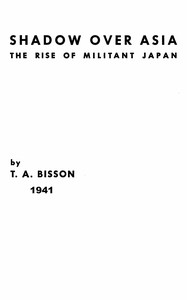
Shadow over Asia : The rise of militant Japan by T. A. Bisson
QR code
"Shadow over Asia" by T. A. Bisson is a historical analysis written in the early 20th century. It examines the rise of militant Japan and its drive to dominate “Greater East Asia,” linking the 1940 Axis pact to deeper currents in Japan’s geography, social structure, industrialization, and imperial ambition. The work traces how elite rule, military power, and economic pressures combined to shape Japan’s expansionist policy and to cast a strategic shadow
over Asia. The opening of the work frames Japan’s 1940 alliance with Germany and Italy as the culmination of a long trajectory that began with the 1931 seizure of Manchuria and now targets “Greater East Asia,” a vast, largely colonial region of immense population and resources. It argues that to understand Japan’s present aims one must grasp its past: the island geography; mixed origins of the people; early clan theocracy under Shinto; the selective borrowing from China that preserved hereditary privilege; and the later feudal era that ended in unification and, after a brief outward surge, two centuries of seclusion tempered by limited Dutch contact. The narrative then tracks the 19th‑century reopening under Western pressure, the “unequal treaties,” and how anti‑foreign agitation helped topple the shogunate and restore the Emperor. Meiji reforms centralized power, abolished feudal domains, created a conscript army, and—through state-guided industrialization and partnerships with emerging business houses—built modern industry while impoverishing many samurai and peasants. Politically, Ito’s 1889 constitution enshrined imperial divinity and entrenched oligarchic organs (Genro, Privy Council, House of Peers, and a semi-autonomous military) that overshadowed the elected lower house. Abroad, Japan revised the treaties, fought China and Russia, annexed Korea, leveraged World War I for gains in Shantung and Pacific islands, then accepted Washington Conference limits while consolidating economic advances. The section closes with the 1920s swing to party cabinets, the London Naval Treaty, the shock of the Depression, and the 1931 Manchurian coup—events that topple the liberals and usher in army extremists. (This is an automatically generated summary.)
Download for free
For your e-reader or reading app — Kindle, Kobo, Apple Books, Calibre etc.
Kindle → Use Send-to-Kindle
Kobo, Nook etc. → Transfer via USB
Phone, tablet or computer → Open in a reading app
Other formats & older devices
There may be more files related to this item.
About this eBook
| Author | Bisson, T. A. (Thomas Arthur), 1900-1979 |
|---|---|
| LoC No. | 41010116 |
| Title | Shadow over Asia : The rise of militant Japan |
| Original Publication | New York: The Foreign Policy Association, 1941. |
| Credits | Aaron Adrignola, Tim Lindell, Craig Kirkwood, and the Online Distributed Proofreading Team at www.pgdp.net (This book was produced from images made available by the HathiTrust Digital Library.) |
| Language | English |
| LoC Class | DS: History: General and Eastern Hemisphere: Asia |
| Subject | Eastern question (Far East) |
| Subject | Japan -- Politics and government |
| Subject | Japan -- Foreign relations |
| Category | Text |
| eBook-No. | 78440 |
| Release Date | Apr 13, 2026 |
| Copyright | Public domain in the USA. |
| Downloads | 222 downloads in the last 30 days. |
Project Gutenberg eBooks are always free!