
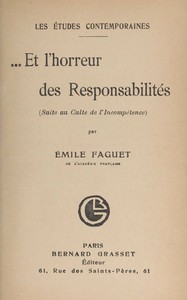
... Et l'horreur des responsabilités (suite au Culte de l'incompétence) by Faguet
QR code
"... Et l''horreur des responsabilités (suite au Culte de l''incompétence)" by Faguet is a political and legal essay written in the early 20th century. It contends that modern French institutions are consciously arranged to evade responsibility, with special emphasis on how the judiciary and public life shift blame onto laws, superiors, and the state. The work continues the author’s broader critique of civic incompetence by examining law, professions, family, and social customs
through a sharp, polemical lens. The opening of the treatise argues that the French strive to be irresponsible and first targets legal ideas and customs. It claims that, since the Revolution, judges are reduced to automatic applicators of statutes, shedding moral responsibility, unlike the old French magistrates, English judges, or Roman praetors who shaped law and felt its burdens. Beccaria’s case for strict textualism is invoked to show how fear of “the spirit of the law” also shelters judges from blame. The author defends the Ancien Régime’s sale of judicial offices (following Montesquieu and La Beaumelle against Voltaire) as a paradoxical guarantee of independence, and argues the Revolution annexed justice to the executive, making government the true judge. He then illustrates politicized judging: the Paris court’s condemnation of Cardinal Luçon, allegedly based on ministry assurances and a distorted quotation, and the 1906 Court of Cassation in the Dreyfus affair, said to have inverted a legal article to avoid a new court-martial—thus appeasing power while keeping the case unresolved. The narrative widens to show executive and parliamentary encroachment, the sway of deputies and local “governments,” and echoes of Guizot and Poincaré on the danger of politics in the courts. In sum, the beginning portrays a judiciary doubly shielded—by literalism and by obedience—leaving justice in the hands of an irresponsible authority. (This is an automatically generated summary.)
Download for free
For your e-reader or reading app — Kindle, Kobo, Apple Books, Calibre etc.
Kindle → Use Send-to-Kindle
Kobo, Nook etc. → Transfer via USB
Phone, tablet or computer → Open in a reading app
Other formats & older devices
There may be more files related to this item.
About this eBook
| Author | Faguet, Émile, 1847-1916 |
|---|---|
| Title | ... Et l'horreur des responsabilités (suite au Culte de l'incompétence) |
| Original Publication | Paris: Bernard Grasset, 1929. |
| Series Title | Les études contemporaines |
| Credits | Laurent Vogel (This file was produced from images generously made available by the Bibliothèque nationale de France (BnF/Gallica)) |
| Language | French |
| LoC Class | JC: Political science: Political theory |
| Subject | Democracy |
| Subject | National characteristics, French |
| Subject | Responsibility |
| Subject | Justice, Administration of -- France |
| Subject | Aristocracy (Political science) |
| Category | Text |
| eBook-No. | 77110 |
| ISBN (HTML) | 979-8-238-77110-6 |
| Release Date | Oct 22, 2025 |
| Copyright | Public domain in the USA. |
| Downloads | 309 downloads in the last 30 days. |
Project Gutenberg eBooks are always free!