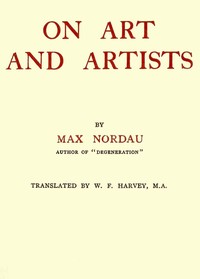
On art and artists by Max Simon Nordau
QR code
"On art and artists" by Max Simon Nordau is a collection of art criticism essays written in the early 20th century. The work contends that art has an essential social mission, rejecting “art for art’s sake,” and argues that modern, democratic societies need art that dignifies labor and expands the inner life stunted by specialization. It combines theory with incisive case studies—from medieval French painters to modern sculptors and realists—to show how
art has served religion, power, and, increasingly, the public, while critiquing fashionable movements that mistake novelty for substance. The opening of this work lays out a psychological and historical case against pure aestheticism: early art (from cave drawings to children’s sketches) may spring from private impulse, but as civilization develops, artists address audiences, patrons, and social needs. The author surveys how ancient, medieval, and Renaissance art served gods, rulers, and institutions; how modern criticism and public exhibitions shifted authority to critics and the crowd; and why, in an industrial age of extreme specialization, art should restore wholeness and self-respect—especially by ennobling work rather than wallowing in grim realism. He proposes “socialistic art” that arouses pity for the disinherited and reverence for honest labor, exemplified through vivid readings of Constantin Meunier’s miners, smiths, and reapers (while noting a few missteps), and links this to Millet’s moral gravity. A subsequent essay dissects style as the tension between construction (utility) and decoration (luxury), praising organic, meaning-rich ornament and critiquing mindless imitation and derivative “Secessionist” fashion. The opening then revisits medieval French masters, challenging the myth that French art merely copied Flemish or Italian models, highlighting naturalism in manuscript-derived painting, the greatness of Fouquet and the Master of Moulins, and the subtle, proto-revolutionary realism latent in sacred scenes, before turning to a century survey that begins to reassess eighteenth-century painters against the politics of taste. (This is an automatically generated summary.)
Download for free
For your e-reader or reading app — Kindle, Kobo, Apple Books, Calibre etc.
Kindle → Use Send-to-Kindle
Kobo, Nook etc. → Transfer via USB
Phone, tablet or computer → Open in a reading app
Other formats & older devices
There may be more files related to this item.
About this eBook
| Author | Nordau, Max Simon, 1849-1923 |
|---|---|
| Translator | Harvey, William Frederick, 1853- |
| LoC No. | 07028523 |
| Title | On art and artists |
| Original Publication | London: T. Fisher Unwin, 1907. |
| Contents | The social mission of art -- Socialistic art: Constantin Meunier -- The question of style -- The old French masters -- A century of French art -- The school of 1830 -- The triumph of a revolution: The realists. Alfred Sisley. Camille Pissarro. Whistler's Psychology -- Gustave Moreau -- Eugène Carrière -- Puvis de Chavannes -- Bright and dark painting: Charles Cottet -- Physiognomies in painting -- Auguste Rodin -- Resurrection: Bartholomé -- Jean Carriès -- Works of art and art criticisms -- My own opinion. |
| Credits | Sean/IB@DP |
| Language | English |
| LoC Class | N: Fine Arts |
| Subject | Art |
| Subject | Degeneration |
| Subject | Art -- France -- History |
| Category | Text |
| eBook-No. | 76748 |
| ISBN (HTML) | 979-8-238-76748-2 |
| Release Date | Aug 28, 2025 |
| Last Update | Dec 12, 2025 |
| Copyright | Public domain in the USA. |
| Downloads | 503 downloads in the last 30 days. |
Project Gutenberg eBooks are always free!