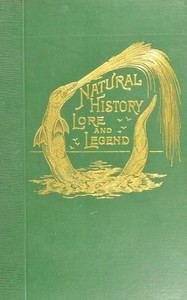
Natural history, lore and legend : Being some few examples of quaint and by-…
QR code
"Natural history, lore and legend" by F. Edward Hulme is a historical survey written in the late 19th century. It explores how ancient and medieval writers understood animals and nature—balancing medical uses, moral symbolism, and travellers’ reports—alongside legends of real and mythical creatures. Expect respectful reassessment of “travellers’ tales,” bestiaries, and heraldic lore, with frequent citations from Pliny, Aristotle, Maundevile, and other authorities. The opening of this survey argues that medieval naturalists
were honest seekers after truth, even if credulous, and notes how later discoveries have vindicated some disputed reports. Hulme contrasts modern, descriptive zoology with earlier aims—healing the body and saving the soul—illustrated by moral readings of animals from works like the Speculum Mundi (e.g., the crafty polypus, the mole that “opens its eyes” at death). He samples astrological medicine and bizarre recipes (protective staves, “Venice treacle”), then shows the “unchanging East” through Jordanus (Towers of Silence, suttee) and Maundevile (Juggernaut processions, artificial incubation, carrier pigeons, bound feet), and notes Burton’s early account of coca. A substantial survey of Pliny’s Natural History outlines its vast scope, sources, and influence, with Aristotle and other classical writers alongside the medieval reliance on travel books, medical handbooks, bestiaries, armories, and poets. Hulme delights in old cosmographies and maps crammed with monsters (Munster), weighs Marco Polo’s comparative sobriety against more fanciful geographers, and glances at Raleigh, Hakluyt, Purchas, Struys, and Acosta. He also samples remedies and student life from Cogan and Potter, and the ecclesiastical bestiaries of Guillaume and Philip de Thaun with their emblematic morals, plus heraldic manuals by Guillim and others. At the start of the second chapter, he turns to pygmies—classical testimonies, crane wars, Browne’s skepticism, Maundevile’s and Jordanus’s reports, Marco Polo’s counterfeit “pygmies”—and notes modern confirmations of dwarf peoples before introducing Aldrovandus’s extravagant “monsters.” (This is an automatically generated summary.)
Download for free
For your e-reader or reading app — Kindle, Kobo, Apple Books, Calibre etc.
Kindle → Use Send-to-Kindle
Kobo, Nook etc. → Transfer via USB
Phone, tablet or computer → Open in a reading app
Other formats & older devices
There may be more files related to this item.
About this eBook
| Author | Hulme, F. Edward (Frederick Edward), 1841-1909 |
|---|---|
| LoC No. | 04006301 |
| Title | Natural history, lore and legend : Being some few examples of quaint and by-gone beliefs gathered in from divers authorities, ancient and mediæval, of varying degrees of reliability |
| Original Publication | London: Bernard Quaritch, 1895. |
| Credits | Tim Lindell, Turgut Dincer and the Online Distributed Proofreading Team at www.pgdp.net (This file was produced from images generously made available by The Internet Archive) |
| Language | English |
| LoC Class | QL: Science: Zoology |
| Subject | Science -- History |
| Subject | Zoology -- History |
| Subject | Animals, Mythical |
| Subject | Monsters |
| Category | Text |
| eBook-No. | 77830 |
| Release Date | Feb 1, 2026 |
| Copyright | Public domain in the USA. |
| Downloads | 500 downloads in the last 30 days. |
Project Gutenberg eBooks are always free!