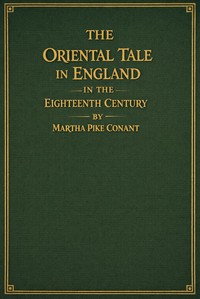
The Oriental tale in England in the eighteenth century by Martha Pike Conant
QR code
"The Oriental tale in England in the eighteenth century" by Martha Pike Conant is a scholarly monograph in comparative literature written in the early 20th century. It traces how “oriental” and pseudo‑oriental fiction took shape in eighteenth‑century England—largely through French translations and imitations—within the wider shift from classicism toward Romanticism. The study highlights pivotal works such as the Arabian Nights, Johnson’s Rasselas, Goldsmith’s Citizen of the World, and Beckford’s Vathek, organizing the
corpus into imaginative, moralistic, philosophic, and satiric strands. It offers an analytic survey supported by a chronological table, notes, and a substantial bibliography. The opening of this monograph lays out its aim and limits—eschewing source‑hunting in Eastern languages to focus on English reception and French mediation—defines “oriental,” and sets the period from the English emergence of the Arabian Nights to the appearance of Vathek, distinguishing this phase from later scholarly Orientalism. After sketching earlier European and English antecedents, it mirrors the French craze (Galland, Pétis de la Croix, Perrault) and proposes four English groupings. Chapter I then surveys the “imaginative” tales: it analyzes the Arabian Nights (frame‑tale, magical atmosphere, vivid incident, weak characterization), contrasts it with the more sentimental and fantastical Persian Tales (Thousand and One Days), and outlines the satiric Sendebar‑based Turkish Tales. It reviews a wave of pseudo‑translations (Three Princes of Serendip; Gueullette’s Chinese/Mogul/Tartarian collections), notes their extravagance and European borrowings, and shows how Bignon’s Abdalla and Gueullette’s imagery fed Beckford. It touches minor currents—lingering heroic romances, realistic travel/captivity pieces, and “oriental eclogues” by Collins, Chatterton, and Scott—then treats Charoba (the source of Landor’s Gebir). The section culminates in an extended reading of Vathek, praising the Hall of Eblis for its sustained terror and rich oriental color while faulting the book’s mockery, sensuality, and thin characterization, and situating it as a brilliant synthesis rather than an anomaly. (This is an automatically generated summary.)
Download for free
For your e-reader or reading app — Kindle, Kobo, Apple Books, Calibre etc.
Kindle → Use Send-to-Kindle
Kobo, Nook etc. → Transfer via USB
Phone, tablet or computer → Open in a reading app
Other formats & older devices
There may be more files related to this item.
About this eBook
| Author | Conant, Martha Pike, 1868-1930 |
|---|---|
| LoC No. | 08003276 |
| Title | The Oriental tale in England in the eighteenth century |
| Original Publication | New York: Columbia University Press, 1908. |
| Series Title | Columbia University studies in comparative literature |
| Credits | Richard Tonsing, Tim Lindell, and the Online Distributed Proofreading Team at www.pgdp.net (This file was produced from images generously made available by The Internet Archive/Canadian Libraries) |
| Language | English |
| LoC Class | PR: Language and Literatures: English literature |
| Subject | English fiction -- 18th century -- History and criticism |
| Subject | English literature -- Asian influences |
| Subject | Orient -- In literature |
| Subject | Orientalism in literature |
| Subject | Oriental literature -- Translations into English -- History and criticism |
| Category | Text |
| eBook-No. | 77806 |
| Release Date | Jan 29, 2026 |
| Copyright | Public domain in the USA. |
| Downloads | 1454 downloads in the last 30 days. |
Project Gutenberg eBooks are always free!