
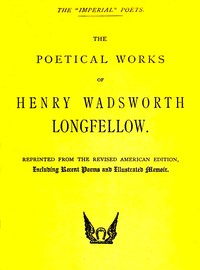
The poetical works of Henry Wadsworth Longfellow by Henry Wadsworth Longfellow
QR code
The Song of Hiawatha is an 1855 epic poem in trochaic tetrameter by Henry Wadsworth Longfellow which features Native American characters. The epic relates the fictional adventures of an Ojibwe warrior named Hiawatha and the tragedy of his love for Minnehaha, a Dakota woman. Events in the story are set in the Pictured Rocks area of Michigan on the south shore of Lake Superior. Longfellow's poem is based on oral traditions surrounding
the figure of Manabozho, but it also contains his own innovations. Longfellow drew some of his material from his friendship with Ojibwe chief Kahge-ga-gah-bowh (George Copway), who would visit Longfellow's home. He also had frequent encounters with Black Hawk and other Sauk people on Boston Common, and he drew from Algic Researches (1839) and other writings by Henry Rowe Schoolcraft, an ethnographer and United States Indian agent, and from Heckewelder's Narratives. In sentiment, scope, overall conception, and many particulars, Longfellow insisted, "I can give chapter and verse for these legends. Their chief value is that they are Indian legends." Longfellow had originally planned on following Schoolcraft in calling his hero Manabozho, the name in use at the time among the Ojibwe of the south shore of Lake Superior for a figure of their folklore who was a trickster and transformer. But he wrote in his journal entry for June 28, 1854: "Work at 'Manabozho;' or, as I think I shall call it, 'Hiawatha'—that being another name for the same personage." Longfellow was following Schoolcraft, but he was mistaken in thinking that the names were synonymous. The name Hiawatha is derived from a pre-colonial figure associated with the League of the Iroquois, then located in New York and Pennsylvania. The popularity of Longfellow's poem nevertheless led to the name "Hiawatha" becoming associated with a number of locales and enterprises in the Great Lakes region. (This summary is from Wikipedia.)
Download for free
For your e-reader or reading app — Kindle, Kobo, Apple Books, Calibre etc.
Kindle → Use Send-to-Kindle
Kobo, Nook etc. → Transfer via USB
Phone, tablet or computer → Open in a reading app
Other formats & older devices
There may be more files related to this item.
About this eBook
| Author | Longfellow, Henry Wadsworth, 1807-1882 |
|---|---|
| Title | The poetical works of Henry Wadsworth Longfellow |
| Original Publication | London: Frederick Warne and Co., 1889. |
| Note | Wikipedia page about this book: en.wikipedia.org/wiki/The_Song_of_Hiawatha |
| Credits | Chuck Greif and the Online Distributed Proofreading Team at www.pgdp.net (This file was produced from images generously made available by The Internet Archive) |
| Summary |
The Song of Hiawatha is an 1855 epic poem in trochaic tetrameter by Henry Wadsworth Longfellow which features Native American characters. The epic relates the fictional adventures of an Ojibwe warrior named Hiawatha and the tragedy of his love for Minnehaha, a Dakota woman. Events in the story are set in the Pictured Rocks area of Michigan on the south shore of Lake Superior. Longfellow's poem is based on oral traditions surrounding the figure of Manabozho, but it also contains his own innovations. Longfellow drew some of his material from his friendship with Ojibwe chief Kahge-ga-gah-bowh (George Copway), who would visit Longfellow's home. He also had frequent encounters with Black Hawk and other Sauk people on Boston Common, and he drew from Algic Researches (1839) and other writings by Henry Rowe Schoolcraft, an ethnographer and United States Indian agent, and from Heckewelder's Narratives. In sentiment, scope, overall conception, and many particulars, Longfellow insisted, "I can give chapter and verse for these legends. Their chief value is that they are Indian legends." Longfellow had originally planned on following Schoolcraft in calling his hero Manabozho, the name in use at the time among the Ojibwe of the south shore of Lake Superior for a figure of their folklore who was a trickster and transformer. But he wrote in his journal entry for June 28, 1854: "Work at 'Manabozho;' or, as I think I shall call it, 'Hiawatha'—that being another name for the same personage." Longfellow was following Schoolcraft, but he was mistaken in thinking that the names were synonymous. The name Hiawatha is derived from a pre-colonial figure associated with the League of the Iroquois, then located in New York and Pennsylvania. The popularity of Longfellow's poem nevertheless led to the name "Hiawatha" becoming associated with a number of locales and enterprises in the Great Lakes region. (This summary is from Wikipedia.) |
| Language | English |
| LoC Class | PS: Language and Literatures: American and Canadian literature |
| Subject | American poetry -- 19th century |
| Category | Text |
| eBook-No. | 78406 |
| ISBN (HTML) | 979-8-238-78406-9 |
| Release Date | Apr 9, 2026 |
| Copyright | Public domain in the USA. |
| Downloads | 612 downloads in the last 30 days. |
Project Gutenberg eBooks are always free!