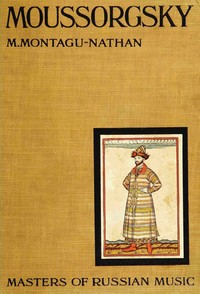
Moussorgsky by M. Montagu-Nathan
QR code
"Moussorgsky" by M. Montagu-Nathan is a biographical and critical study written in the early 20th century. It presents Modeste Moussorgsky as a pioneering Russian composer, outlining his aesthetics of Truth, Freedom, and Progress, and positioning him within the nationalist “Five.” The study surveys his life, major operas, songs, and instrumental works, and argues for his originality beyond the distortions of early, uncharacteristic receptions. The opening of the book sets out Moussorgsky’s aesthetic
credo—art as a truthful, evolving expression of humanity, free of rigid forms and created with absolute sincerity—contrasting his sparse statements with Wagner’s voluminous essays and correcting British misconceptions formed from unrepresentative pieces. It then traces his early life and folklore-rich upbringing, strong piano training, and “conversion” from salon dilettantism to serious national art under Dargomijsky, Balakiref, Cui, and Borodin. We see initial studies and orchestral attempts, a decisive break from the army, and the first operatic efforts (the abandoned “Salammbô” and the boldly realistic, prose-set “The Matchmaker”). The narrative turns to “Boris Godounof”: its first version, rejection, major revision (adding the Polish act and Kromy ending), and a triumphant but short-lived 1874 staging amid critical hostility. Alongside come satirical songs against reactionary critics, the child-world cycle “The Nursery,” and “Pictures at an Exhibition.” The account also covers the slow, research-heavy birth of “Khovanshchina,” fragments of “Sorochinsk Fair,” the introspective cycles “Without Sunlight” and “Songs and Dances of Death,” and the composer’s decline into poverty and alcoholism leading to his death in the early 1880s, with Rimsky-Korsakof later editing his scores. The section that follows begins the critical appraisal of his operatic method—chorus as protagonist, speech-inflected melody, sparing motives, and strict dramatic truth—illustrated through concise synopses and musical commentary on “Boris Godounof” and the historical-religious canvas of “Khovanshchina” up to the early scenes of its fourth act. (This is an automatically generated summary.)
Download for free
For your e-reader or reading app — Kindle, Kobo, Apple Books, Calibre etc.
Kindle → Use Send-to-Kindle
Kobo, Nook etc. → Transfer via USB
Phone, tablet or computer → Open in a reading app
Other formats & older devices
There may be more files related to this item.
About this eBook
| Author | Montagu-Nathan, M. (Montagu), 1877-1958 |
|---|---|
| LoC No. | 17021122 |
| Title | Moussorgsky |
| Original Publication | London: Constable and Company Limited, 1916. |
| Series Title | Masters of Russian music |
| Credits | Carol Brown, Tim Miller and the Online Distributed Proofreading Team at www.pgdp.net (This file was produced from images generously made available by The Internet Archive) |
| Language | English |
| LoC Class | ML: Music: Literature of music |
| Subject | Composers -- Russia -- Biography |
| Subject | Mussorgsky, Modest Petrovich, 1839-1881 |
| Category | Text |
| eBook-No. | 77855 |
| ISBN (HTML) | 979-8-238-77855-6 |
| Release Date | Feb 3, 2026 |
| Copyright | Public domain in the USA. |
| Downloads | 348 downloads in the last 30 days. |
Project Gutenberg eBooks are always free!