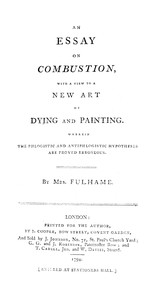
An essay on combustion, with a view to a new art of dying and painting…
QR code
"An essay on combustion, with a view to a new art of dying and painting" by Fulhame is a scientific treatise written in the late 18th century. It investigates combustion, oxidation, and reduction through meticulous experiments, challenges both phlogistic and antiphlogistic accounts, and proposes practical methods for depositing metals onto textiles for artistic and cartographic use. The work argues that water’s hydrogen drives reductions and that water is central to oxygenation, tying
chemical theory to a proposed new art of dyeing and painting. The opening of the treatise presents a preface recounting the author’s long pursuit of making gold and silver cloth by chemical means, its application to painting and to maps with silvered rivers and golden cities, the mixed reception of her specimens, and her decision to publish despite the lack of patrons and fear of plagiarism. She describes her simple apparatus, adopts the French chemical nomenclature, and pointedly answers expected criticism—especially toward a woman conducting scientific work. The introduction surveys major theories of combustion (from Becher and Stahl to Lavoisier, Macquer, Scheele, and Kirwan), critiques their complexity, and advances her thesis that water is the source of oxygen in oxidations and that hydrogen from water is the universal reducer. At the start of the experimental chapters, she uses silk impregnated with metal salts and streams of gases to show that hydrogen gas reduces many metals at ambient temperature, that vivid color changes track degrees of oxygenation, and—crucially—that moisture is essential, leading her to a double-affinity explanation via water’s decomposition. She then shows with phosphorus (in ether solution or as vapor) that reductions of gold, silver, and other metals occur only when water is present, reinforcing the same mechanism. The opening of the sulfur chapter demonstrates that sulfurous vapors rapidly reduce several metals on wet silk (notably yielding brilliant gold), before the excerpt breaks off mid-experiment. (This is an automatically generated summary.)
Download for free
For your e-reader or reading app — Kindle, Kobo, Apple Books, Calibre etc.
Kindle → Use Send-to-Kindle
Kobo, Nook etc. → Transfer via USB
Phone, tablet or computer → Open in a reading app
Other formats & older devices
There may be more files related to this item.
About this eBook
| Author | Fulhame, Mrs. (Elizabeth), active 1780-1810 |
|---|---|
| LoC No. | 15021915 |
| Title | An essay on combustion, with a view to a new art of dying and painting : Wherein the phlogistic and antiphlogistic hypotheses are proven erroneous |
| Original Publication | London: Elizabeth Fulhame, 1794. |
| Credits | MWS, Chris Miceli, and the Online Distributed Proofreading Team at www.pgdp.net (This file was produced from images generously made available by The Internet Archive) |
| Language | English |
| LoC Class | QD: Science: Chemistry |
| Subject | Chemistry |
| Category | Text |
| eBook-No. | 77630 |
| Release Date | Jan 6, 2026 |
| Copyright | Public domain in the USA. |
| Downloads | 301 downloads in the last 30 days. |
Project Gutenberg eBooks are always free!