
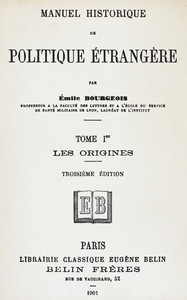
Manuel historique de politique étrangère, tome Ier [de 4] : les origines
QR code
"Manuel historique de politique étrangère, tome Ier [de 4]" by Émile Bourgeois is a historical manual written in the late 19th century. It presents the origins of modern Europe to ground French foreign policy in historical understanding, emphasizing the fractures of the Reformation, the rise of sovereign states, colonial expansion, the Eastern Question, and the balance-of-power struggles that crystallize around Richelieu’s diplomacy. The work positions itself as civic education rather than a
technical guide for diplomats. The opening of this volume sets out its aim: France, now responsible for its own destiny, must study history to choose and keep its rightful place in the world; the book therefore serves as a tool of public instruction. A brief notice for the second edition explains the research burden of correcting partisan judgments and welcomes France’s turn toward an interest-driven foreign policy. The long introduction sketches the making of modern Europe not simply from the fall of Constantinople but from the twin forces of Reformation and overseas expansion, which shattered religious unity while empowering absolutist states; it contrasts maritime colonial drives with the enduring Eastern Question and highlights Russia’s rise as a Byzantine-tinged continuation of medieval frontier expansion. The narrative then moves to Richelieu: facing a near-encirclement by the Habsburgs, he rebuilds alliances, contests Spanish-Imperial control of Alpine passes (Valtellina), and, despite internal crises (Huguenot revolts, court conspiracies, La Rochelle), intervenes decisively in the Mantuan succession. By taking Pinerolo, relieving Casale, forging an Italian league, and securing the Treaty of Cherasco, he breaks Spanish designs in northern Italy and pries the German Catholic League away from Spanish direction (Treaty of Fontainebleau). The section closes as Gustavus Adolphus, subsidized by France but pursuing his own Protestant and Baltic ambitions, complicates Richelieu’s careful balance, with French envoys struggling to restrain Swedish overreach while preserving the broader anti-Habsburg alignment. (This is an automatically generated summary.)
Download for free
For your e-reader or reading app — Kindle, Kobo, Apple Books, Calibre etc.
Kindle → Use Send-to-Kindle
Kobo, Nook etc. → Transfer via USB
Phone, tablet or computer → Open in a reading app
Other formats & older devices
There may be more files related to this item.
About this eBook
| Author | Bourgeois, Émile, 1857-1934 |
|---|---|
| Title | Manuel historique de politique étrangère, tome Ier [de 4] : les origines |
| Edition | Troisième édition |
| Original Publication | Paris: Eugène Belin, 1901. |
| Credits | Laurent Vogel and the Online Distributed Proofreading Team at www.pgdp.net (This book was produced from scanned images of public domain material from the Google Books project.) |
| Language | French |
| LoC Class | D: History: General and Eastern Hemisphere |
| Subject | Europe -- Politics and government |
| Subject | France -- Foreign relations |
| Category | Text |
| eBook-No. | 77291 |
| ISBN (HTML) | 979-8-238-77291-2 |
| Release Date | Nov 22, 2025 |
| Copyright | Public domain in the USA. |
| Downloads | 315 downloads in the last 30 days. |
Project Gutenberg eBooks are always free!