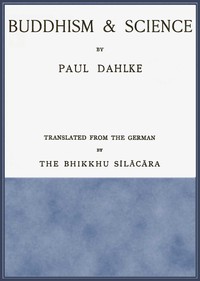
Buddhism & science by Paul Dahlke
QR code
"Buddhism & science" by Paul Dahlke is a philosophical treatise written in the early 20th century. It argues that Buddhism provides a rigorous world-theory that surpasses both faith-based religion and mechanistic science by grounding meaning, morality, and knowledge in direct insight into actuality. The work develops a Buddhist account of causality, consciousness, karma, and rebirth, and sets this framework against questions in physics, biology, and cosmology. The opening of the treatise declares
its purpose and audience: it seeks thinking readers dissatisfied with both dogmatic belief and purely technical science, and it frames three perennial questions—What am I? How should I act? To what end am I here? It contends that morality and religion must be functions of cognition, not mere emotion, and that neither faith (which posits a transcendent “adequate cause in itself”) nor science (which restricts itself to the sensible and the mechanical) can answer these questions. The author critiques faith as contrary to sense and ultimately selfish in motivation, and portrays science as amoral, limited to re-actual (measurable) processes, and incapable of providing existential support. He then introduces the Buddha’s “teaching of actuality,” situating it historically and linguistically, and emphasizing its radical, experiential grasp of transience and suffering. The doctrinal core begins by placing the Buddha between faith and science: all phenomena are conditioned (Sankhāra); living processes require real, non-sensible energies; individuality is an “in-force” (Kamma) expressed through the five aggregates and disclosed as consciousness, without a permanent self (anattā). With the Fire Sermon’s “all is burning” as motif, the text explains volitional action as a self-sustaining process, develops dependent arising, and presents rebirth as the continuity of Kamma via consciousness linking existences—beginningless, personal, and non-identical from life to life. (This is an automatically generated summary.)
Download for free
For your e-reader or reading app — Kindle, Kobo, Apple Books, Calibre etc.
Kindle → Use Send-to-Kindle
- Download the EPUB3 file above
- Upload it on the Amazon site your Kindle is registered with: amazon.com/sendtokindle for the US, amazon.co.uk/sendtokindle for the UK etc.
- It appears on your Kindle and in the Kindle app
Kobo, Nook etc. → Transfer via USB
- Download the EPUB3 file on your computer
- Connect your e-reader by USB and tap "Connect" on its screen
- Drag the file onto the e-reader drive
Phone, Tablet or Computer → Online or Reading App
Easiest: read online in your browser. Nothing to install.
Or use a reading app:
- Find and install one you like, for example Apple Books, ReadEra or Thorium Reader
- Download the EPUB3 file above
- Open it in the app
More help: iPhone / iPad · Android · Computer
Other formats & older devices
There may be more files related to this item.
About this eBook
| Author | Dahlke, Paul, 1865-1928 |
|---|---|
| Translator | Sīlāchāra, Bhikkhu, 1871-1951 |
| LoC No. | 43029661 |
| Title | Buddhism & science |
| Alternate Title | Buddhism and science |
| Original Publication | London: Macmillan and Co., 1913. |
| Contents | Introduction -- What is a world-theory and is it necessary? -- Faith and a world-theory -- Science and a world-theory -- An introduction to the thought-world of the Buddha Gotama -- The doctrine of the Buddha -- Buddhism as a working hypothesis -- Buddhism and the problem of physics -- Buddhism and the problem of physiology -- Buddhism and the problem of biology -- Buddhism and the cosmological problem -- Buddhism and the problem of thought -- Conclusion. |
| Credits | Sean/IB@DP |
| Language | English |
| LoC Class | BQ: Philosophy, Psychology, Religion: Buddhism |
| Subject | Science -- Philosophy |
| Subject | Buddhism and science |
| Category | Text |
| eBook-No. | 77146 |
| ISBN (HTML) | 979-8-238-77146-5 |
| Release Date | Oct 29, 2025 |
| Copyright | Public domain in the USA. |
| Downloads | 364 downloads in the last 30 days. |
Project Gutenberg eBooks are always free!