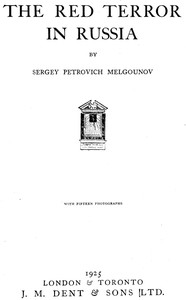
The red terror in Russia by S. P. Melʹgunov
QR code
The red terror in Russia by S. P. Melʹgunov is a historical account written in the early 20th century. It examines how the Bolshevik state built and justified a machinery of repression—above all the Cheka—through hostages, mass executions, and ideological calls for “Red Terror.” Drawing on decrees, press appeals, eyewitness testimony, and case material from across Russia and Ukraine, the study argues that terror was a deliberate policy rather than a spontaneous
outburst of popular rage. The opening of the book presents a translator’s note and a brief portrait of the author as a historian-activist persecuted by the Soviet regime, then moves to an introduction in which the narrator rejects individual terrorism after a café interlocutor asks why no one kills Bolshevik leaders—arguing that such acts would only trigger mass reprisals against hostages. Chapter I details how, following early attacks on Bolshevik officials, the state institutionalized hostage-taking and retaliatory shootings, vividly depicting nights of fear in Moscow’s Butyrka prison and similar reprisals across the provinces, including women and children among the victims; even Peter Kropotkin’s protest against hostage policy is cited. Chapter II challenges the official claim that terror was “forced” by enemies, tracing the swift restoration of the death penalty, summary orders to shoot, and press exhortations to “answer blood with blood,” culminating in Petrovsky’s directive to employ mass terror and the rise of a nationwide Cheka network that eclipsed the soviets. The beginning of Chapter III defines the Cheka as an organ for destroying enemies rather than judging them, quotes Latzis’s class-based test for guilt, and disputes official statistics by pointing to underreported massacres and crackdowns on strikes and revolts from Kiev and Odessa to Astrakhan and Turkestan. (This is an automatically generated summary.)
Download for free
For your e-reader or reading app — Kindle, Kobo, Apple Books, Calibre etc.
Kindle → Use Send-to-Kindle
Kobo, Nook etc. → Transfer via USB
Phone, tablet or computer → Open in a reading app
Other formats & older devices
There may be more files related to this item.
About this eBook
| Author | Melʹgunov, S. P. (Sergeĭ Petrovich), 1879-1956 |
|---|---|
| Translator | Hogarth, C. J. (Charles James), 1869-1942 |
| Uniform Title | Krasnyĭ terror v Rossii. English |
| Title | The red terror in Russia |
| Original Publication | London: J.M. Dent & sons, 1925. |
| Credits | Peter Becker, Karin Spence and the Online Distributed Proofreading Team at www.pgdp.net (This file was produced from images generously made available by The Internet Archive) |
| Language | English |
| LoC Class | DK: History: General and Eastern Hemisphere: Russia, Former Soviet Republics, Poland |
| Subject | Soviet Union -- History -- Revolution, 1917-1921 -- Personal narratives |
| Subject | Melʹgunov, S. P. (Sergeĭ Petrovich), 1879-1956 |
| Subject | Russian S.F.S.R. Chrezvychaĭnaia komissiia po borʹbe s kontr-revoliutsieĭ i sabotazhem |
| Subject | Soviet Union -- History -- Revolution, 1917-1921 -- Atrocities |
| Category | Text |
| eBook-No. | 77104 |
| ISBN (HTML) | 979-8-238-77104-5 |
| Release Date | Oct 21, 2025 |
| Copyright | Public domain in the USA. |
| Downloads | 1468 downloads in the last 30 days. |
Project Gutenberg eBooks are always free!