
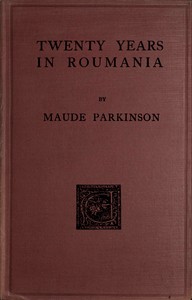
Twenty years in Roumania by Maude Rea Parkinson
QR code
"Twenty years in Roumania" by Maude Rea Parkinson is a memoir of travel and social observation written in the early 20th century. Drawing on decades spent teaching and moving in Romanian society, it offers an intimate, often humorous portrait of the country’s people, institutions, and landscape, from the capital’s salons to village greens. Expect first-hand sketches of geography, politics, religion, and custom, framed by the author’s affectionate yet candid outlook. The opening
of the memoir sets out the author’s purpose and loyalties, then follows her youthful decision to settle in Bucarest, her arduous journey via Vienna and Hungary, and her bracing first impressions of the city. It quickly widens into a clear, informal guide to the country—its mountains, rivers, railways, and the drama of the Danube—before turning to parliament, raucous elections, and a stiff but brave army shaped by the monarchy. The religious life of the Greek Orthodox majority appears through priests’ rounds, Easter rites, and the legend of Curtea d’Argesh. Bucarest is sketched as a garden-like capital of trams, the Calea Victoriei, splendid churches, and domestic habits like serving “dulceata,” followed by a stark account of land tenure, peasant hardship, and a violent rural rising that drew troops to the countryside and anxiety to the capital, where she notably kept her nerve by going to church. The section then lingers on village life—music, the hora and sârba, embroidered dress, rustic weddings, and evening songs—while noting how townsfolk sometimes exploit peasant naivety. It closes by segueing into a discussion of trade and commerce. (This is an automatically generated summary.)
Download for free
For your e-reader or reading app — Kindle, Kobo, Apple Books, Calibre etc.
Kindle → Use Send-to-Kindle
Kobo, Nook etc. → Transfer via USB
Phone, tablet or computer → Open in a reading app
Other formats & older devices
There may be more files related to this item.
About this eBook
| Author | Parkinson, Maude Rea, 1860-1938 |
|---|---|
| LoC No. | 22015191 |
| Title | Twenty years in Roumania |
| Alternate Title | 20 years in Roumania |
| Original Publication | London: George Allen & Unwin, Ltd., 1921. |
| Credits | Peter Becker, Terry Jeffress, and the Online Distributed Proofreading Team at www.pgdp.net (This file was produced from images generously made available by The Internet Archive) |
| Language | English |
| LoC Class | DR: History: General and Eastern Hemisphere: Balkan Peninsula, Turkey |
| Subject | Romania |
| Subject | Romania -- Social life and customs |
| Category | Text |
| eBook-No. | 77048 |
| ISBN (HTML) | 979-8-238-77048-2 |
| Release Date | Oct 13, 2025 |
| Copyright | Public domain in the USA. |
| Downloads | 319 downloads in the last 30 days. |
Project Gutenberg eBooks are always free!