
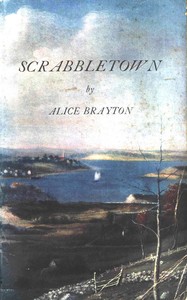
Trading in Scrabbletown by Alice Brayton
QR code
"Trading in Scrabbletown" by Alice Brayton is a historical account written in the mid-20th century. Drawing on a cache of early 19th-century shop papers, it reconstructs the trading world of Scrabbletown (Swansea, Massachusetts) through the life and work of trader Israel Brayton. The focus is on how his company store linked local farms, weavers, and small factories to regional markets, with recurring figures like his wife Keziah, partners John Mason and William
Bowers, and clerk Wheaton Luther. The opening of the book explains the discovery of a barrel of never-published papers and uses them to identify Brayton and his network, then sketches his family background, brief wartime service, and marriage before following his return in 1815 to open a company store tied to the Swansea Union Cotton Manufacturing Company. It shows how he organized home weavers, paid largely in goods, and stocked an astonishing range of supplies sourced from Boston, Providence, and beyond, while juggling credit, counterfeit notes, and shortages. The narrative then follows his expansion to an Egypt (Somerset) branch, additional yarn from the Lyman and Georgia mills, and dealings with the Fall River (Troy) factory, alongside glimpses of community life—poor relief, school governance, church singing, and period reading tastes. A sizable section traces a straw-bonnet venture: placing braid with local young women, pressing and boxing bonnets, and testing markets via trips to Newport, Albany, and New York. It closes with William Bowers in Savannah trying to sell bonnets and textiles on commission, reporting frank market feedback on fashion, sizing, and quality. (This is an automatically generated summary.)
Download for free
For your e-reader or reading app — Kindle, Kobo, Apple Books, Calibre etc.
Kindle → Use Send-to-Kindle
Kobo, Nook etc. → Transfer via USB
Phone, tablet or computer → Open in a reading app
Other formats & older devices
There may be more files related to this item.
About this eBook
| Author | Brayton, Alice, 1878-1972 |
|---|---|
| Title | Trading in Scrabbletown |
| Original Publication | Newport, RI: Ward Printing Company, 1952, pubdate 1953. |
| Credits | Steve Mattern and the Online Distributed Proofreading Team at www.pgdp.net |
| Language | English |
| LoC Class | F001: United States local history: New England |
| Subject | Brayton, Israel, 1792-1866 |
| Subject | Brayton family |
| Subject | Merchants -- Massachusetts -- Scrabbletown -- Biography |
| Subject | Scrabbletown (Mass.) -- Commerce -- History |
| Subject | Scrabbletown (Mass.) -- Biography |
| Category | Text |
| eBook-No. | 77038 |
| ISBN (HTML) | 979-8-238-77038-3 |
| Release Date | Oct 12, 2025 |
| Copyright | Public domain in the USA. |
| Downloads | 489 downloads in the last 30 days. |
Project Gutenberg eBooks are always free!