
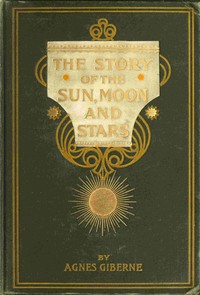
The story of the sun, moon, and stars by Agnes Giberne
QR code
"The story of the sun, moon, and stars" by Agnes Giberne is a popular astronomy primer written in the late 19th century. It introduces beginners to the solar system and the wider universe, explaining the sun, moon, planets, comets, and stars in clear, non-mathematical language. Blending scientific facts, historical notes, and vivid description, it aims to make contemporary astronomy understandable and engaging for general readers. The opening of the book begins with
an admiring introduction by Charles Pritchard praising its simplicity and accuracy for beginners, followed by a contents list that promises a full tour from the solar system to modern methods. It then sets Earth in its true place as one planet among many, distinguishes stars (suns) from planets (worlds reflecting sunlight), and explains Earth’s motions, apparent celestial movements, vast stellar distances, and the zodiac. Next come the sun’s distance and scale, rotation and sun-spots, faculæ, prominences, and corona, with striking imagery of solar storms; a clear account of gravitation and inertia shows how orbits work, and a neat candle-and-orange model illustrates day/night and the seasons via Earth’s tilted axis. The narrative surveys the planetary family: Mercury through Mars, the asteroid belt, then Jupiter (with four large moons and rapid spin), Saturn (with rings and many moons), Uranus, and Neptune, supported by memorable size-and-distance analogies. A vivid “visit” to the moon portrays airless skies, extreme heat and cold, stark light and shadow, cratered landscapes, and Earth shining motionless in the lunar sky, before turning to comets—their once-feared appearances, ethereal nature, varied orbits, behavior near the sun, and famous examples like Halley and Encke—where the excerpt breaks off. (This is an automatically generated summary.)
Download for free
For your e-reader or reading app — Kindle, Kobo, Apple Books, Calibre etc.
Kindle → Use Send-to-Kindle
Kobo, Nook etc. → Transfer via USB
Phone, tablet or computer → Open in a reading app
Other formats & older devices
There may be more files related to this item.
About this eBook
| Author | Giberne, Agnes, 1845-1939 |
|---|---|
| Author of introduction, etc. | Pritchard, Charles, 1808-1893 |
| LoC No. | 99000176 |
| Title | The story of the sun, moon, and stars |
| Original Publication | Cincinnati: National Book Company, 1898. |
| Credits | Alan, Tim Lindell and the Online Distributed Proofreading Team at www.pgdp.net (This file was produced from images generously made available by The Internet Archive/American Libraries.) |
| Language | English |
| LoC Class | QB: Science: Astronomy |
| Subject | Astronomy -- Juvenile literature |
| Category | Text |
| eBook-No. | 77004 |
| ISBN (HTML) | 979-8-238-77004-8 |
| Release Date | Oct 7, 2025 |
| Copyright | Public domain in the USA. |
| Downloads | 567 downloads in the last 30 days. |
Project Gutenberg eBooks are always free!