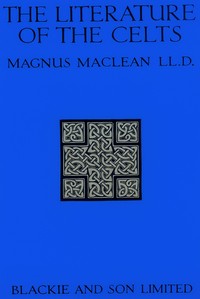
The literature of the Celts by Magnus Maclean
QR code
"The literature of the Celts" by Magnus Maclean is a scholarly survey of Celtic literary history written in the early 20th century. It introduces general readers to the origins, manuscripts, myths, saints, and revivals of Celtic writing, from Ogam stones and early Gaelic-Latin texts through monastic learning to saga cycles and their European influence. The work maps key sources, periods, and scholars, arguing for the richness and enduring significance of the Celtic
tradition. The opening of this study sets out the surge of modern interest in Celtic studies, citing Continental scholarship, Kuno Meyer’s optimism, and Yeats’s hopes for Celtic legend, before explaining the book’s aim as a concise, popular guide distilled from university lectures. It then sketches, in Chapter I, the historical backdrop of the Celts in Europe, their migrations and conquests, the linguistic split between Gadelic (Q) and Brittonic (P) branches, classical testimony from Greek and Roman writers, and the eventual literary awakening marked by Ogam inscriptions, the adoption of the Roman script, and early monastic texts; it also notes that the earliest sustained Gaelic appears in glosses and marginalia on the Continent, and situates Celtic within the Aryan language family. Chapter II focuses on St. Patrick as the first clearly identifiable Celtic writer, recounting the reliable sources on his life, his captivity and call, and summarizing his surviving works—the Latin “Confession” and “Epistle to Coroticus,” and the Gaelic lorica known as the “Deer’s Cry”—while acknowledging uncertain dates and later legendary dialogues. The start of Chapter III introduces St. Columba as Scotland’s earliest man of letters, a scholar-poet whose Iona community kindled a lasting literary and religious renaissance. (This is an automatically generated summary.)
Download for free
For your e-reader or reading app — Kindle, Kobo, Apple Books, Calibre etc.
Kindle → Use Send-to-Kindle
Kobo, Nook etc. → Transfer via USB
Phone, tablet or computer → Open in a reading app
Other formats & older devices
There may be more files related to this item.
About this eBook
| Author | Maclean, Magnus, 1857-1937 |
|---|---|
| Title | The literature of the Celts |
| Edition | New edition |
| Original Publication | London: Blackie and Son Limited, 1926. |
| Credits | Richard Tonsing, Charlene Taylor, and the Online Distributed Proofreading Team at www.pgdp.net (This file was produced from images generously made available by The Internet Archive) |
| Language | English |
| LoC Class | PB: Language and Literatures: General works |
| Subject | Celtic literature -- History and criticism |
| Subject | Ireland -- In literature |
| Category | Text |
| eBook-No. | 76961 |
| ISBN (HTML) | 979-8-238-76961-5 |
| Release Date | Sep 30, 2025 |
| Copyright | Public domain in the USA. |
| Downloads | 810 downloads in the last 30 days. |
Project Gutenberg eBooks are always free!