
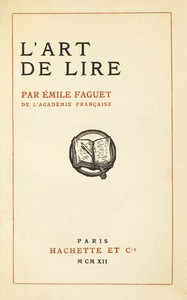
L'art de lire by Émile Faguet
QR code
"L''art de lire" by Émile Faguet is a literary essay and practical guide to reading written in the early 20th century. It sets out how to read not as a critic on duty but as a cultivated reader seeking the fullest pleasure and understanding. Faguet argues for slow, attentive reading and tailored methods for different kinds of works—philosophical, sentimental, and dramatic—so that readers think better, feel more truly, and see more clearly.
The opening of the book contrasts reading to learn or to judge with reading for enjoyment, and declares the author’s aim: to teach the art of pleasurable, intelligent reading. First comes a cardinal rule—always read slowly, distrust first impressions, avoid skimming—because slowness both deepens comprehension and immediately separates worthwhile books from the rest. For books of ideas, he recommends a continual back-and-forth comparison within the text to uncover an author’s governing notions, their growth and contradictions, illustrating with Plato, Montesquieu, Descartes, and La Rochefoucauld; he frames this as a courteous intellectual fencing match that sharpens the reader’s mind without dogmatism. For books of sentiment, he urges initial surrender to emotion, then a second phase of judgment grounded in real-life observation and self-analysis, with cautions about “exceptional” cases and a brisk portrait gallery of reader types (narrative-chasers, realists, idealists, poetry devotees, seekers of the exceptional, and classicists). Turning to drama, he defends reading plays as an appeal from the theater, and advises reading them as if staged—seeing entrances, groupings, and gestures—especially in Greek tragedy; a detailed example unpacks the physical action embedded in Racine’s Phèdre before the discussion moves toward Athalie. (This is an automatically generated summary.)
Download for free
For your e-reader or reading app — Kindle, Kobo, Apple Books, Calibre etc.
Kindle → Use Send-to-Kindle
Kobo, Nook etc. → Transfer via USB
Phone, tablet or computer → Open in a reading app
Other formats & older devices
There may be more files related to this item.
About this eBook
| Author | Faguet, Émile, 1847-1916 |
|---|---|
| LoC No. | 12000429 |
| Title | L'art de lire |
| Original Publication | Paris: Hachette, 1911, pubdate 1912. |
| Credits | Laurent Vogel (This file was produced from images generously made available by the Polona digital library) |
| Language | French |
| LoC Class | Z: Bibliography, Library science |
| Subject | Books and reading -- France |
| Category | Text |
| eBook-No. | 76777 |
| ISBN (HTML) | 979-8-238-76777-2 |
| Release Date | Aug 31, 2025 |
| Copyright | Public domain in the USA. |
| Downloads | 428 downloads in the last 30 days. |
Project Gutenberg eBooks are always free!