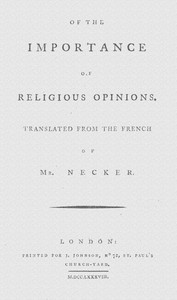
Of the importance of religious opinions by Jacques Necker
QR code
"Of the importance of religious opinions" by Jacques Necker is a treatise of moral and political philosophy written in the late 18th century. It contends that religious belief is indispensable to public order and private happiness, countering efforts to ground morality solely in law, reason, or social esteem. The work promises wide scope—from the social uses of worship and relations with sovereigns to arguments for God’s existence, tolerance, and Christian morality. The
opening of the treatise presents a translator’s note, a detailed table of contents, and an introduction in which the author, reflecting after public service, argues that administration, law, morality, and religion form one system whose harmony secures social prosperity. He laments fashionable indifference and sets himself between harsh intolerance and flippant unbelief, proposing to test whether a secular “moral catechism” can replace religion. Chapter I asserts that basing virtue on the supposed union of private and public interest fails amid real social inequalities, limited education, and strong passions; laws reach actions but not intentions, whereas religion uniquely addresses imagination, conscience, youth, and the afflicted, offering simple, binding commands and hope beyond the present. At the start of Chapter II, he argues that civil and penal laws and public opinion cannot control hidden or ambiguous wrongs; only conscience, grounded in God, can, and even judges need both statute and inward moral responsibility, while reputation and public rewards are narrow, fallible incentives beside religion’s universal, interior authority. (This is an automatically generated summary.)
Download for free
For your e-reader or reading app — Kindle, Kobo, Apple Books, Calibre etc.
Kindle → Use Send-to-Kindle
Kobo, Nook etc. → Transfer via USB
Phone, tablet or computer → Open in a reading app
Other formats & older devices
There may be more files related to this item.
About this eBook
| Author | Necker, Jacques, 1732-1804 |
|---|---|
| Translator | Wollstonecraft, Mary, 1759-1797 |
| Uniform Title | De l'importance des opinions religieuses. English |
| Title | Of the importance of religious opinions |
| Original Publication | London: J. Johnson, 1788. |
| Credits | Richard Tonsing and the Online Distributed Proofreading Team at www.pgdp.net (This file was produced from images generously made available by The Internet Archive) |
| Language | English |
| LoC Class | BR: Philosophy, Psychology, Religion: Christianity |
| Subject | Christianity -- Early works to 1800 |
| Category | Text |
| eBook-No. | 76773 |
| ISBN (HTML) | 979-8-238-76773-4 |
| Release Date | Aug 31, 2025 |
| Copyright | Public domain in the USA. |
| Downloads | 402 downloads in the last 30 days. |
Project Gutenberg eBooks are always free!