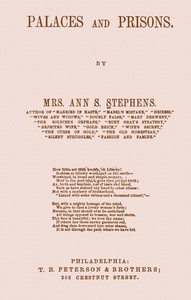
Palaces and prisons by Ann S. Stephens
QR code
"Palaces and Prisons" by Ann S. Stephens is a historical novel written in the late 19th century. Set on the eve of the French Revolution, it intertwines court intrigue and street-level hardship, following figures like Countess Du Barry, Marie Antoinette, Dr. Gosner, Count Mirabeau, and the humble yet determined Marguerite and her mother. The story promises a clash between glittering palaces and brutal prisons, as personal fates collide with rising popular unrest.
The opening of the novel contrasts the Grand Trianon’s splendor with Parisian poverty. Du Barry imperiously presses the refined physician-seer Dr. Gosner to prolong the king’s life and predict her future; he refuses, foresees her death on a blood-soaked scaffold, and reveals the ominous power of his Egyptian scarab ring. Enraged, she secures a lettre-de-cachet to send him to the Bastille and has her dwarf, Zamara, plant the ring as a “gift” for the Dauphiness, who innocently slips it on. The scene shifts to a garret where Gosner’s starving wife and daughter, aided by the people’s man Jacques, learn that Gosner is alive in the Bastille; they pledge themselves to the cause of liberty, encounter the magnetic Mirabeau, and—through a kind market woman—find Marguerite work selling flowers. It closes with the mother’s renewed resolve, signaling her transformation from desperate petitioner to a woman ready to act. (This is an automatically generated summary.)
Download for free
For your e-reader or reading app — Kindle, Kobo, Apple Books, Calibre etc.
Kindle → Use Send-to-Kindle
Kobo, Nook etc. → Transfer via USB
Phone, tablet or computer → Open in a reading app
Other formats & older devices
There may be more files related to this item.
About this eBook
| Author | Stephens, Ann S. (Ann Sophia), 1810-1886 |
|---|---|
| LoC No. | 08012408 |
| Title | Palaces and prisons |
| Original Publication | Philadelphia: T.B. Peterson & Brothers, 1871. |
| Credits | Richard Tonsing and the Online Distributed Proofreading Team at www.pgdp.net (This book was produced from images made available by the HathiTrust Digital Library.) |
| Language | English |
| LoC Class | PS: Language and Literatures: American and Canadian literature |
| Subject | American fiction -- 19th century |
| Category | Text |
| eBook-No. | 76772 |
| ISBN (HTML) | 979-8-238-76772-7 |
| Release Date | Aug 31, 2025 |
| Copyright | Public domain in the USA. |
| Downloads | 412 downloads in the last 30 days. |
Project Gutenberg eBooks are always free!