
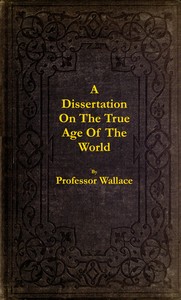
A dissertation on the true age of the world : in which is determined the…
QR code
"A dissertation on the true age of the world : in which is determined the…" by Professor Wallace is a theological and chronological treatise written in the mid-19th century. It argues that the Septuagint’s longer genealogical numbers, rather than the Masoretic Hebrew’s shorter figures, preserve the authentic Biblical chronology from Creation to Christ, thereby lengthening the world’s age by about fifteen centuries. Using Scripture, patristic testimony, early chronographers, and selective astronomical and
geological reflections, it divides sacred history into six ages and seeks to fix key epochs such as the Flood, the Exodus, and the Advent. Readers should expect a rigorous defense of the Septuagint, critiques of Usher and other modern chronologers, and discussion of prophecy, cyclical time, and the millennium. The opening of the treatise sets out the problem: large discrepancies between the Hebrew, Septuagint, and Samaritan texts in the antediluvian and postdiluvian genealogies, a long-debated issue now made urgent by geology, astronomy, and renewed interest in prophecy. The preface outlines two parts—first, a critical reconstruction of Biblical chronology (leaning on Cuninghame and engaging Josephus, Eusebius, and others); second, an inquiry into primeval prophecy, idolatry’s origins, and the “seven ages,” with hints of astronomical cycles (including a proposed grand planetary cycle) deferred to a future volume. The introduction notes the widespread expectation of a savior at the time of Christ and claims Scripture allows the epoch to be fixed, then sketches the authority and utility of the Septuagint over against the present Hebrew text. Early chapters present tables contrasting the three textual traditions, argue that the Hebrew and Samaritan numbers show deliberate centenary adjustments while the Septuagint’s figures are internally coherent, defend the authenticity of the “second Cainan” (citing Luke), and begin correcting received views on Terah and Abraham—altogether preparing the case for the longer, Septuagint-based timeline. (This is an automatically generated summary.)
Download for free
For your e-reader or reading app — Kindle, Kobo, Apple Books, Calibre etc.
Kindle → Use Send-to-Kindle
Kobo, Nook etc. → Transfer via USB
Phone, tablet or computer → Open in a reading app
Other formats & older devices
There may be more files related to this item.
About this eBook
| Author | Wallace, R. (Robert), 1800?-1858 |
|---|---|
| Title | A dissertation on the true age of the world : in which is determined the chronology of the period from creation to the Christian era |
| Original Publication | London: Smith, Elder, 1844. |
| Credits | Richard Tonsing and the Online Distributed Proofreading Team at www.pgdp.net (This file was produced from images generously made available by The Internet Archive) |
| Language | English |
| LoC Class | BS: Philosophy, Psychology, Religion: Christianity: The Bible, Old and New Testament |
| Subject | Bible |
| Subject | Chronology, Historical |
| Subject | Chronology |
| Category | Text |
| eBook-No. | 76771 |
| ISBN (HTML) | 979-8-238-76771-0 |
| Release Date | Aug 31, 2025 |
| Last Update | Jan 8, 2026 |
| Copyright | Public domain in the USA. |
| Downloads | 565 downloads in the last 30 days. |
Project Gutenberg eBooks are always free!