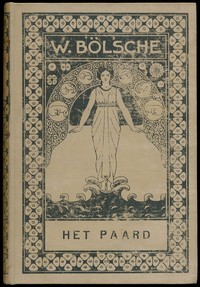
Het paard : in zijne natuurlijke ontwikkeling by Wilhelm Bölsche
QR code
"Het paard : in zijne natuurlijke ontwikkeling" by Wilhelm Bölsche is a popular scientific treatise written in the early 20th century. It explores the natural history and evolution of the horse, tracing its lineage from small, multi‑toed ancestors to the modern, single‑toed runner, and examines its close symbiosis with humans as a domesticated animal. Expect a blend of anatomy, paleontology, and behavioral insight that connects fossil evidence, comparative anatomy, and cultural history
to explain what makes the horse unique. The opening of this work sets out its purpose: to tell the full evolutionary story of the horse, beginning with tiny Eocene ancestors and linking them to living forms and domestic breeds. It recaps the rise of mammals from reptile‑like forebears through monotremes and marsupials to early placental groups, highlighting a pivotal Eocene fauna (the “Cernays” forms) from which hoofed animals emerge. The text defines domestication as a lasting symbiosis rather than mere captivity, illustrating the idea with classic plant–fungus and ant–aphid partnerships before applying it to horses, dogs, and livestock. A clear, step‑by‑step anatomical comparison explains how the horse stands on a single middle toe, with splint bones as vestiges of lost digits, and how this design achieves speed, endurance, and load‑bearing. It then sketches the horse’s instincts and signal‑sensitivity (including the “Clever Hans” case) and turns to the fossil record, from Cuvier’s early finds to the rich American deposits, noting that true horses once ranged widely in the Americas before disappearing there prior to European contact. (This is an automatically generated summary.)
Download for free
For your e-reader or reading app — Kindle, Kobo, Apple Books, Calibre etc.
Kindle → Use Send-to-Kindle
Kobo, Nook etc. → Transfer via USB
Phone, tablet or computer → Open in a reading app
Other formats & older devices
There may be more files related to this item.
About this eBook
| Author | Bölsche, Wilhelm, 1861-1939 |
|---|---|
| Translator | Goudsmit, B. C. (Boudewijn Casper), 1849-1915 |
| Uniform Title | Das Pferd und seine Geschichte. Dutch |
| Title | Het paard : in zijne natuurlijke ontwikkeling |
| Original Publication | Amsterdam: Gebr. Graauw, 1912. |
| Credits | Jeroen Hellingman and the Online Distributed Proofreading Team at www.pgdp.net/ for Project Gutenberg |
| Language | Dutch |
| LoC Class | QL: Science: Zoology |
| Subject | Horses |
| Category | Text |
| eBook-No. | 76754 |
| ISBN (HTML) | 979-8-238-76754-3 |
| Release Date | Aug 28, 2025 |
| Last Update | Aug 30, 2025 |
| Copyright | Public domain in the USA. |
| Downloads | 399 downloads in the last 30 days. |
Project Gutenberg eBooks are always free!