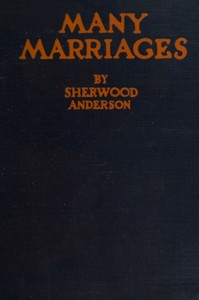
Many Marriages by Sherwood Anderson
QR code
Many Marriages by Sherwood Anderson is a novel written in the early 20th century. It follows John Webster, a Midwestern washing-machine manufacturer whose sudden inner awakening disrupts his settled marriage and draws him toward his secretary, Natalie Swartz. Through sensuous imagery and introspective monologue, the book probes love, desire, conscience, and the constraints of modern respectability as Webster questions his roles as husband, father, and businessman. The opening of the novel frames
an “Explanation” to magazine readers and a foreword meditating on the terror of direct actions in love, then plunges into Webster’s day of upheaval. At work and in town, he experiences a torrent of heightened perceptions and symbols—the body-as-house, black laborers singing, a green stone—while testing his world against these revelations. He studies his wife Mary’s heaviness, his daughter Jane’s unread face, and the quiet dignity of their servant Katherine; he wanders parks and streets, considers escaping to Chicago for anonymous indulgence, then returns to find Natalie freshly bathed and dressed, wordlessly affirming their bond as he kneels with his head in her lap. Town employees notice; the bookkeeper frets and gossips, while Webster spends evenings with Natalie, imagines leaving his business and family, walks into the countryside speaking of love and openness, and, back at home, lies awake sensing the community’s judgment and the stark exposure of private lives—like rooms revealed after a fire. (This is an automatically generated summary.)
Download for free
For your e-reader or reading app — Kindle, Kobo, Apple Books, Calibre etc.
Kindle → Use Send-to-Kindle
Kobo, Nook etc. → Transfer via USB
Phone, tablet or computer → Open in a reading app
Other formats & older devices
There may be more files related to this item.
About this eBook
| Author | Anderson, Sherwood, 1876-1941 |
|---|---|
| LoC No. | 23007319 |
| Title | Many Marriages |
| Original Publication | New York: B.W. Huebsch, Inc., 1923. |
| Note | Wikipedia page about this book: en.wikipedia.org/wiki/Many_Marriages |
| Credits | Carla Foust, Tim Lindell and the Online Distributed Proofreading Team at www.pgdp.net (This file was produced from images generously made available by The Internet Archive/Canadian Libraries) |
| Language | English |
| LoC Class | PS: Language and Literatures: American and Canadian literature |
| Subject | Man-woman relationships -- Fiction |
| Subject | Marriage -- Fiction |
| Subject | Businessmen -- Fiction |
| Subject | Wisconsin -- Fiction |
| Category | Text |
| eBook-No. | 76745 |
| ISBN (HTML) | 979-8-238-76745-1 |
| Release Date | Aug 27, 2025 |
| Copyright | Public domain in the USA. |
| Downloads | 492 downloads in the last 30 days. |
Project Gutenberg eBooks are always free!