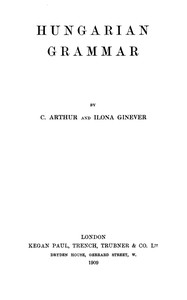
Hungarian grammar by Charles Arthur Ginever and Ilona De Györy Ginever
QR code
"Hungarian grammar" by Charles Arthur Ginever and Ilona De Györy Ginever is a language textbook written in the early 20th century. It presents a practical, streamlined introduction to Hungarian aimed at learners, emphasizing pronunciation, vowel harmony, suffix-based grammar, and clear usage rules, with exercises, vocabularies, and everyday phrases. The opening of this grammar explains its aim to dispel the idea that Hungarian is hard, then lays out the alphabet, sounds, and vowel
harmony (flat, sharp, mediate), compound consonants, and fixed stress. It introduces articles (a/az, and the sparing use of egy), basic noun number formation (including special plural patterns and contractions), and four core cases expressed by suffixes, with possession handled via personal endings and the “van” construction instead of “to have.” It then details personal possessive suffixes, and the language’s extensive place-and-direction system through suffixes and postpositions (with pronominal forms), followed by adjectives (attributive vs. predicative, comparison with -bb and leg-), numerals, and telling time. The verb section begins with the central contrast between definite and indefinite conjugations tied to object definiteness, outlines iktelen and ikes patterns with key tenses, notes the absence of a passive, and highlights features like -lak/-lek when “I” acts on “you,” all reinforced by brief exercises and word lists. (This is an automatically generated summary.)
Download for free
For your e-reader or reading app — Kindle, Kobo, Apple Books, Calibre etc.
Kindle → Use Send-to-Kindle
Kobo, Nook etc. → Transfer via USB
Phone, tablet or computer → Open in a reading app
Other formats & older devices
There may be more files related to this item.
About this eBook
| Author | Ginever, Charles Arthur, 1871-1946 |
|---|---|
| Author | Ginever, Ilona De Györy, 1868-1926 |
| Title | Hungarian grammar |
| Credits | Jonathan Ingram and the Online Distributed Proofreading Team at www.pgdp.net |
| Language | English |
| LoC Class | PH: Language and Literatures: Finno-Ugrian and Basque languages and literatures |
| Subject | Hungarian language -- Grammar |
| Category | Text |
| eBook-No. | 76725 |
| ISBN (HTML) | 979-8-238-76725-3 |
| Release Date | Aug 24, 2025 |
| Copyright | Public domain in the USA. |
| Downloads | 524 downloads in the last 30 days. |
Project Gutenberg eBooks are always free!