
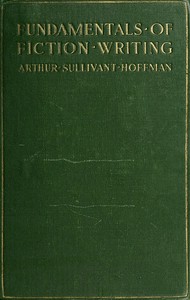
Fundamentals of fiction writing by Arthur Sullivant Hoffman
QR code
"Fundamentals of fiction writing" by Arthur Sullivant Hoffman is a guidebook on writing fiction written in the early 20th century. It centers on how to craft stories that genuinely grip readers by creating and preserving an absorbing illusion. Emphasizing clarity, simplicity, and individuality over rigid technique, it offers practical, market-aware advice on plot, character, style, and audience. The opening of the book lays out the author’s purpose, credentials, and method: an editor’s-eye
view that treats the reader as a core part of the art process. He argues that modern teaching overvalues technique and imitation, and that real success comes from simplicity, clearness, and maintaining the story’s illusion. He distinguishes straight fiction from fiction-as-vehicle (philosophy, instruction, sermon), warns how easily illusion is broken, and shares an illustrative writer’s letter rejecting formulaic “Ford-like” stories. He then proposes three audience strategies (ignore, target, or broaden) and urges writers to study real human reactions. Practical chapters catalog common breakers of illusion—unfamiliar words, foreign phrases, showy allusions, odd names, dialect, authorial intrusions, inconsistencies—and explain how to ensure clarity in names, dialogue, and scene logic. He also cautions against overstrain, advocating brevity, varied sentence length, relief scenes, and simpler plots (with special notes on frames and mystery stories), before moving into a discussion of convincingness. (This is an automatically generated summary.)
Download for free
For your e-reader or reading app — Kindle, Kobo, Apple Books, Calibre etc.
Kindle → Use Send-to-Kindle
Kobo, Nook etc. → Transfer via USB
Phone, tablet or computer → Open in a reading app
Other formats & older devices
There may be more files related to this item.
About this eBook
| Author | Hoffman, Arthur Sullivant, 1876-1966 |
|---|---|
| LoC No. | 22018668 |
| Title | Fundamentals of fiction writing |
| Original Publication | Indianapolis: The Bobbs-Merrill Company, 1922. |
| Credits | Al Haines |
| Language | English |
| LoC Class | PN: Language and Literatures: Literature: General, Criticism, Collections |
| Subject | Fiction -- Technique |
| Category | Text |
| eBook-No. | 76688 |
| ISBN (HTML) | 979-8-238-76688-1 |
| Release Date | Aug 16, 2025 |
| Copyright | Public domain in the USA. |
| Downloads | 621 downloads in the last 30 days. |
Project Gutenberg eBooks are always free!