
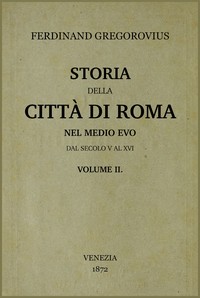
Storia della città di Roma nel medio evo, vol. 2/8 : dal secolo V al XVI
QR code
"Storia della città di Roma nel medio evo, vol. 2/8 : dal secolo V al XVI" by Ferdinando Gregorovius is a historical account written in the late 19th century. It traces Rome’s transformation in the early Middle Ages, from the collapse of the ancient civic order to the ascendancy of the papacy, the spread of monasticism, and the city’s struggles between Byzantine authority and Lombard pressure. Figures such as Benedict of Nursia
and Gregory the Great exemplify how religious institutions replaced imperial structures and reshaped urban life. Expect a richly detailed political, ecclesiastical, and urban narrative rather than character-driven storytelling. The opening of this volume paints a stark tableau of a ruined Rome—temples crumbling, forums silent, baths stripped—while the Church rises as the city’s only vigilant organizer and protector behind Aurelian’s walls. It recounts Benedict’s retreat to Subiaco, the founding of Monte Cassino atop a former pagan site, the crafting of his Rule, and the swift spread of monastic life (from Cassiodorus’s Vivarium to Roman convents fostered by patrician women), culminating in Benedictines sheltered at the Lateran after the Lombards raze Monte Cassino. The narrative then follows the Lombard advance, the embattled pontificates of Benedict I and Pelagius II, and appeals to Constantinople, with Gregory dispatched as apocrisiarius. Flood and plague ravage the city; Pelagius dies, and the rebuilding of San Lorenzo marks the era’s piety amid disaster. Gregory’s election ushers in penitential processions and the legend of the archangel sheathing his sword atop Hadrian’s mausoleum to end the pestilence. Finally, his first sermons read like a funeral oration over Rome as Agilulf and Ariulf press the siege, while he buys off the enemy, clashes diplomatically with the exarch and emperor, and the text sketches the fragile civic framework—prefect, magister militum, and the near-silence surrounding a vanished Senate. (This is an automatically generated summary.)
Download for free
For your e-reader or reading app — Kindle, Kobo, Apple Books, Calibre etc.
Kindle → Use Send-to-Kindle
- Download the EPUB3 file above
- Upload it on the Amazon site your Kindle is registered with: amazon.com/sendtokindle for the US, amazon.co.uk/sendtokindle for the UK etc.
- It appears on your Kindle and in the Kindle app
Kobo, Nook etc. → Transfer via USB
- Download the EPUB3 file on your computer
- Connect your e-reader by USB and tap "Connect" on its screen
- Drag the file onto the e-reader drive
Phone, Tablet or Computer → Online or Reading App
Easiest: read online in your browser. Nothing to install.
Or use a reading app:
- Find and install one you like, for example Apple Books, ReadEra or Thorium Reader
- Download the EPUB3 file above
- Open it in the app
More help: iPhone / iPad · Android · Computer
Other formats & older devices
There may be more files related to this item.
About this eBook
| Author | Gregorovius, Ferdinand, 1821-1891 |
|---|---|
| Translator | Manzato, Renato |
| Title | Storia della città di Roma nel medio evo, vol. 2/8 : dal secolo V al XVI |
| Original Publication | Venezia: Antonelli, 1872, copyright 1876. |
| Credits | Barbara Magni and the Online Distributed Proofreading Team at www.pgdp.net (This transcription was produced from images generously made available by Bayerische Staatsbibliothek / Bavarian State Library.) |
| Reading Level | Reading ease score: 39.3 (College-level). Difficult to read. |
| Language | Italian |
| LoC Class | DG: History: General and Eastern Hemisphere: Italy, Vatican City, Malta |
| Subject | Rome (Italy) -- History |
| Category | Text |
| eBook-No. | 76678 |
| ISBN (HTML) | 979-8-238-76678-2 |
| Release Date | Aug 12, 2025 |
| Copyright | Public domain in the USA. |
| Downloads | 482 downloads in the last 30 days. |
Project Gutenberg eBooks are always free!