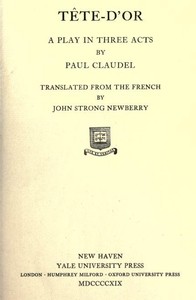
Tête-d'Or: A play in three acts by Paul Claudel
QR code
"Tête-d'Or: A play in three acts" by Paul Claudel is a theatrical work written in the early 20th century. The play introduces the characters Simon Agnel, who later takes on the title Tête-d'or, and Cébès, as they navigate themes of love, loss, and existential questioning. It contemplates the interplay between life and death, as Simon grapples with the profound meaning of existence after the death of a loved one. The opening of
"Tête-d'Or" sets the stage with Simon Agnel carrying the body of a woman he loved, while Cébès expresses his own existential doubts and confusion about life and identity. As they converse, Simon reveals his tumultuous past and the burden of grief he carries, symbolized by the act of digging a grave. Cébès, grappling with his own mortality and the weight of despair, asks poignant questions about existence and the essence of human experience. Their dialogue explores weighty themes of love, loss, and the search for meaning in a world marked by sorrow and uncertainty. (This is an automatically generated summary.)
Download for free
For your e-reader or reading app — Kindle, Kobo, Apple Books, Calibre etc.
Kindle → Use Send-to-Kindle
Kobo, Nook etc. → Transfer via USB
Phone, tablet or computer → Open in a reading app
Other formats & older devices
There may be more files related to this item.
About this eBook
| Author | Claudel, Paul, 1868-1955 |
|---|---|
| Translator | Newberry, J. S. (John Strong), 1822-1892 |
| Title | Tête-d'Or: A play in three acts |
| Credits | Produced by Winston Smith. Images provided by the Internet Archive. |
| Reading Level | Reading ease score: 93.8 (5th grade). Very easy to read. |
| Language | English |
| LoC Class | PQ: Language and Literatures: Romance literatures: French, Italian, Spanish, Portuguese |
| Subject | French drama -- 19th century -- Translations into English |
| Category | Text |
| eBook-No. | 52088 |
| ISBN (HTML) | 979-8-238-52088-9 |
| Release Date | May 16, 2016 |
| Last Update | Oct 23, 2024 |
| Copyright | Public domain in the USA. |
| Downloads | 529 downloads in the last 30 days. |
Project Gutenberg eBooks are always free!