The Project Gutenberg eBook, A Popular History of the Art of Music, by W.
S. B. Mathews
This eBook is for the use of anyone anywhere at no cost and with
almost no restrictions whatsoever.  You may copy it, give it away or
re-use it under the terms of the Project Gutenberg License included
with this eBook or online at www.gutenberg.org
Title: A Popular History of the Art of Music
From the Earliest Times Until the Present
Author: W. S. B. Mathews
Release Date: January 5, 2007 [eBook #20293]
Language: English
Character set encoding: ISO-8859-1
***START OF THE PROJECT GUTENBERG EBOOK A POPULAR HISTORY OF THE ART OF MUSIC***
E-text prepared by Juliet Sutherland, Linda Cantoni,
and the Project Gutenberg Online Distributed Proofreading Team
(http://www.pgdp.net/c/).
Thanks to Alex Guzman
for help with the modern transcription of neume notation.
A POPULAR HISTORY
OF THE
ART OF MUSIC
From the Earliest Times Until the Present.
With Accounts of the Chief Musical Instruments and Scales; the
Principles and Artistic Value of Their Music; together
with
Biographical Notices of the Greater
Composers, Chronological Charts,
Specimens of Music, and
Many Engravings.
BY W. S. B. MATHEWS,
Editor of "Music" Magazine,
Author of "How to Understand Music," "Studies in Phrasing," "Twenty
Lessons to a Beginner," "Primer of Musical Forms," Associate
Editor of
Mason's "Pianoforte Technics," etc., etc.
CHICAGO:
THE "MUSIC" MAGAZINE PUBLISHING CO.
1402-5 THE AUDITORIUM.
Copyright by W. S. B. Mathews, 1891.
TO
DR. FLORENCE ZIEGFELD,
President of the Chicago Musical College
THIS WORK IS
RESPECTFULLY DEDICATED.
PREFACE.
 HAVE here endeavored to provide a readable account of the entire
history of the art of music, within the compass of a single small
volume, and to treat the luxuriant and many-sided later development
with the particularity proportionate to its importance, and the
greater interest appertaining to it from its proximity to the times of
the reader.
HAVE here endeavored to provide a readable account of the entire
history of the art of music, within the compass of a single small
volume, and to treat the luxuriant and many-sided later development
with the particularity proportionate to its importance, and the
greater interest appertaining to it from its proximity to the times of
the reader.
The range of the work can be most easily estimated from the Table of
Contents (pages 5-10). It will be seen that I have attempted to cover
the same extent of history, in treating of which the standard musical
histories of Naumann, Ambros, Fétis and others have employed from
three times to ten times as much space. In the nature of the case
there will be differences of opinion among competent judges concerning
my success in this difficult undertaking. Upon this point I can only
plead absolute sincerity of purpose, and a certain familiarity with
the ground to be covered, due to having treated it in my lectures in
the Chicago Musical College for five years, to the extent of about
thirty-five lectures yearly. I have made free use of all the standard
histories—those of Fétis, Ambros, Naumann, Brendel, Gevaert, Hawkins,
Burney, the writings of Dr. Hugo Riemann, Dr. Ritter, Prof. Fillmore,
and the dictionaries of Grove and Mendel, as well as many monographs
in all the leading modern languages.
I have divided the entire history into books, placing at the beginning
of each book a general chapter defining the central idea and salient
features of the step in development therein recounted. The student who
will attentively peruse these chapters in succession will have in them
a fairly complete account of the entire progress.
W. S. B. MATHEWS.
Chicago, May 5, 1891.
[Pg 4]
LIST OF ILLUSTRATIONS.

| | PAGE. |
| Chart of Greatest Composers |
11 |
| Chart of Italian Composers |
12 |
| Chart of German Composers |
13 |
|
Pianists and Composers for Piano |
14 |
| King David Playing the Three-stringed Crwth |
24 |
| Egyptian Representations, 4th Dynasty |
28 |
| Bruce's Harpers |
30 |
| Harp and Musicians of 20th Dynasty |
32 |
| Lyres Found in Tombs |
33 |
| Women, Street Musicians |
34 |
| Shoulder Harps |
35 |
| Kinnor |
42 |
| Larger Jewish Harp |
43 |
| Assyrian Harps |
45 |
| Assyrian Banjo |
46 |
| Assyrian Psaltery |
47 |
| Greek Lyres |
64 |
| Music to Ode of Pindar |
69 |
| Hindoo Vina |
71 |
| Ravanastron |
72 |
| Chinese Ke |
74 |
| Japanese Ko-Ko |
76 |
| Old Breton Song |
88 |
| Old Welsh Song |
92 |
| Welsh Song in Praise of Love |
94 |
| Harp of Sir Brian Boirohen |
97 |
| Facsimile "Sumer is Icumen In" |
101 |
| The Same Written out |
102 |
| Saxon Harp |
104 |
| Saxon Harp |
105 |
| Crwth |
107 |
| Scotch Pentatonic Melody |
108 |
| Arab Rebec |
112 |
| Arab Eoud |
113 |
| Arab Santir |
114 |
| Song by Thibaut, 13th Century |
122 |
| Reinmar, the Minnesinger |
124 |
| Frauenlob |
125 |
| Minstrel Harps |
126 |
| Gregorian and Ambrosian Scales |
132 |
| Hucbald's Staff |
141 |
| Diaphony |
141 |
| Diaphony in Fourths |
142 |
| Guido of Arezzo |
144 |
| Table of the Schools of the Netherlands |
162 |
| Orlando di Lassus |
167 |
| Music by Palestrina |
176 to 178 |
| Roman Letter Notation of Guido |
181 |
| Neumæ of 10th Century |
181 |
| Neumæ of 11th Century |
182 |
| Neumæ with Lines |
183 |
| Lament for Charlemagne |
184 |
| Early Staff of Five Lines |
185 |
| Lute |
191 |
| Tuning of the Lute |
192 |
| Early Forms of Rebec |
195 |
| Angel Playing Rebec, 13th Century |
196 |
| Viol da Gamba |
197 |
| Barytone |
198 |
| Stradivarius Violin |
200 |
| Old Organ |
202 |
| Portable Organ |
204 |
| Bellows Bags at Halberstadt |
206 |
| Concert of 7th Century |
208 |
| Extract, Peri's "Eurydice" |
225 |
| Aria, Monteverde's "Arianna" |
230 |
| Aria, Cavalli's "Erismena" |
231 |
| Aria, Scarlatti's Cantata |
232 |
| Aria, Lulli's "Roland" |
240 |
| Heinrich Schütz |
246 |
| Jean Pieters Swelinck |
251 |
| Samuel Scheidt |
252 |
| Johann Adam Reinken |
254 |
| John Sebastian Bach |
266 |
| Geo. Friedrich Händel |
274 |
| Joseph Haydn |
286 |
| The Mozart Family |
293 |
| Mozart (Miss Stock) |
300 |
| Mozart |
302 |
| Beethoven |
311 |
| Beethoven as He Appeared on the Street |
314 |
| Beethoven Autograph |
315 |
| Facsimile Title Page Mss. Beethoven |
318 |
| Gluck |
329 |
| Grétry |
340 |
| Boieldieu |
343 |
| Purcell |
350 |
| J.L. Dussek |
358 |
| Hummel |
362 |
| Moscheles |
363 |
| Schubert |
390 |
| Spinet, 1590 |
393 |
| Ornamentation of Same |
394 |
| Another View of the Same |
395 |
| Mozart's Grand Piano |
396 |
| Cristofori's Design of Action |
397 |
| His Action as Made in 1726 |
398 |
| Érard Grand Action |
399 |
| Steinway Iron Frame and Over-stringing |
400 |
| Carl Maria von Weber |
407 |
| Meyerbeer |
412 |
| Richard Wagner |
417 |
| Mme. Schröder-Devrient |
420 |
| Paganini |
430 |
| Paganini in Concert (Landseer) |
431 |
| Chopin |
442 |
| Liszt |
452, 453 |
| Hauptmann |
460 |
| Mendelssohn |
462 |
| Schumann |
476 |
| Rossini |
480 |
| Verdi |
484 |
| Auber |
489 |
| Gade |
498 |
| Sterndale-Bennett | 502 |
| Rubinstein |
506 |
Transcriber's Note: The listed illustration of Sterndale-Bennett is not in
the original book, and the illustration of Gade is actually on page 518. There are additional illustrations, not listed above, of
Glinka, Tchaikovsky,
Smetana, Dvorak, and
Grieg. Some illustrations have been moved slightly from
their original locations to avoid breaking the flow of text. The page numbers
above are the originals; the links point to the actual locations of the
illustrations in this e-text.
[Pg 5]
CONTENTS.
Music defined — general idea of musical progress — conditions of fine
art — qualities of satisfactory art-forms — periods in musical
history — difference between ancient and modern music.
Sources of information — antiquity of their development — instruments — uses
of music — their ideas about music and education — "Song
of the Harper" — kindergarten.
Music among the Hebrews — Jubal — kinnor — ugabh — musicians in the
temple service — psaltery — flute — larger harp — Miriam — liturgy of
the temple — musical ideal in Hebrew mind — music among the
Assyrians — types of instruments.
Importance of this development — extent of the time — date of Homeric
poems — epoch of Æschylus — extracts from Homer — Hesiod — patriotic
applications of music — choral song — festivals — lyric
drama — début of Æschylus, Sophocles and Euripides — nature of
the classic drama — orchestic — Socrates — Aristoxenus — problems
of Aristotle — Greek theory of music — Pythagoras and ratios of
simple consonances — devotional use of music — Greek scales — Claudius
Ptolemy — Didymus — the lyre and cithara — magadis — flute — æsthetic
importance — Plato on the noble harmonies — loyalty to
the true — Greek musical alphabet — notation — Ode from Pindar.
Early beginning — use of the bow — national instruments — the vina — theory — ravanastron — music
exclusively melodic — saying of the Emperor Tschun — the ke — Japanese ko-ko.[Pg 6]
General view of the transformation to modern music — causes co-operating — difference
between ancient and modern music — harmony
and tonality — consonance and dissonance — three steps in the
development of harmonic perceptions — when were these steps
taken? — tonality defined — growth of tonal perception — unconscious
perception of implied or associated tones.
Importance of Celtic development of minstrelsy — origin of the Celts — the
minstrel — old Breton song — the druids — classification of
bards — degrees — Fétis on the Welsh minstrel — "Triads of the Isle
of Britain" — old harp music — "The Two Lovers" — Gerald Barry on
the Welsh — old Welsh song — the Irish — Sir Brian Boirohen's harp — English
and Saxon music — King Arthur as minstrel — organ at
Winchester — Scandinavian scalds — Eddas — "Sumer is Icumen
in" — Anglo-Saxon harp — source of the harp in Britain — the
crwth — melody in pentatonic scale.
The Arab apparition in history — their taste for poetry — competitive
contests of poetry and song — encouragement of literature — rebec — eoud — santir.
Period of the Chansons de Geste — social conditions of France as given
by M. Léon Gautier — "Cantilena of St. Eulalie" — subjects of the
Chansons de Geste.
The troubadours — Count Wilhelm — varieties of their songs — melody
from Thibaut — Adam de la Halle — "Story of Antioch" — "Song of
Roland" — minnesinger Reinmar — Heinrich Frauenlob — minstrel
harps — Hans Sachs — influence of these minstrel guilds.
Church not influential in the development of music as such — nature
of the early Christian hymns — St. Ambrose — the Ambrosian scales — corruptions
elsewhere — St. Gregory and his reforms — the
Gregorian tones — many later reforms — limitations of these
reforms — incidental influence of the Church through her great
cathedrals.
| CHAPTER XI — MUSICAL DIDACTIC FROM THE FIFTH TO FOURTEENTH CENTURY | 134-147 |
Macrobus — Martinus Capella — Boethius — Cassiodorus — Bishop Isidore — Venerable
Bede — Aurelian — Rémi of Auxerre — Hucbald — examples — instruments
of music during the seventh and eighth centuries — Odon of Cluny — Guido of Arezzo — staff — Franco of
Cologne — Franco of Paris.[Pg 7]
| CHAPTER XII — THE RISE OF POLYPHONY; OLD FRENCH AND GALLO-BELGIC SCHOOLS | 148-159 |
Origin and meaning of polyphony — monodic and homophonic — canonic
imitation — chords as incidents — variety and unity — early
French school — Coussemaker's researches — Léonin — descant — Pérotin — names
of pieces — Robert of Sabillon — Pierre de la Croix — Jean
of Garland — Franco of Paris — Jean de Muris — fleurettes — John
Cotton — Machaut — Gallo-Belgic school — Dufay — Hans de
Zeelandia — Antoine de Busnois.
Wealth of the Low Countries — freedom of the communes — strength
of the burgher class — period of these schools — table of periods
and masters — Okeghem — Tinctor — Josquin — his
popularity — Arkadelt — Gombert — Willaert — Goudimel — Cypriano
de Rore — Orlando
de Lassus — his Munich school — his genius.
Prosperity of Italy in fifteenth century — great cathedrals and public
works — conservatories founded at Naples — Willaert at St. Mark's,
Venice — Zarlino — his reforms in theory — Cypriano de
Rore — Goudimel — Palestrina — the
council of Trent — Palestrina's music — Martin Luther.
General direction of musical progress toward classification and the
establishment of unities of various kinds — early letter notation
of the Greeks and Romans — Roman notation as used by Guido of
Arezzo — neumæ — with lines — additional lines — "Lament for
Charlemagne" — notation employed by the French Trouvères — clefs — new
staff proposed by an American reformer.
Progress in tonal perceptions — influence of harp and lute — description
of the latter — system of stringing — locating the frets — the
violin — bow discovered in India — early forms of bowed
instruments — rebec — barytone — viol
da Gamba — Amati — Stradivari — peculiarities
of his instruments — Maggini — Stainer — antiquity of
the organ — early forms — organ sent Charlemagne — organs at
Munich — Malmesbury Abbey — measure of organ pipes — portable
organ — clumsiness of the old keyboards — the organ in 1500 A.D.
| CHAPTER XVII — CONDITION OF MUSIC AT BEGINNING OF EIGHTEENTH CENTURY | 211-220 |
Justification of the name "apprentice period" — office of domestic
musicians in England in the reign of Elizabeth — great fondness
for music everywhere — casual influence of counterpoint in educating
harmonic sense — madrigal — multiplicity of collections of
this kind — absurd use of madrigals for dramatic monody — the
work of the seventeenth century, free melodic expression — the
new problem of the musical drama — the representative principle
in music — music last of the arts — Florence and Venice the
centers — statistics of books published from 1470 to 1500.[Pg 8]
Circle of the Literati in Florence — Galilei and his monody — Peri's
"Dafne" — Schütz's setting of the same — Peri's "Eurydice" — rare
editions — Il stilo rappresentativo — Cavaliere's oratorio "The
Soul and the Body" — second period of opera — Monteverde's
"Arianna" — orchestra of the same — new orchestral effects — scene
from "Eurydice" — director of St. Mark's — Legrenzi — Cesti — public
theaters — Alessandro Scarlatti — recitativo stromentato — Corelli — sonatas
for the violin — influence of the violin upon the art of
singing — origin of Italian school of singing — artificial sopranos — Porpora — Selections
from Monteverde, Cavalli and Scarlatti.
Slow progress of opera to other parts of Europe — origin of French
opera — ballets of Boesset — Perrin — Cambert — their first opera — their
patent from the king — Lulli — his success and productivity — attention
to verbal delivery and the vernacular of the audience — foundations
of the French Académie de Musique — opera in Germany — Schütz — Hamburg
and Keiser — selection from Lulli — "Roland" — Mattheson.
Oratorio invented simultaneously with opera — Cavaliere — mystery
plays — Carissimi — two types of oratorio — cantata — Händel's
appropriation from Carissimi — sacred oratorio — Schütz's Passions — "Last
Seven Words."
Beginnings of instrumental music in seventeenth century — tentative
character of instrumental music of sixteenth century — Gabrieli
and organ pieces — imitations of vocal works — melodies not fully
carried out — Swelinck — Scheidt — Schein — Frescobaldi — Reinken — Pachelbel — Muffat — Corelli — orchestra
of the period — its defects.
The flowering time of modern music — complexity of developments
now taking place — principal actors — two main channels of improvement — fugue — sonata — Bach
and Händel as writers of fugue — people's
song makes its way into cultivated instrumental
music — reference to Mozart's sonatas — thematic and lyric as elements
of contrast.
Bach as a composer — sketch — his clavier — attainments as virtuoso
upon the clavier and the organ — choral works — Passion oratorios — his
pre-eminence as writer of fugues — general sketch of the
form of a fugue — prelude — mutually complementary — Bach's concertos — his
rhythm.[Pg 9]
The companion figure of Bach — early life — violinist at Hamburg — conductor,
composer — first opera — Italy — successes there — England — Italian
operas — oratorio "Messiah" — other oratorios — list
of his works — Bach and Händel compared — Händel's place in art — personalities.
The sons of Bach — Emanuel Bach as composer — difficulty of founding
a new form — Haydn — early years — conductor for Prince
Esterhazy — compositions — the visit to London — the money he
made — "The Creation" — second visit to London — Haydn and the
sonata form — "The Last Seven Words" — his rank as tone-poet.
Charming personality — childhood — early talent — concerts — Mozart
at Bologna and the test of his powers — Haydn's opinion — early
operas — "Marriage of Figaro" — success — accompaniments added
to Händel's "Messiah" and other works — call to Berlin — mysterious
order for the "Requiem" — death — general quality of Mozart's
music.
A worthy successor to Haydn and Mozart — early years — orchestral
leader — piano playing — his friends — Count Waldstein — his first
visit to Vienna — settled in Vienna — compositions — life — appearance — place
in art.
Their relation to symphony — refinement of Mozart — early age of
Mozart — Beethoven's independence — relation to sonata — Beethoven
more free — climax of classical art — Beethoven adagios — summing
up — tendency of progress.
Three great names — Graun — Gluck — his reforms — his ideal — early
works — "Orpheus" — "Iphigenie" — Mozart's place in opera — Rameau — theoretical
writings — Rousseau — Phillidor — Monsigny — Grétry — Gossec — Méhul — Lesueur — Boieldieu — French
opera in
general — Italian opera — Pergolesi — Jomelli — Sacchini — Paisiello — Piccini — Zingarelli — opera
in England — Purcell — Dr. Arne.
| CHAPTER XXX — PIANO PLAYING VIRTUOSI — VIOLINISTS — TARTINI AND SPOHR | 352-369 |
Pianoforte established as domestic instrument — Scarlatti — Mattheson — Dr.
Blow — John Bull — Clementi — Dussek — Cramer — Berger — Hummel — Moscheles — Tartini — Spohr.
| CHAPTER XXXI — THE NINETEENTH CENTURY — THE ROMANTIC — MUSIC OF THE FUTURE | 373-380 |
Classic and romantic defined — art in general — applied to music — illustrated
by Schubert — Schumann — development of virtuosity
Berlioz — "music of the future" — how originating — the outlook.[Pg 10]
Early life of Schubert — compositions — first songs — "Erl King" — rapidity
of composition — unfinished symphony — industry — spontaneity — personal
characteristics.
Origin of pianoforte — spinet — clavicembalo — Mozart's grand piano — Cristofori's
design of action — Érard action — iron frame — Chickering — Steinway
improvements.
Tendency of German opera — Weber — "Der Freischütz" — romanticism — innovations
in piano playing — Meyerbeer — early life — master
works — place in art — Wagner — early life — early operas — "Lohengrin" — Zurich — Schröder-Devrient — "Nibelung's
Ring" — peculiarities.
| CHAPTER XXXV — VIRTUOSITY IN THE NINETEENTH CENTURY — PAGANINI, BERLIOZ, CHOPIN, THALBERG, LISZT | 428-454 |
Continuity of these appearances with those already recounted — Paganini — his
playing — inspiring effect — Berlioz — works — place
in art — progress of piano playing — virtuosi co-operating — Thalberg
and his style — Parish-Alvars — Pollini — Chopin — place in
art — Liszt — early appearances — rivalry with Thalberg — style — Weimar — Bonn
Beethoven monument — as teacher — as composer.
Mendelssohn — personality — talent — early works — maturity — as
player Leipsic Conservatory — Hauptmann — "Elijah" — "St. Paul" — Schumann — early
education and habits — works — strength of the
romantic tendency — his "New Journal of Music" — music in Leipsic — Clara
Wieck — larger works for piano — technical traits — songs — general
characteristics.
Spontini — Rossini — Donizetti — Bellini — Verdi — Boito — Ponchielli.
Auber — Hérold — Adam — Gounod — Massé — Massenet — Saint-Saëns — Délibes — Bizet — Ambroise
Thomas.
Gade — Brahms — Tschaikowsky — Svensden — Grieg — Bruch — Bennett — Macfarren — Mackenzie — Nicodé — Moszkowsky — Dvorak — Henselt — Litolff — Wilmers — Heller — Hiller — Rubinstein — Bülow — Reinecke.
Index
[Pg 11]
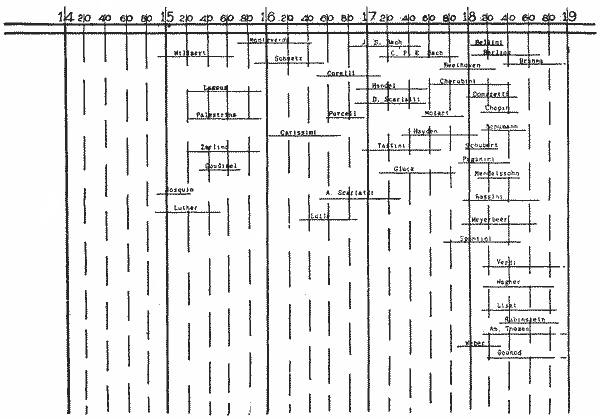
CHRONOLOGY OF THE GREATEST COMPOSERS.
(Copyright.)
Explanation.—The heavy vertical lines are century lines. Light
vertical,
twenty-year lines. Horizontal lines, the life of the
composer.
[Enlarge]
[Pg 12]
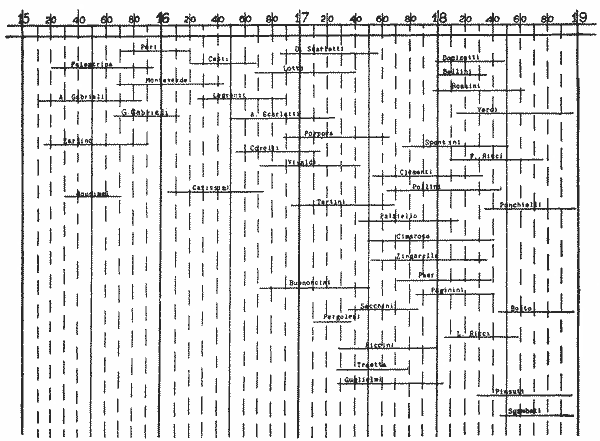
CHRONOLOGY OF PRINCIPAL ITALIAN COMPOSERS.
(Copyright.)
From Palestrina to Present Time. (See explanation,
page 11.)
[Enlarge]
[Pg 13]
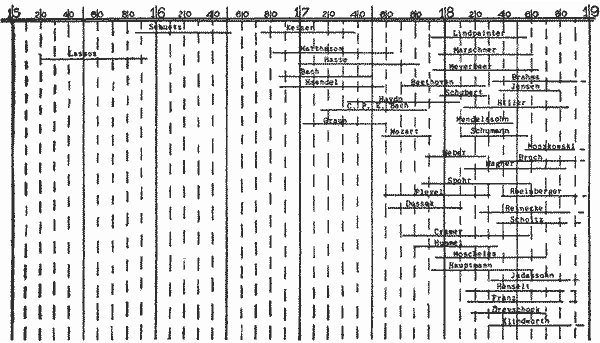
CHRONOLOGICAL CHART OF THE MORE IMPORTANT
GERMAN COMPOSERS.
(Copyright.)
From Orlando Lassus to the Present Time. (See
page 11.)
[Enlarge]
[Pg 14]
CHRONOLOGICAL SUCCESSION OF PIANISTS AND COMPOSERS
FOR THE PIANOFORTE.
(Copyright.)
From 1660 to the Present Time (1891).
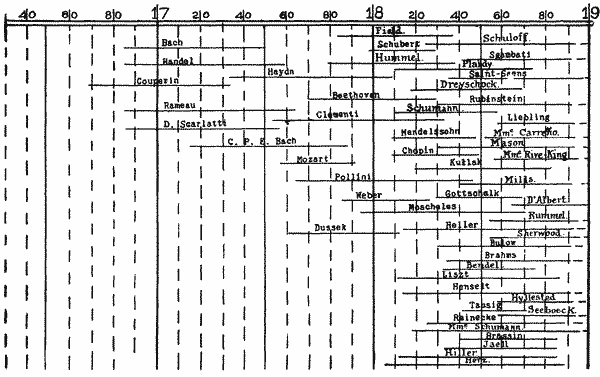
[Enlarge]
[Pg 15]
INTRODUCTION.
I.
 HE name "music" contains two ideas, both of them important in our
modern use of the term: The general meaning is that of "a pleasing
modulation of sounds." In this sense the term is used constantly by
poets, novelists and even in conversation—as when we speak of the
"music of the forest," the "music of the brook" or the "music of
nature." There is also a reminiscence of the etymological derivation
of the term, as something derived from the "Muses," the fabled retinue
of the Greek god Apollo, who presided over all the higher operations
of the mind and imagination. Thus the name "music," when applied to an
art, contains a suggestion of an inspiration, a something derived from
a special inner light, or from a higher source outside the composer,
as all true imagination seems to be to those who exercise it.
HE name "music" contains two ideas, both of them important in our
modern use of the term: The general meaning is that of "a pleasing
modulation of sounds." In this sense the term is used constantly by
poets, novelists and even in conversation—as when we speak of the
"music of the forest," the "music of the brook" or the "music of
nature." There is also a reminiscence of the etymological derivation
of the term, as something derived from the "Muses," the fabled retinue
of the Greek god Apollo, who presided over all the higher operations
of the mind and imagination. Thus the name "music," when applied to an
art, contains a suggestion of an inspiration, a something derived from
a special inner light, or from a higher source outside the composer,
as all true imagination seems to be to those who exercise it.
2. Music has to do with tones, sounds selected on account of their
musical quality and relations. These tones, again, before becoming
music in the artistic sense, must be so joined together, set in order,
controlled by the human imagination, that they express sentiment.
Every manifestation of musical art has in it these two elements: The
fit selection of tones; and, second, the use of them for expressing
sentiment and feeling. Hence the practical art[Pg 16] of music, like every
other fine art, has in it two elements, an outer, or technical,
where trained intelligence rules, and teaching and study are the
principal means of progress; and an inner, the imagination and
musical feeling, which can indeed be strengthened by judicious
experience in hearing, but which when wanting cannot be supplied by
the teacher, or the laws of their action reduced to satisfactory
statement.
3. There is no fine art which reflects the activity of spirit more
perfectly than that of music. There is something in the nature of this
form of art which renders it particularly acceptable to quick and
sensitive minds. If evidence of this statement were needed beyond the
intuitive assent which every musical reader will immediately give, it
could easily be furnished in the correspondence between the activity
of mind in general and in the art of music in particular, every great
period of mental strength having been accompanied by a corresponding
term of activity in music. Furthermore, the development of the art of
music has kept pace with the deepening of mental activity in general,
so that in these later times when the general movement of mind is so
much greater than in ancient times, and the operations of intellect so
much more diffused throughout all classes, the art of music has come
to a period of unprecedented richness and strength.
II.
4. The earlier forms of music were very simple; the range of tones
employed was narrow, and the habits of mind in the people employing
them apparently calm and almost inactive. As time passed on more and
more tones were added to the musical scales, and more and more[Pg 17]
complicated relations recognized between them, and the music thereby
became more diversified in its tonal effects, and therein better
adapted for the expression of a more energetic or more sensitive
action of mind and feeling. This has been the general course of the
progress, from the earliest times in which there was an art of music
until now.
The two-fold progress of an education in tone perception, and an
increasing ability to employ elaborate combinations for the expression
of feelings too high-strung for the older forms of expression, is
observable in almost all stages of musical history, and in our own
days has received a striking illustration in the progress made in
appreciating the works of the latest of the great musical geniuses,
Richard Wagner, whose music twenty-five years ago was regarded by the
public generally as unmusical and atrocious; whereas now it is heard
with pleasure, and takes hold of the more advanced musical minds with
a firmness beyond that of any other musical production. The
explanation is to be found in the development of finer tone
perceptions—the ability to co-ordinate tonal combinations so
distantly related that to the musical ears of a generation ago their
relation was not recognized, therefore to those ears they were not
music. Wagner felt these strange combinations as music. The deeper
relations between tones and chords apparently remote, he felt, and
employed them for the expression of his imagination. Other ears now
feel them as he did. An education has taken place.
5. It is altogether likely that the education will still go on until
many new combinations which to our ears would be meaningless will
become a part of the ordinary vernacular of the art. Indeed, a writer
quite recently (Julius Klauser, in "The Septonnate") points out a
vast[Pg 18] amount of musical material already contained within our tonal
systems which as yet is entirely unused. The new chords and relations
thus suggested are quite in line with the additions made by Wagner to
the vocabulary of his day.
III.
6. There are certain conditions which must be met before a fine art
will be developed. These it is worth while to consider briefly:
The state of art, in any community or nation, at any period of its
history, depends upon a fortunate correspondence between two elements
which we might call the internal and the external. By the former is
meant the inner movement of mind or spirit, which must be of such
depth and force as to leave a surplusage after the material needs of
existence have been met. In every community where there is a certain
degree of wealth, leisure and a vigorous movement of mind, this
surplus force, remaining over after the necessary wheels of common
life have been set in motion, will expend itself in some form of art
or literature. The nature of the form selected as the expression of
this surplus force will depend upon the fashion, the prevalent
activity of the life of the day, or, in other words, the environment.
Illustrating this principle, reference might be made to the condition
of Greek art in the flowering time of its history, when the wealth of
Athens was so great as to leave resources unemployed in the material
uses of life, and when the intellectual movement was so splendid as to
leave it until now a brilliant tradition of history. Only one form of
art was pre-eminently successful here; it was sculpture, which at that
time reached its fullest development—to such a degree[Pg 19] that modern
sculpture is only a weak repetition of ancient works in this line. So
also the brilliant period of Italian painting, when the mental
movement represented by Leonardo da Vinci, Michael Angelo, Lorenzo de
Medici, and the pleasure-loving existence, the brilliant fêtes, in
which noble men and beautifully appareled women performed all sorts of
allegorical representations, and the colors, groupings, etc., afforded
the painter an endless variety of material and suggestion. When Rubens
flourished in the Netherlands, a century later, similar conditions
accompanied his appearance and the prolific manifestations of his
genius. In the same way, music depends upon peculiar conditions of its
own. They are three: The vigor of the mental movement in general, its
strength upon the imaginative and sentimental side, and the suggestion
from the environment in the way of musical instruments of adequate
tonal powers. Such instruments never existed in the history of the art
until about the sixteenth and seventeenth centuries. The organ, the
violin and the predecessor of the pianoforte, the spinet, came to
practical form at nearly the same time. At the same time the
instruments of plucked strings—the guitars, lutes and other
instruments which until then had occupied the exclusive attention of
musicians—began to go out. Moreover, musical science had been worked
out, and the arts of counterpoint, canonic imitation, fugue, harmony,
etc., had all reached a high degree of perfection when Bach and Händel
appeared.
7. The entire history of music is merely an illustration of these
principles. Wherever there has been vigorous movement of mind and
material prosperity (and they have always been associated) there has
been an art of music, the richness of which, however, has always[Pg 20] been
limited by the state of the musical ears of the people or generation,
and the perfection of their musical instruments. The instruments are
an indispensable ingredient in musical progress, since it is only by
means of instruments that tonal combinations can be exactly repeated,
the voice mastering the more difficult relations of tones only when
the ear has become quick to perceive tonal relations, and tenacious to
retain them—in other words, educated. Hence in the pages following,
the instruments peculiar to each epoch will receive the attention
their importance deserves, which is considerably more than that
usually allotted them in concise accounts of the history of this art.
8. The conditions of a satisfactory Art Form are three: Unity, the
expression of a single ruling idea; variety, the relief of the
monotony due to the over-ascendency of unity (or contrast, an exact
and definite form of variety); and symmetry, or the due proportion of
the different parts of the work as a whole. These principles,
universally recognized as governing in the other fine arts, are
equally valid in music. As will be seen later, all musical progress
has been toward their more complete attainment and their due
co-ordination into a single satisfactory whole. Every musical form
that has ever been created is an effort to solve this problem; and
analysis shows which one of the leading principles has been most
considered, and the manner in which it has been carried out. Ancient
music was very weak in all respects, and never fully attained the
first of these qualities. Modern music has mastered all three to a
very respectable degree.
9. The art of music appears to have been earliest of all the fine arts
in the order of time; but it has been longer than any of the others in
reaching its maturity,[Pg 21] most of the master works now current having
been created within the last two centuries, and the greater proportion
of them within the last century. Sculpture came to its perfection in
Greece about 500 B.C.; architecture about 1200 to 1300 A.D., when the
great European cathedrals were built; painting about 1500 to 1600 A.D.
Poetry, like music, representing the continual life of soul, has never
been completed, new works of highest quality remaining possible as
long as hearts can feel and minds can conceive; but the productions of
Shakespeare, about 1650, are believed to represent a point of
perfection not likely to be surpassed. Music, on the other hand, has
been continually progressive, at least until the appearance of
Beethoven, about the beginning of the present century, and the
romantic composers between 1830 and the present time.
IV.
10. The history of music may be divided into two great
periods—Ancient and Modern—the Christian era forming a dividing
line between them. Each of these periods, again, may be subdivided
into two other periods, one long, the other quite short—an Apprentice
Period, when types of instruments were being found out, melodic or
harmonic forms mastered; in other words, the tonal sense undergoing
its primary education. The other, a Master Period, when an art of
music suddenly blossoms out, complete and satisfactory according to
the principles recognized by the musicians of the time. In the natural
course of things such an art, having once found its heart, ought to go
on to perfection; but this has not generally been the case. After a
period of vigorous growth and the production of master works suitable
to the time, a[Pg 22] decline has ensued, and at length musical productivity
has entirely ceased. Occasionally a cessation in art progress of this
kind may have been dependent upon the failure of one or other of the
primary conditions of successful art mentioned above, especially the
failure of material prosperity. This had something to do with the
cessation of progress in ancient Egypt, very likely; but more often
the stoppage of progress has been due to the exhaustion of the
suggestive powers of the musical instruments in use. The composers of
the music of ancient Greece had for instruments only lyres of six or
eight strings, with little vibrative power. After ten centuries of use
every suggestion in the compass of these instruments to furnish, had
been carried out. If other and richer instruments could have been
introduced, no doubt Greek music would have taken a new lease of life,
i.e., supposing that the material prosperity had remained constant.
The apprentice periods of ancient history extend back to the earliest
traces of music which we have, beginning perhaps with the early Aryans
in central Asia, whom Max Müller represents as circling around the
family altar at sunrise and sunset, and with clasped hands repeating
in musical tones a hymn, perhaps one of the earliest of those in the
Vedas, or a still older one. From this early association of music with
religious worship we derive something of our heredity of reverence for
the art, a sentiment which in all ages has associated music with
religious ritual and worship, and out of which has come much of the
tender regard we have for it as the expression of home and love in the
higher aspects.
All the leading types of instruments were discovered in the early
periods of human history, but the full powers of the best have been
reached only in recent times.[Pg 23]
11. The art of music was highly esteemed in antiquity, and every great
nation had a form of its own. But it was only in three or four
countries that an art was developed of such beauty and depth of
principle as to have interest for us. The countries where this was
done were Egypt, Greece and India.
12. Modern music differs from ancient in two radical points: Tonality,
or the dependence of all tones in the series upon a single leading
tone called the Key; and Harmony, or the satisfactory use of combined
sounds. This part of music was not possible to the ancients, for want
of correctly tuned scales, and the selection of the proper tone as
key. The only form of combined sounds which they used was the octave,
and rarely the fifth or fourth. The idea of using other combined
sounds than the octave seems to have been suggested by Aristotle,
about 300 B.C. The period from the Christian era until about 1400 A.D.
was devoted to apprentice work in this department of art, the central
concept wanted being a principle of unity. After the beginning of
the schools of the Netherlands, about 1400, progress was very rapid.
The blossoming time of the modern art of music, however, cannot be
considered to have begun before about 1600, when opera was commenced;
or 1700, when instrumental music began to receive its full
development. Upon the whole, the former of these dates is regarded as
the more just, and it will be so used in the present work.
[Pg 24]
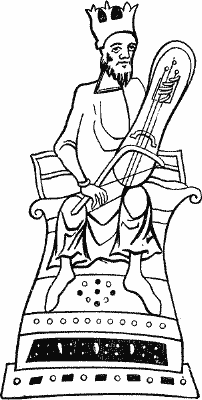
KING DAVID, PLAYING ON THE THREE-STRINGED CRWTH.
[From a manuscript of the eleventh century now
in the National Library, Paris.]
[Pg 25]

THE
Music of the Ancient World.
PRIMITIVE TYPES OF INSTRUMENTS, AND
AN ARTISTIC MONODY, WITHOUT
REAL
TONALITY.
[Pg 27]
CHAPTER I.
MUSIC AMONG THE ANCIENT EGYPTIANS.
 Y a curious fortune we are able to form an approximately accurate
idea of the musical instruments in use in Egypt as long ago as about
4000 B.C. The earliest advanced civilization of which any coherent
traces have come down to us was developed along the Nile, where the
equable climate and the periodic inundations of the river raised the
pursuit of the husbandman above the uncertainties incident to less
favorable climates, while at the same time the mild climate reduced to
a minimum the demands upon his productive powers for the supply of the
necessaries of life. This interesting people had the curious custom of
depositing the mummies of their dead in tombs elaborately hewn out of
the rock, or excavated in more yielding ground, in the hills which
border the narrow valley of the Nile. Many of these excavations are of
very considerable extent, reaching sometimes to the number of twenty
rooms, and a linear distance of 600 feet from the entrance. The walls
of these underground apartments are generally decorated in outline
intaglio if the rock be hard; or in color if the walls be plaster, as
is often the case. The subjects of the decorations embrace the entire
range of the domestic and public life of the people, among them[Pg 29]
being many of a musical character. One of the first discoveries of
this kind was made toward the close of the preceding century, when
Bruce, an English traveler, found in a tomb at Biban-El-Moulouk
representations of two magnificently decorated harps played by
priests. These have since generally been called "Bruce's Harpers." The
instruments have been represented in many ways by different writers,
the most curious perversion of the facts being found in Burney's
"History of Music," where they have the form of the modern harp.
Y a curious fortune we are able to form an approximately accurate
idea of the musical instruments in use in Egypt as long ago as about
4000 B.C. The earliest advanced civilization of which any coherent
traces have come down to us was developed along the Nile, where the
equable climate and the periodic inundations of the river raised the
pursuit of the husbandman above the uncertainties incident to less
favorable climates, while at the same time the mild climate reduced to
a minimum the demands upon his productive powers for the supply of the
necessaries of life. This interesting people had the curious custom of
depositing the mummies of their dead in tombs elaborately hewn out of
the rock, or excavated in more yielding ground, in the hills which
border the narrow valley of the Nile. Many of these excavations are of
very considerable extent, reaching sometimes to the number of twenty
rooms, and a linear distance of 600 feet from the entrance. The walls
of these underground apartments are generally decorated in outline
intaglio if the rock be hard; or in color if the walls be plaster, as
is often the case. The subjects of the decorations embrace the entire
range of the domestic and public life of the people, among them[Pg 29]
being many of a musical character. One of the first discoveries of
this kind was made toward the close of the preceding century, when
Bruce, an English traveler, found in a tomb at Biban-El-Moulouk
representations of two magnificently decorated harps played by
priests. These have since generally been called "Bruce's Harpers." The
instruments have been represented in many ways by different writers,
the most curious perversion of the facts being found in Burney's
"History of Music," where they have the form of the modern harp.
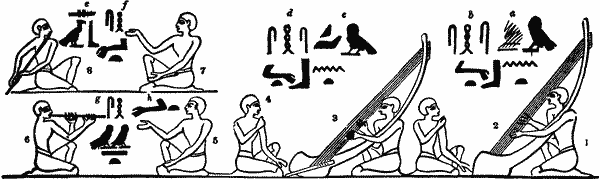
Harps, pipe, and flute, from an ancient tomb near the
Pyramids.
[Enlarge]
Fig. 1.
EXPLANATION OF FIG. 1.—(1) Harper, with harp, bent, of seven cords;
over him is inscribed in hieroglyphs sqa em bents (a), "player
[literally "scraper"] on the harp." (2) Singer, seated; above him, hes
t (b) "singer." (3, 4) Similar harper and singer, and same
inscriptions (c, d). (5, 6) Singer and player on the direct flute
or pipe; before the former, hes (h) "singer"; before the latter, mem
t (g) "pipe." (7, 8) Singer and player on the oblique flute, seba
(e); before the former, hes (f) "singer."
Several large works have been devoted to plates of the pictorial
discoveries in these ancient tombs, but not until the colossal work of
Lepsius, issued under the auspices of the German government, were we
in possession of data for the study of this civilization from the
standpoint of a progressive development.
The oldest of the musical representations are found in tombs near
Thebes, and already we find the art in an advanced state. The
preceding cut shows one of these pictures. A musical group is
represented, consisting of eight figures. Their occupations are
designated by the hieroglyphics above them. The harper is designated
as "harp scraper."
It is not possible to make out in the present state of these drawings
the exact number of strings upon the harps, but explorers agree that
it must have been either five or seven. From the length of the strings
and the structure of the instrument without a "pillar" in front for
resisting the pull of the strings, the tones must have been within the
register of the male voice. The long flute played by the figure
bearing the number 8 must also have produced low tones. It is not
plain whether these players are supposed to be all playing at the
same[Pg 31] time, or whether their ministrations may have taken place
separately. Most likely, however, they all played and sang together.
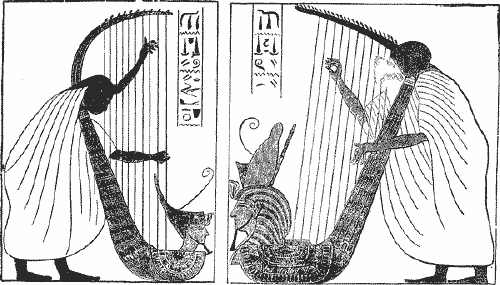
Fig. 2.
BRUCE'S HARPERS.
The most advanced harps found in Egypt were the elegantly colored and
ornamented priestly instruments which Bruce found in what was
afterward discovered to be the tomb of Rameses III, at
Biban-El-Moulouk. The black and white cuts give but a poor idea of the
elaborate structure and rich ornamentation of these fine instruments
(Fig. 2). The instruments are not playing together; each harper plays
before his own particular divinity. They occupy opposite sides in the
same hall. The players, by their white robes and positions, evidently
belonged to the highest order of the priesthood. The harp upon the
right is represented by some writers as having had twenty-one strings;
whereas the one upon the left has only eleven. This would be an
interesting fact if it were well founded. But, unfortunately, the
truth is that the painting was somewhat defaced after Bruce saw it,
and it was only within later years that a clever explorer discovered
that by passing a wet sponge over it the original lines could be made
out. According to Lepsius it has thirteen strings.
In the XXth dynasty, about 1300 B.C., there were harps having
twenty-one strings, of which a good example is shown in Fig. 3. This
instrument, also, is elaborately colored and ornamented in gold and
carving. The strings are shorter than those of Bruce's harpers, and
the pitch was most likely within the treble register. The second
figure clapping hands is marking time. The one upon the right is
playing upon a sort of banjo, of which mention will be made presently.
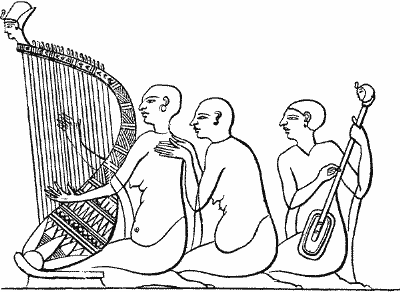
Fig. 3.
Some time before the period of the Hyksos, the[Pg 32] "Shepherd Kings" of
the Exodus, there is a scene of a procession of foreigners presenting
tribute to one of the sovereigns of Egypt. Among the figures is one
playing upon a sort of lyre. Later this instrument became the
established instrument of the higher classes, as it was afterward in
Greece and Rome. Several complete instruments have been found, which,
although dating most likely from a period near the Christian era, are
nevertheless sufficiently like the representations of ten centuries
earlier to make them instructive as well as interesting. Figs. 4 and 5
are from Fétis. One of these lyres had originally six strings, as is
shown by the notches in the cross-piece at the top. They were tuned
approximately by making the cord tense and then sliding the loop over
its notch. From the clever construction of the resonance cases these
instruments should have[Pg 33] had a very good quality of tone. In some of
the later representations there are lyres of twenty strings.
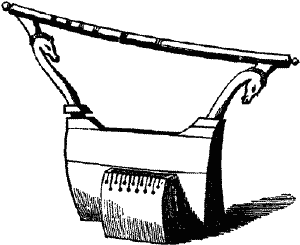
Fig. 4.
LYRE AT BERLIN.
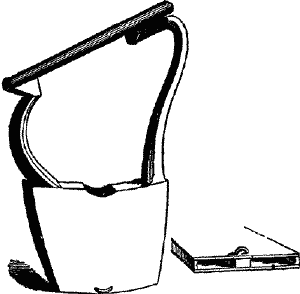
Fig. 5.
FROM THE LEYDEN MUSEUM.
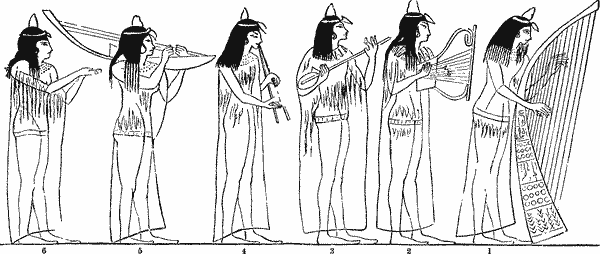
Fig. 6.
A GROUP OF STREET MUSICIANS.
(1) Woman with tall light harp, of fourteen strings. (2) Cithara. (3)
Te-bouni, or banjo. (4) Double flute. (5) Shoulder harp. (6) Singer, clapping
hands.
It will be observed that up to this point all the musicians
represented are men. In later representations women are more common.
Fig. 6 represents the entire musical culture of the later empire, this
particular representation belonging apparently to an epoch not more
than a few centuries before the Christian era. The harp in this case
is of a different construction, and lighter[Pg 35] than those in the former
examples. It would seem to have been played while the player walked,
for we find it in what seems to be moving processions. The lyre
occupies here the post of honor next the harp. The banjo and double
flute come next, and then a curious instrument of three or four
strings, played while carried upon the shoulder. Several of these
instruments have been found in a very respectable state of
preservation. Their construction is better shown in the illustrations
following:
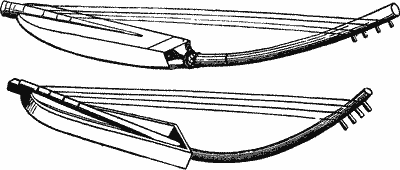
Fig. 7.
The tonal relation of these instruments to the larger harps is
difficult to conceive. Wilkinson gives the dimensions of the most
perfect one in the British Museum as forty-one inches long, the neck
occupying twenty-two inches, and the body being four inches wide.
The instrument with the long neck and the short body, seen in Figs. 3
and 6, belongs to the banjo family. Its resonance body consisted of a
sort of hoop, or a hollowed out piece of sycamore, the sounding board
being a piece of parchment or rawhide. Some of these have two strings,
others one; three are occasionally met with. The name of this
instrument was te-bouni, and it was of Assyrian origin. It was
afterward known as[Pg 36] the "monochord," and by its means all the ancients
demonstrated the ratios of the octave, fourth and fifth, as we will
later see.
We have no knowledge whatever of the tonal sound of the music which so
interested these ancient players and singers. There is, however, an
ancient poem, called "The Song of the Harper" found in a papyrus
dating from about 1500 B.C., which gives an idea of the sentiments the
music was intended to convey. Here it is, from Rawlinson's "History of
Ancient Egypt," p. 48:
"THE SONG OF THE HARPER."
[From a papyrus of the XVIIIth Dynasty.]
The great one has gone to his rest
Ended his task and his race;
Thus men are aye passing away,
And youths are aye taking their place.
As Ra rises up every morn,
And Tum every evening doth set.
So women conceive and bring forth,
And men without ceasing beget.
Each soul in its turn draweth breath,
Each man born of woman sees death.
Take thy pleasure to-day,
Father! Holy one! See,
Spices and fragrant oils,
Father, we bring to thee.
On thy sister's bosom and arms
Wreaths of lotus we place;
On thy sister, dear to thy heart,
Aye sitting before thy face.
Sing the song, let music be played,
[Pg 37]And let cares behind thee be laid.
Take thy pleasure to-day;
Mind thee of joy and delight!
Soon life's pilgrimage ends,
And we pass to silence and night.
Patriarch, perfect and pure,
Neferhotep, blessed one! Thou
Didst finish thy course upon earth,
And art with the blessed ones now.
Men pass to the silent shore,
And their place shall know them no more.
They are as they never had been
Since the sun went forth upon high;
They sit on the banks of the stream
That floweth in stillness by.
Thy soul is among them; thou
Dost drink of the sacred tide,
Having the wish of thy heart,
At peace ever since thou hast died.
Give bread to the man who is poor,
And thy name shall be blest evermore.
|
All princely households appear to have had their regular staff of
musicians, at the head being the "Overest of Musicians," whose tombs
still furnish some of the most instructive information upon this part
of the ancient life. People of lower social grade had to be content
with the temporary services of the street musicians, such as those
represented in Fig. 6. They played and sang and danced for weddings
and festivities, and undertook the entire contract of mourning for the
dead, the measure being the production of a small vial full of tears,
under the immediate inspection of the relative of the deceased whose
grief might happen to need this official assistance.[Pg 38]
For warlike purposes the Egyptians had a short trumpet of bronze, and
a long trumpet, not unlike a straight trombone. They had drums of many
kinds, but as none of these instruments have reference to the
development of the higher art of music, we do not delay to describe
them.
One thing which might surprise us in casting an eye over the foregoing
representations as a whole is the small progress made considering the
immensely long period covered by the glimpses we have of the music of
this far-away race. From the days of the harpers in our earliest
illustrations to those of the last is more than 2,000 years, in fact
considerably longer than from the beginning of the Christian era until
now. The explanation is easy to find. In the first place, the
incitations upon the side of sense perception were comparatively
meager. Neither in sonority nor in delicacy of tonal resource were the
Egyptian instruments a tenth part as stimulating as those of to-day.
Moreover, we have here to deal with childlike intelligences, slow
perceptions, and limited opportunities of comparison. Hence if these
were all the discouraging elements there would be but little cause for
wonder at the slow progress. But there was another element deeper and
more powerful. The Egyptian mind was conservative to reaction. Plato
in his "Laws," says: "Long ago the Egyptians appear to have recognized
the very principle of which we are now speaking—that their young
citizens must be habituated to the forms and strains of virtue. These
they fixed, and exhibited the patterns of them in their temples, and
no painter or artist is allowed to innovate upon them, or to leave the
traditional forms or invent new ones. To this day no alteration is
allowed in these arts nor in music[Pg 39] at all. And you will find that
their works of art are painted or modeled in the same forms that they
were 10,000 years ago. This is literally true, and no
exaggeration—their ancient paintings and sculptures are not a whit
better or worse than those of to-day, but are with just the same
skill." This, which Dr. Draper calls the "protective idea," was
undoubtedly the cause of their little progress.
In another place Plato gives a very interesting glimpse of the
Egyptian method of education, and describes something having in it
much the spirit of the modern kindergarten. He says ("Laws," Jowett's
translation, p. 815): "In that country systems of calculation have
been actually invented for the use of children, which they learn as a
pleasure and amusement. They have to distribute apples and garlands,
adapting the same number to either a larger or less number of persons;
and they distribute to pugilists and wrestlers, or they follow one
another, or pair together by lot. Another mode of amusing them is by
taking vessels of gold, and brass, and silver, and the like, and
mingling them, or distributing them without mingling. As I was saying,
they adapt to their amusement the numbers in common use, and in this
way make more intelligible to their pupils the arrangements and
movements of armies and expeditions, and in the management of a
household they make people more useful to themselves, and wide-awake."
This, together with the well known expectation of the Egyptians to be
judged after death according to the "deeds done in the body," as our
sacred writings have it, affords a high idea of their serious and
lofty turn of mind, as well as of the great advance they had made
toward a true notion of the means of education.
[Pg 40]
CHAPTER II.
MUSIC AMONG THE HEBREWS AND ASSYRIANS.
 ECOND in point of antiquity, but first in modern association, comes
the music of the Hebrews, and of the other allied nations of Assyria
and Babylon, from whom they learned a part of their art of music. The
place of music in the cult of the Hebrews was very large and
important, yet in spite of this fact they never elevated their music
into an art, strictly so called. There are no evidences of a
progressive development of instruments and a tonal sense among this
people. As they were when first we meet them, so they continued until
they pass out of the view of history as a nation, when the sacrificial
fires went out in the great temple at Jerusalem on the 11th of July,
A.D. 70, and the heathen Roman defiled the altars of God. In the
beginning Genesis tells us of one Jubal, who was the father of such as
handle the harp and the organ (kinnor and ugabh—the little triangular
harp of Assyria, and the shepherd's pipe, which here stands for all
sorts of wind instruments). In the course of the centuries the harp
changed its form somewhat, and perhaps had an increased number of
strings; the flute was multiplied into several sub-varieties, and the
horn was added. From Egypt they had the timbrel, a tambourine, to[Pg 41]
which Miriam, the sister of Moses, intoned the sublime canticle, "The
horse and his rider hath He thrown into the sea." There were also the
sistra, those metallic instruments serving in the temple service the
same purpose that the bells serve in the mass at the present
day—that, namely, of letting the distant worshipers know when the
solemn moment has arrived.
ECOND in point of antiquity, but first in modern association, comes
the music of the Hebrews, and of the other allied nations of Assyria
and Babylon, from whom they learned a part of their art of music. The
place of music in the cult of the Hebrews was very large and
important, yet in spite of this fact they never elevated their music
into an art, strictly so called. There are no evidences of a
progressive development of instruments and a tonal sense among this
people. As they were when first we meet them, so they continued until
they pass out of the view of history as a nation, when the sacrificial
fires went out in the great temple at Jerusalem on the 11th of July,
A.D. 70, and the heathen Roman defiled the altars of God. In the
beginning Genesis tells us of one Jubal, who was the father of such as
handle the harp and the organ (kinnor and ugabh—the little triangular
harp of Assyria, and the shepherd's pipe, which here stands for all
sorts of wind instruments). In the course of the centuries the harp
changed its form somewhat, and perhaps had an increased number of
strings; the flute was multiplied into several sub-varieties, and the
horn was added. From Egypt they had the timbrel, a tambourine, to[Pg 41]
which Miriam, the sister of Moses, intoned the sublime canticle, "The
horse and his rider hath He thrown into the sea." There were also the
sistra, those metallic instruments serving in the temple service the
same purpose that the bells serve in the mass at the present
day—that, namely, of letting the distant worshipers know when the
solemn moment has arrived.
Vast numbers of musicians were employed in the greater temple service,
4,000 being mentioned in I Chronicles xxiii, 5, as praising God with
the kinds of instruments appointed by David. According to Josephus,
this great number was vastly increased in still later times, the
numbers given being 200,000 trumpeters and 40,000 harpers and players
upon stringed instruments. Even if we take the figures as greatly
exaggerated, they show nevertheless that the art of music had a great
place among this people.
The instruments known were few in number, and their type underwent
little change from the earliest days. The principal instrument of the
older time was the Kinnor, or little triangular harp, which we find
in the record of the primeval Jubal, and which more than 1,000 years
later was played before Saul to defend him from the evil spirit. This
also was the instrument most prominent in the temple service, and this
again was hung upon the willows of Babylon. The name kinnor is said to
have been Phœnician, a fact which points to this as the source of
its derivation. It is not easy to see how this could well be, unless
we regard the name as having been applied to the invention of Jubal at
a later time, for Jubal lived many years anterior to the founding of
the great metropolis of the Mediterranean. The kinnor was a small harp
having from ten to twenty[Pg 42] strings. The usual forms are shown in the
accompanying illustration. The strings were fastened upon a metal rod
lying along the face of the sounding board. The type of construction
is totally unlike that of the Egyptian harps, and its musical powers
were apparently considerably inferior. Its form was the following:
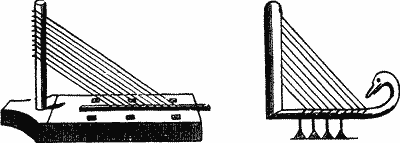
Fig. 8.
Another instrument often mentioned in the English version of the Bible
is the psaltery, of which the form is somewhat uncertain, but is
thought to have been four-sided. Various ancient representations have
been supposed to be this instrument, but none of them satisfactorily,
at least not authoritatively. It was probably a variety of harp. The
nebel is also said to have been a psaltery, but its etymology points
to the Phœnician nabel, a triangular harp like a Greek delta. The
forms of the psaltery were four-sided or triangular. It was probably
the predecessor of the Arab canon, which again is much the same as the
santir. (See Fig. 25.)
There were two kinds of flute, both of them reed pipes, the smaller
being merely a shepherd's pipe. They were used for lamentations and
for certain festivals, as in Isaiah xxx, 29: "Ye shall have a song as
in the night when a holy solemnity is kept; and gladness of heart as
when one goeth with a pipe to come into the mountain of the Lord, the
Holy One of Israel."[Pg 43]
Many of the different names of musical instruments in the common
version of the Scriptures are merely blunders of the Septuagint
translators, who rendered the word kinnor by about six different
terms, where no distinction had been originally intended by the sacred
writers.
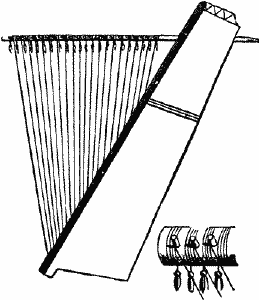
Fig. 9.
Among the Hebrews we find the same progression from men alone as
musicians to women almost exclusively, and it is likely that the
Hebrews gained the idea from Egypt. Jubal was the discoverer of the
harp, according to the tradition in Genesis, and David manifested no
loss of manliness while playing before the Lord. Nevertheless when he
sang and danced before the ark his wife despised him in her heart.
Miriam, the sister of Moses, may well have been a professional
musician, one of the singing and dancing women, such as are
represented over and over again in the monuments. In the time of
Moses, and for some time later, women had no status in[Pg 44] the public
service; but in the later days of the second temple the women singers
are an important element of the display. Ezra and Nehemiah speak of
them, and the son of Sirach, in the Apocrypha, recommends the reader
to "beware of female singers, that they entice thee not with their
charms."
According to the views of many writers, the Hebrews had a larger harp
than the small one represented in Fig. 8. It may have been something
like one which was found in Egypt, but the form is clearly Assyrian,
belonging to the same type as the small harps already given. It
certainly is not Egyptian. (See Fig. 9.)
The liturgy of the temple must have been singularly noble and
imposing. Never had a church so grand a body of poetry as this of the
Hebrews, which they heard in the very sonorous words of David, Moses,
Isaiah and Ezekiel, with all the subtle suggestion of a vernacular as
employed by minds of the first poetic order. The Hebrew parallelism
afforded exactly the kind of formula in which one congregation could
most effectively respond to another.
"The earth is the Lord's, and the fullness thereof;
The world and they that dwell therein;
For He hath founded it upon the seas,
And established it upon the floods.
Who shall ascend into the hill of the Lord?
And who shall stand in His holy place?"
|
When the priests had intoned one line, we may suppose that the whole
choir of Levites made answer in the second line, completing the
parallelism.
There are other psalms in which the people have a refrain which comes
in periodically, as, for instance, in[Pg 45] the one: "O give thanks unto
the Lord; [refrain] for His mercy endureth forever." (Ps. cxxxvi.)
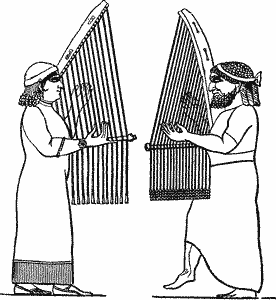
Fig. 10.
The voice of these masses stood to the Hebrews' mind as the feeble
type of the great song which should go up from the entire Israel of
God when the scattered members of the cult were gathered in their time
of fullness and glory. For us also the same image stands. And while
the art of this venerable and singularly gifted people did not attain
a place of commanding influence upon the tonal side of music, it
nevertheless has borne no small part in affording a vantage ground for
later art in the line of noble conceptions, inspiring motives and
brilliant suggestions. It has been, and still is, one of the most
potent influences in the art-music of the world. Nor is it without
interest that the scattered[Pg 46] representatives of this race have been
and continue to be ministers of art in all the lands into which they
have come. The race of Israel has made a proud record in modern music,
no less than that of the ancient temple.
II.
The Assyrians held music in honor, and employed it for liturgical
purposes, as well as those of social and private life. Among the
discoveries at Nineveh and Babylon are many of a musical character.
Strong bearded men are playing upon harps which are of a triangular
form, but of a different structure to any which we have thus far
given. (See Fig. 10.)
The one upon the left is a eunuch. In the following figure we have the
banjo-like instrument so constantly seen in the Egyptian
representations.
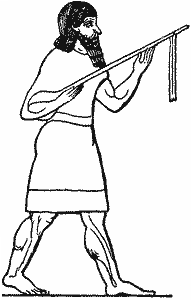
Fig. 11.
There are several instances of some sort of an instrument, apparently
consisting of metallic plates or rods,[Pg 47] played by means of a hammer.
Many have considered these to have been the original type of the
modern instruments of percussion, where metal plates are vibrated by
means of hammers or mallets. The following is one of this kind.
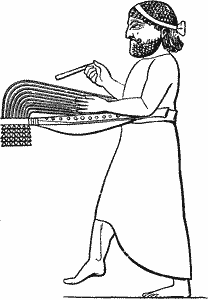
Fig. 12.
The general appearance of these processions indicates that the
Assyrians were in the habit of massing a large number of players upon
important occasions. We have no idea what the effect of this music can
have been, but upon the tonal side it cannot have had any great
resonance or power. Enough if it satisfied the ears of the dignified
players and those who employed their services as a part of the pageant
of their great festivals.
[Pg 48]
CHAPTER III.
MUSIC AMONG THE ANCIENT GREEKS.
 PON several accounts the development of the art of music among the
ancient Greeks is both important and interesting. Our word "music" is
theirs; it carries within its etymology the derivation from the Muses,
the nine agreeable divinities who presided over the more becoming and
nobler activities of the Greek mind. By music the Greeks meant much
more than merely the tonal art itself. Under this term they included
pretty much all that they had of a liberal education; grammar,
history, rhetoric, mathematics, poetry and song—all were included in
this one elastic and comprehensive term. Music itself, the art of
tone-sequence, they called harmony.
PON several accounts the development of the art of music among the
ancient Greeks is both important and interesting. Our word "music" is
theirs; it carries within its etymology the derivation from the Muses,
the nine agreeable divinities who presided over the more becoming and
nobler activities of the Greek mind. By music the Greeks meant much
more than merely the tonal art itself. Under this term they included
pretty much all that they had of a liberal education; grammar,
history, rhetoric, mathematics, poetry and song—all were included in
this one elastic and comprehensive term. Music itself, the art of
tone-sequence, they called harmony.
Our information concerning the general course of the development of
music among this people is pretty accurate through a period of about
1300 years. The entire course of the Greek history of music may be
divided into four great divisions, each of which was principally
devoted to a certain part of the art. These divisions begin at a date
which we might take approximately at about 1000 B.C., when the Homeric
poems began to be chanted or sung by traveling minstrels called
Rhapsodists. The schools of rhapsodies lasted for about 250[Pg 49] years,
when choral and patriotic song began to be developed. In connection
with this part of the history, there was in the later portion of it a
more ornamental and fanciful development of the smaller and social
uses of song, represented by Sappho, Anacreon and others. This period
endured for about two centuries and a half, and by insensible degrees
passed into the Attic drama, which came to its maturity at the hands
of Æschylus, Sophocles and Euripides about 450 B.C.
Here was the culmination of Greek musical art upon the purely artistic
and æsthetic side. Then followed a period of philosophizing, theory
and mathematical deduction, which extended to the end of the
Alexandrian schools, about 300 A.D. The limits of the present work do
not permit tracing this course of progress with the amplitude which
its relation to liberal education would otherwise warrant, or even to
the extent which its bearing upon the present ideals of the tonal art
would justify, were not the range of subjects indispensable to even a
summarized treatment of musical history so wide as it has now become.
But the general features of the different steps in the Greek music are
the following:
As already noticed, the earliest traces of music are those in the
Homeric poems, which are thought to have been composed about 1000 B.C.
In these we find the minstrel everywhere a central figure, an honored
guest, ready at call to entertain the company with some ballad of the
ancient times, or to improvise a new one appropriate to the case in
hand. The heroes themselves were not loth to take part in these
exercises. Ulysses, the Odyssey tells us, occasionally took the lyre
in his own hand and sang a rhapsody of his own adventures. Several
centuries later, Solon, one of the famed seven wise men of[Pg 50] Greece,
composed the rhapsody of "Salamis, or the Lost Island," and sang it in
a public assembly of the Athenians with so much effect that an
expedition was organized, with Solon at its head, for its recovery,
which presently followed triumphantly.
Many passages in the Odyssey will occur to the classical reader in
illustration of the position of the minstrel in Argos in the earlier
times. For example (Odyssey I, 400, Bryant's translation):
"Silent all
They sat and listened to the illustrious bard
Who sang of the calamitous return
Of the Greek host from Troy, at the command
Of Pallas. From her chamber o'er the hall
The daughter of Icarius, the sage queen
Penelope, had heard the heavenly strain,
And knew its theme. Down by the lofty stairs
She came, but not alone; there followed her
Two maidens. When the glorious lady reached
The threshold of the strong-built hall, where sat
The suitors, holding up a delicate veil
Before her face, and with a gush of tears,
The queen bespake the sacred minstrel thus:
'Phemius, thou knowest many a pleasing theme—
The deeds of gods and heroes, such as bards
Are wont to celebrate. Take, then, thy place,
And sing of one of these, and let the guests
In silence drink the wine; but cease this strain;
It is too sad. It cuts me to the heart,
And wakes a sorrow without bounds—such grief
I bear for him, my lord, of whom I think
Continually; whose glory is abroad
Through Hellas and through Argos, everywhere.'
"And then Telemachus, the prudent, spake—
Why, O my mother! canst thou not endure
That thus the well graced poet should delight
His hearers with a theme to which his mind
Is inly moved? The bards deserve no blame;
Jove is the cause, for he at will inspires
The lay that each must sing.'"
|
[Pg 51]
Later than the Homeric rhapsodists, the Hesiodic poems were composed
and sung similarly by wandering minstrels, who, although wandering,
were not on that account lowly esteemed. There were regular schools,
or more properly guilds, of rhapsodists, into which only those were
admitted as masters who were able to treat the current topics with the
light and inspiring touch of real poetry, and only those taken as
apprentices who evinced proper talent and promise. The training of
these schools was long, partly spent in acquiring technique of
treating subjects and the mastery of the lyre, and partly in
memorizing the Homeric and Hesiodic hymns. It is supposed that these
poems were transmitted for more than three centuries orally in this
way, before having been reduced to writing.
In Hesiod's poem of "The Shield of Hercules" (Bank's translation,
365), the general idea of the Greek festive processions is
illustrated:
"There men in dances and in festive joys
Held revelry. Some on the smooth-wheeled car
A virgin bride conducted; then burst forth
Aloud the marriage song; and far and wide
Long splendors flash'd from many a quivering torch
Borne in the hands of slaves. Gay blooming girls
Preceded, and the dancers followed blithe:
These, with shrill pipe indenting the soft lip,
Breath'd melody, while broken echoes thrill'd
Around them; to the lyre with flying touch
Those led the love-enkindled dance. A group
Of youths was elsewhere imaged, to the flute
Disporting; some in dances, and in song;
In laughter others. To the minstrel's flute
So pass'd they on; and the whole city seem'd
As fill'd with pomps, with dances, and with feasts."
|
[Pg 52]
So again in the same poem (274) there is a scene of a minstrel contest
among the immortal gods themselves, described by the poet from one of
the scenes upon the shield of Hercules.
"And the tuneful choir appear'd
Of heaven's immortals; in the midst, the son
Of Jove and of Latona sweetly rang
Upon his golden harp; th' Olympian mount,
Dwelling of gods, thrill'd back the broken sound.
And there were seen th' assembly of the gods
Listening; encircled with beatitude;
And in sweet contest with Apollo there
The virgins of Pieria raised the strain
Preluding; and they seemed as though they sang
With clear, sonorous voices."
|
As early as 750 B.C. we find the famous rhapsodist, Terpander,
summoned to Sparta to sing patriotic songs, in the hope of preventing
a secession of this rather unruly state. He accomplished his mission,
a circumstance creditable alike to the talent of the poet-minstrel and
the high estimation in which the class was held.
The application of music to patriotic purposes was no novelty.
Plutarch, in his "Life of Lycurgus," says that "Thales was famed for
his wisdom and his political abilities; he was withal a lyric poet
who, under cover of exercising his art, performed as great things as
the most excellent lawgivers. For his odes were so many persuasions to
obedience and unanimity, and as by means of numbers they had great
grace and power, they softened insensibly the manners of the audience,
drew them off from the animosities which then prevailed, and united
them in zeal for excellence and virtue." Again, of the subject matter
of the Spartan songs, he says: "Their[Pg 53] songs had a spirit which could
arouse the soul and impel to an enthusiastic action. The language was
plain and manly; the subject serious and moral. For they consisted
chiefly of praises of heroes who had died for Sparta, or else of
expressions of detestation for such wretches as had declined the
glorious privilege."
About this time the art of choral song began to be much cultivated in
Greece, particularly in connection with the cult of certain
divinities, especially Dionysos and Apollo. By the term choral song we
are not to understand anything resembling our singing of a chorus in
parts. There was no part-singing in Greece, but merely a singing, or
rather chanting, of national and patriotic songs in unison,
accompanied by the cithara, the national instrument.
Plato speaks of the imitative and semi-dramatic character of the
choral dance ("Laws," II, 655): "Choric movements are imitations of
manners occurring in various actions, chances, characters—each
particular is imitated, and those to whom the words, the song or the
dances are suited, either by nature or habit, or both, cannot help
feeling pleasure in them and calling them beautiful."
About 500 B.C. a room was rented upon the market place for the
practice of the chorus. Every town had its body of singers, who sang
and performed the evolutions of the representative dance appropriate
to the service of the particular divinity to whom they were devoted.
Presently competitive singing came into vogue, in connection with the
famous games, and the art of the poet was taxed, as well as the
musical and more purely vocal arts of the singers themselves, striving
in honorable competition for the glory of their native towns.
In some of the festival occasions the proceedings of the choral songs
were varied by the leader, who improvised[Pg 54] rhapsodies upon topics
connected with the life of the divinity or upon national stories. At
proper points the chorus came in with the refrain, which remained a
fixed quantity, being put in, apparently, at whatever points the
inspiration or breath of the leader needed a point of repose. None of
these compositions have come down to us, but the allusions to them in
ancient writings give, perhaps, a sufficiently accurate idea of their
nature.
The added interest incident to the fresh improvisations of the leader
in this form of choral song presently opened toward a lyric drama.
Thespis is credited with having been the first to place the leader
upon a centrally located stage where he could be plainly seen and
heard by all concerned. Now the recitations became more dramatic, the
choruses more varied. The speaker illustrated by gestures the acts
which he described; he varied his style of delivery according to the
feeling appropriate to the incidents represented. The chorus meanwhile
was not upon the stage, but in a central location below, and during
their strophes they circled around the platform of the leader in a
sort of mystic dance, each man accompanying himself upon his cithara.
From this to adding a second speaker to the one already upon the stage
was but a short step. It was taken, and the result was a drama with a
chorus in connection. In the earlier plays the speakers represented as
many characters as necessary for carrying out the action. Later they
changed costume to some extent, the chorus meanwhile occupying the
time with their own songs, which generally had the character of a
comment upon the action as developed at the moment. The changes of
costume were extremely slight, merely a different head dress, a mantle
or some slight modification of appearance more or less symbolical[Pg 55] in
character. All the dialogue was delivered in a musical voice, and, it
is thought, all accompanied by the cithara, which every player carried
in his hand. The instrument was sometimes played all the time, in the
same notes as those of the song or chant; at other, times the speaker
employed it for ritournelles, for affording breathing time or points
of emphasis. Once in a great while, it is thought, the instrument had
a note different from that of the song in connection with it. Upon
this point great uncertainty prevails.
At length, about 470 B.C., Æschylus, the great tragedian, made his
début as actor and author, and placed three speakers upon the stage.
Besides the three principals, each man had a suite, if his station
demanded such an appendage according to the ideas or customs of the
times. These, however, had the rank of supernumeraries, merely
following the speaker around, but never taking part in the dialogue.
The principals each represented more than one character, effecting
some slight change of costume for indicating the transformation. The
stage was simply an open platform, with three doors in the rear. The
actor entering by one door represented a prince at home; from another
a prince abroad; by another door he represented a common person. The
chorus occupied the central place in front of the stage, much in the
same location as the parquet is now. In the center of this space was
an altar, originally dedicated to Dionysos, and an offering was
probably placed upon it. Later the Choreagos, or leader of the chorus,
sat upon it and directed the movements of the singers, much as the
operatic director does now. The theaters were very large, being vast
amphitheaters, open to the sky, but with an awning available over the
more[Pg 56] expensive seats. The seats were of stone, arranged exactly like
those in a modern circus. The theater in Athens is said to have held
25,000 persons. At first admission was free, the theater being
conducted by the state. The plays were mounted very expensively at
times, although with the absence of scenery or properties of an
elaborate character it is not easy to imagine what was the use made of
the vast sums reported to have been expended in different productions.
There was a rivalry of leading citizens, each taking upon himself the
expense of mounting a new play, and striving to outdo the last before
him upon the list.
There were three great dramatic authors whose names have come down to
us as the Shakespeares of the Athenian drama. They were Æschylus,
Sophocles and Euripides. All were great poets, the first perhaps the
greatest. Sophocles was a fine musician and an elegant poet, and for
many years he remained the popular idol. All these men wrote not only
the words of the plays, but the music as well, every phrase of every
character having been noted for musical utterance, and all the choral
effects carefully planned. Besides this he composed what was then
called the "Orchestic," whence we have our word orchestra. By
orchestic they meant an apparatus of mystical dancing or posturing and
marching and certain gestures. We do not know precisely what this
famous orchestic was, for no example of it has come down to us in
intelligible form. But from the descriptions of it by contemporary
writers, it seems to have formed the pantomimic complement of the
acting, with a certain added grace of art in grouping and posturing,
suited to attract and satisfy the eye of a public accustomed to
national games, and the beautiful conceptions[Pg 57] of Phidias upon the
Parthenon frieze. Thus, as will be readily seen, this drama was
essentially opera. For reasons to be hereafter detailed, the music is
thought to have been of slight tonal value. This is inferred from the
compass of the instruments and the general deficiency of the Greeks
upon this side, although popular report assigns them a place entirely
different. This mystical drama, leaving so much to the imagination,
and supplementing its actual representation by the help of chorus and
a sort of sanctity derived from music, lasted but a few years. Other
causes were at work destined to bring it to a close.
Almost immediately after Euripides, appeared the great comedy writer,
Aristophanes, about 420 B.C. This great artist was not simply a
dramatist, but also a patriot and a philosopher. In several of his
plays he satirizes the classical dramas effectively, parodies their
effects, and in general pokes fun at them. He was, however, a well
accomplished musician, who might, if he had chosen, have gone on in
the steps of his predecessors. But the times were not favorable to
this. Previous to the time of Socrates, orators in addressing popular
assemblies, lawyers in pleading cases, and all public speakers, appear
to have made use of the cithara as a sort of accompaniment, if for no
other purpose than to assure themselves of securing a proper pitch of
the voice. But Socrates drew attention to verbal distinctions, made
words the image of exact concepts, and in general set in operation an
era of scientific classification and purely intellectual development,
into which music could not enter, especially in a form so poor upon
the tonal side as Greek art then was, and always remained. Then came
the great orators, of whom Demosthenes was the greatest, who[Pg 58] seems to
have been the first to speak without musical aids; and Plato, with his
philosophy; and after him the great Aristotle, the father of
scientific classification and orderly knowledge.
To a disciple of Aristotle, Aristoxenus, we are indebted for the first
really musical work which has come down to us. It is true that the
so-called Problems of Aristotle contain many of a musical character,
showing that this great master observed tonal effects in a purely
musical spirit, but he did not make a scientific treatise upon the
art. In his Politics he has much admirable matter relating to music,
and its influence upon the feelings and its office in life has hardly
been better explained than by him. But music upon the practical side
remained a sealed book.
Among the lucid musical questions of Aristotle's Problems (which, if
not by Aristotle himself, are at least the product of his time or the
succeeding century) he refers to the phenomena of sympathetic
resonance; he asks further, why it is that when mese (the keynote of
the lyre) is out of tune everything is out of tune; yet when any other
string is out of tune it affects only the particular string which is
not correctly adjusted. One of his most instructive, but also, as it
turned out, most misleading questions was why they did not magadize
(sing in) fourths and fifths as well as in octaves, since the
consonances of the fourth and the fifth are almost as well sounding as
those of the octave. This question appears to have led to the practice
of what Hucbald called "diaphony." This question, it may be remarked
incidentally, is conclusive that they did not use the third as a
consonance in Aristotle's time, nor sing together in fourths, fifths,
or any other intervals than the octave.[Pg 59]
In spite of the talk about music by the Greek writers, musical theory,
in an exact form, occupies but a small place in the volume of their
works. The earliest theorist of whom we have any account was
Pythagoras, who lived about 580 B.C. He was one of the first of the
Greek wise men to avail himself of the opening of Egypt to foreigners,
which took place by Psammeticus I in the year 600 B.C. Pythagoras
lived there twenty years in connection with one of the temples, where
he seems to have gained the confidence of the priesthood and learned
much of his philosophy and so-called musical science. He defined the
mathematical relation of the octave as produced by half of a given
string, the fifth produced by two-thirds and the fourth by
three-fourths. He also found the ratio of the major step by
subtracting the fourth from the fifth. This was the ratio 9:8. With
this as a measure he attempted to place the tones of the tetrachord,
or Greek scale of four tones, which was the unit of their tonal
system. This gave him two major steps, and a half step somewhat too
small, being equal to the ratio of 256:243.
The most important part of Pythagoras' influence upon the art of music
was of a sentimental character. From Egypt he acquired many ideas of a
musical nature, such as that certain tones represented the planets,
and that time was the essence of all things. It was one of the laws of
his religion that before retiring at night his disciples should sing a
hymn in order to compose their spirits and prepare them for rest. The
verses selected for this use were probably of a devotional character,
like what are now known as the Orphic hymns, of which the lines upon
the next page may be taken as a specimen. Ambros well remarks that
such hymns could only have been sung appropriately to melodies of a
choral-like character.[Pg 60]
"Thou ruler of the sea, the sky, and vast abyss,
Thou who shatterest the heavens with Thy thunder peals;
Thou before whom spirits fall in awe, and gods do tremble;
Thou to whom fates belong, so wise, so unrelenting Thou;
Draw near and shine in us."
|
Various musicians and theorists later are credited with having made
additions to the musical resources of the Greeks, and it was a
proverb, said of any smart man, that he "added a new string to the
lyre." This was said of Terpander especially; but it is pretty certain
that the lyre had six or seven strings some time before Terpander, and
that the form of expression was purely symbolical, as if they had said
of him "he set the river on fire." The first real contributions to
musical science after the Problems of Aristotle, already cited, are
the two works of his pupil Aristoxenus—one on harmony, the other on
rhythm. These give a full account of the Greek musical systems, and
are the source of the greater part of our information upon the
subject. From them it appears that the basis of their scale was the
tetrachord of four tones, placed at an interval of two steps and a
half step. The outside tones of the tetrachord remained fixed upon the
lyre, but the two middle ones were varied for the purpose of
modulation. The Dorian tetrachord corresponded to our succession mi,
fa, sol, la; the Phrygian re, mi, fa, sol; the Lydian from do. Besides
these modes, the Greeks had what they called genera, of which there
were three—the diatonic, to which the examples already given belong;
the chromatic, in which the tetrachord had the form of mi, fa, fi, la,
the interval between the two upper tones being equal to a step and a
half; and the enharmonic, in which the first two intervals were
one-quarter of a step and the upper one a major third.[Pg 61] We are
entirely ignorant of the practical use made of these different forms
of scale. Whether the quarter tones were used habitually, or were
glided like appoggiaturas, or passing tones, has been vigorously
maintained on both sides by different writers. The evidence seems to
point to the enharmonic as having been the most ancient, and the
chromatic and diatonic gradually superseding it. In Plato, Aristotle
and many of the Greek writers, especially in Athenæus, much is said
about the characteristic expression of the different modes, but as
they are mutually contradictory, one saying of a given mode that it is
bold and manly, while another calls it feeble and enervating, we may
leave this for the antiquarians to settle for themselves.
After Aristotle, there were several Greek theorists who devoted
themselves to mathematical computations, the favorite problem seeming
to be to find as many ways as possible of dividing the major fourth,
or the ratio 4:3, into what they called super-particular ratios—that
is to say, a series of fractions in which each numerator differed from
the denominator by unity. They had observed that all the ratios
discovered by Pythagoras had this character, 1/2, 2/3, 3/4, 8/9, and
they attributed magical properties to the fact, and sought to
demonstrate the entire theory of music by the production of similar
combinations. The latest writer of the Greek school was Claudius
Ptolemy, who lived at Alexandria about 150 A.D. In his work upon
harmony he gives a very large number of tables of fractions of this
kind—his own and those of all previous Greek theorists, and it is to
his book that we principally owe all the exact knowledge of Greek
musical theory which we possess. Among other computations, Ptolemy
gives the precise formula of the first four notes[Pg 62] of the scale as we
now have it, but as this occurred only as one among many of a similar
character, and is in no way distinguished from any of the others by
any adjective implying greater confidence in it, we can only count it
as a lucky accident. The eminence that has been awarded to Ptolemy as
the original discoverer of the correct ratio of the major scale,
therefore, does not properly belong to him.
This will more clearly appear from the entire table of the various
determinations of the diatonic mode made by Ptolemy, taken from his
work. (Edition by John Wallis, Oxford, 1682, pp. 88 and 172.) He gives
no less than five of his own forms of diatonic genus, as follows: (The
fractions give vibration ratios.)
Soft diatonic, 8/7 × 10/9 × 21/20 = 4/3.
Medium diatonic, 9/8 × 8/7 × 28/27 = 4/3.
Intense diatonic, 10/9 × 9/8 × 16/15 = 4/3.
Equable diatonic, 10/9 × 11/10 × 12/11 = 4/3.
Diatonic diatonic, 9/8 × 9/8 × 256/243 = 4/3.
Among these there is no one that is correct or rational. The proper
ratios are given in the diatonic intense, but the large and small
steps stand in the wrong order. It is in Ptolemy's record of the
determinations of Didymus (born at Alexandria, 63 B.C.) that the true
tuning of the first four tones of the scale occurs. This is it:
Diatonic (Didymus), 9/8 × 10/9 × 16/15 = 4/3.
Thus it appears that it was Didymus, and not Ptolemy, who proposed the
tuning of the tetrachord which is now accepted as correct. It is very
evident from the entire course of the discussion as conducted by
Ptolemy that his calculations were purely abstract. He is to be
reckoned among the Pythagoreans, who held that in time and number all
things consist. It was not until[Pg 63] some centuries later that the happy
thought of Didymus came to recognition as the true statement of the
mathematical relation of the first four tones of the scale, and then
only through the ears of a race of musicians following the great
thesis of Aristoxenos, that in music it is always the ear which must
be the arbiter, and not abstract reasoning or calculation. The ratios
of the major and minor third also occur among the calculations of
Didymus; but here, again, they count for nothing in the history of
art, because these intervals derive their value and expressive quality
from their harmonic relation, while Didymus and all the Greeks
employed them as melodic skips only, and reckoned them in with a
multitude of other skips and progressions, without distinguishing them
in any way.
The one characteristic instrument of Greek music from the earliest to
the latest days was the lyre. In the oldest times, those of Homer and
Hesiod, it was called phorminx, which is believed to have been the
form so often represented on Greek vases of a turtle shell with side
pieces like horns, an instrument having but little effective
resonance. The later form was the so-called cithara, the most common
shape of which is that made familiar to all by the pedal piece of the
square pianoforte. This instrument rarely had more than six strings,
and as it had no finger board it could have had no more notes than
strings. Chappell, the English historian, attempts to demonstrate that
certain ones of these instruments had a bridge dividing the string
into two parts, thus largely increasing the compass, but the evidence
supporting this hypothesis is not satisfactory. Plato speaks of
instruments of many strings imported from Asia, which seem to have
been the fashion or fad in his day. He[Pg 64] disapproved of them very
heartily, but the terms in which he speaks of them show that he cannot
have been very familiar with their appearance, for it is impossible to
make out what he is driving at.
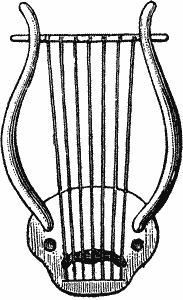 |
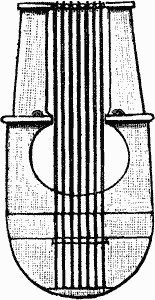 |
Fig. 13.
LYRE. |
Fig. 14.
CITHARA. |
There is considerable doubt as to the extent to which the larger
instruments of Asiatic origin penetrated the general musical practice
of Greece. Athenæus, in his "Banquets of the Learned" (B. xvi, C),
quotes Anakreon as saying:
"I hold my magadis, and sing,
Striking loud the twentieth string,
Leucaspis at the rapid hour
Leads you to youth and beauty's bower."
|
Most certainly the lyre of Terpander had no twenty strings.
The so-called Greek flute was a very reedy oboe or clarinet, a pipe
played with a reed, the pitch determined by holes stopped by the
fingers. These instruments[Pg 65] were so hard to blow that the players wore
bands over their cheeks because there were cases on record where, in
the contests, they broke their cheeks by the wind pressure. The flute
or aulos does not seem to have been used in connection with the
cithara at all, and the Greeks had nothing corresponding to what we
call an orchestra. The aulos was appropriate to certain religious
services and to certain festivals, and it had a moderate status in the
various contests of the national games, but the great instrument of
Greek music, the universal dependence for all occasions, public and
private, was the lyre.
In spite of the meager resources of Greek music upon its tonal side,
this development of art has had a very important bearing upon the
progress of music, even down to our own times. Opera was re-discovered
about 1600 in the effort to re-create the Greek musical drama, and the
ideal proposed to himself by Richard Wagner was nothing else than that
of a new music drama in which the severe and lofty conceptions of the
old Greek poets should be embodied in musical forms the most advanced
that the modern mind has been able to conceive. Upon the æsthetic side
musical theory is entirely indebted to the Greek. Nothing more
suitable or appropriate can be said concerning musical taste and
cultivation than what was said by Aristotle 300 years before Christ.
For example, he has the following (Politics, viii, C. Jowett's
translation, p. 245): "The customary branches of education are in
number four. They are: (1) reading and writing, (2) gymnastic
exercises, (3) music, to which is somewhat added (4) drawing. Of
these, reading, writing and drawing are regarded as useful to the
purposes of life in a variety of ways."[Pg 66] He recommends the study of
music as part of the preparation of the fit occupation of leisure.
"There remains, then, the use of music for the intellectual enjoyment
of leisure; which appears to have been the reason of its introduction,
this being one of the ways in which it is thought that a freeman
should pass his leisure; as Homer says:
'How good it is to invite men to the pleasant feast,'
and afterward he speaks of others whom he describes as inviting
'The bard who would delight them all' (Od. xvii, 385);
and in another place he says that there is no better way of passing
life than when
'Men's hearts are merry, and the banqueters in the hall
Sitting in order hear the voice of the minstrel.'"
|
Plato is particular that only the noble harmonies shall be permitted
in his state. He says, "Of the harmonies I want to have one warlike,
which will sound the word or note which a brave man utters in the hour
of danger or stern resolve, or when his cause is failing and he is
going to wounds or death, or is overtaken by some other evil, and in
every such crisis meets fortune with calmness and endurance; and
another which may be used by him in times of peace and freedom of
action, when there is no pressure of necessity—expressive of entreaty
or persuasion or prayer to God, or of instruction to man, or again
willingness to listen to persuasion or entreaty or advice. These two
harmonies I ask you to leave; the strain of necessity and the strain
of freedom, the strain of the unfortunate and the strain of the
fortunate, the strain of courage and the strain of[Pg 67] temperance; these,
I say, leave." These he explains will be only the Dorian and the
Phrygian harmonies. In another place Plato shows himself a disciple of
the Egyptian ideas of conservatism, already mentioned. "And therefore
when one of these clever and multiform gentlemen who can imitate
anything comes to our state, and proposes to exhibit himself and his
poetry, we will fall down and worship him as a sweet and holy and
wonderful being; but we must also inform him that there is no place
for such as he is in our state—the law will not allow him. And so
when we have anointed him with myrrh and set a garland of wool upon
his head, we shall send him away to another city." (Republic, Jowett,
iii, 398.)
In fact, upon the subject of music, Plato is one of the least
satisfactory of writers. He has many noble sentiments which might well
be printed in letters of gold and hung upon the walls of educational
institutions to-day, as ("Laws," Jowett's translation, 668): "Those
who seek for the best kind of song and music, ought not to seek for
that which is pleasant, but for that which is true." In another place,
however, he speaks of music as a kind of imitation. He says that music
without words is very difficult to understand. ("Laws," ibid., 668.)
All these inconsistencies disappear, however, as soon as we recognize
the limitations of the music which Plato knew, upon its tonal side.
All the richness of sense incitation, and all the definiteness of
expression which come into our modern music through the magic of
"tones in key," were wholly outside the range of Plato's knowledge.
The musical notation of the Greeks consisted of letters of the
alphabet placed over the syllables to which[Pg 68] the tones indicated were
to be sung. The letters represented absolute pitch, and as, owing to
the variety of genera, modes and chroa, the total number of tones was
very large, parts of older forms of the alphabet were also employed,
the whole number of characters thus demanded being upwards of seventy.
There was little or no classification of tones, and the entire
twenty-four letters were applied in regular order to the diatonic
series of the Dorian mode. Tones in the chromatic or enharmonic modes
were named by other letters, and the system was extremely complicated.
The notes of the instrumental accompaniment were still different from
those of the vocal part. No genuine example of this music has come
down to us in reliable form, and curiously enough, no classical writer
gives any idea of the notation of music. All that we know of this
notation we derive from Alypius, who lived about 150 A.D. Athanasius
Kircher, a Jesuit of a monastery in Sicily, published in the last
century the text of what purported to be a fragment of the first
Pythic Ode of Pindar. (See page 69.) In the original the musical
characters stood in immediate proximity to the words of the text. At
the middle of the third line begins the chorus of Citharodists. As all
the musical characters of the Greeks indicated absolute pitch, the
student will discover the difference between the vocal and
instrumental notation by comparing the notes in the early part of the
ode with those of the same pitches noted for instruments later.
Three other pieces of similar apocryphal character have come down to
us. It is likely that these melodies, if not really genuine, as
related to the composition of Pindar, nevertheless belong to a period
a little anterior to the Christian era.[Pg 69]
FRAGMENT OF THE FIRST PYTHIC ODE OF PINDAR,
According to the musical notation given by Athanasius Kircher, (F.A.
Gevaert's "La Musique dans l'Antiquité.")
[Listen]
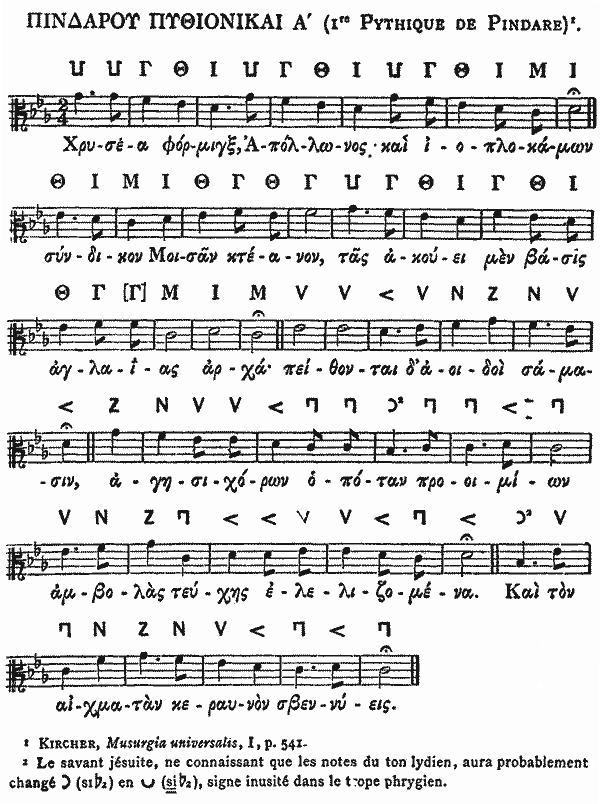
[Transliteration of Greek lyrics]
Note.—The amateur unfamiliar with the C clef, will obtain
the true tonal effect of the above fragment from Pindar, by
considering the clef to be G, and the signature five flats.
This will transpose the piece one degree lower than above
written, but the melody will be preserved. In other words,
read it exactly like the treble part of any piano piece,
only considering the signature to be five flats.
[Pg 70]
CHAPTER IV.
MUSIC IN INDIA, CHINA AND JAPAN.
I.
 ERY important developments of the art of music took place in India
from a remote period, but dates are entirely uncertain. When the hymns
of the Rig-Veda were collected into their present form, which appears
to have been about 1500 B.C., music was highly esteemed. It was in
India that the art of inciting vibrations of a string by means of a
bow was discovered; and our violin had its origin there, but the date
is entirely unknown. The primitive violin was the ravanastron, which
the Ceylonese claim to have been invented by one of their kings, who
reigned about 5000 B.C. The form of this instrument is given in Fig.
16. It must have been some time before the Mohammedan invasion, for
they brought a rude violin back to Arabia, from whence it came into
Europe after the crusades. They had many forms of guitar, instruments
of percussion, and the varieties of viol, as well as trumpets and the
like. The national instrument was the vina. This was a sort of guitar,
its body made of a strip of bamboo about eight inches wide and four
feet long. Near each end a large gourd was fixed, for reinforcing the
resonance. In playing, it was held obliquely in front of the player,
like a guitar, one gourd[Pg 71] resting upon the left shoulder, the other
under the right arm. It was strung with six strings of silk and wire,
and had a very elaborate apparatus of frets, much higher than those of
a guitar, many of them movable, in order to permit modulation into any
of the twenty-four Hindoo "modes." The instrument had a light, thin
tone, not unpleasing. A fine specimen is figured in "Hipkins' Plates
of Rare Instruments" in the South Kensington Museum, a copy of which
may be seen in the Newberry Library.
ERY important developments of the art of music took place in India
from a remote period, but dates are entirely uncertain. When the hymns
of the Rig-Veda were collected into their present form, which appears
to have been about 1500 B.C., music was highly esteemed. It was in
India that the art of inciting vibrations of a string by means of a
bow was discovered; and our violin had its origin there, but the date
is entirely unknown. The primitive violin was the ravanastron, which
the Ceylonese claim to have been invented by one of their kings, who
reigned about 5000 B.C. The form of this instrument is given in Fig.
16. It must have been some time before the Mohammedan invasion, for
they brought a rude violin back to Arabia, from whence it came into
Europe after the crusades. They had many forms of guitar, instruments
of percussion, and the varieties of viol, as well as trumpets and the
like. The national instrument was the vina. This was a sort of guitar,
its body made of a strip of bamboo about eight inches wide and four
feet long. Near each end a large gourd was fixed, for reinforcing the
resonance. In playing, it was held obliquely in front of the player,
like a guitar, one gourd[Pg 71] resting upon the left shoulder, the other
under the right arm. It was strung with six strings of silk and wire,
and had a very elaborate apparatus of frets, much higher than those of
a guitar, many of them movable, in order to permit modulation into any
of the twenty-four Hindoo "modes." The instrument had a light, thin
tone, not unpleasing. A fine specimen is figured in "Hipkins' Plates
of Rare Instruments" in the South Kensington Museum, a copy of which
may be seen in the Newberry Library.
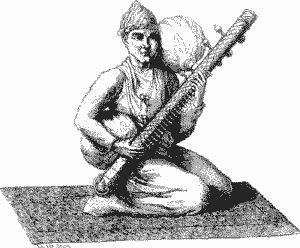
Fig. 15.
JIWAN CHAH.
[Portrait of Jiwan Chah, one of the latest
masters of the vina. He died about 1790.]
The Hindoos carried the theory of music to an extremely fine point,
having many curious scales, some of them with twenty-four divisions in
an octave. Twenty-two was the usual number. The pitch of each note in[Pg 72]
every mode was accurately calculated mathematically, and the frets of
the vina located thereby, according to very old theoretical works by
one Soma, written in Sanskrit at least as early as 1500 B.C. When this
work first became known to Europeans, its elaboration led it to be
regarded as a purely theoretical fancy piece, and it was thought to be
impossible that practical musicians could have been governed by
theories apparently so fine-drawn. A study of the structure of the
vina, however, perfectly adapted to these theories, set all doubts at
rest. None of the intervals of the Hindoo scale exactly correspond to
our own. Harmony they never conceived. Well sounding chords are
impossible in their scales. All their music was monodic—one-voiced.
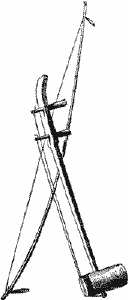
Fig. 16.
[Pg 73]
There was a curious development of the musical drama in India about
300 B.C., having certain of the traits of modern opera. Several of
these ancient pieces have come down to us, but without the musical
notes. They are long, consisting of as many as eleven acts, part of
them sung, part spoken. Curiously enough, the different acts are not
all in the same dialect. The musical acts are in Sanskrit, which had
then ceased to be a spoken language for at least 500 years; the spoken
acts were in Pakrit, a dialect of Sanskrit, which likewise had ceased
to be spoken for several centuries. A fuller account of the Hindoo
drama is given in Wilson's "Theater of the Hindoos." The curious
circumstance of the drama of the Hindoos of this epoch is that it was
contemporaneous with another very celebrated development of musical
drama in Greece.
Besides the primitive form of the bowed instrument, the ravanastron
(Fig. 16), many forms more advanced are figured among the instruments
from India in European museums, but as they are all of absurd and
impossible acoustical conception, besides being most likely of
comparatively modern origin, we do not present them at this point.
Later, in the history of the violin, one or two of the most curious
will be given.
II.
China has had an art of music from extremely remote periods, and
singularly sagacious ideas concerning the art were advanced there very
long ago, at a time when Europe and most other parts of the world were
still in the darkness of barbarism. For example: There is a saying of
the Emperor Tschun, about 2300 B.C., "Teach the children of the great;
thereby reached through thy[Pg 74] care they will become mild and
reasonable, and the unmanageable ones able to receive dignities
without arrogance or assumption. This teaching must thou embody in
poems, and sing them therewith to suitable melodies and with the play
of instrumental accompaniment. The music must follow the sense of the
words; if they are simple and natural then also must the music be
easy, unforced and without pretension. Music is the expression of
soul-feeling. If now the soul of the musician be virtuous, so also
will his music become noble and full of virtuous expression, and will
set the souls of men in union with those of the spirits in heaven."
(Quoted by Ambros.)

Fig. 17.
The principal instruments of Chinese music are the Kin and the Ke. The
former is a sort of guitar, of which no illustration has come to hand.
The main instrument of their culture-music is the ke, a stringed
instrument entirely unlike any other of which we have accounts, saving
the Japanese ko-ko, which was most likely derived from it. The ke is
strung with fifty strings of silk. Originally it had but twenty-five,
but in the reign of Hoang-Ti, about 2637 B.C., it is said to have been
enlarged to its present dimensions and compass. The appearance of the
ke and the arrangement of its bridges are shown in Fig. 17. The
strings were plucked with the fingers.
In the earlier times the Chinese had the pentatonic scale,
approximately the same as that of the black keys[Pg 75] of the piano. Later
it was enlarged to seven notes in the octave, and it is claimed by
some that long before the Christian era they had a complete chromatic
scale of twelve tones in the octave. The evidence upon this point,
however, is insufficient. And even if they had this musical resource
at so early a period the fact counts very little to their credit,
since at best the chromatic scale is only an impure harmonic
compromise, which they have never learned to use understandingly.
Chinese music has always been monodic, and they use a great variety of
melodic shadings composed of intervals of small fractions of a step.
These they call lu. There are movable bridges which can be placed in
such way as to divide the strings of the ke at proper proportions of
its length for producing the lu. The places for the fingers upon the
finger board are marked by small brass points. Besides the intonations
due to stopping the strings, the players upon the ke are in the habit
of adding expression in a manner analogous to that of the tremolo of
the modern violinist. With the left hand he touches the string beyond
the bridge and pulls it slightly, thus imparting to the tone a sliding
intonation upward or downward, familiar to all who have experimented
with strings. This habit the Japanese still have in playing their
ko-ko, and the results are said to be not unpleasing. The volume of
tone in the ke is very light, but the quality is sweet.
As a natural consequence of the long existence of this nation and
their commercial relations to the other parts of the world, which with
all their care they have never been able wholly to avoid, the Chinese
have many other varieties of instruments, including many trumpets; an
unexampled wealth of instruments of percussion, and a[Pg 76] few of the
ruder types of the violin kind, which seem to have come in from India
or Thibet by the way of the Buddhist monks. The ravanastron is a
common instrument with the mendicant friars of this order. The
characteristic instrument of the Chinese, however, the one which
stands as the representative of all their higher musical culture, is
the ke.
In common with all other nations of antiquity, and with some of the
present day, the Chinese have always held strong conservative
opinions. The principle has been held among them from the earliest
times that the pattern of a good thing, whether a religion, an art or
a mechanism, having once been found satisfactory, should be made
official and never afterward changed. This principle, taken in
connection with the limited powers of their chief instrument, accounts
for the small progress they have made in music within the past 2000
years. It must be remembered, however, that our knowledge of the music
of this country is still far from perfect, the travelers and
missionaries from whom it has reached us not having been practical
musicians, nor having had sufficiently long opportunities for
mastering musical systems so different from what they had previously
known, and so contrary to all their inherited percepts of tone.
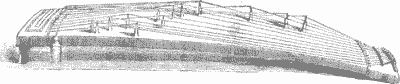
Fig. 18.
[Pg 77]
The Japanese are a very musical people in their way. The chief
instrument of their culture is the ko-ko. (See Fig. 18.)
In structure it much resembles the Chinese ke. They have also many
other instruments, especially various kinds of imperfect guitars, a
few rude violins, and the usual outfit of trumpets, reed pipes and
instruments of percussion. Like all the other barbarous nations, they
have never had harmony until since they began to learn it from the
Europeans.

[Pg 79]

THE
Apprentice Period of Modern Music.
THE DEVELOPMENT OF HARMONY, TONALITY,
CANONIC IMITATION AND POLYPHONY.
THE GENERAL POPULARIZATION
OF THE ART OF MUSIC IN
EVERY DIRECTION.
[Pg 81]
CHAPTER V.
THE NATURE OF THE TRANSFORMATION, AND
THE AGENCIES EFFECTING IT.
 CCORDING to the division of the subject in the beginning of this
work, the period from the Christian era to that of Palestrina, A.D.
1600, is one of apprentice work, in which the details of art were
being mastered, but in which no music, according to our acceptation of
the term, was produced. The history of this period is somewhat
obscure, the writers who throw light on it averaging scarcely more
than one to a century, scattered about in different parts of Europe.
Nevertheless, the most important changes in the history of music took
place during this period. The monody and empyrical tonality of the
ancients gave place to polyphony and harmonized melodies resting upon
the relations of tones in key. New instruments came in, and the entire
practice of the art of music was deepened, ennobled and immeasurably
enlarged in every direction. There were four causes co-operating in
this transformation of the art, and it is not easy to say of any one
of them that this one was the chief. First of these, in the Roman
empire, or in the south of Europe more particularly, for about 800
years the Greek principles remained more or less in force. The Church
is here the foremost[Pg 82] influence, and its part in the transformation
already noted will be considered presently. In the north of Europe the
Goths, Celts and Scandinavians built mighty empires and impressed
their enthusiastic and idealistic natures upon the whole form of
modern art. The Saracens conquered a foot-hold in the south of France
about 819, and remained there for twenty years. Their influence was
very important in the development of music, and became still more
active after the crusades, where the armies of the west came again in
contact with this peculiar civilization. Besides these three sources
measurably unprofessional and outside of music, or amateur, as we say
now, there was the work of the professional musicians strictly
so-called, who, from about 1100 in the old French school, commenced
the development of what is now known as polyphony, which culminated in
the hands of the Netherlanders, about 1580, Palestrina himself being
one of the latest products of this school. These influences reacted
upon each other, and all have entered into modern art, and have
imparted to it their most essential elements.
CCORDING to the division of the subject in the beginning of this
work, the period from the Christian era to that of Palestrina, A.D.
1600, is one of apprentice work, in which the details of art were
being mastered, but in which no music, according to our acceptation of
the term, was produced. The history of this period is somewhat
obscure, the writers who throw light on it averaging scarcely more
than one to a century, scattered about in different parts of Europe.
Nevertheless, the most important changes in the history of music took
place during this period. The monody and empyrical tonality of the
ancients gave place to polyphony and harmonized melodies resting upon
the relations of tones in key. New instruments came in, and the entire
practice of the art of music was deepened, ennobled and immeasurably
enlarged in every direction. There were four causes co-operating in
this transformation of the art, and it is not easy to say of any one
of them that this one was the chief. First of these, in the Roman
empire, or in the south of Europe more particularly, for about 800
years the Greek principles remained more or less in force. The Church
is here the foremost[Pg 82] influence, and its part in the transformation
already noted will be considered presently. In the north of Europe the
Goths, Celts and Scandinavians built mighty empires and impressed
their enthusiastic and idealistic natures upon the whole form of
modern art. The Saracens conquered a foot-hold in the south of France
about 819, and remained there for twenty years. Their influence was
very important in the development of music, and became still more
active after the crusades, where the armies of the west came again in
contact with this peculiar civilization. Besides these three sources
measurably unprofessional and outside of music, or amateur, as we say
now, there was the work of the professional musicians strictly
so-called, who, from about 1100 in the old French school, commenced
the development of what is now known as polyphony, which culminated in
the hands of the Netherlanders, about 1580, Palestrina himself being
one of the latest products of this school. These influences reacted
upon each other, and all have entered into modern art, and have
imparted to it their most essential elements.
All modern music differs from the ancient in two important
particulars—Harmony and Tonality. Harmony is the use of combined
sounds. These may be either dissonant, inharmonious in relation to
each other, or harmonious, agreeable. All points of repose in a
harmonized piece of music must be consonant; or, to say it
differently, the combined sound (chord) standing at the beginning or
end of a musical phrase must be harmonious. All the elements in it
must bear consonant relations to all the others. Between the points of
repose the combined sounds may or may not be consonant. Under certain
conditions dissonances make an effect even better[Pg 83] than
consonance—better because more appealing. The law of the introduction
of dissonances is that every dissonance must arise out of a
consonance, and subside into a consonance. When this law is observed
there is hardly any combination possible in the range of music which
may not be employed with good effect. Here already we have a progress
in perception of tones, in the ability to discriminate between those
which harmonize and those which dissonate. All consonance and
dissonance are purely relative. There is no such thing as a dissonant
tone in music, by itself considered; a tone becomes dissonant by being
brought into juxtaposition with some other tone with which it does not
agree. This part of the development of a tonal sense had its
beginnings in Greece, but only reached the point where the most
elementary relations were regarded as agreeable. The octave, the
fourth and the fifth, were the only consonances which they knew, and
of these they used in the combined sounds of their music only the
octave. The third, which with us is the most agreeable part of a pure
harmony, because it adds so many elements of agreement to the combined
sound into which it enters, was not only regarded as a dissonance by
them, but actually was a dissonance as they tuned their scale.
The entire course of harmonic perception in modern music may be
roughly divided into three steps: First, the recognition of
consonance, especially of the most fruitful consonance of all—that of
the thirds, and the differentiation between consonance and dissonance.
A second step involved the recognition of dissonance as an element in
musical expression, on account of the motion it imparts to a harmonic
movement. Third, the establishment of these materials of music in the
mind in such[Pg 84] depth and fullness that their æsthetic implications
became realized as elements of expression, so that when a composer had
a certain feeling to express, the proper combination of consonance and
dissonance immediately presented itself to his mind. The first of
these steps was taken by the minstrels of the north, somewhere between
the Christian era and the tenth century. The second was the particular
work of the old French school, the Netherlanders, and of all who
composed music between about 1100 A.D. and the epoch of Palestrina,
about 1600. The third, the spontaneous application of musical material
to the expression of feeling, had in it another element, that of
tonality, concerning which it is proper to say something at this
point.
By "tonality" is meant the dependence or interdependence of all the
tones in a key upon some one principal tone called the Key-tone. The
tonality of the music of the ancients was wholly artificial and
unreal. A mode and a point of repose for the melody were chosen
arbitrarily; the beginning was here made, and still more the ending
was conducted to this point of repose. Between the beginning and the
ending the same tones were employed, whether the melody proposed to
repose upon re, upon fa or do. The usual points of repose in Greek
music were mi, fa and re; never upon do, the real key tone, and rarely
upon la, the natural tonic of the minor mode.
One of the chief elements of modern musical expression, particularly
in the expression of melody, is the unconscious perception of the
"relation of tones in key." With every tone sung the singer conceives
not only that tone, its predecessor and its follower, but all other
tones in the entire course of the melody; and the expression[Pg 85] of every
tone in the series rests upon its place in rhythm, and still more upon
its "place in key." Change a single tone in a melody, as, for
instance, to make fa a half step sharp, and the expression of the
entire melody is thereby changed, until such time as the hearer has
forgotten the change of key effected by the introduction of the
foreign tone. It is not at all unlikely that what little of melodic
expression the music of the Greeks had, may have rested to some extent
upon an unconscious perception of these relations, which, although
foreign to their musical theory, may nevertheless have made their way
into the ears of these acute minstrels. The discovery of simple
tonality seems to have been due to the northern minstrels, for it is
here that we find the earliest melodies purely tonalized. But the
natural bounds of a melodic tonality as established by these northern
harpers have been very much exceeded in modern times, so that now
there is hardly a chord possible which might not be introduced in the
course of a composition in any key whatever, without effecting a
digression into the new key suggested by the strange chord. Not only
all the natural or diatonic notes are regarded as belonging to a key,
but also all the chromatics, the sharps and flats, and the double
sharps and double flats.
All this implies a growth of tonal perception on the part of the
hearers, and especially of the ability to co-ordinate tonal
impressions over a wide and constantly increasing range. For the
hearer has in mind not only the particular tone which at the moment
occupies his ear, and the others which preceded it, and a sort of
inner feeling of the tone which will follow the present one, but also
all the other tones over which the singer would pass in going from one
tone to another. And[Pg 86] unless he has this he cannot realize the true
place of the melody tone in key, and therefore rests unconscious of
its real expression. It is, indeed, possible for him to make a mistake
in regard to the tones which he unconsciously associates with the
tones actually heard—as, for example, when one hears an E followed by
a C higher, and one thinks of the four white keys of the piano between
them, while the melody may be thinking of the black keys between them.
In the one case the melody would be in the key of C, in the other of C
sharp minor. And the expression of the melodic skip would be
enormously changed thereby. This larger education of the faculties of
tonal perception and tonal co-ordination has been the work mainly of
the last century and a half, and more particularly of the present
century itself. During this period the progress has been more rapid
than within any other in the entire course of the history of our art,
and it is to the successive steps preparing for this that we now
address ourselves.

[Pg 87]
CHAPTER VI.
THE MINSTRELS OF THE NORTH.
PON many accounts the development of minstrelsy by the Celtic singers
and harpers was one of the most important of all the forces operative
in the transformation of the art from the monody of the ancients to
the expressive melody and rich harmony of modern music. As it is to a
considerable extent one side of the direct course of this history,
which hitherto has dealt largely with the south of Europe, the present
is the most convenient time for giving it the consideration its
importance deserves. I do this more readily because English influence
upon the development of music has generally been underrated by
continental writers, the erudite Fétis alone excepted; while their own
national writers, even, have not shown themselves generally conscious
of the splendid record which was made by their fathers.
The Celts appear upon the field of history several centuries before
the Christian era. Cæsar's account of them leaves no doubt of the
place which music held in their religion, education and national life.
The minstrel was a prominent figure, ready at a moment's notice to
perform the service of religion, patriotism or entertainment. There is
a tradition of one King Blegywied ap[Pg 88] Scifyllt, who reigned in
Brittany about 160 B.C., who was a good musician and a player upon the
harp. While we have no precise knowledge of the music they sang in the
oldest times, it was very likely something like the following old
Breton air, which is supposed to have come down from the Druids. It is
full of a rude energy, making it impressive even to modern ears. By
successive migrations of Angles, Danes and Northmen, the Celts were
crowded into Wales, where they still[Pg 89] remain. The harp has always been
their principal instrument, and for many centuries a rude kind of
violin called the crwth, of which there will be occasion to speak in
connection with the violin, at a later period in this work.
OLD BRETON SONG.
[Listen]
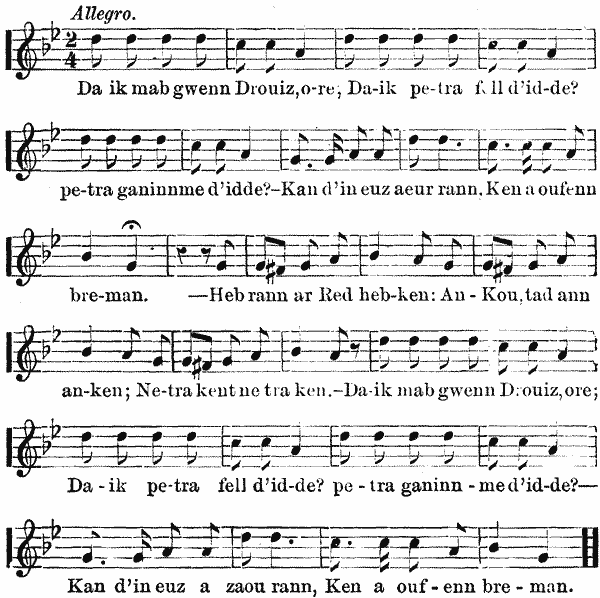
According to the best authorities the bards were divided into three
great classes. The first class was composed of the historians and
antiquaries, who piqued themselves a little upon their sorcery, and
who, upon occasion, took up the rôles of diviners and prophets. The
second class was composed of domestic bards, living in private houses,
quite after the custom of ancient Greece. These we may suppose were
chiefly devoted to the annals and glories of their wealthy patrons.
The third class, the heraldic bards, was the most influential of all.
They wrote the national annals. All these classes were poet-bards as
well as musicians.
The musical bards were divided into three classes. In the first were
the players upon the harp; they were called doctors of music. To be
admitted into this class it was necessary that they should perform
successfully the three Mwchwl—that is, the three most difficult
pieces in the bardic repertory. The second class of musical bards was
composed of the players upon the crwth, of six strings. The third
class were the singers. From the wording of the requirement it would
seem that these must have had the same qualification as the first
class, and therefore have been true doctors of music. For, in addition
to being able to accord the harp or the crwth, and play different
themes with their variations, two preludes and other pieces "with
their sharps and their flats," they had to know the "three styles of
expression," and accent them with the voice in different styles[Pg 90] of
song. They had also to know the twenty-four meters of poetry as well
as the "twenty-four measures of music." Finally, they must be able to
compose songs in many of these meters, to read Welsh correctly, to
write exactly, and to correct an ancient poem corrupted by the
copyists.
The classification of new bards was made at an Eisteddfod once in
three years. It was a public contest, after the custom of the Greeks.
The degrees were three, conferred at intervals of three years
respectively. The organization of the bards existed until the
sixteenth century; it was suppressed under Queen Elizabeth. The
Eisteddfod has been maintained until the present time. The learned
musical historian, J.J. Fétis, attended one in 1829, of which he has
left an interesting account. The performances of the blind minstrel of
Caernarvon, Richard Robinson, excited his admiration beyond anything
else that he mentions. He says: "His skill was something
extraordinary. The modern harp of Wales has no pedals for the
semitones in modulations. It is supplied with three ranks of strings,
of which the left and right give diatonic notes, those in the middle
the half-tones. Nothing more inconvenient could be imagined; in spite
of his blindness, this minstrel, in the most difficult passages,
seized the strings of the middle ranks with most marvelous address.
The innate skill of this musician of nature, the calm and goodness
painted upon his visage, rendered him an object of general interest."
Independently of the minstrels of this high class, they had also
wandering minstrels who played the crwth of three strings, and who
made themselves useful in the customary dances and songs of the
peasants and the common people.[Pg 91]
There exists an old manuscript, supposed to have been begun in the
third or fourth century, Y Trioeddy nys Prydain ("The Triads of the
Isle of Britain"). It contains the traditions from the ancient times
until the seventh century. Among the famous triads of this book are:
The three bards who bore the cloth of gold, Merlin Ambrosius, Merlin,
son of Morvryn, and Taleisin, chief of the bards. There were three
principles of song: Composition of poetry, execution upon the harp,
and erudition. In the sixth century we see the bards playing the harp
and singing their stirring songs with inspiring effect in animating
the hearts of their compatriots again in their successful combats
against the Saxons. Edward Jones, bard of the Prince of Wales in the
last part of the eighteenth century, preserved the names of
twenty-three bards who lived in the sixth century. The principal were
Taleisin pen Beirrd, Aneurin Gwawrydd, Gildas ab Caw, Gildas Badonius.
Taleisin was bard of Prince Elphin, then of King Maelgwin, and in the
last place of Prince Urien Reged. He lived about 550; a number of his
poems remain, but no fragment of his melody. Aneurin was author of
"Gododn," one of the best Welsh poems that has come down to us.
In the British Museum there is a manuscript supposed to have been
begun in the eleventh century, containing much music for the harp.
Among it are exercises in the curious notation of the Welsh, in which
chords are freely used, and in positions suggesting the immediate
occasion of their introduction—that, namely of supplementing the
small power of the instrument by sounding several tones together,
which, as octaves were impossible outside the middle range or pitch,
were necessarily chords. Among the songs given are several which[Pg 93]
betray the transition period of tonality, when chords had come into
legitimate use, but the true feeling for a tonic had not yet been
acquired. The preceding, for instance, proceeds regularly in the key
of G in all respects but the very ending of each strain, which takes
place in the key of C. Or to speak tonically, the melody and
accompaniment after being written nearly all the way in the key of Do,
suddenly diverge to the key of Fa, and there close.
DADLE DAU—THE TWO LOVERS.
[Listen]
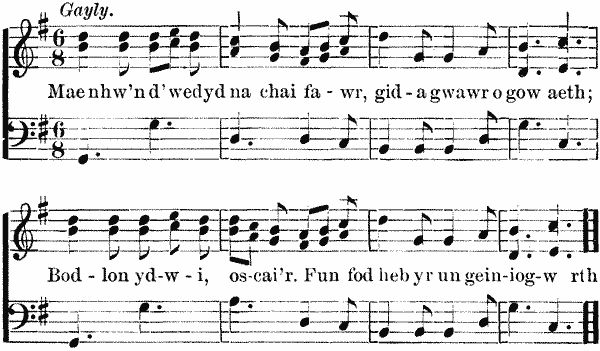
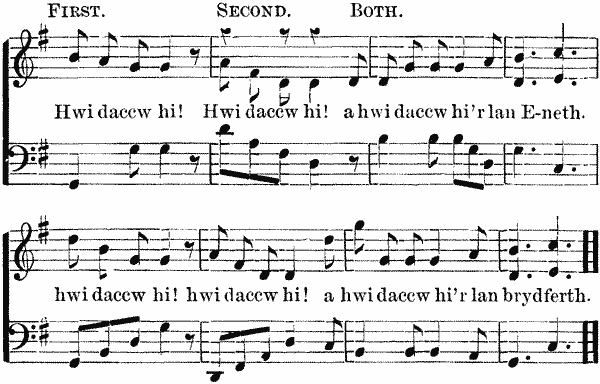
This old song was a great favorite with Henry V, while he
was yet Prince of Wales, and with his jolly companions he
used to shout it vigorously at the Bear's Head tavern, about
1410. (Edward Jones' "Relics of the Welsh Bards," p. 176)
Another (p. 94) is quite modern in spirit and treatment. It is a
vigorous love song, and there is a boisterous chorus of bards which
comes in with the refrain. A curious feature of this melody is the
full-measure rest, immediately following the strong chorus of the
bards. During the rests we seem to hear the chorus repeated.
OLD WELSH SONG, IN PRAISE OF LOVE.
[Listen]
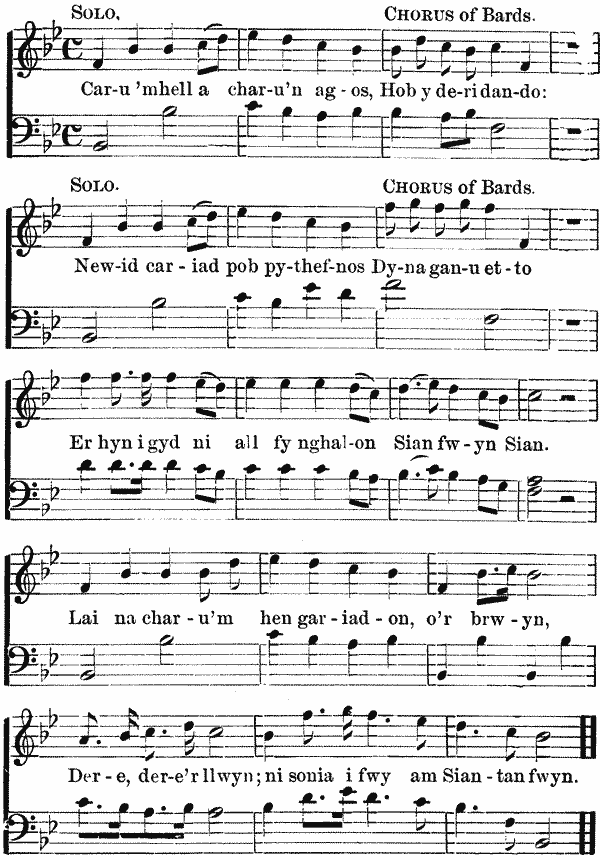
In the eleventh century, Gerald Barry, an entertaining writer, made a
tour of Britain, and his account of the people in different parts of
the country is still extant and full of interest. Of the Welsh he
says: "Those who arrive in the morning are entertained until evening
with the conversation of young women, and the music of the harp, for
each house has its young women and harps allotted to this purpose. In
each family the art of playing the harp is held preferable to any
other learning."
He adds (chapter XIII, "Of their Symphonies and Songs"): "In their
musical concerts they do not sing in unison, like the inhabitants of
other countries, but in many different parts, so that in a company of
singers, which one very frequently meets with in Wales, you will hear
as many different parts and voices as there are performers, while all
at length unite with organic melody in one consonance, and in the soft
sweetness of B-flat.[Pg 95] In the north district of Britain, beyond the
Humber and on the borders of Yorkshire, the inhabitants make use of
the same kind of symphonious harmony, but with less variety, singing
in only two parts, one murmuring in the bass, the other warbling in
the acute or treble. Neither of the two nations has acquired this
peculiarity by art, but by long habit, which has rendered it natural
and familiar; and the practice is now so firmly rooted in them that it
is unusual to hear a single and simple melody well sung, and what is
still more wonderful, the children, even from their infancy, sing in
the same manner. As the English in general do not adopt this mode of
singing, but only those to the north of the countries, I believe it
was from the Danes and Norwegians, by whom these parts of the island
were more frequently invaded, and held longer under their dominion,
that the natives contracted this method of singing." In further token
of the universality of music among these people, Gerald mentions the
story of Richard de Clare, who a short time after the death of Richard
I, passed from England into Wales, accompanied by certain other lords
and attendants. At the passage of Coed Grono, at the entrance into the
woods, he dismissed his attendants and pursued his journey undefended,
preceded by a minstrel and a singer, the one accompanying the other on
the fiddle. ["Tibicinem præviens habens et precentorem cantilenæ
notulis alternatim in fidiculare respondentem."]
Similar devotion to music he found in Ireland. He says: "The only
thing to which I find this people to apply commendable industry is
playing upon musical instruments, in which they are incomparably more
skillful than any other that I have seen. For their modulation on
these instruments, unlike that of the Britons, to[Pg 96] which I am
accustomed, is not slow and harsh, but lively and rapid, while the
harmony is both sweet and gay. It is astonishing that in so complex
and rapid a movement of the fingers the musical proportions can be
preserved, and that throughout the difficult modulations on their
various instruments the harmony is completed with so sweet a velocity,
so unequal an equality, so discordant a concord, as if the chords
sounded together fourths and fifths. They enter into a movement and
conclude it in so delicate a manner, and play the little notes so
sportively under the blunter sounds of the bass strings, enlivening
with wanton levity, or communicating a deeper internal sense of
pleasure, so that the perfection of their art appears in the
concealment of it. From this cause those very strains afford an
unspeakable mental delight to those who have skillfully penetrated
into the mysteries of the art; fatigue rather than gratify the ears of
others, who seeing do not perceive, and hearing do not understand, and
by whom the finest music is esteemed no better than a confused and
disorderly noise, to be heard with unwillingness and disgust. Ireland
only uses and delights in two instruments—the harp and tabor.
Scotland has three—the harp, the tabor and the crowth or crowd.
Wales, the harp, the pipes and the crowd. The Irish also used strings
of brass instead of catgut."
The brilliant time of Ireland was the reign of Sir Brian Boirohen, in
the tenth century. After his victory over the Danes, and their
expulsion from the island, he opened schools and colleges for indigent
students, founded libraries, and encouraged learning heartily. He was
one of the best harpers of his kingdom. His harp is preserved in the
library of Trinity College, Dublin, and a well made instrument it is,
albeit now somewhat[Pg 97] out of repair. It is about thirty inches high;
the wood is oak and arms of brass. There are twenty-eight strings
fixed in the sounding table by silver buttons in copper-lined holes.
The present appearance of the instrument is this:
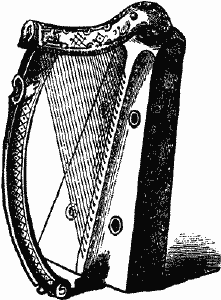
Fig. 19.
The Anglo-Saxons also were great amateurs of music. Up to the sixth
century they remained pagan. Gregory the Great sent missionaries to
them, and more than 10,000 were baptized in a single day. The
Venerable Bede represents St. Benoit as establishing the music of the
new church, substituting the plain song of Rome for the Gallic songs
previously used.
While few remains of the literature of the early English have come
down to us, we have enough from the period of the Venerable Bede and
the generation immediately following to give an idea of the vigor and
depth of the national consciousness here brought to expression. From
the seventh to the tenth centuries there was in England a movement
more vigorous, more productive and consequently more modern, than
any[Pg 98]thing like it in any other part of Europe for three centuries
later. The Saxon poets Cædmon, the Venerable Bede, Alcuin, the friend,
teacher and adviser of that mighty genius Charlemagne, were minds of
the first order.
King Arthur the Great was an enthusiastic and talented minstrel. It is
told of him that in this disguise he made his way successfully into
the Danish camp, and was able to spy out the plans of his invading
enemies. The incident has also a light upon the other side, since it
shows the estimation in which the wandering minstrel was held by the
Danes themselves. King Alfred also established a professorship of
music at Oxford, where, indeed, the university, properly so-called,
did not yet exist, but a school of considerable vigor had been
founded. All the remains of Anglo-Saxon poetry are full of allusions
to the bards, the gleemen and the minstrels; and the poems themselves,
most likely, were the production of poet-musicians classed under these
different names. Many additional reasons might be given for believing
that the art of music was more carefully cultivated in England at this
time than in any other European country. For instance, at Winchester,
in the year 900, a large organ was built in the cathedral—larger than
had ever been built before. It had 400 pipes, whereas most of the
organs previously in use had no more than forty or fifty pipes. There
is reason to believe that among the other musical devices here
practiced that of "round" singing was brought to a high degree of
popular skill. Apparently also they had something like what was
afterward called a burden, a refrain which, instead of coming in at
the end of the melody, was sung by a part of the singers continually
with it.[Pg 99]
Nor was musical cultivation confined to England. In the eighth and
ninth centuries the Scandinavians had a civilization of considerable
vigor. The minstrels were called Scalds, polishers or smoothers of
language. Fétis well says: "As eminently poets and singers as they
were barbarians, they put into their songs a strength of ideas, an
energy of sentiment, a richness of imagination with which we are
struck even in translations, admittedly inferior to the originals. Not
less valiant than inspired, their scalds by turns played the harp,
raising their voices in praise of heroes, and precipitated themselves
into the combat with sword and lance, meeting the enemy in fiercest
conflict. Most that remains from these poet-minstrels is contained in
the great national collections called Eddas, of which the oldest
received their present form early in the eleventh century. The sagas
contained in the Eddas form but a mere fragment of this ancient
literature. More than 200 scalds are known by name as authors of
sagas. These warriors, so pitiless and ferocious in battle, show
themselves full of devotion to their families. They were good sons,
tender husbands and kind fathers. The Eddas contain pieces of singular
delicacy of sentiment." Their songs, when compared with those of other
races, are more musical, the sentiment is richer and more profound,
and the rhythms have more variety. The melodic intervals, also,
indicate a more delicate sense of harmony than we find in other parts
of Europe at so early a date. Their instrument was the harp. Iceland
was the foremost musical center of the civilized world in the ninth
century, and it is said that kings in other parts of Europe sent there
for capable minstrels to lead the music in the courts.[Pg 100]
A very highly finished English composition, a round with strict canon
for four voices, with a burden of the kind already mentioned, repeated
over and over by two other voices has been discovered. It is the
famous "Summer is Coming In," composed, apparently, some time before
the year 1240.
On page 101 is given a reduced fac simile. It is written on a staff
of six lines, in the square notes of the Franconian period. The clef
is that of C. The asterisk at the end of the first phrase marks the
proper place of entrance for the successive voices, each in turn
commencing at the beginning when the previous one has arrived, at this
point. Below is the pes, or burden, which is to be repeated over and
over until the piece is finished. The complete solution is reproduced
in miniature from Grove's Dictionary, on pages 102 and 103. The
elaborateness of this piece of music led the original discoverers to
place it much later than the date above given, but more careful
examination of the manuscript justifies the conclusion that it was
written some time before 1240. It is by far the most elaborate piece
of ancient part music which has come down to us from times so remote.
It indicates conclusively that early in the thirteenth century, when
the composers of the old French school were struggling with the
beginnings of canonic imitation, confining their work to
ecclesiastical tonality, English musicians had arrived at a better art
and a true feeling for the major scale and key. Following is the
manuscript, the original size of the page being seven and
seven-twelfths inches by five and five-twelfths inches. The reduced
page before the reader represents the original upon a scale of about
two-thirds. The Latin directions below the fourth staff indicate the
manner of singing it.[Pg 101]
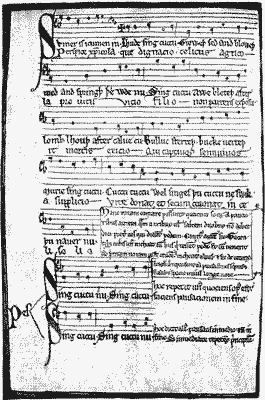
FAC SIMILE OF MSS. OF "SUMER IS ICUMEN IN."
[Enlarge]
[Pg 102]
"SUMER IS ICUMEN IN."
[Listen]
[View modern transcription (PDF)]
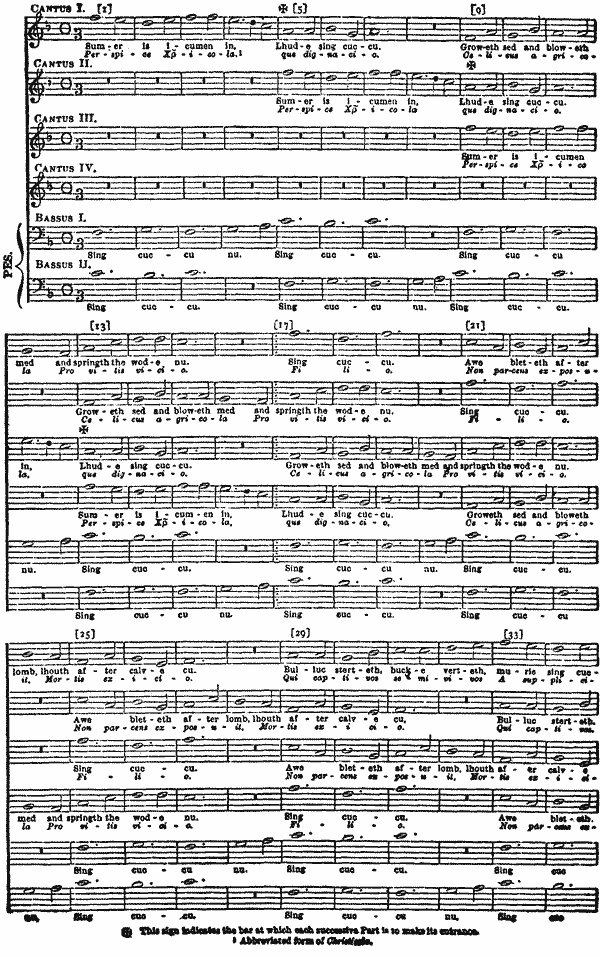
[Enlarge]
[Pg 103]
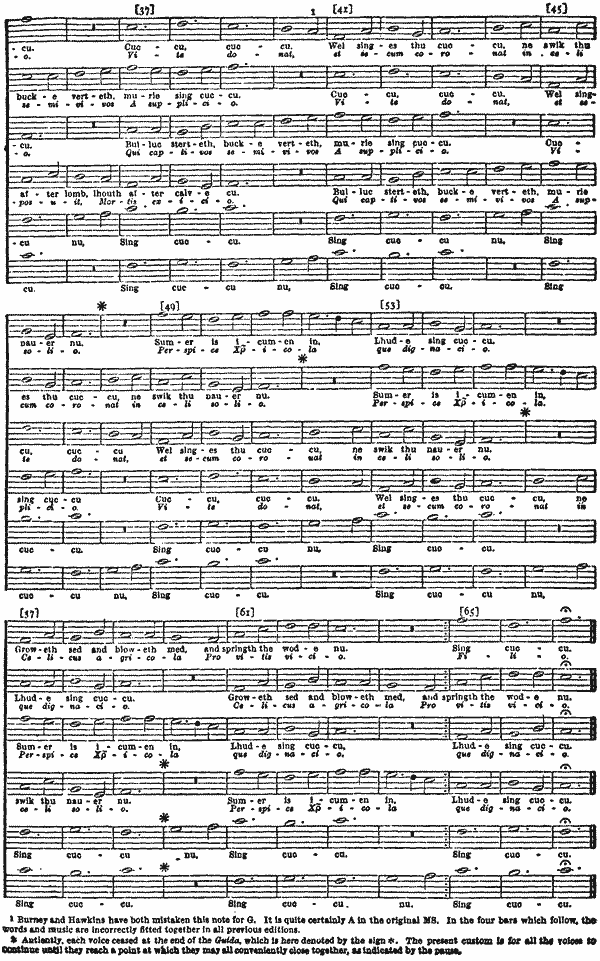
[Enlarge]
[Pg 104]
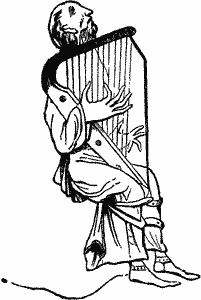
Fig. 20.
SAXON HARP.
[From manuscript in the library of Cambridge
University.]
The harp was the principal instrument of these people, and their songs
and poems contain innumerable references to it. Sir Francis Palgrave
says in his "History of the Anglo-Saxons": "They were great amateurs
of rhythm and harmony. In their festivals the harp passed from hand to
hand, and whoever could not show himself possessed of talent for
music, was counted unworthy of being received in good society. Adhelm,
bishop of Sherbourne, was not able to gain the attention of the
citizens otherwise than by habilitating himself as a minstrel and
taking his stand upon the bridge in the central part of the town and
there singing the ballads he had composed." One of the earliest
representations of[Pg 105] the English harp that has come down to us is found
in the Harleian manuscript in the British Museum. It is presumably of
the tenth century.
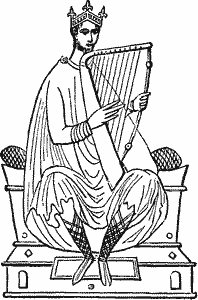
Fig. 21.
KING DAVID.
[From Saxon Psalter of the tenth century.]
The harp was three or four feet in height. It had eleven strings. It
was held between the knees, and was played with the right hand. In the
thirteenth century it appears to have been played with both hands.
Two circumstances in this account may well surprise us; nor are there
data available for resolving the questions to which they give rise.
The presence of two such instruments as the harp and the crwth in this
part of Europe is not to be explained by historical facts within our
knowledge. The harp does not appear in musical[Pg 106] history after its
career in ancient Egypt until we find it in the hands of these bards,
scalds and minstrels of northern Europe. The Aryans who crossed into
India do not seem to have had it. Nor did the Greeks, nor the Romans.
We find it for a while in Asia, but only in civilizations derived from
that of Egypt, already in their decadence when they come under our
observation. Inasmuch as there are no data existing whereby we can
determine whether these people discovered the harp anew for themselves
or derived it from some other nation, and greatly improved it, either
supposition is allowable. Upon the whole, the probabilities appear to
be that this instrument was among the primitive acquisitions of the
Aryans. All of them were hunters, to whom the clang of the bow string
must have been a familiar sound. As already suggested, it seems that
the harp must have been the oldest type of stringed instrument of all.
The Aryans who crossed the Himalayas into India may have lost it, in
pursuit of some other type of instrument of plucked strings.
The crwth presents still more troublesome questions, which we must
admit are still less hopeful of solution. (See Fig. 22.)
In this case we find an instrument played with a bow in northern
Europe, far one side the course of Asiatic commerce, at a time when
there was no such instrument elsewhere in the world but in India.
Whence came the crwth? The rebec was not known in Arabia until nearly
two centuries after we find the crwth mentioned by Venance Fortunatus.
We have seen that the Sanskrit had four words meaning bow, a fact
affording presumptive evidence of the knowledge of this mode of
exciting vibrations, while the Sanskrit was still a spoken language.[Pg 107]
It is possible that the bow was a discovery of the Aryans in their
early days, ere yet the family had begun to separate. The crwth may
have been a survival of this primitive discovery, still cherished
among a people not able to employ it intelligently, and not able to
develop its powers. For while the crwth was in Europe two centuries
before the violin, the improvement of this instrument was due to
stimulation from quite another quarter. It was the Arab rebec that
afforded the starting point for the modern violin, and this instrument
was not known in Europe until it came in by way of the crusaders or
the Spanish Arabs.
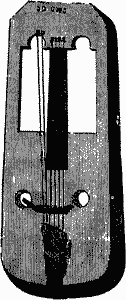
Fig. 22.
Another popular instrument of music in all parts of Britain from the
earliest of modern times, was the bagpipe, a reed instrument generally
of imperfect intonation, the melody pipe being accompanied by a
faithful[Pg 108] drone, consisting of the tonic and its octave, and
occasionally the fifth. It was the witty Sidney Smith who described
the effect as that of a "tune tied to a post." This instrument was
common in all parts of Britain until driven out by better ones. It
still survives in Scotland. Its influence is distinctly to be traced
in the Scotch melodies founded upon the pentatonic scale, of which the
following is a specimen:
SCOTCH MELODY (IN THE PENTATONIC SCALE).
[Listen]
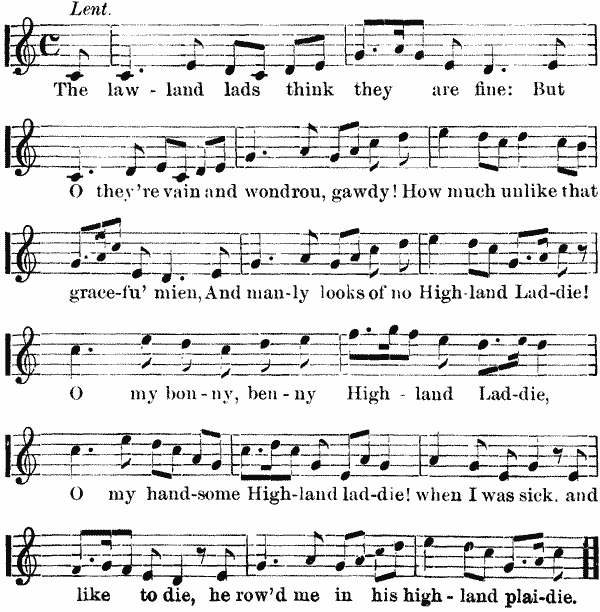
[Pg 109]
CHAPTER VII.
THE ARABS OR SARACENS.
PON many accounts the influence of the Arab civilization was
important in this quarter of the musical world, and it may here well
enough engage our attention, since its most important aspects are
those in which it operates upon the European mind, awakening there
ideas which but for this stimulus might have remained dormant
centuries longer.
From the standpoint of the western world and the limited information
concerning the followers of Mahomet which enters into our educational
curricula, the Arab appears to us an inert figure, picturesque and
imposing, upon the sandy carpet of northern Africa, but a force of
little influence in the world of modern nineteenth-century thought.
Nevertheless, there was a time when this picturesque figure became
seized with an activity which shook Europe and Christendom to its very
center. The voice of the prophet Mahomet awakened the Arab from his
slumber. He aroused himself to the duty of proselyting the world to
the doctrine of the One God and the Great Prophet. With sword in hand
and the rallying cry of his faith he went forth, with such result that
a vast proportion of the inhabitants of the globe at this very hour[Pg 110]
profess the tenets of his religion. Once awakened into life, he
penetrated the distant east, and brought back thence the foundation of
our arithmetic, the predecessor of our greatest of musical
instruments, the violin, and discovered for himself the productions of
the greatest of the Greek minds, the works of the philosopher
Aristotle. He established a new state in Spain, and for several
centuries confronted Christendom with the alternative of the sword or
his faith. One of the best characterizations of this people upon the
musical-literary side is that of the eminent M. Ginguène, who in his
"History of Italian Literature," remarks as follows, concerning the
points under immediate consideration:
"In the most ancient times the Arabs had a particular taste for
poetry, which among almost all people had opened a way to the most
elevated and abstract studies. Their language, rich, flexible and
abundant, favored their fertile imagination; their spirit lively and
sententious; their eloquence natural and artless, they declaimed with
energy the pieces they had composed, or they sang, accompanied with
instruments, in a very expressive chorus. These poems make upon the
simple and sensitive auditors a prodigious effect. The young poets
receive the praises of the tribe, and all celebrate their genius and
merit. They prepare a solemn festival. The women, dressed in their
most beautiful habits, sing a chorus before their sons and husbands
upon the happiness of their tribe. During the annual fair, where
tribes from a distance are gathered for thirty days, a large part of
the time is spent in a contest of poetry and eloquence. The works
which gain praise are deposited in the archives of the princess or
emirs. The best ones are painted or embroidered with letters of gold[Pg 111]
upon silk cloth, and suspended in the temple at Mecca. Seven of these
poems had obtained this honor in the time of Mahomet, and they say
that Mahomet himself was flattered to see one of the chapters of the
Koran compared with these seven poems and judged worthy to be hung up
with them. Almansor, the second of the Abassides, loved poetry and
letters, and was very well learned in laws, philosophy and astronomy.
They say that in building the famous town of Bagdad he took the
suggestions from the astronomers for placing the principal building.
The university at Bagdad was honored and very celebrated. Copious
translations from the Greek were made, and many original treatises
produced in other parts of Arabia, but the most brilliant development
of Arabic letters was in Spain. Cordova, Grenada, Valencia were
distinguished for their schools, colleges and academies. Spain
possessed seventy libraries, open to the public in different towns,
when the rest of Europe, without books, without letters, without
culture, was sunk in the most shameful ignorance. A crowd of
celebrated writers enriched the Spanish-Arabic literature in all its
parts. The influence of the Arab upon science and literature extended
into all Europe; to him are owed many useful inventions. The famous
tower at Seville was built for the observatory. It is to be noticed,
however, that the Arabs, while taking much from the Greeks, did not
take any of their literature, properly so-called—neither Sophocles,
Euripides, Sappho, Anacreon, nor Demosthenes. The result is that their
own literature preserved its original character; they preserved also
in all purity the peculiarity of their music—an art in which they
excelled and in which the theory was very complicated. Their works are
full of the praises of music[Pg 112] and its marvelous effect. They
attributed very powerful effects not alone to music sung, but to the
sound of certain instruments and to certain instrumental strings and
to certain inflections of the voice."
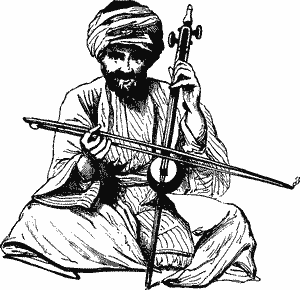
Fig. 23.
THE ARAB REBEC.
The modern world is indebted to the Arab for at least three of its
most important instruments of music. The ravanastron he brought home
with him from India, and under the name Rebec it found its way into
Europe, where in an appreciative soil it grew and expanded into that
miracle of sonority and expression, the modern violin. The instrument
of the south of Europe during the latter part of the Middle Ages was
the lute, which had its origin in the Arab Eoud. (See Fig. 24.)[Pg 113]
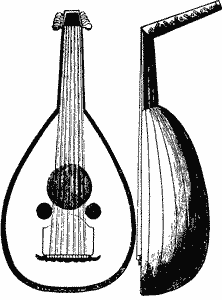
Fig. 24.
THE EOUD.
Still more familiar to domestic eyes is that descendant of the Arab
santir, the modern pianoforte. This, under the name of psaltery,
begins to figure in manuscript as early as the ninth century. The Arab
canon, which is commonly taken as the immediate predecessor of the
pianoforte, had the important difference of being strung with catgut
strings. The essential foundation of the pianoforte was the metal
strings, necessitating hammers for inciting the vibrations, and
affording in the superior solidity incident to metal support a
firmness and susceptibility to development. This is the santir. It has
survived in Europe as the dulcimer, or the German hackbrett.[Pg 114]
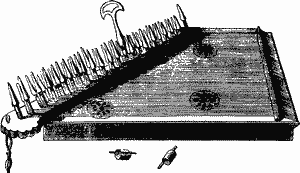
Fig. 25.
THE SANTIR.
Yet while the Arab wrote so abundantly upon the subject of music, and
while it filled so prominent a part in his social and official life,
and in spite of his sagacity in seizing perfectible types of
instruments, there is very little in his treatment of the art which
need delay us in the present work. His music belongs entirely to the
ancient period of monody. He never had a harmony of combined sounds,
nor a scale with intervals permitting combined sounds. He was
sufficiently scientific to carry out the intonations of the
Pythagorean theory, and when he went beyond this and formed a scale
for himself he devised one which did not permit the association of
sounds into chord masses; and, more fatal still, he not only invented
such a scale, but carried it into execution so exactly that the ear of
the race was hopelessly committed to monody, and has remained so until
this very day. The scale of the Arabs in the latter times contained
twenty-two divisions in the octave, of which only the fifth and fourth
exactly correspond with the harmonic ratios. The place of the Arab in
music, therefore, is that of an unintentional minister to a higher
civilization and to the art of music.
[Pg 115]
CHAPTER VIII.
ORIGIN OF THE GREAT FRENCH EPICS.
 NE of the earliest developments of popular music on the continent was
that of the Chansons de Geste ("Songs of Action"), which were, in
effect, great national epics. The period of this activity was from
about 800 to 1100 or 1200, and the greatest productions were the
"Songs of Roland," the "Song of Antioch," etc., translations of which
may be found in collections of mediæval romances. The social
conditions out of which these songs grew have been well summarized by
M. Léon Gautier, in his "Les Épopées Françaises": "If we transport
ourselves in imagination into Gaul in the seventh century, and casting
our eyes to the right, the left, and to all parts, we undertake to
render to ourselves an exact account of the state in which we find the
national poetry, the following will be the spectacle which will meet
our gaze: Upon one hand in Amorican Brittany there are a group of
popular poets who speak a Celtic dialect, and sing upon the harp
certain legends, certain fables of Celtic origin. They form a league
apart, and do not mix at all in the poetic movement of the great
Gallo-Roman country. They are the popular singers of an abased race,
of a conquered people. Toward the end of the twelfth century we see
their legends emerge from[Pg 116] their previous obscurity and conquer a
sudden and astonishing popularity, which endured throughout all the
remainder of the Middle Ages. But in the seventh century they had no
profound influence in Gaul, and their voice had no echo except beyond
the boundary straits among the harpers and singers of England, Wales
and Ireland.
NE of the earliest developments of popular music on the continent was
that of the Chansons de Geste ("Songs of Action"), which were, in
effect, great national epics. The period of this activity was from
about 800 to 1100 or 1200, and the greatest productions were the
"Songs of Roland," the "Song of Antioch," etc., translations of which
may be found in collections of mediæval romances. The social
conditions out of which these songs grew have been well summarized by
M. Léon Gautier, in his "Les Épopées Françaises": "If we transport
ourselves in imagination into Gaul in the seventh century, and casting
our eyes to the right, the left, and to all parts, we undertake to
render to ourselves an exact account of the state in which we find the
national poetry, the following will be the spectacle which will meet
our gaze: Upon one hand in Amorican Brittany there are a group of
popular poets who speak a Celtic dialect, and sing upon the harp
certain legends, certain fables of Celtic origin. They form a league
apart, and do not mix at all in the poetic movement of the great
Gallo-Roman country. They are the popular singers of an abased race,
of a conquered people. Toward the end of the twelfth century we see
their legends emerge from[Pg 116] their previous obscurity and conquer a
sudden and astonishing popularity, which endured throughout all the
remainder of the Middle Ages. But in the seventh century they had no
profound influence in Gaul, and their voice had no echo except beyond
the boundary straits among the harpers and singers of England, Wales
and Ireland.
"Upon another side, that of the Moselle, the Meuse and the Rhine, in
the country vaguely designated under the name of Austrasia, German
invasions have left more indelible traces. The ideas, customs and even
the language have taken on a Tudesque imprint. There they sing in a
form purely Germanic the 'Antiquissima Carmina' ["Most Ancient
Songs"] which Charlemagne was one day to order his writers to compile
and put in permanent form. Between these two extreme divisions there
was a neutral territory where a new language was in process of
forming—that of the 'Oc' and 'Oil.' Here the songs were neither
German nor Gallo-Roman, but Romance. And here were the germs of the
future epics of France."
Out of this combination of contrasting spirits of race, the movement
of awakened national life, arose, first, what were called
Cantilenas—short songs of a ballad-like character. The language is a
mixture of German, Latin and French, intermingled in a most curious
manner. For example, consider the following verses from the cantilena
of St. Eulalie, as given by M. Gautier, p. 65:
"Buona pulcella fût Eulalia;
Bel avret corps, bellezour anima.
Voldrent la vientre li Deo inimi,
Voldrent la faire diaule servir.
Elle n'out eskoltet les mal conselliers
Qu'elle Deo raniet chi maent sus en ciel."
|
[Pg 117]
Which being somewhat freely rendered into English, it says that:
"A good virgin was Eulalia;
She had a beautiful body, more beautiful spirit;
The enemies of God would conquer her,
Would make her serve the devil;
But never would she understand the evil ones who counsel
To deny God, who is above all in heaven."
|
And so the ballad goes on twenty-three verses more to narrate how she
withstood the exhortations of the king of the pagans, that she would
forsake the name of Christian; and when they threw her into the fire
the fire would not burn her, for the fire was pure; and when the king
drew his sword to cut off her head the demoiselle did not contradict
him, for she wished to leave the world. She prayed to Christ, and
under the form of a dove she flew away toward heaven. These charming
verses of the ninth century were probably sung to music having little
of the movement which we now associate with the term melody, but which
was more of a chant-like character.
Of similar literary texture were a multitude of songs, of which many
different ones related to the same hero. Hence in time there was a
disposition on the part of the cleverer minstrels to combine them into
a single narration, and to impart to the whole so composed something
of an epic character. Thus arose the famous Chansons de Geste
already mentioned, the origin and general character of which have been
most happily elucidated in the work of M. Gautier, already referred
to. He says:
"The great epics of the French had their origin in the romantic and
commanding deeds of Charlemagne and the battles against Saracens in
792. The fate of civilization trembled in the balance at Ville Daigne
and at Poitiers.[Pg 118] It is the lot of Christianity, it is the lot of the
world, which is at stake. The innumerable murders, the torrents of
blood, these thousands of deaths have had their sure effect upon
history. The world has been Christian in place of being Arab. It
appertains to Jesus instead of Mahomet. This civilization, of which we
are so proud, this beauty of the domestic circle, this independence of
our spirit, this free character of our wives and children it is to
Charles Martelle, and above all to William of Orange, that we owe
them, after God. We possess only a limited number of these primitive
epics, the Chansons de Geste, and are not certain that we have them
in the second or even the third versions. At the head of the list we
place the 'Song of Roland,' the Iliad of France. All the other songs
of action, however beautiful and however ancient they may be, are far
inferior. The text of the 'Song of Roland' as it has come down to us
cannot have been written much before 1100. Besides this there is the
'Chanson de Nimes,' 'Ogier le Danois,' 'Jour de Blaibes,' all of
which were written in the languages of Oc and Oil. All these have
something in common; the verse is ten syllables, the correspondences
are assonances and not rhymes. In style these Chansons de Geste are
rapid, military, but above all dramatic and popular. They are without
shading, spontaneous, no labor, no false art, no study. Above all it
is a style to which one can apply the words of Montaigne, and it is
the same upon paper as in the mouth. Really these verses are made to
be upon the living lip, and not upon the cold and dead parchment of
the manuscript. The oldest manuscripts are small, in order that they
may be carried in the pocket for use of traveling jongleurs and
singers. They have Homeric epithets. The style is singularly grave.
There[Pg 119] is nothing to raise a laugh. The first epics were popular about
the end of the eleventh century. The idea of woman is purer in the
early poems. There is no description of the body; there is no
gallantry. The beautiful Aude apprehends the death of Roland; she
falls dead. In the second half of the twelfth century our poets would
have been incapable of so simple and noble a conception. We find, even
in 'Amis et Amelis,' women who are still very German in physiognomy,
and alluring, but they are Germans, so to say, of the second manner.
They have a habit of throwing themselves into the arms of the first
man who takes their fancy.
"Each one of the races which composed France or Gaul in the sixth or
seventh century, contributed its share toward the future epics. The
Celts furnished their character, the Romans their language, the Church
its faith; but the Germans did more. For long centuries they had the
habit of chanting in popular verse their origin, their victories and
their heroes. Above all they penetrated the new poetry with their new
spirit. All the German ideas upon war, royalty, family and government,
upon woman and right, passed into the epic of the French.
"Our fathers had no epics, it is true, but they had popular chants,
rapid, ardent and short, which are precisely what we have called
cantilenas. A cantilena is at the same time a recitation and an ode.
It is at times a complaint and more often a round. It is a hymn, above
all religious and musical, which runs over the lips and which, thanks
to its brevity, mainly, is easily graven upon the memory. The
cantilenas were a power in society; they caused the most powerful to
tremble. When a captain wished to nerve himself up against a bad
action he said, 'They will make a bad song about me.'[Pg 120]
"The heroes and the deeds which gave birth to French epics are those
of the commencement of the eighth century to the end of the tenth.
France is then more than a mere land; it is a country; a single
religious faith fills all hearts and all intelligence. Toward the end
of the tenth century we see the popular singers arresting crowds in
all public places. They sing poems of 3,000 or 4,000 verses. These are
the first of the Chansons de Geste. Out of the great number of
cantilenas dedicated to a single hero it happened that some poet had
the happy thought of combining them into a single poem. Thus came a
suite of pieces about Roland or William, and from these, in time, an
epic. The latest of the epic cycles was that concerning the crusades.
The style is popular, rapid, easy to sing. It recalls the Homeric
poetry. The constant epithets, the military enumerations, the
discourses of the heroes before combat, and the idea of God, are
simple, childlike, and superstition has no place. The supernatural
exists in plenty, but no marvels."
[Pg 121]
CHAPTER IX.
THE TROUBADOURS, TROUVÈRES AND
MINNESINGERS.
O the full account of the origin of the Chansons de Geste in the
foregoing chapter, it remains now to add a few notes concerning the
personnel of the different classes of minstrels through whose
efforts these great songs were created.
The first of these singers were the troubadours, who were traveling
minstrels especially gifted in versification and in music. Their
compositions appear to have been short, on the whole, and of various
kinds, as will presently be seen. The earliest of the troubadours of
whom we have definite account was Count Wilhelm of Poitiers,
1087-1127. Among the kind of songs cultivated by these singers were
love songs, canzonets, chansons; serenade—that is, an evening song;
auberde, or day song; servantes, written to extol the goodness of
princes; tenzone, quarrelsome or contemptuous songs; and roundelays,
terminated forever with the same refrain. There was also what was
called the pastourelle, a make-believe shepherd's song.
The so-called chansonniers of the north, who flourished toward the end
of the twelfth century, were also troubadours. Among them the name of
Count[Pg 122] Thibaut of Champagne, king of Navarre, stands
celebrated—1201-1253. He composed both religious and secular songs.
The following is one of his melodies unharmonized. Its date is about
the same as that of "Summer is Coming In." Another celebrated name of
these minstrels was Adam de la Halle, of Arras in Picardy—1240-1286.
Upon many accounts the music of this author is of considerable
interest to us. He was a good natural melodist, as the examples in
Coussemaker's "Adam de la Halle" show. He is also the author of the
earliest comic opera of which we have any account, the play of "Robin
and Marion." We shall speak of this later, in connection with the
development of opera in general.
[Listen]
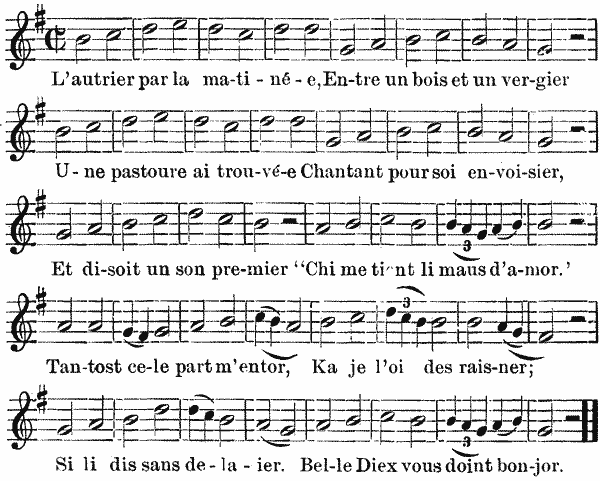
Immediately following the troubadours came the trouvères, who were
simply troubadours of nobler birth, and perhaps of finer imagination.
There were so[Pg 123] many of these singers that it is quite impossible here
to give a list of their names. Among the more celebrated, forty-two
names are given by Fétis, the most familiar among them being those of
Blondel, the minstrel of Richard Cœur de Lion, and the Châtelaine
de Coucy (died about 1192), from whom we have twenty-three chansons.
It was the trouvères who invented the Chansons de Geste already
mentioned—songs of action; in other words, ballads. One of the most
celebrated of these was the "Story of Antioch," a romance of the
crusades, extending to more than 15,000 lines. This poem was not
intended to be read, but was chanted by the minstrels during the
crusades themselves. One Richard the Pilgrim was the author. The song
is, in fact, a history of the crusade in which he took part, up to a
short time before the battle in which he was killed. Another very
celebrated piece of the same kind, the "Song of Roland," the history
of a warrior in the suite of Charlemagne, is said to have been chanted
before the battle of Hastings by the Jongleur Taillefer. Other pieces
of the same kind were the "Legend of the Chevalier Cygne"
("Lohengrin") "Parsifal" and the "Holy Grail." Each one of these was
sung to a short formula of melody, which was performed over and over
incessantly, excepting variations of endings employed in the episodes.
A very eminent author of pieces of this kind was the Chevalier de
Coucy, who died 1192, in the crusade. There are twenty-four songs of
his still in the Paris Library.
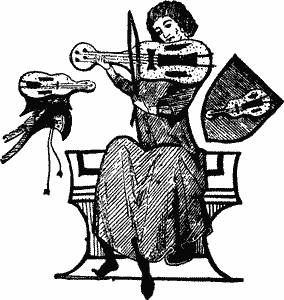
Fig. 26.
REINMAR, THE MINNESINGER.
[From a manuscript of the thirteenth century,
in the National Library at Paris.]
A similar development of knightly music was had in Germany from the
time of Frederick the Red—1152-1190. These were known as
minnesingers. Among the most prominent were Heinrich of Beldeke,
1184-1228,[Pg 124] an epic writer; Spervogel, 1150-1175; and Frauenlobe,
middle of the twelfth century. The forms of the minne songs were the
song (lede), lay (lerch), proverb (spruch). The song rarely
exceeded one strophe; the lay frequently did. A little later we
encounter certain names which have been recently celebrated in the
poems of Wagner, such as Heinrich von Morungen, Reinmar von Hagenau,
Wolfram von Eschenbach, Gottfried von Strassburg, Walther von der
Vogelweide, Klingsor, Tannhäuser, etc. All of these were from the
middle of the thirteenth century. A portrait of Reinmar, the
minnesinger, has come down to us with a manuscript now contained in
the National Library at Paris. The last of the minnesingers was
Heinrich von Meissen, 1260-1318. His poems were always in the praise
of woman, for which reason he was called Frauenlob ("Woman's Praise").
An old chronicle tells us that when he died the women of Mayence[Pg 125] bore
him to the tomb, moistened his grave with their tears, and poured out
libations of the costliest wines of the Rhineland. The following
illustration is supposed to be a representation of this minstrel,
although the drawing is hardly up to the standard of the modern
Academy.
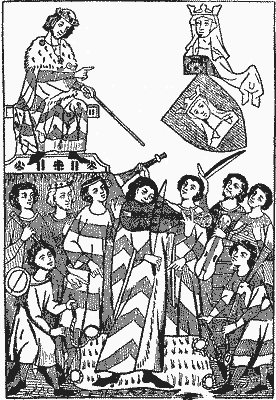
Fig. 27.
MASTER HEINRICH FRAUENLOB.
[From a manuscript in the Manesse collection at
Paris.]
The work of the minnesingers was succeeded in Germany by a class of
humbler minstrels of the common[Pg 126] people, known as the Mastersingers,
the city of Nuremberg being their principal center. A few of these men
were real geniuses—poets of the people. One of the most celebrated
was Hans Sachs, since represented in Wagner's "Meistersingers." Sachs
was a very prolific poet and composer, his pieces being of every kind,
from the simpler songs of sentiment and home to quite elaborate plays.
About nine volumes of his poems have been reprinted by the Stuttgart
Literary Union.
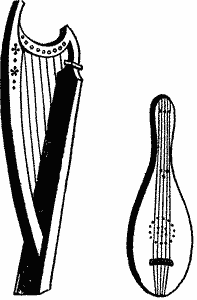
Fig. 28.
MINSTREL HARPS OF THE THIRTEENTH CENTURY.
The principal influence of these different classes of popular minstrel
was temporary, in keeping alive a love for music and a certain
appreciation of it. The most of their music was rather slow and
labored, and it is impossible to discover in the later development of
the art material traces of their influence upon it. In this respect
they differ materially from the Celtic and English bards mentioned in
the previous chapter. Although the productions of those minstrels have
all passed away, they[Pg 127] have left a distinct impress upon musical
composition, even to our own day, in certain simple forms of diatonic
melody of highly expressive character. The troubadours, trouvères and
minnesingers, on the other hand, never acquired the art of spontaneous
melody, and as for harmony, there is no evidence that they made any
use of it. Their instrument of music was a small harp of ten or twelve
strings, but no more—a much smaller and less effective instrument
than the Irish harp of the eleventh century, or the Saxon of the
tenth. (See Fig. 28.)
[Pg 128]
CHAPTER X.
THE INFLUENCE OF THE CHRISTIAN CHURCH.
T is not easy to define the influence of the Christian Church in this
transformation, for the reason that upon the technical side it was
slight, although upon the æsthetic side it was of very great
importance. From the circumstance that all the early theoretical
writers from the sixth century to the thirteenth were monks or
ecclesiastics of some degree, and from the very important part played
by the large cathedrals in the development of polyphonic music, many
historians have concluded that to the Church almost this entire
transformation of the art of music is due. This, however, is wide of
the truth. The Church as such had very little to do with developing an
art of music through all the early centuries. The early Christians
were humble people, for the most part, who had embraced a religion
proscribed and at times persecuted. Their meetings were private, and
attended by small numbers, as, for instance, in the Catacombs at Rome,
where the little chapels in the dark passage ways under ground were
incapable of holding more than twenty or thirty people at a time.
Under these circumstances the singing cannot have been essentially of
more musical importance than that of cottage prayer meetings of the
present day. In another way the Church, indeed, exercised a[Pg 129] certain
amount of influence in this department as in all others, an influence
which might be described as cosmopolitan. The early apostles and
bishops traveled from one province to another, and it is likely that
the congregation in each province made use of the melodies already in
existence. The first Christian hymns and psalms were probably sung to
temple melodies brought from Jerusalem by the apostles. As new hymns
were written (something which happened very soon, under the
inspiration of the new faith and hope), they were adapted to the best
of these old melodies, just as has been done continually down to
nearly our own time. Our knowledge of the early Church, in this side
of its activity, is very limited. It is not until the time of St.
Ambrose, who was bishop of Milan in the last part of the fourth
century, that the Church began to have an official music. By this time
the process of secularization had been carried so far that there was a
great want of seriousness and nobility in the worship. St. Ambrose,
accordingly, selected certain melodies as being suitable for the
solemn hymns of the Church and the offices of the mass. He himself was
a poet of some originality. He composed quite a number of hymns, of
which the most famous is that noble piece of praise, Te Deum
Laudamus, a poem which has inspired a greater number of musical
settings than any other outside the canon of the Scriptures. The
melodies which St. Ambrose collected were probably from Palestine, and
he selected four scales from the Greek system, within which, as he
supposed, all future melodies should be composed. This was done, most
likely, under the impression that each one of the Greek scales had a
characteristic expression, and that the four which he chose would
suffice for the varying[Pg 130] needs of the hymns of the Church. In naming
these scales a mistake was made, that upon re being called the Dorian,
and all the other names being applied improperly. The series upon mi
was called Phrygian, upon fa Lydian; upon sol Mixo-Lydian. The
melodies of St. Ambrose were somewhat charged with ornament, a fact
which indicates their Asiatic origin. It is probable that a part of
the melodies of the Plain Song still in use are remains of the
liturgies of St. Ambrose. The Church at Milan maintains the Ambrosian
liturgy to the present date. In this action of St. Ambrose we have a
characteristic representation of the influence which the Church has
exerted upon music in all periods of its career. Upon the æsthetic and
ethical sides the Church has awakened aspirations, hopes and faith, of
essentially musical character, and in this respect it has been one of
the most powerful sources of inspiration that musical art has
experienced. But upon the technical side the action of the Church has
been purely conservative and, not to say it disrespectfully, politic.
The end sought in every modification of the existing music has been
that of affording the congregation a musical setting for certain
hymns—a setting not inconsistent with the spirit of the hymns
themselves, but in melody agreeable to the congregation. The question
which John Wesley is reported to have asked, "Why the devil should
have all the good tunes," has been a favorite conundrum with the
fathers of the Church.
Notwithstanding the firmness with which the Church at Milan maintained
the Ambrosian liturgy, in other provinces this conservatism failed;
and within the next two centuries very great abuses crept in through
the adoption of local secular melodies not yet divested of[Pg 131] their
profane associations. St. Gregory the Great (540-595), who was elected
pope about 590, set himself to restore church music to its purity, or
rather to restrict the introduction of profane melodies, and to
establish certain limits beyond which the music should not be allowed
to pass. St. Gregory himself was not a musician. He therefore
contented himself with restoring the Ambrosian chants as far as
possible; but the musical scales established by Ambrose he somewhat
enlarged, adding to them four other scales called plagal. These were
the Hypo-Dorian, la to la; Hypo-Phrygian, si to si; Hypo-Lydian, do to
do; Hypo-Æolian, mi to mi. I do not understand that the terminal notes
of these plagal scales of St. Gregory were used as key notes, but only
that melodies instead of being restricted between the tonic and its
octave, were permitted to pass below and above the tonic, coming back
to that as a center; for we must remember that in the ancient music
the tonality was purely arbitrary, and, so to say, accidental. While
all kinds of keys used the series of tones known by the names do, re,
mi, fa, so, la, si, do, it was within the choice of the composer to
bring his melodies to a close upon any one of these tones, which,
being thus emphasized, was regarded as the tonic of the melody.
Whatever of color one key had differing from another was due therefore
to the preponderance of some one tone of the scale in the course of
the melody. The Plain Song of the Roman Church, and of the English
Church as well, has been called Gregorian, from St. Gregory, and the
majority of ecclesiastical amateurs suppose that the square note
notation upon four lines was invented by St. Gregory. This, however,
is not the case. The melody, very likely, may have come down to us
with few alterations. The notation, however, has undergone[Pg 132] several
very important changes, of which there will be more particular mention
in chapter XV. The Gregorian notation of the sixth century was
probably the Roman letters which we find in Hucbald, as will be seen
farther on. Several of the tunes well known to Protestants have been
arranged from the so-called Gregorian chants. They are "Boylston,"
"Olmutz" and "Hamburg." The eighth tone, from which "Olmutz" was
arranged, has always been appropriated to the Magnificat ("My Soul
doth Magnify the Lord").
The following are the ecclesiastical scales and names, as established
by St. Gregory:
[Listen: Dorian
Phrygian
Lydian Mixo-Lydian]
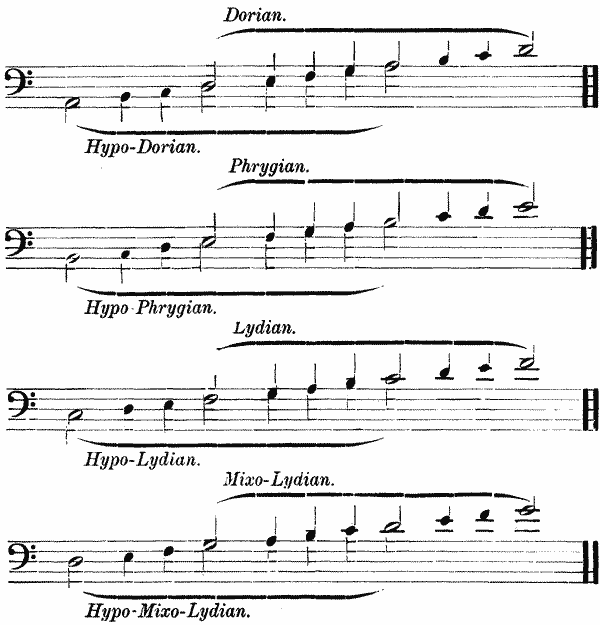
[Pg 133]
With the labors of St. Gregory the influence of the Church upon the
course of musical development by no means ceased. At various epochs in
its history synods, councils and popes have effected various reforms,
every reform consisting in barring out a certain amount of novelty
which had crept in, and in a supposed "restoration" of the service to
its pristine purity. The restoration, however, has never been
complete. Church music, like every other department of the art, has
gone on in increasing complexity from the beginning until now. The
main difference between the Church and the world in any century
consists in drawing the line of the permissible at a different point.
One of the latest reforms was that begun by Pope Marcellus and the
Council of Trent, which ordered from Palestrina an example of church
music as it should be.
Incidentally, in another direction, the Church has been of very great
influence upon the course of musical development. The great cathedrals
of the commercial centers of the world, in the effort to render their
service worthy of the congregation, have afforded support to talented
composers in all ages, and some of the most important movements in
music have been made by ecclesiastics or officials deriving support
from these sources. More extended particulars of this part of her
influence will be given later. It may suffice to mention the
cathedrals of Westminster and St. Paul in England, of Notre Dame in
Paris, to which we owe the old French school and the beginning of
polyphony; the cathedral at Strassburg, which supported important
musicians; Cologne, where the celebrated Franco lived; St. Mark's, at
Venice, where, from about 1350 to the end of the last century, an
extremely brilliant succession of musical directors found a field for
their activity.
[Pg 134]
CHAPTER XI.
THE DIDACTIC OF MUSIC FROM THE FIFTH CENTURY
TO THE FOURTEENTH.
I.
HERE is very little in the Roman writers upon music that is of
interest. Macrobus, an expert grammarian and encyclopedist living at
Rome at the end of the fourth or beginning of the fifth century, wrote
a commentary upon the song of Scipio, in which he quotes from
Pythagoras concerning the music of the spheres: "What hear I? What is
it which fills my ears with sounds so sweet and powerful? It is the
harmony which, formed of unequal intervals, but according to just
proportion, results from the impulse and movements of the spheres
themselves, and of which the sharp sound tempered by the grave sound
produces continually varied concerts." (Cicero, "De Republica," VI.)
Commenting upon this passage, Macrobus says that Pythagoras was the
first of the Greeks who divined that the planets and the sidereal
universe must have harmonic properties such as Scipio spoke of, on
account of their regular movements and proportions to each other. We
find in the writings of Macrobus an advance upon the musical theories
of Ptolemy. He shows that contrary to the doctrine of Aristoxenus
there is not a[Pg 135] true half tone, and that the relation 8:9 does not
admit of being equally divided. In place of the three symphonies of
the octave, fourth and fifth, mentioned by his predecessors, he makes
five, including the octave and the double octave. "Such," he says, "is
the number of symphonies that we ought to be astonished that the human
ear can comprehend them."
Another of the Roman writers upon music was Martinus Capella. His work
is called the "Nuptials of Philologus and Mercury" ("De Nuptiis
Philologiæ et Mercurii"). The little upon music which the book
contains was only an abridgment of the Greek treatise of Aristides
Quintilianus.
The most important of the earliest treatises upon music, and by far
the most famous, is that of Boethius, as it is also the most
systematic. The following summary is from Fétis' "History of Music,"
Vol. IV:
"Born at Rome between 470 and 475, Boethius made at home classical
studies, and went, they say, to Athens itself, where he studied
philosophy with Proclus. He was of the age of about thirty-five when,
in 510, he was made president of the senate. Theodoric, king of the
Ostrogoths, called him to himself, on account of his reputation for
wisdom and virtue; he confided to him an important position in the
palace, and intrusted to him many important diplomatic negotiations.
Boethius did nothing which was not to his credit, but this made him
only the more hostile to the interests of the courtiers; he was
therefore overthrown and cast into prison, where he composed his
'Consolations of Philosophy.' He was put to death 524 or 526."
Boethius' treatise on music is divided into five books. It is a vast
repertory of the knowledge of the ancients[Pg 136] relative to this art. Its
doctrine is Pythagorean. The first book is divided into thirty-four
chapters. In the first he develops the thought of Aristotle, that
music is inherent in human nature. He there renders the text of a
decree which the Ephori of Sparta rendered against Timotheus of
Miletus, but which better critics have regarded as fictitious. The
second chapter establishes that there are three sorts of music: the
worldly, which is universal harmony; the human, which has its source
in the intelligence, which reunites and co-ordinates the elements;
finally, the third kind is artificial, made by instruments of
different sorts. The chapters following treat of the voice as the
source of music; of consonances and their proportions; of the division
of the voice and its compass; of the perception of sounds by the ear;
of the correspondence of the semitones; of the division of the octave;
of tetrachords; of the three genera—enharmonic, chromatic and
diatonic; of intervals of sounds compared to those of the stars; of
the musical and different faculties.
All the second book, divided into thirty chapters, is speculative, and
devotes itself to the different kinds and relations of intervals,
according to the different systems of theoreticians. The third book,
in seven chapters, is a continuation of the subject of the second. It
is particularly employed in refuting the errors of Aristoxenus. The
fourth book, in eighteen chapters, is entirely relative to the
practice of the art, particularly to the notation. It is in this book
that Boethius makes known the Latin notation of the first fifteen
letters of the alphabet without preparation, without the slightest
explanation, and as if he had done something which any one concerned
with music at Rome would readily understand, as[Pg 137] a matter of course.
There is not one word to show that it was new, or that he claimed the
invention. It was undoubtedly the usual notation.
The fifth book of this treatise has for its object the determination
of intervals by the divisions of a monochord, and a refutation of the
systems of Ptolemy and Archytas. We here find this proposition,
remarkable if we recall the time when the author lived, that: "If the
ear did not count the vibrations, and did not seize the inequalities
of movement of two sounds resonating by percussion, the intelligence
would not be able to render account of them by the science of
numbers." After Boethius there is nothing in Roman literature
concerning music. Notwithstanding that Italy fell under the dominion
of the Goths and Lombards after 476, it preserved Greek traditions in
music to the end of the sixth century.
Cassiodorus, who lived still in 562, aged almost 100 years, left a
souvenir for music in the fifth chapter of his treatise on the
"Discipline of Letters and Liberal Arts" (De Artibus ac Disciplinis
Litterarum). He enumerates the fifteen modes of Alypius as not having
been abandoned, and establishes them in their natural order, calling
them tones. Here also we find the classification of six kinds of
symphonies, about 300 years after this enumeration, first realized in
notes by Hucbald. He gives a series of fourths and of fifths,
occasionally for two voices, occasionally with the octave added. These
are the most important of all the things concerning music to be found
in that part of Cassiodorus' book dedicated to music.
In the seventh century the first, or perhaps the only author who wrote
upon music was Bishop Isidore, of[Pg 138] Seville. In his celebrated treatise
on the etymologies or origins ("Isidori Hispaniensis Episcopi
Etymologiarum, Libri XX") divided into twenty books, chapters XIV to
XXII of the third book relate to music. These are the chapters
published by the Abbé Gerbert, under the name of "Sentences de
Musique," in the collection of ecclesiastical writers upon this art,
after a manuscript in the imperial library at Vienna. While many of
these chapters contain nothing more than generalities and pseudo
historical anecdotes concerning the inventors of this art, this is not
the case with the nineteenth chapter, the sixth in Gerbert's edition,
for here he speaks "Of the First Division of Music, called Harmony."
The definitions given by St. Isidore have a precision, a clearness not
found in other writers of the Middle Ages. "Harmonic music," says he,
"is at the same time modulation of the voice, and concordance of many
simultaneous sounds. Symphony is the order established between
concordant sounds, low and high, produced by the voice, the breath or
by percussion. Concordant sounds, the highest and the lowest, agree in
such way that if one of them happens to dissonate it offends the ear.
The contrary is the case in diaphony, which is the union of dissonant
sounds." Here we find St. Isidore employing the term diaphony in its
original sense, as a Greek word, meaning dissonance—a sense exactly
opposite to that of Jean de Muris.
The Venerable Bede was the light of the eighth century, and the glory
of the Anglo-Saxons. His treatise upon music, however, deals in
theories and generalities, throwing no light upon the music of his
day. The elevation of his ideas may be seen in the following sentence,
with which he introduces his subject: "It is to be[Pg 139] remarked that all
art is contained in reason; and so it is that music consists and
develops itself in relations of numbers." ("Notandum est, quod omnis
ars in ratione continetur. Musica quoque in ratione numerorum
consistit atque versatur.")
Only two treatises upon music have come down to us from the ninth
century. The first is by a monk, named Aurelian, in the abbey of Réomé
or Montier-Saint-Jean, in the diocese of Langes, who appears to have
lived about the year 850. His book, called "Musicæ Disciplina," in
twenty chapters, is a compilation of older anecdotes and theories,
throwing no light upon the actual condition of the art in his day. The
sole remaining work of this period was by Rémi, of Auxerre, who had
opened the course of theology and music at Rheims in 893, and
afterward at Paris in the earlier years of the tenth century. His
book, like the preceding, is wholly devoted to the ideas of the
ancients.
II.
This brings us to the first writer on music, during the Middle Ages,
whose work throws any important light upon the actual practice of the
art in the period when it was written, namely, Hucbald, a monk of the
convent of St. Armand, in the diocese of Tournay, in French Flanders.
Gerbert gives two treatises upon music, as having come down to us from
this author. Nevertheless there is reason to doubt the genuineness of
one of them—whereof presently. The first of these, the so-called
"Treatise," from a manuscript in the library of the Franciscan convent
at Strassburg, collated with another from Cesene, bears this title:
"Incipit Liber Ubaldi Peritissimi Musici de Harmonica Institutione."
The other is[Pg 140] called "Hucbaldi Monachi Elonensis Musica
Enchiriadis," or "Manual of Music, by the Monk Hucbald." The former
work is of little interest, and if a genuine production of Hucbald's,
probably belongs, as M. Fétis suggests, to his earlier period, when he
was still teaching at Rheims, along with his former classmate, Rémi,
of Auxerre.
The manual of Hucbald is not to be regarded as a complete treatise
upon music. It has three principal subjects, namely: The formation of
a new system of notation, the tonality of plain song, and symphony, or
the singing of many voices at different intervals—in other words,
harmony.
In treating the scale he divides it into tetrachords, precisely
according to the Greek method, as far as known to him, and he nowhere
appears to perceive the inapplicability of this division to the
ecclesiastical modes. For representing the sounds of the scale,
divided into four tetrachords, Hucbald proposed the Greek letters,
which in effect, would have been a notation of absolute pitch, with
the farther disadvantage of ignoring the harmonic principles of unity
already discovered, and in fact involved in his own method of
enlarging a two-voice passage by adding a third at the interval of an
octave with the lowest.
He recognizes six kinds of symphony; in reality he employs only three,
the others being reduplications. His symphonies are those of fourths,
fifths and octaves. In all parts of his work but one he uses the term
diaphony as synonymous with symphony; there he gives its ancient
meaning of dissonance.
He proposed a sort of staff notation, upon which all the voices could
be represented at once. The following[Pg 141] illustration represents his
staff and his diaphony, or harmony:
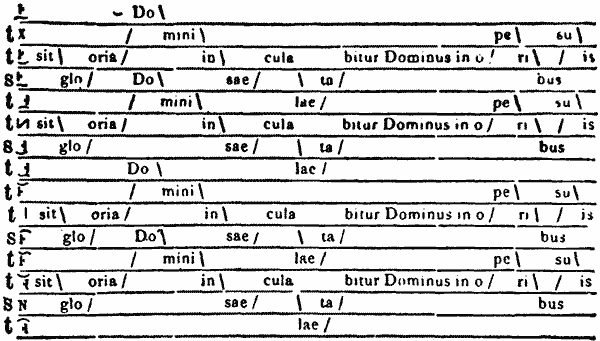
[Enlarge]
POLYPHONIC NOTATION OF HUCBALD.
The initial letters, T and S, at the beginning of the lines in the
preceding staff indicate the place of the steps (tones) and half steps
(semitones).
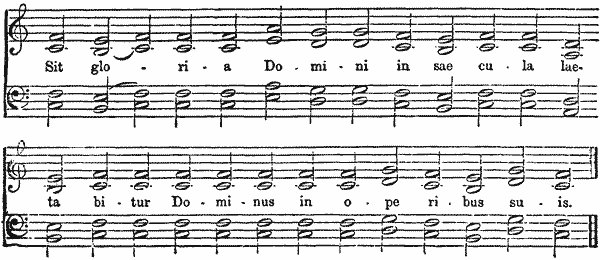
DECIPHERING OF ABOVE.
[Listen]
M. Fétis gives a two-voice parallelism in fifths, which is
progressively enlarged to three voices by adding an[Pg 142] octave to the
lower voice; and then to four by doubling the original upper voice in
the octave above. Thus:
[Listen]
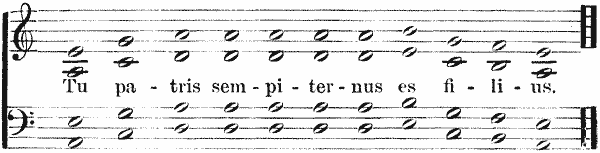
In addition to mechanical progressions of parallel motion in this way,
Hucbald in another place gives an account of a so-called "roving"
organum, in which, while parallel progressions of fourths and fifths
still are found, there are also other intervals, while the beginning
and the end must be in unison. This form of the harmony of
simultaneous sounds has in it much of the character of counterpoint,
especially in the restriction that the voices must begin and end in
unison. This roving organum, or free organum, was also known as
"profane" or "secular" organum, in contradistinction to the "sacred
organum" already given, upon the sweetness of which Hucbald greatly
prided himself.
Fétis has well said that Hucbald must be considered as one of those
superior spirits who impress upon their epoch a movement in an art or
science. Besides this, he merits particular mention in the history of
music because his works are the first since those of Boethius—a
period of four centuries—in which the art of music is treated
systematically and without obscurity.
In the "Epistola de Harmonica Institutione ad Rathbodum Episcopum
Trevinesem" ("Letter to Rathbodum, Bishop of Treves"), there is
mention of the instruments of music during the seventh and eighth
centuries. They are the cithara and harp as the stringed instruments;[Pg 143]
musetts, syrinx and organ among the wind instruments; cymbals and
drums, instruments of percussion. In the tenth century there was a
methodical treatise upon music in dialogue form, published by Odon,
abbot of Cluny, who died in this monastery November 18, 942. This
work, which was wrongfully attributed to Guido of Arezzo, contains a
number of analyses of intervals showing an understanding of the exact
dimensions of the various kinds of fourths, fifths, thirds and sixths.
According to his doctrine, the intervals of the fourths, fifths and
octaves are more natural for the voice than the others called thirds
and sixths, because the former are invariable, while the latter may be
larger or smaller by a half step. He makes a summary of ecclesiastical
chant, mentioning the modes as established by St. Gregory,
illustrating each of them by a selection from the "Plain Song." It is
a fact significant of the unsettled condition of musical theory and
the complete unconsciousness of musical amateurs that any essential
change in the art was being undergone, that as late as 1000 or 1020
Adelbold, Bishop of Utrecht, published a treatise upon music in which
the proportions of the tetrachords are calculated carefully according
to the Greek theories, and demonstrated upon the monochord.
III.
The most important writer upon music in the eleventh century, and one
of the most famous in the history of the art, was a monk named Guido,
living at Arezzo, in Tuscany, a Benedictine in the abbey of Pontose.
He was a remarkably skillful teacher of ecclesiastical singing, both
in his own monastery and at Rome, and in the effort to systematize the
elements of music he introduced[Pg 144] a number of important reforms, and is
credited by later writers with many others which he did not himself
originate, but which grew out of some of his suggestions. He is
generally credited with having invented the art of solmization, the
introduction of the staff, the use of the hand for teaching intervals,
and the introduction of notes. He was not the first who introduced the
staff. Hucbald, as we have already seen, employed the spaces between
the lines for designating pitch. Between his time and that of Guido,
one or more lines were introduced in connection with the neumæ, as
will be more particularly illustrated in chapter XV. Guido, however,
employed both the lines and the spaces, but instead of notes he wrote
the Roman letters upon the lines and spaces according to their pitch.
The notes were invented shortly after his time. For determining the
correct pitch of the[Pg 145] notes of the scale he explains the manner of
demonstrating them upon the monochord. He mentions organum and
diaphony, and remarks that he finds the succession of fifths and
fourths very tiresome. The last treatise of the thirteenth century was
written by John Cotton, an English monk, whose entire theory of music
is made up from the Greek works.
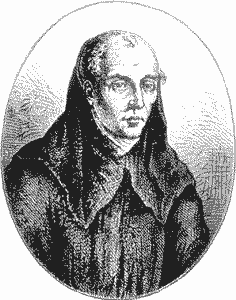
Fig. 29.
GUIDO OF AREZZO.
This summary of the didactic writers between Boethius and Franco at
Cologne fully confirms the justice of the remark, in the chapter
previous, concerning the influence of the Church upon music. At the
very time when a well marked beginning was being made in counterpoint
by the old French school at Paris, and when the English, Welsh and
Scandinavian musicians were in possession of an art of expressive
melody resting upon a simple harmonic foundation, these writers can
find nothing to say but to repeat over and over again their tedious
calculations concerning the intonations of nete hypate and the other
Aristoxinean notes in the enharmonic and chromatic genera, which had
been dead names in the art of music for more than ten centuries.
With the appearance of Franco at Cologne, there is something new in
music. Late in the twelfth century he wrote a treatise upon measured
music, the first one in all the history of the art, so far as we know,
in which musical measure is treated independently of verse, and a
notation given for representing it. He recognizes two kinds of
measure—triple or perfect, and duple or imperfect. He gives four
kinds of notes—the shortest being the brevis, an oblong note having
twice the value of a whole note; a short stem affixed to this note
doubled its value. It was then called the longa. A note head twice
as long represented a still longer duration, called[Pg 146] the maxima or
longest. There was also a semibreve, a diamond-shaped note which was
used when two or more tones were sung to one syllable. There were no
bars for indicating the place of the strong pulse in the measure, but
a bar was used to show the end of the musical phrase belonging to a
line of verse. The notation was made still more uncertain by the
license of the breve in triple time being equal to three semibreves,
and so in general each long note in triple measure being equal to
three of the next class shorter. In short, the time notation was of
the most crude and imperfect description, but it was at least a
beginning, and all the theoretical writers upon music for the next two
centuries rest in the precepts of Franco of Cologne, as a sure
stronghold, where no false doctrine can find admission. Franco
remarks, concerning the dissonances, that the imperfect dissonances,
the thirds and sixths, go very well between two consonances, showing
that in his time the third and sixth were still regarded as licenses
in harmony to be explained or excused. The general principle that any
dissonance is admissible when smoothly placed between two consonances
is a fundamental law of modern counterpoint.
There was another Franco whose work has often been confounded with
that of the celebrated master at Cologne. Franco of Paris was
connected with the Sorbonne or with Notre Dame, and his writing had
mostly to do with harmonic music. He classifies the consonances
as—complete, the unison and octave; the incomplete, the major and
minor thirds; the middle, the fourth and fifth. This is the first
instance in musical theory where the third has been recognized as a
consonance. Among the dissonances he classes the major[Pg 147] and minor
sixth as incomplete, and says concerning these two only that
immediately before a consonance any incomplete dissonance goes very
well. From the superior celebrity of the Cologne Franco the work of
the Parisian master was overlooked for many years, and it is only
through the investigation of Coussemaker that his real standing and
importance have been ascertained.
[Pg 148]
CHAPTER XII.
THE RISE OF POLYPHONY. OLD FRENCH AND
GALLO-BELGIC SCHOOLS.
I.
 E here enter upon one of the most interesting and important chapters
in the history of music. The art of polyphony had its origin at the
same period as the pointed arch and the great cathedrals of Europe,
which our architects strive in vain to surpass. In the province of
music it represents the same bounding movement of mind, filled with
high ideality, which gave rise to the crusades, and poured out in
their support such endless treasures of life and love. And in the same
country, too, arose the Gothic arch, the beauties of the shrine of
Notre Dame in Paris, and the involved and massive polyphony of music.
Polyphonic is a term which relates itself to two others, as the
leading types of all effort toward the expression of spirit through
organized tones. They are Monodic and Homophonic. The musical art
of the ancients was an art in which a single melodic formula was
doubled in a lower or higher octave, but where no support of harmony
was added, and where the only realization of variety could come
through the province of rhythm alone; or, perhaps, to a very limited
extent through changes in the[Pg 149] mode or color of the scale from which
the melody had been derived. Monodic art was an art of melody only,
rhythm finding its explanation and source in the words, and so far as
we understand the case, scarcely at all in the music. Our modern art
of homophony is like that in having but a single melody at each moment
of the piece; but it differs from the ancient in the important
particular of a harmonic support for the melody tones composed of
"chords in key." This harmonic accompaniment rules everything in
modern music. It is within the power of the composer to confirm the
obvious meaning of the melody tone by supporting it with the chord
which would most readily suggest itself, within the narrowest
limitations in the concept of key; or, second, it is within his reach
to impart to any tone, apparently most commonplace, a deeper and a
subtler meaning, by making it a peculiarly expressive tone of some
related key. Instances of this use of harmonic accompaniment are
numerous in Wagner's works, and form the most obvious peculiarity of
his style, and the chief reason why the hearers to whom his works were
first presented did not recognize the beauties and the novelties of
poetic expression in them. Half way between these two types of musical
art stands polyphony, which means etymologically "many sounds," but
which in musical technique means "multiplicity of melodies." In a true
polyphony not only has every tone of the leading voice a melodic
character, but all the tones which sound together with it are
themselves elements of other and independently moving melodies.
Polyphony comprehends the most recondite elements of musical theory,
but its essence consists of one leading concept—that of canonic
imitation. The simplest form of this is furnished by that musical[Pg 150]
construction known as "round," in which one voice leads off with a
phrase, and immediately a second voice begins with the same melodic
idea at the same pitch, and follows after. At the proper interval a
third voice enters and follows the procession at a corresponding
distance behind. Thus, when there is only one voice singing we have
monody; when the second voice enters we have combined sounds
consisting of two elements; and when the third enters we have at each
successive step chords of three tones. If there are four voices, as
soon as the fourth enters, we have combined sounds of four elements.
This form of musical construction was much practiced in England, as
already noticed. A round, however, does not come to a close, but goes
on in an endless sequence until arrested arbitrarily by the
performers. Such a form is not proper to art, since it lacks the
necessary element of completeness, for at whatever point it may have
been arrested there was no innate reason why it might not have gone on
indefinitely.
E here enter upon one of the most interesting and important chapters
in the history of music. The art of polyphony had its origin at the
same period as the pointed arch and the great cathedrals of Europe,
which our architects strive in vain to surpass. In the province of
music it represents the same bounding movement of mind, filled with
high ideality, which gave rise to the crusades, and poured out in
their support such endless treasures of life and love. And in the same
country, too, arose the Gothic arch, the beauties of the shrine of
Notre Dame in Paris, and the involved and massive polyphony of music.
Polyphonic is a term which relates itself to two others, as the
leading types of all effort toward the expression of spirit through
organized tones. They are Monodic and Homophonic. The musical art
of the ancients was an art in which a single melodic formula was
doubled in a lower or higher octave, but where no support of harmony
was added, and where the only realization of variety could come
through the province of rhythm alone; or, perhaps, to a very limited
extent through changes in the[Pg 149] mode or color of the scale from which
the melody had been derived. Monodic art was an art of melody only,
rhythm finding its explanation and source in the words, and so far as
we understand the case, scarcely at all in the music. Our modern art
of homophony is like that in having but a single melody at each moment
of the piece; but it differs from the ancient in the important
particular of a harmonic support for the melody tones composed of
"chords in key." This harmonic accompaniment rules everything in
modern music. It is within the power of the composer to confirm the
obvious meaning of the melody tone by supporting it with the chord
which would most readily suggest itself, within the narrowest
limitations in the concept of key; or, second, it is within his reach
to impart to any tone, apparently most commonplace, a deeper and a
subtler meaning, by making it a peculiarly expressive tone of some
related key. Instances of this use of harmonic accompaniment are
numerous in Wagner's works, and form the most obvious peculiarity of
his style, and the chief reason why the hearers to whom his works were
first presented did not recognize the beauties and the novelties of
poetic expression in them. Half way between these two types of musical
art stands polyphony, which means etymologically "many sounds," but
which in musical technique means "multiplicity of melodies." In a true
polyphony not only has every tone of the leading voice a melodic
character, but all the tones which sound together with it are
themselves elements of other and independently moving melodies.
Polyphony comprehends the most recondite elements of musical theory,
but its essence consists of one leading concept—that of canonic
imitation. The simplest form of this is furnished by that musical[Pg 150]
construction known as "round," in which one voice leads off with a
phrase, and immediately a second voice begins with the same melodic
idea at the same pitch, and follows after. At the proper interval a
third voice enters and follows the procession at a corresponding
distance behind. Thus, when there is only one voice singing we have
monody; when the second voice enters we have combined sounds
consisting of two elements; and when the third enters we have at each
successive step chords of three tones. If there are four voices, as
soon as the fourth enters, we have combined sounds of four elements.
This form of musical construction was much practiced in England, as
already noticed. A round, however, does not come to a close, but goes
on in an endless sequence until arrested arbitrarily by the
performers. Such a form is not proper to art, since it lacks the
necessary element of completeness, for at whatever point it may have
been arrested there was no innate reason why it might not have gone on
indefinitely.
The polyphonic compositions of the schools in consideration in the
present chapter go farther than this. While they consist of imitative
treatment of a single subject carried through all the voices, or of
several subjects which come together in such a way that the ear is not
able to follow them as individuals, there is a conclusion, and the
canonic imitation has a legitimate ending. Besides those compositions
consisting of repetitions of the same subjects, these schools gave
rise to other works in which several subjects are treated more or less
in the same manner as a single subject would have been in a simpler
composition. Nevertheless, in the earlier stages of the development,
all the chords arose as incidents, and not as ends. The composer
brought in his leading[Pg 151] melodic idea at the interval prescribed or
chosen. If crudities arose when all the voices were employed, he took
no notice of them; the hearers, apparently, being too intent upon
following the individual voices to notice the forbidden parallels of
fifths or octaves, which inevitably arose until the composer had
learned which intervals might be used without harmonic offense, and
which not.
Before proceeding to the story of this chapter, the definition of a
few terms may be advisable, in the interests of clearness. By
"imitation," then, we mean the exact repetition of the melody of one
part by another part, at the same or a different pitch. Such an
imitation may be "strict," as when the intervals and progressions are
exactly repeated; or "free," as when certain changes are made here and
there in order to lead the imitation around better to the principal
key. Canonic imitation is one in which the imitation is strict, the
repeating voice exactly repeating the melody of the principal. By
"counterpoint" we mean a second voice added to a melody already
existing, the counterpoint having a strict relation to the leading
melody, but a wholly independent movement. This conception had its
origin in the art of extemporaneous descant, in which, while the choir
and congregation repeated the melody of the plain song, a few talented
singers performed variations to it, guided solely by ear and
tradition, returning to the tone of the plain song at all the points
of repose. We do not know when extemporaneous descant gave place to
written composition, but it was probably early in the twelfth century.
By "double counterpoint" is meant a counterpoint which, although
written to be sung an octave lower than the principal song, can be
transposed an octave and[Pg 152] sung higher than the principal song without
giving rise to forbidden progressions. This will be the case only when
the original relations of the two voices have been restricted to
certain prescribed intervals. By "fugue" is meant a form of
composition in which every voice in turn enters with the leading
melody of the piece, the same given out by the leading voice at first,
called the "subject," responding alternately in tonic and dominant.
This form comes later than the period we are now about to consider,
but it grew out of the devices of polyphony, and accordingly is always
to be kept in mind as the goal toward which all this progress was
tending.
The art of polyphony is to be understood as an effort toward variety
and unity combined. The unity consisted in all the voices following
with the same melodic idea; variety, in the different combinations
resulting in the course of the progress. The limitations of polyphony
were reached when the true expression of melodic intervals was lost
through their intermingling with so many incongruous elements.
II.
The beginnings of contrapuntal and polyphonic music have been traced
to what is now known as the old French school, having its active
period between about 1100 and 1370, or thereabouts. The principal
masters known to us now by name, were all, or nearly all, connected
with the cathedral of Notre Dame, Paris, and several of them with the
university of the Sorbonne. Paris, during the earlier part of this
period, in fact during the greater part of it, was the most advanced
and active intellectual center of the entire civilized world. When the
French school had ceased to advance, as[Pg 153] happened some time before the
close of the history in 1370, as above assigned, it found a successor
in what is known as the Gallo-Belgic school, which was active between
1350 and 1432. This, in turn, was succeeded by the Netherland school,
extending from about 1425 to 1625. The removal of the star of progress
from one location to another, as here indicated in the succession of
these great national schools, was probably influenced by corresponding
or slightly antecedent changes in the commercial or political
relations of the countries, rendering the old locality less favorable
to art than the new one. For questions of this sort, however, there is
not now time or space. To return to the old French school—the
recognition of the importance of this school is due to a learned
Belgian savant, M. Coussemaker, who happening to discover in the
medical library at Montpelier, France, an old manuscript of music,
analyzed it, and found that it represented masters previously unknown,
and, for the most part, belonging to the period under present
consideration. In several monographs upon the history of "Harmony in
the Middle Ages," he traced the steps through which polyphony had
arisen, and was able to show that, instead of dating from the
fourteenth or fifteenth century, as previously supposed, it had its
beginnings more than three centuries earlier, and that Paris was the
first center of this form of musical effort.
For convenience of classification the entire duration of the old
French school may be divided into four periods, of which the first may
be taken to extend from 1100 to 1140, the great names being those of
Léonin and Pérotin, both organists and deschanteurs at Notre Dame. The
Montpelier manuscript contains several compositions[Pg 154] by both these
masters, and in them we find the germs of the most important devices
of counterpoint.
Léonin was known to his contemporaries as "Optimus Organista," on
account of his superior organ playing. He wrote a treatise upon the
art, a manuscript copy of which appears to be in the British Museum,
and its contents have been summarized by an anonymous observer, but
never published in full. He is said to dwell mainly upon the proper
manner of performing the antiphonary and the graduale. It is also
stated that he noted his compositions according to a method invented
by himself. If this work could be fully examined it might throw
important light upon the point reached in the practice of church music
in his day; his notation, also, would be a matter of interest and
possibly of importance. Quite a number of compositions by Léonin have
been discovered. The successor of Master Léonin, as director of the
music at Notre Dame, was one Pérotin, who, besides being a capable
deschanteur, was an even greater organist than his teacher, Léonin. He
was also a very prolific composer, many of his compositions being
still extant. He made additions to his predecessor's manual of the
organ.
By descant in the foregoing account, reference is made to the practice
of extemporaneous singing of an ornamental part to the plain song or a
secular cantus fermus. This art had its origin one or two centuries
earlier than the period now under consideration, in the secular
organum of Hucbald (see p. 142), and all the more talented singers,
who were also composers as well, were expert masters of it. Descant
was the predecessor of counterpoint.
The chief forms of composition in vogue during this period were
motette, rondo and conduit. The terms were[Pg 155] rather inexactly applied,
but in general the motette appears to have been a church composition,
in which often the different voices had different texts, so that the
words were wholly lost in performance. The rondo seems to have been a
secular composition, and was sometimes written without words. The
conduit was an organ piece, occasionally, if not generally, of a
secular character. All of these forms were also distinguished as
duplum, triplum and quadruplum, according to the number of voices. The
harmonic treatment in them is still crude, occasional passages of
parallel fifths occurring, after the manner of Hucbald, but in the
works of Pérotin passages of this kind are softened somewhat by the
device of contrary motion in the other parts. He made a beginning in
canonic imitation, Coussemaker and Naumann, after him, giving examples
from a composition of his called "Posuit Adjutorium." In these works
of Pérotin, and in many others of that day, traces are to be seen of
an amelioration of the musical ear, and a preference for thirds and
sixths, such as but a short time previously had been unknown to
musical theory. This influence was probably due to what was called
"Faux Bourdon," a system of accompanying a melody by an
extemporaneous second and third part in thirds or sixths.
This art, again, is clearly due to the influence of the round singing
of the British isles. Thus we have already a beginning of at least
three important elements of good music: The recognition of the triad,
or, more properly, of the third and sixth, a beginning in imitation,
and the contrapuntal concept of an independently moving melodic
accompaniment to a second voice, which in turn had been the outcome of
extemporaneous descant. The works of Pérotin were undoubtedly in
advance of[Pg 156] his time, having in them no small vitality, as is shown in
their having formed a part of the repertory of Notre Dame for more
than two centuries.
The second period of the old French school extended from about 1140 to
1170, and great improvements were made in the art of harmony
meanwhile. The three great masters of this period were Robert of
Sabillon, his successor in Notre Dame, Pierre de la Croix, and a
theoretical writer named Jean de Garland. The first of these men was
distinguished as a great deschanteur, in other words, a ready hand at
extemporaneous counterpoint. Pierre de la Croix made certain
improvements in notation, the nature of which, however, the musical
historians fail to give us. Garland divided the consonances into
perfect, imperfect and middle—a system which has remained in use,
with slight alteration, to the present day. The thirds and sixths,
however, still rank as dissonances. He also defines double
counterpoint, and gives examples. The illustrations are crude, but the
idea is correct.
The third period of the old French school is sometimes known as the
Franconian period, from the two great names in it of Franco of Paris
and Franco of Cologne, whose theories have already been noticed. (See
page 146.)
Another celebrated name of this period was that of Jerome of Moravia,
also a theoretical writer, whose treatise has been published along
with the others in Coussemaker's "Mediæval Writers upon Music." He was
a teacher and a Dominican monk at Paris. He was contemporaneous with
Franco of Cologne.
The fourth period of the old French school extended from 1230 to 1370.
The three great names were Phillippe[Pg 157] de Vitry, Jean de Muris and
Guillaume de Machaut. They were regarded by their contemporaries as
exponents of the ars nova, in contradistinction to the Franconian
teaching, which was called ars antiqua. One of these differences was
the use of a number of signs permitting singers to introduce
chromatics in order to carry out the imitations without destroying the
tonality. Jean de Muris was born in Normandy. He was a doctor in the
Sorbonne, and from 1330 a deacon and a canon. He died in 1370. He was
a learned man of an active mind. He speaks of three kinds of
tempo—lively, moderate and slow. He says that Pierre sometimes set
against a breve four, six, seven and even nine semibreves—a license
followed to this day in the small notes of the fioratura. This kind
of license on the part of the deschanteurs had been carried to a great
length, the melodic figures resulting being called "fleurettes"
("little flowers"). John Cotton compared the singers improvising the
fleurettes of this kind to revelers, who, having at length reached
home, cannot tell by what route they got there. Jean de Muris reproved
them in turn, saying: "You throw tones by chance, like boys throwing
stones, scarcely one in a hundred hitting the mark, and instead of
giving pleasure you cause anger and ill-humor." Machaut was born in
Rethel, a province in Champagne, in 1284. He was still living in 1369.
He was a poet and musician who occupied important positions in the
service of several princes, and wrote a mass for the coronation of
Charles V. Naumann thinks that Machaut was the natural predecessor of
the style of Lassus and Palestrina. He says that the use of double
counterpoint slackened from this time, whereby the music of the
Netherland composers—Dufay, Willaert and Palestrina—is simpler and
less[Pg 158] artificial than that of Odington and Jean de Garland. Chords
were more regarded. This also had its source in the north.
III.
The Gallo-Belgic school occupies an intermediate place between the old
French and Netherlandish. Its time was from 1360 to 1460, and Tournay
the central point for most of the time. The first great name in this
school was Dufay, 1350-1432. The compositions remained the same as
formerly, triplum, quadruplum, etc. One of the masters of this school,
Hans Zeelandia, who died about 1370, is to be noticed on account of
his part writing being more euphonious than that of his predecessors.
He uses the third more freely, and he gives the principal melody in
his chansons to the treble, and not to the tenor, as do the others.
This also is in line with the British influence. Dufay was regarded by
his contemporaries as the greatest composer of his time. The open note
notation succeeded the black notes about 1400, or, according to
Ambros, as early as 1370. Coussemaker dates Dufay 1355 to 1435. The
introduction of popular tunes as a cantus fermus in masses and other
such compositions is due to him; there are a large number of such
works still in the library of the Vatican. He was the first, so far as
we know, who introduced "L'Omme Armé," and the same subject was
treated by several other composers after him. Naumann thinks that the
most noticeable peculiarity of the work of Dufay is the interrupted
part writing, the imitation not running through the whole composition,
but appearing here and there, according to the fancy of the composer.
Dufay is also credited with[Pg 159] having written pure canonic imitations
without descending to the level of the rota, with its endless phrases.
Quite a number of his compositions are preserved at the Vatican and
the Royal Library at Brussels. The other great name of the first
period of this school was that of Binchois, born in Hennegau, died
about 1465. A few of his compositions are preserved, but they hardly
present important differences from those of Dufay. There were several
masters intervening between those just mentioned and Busnois, who
closed the school, but at this lapse of time their work hardly retains
sufficient individuality to warrant burdening the memory with them.
Antoine de Busnois was born in Flanders in 1440, and died in 1482.
During a great part of his active life he was chapelain-chanteur in
the household of Charles the Bold, and that of his successor, Maria of
Burgundy. His salary in this position was extremely meager, ranging
between twelve and eighteen sous a day, or, in our currency, between
about twenty-five cents and forty-eight cents a day, but as the
position carried provision for all the real needs of a man in the
matter of food and clothing, perhaps the salary was not so
insufficient, considering the greater purchasing power of money, which
must have been at least three or four times as great as at the
present. Busnois appears to have been on cordial terms with the duke,
accompanying him in his travels.
[Pg 160]
CHAPTER XIII.
THE SCHOOLS OF THE NETHERLANDS.
HE wealth and commercial activity of the Low Countries, known as
Flanders, Brabant and Hainault, had now become greater than that of
any other part of Europe, Italy perhaps excepted. The organization of
the Communes, which began, indeed, in France as early as the tenth
century, naturally reached a greater extent during the crusades, when
so many of the higher and more energetic nobility were absent in the
Holy Land, since the defense and order of the people at home had to be
maintained by those who were left behind. Under these circumstances,
the power naturally drifted into the strongest hands available, which
quite as naturally were those of the capable merchants and
manufacturers of the burgher class. Hence the condition of society,
while much hampered by the restrictions of the guilds requiring
children to be brought up to the occupation of the parents, was
nevertheless more favorable to the freedom of the individual than at
any previous period. These social elements combining with the wealth
aforesaid, and the public spirit which has always distinguished the
mercantile classes engaged in foreign commerce upon a large scale,
united to form an environment favorable to the development of art;
and, as music was the form of art which happened to be most in[Pg 161] demand
at the time, the effects of the stimulating environment were
immediately seen. It was perhaps partly in consequence of the burgher
character of the classes most engaged in music in Flanders that the
form music there developed should have been so exclusively vocal. All
the work of this school, extending over two centuries, was either
exclusively vocal, or written with main consideration for the voice,
the instrumental additions, if any, having never taken on a
descriptive or colorative character.
The schools of the Netherlands came into prominence about 1425, and
endured, with little loss of prestige, for two centuries, or until
1625. During this period there was a succession of eminent names in
music in these countries, and a great progress was made in polyphony,
and a transition begun out of that into harmony (which was in part
accidental, owing to their outdoing themselves, as we shall see).
Moreover, in the later times, quite a number of eminent men emigrated
to foreign countries, and there kindled the sacred fires of the art,
and set new causes in operation, leading to the development of
national schools of great vigor. The three most eminent names in the
category last referred to were those of Tinctor, who founded the
school of Naples shortly before 1500; Willaert, who founded that of
Venice soon after 1500, and Orlando Lassus, who founded that of Munich
a trifle later. The great Palestrina himself was an outcome of these
schools of the Netherlands, and, aside from the independent musical
life in Spain, there was no strong cultivation of music anywhere in
Europe during this period, which did not have its source in these
schools of the Netherlands. The entire relation of these schools is
perhaps better shown in the following[Pg 162] table taken from Naumann, than
is possible in any other manner:
THE NETHERLAND SCHOOL. (1425-1625 A.D.)
| Belgian School. |
Dutch School. |
| First Period—1425-1512. |
First Period—1430-1506. |
| OKEGHEM, Compère, Petrus,
Platenis, Tinctor. |
Hobrecht. |
| Second Period—1455-1526. |
Second Period—1495-1570. |
| JOSQUIN DES PRÈS, Agricola,
Mouton. |
ARKADELT, Holländer. |
| Third Period—1495-1572. |
Third Period—1440-1622. |
GOMBERT, WILLAERT,
Goudimel, Clemens (non papa),
Cyprian de Rore. |
SCHWELINCK.
|
| Fourth Period—1520-1625. |
|
ORLANDO LASSUS, Andreas Pavernage,
Phillippus de Monte, Verdonck. |
|
The first composer of the Belgian branch of the Netherlandish school
was Joannes Okeghem, who was a singer boy in the choir of the Antwerp
cathedral in 1443, and is supposed to have been a pupil of Binchois.
Directly after the date just mentioned he gave up his place at
Antwerp, and entered the service of the king of France. For forty
years he served three successive kings, having been in especial favor
with Louis XI. He resigned his position at Tours soon after 1490, and
lived in retirement until his death in 1513, at the age of nearly 100
years. Okeghem was a very ingenious and laborious composer, who
carried the art of canonic imitation to a much finer point than had
been reached before his time. He is generally credited with having
composed a motette in thirty-six parts having almost all the devices
later known as augmentation, diminution, inversion, retrograde, crab,[Pg 163]
etc. The thirty-six parts here mentioned, however, were not fully
written out. Only six parts were written, the remainder being
developed from these on the principle of a round, the successive
choruses following each other at certain intervals, according to Latin
directions printed with the music. The other composers belonging to
this period were comparatively unimportant, with the exception of
Johannes Tinctor, who was born about 1446 and died in 1511. Tinctor,
after being educated to music in Belgium, emigrated to Naples. In
early youth he studied law, and took the degree of doctor of
jurisprudence, and afterward of theology; was admitted to the
priesthood, and became a canon. He then entered the service of
Ferdinand of Aragon, king of Naples, who appointed him chaplain and
cantor. He founded a music school in Naples, and published a multitude
of theoretical works of the nature of text books. He is entitled to
the honorable distinction of having published the first musical
dictionary of which we have any record. This book is without date, but
is supposed to have been printed about 1475. None of the compositions
of Tinctor have been printed, and his importance in music history
ranks mainly upon the theoretical works which he composed, and his
relation as founder of the Naples school.
The second period of the Belgian school has the great name of Josquin
des Près, who was born about the middle of the fifteenth century,
probably at St. Quentin, in Hainault. He was a pupil of Okeghem; was
chapel master in his native town, and in 1471 was a musician at the
papal court of Sixtus IV. This great master is to be remembered as the
first of the Netherlandish school whose works still have vitality. He
was a man of genius and of musical feeling. Martin Luther said of him
that[Pg 164] "Other composers make their music where their notes take them
[referring to their canonic devices]; but Josquin takes his music
where he wills." Baini, the biographer of Palestrina, speaks of him as
having been the idol of Europe. He says: "They sing only Josquin in
Italy; Josquin alone in France; only Josquin in Germany; in Flanders,
in Hungary, in Bohemia, in Spain—only Josquin." ("Si canta il solo
Jusquino in Italia; il solo Jusquino in Francia; il solo Jusquino in
Germania," etc.) Josquin was a musician of ready wit, and many
amusing stories are told of the skill with which he overcame
obstacles. Among others it is told that while he was at the French
court the courtier to whom he applied for promotion always put him off
with the answer, "Lascia fare mi." Weary of waiting, Josquin
composed a mass upon the subject la, sol, fa, re, mi, repeated over
and over in mimicry of the oft repeated answer. The king was so much
amused that he at once promised Josquin a position, but his memory not
having proved faithful, Josquin appealed to him with a motette:
"Portio mea non est in terra viventium" ("My portion is not in the
land of the living"); and "Memor esto verbi tui" ("Remember thy
words"). Another anecdote of similar readiness is that of the motette
which the king, who was a very bad singer, asked Josquin to write,
with a part in it for the royal voice. Josquin composed a very
elaborate motette, full of all sorts of canonic devices, and in the
center of the score one part with the same note repeated over and
over, the one good note of the king's voice—the inscription being
"Vox regis" ("voice of the king"). It will be too much to claim
Josquin as a composer of expressive music. The mere fact of his having
written motettes upon the genealogies in the first chapters of St.
Matthew[Pg 165] and St. Luke sufficiently defines the importance he attached
to the words. Speaking of Josquin's treatment of effects, it is
recorded of him that a single word is sometimes scattered through a
whole page of notes, showing that he attached no importance to the
words whatever. One of the most beautiful of his pieces was a dirge
written upon the death of Okeghem. Owing to the good fortune of the
invention of music printing from movable types, in 1498, when Josquin
was at the height of his powers, a large number of his works have come
down to modern times.
In the corresponding period of the Dutch school the name of Jacob
Arkadelt is to be remembered, who, although not a composer of the
first order, was nevertheless a man of decided power, and is known to
us through a number of his works still existing in considerable
freshness. Arkadelt was a singing master to the boys in St. Peter's in
Rome in 1539, and was admitted to the college of papal singers in
1540. About 1555 he entered the service of Cardinal Charles of
Lorraine, duke of Guise, and went to Paris, where probably he died.
Besides a large number of motettes and masses, he was one of the most
famous of the Venetian school of madrigal writers, a form of
composition of which it will be in order to speak later. One of the
most pleasing of Arkadelt's compositions is an Ave Maria which is
often played and sung at the present day.
The third period of the Netherlandish school embraced four very
eminent names—Gombert, Willaert, Goudimel and Cyprian de Rore. The
three latter were successively chapel masters at the cathedral of St.
Mark's in Venice, and were eminent lights of the Venetian school. It
is a significant indication of the commercial decadence of[Pg 166] the
Netherlands, which had now set in, that all the composers of this
period distinguished themselves in foreign countries. Nicholas
Gombert, a pupil of Josquin, became master of singers, and afterward
directed the music at the royal chapel in Madrid from 1530. He was a
prolific composer of masses, motettes, chansons and other works. Of
the remaining members of this period mention will be made in
connection with the account of the music in St. Mark's, where they all
distinguished themselves.
The most gifted of all these Netherlandish masters was Orlando de
Lassus, who was born in Belgium, educated at Antwerp, spent some time
in Italy, and finally settled at Munich, where he lived for about
forty years, as musical director and composer. The compositions of
this great man fill many volumes. He distinguished himself in every
province of music, being equally at home in secular madrigals—quite a
number of which are heard even at the present day with
satisfaction—masses and other heavy church compositions, and
instrumental works. He was a cultivated man of the world who held an
honored position at court and made a great mark in the community. He
founded the school at Munich which, with rare good fortune, has
occupied a distinguished position ever since, and has been, and still
is, one of the most important musical centers in Europe, as all who
are acquainted with the history of Richard Wagner, or the reputation
of the present incumbent, the Master Rheinberger, will readily see. In
Lassus we begin to have the spontaneity of the modern composer. The
quaintness of the Middle Ages still lingers to some extent, and
learning he had in plenty when it suited him to use it, but he was
also capable of[Pg 167] very simple and direct melodic expression and quaint
and very fascinating harmony. While the tonality is still vague, like
that of the church modes, the music itself is thoroughly chordal in
character, and evidently planned with reference to the direct
expression of the text. A large number of madrigals have come down to
us from this great master; among them is the one called "Matona,
Lovely Maiden," which is one of the most beautiful part songs in
existence. The life of Lassus was full of dignity and honor. He was
extremely popular in Munich and in all other parts of Europe. He is to
be considered the first great genius in the art of music.
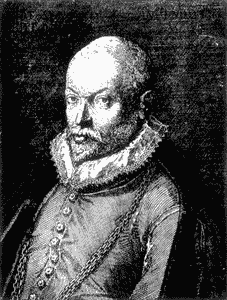
Fig. 30.
ORLANDO DE LASSUS.
[From a contemporary print by the French
engraver Amelingue.]
[Pg 168]
CHAPTER XIV.
POLYPHONIC SCHOOLS OF ITALY.
PALESTRINA.
TALY in the fifteenth century was in a highly prosperous condition.
The great commercial cities had a profitable commerce with all parts
of the then known world, and great public works had been under way for
more than two centuries. The beginning of the Renaissance was marked
by the great cathedrals, of which St. Mark's at Venice was a little
earlier than Pisa, Siena, Florence and Milan. All these were built
before 1300. Vast public works were undertaken in all parts of the
country, such as the canal that supplied Milan with water, and
irrigated a large part of the plain of Lombardy; the great sea wall of
Genoa; roads, bridges, municipal buildings, fortresses and the like.
By the beginning of the sixteenth century the art of painting had
reached a very high eminence; the master Raphael was already at work,
as was also that remarkable genius, Leonardo da Vinci—the most
universally gifted artist who ever appeared. Michael Angelo was at
work in the Sistine Chapel, and his plans for St. Peter's were partly
being carried out. It was in this time that Johannes Tinctor, the
Netherlandish composer, founded a music school at Naples. The school
itself was short-lived, but[Pg 169] it was presently succeeded by four others
of a different kind which eventually produced a large number of
eminent musicians, several of whom will occupy our attention later.
Tinctor's music school appears to have been a private affair. Those
which followed it were charitable institutions, taking poor boys from
the streets, furnishing them with a living, the rudiments of an
education, and musical training enough to make them available in the
service of the Church. The founding of these schools took place some
time later than the period under immediate discussion. Santa Maria di
Loreto was founded in 1535, by a poor artisan of the name of
Francisco, who received in his house orphans of both sexes, and caused
them to be fed and clothed and instructed in music. He was assisted by
donations from the rich, and presently a priest named Giovanni da
Tappia undertook to raise a permanent endowment by begging alms from
house to house. At the end of nine years he had accomplished his task.
The building was called the Conservatorio, and in 1536 received
certain government allowances. The pupils reached the number of 800,
and among the illustrious musicians produced by this school were
Alessandro Scarlatti, Durante, Porpora, Trajetta, Sacchini, Gugliemi
and many more. The second school of this kind organized was that of
San Onofrio a Capuana, in 1576. It received 120 orphans, who were
instructed in religion and music. In 1797 the pupils of this school
were transferred to Santa Maria. The third school of this kind was
that of De Poveri di Gesu Cristo, established in 1589, for
foundlings. In 1744 this conservatory was made into a diocesan
seminary. The fourth of these schools was that of Della Pieta di
Turchini, which originated about 1584. Quite a number of eminent[Pg 170]
composers were produced in this school. All of these conservatories
were consolidated in 1808 as the Reale Collegio di Musica (Royal
College of Music). The example of Naples was followed with more or
less rapidity in the other principal Italian cities. The most
important musical center of Italy during this time was Venice, where
Adrian Willaert became musical director in the cathedral of St.
Mark's, in 1527. Here he remained until 1562. The church of St. Mark's
had already held a prominent position as a musical center at least two
centuries of the four which it had been in existence. The recently
published history of the music in St. Mark's extends back to 1380,
from which time to the beginning of the present century there has been
a succession of eminent musicians as organists and musical directors.
There were two organs in this church, standing in galleries on
opposite sides of the chancel. This circumstance had an important
influence on the development of music in the cathedral, as will
hereafter be seen. It was in this church, according to Italian
tradition, that pedals were first applied to the organ. It is probable
that these appliances were very rude at first, and few in number, but
they served to supplement the resources of the hands of the organist,
and enabled him to produce effects not otherwise obtainable. The
existence of the two choirs and two organs, and no doubt the habit of
antiphonal singing in the Plain Song of the Church, led Willaert to
invent double choruses, and finally to divide his choir into three or
more parts. Willaert is regarded by many as the founder of the
madrigal, of which there is more to be said presently. He was also the
teacher of two very eminent musicians who succeeded him in his
position at St. Mark's—Zarlino and Cyprians de[Pg 171] Rore. To go on with
the story of St. Mark's from this point, the most important successor
of Willaert was Gioseffo Zarlino, who spent his youth in studying for
the Church, and was admitted to minor orders in 1539, and ordained
deacon in 1541. He was a proficient scholar in Greek and Hebrew, in
mathematics, astronomy and chemistry. After studying for some years
with Willaert he was elected in 1555 first Maestro di Capella at St.
Mark's. In this position his services were required not alone as
director of music in the church, but also as a servant of the
republic, and it was his duty to compose or arrange music for all of
the public festivals. After the battle of Lepanto, October 7, 1571,
Zarlino was appointed to celebrate the victory with appropriate music.
When Henry III visited Venice, in 1574, he was greeted by music by
Zarlino. This same composer is also credited with having composed a
dramatic piece called Orpheo, which was performed with great
splendor in the larger council chamber. Again, in 1577, Zarlino was
commissioned to compose a mass for the commemoration of the terrible
plague which devastated Italy and carried off Titian, among other
great men. His ecclesiastical standing was so good that in 1583 he was
elected bishop, but his accession to the see was so strongly opposed
by the doge and the senate that he consented to retain the appointment
of St. Mark's, where he remained until his death in 1590. Zarlino was
very famous as a composer, in his own day, but few of his works have
come down to us. He is best known by certain works of his on harmony
and the theory of music, of which the most important was the
Institutioni Armoniche (Venice, 1558), and his Demonstrationi
Armoniche (Venice, 1571). Zarlino's distinction rests upon[Pg 172] his
having restored the true tuning of the tetrachord to that of 8:9,
9:10, 15:16, as opposed to the Pythagorean tuning of 9:8, 9:8,
256:243. He was the most important scientific authority in the music
of the new epoch. His discoveries in harmony were afterward
supplemented by those of Tartini, almost two centuries later. Among
other strong points of Zarlino was his demonstration of equal
temperament, which came into general use about 100 years later.
Cypriano de Rore, whose name was mentioned above in connection with
St. Mark's, held a position as master in that eminent cathedral only
one year, his tenure of office falling between the death of Willaert
and the appointment of Zarlino. He was a very prolific composer of
motettes and madrigals, and after resigning his position at St. Mark's
went to the Court of Parma, where he died at the age of forty-nine.
The later eminent masters holding positions in this church will come
into view in the next book, in connection with the opera, for
Monteverde was director of the music here during the greater part of
his career as a dramatic composer.
The most eminent development of the polyphonic school, and at the same
time the dawn of a better era in church music, took place in Rome,
where the influence of the Netherlandish composer is noticeable.
Claude Goudimel, whose name appears in the table of the Netherlandish
school in the preceding chapter, opened a music school in Rome in the
early part of the sixteenth century, and among his pupils was the name
of Palestrina. Goudimel's residence in Rome was not very long. He
afterward returned to Paris, and in some way was connected with Calvin
in preparing psalm books for the[Pg 173] Calvinists. He was killed finally at
Lyons in the massacre of St. Bartholomew, August 24, 1572.
The culmination of the contrapuntal school and the dawn of the new era
in church music came about through the labors of the pupil of
Goudimel, the great Palestrina. This master, whose name was Giovanni
Pierluigi (English, John Peter Lewis), was born of humble parents at
Palestrina, a small town in the vicinity of Rome. The date is
uncertain, but it was probably about 1520. As early as 1540 he came to
Rome to study music, where he made so good progress that in 1551 he
was appointed musical director at the Julian chapel in the Vatican. He
then commenced the publication of a series of remarkable musical
works, the first of which were in the style prevalent in his day.
There was much learning of every sort; all the devices of polyphony
were freely and luxuriantly employed, but along with them were other
passages of true expression. The dedication of some of these books to
the pope secured for him certain small preferments, which, in his most
profitable condition, aggregated about thirty scudi a month (perhaps
equal to $20 of our money). On this miserable pittance he supported
his wife and four children. In 1556 he was discharged from his place
as a pontifical singer, on account of his marriage, a fact which had
been ignored by the pope who appointed him. He then held the post of
chapel master at the Lateran. In 1561 he was transferred to Santa
Maria Maggiore, where he remained ten years at a monthly salary of
sixteen scudi, until 1571, when he was once more elected to his old
office of master at the Vatican. It would take us too long to speak of
his various works in detail, although his numerous publications during
this period demonstrate his claim to mastership of the first[Pg 174] order.
The best of his pieces had already been adopted in the apostolic
chapel, and his reputation was now greater in Italy than that of any
other musician. But the taste for elaboration in church music had
reached a point where reform was imperatively demanded. Not content
with having secular melodies employed as canti fermi in the music
sung to the words of the mass, the words of these secular songs
themselves were often written in and sung by a majority of the singers
in the choir, only those in the front rows singing the solemn words of
the ecclesiastical office. The Council of Trent (1545-1563) commented
upon this state of things with great severity, and appointed a
commission to inquire into the abuse and decide upon a remedy. It was
contemplated to entirely do away with elaborate music in the Church,
and sing only the Gregorian songs. A few of the music-loving cardinals
succeeded in preventing so sweeping an order, and a commission was
appointed to take the matter in hand. Two of the most active of these
were Cardinals Borromeo and Vitellozzi. The former reported of the
singing in the pontifical chapel, to the following effect: "These
singers," said he, "count it for their principal glory that when one
sings sanctus, another sings Sabbaoth and another gloria tua,
and the whole effect of the music is little more than a confused
whirring and snarling, more resembling the performance of cats in
January than the beautiful flowers of May." At the same time
Palestrina was desired to write a mass in a style suitable for the
sacred office. Too modest to rest the case upon one work, he wrote
three, which were performed with great care at the house of Cardinal
Vitellozzi, and all were much admired, but the third, known as the
mass "Papæ Marcelli," in memory of the pope[Pg 175] who had appointed
Palestrina to one of his positions, was recognized as of transcendent
excellence. It was copied in the collection of the Vatican, and the
pope ordered a special performance of it in the Apostolic chapel. At
the end of it he declared that it must have been some such music as
this that the apostles of the Apocalypse heard sung by the triumphant
hosts of angels in the New Jerusalem. Palestrina continued to write
masses, motettes and other works during the remainder of his life, but
during the entire time lived in the extremely limited condition
already mentioned, and was subject to much enmity from jealous singers
and composers. The most pleasing incident of his later life happened
in 1575, when fifteen hundred singers from his native town came to
Rome in two confraternities of the Crucifix and the Sacrament, making
a solemn entry into the city, singing the music of their great
townsman, who conducted at their head. The long and active life of
this great master came to an end January 22, 1594. Among his greater
works are ninety-three masses, a very large number of motettes,
forty-five hymns for the whole year, sixty-eight offertories, and a
large number of litanies, magnificats and madrigals.
It is not unlikely that reform in Catholic Church music had been very
largely influenced by the Protestant music of Germany. Martin Luther
(1483-1546) in arranging music for the Protestant Church, invented the
chorale and added to the best melodies from the Plain Song some
wonderfully fine ones of his own, such as "Eine Feste Burg," and
caused many others to be written by the best composers of the
Netherlandish school. The chorale was the exact opposite of the
motette of the Netherlands. In the chorale all of the voices moved
together. The[Pg 176] same music was invariably sung to the same words,
whereby an association was created, intensifying the effect of the
music and the words respectively.
As examples of Palestrina's music are not common I have thought best
to allow space for the following from his music for Holy Week. The
pieces will produce a much better effect if sung by good voices than
when played upon an instrument. They are written for the voice.
"TENEBRÆ FACTÆ SUNT," BY GIOVANNI PIERLUIGI DA
PALESTRINA.
[Listen]
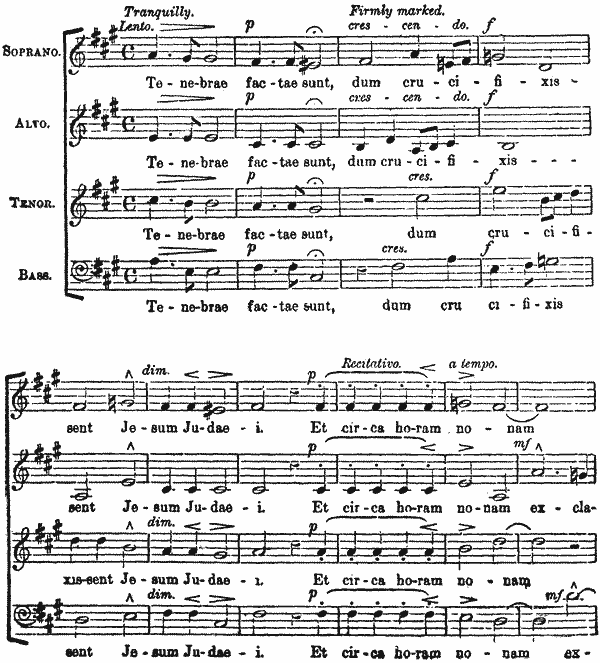
[Pg 177]
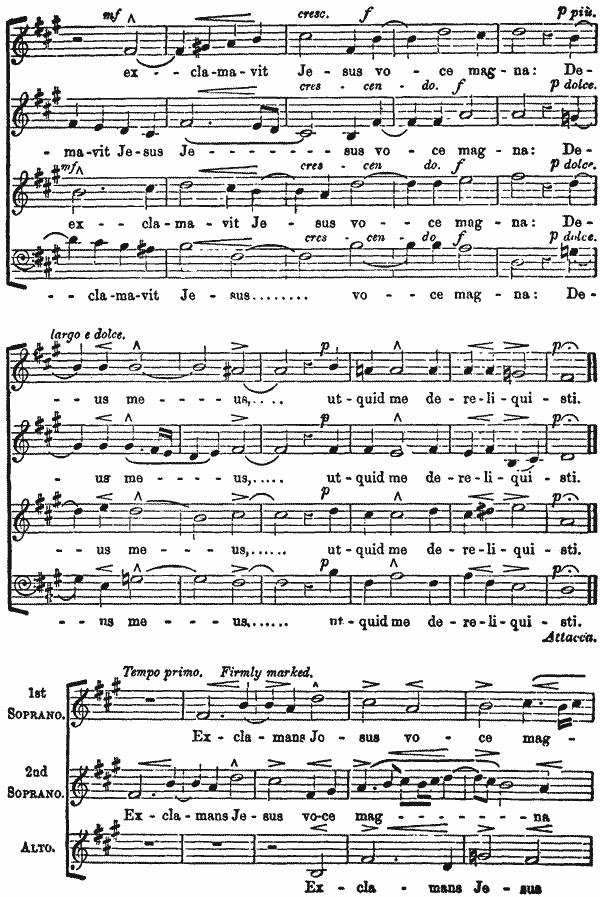
[Pg 178]
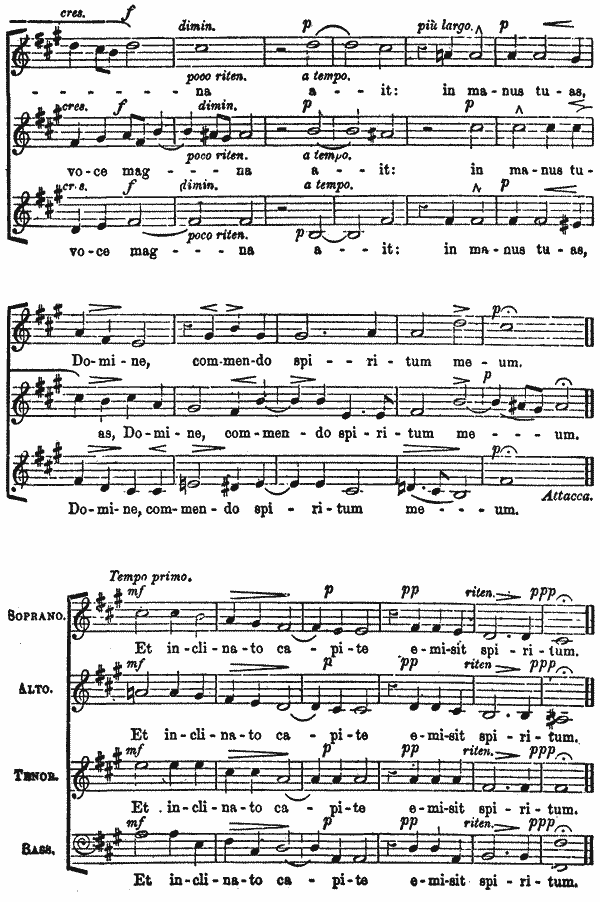
[Pg 179]
CHAPTER XV.
THE CHANGES IN MUSICAL NOTATION.
HE entire movement of musical thought since three or four tones began
to be put together into scales, melodies and unities of various kinds,
has been in the direction of classification. This is shown very
conclusively in the history of musical notation, which, at the end of
the period just now under consideration, had reached a form nearly the
same as we now have it. The early notation regarded tones as
individual, and wholly without classification of any kind. The first
musical notation of which we have any authentic knowledge was that of
the Greeks already noted in chapter III. Their scale consisted of two
octaves and one note, their so-called "greater perfect system," and
the tones were named by the first fifteen letters of the Greek
alphabet. This, however, was only a beginning of their system, for the
variety of pitches required in their enharmonic and chromatic scales,
and in the various transposition scales was so great that they
required sixty-seven characters for representing them. These
characters were written above the words to which they applied, and
they had additional marks for duration, especially in the later
periods of Greek music. Besides this they had an entirely different
set of characters for the same tones played upon the cithara, so that
a word[Pg 180] to be sung without accompaniment had one mark above it for the
pitch of the note, while if accompanied even by the same tone upon the
instrument, a second character was written for the instrumental part.
The system was wholly without classification, except that the letters
were applied from the lowest notes upward, the same as we now have
them. There was nothing to assist the eye in forming an idea of the
movement of the melody, and as the forms of the letters were very
similar in some cases there is no doubt that mistakes of copyists were
numerous. This, however, is a matter of little concern to us, since no
authentic melodies of the classical period have come down to us. The
example of Greek characters given on p. 69, in connection with the Ode
of Pindar, sufficiently illustrates the nature of this notation,
although the interposition of the staff between the musical notes and
the words deprives the illustration of a part of its value.
The Romans had also a notation consisting of letters written above the
words to which they applied; they made use of the first fifteen
letters of the alphabet in the same manner as the Greeks, but we do
not know whether they employed the same characters for the instruments
and the voices, or had different ones. The only example we possess of
the Roman notation from classical times, or in close tradition from
classical times, is that in "Boethius' Consolations of Philosophy."
From the fact of this being the only place where the Roman notation is
illustrated, certain writers have concluded that Boethius invented
it—a supposition which is utterly improbable. Boethius mentions the
Roman notation, and employs it, as also does Hucbald in certain of his
examples, but neither one of them explains it or gives[Pg 181] any account of
its origin. We have simply to take it for granted that the Romans
transferred the letter notation of approximate pitch to their own
characters instead of using Greek letters. The following example from
Guido's book illustrates the appearance of the Roman notation as he
uses it:
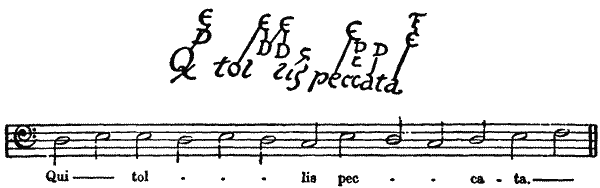
Fig. 31.
LETTER NOTATION OF GUIDO OF AREZZO, WITH DECIPHERING.
[Listen]
The most curious notation of which we have a record was that of the
neumæ, or neumes, which were employed by the ecclesiastical writers
mostly from about the sixth century to the twelfth. This writing, as
will be seen from the examples hereafter given, very much resembled
the curves and hooks of the modern shorthand. The learned Fétis thinks
that the characters were derived from the Coptic notation, and these
again from the hieratic notation of the ancient Egyptians. The neumes
signified mostly intonations, upward or downward slides of the voice,
and not absolute pitch.
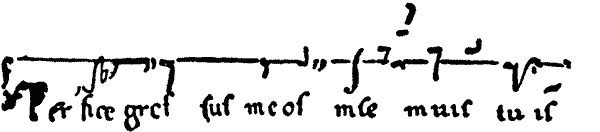
Fig. 32.
NEUME NOTATION OF THE TENTH CENTURY.
There are no clefs or other indications of the key, and it is little
better than sheer guesswork to attempt to decipher one of them, for
want of some one[Pg 182] single base mark to reckon from. Accordingly, the
various commentators have rendered the old pieces in a variety of
ways. It is probable that the imperfections of this notation were
helped out, when it was in current use, by tradition, which
appropriated certain keys to each of the principal hymns of the
Church; this being understood, the singer found himself able to make
something intelligible out of a notation which, without the help of
traditions, would have been meaningless. From about the eleventh
century the supposed meanings of the various signs of the neumes are
easily to be ascertained, because tables are given by a number of
writers of that period; but the earlier examples are practically
undecipherable. This notation came into use partly through
ecclesiastical influence, and partly owing to its being easy to write,
while at the same time it occupied little space upon the page. The
earlier examples, as already said, were without clefs or any means of
ascertaining the key note. After a while we find them with one line
representing do or fa, and the signs arranged above, below, or upon
the line, at intervals approximately representing the pitch intended.
Still later we find a colored line for fa, a thumb nail line traced on
the parchment, but not colored, for re, and a different one for la.
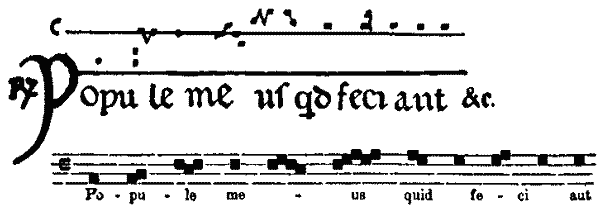
Fig. 33.
NEUME NOTATION OF THE ELEVENTH CENTURY, DECIPHERED BY MARTINI IN
"GREGORIAN" NOTATION.
[Listen]
[View modern transcription]
[Pg 183]
Still later four lines were used. There were many varieties of forms
of the neumes employed by the different copyists and by different
nationalities, the heaviest marks of this kind being those of the
Lombard-Gothic represented in Fig. 35. These marks were afterward
written upon a four-line staff, and the note heads were derived from
them.

Fig. 34.
NEUME NOTATION OF GUIDO OF AREZZO.
There were no marks whatever for duration or measure in the neumes
notation, and its persistence through so long a time signifies very
plainly that it was not in the line of the musical life of the world,
but was a special hieratic notation made to answer for ecclesiastical
purposes by the help of carefully transmitted traditions.
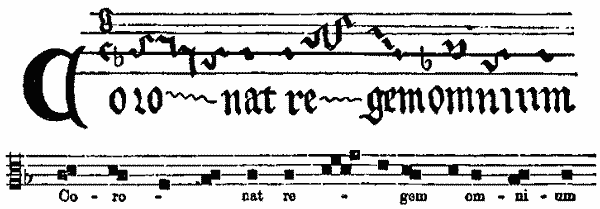
Fig. 35.
DECIPHERED NEUME NOTATION OF THE LATEST PERIOD.
[Listen]
[View modern transcription]
One of the oldest forms of this notation is that of the lament for the
death of Charlemagne, an extract from which is here presented,
together with its translation as given by Naumann.[Pg 184]
Incidentally this illustration gives a fair specimen of mediæval
melody of the earlier period. It dates from the tenth century.
"LAMENT FOR CHARLEMAGNE."
[Listen]
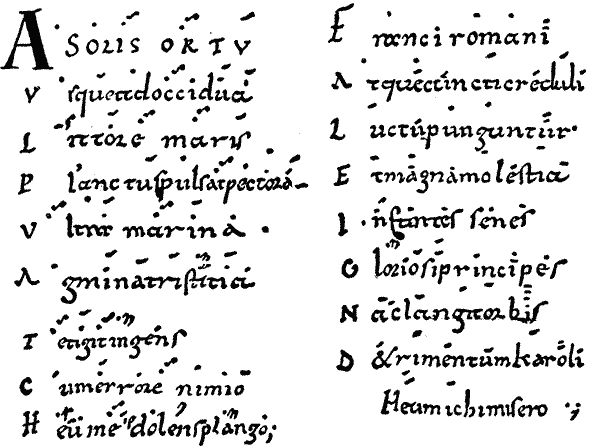
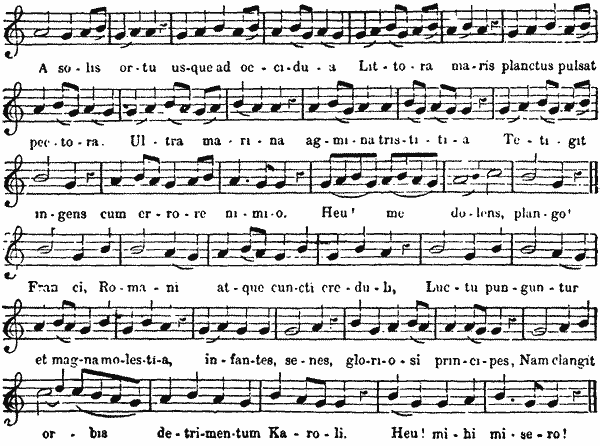
[Pg 185]
The earliest suggestion of the staff that we have is that in the work
of Hucbald already mentioned, in which he proposed to print the words
in the spaces of the staff of eleven lines, placing each syllable
according to its pitch (p. 141). The staff, in connection with neumes,
as given above in Fig. 34, probably came into use about the same time
as that when Hucbald's book was written, but it was not until the days
of Guido of Arezzo that the staff was employed in anything like its
modern form, nor is it certain that Guido had anything to do with
introducing it. In one of the manuscripts of his book letters are
written upon the lines and spaces, and in another the neumes are
given. The note head was not invented until some little time after his
death, probably about fifty years.
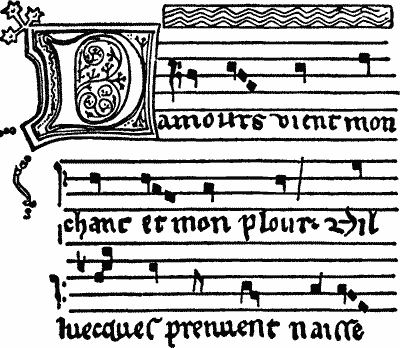
Fig. 36.
NOTATION OF THE FRENCH TROUVÈRES.
By the time of Franco of Cologne, the four-lined staff with square
notes had come into use, the notes having the value already assigned
them in the chapter upon Franco of Cologne. (See p. 145.) The place of
fa was marked by a clef, and with some few exceptions all the[Pg 186] musical
notation from this time forward is susceptible of approximate
translation. The term approximate is used above by reason of the fact
that no sharps or flats were written until long after this period, but
it is thought that they were occasionally interpolated by the singers
quite a long time before it became customary to put them into the
notation. In this way, for example, a piece of music beginning and
ending on the degree appropriate to fa might be brought within the
limits of the key of F by the singer changing B natural to B flat
wherever it occurred. Our information in regard to this practice is
extremely limited, and, in fact, rests upon two or three detached
hints. The signature was not employed until some centuries later.
As already mentioned in chapter XI, there was no measure notation for
a long time after Franco's death. The data are uncertain concerning
the exact time when the bar began to be used to mark the measure. Its
earliest use was that of marking the end of the music belonging to a
line of poetry. This is the same use as now made of the double bar in
vocal music. In fact, everything points to the progressive development
of music in all respects, and the development of what we might call
self-consciousness in musicians, whereby each succeeding generation
sought to place upon record a greater number of particulars concerning
their music, and to leave less and less to accident or tradition. This
progress has gone on until the present time, when two particulars of
our music are exactly recorded—the pitch and the rhythm. The exact
relation of every tone to the key note is ascertainable from our
musical notation, and the precise degree of rhythmic importance
appertaining to each tone according to its place in measure and in the
larger rhythms. We[Pg 187] are still lame in the matter of expression, and in
pianoforte music also in regard to the application of the pedals. Here
our notation affords only a few detached suggestions. If the master
works of the modern school could be noted for expression as completely
as for pitch and rhythm, the labor of acquiring musical knowledge
would be very greatly diminished.
The four-line staff has remained in use in the Catholic Church until
the present time, and with it the square notes. It is generally called
Gregorian, and by many is supposed to have been invented by Gregory
the Great; but as a matter of fact, about six centuries elapsed after
his death before this square-note notation came into use. The
five-line staff came into use about 1500. Information is wanting as to
the causes which led to its adoption in preference to the four-line
notation so long in use. The clef for do (C clef) remained in use
until very lately, and is still used by many strict theorists, being
written upon the first line for the soprano, the fourth line for the
tenor, the third line for the alto. The G clef, also, when first
introduced, was often written upon the third or the first line; the F
clef, moreover, was not definitely established on the fourth line
until toward 1700. In the scores of Palestrina's work, now published
in complete form, there are pieces written with the soprano in the G
clef upon the first line, the alto in the C clef upon the second line,
the tenor in the C clef upon the fourth line, and the bass in the F
clef upon the third line. This, while affording the eye two familiar
clefs, the treble and the bass, places them in such a way as to
practically make it necessary for the modern reader to transpose every
note of the composition in all the parts,[Pg 188] and, in fact, to effect a
transposition for each part upon principles peculiar to itself.
The progress of classification is distinctly seen in the use of seven
letters instead of fifteen, affording a tacit recognition of the most
essential underlying facts of harmony—the equivalence of octaves.
The staff, however, affords the eye no assistance at this point, since
the octaves of notes occupy relatively entirely different positions
upon it, the octave of a space being invariably a line, and the octave
of a line a space. Moreover, the octave of a bass line is always very
differently located when it falls upon the treble staff, and, vice
versa, the octave of a treble note falling in the bass is very
differently placed. If a notation had to be made anew it would no
doubt facilitate matters to make use of a staff so planned as to bring
out the equivalence of octaves more perfectly. A recent American
designer, Mrs. Wheeler, has proposed a double staff of six lines,
divided into two groups of three, for the treble and bass, thus
presenting for the piano score four groups of three lines each,
separated by smaller or larger intervals. Upon such a staff every tone
would fall in the same place upon the three lines in every octave, the
octave of the first line of the lower three would be the first line of
the second three, and so on.
This, however, is to anticipate. The smaller rhythmic divisions of the
measure were very little used in the old music which, if not sung in
slow time, was at least written in long notes, and the smaller
varieties of notes are the invention of a period perhaps rather later
than that at which we have now arrived. They belong to the elaborate
rhythmic construction of the music of Händel, Bach, Scarlatti and
Haydn.
[Pg 189]
CHAPTER XVI.
MUSICAL INSTRUMENTS. THE VIOLIN,
ORGAN, ETC.
I.
 URING the entire period covered by the division of the story with
which we have been now for some time dealing, the influences operating
upon the tonal sense in the direction of harmonic perception had also
been highly stimulative to the sense of melody. All the devices of
counterpoint, with their two, three and four tones of the moving voice
against one of the cantus fermus, were so many incitations in the
direction of melodic cleverness. This influence was still further
strengthened by the constant effort of the composer to impart to each
voice as characteristic an individuality of movement as possible.
Hence there is a distinct gain in smoothness of melody, and there are
occasional appearances of truly expressive quality in this part of the
music, even in the most elaborate of the contrapuntal compositions.
Meanwhile the various forms of popular minstrelsy, whose general
course we have already traced, were powerfully appealing to this part
of the musical endowment of the hearers. But the great means of
cultivating an ear for melody, both in players and hearers, was the
violin, which, contemporaneously with[Pg 190] the present point of our story,
had reached its mature form and nearly all of its tonal powers. In
fact, the tonal education of the mediæval musicians had been carried
forward in several directions by the instruments in use. The harp and
its influence upon the development of chord perceptions have already
received attention, but there was another instrument which, during the
period subsequent to about 1400, exerted even a more powerful
influence—I mean the lute. The lute and the violin appear in crude
forms at nearly the same time in Europe. The violin was the instrument
of the north, the lute of the south. Later they move together
geographically, sharing the popular suffrages. By the time of
Palestrina the lute had come to its full powers and most complete
form. Within twenty years after the death of Palestrina orchestral
music started upon the career which has never since stopped, the
violin at the head of the forces, thanks to the insight of the great
musical genius, Monteverde.
URING the entire period covered by the division of the story with
which we have been now for some time dealing, the influences operating
upon the tonal sense in the direction of harmonic perception had also
been highly stimulative to the sense of melody. All the devices of
counterpoint, with their two, three and four tones of the moving voice
against one of the cantus fermus, were so many incitations in the
direction of melodic cleverness. This influence was still further
strengthened by the constant effort of the composer to impart to each
voice as characteristic an individuality of movement as possible.
Hence there is a distinct gain in smoothness of melody, and there are
occasional appearances of truly expressive quality in this part of the
music, even in the most elaborate of the contrapuntal compositions.
Meanwhile the various forms of popular minstrelsy, whose general
course we have already traced, were powerfully appealing to this part
of the musical endowment of the hearers. But the great means of
cultivating an ear for melody, both in players and hearers, was the
violin, which, contemporaneously with[Pg 190] the present point of our story,
had reached its mature form and nearly all of its tonal powers. In
fact, the tonal education of the mediæval musicians had been carried
forward in several directions by the instruments in use. The harp and
its influence upon the development of chord perceptions have already
received attention, but there was another instrument which, during the
period subsequent to about 1400, exerted even a more powerful
influence—I mean the lute. The lute and the violin appear in crude
forms at nearly the same time in Europe. The violin was the instrument
of the north, the lute of the south. Later they move together
geographically, sharing the popular suffrages. By the time of
Palestrina the lute had come to its full powers and most complete
form. Within twenty years after the death of Palestrina orchestral
music started upon the career which has never since stopped, the
violin at the head of the forces, thanks to the insight of the great
musical genius, Monteverde.
The lute belongs to the same class of instruments as the guitar,
differing from that, however, in important details of construction. It
has a pear-shaped body, composed of narrow pieces of bent wood glued
together; the sounding board is flat, and of fir. The neck is longer
or shorter, according to the variety of lute. It was strung with from
eight to eleven strings, which in the east were of silk, but in Europe
were catgut down to the end of the seventeenth century, when spun
strings were substituted for the bass. The finger board was marked by
frets, indicating the places at which the strings should be stopped.
There were four or more of the longest strings which were not upon the
finger board, and were never stopped. They were used for basses.
Melodically the instrument had little power, although its tone was
gentle and sweet.[Pg 191] Its influence, like that of the guitar of the
present time, was in the direction of simple harmony, mainly
restricted to the nearest chords of the key. The essential point in
which the construction of the lute differed from that of the guitar,
was in the back, which in the latter is flat, so that ribs are
indispensable for preserving the rigidity of the body against the pull
of the strings. The lute body is very solid, from the mode of its
construction involving an application of the principle of the arch.
The standard appearance of the lute was the following:
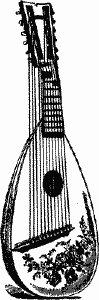
Fig. 37.
THE LUTE IN ITS STANDARD FORM.
[From Grove's Dictionary.]
The stringing and tuning varied much in different periods. According
to Prætorius, the lute had four open[Pg 192] strings tuned according to the
scale in a below. Later, a G was added above and below, and the
tuning was that at b.

[Listen]
Another authority—Baron—gives a tuning for an "eleven-course" lute,
as follows:

[Listen]
The F below the bass staff had ten frets, G eleven, and each of the
highest six strings twelve frets. The instrument thus had a compass of
three octaves and a half from the C below the bass. All the strings
were in pairs, two to each unison, excepting the upper two, which were
single. The instrument was a very troublesome one to keep in order.
Mattheson, who wrote in the latter part of the eighteenth century,
when the lute was still cultivated, said that a lutist of eighty years
must have spent nearly sixty in tuning his instrument. The pull of the
strings broke down the sounding board or belly, which had therefore to
be taken off and righted once in every two or three years. The lute
was derived from an Arabian or Persian instrument, of which the Arab
eoud, Fig. 24 (p. 113), was the latest representative.
The problem of locating the frets accurately upon the finger board was
one of the causes which led to close investigation into the
mathematical relation of the tones in the scale; and the directions
given for placing them by various Arab and other writers afford
precise and valuable information concerning their views of[Pg 193]
intonation. The lute was made in a great variety of sizes, the largest
being what was called the arch lute, which was more than four feet
long from bottom to the end of the neck. This was employed by Corelli
for the basses of his violin sonatas, and Händel made similar use of
it. A diminutive lute has come down to our own days under the name of
Mandolin. It is strung with metal strings, however, and played with a
plectrum, whereas the mediæval lute was played with the fingers.
Monteverde employed still another variety of the lute in his
orchestra, called the Chitarrone, whence our word guitar. This was a
very large lute, with many strings, which were wire, and played,
therefore, with a plectrum. The chitarrone in the collection at South
Kensington has twelve strings upon the finger board, and eight bass
strings tuned by the pegs at the top of the long neck. It was used
mainly for basses. The guitar, of which a figure is omitted on account
of the familiarity of the instrument, was the Spanish form of the
lute, or the Spanish form which the Moorish lute took in that country.
The essential feature of the violin is the incitation of the vibration
by means of the bow. We do not know when or where this art was
discovered, but it is supposed to have been in the remote east, at a
very early period. The argument of Fétis, that since the Sanskrit has
four terms for bow, according to the material of which it was made,
therefore the art of the bow must have been known before the Sanskrit
ceased to be a spoken language, has little weight. For while it is
true that Sanskrit was not a spoken, or, more properly, a living,
language in ordinary life after about 1500 B.C., it is true, on the
other hand, that it remained in use as a[Pg 194] language of religion and of
the learned down to times very recent. In that case there would
necessarily be additions made to it from time to time, as new concepts
came up for expression, in the same manner as additions were made to
Latin during the Middle Ages, and even in modern times. Still, all the
nations around Hindostan have the tradition that the art of playing
music by means of a bow is very old, the Ceylonese attributing the
invention to one of their kings who reigned about 5000 B.C. Their
ravanastron is very crude. (See page 72.) A similarly simple
instrument is in use to the present day in many parts of the east. The
Arab form of it, known as the rebec, is represented on p. 113,
Fig.
23. It has two strings of silk, and is played with the point downward,
like a 'cello. It is not possible after this lapse of time to
determine which was the original form of the violin in Europe. Very
early we find the crwth in the hands of the Celtic players, as noticed
in chapter VI. The form given in Fig. 22 (p. 107) is rather late, most
likely, and somewhat of a degradation, since many of the elements of
the violin are wanting in it. The clumsy resonance body is of the same
width all the way, preventing the depression of one end of the bow in
order to avoid sounding adjacent strings. As the bridge of the crwth
was nearly flat, the adjacent strings were octaves, or related in such
a way that when sounding together chords were produced. Many have
supposed that all the strings were sounded together at each drawing of
the bow. This is not impossible, for in one of the sculptures on a
capital in the old church at Boscherville in Normandy a stringed
instrument is represented in which the tone is produced by a revolving
bow, on the principle of the hurdy-gurdy, whereby chords must have
been[Pg 195] produced continually. (See
p. 208.) The same carving has two
stringed instruments of the violin family, one held like a violin (No.
6), the other bass downward, like a 'cello (No. 1). These two figures
are fragments of the same carving. They are supposed to date from
about the eleventh century. Many similar representations occur, such
as the following from old manuscripts.
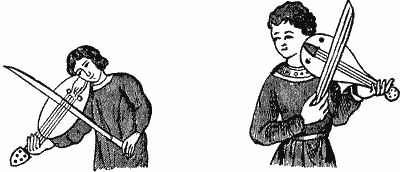
Fig. 38.
These oval instruments had the same deficiency as the crwth, in
respect to indentations at the side of the instrument, for permitting
the depression of the bow. The oldest type of this instrument in use
appears to have been the form known as the rebec, the Arab form, which
came into Europe in the time of the crusades. According to certain
authorities this was the primitive type from which our violin was
derived. The form is better shown in the cut on page 196, which is
from an Italian painting of the thirteenth century.
The body of the rebec was pear-shaped. It was contemporaneous with
many other forms partaking of the shape of the guitar. From this came
the family of viols, which were very popular in England during the
fifteenth and sixteenth centuries.[Pg 196]
The viol differed from the violin family proper in having a flat back
like a guitar, and rounded corners. The only individual of the viol
family which attained to artistic development was the viol da Gamba,
or bass viol, which was tuned like a lute, having six strings. This
instrument was a favorite with many amateurs until late in the
eighteenth century. (See p. 197.)
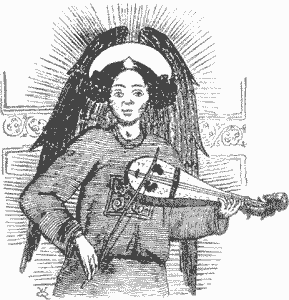
Fig. 39.
ANGEL PLAYING A REBEC.
[From an Italian painting of the thirteenth
century.]
Still more curious was the form of viol known as the barytone, which,
in addition to an outfit of six catgut strings upon the finger board,
was furnished with twenty-four wire strings, stretched close under the
sounding board, where they sounded by sympathetic vibration. This was
the instrument which Prince Esterhazy, Haydn's patron, so much
admired, and for which Haydn wrote more than 150 compositions. Its
form is shown in Fig. 41.
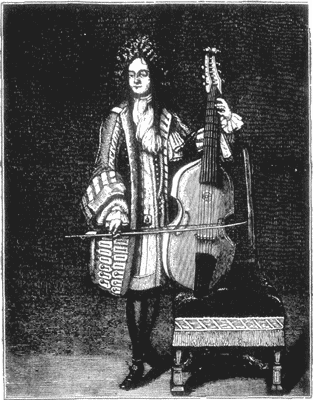
Fig. 40.
VIOL DA GAMBA.
[From Reissman's "History of German Music."]
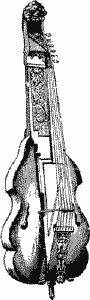
Fig. 41.
THE BARYTONE.
It is not easy within present limits to apportion the various steps by
which the violin reached its present[Pg 197] form. The first eminent master
of violins, as distinguished from small viols, was the celebrated
Gaspar da Salo, who lived and worked at Brescia during the latter part
of the sixteenth century. The model varies, and the sound holes are
straight and flat. His violins are small and weak of tone, but his
tenors and basses are much sought for. His model was followed some
time later by Guarnerius. The real mastership in violin making was
attained at Cremona, in Lombardy, where were many religious houses
with elaborate services, and a surrounding population of wealth and
artistic instinct afforded the mechanic[Pg 198] an appreciative public. It
was here early in the sixteenth century that we first find the Amati
family in the person of the oldest known violin maker, Andrea, from
whom Fétis quotes two instruments dated 1546 and 1551. One of them is
a rebec with three strings; the other is a small violin. They are a
distinct advance over the violins of the western school, but they stop
very far short of the modern instrument. The tone of his instruments
is clear and silvery, but not very powerful. The most eminent of the
Amatis was Nicolo, 1596-1684, a son of Geronimo and grandson of
Andrea. The outline is more graceful, the varnish deeper and richer,
and the proportions of his instruments better calculated. His[Pg 199]
instruments have greater power and intensity of tone, and his tenors
and 'cellos are very famous. But the Cremona school came to a
culmination in the works of the pupil of Nicolo Amati—Antonio
Stradivari, 1649-1737. This great master of the violin pursued the
principles of the Amati construction down to about 1700, having then
been making violins for upwards of thirty-three years. After 1700 he
changed his principles of construction somewhat, and developed the
grand style distinguishing his later works. He marks the culminating
point of the art of violin making. It was he who perfected the model
of the violin and its fittings. The bridge in its present form, and
the sound holes, are cut exactly as he planned them, and no artist has
discovered a possibility of improving them. His main improvements
consisted (1) in lowering the height of the model—that is, the arch
of the belly; (2) in making the four corner blocks more massive, and
in giving greater curvature to the middle ribs; (3) in altering the
setting of the sound holes, giving them a decided inclination to each
other at the top; (4) in making the scroll more massive and permanent.
Every violin of Stradivari was a special study, modified in various
details according to the nature of the wood which he happened to have,
sometimes a trifle smaller, a trifle thicker in this place or the
other, or some other slight change accounted for not by
pre-established theory, but by adaptation to the peculiarities of the
wood in hand. According to Fétis, his wood was always selected with
reference to its tone-producing qualities—the fir of the belly always
giving a certain note, and the maple of the back a certain other note.
These peculiarities are not regarded as fully established. The tone of
the Stradivarius violin is full, musical and high-spirited. The[Pg 200] small
number now in existence are held at extremely high prices. The usual
pattern is that represented in the following figure.
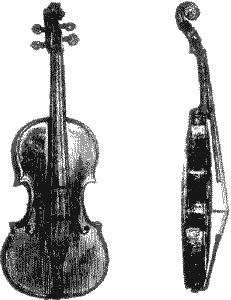
Fig. 42.
THE STRADIVARIUS VIOLIN.
[From Grove.]
Stradivari established his own factory about 1680, and continued to
make instruments up to 1730. The violin of 1708 weighs three-quarters
of a pound. Besides making violins, this eminent artist also made
guitars, lutes, 'cellos and tenors. It is wholly uncertain to what
extent the peculiarities of the Stradivari instruments were matters of
deduction and how far accidental. But there can be no question that
the average excellence of his instruments, judging from the specimens
still in existence, was much greater than that of any other violin
maker.
Many other eminent artists made good violins in the century and a half
from the time of Andrea Amati and[Pg 201] Gaspar da Salo to Stradivari, among
the most eminent being Maggini, of Brescia, whose violins are very
highly esteemed. Still, inasmuch as the finishing touches were put to
the instrument by Stradivarius, we need not linger to discuss the
minor makers.
II.
Before 1600 the organ had attained its maturity, and had become
furnished with its distinctive characteristics as we have it at the
present time. As this instrument, from the nature of its tone
qualities and its peculiar limitation to serious music of grave
rhythm, is naturally suited to the service of the Church, it has
remained till the present day in the province where it had already
firmly established itself at the time now under consideration. The
origin of the organ is very difficult to ascertain. There are traces
of some sort of wind instrument before the Christian era. The
so-called hydraulic organ was probably one in which water was used to
perfect the air-holding qualities of the wind chest, in the same
manner as now in gas holders. One of the earliest mediæval references
to organs is to that sent King Pepin, of France, father of
Charlemagne, in 742 by Constantine, emperor of Byzantium at that time.
This instrument, says the old chronicler, had brass pipes, blown with
bellows bags; it was struck with the hands and feet. It was the first
of this kind seen in France.
Prætorius says that the organ which Vitellianus set in church 300
years before Pepin, must have been the small instrument of fifteen
pipes, for which the wind was collected in twelve bellows bags.
According to Julianus, a Spanish bishop who flourished in 450, the
organ was in common use in churches[Pg 202] at that time. In 822 an organ was
sent to Charlemagne by the Caliph Haroun Alraschid, made by an Arabian
maker. This instrument was placed in a church at Aix-la-Chapelle.
There were good organ builders in Venice as early as 822, and before
900 there was an organ in the cathedral at Munich. In the ninth
century organs had become common in England, and in the tenth the
English prelate, St. Dunstan, erected one in Malmesbury Abbey, of
which the pipes were of brass. The instruments of that time were
extremely crude.
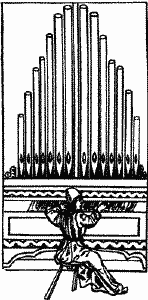
Fig. 43.
[From Franchinus Gaffurius, "Theorica Musica," Milan, 1492.]
[Pg 203]
From this time on there are many authentic remains in the way of
treatises on organ building and description of organs. The essential
elements of this instrument consist of pipes for producing sound, of
which a complete set, one pipe for each key of the keyboard, is called
a stop; bellows and wind chest for holding the wind, sliders or valves
for admitting it to the pipes, and keys for controlling the valves.
In his studies for a history of musical notation, Dr. Hugo Riemann
quotes an extract from an anonymous manuscript of the tenth century,
in which the author gives directions for a set of organ pipes. "Take
first," he says, "ten pipes of a proper dimension and of equal length
and size. Divide the first pipe into nine parts; eight of these will
be the length of the second. Dividing the length of this again into
nine parts, eight of these will be the proper length of the third;
dividing the first pipe into four parts, three of them will be the
length of the fourth; taking the first pipe as three parts, two of
them will be the length of the fifth; eight-ninths of this again will
give the proper length of the sixth; eight-ninths of this, the length
of the seventh; one-half the first, the length of the eighth, or
octave." This gives a major scale, with the Pythagorean third,
consisting of two great steps, which was too sharp to be consonant.
The semitone between the third and the fourth is too small, as is also
that between the seventh and eighth. The modern way of making the
pipes of smaller diameter as they become shorter, had evidently not
been thought of. Nevertheless, these directions are very important,
since they throw positive light upon the tuning of the various
intervals, the pipe lengths and[Pg 204] proportions affording accurate
determinations of the musical relations intended.
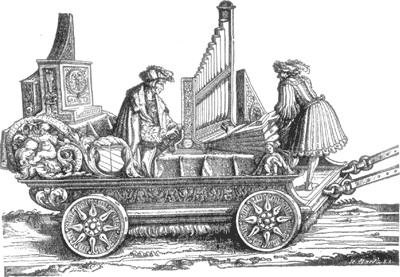
Fig. 44.
PORTABLE ORGAN FROM THE PROCESSION IN HONOR OF MAXIMILIAN I.
[From Prætorius' "Syntagma Musica,"
about 1500 A.D.]
The early organs were furnished with slides which the organist pulled
out when he wished to make a pipe speak, and pushed back to check its
utterance. The date of the invention of the valve is uncertain, but it
must have been about as soon as the power of the instrument was
increased by the addition of the second or third stop. Before this,
however, and perhaps for some little time after, there were many
organs in use, which were committed to the diaphony of Hucbald, having
in place of the diapason three ranks of pipes, speaking an octave and
the fifth between. Each of these combined sounds was treated in the
same way as simple ones are on other instruments, and if chords were
attempted upon them the effect must have been hideous[Pg 205] indeed; but it
is probable that at this time the notes were played singly, and not in
chords, or at most in octaves. We do not know the date at which this
style of organ building ceased, but it is probably before the
thirteenth century. There is a manuscript of the fourteenth century in
the Royal Library at Madrid, stating that the clavier at that epoch
comprised as many as thirty-one keys, and that the larger pipes were
placed on one side, and small pipes in the center, the same as now.
The earliest chromatic keyboards known are those in the organ erected
at Halberstadt cathedral in 1361. This instrument had twenty-two keys,
fourteen diatonics and eight chromatics, extending from B natural up
to A; and twenty bellows blown by ten men. Its larger pipe B stood in
front, and was thirty-one Brunswick feet in length and three and a
half feet in circumference. This note would now be marked as a
semitone below the C of thirty-two feet. In this organ for the first
time a provision was made for using the soft stop independently of the
loud one. This result was obtained by means of three keyboards. The
keys were very wide, those of the upper and middle keyboards measuring
four inches from center to center. The sharps and flats were about two
and a half inches above the diatonic keys, and had a fall of about one
and a quarter inches. The mechanical features of the organ were very
greatly improved during the next century, but it was not until the old
organ in the Church of St. Ægidien in Brunswick that the sharps and
naturals were combined in one keyboard in the same manner as at
present. The keys were still very large, the naturals of the great
manual being about one and three-quarters inches in width. It was to
the organ at Halberstadt that pedals were added in 1495,[Pg 206] but no pipes
were assigned to them. They merely pulled down the lower keys of the
manual.
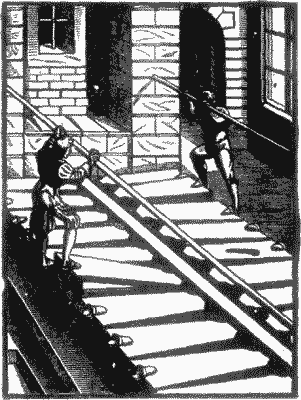
Fig. 45.
BELLOWS BAGS IN THE ORGAN AT HALBERSTADT, AND METHOD OF BLOWING.
[Prætorius.]
Some time before the beginning of the seventeenth century the organ
had acquired nearly the entire variety of tone that it has ever had.
The mechanism was rude, no doubt, and the voicing perhaps imperfect.
The tuning was by the unequal system, throwing the discords into
remote keys as much as possible. In Michael Prætorius' "Syntagma
Musica," the great source of information upon this part of the
history (published at Wolfenbüttel, 1618), he describes a number of
large organs. Among them he mentions the organ in the Church of St.
Mary at Danzig, built in 1585, having three manuals and pedal; there
were fifty-five stops. The balance must have been very bad, since
there were[Pg 207] in the great organ three stops of sixteen feet, and only
three of eight feet. There was a mixture having twenty-four pipes to
each key, besides a "zimbel" in the same manual, having three ranks.
Prætorius also gives many other specifications of large organs of
three manuals, some with dates, some without. They belong mostly to
the beginning of the seventeenth century, and the number indicates
unmistakably the interest awakened in this part of the musical
furnishing of the large churches. Many points in these organs were
imperfect, but the foundation had been laid, and the general character
of the subsequent building settled. There was also a beginning of
virtuosity upon the organ, but this will come up for consideration at
a later point in the narrative.
[Pg 208]
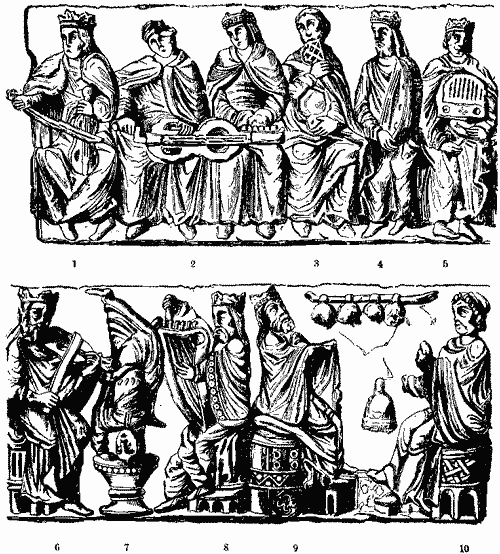
Fig. 46.
SCULPTURED HEAD OF COLUMN, FOUND IN THE RUINS OF THE ABBEY OF ST.
GEORGE, AT BOSCHERVILLE, IN NORMANDY.
ELEVENTH CENTURY.
(1) Three-stringed viol or rebec. (2) Two persons playing the organistrum,
a stringed instrument vibrated by means of a circular bow or wheel, like the
hurdy-gurdy. (3) Pandean pipes. (4) Apparently a small harp. (5) Psaltery. (6)
Rotta or crwth. (7) Acrobat. (8) Harp. (9), (10) Instruments of percussion,
perhaps bells.
[Pg 209]

THE
Dawn of Modern Music.
THE BEGINNING OF FREE EXPRESSION IN
SONG, OPERA, ORATORIO AND FREE
INSTRUMENTAL MUSIC.
[Pg 211]
CHAPTER XVII.
CONDITION OF MUSIC AT THE BEGINNING
OF THE SEVENTEENTH CENTURY.
N justification of the name "apprentice period" for that part of the
history of music ending with Palestrina as the representative of the
finished art of the Netherlands (helped out, we may well enough admit,
with no small measure of the original insight and genius of his own),
a general view of the condition of music in all European countries at
the beginning of the seventeenth century may well be taken. The
fullness with which the details have already been treated renders it
unnecessary to repeat them here, but it will be enough to recapitulate
the principal features of the art thus far attained, adding thereto a
number of incidents omitted. Upon the side of musical phraseology,
then, we find in the north the attainment of a simple and expressive
form of melody almost or quite up to the standard of modern taste. In
the direction of the musically elaborative element we have the schools
of the Netherlands and of Italy, in which absolutely everything of
this kind was realized which modern art can show, saving perhaps the
fugue, which involved questions of tonality belonging to a grade of
taste and harmonic perception more advanced and refined than that as
yet attained. It took nearly[Pg 212] another century before the
ecclesiastical keys were thoroughly disenchanted in the estimation of
classical musicians. It was Bach who finally made true tonality the
rule rather than the exception.
In the line of instruments the harp had had its day, its never ending
tuning having been one of the most operative forces in the development
of the ear. Its successor, the lute, equally weak in tenacity of
intonation, but with greater artistic resources, had been fully tested
in every direction. The organ had attained a very respectable size,
even when measured according to modern ideas, and its influence in the
direction of harmonic education had been well begun. The keyed
instrument, of which our pianoforte is the living representative, had
found its keyboard and a practical method of eliciting tones, which,
whatever their weakness, were at least better than those of the lute,
the chitarrone, the psaltery or harp. Best of all, the violin had
found master hands able to shape it into a model graceful to the eye,
and sonorous beyond anything else which the art of music can show.
True, it was not until about sixty years later that the powers of this
instrument in the direction of solos were fully recognized, or,
indeed, brought before the public. This was the work of Corelli, whose
sonatas were published in the third quarter of the century with which
we are now dealing. The viol, the weaker predecessor of the violin,
had made great headway, and Monteverde put himself on record in 1607,
much to his credit, by placing it at the head of his orchestra.
Moreover, not only were the instruments of music in a condition
creditable even in the light of modern ideas, but the popular taste
for music was more lively and far-reaching than ever before.
Everywhere in the civilized[Pg 213] world the practice of music was the
universal attribute of a gentleman. In Italy we shall find a circle
composed of some of the best minds of the nation engaged in the
regular study of classical learning, and in discussions having for
their object the re-discovery of the art of ancient music, which the
seekers wrongfully imagined to have been as far superior to the music
then in vogue as the sculpture of the ancients had been superior to
that of mediæval Italy. In no country was the art of music more highly
esteemed, or, we may add, in a more advanced state than in England.
Richard Braithwaite, a writer of the reign of Elizabeth, formulated
certain rules for the government of the house of an earl, in which the
earl was "to keep five musicians, skillful in that commendable sweet
science"; and they were required to teach "the earl's children to sing
and to play upon the bass viol, the virginals, the lute, the bandour
or cittern." When he gave great feasts, the musicians were "to play
whilst the service was going to the table, upon sackbuts, cornets,
shawms and such other instruments going with wind, and upon viols,
violins or other broken music during repast." In barber shops they had
lutes and virginals wherewith the gentlemen might amuse themselves
while awaiting their turn. It was the same in reception rooms; musical
instruments were provided as the surest method of enabling waiting
guests to amuse themselves.
If it be asked why it was that in spite of this high esteem for music
so little came out of its cultivation in England that was creditable
upon the highest plane, according to the scales in which we are
accustomed to weigh the music of Italy and Germany, the answer is not
hard to find. It was in consequence of the little[Pg 214] attention paid to
musical learning in the highest sense, as compared with the learning
and training in musicianship on the continent. English music died out,
or grew small, for want of depth of earth. High ideals and thorough
training in the technique are two prime conditions of a successful
development of an art. Besides, the art of music suffered irreparable
damage in England at the hands of the Puritans. The protectorate
lasted long enough to put the art under an eclipse from which it did
not fully emerge until nearly our own time.
A similar fondness for this form of art pervaded all European
countries. In Italy music was the delight of the common people and the
favorite pursuit of the great. In Germany the Reformation and the
influence of Luther had set the people singing. The organ had attained
an advanced state there, and other instruments of every sort were
cultivated. It was the same in France. The love for music was
universal. Hence the times were ripe for a great advance in art. There
was concentrated upon music an attention which it has rarely enjoyed
at any other period of its history, and the advances now to be
mentioned were correspondingly abundant and striking.
The contrapuntal schools had done more to educate harmonic perception
than is commonly supposed. All the devices of counterpoint, as we have
them to-day, were invented by the various schools of this period, and
brought to a high degree of perfection. But the learning had somewhat
overshot its mark. The multiplicity of parts in the compositions of
Willaert, and the other masters of the polyphonic schools, served for
the cultivation of chord perception just as surely as if they had
intentionally written chord successions without troubling[Pg 215] themselves
with imitative canon in any degree. For, when there were so many voice
parts as ten, fifteen or twenty within the limits of the compass of
the human organ, that is to say, mainly within the limits of two
octaves and a half, the parts had no recourse but to cross
continually, and since there was no aid afforded the ear by
differences in tone color between one voice part and another, it
necessarily followed that they fell upon the ear with the effect not
of voice parts, in which the melody of each could be followed
independently of the others, but rather as chord masses, in which here
and there a prominent melodic phrase occasionally emerged, only to be
lost the next moment by the prominence of a bit of the melody of some
other voice. The effect of a composition of this kind was no other
than that of a succession of chords, and the ear was as thoroughly
educated to chord perception by this class of music as if the composer
had intended only to write successions of chords. Still the training
of these schools, while incidentally affording education to the ear
upon the harmonic side, was thoroughly contrapuntal, and the study of
every composer was to make something more elaborate than anything that
had been written by his predecessors.
Nevertheless there was an influence in another direction. An art form
was invented, which by the end of this period had established itself
as the type of a musical form whenever the composer would arrive at
something more spontaneous than could conveniently be attained by the
way of a motette or conduit. That form was the madrigal. The meaning
of the name is unknown. Some have derived it from Mary, and point to
the sacred madrigals, many of which were composed by all the
contrapuntal writers. Others have assigned a different[Pg 216] origin for it,
and it is not possible now to decide which is the true one. Enough if
we find this form emerging from obscurity by the middle of the
fifteenth century. The first writer of compositions under this title
whose name is known to us was Busnois, and in the same collection are
compositions of the same class by many other composers of the
Netherlandish schools. A madrigal was a secular composition, generally
devoted to love, but in polyphonic style, and in one of the
ecclesiastical modes. They were always vocal down to the seventeenth
century, but from that time forward they were generally marked for
voices and instruments. One of the best composers of madrigals was
Arkadelt, of the Netherlandish school. The success of the great
Orlando Lassus in this school has already been mentioned, together
with the name of one of the best known of his compositions in this
line (p. 167).
The strange modulations, like that from F to E flat in one of
Arkadelt's madrigals, are current incidents of the ecclesiastical mode
in which they are written. Many of the secular works of this class are
hardly to be distinguished from those intended for the Church, and
some are to be met with, having two sets of words, one secular,
occasionally almost profane; the other sacred, some hymn or other from
the offices of divine service.
In England this school had a great currency, and the madrigals of the
British writers of the seventeenth century are every whit as free and
melodious as the best of those of the Italian school. The number of
writers of this class of works was innumerable, so much so that we
might well class it as the ruling art form of the century, just as the
dramatic song was in the eighteenth century, the fugue in the last
half of it, and the sonata in the[Pg 217] beginning of the nineteenth.
Everybody wrote madrigals who ever wrote music at all. According to
the dates of collections published, the English followed the Italian
composers. The earliest Italian compositions of this class are
contained in three collections printed by Ottaviano di Petrucci, the
inventor of the process of printing music from movable type. These
collections were published in Venice, 1501-1503, and copies are still
retained in the library at Bologna and at Vienna. The English
cultivation of this form of composition became general toward the last
of this century, and in the first part of the next ensuing, and it is
but just to say that the English composers finally surpassed the
continental in this school, and developed out of it a beautiful art
genre of their own, the glee. Toward the latter part of the sixteenth
century certain attempts were made in Italy at something resembling
our opera, but in place of solo pieces by any of the performers there
were madrigals. When Juliet, for example, would soliloquize upon the
balcony, she did so in a madrigal, the remaining four parts being
carried by chambermaids inside. When Romeo climbed the balcony and
breathed his sweet vows to Juliet, one or two of his friends around
the corner carried the missing melodies in which he sought to
improvise his warm affection. The absurdity of the proceeding was
manifest, but it needed yet another point of emphasis. There was a
grand wedding in Venice in 1595, at which the music consisted of
madrigals, all in slow time and minor key. The contradiction between
the doleful music and the festive occasion was too plain to be
ignored, and led, presently, to the invention of a totally different
style of song of which later there is much to say.[Pg 218]
The seventeenth century was one of the most memorable in the history
of music, not so much, however, for what it fully accomplished as for
the new ideas brought out and in part developed. The specific part of
the general development of music which this century accomplished was
the development of free melodic expression. While, as already
noticed, the musical productions of the preceding centuries had
manifested an increasing melodic force and propriety, the secret of
genuine melodic expression had yet to be found. In the madrigal and
motette the conditions were wholly unsuited to the development of this
part of music. Instead of one prominent voice, in which the main
interest of the production centered itself, the composer of that
period had a certain number of equally important voice parts, all
taking part in the development of the one leading idea of his piece.
Melodically speaking, the standpoint was wrong and the situation
false. Melody means individuality, individualism; the free
representation of a personality in its own self-determined motion. At
the point of the year 1600, speaking with sufficient exactness for
ordinary purposes, the ruling standpoint of musical production
changed, in the effort to rediscover the lost vocal forms of the Greek
drama. The new problem was that of finding, for every moment and every
speech of the drama, a form of utterance suitable to the sentiment and
the occasion. Thus entered into music, through the ministry of
self-forgetfulness, the most important principle which has actuated
its later progress, the principle namely, of dramatic expression—in
other words, the representative principle, the effort to represent
in music something which until now had been outside of music. Out of
this principle, co-operating with that other idea[Pg 219] of two centuries
later, the inherent interest of the individual, has grown the richness
and manifold luxuriance of modern romantic music, together with the
entire province of opera and oratorio. We have now to trace the steps
which led to this great transformation in the art of music; and to
illustrate the application of the new principles to the province of
instrumental music, which had no beginning of genuine art value before
this period. When examined with reference to the matured productions
of the century next ensuing, those of the seventeenth appear quite as
much like apprentice efforts as those of the latter part of the period
covered in the preceding book of our story; but they have in them,
however, the seeds of the later development, and stand to us,
therefore, in the character of first fruits. To state it still more
unmistakably, we have to trace in the operations of the seventeenth
century the origin of dramatic song, the beginnings of free
instrumental music, the discovery of the art of voice training and
the formation of what is called the "old Italian school of singing,"
and the operation of the representative element in music, together
with the new forms created through its entrance into art.
The musical movement of this century in its entirety was a part of the
general operation of mind, which was now of great amplitude and
spontaneity. The fervor of the Renaissance indeed had passed, having
resulted in the creation of masterpieces of architecture, sculpture,
painting and poetry during the previous two centuries. Music came to
expression last of the forms of art, and when mental movement was less
intense. For this reason the Italian mind failed to rule in it after
the early beginnings in the new direction had been made.[Pg 220] The
representative element entered the art of music in Italy; but the
mastery of its application, and the development of new forms fully
completing the representation, were carried on by other nationalities
where the mental movement still retained the pristine vigor of new
impulses and rich vitality.
The city of Florence was the center where the drama and song-like
melody found its beginning. Almost immediately, however, Venice became
the home of music, and fostered the growth of dramatic song for more
than half a century. At this time, as for a century previous, Venice
was the most active intellectual center of Europe. Perhaps nothing
gives so clear a realization of this supremacy as the statistics of
books printed in the leading centers of Europe from 1470 to 1500. The
largest centers were Strassburg, with 526; Basle, 320; Leipsic, 351;
Nuremburg, 382; Cologne, 530; Paris, 751; Rome, 925; Bologna, 298;
Milan, 625, while Venice heads the list with 2,835. Toward the end of
the century, the appearance of the genius, Alexander Scarlatti,
effected the transference of the musical supremacy of Italy to Naples.
[Pg 221]
CHAPTER XVIII.
FIRST CENTURY OF ITALIAN OPERA AND
DRAMATIC SONG.
URING the last decade of the sixteenth century a company of
Florentine gentlemen were in the habit of meeting at the house of
Count Bardi for the study of ancient literature. Their attention had
concentrated itself upon the drama of the Greeks, and the one thing
which they sought to discover was the music of ancient tragedy, the
stately and measured intonation to which the great periods of
Æschylus, Euripides and Sophocles had been uttered. The alleged
fragments of Pindar's music since discovered by Athanasius Kircher (p.
69) were not yet known, and they had nothing whatever to guide their
researches beyond the mathematical computations of Ptolemy and the
other Greek writers. At length, one evening, Vincenzo Galilei, father
of the astronomer Galileo, presented himself with a monody. Taking a
scene from Dante's "Purgatorio" (the episode of Ugolini), he sang or
chanted it to music of his own production, with the accompaniment of
the viola played by himself. The assembly was in raptures. "Surely,"
they said, "this must have been the style of the music of the famous
drama of Athens." Thereupon others set themselves to composing
monodies, which, as yet, were[Pg 222] not arias, but something between a
recitative and an aria, having measure and a certain regularity of
tune, but in general the freedom of the chant. Among the number at
Count Bardi's was the poet Rinuccini, who prepared a drama called
"Dafne." The music of this was composed in part by an amateur named
Caccini, and in part by Jacopo Peri, all being members of this
studious circle meeting at the house of Count Bardi. "Dafne" was
performed in 1597 at the house of Count Corsi, with great success, but
the music has been lost, and nothing more definite is known about it.
This beginning of opera, for so it was, was also the beginning of
opera in Germany, as we shall presently see, for about twenty years
later a copy of "Dafne" was carried to Dresden for production there
before the court, but when the libretto had been translated into
German, it was found unsuited to the music of the Italian copy,
whereupon the Dresden director, Heinrich Schütz, wrote new music for
it, and thus became the composer of the first German opera ever
written. In 1600 the marriage of Catherine de Medici with Henry IV of
France was celebrated at Florence with great pomp, and Peri was
commissioned to undertake a new opera, for which Rinuccini composed
the text "Eurydice." The work was given with great éclat, and was
shortly after printed. Only one copy of the first edition is now known
to be in existence, and that, by a curious accident, is in the
Newberry Library at Chicago. The British Museum has a copy of the
second edition of 1608. The opera of "Eurydice" is short, the printed
copy containing only fifty-eight pages, and the music is almost
entirely recitative. There are two or three short choruses; there is
one orchestral interlude for three flutes, extending to about twenty
measures in all, but there is nothing like[Pg 223] a finale or ensemble
piece. Nevertheless, this is the beginning, out of which afterward
grew the entire flower of Italian opera. On page 225 is an extract.
FLUTE TRIO AND SCENE.
[From the first opera, "Eurydice" (1600). Jacopo Peri.]
[Listen]
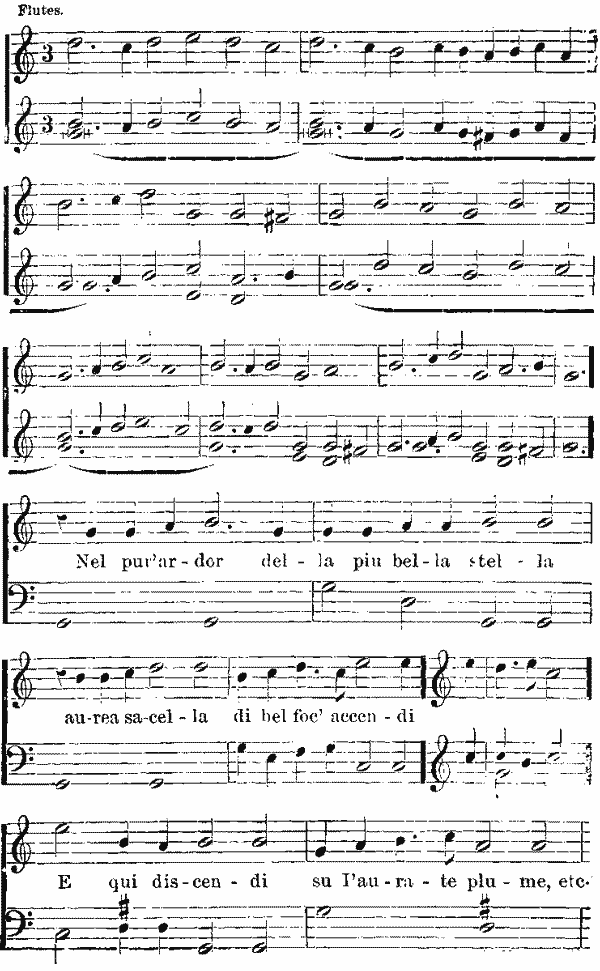
The new style thus invented was known to the Italians as il stilo
rappresentivo, or the representative style, that is to say, the
dramatic style, and there is some dispute as to the real author of the
invention. About the same time with the production of "Eurydice," a
Florentine musician, Emilio del Cavaliere, wrote the music to a sacred
drama, of which the text had been composed for him by Laura
Guidiccioni, the title being "La Rappresentazione del Anima e del
Corpo." The piece was an allegorical one, very elaborate in its
structure, and written throughout in the representative style, of
which Cavaliere claimed to be the inventor. This oratorio, which was
the first ever written, was produced at the oratory of St. Maria in
Vallicella, in the month of February, ten months before the appearance
of "Eurydice" at Florence. It is evident, therefore, that if the style
had been in any manner derived from the Florentine experiments already
noted, it must have been from the earlier opera "Dafne" and not from
"Eurydice." The principal characters were "Il Tempo" (time), "La
Vita" (life), "Il Mondo" (the world), etc. The orchestra consisted
of one lira doppia, one clavicembalo, one chitarrone and two flutes.
No part is written for violin. At one part of the performance there
was a ballet. The whole was performed in church, as already noticed,
as a part of religious service.
Seven years later we enter upon the second period of the opera, when,
on the occasion of the marriage of Francesco Gongeaza with Margherita,
Infanta of Savoy, Rinuccini prepared the libretti for two operas,
entitled "Dafne" and "Arianna," the second of which was set to[Pg 224] music
by Claudio Monteverde, the ducal musical director, a man of
extraordinary genius. The first of these operas has long since been
forgotten, but Monteverde made a prodigious effect with his. The scene
where Ariadne bewails the departure of her faithless lover affected
the audience to tears. Monteverde was immediately commissioned to
write another opera, for which he took the subject of "Orfeo," and,
being himself an accomplished violinist, he made an important addition
to the orchestral appointments previously attempted in opera. The
instruments used were the following:
2 Gravicembani.
2 Contrabassi de viola.
10 Viole da brazzo.
1 Arpa doppio.
2 Violini piccolo alla Francese.
2 Chitaroni.
2 Organi de Legno.
2 Bassa da Gamba.
4 Tromboni.
1 Regale.
2 Cornetti.
1 Flautino alla vigesima secunda.
1 Clarino, con 3 trombi sordine.
A very decided attempt is made in this work at orchestra coloring,
each character being furnished with a combination of instruments
appropriate to his place in the drama. These works were not given in
public, but only in palaces for the great, and it was not for more
than twenty years that a public opera house was erected in Venice. In
1624 Monteverde at the instance of Girolamo Mocenigo composed an
intermezzo, "Il Combatimento di Tancredi e Clorinda," in which he
introduced for the first time two important orchestral effects: The
pizzicati (plucking the strings with the fingers) and the
tremolo.[Pg 226][Pg 225] These occur in the scene where Clorinda, disguised as a
knight, fights a duel with her lover Tancredi, who, not knowing his
opponent, gives her a fatal wound. The strokes of the sword are
accompanied by the pizzicati of the violins, and the suspense when
Clorinda falls is characterized by the tremolo—two devices universal
in melodrama to the present day.
Monteverde had already for some time been a resident in Venice as
director of the music at St. Mark's, where his salary had originally
been established at 300 ducats per annum, and a house in the canon's
close. In 1616 his salary was raised to 500 ducats, and he gave
himself up entirely to the service of the republic. The first opera
house was erected in 1637 and was followed within a few years by two
other opera houses in Venice. In these places Monteverde's subsequent
works were produced. The greater number of his manuscripts are
hopelessly lost. We possess only eight books of madrigals, a volume of
canzonettes, the complete edition of "Orpheus," and a quantity of
church music.
The new path opened by this great composer was followed assiduously by
a multitude of Italian musicians. Among these the more distinguished
names are those of Cavalli, who wrote thirty-four operas for Venice
alone, Legrenzi and Cesti. The latter wrote six operas, some of which
were very successful. By 1699 there were eleven theaters in Venice at
which operas were habitually given; at Rome there were three; in
Bologna one; and in Naples one. It would take us too far to discuss in
detail the successive steps in the history during this century, since
in the nature of the case, an individual work like an opera can with
difficulty rise above the popular musical phraseology of the day, the
object being immediate[Pg 227] success with a public largely uncultivated.
Hence, popular operas for the most part are short-lived, rarely
retaining their popularity more than thirty years.
The greatest genius in opera in this century after Monteverde was
Alessandro Scarlatti, of Naples, the principal of the conservatory
there, and, we might say, the inventor of the Italian art of
singing—bel canto. For as there had been no monody, so there had
been no solo singing, and as the operas of the first three-quarters of
this century, in spite of the improvements of Monteverde, consisted
mostly of recitative, there was still no singing in the modern
acceptation of the term. Scarlatti introduced new forms. To the
recitativo secco, or unaccompanied recitative, which until now had
been the principal dependence for the movement of the drama, he added
the recitativo stromentato, or accompanied recitative, in which the
instruments afforded a dramatic coloring for the text of the singer.
To these, again, he added a third element, the aria. The first he
employed for the ordinary business of the stage; the second for the
expression of deep pathos; the third for strongly individualized
soliloquy. These three types of vocal delivery remain valid, and are
still used by composers in the same way as by Scarlatti. His first
opera was produced in Rome at the palace of Christina, ex-queen of
Sweden, in 1680. This was followed by 108 others, the most of which
were produced in Naples. The most celebrated of these were "Pompei"
(Naples, 1684), "La Theodora" (Rome, 1693), "Il Triompho de la
Liberta" (Venice, 1707) and, most celebrated of all, "La Principessa
Fidele." In addition to this he wrote a large number of cantatas,
more or less dramatic in character. Scarlatti not only created the
aria, calling for sustained[Pg 228] and impassioned singing, but also
invented or discovered methods of training singers to perform these
numbers successfully. He was the founder of the Italian school of
singing, and the external model upon which it was based undoubtedly
was furnished by the violin which, having been perfected by the Amati,
as already noted in the previous chapter, and its solo capacities
having been brought out by Archangelo Corelli, whose first violin
sonatas were published a few years before Scarlatti's first opera, had
now established a standard of melodic phrasing and impassioned
delivery superior to anything which had previously been known. It was
a pupil of Scarlatti, Nicolo Porpora (1686-1766), who carried forward
the work begun by his master. Porpora was even a greater teacher of
singing than Scarlatti himself, and his pupils became the leading
singers in Europe during the first quarter of the eighteenth century.
The progress of vocal cultivation was remarkably helped by the fact
that at this time women were not permitted to appear upon the stage,
all the female parts being taken by male sopranos, castrati. These
artificial sopranos, having no other career before them than that of
operatic singing, devoted themselves vigorously to the technique of
their art, and were efficient agents in awakening a taste for florid
singing impossible for ordinary or untrained voices. Women did not
appear upon the stage in opera until toward the middle of this
century. Händel, in London, had male sopranos such as Farinelli,
Senesimo, and the earlier of the female sopranos, of whom the vicious
Cuzzoni was a shining example. The artistic merits of Porpora have
been greatly exaggerated by certain writers, notably by Mme. George
Sand in her "Consuelo," where he figures as one of the greatest and
most devoted of[Pg 229] artists. Her work, however, has the excellence of
affording a very good representation of the artistic end proposed by
the Italian masters of singing in their best moments. Porpora spent
the early part of his life in Naples, but afterward he resided for
some time in Dresden, Vienna, Rome and Venice, being principal of a
conservatory in the latter place. In the latter years of his life
(1736) he was invited to London to compose operas in competition with
Händel, in which calling he but poorly succeeded. Porpora represents
the ideal which has ruled Italian opera from his time to the present,
the ideal, namely, of the pleasing, the well sounding, and the vocally
agreeable. He is responsible for the fanciful roulades, the long arias
and the many features of this part of dramatic music which please the
unthinking, but mark such a wide departure from the severe and noble,
if narrow, ideal of the original inventors of this form of art.
It is to be regretted that the limits of the present work do not
permit the introduction of selections of music sufficiently extended
for illustrating the finer modifications of style effected by the
successive masters named in the text. The brief extracts following are
taken from the excellent lectures of the late John Hullah upon
"Transitional Periods in Musical History." The same valuable and
suggestive work contains a number of more extended selections from
these and other little known masters of the period, for which reason
the book forms a useful addition to the library of teachers, schools,
etc. Other illustrations will be found in Gevaert's "Les Gloires
d'Italie" ("The Glories of Italy"). There are sixty arias in this
collection, all well edited, and chosen for their effectiveness for
public performance at the present day.[Pg 230]
ARIA PARLANTE.—"LASCIATE MI MORIR."
[From the opera "Ariadne," 1607. Monteverde.]
[Listen]
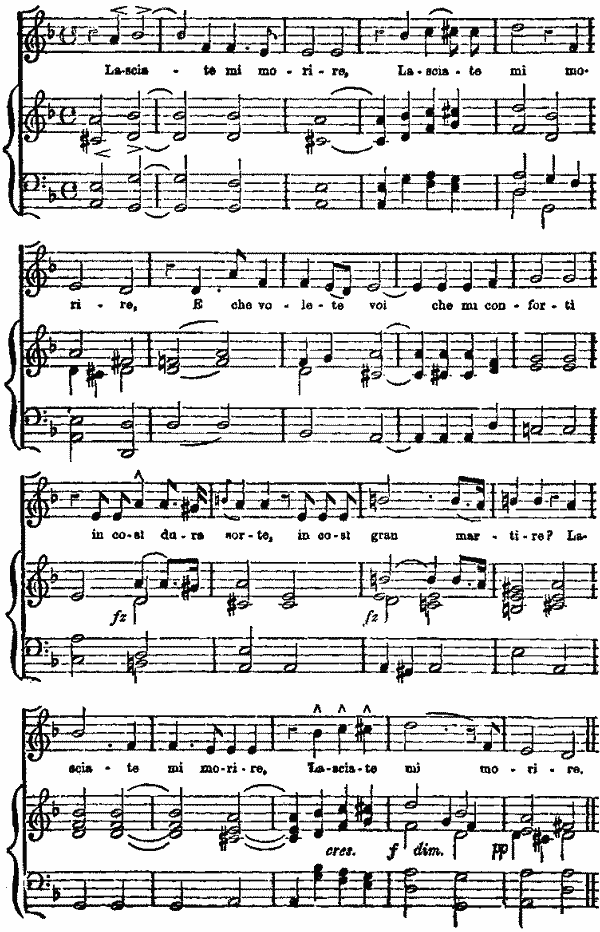
[Pg 231]
EXTRACT FROM SONG, "VAGHE STELLE."
[From the opera "Erismena," 1655. Francesco Cavalli.]
[Listen]
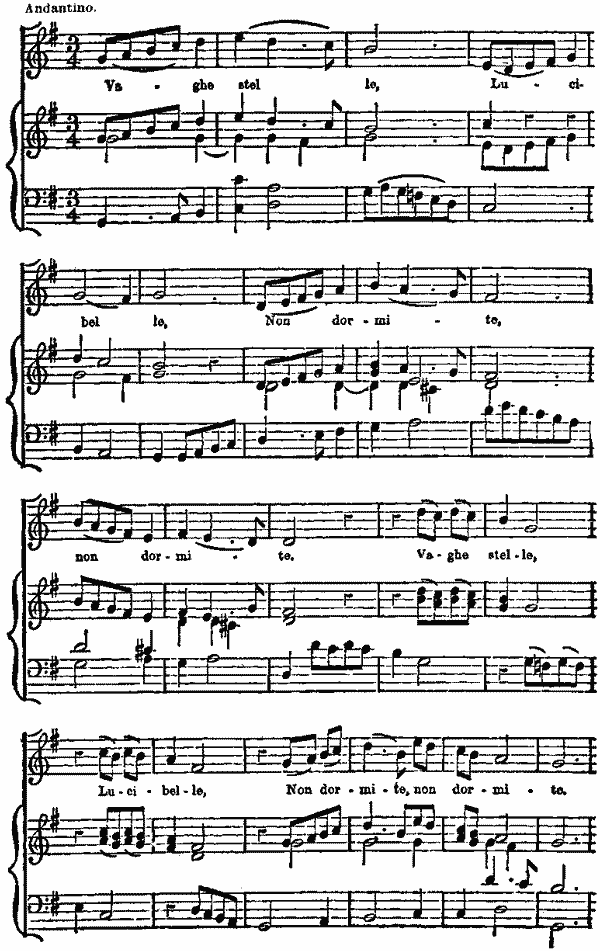
[Pg 232]
ARIA.—"LASCIAMI PIANGERE."
[From a cantata. Alessandro Scarlatti.]
[Listen]
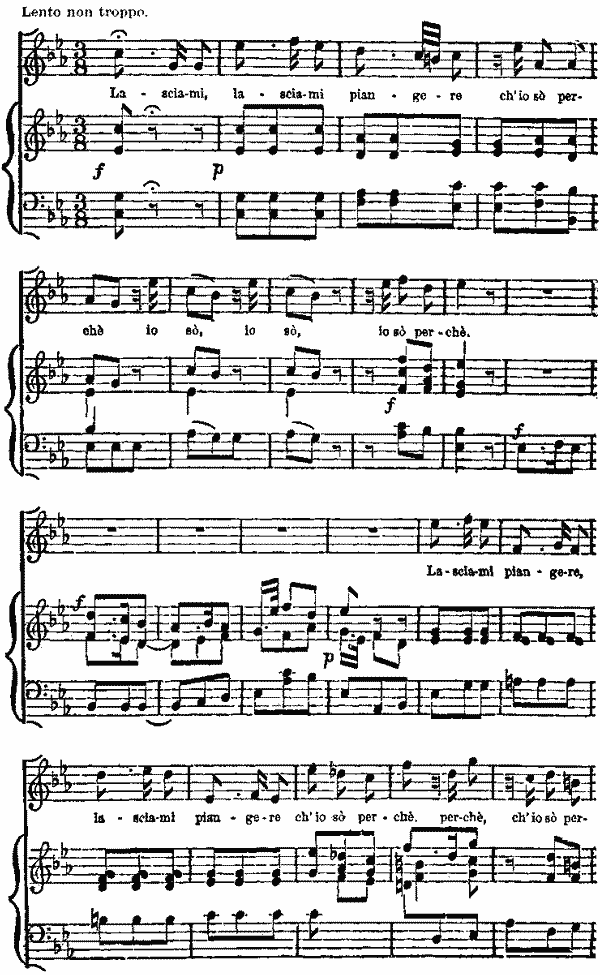
[Pg 233]
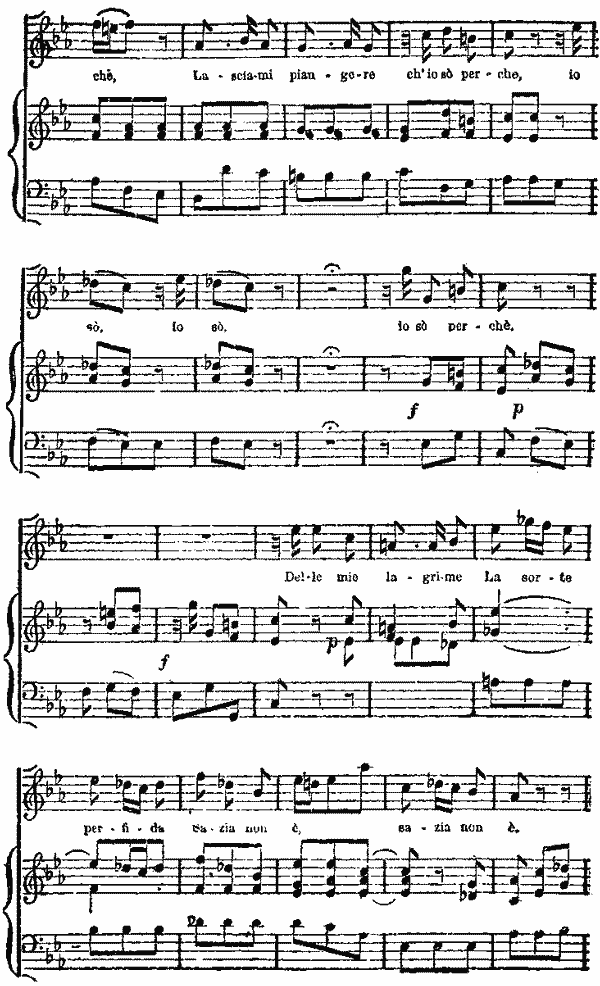
[Pg 234]
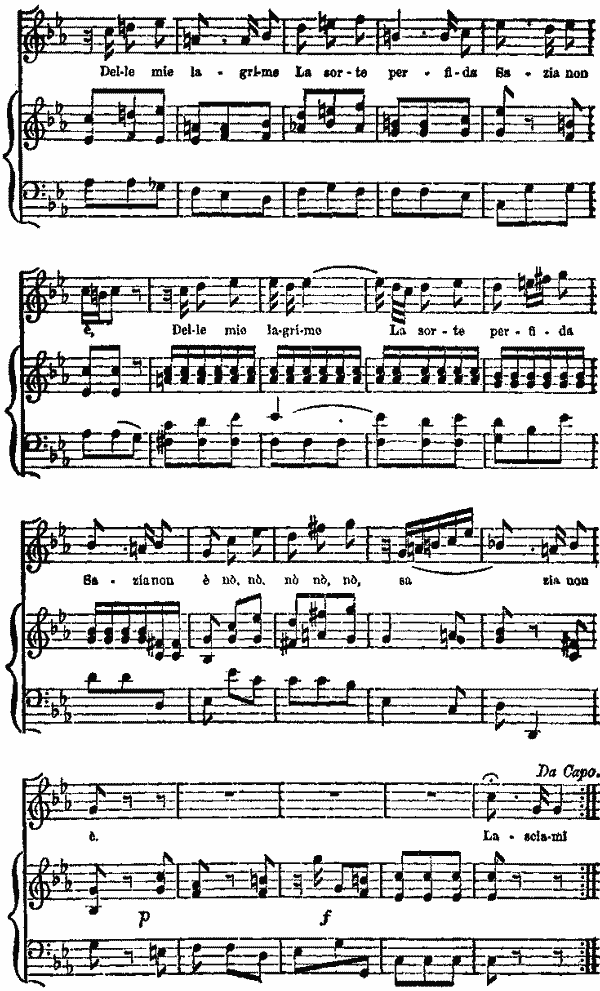
[Pg 235]
CHAPTER XIX.
BEGINNINGS OF OPERA IN FRANCE AND
GERMANY.
I.
 ROM Florence the art of dramatic song spread to all other parts of
the world, yet not so rapidly as would have been supposed. For it was
not until nearly half of the century had already elapsed that opera
made a beginning in France, the country where ruled the unfortunate
princess for whose nuptials the first opera had been written. French
opera grew out of the ballet. This term, which at present is
restricted to entertainments in which dancing is the principal
feature, and the story is entirely told in pantomime, had formerly a
more extended signification. It was equivalent to the English term
"Mask," a play in which dancing, songs and even dialogue found place.
This light and sprightly form of drama has been favored in France from
a remote period. As early as the first quarter of the seventeenth
century Antoine Boesset (1585-1643) composed ballets for the
entertainments of the king, Louis XIII. His son succeeded him at the
court of Louis XIV. Some of the ballets of the elder Boesset were
produced in 1635, and in these we must find the beginnings of French
opera, if indeed we do not go back still farther, and find it in the[Pg 236]
play of "Robin and Marian," written by Adam de la Halle. In fact,
dramatic entertainment has been indigenous in France from an early
date, and it is by no means easy to say that at any particular moment
the line was crossed where modern opera begins. The ballets of Boesset
were, no doubt, slight upon the dramatic side, having even less of
serious intention in the music than the lightest of comic opera of the
present day.
ROM Florence the art of dramatic song spread to all other parts of
the world, yet not so rapidly as would have been supposed. For it was
not until nearly half of the century had already elapsed that opera
made a beginning in France, the country where ruled the unfortunate
princess for whose nuptials the first opera had been written. French
opera grew out of the ballet. This term, which at present is
restricted to entertainments in which dancing is the principal
feature, and the story is entirely told in pantomime, had formerly a
more extended signification. It was equivalent to the English term
"Mask," a play in which dancing, songs and even dialogue found place.
This light and sprightly form of drama has been favored in France from
a remote period. As early as the first quarter of the seventeenth
century Antoine Boesset (1585-1643) composed ballets for the
entertainments of the king, Louis XIII. His son succeeded him at the
court of Louis XIV. Some of the ballets of the elder Boesset were
produced in 1635, and in these we must find the beginnings of French
opera, if indeed we do not go back still farther, and find it in the[Pg 236]
play of "Robin and Marian," written by Adam de la Halle. In fact,
dramatic entertainment has been indigenous in France from an early
date, and it is by no means easy to say that at any particular moment
the line was crossed where modern opera begins. The ballets of Boesset
were, no doubt, slight upon the dramatic side, having even less of
serious intention in the music than the lightest of comic opera of the
present day.
The impulse to grand opera came from a different quarter. A sagacious
cleric, the Abbé Perrin, heard, either at Florence or in Paris, from
the company of Italian singers brought over in 1645, Peri's
"Eurydice," which made a great impression upon him, and he suggested
to a musician of his acquaintance, Robert Cambert, the production of
another work in similar style. Several things in this account appear
strange, but strangest of all, the total ignorance that prevailed in
Paris of the vast development that had been made in Italian opera by
Monteverde and the other Italians, during the forty years since Peri's
experiment had been first composed. With the leisurely movement of the
times, the new work of the French composers was produced in 1659. This
was "La Pastorale," performed with the greatest applause at the
chateau of Issy. This was followed by several other works in similar
style, "Ariane," "Adonis" and the like, and in 1669 Perrin secured a
patent giving him a monopoly of operatic performances in France for a
period of years.
Meanwhile a certain ambitious and unscrupulous youngster was feeling
his way to a position where he might make himself recognized. It was
the youthful violinist, Jean Baptiste Lulli, the illegitimate son of a
Florentine gentleman, his dates being about 1633-1687.[Pg 237] Lulli had been
taught the rudiments of knowledge, including that of the violin, by a
kind-hearted priest of his native city, and, when yet a mere lad, made
his way to Paris in the suite of the duke of Guise. Once in Paris his
way was open. Gifted with a quick wit, a total absence of principle or
honor, but of insatiable ambition, he made his way from one position
to another, and at length had been so prominent as a composer of dance
music, and leader of the king's violins, as to have opportunity to
distinguish himself by composing the music for the ballet of
"Alcidiane," and others, in which Louis XIV himself danced. Lulli's
ambition was still farther stimulated and his style influenced by the
study of the music of Cavalli, for several of whose operas he composed
ballets, upon the occasion of their production in France.
Within thirteen years he produced no less than thirty ballets. In
these he himself took part with considerable success as dancer and
comic actor. The success of Cambert and Perrin's operas of "Pomone"
and "The Pains and Pleasures of Love" (1671) awakened in him the
desire of supplanting them in the regard of the king. After intrigues
creditable neither to himself nor to the powers influenced by them, he
succeeded in this same year in having the patent of Perrin set aside,
and a new one issued, giving him the sole right of producing operas in
France for a period of years. Then ensued a career of operatic
productivity most creditable and influential from every point of view.
In the space of fourteen years Lulli produced twenty operas, or
divertissements, of which the best, perhaps, were "Alceste," 1674,
"Thesée," 1675, "Amadis de Gaule," 1684, and "Roland," 1685. Lulli
made certain improvements upon the Italian[Pg 238] models, which he
originally followed, making the recitative more stately, and employing
the accompanying orchestra for purposes of dramatic coloration. He was
a great master of the stage, and introduced his effects with
consummate judgment. His declamation of the text was most excellent,
and in this respect his operas have served as models in the traditions
of the French stage from that time until now. As a musician, however,
he was clever rather than deep, and the music is often monotonous and
rather stilted. Nevertheless, his operas held the stage for many years
after the death of their author, and occasional revivals have taken
place at intervals, even after the advance in taste and musical
knowledge had effectually quenched their ability to please a popular
audience. His "Roland" was performed as an incident in the regular
season at Paris as late as 1778, when Gluck's "Orpheus" had already
been heard. The example of Lulli's music given on pages 240 and 241 is
from this work. The melody is vigorous and appropriate.
The most commendable feature of this beginning of opera in France was
the attention given to the musical treatment of the vernacular of the
country. The principle once recognized, that opera not in the
vernacular of the country can never have more than an incidental and
adventitious importance, has always been maintained in France. The
Académie de Musique, for which the patent was granted to Perrin, and
transferred to Lulli, has been maintained with few interruptions ever
since, and has been the home of a native French opera, constantly
increasing in vigor, originality and interest. Italian opera has been
fashionable in Paris for brief periods, and as the amusement of the
fashionable world, but the native opera has nearly always held the
place of honor in the[Pg 239] affections of the people, and the foreign works
produced there have been translated into the French language.
SONG.—"ROLAND, COUREZ AUX ARMES."
[From the opera "Roland," 1685. J.B. Lulli.]
[Listen]
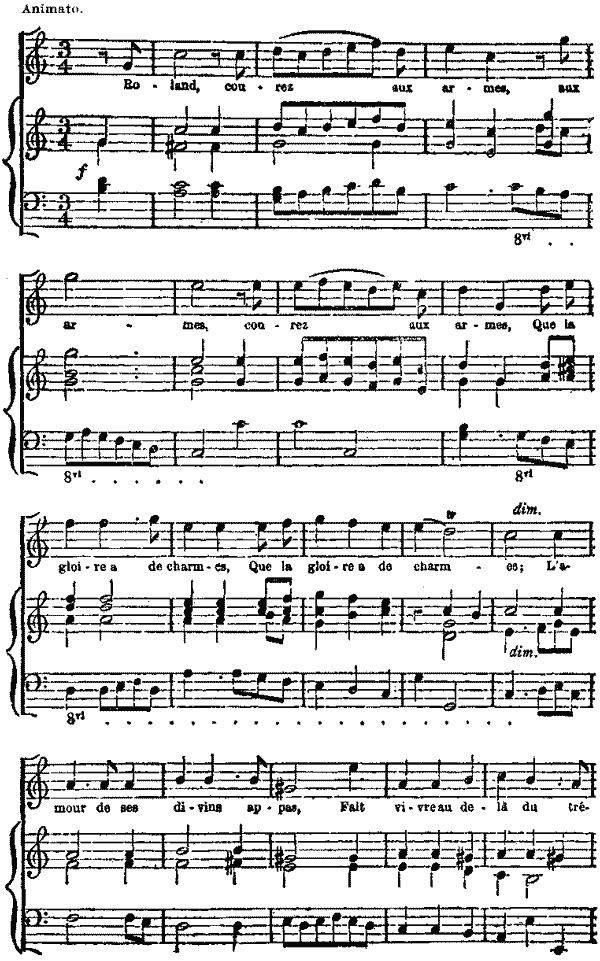
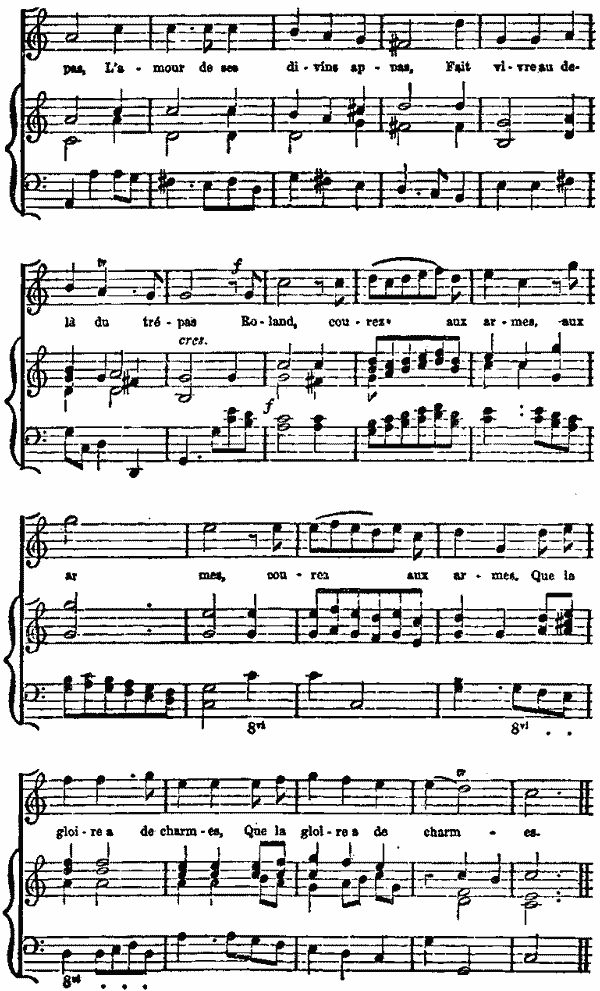
II.
In Germany the contrary was the case for more than a century later.
The first operatic performance, indeed, was given in the German
language. A copy of Peri's "Dafne" was sent to Dresden and as a
preparation for performance the text was translated, but it was found
impossible to adapt the German words to the Italian recitative, owing
to the different structure of the German sentences, bringing the
emphasis in totally different places. In this stress the local master,
Heinrich Schütz, was called upon to compose new music, which he did,
and the work was given in 1627. This beginning of German opera,
however, was totally accidental. All that was intended was the
repetition of the famous Italian work. Nor did the persons concerned
appear to recognize the importance and high significance of the act in
which they had co-operated, for no other German operas were given
there or elsewhere until much later. Schütz, moreover, did not pursue
the career of an operatic composer, but turned his attention mainly to
church music and oratorio, in which department he highly distinguished
himself, as we will presently have occasion to examine farther.
It was not until the beginning of the century next ensuing, that
German opera began to take root and grow. The beginning was made in
the free city of Hamburg, which was at that time the richest and most
independent city of Germany, and, being remote from the centers of
political disturbance, it suffered less from the thirty years' war
than most other parts of the country. The prime mover here was
Reinhard Keiser (1673-1739), born at[Pg 242] Weissenfels, near Leipsic, and
educated at the Thomas School. His attention had been directed to
dramatic music early, and at the age of nineteen he was commissioned
to write a pastoral, "Ismene," for the court of Brunswick. The
success of this gained him another libretto, "Basilius," also
composed with success. He removed to Hamburg in 1694, and for forty
years remained a favorite with the public, composing for that theater
no less than 116 operas, of which the first, "Irene," was produced in
1697. In 1700 he opened a series of popular concerts, the prototypes
of the star combinations of the present day. In these entertainments
the greatest virtuosi were heard, the most popular and best singers,
and the newest and best music. His direction of the opera did not
begin until 1703; here also he proved himself a master. The place of
this composer in the history of art is mainly an adventitious one,
depending upon the chronological circumstance of his preceding others
in the same field, rather than upon the more important reason of his
having set a style, or established an ideal, for later masters. His
operas subsided into farce, the serious element being almost wholly
lacking, and, according to Riemann, the last of them shows no
improvement over the first. Their only merit is that they are not
imitations of the Italian nor upon mythological subjects, but from
common life. In his later life he devoted himself to the composition
of church music, in which department he accomplished notable, if
somewhat conventional, success. The Hamburg theater furnished a field
for another somewhat famous figure in musical history, that of Johann
Mattheson, a singularly versatile and gifted man, a native of that
city (1681-1764). After a liberal education, in which his musical
taste and[Pg 243] talent became distinguished at an early age, he appeared on
the stage as singer, and in one of his own operas, after singing his
rôle upon the stage, came back into the orchestra in order to conduct
from the harpsichord the performance, until his rôle required him
again upon the stage. Indeed, it was this eccentricity which
occasioned a quarrel between him and Händel, who resented the
implication that he himself was incapable of carrying on the
performance. Mattheson composed a large number of works, including
many church cantatas of the style made more celebrated in the works of
Sebastian Bach, later, the intention of these works having been to
render the church services more interesting by affording the
congregation a practical place in the exercises. Mattheson is best
known at the present time by his "Complete Orchestral Director," a
compilation of musical knowledge and notions, intended for the
instruction of those intending to act in this capacity.
[Pg 244]
CHAPTER XX.
THE PROGRESS OF ORATORIO.
I.
S already noticed in the previous chapter, the oratorio had its
origin at the same time as opera, both being phases of the stilo
rappresentativo, or the effort to afford musical utterance to
dramatic poetry—at first merely a solemn and impressive utterance,
later, as the possibilities of the new phase of art unfolded
themselves, a descriptive utterance, in which the music colored and
emphasized the moods of the text and the situation. The idea of
oratorio was not new. All through the Middle Ages they seem to have
had miracle plays in the Church, as accessories of the less solemn
services, and as means of instruction in biblical history. The
mediæval plays had very plain music, which followed entirely the
cadences of the plain song, and made no attempt at representing the
dramatic situation or the feelings growing out of it. All that the
music sought to do was to afford a decorous utterance, having in it,
from association with the cadence of the music of the Church,
something impressive, yet not in any manner growing out of the drama
to which it was set. The Florentine music drama was something entirely
different from this, or soon became so, and in oratorio this was just
as apparent as in opera, although the opportunities of vocal display
were not made so much of.[Pg 245]
The modern oratorio exists in two types: The dramatic cantata, of
which the form and general idea were established by Carissimi; and the
church cantata, which differed from the Italian type chiefly in being
of a more exclusively religious character, and of having occasional
opportunities for the congregation to join in a chorale. The former of
these types was established by Giacomo Carissimi (1604-1674), who was
born near Rome, and held his first musical position as director at
Assisi, but presently obtained the directorship at the Church of St.
Apollinaris in Rome, where he served all the remainder of his long and
active life. Without having been a genius of the first order, it was
Carissimi's good fortune to exercise an important influence upon the
course of musical progress, particularly in the direction of oratorio,
in which all the more attractive elements came from his innovations.
Carissimi was a prolific composer, having constant occasion for new
and pleasing attractions for the musical service of the rich and
important Jesuit church, where he held his appointment. These
compositions are of every sort, but cantatas form the larger portion,
consisting of passages of Scripture set in consecutive form, with due
alternation of solo and chorus, in a style at once pleasing and
dramatically appropriate. The majority of his compositions have been
lost, many of them going to the waste paper baskets when the Jesuits
were suppressed. Enough remain, however, to indicate the interest and
importance of his work. Moreover, there, is another curious commentary
upon the value of his music, in the fact that Händel took twelve
measures well nigh bodily out of one of the choruses in Carissimi's
"Jephthah," and incorporated them in "Hear Jacob's God" in his own
"Samson." Mr. Hullah gives an[Pg 246] excellent aria from this work, but it
is too long for insertion here. The more important of Carissimi's
innovations were in the direction of pleasing qualities in the
accompaniments, and agreeable rhythms. He was teacher of several of
the most important Italian musicians of the following generation,
among them being Bassani, Cesti, Buononcini and Alessandro Scarlatti.
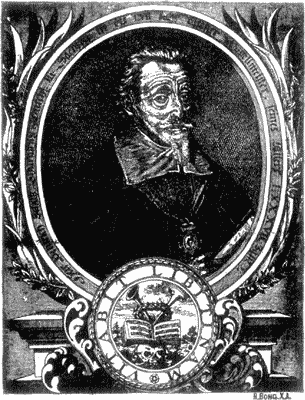
Fig. 47.
HEINRICH SCHÜTZ.
II.
The other type of oratorio received important assistance toward full
realization in Germany, at the hands of Mattheson, as already noticed,
and from those of Heinrich Schütz (1585-1672), who, after preliminary
studies in[Pg 247] Italy, where he acquired the Italian representative style
from Gabrieli in Venice, in 1609, three years later returned to
Germany, and in 1615 was appointed chapel master to the elector of
Saxony, a position which he held with slight interruptions until his
death, at the advanced age already indicated. Notice has already been
taken in a former chapter of his appearance in the field of opera
composition, in setting new music to Rinuccini's "Dafne," on account
of the German words being incapable of adaptation to the music of
Peri. But before this he had demonstrated his versatility and talent
in the production of certain settings of the psalms of David, in the
form of motettes for eight and more voices. In his second work, an
oratorio upon the "Resurrection," he shows the same striving after a
freer dramatic expression. His great work "Symphoniæ Sacræ,"
consists of cantatas for voices, with instrumental accompaniments, in
which the instrumental part shows serious effort after dramatic
coloration. The first of his works in this style was the "Last Seven
Words" (1645), which contained the distinguishing marks of all the
later Passion music. It consisted of a narrative, reflections,
chorales, and the words of the Lord Himself. Many years later he
produced his great Passions (1665-1666), and in these he accomplishes
as much of the dramatic expression as possible by means of choruses,
which are highly dramatic in style and very spirited. The voluminous
works of this master have now been reprinted, and some of them possess
a degree of interest warranting their occasional presentation. Schütz
occupies an intermediate position between the masters of the old
school, with whom the traditions of ecclesiastical modes governed
everything, and those who have passed entirely beyond them and[Pg 248]
polyphony, into modern monody. The music of Schütz is always
polyphonic, but there is much of dramatic feeling in it, nevertheless.
He was one of those clear-headed, practical masters, who, without
being geniuses in the intuitive sense, nevertheless contrive to
impress themselves upon the subsequent activity in their province,
chiefly through their sagacity in seizing new forms and bringing them
into practicable perfection. Into the forms of the Passion, as Schütz
created it, Bach poured the wealth of his devotion and his
inspiration; so later Beethoven put into the symphony form, created to
his hand by the somewhat mechanical Haydn, the amplitude of his
musical imagination, which, but for this preparatory work of the
lesser master, would have been driven to the creation of entirely new
forms for his thoughts, not only hampering the composer, but—which
would have been equally unfavorable to his success—depriving him of
an audience prepared to appreciate the greatness of the new genius
through their previous training in the same general style.
[Pg 249]
CHAPTER XXI.
BEGINNINGS OF INSTRUMENTAL MUSIC.
HE beginning of instrumental music, apart from vocal, is to be found
in the latter part of the sixteenth century, but the main advances
toward freedom of style and spontaneous expression were made during
the seventeenth, and, as we might expect, originally in Italy, where
the art of music was more prosperous, and incitations to advance were
more numerous and diversified. Upon all accounts the honor of the
first place in the account of this part of the development of modern
music is to be given to Andreas Gabrieli (1510-1586), who from a
singing boy in the choir of St. Mark's, under the direction of Adrian
Willaert, succeeded in 1566 to the position of second organist, where
his fame attracted many pupils. Among the numberless compositions
emanating from his pen were masses, madrigals, and a considerable
variety of pieces for organ alone, bearing the names of "Canzone,"
"Ricerari," "Concerte," and five-voiced Sonatas, the latter
printed in 1586, being perhaps the earliest application of this now
celebrated name to instrumental compositions. The pieces of Gabrieli
were mostly imitations of compositions for the voice, fugal in style,
and with never among them a melody fully carried out. Among the pupils
of Andreas Gabrieli were Hans[Pg 250] Leo Hassler, the celebrated Dresden
composer, and Swelinck, the equally celebrated Netherlandish organist,
of whom there is more to be said.
The beginning of organ composition, and the higher art of organ
playing, made by Andreas Gabrieli, was carried much farther by his
nephew and pupil, Giovanni Gabrieli (1557-1612), who, born and trained
at Venice, early entered the service of its great cathedral, and in
1585 succeeded Claudio Merulo as first organist of the same. As a
composer Giovanni Gabrieli continued the double-chorus effects which
had been such a feature of the St. Mark's liturgy since the time of
Willaert, but especially he distinguished himself in improving the
style of organ playing, and in giving it a freedom and almost secular
character somewhat surprising for the times. A large number of his
compositions of all sorts are in print, very many "for voices or
instruments." The alternative affords a good idea of the subordinate
position still occupied by instrumental music, but a beginning had
been made, which later was to lead to great things.
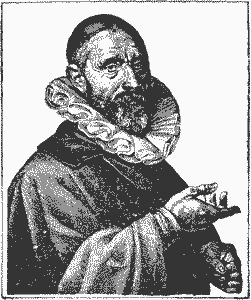
Fig. 48.
JEAN PIETERS SWELINCK.
The art of organ playing found its next great exponents in Holland and
Germany, all of them having been pupils of the Venetian master. The
most celebrated of these, considered purely as an organist, was Jean
Pieters Swelinck (1560-1621), who was born at Deventer in Holland, and
died at Amsterdam. He was more celebrated as a performer and
improviser than for the instrumental pieces he published. Among his
pupils was the celebrated Samuel Scheidt (1587-1654), organist at
Halle, who is memorable as the first who made artistic use of the
chorale. Scheidt is also famous as the author of a book upon organ
tabulature, or the notation for organ, which in Germany at this period
was different from that[Pg 251] of the piano, and in fact much resembled the
tabulature for the lute, from which it was derived. It consists of a
combination of lines and signs, by the aid of which the organist was
supposed to be capable of deciphering the intentions of the composer.
No especial importance appears to have been attached to the difference
of notation for instruments and voices in this period. And in fact,
until our own times certain instruments, the viola, for example, have
had their own notation, different from the voices, and different from
that of other instruments. Another celebrated German organist of this
period was Johann Hermann Schein, who, with Scheidt and Swelinck,
constituted the three great German musical S's of the sixteenth
century. Schein (1586-1630) was appointed cantor of the Leipsic St.
Thomas school in 1615, and worked[Pg 252] there as above. His numberless
compositions are more free in style than the average of the century,
and a number of them are distinctly secular. Nevertheless, in the
development of instrumental music he had but small part, not being one
of the highly gifted original geniuses who impress themselves upon
following generations. The great German master of this period was
Schütz, chapel master at Dresden, whose career forms part of the
story of the oratorio, a form of music which he had so large a share
in shaping into its present form.
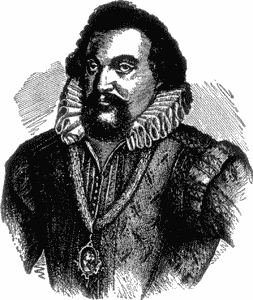
Fig. 49.
SAMUEL SCHEIDT.
II.
In order to come once more into the path of musical empire, we must
return again to Italy, where there was an organist at St. Peter's, who
had in him the elements of greatness and originality. Girolamo
Frescobaldi (1587-1640) was organist of St. Peter's at Rome from[Pg 253]
1615. His education had been in part acquired in Italy, and in part in
the Netherlands. As a virtuoso he attained an extraordinary success,
and one of his recitals is reputed to have been attended by as many as
30,000 people. He distinguished himself as composer no less than as
organist, and particularly by his compositions in free style. His
Ricerari, Concertos and Canzones were all protests against the bondage
of instrumental music to the fetters of vocal forms. It was the
compositions of this master, together with those of Froberger, that
Sebastian Bach desired to have, and which, in fact, he stole out of
his brother's book case, and copied in the moonlight nights.
It would take us too far were we to enumerate all the composers who
distinguished themselves in this century, no one of them succeeding in
composing anything satisfactory to this later generation, but all
contributing something toward the liberation of instrumental music,
and all adding something to its too limited resources. Among these
names were those of Johann Kasper Kerl, organist at St. Stephen's
church in Vienna, who, after having served with distinction at Munich,
returned later and died at Vienna in 1690. Another of these German
masters, also one of those whose compositions Bach wished to study,
was Johann Pachelbel, of Nuremberg (1635-1706). In 1674 he was
assistant organist at Vienna, in 1677 organist at Eisenach, and soon
back to Nuremberg a few years later. His multifarious works for organ,
among which we find a variety of forms, were perhaps the chief model
upon which Sebastian Bach formed his style. He especially excelled in
improvising choral variations, and in fanciful and musicianly
treatment of themes proposed by the hearer. Yet another name of[Pg 254] this
epoch, that of George Muffat, is now almost forgotten. He studied in
France, and formed his style upon that of the French. A later master,
also very influential in the style of Sebastian Bach, was Dietrich
Buxtehude (1637-1707). For nearly forty years he was organist at the
Church of St. Mary at Lübeck, where he was so celebrated that the
young Sebastian Bach made a journey on foot there in order to hear and
master the principles of his art. Buxtehude wrote a great number of
pieces in free style for the organ, and, while his works have little
value to modern ears, there is no doubt that this master was an
important influence upon the enfranchisement of instrumental music.
Among all these Netherlandish organists few are better known by name
at the present day than Johann Adam Reinken (1623-1722), who was born
at Deventer, Holland, and after the proper[Pg 255] elementary and finishing
studies, succeeded his master, Scheidemann, as organist at Hamburg.
Here his fame was so great that the young Bach made two journeys there
on foot, in order to hear him. He was a virtuoso of a high order, and
his style exercised considerable influence over that of Bach.
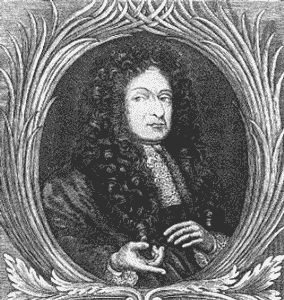
Fig. 50.
JOHANN ADAM REINKEN.
III.
Return we now to Italy, where the violin led also to an important
development of instrumental music, having in it the promise of the
best that we have had since. In Fusignano, near Imola, was born in
1653 Archangelo Corelli, who became the first of violin virtuosi, and
the first of composers for the instrument, and for violins in
combination with other members of the same family, and so of our
string quartette. He died in 1713 at Rome. Of his boyhood there is
little known. About 1680 he appears in high favor at the court of
Munich. In 1681 he was again in Rome, where he appears to have found a
friend in Cardinal Ottoboni, in whose palace he died. His period of
creative activity extended from 1683, when he began the publication of
his forty-eight three-voiced sonatas, for two violins, in four numbers
of twelve sonatas each. He also composed many other sonatas for the
violin, for violin and piano, and for other instruments. These
epoch-marking works are held in high esteem at the present time, and
are in constant use for purposes of instruction.
Meanwhile the orchestra had been steadily enriched through the
competition of successive operatic composers, each exerting himself to
produce more effect than the preceding. In this way new combinations
of tone color were contrived, and now and then introduced in a[Pg 256]
fortunate manner, and effects of greater sonority were attained
through the greater number of instruments, and the more expert use of
those they had. In the present state of knowledge it would be very
difficult, if not impossible, to trace the successive steps of this
progress, and to give proper credit to each composer for his own
contribution to the general stock. At best, the orchestra at the end
of this century was somewhat meager. The violin and the other members
of its family had taken their places somewhat as we now have them, but
the number of basses and tenors was much less than at present, their
place being filled by the archlute and the harpsichord. The trumpet
was occasionally employed, the flute, the oboe, and very rarely the
trombone. The conductor at the harpsichord, playing from a figured
bass, filled in chords according to his own judgment of the effect
required. Nothing approaching the smoothness and discreet coloration
of the orchestra of the present day, or even of the Haydn orchestra,
existed at this time. The violin players were very cautious about
using the second and third "positions," but played continually with
their hands in the first position. This part of the music, therefore,
wholly lacked the freedom which it now has, and the whole progress of
this century was purely apprentice work in instrumental music, its
value lying in its establishing the principle, first, that
instrumental music might exist independently of vocal, and, second,
that it might enhance the expressiveness of vocal music when
associated with it. The groundwork of the two great forms of the
period next ensuing, the fugue and the sonata, had been laid, and a
certain amount of precedent established in favor of free composition
in dance and fantasia form. Meanwhile the pianoforte of the day, the[Pg 257]
clavicembalo, as the Italians called it, had been considerably
improved. The present scale of music had been demonstrated by Zarlino,
and the ground prepared for the great geniuses whose coming made the
eighteenth century forever memorable as the blossoming time of musical
art.
Upon the whole, perhaps the most important part of the actual
accomplishment of this century was in musical theory. While musicians
for centuries had been employing the major and minor thirds, and the
triads as we now have them, the fact had remained unacknowledged in
musical theory, and the supposed authority of the Greeks still
remained binding upon all. Zarlino, however, made a new departure. He
not only assigned the true intervals of the major scale, according to
perfect intonation, but argued strongly for equal temperament, and
demonstrated the impossibility of chromatic music upon any other
basis. Purists may still continue to doubt whether this was an
absolute advantage to the art of music, since it carries with it the
necessity of having all harmonic relations something short of
perfection; but the immediate benefit to musical progress was
unquestionable, and according to all appearance the art of music is
irrevocably committed to the tempered scale of twelve tones in the
octave.
[Pg 259]

THE
Flowering Time of Modern Music.
BACH, HÄNDEL, HAYDN, MOZART, BEETHOVEN.
THE FUGUE AND THE SONATA.
[Pg 261]
CHAPTER XXII.
GENERAL VIEW OF MUSIC IN THE EIGHTEENTH
CENTURY.
T is not easy to characterize simply and clearly the nature of the
musical development which took place during the eighteenth century.
The blossoming of music was so manifold, so diversified, so
irrepressible in every direction, that there was not one single
province of it, wherein new and masterly creations were not brought
out. The central figures of this period were those of the two Colossi,
Bach and Händel; after them Haydn, the master of genial proportion and
taste; Mozart, the melodist of ineffable sweetness, and finally at the
end of the century, the great master, Beethoven. In opera we have the
entire work of that great reformer, the Chevalier Gluck, and a
succession of Italian composers who enlarged the boundaries of the
Italian music-drama in every direction, but especially in the
direction of the impassioned and sensational. Add to these influences,
already sufficiently diversified, that of a succession of brilliant
virtuosi upon the leading instruments, whereby the resources of all
the effective musical apparatuses were more fully explored and
illustrated, with the final result of affording the poetic composer
additional means of bringing his ideas to a more effective
expression[Pg 262]—and we have the general features of a period in music so
luxuriant that in it we might easily lose ourselves; nor can we easily
form a clear idea of the entire movement as the expression of a single
underlying spiritual impulse. Yet such in its inner apprehension it
most assuredly was.
Upon the whole, all the improvements of the time arrange themselves
into two categories, namely: The better proportion, contrast, and more
agreeable succession of moments in art works; and, second, the more
ample means for intense expression. In the department of form, indeed,
there was a very important transition made between the first half of
the century and the last. The typical form of the first part of this
division was the fugue, which came to a perfection under the hands of
Bach and Händel, far beyond anything to be found in the form
previously. The fugue was the creation of this epoch, and while based
upon the general idea of canonic imitation, after the Netherlandish
ideal, it differed from their productions in several highly
significant respects. While all of a fugue is contained within the
original subject, and the counter-subject, which accompanies it at
every repetition, it has an element of tonality in it which places it
upon an immensely higher plane of musical art than any form known, or
possible, before the obsolescence of the ecclesiastical modes.
Moreover, the fugue has opportunities for episode, which enable it to
acquire variety to a degree impossible for any form developed earlier;
and which, when these opportunities were fresh, afforded composers a
field for the display of fancy which was practically free. This, one
may still realize by comparing the different fugues in Bach's "Well
Tempered Clavier" with each other, and with[Pg 263] those of any other
collection. It is impossible to detect anywhere the point where the
inspiration of the composer felt itself bound by the restrictions of
this form. It was for Bach and Händel practically a free form. And the
few other contemporaneous geniuses of a high order either experienced
the same freedom in it, or found ways of evading its strictness by the
production of various styles of fancy pieces, which, while conforming
to the fugue form in their main features, were nevertheless free
enough to be received by the musical public of that day with
substantially the same satisfaction as a fantasia would have been
received a century later. Roughly speaking, Bach and Händel exhausted
the fugue. While Bach displayed his mental activity in almost every
province of music, and like some one since, of whom it has been much
less truthfully said, "touched nothing which he did not adorn," he was
all his life a writer of fugues. His preludes are not fugues, and
their number almost equals that of the fugues; but the operative
principles were not essentially different—merely the applications of
thematic development were different. Yet strange as it may seem,
within thirty years from his death it became impossible to write
fugues, and at the same time be free. Why was this?
A new element came into music, incompatible with fugue, requiring a
different form of expression, and incapable of combination with fugue.
That element was the people's song, with its symmetrical cadences and
its universal intelligibility. Let the reader take any one of the
Mozart sonatas, and play the first melody he finds—he will
immediately see that here is something for which no place could have
been found in a fugue, nor yet in its complement, the prelude of
Bach's days. The same is[Pg 264] true of many similar passages in the sonatas
of Haydn. Music had now found the missing half of its dual nature. For
we must know that in the same manner as the thematic or fugal element
in music represents the play of musical fantasy, turning over musical
ideas intellectually or seriously; so there is a spontaneous melody,
into which no thought of developing an idea enters. The melody flows
or soars like the song of a bird, because it is the free expression,
not of musical fantasy, as such (the unconscious play of tonal fancy),
but the flow of melody, song, the soaring of spirit in some one
particular direction, floating upon buoyant pinions, and in directions
well conceived and sure. The symmetry of the people's song follows as
a natural part of the progress. The spontaneous element of the music
of the northern harpers now found its way into the musical productions
of the highest geniuses. Henceforth the fugue subsides from its
pre-eminence, and remains possible only as a highly specialized
department of the general art of musical composition, useful and
necessary at times, but nevermore the expression of the unfettered
fancy of the musical mind.
The discovery of the secret of musical contrast, in the types of
development, the thematic and the lyric, led to the creation of a
new form, in which they mutually contrast with and help each other.
That form was the Sonata, which having been begun earlier, was
developed further by the sons of Bach, but which received its
characteristic touches from the hands of Haydn and Mozart. This was
the crowning glory of the eighteenth century—the sonata. A form had
been created, into which the greatest of masters was even then
beginning to breathe his mighty soul, producing thereby a succession
of master works, which stand without parallel in the realm of music.
[Pg 265]
CHAPTER XXIII.
JOHN SEBASTIAN BACH.
LL things considered, the most remarkable figure of this period was
that of the great John Sebastian Bach, who was born at Eisenach, in
Prussia, in 1685, and died at Leipsic in 1750. It is scarcely too much
to say that this great man has exercised more influence upon the
development of music than any other composer who has ever lived. In
his own day he led a quiet, uneventful life, at first as student, then
as court musician at Weimar, where he played the violin; later as
organist at Arnstadt, a small village near Weimar, and still later as
director of music in the St. Thomas church and school at Leipsic. In
the sixty-five years of his life, Bach produced an enormous number of
compositions, of which about half were in fugue form, a form which was
at its prime at the beginning of this century and which Bach carried
to the farthest point in the direction of freedom and spontaneity
which it ever reached.
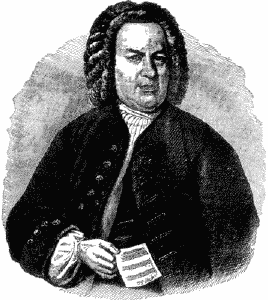
Fig. 51.
JOHN SEBASTIAN BACH.
It is the remarkable glory of Bach to have rendered his compositions
indispensable to thorough mastery in three different provinces of
musical effort. The modern art of violin playing rests upon two works,
the six sonatas of Bach for violin solo, and the Caprices of Paganini.
The former contain everything that belongs[Pg 266] to the classical, the
latter everything that belongs to the sensational. In organ playing
the foundation is Bach, and Bach alone. Nine-tenths of organ playing
is comprised in the Bach works. Upon the piano his influence has been
little less. While it is true that at least four works are necessary
for making a pianist of the modern school, viz., the "Well Tempered
Clavier," of Bach; the "Gradus ad Parnassum," of Clementi; the
"Studies," of Chopin, and the Rhapsodies, of Liszt, the works of Bach
form, on the whole, considerably more than one-third of this
preparation. Nor has the influence of[Pg 267] Bach been confined to the
province of technical instruction alone. On the contrary, all
composers since his time have felt the stimulus of his great tone
poems, and Mendelssohn, Schumann, Chopin and Wagner found him the most
productive of great masters.
The life of Bach need not long detain us. A musician of the tenth
generation, member of a family which occupies a liberal space in
German encyclopedias of music, art and literature, Sebastian Bach led
the life of a teacher, productive artist and virtuoso, mainly within
the limits of the comparatively unimportant provincial city of
Leipsic. His three wives in succession and his twenty-one children
were the domestic incidents which bound him to his home. Here he
trained his choir, taught his pupils, composed those master works
which modern musicians try in vain to equal, and the even tenor of his
life was broken in upon by very few incidents of a sensational kind.
We do not understand that Bach was a virtuoso upon the violin,
although no other master has required more of that greatest of musical
instruments. Upon the piano and organ the case is different. Bach's
piano was the clavier, upon which he was the greatest virtuoso of his
time. His touch was clear and liquid, his technique unbounded, and his
musical fantasy absolutely without limit. Hence in improvisation or in
the performance of previously arranged numbers he never failed to
delight his audience. It was the same upon the organ. The art of
obligato pedal playing he brought to a point which it had never before
reached and scarcely afterward surpassed. He comprehended the full
extent of organ technique, and with the exception of a few tricks of
quasi-orchestral imitation, made possible in modern organs, he covered
the entire[Pg 268] ground of organ playing in a manner at once solid and
brilliant. Many stories are told of his capacity in this direction,
but the general characterization already given is sufficient. He was a
master of the first order. The common impression that he played
habitually upon the full organ is undoubtedly erroneous. He made ample
use of registration to the fullest extent practicable on the organs of
his day.
The most remarkable feature of the career of Bach is his productivity
in the line of choral works. As leader of the music in the St. Thomas
church, he had under his control two organs, two choirs, the children
of the school and an orchestra. For these resources he composed a
succession of cantatas, every feast day in the ecclesiastical year
being represented by from one to five separate works. The total number
of these cantatas reaches more than 230. Some of them are short, ten
or fifteen minutes long, but most of them are from thirty to forty
minutes, and some of them reach an hour. Their treasures have been but
imperfectly explored, although most of them are now in print. In the
course of his ministrations at Leipsic he produced five great Passion
oratorios for Good Friday in Holy Week. The greatest of these was the
Passion of St. Matthew, so named from the source of its text. This
work occupies about two hours in performance. It is in two parts, and
the sermon was supposed to intervene. It consists of recitative, arias
and choruses, some of which are extremely elaborate and highly
dramatic. The other Passions are less fortunate. Nevertheless they
contain many beautiful and highly dramatic moments. Bach's oratorios
belong to the category of church works, as distinguished from those
intended for concert purposes. This is seen especially[Pg 269] in the
treatment of the chorale, in which he expects the congregation to
co-operate. In one direction Bach was subject to serious limitation.
His knowledge of the voice, and his consideration for its convenience,
were far below the standard of composers of the same time educated in
Italy. In his works, while many passages are very impressive, and
while the melody and harmony are always appropriate to the matter in
hand, the intervals and especially the convenience of the different
registers of the voice are very imperfectly considered, for which
reason his works have not been performed to anything like the extent
to which their musical interest would otherwise have carried them.
This is especially true of the greatest of all, the Passion according
to St. Matthew. It was first performed on Good Friday, 1729, in the
St. Thomas church at Leipsic, and it does not appear to have been
given again until 1829, when Mendelssohn brought it out. Since that
time it has been given almost every year in Leipsic, and more or less
frequently in all the musical centers of the world, but its
elaboration is very great and its vocal treatment unsatisfactory to
solo voices, for which reason it succeeds only under the inspiration
of an artistic and enthusiastic leader. In fact, all the great works
of Bach are more or less in the category of classics, which are well
spoken of and seldom consulted. While, in Beethoven's time, the whole
of the "Well Tempered Clavier" was not thought too much for an
ambitious youngster, at the present time there are few pianists who
play half a dozen of these pieces. The easier inventions for two
parts, some of the suites, several gavottes, modernized from his
violin and chamber music, and a very few of his other pieces for the
clavier, are habitually played.[Pg 270]
It would be unjust to close the account of this great artist without
mentioning what we might call the prophetic element in his works. The
great bulk of Bach's compositions are in two forms, the Prelude and
the Fugue. The fugue came to perfection in his hands. It was an
application of the Netherlandish art of canonic imitation, combined
with modern tonality. In a fugue the first voice gives the subject in
the tonic, the second voice answers in the dominant, the third voice
comes again in the tonic, and the fourth voice, if there be one, again
in the dominant. Then ensues a digression into some key upon what
theorists call the dominant side, when one or two voices give out the
subject and answer it again, always in the tonic and dominant of the
new key. Then more or less modulating matter, thematically developed
out of some leading motive of the subject, and again the principal
material of the theme, with one or more answers. The final close is
preceded by a more or less elaborate pedal point upon the dominant of
the principal key, after which the subject comes in. With very few
exceptions the fugues of Bach are in modern tonality, the major key or
the modern minor, with their usual relatives.
The prelude is a less closely organized composition. Sometimes it is
purely harmonic in its interest, like the first of the "Well Tempered
Clavier." At other times it is highly melodic, like the preludes in C
sharp major and minor of the first book of the Clavier, and, as a
rule, the prelude either treats its motives in a somewhat lyric manner
or dispenses with the melodic material altogether. Thus the prelude
and fugue mutually complete each other. But it is a great mistake to
regard Bach as a writer of fugues alone. He was also very free[Pg 271] in
fantasies, and one of his pianoforte works, concerning the origin of
which nothing whatever is known, the "Chromatic Fantasia and Fugue,"
is one of the four or five greatest compositions that exist for this
instrument. The remarkable thing about this fantasia is the freedom of
its treatment and the facility with which it lends itself to virtuoso
handling, as distinguished from the rather limited treatment of the
piano usual in Bach's works. The second part of the fantasia is
occupied by a succession of recitatives of an extremely graphic and
poetic character. Melodically and harmonically these recitatives are
thoroughly modern and dramatic, the latter element being very forcibly
represented by the succession of diminished sevenths on which the
phrases of the recitative end. The fugue following is long, highly
diversified and extremely climactic in its interest. In other parts of
his work Bach has left fantasies of a more descriptive character. He
has, for instance, a hunting scene with various incidents of a
realistic character, and in general he shows himself in his piano
works a man of wide range of mind and extremely vigorous musical
fantasy.
In the department of concertos for solo instruments and orchestra, his
works are very rich. There are a large number for piano, quite a
number for organ, several for two and three pianos, with orchestra,
and various other combinations of instruments, such as two violins and
'cellos, and so on. In these each solo player has an equal chance with
the other, and solos and accompaniment work together understandingly
for mutual ends. The most noticeable feature of his elaborate works is
the rhythm, which is vigorous, highly organized and extremely
effective. In the department of harmony, it is believed by almost all
close observers[Pg 272] that no combination of tones since made by any writer
is without a precedent in the works of Bach; the strange chords of
Schumann and Wagner find their prototypes in the works of this great
Leipsic master. Melodically considered, Bach was a genius of the
highest order. Not only did he make this impression upon his own time
and upon the great masters of the next two generations, but many of
his airs have attained genuine popularity within the present
generation, and are played with more real satisfaction than most other
works that we have. This is the more remarkable because from the time
of his first residence in Leipsic when he was only twenty-four years
old he went out of that city but a few times, and heard very little
music but his own. He was three times married, and had twenty-one
children, many of whom were musical. Three of his sons became eminent,
and the principal episode of his later life was his visit to Potsdam,
where his son, Carl Phillip Emanuel, was musician to Frederick the
Great. Here he was received with the utmost informality by the king
and made to play and improvise upon all the pianos and organs in the
palace and the adjacent churches. As a reminiscence of this visit he
produced a fugue upon a subject given by Frederick himself, written
for six real parts. This work was called the "Musical Offering," and
was dedicated to Frederick the Great. In his later years Bach became
blind from having over-exerted his eyes in childhood and in later
life. He died on Good Friday in 1750.
[Pg 273]
CHAPTER XXIV.
GEO. FREDERICK HÄNDEL.
HE companion figure to Bach, in this epoch, was that of George
Frederick Händel, who was born at the little town of Halle in the same
year as Bach, 1685, and died in London in 1759. Händel's father was a
physician, and although the boy showed considerable aptitude for music
his father did not think favorably of his pursuing it as a vocation;
but the fates were too strong for him. When George Frederick was about
eight years old, he managed to go with his father to the court of the
duke of Saxe Weissenfels, some distance away, where an older brother
was in service. Here he obtained access to the organ in the chapel,
and was overheard by the duke, who recognized the boy's talent, and,
with the authority inherent in princely rank, admonished the father
that on no account was he to thwart so gifted an inclination.
Accordingly the youngster had lessons in music upon the clavier, the
organ and the violin, the three standard instruments of the time. The
older Händel died, and before he was nineteen George Frederick made
his way to Hamburg, which was then one of the musical centers of
Germany. Here he obtained an engagement in the theater orchestra as
ripieno violin, a sort of fifth wheel in the orchestral[Pg 274] chariot,
its duty being that of filling in missing parts. The boy was then
rather more than six feet high, heavy and awkward. He was an
indifferent violinist, and the other players were disposed to make a
butt of him, although he was known to be an accomplished
harpsichordist. It happened presently, however, that the leader of the
orchestra, who presided at the harpsichord, fell sick, and Händel,
being at the same time the best harpsichordist and the poorest
violinist of all, was placed at the head.[Pg 275] He carried the rehearsals
and the performances through with such spirit that it resulted in his
being made assistant director, and two works of his were presently
performed—"Almira" and "Nero." The first made a great hit and was
retained in performance for several weeks. The Italian ambassador
immediately recognized the talent of the young man, and offered to
take him to Italy in his suite, but Händel declined, preferring to go
with his own money, which, after the production of "Nero," and its
successful run of several weeks, he was able to do.
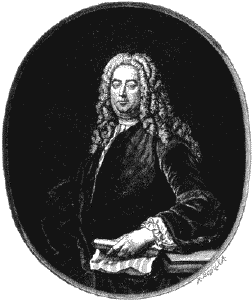
Fig. 52.
GEORGE FREDERICK HÄNDEL.
1685-1759.
Accordingly we find him in Italy, in 1710, first at Naples, where he
made the acquaintance of the greatest harpsichord player of that time,
Domenico Scarlatti. The style of the young German was so charming, and
so different from that of the great Italian player, that he
immediately became a favorite, and was called Il Caro Sassone ("The
dear Saxon"). He produced an opera in Naples with good success.
Afterward he produced others at Rome and Venice. In a few years he was
back at Hanover, where he was made musical director to the Elector
George, who afterward became George I of England. Here, presently, he
took a vacation in order to visit London, where he found things so
much to his liking that he remained, having good employment under
Queen Anne, and a public anxious to hear his Italian operas. Presently
Queen Anne died and George the First came over to reign as king. This
was altogether a different matter, for Händel had his unsettled
account with the elector of Hanover, upon whom he had so cavalierly
turned his back. The peace was finally made, however, by a set of
compositions very celebrated in England under the name of "The Water
Music." When[Pg 276] King George was going from Whitehall to Westminster in
his barge, Händel followed with a company of musicians, playing a
succession of pieces, which the king knew well enough for a production
of his truant capellmeister. Accordingly he received him once more
into favor, and Händel went on with his work.
For upwards of twenty years, Händel pursued his course in London as a
composer of Italian operas, of which the number reached about forty.
During the greater part of his time he had his own theater, and
employed the singers from Italy and elsewhere, producing his works in
the best manner of his time. His operas were somewhat conventional in
their treatment, but every one of them contained good points. Here and
there a chorus, occasionally a recitative, now and then an
aria—always something to repay a careful hearing, and occasionally a
master effect, such as only genius of the first order could produce.
His education during this period was exactly opposite to that of Bach.
Bach lived in Leipsic all his life, and, being in a position from
which only a decided fault of his own could discharge him, he
consulted no one's taste but his own, writing his music from within,
and adapting it to his forces in hand, or not adapting it, as it
pleased him. Händel, on the other hand, had always the public. He
commenced as an operatic composer. As an operatic composer he
succeeded in Hamburg, and as an operatic composer he succeeded in
Italy. The same career held him in London. There was always an
audience to be moved, to be affected, to be pleased, and there were
always singers of high talents to carry out his conceptions. Hence his
whole training was in the direction of smoothness, facility, pleasing
quality. Nevertheless, there came an end[Pg 277] to the popularity of Händel.
A most shabby pasticcio called the "Beggar's Opera," was the
immediate cause of his downfall. This queer compilation was made up of
old ballad tunes, with hastily improvised words, and the merest thread
of a story, and included some tunes of Händel's own. This being
produced at an opposition house, took the town. The result was that
Händel was bankrupted for the second time, owing more than £75,000.
Some time before this he had held the position of private musical
director to the earl of Chandos, who had a chapel in connection with
his palace, a short distance out of London, as it then was. In this
place Händel had already produced a number of elaborate anthems and
one oratorio—"Esther." In the stress of his present circumstances,
after a few weeks, he remembered the oratorio of "Esther," and
immediately brought it out in an enlarged form. The effect was
enormous. Whatever the English taste might be for opera, for oratorio
their recognition was irrepressible. "Esther" brought him a great deal
of money, and he presently wrote other oratorios with such good effect
that in a very few years he had completely paid up the enormous
indebtedness of his operatic ventures. At length, in 1741, he composed
his master work—the "Messiah." This epoch-marking composition was
improvised in less than a fortnight, a rate of speed calling for about
three numbers per day. The work was produced in Dublin for charitable
purposes. It had the advantage of a text containing the most beautiful
and impressive passages of Scripture relating to the Messiah, a
circumstance which no doubt inspired the beauty of the music, and
added to the early popularity of the work. In later times it is
perhaps not too much[Pg 278] to say that the music has been equally useful to
the text, in keeping its place in the consciousness of successive
generations of Christians. In this beautiful master work we have the
result of the whole of Händel's training. The work is very cleverly
arranged in a succession of recitatives, arias and choruses, following
each other in a highly dramatic and effective manner. There are
certain passages in the "Messiah" which have never been surpassed for
tender and poetic expression. Among these are the "Behold and See if
There Be Any Sorrow Like His Sorrow," "Come unto Him," and "He was
Despised." In the direction of sublimity nothing grander can be found
than the "Hallelujah," "Worthy is the Lamb," "Lift up Your Heads," nor
anything more dramatically impressive than the splendid burst at the
words, "Wonderful," "Counsellor." The work, as a whole, while
containing mannerisms in the roulades of such choruses as "He shall
Purify," and "For unto Us," marks the highest point reached in the
direction of oratorio; for, while Händel himself surpassed its
sublimity in "Israel in Egypt," and Bach its dramatic qualities in the
thunder and lightning chorus in the St. Matthew Passion; and
Mendelssohn its melodiousness in his "Elijah"; for a balance of good
qualities, and for even and sustained inspiration throughout, the
"Messiah" is justly entitled to the rank which, by common consent, it
holds as the most complete master work which oratorio can show.
In the "Israel in Egypt" Händel illustrates a different phase of his
talent. This curious work is composed almost entirely of choruses, the
most of which are for two choirs, very elaborately treated. Among them
all, the two which perhaps stand out pre-eminent are "The[Pg 279] Horse and
His Rider" and the "Hailstone," two colossal works, as dramatic as
they are imposing. The masterly effect of the Händelian chorus rests
upon the combination of good qualities such as no other master has
accomplished to the same extent. They are extremely well written for
the voice, with an accurate appreciation of the effect of different
registers and masses, the melodic ideas are smooth and vigorous, and
the harmonic treatment as forcible as possible, without ever
controlling the composer further than it suited his artistic purpose
to go. Bach very often commences a fugue which he feels obliged to
finish, losing thereby the opportunity of a dramatic effect. Händel
perfects his fugue only when the dramatic effect will be improved by
so doing, and in this respect he makes a distinct gain over his great
contemporary at Leipsic. The total list of the Händel works comprises
the following: Two Italian oratorios; nineteen English oratorios; five
Te Deums; six psalms; twenty anthems; three German operas; one English
opera; thirty-nine Italian operas; two Italian serenatas, two English
serenatas; one Italian intermezzo, "Terpsichore"; four odes;
twenty-four chamber duets; ninety-four cantatas; seven French songs;
thirty-three concertos; nineteen English songs; sixteen Italian airs;
twenty-four sonatas.
Händel was never married; nor, so far as we know, ever in love. He had
among his friends some of the most eminent writers of his day, such as
Addison, Pope, Dean Swift and others. His later years were so
successful that when he died his fortune of above £50,000 was left for
charitable purposes. This was after he had paid all of the
indebtedness incurred in his earlier bankruptcy. It would be a mistake
to dismiss this[Pg 280] great master without some notice of his harpsichord
and organ playing. As a teacher of the princesses of the royal family,
he produced many suites and lessons for the harpsichord, in one of
which, as an unnoticed incident, occur the air and variations since so
universally popular under the name of "The Harmonious Blacksmith." It
is not known to whom the composer was indebted for the name generally
applied to this extremely broad air, and clever variations. Very
likely some music publisher was the unknown poet. As an organist
Händel was both great and popular. In the middle of his oratorios he
used to play an organ concerto with orchestra. Of these compositions
he wrote a very large number. They are always fresh and hearty in
style, well written for organ, and with a very flowing pedal part.
Händel appears to have played the pedals upon a somewhat different
plan from that of Bach. Bach is generally supposed to have used his
toes for the most part, employing the heel only for an occasional note
where the toes were insufficient. Händel seems to have used toe and
heel habitually in almost equal proportion.
It is a curious feature of the later part of Händel's career that he
brought out his oratorios in costume. Several of the original bills
are extant, in which an oratorio is promised "with new cloathes."
"Esther" is said to have been given with complete stage appointment at
Chandos, like an opera; but the Lord Chamberlain prohibited future
representations of the kind on account of the supposed sacredness of
the subject. Afterward the characters were costumed, and the stage
set, but there was no action. While Händel was German by birth, his
long residence in England and his habitual writing for the last ten or
fifteen years of his life[Pg 281] oratorios in the English language, made
him, to all intents and purposes, an English composer. For nearly a
century he stood to the English school as a model of everything that
was good and great, to such an extent that very little of original
value was accomplished in that country, and when, by lapse of time and
a deeper self-consciousness on the part of English musicians, this
influence had begun to wane, a new German composer came in the person
of Felix Mendelssohn Bartholdy, who, in turn, became a popular idol,
and for many years a barrier to original effort.
The influence of Händel upon the later course of music is by no means
so marked as that of Bach. Nevertheless, he was one of the great tone
poets of all times, and his works form an indispensable part of the
literature of music. It was his good fortune to embody certain types
of melody and harmony with a clearness and effectiveness that no other
composer has equaled. The oratorio, in particular, not only fulfilled
itself in Händel, but we might almost say completed itself there,
for very little of decided originality has been produced in this
department since. The Händelian operas have been mostly forgotten for
many years, but they contain gems of melody in the solo and chorus
parts which have still a future. His first opera, "Almira," was
revived at Hamburg a few years ago with remarkable effect, and it is
not at all unlikely that extracts from many of the other works will
eventually find their way into the current repertory of the singer, as
many of the arias already have.
[Pg 282]
CHAPTER XXV.
EMANUEL BACH; HAYDN; THE SONATA.
I.
 ONE of the sons of Bach inherited the commanding genius of their
father, although four of them showed talent above the average of
musicians of their day, and one of them distinguished himself and
exercised an important influence upon the subsequent course of
pianoforte music. The most gifted of Bach's sons was Wilhelm
Friedmann, the eldest (1710-1784), who was especially educated by his
father for a musician. He turned out badly, however, his enormous
talents not being able to save him from the natural consequences of a
dissolute life. He died in Berlin in the greatest degradation and
want. This Bach wrote comparatively few compositions, owing to his
invincible repugnance to the labor of putting them upon paper; he was
famous as an improviser, and certain pieces of his in the Berlin
library are considered to manifest musical gifts of a high order.
Johann Christian (1735-1782), the eleventh son, known as the Milanese
or London Bach, devoted himself to the lighter forms of music, and
after having served some years as organist of the cathedral at Milan,
and having distinguished himself by certain operas successfully
produced in Italy, he removed to London, where he led an easy and
enjoyable life. He was an elegant and fluent[Pg 283] writer for the
pianoforte. The one son of Bach who is commonly regarded as having
left a mark upon the later course of music was Carl Philip Emanuel
(1714-1788), the third son, commonly known as the Berlin or Hamburg
Bach. His father intended him for a philosopher, and had him educated
accordingly in the Leipsic and Frankfort universities, but his love
for music and the thorough grounding in it he had at home eventually
determined him in this direction. While in the Frankfort University he
conducted a singing society, which naturally led to his exercising
himself in composition. Presently he gave up law for music, and going
to Berlin he obtained an appointment as "Kammer-musiker" to Frederick
the Great, his especial business being that of accompanying the king
in his flute concertos. The seven years' war having put an end to
these duties, he migrated to Hamburg, where he held honorable
appointments as organist and conductor until his death. He wrote in a
tasteful and free, but somewhat superficial, style; and while his
compositions bear favorable comparison with those of other musicians
of his time, they are by no means of a commanding nature like those of
his father. There were, however, two reasons for this, wholly aside
from the question of less ability in the younger composer. One of
these is to be found in the free form which Emanuel Bach began to
develop. Sebastian Bach had the advantage of writing his greatest
works in a form which had been prepared for him, without having been
exhausted. The technique of fugue had been created before his time,
but its possibilities in the direction of freedom and spontaneity had
never been illustrated. Bach proceeded to do this for the fugue form,
and, it may be added, did it with such amplitude that no composer has[Pg 284]
been able to write a free and original fugue since. The son
recognizing both that the fugue had been exhausted as a free art-form,
and feeling no doubt that something more intuitively intelligible than
fugue was possible, addressed himself to composition in the free
style, in which the means of producing effects had not yet been
mastered. The thematic use of material had been acquired, or was
easily inferable from the fugue, but the proper manner of contrasting
that material with other, calculated to relieve the attention and at
the same time intensify the interest, remained for later explorers.
The missing contrast was the lyric element, but it was not until the
next generation of composers that it came into pianoforte music in
satisfactory form. Accordingly the sonatas of Emanuel Bach sound dry
and superficial, and while they are interesting as the remote models
upon which Beethoven occasionally built, they do not repay study for
the purposes of public performance. There is little heart in them. As
a literary musician Bach deserves to be remembered for his work upon
"The True Art of Playing the Piano." This was the first systematic
instruction book for the instrument of which we have a record, and it
still is the main dependence for information concerning the method of
Bach's playing, and the way in which he intended the embellishments in
his works to be performed.
ONE of the sons of Bach inherited the commanding genius of their
father, although four of them showed talent above the average of
musicians of their day, and one of them distinguished himself and
exercised an important influence upon the subsequent course of
pianoforte music. The most gifted of Bach's sons was Wilhelm
Friedmann, the eldest (1710-1784), who was especially educated by his
father for a musician. He turned out badly, however, his enormous
talents not being able to save him from the natural consequences of a
dissolute life. He died in Berlin in the greatest degradation and
want. This Bach wrote comparatively few compositions, owing to his
invincible repugnance to the labor of putting them upon paper; he was
famous as an improviser, and certain pieces of his in the Berlin
library are considered to manifest musical gifts of a high order.
Johann Christian (1735-1782), the eleventh son, known as the Milanese
or London Bach, devoted himself to the lighter forms of music, and
after having served some years as organist of the cathedral at Milan,
and having distinguished himself by certain operas successfully
produced in Italy, he removed to London, where he led an easy and
enjoyable life. He was an elegant and fluent[Pg 283] writer for the
pianoforte. The one son of Bach who is commonly regarded as having
left a mark upon the later course of music was Carl Philip Emanuel
(1714-1788), the third son, commonly known as the Berlin or Hamburg
Bach. His father intended him for a philosopher, and had him educated
accordingly in the Leipsic and Frankfort universities, but his love
for music and the thorough grounding in it he had at home eventually
determined him in this direction. While in the Frankfort University he
conducted a singing society, which naturally led to his exercising
himself in composition. Presently he gave up law for music, and going
to Berlin he obtained an appointment as "Kammer-musiker" to Frederick
the Great, his especial business being that of accompanying the king
in his flute concertos. The seven years' war having put an end to
these duties, he migrated to Hamburg, where he held honorable
appointments as organist and conductor until his death. He wrote in a
tasteful and free, but somewhat superficial, style; and while his
compositions bear favorable comparison with those of other musicians
of his time, they are by no means of a commanding nature like those of
his father. There were, however, two reasons for this, wholly aside
from the question of less ability in the younger composer. One of
these is to be found in the free form which Emanuel Bach began to
develop. Sebastian Bach had the advantage of writing his greatest
works in a form which had been prepared for him, without having been
exhausted. The technique of fugue had been created before his time,
but its possibilities in the direction of freedom and spontaneity had
never been illustrated. Bach proceeded to do this for the fugue form,
and, it may be added, did it with such amplitude that no composer has[Pg 284]
been able to write a free and original fugue since. The son
recognizing both that the fugue had been exhausted as a free art-form,
and feeling no doubt that something more intuitively intelligible than
fugue was possible, addressed himself to composition in the free
style, in which the means of producing effects had not yet been
mastered. The thematic use of material had been acquired, or was
easily inferable from the fugue, but the proper manner of contrasting
that material with other, calculated to relieve the attention and at
the same time intensify the interest, remained for later explorers.
The missing contrast was the lyric element, but it was not until the
next generation of composers that it came into pianoforte music in
satisfactory form. Accordingly the sonatas of Emanuel Bach sound dry
and superficial, and while they are interesting as the remote models
upon which Beethoven occasionally built, they do not repay study for
the purposes of public performance. There is little heart in them. As
a literary musician Bach deserves to be remembered for his work upon
"The True Art of Playing the Piano." This was the first systematic
instruction book for the instrument of which we have a record, and it
still is the main dependence for information concerning the method of
Bach's playing, and the way in which he intended the embellishments in
his works to be performed.
II.
In the little village of Rohrau, in Austria, was born to a master
wheelwright's wife, in 1732, a little son, dark-skinned, not large of
frame, nor handsome, but gifted with that most imperishable of
endowments, a genius for melody and tonal symmetry. The baby was named
Francis Joseph, and he grew to the age of about six in[Pg 285] the family of
his parents, in a little house which although twice somewhat rebuilt,
still stands in its original form. Hither people come from many lands
in order to see the birthplace of the great composer Haydn, the
indefatigable and simple-hearted tone poet of many symphonies,
sonatas, and the two favorite cantatas or oratorios, the "Creation"
and the "Seasons." In his earliest childhood the boy showed a talent
for music, which, as his parents both sang and played a little, he had
often an opportunity of hearing. Before he was quite six years old he
was able to stand up in the choir of the village church and lead in
solos, with his sweet and true, if not strong, voice. This was his
delight. At length George Reutter, the director of the music in the
cathedral of St. Stephen at Vienna, heard him, and offered the boy a
place in his choir. Now indeed his fortune seemed made, and he
embraced the offer with gratitude. As a choir boy he ought to have
been taught music in a thorough manner, but as Reutter was rather a
careless man this did not happen in Haydn's case, but the boy grew up
in his own devices. He composed constantly, without having had the
slightest regular training. One day Reutter saw one of his pieces, a
mass movement for twelve parts. He offered the passing advice, that
the composer would have done better to have taken two voices, and that
the best exercise for him would be to write "divisions" (variations)
upon the airs he sang in the service—but no instruction. At length
the boy's voice began to break, and at the age of fourteen or fifteen,
he was turned out to shift for himself. He found an asylum in the
house of a wig maker, Keller, with whom he lived for several years,
earning small sums by lessons, playing the organ at one of the
churches, the violin at another, singing at another and[Pg 286] so on, in all
managing to place himself upon the road to fortune—that of industry
and sobriety. This part of his career lasted from 1748, when he left
the choir of the cathedral, to 1752, when he became accompanist to the
Italian master, Porpora, who was then living in Vienna in the house of
an Italian lady, whose daughter's education he was superintending.
With Porpora he learned the art of singing, and the proper manner of
accompanying the voice. He also got many hints in regard to the
correct manner of composing. He had already produced a number of works
in various styles. In 1759 he was appointed conductor of the music at
the palace of Count Morzin, where he had a small number of musicians
under his direction, only sixteen in all. Here he began his life work.
Two years later he was invited to assume the assistant directorship of
the private orchestra and choir of Prince Esterhazy, who lived in
magnificent style, and for many years had maintained a private musical
chapel.[Pg 287] Very soon the old prince died, and his son reigned in his
place. The new master was the one named "The Magnificent," and greatly
enlarged the musical appointment of his predecessor. He built a great
palace at Esterhaz, where there was a theater, in which opera was
given, and a smaller one where there was a marionette company, the
machinery of which had been brought to great perfection. There were
frequent concerts. The prince was a great amateur of the peculiar viol
called the barytone, and it was one of Haydn's duties to provide new
compositions for this instrument. Here for thirty years he continued
in service, with few interruptions, and always on the very best of
terms with his prince, and with the men under him. The players called
Haydn "Papa."
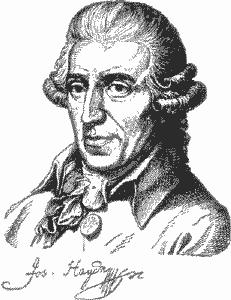
Fig. 53.
Owing to its situation, remote from town, and to the prince's
constantly increasing aversion to living in Vienna, Haydn scarcely
left the vicinity for years together. Here, wholly from within his own
resources, he evolved a succession of works in every style, and for
almost every possible combination of instruments, from operas for the
large theater, to marionette music for the small place, orchestral
compositions, among which the 175 symphonies form a not inconsiderable
portion; there are also concertos for many kinds of instruments, and
songs, masses, divertissements and the like. In short, there is
scarcely any form of music which Haydn did not have to make at some
time or other in his long service in the Esterhazy establishment.
Being his own orchestral director, he had the opportunity of trying
and experimenting and of realizing what would be effective and what
would not. The motive mainly operative in his work, necessarily, was
that of pleasing and amusing. Nobler intentions were not wanting, but
the pleasing element had to be considered[Pg 288] in most that he did. Thus
he developed a style of his own, original, becoming, with a certain
taste and symmetry, and with a melodious element which never loses its
charm. Withal he became very clever in his treatment of themes. It was
a saying of his that the "idea" did not matter at all; "treatment is
everything." From this standpoint it is impossible to deny Haydn the
credit of having accomplished his ideal.
He commenced his musical career as a violinist and a singer. His
orchestral symphonies were for violins (for strings), with occasional
seasoning from the brass and wood wind. The constant study of the
violin led to modifications in his style, and evolved first, the
string quartette in the form which has always remained standard. The
symphonies are only larger string quartettes, for, in the order of the
themes, the general manner of treating them and the principles of
contrast or relief which actuated them, the quartettes are sonatas, as
also are the symphonies. Haydn gave the sonata form its present shape.
The insertion of a second theme in the first movement, and the
principle of contrasting this second theme with the first in such a
way that the second theme is generally lyric in style, or at least
tending in that direction, was Haydn's. He also developed the middle
part of the sonata into what is known as the "elaboration,"
"Durchführungssatz". The cantabile slow movement, modeled somewhat
after the Italian cantilena, was his. Mozart and Beethoven did wonders
with it later, but the suggestion was Haydn's. The endless
productivity, the constant succession of new pieces demanded, led to a
somewhat systematic proceeding in their production, and so the form
and the method of the sonata became stereotyped. All the instrumental
movements of this time,[Pg 289] whenever there was any serious intention,
assumed the form of sonatas; i.e., of the instrumental sonatas—the
symphony and the quartette.
At length Haydn's master died, and he accepted an invitation from
Salamon, the publisher, to London, where he produced several new
symphonies, conducted many concerts and returned to Vienna richer by
about $6,000 than when he had left his home a few months before. He
had become a great master, known all over the world, without himself
knowing it. If any man ever woke up and found himself famous, Haydn
was that man, although he had been in the way of having his
compositions played and sung before most of the important personages
in Europe for years, Prince Esterhazy being a royal entertainer. It
was for Madrid that Haydn composed his first Passion oratorio, "The
Last Seven Words." This work, by a curious chance, he made over into
an instrumental piece for his London concerts, the prejudice against
"popery" preventing its being given there in its original form. In
1794 he was again in London. Upon the first visit to London he took
the journey down the Rhine, and at Bonn, in going or coming, the young
Beethoven showed him a new cantata. In 1794 he was again in London,
where the same success attended him as before. He produced many new
works, and was royally entertained. Again he went home richer by many
thousands of dollars than when he set out. With his savings he
purchased a house in the suburbs of Vienna, where he lived the
remainder of his life, dying in 1809. It was during these last years
that he wrote his two oratorios already mentioned. That by which he is
best known is the "Creation," which is a master work indeed, if only
we do not look in it for too much of the distinctly religious or[Pg 290]
sublime. It belongs to the pleasing in art, and certain of its numbers
are worthy of Italian opera, so sweetly melodious are they, yet ever
refined and beautiful. Of this kind are the solo arias, "On Mighty
Pens," the famous "With Verdure Clad," the lovely trio, "Most
Beautiful Appear." Several choruses in this work are really splendid.
At the head of the list I would place the two choruses, "Achieved Is
the Glorious Work," with the beautiful trio between, "On Thee Each
Living Soul Awaits." The development of the fugue in the second chorus
is masterly and effective indeed. Everybody knows "The Heavens are
Telling," which, however, has rather more reputation than it deserves.
The English have made much of Haydn's descriptive music in the
accompanied recitatives. This part of his work, however, was but
clever when first written, and now, through the enormous development
which this part of musical composition has since reached, is little
more than childish. Withal, the "Creation" is not difficult. It can be
rendered effectively with moderate resources. This fact, added to its
many charming and engaging qualities, has insured its popularity in
all parts of the musical world. It bids fair to remain for amateur
societies for many years yet.
As a tone poet Haydn belonged by no means to the first rank—at least
in so far as the inherent weight and range of his ideas is concerned.
His one claim to musical fame rests upon his graceful manner of
treating a musical idea, and upon the readiness of his invention in
contrasting his themes, to which may be added the sweet and genial
flavor of his music, which in every line shows a pure and childlike
spirit, simple, unaffected, yet deep and true. It was his good fortune
to stand to Mozart and Beethoven in the rôle of master. Both were in
many[Pg 291] ways his superiors, yet both revered him, the one until his own
life went out in the freshness of his youth; the other until when an
old man, having stood upon the very Pisgah tops of the tone world,
full of honors, he spoke of the old master, Haydn, with affection, in
his very last days. Higher testimony than this it would be impossible
to quote. For, in the nature of the case, the composer, Haydn, can
never be judged again by musicians and poets who know so well his aims
and the value of what he accomplished as the two Vienna masters,
Mozart and Beethoven, who were younger than he, yet not too young to
understand the condition of the musical world into which Haydn had
been born, and the musical world as it had become from his living in
it.
[Pg 292]
CHAPTER XXVI.
MOZART AND HIS GENIUS.
NE of the most engaging personalities, and at the same time one of
the most highly gifted, versatile and richly endowed geniuses who ever
adorned the art of music, was that of Wolfgang Amadeus Mozart
(1756-1791). He was a son of the violin player and musician, Leopold
Mozart, living at Salzburg. At an extremely early age he showed his
love for music by listening to the lessons of his sister. By the time
he was four, his father commenced to give him lessons, and when he was
less than five years old he was discovered one day making marks upon
music paper, which he stoutly maintained belonged to a concerto. The
statement was received with incredulity, but upon carefully examining
the manuscript it was found correctly written, and sensible; but so
difficult as to be impossible to play. Upon the boy's attention being
called to this, he replied, "I call it a concerto because it is so
difficult; they should practice it until they can play it." In
childhood, and indeed all through life, his ear was very sensitive. He
could not bear to hear the sound of a trumpet, and upon his father
seeking to overcome his nervousness by having a trumpet blown in the
room, it threw him into convulsions. The boy was of a most active
mind, interested in[Pg 293] everything that went on about him, and eager to
learn in every direction. Nothing came amiss, arithmetic, grammar and
language—he was immediately at home in any subject which he took up.
Music was intuitive to him. So remarkable was his progress, that when
he was yet but six years old his father began to travel with him.
Their first journey was to Munich, where the elector received them
kindly. The programmes consisted of improvisations[Pg 294] by the youthful
Mozart upon themes assigned by the audience; pieces for violin and
piano, the father taking the violin part, and the sister in turn
played piano pieces. The father was a good violinist and the author of
an excellent school for that instrument. He also composed many
ambitious works, which rise above the capellmeister average. Highly
gratified with their reception at Munich, they went on to Vienna,
where again they were cordially received, the emperor especially being
highly delighted with the "little magician," as he called the
promising boy. Even at this early age Mozart had a distinct idea of
his own authority in music, although no one could be freer than he
from the charge of self-conceit. In Vienna, he asked expressly for
Wagenseil, the court composer, that he might be sure of having a real
connoisseur among his hearers. "I am playing a concerto of yours," he
said, "you must turn over for me." The ladies of the aristocracy went
wild over the fascinating young fellow, but presently he had an attack
of scarlet fever, which brought the tour to an end. After the return
to Salzburg, the practice went on every day, and regular lessons in
books, as they had during the journey; and, when he was still less
than nine years of age, the family undertook a longer tour to Paris,
playing at all the important towns on the way. In several of the
cities, Wolfgang played the violin, and also the organ in the
churches. At Paris they had a remarkable success, playing before the
court at Versailles, and in many of the houses of the nobility. Here
the father had four of the boy's sonatas for piano and violin engraved
and published. The stay at Paris lasted five months, until November
10, 1764, when they departed for London. Here they met a favorable
reception at court, the king, George III,[Pg 295] taking a great interest in
the wonderful young master. He put before him pieces of Bach,
Wagenseil and Händel, which he played at sight. On the fifth of June
they gave a concert in Spring Gardens, where their receipts were as
much as 100 guineas. His next appearance was as an organist for the
benefit of a charity. The father having taken cold, was ill for some
time, during which time, as the boy was unable to play on the piano,
he wrote his first symphony, and the year following three others.
Before leaving London they visited the British Museum, and in memory
of his visit Wolfgang composed a four-part quartette, and presented
the autograph to the museum.
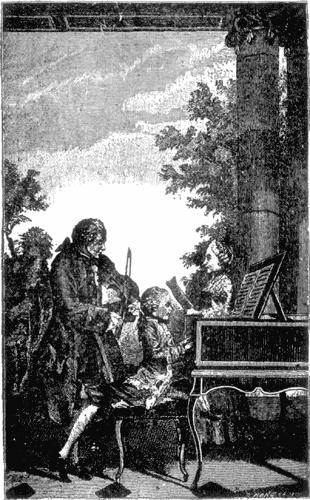
Fig. 54.
CONCERT BY THE MOZART FAMILY. THE LITTLE WOLFGANG AT THE PIANO.
[From a painting by Carmontil, 1763.]
Without pausing to trace the concert career of the young virtuoso it
must suffice to say, that by the time he was twelve years old, he had
become favorably known in every court of southern Europe. His talent
had been illustrated in many different ways, and tested by the most
severe masters. One of the most celebrated cases of this kind happened
at Bologna, where the Philharmonic Academy received him as a member,
after his passing the usual severe test, over which the famous master,
Padre Martini, presided. The conditions of membership required the
candidate to write an elaborate motette in six parts, founded upon a
melody assigned from the Roman Antiphonarium, the work to conform to
the strictest rules, with double counterpoint and fugue. In
consequence of the nervous feeling due to the limit of time allowed,
candidates very often failed. Mozart, however, took his paper in the
cheerful frame of mind which everywhere distinguished him, and was
duly locked up. In less than three-quarters of an hour he rapped at
his door and asked to be let out. The authorities sent him[Pg 296] word not
to be discouraged, but to keep on trying, as he had yet three hours,
and might accomplish it. They were greatly astonished on finding that
he had already finished, having produced a complete master work,
abundantly up to all requirements, the whole written in his peculiarly
neat and accurate manner.
His compositions had already reached the number of eighty, including a
number of symphonies. It was now late in the year 1771, and at Milan
Wolfgang set seriously to work upon his opera, which was produced
December 26 and repeated to full houses twenty times, the author
himself conducting it. This was "Mitridate, Re di Ponto." The year
following he composed two other operas for Italy, and several
symphonies, so that when his new opera of "Lucio Silla" was
performed in Milan October 24, 1772, the number of his works had
reached 135. From 1773 to 1777 Mozart remained at Salzburg, with
occasional journeys to Vienna and other cities, always pursuing a life
of unflagging industry. The number of his works had increased by the
end of this period to upwards of 250, including an immense variety of
pieces of chamber music, symphonies, two or three operas, a number of
masses, and the like. He was now twenty-one years old, and since the
age of fourteen he had been assistant conductor at Salzburg in the
service of the prince archbishop, who was a small-souled man, wholly
unworthy the service which Mozart rendered him. There is at least a
small satisfaction in remembering that the archbishop himself had a
distinct impression of the dis-esteem in which he was held by his
talented young musical conductor.
With the attainment of his majority the second period in the life of
this great genius began. Unable to obtain permission from the shabby
prelate for father and son to[Pg 297] go together upon an artistic tour, the
father at length decided to send the young man out with his mother,
and in September, 1777, the two started for Paris, traveling in their
own carriage with post horses. Their plan was to give a concert at
every promising town, taking whatever time might be necessary for
working it up in due form. In this way their journey was considerably
prolonged by delays at Munich, Mannheim and Augsburg. At Mannheim,
especially, the incidents of the tour were varied by Mozart's falling
in love with the charming daughter of the theatrical prompter and
copyist, a promising singer, who afterward married happily in quite a
different quarter. At Paris things did not turn out quite so favorably
as the father had anticipated. Most afflicting of all, the mother fell
sick there, and died, so that the son left Paris in September for home
with a far heavier heart than when he entered it. During the most of
1779 and 1780 he remained at Salzburg, fulfilling his duties as
assistant conductor. Then came his first opera in Germany, "Idomeneo,
Re di Creta," produced at Munich January 29, 1781. The success of
this work was so decided that it determined Mozart's career as an
operatic composer. A few months later he quarreled with the
archbishop, and the unpleasant connection came to an end. His second
opera, "Die Entführung aus dem Serail" ("The Elopement from the
Seraglio"), was produced at Vienna July 16, 1782. This was his first
opera in German. In August of this year he was married to Constance
Weber, younger sister of her who had first enchanted him. The marriage
was congenial in many ways, but as the wife was incapable in money
matters and administration, and Mozart himself careless as a business
man, and in receipt of a small and irregular income, they soon found
themselves in a sea of little[Pg 298] troubles, from which the struggling
artist was nevermore free. Only at the last moment, when indeed his
life was all but extinct, did the clouds disappear, and a prospect
open before him, which if he had lived to enjoy it, would have placed
his remaining days in easy circumstances. In 1785 the father visited
his son in Vienna, and upon one of the first days of his stay, there
was a little dinner party at Mozart's house, with Haydn and the two
Barons Todi. In his letter home, Leopold Mozart says that Haydn said
to him: "I declare to you, before God, as a man of honor, that your
son is the greatest composer that I know, either personally or by
reputation; he has taste, and beyond that the most consummate
knowledge of composition." In return for this compliment Mozart
dedicated to Haydn six string quartettes, with a laudatory preface, in
which he says that it was "but his due, for from Haydn I first learned
to compose a quartette." Mozart was an enthusiastic Freemason, and
through his influence his father, who had always previously opposed
the order, became a member, during this visit at Vienna. Soon
afterward the father died. For the lodge Mozart wrote much music, both
of a liturgical character and for concerts, and special
entertainments, and in the "Magic Flute" there are many reminiscences
of the order.
A year later he made the acquaintance of the celebrated librettist,
Lorenzo da Ponte, who proposed to adapt Beaumarchais' comedy, "The
Marriage of Figaro," which after some difficulty in obtaining the
consent of the emperor, on account of the objectionable character of
the story, was done, and the work produced at Vienna, May 1, 1786. The
theater was crowded, and many airs were repeated, until at later
performances the[Pg 299] emperor prohibited encores. A pleasing scene took
place at the last dress rehearsal. Kelly, who took the parts of Don
Basilio and of Don Curzio, writes: "Never was anything more complete
than the triumph of Mozart and his 'Marriage of Figaro,' to which
numerous overflowing audiences bore witness. Even at the first full
band rehearsal, all present were roused to enthusiasm, and when
Benucci came to the fine passage 'Cherubino Alla Vittoria, Alla
Gloria Militar,' which he gave with stentorian lungs, the effect was
electric, for the whole of the performers on the stage, and those in
the orchestra, as if actuated by one feeling of delight, vociferated
'Bravo, Bravo, Maestro. Viva, Viva, grande Mozart.' Those in the
orchestra I thought would never have ceased applauding, by beating the
bows of their violins against their music desks. And Mozart, I never
shall forget his little animated countenance. When lighted up with the
glowing rays of genius, it is as impossible to describe it as it would
be to paint sunbeams." Yet the success did not improve his position in
money affairs. Soon afterward, however, he was invited to Prague, to
see the success his beautiful work was making there. He was
entertained handsomely, and found the town wild with delight, at the
novelty, the spontaneity and charming quality of his music. He also
gave two concerts there, which were brilliantly successful, and having
been many times recalled he sat down at the piano and improvised for
half an hour, the audience resisting every effort he made to stop.
After returning to Vienna he obtained another libretto from Da Ponte,
that of "Don Giovanni," which was produced at Prague, October 29,
1787. It is told, as a characteristic incident of Mozart's method of
working, that the overture of this opera had not[Pg 300] been written until
the night before the performance. At every suggestion Mozart answered,
tapping his forehead, "I have it all here." But not a line had been
written. Late at night he set about writing it. His wife made him some
punch, of which he was very fond, and sat with him telling him fairy
stories, in order to keep him awake. Early in the morning the overture
was finished, and after being copied it was played prima vista at
night, with grand success. In response to repeated appeals for court
recognition, Mozart was made chamber composer, with a salary of about
$400, which he pronounced, "Too much for what I produce; too little
for what I might produce." "Don Giovanni" was not given in Vienna
until May, 1788.
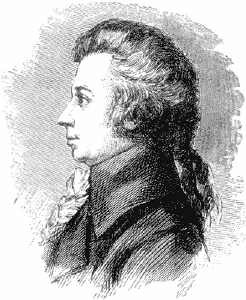
Fig. 55.
MOZART, AT THE AGE OF THIRTY-THREE.
[From a drawing by Dora Stock, a friend of
Schiller, 1789. (Grove.)]
His pecuniary circumstances continued desperate[Pg 301] but there were
certain incidents of an artistic kind which afforded the struggling
genius a meager consolation. One Van Swieten, director of the royal
library, who was a great amateur of classical chamber music, held
meetings every Sunday for the rehearsal of works of this class. Mozart
sat at the piano. For these occasions he arranged several of the
fugues of Bach's "Well Tempered Clavier," for string quartette. The
year following the practices took on larger proportions, a
subscription having been made to provide for giving oratorios with
chorus and orchestra. Mozart conducted, and Weigl took the pianoforte.
It was for performances of this club, that Mozart added the wind parts
to certain works of Händel. They gave "Acis and Galatea" (November,
1778), the "Messiah" (March, 1779), "Ode to St. Cæcilia's Day" and
"Alexander's Feast" (July, 1790). Space forbids our following his
later career beyond mentioning the chief incidents in a life where
sadness had larger and larger place, when nevertheless the great
master was pouring out his most noble and beautiful strains of melody
and tonal delight. A visit to Berlin resulted in receptions at court,
at Potsdam, where the truthful composer replied to the king's
question, how he liked his band, that: "It contains great virtuosi,
but if the gentlemen would play together they would make a better
effect"—a remark which has been appropriate to many later orchestras.
The king apparently laid the remark to heart, and offered Mozart the
post of director, with a salary of 3,000 thalers, almost equal to the
same number of our dollars. It would have been well for Mozart if he
had accepted this liberal offer; but his answer was, "How can I
abandon my good emperor?"—certainly an affection most misplaced.[Pg 302]
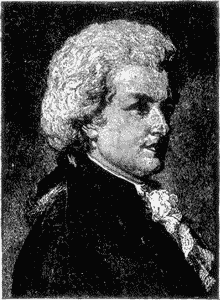
Fig. 56.
MOZART.
[From the Lange painting.]
The list of the Mozart operas was closed with the "Magic Flute,"
produced September 30, 1783, which at first was not so successful as
most of his previous works, but which continued to improve upon
hearing, until at length it reached the estimation which it has ever
since held, as one of the most characteristic and interesting of all
his works. He had already begun upon his "Requiem," which had been
mysteriously ordered of him by a messenger, who declined to state the
object for which the work was intended. It is now ascertained that the
unknown patron was a Count Walsegg, an amateur desirous of being
thought a great composer. It was his intention to have performed the
work as his own. Mozart was now in low spirits, worn out with work,
late hours and financial worry. The mystery of the "Requiem" preyed
on[Pg 303] his imagination none the less that he felt that in it he was
writing some of his noblest and best thoughts. He said: "I am sure
that this will be my own requiem." Nothing could dissuade him from the
idea. It returned again and again. At length he fell ill, poisoned, as
he thought, by some envious rival. No one knows whether there was
anything in the notion that actual poison had been administered,
although there were rivals who had been heard to wish that he were out
of the way. Without having quite finished the "Requiem" he breathed
his last December 5, 1791. His premonition proved correct. The
"Requiem" was given at his own funeral.
This account of the life of Mozart has hardly the merit of an outline,
for within the short thirty-five years of his earthly existence this
great master produced a variety of works in every province of music,
greater than that produced by any other of the great masters, scarcely
excepting the indefatigable and long-lived Händel.
It is extremely difficult to assign Mozart a definite place in the
musical Pantheon without praising him too highly on the one hand, or
going to the other extreme and belittling his genius by pointing out
the evident fact that noble, beautiful, sprightly, sweet and charming
as were his compositions, he has not left so large an influence upon
the later course of music as quite a number of artists apparently his
inferiors. His influence in music was largely temporary, but none the
less indispensable to musical progress. To the neat and symmetrical
periods of the Haydn symphony and sonata, with their fresh, thematic
treatment, Mozart added a tender grace and sweetness like the
conceptions of a Raphael in painting. He was the apostle of melody. If
he had never written, the art of music would have remained something
quite[Pg 304] different from what we know it. And wherever there are lovers
of refined, noble melody, there will the music of Mozart be loved.
Moreover, in his best symphonies, such as the one in G minor, and the
"Jupiter" in C, there is a boldness and freedom of flight which
Beethoven scarcely surpassed. He was at his best as a composer of
operas. He was one of the fathers of the artistic song, with music for
every stanza differing according to the sentiment of the words; and
while the dramatic coloration is not forgotten in his operas, they are
a constant flow of charming, inexhaustible melody, which sings most
divinely. In short, taking his works through and through, Mozart was
what, in the words of Mr. Matthew Arnold, we might call the composer
of "sweetness and light." His music glows with the radiance of
immortal beauty.
[Pg 305]
CHAPTER XXVII.
BEETHOVEN AND HIS WORKS.
HE labors of Haydn and Mozart in the rich field of instrumental music
were followed immediately by those of Ludwig van Beethoven, who was
born at the little town of Bonn, on the Rhine, about twenty miles
above Cologne, in 1770. He died at Vienna, 1827. The years between
these dates were filled with labor and inspiration, beyond those of
any other master. Beethoven's place in music is at the head. Whether
he or Bach ought to be reckoned the very greatest of all the great
geniuses who have appeared in music, is a question which might be
discussed eternally without ever being settled. Considered merely as
an artist capable of transforming musical material in an endless
variety of ways, he would perhaps be placed somewhat lower than Bach;
but considered as a tone poet gifted with the faculty of making
hearers feel as he felt, and see as he saw (with the inner eyes of
tonal sense), no master ought to be placed above him. This is the
general opinion now, of all the world. Taine, the French critic, in
his work on art, names four great souls belonging to the highest order
of genius—Dante, Shakespeare, Michael Angelo and Beethoven. The
company is a good one, and Beethoven rightfully belongs in it. His
early life was wholly different from that of the gifted Mozart. He was
the son of a dissipated[Pg 306] tenor singer, and his mother was rather an
incapable person. When the boy was about eleven years old he began to
play the viola in the orchestra. He was already a good pianist, and it
was said of him that he was able to play nearly the whole of the "Well
Tempered Clavier" by heart, and at the age of eleven and a half he was
left in charge during Neefe's absence, as deputy organist. His
improvisations had already attracted attention, and when he was a
little past twelve he was made assistant musical conductor
(cembalist), having to prepare the operas, adapt them to the orchestra
and the players of the theater, and sometimes to train the whole
company for several months together, while Neefe, the director, was
away. All this without salary. In this practical school of adversity
the boy grew up, arranging continually, training the orchestra,
adapting music and composing—for he began this very soon; in fact, we
have certain sonatinas of his, composed while he was but ten years
old.
He was direct in his speech, almost to rudeness, not, like Mozart,
attractive in his personal appearance, and rather awkward in society,
where he was continually breaking things, upsetting the water, the
ink, or whatever liquid was in his way. Nevertheless, there must have
been something attractive about this young man of independent manners,
for very early in life, and all the way through it, he made friends
with the aristocracy. Count Waldstein, a few years his senior, to whom
he afterward dedicated the so-called "Waldstein" sonata, Opus 53, in
C, early became interested in him, hired a piano for him and sent it
to his room, that he might have opportunity to practice. There was a
family of Von Breunings in Bonn, consisting of the mother, three boys
and a daughter, where the young Beethoven often stayed[Pg 307] for several
days together. This was one of the most refined families in town, and
it was here that the unfortunate young Beethoven got his first
glimpses of a true home life, and his first realization of the
refining influence of woman's society. He learned English in order
that he might be able to read Shakespeare in the original. He also
learned a little Italian and French. In short, the boy appears at good
advantage from every point of view, except from that of mere
appearance. This life of labor and responsibility was broken in upon
when he was about seventeen (in 1787). He was sent to Vienna, and
there is a tradition that he played there before Mozart, who is
reported to have prophesied favorably concerning him. There is very
little left us concerning his first visit to the great Austrian
capital, then, as ever since, the home of music. He was soon back
again in Bonn, and there for yet another year and a half he went on
with his work. His mother dying, he had no longer any responsibility
to retain him there, so when he was about twenty-one he set out again
for Vienna, where all the remainder of his life was spent. At Vienna
he immediately began to give concerts, in which his piano playing was
the main feature, and his improvising upon themes presented by the
audience. This art always remained one of his great distinctions—the
surest proof of genius, the possession of musical fantasy, in which
every thought immediately suggests something else. He devoted himself
to serious study of counterpoint and composition under the instruction
of Haydn at first, but later with Albrechtsberger. His two great
elements of power at this period were his playing and his improvising.
Czerny says: "His improvisation was most brilliant and striking; in
whatever company he might chance to be, he knew how[Pg 308] to produce such
an effect upon every hearer that frequently not an eye remained dry,
while many would break out into loud sobs; for there was something
wonderful about his expression, in addition to the beauty and
originality of his ideas, and his spirited manner of rendering them."
The limits of the present work do not admit of following the career of
this great master in the detail which would otherwise be desirable. It
must suffice to mention the more salient features. Contrary to the
precedent established by Mozart, Beethoven was in no hurry to appear
as a composer of ambitious pieces. After the early practical
experiences above described, and the further advantage of studies in
Vienna under the best teachers at that time living, it was not until
1795 that he appeared as composer of his first concerto for pianoforte
and orchestra, a Mozart-like work, but with an Adagio of true
Beethovenish flavor. A year later he published his first three sonatas
for pianoforte, dedicated to Haydn. These three works are in styles
totally unlike each other, and there is little or no doubt that each
one of them was modeled after some existing work, which at that time
was highly esteemed in Vienna. The first in F minor, is plainly after
one by Emanuel Bach in the same key. The Adagio of this is
especially interesting, not only because it shows a freedom and a pure
lyric quality totally foreign to Emanuel Bach, and beyond Mozart even,
but because it was taken out of a quartette which he had written when
he was fifteen years old. This shows that even at that early age
Beethoven had arrived at the conception of his peculiar style of slow
movements, which differed from those of Mozart in having a more
song-like quality, and a deeper and more[Pg 309] serious expression. The
impression of a deep soul is very marked in the Largo of the first
concerto, and there are few of his later works which carry it more
plainly. In all, some sixty works precede this Opus 2, which is the
modest mark affixed to these three sonatas. The third, in C, is still
different from the other two, and was fashioned apparently after some
composition of Clementi or Dussek. The Adagio takes a direction
which must have been regarded as not entirely successful, for nowhere
else does the composer follow it out. Then followed a succession of
pieces of every sort, not rapidly, like Mozart's compositions, as if
they represented the overflowing of an inexhaustible spring, but
deliberately, as if the world were not ready for them too rapidly, one
after another, each in succession carrying the treatment of the
pianoforte to a finer point, and each different from its predecessor,
whether of contemporaneous publication or of a former year, until by
the end of the century he had reached the "Sonata Pathetique," a
work which marked a prodigious advance in expression and boldness over
anything that can be shown from any other master of the period.
Mention having been made of the slow movements in these works, in
which point they were perhaps more strikingly differentiated from
those of the composers previous—the Largo of the sonata in D major,
Opus 10, may be mentioned as an example of a peculiarly broad and
dramatic, almost speaking rhapsody, or reverie, for piano, which not
only calls for true feeling in the interpreter, but also for technical
qualities of touch and breadth of tone, such as must have been
distinctly in advance of the instruments of the day. Meanwhile a
variety of chamber pieces had been composed, many of them of decided
merit. This was a great period of activity[Pg 310] with the young composer.
He had found his voice. Within two years from the "Sonata
Pathetique," he had composed all the sonatas up to the two numbered
Opus 27, in which the so-called "Moonlight" stands second, and between
these a variety of variations, and several important chamber pieces,
not forgetting the oratorio, "Christ on the Mount of Olives"—a work
which although not fully successful, nevertheless contained many
beautiful ideas, and one chorus which must be ranked among the best
which the repertory of oratorio can show—"Hallelujah to the Father."
The year 1800 also saw the first performance of the beautiful and
romantic third concerto for pianoforte and orchestra. The first
symphony had been performed in 1800, and by 1804 we have the great
heroic symphony, the "Kreutzer Sonata," and the "Appassionata"
with all that lie between. Never did tone poet give out great
inspirations like these so freely. Each is an advance upon the
previous, distancing all works of similar composers, and each one
surpassing his own previous efforts. This activity continued with
little or no interruption until 1812, after which there is quite a
break, Beethoven occupying himself with pot-boilers for the English
market, in the way of arrangements of songs for instrumental
accompaniment. Of these there are many, Scotch and other, besides
masses, canons for voices and the like. In 1814 we have the lovely
sonata in E minor for piano, Opus 90, and in 1818 the great sonata for
hammer klavier, Opus 106. Then in 1821 and 1822 the last of the
sonatas, which carry this form of pianoforte writing to a point which
it had never previously reached, if since; and then the "Messe
Solennelle," and the ninth symphony, the latter having been composed
in 1822-1823. After this came the last quartettes[Pg 311] for strings,
compositions which have been much written about, but which time has
shown to be among the most beautiful and understandable of all that
great master produced.
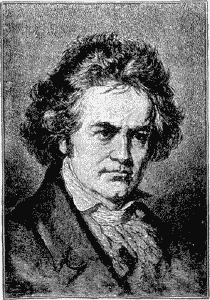
Fig. 57.
BEETHOVEN.
Meanwhile, as a man Beethoven had been subject to his vicissitudes,
but upon the whole, while no longer the popular composer of the day
(his seriousness prevented that) he was in comfortable circumstances,
but annoyed by the care of a nephew of irregular habits and
reprehensible character. For many years now Beethoven had been getting
deaf, and for the past ten or twelve he had been unable to hear
ordinary conversation, so that communication had to be carried on with
him by writing.[Pg 312] Superficial observers inferred from this fact that
the inability to hear his compositions must have reacted unfavorably
upon them, and probably accounted for many passages which were unlike
his early works, and unintelligible or unlovely to the critics
aforesaid. It is true that between the early and the latest
compositions of Beethoven there is a greater difference in
intelligibility than between the early and the late compositions of
any other master. But the difference is not one of judgment on his
part, but purely one of different conception, different melodic
structure and deeper effect. The ninth symphony, which the first
players called impossible, has lived to be counted not simply the
greatest of all of Beethoven's works, but the greatest of all
instrumental music. It has been named as an impassable barrier beyond
which no later composer might pass and compose an instrumental
symphony. Nothing could be more unjust or mistaken. Every composition
of Beethoven is a fantasia, which in his earlier work indeed has the
form of the sonata, the accepted serious form of the day; but in the
works of the middle period, the limits of the sonata form were crossed
in many directions, and in the latest the sonata is forsaken entirely.
But this is not to say that Beethoven had gone beyond the sonata form.
Beethoven was an improviser in music, quite as surely as his wildest
successor, Schumann, and he wrote as he felt at the time. He lost
nothing in being deaf. His inner tonal sense was as acute as ever, and
had been trained as the tonal sense of few composers ever was. In
point of fact the compositions of the later period are as sweet as
those of any former period whatever. The last sonata for the
pianoforte is one of the most advanced compositions that exist for the
instrument. It is a tone poem[Pg 313] which will outlast most other things
that Beethoven wrote for this instrument. In fact, the accuracy with
which the capacity of the instrument is gauged is one of the most
striking peculiarities of the last sonatas and other late works of
this master. Meanwhile, piano technique has advanced to a point where
these great works no longer present the insurmountable difficulties
that they did when first composed. Their general acceptance has been
delayed by the foolish notion that there was about them something
sacred and secluded from the apprehension of ordinary readers. This is
not the case. They are within reach, and repay study.
Beethoven's last days were not pleasant. He lived the life of a
bachelor, and his nephew was a source of trouble. It is thought by
many that the neglect of his nephew to order a physician in time, when
requested to do so by his uncle, was the immediate occasion of the
death of the great man. Beethoven died March 27, 1827, after a serious
illness, in which dropsical symptoms were among the most troublesome.
There was a grand funeral, in which impressive exercises were held,
and the body was deposited in consecrated ground in the cemetery at
Wahring, near Vienna.
The allusions to the compositions of this composer in the preceding
pages are very fragmentary, and, in fact, are expected merely to
direct attention to those mentioned. There are many others almost
equally worthy of attention. But upon the whole, the reputation of
Beethoven as a tone poet must rest first upon the nine symphonies;
then upon the string quartettes and other chamber music; next upon the
concertos, of which the third and fourth for pleasing beauty, and the
fifth for deep poetical meaning, have never been equaled by those of[Pg 314]
any other composer. There remain the sonatas for pianoforte and for
piano and violin, three large volumes, containing a multitude of
exquisite strains, which the world would be poor indeed to lose.
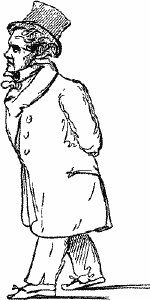
Fig. 58.
BEETHOVEN AS HE APPEARED ON THE STREETS OF VIENNA.
[From a sketch by Lyser, to the accuracy of which Breuning testifies,
excepting that the hat should be straight on the head, and not inclined to one
side.]
In personal appearance Beethoven was rugged rather than pleasing. He
was rather short, five feet five inches, but very wide across the
shoulders, and strong. His ruddy face had high cheek bones, and was
crowned by very thick hair, which originally was brown, but in later[Pg 315]
life perfectly white. His eyes were black and rather small, but very
bright and piercing. His natural expression was grave, almost severe,
but his smile was extremely winning, and he was jovial in humor. He
was very fond of the country, walking in the fields, where under a
tree he would lie for a half day together, humming the melodies which
occurred to him, and making notes in the bits of blank paper which he
always carried. These pocket note books have been preserved, and we
find in them themes in crude form which he used for some important
movement or other, often several years later. Among the works produced
while this habit was strongest were the sixth and seventh symphonies,
than which no works in music are more charming.
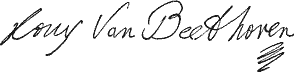
[Pg 316]
CHAPTER XXVIII.
HAYDN, MOZART AND BEETHOVEN COMPARED.
HE three masters, Haydn, Mozart and Beethoven, in relation to the
symphony stand upon a plane of substantial equality, whether we
estimate their merits according to the absolute worth of the
compositions they produced in this form, or in the value of the
additions which each in turn made to the ideal of his predecessor.
Naturally, as the latest of the three, though so far contemporaneous
with them as to form part of a single moment in the progress of art,
the symphonies of Beethoven are greater in certain respects, and, as
also was to have been expected from his general depth of mind and
seriousness of purpose, they are perhaps somewhat more severe—or
elevated—in style and sentiment. Nevertheless, the ideal of the three
writers was but slightly different. All alike sought to weave tones
into a succession of agreeable and beautiful combinations, related as
representing a continued flight of spirit—a reverie of the beautiful.
Haydn has the honor of having created the form. His fortunate
innovation upon the traditions of his predecessors, by adding the
second and contrasting theme, and his happy faculty of working out the
middle part of the first movement thematically in a style of free
fantasy based upon the various devices of counterpoint and canonic
imitation, not only[Pg 317] suggested to the later composers a way in which
an endless variety of pleasing tone pictures might be created—but
established, and demonstrated by the clearness with which he did it,
and the ever fresh variety and charm of his works, that this was the
way in which symphonic material must be put together. For further
particulars relating to the sonata form, as such, the student is
referred to my "Primer of Musical Forms" (Arthur P. Schmidt, Boston,
1891).
The form thus established by Haydn, Mozart accepted, and followed in
all his symphonies, with few and unimportant variations. His additions
to the general ideal of orchestral effect were in the direction of a
sweeter cantilena, a vocal and song-like quality, which pervades
every movement, and which in the slow movement rises to a height of
refined and exquisite song never surpassed by any composer. Beethoven
is often more impassioned; at times more forcible. But it is never
possible to say of the pure spirit of Mozart, that this refined and
gentle soul might not have broken mountains and shaken the hills if he
had chosen to do so. His refinement is like that of a seraph, as we
see it illustrated in the feminine-looking faces of the Greek Apollos,
and the St. Michaels and archangels of Guido Reni and Raphael. It is
free from passion and toil; but no man dares set a limit to the
strength therein concealed. In the slow movements of the pianoforte
sonatas of Mozart we do not find this quality so plainly manifested.
The instrument was still too imperfect, and did not invite it.
Moreover, the greater portion of these compositions bear the
appearance of having been written for the use of amateurs. But in the
string quartette and the symphonies it is different. Here the spirit
of[Pg 318] Mozart has free course, and he goes from one beauty to another,
with the sure instinct of a master before whom all tonal kingdoms are
wide open. This can be seen even in the pianoforte arrangements of the
greater symphonies. The melodies, apparently so simple and diatonic,
are susceptible of being sung with heartfelt fervor under the fingers
of the violinist, or by the voice of the great singer, and when so
sung they become transfigured with beauty—luminous from within, like
lovely angel faces, glowing with radiance from the higher realms of
bliss. Without this idea of singing, and more than this, of a pure
spirit singing, the Mozart adagios are open to the charge often made
against them in these later days[Pg 319] by the unthinking, who find in them
only the external peculiarities of simplicity and diatonic quality,
with the unsensationalism which technical reserve implies.
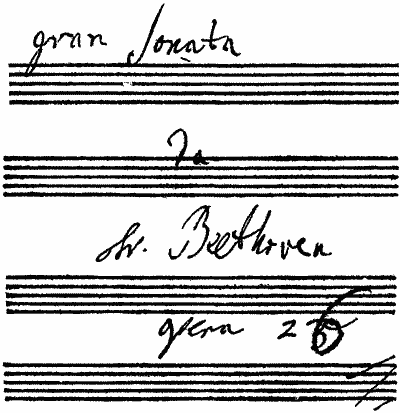
Fig. 59.
REDUCED FACSIMILE OF THE TITLE PAGE OF
BEETHOVEN'S SONATA, OPUS 26, CONTAINING THE CELEBRATED FUNERAL MARCH.
Nor is it true that Beethoven is incapable of this elevated soaring in
the higher realms of the merely beautiful in song. There is generally
an undercurrent of deeper pathos in all his sustained slow movements,
but in the earlier symphonies, especially in the second, there is a
long slow movement of heavenly depth and quality. Indeed, without
pausing to individualize we may say once for all that the slow
movements of Beethoven are nearly as sweet and as forgetful, as
rapturous, as those of Mozart. Even when he takes the lower key of the
minor, with its implication of suffering and pain, there is still a
sweetness, which once heard can never be forgotten. Think of the
lovely allegretto of the seventh symphony, with its persistent
motive of a quarter and two-eighths. Even in an arrangement for the
pianoforte this is still impressive; upon the organ yet more so; but
how much more so when given by the orchestra, with the lovely changing
colors of Beethoven's instrumentation! The progress from Haydn's slow
movement to that of Beethoven is in the direction of depth,
self-forgetfulness, and elevated reverie, having in it a quality
distinctly church-like, devotional, worshipful and reposeful in the
heavenly sense. The finest example of this is in the slow movement of
the ninth symphony of Beethoven, where the composer has one of those
lofty moods, which even in his younger times Mrs. Von Breuning used to
call his "raptus"—rapture of song.
In a technical point of view the handling of the themes becomes more
masterly in Beethoven than even in Mozart—mainly perhaps because the
symphonies of[Pg 320] Beethoven represent a more mature point in his mental
and artistic career than do those of Mozart. The third symphony of
Beethoven was written in 1803, the composer being thirty-three years
old; the fourth waited until he was thirty-five or six. Mozart died at
the age of thirty-five, and whatever we have from his lofty pen came
to the young Mozart, not yet having reached middle life. Observe also
the rapidity with which these great works followed one another from
the pen of Beethoven, when once he had found his voice. The fifth
symphony was written in 1808. In the same year he wrote also the
sixth; four years later, in 1812, the next two symphonies, the seventh
and eight. Then a long pause, filled up with other works, and at
length when the composer was fifty-three years of age, in 1823, the
mighty ninth. If Mozart's life had been spared to enter into the more
comfortable and dignified openings which his death prevented, what
might we not have had from him!
In one sense there is a distinct difference between the symphonies of
Mozart and those of Beethoven. The passionate ideal, the picture of a
deep soul, tossed yet triumphant, is nearer to the latter. Whatever
Mozart may have experienced in the way of "contradiction of sinners"
(as St. Paul calls it), he never allows the fact to find entrance into
his music, and especially into his symphonies. Whether he felt that
these moments did not belong to a high ideal of orchestral pieces, or
whether he was glad to find in the tone world forgetfulness of sorrows
and troubles, we do not know. But Beethoven came nearer to the great
time of the romantic. The inherent interest of whatever belongs to the
human soul was an idea of his time, and unconsciously to himself,[Pg 321]
perhaps, it entered into and colored his work. The ninth symphony
belongs to the period when Hegel was delivering his lectures upon the
deepest questions of philosophy, and laying it down as a fundamental
principle that it is the place of art to represent everything
whatever, which sinks or swells in the human spirit; not alone all the
noble and the lovely, but also the ignoble, the vicious, the unworthy,
and particularly the tragic—to the end that the soul may learn to
know itself, and awaken to a deeper and better self-consciousness.
Beethoven felt the mental movement of his day. While his acquaintance
with other prominent literary men of his time made little headway,
owing in part to his deafness, and in part to his very strong
self-consciousness, he read and thought, and felt himself akin with
the whole human race. He was a socialist and a republican by instinct.
"Man stands upon that which he really is," was a form of
self-assertiveness, which, if not actually enunciated by him, at least
represents his attitude toward the conventionalities and
superficialities of the courts, the social orders, and the general
movement of mind into which he entered. Moreover this was the time
when the romantic poets of Germany had already set the world thinking
their new ideas. Close by the great composer, in the same city in
fact, worked a young man, worshiping almost the very ground upon which
Beethoven walked, but for the most part unknown to him—Franz
Schubert, who in the symphony was classic to the very highest degree,
and a tone poet gifted lyrically not less than Mozart himself, a
composer whose ideas have equal refinement and grace with those of
Mozart, together with a certain charm peculiarly their own, and an
instinct for musical coloration, which has never found its superior.[Pg 322]
This obscure young man, whose lofty genius was recognized only after
his soul had taken its flight from earth, was the founder of the
modern romantic school of music—the musical commentator upon the
productions of all the best of German poets; a composer of such
inexhaustible fertility and melodic inspiration that Schumann said of
him, that if he had lived he would have set to music the whole German
literature. Thus by the combined efforts of all these composers, of
Schubert no less than of the three great masters of whom we are more
particularly speaking, the symphony came to its full expression.
In their relation to the sonata, these three great masters do not
stand in the same position of quasi-equality. Haydn is here the
first, as already in the symphony. But in his sonatas he is always
rather hampered, and never attains the flow of his slow melodies for
the violin. Mozart, also, while a beautiful player upon the pianoforte
of his day, did not possess the prescience of Beethoven, who was able
to see over the pianoforte of his time and write as if he felt the
assurance of the nobler and yet nobler instruments of these later
times. Here he stands with Bach, who in his great Chromatic Fantasia
and Fugue requires and confidently expects the breadth of tone and the
power of the modern piano. It was Beethoven's fortune to live during
the early days of the modern instrument. Just after his death the era
of virtuoso piano playing began, the first appearances of Thalberg
having been made as early as about 1830. He was himself a great
pianist, as we see in the concertos which he wrote, always intending
to play them at some concert or other in near prospect. Occasionally
indeed he overshot his mark, as notably in the fifth, which,[Pg 323] being
finished just before his concert in 1809, he found too difficult for
his fingers, whereupon he was obliged to fall back on the third.
Moreover, the pianists Hummel and Dussek were already before the
public, and Clementi had made his concert tours, and established the
lines of the classical technique upon its brilliant side. All these
influences find their illustration in the music of Beethoven, and
especially find illustration in the last and greatest of his
pianoforte sonatas. These beautiful tone poems were long regarded as
impossible. But the genius of Schumann and Liszt came to their rescue
by introducing a new style of touch and technique, which, when once
found, proved to be the link missing for the proper interpretation of
these till then obscure works.
Moreover, Beethoven occupied a different attitude toward the sonata
form from that which he held to the symphony. He deviated from the
sonata form in every direction, and this not alone in his later works,
when we might suppose he had become wearied with the repetition of his
ideas in the same order, but in his works of middle life, when as yet
he might apparently have gone on writing sonatas indefinitely, so
fresh, so novel and so varied were the tone pictures which he gave the
world under this name. He seems to have regarded music as an
improvisation, not to be held to some one fixed type of expression,
but free to go wherever the fancy of the poet took him, to the end
that the entire heavens of the tone world might in time be visited. He
expects of his readers an element of the devotee. It is not for
amateurs that he writes, still less for the votaries of fashionable
society, with its emptiness and repeated insincerities. There is a
suggestion of entering into the closet, and of shutting the door, as a
prerequisite to the full[Pg 324] enjoyment of these ineffable pictures and
images which come from his revelation.
In the present full-grown faith in the doctrine of the capacity of man
for a development continually progressive, it would be presumptuous to
say that the three composers, Haydn, Mozart and Beethoven, have
reached the limit of art, so far as instrumental music goes. In the
nature of the case, there is not, nor can there be an Ultima Thule
in art. Whatever the splendor of color, the nobility of conception, or
the sincerity and loyalty of purpose, and however resplendent the
works created by these exceptional talents, there is reason to hope
that better works still may yet be in store. Stronger and yet stronger
imaginations, more perfect technique of expression and finer
inspiration, may yet be the lot of fortunate individuals of the
twentieth century, inheriting the richly diversified musical
experiences of the present time. But in one direction there is little
doubt that these three great masters did carry the art of
instrumental music to a pinnacle beyond which no one as yet has been
able to soar. They represent the climax of classical art. In the
nature of the case, the term classical itself is subject to an element
of uncertainty. According to the philosopher Hegel, the classical is
that art in which the form is beautiful and wholly satisfactory in
symmetry, while the content exactly matches it in fullness and
beauty. Or, in ordinary usage, the classical is the first-class, the
superior, the highly finished, the standard. And since music is a
matter of sense perception, and the impressions resulting from it are
in some degree dependent upon the ability of the hearer to find the
principles of unity (in other words, "the sense of it"), every
generation extends the list of the classical, and includes[Pg 325] much which
the preceding one found imperfect and strained. So far as our
knowledge and experience have yet gone, however, there is a sense in
which the productions of these great masters are likely to remain long
unmatched in beauty and worth.
Nothing has been done since that surpasses the sustained beauty of the
Beethoven adagios, of which we find the most beautiful specimens
naturally among the orchestral pieces and in the chamber music, where
he could depend upon the long phrases and sustained tones of the
violins. But in the sonatas for pianoforte he is equally at home. He
seems to have foreseen the possibilities of the modern piano. In his
latest sonatas there are passages which foresee the modern technique,
and suggest effects which only the pianoforte of the past thirty years
has been capable of attaining. This is the prophetic element in the
writings of this great master.
The same difference in the sweep of mind shows itself in the lighter
movements. In the minuets Haydn is playful, Mozart is occasionally
tender and arch; Beethoven alone is vigorous and humoristic in the
modern sense. And, in the finales of the sonatas there is a movement
in those of Beethoven which we look for in vain in those of the older
composers. It was not in Haydn, nor yet in Mozart, to play with tones
in this masterly spirit.
Hence the true relation of these great masters might be summed up
without intending to be disrespectful to either, as the following:
Haydn provided the form, the order of keys and the general character
of the contrasts between the two subjects. Mozart invented a myriad of
tender nuances which illustrated the fine points of music, and
imparted to the works a sweetness and pleasing quality which everybody
recognized as irresistible. Bee[Pg 326]thoven added to these ingredients of
popular music a depth, a soulful quality, an earnestness and a
universal intelligibility to spirits of the necessary depth, which
have stood to all the world ever since as models. Such, in general,
are the points of relation and of contrast.
It is not to be overlooked, however, that the tendency of musical
taste is to leave the works of Mozart behind. Haydn is gaining ground,
relatively, through the admiration of musicians for the cleverness
with which he treats themes. Beethoven holds his own by reason of his
vigorous personality, which is to be felt in every page of his music.
Mozart, however, appeals less to the taste of the present time, and
his pianoforte works are now cultivated chiefly for technical
purposes, in the earlier stages of study.
[Pg 327]
CHAPTER XXIX.
OPERA IN THE EIGHTEENTH CENTURY.
I.
PON the musical side, and in one instance upon the dramatic side as
well, there were three great forces in opera during this century. The
first of these in order of time was Karl Heinrich Graun (1701-1759). A
native of Dresden, he was educated there, and having early a beautiful
voice became treble singer to the town council—a curious name for a
position in the leading church. He profited by the instruction of the
official directors of the choir and the church, Petzold and Schmidt,
and very early he was an enthusiastic student of the compositions of
the Hamburg director, Keiser, whose style influenced his own in his
later work. Lotti, the Italian composer, who conducted a series of
performances in Dresden with a picked company of Italian singers, was
another force operative in his development. He early commenced to
write cantatas and motettes for the seminary, of which he was a
member, all of which show traces of the Italian influences. In
particular his biographer speaks of a Passion cantata, in which an
opening chorus, "Lasset uns aufsehen auf Jesum," is singularly
forcible for the work of a boy of fifteen. His first entrance upon
operatic work was as tenor, when he was scarcely twenty-four years of
age. Being dissatisfied with the music of his part (written by one
Schurmann, a local director), he substituted other airs of his own[Pg 328]
composition, which were so popular that he was commissioned to write
an opera, and was appointed assistant director. His first opera,
"Polliodoro," was successful, and he was commissioned to write five
others, some in Italian, some in German. Besides these he composed
several cantatas for church use, and several instrumental pieces. In
1735 he was invited to the residence of the crown prince of Prussia,
afterward Frederick the Great. This powerful potentate remained
Graun's friend and patron until his death. Here, among other works, he
composed fifty Italian cantatas, usually consisting of two airs with
recitative. In 1740 Frederick came to the throne, and gave Graun the
post of musical director, with a salary of $2,000. Selecting his
singers in Italy, where his singing was very highly appreciated, he
returned to Berlin and assumed the duties of his position. Here he
composed no less than twenty-seven operas, the last being in 1756, all
in the Italian style, in so far as a German might master it, and all
making the singer the prime person of consideration, and the listener
next. The poet took whatever of opportunity these two might not have
needed. His best talent both as singer and as composer lay in his
power of expressing emotion in adagios. In this respect he had, no
doubt, more influence upon the development of the lyric slow movement
than he has generally been credited with. Later in his life he turned
once more to church music, and in his cantatas, and especially in his
oratorio, "Der Tod Jesu" ("The Death of Jesus"), a Passion oratorio,
he made a distinct impression upon the practices of his successors. In
Germany this work is held in nearly the same affection as the
"Messiah," of Händel, in England. Graun's influence upon the later
course of opera, besides[Pg 329] the adagio aria already mentioned, lay
principally in his accompaniments, which were often strong and highly
dramatic.
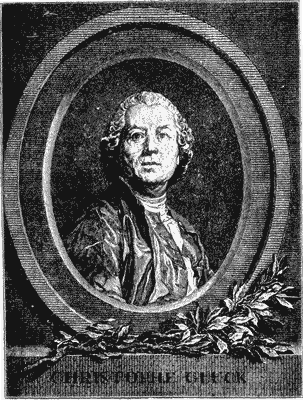
Fig. 60.
The great operatic mind of this century, and one of the greatest of
all time, was that of Christopher Willibald von Gluck (1714-1785). By
the middle of the eighteenth century the influence of the Italian
composers, helped out by the superficial German composers, such as[Pg 330]
Graun and Hasse, had reduced the Italian opera to a collection of mere
showpieces of singing, the arias having indeed an excuse in the story,
but the action of the drama had been lost entirely, owing to the long
stretches of time needed for these elaborate arias and the recalls to
which they inevitably gave rise. During these pauses the action ceased
entirely, as we see at the present day in many Italian operas still
current—as in the "mad scene" from "Lucia," for instance. In that
scene where everything ought to be wild excitement, the chorus
singers, representing the relatives and friends of poor Lucia, stand
around while she sings long cadenzas with the flute, in such trying
relationships as would test the vocal technique of a sane person. In
the time of Gluck this abuse had reached about the same height, and to
make the matter less bearable, the Italian composers had not yet
attained the art of expressing sentiment simply and directly, but were
intent upon sweet-sounding trivialities calculated to please the
groundlings, but of little or no relation to the drama. Gluck sought
to restore the ideal of the original inventors of opera, with such
unconscious modification as had been made meanwhile. But before
undertaking this he had to undergo the usual long and severe
apprenticeship of reformers. In his time the rules for a composer had
become well settled, every personage must have his or her aria
immediately upon their first entrance. The character of the arias had
been well settled. There was the aria cantabile, a flowing melody,
very lightly accompanied, affording opportunity for embellishments;
the aria di portamento, introducing long swelling notes, affording
the singer opportunity for illustrating his length of breath and
sustaining power. And so on with several other[Pg 331] forms of aria. The
part of hero, whether male or female, was assigned to a man, an
artificial soprano, although it might be a hero—like Hercules, for
example. The subject had to be classical, and the dénouement happy.
There were invariably six principal characters, three men and three
women. The first woman was always a high soprano; the second or third
a contralto; the first man, always the hero of the piece, an
artificial soprano. The second man might be an artificial soprano or a
contralto. The third man might be a bass or tenor. But it was not at
all unusual to confide all the male parts to artificial sopranos. Each
principal character claimed the right to sing an aria in each of the
three acts of the drama. Each scene ended with an aria of some one of
the classes already mentioned, but no two arias of the same class were
permitted to follow each other. Gluck was the reformer destined by the
fates to rectify some of these artificial traditions. He was educated
at the Jesuit seminary in Komotow, and later in Prague. He was engaged
in the musical forces of Prince Melzi, who took him to Italy, where he
became a pupil of the famous Italian composer and teacher, Sammartini.
To this fact, no doubt, is due his early attachment to the Italian
opera.
Here he wrote several operas, all more or less in the Italian style as
he had been taught it, and as he heard it upon every hand. His first
work, "Artaserse," the book by Metastasio, was produced with such
success in Milan, in 1741, that he presently wrote several others for
other Italian theaters. For Venice in 1741, "Demetrio," and
"Ipermestra"; for Cremona, "Artamene" (1743); for Turin,
"Alessandro nelle Indie" (1745); for Milan, "Demofoonte,"
"Siface" and "Fedra" (1742-1744); in all, eight operas in five
years. None of these[Pg 332] works in their complete form are now in
existence; fragments alone have been preserved. If any inference is
justified from these extracts the style throughout was that of the
Italian opera of the day.
The fame of Gluck had now extended to England, and in 1745 he was
invited to London to compose operas for the Haymarket theater. He came
and wrote the year following (1746) "La Caduta de Giganti," after
which he produced the Cremona opera. Händel assisted at the production
of these two operas, and is reported to have said that the author knew
no more of counterpoint than a pig. Naumann thinks that Gluck learned
much from hearing Händel's oratorios in England, and that his
subsequent deeper and nobler dramatic style was formed upon these
great models. The two operas produced in London made but a moderate
success, and Gluck was commissioned to write a "pasticcio" or medley
of styles. He did so, imitating all styles according to the best of
his ability, but it made no better effect than the works before it.
This was the turning point in his career. The failure mortified him
deeply, and led him to reflect concerning the nature of dramatic
music. On his way back to Vienna he passed through Paris, where he
heard certain operas of Rameau, which also influenced his style later.
The declamation and the dramatic treatment of the recitative were the
points upon which his attention principally dwelt. Upon reaching
Vienna he wrote a number of instrumental pieces, bearing the name of
symphonies, pieces which in no way differed from the conventional
music of the day. The Haydn symphony had not yet been invented, and
the form was wholly indeterminate. There was an opera in this year;
also a love affair. Gluck was deeply in love with the beautiful and
charming[Pg 333] daughter of a rich merchant, who upon no account would
consent to her marriage with a musician. So Gluck went back to Italy,
and there he wrote another opera, rather better in quality than his
previous ones. Early in 1750 the inexorable parent died, and late in
the year Gluck married the woman of his choice, who made him a model
wife, being educated above the average of her times, and entering into
his ideals and aspirations with ever ready sympathy. Her wealth also
placed the composer in an easy position as regarded the world, and
permitted him to devote himself to study. For nearly ten years
following Gluck produced occasionally an opera, but as yet the man
had not arrived; all these were early and apprentice works. At length
in 1762 was produced his first master work, "Orpheus and Eurydice,"
the libretto having been written by the imperial councillor Calzabigi.
The novelty of this great work was not above the appreciation of the
Viennese public of the day. "Orpheus" made a decided success. Its
principal innovations consisted in its more powerful instrumentation,
the introduction of a chorus having an integral part in the movement
of the piece, and in the highly dramatic treatment of the second act,
where Orpheus descends into the lower world to seek his lost love.
Nevertheless, the composer had not reached true self-consciousness. A
retrogression followed. He went back to Metastasio, and in conjunction
with him produced three or four small operas, all in his earlier
style. But in 1767 he returned to Calzabigi, and upon a libretto of
his wrote "Alceste" which was produced at the Vienna opera house in
1767 with vastly more success than "Orpheus." The story is that of the
tragedy of Euripides, and the music is exclusively severe and tragic.
The public was divided concerning[Pg 334] the merit of the new work. Already
the notion of a music of the future had been conceived, and the notion
suggested that only in a more self-forgetful future would a work of
such severity and of such lofty aim find acceptance.
In the dedicatory epistle to the duke of Tuscany, prefixed to the
score, Gluck defines his intentions. He says: "I seek to put music to
its true purpose; that is, to support the poem, and thus to strengthen
the expression of the feelings and the interest of the situation,
without interrupting the action. I have therefore refrained from
interrupting the actor in the fervor of his dialogue by introducing
the accustomed tedious ritournelle; nor have I broken his phrase at
an opportune vowel that the flexibility of his voice might be
exhibited in a lengthy flourish; nor have I written phrases for the
orchestra to afford the singer opportunity to take a long breath
preparatory to the accepted flourish; nor have I dared to hurry over
the second part of an aria, when such contained the passion and the
most important matter, to find myself in accord with the conventional
repeat of the same phrase four times. As little have I permitted
myself to close an aria where the sense was incomplete, solely to
afford the singer an opportunity of introducing a cadenza. In short, I
have striven to abolish all these bad habits, against which sound
reasoning and true taste have been struggling now for so long in
vain."
There were several numbers in "Alceste" which exercised an influence
upon subsequent composers, among the more notable being the speech of
the oracle, which Mozart must have had in mind in writing the
commandatore's reply to Don Giovanni; and the sacrificial march,[Pg 335]
which probably influenced the priests' march in the "Magic Flute."
Gluck was forty-eight when he wrote "Orpheus," and fifty-three when
"Alceste" appeared.
Galled by the criticisms of his countrymen, and encouraged by the
friendship of the French ambassador, Gluck now went to Paris, where
his operas were presently brought out, but with the same varying favor
as at home. Marie Antoinette, who had been his pupil, befriended him
and granted him a pension of 6,000 francs. Thus supported, he brought
out still another grand opera in the French language, "Iphigenie en
Aulide," produced at Paris in 1774. In this work classical severity
was scrupulously observed, and the opera is full of telling points of
dramatic musical coloration. In "Armide," 1777, he endeavored to
show that he was equally at home in richly conceived sensuous music,
and succeeded so well that the famous controversy was precipitated
with the Italian composer, Piccini, who had just arrived in Paris,
preparatory to bringing out his opera of "Roland." Volumes were
written in praise of Italian music, and in disparagement of the
roughnesses of that of Gluck. On the other hand, the friends of Gluck
stood up for him manfully, and the contest raged fiercely—with the
usual result of thoroughly advertising the music of both. Gluck's last
opera for Paris was "Iphigenie en Tauride," 1779, the same subject
already having been treated by his rival Piccini. The superiority of
Gluck's was incontestable. He died at Vienna, of apoplexy, November
15, 1787.
Gluck's place in art has been well summed up by Padre Martini, and the
opinion is all the more worthy of attention from the general charge of
Gluck's enemies that his music had overturned the traditions of pure
Italian[Pg 336] art. He says: "All the finest qualities of Italian, and many
of those of French music, with the great beauties of the German
orchestra, are united in his work." This is tantamount to crediting
Gluck with having created a cosmopolitan music—which is precisely the
position which posterity has assigned him. For the time when he wrote,
his music is wonderfully fine. It still retains its vitality, as has
been vividly shown in several revivals of his "Orpheus" within recent
years, in two of which (in America and in Italy) the American prima
donna, Mme. Helène Hastreiter, has nobly distinguished herself.
The third force alluded to at the outset of the chapter, as having
been mainly influential in German opera during the eighteenth century
(and until our own time, it might be added), was Mozart, whose works
have already received attention in former pages of the narrative. It
must suffice here to remind the reader of the successes and qualities
of his operas, in order that he may be remembered in this connection;
for, like Gluck, his art was cosmopolitan, having in it the sweetness
of the Italian, the richness of the German, and occasional traces of
the declamation of the French.
II.
After Lulli, the next great name in the history of French opera was
that of Jean Philippe Rameau (1683-1765). This great master was one of
the most versatile men of whom we have a record in music. He was a
mathematician, physicist, a profound theorist, and a virtuoso upon the
piano and harpsichord. He is one of the four great names in music of
the period of Bach and Händel, the fourth being Scarlatti. His
education in music began[Pg 337] while he was very young, and it is said of
him that such was his talent that he could improvise a fugue upon any
theme assigned, when he was but fourteen years of age. His father
wished him to be trained for the law, but music had greater charms for
him, and the margins of his books were marked over with crotchets and
quavers. Having become desperately in love with a fascinating young
widow, whom his father was opposed to his marrying, he was sent at the
age of seventeen to Italy, ostensibly to study. He came, therefore, to
Milan about 1701, a few years before Händel came there. Italian music
was little to his taste. The dignified declamation of the Lulli operas
seemed to him better worthy the attention of men than the tunes of the
Italians. Accordingly he took service as a violinist with a traveling
operatic troupe, and in this capacity visited the south of France. In
Paris he became a pupil of the court organist Marchand, of whom we
hear again in connection with certain tests of proficiency with
Händel. Marchand was at first delighted with his new pupil, but
presently dropped him when he discovered how talented he was, and
liable to prove a dangerous rival. Accordingly he left Paris and took
service as organist at Lille, which post he exchanged afterward for
one at Clermont. In this quiet town he devoted himself to the study of
harmony, and to reflection upon the principles of music. He read here
the works of Zarlino, and other Italian theorists, and in 1721 he
returned to Paris and published his treatise on harmony, in which he
propounded the theory of inversions. His second treatise on harmony,
"New System of Musical Theory," was published in 1725. These works
excited a great deal of attention and brought the author renown, but
his soul yearned for[Pg 338] recognition as composer, and in 1730 he obtained
from Voltaire a libretto, "Samson." This work was declined at the
national opera, on the ground that the public was not attracted by
Biblical subjects. Three years later, however, he composed another,
"Hypolite et Arcie," which was performed with moderate success. He
had now reached the age of fifty, and entered upon the second stage of
his artistic career, and the second period of the French opera. The
admirers of Rameau invited appreciation of the new works upon the
ground of their being better than those of Lulli, and all Paris was
divided into two opposite camps. Rameau is entitled to having
developed his operas more musically than those of Lulli, and the later
ones became still richer upon the orchestral side.
The entire list of operas by Rameau numbers about thirty. That they
did not preserve their popularity so long as those of Lulli is due to
their deficiency upon the dramatic side, especially to the inherent
inexpressiveness of the music itself. The treatment of the orchestra
is clever in many places, showing a manifest improvement over that of
Lulli, especially in the freedom of thematic work. He also ventures
occasionally on enharmonic changes.
Contemporaneous with him was that remarkable genius, Jean Jacques
Rousseau (1712-1778), the father of the kindergarten idea, and of many
other humanitarian and educational novelties. Rousseau's importance in
the history of music is not sufficient to justify an account of his
early days. With a great fondness for music, he found it extremely
difficult to read by note, as he was almost entirely self-taught. This
led him to devise a simpler notation, which he did about 1740,
publishing[Pg 339] an account of it in 1743. His system was substantially
that of the tonic sol fa, except that he used figures in place of
letters. He presented a memorial to the Academy of Sciences upon this
subject in 1742, but his plan was so vigorously opposed by Rameau that
nothing came of it; nevertheless the idea was afterward worked out by
M. Paris, in the present century, and has proven very useful among the
Orphéonistes. In 1752 Rameau produced his first opera "Le Devin du
Village," a very light affair, somewhat on the order of what Germans
call a Singspiel. The most remarkable piece that he produced was his
comedy "Pygmalion" in 1775. There is no song in this opera. The only
music in it is that for orchestral interludes in the intervals between
the phrases of declamation.
The continuation of French opera was due to Philidor, the celebrated
chess player (1726-1795). He was very talented in many directions, and
from the production of his first opera in 1759, to his last,
Bélisaire, finished by his friend Berton, and produced in 1796, he
enjoyed an uninterrupted popularity, having brought out in that time
about twenty-one operas, some of them comic, one or two of them
serious. His music is light and pleasing, and he is credited with
having been the first to produce descriptive airs ("Le Maréchal")
and the unaccompanied quartette ("Tom Jones," 1764). The great merit
of his works was their clever construction for the stage.
Contemporaneous with him was Pierre Alexander Monsigny (1729-1817).
Not having been intended for the profession of music, he had a
classical education, and upon the death of his father obtained a
clerkship in Paris. He belonged to a noble family, and at first
pursued music as a recreation. His first opera[Pg 340] was produced after
five months' tuition in harmony and theory, in 1759; this was followed
by about thirty other works. His greatest skill was melody and ease of
treatment. In 1812 he was appointed inspector of the Conservatory, and
in 1813 he succeeded Grétry in the Institute, and in 1816 he received
the cross of the Legion of Honor.
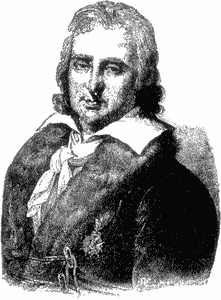
Fig. 61.
GRÉTRY.
Upon the appearance of André Ernest Modest Grétry, (1741-1813), we
come to a real genius, although not of the first order. He was the son
of a poor violinist of Liege, Belgium, and when about sixteen years of
age he composed six small symphonies and a mass. The latter gained him
the protection of the canon of the cathedral[Pg 341] who sent him to Rome,
where he pursued his studies with very little credit. After producing
one small work in Rome, he made his way to Paris, and his first opera,
"Le Huron," was successfully produced in 1768. This was followed by
more than fifty operas of all sorts, some of which still survive.
Grétry was a very charming man, and wrote upon music and other
subjects in a pleasing manner. His importance in the history of music
is due more to the number of works by him, than to their striking
musical qualities.
Another remarkable musician of this period in France was François
Joseph Gossec (1733-1829), who also was a Belgian from Hainault. His
early training was obtained in the cathedral at Antwerp. He came to
Paris in 1751 and became a pupil of Rameau. He conceived the idea of
writing orchestral symphonies, and produced some pieces of this kind
in 1754, five years before the date of Haydn's first. In 1759 he
published some quartettes. In 1760 he produced his best, "Messe des
Morts," in which he made a sensation by writing the "Tuba Mirum"
for two orchestras, one of wind instruments concealed outside. Berlioz
probably derived an idea from this. He wrote twelve operas which were
successfully produced, twenty-six symphonies and a variety of other
works. He founded his amateur concerts in 1770, and his sacred
concerts in 1773. In 1784 he organized his school of singing, out of
which the Conservatory of Music was afterward developed. Upon the
foundation of the conservatory, in 1795, he was appointed inspector
with Cherubini and Méhul. His influence upon the general development
of music is local to Paris, where he did more to enrich opera on the
instrumental side than any other composer of the eighteenth century.[Pg 342]
Étienne Henri Méhul (1763-1817) was another of these prolific
composers of light operas. Son of a cook at Givet, he had passion for
music, and soon became a good organist. At fourteen he was deputy
organist, and in 1778 he arrived in Paris and at once commenced to
study and teach. The next year he was so fortunate as to listen to
Gluck's "Iphigenie en Tauride," which made a great impression upon
him. He called upon Gluck himself in order to express his admiration,
and, in consequence of the encouragement received from the eminent
composer, he proceeded to write three operas, one after another, which
are now lost. His fourth was accepted at the Academy, but not
performed. Finally his "Euphrosine et Coradin" was produced at the
Opéra Comique in 1790. The public immediately recognized a force, a
sincerity of accent, a dramatic truth, and a gift of accurately
expressing the meaning of words, which always remained the main
characteristics of Méhul. Within the next seventeen years he produced
twenty-four operas, besides a large number of cantatas and other
works. Upon the whole, this sincere master must be regarded as one of
the most eminent in the history of French opera.
Somewhat later in the operatic field was Jean François Lesueur
(1763-1837). After serving as a boy chorister at Abbeville and Amiens,
he came to Paris, where in 1786 he was appointed musical director at
Notre Dame, and distinguished himself by giving magnificent
performances of motettes and solemn masses, with a large orchestra in
addition to the usual forces. His first opera, "La Caverne," was
produced in 1793, after which he wrote four others, as well as three
which were never performed. In the line of church music he was much
more[Pg 343] productive, and one might say, more at home. His music is marked
by grand simplicity. As a teacher in later life he was very
celebrated, among his pupils being the greatest of French masters,
Berlioz.
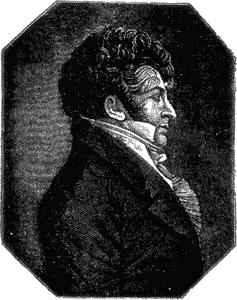
Fig. 62.
BOIELDIEU.
The most gifted of the French composers of light opera at the end of
the eighteenth century, and in the part of the nineteenth, was
François Adrien Boieldieu (1775-1834). This talented musician was born
at Rouen, where his father was secretary to the archbishop. The boy
was educated in the ecclesiastical schools, having begun as a choir
boy in the cathedral. His first little work for the stage was
performed at Rouen when he was about seventeen, "La Fille Coupable,"
with such success that the author was encouraged to go and seek[Pg 344] his
fortune in Paris. Here for a long time he met with little
encouragement, and was obliged to make a living at first as a piano
tuner; later he was fortunate enough to have certain romances of his
sung by popular singers, and thus his name became somewhat known. For
these songs he received the munificent compensation of two dollars and
a half each. Presently he secured a libretto, "La Dot de Suzette,"
which was composed and performed at the Opéra Comique, with so much
encouragement, that he soon after produced his one-act opera, "La
Famille Suisse." His popularity was not fully established, however,
until "Zoraime et Zulnare" in 1798. This work possesses a vein of
tenderness, a refined orchestration, and singularly clear and pleasing
forms. In 1800 his world-wide favorite, "Le Caliph de Bagdad," was
produced, and its taking overture was played from one end of Europe to
the other, upon all possible instruments and combinations of them. His
other two successful operas were "Jean de Paris" (1812), and "La
Dame Blanche" (1825). Both these made as much reputation outside of
France as in it, and are still produced in Germany. In 1803 Boieldieu
received an appointment in St. Petersburg and lived there six years,
but he returned to Paris later, and in 1817 became Méhul's successor
as teacher of composition at the Conservatory.
Of the French stage during this epoch it is to be observed that
nothing of a large and serious character was produced upon it, except
the operas of Gluck, which of course were not indigenous to France.
What progress was made by the composers before mentioned, and others
of less importance, consisted in acquiring fluency, ease and effective
construction. The ground had been prepared from which the century
following would reap a harvest.[Pg 345]
III.
In Italy during the eighteenth century, opera continued to be
cultivated by a succession of gifted and prolific composers. At the
beginning of the century, the great Alexander Scarlatti was at the
height of his career, as also were Lotti and the younger masters
mentioned in the former chapter. All these composers followed in the
style established by Scarlatti and Porpora. The most talented of the
Italians of this period was Giovanni Batista Pergolesi (1710-1737).
This gifted genius was born at Jesin, in the Roman states, but when a
mere child, was admitted to the conservatory "Of the Poor in Jesus
Christ" at Naples, where his education was completed. He commenced as
a violin player, and attracted attention while a mere child by his
original passages, chromatics, new harmonies and modulations. A report
of his performances of this kind being made to his teacher Matteis, he
desired to hear them for himself, which he did with much surprise, and
asked the boy whether he could write them down. The next day the
youngster presented himself with a sonata for the violin, as a
specimen of his power; this led to his receiving regular instruction
in counterpoint. The first composition of his was a sacred drama
called "La Conversione di St. Guglielmo," written while he was still
a student. It was performed with comic intermezzi (sic!) in the
summer of 1731, at the cloister of St. Agnello. The dramatic element
in this work is very pronounced, and the violin is treated with
considerable feeling. His first opera, "La Salustia," was produced
in 1731. It is notable for improvement in the orchestration. In the
winter of this same year he wrote his comic intermezzo,[Pg 346] "La Serva
Padrona," a sprightly operetta, which had a moderate success at the
time, but afterward for nearly a hundred years was played in all parts
of Europe. He wrote several other operas, which had but moderate
success, although many of them were performed with considerable
applause after his death. By general consent the most beautiful work
of Pergolesi was his "Stabat Mater," which was written to order for
a religious confraternity, for use on Good Friday, in place of a
"Stabat" by Scarlatti, the price paid being ten ducats—about nine
dollars. It is for two voices, a soprano and contralto, and is
excellently written. No sooner was he dead than his music immediately
became the object of admiration, his operas and lighter pieces being
played in all parts of Italy. He died at the age of twenty-six, being
the youngest master who has ever left a permanent impression in
musical history.
One of the most prolific composers of this period was Nicolo Jomelli
(1714-1774). Jomelli represents the Neapolitan school, having been
educated first at the conservatory of San Onofrio, and later at that
of "La Pieta de' Turchini." His earlier inclination was church
music, and in order to perfect himself in it he went to Rome. This was
in 1740, and two of his operas were there produced. He afterward
visited Vienna, where he produced several operas, and in 1749 he was
appointed assistant musical director at St. Peter's in Rome, a
position which he held for five years, after which he went to
Stuttgart, as musical director. While in Germany he had a very great
reputation as an opera composer. In 1770 Mozart wrote from Naples,
"The opera here is by Jomelli; it is beautiful, but the style is too
elevated as well as too antique for the theater." His later life was
spent in[Pg 347] Naples. Besides many operas he wrote a number of
compositions for the church. It perhaps gives a good idea of the
estimation in which he was held while living, that a critic highly
esteemed in his day said that it would be a sorry day for the world
when the operas of Jomelli were forgotten, at the same time
pronouncing them superior to those of Mozart. Not a single line of
Jomelli is performed at the present time, nor is likely ever to be;
but the works of Mozart still retain their popularity.
Another prolific composer of the Neapolitan school was Antonio Maria
Gasparo Sacchini (1724-1786). This clever composer was very successful
in his lifetime, his operas being produced in all parts of Europe.
Nevertheless they are monotonous in character, and have little depth.
He has very little importance for the history of music. Still another,
also from the Neapolitan school, was Piccini (1728-1800). His first
operas were produced in 1754, and from that time on for about forty
years he was a very popular composer, his works being produced in
every theater, and in 1778 he was set up as an idol by his admirers,
in opposition to Gluck. He was highly honored by Napoleon, who took
pleasure in distinguishing him for the sake of humbling several much
more deserving musicians. The complete list of his works in Fétis
contains eighty operas. His biographer credits him with one hundred
and thirty-three. Yet another composer of the Neapolitan school was
Giovanni Paisiello (1741-1815). From the time of his first operas to
his death, he was highly esteemed as a composer. In 1776 he was
invited by the Empress Catharine to St. Petersburg, where he lived for
eight years, and among other operas which he composed while there was
"Il[Pg 348] Barbiere di Siviglia." In 1799 he was called to Paris, where
Napoleon very greatly distinguished him. Upon leaving Paris, in 1803,
Napoleon desired him to name his successor, when he performed the
creditable act of nominating Lesueur, who was at that time unknown.
The list of his works embraces ninety-four operas and 103 masses. His
music was melodious and pleasing, but rather feeble; he is regarded,
however, as the inventor of the concerted finale, which has since been
so largely developed in opera. Perhaps the best of all the Neapolitan
composers of this half century was Zingarelli (1752-1827). Zingarelli
was not only a good musician and a good composer, but a man of ability
and principle. He was an associate pupil with Cimarosa. After leaving
the conservatory he took lessons upon the violin, and in 1779 produced
a cantata at the San Carlo theater. Two years later his first opera
was produced at the same theater with great applause, "Montezuma."
He then went to Milan, where most of his later works were produced. He
was an extremely rapid worker, his librettist stating it as a fact
that all the music of his successful opera of "Alsinda" was composed
in seven days, although the composer was in ill health at the time.
Another of his best works, his "Giulietta e Romeo," was composed in
about eight days. It is said that this astonishing facility was
acquired through the discipline of his teacher Speranza, who obliged
his pupils to write the same composition many times over, with change
of time and signature, but without any change in the fundamental
ideas. While busily engaged as a popular opera composer, Zingarelli
found time to compose much church music, his most important works
being masses and cantatas. Of the former there still exist a very
large number; of the latter[Pg 349] about twenty. He made a trip to France in
1789, where he brought out a new opera, "L'Antigone"; he was
appointed musical director at the cathedral at Milan in 1792, and two
years later at Loretto, Naples. Thence he was transferred to the
Sistine chapel at Rome, and finally in 1813 he was appointed director
of the Royal College of Music at Naples, in which position he spent
the remainder of his long and active life.
He produced about thirty-two operas, twenty-one oratorios and
cantatas, and there are about 500 manuscripts of his in the "Annuale
di Loreto." As a composer of comic operas Zingarelli became popular
all over Europe, but he was nevertheless a serious, even a devout
composer. He was extremely abstemious, rose early, worked hard all
day, and, after a piece of bread and a glass of wine for supper,
retired early to rest. He was never married, but found his
satisfaction in the successes of his musical children, among whom were
Bellini, Mercadante, Ricci, Sir Michael Costa, Florimo, etc.
IV.
In this, as in the preceding century, there was very little activity
in England in the realm of opera music, beyond that of foreign
composers imported for special engagements. In the last part of the
seventeenth century, however, there was a real genius in English
music, who, if he had lived longer, would in all probability have made
a mark distinguishable even across the channel, and upon the chart of
the world's activity in music. That composer was Henry Purcell
(1658-1695), born in London, of a musical family. His father having
died while the boy was a mere infant, he was presently admitted as a
choir boy in the Chapel Royal, the musical director[Pg 350] being Captain
Cook, and later Pelham Humpfrey. In 1675, when yet only seventeen
years of age, Purcell composed an opera, "Dido and Æneas," which is
grand opera in all respects, there being no spoken dialogue but
recitative—the first work of the kind in English. It contains some
very spirited numbers. After this he composed music to a large number
of dramatic pieces, many anthems, held the position of master of the
Chapel Royal, and in many ways occupied an honored and distinguished
position. He was one of the earliest composers to furnish music to
some of Shakespeare's plays, and his "Full Fathom Five" and "Come unto
These Yellow Sands," from the "Tempest," have held the stage until the
present time. He was in all respects the most vigorous and original of
English composers. He died in the fullness of his powers and was
buried in Westminster Abbey. The portrait here given was painted by
John Closterman, and originally engraved for his "Orpheus
Britannicus." It is[Pg 351] impossible not to wonder whether the future of
English music might not have been better if the powerful figure of the
great master Händel had not dwarfed all native effort in Britain after
Purcell.
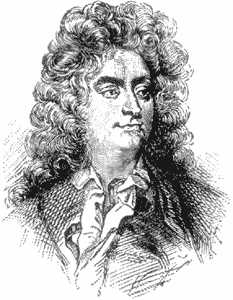
Fig. 63.
HENRY PURCELL.
In the eighteenth century the most notable English composer was Dr.
Thomas Arne (1710-1778), who enjoyed a well deserved reputation as an
excellent dramatic composer, the author of many songs still reckoned
among English classics, and the composer of the national hymn "Rule
Britannia," which occurred as an incident in his masque of "Alfred,"
1740. Dr. Arne has all the characteristics of a genuine national
composer. His music was immediately popular, and held the stage for
many years. His first piece was Fielding's "Opera of Operas," produced
in 1733. The full list of his pieces reached upwards of forty-one
operas and plays to which he furnished the music, two oratorios,
"Abel" and "Judith," and a variety of occasional music. His style is
somewhat like that of Händel, a remark which was true of all English
composers for more than a hundred years after Händel's death; but it
is forcible, melodious and direct. His music was not known outside of
England.
[Pg 352]
CHAPTER XXX.
PIANO PLAYING AND VIRTUOSI; THE VIOLIN;
TARTINI AND SPOHR.
I.
T was during the eighteenth century that the pianoforte definitely
established itself in the estimation of musicians, artists and the
common people, as the handiest and most useful of domestic and solo
instruments. The progress was very slow at first, the musicians such
as Bach, Händel, Scarlatti and Rameau, the four great virtuosi of the
beginning of this century, generally preferred the older forms of the
instrument, the clavier or the harpsichord, both on account of their
more agreeable touch and the sweetness of their tones. Nevertheless
the style of playing and of writing for these instruments underwent a
gradual change at the hands of these very masters, of such a character
that when the pianoforte became generally recognized as superior to
its predecessors, about the middle of the century, the compositions of
Bach and Scarlatti were found well adapted to the newer and more
powerful instrument. The pianoforte itself underwent several
modifications from the primitive forms of action devised by Cristofori
in 1711, rendering it more responsive to the touch. All this, relating
to the mechanical perfection of the instrument, although appropriate
in part to the present moment of the[Pg 353] narrative, is deferred until a
later chapter, when the entire history of this instrument will be
considered in detail. From that it will be seen, by comparing dates,
that every important mechanical step in advance was followed by
immediate modifications of the style of writing and playing, whereby
the progress toward fullness and manifold suggestiveness of music for
this instrument has been steady and great.
The first of the great virtuosi was Domenico Scarlatti (1683-1757),
son of the great Alessandro Scarlatti, and a pupil of his father, and
of other masters whose names are now uncertain. He was a moderately
successful composer of operas and works for the Church, but his
distinguishing merit was that of a virtuoso upon the harpsichord—the
pianoforte of that time. He was the first of the writers upon the
harpsichord who introduced difficulties for the pleasure of overcoming
them, and who, in his own country, was without peer as performer until
Händel came there and surpassed him, in 1708. Scarlatti was also a
performer upon the organ, but upon this instrument he unhesitatingly
confessed Händel to be his superior. In 1715 Scarlatti succeeded Baj
as chapel master at St. Peter's in Rome, where he composed much church
music. His operas were successful in their own day, but were soon
forgotten. His pianoforte compositions still remain as a necessary
part of the education of the modern virtuoso. They are free in form,
brilliant in execution, and melodious after the Italian manner. Many
of them are still excessively difficult to play, in spite of the
progress in technique which has been made since.
There were many other composers in the early part of this century who
exercised a local and temporary[Pg 354] influence in the direction of
popularizing the pianoforte and its music, through the attractiveness
of their own playing, as well as by the compositions they produced.
Among these must not be forgotten Mattheson, the Hamburgh composer of
operas (p. 242), who published many works for piano, including suites,
sonatas and other pieces in the free style. Johann Kuhnau (1667-1722),
predecessor of Bach as cantor at Leipsic, published a variety of
sonatas and other compositions in free style, about the beginning of
the eighteenth century. Of still greater importance than the last
named, was Rameau, the French theorist and operatic composer (p. 336).
His compositions were attractive and very original, and in addition to
the charm of his own playing, and that of his works, he placed later
musicians under lasting obligations by his treatise upon the art of
accompanying upon the clavecin and organ, in which his theories of
chords were applied to valuable practical use.
The work of all these and of many others who might be mentioned, not
forgetting several English writers, such as Dr. Blow, Dr. John Bull
and the gifted artist Purcell (see p. 350), must be regarded as merely
preparatory for the advance made during the last part of the
eighteenth century. It was Haydn who began to demand of the pianoforte
more of breadth, and a certain coloration of touch, which he must have
needed in his elaborative passages in the middle of the sonata piece.
This kind of free fantasia upon the leading motives of the work, was
planned after the style of thematic discussion of leading motives by
the orchestra, and the obvious cue of the player is to impart to the
different sequences and changes of the motives as characteristic
tone-colors as possible, for the sake of rendering them more
interesting[Pg 355] to the hearers, and possibly of affording them more
expression. Haydn's work was followed by that of Mozart, who gave the
world the adagio upon the piano. Then in the fullness of time came
Beethoven, who after all must be regarded as the great improver of
piano playing of this century, as well as that of the next following.
Beethoven improved the piano style in the surest and most influential
manner possible. In his own playing he was far in advance of the
virtuosi of the eighteenth century, and in his foresight of farther
possibilities in the direction of tone sustaining and coloration he
went still farther. This is seen in all his concertos, especially in
the fourth and fifth, in the piano trios, and the quartette; but still
more in the later pianoforte sonatas. Here the piano is treated with a
boldness, and at the same time a delicacy and poetic quality, which
taxes the greatest players of the present time to accomplish. The most
advanced virtuoso works of Chopin, Schumann and Liszt, the three great
masters of the pianoforte in the nineteenth century, are but slightly
beyond the demands of these later sonatas of the great Vienna master.
In the later part of the eighteenth century there were a number of
pianoforte virtuosi whose merits claim our attention at this point. At
the head, in point of time, was the great Italian master, Muzio
Clementi (1752-1832). Born at about the same time as Mozart, he
outlived Beethoven. His early studies were pursued at Rome with so
much enthusiasm that at the age of fourteen he had produced several
important compositions of a contrapuntal character. These being
successfully performed, attracted the attention of an English amateur
living in Rome, who offered to take charge of the boy, carry him to
England and see that his career was opened under[Pg 356] favorable auspices.
Until 1770, therefore (the year of Beethoven's birth), Clementi
pursued his studies near London. Then, in the full force of his
remarkable virtuosity, he burst upon the town. He carried everything
before him, and had a most unprecedented success. His command of the
instrument surpassed everything previously seen. After three years as
cembalist and conductor at the Italian opera in London, he set out
upon a tour as virtuoso. In 1781 he appeared in Paris, and so on
toward Munich, Strassburg, and at length Vienna, where he met Haydn,
and where, at the instigation of the Emperor Joseph II, he had a sort
of musical contest with the young Mozart. Clementi, after a short
prelude, introduced his sonata in B flat, the opening motive of which
was afterward employed by Mozart in the introduction to the overture
to the "Magic Flute"; and followed it up with a toccata abounding in
runs in diatonic thirds and other doublestops for the right hand, at
that time esteemed very difficult. The victory was regarded as
doubtful, Mozart compensating for his less brilliant execution by his
beautiful singing touch, of which Clementi ever afterward spoke with
admiration. Moreover, from this meeting he himself endeavored to put
more music and less show into his own compositions. Clementi was soon
back in England, where he remained until 1802, when he took his
promising pupil, John Field, inventor of the nocturne, upon a tour of
Europe, as far as St. Petersburg, where they were received with
unbounded enthusiasm. In 1810 he returned to London and gave up
concert playing in public. He wrote symphonies for the London
Philharmonic Society, published very many sonatas for piano (about 100
in all), and in 1817 published his master work, a set of 100 studies
for the piano, in all[Pg 357] styles, the "Gradus ad Parnassum," upon which
to a considerable extent the entire modern art of piano playing
depends. Clementi's idea in the work was to provide for the entire
training of the pupil by means of it; not alone upon the technical,
but upon the artistic side as well, and the majority of the pieces
have artistic purpose no less than technical. The wide range taken by
piano literature since Clementi's day, however, reduces the teacher to
the alternative of confining the pupil to the works of one writer, in
case the entire work is used, or of employing only the purely
technical part of the "Gradus," accomplishing the other side of the
development by means of compositions of more poetic and older masters.
The latter is the course now generally pursued by the great teachers,
and this was the reason influencing the selection of studies from the
"Gradus" made by the virtuoso, Tausig. Clementi's compositions
exercised considerable influence upon Beethoven, who esteemed his
sonatas better than those of Mozart. The opinion was undoubtedly based
upon the freedom with which Clementi treated the piano, as
distinguished from the gentle and somewhat tame manner of Mozart. The
element of manly strength was that which attracted Beethoven, himself
a virtuoso.
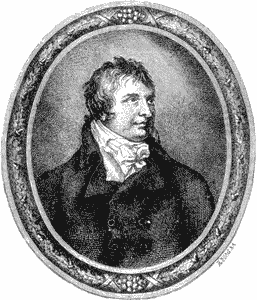
Fig. 64.
J.L. DUSSEK.
Another of the first virtuosi to gain distinction upon the pianoforte,
in the latter part of this century and the first part of the
nineteenth, was J.L. Dussek (1761-1812). This highly gifted musician
was born in Czaslau, in Bohemia, and his early musical studies were
made upon the organ, upon which he early attained distinction, holding
one prominent position after another, his last being at Berg-op-Zoom.
He next went to Amsterdam, and presently after to the Hague, still
later, in 1788,[Pg 358] to London, where he lived twelve years. It was there
that Haydn met him, and wrote to Dussek's father in high terms of his
son's talents and good qualities. Afterward he was back again upon the
continent, living for some years with Prince Louis Ferdinand, and
having right good times with him, both musically and festively. He
died in France. He made many concert tours in different periods of his
life, and his playing was highly esteemed from one end of Europe to
the other. A contemporary writer says of him: "As a virtuoso he is
unanimously placed in the very first rank. In rapidity and sureness of
execution, in a mastery of the greatest[Pg 359] difficulties, it would be
hard to find a pianist who surpasses him; in neatness and precision of
execution, possibly one (John Cramer, of London); in soul,
expression and delicacy, certainly none." The brilliant pianist and
teacher Tomaschek said of him: "There was, in fact, something magical
in the manner in which Dussek, with all his charming grace of manner,
through his wonderful touch, extorted from the instrument delicious
and at the same time emphatic tones. His fingers were like a company
of ten singers, endowed with equal executive powers, and able to
produce with the utmost perfection whatever their director could
require. I never saw the Prague public so enchanted as they were on
this occasion by Dussek's splendid playing. His fine declamatory
style, especially in cantabile phrases, stands as the ideal for
every artistic performance—something which no other pianist since has
reached. He was the first of the virtuosi who placed the piano
sideways upon the platform, although the later ones may not have had
an interesting profile to exhibit."
The published works of this fine musician and creditable composer
number nearly 100, and the sonata cuts a leading figure among them. He
treated the piano with much more freedom and breadth than Mozart,
though this is not so much to his credit as if he had not lived many
years after Mozart died, his earliest compositions falling very near
the last years of that great genius. He was distinctly a virtuoso,
loving his instrument and its tonal powers. He was the first of all
the players whose public performances called attention to the
quality of tone, and its singing power. This also points not alone
to the fact of his career falling in with[Pg 360] the increased powers of the
pianoforte, as a result of the inventions of Érard, Collard and
Broadwood, but is to his personal credit, since it was genius in him
enabling him to recognize these possibilities, at a time when most
players were still in ignorance of them. As a composer he wrote many
things of more than average excellence, and some of his lighter
compositions still have vitality. It is altogether likely that
Beethoven was influenced by Dussek's playing, in the direction of
tone-color. Indeed, the third sonata of Beethoven can hardly be
accounted for without recognizing Dussek as the composer upon some one
of whose works its general style and form were modeled.
Another pianist of considerable importance, a disciple of Mozart, yet
with originality of his own, was J.B. Cramer (1771-1858). This
talented and deserving musician was the son of a musician living at
Mannheim, who removed to London when the young Cramer was but one year
old. There the boy grew up, receiving his education from several
reputable masters, Clementi being among them. His taste was formed by
the diligent study of the works of Emanuel Bach, Haydn and Mozart. In
spirit Cramer was a disciple of the last named, but from living to a
good old age, he naturally surpassed his ideal in the treatment of the
pianoforte. In the latter part of the eighteenth century there were
few musical compositions sold over the music counters in Vienna and
the musical world generally, but those of Dussek, Cramer and Pleyel,
while those of Beethoven were comparatively neglected. Cramer's
compositions were slight in real merit, his fame resting upon his
studies for the piano, of which about thirty out of the entire 100 are
very good music. The second, and last, book of[Pg 361] these were published
in 1810. They do not form a necessary part of the training of a
virtuoso, but they have decided merits, and are generally included to
this day in the list of pianistic indispensables. Cramer's style of
playing was quiet and elegant. Moscheles gives an idea of it in his
diary, and regrets that he should allow the snuff, which he took
incessantly, to get upon the keys. Cramer's studies preceded those of
Clementi, and very likely may have inspired them through a desire of
illustrating a bolder and more masterly style of pianism.
Among the many talented pupils of Clementi was Ludwig Berger
(1777-1838), of Berlin, whose unmistakable gifts for the piano
attracted the master's attention when he was in Berlin in 1802, and he
took him along with him to St. Petersburg. After living some years in
that city, and later in London, he returned to Berlin, where he was
held in the highest esteem as teacher until his death. Among the
distinguished who studied with him were Mendelssohn, Taubert, Henselt,
Fanny Hensel, Herzsberg, and others. He was an indefatigable composer
of decided originality. But few of his works were published. A set of
his studies is highly esteemed by many.
In further illustration of the Mozart principles of piano playing, and
with a reputation as composer, which in his lifetime was curiously
beyond his merits, was J.M. Hummel (1778-1837). He was born at
Presburg, and had the good luck to attract the favorable notice of
Mozart. He was received into the house of the master, and was regarded
as the best representative of Mozart's ideas. He made his early
appearances as a child pianist under the care of his father, in most
parts of Germany and Holland. In 1804 he succeeded Haydn as musical[Pg 362]
director to the Esterhazy establishment. He afterward held several
other appointments of credit, and played much in all parts of Europe.
He was a pleasant player, with a light, smooth touch, suited to the
Viennese pianofortes of the time.
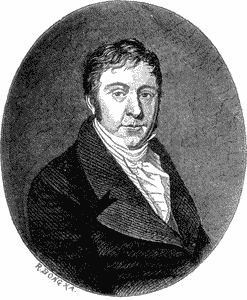
Fig. 65.
HUMMEL.
The latest of the virtuosi representing the classical traditions of
the pianoforte, uninfluenced by the new methods which came in with
Thalberg and Liszt, was Ignaz Moscheles (1794-1870). He was born at
Prague, his father being a cloth merchant and Israelite.[Pg 363]
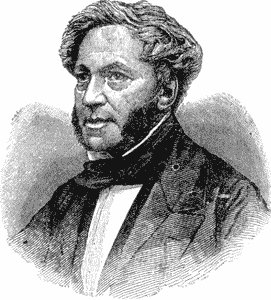
Fig. 66.
MOSCHELES.
He had the usual childhood of promising musicians, playing everything
he could lay his hands upon, including Beethoven's "Sonata
Pathetique," and at the age of seven he was taken to Dionys Weber,
whose verdict is worth remembering. He said: "Candidly speaking, the
boy is on the wrong road, for he makes hash of great works which he
does not understand, and to which he is entirely unequal. But he has
talent, and I could make something of him if you were to hand him over
to me for three years, and follow out my plan to the letter. The first
year he must play nothing but Mozart, the second Clementi, the third
Bach; but only that—not a note as yet of Beethoven, and if he
persists in using the cir[Pg 364]culating musical libraries, I have done with
him forever." Having completed his studies after this severe régime,
Moscheles began his concert appearances, which were everywhere
successful.
He continued his studies in Vienna with Salieri, and Beethoven thought
so well of him that he engaged him to make the pianoforte arrangement
of "Fidelio." This was in 1814.
In 1815 he produced his famous variations upon the Alexander march,
Opus 32, from which his reputation as virtuoso dates. His active
concert service began about 1820, and extended throughout Europe. In
1826 he settled in London, where he was held in the highest esteem,
both as man and musician. He became a fast friend of Mendelssohn, who
had been his pupil in Berlin, and in 1846 joined him at Leipsic, where
he continued until his death. Moscheles was originally a solid and
brilliant player. Later he became famous as one of the best living
representatives of the true style and interpretation of the Beethoven
sonatas. He never advanced beyond the Clementi principles of piano
playing, the works of Chopin and Liszt remaining sealed books to his
fingers, to the very last. As a teacher he was painstaking and
patient, and he was honored by all who knew him. All his life he kept
a diary, from which a very readable volume has been compiled, with
many glimpses of other eminent musicians. It is called "Recent Music
and Musicians."
II.
The art of violin playing also made great progress during this
century, its most eminent representative being Giuseppe Tartini
(1692-1770). He was born in Pirano, in Istria, and was intended for
the church, but[Pg 365] upon coming of age he fell in love with a lady
somewhat above him in rank, and was secretly married to her. When this
fact was discovered by her relatives he was obliged to fly, and having
taken refuge in a monastery he remained there two years, during which
he diligently devoted himself to music, being his own instructor upon
the violin, but a pupil of the college organist in counterpoint and
composition. Later, being united to his wife, he made still further
studies on the violin, and by 1721 had returned to Padua, where he
evermore resided, his reputation bringing him a sufficient number of
pupils to assist his rather meager salary as solo violinist of the
cathedral. He was a virtuoso violinist greater than any one before
him. Besides employing the higher positions more freely than had
previously been the case, he appears to have made great improvements
in the art of bowing, and his playing was characterized by great
purity and depth of sentiment, and at times with most astonishing
passion. He was a composer of extraordinary merit, several of his
pieces for the violin still forming part of the concert repertory of
artists. His famous "Trillo del Diavolo," is well known. He dreamed
that he had sold his soul to the devil, and on the whole was well
pleased with the behavior of that gentlemanly personage. But it
occurred to him to ask his strange associate to play something for him
on the violin. Cheerfully Satan took the instrument, and immediately
improvised a sonata of astonishing force and wild passion, concluding
it with a great passage of trills, of superhuman power and beauty;
Tartini awoke in an ecstasy of admiration. Whereupon he sought after
every manner to reduce to paper the wonderful composition of his
dream. Fine as was the work thus produced, Tartini[Pg 366] always maintained
that it fell far short of the glorious virtuoso piece which he had
heard.
Tartini was in some sort a forerunner of the modern romantic school.
He was accustomed to take a poem as the basis of an instrumental
piece. He wrote the words along the score and conducted the music
wherever the spirit of the words took it. He was also in the habit of
affixing to his published works mottoes, indicative of their poetic
intention. With this general characterization his music well agrees,
for in dreamy moods it has a mystical beauty till then unknown in
music. He is also entitled to lasting memory on account of his having
first discovered the phenomenon of "combination tones," the under
resultant which is produced when two tones are sounded together upon
the violin, especially in the higher parts of the compass. These tones
are the roots of the consonances sounding, and Tartini directed the
attention of his pupils to them as a guide to correct intonation in
double stops, since they do not occur unless the intonation is pure.
He made this important discovery about 1714, and in 1754 he published
a treatise on harmony embodying the combination tones as a basis of a
system of harmony. This having been violently attacked, his second
work of this kind, "On the Principles of Musical Harmony Contained in
the Diatonic Genus," was published in 1767. Tartini, therefore, must
be reckoned among the great masters who have contributed to a true
doctrine of the tonal system. Copies of his theoretical writings are
in the Newberry Library at Chicago.
In the latter part of the eighteenth century and the first of the next
following the art of violin playing was best illustrated by the German
artist, Louis Spohr (1784-1859), who was almost or quite as great as a
composer,[Pg 367] as in his early career of a virtuoso. In his own specialty
he was one of the most eminent masters who has ever appeared. His
technique was founded upon that of his predecessors of the school of
Viotti and Rode, but his own individuality was so decided that he soon
found out a style original with himself. Its distinguishing quality
was the singing tone. He never reconciled himself to the light bow
introduced by Paganini, and all his work is distinguished by
sweetness, singing quality and a flowing melodiousness. He was fond of
chromatic harmonies and double stops, which imparted great sonority to
his playing. He was born at Brunswick, and early commenced to study
music. At the age of fifteen he played in the orchestra of the duke of
Brunswick, at a yearly salary of about $100. Later he studied and
traveled with Eck, a great player of the day, and upon his return to
Brunswick he became leader of the orchestra. His virtuoso career
commenced about 1803. Two years later he became musical director at
Gotha, where he married a charming harp player, Dorette Scheidler, who
invariably afterward appeared with him in all their concerts. They
traveled in their own carriage, having suitable boxes for the harp and
the violin. In 1813 he was musical director at the theater, "An der
Wein," at Vienna, where among his violinists was Moritz Hauptmann,
afterward so celebrated as theorist.
Soon after his arrival in Vienna, Spohr received a singular
proposition from one Herr von Tost, to the effect "that for a
proportionate pecuniary consideration I would assign over to him all I
might compose, or had already written, in Vienna, for the term of
three years, to be his sole property during that time; to give him the
original scores, and to keep myself even no copy of them.[Pg 368] After the
lapse of three years he would return the manuscript to me, and I
should then be at liberty either to publish or sell them. After I had
pondered a moment over this strange and enigmatical proposition, I
asked him whether the compositions were not to be played during those
three years? Whereupon Herr von Tost replied: 'Oh, yes! As often as
possible, but each time upon my lending them for that purpose, and
only in my presence.'" He desired such pieces as could be produced in
private circles, and would therefore prefer quartettes and quintettes
for stringed instruments, and sextettes, octettes and nonettes for
stringed and wind instruments. Spohr was to consider the proposition
and fix upon the sum to be paid for the different kinds of
compositions. Finding on inquiry that Herr von Tost was a wealthy man,
very fond of music, Spohr fixed the price at thirty ducats for a
quartette, thirty-five for a quintette, and so on, progressively
higher for the different kinds of composition. On being questioned as
to his object, Von Tost replied: "I have two objects in view: First, I
desire to be invited to the musical parties where you will execute
your compositions, and for that I must have them in my keeping.
Secondly, possessing such treasures of art, I hope upon my business
journeys to make extensive acquaintance among the lovers of music,
which may then serve me also in my manufacturing interests." This
singular bargain was duly consummated and faithfully carried out, and
the wealthy patron proved of great service to the Spohrs in procuring
their housekeeping outfit from various tradesmen with whom he had
dealings, and he would not suffer Spohr to pay for anything, saying
only, "Give yourself no uneasiness; you will soon square everything
with your compositions."[Pg 369]
The most important of Spohr's works is his great school for the
violin, published in 1831. He left also a vast amount of chamber
music, fifteen concertos for violin and orchestra, nine symphonies,
four oratories, of which "The Last Judgment" is perhaps the best, ten
operas, many concert overtures, etc.—in all more than 200 works, many
of them of large dimensions. His best operas are "Jessonda" (1823),
"Faust" (1818), "The Alchemist" (1832) and "The Crusaders" (1845). His
orchestral works are richly instrumented, and the coloring is sweet
and mellow, yet at times extremely sonorous.
During his residence in Vienna, Spohr met Beethoven many times. He was
one of the first to introduce the earlier quartettes, in his concerts
throughout Germany, and valued them properly. But in regard to the
Beethoven symphonies he placed himself on record in a highly
entertaining manner. He says of the melody of the famous "Hymn to
Joy," in Beethoven's ninth symphony, that it is so "monstrous and
tasteless, and its grasp of Schiller's ode so trivial, that I cannot
even now understand how a genius like Beethoven could have written
it."
[Pg 371]

THE
Period of the Romantic.
WEBER, PAGANINI, SCHUBERT, BERLIOZ, MEYERBEER,
MENDELSSOHN, SCHUMANN,
CHOPIN, LISZT,
WAGNER; THE VIRTUOSI; MUSIC
OF THE FUTURE.
[Pg 373]
CHAPTER XXXI.
THE NINETEENTH CENTURY, THE ROMANTIC;
MUSIC OF THE FUTURE.
N ordinary speech a distinction is made between the musical
productions of the eighteenth century and those of the next following;
the former being called Classic, the latter Romantic. The terms
are used rather indefinitely. According to Hegel, whose teaching
coincided with the last years of Beethoven's life, the classic in art
embraces those productions in which the general is aimed at, rather
than the particular; the reposeful and completely satisfactory,
rather than the forced, or the sensational; and the beautiful
rather than the exciting. The philosopher Hegel, who was one of the
first to employ this distinction in art criticism, took his departure
from the famous group of Laocoön and his sons in the embrace of the
destroying serpents. This group, so full of agony and irrepressible
horror, belongs, he said, to a totally different concept of art from
that of the gods and goddesses of Greece, in the beauty and freshness
of their eternal youth. These qualities are those of the general and
the eternal; the Laocoön, in its nature painful, was not nor could be
permanently satisfactory in and of itself, but only through allowance
being made by reason of interest in the story told by it. According to
more recent philosophers, the romantic[Pg 374] movement in literature and art
(for they are parts of the same general movement of the latter part of
the eighteenth century) has its essential characteristic in the
doctrine that what is to be sought in art is not the pleasing and the
satisfactory, so much as the true. Everything, they say, belonging
to life and experience, is fit subject of art; to the end that thereby
the soul may learn to understand itself, and come to complete
self-consciousness. The entire movement of the romantic writers had
for its moving principle the maxim, Nihil humanum alienum a me puto
("I will consider nothing human to be foreign to me"). Yet other
writers make the romantic element to consist of the striking, the
strongly contrasted, the exciting, and so at length the sensational.
Whichever construction we may put upon this much used and seldom
determined term, its general meaning is that of a distinction from the
more moderate writings and compositions of the eighteenth century.
Individualism, as opposed to the general, is the key to the
romantic, and in music this principle has acquired great dominance
throughout the century in which we are still living. Moreover, if the
principle of individualism had not been discovered in its application
to the other arts, it must necessarily have found its way into music,
for music is the most subjective of all the arts; having indeed its
general principles of form and proportion, but coming to the composer
(if he be a genius) as the immediate expression of his own feelings
and moods, or as the interplay of his environment and the inner
faculties of musical phantasy.
In this sense there is a difference between the music of Bach and
Mozart, on the one hand, and that of Beethoven and Schubert, on the
other. Beethoven was essen[Pg 375]tially a romantic composer, especially
after he had passed middle life, and the period of the "Moonlight"
sonata. From that time on, his works are more and more free in form,
and their moods are more strongly marked and individual. This is true
of Beethoven, in spite of his having been born, as we might say, under
the star of the classic. He writes freely and fantastically, in spite
of his early training. The mood in the man dominated everything, and
it is always this which finds its expression in the music.
The romantic, therefore, represents an enlargement of the domain of
music, by the acquisition of provinces outside its boundaries, and
belonging originally to the domains of poetry and painting. And so by
romantic is meant the general idea of representing in music something
outside, of telling a story or painting a picture by means of music.
The principle was already old, being involved in the very conception
of opera, which in the nature of the case is an attempt to make music
do duty as describer of the inner feelings and experiences of the
dramatis personæ. Nevertheless, while leading continually to
innovations in musical discourse for almost two centuries, it was
prevented from having more than momentary entrances into instrumental
music until the beginning of the nineteenth century, when the general
movement of mind known as the romantic was at its height. In France
the writers of this group carried on war against classic
tradition—the idea that every literary work should be modeled after
one of those of the ancient writers; subjects of tragedy should be
taken from Greek mythology or history; and the characters should think
like the classics, and speak in the formal and stilted phraseology of
the vernacular translations out of the[Pg 376] ancient works. These writers,
also, were those who upheld the rights of man, and produced
declarations of independence. In short, it was the principle of
individualism, as opposed to the merely general and conventional, for
we may remember that the conventional had a large place in ancient
art. Plato says (see p. 38) that the Egyptians had patterns of the
good in all forms of art, framed and displayed in their temples. And
new productions were to be judged by comparing them with these, and
when they contained different principles, they were upon that account
to be condemned and prohibited.
In farther evidence of the correspondence between the musical activity
in this direction, and the general movement of mind at this period,
including the shaking up of the dry bones in every part of the social
order, (the French revolution being the most extreme and drastic
illustration), we may observe that the composer through whom this
element entered into the art of music in its first free development
was Franz Schubert, who was born during the years when this
disturbance was at its height, namely, in 1797. Moreover, the manner
in which his inspiration to musical creation was received corresponded
exactly to the definition of the romantic given above; for it was
always through reading a poem or a story that these strange and
beautiful musical combinations occurred to him, many instances of
which are given in the sketch later. It is curious, furthermore, that
the general method of Schubert's musical thought is classical in its
repose, save where directly associated with a text of a
picture-building character, or of decided emotion. Thus, while it is
not possible to separate one part of the works of this composer from
another, and to say of the one that it belongs to an older
dispensation,[Pg 377] while the other part represents a different principle
of art (both parts alike having the same general treatment of melody,
and the same refined and poetic atmosphere), it is, nevertheless, true
that if we had only the sonatas, chamber pieces, and the symphonies of
Schubert, no one would think of classing his works differently from
those of Mozart, as to their operative principles. But when we have
the songs, the five or six hundred of them, the operas and other vocal
works, in which music is so lovely in and of itself, yet at the same
time so descriptive, so loyal to the changing moods of the text, we
necessarily interpret the instrumental music in the same light,
especially when we know that there are no distinct periods in the
short life of this composer concerning which different principles can
be predicated.
Almost immediately after Schubert there come composers in whom the new
tendency is more marked. Mendelssohn entered the domain of the
romantic in 1826, with his overture to the "Midsummer Night's Dream,"
and directly after him came Schumann, with a luxuriant succession of
deeply moved, imaginative, quasi-descriptive, or at any rate
representative, pianoforte pieces. Schumann, indeed, did not need to
read a poem in order to find musical ideas flowing in unaccustomed
channels. The ideas took these forms and channels of their own accord,
as we see in his very first pieces, his "Papillons," "Intermezzi,"
"Davidsbundlertänze" and the like. So, too, with Chopin. There is
very little of the descriptive and the picture-making element in his
works. Nevertheless, they chimed in so well with the unrest, the
somewhat Byronic sentiment, the vague yearning of the period, that
they found a public without loss of time, and established themselves
in the popular taste without having had[Pg 378] to find a propaganda movement
for explaining them as the foretokens of a "music of the future."
This representative work in music has been very much helped by the
astonishing development of virtuosity upon the violin, the pianoforte
and other instruments, which distinguishes this century. Beginning
with Paganini, whose astonishing violin playing was first heard during
the last years of the eighteenth century, we have Thalberg, Chopin,
Liszt, Rubinstein, Joachim, Tausig, Leonard, and a multitude of
others, through whose efforts the general appreciation of instrumental
music has been wonderfully stimulated, and the appetite for overcoming
difficulties and realizing great effects so much increased as to have
permanently elevated the standard of complication in musical
discourse, and the popular average of performance.
Nor has virtuosity been confined to single instruments. There have
been two great virtuosi in orchestration, during this century, who
have exercised as great an influence in this complicated and elaborate
department, as the others mentioned have upon their own solo
instruments. The first of these was Hector Berlioz, the great French
master, whose earlier compositions were produced in 1835, when the
instruments of the orchestra were combined in vast masses, and with
descriptive intention, far beyond anything by previous writers. In his
later works, such as the "Damnation of Faust," and the mighty Requiem,
Berlioz far surpassed these efforts, every one of his effects
afterward proving to have been well calculated. Directly after his
early works came the first of that much discussed genius, Richard
Wagner, who besides being one of the most profound and acute
intelligences ever distinguished[Pg 379] in music, and a great master of the
province of opera (in which he accomplished stupendous creations), was
also an orchestral virtuoso, coloring when he chose, with true
instinct, for the mere sake of color; and massing and contrasting
instruments in endless variety and beauty.
The activity in musical production during the nineteenth century has
been so extraordinary in amount and in the number of composers
concerned in it, and so ample in the range of musical effects brought
to realization, as fully to illustrate the truth of the principle
enunciated at the outset of this narrative, namely: That the course of
musical progress has been toward greater complication of tonal effects
in every direction; implying upon the part of composers the possession
of more inclusive principles of tonal unity; and upon the part of the
hearers, to whom these vast works have been addressed, the possession
of corresponding powers of tonal perception, and the persistence of
impressions for a sufficient length of time in each instance for the
underlying unity to be realized.
As an incident in the rapidity of the progress on the part of
composers, we have had what is called "the music of the future";
namely, productions of one generation intelligible to the finer
intelligences of that generation, yet "music of the future" to all the
others; but in the generation following, these compositions have gone
into the common stock, through the progress of the faculties of
hearing and of deeper perceptions of tonal relations. Meanwhile there
has been created another stratum of music of the future, which may be
expected to occupy the attention of the generation next ensuing, to
whom in turn it will become the music of the present.[Pg 380]
In the nature of the case, there is not, nor can there be, a stopping
place, unless we conceive the possibility of a return to the
conservatism of Plato and the ancient Egyptians, and the passage of
statute laws permitting the employment of chords and rhythms up to a
certain specified degree of complexity, beyond which their use would
constitute a grave statutory offense. It is possible that the ideal of
art might again be "reformed" in the direction of restriction from the
uncomely, the forced and the sensational, and in favor of the
beautiful, the becoming and the divine. Nevertheless, it is the
inevitable consequence of a prescription of this kind to run into mere
prettiness and tuneful emptiness. Protection is a failure in art. The
spirit must have freedom, or it will never take its grandest flights.
And it is altogether possible that the needed corrective will
presently be discovered of itself, through the progress of spirit into
a clearer vision, a higher aspiration and a nobler sense of beauty.
This we may hope will be one of the distinctions of the coming ages,
which poets have foretold and seers have imagined, when truth and love
will prevail and find their illustration in a civilization conformed
of its own accord to the unrestricted outflowing of these deep,
eternal, divine principles.
[Pg 381]
CHAPTER XXXII.
SCHUBERT AND THE ROMANTIC.
HE first two great figures of the nineteenth century were those of
Carl Maria von Weber, whose work will be considered later, and the
great song writer, Franz Peter Schubert (1797-1828). This remarkable
man was born of poor parents in Vienna, or near it, his father being a
schoolmaster, earning the proverbially meager stipend of the
profession in Germany at that time, amounting to no more than $100 or
$200 a year. The family was musical, and the Sundays were devoted to
quartette playing and other forms of music. The boy Franz early showed
a fine ear. He was soon put to the study of the violin and the
piano—while still a mere child being furnished with a small violin,
upon which he went through the motions of his father's part. He had a
fine voice, and this attracted the attention of the director of the
choir in the great Cathedral of St. Stephen's, as it had in Haydn's
case, and he was presently enrolled as chorister and a member of what
was called the "Convict," a school connected with the church, where
the boys had schooling as well as musical instruction. Early he began
to write, among his first works being certain pieces for the piano and
violin, composed when he was a little more than eleven. In the
"Convict" school there was an orchestra where they[Pg 382] practiced
symphonies and overtures of Haydn, Mozart, Kotzeluch, Cherubini,
Méhul, Krommer, and occasionally Beethoven. Here his playing
immediately put him on a level with the older boys. One of them turned
around one day to see who it was playing so cleverly, and found it "a
little boy in spectacles," named Franz Schubert. The two boys became
intimate, and one day the little fellow, blushing deeply, admitted to
the older one that he had composed much, and would do so still more if
he could get the music paper. Spaun saw the state of affairs, and took
care thereafter that the music paper should be forthcoming. In time
Franz became first violin, and when the conductor was absent, took his
place. The orchestral music delighted him greatly, and of the Mozart
adagio, in the G minor symphony, he said that "you could hear the
angels singing." Among other works which particularly delighted him
were the overtures to the "Magic Flute" and "Figaro." The particular
object of his reverence was Beethoven, who was then at the height of
his fame, but he never met the great master more than once or twice.
Once when a few boyish songs had been sung to words by Klopstock,
Schubert asked his friend whether he could ever do anything after
Beethoven. His friend answered, perhaps he could do a great deal. To
which the boy responded: "Perhaps; I sometimes have dreams of that
sort; but who can do anything after Beethoven?" The boy made but small
reputation for scholarship in the school, after the thirst for
composition had taken possession of him, which it did when he had been
there but one year. One of his earliest compositions was a fantasia
for four hands, having about thirteen movements of different
character, occupying about thirty-two pages of fine writing. His[Pg 383]
brother remarks that not one ends in the key in which it began. He
seems to have had a passion for uncanny subjects, for the next work of
his is a "Lament of Hagar," of thirteen movements in different keys,
unconnected. After this again, a "Corpse Fantasia" to words of
Schiller. This has seventeen movements, and is positively erratic in
its changes of key. It is full of reminiscences of Haydn's "Creation"
and other works. The musical stimulation of this boy was meager
indeed. Not until he was thirteen years of age did he hear an opera;
and not until he was fifteen a really first-class work, Spontini's
"Vestal," in 1812. Three years later he probably heard Gluck's
"Iphigenie en Tauride," a work which in his estimation eclipsed them
all. During the same year there were the sixth and seventh symphonies,
the choral fantasia and portions of the mass in C, and the overture to
"Coriolanus," of Beethoven. He was a great admirer of Mozart, and in
his diary, under date of June 13, 1816, he speaks of a quintette:
"Gently, as if out of a distance, did the magic tones of Mozart's
music strike my ears. With what inconceivable alternate force and
tenderness did Schlesinger's magic playing impress it deep into my
heart! Such lovely impressions remain on my soul, there to work for
good, past all power of time and circumstance. In the darkness of this
life they reveal a bright, beautiful prospect, inspiring confidence
and hope. Oh Mozart, Mozart, what countless consolatory images of a
bright, better world hast thou stamped on our souls!"
Presently Schubert entered his father's school, in order to avoid the
rigorous conscription, and remained a teacher of the elementary
branches for three years. His first important composition was a mass,
which was produced honorably October 16, 1814, and many good judges[Pg 384]
pronounced it equal to any similar work of the kind, excepting
possibly Beethoven's mass in C. By 1815 the rage of composition had
fully taken possession of the soul of Schubert, and thenceforth poured
out from this receptacle of inspiration a steady succession of works
of all dimensions and characters, very few of which were performed in
his lifetime. Among these works in the year 1815, there are 137 songs,
of which only sixty-seven are printed as yet. And in August alone
twenty-nine, of which eight are dated the 15th, and seven the 19th.
Among these 137 songs some are of such enormous length that this
feature alone would have prevented their publication. Of those
published, "Die Burgschaft" fills twenty-two pages of the Litolff
edition. It was the length of these compositions which caused
Beethoven's exclamation upon his death bed: "Such long poems, many of
them containing ten others." And this mass of music was produced in
the interim of school drudgery. Among these songs of his boyhood years
are "Gretchen am Spinnrade," "Der Erl König," "Hedge Roses,"
"Restless Love," the "Schaefer's Klaglied," the "Ossian" songs, and
many others, all falling within the production of this year. It is
said that when the "Erl King" was tried in the evening, the listeners
at the convict thought it of questionable success. The music of the
boy at the words "My father, my father" seemed to be inexcusable, for
overwhelmed with fright, he sings a half a tone sharp of the
accompaniment.
At length, after about three years, Schubert's services as a
schoolmaster becoming less and less valuable, an opening was made for
him by Schober, who proposed that Schubert should live with him. He
was now free to devote himself to composition, and so thoroughly did[Pg 385]
he do this that in the year following, 1816, he experienced the
novelty of having composed for money, a cantata of his having not only
been performed upon the occasion of Salieri's fiftieth anniversary of
life in Vienna, but money was sent him for it, 100 florins, Vienna
money, about $20 American. He was already composing operas, and in
1816 there was one, "Die Burgschaft," in three acts. In the same
year there were two symphonies, the fourth in C minor, called "The
Tragic," and the fifth for small orchestra. The songs of this year,
however, were of more value. Among them were the "Wanderer's Night
Song," the "Fisher," the "Wanderer" and many others now known wherever
melody and dramatic quality are appreciated.
The rapidity with which he composed songs was incredible. October,
1815, he finds the poems of Rosegarten, and between the 15th and 19th
sets seven of them. "Everything that he touched," says Schumann,
"turned into music." At a later date, calling upon one of his friends,
he found certain poems by Wilhelm Müller, and carried them off with
him. A few days later, his friend desiring the book, called on
Schubert for it, and found that he had already set a number of them to
music. They were the songs of the "Schöne Müllerin." A year or so
after, returning from a day in the country, they stopped at a tavern,
where he found a friend with a volume of Shakespeare open before him.
Schubert took up the volume, turned a few pages, became interested in
one of the pieces, took up some waste paper, and scribbling the lines
proceeded to write a melody. This was the so-called "Shakespeare
Serenade," "Hark, Hark, the Lark." The "Serenade," in D minor, is said
to have been conceived in a similarly impromptu manner. In[Pg 386] 1816 the
great tenor, Vogl, made Schubert's acquaintance, having been brought
by one of Schubert's admirers. At first the songs did not make much
impression upon him; later they grew upon him, and he introduced them
among the best circles of the Vienna aristocracy. Vogl appreciated the
value of these songs. "Nothing," said he, "so shows the want of a good
school of singing as Schubert's songs. Otherwise, what an enormous and
universal effect must have been produced throughout the world,
wherever the German language is understood, by these truly divine
inspirations, these utterances of musical clairvoyance. How many would
have comprehended for the first time the meaning of such terms as
speech and poetry in music; words in harmony, ideas clothed in music,
and would have learned that the finest poems of our greatest poets may
be enhanced and even transcended when translated into musical
language. Numberless examples might be named, but I will only mention
the 'Erl King,' 'Gretchen,' 'Schwager Kronos,' 'The Mignon's and
Harper's Songs,' 'Schiller's Pilgrim,' the 'Burgschaft' and the
'Sehnsucht.'"
We are told that within the next two or three years Schubert made a
number of friends, and the circle of his admirers was considerably
extended. The same remarkable productivity continued. In the summer of
1818 he went to the country seat of Count Esterhazy, where he remained
several months. This was in Hungary, and the Hungarian pieces are
supposed to date from his residence there. It was not until 1819 that
the first song of Schubert was sung in public. This was the
"Shepherd's Lament," of which the Leipsic correspondent of the
Allgemeine Musikalische Zeitung says: "The touching and feeling
composition of this talented young man was[Pg 387] sung by Herr Jaeger in a
similar spirit." The following year, among other compositions, was the
oratorio of "Lazarus," which was composed in three parts—first, the
sickness and death, then the burial and elegy, and, finally, the
resurrection. The last part, unfortunately, if ever written, has been
lost. He made attempts at operatic composition, producing a vast
amount of beautiful music, but always to indifferent librettos, so
that none of his music was publicly performed. It was not until 1827
and 1828 that his continual practice in orchestral writing resulted in
the production of real master works. In this year the unfinished
symphony in B minor was produced, in which the two movements that we
have are among the most beautiful and poetic that the treasury of
orchestral music possesses. The other was the great symphony in C,
which was first performed in Leipsic ten years after Schubert's death,
through the intervention of Schumann. During all these years since
leaving his father's school, Schubert had been living in a very modest
manner, with an income which must have been very small and irregular.
He was very industrious, usually rising soon after five in the
morning, and, after a light breakfast of coffee and rolls, writing
steadily about seven hours. The amount of work which he got through in
this way was something incredible. Whole acts of operas were composed
and beautifully written out in score within a few days. Upon the same
morning from three to six songs might be written, if the poems chanced
to attract him. He scarcely ever altered or erased, and rarely
curtailed. All his music has the character of improvisation. The
melody, harmony, the thematic treatment, and the accompaniment with
the instrumental coloring, all seem to have occurred to him at the
same[Pg 388] time. It is only a question of writing it down. Very little of
his music was performed during his lifetime—of the songs, first and
last, many of them in private circles, and the last two or three years
of his life, perhaps twenty or twenty-five in public. A few of his
smaller orchestral numbers were played by amateur players, where he
may have heard them himself, but his larger works he never heard. All
that schooling of ear which Beethoven had, as an orchestral director
in youth, Schubert lacked. His studies in counterpoint had never been
pursued beyond the rudiments, and the last engagement he made before
his death was for lessons with Sechter, the contrapuntal authority in
Vienna at that time.
In spontaneity of genius Schubert resembles Mozart more than any other
master who ever lived. His early education and training were different
from those of Mozart, and musical ideas take different form with him.
While Mozart was distinctly a melodist, counterpoint and fugue were at
his fingers' ends, and his thematic treatment had all the freedom
which comes from a thorough training in the use of musical material.
Schubert had not this kind of training. He never wrote a good fugue,
and his counterpoint was indifferent; but on the other hand he had
several qualities which Mozart had not, and in particular a very
curious and interesting mental phenomenon, which we might call
psychical resonance or clairvoyance. Whatever poem or story he read
immediately called up musical images in his mind. Under the excitement
of the sentiment of a poem, or of dramatic incidents narrated, strange
harmonies spontaneously suggested themselves, and melodies exquisitely
appropriate to the sentiment he desired to convey. He was a musical
painter, whose colors were not imitated[Pg 389] from something without
himself, but were inspired from within.
Schubert was a great admirer of Beethoven, and upon one occasion
called upon him with a set of works which he had dedicated to the
great master. Beethoven had been prepared for the visit by some
admirer of Schubert's, and received him very kindly, but when he began
to compliment the works the bashful Schubert rushed out of doors. Upon
another occasion during his last illness Beethoven desired something
to read, and a selection of about sixty of Schubert's songs, partly in
print and partly in manuscript, were put in his hands. His
astonishment was extreme, especially when he heard that there existed
about 500 of the same kind. He pored over them for days, and asked to
see Schubert's operas and piano pieces, but the illness returned, and
it was too late. He said "Truly Schubert has the divine fire in him."
Schubert was one of the torch bearers at Beethoven's funeral. In March
1828, he gave an evening concert of his own works in the hall of the
Musikverein. The hall was crowded, the concert very successful, and
the receipts more than $150, which was a very large sum for Schubert
in those days. For several months before his death Schubert's health
was delicate. Poverty and hard work, a certain want of encouragement
and ease had done their office for him. He died November 19, 1828. He
left no will. His personal property was sold at auction, the whole
amounting to about $12. Among the assets was a lot of old music valued
at ten florins. It is uncertain whether this included the unpublished
manuscript or not. In personal appearance Schubert was somewhat
insignificant. He was about five feet one inch high, his figure stout[Pg 390]
and clumsy, with a round back and shoulders, perhaps due to incessant
writing, fleshy arms, thick, short fingers. His cheeks were full, his
eyebrows bushy and his nose insignificant. His hair was black, and
remarkably thick and vigorous, and his eyes were so bright that even
through the spectacles, which he constantly wore, they at once
attracted attention. His glasses were inseparable from his face. In
the convict he was the "little boy in spectacles." He habitually slept
in them. He was very simple in his tastes, timid and never really at
ease but in the society of his intimates and people of his own
station. His attitude toward the aristocracy was entirely different
from the domineering, self-assertive pose of Beethoven, but he was
very amiable, and dearly beloved.
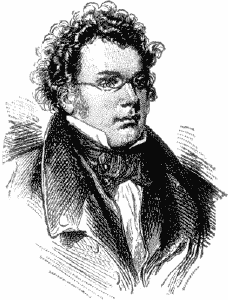
Fig. 67.
FRANZ SCHUBERT.
[Pg 391]
His place in the history of music, aside from the general fact of his
possessing genius of the first order, is that of the creator of the
artistic song. While his pianoforte sonatas are extremely beautiful
and very difficult, and anticipate many modern effects; his string
quartettes, and other chamber music, worthy to be ranked with those of
any other master; and his symphonies exquisitely beautiful in their
ideas, orchestral coloring and the entire atmosphere which they
carry—his habitual attitude was that of the writer of songs. Some of
these are of remarkable length and range. One of them extends to
sixty-six pages of manuscript. Another occupies forty-five pages of
close print. A work of this kind is a cantata, and not merely a song.
Many of the others are six or eight pages long, and in all the music
freely and spontaneously follows the poem, with a delicate
correspondence between the poetic idea and the melody, with its
harmony and treatment, such as we look for in vain in any other
writer, unless it be Schumann, who, however, did not possess
Schubert's instinct of the vocally suitable. For with all the range
which these songs cover, their vocal quality is as noticeable as that
of Italian cantilenas.
[Pg 392]
CHAPTER XXXIII.
THE STORY OF THE PIANOFORTE.
HE popular instrument of the nineteenth century has been the
pianoforte, the result of an evolution having its beginning more than
six centuries back. It is impossible in the present state of knowledge
to trace all the steps through which this remarkable instrument has
reached its present form. In the Assyrian sculptures discovered by
Layard, there are instruments apparently composed of metal rods or
plates, touched by hammers, upon the same general principle as the toy
instrument with glass plates, or the xylophone composed of wooden rods
resting upon bands of straw. In these the use of the hammer for
producing the tone is obvious. In the Middle Ages there was an
instrument called the psaltery, apparently some sort of a four-sided
harp strung with metal strings. The evidence upon this point is rather
indistinct. Still later there is the Arab santir (p. 114). This was a
trapeze-shaped instrument, composed of a solid frame, sounding board
and metal wires struck with hammers. This instrument still exists in
Germany under the name of Hackbrett, or the dulcimer. As now made,
each string consists of three wires tuned in unison. It is played by
means of leather hammers held in the hand. The difficulty of adapting
this instrument to the keyboard consisted in the fact that if the[Pg 393]
hammers were connected with the keys, they would be under the strings
instead of above them, and this difficulty for a long time proved
insurmountable.
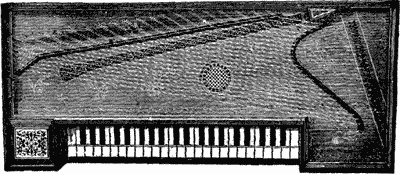
Fig. 68.
SPINET.
[Showing the disposition of the strings,
bridges, etc. Dresden, 1590.]
Two forms of instruments were at length developed, composed of a
wire-strung psaltery, played from a chromatic keyboard like that of
the organ. The first of these was the one called in England Spinet, or
in Italy Espinnetto, and in Germany the Clavier. The essential
characteristic of this instrument was the manner of producing tones.
Upon the ends of the keys were brass pieces called "tangents," of a
triangular shape, of such form that when the key was pressed, the
tangent pushed the wire and so produced the tone. As it remained in
contact with the wire as long as the key was held down, there was
nothing like what we now call a singing tone. The instruments were
very small, in shape like a square piano, but of three or four octaves
compass; the wires were of brass, and quite small. In several
representations which have come down to us from the seventeenth
century, the number of strings shown is smaller than the number of[Pg 394]
keys, from which some writers have inferred that it might have been
possible to obtain more than one tone from the same string, through a
process of stopping it with one tangent and striking it with another.
This, however, is highly improbable; the discrepancies referred to are
undoubtedly due to carelessness of the engraver. The clavier, or
spinet, was a better instrument than the lute, which at length it
superseded, having more tones and a greater harmonic capacity. Besides
which it was a step toward something much better still. In England
they made them with pieces of cloth drawn through between the wires,
to deaden the already small tone still further. These were sometimes
called virginals, and seem to have been used as practice pianos, where
the noise of the full tone might have been objectionable. The oldest
form of the clavier known to the writer was that shown in Fig. 69,
which was so small that it might be carried under the arm, and when
used was placed upon the table. They were sometimes ornamented in a
very elaborate manner.
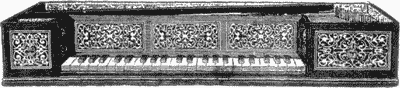
Fig. 69.
KEYBOARD AND FRET WORK OF SPINET SHOWN IN
FIG.
68.
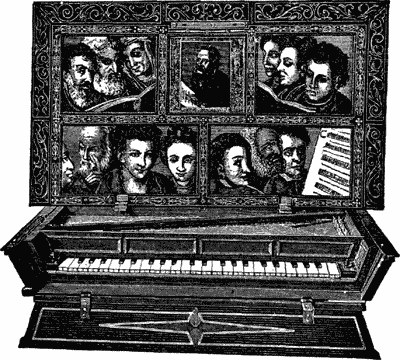
Fig. 70.
RICHLY ORNAMENTED SPINET.
[Made for the Princess Anna, of Saxony, about
1550.]
Contemporaneously with the spinet, and of almost equal antiquity, was
an instrument in the form of a grand piano, called in Italy the
clavicembalo, and in England the harpsichord. In Germany it was called
the flugel or wing, from its being shaped like the wings of a bird.[Pg 395]
These also, in the earlier times, were made very small, and were
rested upon the table. The essential distinction between the cembalo
and the spinet was in the manner of tone production. In the cembalo
there was a wooden jack resting upon the end of the keys, and upon
this jack a little plectrum made of raven's quill, which had to be
frequently renewed. When the key was pressed, the jack rose and the
plectrum snapped the wire. The tone was thin and delicate, but as the
plectrum did not remain in contact with the string, the vibration
continued longer than in the clavier. The cembalo was the favorite
instrument in Italy during the seventeenth century, and in England it
had a great currency under the[Pg 396] name of harpsichord. Many attempts
were made at increasing the resources of this instrument, one of the
most curious being that of combining two harpsichords in one, having
two actions, two sounding boards and sets of strings, and two
keyboards related like those of the organ. This form seems to have
been exclusively English. The form of the harpsichord is shown in Fig.
71.
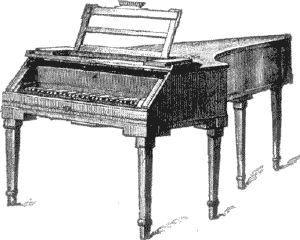
Fig. 71.
MOZART'S CONCERT GRAND PIANO.
[Now in the Mozart Museum at Salzburg. Its
compass is five octaves.]
Far back in the sixteenth century an attempt was made at a hammer
mechanism to strike down upon the strings. For this purpose the
strings were placed in a vertical position, the same as in our upright
pianos of the present day. Mr. B.J. Lang, of Boston, has an upright
spinet of this kind, which he bought in Nuremburg. It is a small and
rude affair, having about four octaves compass and a very small scale.
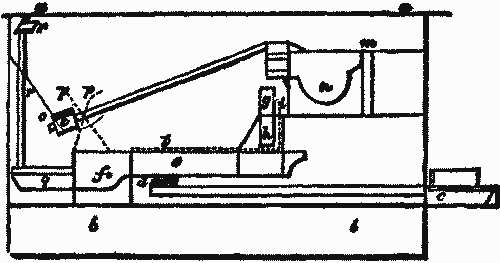
Fig. 72.
CRISTOFORI'S ACTION.
[According to his original diagram.]
A is the string; b the bottom; c the first lever, or key; there
is a pad, d, upon the key to raise a second lever, e, which is
pivoted upon f; g is the hopper—Cristofori's linguetta
mobile—which, controlled by the springs i and l, effects the
escape, or immediate drop, of the hammer from the strings after the
blow has been struck, although the key is still kept down by the
finger. The hopper is centered at h. M is a rack or comb on the
beam, s, where, h, the butt, n, of the hammer, o, is centered.
In a state of rest the hammer is supported by a cross or fork of silk
thread, p. On the depression of the key, c, the tail, q, of the
second lever, e, draws away the damper, r, from the strings,
leaving them free to vibrate. (Hipkins.)
The pianoforte proper was not invented until 1711, when a Florentine
mechanic, named Cristofori, invented what he called a Fortepiano, from
its capacity of being[Pg 397] played loud or soft. The essential feature of
the pianoforte mechanism is in the use of the hammer to produce the
tone, and the necessary provision for doing this successfully is to
secure an instantaneous escapement of the hammer from contact with the
wire, as soon as the blow has been delivered, while at the same time
the key remains pressed in order to hold the damper away from the
strings and allow the tone to go on. These features were all contained
in Cristofori's invention. The above diagram, Fig. 72, illustrates the
mechanism employed. It is from Cristofori's published account of his
invention, dated 1711; but there is in Florence a pianoforte of his
manufacture still existing, dated 1726, in which the action is more
perfect, as shown in Fig. 73.[Pg 398]
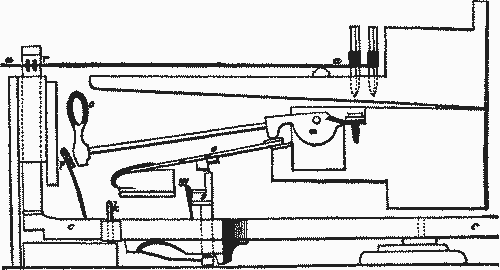
Fig. 73.
ACTION OF CRISTOFORI'S FORTEPIANO. DATE 1726.
[Besides several minor improvements over his first idea, the later
instrument has a hammer check, p, and the hammer is more developed.]
The invention of Cristofori was taken up in Germany almost
immediately, and a Dresden piano maker, Silbermann, became very
celebrated. It was the pianofortes of his manufacture in the palace at
Potsdam, which Frederick the Great made Bach try, one after another.
The form of these instruments was the same as that of Mozart's piano,
shown in Fig. 71. The square-formed piano began to be made about 1750,
but the instrument involved no application of new principles, being
merely a clavier with pianoforte mechanism. The new form, so much more
compact and inexpensive, began to be popular, and was soon the
standard form for private families, as that of the clavier had been
before, and as the square piano, remained until as late as about 1870,
when the inherent mechanical difficulties of the upright were for the
first time satisfactorily overcome. Pepys, in his diary, tells of
having purchased a virginal which pleased him very much. It cost five
guineas—about $26.[Pg 399]
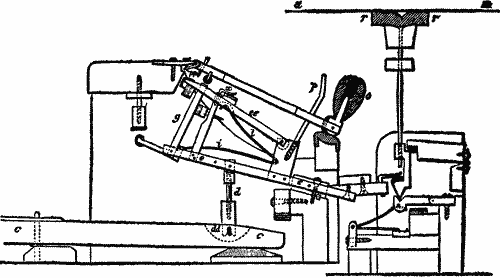
Fig. 74.
IMPROVED ACTION OF THE ÉRARD CONCERT GRAND. (1821.)
C is the key; d is a pilot, centered at dd to give the blow, by
means of a carrier, e, holding the hopper, g, which delivers the
blow to the hammer, o, by the thrust of the hopper, which escapes by
forward movement after contact with a projection from the hammer
covered with leather, answering to the notch of the English action.
This escapement is controlled at x; a double spring il, pushes up
a hinged lever, ee, the rise of which is checked at pp, and causes
the second or double escapement; a little stirrup at the shoulder of
the hammer, known as the "repetition" pressing down ee at the point,
and by this depression permitting g to go back to its place, and be
ready for a second blow before the key has been materially raised. The
check p in this action is not behind the hammer, but before it,
fixed into the carrier, e, which also, as the key is put down,
brings down the under damper. (Hipkins.)]
The instruments were still small, and strung with small wires;
nevertheless, there was a tendency toward increased compass, which, by
the beginning of the nineteenth century, led the Broadwoods, of
London, to attempt a grand piano with six octaves' compass. But they
found that the wrest plank (in which the tuning strings are placed),
was so weakened by the extension that the treble would not stand in
tune. In order to strengthen the instrument, he introduced the iron
tension bar. This, like nearly all of the English improvements of the
piano during the first quarter of the nineteenth century, was in[Pg 400] the
direction of greater solidity, and better resisting power to the pull
of the strings.
Upon the artistic side, Sebastian Érard in 1808 patented his grand
action, which, with very slight improvements, still remains the model
of what a piano action should be. Fig. 74 shows this action and its
parts.
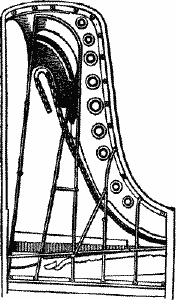
Fig. 75.
THE STEINWAY IRON FRAME.
[Showing the disposition of the sounding board,
bridges, etc.]
Between 1808, when the Érard action was perfected, and 1832 or 1834,
when Thalberg and Liszt began to revolutionize the art of piano
playing, the instrument was the subject of a great number of
improvements in every direction. The damper mechanism was perfected
between 1821 and 1827; the stringing had been made heavier, the
hammers proportionately stronger, and the power of tone had become
greater. Thus the instrument had become ready for the great
pianists—Liszt having made his first appearance in Vienna in 1823,
and[Pg 401] within seven years after having become generally recognized as a
phenomenal appearance in art. Meanwhile, great improvements were
continually carried on for the purpose of rendering the instrument
impervious to the forcible attacks made upon its stability by these
new virtuosi. In the early appearances of Liszt it was necessary to
have several pianos in reserve upon the stage, so that when a hammer
or string broke, which very often happened, another instrument could
be moved forward for the next piece.
The most important improvement in the solidity of the piano came from
the iron frame, which was introduced tentatively, somewhere about
1821, in the form of what is now called a "hitch-pin plate," or half
iron frame. About 1825 an American, Alpheus Babcock, of Philadelphia,
patented a full iron frame, but it was imperfect, and nothing came of
it. Conrad Meyer, of Philadelphia, in 1833, patented an iron frame and
manufactured pianos with it, which are still in existence. In 1837,
Jonas Chickering, of Boston, perfected the iron frame by including in
the single casting the pin bridge and damper socket rail. This
improvement still remains at the foundation of the piano making of the
world. Previous to this invention some of the American piano makers
had constructed their cases upon a solid wooden bottom plank five
inches thick. In 1855 the firm of Steinway & Sons exhibited their
first overstrung scale, in which the bass strings were spread out and
carried over a part of the treble strings, thus affording them more
latitude for vibration, without interfering, and bringing the bridges
nearer to the center of the sounding board. The idea of overstringing
was not new at this time, Lichtenberg, of St. Petersburg, having
exhibited a grand[Pg 402] piano with overstringing at the London exposition
in 1851, and Theodore Boehm, the celebrated improver of the flute,
having invented an overstrung system for square pianos as early as
1835. In 1853, also, Jonas Chickering combined an iron frame with an
overstrung system in square pianos, the instrument having been
completed and exhibited after his death. The Steinway system of
overstringing, however, was more extended, and solved the acoustical
difficulties of cross-vibrations more successfully by spreading the
long strings, and this, therefore, is the system now generally
followed. The superiority of this principle was immediately
acknowledged, and it has since been applied to grands and uprights,
and few makers in the world but follow it in their work. Many minor
improvements have been introduced in America by Steinway & Sons and
others, whereby the artistic qualities and the durability of the best
American pianos are now generally acknowledged throughout the world.
The solidity of construction is such that with a compass of seven and
one-third octaves the tension of the strings amounts to about 50,000
pounds avoirdupois. The hammers are larger and heavier, the action
more responsive, and the singing quality and sustaining power has
reached remarkable perfection. Perhaps the most curious and important
of all American improvements in this direction is the so-called
"duplex scale" of Steinway & Sons, patented in 1872, in which a
fraction of the string is made to vibrate sympathetically, thereby
strengthening the super-octave harmonic, and imparting to the tone a
brightness and sweetness not so well secured in any other way at
present known.
If space permitted it would be interesting to follow the course by
which the difficulties of the upright piano[Pg 403] have at length been
surmounted, and the tone of this form of instrument rendered nearly
equal to that of the grand. This was first accomplished by Steinway &
Sons between 1862 and 1878, by a succession of improvements having for
their object, first, the solidity of the instrument, then its prompt
action, together with as much of the tone quality of the grand as
possible. Many other American builders have taken part in this
development, whereby the American pianoforte to-day is the strongest,
the fullest-toned and the most expensively constructed of any in the
world. Still later, quite a number of more or less successful attempts
have been made to increase the stability of the tuning of the
pianoforte by a different system of stringing, the tension of the
strings being regulated by means of a tuning pin of "set-screw"
pattern, working through a collar of steel, instead of being thrust
into a wooden wrest-plank, where it holds fast by friction alone, as
has been the universal way previous to these inventions.
[Pg 404]
CHAPTER XXXIV.
GERMAN OPERA; WEBER, MEYERBEER AND
WAGNER.
I.
 ERMAN opera reached an extraordinary development during the
nineteenth century, the distinguishing characteristics being an
extremely full and dramatically conceived treatment of the orchestra,
and a mode of delivering the text partaking of the character of melody
and recitative in about equal proportions, the entire object being to
present the action to the inner consciousness of the beholder in the
most impressive manner possible. In Italian opera, as we have seen,
there was a large development of arias and vocal pieces, whose value
lay in their beauty as melodies and as concerted effect, the action of
the drama being meanwhile delayed sometimes for an entire half hour,
while these pieces were going on. In Germany the effort to improve the
delivery of the text and to bring it into closer union with the
orchestra, and to develop the music from a dramatic standpoint
exclusively, led to the vocal form known as arioso, or, to use
Wagner's term, "endless melody," in which the successive periods
follow each other to the end of the paragraph, or the end of the
piece, without a full stop at any point until the end of the sense is
reached. The great master of this form of com[Pg 405]position was Richard
Wagner, who may be regarded as the exponent of the extreme development
yet reached by German opera. Wagner's endless melody proposed to
itself the same ideal as that of Gluck, but it is only at rare moments
that one will find in the music of the later master the symmetrical
periods of the Gluck and Mozart epoch. Italian opera, as we have
already seen, carried forward the dialogue mostly in
recitativo-secco, that is to say, in a recitative following more or
less successfully the modulations of speech, and accompanied only by
detached chords marking the emphatic moments. This form of vocal
delivery has the slightest possible musical interest, and the Germans
almost immediately endeavored to improve it, as also did some of the
Italian masters, the first result being recitativo-stromentato, or
instrumented recitative, viz., recitative in which the text is
accompanied by a flowing and more or less descriptive orchestral
accompaniment. This differs essentially from the descriptive
recitative in the works of the Mozart or Gluck period, or even in
those of Haydn's later time. In the "Creation," for example, the
descriptive recitative consists of vocal phrases with instrumental
phrases interspersed, in dialogue form. The voice announces a certain
fact and the orchestra immediately answers with a musical phrase
corresponding to it, as, for example, in the recitative describing the
creation of the world, where the phrase relating to the horse is
immediately answered by an orchestral gallop; that of the tiger by
certain slides and leaps in the melody remotely answering it; while
the roar of the lion is immediately answered by a vigorous snort of
the bass trombone. This is by no means of the same nature as the
dramatic arioso of German opera during the nineteenth century.
Händel came[Pg 406] nearer to this type of musical formation, for example, in
the "Messiah," at the recitative describing the appearance of the
angels to the shepherds, where, after a phrase of unaccompanied
recitative, the appearance of the angels is signified by an
accompanied and measured strain, "And lo, the angel of the Lord came
upon them."
ERMAN opera reached an extraordinary development during the
nineteenth century, the distinguishing characteristics being an
extremely full and dramatically conceived treatment of the orchestra,
and a mode of delivering the text partaking of the character of melody
and recitative in about equal proportions, the entire object being to
present the action to the inner consciousness of the beholder in the
most impressive manner possible. In Italian opera, as we have seen,
there was a large development of arias and vocal pieces, whose value
lay in their beauty as melodies and as concerted effect, the action of
the drama being meanwhile delayed sometimes for an entire half hour,
while these pieces were going on. In Germany the effort to improve the
delivery of the text and to bring it into closer union with the
orchestra, and to develop the music from a dramatic standpoint
exclusively, led to the vocal form known as arioso, or, to use
Wagner's term, "endless melody," in which the successive periods
follow each other to the end of the paragraph, or the end of the
piece, without a full stop at any point until the end of the sense is
reached. The great master of this form of com[Pg 405]position was Richard
Wagner, who may be regarded as the exponent of the extreme development
yet reached by German opera. Wagner's endless melody proposed to
itself the same ideal as that of Gluck, but it is only at rare moments
that one will find in the music of the later master the symmetrical
periods of the Gluck and Mozart epoch. Italian opera, as we have
already seen, carried forward the dialogue mostly in
recitativo-secco, that is to say, in a recitative following more or
less successfully the modulations of speech, and accompanied only by
detached chords marking the emphatic moments. This form of vocal
delivery has the slightest possible musical interest, and the Germans
almost immediately endeavored to improve it, as also did some of the
Italian masters, the first result being recitativo-stromentato, or
instrumented recitative, viz., recitative in which the text is
accompanied by a flowing and more or less descriptive orchestral
accompaniment. This differs essentially from the descriptive
recitative in the works of the Mozart or Gluck period, or even in
those of Haydn's later time. In the "Creation," for example, the
descriptive recitative consists of vocal phrases with instrumental
phrases interspersed, in dialogue form. The voice announces a certain
fact and the orchestra immediately answers with a musical phrase
corresponding to it, as, for example, in the recitative describing the
creation of the world, where the phrase relating to the horse is
immediately answered by an orchestral gallop; that of the tiger by
certain slides and leaps in the melody remotely answering it; while
the roar of the lion is immediately answered by a vigorous snort of
the bass trombone. This is by no means of the same nature as the
dramatic arioso of German opera during the nineteenth century.
Händel came[Pg 406] nearer to this type of musical formation, for example, in
the "Messiah," at the recitative describing the appearance of the
angels to the shepherds, where, after a phrase of unaccompanied
recitative, the appearance of the angels is signified by an
accompanied and measured strain, "And lo, the angel of the Lord came
upon them."
This development of opera in the nineteenth century has been carried
forward by the successive efforts of a considerable number of masters,
among whom the three most important are Weber, Meyerbeer and Wagner,
each of whom created a type of opera peculiar to himself, and left
something as an addition to the permanent stock of musical dramatic
ideas.
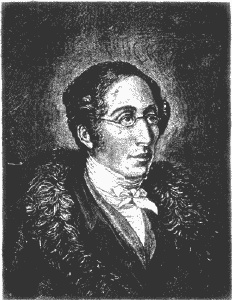
Fig. 76.
CARL MARIA VON WEBER.
II.
Carl Maria von Weber (1786-1826) was the son of a very musical family.
He was born at Eutin, and fulfilled his father's desire, which had
always been to have a child who should correspond to the youthful
promise of Mozart. The father was an actor, and the director of a
traveling troupe, largely composed of his own children by a former
marriage. This mode of life continued for a number of years, while the
future master was quite small. In 1794 Carl Maria's mother was engaged
as a singer at the theater at Weimar, under Goethe's direction.
Presently, however, the boy became a pupil of Heuschkel, an eminent
oboeist, a solid pianist and organist, and a good composer. Under his
careful direction Weber developed a technique which very soon passed
far beyond anything that had previously been seen. Still later he
became a pupil of Michael Haydn, a brother of Joseph. As early as 1800
the boy gave concerts in Leipsic and other towns in central Germany.
At this time an opera book[Pg 407] was given him, "Das Wald Mädchen," and
the opera was composed and produced in November. Five years later it
was highly appreciated at Vienna, and was performed also at Prague and
St. Petersburg. Young Weber was of a most active mind, and interested
himself in all questions of art. In 1803 he made the acquaintance of
the famous Abbé Vogler, and became his pupil. Vogler commissioned him
to prepare the piano score of a new opera of his. He still continued
his practice as pianist, but when he lacked some months of being
eighteen years of age he was made director of the music of the theater
at Breslau. This was his first acquaintance with practical life as a
musician. He showed great talent for direction and organization, and
here he composed his first[Pg 408] serious opera "Rubezahl" (1806). His
next position was at Stuttgart, where he became musical director in
1807. After composing several short pieces, he led a somewhat
irregular life for several years, concerting as a pianist, writing
articles for the papers, at which he was very talented, beginning a
musical novel, and at length, in 1810, producing his opera "Abou
Hassan." Then followed about three years of roving life as a concert
player and occasionally as composer, until 1813, when he was appointed
musical director at Prague. The opera here was in very bad condition,
and the company incapable, but Weber engaged new singers in Vienna,
and entirely reorganized the affair, and conducted himself so
prudently that he gained the good will of nearly every one. As an
example of his quickness it may be mentioned that upon discovering
that certain musicians in the orchestra, who were not disposed to
yield to his strict ideas of discipline, were conversing with each
other in Bohemian, while the music was going on, he learned the
language himself sufficiently to rebuke them in their own tongue. His
next position was at Dresden in 1816, and here he remained nine years
until his death. His position at first was somewhat ambiguous. There
were two troupes of singers in the opera—an Italian and the German.
The grand operas were given in Italian by the Italian company, and the
light operas in German by the German company. It was Weber's task to
change this, by producing new works of a distinctly higher character
than the foreign works of the Italian company. The second year he was
able to produce a few good operas of other schools in German versions,
but it was not until 1821, when his "Preciosa" was produced at
Berlin, and 1822, when "Der Freischütz" was produced in the same[Pg 409]
theater, that the reputation of the young master was established
beyond question. It is impossible at the present time to describe the
enthusiasm which the latter work created. It was a new departure in
opera. It united two strains very dear to the German heart—the simple
peasant life and the people's song are represented in the choruses,
and in the arias of the less important people. Agatha, the heroine,
has a prayer of exquisite beauty, which still is often heard as a
church tune. And in contrast with these elements was the weird and
uncanny music of Zamiel, the Satanic spirit of the wood, and the
strange incantation scene in the Wolf's Glen at midnight, where the
magic balls are cast. The story was thoroughly German, and the music
not only German and well suited to the story, but distinctly original
and charming of itself. In this work, perhaps first of any opera,
Weber made use of what has since been known as "leading
motives"—characteristic melodic phrases appropriate to Zamiel and
Agatha. The instrumentation was very graphic, and as Weber had been
brought up upon the stage, there were many novelties of a scenic kind.
In fact, the work marked as distinct an epoch as Wagner's "Nibelungen
Ring," and what is more to the point, it was one of the operative
influences affecting the young Wagner, as he tells with considerable
care in his autobiography. His next effort was a comic opera, the
"Three Pintos," which was never finished. Then came "Euryanthe"
performed at Vienna in 1823 with the most extraordinary success. This
work is said to have been the model upon which Wagner created his
"Lohengrin." When it was produced in Berlin in 1825, the enthusiasm
was yet greater and more remarkable than in Vienna. In 1825 he
composed "Oberon," the[Pg 410] first of the operas in which the fairy
principle has prominent exemplification. This was produced in London
early in 1826. But by this time Weber's health had become completely
broken, and he died there of overwork and fatigue. He was laid to his
rest, to the music of Mozart's Requiem, in the chapel at Moorsfields
in London.
Weber was the first of the romantic composers—the first, at least, to
gain the ear of the public. These operas, with their beautifully
descriptive music, in which voices and orchestra co-operate with the
action and scene as one, were composed at the same time that the young
Franz Schubert was improvising his beautiful songs in Vienna. From one
end of Germany to the other, and in all Europe, these operas made
their way. "Der Freischütz" has lasted fifty years, and is still
presented with success. More than that, as already noticed, Weber
furnished the model, or point of departure, for a multitude of smaller
composers, who developed the opera in various side directions; and
last, but not least, for Richard Wagner himself.
Moreover, in the department of piano playing Weber was no less
epoch-marking than in that of opera. In 1812 his sonata in C, Opus 24,
was produced, a work which is distinctly in advance of those of
Clementi or any other writer before that time. The finale of this work
is the well known rondo "Perpetual Motion," which, indeed, contains no
new principle of piano playing, but is an elegant example of
melodiousness and real musicianly qualities displayed at the highest
possible speed. His next sonata, Opus 39, in A flat (1816), is still
more remarkable. The piano playing here is of an extremely brilliant
and picturesque description. Here also, in[Pg 411] the Andante we have the
tricks which he afterward made so effective in the Concertstück, of
the legato melody accompanied by chords pizzicati. Equally
significant in this way is the sonata in D minor, Opus 49, published
in the same year as the preceding. Here we have very strong contrast
and an enormous fire and vigor. The romantic impulse, however, had
been displayed yet earlier in his "Momento Capriccioso," Opus 12, in
B flat (1808). This extremely rapid piece of changing chords
pianissimo is like a reminiscence from fairy land, and the second
subject contrasts with it to a degree which would have satisfied
Schumann. It is a choral-like movement with intervening interludes in
the bass, upon which Rubinstein must have modeled his "Kamennoi
Ostrow," No. 22. But the most decided token of the romantic movement
is seen in the "Invitation to the Dance," and the "Polacca
Brilliant," both of which were published in 1819. Two years later
came the concert piece, which for seventy years has remained a
standard selection for brilliant pianists, and for fifteen years was
Liszt's great concert solo. It marks a transition from Moscheles,
Dussek and Clementi to Thalberg and Liszt. The "Invitation to the
Dance," moreover, was the first salon piece idealized from a popular
dance form.
III.
Yet another distinguished name might well have been enrolled among
those of the great virtuosi of the first part of the nineteenth
century. Jacob Liebmann Beer, better known as Giacomo Meyerbeer
(1791-1864), was born at Berlin, the son of a rich Jewish banker. The
name Meyer was prefixed to his own later, as a condition of inheriting
certain property from[Pg 412] a distant relative. As the boy showed talent
for music at a very early age, he was put to the study of the
pianoforte, and it was his ambition to distinguish himself as a
virtuoso, which his talent undoubtedly permitted, if he had not been
diverted from it by the success of his early attempts at opera. He was
taught by a pupil of Clementi, and for a while by Clementi himself, as
well as by other distinguished teachers, and if reports are to be
believed concerning his playing, he must have become by the time he
was twenty years old one of the very[Pg 413] first virtuosi in Europe. His
studies in theory were carried on under Abbé Vogler, at Darmstadt,
where he was a schoolmate with C.M. von Weber and Gansbacher, and
later with Salieri at Vienna. At Darmstadt he wrote an oratorio "God
and Nature," which was performed by the Singakademie, of Berlin, in
1811; and an opera, "Alimelek" ("The Two Caliphs"), which also was
successfully given at Munich in the Grand Opera House in the same
year, 1811. Both works were anonymous. The opera made considerable
reputation, and was played in several other cities. Upon Salieri's
direction he went to Venice, where he arrived in 1815, to find
Rossini's star in the ascendant, and all Venice, and Italy as well,
wild over the bewitching melodies of "Tancredi." Meyerbeer, having
that vein of cleverness and adaptability so characteristic of his
race, immediately became a composer of Italian operas, and produced in
Venice, "Romilda e Constanza" (Padua, 1815), "Semiramide
Riconosciuta" (Turin, 1819), "Emma di Resburgo" (Venice, 1820), the
latter also making a certain amount of reputation in Germany as "Emma
von Leicester." Then followed "Margherita d'Anjou" (Milan, La
Scala, 1820), "L'Esule di Granata" (Milan, 1822) and "Il Crociato
in Egitto" (Venice, 1824). All of these were Italian operas, with
melody in quite the Rossini vein, with the same attention as Rossini
to the light, the pleasing and the vocal, but with a certain added
element of German cleverness of harmony and thematic treatment.
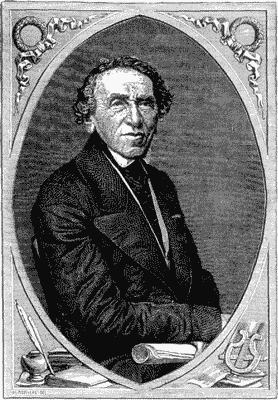
Fig. 77.
GIACOMO MEYERBEER.
He now returned to Berlin, but his opera, "Das Brandenburger Thor,"
which he had written for Berlin, was not performed, owing to opposing
intrigues. Nevertheless, for about six years Meyerbeer remained in his
native city, married, and presently lost two infant[Pg 414] children. In 1830
he took up his abode in Paris, where already his "Il Crociato" had
been performed, in 1826, and in that city, as the leading composer for
grand opera, he lived six years, and finally died there. For the Paris
stage he produced a succession of large and sensational operas,
following to some extent the footsteps of Spontini, in respect to the
heroic, the spectacular and the theatrical. Up to the time of his
going to Paris, Meyerbeer had figured as an Italian composer in grace
of melody, German in his harmony, and now he became a French composer
in refinements of rhythm. His first work in Paris was "Robert le
Diable," 1831, and it made his reputation, and at the same time made
an epoch in operatic construction. It was followed by "Les
Huguenots," 1838, which when played in Berlin, in 1842, so pleased
the king, Friedrich Wilhelm IV, that he created Meyerbeer "General
Musical Director" for Prussia, and Meyerbeer came to Berlin to reside.
Here in 1842 he wrote his "Das Feldlager in Schlesien" in which
Jenny Lind made a great success. Later, however, he made over a great
part of this music for his opera of "L'Étoile du Nord," 1854, for
the Opéra Comique in Paris. His remaining works were "L'Africaine,"
performed after his death, in 1865; "Le Prophète," 1843, and
"Dinorah," 1859. He died in Paris while superintending the
production of his "L'Africaine." In his will he left a fund of
10,000 thalers, the interest of which to be used as a prize for the
support of a young German composer during eighteen months' study in
Italy, Germany and France, six months in each. Besides the operas
above mentioned Meyerbeer wrote a quantity of other music for
orchestra, cantatas, and occasional pieces for festival purposes, of
which the "Schiller March" is an example.[Pg 415]
The music of Meyerbeer is extremely sensational. His instrumentation
is rich, at times bizarre, and strongly contrasted. His knowledge of
stage effect, such that he knew by intuition what would do, and what
not. He was to some extent created by circumstances, a striking
instance of which is told in connection with the opera of the
"Huguenots," where the parting with Valentine at the end of the fourth
act was originally without important music. But the tenor declined to
take the part unless suitable music could be furnished him at this
point. Whereupon Meyerbeer wrote the impassioned duet, since so
celebrated, and which in fact is generally recognized as one of the
most suitable, not to say most effective, incidents of the whole
opera. Meyerbeer's operas follow the lead of Spontini in their
fondness for military glory and spectacle. They partake of the
virtuoso spirit of the other great geniuses mentioned in a later
chapter—all of whom wrote for the sake of an effect to be arrived at,
rather than from any inner necessity of carrying out their tone-poems
in such and such a way. Meyerbeer's influence, about 1830 to 1840, was
supreme upon the stage. It was to consult him that young Wagner
undertook his journey to Paris, bringing with him his splendid
spectacular opera "Rienzi," quite in the Meyerbeer vein. This feature
in the work, most likely, was the one chiefly concerned in preventing
its acceptance at Paris under Meyerbeer's direction. Wagner was very
much influenced by Meyerbeer in all his earlier works, particularly in
the matter of splendid appointments for the stage. With all the
splendid brilliancy of Meyerbeer's music, there is something insincere
about it. It rarely touches the deeper springs of feeling. This is
true of the greatest of his pieces, no less than of the smaller
numbers.[Pg 416]
IV.
The most interesting story in the history of opera, and one so
resplendent that it is impossible not to regard the others as merely
in some degree preparatory to it, is that of Richard Wagner
(1813-1883). This remarkable man was born in Leipsic in 1813, the son
of a superintendent of police. His mother was a woman of refined and
spiritual nature. After the death of his father, his mother married
again—an actor named Geyer—a circumstance having an important
bearing on the future of the composer. His brother Albert and his
sister Rosalie became actors, and Wagner himself was familiar with the
stage from earliest childhood. He studied music while a boy, but his
ambition was to become a poet. He translated the twelve books of the
Odyssey. He made the acquaintance of Shakespeare's plays, first in
German, afterward in English. He made a translation of Romeo's
soliloquy, and began to compose music for it. At the age of eighteen
he copied Beethoven's ninth symphony in score, for the purpose of
knowing it more thoroughly. His musical progress was such that at the
age of twenty-one he was able to accept a position as the conductor of
the opera at Magdeburg. In 1836 this failed, and he accepted a place
at Königsberg. He had then written one opera, called "The Love Veto."
In 1837 he was much interested in Bulwer's "Rienzi," and immediately
made a libretto from it. He was now musical director at Riga, and his
wife had leading feminine rôles in opera. His favorite composer in
opera just then was Meyerbeer. For some reason he lost his place at
Riga, and resolved to visit London, taking ship across the Black sea.
It was a sailing vessel of small burden, and they encountered a very
violent[Pg 417] storm. He heard the legend of the Flying Dutchman, and the
next year made a poem of it and commenced to write the opera. He spent
some time in Paris, where he hoped to get his "Rienzi" accepted at the
Grand Opera. This opera he had written on a large scale in the hope of
pleasing Meyerbeer, whose influence at Paris was very strong at this
time. This, however, he failed to do, very possibly because his opera
was too good. He was reduced to great straits, and had to write
potpourri for the cornet and piano at a beggarly price, in order to
gain a living. In 1843 his "Rienzi" was accepted at Dresden,[Pg 418] through
the influence of Meyerbeer. It was performed with great success, and
Wagner was called there as conductor. Here he had an important
position, having to produce the best operas of all schools. He brought
out his own "Flying Dutchman" and had already finished "Tannhäuser."
He read the Arthur legends, and conceived the idea of an opera upon a
subject connected with the Holy Grail. This was "Lohengrin,"
completed in March, 1848. It was in a fair way to have been produced
under his own direction if he had had the good sense to let politics
alone; but in some way he mixed himself up in the revolutionary
attempt of that year, and was obliged to flee the country. He went to
Zurich, where he lived in great poverty at first, but afterward with a
certain moderate income, for nearly ten years. This circumstance was
evidently providential, as will appear in the sequel.
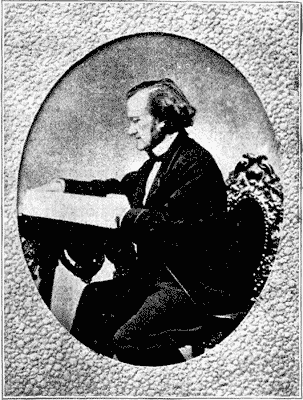
Fig. 78.
RICHARD WAGNER.
Franz Liszt was now conductor at Weimar, and he brought out
"Lohengrin" in 1850. From this moment a friendship was established
between these two remarkable men. Liszt sent Wagner a handsome
honorarium, and from this time on was his financial guardian. By
this time Wagner's art theories had become pretty well defined. From
his standpoint the three great arts of music, poetry and drama had
been independently explored to their limit—music by Beethoven, poetry
and the drama by Shakespeare and Goethe—and the only remaining thing
of importance to do was to unite them all in one homogeneous mass, and
by their combined operation accomplish a more profound and
overwhelming effect than had been made before, or indeed would have
been possible to them separately. In his autobiography, speaking of
his early experiences as conductor, he says:[Pg 419]
"The peculiar, gnawing feeling that oppressed me in conducting our
ordinary opera, was often interrupted by an indescribable enthusiastic
feeling of happiness, when here and there, in the performance of
nobler works, I became thoroughly conscious, in the midst of the
representation, of the incomparable influence of dramatic-musical
combinations—an influence of such depth, fervor and life, as no other
art is capable of producing.
"That such impressions, which, with the rapidity of lightning, made
clear to me undreamed-of possibilities, could constantly renew
themselves for me—this was the thing which bound me to the theater,
much as the typical spirit of our operatic performances filled me with
disgust. Among especially strong impressions of this character, I
remember the hearing of an opera, by Spontini, in Berlin, under that
master's own direction; and I felt myself, too, thoroughly elevated
and ennobled for a time, when I was teaching a small opera company
Méhul's noble 'Joseph.' And when, twenty years ago, I spent some time
in Paris, the performances at the Grand Opera could not fail by the
perfection of their musical and dramatic mise en scène to exercise a
most dazzling and exciting influence upon me. But greatest of all was
the effect produced upon me in early youth by the artistic efforts of
a dramatic singer of (in my eyes) entirely unsurpassed
merit—Schröder-Devrient. The incomparable dramatic talent of this
woman, the inimitable harmony and strong individuality of her
representations, which I studied with eyes and ears, filled me with a
fascination that had a decisive influence on my whole artistic career.
The possibilities of such a performance were revealed to me, and with
her in view, there grew up in my mind a legitimate demand,[Pg 420] not for
musical-dramatic representation alone, but for the poetic-musical
conception of a work of art, to which I could hardly continue to give
the name of 'opera.'"
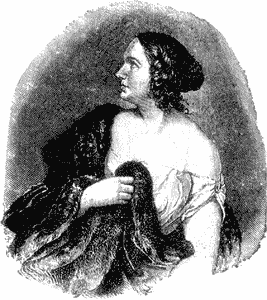
Fig. 79.
MME. SCHRÖDER-DEVRIENT (1804-1860).
Soon after his removal to Zurich, he commenced to compose the libretto
of the "Nibelung's Ring." This work was founded on the famous old
German poem, "Die Nibelungen Lied," but with very important
modifications of Wagner's own. It is divided into four works. In the
first, "Das Rheingold," the gold of the Rhine, is stolen, and a
curse is laid upon it. The second opera of the series is "Die
Walküre." In this work the remarkable character of Brunhilde is the
central figure. She is one of the Wish-maidens of Odin, whose duty it
was to conduct the souls of slain heroes to Walhalla, the dwelling
place of the gods. The entire conception of this[Pg 421] character is unique,
and still more unique in the musical way in which it is worked out. We
find in this work also the mother and father of Siegfried, and the
opera closes when Brunhilde is thrown into the magic slumber with the
fire around her. The third opera of the series is that of Siegfried,
the half-divine, half-human hero, who knows no fear—who slays the
dragon that captures the gold of the Rhine—awakens Brunhilde from her
magic sleep, etc. The fourth opera is called "The Twilight of the
Gods," or "The Death of Siegfried." I will not consume space by
describing this poem in detail, since this material is easily
accessible in every encyclopedia. I have already treated it at
considerable length in the second volume of my "How to Understand
Music." These works are especially remarkable upon a musical side. The
opera of the "Rhinegold" is a little monotonous, but the orchestral
score contains many points of beauty, and "The Valkyrie" is beautiful
throughout, conceived in a very masterly and poetic vein; the
instrumentation, also, is extremely noble and beautiful. In the whole
of these two works there is scarcely a single piece which can be
played apart from the rest as a concert number. The drama moves
straight on from one thing to another. There are no melodies of the
conventional type, and the music is closely woven together, like the
effects of an April day, with storms, sunshine and shadows following
each other without any perceptible break. So great has been the
advance in musical taste since these were first composed, that "The
Ride of the Valkyries," a famous descriptive piece for orchestra,
forming the prelude of the second act, has been played in all parts of
the world, as also the "Magic Fire Scene," which closes the opera.
These are given over and over again by[Pg 422] Thomas, and arrangements of
them are often played at the piano. Directly he had finished "Die
Walküre," Wagner sent it to Liszt, and a letter with it, in which he
modestly admitted that he thought it was very fine, or words to that
effect. Liszt, on his part, was delighted with it. He wrote a most
beautiful and noble letter to Wagner about it, and a little later he
speaks of Hans von Bülow having been with him, when he could not
refrain from giving him "a sight of Walhalla." So he brought out the
score, and he said that Hans pounded at the piano, and he himself
hummed and howled as well as he could, and they had a great time over
it.
Wagner then set to work on the opera of "Siegfried," which
interested him very much indeed. This character also is a genuine
conception of Wagner's. The wild forest boy who knows no fear, who has
the most marvelous strength, is described in music as wild and
powerful as himself. When Sieglinde, Siegfried's mother, was married,
an old man appeared at the wedding with an ashen staff, his hat brim
drooping over one eye, and in the midst of the festivities he drew a
mighty sword and with a great blow thrust it into the stem of the ash
tree which grew in the center of the house, saying that it was the
sword of a hero, and that whoever was strong enough to draw it should
wield it in the service of gods. All the strong men tugged at this
weapon, but none were able to draw it. When Siegmund, Siegfried's
father, comes there, he draws the weapon amid a splendid burst of
music. This sword is broken on Wotan's spear, but the pieces are saved
for Siegfried, and one of the great scenes in the opera of
"Siegfried" is where he welds anew the broken sword, and at the end
cleaves the anvil with one mighty stroke. The opera of "Siegfried"
closes with[Pg 423] the awakening of Brunhilde, and a splendid duet with
Siegfried.
The composition of this work was interrupted at the end of the second
act, and here we come to one of the most curious circumstances in
Wagner's career. He says that he felt it necessary to stop now and
write a practical opera for the stage as it then was, in order to
re-establish his connection with the German theater, for he did not
believe that these works would be performed in his own time.
Accordingly he wrote "Die Meistersinger," and the opera of "Tristan
and Isolde." They were finished in 1865, and Hans von Bülow, who was
then director of the opera at Munich, took them both for rehearsal;
they had there about 160 rehearsals of "Tristan and Isolde"—but gave
it up as impossible, the singers forgetting from one day to another
the music they had learned the previous day. The other work, "Die
Meistersinger," fared better. They had sixty-six rehearsals, and
finally brought it to a dress rehearsal, which was as far as they got
toward performing it. Nothing shows the increased growth that Wagner
had made, as well as his unconsciousness of this growth, like this
experience of his operas at Munich, under so enterprising and able a
director as Hans von Bülow—who was undoubtedly the most competent man
in Germany, as well as the most courageous, for the task of producing
this kind of work. Although these operas were not successful at the
time, "Die Meistersinger" has since become highly appreciated upon
large stages, and it is in my opinion the most beautiful opera that
has ever been written. The music throughout is in a noble and
dignified strain, with melodies beautiful and highly finished, almost
suitable for church music, yet comedy in the best sense of the term.[Pg 424]
The famous prize song in this work is sufficiently well known. There
is a most delightful finale in the third act, where Beckmesser's
serenade occurs as one of the incidents. The other work, "Tristan and
Isolde," is the most difficult opera that has ever been written, and
will have to wait a generation yet, most likely, before its beauties
are fully appreciated.
After composing these two enormous works, Wagner went on to finish
"Siegfried," and then completed the work by writing "Die
Götterdämmerung" ("The Twilight of the Gods"), or, "The Death of
Siegfried," as he had originally intended to call it. This work
contains one number which is stupendous in its pathos, "The Funeral
March of Siegfried." Nothing like it exists elsewhere. These four
operas have a very remarkable peculiarity, that throughout the four
there are certain leading motives, which repeatedly occur. There is
the motive of "the magic fire," which cuts a great figure in the first
opera of the series, where Loki, the fire god, appears and is ushered
in by this motive. It occurs again in the magic fire scene, at the
close of "Die Walküre," where Wotan surrounds Brunhilde with
shrieking flames, in order that their terrors may deter cowards from
waking her. There is the "sword motive," which is heard in the first
opera, when this sword is first spoken of; it is finely developed
where the sword is drawn, and again in the opera of "Siegfried,"
where it is freshly welded. There is the "Walhalla motive," the
"Siegfried motive," the "Valkyrie motive," and many others, to the
number of nearly one hundred. These are woven together, especially in
the last opera of the series, in a most astonishing and wonderful way,
yet without impairing the musical flow of the work. The scores are
also[Pg 425] extremely elaborate, from an orchestral point of view, requiring
a large number of instruments, most of them having a great deal to do.
This great trilogy, as Wagner called it, which was at first supposed
to be beyond the ability of the public to appreciate, has now been
given in all parts of Germany with great success, and it is no longer
beyond the ability of an audience to enjoy.
By the time he had completed this work, Wagner had conceived the idea
of a national theater, to be completed regardless of cost, and with
appointments permitting it to produce great works in a faultless
manner. At first he thought of building it at Munich, but the Munich
public proving fickle, he resolved to build it in an inland town,
where all his audience would be in the attitude of pilgrims, who would
have come from a distance to hear a great work with proper
surroundings. The sum required to complete this was about $500,000. It
is sufficient compliment to Wagner's ability to say that he secured
it, King Louis, of Bavaria, having contributed more than $100,000.
Large sums also were sent in by Wagner societies all over the world.
The house was completed at Bayreuth. It was a little theater holding
about 1,500 people, with a magnificent stage, which at that time was
far in advance of any other, but has since been surpassed by many,
notably by that of the Auditorium, in Chicago. Here he proposed to
have what he called a stage festival—the singers to contribute their
services gratuitously, the honor of being selected for this place, and
the advantage of the experience, being regarded as ample compensation.
The orchestra, likewise, in great part was to be composed of
virtuosi—also to play without pay. All these expectations were
realized. Leading the violins for several years was the famous[Pg 426]
virtuoso, Wilhelmj, and the singers of the Bayreuth festival were the
best that the German stage possessed. The festival is now carried out
upon a more rational basis, the singers receiving something for their
services. Wagner completed his achievements by the opera of
"Parsifal"—a work nearly related to "Lohengrin"—in some respects
more beautiful. This is entirely like church music, and the whole
effect of the performance at Bayreuth,—for it has never been given
elsewhere—is noble and beautiful. It leaves an impression like a
church service.
The peculiarities of Wagner's operas are many. The plays, from a
poetic side, are in the vein of magic; irresistible causes work
together for irresistible ends. They are somber and primeval, like the
voice of the forest. The music fits the poem exactly, without making
any attempt at being beautiful on its own account. It is extremely
elaborate, and richly scored for orchestra, and full of beautiful
science—not intended to be recognized as such by the average hearer.
From a dramatic point of view the works are very consistent, and the
stage effects are of a remarkable kind. Wagner was fortunate enough to
make the acquaintance of a mechanic able to carry out some of his most
impracticable suggestions.
Wagner left a large number of pamphlets and treatises, which are
likely to remain among the classics of musical literature. The most
important is his "Opera and Drama," written in 1851. This is a full
discussion, in singularly vigorous and clear language, of the entire
nature of opera as poetically conceived and as practically carried out
by the previous masters, and as proposed to be carried out by Wagner
himself. Many of Wagner's writings have now been translated into
English.[Pg 427] His opera texts are highly esteemed by his admirers, and
respected by all. As a poet the general opinion seems to be that he
was given to magnificent phraseology rather than to delicacy of fancy
or humor. He is most at home with the grand, the gigantic, the
superhuman; and in nearly all that he writes the primeval undertone of
the minor makes itself felt.
It is entirely uncertain whether opera will continue to follow the
lines he laid down, with the same severity, but there can be no
question that his influence upon the course of art will be very great.
In musical discourse, especially in the harmonic side of it, Wagner
has made very great variations from the practices of his predecessors,
even the most free of the instrumental writers—Schumann. His
modulations are carried into more remote keys, and the tempered scale
is taken as a finality of our tonal system. All the keys are brought
near, as he treats them, and in any key any chord whatever can be
introduced without effecting a modulation, provided it be so managed
that the sense of tonality is not unsettled.
Personally Wagner was rather small, very fastidious in his attire and
surroundings. In 1869 Mme. Cosima, daughter of Liszt, and wife of Von
Bülow, left him and became the wife of Wagner. During the last ten
years of his life they had an elegant residence at Bayreuth, where
Mme. Wagner still has her home. Wagner died in Venice, whither he had
gone for the mild climate. No musician in the entire history of art
has occupied the attention of the whole contemporaneous world to
anything like the same degree as did Richard Wagner, from the
performance of "Lohengrin," in 1850, until his death in 1883.
[Pg 428]
CHAPTER XXXV.
VIRTUOSITY IN THE NINETEENTH CENTURY;
PAGANINI; BERLIOZ; CHOPIN;
LISZT.
I.
TRICTLY speaking, there was no break in the continuity of art
development represented in the virtuoso appearances recorded in
Chapter XXX, and those with which we have presently to deal. In point
of chronology, many of those recorded in the present chapter were
contemporaneous with some of those in the former. Nevertheless, the
artists with whom we are now concerned represent principles more
decidedly belonging to the romantic, and hence to the nineteenth
century, than did those whose operations have already been discussed
as part of the record of the eighteenth. This is seen in the quality
and the novelty of their playing, and still more in the influence
which they exercised upon the musicians who came after.
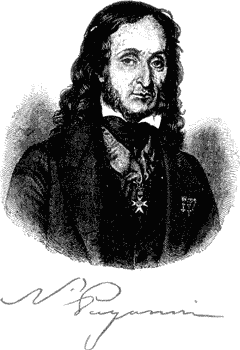
Fig. 80.
Earliest of these in point of time, and most influential in other
departments than his own, was the famous Italian violinist, Nicolo
Paganini (1784-1840), perhaps the most remarkable executant upon the
violin who has ever appeared. His father, a clever amateur, had him
taught music at an early age, and when only nine years of age he
played in a concert at Genoa with triumphant success. He had already
practiced diligently and, with[Pg 429] the intuition of genius, had found out
his own ways of accomplishing things, so that when, at the age of
eleven, he was taken to Parma to the teacher Rolla, he was told that
there was nothing to teach him. Returning home, he continued his
practice, applying himself as much as eight or ten hours a day, and
producing a number of compositions so difficult that he alone could
play them. His first European tour took place in 1805, and astonished
the world. The most marvelous stories were told of him. It was
popularly supposed that he could play upon anything, provided only the
catgut and the horsehair were furnished him. His first appearance in
France was in 1831, and in the same year he played in London. The[Pg 430]
height of his fame was reached in 1834, at which time Berlioz, the
French composer, presented him with a beautiful symphony, "Harold en
Italie." Notwithstanding the fact that Paganini lost money in Paris,
he presented Berlioz with 20,000 francs, in order to enable him to
pursue his career as a composer unhampered by financial distress. This
act was greatly to Paganini's credit, and entirely contrary to the
prevalent opinion concerning him, which was that he was very miserly.
Among the works which Paganini produced was a set of caprices for the
violin which were essentially novelties for the instrument. He
enlarged the resources of the violin in every direction, employing
double stopping, harmonics, and the high positions with a freedom
pre[Pg 431]viously unknown. Notwithstanding Spohr's modest remark that upon a
certain evening when playing for some amateurs he delighted them "with
all the Paganini juggles," it is certain that he did nothing of the
kind.
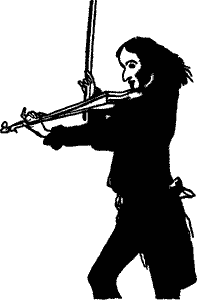
Fig. 81.
PAGANINI AS HE APPEARED.
[From a drawing by Sir Edwin Landseer.
(Grove.)]
It is impossible after this lapse of time to realize the sensation
which Paganini's appearances made. His tall, emaciated figure and
haggard face, his piercing black eyes and the furor of passion which
characterized his playing, made him seem like one possessed, and many
hearers were prepared to assert of their own knowledge that they had
seen him assisted by the Evil Spirit. His caprices remain the sheet
anchor of the would-be virtuoso. The entire art of violin playing
rests upon two works—the Bach sonatas for violin solo, and the great
Paganini caprices. Everything of which the violin is capable, or which
any virtuoso has been able to find in it, is contained in these works.
Upon two composers of this century Paganini's influence was extremely
powerful. Schumann took his departure from the Paganini caprices,
seeking to perform upon the piano the same kind of effect which
Paganini had obtained from the violin, or to discover others
equivalent to them. And Liszt set himself to do upon the piano the
same kind of impossibilities which Paganini had performed upon the
violin. Both these masters accomplished more than they planned for.
Schumann enriched the current of musical discourse by his experiments
having their departure from Paganini, thereby accomplishing something
which Paganini did not; for while the great violinist's works are of
astonishing value for the violin, they are not particularly
significant as tone-poetry. They are pleasing and sensational, and at
times passionate, show pieces for the virtuoso.[Pg 432]
II.
Hector Berlioz (1803-1869), for whose genius Paganini had such
admiration, was perhaps the most remarkable French personality in
music during the nineteenth century, and one of the most commanding in
the whole world of music. He was born at Grenoble, in the south of
France. His father, a physician, intended that the son should follow
his own profession, but when the young Berlioz was sent to Paris to
study medicine, at the age of eighteen, music proved too strong for
him, and he entered the Conservatory as a pupil of Lesueur. His
parents were so incensed by this course that the paternal supplies
were cut off, and the young enthusiast was driven to the expedient of
earning a scanty living by singing in the opera chorus at an obscure
theater, La Gymnase Dramatique. The daring originality of the young
musician, and his habit of regarding every rule as open to question,
rendered him anything but a favorite with Cherubini, the director of
the Conservatory, and it was only after several trials that he carried
off the prize for composition. The second instance of this kind
occurred in 1830, the piece being a dramatic cantata "Sardanapole,"
which gained him the prize of Rome, carrying with it a pension
sufficient to maintain the winner during three years in Italy.
On his return to Paris, he found it extremely difficult to secure a
living by his compositions, their originality and the scale upon which
he carried them out, placing them outside the conventional markets for
new musical works designed for public performance. In this strait he
took to writing for the press, in the Journal des Débats, for which
his talent was little, if any, less marked than[Pg 433] for musical
production upon the largest scale. As a writer, he was keen,
sarcastic, bright and sympathetic. A man of the world, and at the same
time an artist, he touched everything with the characteristic
lightness and raciness of the born feuilletonist. Very soon (in
1834), he produced his symphony "Harold en Italie," which Paganini
so much admired that he presented Berlioz with the very liberal, even
princely douceur of 20,000 francs ($4,000). Meanwhile Berlioz was
unable to secure recognition in Paris. His compositions were regarded
as extravagant and fantastic, and Parisians were curiously surprised
at the reception the composer met with in Germany, when he traveled
there in 1842 and 1843, and again in 1852, bringing out his works. The
Germans were by no means unanimous regarding his merits. Mendelssohn,
who found Berlioz most interesting as a man, had no admiration for his
music. To him it appeared crazy and unbeautiful. The sole recognition
which Berlioz had in France was the librarianship of the
Conservatoire, with a modest salary, and the Cross of the Legion of
Honor. In spite of the small esteem in which this clever master was
held by his countrymen during his life, he produced a succession of
remarkable works, without which the art of music would have missed
some of its brightest pages. Among these we may mention his dramatic
legend of "The Damnation of Faust," for solos, chorus and orchestra,
which marks one of the highest points reached by program music. This
great work is now generally accepted as one of the best of the
romantic productions, and the orchestral pieces in it have become part
of the standard repertory of orchestras everywhere.
Berlioz was above all the composer of the grandiose, the magnificent.
This appears in his earliest works. In[Pg 434] 1837 he composed his Requiem,
for the funeral obsequies of General Damremont. This work is of
unprecedented proportions. It is scored for chorus, solos and
orchestra, the latter occasionally of extraordinary appointment. In
the "Tuba Mirum," for example, he desires full chorus of strings,
and four choirs of wood-wind and brass. The wood-wind consists of
twelve horns, eight oboes, and four clarinets, two piccolos and four
flutes. The brass is disposed in four choirs as follows, each at one
of the corners of the stage; the first consists of four trumpets, four
tenor trombones and two tubas; the second of four trumpets and four
tenor trombones; the third the same; the fourth of four trumpets, four
tenor trombones and four ophicleides. The bewildering answers of these
four choirs of brass give place at the words "Hear the awful trumpet
sounding," to a single bass voice, accompanied by sixteen kettle
drums, tuned to a chord. A movement of similar sonority is the "Rex
Tremendæ Majestatis." At other times the work is very melodious. It
is indeed singular that a young composer should commence his career
with a piece so daring. But to Berlioz's credit it must be said he
never makes a mistake in his calculations of effect. When he desires
contrast and blending effect of different masses, these results always
follow whenever his work is performed according to his directions.
All the music of Berlioz belongs to the category of "program music,"
that is to say, everywhere there is an attempt at painting a scene or
representing something by means of music, that something being
habitually suggested and explained by the text, if the work be vocal,
or by explanatory notes, if the work be instrumental. This is as true
of his symphonies, "Romeo and Juliet,"[Pg 435] and "Harold in Italy," as in
the vocal works themselves. The list of these contains an oratorio,
"The Childhood of Christ" (1854), "The Damnation of Faust" (1846), the
operas "Benvenuto Cellini," produced at the Académie, 1838, "The
Trojans" (1856), "Beatrice et Benedict" (1863). The first was
performed under the direction of Liszt at Weimar, about 1850, but with
indifferent success. Berlioz instrumented several pianoforte
compositions for orchestra, the best known of them being Weber's
"Invitation to the Dance," and "Polonaise in E flat." His treatise
upon instrumentation, published in 1864, remained standard until since
the appearance of the elaborate and more systematic work upon this
subject by F.A. Gevaert. The greatest of Berlioz's works is his
splendid "Te Deum," written during the years 1854 and 1855, for some
kind of festival performance. He planned this composition as part of a
great trilogy of an epic-dramatic character in honor of Napoleon, the
first consul. At the moment of his return from his Italian campaigns,
he was to have been represented as entering Notre Dame, where this
"Te Deum" is sung by an appointment of musical forces consisting of
a double chorus of 200 voices, a third choir of 600 children, an
orchestra of 134, an organ, and solo voices. The entire work was never
completed, and the "Te Deum" had its first and only representation
in Berlioz's lifetime at the opening of the Palace of Industry, April
30, 1855. The work is full of splendid conceptions, and is freer from
eccentricities than any other of the author. It is extremely sonorous,
and is destined to be better known as festival occasions upon a larger
scale become more numerous.
The whole effect of Berlioz's activity was that of a virtuoso in the
department of dramatic and descriptive[Pg 436] music, and in the art of
wielding large orchestral masses. It is curious that between him and
Wagner the relations should never have been cordial, although the ends
proposed by both were substantially identical, and the genius of both
incontestable. Berlioz had no confidence in Wagner's "endless melody,"
and when he writes about music he does so in the attitude of a humble
follower of the old masters.
III.
The progress in piano playing, in the course of the nineteenth century
has been most extraordinary. The music of Beethoven and Schubert,
composed during the first quarter of this century, and the influence
of the virtuosi prominent during that time, whose activity has been
told in connection with those of the century previous (the operative
principles of which were the ones mainly influencing them); and the
continual strife of the piano makers to increase the resonance,
singing quality and artistic susceptibility of the tone and the
strength and elasticity of the action, as recounted in the chapter
devoted to the history of this, the greatest of modern
instruments—were concentrating influences having the effect of
calling attention to the new instrument in a very remarkable manner.
Add to these causes the meteor-like appearance of Paganini, with his
stupendous execution upon the violin, and its novel possibilities. All
these together seem to have led four gifted geniuses at about the same
time to make independent investigations into the tonal possibilities
of the piano, and the mode of producing effects upon it, in the hope
of creating a new art, and of rivaling the weird successes of the
highly gifted Italian, who apparently had exhausted the possibilities
of the[Pg 437] violin. The artists thus occupied in developing the art of
piano playing were Chopin, Liszt, Thalberg and Schumann, and it is far
from easy to determine exactly which one it was who first brought his
influence to bear upon the public; or which one it was who first
arrived at the successful application of the principles of the new
technique, whose essential divergences from the old consisted in a
more flexible use of the fingers, hand and arm, and the co-operation
of the foot for the promotion of blending, and of bringing into
simultaneous use the tonal resources from all parts of the instrument.
In this case, as in so many others of remarkable invention, the
improvements seem to have been made by several independent
investigators acting simultaneously, each one ignorant of the work of
the others. The impulse in the direction of greater freedom had
already found expression in the pianoforte pieces of the great master,
Von Weber, whose sonatas and caprices had been published between 1810
and 1820. (See pp. 410 and 411.) These contain several novelties,
which I have found it more convenient to discuss in connection with
the personal history of the composer. Liszt has generally been held as
a little the earliest of the four in point of time, his arrangement of
Berlioz's "Harold" symphony having been published, according to the
dates in Weitzmann's history, in 1827, but according to more accurate
information, in 1835, while he had published his arrangement of the
Paganini caprices in 1832, one year after hearing Paganini. In these
works Liszt makes demands upon the hands which were not recognized as
among the possibilities of the old technique. But for all this, it is
apparently certain that the honor of having developed a style
distinctly original, and with peculiarities easily recog[Pg 438]nizable by
the average listener, belongs to the great virtuoso Thalberg.
Sigismund Thalberg (1812-1871) was the illegitimate son of Prince
Dietrichstein, a diplomat then living at Geneva. His mother was the
Baroness von Wetzlar. Thalberg was carefully educated, and accustomed
to high-bred society from childhood. His father intended him for a
diplomatic career, but the boy's talent for the piano was
irresistible, and, so well had his education been advanced by his
teacher, the first bassoonist of the Vienna opera, that by the time he
was fifteen he made a brilliant success at a concert in Vienna. His
first composition in the style which he afterward made so famous was
the fantasia on themes from "Euryanthe," which was published in
1828. Later, in 1835, he entered upon his public career as virtuoso
with concert tours to all parts of the world, everywhere greeted with
admiration and astonishment. He appeared in Paris late in 1834 or
early in 1835, finding Liszt there in the plenitude of his powers.
Then there was a rivalry between them, and opposing camps were
instituted of their respective admirers. The dispute as to their
relative excellence ran high, and, as usually happens in personal
questions of this sort, victory did not belong entirely to either
party. Nevertheless, at this distance it is not easy to see why the
question should have been raised, since in the light of modern piano
playing Liszt's art had in it the promise of everything which has come
since; while Thalberg's had in it only one side of the modern art.
Thalberg had a wonderful technique, in which scales of marvelous
fluency, lightness, clearness and equality, intervened between chord
passages of great breadth and sonority, so that all the resources of
the piano were open to him. But his specialty was that of carrying[Pg 439] a
melody in the middle of the piano, playing it by means of the two
thumbs alternately, the other hand being occupied in runs and passages
covering the whole compass of the piano, crossing the melody from
below, or descending upon it from the highest regions of the treble,
and continuing down the keyboard with perfect equality and lightness,
without in the slightest degree disturbing the singing of the melody.
This, of its own accord, went on in the most artistic manner, as if
the pianist had nothing at all else to do than to sing it. The
perfection of Thalberg's melody playing was something wonderful, as
well it might be; for in order to master the art of it, he studied
singing for five years with one of the best teachers of the Italian
school, the eminent Garcia. This, however, was later, after he had
located in Paris.
This trick of treating the melody was not new with Thalberg. It had
previously been done upon the harp by the great Welsh virtuoso, Parish
Alvars (1808-1849), whose European reputation had been acquired by a
succession of great concert tours, and who at length closed his days
in Vienna, where Thalberg lived. There was also an Italian master,
Giuseppe Francesco Pollini (1763-1846), who in 1809 became professor
of the piano in the Conservatory of Milan. Pollini had been a pupil of
Mozart, and dedicated to that great master his first work. Early after
being appointed professor he published a great school for the
pianoforte (1811), in which the art is fully discussed in all its
bearings, and minute directions given for touch and all the rest
appertaining to a concert treatment of the instrument. He was the
first to write piano pieces upon three staves, the middle one being
devoted to the melody; a proceeding after[Pg 440]ward followed in some cases
by Liszt and Thalberg. Pollini surrounded his melodies, thus placed in
the middle of the instrument, where at that time the sonority and
singing quality of the pianoforte exclusively lay, with runs and
passages of a brilliant and highly ingenious kind. This was done in
his "Una de 32 Esercizi in Forma di Toccata," but he had already, in
1801, published several brilliant pieces in Paris, in which novelties
occur. I have never seen a copy of these works of Pollini, nor any
other account of them than those in Riemann's dictionary and in
Weitzmann's history of the pianoforte, but it is altogether likely
that when they are examined we shall find in this case, as in many
others of progressive development, that the final result was reached
by a succession of steps, each one short, and apparently not so very
important. The chain of technical development for the piano extended
from Bach in unbroken progress, and the discovery of Pollini, who was
less known in western lands than others of the great names in the
list, enables us to fill in between Moscheles and Thalberg. Pollini's
work anticipates the Clementi Gradus by about six years.
To return to Thalberg.—In 1856 he visited America, where his success
was the same as in all other parts of the world. Having accumulated a
fortune, he retired from active life, and bought an estate near
Naples, where he spent the remainder of his life. There were reasons
of a purely external and conventional kind why the playing of Thalberg
should have attracted more attention, or at least been more admired,
than that of Liszt, in Paris and in aristocratic circles everywhere.
His manner was the perfection of quiet. Whatever the difficulty of the
passages upon which he was engaged, he remained[Pg 441] perfectly quiet,
sitting upright, modestly, without a single unnecessary motion.
Moreover, the general character of his passages, which progressed
fluently upward or downward by degrees, instead of taking violent
leaps from one part of the keyboard to another, permitted him to
maintain this elegant quiet with less restriction than would have been
possible in such works, for instance, as the great concert fantasias
of Liszt. It is to be noticed, further, that the peculiar sonority of
Thalberg's playing depended upon the improvements in the pianoforte,
made just before his appearance and during his career. His method of
playing the melody, moreover, while perhaps not distinctly so
recognized by him, employed a noticeable element of the arm touch,
while his passage work was a ringer movement of the lightest and most
facile description. His chords, also, were often struck with a finger
touch, and he was perhaps the originator of the peculiar effect
produced by touching a chord with the fingers only, but rebounding
from the keys with the whole arm to the elbow. A chord thus played has
the delicacy peculiar to finger work, but in the removal from the keys
the muscles of the arm are called into action in such a way that the
finger stroke is intensified to a degree somewhat depending upon the
height to which the rebound is carried.
IV.
François Frédéric Chopin (1809-1849) was one of the most remarkable
composers of this epoch, and in some respects one of the most
precocious musical geniuses of whom we have any record. He was born at
Zela-Zowa Wola, a village six miles from Warsaw, in Poland, the son of
a French merchant living there, who[Pg 442] had married a Polish lady. Later,
in consequence of financial reverses, his father became a teacher in
the university. The boy, François, was brought up amid refined and
pleasant surroundings, and his education was carefully looked to.
Although rather delicate in appearance, he was healthy and full of
spirits. His precocity upon the piano was such that at the age of nine
he played a concerto in public with great success, from which time
forward he made many appearances in his native city. He early began to
compose, and by the time he was thirteen or fourteen, had undertaken a
number of works of considerable magnitude. After having received[Pg 443] the
best instruction which his native city afforded, he started out, at
the age of nineteen, for a visit to Vienna, where he appeared in two
concerts, and to his own surprise was pronounced one of the greatest
virtuosi of the day. This, however, is not the point of his precocity.
When he started upon his tour to Vienna, he had with him certain
manuscripts, which he had composed. His Opus 2 consisted of variations
upon Mozart's air, "La ci Darem la Mano," of which later Schumann
wrote such a glowing account in his paper at Leipsic. These variations
were enormously difficult, and in a wholly novel style. There were
several mazurkas, the three nocturnes, Opus 9, of which the extremely
popular one in E flat stands second; the twelve studies, Opus 10,
dedicated to Franz Liszt, and a concerto in F minor, and all or nearly
all of that in E minor. These were the work of a boy then only
nineteen, the pupil of a comparatively unknown provincial teacher.
When we examine these works more minutely, our astonishment increases,
for they represent an entirely new school of piano playing. New
effects, new management of the hands, new passages, beautiful melody,
exquisitely modulated harmonies—in short, a new world in piano
playing was here opened. So difficult and so strange were these works,
that for nearly a generation the more difficult ones of them were a
sealed book to amateur pianists, and even virtuosi like Moscheles
declare that they could never get their fingers reliably through them.
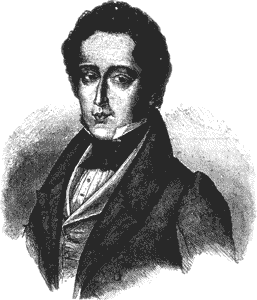
Fig. 82.
FRÉDÉRIC CHOPIN.
Much pleased with his success in Vienna, Chopin returned to Warsaw,
and after some months, set out for London, by way of Paris. Here his
fortune varied somewhat. At first he found it impossible to secure a
hearing, his only acquaintances being a few of his exiled
fellow-[Pg 444]countrymen, who were there. At length one evening a friend
took him to a reception at the Rothschild's, and in this cultivated
society he found appreciative listeners to his marvelous playing. From
that time on he remained in Paris, only leaving it when his health
made it necessary to visit the south of France. He very seldom
appeared in public. His touch was not sufficiently strong to render
his playing effective in a large hall.
The whole of the Chopin genius is summed up in his early works, which
he took with him on his visit to Vienna. All his later works are in
some sense repetitions. The ideas and the treatment are new, but the
principles underlying are the same, and rarely, if ever, does he reach
a higher flight than in some of these earlier works. His most
celebrated innovation was that of the Nocturne, a sentimental
cantilena for the pianoforte, in which a somewhat Byronic sentiment is
expressed in a high-bred and elegant style. The name "nocturne" was
not original with Chopin—the Dublin pianist, John Field, having
published his first nocturnes in 1816. Field himself derived the name
from the prayers of the Roman Church which are made between midnight
and morning. The name, therefore, implies something belonging to the
night—mysterious, dreamy, poetic. In Field's there is little of this,
aside from the name; the melodies are plain and the sentiments
commonplace. With Chopin, however, it is entirely different. In some
instances the treatment for the piano is very simple, as in the
popular nocturne in E flat, already mentioned; but in other cases he
exercises the utmost freedom, and very carefully trained fingers are
needed to perform them successfully. This is the case, for example, in
the beautiful nocturne in G, Opus 37, No. 2, where the passages in[Pg 445]
thirds and sixths are extremely trying; also in the very dramatic
nocturne in C minor, Opus 48.
Chopin's place in the Pantheon of the romantic school is that of the
popularizer of pianoforte sentiment. His compositions, by whatever
name they may be called, are essentially lyric pieces, songs, ballads
and fanciful stories in rhyme. The subjects are frequently tender or
sad, sometimes morbid—in short, Byronic. The treatment is always
graceful and high-bred, and the contrasts strong. The melodies are
embroidered with a peculiar kind of fioratura, which he invented
himself, founded upon the Italian embellishment of that kind—a
delicate efflorescence of melody, which, when perfectly done, is
extremely pleasing. The names applied to the different compositions
such as Ballade, Scherzo, Prelude, Rondo, Sonata, Impromptu, have only
a remote reference to the nature of the piece. Occasionally the entire
composition is morbid and unsatisfactory to a degree. These belong to
the later period of his life, when he was in poor health. He is a
woman's composer. In his strongest moments there is always an
effeminate element. In this respect he is exactly opposite to Schumann
and Beethoven, whose works, however delicate and refined, have always
a manly strength. Chopin made the most important modifications in the
current way of treating the piano. In this part of his activity he
seemed to realize the possibilities of the instrument, in the same way
that Paganini had recognized those of the violin. His passages, while
based upon those of Hummel, nevertheless produced effects of which
Hummel was totally incapable. Chopin is the originator of the extended
arpeggio chord, of the chromatic sequences of the diminished
sevenths with passing notes, and cadenza forms derived from[Pg 446] them. He
is thoroughly French in his views of "changing notes," as, for
instance, in the accompaniment to the impromptu in A flat, Opus 29.
His influence upon the general progress of musical development is to
be traced in the works of Liszt, especially in the later pianoforte
works, and in a large number of less gifted imitators, like Doehler.
V.
Aside from Wagner, the most remarkable figure of this century is that
of Franz Liszt, who was born at Raiding, in Hungary, 1811, and died at
Bayreuth, 1886. His father, Adam Liszt, was an official in the
imperial service, and a musical amateur, capable of instructing his
son in piano playing. At the age of nine he made his first public
appearance, with so much success that several noblemen guaranteed the
money to enable him to pursue his studies for six years in Vienna.
Here he became a pupil of Czerny, Salieri and Randhartinger. He made
the acquaintance of Schubert, and upon one occasion played before
Beethoven, who kissed him, with the prophecy that he would make his
mark. His first appearance as a composer was in a set of variations on
a waltz by Diabelli, the same for which Beethoven wrote the
thirty-three variations, Opus 120. Liszt's variation was the
twenty-fourth in the set to which Beethoven did not contribute. It was
published in 1823, when he was twelve years old. The same year he went
to Paris, his father hoping to enter him at the Conservatory, in spite
of his foreign origin; but Cherubini refused to receive him, so he
studied with other composers. His operetta of "Don Sanché" was
performed at the Académie Royale in 1825, and was well received. At
this time he[Pg 447] was in the height of his youthful success in Paris,
tall, slender, with long hair and a most free and engaging
countenance, with ready wit and unbounded tact. He performed marvels
upon the piano, such as no one else could attempt. His repertory at
this time seems to have consisted of pieces of the old school. In 1827
he lost his father, and being thrown upon his own resources, he began
his concert tour. He appeared in London in 1827, his piece being the
Hummel concerto. Three years later he played in London again, his
number being the Weber Concertstück.
There was something weird and magnetic about his playing. He was very
tall, about six feet two inches, slender, with piercing eyes, very
long arms, but small hands; he played without notes, and amid the most
frightful difficulties of execution kept his eyes fixed upon this,
that or the other person in the audience. He moved about at the piano
very much in the exciting passages, not, apparently, on account of the
difficulty of overcoming technical obstacles, but simply from innate
fire and excitement. As for technical difficulties, they did not
exist. Everything that the piano contained seemed to be at his
service, and the only regret was that the instrument was not better
able to respond to his demand. In the fortissimo passages his tone
was immense, and his pianissimos were the most delicate whispers. In
these his fingers glided over the keys with inconceivable lightness
and speed, and the tone fell upon the ear with a delicate tracery with
which no particular was lost by reason of speed or lightness. This
wonderful control of the instrument stood him in equal stead with his
own compositions, especially adapted to his own style of playing; or
with the works of the old school, which he[Pg 448] transfigured as they had
never been played before; or the last sonatas of Beethoven, which at
that time were a sealed book to most musicians. These, indeed, he did
not play in public, but in private. The essential novelties of the
Liszt technique were the bravura cadenzas. The other sensational
features, such as carrying the melody in the middle range of the piano
with surrounding embroidery, the rapid runs and the extravagant
climaxes, were all more or less common to the three representative
virtuoso piano writers of this epoch—Liszt, Chopin and Thalberg.
A careful study of all the circumstances and influences surrounding
Liszt at the time, leads to the conclusion that his ideas of the
possibilities of the pianoforte were matured very gradually, not
reaching their complete expression in the operatic fantasias before
about 1834 or 1835. His early appearances were in pieces of the old
school, and there is nothing more to be found in contemporary accounts
of his playing than admiration for its superior fire and delicacy.
Upon the appearance of Paganini, however, this was changed. The
temporary eclipse, which this brilliant apparition made of the rising
Liszt, led him to new studies in original directions. Thus arose the
transcriptions of the Paganini caprices in 1832, and the composition
of his own "Studies for Transcendent Execution," in the same or the
following year. Farther sensational improvements were probably the
result of the Thalberg contest in Paris during 1835.
Liszt's influence may be inferred from such incidents as the
following: In 1839 there was a movement on foot to erect a monument to
Beethoven at Bonn, but after some months' solicitation the committee
found it impossible to realize the desired sum, or anything
approaching[Pg 449] it. Whereupon Liszt wrote them to give themselves no
further uneasiness, for he himself would be responsible for the entire
amount, about $10,000. This large sum he raised by his own exertions,
and paid over, and a monument was unveiled with brilliant ceremonies
in 1845. One of the performances upon that occasion was that of the
Beethoven fifth concerto, which Liszt himself played. Concerning this
memorable performance Berlioz himself writes: "The piano concerto in E
flat is generally known for one of the better productions of
Beethoven. The first movement and the Adagio, above all, are of
incomparable beauty. To say that Liszt played it, and that he played
it in a fashion grand, fine, poetic, yet always faithful, is to make a
veritable pleonasm, and there was a tumult of applause, a sound of
trumpets, and fanfares of the orchestra, which must have been heard
far beyond the limits of the hall. Liszt immediately afterward mounted
the desk of the conductor to direct the performance of the symphony in
C minor, which he made us hear as Beethoven wrote it, including the
entire scherzo, without the abridgment, as we have so long been
accustomed to hear at the Conservatory at Paris; and the finale, with
the repeat indicated by Beethoven. I have always had such confidence
in the taste of the correctors of the great masters that I was very
much surprised to find the symphony in C minor still more beautiful
when executed entirely than when corrected. It was necessary to go to
Bonn to make this discovery."
In 1849 a new epoch was opened in the history of this remarkable man.
The grand duke of Weimar invited him to assume the direction of his
musical establishment, including the opera. The salary was absurdly
small—$800 or $1,000 a year. This, however, cut no figure in Liszt's[Pg 450]
mind, for he had always been singularly open-handed, yet at same time
prudent. From his successful concert tours he had put by funds, 20,000
francs for his aged mother, and 20,000 francs for each of the three
children he had by the Countess D'Agoult (known in literature as
Daniel Stern), and he considered that the position would afford him an
opportunity of developing his own talent for composition, and at the
same time of affording a hearing for important new works, which, on
account of their novelty and originality, were impossible of
performance in the theaters of large cities. The repertory of the
Weimar opera, from this time on, was most extraordinary. Here were
produced for the first time Wagner's "Flying Dutchman,"
"Tannhäuser," and "Lohengrin," "Benvenuto Cellini," of Berlioz,
Schumann's "Genoveva" and "Mannfred," and Schubert's "Alfonso and
Estrella." Here were produced, also, the best of the operas of
previous generations. Every master work of this sort Liszt revised
with the greatest care, giving endless patience to every detail, and
supplementing the resources of the theater, when insufficient, by
"guests" from the great operas in the capital. Thus the musical
establishment at Weimar became a sort of Mecca, to which all the
musicians of the world gathered, especially the young and energetic in
the pursuit of knowledge, and creative artists seeking a hearing or
fresh inspiration. From an artistic standpoint, nothing more beautiful
than the life of Liszt at Weimar could be desired. Besides these
operatic performances and his symphony concerts, he gathered about him
a succession of young virtuosi pianists. These had lessons, more or
less formally, some of them for many years. Liszt never received money
for lessons, and took no pupils but those whom he regarded[Pg 451] as
promising, or who were personally attractive to himself. About 1850
the American, Dr. William Mason, was there, and for two years
following. The class at this time contained the well known names of
Rubinstein, Carl Klindworth, Pruckner, Tausig, Joachim Raff, and Hans
von Bülow. From this time on there is scarcely a concert pianist in
the world who did not spend a few months or longer with Liszt at
Weimar. Nor did his influence stop here. He produced a constant
succession of important works, and conducted concerts and festivals in
Hungary, and in different parts of Germany and France. Everywhere his
inspiring presence and his keen insight were prized above all ordinary
resources.
There is not space here to sketch in detail his singular and trying
relations to that self-conscious genius, Wagner, who, when absconding
to Zurich, sent the score of "Lohengrin" to Liszt. It can be
imagined with what force the elevated and noble beauty of this
epoch-marking work appealed to a genius so sensitive as Liszt. He not
only produced the opera with great care, but prepared the public for
it by means of extended articles in important journals in Leipsic,
Berlin and Paris. From this time on, Liszt became the good angel of
Wagner. There are few records in the annals of music more creditable
than the letters of Liszt to Wagner. He took charge of his business in
Germany, exercised his wholly unique and commanding influence to
secure performances of Wagner's operas, sent him money out of his own
purse, and secured some from his friends. More than this, he greeted
every new work of Wagner's with an appreciation as generous and noble
as it was intelligent and fine.
About 1852 Liszt commenced his symphonic poems. In these he avails
himself of two of Wagner's sugges[Pg 452]tions. Much is made of the leading
motive, and the orchestration is handled in a sonorous and brilliant
manner, which Berlioz and Wagner first introduced. The works are very
effective and original. Certain ones of them have become almost
classic, like "The Preludes" and "Tasso." He also wrote a number of
large choral works, among them his "Legend of the Holy Elizabeth," the
"Graner Mass," etc.
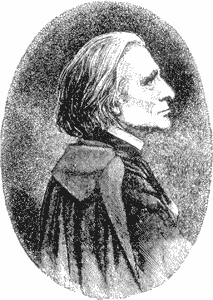
Fig. 83.
LISZT AS ABBÉ.
[Grove.]
There is hardly a province of musical composition in which Liszt did
not distinguish himself. The orchestral compositions number about
twenty. There are several important arrangements, such as Schubert
marches, Schubert's songs, "Rakoczy March," and a variety of
arrangements for pianoforte and orchestra, including two[Pg 453] concertos,
the Weber Polacca in E, and the Schubert fantasia. The pianoforte
compositions are extremely numerous. Of the original pieces there are
perhaps one hundred. Of important arrangements, such as the études
from Paganini, the organ preludes and fugues from Bach, Schubert
marches, etc., there are thirty or forty. Of the operatic fantasias
there are perhaps a hundred or more. There are fifteen Hungarian
Rhapsodies, and a large number of transcriptions of vocal pieces (of
songs alone there are upwards of a hundred). Of masses and psalms[Pg 454]
about twenty. Two oratorios, several cantatas, about sixty original
songs for single voice and piano, and very many other writings of a
literary and musical kind. In 1865 Liszt left Weimar for several
years, and resided in Rome, where he began to take holy orders.
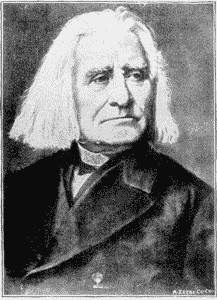
Fig. 84.
FRANZ LISZT.
In the closing years of Wagner's life, after the Bayreuth festival
theater had been inaugurated, Liszt was a central figure, and there
are few large cities in Europe which he did not visit for the sake of
encouraging important productions of the Wagnerian works. Thus, taken
as a composer, a performer, a conductor, and an appreciative friend of
art, his name is one which deserves to be revered as long as the
history of music in the nineteenth century is remembered.
Fig. 84 represents him as he appeared in the last years of his life.
The portrait of Liszt as abbé is taken from Grove's Dictionary.
Neither of these last pictures gives an adequate idea of the sweetness
of his expression. While the profile in middle life was sharp and
clearly cut, as we see it in the abbé picture, and while in old age
the mouth assumed a stern and set expression in repose, his smile was
extremely winning, and the habitual expression of his face in
conversation one of amiability and kindness.
[Pg 455]
CHAPTER XXXVI.
MENDELSSOHN AND SCHUMANN.
I.
NE of the most fortunate personalities among modern composers was
Felix Mendelssohn Bartholdy (1809-1847), who was born in Berlin, the
grandson of Moses Mendelssohn, the famous Jewish philosopher. The
father of Felix was a banker, and his mother a woman of a very sweet
and amiable disposition. The children of Abraham Mendelssohn were
baptized in the Christian faith in order to escape in some degree the
prejudice against the Jewish race. Felix, having a strong inclination
to music, at an early age made great progress in it. His first concert
appearance was made at the age of ten, in which he played the piano
part in a trio by Woelfl, and was very much applauded. As early as his
twelfth year he began systematically to compose, and being naturally
of methodical habits, which were still further encouraged by his
father and mother, he kept an accurate record of his works, which at
the last filled forty-four folio volumes, the most of the pieces being
dated, and the place given where they were written. In the year 1820
he composed between fifty and sixty movements, of almost every sort,
songs, part songs, pieces for organ, piano, strings and orchestra, as
well as a cantata,[Pg 456] and a little comedy for voices and a piano. In the
summer of 1820, the whole family made a tour of Switzerland, and a
very large number of pieces were composed at this time. In this same
year he made a more important concert appearance with Aloys Schmitt,
in which he played with Schmitt a duet for two pianos. This continued
exercise in composition was not entirely of an abstract nature, for
the Mendelssohn family were accustomed to have reunions on Sunday
evenings, when these pieces were played. For occasions like this he
wrote several small operas, and his talent was encouraged in every way
by his parents, and by his very judicious teacher, the celebrated
Zelter. When he was scarcely more than twelve years old, Zelter had
him play before Goethe, and a trio of the boy's was also played, after
which he was sent to play in the garden while his seniors discussed
his prospects. Thus the boy grew up under the most favorable
circumstances possible, his father being a wise and careful man, who,
although not a musician, thoroughly sympathized with the artistic aims
of his son; and his mother also encouraged him to more serious
efforts. Even at this early age he was a prolific composer of
orchestral music, the year 1824 being that of the composition of the
symphony in C minor, now known as No. 1, but in Mendelssohn's
catalogue marked the thirteenth of his compositions. In this year
Moscheles passed through Berlin on his way to London, and made the
acquaintance of Mendelssohn. At the Sunday morning music in the
Mendelssohn house, Moscheles recalls the performance of Felix's C
minor quartette, D major symphony, a concerto by Bach, played by
Fanny, and a duet for two pianos. In the same year Spohr came to
Berlin, and a little later Hiller, both of whom speak of[Pg 457]
Mendelssohn's playing as something very remarkable. His celebrated
octette for strings, Opus 20, was composed in 1825. This was the first
of his works which has retained its popularity. The year following he
composed the overture to "The Midsummer Night's Dream," one of the
most remarkable pieces of the early romantic school. In this the
fairy-like music of Titania and her elves is charmingly contrasted
with the folk songs and the absurd bray of the transformed Bottom. He
had already written an opera "Camacho," which had been submitted to
Spontini, the musical director of Berlin, but it was never performed.
He entered at the University and attended the lectures of Hegel and
Carl Ritter, the geographer, but for mathematics he had no talent. Two
folio volumes of notes of the lectures of Hegel and Ritter are
preserved from the years 1827 and 1828. His overture to "The Calm Sea
and Prosperous Voyage" was written in 1828. In the year following he
started on a long journey of three years, carefully planned by his
father, in which all the countries of Europe were to have been visited
successively, and observations made on civilization and society. His
first appearance before an English audience was at a Philharmonic
concert, May 25, 1828, when he conducted his symphony in C minor and
improvised on the piano. He was received with the utmost applause.
Five days later he played the Concertstück of Von Weber, and, which
was a great innovation at that time, with no music before him. His
letters from London are very charming indeed. At a concert later, his
overture to "The Midsummer Night's Dream" was performed with great
success; this was the beginning of his English popularity, lasting all
the rest of his life.[Pg 458]
The first of his "Songs without Words" was published in 1830, having
been originally composed for his sister Fanny. In this simple act he
opened a new chapter of the literature for the piano. The form of the
song without words had already been given in Field's nocturnes, the
first of which were published in 1816; but Mendelssohn, by giving it
the title, "Song, without Words," put the hearer in a different
relation to the composition—that of seeking to find in the work a
poetic suggestion in addition to pleasing melody and finely modulated
harmony. This, also, is extremely characteristic of the romantic
epoch, in which music has its origin in poetry. He had already written
a number of those charming capriccios, in which the piano is treated
with light staccato changing chords, such as Von Weber had suggested
nearly twenty years earlier in his "Moment Capriccio," but which no
writer brought to such perfection as Mendelssohn. These two styles of
pianoforte writing—the fairy-like scherzo, and the "Song without
Words," are Mendelssohn's specialties, in which no other writer can be
compared with him. He also wrote a number of concertos for piano and
orchestra, and one for violin, in which these two elements are very
strong features. Without having the effective passage work of
Thalberg, Liszt or Chopin, or the bold originality of Schumann,
Mendelssohn was an extremely original and pleasing pianoforte writer.
During his life, especially in the later part of it, he was somewhat
over-estimated; but at the present time, through the emergence of
Schumann from the obscurity into which Mendelssohn's reputation cast
him, the works of Mendelssohn are often underestimated. He opened a
new chapter in tone-poetry, popularizing pianoforte sentiment.[Pg 459]
The famous G minor concerto for the piano was first produced in Munich
in 1831. In the same year he went to Paris, where many of his works
were performed and others were composed. The next year he was in
London again, when the Hebrides overture was produced and the first
book of "Songs without Words" was published. He also played the organ
at several of the churches, and excited general admiration by his
vigorous style. He is said to have been the first to play a Bach pedal
fugue in England, certainly the first to play any of the important
ones. In 1833 he was settled at Düsseldorf, as musical director of the
church and two associations. There he immediately instituted a reform
in the music of the church, and in the character of the selections for
concert. In the church there were masses by Beethoven and Cherubini,
motettes by Palestrina, and cantatas by Bach. The next year his
oratorio of "St. Paul" was begun. In 1837 he was married to a very
charming lady—Miss Cecilia Jeanrenaud, daughter of a clergyman of the
Reformed Church at Frankfort. Very soon after the wedding he was in
London and Birmingham, where he conducted "St. Paul" and commenced to
prepare the libretto for his oratorio of "Elijah." Among the Bach
fugues which he played in London on the organ at this time were the D
major, the G minor, the E major, the C minor and the short E minor.
His pedal playing was very highly esteemed.
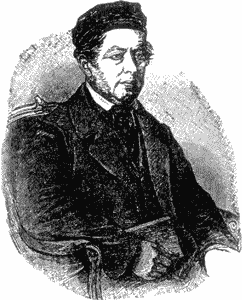
Fig. 85.
MORITZ HAUPTMANN.
In 1835 he commenced to conduct the Gewandhaus concerts at Leipsic,
and the celebrated conservatory there was founded in 1843. The first
professors were Hauptmann, David, Schumann, Pohlenz and C.F. Becker.
Ferdinand David (1810-1873) was the greatest master of the violin
during the third quarter of the century.[Pg 460] Moritz Hauptmann
(1792-1868), originally a violinist, was one of the most original
theorists of this century. His greatest work, "Harmony and Meter," was
published in 1853. Soon afterward Moscheles became associated with
them. The city of Leipsic remained his home during the remainder of
his life. The founding of the conservatory may have been hastened by
certain plans which Mendelssohn had endeavored three years before to
get adopted in Berlin, where there was a project for founding a royal
music school upon a different basis from any at that time existing.
From some change in the ministry, or temporary political disturbance,
the plan fell through, but in Leipsic it was carried out. This famous
school from that time forward, for nearly[Pg 461] fifty years, exercised an
influence greater than that of any other music school in the world.
Among its graduates are a very large number of the most successful
teachers and celebrated professional musicians. They had been drawn to
Leipsic by the reputation given the conservatory by the possession of
such masters as Mendelssohn, Schumann, Hauptmann, Moscheles, Plaidy,
Dr. Paul, Becker, Brendel, Reinecke and others. After Mendelssohn's
death, indeed, the tradition of his ideas hampered the efficiency of
the school to some extent, but very thorough work has always been done
there. During his four years' connection with the conservatory
Mendelssohn conducted the Gewandhaus concerts and superintended the
entire educational operations of the school. In addition to this he
conducted a succession of important festivals in all parts of Europe,
producing new works of his own, and the greatest works of the masters
before him. He made a great reputation as concert pianist, playing his
own concertos and those of Beethoven, as well as the Concertstück of
Von Weber. Everywhere he improvised upon the organ or the piano, and
through all the admiration which he received remained the same simple,
unaffected, sincere artist that he was when a boy. His home life was
very happy. In Ferdinand Hiller's reminiscences many charming pictures
of it are given.
The greatest of Mendelssohn's works was "Elijah," which was produced
at Birmingham, August 26, 1846. Staudigl, the famous baritone of
Vienna, was Elijah. The work went extremely well at the first
performance—better, Mendelssohn says, than any former work of his.
The continual anxiety of producing the new work, the travel and the
many responsibilities belong[Pg 462]ing to his position finally undermined
his health, and at length, November 4, 1847, he died at Leipsic. It is
doubtful whether any musician ever left a warmer or a more
distinguished circle of friends than Mendelssohn. In all parts of the
musical world his death was regarded as a calamity.
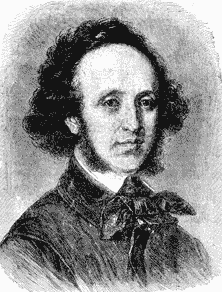
Fig. 86.
FELIX MENDELSSOHN BARTHOLDY.
In "Elijah" and in the first part of "St. Paul" Mendelssohn made an
addition to the world's stock of oratorios scarcely second to any
other works, excepting Händel's "Messiah." "Elijah," in particular,
had the advantage of an extremely dramatic and picturesque[Pg 463] story, and
a text well selected from the Scriptures. There are many moments in
this work of rare and exquisite beauty. The choruses when
contrapuntally developed, have themes somewhat too short, whereby the
effect of the words is lost in the intermingling of voices coming in
at later moments, but there are other parts of the work which are
extremely beautiful. There is a lovely chorus, "He Watching over
Israel," in which the gentle Mendelssohnian melody is accompanied by
soft triplets in the strings, whereby a most delightfully light and
spirituelle effect is produced. Near the end of the work there is a
very graphic recitative to the words, "And One Cherub Cried to
Another"; then a soprano voice with grand phrase sings "Holy, Holy Is
God, the Lord," three other soprano voices joining in the last words.
These are very lightly accompanied. Immediately thereupon, the entire
chorus, orchestra and organ, with the utmost power, come in with the
same melody, "Holy, Holy Is God, the Lord." This antiphon between the
full chorus and the female quartette continues in varying style
throughout the chorus, and the result is thrilling in the extreme.
Extremely dramatic, also, is the great chorus "Thanks Be to God, for
He Laveth the Thirsty Land." There are many solo numbers in the work,
all of them remarkable for the care with which the text is treated,
and the clearness with which the musical utterance expresses the
words. The famous tenor song, "If with All Your Hearts Ye Truly Seek
Him," the alto song, "Oh Rest in the Lord," the angel trio, "Lift
Thine Eyes," the great soprano song, "Hear Ye Israel," and the bass
aria, "It Is Enough," and especially the prayer of Elijah, "Lord God
of Abraham, Isaac and Israel," are scarcely surpassed in the entire
range of oratorio music. There is[Pg 464] very remarkable instrumentation,
also in the scenes on Mt. Carmel, and especially at the series of
choruses where "God, the Lord, Passed By."
During his life, Mendelssohn was very highly esteemed as a composer of
orchestral music, symphonies and overtures. While his works in this
department contain many beauties, and are carried out with elegant
clearness of form, and with that refinement and taste which
characterized everything which Mendelssohn did, they have not
maintained their reputation at the high level where it formerly stood.
It was Mendelssohn's fortune to be one of the masters instrumental in
introducing the romantic school; but upon principle and education he
was classical in his taste and instincts, and while his works had a
very important use in cultivating an appetite for novelty, whereby the
other masters of the romantic school profited later, he went so short
a distance in the new path that the march of events has since left him
somewhat behind.
II.
If it were asked to name the two masters most representative of the
nineteenth century, one could scarcely go amiss, the names of Robert
Schumann and Richard Wagner immediately occurring. Robert Schumann
(1810-1856), the son of a very intelligent book seller, was born at
Zwickau, in Saxony, and was intended for the law. He received lessons
in music at an early age, and his talent was unmistakable. When he was
about eleven he accompanied a performance of Frederick Schneider's
"Weltgericht." At home, with the aid of some musical companions he
got up performances of musical compositions, and had a small
orchestra. He entered at the Leipsic University as a student of law,
but[Pg 465] devoted the most of his time to playing the piano, and to reading
Jean Paul, for whom he had a great fondness. He immediately attached
himself to the musical circles, entering himself as a pupil with
Wieck, the father of his future wife. A year later he transferred his
attendance to the University of Heidelberg, attracted thither by the
lectures of the famous teacher Thibaut, the same whose work upon the
"Purity of Musical Art," had only recently been published. Here, as in
Leipsic, his principal occupation was practicing upon the piano, which
he did to the extent of six or seven hours a day. Notwithstanding his
fondness for music, his mother was violently opposed to his entering
the musical profession, and as his father was now dead, her wishes
naturally had much weight. He had already commenced to write songs,
quite a number of which belong to the year 1830, when he was living in
Heidelberg.
He made a tour to the north of Italy, and heard the Italian musician
Paganini, which fired him with so much ardor, that he immediately set
himself to transcribe his Caprices for the piano, and to accomplish
upon this instrument similar effects to those which Paganini produced
upon the violin. At length, after much difficulty with his guardian
and his mother, it was agreed that he might fit himself for a
musician, so in 1830 he was back again in Leipsic studying diligently
with Master Wieck. In his ardor for great results in a short time, he
undertook some kind of mechanical discipline for the fourth finger of
his right hand, the effect of which was that the tendons became
overstrained, the finger crippled, and for a long time he was utterly
unable to use it in piano playing. In composition he now entered upon
regular instruction with Heinrich Dorn, at that time conductor of the[Pg 466]
opera in Leipsic. Dorn recognized the greatness of Schumann's genius,
and devoted himself with much interest to his improvement. In 1832 a
symphony of his was produced in Zwickau, but apparently with little
success, for the work was never heard of afterward. At this same
concert Wieck's daughter, Clara, who was then thirteen years of age,
appeared as a pianist, and Zwickau, Schumann says, "was fired with
enthusiasm for the first time in its life." Already he was very much
interested in the promising girl, and expresses himself concerning her
with much ardor. He seems to have been singularly slow in composition.
At this time, 1833, he had written the first and third movements of
the G minor sonata, had commenced the F minor sonata and completed the
"Toccata," which had been begun four years before. He also arranged
the second set of Paganini's caprices, Opus 10. He found a faithful
friend in Frau Voigt, a pianist of sense and ability. Schumann usually
passed his evenings in a restaurant in company with his friends, after
the German fashion, but while the others talked he usually remained
silent. Frau Voigt told W. Taubert that one lovely summer evening
after making music with Schumann, they both felt inclined to go upon
the water. They sat side by side in the boat for an hour in silence.
At parting Schumann pressed her hand and said, "Good day, we have
perfectly understood one another."
The immediate result of the musical associations of Schumann, in
Leipsic, was the project for a musical journal, devoted to progress
and sincerity. In opera Rossini was then the ruling force. At the
piano Herz and Hünten; and musical journalism was represented by
Allgemeine Musikalische Zeitung, published by Breitkopf & Härtel,
which praised almost everything, upon[Pg 467] general principles. In 1834,
the first number of the Neue Zeitschrift für Musik saw the light.
The editors were Robert Schumann, Friedrich Wieck, Ludwig Schunke and
Julius Knorr. Schumann was the ruling power, and he proceeded to
develop his literary faculty in a variety of forms. He writes under
many pseudonyms, and has much to say about the "David league against
the Philistines," a society existing in his imagination only. One of
the famous early articles in this paper was that upon Chopin's
variation "La ci Darem," greeting the work of the talented young
Pole as a production of rare genius. Schumann himself thought so well
of this article that he placed it at the beginning of his collected
writings. It will be impossible within available limits to define the
influence of this journal. During the ten years when Schumann was
editor, many of the most important productions of the modern school
first saw the light, and all come in for discussion, from a point of
view at the same time sympathetic and intelligent.
As an example of the musical life at Leipsic in this time, Moscheles
mentions an evening in 1835, when Mendelssohn conducted his first
concert in the Gewandhaus; the day before this there had been a
musical gathering at Wieck's, at which both Mendelssohn and Schumann
were present, perhaps the first time that these two great geniuses
were brought together. The next day Mendelssohn, Schumann, Moscheles
and Banck dined together, and the next day there was music at Wieck's
house—Moscheles, Clara Wieck and L. Rakemann from Bremen, playing
Bach's D minor concerto for three pianos, Mendelssohn putting in the
orchestral accompaniments on the fourth piano. With Mendelssohn he
contracted quite an intimacy. In 1836 he found[Pg 468] himself very much
devoted to Clara Wieck, and in order to secure a more favorable
opening for his career, resolved to transfer himself and the paper to
Vienna, but after a year he returned again to Leipsic, and then the
course of true love became more difficult, for Papa Wieck was
resolutely opposed to the match; but after some months his consent was
given, and they were married in 1840. During this year he had an
extraordinary activity as a song writer. The "Woman's Love and Life,"
the "Poet's Love," and various other cycles of song, were all produced
under the stress of his happy prospects with Clara. It is not easy to
ascertain the order of his compositions, since, as we have already
seen, the sonatas and some of the other works appearing late in the
list of opus numbers were composed very early.
The romantic tendency is the most marked of all of Schumann's
characteristics as a composer. He is above all others the composer of
moods. His long pieces are invariably aggregates of shorter ones. The
typical forms of Schumann's thought are two, and two only, the Song
and the Fantasia. He made diligent efforts to master counterpoint and
fugue, and manly attempts in these provinces can be found among his
writings; but counterpoint and fugue remained to him a foreign
language. The smoothness of Mendelssohn, the readiness of Bach, of
Beethoven, or even Mozart, are impossible to him. On the other hand,
when he follows his own inclination, he creates forms that are clear,
concise and original. One scarcely knows which to admire more—the
graphic correspondence of the music with the suggestive title placed
at the head, or the original style of the music itself, which is
entirely unlike anything by any former[Pg 469] composer. His Opus 2 is a set
called Papillons, "Butterflies," or "Scenes at a Ball," consisting
of twelve short movements in different style, without explanatory
titles. Some are fantastic, others are sentimental, all original and
striking. The eleventh number of this is a short but magnificent
polonaise in D major, an extremely spirited and beautiful movement
which has since been very popular. The transcriptions of the Paganini
caprices were undertaken as studies for the composer himself in the
direction of unexplored pianoforte effects, but Schumann had also the
intention of providing in music new discipline for piano students. In
my opinion the technical value of these works has not yet been
realized, and it is quite possible that a later generation may esteem
them more highly than the present. However this may be, the practice
of writing gave Schumann a greater freedom, the effect of which is
seen upon the next set of pieces, the six Intermezzi. These,
however, are vague and mystical, rather than clear. With the "David's
League Dances" the Schumann nature appears more plainly. The style is
freer, and these new combinations are very charming, although they
must undoubtedly have been fatal stumbling blocks to the fingers of a
pianist trained in Dussek and Hünten. "The Carnival," a series of
fanciful scenes, belongs to an earlier period, having been composed in
1834 and 1835. The different numbers, of which there are twenty-one,
are provided with explanatory titles, such as "Pierrot," "Harlequin,"
"Valse Noble," "Eusebius," "Chopin," etc. Of all the earlier works the
Fantasy-Pieces, Opus 12, are the most successful. These eight
pictures, "In the Evening," "Soaring," "Why," "Whims," "In the Night,"
"Fable," "Dreams," and "The End of the Song," or[Pg 470] peroration, are
extremely characteristic and beautiful, and it is not easy to assign
the pre-eminence of one number over the others. Of the same general
class, only upon a smaller scale, are the "Scenes from Childhood,"
Opus 15, of which there are thirteen little pieces, each with an
explanatory title, such as "Playing Tag," "Happy Enough," "Dreams"
(Traumerei). In this direction Schumann often composed at a later
period of his life. There is the "Album for the Young," Opus 68,
containing forty-three short pieces, all with titles; the twenty
"Album Leaves," Opus 124, and the "Forest Scenes," with titles like
"The Entrance," "The Hunter on the Lookout," "Solitary Flowers,"
"Prophetic Bird," "Hunting Song," etc.
Schumann's greatness as a composer for the pianoforte, both from a
technical and poetic standpoint, is shown in such works as the
"Études Symphoniques," the "Kreisleriana," and the concerto in A
minor. The first of these works is regarded by many as the most
satisfactory of any of this author's works. It consists of an air,
nine variations and a finale which is in rondo form. The variations,
however, are fantasies rather than variations, the theme itself
appearing very little in any of them, and in some of them not at all.
It would be impossible to find within the same compass a similar
number of pages covering so wide a range of beautiful pianoforte
effects, and highly suggestive and poetic music. In the fantasia in C,
Schumann's fancy takes on a more serious mood. He treats the piano
with great freedom, requiring of the player a powerful touch and much
refinement of tone-color, as well as a style of technique which he
himself has largely created. The second movement of this, the march
tempo, represents Schumann's imagination in a[Pg 471] forcible light in two
directions—its bold, strong moods, and its deeply subjective,
meditative activity. The "Kreisleriana" consists of eight fantasies
named after an old schoolmaster near Leipsic, noted for his
eccentricities. This work was coldly received when first produced, but
later has become very popular. The best movements are the first and
second, but the entire work is strong. The concerto in A minor is by
no means a show piece for the piano, but an extremely vigorous and
poetic improvisation, in which the solo and orchestral instruments
answer each other, and work together in a furor of inspiration.
The entire art of modern piano playing is indebted to Schumann for
some of its most impressive elements. He was fond of playing with the
dampers raised, and might well contest the honor with Liszt of having
originated the modern style of pedal legato as distinguished from the
finger legato of Chopin and all the early writers. He seems to have
discovered the touch which Mason called elastic; that made by shutting
the hand and at the same allowing the wrist to remain flexible. In
quite a number of his pieces this effect is very marked, as the first
number of "Kreisleriana," the first of the "Night Pieces," and
especially the fourth of these, where the chords are purposely spread
beyond the octave, in order to necessitate their being struck with the
finger and arm touch combined, in the same manner as that illustrated
on a larger scale in the eleventh study of Chopin's, Opus 10. Indeed,
if one were to attempt to characterize the Schumann technique by some
one of its more prominent features, the free use of the arm would be,
perhaps, the one best representing the depth and sonority of tone
required for these effects. But while Schumann demands broad,[Pg 472] deep,
elastic tone color for the stronger moments in his work, there is no
other writer so desirous as he of the soft, full, mysterious tone
representing what he was fond of calling Innigkeit ("inwardness").
There are many minor mannerisms which have been diligently cultivated
by later composers, the most prominent among them being perhaps what
might be called the accompaniment upon the off beat. In many of his
works Schumann occupies the middle ground of the piano with soft
chords which are felt rather than heard, and which always come in upon
the half beat or the quarter beat, and rarely or never upon the full
accented part of a measure. The differentiation of the melody from its
harmonic and rhythmic background is accomplished by this great master
in a beautiful manner. Take for instance, the romanze in F sharp, Opus
28, No. 2. The melody of the first strophe of this exquisite music
might have been written for Church. It is a duet for baritones, the
voices being represented by the thumbs of the player. Against this
melody in quarter notes and eighths, there is an accompaniment in
sixteenths, covering two octaves and a third, the entire effect being
soft and distant. In the second strophe the soprano voice takes the
melody, which is supported by rare harmonies and a lovely figuration
in the alto. The third strophe brings back again the principal
subject, and a splendid climax is made, after which an elaborate coda
concludes the work. It is impossible to play this lovely piece with
good effect without the Schumann technique. Played with the Mozart
technique it would be simply insipid, and with a Beethoven technique
it would still be dry and harsh. It is only by the combination of the
arm touch for the melody, the very obscure, unobtrusive finger touch
for the accom[Pg 473]paniment, and the constant use of the pedal for
promoting blending of tones, that the vague and poetic atmosphere of
this piece can be realized.
Schumann might also be credited with the invention of a new style of
composition, or of music thinking. The element of canonic imitation
occurs in his works in wholly new form. A single phrase or motive is
repeated through nearly an entire movement, in a thousand different
forms and transformations, so that the whole movement is made up from
this single germ; and yet with such mastery of rhythm and of harmony
as to conduct the thought to a powerful climax, without any impression
of monotony interfering with it. One can hardly go amiss in the large
works of Schumann for illustrations of this style of composition.
Take, for example, the Novelette in B minor, Opus 99; the Novelette in
E major, Opus 21, No. 7; the first of the "Kreisleriana," and many
other parts of the same work. This style I have elsewhere called the
"Thematic," as distinguished from the "Lyric," in which a flowing
melody is a distinctive trait. Beethoven, in a number of cases,
employs a style of thought development somewhat similar, but the
results accomplished are tamer than with Schumann. One of the most
striking examples is found in the finale of the sonata in D minor,
Opus 31, No. 2, and in the first movement of the sonata in C minor,
Opus 111. In this point of view Schumann appears as the predecessor of
Wagner, who almost certainly took his departure for thematic work from
Schumann.
If it were not for these numerous, highly poetic and masterly
compositions for pianoforte solo, and for the chamber pieces, the
symphonies and other large works, Schumann would have been entitled to
a very eminent[Pg 474] place among composers by his songs alone. These are as
different as possible from those of previous writers, excepting
Schubert, and the voice itself is not always well considered in them;
but there are no other works in this department in which the poetic
sentiment is so thoroughly reproduced in the music as Schumann has
done it in his "Woman's Love and Life," and in "Poet's Love," and in
many single songs of other sets, "The Spring Night" being a very
marked example. If the future should chance to produce a race of
poetic and intelligent singers, these songs will be found among the
most effective which the whole literature of music can show. Some of
them are already well and favorably known in all parts of the world.
The excellencies of Schumann as a song writer are only in part
reproduced in his larger works in the form of cantatas, and in the
opera of "Genoveva." He was without the technique of chorus
construction, and writes injudiciously for voices in mass. His
instrumentation, although graphically conceived, is not cleverly
worked out, in consequence of which we find in such works as the
"Pilgrimage of the Rose," "Paradise and the Peri," the "Faust" music,
and the opera of "Genoveva," some extremely brilliant suggestions
and contrasts, and occasionally fine moments, intermingled with many
others which fail for want of technical skill in the use of the
performing material.
The same restriction may be applied to the orchestral and chamber
works, in spite of the inherent force and beauty of the ideas they
contain. In the symphony, for example, he writes badly for the
violins, the very soul of the orchestra. The phrases are short,
staccato notes abound, and scarcely in an entire score have the
violin[Pg 475]ists the long sustained phrases, where the singing power of
this beautiful instrument appears. The best of the chamber pieces are
those in which the piano is the principal instrument, especially the
great quintette. This is a master work of a very high order, and while
the strings do not have the consideration that belongs to them, the
pianoforte is treated with so much freedom and power as in a great
measure to compensate for this lack.
Of the Schumann works as a whole the most striking characteristic is
the spontaneous, improvistic effect. Every Schumann piece—that is to
say, every successful Schumann piece—has the character of an
improvisation, in which the power and fancy of the composer are as
marked as his deep tenderness and sentiment, fine instinct for poetic
effect and a delicate ear for tone-color. For this reason the popular
appreciation of the Schumann works upon a large scale is only a
question of an educated generation. There are many indications of
progress in this direction on the part of musical amateurs the world
over. In Schumann's lifetime, and immediately after his death, the
neglect of his compositions was extreme. Dr. Wm. Mason narrates that
when he visited Leipsic in 1850, one of the first symphonies he heard
was Schumann's in B flat, the first composition of this writer he had
ever heard. The beauty and force of the work took complete possession
of him. A new world of tone was opened to him. He dreamed of the
Schumann symphony all night, and at early morning went down to
Breitkopf & Härtel's to inquire whether this man Schumann had written
anything for the piano. The salesman laid before him a few dusty
compositions off the shelves. The young American asked, "Is that all?"
More were produced. "Is that all?" he asked again,[Pg 476] whereupon the
salesman, discovering that he had a Schumann enthusiast to deal with,
took advantage of the moment and in the cellar showed him whole
editions of Schumann pianoforte pieces tied up in bundles, exactly as
they had come from the printers. Liszt in some of his earlier concerts
attempted to patronize the Schumann compositions. Their style,
however, was so different from the sensationalism of his own pieces or
the sentiment of Chopin, that the public failed to appreciate them,
and the pianist dropped them. Nevertheless, there were reasons why
Liszt ought to have played these works. The Schumann technique is not
sensational, like that of Liszt, but it has with it one element in
common,[Pg 477] already referred to—the pedal legato—and no pianist of that
time was so well prepared to recognize and interpret this element as
Liszt if he had realized his opportunity.
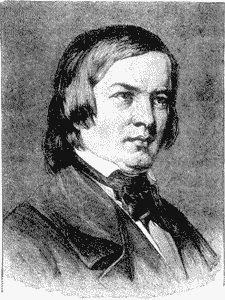
Fig. 87.
ROBERT SCHUMANN.
In person Schumann was of medium height, inclining to corpulency, with
a very soft and gentle walk and a most invincible habit of silence.
Old residents of Leipsic remember his visits to the rehearsals at the
Gewandhaus, where for a whole evening he would sit with his
handkerchief held over his mouth, never speaking a word to any one
from the beginning to the end, and going away as silently as he came.
Nevertheless, it was universally recognized that upon these occasions
Schumann heartily enjoyed himself, and to use his own words again, he
and the music "perfectly understood one another." His mind was
intensely active and fanciful. This is seen in all his pieces. The
rapidity of the musical thought, the strong contrasts of mood, the
proximity of remote chords and modulations, are all indications of
this mental trait. It was this, also, which finally destroyed him. His
mind became unbalanced, and after intermittent attacks of melancholy
his life ended with two years' almost entire oblivion of reason. In
spite of his comparative unpopularity in his own day, no one of the
romantic masters has left so strong an impression upon the composers
who came after him. In my opinion, the four great names which have
been most operative in establishing forms of musical thought and in
creating wholly original and highly poetic and masterly tone-poems by
means of those forms, are Bach, Beethoven, Schumann and Wagner, and
each one of the earlier masters has in his work the prophecy of most
of the qualities of those who come after, while each of the later
reflects the characteristic traits of his predecessors.
[Pg 478]
CHAPTER XXXVII.
ITALIAN OPERA DURING THE NINETEENTH
CENTURY.
HE strongest personality of the Italian composers (though by no means
the loveliest), at the beginning of the nineteenth century, was that
of Gasparo Spontini (1774-1851). He was born of peasant stock in the
Roman states and educated at Naples, where his boyish successes were
made. In 1803 he went to Paris, where he composed several operas with
very poor success. Nevertheless, having full confidence in his own
powers, he was not discouraged, and in 1804 his one-act opera of
"Milton" was performed successfully at the Théatre Feydeau. He had
already begun his "La Vestale," which was brought out in 1807, and
immediately achieved a remarkable success. Spontini was appointed
"Compositeur Particulaire" to the Empress Josephine, in spite of
which an oratorio of his was hissed from the stage in Holy Week of the
same year that his "Vestale" had been so favorably received. The
popularity of "The Vestal" continued to grow, so that it had been
performed more than 200 times in Paris before 1824. In Italy and
Germany, where its career began, in 1811, its popularity was similar.
His next opera was "Fernand Cortez," (1809), afterward materially
improved. These two works[Pg 479] mark the highest point reached by Spontini.
They are brilliant, martial, vigorous and spectacular, and the
legitimate predecessors of the Meyerbeer grand operas. Spontini's
smaller works failed, and in 1819 negotiations were concluded with
King William III, who had been impressed with "La Vestale" when he
had visited Paris, whereby for twenty years Spontini was made
"director general" of the opera in Berlin. In this position he
produced a number of other works, the best being "Nurmahal" (1822),
"Alcidor" (1825) and "Agnes von Hohenstaufen" (1829). Spontini was
a vigorous director, but unprincipled, vain and narrow. Nevertheless,
at his concerts he produced the fifth and seventh symphonies of
Beethoven for the first time in Berlin, as well as parts of the great
Bach mass in B minor, and much other great music. Opposition to his
tyranny culminated in 1842 by his dismission from the directorship,
Meyerbeer being his successor. His popularity paled from the
production of Weber's "Der Freischütz" in 1821. Spontini died in his
native town of Majolitat.
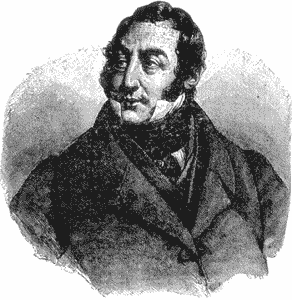
Fig. 88.
ROSSINI.
The Italian composer most famous in the earlier part of the century
was Gioacchino Antonio Rossini (1792-1868), a native of Pesaro, a
small town on the Adriatic. After a short course at the Conservatory
of Verona, the boy commenced to compose, and no less than thirteen
short pieces preceded his first really popular opera, "Tancredi,"
which was produced at La Fenice, in Venice, in 1813. The success of
this work led to many others, among which the best known are "The
Italian in Algiers," "The Turk in Italy," and (in 1816) no less than
five operas in one year—"Torvaldo e Dorliska," "The Barber of
Seville," "La Gazetta" and "Otello," his first serious opera. He
composed with the utmost facility. "The Barber," one[Pg 480] of the most
successful operas ever performed, and the one of Rossini's works which
bids fair to outlast the rest, was composed and mounted within a
month. For this work he received eighty pounds sterling. It was not at
first successful. In 1823 he brought out "Semiramide," which was
only moderately successful at first. The next turn in Rossini's
fortune found him in London, where he had accepted an engagement with
the manager of King's Theater, and here he produced a number of his
former works with moderate success. Rossini himself appeared upon the
stage and sang the solos in a cantata which he had composed in honor
of the King, George IV. He turned many honest pennies during his
London engagement by acting as accompanist at private soirées for a
fee of £50. At the end of five months he found himself in possession
of £7,000, with which he[Pg 481] made a graceful retreat to Paris, where he
accepted the musical direction of the Théatre Italienne, at the
salary of £800 per year. This was in 1826. After the expiration of his
engagement at this theater several of his works were produced at the
Grand Opera, among which were the "Siege of Corinth" and "Moise"
(March 27, 1827). This work, which is given in England as an oratorio,
was a revised edition of his opera of "Mose," which he had written for
Naples five years before. The most taking number in it is the famous
prayer, which has been played and sung in every form possible for a
popular melody. The operatic career of Rossini ended in 1829 with the
production of his opera of "William Tell," at the Paris Académie,
with a brilliant cast. In this work he forswears florid writing, and
makes a serious effort at dramatic characterization. The opera is
extremely melodious, and a very great advance over any of his former
productions. Having now accumulated a fortune, he retired from the
stage and lived the remainder of his life near Paris in elegant
leisure, composing a solemn mass and a few other sacred works, but no
other operas.
In reviewing the career of this singularly gifted Italian melodist, it
is impossible to resist the conclusion that his talents were worthy of
a nobler development. Among his sacred works the "Stabat Mater" is
the most popular. It contains some very beautiful chromatic writing,
and is really an art work of distinguished merit. His latest work was
the "Messe Solennelle" (1864). Rossini was fond of good living, very
witty in conversation, and his house was frequented by the most
brilliant wits and the best artists of the thirty years between
"William Tell" and his death.[Pg 482]
Upon the whole, the most brilliant master of Italian opera during this
period was Gaetano Donizetti (1797-1848), who was born at Bergamo and
educated at Naples. His first opera was produced in Vienna in 1818,
but his first complete success was "Anna Bolena," which was written
for Milan in 1830, the principal parts having been taken by Pasta and
Rubini. Soon after this followed "L'Elisir d'Amore" (1832), "Lucia
di Lammermoor" (Naples, 1835), "Lucrezia Borgia" (1834),
"Belisario" (1836), "Poliuto" (1838), "La Fille du Régiment"
(1840), "La Favorita," "Linda di Chamounix" (1842), "Don
Pasquale" (1843). Besides these well known works there were many
others, the total number reaching sixty-three, brought out in various
Italian theaters and in Paris. Donizetti's traits as a composer are
pleasant melody, effective concerted pieces (as, for instance, the
sextette in "Lucia," which is perhaps the best concerted piece in
Italian opera), and a good constructive ability. Like Rossini he was a
writer of florid music, and "Lucia" remains one of the favorite
numbers of coloratura singers to the present day, which, considering
that more than fifty years have intervened since it was composed, is a
great compliment.
Vincenzo Bellini (1802-1835) was born at Catania, in Switzerland, the
son of an organist. He was educated at Naples under Zingarelli, his
first opera having been composed in 1826, while he was still a member
of the Conservatory. It was "Bianca e Fernando," produced at San
Carlos. His next work, "Il Pirata," was written for La Scala in
Milan, the tenor part having been especially designed for the
celebrated Rubini. Among the other successful operas of this composer
were "I Capuletti e i Montecchi" (in 1830), "La Sonnambula" (1831,
at[Pg 483] La Scala), "Norma" and "I Puritani." It was this latter work
which contains a brilliant duet for two basses, "Suona la Tromba,"
of which Rossini wrote from Paris to a friend at Milan, "It is
unnecessary for me to write of the duet for two basses. You must have
heard it." Bellini was essentially a melodist, a lyric composer of
ideallic naiveté. Of dramatic power he had very little. His
orchestration is simple, although frequently very sonorous. If he had
lived to the age of Donizetti or of Rossini it is not impossible that
much greater works would have emanated from his pen, for in his next
great successor we have an example of such a growth under conditions
less favorable than those promised in Bellini's case.
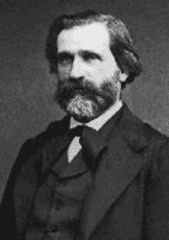
Fig. 89.
GIUSEPPE VERDI.
The most vigorous of all the Italian composers of this epoch is
Giuseppe Verdi, who was born at Roncole, October 9, 1813, his father
having been a small inn keeper. The boy was of a quiet, melancholy
character, with one passion—music; and when he was seven years of age
his father purchased a spinet for his practice. When he was ten years
old he was appointed organist of the Church in his native town. At
this time his necessary expenditures amounted to about $22 per year,
and his salary as organist $7.20, which after many urgent appeals was
increased to $8. In addition he had certain perquisites from weddings
and funerals, amounting to about $10 per year. In this way he
continued until he was sixteen, having by this time become conductor
of a philharmonic society, and the composer of quite a number of
works, at the little town of Dusseto. He went to Milan, where he was
refused admission to the Conservatory on the ground of his showing no
special aptitude for music. Nevertheless, he persevered in his chosen
vocation,[Pg 484] receiving lessons of Rolla, the conductor of La Scala. He
studied diligently for two years, Mozart's "Don Giovanni" being a
part of his daily exercise. After this he returned for five years to
his country life, and by the time he was twenty-five he was back again
in Milan, in the hope of securing the performance of his opera,
"Oberto." This for quite a long time he was unable to do, but at
length in 1839 it was performed at La Scala. The moderate success of
this work secured him an engagement to produce an opera every eight
months for Milan or Vienna. But his first work, a comic opera which
the managers demanded, "Un Giorno di Regno," was a dead failure, and
disgusted the composer to such a point that he declared that he would
never write again. At this time Verdi was[Pg 485] the victim of most severe
affliction. In addition to poverty, within the space of about two
months he experienced the loss of his two children and of his wife, to
whom he was devotedly attached. After living some time in Milan, he
received a copy of the libretto, "Il Proscritto," and in 1842 it was
performed. It was well staged, and achieved an unqualified success.
Then followed "I Lombardi" (1843), "Ernani" (1844), "I Due
Foscari" (1844), "Attila" (1846), "Macbeth" (1847), "Rigoletto"
(1851), "Il Trovatore" (1853), "La Traviata" (1853), "Les Vepres
Siciliennes" (1855), "Un Ballo in Maschera" (1859), "La Forza del
Destino" (1862), "Don Carlos" (1867), "Aida" (1871), "Otello"
(1887). In addition to these works he has written a great "Requiem
Mass," and many smaller works. Besides the operas above mentioned
there were several others now mostly forgotten, the total number being
twenty-nine; and there is not one of them that does not contain more
or less of striking melody, with effective concerted pieces and
choruses. Verdi's melody was much more vigorous than that of either of
his predecessors. In "Trovatore" there are ten or twelve numbers
which have become famous in the barrel-organ repertory. His
instrumentation was very full and sonorous, and his dramatic instinct
excellent. We do not find the long roulades and ornamental passages
according to the taste of his predecessors, but instead of them,
clear, sharp, concise, manly melodies—unfortunately, however, they
are so near the line of the vulgar that only a refined treatment on
the part of the singer can save them for poetry and beauty.
Beginning with "Aida," a very important change can be seen in
Verdi's style. By the time this work was[Pg 486] undertaken the Wagnerian
theories were attracting general attention, and it was impossible that
a man of Verdi's intellectual force should have failed to be affected
by them. "Aida" is much more refined and dramatically truthful than
any of those before it. As the composer was now an old man nothing
farther was expected from his pen. Nevertheless, in "Otello," he has
given the world a masterpiece of a still higher order, the music
throughout being subservient to the story, while the dramatic handling
of the work is masterly in the extreme. For this he was in part
indebted to his librettist, the distinguished poet and composer,
Signor Arrigo Boito. The strangest thing in regard to Verdi is that at
the present writing (1891) he is engaged upon a comic opera,
"Falstaff," a subject which he says has interested him for about forty
years, but which until now he has never had time to undertake. As a
man and a patriot Verdi is held in the highest possible honor in
Italy; and for his own original genius, as displayed in his works, and
especially in his aptitude for progress, no less than for his
dignified and simple private life, he deserves to be admired as the
foremost Italian master of the present century.
One of the most earnest among Italian composers and musicians is
Arrigo Boito (1842), who, from an origin which is German from his
mother's side, possesses an earnestness and force in music not usual
in southern lands. After composing two cantatas, which had a good
success, his grand opera of "Mefistofele" was produced at Milan in
1868, and later in other leading cities. Two more operas "Hero and
Leander" and "Nero" are not yet published. M. Boito is equally
celebrated in his own country as musician and as poet. In the latter[Pg 487]
capacity he prepared his own librettos, besides furnishing that of
"Otello" to Verdi and "La Gioconda" to Ponchielli. He has
published several books of poems, and other operatic books. As
composer he partakes much of the spirit of Wagner. He has yet another
opera nearly completed, but in 1891 little is known of it. It is
called "Orestiade."
Amilcare Ponchielli (1834-1866) is generally regarded in Italy as
having been the most distinguished Italian composer after Verdi. He
was educated at Milan, but his early triumphs were made elsewhere, his
famous "I Promessi Sposi" having been performed there only in 1872.
His principal works are the preceding, which was composed in 1856,
"La Savojarda" (1861), "Roderico" (1864), "La Stella del Monte"
(1867), "La Gioconda," his master work, produced at La Scala,
1876, and "Marion Delorme" (1885). His music occupies a middle
ground between the melodiousness of the Italian composers of the early
part of the century and the seriousness of later German opera.
In spite of the few examples reaching foreign countries, there is a
continuous and rather abundant production of light and serious operas
in Italy, every principal theater making it a point to bring out one
or more new works every season. The best of these, after a long
interval, become known abroad. It is a great mistake to suppose that
the few Italian operas of recent date performed in England and America
adequately represent the present state of Italian art.
[Pg 488]
CHAPTER XXXVIII.
FRENCH OPERATIC COMPOSERS OF THE
NINETEENTH CENTURY.
N the earlier part of the nineteenth century the operatic stage of
Paris shared with those of Berlin and Dresden the honor of producing
brilliant novelties by the best composers. In France there had been a
persistent cultivation of this province of musical creation, and many
talented composers have appeared upon the scene of the Grand Opera and
that of the Opéra Comique. French opera has developed into a genre
of its own, rhythmically well regulated, instrumented in a pleasing
and attractive manner, and staged with considerable reference to
spectacular display.
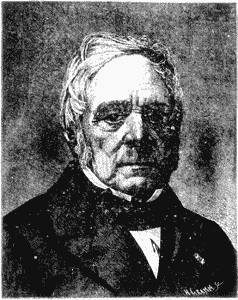
Fig. 90.
AUBER.
The oldest of these masters to achieve distinction, and the one most
successful in gaining the ear of other countries than France, was
Daniel François Esprit Auber (1782-1870). He was born in Caen, in
Normandy, of a family highly gifted and artistic in temperament.
Nevertheless, his father intended him for a merchant, and sent him to
England in 1804, in the hope that the study of commercial success
there might wean him from his love of music. But the boy came back
more musical than ever. After composing several pieces, a little
opera, a mass, etc., his first opera to be publicly[Pg 489] performed was
"Le Séjour Militaire." During the fifteen years next following he
wrote a succession of light operas for the smaller theaters of Paris,
most of them with librettos by Scribe. No one of these works had more
than a temporary success, and the names are not sufficiently important
to be given here. At length, in 1828, he produced his master work,
"La Muette di Portici," otherwise known as "Masaniello," which at
once placed its author upon the pinnacle of fame. This was an opera
upon the largest scale, and was the first in order of the three great
master works which adorned the Paris stage during this and the three
years following. The others were Rossini's "Tell" in 1829, and
Meyerbeer's "Robert" in 1831. The subject was fortunately related[Pg 490] to
the spirit of the times, Masaniello having been leader of the
insurgents in Naples. The work well deserved its success, since for
melody and pleasing effects it has rarely been surpassed. The overture
is still much played as a concert number, but the opera itself has
nearly left the stage, excepting in Germany, where it still has a
distinguished place. All his later works were lighter than
"Masaniello." They were "La Fiancée" (1829), the extremely
melodious and popular "Fra Diavolo" (1830) and many others, for more
than twenty years still. Among them were "The Bronze Horse" (in 1835),
"Le Domino Noir" (in 1837), and "The Crown Diamonds" (1831). Auber
was elected member of the Institute in 1829, and in 1842 succeeded
Cherubini as director of the Conservatory. He was an extremely witty
and charming man, beloved by all.
Contemporaneous with Auber, but more allied to the genius of
Boieldieu, was Louis Joseph Ferdinand Hérold, (1791-1833). After
studying at the Conservatory and composing a number of operas which
failed, or had but moderate success, he brought out "Zampa," in
1831. This work had an extraordinary success, and its overture is
still often heard. Another work "Le Pré aux Clercs," (1832), is
generally esteemed in France more highly than "Zampa," but outside
of his native country public opinion universally regards the latter as
his best work. Hérold's operas are extremely well conceived from a
dramatic point of view, and his melody has much of the sweet and
flowing quality of the best Italian. His concerted numbers also are
well made, and in all respects he is to be regarded as a master of
high rank within the province of light opera, verging indeed upon the
confines of the romantic type, like that of Weber.[Pg 491]
The true successor of Boieldieu, with perhaps somewhat less of
originality, was Adolphe Charles Adam, (1803-1856), son of a piano
teacher in the Conservatory at Paris. His most lasting work was "Le
Postillon de Lonjumeau" (1836), in which the German tenor Wachtel
made himself so famous. Most of the other productions of this clever,
but not deep, composer, are now forgotten. In their day they pleased.
The most important work of the last half century of French opera was
the "Faust" of Charles François Gounod (1818- ), produced in 1859.
Gounod was born and educated at Paris, took the prize of Rome in 1837,
after composing quite a number of works of a semi-religious character,
in which direction he has always had a strong bias. His first opera
was produced in 1854, "La Nonne Sanglante." In 1852 he was made
director of the Orpheonists, the male part singers of Paris, numbering
many thousands, somewhat answering to the organization of the Tonic
Sol-fa in England. "Faust" made an epoch in French opera. Its rich
and sensuous music, its love melodies of melting tenderness, and the
cleverness of the instrumentation, as well as its pleasing character,
combine to place it in a category by itself. This was the beginning
and the end of Gounod, for in his other works, while there is much
cleverness and melodiousness, there is also much reminder of
"Faust." Perhaps the best of his later operas are "Romeo et
Juliette" (1867), and "Mireille" (1864). Among the others were
"Cinq-Mars," "Polyeucte," "Le Tribute de Zamora." He has also
written an oratorio, "The Redemption," produced at Birmingham in 1882,
many numbers in which are truly imposing. As a whole the work is
mystical and sensuous, rather than strong or[Pg 492] inspired. A continuation
of this work "Mors et Vita" was given at Birmingham in 1885, and the
following year several times in America, under the direction of Mr.
Theodore Thomas. In this work, a part of the text of which consists of
the Latin hymn "Dies Iræ," Gounod contrives to repeat certain of the
sensational effects of Berlioz's work. Both these oratorios belong to
an intermediate category in oratorio, sensational effects possible
only in the concert room intervening with others planned entirely in a
devotional and mystic spirit. As a composer, Gounod has two elements
of strength.
He is first of all a lyrical composer of unusual merit, as can be seen
in his "Oh that We Two were Maying," "Nazareth," "There Is a Green
Hill Far Away," etc. His second element of greatness is his talent for
well sounding and deliciously blending instrumentation, in which
respect he is one of the best representatives of the French school.
This quality is happily shown upon a small scale, in connection with
the other already mentioned, in his famous "Ave Maria," with violin
and organ obligato, superimposed upon the first prelude in Bach's
"Well Tempered Clavier." Unfortunately his structural ability is not
equal to the strain of elaborate dramatic works, in which the interest
greatly depends upon the music following the complications of the
drama. In "Faust," and in all his other operas, the songs are the main
attractions—the songs and the choruses. The finales are poorly
constructed, with little invention and less progress of dramatic
intensity.
Among the better composers of the later French school was Felix Marie
Victor Massé (1822-1884), who experienced the usual fortunes of the
better class of French composers, having taken the prize of Rome in[Pg 493]
1844 and produced his first opera, "La Chanteuse Voilée," in 1850,
which was followed by his "Galathéa" in 1852 and the "Marriage of
Jeanette" in 1853. Encouraged by these successes he produced a large
number of operas in Italy, of which the best were "La Reine Topaze"
(1856) and "Les Saisons" (1855). In 1860 he became chorus master at
the Academy of Music, and in 1866 professor of composition at the
Conservatory. In 1872 he was elected to the Institute as successor of
Auber. In addition to the works already mentioned he produced "Paul
and Virginia" (1866), and several others, besides a number of songs.
His last opera, "Le Mort de Cleopatre," was written during his long
sickness, and on the whole was not a success.
Another pleasing French composer is Jules Émile Frédéric Massenet
(1842- ), who took the prize of Rome in 1863, and in 1867 produced his
first opera, "La Grande Tante." In addition to this he composed a
number of operas, "Le Roi de Lahore" (1877), "Marie Madeleine"
(1873), an oratorio, and "Eve" in 1875. He has also written a number
of orchestral suites which have been very popular in all countries.
His latest work, "Le Mage," was produced at the Grand Opera, Paris,
March, 1891.
One of the most brilliant and versatile of the French musicians of
this generation is M. Camille Saint-Saëns (1835- ), a virtuoso upon
the piano and organ, and an orchestral tone-poet of very rare quality.
Educated in the Conservatory, he composed his first symphony when he
was sixteen, and was organist of the Church of St. Marri at the age of
eighteen. In 1858 he became organist at the Madeleine. He has produced
a number of operas, of which "Le Timbre d'Argent" (1887), "Samson
and Delilah"[Pg 494] (1877), and "Etienne Marcel" (1879), "Henry VIII"
(1883) and "Ascanio," produced in 1890 at the Grand Opera. In
addition to these, Saint-Saëns has produced a large number of
orchestral pieces, including "Le Mouet d'Omphale," "Le Dance
Macabre," and other symphonic poems of the programme character. He
has also written several oratorios, of which "The Deluge" is the most
important, and a large amount of chamber and pianoforte music. He is a
brilliant writer about music, and is favorably known in Germany and
all the rest of Europe as a virtuoso upon the piano and organ. His
second concerto for piano is one of the best virtuoso pieces for that
instrument. In his "Melodie et Harmonie," a collection of newspaper
essays, he discusses many interesting questions. His fame with
posterity is more likely to rest upon his orchestral pieces, which are
extremely clever and interesting, than upon his operas. Personally he
is said to be very witty and entertaining. He has been a member of the
Institute since 1874.
Another French composer, versatile and well gifted in orchestral
composition, is Clément Philibert Léo Délibes (1848- ). After his
education at the Conservatory, and his service as accompanist at the
Grand Opera, he received, in 1866, a commission to compose a ballet,
"La Source," in which he displayed such a wealth of melody and such
fortunate rhythm that his talent was henceforth unmistakable. He has
since composed a large number of ballets, many of which are known in
all parts of the world, such as "Sylvia"; also a large number of
songs. His principal opera was "Lakmé" (1883). He is a professor at
the Conservatory, a member of the Legion of Honor, and the successor
of Victor Massé at the Institute.[Pg 495]
Still another very talented composer of orchestral music is Édouard
Victor Antoine Lalo (1823- ), who was originally a violinist in a
favorite string quartette. He has composed a large amount of
orchestral music, a violin concerto in F (1874), "Symphonie
Espagnole" (1875), for violin and orchestra, a rhapsody
"Norvegienne," and many other orchestral works, besides several
operas, of which the "Roi d'Ys" (1888) is the most important. He
received the Cross of the Legion of Honor in 1880, and is one of the
best of the French composers. Many of his works have been played by
Theodore Thomas.
Georges Bizet (1838-1875) is best known as the composer of "Carmen"
(1875). He had previously produced a considerable number of smaller
works, which had been but moderately successful. In "Carmen,"
however, he showed qualities of rhythmic and harmonic coloration which
promised brilliant results in the future. His career was prematurely
cut short by death. He was a fine pianist.
The Nestor of still living French composers is M. Charles Ambroise
Thomas (1811- ), born at Metz in the same year as Liszt, and only one
and two years after Schumann and Chopin. This venerable and highly
gifted master early succeeded in catching the ear of the French
public, and between 1837, when his "La Double Echelle" was performed
at the Opéra Comique, until 1848, he produced a succession of
charming light pieces in the taste of the day. There was a sort of
middle period in which he wrote several very witty works for the same
stage, but the time of his greatest career dates from the production
of "Mignon" (1866), "Hamlet" (1868), and "Francesca da Rimini"
(1882). He was elected to the Institute in 1851, and at Auber's death
in 1871 was made director[Pg 496] of the Conservatoire, in which important
position he has accomplished much toward systematizing and deepening
musical education. M. Thomas is a highly cultivated man of the world;
tall, slender, fond of physical exercise, he has retained the
faculties of an active and very versatile mind to an old age. His
opera of "Mignon" is probably the one of his productions which will
last longest.
Of French opera as a whole during this century, the general
characterization may be made that it has gained in cosmopolitan
quality, nearly all the composers mentioned in the present chapter
having gained a world-wide fame. The distinguishing feature of this
class of opera is its sprightly rhythm, and the clearness of the
melodic forms. The instrumentation, also, is generally clever. The
music is pleasing rather than deep, and the popularity of French opera
in Germany, for example, is mainly due to its value as a relief to the
often undue elaboration of the original German article.
[Pg 497]
CHAPTER XXXIX.
LATER COMPOSERS AND PERFORMERS.
EFORE summing up the remaining names of musical history, a brief
retrospect over the present century may be in place. The first quarter
of the nineteenth century was distinguished by two composers of the
first order—Beethoven and Schubert; and by a large number of highly
gifted lesser artists, some of whom, such as Spohr and Weber, bid fair
to remain long enrolled in the list of immortals. The second quarter
of the century was made memorable by the rise and blossoming into full
glory of the romantic school, all the works of this school (excepting
a few of the earlier of Mendelssohn) having been produced during this
period. Mendelssohn, Schumann, Chopin and the young Wagner were the
active spirits of this time, and their productions not only enriched
the store of the world's tone poetry, but changed the general
direction of musical ideals in many ways.
The great feature of the third quarter of the century was the
conception and execution of the Wagnerian music-drama, with its wealth
of sense incitation and its somber appeal to accumulated experiences
of the race. The "Ring of the Nibelungen" was completed during this
period and received its first performance at Bayreuth in 1876. During
the same period Franz Liszt had[Pg 498] conceived a modification of the
symphony form, bringing its four movements into a single one, or
uniting the different movements (if such there were) by means of
motives common to all or several of them. In this way a certain
novelty was attainable in the most important province of instrumental
music; and while the new compositions generally acknowledged their
indebtedness to external incitation by titles, such as: "What One Sees
from a Mountain," the "Battle of the Huns," "Romeo and Juliette," and
the like, there was nothing to prevent them being in the fullest sense
musical works, having a musical life as such wholly independent of the
suggestion given by the title. Berlioz had been the founder of
programme music, and his leading works had been produced during the
second quarter of the century, but their full force was not recognized
until later. It was a follower of Liszt, the brilliant Frenchman,
Camille Saint-Saëns, who stated the central thesis of the whole
romantic school, when he said that a composer had the same right to
affix a title to his work, in order to give a pleasing standpoint for
judging it, as a painter had to name his picture. And in the case of
music, he added, as in that of painting, the real question finally was
not whether the suggestion of the title had been fully satisfied, but
whether the picture were good painting and the composition good music.
If it were good music, no flaw in the title and no disagreement
between the title and the work could impair its value and lasting
quality.
When carefully scrutinized, the progress of music during the present
century has been governed by certain leading principles which are not
contradictory, although at first glance they might appear so. Since
the time of the Netherlandish contrapuntists, the pri[Pg 499]mary impulse in
musical creation has been the musical ideal—the creation of tonal
fancies, novel, inspiring, musical, satisfactory. Out of this desire
has arisen the entire fabric of fugue, sonata, symphony and the whole
world of free music. And at every period there have been those also
who sought to connect these tonal fancies with the inner life of the
spirit—to awaken feeling, inspire imagination, deepen dramatic
impression; in short, to give us in place of irresponsible tonal
crystallizations a poetically conceived discourse, operative upon the
feelings and stimulative to the entire mind. This was the ideal of the
new movement in Italy at the beginning of the seventeenth century, and
opera has steadily worked along this ideal. Sebastian Bach had moments
when he himself attempted the programme music; and Beethoven made many
attempts of the same kind, some of which are significant and lasting.
Hence the romantic impulse was not something new in the history of
music, but the blossoming of buds from seeds planted long before. The
programme music of Berlioz was simply larger and more flamboyant than
the little exercises of Bach in the same direction. Wagner's idea of
bringing together the entire resources of musical, dramatic and scenic
art into a single highly complex work was merely the idea of the unity
of all the arts, upon which Æschylus worked two thousand years
earlier, and upon which Jacopo Peri and Claudio Monteverde worked at
the beginning of the seventeenth century. In short, the art of music,
while in this century being enriched by a multitude of new creations
representing a variety of subordinate ideals, is nevertheless still a
unity, constantly becoming more elaborate and masterly upon the tonal
side, and continually more and[Pg 500] more in touch with the deeper springs
of duration in art, the intuitively realized correspondence between
certain art forms and modes of expression and human feeling.
The composers of the last quarter of the century are very numerous;
indeed, so numerous that a catalogue even of their names would occupy
too much space. Moreover, their proximity to our own times brings them
too near for successfully estimating their places in the pantheon of
art, or even for the much simpler task of deciding upon certain names
which undoubtedly should occupy places in the list. For present
purposes it will be more convenient to notice them by nationalities,
since every racial stock has certain individualities and ideals which
the national composers eventually bring into art, as we see
brilliantly illustrated in the case of the Russians, both in music and
in painting.
There are, however, certain names which stand out above all others and
at the present writing appear destined for place among or very near
the immortals of the first order. These great names are those of
Johannes Brahms, Camille Saint-Saëns, Peter Ilitsch Tschaikowsky,
Antonin Dvorak and Edvard Grieg.
I. Music in Germany.
In Germany, very naturally, the activity in the higher departments of
music remains more intense than in any other country, and the seat of
musical empire may be said to still abide in southern Germany, where
it was established by Haydn, Mozart and Beethoven. The most eminent
living composer in the higher department of the art, Johannes Brahms,
resides at Vienna[Pg 501] since these many years; there also Max Bruch long
resided, and there the greatest of the light opera composers, the
Strauss family and Von Suppé, have lived and worked. It is in the
provinces of the Austro-Hungarian empire, moreover, that the Bohemian
composer, Dvorak, has his home.
In Johannes Brahms (1833- ) we have still living a musical master of
the first order, whose quality as master is shown in his marvelous
technique, in which respect no recent composer is to be mentioned as
his superior, if any can be named since Bach his equal. This technique
was at first personal, at the pianoforte, upon which he was a virtuoso
of phenomenal rank; but this renown, great as it is in well informed
circles, sinks into insignificance beside his marvelous ability at
marshaling musical periods, elaborating together the most dissimilar
and apparently incompatible subjects, and his powers of varying a
given theme and of unfolding from it ever something new. These
wonderful gifts, for such they were rather than laboriously acquired
attainments, Brahms showed at the first moment when the light of
musical history shines upon him. It was in 1853, when the Hungarian
violinist, Edouard Remenyi, found him at Hamburgh and engaged him as
accompanist and having ascertained his astonishing talents, brought
him, a young man of twenty, to Liszt at Weimar, with his first trio
and certain other compositions in manuscript. The new talent made a
prodigious effect upon Liszt, who needed not that any one should
certify to him whether a composer had genius or merely talent. The
Liszt circle took up the Brahms cult in earnest, played the trio at
the chamber concerts, and the members when they departed to their
homes generally carried with them[Pg 502] their admiration of this new
personality which had appeared in music.
Johannes Brahms was born at Hamburgh, May 7, 1833, the son of a fine
musician who was player upon the double bass in the orchestra there.
The boy was always intended for a musician, and his instruction was
taken in hand with so much success that at the age of fourteen he
played in public pieces by Bach and Beethoven, and a set of original
variations. At the age of twenty he was a master, and it was in this
year that he accompanied Remenyi, made the acquaintance of Joachim and
Liszt, and had a rarely appreciative notice from a master no less than
Robert Schumann himself, who in his New Journal of Music said:
"He has come, a youth at whose cradle graces and heroes kept watch.
Sitting at the piano he began to unveil wonderful regions. We were
drawn into more and more magical circles by his playing, full of
genius, which made of the piano an orchestra of lamenting and jubilant
voices. There were sonatas, or rather veiled symphonies; songs whose
poetry might be understood without words; piano pieces both of a
demoniac nature and of the most graceful form; sonatas for piano and
violin; string quartettes, each so different from every other that
they seemed to flow from many different springs. Whenever he bends his
magic wand, there, when the powers of the orchestra and chorus lend
him their aid, further glimpses of the magic world will be revealed to
us. May the highest genius strengthen him! Meanwhile the spirit of
modesty dwells within him. His comrades greet him at his first
entrance into the world of art, where wounds may perhaps await him,
but bay and laurel also; we welcome him as a valiant warrior."[Pg 503]
The next few years were spent by Brahms in directing orchestra and
chorus at Detmold and elsewhere, and in Switzerland, which has always
had great attraction for him. In 1859 he played in Leipsic his first
great pianoforte concerto; most of the criticisms thereon were,
however, such as now excite mirth. Lately he has played in Leipsic
again, conducted several of his works, and was greeted with the
reverence and enthusiasm due the greatest living representative of the
art of music. In 1862 Brahms located in Vienna, where he has almost
ever since resided. Mr. Louis Kestelborn, in "Famous Composers and
Their Works," says: "About thirty years ago the writer first saw
Brahms in his Swiss home; at that time he was of a rather delicate,
slim-looking figure, with a beardless face of ideal expression. Since
then he has changed in appearance, until now he looks the very image
of health, being stout and muscular, the noble manly face surrounded
by a full gray beard. The writer well remembers singing under his
direction, watching him conduct orchestra rehearsals, hearing him play
alone or with orchestra, listening to an after-dinner speech or
private conversation, observing him when attentively listening to
other works, and seeing the modest smile with which he accepted, or
rather declined, expressions of admiration."
The most important works of Brahms, aside from his "German Requiem,"
are four symphonies for orchestra, two concertos for pianoforte, a
concerto for violin and 'cello with orchestra, a violin concerto, many
songs, a variety of compositions for chamber, embracing a number for
unusual combinations of instruments (such as clarinet and horn with
piano), sonatas for piano solo, etc. In the songs he attains a simple
and[Pg 504] direct expression, not surpassed in musical quality since
Schubert and Schumann; in the concertos he is more for music than for
display, which is merely to say that in conceiving the display of his
solo instrument, he has sought rather to display it at its best in a
musical sense than to exhibit its peculiar tricks of dexterity. As a
symphonist he follows classic form, and is more successful than any
other writer in the slow movements, a department in which most of the
later writers are distinctly weak, since in an idealized folk song
(which is the essential ideal of the symphonic slow movement) poverty
of imagination cannot be concealed by dexterity of thematic treatment
and modulation. As a writer for the pianoforte he has made important
enlargements of the technique, not alone in his arrangement of easier
compositions by earlier writers, but still more by original demands
upon the fingers, as illustrated in his great sets of variations.
Distinguished among German composers is Max Bruch (1838- ) who was
born at Cologne, and educated there and almost everywhere else in
Germany. Bruch is best known by his works for chorus with orchestra,
of which "Frithjof," "A Roman Song of Triumph," "The Song of the Three
Kings," "Odysseus," "Arminius" are best known. His concerto for violin
is also played in all parts of the world, but his opera of "Hermione"
made but a moderate success at Berlin in 1872. Riemann considers his
greatest works for mixed chorus to be "Odysseus," "Arminius," "The
Song of the Bell," and for male chorus "Frithjof," "Salamis" and "The
Normans." His style is closely wrought, musical, full of deep and
natural musical expression, and well colored instrumentation.[Pg 505]
Anton Bruckner (1824- ) a highly gifted organist and composer, has
written seven symphonies, in which the style is very modern, and shows
the influence of the theatrical style of Wagner. He is a composer of
considerable vigor.
II. Music in Russia.
The awakening of musical art has been remarkable in all parts of the
civilized world, and in many countries not previously distinguished in
music composers have arisen who have embodied the rhythms and spirit
of the national songs in their works, composed dramatic works upon
national subjects, and so have created a national school of music. In
some cases the works of these men have proven of world-wide
acceptance; in others they have set in operation musical life in their
own country, and have been followed quickly by younger composers
working in a more cosmopolitan vein, who have created works which have
been taken into the current of the world's music and bid fair to hold
an honorable position in the pantheon.
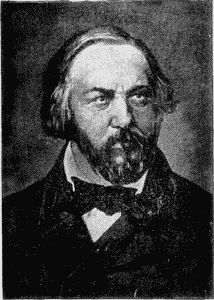
MICHAIL IVANOVITCH GLINKA.
One of the most brilliant cases of this kind is Russia, that country
so vast, so powerful, so mysterious. The first composer in Russia to
distinguish himself and to create a national opera was Michail
Ivanovitch Glinka (1803-1877), born near Selna. His first schooling
was at the Adelsinstitute in St. Petersburg, where he distinguished
himself in languages. But presently, under the teaching of Bohme upon
the violin and Carl Mayer in pianoforte and theory, he showed the
musical stuff which was in him. Leaving Russia for his health, he
resided four years in Italy, constantly studying and[Pg 506] incessantly
composing. On his way back to Russia he placed himself for a time
under the teaching of the distinguished S. Dehn in Berlin, in theory.
Dehn recognized his originality and encouraged him to write "Russian"
music. His first opera, "A Life for the Czar" (December 9, 1836), was
a great triumph. The subject was national, the contrast between Polish
and Russian subjects in the music was brilliant, and actual[Pg 507] or
simulated folk songs gave a local coloring highly grateful to the
Russian audience. The work received innumerable repetitions and still
remains one of the most popular operatic works upon the Russian stage.
His next work, "Ruslan and Ludmilla," was also successful, and Liszt,
who happened to be in Russia at the moment of its production, accorded
the young composer distinguished praise. Berlioz took up the pen in
honor of Glinka and of his new Russian school of music, and so the
composer's powers were widely celebrated. During the remainder of his
life Glinka made long residences in the south, especially in Spain,
and several orchestral works, with Spanish coloring, represent this
portion of his creative career. His last years were spent in rural
life near St. Petersburgh, busy with new opera projects, and
especially seeking some rational manner of harmonizing the Russian
popular songs. Riemann calls Glinka "the Berlioz of Russia," in the
originality of his invention and his clever technique; and something
more, namely, that he created a national school of music for his
country. The list of his works is very long, embracing compositions in
almost every province. There are two symphonies, both unfinished,
several dances for orchestra, a number of chamber compositions of
various combinations of instruments, a tarantella for orchestra, with
song and dance ("La Kamarinskaia"), etc. His operas, however, are
his lasting monument.
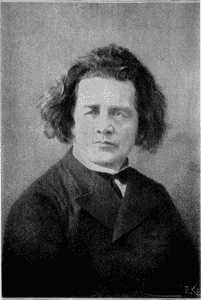
ANTON VON RUBINSTEIN.
The next great name in the roll of Russian music is that of the
pianist, Anton von Rubinstein (1830-1895), who was born at
Wechwotynez, in Bessarabia. His father presently removed to Moscow,
where he carried on a manufactory of lead pencils. The boy Anton
showed such talent for music under the skillful and affectionate[Pg 509]
teaching of his mother, that at the age of ten he was brought before
various musical authorities in Paris for opinions concerning his
talent. His concert life began almost immediately from this period.
His mother went with him, and wherever there were pauses of a few days
the studies were resumed, exactly as had been the case with Mozart,
long before. In 1848 he found a friend and appreciative companion in
the Princess Helene, and then he wrote several operas upon Russian
subjects, of which two were published—"Dimitri Donskoi" and "Toms der
Narr." The success of these works was such that in 1854 the composer
was given a subvention for further foreign study by the Princess
Helene and Count Wielhorski, upon which followed four brilliant years
of incessant activity as virtuoso pianist and composer, extending as
far as London and Paris. Rubinstein had already lived some years in
Berlin, where he was as well known as at home. Returning to Russia in
1859, he received important appointments as musical director, founded
the St. Petersburg musical conservatory, of which he remained the
director until 1867, when ensued a new series of concert journeys
covering Europe, and in 1872-1873 extending to America, where he had a
wonderful success, carrying back to Russia as proceeds of the American
tour the at that time unprecedented sum of $54,000.
As pianist, Rubinstein was distinguished for his grand style, broad
and noble mastery of the instrument, and his consummate sympathy and
innate musical quality. He was a player of moods, at times playing
like a god, at other times his work disfigured by many errors, but
always interesting, commanding and noble. He played best the
compositions of Beethoven and Schumann, their[Pg 510] innate depth and
intense musical expression appealing to his richly gifted musical
nature irresistibly. His personality was commanding and attractive.
Saint-Saëns relates how Rubinstein played in Paris the concertos of
Beethoven and of Rubinstein, while Saint-Saëns conducted the
orchestra. At the close of the concerts Rubinstein desired to give yet
another in which he himself would direct the orchestra, while
Saint-Saëns should play. It was for this occasion that the Saint-Saëns
second concerto was written. In his later life Rubinstein lived like a
prince in a beautiful estate near St. Petersburgh. The list of his
works is something enormous. Of operas and dramatic works there are
twelve, several of which, such as "The Tower of Babel," "Paradise
Lost" and "Moses," are biblical operas, a type of dramatico mystical
work created by Rubinstein. It contains the gravity and depth of
oratorio combined with the intense realism of the stage. There are six
symphonies, of which the famous and several times enlarged "Ocean"
symphony is perhaps best known, a "Heroic Fantasia" for orchestra,
three character pieces for orchestra, "Faust," "Don Quixote" and
"Ivan"; three concert overtures, a quantity of chamber music,
compositions for piano, songs, and the like. In everything of
Rubinstein beautiful melodies are found; his weakness lies in the
development, which occasionally is carried too far, and with
insufficient vitality of thematic work.
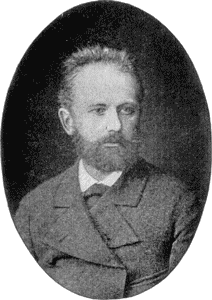
PETER ILITSCH TSCHAIKOWSKY.
Even greater than Rubinstein as composer was the brilliant Peter
Ilitsch Tschaikowsky (1840-1893). Tschaikowsky was intended for the
profession of the law, in which he took his degree. But his love for
music asserted itself, and after a short career as pupil in[Pg 511] the St.
Petersburgh conservatory, he was appointed teacher of harmony in that
institution, and entered upon his career as composer. Here he remained
but a short time, resigning in 1877, after which he lived by turns at
St. Petersburgh, in Italy and in Switzerland. Tschaikowsky was of a
lyric musical nature, and in his early life his taste was entirely for
Italian music. This shows to a remarkable degree in all his earlier
productions, even if he had not himself published the fact so often
and unmistakably. In 1869 he produced his first Russian opera, "Der
Woiwode" which was followed by eight others, of which the best known
are "Eugene Onegin" and "Makula, the Smith." Several of these are now
played throughout Europe. It was in his orchestral[Pg 512] compositions,
however, that Tschaikowsky most illustrated his unexampled powers.
Besides a number of brilliant and highly sensational overtures, he
composed six symphonies, of unexampled sonority, rich coloring and
strange musical expression. The fifth symphony of Tschaikowsky met
with almost universal recognition at the hands of the leading
orchestral conductors of the world; and the last, the so-called
"Tragic," only deepened the impression of the composer's powers.
Several points are unusual. The themes themselves are original,
forceful and lend themselves easily to elaboration. The harmonic
treatment is highly original, as if the author had found, as Bülow
said, "new harmonic paths." The instrumentation is richly colored and
the climaxes are of vast power and effect. The whole is a grandly
composed tone poem which even if regarded as surpassing the proper
reserve of symphonic form must nevertheless be counted as one of the
most valuable enrichments of the world's orchestral repertory. In
several places in his works Tschaikowsky introduces peculiarities of
Russian folk music, as for example in the movement in 5-4 measure in
the fifth measure symphony. Nevertheless, the works belong to the
world's music, being in no sense provincial, narrow or limited.
Æsthetically considered, they illustrate the quick technique and
over-mastering energy of the race to which the composer belonged.
III. Music in Bohemia.
Another country in which a notable musical revival has taken place
during the latter part of the present century is Bohemia, where two
names are to be mentioned. Bedrich Smetana (1824-1884), is to be[Pg 513]
remembered as the creator, or at least the awakener, of Bohemian
music. After a short education at the Prague university Smetana
entered diligently upon the study of music, becoming a brilliant
pianist, and as such forming one of the circle of enthusiastic and
advancing souls surrounding Liszt at Weimar, between 1850 and 1860.
His first position as musical director was at Gothenberg,[Pg 514] 1856. Here
he lost his wife, the brilliant pianist Katharina Kolar. In 1861 he
made a long concert tour to Sweden. In 1866 he was appointed director
of the music at the national theater in Prague, a position which he
held until obliged to give it up on account of loss of hearing in
1874. Smetana wrote eight operas upon Bohemian subjects, with music in
the Bohemian spirit; one best known is "The Bartered Bride," which was
the last composed. He also wrote about ten symphonies or symphonic
poems, and a great variety of chamber music. Of his symphonic poems
those most often played are: "In Wallenstein's Camp," "Moldau,"
"Sarka" and "Visegrad." In all these the titles are mainly suggestive,
although in "Sarka" a programme is quite closely followed. Smetana was
a brilliant composer, but his value lies in his awakening of the
Bohemians to musical creation.
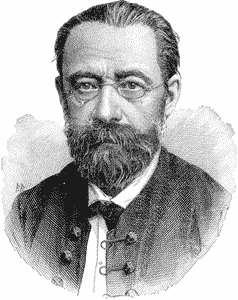
BEDRICH SMETANA.
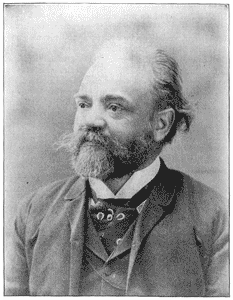
ANTON DVORAK.
The most brilliant name in Bohemian music, and the one most valued by
the world in general, is that of Anton Dvorak (1841- ), who was the
son of a butcher at Mulhausen. The boy early applied himself to the
violin, and after some years' playing in small orchestras, found a
place as violinist in the orchestra of the National theater at Prague.
This was at the age of nineteen. About ten years later he first
attracted attention as composer, by means of a hymn for mixed chorus
and orchestra. The attention of his countrymen, thus gained, Dvorak
fastened still more by a succession of compositions of varied scope,
ranging from the Slavic dances and Slavic rhapsodies to symphonies,
chamber music and choral works of great brilliancy. In 1892 Dr. Dvorak
was called to New York as director of the so-called National
Conservatory of Music. In 1895 he[Pg 516] returned to Bohemia. The choral
works of Dvorak were generally first written for English musical
festivals. "The Specter's Bride," "Stabat Mater," "Saint Ludmilla."
The list of his works includes five symphonies for full orchestra,
several concert overtures, a very beautiful air and variations for
orchestra, and seven operas upon Bohemian subjects. Dvorak is one of
the most gifted composers of the present time, especially in the
matter of technique. His thematic treatment is always clever, his
orchestral coloring rich and varied, and his style elegant. If
deficiency is to be recorded concerning him it is in invention or
innate weight of ideas. During his residence in America he promulgated
the idea that an American school of music was to be created by
developing the themes and rhythms of the negro melodies, and he wrote
a symphony, "From the New World," in order to illustrate his meaning.
The second or slow movement of this work attained a distinguished
success almost everywhere; but the themes of the first and last
movement are not sufficient for the treatment they receive. This work
has been more successful in Europe than in this country. Perhaps the
most notable quality of Dr. Dvorak's personality is his naiveté, which
shows well in his music. He is quite like a modern Haydn, who has
learned and remembered everything of musical coloration which has been
discovered, but who applies his knowledge in a simple and direct
manner without straining after effect.
IV. Music in Scandinavia.
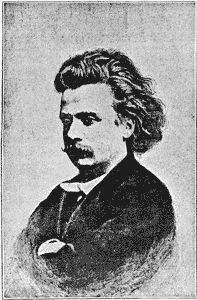
EDVARD HAGERUP GRIEG.
Foremost of Scandinavian composers is Edvard Hagerup Grieg (1843- ),
who was born at Bergen,[Pg 517] Norway, and received his early musical
education from his mother, who was an excellent pianist, and very
musical. By the advice of the celebrated violinist, Ole Bull, Grieg
was sent in 1858 to Leipsic for further instruction, where he became a
pupil of Moscheles, Hauptmann, Reinecke, Richter and Wenzel. In 1863
he pursued further studies under Gade at Copenhagen. In companionship
with a talented young composer, Ricard Nordraak, Grieg set himself, as
he says, "against the faded Scandinavianism of Gade and Mendelssohn
intermingled, and undertook to put into tones the real[Pg 518] beauty,
strength and inner spirit of the northern folks-life." He composed in
many varieties of work, and in 1879 attained German recognition by
playing his own piano concerto at the Gewandhaus in Leipsic. Grieg's
works are full of poetry, easy and natural expression, and are
pervaded by northern coloring, so decided as in some cases to approach
what in speech is called dialect. Nevertheless, it is indubitable that
his music has distinctly enriched the world's stream of tone-poetry,
and introduced a new accent and voice. He has distinguished himself in
almost every department, in songs,[Pg 519] choral work, chamber music,
symphonies, sonatas for piano and piano and violin, and orchestral
suites, of which perhaps his two "Peer Gynt" are the most celebrated.
In person Grieg is slight, fair-haired, with lovely deep blue eyes and
a charming manner. He is subject to pulmonary weakness, and is
compelled to reside much of his time in warmer climates than those of
his native land.
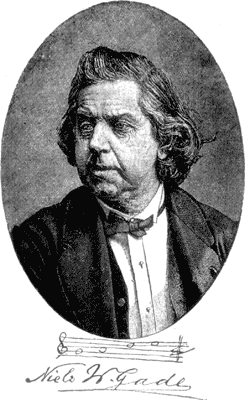
An older composer than Grieg is Niels Wilhelm Gade (1817-1890), of
Copenhagen, who after a thorough musical education received in his
native city, attracted wider attention in 1841 by taking the prize for
his concert overture, "Night Sounds from Ossian," the judges being Fr.
Schneider and Spohr, the violinist. This gave Gade a royal stipendium,
with which he immediately betook himself to study at Leipsic, where he
came under the personal influence of Mendelssohn, an influence which
he never outgrew. At the death of Mendelssohn he was appointed
director of the Gewandhaus, but not proving in all respects
satisfactory he held the position only a part of one season. After the
death of Gläser in 1861, Gade was made royal music director at
Copenhagen, a position which he filled many years. He was active as
composer in every direction, his published works embracing eight
symphonies, five overtures, two concertos for violin and orchestra,
three violin sonatas, several cantatas for mixed voices, soli and
orchestra, and many other works. The ultimate judgment of Gade as a
tone-poet is likely to be that while distinctly talented, he never
attained imagination of the first order.
Among the younger composers Christian Sinding (1856- ) is to be
mentioned. Besides many works for chamber, he has written one
symphony, which while[Pg 520] not very original gives promise of better
productions later.
V. Music in England.
The relation of England to the higher art of music has been peculiar.
In the sixteenth century and earlier it was one of the most musical
countries in Europe; but from the appearance of Händel, about 1720,
German music and German composers absorbed public attention to the
exclusion of the natives—no one of whom, it may be added, evinced
creative powers of any high order. England was a liberal patron of all
the leading German masters, from Haydn, who wrote twelve symphonies
for the London Philharmonic, to Beethoven, whose ninth symphony was
written for the same society; Mendelssohn, whose "Elijah," was written
for the Birmingham festival, and Wagner, who received handsome
compensation for conducting a series of concerts in London. A little
past the middle of the present century, however, more creative
activity began to show itself among English composers, until at the
present time there are excellent English composers in all the leading
departments of musical production. The more celebrated names follow.
One of the most graceful and talented of English composers was Sir
William Sterndale Bennett (1816-1875), who came of a musical stock,
and was duly trained as a choir boy in King's Chapel, and at the Royal
Academy of Music. In 1836 he went to Leipsic, in order to profit by
the Gewandhaus concerts there and the friendship of Mendelssohn. Here
he produced a number of orchestral compositions which were so highly
esteemed that in 1853 the directorship of the Gewandhaus con[Pg 521]certs was
offered him. After a short sojourn at Leipsic he returned to London,
where he ever after lived, highly honored as composer, pianist,
teacher and man. In 1856 he became the conductor of the London
Philharmonic concerts, and in 1866 principal of the Royal Academy of
Music. He was knighted in 1871, having previously been honored by
degrees from Cambridge and Oxford. He was professor of music in
Cambridge University from 1856 until his death. As a composer Bennett
was influenced by Mendelssohn, but he had much delicacy of fancy and a
certain originality of his own. His compositions embrace four
concertos for piano and orchestra, several concert overtures for
orchestra, one symphony, much chamber music, a cantata, "The May
Queen" (1858), "The Woman of Samaria" (1867), and a number of
occasional odes, anthems and part songs.
The successor of Sterndale Bennett as principal of the Royal Academy
of Music was Sir George A. Macfarren (1813-1887), who although totally
blind for many years before his death, produced a greater number of
important compositions than any other English composer of the century.
He was educated in London, and in 1834 became one of the professors in
the Royal Academy of Music. His first opera was produced in 1838,
"Devil's Opera," "Don Quixote" (1836), "Jessy Lea" (1863) and
"Helvellyn" (1864). He wrote a number of cantatas for chorus and
orchestra, oratorios, "St. John the Baptist" (1873), "The
Resurrection" (1876), "Joseph" (1877), and other works of less
importance. There are also many anthems, several overtures and other
pieces for chamber. Personally he was kind-hearted, intelligent,
helpful and public spirited.[Pg 522] The amount of work that he accomplished
under the greatest of disadvantages is wonderful, as well as its
generally superior quality. As a lecturer and teacher he was the
foremost musical Englishman of his time. His compositions are strong
and respectable, but not especially inspired.
The successor of Sir Geo. Macfarren in the principalship of the Royal
Academy of Music was Alexander Campbell Mackenzie (1847- ), the
youngest eminent English composer, but also the most successful and
promising. He was educated as a violinist, and resided at Edinburgh as
a teacher of the pianoforte and violin until his compositions
attracted the attention of his countrymen and induced his being called
to London. The most important compositions of Dr. Mackenzie up to the
present time are the operas "Colomba" (1883), "The Troubadour" (1886)
and the oratorio "The Rose of Sharon" (1884). There are several
cantatas, "Jason," "The Bride," "The Story of Sayid" (1886) and a
considerable number of orchestral pieces, of which two Scotch
rhapsodies and the overture to "Twelfth Night" are the best known. He
has also produced a violin concerto (played by Mr. Sarasate), and much
chamber music and songs. On the whole, Dr. Mackenzie seems the most
gifted English composer who has yet appeared.

[Pg 523]
INDEX.
"Abel", 351
"Abou Hassan", 408
Académie de Musique, 238
Adam, 491
Adam de la Halle, 122
Æschylus, 55
"Africaine", 414
"Agnes von Hohenstaufen", 479
"Aida", 485
"Alceste", 333
"Alcidor", 479
"Allgemeine Musikalische Zeitung", 464
Amati, 201
Ambrosian Scales, 131
Anglo-Saxon Harp, 104
Anglo-Saxons, Music among, 96
"Anna Bolena", 482
Antiquity, Music in, 23
Apprentice Periods of Music, 22
Arabs and Saracens, 109
"Arianna", 224
Aristophanes, 57
Aristotle, 58, 65
Aristoxenus, 58
Arkadelt, 165
Art, Conditions of Its Development, 18
Art Forms, Qualities of, 20
"Ascanio", 494
Assyrian Harps, 45
Assyrians, Music among, 46
Auber, 488
Aurelian, 139
Bach, 265, 468
Bach as Melodist, 272
Bach, Emanuel, 282
Banjo, Ancient, 46
Bar in Vocal Music, 186
Bardi, Count of, 221
Bards, 89
Barytone, 196
"Basilius", 242
Bayreuth, 425
"Beatrice and Benedict", 435
Bede, 139
Beethoven, 305, 316, 319, 320, 355, 499
Bellini, 482
Bellows Bags in Old Organs, 206
Bennett, 501
Berger, 361
Berlioz, 432
Berlioz and Mendelssohn, 434
Bizet, 495
Blondel, 123
Blow, Dr. John, 354
Boethius, 135
Boieldieu, 343
Boito, 486
Bologna, Mozart at, 295
Books Published, 220
Boscherville Sculptures, 208
Brahms, 498
Braithwaite's Musicians for an Earl's Household, 213
Breton Song, 88
Bruce's Harpers, 30
Bruch, 500
Bülow, 423, 507
Buxtehude, 254
"Caliph de Bagdad", 344
"Calm Sea and Prosperous Voyage", 457
Calzabigi, 333
Cambert, 236
"Cantilena of St. Eulalie", 116
Canzone, 249
Carissimi, 245
Cassiodorus, 137
Cavalli, 226, 231
"Caverne, La", 342
Celts, 87
Centers of Music, 17th Century, 220
Cesti, 226
Chansons de Geste, 115
"Cheval de Bronze, Le", 490
China, 73
Chitarrone, 193
Chopin, 441
Choral Song, 53
Choral Works of Bach, 268
Chromatic Keyboards, 205
Church Influence, 128
Cithara, 64
Clementi, 355, 357
Concerto, 249
"Concertstück", 411
Corelli, 255
"Corpse Fantasia", 383
Council of Trent, 174
Cramer, 360
Cremona, 198
"Crociato, Il", 141
"Crown Diamonds", 490
Crwth, 24, 106
Cypriano de Rore, 172
"Dafne", 222
"Damnation of Faust", 434
Délibes, 494
"Devil's Trill", 366
"Devin du Village", 339
Didactic of Music, 134
"Dido and Æneas", 349
"Dinorah", 415
"Don Giovanni", 300
Donizetti, 482
"Don Sanché", 446
[Pg 524]Drama, Ancient, 54, 55
Druids, 89
Dufay, 158
Dussek, 357
Düsseldorf, Mendelssohn, 459
Dvorak, 503
Egyptians, Early, 25
Elements of Music, 15
"Elijah", 461
English Round, 100
"Entführung aus dem Serail", 297
"Esther," Händel, 277
Eoud, 113
Epics, French Mediæval, 115
"Erl King, The", 384
"Ernani", 485
"Euryanthe", 409
"Eve", 493
"Faust," Berlioz, 434
"Faust," Gounod, 491
"Faust," Schumann, 474
"Faust," Spohr, 369
"Fernand Cortez", 478
Fétis, on the Celts, 90
Field, 356
Fleurettes, 157
Flute, Egyptian, 28
Flute, Greek, 64
Flute, Hebrew, 42
Form, Principles of, 20
"Fra Diavolo", 490
Franco of Cologne, 146, 156, 186
Franco of Paris, 147, 157
Frauenlob, 125
French Opera, Origin of, 225
French Tenacity of Vernacular, 239
Frescobaldi, 252
Fugue, 151, 262, 263, 270
Fugue, Chromatic, 271
Gade, 497
"Gioconda, La", 487
"God and Nature", 413
Grieg, 500
"Harmony and Meter", 460
"Harold in Italy", 434
Heller, 504
Henselt, 504
Hérold, 490
Hiller, 505
"Huron, Le", 341
India, Music in, 70
India, Musical Drama in, 73
Individualism, 374
Instrumental Music, 249
Instruments, Relation to Progress, 20
"Iphigenie", 335
Ireland, Music in, 95
Irish Harp, 97
Iron Frame, 401
Iron Tension Bar, 399
Isidore, of Seville, 138
"Ismene", 242
Italian School of Singing, 228
Japanese, 77
"Jean de Paris", 344
"Jephthah," Carissimi, 245
"Jessonda", 369
Jomelli, 346
Josquin, 163
Jubal, 43
"Judith", 351
Kerl, 253
Kindergarten, Egyptian, 39
King Arthur, 98
King David Playing, 24
Kinnor, 42
Klauser, "Septonnate", 17
Ko-ko, 77
"Kreisleriana", 471
Kuhnau, 354
"Lakmé", 494
Lalo, 495
Landseer Portrait of Paganini, 431
Lassus, 167
Leading Motive, 410
"L'Elisir d'Amore", 482
Léonin, 153
Liszt, 446, 447
Liszt and "Lohengrin", 418
Liszt and the Later Sonatas of Beethoven, 323
Liszt, Pupils of, 451
Liszt's Appearance, 454
Litolff, 504
"Lucia", 482
Lulli, 236
Luther, 175
Lyre, Egyptian, 33
Lyre, Greek, 64
Lyric Element in Music, 263
Macfarren, 501
Mackenzie, 503
Macrobus, 134
Madrigal, 215
Madrigal in Opera, 217
Magadis, 64
"Marion Delorme", 487
Martinus Capella, 135
"Marriage of Jeannette", 493
Mask, 225
Mason's Enthusiasm for Schumann, 475
"Masaniello", 489
Massé, 492
Massenet, 493
Mediæval Violins, 195
Méhul, 342
"Mefistofele", 486
"Meistersinger, Die", 423
Mendelssohn, 455
Mendelssohn on Berlioz, 434
Mendelssohn's Relation to Schubert, 377
"Messe Solennelle," Rossini, 481
Metastasio, 333
Meyerbeer, 411
"Mignon", 495
[Pg 525]Minnesingers, 123
Minstrels of the North, 87
Miracle Plays, 244
"Mireille", 491
Mixtures in Old Organs, 207
Modes, Greek, 61
"Moise", 481
Monody and Homophony, 198
Monsigny, 339
Monteverde, 224
"Mors et Vita", 492
Moscheles, 362
Moscheles with Mendelssohn, 455
Moszkowsky, 503
Motette, 154
Mozart, 299
Mozart as an Operatic Force, 336
Mozart on Jomelli, 346
Naples Schools, 169
"Nero", 486
Neumæ, 181
Nicodé, 503
"Nibelung's Ring", 420
"Norma", 483
Notation, 179
Notation, Roman, 189
"Nurmahal," 1822, 479
"Oberon", 409
Odon, 143
Okeghem, 162
Old French School, 153
Opera, 223
Opera in Germany and France, 235
Opera in 16th Century, 327
Opera and Drama, 427
Opera, Future of, 427
Oratorio, 223, 244
Oratorio in Costume, 280
Orchestic, Greek, 56
Orchestra at End of 17th Century, 256
Orchestra, Corelli's, 255
Orchestra, Monteverde's, 224
Organ, Early Form, 202
Organ, Portable, 204
Organ at Winchester, 98
Organ Music Notation, 251
Organum, 142
Orlando di Lassus, 166
"Orpheus," Gluck's, 333
"Otello", 485
"Otello," 1816, 479
Pachelbel, 253
Paganini, 428
Paisiello, 347
Palestrina, 173
Parish-Alvars, 439
"Parsifal", 426
Passions, Bach, 269
Patriotic Use of Music, 52
Pentatonic Scales, 74
People's Song, 263
Perceptions of Tone, 85
Pergolesi, 345
Pérotin, 153
Perrin, the Abbé, 326
Petrucci, 217
Phantasiestücke, Schumann, 469
Philippe de Vitry, 157
Phillidor, 339
Piccini, 347
Pindar, Ode of, 69
Pizzicati, 224
Plato, 67
Pollini, 439
"Polliodoro," Graun, 328
"Polyeucte", 491
Ponchielli, 487
Popular Taste for Music, 213
Popularity in 19th Century, 373, 379
Polyphonic Schools of Italy, 168
Polyphony as an Art Form, 151
Porpora, 228
"Postillon de Lonjumeau, Le", 491
"Pré aux Clercs, Le", 490
"Promessi Sposi, I", 487
"Prophète", 414
Ptolemy, 61
Pupils of Liszt, 452
Purcell, 349
"Puritani, I", 483
"Pygmalion", 339
Pythagoras, 59
Rameau, 336
Ratios, Greek Tetrachord, 61
Ravanastron, 72
Rebec, 196
"Redemption, The", 492
Reinecke, 517
Reinken, 254
Reinmar, 127
Rémi, 139
"Representative Style", 223
"Requiem," Berlioz, 434
"Requiem," Mozart, 303
"Rheingold, Das", 420
Rhythm of Bach, 271
Rhythmic Development, 188
Ricerari, 249
"Rienzi", 416
Rinuccini, 222
"Robert le Diable", 414
"Robin and Marian", 236
Roman Notation, 180
Romantic, The, 373
"Romilda e Constanza", 413
Rondo, 155
Rossini, 479
Rota, 150
Rousseau, 338
"Rubezahl", 408
Rubinstein, 505
Saint-Saëns, 493
Santir, 114
Saracens, 109
Saracens, Instruments of, 112
"Sardanapolis", 433
Scales, Greek, 60
[Pg 526]Scales, Ambrosian, 129, 130
Scandinavians, Music among, 99
Scarlatti, A., 227, 232
Scarlatti, D., 275, 353
Scheidt, 250
Schein, 251
School of Munich, 166
Schools of the Netherlands, 160
Schubert, 376, 381
Schulhoff, 504
Schumann, 464-477
Schütz and "Dafne", 239
Scotch Melody, 108
"Septonnate", 17
"Serva Padrona, La", 344
"Siegfried", 421
Socrates, 56
Sonata Form, 264
Sonatas, Bach, 265
Sonatas, Beethoven, 309, 319, 322
Sonatas, Corelli, 255
Sonatas, Haydn, 288, 317
Sonatas, Weber, 410
"Song of Roland", 118
"Song of the Harper", 36
Songs of Schubert, 384
Songs of Schumann, 468
Songs of Troubadours, 121
"Songs without Words", 458
"Sonnambula, La", 482
Spinet, 393, 396
Spohr, 366
Spontini, 478
Staff, 185
Steinway, 402
St. Ambrose, 129
St. Mark's, 133
"St. Paul", 459
"Sumer is Icumen in", 101
Svensden, 500
Swelinck, 250
"Symphoniæ Sacræ", 247
Symphonies, Beethoven, 319
Symphonies, Haydn, 288
Symphonies, Mendelssohn, 464
Symphonies, Schumann, 474
Symphony, 316
"Tancredi", 479
"Tannhäuser", 418
Tartini, 364
Tausig, 505
Technique, Modern, 436, 446
Terpander, 52
Thalberg, 438
Thales, 52
Theaters in Venice, 226
Thematic Work, Schumann, 473
Theory, India, 70
Theory, Mediæval, 134, 147
Thomas, Ambroise, 495
Tinctor, 163
Thomaschek, 359
"Tom Jones", 339
Tonality, 84
Tone Perceptions, 17, 55
"Traviata, La", 485
"Triads of Britain", 93
"Tristan and Isolde", 423
Troubadours, 121
"Trovatore, Il", 485
Tschaikowsky, 499
Verdi, 483
"Vestale, La", 478
Vina, 71
Viol da Gamba, 164
Violin Making, 195
Violin, Stradivarius, 199
Virtuosity, 378
Virtuoso Element, 19th Century, 428
Vitry, Philippe de, 157
Wagner, 416
Wagner and Berlioz, 434
Wagner, "Die Walküre", 420
Weber, 406
Weber as Pianist, 410, 437
Weber's Influence on Piano Playing, 410
Weimar, Liszt at, 449
Welsh, Music of, 93
Wieck, 467
Wilhelm, Count, Troubadour, 121
Willaert, Adrien, 171
Winchester, Organ at, 98
"Zampa", 490
Zarlino, 171, 257
Zelter, 457
Zingarelli, 348
Transliteration of the Greek lyrics to
the
Pythic Ode:
PINDAROU PYTHIONIKAI A'
Chrysea phorminx, Apollônos kai ioplokamôn
syndikon Moisan kteanon, tas akouei men basis
aglaïas archa, peithontai d' aoidoi samasin,
hagêsichorôn hopotan prooimiôn
ambolas teuchêis elelizomena. Kai ton
aichmatan keraunon sbennueis.
|
***END OF THE PROJECT GUTENBERG EBOOK A POPULAR HISTORY OF THE ART OF MUSIC***
******* This file should be named 20293-h.txt or 20293-h.zip *******
This and all associated files of various formats will be found in:
http://www.gutenberg.org/2/0/2/9/20293
Updated editions will replace the previous one--the old editions
will be renamed.
Creating the works from public domain print editions means that no
one owns a United States copyright in these works, so the Foundation
(and you!) can copy and distribute it in the United States without
permission and without paying copyright royalties. Special rules,
set forth in the General Terms of Use part of this license, apply to
copying and distributing Project Gutenberg-tm electronic works to
protect the PROJECT GUTENBERG-tm concept and trademark. Project
Gutenberg is a registered trademark, and may not be used if you
charge for the eBooks, unless you receive specific permission. If you
do not charge anything for copies of this eBook, complying with the
rules is very easy. You may use this eBook for nearly any purpose
such as creation of derivative works, reports, performances and
research. They may be modified and printed and given away--you may do
practically ANYTHING with public domain eBooks. Redistribution is
subject to the trademark license, especially commercial
redistribution.
*** START: FULL LICENSE ***

THE FULL PROJECT GUTENBERG LICENSE
PLEASE READ THIS BEFORE YOU DISTRIBUTE OR USE THIS WORK

To protect the Project Gutenberg-tm mission of promoting the free
distribution of electronic works, by using or distributing this work
(or any other work associated in any way with the phrase "Project
Gutenberg"), you agree to comply with all the terms of the Full Project
Gutenberg-tm License (available with this file or online at
http://www.gutenberg.org/license).


Section 1.  General Terms of Use and Redistributing Project Gutenberg-tm
electronic works

1.A.  By reading or using any part of this Project Gutenberg-tm
electronic work, you indicate that you have read, understand, agree to
and accept all the terms of this license and intellectual property
(trademark/copyright) agreement.  If you do not agree to abide by all
the terms of this agreement, you must cease using and return or destroy
all copies of Project Gutenberg-tm electronic works in your possession.
If you paid a fee for obtaining a copy of or access to a Project
Gutenberg-tm electronic work and you do not agree to be bound by the
terms of this agreement, you may obtain a refund from the person or
entity to whom you paid the fee as set forth in paragraph 1.E.8.

1.B.  "Project Gutenberg" is a registered trademark.  It may only be
used on or associated in any way with an electronic work by people who
agree to be bound by the terms of this agreement.  There are a few
things that you can do with most Project Gutenberg-tm electronic works
even without complying with the full terms of this agreement.  See
paragraph 1.C below.  There are a lot of things you can do with Project
Gutenberg-tm electronic works if you follow the terms of this agreement
and help preserve free future access to Project Gutenberg-tm electronic
works.  See paragraph 1.E below.

1.C.  The Project Gutenberg Literary Archive Foundation ("the Foundation"
or PGLAF), owns a compilation copyright in the collection of Project
Gutenberg-tm electronic works.  Nearly all the individual works in the
collection are in the public domain in the United States.  If an
individual work is in the public domain in the United States and you are
located in the United States, we do not claim a right to prevent you from
copying, distributing, performing, displaying or creating derivative
works based on the work as long as all references to Project Gutenberg
are removed.  Of course, we hope that you will support the Project
Gutenberg-tm mission of promoting free access to electronic works by
freely sharing Project Gutenberg-tm works in compliance with the terms of
this agreement for keeping the Project Gutenberg-tm name associated with
the work.  You can easily comply with the terms of this agreement by
keeping this work in the same format with its attached full Project
Gutenberg-tm License when you share it without charge with others.

1.D.  The copyright laws of the place where you are located also govern
what you can do with this work.  Copyright laws in most countries are in
a constant state of change.  If you are outside the United States, check
the laws of your country in addition to the terms of this agreement
before downloading, copying, displaying, performing, distributing or
creating derivative works based on this work or any other Project
Gutenberg-tm work.  The Foundation makes no representations concerning
the copyright status of any work in any country outside the United
States.

1.E.  Unless you have removed all references to Project Gutenberg:

1.E.1.  The following sentence, with active links to, or other immediate
access to, the full Project Gutenberg-tm License must appear prominently
whenever any copy of a Project Gutenberg-tm work (any work on which the
phrase "Project Gutenberg" appears, or with which the phrase "Project
Gutenberg" is associated) is accessed, displayed, performed, viewed,
copied or distributed:

This eBook is for the use of anyone anywhere at no cost and with
almost no restrictions whatsoever.  You may copy it, give it away or
re-use it under the terms of the Project Gutenberg License included
with this eBook or online at www.gutenberg.org

1.E.2.  If an individual Project Gutenberg-tm electronic work is derived
from the public domain (does not contain a notice indicating that it is
posted with permission of the copyright holder), the work can be copied
and distributed to anyone in the United States without paying any fees
or charges.  If you are redistributing or providing access to a work
with the phrase "Project Gutenberg" associated with or appearing on the
work, you must comply either with the requirements of paragraphs 1.E.1
through 1.E.7 or obtain permission for the use of the work and the
Project Gutenberg-tm trademark as set forth in paragraphs 1.E.8 or
1.E.9.

1.E.3.  If an individual Project Gutenberg-tm electronic work is posted
with the permission of the copyright holder, your use and distribution
must comply with both paragraphs 1.E.1 through 1.E.7 and any additional
terms imposed by the copyright holder.  Additional terms will be linked
to the Project Gutenberg-tm License for all works posted with the
permission of the copyright holder found at the beginning of this work.

1.E.4.  Do not unlink or detach or remove the full Project Gutenberg-tm
License terms from this work, or any files containing a part of this
work or any other work associated with Project Gutenberg-tm.

1.E.5.  Do not copy, display, perform, distribute or redistribute this
electronic work, or any part of this electronic work, without
prominently displaying the sentence set forth in paragraph 1.E.1 with
active links or immediate access to the full terms of the Project
Gutenberg-tm License.

1.E.6.  You may convert to and distribute this work in any binary,
compressed, marked up, nonproprietary or proprietary form, including any
word processing or hypertext form.  However, if you provide access to or
distribute copies of a Project Gutenberg-tm work in a format other than
"Plain Vanilla ASCII" or other format used in the official version
posted on the official Project Gutenberg-tm web site (www.gutenberg.org),
you must, at no additional cost, fee or expense to the user, provide a
copy, a means of exporting a copy, or a means of obtaining a copy upon
request, of the work in its original "Plain Vanilla ASCII" or other
form.  Any alternate format must include the full Project Gutenberg-tm
License as specified in paragraph 1.E.1.

1.E.7.  Do not charge a fee for access to, viewing, displaying,
performing, copying or distributing any Project Gutenberg-tm works
unless you comply with paragraph 1.E.8 or 1.E.9.

1.E.8.  You may charge a reasonable fee for copies of or providing
access to or distributing Project Gutenberg-tm electronic works provided
that

- You pay a royalty fee of 20% of the gross profits you derive from
     the use of Project Gutenberg-tm works calculated using the method
     you already use to calculate your applicable taxes.  The fee is
     owed to the owner of the Project Gutenberg-tm trademark, but he
     has agreed to donate royalties under this paragraph to the
     Project Gutenberg Literary Archive Foundation.  Royalty payments
     must be paid within 60 days following each date on which you
     prepare (or are legally required to prepare) your periodic tax
     returns.  Royalty payments should be clearly marked as such and
     sent to the Project Gutenberg Literary Archive Foundation at the
     address specified in Section 4, "Information about donations to
     the Project Gutenberg Literary Archive Foundation."

- You provide a full refund of any money paid by a user who notifies
     you in writing (or by e-mail) within 30 days of receipt that s/he
     does not agree to the terms of the full Project Gutenberg-tm
     License.  You must require such a user to return or
     destroy all copies of the works possessed in a physical medium
     and discontinue all use of and all access to other copies of
     Project Gutenberg-tm works.

- You provide, in accordance with paragraph 1.F.3, a full refund of any
     money paid for a work or a replacement copy, if a defect in the
     electronic work is discovered and reported to you within 90 days
     of receipt of the work.

- You comply with all other terms of this agreement for free
     distribution of Project Gutenberg-tm works.

1.E.9.  If you wish to charge a fee or distribute a Project Gutenberg-tm
electronic work or group of works on different terms than are set
forth in this agreement, you must obtain permission in writing from
both the Project Gutenberg Literary Archive Foundation and Michael
Hart, the owner of the Project Gutenberg-tm trademark.  Contact the
Foundation as set forth in Section 3 below.

1.F.

1.F.1.  Project Gutenberg volunteers and employees expend considerable
effort to identify, do copyright research on, transcribe and proofread
public domain works in creating the Project Gutenberg-tm
collection.  Despite these efforts, Project Gutenberg-tm electronic
works, and the medium on which they may be stored, may contain
"Defects," such as, but not limited to, incomplete, inaccurate or
corrupt data, transcription errors, a copyright or other intellectual
property infringement, a defective or damaged disk or other medium, a
computer virus, or computer codes that damage or cannot be read by
your equipment.

1.F.2.  LIMITED WARRANTY, DISCLAIMER OF DAMAGES - Except for the "Right
of Replacement or Refund" described in paragraph 1.F.3, the Project
Gutenberg Literary Archive Foundation, the owner of the Project
Gutenberg-tm trademark, and any other party distributing a Project
Gutenberg-tm electronic work under this agreement, disclaim all
liability to you for damages, costs and expenses, including legal
fees.  YOU AGREE THAT YOU HAVE NO REMEDIES FOR NEGLIGENCE, STRICT
LIABILITY, BREACH OF WARRANTY OR BREACH OF CONTRACT EXCEPT THOSE
PROVIDED IN PARAGRAPH F3.  YOU AGREE THAT THE FOUNDATION, THE
TRADEMARK OWNER, AND ANY DISTRIBUTOR UNDER THIS AGREEMENT WILL NOT BE
LIABLE TO YOU FOR ACTUAL, DIRECT, INDIRECT, CONSEQUENTIAL, PUNITIVE OR
INCIDENTAL DAMAGES EVEN IF YOU GIVE NOTICE OF THE POSSIBILITY OF SUCH
DAMAGE.

1.F.3.  LIMITED RIGHT OF REPLACEMENT OR REFUND - If you discover a
defect in this electronic work within 90 days of receiving it, you can
receive a refund of the money (if any) you paid for it by sending a
written explanation to the person you received the work from.  If you
received the work on a physical medium, you must return the medium with
your written explanation.  The person or entity that provided you with
the defective work may elect to provide a replacement copy in lieu of a
refund.  If you received the work electronically, the person or entity
providing it to you may choose to give you a second opportunity to
receive the work electronically in lieu of a refund.  If the second copy
is also defective, you may demand a refund in writing without further
opportunities to fix the problem.

1.F.4.  Except for the limited right of replacement or refund set forth
in paragraph 1.F.3, this work is provided to you 'AS-IS,' WITH NO OTHER
WARRANTIES OF ANY KIND, EXPRESS OR IMPLIED, INCLUDING BUT NOT LIMITED TO
WARRANTIES OF MERCHANTIBILITY OR FITNESS FOR ANY PURPOSE.

1.F.5.  Some states do not allow disclaimers of certain implied
warranties or the exclusion or limitation of certain types of damages.
If any disclaimer or limitation set forth in this agreement violates the
law of the state applicable to this agreement, the agreement shall be
interpreted to make the maximum disclaimer or limitation permitted by
the applicable state law.  The invalidity or unenforceability of any
provision of this agreement shall not void the remaining provisions.

1.F.6.  INDEMNITY - You agree to indemnify and hold the Foundation, the
trademark owner, any agent or employee of the Foundation, anyone
providing copies of Project Gutenberg-tm electronic works in accordance
with this agreement, and any volunteers associated with the production,
promotion and distribution of Project Gutenberg-tm electronic works,
harmless from all liability, costs and expenses, including legal fees,
that arise directly or indirectly from any of the following which you do
or cause to occur: (a) distribution of this or any Project Gutenberg-tm
work, (b) alteration, modification, or additions or deletions to any
Project Gutenberg-tm work, and (c) any Defect you cause.


Section  2.  Information about the Mission of Project Gutenberg-tm

Project Gutenberg-tm is synonymous with the free distribution of
electronic works in formats readable by the widest variety of computers
including obsolete, old, middle-aged and new computers.  It exists
because of the efforts of hundreds of volunteers and donations from
people in all walks of life.

Volunteers and financial support to provide volunteers with the
assistance they need, is critical to reaching Project Gutenberg-tm's
goals and ensuring that the Project Gutenberg-tm collection will
remain freely available for generations to come.  In 2001, the Project
Gutenberg Literary Archive Foundation was created to provide a secure
and permanent future for Project Gutenberg-tm and future generations.
To learn more about the Project Gutenberg Literary Archive Foundation
and how your efforts and donations can help, see Sections 3 and 4
and the Foundation web page at http://www.gutenberg.org/fundraising/pglaf.


Section 3.  Information about the Project Gutenberg Literary Archive
Foundation

The Project Gutenberg Literary Archive Foundation is a non profit
501(c)(3) educational corporation organized under the laws of the
state of Mississippi and granted tax exempt status by the Internal
Revenue Service.  The Foundation's EIN or federal tax identification
number is 64-6221541.  Contributions to the Project Gutenberg
Literary Archive Foundation are tax deductible to the full extent
permitted by U.S. federal laws and your state's laws.

The Foundation's principal office is located at 4557 Melan Dr. S.
Fairbanks, AK, 99712., but its volunteers and employees are scattered
throughout numerous locations.  Its business office is located at
809 North 1500 West, Salt Lake City, UT 84116, (801) 596-1887, email
business@pglaf.org.  Email contact links and up to date contact
information can be found at the Foundation's web site and official
page at http://www.gutenberg.org/about/contact

For additional contact information:
     Dr. Gregory B. Newby
     Chief Executive and Director
     gbnewby@pglaf.org

Section 4.  Information about Donations to the Project Gutenberg
Literary Archive Foundation

Project Gutenberg-tm depends upon and cannot survive without wide
spread public support and donations to carry out its mission of
increasing the number of public domain and licensed works that can be
freely distributed in machine readable form accessible by the widest
array of equipment including outdated equipment.  Many small donations
($1 to $5,000) are particularly important to maintaining tax exempt
status with the IRS.

The Foundation is committed to complying with the laws regulating
charities and charitable donations in all 50 states of the United
States.  Compliance requirements are not uniform and it takes a
considerable effort, much paperwork and many fees to meet and keep up
with these requirements.  We do not solicit donations in locations
where we have not received written confirmation of compliance.  To
SEND DONATIONS or determine the status of compliance for any
particular state visit http://www.gutenberg.org/fundraising/pglaf

While we cannot and do not solicit contributions from states where we
have not met the solicitation requirements, we know of no prohibition
against accepting unsolicited donations from donors in such states who
approach us with offers to donate.

International donations are gratefully accepted, but we cannot make
any statements concerning tax treatment of donations received from
outside the United States.  U.S. laws alone swamp our small staff.

Please check the Project Gutenberg Web pages for current donation
methods and addresses.  Donations are accepted in a number of other
ways including checks, online payments and credit card donations.
To donate, please visit: http://www.gutenberg.org/fundraising/donate


Section 5.  General Information About Project Gutenberg-tm electronic
works.

Professor Michael S. Hart is the originator of the Project Gutenberg-tm
concept of a library of electronic works that could be freely shared
with anyone.  For thirty years, he produced and distributed Project
Gutenberg-tm eBooks with only a loose network of volunteer support.

Project Gutenberg-tm eBooks are often created from several printed
editions, all of which are confirmed as Public Domain in the U.S.
unless a copyright notice is included.  Thus, we do not necessarily
keep eBooks in compliance with any particular paper edition.

Each eBook is in a subdirectory of the same number as the eBook's
eBook number, often in several formats including plain vanilla ASCII,
compressed (zipped), HTML and others.

Corrected EDITIONS of our eBooks replace the old file and take over
the old filename and etext number.  The replaced older file is renamed.
VERSIONS based on separate sources are treated as new eBooks receiving
new filenames and etext numbers.

Most people start at our Web site which has the main PG search facility:

http://www.gutenberg.org

This Web site includes information about Project Gutenberg-tm,
including how to make donations to the Project Gutenberg Literary
Archive Foundation, how to help produce our new eBooks, and how to
subscribe to our email newsletter to hear about new eBooks.

EBooks posted prior to November 2003, with eBook numbers BELOW #10000,
are filed in directories based on their release date.  If you want to
download any of these eBooks directly, rather than using the regular
search system you may utilize the following addresses and just
download by the etext year.

http://www.gutenberg.org/dirs/etext06/

    (Or /etext 05, 04, 03, 02, 01, 00, 99,
     98, 97, 96, 95, 94, 93, 92, 92, 91 or 90)

EBooks posted since November 2003, with etext numbers OVER #10000, are
filed in a different way.  The year of a release date is no longer part
of the directory path.  The path is based on the etext number (which is
identical to the filename).  The path to the file is made up of single
digits corresponding to all but the last digit in the filename.  For
example an eBook of filename 10234 would be found at:

http://www.gutenberg.org/dirs/1/0/2/3/10234

or filename 24689 would be found at:
http://www.gutenberg.org/dirs/2/4/6/8/24689

An alternative method of locating eBooks:
http://www.gutenberg.org/dirs/GUTINDEX.ALL

*** END: FULL LICENSE ***
![[Enlarge]](images/chrono1a.png)
![[Enlarge]](images/chrono2a.png)
![[Enlarge]](images/chrono3a.png)
![[Enlarge]](images/chrono4a.png)
![[Enlarge]](images/fig01a.png)
![[Enlarge]](images/sumerlg.png)
![[Enlarge]](images/sumermusic1lg.png)
![[Enlarge]](images/sumermusic2lg.png)
![[Enlarge]](images/hucbaldlg.png)
![[View modern transcription]](images/fig33mod.png)
![[View modern transcription]](images/fig35mod.png)