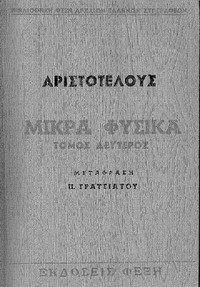
Μικρά Φυσικά, Τόμος Δεύτερος by Aristotle
QR code
"Μικρά Φυσικά, Τόμος Δεύτερος" by Aristotle is a scientific publication likely written in the early centuries of the Common Era. This work focuses on various natural phenomena and human experiences, including the nature of dreams, their causes, and effects on perception, blending philosophy with empirical observation to understand sensory phenomena. The beginning of this volume explores the concept of dreams, asserting that they occur in the realm of the sensory rather than
the rational part of the psyche. Aristotle begins by discussing how dreaming differs from sensory perception during wakefulness, emphasizing that while one may experience vivid imagery in dreams, they are not controlled by external stimuli in the same way as when awake. He proposes that dreams are residual impressions of prior sensory experiences, offering insights into the workings of perception and imagination during sleep. Additionally, Aristotle examines how emotional and physical states can influence dreaming, hinting at a complex interplay between the mind and body in these nocturnal narratives. (This is an automatically generated summary.)
Download for free
For your e-reader or reading app — Kindle, Kobo, Apple Books, Calibre etc.
Kindle → Use Send-to-Kindle
Kobo, Nook etc. → Transfer via USB
Phone, tablet or computer → Open in a reading app
Other formats & older devices
There may be more files related to this item.
About this eBook
| Author | Aristotle, 385 BCE-323 BCE |
|---|---|
| Translator | Gratsiatos, Paulos |
| Title | Μικρά Φυσικά, Τόμος Δεύτερος |
| Alternate Title | Parva Naturalia (Little Physical Treatises) Vol. 2 |
| Credits | Produced by Sophia Canoni, book provided by Iason Konstantinidis |
| Language | Greek |
| LoC Class | PA: Language and Literatures: Classical Languages and Literature |
| Subject | Psychology -- Early works to 1850 |
| Category | Text |
| eBook-No. | 27896 |
| Release Date | Jan 26, 2009 |
| Last Update | Mar 12, 2012 |
| Copyright | Public domain in the USA. |
| Downloads | 310 downloads in the last 30 days. |
Project Gutenberg eBooks are always free!