
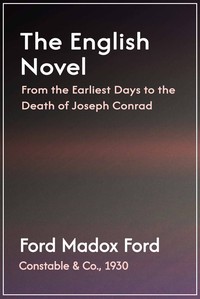
The English novel : From the earliest days to the death of Joseph Conrad by Ford
QR code
"The English novel" by Ford Madox Ford is a critical study written in the early 20th century. It surveys the development and technique of the novel (largely through English examples but with an international lens) and argues for its central social function in modern life, culminating in Joseph Conrad. The work blends history, craft talk, and polemic for general readers, challenging academic orthodoxies while reassessing figures from Bunyan, Defoe, and Richardson to
Flaubert and Conrad. The opening of this study begins with an “Author’s Apology” to Hugh Walpole, explaining the book’s origins as lectures for American students, Ford’s modest readership in England, and his decision to publish at home out of gratitude and to aid students; he promises a frank, controversial, craftsman’s map rather than academic doctrine. He then argues that the novel has become indispensable in a mobile, urban world where gossip and shared lives have thinned: unlike tabloids, art leaves lasting impressions and supplies the “cloud of human instances” once provided by classical culture, thereby aerating public life. He outlines a plan to trace a transnational lineage from antiquity to Conrad and signals that his estimates will provoke disagreement. Early chapters sketch the ground: medieval story collections and drama fed the appetite for fiction; the Elizabethan stage is treated as “novels for recitation,” with thoughts on Shakespeare’s page-versus-stage effects; printing and Chaucer prepared readers for sustained prose. He contrasts Spanish picaresque with English taste, then shows Bunyan’s sincere, vividly rendered allegory and Defoe’s journalistic, autobiographical convention as foundational steps toward convincing narrative. Moving “towards Flaubert,” he links modern technique to the plain, image-rich prose of the Prayer Book and Bible, praises Richardson’s epistolary sentiment as a breakthrough, and criticizes Fielding and Thackeray as moralizing purveyors of the “nuvvle.” Throughout, he frames the central technical problem as finding a watertight convention that makes readers feel truly present in a scene, noting how Bunyan, Defoe, and Richardson each attempted it. (This is an automatically generated summary.)
Download for free
For your e-reader or reading app — Kindle, Kobo, Apple Books, Calibre etc.
Kindle → Use Send-to-Kindle
Kobo, Nook etc → Transfer via USB
Phone, tablet or computer → Open in a reading app
Other formats & older devices
There may be more files related to this item.
About this eBook
| Author | Ford, Ford Madox, 1873-1939 |
|---|---|
| Title | The English novel : From the earliest days to the death of Joseph Conrad |
| Original Publication | London: Constable & Company Limited, 1930. |
| Credits | Sean (@parchmentglow) |
| Language | English |
| LoC Class | PR: Language and Literatures: English literature |
| Subject | English fiction -- History and criticism |
| Category | Text |
| eBook-No. | 78426 |
| Release Date | Apr 12, 2026 |
| Copyright | Public domain in the USA. |
| Downloads | 444 downloads in the last 30 days. |
Project Gutenberg eBooks are always free!