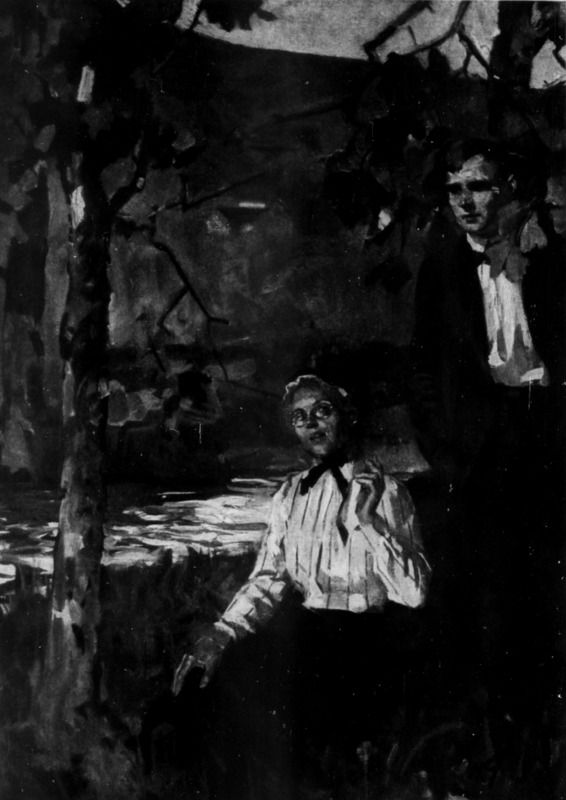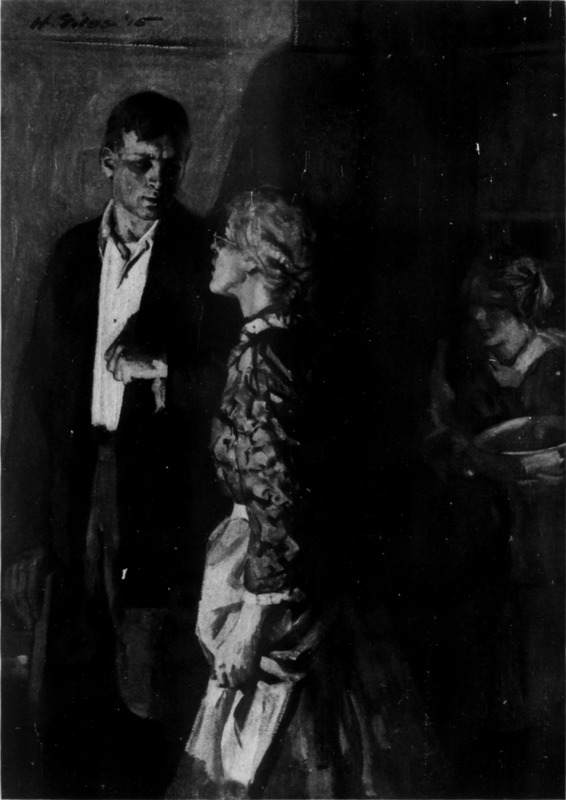
HE WOULD HAVE RUSHED OUT, BUT HIS MOTHER CAUGHT HIS ARM.
Helen R. Hull
Illustrations: Howard Giles
Harper’s Magazine, vol. 131, June 1915, pp. 73-82.
John scraped his chair over the bare floor and rose. His mother leaned forward to pick up the napkin he dropped beside his plate, and said, an uncertain entreaty in her voice, “The paper’s on the table, Johnny.”
He made no answer, but his mother’s face relaxed when he walked to the other end of the long room, the sitting-room end. Laying aside the rose-sprawled china globe, he lighted the lamp on the little round table and sat down with the paper.
His mother rose from the supper-table. “Katie, you pick up the dishes. I’ve got to sew to-night.”
Her voice drooped a little wearily, much like her shoulders.
“I’ve got some hist’ry to do,” pouted Katie.
“You’ve got dishes to do first,” retorted her mother, sharply. “Don’t you let me hear another word. Molly’ll help you.”
She opened the door which led to the two tiny bedrooms, and a cool breeze blew in, ruffling the white sash-curtains. With her sewing-basket she seated herself opposite John. He did not raise his eyes from the paper, but he moved restively, conscious of her glances in his direction.
“Pink’s bad for eyes at night,” she ventured, as she held her needle near the lamp to find the elusive eye. No answer from John.
“Are you going to the exercises?”
“Huh? What exercises?”
“Why, the Memorial Day ones at the church.”
“What do I want to go for?”
His mother’s thread broke, and she snapped out an irritated, “You could answer decent, at least.”
He rustled his sheet aggressively. From the other end of the room came the clatter of dishes and subdued giggles. A tin slipped to the floor with a bang, and John jumped up, tossing aside his paper.
“Can’t ever let a fellow read in peace!” he muttered, glowering irresolutely.
His mother looked up from the pink waist at this tall son of hers. “Don’t go out again, John. There—there’s popcorn in the cellarway—”
“Popcorn!” John mocked her accent scornfully. “I’m going over town. I’ve got to see Barney.”
“You don’t have to see him.” Her knowledge of her helplessness made her voice shrill.
“He’s going! He’s going!” sang out Molly, suddenly, pounding on her pan with an iron spoon.
“Hush up! He ain’t going anywheres!” cried Mrs. Ryan.
“What is there here for a fellow to do, I’d like to know?” demanded John, glaring about the room with its bright-chimneyed lamps. “A fellow’d ought to have some fun.”
“I like to see you of an evening, Johnny. You’d ought to be glad you’ve a home to come to.”
“I guess this is better than walking around with that Dovie Jacks.” This came pertly from Katie.
“Shut up!” roared John. “Who asked you to butt in?” He turned on his sister fiercely, away from the tears in his mother’s eyes.
“Well, you were a-walking with her.”
“Keep it up! If you think I’m going to stay here!” He seized his hat from the hook near the door, and would have rushed out, but his mother, stumbling in her haste, caught his arm. Her thin lips drew into a little pucker, and the hollows of her cheeks deepened as she swallowed quickly. John met her eyes stubbornly.
HE WOULD HAVE RUSHED OUT, BUT HIS MOTHER CAUGHT HIS ARM.
“Johnny!” she said, and then was silent, glancing from him about the clean, bare room. Her eyes came back to his sullen face, and with a little sigh she released his arm. He stood for a moment, his face flushing heavily, and then, at a derisive little titter from one of the small sisters, turned and with deliberately loud steps walked down the door-steps to the gravel path. He heard his mother’s voice, breaking tensely through her control:
“See what you’ve done, Katie Ryan!”
He struck off down the road, across the river, and up to the main street of the village, shuffling moodily along through the dust.
The street was dark, save for the light from a few shops and the string of bright specks which marked the intersection of trolley-line and street, several blocks down. The boarded windows of the tavern offered a mute protest against the recent local-option ruling which had closed the chief social refuge of the village. Against the doorway of the cluttered general store were silhouetted the figures of several girls.
“Hullo there, John!” called one. “Oh, John! Coming to the exercises?”
“No, I ain’t,” he retorted, without stopping.
“Got a date, John?”
He went angrily on. From the drugstore corner the street dipped quickly to the car-tracks. In the shadow of the town hall was a small building. The torn shade of the one window was drawn, but the sultry night had forced open the door. John stopped where the light fell on his discontented face. The room within was full of smoke and men—men lounging about a green-topped table and tipped back in chairs against the wall. A brisk little man came to the door, carefully chalking his cue, and John, with a shrug of distaste, started on down the street.
“Hey, you, John!” The man spied him. “Come on in!”
John stopped a moment. At a laugh from the room the man turned, and John walked on to the little brick waiting-room.
That was the newest and cleanest place in town. The taciturn old mail-carrier was in front of the door, his limp mail-sack carefully guarded between his legs. The station-agent, a sallow, bored young man, stood in the doorway, an unlighted cigar between his teeth. John nodded at him, imitating his nonchalant pose.
A couple strolled around the corner of the platform, arms linked, the girl’s white hat drooping affectionately on his shoulder.
“Married last night,” commented the agent. “Going to live in the city.”
John stared after them curiously.
Far down the road appeared a glow. It wavered, disappeared, returned, was caught by the trolley-wires, and at length flashed into brilliancy as the car came up the grade to the station.
The agent walked to the front of the car, a touch of officiousness in his nonchalance. The mail was tossed onto the platform. Only one passenger, a woman, got off, brushing rudely past the couple, who had rushed in haste from their dark corner.
At the sight of her, John’s listlessness fled. She was slender and untidy, a scarf about her head. Her dark eyes followed the station-agent as he walked back to the door, ignoring her, and she saw John.
A hand fluttered one end of the scarf toward him, and she walked more slowly.
John scowled at the old mail-carrier who stood watching him. As the car pulled out he joined the girl. She laughed back over her shoulder as they left the platform.
“I was hopin’ to see you, John.” Her voice was lazy, soft in its undertones, nasal when she spoke aloud. “I’ve been out to Ranna’s, helpin’ her.”
“You help her a lot, don’t you?” John asked, awkwardly.
“Oh, some. I’m tired to-night.” She sighed. “It’s tiresome, workin’ for folks.”
“You bet it is,” assented John.
They said no more until they reached the bridge. There John, clearing an obstinate throat, asked, “Say, Dovie, are you too tired to go along the river to-night?”
She leaned against the bridge rail, sighing again.
“It’s nice and cool,” he urged.
“Well—seein’ that you want to so bad.”
John helped her over the roadside ditch. She clung rather heavily to his arm as they started across the meadow. The soft wind fluttered her scarf into John’s face, and when he put up his hand to brush it away the gauze caught on his fingers.
“Caught, ain’t you?” she laughed.
“Well, I guess I can get away,” he retorted, jerking free.
She laughed again.
They reached the meadow fence. John held the wires apart for her to crawl through, and followed slowly. A dull darkness hung over the country, shutting out stars and muffling sounds. From the river came the subdued croaking of the frogs; a distant catbird called shrilly. Just at the river’s edge was a slight rise of ground with two slender trees.
“Let’s rest,” she said. “I’m tired.”
She leaned against a tree, her face a white blur in the night. John stretched out beside her, poking at the turf with a bit of stick. After a silence of some moments, the girl spoke:
“It’s just like we was saying last night. It ain’t right. Here’s you workin’ fer other folks, givin’ ’em all your money. An’ here am I, all wore out, doin’ the same thing.”
John lunged at the turf.
“Why, I’ll bet they even treat you same’s if you was a baby.”
John sat up, hurling his stick out into the stream. The words seemed to push out in spite of him, doggedly, “I’m gettin’ pretty tired of it, too.”
“I know. You ain’t a kid no more, and folks don’t know it.” She waited, and, as he made no answer, continued, plaintively: “This ain’t no fit place to live, either. Since I’ve been back I’ve about died. They ain’t even any one I can talk to but you.”
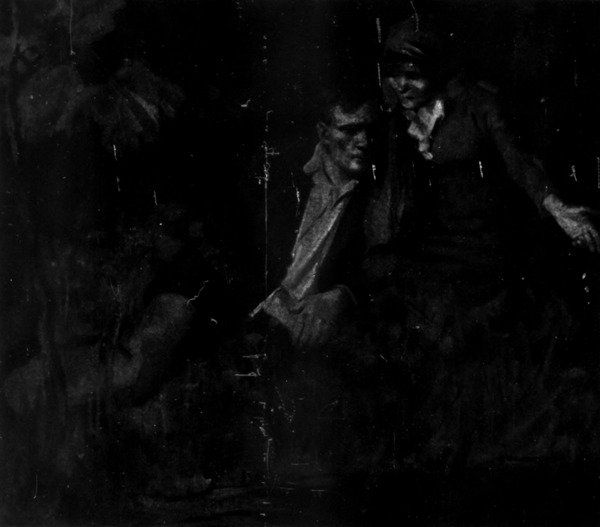
“THEY AIN’T EVEN ANY ONE I CAN TALK TO BUT YOU.”
The reflection of vague light from the river hid her coarseness, making her not Dovie Jacks so much as just a girl. John sat very erect, his shoulders squared. Her low voice went on complainingly:
“An’ what do I get fer talkin’ to you? What do they say?” Her hands entreated him.
“Let ’em talk.”
“They say—they say I’m runnin’ after you.” She caught her breath in a sob and covered her face with fingers slyly parted over her eyes.
John moved uneasily. “Don’t cry, Dovie. Anybody can’t stir here without they get talked about.”
“What does your own mother say?” Her voice rose shrilly, then broke in despair again. “What does she say?”
John made an inarticulate answer. A perverse memory answered Dovie’s question, and he heard his mother’s “Johnny!”
“She says ‘that Jacks girl!’ Oh, I know. I hates ’em all. What chanct have I got here? I’m goin’ away.”
“Where?” demanded the boy.
“Anywheres. To the city. Away!”
“An’ what’ll I do?” He spoke dully.
She made an impatient movement of a foot.
“I can’t go,” he continued, still with the dull sense of empty, heavy days ahead.
“Why not?”
“Why, I—” He stopped, unable to bring into words the reason—his mother.
“Why should y’ stay an’ work?”
“I’d ought to,” he answered, doggedly.
“Ain’t you got a right to live? What thanks do you get? Naggin’ and words.”
John dropped his head between his hands. Hadn’t he a right to be a man?
“You ain’t a boy no more. Go away, an’ she’d respect you more.”
He sat helplessly dumb. After an expectant pause, Dovie rose, taunting him with: “Stay, then, sissy. I’m goin’.”
She tripped, and caught at John’s shoulder. The touch woke him, and he drew her toward him.
“You ain’t—not without me!” he cried.
She laughed and sank against him, slipping an arm about his shoulder, and angrily, awkwardly, he kissed her. For a whirling moment she clung to him; then she pulled away.
“I’m goin’!” John cried out against the confusion within him. “I’m goin’ with you. We—we’ll get married.”
“You ain’t old enough, even if you do look it.”
“I am. They don’t know.”
She leaned to him, her face mysteriously alluring in the dim river-light. “’N’ what about yer mother?”
He caught her roughly to him and silenced her. “You’ll have a chance,” he said, finally. “We’ll have it together. I can work, and we’ll live. That’s what we’ll do.”
She rose as he scrambled up. A placid moon peered through the bushes at them. They started back along the river, silent until they reached the bridge. There Dovie stopped.
“I’ve got to get my clothes out at Ranna’s,” she said. “I can get ’em to-morrow early. Well!” she snapped, as John made no answer. “I suppose we can go to-morrow as well’s any time.”
John choked over the word. “To-morrow!”
Dovie moved near. “Don’t you want to?” she whispered, swaying against him slightly, and laughing as his lips found hers again—only for a second—and she broke away.
“Somebody’s comin’. You slip across your back yard. I’ll meet you at the crossin’ to-morrow night. Run along!”
He started across the garden, and she watched the tall shadow until it disappeared around a corner of the house.
There was a figure in the doorway when John came up the path. It was his mother. She said not a word as he went past her into the house, where she followed him.
“You’ve been with that girl again!”
“S’pose I have?”
“An’ you a son of mine!”
“She’s good enough for me.” John faced his mother, his face distorted, as flushed as hers was colorless.
“John Ryan! That Jacks girl! You bring disgrace in the house by goin’ with her. You—you ain’t been the same boy since she came home.”
“You lie!” The words were a burst of flame from sullen fire, away from which the mother shrank. “Lies! She’s as good as I am! And nothin’ could be as bad as livin’ here and workin’ and never a thing but jawin’. I’m through.”
Tossing his cap on a chair, he strode off into the tiny bedroom, banging the door after him. He could hear his mother pacing back and forth in the outer room, and he thought he could detect shrill words hurled at him. When he had finished undressing he stood for a moment, his hand on the door. The footsteps still passed with jerky regularity. After a moment he crawled into bed. The room was stifling with the door closed, and he could not sleep. A long time afterward the door crept open. Through half-closed lids he saw his mother, her hands pressed to her breast, a pitiable shadow against the dimness of the outer room. He was carefully still, and she turned away.
Friday, Memorial Day, was a holiday, and so John was bewildered to wake early that morning and find his mother leaning over his bed.
“Get up, Johnny,” she said, softly. “Still, so’s not to wake the girls.”
“I don’t have to work.”
“I’ve laid out your clothes. You just put them on.”
Her quiet persistence roused him to action without waking his obstinacy. He noted with dull surprise that the clothes laid out were his best, even to a collar. When he came out into the kitchen, his mother, in unwonted splendor of white waist and black skirt, was hovering about the table.
“Eat your breakfast,” she whispered, “and I’ll tell you about it.”
He ate in silence, dazed by the unusualness of his mother’s behavior. She put on her hat while he ate. She piled the dishes into the sink, and possessing herself of a large pasteboard box, tiptoed him out, closing the door gently.
“There! we didn’t wake them,” she exclaimed. “And now we’ll have to hurry to catch that car.”
“What car are you going to catch?”
John strode along, impelled to haste by the nervous force which his mother displayed.
“I’ll tell you when we get it,” she panted, hurrying on.
“I ain’t goin’ anywhere.”
She shook her head impatiently, and hastened on.
Baffled by the lack of anything definite against which to protest, John followed. The distant gong of the car sounded as they turned into the main street, still quiet in sleep.
“Catch it, John!” cried Mrs. Ryan; and John sped down the hill.
He stood with one foot on the step, beckoning her to hurry, as she came breathlessly up. He climbed after her, quite as a matter of course, and the car started off with its clamor of bell and gong.
Mrs. Ryan’s face was flushed and her hat was awry, but the dead hopelessness had left her eyes. She relinquished the box to John, straightened her hat, and tucked up a few strands of hair. When the conductor came through the empty car to their seat, she leaned toward him across John, gripping a shabby little purse. “Does this car go straight through?” she asked, half fearfully.
“Yes’m. Clear through.”
“And I can buy two tickets to Nelson?”
“Sure.” He tore the two receipts from his book and tossed them aside. “One dollar thirty.”
She handed him the exact change, her eyes on the slips of paper.
“Don’t we have any tickets?” She was politely dubious.
“We don’t need ’em, ma.” John’s voice had a hint of apology, and the conductor went on, smiling.
“What are you going to Nelson for?”
“Well,” she hesitated, “I ain’t going exactly to Nelson. I’m going on a little trip.”
“A what?”
“Well, sort of. I’ve been saving the money for a while—for you to go, too.”
“Where do you think you’re going?”
“It ain’t just a pleasure trip. But it’ll be nice. I didn’t say anything until I saw the weather. But it couldn’t be a nicer day. I ain’t had no vacation for a good time.” She paused, looking at her hands—thin, roughened, with swollen knuckles and blue ridges of veins. “I’m glad you wanted to go,” she finished.
John started to retort, but he could not get the vision of her hands out of his mind, and he said nothing. She had turned to the window, leaning back against the seat.
“It’s a pretty morning,” she sighed.
John looked out at the country with the vague tolerance one has for an accustomed journey. The hollows of the rolling meadows were grayed with a faint mist which the sun had not yet disturbed. There were signs of awakening at the scattered farm-houses. At a cross-roads waiting-station several couples entered, presenting a wonderful combination of celluloid collars, white dresses, red hands, and loud laughter.
“There’s a circus in Jackson,” volunteered John, but his mother made no reply.
The mid-morning was hot and dusty. John shifted uncomfortably, hampered by his collar, and glanced at his mother, upbraidings on his lips. A veiled expectancy about her silenced him. She had removed her hat, and the wind blew her thin hair in wisps about her cheeks. Once John caught a smile on her face. The whole proceeding had an air of momentousness for which he could not account. Neither could he understand how he happened to be there. Would they be home by evening?
The conductor came down the aisle, and Mrs. Ryan stretched out her hand to intercept him. “How much farther is Nelson?”
It was the next stop, and with trembling fingers she adjusted her hat. She sat far forward on the seat, hands tightly clasped. Almost before the car had stopped she was down the aisle.
Nelson was little more than a street crossed by the car-line. The church, store, and a few houses lay to the west, but Mrs. Ryan turned eastward down the dusty road.
“It ain’t much of a walk,” she assured John. “Be careful about that box.”
She struck so brisk a gait that John fell behind, his ire rising with his increased discomfort. His mother, apparently as oblivious to heat and dust as to him, went on, her skirt flopping limply back and forth above the little spurts of dust from her quick feet. The road skirted a hill and then climbed resolutely up the next. At the top Mrs. Ryan stopped, breathing hard and shading her eyes. There was no sudden descent. The ground rolled away in stretches of green meadows and dark, freshly plowed fields at the left. Not far below was a cross-road. At the right a lane led in among the trees of a little grove. Mrs. Ryan turned into this lane, John still lagging behind. On through the trees they went, until they caught sight of a white steeple.
“That’s the church!” Mrs. Ryan’s voice thrilled. In a moment John saw it—a small, worn building, with a few old sheds behind, all fronting on the cross-road.
“I’ve wanted to come for these twelve years,” said the mother, “an’ most of all this last year, since the car’s been running so close. An’ here I am!”
“Here!” Had they come this hot way to see an old church? But Mrs. Ryan had gone on, quickening her steps almost to a run. The sheds shut her from view for a moment. When John rounded them he saw a stretch of ground, not large, surrounded by old trees. Under the trees were mounds in the long grass, and queer, gray tombstones. Then across at the far side he saw his mother kneeling.
He picked his way slowly around the mounds. At the sight of a stone tipped so sadly that the carven lamb seemed trying a somersault he smiled. A sense of quiet rose from the old graves, and the boy felt his anger slipping away. When he reached his mother she was drying her eyes with gentle pats.
“I’d oughtn’t to cry when I’ve wanted to come,” she smiled up at John.
He looked at the mound. There was no stone here at all—only a rounded wooden slab. He bent to read the worn letters of the name, and then stared at his mother.
She nodded quietly. “Yes, John. It’s your father’s. Now let me have the box.”
He handed it to her and watched her fumble at the knot. She took off the cover. A shoe-box at one end she returned to John. “Just our lunch,” she explained. Then she pulled away the paper, disclosing a mass of purples and lavenders—careful bunches of pansies and violets.
“I gathered them before you was up,” she said, softly. “They’ll keep, bein’ that fresh. There’s a tin pan on that next grave, and here’s an old glass. You go and fill them at the pump there by the church.”
When John returned, his mother was pulling away the grass which grew around the headboard. She handed a pair of scissors to John. “Just cut the edges down a little, Johnny.”
Then she brought a few stones to hold the glass in place, and spent a long time arranging the flowers. John, on a stump just beyond, watched her silently. At length she rose, rubbing her hands on her handkerchief.
“Isn’t it better, don’t you think, Johnny?” she asked, wistfully. “Of course we can’t do much.” She pointed to two graves near, with gray stones still erect, and a scraggly rose-bush growing between. “I’d ought to put flowers there, but I want John to have them all. They’re his father and mother. They had these lots. When John died I couldn’t buy one nearer us, so we drove over here. I remember I couldn’t cry as much as I wanted to, because I had to hold Katie, and you wouldn’t stay with no one but me. Molly came that winter. Twelve years....”
She was silent a little while, and then:
“I thought I’d get him a stone after Molly came. But I never could. All I could, do was to keep my family’s soul in its body, let alone buying stones. But I did keep my family.” She held out her hands with an unconscious gesture. “All alone till you was big enough to help. And now you’ve quit school and begun to be a man. Your father used to think how you’d be educated, like he wanted to be.” She stopped again, sitting down on the grass, her hand on the poor board. “He was a good man, your father. He wouldn’t mind not having a stone. I s’pose he was the last one to come here.” She looked about at the forgotten graves. “They all go over to the Hope Cemetery now.”
John listened, resenting his mother’s silences, hating the rebuke of the wooden slab, struggling to remain firm against these attacks upon his sympathies.
“I want him to be proud of his boy. You look like him. He wasn’t much older—at first—and you’re so big you look about as old.”
“You never told me about him,” John cried out. “You said he was buried off where you used to live. You never said there wasn’t even any tombstone.”
“No. I—I was ashamed to talk about this.” She touched the board. “An’ then I was awful busy.”
“He’d ought to have a stone,” declared John.
“Oh, Johnny!” His mother was radiant. “Do you think so?”
John rose impetuously. “Of course. It ain’t right. It ain’t decent for him not to have one. We’d ought to get one.” He looked about him desperately. Where was Dovie? He fancied he had heard her laugh.
“They cost a lot,” said the mother, simply.
John avoided her eyes miserably. After a moment she rose. “There’s a brook down farther. We can eat our lunch there,” she suggested.
Lunch was a silent affair. John gulped his sandwiches with an air of determination. His mother ate little. She sat half alert, with remote eyes. John wondered what she heard. The stir of the woods, the soft murmuring of the leaves, the faint brook, filled him with uneasiness. When they had finished their pretense of lunch John dropped the box and its cover into the stream. With much swirling they floated out of sight around the curve, and John turned to his mother. But she was not ready to go.
“I—I’m tired, Johnny. I guess I’ll rest awhile.” She pulled herself into the hollow formed by the roots of an old stump. “You won’t mind waiting a bit, will you?”
She closed her eyes, leaning her head against the rough bark. John stood above her, the sunlight on his troubled face. The mother opened her eyes with a swift smile. “We had our lunch just here once. Only this was a fine tree. Come here, John. No, closer.”
He knelt reluctantly at her side, and she ran her fingers through his thick hair, trying to smooth it into a neat part.
“There,” she sighed. “He combed his hair so. Go for a little walk, Johnny, and then we’ll start back.”
John walked away slowly. He brushed his hair back roughly. He didn’t want to look like his father. Did his father mind having no stone? He struggled against the touch of dead fingers at his heart. Hadn’t you a right to live as you wanted to? Lots of things counted more than tombstones. He guessed he’d done all any boy would. Following the brook, he struck off into the wood.
Later, so much later that the shadows of the trees across the brook reached over and touched her, Mrs. Ryan opened her eyes. She rose, a little stiffly, and walked back to the cemetery, halting at the broken rail fence which marked off the burial field. Just ahead of her was the grave. High about the wooden headpiece, hiding it, was piled a mass of dogwood branches. Beyond it, on the stump, sat John, whittling, his back to the grave and to her. She watched him, her hands yearning toward him, her face pathetic in its wistful hope.
John stopped whittling and turned his head as if to listen. Then he rose, brushing a few shavings from his coat, and turned very slowly until his eyes met his mother’s. He grew red, but his eyes held to hers resolutely.
“The—flowers are pretty,” she said, her lips trembling.
“You can talk about expense all you want to”—there was defiance as well as blustering apology in John’s voice; “my father’s got to have more than a stick of wood.”
“Oh, Johnny! I—I guess we won’t mind the cost.”
She laughed, a little laugh that choked in her throat. Bending down she broke a sprig of the dogwood to stick in her belt.
“It’ll take a while”—John hesitated—“but we’d ought to.”
“Yes, Johnny.” She glanced up at him. “Well, we’d better be going now.”
Transcriber’s Notes
Transcribed from Harper’s Magazine, vol. 131, June 1915, pp. 73-82.
New original cover art included with this eBook is granted to the public domain.
The original spelling and punctuation were mostly preserved.