
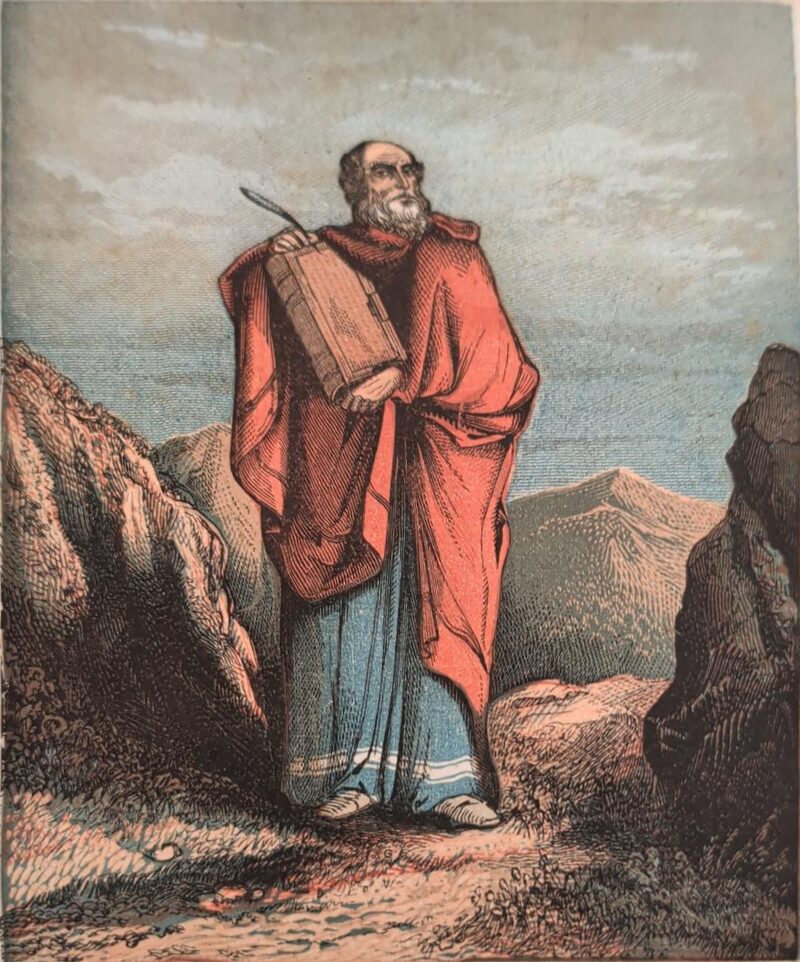
St. Matthew.
THE
GOOD CHILD'S LIBRARY.
FIFTH BOOK.
In Easy Verse.
WITH
BRILLIANT ILLUMINATIONS,
FROM ORIGINAL DESIGNS,
Printed in Oil Colours by Hogan & Thompson.
PHILADELPHIA:
HOGAN & THOMPSON.
1850.
Entered, according to the Act of Congress, in the year 1850, by
HOGAN AND THOMPSON,
In the Clerk's Office of the District Court of the United States, for the
Eastern District of Pennsylvania.
The object of the "Good Child's Library," is to encourage a taste for Scripture reading, by presenting some of the most interesting portions of the New Testament narrative, in the attractive form of verse. While the children read these verses, they will not only become acquainted with the principal events in the lives of our Blessed Saviour and His Apostles—their travels, their sufferings and their death,—but they will see that the Bible is a readable book, and a book that may be read every day, without any fear of becoming the unhappy being that some persons suppose; and besides this, the tone which is given to the affections, the minds, and the morals of children by such reading, is of almost infinite value.
In order to combine things pleasing and things useful, to the greatest possible extent, the publishers have gotten up at a great expense, especially for this work, some of the most beautiful Scripture designs that have ever been published. These pictures are printed in Oil Colours—an expensive, but a finished and highly artistical process, of which the publishers are the originators in this country. Each history is illustrated handsomely with them.
There is in all twelve books; each book being complete in itself, and containing a full history.
The "Good Child's Library" is composed of the following books:
The Publishers have in preparation another series, embracing Scenes in the Lives of the Patriarchs, Prophets, and Kings, illustrative of the Old Testament Scriptures, to be gotten up in the same style as the present series.
SCENES IN THE LIFE OF SAINT MATTHEW.
| SAINT MATTHEW. | |
| I. | His Call |
| II. | Christ Dines with Matthew |
| III. | His Character |
| IV. | His Ministry |
| V. | St. Matthew's Gospel |
| SAINT JUDE. | |
| I. | Called to be a Disciple |
| II. | An Interesting Question |
| III. | His Ministry |
| IV. | His Epistle |
| SAINT SIMON. | |
| I. | The Zealots |
| II. | His Ministry |
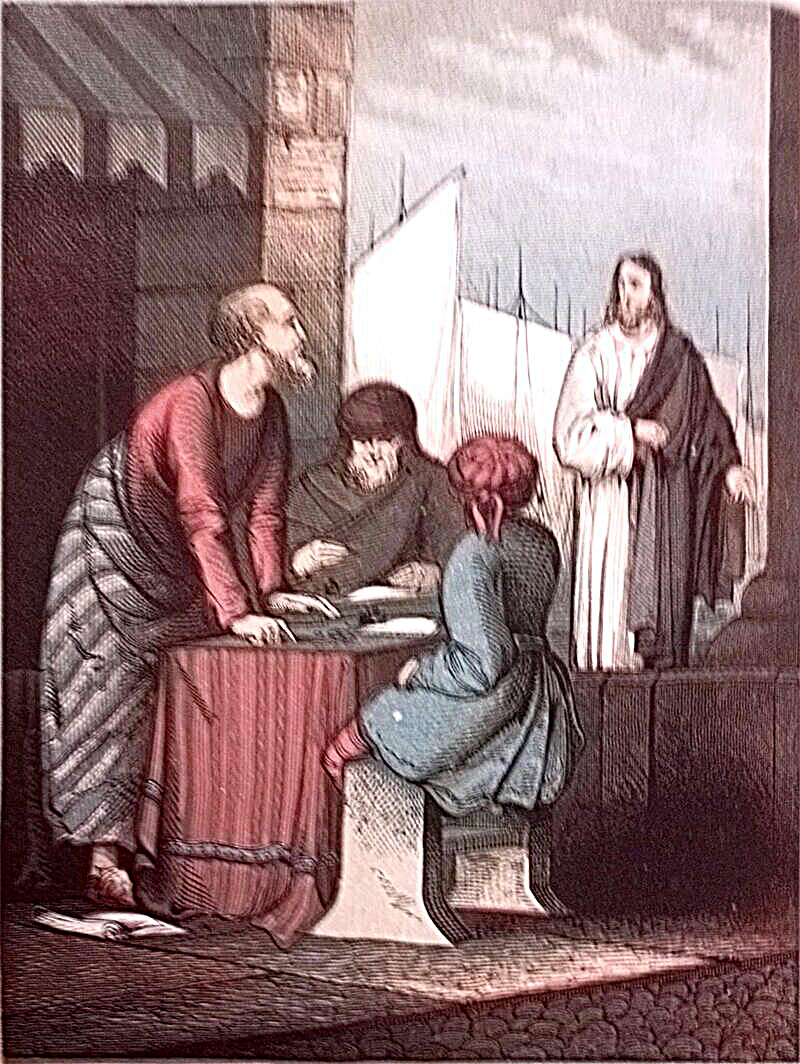
Calling of Matthew.
ST. MATTHEW was a publican,
And lived in Galilee;
But he was nearly always at
His office near the sea.
'Tis strange that he should follow Christ,
And leave his work behind;
He gave up all for Christ at once,
That he His grace might find.
It seems that Matthew had some wealth,
But this at once did leave;
He left his office and his friends,
On Jesus to believe.
His case was different from the rest,
For they it seems were poor;
But he, in mingling with the world,
Accumulated store.
And sitting in his office once,
Down near beside the sea,
The Saviour, passing by that way,
Call'd out, "Come follow Me."
Had Christ come to him as a prince,
And call'd him by his word,
To follow him in glorious arms,
And wear a glittering sword,
We would not then have wonder'd much
To see him go straightway;
For one who seem'd to love the world
Would such a call obey.
But Christ, our Blessed Lord was poor,
And those who follow'd, too—
It then doth show authority,
To see a rich man go,
And leave his friends and follow one
He ne'er before did see,
Because He said unto him there,
"Come thou and follow Me."
But Matthew saw in Christ, beside
His humble poverty,
The light of love and truth Divine,
And great authority.
And when he heard the Saviour's word,
He saw the truth most clear,
That Christ was more than all the world,
Than all its wealth, more dear.
He therefore left his friends, and found
In Christ great power to save,
And though he left all things, he should
Eternal riches have.
He never turn'd away from Christ,
But follow'd to the end;
And found in all his trials here,
That Jesus was his friend.
THEN Matthew said to Jesus, "Come
Into my house and eat;"
And many publicans were there,
And while they sat at meat,
The Pharisees began to say:—
"Why eateth Christ with them—
With publicans and sinners too?
In this he is to blame."
But Jesus overheard their speech,
And said:—"For I am come
To call, not righteous ones to me,
But sinners to my home.
"I am the great Physician, and
The sick I heal with grace,
And all who need my power and skill,
To them I show my face.
"These publicans and sinners are
The ones I come to heal,
And with the poor and meek in heart
My spirit loves to dwell.
"I come not then to call the good,
But sinners to repent;"
They understood the Saviour's word,
And on their way they went.
They went ashamed and dumb away
For they were very proud;
They needed no physician, for
Their righteousness was loud.
But Jesus knew their inmost heart,
His eye their guilt discern'd,
And when they heard Him speak such words,
Their shame and anger burn'd.
Our Saviour gives His love to all
Who do their sins confess,
He came to cheer the humble heart,
And graciously to bless.
The proud in spirit never can
Be taught for grace to kneel,
And those who never bow to Him,
His love can never feel.
'TIS said that Matthew had a heart
All temper'd with the love
Of Christ, and all his thoughts were fix'd
On pleasures pure above.
It seems before he followed Christ,
He served with care for gain;
He would be rich, and always tried
His pleasures to obtain.
Religion changes the whole man,
His thoughts, his words and life
It calms the fiercest passions down,
And turns away from strife.
A worldly man is always full
Of toil and strife and care,
He never feels the Christian's calm,
Obtain'd through humble prayer.
So Matthew show'd this wondrous change,
In following the Lord,
He felt it was more pleasing far,
To trust the Saviour's word.
Religion never makes the heart
Of any man feel sad,
It buoy's up the soul of man,
And makes the spirits glad.
A man of groanings and of sighs
Knows not what peace is given,
To those who are the sons of God—
Who are the heirs of Heaven.
So Matthew show'd in after life
Where'er his thoughts did range,
That he had pass'd from death to life
And felt the pleasing change.
His heart indeed was happy then,
He did the Lord receive;
His happiness did grow and spread,
The more he did believe.
Religious men are modest too,
Not like the Pharisee,
Who loudly tell how good they are,
But show no piety.
A good man always walks with God,
He's humble, meek and kind,
To all around, where'er he goes,
He shows a heavenly mind.
So Matthew, when this change had pass'd
Upon his mind and heart,
Did show to all great modesty,
And act a pleasing part.
I tell these things, that children may,
Learn wisdom and be good,
By living out the Saviour's will,
Who bought them with His Blood.
Be amiable and kind to all,
With tenderness and love,
And fix your thoughts, not on the earth,
But on the Lord above.
THE Eleven Apostles went abroad
To spread the Saviour's Name,
To tell the world He came to die,
And all His love proclaim.
For eight years after Christ arose,
To Jews St. Matthew preach'd;
But after this he went abroad,
And Gentile nations reach'd.
And like the rest, he bold went forth,
To tell of Christ the Lord,
Not caring for his life, so that
The people heard His word.
Some children who these verses read,
May go and tell abroad
The wonders of their Saviour's love,
The mercy of their God.
And some may go to heathen lands,
To preach to dying men,
That blessed truth, which brings us peace,
And gives us life again.
Remember what these verses tell,
Of men who had no fear,
But who in every danger felt
Their Lord and Master near.
Go preach the truth, go tell abroad
To all the nations round;
What all the world in Adam lost,
You now in Christ have found.
And never fear, though dangers rise,
And death your way oppose;
Go in the strength of Christ your king,
And triumph o'er your foes.
The world may persecute you here,
But God will hear your prayer,
Go, cast your burden all on Him,
He will your sorrows bear.
So Matthew, he went boldly forth,
Though death was in his way,
He could not turn aside, he must
His Lord's commands obey.
He went to Ethiopia,
That dark, benighted world,
And there the glorious standard high
With light and truth unfurl'd.
I see this lonely man afar,
Wand'ring in deserts drear,
To reach the sinful sons of men,
Without a dread or fear.
He's sacrificed all earthly good,
To tell a sinful race
How Jesus came on earth to die,
And save us by His grace.
They're steep'd in gross idolatry,
From this he bids them rise,
And points them to a Heavenly way,
That leads beyond the skies.
He stretches forth and high his hand,
And calls them with loud voice,
To come and leave their sinful ways,
And make the Lord their choice.
He tells them of the Saviour's love,
How he was crucified,
And how when men had pierced His heart,
He bow'd His head and died.
And how He sent them forth to tell,
That now He reigns above,
And sends His spirit down to bless
The sons of men with love.
They gather round to hear his words,
Such words they never heard,
They gaze with great astonishment,
Their wonder now is stirr'd.
Still he invites, and still instructs,
And many souls now come,
He points them to the Lamb of God,
And to a Heavenly home.
And now their sins they do confess,
And do in Christ believe,
The spirit purifies their hearts,
And God their sins forgives.
His enemies are now enraged,
To see so many turn,
From error's ways to serve the Lord;
Their wrath and anger burn.
And Satan fills their hearts with rage,
And leads them on to blood,
They lift their cruel, wicked hands
To smite the child of God.
Wherever martyr blood is spilt,
By hands of wicked men,
The glorious light of sacred truth,
Doth spring in power again.
The Lord preserves and honors those
Who serve Him here below,
And when the Lord shall come, then they
Shall highest glory know.
And though their blood is shed, yet He
Doth order all for good;
Their good is gain'd, and others' too,
By pouring out their blood.
And those who wear the martyr's crown,
Shall in full glory shine,
Their hands shall bear the "Morning Star,"
And sing with joy divine.
St. Matthew, he was call'd to share
The glorious martyr's death,
Through violence of wicked men,
He did yield up his breath.
His toils were then forever past,
He's found his home in Heaven,
And to him, in that Heavenly home,
Eternal joy is given.
THIS Gospel is a History,
That doth show forth to all,
The words Christ spake when on the earth,
His acts, both great and small.
It tells us of His humble birth,
His infancy and youth,
And what He did in manhood's prime—
In words of clearest truth.
It tells us of the words He spake,
In many parables;
It tells us also of His works
His many miracles.
It tells how He the people taught,
So kind from day to day,
It tells us His commandments pure
That we must all obey.
It tells us too, how poor He was,
So poor, He had no bed,
And when the night came on, He had
No place to lay His head.
It tells us how He loved the poor
And sought to do them good,
And cheer'd them all amid their care,
And show'd the way to God.
It tells us how He was despised,
Forsaken and forlorn;
How wicked men derided Him,
And treated Him with scorn.
It tells us how He was betray'd
Into the hands of foes;
And how they did with cruel wrath
His lovely heart oppose.
And how He was condemn'd, it tells,
To die upon the tree,
And there pour'd forth in agony,
His blood for you and me.
It tells us that the Saviour lay,
Three days within the tomb;
And then came forth in triumph thence,
Dispelling all its gloom.
And how He did ascend on high,
And sit in Glory down,
At the Right Hand of God in Heaven,
Upon a shining throne.
Our hearts do burn with sacred love,
When we do read this word,
We wonder at the richest grace,
Of our Redeemer Lord.
We read it o'er and o'er again,
And feed on truth divine;
And as we read each page and pray,
Our souls it does refine.
And children, it has charms for you,
See, what a lovely thought:
"Permit them to approach," He cries,
"And O! forbid them not."
"O! suffer them to come to me,"
He took them in His arms,
And blest them with His tender love,
Surrounding them with charms.
He now from Heaven looks down to you,
He'll hear your simple prayer;
He'll come and save you from your sins,
And make your hearts His care.
O! trust in Him, He'll never leave
Your souls, until you die,
And then if you have faithful been,
You'll reign with Him on high.
O! hear his words,—O! listen to
His winning, welcome voice,
And in your youthful days make Him,
Your early, only choice.
SCENES IN THE LIFE OF SAINT JUDE.
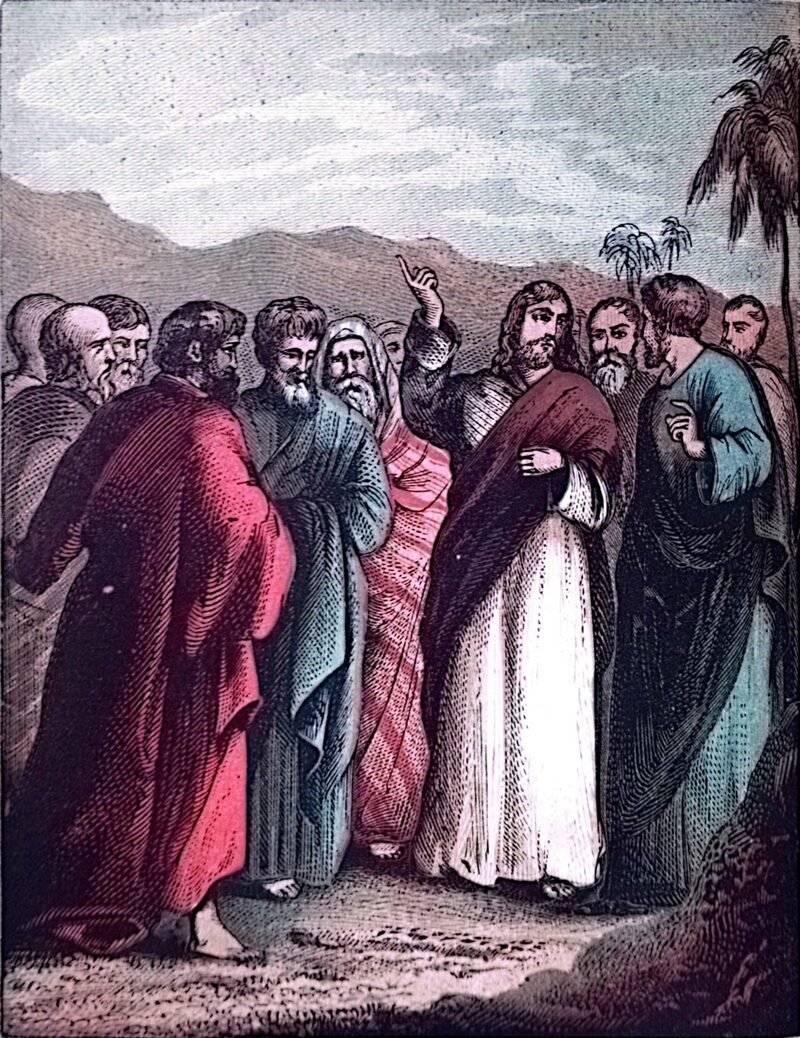
Christ conversing with St. Jude.
ST. JUDE is also one of those
Whom Christ did call to be
With Him, wherever He should go,
His gracious works to see.
Now this one in the Book is known,
Sometimes as Lebbaus,
And sometimes by some other ones,
He is call'd Thaddaus.
He's also known as brother to
The Apostle James the Less,
The Bishop of Jerusalem,
Who did the churches bless.
Of this Disciple, I can say,
But little here to you,
And I cannot make up a tale,
That is not strictly true.
How he was call'd, I cannot tell,
Nor when, nor where is known;
No light in Scripture history
Is on these matters thrown.
His history then can be but short,
And soon you'll read it through;
Whatever things I find I'll tell,
In simple verse to you.
BEFORE the Blessèd Saviour died,
He comforted the eleven,
And said He soon would send to them
The spirit down from Heaven.
And He would show Himself to them,
In goodness from above,
And every where in all their lives
Would bless them with His love.
He said:—"And, yet a little while
Ye shall not see my face;
The world will not receive my love,
But ye shall know my grace."
Then Jude said: "Lord how wilt Thou show
Thyself to us alone,
How wilt Thou manifest Thyself,
And not to every one?"
Then Jesus answer'd him and said,
"If ye love me, your Lord,
And fix your heart alone on me
And keep my sacred word;
"I and my Father then will come
And dwell within your heart;
We'll take up our abode with you,
And never hence depart.
"And ye shall know my gracious power,
And evermore shall prove,
In every dark, distressful hour,
The presence of my love.
"And ye shall know that I am with
Your hearts from day to day,
And ye shall all my spirit love,
And all my words obey.
"The world can never feel my love,
I cannot dwell with sin;
I dwell alone with those whose souls
Are ever pure within.
"And thus I manifest myself
To you who follow me;
Ye evermore shall know my grace,
And all my glory see."
What blessed, happy words are these
The Saviour did unfold,
More precious these than diamonds are,
Or than the finest gold.
We'll treasure them within our hearts,
And learn the gracious word;
And walking by their rule, shall dwell
Forever with the Lord.
SOME writers of Church history,
In early times do say,
That this Disciple went abroad,
To preach in Lybia.
When first he went to labour in
The vineyard of the Lord,
In Judah, and in Galilee,
He told the Blessed word.
He went through all Idumea,
And to Samaria;
And then into Arabia went,
And into Syria.
And thus you see his word was spread
In many lands abroad,
And many people heard from him,
The dying love of God.
Some persons tell us that St. Jude,
In peace resign'd his breath;
But others say to us again,
He died a martyr's death.
He's gone to his eternal rest,
His race on earth is run;
His spirit now is ever blest,
His work forever done.
ST. JUDE did an Epistle write,
To Christian Jews abroad,
Which gives them much instruction in
The blessed way of God.
He wrote to them about the love,
The common love of God;
About the pleasures they would have,
If they would keep His word.
He tells them of the heresies,
Which then prevail'd about;
And tells them for their happiness,
At once to root them out.
To stand like men, strong for the truth,
And for the faith contend,
And in the hour of danger, then,
On Jesus to depend.
He tells them that the Lord will come,
And in the Judgment day,
Will punish sore these wicked ones,
And drive them far away.
He says, that they are raging waves,
That their own shame doth foam;
That they are fearful wandering stars,
That in the dark do roam
But in the day when Christ the Lord,
Shall as a Judge return,
Then those who did torment His saints,
Shall feel His anger burn.
But ye, beloved, build yourselves
On your most holy faith,
So when the Lord shall come as Judge,
Ye shall escape His wrath.
And keep your hearts within the love
Of Christ, your Heavenly Lord;
And ever for His mercy look,
And ever keep His word.
And then when Christ shall put an end,
To every earthly strife,
He'll bring you with Himself to dwell,
And give Eternal Life.
Then with the Heavenly Host above
For evermore you'll praise
And sing the wonders of His love
Through everlasting days.
And now to God, shall praise be given,
From Angels and from men,
Dominion, Power, and Majesty,
For evermore—Amen.
SCENES IN THE LIFE OF SAINT SIMON.
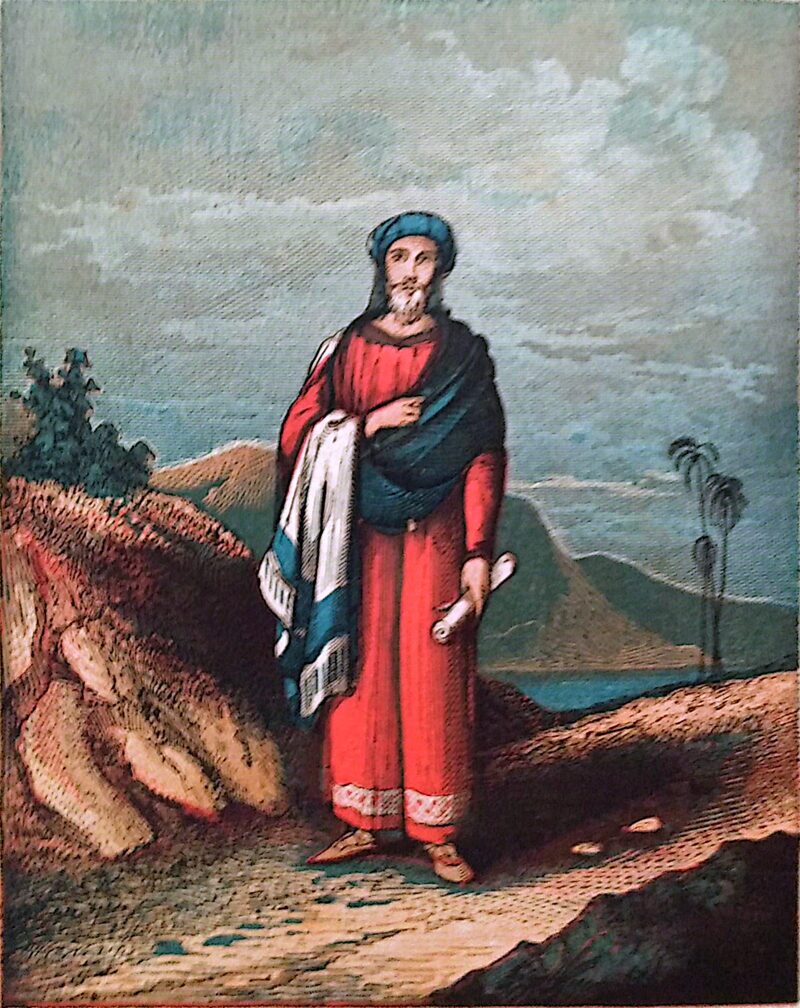
St. Simon Journeying to Jerusalem.
OF SIMON now, the Canaanite,
To you I will rehearse
Some simple facts of history,
And all in simple verse.
By "Canaanite," it is not meant
That He in Cana lived,
But to a certain sect belong'd,
Who certain laws received.
St. Simon was a "Zealot" call'd,
Not that he show'd more zeal
For Christ, than others of the twelve,
Nor stronger love did feel;
It signifies a certain sect,
To which his life was join'd,
A certain order of the Jews,
Who had a different mind
From others of the Pharisees,
And from them had withdrawn,
And midst the multitudes of men,
They kept themselves alone.
They did not keep the Roman law,
But acted as they pleased;
They sometimes punish'd, whom they would,
And whom they would, released.
They at the first were peaceable,
And did in quiet live;
And from all tongues of men around,
They did great praise receive.
They soon became degenerate,
Indulging every sin;
They then had many foes without,
And discord dwelt within.
They urged all men to take up arms,
Against authority,
And wanted them to fight, for what
They call'd their liberty.
They wanted all the people to
Throw off the Roman law,
And tumults they did raise, such as
Their cities never saw.
They broke into the Temple's courts,
And slew the Priests of God;
And scatter'd through Jerusalem,
Great tumult, war and blood.
This people wanted all the law
To be in their own way,
They fought against the magistrates,
And would no law obey.
Now Simon to this sect belong'd,
But our Redeemer, Lord,
Had call'd him forth to follow Him,
And to receive His word.
He left the sect and follow'd Christ,
And served Him here with zeal,
And for the blessed Son of God,
Strong fellowship did feel.
O! what a miracle is Christ,
What power there was in love,
He could possess the hearts of men,
And fix them all above.
There must have been authority
And music in His voice,
That He could call these different men,
To make His way their choice.
Had they all been one family,
And follow'd Him as such,
It would not then have seem'd so strange,
Nor would we wonder much.
But here we see a lonely man,
Though true, the Son of God—
Call different men, from different spheres,
And they obey His word.
They must have seen great loveliness,
In His humility,
To answer, when to them He said:—
"Come ye, and follow me."
St. Simon therefore left his sect,
And did the Lord receive;
He saw He was the Son of God,
And did in Him believe.
HE tarried in Jerusalem,
Until, with power from Heaven,
Unto the waiting sons of God
The Holy Ghost was given.
And when the Apostles bade adieu,
In all the earth abroad,
To go and spread the glorious news,
And tell the grace of God,
Then Simon wander'd forth alone,
To publish far and near,
That men should worship only God,
And love, with filial fear.
I see him leaving friends and all
In stranger lands to roam,
And bearing forth the light of truth,
To guide the wanderers home.
'Tis pleasant sure to have some friend,
That when our souls are faint,
We may pour out our griefs to them,
And tell them our complaint:—
But Jesus is the only friend,
His power and grace alone,
Can strong defend us, and His Love,
Is all we call our own.
Where'er we go He comforts us,
And in our great distress,
He comes on wings of grace and love
With happiness to bless.
And when we're in the city full,
Or on a lonely isle,
His spirit, through the darkest gloom,
On us with love will smile.
What is it makes the martyr give
To wicked men his breath?
What is it makes him boldly march
To meet a cruel death?
He's stronger sure than other men;
For other men would fly,
And give up all things for their lives;
They cannot bear to die.
It is the love and strength of God,
That bears their spirits up,
Their spirits triumph in the faith,
Their hearts are full of hope.
St. Simon's trust was in the Lord,
God was his strength and tower,
He felt the Saviour's loving arms
Around Him every hour.
And when at last his work was done,
He did resign his breath,
And bravely bore his spirits up,
To meet a martyr's death.
He died upon the cruel cross.
And suffer'd dreadful pain,
But with the Saviour in his heart,
He did not once complain.
Farewell to earth, farewell to pain—
His spirit upward sings,
The Angels welcome him above,
While Heaven with rapture rings.
There is no sorrow there, and grief
Is gone forever more—
And blessings crown the saints, while they
The Saviour's name adore.
THE END.
Transcriber's Note
Spelling and punctuation are as printed, including these places where the printer may have slipped: