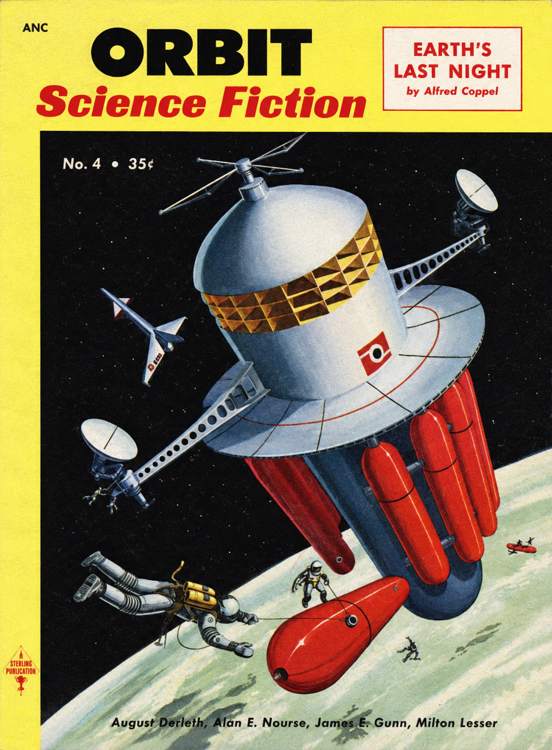
Transcribed from Orbit, September-October 1954 (Vol. 1, No. 4).
Transcribed from Orbit, September-October 1954 (Vol. 1, No. 4).
by Irving E. Cox, Jr.
Eternally, Man seeks in the stars the thing he could find at home.
In an hour—as soon as it was dark—they would raid the chart vault.
The decision was made; the waiting over. Lawson repeated that to himself as he stood with the late afternoon crowd on the slow-moving outer band of the slide-walk. Two hours more and they would be gone. Escape! They would escape from this regimentation and mediocrity.
Lawson grinned at the vacuous faces of the throng. He was looking upon the farce called civilization for the last time. It was their world, this thing he loathed. Let them have it, the nameless mass of happy nonentities; let them live with it and die with it. Tomorrow he would be free.
And then Adam Endicott slipped out of a cross-walk and caught desperately at Lawson’s sleeve.
“The police raided the cellar, Lawson!”
The dream began to die. “When?” Lawson whispered.
“Twenty minutes ago.”
“How many—?”
“Nearly all of us. I broke away and ran to warn you. Madge hadn’t come yet.”
“We’ll have to find her and get out of the city fast. There’s still a chance.”
“For only three of us?” Endicott laughed sourly.
“One man can pilot a ship.”
Lawson and Endicott took the high-speed slide-walk from the clanging, cluttered industrial area to the suburbs on the outskirts. Tall apartment spires were set in green parks. The glass-like walls of the buildings reflected the red of the dying sun. Hordes of noisy children crammed the playgrounds beside the apartments, and the park walks were filled with brown-uniformed workers returning from the five-hour afternoon shift in the city factories. Lawson and Endicott cut across the lawn toward the block-three buildings where Madge Brown, as an unmarried woman, was granted a single apartment.
“She may not be here,” Endicott said. “I tried to get her on the teleview right after the raid and I couldn’t.”
“Then we’ll wait,” Lawson answered. Madge Brown meant as much to him as his dream of escape. He knew that; yet it was a strange infatuation, for until four weeks ago he had not known her. Madge had been the last to join the conspiracy.
“It was an inside job,” Endicott told him grimly.
“One of us blew the story to the police?”
“It’s obvious. They knew just how to find the cellar; they knew exactly when we were going to be there.”
Lawson fingered his lip thoughtfully. “I suppose they’d have had me, too, if I hadn’t been held up waiting for the slide-walk out of the plant.”
“That’s how I got away—because I was late.”
“But we all believed in the same thing, Endicott. For two years we’ve been planning this together!”
“Most of us, Lawson.”
“You don’t mean—?” Lawson stopped and faced Endicott with clenched fists. “Not Madge.”
“She’s the only one who didn’t show up at the cellar.”
“You’re wrong! She hated this world as much as we do.”
“So she said.” Endicott licked his lips. “I know how you feel, Lawson. Sometimes the truth hurts. What do we really know about her? Madge Brown—just a dame you picked up one night in a recreation block. We took her in on your say-so. But who is she? Where’d she come from?”
Suddenly the words sang in Lawson’s soul with the tinny jangle of hysteria. It was more than he could take, to lose his faith in Madge and the dream of escape simultaneously. His fist shot out, lashing Endicott’s jaw.
Lawson turned and ran blindly toward the walk in front of the block-three apartments. From the lobby he rang her apartment, but the teleview remained blank. While he waited in the booth, he heard the distant cry of a police siren. Fear clutched at his mind. How could the police have traced him here so soon?
Considering the cumbersome inefficiency of this world it was impossible. There would have been a dozen bureaucratic forms to fill out first. Endicott must have called the police. It was Endicott, then, who had betrayed the conspiracy, not Madge.
Lawson got the picture, then—or thought he did. Only Lawson and Madge had escaped the police raid, and Endicott was using Lawson to lead him to Madge, since no record of addresses had been kept. Clearly, Endicott had to present the police with a clean sweep before he was paid the Judas fee.
Lawson left the apartment lobby. He had more chance to evade the police in the park outside. Across the lawn beyond the playground he saw the police van, its black panels turned to fire in the sunset light. Two gray-uniformed officers, armed with neuro guns, were pushing Adam Endicott into the cage.
Lawson darted into the shrubs that sheltered the walk. He stood watching the arrest, helpless with impotent hatred. Lawson was unarmed and superstitiously awed by the dreaded neuro guns. No citizen could legally possess a weapon—and the handful which the conspiracy had managed to acquire had been lost in the raid on the cellar. There was literally nothing Lawson could do to save Endicott. The van doors banged shut. Now Lawson knew beyond any possibility of doubt that it was not Endicott who had sold out to the police. And that left only Madge.
Only Madge! Lawson saw the police officers help her out of the cab. They walked with her to the apartment building. As they passed the shrub where Lawson was hidden, he heard her voice distinctly,
“... and there’s only one more—Jimmy Lawson. He’ll show up at my apartment, I think. I’ll bring him in myself.”
The full weight of the truth crushed Lawson’s soul with a kind of numbing fury. For a moment he felt nothing. He saw Madge enter the lobby and, by instinct, he crept away across the lawn. When he came to a walk, he began to run. He ran without direction or destination until his lungs were screaming for relief and pinpoints of fire hung before his eyes.
He dropped panting on the grass. He had come to the edge of the parkland and the suburban area of the city. Below him, beyond the fringe of trees, were the bright lights and the crowded slide-walks of the industrial area. On the roof of a factory building he saw a faded campaign poster, forgotten for almost two years. It was tattered, but still the grinning face of Kim Rennig was visible in the smoke-blue reflection of city lights.
Rennig, Madge and the conspiracy: they swam together in a nightmare, without ending and without hope. From the deep well of his bitterness, Lawson abruptly remembered the beginning of his dream of escape.
At first the dream was Lawson’s alone. But it was by no means original with him. As recently as forty years ago the sleek sky cruisers had still soared up from the space port beyond the city. It was only after the gray-uniformed dictatorship had been clamped tight on the world that the government had rigidly supervised interstellar flight, and finally prohibited it entirely.
The government claimed that the population had been seriously depleted by colonization flights which had robbed each generation of its strongest, its most ambitious and intelligent men and women. But Lawson never accepted that explanation. The real truth, as he saw it, was that the colonization of the infinite empty worlds of the universe presented a constant invitation to freedom to the dissatisfied and the oppressed. The gray dictatorship could not really control the home world so long as any man with a smattering of initiative could escape. Consequently, all possibility of interstellar flight had to be cut off.
That happened with the election of Kim Rennig to the planetary presidency two years ago. It was not that Rennig—a mild-mannered, emotionless man—was in any way personally responsible. He simply represented the ultimate end of a trend, and he had been elected by an overwhelming vote. The opposition, speaking vigorously for freedom, for man’s right to colonize where he chose, to grow as much as he dared, had not polled quite five per cent of the ballots.
“How can people be such fools?” Lawson demanded when the final election returns flashed on the wall screen in the factory where he worked.
“Because we’re afraid.” The answer came from one of the blank-faced nonentities in the throng: the slight, stooped man Lawson later knew as Adam Endicott. As the crowd broke up and the workers went back to their machines, Endicott added, “The average man is always disturbed by change, and the colonies represent an unknown constant of change. We don’t know where they are or what worlds they may be building. They’re cut off from us and that makes us feel we’ve lost a part of ourselves.”
“Don’t tell me,” Lawson sneered, “that these idiots who elected Rennig went through that involved reasoning.”
“Of course not. They do it by instinct.”
“And destroy freedom by default!”
“Freedom is an abstract. It means nothing to most of us.” “You’re taking this as if it had nothing to do with you personally.”
“What else can I do? It’s impossible to escape now.”
“Not impossible,” Lawson replied slowly. “We still have the power of cosmic energy and the sky ships. All we need is initiative and—”
“And a star chart,” Endicott intervened dryly. “When you figure out how to break into the government vaults, let me know.”
Lawson’s dream of escape began with that conversation. For days on end he mulled over the factors of the problem. No legal prohibition of interstellar flight could have been effective except that all galactic charts were possessed by the government and the science of astronomy had been a bootleg subject for a quarter of a century. There were thousands of sky ships lying abandoned on deserted fields; anyone with a small outlay of funds could have built one.
Five centuries earlier the harnessing of cosmic radiation, in a machine as simple to make as a crystal radio set, had put interstellar flight into the hands of the common man. No longer had the exorbitantly expensive three-stage rockets been necessary. Cosmic power automatically eliminated the government control and financing of space flight. The adolescent boy, once happy with his noisy hot rod, began to build space flivvers to explore the dry deserts of Mars. The family down the street took a Sunday ride beyond the troposphere and vacationed in the asteroids.
Within a generation man learned to key his new-found energy to a speed just short of the speed of light. And humankind overflowed into the universe. Every crackpot who could attract a handful of disciples went to build a new world after his own pattern. By the thousand other groups left to make more stable societies. Sometimes, for a decade or more, communication was maintained with the home world. But the universe was infinite and the colonies were so widely scattered that any continuing form of union was impractical.
Lawson looked upon the period of free-for-all colonization as the high point in man’s creative genius. He was certain that the gradual tightening of controls paralleled a cultural decline, and the prohibition of space flight marked the death of civilization. There was no alternative except to escape from a world that had chosen, in indolence and ignorance, to destroy itself. The only thing he needed to make his escape was one of the government charts of the universe; without it—and without a knowledge of astronomy—no cosmic-powered ship could be piloted to a pinpoint destination in the vast emptiness of space.
Yet Lawson was quite undisturbed by the fact that the charts were sealed within a vault more carefully guarded than the treasury. The gray-uniformed dictatorship, tangled in its endless net of bureaucratic forms, was hopelessly inefficient. A determined man could break into the vaults before the ponderous machinery of government could bestir itself to stop him.
Lawson’s primary concern was to recruit colonists who thought as he did. Carefully he sounded out the men and women he knew. Within six months he found twenty followers—all as young as he was and as idealistic. They met in an abandoned cellar in the industrial district and they liked to consider themselves the first spark of conspiracy against the dead-weight mediocrity of the gray dictatorship.
The number of converts increased steadily, as new members of the conspiracy spread the word to their friends and brought them to the hidden cellar. At the end of a year, when more than a hundred eager citizens for the new world-to-be had been recruited, Lawson met Adam Endicott again. It was in the white-tiled coffee automat, where Lawson went for his fifteen-minute break in the five-hour afternoon shift he worked in the factory. Endicott dropped on the booth seat opposite Lawson, smiling his recognition.
“Still dreaming of escaping from your fellow fools?” Endicott asked.
For a moment Lawson was shocked—and frightened—at having his dream spoken of in a crowded public space. Then he saw who it was, and he countered with another question, “Do you still want to join me?”
Endicott shrugged. “Any time you show me a sky chart—”
“We don’t have that—not yet. But I’ve something almost as good.” Lawson’s voice dropped to a stealthy whisper. “A genuine textbook in astronomy. We stole it from the library archives. Nobody ever caught on. This government’s too lazy to inventory its own books.”
A flame of hope flickered behind the cynical mask of Endicott’s lean, hungry face. “So you really mean it.” He held out his hand. “It won’t work; it can’t work. Escape is impossible. But I’m with you all the way.”
After Endicott joined the conspiracy, his sardonic probing, his incisive cynicism, shifted the emphasis from starry-eyed discussions of the projected escape colony to practical plans for creating it. The recruiting of colonists stopped, and the conspirators hammered out the details of an ideal government. It was largely a government of negatives. They knew precisely what they did not want—the cumbersome bureaucracy which crushed their world—but it was considerably more difficult to visualize the positive legislative forms they would need.
“That we can work out later,” Lawson said confidently. “It will depend partly on the environment of the planet we colonize. The important thing for us to agree upon now is the extent to which we must limit the government. In our world the individual must have maximum freedom. Government must never be allowed to regiment our lives or imprison us again in mediocrity.”
All the colonists spent a great deal of their time studying the stolen text in astronomy. At the space port near the city they located a large, abandoned cruiser that would meet their needs when the time came to escape. At night they worked in small groups refurbishing the interior. They carried supplies, in small quantities, past the gray-uniformed field guard and secreted them aboard the escape ship.
During the second year they managed to steal half a dozen neuro guns from the police. They could never make an open raid on the city arsenal, because that would have given away the conspiracy. For the same reason they could not attack isolated police officers patrolling their beats in the factory aisles or on the city slide-walks. So that the loss of the guns would seem to be the result of a natural accident, the conspirators periodically tied up slide-walk intersections at the peak of the rush hour when the factory shifts were changing. They did this by tampering with the machinery in the bowels of the city—slight damage which the repair crew could take for a normal breakdown. When the police tried to straighten out the temporary confusion caused on the street level, conspirators in the milling mob managed to drive the dull-witted emotions of the nonentities close to panic. They arranged for the gray-uniformed patrol to be caught and trampled in the turmoil. And, in the process, the police lost their weapons.
It was a very slow way to acquire arms, because the mechanical breakdowns could be organized only at rare intervals or the government might have become suspicious. But the conspiracy required relatively few neuro guns. They would be used only once, on the night the chart vault was raided.
When the last of the supplies had been carried aboard the cruiser, the date for the raid was set for a month in the future—when the rotation of the vault guard would increase the chance for success. The final act—escape—was within their grasp, and Lawson’s dream was nearly a reality.
That knowledge acted upon Lawson like a drug, intoxicating his senses and blurring the rigid self-discipline he had held upon his thinking for two years. Where once he had been outspoken against the gray dictatorship, he had forced himself to conform; he had made himself, in public, a bland imitation of the vacuous fools he observed around him.
But for the moment, when he knew escape was within his grasp, Lawson’s self-imposed restraint was gone. He wandered alone in the city, reveling in his hatred and drunk on his dreams. He wanted to see it all—that bumbling world he despised—and to sneer at its absurdities.
He walked through the factory district, where the first night shift was working in the blue-lit buildings. A five-hour work shift, Lawson thought. It was enough to give man freedom for all the creative impulses he had ever felt. That much the gray dictatorship had given them—that and economic security. Regardless of the work a man did, his income and his living conditions were much the same, within a very narrow range. Yet how had the fools frittered away their freedom?
There might have been a Renaissance of art, poetry, music, drama. Instead the people flocked during their free time to the great recreation blocks. They sat munching on insipid confections and watching the lush 3-D love dramas. Or they ate soporific banquets in the gilded halls, or drank endlessly at the mirrored bars. Sporting contests, too, were watched in 3-D restorations of the great games of the past; no one participated. There were gyms, pools, and game courts in all the recreation blocks; no one ever used them.
Man had made himself flabby-muscled and witless. For that, too, Lawson blamed the gray dictatorship. The government built and maintained the glittering recreation blocks and encouraged the people to use them. Amusement had been transformed into a drug to keep the world placid and easily managed.
From his early childhood Lawson had belligerently used the gyms and pools in the recreation block. He enjoyed the physical activity. He had a boundless energy that few others in his world seemed to possess. It disturbed his parents that he was so different from other people. They were desperately concerned at what the neighbors might think. But Lawson gloried in the difference. He was proud of his physique, vain in the knowledge that with one hand he could have crushed his scrawny, flaccid companions. His parents spoke so often of his embarrassing idiosyncrasies that Lawson left home in his teens and took a job in a city factory. To do so meant that he had to sacrifice his right to attend the government university, but education under the dictatorship had no appeal for him.
On the night when the conspiracy voted to raid the chart vaults, Lawson walked slowly through the throbbing industrial sector and went to a recreation block on the edge of the suburb. For a time he wandered in the thronged bars and banquet halls, laughing in his soul at the dull-witted pleasures of his fellow men. From the back of an auditorium he watched a part of a 3-D love thriller until the ridiculous posturing of the heroine began to churn his viscera with nausea. Angrily, he went into the empty natatorium, stripped off his brown uniform, and plunged naked into the clean, cold water of the pool.
As he came up, refreshed by the long, gliding dive beneath the surface, he saw a pretty brunette watching him from the side of the pool. For a moment his nakedness embarrassed him. Disposable plastic trunks were always available in the dressing rooms, but Lawson seldom bothered to use any because he had always been alone in the pools. Then his embarrassment became boastful belligerence. What did he have to be ashamed of? Let her see a real man for a change.
Very deliberately he began to swim the length of the pool. He heard a splash in the water behind him, and the pretty brunette was in the water with him. She knifed past him, with a clean, powerful stroke, and turned at the end of the pool to smile into his face.
“I’ve always wanted to do it myself,” she laughed, “but I could never quite get up the nerve.”
And that was how he met Madge Brown. Their mutual affinity was immediate. She preferred to use the gyms and pools in the recreation blocks, as he did. That made her different in the same way that Lawson was different. Until he met Madge, he had never realized how lonely he had been, wedded to the abstraction of a dream and a hatred.
When they left the pool, they went to the lounge for a snack. He found himself telling her of his cherished hope of escape. It was a dangerous admission to make to a stranger, but he was certain it was safe. Lawson was sure he knew Madge Brown as well as he knew himself. Within an hour he had told her about the conspiracy, and the next day he asked the others to accept her as a recruit.
They found it impossible to investigate Madge as they did every other new member of the conspiracy. She told them that was to be expected, since she had just moved to the city from another some miles to the south.
“At home I was bored,” she said. “I lived with nothing but fools. I thought it might be different here.”
Adam Endicott was unwilling for her to know the details of the conspiracy until they had learned more of her background, but he was a minority of one. Lawson persuaded the others to accept her because he vouched for her. After all, it was fantastic to be cautious where Madge was concerned. Lawson knew her and that was enough. She was enthusiastic for his dream and surprisingly helpful; she was a government secretary, working for the security office, and she knew a way into the chart vault that would allow the conspirators to by-pass the outer ring of guards.
Yet one point of view, which she expressed repeatedly, puzzled Lawson. “It’s a wonderful thing to escape, Jimmy—but think how much more we could do if we stayed right here.”
“These fools had their chance. They turned it down when they elected Rennig.”
“Of course. First, you have to teach the people to want a revolution.”
“This is their world, just the way they have made it. Let them die with it.”
“That’s not the point, Jimmy. Don’t you see their problem is ours, too? We’re all human beings, with the same faults. If we could solve the problem here, we wouldn’t need to run away.”
“We’re not running away; we’re escaping from a graveyard to build a better world.”
“Then why couldn’t we do it here?”
To that one he never had an answer which satisfied even himself. The dream was to escape; anything else was a weakling’s compromise. Lawson couldn’t put that feeling in words, and he always countered her question with one of his own. “What makes you talk so much like a government propagandist, Madge?”
“But I don’t, Jimmy; I don’t!”
It amused him that the suggestion flustered her. He could never understand why. Madge was no spy; Madge would never betray the conspiracy; her thoughts and her reactions were too much like his own. He believed that; he believed it implicitly until the end—until he saw Madge with the gray-uniformed police officer outside her block-three apartment spire.
“There’s one more,” she had said. “I’ll bring him in myself.”
Lawson lay on the grass at the edge of the parkland looking at the factory buildings of the city, gleaming bright against the night sky. The hatred burned out of his soul in the searing flush of guilt. It was his fault the dream had failed. He had destroyed the others by trusting Madge. How could he have misjudged her so grossly? Why hadn’t he seen that she was only acting a part?
That could not be true. Madge’s hatred for the gray dictatorship was as real as his, her wish for a finer world as genuine. No degree of acting could have conveyed such sincerity. Then why had she betrayed them?
At first Lawson thought of revenge. He would go back to her apartment and kill her with his own hands. It would be easy. She expected him and she didn’t know he knew the truth. Lawson actually got up from the grass and began to cut back across the park toward her apartment spire.
But gradually his footsteps slowed and stopped. Revenge was a personal emotion, entirely pointless. The dream deserved better than that. Whatever happened, Lawson could not save himself. In a matter of hours the gray-uniformed police would close in on him and, without a weapon, he was helpless. He accepted that as the hazard for opposing the accumulated weight of mediocrity. In the time that was left to him he wanted to make a gesture of some sort, something spectacular enough to encourage any other captives of regimentation who dreamed of escape.
He knew, suddenly, what he must do. The sky cruiser was on the abandoned space port, ready and waiting. Lawson would take it up alone and without the sky charts. He would be lost in the infinite emptiness, a mote forever riding the beams of cosmic energy. He had little chance of stumbling upon a world where he could survive or of finding one of the older colonies. The flight would be suicide. But no one would know that. In the city they would see the waterfall of fire as the ship arched upward through the stratosphere. The people would know that someone had broken free of the gray dictatorship. To those who dreamed, the trail of fire would be an encouragement and a hope—perhaps enough to make them attempt escape.
From the park Lawson took the slide-walk to the fringe of the city, riding the fast-moving center lane. Beyond the circle of suburban apartments, the city decayed rapidly. There was a broad area of deserted homes, long unoccupied because the city population was much smaller than it had been generations before. Every city on the planet was bordered by a similar fringe of empty buildings and untended parks. Lawson took the decay for granted, since he had never lived with anything else, but he considered it a bitter symbol of the death of his world.
The slide-walk came to a turnaround in an empty station, where the windows were filmed by decades of accumulated grime and the ornamental gilt was flaking from the stone walls. Beyond the station was the two-level express highway winding across the rolling, green farmland. Here and there on the white road Lawson saw the lights of produce vans moving toward the city.
There were no other vehicles on the road. Lawson would have been surprised if he had seen one. The people in the cities did not travel. They were uninterested in seeing the physical beauties of their world, although scores of pleasure cars were available for their use in the city storage yards. Early in their lives the people settled into their ruts: a five-hour work shift, with the rest of their day devoted to the sterile pleasures of mechanical amusements. They were content to live and die with that; they had no ambition to achieve anything else.
In a valley just outside the city lay the old space port. A bright, crescent moon, just rising above the horizon, revealed the high, wire walls and the round hulks of the abandoned sky ships. Far away, in the old, flat-roofed terminal building, there was a feeble light, burning for the convenience of the guards who patrolled the field. It was a small guard, merely a token reminder that space flight was forbidden. A stronger force was not necessary, for as long as the sky charts were locked in the government vaults not even a moronic fool would think of taking a ship into the trackless void of space.
Lawson slipped into the field through a gully beneath the electrified fence. It had been dug by the conspirators when they carried supplies to the sky cruiser. The cruiser was the largest hulk on the field, an enormous disk of rusting metal overgrown with weeds and vines. Although the interior had been cleansed and refinished, the conspirators could do nothing to the outer hull or their work would have been discovered by the guard. Yet they had tested the metal and found it entirely sound. The rust was an ugly blemish, but the long period of neglect had not seriously damaged the cruiser.
Cautiously, soundlessly, Lawson wormed his way across the field. He entered the cruiser by the fuel chamber, partly buried in the hard earth, and pulled himself through the narrow emergency corridor into the spacious living quarters of the disk. He fumbled in the darkness for the door of the control room.
Suddenly he heard the sound of breathing close behind him. A hand shot out and closed upon his. Lawson responded by instinct, swinging his fist blindly through the seething darkness. He hit something soft. A man grunted. There was a scuffling of feet on the metal floor. Fingers clawed at Lawson’s chest. He broke the grip and jerked open the door of the control room. A pale blue light came on in the corridor. Lawson saw three men in the gray military uniforms. So they had been waiting for him here. He should have expected that. Naturally Madge would have told them about the ship.
As they drew their weapons—old-fashioned pistols, not the devastating neuro guns—Lawson darted toward the control panel. All he had to do was jerk down the power lever. The ship would catch the cosmic transmissions and rise into the heavens. Nothing mattered after that. The men could kill him then, for the ship would be aloft, riding the floodtide of radiated light.
“No, Lawson. No!” one of the men screamed. “Madge sent us! You must understand—”
A second man fired his pistol, not at Lawson but at the curving glass of the control panel. The bullet ploughed through the delicately interlocked wires of the power receiver. Sparks flashed. Tubes shattered. Flames leaped up from the fuel chamber at the center of the disk. The cabin rocked and the three men were thrown off balance.
Lawson sprang at the nearest man, grappling for his gun. It should have been easy. A dozen of the flabby nonentities would not have been a match for him. But, surprisingly, the muscles beneath the gray uniform were hard and lithe. A fist smashed Lawson back against the shattered panel.
Through the arching view window of the cabin Lawson saw guards streaming across the field from the terminal building. They were carrying white lights that bobbed in their hands as they ran. Lawson’s three assailants saw them, too. Inexplicably they turned and fled from the cabin, in such haste that one of them left his pistol forgotten on the floor.
They darted across the field, firing at the terminal guard. Lawson heard the sound of pistol shots, and he saw the silent probe of the energy beam as the guard replied with neuro guns. In a moment the fighting had moved beyond his range of vision.
Lawson glanced at the ruined panel. The cruiser receiver was smashed; the ship would never rise again from the abandoned port. Once more Lawson was defeated. “Madge sent us,” the gray-uniformed man had said as if that were a magic formula that made anything all right!
Lawson stooped and picked up the pistol. Except in museums, he had never seen one before. All shell-firing weapons had been replaced long ago by the more efficient neuro guns, which fired a paralyzing beam of energy created by a combination of radioactive elements sealed in the leaded handle. The neuro-gun monopoly had always been rigidly controlled by the government. Except for half a dozen closely guarded technicians, no one knew precisely what gave the gun its power; and it was instant death to remove the leaded handle to experiment.
The ancient pistol lay cold and hard in Lawson’s hand: a new kind of power. It gave him a strange sense of confidence. He no longer felt naked before a guard armed with the neuro guns. With a pistol that spoke the ultimate finality of death, he could invade the government headquarters and the chart vaults. The soft, gray men would run before him in fear.
Smiling grimly, he slid out of the cruiser, went past the burned-out wreckage of the fuel chamber. Far away across the field Lawson heard the continuing sounds of the conflict between the guards. And that puzzled him. Why should they fight among themselves?
As he squeezed through the gully under the fence, he heard the whine of a motor on the express highway. A police van screamed past him. The three men in the cab were the same who had tried to trap him in the cruiser. Behind them a chaos of alarm sirens sounded over the space port.
Lawson took the high-speed slide-walk back toward the heart of the city. As he moved through the suburbs, he heard sirens again, from scattered points in the city. He had no doubt that the guard had reported his escape, and now all the police of the gray dictatorship would be after him. But the last place they would look would be the government center. Lawson’s heart soared with the anticipation of victory. He could release his fellow conspirators and still escape to his dream.
He left the slide-walk at the government center and stood for a moment looking up at the facade of the buildings. There was a light in the jail and the hospital, and lights blazed from the lecture rooms of the city university. But the rest of the center was dark.
Stuffing the pistol into his belt, he moved slowly toward the yawning, open doors of the jail. The tiny, landscaped square in front of the center was deserted. In another hour it would be thronged as students left the night classes in the university. Lawson’s confidence increased; even time had played into his hands.
Then, suddenly, a black police van screamed to a stop on the plastic surfaced road beside the jail. The cab door banged open. Lawson saw Madge Brown running toward him, a pale shadow in the moonlight. “Jimmy!” she cried. “Don’t be a fool! Come with us!”
He saw that she was armed with a neuro gun. He drew his pistol and fired at her, but missed. The sound of the shot echoed like thunder over the silent square. He turned and ran toward the steps of the jail. Guards tumbled through the doors, blocking his way. The beam from Madge’s neuro gun caressed them and they dropped where they stood.
Why had Madge saved him? Lawson had no time to consider a logical answer. He sprang up the steps, into the ornate hearing room. He heard Madge call out behind him,
“Jimmy, come back!”
Guards came at Lawson from all sides, confused and uncertain of themselves, not quite sure what to do. Lawson waved his pistol. It meant nothing to them, for they had not seen it destroy a sky ship. Lawson pulled the trigger. The bullet smashed into the wall, fragmenting the plastic ornamentation. Frightened, the gray-uniformed men backed away, reaching for their neuro guns.
Lawson swung toward the door. Madge was on the steps. Once again she sprayed the mob with her gun. Lawson clawed at a door in the side wall. It swung open. He caught a glimpse of the cell block. It was empty—empty, except for a handful of dissolute drunks serving out sentences for disorderly conduct. The conspirators were not in the city jail. Lawson’s mind reeled. None of it made sense. He turned toward Madge, an agony of doubt in his eyes. She faced him with a neuro gun leveled at his chest.
“Now will you come with us, Jimmy?”
Dumbly he followed her out of the station to the black police van parked on the road.
“You’re the toughest recruit I ever corralled,” Madge said, as she climbed into the cab beside him. The gray-uniformed driver put the van on the express highway leading south out of the city.
“Recruit?” Lawson repeated.
“For our revolution,” she answered coolly. “I told you before, Jimmy, we can’t run away; we have to solve our problem right here.”
“That’s impossible, Madge. Rennig runs the planet. We don’t stand a chance.”
“No?” She smiled. “You remember, I mentioned that I came here from another city. That’s where I’m taking you now; that’s where I sent your men this afternoon. That city already belongs to us. We’re ready to take over another one, when we find enough recruits. Revolutions aren’t necessarily violent, Jimmy. We simply adopt the forms of this world—as you see, our people use the police vans and the gray uniforms—and make them our own.”
“It isn’t worth it, Madge, for these nonentities, these fools—”
“They are children of men who dreamed of escape long ago. Escape is impossible. Colonization skims off the best of a world and leaves mediocrity behind. And in a generation or two—if the colony survives—it faces the same problem.”
“That isn’t true! If you build a world on genius and on ambition—”
“It is still a human world. We carry our faults as well as our virtues with us. What we have to learn is how to build a workable civilization for all of us together. Running away only postpones the problem; it doesn’t solve it.” She paused and her voice became very gentle. “You see, Jimmy, I know I’m right, because this world is a colony, too.”
He felt as if she had struck him with a club. “No, Madge,” he whispered. “This is the Earth—the home world. We’ve always believed that.”
“I said I worked as a government secretary, Jimmy. I do, when I’m out recruiting for the revolution—which is what I was doing when I found you. I’ve seen the old documents in the archives. Rennig and his bunch of fools may not know what the records mean; perhaps they’ve never bothered to read them. But I did. This is a colony founded by men from the Earth centuries ago. They ran away to create a better world. They did their best. And this is the result. That’s why I know the running has to stop. We can’t escape a thing that’s a part of ourselves; it’s time we solved the problem.”
He sat silent beside her. There was no reason to doubt what she said; his dream had been foolish and childish—he realized that without bitterness—and, as he discarded it, he found another to take its place: the more stable dream of maturity.
As a city came into view on the horizon, he took her hand and said, “We’ll make this our kind of world, Madge; we’ll rebuild here. And tomorrow—”
“Tomorrow our children must build for themselves, their sort of civilization and not ours. It must always be that way, Jimmy. We can never find perfection, but to grow constantly toward it—that’s the only dream worth having.”
After a silence, he asked, “Madge, how did you know you’d find me at the government center?” She was surprised. “Why, you called me on the teleview—”
“Called you? No, Madge.”
“The connection was poor and I couldn’t bring in your face, but I was sure—” Suddenly she laughed. “You’re joking, aren’t you, Jimmy?”
He had no time to reply, for the van came to a stop in the square of a new city, and they were surrounded by a noisy, jovial crowd. The sight of a city that was so alive with the energy of hope and creativeness was so new to Lawson that he forgot the tiny detail of the question neither he nor Madge could have answered. It hardly seemed important. It belonged to the mediocrity of yesterday—to a dead world. Lawson had suddenly regained the living.
In a campus room, high above the government center of the city Jimmy and Madge had left, three elderly professors met anxiously with Kim Rennig. They were concerned, too, about the garbled teleview call; it was the only small detail where their interference might have been detected.
“It doesn’t matter,” Rennig assured them, in his weak, emotionless voice. “She found him and got him out of the city; they won’t try to escape again.”
“We’ve kept them here; we’ve kept their revolution,” one of the professors added with satisfaction. “That’s what counts. No colony will get our best brains and our non-conformists this time. We’ve given the Earth a chance to grow again.”
“It was touch and go for a while,” Rennig admitted. “The thing that did the trick was the misinformation we planted in the archives. The forged papers convinced Madge Brown and her friends that this was a colony, not the Earth itself; and on that basis she concluded that escape was futile.”
“The Earth has spawned the universe;” one of the professors said. “It’s time we looked out for ourselves. In two or three generations, perhaps, we’ll be able to lift up our heads again and be the equals of our brilliant offspring.”
“If this revolution doesn’t sink back into the comforts of conformity,” another added.
“It won’t,” Rennig assured them. “We’ve made the dictatorship their challenge, rather than the stars.” He said very softly, “No more the stars, but man himself: that’s the problem we’ve given them. As long as we exist, the challenge does too. And by the time they destroy us, they will have transformed the world.”
This etext was produced from Orbit, September-October 1954 (Vol. 1, No. 4). Extensive research did not uncover any evidence that the U.S. copyright on this publication was renewed.
Obvious errors have been silently corrected, but minor inconsistencies have been retained as printed.
New original cover art included with this eBook is granted to the public domain.