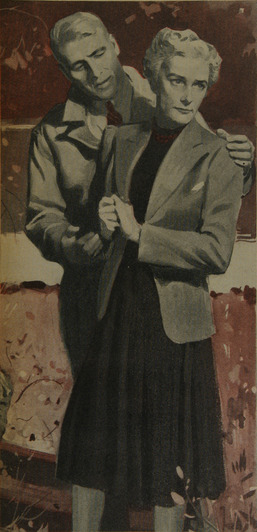
*** START OF THE PROJECT GUTENBERG EBOOK 79860 ***
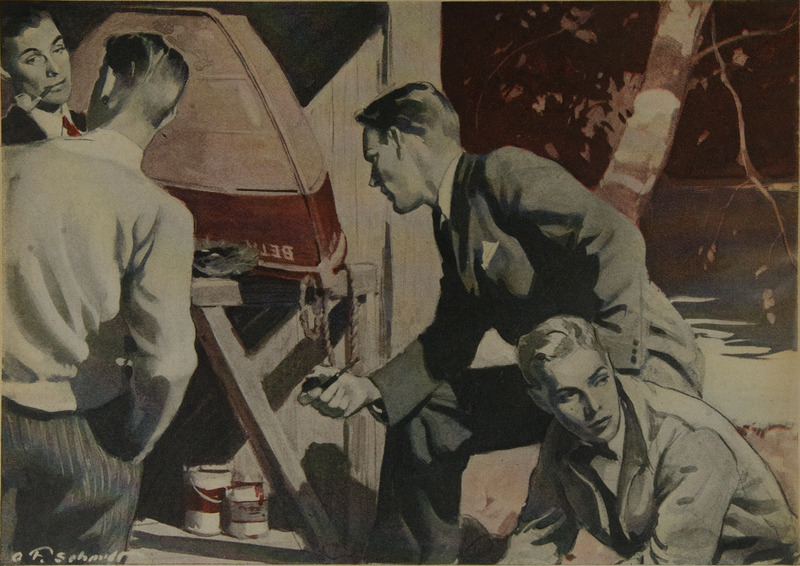
“It wouldn’t be long,” said Elizabeth, “and she’ll have her brood out. You can do something else.”
Less Than a Bird
The story of a frail woman who tried to
build a nest for her five strapping males.
Helen R. Hull
Illustrations by O. F. Schmidt
Redbook Magazine, vol. 74, Mar. 1940, pp. 24-25, 101-102.
The unseasonable warmth of that first week-end in May
caused all the trouble—that and the fact that all four of the
Rossbridge sons happened to be at home. Elizabeth Rossbridge
had mourned during the past ten years because she never
had the family all under the roof at once. Like trying to pick up
quicksilver in her fingers, her attempts to corral them for Christmas
or for a summer holiday. Robert, the youngest, was the
only one who still belonged at home, and next year he would be
off to college. This spring it happened, through bad luck and
good, that each of the older three came home.
Albert, the engineer, had two months between a job in Brazil
and another in Canada; his wife wished to visit her people, and
Albert decided to visit his own. John had had a bad spill, skiing
in New Hampshire during the Christmas vacation, and after
several months in a dreadful harness at the hospital, had come
home, as he said, to learn to walk again. He would have to spend
the summer at Columbia, to make up the semester he had lost
at college. And Henry, having passed his comprehensive examination
for his doctor’s degree, had settled into his old room,
his notes piled around him, to finish writing his dissertation.
Elizabeth had said: “Of course I’m sorry John mashed his hip
all up, but still, here you are, all of you!”
“You aren’t sorry at all—you know you aren’t! It gives you
a chance to boss me around again.”
“Oh, John, I am—” Elizabeth stopped, her blue eyes behind
the rimmed spectacles troubled, as they all shouted with laughter.
Even Clark, her husband, their father, was laughing. The boys
liked to tease her, but Clark didn’t, usually. She had felt suddenly
overwhelmed, one woman, rather small and faded, against
five strapping males. Robert was still skinny, but John had put
on weight during his convalescence. Albert and Henry matched
their father in breadth of shoulder and height; their dark, strong
faces were like his, except that Albert had a fine coppery hue
from Brazilian sun, and Clark’s face was deeply lined. “They have
a way of ganging up on me, when they’re all together,” she thought.
But she concealed her dismay, just as she had always concealed
her amazement that she was the mother of these four men.
Clark was different, with all his sons at home. His pride in
them had a touch of patriarchal arrogance, almost as if he had
made them by himself, without her help at all! Having them all
there again was both more and less than she had expected. More
work, of course. Katie Riley, the woman from the village who
came in each day, was competent; but a family of six seemed to
eat three times as much as one of three. More pleasure, in discovering
in her gentle, unobtrusive fashion, what kind of maturity
each of her sons had acquired. And somehow, more confusion
in her own moods than she would ever have believed possible.
Perhaps she was just tired. There had been a week or so of
difficult strain until they knew whether John’s hip would heal
properly. Perhaps fifty was an age of confusion. Perhaps she
was like a field which had borne too many crops, and needed a
period now to lie fallow, without emotional demands. After all,
her youth, her delicate beauty, the resilience of her body, had all
gone into the making of these men. Usually she responded with
shy delight to the glances which measured her against them; what
a little thing, to be the mother of such stalwart sons! Usually
she knew that they loved her; Robert a little more than the others,
because he was the youngest. She kept her own counsel about
the various crises she had helped them meet, about the strength
she had which was not brawn. She didn’t often mind their laughing
at her, for she knew her mind was clear and literal, moving a little
like the short, quick steps she had to take to keep up with their
stride. She must be tired, that was why their laughter this spring
seemed to have less tenderness, and their wit sometimes hurt her.
The rambling white house on the hill above the lake seemed
crowded. She had never expected that. She had thought instead
how empty it would feel when only she and Clark were left
there. They had built it when Henry was a little boy; they had
added a wing after John was born. They had planned, she and
Clark, to move into the city after the children had grown up, but
they never would. This was home, and the boys wanted it always
as they had known it, even if John did spend Christmas in New
Hampshire, and though Henry hadn’t been back for ten years, until
this spring.
* * *
In April, Elizabeth took herself in hand. She would take a
walk alone every afternoon, slipping out of the house when no
one happened to look. An hour or two by herself, watching signs
that the late spring had started to move, might cure her of this
curious edginess. If she had a daughter, she thought, maybe she
wouldn’t feel so—so outnumbered. Still, mothers and daughters
didn’t always get along well; she could think of several girls who
were more alien to their mothers than any son could be.
In late April she found the nest. She had sat down on the crumbling
ways of the old boathouse, out of the sharp wind which
ruffled the surface of the lake. She sat very still, liking the warm
sun along the parting of her smooth dun hair; and presently she
saw the bird watching her, a thrush, sleekly brown, its fawn breast
beautifully spotted with brown. She did not move, not even when
the thrush flew over her, so close she was sure she felt the air
warm from its wings. After a moment she turned her head, slowly
slowly, to see where the bird had gone. The end of the boathouse
was open, and in a crotch of the scaffolding which held the rowboat,
close under the pointed bow, the thrush balanced, tail
cocked, weaving into the rough beginnings of a nest the bit of
twig she had carried.
“Oh,” whispered Elizabeth, “the darling!” She sat there an
hour, in quiet wonder, as if she shared a mystery. Then, while
the bird was gone on one of her long flights for just the proper
twig, Elizabeth went away. As she walked toward the house, she
thought: “They won’t need the boat for weeks; it’s much too
cold for the water. I won’t speak about the nest.”
She woke early next morning, wondering what had happened to
give her the elation with which her eyelids opened. Then she
heard in the great oak outside her windows, on which the new
leaves were like tiny pink curled feathers, the lovely mounting
spiral of the thrush’s song.... She went each day to sit on the
ways; she thought the thrush accepted her coming; there was no
interim to gain assurance before the wings rushed past her, so
close she caught her breath with pleasure. The nest was finished;
Elizabeth even saw the final stages, as the bird rounded the interior,
molding it with her soft and speckled breast. Each morning
she woke just as daylight crept over the curve of the world,
to listen to the song, spiral and answer threading together—vox
angelica, she thought. By standing on tiptoe at the entrance, she
could peer into the nest, bracing herself with a hand against the
rough upright. On Friday of that first week in May there were
three eggs, smaller than a robin’s, but the same turquoise blue.
The thrush flew past her as she stood there, poised on delicate
feet among the eggs, settled over them, looking at Elizabeth with
bright unalarmed wise eyes.
As Elizabeth walked toward the house that afternoon, she pulled
off her sweater, thinking how suddenly the day had grown warm.
She stopped, her hands trembling. They might want the boat
this week-end! They couldn’t touch it, she wouldn’t let them.
Her heart thumped as she climbed the steps. They had a special
kind of feeling about that boat; they had built it themselves,
Clark and the boys; each spring some of them worked on it, scraping
and painting and calking. If she
could think of something else for tomorrow—a
trip somewhere—
At dinner Henry warranted her premonition.
He said: “I got the paint for
boat today. What say we all hands
work on her tomorrow, and go fishing
Sunday?”
“You can’t,” said Elizabeth. “There’s
a thrush under it.”
“Under our boat?” Robert looked incredulous.
“Thrushes don’t build in
houses.”
“This one did.” Elizabeth was breathless.
“I saw her. She’s got three eggs.”
“We’ll, she had her nerve,” said John.
“We’ll move her out.”
“You can’t! She’d never come back.”
“We’ll go look at it, Beth.” Clark
sounded reassuring. “It’s Henry’s last
week-end; it’s going to be fine and warm—we
can fix it all right.”
* * *
After dinner they all walked down to
look at it, the song of the male bird
floating over their heads, the twilight
primrose through the pale new leaves on
all the trees.
“It wouldn’t be long,” said Elizabeth,
“and she’ll have the brood out. You can
do something else.”
They overruled her, the three older
boys and Clark. Robert was silent; in
his troubled glance Elizabeth saw his desire
not to be a sissy in the eyes of his
brothers, in spite of his impulse to side
with her.
“You can’t be so unreasonable as that,
now Mother,” said Clark, and Elizabeth
turned away to hide her unsteady mouth,
her eyes that burned with no tears. When
Clark called her Mother, he had his mind
made up. “Spoil Henry’s last week-end
for the sake of a whim? Why, Henry
helped build that boat.”
“I can’t bear it,” she whispered, and
hurried away from them. Clark came to
her door late that night, and asked uneasily
if she felt all right. She pretended
she slept. The thrush’s song the next
daybreak was like a funeral dirge. She
did not get up for breakfast, and when
Robert came to the door, she said she had
a headache.
“We fixed the nest just fine,” he said
awkwardly. “In a crotch of the tree.
We didn’t touch the eggs at all. Listen,
Mother, we tried the boat, and she doesn’t
leak scarcely any. So we’re going fishing
today—and can Katie put up a lunch?”
“Why not have hard-boiled thrush’s
eggs?” cried Elizabeth. “Go away!”
When the house was quiet, their deep
male voices, the beat of their feet gone,
Elizabeth got up. She dressed quickly, in
the suit she wore for trips to town; she
packed a few things in her overnight
bag; she borrowed twenty-five dollars
from the purse in which she kept the
household money. She drank the coffee
Katie had kept hot for her, and said:
“I am going to the city. I don’t care
what you order for dinner.”
She would leave no note. They could
figure it out for themselves. She simply
couldn’t stand them any longer. Perhaps
the difference between men and women
was just too great. Men needed women
for a while; they wanted sons; when the
sons were little, they needed a mother;
but now—She could walk to the station
in the village; her bag wasn’t heavy.
* * *
She stood in front of the house, surprised
at the thick warmth of the air.
Robert would probably strip off his shirt;
he would be sick with sunburn by the
evening—he had her thin, fair skin. She
didn’t care! She started along the drive;
her feet lagged, and then she stood still.
She didn’t want to see the nest, now that
the vandals had ruined it, but she couldn’t
feel worse than she did. She set down
her bag, and ran across the sloping lawn
down toward the boathouse.
At first she couldn’t see the nest; had
they just tossed it cruelly away? Then
she saw it, as Robert had said, in a crotch
of the low willow. One of them—Robert
or Clark, she knew—had woven a thatch
of branches in the crotch, had made a low
triangle of branches, like an old rail fence,
in which the nest sat, as firm, as secure
against the wind as the thrush might have
built. They hadn’t been utterly wanton,
for all their effort was useless. Her
heart hurt her side, pounding, and she
couldn’t breathe the heavy hot air. She
sank down on the ways, knowing the
dreadful emptiness of the boathouse behind
her. She mustn’t have a heatstroke
before she got away; she didn’t
want to see one of them again, ever! She
closed her eyes, her lids still burning with
the need for tears she could not shed.
Then she heard it! That whir of wings
over her head! She was afraid to open
her eyes; she dared not look. It couldn’t
happen; no bird would ever return to a
nest with which inhuman hands had tampered.
She heard it again, and unsealed
her eyes. She would see, she knew, only
a distracted thrush, caught in the terrible
frustration of her mysterious fulfillment
of her life cycle.
After a moment she saw the bird, balancing
on a branch of the willow, the
small new leaves like green beads along
the drooping stems. The thrush moved
her head to one side and to the other, her
bright, unalarmed wise eyes on Elizabeth,
her throat curving with its soft plumage.
Then, amazingly, with a swift, single
movement, she reached the nest, and
poising on delicate feet among the eggs,
settled over them.
* * *
“It can’t be true,” thought Elizabeth.
“I’m making it up, because I can’t
bear it otherwise.” Then from a near-by
tree she heard the alarm-note, the strong
clucking note, of the mate. “It is true,”
she thought. She pulled off her hat, and
leaned back against the post. Far off
across the lake she saw the small dark
blob that was the boat. “It’s more than
they deserve,” she thought. And then
she was crying, softly, thinking: “Well,
I can’t do less than a bird, can I?”
Transcriber’s Notes
Transcribed from Redbook Magazine, vol. 74, Mar. 1940, pp. 24-25, 101-102.
New original cover art included with this eBook is granted to the public domain.
The original spelling and punctuation were mostly preserved.
*** END OF THE PROJECT GUTENBERG EBOOK 79860 ***