
Transcriber's notes: Unusual and inconsistent spelling is as printed.
New original cover art included with this eBook is granted to the public domain.
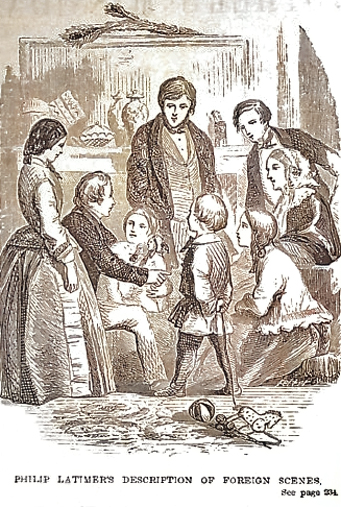
PHILIP LATIMER'S DESCRIPTION
OF FOREIGN SCENES.
Sketches from Real Life.
BY THE
AUTHOR OF "THE OBJECT OF LIFE."
[Lucy Ellen Guernsey]

If thou desert thy charge, and throw it wide,
Nor heed what guests there enter, and abide,
Complain not if attachments lewd and base
Supplant thee in it, and usurp thy place.
But if thou guard its sacred chambers sure
From vicious inmates, and delights impure,
Either his gratitude shall hold him fast,
And keep him warm and filial to the last;
Or, if he prove unkind, (as who can say,
That being man, end therefore frail, he may,)
One comfort yet shall cheer thine aged heart,
Howe'er he slight thee, thou hast done thy part.
COWPER.

FIVE ILLUSTRATIONS.

New York:
PUBLISHED BY CARLTON & PORTER
SUNDAY SCHOOL UNION, 200 MULBERRY-STREET.
Contents.
—————
CHAPTER.
Illustrations.

PHILIP LATIMER'S DESCRIPTION OF FOREIGN SCENES
HOLIDAY MEETING AT MR. LATIMER'S
THE MOTHER'S MISSION.

Covet earnestly the best gifts.—1 COR. xii, 31.
"LET us look into the nursery before we go down," said Mrs. Fielding to her sister; "I know you do not like children to be dressed up and made presentable, so come, we will take them by surprise."
The ladies approached the nursery with noiseless steps; and then, with a swift swing by which no one but mamma could have presumed to reveal the scene within, the door flew open, and the whole party remained transfixed for a moment in their several attitudes and occupations.
The nurse was trying to mend a stocking, with a fat, boisterous baby in her lap, whose business it seemed to be to waylay the needle, and entangle the cotton with his mischievous fingers, while the "Don't, sir—" "You naughty boy, sir—" "I never did see anything like it, then; you are as bad as any of them—" seemed to afford infinite amusement to the saucy-faced pet, who became more daring after each grumbling comment upon his proceedings.
On the floor, behind nurse's chair, lay a curly-headed urchin, enjoying unobserved the oft-prohibited delight of diving his hand into the coal-box, to rout out the shining pieces of coal, some of which were transferred to a broken cart, and some unwarily hidden in the pinafore, which soon told tales to nurse's indignant eyes.
A still older child was in the act of "making pussy dance," holding the struggling animal by the fore-paws, and bounding about the room to a tune composed for the occasion, to which pussy occasionally added a grace note, as the pace particularly distressed her; while an arch little fairy was pompously marching along, with nurse's white apron tied round her neck at a suitable length for a train, and claiming the homage of the nursery subjects, as "Lady Queen."
After the first shock of surprise at the unexpected visit, suspended animation was simultaneously restored; the baby vociferated his best effort at pronunciation, the rogue at the coal-box sprang to his feet, the little queen screamed the announcement of her rank, and pussy's tormentor, in the energy of an extra leap, loosed hold of a paw and received a long scratch down the arm, whereupon she kicked furiously at the animal until poor puss was ignominiously expelled, and then cried bitterly under the pitying kisses of mamma.
The beginning of a juvenile commotion is no light matter; it is one of the laws of infancy that no baby can tolerate without alarm any screams but its own, and Mrs. Fielding's baby was no exception to the rule. He thought proper to add his quota to the general confusion, and it was not until a shower of sweet little bribes was scattered over the floor that a turn was given to events and feelings, and scrambles and kisses concluded the scene. Mrs. Fielding then gladly beat a retreat, closing the door upon deafening requests for permission to follow.
"Not for the world, you noisy little beings," she exclaimed; "we should have no peace for a moment. Did you ever see such a set of young ruffians?" she smilingly asked, as she sat down with her sister in the acceptable quietness of the drawing-room.
"Children must be occupied, you know," said Mrs. Latimer, unfolding her work as if the same rule applied to children of a larger growth.
"Occupied! Yes," said Mrs. Fielding, "but surely they need not be scratching up coals, tormenting cats, and making such terrific noises, while beautiful and instructive toys lie in the corner all neglected or forgotten."
"I am inclined to think we may as well find some better use for our toy money," said Mrs. Latimer. "From observations I have made in nurseries, it appears to me that children have a kind of instinctive contempt, after the charm of novelty subsides, for everything which is made merely to be played with."
"It really does seem so, for I find them always preferring something forbidden and unsuitable: it is a very extraordinary taste, but I suppose it is because of their ignorance, the foolish little things!"
"I am afraid we shall find it equally their taste in more advanced years," said Mrs. Latimer. "But with regard to playthings, children seem soon to comprehend that life is real and earnest. They do not see those around them playing long at anything, habitual and persevering occupation is the rule, and they are longing to be in earnest too. The handsome toy is of no real use, but a piece of wood or paper, an old broken box or tool, may be fashioned into some kind of desirable and interesting experiment, and it exercises the dawning consciousness of power to turn it to some account, however whimsical or absurd."
"Really you quite surprise me, Marion," said Mrs. Fielding, smiling exultingly on her sister. "I thought you would have been shocked at the scene you have just witnessed, and never expected you to justify the vagaries of young rebels."
"I am not sure that I justify them," said Mrs. Latimer; "I rather think I am only excusing them. I am obliged to deal with my children as they are, without deceiving myself into the idea that they are what I should like them to be. There are many things besides cats and coals that elicit the natural character, and warn us of our duty."
"Now of what do you think I ought to be warned, then, by the frolics we have just seen in my nursery?"
"Without being so very personal," said Mrs. Latimer, smiling, "suppose I tell you that in every nursery I see proofs of the evil nature inherited by the children of Adam, and in my own find constant demands upon my watchful care to check disobedience, pride, vanity, self-will, and other fruits of the corrupt tree."
"You must have an extra naughty set to deal with, then," said Mr. Fielding, who just then entered the room, after having been to enjoy a romp with his children, among whom he seemed to have found a similar state of things to that already described. "Now I'll tell you what may be inferred from 'my' nursery," he added, smiling at his wife, "that George's love of coals and dirty fingers will develop something scientific; that Blanche will make everything submit to her will, even at the expense of a scratch; that Gertrude will be a belle, and make some figure in the world; and that baby bids fair to be a mischievous young elf rather sooner than need be. There, have I not spread a charming prospect before you, Helen?"
"If it come to nothing worse, I shall be a most fortunate mother," said Mrs. Fielding, "but I do not believe Marion draws any such harmless inferences."
"Come now," said Mr. Fielding, playfully, "confess, Marion, that you would be best gratified by finding one of your boys mounted on a chair with his pinafore reverendly adjusted as a clerical robe, vociferating a sermon for the benefit of the rest, who all sit round in demure and edified attention."
"No, really," said Mrs. Latimer quietly, "my penetration cannot go so far as to see more than conceit and mimicry in the scene, both of which should be checked as early as possible."
"Why, you would not punish a child for such a thing, would you?"
"No, but I would show him the impropriety of it, and punish a repetition if it occurred."
"Ah, well," said Mr. Fielding, shrugging his shoulders, "I don't pretend to know what you good people would be at with your naughty little progeny, whom you seem to regard as so many young sinners born to trouble. For my part, I expect my children to be good and obedient, while I make them as happy as I can, and educate them to act with credit their part in the drama of life."
"And what then?" said Mrs. Latimer, looking earnestly toward her brother-in-law.
"What then? Why, then I have done my duty. I am observing their characters as they develop in their plays and pastimes that I may have some idea what to plan for their advantage by and by."
"But as it is certain that the drama of life has its closing scene preparatory to one of endless existence, would it not be wise to educate our children with a view to those eternal interests, which include also the best, indeed the only security for a creditable discharge of the duties of this life?"
"It is quite impossible for us to determine what ideas our children may form upon such subjects, Marion," said Mr. Fielding. "If I do my best for them for the present world, they must consider about the next for themselves. And I really cannot see any reason why they should not go to heaven as well as your little saints that are to be."
"Besides, dear Marion," said Mrs. Fielding, "you cannot but know how frequently children brought up as you seem to think right, prove anything but a credit to their religious parents. Of course they are disgusted with the subject, and rush into the other extreme whenever they have opportunity."
"Are you sure, Helen, that in such cases the right means have been rightly used?"
"O, I can satisfy you upon that point," said Mr. Fielding, eagerly.
And he proceeded to name two or three families of decided evangelical piety, in which he said there were sons so profligate, and daughters so worldly, as to become notorious among moral and consistent people who made no profession of religion at all.
"I can only regret the bitter disappointment to the tried parents, so far as it goes," replied Marion, "but two things are wanting to render those cases any real support to your argument. First, you should be able to prove that Christian duty has been faithfully, consistently, and affectionately discharged, without any counteracting influence from example that might have been avoided, and interference that should have been resisted. And then you must turn prophet, and show that what is not done yet can never be done at all, and that the child who has caused sorrow never shall become worthy of a happier feeling."
"Then you think those young scapegraces may be reclaimed, do you?" said Mr. Fielding, in a tone which announced his own impression of their case.
"I do think and hope so, and would encourage all Christian parents to hope, while the story of the Prodigal Son remains on record. They have a refuge, too, in the grace of a loving and prayer-hearing God, who can touch the heart, and has promised to answer those who trust and call on him."
"Well, well, we must be content to differ, Marion. I cannot enter into your theological crotchets, but we shall see by and by, perhaps, how you succeed among your own children, who are of course to be trained after this fashion. By the way, sister, how was it you did not call your boy Hugh? Don't you think Hugh Latimer has a reformatory and imposing sound? A little sanctity, too, might have blended with the name of the martyr."
"I had no particular desire for mere sound," said Marion, smiling, "nor for sanctity at second hand, even through so revered a channel. I often wonder how people can give to their children the names of great and honored men, to whom they may prove sad contrasts in virtue and dignity. Let our children make their own names honorable if they can, but let us not render their deficiencies more apparent, nor their pretensions ridiculous."
Mr. Latimer soon afterward joined the little party, and notwithstanding a private resolution on the part of his host that no conversation should be permitted to introduce the subject of religion, the Christian spirit, and scriptural principles of the children of God could not be dissociated from their due connection with everything deserving of an opinion. In fact, Mr. Fielding himself proposed a point which could not fail to elicit reasons and views with which he did not sympathize.
"I have been anxious to see you, Latimer," said he, "to mention the subject of a letter I received a day or two since from Henry Ashford. You know that he invited Harry, our eldest boy, to spend a month or two with him, and it appears that he now wishes to adopt him altogether. Now I should not like you to suppose that I want to steal a march upon you, for he says that he had taken a fancy to your Philip, but you would not consent to his plan. Is it really so?"
"It is, indeed, exactly so."
"Well, excuse me, but I could scarcely believe you so blind to your boy's interests, and I determined to know the truth from yourself, fancying there might be some mistake, of which I am far from wishing to take any ungenerous advantage."
"I do sincerely thank you for your candor and kindness," returned Mr. Latimer, warmly, "but it was with deliberation that Marion and I declined her brother's offer. We dared not, for any amount of apparent worldly advantage, attempt to transfer our parental responsibility."
"But Ashford has no child, no heir. May not your son some day feel that you came between him and wealth, influence, and position?"
"I cannot help that, if I fail to convince him that the wise man's prayer, 'Give me neither poverty nor riches; feed me with food convenient for me,' describes the condition in life most free from temptation, and most likely to justify reasonable expectations of happiness."
"Well, all I can say is that I think you have judged unwisely. But I feel fully at liberty to accept the offer for Harry, and very glad to see a son of mine so nobly provided for. Helen will not have to break her heart over parting with him either, for he is not to leave home until we should be sending him to school, and is to visit us whenever we wish it."
"That is kind and right in Ashford," said Mr. Latimer, "but with my idea of the solemn duty of parents, and the ties of family affection, I should not be justified in resigning my sacred charge. Ashford, with all his wealth, cannot answer for me before the bar of Heaven when an account of my stewardship is required."
"Do you think, then, that no circumstances can justify a parent in giving up a child for his positive advantage and benefit?"
"There may be such circumstances, but they are not mine. As a Christian man, blessed with health and ability to 'provide things honest in the sight of all men,' I must not evade a single duty that the providence of Cod has laid upon me; more especially to secure what I know to be a snare at any age, but how much more to inexperienced youth! In honest simplicity, Fielding, I confess that I would rather see my boys work their way industriously in the world, than speculating how to spend the fortune of a generous giver."
"I am not going to quarrel with opinions that turn out so profitably for other people," said Mr. Fielding, laughing. "And as for spending, of course Ashford will teach the boy that he is to think of his brothers and sisters, and give them a lift in the world, if they need it. So that in reality, they all in some measure share the good fortune which, has befallen him, and I am relieved of many an anxiety about ways and means. I think it the luckiest thing that could have happened, I assure you."
"And I assure you with equal sincerity that I am satisfied with my share in the matter," returned Mr. Latimer, "and shall be as pleased as yourself to find in after years that you have no reason to regret the acceptance of our brother's offer."
"Let us just look at the children now they are asleep," said Mrs. Fielding, as she went to assist in the preparations for walking home.
And the sisters softly entered the room together.
All was still now; each little cheek rested on its pillow; the voices so lately ringing through the house with petulance or glee were hushed in silent sleep. The little hand so lately the instrument of stubborn will, or vengeful anger, lay passive on the coverlet, and the smile that played around the rosy lip seemed to tell only of peace and pleasure.
"Are they not lovely? I mean sleeping children," whispered Mrs. Fielding, as they paused by the infant's cot.
"They are lovely, and yours, dear Helen, are very lovely," said her sister, tenderly. "O may they be made pure in heart, as they are fair in form, and may God give you grace and wisdom to train them for his holy kingdom."
And as she raised her head from bending to kiss the baby's dimpled hand, Mrs. Fielding saw that tears were in Marion's eyes, and her wonder at the wish was lost in the gratification of maternal pride, and the affectionate appreciation of sympathizing interest. And Helen Fielding turned away from her children with a proud satisfaction in the thought that these beautiful treasures were her own, and felt that her own admiration was more than justified in the effect they had produced on the feelings of the calm and gentle Marion.
"Yes, they are fair and innocent, and why may they not continue so?" she thought, as she returned to the drawing-room, and sat chatting with her husband of the peculiarities of her sister and brother-in-law, and the great hindrances to worldly advancement presented in their "singular and puritanical" creed.
And ere their comments and predictions were ended, Marion was standing in her own nursery, gazing on her children as usual before retiring to rest.
Perhaps here also there was beauty, but if the thought crossed her mind, it did not occupy her heart. Perhaps here, too, she recalled manifestations of pride, self-will, disobedience, and other evils. But she knew it must be so, in greater or less measure, until the breath of the Eternal Spirit should kindle spiritual life within their souls, and it did not absorb her in painful fear.
But she loosed the rein from thought as it turned upon their everlasting destiny, upon the price of a sinner's salvation, and the love of Him who paid it; upon her own solemn responsibility, and her conscious weakness and inefficiency to discharge it as she desired.
And kneeling by the little bed, her meditations took the form of pleading prayer for grace to help and wisdom to guide, for a blessing on the efforts of consecrated affection, for the salvation of these immortal souls, and that their lives, if spared, should be devoted to their Saviour's glory. And what more need parent wish? What less can satisfy a Christian parent's love?
If there come any unto you, and bring not this doctrine, receive him
not . . . neither bid him God speed: for he that biddeth him God speed
is partaker of his evil deeds.—2 JOHN 10, 11.
MRS. FIELDING was the elder of these sisters, whom marriage had separated for several years, until a change in the arrangements of Mr. Latimer's business brought them again into the same neighborhood.
Marion had been considered "religious" prior to her union with a sincere Christian man, and Helen had never shown any opposition to the faith or practice of those with whom she had associated from childhood; and she held religion, especially her sister's, in great respect.
But while Marion grew in knowledge and grace, and her deepened faith bore fruit in sanctified character and practical godliness, Helen drifted away from the formal hold of habit and association into thorough worldliness. And now, when the sisters met again in intimate communion, they found their tastes, pursuits, motives, and hopes wide asunder as the poles. The society enjoyed by one was uncongenial to the other; the style of living adopted by one as disapproved by the other; their domestic arrangements were unlike, their dress dissimilar, and even in that department of life in which all mothers make common cause, so far as love and devotedness are concerned, it has been seen how opposed were their principles, how different their views.
"I fear we shall not get on happily with my sister and her family," remarked Marion to her husband; "she has been trying to modernize me, as she calls it, and insists on certain submissions to the opinions of society. I am sorry to annoy her by frequent opposition, when I know she intends only to be kind, and is so anxious that we should be well received among her friends."
"Well, you may venture to yield a point or two in trifles," said Mr. Latimer, smiling.
"Ah, but you quite underrate her desire to serve us, if you think she is to be satisfied with trifling concessions. She protests against the ministry we expect to enjoy, and declares there are no respectable people in the congregation. And she is about to give two large parties on our behalf, in order, she says, to introduce us; and one for the children afterward, though I have almost decided that they cannot be allowed to go."
"Have you decided that it is not a right position in which to place them, dear Marion?" asked Mr. Latimer seriously.
"I cannot avoid that conclusion," she replied, "from what I have already observed of Helen's plans and associations. I imagine the mode of spending time is not that in which we wish our children to feel interested."
"It seems evident, my love, that you should not 'almost,' but quite irrevocably have declined this intended kindness," said Mr. Latimer. "Decision, Marion, is the best escape from many difficulties; the reverse soon entangles in a labyrinth of vexations."
"I am very glad to have your opinion, Philip, for I would neither be needlessly scrupulous, nor weakly compliant. But I will take the first opportunity of repairing, if I can, any ill consequence of my indecision."
"I need not remind you, dear Marion, that 'the wisdom that is from above is "first" pure, then peaceable, gentle, and easy to be entreated;' nor that we may speak kindly that which in itself may be annoying and unacceptable. Let us not offend in manner where we are compelled to disagree in substance. If offense must be taken, it should be the 'offense of the cross,' and not of rudeness or unkindness in its bearers."
"Then the parties for ourselves, Philip; what must we do about them?"
"What do you think yourself would be right?"
"I think that to my sister's house it would, perhaps, be right for us to go, as she so much wishes it. We should not be involved in intimacy with any, and we could not then be accused of rejecting a circle of acquaintance without testing its congeniality. If we allow ourselves to be known, perhaps we may not make a favorable impression either," she added with a smile.
Philip did not quite agree in his heart to this conclusion, so far as his well-informed and ladylike wife was concerned.
"Well, then," he said, "we will go for once; we have not witnessed one of your sister's parties, and have therefore no right to prejudge them. For our children, the case is different; we are responsible for the impression of scenes to which we willingly expose them, while they are unable to judge for themselves, and uninfluenced by the only principle which can discriminate to reject the evil and to choose the good. We know the too probable choice of the natural inclination."
Mrs. Fielding was greatly displeased at the rejection of her kind offer to introduce her youthful relatives to the children of the neighborhood. But she comforted herself in the prospect of presenting their parents, both of whom she said would be considered acquisitions to society if they could but be persuaded to keep their religion at church, and not live in it like a snail in its shell, carrying it with them wherever they went, and retreating into it as quickly whenever any one ventured to touch a sensitive point. However, she was of a sanguine temperament, and did not despair of effecting a reformation in time.
So the parties were assembled. And Mrs. Fielding, as she inquisitively surveyed her sister's dress, declared it "really better than she expected: not quite fashionable enough, to be sure, nor what the initiated would call full dress, but nothing 'outré,' all in very tolerable taste."
And she was not sure but that some of her friends, who concealed beneath their smiles, hearts sorely troubled and minds perplexed to keep up a stylish appearance, envied that sweet and placid face, and thought the modest simplicity of the fair stranger an interesting novelty among them.
Some of the visitors, who had heard Mr. Latimer spoken of as a puritan and a bigot worthy of the days of Barbone, * were profoundly astonished to hear a pleasant laugh from his lips, and to find that he had stored his mind with anything besides texts, hymns; and homilies.
* Commonly called "Barebones."
Mr. and Mrs. Fielding were beginning to congratulate themselves on the satisfactory manner in which their entertainment was passing off, when a gentleman, not aware of the unacceptable tendency of his subject, asked Mr. Fielding, carelessly, if he had "seen poor Bingham lately."
"Yes," replied Mr. Fielding; "I saw him only a few days since, and he looked like what I suppose he is, a broken-hearted man. That last frolic of his son's is likely to cost him dear, I am told."
"It will ruin him most probably. If he does not pay the money, or at least guarantee its payment within reasonable time, proceedings will be taken, and the young scapegrace will get his deserts."
"I am very sorry for him," said Mr. Fielding. "I almost think, as the affair is so well-known, he had better let the law take its course, and rid the country and himself of a great disgrace to both."
"Well, I don't know that," replied the visitor. "You see, Bingham cannot help feeling himself to blame; for it is said that his son would never have turned out such a lawless rogue if his father and mother had not taken their fanatical fit a few years ago. The boy seems to have been disgusted with their religious sayings and doings, and got away from home as much as he could, and of course fell into bad company. It is a pity people will take up such foolish conceits about religion," he added, appealing for assent to Mr. Latimer, who happened to sit near him.
"I am ignorant of the circumstances to which you allude," said Mr. Latimer, inquiringly. "Have these unhappy parents become Mormonites?"
"Mormonites! O no," replied the other, laughing; "we have fanatics under other names, and no names at all, I assure you. These good people are members of a most orthodox community, but they could not be satisfied to go on in a quiet, inoffensive way. They took it into their heads that this was wrong, and that was sinful, and gave up their old friends and their old ways, and set themselves in opposition to, everything cheerful and pleasant in the world."
"If I might conclude that you speak rather from report than from personal observation, I would venture to suggest a possible explanation of the change. Perhaps from being more formalists in religion, they became Christians, and, found 'ways of pleasantness and paths of peace' where the word of God directs us to seek them. In that case you know it follows, as the apostle describes it, that 'if any man be in Christ, he is a new creature: old things are passed away; behold, all things are become new.'"
"That is doubtless a very charitable suggestion," replied the visitor, in no small surprise at finding a subject so carelessly introduced thus seriously grappled with. "But it is unhappily too well-known that their path is at present anything but peace, and that their own folly has brought war and sorrow into their household. For my part, I do not wonder at any mischief a boy might rush into who was, no doubt, bored with religion from morning till night."
"It is not the first instance either," observed a lady, "in which poor Mr. Bingham's religion has caused him trouble. I heard of an absurd scruple of his, which lost him a large sum in a business affair. He seems quite to emulate Daniel."
"In the particular that no fault can be found in him except it be concerning the law of God?" asked Mr. Latimer.
"Not exactly," said the lady, "but in very needless exhibition of his own peculiar views. Daniel, you know, is a historical personage, and we are at liberty to form our own opinion of his conduct. It has always seemed to me a most uncalled for display of zeal, to act in such open defiance of the king's edict. There could have been no impropriety, but merely common prudence, in keeping his windows closed and himself out of sight while he prayed so often."
"It was happy for Daniel that his God judged otherwise, and sent his angel to shut the lions' mouths because innocency was found in him," replied Mr. Latimer. "But perhaps some day, if not now, we may have as clear a testimony to the consistency of a Christian father's conduct in his family. The world may make mistakes in judging of actions, the motives for which it has either not known, or has misunderstood."
"Now, what and whom do you mean by 'the world?'" said the gentleman who had before spoken. "For I should really be glad to know, since you seem to be familiar with the expressions of a certain class of religionists."
"I used it," said Mr. Latimer, without observing the anxiety and alarm visible in the countenances of his brother and sister, "in the sense in which it is used by the Lord Jesus Christ in the fifteenth chapter of St. John's Gospel. It there represents persons whose characters, habits, pursuits, hopes, and joys are chiefly confined to 'things seen and temporal;' and thus occupied, they are not competent to judge for the much smaller number of their fellow-creatures who have withdrawn their hearts and hopes from the things of time and sense, and fixed them chiefly on 'things unseen and eternal.' The Church of God consists of his believing people, who live and walk by faith in Christ, loving him, and endeavoring to prove it by obedience to his will, and desire for his glory: the world, in contradistinction, consists, in our land at least, of those who call him 'Lord, Lord,' and 'do not the things that he says,' together with all who deny or reject his Gospel."
"I am obliged to you for so clear an exposition. But I am to infer that you class all who are not of your way of thinking with the very dregs of the human race?"
"It was not I, but 'God manifest in the flesh,' who said, 'He that is not with me is against me,' and who divided the hearers of his Gospel into two classes, believers and unbelievers, the saved and the unsaved; the latter including those who deny him altogether, as well as those who are deferring to a more convenient season their consideration of the subject."
"Ah, but can you not perceive a great difference between those who entirely deny a Saviour, and those who hope to profit by his kindness when the time of need arrives?"
"There may seem a difference to human judgment, but, dear sir, it is our condition before God which is the really important point. Surely the man who only intends to be saved some day is practically in no better position than the man who denies the necessity altogether; but rather worse in one sense, for the convictions of conscience which led him to purpose closing with Christ before he dies, will aggravate his misery should time and opportunity after all be denied."
"You speak very decidedly, sir, as if your own mind were made up, at any rate," remarked the other, flippantly.
"It is because I deem my soul too precious, and eternity too tremendous a reality, to risk either on an intention or a peradventure," said Mr. Latimer. "And may I venture to add, that we live in days when every man needs to feel the foundation firm beneath his feet, to know clearly what and in whom he believes, and to decide advisedly, but firmly, whom he chooses to serve. If the Lord be God, let us follow him; if Baal, let us follow him: in neither case disguising our choice."
"It is pushing matters to extremes, sir. What is your opinion, Mr. Fielding?" said the visitor, appealing to his host.
"O, I never measure weapons with Latimer on such points," said Mr. Fielding, glad of an opportunity to change the subject. "And after all that can be said, we shall have to settle them for ourselves, you know, and let each of us do it in his own way."
And again the conversation became general, and more congenial to the feelings of the majority who joined in it.
But when separating after the evening closed, the same guest approached his opponent with a jocular air:
"Well, sir," said he, offering his hand, "though you may belong to the favored few whom you call 'the Church,' and I to the great ungodly world, I dare say we shall both find ourselves all right at last, and so let us shake hands upon it."
"Forgive me, my dear sir," said Mr. Latimer, seriously and kindly, "but common truthfulness forbids me to subscribe for a moment to such an estimate of our respective views; we cannot both be right while so opposed. Let us rather shake hands upon the sincere determination to know the truth, and firmly to abide by it, and God himself be our teacher."
The bland smile of good fellowship yielded to a flush of pride, and the visitor, strongly disposed to imagine himself insulted, hastened away. The way that seemed right to him was the way of death; his knowledge was derived from the evil inspiration with which the archenemy deluded the first sinner, when he said, "Ye shall not surely die." And the revelation of that only antidote to the poisonous lie—the love of God in Christ Jesus—was set aside as a fable, or referred to some uncertain period of life's short term, when the heart and mind should have nothing to do but prepare for a misty heaven, and an unwelcome eternity.
Could the surprised company who commented so severely on the conduct of Mr. Latimer, denouncing it as presumptuous and uncharitable, have followed the servant of God to his closet that night, they would have heard him pleading as with a brother's interest for the soul of the man whom he had felt bound to oppose, and seeking for himself more unshrinking faithfulness to speak "the truth in love," and under all circumstances and at all times to bear witness for his absent Lord.
True, he had "daubed" no wall "with untempered mortar" nor cried "peace, peace, where there was no peace;" but at the same time, it was hard and trying to the natural feelings of a kind and liberal heart, to tear down amid sneers and displeasure the flimsy screen behind which men try to keep out the light of truth, and hide themselves from the heart-searching God.
And if they could also have traced the man of the world to his prayerless chamber, they would have seen the brow knit with a mortifying consciousness that he had made but an indifferent figure before the calm, strong testimony of a Bible believer. There was a secret fear, too, that the words he had provoked were true; that all was not only not "right," but very wrong in heart and practice; and then there was a desperate effort to shake off the impression as a nightmare, a superstition of the darkness unbecoming one in health and prosperity, a man of business, position, and influence. And whatever the monitor within, whether the remonstrance of the Divine Spirit, or the voice of conscience, or the memory of early instruction, it was heard, but not obeyed; it struggled once and again for God and truth, for the soul and eternity, and left the resisting rebel without excuse before Heaven and his Judge.
And thus it was with thousands, generation after generation. A few days, and the warning is forgotten. The man of business, or pleasure, or science, amid the details of daily life, and the good opinion of his congenial cotemporaries, passes on quietly for years, grows old, and dies. A mourning procession follows the body to its last home. A dark narrow space is sufficient now. The proud spirit that enjoyed worldly show, that indulged in costly comforts, and had no time to think of resigning them—the immortal spirit that would now court annihilation at any cost if it could be had, has gone in never-ending consciousness to realize the knowledge it has fatally deferred, and to mourn for ever the irretrievable mistake of a lost lifetime.
O for more truth-telling voices to fill the air men breathe with words of wisdom, to "cry at the gates, at the entry of the city, at the coming in at the doors,—
"To you, O men, I call, and my voice is to the sons of men."
"Turn ye, turn ye: why will ye die?"
"Behold, 'now' is the accepted time; behold, 'now' is the day of
salvation."
Cast not away therefore your confidence, which hath great recompense of
reward.—HEB. x, 35.
IT was not possible for Mr. Latimer to hear the tale of sorrow which had introduced conversation so unacceptable among his brother's guests, without endeavoring to ascertain if any means within his power could be of service. He therefore sought an introduction to Mr. Bingham through a mutual friend. And being received as brethren in Christ should meet, "in love," he found it his privilege to soothe with acceptable sympathy, and to assist materially by influence and means.
Through his manly and straightforward word, the merchant who had been injured by the misconduct of his clerk, was induced to accede to reasonable terms for the repayment of the subtracted property. And the youth himself, relieved from the dread of the punishment he merited, listened respectfully to the kind voice which encouraged him to hope for another opportunity for becoming honest and respected.
"Alas, my dear sir, who will trust him?" asked the desponding father. "He cannot retrieve himself here, and he can carry no character to another land."
"I will trust him," said Mr. Latimer, "but it is because he is the child of those who love God, and know how to pray. I shall not despair, nor must you, so long as we are permitted to make all our requests known where there is power and grace enough to grant were they tenfold in number and difficulty."
It was evident that nothing in the conduct of that kind father, or that gentle broken-hearted mother, had driven the boy to open iniquity. He spoke of them with affection, and seemed to regret the sorrow he had caused them. But he told the too common story of youthful mischief, bad companions, strong temptations, lack of funds for self-indulgence, desire to do as others did, all combining at an early age around a heart prone to folly, prevailed over the better knowledge and right principles his parents endeavored to instill, and home only became distasteful when he knew he was sinning away its respectability and peace.
It was very true that a change in many things had come over the management and occupations of that home. There was no longer the uncertain rule of humor or caprice, and love had caught the reins that selfishness had dropped.
"The fanatical fit" had wrought a reformation where many were hastening to ruin; and if one went headlong into the snare spread for all, others were arrested and brought out of darkness into light. Who would dare to prophesy that one had fallen too far for mercy and redemption, when none could have risen at all without the gratuitous exercise of both?
Mr. Latimer thus sought to encourage the faith of the parents, while he gave practical proof of his own in the plan proposed for their son and the trouble he bestowed in preparing him for the new sphere he was to enter upon abroad, under the authority of an agent on whose co-operation he could rely. He did not always approve of sending bad boys to other shores, where they are free to disgrace themselves and their country in any way they choose, the only object attained being temporary deliverance from the trouble of their presence at home. But young Bingham was earnest in his entreaties to be allowed to leave his native land, at least for a time, and his friends concurred, in the hope that severance from evil companionship, and opportunity to cultivate better sympathy, would have due weight in the reformation he professed to desire.
There was, however, something in the fragile form and pallid cheek of his mother, which pressed the thought painfully on the boy's mind, when he bade her farewell, that perhaps he should never be clasped to that tender heart again, and a maddening pang of agony for a while whispered that he had struck the blow that was quietly destroying her.
And she told him how he would live in every thought, and be remembered in every prayer, so long as life should last, and how his name would linger latest on her lips in the hour of death.
"I have heard," she said, "of a mother who, on her death-bed, feeling helpless to do anything more for her children, and having no earthly goods to bestow, remarked with a smile of faith and love, 'My legacy is seven years' prayers laid up before the throne of God.' Such will be mine to you should I not live to see them answered."
In the tearful utterance of a fervent promise to try and be all she wished, perhaps she might feel the drop that precedes the shower, and be strengthened in faith and hope to wait for a future blessing.
It was very sad to see a loving mother fade slowly and meekly away under the effects of mental anguish on a delicate frame. She had passed through other sorrows and endured bodily sickness, and rallied through them all, but this had been 'the' sorrow of her life, eating into her peace as a canker, pressing heavily at her heart by day, and banishing rest by night, wearing her away to the grave, with a consuming grief that is like nothing else on earth. Undeserved disgrace she could have struggled bravely through with a woman's heroic love, but sin, deep, infamous, degrading, in defiance alike of the laws of God and man, crushes like an avalanche a mother's loving heart, and lays her fond hopes in the dust.
Mrs. Bingham mourned too over the years she had devoted to the world, during which she might have been useful to her son, and trained him earlier in the right way. But she trusted still in the loving-kindness of God, and her "legacy" was duly stored, to be paid some day to the full.
Mrs. Latimer's prediction that her sister's circle of friends might not be favorably impressed by the kindly intended introduction was verified. The brand of the Nazarene was at once affixed, and she had abundant cause to rejoice that her husband's manly protest had struck a line of demarcation between themselves and the world, and through it was spared from many a pressing solicitation, and many an unwelcome intrusion.
"I had tickets for the oratorios and concerts which are to occupy the greater part of next week, Marion," said Mrs. Fielding one day, "but I concluded it would be useless to offer any to you, the thing being altogether too worldly."
"Thank you for judging so correctly of what would be consistent for me," replied Marion. "I am very fond of music, but prefer to have it unaccompanied by anything that can subtract largely from my enjoyment of it."
"You had better inform me what that 'anything' includes, so that if I happen to hear of an opportunity perfect enough, I may not forget you."
"Well, then, to begin," said Marion, "I should like to hear the sweet sounds of the human voice from performers whose moral character would not deny them a place in the society assembled to listen. I should like no sacred words warbled in thrilling cadences by those whose hearts are uninterested in their solemn meaning. Let the people of this world make melody in their own sphere, and there are themes enough to charm the most critical taste; but let them not meddle with hallowed names, and weave the majestic language of prophecy, or the tender revelations of Divine love, or the agonized cry of a suffering Saviour, into subjects of sensual entertainment or deceptive sentimentality."
"O Marion! You can have no idea of the devotional effect of such passages when well sung. It does one good, too, to feel that one is susceptible of such heavenly emotions."
"Then why is the language disregarded in its native simplicity, if the charm be not in the excitement of the music? No, Helen, there is no more religion in enjoying an oratorio than a glee or a ballad."
"Well, it is very hard that you won't allow me to possess even that little amount of goodness," said Mrs. Fielding, laughing.
"I will not let you deceive yourself, my dear sister, if I can say anything to hinder it," said Marion affectionately; "and I know the soft sentimentality of excited feeling has too often been complacently exalted into evidence of better and holier things."
"Well, go on with your list of requisites for a musical treat."
"May I venture to add, then, that it is very inconvenient to many real lovers of music that such extravagance in dress is considered indispensable to appearing in your beautiful concert-room. Few who do not spend much time in considering wherewithal they shall be clothed, and much money in procuring it, can often be found there."
Mrs. Fielding laughed for lack of a reply, for none knew better than she did the truth of that remark. And she would have been ashamed to confess how her anxiety to appear as well adorned as her fair cotemporaries at the series of concerts to which she alluded, had absorbed her supplies for personal expenditure. But she knew she was not singular in this; she sinned in good company, and amid a host of fashionables no better able to bear the consequences than herself.
"I wonder," said she, after a pause, "that you religious people do not try to get up some such rational entertainment in your own way. You might patronize virtue, select unexceptionable music, and dress half-a-dozen years behind the fashion, just to show us how things should be done."
"God's children have not time to spare for getting up public entertainments," replied Marion; "their own enjoyments lie in a different sphere, and those over whom they would thankfully exercise their influence need no stimulus to amusement and self-gratification. In instructing the ignorant, ministering to the sick and sorrowful, and adorning their Master's doctrine by their personal example in private life or public duty, Christians trace those paths of usefulness which God himself has prepared for them to walk in, and there they may justly ask and expect his blessing. I do not, however, mean to deny that beautiful music is one of the world's pleasures in which we might moderately participate, apart from the objectionable accompaniments you have made me enumerate."
"Well, then, when I can effect a reformation, which I positively believe would prove in the end the destruction of our Philharmonic Society, I may hope you will accept a ticket."
"Very willingly," returned Marion playfully, "and, moreover, rejoicing in a change that would bring an agreeable recreation within the occasional reach of quiet matter-of-fact people like myself."
"Matter-of-fact! Why, Marion, I think you are the most visionary enthusiast of my acquaintance—always living as if in communion with unseen influences, and doing nothing like the inhabitants of the earth."
"Dear Helen," said Mrs. Latimer earnestly, "I pray that you also some day may realize the happiness I find in that communion. An apostle could rise no higher in the true idea of enjoyment than in living the 'life that he lived in the flesh, by faith in the Son of God, who loved him and gave himself for him.'"
"Why do you always quote texts?" said Mrs. Fielding, with an expression of impatience.
"Because God's word so powerfully expresses just what I want to say, and because my words might be gainsayed where his are unanswerable."
Mrs. Fielding was conscious of this, and, like all worldly people, shrank from that sword of the Spirit which so sharply cuts down to the root of the matter, and lays open to the reluctant view the deep source of many an opposition to the judgment and conduct of his people, enmity against God, and worship of the idol, self.
A time to plant.—ECCLES. iii, 2.
NOTWITHSTANDING repeated experiences of the fact that her sister took no superficial view of circumstances in which she was called to form a decisive judgment, and that the result of consideration seldom harmonized with her own wishes, Mrs. Fielding still persisted in efforts to accomplish the impossibility implied in the prophet's question: "Can two walk together unless they be agreed?"
Sometimes her motive was sisterly kindness, really desirous to offer and accept sympathy; and here she was ever warmly met, up to any point that did not involve inconsistent concession of higher claims. Sometimes she wished to prove to others that the difference between herself and her Christian relatives was merely one of words, and had nothing to do with principles. And at other times, she sought co-operation in plans that suited her own convenience.
On the last of these motives, she raised a little educational scheme, to which she supposed Marion could find no possible objection. Her children began to be troublesome by rejecting the restraints of the nursery, and quarreling perpetually for want of something to do, rambling over the house, and stirring up confusion, or intruding uninvited into the drawing-room just when they were not wanted. Mrs. Fielding concluded that all children were alike in these disagreeable propensities. And after threatening her own with a governess, the ideal of whom was a picture they had seen of a cross old woman in large spectacles with a rod in one hand and a book in the other, all objects of their profound aversion, she determined to relieve her own perplexity, and doubtless her sister's also, by proposing to hand over the young troublers of her peace to the charge of a hired instructress.
Added to this was an opportunity which she declared to be so "remarkably providential" that Marion herself could not but recognize it, of patronizing a young lady of her acquaintance whose education had been fashionably conducted, and who was now, through adverse circumstances, compelled to turn it to pecuniary account.
"I have not thought of having a governess for some time to come," said Mrs. Latimer, after listening to her sister's proposal that the children of the two families should be united under this lady's care for a few hours every day.
"I do not mean that they should be worked hard," said Mrs. Fielding, "but a little discipline can do no harm. And though beginning easily, Miss B.'s accomplishments are such that she might carry on her education for several years."
"My dear Helen," said Mrs. Latimer, "do you not expect that I shall wish for something more than the qualifications you have described, when I find the assistance of a governess desirable?"
"I really don't know what, excepting the inducement which I thought would weigh much in her behalf, the pleasure of assisting a young lady to whom such a beginning may be of real advantage."
"I should first try to ascertain whether she is a sincere, and not merely a professing follower of Him who said, 'Suffer the little children to come unto me,' that I might trust she would help me to bring them to him."
"Ought you not to believe the best of every one, Marion, and conclude that she is religious before you know anything to the contrary?"
"I think not. The Bible tells us that all of us are lost sinners by nature; and those who are saved are saved by the grace of God, and he gives us no authority to take the change for granted, until some evidence is afforded by its fruits."
"Well, charity compels me to take the opposite course. I have no doubt she is very good."
"I should wish to feel interest in one situated as you describe," continued Mrs. Latimer, "but I am persuaded that many a family has suffered from the benevolent mistake of so assisting those who are unexpectedly obliged to earn the means of subsistence, without due regard to their fitness for duties so serious and responsible. Power of mind, aptness to teach, perception and treatment of character, are indispensable requisites in real education, the absence of which could not be compensated by all the accomplishments in the list of Muses."
"It does not seem likely, then, that we can agree even about a governess; for I do not suppose Miss B. could stand your tests at present. But, Marion, I scarcely thought you would like children to run wild so long. I find mine absolutely need restraint, and yours are nearly the same age."
"But they are not perfectly savage yet," said Marion, smiling; "they show symptoms of reading and spelling, and even a little writing and geography."
"Surely their nurse is not qualified to teach them properly," said Mrs. Fielding incredulously.
"No, but their mother ought to be; and it is her privilege and duty to direct their earliest efforts in everything."
"I had no idea of this," exclaimed Mrs. Fielding; "nor can I imagine how you find time. I wonder, too, that Philip allows you to make such a slave of yourself."
"Perhaps he agrees with many wise and good men, that during the early years of childhood, no teacher is so suitable as a mother. No one else can so instinctively exercise the gentle patience and self-denying ingenuity requisite to sustain attention, and invest each subject with renewed attraction day by day. And surely in exercising the dawning reason, directing the course of thought, and planting the seed of truth in the young soft ground, no human heart can be stimulated by affections and hopes so constraining as a mother's!"
"It sounds very pleasant, Marion, but your idea will not suit the experiences of real life. Consider how many mothers are utterly unable to do as you describe; they have no notion of training children's minds, indeed, some have too little disciplined their own."
"You have spoken a melancholy truth, Helen; and it is painful to find how few of the young women of our country, taking the position of heads of families, have been seriously desirous to fit themselves for their important duties. But it should never be taken for granted that there is any right thing a person cannot do, more especially a mother, endowed with common sense and natural affection, 'if she wills,' and wills 'to begin in time.'"
"But, Marion, there is another objection. Some who are perhaps not entirely unfit, have not time. Think of the many demands upon her time and thoughts of the mother who acts as her own housekeeper. Besides, she and her husband too must have some society; and it is impossible to provide for the entertainment of company, and preserve any regularity in hours of instruction."
"I quite demur to the necessity of much company, but a little management will admit of occasional indulgence in cheerful society. I am supposing the mother's first duty to be at home, among her children; and if something must be given up, let it not be the charge of those immortal creatures who are receiving impressions hourly for good or evil, but rather anything that interferes with their true interests."
"You do not give an attractive view of the relationship, Marion, if so great are its demands, and if sacrifices are so imperative."
"I cannot call anything sacrifice which is to promote my children's happiness and welfare; and even if it were so, the self-denial reacts in personal benefit."
"Pray how? For I do not perceive it."
"It seems to me, Helen, that God has placed a holy barrier around the heart and conduct of a mother, which, if accepted as it should be, shields her from many of the temptations of her sex. The time-wasting gayeties of the world, the love of dress and display, the extravagances of society, by which trouble and ruin are so often brought into families, must be resisted and shunned by the mother who devotes herself conscientiously to her interesting charge, and finds her mission-field at home, where she is called to be employed for God. No worldly dissipation, no idle gossip, no breath of fashion, slander, covetousness, or infidelity must be admitted there, to poison the atmosphere where her young plants are growing: she has enough to do with their native corruption, without letting in pernicious influences that watchful care can prevent. Thus she is saved herself from many a danger, and the moral and spiritual health of her own character is strengthened by the purity she strives to keep spread around her own heart and life. Forgive me, dear Helen, for saying so much, but I have thought long and deeply on this subject."
"I am sure you have, Marion, a great deal more than I ever did," said Mrs. Fielding, kindly; "but our characters seem to have been cast in very different molds. Let me ask you, however, if everything is to be done for our children, though you have so summarily disposed of company, is there not a risk of neglecting household duties?"
"An ordinary oversight of suitable domestics ought to keep the house in order, if there be a systematic plan of family comfort. But I must admit that, having given my directions clearly at proper times, I would rather trust my inanimate household goods to the care of servants, than the minds and hearts of little children to that of strangers. You may replace a set of glass or china that clumsiness has spoiled, or manage to eat of a dish not quite seasoned to your taste; but who shall restore youthful energies wrongly directed, or curb with authority and tact the rude passions and strong wills that have been left to their natural impulses?"
"You seem to see no difficulties when you have resolved upon a thing, Marion. But suppose your husband disapprove such close attendance in the nursery or the school-room?"
"I am not supposing myself confined to either. Children occasionally associated with the drawing-room occupations of their mother, are often the acceptable companions of their father, when wearied with the business of the day. And, perhaps grieved and disappointed with some of his grown-up species, he is glad to forget both for a while in the plays and pastimes of his happy little ones."
"Sometimes, perhaps, but you are not to suppose that all fathers are as satisfied with a quiet home as Philip seems to be."
"Still I am persuaded your objection is imaginary. No man really prefers that his wife should enjoy the excitement of fashionable society to the peaceful pleasure of knowing that, whatever his views of his own duty, she is in her right place doing hers, and deserving his love and respect in her retired but important sphere."
"But it seems that you would have one without a single idea in life but one's husband and children. I should fear becoming narrow-minded and selfish, and forgetful that anything is due to society."
"I cannot help thinking, Helen, that she does the most for society who trains her children to adorn the station appointed for them. Most highly honored is that mother whose life's little history may be read in the modest intelligence and womanly graces of her daughters, and the upright principles and right conduct of her sons.
"And as for ideas, I suspect an educating mother must find it necessary to cultivate many more for companionship with inquisitive childhood, than for intercourse with her equals in general society. Silence on knotty points, or amid sparkling wit, you know, is becoming in a woman when clever people are conversing; but children must be answered and instructed continually."
"I am sure your children ought to be good," said Helen, "and I hope you will have the reward you are seeking. But let me ask you one thing more, and it is a point on which of course you, with your ideas about doing good, cannot be indifferent. If home interests are to be so absorbing, what is to become of all the charities, and institutions, and committees, the business of which is chiefly conducted by ladies?"
"I can only reply that I believe the mother miserably mistakes her vocation who devotes her time to public business, leaving the prior claims of her family to be discharged by others. The talent or energy which renders her a desirable assistant abroad would be more honored of God in the sphere which nature and providence have appointed at home. Surely the childless and the unmarried should come forward to fill up the active offices of public charity, where female attention is useful and desired."
"Well, Marion, I admit that you have defended your position tolerably, but the greatest objection is not to be set aside so easily, after all, that few parents are fitted in mind, temper, and aptness for the duties you would assign them."
"I would not despair of one who would really try to become fitted," said Marion earnestly; "love should try, love will not be easily discouraged; and a mother's love, the purest, most unselfish feeling of the human heart, what has it not done, what may it not do again? You used to like reading of heroines, Helen, of women who could lead armies and govern states, but depend upon it, she who could forget self, and patiently discharge home duties in the fear of God, outshines them all, and her memory will be blessed when her more showy sisters have passed into oblivion. I read once of a little meeting of twenty-five Christian men, several of whom had taken a distinguished part in the religious improvement of their fellow-creatures in different lands, and twenty-three of them traced their first impressions for God and salvation to the instruction of their mothers. O Helen, you cannot wonder that those twenty-three favored mothers seem to beckon me forward in the path they trod, and in which, God helping me, I strive to follow!"
There be many things that increase vanity.—ECCLES. vi, 11.
PERHAPS there is no point connected with the subject of education on which there exists such unity of sentiment as on that of the value of early impressions.
It is imputed to the priesthood of a religious system based on the knowledge of human nature, that their deliberate judgment has been thus expressed: "Give me a child until he is seven years old, and you may do what you like with him afterward."
And therefore, with laudable consistency, the training of infancy and childhood is the especial aim of the Church of Rome: twenty disciples from baptism to youth will do her more effectual service, and render more unquestioning obedience, than a hundred converts at maturer years.
Whatever the influence brought to bear, whether mental discipline, firm authority, impression of the imagination, even possibly winning affection, or all these combined, it cannot be contended that the opportunities afforded, under any circumstances, to the priest and his agents, are greater or more favorable than those naturally possessed by every mother in any degree worthy of the name. And if she be a Christian mother, enjoying access to the throne of grace, privileged to plead God's promises to faith and duty, her power is increased sevenfold, and her success all but secure.
A sensible and loving mother, uninfluenced by serious thoughts of her child's eternal interests, may train him for respectability and usefulness in life, and enjoy the reward of her care and skill; early impressions may tend to produce a frank, generous, kindly character that shall prove a comfort to her declining years: let not these consequences to society be undervalued, nor the good, so far as it goes, ignored.
It is true, on the other hand, that some, looking earnestly forward to divine interference, may err in their method of discharging duty; may too lightly estimate the importance of early training, or injudiciously attempt too much. They, too, may reap, but in disappointment and sorrow; and their ill management will draw rebuke upon right principles, while the real blame should rest rather on the indiscreet application, or the thoughtless neglect of them.
But while it is manifest that Christian parents are not all wise, nor worldly ones all foolish, there are precepts in God's word addressed to common sense, as well as enlightened faith, which prove the general principle of that close connection between means and results on which it is man's duty and wisdom to act. The characteristics of early childhood, as depicted there, and prove in daily experience true, are not flattering to human pride, and demand prompt and persevering care to "train" them, not in the course they would naturally run, but in "the way they 'should' go."
It is too palpable that, notwithstanding the general consent to that primary fact concerning early impressions, few take sufficient care watch and rule the practice with reference to it in little things. And things comparatively trifling to those who are said to have obtained "years of discretion," are often the precise instrumentality for fixing impressions on the unoccupied mind and impulsive heart of childhood, and may be found to have inseparable connection with traits to be desired or disapproved in after life.
Whenever Mrs. Fielding ventured to appear amid her little flock, her presence was usually hailed with a clamor of requests, wills, and entreaties, which had to be either rejected, and if possible silenced, or heard and granted. This often depended on the humor, the state of health, or degree of mental energy with which she faced the youthful tyrants. One time bland and condescending, she would grant favors to all; at another, irritated at some untoward occurrence, all were denied. And again, oppressed by a headache, the nursery was a kind of den into which it was a duty to peep, but from the inconsiderate occupants of which she was glad to escape, disregarding everything but her own convenience. Thus the children learned to conceive a sort of moral zodiac through the signs of which to trace their parent's humor, and by which to calculate the chances of success to their exactions.
But if a mother would command respect and retain affection, she must keep broadly defined the cardinal points of right and wrong, and permit no degrees of infirmity to indicate variation from the laws of equity and love. Caprice must be far from her; she must not hesitate concerning that which is wrong or unsuitable, nor suffer her children to associate their pleasures with her animal spirits, nor their disappointments with her disturbed temper.
But they should be taught how their obedience and attention may soothe her in sickness or sorrow; they should see how she can make the happiness of others take precedence of her own mere inclinations, and act with uniform kindness in forgetfulness of self. And they should feel that while meteoric flashes of indiscreet indulgence are unknown, how sweetly and lovingly she can make a necessary denial palatable, or enhance by sympathy the pleasure of acquiescence. If consistency of practice, and harmony of character, be worthy of cultivation at all, they are supremely so before the acuteness of childish observation, and the deep impressions of childish experience.
Scarcely any errand to the nursery was more agreeable to her maternal pride than that with which Mrs. Fielding hastened there one morning, with two beautiful little dresses in her hands.
"Look, Blanche! Look, Gerty!" she smilingly exclaimed. "How nice my darlings will look now! Come, nurse, put baby down for a minute, and try on these frocks. But how is this?" she continued, examining one of them more closely. "This is Gertrude's, and the other is not yours, Blanche, but your little brother's has been done first by mistake. Now that is provoking."
Blanche had rushed forward with her sister to admire the frocks. But on hearing the disappointing news, and seeing Gertrude speedily arrayed to admiration, she burst into a passion of tears, screamed for her frock, and snatched at the delicate muslin work with which her sister's dress was adorned.
Her mamma caught the furious little hand in time to prevent the purposed mischief. And finding her assurances that the other frock would arrive soon unavailing to appease the storm, she pushed Blanche angrily into an inner room, and proceeded to make her comments on the dressmaker's taste and skill, to all of which Gertrude listened with great attention, notwithstanding the kicks at the door, and the sobs which proceeded from the little prisoner.
"And shall I come down in this pretty frock to-day, mamma?" she eagerly asked. "But what must Blanche wear? She can't look as nice as I shall."
"Well, dear, I think if the other does not come, you must wait, and not wear yours to-day; your other frocks are quite nice yet, you know."
"O! No, mamma, I must wear this, it is so pretty; I like it so much. I may wear it, mayn't I, mamma? Yes, nurse, you will dress me in this new frock. And if Blanche doesn't like her old frock, she can stay in the nursery."
"Blanche has been so naughty about it that I almost think it will be a good punishment for her to come down in the old frock, nurse," said mamma. "But don't be vain and foolish, Gertrude; you may, perhaps, be naughty before dessert time, and then I shall not allow you to wear the new one."
"O no! I'll be good, that I will, for my dear pretty frock. And Georgy, shall he wear his too? O, don't touch it with your dirty fingers, Georgy."
"I don't like it, I don't," muttered Georgy, who perfectly hated to be what nurse called "dressed," because he had to sit on a high chair until the bell rang for the children to go down with his pretty kid slippers and ornamental socks on dangling legs that preferred a thousand times the old nursery slippers, and the pleasure of kicking at ease. Then that richly embroidered dress, with its elegant work and fine buttons, Georgy knew full well that it would be high treason in nurse's toilet code to put his offending hands anywhere but straight down by his sides, where it was utterly impossible for his strongest resolutions and best intentions to keep them.
Then again, he did not like strangers, and felt sheepish and silly (he could not tell why, but so it was) when the kind ladies stroked his hair, and pronounced his eyes like papa's, and his mouth like mamma's, and said he was a "fine boy." And all this had to be undergone before the only part of the performance began with which he had any sympathy, and for the sake of which he had struggled to keep awake.
But the dinner passed, and in due time, the children's bell rang. And nurse giving Georgy a jerk from his high chair, and smoothing all the little heads with a last touch, proceeded down stairs. Blanche hung back at first, while Gertrude looked behind with a half triumphant, half condescending air, saying, "Never mind, Blanche; I shall tell them your frock didn't come home."
"I don't care for the frock," pouted Blanche, "but they shouldn't have dared to do yours first, when I am Miss Fielding."
"Come along, Miss Fielding," said nurse, "and don't spoil your face with quarreling about what can't be helped. You look quite as nice as vain Miss Gerty there, for anything I see. Now, Georgy, walk properly, turn your toes out, else you'll spoil those pretty shoes. Dear me, what a clumsy boy you are!"
The well-meant lecture terminated at the foot of the stairs, and the moment after, four beautifully dressed children stood like a bright little show in the blazing light of their papa's dining-room, where their kind friends were ready to welcome them with the usual caresses, and a liberal supply of "something nice," to indemnify them for all the annoyances of the initiatory ordeal.
Perhaps it would be neither agreeable nor kind to criticise too closely the sort of conversation frequent on such occasions in any society, but it may generally be remarked that it is such as the children can comprehend, and by which the parents may be gratified. And it is not going too far to say, that even truth may take the mischievous form of flattery, and good sense should dictate preferable silence. Mrs. Fielding's children were remarkably fine looking, and there is no harm in feeling attractiveness of beauty, but it was most unhealthy and disadvantageous for them to hear the fact discussed, and to feel the importance with which it seemed to invest them amid their injudicious admirers.
Without being too severe upon sociable silliness, an illustration similar to what frequently occurs may be permitted: the impression on children may be easily imagined.
"What lovely hair you have!" said a lady, turning a finger through one of Gertrude's ringlets. "It is a perfect picture, Mrs. Fielding. Have you had this dear child's likeness taken? Indeed, they would make a sweet group altogether. I saw a family picture the other day, but of mere ordinary children, and yet it was very interesting. Now yours would be quite a study, and establish the artist's fame. Pray do think of it."
"Blanche, do you know how much you are growing like dear mamma?" said a lady at whose side the child stood. "And I am quite sure you are a good little girl. Tell me how it is that you are not all dressed alike to-day."
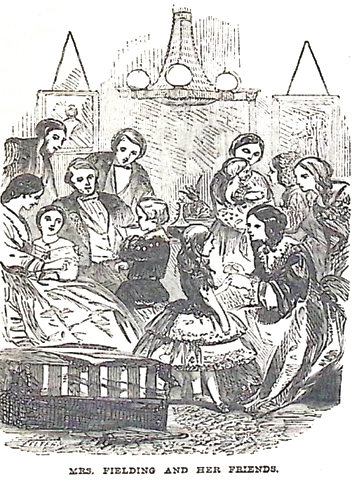
MRS. FIELDING AND HER FRIENDS.
"My frock didn't come home," murmured Blanche, in a little voice from between a French plum and a piece of orange.
"I thought so; for, to tell you a little secret, I heard a message about it as I came in this evening. You are very good not to be jealous of your sister."
"What is jealous?" said Blanche, gulping down the plum, and looking up in the lady's face for an explanation of the amount of her "goodness."
"You dear innocent little thing!" exclaimed the unwise lady. "My dear Mrs. Fielding, I congratulate you. Your sweet child here does not know what jealousy means, and I shall not certainly be the first to enlighten her—'where ignorance is bliss.' Ah, how happy you are to be able to keep your children from contamination in this way."
Mrs. Fielding felt a little awkward, but how could she expose her children's faults? And poor Blanche was doubtless sufficiently punished by being presented in the old frock.
"I say, Fielding," exclaimed a gentleman, "this young rogue knows what is good."
"O, pray do not let him have it," cried Mrs. Fielding, as she saw George swallowing the contents of a wine-glass with great energy.
"It will not hurt him for once," replied the guest, laughing; "he will be a lad of spirit, depend upon it. Well, sir, what next?" he asked, as the boy put down the glass, in no wise discomposed by the length or the strength of his draught.
Alas! It was not a first time; it was not "for once;" and George had already his favorite wine as decidedly as his father or any of the visitors present. The little girls also sipped from their friends' glasses, and knew quite well those who were most liberal in the bestowal of their favors.
The children accompanied the ladies to the drawing-room, where, in a few moments, ottomans, cushions, picture books, and all available fancy articles within reach, seemed to partake of the excitement of the young tumblers; and nurse was speedily summoned to remove them from the scene, as the only means of delivering the persecuted company from the strife of their indefatigable tongues.
But nurse, with baby in her arms, was seated by the kitchen fire, regaling on the delicacies which cook, in token of her kind regard, had set aside for her enjoyment, and of which the children's absence afforded her time to partake in perfection.
Poor baby cried a little, and nodded a little, and was pronounced "the tiresomest baby that ever was," because he sputtered over his clean little night-dress the mouthful of some uncongenial mess to which he had been treated with a taste.
"There now! I must change his gown, the naughty thing! else his mamma will find it out at bedtime. It's of no use to get him to sleep till the others are gone, for they always come up with such a noise, enough to wake the dead, when they've been with company, having wine and things. Not that I've anything to say against dinner parties, thanks to you, cook; only it's quite time those young ones were asleep."
"I say, nurse," said cook, looking at the baby, "I hope that blancmange won't make him sick; he looks pale and queer. Do take him upstairs out of this hot place. I'll save you a nice bit for supper, never fear. Dear, dear! It's a terrible weight off one's mind when the dinner's done and no fault found; but there's lots of things never been touched that I spent deal of trouble on. But missus will have the best, and plenty of it; and she's in the right not to be outdone by anybody, I say."
Here the children's bell terminated the gossip; so baby was put into his cot with something sweet in his mouth to insure his complacency, while nurse ran down to receive her uproarious charge, whom by dint of scolding and coaxing she at last lodged safely in their beds.
Such scenes are among the commonplace circumstances of society, and probably never recur to the minds of those heedlessly engaged in assisting their mischievous influence. But nevertheless injury is done, and antagonism is strengthened against the inconsistent attempts which the same persons will make to teach great principles by rote and intellectual routine. They may be trifling in themselves, and seem too light to be named as pernicious to youthful character, but they make impression on susceptible material, and belong more emphatically to "education" than all the lectures and precepts on the moral qualities that ever were penned or propounded by instructors of youth.
Keep yourselves from idols.—1 JOHN v, 21.
MR. and MRS. LATIMER'S nearest neighbors consisted of a family in station, number, and ages similar to their own; and to the youthful claimants on her love and care, Mrs. Denby was as fondly devoted as parent could be. She heard with much satisfaction of Mrs. Latimer's home engagements, and felt sure of sympathy in her own anxious views of maternal duty. But it was possible for two mothers equally affectionate, equally devoted, and equally self-denying, to be in their motives, methods, and hopes thoroughly and essentially opposed.
In Mrs. Denby's household everything gave place to the children; their health, their comfort, their dress, their diet, their education, occupied the whole heart, and mind, and time of the harassed mother, whether waking or sleeping. Her children were her one idea, in reference to whom the very sun shone, and the earth revolved, so far as she appreciated the convenient regulations of nature. The domestic administration, it may be surmised, was not of the most orderly character; for, however the nominal head of the household might stand in the estimation of society, the essence of power was grasped by the hands of juvenile tyrants, whose caprices dictated laws to which for the sake of peace it was usually deemed best to submit.
Mrs. Denby would have been shocked had she been told that her easy, kind-hearted husband was not master of his own house, or that his wishes and comfort were ever sacrificed to the whims of his wayward children. But such was the fact; for, having resigned herself to their service, she exacted the like subjection from all around them. If invited out, he could of course go if he pleased, but Mrs. Denby could not leave the children; and if he wished to receive friends at home, Mrs. Denby thought he should consider the children, for how could she attend to arrangements for company, when she was so much engaged in the nursery? Of course she never trusted a servant; for who, except a mother, could be thoughtful enough of children's numerous wants and ailments?
A mother's work, she remarked, (that is to say, "her" work) was never done; it had no intermission, it had no end. In the morning, she awoke to anxiety. In the evening, she retired in anxiety, for there were terrors by night, as well as arrows by day; and it was one special branch of duty to ward off the danger of epidemics, and to be prepared for all the possible ills to which juvenile flesh is heir.
Sometimes the whole house was raised in the dead of night to assist at a bath for baby, who, by, the pale glimmer of the lamp, looked as if he were intending to have a fit, while Mr. Denby hurried off for the doctor. Then, when the doctor came as quickly as possible, and found the little idol comfortably dozing in his blanket, he could only highly commend the forethought and promptitude of the anxious mother, promise to call and watch further developments of the illness in the morning, and advise the alarmed family to retire to rest.
Morning opened the bright eyes, and dimpled the rosy cheek with smiles enough to prove that all impending mischief was happily averted, and the bath was of course a specific for all disorders imaginary or real.
It is certainly essential that a mother should be acquainted with such little easy and harmless remedies, for whether they benefit the patient or not, it is a safety-valve for her anxiety to be doing something.
One evening Mrs. Denby came in much distress requesting an interview with Mrs. Latimer, from whom she wished, she said, to solicit the greatest possible favor. Mrs. Latimer assured her of sympathy and assistance by any means in her power.
"I am sure you will feel for me, dear Mrs. Latimer," said she, "for I know how devoted you are to your home and family. Do you know I have never left the house for a day or night for years without my children, but now I must do so, I fear. My mother is very ill, and she wished me sent for. What can I do?"
"Go to her immediately, I should think," replied Mrs. Latimer.
"Ah, but my children—it is most distressing to me to leave them; they may be ill and die before I can be at home again. Do you not think they are my first duty?"
"Would you not wish them to come to you if you were ill?"
"Yes, certainly. But then I do not think my mother can be so ill as my sisters in their alarm represent, and probably my journey after all may be unnecessary."
"In what way can I assist you?" asked Mrs. Latimer, grieved at this exhibition of selfish folly.
"In case I do go—and Mr. Denby thinks I ought not to have waited another post, but I thought little Tilly looked so pale, I dared not venture to-day; if I go, I want to ask you, dear madam, to oblige me by visiting my nursery every few hours, just to see that all is well. You will not permit them to go out unless you are sure that the weather is mild, and the wind in a safe quarter. They have not had any of the usual disorders of childhood, and I fear would never get through the measles or hooping-cough without great care. Does not this often distress you for those of your children who have not passed through the ordeal?"
"No," said Mrs. Latimer quietly, "it does not distress me; and perhaps those disorders are not inevitable."
"Not inevitable? I never heard so before. Pray tell me what can prevent them?"
"I do not know; but, dear madam, may I not venture to remind you of a loving and powerful Friend, whose watchful care can guard those so dear to you far more effectually than either you or I can do it?"
"There is no one more likely to feel with me than yourself, Mrs. Latimer, for, like me, you live only for your children—at least so I have been told."
"Then I fear I have been misrepresented to you," said Mrs. Latimer, smiling. "I desire to live in the faithful discharge of all the duties devolving on me, but I trust that my children have a far wiser and better Friend, under whose authority I act, and on whose continual care I rely."
"I know, of course, that God rules everything," said Mrs. Denby, despondingly.
"And rules for good to them that love him. O let us not forget that if we have given ourselves to Christ, he has taken into his sacred keeping every interest by which we can be affected during our short absence from our heavenly home, and nothing can happen to us or ours by accident or chance."
"Ah! Mrs. Latimer, I know that you are religious, but I had no idea you carried it so far as this."
"Dear Mrs. Denby, true religion was made for every-day life, and for every experience of hearts like yours and mine. And those who appreciate most the redemption Christ wrought out, and the future glory to which it leads, are just those who realize most the daily appoint merits of his providence, and the comfort of his sustaining grace."
"But suppose you were situated just as I am now, would you not be oppressed by the same anxiety, and suffer the same distress when called away from your home and children?"
"Do not condemn me hastily, if I venture to say that, by the grace of God, I think I should not. You are called to fulfill a solemn duty to a perhaps dying parent; it is only in the wise will of God that such a claim can arise, and confiding for the time my other duties to his guardianship, I would take as my own portion, under any circumstances so ordained, those happy, holy words,—
"'Let not your heart be troubled; ye believe in God, believe also in
me. My peace I give unto you; not as the world giveth give I unto you.'"
"Ah! Mrs. Latimer, I would give anything I possess at this moment for such calmness and peace as that, but I am naturally so anxious, so nervous, so apprehensive. If one of my children were to be ill and die in my absence, I should never, never forgive myself for going away."
"Because you do not distinguish between doing the will of God and acting upon the suggestions of your own, in which case there cannot be peace; there must always be fear, irresolution, perhaps great unhappiness."
"You are quite right, it is just so. I love my children so fondly that I have scarcely a thought but for their interests, and whatever would withdraw me from my charge makes me anxious and unhappy. But I cannot believe that this is wrong."
"My dear friend," said Mrs. Latimer, "forgive me for asking the question your words suggest—is it not idolatrous affection, and will not God have cause to reprove it? O! Do be warned in time, for your dear children were not given to you to fill your heart so that there is no room for him."
"Surely I am pleasing God when trying to discharge a mother's duty?"
"Not if you cannot trust him; not if you allow your own absorbed feelings rather than his word and providence to dictate the form of your duty. To be a happy parent, really blessed of God, you must be a Christian too."
"I hope I am a Christian. Mrs. Latimer, you mistake me greatly if you doubt it."
"But does the word imply the same thing to both our minds! I mean a believer living by faith in the Son of God. I mean one of God's own children pardoned and accepted in Christ, and loving him with personal, practical affection, and who feels and obeys the influence of the Holy Spirit, without whom we can know nothing to any saving purpose of the things that make a Christian."
"It is not exactly thus that I am conscious of being one; but then it is an extreme view, and extremes, you know, are both extravagant and dangerous."
"In all earthly things, even including parental affection, it is written,—
"'Let your moderation be known unto all men; be careful for nothing.'
"But in heavenly things, the word of God sets no bound to the demand for, or the value of Christian attainments and desires; it enjoins unlimited confidence in God's love, the purest holiness in life and practice, the fullest enjoyment of spiritual privilege, and the most perfect repose of heart concerning all the arrangements of Divine Providence. Only read how beautifully the Lord Jesus provided for his people against anxiety and doubt. See how his apostles reiterate his meaning, and how the Spirit anticipates the loving warmth of perpetual remembrance, when he says,—
"'Pray without ceasing;'
"'Rejoice evermore;'
"'In everything give thanks.'"
"May I ask," said Mrs. Denby, thoughtfully, "if it be not true that you devote your time and energies to the welfare of your children, and that you make everything bend to their interests?"
"I should be glad to reply in the affirmative with some qualifications," said Mrs. Latimer, smiling. "I do devote a large portion of my time to my children, but it is because such a charge has been delegated to me by my heavenly Father, and not because I could enjoy no peace elsewhere. I instruct them for the present, not because I love them so that I cannot trust them to another, but because I believe a mother to be the right teacher during the early years of childhood, and that it should be her precious privilege to use the period of her influence in sowing that good seed which God in time will bless. And I do try, and by God's help am resolved, that every earthly consideration for my children's welfare and advancement shall bend to the higher and more important interests of their souls' salvation. I am among them so much, not to twine their thoughts around myself, nor to absorb their affections, for I may be removed from them at any moment, but to lead them to the Guide of their youth, the everlasting Father from whose arms, if once clasped there, no power of Satan or man can snatch them."
"And have you no anxieties about their health?"
"O yes, sometimes, but that is when my own infirmities are unhappily escaping the control of faith and reason. But when I can again trust God with my ailing child, again I am at peace. I know that many a planted flower is taken away from evil to come, and that some given back to the wild willfulness, of parental idolatry have lived to pierce those loving hearts with many sorrows."
"Really you do astonish me with such extraordinary ideas," said Mrs. Denby, looking with wonder on the earnest countenance before her. "I cannot in the least understand, you."
"But do try, dear madam—it is worth an effort—to know Him whose presence can comfort yourself and bless your precious children; who alone can furnish you with strength for duty, regulate and control the outflowings of tender affection, and make you what you long to be, a happy, useful mother, whom God will delight to bless and honor."
In tears and trouble Mrs. Denby took leave of her nursery the next morning, relying on the kindness of her Christian neighbor, who had nevertheless suffered somewhat in her esteem since she found that measles, and hooping-cough, and scarlet fever were not specters perpetually haunting her threshold, and that the health, and prettiness, and cleverness of her children were not the chief objects of her solicitude and ambition. She did not comprehend any motive for maternal attention but that of intense and absorbing affection. To her it seemed inevitable for maternal love to degenerate into what her neighbor deemed idolatry, no sanctifying motive prompted her self-denial by the fact that she was invested with a responsibility of which she must some day give account, or that the young creatures on whose every whim and wish she attended with slavish assiduity, were immortal.
Her devoted love was lavished on those fair forms which seemed to her the very incarnation of beauty and grace. And had any unusual interest been perceived in any one of them concerning things that pertain to a future state and "the better land," her apprehensions would have been painfully excited lest some mysterious influence had awakened a presentiment of early death. Religion and death were inseparable in her thoughts; Christianity and a life of holy happiness and usefulness were not her idea of the Gospel of Jesus Christ. "Too good to live" is a false proverb which has made many a mother's heart ache, in forgetfulness that a generation of living believers should be "lights of the world," and "salt of the earth."
But alas! she thought little of the future man who must one day stand alone among men, compelled to take a place in the world whose atmosphere is ambition, and pride, and covetousness, and unbelief, to encounter temptation without, and feel the workings of natural corruption within. She thought but little of the future woman on whose temper and principles might depend the happiness or misery of some future home and the peace of her own life. And she entirely forgot the certain day when parents and children shall stand before the judgment-seat of God; when neglected opportunities will wring the conscience with intolerable anguish; when it will be seen that the sad inheritance of a fallen nature has been transmitted from generation to generation, without a serious effort to arrest its tremendous consequences by the effectual means provided in the Gospel of the grace of God.
A mother once said, in the hearing of her child, to the governess resident in the family: "Though we may not be very religious ourselves, we wish our children to be brought up religiously." And the arrangements prescribed for that end were, that they should be taken to church once every Sunday. And how many parents, conscious that there is some spiritual mystery bound up in the being of man, that "something" after all is "needful," yield to hired teachers, or a weekly sermon, the precious privilege of teaching the infant soul all it may ever live to know of God and Christ, of heaven and hell.
And what wonder, if the parent needs no religion, the child should take the liberty of judging it needless also, and deem the formal reading with the governess a troublesome task to the mind, and the Sunday service a weariness to the flesh? Surely the conclusion would be reasonable, that if papa and mamma were going to heaven without any such trouble, their sons and daughters might tread in their steps. And so "the name that is above every name," the favor which is "better than life," the wisdom whose "price is above rubies," become associated with dreary task-work and superfluous obligations.
Little do such parents know how charming to the ear of childhood is the sweet story of Jesus, when told with the animated earnestness of one who loves him; little do they know how his touching sorrows, his pitying love, his wonderful sacrifice for sinners, can penetrate the hearts of "babes and sucklings," and constrain their acceptable praise. They are not aware how the knowledge of Jesus would throw a shield between their children and the worst dangers to which they are exposed on the journey of life; nor covet the joy of that parent's heart who is made instrumental to the eternal happiness of beloved ones doubly dear in the bonds of earth and heaven.
In contrast with such, and amid the few redeeming scenes that this sin-burdened earth presents to the eye of the great God who looks down on the children of men, none can be more fair in his sight than that of a family under Christian rule, where "the instruction of the father" and "the law of the mother" are in harmony with his word and will; where "he knows them, that they will command their children and their household after them; and they shall keep the way of the Lord."
It is a Goshen, where a portion of the "little flock" is tended; there is a mark on the door that the destroyer must pass by; it is a spiritual camp in the wilderness of sin, a witness for Christ in the world that denies him. And there the Lord commands "the blessing, even life for evermore."
Happy the land that contains many such scenes, yea, happy the families in such sacred keeping!
They first gave their own selves to the Lord.—2 COR. viii, 5.
MRS. LATIMER found it no pleasant task to face the turbulent young spirits in her neighbor's nursery. And the multitude of instructions and cautions she had received, together with the assurance of the nurses that their mistress always did this, and never allowed them to do that, rendered it very evident that poor Mrs. Denby was emphatically, what she frequently with some little self-satisfaction pronounced herself, "the slave of her children."
The spoiled little pets were not to be easily propitiated by a stranger, and at first stared with wonder, and screamed with rage when she approached them. To thwart or control them was utterly out of the question, and any sign of discipline might have found similar success in the days when "every man did that which was right in his own eyes."
The head nurse, too, resented Mrs. Latimer's interference, and proved herself wholly unworthy of confidence; none had ever been reposed in her, and she felt no responsibility. She obeyed her mistress while she was present to see her orders executed, and then conceived her duty done.
It was therefore impossible to transfer the party, or any portion of it, to her own house, and so voluntarily expose her children to pernicious example, for there was enough of natural evil already developing there. And Mrs. Latimer was obliged to content herself with literal obedience to her neighbor's request, though she would gladly have gone far beyond it, and felt thankful when the return of their mother released her from her unpleasant engagement.
She could not avoid reflecting on the difficulties a parent like Mrs. Denby must encounter, when brought, in the mercy of God, to a true sense of her position and duty, before a family so mismanaged could be reduced to order and obedience. But foreseeing trials more overwhelming under the present system, she resolved to cultivate further acquaintance with the mistaken mother, hoping to induce in time, by kind and gentle hints, and true maternal sympathy, some change for the better where all was so very wrong.
From such a meditation she was suddenly roused by the gleeful voices of some of her own little ones.
"Look, look, mamma! Here is Mrs. Lester coming with her baby and the nurse. O the dear little thing! May we play with him, mamma?"
And all rushed from their several occupations to receive the little guest.
"Take care not to frighten him with too rough a welcome," said Mrs. Latimer as the door opened, and a young lady smilingly advanced, followed by a respectable elderly attendant bearing in her arms a thriving little inhabitant of lace, cambric, and cashmere.
"I have fulfilled my promise, and brought baby to see you," said Mrs. Lester, as she presented him to his eager little friends.
She sat down on a low seat and showed them his beautiful hair, and his tiny hands and feet, while they stood round her in an ecstasy of delight and admiration.
Baby was in the best of humors, and smiled when they kissed his soft cheek, and suffered himself to be squeezed and tumbled into the arms of each with gratifying condescension. Until Mrs. Latimer perceived a change pass over the young mother's countenance, and starting tears chase away her recent smiles.
"May baby go to the nursery for a little while with them?" said she. "The two nurses will take care that no danger occurs from their zealous caresses."
And leading the way, with injunctions to great carefulness and gentle treatment on the part of her youthful tribe, Mrs. Latimer returned to her friend, who was struggling under excited feelings to regain composure.
"I am so ashamed, dear Mrs. Latimer," at last she said, "but I must explain the cause of this folly, and you are too kind to laugh at me. My good, experienced nurse is obliged to leave me, and I feel so unequal to the whole charge of my darling babe; I know not how I shall manage with only a young woman, who needs guidance from me."
"You will do as others have done before you," said Mrs. Latimer kindly; "you will feel pleased, in a few days, with all your increased responsibilities."
"Ah, I fear not. You do not know how timid I am; I get terrified at the least symptom of illness, and am likely to do nothing from the mere dread of doing wrong. And how can I trust him out of my sight with a stranger?"
"Are you satisfied about her character?"
"O yes, that is all I can wish. But she has never had the sole charge of so young an infant before, though she feels no fear in undertaking it."
"But you do not wish to be released from your share of the charge?"
"O no, I would do anything in the world, only I so mistrust myself. And just now when your children were playing with him, I wondered how you had ever managed to bring them up so far without almost dying of anxiety. Will you help me sometimes with advice if I come to you in my difficulties?"
"Most readily, if it can be of any use. But what will you think if I venture to begin with a single recommendation now? You will feel little need of my weak help if you will adopt it."
"I shall think it most kind; I shall be deeply grateful," said the young mother earnestly.
"I remember once being like you now, the anxious parent of one precious child, and I thought my cares were intense, and all my powers inadequate to bear them."
"That is exactly as I feel: tell me what you did."
"Under much depression of heart, I knelt down by my baby's bed, and dedicated myself and him afresh to God. I knew God in Christ as my Lord and Saviour; I knew he had promised to his people strength according to their day, and grace to help in time of need. I pleaded those and kindred promises; I plead them still, and they have never failed me from that day until now. May I not therefore say to you,—
"'Cast all your care on him, for he careth for you,' and 'will supply
all your need,'
"as he has supplied mine?"
"But, Mrs. Latimer, do you mean that God will condescend to help a weak, trembling mother to fulfill her duty as she ought?"
"Yes, if she wishes to begin as a wise mother should, by training her child for him. The Lord Jesus gave us the initiatory secret when he said,—
"'Suffer the little children to come unto me.'
"You know that your child is immortal; his spirit must one day be holy and happy as an angel, or—"
"Hush, hush!" said the young mother. "I have not thought of this; it shows my duty in a more overwhelming form than ever; for I cannot, no, I cannot do it for God, nor expect his help or blessing."
"Why not?" asked Mrs. Latimer anxiously, as she saw the struggle of contending thoughts.
"Because I know nothing of Jesus Christ as my own Saviour; because I have lived without God in the world, and would not give myself to him as I ought."
"Then hear his voice now asking you to do so at once by the cradle of your babe; receive this tender tie from his very hand, and let it keep you affectionately dependent on him for everything needful both for yourself and your child. You know the way to the Father is by his Son Jesus Christ; and when, in your own experience of parental love, you recognize in a figure something of God's love toward his children, you will ask yourself how he who gave his only Son for you, will not also freely give you all things."
"You mean, then, that he would bless and guard my child for me, among the 'all things'? O if I might pray for that!"
"Yes, and more still. But I have sometimes thought there are few things more distressing than a prayerless parent, watching by a child whom she regards as an idol in her heart, and the plaything of her life, and whom the hand of death may snatch away in a moment. You know, the exclamations or the expressed wishes of those who are not trusting in Christ, are not prayer. Prayer is the desire of the soul in conscious intercourse with God through Christ, and to be effectual, it must be suggested by the Spirit of God in accordance with the will of God. Prayer is not 'the upward glancing of an eye,' that sees nothing; it must see Him by faith who 'ever liveth to make intercession for us.'"
"O! I know nothing of such prayer as that. And yet this morning, as I sat alone with baby after he had fallen asleep, my thoughts seemed solemn and prayerful. I felt that I could do anything on earth were it possible to save him from growing up a bad unhappy man, and to keep him pure and innocent as he is now."
"'With God all things are possible.'
"He can make pure that which is in itself defiled. But you cannot renew the heart, nor reach the source of sin even in your own child."
"But, dear Mrs. Latimer, how much we hear of the influence of a mother's love over the hearts of her children; and does it not tend to their heavenly as well as earthly good?"
"Yes, if it be the love of the Christian mother, who receives her child as a gift from God, and views her duty as his appointment, to be discharged in faith and prayer. She knows that a little time will prove the existence of an evil nature, which nothing but God's grace can overcome; and recognizing the use of means, as the channel through which that grace may flow, she diligently throws into 'the way he should go' all the power and influence with which she is invested. She knows that the source of true happiness for this world, as well as the future, is in the hand of redeeming love:
"'Blessed is he whose transgression is forgiven, whose sin is covered.'
"And other foundation for it can no one, not even a tender mother, lay. Therefore, she seeks to consecrate her affection and her influence to the education of her child for God. Less than this does not fulfill the sacred mission of maternal love."
"My dear, kind friend," said Mrs. Lester warmly, "I cannot describe how you have startled me into thoughts such as I never had before. I have been sentimentalizing over the feelings called forth by my new relationship; while its duties, beyond attention to the much-loved little form, have been forgotten. But I am resolved to consider what you have said, and never to dismiss the subject until I have attained some satisfactory conclusion. I have never yet yielded anything to God, but a cold dull assent to his existence and his power; and I was afraid of him because he cannot be deceived, and I wished to deceive myself into some hope of escape from his displeasure. How strange it will be if love for my child should draw me into the way of knowing what the danger of my own soul never suggested to any good purpose."
"God's ways are not as our ways, nor his thoughts as ours, my dear friend. It is a solemn moment for the sinner when a conviction of sin and helplessness is forced upon the conscience; and may God guide your heart to the Saviour's feet. Who can tell what tremendous interests may hinge upon the regard you pay to the voice that whispers within you now? Let me beseech you to allow no delay; do not defer to some 'more convenient season' the consideration of a subject that involves everything eternally precious and important. God waits to be gracious. There is nothing between you and his bosom of love but your own reluctance or unbelief."
"How confidently you speak, Mrs. Latimer! What if I seek and fail to find? All are not saved."
"All who seek Jesus 'shall' find him; there is no such 'if' in existence as you fear; there never will be a lost soul that can blame an unwilling Saviour."
"But I seem to know nothing yet that I ought to know. How can I begin? What shall I do? I want instruction and help."
"'In me is thine help,' saith the Lord God.
"'Take with you words and turn to the Lord,' 'and he will have
mercy . . . he will abundantly pardon.'
"'He keepeth not his anger for ever, because he delighteth in mercy.'
"'God commendeth his love . . . in that, while we were yet sinners,
Christ died for us.'"
"And my child—shall I be a better mother to him if I love him less?"
"You will not love him less, bur your love will be wiser. The love of Jesus does not check the affections or tender relationships of life; it only regulates them and preserves us from idolatry. It descends with us to the details of daily duty, sanctifying all our efforts for the happiness of those around us; and secures diligence in the present, while looking forward in joyful hope to the destiny of God's believing family."
"O! It must be very happy to think as you do. How I wish to attain such a religion myself!"
"There is another thought on the subject, which I may venture to suggest to you, dear Mrs. Lester. I have just witnessed the state of a family in which neglect of a parent's highest duty has contributed to strife and confusion, melancholy to contemplate, and more miserable to endure. Not neglect of the perishable body, for that has been pampered to injurious excess, but a set of spoiled children all ignorant of God, of self-denial, and self-control; and living but to eat, drink, and be clothed in beautiful apparel, and to have their own way by any means. The mischief began with the first, and has increased with every unsubdued will that has been added to the group, until the climax is appalling even to the mother, who will soon find herself a cipher in her own house.
"One corrected, well-trained child may be a blessing to the future family; the loving scriptural care of childhood may be the safeguard in the hand of God to the future youth. O begin to train your little one in time, and I trust both you and I shall find that God honored in the nursery will return the honor a hundredfold in the school and in the world."
Many an interesting exchange of thoughts and feelings passed between the young mother and her more experienced friend. And Mrs. Latimer had the satisfaction of seeing her decide for the service of Christ, and resolved, by his help and grace, to train her little charge according to the Divine precept.
Let it not be supposed that Mrs. Latimer's duty was all pleasure, or her life all sunshine. She had faults in herself against which to strive daily; she had character to be cultivated, anxieties to be calmed, affections to be controlled, temper to be subdued, speech to be guarded, and temptations provoking all, to be watched and shunned. But she knew the mighty strength in which she might be armed day by day, and each morning sought forestalling grace to meet everything, adverse or prosperous, painful or pleasant, in the armor of God. From her closet, she went to her nursery with the sunbeam of heaven on her soul, and its radiant index on her peaceful brow; and in the healthful bloom or the languid eye that might meet her there, she read the will of her heavenly Father, who never needlessly afflicts, and only chastens in love; and while rejoicing in the one, or ministering to the other, depended equally on the same goodness for both. Distress carried her heart to the throne of grace in prayer; joy hastened with it there in praise.
She had often to behold the innate corruption of young hearts; lashing up tempests of passion, sudden freaks of spite and revenge, sometimes willful disobedience, and worse than all, to detect the lie intended to disguise a fault, or the prevarication which seeks to elude censure. But she knew that in her children sin was not an accident of a day, but a proneness of their nature; that their hearts were not like a river acquiring a taint in its course, and which having been pure at first might be so again, but were polluted at the fountain head before ever a thought gushed forth to testify their bitterness. And therefore, when she saw tempers and conduct and heard words that pained her, she was neither surprised nor confounded, as at some unaccountable marvel, but calmly prepared, like a skillful physician, to deal with a disease she knew but too well, and of which these were the easily recognized symptoms.
Each young offender knew how loving was the heart that dictated the needful punishment, and animal passion often quailed and quieted beneath the steady but sorrowful gaze of the mother's eye. Each child know the influence of the quiet interview, when at her knee or by her side the culprit stood alone, to hear of his fault, and learn its sinfulness before God, and the cost of its forgiveness; and the tear of penitence seldom failed to flow while the mother prayed in yearning tenderness for the erring little one. She extorted no promises, counseled no boastful resolutions, but taught what God approves, what Christ loves, and how he gives grace to help all who desire to be good and holy. If she saw desire to avoid the fault in future, she gave the ready aid of an approving smile or a word of encouragement; and if there were failures, she endeavored to distinguish between forgetfulness before sudden temptation, and indifferent carelessness or willful rebellion.
It does not require vigilance, activity of mind, patience, judgment, thus to deal with childhood; but what study can be more interesting, or make more lawful demand upon the exercise of those attributes of mind and character? How often injustice might be avoided, evil discountenanced, and good promoted, by such watchful promptitude to observe and act! Children are too often treated merely as machines, or even as animals, rather than as reasonable beings susceptible of keen feelings, and capable of appreciating in their own way the manifestations of sympathy, and the discriminating love of those around them. There is some peculiarity about every child; no two are ever found precisely alike in disposition and mental power, any more than in person and feature. And she who can detect and meet those differences, penetrates a secret for her own guidance in discipline and training, and confers a benefit on each. It is sad for the little isolated heart that is obliged to feel misunderstood, where its love and obedience are chiefly due. It is because God "knoweth our frame and remembereth that we are dust," and expects from us nothing but what he knows we can do, that his children so confidingly trust his love, and so freely "pour out their hearts before him."
In the much controverted point of personal chastisement, it was Mr. and Mrs. Latimer's last resort in cases of stubborn pride, or hardy disobedience, but where moral sensitiveness was encouraged and cultivated, it was not often necessary to inflict bodily pain. There are perhaps natures so gross and impenetrable that nothing else effects an impression, and physical pain being connected with certain faults may place the barrier of fear before their recurrence, but after all it neither reaches the heart nor enlightens the conscience; it is discovery and punishment dreaded, not sin renounced and hated. Happy the child who is taught rather that sin grieves his parent's heart, than that it provokes his arm. But if it be inevitable after all gentler means have failed; if it be of necessity and not of anger, of calm decision and not of passionate haste, O then let it be done with the solemnity of sorrow on the parent's part, with the dignity of a sacred duty that God's servant dares not neglect. Seldom, perhaps never again, it may be needed.
But in all the branches of parental care and duty, the Christian has immense advantage. Who can work like those who work for God, and who obtain such glorious wages? God in Christ is the very life and soul of a Christian mother's efforts; he is her wise, close, helpful guide and friend in everything. In him is forgiving love for herself and all she brings to him; in him the spring of motives, in him the bright example. In him all power for earth and heaven, all tender sympathy, and strengthening grace. He watches her efforts, he knows her soul's desire, and hears her never-tiring prayers. He knows that the sharpest pang of fear that ever wrings her heart is lest any child of hers should blaspheme his hallowed name; and that the dearest hope which animates her amid her duties is, that they who are born of her shall in due time be "born again" of God, to glorify and honor him forever.
Let it not be thought that such close realization of maternal duty is a bondage and a burden. If there be either, it is so disguised in pleasure, so twined with love, that it is not felt, unless the mind is unhinged and the heart absorbed for the time with self. The discipline involved to the parent, purifies and refines her own character; her temper, feelings, thoughts, ways, manners, are all under more control, and improve with the improvement she desires to effect in her children. She who would make others love goodness, must show them its beauty in herself; and she who copies Christ will not fail to attain something of his likeness. She may grieve herself by mistakes and failures, but she never honors God in vain. His eye is upon her, and he will never disappoint her longing heart, or forget her faithful love.
And thou shalt teach them diligently unto thy children, and shalt talk
of them when thou sittest in thine house, and when thou walkest by the
way, and when thou liest down, and when thou risest up.—DEUT. vi, 7.
IN the social Christian circle which gladly welcomed Mr. and Mrs. Latimer among them, was a lady with whom the latter often took counsel, and who seemed to be desirous to adorn the doctrine of God her Saviour in all things. She was the wife of a Christian gentleman, and the mother of a youthful family, whom she said she was endeavoring to bring up "in the nurture and admonition of the Lord." Duties and interests so similar often drew the two mothers together for mutual advice and encouragement, and not unfrequently the uncompromising principles of Marion Latimer settled the wavering opinion or hesitating judgment of her friend.
As increase of occupation and care gradually claimed their time and thoughts, their opportunities of meeting became fewer, their comparison of plans and results less intimate, but their friendship remained uninterrupted and sincere. Each believed the other engaged in the path of duty; but it was not well for Mrs. Thornhill that the influence of a consistent friend should have been relaxed at a time critical and important to her own duties and her children's welfare.
In fact, with all her love and knowledge, and in some things her zeal, Mrs. Thornhill was inconsistent. She was more manifestly a Christian everywhere than among her children. Here she lowered the standard of the cross. And as the time passed too swiftly by when she taught pretty hymns to lisping lips which she loved to hear utter the Saviour's name, when they no longer ran to repeat a daily verse, and began to seem sometimes weary of hearing her read and talk of Jesus, she thought it better to be silent altogether, to sigh in secret over the change, and refrain from risk of rendering religion distasteful to them.
Then she introduced another class of books for their entertainment; she told tales of other influences and other motives, and by degrees unconsciously separated, in the minds of the children, the Son of God and the Spirit of God from their necessary connection with real happiness and holiness. She thought the Gospel too difficult for their apprehension, and its self-denying exhortations likely to render it displeasing, until God himself should interfere and change their natural inclinations.
Mr. Thornhill, much engaged in business, and trusting to the wisdom and judgment of his wife, seldom spent much time with his children except on Sunday, and then their pleasure in his society caused them to receive respectfully whatever instruction he chose to mingle with it; though he was even then gently reminded that they could not be expected to feel any interest in subjects which only the grace of God had made acceptable to him.
"But," he would say, "we know not at what moment the same grace may cause the good seed to strike root in them; and though I would not weary them, I would be associated in their minds with the best and holiest subject in which it is possible for them to be interested. I want my children to meet me in heaven, and therefore am bound to use such means as may, under God, quicken a mutual sympathy."
Then Mrs. Thornhill thought it better to say less herself. And when her efforts for their spiritual welfare relaxed, was it wonderful that her prayers relaxed too, and that the depth and earnestness of her own feelings suffered damage; that she yielded many a point which practical Christianity ought firmly to have withstood, and then justified herself in the reflection that "by grace ye are saved through faith," and "not by works, lest any man should boast."
Surely no Christian parent has any right to assume aught concerning the purposes of God. The Scriptures are the standard of our duty; and in them it is clearly revealed that God commands that our children be trained "in the way they should go," and appends to his precept a faithful promise by which to gladden with hope the hearts that obey in faith and love. It is monstrous to see parents, assured of their own salvation, waiting idly until God shall speak through some unknown channel to their children, as if it were not blessedly true that he works by means, and designed the paternal relationship, rightly understood, to be one of his choicest and most practical representatives in a fallen world.
Mrs. Thornhill and Mrs. Fielding, though not on terms of intimacy, had sometimes exchanged formal visits; but the children of their families having met in mutual pleasure, a closer acquaintance seemed to the former almost unavoidable. Mrs. Fielding, seldom negligent of opportunities for securing worldly advantage or desirable ends, and wishing her little girls to commence an accomplishment in which they could not excel without several young companions, arranged in her own mind the plan of a select dancing class, numerous enough to acquire all the fashionable figures, without mixing with the pupils of a school, or meeting anywhere but in their parents' houses. The young Thornhills she conceived eligible, and with some slight misgiving concerning the reception her proposal might meet, she called on Mrs. Thornhill to represent its advantages.
"I really have never given the subject any consideration," said Mrs. Thornhill; "indeed, I am not sure that Mr. Thornhill intends his children to learn dancing at all, but it is still very kind of you to propose so unexceptionable a plan."
"I trust we may calculate on his consent," said Mrs. Fielding; "for you know young people feel so awkward and bashful unless they have been taught to move with propriety and elegance. I always am so sorry for a poor girl who has never learned to dance; she cannot enter a room without the miserable idea that all eyes are observing her awkwardness."
"I should be sorry to think my children were made uncomfortable by any feeling of that kind," said Mrs. Thornhill; "but you know, dear madam, I should regret anything that might give them a taste for worldly amusements in which I could not conscientiously indulge them."
"Yes, I am aware of that," said Mrs. Fielding, "but if I rightly apprehend your views, you do not expect your happy little ones, ignorant of the temptations of frivolity and dissipation which excess in worldly pleasures may induce, to resign all the innocent enjoyments natural to their age, and feel with you in your higher and better desires."
"No, certainly, I cannot expect it."
"Nor need you fear that the little fairy who is taught to use her limbs with graceful ease in your own house, must necessarily wish to exhibit like proficiency at a ball or a public assembly. My impression is, that young people will dance if they please, in some way, when grown-up, whether they have learned or not; and if they should not wish to do so, a knowledge of the accomplishment will have done no possible harm."
"I think that is quite true," said Mrs. Thornhill, thoughtfully.
"But, my dear Mrs. Thornhill, allow me to tell you the chief reasons which induce me to favor dancing for my young party. They must have exercise, and it is important to give them some inducement to take it within doors, when the weather does not permit them to walk out. Now, a little amusement combined is sure to make them enjoy it."
"That is very desirable, certainly," replied Mrs. Thornhill. "Do you think Mrs. Latimer would allow her family to join with ours in forming a class?"
"I have not mentioned it to her, but I have no doubt you could easily prevail. My sister, you know, is very peculiar, and when she cuts short all argument with one of her favorite texts, I am always discouraged from urging her to consider further. But I assure you, I pity her poor children, and would gladly do anything to make a pleasant change for them; she is pursuing a mistaken system, Mrs. Thornhill, and will regret it some day."
Mrs. Thornhill promised to ascertain her friend's opinion; and it was evident that her own inclined to the dancing class, if Mr. Thornhill should make no decided objection. However, she was scarcely prepared for the promptitude with which Mrs. Latimer, with her usual gentleness, replied at once to the suggestion, proving that the subject had already been weighed, and all argument in its favor found wanting.
"I am sorry to dissent from you, my dear friend," she said, when again urged, "but it has been decided long since that dancing will not be among the acquirements of my children."
"But are you not afraid that they may grow up awkward in figure or constrained in manner?"
"Not in the least. I greatly dislike an assumed manner or drilled movement, and think modest ease and self-possession will be best secured by cultivation of mind, and correct moral feeling."
"Still, as you cannot quite positively insure it, do you not think it right to adopt a method for guarding children from the pain of being made uncomfortable, by conscious deficiencies which may excite remark?"
"Yes, certainly; and I endeavor to fulfill that duty by teaching them to avoid a false estimate of the world's opinion. They should be solicitous to do right and to be right, not merely to seem so; the reality of character is to be experienced first, and then its appearances may be trusted. I should be sorry to cultivate any accomplishment which might conceal the truthfulness and simplicity of the natural manner, and teach my children that they are to stand before the world in disguise, because they might be considered awkward and ignorant without it."
"I think there may safely be a difference of opinion so far," said Mrs. Thornhill. "I thought perhaps you had other objections."
"I was replying to the only plea that you advanced," replied Mrs. Latimer, "but I have other reasons for disapproving altogether."
"Do let me know them, dear Mrs. Latimer, for I value your judgment; but while I fully concur in all you can say concerning the gayeties of a thoughtless world, which I doubt not you will advance, I cannot see what that has to do with a few little children learning to amuse themselves with a pleasant and innocent exercise."
"If you can see what the seed is to the harvest, what the bud is to the flower, you will perceive what I think the dancing child may be to the future woman. If I regarded nothing higher than the domestic and feminine virtues, I would not allow my daughters to dance; but you know it is wholly inconsistent with the principles and habits in which I wish them to find enjoyment."
"Yes, I was prepared for this objection; but you know, my dear friend, you cannot, after all, compel them to be satisfied with your choice of enjoyment. And I need not remind you that many spiritual Christians were dissipated and thoughtless in their youth, or how some of the most devoted servants of God have sprung from decidedly worldly families."
"Very true; but was it because they were dissipated that they became spiritual? Was it through worldliness that they became devoted? Would they have been less likely to become the subjects of God's saving mercy if they had been brought up in his knowledge and fear? I admit that persons surrounded by the most adverse circumstances have obeyed the invitation of the Gospel, and become eminent for piety and usefulness. The Lord called Moses in the court of Pharaoh, and made saints in Cæsar's household, but that has nothing whatever to do with parental duty, under recognized responsibilities and the use of appointed means."
"I remember," said Mrs. Thornhill, "that he says the work is his own. His glory he will not give to another in the salvation of a single soul."
"Quite true, and God forbid that I should look anywhere else for my children's salvation. It is God's love, God's grace, God's word, God's Spirit. But all these may be manifested through human instrumentality, and at any moment may bless human effort. How reasonable to expect and hope for them through those special appointments of his providence to which he has attached his promise! Tell me to pray and trust as if I could do nothing, and I cordially assent; but I must add, and work as diligently as if I could do all, or else I separate faith and duty, two things which God in his word has joined together."
"Still there is the fact so often forced upon our attention, that the children of evangelical parents are frequently the most worldly, and the least influenced by Christian principle. And is it not said that they have been disgusted at home by having religion so constantly intruded upon them?"
"That is an oft-told tale that grows none the truer for repetition," said Mrs. Latimer, smiling. "I might refer you to the statistics of crime in our own country for proof, that where one offender has been the child of prayer and Christian cultivation, five hundred have been brought up for this world, or have had bad examples and unholy influences around them. And I do not believe, nay more, I think it next to impossible, that the religion of Jesus seen in the life and manners of affectionate, judicious, Christian parents can be disgusting to their children. It is inconsistency that makes religion seem revolting; it is infirmity and sin prevailing in spite of religion; it is the unholy temper, or the unamiable manner, the lurking pride or covetousness betrayed by passing circumstance, which the child detects and knows to be unlike the Christ he is told all should try to imitate. But O! do not yield a moment's credit to the calumny that anything in the Gospel of Christ ever made a parent less respected, or his character less influential in the eyes of his child."
"But do you not think there may be mischief done by willfully provoking the enmity of the natural heart?"
"Would you class your children with the 'swine,' before whom you are advised not to 'cast your pearls?'" asked Mrs. Latimer. "I know the unrenewed heart is enmity against God, but mingled with its opposition is usually found a respect for consistency; and though Christianity be not received and loved, its quiet unostentatious practice seldom fails to command admiration and reverence. It seems to me to be actually falling into one of Satan's subtlest snares, for God's children to be scared by such possibilities as you fear; for it endangers their faithfulness, and lowers the standard of their practice before those who are watching with the instinctive trust of childhood."
"But with all this, Mrs. Latimer, how can you account for the fact that the children of Christians so frequently disappoint their hopes?"
"I am not sure that they 'so frequently' do. The instances of such disappointment are dragged into notice by an exulting world, glad of any opportunity to throw discredit on the faith and followers of Jesus; but the sweet flowers of grace that adorn many a happy home are left uncounted. Their record is on high, in a juster estimate of causes and effects, where darkness is not put for light, nor light for darkness. I can understand how a true Christian may make the mistake of resting too exclusively on the use of means, and need a solemn lesson on the utter helplessness and inefficiency of man without God's power and blessing; but nothing that I have said involves, of necessity, human presumption."
"I pray that you may never have to learn that lesson, my dear friend," said Mrs. Thornhill. "But for myself, I dare not treat my children as if they were believers: I have no right to expect them to take an interest in those spiritual things which God's grace has enabled me to enjoy."
"But must you, because you feel that you cannot raise them to your own level, add the weight of a tempting and dangerous accomplishment to the advantages the enemy already possesses over them?"
"I do not think it will do that. There are amusements and accomplishments common to young people which they may be not the worse for sharing, or the better for avoiding; and I know I must leave their eternal happiness in the hands of God after all."
"But beware how you allow or introduce hindrances; how you suffer their young hearts to be preoccupied with vanities you might have kept from them. With what consistency can you teach them the apostolic injunction,—
"'Love not the world, neither the things that are in the world—'
"while you permit them to learn an accomplishment which is one of its favorite and most exclusive badges, involving strong temptations to all that you disapprove in the love of dress, levity, and folly, the lust of the eye, and the pride of life?"
"I am afraid I must give up my cause," said Mrs. Thornhill, "and that we no longer argue on common ground."
"Forgive me, my friend, if I speak too earnestly," said Mrs. Latimer, "but we do meet on common ground. We are both, I trust, on the 'sure foundation;' you are not 'of the world,' any more than myself. Let us feel that we are anchored together on the Rock of ages, and that our precious children float on the sea of life around us. Shall we ourselves bid them steel away to try the breakers where thousands have already perished, or shall we use a gentle and loving authority to keep them near where the soft breath of the Spirit may at any moment waft them into the harbor of everlasting safety? O! let us ask for wisdom from above; and I do believe that no Christian mother on her knees before the throne of grace, and estimating in some degree the value of souls for whom Christ died, can willfully throw her children into the arms of this worldly temptation."
Mrs. Thornhill hesitated, doubted, reconsidered, and again conversed with Mrs. Fielding, and having unwisely allowed her daughters to hear of the proposal, found the majority too strong for further opposition. Mr. Thornhill was silenced by assurances that the motive was healthful exercise, and cheerful play merely regulated by time and tune; he would have preferred calisthenics, but they were not varied and interesting enough, and only secured the useful, while Mrs. Fielding was the able advocate of the ornamental also. And thus the dancing class was insinuated into the family of Christian parents by means of a one-sided view of Divine truth, and the mischievous influence of worldly wisdom. It would have been well for the whole party if "the poetry of motion" could have been kept apart from the accompaniments which are usually essential to it, its gay revels limited to the school-room or the domestic circle, and unguarded hearts and giddy heads preserved from the further developments of its exciting charms, but that could not be.
Mrs. Fielding found a sufficient number of eligible young people for her select class, and a lady of graceful figure and unexceptionable manners was engaged to instruct ten or twelve pairs of fairy feet in the arts of motion. Now these exercises were not like the light bound over a gravel walk, or a race on the greensward, and could not be accomplished in ordinary boots and shoes; and the shape and color of dancing pumps immediately became subjects of serious discussion among the little people. Then of course no one could dance a quadrille in a dress suitable for a romp in the nursery, or a walk in the garden, and thus it came to pass that a flounced and sashed assembly demurely awaited their instructress every dancing day, while mammas looked on complacently, Christian mother and her children doing precisely as the worldly mothers and their children. There were practicing days as well as lesson days, and sometimes dancing seemed just the one idea of youthful existence.
No one could doubt or dispute for a moment the perfect suitableness of this accomplishment to the tastes and necessities of a worldly family, where time may often bang heavily, and youth may know no better entertainment. But for a family assembling morning and evening, in prayerful recognition of the great God in whom we live, and move, and have our being, in solemn dedication of life, talents, substance, affections, all things, to his service and glory, it is, or ought to be, an uncongenial intrusion, and a pastime or exercise wholly needless to the preoccupied time and physical energies of immortal creatures.
If it were proposed to apply the same rule to music or drawing, or any other of those elegant acquirements which, though associated with education, may become useful and gratify through life, it would be easy to show how dancing stands out in unenviable distinction from all other accomplishments, as the only one incapable of being consecrated to the glory of God or the benefit of man.
Profane reference has sometimes been made to Miriam and her Hebrew maidens, to David and his rapturous welcome before the returning ark. But the shallowest conception of lawful parallelism could never seriously appeal from the amusements of the modern ball-room, to the hallelujahs of a national deliverance, or the sacred rapture of the worshiping king.
Surely our fathers have inherited lies, vanity, and things wherein
there is no profit.—JER. xvi, 19.
BLANCHE FIELDING seized the first opportunity of expatiating to her cousins on the pleasures which the dancing class had unfolded to her enjoyment.
"Do ask your mamma to let you learn," said she. "Wouldn't you like it very much?"
"I don't know," said Agnes, "but I am afraid we have no time."
"O but you could make time; we do. And you can't be ever like a real lady if you don't know how to dance. I dare say you can't make a courtesy as I can, and how can you come into a room before company?"
"O! I run in without thinking about it, if I know the people. And mamma does not often send for us to see strangers."
"Then that is just like a hoiden, mamma says. Now let me show you how we do it. Come to the school-room, for you know I must have a door to do it with."
And the little girls ran in from the garden where they were walking, and hastened to the school-room, where Agnes was directed to take a seat, while Blanche, with a gravity which would have become the etiquette of a foreign court, prepared to make her entrée. She swung the door to the becoming distance, stepped forward, placed her feet "in position," and bent slowly to the prescribed attitude, then advanced with a polite smile, and offered her hand to Agnes, who was representing "the company."
"Is that all?" cried Agnes, bursting into a merry laugh. "Why, anybody can do it, without having lessons, I should think; only I was afraid you would fall down when you twisted your feet in that funny way."
"I put them quite properly, I'm sure," pouted Blanche. "But if you laugh, I shall not show you any more of my steps. Miss Lightfoot says I shall soon dance like a fairy."
"I am sorry I laughed, Cousin Blanche, if you don't like it; and I should like to see what else you do."
Thus mollified, Blanche began her "steps," and whisked about the room to her own infinite satisfaction.
"Then I suppose you do it to get warm when you go out to play in the garden," said Agnes gravely, not exactly comprehending the drift of the entertainment.
"In the garden!" screamed Blanche with ineffable contempt. "Why, don't you know that we have our best frocks on, and the thinnest shoes you ever saw?"
"Then what is it for, when you have learned it all?" asked Agnes.
"What is it for? Of course we shall have parties, and go to parties, like young ladies and gentlemen, and dance quadrilles, and polkas, and waltzes, and all that!"
"What! Do boys and gentlemen fly about rooms as you did just now?" exclaimed Agnes, opening her eyes wide with amazement. "I declare I should think they were all gone out of their minds, and so would my brothers, I'm sure."
"I can't help that," replied Blanche, pettishly; "it is because you and they don't know what is fashionable and polite. I never saw such foolish things as you all are; but I dare say you will be very glad to come to one of our parties, if we invite you, and will wish you could do as we do."
"I don't think Philip will, for I remember he told a boy who said he had to learn dancing that he hoped papa would not wish him to learn, for he had enough to do with his head, without putting his feet into moods and tenses. I know now what he meant; and I think if we can run and jump about, that is quite enough."
"What are you doing, girls?" asked Mrs. Fielding, opening the door. "Are you ready to come home with me, Blanche?"
"Yes, mamma; I was only showing Agnes my steps, and how to come into a room properly."
"And would Agnes like to learn?" said Mrs. Fielding, looking toward her niece.
"No thank you, aunt, it makes me laugh. And Blanche says it is not to be laughed at, for grown-up people do it. But I thought it the funniest thing I ever saw."
"What a little simpleton!" murmured Mrs. Fielding. "Come, Blanche, you may spare yourself the trouble of teaching her anything more."
In the evening, a loud burst of merriment during the period usually devoted to the study of lessons for the succeeding day, attracted Mrs. Latimer to the school-room, where she found Agnes in the act of representing, for the benefit of her brothers and sisters, the performance of the morning. While their edification was testified in unmistakable symptoms of gleeful ridicule, and any serious purpose in such an acquisition was to them, at least, thoroughly incomprehensible.
It was not apparent that Mr. and Mrs. Fielding's plans in bringing up their children contributed to the improvement of their tempers and feelings toward each other, nor that indulgence in worldly pleasures increased affection and respect toward themselves. But these were favorite maxims: that "children will be children," and that "old heads cannot be put upon young shoulders;" and thus much selfishness was overlooked, many an unkindness passed unrebuked, and the children, if conscious of the fault, ceased to regard with compunction what their parents seemed to think of so little consequence.
"They will know better by and by," mamma would say, when they forgot the comfort or convenience of another in eager anxiety to secure their own way. But she also forgot that the young characters were forming now, and the deformities that a gentle hand might have checked or pruned away as they appeared in childhood, would probably be too strong for reason and authority in advancing years.
Harry, the youthful exile for whose temporal advantages his parents had resigned the chief claim upon his duty and affection, was to spend his holidays at home (his education being conducted by a tutor under his uncle's roof). And every kind of treat and enjoyment was planned which could be supposed likely to cement the natural ties so early interrupted, if not broken.
It was with no little feeling of importance, too, that the son arrived as a visitor at his father's house, and, surrounded by his brothers and sisters, detailed to them the history of "his" pony and "his" dog, the delights of his country life, the luxuries of his uncle's establishment, and the respect rendered to himself as the adopted child and heir of a wealthy gentleman.
Perhaps it was not wonderful that George thought he ought to have had a share of such gratifying favors, until reminded that he stepped into his brother's place at home, and would enjoy a position there of which the presence of an elder brother must have deprived him. Thus pride was met by pride under another aspect, jealousy by self-love, and one disease grafted on another rendered a cure more unlikely than before.
"Well, Blanche," said Mr. Fielding one day, "what have you thought of to make your brothers happy at home this Christmas? I suppose, in the first place, you intend to put all books out of sight."
"Yes, of course, papa," replied Blanche, who had given some thoughts to what they should all enjoy together, though how much the happiness of her brothers in particular had been considered, it might be better not to inquire too closely. "We mean to do nothing but play all day long. Then there will be our party, you know, and we shall go to a great many others. And Gertrude and I know one or two things that we shall want you to do for us."
"Indeed! Pray what are they?"
"We want you to give us some money to do what we like with, for one thing. And we want you to take us to the theater, papa, as you did last Christmas."
"Really! But what if I have no money to spare, and what if I have no taste for the play this Christmas?"
"O papa! But we know you must have some money, because you go to business. And we know you like the play, because you often go with mamma."
"Very sensibly proved," said papa, smiling. "And so if you will proceed to show that you inherit my industry in business, as well as my enjoyment of the play, I will grant both your requests."
"O delightful!" cried Blanche and Gertrude, jumping with joy.
"What a dear good papa he is!"
"How much money is it to be?"
"A great many shillings, papa, if you please."
"Well, then, I will give you each a crown on Christmas day. And you shall do what you please with your crowns, wear them or spend them as you think best."
And forthwith the purchases to be made became a serious subject, one proposition after another being rejected as incapable of yielding the coveted amount of novelty and pleasure.
On the morning of the day for which the theatrical expedition had been fixed, there were very grave faces around Mr. Fielding's breakfast table, for mamma did not appear, and he informed the children that her cold was so very bad she had not been able to get up.
"What shall we do, Gerty?" said Blanche when their papa had left them, with many charges to be very good and quiet. "What a dreadful disappointment it is!"
"I dare say papa will take us, though mamma can't go," suggested George.
"No," said Gertrude gravely, shaking her head, "for I heard him say that he could not take charge of such a party himself, when he saw how poorly mamma was yesterday. So I suppose it will have to be put off."
"I shall ask papa to take us boys, and you girls can go some other time," said Harry.
"Come, Gerty," said Blanche, "let us go quietly to mamma's room, and see how she really is. It is very selfish of those boys to wish to go without us, and I don't like to give it up at all."
The little girls opened their mamma's door very gently, and peeped through the curtains.
"Is it you, Blanche?" said Mrs. Fielding, in a voice interrupted by a cough.
"Yes, mamma, we came to see how you are now."
"My cold is very troublesome, but perhaps I shall be better by and by. Come again in an hour or two, and I will try whether I cannot prevent you from being disappointed to-night."
The children instantly tripped away, and ran to their brothers.
"We shall go, we shall go!" they exclaimed. "She will be better by and by; I'm sure we shall go."
And watching the progress of time for one precise hour, they appeared again at their mother's bedside.
"I really don't know what to say about it, children," said Mrs. Fielding, languidly.
"Could you not be very well wrapped up?" suggested Blanche.
"And we shall be warm in a carriage, you know," added Gertrude.
"Well, I will at least be ready, if I should feel able. Just tell nurse to come and let me speak to her about your dresses."
This settled, the children awaited further orders.
"Now my head-dress requires a little alteration. Gerty, bring that little box of flowers from the drawer. And you, Blanche, take out the dress you will see lying in the wardrobe, and put it carefully on the bed. Then get my work-basket, and learn how to make a pretty bow of ribbon, as I will show you."
In a few minutes, the delighted children had covered the bed with the varieties of a milliner's table, giving their opinions upon the prettiest colors, and the most becoming ornaments.
And then, Mrs. Fielding dismissed them while she rested again.
Finally she rose late in the afternoon, fancied she was better, and to her husband's surprise declared herself quite able to spend the evening in public.
So the little joyful party being all dressed with scrupulous care, drove away to the theater, where they were highly entertained by a splendid pantomime, and listened to much that they could not understand in an afterpiece, clapped their hands because others did so, thought the changes of scenery the best part of the performance, and finally quarreled on the way home for the coach corners, in which they could bury their heads and go to sleep.
It is a remarkable feature in the natural history of the human mind, that in amusements and pleasures such as these, at least during the early period of indulgence, the remembrance of their fascination remains, and that of any weariness connected with them is speedily forgotten, so that on the recurrence of every temptation, they are as eagerly coveted as before. While on the contrary, in the recollections of any more worthy exercise of time and thought, calculated to rouse inquiry into who and what we are, and whither we are going, all that should have riveted attention passes away, and irritating recollections of weariness, discomfort, and annoyance seem carefully treasured up as unanswerable reasons for avoiding contact with that subject in future.
The excitement of theatrical taste was not to be satisfied with one exhibition. And the more frequent the indulgence, the greater the craving for repetition. The children could enjoy it without mingling with any of its external evils, but why should the future adult be expected to refrain from what had not apparently injured the child? And how sure a snare for future mischief has Satan often been thus permitted to spread in the path of unsuspecting youth!
But Christmas comes alike to all, and holidays have their joys for all. What parent does not rejoice to see the bright young faces gathered once more round the domestic hearth? All the household is astir, from the head of it himself, down to the wagging tail of the favorite dog. And all things are ready, from the neat little beds of which mamma herself has seen to the airing, down to the great plum cake on which cook has expended her choicest skill. And all the stir, and the smiles, and the preparations indicate that anticipated pleasures are at hand, and warm hearts ready to enjoy them.
And why not? There is nothing sinful in human affection. It is a rose-wreath garlanding the stern realities of life. And if thorns of anxiety sometimes remind that the roses have grown in a sin-stained soil, they should but stimulate to watchfulness and prayer, watchfulness lest affection exceed, and prayer for the hastening of the promised time when every faculty of the human soul shall be conformed again and forever to the perfection in which it was made.
But does any one think that in "the habitation of the just," the household in which God holds the first place as Master and Lord, such endearing and pleasurable sympathies may not be cherished? Some people do seem to think so, and to suppose that Christians behold nothing but the archenemy presiding over a holiday gathering, hear his voice in the ringing laugh, and trace the trail of the serpent through every flash of wit or sign of fun. It is a libel on their common sense and unselfish philanthropy, their knowledge of God and human nature. That affection is the loveliest and the most enjoyed, which is hallowed by Divine association, and blended with hopes which time will but brighten and eternity fulfill.
The parent who bends his knee before God amid his immortal charge, commending them in earnest love to his mercy and guidance, is the very parent to be appreciated in joining their pleasant sports and merry pastimes. He may consistently yield to their enjoyment what he has long ceased to seek for his own, and by his presence add tenfold pleasure to their hour of glee. He too can maintain fair play, infuse a spirit of truth and honor into their games of exercise or skill, and hold an unseen helm by which to influence character. Thus, he stoops to conquer; he loves his children, and at suitable times and opportunities enters into their feelings, tastes, and pursuits. And his children love him, and at suitable times and opportunities, he endeavors to kindle their interest in his higher and more enduring pleasures, intellectual and spiritual.
Christian parents, be not moved by the unhallowed wit of writers and talkers, who select the worst features of mismanaging professors of evangelical religion, and unite them into a portrait at which the world may laugh, and whole family of God be held up to ridicule. The Lord's day is a special field for exercise of this lying spirit. The youthful group gladly going forth to public worship, some hastening with loving hearts to teach to others in the Sunday school what they have learned themselves at home; the private hour when many a young spirit communes with God and is still; the happy party intent upon searching out Scripture questions, or developing mental pictures, and the blending of sweet young voices in hymns of praise. All such sources of pleasure and scenes of happiness are willfully passed by, and these unjust critics sketch instead some gaunt outline of enforced conformity, full of dull faces and weary spirits, and with its unsightly features seek to scare mankind from efforts to make their children remember God on his chosen day, or to train them according to Scriptural precept. This is doing the work of the father of lies, and is a willful misrepresentation of the spirit and influence of the Gospel of Christ. Their aim is professedly at injudicious constraint; the hit is really at the subject on which they suppose constraint to be exercised. But, for one such dreary specimen of formality and drill, the Church of God can present hundreds and thousands of happy social families, where the name of Christ is as ointment poured forth, and the sweet counsel taken together on heavenly things is nerving hearts and strengthening resolves in the duties of the coming week, to be "diligent in business, fervent in spirit, serving the Lord."
He giveth power to the faint; and to them that have no might he
increaseth strength.—ISA. xl, 29.
TWO days before Christmas—five o'clock in the afternoon—a bright fire—the curtains drawn—the room as still as if no human heart beat within it. But Mrs. Latimer was there alone, yet not alone; for the "unseen influence," as her sister called it, to which she had bent both heart and knee, was present. "The Comforter" had vouchsafed sweet communion with her spirit, and been a very present help in an hour of temptation to depression and fear.
She had been thinking of her own weakness, of failures to do many things as she wished to do them, of the responsibilities laid upon her, of the possibility of making some fatal mistake in the training of her young immortal charge; and for a little while, she had felt—
"—wearied with the toil and strife,
And all the needful discipline of life."
And as the tears filled her eyes, she murmured almost aloud, "Who is sufficient for these things?" A weight seemed to press down her spirit, and a load lay at her heart, and she who had been all day the cheerful guide, and encourager, and example to others, was now cast down under the self-searching probe which detected many a fault, unknown, perhaps, to any but herself, and Him to whom she desired ever to look up with clear conscience and confiding love, saying, "Thou God seest me."
But then came the whisper from heaven over the troubled soul, so sweet, so assuring, so subduing:
"My grace is sufficient for thee, for my strength is made perfect [or
manifested] in weakness."
And then she remembered the psalmist's resort in the hour of need:
"When thou saidst, Seek ye my face; my heart said unto thee, Thy face,
Lord, will I seek."
And she looked into that face, and beneath the mark of thorns saw nothing but love and smiles. Then, like one of her own little ones asking confidingly of her for some good thing, in implicit faith in her readiness to grant or do, she poured out her heart before her Father in heaven, and received abundant answer beyond all she asked or thought.
The painful sense of sin and failures vanished before the cleansing efficacy of the blood of Jesus Christ; unbelief fled away ashamed before the golden beam of promise with which the applying Spirit poured light and comfort into her heart:
"Fear thou not, for I am with thee: be not dismayed, for I am thy God:
I will strengthen thee; yea, I will help thee;—"
And the animating motto for the banner of the Church militant seemed to inspire with new life the fainting energies of the Christian soldier, as it announced on the authority of the conquering Captain,—
"All things are possible to him who believeth."
"'As' thy days, 'so' shall thy strength be."
God's servants must not waver:
"Speak unto the children of Israel, that they go 'forward.'"
And seas of tribulation shall divide before them, and the very impediments they feared shall be walls of defense on the right hand and on the left. So was it to the typical Israel; so shall it be to every believer brought out of darkness and bondage into the light and liberty of the freedmen of the Lord. Verily it is a blessed thing to be a Christian.
And thus comforted, serenity and peace returned, and the Christian mother was herself again. This was her own quiet half hour between daylight duties and evening occupations, when it was her wont to commune with God and be still—a spiritual tonic, as it were, to restore vigor to powers taxed largely for many hours; when things that had, perhaps, assumed distorted aspects through disappointment or vexation, took their true shape and hue again, and the mental vision returned to the right point of view whence to observe and estimate the realities of life. Thus—
". . . they that wait upon the Lord shall renew their strength; they
shall mount up with wings as eagles; they shall run, and not be weary;
they shall walk, and not faint."
Then came a gentle tap at the door, and a little form stole softly into the range of the firelight.
"May we come now, mamma?" said Agnes Latimer.
"Yes, darling, you may come now; my half hour is up, and now for yours."
"But no lights yet, mamma, only that nice fire." And away she tripped with the welcome summons.
"Only the fire," and the mild, warm light of sanctified maternal love, to which the little ones knew not how much was owing of the attraction of that room, and the charm of the dear half hour with mamma before the nursery tea time.
In a few minutes, the patter of little feet, and the mingling of many voices, came pleasantly down the stairs, and mamma was again in the midst of her little flock, one on the hearth-rug, one in her lap, one squeezing into her chair, one on a footstool at her side, and all as close as possible.
"Now for a story, mamma. Now will you tell us a story?" cried two or three at once.
"Take care," said Mrs. Latimer, "or the only story I shall be able to remember will be about an old woman who lived in a shoe."
"O, the funny old woman! We know all about her; she was cross and the children were naughty," said one.
"And which of the troubles began first, do you suppose?" asked mamma.
"Never mind, mamma," said another, "we won't tell, and the story does not tell either; you are not that old woman, you know."
"Mamma shan't ever be old woman," said little Herbert, laying his head on her knee.
"Why not, dear?"
"Old women die. Poor old Mrs. Willis died," said Herbert, almost ready to cry at the idea of such a calamity as the death of his dear mother.
"But it was only her body that died, Herbert; her spirit went to be happy with the Saviour she loved so dearly, and she will never be sick or sad any more forever."
"Mamma, I should like best that we all go to heaven hand-in-hand."
"May God grant it!" said Mrs. Latimer fervently. "When the trumpet shall sound, and the Lord Jesus comes to call his people around him in resurrection glory, may we all be there to meet him hand-in-hand."
"That will be nice," said Herbert, looking up with a smile.
"But, dear Herbert, we must believe him, and love him, and serve him now, that he may not be obliged to say to us,—
"'I never knew you: depart from me—'"
"O no, he will not say that if we are his children, mamma," said Agnes.
"No, darling; but his children love him, and how are they to prove their love?"
"'If ye love me, keep my commandments.'
"Is not that it?"
"Yes, that is 'it' indeed."
"Haven't you got a story about it, mamma?"
"I must think."
"O, a story, a story!" whispered one to another. "Don't you know when she says she will think about it, she's sure to find one?"
"Well, there was once a dear little boy whose business it was to take
a journey—"
"What, by himself, mamma?" asked Herbert.
"No, not quite by himself; he had fellow-travelers whom he loved,
and they loved him very dearly. He set out on a fair and sunny
morning, light and active as could be, and thinking of nothing but the
pleasantness of all around him, and the enjoyments he should find on
the way. The sun gave just the light and warmth he wanted, the scenes
he looked upon were full of beauty, everybody he saw seemed kind and
good, and the road he traveled was new and delightful.
"After a time, however, he found there were rough places to be got over
and dangerous places to pass, such as he had been told to expect if he
kept in the right road. But a kind Friend who was watching him, and
to whose protection he had been commended, gently reminded him of the
directions he had received, and so he went on safely.
"Many a time he heard sounds which seemed to come from places not lying
just in his road, sweet music and enticing invitations to turn aside
and rest and enjoy himself. And more than once he had nearly done so,
when the voice of his Friend was heard in his ear, and the hand of his
Friend firmly led him on, and again he made speed on his way.
"It was rather a long journey, and on, on he went. Sometimes the sun
was too hot now, and sometimes not hot enough. And though the scenery
was in itself much the same as at first, it had not the same charms for
him, and he wondered at the pleasure of many young travelers who came
laughing and leaping along beside him.
"He had found thorns in the wayside flowers too, the cause of which his
Friend had explained to him, and he began to be anxious about the end
of his journey. Some of his companions with whom he set out were no
longer to be seen on the road, but his Friend told him they had been
hastened forward, and would be at the journey's end to meet him. And
finding how well that kind Friend knew all about it and that he was
never at a loss for comfort, or help, or wisdom, or anything he really
wanted, he gave up to him entirely, and loved him so dearly, that while
walking close by his side, he forgot there was anything disagreeable to
be borne, and left everything quite to his care.
"At last, one evening, he felt very tired, and lay down to rest,
thinking of all the way he had come, and that perhaps there remained
but a little way now to go. Presently his faithful Friend drew very
close, and took his weary head to rest on his own bosom. And if any
uneasy thought threatened to disturb his mind before, it was quite
driven away by the sweet feeling that so dear a guardian was watching
over him. So he fell asleep.
"Morning came; but O what a morning! He opened his eyes in soft and
radiant light such as he had never seen before. He was refreshed by
that sleep as no sleep had ever refreshed him before; he felt neither
hunger nor thirst, and so happy, so full of joy. And while beginning to
realize the fact that he was at his journey's end, really at home at
last, he looked with rapture on the glorious scene around him.
"The first object he saw was just what he wished to see—the Friend and
Companion of his way, who had called some of his servants to carry
him just the last steps home, and who now smiled his sweet welcome
there. And now, to his great delight, the love and gratitude which he
had before constantly failed to express as he wished, poured from his
affectionate heart and eloquent lips in glowing praises. Then he soon
saw gathering near some of the dear fellow-travelers he had missed on
the way, and some he had loved the most, all safely arrived before
him, and ready to meet him in love and joy. Father, mother, brothers,
sisters, all there; no shade of care, or age, or sorrow on their brows,
but all beautiful and happy, and shining like the light that filled the
whole illuminated palace."
"What a nice end to the story, mamma!" exclaimed Herbert, as soon as he was sure the story was ended.
"Yes, and the comfort is, that it is the very end. There is no more to tell about sadness, or pain, or growing old or helpless, or parting, or mourning; for the days of sorrow were ended, and there was no more sin."
"Ah! Mamma, now I see all about it," cried Agnes.
"What do you see, dear?"
"The journey of life, mamma. Jesus is the faithful Friend, and heaven is the beautiful home."
"What, and the going to sleep, was that dying?" said Herbert.
"Yes, darling, it is called in the Bible 'falling asleep.' My Herbert is not afraid to go to sleep, is he?"
"O no, mamma; if it is only like that, it doesn't matter."
"It is like that to the children of God, to believers in Jesus. He died to take away all that made death terrible to them, and now they only lay their heads by faith on his bosom, and fall asleep, and awake again to find him welcoming them to glory. But though we have been talking of dying, and it is very happy to have right thoughts about it, we are all on life's journey yet, and must do what we can to help and cheer one another, and try to keep very close to our best Friend."
Presently voices were heard at the door, and out rushed the whole party to welcome papa and brothers from the examinations which terminated the half year's hard work, and ushered in the holidays. Vain would be the effort of chronicler's skill to bring any satisfactory information out of the torrent of tongues that ensued.
It appeared at last, however, that Philip and Ernest were among the boys honored by certificates of merit, written in truthful simplicity by their wise master, and more gratifying to their parents than a dozen prizes, for they told of industry and moral conduct and general advancement, without any of the emulations and heart-burnings which to often accompany concentrated efforts for one or two costly rewards.
During subsequent happy days, there were holiday schemes to be discussed, presents to be distributed, books to be read and enjoyed together, the missionary box to be opened, and the family offerings since New Year's day to be disclosed; and kindness as shown toward those who were less favored than themselves, in many little ways of self-denying usefulness. Mr. Latimer detested the sentimentality which only sighs and talks, and made his children understand that where there is reason and feeling, there should be wise decision about what is to be done, and prompt activity to do it whenever opportunity offers to test the sincerity of Christian sympathy.
One morning, Mrs. Latimer was sitting with her merry boys and girls around her, all uttering in her presence just what they would have said in her absence, and continually appealing to her for an opinion or advice, when Mrs. Fielding was announced. Her children's party was to be given, and she came to try once more if she could not induce her sister to allow their cousins to join it.
"Now they were growing up so fast," she said, "it was only kind to offer them some enjoyment, and it could not be supposed that Marion would always have her own way with them."
So she came to see how things were going on, and really with a kind, though mistaken feeling for the children, who all turned inquiring looks upon their mother when the request was made.
"Ah!" said Mrs. Fielding, triumphantly. "I see they will all like to come."
"Perhaps so," said Mrs. Latimer, looking kindly upon them in return; "but when they know that I feel it right to decline your kindness for them, I hope they will not be very seriously disappointed."
"O Marion, indeed you must not decline. Let them speak for themselves, and I am sure they will tell you how good and dutiful they will be, if you allow them this one little indulgence."
"We have a great many indulgences, aunt," said Agnes, feeling as if something were implied which was untrue, and that her mother's judgment was called in question.
For a moment Mrs. Latimer hesitated what course to pursue. She must be justified to her children, before whom the invitation had been given, and she must not expect to propitiate a sister whose views were so opposed to her own. As for the party, there could be no doubt about the kind, now that Blanche and Gertrude were pronounced the most graceful dancers in Miss Lightfoot's class.
"The young Thornhills are all coming," said Mrs. Fielding, following up her supposed advantage; "their kind mamma was beset the moment the subject was mentioned, and it was quite out of her power to refuse such a united petition."
"I am not hesitating between consent or refusal, dear Helen," said Mrs. Latimer, gravely; "and my children know that entreaties would never win what my judgment obliged me to deny them. But as you have informed them of your invitation, you compel me to give them my reasons for declining it, since they are old enough to understand them."
"You inflict a general disappointment, Marion," said Mrs. Fielding, angrily, "and there are no real reasons for it."
"Now that you know my decision, dear children," said Mrs. Latimer, "suppose you go and prepare for your walk. Papa will meet us punctually, I have no doubt."
"And our skates, mamma; don't you think we may want them?"
"Yes, take them with you; and if the ice prove safe at S— meadows, you will have to escort your sisters and me across in due style."
"Come along, girls, we shall have capital fun;" and then turning suddenly to wish their aunt "good morning," the whole party disappeared for the necessary equipment, the recent invitation apparently forgotten, and Mrs. Fielding somewhat surprised and disconcerted.
"And do you suppose, Marion, that you can always keep those young spirits in subjection?" she asked. "They will burst the barrier some day, and their plunge into dissipation may be the more fatal for present restraints."
"I trust not," said Marion; "but whatever the event, nothing can excuse me from the conscientious discharge of known duty."
"What is it you fear? They need not dance, or do anything you disapprove."
"They cannot dance, as you know; and would it be consistent to forbid what the world calls an accomplishment, and then send them where it is displayed in its most attractive form?"
"Well, you can soon correct that mistake; they are not too old to learn."
"It is no mistake, Helen, but a deliberate decision which nothing can ever make me regret. It seems to me a marvelous infatuation to instruct a child in what I should not wish to be enjoyed in maturer years."
"But that is just what our friend Mrs. Thornhill is doing, and she does not expect her daughters to be always dancing when they are grown-up. I shall not be surprised if they even persuade her to let them have a ball some day."
"'Whatsoever a man soweth that shall he also reap,'" said Marion. "If we sow to folly and temptation, I cannot see what right we have to expect to reap sense and self-denial. I am not alluding to you, Helen, because you are professedly training your children for the admiration of the world. But those who have a different aim should not be guided by your views, nor influenced by your fears."
"I really think, Marion, that I shall take as much alarm at your puritanical notions as you manifest at my rational ones, and keep my children quite out of your way."
"I assure you, dear Helen, I have far less fear of your consistent worldliness, than of Mrs. Thornhill's grievous mixture of religion and the world. There is less risk from decision than from vacillation and infirmity of purpose. I know in your heart, Helen, you do not despise me for trying to be consistent."
"No, Marion, I dare not despise you, though you vex and grieve me so much. I only want you to be a little more like other people, and to live as if you were in a world of human beings, and not among spirits of perfection."
"And I only want you, dear sister, to live more like an immortal creature, to whom God and eternity are not unmeaning words. O Helen, what are you doing for those children you love so dearly, toward counteracting the evil natural to them, and teaching them how they may be saved? Do you ever seriously think of the value of their souls, and the sacred trust for which you must one day account?"
"I think there is quite time enough to damp their enjoyment by such thoughts, without prematurely forcing them on their attention."
"Did you see any present enjoyment damped just now?" asked Mrs. Latimer, knowing that her sister must have seen in the children who had left the room a practical refutation of such fears.
"Well, I am quite sure my young party would never like your discipline; but there is a wonderful difference in the dispositions of children certainly."
"Very true; but in one respect there is no difference; and as one event must happen to all, and the greatest of blessings is equally suitable to all, are we not neglecting a very solemn duty in keeping such truths out of sight? Besides, it is a fact, that in securing a good hope for the future life through the merits and mercy of Christ, we are securing meanwhile the most substantial happiness in the present one. There is no one so really happy as he who has the Almighty God for his Father and Friend now; and I covet nothing for my children in comparison with the assurance of this immeasurable blessing. Be advised, dear Helen, and think more of such happiness for yours."
"Very pleasant, doubtless, Marion, to be such an enthusiast," said Mrs. Fielding, "though I cannot see what it has to do with the children's party. So I must fill up our numbers with those who will appreciate a little earthly pleasure more than my nephews and nieces seem to do."
But Mrs. Latimer had no objection to a children's party, as was made evident shortly after the juvenile fête at Mr. Fielding's.
It was Philip's birthday, and parental and fraternal love was ready with offerings of remembrance, and affectionate congratulations on the happy fact of his "creation and preservation," mingled with warm wishes that he might enjoy "all the blessings of this life."
HOLIDAY MEETING AT MR. LATIMER'S.
"May God bless my dear boy," said his father tenderly, "and make his life a blessing to himself and all connected with him."
"And teach him, in order that it may be so, that those who would live happily must not live unto themselves, but unto Him who died for them and rose again," said his mother, as she tenderly kissed him.
Before his place at the breakfast table stood a valuable gift in the form of a box of beautiful views for his magic lantern, which Philip had long wished to possess, and toward which he had saved a portion of his allowance. But as no proposed self-indulgence was expected to interfere with contributions toward lawful claims on liberality, this wish by means of savings was yet a long way off accomplishment. There they were, however, ready to add to the pleasures of the evening, when at an early hour carriage after carriage set down its youthful burden at Mr. Latimer's door.
It is true there was not the mimicry of more stately assemblies which distinguished the young Fieldings' entertainment. But hospitality, if less costly, was dispensed with equal liberality, and spread with equal taste; the lights were as brilliant, the evergreens as ornamental, and the rooms as gay with smiles and pleasure, and perhaps a good deal more noisy with frolic and fun.
But Mr. and Mrs. Latimer did not provide all this, and then leave the young party completely to themselves, under the oft-made mistake that children enjoy themselves best alone. They knew that what man does not use for good, Satan will use for evil; and that even in pleasing and amusing children, Christian love and principle may spread their sanctifying influence over the means, and prevent them from degenerating into mere frivolity and idleness, or the causes of unamiable contention.
They knew, too, that none but very shy or very ill-disposed children care to have their romps and games exclusively to themselves, in which case the bashful and timid need encouragement and protection, and the rude and naughty need watchful checks. But usually all enjoy most the amusements in which older companions unite; and the condescension, if such it be, is well repaid in the greater happiness conferred, and many possible mischiefs hindered.
When the exuberance of youthful spirits had somewhat subsided over many spirited games involving bodily exercise or mental skill, a change was proposed from brilliant light to complete darkness. And Mrs. Latimer leading the way, arranged her youthful train according to their varying height before the great screen, on the other side of which papa and his boys were ready with their preparations. And after the darkness, a superb eastern city burst upon their delighted view, and being one far-famed in ancient times, Mr. Latimer's well-stored mind was largely taxed to supply history, geography, and anecdote.
Then gorgeous palaces gradually disappeared, lovely gardens and ornamental waters withered and dried away, and a dreary desert spread over the scene, with here and there a mighty fragment of huge masonry, all that now marks the spot where that noble city stood. A few words on Divine prophecy and its inevitable fulfillment were appropriately introduced.
The next scene was an Indian encampment, or rather town, if the home of heathen savages be worthy of the name. There was the council fire, the circle of warrior chiefs, and men of barbarous renown; there were women and children assembled round the wretched captive about to be tortured to death; and all the primitive appliances of heathen life in its most original form appeared around. Such was untutored man, and terrible his need.
A change passes over the scene. The forest has retired to form the tall boundary of a great clearing; the wigwams give place to cottages and farms, the Indian children are going into school, the men are busy at manly occupations, the women in domestic duties. A neat little building, with its small spire, proclaims that Christian meetings and one sacred day are known here now. The removal of a slide reveals the cause of this happy change, and behold! a well-known Christian missionary stands amid his attentive flock. The Gospel of the grace of God, with his Spirit's irresistible power, has made all the difference. And the contrast could not but impress, at least for the time, the value and claims of the mission cause on the minds of the young spectators.
Another scene represented an old English homestead. A young, strong man is bidding farewell to home, a stout stick across his shoulder supporting his all of earthly goods, except the last gift of love, a little Bible, which his father, looking upward the while as if invoking God's blessing, is placing in his hand; other forms are in the distance looking their last upon the departing one.
Gradually the cottage farm, the meadow and stream, the rural lane, and mossy banks, and straggling oaks of the old familiar spot, dim and dissolve into confusion. And the thick shade of pines darting up to the clear blue sky denote of the change to the far-off land of the West. Hero, at the foot of a tree, with his ax by his side, sits the young adventurer, reading that precious Bible.
Mr. Latimer here spoke in cheerful tones of "the blessing that maketh rich," of "seeking first the kingdom of God, and his righteousness," of the reward of industry and perseverance. And then came a practical illustration of them all in the downfall and use of that forest timber, which formed the substantial and ornamented log-house and out-buildings of a farm, which took its place where a garden and livestock, and many symptoms of more than common care and cultivation, are now the property of the young emigrant. And there he stands himself in the midst of his little estate, gazing with apparent eagerness and interest along the road which leads in a long line through the uncleared forest.
The withdrawal of a slide or two presently reveals the whole reunited family, aged parents, young wife, and happy children, with clasped hands and grateful looks giving thanks to Him who has blessed the efforts to provide such a home, when no longer able to retain their own in the mother country.
At the risk of tediousness, the contrasting scene must also be told. Another parting. Another youth, strong and able as the former, is leaving home; he promises great things, for he is making haste to be rich, and he seems to be going, not because there is positive need, but because things do not go fast enough to please him in the dull toils of daily industry. So, as the speediest means of attaining his ends, behold him busy, amid many like himself, in the rocky defiles of the gold region, working and picking, and straining and treasuring the tempting dust or the richer nugget, amid discomfort and sin, and "covetousness which is idolatry."
The change is to a dreary plain, at evening time. The successful gold-seeker, wasted and worn by toil and excesses, yet anxious to secure his treasure, lies faint and exhausted on the ground, his bag of gold clasped tenaciously against his pale, hollow cheek. Two men of ferocious and profligate aspect, lately his companions, bend over him, and one is attempting to withdraw the idolized gold. It was easy to imagine their success by any means that might occur to them, and the melancholy end of the disappointed man.
"'What is a man profited,' said Mr. Latimer, 'if he gain the whole
world, and lose his own soul?'
"'We brought nothing into the world, and . . . can carry nothing out
of it.'
"'Lay not up for yourselves treasures upon earth, where moth and rust
doth corrupt, and where thieves break through and steal: But lay up
for yourselves treasures in heaven, where neither moth nor rust doth
corrupt, and where thieves do not break through nor steal: For where
your treasure is, there will your heart be also.'"
Thus while entertaining the mind, and pleasing the eye, an effort was made to rivet a useful lesson on the heart, and to connect a happy evening with remembrances that might benefit and instruct.
Perhaps it might not be uninteresting to peep into the two families on the mornings subsequent to the two entertainments. The young Latimers rose at their usual hour, and proceeded as usual with their several occupations. No one yawned over the morning chapter, or seemed fretful from exhaustion, consequent on prolonged excitement. Cheerful countenances and pleasant tempers met around the breakfast table, and, with much to recall with pleasure, there was nothing to remember with regret.
Their cousins rose very late, rather indignant at the information that it was late, wondering how anybody presumed to suppose that young people who had been up until after midnight, and had danced so much, could be fit for anything the next day. They yawned every five minutes, protested they were "tired to death," and had not slept at all; whispered together about various young friends, their dress and their manners; wondered how many invitations would arrive in return for such an elegant entertainment; and counted up several times the number of sixpences they had won at the round game at cards, to which they had been prevailed on to sit down for a rest during an interval in the dance, and for which papa had liberally provided the requisite funds for all who chose to try what he called their "luck."
When Mrs. Fielding, who had the most reason to be tired, with a languid and jaded air looked in upon them to say, in as complacent and condescending a tone as she could assume, that she hoped her dear girls would repay her by future good conduct for the great pleasures and indulgences of the previous day, she felt shocked at the drowsy, querulous faces that met her gaze, and which the acknowledgment of her kindness could scarcely rouse into temporary good-humor.
What fellowship hath righteousness with unrighteousness? and what
communion hath light with darkness? . . . Wherefore come out from among
them, and be ye separate, saith the Lord.—2 COR. vi, 14, 17.
IN consequence of her unsettled views of Christian duty, Mrs. Thornhill found herself placed, or rather, it should be said, had placed herself, in an exceedingly uncomfortable position. She stood, as it were, between a Christian father and his unbelieving children. She had yielded so much to her conviction of inability to save her children's souls, that she had supplied them with a platform on which to assail every principle of consistency that should have opposed their worldly tastes and inclinations.
Instead of carrying out her husband's wishes by gentle and loving influences, where direct authority might have kept quietly in the background, she was perpetually excusing and meditating for relaxation of principle or practice in points on which she represented them as at present unable to appreciate his motives or understand his reasons. And too frequently Mr. Thornhill felt that his family neither looked nor acted like those whose head had chosen the service of the Lord, or sought to rule his household in the fear of God.
As they grew up, and presumed more and more upon their mother's indulgence, he was still less able to curb or regulate what had so long gone wrong, without assuming the aspect of a bigoted opposer of their "innocent pleasures." Mrs. Thornhill still sought to console him and herself also by reminding him that the salvation of the soul is the act of God's sovereign grace, and they could not wrest the blessing from his hand one moment earlier than he designed to bestow it. But she forgot, or only recollected with uneasy reluctance to ponder it, another truth, that he works by means, and that no means are more richly stored with promise than the consistent life and practice of believing parents. If power and influence and opportunity be talents intrusted by the Lord at all, they have tenfold responsibility in the hands of parents.
Mr. Thornhill found too late how his authority had been undermined and his influence destroyed, and shrank from the painful duty which he could not help seeing ought to be done without delay. But surely she whom he regarded as so excellent a wife, so kind a mother, and withal what some people called "so judicious," would after serious and affectionate remonstrance endeavor to retrace those steps which had placed her, in the maternal relationship at least, on a level with them that "fear not God nor think upon his name."
"Now, mamma," said Laura Thornhill, one day, "you can manage it all for us quite easily if you will. I am sure papa would wish us to return the attention we have received from so many friends; he cannot be so unkind as not to let us give a party in our turn."
"Your father is not unkind, Laura," said Mrs. Thornhill, in some displeasure. "He does not object to your having even a large party if you desire it, but he does object to the manner in which I fear you wish to entertain your friends."
"But he did not say positively what we may do, or may not do, did he, mamma?"
"Perhaps not exactly, but we know his wishes."
"O then we will say nothing about it, mamma. Only let us have things like other people's parties, you know, and we shall entertain ourselves well enough, never fear."
"Well, then, you may think about the young people you like to ask, and I will see that our hospitality equals your wishes."
"Thank you, mamma. Then, you know, we must ask all who have invited us, to begin with."
"No, dear, not all, I think. You were invited to Mr. Belmont's, but you did not go."
"Ah, but we were unfortunately engaged, mamma, that was the reason," said Selina, eagerly.
"I was glad it happened so, my love, for we do not wish you to cultivate any acquaintance with the family."
"O mamma, mamma, indeed we cannot help asking them to our house; you have no idea how delightful they are. Theresa Belmont will win your heart in half an hour, and Roland is a nice, gentlemanly boy; my brothers are quite fond of him at school. Indeed we are obliged to invite them, mamma, for I told Theresa we should have our party soon, and they must come."
"You did very imprudently then, Selina. How could you say so without knowing first what your papa and I should think of it?"
"We knew you would not refuse, my own kind mamma," said Laura; "we both know how good you are to us."
And the willful girl threw her arms round her mother, and looked coaxingly in her face.
"I am really very much vexed with you though," said her mother, kissing her fondly. "But if you have gone so far, you cannot be rude, and so we must make the best of it."
"Now, Selina," said Laura, as their mother left the room, and they sat down to write the notes of invitation, "take care you say nothing about dancing, and we shall be sure to manage it somehow. We can go into the school-room for a good game at play, and you can sit down to the piano, and we shall find ourselves dancing quite naturally to your pretty tune; there can't be any harm in that, you know."
"No, I should think not," returned Selina; "but I don't think Theresa cares much about dancing."
"Well, then, she can play for those who do. The others would think nothing of a party without it. I wish I might put in our notes that we request the pleasure of their company to a juvenile quadrille party, like Blanche Fielding's invitation."
"Ah, but that nearly prevented our going at all, you know; and if papa had seen the note—"
"But he did not see it. And mamma says we must learn for ourselves that worldly things are wrong, before we can disapprove of what seems so pleasant. Besides, Selina, what in the world did Mamma let us learn dancing for, if we are never to enjoy it as others do?"
"O, to make us walk and move without awkwardness, mamma says."
"What, just by ourselves, without any one to notice us? Surely we need not have practiced all those figures and steps, and cost papa so much money, for that."
"Laura," said Selina, thoughtfully, "what could mamma mean by saying she did not wish us to be intimate with the Belmonts?"
"I'm sure I don't know, unless it is something about their religion, which I heard somebody talking of once, and it seemed papa thought them quite wrong. But he must be mistaken, you know. What harm can they do us?"
"And if we meet them at Mrs. Fielding's on dancing days, that seems almost the same as having them here," continued Selina. "Theresa is a dear, nice girl; I don't believe she would do anything wrong."
"No, of course not, and she must do as her papa and mamma wish. She is not old enough yet to know much about religion."
"I am not sure about that, Laura; for in the 'History of England' which she lent to me, she told me to compare particularly what it said about the Reformation with what I had read before, and it certainly did make me doubt which could be true."
"You had better settle it my way, then," said Laura, laughing; "believe that both sides are a little right, and both a little wrong; and at this long time off, it doesn't matter which is which."
"But Theresa says it does matter very much," replied Selina, "and I should like to know. She says that all true Catholics wished for a reformation, and were grieved at the abuses that had crept into the Church."
"Well, really, Selina!" exclaimed her lively sister. "I did not know that you were interested in such a dry subject. Do get on to a platform with Theresa and argue it out. Depend upon it, you will have quite an audience to hear two such champions."
"Theresa never talks about it before any one. She says it is not becoming in young people to argue; we should receive what proper teachers tell us."
"Well, then, if you want to know about the Reformation, or anything of that sort, just introduce Theresa to papa, and he will tell you both all about it."
Selina was silent; she was not quite sure that Theresa would consider her papa a "proper teacher."
Laura's advice was, however, the best that could have been given to Selina at that moment. And had these children been in the habit of hearing the fundamental truths of Christ's Gospel spoken of with love and earnestness, and sometimes even urged upon their attention with Scripture reference and proof, probably Selina would have followed it. And then she would have learned from one deeply interested in her spiritual welfare the whole truth concerning the conflicting statements of historians of the Reformation, and the reason her father objected to intimacy with Mr. Belmont's family.
She would have learned that no true follower of the crucified Saviour, believing in him as the one sacrifice for sin, and the one Mediator between God and man, can consistently desire companionship with those who substitute or add any other medium of communion between the sinner and his God. She would have learned that Jehovah is a jealous God, and will not give his glory in the work of salvation to another; and that his true children are jealous too, and will not divide their trust and homage between Christ and any created person or element in heaven above or earth beneath.
But Selina was timid and reserved; and when she found that her father was greatly displeased at the acquaintance, she disguised the interest she felt, and sought neither reasons nor instruction. She little knew how thankfully that parent would have taken her to his heart, given her sweet counsel in the things that belonged to her peace, and how he was restrained by the fear that the subject was yet uncongenial and even irksome.
However, he kindly consented to the party, and promised to contribute to any amusement consistent with the proprieties of a Christian home.
What, then, was his chagrin to miss all the young people from the drawing-room, and on following to the school-room, which had been tastefully adorned for the occasion, to find them engaged in the mazes of the dance, and Mrs. Thornhill herself acting the part of musician. She had not intended it; she had never thought of it until she saw that some one must give up a pleasure to contribute to that of others, and then she offered her assistance, played their prettiest airs, received their warmest thanks, and hoped she had done right to make them all so happy.
She did not quite like the evident inclination she observed in Laura to forwardness and flirtation; nor was she better pleased on missing Selina and Miss Belmont, to find them walking arm-in-arm up and down another apartment.
Mr. Thornhill had looked in upon the gay and giddy assembly, and feeling that he could neither unite with them nor interrupt their chosen pastimes, he retired to his room displeased and unhappy.
All thy works shall praise thee, O Lord; and thy saints shall bless
thee. They shall speak of the glory of thy kingdom, and talk of thy
power.—PSALM cxlv, 10, 11.
JUNE, beautiful June, with its sunshine and roses, and long bright days, its tempting suggestions of wood and lawn, meadow and stream, brought midsummer holidays also to mind. Mrs. Latimer, assisted by a well-informed Christian gentlewoman and suitable masters, still superintended the education of her daughters and the younger children at home; and Philip and Ernest had become daily boarders with the gentlemen to whose wise care they had, after many prayers for Divine guidance, been confided.
Most of the family were now able to appreciate a change, and to make bodily enjoyment subserve mental improvement also. And Mr. Latimer had decided on a method of spending the vacation which he expected would meet with unmixed approbation from all parties concerned.
Saturday evening brought the whole family together in pleasant anticipation of the day of rest, uninterrupted by preparations for the next day's lessons. And the children loved to sit around papa in the twilight of summer, as much as with mamma by the warmth of the winter fire.
"The holidays will soon be here," remarked Philip, "and I am thinking how we shall spend them this time. I wouldn't mind going to the sea, if I might have a trip in one of the fishing boats, papa."
"I have been thinking about the holidays too, Philip," said his father, "but I do not feel much fancy for the fishing-boat. Suppose I suggest something else. What if we rise some bright morning almost as soon as the sun, and go up Loughrigg in search of an appetite for breakfast?"
"Loughrigg, papa; where is that?"
"I think it is some hill or mountain in the lake district," said Ernest, "and papa is making fun of us."
"I have only got as far as breakfast yet. Then we are rather disposed to be quiet and read for an hour, by which time mamma and your sisters will be ready for a pleasant row on Windermere; and away we go to secure a boat, and I am obliged to teach my young gentlemen to use the oars. By the time their arms ache tolerably, we reach the Ferry, or Bowness, and are hungry again; so we take votes about floating or landing, and finally settle ourselves and our basket in a shady nook of a wooded islet to enjoy our luncheon."
"I never heard anything like this," exclaimed one; "I wish it could come true."
"Papa never tells stories," said another, oracularly; "I am sure there is something in it."
"Well, let us get back again in time to see the sun set behind Langdale Pikes, which stand out from the golden sky like giant guardians of the valley."
"I never saw a real mountain yet. O how I should like to see this!" said Agnes.
"The lake for me," cried Philip; "the lake, the boat, and a fishing rod, and I would catch you such a dinner!"
"And if there are lakes and mountains, there must be waterfalls somewhere; and I do so long to see a waterfall," said Marion.
"Then," continued papa, "we must order a carriage, and spend a day at Lodore, where all your wishes can be gratified at once, lake and boat, mountain and waterfall."
"But really now, papa, you always say we must not covet anything not proper for us; and I can't tell what to think of all this."
"I will tell you then. I do wish you, dear children, 'in whatever state you are therewith to be content.' And yet, if any unusual but lawful gratification is offered to you, to accept it thankfully from the kind hand of our heavenly Father, who gives us 'all things richly to enjoy.' You know that as you are growing up, there are sometimes ways of spending time, or rather, perhaps, of wasting it, proposed to you, or wished for by yourselves, which dear mamma and I feel obliged to deny you; and there are some associates whom you fancy good and pleasant of whom we entertain a different opinion; and our duty to God and to you compels us to inflict a disappointment, or cause a privation. Now of 'the world,' as it is called, the ways and objects and pursuits of those who neglect God, the less you know the better. But of the world physically and geographically, the works of God in creation, the beautiful scenes and curious stores that charm the eye, improve the taste, and inform the mind, you cannot know too much, while rendering back to their Creator the praise which their greatness and loveliness ought to inspire. You hear I am making a long speech; I hope you are not going to sleep until I have finished."
"To sleep!" exclaimed the whole party impatiently. "Do go on, dear papa; it is a very nice speech, and we guess what is coming."
"I propose, therefore, in the place of what might injure, to supply you with something that may benefit, and, with God's blessing, may promote health of body, refreshment of mind, and provide new themes of interest and sources of pleasure, pure and unalloyed as they can be in a fallen world. So long as his providence enables us, we will visit each summer some region of beauty, where nature has been spared the meddling genius of man; and our explorations must of course begin in our own country. So, you know, the less we spend upon useless and needless objects, the more we can afford for real, substantial enjoyments."
"Then the holidays are settled, and of all things that could have been thought of, in the most delightful way," said Philip.
"And the appetite is waiting for us on Loughrigg. I never knew anything so capital. I declare I feel like a mountaineer already," cried Ernest, skipping over a seat that stood in his way.
"And what are those other mountains?" said Agnes. "Is not one Helvellyn, and another Skiddaw? And—dear, dear, to think of seeing places that one has only learned on the map!"
"Fifteen days, and off we go. Papa, we shall never be able to thank you enough for this great treat."
Papa was thanked already in the pleasure of anticipation, and his heart rose in grateful love to the Giver of all good, for the means of thus wisely gratifying those so dear to him.
Fifteen days, as Philip said, and off they went, the whole family, half of whom at least were nearly wild with joy. Never, they thought, was day so bright, nor railway so interesting; and never, thought their older companion, were tongues so busy, nor spirits so high.
It should be told that the chief varieties the children had seen of the earth's beauty were within easy reach of home, or at least at only such distances as very young travelers can bear with comfort. A country village with pleasant meadows, or the flat sea-beach at a neighboring watering place, had been the extent of their ramblings. And these were not entirely to their taste, now that they could bear a journey and endure fatigue, and had become more inquisitive withal about what was to be seen beyond their home horizon.
No wonder, then, that when the train dashed past the open country into the immediate vicinity of Windermere, and the lovely scene from above Bowness, in the rich beauty of summer foliage, and the blue lake smiling in the lap of its guardian hills, burst into view, one long, loud exclamation of rapturous surprise announced the feelings of the youthful admirers.
And for five or six weeks, they reveled in mountain breezes and luxuriant vales, where they imbibed voracious appetites, inexhaustible spirits, and pleasure greater or less out of everything. Stores of curiosities filled pockets and baskets for future examination; specimens, sketches, memorials from mountain tops, pebbles from river beds, wild flowers from the woods, ferns from the rocks, were daily gathered in. Boating, gipsying, driving, scrambling, afforded intimate acquaintance with some of the most charming scenes of the neighborhood; to say nothing of the interesting vagaries of a willful donkey, which drew, or stopped short, according to his peculiar mood, a nondescript vehicle filled with the smaller tourists of the party, who found infinite amusement in the joltings of his kindly pace, or the rigid decision with which he occasionally declined to assist their speed. But everything was right, and fell in to admiration; and even the few rainy days that obliged them to remain within, with books and work, supplied food for expectation that waterfalls would rush a little faster and roar a little louder.
Sunday too was a happy day, for the spot chosen as head-quarters combined what is not always found in scenes distinguished by natural beauty—the better gifts of divine grace; and the favored inhabitants of mountain and valley gathered together on "the pearl of days," to hear the pure Gospel of Jesus Christ from the lips of a faithful and devoted pastor. The walk was lovely, and the little temple dedicated to the worship of God stood amid emblems of the precious truths preached within it. It was built on a rock; the clear sparkling waters of a winding river flowed at its base, trees waved around the windows, and lofty mountains stretching far away as the eye could reach, seemed to guard the lovely inclosure from the external world.
It was easy to remind the children, while drinking in with untiring eyes the charms of such a scene, of the Eternal Rock, "the sure foundation," the "tree of life," the "green pastures and still waters," the "everlasting hills," and the encamping of Jehovah round about them that fear him; figures all his own to illustrate, by means of what man by nature admires and delights in, the far higher and better things which man by grace may experience and enjoy.
But home must be thought of, and none were at all eager to exchange this manner of life in the yet long bright days of summer for the toil-stained town, the flow of waters for the rush of human crowds the rocky heights and pine-clad hills for slated roofs and chimney-tops. But so it must be, and with some sadness of heart, the young tourists prepared to return.
Mrs. Latimer observed their feelings, and moreover heard sundry slighting remarks upon the locality of home, made quietly to each other, and took occasion herself to speak thankfully of having many blessings to which to return after so long an absence; but her observations elicited no response.
On the day after the journey, she heard many ironical allusions to the uninteresting "scenery" visible around; every puddle was sneeringly named after one of the lakes; any elevation of broken ground, or temporary heap of mud, provoked a ridiculous apostrophe to their favorite mountain; and there were unmistakable symptoms of reluctance to bring out the books and slates again.
Mrs. Latimer was not much surprised, for she had never flattered herself into the idea that her watchful discipline could change her children's hearts, or eradicate the deep-seated rebellion of the human will within them. But she did not therefore leave the mischief to work its pleasure. Such manifestations did not prove that her plans had been wrong in the past, but that she must persevere at the present. They did not induce her to proclaim that holidays and recreations were evil, but taught her that every circumstance in life will be perverted by the enemy, if not forestalled by the power of God. So she took the cause at once to Him who rules all hearts, and can as easily make a child obedient, as direct an angel's flight.
Having given sufficient time to the restoration of persons and things to their usual places, Mrs. Latimer summoned her children to their morning reading before lessons, and without asking them to join in their accustomed order, she read alone a portion of Scripture expressive of praise for undeserved mercies, and desire to render willing obedience as the result of grateful love. Then kneeling with them all around her, she gave thanks for all the mercies which had attended their going out and coming in, and prayed earnestly that the Holy Spirit of God would breathe into every heart the right response, would drive out the evil which Satan might endeavor to excite from the very fullness of recent blessings, and conform every will to immediate and practical obedience; that he would remind them of the value of a Christian home and hours of study, as well as scenes of beauty and hours of relaxation; of a time to work as well as a time to play; and that affection and indulgence would find their happiest fruits in willing and cheerful return to the daily routine of prescribed duty.
When she rose, conscious hearts were beating, and tearful eyes were turned toward her; then each sprang into her arms for a loving kiss, and all went to work with good-will, and neither murmurs nor sarcastic speeches were heard again. A victory was gained; and who shall estimate the consequence, which might not be limited to that one occasion, of carrying discontented feelings and rebellious wills directly into the presence of Almighty God, who was thus recognized, as the source of authority and power, and able to subdue and control them all.
Mr. Latimer had for some time observed with regret the turn of mind and taste manifested by his eldest son. He saw that it was not from Philip he must expect the assistance of a man of business, and without assuming any suspicion of his tendencies, he kindly and imperceptibly presented, as far as practicable, any counteracting impressions he could devise.
Philip was generous and impulsive, and not particularly studious. But, from the desire to gratify his parents, he had striven to make creditable progress. His heart, however, was not with his books; and nothing but the fear of disappointing hopes, probably connected with his future career, had withheld him from boldly declaring his choice of an occupation in life.
But as time passed on, and he heard nothing to elicit any expression of his wishes, he one day opened his heart to his father with candor and diffidence.
"I know it must be as you decide, of course, papa," he concluded; "but indeed there is nothing I should like so well, nor anything I feel so fit for."
"Have you thought of the great change such a life must be to you, Philip?" asked his father, gravely.
"Yes, papa, I have thought of everything about it for a long time past. And nothing seems against it but the good education you have given me, and which may perhaps seem partly thrown away."
"Not so, my dear Philip; you have chiefly learned what you will find useful in any station and under almost any circumstances. It was my duty to educate you consistently with my means and position in life, and perhaps you will be rather surprised that I wish you to give a year to studies suitable for this profession of your choice before taking any active steps in the matter. I do not oppose you, because I have long perceived that the idea has become part of yourself. But, my dear Philip, you must remember that when decided on and prepared for, you cannot be permitted lightly to abandon it; you are not to embark in such a pursuit as a mere amusing adventure."
"O no, papa, I expect it to be my business, my means of earning my daily bread."
"Then I shall secure you such instruction as may qualify you for entering upon it with every possible advantage. But, Philip, if I saw you as steadily resolved to serve God as you are to embrace a profession in the service of man, I should look forward with far more confidence than I now feel to your success and happiness in it. Can you say that you have consulted his will and glory in the matter?"
"No, papa, I cannot. I have thought of my own wishes, and—but yes, I have thought whether it was a right thing, for if not, I knew you would never consent. But I could not see anything wrong in it, if I try to remember what I have been taught all my life."
"No, there is nothing necessarily wrong in it. But many do not do credit to it either, Philip."
"Indeed I shall try, papa. But you know I am only beginning the world, and not likely to be as wise and good now as I hope to be by and by."
"The wisdom I covet for you, my dear boy, comes from above, and is as suitable to the soul of a little child as that of the experienced man. The aged sinner must become as a child in conscious helplessness before he can rest wholly on the mercy and love of Jesus. I know better than you do the temptation and snares that will beset you; and I know too, that mere human resolutions will not uphold you. And you will have to endure many a bitter hour of remorse if conscience preserve any degree of sensitiveness, from which early devotedness to God would shield you."
"I will try to keep every rule you give me, papa; and then surely I shall not go wrong."
"I can give you no moral code that is not contained in God's word, Philip. And we can say of you with truth, that 'from a child you have known the Holy Scriptures, which are able to make you wise unto salvation.' I do not think there is any difficulty or temptation you can encounter that has not its appropriate advice or warning in your Bible. Let me hope that you will really study it in order to frame your conduct by its precepts day by day, as well as to know more about your need of a Saviour, 'whom to know is life eternal.' I can part with you, my son, for any length of time that God requires on earth, but to part with you for eternity would crush the hopes that were born with your birth, and bring your parents with sorrow to the grave."
Philip never forgot those solemn words; they went down into the very depths of his young heart: he could make no protestations, he could command no voice; but, respectfully pressing his father's hand in both his own, he rushed away to be alone. Did he, in that moment of intense feeling, resolve that he would serve the God of his father? Did he ask for help and strength to do it? Perhaps so.
News, especially if not thoroughly agreeable, flies fast.
"Is it possible?" exclaimed Mrs. Fielding, in eloquent surprise. "What will poor Marion do? It will almost kill her. That boy on whom she has bestowed such care, whom she would not allow out of her sight unless she knew what he was doing, and whom he was with."
"I dare say that is just the reason," said Mr. Fielding, laughing; "he is tired of leading-strings, and is trying to cut them as completely as a lad of spirit can do it."
"It seems almost incredible," continued Mrs. Fielding; "yet I always told her so, and she would not be warned. Her children will certainly rush into the extreme of everything from which she has so carefully guarded them."
"Well, you have prophesied truly, it appears. But I was surprised at the calmness with which Latimer spoke of it; he really did not seem to think it anything to be deplored, while I should have been half mad if one of my boys had chosen such a life. He will never be a gentleman now, nor fill the place of his father before him. I suppose Ernest will be expected to take to business, but I dare say he will think his brother's example too good not to be followed."
"I wonder why they do not try the navy," said Mrs. Fielding, thoughtfully; "that would afford some chance of distinction."
"So I remarked, but Latimer said he did not want any false notions about glory put into the boy's head, and that he could more effectually serve his country by bearing to foreign lands an example of integrity and Christian principle, than by wearing her epaulet on his shoulder. Besides, he said he thought it important to be cautious about the choice of a ship, the commander and his company. But I fancy Philip is not at all particular, if he can only get afloat."
"Is it not surprising that his father and mother should consent?" asked Mrs. Fielding.
"Ah, they are wise there; for, as Latimer said, in a thing not really wrong, nor necessarily involving wrong, opposition must have seemed the result of prejudice and selfishness. He did not suggest the idea, and cannot enter into the charms of it, but he says he has so endeavored to train the boy that he does not believe he could have cherished a mere impulse of fancy so long or so firmly."
"O that is just like Philip Latimer; he thinks so much of training. But I protest the present result of his discipline is anything but satisfactory. A voyage will be sufficient, no doubt, to show the poor boy his folly."
"I said so, but Latimer will not listen to capricious desires for change. He remarked wisely enough that many youths are ruined for usefulness in life by being allowed to try experiments, and to suppose that an occupation or profession is a mere matter of whim and fancy."
"Well, I am thankful to feel that we have no cause for anxiety about one, at least, of our children," said Mrs. Fielding, complacently.
"You mean Harry; and it is, of course, comfortable to know that he is provided for. But I hope your brother will not allow him to be completely idle. I thought when he was here last time that he didn't care how soon he got away again; and he has not much idea of showing kindness to his brothers and sisters."
"I think children know very little about the value of close relationships," said Mrs. Fielding, with a sigh. "Perhaps they will know better by and by. It is natural that Harry should prefer to be the only object of regard at his uncle's, to sharing everything with so many at home."
"That reminds me to say, Helen, do you keep a sufficient watch over George when he is at home? You really must, for I actually thought the other night that the boy had somehow or other had too much wine."
"Well, as you mention it, I had the same suspicion. And I am afraid he is rather too fond of indulging himself in that way when he finds an opportunity."
"It must not be allowed. He must be taught better than that, or else we shall have mischief in hand by and by."
"I wish you would speak to him, then; for I have done so, and he does not mind."
"I shall make him mind, though. I am not going to have a drunkard in my family; that would be worse than going to sea, indeed."
It may be here remarked that Mr. Fielding did speak to his son, who boldly denied the charge. And that being assured from his own observation there was cause for his interference, he punished George with severity, and thus satisfied his conscience that he had done a parent's duty under the double provocation of intemperance and lying.
When I sit in darkness, the Lord shall be a light unto me.—MICAH
vii, 8.
Rest in the Lord, and wait patiently for him.—PSALM xxxvii, 7.
"WHAT will poor Marion do?" said Mrs. Fielding to every one who expressed interest in the terrible misfortune which she announced to have befallen her sister.
And what did Marion, the loving, watchful mother of a fine bright boy, her firstborn child? It need not be supposed that she had been blind to his inclination for the sea for some years past. She had viewed with reluctance the passion for nautical information, the sketches, and carvings, and building of ships of all sizes, with all sorts of materials, the games at voyages, the dressing up like a sailor, climbing the make-believe mast, and the issuing of captain's orders, with other indications of a ruling taste. Such hints had not been lost upon her. And though she had gently endeavored to lead his mind in other directions, she saw that his natural bias must some day prevail in the important matter of a profession in life.
She had deferred the prospect as long as possible, but now that it was before her, she prepared to meet it as a Christian mother ought. She did not weep out an unwilling consent; she did not pain the boy by making him feel that he had done cruel violence to her wishes. But she at once threw the weight of her interest and influence around his project, and sought to elevate and consecrate it by the best and holiest stimulants.
And Philip, in the self-surrendering love which yielded thus gracefully to the desire of his heart, found a new motive arising to prove to his disappointed parents that their instructions and example should better enable him to dignify his chosen course, and that he could as truly follow both far away on the captivating sea, as at home in the study or the family circle.
But was there no struggle of maternal fears and feelings about shipwreck, and climate, and weather? Or, far more important, about association and companionship? The boy had never seen a drunkard, unless in the street; he had never heard an oath, nor the sacred name of Jehovah spoken lightly, in his father's house; and it was revolting to imagine him shut up for months with men who too often deem such sins a part of their calling. Many a pang came with such thoughts as these, but Marion had overcome their first intensity before she saw her sister.
"Dear Marion, I do sincerely feel for you," said Mrs. Fielding, meeting her with unusual kindness. "What an unhappy thing that Philip should make such a choice!"
"Perhaps it may not prove so, after all," said Marion cheerfully. "There is nothing in it on which we may not ask God's blessing."
"It seems to me very wrong in him to wish what he must know you would never have chosen for him. And if you had known he was to be a sailor, you would have brought him up so differently."
"O no! You mistake; we should have done just the same."
"Why surely you would have tried to make him more bold and hardy, and have thrown him more among all kinds of people! You would never have sent a child, instructed for several years by yourself, trained with sisters, taught many elegant and gentleman-like accomplishments, into the society of rough sailors, and to engage in the vulgar occupations of seafaring life?"
"Yes I would, again and again, if I knew that every son I have would choose to spend his life upon the sea. All these things will help to save my boy from becoming rough and vulgar, in mind at least, if not in habit and manner."
"I wish it may be so, Marion. But were I in your place, I should feel crushed with sorrow."
"My dear Helen, I need not now tell you where my dearest hopes have long been anchored for my children. Is my God not a God afar off as well as close at hand? Can any power hinder him from guarding my boy a thousand miles away, and in the midst of dangers, as easily as by my side?"
"Are you at all apprehensive of the effect of Philip's example upon his brothers?" asked this "Job's comforter."
"I ought not to be surprised if it should have some influence," replied Marion, calmly.
"Dear me, Marion, can you bear to think of such a thing, to have all your sons love the sea, forget your feelings, and leave you perhaps forever?"
"Can I be to have three sons 'go down to the sea in ships, do business on the great waters, seeing the works of the Lord, and his wonders in the deep?' Yes, I can bear it, if so it be God's will to order it."
"You put me out of patience, sister, to call a boy's folly and presumption the ordering of God's pleasure."
"It is then permitted, for it closely affects two of God's children; and therefore I know, because he has said so, that it 'shall work together for good to them that love him.'"
"Then perhaps you expect some good to come out of this affair, after all. I'm sure I hope you will not be disappointed; and I am glad to find my sympathy quite superfluous."
"A mother's sympathy is not superfluous, dear Helen; as far as my heart yields to natural affection it is fully appreciated. But the Christian must vindicate the loving-kindness and faithfulness of God, if unbelief presume to question either."
Mrs. Fielding could only wonder at the extraordinary things her sister said and did; for she could not comprehend the motives, principles, and hopes which belong to the heavenly life of faith in God, through Jesus Christ.
Philip Latimer forthwith applied to the study of navigation, in addition to modern languages, which his father considered valuable in preparation for his future career. Little was said about separation, and he still delighted to join his sisters in a family concert, to sing with them their favorite songs, and perhaps prized such sweet pleasures the more for the remembrance that they must be resigned for far different scenes by and by.
"Philip," said Agnes one evening, as he was trying his flute at her side, "do you know what cousin Blanche says about your going to sea?"
"No; what is it? Something very polite, I dare say; for she has never forgiven me for not admiring her dancing."
"She says you are going to run away from home that you may do as you like in some other place where no papa and mamma can scold you for doing wrong, nor prevent you from being as bad as other boys. She can't endure boys, you know, and wishes all her brothers were going with you."
"She is very, very wrong," exclaimed Philip indignantly. "I should be happier in going to sea if my father were my captain, and mamma and all of you with me. I don't want to do anything they would not like, and I will not if I can help it, but I am going because I love the sea, and have always wanted to be a sailor. I can't tell why, any more than you can tell why you like music; it's just our natural taste, I suppose."
"Papa and mamma do not think about it as Blanche does," said Agnes, "or they would not let you go."
"Agnes, do you know I think the way they have acted about it has made me love them better than I ever did in my life before. It is impossible that I could wish to leave home for the sake of going away from them. I wish Miss Blanche would keep her remarks for things she understands, and you may tell her that is my advice."
"I did say something like it, for it seemed so unkind of her. Philip dear," and Agnes turned her eyes, filling with tears, full upon his face, "mamma and we can bear to part with you if it will make you happier, or do you good in any way. But it would, yes, I do think it would almost kill us in time, if we heard that you were going to be a wicked boy—a bad man."
"I would rather a wave swept me overboard," said Philip, with energy. "You never shall hear that, Agnes, trust me."
"No, rather let us trust God, who will keep you from evil if you ask him, dear Philip," said Mrs. Latimer, approaching them. "Perhaps you do not know that some of our friends think you are anxious to throw off the restraints of a Christian home, and the frequent mention of that best portion, the favor of God, which we so earnestly covet for you."
"They make a cruel mistake, mamma; and perhaps they may see it some day. I do not mean that I am like you, and love God and obey him as you do; but I do mean that I cannot forget how I have been taught, and what I know you wish. And I shall only feel safe and happy while I am trying to do it."
Was there no comfort in this assurance? Might not the parents who had trained their "child in the way he should go" hope all things? True, they could not implant spiritual life, nor the root of permanent obedience; but if they had done what they could, it would not be forgotten before God.
Very precious both to parents and children were the remaining months of Philip's residence at home. And every human effort that love could suggest for his comfort and welfare, temporal and spiritual, seemed pressed into that little space.
Mr. Latimer, true to the consistent Christianity that should regulate every engagement, sought with unwearied determination, until he found, in the merchant service, a man who feared God and loved him as a Saviour in Jesus Christ, and to whose admirable management of his ship and company his employers bore gratifying testimony. His advocacy of temperance spared Captain M. from the intrusion of the lowest grade of seamen among his crew, and secured him the services of many who valued peace and order. To him Philip was introduced as the master under whose instruction he was to acquire the practical knowledge of that profession which, viewed from the shore, appeared to him gilded with all possible attractions.
Captain M. came among the inmates of Philip's home; he saw the parents amid their children. He saw his young charge among his brothers and sisters; he saw that God was honored there. And if he felt a passing surprise as to how Philip could have originated the wish to wander over the restless ocean, his kind heart was interested to watch more tenderly over him and his conscientious sense of duty was impressed with a more sacred responsibility.
Too soon came the last evening, the last hymn to be sung together, the last united prayer, the last tearful kiss, the last long gaze on the youthful form, as he waved his cap from the ship's bulwarks as she got under way, toward the dear parents and brother and sisters who had accompanied him to the place of embarkation. And then, while the boy rushed below to relieve his bursting heart in tears, and murmur the fond names of "Mother," "Father," with a deep yearning he had never felt before, his mother turned away with a sensation of sickening agony, and the light seemed to have dimmed before her eyes.
EMBARKATION OF PHILIP LATIMER.
Her husband led her to the carriage which bore them back to their temporary lodging, and then at once to the seclusion of her room, and the throne of grace. He knew that there was the only refuge in the whole universe of God, the only help in an hour of trial like this. O the relief, the soothing comfort of that sacred presence to which free access is given by Jesus Christ! There, stores of help for every human need are among the gifts that he received for pardoned sinners who come by faith in him.
"Cast thy burden on the Lord, and he shall sustain thee," is a precept and promise among the most blessed treasures that have fallen to the portion of "the family of the firstborn, whose names are written in heaven." Why will Christians persist in groaning under burdens which a powerful Friend solicits them to transfer to him? Do they realize his love, and do justice to his truthfulness? Do they honor his relationship, and appreciate his sympathy? Or do they forget that his love is stronger than death, that his promises must be fulfilled, and that he is "touched with a feeling of all their infirmities"?
Mr. Latimer endeavored to beguile his children's grief by allowing them everything worth inspecting in the seaport whence their brother had sailed. And then the little party returned home, to feel for a long time the blank which his absence had caused among them.
If the parents had felt any assurance that the Spirit of God had commenced his work in the heart of their child, they could have trusted him anywhere that was not forbidden by God's commands. But they did not, nor dared they depend upon their own efforts for him. They knew that it is not of the will of man that sinners of any age can be born again, but only by the power of God, and in him they trusted for its exercise.
They knew, too, that evil communications corrupt good manners, and that only a good communication within could counteract evil without. And in a large ship's company that some evil would exist, notwithstanding all the vigilance of the commander, was not to be doubted. But where in this fallen world could a human soul be out of Satan's reach, or entirely free from temptations that elicit the mischief of indwelling corruption? And what spot of space is independent of God's power, or secluded from his all-seeing eye? Dangers may be great, and the threefold enemy may be strong, but God is greater and stronger than all. "Sin" may "abound," but "grace does much more abound." And so anxious hearts were comforted, and God's dear children waited on him in faith and patience.
While men slept, his enemy came and sowed tares among the wheat.—MATT.
xiii, 25.
THERE was a pensive gentleness about the manners and disposition of Selina Thornhill, which frequently excited her mother's hope that she would early set her "affections on things above," and embrace the service of Christ. She anxiously watched and exaggerated every sign which seemed to favor her impression, until she mistook a serious deportment for enlightened faith, and the devotion of a sentimentalist for the influence of the Spirit of God.
It was remarkable that Selina did not seek to repose confidence in either of the parents so ready and willing to assist and encourage her; but that might be accounted for by natural timidity, and the fear of being led to make a profession which practice might not always justify.
So Mrs. Thornhill contented herself with occasional general remarks which might have suited a sincere believer in any creed whatever, and the close heart-work which must be a portion of genuine trust in Jesus, was seldom or never urged upon her attention.
Selina frequently withdrew to read alone, but her mother did not seek to share her study, nor inquire into its subject. And finding theological works occasionally lying on the table, she felt satisfied that such was the lawful exercise of a discriminating mind.
She sometimes gently remonstrated with Laura on her exclusive delight in worldly things; but she did not bring God's truth to her assistance in a way the flippant girl could not controvert, nor impose restraint to which she must have submitted, lest she should disgust with religion, and increase enmity to Christ. Alas! enmity was triumphant enough already.
The sisters had sufficient art to avoid collision with their father's stronger views, by quietly assenting to everything he said, and winning the gratification of their wishes through the mediation and management of their mother. Wherever she yielded a little, they claimed more; and unhappily her representations to her husband were colored rather by her wishes than her genuine conviction of facts. Thus money for "simple dress" was appropriated for costly fashion. "A mere friendly party" proved to be a ball in disguise, until it spoke for itself.
O how the fine gold of the mother's Christianity dimmed under such a system as this! How her graces declined, and her conscience became blunted, until her children felt that she could no longer consistently oppose what she had contributed to foster and indulge, and at last secretly doubted the reality of religion in one who could yield so much in practice to the very worldliness she professed to disapprove.
Mrs. Thornhill thought she was in her children's confidence. But while tacitly aiding them to mislead or impose on their father, she had no right to expect perfect sincerity toward herself. During a temporary absence of Miss Belmont from home, letters arrived in quick succession to her friend, Selina Thornhill. The first letter was handed to mamma for perusal, and contained an account of the journey and the locality of her visit. And though no consent to the correspondence had been asked, Mrs. Thornhill thought there could be no harm in such communications as these, and did not interfere.
But after the arrival of several more at short intervals, she began to think that some other topics must afford matter for these frequent billets, and wondered whether Selina's pen were equally industrious in return.
"What do Miss Belmont and your sister find to write about so often, Laura?" she one day asked her elder daughter.
"Indeed, mamma, I cannot tell you," replied Laura; "Selina does not show me the letters."
"Does she not? I should have thought Miss Belmont's account of people and things would have been equally interesting to you both."
"O no, I am too giddy and worldly for them; they are such very good young ladies," replied Laura, ironically.
"You should not ridicule their goodness, Laura, but rather try to cultivate sympathy with it."
"O mamma, there is nothing worthy of the cloister about me; and that is to be the climax of Theresa's goodness some day."
"What makes you think so?" said Mrs. Thornhill, with some uneasiness.
"Only the enthusiastic way in which she talks, or at least did talk, until I offended her so deeply that now she gets Selina by herself to discuss their interesting subjects. I am very glad; for I cannot see any religion in cells and sackcloth."
"How did you give offense, Laura?"
"Why, one day, after Theresa had edified us with a long account of some ancient saints who flourished in the dark ages, I took the liberty of reading a pithy little description of them in Protestant language, just to tease her, for they looked rather shorn of their dignity according to reformed ideas. So she and Selina discovered that I am in a hopeless predicament, without veneration, humility, or faith."
"And do you not think that Selina has good sense enough to perceive that bodily mortification and seclusion from the world is not God's method for producing holiness of heart?"
"No indeed, mamma, I think she has a great fancy for things that make people 'seem' very self-denying and heroic. Then, she is very much attached to Theresa, and admires everything she says and does."
"But they have not met often enough to be so very intimate, Laura. How can anything worth calling an attachment subsist between them?"
Laura did not reply, and, conscious that the earnest gaze of her mother was fixed upon her countenance, she complained that the light was not sufficient, and moved her work toward the window, while the deepening color overspread her face.
"Laura," said Mrs. Thornhill, now thoroughly aroused, "I charge you to tell me if you know of any religious influence over your sister's mind, exercised by those whom I should not wish to be her teachers."
"I—I—have no right to say anything about it. Perhaps it is only my worldliness that is wrong."
"You have a right to reply my question, Laura. Your first duty is to me."
"Ask Selina herself, mamma, and you will soon find out," said Laura.
And in evident excitement and vexation, she hastened from the room.
Mrs. Thornhill was confounded at all this. What could have been going on? Was it possible that her child could be carrying on a clandestine intercourse upon the subject of religion?
"Ah!" whispered conscience. "And why not? If you have not faithfully, both by precept example, set 'truth' before her, why be surprised if error has gained a hearing?"
Perhaps it might not be too late to refute and overthrow it. And Mrs. Thornhill struggled through the remainder of that day in sorrowful perplexity concerning the best course to be pursued. Her daughters were now past the age of mere childhood, and could no longer be treated as void of capacity to understand and judge for themselves. And how had she dealt with these gradually unfolding powers, in the great subject now so painfully forced into prominence? Had she not allowed all things to combine with their fallen nature against God and his truth? Had she sought to check the natural impulse toward error, and distance from him?
Fearful of making further mistakes, or preventing by anger and haste the confidence she was now determined to obtain, she treated her daughters as usual, and locked within her own anxious heart the miserable suspicions that disturbed it. Long after sleep had closed the sisters' eyes, their restless mother stepped softly to their chamber. Sometimes one glance to see that they were well and safe sufficed, and she turned away. But now, oppressed by new anxieties, she lingered at their bedside, gazing earnestly on the calm young sleepers, and recalling Laura's alarming words,—
"Ask Selina herself, and you will soon find out."
Suddenly she observed a black ribbon round Selina's neck, which some slight movement disclosed, and her immediate impulse was to trace it to the unconscious hand, which clasped a small golden crucifix.
Had she found a viper there, the shock could scarcely have been greater, and she stood transfixed with surprise, indignation, and distress. But where was her chiefest, bitterest displeasure to fall? Not on the deceived child, who might have been anxious about her hope of heaven; not on the proselytizing zeal of her friend, whose Romeward tendencies would deem any means lawful that promoted the desired end, but surely on the mother who had not fulfilled her duty to the soul, who had forgotten the imperative command,—
"In the morning sow thy seed, and in the evening withhold not thine
hand: for thou knowest not whether shall prosper, either this or that."
Sow always; the dew may descend when we think not. Sow always; there is life in the seed, and it is in the recess of the earth it must strike before any blade of promise can appear. She had acted as if she were wiser than God, and were afraid of the effect his own plan.
The meditations of the self-accusing parent were not to be envied that night; and how to proceed without risking the aspect of a persecutor to her child, was no trifling addition to her difficulty. But the mischief was not fathomed yet.
When the letters for the family were brought into the breakfast-room the next morning, one for Selina appeared among them, which Mrs. Thornhill instinctively took up.
"Give it to me, mamma!" exclaimed Selina, almost authoritatively, springing forward to seize it.
"Selina, my dear, you forget yourself," said her father with some surprise. "You have no correspondents, I presume, who write special secrets." And he smiled kindly upon her.
But her countenance, alternately flushed and pale, immediately warned him that something serious must be connected with that letter.
"Give me the letter, my dear," said he.
And it was then Mrs. Thornhill's turn to manifest signs of reluctance; she dreaded some revelation for which her husband's mind was less prepared than her own.
Selina made another effort to catch the letter from her mother's hand, and turned imploringly to her father.
"Indeed, papa, it is only some business of Theresa Belmont's; I beseech you not to open it."
"Then your mother must open it, my child, and assure me that there is nothing in it concerning yourself. You are too young to carry on any correspondence the nature of which can affect you as this seems to do."
"We will go to my room and open it together presently, my love," said Mrs. Thornhill, looking anxiously at Selina.
"I desire to have my letter," said Selina with quivering lip; "you have no right to open it when I have received so many without any notice being taken of them."
"We have neglected our duty, then, and must do so no longer," said Mr. Thornhill, increasingly convinced that it must be some grievous mischief which had power thus to excite his usually gentle child. "Open the letter at once," he added, as Mrs. Thornhill still hesitated.
She obeyed. The envelope inclosed two notes, and Selina, gasping for breath, made one more effort to obtain them, but her father firmly encircled her with his arm.
"Fear nothing, my dearest child," said he, suppressing his own feelings; "trust your parents, and bear with their advice. Where can you find friends so interested for your happiness?"
"Cannot you read it?" he continued, as Mrs. Thornhill, dropping the letters, covered her face with her hands, and uttered an exclamation of intense distress.
A few minutes and he saw through it all.
The smaller note was from a gentleman, once a professing Protestant, but now a member of the Church of Rome, advising the young convert how to act toward her heretic family, and wishing her to prepare for confession and baptism, as the appointed means of bringing peace and blessing upon her soul, so soon as the return of her friend should provide a suitable opportunity.
Miss Belmont's letter was an eloquent and sentimental effusion, descriptive of the enjoyment she experienced in her conventual retreat, in which she looked forward to be united in due time to the devoted sisterhood. She charged her beloved Selina to be steadfast, to obey the directions with which she was favored, and added blessings and prayers for her spiritual progress, through the mercy of the "queen of heaven."
This disclosure provoked no unseemly anger; for, be it remembered, the parents were Christians, sincere but inconsistent believers in Jesus, and they were wounded too deeply for any ebullition of natural indignation to relieve their sorrow.
But what was to be done? Finding that all was now discovered, Selina assumed a boldness unnatural to her, and declared her resolution to join the Church of Rome, which she believed to be the true Church, out of the pale of which there could be no salvation.
"You must wait, my dear deluded child," said Mr. Thornhill, "until the laws of our country give you authority over your own actions. And for the present, give a calm and deliberate examination to the subject on both sides."
"I have already done so, papa, and am quite satisfied."
"Your feelings may at present be satisfied, but feelings are variable and evanescent; your judgment should be convinced, through impartial evidence, if possible, before a step so solemn can be decided. Remember the consequences in this world, and they are not lightly to be despised, are small compared with those of your eternal condition. It is not 'he that is sincere in his profession or belief shall be saved,' but 'he that believeth in Jesus.'"
"I do believe in Jesus Christ," said Selina.
"Doubtless in some sense, but not in that which is the essence of his Gospel, while you accept other merits, other mediators, and imagine that anything can ever be added to his finished work. Dear child, you may know what fallible men have written, and what councils have decreed, but you have yet to weigh carefully what God has revealed, what Christ has done, and to learn that 'his glory he will not give to another.' We will study the only record of revealed truth together before we say more upon the subject."
"We cannot interpret it for ourselves, papa. You have not received any authority to do what only one succession of persons in the holy Church itself can presume to do."
"The apostle whom Jesus loved did not think so, Selina, when addressing believers who had never heard of anything but the blood and righteousness of the crucified One, as the means of salvation, he said,—
"'Ye have an unction from the Holy One, and ye know all things.'
"Paul did not think so when he commended those who searched to see if the things they heard were true. You see you have dwelt only on that side of the question which your love for your friend induced you to wish to find true. I could have wished that affection or duty to your parents had preserved a counterbalancing influence in favor of the creed in which you have been trained. But, thank God, it is not too late: we shall find the truth in God's word, without help from man on one side or the other, in language so plain, or silence so significant, that no genuine inquirer can fail to obtain at least an intellectual knowledge of it."
"Papa," said Selina, "I am very sorry to disappoint you, but I know it will be useless. Unless, indeed," she added with animation, "I could convince you that you are wrong, and have the merit and delight of winning my own father into the arms of the true Church."
Mr. Thornhill was somewhat confounded by this turn of the argument, and felt how thoroughly aggressive was the system which had won his daughter's heart.
"Surely it is a lesson," he thought. "Why should the children of God, with their pure and holy faith, linger behind the earnest professors of unholy error? Should they love their unsatisfying system, which will prove but a broken reed, more devotedly than we our satisfying Saviour, in whom dwells all our salvation, and all our desire? And shall they venture more for their Church than we for our Lord? O shame, that the children of this generation should act so much more zealously, than the children of light!"
"Has it never struck you, Selina," he asked, kindly, "that those who encouraged you in the secret study of this important subject, were causing you to break one of God's commandments? You have not learned at home to do evil that good may come; and such a proceeding should have warned you to beware of views that involved means, to say the least, so questionable."
"I thought the safety of my soul too important to be left undecided, papa; and when I had the means of learning something about it, I thought it was my duty to use them."
"The safety of your soul, my dear child? Were you not taught the way of safety at home?"
"Yes, sometimes, what you think the way, but not as if it were the one thing needful. I thought if mamma were quite sure that her more religion was true, she would have taught us more about it, and made us feel certain that she believed it herself. Now, Theresa is as sure hers is right as that she lives."
"I do not doubt her sincerity, and am too painfully conscious of her zeal. But you have been taught that the Spirit of God is the only effectual Teacher. It is his office to take of the things of Christ, and show them to us."
"Yes, but I had no right to expect a miracle to be worked for me. It is only the greatest saints and confessors who receive such signs of heavenly favor, and that only after long and devoted prayer and humiliation. But I do not despair of obtaining mercy and favor some time, if I prove a faithful daughter of the Church, and am adopted by the holy mother of God." Here a lowly reverential movement attested the sincerity of the declaration.
The grieved father saw how long and deep must have been the working of the influence of error, and how skillfully tares had been sown on the unoccupied soil. And he now sought in vain, on behalf of that word "which giveth light and understanding," a portion of the willing attention which had been accorded to the "traditions of men."
As cold waters to a thirsty soul, so is good news from a far
country.—PROV. xxv, 25.
A LONG and severe illness which visited Mrs. Latimer, and caused deep anxiety to her family, afforded her a period of complete rest from the duties she had been accustomed to discharge with constancy and devotedness. She saw that it was her heavenly Father's will thus to lay her aside, and yielded at once to the many consequences of that necessity.
Unlike poor Mrs. Denby, who had prolonged and aggravated an illness by overwhelming anxiety, through imagining that everything must go wrong over which she did not preside in person, Mrs. Latimer wisely hoped that she had not ruled so long without having established certain laws of order which would not be immediately broken through, and now expected from her children some proof of the effect of her mission on their behalf. The younger ones visited her when she was able to bear the excitement of their presence, and to their two elder sisters were confided the responsibilities of housekeeping, and the privilege of access by turns to their mother's room, with their books or work, whenever release from necessary duties afforded opportunity.
Mrs. Latimer thought it was a mistake to exclude children of their age from a sick room, when no serious danger attends their presence there, and wished them to cultivate sympathy with suffering, and to enjoy the pleasure of soothing it by such gentle and thoughtful attentions as true affection loves to suggest. And when after a time she was able to converse with them again, very sweet to both parent and child were the hours of confidential intercourse they passed together. There was the touched heart of the child, to whom a beloved mother was given back from the verge of the grave, and the earliest wish to prove, by more obedience and love than ever, how dearly she was valued. And there was a lively sense of the loving-kindness of the God who had answered prayer, and a warm desire to render him affectionate service in return.
And there was the grateful love of the Christian mother, more than ever anxious to devote to his glory the life he had spared. It was very true, blessedly true, that if it had been otherwise, her heart would have reposed too faithfully on the love of Jesus to doubt that all was wisely ordered, and she would have felt that to depart and be with him was "far better;" that there was no more for his servant to do for him below, and that the best interests were really consulted of those she left behind. But now that his will was manifested in recovery, she felt it was mercy still which permitted her to watch over the little flock intrusted to her care, and sought increase of grace and wisdom to discharge her duty more diligently than before, endeavoring to prove that she had passed through a refining and sanctifying dispensation, and that it was "good" for her to "have been afflicted."
But she did not wrap herself in her own solemn meditations, as if the things of earth had no further interest. She was ready as ever to enter into the feelings of her children, to listen to their simple chat, and participate in their cheerfulness. And she knew that their spirits would rise in proportion to their late depression, now that she was pronounced convalescent.
"Well, Agnes dear," she said one day, as Agnes sat with her work by the side of her mother's couch, "have you and Marion finished the books we began together before I was ill?"
"We finished the 'History of the Reformation,' mamma, because we thought you would not object to let us read that by ourselves. But we have not opened the other book, because you said that we required guidance to discern the error of some things assumed in it, or inferred, and which its fascinating style might cause us to overlook. We finished 'Cowper's Poems,' and have learned a great many pieces which we admired so much. Papa has been very kind, and has read to us, and talked to us often about what we have read to ourselves."
"That was very kind, I am sure; and now we shall all read together again soon, I hope."
"I am so glad of that, mamma; but I must tell you about another book. Do you know, my cousins, when they came one day to inquire about you, brought a work in two volumes with them, which aunt said they might lend to us, to amuse us while we were so dull and sad. When they were gone, I began to look at it, when Marion said,—
"'O Agnes, mamma has not seen it.'
"So I was very sorry I did not think of that, and shut the book directly. We asked papa about it when he came home, and he said you would not like us to read it. So we took it back to Aunt Fielding's the next time we went out."
"That was right. But Agnes, what would you have done if mamma had been in another world, and papa not near enough to ask about it?"
"I am not sure, mamma, but I think I should soon have found out that it was not like the books you choose for us. And then I think and hope I should not have read it. Papa said it was a fashionable novel, conveying wrong impressions of good and evil. And though it might excite our feelings, and amuse our minds while reading it, we should be more dull than ever afterward, and want something more exciting still."
"That is usually the case in reading works of mere imagination, dear Agnes; their tendency is to weaken the mind, and divert the feelings from practical sympathy with real sorrow, into the useless and exhausting channel of inoperative sentimentality. You are sometimes permitted to read narratives descriptive of real character and probable circumstances, illustrating Scriptural principles and Christian conduct, because they may suggest paths of usefulness, and encourage your efforts in the right direction. But such works cannot, from their nature and aim, be classed with those whose object is to while away time and divert the mind from serious reflection.
"I once knew a young lady, who, during a period of some trial which afflicted her, was so anxious to get rid of her own thoughts, that she obtained the longest and most extravagant romance that a neighboring library could supply, and resolved to lose the keen pressure of her sorrow in the terrible misfortunes of such heroes and heroines as the world never produced, and wonderful events that never could have happened. She read away, and too soon finished her intoxicating occupation. And when again she was obliged to face the realities of life, every providence looked darker than before; her discontent was more wearing and rebellious, and she was more really unhappy than ever. Now this weakened her mind, and increased her selfishness to such a melancholy extent, that she forgot entirely the many around her for whose sakes she ought to have exerted her energies, and whose trials, quite as great as hers, she might have soothed and mitigated."
"Mamma, was she a religious person at all?"
"She was a Sunday professor of religion, dear Agnes, formal and self-righteous. But if, conscious of her helplessness, and humbly desiring patience and comfort where none ever seek is vain, she had taken her Bible and read of the real One who was 'a man of sorrows and acquainted with grief,' she would have lost sight of self in the only profitable sense, and learned how 'her lighter cross to bear.' She would have seen the necessity of discipline to an ungoverned will and a deceitful heart, and blessed God for dealing with her as with a child of his love; and she would have gained such strength from holy communion with the unselfish mind of Christ, and the influence of God's Spirit, as would have made her a beam of light and a messenger of mercy in the troubled household of which she was a member."
"I suppose we shall know some day, almost without requiring to be told, how to select good and useful books, mamma?"
"Yes, I hope so, when your judgment is in some measure formed, and you have made certain good principles landmarks to guide your course."
"I should like to ask you something, mamma, if you can bear to let me talk a little more now. It is about what happened one day when we were all walking as far as we could go into the country. You were too ill for us to tell you at the time."
"Talk on, my love; I have missed your little accounts of what you see and hear, and am ready for the contents of your budget whenever you like."
"Well, mamma, we met Miss Thornhill and young Mr. Belmont first, and just afterward Miss Belmont and Selina, who were reading together. Selina is a nice, kind girl, you know; and though she is a little older than we are, she stopped and introduced us to her friend. They showed us their book, which seemed to be biography of somebody who was called a saint, and had a beautiful picture in it.
"Selina said, 'Would you not like to read it, Agnes?'
"I said, if mamma approved, I dare say I should, very much. And then Selina colored so, that Marion said afterward she did not believe that Mrs. Thornhill would like the book, or knew that Selina was reading it."
"Indeed, I am afraid Marion was right," said Mrs. Latimer.
"But this is what I want to know particularly, mamma," resumed Agnes. "Selina seemed to think that it was necessary to read both sides of a question before we could know which is the right one, and that the creed was worth nothing which could not be made to overthrow all opposite opinions. Is it so?"
"Let us take her first statement: Is it necessary to read arguments on both sides of a subject, in order to decide which is right? She was referring, I suppose, to religion."
"Yes, mamma; we walked together a few minutes, while nurse was running with the little ones, and we spoke about the books we also were reading."
"Well then, dear Agnes, attend to the rule I should like to give you on that point. In subjects of human learning, of science or taste, or anything in which man's wisdom or research is the only source of information, it is good to put ourselves in possession of what has been said by competent writers on both sides, to read for and against the point at issue, and then accept the view which best commends itself to our judgment. But in those which are beyond the reach of man's reason, those of which we can know nothing certainly but what God has revealed, there is no room for argument; human opinion is mere presumption: a fact is stated, and our duty, as well as our interest, is to believe it. Do you understand me clearly?"
"Yes, I think I do, mamma. Suppose I ask you how I can be saved; you would not tell me what anybody thinks may save me, but you would tell me what God has said will save sinners."
"Yes; I would say,—
"'Believe in the Lord Jesus Christ.'
"He came to suffer 'the just for the unjust,' to bring us to God.
"'Neither is there salvation in any other.'
"God has said it; and if all the angels in heaven and wise men upon earth were to argue about it, they could never touch the fact: it belongs to the region of God's wisdom and saving grace, and is altogether beyond their reach to scrutinize or interfere with. But you may justly say, 'Prove to me that such is indeed the word of God,' and then I proceed to lay before you evidences of the Old and New Testaments being the inspired revelations of Christian truth. You may read different writers on the authenticity of the Scriptures, and satisfy your reason that these are really what they claim to be, before you receive their statements; but there the province of reason and judgment ends. Once assured that the authority is Divine, faith receives the revelation as from God himself, and no more argues, but believes. This simple rule I heard ably defined by a minister of Christ, and have given it you almost in his own words, so easy to be remembered."
"But suppose, mamma, two persons disagree about the meaning of what God has revealed."
"Then we must thankfully use our Protestant privilege, and 'search the Scriptures.' Some persons choose to look back into the writings of men, and mystify themselves again amid conflicting and fallible human opinions; but he that would trim his lamp with oil that will give certain light, will seek 'to the law and to the testimony,' and he who speaks not according to that has no light in him. We must compare Scripture with Scripture, examine all the passages bearing upon the point, and accept the interpretation that best harmonizes with the whole; for Scripture cannot contradict itself."
"Thank you, mamma; I understand this now. But perhaps I could not argue out a doctrine with some one who opposes it, and Selina would say that it was worth nothing because I could not completely prove it."
"And her assertion would be worth nothing either, Agnes. Truth abides, let what may be the strength or weakness of its advocate; and the victory is paltry indeed which merely triumphs over the feeble witness, while the subject of his testimony remains unshaken. Many a Christian knows in his soul what no human power could disprove, and yet would utterly fail to set it influentially before the mind of another. The Bible contains no doctrine which is not stated plainly, in some passage clear enough for those who desire to be taught by God's word."
"I am sure of that, mamma," said Agnes quickly. "And no one can be lost for want of more means to know God's way of salvation—I mean, if he has a Bible."
"That is true, dear child. If sinners would look for the glory, the love, the mercy they rightly think should belong to God, in the face of Jesus Christ, they could not fail to see there the beautiful harmony of all that they prefer to speculate about. They do not want more light, but they want 'the seeing eye.'
"'This is the condemnation, that light is come into the world, and men
loved darkness rather than light.'"
"Religion is easy and happy in Jesus Christ; out of him, all is false and dismal."
"Mamma," said Agnes, drawing closer to her mother, "do you think that I can be—that I am—God's child?"
"Do you love the Lord Jesus Christ, my Agnes?" said her mother, fondly drawing toward her, and resting the drooping head upon her bosom. "I mean Jesus as revealed in Scripture, the Son of God, the Saviour of sinners?"
"I sometimes think I do; I am almost sure I do," faltered Agnes.
"Then you are answered, my darling, and we are 'heirs together of the grace of life.' 'No man can say that Jesus is the Lord, but by the holy Ghost.'"
"But, dear mamma, I am afraid; and the reason I dare not say positively that I love him, is not because I doubt his love to me, when I know that I am a sinner, but because he says,—
"'If ye love me, keep my commandments.'
"And O, I do so often forget them!"
"Are you happy when you forget and disobey him?"
"O no, no; I never knew what unhappiness meant until two things happened. You were ill, and I could not say to God 'Thy will be done,' unless he would give you health again. I knew it was very wicked, but I have found out so many things in which I am not keeping Christ's commandments."
"'If we say that we have no sin, we deceive ourselves,—'
"my Agnes, but—
"'If we confess our sins, He is faithful and just to forgive us our
sins, and to cleanse us from all unrighteousness'—
"From the guilt of it because he died, and from the practice of it by his Spirit dwelling in us."
"Then if I feel in my heart that I love Jesus, and wish to please him, I need not think it is all deception when I sometimes fail to do right, mamma?" asked Agnes, anxiously.
"No, dear, certainly not; but if you say you love him, and 'regard iniquity in your heart,' and do not try to please him, you may justly fear that you are deceiving yourself. You know, for you have learned it, in words at least, that 'faith without works is dead,' and so is love without obedience. But if the heart is indeed given to Christ, the life will give more constant evidence of its renewed affections than of its natural corruption; obedience will be the desire and the habit, and sin the painful and repented exception. And, dear Agnes, it is written, for the comfort of all who are brought by the Spirit of God to trust with intelligent faith in his Son, that—
"'He which hath begun a good work in you will perform it until the day
of Jesus Christ.'"
"O mamma, how happy it is to know that!"
"It 'is' happy to be invited to look away from the depressing fact of our own weakness to our dear Saviour, in whom we may find strength to contend against self and sin. He is not only our lovely example for holiness of life, but he is the source of every motive that can stimulate us to follow it, and the bestower of power to overcome all obstacles. My precious child, you can scarcely conceive the joy that fills your mother's heart, to find you endeavoring to realize the blessedness of loving and serving God in Christ."
"You have taught me to desire it, my own dear mother," said Agnes tenderly; "you have done like the mothers of Jerusalem, and Jesus is taking some of us in his arms and blessing us. O mamma, I do pray that dear Herbert's wish, that I have so often thought of, may be granted, and that we may all reach heaven hand-in-hand."
Agnes's voice faltered, as she felt the fond clasp of her mother's arms, and both hearts were too full for words.
At last, timidly looking in her face, "Dear mamma," said Agnes, "do you think that Philip loves the Lord Jesus Christ?"
"Do you think he does, Agnes?"
"Loving is such a different thing from not disliking," said Agnes, as if she could not give a comfortable form to her reply.
"Very different indeed. Not disliking, means mere indifference; but love arising from an appreciation of blessings bestowed on the undeserving, makes everything connected with the benefactor interesting and precious."
"Then, mamma, I dare not say that Philip loves the Lord Jesus; and if not—"
"Then let us ask for him the grace that can make him do so, dear Agnes."
"O, indeed I do, mamma, and so does Marion. We never knew what a comfort there is in prayer until Philip went away, for we know that only God can take care of him now, and keep him from being a bad boy. And though it was so hard to say, 'Thy will be done,' we believe that God has heard our prayers for your recovery; and we do so long to be and do everything right, to show how dearly we thank him for such kindness."
At what point in her child's little history the quickening touch of the Eternal spirit had kindled the breath of life, the grateful mother knew not. And the young believer herself could not tell. From a child she had known the Scriptures, and line upon line, precept upon precept, had been daily falling, like good seed upon the soil. But might there be no self-deception through present touching providences, and naturally awakened susceptibilities? Rather, why doubt that prayers were answered, that God had fulfilled his promise, and that the seal of adopting love had stamped his sacred ownership on one, if not two of her treasures, and written their names in the book of life? And when was ever prayerful interest in the spiritual welfare of another excited by mere natural affection? Human feeling kindly hopes for a peaceful end, and a safe conduct to heaven, but longing desire that one should love the Saviour, and glorify him here, is the fruit of a living seed, that neither superstition, nor sentiment, nor mere intellectual conviction could plant.
It is often said, that familiarity with Scripture and external means of religious instruction tends to harden the conscience, and deceive children into the idea that all is right, because they conform patiently to certain rules, and yield readily to prescribed dogmas, but this careful consideration for results cannot be acceptable to Him who gave such a command to the model families of old, as that celebrated in the seventy-eighth Psalm, that the generation to come—
"—might set their hope in God, and not forget the works of God, but
keep his commandments."
It is better and wiser to obey the command, notwithstanding all risks, and leave Him who gave it, well knowing all that is in man, to order the consequences, and take care of his own truth.
Philip Latimer's voyage lasted eighteen months, and he returned home grown, bronzed, and hardy. Many were the tales he had to tell to wondering brothers and sisters, and very happy was the time they spent together after so long a separation. His parents received satisfactory accounts of his conduct from Captain M., and the change they observed in him was not greater than they reasonably expected to occur. His manners were more free and bold, his expressions occasionally savored a little of "salt water," as he playfully said; but his general character seemed unaltered, and his love for all at home undiminished.
He returned with evident pleasure to his old occupations, and his sisters again heard his voice in their songs and hymns, and played to his unforgotten accompaniments the favorite music they had learned together. There was not yet anything vulgar about their dear sailor brother. But they felt that there was no sympathy in their higher and holier feelings, and were tempted to wish they could detain him within the pure and loving influences of their happy Christian home.
Philip's diary, or his "log," as he called it, afforded some instruction, and much entertainment, but it told little of the inner life of the young sailor. Perhaps there was not much to tell, for the thoughtlessness and indifference of youth seem often to leave that department of the being a blank for years. The ship refitted and sailed again to another part of the world; and though the actual parting was scarcely less painful than before, there was a difference for which all were thankful. It was no longer an untried life, and through the first blasts of its temptations and dangers Philip seemed to have passed unscathed. Who could tell how many had been averted in answer to believing prayer? In all such cases the praise is due only to God; and whatever the means, "the day shall declare it."
Time passed swiftly, both at sea and on shore. Philip was accustomed to write to each member of the home circle by turns, and all the letters sometimes arrived together, if no homeward-bound vessel had been spoken in the intervals of writing.
One day a package arrived from which Mr. Latimer produced several epistolary favors, which their various recipients were all eagerly devouring, when Agnes uttered an exclamation of delight, and passing over to her mother, she held the letter before her.
"Come, dear papa, come, Marion, and let us read this dear letter together; it brings good news for us all."
And she had scarcely time to observe that tears of joy were sparkling in other eyes than her own, over a hasty paragraph addressed to his dear parents by Philip at the moment his packet was called for, and for further explanation of which he referred them to his sister's letter.
"MY DEAREST AGNES,—It is your turn for a letter, and I must tell you at
once of something so strange, so beautiful, that has happened to me. No
discovery of a new earthly country, no shipwreck, no 'Flying Dutchman,'
could have affected me half so much. We wanted water; and so, one
Sunday morning, we put into a pretty island to obtain some. I had
leave to go ashore after morning prayer on board, and I rambled about,
grievously forgetful of the different way you were all engaged that
day. O! Agnes, I have been very guilty; many things I used to think
wrong when I was at home have become familiar to me, and lost their
power to shock or disturb me. What might I not have become if left to
myself?
"But I was returning to the ship; it was evening, a sweet calm evening
like one of those at home, when we were so happy together singing
our hymn in the twilight. As I went along, I heard a sound of music
floating on the breeze, and I stopped to listen. Then I went in the
direction whence it seemed to come, and found a little range of
buildings, the chief of which was a place of worship, and many people
were assembled within it. It was many, many months since I had seen a
church or chapel, and the sight of one here made my heart beat quick.
There were English faces, too, mingled with the natives of the island,
negroes and other colored people, and they were singing with voices
scarcely less sweet than yours, what do you think?—even your favorite
hymn. I crept into a corner quite overpowered, and then listened to the
sermon of an English missionary who lives there, and was preaching at
that time in our own language.
"It was nothing new, dear sister, but just what I had been taught at
home; only it came with a startling power all the greater for that,
for it seemed as if my own dear father and mother were speaking to me
again, and reminding me of all that I was in danger of forgetting. I
seemed as if I were suddenly awakened out of a long sleep; and what
makes me think that God himself has spoken to me is, that I can see a
beautiful meaning in texts and verses that seemed only words before.
And all those passages we used to learn at home come in at the right
place, and the right time, that seemed of no use before. I read my
Bible now, not only because I promised dear mamma I would, but because
I like it.
"I have told my captain all about it, and he said with the tears in his
eyes, 'Bless God, my boy, for your home where God's word and blessing
are, and whence prayers for you have been winged by faith that the
Mighty One loves to honor.' And I do, dear Agnes. The captain's is so
kind, and reads and talks with some of us often, and gives us quiet
time when he can; he is just like a father to us.
"And will you not all be quite happy about me for evermore? And
will you not give something more than you ever gave before to send
missionaries abroad? It is said somewhere, for I know we learned it
once, that 'in watering others we shall be watered also ourselves.' We
have been taught to remember the heathen, and the heathen's blessing
has come back to us.
"Now, if it happen that I never come home to you on earth, my dear
parents, and sisters, and brothers, we shall meet in the better home at
last, and sing praises together again. But I hope we shall meet again
on shore, and talk about this, and many, many things that dear papa and
mamma can teach me.
"With a great sail full of love, that drives my heart close to you all,
I am, my dearest sister, your loving, happy brother, PHILIP LATIMER."
It were needless to speak of the overflowing love and gratitude to God with which this little narrative was read. The Christian can imagine it, and sympathize; to all others it is nothing but an exaggerated coincidence; but it is, nevertheless, one which has already caused joy in heaven, and will be told again far better in the language of eternal praise.
The harp, and the viol, the tabret, and pipe, and wine, are in their
feasts: but they regard not the work of the Lord, neither consider the
operation of his hands.—ISA. v, 12.
THOUGH a certain amount of friendliness still existed between the families of Mr. Latimer and Mr. Fielding, there could be nothing of congenial intimacy, and their children seldom spent more time together than was consumed in a call of kind inquiry after the health of either. Mr. Latimer did not think it desirable, because his children might some day come into contact with much that he disapproved, to precipitate the event by way of testing their principles, and the efficacy of the Christian plans pursued in their education. He knew on which side lay the mischievous strength of external influence—the natural instincts of youth, the allurements of an untried world, and the malice of a never-weary tempter; and opposed to these were parental watchfulness and authority, and Christian precept and example, against all of which many among the youth of the present day seem to rise with contempt and defiance.
A Christian lady whose family was fast approaching manhood and womanhood, remarked to another whose little flock was still chiefly confined to the nursery:
"Your time of trial is not come yet; the care of mere childhood is nothing compared with that you will experience when your young people demand indulgences and enjoyments you hesitate to grant, and you are divided between the duty of rendering home attractive to them, and your desire to preserve its Christian simplicity."
"If my duty to God is worthy to be paramount in the management of childhood," thought that younger mother, "it is surely of infinitely more importance afterward, as difficulties multiply and temptations abound; and may God grant that the first attraction of my children's home be sought and found in the fact that his presence and blessing are there, and that whatever is done be done as unto the Lord, and not unto the world."
Blanche and Gertrude Fielding were rapidly growing into elegant and fashionable young women, and it was their mother's pride to deck them for the homage and admiration plentifully lavished on youth, beauty, and accomplishments. No party was perfect unless they were present, and their young heads were full of anticipated triumphs. Mrs. Fielding had many sources of disquiet in other quarters; but when she witnessed the sensation produced in her large visiting circle by the appearance and manners of her lovely daughters, she fondly accepted the congratulations of her friends, and complacently believed that she had done a mother's duty.
It happened that Mrs. Latimer, with Agnes and Marion, called one day during their morning walk to inquire after her sister, and Blanche carried off her cousins to see Gertrude, who she said was lying down.
"Do not move, cousin," said Agnes, kindly; "you are not well."
"O yes, I am well enough," cried Gertrude, laughing, "only a little tired. We have been out so much lately, and are going to a ball to-night; so I was only turning day into night, to balance my account with the twenty-four hours. But I am glad to see you; I am quite awake enough to talk. Why don't you come oftener?"
"You always seem so busy visiting," said Agnes, "and have no interest in our quiet ways."
"O! Come, Agnes, do be like other girls, and leave your quiet ways at home. Let me see; how can we put some spirit into them, Blanche? You shall see our dresses that are to be worn to-night; they are so pretty, and cost me many an anxious thought to produce the right effect. Mamma says I have so much taste that I ought to be a mistress of robes, and she lets me direct the milliner just as I please."
"Stay, Gertrude," said Blanche mischievously, as the light-hearted girl sprang from her couch; "you forget they don't care for such things. I shouldn't wonder if they had to do penance for looking at them."
"Nonsense; I want to make them care. I know they would like a little pleasure, as well as we like it. Tell the truth now, Marion, and never mind what Agnes thinks."
"Yes, we like a little pleasure, or rather a great deal of it," said Marion; "but—"
"But you cannot get it. There, I knew it!" exclaimed Gertrude.
"You are not apt at guessing, I perceive," said Marion; "let me finish my speech for myself; but it is not precisely of the same kind as yours. We are actually mistresses of the robes, though, and can assure you it is a very pleasant office."
"To half-a-dozen clothing clubs, I suppose, or all the urchins in the ragged school," cried Gertrude, laughing immoderately at the idea.
"Not quite so many," said Marion, with pretended gravity, "but enough to call forth our taste and skill; and the patterns are at your service when you are installed."
"Now, Marion, don't talk as if your mamma were hid behind the curtain listening," said Blanche, laughing. "But do tell us, is it really true that you like going to church, and reading Bibles, and visiting poor people, and making clothes, and all such good things as are very proper for people three or four times your age?"
"Quite true," said Marion; "those are some of our pleasures."
"Quite true," said Agnes; "we are hoping to do a great deal more in some of those things by and by, when we devote less time to study."
"Poor girls," said Blanche; "what a pity you know nothing better. But it is not your fault."
"No, it is mamma's fault," said Marion, with a mischievous expression in her eyes; "she has a peculiar notion that she learned out of an old book, which recommends feeding the hungry, clothing the naked, and visiting the sick; so, as many thrive upon that prescription for happiness, we wish to try it, knowing it to be written by 'the good Physician.'"
"I do believe you are satirical, Marion, so I won't talk to you. Agnes, do you think you are going to die soon, that you seem to like such dull things?"
"No, I cannot tell anything about that," replied Agnes. "But as it must happen some time, I like to believe and live so that I may be ready to depart and be with Christ whenever he pleases."
"Ready to die! Only think, Blanche," exclaimed Gertrude, shuddering, "why, I shall not be ready these hundred years."
"Provided you keep as you are now, I suppose," said Blanche, "but, unhappily, there are such things as wrinkles and gray hairs."
"Do not mention them," said Gertrude, glancing into a mirror; "there is no occasion to anticipate horrors."
"There is nothing horrible in 'the hoary head, which is a crown of glory, if it be found in the way of righteousness,'" said Agnes, in a tone of gentle reproof.
"Never mind her, but listen to me, Agnes," said Blanche. "I am going to test you. These words caught my ear one Sunday as they were read in church, and I thought of you."
And having produced a beautiful little Bible from its handsome case, Blanche, after some search, found the passage, and read,—
"'If any man come to me, and hate not his father, and mother, and wife,
and children, and brethren, and sisters, yea, and his own life also, he
cannot be my disciple.'
"Now, do you hate your father and mother, Agnes?"
"No," said Agnes.
"No? Then you are not religious; you are not a 'disciple.'"
"If you compare the Scriptures fairly, Blanche, you will soon see what that verse means. It says in another place:
"'He that loveth father or mother more than me is not worthy of me:—'
"It is just comparative, and our love to Jesus ought to be so devoted, that no other affection can contend with it for a moment. If our friends would hinder us from serving God, we must give them up for his sake."
"Do you believe that you could do that yourself, Agnes?"
"I do not know, I have not been tried; but it is quite certain that I ought."
"Ah, that will not do. If you are so positive and determined and strict about other things, why do you hesitate in this, which is something you would not like to do at all? And yet the Bible says it."
"I only hesitate because you ask whether I 'would' do it, and I know how weak and foolish I am; but I believe in my heart that if there were occasion I should, because of the promise which says,—
"'As thy days, so shall thy strength be.'
"I always am afraid to say positively that I can and will do anything except as Christ strengthens me, since mamma told us about two persons who lived during the persecution of the Protestants at the time of the Reformation."
"What happened about them?" asked Blanche, carelessly.
"They were talking together concerning their faith, and one said he could bear to be burned alive for the doctrines of the Gospel, if it came to his turn to suffer. The other was timid, and said he dared not trust himself; he prayed that he might be faithful, but he feared bodily suffering. Their time did come, and the boaster recanted before the dread of a cruel death; and the humble believer was strengthened to die triumphantly, praising God at the stake."
"A very nice story. But, Agnes, you don't put yourself on a level with a martyr, I suppose, nor imagine that in the crowds of angels and people in heaven and earth you are seen and known by yourself?"
"God puts all who need and seek help on a level so far as this, that he helps them all," said Agnes. "And if he numbers the hairs on his children's heads, and notes the sparrows, he will not overlook the poorest and weakest who loves Jesus."
"Well, it is quite true, as mamma says, that you are the very oddest family I ever heard of. I really would laugh at you, only you seem so much in earnest, and mean what you say."
"O yes, Blanche, we have reason to be in earnest. Did not God give us back our dear mamma when almost all our friends thought she would die? And we want to give him our whole hearts, and love him and serve him because he has given us a Saviour too."
"Well, but if I were in trouble, don't you think he would help me just as soon as you?"
"Of course, if you come to him in the right way. But indeed, dear Blanche, I am afraid you do not care about Jesus; and if not, how can you suppose God could attend to your prayer?"
"Blanche! Agnes!" exclaimed Gertrude. "Do talk about something else, if you please. I declare I am getting quite melancholy. Did anybody ever see four girls of our age together, talking of such things as these? We should scarcely be believed if we told it to-night."
Blanche said she so seldom saw her cousins alone that she was determined to find out if they thought for themselves, and were happy in their dull ways. And now, having obtained sufficient information on the subject, Gertrude was at liberty to talk as much nonsense as she pleased.
And then the giddy young lady poured forth some of the thoughts which occupied her heart and head, and "made the most of them," she said, "to astonish her saintly cousins."
But before the second year of this gay life expired, Gertrude was a severe sufferer from violent cold, and was for some time confined to her room, though she persisted in regarding so much care as both unnecessary and irksome. Her fond mother supplied her with all the gossip and news she could collect, and always took care that some lively novel lay at hand, to cheer her spirits if she happened to be left alone. And Blanche, though kind and attentive, felt it no particular cause for regret that she had the field of display entirely to herself for a time.
It is surprising how much the health of the physical system is supposed capable of enduring amid variations of temperature, excitement and fatigue, in the pursuit of pleasure; while in the same individuals, it is threatened with utter prostration before a shower on the way to public worship, the risk of infection among the sick poor, or the head-aching tendencies of profitable study. In Gertrude's case, however, too much had been presumed in the calculation of bodily strength, and she did not shake off the effects of indisposition, but was removed to the drawing-room, and allowed to receive visitors long before it was deemed prudent to permit her to leave home.
A visit to a fashionable watering place was then supposed to have effected complete restoration. And again, therefore, Gertrude, more beautiful than before, was seen mingling in the gay world, and eagerly seizing on every amusement that came within her reach. Her parents flattered themselves that she was well, though not strong. But wiser heads were shaken with admonitory warnings, when, as too often happened, her sweet voice could not sustain its usual part in the song, nor her light figure flit as untiringly through the mazes of the dance. Often concealing under a smile the vexation and disappointment she felt, she was compelled to retire from scenes of exciting pleasure to the quiet of her own room. Then an epidemic disease prevailed in the neighborhood; and, predisposed by weakness of body and irritability of mind, poor Gertrude was among its earliest victims.
Now, to her deep dismay, the fond mother, so able and willing to contribute to the triumphs and pleasures of her children in life and health, was useless beside the sick bed, where positive danger had awakened the fears of conscience. She sought to soothe the restless mind of the young sufferer, by assurances of her good and amiable qualities, the innocence of her life, and the certainty that she had never deserved the displeasure of the Almighty. But Gertrude knew better than that. As the world seemed fading away, and no foundation remained to uphold her sinking steps, all was dark, and she turned impatiently from the false hopes that ignorance offered for her consolation. She wanted something, but she knew not what to ask for.
The progress of the disease was rapid, and between the attacks of delirium, rejecting every suggestion that pitying love could invent to cheat her into the hope of recovery, or calm the terrors of death, she begged to see Agnes Latimer.
"Send for her," she said impatiently; "she knows about a Friend in heaven."
And it was not long before Agnes stood there, gazing on the restless form and wandering looks of her lovely cousin; but she never knew if she were recognized. She spoke, of Jesus, she whispered the sweet message of his love to sinners, and prayed her own prayer to the Friend in heaven. But Gertrude spoke no more, and that night, while her attendant watchers, exhausted by sorrow and fatigue, had yielded to overpowering sleep, the spirit of Gertrude Fielding passed silently away. And when they roused themselves to note the hour, and looked upon their charge, behold, death had set his seal on her faded brow.
The one event that happens to all had happened in the spring-time of life to the beautiful one, on whose tomb no more suitable inscription could have been engraved than,—
"A lover of pleasure more than a lover of God."
What the mother felt who had prepared her child for any lot rather than that which befell her, it is not possible for another to know. But the disappointment of every hope with which she had cherished her through life must have been her bitter portion. In such an hour, how deeply is that parent to be pitied who has lavished her love and care on the external form and temporal interests of her child, when, in the mysterious dispensation of an early death, she has nothing left of the loved one but a corpse! O how different the feelings of faith and hope, which follow the departing spirit, when God and Christ, heaven and home, are so associated with its earthly history as to afford just right to appropriate the apostolic consolation concerning "them that sleep in Jesus!"
It was, however, quite possible for Mrs. Fielding, after time had subdued the keenness of her grief, to talk sentimentally of her "transplanted flower," and of "escape from the vicissitudes of life." But the solemn lesson that ought to have been impressed on the domestic circle, the warning to young men and maidens, to remember the uncertain tenure of that frail thing called health, and the certainty of a like summons at some unknown time to each and all, was avoided as a too painful theme.
In a few months time, younger members of the family moved and lived as before. And Mrs. Fielding thought it her duty to recall the thoughts that often wandered to her daughter's grave, in anxious remembrance that her other children must be brought forward, and made to attract and please as their sister had done before them.
Alas! Whither was her flower transplanted? To what purpose was escape from the changes and chances of this mortal life, unless the soul had sought pardon and peace through the blood of the Lamb, and the Eternal Spirit had ripened the bud of grace to adorn the paradise of God?
They have healed the hurt of the daughter of my people slightly,
saying, Peace, peace; when there is no peace.—JER. viii, 11.
THE painful controversy between Selina Thornhill and her parents was not softened by the conduct of Laura, who, adopting the convenient liberality which regards all religions alike, so long as their professors are sincere, joined her sister in the demand for "liberty of conscience," each interpreting its meaning according to the peculiar features of her own case.
To Selina, "liberty of conscience" was permission to mix almost exclusively with the members of a Church opposed to the pure doctrines of the Reformation; to listen to teachers who regarded the traditions of men as equal with, if not superior in authority to, the Scriptures of God; and to repose her hope of salvation in the merciful mediation of one who was blessed among women, instead of in the finished work of the only Advocate with the Father, Jesus Christ the righteous. Time did not alter her views, nor diminish the gentleness and patience of her anxious instructors at home. But as all means failed to win back the obedience and confidence which had been so effectually undermined, it became necessary, for the sake of the younger members of the family, on whom she endeavored to impress the duty of following her example, to yield to her desire for removal to a more congenial abode.
At her earnest request, she was permitted to enter a convent as a boarder, and to rejoice in the most favorable opportunity possible for indulging in all the rites and privileges of her new religion, not only uninterrupted by the loving hearts that deplored her mistake, but stimulated by the applause and commendation of spiritual superiors, and sentimental devotees like herself.
To Laura, "liberty of conscience" was permission to ally her earthly lot with that of the worldly-minded brother of her sister's friend, with whom she had long exchanged romantic vows of inextinguishable attachment. The wishes of each sister had been assisted by those of the other. And while Selina and Theresa met in distant walks and stolen visits to discuss the creed of Pope Pius, and the heavenly lives of individuals isolated from the common ties and natural affections of life, Laura and Roland were amusing themselves with their sisters' ideas of happiness, and planning a very different line of things for the attainment of their own.
Roland was a lively, agreeable person, devoid of bigotry or seriousness, and rather surprised to find a thoughtless flirtation subsiding into real regard; and his family, who had all seceded to Romanism, saw no particular objection to his union with a manageable Protestant like Laura.
The formal announcement of this unwelcome news was precipitated by certain fears which arose in Mrs. Thornhill's mind before the removal of Selina, on whom her thoughts and cares had been too exclusively concentrated. And when she endeavored to check, on the part of Laura, an intimacy with the chosen friends of her younger daughter, the disclosure of long acquaintance followed, and the decision of feelings whose existence she had never seriously contemplated.
And alas! who was chiefly to blame? Where had slumbered a mother's watchfulness, that so much could occur in the personal history of her children before she was aware? Why had two strangers superseded her in their affections, and established, in a comparatively short time, an influence opposed to that she should have exercised for life past, and still for years to come? Ought she to be surprised that neglect of means had received a pointed rebuke, and that having left her duty undone, the enemy of souls and domestic peace had availed himself of an open field wherein to try his deceits on a family of professedly evangelical Protestants? Surely not; and the double triumph to Romish zeal was far greater in alluring them from the threshold of truth, than if they had been won from the highway of infidelity, or the darkness of heathenism.
The world did not blame Mr. and Mrs. Thornhill. It was even sorry for parents who had been so "judicious and indulgent, who had not forced their own views upon their children, nor trammeled them on a subject which, after all, everybody will sooner or later decide for himself; who had done all that could be done to disown bigotry and self-righteousness, and conformed so generously to tastes and amusements in which they found no pleasure for themselves. Yes, it was annoying and vexatious in one sense, but after all, it was no very deep affliction. Selina might be very happy and good in a convent, and Laura would not be disgraced by connection with a family so respectable and prosperous as Mr. Belmont's; and no doubt her parents had too much good sense not to make the best of things as they had happened."
Thus argued many kind-hearted professors of the religion of Jesus, who were charitably disposed toward the inconsistencies of those whose practice had not condemned themselves, but whose censures fell heavily on any unhappy failure in the conduct or plans of a true possessor of high-toned Scriptural Christianity.
Very different was the view taken by the parents themselves of their own conduct and its consequences; but the same living principle which was restored to former activity within them, while it imposed a just estimate of their errors, also prevented them from being crushed under their trials. It is true that the bitterest drop in their cup was that of self-reproach; and Mrs. Thornhill was the more self-abased that no unkind or upbraiding word escaped her husband's lips. He took himself to task too solemnly to cast blame upon another; for ought not a Christian father to be the directing head of his own family, and ought he not to supply, as far as possible, any lack of discretion and wisdom he may see or apprehend in the more obvious influence of his companion?
Business has its obligations, and the associations it involves may be secularizing to the mind and wearisome to the body, rendering the idea of duty at home trying and unwelcome; but nothing can absolve a believer in God's superintending providence from the responsibilities of home, where he should go not only to rest from toil, but to bear consistently before God and man, in all his dealings with child, or friend, or servant, in converse at the domestic hearth, in observations and guidance concerning the pursuits, habits, and occupations of all belonging to him, the motto of a chosen servant:
"As for me, and my house, we will serve the Lord."
It was not of Sarah, but of Abraham that God said,—
"I know him, that he will command his children and his household after
him, and they shall keep the way of the Lord."
It was to fathers the apostle addressed his command concerning children:
"Bring them up in the nurture and admonition of the Lord."
Happy the father who finds in the maternal ministry the earliest and vigilant care that leaves him little to do at home, but advise, approve, and enjoy himself, and on which he can depend for the anticipation or application of wishes and plans he has not time to carry out himself. But surely he who shares his children's love, and looks forward to share the comfort of their society in their more matured characters, and honorable paths of after life, should share also the efforts and anxieties of the mother on whom avowedly so much preparatory to both depends. He should not be known only as the last resort in punishment, the tribunal before which complaints are laid, or the channel of supplies for bodily wants, but for what he really is in the sight of God—the head of a social system however small, and the responsible guardian of immortal souls.
Mr. Thornhill began to feel this as he had never felt it before. And while he mourned over the course, apparently irremediable, pursued by his two elder children, resolved that the rest should better understand the range of parental authority, and the landmarks of filial duty.
The younger children saw that something was very wrong, and that the departure of Selina, and subsequently that of Laura, though under circumstances so different, had caused almost equal grief. In Selina's wish to be shut up for life, they had no sympathy, and could only wonder at her choice. But they loved kind and playful sister Laura, and were sorry to part with her, when, having persuaded herself she had counted the cost, she exchanged her home and all its ties for one whose regard had no deeper basis than her agreeable manners, unexceptionable connections, and future fortune.
One's own way is very pleasant while it can be had, but it is like a flowery walk that ends in a rude precipice just when one is least prepared for a change. Laura had taken her own way, and for a time enjoyed it. But she had to learn that it was in reality resigned to another, whose authority would be felt whenever circumstances arose to provoke opposition. As she subsided into the thoughtful wife and anxious mother, and clasped her firstborn to her bosom with all a young mother's love, thoughts of her own parents, and her undutiful disregard of their wishes came painfully to mind. She knew now how they regretted the course they had pursued, and saw there was a change at home which she could not but judge advantageous to the best interests of her younger sisters. And she hoped, nay, almost prayed, that she might be able to train up "her" child in obedience and goodness. She had thought little of religion for herself, but now she instinctively turned with preference toward the faith of her fathers, and intended to seek in her own family the assistance she would need in teaching another.
But she miscalculated her position. The child must be baptized into the adopted Church of her husband. And the fact of a firm and peremptory decision upon this point roused the opposition of a hitherto indulged will, and a trying contention ensued. At last, she endeavored to persuade herself that it was nothing but a form. But future interferences would prove that, in the creed of the priest, it made her child, body and soul, for this world and the next, the property of the Church of Rome; to whose maternal tyranny he must submit, unless a higher Power, whose actings are uncontrollable, should free him by death in unconscious infancy, or disenthral his conscience in after years by the enlightening agency of the Holy Spirit.
Mr. Belmont was not an independent or strong-minded person; and as he settled down after the early gayeties of life into the absorbing affairs of business, he yielded to the advice and representations of his ecclesiastical guides in matters which he did not profess to understand, and to which he thought he had no time to attend. Laura's influence must be subordinated to the wisdom of spiritual fathers, to whom were intrusted the solemn interests of eternity. And when her wishes and their views clashed, there was soon no doubt how the matter must end.
Her position became each year more trying, for the recollections of her early childhood were blended with sweet themes of instruction long forgotten, which she would gladly have wrought into her daily intercourse with her own little ones, but she dared not. Inquisitorial eyes were upon her, and the liberty of conscience and action in which she had chosen her lot in life, was swept away by the necessary results of that independent step.
Oftentimes, in resentment and distress at some interference prompted, she knew, by her husband's jealous advisers, she would pour out her wounded feelings to her mother, and thus unconsciously add to the self-reproving sorrow with which Mrs. Thornhill traced to her own negligence this wreck of her daughter's happiness, and the consequences which were descending to another generation.
In the mean time Selina, enamored of the charms of seclusion, religious forms, and prospects of distinguished self-righteousness, intimated her wish to enter upon the course of discipline preparatory to the formal bonds of sisterhood, and renouncing forever her personal liberty and connection with the external world. She was taught to believe the sacrifice would be acceptable to God, and the means of exalting her to a holiness and purity unattainable by any act of less sublime self-devotion.
It was useless for her friends to oppose her wishes, for they only thus added to the supposed merit of her perseverance. But they obtained the favor of an interview, in which, with solemn and affectionate earnestness, they set before her the Scriptural view of devotedness to God, the true source of peace to the conscience, and the only effectual means of resisting and overcoming sin. And finally, as their last remonstrance with the resolution she had formed, they left upon her ear the sacred words of the Saviour of sinners, as he breathed the desire of his soul before his death for all who should believe on his name:
"I pray not that thou shouldest take them out of the world, but that
thou shouldest keep them from the evil."
Only once more, perhaps, might they see their child before a public profession would add the barriers of physical restraint to those by which superstition had already separated her from them. Still, though the voice of paternal tenderness might not penetrate a convent's walls, the breath of God's Spirit could enter unseen, and imprint a message on the heart, which no power of all the assembled councils and authorities on earth could erase or annul. Who shall tell how the believer's privilege of access to the throne of grace has availed to convey such a message, while all human chapels of light and truth have been barred out with jealous care?
Time passed on, and the young convert delayed her novitiate, declaring herself not yet advanced enough for the contemplated step. Penances and formalities to any amount she voluntarily underwent, in the expectation of subduing the refractory feelings which had interfered; but the whole routine failed, and the distressing conflict affected her health so seriously, that, to the surprise and consternation of her cloistered friends, she begged to be removed to the old home she had so long forsaken, in hope that the change might revive her energies for a future struggle.
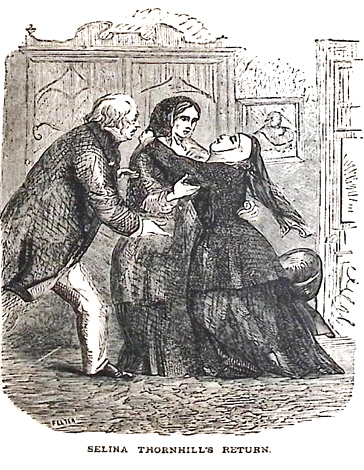
SELINA THORNHILL'S RETURN.
The father with whitened head, and the mother with lines of sorrow deeply traced on her once blooming countenance, thankfully opened their arms to receive the mere shadow of their child. She said her spirit was exhausted, but it was evident that the body was still more so. And she laid her head on her mother's bosom, and touchingly prayed for "peace."
"Peace I leave with you, my peace I give unto you: not as the world
giveth, give I unto you . . . Ye believe in God, believe also in
me . . . I am the way, the truth, and the life: no man cometh unto the
Father, but by me—"
—were the sweet words which responded to that appeal.
And something like a smile lighted up the pale features of the weary sufferer. They brought to mind the good seed sown long, long ago in nursery days, and which now in the depth of her conscious need was found to be imperishable truth, able, when heard with the willing ear, and the heart, through grace, yielded to the operation of the Holy Spirit, to disperse the miserable superstitions which in later years had stifled and overgrown it.
Their sound was not rejected now, for the young inquirer was in new earnest. She declined for the present, under the plea of illness, the attendance of spiritual superiors who would have brought their best consolations to her assistance, and turning to her father, she said, "I have tried them all; salvation is not in them. Others may try harder, and do better, but I can do no more; I want all done for me. O that it could be so!"
And it was so. Poor and pitiable the soul that never learns the emancipating secret; and happy the freeborn spirit that takes sanctuary in Jesus from the pursuit of conscience, the slavery of fear, and the power of temptation. And wondering, grateful thanksgiving filled the father's heart when his suffering child asked him for the long-banished Bible that she might again hear those truths which had partly upheaved the superstructure of error, and in which she might yet find peace before the lamp of life went out forever.
The more she now learned of the word of God, the deeper grew her conviction of utter helplessness except through the one Mediator between God and man. And as may usually be observed in consciences touched with genuine penitence, one of the first proofs of a revolution in the estimate of duty, was the feeling with which she deplored her neglect of filial obedience. If it be "sharper than a serpent's tooth to have a thankless child," it is the keenest sting in the heart of the child awakened to a sense of sin, that it has been "thankless" and disobedient where its first love and duty were due.
But parents on earth, and a Father in heaven, had freely forgiven all; and the poor troubled heart that had confessed in vain to man, confessed to God in Christ, and received effectual absolution. He was made unto her all she wanted, "Wisdom, righteousness, sanctification, and redemption;" and to believe and to fall asleep were all that remained for her to do.
She told with touching self-condemnation how she had struggled to keep out sin; how she had confessed day by day, said prayers by hundreds, performed every duty recommended, until all around her said she was worthy to be the bride of Christ, and nothing was wanting but the solemn ceremony which would seal the heavenly union. But still holiness came not, peace came not; she was yet where she began, only more hopeless, and she dared not complete the terrible self-deception.
Such details only convinced Mrs. Thornhill more painfully of her own mistake. Hers should have been the precious privilege of leading that devotional mind, of guiding that spiritual longing to the foot of the cross, instead of conforming to the follies of the world, and frittering away the period of her influence. And though, at last, her dearest wish was granted, and her child was saved, yet through what disobedience and sin, what clouds and darkness, what pain and sorrow, had the poor sufferer passed, ere the mischief of her negligence was thus more than repaired by heavenly grace.
It has pleased the Lord God, in his providential dealings with man, to connect duties performed and rewards bestowed, means and results, diligent efforts and reasonable success; and if so in temporal things, and among those who are merely aiming at the benefits of this life, how much more in spiritual things, and among his own beloved people! Surely no believer would desire to dissever the harmonious union. It has nothing to do with the equally clear truth of the sovereignty of God, and does not dispute that,—
"Deep in unfathomable mines
Of never-failing skill,
He treasures up his bright designs,
And works his sovereign will."
But it should never be forgotten, that "if his children forsake his way, and do not act according to his commandments," he "will visit their transgression with the rod, and their iniquity with stripes," not in judicial anger, but in paternal chastisement; "nevertheless his loving-kindness will he not utterly take from him, nor suffer his faithfulness to fail."
I will pour my Spirit upon thy seed, and my blessing upon thine
offspring; and they shall spring up as among the grass, as willows by
the watercourses.—ISA. xliv, 3, 4.
AS her children grew up, it was Mrs. Latimer's earnest desire to continue, as she had ever been, their chosen friend and companion. But could she hope that the pleasure with which they had formerly sought her society would continue after the restraints of education had been removed, and freer intercourse with others became suitable to their age? Was it probable that they would still make her the confidant of their thoughts and feelings? Would they still believe that she was interested in everything that interested them? Or would they not rather shrink from the unreserved simplicity of earlier intercourse, fearing to be misunderstood; or, what to some is worse, to be too well understood, doubting sympathy, dreading ridicule, or concluding that the wise and Christian mother would disapprove the light, gay thoughts of youth?
There had been hitherto no interruption to the closest intimacy, no gap of absence at school, no visits from home without maternal guardianship. God's kind providence had favored all her plans for home education; and now unusually perverse must have been the materials on which she had worked, or ill performed indeed her duty, if her children knew not where to find the readiest sympathy, and the warmest interest in all that affected them. There was One whose right she had always placed first, and to whom alone she was willing to yield their closest confidence; she had taught them that while to God all hearts are open, he loves to have his children pour them out voluntarily before him; and if she might hope they thus enjoyed the highest communion, she might reasonably expect that the next confidant of their revealable feelings would be, the ready ear of a loving Christian mother. It was not jealousy of other friends, nor selfish monopoly of their affections; it was the lawful claim of the maternal relationship, and the due response of filial love; it was wise provision against misguided feeling, and a shield from many youthful mistakes.
But in addition to the tie of nature, there was a dear and precious bond of union between the mother and her daughters, which it were well for parents to ponder. It is allowed that spiritual relationships are influential and lasting; and the apostle Paid adopted the tenderest emblem of their nature, when he addressed his youthful convert as "mine own son in the faith." And when he would add a constraining motive to the exhortations he was writing to the Church at Corinth, he thus pleads with them:
"As my beloved sons I warn you. For though ye have ten thousand
instructors in Christ, yet have ye not many fathers: for in Christ
Jesus I have begotten you through the Gospel. Wherefore I beseech you,
be ye followers of me."
The individual who seems to be God's instrument to enlighten the soul with knowledge of his salvation becomes justly dear and valued; and the affectionate sense of personal obligation is added to the sacred interest with which his mission invests the teacher. But the relationship so gracefully urged by Paul may descend among ministers who have not the apostle's single-hearted devotedness, and converts forgetful of Timothy's consistent example; and the results may be mischievous on both sides. Idolatrous attachment to a comparative stranger has been often interwoven with the reception of Christian truth; and a spirit of partisanship has ranged youthful enthusiasts on the side of human opinions, because taught or vindicated by their favorite pastor and guide.
To unite, so powerful an influence in its purest form with that naturally her own, is a wise mother's aim; and if blessed of God to be his voice to her children, she may guard them from many snares, and hallow her own memory in their hearts by a more sacred and holy love. Thus was Mrs. Latimer associated with the heavenly hopes, as well as the earthly happiness, of her children; and devotedness to her as their spiritual teacher was a twin fold in the enduring bond which united them to the best of friends.
Between the sisters themselves she promoted the closest sympathy, knowing how many mischiefs and heart-burnings arise from permitting young people to choose from indifferent society a companion whom each calls "a friend," the friend being in reality too often a retailer of gossip, a reflector of the sentiments and fancies confided to her ear, unfit to advise in difficulty, and an instrument of family disunion.
It is not denied that friendships, worthy, honorable, and lasting, have been formed in the warm impulse of youthful affection, but they are the fair exceptions. The frequent rule is selfishness and jealousy. The intercourse consists chiefly of silly secrets about things that are either unworthy to be mentioned at all, or, if worthy, would better be reposed elsewhere. Happy the sisters who feel that, by whomsoever surrounded in the society of congenial youth, their most intimate friendship is with each other, their interests are one, and their pleasures sweetest when shared together. And when in need of guidance, their mutual resort should be the trusted mother who loves them all alike.
O that mothers, in the dignity of their subdued or well-balanced feelings, after the discipline and experience of years, would be careful how they crush or repel the awakening susceptibilities of youth that has had no experience, and to which each new feeling may open a world of speculations concerning life and its manifold destinies. It is a mistake to despise the first signs of conscious power to please, to turn contemptuously upon a supposition of gratified vanity; and still worse, to excite a blush by the suspicion of feelings, or imputation of motives, which may either not exist at all, or if existent, might never assume importance if left unremarked.
The delicate machinery of the youthful affections cannot be too jealously guarded, or too closely watched, but it must be with the refined and unobserved skill of a mind as delicate as itself. No rude touch nor vulgar breath should intrude into its movements, or unnecessarily interfere with its reserve, lest the very confusion be introduced, and the very mischiefs suggested which it was designed to avert. Warm young hearts should be led to expand in love and tenderness at home, where scope enough is usually afforded for their healthy exercise, before they can profitably be bestowed elsewhere.
But many a parent, or injudicious friend, has thoughtlessly raised a spirit which no subsequent discipline could lay; and in yielding to that temptation of vulgar minds, some imagined opportunity to banter and quiz has driven the plowshare of ridicule over the delicate fibers of modesty and reserve, and sown in their stead that pert defiance, flippant retort, and deceitful concealment, which deform the moral beauty of many fair maidens in the present day. A line of conduct may then follow, leading too often to results disastrous to domestic peace.
Confidence, where there is anything to tell, may be induced between those who understand one another without its being rung forth by questioning, which, after all, produces nothing worthy of the name. And that mother is a wise, true friend, whose sympathy and love have been so long trusted that she can tenderly elicit the truth from her child if she fear any wrong bias to her inclinations, and without assuming too much, reason them back to a correct estimate of worth and honor. Many a premature interest might be easily dissipated, undesirable attachments arrested in the bud, and many a wretched self-deception hindered, if the love of mothers and daughters were allowed, as the period of authority and obedience expires, to ripen into sympathizing, confidential friendship. The mother would lose nothing; the daughter might gain much.
It in no way derogates from the respect due to a parent that her children can talk to her of anything and everything by which their minds and feelings are exercised; it does derogate from it essentially if any other be permitted or selected to usurp the place in their confidence to which she is entitled. She loses the sweetest proof of their appreciating love, and the pledge of their integrity; they lose the benefit of her counsels, and the influence of close intercourse with her purified affections.
The self-possession and propriety of manner observable in the young people brought up as Mr. Latimer's daughters had been, in the retirement of a Christian home, surprised many who expected to see them awkward and constrained, or book-learned and self-sufficient. But not having been taught to regard the world's opinion as any criterion, but rather to consider what was right and good in itself, and having insensibly imbibed from the examples constantly before them the simple observances of courtesy and refinement, they felt no awkward diffidence about the effect of what they said or did, and came into society not to exhibit themselves, or to suppose themselves there for the notice and admiration of others, but because their age warranted the privilege of meeting and visiting their parents' friends.
Mr. and Mrs. Latimer did not "introduce" their children as many young ladies are introduced, like rare plants cultivated for exhibition, and brought forward in all the triumph of anticipated applause, candidates for the best prizes in the lottery of life; but simply permitted them to appear among friends and acquaintances more frequently than before, because the object of their closer studies might be supposed to be attained, in the formation of principles, and the acquisition of knowledge calculated to prepare them for paths of usefulness in which their time and talents might be employed for God. It was but a slight change of scene—home as it were enlarged; the persons remained the same, the motives, the desires the same.
If the attractions of Mr. Latimer's house had increased by the presence of his accomplished daughters in the visiting circle, it was obviously his duty to take special care who found access there. The vain, flattering coxcomb, the empty-headed idler wishing to kill time, had little opportunity of admission. But if such did happen to present themselves, it needed not a father's frown or a mother's eye to warn the sisters against extravagant compliments and besieging attentions. The simplicity of sound good sense and Christian principle armed them with matchless weapons wherewith to unmask the cheat, and, for the time, half annihilate the perpetrator.
"Mamma," said Marion one day, when alone with her mother, "do you know I heard last evening the very nicest remark made on our dear Agnes that could be said of any one."
"Did you, dear; what was it?"
"Why you know, mamma, it is no wonder that we admire her, who know how good and kind she is, but I never seemed to understand before what it is that makes her look always so lovely. I see young ladies with more beauty of feature and complexion, perhaps, but few so interesting."
"Well, dear, did you meet with some one who agrees to your opinion?" said Mrs. Latimer, with a smile.
"I was standing near Mr. and Mrs. D., who seemed to be observing Agnes very closely. And when she was asked to sing, and did so at once, in her usual willing way, Mrs. D. said, 'There is no affectation about her, I should think.' And, 'What a very sweet Christian face she has,' said Mr. D., looking at her so kindly, and laying strong emphasis on the word 'Christian.' I felt in a moment he had traced her attractiveness to its true source."
"I am glad you did, dear Marion; it is very precious to think that it is 'by the grace of God' she is what she is. A heart and mind under the guidance of the Spirit of God, can spread the beauty of Christian peace and serenity of temper over a countenance not gifted with symmetry of form."
"Agnes has no vanity," said Marion, musingly.
"Are you sure of that, Marion?"
"Sure, dear mamma? I have not a single doubt of it," exclaimed Marion, looking at her mother with astonishment.
"I have; and I think Agnes herself would not subscribe to your view of her character in that respect."
"Mamma," said Marion, after a moment's pause, "if you think Agnes vain, what must you think of me?"
"I did not say that Agnes is vain, my dear girl, nor do I think you vain either. But that is a different thing from being tempted to vanity as one of the corruptions of our evil nature."
"Then Agnes subdues it, keeps it in check, you mean, mamma."
"Yes, and so does my Marion, I hope," said her mother, tenderly. "Vanity is one of the greatest mischiefs with which youthful womanhood has to contend. It is natural to love praise; it is woman's delight to exercise the power of pleasing, and her temptation to gratify it, increases with every success. I have felt it so, nay, I feel it still, though not in the same manner or measure; and do I err in thinking that my children may feel it too?"
"No, dearest mother, you are right; and perhaps in this way Agnes would be obliged to admit the same. I should like to be above the folly of seeking or caring for the praise of people who have no principle to guide their judgment."
"You discriminate justly there, Marion. A young woman who haughtily sets herself above all human opinion is likely to be particularly selfish and disagreeable."
"It is not wrong, then, to be willing and glad to please those whose good opinion is worth having," remarked Marion.
"Not at all. And judicious praise is often the just tribute to self-denying love; it encourages and stimulates right efforts. And though, of course, secondary to the great motive which should rule all we do—the desire to please God, the good opinion of his people need not be denied a place in our enjoyment of present reward."
"It is much more easy to satisfy ourselves that we please somebody like ourselves, than that we please God, mamma."
"And yet no one so tenderly feels for our weaknesses, and bears with our infirmities, dear Marion. I have often felt, when self-condemned for sin, that I can better bear the all-searching eye of God, than that of any fellow-sinner; because he pardons completely, and he knows all—not only the fault, but the penitence. He upbraideth not; and a pardoned sin is to him as if it had never been. We do not find this in our fellow-sinners; they remember our fault; they know but little of the sorrow and penitence which have followed it, and we are perpetually liable to their suspicions."
"It is certain that mere vanity must grovel about among sin and folly, if it is to be gratified at all," said Marion. "It cannot soar into anything commonly respectable."
"But it may take another name, and become pride of intellect, conceit of talent, and self-sufficiency in many ways not less reprehensible."
"Well, then, I suppose there is no escape from some touch of its troubles. But a vain woman has always seemed to me such a despicable, senseless creature."
"But a woman who is aware of one of the weakest points in her natural character is safe from that designation. She will try to do and be what she desires, in the spirit which elevates above the littleness of personal earthly distinction. And though vanity may assail as a temptation, it will not be a conqueror, and perhaps never show its colors long in the battle-field of her experience."
"Thank you, dear mamma, for that encouragement. But when I spoke of a vain woman, I was just thinking of some young ladies I have seen who seemed to covet admiration for personal attractions, and do their best to secure it too."
"That is the usual form of female vanity in undisciplined hearts, and weak or uncultivated minds. And it involves so many other faults that few objects are more pitiable than a young woman vain of what she has no merit in possessing, and which an illness or an accident may ruin at any moment. It leads to immoderate interest in dress and adornment; it provokes envy and unworthy emulation. Its triumphs are destitute of lasting gratification, and it tempts to the neglect of those domestic qualities which are the true attributes of a lovable and attractive woman."
"That brings me back to thoughts of Agnes, mamma. Do you know, I believe Mr. and Mrs. D. had a reason, and a very good one too, for noticing her so much."
"Do you, love? Then, perhaps, you may like to know that you are not singular in that thought."
"That is like my own dear mother," cried Marion; "you are able to give me your confidence, as well as to accept mine: and O! mamma, it does so steady me. I feel it such an honor not to be repulsed as if I were a child still. And I will not utter a syllable of my thought to any one else, I do faithfully promise you."
"That is right, darling; it would not be right or delicate to do so, and I would not have so candidly acknowledged the correctness of your penetration if I had not felt that anything concerning her sister is as sacred in my Marion's heart as if it concerned herself."
"Indeed it is, mamma," said Marion, with tears of grateful love springing to her eyes, "but I could not keep my discovery from you. But now I must tell you something naughty about myself, and what we have been saying has shown me that I am vain, or self-sufficient, or something of the sort. Do you know, mamma, that I cannot help seeing through people's characters sometimes. And when things happen afterward to prove that I am right, I feel quite edified with myself for my wisdom. If I only saw the good side of everybody, it would not so much matter. But I see the bad side the quickest, I am afraid. Now what do you call this, and what must I do about it?"
"I fear we must call it self-complacency at present," said Mrs. Latimer, gratified at the simplicity of the confession. "I have observed this power in you, dear Marion, and though discrimination of character is a valuable possession, being a great safeguard from imposition, watchfulness is requisite to prevent it from degenerating into censoriousness. You know true Christian love 'hopeth all things,' 'thinketh no evil,' and can feel no satisfaction at the correctness of an unfavorable impression concerning the conduct or character of another. I should prefer to see you less observant of persons toward whom you are not attracted by their virtues, and more anxious to detect in yourself those beams which may otherwise distort and magnify the motes around you."
"Mamma, if you have taken trouble to teach us what is right, should you be sorry that we can see and disapprove what is wrong?"
"I am not sorry, dear Marion, and I wish your opinions about right and wrong to be wise and firm, but you may make mistakes in judging of persons, notwithstanding your penetration. And even where you are compelled to disapprove, you should be careful to make kind allowance for disadvantages of education or circumstances, to which you have not been subjected yourself. This does not palliate sin; it only inclines us to the Christ-like spirit which pities and feels for the sinner."
"That is just what I want, mamma. I wish I could always remember that to us much has been given, and from us much may justly be required."
"Let me give you another caution, Marion. When you are obliged to observe anything disadvantageous to the character of another, do not give utterance to your discovery, unless some positive good can be secured by it. Speaking of a thing impresses it upon the mind; having given an opinion, we feel involved to support it by proof. And the unchristian and unamiable spirit is fostered of watching for evidences of our own sagacity."
"Mamma, did it take you a long time to form right opinions about things, or did it come to you at once?"
"Those of my opinions, dear Marion, which have any pretension to your description, have been formed by the prayerful study of the word of God, and the guidance of the Spirit who inspired it. I do not think any one will greatly err who is willing to bend to that authority, and seek that instruction. And those who come into society undefended by the knowledge of God's standard of right and wrong have to learn many a hard lesson from painful experience, which they might otherwise be spared. May you, dear child, seek the mind of Christ in your exercise of the gifts he has bestowed upon you and then I shall not fear for your quickness of apprehension, or powers of discrimination. We do not need time to prove the correctness of principles derived from his Gospel, but time ought to prove our faith in, and improve our practice of them."
Marion's impression concerning the chief cause of the observations made upon her dearly loved sister was just. It was in a family trained as Mr. Latimer's had been, that the sober-minded, anxious Christian father rejoiced to find an alliance sought by the son on whom all his earthly hopes were centered. He did not covet for him riches, or rank, or prosperous connections, but a happy home, and a true-hearted Christian companion, whose influence would be on the side of practical piety in everything, and who would bring with her "the blessing that maketh rich, and addeth no sorrow." It was from such a family that the jealous love of a mother might fearlessly receive a dutiful and attentive daughter, who would cement rather than sever the filial tie, and feel it her blessed privilege to contribute to that mother's comfort, rather than subtract from it one single attention to which she had become fondly accustomed.
It is no slight subject of anxiety when a son is disposed to form a separate home and household, and what is called "settle in life." Too frequently his intention to "settle" is thoroughly frustrated by the very individual he selects for its accomplishment. And the peace, order, and retirement he delighted to anticipate, are forever banished by the worldliness, self-indulgence, and dissipation in which his wife finds her untired enjoyment. Such a disappointment could not be through the habits, the virtues, and the cultivated character of an Agnes Latimer. The "sweet Christian face" was no deceptive surface, promising more than experience would realize, but the faithful index of a heart and life under the rule of those sacred principles which, far from deteriorating like most earth-born graces, must through life more and more beautifully adorn, more and more richly bless.
The rod and reproof give wisdom: but a child left to himself bringeth
his mother to shame.—PROV. xxix, 15.
BENEATH the courteous smile and easy manner worn in the presence of her acquaintances, Mrs. Fielding concealed a heart laden with grief and often with despair, and she knew no Friend on high to bear her burden, no resting-place for the bruised spirit that groaned with untold misery.
She comforted herself in the loss of her eldest son, whom she had given up for his worldly interest, by the knowledge that he was well provided for, and happy as self-importance and indulgence could make him. She had but a very small place in his regard; and if the young affections which had been cut off from their earliest claims were in any exercise at all, it was among strangers or relatives, whose place should have been subordinate to that of home and nature. At this she did not murmur, though it added a pang which she denounced as selfish. She took credit for the sacrifice she had made of a mother's feelings, and looked forward to the golden result with proud satisfaction. The wound was willfully self-inflicted, and she bore it bravely.
Probably the youth was as well-instructed as he would have been at home in all the moral qualities; and better after his generous uncle began to realize the responsibility he had undertaken, and to imbibe a desire to understand somewhat of man's eternal destiny. Riches had not satisfied his soul; and though he had bought many things with gold, he found it insufficient to procure peace of mind, or make a bargain for eternity. Mrs. Fielding had occasionally some fears lest her sister Marion's "peculiar views" had found favor in his eyes.
The place from which her eldest child was in some sense banished was filled by his brother George, who grew up, under her indulgent eye, in habits which she weakly fancied emanated only from the thoughtlessness of youth, and would yield to reason and authority in time. She knew of many circumstances that roused occasional alarm; and when they came to his father's knowledge, she palliated and excused, and perpetually came between the boy and the punishment he merited. Mr. Fielding's displeasure, though just, was not always wisely manifested; at one time severe, at another indulgent, according to the mood in which the annoyance assailed him; and when provoked, hasty in his choice of expedients to check the growing evil.
Blanche, engrossed with gay friends and varied pleasures, was no comfort to her mother in those scenes of domestic sorrow which too often disturbed her home, and thought of little concerning them but the disgrace which she sometimes feared George would bring upon his family. Here again the unselfishness of the mother prevailed to excuse the selfish child; she would not that premature grief should dim those bright eyes, or oppress the gay spirits that seemed to flourish amid the world's revelry and admiration. So she continued to hope the best and deceive herself, while her son was growing more unmanageable, presuming, and reckless.
His early love of the indulgences of the table, treated as a joke in childhood, and not restrained by a firm and consistent authority in after years, developed into decided intemperance, which was deemed more disreputable than sinful. In vain Mr. Fielding stopped supplies of money, while he could coax or threaten from his mother the means of gratifying his inclinations. And many were the self-denials to which she submitted, and the disingenuous expedients to which she resorted, in order to furnish him with continued funds. His promises were speedily broken, his resolutions yielded before every temptation, and no influence seemed strong enough to keep him within the common bounds of respectability.
The quarrels and contentions with his father, the constant terror in which he held his still doting mother, the fearful effect of his example on the younger members of the family, together with the risk of pecuniary loss and crushing disgrace, all operated toward a serious decision that some effort must be made to rid the household of such an unmanageable inmate.
After a difficult task one evening, in compelling his son, who had broken into the drawing-room in a state of intoxication, to retire to his chamber, Mr. Fielding returned for a moment to his agitated family.
"Helen," said he sternly, "I am resolved to execute the plan I have named to you; therefore do not seek to interfere with it again. I cannot and will not live subject to such infamy as this; if there be a remedy at the antipodes, it shall be sought."
And leaving the house, he bent his troubled steps toward the residence of his brother-in-law.
The worldly man does not often turn to the world for comfort in the hour of heart-sorrow such as Mr. Fielding was then enduring. If he can reckon a child of God among relatives, or even mere acquaintance, he would rather seek counsel and sympathy there, for he knows he is cared for, his confidence will not be abused, nor his misery thrown coldly back upon his burdened spirit.
Mr. Fielding's heart ached too bitterly to permit him to join the happy party where Mr. Latimer was reading to his family, and requested a private interview.
"I have just been seriously annoyed," said he in apology; "and it strikes me that you can help me, Latimer. I believe you will if you can."
Mr. Latimer kindly confirmed this impression, and the unhappy father proceeded.
"You are aware, I dare say—it is likely that you would hear—how my son George has been conducting himself for some time past. He is bent upon ruining himself and me also, and I have decided to send him to sea, in the hope that, separated from the temptations and indulgences of his present position, he may be brought to his senses. Do you think Philip's captain would take him? I know your son is a steady fellow, and perhaps he would look after his cousin a little, and give him the benefit of his good example. He is welcome to make anything of him he can; if a saint, all the better, for I am weary enough of him as a sinner, I assure you."
"My dear brother," said Mr. Latimer, "you forget that he is more likely to influence others, than to be influenced by them. And I do not think Captain M. would undertake the charge unless invested with authority to restrain in any way he may judge necessary."
"That he shall certainly have. I shall be too glad to be relieved from what has almost distracted me during the last year, to cavil about the terms. So when the ship returns, I shall calculate upon your interest with the captain. And if he will not, why some one else shall, that's all; for the same country cannot contain me and such a son any longer."
"Does George know of your decision?" asked Mr. Latimer.
"No, he has only been threatened with it. But I have told his mother, and therefore he will soon be aware of it. Helen has been most blamable with her foolish indulgence, and cruelly he is repaying her now. It is well for you, Latimer, that your boys take the steady turn; though, to tell you the truth, I rather wonder at it."
"I wish I could persuade you, for the sake of your other children, to try at least a part of our plan," said Mr. Latimer; "your own has not answered to your satisfaction, and it is not too late to change it."
"Why as to that, you know it is all a matter of chance; one lad goes right, and another wrong, without any apparent cause."
"Excuse me if I cannot admit that," said Mr. Latimer kindly; "for though I do not doubt for a moment that you have been a kind father, and have done quite as much as many other fathers to secure the greatest advantages for your boy, yet if you had thought more of the Scriptural precept to 'train him up in the way he should go,' I cannot help feeling assured you would have experienced a different result."
"But, Latimer, may you not be congratulating yourself rather prematurely on the complete success of your training? You may not know all about Philip yet; perhaps he has his faults, though they may not be so openly disgraceful as George's."
"I am sure he has; but he has also a counteracting principle which will not allow them to 'have dominion' over him."
"But I have heard you say that no human will or power can impart that principle."
"True; but we know who can, and the means by which He often condescends to impart it; and when we are diligently using those which he has commanded, we may justly expect the reward he has connected with them."
"I thought we had worn this subject threadbare years ago," said Mr. Fielding, with a melancholy smile, "but I confess your words ought to have greater weight now that you seem in some measure to have tested your views successfully. It just strikes me to ask what you mean by 'the way he should go;' for I wished my boy to be sober, honest, dutiful, and industrious, and had him educated in the respect and practice of all such virtues—at least he was subjected to no example of a contrary tendency—and I call that 'the way he should go.'"
"When Marion and I read those words in the Bible," said Mr. Latimer, "we were beginning to be too deeply interested in the subject to pass them over superficially; we examined into every word. 'Train' implied a duty on our part, and must have reference to the entire being of our child—body, soul, and spirit. To train one portion and neglect another, could not be training a child. Nor could we feel that the duty was done by putting him under the instruction and control of qualified professors. A child must have a character; and learning and study, however constant, do not form moral conduct. A great philosopher may be a petty tyrant; a wise legislator may not know a law that can rule his own temper; and a fascinating poet may be an intemperate spendthrift: such moral deformities never sprang from the training which the Bible inculcates. Affections, tempers, habits, thoughts, language, all need watchfulness, and discipline, and direction, as much as intellectual powers and bodily exercises. And the training is not worth the name which does not embrace them all."
"Well, this is rather strict, but it may be true. Now, then, what about 'the way' for all this? Who is to decide that? For you see no two parents may think alike upon that point."
"I do not believe that to be a matter of opinion, any more than the duty one of choice. And at the same source whence the command proceeds, I look for my instructions how to obey it. I find it written in Proverbs xxi, 8:
"'The "way of man" is froward and strange—'
"And in Job xxii, 15:
"'Hast thou marked the old way which wicked men have trodden? Which
were cut down out of time, whose foundation was overflown with a flood?'
"Isaiah says:
"'All we like sheep have gone astray; we have turned every one to his
"own way."'
"And it needs no inspired record to enable us to form some idea of the state of things when every man does that which is 'right in his own eyes;' for as the natural inclinations of the human heart are evil, opposed to obedience, authority, and holiness, it must come to pass according to the proverb,—
"'There is "a way which seemeth right" unto a man, but the end thereof
are the ways of death.'"
"Well, it is quite clear that these must be the ways in which a child should 'not' go; but the chief question yet remains."
"If we consider a little further, we shall see that God's word has positive directions as well as negative warnings. And at the threshold of parental as well as every other duty stands the sentinel of wisdom:
"'In "all thy ways" acknowledge Him, and he shall direct thy paths.'
"I find God's prophet of old speaking thus:
"'I will teach you the good and the right way: only fear the Lord, and
serve him in truth with all your heart.' 1 Samuel xii, 23, 24.
"Again, in Proverbs vi, 23:
"'The commandment is a lamp; and the law is light; and reproofs of
instruction are the way of life.'
"David asks, and answers for us, that most important question:
"'Wherewithal shall a young man cleanse his way? By taking heed thereto
according to thy word.'
"And God's word has left nothing doubtful concerning the good and right way, which preserves health, purity, and peace.
"'They that tarry long at the wine' are warned of 'woe;'
"And filial obedience, personal sobriety, industry, and truthfulness are distinctly connected with certain rewards. But we find the whole subject beautifully summed up in the words of Him who spoke as never man spoke:
"'I am the way;' 'Come unto me.'
"Looking to him in his work, he is the way of pardon; resting in his love is the way of peace; and following in his steps as our perfect example is that way of righteousness in which the child should be trained to walk, from which, when old, he shall 'not depart,' and where alone 'the hoary head is a crown of glory.'"
"Latimer," said Mr. Fielding, seriously, "I have been accustomed to think that you were looking too far forward, and, in eagerness to secure heaven for your children, were forgetting that they have to get respectably through this world first. I believe I have been mistaken."
"If we set God and his word first, all other things fall into their right place, my dear brother. It is as true in morals as in providence:
"'Seek ye first the kingdom of God, and his righteousness, and all
these things shall be added unto you.'
"In all the social relations of life, in all public duties as well as private actions, the real believer in Jesus Christ should be first and best. Mind, I do not speak of professors of religion, nor of that fashionable sham which some call religion, which tries to serve God and mammon, provokes no opposition, and deserves only contempt; but I mean the real, matter-of-fact believer, who is born again of God's Spirit, lives by God's word, and is what he is by God's grace."
"Well, I cannot see with you in everything, but I own that in some things you have appealed to my common sense, and perhaps my younger children may profit by it."
"May I venture to ask if you will allow me to have a little conversation with George concerning himself and his own interests?" asked Mr. Latimer.
"Most willingly, and thankfully too," said Mr. Fielding. "But you know he has not been trained as you have described. Perhaps he may turn round and charge me with not having done my duty by him, after all."
"The commands of God concerning you which I would lay before him are unconditional; it is 'Honor,' 'Obey,' without any reference to what the parent has done, or left undone; and he must learn his own responsibility before he can presume to look at yours. Believe me, dear brother, I have not spoken so plainly to excuse your boy, but only in the hope that concerning the others you will think more of 'the way' in which they should go."
"I wish you would get your good Marion to initiate Helen into it a little; she has more in her power than I have, and I really do not know that the bitter lesson she is learning will have the effect of altering any of her ideas about her children."
"But, Fielding, we men of business, who spend the greater part of our day in providing for the temporal wants of our families, ought we not to find a little time for their moral and spiritual benefit? Our riches cannot make them wise, good, or happy. Let us seek for them first those unsearchable riches which can do all."
"Well, perhaps we may have a little further talk about it some other time. You will do what you can with the captain when the ship comes home; and any good advice you can bestow on George I will thank you for, though he may not; he is a sad, unfeeling fellow. But I must return home, lest he may be breaking out for some fresh mischief. May God save you, Latimer, from ever knowing by experience the feelings with which I left it this evening."
"And may the same God teach you where to find help and comfort," said Mr. Latimer, as he affectionately grasped his brother's hand.
And they parted, one to a distracted wife and a disturbed home, where God's presence was neither desired nor thought of; the other to a sympathizing and happy domestic party, on whom His blessing, so unceasingly sought and so dearly prized, rested in abundant proofs of gracious favor.
George Fielding had no relish either for his uncle's advice or his father's project. And one day, during Mr. Fielding's absence, having found access to a large sum of money at the office, the temptation proved too strong for his remaining sense of right. He took advantage of an opportunity to pocket the amount and depart, and was seen at the office and at home no more.
When hour after hour of the succeeding night passed away, poor Mrs. Fielding guessed too truly that her son had absconded, and her restless distress tended to confirm her husband's fears. She dared not ask what course would be pursued, but she trusted that the father's heart was yet too tender, or his pride too great, to expose his domestic sorrow to the public eye.
The amount with which George had disappeared was too important to be lightly abandoned to his profligate gratifications, and all private means of pursuit and detection were immediately put into operation. After a week of fruitless search, Mr. Fielding returned home wearied in body and broken down in spirit, and in a mood of sullen resentment, commanded that his son's name should never more be uttered in his presence, and he should be considered henceforth as dead.
As easily might the earth be arrested in its orbit, as a child, however worthless, be banished by the power of human will from his mother's heart; and the blow sank deep there with a wound never to be healed on earth. Some years before, Mrs. Fielding had joined in the opinion, with reference to a somewhat similar case in the family of an acquaintance, that disgust at religion had driven a child into sin, to escape the annoyance of Scriptural instruction. Here no such reason could be alleged. No motive but that of honor and respectability before men had ever assailed the reluctant ear; every promise, every bribe, every prospect connected with personal advantage, had been tried in vain.
Whence, then, the distressing disclosure of this unexpected iniquity? Whence but out of that heart which Divine inspiration has pronounced "deceitful above all things, and desperately wicked"? That heart originally alike in all, but unreclaimed from its native ruin by that knowledge which is as a second birth. It is true that it "might" have happened in spite of Scriptural instruction, parental care, and prayerful fulfillment of Christian duty, but it is clear that all human probabilities, and all divine promises, are in favor of a different result. Neither is it denied that in such a family as Mr. Fielding's might have been found a Christian youth, taught by the Spirit of God, and providentially guarded from the natural consequences of the evil influences around him. But such is not God's promise, and to expect it is only presumption. They who sow to the wind must expect to reap only the whirlwind.
The mercy of the Lord is from everlasting to everlasting upon them that
fear him, and his righteousness unto children's children; to such as
keep his covenant, and . . . remember his commandments to do them.—PSA.
ciii, 17, 18.
GODLINESS hath the "promise of the life that now is, and of that which is to come." If happiness is to be found on earth, it is only where God's blessing is, and in his favor which is better than life. Them that honor him, he will honor, and they that despise him, shall be lightly esteemed. Unquestionably the highest attainment of human happiness is to be found in conscious acceptance to his favor through Christ, and sanctifying communion with him through the Spirit, and is independent of all the external circumstances that can affect the believer in his pilgrimage through life. Here "Christ is all," and having him, though "having nothing" else, he possesses "all things."
But there are temporal blessings, personal, relative, and social, in the gift of the same gracious hand. And even now, as in the experience of the young monarch of Israel, where great heavenly and spiritual things are sought, very valuable earthly things are often bestowed in their company.
The dearest, best desire of the Christian's heart is to know more of God and to live to his glory. And not a Samuel only, but every member of his family is received as a sacred charge to be nursed for heaven, and dedicated in faith and prayer to the same happy service.
Thus have parents believed and worked, and one by one the reward has come down in the golden cords of heavenly love, to wind their everlasting folds around the heart of each precious child. Angels have been commissioned often to rejoice over that honored household; it is a familiar spot to them, and each time from their happy throng some bright spirit has lingered on the wing, henceforth to minister for another heir of salvation.
Thus and thus it had been in the family whose simple story is sketched in these pages, no solitary instance exaggerated into contrasting prominence, but an inadequate record in every circumstance of things that have been, that are, and will be again. It was emphatically "a Christian family."
"Train up a child the way he should go," had been the rule from the first dawn of intelligence in nursery days; and now they were old they were not departing from it. "The fear of the Lord is the beginning of knowledge," had been the motto presiding over all intellectual pursuits; and "by the fear of the Lord, men depart from evil" had been the moral consequence in life and practice.
And now, though first and chiefly such were the blessings sought, many others followed in rich abundance in their train. Prosperity and honor and respect abroad, peace and love and happiness at home, crowned the consistent lives of God's dear children. There was not a merchant in the town who would have hesitated to receive the son of such a family into his confidence and employment; there was not a housekeeper who would have rejected a servant recommended from that household; and there was no Christian parent who would not gladly have secured for his children a share of the hospitality and friendship of that well-ordered home.
"The father of the righteous shall greatly rejoice" is a prophecy that has many a bright fulfillment on this side of the grave; and especially and peculiarly Mr. Latimer was permitted to realize its truth, on an evening subsequent to Philip's return from sea, when, with all he loved best on earth around him, he could adopt the language of the royal psalmist, and say,—
"Who am I, O Lord God? and what is my house, that thou has brought me
hitherto? Therefore now let it please thee to bless the house of thy
servant, that it may continue forever before thee . . . and with thy
blessing let the house of thy servant be blessed forever."
The sunny presence of the young sailor not only made joyful holiday for hearts and hands while he stayed among them, but there was now the exquisite pleasure of communing together of things that belonged to his and their everlasting peace. And more cheering were his glimpses by faith into the land of promise, than the animated details of big, adventures among places and people of earthy clime and color.
Ernest was there, with his open, intellectual brow, and quiet ways, his father's friend and companion in hours of business, emulating the consistent example before him, and the welcome addition to the happiness of his mother and sisters in hours of recreation at home. And Herbert, still the mother-loving boy, with his young heart delighting in the hope that all he loved were journeying heavenward "hand-in-hand," and giving fair promise that one minister of the everlasting Gospel would yet be found among them.
Agnes and Marion, with two younger sisters, on whom was now being spent the same loving care which had been so successfully lavished on them, completed the family picture. And the parents, themselves scarcely past the prime of life, gazed on it with a deep and holy gratitude, more eloquent in the silent tear that glittered in the mother's eyes, than in any expression that human tongue could utter. Now was the hope which they had pleaded night after night, year after year, by their infant pillows, amply and richly fulfilled. Now was the watchful care, the self-denying patience, the consistent discipline, more than rewarded; and all the tears and fears, and anxieties and trials, were swallowed up and forgotten in an overwhelming sense of blessedness that God himself had given, and in which he too graciously sympathized ever to let man or devil take away.
"Lord, here are we, and the children thou hast given to us," was the anticipating thought, as overleaping the changes and chances that must yet checker the earthly lot of these youthful pilgrims, they seemed to stand together before the great white throne, and to receive the approving command to enter all into "the joy of their Lord."
Several Christian friends joined the domestic party to sympathize and rejoice together. And among them came another grateful parent in the person of Mr. Bingham, who had received back his reformed prodigal to his home. And though there was now no mother to be cheered by his return, her prayers were answered. And if she knew it not then, she would know it with adoring praise throughout the great hereafter.
But among those friends none experienced a warmer interest than Mr. Ashford, Mrs. Latimer's brother, the same who had desired to adopt Philip in his childhood, and who within the last few years had been led to see the path of human duty in the light of Christ's constraining love.
"Marion," he said, as he drew near to his sister's side, "I feel tempted to appropriate to you an angel's salutation to the favored one of old, and to say, 'Blessed art thou among women.'"
"It is true indeed, dear brother," said Marion with a grateful smile; "my cup of blessing is running over."
"I would ask leave to add one little drop, if it be not too poor a thought to mingle with your just thanksgivings. You would not give that boy to me, and you did right; I could not have brought him up as you have done. But I may be allowed to have my own way about his future provision in life; and when he is ready to launch, he shall command as fine a ship of his own as ever sailed from port. It will rejoice my heart to know that wherever his flag may float, it carries with it such a specimen of Protestant Christianity as any nation might be proud to own. I heartily wish the religion of Christ had more such representatives from the homes of our Christian land."
"Thanks, kind brother," said Mr. Latimer; "and we the more gratefully appreciate your generous proposal, in that it is a tribute of approbation to the mother who has for so many years, in prayerful faith and persevering love, presided over the duties and the happiness of one such home. Come here, Philip, and hear your uncle's comment on a Christian mother."
"I don't know what any one else says about her," replied Philip, gazing fondly in his mother's face; "but this I do know, that 'her children rise up and call her blessed,' and next to the favor of God, there is nothing more precious to them than her love."
"And she has 'no greater joy than to hear that her children walk in truth,'" said Mrs. Latimer, as her heart gratefully accepted the sweet and touching tribute.
"I am far from undervaluing the wisdom, authority, and consistent example of a Christian father," said Mr. Ashford. "But I confess to full sympathy with the reply given by a noble-hearted patriot of France to the great emperor's question,—What would preserve to his country the first place among the nations of the earth? The bold, wise answer was,—
"GOOD MOTHERS!"
THE END.