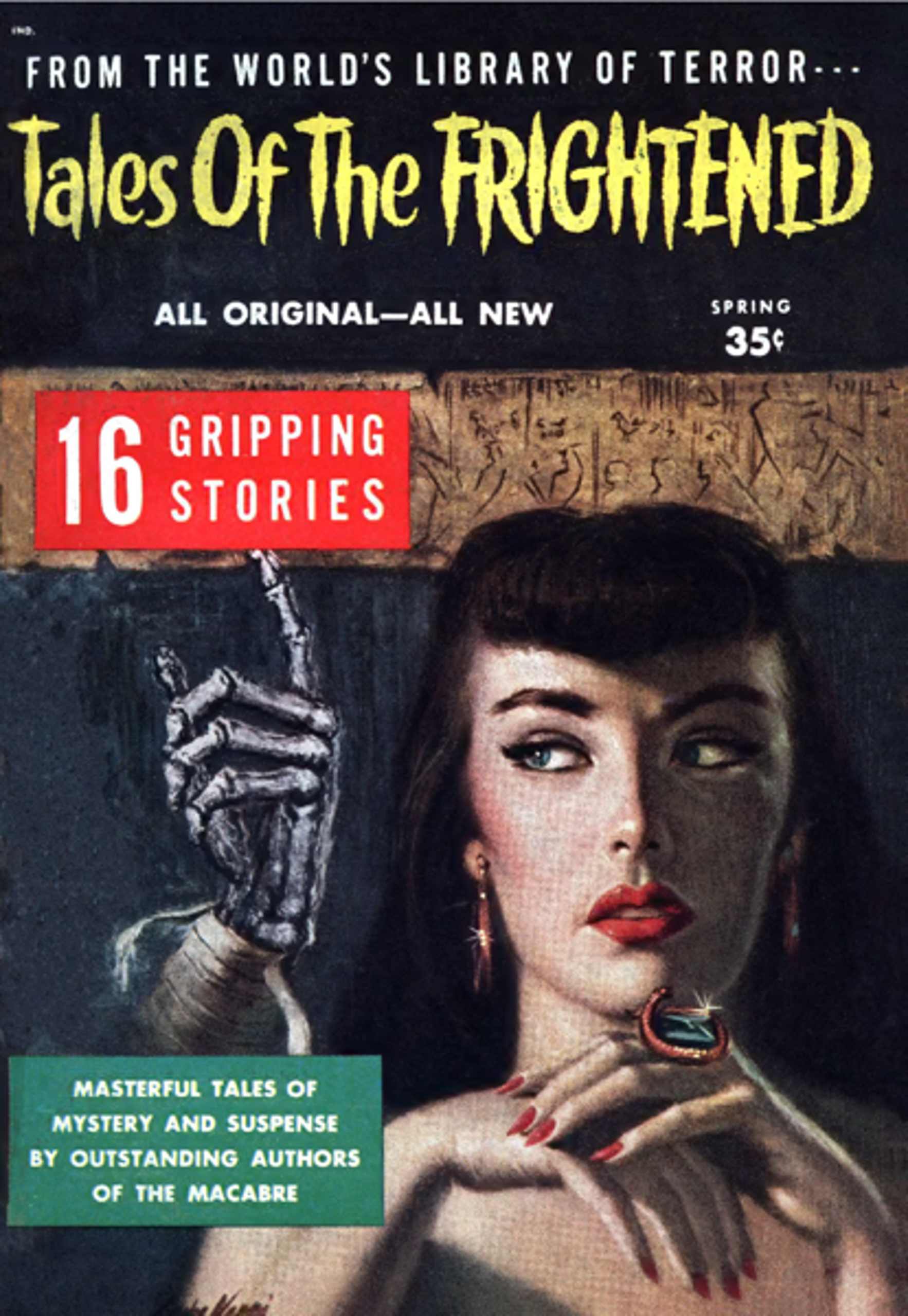
Transcribed from Tales of the Frightened, Spring 1957 (vol. 1, no. 1).
Transcribed from Tales of the Frightened, Spring 1957 (vol. 1, no. 1).
by Alan Henry
[Pseudonym of John Jakes]
History will attest that Mr. Newsome Holder was insane, although his was a form of insanity which did not manifest itself in various bizzare symptoms, but in one single act conceived dispassionately and with amusement in what Mr. Holder regarded as his clear, superior mind. He looked quite ordinary, in fact, this American—perhaps a bit fat around the waist and gray around the ears, but excellently dressed, for he had inherited a fortune from his mother and had never done a day’s hard labor in his life. Those who noticed—and not many did—recognized him as a tourist, a sight seldom seen in this tiny English hamlet of Styles, a short distance from London, but a sight in no way frightening or unusual.
Mr. Holder stood at the upward end of the cobbled High Street, gazing with affection at the collection of shops under the drowsing May sun. On a hill in the distance glistened the windows of a very large manor house. Mr. Holder felt his pulses beat a bit faster, for this was indeed the perfect setting in which to fulfill himself.
Mr. Holder was planning to commit murder in Styles.
He had experienced, via years of leisure and nearly unlimited funds, every sensational pleasure of which man is capable, save one. Now at last, since all other peaks had been left far below, he was ready to ascend this final pinnacle, and kill another human being for the sheer intellectual joy of finding out how one felt as one did it.
Picking up his traveling bag, the last sounds of the rattling bus which had brought him out from London dwindling from his hearing, Mr. Holder proceeded down the street, past the greengrocer’s, past a stationer’s, to an inn over whose doorway hung an iron sign bearing the words, The Red Bull. How English! thought Mr. Holder rapturously. How ancient, how connotative, how typical! Almost literally quivering, Mr. Holder entered and engaged a room from the landlord.
He lunched joyously on ale and cold mutton and then retired to his rented chambers on the second floor, overlooking the High Street. A couple of boys could be seen throwing a red rubber ball and catching it, while a shambling collie leaped at their heels. No sound came to Mr. Holder’s ears save the bark of the animal, and that seemed so faint as to belong in a dream. The manor house on the hill might at any moment, in Mr. Holder’s view, have become frenzied with activity as a troop of be-plumed Cavaliers rode into its yard. The miniature village summed up perfectly for him hundreds of years of tradition.
Mr. Holder looked at his watch. Quarter past two. He planned to wait until nightfall before committing the murder, but one did have to be prepared. He opened his valise, and in turn opened a blue velvet box in which reposed a keen-bladed knife. Mr. Holder sat in the sun at the window, running the fatty ball of this thumb along the razored blade.
Like many, Mr. Holder regarded the grass on the opposite side of the fence as greener. He had for several years contemplated an intellectual murder, but was undoubtedly too close to his native America to appreciate the aesthetic values of a trunk homicide or blackjack assault. Then too, being somewhat of an intellectual, he despised the lurid treatment given such murders by the American newspapers.
For more years than he could count. Mr. Holder had been what was vulgarly known as a fan of the British detective novel. He cared nothing about the titles or the authors or the puzzles, but delighted only in the remarkable way in which murder in England, at least in books, seemed so polite, so rational, so un-crude, so purely cool and restrained. He had pored over maps, selecting at last the name of a small village whose sound summed up all his feelings for what England must be like, and so here he was, actually in Styles, and thrilled at the prospect of killing in the perfect environment.
He planned to treasure the newspaper accounts. It would be referred to as a “Singular Occurrence at Styles,” or, at its most sensational, “Startling Happening at Styles.” Always the tone of wonder, yet admirably controlled, as if the mood of the entire nation toward murder could be summed up in the placidity of a group of Oxford dons taking tea.
The sun sank lower, and when it had finally set, and a fragrant spring night covered Styles, Mr. Holder left his room with the knife in his pocket. He strolled past the upward end of the High Street, and at length saw a young man come pedalling along on a cycle. Mr. Holder hailed him and inquired the time. The young man courteously responded, although letting it be known that he was already late for an engagement at the home of his sweetheart. Mr. Holder then managed to draw him from his cycle on the pretext of getting a light for his cigar.
As the young man bent forward obligingly with his hands cupped around the match’s flame, Mr. Holder stabbed him through the chest several times.
Mr. Holder then dragged the corpse and the cycle to the edge of the road, and commenced to disfigure the former with his knife, in a fashion his palpitating brain could only think of as singular. He left the knife by the corpse, and the corpse where it would certainly be discovered by daylight, and walked back to The Red Bull.
Mr. Holder found himself desperately wishing to tell someone about the crime, so that he could experience the intoxicating magic of English reaction. The innkeeper was not momentarily present, and there was only one customer, a man of forty or thereabouts, wearing a tweed jacket and smoking a pipe. The man, whose name happened to be John Richardson Ford, had a tankard of ale at his elbow, and glanced around pleasantly as Mr. Holder entered.
“Hello there,” said Ford. “I heard we had a visitor in Styles.”
“I am the visitor. My name is Newsome Holder.”
“Ford’s mine.” They exchanged handshakes.
“I just killed a man,” said Mr. Holder.
“Excellent!” Ford laughed. “That’s always profitable. Hope you did it in a novel way. Getting damned hard to be clever any more, isn’t it?”
“This one, I am sure, is ... singular,” said Mr. Holder. He described briefly the crime he had committed. He was disturbed, however, by the frown on the brow of Ford. “Is anything the matter?” Holder inquired at the last.
“Well, I hate to say this when we’ve only just met, and don’t know anything about one another, but if you want to startle the populace of Styles, you’re going to have to do a bit better than a poor swain butchered in the ditch. Of course if you’re interested in establishing a certain mood it might go, but I really don’t think it’s awfully clever.” Ford clapped him on the shoulder. “Mind you, I know that sounds a bit lordly, but I believe that honesty can avoid many mistakes. Your little crime sounds too gangsterish, too American, if you see what I mean.”
Mr. Newsome Holder was stricken. He did not know if he could stand to hear Ford speak further. But Ford continued good-naturedly, “Why, only last Tuesday, Miss Crisby, at tea, concocted a fiendish little killing involving a large mirror, a pistol and a doorbell. Mike Ginnis is mapping one out in which he’s going to use a baby’s perambulator as an engine of death. I say!” Ford exclaimed. “I really think I have said too much. You look as if everything had just gone smash.”
“No, no....” muttered Mr. Holder. “Quite all right. Must have air.”
And he lurched out into the High Street and reeled toward the upward end, past the last shop, to the sylvan spot where the forever late swain lay bleeding on his cycle. Mr. Holder’s master scheme had proved empty, and his mind could not hold up beneath the battering of that realization.
Muttering to himself, Mr. Holder searched about in the grass for the knife, torturing himself by thinking, “Not singular, not singular at all.” At last he closed his fist round the handle of the knife, and turning toward the mellow, glowing lights of The Red Bull, he exclaimed, “May God damn this community of devils.” He was actually crying as he said this, and immediately he raised the knife.
Aware of his own miserable luck at being cast among madmen, he ended his own life with a brief stroke of the knife.
“A real murder!” exclaimed John Richardson Ford next evening in the public room of The Red Bull. “I ... I had no idea. Such things don’t happen in this part of the world, except on paper.”
P. C. Finch, laboriously writing out his report on the bar, said, “I found the body myself. I mean the bodies. What the blazes did you say to him, Ford?”
Ford scratched his chin reflectively. “Now that I look back, it’s damnably like one of my own books. It’s not what I said, but the perspective in which I said it. No one ever comes to Styles except publishers and literary agents and those few—very few—tourists who are either devotees of novels such as Miss Crisby and Mike Ginnis and I write, or amateurs attempting to write similar works. Even though this Holder was clearly no good, I feel damned guilty, because I assumed he knew about the little colony of writers here at Styles, or he wouldn’t have come. So when he said he’d ‘killed’ someone, I was delighted. I thought he was talking, as we do around here, about a book he was writing. You know, Finch—you’ve been at some of our get-togethers.”
Finch nodded. “The conversations are always most amusing, sir. ‘I killed the Duchess in the most ingenious fashion this morning. My publisher is certain to be pleased.’ Poor devil. He never stopped to think that murders that are—what did’y say was the word he used—singular?—murders that are singular are always more singular in books than in real life.”
“I can’t imagine, though,” Ford said, “why an American would come to England just to commit a murder. Personally I’ve always felt that a body thrown down a lift shaft in someplace like Kansas City would be a hell of a lot more colorful.”
“My feelings exactly, sir.”
Ford sighed. “But then there’s always danger, when you write about something with which you’re not familiar.”
This etext was produced from Tales of the Frightened, Spring 1957 (vol. 1, no. 1). Extensive research did not uncover any evidence that the U.S. copyright on this publication was renewed.
Obvious errors have been silently corrected in this version, but minor inconsistencies have been retained as printed.
New original cover art included with this eBook is granted to the public domain.