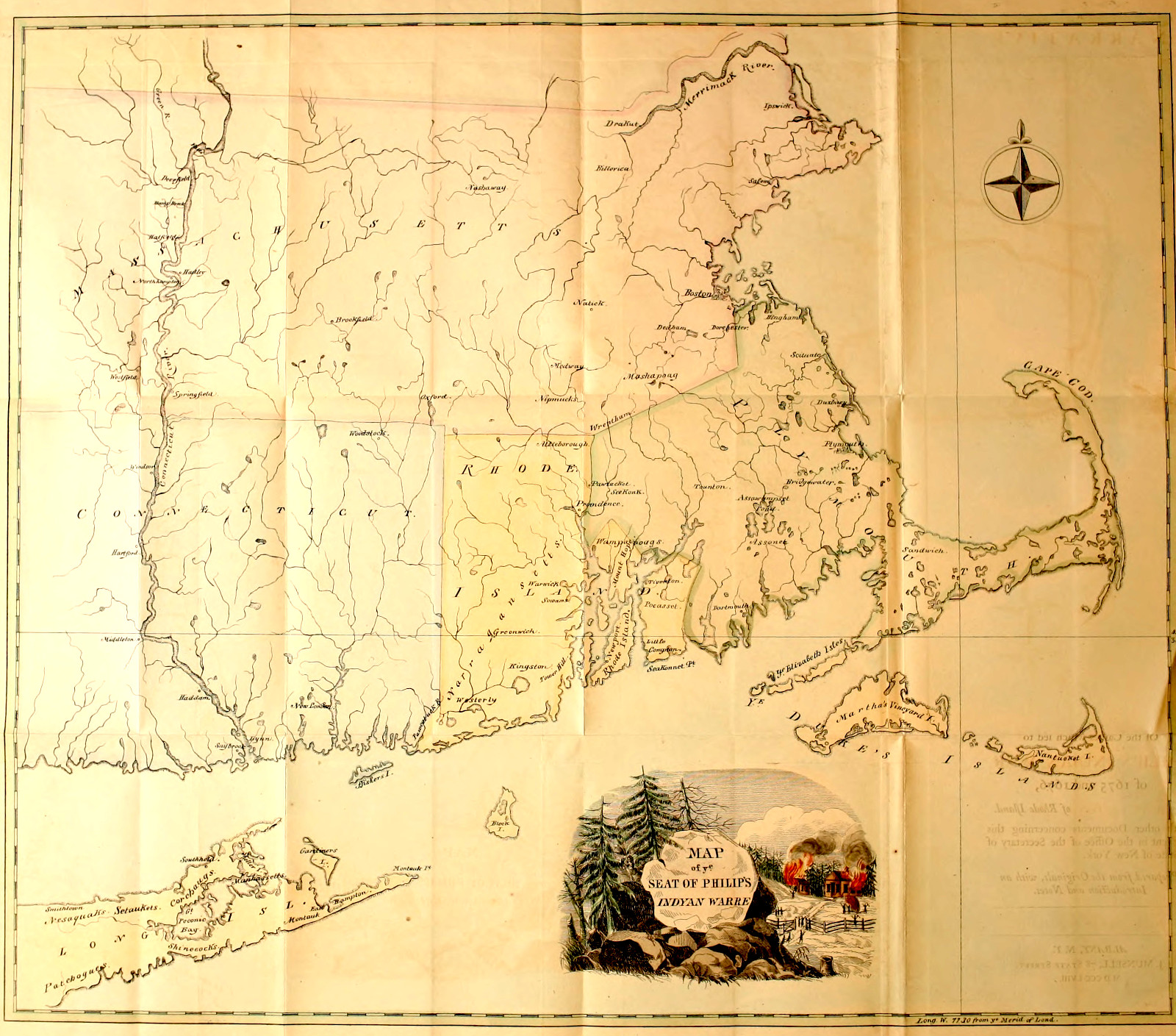
 click on the map for a larger image.
of ye
SEAT OF PHILIP’S
INDYAN WARRE
TRANSCRIBER’S NOTE
This book was published in 1858 and is a careful reproduction of documents written between 1669 and 1676. The spelling and punctuation in those documents has been faithfully kept in this etext.
The dates in the documents were all according to the Julian calendar, where new years begin on March 25th. Dates between January 1st and March 25th in the year 1675 in a document reflect the year 1676 in our modern Gregorian calendar. Many books including this one indicate this duality by printing both years, either in the copied document or a footnote to it, in an abbreviated format. In this etext the format is 1675/6.
Footnote anchors are denoted by [number], and the footnotes have been placed at the end of each chapter or letter. The numbering is unique only within that chapter or letter.
New original cover art included with this eBook is granted to the public domain.
Some minor changes to the text are noted at the end of the book. These are indicated by a dashed blue underline.
click on the map for a larger image.
By JOHN EASTON, of Rhode Island.
With other Documents concerning this Event in the Office of the Secretary of State of New York.
Prepared from the Originals, with an
Introduction and Notes.
By FRANKLIN B. HOUGH.
ALBANY, N. Y.
J. MUNSELL, 78 State Street.
M D CCC LVIII.

|
INTRODUCTION, |
v |
| A Relation of the Indian War, by Mr. Easton of Rhode Island, 1675, | 1 |
| Papers Relating to Philip’s Indian War, | 53 |
| Record of a Court Martial held at Newport, R. I. in August, 1676, for the Trial of Indians charged with being engaged in Philip’s Designs, | 173 |
| Index, | 191 |
[Pg iv]
The Statement inadvertently made in
Note [14], Page 9,
concerning the Absence of the Governor, is erroneous.
He did not sail for England until November, 1677.
[v]
The Years 1675 and 1676, will ever fill a gloomy Page in New England History, and be equally memorable for the desperate but ineffectual Efforts of its primitive People, to rid their Country of its European Inhabitants, and the efficient Measures adopted by the latter, against the Chances of future Hostilities.
The Details of these Events, have come down to us in the Narratives of several prominent Actors in them, and from them, we have been made familiar with the Scenes of Atrocity which distinguished the several Combatants in this War of mutual Extermination; but in none of these Accounts do we find Evidence of that earnest Desire to render a strictly impartial Statement of Events, which alone constitutes the highest Aim of History, and claims our strongest Regard. The Writers of these Narratives, [vi]in their active Sympathies for the one Party, have scarcely been willing to concede either Justice or Honor to the other. The Indian Leader who acted so prominent a Part in this War, is represented as a Monster in Iniquity, incapable alike of Generosity or Sympathy, waging an unprovoked and aggressive War upon inoffensive Settlers, violating the most solemn Engagement of Treaties, and wantonly butchering those who had extended to him the kindest Offices of Friendship.
The Account of the Origin of this War, given in the following Pages, is believed to be the only one that has been printed, in which a cotemporary Writer has appeared anxious to represent in a favorable Light, the Injuries that provoked the Natives to Acts of Hostility, or to concede to them Motives of Honor and Equity in previous Attempts to adjust the Grounds of Dispute without a final Resort to Arms.
The Government of Rhode Island, of which Mr. Easton was a Member, had been excluded from the Union of the New England Colonies, on account of her heretical Toleration of religious Freedom, and her open Advocacy of that Liberty of Conscience [vii]which has since become a distinguishing Feature of our Government. Her Territory was invaded by armed Forces without previous Notification or Consent, and her Magistrates seized and carried to Prisons beyond her Borders, for presuming to question the Right of these informal Inroads upon her Soil.
The Boundary between Connecticut and Rhode Island, was at this Time a Subject of Dispute, and upon it depended the Question of separate Existence, to the greater Part of the latter. This Controversy had excited a Feeling of Alienation between the two Colonies, as had a similar Question between the former and New York, and in some Degree prevented a cordial Coöperation, in Measures tending to the common Welfare of the English Colonies. This may perhaps have influenced the Writer of the following Narrative, in his Desire to prove that the Complaints of the Indians might have been peaceably settled, and that the immediate Cause of the War arose from the Indiscretion of their Neighbors. Whatever Weight this Motive may have had, there is found nothing either in the Narrative itself, or the Evidence of other Writers, to lead us to question [viii]the Accuracy of the Facts therein stated, or to doubt that the Grievances complained of, were fully as real as by them represented.
Slighter Grounds of Difference between civilized Nations have often sooner led to open War, and we may perhaps find in this Case, no other Reason for patient Forbearance under continued Wrongs, than the Fact that the Indians were dependent upon the Whites for the Means of commencing and prosecuting Hostilities, and were without those Facilities for Consultation and Coöperation which Education alone confers.
Prompted by that inherent Sense of Equality which has often led them to share equally with their Prisoners, the last Morsel of Food, the Indians had cheerfully given to the first Colonists a liberal Share of their Lands, and had not only supplied them with Provisions when they would otherwise have starved, but had taught them the Method of cultivating Corn, and the Time and Mode of catching Fish, which preserved them from Extremities to which there would have been no other Relief.[1] Thus favored and assisted, the Colonists at Peace [ix]with the native Tribes rapidly multiplied, and their Fields everywhere extended along the Valleys and over the Plains that had been the Haunts and the Homes of the primitive Owners. During more than fifty Years, they had been gaining steadily upon the Wilderness, and the Indians had proportionably wasted away, deriving few and doubtful Benefits from Civilization, but becoming daily more degraded by its Vices, and more dependent upon its Arts for the Means of Existence.
Massasoit, the chief Sachem of the Wampanoags, had been the early and constant Friend of the Whites, and towards the Close of his Life had taken his two Sons, upon whom his Authority was to descend, to a principal Settler to make them pledge their continued Friendship to the English. Alexander, the elder of these Brothers, was a few Years after summoned to appear and answer to Charges made against him upon Suspicion that he was plotting the Destruction of the Settlers; but not obeying promptly, he was surprised at an unguarded Moment, and taken towards Plymouth. Exasperated at this Treatment, he fell sick, was released [x]under the Pledge of Hostages, but died on his Way Home.
The chief Authority devolved upon Metacom,[2] better known as Philip, on the Death of his Brother, and whatever may have been his early Feeling towards the English, there can be no Doubt that from this Period he harbored a secret Resolution of Vengeance, although Policy led him for a Season to conceal his Purpose under a Cloak of Friendship, and even to consent to repeated Renewals of the Treaties of Amity, which his Father had made.
With this Design he visited many Indian Tribes, portrayed in eloquent Language the steady Encroachments of the Settlers, reminded them of their ancient Power now rapidly wasting away, and invoked them by the Love of Country and Kindred, the Memory of their Forefathers, and their Duty to Posterity, to unite in driving from the Land these dangerous Rivals, whose past Encroachments foreshadowed the rapid and complete Destruction of their Race.
The Magnitude of this Enterprise, and the evident [xi]Success with which he privately advanced in its Arrangement, bespeaks a Mind capable of the most comprehensive Generalization, while his future Course proved him the Owner of Talents equal to the most pressing Emergencies that might arise in the Execution of its Details.
His Tact in enlisting the Narragansetts, the hereditary Enemies of his Tribe, in the general Scheme which he had formed, indicates the Possession of a fair Degree of diplomatic Skill, and a thorough Knowledge of the human Character.
The Circumstances attending the Conference related in the following Narrative, are particularly interesting, as showing the Wrongs which had for Years been practiced upon the unsuspecting Natives, and the lively Sense of Injustice which these Injuries had awakened. The simple confiding Ignorance of these untutored Sons of Nature, had led them on from one Concession to another, until they were brought to a forcible Realization of the Value of Land, by a pressing Sense of its Want, and found themselves in almost as feeble and dependent a Condition, as were the English upon their first Arrival.
[xii]
There is something peculiarly refined and elevated in the Sentiment expressed by Philip, in answer to their Remark, that the Whites were now too strong for the Indians, when he replied, that then the English should do to them, as they did, when they were too strong for the English. In this was expressed the Spirit of that most sacred Injunction of Scripture, that “all Things whatsoever ye would that Men should do to you, do ye even so to them,” with all the additional Obligation that a previous Performance of this Duty could impose.
His Plans, it is said, had been laid with Reference to their Development in the Spring of 1676, but were prematurely hastened by the Death of Sassamon, and the Executions which followed.
Perhaps fearing that he might be selected as the next Victim, Philip kept himself surrounded by his armed Followers, and finally yielding to their Impatience for Plunder, allowed them to commit Depredations. These by provoking an Attack from the Whites, relieved him from the Superstitious dread which he is said to have entertained of beginning the War, and active Hostilities quickly followed.
[xiii]
The first Attack was made at Swansea upon People returning from public Worship. A Body of Troops arriving soon after, were fired upon, and one of the Party killed. The Indians fled, marking their Course by burning Houses, and fixing on Poles the Heads of those they had slain; but being pressed by the Troops, Philip left Mount Hope and retired to a Swamp at Pocasset, where he succeeded in repelling the English and killing sixteen of their Number.
Learning that his Enemy was preparing to guard every Exit from the Swamp and thus reduce him to Starvation, he escaped towards the Nipmucks in Worcester County, pursued by People of Rehoboth and Providence. The Indians continued to hang upon the Outskirts of the Settlements in small Parties, committing frequent Murders, and generally evading Pursuit. Being intimately acquainted with every Locality, they could easily fall upon an unguarded Hamlet, murder its Inmates, and escape before an Alarm could be raised, or a Force collected. Mendon, Brookfield, Deerfield, Hadley, Northfield, Hatfield, Northampton and Springfield, became in Turn the Scene of desperate Encounters, in which [xiv]Fortune favored sometimes one and at other Times the other Party. Philip, who was generally present in these Engagements to direct his Men, evinced a Boldness mingled with Caution, that defied the utmost Efforts of the English to gain any signal Advantage.
It being no longer doubted that the Narragansetts were in secret Alliance with Philip, War was declared against them by the Commissioners of the United Colonies in November, and in December an Army of from fifteen hundred to two thousand Men, including Volunteers, Indians and a Troop of Horse, the whole under the Command of General Winslow, assembled in the Neighborhood of the Enemy. The Indians, under Philip, were located on an Island in a Swamp in South Kingston, Rhode Island, and had surrounded their Camp with Pallisades and an almost impenetrable Hedge of fallen Trees, with their Tops pointing outwards. Within this Inclosure, the Indians had gathered with their Families to the Number of three thousand, comfortably supplied with Provisions and armed with Bows and Arrows, Muskets and Tomahawks.
Here, on the 18th of December, was fought the [xv]most bloody Battle recorded in the early Annals of New England, in which seven hundred Indian Warriors were slain and three hundred wounded; three hundred more and as many Women and Children taken Prisoners. The Number of Women and Children that perished in the Flames was never known. The English lost six Captains and eighty Men in killed and one hundred and fifty in wounded.
The Weather was intensely cold, and the English suffered extremely from Cold and Fatigue while traveling in deep Snows. Philip fled, and is supposed to have passed the Winter upon the western Borders of Massachusetts. The Winter was remarkably mild, and upon the Hudson River opening unexpectedly in February, the Governor of New York sent up several Sloops laden with Soldiers and military Stores, to resist any Attack which Philip might make in that Quarter. Sudbury, Lancaster and Medfield were attacked in February.
The Spring opened with renewed Hostilities, and Parts of Groton, Marlborough, Warwick, Rehoboth and Providence were burned. A memorable Engagement occurred in Rehoboth, on the [xvi]26th of March, known as the “Pierce Fight,” in which Capt. Michael Pierce, of Scituate, at the Head of a Band of 63 English and a few friendly Indians, was led into an Ambuscade, in which 55 English and 10 of their Indian Allies were slain on the Spot, but not without destroying several Times this Number of their Enemies.
The Indians scattering in small Parties, were enabled to distract the Attention of the English Forces by simultaneous Attacks in different Quarters. In March, a Body of Volunteers from Connecticut, succeeded in capturing Conanchet, Sachem of the Narragansetts, who was scarcely less formidable than Philip, and Expeditions upon the Strongholds of the Indians were constantly reducing their Numbers and rendering their Prospects more gloomy.
On the 18th of May, Capt. Turner, with 180 Men, surprised a large Party of Indians at the great Falls in the Connecticut River, above Deerfield. They found the Camp entirely unguarded, and slew great Numbers, while others rushed into the River, only to meet a watery Grave. The English lost but one, while the Indians afterwards admitted the Loss of 300 Men in killed and drowned, some of [xvii]them being principal Sachems. In returning, the English in their turn experienced heavy Reverses at the Hands of another Lodge of Indians, in which Capt. Turner was killed, and before reaching Hatfield, their Numbers were reduced to thirty-eight Men.
The Slaughter at the Falls proved a death Blow to the Hopes of Philip, and from this Time Misfortunes closed thickly upon him. There still, however, remained sufficient Force to seriously annoy the Settlements. On the 30th of May, six or seven hundred Indians invaded Hatfield, burned several Houses without the Fortification, and killed five Men, but were repulsed with the Loss of five Times this Number.
On the Morning of the 12th of June, about seven hundred Indians made a furious Assault upon Hadley, and the Inhabitants were thrown into great Confusion and Alarm. The Indians succeeded in forcing the Palisades and gaining Possession of one House, but were beaten back with Loss. Suddenly, a Man of noble Mien, peculiar in Dress, venerable in Appearance and manifestly familiar with military [xviii]Affairs, assumed the Command, ordered the English to rally in the Manner best adapted to meet the pressing Emergency, and by his Voice and Example inspired them to new Activity and Courage. Under his Direction the Indians were at length repulsed with Loss, and driven into the Woods. The mysterious Stranger as suddenly disappeared, and it was long reported and believed that an Angel from Heaven had led them to Victory. It was afterwards found, that this Person was Col. Goffe, the Regicide, who had for fifteen Years, with Whalley his Father-in-law, been concealed in the Colony, and who was then living in strict Seclusion in the Family of Mr. Russell the Minister.
The Indians began to lose their Courage with these Failures, and their Attacks were thenceforth made with less Bravery. They also found new Enemies in the Mohawks of New York, who willingly listened to Propositions from the English to engage in a War against the eastern Indians. They did this the more readily, from having discovered an Act of Treachery on the Part of Philip.
A Party of 200 Indians, on their Way westward from the Connecticut, was surprised in the present [xix]Town of Stockbridge, of whom about sixty were killed and taken, with the Loss of but one Man.
Thus repulsed from the Connecticut, Philip returned to the Plymouth Colony, still following out his Purpose of Extermination, but daily losing his Counselors and Friends, his Captains and Warriors. He continued to struggle against Fate, and to gather new Energies from the Desperation into which his Affairs were plunged. His Wife and Children were seized or killed, and many of his Followers gave up in Despair and threw themselves upon the Mercy of the English. Retiring to Mount Hope, his former Residence, he took Refuge in a Swamp with about two hundred of his Men. Some Time before he had slain one of his Followers, who presumed to propose Submission to the English, and the Brother of this Indian, in Revenge betrayed the Secret of his Retreat. Captain Benjamin Church, who had been distinguished throughout the War for his Courage and Success, surrounded the Swamp on the 12th of August, 1676, and but sixty of the Indians escaped. Philip was shot by an Indian and fell with his Face in the Mud. His Head was cut off and exhibited as a Trophy.
[xx]
Annawan, his principal Captain, was taken August 28th, in Rehoboth, which ended the War in this Section of New England, although Hostilities continued one or two Years later, in the northeastern Part of the Colonies.
The Indians, everywhere broken and scattered, either submitted to such Terms as the English might dictate or removed North and joined the French in Canada; and the exhausted Colonies were left to a realization of the Ravages which this vindictive War had occasioned. Famine would have followed close upon the Miseries of the Torch and Tomahawk, but for timely Charities from Dublin and London, obtained through the Letters of Dr. Increase Mather. One eleventh of the able bodied Men of New England are said to have been slain during these two Years, and according to another Writer, almost every Person in the two Colonies, had lost a Relation or near Friend, so that every Family was in deep Mourning.
We have already alluded to the Jealousies then existing between New York and Connecticut, on account of disputed Boundaries. The first News of Indian Hostilities, naturally filled the Country [xxi]with an Alarm which was frequently renewed during the Progress of the War, as Rumors of projected Massacres, magnified by the Fears of the Timid or the Exposed, were circulated among the Settlers or reported to the Governor. Although the Province of New York escaped the Calamities which fell upon the New England Colonies, the occasional Intercourse of its Indians with those to the Eastward, especially the tributary Dependence in which the Tribes upon the east End of Long Island were held by the Narragansetts, gave just Reason to suspect that these Indians might be in secret Alliance with their powerful Masters, and justified the Measures that were adopted for their Security.
A prominent Source of Irritation between New England and New York, arose from the Charges publicly made by the former, that the hostile Indians were supplied with Powder and Arms by the latter. The Documents which follow, exhibit the Grounds upon which this Allegation was made, and the Spirit with which it was repelled. They also prove that the Indians were in some Degree at least assisted by the French in Canada, with whom the English were then nominally at Peace.
[xxii]
The Government of New York pursued an undeviating Line of Policy with regard to the Indians within her Borders, and claimed at all Times the exclusive Management of their Affairs; asserting sometimes rudely, at other Times respectfully, but always firmly, her sole Right of negotiating with them. Every Attempt of the neighboring Colonies to treat with the New York Indians, for Aid against the eastern and northern Tribes, was met with a prompt Refusal, unless conducted in the Presence of the Governor or his authorized Agents.
This Policy, and the Grounds upon which it was based, were not understood by those who had Occasion to deal with these Indians, and the unpleasant Feeling which followed the Failure of informal Attempts at Negotiation, has in some Degree influenced the public Mind, and imparted to the historic Page a Tinge of Prejudice against the Conduct of New York, which is by no means deserved. A careful Study of these Documents will convince the Reader, that whenever proper Courtesy was shown to New York in these Transactions, the Subject of Request received proper Attention.
The warlike Mohawks needed but slight Entreaty [xxiii]to engage in a Pursuit so congenial to their Tastes, and had Hostilities continued, would doubtless have aided in an effectual Manner, in the War against Philip. Indeed upon several Occasions after the Peace, they made Inroads upon the Christian Indians of Natick and other Villages, mistaking them for the late Enemies to the English; and it became necessary to explain to them that their Services were not further needed, and to dissuade them from Hunting in that Quarter, least they might injure the friendly Natives.
The rude and unadorned Style and Language of these Documents afford an interesting View of the Period and the Events to which they relate, and we are enabled to catch a Glimpse of the Manners of the Age, the Relations existing between the Whites and the Indians, the Hopes and Fears of the Colonists, and the Light in which these Events were regarded by the Government of New York, more satisfactorily perhaps than could have been done by any other Means. Should they in any Degree answer this Purpose, the Object of their Publication will be accomplished.
F. B. H.
[1] See Bradford’s History of Plymouth Plantations, p. 100.
[2] Sometimes written Metacomet, and said to be a Contraction from Pometacom.
[Pg 1]
By Mr Easton[1] of Rhoad Island,
1675.

A true Relation of what I kno & of Reports & my Understanding concerning the Begining & Progress of the War now between the English and the Indians.
In the Winter in the Year 1674, an Indian was found dead, and by a Coroner’s Inquest of Plimouth [2]Colony iudged murdered.[2] He was found dead in a Hole thro Ice broken in a Pond[3] with his Gun and sum Foulls by him. Sum English suposed him thrown in, sum Indians yt I iudged intelegabell and impartiall in ye Case did think he fell in and was so drouned, and that the Ies did hurt his Throat, as the English said it was cut;[4] but acnoledge [3]yt sumetimes naty Indians wold kill others but not as euer they herd to obscuer as if the dead Indian was not murdered. The dead Indian was caled Sansimun[5] and a Christian yt could read and write. Report was he was a bad Man, yt King Philip got him to write his Will, and he made the Writing for a great Part of the Land to be his, but read as [4]if it had bin as Philip wrote; But it came to be known, and then he run away from him.
Now one Indian informed that three Indians had murdered him, and sheued a Coat yt he said thay gave him to conseall them. The Indians report yt the Informer had playd away his Coate, and these Men sent him ye Coate, and after demanded Pay, and he not to pay, so acused them, and knoing that it wold pleas the English so to think him a beter Christian, and the Reporte came yt the three Indians had confesed and acused Philip so to imploy them, and yt ye English wold hang Philip; so the Indians wear afraid, and reported yt the English had flatred them (or by threats) to bely Philip yt thay might kill him to have his Land, and yt if Philip had dun it, it was ther Law so to execute home ther Kings iudged deserved it, yt he had no Case to hide it.[6]
[5]
So Philip kept his Men in Armes. Plimoth Gouerner required him to disband his Men, and informed him his Jealousy was falce. Philip answered he would do no Harm, and thanked the Governer for his Information.[7]
The three Indians wer hunge, to the last denied the Fact; but one broke the Halter as it is reported, then desired to be sayed, and so was a littell while, then confessed they three had dun the Fact; and then he was hanged.[8] And it was reported Sansimun before his death had informed of the Indian Plot, and yt if the Indians knew it they wold kill him, and that the Hethen might destroy the English for their Wickedness, as God had permitted the Heathen to destroy the Israellites of olde. So the English wear afraid and Philip was afraid, [6]and both incresed in Arems. But for four Yeares Time, Reports and Iealosys of War had bin veri frequent, yt we did not think yt now a War was breaking forth;[9] but about a Week before it did,[10] we had Case to think it wold. Then to indever to prevent it, we sent a Man to Philip, yt if he wold cum to the Fery we wold cum over to speke with him. About four Miles we had to cum; thither our Messenger cum to them; they not [7]aware of it behaved themselves as furious, but sudingly apeased when they understood who he was and what he came for, he called his Counsell and agreed to cum to us; came himself unarmed, and about 40 of his Men armed. Then 5 of us went over, 3 wear Magistrates. We sate veri friendly together.[11] We told him our bisnes was to indever that they might not reseue or do Rong. They said that was well; they had dun no Rong, the [8]English ronged them. We said we knew the English said the Indians ronged them, and the Indians said the English ronged them, but our Desier was the Quarrell might rightly be desided, in the best Way, and not as Dogs desided their Quarrells. The Indians owned yt fighting was the worst Way; then they propounded how Right might take Place. We said, by Arbitration. They said that all English agreed against them, and so by Arbitration they had had much Rong; mani Miles square of Land so taken from them, for English wold have English Arbitrators; and once they were persuaded to give in their Armes, yt thereby Jealousy might be removed,[12] and the English having [9]their Arms wold not deliver them as they had promised, untill they consented to pay a 100L, and now they had not so much Sum or Muny; yt thay wear as good be kiled as leave all ther Liueslyhode.[13]
We said they might chuse a Indian King and the English might chuse the Governor of New Yorke,[14] yt nether had Case to say either wear Parties [10]in the Diferance. They said they had not heard of yt Way, and said we onestly spoke, so we wear perswaided if yt Way had bine tendered they would have acsepted. We did endeaver not to hear their Complaints, said it was not convenient for us now to consider of, but to indever to prevent War; said to them when in War against English, Blood was spilt, yt ingaged all Englishmen, for we wear to be all under one King; we knew what their Complaints wold be, and in our Colony had removed some of them in sending for Indian Rulers in what the Crime concerned Indians Lives, which thay veri lovingly acsepted, and agreed with us to their Execution, and said so they were abell to satisfie their Subjects when they knew an Indian sufered duly, but said in what was only between their Indians and not in Towneshipes, yt we had purchased, they wold not have us prosecute, and yt that thay had a great Fear to have ani of ther Indians should be caled or forced to be Christian Indians.[15] Thay [11]said yt such wer in everi thing more mischievous, only Disemblers, and then the English made them not subject to ther Kings, and by their lying to rong ther Kings. We knew it to be true, and we promising them yt however in Government to Indians all should be alike, and yt we knew it was our King’s will it should be so, yt altho we wear weaker than other Colonies, they having submitted to our King to protect them, others dared not otherwise to molest them; expressed thay took that to be well, that we had littell Case to doute, but that to us under the King thay would have yielded to our Determinations in what ani should have complained to us against them.
But Philip charged it to be disonestly in us to put of the Hering to iust Complaints, therefore we [12]consented to hear them. Thay said thay had bine the first in doing Good to the English, and the English the first in doing Rong; said when the English first came, their King’s Father was as a great Man, and the English as a littell Child;[16] he constrained other Indians from ronging the English, and gave them Corn and shewed them how to plant, and was free to do them ani Good, and had let them have a 100 Times more Land than now the King had for his own Peopell. But ther King’s Brother, when he was King, came miserably to dy by being forced to Court, as they iudge [13]poysoned.[17] And another Greavance was, if 20 of there onest Indiand testified that a Englishman had dun them Rong, it was as nothing; and if but one of their worst Indians testified against any Indian or ther King, when it pleased the English it was sufitiant. Another Grievance was, when their King sold Land, the English wold say, it was more than they agreed to, and a Writing must be prove against all them, and sum of their Kings had dun Rong to sell so much. He left his Peopell none, and sum being given to Drunknes the English made them [14]drunk and then cheated them in Bargains, but now ther Kings wear forwarned not for to part with Land, for nothing in Cumparison to the Value thereof. Now home the English had owned for King or Queen, they wold disinheret, and make another King that wold give or sell them these Lands; that now, they had no Hopes left to kepe ani Land. Another Grievance, the English Catell and Horses still incresed; that when thay removed 30 Mill from where English had ani thing to do, thay could not kepe ther Corn from being [15]spoyled, thay never being iused to fence, and thoft when the English boft Land of them thay wold have kept their Catell upon ther owne Land. Another Grievance, the English were so eager to sell the Indians Lickers, yt most of the Indians spent all in Drynknes, and then raueved upon the sober Indians, and thay did believe often did hurt the English Catell, and ther King could not prevent it.
We knew before, these were their grand Complaints, but then we only indevered to persuaid yt all Cumplaints might be righted without War, but could have no other Answer but that thay had not heard of that Way for the Governor of Yorke and an Indian King to have the Hearing of it. We had Case to think in yt had bine tendered it wold have bine acsepted. We indevered yt however thay should lay doune the War, for the English wear to strong for them; thay said, then the English should do to them as they did when thay wear to strong for the English.
So we departed without ani Discurtiousness, and sudingly had Letter from Plimoth Governor thay intended in Arms to conforem Philip, but no Information what yt was thay required or wt Termes [16]he refused to have their Quarrell desided; and in a Weke’s Time after we had bine with the Indians the War thus begun.[18] Plimouth Soldiers were cum to have their Head Quarters within 10 Miles of Philip; then most of the English thereabout left there Houses, and we had Leter from Plimouth Governor to desier our Help with sum Boats if thay had such Ocation, and for us to looke to our selfs; and from the Generall at the Quarters we had Leter of the Day thay intended to cum upon the Indians, and desier for sum of our Boats to attend. So we took it to be of Nesesity for our Ieslanders one half one Day and Night to atend and the other half the next, so by Turnes for our owne Safety. In this Time sum Indians fell a pilfering sum Houses yt the English had left, and a old Man and a Lad going to one of these Houses did see three Indians run out thereof. The old Man bid the young [17]Man shoot; so he did, and a Indian fell doune, but got away againe. It is reported yt sum Indians came to the Gareson, asked why they shot the Indian. Thay asked whether he was dead. The Indians said yea. A English Lad saied it was no Mater. The Men indevered to inform them it was but an idell Lad’s Words, but the Indians in haste went away and did not hearken to them. The next Day, the Lad that shot the Indian, and his Father, and fief English Men wear killed so the War begun with Philip.[19] But ther was a Queen yt I knew [18]was not a Party with Philip, and Plimoth Governor recumended her yt if she wold cum to our Iesland it wold be well shee desired shee might if it wear but with but six of her Men.[20] I can sufitiantly prove, but it is to large here to relate, that shee had practised much the Quarell might be decided without War; but sum of our English allso, in Fury against all Indians, wold not consent shee should be reseved to our Iesland although I profered to be at all the Charge to secuer her and those shee desired to cum with her; so at length prevailed we might send for her; but one Day acsedentaly we [19]wear prevented, and then our Men had seased sum Cannos on her Side, suposing they wear Philip’s, and the next Day a English House was there burned and Mischief of either Side indevered to the other, and much dun, her House burned; and so we wear prevented of ani Menes to atain hir. The English Army cam not downe as informed thay wold, so Philip got over, and they could not find him. Three Days after, thay came doune, had a veri stormy Night, yt in the Morning the Foote wear disabled to return. Before they had Refreshment, thay wear free to acsept, as we wear willing to relieve them,[21] but ... Trupers sayed of their Captaine [20]they despised it, and so left the Foote. After the Foote had refreshed themselfs they also returned to their head Quarters, and after hunt[ing] Philip from all sea Shores, yt thay could not tell what was becum of him, the Naroganset Kings informed us yt the Queen aforesaid must be in a Thicket, a starving or conformed to Philip; but thay knew shee wold be glad to be from them, so from us had Incuragement to get her and as mani as they could from Philip.[22]
[21]
After the English Army, without our Consent or informing us, came into our Colony, brought the Naroganset Indians to Articles of Agreement to them.[23] Philip being flead, about a 150 Indians came in to a Plimouth Garrison volentarley. Plimouth Authority sould all for Slafes (but about six of them) to be carried out of the Country.[24] It is [22]true the Indians genaraly are very barbarous Peopell but in this War I have not heard of their tormenting ani, but yt the English Army cote an old Indian and tormented him. He was well knone to have bine a long Time a veri decrepid and harmless Indian of the Queen’s.[25] As Philip fled the foresaid Queen got to the Narogansets, and as manni of her Men as she could get, but one Part of the Narogansets Agreement to Boston was to kill or deliver as mani as they could of Philip’s Peopell, therefore Boston Men demanded the fore said Queene and others yt thay had so reseved; for which the Indians wear unfree, and made mani Excuses, as that the Queen was none of them, and sum others [23]wear but Sudierners with Philip becase removed by the English having got their Land, and wear of their Kindred, which we kno is true, not but we think they did shelter mani thay should not, and yt they did kno sum of their Men did assist Philip, but according to their barbarous Ruells thay accounted so was no Rong, or they could not help it. But sum enemies Heds thay did send in, and told us thay wear informed yt however when Winter came thay might be suer the English wold be their Enemies. And so thay stood doubtful for about 5 Months. The English wear iealous that there was a generall Plot of all Indians against English; and the Indians wear in like Manner iealous of the English. I think it was generall, yt thay wear unwilling to be ronged, and yt the Indians did iudg the English partiall against them, and among all a philthy Crue yt did desire and indever for War; and those of any Solidety wear against it, and indevered to prevent the War.[26] For conserning Philip [24]we have good Intelligence yt he advised sum English to be gone from ther out Plases where they lived or they wear in Danger to be killed; but whether it wear to prevent a War, or by their Prests informed if thay begun thay should be beaten, and otherwise not, so we have good Intelligence; for I do think most of them had a Desire the English would begin; and if the English be not carefull to manifest the Indians mai expect Equity from them, thay mai have more Enemies than thay wold, and more Case of Jelosy.[27]
The Report is, yt to ye Estward the War thus begun, by supposing yt sum of those Indians were at a Fight in these Parts, and yt thear thay saw a Man wounded, so Authority sent sum forth to discufer, having before disarmed those Indians and confined them to a Place which the Indians wear [25]not ofended at; but these Men coming upon them in a warlike Postuer, they fled; yt the Men cote but 3 of them. Those in Authority sent out againe to excuse themselfs, but thay could only cum to the Spech with one Man; as he kept out of their Rech, thay excused themselfs and said his Father was not hurt; one of them thay had taken. He said he could not believe them, for if it was so, thay wold have broft him; thay had bin desaitfull to disarm them, and so wold have killed them all; and so he run away, and then English wear killed, and the Report is, yt up in the Country here away thay had demanded the Indians’ Armes, and went againe to parrell with them, and the Indians by Ambushcade tretcherously killed 8 yt wear going to treat with them.[28]
When Winter was cum we had Leter from [26] Boston of the iunited Comitioners that thay wear resolved to reduce the Narogansets to Conformity, not to be trubled with them ani more, and desered sum Help of Botes and otherwise, if we saw Case, and yt we should kepe Secret conserning it.[29] Our Governor sent them Word we wear satesfied Narragansets wear tretcherous, and had ayded Philip, [27]and as we had asisted to relive ther Army before, so we should be ready to asist them still, and advised yt Termes might be tendred yt such might expect Compation yt would acsept not to ingag in War, and yt ther might be a Separation betwene the Gilty and the Inosent which in War could not be expected, we not in the lest expecting thay wold have begun the War and not before proclaimed it, or not give them Defianc.
I having often informed the Indians yt English Men wold not begin a War, otherwise it was brutish so to do. I am sorry so the Indians have Case to think me desaitfull, for the English thus began the War with the Narogansets, we having sent ofe our Iesland mani Indians and informed them if thay kept by the water Side and did not medell; yt however the English wold do them no Harem, altho it was not save for us to let them live here. The Army first take all those Prisoners then fell upon Indian Houses, burned them and killed sum Men. The War [began] without Proclamation, and sum of our Peopell did not kno the English had begun Mischief to Indians, and being confedent and had Case therefore; yt the Indians wold [28]not hurt them before the English begun, so did not kepe ther Gareson exactly; but the Indians having reseued yt Mischief came unexpected upone them, destroyed 145 of them beside other great Loss, but the English Army say thay suposed Conetecot Forces had bine there. Thay solde the Indians yt thay had taken as afoersaid, for Slafes, but one old Man yt was caried of our Iesland upone his Sun’s Back he was so decreped could not go, and when the Army tooke them upon his Back caried him to the Garison, sum wold have had him devoured by Doges, but the Tendernes of sum of them prevailed to cut ofe his Head; and after came sudingly upon the Indians whear the Indians had prepared to defend themselfs, and so reseved and did much Mischief, and for aboute six Weeks sinc hath bine spent as for both Parties to recruet. And now the English Army is out to seeke after the Indians, but it is most lickly yt such most abell to do Mischief will escape, yt Women and Children and Impotent mai be destroyed, and so the most abell will have the less Incumbranc to do Mischief.[30]
[29]
But I am confident it wold be best for the English and Indians yt a Peas wear made upone onest Terems, for each to have a dew Propriety and to enioy it without Opretion or Iusurpation by one to the other, but the English dear not trust the Indian’s Promises, nether the Indians to the Englishes Promises; and each have gret Case therefor. I see no Way likely, but if a Sessation from Arems might be procured untill it might be known what Terems King Charles wold propound; for we have gret Case to think the Naroganset Kings wold trust our King, and yt thay wold have acsepted him to be Umpier if it had bine tendered, about ani Diferanc; for we do kno the English have had much [30]Contention against these Indians to invaled the king’s Determination for Naroganset to be in our Colony; and we have Case to think yt was the great Case of the war against them.
I see no Menes likely to prevent a Sesation from Arems, except the Gouevner of New York can find a Way so to interfere, and so it will be likely a Pease mai be made without trubbling our King; not but it allwais hath bine a Prinsipell in our Colonly, yt ther should be but one supreme to English Men, and in our natief Country wher ever English have Iurisdiction; and so we know no English should begin a War and not first tender for the King to be Umpier, and not persecute such yt can not conforem to ther Worship; and ther Worship be what is not owned by the King, the King not to mind to have such Things redresed, sum mai take it that he hath not Pouer, and that ther mai be a Wai for them to take Pouer in Oposition to him.[31] I am so perswaided of New England Prists, [31]thay are so blinded by the Spirit of Persecution and to maintaine to have Hyer, and to have Name to be mere Hyrelings yt thay have bine the Case yt the Law of Nations and the Law of Arems have bine violated in this War; and yt the War had not bine if ther had not bine a Hyerling, that for his Moni, giving what he caleth the Gospel by Voiolanc to have it chargabell for his Gaine from his Quarter; and if ani in Magistracy be not so as ther pack Horses, thay will be trumpating for Inovation or War.[32]
5 : 12m : 1675. Poadiestan.
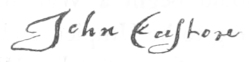
John Easton (copy of his signature)
[1] John Easton, the Author of this Account, was the Son of Nicholas Easton, who emigrated to New England with his Sons Peter and John, in the Spring of 1634, and settled at Ipswich. He subsequently removed to Newburgh, and then to Hampton, where he built the first English House. In 1638 he removed to Rhode Island, on account of the religious Intolerance he experienced, as a Quaker, and the second Year after settled at Newport, where he also built the first House. In 1641 this was burned by the Indians setting Fire on his Lands. In 1640 and 1653 he was chosen an Assistant, and from 1650 to 1652, and in 1654, he was President under the first colonial Charter. From 1672 to 1674 he held the Office of Governor, and died at Newport in 1675.
His Son John Easton, held the Office of Attorney General of Rhode Island fifteen Years between 1652 and 1675, was Deputy Governor in 1674-1675; was several Times an Assistant, and from 1690 to 1695 he was elected Governor. He died at Newport, Dec. 12, 1705, aged 88 Years, and was buried in the Coddington burial Place. Callender’s Discourse, p. 125, 148: Peterson’s Hist. R. I.—Ed.
[2] He was first buried by his Friends, without an Investigation, but David, a Tetticut Indian, having noticed some Bruises about the Head, reported to some English and the Governor of Plymouth ordered an Inquest. This proved that sufficient Injuries had been received to cause Death without drowning. An Indian also acknowledged, that while standing on a Hill near the Pond, he saw the Murder committed, but being fearful for his own Life, at first was unwilling to disclose it. Bayley’s Plymouth, ii, 27.—Ed.
[3] Assawomsett Pond, in Middleborough, in the Present County of Plymouth, Mass.—Ed.
[4] Other Accounts state that his Neck was broken. C. Mather.—Ed.
[5] This Indian was John Sassamon, alias Wassasamon, of the Massachusetts Tribe, who had been converted to Christianity and received a partial Course of Instruction at Harvard College. Being well acquainted with the English Language, and able to read and write, he was employed as a Teacher at Natick. Renouncing his Faith, he went to reside with Alexander, Philip’s Brother, and afterwards with Philip, where his Learning made him useful as a Secretary. He thus had the Means of becoming thoroughly acquainted with the Sachem and his Plans.
Incurring the Displeasure of his Employer, or yielding to the Solicitations of his Friend and Instructor the venerable Eliot, he returned to Natick, where, upon Professions of Repentance, he was again baptized, received into the Church, and employed as an Instructor. Being frequently with his Countrymen, he gained a full Knowledge of the hostile Feeling that was rapidly spreading among them, and going to Plymouth he imparted this Information to the Governor.
This Advice was at first disregarded, but Circumstances soon occurred to strengthen his Statement, and Philip with several of his Indians were examined, but without gaining any new Proof of the Allegation. They were accordingly dismissed, under strong Suspicions, and Sassamon disappeared soon after. His Death occurred early in the Spring of 1674-5. Bayley’s Plymouth, ii, 27; Drake’s Book of Indians, 194 et seq.—Ed.
[6] Tobias, alias Poggapanossoo, one of Philip’s Counsellors, his Son, and Mattashinnamy, were apprehended and tried by a Jury consisting of four Indians and twelve Whites. On the 8th of June, 1675, two of them were hung, and a few Days after the third was shot, at Plymouth, one of them, before his Execution, confessing the Murder, but the others denying it to the last. One of the absurd Grounds of Evidence that influenced the Jury is thus related by Dr. Increase Mather: “When Tobias (the suspected Murderer) came near the dead Body, it fell a bleeding on fresh, as if it had been newly slain; albeit, it was buried a considerable Time before that.” Mather’s Relation, 75; Drake’s Book of Indians, 195.—Ed.
[7] Other Accounts state that Philip paid no attention to the Court, and made no Effort to free himself from the Suspicions that were aroused against him, marching from Place to Place with his Men in Arms, and receiving all strange Indians who came to him. Bailey’s Plymouth, ii, 28.—Ed.
[8] This Circumstance is not mentioned by other Contemporaries.—Ed.
[9] Strong Suspicions of Indian Hostilities had arisen in the Spring of 1671, occasioned by warlike Preparations on the Part of Philip and Men on Account of some Injury alleged to have been done to his planting Ground. The Massachusetts Government, anxious to preserve Peace, sent Agents to mediate between the Parties, and on the 12th of April a Conference was obtained at the Meeting House in Taunton. Philip represented that his Preparations were designed to protect himself from the Narragansetts, but on its being shown that his Relations with that Tribe were never more friendly, he acknowledged the Charges and signed a Covenant in which he agreed to remain friendly to the Colonists, and to deliver up to the Government of New Plymouth all his English Arms, to be kept by them for their Security so long as they might see Reason. Hubbard, Mather, Hutchinson, Bayley, &c. Another Conference was held in September of the same Year. A Letter from the Governor of New York, on the Subject of these Rumors of Hostility, will be found in a subsequent Page of this Volume.—Ed.
[10] This Indian War began June 24th, 1675, at Swansea, and ended with the Death of Philip, Aug. 12, 1676, at Pokanoket.—Ed.
[11] No other Historian of this War has given an Account of this Negotiation. The Relations existing between the Indians and the Government of Rhode Island, had been friendly from the Beginning, and all the Engagements on the Part of the English had been fulfilled with scrupulous Exactness. Mr. Roger Williams relates that he had obtained by Love and Favor the Title of Rhode Island, which could not have been purchased by Price or Money, and that the Indians, always shy and jealous of selling their Lands, chose rather to make a Grant of them to such as they esteemed. The Gratuities however expected in return, often made these Gifts a very dear Bargain. Callender’s Discourse, 85.
It is said that shortly before the War of 1675 began, the Governor of Massachusetts sent to inquire of Philip why he would war upon the English, and to request him to enter into a Treaty. The Sachem replied: “Your Governor is but a Subject of King Charles of England; I shall not treat with a Subject, I shall treat of Peace only with the King my Brother. When he comes I am ready.” Old Indian Chronicle, 68. The Respect and Confidence which the People of Rhode Island had acquired with the Indians, secured a Hearing for their pacific Overtures on the above Occasion, at a Time when probably no other English could have safely solicited an Interview.—Ed.
[12] The Conference at Taunton, April 12, 1671, is here referred to. All the Arms which Philip’s Men had with them on that Occasion were given up, and they agreed to bring in the Remainder at Plymouth by a certain Time. But this for some Reason was not done. The Government at Boston being looked to as an Umpire, a Complaint was made to them by the Colony of New Plymouth. Philip appeared in Person, and by his plausible Address quieted all Apprehensions, and proposed that Commissioners from the several United Colonies should meet at Plymouth for a Discussion and Settlement of the existing Differences. This Meeting occurred Sept. 29th, 1671, and “Philip again acknowledged his Offence, and was appointed to give a Sum of Money to defray the Charges which his insolent Clamors had put the Colony unto.” Mather’s Relation, 73. The Sum agreed upon, as stated in the Text, was £100, payable in three Years. He also agreed “to send unto the Governor, or whom he shall appoint, five Wolves’ Heads, if he can get them, or as many as he can procure, until they come to five Wolves’ Heads yearly.” The Disarming of the Indians was continued through the Spring and Summer of 1671. Drake’s Book of the Indians, 204.—Ed.
[13] The Indians of New England were first taught the Use of Firearms by Thomas Morton, an unprincipled and dangerous Adventurer, who came over with Captain Wolaston in 1622, in the Capacity of a Servant, and settled in the present Town of Quincy. In the Absence of Wolaston he succeeded in persuading his Associates to throw off all Obligation to their Master, and they fell into the most riotous Excesses. The neighboring Settlements becoming alarmed, united in suppressing this Nuisance, and Morton was sent a Prisoner to England in 1628. Bradford’s Hist. of Plymouth Plantation, 238. At the Time of Philip’s War, the Use of Firearms had become general among the Indians throughout New England, mostly superceding the primitive Weapons of the Natives, and forming an indispensable Means of Success in Hunting.—Ed.
[14] Sir Edmund Andros, was at this Time Governor of New York, but at the breaking out of the War, he was absent in England, and the Government was administered by Capt. Anthony Brockholls the Lieutenant Governor.—Ed.
[15] The Narragansets in particular, made it a Matter of public Policy to oppose the Propagation of the Christian Religion among them. The Priests and Sachems imagined that the Prevalence of the Gospel would put an End to their Authority, and although Mr. Roger Williams at first attempted to Instruct the Natives in religious Matters, upon longer Acquaintance he appears to have changed his Opinion on this Subject. Callender’s Discourse, 136; Coll. R. I. Hist. Soc., iii, 9; Bayley’s Plymouth, ii, 16. Better Results followed the Labors of Eliot, the Mayhews, and others in Massachusetts, Plymouth, Martha’s Vineyard and Nantucket, but even among the praying Towns in which Gookin enumerates about 1150 Indians in 1674, in six Years after, Eliot claimed but four out of fourteen Towns with some 300 Souls. Some had joined Philip and the others had been much scattered.—Ed.
[16] Massasoit, the Father of Philip, and Chief of the Wampanogas, at the Time of the Arrival of the English at Plymouth, dwelt at Sowams, in the present Town of Warren, R. I., and his People occupied the Region now constituting Bristol, Barrington, and Warren, in Rhode Island, with Parts of Seekonk and Swanzea in Massachusetts. This Tribe, with others of New England, had a few Years before been greatly reduced by an Epidemic. The Dominion of Massasoit extended over nearly all the southern Part of Massachusetts, from Cape Cod to Narragansett Bay. Note to Bradford’s Hist. of Plymouth Plantation, p. 94. So greatly were the Settlers of Plymouth reduced by Sickness and Famine, in the early Years of their Residence, that they must have fallen an easy Prey to any concealed Plan of Hostilities. The Kindness and Assistance which they received from the Natives is gratefully acknowledged by several of their early Annalists.—Ed.
[17] Alexander, alias Wamsutta the elder Son of Massasoit, succeeded to his Authority upon the Death of the latter in the Winter of 1661-2. He had married Weetamoo, Squaw-Sachem of Pocasset, and thus extended his Influence with the Natives. From his Conduct in 1662, towards the Narragansetts his ancient Enemies, Suspicions were raised that he might be plotting Mischief against the English, and the Governor of Plymouth appointed Captain Willet, who lived near the Residence of Alexander, to desire him to attend the next Court at Plymouth, which he agreed to do. He failed to attend, and Circumstances appearing to confirm the Reports, Major Winslow was ordered to bring him before them by Force. This Party surprised the Sachem and about eighty of his Men, and having secured their Arms made known their Instructions. He at first “fell into a raging Passion at this Surprise, saying that the Governor had no Reason to credit Rumors, or to send for him in such a Way, nor would he go to Plymouth but when he saw Cause.” (J. Matther). Yielding to the Advice of his Interpreter (a Brother of John Sassamon) he went with them. On his Way being taken sick, he was received and nursed at the House of Mr. Winslow, but his Malady increasing, his Followers entreated those that held him Prisoner that he might have leave to return. He was accordingly dismissed with the Promise of sending his Son as a Hostage till he could appear, and died on his Way Home. (Mather; Hubbard.) Philip and Weetamoo always believed he was poisoned, and from this Time, without Doubt, a deep and settled Purpose of Vengeance was harbored by Philip. Fear or Policy, had induced him to yield an outward Compliance, and subscribe to the written Conditions which they imposed, but the Interval was busily occupied in maturing his Schemes, and engaging the Alliance of the neighboring Tribes. The Spring of 1676 is said to have been agreed upon as the Time for commencing Hostilities, but the Death of Sassamon, and the Trial and Executions which followed, are believed to have led to a Rupture before his Plans were matured.—Ed.
[18] The Execution of the alleged Murderers of Sassamon, greatly irritated the Indians, insomuch that Philip, sending the Wives and Children of his Tribe for Protection to the Narragansetts, allowed his young Men to commence Aggressions by killing the Cattle and plundering the Houses of the English, on the 24th of June, 1675. Irritated at this, the Indians were fired upon, and one was wounded. Accounts differ somewhat in relation to the Manner in which Hostilities commenced.—Ed.
[19] An Account printed soon after this War in London, and republished in Boston in 1836, with others under the Title of the Old Indian Chronicle, gives the following Version of this Event. “By this Time the Indians have killed several of our Men, but the first that was killed was June 23, a Man at Swansey; that he and his Family had left his House amongst the Rest of the Inhabitants, and adventuring with his Wife and Son (about twenty Years old) to go to his House to fetch them Corn, and such like Things (he having just before sent his Wife and Son away), as he was going out of the House was set on and shot by Indians. His Wife being not far off, heard the Guns go off, went back,” and fell into their Hands. Dishonored and afterwards scalped by them, she immediately died, and her Son was at the same Time scalped. “They also the next Day killed six or seven Men at Swansey, and two more at one of the Garrisons; and as two Men went out of one of the Garrisons to draw a Bucket of Water, they were shot and carried away.” Drake’s Book of the Indians, 209.—Ed.
[20] This Indian Queen was undoubtedly Awashonks, Squaw Sachem of Sogkonate (Seconet), the Wife of an Indian, called Tolony. Her Residence was on a Peninsula on the northeast Side of Narraganset Bay, opposite the Island of Rhode Island, and now chiefly included in the Town of Compton, R. I. A few Days before the War commenced, Philip sent six of his Warriors to invite her to join him in it. Mr. Benjamin Church, who afterwards acted a conspicuous Part in the War, and who had lived with his Family a Year in the midst of her People, induced her to decline the Invitation and to consent to place herself under the Protection of the English. He advised her to pass over to Rhode Island for Security, and proceeded to Plymouth to make Arrangements according to this Agreement. He arrived June 7, but was prevented from returning by the Outbreak of Hostilities, and the good-hearted Awashonks was constrained, though reluctantly, to join Philip. Drake’s Book of the Indians, 249; Bayley’s Plymouth, ii, 28, 32. Church.—Ed.
[21] The Government of Massachusetts at first imagined that Hostilities might be averted by Mediation, but were quickly undeceived, and on the 26th of June, they dispatched a Company of Infantry and of Horse to Mount Hope, to aid the Plymouth Forces already in the Field. They reached Swansey in two Days, depressed with gloomy Forebodings from a lunar Eclipse, in which the Superstitious read a melancholy Omen of the divine Displeasure. After several sharp Encounters with the Indians, it was decided to march to Mount Hope where Philip was posted. The Inclemency of the Weather prevented an immediate Execution of this Purpose for several Days, which Delay was improved by the Indians in effecting their Escape by Water, and when the Troops finally proceeded, they met only with revolting Trophies of Massacre and Desolation. The Quarters lately occupied by the Enemy were found deserted, with Evidences of their precipitate Flight. Finding no enemy, General Cuddeback with some of the Plymouth Forces passed over to Rhode Island to obtain better Shelter than could be found at Mount Hope, while Major Savage with the Massachusetts Troops, remained in the open Fields through an inclement Night, and the next Morning returned to Swansey. Bayley’s Plymouth, ii, 38.—Ed.
[22] The Assistance which Awashonks rendered to Philip was more from Fear or Policy than from Inclination. She and her People appear to have spent the Winter with the Enemy on the Frontiers of Massachusetts, and in June, 1676, through the Influence of Mr. Benjamin Church, friendly Relations were restored between her and the English. She offered to join her Forces with those of the Colonists against the Enemies of the latter, on Condition that she and all of her Warriors with their Wives should have their Lives spared, and that none of them should be transported out of the Country. This Treaty was never afterwards broken. About the Year 1700 there were one hundred Men of this Tribe, and about 1760, a mortal Fever swept off many. A Remnant was living in Compton in 1803. Drake’s Book of the Indians, 252.—Ed.
[23] The Massachusetts Government had given Orders for their Troops to proceed to the Narragansett Country and prevent any Aid being rendered by them to Philip. Part of the Country occupied by these Indians was found abandoned, and several Days elapsed before they met with any Indians with whom to treat. At length four Men were found, whom the English styled Sachems, and a Treaty in the Name of the whole Tribe, secured by Hostages, and most humiliating in its Conditions, was drawn up, and signed on the 15th of July, 1675. This Treaty was held at Pettyquamsott, now Narrow River. By this Agreement, the Narragansetts were bound to the impossible Task of seizing all and every of Philip’s Subjects, and bringing them dead or alive to the English; they were to kill them wherever found, and to restore all stolen Goods. A large Reward was promised for Philip delivered alive, or for his Head if slain. Bayley’s Plymouth, ii, 48; Drake’s Book of Indians, 211.—Ed.
[24] Soon after the Destruction of Dartmouth, a Party of Indians who had not been concerned in the Outrage, were induced to surrender through Persuasion and Promises and were taken to Plymouth where the Government ordered the whole, to the Number of about one hundred and sixty, to be sold as Slaves. Bayley’s Plymouth, ii, 47. “In the beginning of the War, Capt. Moseley captured eighty who were confined at Plymouth. In September following, one hundred and eighty Captives were put on board a Vessel commanded by Captain Sprague, who sailed with them from Plymouth for Spain.” Drake’s Book of Indians, 224. In Rhode Island, Numbers of Indian Captives were sold into Servitude for a limited Time.—Ed.
[25] While this Reputation of Forbearance from Cruelties on the Part of the Indians is scarcely sustained by the Evidence of cotemporary Records, that of Barbarity to the Indian Prisoners by the English is abundantly proven. The War was upon both Sides one of Extermination, and in their Eagerness to accomplish this Purpose, friendly Indians and those who had surrendered themselves under Pledges of Protection were in several Cases massacred. In September, 1675, an Indian Prisoner was executed in Boston, to appease the Fury of the Mob, “in a Manner so revolting, that were the Truth alone related, the Reader’s Belief might be confounded.” Drake’s Boston, 410.—Ed.
[26] Although there were well grounded Suspicions that the Narragansetts were in secret Alliance with Philip, War was not openly declared against them until November following. The Commissioners of the United Colonies appointed Governor Winslow, Commander in Chief of all their Forces, and made Arrangements for an active Winter Campaign. Moore’s Lives of Governors of N. Plymouth.—Ed.
[27] “Tradition says: ‘He was forced on by the Fury of his young Men sore against his own Judgment and Inclination; and that though he foresaw and foretold the English would in Time by their Industry root out all the Indians, yet he was against making War with them, as what he thought would only hurry on and increase the Destruction of his People,’ and the Event proved he judged right.” The Powaws had given out an ambiguous Oracle, in which they promised the Indians would be successful, if the English fired the first Gun, and that no Englishman should ever kill Philip. Callender’s Discourse, 126.—Ed.
[28] This account appears to be an incorrect Report of the Proceedings against the Indians under Wonolancet, in the Country of the Merrimack in September, 1675. As this Transaction is elsewhere reported, the Indians exhibited an unparalleled Forbearance under the Injuries they received from the English, and the latter having the next Year enticed about 400 Indians within their Power, sold into foreign Slavery or executed more than half of this Number. Drake’s Book of Indians, 279.—Ed.
[29] The Commissioners of the United Colonies met at Boston, September 9, 1675, at which those of Plymouth laid before their Body a Narrative of the Origin and Progress of the War. Upon receiving this they at once declared War against the Indians, and agreed to raise a thousand Soldiers of whom half were to be Dragoons. These Troops were levied upon the several Colonies in the following Proportion: Massachusetts 527, Plymouth 158, Connecticut 315. To encourage volunteer Parties, the Plunder which they might obtain, whether Goods or Persons, was promised to the Captors, and Bounties were offered to friendly Indians for such Captives of the Enemy as they might bring in. Although the Narragansetts had been suspected to be concerned in Philip’s Plans and Individuals of that Tribe had been found openly engaged in Arms against the English, it does not appear that they had fully and openly commenced Hostilities at this Time. In October, 1675, a written Engagement had been renewed by several Sachems of the Tribe in which they engaged to deliver up every Indian belonging to Philip, the Pocasset Squaw (Weetamoo, former Wife of Alexander, Philip’s brother), Saconet, Quabaug, Hasley, or other hostile Indians. This Agreement had been evaded, and the united Colonies were in Consequence induced to undertake their Extermination. At another Meeting the Force formerly ordered was increased, and their united Forces were placed under the Command of Josias Winslow of Plymouth Colony.
[30] The memorable swamp Fight of Dec. 18, 19, had not occurred at the Time the above Narrative was written. In this sanguinary Engagement the Indians lost over 700, and of the English 80 were killed and 150 wounded. (See Coll. R. I. Hist. Soc., iii, 84; iv, 132; v, 161. Bayley’s Plymouth, ii, 93. Drake’s Book of Indians, 218. Also Hubbard, Mather and other Historians). The Share taken by Rhode Island in this War is thus stated by Callender: “As to the Part this Colony had in that War, it must be observed that though the Colony was not, as they ought to have been, consulted, yet they not only afforded Shelter and Protection to the flying English, who deserted from many of the neighboring Plantations in Plymouth Colony, and were kindly received by the Inhabitants, and relieved and allowed to plant the next Year on their Commons for their Support; but they likewise furnished some of the Forces with Provisions and Transports.” Hist. Discourse, 133.—Ed.
[31] It will be remembered that the Writer of this Account was a Quaker, who many Years before, with others, had sought in Rhode Island an Asylum from the religious Intolerance of Massachusetts. The Sect to which he belonged was especially noted for its Disapproval of the System of a professional and paid Clergy, common among other religious Denominations.—Ed.
[32] The Sequel of the War of 1675-6, is briefly stated in the introductory Chapter.—Ed.
[32]
[33]

Letter from Governor Francis Lovelace of New York, to Governor Benedict Arnold of Newport.
[Orders, Warrants, Letters, ii, 461.]
Sr This Opportunity presenting, I was willing to give you Notice of ye Apprehension some Persons at ye east End of Long Island have of Comocons like to arise by their Indians and yors of the Narragansett, sett on by their Sachem Ninsecrast against the English.[1] A Copy of some Passages in a [34]Letter sent expresse from thence to mee, I here inclosed send you. For my Part I can not thinke them in a Condicon strong enough to make any such bould Attempt. Whatsoever their Will may bee, however, its Good to be cercumspect and to provide against the Worst. I shall desire you would make Enquiry into ye Matter, and send mee yor Opinion of it by ye First.
It seemes Nonecrast hath become an old Enemy to ye English so to be suspected. Mr. Thomas Terry,[2] of Block Island, informes mee that he hath had 6 Indyans Servants run away from him, which Nonecrast protects and keepes, though none of his Indians. I thinke you may do well to admonish him of it, and that hee ought not to doe the least [35]Injury to the English under whose Protection hee liues, without giving Satisfaction for it. It may bee by his Answer you may iudge of his Intent. I have not further but to desire a neighbourly and friendley Correspondence between us, which shall bee cherished upon all Occasions.
Yor affectionate Friend and Servt
Francis Lovelace.
New York this 5th July, 1669.
To Mr. Benedict Arnold,
Governor of Rhode Island.
[1] Apprehensions of Indian Hostilities, appear to have been entertained in Rhode Island at this Period. Ninicraft was charged with detaining some Indian Servants of Thomas Torrey of Block Island, and on the 20th of July, 1669, a Warrant was issued for his Arrest on Suspicion of a Plot, seven of Philip’s ancient Men having been with him nine or ten Days without sufficient Reason. He appeared eight Days after and stated that the Indians had had a great Dance lately, which was an Invocation for a plentiful Harvest. He ascribed the Report of hostile Intentions to a Long Island Indian, and stated that he had formerly taken Captive their Sachem’s Daughter, and obliged them to pay him Tribute. The Sachem and his Daughter were both dead, and the Tribute after some Difficulty, had been lately paid. He was again summoned before the Governor and Council in August, but was dismissed. Coll. R. I. Hist. Soc., iii, 71.—Ed.
[2] Torrey.
[36]
Letter from Governor Lovelace of New York, to Governor Arnold of Rhode Island.
[Orders, Warrants, Letters, ii, 519.]
For ye Honble Mr Benedict Arnold, Governor &c. of Rhode Island, These:
Sr I recd yr Lre of ye 29th of July —69, in Answer to myne for which I must render you my pticuler Thanks for those Civilityes you were pleased to afford me in yor friendly Expressions. Next, I cannot but kindly reseve yt Care you have showne in setling ye Myndes of some over credulous Prsons amongst us, who (being possest wth a pannick Feare) were apt to entertaine very melancholly Thoughts according as they were instilled by ye Intelligence and Informations of some fond Indians, to ye great Disturbance of ye publique Peace, and by it animating ye Heathens who taking Courage from our Feare might be apt to breake forth into Extravagances not to be redrest wthout a Warre, and all ye Miseryes attending it, but those Apprehensions are now vanisht and men’s Myndes by ye Reason of [37]yor excellent Lre well pacified and settled, neither do I believe they will too hastily againe give Credence to ye Information of a faithlesse and false Generation. All that I shall further add and heartily desire for ye Future, is that this friendly and neighbourly Correspondence wch by this Occasion hath had its first Rise, may by ye same Zeale and Kindnesse be continued; to wch we are not onely oblieged by ye comon Tyes of Xtianit ybut comon Safety, and ye Happinesse promised to all Brethren living in Love and Unity togethr wch as none shall be ready to cherish it more than myselfe, as to ye Genral so I shall not be wanting to embrace all Occasions to demonstrate ye sincere Service I have to you pticuler in ye Compellation of
Yor affectionate Freind and Servt
Fran. Lovelace.
Fort James in N. Yorke,
Aug. 24th, 1669.
[38]
Extract from a Letter of Francis Lovelace Governour of New York, to Thomas Prence, Governour of New Plymouth, dated May 5, 1671.
[Court of Assize ii, 678.]
* * * As to yor Indyan Affaires,[1] I am heartily glad that yor Courage and Wisdome has met wth that Success as to compell him to a Complacency to yor Desires; and I verily believe (by what Relacons I have met with) even of our own Indyans, the Defection seemed almost universal. At present, there can be no better Prevention practisd then Vigilancy, and such a Composure towards them as may testify wee rather despise than feare them. The Confession of the Sagamore seems cleere enough, wch if his Compunction be soe toe, it then may proove in ye politique Body as sometimes it happens in ye naturall; that a Bone once broken and well sett, strengthens ye Limbe; which [39]good Effect I heartily wish it may have, and if my Endeavors can any Wayes be subservient to you, you shall as freely command mee as I subscribe myselfe
Yor affete ffriend and
Humble Servant,
[1] Alluding to the Difference that arose between Philip and the Plymouth Colony in 1671, mentioned in a Note on Page 6.—Ed.
[40]
Fragment of a Letter from Governor John Winthrop of Connecticut, to the Governor of New York.[1]
[N. Y. Colonial MSS., xxiv.]
New London, June 29, 1675.
Sr
P ... att Mr Richards Smith
... tt I met Capt Hutch-
... n Boston with a Lre
... vernor and Councill dir ...
... Le ... craft, and the
... ca, the Contents whe ...
... ernore p’ticularly
... ams, which being brought
to ... morning with the said Robert
of the farther Confirmation of the Truth of the
Murther committed upon several English by Philip;
there is Pr paration for Conveyance to yourselfe,
[41]
and being something ill myselfe since my
Returne, have desired Mr Witherly what Intelligence
is passing, to convey it.
A Coppy is subscribed pr
J. Winthrop.
[1] The Parts of this Letter indicated by Dots have been lost, but enough remains to show its general Tenor. It was probably the earliest Intelligence of the Outbreak of Indian Hostilities that reached New York.—Ed.
[42]
Fragment of a Letter from New London about the Indian News.
[New York Colonial MSS., xxiv.]
New London, June 29, 1675.
Yestarday Left Avery, myselfe and some others
went vp to Vncas,[1] to vnderstand, iff possible we
could, how he stood affected to Phillip’s Designe. He
informed us that he heard of much Damage done
by Philip, by killing many English, and burning
theire Houses. But would not be known that he
held any Correspondence with him, but vpon carefull
Vew, we have Reason to beleive that most of
his Men are gone that Wa ... ath ... very
[43]
... th ... three
few Men Gunns it m ...
hath had great ...
and many presen ...
that particular Course ...
Part, into a Posture of ...
It is reported that ...
expects farther ...
(Copy) Subscribed by ...
[1] Uncas, Sachem of the Mohegans. He was originally a Pequot, but revolted from the Sachem of that Tribe, and upon the Settlement of the English in Connecticut, he became their Ally and aided in the Wars that proved so disastrous to his native Tribe. Although his Villainies occasioned frequent Annoyance and Anxiety, he remained attached to the English till his Death, and in the Wars with Philip, he sent a Number of his Warriors to their Assistance. His Friendship to the English appears to have been dictated by Policy rather than Affection, and he strenuously opposed the Introduction of Christianity and Civilization among his People.—Ed.
[44]
Council Minutes concerning Indian Hostilities.
[Council Minutes, iii, 44.]
At a Councell July 4th, 1675.
| Present, | The Governor, | |
| The Secretary, | Capt. Brockholes, | |
| Mr. J. Laurence, | Capt. Dyre. |
It is the Opinion of the Councell that Conecticott doth not expect nor desire Assistance from us in Relacon to the Indyan Disturbance at this Time.[1]
Upon due Consideracon of ye Intelligence now sent from thence concerning ye Indyans,
[45]
Resolved, That ye Governor doe proceed on his intended Voyage to Conecticott forthwith, and do take a Force with him, to be in a Capacity to protect that Part of his Royall Highnesse Government, as there may be Occasions.
[1] At the Time that Indian Hostilities commenced, in June, 1675, the Governor and Council of New York were actively discussing the Question of Boundary, and an Expedition was in Preparation with the View of enforcing the Claims of New York if found expedient. The Patent of the Duke of York was claimed by Andros as extending to the Connecticut, and this Construction was subsequently approved by the Duke of York, but from prudential Reasons its Adjustment was deferred. Coll. Hist. N. Y. iii, 235. The Council coinciding with the Governor had passed a Resolution declaring that Disobedience to his Majesty’s Pleasure, as signified by Letters Patent, was Rebellion. Council Minutes, iii, 42.—Ed.
[46]
A Letter from the Governour to Governour Winthrop, upon the Indyan News.
[Warrants, Orders, Passes, iii, 117.]
Sr
About 3 a Clock this Morning, [July 4] I recd yors of the 1st Inst, together with severall Copyes of Lres, of the Indyans being in Armes in Plymouth Colony, and their having destroyed severall Christians to the Eastward of you, as neare as Narrowgansett, and Apprehencon of their trending further to you wards. I am very much troubled at the Christians’ Misfortunes, and hard Disasters in these Parts, being so overpowered by such Heathen.
Here upon I have hastened my coming to your Parts, and added a fforce to bee ready to take such Resolucons as may be fitt for mee, upon this extraordinary Occasion, with which I intend (God willing) to sett out this Evening, and to make the best of my Way to Connecticutt River, his Royall [47]Highnesses Bounds there; where at my Arrivall you shall heare further from
Sr
Yor most humble Servt
E. Andross (copy of his signature)
This was sent in Post hast,
from Const to Constable.[1]
[1] The earliest Proposition for the Establishment of a regular Post is believed to have been made in 1672. Previously Intelligence was conveyed by special Express, or occasional Opportunities.—Ed.
[48]
A Letter to Governor Carterett, upon the Indyan News; sent July 4th, 1675.
[Warrants, Orders, Passes, iii, 117.]
Honed Sr[1].
The severall inclosed Copyes, came to my Hands at 3 o’clock this Morning, which I thought fitt (as soone as I could), to dispatch to you, that you may see the Power of, and Outrages committed by the Indyans in Plymouth Colony, as farre as Narrowgansett, on the Christians; and Apprehencons of their further Proceedings, upon which, I have quickened my Voyage that Way, and resolve to take a Force with mee, which I intend (God willing) to imbarke this Night for Connecticutt River.
I am in Haste Sr
Yor humble Servant,
E. Andros.
[1] Philip Carteret, Governor of New Jersey.
[49]
A Lre at Seabrooke, from the Go. to the Go. or Depty Go. and Assistants, or chiefe Magistrates of the Colony of Conecticutt, to be delivered to the Chiefe of them at Hartford,[1] July 8th, 1675.
[Warrants, Orders, Passes, iii, 118.]
Honoble Gent.
I writt to you at large, the 28th past, by Mr. John Collyer, and also by another the 4th Instant in the Morning, by Returne of yor Expresse, upon yor Notice of the Indyans’ Rebellion and Barbarisme did give you Accot of my Intent this Way, and to this Place, where I am now arrived. But finding no Occasion heer upon the Indyan Accot I am sending a small Vessel further eastward for Intelligence, and do send this by Express to you, in his Maties and Royall Hignesse Behalfe to desire your [50]direct and effectuall Answer to my former Lre, which I here attend in Discharge of my Duty, accordingly.
In the Meantime I remaine
Honoble Gent.
Yor affecate Friend and
Humble Servt
E. Andross.
[1] Governor Andros, upon his Arrival at Saybrook, made a formal Demand of Surrender, but being met by a spirited Refusal on the Part of Capt. Bull in Command of the Fort, supported by a respectable Force hastily assembled from the neighboring Militia, he prudently forebore further Measures of Hostility, and shortly after crossed to Long Island. Dunlap’s Hist. N. Y. i, 132.—Ed.
[51]
A Letter of the same Date from Governour Andros to the Governour of Boston.
[Orders, Warrants, Passes, iii, 118.]
Honoble Sr
I cannot omitt this Opportunity by Mr Andrew Belcher, with my Respects, to give you an Accot of my Arrivall to this Place, being intended to these Parts upon Accot of the Limitts, expressed in his Maties Lres Patents, between his Royall Hss. and Connecticutt: But suddenly hastened by the Newes from Go: Winthrop, by Expresse, of the Indyans Irruption and Barbarousnesse; of which Proceedings hearing no further, I hope there already is (or will be speedily) a good Event. And as to the Limits, having proceeded in ye fairest Manner, (according to his Maties Pleasure and Commands) I will not doubt a suitable Issue therein, accordingly, for wch, and the Indyan Concernes, I do attend here; where I shall bee glad, or at my Returne, of any Opportunity to serve you, remaining,
Honoble Sr
Yor very humble Servt
E. Andross.
[52]
Letter from Governour Andros to Major Winthrop, at New London.
[Orders, Warrants, Passes, iii, 119.]
Sr According to the Accts I gave Go: Winthrop, I arrived yesterday to this Port, where I am very sorry to hear of your continued Indisposition, which I hearing no further Certainty of the Indyans Proceedings, occasions my sending this small Vessell herewith, desiring to heare more particularly of yor Health, and if you please, what Newes you heare of the said Indyans. I have also ordered the Master, William Welch, (if you shall thinke fitt) to proceed further eastward, for Intelligence, not beyond Rhoad Island, and hope in the meane Time to have a good Issue concerning the Limitts; having proceeded therein according to his Maties Pleasure and Commands, with all Fairnesse; and shall still with all Respect in my Power, to the worthy Governor, and bee glad, I may bee any Wayes capable of serving you, being really,
Sr Yor most affecate humble Servt
E. Andross.
Seabrooke, July the 9th, 1675.
[53]
Instructions for William Welch.
[Warrants, Orders, Passes, iii, 119.]
Having herewith recd a Lre to Major Winthrop, you are forthwith to repaire with it to New London, and having delivered the same, (if he shall think fitt) to proceed further eastward, as he shall direct, for Intelligence about the Indyans, but not further than Road Island: And having his Despatch, that you make the best of yor Way back to this Post. I wish you a good Voyage, and am,
Yor loving ffriend,
Seabrooke, July the 9th, 1675.
[54]
A Lre sent from the Governor to Capt. John Young, at Southold.
[Warrants, Orders, Passes, iii, 119.]
Capt. Young:
Being afore designed for these Parts, I was hastened the sooner, by the Receipt of the Lre from Go: Winthrop, with the Intelligence of the Indyan Disturbence, and Insurrection in Plymouth Colony, so that I immediately made ready to come out with two Sloopes, and arrived to this Place, where I may stay yet some few Days longer. I have this Evening received a Lre from Major Winthrop, relating to the Indians being disperst, but continue in their mischievous Practices. Having now this Opportunity by a Boat going over to Southhold,[1] I was willing to advertize you hereof. And the rather it being by them eastward suspected that there is a genall Intelligence and Confederacy between the Indyans even to Delaware Bay, which wee cannot perceive to the Westward. But if you do finde any Thing [55]from yor Parts, amongst those Indyans, I desire you’l give mee present Notice to this Place, and in the meane Time, will not doubt yor Care upon all Occasions; And do intend (God willing) to see you in my Returne. I hope Mr. Arnolde and Mr. Silvester gott well to Boston, having heard Nothing to the Contrary, though many others found Dead upon the Wayes. I am
Yor very loveing ffriend.
E. Andros.
Seabrooke, July 10th, 1675.
[1] On the north Side of Long Island and near its east End.
[56]
A Letter to Mr. Thomas Backer, Justice of the Peace at East Hampton, of the same Date.
[Warrants, Orders, Passes, iii, 120.]
[The Beginning as the former; the Conclusion viz:] At my going from hence I do intend (God willing) either to see you, or to send a Sloope, for the Endeavouring the getting up, or taking in of those Guns of the Wreck, which I writt to you of before. Therefore if the Indyans have not done it already I pray they may be in Readynesse for it, which I thinke may bee in a few Dayes.
I am Yors
E. Andros.
[57]
A Letter to Mr. Thomas Mayhew, or Chiefe Magistrate at Martin’s Vineyard.[1]
[Warrants, Orders, Passes, iii, 120.]
Southhold, July the 14th, 1675.
Mr. Mayhew:
Having Notice of the Irruption of the Indyans, [58]and their barbarous Proceedings against the English, in and on this Side of Plymouth Colony, hath occasioned my hastening to visite these Parts and to take Order in any Thing that may bee wanting for their Security: To which End I am proceeding as farre as South and East Hampton. But lest you and yor Neighbors of Nantuckett bee not furnisht with Ammunicon, and thereby suffer by the said Indyans Irruptions, I have without Delay, despatcht this Sloope wth Ammunicon, and to inquire of yor State, to wit, for you one Barrell of Powder, ffifteen Musketts, and foure Skeynes of Match. The which, to bee returned in kinde, to the Stores at New Yorke, when you can with Convenience bee supplyde. I desire you will furnish the Master of the Sloope with a Pilot, or Direcons to Nantuckett, as hee shall have Occasion; And that you will send mee by him, an Accot of the State of all Things with you, in this present Juncture, as to ye Strength or Posture of Defence, if any of the said Indyans should attempt to come upon yor Island, that I may take such further Order as may be fitt. In wch I shall not faile (God willing.) All our Indyans [59]westward, are hitherto very quiett, and promise faire, and I hope, will not intermeddle.
I am,
Yors
E. Andross (copy of his signature)
[1] Nantucket, Martha’s Vineyard, and the adjacent Islands, as well as the Country on the Coast of Maine, eastward of the Kennebec, had been purchased by the Duke of York from the Earl of Stirling, and were at this Time Dependencies of the Government of New York. The Country in Maine known as Pemaquid and its Dependencies, was transferred to Massachusetts in 1686, on the Accession of the Duke of York to the Throne as James II, and the former Islands were included in the New England Charter in 1692. A local Government had been organized at Nantucket and Martha’s Vineyard, under the Direction of a Chief Magistrate in each Island, and a General Court held alternately in one and the other. The Decisions of this Court were subject to Appeal to the Governour and Council and to the Court of Assize at New York. Mr. Thomas Mayhew had been appointed Governour of Martha’s Vineyard for Life. With such Assiduity and Success had he labored for the Conversion of the Indians upon these Islands, that although much more numerous than the Whites, the latter retained their Friendship without Interruption, and these Islands became an Asylum for many English Families driven from the Main-Land by Philip’s War. There is no Evidence that the slightest Disaffection prevailed among the Natives on these Islands during the War. Nantucket Papers, Albany, 1856.—Ed.
A Lre of the same Tenor and Date was sent to Nantuckett by the Sloope at that Time likewise.
The Ammunicon sent thither was one Barrell of Powder, ten Musketts, and three Skeynes of Match.
The Lre was directed, To Mr Richard Gardner, and Capt. John Gardner, or Chiefe Magistrate and Officrs at Nantuckett.
[60]
Instructions for Franck Lee, being sent with his Sloope to Martin’s Vineyard and Nantuckett.
[Warrants, Orders, Passes, iii, 121.]
Franck Lee:
Having received on Board yor Sloope two Barrells of Powder, twenty-five Musketts, and seven Skeynes of Match, with a Lre to Martin’s Vineyard, and another to Nantuckett, and a Pilott to the said Places, you are, (Wind and Weather permitting) to make Sayle the next Tyde, and the best of yor Way thither, where being arrived, you are to deliver my Lre to Mr. Mayhew, or Chiefe Officer at Martin’s Vineyard, together with one Barrell of Powder, ffifteen Musketts, and foure Skeynes of Match, and at Nantuckett my other Lre with one Barrell of Powder, ten Musketts, and three Skeynes of Match, taking a Receipt of the Chiefe Magistrate or Officer, at each Place, to whom you shall deliver it. Having so done, you are not to stay in either Place above one Tyde, unlesse it may happen that the Indyans should flock over from the [61]Maine, and the Chiefe Magistrate or Officer desire yor Assistance for obstructing the same by Water; in wch Case you are to stay, as there may bee Occasion, for their Preservation; which having p’formed, and received the Lres to mee, from the Chief Magistrate or Officers in each Place, you are (Winde and Weather prmitting) to make the best of your Way back to mee, to New Yorke.
In yor going there and returne, you are to take Care, that yorselfe, Souldyers and Seamen, be vigilant and carefull in the Businesse, and do give no just Cause of Complaint or Offence; If they should not have Occasion, or desire ye Armes, you are to bring them back with you. I wish you a good Voyage, and am
Yor loving ffriend,
E. Andros.
Southold, July 14th, 1675.
[62]
Abstract of a Letter from the Governour of Rhode Island to the Governour of New York, dated July 21st, 1675.
[New York Colonial MSS., xxiv, 128.]
A great Part is a Relation of severall Passages of the Warre betweene Plymouth Colony and the Indyans, and their own being in a warlike Posture of Defence.
Then relates the coming of an Army from Boston and Connecticut Colonyes into their Colony (without informing them thereof) to bring the Indians there to their own Terms, and to call that Part of Roade Isl Colony theirs (vizt Kingstoune in the Narrogansett Country)[1] and having made Terms [63]with the Indians, tooke one Tho. Gould appointed a Conservator of the Peace in Kingstown Prisoner, for questioning whether they should not firstly have informed them of their coming with an Army within that Province, and pinioned him and guarded him, and the next Morne sentenced him to bee sent from Constable to Constable to Connecticutt Prison with 8 Horsemen at his own Charge, but afterwards tooke Bayle from him.
And further, those of Connecticutt have formerly threatned Force, that we should not use the K’s Authority there, and not to maintaine it for the K’s Province, as confirmed to us. It intimates their Force was as much therefor as their Pretence agst ye Indyans, and we doubt not but we could have prevailed to have brought ye Indyans to greater Conformity than they have done by their Armes; and so with Relacon of some Skirmishes with the Indyans take leave.
Signed,
R. Codrington.
[1] The Boundary between Rhode Island and Connecticut was during many Years a Subject of Disagreement and often of angry Dispute, from the conflicting Terms of their respective Charters. In April 1663, Mr. John Winthrop, Agent for the Colony of Connecticut, and Mr. John Clarke, Agent for the Colony of Providence, agreed to refer the Question to Arbitrators, who recommended a Line much like the present, as the Boundary. A farther Attempt was made by Commissioners from the two Colonies in November, 1699; but not until May 12, 1703, were these Negotiations finally settled by Articles of Agreement that received the royal Sanction Feb. 8, 1726. Coll. R. I. Hist. Soc. iii, 200, 213.—Ed.
[64]
Council Minutes.
[Council Minutes, iii, Part 2, 44.]
At a Councell, July 24, 1675.
| Present, | The Governour, | |
| The Secretary, | Capt. Brockholes, | |
| Mr. Jas. Lawrence, | Capt. Dyre. |
The Governor relates ye severall Passages of his Voyage.[1]
Resolved, That an Order be sent to ye severall Tounes upon Long Island to continue a good Constable’s Watch until further Order, and to take Care that ye Indyans now disarmed bee not any Wise injured, but assisted upon any Occasion requireing it.
That Mr. Pell[2] be written to to take a daily Accot of his Indyans, unlesse they send Hostages to this Place, which would be best.
[2] John Pell, a Justice of the Peace, had several Indians living on his Land at Anne Hookes Neck, in Pelham, on the East River, near the Line of Connecticut. He was the first Lord of the Manor of Pelham; born Feb. 3, 1643; died about 1700. Bolton’s Westchester.—Ed.
[65]
Letter from Governour Andros to Mr. Woodhull.[1]
[Warrants, Orders, Passes, iii, 125.]
New Yorke, August the 4th, 1675.
Mr. Woodhull:
I have this Afternoone recd yors of the 4th, which I suppose was writ yesterday. You have done well in prosecuting my Orders to yor out Indyans of Unquechauge,[2] for their Armes, and particularly sending a Party to compell them, when they did not punctually bring them in, as you desired, which cannot bee amisse, though ’tis possible the Sachem being at South’ton, (as you alleadge) to that Day, and others disperst might have no [66]Notice, so not faulty. But I would not have you faile to seize the Indyan Messengers you sent, as soone as you can light on them, and unlesse they can give you a satisfactory Account of their Endeavors that you send them up hither, by the first Convenience, and for others, that you continue the same Care for their Proteccon (being disarmed) and do them Justice upon all Occasions requiring it, of which you may acquaint them againe.
I dispatch this the sooner to you, upon receiving this Night a Paper and Letter from the Eastward, of which I send you Copyes, desiring you’l send forthwith towards Nesaquacke,[3] to informe yourselfe if there hath been any Meeting of the Indyans that Way, as intimated, and that you give Order to Mr. Smith to be careful, and give you Notice if any Thing happen there for the Future; and that you take such Order therein as you shall judge necessary, and give mee Account thereof, if any Thing requiring it.
[67]
As to the Charge of the Party, or any Thing else concerning the Publick, I think it ought to be borne by the Publicke, and shall bee allowed out of the country Rates: But if any seeme to exact at any Time, you may send up their Demands hither, where it shall bee determined, but none are to bee suffered to refuse a publicke Service. I hope all our Indyans will bee quiet. But you are not (however) to omit yor watching till further Order.
I am,
Yor very loving ffriend,
E. Andross (copy of his signature)
[1] Richard Woodhull was born at Thenford, Eng., Sept. 13, 1620, and removed to Long Island, about 1648, settling first at Jamaica, and afterwards at Setauket, in the present Town of Brookhaven, Suffolk County. He died October, 1690. He had a Son Richard, born Oct. 9, 1649, who was early chosen a Magistrate, and retained the Office until his Death, which occurred Oct. 18, 1699. It is probably the Son that was addressed in the above Letter. Thompson’s Long Island, ii, 398.—Ed.
[2] These Indians inhabited the Point north of Peconic Bay, near the eastern Extremity of Long Island.—Ed.
[3] The Nesaquake Indians possessed the Country between the River of that Name and Stony Brook, and from the Sound to the Middle of the Island in the northwestern Part of Suffolk County. Thompson’s Long Island; Prime’s L. Island.—Ed.
[68]
A Letter sent to Seatalcott by the Deputy Governour in the Governour’s Absence.
[Warrants, Orders, Passes, iii, 126.]
Gent:
In the Absence of the Governor[1] I recd your Lre by Serjeant Briggs. The Contents thereof relating some Apprehencons you have, of yor Indyans ill Designe, for that they stragle abroad, and are not conformable as they ought, to the Orders left by the Governour. I have made some Enquiry about the Matter, and advised thereupon, and in Answer thereunto (at psent) can make you no other Returne, then that you give yor Indyans Notice duly to observe the Governors Orders and Direccons; and if any one of them shall do any violent Act, or harbor strange Indyans, without giving Notice thereof, that you send them up hither, where they shall be secured to answer their Misdemeanor or Contempt; of the which, the Governor will shortly bee back to bee Judge.
[69]
In the meane Time, it will not bee proper for you to shew any Doubts or Feares you may have of them; onlly to have a vigilant Eye over their Accons, otherwise to live with them as formerly.
Tom the Indyan hath been heere, who saith hee came from the Sachem, only to see if the Governor were returned, for that hee intends then to come to the Governor as hee was appointed. At his Honors Returne (which may be expected the latter End of this or Beginning of the next Weeke) such further Order will bee taken about yor Affaires as will bee thought convenient. This is all at psent from,
Gent,
Yor very Loving ffriend,
Antho. Brockholes.
New York, Augst 30th, 1675.
[1] Gov. Andros was at this Time on a Journey to Albany for the Purpose of holding a Treaty with the Mohawks.—Ed.
[70]
Rumour of Indian Hostilities.
[New York Colonial MSS., xxiv, 137.]
September 10, ’75.
To Mr. Townsend,[1] or to the Constable and Overseers and Inhabitants of Oyster Bay:
Gentlemen and Naibours,
I being at the South, and our Naibours being informed by an Indian that the Indians would be speedily in Action, soe that it is my Advice to get yourselves in the best Poster of Defenc you can, which is the Advice of
Your Friend,
Joseph Bayly.
[1] Henry and Richard Townsend, Quakers, and their Families, were then living at Oyster Bay. Thompson’s L. I.—Ed.
[71]
Council Minutes.
[Council Minutes, iii, Part 2, 50.]
At a Councell, Septber 10th, 1675.
| Present, | The Governour, | |
| The Secretary, | Capt. Brockholes, | |
| Mr. Jas. Lawrence, | Capt. Dyre, | |
| Mr. Frederick Philips. | ||
The Matter under Consideracon was about ye Indyans at this present Juncture.
Resolved, That we ought not to breake wth our Indyans, upon Acct of ye Warre betweene our Neighbours and their Indyans, they receiving more Benefitt by or Peace wth them, whereby they are hindred from joyning wth their Enemys.
Neither to prohibitt ye selling of Powder to our Indyans, but to be regulated as formerly, and according to Law.
Resolved, To send for all the Sachems, and acquaint them with ye Peace made above at Albany, and to assure them that comporting themselves as they ought, and have done, they shall be protected, [72]and may live quiet, and thereupon, that an Order be made for the Redelivery of their Arms to them.
[Ibid. p. 51.]
[Sept. 14, the same Members present.]
A flying Rumour of ye Indyans taken into Consideracon.
Ordered to be respited for any Resolucon untill ye Indyans come in or are heard of, they being sent for.
[Ibid. p. 52.]
[Sept. 15, the same Members present.]
Resolved, That ye Indyans of Long Island shall by Reason of their good Comport, and ye Season of ye Year, have their Guns restored to them againe by ye Officers of ye Townes where they have been delivered, unlesse to such Indyans as shall not be thought fitt to be trusted therewith. Excepting East Hampton and Shelter Island, who having paid Contribution to those of Narrogansett, are not to have their Armes for ye Present, but to have equall [73]Justice, and (if quiet) Protection, as others of ye Government.
Copies of this Order were sent out.
Resolved, That there be a Proclamation issued forth to quiett people’s Mindes, and satisfy them of the Falsity of the late Reports about ye Indyans ill Intents.
That each Toune upon Long Island and its Dependencies be enjoyned to fortify some particuler Place in their respective Touns for their Defence upon all Occasions, and to secure their Wives and Children in Case of any Enemy.
[74]
A Proclamation about the Indyans and making of Block Houses.
[Warrants, Orders, Passes, iii, 132.]
Whereas there hath lately been severall Reports or Rumours spread, of the Indyans evill and mischievous Intents and Readynesse to execute it against the Inhabitants of this Government, particularly Long Island, which hath very much disturbed the Mindes and the lawfull Occupacons of his Maties Subjects in the same; And whereas upon a strict Examinacon, there appeares no Evidence or Cause for such Reports, but the Contrary, these are therefore by the Advice of my Councell, in his Maties Name, to require and charge all his Maties Subjects of this Government, Christians and Indyans, that shall know or heare any Thing of such a publick Nature, forthwith to repaire and give a full Relacon thereof, to the next Magistrate or Chiefe Officer, and the said Magistrate or Officer to take the Examinacon and give necessary Orders or Notice, and send mee a present Account thereof, as the Thing may require.
[75]
And whereas it is necessary to keep Watch and Ward, all Magistrates and Officers of the severall Tounes and Places within this Government, are hereby required to see ye same continued and punctually performed; And where there is not a Block House or some stockadoed or palisadoed House or Place, that there bee one forthwith fitted, in the most convenient Place in each respective Toune, for a Retreat to the Women and Children, into which our Indyan Women and Children, to bee also received and protected if they desire it: And that all our Indyans bee friendly treated, and have equall Justice according to Law, of which all Persons are to take Notice and conforme themselves thereunto accordingly as they and every of them will answer the Contrary at their utmost Perills.
Given under my Hand in New Yorke this 16th Day of Septr in the 27th Yeare of his Maties Reigne, Annoq Domini, 1675.
E. Andross.
To the Mayor and Aldermen
of this City, &c.
[76]
[New York Colonial MSS., xxv, 138.]
Sept. 18th, 1675.
This Morning there came to the Governor in the Fort one of the Long Island Sachems that mist yesterday ... he is of Rockaway[1] or.... The other ... Day upon the Newes of ... sse. Here was ... with Tom ... and others, and were very well ... what was done. Yesterday ... the behalfe of the Rest.
There were also two Sachems from the other Side, one from Hackingsack,[2] the other from Tapan, who hearing of the Gos Returne from Alb. came to bid him welcome Home and promise all Friendship.
[1] The Rockaway Tribe occupied the southern Part of Hempstead, a Part of Jamaica, and the Whole of Newtown, in Queens Co. Thompson’s Long Island, i, 94; Prime’s L. I., 90.—Ed.
[2] A Number of Hackensack Indians waited upon the Governour July 23d, assuring him that their Hearts were good, and presenting him some Deer Skins. The Governour informed them that he had for the Present taken away the Canoes of the Indians of Long Island, because they had paid Tribute to the Narragansetts. He required of his Visitors some Assurance of their Sincerity: “Thereupon they consent to leave two of their young ones for Hostages, and are very well satisfied. The Go. prests 3 Sachems each with a Coat of Duffels, and gives them each a Dram. Their Compa. was about 50.” Presenting them with Bottles of Liquor, they were dismissed. N. Y. Coll. MSS., xxv, 130.—Ed.
[77]
A Letter to South’ton and Seatalcott.
[Warrants, Orders, Passes, iii, 133.]
Gent.
I yestarday recd yors of the 13th Instant, so long a coming, (as the Indyan saith) by Reason of the wet Weather. I arrived here on the 9th Instant, late, and am sorry to heare that you (as well as the most Part of the Island) have been so alarm’d upon a false Report of our Indyans ill Intent against us, which I endeavour’d and hope is now rectified, and all Partyes well satisfied and quiet. Some Officers from all the Tounes on this side Seatalcott, and all the Sachems of Long Island and Neighbourhood on the Maine, having been here with mee since; And although I did hope you would not have been alarm’d, yet I writ to you on the 11th, which I hope came well to yor Hands, and satisfide you. The same Night I ordered and sett out a Sloope armed, to cruise in the Sound, and the next Morning went myselfe in my Pinnace as farre as Mr. Pells, to the Indyans there, and from thence to Fflushing, and Home by Land, the better to settle people’s Mindes.
[78]
I now send you a copy of a Proclamacon, relating to the said Matters, that it may be forthwith put in Execucon, both by you, and the neighbouring Tounes of Southold and Easthampton, to whom you are to send Copyes attested, and also to communicate this, not having Time to write to them, and unwilling to stay yor expresse Indian. Though I do not apprehend any Danger by the Indyans, yet there shall continue an armed Sloope to ply in the Sound that so, no ill Indyans may have Opportunityes to cross it at their Pleasure; which Sloope is intended to call at Southold and Easthampton, some Time the next Weeke. And if there should happen any Occasion, more Sloopes shall bee forthwith sent out, as the Matter may require, so that I hope none will have Cause to neglect their lawfull Occasions. Recommending you to bee vigilant, and that I may heare from you, upon all Occasions requiring it, I remaine,
Yor very loving friend,
E. Andross.
New Yorke, Sept.
the 18th, 1675.
[79]
Postscript.
It being Resolved, That the Indyans of the north and west Ridings of Long Island, shall (by Reason of their good Comport and the Season of the Yeare) have their Guns restored to them; you have likewise Liberty to do the same in yor Parts, unlesse you know any of yor Indians not fitt to bee trusted therewith, excepting Easthampton, and Shelter Island, who, having yor Contribucon to the Narrowgansett Indyans, are not to have them for the P’sent.
To Mr. John Topping,
Justice of the Peace,
and Capt. John Howell.
These at East Hampton.
[80]
The Governour’s Letter to Mr. Woodhull sent by the Indyan, Sept. 18, 1675.
[Warrants, Orders, Passes, iii, 134.]
Sr
I recd yors of the 16th the last Night, and am very well satisfyed of yor Care and Justice in Relation to ye Indyans, who I finde have not misbehaved themselves, notwithstanding the great Noise, Jealousies and Apprehencons of them, so that the Cause and Instruments thereof ought to bee severely Punisht: However the Indyans to the Eastward, being still strong and active, I have issued forth the Proclamacon herewith sent, the better to satisfy all people’s Minds, particularly the Christians, and to keepe a Sloope armed in the Sound, that no ill Indyans may easily crosse it, and shall bee ready to send more upon any Occasion requiring it. I would advise you to be vigilant, though as yet no Cause of Feare, but to continue in being just and protecting yor Indians upon all Occasions.
Had you named those of yor Towne who you seeme to imply to bee troublesome, or exceed their [81]Bounds towards the Indyans, I would have taken such present Order in it as had been fitting: But you having sufficient Power as a Justice, I do not doubt but you will make Use of it as there is Occasion, and you see Cause.
I sent for Capt. Bayley, and the Officrs of more of the other Townes, (as well as Sachems of Long Island and Neighbourhood upon the Maine) have been wth mee since my Returne, and all satisfyed and well.
I am,
Yor very loving ffriend,
E. Andross (copy of his signature)
[The same Postscript as in the previous Letter.]
[82]
Council Minutes.
[Council Minutes, iii, Part 2, p. 57.]
At a Councell, Septber 28th, 1675.
| Present, | The Governour, | |
| The Secretary, | Capt. Brockholes, | |
| Mr. J. Lawrence, | Capt. Dyre. | |
| Mr. ffred. Philips. | ||
The Matter in Consultation was about a Letter brought by an Expresse from ye Island Nantuckett, intimateing their Weaknesse, and great Strength of the Indyans, both on their Island, and Martin’s 1500 Indyans Men, Women and Children. Vineyard, not above 40 Men at ye last, and 30 on ye former, capable of bearing Armes. On Nantuckett ye Indyan Men 5 or 600; not so many on Martin’s Vineyard.
They desire in their Letter a Couple of great Guns, and halfe a douzen Souldrs. They pretend an ill Consequence may arrive upon the Indyans trayning in Armes upon Martin’s Vineyard.
Resolved, To send them each a great Gun at ye two Islands of Nantucket and Martin’s Vineyard, and to each ye Proclamation concerning ye Indyans of keeping Watches, erecting Block Houses, &c.
[83]
Memorial of the Sachem of Montauk to the Governour.
[N. Y. Colonial MSS., xxiv, 157.]
Right Honrble.
I and my Men understanding that yr Honr was pleased to graunt Liberty to the other Indians to have their Guns restored to them, but a Restraint was imposed vpon vs the Montaakut Indians by Reason of some Complyance we have had wth Nenccraft the Narbiggen Sachem, have sent this our Messenger wth these few Lines, to intreat your Honrs Fauour towards yor poor Supplicants. Your Honr may vnderstand my Father and Grandfather haue stood always loyall to ye English in ye Pequot Warrs, now towards 40 Years since.... Forefather was a great Help to ye English, haueing then this whole Island att his Command, and since then upon all Occasions manifested his Faithfulnes to the English; and if any Plots were att any Tyme against them, tymely discouered them; and this is known to many of the English yet alive. And concerning this Plot now on Foot against the English, [84]and yor Honr may be assured (for we speak it before God the Knower of all Hearts) that had we been in the least acquainted wth any such Matter, we should haue discouered the same; and though of late Years we have held some Correspondency wth Ninecraft, yor Honr may be assured it was onely wth respect to our own Security, we being very weak and few in Numbers, and he being great, and having had wofull Experience of the great Desolation he made amongst us while we stood in Termes of Hostility against him. But this we vnderstanding is offensive to yor Honr we shall forbear for the Future, onely entreate yor Honr to take some speedy Course for our Security, that we may not be more hectr’d by the Narhegansits, for our Dependance is wholly upon yor Honr for Protection, as we hope yor Honr shall find us ever loyall Subjects to the King and Duke of Yorke, and to yor Honr and to all Authority under you.
Yor Honr may be pleased to take Notice, that 4 of our stoutest Men have been this Tyme of Warre wth the English Captaines, and fought vnder them, and helped to doe some Execution vpon their Enemies, and had their free Liberty to returne Home, [85]being dismissed upon their Desire to retire to their Friends and Relatives, by the Governr at Boston. We leave our selues wth yor Honr hopeing yor Honrs favourable Acceptation of vs. Now is the vsual Tyme of our Hunting, and to gett a litle Provision and some Skins for Cloathing, and if our humble Request herein may find a gracious Answer, we shall take it as a further Engagemt to yor Honr and shall rest
Yor Honrs humble Servants,
Easthampton, Oct 5th, 1675.
Mossup Sachem
 Marks.
Ghekonna, Couns.
 his Mark.
Will, alias Wuttauntaquim
 his Mark.
Monugabongun, alias Gentleman, Counsellor.
 his Mark.
In ye Name and wth the Consent of ye Reste of ye Indians at Montaukut.
[86]
Right Honable.
The Lines upon the other Side I wrote vpon the Desire of the Sachem and his Men. They are their own Words, and the Substance thereof they also had expressed before Mr. Backer, but since my writeing or them, wch was almost a Week since, I perceiue that deliuering up their Armes to the Indians doth not relish well wth the English, especially since of late we h ... of the great Slaughter they haue made vp ... English in other Parts of the Country. I perceiue at Southampton ye English are much troubled, the Indians haue their Armes, and I thinke it doth much disturbe ye Spirits of those have them not. As for these Indians, for my owne Part I doe thinke they are as cordiall Friends to the English as any in ye Country, and what is written by ym and known by many to be ye Truth, though God knows their Hearts as their Counsellor sd. Yor Honrs Predecessor wrote severall Letters to me to stirre me vp about instructing the Indians in the Knowledge of God and his Religion, and that he would further and encourage the Busines, so farr as lay in his Power. I doe thinke if yor Honr [87]be pleased to sett in att this Tyme it may be a good Promotion of that Work wch as I have seen in severall Writeings of his most excellent Majesty ye King his pious Desires expressed for ye putting forward yt Worke. But Sr I cease further to trouble your Honr att present, and for wt ye Indians have written I leave to yor Honrs Prudence to act for ye Best, and rest wth my humble Service to yor Honr and Honrs Counsell,
Yor Honrs humble Supplicant att
ye Throne of Grace.
Tho. James.[1]
Easthampton, Oct. 5th, 1675.
[1] The Rev. Thomas James settled in East Hampton as its first Minister in 1650. He learned the Indian Language and translated the Catechism and Parts of the Bible into the Indian Tongue, and succeeded in gaining to a great Degree the Confidence of these People. He died 16th June, 1696. Thompson’s Long Island; Prime’s do.—Ed.
[88]
An Order to reinforce the Building of Block Houses.
[Warrants, Orders, Passes, iii, 139.]
Whereas there issued forth a Proclamacon bearing Date the 16th 7ber last, for the keeping of Watches, and immediate making of Block Houses in the severall Townes upon Long Island and Dependences, for their genall Safety, and to bee a Retreat (upon all Occasions) for the Women and Children, and observe the said Proclamacon; and many from all Parts resorting to this Genall Court of Assizes, These are therefore, (by the Advice of my Councell) in his Maties Name to require you, that forthwth and wthout Delay, you cause the said Proclamacon to bee fully put in Execucon, And that you give mee a psent Accot thereof, and how strong you keep ye Watches in yor respective Townes. Hereof you are not to faile in any Particular, as you or any of you, will answer the Contrary at yor utmost Perills.
Given under my Hand in New Yorke, this 6th Day of October, in the 29th Yeare of his Maties Reigne, Annoq. Domini 1675.
E. Andros.
[89]
Letter from Gov. Andros to the Deputy Governour of Connecticut.
[Warrants, Orders, Passes, iii, 141.]
Sr
An Indyan under a Prtence of ffriendship, telling and affirming very confidently, to one of this Place, That there is an extraordinary Confederacy between all the neighboring Indyans, and eastwards, (in wch yor pretended ffriends to bee included) and designed this light Moone, to attack Hartford itselfe, and some other Places about Greenwch, of which being informed this Morning, I have immediately despatched this, to give you Accot thereof, least there should bee some Thing in it, though not so much as they report, 5 or 6000 Indyans enjoyned together.
I am,
Yor humble Servt
E. Andross.
New Yorke, Octobr.
10th, 1675.
[90]
Extract from the Minutes of a Court of Assizes.
[New York Colonial MSS., xxiv, 172.]
At a Genall Court of Assizes held in the City of New York [&c.] the 6th Day of Oct. 1675.
Upon the Governors Receipt of a Lre from Governour Carteret[1] in Court, all but the Bench were ordered to withdraw.
The Contents were a late Violence acted by some Indyans at the Nevesans,[2] who plundered a Boat sent by him to trade, whereupon he hath issued forth a Proclamation to prohibit every one to carry Goods or trade wth them, and desireth the like may bee done here.
It is ordered in like Manner that there bee no Trading with the Indyans at their Plantacons.
That the Law bee observed wch prohibits selling strong Liquors to Indyans, Albany excepted.
[91]
The selling of Powder and Shott to the Indyans debated and put to the Vote.
Capt. Chambers,[3] to be forbid to all but the Maques and Sinnekes.
Mr. Geo. Hall[4] the like.
Mr. Cornell[5] idem.
Mr. Topping,[6] forbid to all except those that comport themselves well.
Mr. Pell,[7] a Restraint for a Time.
All the Rest[8] to continue as it is, wch is by farre the major Vote.
That pursuant to the Law the Constables of the severall Tounes take Care no Powder or Lead bee sold to the Indyans, but by them as directed or their Consents.
[92]
The Proclamacon about the Block Houses, &c. approved of.
At a Court of Assizes Octobr 11th, 1675.
Vpon a Proposall whether it will not bee convenient at this Juncture of Time, of the Indyan Disturbance to the Eastward, to bring all Canoes on the north Side of Long Island to this Place, or to have them all destroyed, to prevent any Intercourse wth the Indians on the Maine.
Or that the Canooes bee brought to the next Towne and secured by the Officers.
Resolved, That all Canooes whatsoever belonging to Christians or Indyans on the north Side of Long Island, to the East of Hell-Gate, shall within three Dayes after Publicacon hereof, bee brought to the next Townes and delivered into the Constables Custody, to bee laid up and secured by them, neare the Block House.
And that whatsoever Canooe shall be found upon the Sound after that Time bee destroyed.
And that the Indyans at Mr. Pells bee ordered [93]to remove within a ffortnight to their usuall Winter Quarters within Hell Gate upon this Island, during wch Time loaden Canooes which shall have Certificates from the Magistrates of the Place from whence they come, expressing whether they are going, shall bee permitted quietly to passe along the Shoare, except out of the Government, which in no Case is to be allowed.
[1] Philip Carteret, Governour of New Jersey.
[2] In New Jersey, south of the Raritan River, sometimes written Newesing, Newasons, or Navesink.
[3] Capt. Thomas Chambers, was sitting at this Time as Justice for Esopus.
[4] George Hall, a Sheriff of Esopus.
[5] Richard Cornell, a Justice for the North Riding of Yorkshire, on Long Island.
[6] John Topping, a Justice for the East Riding of Yorkshire, on Long Island.
[7] John Pell, see Note, p. 64.
[8] The Court present consisted of the Governour, Secretary, 3 Councilors, two Aldermen, and 18 Justices of the Peace.
[94]
A Proclamation about Canooes being laid up and secured by the Constables,[1] &c.
[Warrants, Orders, Passes, iii, 141.]
Whereas it hath been thought convenient, and it is ordered by the Gena11 Court of Assizes, at this present Juncture, That all Canooes whatsoever, belonging to Christians or Indyans, on the north Side of Long Island, to the East of Hell Gate, shall within three Days after the Publication hereof, bee brought to the next Tounes and delivered into the Constable’s Custody, to bee laid up and secured by them, near their Block Houses. And that what Canooes soever shall bee found upon the Sound after that Time, shall be destroyed: As also that the Indyans at Mr. Pell’s[2] bee ordered to remove within a ffortnight, to their usuall Winter Quarters, wthin Hell-Gate, upon this Island; During which Time all loaden Canoes which shall have Certificates from the Magistrates of the Place from whence they [95]came, expressing whether they are going, shall bee permitted quietly to passe along the Shoare, except into or out of the Government, which in no Case is to be alloued; These are in his Maties Name to require a strict and due Observance of this Order from all Persons, as they and every of them will answer the Contrary at their utmost Perills.
Given under my Hand in N. Yorke, this 12th Day of October, 1675.
E. Andross.
To all Magistrates, Constables, and
Overseers, or other his Maties Officers,
and others whom it may concerne.
[1] Issued in Accordance with the preceding Order of the Court of Assizes.
[2] Anne Hookes Neck, Pelham, Westchester County.
[96]
Order to disarm the Indians.
[Warrants, Orders, Passes, iii, 142.]
Whereas there lately past an Ordr of Councell, That by Reason of the good Comport of the Indyans, their Armes should be restored unto them, except those of Easthampton and Shelter Island, for the Reasons therein given, or such others as were not fitt to be trusted therewth: The which hath in most Places beene attended: These are (notwithstanding the former Order) to empower and authorize Mr. John Topping, Justice of the Peace, and Capt. John Howell of Southampton, That as the Matter may require, and they shall see Occasion, They send for their Indyans and disarme them againe, yet wthall, to afford them due Proteccon as formerly; ffor the doing whereof this shall bee your Warrant.
Given under my Hand in New Yorke this 14th Day of October, 1675.
E. Andross.
[97]
A Letter sent to Mr. Tapping about ye Indians.
[Warrants, Orders, Passes, iii, 143.]
New Yorke the 14th October, 1675.
Mr. Justice Tapping:[1]
In Answer to some of your Lines, wherein you seem dissatisfyed at the delivering the Indyans Armes. Yourselfe nor Capt. Howell, nor yet the Constable and Overseers, not finding just Cause to detaine them longer, you have done well. And as for the other, you are of yourselves sufficiently authorized (upon any Occasion requiring it) either for the publicke Peace, or Safety, to call for or take from the said Indyans, or any other that shall happen to bee in yor Parts, All or Part of their Armes, or secure the Persons of any that shall, or indeavor to do Harme, or cause Disturbance; But are alwayes to do Justice, and protect the Good and Unconcerned, from
Yor affectionate ffriend,
E. Andros.
[1] John Topping.
[98]
An Order sent to all the Townes within the Governmt about reinforcing the Watch &c.
[Warrants, Orders, Passes, iii, 143.]
Whereas notwthstanding two severall Proclamacons or Ordrs, the last of the 6th Inst. strictly requiring and commanding all Townes and Villages within this Government (that have not before) forthwth without Delay, to ffortify and make compleat, in some convenient Place, a block or palizadoed House, or Place for a Retreat to Women and Children, &c. and keeping good Watch and Ward, in their said Townes, and to make a present Returne thereof, unto mee: of which, having had no Account, and being credibly informed that most do neglect the due Execucon of Part of the said Proclamacon: These are in his Maties Name to require you forthwth to cause double and strict Watches to bee kept in your respective Townes; And yor Constable, or one of the Overseers, on Sight hereof, to repaire to mee, to give mee an Accot of yor Proceedings, and answering yor and yor Tounes Contempt, if you [99]have not obeyed every Part of the Proclamacon; Of which you are not to faile, as you will answer the Contrary at yor utmost Perills.
Given under my Hand in New Yorke, this 16th Day of October, 1675,
E. Andross (copy of his signature)
[100]
A Letter to ye Depty Governor of Hartford.
[Warrants, Orders, Passes, iii, 145.]
Gent.
Last Night I received yors of ye 6th Instant, and am as from the Beginning very sensible of, and much troubled at the Indyans continued Depradations and Successes, and Misery of our Countrymen in those Parts, and have endeavoured not to bee wanting in my Duty, though at the very first slighted and rejected. When I was at Albany, I took the Occasion on a Lettr from Major Pinchon[1] to the Commandr and Comissaryes there to returne him an Answer myselfe, and of my Endeavors, in [101]which I have been as carefull since as possible, but noe Answer.
The 10th Inst. I gave you by Expresse an Accot of some Indian Newes, of their Designe on Hartford itselfe,[2] &c. and immediately dispatched Capt. Brockholes my first Lievtent to Albany with reiterated Orders to those Parts, for yor Advantage, as farr as I might, not having heard from you. But if you desire anything further, and please to send a fitt Parson, I shall be ready to doe what is fitt for mee, and serve you to my Power, being
Yor affectionate ffriend and
Humble Servant,
Edmd Andros.
New Yorke, Octobr.
17th, 1675.
[1] John Pynchon was perhaps more prominent in the public Service of Massachusetts than any other of the earlier Settlers upon the Connecticut River. He came to Springfield when but ten Years old, was a Magistrate fifty Years, and on almost every Commission and Committee, whose Duties he discharged with remarkable Ability and Success. He died in 1703, at the Age of seventy-six.
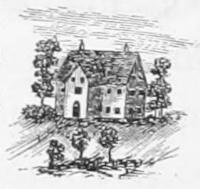
The Pynchon House, the first brick Structure in the Valley, was built in 1660, and torn down in 1831. Its Picture is preserved in the Seal of the City of Springfield.—Holland’s W. Mass., i, 44, 162.—Ed.
[102]
A Letter to Capt. Brockholes at Albany.
[Warrants, Orders, Passes, iii, 146.]
Capt. Brockholes:
I long much to have an Accot from you. Yesterday wee had the Newes of Springfield being burnt,[1] and Indyan Strength in those Parts, which evinces the Necessity of yor being carefull in keeping good Guards.
[103]
I have nothing more to add to yor Instructions, but that you order Matters the best you can accordingly, and see that the Maques may see tis ffriendship, not Apprehension or Need of them, but for their Good; Hearing that they and the Sinnekes are inclinable to a Warre wth the Indyans to the East, if soe, though they have not yet attackt us, ’tis the Opinion of my Councell, that ’twere well the said Maques were rather encouraged than hindred; and you may lett them have a ffree Markett for Powder &c. as formerly, continued.
Pray remember mee to all wth you. I hope my Brother, Knapton,[2] Sharpe,[3] &c. will bee here per first.
I am,
Yors &c.
Edmd Andross.
N. Y. Octbr. 19th 1675.
[1] On the Night of October 4th, 1675, an Expresse was despatched from Windsor, Ct., to Springfield, Mass., with the Intelligence derived from a friendly Indian, that a Party of about 300 of Philip’s Warriours were on their Way to burn the Town and destroy the Inhabitants. The Alarm was hastily spread, and the Citizens fled to the fortified Houses, three in Number, with such Valuables and Necessaries as they could carry. On the Morning previous, the Springfield Soldiers, to the Number of 45, had left for Hadley, to join in a Demonstration, concerted against the Enemy at that Place, and a Messenger was sent thither to inform them of the threatened Danger. When the Morning came, no Enemy appearing, two Persons rode forwards toward the Indian Fort, and were shot by the Foe in Ambush. The Town was soon filled by Savages; about thirty Dwellings and twenty-five Barns were burned, besides the Corn and Saw Mill; four or five Persons were wounded, and one Person was killed. The Enemy retired on the Arrival of the military Force that had been recalled, leaving the Settlement in Ruin and the Inhabitants in the greatest Distress near the Verge of Winter. Holland’s Western Mass., i., 95.—Ed.
[2] Cæsar Knapton.
[3] Thomas Sharpe.
[104]
Letter from the Governour to Esopus, &c.[1]
[Warrants, Orders, Passes, iii, 147.]
Gent:
I have just now received yors of the 16th Instant, and think you have done well to putt yourselves in a fitting Posture for all Events, and securing the Goods and Corne of yor out ffarmers, which is also done in these Parts, where all is quiet; but have a Rumour that Stanford Indyans are in Armes, but have done noe Harme. However its thought they have noe good Intent in it. I doe not know that I have any brasse Gunn of yours, but if you have Occasion shall notwithstanding bee ready to send you one or more such iron Gunns as are here, the least of which is a small Saker, and if I can will gett and fitt up a Petrara for Capt. Chambers, having none in the ffort ready, and the Sloope in hast not to loose their Tide. I am,
Yor affecate ffriend,
E. Andross.
N. Yorke, October 19, 1675.
[1] Esopus near Kingston, about Midway between New York and Albany, was one of the earliest Settlements by the Dutch in this Colony.—Ed.
[105]
An Order for Oyster Bay to fortify, &c.
[Warrants, Orders, Passes, iii, 148.]
By the Governor:
Whereas I am informed that severall of the Inhabitants of Oyster Bay, notwithstanding the late Orders and Proclamacons, are still very backward in making up their ffortifications, These are by the Advice of my Councell, in his Maties Name, to require all the Inhabitants in Genall, that with all Speed they apply themselves to finish the said Worke already begunn, only that it bee left to the Discretion of the Constable and Overseers to excuse such Persons as they shall think most proper, and may not bee a Hindrance to the setting forward soe needfull and publick a Work: Provided they bee such auncient Persons as have principally contributed to the House taken in within the said ffortificacon.
Given under my Hand in New Yorke this 19th Day of October, 1675.
E. Andross.
To the Constable and Overseers
of Oyster Bay.
[106]
An Order about selling Powder to the Indyans.
[Warrants, Orders, Passes, iii, 151.]
Whereas there was at the City Hall an Order of the last Genall Court of Assizes, publisht the 12th Instant, strictly prohibiting the Sale of Powder or Strong Drink to Indyans in any Part of Yorkshire, on Long Island, or Dependencyes, as pr said Order; notwithstanding which some Persons think it doth not comprehend or is binding to the city Inhabitants; These are therefore by Advice of my Councell in his Maties Name to require and command the strict Observance of said Order in this City in every Particular, under the Penaltyes therein expressed, at their utmost Perills.
Given under my Hand in New Yorke, this 12th Day of October, 1675.
E. Andross.
[107]
An Order for the Inhabitants of Madd Nan’s Neck[1] to make a Block House.
[Warrants, Orders, Passes, iii, 153.]
By the Governour:
Whereas I am given to understand that notwithstanding the severall Orders for making of Block Houses, or some Place of Defence in each respective Toune upon Long Island and Dependencyes, the Inhabitts of yor Place have neither contributed any Help or Assistance towards the making of the Block House or Fortification at Hempstead, nor taken Care to make any for themselves; These are in his Maties Name to require you, that forthwith and without Delay you make up some Fortification upon yor Neck of Land, and give mee an immediate Accot thereof by one from yor Neck, and Answer [108]of short Contempt, as you and every of you will answer the Contrary at yor utmost Perills.
Given under my Hand in New Yorke, ye 21th Day of October, 1675.
E. Andross (copy of his signature)
To the Deputy Constable at
Madd Nan’s Neck.
[1] Now known as Great Neck, in the Town of North Hempstead, Queens County. It contains about 4000 Acres of Land, and was patented in 1666 to Thomas Hicks, who sold a Part of it the same Year to Richard Cornell. Thompson’s Long Island, ii, 61.—Ed.
[109]
Letter from the Governour to the Constable of Harlem.
[Warrants, Orders, Passes, iii, 153.]
Mr. Constable:
I have just now seen yors of this Day, sent Expresse by Wm Palmer, of yor having stopt 10 or 12 Indyan Canoes with Women, Children, Corne, and Baggage, coming as they say from Westchester, and goeing to Wickers Creek,[1] but not any Passe mentioned. Soe that you have done very well in stopping the said Indyans, and giving Notice thereof.
These are now to order all the said Indyans to stay in yor Toune, and that you send some of the chiefest of them to mee early to-morrow, and one of yor Overseers for further Orders; and that it may [110]bee the better effected you are to order them some convenient House or Barne to bee in, and draw up their Canooes until ye Returne of them you shall send; And that you double yor Watch.
I am,
Yor loving Friend,
E. Andross.
N. Y. Octbr. ye 21th, 1675.
[1] The Name applied to a Stream flowing into the Hudson at the upper Landing of Dobbs’ Ferry, in Greenburgh, Westchester County. It was called by the Indians Weghqueghe, or Wysquaqua. The Wichquaesqueecks, or Weckquaskecks, a Tribe of the Mohegans, anciently inhabited the adjacent Country, and from these Names, the one given in the Text was doubtless derived. Bolton’s Westchester, i, 2, 164.—Ed.
[111]
Council Minutes.
[Council Minutes, iii, Part 2, p. 65.]
At a Councell, Octber 23th, 1675.
| Present, | The Governour, | |
| The Secretary, | Capt. Dyre. | |
| Mr. Philips. | ||
A Letter from Mr. Leete, Dep. Governr of Conecticott about ye Indyan Affaires and in Answer to ye Governors Letter of Intelligence to them, was read.
The Governor had another Letter of private Intelligence about ye Indyans ill Intent upon Long Island.
Resolved, upon ye said Indyan Intelligence of our Indyans being in Confederacy wth the Narrogansett Indyans upon ye Maine, and plotting Mischiefe, That all our said Indians on Long Island be forthwith disarmed.
The Armes to be delivered into ye Constables Hands of ye severall Touns, who may lend some few of them to such Indyans as they shall think may be [112]trusted, for their Hunting, wth ye Approbacon of ye Justice of Peace, and where no Justice at Hand, of ye chiefest military Officers of ye Place.
That an Order be made hereupon for the putting of this in Execucon.
[113]
Letter to Mr. Wm. Leet, Deputy Governor of Connecticott, &c.
[Warrants, Orders, Passes, iii, 155.]
Honble Sr.
I have just now received yors of ye 19th Instant, for wch this is only my Acknowledgment, having writt fully in my last, to which have nothing more to add; being ready if any Thing bee yet wanting to doe my Duty, and serve you to my Power.
I am,
Yor affecate humble Servt,
E. Andross.
To Mr. Leet, Dpty Governor
of Connecticot.
[114]
Council Minutes.
[Council Minutes, iii, Part 2, p. 66.]
At a Councell, Octber 24th, 1675.
| Present, | The Governour, | |
| The Secretary, | Capt. Dyre. | |
| Mr. Fred. Philips. | ||
Letters being brought from ye Commissaryes of Albany by Mr. Knapton, who had been Commander there, concerning a Peace newly made or renewed by them at the ffort between ye Maques and Mahycanders[1] Indyans, though without Leave, it is ordered to be kept. It is likewise resolved, That there be at this Juncture, a Prohibicon of selling Powder and Lead to any Indyans whatsoever at Albany, unlesse it be to ye Maques & Sinnekes, the same to be under ye Penalty of one hundred [115]Guildrs Beaver,[2] for each Quartr of a Pound,[3] and so proporconably for more or lesse, or corporall Punishment extending to Life as the Case may require, except allowed by the Commander himselfe under his Hand, to some adjacent Mahycandr Indyan well knowne to himselfe or Magistrates; the Quantity of one Quarter of a Pound for ye present Hunting, or to some few such Indyans, who shall be knowne by them to be designed for ye beaver Hunting who may by the said Command be allowed one Pound with Lead proportionable. This Prohibicon to continue for the Space of six Months after this Date.
It is also ordered and resolved, That ye like Ordr be sent up to Esopus, only the Alteration of [116] the Words (Mutatis Mutandis) instead of ye Comander, the Justices or chiefe Officers to be inserted. Upon ye Receite of a Letter from ye Esopus, relating their great Apprehension of ye Indyans.
It is resolved, That ye Magistrates there be checkt for their needlesse Feares, and they are all ordered to keep at their usual Habitations and Places of Abode, both at ye distant Villages and out Farmes, untill more apparent Cause to ye Contrary.
Ordered, That ye Magistrates doe give a present Acct what is meant by the Indyans offering to deliver up ye Articles made betweene Coll. Nicolls and them, and who spake of it first, whether private Persons amongst the Indyans, or Sachems. The Agreement in ye said Article sett forth having been renewed with those Indyans, this very Spring, and themselves having no Authority to alter or make either Peace or Warre, nor to treate of either in ye least, but to do their Dutyes in continuing Things as they are.
[1] Mohegans, inhabiting the eastern Borders of New York and the adjacent Parts of New England. They were at this Time considered subordinate to the Iroquois and under their Influence. Those living near the Hudson were often called River Indians or the North Indians.
[2] The Currency of the Colony then in Use, as established by Proclamation, June 24th, 1675, was as follows:
| Pieces of eight, | six Shillings. | ||
| Wampum, | { three Black, | } | one Stiver. |
| { or six White, | } | ||
| Three Stivers Wampum, | { one Penny Silver, | ||
| { New England Money. | |||
| Four Stivers, Wampum, | one Penny Sterling. | ||
| One Beaver, (in merchantable Condition), | 13s. 4d. Sterling. |
Council Minutes, iii. Warrants, Orders, Passes, iii, 102.—Ed.
[3] This Penalty was about $38, as Money is now reckoned, although this Sum was relatively much greater then.—Ed.
[117]
Letter to Mr. Baker of East Hampton.
[Warrants, Orders, Passes, iii, 156.]
Mr. Baker.
I have just now received yors of ye 24th of yor Indyans friendly Intelligence and Declaracons of their good Wills and constant ffriendshipp wch I shall also acknowledge upon all Occasions, and may assure them that if any Disturbance shall happen to the Eastward, or any other against the Governmt soe long as they continue thus they shall be sure of Protection, and need not feare.
But I finde no Cause or Likelyhood of their Intelligence wch I rather believe the ffancyes of some disaffected Indyans who would gladly have it soe, for I have not heard of one English Man killed, much less 12, which could not have been concealed, nor is there nor hath been for some Years one Indyan belonging to Staten Island, and those towards Achter Cull[1] are now as friendly as ever. However wee, as you know, are upon our Guard, and upon some Intelligence of the Rockaway and Masha-Peage[2] [118]Indyans Plotting have againe disordered them, and see rather lesse Cause of apprehending Troubles this Way than when you were here, but would have all Watches continued, and see none neglect their Occasions abroad as well as at Home.
If any Troubles should happen, you have by yor Commissions, and Places of Peace and Militia sufficient Power to call before you, disarm and committ any that shall goe about, or (you suspect) would break the King’s Peace, not only Indyans but Christians, and if any resist to make Use of all the fforce of yor Towne to reduce them. Pray doth you and Southampton send daily to see yor Indyans in their Plantacons, and then unlesse you discover very good Cause, bee not at all alarm’d to hinder (as above) any yor Occasions.
I am,
Yor affectionate Friend,
E. Andros.
N. Yorke, 27th October, 1675.
[119]
Letter from the Governour to Mr. Hicks.
[Warrants, Orders, Passes, iii, 156.]
Mr. Hicks.[1]
I have just now received yors dated yesterday, of yor Indyans having brought in their Armes, and ffriendlynesse, which is well, and think may lend them as many back as you judge proper for their present Hunting, without any Apprehension from them however that those of Hempstead omitt not sending daily to see them according to order.
The Letter from the Eastwards is Mr. Justice Bakers of East Hampton, occasioned upon Rumors from these Parts for which I can see noe Ground.
I am,
Yor affecate Friend,
E. Andross.
N. Yorke, ye 27th, Octbr. 1675.
[1] Thomas Hicks, a Justice of the Peace at Hempstead, L. I.—Ed.
[120]
Council Minutes.
[Council Minutes, iii, Part 2, p. 68.]
At a Councell, Novber 8th, 1675.
| Present, | The Governour, | |
| The Secretary, | Capt. Dyre, | |
| Mr. Fred. Philips. | ||
The Matter under Consideracon was upon Occasion of Nehemiah Peirce and James Pennymans being sent downe from Albany by Capt. Brockholes, upon Suspicon of writing false Storyes to Boston.
Nehemiah Peirce being first examined saith, That he never hath writt to Boston of Powder sold to ye Indyans to ye Eastward, nor knows of any, but on the Contrary, having heard from ye Commandr yt whosoever should sell any Powder to them if it could be discovered, ye Person or Persons offending should be severely punisht. He saith yt hereupon he did forewarne many thereof as he had Oppertunity, and had watcht some whom hee did suspect, but never could meet with any Powder so sold.
[121]
Withall being demanded if he had not sold Powder himselfe, he saith yes, that he did sell some few Barrells, being all that he had, but it was to ye Christians.
The said Peirce is ordered to be dismist he giving Security to make his Appearance when called for, or to give Notice if he shall have Occasion to depart ye Governmt before a Returne from Boston about this Matter, from whence if nothing materiall shall come against him as to this Businesse, within three Months, then to be totally discharged and cleare.
James Pennyman being examined saith, that he knoweth no more, than what he hath set down in a Paper which he delivered in, it being a Recitalle of ye Contents of a Letter to his Wife at Boston, which is as followeth, vizt:
To the Right Honored Governor.
If it may stand with your Honours Pleasure upon this Occasion I have recollected my Memory and according to my best Remembrance, I shall give you ye true Contents of yt Letter as I wrote to my Wife, wch as it is circumstanced it is by some counted [122]Matter of Fault, but when your Honr has a View of it, I hope you will esteeme of it otherwise. My Wife has oftentimes when she wrote Letters to me sent me News in her Letters concerning the Warre, and att some Times how ye Enemy prevayles. I never received any News but I acquainted the Governor at Albany with it, and shew him my Letters; now that as I write to my Wife is as follows:
That when our honrd Governor Genll was here in Albany, there came two Men as Post from Major Pinchon of Springfield, which as I heard peticoned to our Governor that no Powdr should be sold in this Place, truely Wife what a vain Thing was that, for this Place is upheld by Trade, I believe there is two or three hundred Barrells of Powder bought and sold in this Towne in one Yeare, and I thinke there were sold out of my House twenty or thirty Barrells this Yeare, but as I heare our honoured Governor has laid a Restraint of selling to our Englishes Enemyes and that upon a great Penalty. This is ye Summe of what I writt, now if yor Honr be displeased at this as I writt, I rather choose to forbear writing to my Wife though I love [123]her as well as a Man can do his Wife, I say I rather doe it than gett your Honours Displeasure.
James Penniman.
The said Pennyman was hereupon ordered to find Security for his good Behaviour, and to make his Appearance when called for.
[124]
Letter to the Governour of Maryland.[1]
[Orders, Warrants, Letters, &c., iii, 164.]
Right Honble.
I have received yors of the 4th past, of your Progresse against the Indyans, which I wish may have ended it, but am sorry the Susquehannas were concerned, having allwayes (as the Maques to this) had the Repute of being perfect ffriends to the Christians, particularly Maryland; and being Offsprings of the Maques, though by the Sinnekes engaged in Warre, and the Indyans to the Eastward, soe great Successes in Plymouth and Massachusetts Colonyes having engaged all others their Neighbors and endeavoring by all Meanes of Command and Profitt to engage the Maques and sent to all other Parts as farre as Canada, wch New England think doe supply their said Enemyes, and all our Indyans as farre as Delaware, thought only to wait Opportunityes.
There only remaines firme the Maques and by their Meanes the Sinnekes, which as seated are most [125]able to do Good or Harme and too farre and particularly the Sinnekes, if they fall off to bee forced.
I here send you an Abstract of a Letter sent from the Commander at Albany, relating to some Particulars (writte by ye Jesuite among the Maques), by which you may see his Sence, though I think him in a great Measure mistaken, but of myselfe can doe more than I have already.
I heare that all New England have joyned a very great Force to fall on the Narragansett Indians, the Event whereof (wch I hope good) will very much influence Things, and conduce to the Future or next Yeares Action, which is all in Addition to mine of ye 21th of October last.
Soe remaine
Yor very humble Servt,
E. Andross.
N. Yorke, Decem. 10th, 1675.
[1] Charles, Lord Baltimore.
[126]
A Speciall Warrant sent to Huntington to Demand the Indyans Armes of Rockaway and Seaquatalke, who are to Kintecoy there.
[Warrants, Orders, Passes, iii, 189.]
By the Governor:
Whereas I am informed that several Indyans at Rockaway, Unchechauge and Parts adjacent, are in a few Dayes to have a great Kintecoy[1] at Seaquetalke, which being unusuall at this Time of Yeare, is at this Juncture in no Case to be neglected; And [127]therefore (by the Advice of my Councell) you are in his Maties Name hereby required upon Notice of the Time or Day the said Indyans Kintecoy is to bee, with six or more Men, not exceeding ten (as you shall judge fitt to bring Home their Armes) to repaire to Seaquatalke or Place where the above Kintecoy shall bee, sending two Men a little before, to give them Notice of your coming (that they bee not scared at your Arrivall) to informe yourselfe of what Indyans are there, and demand their Armes; which having recd to warne and command them to separate, and each to repaire to their proper Place of Abode, and for the Future to forbear appointing or coming to any such public Meetings, or Kintecoyes, wthout speciall Leave, and to bring away with you all their said Armes, wch you are safely to lay up and keepe in your Towne, till further Order. But in Case the above Indyans should happen to be refractory, and refuse to deliver their Armes, you are (having taken the best Accot or Notice you can from whence they are, their Number, &c.), to warne and command all their Sagamacks, wthout Delay, to repaire to mee at this Place, and all other Indyans Home, and so leave them. At yor Return, [128]you are immediately to give mee a particular Acct of yor Proceedings, according to the aboue; of which you are not to faile, as you will answer the Contrary at your Perills. And for so doing this shall bee to you, and every of you, a sufficient Warrant.
Given under my Hand and Seale in New Yorke, this 13th Day of December, 1675.
To the Constable or chiefe Overseer
of Huntington.
[1] “The Indians sometimes assemble in large Numbers and retire far into the Wilderness, where they eat and drink in a profuse Manner. These Conventions are called Kenticoys. Some esteem them to be debauched Revels or Bacchanalia, but those who have followed them into these Recesses give some Accounts of their Conduct as lead one to imagine that they pay a joint Homage and Supplication to some invisible Being.” Smith’s Hist. of N. Y., Alb. Ed., p. 76. This Term was adopted by the Whites and is still used in the River Counties and on Long Island, to designate a Revel. A Description of the wild Excesses of the Indians at their “Canticos,” is given by Denton, in his Description of their Customs, p. 9. Mr. Henry R. Schoolcraft in a Letter to the Editor, expresses the Opinion that this Custom was analagous to the modern Wabino, the most viscious of Indian Orgies, the Name denoting that the Dancing is continued till Daybreak.—Ed.
[129]
Council Minutes.
[Council Minutes, iii, Part 2, p. 74.]
At a Councell, Decemr 22th, 1675.
| Present, | The Governour, | |
| The Secretary, | Capt. Dyre. | |
| Mr. Philips. | ||
Ordered that a Letter be writt to ye Governour of Roade Island, upon News or Report that a Vessell designed or bound for this Port, is stopt at that Island upon Acct of having Powder and Armes in her.
That Copies be likewise sent of the Orders for Prohibicon of Powder at Albany to be sold to the Indyans.
[130]
Letter to the Governour of Rhode Island.[1]
[Warrants, Orders, Passes, iii, 169.]
Decem. 22th, 1675.
Honble Sr.
This is by a Sloope bound to yor Parts not to omitt noe good Opportunity, though there bee nothing new, but that I heare you have stopped a Vessel bound to this Place, on Acct of some Powder and Armes in her, which (as represented) would not only reflect on mee, and all the Magistrates of this Government, but also on his Royall Highnesse and the King himselfe, whose Commissions I have. And therefore as I have endeavoured to do my Duty, and (un-asked) to serve my Neighbours, particularly yor Colony from the Beginning of the Indyan Troubles, &c., Sale of Powder to Indyans being soe strictly forbidden here, I cannot give Creditt to this Report, not having heard from yor selfe or Colony of it, which I am confident I should, yet being told mee by sufficient Men, I pray I may. [131]And if any such Thing bee, whether you have any Orders from the King to stop any of his Maties Subjects, Vessells or Goods coming to these Parts and youl oblige,
Yor humble Servant,
[1] William Coddington.
[132]
The Governour of Rhode Island to the Governour and Councell of Boston.
[New York Colonial MSS., xxv, p. 67.]
The Governor and Councell of ye Mathacusetts and Comissioners of ye Vnited Collonies writing to us do give vs Thanks for transporting their Souldrs and Prvision and yt our Sloops transported their Wounded and desired vs to lett out 100 or 200 Souldiers answering you denying so to doe and gave your Grounds. This was our Postcript.
Friends, Since our writing ye aboue said to you is come to our Hands, certain printed Lawes or Orders of ye 3th Nouembr 1675[1] set forth by ye [133]Authority of yor Generall Assembly of ye Matathusetts your Secretaries Hand being to ym wherein you say you haue apostated from ye Lord with a great Backsliding: To wch I do consent so great hardly to be paralleled, all Things considered, we were a People prfessing ye Feare of ye Lord in England against Bishops and Ceremonies in tender Loue to all yt pfessed Godliness, and so departed from ye Land of our Nativity, declaring ye Ground of our Removall into New England, viz: to seek out a Place for our Brethren where we might enjoy ye Liberty of our Consciences yt ye Sons of Wickedness might vex vs noe more, as was yri[2] publikely preached and declared.
2dly ... For ye Prpagating of ye Gospel converting ye Indians &c:
3dly ... That we might enjoy such as preached ye Gospell (ye Power of God to Salvation) for ye Bishops did yn Silence our best Ministers these and others in 1630 was printed and dispersed both in England and Holland wch I haue by me in Print, ye Governor and Deputy Governor and Assistants Hands being to it, my selfe and Simon Broadstreet [134]being two of ye yn Assistants our Hands is to it, I haue ym at large in Print to be seene.
How well this hath bin performed by you, let your printed Lawes declare, and this amongst ye Rest our Houses are now open to receive your Wounded and all in Distress, we have prpared an Hospitall for yors, but you a House of Correction for all yt repaire to our Meetings, is this soe do as you would be done by? Your Ministers with us have not been molested, ours with you have been persecuted,[3] is this a Time for you to establish Iniquity by a Law,—will not ye Lord be avenged on such a Nation as this yt set vp Ministers yt are not so made Ministers by yor Power of and endless Life, but of ye Letter yt kills but not ye Spirit yt giues Life and a Worship, yt is not in Spirit and Truth, set by Christ aboue 1600 Yeares agoe; we cannot come to you, but depart from or Lord as you haue done, therefore desiring your returne to ye Power yt made you ye true Light yt is in you.
This is written to you by one who aboue 45 [135]Yeares past was one of you and now is one yt desires your true Good both eternall and temporall as I did when I was with you, and am,
Yours in true Loue,
Wm. Coddington,
Gouernor.
Rhoad Island, January
ye 9th, 1675/6.
Vera Copia.
[1] “Att a Meeting of the Vnited Collonies in Boston, by Adjournment, Nouemb. 2: 1675.
The Commissioners do agree to comend to the severall generall Courts or Councells, of the Vnited Collonies that they appoint and order the second Day of December, being the fift Day of the Weeke to be obserued and kept as a solemn Day of Prayer and Humiliation; to supplycate the Lords pardoning Mercye and Compasion towards this poor People; and for Successe in our Indeauors for the repelling the Rage of the Enimy.” * * Hazard’s American State Papers, ii, 537. The general Court of Mass., accordingly on the next Day appointed a Day of fasting and Prayer. Mass. Coll. Records, v, 69.—Ed.
[2] Very.
[3] Several Quakers in Boston, were compelled to run the Gauntlet for refusing to bear Arms during the Autumn of 1675. Drake’s Boston, 410.—Ed.
[136]
Council Minutes.
[Council Minutes, iii, Part 2, p. 81.]
At a Councell, Jany 17th, 1675.[1]
| Present, | The Governour, | |
| The Secretary, | Capt. Dyre, | |
| Mr. Fred. Philips. | ||
Resolved to write to ye Governor of Boston, to vindicate this Governmt from an Aspersion in a printed Paper of Decemr the 7th last past, wherein they sett forth, that Philip in his Flight was supplyde with Ammunition from Albany whereby he was enabled to prosecute his bloody Designe against ye English.
That it be despatched by an Expresse wth the first Convenience.
Resolved, That there be a civill Letter of Thanks sent to ye Governr of Roade Island, in Answer to his two last to ye Governor and a nearer Correspondence accepted and concluded, in ye best Manner for ye Preservacon of both Colonyes, according [137]to ye Extent of their Patents, from all Invasions or Encroachments on them and particularly to accept of a Mediation to compose ye Difference betwixt them and the neighbouring Colonyes concerning ye Narragansett Country and other Territoryes upon ye Maine, all which Treatys to be privately managed by ye Person or Persons, who shall carry the Letter to Boston, who shall have a Letter of Creditt and Instructions to that Purpose.
Resolved to let ye Governor of Roade Island know, that any in their Parts driven by the Indyans from their Habitacons or Plantations, shall be welcome here and have Land assigned them upon this, Long Island or Staten Island.
And to take away all Apprehensions from our present Inhabitants, or such as shall come hither, it is likewise ordered, That all or Indyans on Long Island not yet disarmed, vizt Sequetauke, Seatauque, Unchechauge and Southampton, be forthwith disarmed, as ye others upon ye Island already are, and no Indyan there to be permitted to have any fire Arms in any Case during ye present Troubles.
[1] 1675/6.
[138]
An Order for all Indyans on Long Island to be disarmed, in this Juncture of the Warre, and that none ramble from Place to Place, &c.
[Warrants, Orders, Passes, iii, 174.]
By the Governour:
Whereas I am informed from several Townes and Places on Long Island, of the general Apprehensions of the People concerning any our Indyans being armed at this Juncture, for wch though I hope there is noe Cause, however by the Advice of my Councell I have ordered that all Indyans on Long Island that have by the Favour of the Townes (as allowed) their Armes still entrusted to them bee forthwith disarmed, and the said Armes according to former Order to be safely laid up and kept in or near the Block House or ffortification in the severall Townes: And that all Indyans have Notice not to ramble or goe from Place to Place out of the Bounds they live in without a Certificate from ye Magistrate or Constable to be showed to the like Officers at [139]their Arrivall where they goe, and have Leave to stay: But all Justice to be shewed to them according to Law and Orders of ye Court of Assizes, and concerning ffortification. This Order to bee forthwith effectually put in Execution, and a due Returne made to mee thereof by the severall Townes in whose Precincts any Indyans live by the first Opportunity or Expresse, if Occasion: Of which none to faile as they will Answer the Default at their utmost Perills.
Given under my Hand in New Yorke ye 24th Day of January, in the 27th Yeare of his Maties Reigne, Annoq Dmi 1675.[1]
E. Andros.
To the Justices of the Peace, Military Officers,
Constables and Overseers of Southampton, &c.
[The like sent to all the Towns on Long Island.]
[1] 1675/6.
[140]
Mr. Stanton about Indyan News.
[New York Colonial MSS., xxv, 77.]
These may certifie all whome it may conserne that the Pecoites[1] Indians haue bene out with the English against the Naragansits and haue aproued themselues uery faithfull to our English Interest the Enemy fled before the Army and in the Pursute these Pequets Indians did uery good Serues: we slewe in all neere about fouer score Persons and followed them neare about thre score and ten Mille the Enemies hauing Noties of our Armyes aproaching the Sechems fleed and their Wimen and Children and lefte sixtye Patomtook Indians three hundred fitteing Men to way lay the Army by the Ambuscadoes weare by the Prouidence of God timely discovered by our Endyins. They wounded fiue English Men in the Rear of the Army after they weare beaten in the Fronte by our English and our Endyans. We slew at that Time fiue of the Uplanders and kiled on of there chefe Captaines and [141]the same Day took ye Towne and layed there all Night, the next Day burned the Towne and then marched to the Metropolitente Place and found it deserted so fired nere fiue hundred Widgwames. This Scalpe cared by the Bearer was a Endyon of greate Accounte and was taken with 25 Persones more by the Pecoites Indyons upon their returning Home after they parted with the English ... and his Men killed two Men nere Noradg and took away a Boy alive this 6 Febrery. This is short but ... in large.
Febr’y 9: 1675.[2]
Your loving Friend,
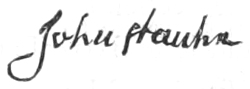
[142]
Council Minutes.
[Council Minutes, iii, Part 2, p. 85.]
At a Consultation held Feby 24th, 1675.[1]
| Present, | The Governour, and Councell, |
| The Mayor and Aldermen. |
Mr. Matthias Nicolls, and Mr. Samuell Leete, being returned from Boston, and having brought a Letter from ye Governor and Councell there to ye Governor, which was not satisfactory.
Resolved, That for ye Present no further Application be made to ye Government of Boston.
[1] 1675/6.
[143]
The Examination of Tho. Warner, that had been a Prisoner with the Indians.
Feb. 25, 1675.[1]
[New York Colonial MSS., xxv, 81.]
Thomas Warner one of the two that came downe from Albany and had beene Prisonr wth ye Indyans who arrived here this Morne, being examined, saith, that he was one of ye Psons that being sent out from Hatfield[2] where the English Army lay, to discover [144]the Enemy, but a Party of Indyans way layd them, and shott downe 5 of their Company, and tooke 3 of which he and his Comrade are two, the 3d they put to death, the 9th was an Indyan that came with them, and escap’t away.
That the Indyans lay still two Dayes after they were taken, and then a Party of about 30 with whom he was march’t to a River to the north east from thence about 80 Miles called Oasuck, where about a Fortnight after the Rest of the Army came to them, having in the meane Time burnt two Townes: They kill’d one of the Prisoners presently after they had taken him, cutting a Hole below his Breast out of which they pull’d his Gutts, and then cutt off his Head.
That they putt him so to Death in the Presence of him and his Comrade, and threatened them also with the like.
That they burnt his Nayles, and put his Feet to scald them agst the Fire, and drove a Stake through one of his Feet to pin him to the Ground. The Stake about the Bignesse of his Finger, this was about 2 Days after hee was taken. They continued at Oasmuk sending out p’ys severall Days and that [145]about 5 Weeks agoe at one of their Meetings he saw 2100 Indyans all fighting Men, [of?] which 5 or 600 French Indyans, with Strawes in their Noses.
When hee was taken the pty were abt 600 Indyans.
That the Riuer Indyans recd those Indyans kindly, furnish’t them with Provisions, and some of those Indyans were with them that ... him.
That there were 5 or 600 of the Indyans with Strawes in their Noses, which they called the French Indyans.
That hee was made to tell the Number by ye Indyans themselves, which hee did 3 Times over.
That there were most young Men, the oldest not 40 Years old.
That they were supplyed with Powder from ... French Indyans.
That they sd their Designe was in ye Spring to goe to Hadley, Hartford &c. and Conecticut Col., and having destroyed them to goe to Boston ye ... and then after that they would destroy ye Dutch, &c., but the French and ...
[1] 1675/6.
[2] On the 19th of October, 1675, the Indians having cut off the Scouts that had been sent out to obtain Intelligence of any Enemies in the Neighborhood, made an Attack upon Hatfield with a Force of 700 or 800 Men. The Place was garrisoned by two Companies, under the Command of Captains Moseley and Poole, who were soon joined by a Reinforcement from Hatfield under Captain Appleton. The Engagement was spirited and obstinate, and ended with the Repulse of the Enemy, who retired in great Haste and Confusion, having only Time to burn a few Barns and other out Buildings and drive off a Number of Cattle. Ten Persons, including Thomas Warner, the Deponent of the above Statement, are recorded as slain. Holland’s Hist. of W. Mass., i, 105. It is probable that his Escape was not known at Hatfield. This was among the last of their important Efforts on the Connecticut River before retiring to the Country of the Narragansets. Drake’s Book of Indians, 217.—Ed.
[146]
Council Minutes.
[Council Minutes, iii, Part 2, p. 85.]
At a Councell, Feb. 26th, 1675/6.
| Present, | The Governour, | |
| The Secretary, | Capt. Dyre, | |
| Mr. Fred. Philips. | ||
Upon reading Governor Coddington’s Letter, and Consideracons of other Letters, and Returnes of Messages from other Colonyes,
Resolved, That it is not adviseable at this Juncture to make any Application, or send any friendly Message to ye North Indyans, but if they apply themselves not refuse hearing of them.
The other Colonyes, vizt ye Massachusetts Connecticott and Plimouth principally engaged in ye Warre, not having made us acquainted with their Concernes, and some of them slighted our friendly Tenders, to continue our Endeavors as Christians and ye King’s Subjects, for ye Good of this Government without farther Application to the said Colonyes.
[147]
Resolved, That ye Governor goe forthwith to Albany to settle Matters there, it being of very great Import.
That ye Wickerscreeke Indyans, if they desire it, be admitted with their Wives and Children to plant upon this Island but nowhere else if they remove, and yt it be upon ye north Point of ye Island neare Spiting Devill. The sd Indyans to be protected comporting themselves as they ought, and all our other Indyans round, doeing ye like to be assured of Protection.
That a Letter be written to ye Governor of Roade Island to acquaint him wth ye Governors going up to Albany to take Order there, having Notice of ye Maques Indyans being moved in a warrelike Manner against ye North Indyans. That ye Governor hath not Time to write now in Answer to ye Particulars of his Letter, but shall have all due Regard to them, of wch he shall give him an Acctt at his Returne.
[148]
The Governour’s Order to Lieut. Teunise to demand Christian Prisoners of the Indians.
[New York Colonial MSS., xxv, p. 88.]
By the Governour:
You are hereby authorized and required, with the Indian Guide ordered wt you, forthwith to goe eastward, to the furthest Part of the Govermt or as farr as Coneticut River, to finde out Philep or other North Indians, lately within this Governmt, and lett him or other Sachems or Commanders in Chief know; yt haveing heard of there being in warlike Posture, intruded and brought some Christian Prisoners in our Parts, I have therefore sent you to demand the said Christian Prisoners, brought by them vnto this Governmt and to command and forewarne them, from, or returning into any Pairt of the Government or Confines.
If they should be divided into severall Partyes or Parts, you are then as you see Cause and have Opportunity, to goe to each, but to make no [149]longer Stay, in any, than to deliver your Message, and receive such Prisoners as they shall deliver and refresh and rest yourself, and without Delay to return and make the best of your Way to me.
Given under my Hand and Seall in Albany, the 4th March, 1675/6.
To Gerrit Teunise,
Lt to Capt. Volkert.
Agrees wth ye Principall was signed,
Quod Attestor R. Livingston.
[150]
Order to Confine William Loveridge.
[New York Colonial MSS., xxv, p. 90.]
Copia Vera.
By the Governour:
Whereas Mr. Wm. Loveridge did 2d Instant afore me Magistrates and cheef Officers of these Pairts, alleadge and confidently affirm that the North Indians have been lately now this last Winter, supplyed by the (Dutch as he termed them) Inhabitants of this Place with Ammunition, notwithstanding the Law and strict Prohibicon; but could not make it appear by any Evidence, or Circumstance, or named any Persone, whatever, he could suspect, and therefore was committed, and not haveing yett, and it being a generall Imputation and Reflexion, you are in his Maj: Name, further ordered; still to keep the said Wm Loveredge, untill he give sufficient Security, at the Secretary, or Clerks Office, to answere ye same, at the next generall Court of Assizes, and to be in the mean Time of good Behavior, [151]for which this shall be your sufficient Warrant.
Given under my Hand in Albany this 11th Day of March 1675/6
Was signed
E. Andross.
To Mr Michel Suton, Sheriffe
or Scout in Albany.
This is a true Coppy examined by me,
Ro: Livingston, Secr.
[152]
An Order made at Albany about selling of Powder to the Indyans there.
[Warrants, Orders, Passes, iii, 223.]
By the Governour.
Whereas I did in October last past, limite the Sale of Powder in these Parts to be observed, but the Mahikanders coming now to live among us, and nearer to this Place, I do hereby allow and order that the Commander, or two of the Magistrates, may and do, from Time to Time, permitt such Mahikanders as are already, or shall come to live by us, as above, to buy and bee supplyd with Powder for their necessary Occasions, not exceeding 1-4 of a Pound at a Time as pr said Order which Leave or Permitts to bee writt and given out either to Indyans or Christians for them, by the Secretary or Towne Clarke ex officio gratis.
Given under my Hand in Albany, this 27th March 1676.
E. Andross.
[153]
Council Minutes.
[Council Minutes, iii, Part 2, p. 87.]
At a Councell, Aprill ye 4th, 1676.
| Present, | The Governour, | |
| Capt. Anthony Brockholes, | The Secretary, | |
| Capt. William Dyre. | Mr. Fred. Philips. |
The Governour returning yesterday from Albany he was pleased to shew to the Councell severall Papers of the Proceedings above between his Honor and the Maques Indyans, together with a Relation of the Message sent to the North Indyans.
Resolved, That ye Wickersecreeke and Long Island Indyans have speedy Notice of ye Governors Arrivall, that they may bee spoke with.
[154]
Council Minutes.
[Council Minutes, iii, Part 2, p. 87.]
At a Councell, Aprill ye 8th, 1676.
| Present, | The Governour, | |
| Capt. Brockholes, | The Secretary, | |
| Capt. Dyre, | Mr. Philips. |
Ordered, That all Boates and Vessells that pass through Hell Gate do take a Permitt from ye Custom House by Reason of ye Indian Troubles, which Permitt (unlesse for Merchandize) to be given Gratis and with all Dispatch.
[155]
Council Minutes.
[Council Minutes, iii, Part 2, p. 90.]
Aprill ye 10th, 1676.
There was a Meeting of the Governor and Councell in the Morning upon Occasion of the Arrivall of Mr Samuell Willis and Mr Willm Pitkin with a Letter from the Councell of Connecticott; The Letter being read, it was not adjudged that the Gentlemen menconed therein were authorized further than in Complement or for Advice. Thereupon they produced their Instructions and read them, but no further Authority appearing, the Governor proposed to them to deliver their Minds in writeing, to ye which he would likewise returne them Answer in writeing.
Afternoone, Mr. Willis and Mr. Pitkin delivered in their Proposalls in writeing. To the which after a Consultacon of the Governor and Councell, together with the Mayor and Aldermen, an Answer was made; and publikely read to the Connecticott Gentlemen, ye Governor and Councell, with the [156]Mayor and Aldermen being together, and divers Merchants and other Strangers admitted to bee present.
Ordered, That a faire Copy of what was read be given to the Gentlemen as an Answer both to the Letter and Proposalls.
The Tenour as follows.
| THE PROPOSALLS. | AN ANSWER |
| To the Honble Major Edmond Andros, Governor of his Highness’e Territories in America. | to ye Proposalls of Mr Samuel Willis, and Mr William Pitkin, in the Name of the Councell of Connecticut, from whom they brought a Letter, dated the first of Aprill most mistaken and ineffectuall. |
| Sr. having presented to your Honor the Letter wch wee received from ye Secretary of Conecticutt Colony, according to our Instructions and ye Import of that Letter as Agents sent from the said Councell, wee do in their Behalf desire. | You are sent Agents to salute, but not authorized or empowered to treate or conclude, by said Councells Letter, or otherwise that appeares. |
|
First. That yr Honor will please to informe us of what Intelligence you have, as to ye State and Place of the Enemyes of the Colony of Connecticutt, and what Correspondence ye Enemy holds with ye Maques and[157] Sinnekes, and how ye said Maques and Sinnekes stand affected towards the said Colony of Connecticutt, according as your Honor is advertized or knoweth. |
1st. I know of no Commerce or Correspondence wth such Indyans, butt upon the Rumor of your Warre (having made fitting Preparations) when sd Indyans did approach our Confines, were repulsed by our Indyans, the Maques and Sinnekes, and (as wee are informed) are retreated beyond Connecticutt River, but am ignorant if our Indyans have any particular Knowledge of you, which should bee best known to yourselves. |
| Secondly; That your Honor will advize us what is best to be done in exciteing the Maques and Sinnekes to prosecute their and our Enemys according, as is propounded in the said Letter, and what Present (if any) you will advize us to give them to that End. |
2d and 3d. Having already taken fitting Orders, hope the Maques &c. will do their Dutye as they ought to this Government, on all Occasions, and cannot bee subject to two. |
|
Thirdly, if your Honor advize us thereunto, that you will please to afford your Aide and Conduct to us therein, and an Interpreter, with whatelse may in your Honors Prudence best effectuate ye same. |
|
|
Fourthly, what Liberty your Honor will grant us to passe to Albany, or any other convenient Place in your Governmt to excite ye said Indyans, according to our Instructions to proceed against our Enemyes. Yor honors humble Servts, Samll Willis. William Pitkin. New Yorke, April 10th, 1676. |
4th. Thinke it strange that you should aske to treate with any Branch of this Gouernment apart, and upon your own Acct and notwithstanding ye Neighbourhood and all my Endeavours unaskt, that you have hitherto, and still keepe the Concernes of your said Indyan Warre. New Yorke, Aprill 10th, 1676. |
[158]
Council Minutes.
[Council Minutes, iii, Part 2, p. 93.]
At a Councell Apr. 23d, 1676.
| Present, | The Governour, | |
| The Secretary, | Capt. Dyre, | |
| Mr. Philips. | ||
Before Noone.
The Matter under Consideracon was ye Receit of two Letters, the one from Councell of Boston the other from the Councell of Connecticut in answer to what was sent by Mr. Willis and Mr. Pitkin.
Neither of them being plaine or satisfactory, the Returne of an Answer was put off till afternoon.
After Noone.
The Mayor being also present with the Governor and Councell, it was concluded that an Answer should be sent by Mr. Daniell Burre (who brought the Letter from Connecticutt) by Word of Mouth. To the Effect hereafter written, vizt:
Resolved, That the Letter of the 18th Instant from the Councell of Connecticutt, being only genrall and as formerly no suiteable Returnes, nor [159]any Trust reposed, it requires no Answer, but shall continue our Duty without intrenching on our Neighbours.
That an Answer be likewise sent by Word of Mouth for the present to Boston, by Mr. Richard Pattershall, who is upon his Departure. The which was accordingly done, but with all Civility.
[160]
Council Minutes.
[Council Minutes, iii, Part 2, p. 94.]
At a Councell, May 5th, 1676.
| Present, | The Governour, | |
| Capt. Brockholes, | The Secretary, | |
| Capt. Dyre, | Mr. Philips. |
Newes being brought from Roade Island by Mr. Joseph Carpenter, of the great Number of People flockt thither from their Habitations destroyed by the Indyans, insomuch that the Inhabitants are very much straitened by their Numbers, and will quickly want Provisions.
It being proposed whether not convenient at this Juncture to send a Sloope thither to offer them Transportation into this Colony, where they may have Lands assigned them.
Ordered, That the Governours Sloope being ready, bee forthwith sent to Rhode Island with Directions to bring as many Passengers as may bee, and that the Sloopes belonging to Luycas and [161]Christian now bound for Boston, do call there likewise in coming back, and any other Sloopes to hasten thither, and take in such Passengers as are willing to come.
Ordered, That upon this extraordinary Occasion of the Warre, and other late Intelligences, the severall Townes upon Long Island be sent to, to represent the same unto the Inhabitants in order to a Levy, and to know what they will give towards a Supply.
[162]
Orders sent to the Townes of the West and North Ridings, by Capt. William Dyre, May 8th, 1676.
[Warrants, Orders, Passes, iii, 193.]
Mr. Constable and Overseers:
The Warre continuing eastward, in the Manner it is, of wch daily sad Tidings, I am now necessitated to represent to you and the whole Government, and how necessary it is to make a more than ordinary Provision, to prevent the like Miseryes, ffor which, having already been at a greater Expence then his Royall Highnesse Revenue in this Place: I pray you’l take it into yor p’sent Consideracons to agree and order such a suitable Supply for yor Towne, as may be proper, for so an extraordinary Occasion, and that it bee in the Nature of a Rate, designing to bee received in the same Manner and accompted for to the Countrey at the Genall Court of Assizes.
I am,
Yor affectionate ffriend,
E. Andros.
[163]
This is by Capt William Dyre, who is ordered to receive and bring yor Result.
M.[atthias] N[icolls,] Secr.
Warrants were issued May 13th to the Constables and Overseers of Hempstead and Flatlands, to appear and answer for Neglect of the above Orders.
[164]
Council Minutes.
[Council Minutes, iii, Part 2, p. 97.]
At a Councell, May 23d, 1676.
| Present, | The Governour, | |
| Capt. Brockholes, | The Secretary, | |
| Capt. Dyre, | Mr. Philips, | |
| Mr. Mayor, | Capt. Delavall. |
The Matter under Consideracon was about a Letter to be writt to ye Governour and Councell of Boston, in answer to theirs of Aprill ye fifth.
The Letter being read was approved of, and ordered to be sent by Mr. Mayor, hee being bound for Boston.
At a Councell, May 28th, 1676.
| Present, | The Governour, | |
| Capt. Brockholes, | The Secretary, | |
| Capt. Dyre, | Mr. Philips, | |
| Capt. Delavall, | Capt. Salisbury. |
Upon the Arrivall of the Governors Sloope from Rhode Island, severall Letters comeing to his Honor [165]from thence, Martins Vineyard, and Nantuckett, relateing to their present Condicon and the Report and Probability of Boston, makeing a Peace with the North Indyans, upon their own Account alone; Resolved, That Endeavours be made to putt a Stop to the Maques farther prosecuting the North Indyans.
That an Order be issued forth for the Redelivery of the Indyans Armes upon Long Island.
At a Councill May ye 29th, 1676.
Whereas, being in Peace we have upon Acct of our Neighbours Warre, disarmed all our Indyans upon Long Island, and prohibitted all Canooes from goeing in the Sound, neither of which our Neighbours have as yett done, and finding no Cause to continue the same; but rather the Contrary by our Indyans good Comport, these are therefore to signify the same unto you, and that you may and are at Liberty to redeliver all Arms taken from your Indyans, unlesse you see or know Cause to the Contrary: In which Case you are to detayne them and signify the same unto the Governor. But [166]in either Case to continue carefull Watch and Ward according to former Orders.
To the Justices of the Peace, Constables, and Overseers of any of the Townes upon Long Island.
Upon Application of Mr. John Pell (one of the Justices of the Peace,) concerning the Indyans living upon his Land at Anne Hookes Neck, using their Canooes, contrary to the Order of the Court of Assizes, presumeing so to doe for that ye Indians upon Long Neck (neare Stamford in ye neighbour Colony) have theirs, and never forbidden them, though in Warre. Ordered, That Mr. Pell do make Enquiry of the Truth thereof and give an Account of itt hither. In meane Time upon his Request, the Indians upon his Land are to have Liberty to make Use of three Canooes about their Occasions, and if the Justice upon Enquiry do find it practised as is alleaged, upon his making his Returne thereof to ye Governour, then they are to have all their Canooes returned them againe.
Ordered, That all North Indyans that will come in, may be protected, and a Stop to be put to the Maques further prosecuting sd North Indyans.
[167]
Council Minutes.
[Council Minutes, iii, Part 2, p. 101.]
At a Councell May 30th, 1676.
Resolved, The Governor being intended for Albany the next Weeke and Capt. Tho. Delavall being now goeing up, that he be desired and authorized as soon as hee arrives there, to communicate it to Serjt Sharpe the present Commandr and with said Sharpe, by Means of Arnold the Interpreter, send Word to the Maques and Sinnekes of ye Governors said Coming, and that he desires and orders that some of them will meet him there, and particularly Carriconty. The said Message to be sent by a Maques from Albany, who is to be well paid, and no further Mencon to any others, or Talke thereof at Albany: Also to send Word by some good Mahicander eastward (who is likewise to be rewarded) that all Indyans that will come in and submit, shall bee received to live under the Protection of the Government, and that the Governor will bee there as afore, where any of them may freely come and [168]speake with him, and returne againe as they see Cause without Molestation.
Memorandm. That the ffrench do receive North Indyans under their Protection, and its said that five hundred of them are already there.[1]
That the Governmt of Conecticutt hath likewise made an Order, at their late Genrall Court, that any Indyans that will come in shall be received, have Land assigned them, and be protected under their Government.
[1] The Emigration of Iroquois to Canada and Settlement at La Praire, occurred about this Time.—Ed.
[169]
Council Minutes.
[Council Minutes, iii, Part 2, p. 103.]
At a Meeting of the Councell in the Absence
of the Governour, June 10, 1676.
| Present, | Capt. Brockoles, | The Secretary, |
| Capt. Dyre, | Mr. Philips. |
Mr. Pell having upon Enquiry made Returne that it hath been and still is practised by ye Indyans on Long Neck, &c., to have their Canooes, the following Order was made.
The Wyckerscreeke Indyans having made Suite to the Governor that the Restraint of their going into and passing to and fro in ye Sound in Canooes may be taken off, in regard to their planting on Mr. Pells Land at Anne Hoockes Neck[1] or ye Islands adjacent; Upon Consideration of their good Comport, and also for that ye Indyans in the neighbour Colony of Conecticutt have hitherto beene, and are [170]now permitted the Use of their Canooes, it is Ordered, That our said Indyans of Wickerscreeke have Liberty to make Use of their Canooes, in the Sound, or any other Part within the Government, Long Island excepted.
[1] In the present Town of Pelham, Westchester County. See Bolton’s Westchester, i, 515.
[171]
Council Minutes.
[Council Minutes, iii, Part 2, p. 104.]
At a Councell, July 26, 1676.
| Present, | The Governour, | |
| The Secretary, | Capt. Dyre. |
A Letter being brought from the Governor and Councell of Conecticott, giving Notice of the North Indians tending towards Hudsons River,
An Answer was sent to it, declaring ye Improbability of what was suggested by them.
[172]
[173]

FOR THE
Trial of Indians charged with being engaged
in Philip’s Designs.[1]
Newport, August 24th, 1676.

The Names of the Members of the Court Martiall.
Mr. Walter Clarke, Governour,
Major John Crayton, Dept. Governour,
Mr. John Coggeshall, Assistant,
Mr. James Barker, Assistant,
[174] Mr. John Easton, Assistant,
Mr. William Harris, Assistant,
Capt. Arthur ffenner, Assistant,
Mr. Thomas Borden, Assistant,
Mr. Joshua Coggeshall, Assistant,
Mr. William Cadman, Assistant,
Capt. Randall Houlden, Assistant,
Mr. Samuell Gorton, Jun., Assistant,
Edward Richmond, Secretary,
Capt. Edmund Calverly, Attorney General,
James Rogers, Gen. Sergeant,
Henry Lilly, Marshall and Cryer.
| Military Officers. | |
| Capt. Peleg Sanford, |
Left. Latham Clark |
| Capt. Roger Williams, |
Left. ffrancis Gis |
| Capt. Samuell Wilbore, |
Left. Ireh Bull, |
| Capt. John Albro, |
Ensn. Weston Clark |
| Capt. Edmund Calverly, |
Ensn. James Barker |
| Capt. John ffoanes, |
Ensn. Caleb Arnold |
| Left. Edward Richmond, |
Ensn. Hugh Mosher, |
| Left. John Green, |
Ensn. John Potter. |
| Left. William Correy, | |
I Edmund Calverly, Attorney Generall, in the Behalfe of our Soveraigne Lord the King Charles the [175]second, of England, Scotland, France and Ireland, King, &c. Doe impeach the Quanpen otherwise Sowagonish, an Indian Sachim, relating to the Narragansett Country in the Collony of Rhode Island, and Providence Plantations in New England, for these sundry Crimes following, namely: ffor being disloyall to his said Majesty sundry Ways.
Videleset. ffor that thou hast not faithfully adheared to the Government established in this said Collony by his said Majesty, but hast rebelliously adheared to Indians of another Collony called Plymoth, namely, Philip chiefe Sachem of the Indians [176]in that said Collony, whoe with his Indians did within sixteen Months past trayterously, rebelliously, royetously and routously arm, weapon, and array themselves with Swords, Guns and Staves, &c., and have killed and bloodely muthered many of his said Majestys good Subjects, who lived peaceably under the sundry Governments to which they did belong.
Butt more partikularly thou hast through thy wicked bloody Minde and trayterous, rebellious, roietous and routous Acts, with Swords, Guns, Staves, &c., in thy owne Person, within this his Majties Collony, and many great Companys of Indians with the, some of them yett unknowne, armed and arrayed as aforesaid, didst doe great Damage to our soveraigne Lord the King, by killing his Subjects, burning their Houses, killing and driving away their Cattell, and many more Outrages of that Nature, have been by the and thy Confederats done and committed, all against the Peace of our soveraigne Lord the King, his Crowne and Dignity, for all which Acts of thine, I doe on the Behalfe of his said Majesty, impeatch the as a Rebell in the Face [177]of this Court, and pray Justice against thee the said Quanapen, otherwise Sowagonish, &c.
Edward Calverly,
Attorney Generall.
Dated at a Court Martiall held in Newport, ye 24th of August, 1676.
Quanopen owned, that he among the Rest was in Armes against the English Nation, and that he was at the swamp Fight, and that he had nothing to say against the Indians burning and distroying Pettacomscutt, and that he was at the Assaulting of Mr. William Carpenters Garisson at Pawtuxet,[2] and that he was in Armes at Nashaway, and did asist in difsroyinge and burninge the Towne, and takeinge and carrying away the Englifh Captives to the Number of about 20.
Voted. Guilty of the Charge, and that he shall be shott to death in this Towne on the 26th Instant, at about one of the Clock in the Afternoone.
An Indian with one Eye, Quanopens Brother [178]saith his Brother Quanopen was a Comander in the Warr, but he was not, he being soe defective in his eye Sight, that he was incapable.
Voted, that at present Judgment is suspended.
August 25th.
Sunkeecunasuck upon his Examination owneth, that he was at the burning and destroying of Warwick, and that Wenunaquabin, an Indian that is now in Prison, was at the burning and distroying Warwick with him, at the same Time, and that his Brother Quanopin, was the second Man in Comand in the Narragansett Cuntry, that he was the next to Nenanantenentt.
And Nechett, an Indian, owned that he saw Sunkeecunasuck at Warwick, and that he was instrumentall in chief in saveing his Life.
Voted guilty of the Charge, and to suffer Death, the same Time and Place with his Brother.
Ashamattan, upon his Examination, owneth that his Brother Quanapin, had some of the Wampanooage with him, and that his Brother Quanapin had many Indians under his Comand, but Nenanantenentt was counted the chiefest of the two, and [179]that they had recrute of Powder latly from the Dutch.
Voted that present Judgement is suspended.
Wenanaquabin of Pawtuxett saith, that he was not at the wounding of John Scott, but was at that Time living at Abiah Carpenters, and he could cleer him. Abiah Carpenters being sent for, before his Face saith, that he went away from their House some Time in May, 1675, and did not see him againe, nor could heare of him till towards Winter, which he saith is true. The laid Wenanaquabin further saith, that he did not come to Warwick till Night after the Towne was burned, and after owned that he saw Nechett an Indian there. The said Nechett, to his Face afirmed that he saw him at Warwick at the burning the Towne with his Gun, about Noone. The said Wenanaquabin also confesseth, that he was at the Fight with Capt. Turner, and there lost his Gun, and swam over a River to save his Life.[3]
[180]
Voted guilty of the Charge, and that he shall be putt to Death after the same Manner, and Time and Place as Quanopin.
John Wecopeak, on his Examination saith, that he was never out against the English, but one Time with other Narragansett Indians about the Month of March last, against a Towne upon Conecticutt River called in Indian Pewanasuck, and at that Time their Company burned a Barne and two dwelling Houses, and killed two Englishmen, and that he was not at the burninge of Pettacomscutt, but was at that Time with Indian John, William Heiffermans Man, removeinge their Wigwams, but shortly after he was sent downe by the Sachems to fetch off two dead Indians from thence, and saith that Georg Crafts Wife was shott with a Slugg, and chopt in some Parts of her Body with a Hatchett, and saith she did not crye hoe. Also saith, that he was at the Fight with Capt. Turner, and run away [181]by Reason the Shott came as thick as Raine, but said alsoe, that he was at a great Distance. Butt John Godfree and William Heifferman saith, that he the said Wecopeak told them, that he saw Capt. Turner, and that he was shott in the Thigh, and that he knew it was him, for the said Turner said that was his Name.
Voted guilty of the Charge, and to dye as the others.
Anashawin of Narragansett denyeth, that he layed Hands on John Green of Narragansett, occasioned about the Death of a dumb Boy, although afirmed by three Witnesses to his Face, to wit: Mr. Thomas Gould, John Andra and Daniel Green.
The Court adjourned till Thursday next at ten of the Clock in the Morning, being the 31st of this Instant.
Before the Court Martiall the 31st of August, 1676.
Quonaehewacout saith, that he was informed that all the Sachims was at the takeing and burning of Ireh Bulls Garrison.[4]
[182]
Manasses Molasses, called and answered to the Name, being examined concerning Low Howland, kild at Pocasset[5] Side (being an Englishman) and slaine or murdered by the Indians, and this Mollasses being charged or suspected to have a Hand in the Crime, answers, that he did not kill him, but being in the Woods, the Indians came and said such a one was kild, and offered to sell the Coate of the Person soe murdered or slaine, and that he the said Mollasses bought the Coate (of the said dead Man) for ground Nuts, and further saith, that it was one Quasquomack kild the said Howland.
This Deponent, John Cook, aged about forty-five Yeares, testefyeth, being at Punckatest, in the Midle of July, or thereabout, did ask of severall Indians, named as followeth: Woodcock, Matowat, and Job, whome they were, that kild Low Howland, the foresd Indians’ Answer was, that there was six of them in Company, and Manasses was the Indian that fetcht him out of the Water. ffurther this Deponant saith not.
This Deponant, John Brigs, aged thirty-five Yeares or thereabout, testefyeth to the above written [183]Testamony, and alsoe, that the said Manasses shot at Joseph Russell, as the Indians, first above named relate, and ffurther this Deponent saith not.
Taken before me this 25th of August, 1676.
Wm. Cadman, Assist.
This Deponant William Manchester, aged twenty and two Yeares, or thereabout, being at Pocasset, asked of Peter Nonoet, the Husband of Wetamoe, whoe it was that killed Low Howland, his Answer was, that Manasses fetcht him out of the Water, and further saith not.
Taken before me, Wm. Cadman, Asist., Augst 25th, 1676.
Court adjourned until to-morrow Morning, eight of the Clock.
Septr 1st, 1676. The Court called.
Awetamoes Sister being examined, what she could say concerning the killing of Low Howland, she saith, she was informed by one of those that was at his killing, called Ohom, that this abovsd Molasses was the Person that fetcht Low Howland out of the Water, at the Time he was kild, although the Indians that were with them perswaded him not to [184]persue him, and alsoe further saith, that she knoweth him the sd Mollases to be one of the 12, that was of that Company, that took and kild the said Howland.
Mumuxuack alias Toby, being charged for Suspition of killing or assisting, or being in the Company of them that killed John Archer. Upon his Examination saith that he was one of four at the killing of John Archer and his Sonn, but he was with one more, that was about tenn Rod Distance, and that the other called whether they should shoot, or not, but did shoot; but after, the said Mamuxack said, being over-perswaded, and threatned by his Brother to carry away John Archers Head, he did doe it to Awetamoe[6] by Reason his Brother threatened him, if he refused to take off his Head, and that he carryed the Head to Awetamoe, and that his Brother gave him a Shirt for soe doeing, for carrying the Head.
Jack Havens saith that he heard the Indians say, that John Archer had like to have escaped, by takeing hold of Mamuxuats Brother called Whaweapunet [185]his Hatchett: but that he, the sd Mamuxuat came behind the sd Archer, and struck him on the Head with his Hatchitt, and soe they kild him.
Wechuncksum, alias Abram, saith, that he well knoweth the above sd Molasses, and that he heard at the Spring of the Yeare last, being then at Wachusett,[7] there was then Information given, what Execution had lately been done against the English, amongst which was afirmed, that the above sd Malasses had latly killed an Englishman at Pocasset.
Suckats Squa, that lives with Daniel Wilcocks, saith, that she heard the above sd Malasses say, being askt, or examined by the Indians at the Spring of the Yeare last, towards Wachusett, whether he had latly killed an Englishman at Pocassett, he answered that he had done it.
Whawinuckshin, Serjt Roger’s Man, being examined saith that he was at Thomas Gould’s Garrison, and the Occasion of his cominge was to bury his Father, or help bury him, and there found severall Indians upon their Gard, but stayed not long there, but emediatly came away.
[186]
Voted that Serjt Rogers shall have his Indian Man home with him, provided that the said Indian shall be brought forth, if required, which the said Serjt Rogers doe in the Face of the Court, engage to doe.
The Court adjourned till tomorrow Morning at eight of the Clock.
The following Record is, probably, a Copy of a Letter, addressed by the Court Martial to Walter Clarke, of Newport, the Governour.[8]
[187]
(Place and Date, probably)
Newport, R. I., August 31, 1676.
“Sir:
The Court adjourned till tomorrow Morning at eight of the C’ck. The Letter sent by the Governour of Plymouth to yourselfe, and by yourselfe to us bearing Date August 28, last past, purporating the Massachusetts and New Plymoths Demand of Indians on this Island, &c., an Answer to which Concerne in a speciall Manner yor selfe, and need of all Expedition for divers Reasons, besides Safety and Charge. Wee therefore pray your Presence at the usiall Place of Meeting this Day to consider what Answer, or to require a full Apearance of the Councell, or otherwise, as you please; with Speed doe what seems best to you; we are redy to doe our Service to the publick Peace and Safety.”
The Letter of the Governor of Plymouth to the Governor of Rhode Island is as follows:
“These are to certefy all whome it may Concerne that Capt. Benjamin Church is authorized and fully empowered by the Authority of this Collony of New Plymoth, in the Name of the said Collony, [188]and for their Use and Benefitt, to demand and receive of the Governor and Authority of Rhode Island, all such of our Indian Enemys, whether Men, Women, or Children, as whilst our forces were abroad ranging, the adjacent Parts of our Collony, in Pursute of the said Enemyes, were received by, and are entertained upon the sd Island. And having received them, he is ordered to guard and conduct them to Plymoth aforesd and alsoe impowred to sell and dispose of such of them, and soe many as he shall see Cause for, there: to the Inhabitants, or others, for Term of Life, or for shorter Time, as there may be Reasons. And his actinge, herein, shall at all Times be owned and justefyed by the said Collony.
[Plymoth]
August 28, ’76.
Pr. Josiah Winslow, Govr.”
Voted, That Malasses and Mamuxuat and Quanachuagat are ordered to be delivered out of the Prison to Capt. Benjamin Church, and seven more to be delivered to Capt. Anthony Low, whoe have engaged to transport them out of the Collony, and that they shall not returne here againe, and one more to be at the Dispose of Henry Lilly, which [189]he receives in full Satisfaction for his Attendance at this Court, and to be transported, as the other to Capt. Low; and that, at or before the Delivery of these the Mashall shall take all their Names, and give Returne thereof to the Clerk of this present Court.
Whereas it is reported that divers Indians are now brought to Newport, and severall upon the main Land, neer Shores of Rhode Island, wee doe therefore declare, and in his Majesty’s Name require, that noe Indian, either great or small, be landed on any Part of Rhode Island aforesaid, or any Island in the Narragansett Bay, upon the Penalty, as formerly imposed upon such Offenders; and they shall be taken as being contemney of the Authorety of this Collony; Always, provided that bee, or may bee, upon just Cause detected, he, or they, at all Times, shall be lyable to be brought forth to answer the same, by Warrant from the Governor or Dept. Governor, or any two Assistants.
Dated at a Court Martiall held in Newport, on Rhode Island, August 24th, 1676.
Pr. Edwd Richmond, Secry
to the Court.
[190]
Voted, That the Dept. Governor shall have Copys of the Transactions of this Court between this and the next Sitting.
Voted, That the Court is adjourned till the 25th this Instant, except the Dept. Governour shall see Cause to call the sd Court in the Intrim, between this and the 25th of this Instant, as aforesd and upon any such Occasion the Dept. Govor have full Power to call a Court Martiall as aforesaid.
[1] The Narragansetts and Wampanogas, at first friendly to Rhode Island, becoming exasperated against all the English by the Outrages committed by the New England Troops upon defenceless Women, Children and old Men, attacked Bull’s Garrison in South Kingstown, and afterwards Warwick and Providence, wreaking their Vengeance upon all who fell in their Way. It was accordingly decided by the major Part of the Government to hold a Court Martial for the Trial of several Indians that had been captured by the Rhode Island Troops. This Court was formed August 23d, in accordance with the Powers granted in their Charter “to Exercise the Law Martiall in such Cases as Occasions shall necessarily require, and upon just Cause, to invade and destroy the native Indians and other Enemies of the said Colony.”
The Course pursued by Rhode Island towards their Indian Prisoners, was however lenient as compared with that of the other New England Colonies.
The Town Authorities of Providence on the 14th of August, 1676, disposed of a Number of Indian Captives upon the following Conditions, recommended by a Committee consisting of Roger Williams, Thomas Harris, Sen., Thomas Angell, Thomas Field and John Whipple, Jun.
All Indians under 5 to serve till 30.
Above 5 and under 10, till 28.
Above 10 to 15, till 27.
Above 15 to 20, till 26.
From 20 to 30 to serve 8 Years.
All above 30 to serve 7 Years.
The Rhode Island General Assembly in March, 1676, forbade Slavery of the Indians, and enacted a Law by which they could only be made to serve for a limited Time, for the paying of Debts, fulfilling of Covenants and defraying the Expense of bringing up.
We are indebted to Dr. David King of Newport, R. I., for this Record, which is copied from the Original, and now for the first Time printed.—Ed.
[2] William Carpenter’s House was attacked by about three hundred Indians, January 27, 1676. The House was fired, but the Flames were extinguished by those within. The Indians drove off a large Amount of Stock. Drake’s B. of Indians, 220.—Ed.
[3] Capt. William Turner of Boston, having been but a short Time stationed at Northampton, was on the 14th of March, 1676, attacked by the Indians, but succeeded in repelling them. On the 18th of May, with Capt. Samuel Holyoke, of Springfield, and 180 Men, he surprised a large Party of the Enemy at the Falls above Deerfield, and succeeded in destroying about three hundred with the Loss of only one Man. Upon returning, the Party met with a Series of Disasters, and Captain Turner, with about thirty of his Men were slain in crossing Green River. Holland’s Western Massachusetts, i, 113-124. Drake’s Boston, 419.
[4] The Garrison of Mr. Jerah Bull was taken by the Indians, December 16, 1675, and all the People slain, seventeen in Number.—Ed.
[5] Now Tiverton.
[6] Probably the same as Weetamoo, mentioned on Pages 13, 14. She was found dead in Taunton River, August 6, 1676.—Ed.
[7] Princeton, Massachusetts.
[8] Walter Clarke was a Friend, and with others of that Denomination, at that Time quite large on Rhode Island, was opposed to the War against the Indians. He felt a deep Interest in the Natives, and with his Friend John Easton, believed that the Calamities of King Phillip’s War might have been prevented by a Negotiation or Arbitration. Walter Clarke is said to have incensed the People of Providence and Warwick, who were fierce to fight, by refusing to issue military Commissions, or in the Language of Friends, Commissions “to kill and destroy Men.” It does not appear that he attended the Court Martial, and he probably, refused to sit in Judgment on the poor persecuted and wronged Natives.
This Letter was probably addressed to Gov. Clarke, by the sitting Members of the Court Martial, viz: the Deputy Governor, Major John Cranston; seven out of the nine Assistants, viz: James Barker, Wm. Harris, Arthur Fenner, Joshua Coggeshall, William Cadman, Randall Houlden and Samuel Gorton, and probably the military Officers before mentioned. John Coggeshall, John Easton and Thomas Borden, were the remaining three Assistants. Dr. David King, of Newport, R. I.
[191]
| July 4, | 1675, 44. |
| July 24, | 64. |
| September 10, | 71. |
| September 14, | 72. |
| September 15, | 72. |
| September 28, | 82. |
| October 23, | 111. |
| October 24, | 114. |
| November 8, | 120. |
| December 22, | 129. |
| January 17, | 1675/6, 136. |
| February 24, | 142. |
| February 26, | 146. |
| April 4, | 1676, 153. |
| April 8, | 154. |
| April 10, | 155. |
| April 23, | 1676, 158. |
| May 5, | 160. |
| May 23, | 164. |
| May 29, | 165. |
| May 30, | 167. |
| June 10, | 169. |
| July 26, | 171. |
TRANSCRIBER’S NOTE
Pg iv: The reference in the Erratum was 'Note 2, Page 9'. This has been changed to 'Note [14], Page 9'.
Some printer's errors in the 1858 book have been noted below and corrected in this etext. Otherwise the spelling in the original 1858 printed text has been retained.
Pg xxiii: ‘the Christan Indians’ replaced by ‘the Christian Indians’.
Pg 5: ‘reported Sausimun’ replaced by ‘reported Sansimun’.
Pg 26 Footnote [29]: ‘Plans an Individuals’ replaced by ‘Plans and Individuals’.
Pg 38 Footnote [1]: ‘Note on Page ’ replaced by ‘Note on Page 6’.
Pg 48 Footnote [1]: ‘P arteret’ replaced by ‘Philip Carteret’.
Pg 97: ‘wherein yuo seem’ replaced by ‘wherein you seem’.
Pg 124: ‘theirs aid Enemyes’ replaced by ‘their said Enemyes’.
Pg 128: ‘particular Acc of’ replaced by ‘particular Acct of’.
Index.
Pg 191: ‘Arms to to be taken’ replaced by ‘Arms to be taken’.
Pg 205: ‘of Ind. Hostlities’ replaced by ‘of Ind. Hostilities’.
Pg 206: ‘Supersttion on account’ replaced by ‘Superstition on account’.