
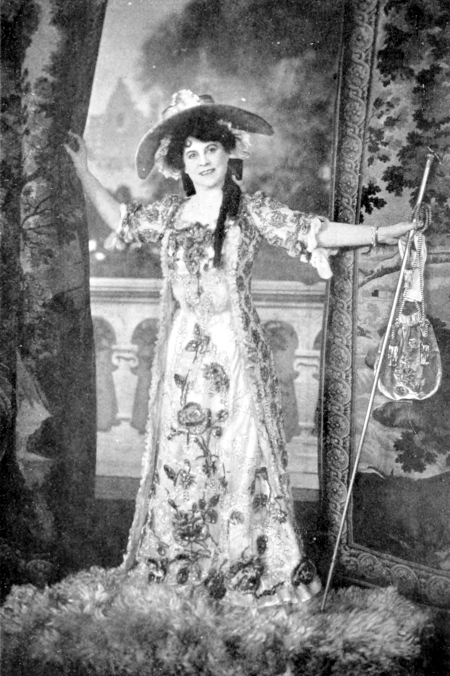
JESSIE MILLWARD AS LADY MANNERS
IN “A SCHOOL FOR HUSBANDS.”
Myself and Others
By Jessie Millward (In Collaboration
with J. B. Booth).
With 18 illustrations.
LONDON: HUTCHINSON & CO.
PATERNOSTER ROW, E. C.
1923
CONTENTS
| PAGE | |||
| Foreword | 7 | ||
| Chapter | I. | My Father, Charles Millward | 9 |
| “ | II. | Early Days | 29 |
| “ | III. | Henry Irving | 50 |
| “ | IV. | The Lyceum | 66 |
| “ | V. | First Visit to America | 81 |
| “ | VI. | The Adelphi | 101 |
| “ | VII. | Adelphi Days | 120 |
| “ | VIII. | Drury Lane | 144 |
| “ | IX. | Back to the Lyceum | 165 |
| “ | X. | Authors and Others | 188 |
| “ | XI. | A Prophecy of Evil | 218 |
| “ | XII. | William Terriss | 228 |
| “ | XIII. | Charles Frohman | 241 |
| “ | XIV. | America | 257 |
| “ | XV. | Comedy and Tragedy | 276 |
| “ | XVI. | The War and After | 294 |
| “ | Parts I have Played | 315 |
LIST OF ILLUSTRATIONS
| Jessie Millward, as Lady Manners in “A School for Husbands” | Frontispiece |
| FACING PAGE | |
| Charles Millward | 18 |
| The Millward Family | 18 |
| Irving and Toole (Caricature by Sir Herbert Tree) | 52 |
| Irving at Rehearsal (Drawing by J. Bernard Partridge) | 70 |
| Jessie Millward as Hero | 76 |
| David Belasco | 102 |
| Jessie Millward as Ann Chute in “The Colleen Bawn” | 108 |
| Jessie Millward and William Terriss in “The Harbour Lights” | 120 |
| Jessie Millward as Pauline in “The Lady of Lyons” | 138 |
| G. R. Sims and Henry Pettitt | 208 |
| Daniel Frohman | 246 |
| Jessie Millward as Lady Algy in “Lord and Lady Algy” | 252 |
| Jessie Millward as Lady Doura in “My Lady’s Lord” | 256 |
| Jessie Millward as Lady Eastney in “Mrs. Dane’s Defence” | 260 |
| Jessie Millward as Beatrice | 266 |
| Sir Squire Bancroft | 284 |
| John Glendinning | 284 |
[Pg 7]
REGRETS have an uncomfortable habit of late arrival, and never until I sat down to recall the past had I regretted that I had not kept a diary.
For these pages I have been compelled to rely on old letters, faded old cuttings, old memories, and old friends. And if in any instance I have failed to acknowledge the help which I have received, my omission will, I hope, be ascribed to accident or sheer forgetfulness.
First I must pay my debt of gratitude to that splendid and courtly veteran of a grand old school, Sir Squire Bancroft, for his kindness and assistance in recalling incidents in my family history before I was even of an age to keep a diary. Mr. Belasco I thank for his portrait, and to Mr. Daniel Frohman I give my deep thanks for his picture and kindly words of encouragement:—
“I am sure your reminiscences will be most interesting, and will cover a wide range of theatrical activities. I remember so well my early visits annually to London, and my seeing you so earnestly active at the Adelphi, when I used to drop in to see my dear old friend, Will Terriss. Now so many of the old friends are gone—Kendal, Tree, Alexander, Hare, Wyndham—but time rolls on.”
[Pg 8]
To Mr. Bernard Partridge I am indebted for the permission to publish his valuable and little known drawing of Sir Henry Irving at rehearsal; to the proprietors of the “Era” I owe my thanks for Sir Herbert Tree’s drawing of Sir Henry Irving and John Toole, and, wherever I have been able to trace it, the name of the photographer appears beneath each photographic illustration. To Mr. Tom Terriss I am indebted for the deeply interesting views on the future of the film which appear in the last chapter.
J. M.
[Pg 9]
MYSELF AND OTHERS
I!—Henry Irving and my mother.—My father, Charles Millward.—Liverpool associations.—The “Porcupine.”—Greeks in Liverpool.—Amateur theatricals.—The “Illustrious Stranger.”—E. A. Sothern.—Journalism.—Liverpool papers.—An editor of the old school.—Justin McCarthy.—M. J. Whitty.—The penny “Daily Post.”—Lord Russell of Liverpool.—A journalists’ club.—Barry Sullivan.—The Liverpool Literary and Dramatic Society.—A melting performance.—My father’s first play produced at the Adelphi.—Albert Smith and Robert Brough.—A Temple supper party.—Sala, Mayhew and others.—Coaxing the “gods.”—Mayoral patronage.—Mr. Gladstone and an unlucky supporter.—The “London Letter.”—Mrs. John Wood.—The Walker Art Gallery.—Mr. Philip Rathbone.
I!
And now everybody tells me that the worst is over.
Of all the vowels “I” is the most stark and unashamed; “A” has a certain graceful angularity; “E” is full of cosy nooks, “O” and “U” are cheery, rotund little fellows, full of good humour—but “I”!
So when people have suggested to me that some record of my life and art might be of interest both to the public with which I grew up and to the public which is growing up, a horrid vision presented itself to me of rigid, uncompromising “I’s” flashing through the pages as telegraph posts—and they are ugly and uncompromising enough, in all conscience—flash past through the windows of an express train.
[Pg 10]
But as behind the telegraph posts which fringe the railway line there is often interesting, often beautiful, often strange and thought-provoking scenery, so behind the “I’s” which flash past in this survey of my life’s journey there will, I think and hope, be found some pictures of brilliant and interesting people, records of high artistic endeavour, and scenes from the great tragicomedy of life which will help the reader to forget the hideous first person singular.
And if the reader should get one half so bored as I shall become with the pronoun, he or she can always substitute mentally the impersonal “one” or the pleasantly vague “they.”
******
“Of course your daughter will go on the stage,” said Mr. Henry Irving to my mother after hearing me recite one evening at our house in Malden Crescent when I was about fourteen years of age.
“I would sooner see her in her grave,” was my mother’s very uncompromising reply.
And yet within a few years of this stern declaration I entered on a stage career with her consent and approval, and—but I seem to have begun, if not quite in the middle, rather far from the beginning, so I had better go back and explain how Mr. Irving came to be inflicted with the recitations of a young lady of fourteen.
My father, Charles Millward, was a familiar and popular figure in the theatrical world. A clever journalist—amongst other things, he wrote the London Letter to the Liverpool “Porcupine,” a bright little journal which had a considerable reputation on the banks of the Mersey, and of which he was at one time the proprietor—the author of many pantomime “books,” and a prominent[Pg 11] member, and one of the fathers, of the Savage Club, in the days when the club-room had a sanded floor and its weekly “function” was a tripe and onion supper, he was a typical Bohemian of the witty, brilliant type of which there seemed so many in those days.
Born in Liverpool, my father, after being educated at the Liverpool College School in Shaw Street, passed into the office of a general merchant in South Castle Street, Liverpool.
There were no Greeks in Liverpool in those days—times have indeed changed!
The shipping business of the few firms of that nationality in London and Manchester was delegated to local agents, and at that time, too, the great steamship companies of Burns and MacIver, Bibby, Moss, and Papayanni were unborn, and clipper schooners and brigantines were the only traders between Liverpool and the Mediterranean ports.
These traders usually loaded and unloaded in the King’s and Queen’s Docks, and it was part of my father’s duty to see that none of his firm’s packages were shut out. All packed goods for Russian ports were sealed by the consul, who kept the wretched juniors waiting for his “certificates” hours in his dingy old office off Mersey Street.
It was during my father’s apprenticeship that the Greek invasion of Liverpool began, and towards the close of his articles he gazed for the first time on a real live Greek. The young gentleman in question was “consigned” to his employer with secret instructions to “learn all he could as quickly as possible” and pave the way for the establishment of a direct branch of the house instead of a mere agency. Other young Greeks arrived in Liverpool about the same time with similar[Pg 12] instructions, and, as an inevitable result, the English agents were soon swept away and the first Greek houses in Liverpool were established.
The first of the invading firms was, I fancy, Messrs. Cassavetti and Co., then followed Papayanni, who have made their name in the commercial annals of the town. Messrs. Giannopulo, Cochilani and Maovrogordato came next, and to them succeeded the Rallis, the Lascaridis, the Negropontes, the Georgalas, the Prichas, and other firms of classic name and honourable repute, and my father was transferred, with the office fixtures, to the firm for which his employer had previously acted as agent. Larger offices were rented from Mr. George Holt (who sensibly collected his own rents in those primitive days) in Fenwick Chambers, and my father occupied the dignified position of cashier and chief clerk.
During the fitting-up of the new offices his Greek employer rarely appeared, but one day he turned up as my father was settling accounts with the “poor rates.”
“What is that?” demanded the Greek gentleman.
“The rates.”
As there seemed to be no poor rates nor local taxes in Greece, matters had to be explained to my father’s bewildered chief, who, with a keen appreciation of the situation, turned to the collector and said: “We’re paying you prompt money, so of course you’ll allow the usual discount for cash?”
That rate-collector cast a bewildered look upon the verdant foreigner, and, with a groan, fled, leaving my father to explain matters.
It was surely the first and last experience of a rate-collector being asked to allow discount for ready cash.
[Pg 13]
Those were the days of late hours for the juniors, and I have heard my father tell how many a time he was kept until midnight waiting for captains to sign bills of lading. Bahr, Behrend and Stewart’s office in Cable Street rarely closed before the small hours, and their captains were usually to be found when urgently wanted at an adjoining hostelry, kept by the firm’s cashier, a Mr. Ryley, and later known as “Kelly’s.” Another “late-hour” office was Leech, Harrison and Forwood’s, in North John Street, where twelve to fifteen hours was quite a usual day’s work for the clerks. But the “late-hour” custom was as general as it was reprehensible. The leading merchants all followed it, and the droning manner in which business was then conducted made it almost a necessity.
Hard-worked as he was, my father found time to indulge in his pet hobby of private theatricals. Undeterred by the drudgery of office, he took up the cause of the drama, and with several kindred spirits started, in a room in Upper Newington Street, a very modest amateur dramatic society, which in due time gave a performance which was very highly praised.
It should be added that the audience, being admitted free, and being provided with tea and coffee between the pieces, were expected to be eulogistic. Other performances followed, and as my father was the acknowledged leading actor of the company, he began to regard himself as the coming man. He had even been permitted to write a notice of his own performance in a local paper, so his assumption seemed justifiable. One evening, however, his evil genius appeared in the shape of a gentle youth, with chubby face and flaxen hair, who expressed a desire to join the theatrical ranks.
“What can you play?” asked my father.
[Pg 14]
“Anything,” replied the gentle youth, with becoming modesty.
The company was then rehearsing the old farce, “The Illustrious Stranger,” in which my father played Benjamin Bowbell, so the mild young stranger was cast for a small part and won my father’s heart with some ingenuous praises of his acting.
The eventful night arrived, and my father was happy in the belief that not only was a great personal triumph in store, but that my grandfather—whose hatred of actors and acting, even of the amateur variety, was deeply rooted—had been kept in the dark.
His hopes and fears had been imparted to his new friend, whose sympathy cheered him, and whose watchfulness filled him with a sense of security. The two youths dressed in the same room, but as the friend only appeared in the last scene, he generously acted as “dresser” and assisted my father in his make-up.
About twenty minutes before the rise of the curtain the dear young friend pronounced my father’s “make-up” perfect, and left the dressing-room for a moment, to return with the ghastly news that my grandfather was “in front.”
“The old man,” he said, “is in the most awful rage, and threatens all sorts of things if you put a foot on the stage!”
“What on earth’s to be done?” cried my father in terror. “How did he get wind of it?”
“I’ll tell you what to do,” replied his kind friend. “Get out of your clothes and make-up, and clear off home as fast as you can. I’ll try to get through the part for you.”
As my grandfather was not a man to be trifled with, the advice was quickly followed, and as speedily as[Pg 15] possible my father fled home from the scene of his expected triumph. An hour afterwards, my grandfather arrived home panting, shook him warmly by the hand, and assured him that he “would never be taken in again.”
My father was properly grateful to his kind young friend—until next day. Next day he learned that the bland young gentleman, having made up his mind to play the part (in which he was letter-perfect), had written anonymously to my grandfather, and——! The worst of it was, he played the part to perfection; the audience—my father’s invited guests—applauded him enthusiastically, and my father was forgotten!
The same ingenious youth since then played many practical jokes. He also played many parts. A good fellow, a fine actor, and a Liverpudlian bred and born, E. A. Sothern’s name will live long in theatrical history, and not only as the original Lord Dundreary.
Not long after this catastrophe my father began to dabble in journalism, and became an acknowledged paragraph writer for the weekly newspapers (there were no dailies then), and occasionally acted as dramatic critic.
It was in the year 1853 that steady-going Liverpudlians were startled by the announcement of the publication of the town’s first daily newspaper. Up to that time there were the “Albion” on Monday, the “Courier” on Wednesday, and the “Journal,” “Mail,” and “Chronicle” on Saturday. Other semi-weekly papers were the “Standard,” “Times,” and “Mercury.” It was a jog-trot age journalistically, and, taking the Liverpool papers all in all, they possessed a high average of respectability.
The “Albion,” the property of the Bean family, was edited by Mr. Herbert, and sub-edited by Mr. Whitehead,[Pg 16] later a thriving auctioneer, and its business man was Mr. Thomas Atherton, founder of the firm of Wade and Atherton. The “Courier,” the great Church and State organ, was the pride of the Tory party, but the editor who was later to bring it into its highest prosperity, Mr. John Willox, who died some years ago Sir John Willox, was at that time receiving his journalistic training in the office of Messrs. Lee and Nightingale.
Of the Liberal papers the chief were the “Journal,” edited by Mr. M. J. Whitty, the “Times,” under Mr. Thomas Bains, on which, under the fostering care of the sub-editor Mr. Thomas Lee, my father fleshed his maiden steel, and the “Mercury,” with which were connected Hugh Shimmin, Edward Rushton, C. E. Macqueen, John Finch and Nathaniel Caine.
The “Chronicle,” formerly the property of Messrs. Ross and Nightingale, but in its later days owned by Messrs. Willman and Smith, was edited by Mr. John Dignan, one of the real old school of journalists. Ponderous in style, but painstaking and conscientious, John Dignan’s editorship gave a solemn tone to the paper. But once out of his editorial sanctum, behind his “yard of clay” in the old “Brunswick,” or imbibing his half-pint of Welsh from brown jug and tallboy in the “Coach and Horses,” the solemn editor was one of the most jovial souls. It was in his company that my father first met Thomas Spencer, to whose inventive genius the great firm of Elkington and Co. originally owed most of their fame and prosperity.
The time of my father’s entry into journalism was a period of transition, and most of those old steady-going papers were in their death-throes. On Saturday, September 21, 1853, Mr. Charles Willmer brought out the “Northern Daily Times,” at the price of threepence[Pg 17] a copy, or fourpence stamped. Mr. Samuel Phillips Day was the chief editor, and the staff consisted of a sub-editor, a financial editor, six leader-writers and six reporters, one of the latter being my father’s friend, Justin McCarthy, later member for Longford and head of the parliamentary staff of the “Daily News.” In June, 1855, the price of the paper was reduced to twopence, and a fortnight later still further reduced to a penny.
The fight was a plucky one, but the town was not then equal to the maintenance of a daily, and after a fitful existence the “Northern Daily Times” died through lack of nourishment. But the seed had been sown.
During the death-throes of the “Northern Daily Times,” my father’s colleague, Mr. M. J. Whitty, conceived the notion of following up the idea which had ended so disastrously for Mr. Willmer’s paper, and startled the public one fine day by announcing the penny “Daily Post.”
How that famous paper blossomed into success under the founder’s vigorous management, how it maintained its prestige under the brilliant editorship of his successor, Mr. E. R. Russell, later Sir Edward Russell, and who died quite recently Lord Russell of Liverpool, are facts well known in journalistic history.
Later the “Mercury” became a daily, and still later was absorbed by the “Post,” but it should not be forgotten that Charles Willmer was the adventurous pioneer of the Liverpool penny daily, and was, in one sense, the Northcliffe of his day.
About this time, thanks to the introduction of Robert Brough, my father was made a member of an old-fashioned club of journalists, who held their weekly[Pg 18] meetings at a quaint old hostelry in Basnett Street, called “The Coach and Horses,” long since swallowed up by the huge Compton House. The chief members of the club were John Dignan, then the editor of the “Liverpool Chronicle”—Robert Brough, Ross—also of the “Chronicle,” Herbert of the “Albion,” and Michael James Whitty of the “Journal” (grandfather of Dame May Whitty).
Shortly after my father’s admission to the club there was some little stir in theatrical circles over the advent of a new actor whom Mr. W. R. Copeland, then manager of the Theatre Royal, had engaged for “leading business.” The wily manager had given the new man a Saturday evening for his first appearance, as in those days Saturday was an “off” night, and shrewd managers were accustomed to venture “new stars” on the nights when the theatre was worst attended. Then, if the new appearance turned out to be a failure, he could be quietly sent to the right-about with few people the wiser, and the manager little the poorer.
On the first Saturday night of his admission to the club, his editor told my father that a new actor—a young man from Edinburgh—was to make his first appearance in Liverpool, and, as a notice was expected in the Monday “Albion,” it was decreed that someone was to go and see him. The programme—that gloomy old play “The Iron Chest”—was not attractive, and no one volunteered, so my father, as the recruit, was ordered to report the doings of the unknown.
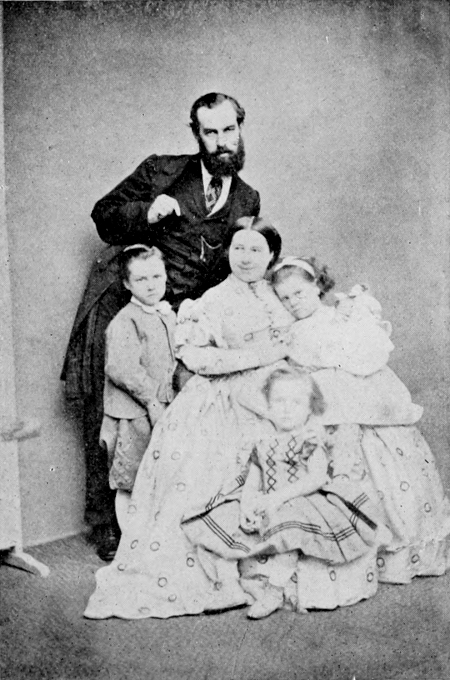
THE MILLWARD FAMILY.
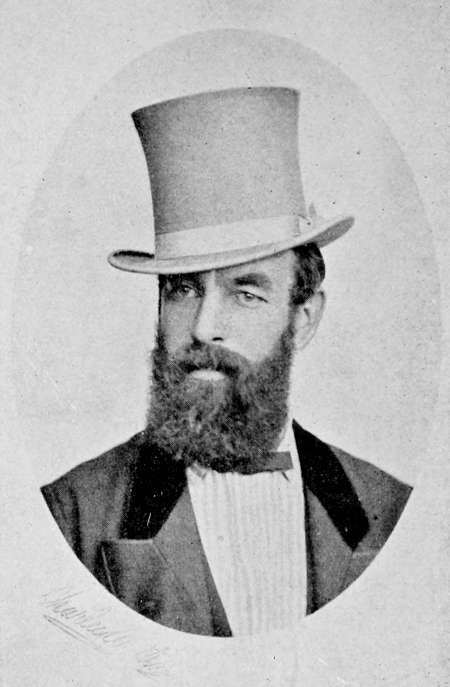
CHARLES MILLWARD.
Abusing his luck, he left the cosy club-room, and in two or three minutes found himself one of about a score of people in the dress circle of the Theatre Royal. The house was not a quarter filled and was a listless one, and even the “orders” in the boxes and pit looked [Pg 19]depressed. The play proceeded drearily until the monotony of the performance was broken by the entrance of the Sir Edward Mortimer—a tall, slim young man, graceful in bearing, of good presence, with expressive face, brilliant eyes, and a “taking” voice. A decidedly attractive appearance, but unmistakably nervous. The young man’s entrance roused the audience a little; and their awakening made him forget his nervousness. Presently the pit muttered approbation, and the gallery began to applaud. The dress circle ceased to yawn, the “orders” lost their lethargy, and the house made the pleasant discovery that an actor of undoubted ability was before it. At the fall of the curtain my father returned to report to his editor. He explained how the new actor had worked on his audience, how he had been called before the curtain, how a delighted manager had appeared and had announced that his new “star” would appear as Hamlet on the Monday, and how the house had applauded rapturously.
The young and nervous actor who made his first appearance in Liverpool as Sir Edward Mortimer in “The Iron Chest” was to make a great name for himself, and to become the last and perhaps greatest of the old school of tragedians, and his name was Barry Sullivan.
The theatre thus began to possess a powerful attraction for my father and his youthful friends, and it was not long before they constituted themselves into a regularly organized body, “The Liverpool Literary and Dramatic Society,” of which Mr. Robert Crompton was first president.
About this time a number of local philanthropists conceived the idea of establishing what may be termed[Pg 20] coffee-room places of amusement in the lower quarters of the town. A committee was appointed, including such well-known Liverpool names as Mr. Philip Rathbone, Mr. George Melly, and other local worthies. Recreation rooms were taken in Bevington Bush and other festive localities, in which coffee was provided at a penny a cup, with no charge for draughts or newspapers, and the members of the dramatic society gave their services as entertainers. A sort of “free-and-easy” was established, at which on certain nights members of the committee orated and recited, and the penny people might volunteer sentimental and comic songs.
One eventful evening my father appeared to entertain the penny audience with a lecture on Thomas Hood, with readings from his works by Frederick Maccabe, Robert Crompton and other friends. Mr. George Melly was in the chair, and Mr. Philip Rathbone superintended the “front of the house.”
The lecture seemed to go well; several of the poet’s masterpieces were admirably recited by my father’s friends, and he felt he had time to take it coolly. But how was it that the chairman was continually mopping his face? Above all, how was it that the lecturer, taking it coolly as he thought, had not a dry thread on his back? Then the chairman began to show obvious signs of distress. A powerful recitation of “The Bridge of Sighs” brought out a big display of handkerchiefs, which were used, however, to mop foreheads instead of eyes; the members of the committee were visibly dissolving. There was a pervading feeling of moist depression.
“For heaven’s sake,” whispered the chairman, “cut it short, or I shall melt!”
[Pg 21]
“There are only four people left in front!” hissed a committeeman, and the Hood lecture came to an abrupt end.
There was a bread bakery beneath the recreation room, and the baker had chosen the precise hour at which the entertainment started to “fire-up.”
My father’s first journey to London was in 1851, the year of the Great Exhibition, but, I fancy, far more important to him than the Great Exhibition was the fact that the great object of his existence—up to that period—had been attained, and that living, breathing actors and actresses of real celebrity were nightly speaking his words and delighting crowded audiences with his wit.
A dear friend, Joe Nightingale, and himself had given birth to a real live piece, which had been accepted by Mr. Benjamin Webster, and had been brought out at the Adelphi Theatre, where it ran for seventy-one nights.
So, in a sense, my association with the Adelphi Theatre started before I was born.
The name of the piece was “Bloomerism,” or “The Follies of the Day,” and in the cast were Miss Woolgar, Miss Kathleen Fitzwilliam, Miss Ellen Chaplin, George Honey, Paul Bedford, Parselli, and the famous O. Smith. Alfred Mellon was musical director, and Leigh Murray, the father of Alma Murray, stage manager.
Much of the success of the piece was due to the friendly offices of Albert Smith and Robert Brough. My father had long been on terms of affectionate intimacy with the latter, and had made the acquaintance of the former when Smith was gathering material for his novel, “Christopher Tadpole.” Cheshire salt mines had been explored, ham and eggs eaten at the[Pg 22] old “Ring o’ Bells” at Bidston, and George’s Dock carefully inspected and made a note of. The novelist and entertainer was also accompanied in his rambles by another friend, Mr. Joe Nightingale, one of the founders of the big printing firm of Lee and Nightingale.
Albert Smith, William and Robert Brough, and other old friends gave my father a hearty welcome in London, and introduced him to the Kingdom of Bohemia. To celebrate the Adelphi success, a supper party was given within the shadow of Temple Bar in the chambers of Mr. Soutar, of the “Morning Advertiser,” and as the guests emerged from their friend’s chambers day was beginning to dawn.
Amongst the party were “Gus” Mayhew, Robert and William Brough, Andrew Halliday, George Augustus Sala, and others, and they started cheerfully homeward. As ill luck would have it, they came into collision with a party of opposition revellers, and from words came to blows.
Some hours later my father accompanied Brough to Mayhew’s room, and found “Gus” in bed with a bandaged head. To him they recounted their deeds of valour in the morning’s grey.
“We let them have it hot,” said Brough. “One of ’em, a big ruffian, set on me, but I knocked him down and bumped his head against the kerbstone.”
“Did you?” said Mayhew, in his gloomiest manner and raising his bandaged head, “I was the man!”
The callers hurriedly left the sick room, and that same afternoon my father returned to Liverpool.
Meanwhile the Literary and Dramatic Society throve and prospered, and went in for annual “state” performances, in spite of gloomy prophecies to the effect[Pg 23] that “play-acting” would bring ruin upon its members. Amongst the original members are many names well known in Liverpool annals, such as W. H. Peat, the founder of “The Journal of Commerce,” T. C. Leete, of the well-known firm of Branch and Leete, T. W. Hughes, J. H. Nightingale, Barry Sullivan, W. M. Nuttall, W. J. Hammond, Fred Maccabe, George Meyrick, Fred Cummins, J. Forwood Tafe, and many others, who became prosperous merchants and professional men.
The Society’s first venture as a constituted body was on behalf of the Free Public Library, and it contributed some hundreds of volumes to the town Library. Almost immediately afterwards, the Town Council adopted the Free Library, and the town was asked for its support, but the Literary and Dramatic Society were the first donors to the Shaw’s-brow Library.
In addition to the “annual” performances, the Society had occasional “wanders” into other towns, some of which were successful, and some of which were—well, not quite so successful.
On one occasion, fresh from a big success in Liverpool with Douglas Jerrold’s “Rent Day,” when over one hundred and fifty pounds had been taken for a charity, my father and his friends took the piece, company, and dresses to Bolton, and opened there to a five-pound house.
To make matters worse, W. J. Hammond, a nephew of Douglas Jerrold, who played the part of Bullfrog, tried to coax the “gods” into a good humour, and this was how he did it.
When the hisses began to predominate, he addressed the audience as follows:—
“Have you chaps done up there?”
Whereupon the king of the gallery bawled:
“Noa; but it’s time thou had.”
[Pg 24]
The curtain had to be dropped before the end of the comedy, to my father’s disgust, for the second piece was to have been a new and original farce from his pen.
Bullfrog’s loss of temper and defiance of the gallery got his fellows into serious trouble. In an angry speech to the “gods” he intimated to the sixpenny patrons that the company—amateurs as they might be—were ready and willing to “take on the lot of ’em!” When the curtain was abruptly dropped, the stage door-keeper appeared and announced to the company that “Th’ gallery’s waitin’ for ye.”
It was.
The patrons in the upper regions had cheerfully accepted the challenge, and were at the stage door anxious for the appearance of the challengers.
Another dramatic venture of my father’s about this time was an entertainment which he had composed called “The Rose, Shamrock and Thistle, or Gleanings from the Minstrelsy of England, Ireland and Scotland,” and which his friend E. L. Hime, the composer and vocalist, took for a short tour, but, I fear, without success.
I always remember my father’s humorous description of the fate of this youthful venture.
The first “show” was in the Isle of Man, during Whitsun week, and the success was such that on the second night the piano had to be dispensed with, and on the third night the gas was turned off. Then on to Wigan, from which city Mr. Hime wired proudly that success was assured, as he had secured the patronage of the Mayor.
Tremendously impressed, the author took a first-class return from Liverpool to Wigan in order to be present at the historic performance. His first disillusionment[Pg 25] was not long in coming. It was Friday night—the colliers’ pay day—and groups of men were assembled in the street leading from the station. He mildly asked a gigantic collier who blocked and blacked the way if he could direct him to the hall.
“A dunno, but a can punch thy yead,” was the giant’s immediate reply, and he seemed miserable when my father declined to “have it out for half a gallon.”
But worse was to come.
The hall at last found, the “door” was opened, and there was a rush of two to the shilling seats, but those two came in with an “order” from the printer and the billposter. Then two or three “sixpences” sauntered in and began to make themselves disagreeable because it was announced that the performance would not start until the arrival of the Mayor. The total receipts at last amounted to about fifteen shillings, with liabilities of seven or eight pounds, when my father’s spirits were cheered by the arrival of the Mayor, a puffy little gentleman, accompanied by a family comprising at least a dozen persons. Hastily reckoning them up to produce to the speculation a sum of three pounds sterling, my father respectfully saluted the chief magistrate and added a nervous application for the price of admission.
“Why, dom it man!” said Wigan’s potentate. “What dost thee mean? I’m th’ Mayor, and th’ patron, and, dom thee, what more dost ’ee want?”
So the Mayor and his entourage were “dismissed,” the “sixpences” were returned, the curtain never rose, and the two theatrical adventurers once more sought the railway station.
In spite of these youthful experiences, which were not exactly encouraging, my father continued to write and to dabble in journalism and play-writing. Amongst his[Pg 26] great friends at this time was Mr. M. J. Whitty, the editor of the Liverpool “Daily Post,” and one of my father’s favourite stories was of attending a political meeting with him in support of Mr. Gladstone’s candidature for South Lancashire. The meeting was held in the Liverpool Amphitheatre, and feeling ran high, for it was the memorable election at which Mr. Gladstone was defeated for Oxford University. It had soon become obvious that his seat for the University was lost, and he had been nominated for South Lancashire.
The Amphitheatre was packed, crowds thronged the streets outside and Mr. Gladstone’s reception was overwhelming. My father sat in one of the boxes with Mr. Whitty and other friends, and the editor of the “Daily Post” grimly hinted that he didn’t “think the building was strong enough for the noise.”
Mr. Robertson Gladstone was in the chair. Mrs. Gladstone was in a stage-box, and with her sat Mr. W. H. Gladstone, who had that day been elected member for Chester.
Mr. Gladstone had begun his speech when a telegram was placed in his hand.
After reading it, he said, with that pathos and dignity so peculiarly his own: “I stand before you the rejected of Oxford,” and the audience received the announcement with hisses and groans. There was a moment’s lull, and then one jubilant voice was heard shouting: “Three cheers for Oxford!”
Like wolves the indignant audience turned upon the unlucky soul who had uttered the fatal words. In vain the chairman, the candidate, and other leaders on the platform tried to quell the storm, but it was not until the tactless gentleman’s coat had been torn from his back that he was safely landed beside them. Then it[Pg 27] was discovered, to the consternation of the audience, that he was a prominent local Liberal.
“Let me complete my speech,” he pleaded breathlessly; “let me complete my speech. What I intended to say was: ‘Three cheers for Oxford, which has sent us such a candidate!’”
And the poor old gentleman immediately became the lion of the evening, although his coat had a moment before been torn from his back.
My father’s association with Liverpool continued for some time after he had set up his tent in London, for, in conjunction with two of his greatest friends, Tom Cope, of tobacco fame, and Hugh Shimmin, he started a bright little weekly paper, “The Porcupine,” of which Mr. Shimmin was the editor, and which achieved much more than a local reputation, owing largely to the dramatic criticisms and the brilliant “London Letter”—the first of its kind—which were contributed by my father. In his standard two-volume life of Irving, Mr. Austin Brereton quotes largely from the “Porcupine” criticisms.
How well I remember that “London Letter!”
Like so many writing men, my father loathed the manual labour of pen and ink, and when I grew old enough he used me as an amanuensis. The political parts used to bore me to death, but I revelled in the work when we came to the theatrical criticisms.
His first pantomime, “Little Snow White,” was produced in Liverpool with great success, one scene in particular, of a looking-glass dance, the looking-glass being in reality of gauze with another dancer behind it—a novelty at the time—creating quite a furore. “Little Snow White” was later produced at the Adelphi,[Pg 28] with Mrs. John Wood in the title rôle, and achieved a big success.
Another Liverpool connection which he kept up for many years was with the Liverpool Autumn Exhibition at the Walker Art Gallery, to which he was the corresponding honorary secretary in London, and on behalf of which he used to visit the studios of the leading artists in company with his friends Mr. Philip Rathbone and Alderman Samuelson, in order to select pictures for the annual show.
[Pg 29]
The Savage Club.—“From Grave to Gay.”—Malden Crescent.—Irving, the Hares, the Kendals, the Bancrofts and Tom Robertson.—“The Dream of Eugene Aram.”—An old dance programme.—Artemus Ward.—Tom Robertson’s struggle for fame.—My first appearance.—The North London Collegiate School.—The famous Miss Buss.—Friends for life.—Lady Carl Meyer.—A Shakespearean failure.—Saint Peter.—The ambitious writing master.—Henry Pettitt.—Snubbing the leading lady.—The Grossmiths.—A reluctant model.—Lionel Brough and my mother.—Barry Sullivan.—A Zeppelin rehearsal.—Rival godparents.—Adelaide Neilson.—Chirgwin.—The Carlton Dramatic Club.—My father’s fatal illness.
AS I look back and try to revive the memories of childhood, father seems to me to have been always late, always with his pockets full of papers, and always surrounded by clever, brilliant friends.
But while I was very proud of his popularity, it had its drawbacks, and one of my earliest recollections is my indignant expostulation when he failed to turn up at some children’s party.
“Your father couldn’t possibly get away in time,” explained my mother. “He is talking business with his clever friends at the Savage Club.”
“I shouldn’t like my husband to be a member of the Savage Club,” I replied primly.
One of the founders of the Savage Club was my father’s great friend, the veteran naturalist, W. B. Tegetmeier, who died in 1912 at the great age of ninety-six. To-day many people seem to imagine that the[Pg 30] name “Savage” was adopted because the members were social or artistic “savages,” and this idea is kept up by the barbaric weapons which hang on the walls of the present club, but the “Savage” in the minds of the club’s godfathers was Richard Savage, the somewhat disreputable and drunken poet.
The original members used to meet in what would now be called a pot-house off Drury Lane: most of them were contributors to “The Train,” edited by Edmund Yates, and when it was proposed that they should form themselves into a literary club other names were debated, such as “The Johnson,” “The Addison,” and “The Goldsmith.” It was one of the Broughs who suggested the name of “Savage.” In its early days the club moved from tavern to tavern, and at last acquired premises of its own in a ground floor flat of Savoy Mansions, and the only qualification for membership was that a candidate must be a “working man” in literature or art.
Tegetmeier’s books on poultry and on pheasants and pigeons are still regarded as standard works.
On his sixty-sixth birthday the Savages gave the old gentleman a dinner, and Horace Lennard, one of the members, later a member of the staff of the old “Pink ’Un,” and later still one of the four original members of the staff of “Town Topics”—the others being Colonel Newnham-Davis, Arthur Binstead (“Pitcher”), and J. B. Booth—addressed to him some lines of admonition in verse: “From Twenty-six to Sixty-six,” which were afterwards printed and stuck in the Savage Club scrapbook.
One verse alluded to Tegetmeier’s connection with “The Queen,” for which paper he wrote the leader for many years. Some years later, when the Prince of[Pg 31] Wales (afterwards King Edward VII) was about to pay a visit to the Club, an over zealous and over anxious committeeman cut this verse out of the album, lest it should catch the eye of the Royal visitor and give offence. That, at least, was his explanation, which seemed ludicrous. Even in Queen Victoria’s days there were more Queens than one.
Amongst the Savages my father was known by a curious nickname, which he acquired in a curious way. Some man who owed him money died, leaving him as payment for his debt a small monumental mason business at Abney Park, which eventually turned out to be very prosperous.
This caused an enormous amount of chaff amongst the Savages, for my father was at that time hard at work on a pantomime, so he was promptly dubbed: “Charlie Millward, or From Grave to Gay.”
But there were compensations for his membership of the Savage.
With such a father the house at Malden Crescent became a regular meeting place for many folk who were then or have since become famous: Irving, the Hares, the Kendals, the Bancrofts—it was at Malden Crescent that Sir Squire Bancroft first met Tom Robertson—were constant visitors, and every Sunday evening certain members of the Savage Club ate a huge hot-pot supper—one Sunday at the Millwards’ house, the next Sunday at Toole’s, the next at the Grossmiths’, and the next at the Hollingsheads’.
And on the Sundays when the Millwards were entertaining, a small girl, then known as “Cissie” Millward, would peep over the banisters to watch the famous ones arrive and depart, and when all was safe steal downstairs, and crouch outside the drawing-room door[Pg 32] to listen to Mr. Irving as he recited “The Dream of Eugene Aram.”
Later, when I was a little older and allowed inside the sacred room, I heard him recite the “Dream,” and I can see him now, stretched on the rug before the fire, his body slightly raised on one shoulder, and his wonderful face resting on his hand, while his eyes shone in the firelight like burning coals.
On those evenings little “Cissie” Millward did not always sleep the peaceful sleep of childhood when she was sent up to bed after the recitations!
But how she thrilled on those occasions, and how devoutly she hero-worshipped those famous visitors!
Small wonder that I was early possessed with an intense love of acting, and looked upon actors and actresses as gods and goddesses.
While turning out some old papers—should one keep old papers, I wonder? Do the happy recollections always compensate for the sorrowful?—I came across a little printed relic of a party given in celebration of one of my very early birthdays, and the programme of dances evokes a host of memories. Here it is:
The “Barnes” Quadrille.
The “Toole” Polka.
The “Polly Brough” Lancers.
The “Croft” Waltz.
The “Bessy Hollingshead” Quadrille.
The “Hingston” Galop.
The “Cremer” Polka.
The “Wilson” Schottische.
The “Burroughs” Lancers.
“Jessie Millward’s” Quadrille.
The names given to the dances are all those of the closest of the family friends. Toole’s name needs no explanation: he had, by the way, been the former tenant of our house.
[Pg 33]
Dear old “Johnny” Toole. With him died the last of the amusing practical jokers of the ’sixties and ’seventies. And unlike so many practical jokes, Toole’s were essentially harmless and amusing. Everybody who was in Toole’s company for long was bound, sooner or later, to be made an accessory to his pranks, and most of those pranks have been written of often enough. Now and again someone would undertake to show Toole how a practical joke really should be played, and amongst such instructors was a well-known racing celebrity and man-about-town.
Going into a Manchester hotel one evening during race week, with Toole as his guest, the gentleman in his lordliest manner demanded to know what liquid refreshment was provided for late-comers who were staying in the hotel. The slightly bewildered night-porter reeled off a list of the bottles of whisky, brandy, soda, beer and so forth left in his charge.
“I buy the lot,” said Toole’s host. “Bring them to the smoke-room,” and the puzzled attendant proceeded to set forth an extraordinary array of bottles before the two eccentric gentlemen. Presently the late-coming guests began to arrive, most of them thirsty after a long day’s racing, and one by one, sooner than go drinkless to bed, they came to the smoke-room to beg for a whisky and soda, where they were promptly called upon to “amuse the company” by way of payment.
It was probably one of the quaintest impromptu smoking concerts ever given, and Toole did his share.
The story got about Manchester, and while he was being shaved in a local barber’s shop the barber expressed to Toole his delight at shaving such a celebrity.
“I assure you, sir,” he said, “you’re such a favourite down here that it’s a pity you can’t always be with us.”
[Pg 34]
The actor was properly pleased, and thanked his admirer modestly.
“Yes, sir,” continued the artist in soap, “I can assure you that all you have to do is to settle down in Manchester and keep a public-house and your fortune would be as good as made.”
The old Pump Room Hotel at Bath, which was the property of the corporation, was one of Toole’s favourite country hotels, and on one occasion when he was staying there John Billington, on entering his room, noticed that the city arms were displayed on all the china. Commenting on this, Billington remarked that it was not so in his room.
“Have you gout?” asked Toole.
“No, thank heavens.”
“Ah, that explains it,” said the old man. “In this place they only grant the city arms to those who have gout.”
Which, after all, seems as good a reason for “honours” as most.
And how Toole loved to talk racing. Up to the very end he would have his little bet every day, just as in the old times, when he would exclaim, after backing a loser—and many losers did he back—“There goes another row of stalls!”
There never was an actor-manager more beloved by his “boys and girls” than John Toole, and he brought out many who came well to the front, among them poor Lewis Waller, Seymour Hicks and C. M. Lowne, while Miss Violet Vanbrugh was for long a member of Toole’s company.
On his death, after long years of lingering pain, one who knew him well wrote of him: “In every sense of[Pg 35] the word he was a good man and, generous to a fault, his benevolence knew no bounds.”
It would be difficult to conceive of a finer or truer epitaph on a lovable man.
The “Polly Brough” of that dance programme, Lionel Brough’s eldest daughter, later became famous as that accomplished actress Mary Brough; the gentleman whose name was borrowed for the lancers was Colman Burroughs; the “Bessy Hollingshead” was the daughter of “Honest John,” the founder of the Gaiety burlesque; and “Hingston” was the bosom friend and agent of Artemus Ward, who was a regular visitor to the house, and who one day presented my mother with the curious little cane with which he used to lecture.
And immediately a sad memory arises.
We children were very fond of the thin, frail man with the luminous eyes. My father heard that the great humorist had died in a hotel at Southampton of consumption and that his body was to be placed in a stable for the night, and promptly interfered. So it came about that, hearing a commotion in the house near midnight, I crept down the nursery stairs, and looking over the banisters was almost frozen with fright as I saw a coffin being carried into the drawing-room. The next morning my father took me to the florist and together we bought a large bunch of violets. When we got home he took me into the drawing-room and lifting me up told me to lay the violets on the coffin.
“Where is Mr. Ward’s heart?” I asked, and I placed the flowers where I was told. Artemus Ward’s body was sent to America, to his mother, Mrs. Brown, and on the coffin being opened my violets were found where I had laid them.
[Pg 36]
One more sad childish memory and then we will turn to lighter things.
A frequent visitor was Tom Robertson, afterwards to achieve such fame with “Society” and the plays which have given him his place for all time in theatrical history.
But in those days fame was still out of sight, and poor Robertson was undergoing a terrible struggle for a bare existence. One day he called at the house about midday. My father was out, but my mother asked him to join us at the children’s midday meal—there were seven of us—and the dishes were appropriately substantial. A huge rice pudding was on the table, and Robertson, after sitting for a while in silence, burst into tears.
“My children are starving,” he sobbed, in answer to my mother’s horrified questioning.
The Millward children had very little rice pudding that day, and my mother’s larder was ransacked.
Shortly after, the great dramatist’s first wife died, practically of starvation—and then came the first of his successes. Fate can be terribly ironic.
But to turn to happier memories.
My positively first appearance on any stage was at the mature age of five, when I appeared at the Theatre High Hill, 9, Malden Crescent, as the drummer in “Bombastes Furioso.” The “Theatre High Hill” was the drawing-room, and I am sorry to say that the drummer mutinied and was carried off the stage screaming.
For the sake of other names than that of the mutinous drummer the programme of this historic revival of the terrible tragedy may be interesting to readers of an older generation, so I give it in full. The list of dances is, to put it mildly, unusual.
[Pg 37]
THEATRE HIGH HILL,
9, Malden Crescent.
(Late 5, Eastcott Place.)
FRIDAY EVENING, 5th JANUARY, 1866.
PROGRAMME.
The Entertainments will commence with
THE ARRIVAL OF THE COMPANY.
After which, the Terrible Tragedy of
BOMBASTES FURIOSO.
| Bombastes | Mr. Colman Burroughs. |
| Artax-oh-my-nose | Mr. J. C. Brough. |
| Fusbos | Dr. Strauss. |
| Castle Musician | Mr. C. Millward. |
| Fifer | Master Burroughs. |
| Drummer | Miss Jessie Millward. |
| Distaffina | Mrs. Colman Burroughs. |
| Soldiers, Punchbowl, Pipes, Boots, etc., etc. | |
THE NEW AND BEAUTIFUL SCENERY
(which must be SEEN to be believed)
By Messrs. Barnes, Brunton, etc.
THE LIMELIGHTS, SQUIBS AND CRACKERS
By Mr. E. Draper.
MASKS AND PROPERTIES
By Messrs. Archer, Prowse and Hood.
THE ELABORATE MACHINERY
By Mr. T. W. Robertson, C.E.
APPROPRIATE (D) MUSIC
By Mr. H. S. Leigh.
THE APPOINTMENTS
By Earl Russell.
COSTUMES by Mr. S. May. WIGS by Mr. Clarkson.
RUSTIC GATHERINGS (first time)
By Mr. Paul Bedford.
Mr. J. C. BROUGH and Mr. HOLLINGSHEAD
Will perform several sleight-of-hand tricks in their usual
good-natured
and slight-off-hand style.
Private WILLIAM BARLOW
Introduced by Mr. E. Draper.
Mr. ANDREW HALLIDAY
Will oblige.
Mr. J. L. TOOLE
Will be “at his Tricks.”
PAUL BEDFORD
Will introduce his Scotch Friends.
LIST OF DANCES.[Pg 38]
| Quadrille | The Halliday, Brough and Jefferson. |
| Polka | The Whitehead, Bingham and Russell. |
| Waltz | The Nightingale and Pearson. |
| Lancers | The Croft, Ledger, Walker and Barnes. |
| Polka | The Archer, Draper, Fryer and Brown. |
| Quadrille | The Hobbs, Du Terreaux and Thorpe. |
| Galop | The Strauss, Hollingshead and Brunton. |
| Polka | The Byron, Clark, Hare and Bancroft. |
| Quadrille | The Toole, Bedford and Billington. |
| Waltz | The Greenhalgh and Grossmith. |
| Sir Roger de Coverley | The Hughes, Henderson and Millward. |
Stage Manager—Mr. Colman Burroughs.
Prompter—Mr. J. L. Toole.
Call Boy—Mr. Billington.
Acting Manager—Mr. C. Millward.
Doors open at 8, Performance commencing at 7, and terminating at
6 o’clock.
GOD SAVE THE QUEEN.
But neither the stage-fright nor the resulting mutiny cured me of my passion for the stage, and in secret I was always acting, living in a little dream-world of my own, peopled by the most extraordinarily beautiful and haughty fairy princesses, and the handsomest and humblest and most devoted knights and squires.
Then came school.
I was sent to the North London Collegiate School, a huge institution under the head-mistresship of the famous Miss Buss, a great character in the scholastic circles of those days.
Miss Buss was an austere old maid, plump and excessively dignified, and did not in the least appreciate my histrionic efforts when one awful day she caught me imitating her. “Impersonations of celebrities,” now so popular, were not in the curriculum of the North London Collegiate School.
Frankly, I loathed school. All my life I have been in a hurry, and I hated to be compelled to move slowly and by rule.
[Pg 39]
But my first day at school had its compensations. I found myself sitting next to a pretty little girl who seemed to be looking at me with unusual interest.
At last: “What is your name?” she whispered.
Now, at home I had always been known as “Cissie,” but on my first entrance into public life I had determined to revert to my more dignified name, so, “Jessie Millward” I whispered.
“Mine’s Kate Morton,” she went on. “How old are you?”
“Nine.”
“You are pretty,” she whispered.
This was the pleasant surprise of my young life, for at home I was inured to hearing myself described by my brothers—in the usual brotherly way young brothers have—as “the ugly one,” and “all teeth and eyes”; so when the pretty little stranger added, “Well, let’s be friends for life,” I jumped at the proposal. And we have been friends for life, for Kate Morton, who was the daughter of Charles Morton, of Palace Theatre fame, and married Wilfred Morgan, is one of my dearest friends.
After this contract had been entered into, another little girl who sat on the other side spoke to me.
“My name is Adele Levis,” she said.
“And I am Jessie Millward.”
“I don’t think I want to make friends with a playwright’s daughter,” she observed.
“And I wouldn’t dream of making friends with an india-rubber man’s daughter!” I retorted, for I had been told that her people had made money out of rubber.
Even quite little girls can be cattish, you see, and if they are made of “sugar, and spice and all that’s nice,”[Pg 40] sometimes manage quite successfully to conceal the fact.
Adele Levis is now Lady Carl Meyer.
But, as I have said, on the whole I detested school life with its rules and regulations, though my passion for acting and recitation made me something of a heroine among the other little girls of my age, getting me into far higher classes than my general knowledge entitled me to, and I was promoted on the strength of my recitations to a class the members of which used to give Shakespearean readings.
“Aha!” I said to myself. “I’ll show them how Shakespeare should be recited!” But pride not only fell but positively bumped.
I was chosen for Gratiano in the trial scene from “The Merchant of Venice,” and got along swimmingly until I came to the lines:
The emphasis, the force, the intensity were all there, but never was a rousing piece of declamation more indecorously received. For I pronounced “infidel” with a long second “i,” and amidst roars of laughter retired in tears of rage, exactly as I had retired from my earlier part in “Bombastes.”
But school girls are no respecters of persons, even amongst themselves, and are still less respectful to strangers, if that be possible.
On our way to and from school we used often to meet a blonde-bearded, distinguished-looking man with a provokingly saintly face at whose appearance we used to giggle, and whom we nicknamed Saint Peter.
Saint Peter was something of a mystery to us; he was invariably to be found strolling about at times[Pg 41] when all the other menfolk of our acquaintance were at their business, so we concluded that he must be a mysterious millionaire.
But some years after the mystery was solved for me, for at my very first rehearsal at the Lyceum I looked across the stage and recognized Saint Peter.
He was Andrew Levey, the first violinist in the Lyceum orchestra.
My brothers went to the North London Collegiate School for boys, in the now unfashionable district of Camden Town, where poor old Cobden stands in statuesque isolation and mournfully regards the landscape. One day the young writing master, who had theatrical ambitions which soared high above his tiny salary as a writing master, took my brother Herbert aside.
“I hear your father is a literary man,” he said. “I should so much like to meet him.”
Herbert, by no means sorry to put a taskmaster under an obligation, spoke to my mother, and the young writing master was invited to one of the weekly evening parties, where he met Toole, Irving, the Bancrofts, the Hares and the Grossmiths.
In those days the salary of a writing master at even a big school did not run into fantastic figures. The hire of a dress suit for the evening made a large hole in the weekly accounts, but the young man evidently deemed it worth while, for after a day or two’s serious thought he called on my mother and asked her advice as to the wisdom of abandoning the copperplate and pothook line of writing for writing for the stage.
My dear mother strongly advised him to stick to the unexciting but certain copperplate form of literature—which advice he did not take.
[Pg 42]
Some years later, as the story-books say, when the writing master had become famous as Henry Pettitt, “little Cissie Millward” who had blossomed into Jessie Millward, played the heroine in “Harbour Lights” and many other successful plays by the ambitious young man who had refused to take advice, and who always vowed that the hiring of a dress suit was the finest investment he ever made, and was the turning point in his career.
And when, in those later days, I used to complain that the author did not treat me at rehearsal with the respect due to a “leading lady,” but would actually address me by my childish name, he would make matters worse by explaining that somehow or other he could never forget me in socks. Nor, I am afraid, did I always treat “H.P.” with the respect due to a famous playwright for a somewhat similar reason, and I well remember the sternness of his reproof one day at rehearsal when the vision of a tall, lanky man, with a hooked nose, leaping irritably on a chair, extending his arms, and snapping: “Imagine this is a tree and that you are making love under it!” was too much for the leading lady and she became semi-hysterical with laughter.
“H.P.’s” indignant reproof was up to his best schoolmaster form, and Jessie Millward, “leading lady” as she was, once more felt very small “Cissie.”
The Grossmiths, who lived near us at Haverstock Hill, were amongst our more intimate friends, and my father was godfather to the present George.
I myself, though a small child, was occasionally useful to Weedon—Walter, as he was then called—and his brother George.
For example, having adopted photography as a hobby, the two boys called round one morning with a[Pg 43] request to “lend us Cissie for a model for our camera.”
Cissie was lent, and—it was not the days of instantaneous photography—was snatched from her play and, with rumpled frock, scratched knees, and grubby socks, was posed under a mulberry tree for hours.
Plate after plate was exposed, and the wretched model was left at intervals, with strict injunctions not to move, while the plates were hurriedly developed in the stable of their house in Haverstock Hill.
At last she burst into tears of rage in her best “Bombastes” tradition and demanded to go home.
The sticking-plaster on her knees and the grubby socks were the most prominent features in those early efforts of the photographic firm of Grossmith.
A few years later, as a more or less dignified schoolgirl, I stood outside the church to watch George Grossmith’s wedding leave, and celebrated the occasion by picking up a lucky sixpence, which was, perhaps, some small compensation for my trials as a model for the bridegroom.
Another old friend of the family was Lionel Brough—it was he who was largely instrumental in persuading my mother to go to a fancy dress ball at Knightsbridge, given, I think, for members of the stage. My mother was very dark, and her Spanish costume—which I am sure was the only fancy dress she ever wore—suited her striking type of beauty to perfection. My father, who was dressed as a barrister, helped my mother out of the four-wheeler, and to her surprise went quickly into the barracks. For a moment she stood bewildered, and was about to follow him when her arm was seized by a police-constable.
“You ought to know better than that!” said the constable severely.
[Pg 44]
“What do you mean?” demanded my mother indignantly. “How dare you?”
“Come, come, you ought to know better than that!”
“Charles! Charles! Come back, I am insulted!” called my mother, but my father had disappeared.
“Now don’t let’s have a fuss,” said her tormentor sternly. “No one knows better than you that only respectable people are admitted in there.” Then, seeing the real distress of my poor mother, who in spite of her Bohemian and theatrical surroundings was respectability incarnate, and only tolerated the theatre as a necessary evil, the constable whipped off his helmet and revealed himself as Lionel Brough.
My dear mother’s attitude to the stage was always one of bare toleration, which to me, as a child, seemed extraordinary and inexplicable, for so many of my theatrical gods and goddesses were her intimate and cherished friends.
As individuals she loved them, but their profession left her cold, and to my infant amazement she never even thrilled when one momentous afternoon the great Barry Sullivan himself, the typical tragedian of the old school, with heavy ever-working eyebrows and deep rolling voice, called to present her with a clock and two candlesticks, each of which had its own little glass case of the period.
I don’t remember that I was particularly impressed by the articles under the glass cases, but I positively quivered at the notes of Barry Sullivan’s voice.
As I have told, Barry Sullivan had been one of my father’s earliest “subjects” for dramatic criticism in the Liverpool days, and a great friendship had arisen between the critic and the criticized.
[Pg 45]
In those early provincial days they frequently acted together, the great tragedian more than once coming to the assistance of the amateur dramatic club of which my father was a prominent member. And in this connection I am reminded of a favourite family story of a certain production of Richard III, in which the part of Catesby was taken by an ambitious amateur, and the wicked King was played by Sullivan.
The amateur, either from lack of study or from sheer nervousness, was none too perfect in his words, but he managed to struggle through the early portion of the tragedy without disgracing himself, and even drew enthusiastic applause from his admiring friends.
Then came the great tent scene.
Starting from his knees at the conclusion of the dream:
“Who’s there?” cried the guilty king.
“’Tis—’tis I, my lord, the early village cock——” stammered Catesby and “dried up.”
Barry Sullivan surveyed his tongue-tied officer for a few moments with a sardonic grin.
“Then why the devil don’t you crow?” he growled.
Long years afterwards, as the story-books say, when Barry Sullivan was famous in two continents, a public banquet was given to him at the Alexandra Palace on the eve of his departure for a tour in the States in July, 1875. The majority of those present were members of the Savage Club, of which the actor had recently been made a member, and the Earl of Dunraven, as the chairman, presented the guest with an illuminated address, the reading of which was entrusted to my father, who was then Secretary of the Club. This address bore the names of the Earl of Dunraven, Lord William Lennox, Andrew Halliday, Charles Millward,[Pg 46] James Albery, E. L. Blanchard, F. B. Chatterton, William Creswick, John S. Clarke, Ed. Falconer, Joseph Hatton, George Honey, Howard Paul, E. A. Sothern, Charles Wyndham, John Billington, Benjamin Webster and many other well-known folk in theatrical, literary and Savage circles.
Another childish memory is of a great explosion by the Regent’s Park Canal, and of tearing down with my father to see if Joe Hatton and his family were safe. Several houses had been shattered, but the Hattons’ was unharmed, although a few doors off the house of the famous entertainers, the Howard Pauls, was badly damaged, glass from the windows having been blown in all round Mrs. Howard Paul’s bed, and by some extraordinary freak her petticoat had been found waving like a flag from the balcony. At Alma Tadema’s house near by, the windows were smashed, but a huge vase which stood on his balcony was untouched.
All of which was a mild rehearsal for Zeppelin experiences in after-life.
A constant visitor to the house in Malden Crescent was Andrew Halliday, the author of many plays, including “Amy Robsart,” “The Lady of the Lake,” in which the beautiful Adelaide Neilson appeared, and “For Love or Money,” a comedy with which the present Vaudeville Theatre opened on 16th April, 1870.
The comedy was not a success, although the part of Alfred Skimmington, “a handsome West End swell, who is currently reputed to be worth £3,000 a year, but who has not given his attention too closely to morals,” was played by Henry Irving.
One Sunday Halliday looked into our nursery, which then contained seven inhabitants, and observed vaguely:
“Let me see, one of you is my godson.”
[Pg 47]
My brother Harry promptly retorted: “Yes, I am. But you’ve never given me anything.”
Probably feeling that his responsibilities as a godparent ought to be no longer neglected: “Learn your catechism,” said Halliday, “and I’ll give you a watch and chain.”
Harry was a quick study, and was soon in possession of a watch and chain.
Another frequent Sunday visitor, Stephen Fiske, proprietor of a very lively journal called “The Hornet,” and a dramatic critic of great English and American reputation, on hearing of Halliday’s assumption of a godparent’s responsibilities, felt his conscience smite him.
“By Gad!” he cried remorsefully, “one of them’s my godchild!” But nobody claimed him.
Nevertheless, next week a little Scotch suit and a watch arrived, addressed “To my godson.”
The godfather’s intentions were admirable, but, alas! the godson was a god-daughter—my sister Lil.
The mention of Adelaide Neilson reminds me that she was the first actress I saw. She was playing Juliet at the Adelphi Theatre and my father took me round to her dressing-room. I remember that I never thought anyone could possibly be half so beautiful.
The speechless adoration of the stage-struck schoolgirl must have touched her, for she took from her neck a large Maltese cross of opals and gave it to me, saying: “There, little girl, I hope that will be the heaviest cross you will ever have to bear.”
I wore that cross as Hero in my first success at the Lyceum of Irving’s day.
As my father had a considerable reputation as a writer of pantomimes and lyrics, many “stars” of the[Pg 48] pantomime stage used to call upon him bringing with them songs for him to re-write, and as I grew older one of my delights was to play the accompaniments while the new words were being “tried over” with the visitor.
Chirgwin, who afterwards achieved music-hall fame as “The White-eyed Kaffir,” was one such visitor, and I well remember the tiny white dog which he brought with him and carried in his arms. My powers as a musician impressed him greatly, for when I had finished he turned to my mother, saying with the most stately politeness: “Madam, may I be allowed to embrace your little daughter?”
The song which he had tried over was for his first appearance in pantomime—a pantomime written by my father for the Theatre Royal, Birmingham—and in one of his last articles in the “Referee” George R. Sims referred to him as being extremely nervous but the real success of the production, and as helping to make the fortunes of Mercer Simpson.
And so passed my childhood and early girlhood, in an atmosphere which was a fascinating mixture of journalism and the stage, and in a dream-world in which I played countless imaginary parts.
But quite early I realized that there were material benefits attached to the drama, on however humble a scale that drama might be.
Once a month we had Dorcas meetings at school, at which the conscientious and model girls sewed religiously for the benefit of their souls, and to my delight I was invariably chosen to read aloud to the sewers and not to sew. My choice of readings and my dramatic sensibilities must have vastly astonished my audience at times, and I well remember the whole Dorcas meeting laying down its collective needle and staring in open-mouthed[Pg 49] amazement when one afternoon I broke down and sobbed, completely overcome at my own reading of “Misunderstood.”
Needless to say, to a small girl with such tendencies visits to the theatre were events of delirious interest, but I am afraid that so little could she foresee the future that even in her wildest dreams the schoolgirl “Cissie” Millward, when she paid her very first visit to a real theatre and saw the Vokes family at Drury Lane, never imagined that she herself would one day be the “leading lady” on that very stage.
Nor later, when she paid her second visit to a real theatre, the Adelphi, to see her father’s pantomime “Little Snow White,” the girl who had never seen herself in a looking-glass, in which Mrs. John Wood played the part of Little Snow White, did the small enthusiast dare to picture herself as the heroine of Adelphi drama.
The days at Malden Crescent passed happily, and then the Millward family moved to Crowndale House, Oakley Square, N.W.
By this time I was growing up into a “young lady,” with stage ambitions as firmly rooted as ever, and I found an outlet for my dramatic energy in joining the Carlton Dramatic Club.
Then an event occurred which altered our careers.
My father had a paralytic stroke, and it was necessary for us all to earn our livings.
[Pg 50]
Choosing a career.—Mrs. Kendal.—An unpromising start.—“Walking on.”—A lecture on my presumption.—Toole.—“Can I have your theatre?”—“Of course.”—Billington’s horror.—A successful matinée.—With the Kendals.—The matron of the drama and an “unmaidenly performance.”—-An indiscreet enthusiast.—Brandon Thomas.—An unsympathetic atmosphere.—Mrs. Kendal and Irving.—I achieve my ambition.—Miss Genevieve Ward.—A letter from Irving.—Edward Ledger’s suggestion.—“Can Irving afford five pounds a week?”—Irving asks me to play Hero.—The question of salary.—Shillings or pounds?—I meet William Terriss.—My first Lyceum rehearsal.—Miss Terry’s sympathy.—Great teachers.—A friend for life.
ON my father’s fatal illness, after having enjoyed the luxuries of life we found ourselves in straitened circumstances, and it was necessary for those of us who were able to do so to earn our own livings.
For myself, I never had a moment’s doubt as to the career I should choose.
“Would you like to be a governess?” suggested my mother.
There was only one answer to that question, and I gave it. School life, even with the possibility of escaping it, had never appealed to me. The prospect of an eternal school life was appalling.
So I plucked up courage.
“No,” I said definitely, and then plucked up more courage. “I think I should like to go on the stage.”
[Pg 51]
In view of my mother’s attitude towards the stage as a profession I expected an indignant refusal, but to my astonishment and delight, after a few moments’ thought, she replied quietly:
“Very well, if you really think that is your vocation, you may go on the stage, provided you start under Mrs. Kendal.”
There was nothing “raffish” or Bohemian about Mrs. Kendal, even in those somewhat Bohemian days, and not for nothing did she become known as the matron of the British drama.
In my excitement at such an easy consent to what I had long looked upon as an impossible ambition, I would have accepted any condition, so, making myself look as old and as prim as possible, in a poke bonnet and a long skirt I sallied down to the St. James’s Theatre, and saw Mrs. Kendal.
Her first words were not encouraging. I explained my desire, and then:
“How old are you?” she asked abruptly.
“Eighteen.”
“My dear, you are telling lies; you are twenty-five at the very least.”
I forget whether I had my birth certificate with me, but I succeeded in convincing her that I was telling the truth.
At the same time, I could not help feeling that the start was not particularly promising.
After some more conversation on similar lines, I was told that out of friendship for my father I might be permitted to “walk on” in the Kendal Company.
The phrase “walk on” was beyond me, and I asked for an explanation. I got it.
[Pg 52]
“But,” I cried, half in tears, “I don’t want to ‘walk on’; I want to act!”
As I look back, I shiver at my audacity.
Then, I vaguely remember, followed a lecture, pointing out my unheard-of presumption, my utter lack of fitness for the stage, my youthful callowness, and a few other pleasant little home truths.
“But I want to act,” I kept on repeating obstinately, and obstinacy at last led to a practical suggestion.
“Can you afford to give a matinée and invite the critics?”
I shook my head. For financial reasons, a special matinée seemed out of the question.
Then I had a flash of inspiration, and leaving the St. James’s Theatre I hurried round to the Folly, and asked to see our old family friend, John Toole.
He was in his dressing-room, talking with his manager, John Billington, when I was shown in, and seemed rather surprised to see me.
“Hullo!” he cried. “It’s little ‘Cissie’ Millward! What do you want, my dear?”
“I want to go on the stage!” I blurted.
“Good!” said the dear old man encouragingly.
“And I want to give a special matinée!”
“Splendid!”
“And—and—can I have your theatre?”
“Of course!”
“Come,” said I to myself, “it is not hard to get on the stage after all!”
“And when do you want the theatre?” asked Toole.
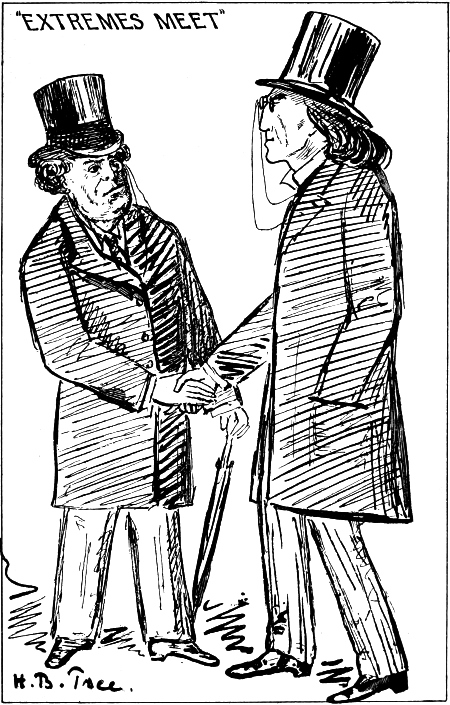
Caricature by Sir Herbert Tree
IRVING AND TOOLE.
Now for my “support” I was relying on my fellow members of the Carlton Dramatic Club, and I knew [Pg 53]that all the male members were engaged during the week in the sordid pursuits of their sordid businesses and professions. Obviously, a half-holiday was the only day for my “special matinée.”
“Can I have it on Saturday afternoon?” I asked in all innocence, and to this day I can see Billington’s face.
But kind old Toole never moved an eyelash.
“Er—haven’t I a matinée on Saturday, Billington?” he asked.
“You have,” said Billington grimly.
Something in Billington’s face and manner roused me to desperation. And after all it did seem rather absurd. Here was Mr. Toole, a famous actor, who could have a matinée any day in the week he pleased, while Saturday was the only day I could choose.
“But can’t you have your matinée another day?” I pleaded. “You see, it’s fearfully important for me.”
“Of course I can,” replied Toole, as if the idea was entirely new to him; “of course I can. Billington, see that things are arranged, and do what you can for her.”
And so in huge elation I rushed off to find the amateur stage manager of our dramatic society, the Carlton Dramatic Club, who as soon as he heard the news was in as huge a state of elation as myself.
The society had already played “Love’s Sacrifice” at St. George’s Hall, so we at once decided to give it at the Folly, with a comedy scene from “The Hunchback,” with John Billington as Modus and myself as Helen.
The excitement of my fellow members at playing in a real theatre, on a real stage, to a real audience, with real[Pg 54] critics can be imagined, and when it was all over we had a banquet, in the course of which my grateful and enthusiastic company presented their equally grateful and enthusiastic actress-manageress with two silver bracelets to commemorate the great event.
And there was little doubt about the success of the matinée from my point of view, for, as an immediate result, I had offers from the Kendals, from Mr. Hare, from the Bancrofts for “Ours,” from Edgar Bruce for “The Colonel,” and from dear old Toole for the part of leading lady in “Uncle Dick’s Darling.”
It was indeed a happy afternoon, and in the course of it Mrs. Kendal had visited my mother’s box and announced definitely that she would engage me—“but she does the most ridiculous things.”
So, in pursuance of my mother’s wishes, my first professional engagement, after all, was with the Kendals, and I made my first professional appearance as Mrs. Mildmay in “Still Waters Run Deep,” and as the ingénue in “Coralie,” following Miss Winifred Emery in the part.
The tour—for we started immediately on tour—included Birmingham, Manchester and Liverpool, and in Liverpool a terrible episode occurred.
My father, as proprietor of the “Porcupine,” was well known in the Mersey city, and for his sake, many of his friends had taken seats to give a welcome to his daughter on her first dramatic essay. So it came about that on my entrance in the leading juvenile part I received for the first time in my life an enthusiastic reception, which so completely upset me that instead of waiting for my guardian in the play (John Hare) to kiss me I rushed up to him and kissed him.
[Pg 55]
No sooner had the curtain fallen on the first act than Mrs. Kendal sent for me to her dressing-room.
After some severe remarks on decorum, she concluded her reproof by describing my lapse as “the most unmaidenly performance I have ever seen in my life!”
Not for nothing did Mrs. Kendal earn her title of matron of the drama.
Naturally enough, I was completely upset for the rest of the evening, although I don’t think my “unmaidenly performance” had any particularly distressing effect on Sir John Hare, who, after all, was the person chiefly concerned.
After a short tour we returned to the St. James’s Theatre, and I played in a one-act play by Clement Scott, “The Cape Mail,” with Mrs. Kendal, Gaston Murray and Brandon Thomas.
Once again an indiscreet enthusiast nearly got me into serious trouble.
On my insignificant entrance in “The Cape Mail”—which preceded “The Squire”—my young brother, who had gone into the gallery to see his sister, somewhat upset his neighbours by his enthusiastic shouts of “Bravo! Bravo!” before I had spoken a single word.
“S’sh! S’sh!” hissed the galleryites.
“I shan’t s’sh!” cried my young brother indignantly. “She’s my sister! Bravo! Bravo!”
It was during my engagement with the Kendals that I first met Brandon Thomas.
He had been a drawing-room entertainer, but his ambition, like mine, had led him to the stage, and at that time he was going through a hard struggle for fame with indomitable pluck.
[Pg 56]
After one long and late rehearsal, with his invariable courtesy he asked if he could escort me home, and, having an idea that at that particular moment he was dreadfully hard-up, I insisted on walking, though the ’bus fare was only twopence.
Long afterwards, when I was playing at the Adelphi in “The Swordman’s Daughter,” adapted from the French by Brandon Thomas and Clement Scott, I reminded him of that walk, and he admitted that my suspicions had been horribly correct.
Brandon Thomas was one of those sincere and true types—all too rare, unfortunately—whom success is unable to change or spoil.
I frankly admit that I was not particularly happy at the St. James’s. Possibly it may have been because, temperamentally, we were as opposite as the poles, but there was always something about Mrs. Kendal’s manner and attitude that took all enthusiasm and ambition out of me.
I was a very young girl at the time, full of wild enthusiasm for my art; very immature and untrained, no doubt, but, like most young enthusiasts, almost morbidly sensitive, and it did not, for example, comfort me in the least when one day, in sheer despair, I cried: “Oh, shall I ever be able to use my hands properly!” to be told promptly and primly: “Never, my dear. You were not born on the stage.”
No, I’m afraid we were not sympathetic.
In later days, when I had joined the Irving company, Mrs. Kendal, who was in a box at the Lyceum, sent for me between the acts.
“I dare say you think you have done better for yourself, Miss Millward,” she observed consolingly.
[Pg 57]
“Personally, I think him laughable, and I sit in the box and smile and wonder at his success. But there is a type of girl who goes on the stage and whose only ambition is a carriage, sealskins and diamonds.”
Not long after—the wonderful revival of “Much Ado about Nothing” had brought me my first taste of real success, and I had gained confidence in myself—I was driving down the Haymarket and saw Mr. Kendal. I stopped the carriage and spoke to him.
“Do tell Mrs. Kendal that she was quite right,” I begged him. “I have achieved my ambition; I have got a carriage, at three-and-sixpence the hour; I have got a very small pair of diamond ear-rings, given to me by my mother; and I have got a sealskin coat I bought off the wardrobe mistress at the Lyceum for eight guineas.”
The poor man stared, but promised faithfully to deliver the message.
With the Kendals, then, I made my début as a professional actress, but I did not stay long with them. I was very young, very anxious to learn, very sensitive and very ambitious, and the Kendal atmosphere was very crushing.
So I determined to leave them and it, and I have always counted it as a piece of good fortune that my next professional engagement was with that great actress Miss Genevieve Ward. She engaged me to play the part of Alice Verney in “Forget Me Not,” and my six weeks’ provincial tour with her was one of the turning-points of my career.
Miss Ward was a severe but a helpful critic; I felt that she understood and sympathized with the ambitions of the very ambitious novice. Merciless where bad or[Pg 58] careless work was concerned, she was ever helpful and charitable in matters of mere rawness and inexperience, and where she saw that, however inadequate the execution and technique might be, the intention was good, she was indefatigable in help and advice. I owe more than I can say to the lessons in acting which she went out of her way to give a novice to whom she was paying a salary.
Owing to the salary, I fear I must have become almost objectionably conceited. To be a real, live actress, to have five golden sovereigns a week of my very own, instead of the schoolgirl’s ten shillings pocket money, to be travelling all over the country in the company of a celebrity, to be free and independent—all this was more than enough to turn the head of a girl whose hair had not long been out of pigtails.
And I was tremendously happy.
Everybody was so kind to me; everybody was so helpful; and I felt that at last I was on the right road to learning in the art I adored.
It was a very happy company; the tour lay through very interesting parts of England—all new to me—and the expeditions we made to see the local sights were fascinating experiences.
One such expedition will ever remain in my mind.
A picnic to Chatsworth had been arranged, and when in the morning I arrived at the stage door—we always met at the theatre for our “outings”—the stage door-keeper handed me a letter in familiarly illegible handwriting. I opened it, glanced at the signature, and, being far too excited about the day’s expedition, stuffed it into my bag, saying: “I can’t possibly bother to read it now, Irving’s writing takes hours to understand!”
[Pg 59]
Conceited little thing! I knew at a glance it was from our old friend, and imagined that he was anxious to hear how I was getting on. It seemed very kind of him, of course, but his writing was awful, and besides his anxiety seemed rather unnecessary, for was I not receiving five whole pounds a week?
At the theatre in the evening, Mr. W. H. Vernon, who was our leading man, said: “I hear you have had a letter from Irving. What does he say?”
I handed it to him.
“I can never make head or tail of his writing,” I said. “Do read it to me.”
Mr. Vernon studied the letter for some time, and then handed it back to me with an air of reverence.
“Good heavens, child,” he said in awe-struck tones. “He wants you to play Hero in ‘Much Ado About Nothing’ and to understudy Ellen Terry. And you’ve only been on the stage for a few weeks!”
I afterwards heard how the wonderful piece of good fortune came to me.
Irving had been worried about the casting of the part of Hero, and dining one night with another old friend of ours, Mr. Edward Ledger, of the “Era,” he started to discuss his problem.
“The actress I have in mind,” he said, “must be young, brown-eyed, and, above all, be capable of being taught to act.”
“Why not try Charlie Millward’s daughter?” asked Mr. Ledger.
“Why, yes!” exclaimed Irving. “I wonder I never thought of her. That is the exact type I want, but can she act?”
[Pg 60]
“Well,” was the reply, “of course she’s absolutely inexperienced, but I’m sure she has it in her. She is ambitious, and I think you could teach her.”
But the two old friends had counted without Miss Millward.
Miss Millward was very happy. For the first time in her life Miss Millward was quite independent—was she not earning a whole five pounds a week?—and Miss Millward was very reluctant indeed to leave the kind people who were doing so much to help her and instruct her in her artistic path.
Besides, there was the commercial side to be considered. Of course Mr. Irving was an old friend—but would he give a whole five pounds a week and instruction as well?
So the young Miss Millward wrote condescendingly and non-committingly to the Lyceum manager, saying that she was glad to hear from him, that she would be in town in a few weeks’ time, and would then call to see him.
Irving rose to the occasion, and the gentle irony of the great actor’s reply to the ex-schoolgirl was exquisite.
“I also,” he wrote, “shall be in town in a few weeks’ time, and shall be delighted if you will call and see me.”
They were then playing the great revival of “Romeo and Juliet” at the Lyceum!
But for the rest of that tour there was little peace for me. Hardly a day passed but Miss Ward sent for me and impressed on me the tremendous privilege of studying under such a master; the company, when they got to know of it, never ceased to din into my ears the magnificence of the chance which had been offered me. But, for me, I felt like a child changing schools, and[Pg 61] leaving one in which I had been tremendously happy for a new and strange one which might be even worse than merely uncomfortable.
Besides, there was the five pounds a week to be considered. Could Mr. Irving afford so much as that?
However, the tour came to an end, and finding myself, almost against my will, back in town, I condescended to call at the Lyceum.
I remember well that I was horribly frightened when I was shown into Mr. Irving’s room.
And here let me say that, though I worshipped Irving, it was long before I ceased to be afraid of him. In some subconscious way I may have connected him with the terrific “Eugene Aram” of my childhood days, but for long there was a mysterious fascination about him that almost hypnotized me into a state of awe.
He knew this, and I am sure it amused him.
And it is indeed comical to think of anyone being afraid of Irving, for in reality there never existed a kindlier, gentler, more generous, or more courtly spirit. Curiously enough, if I was abashed, self-conscious, and tongue-tied when I met him off the stage, I never once felt this nervousness when acting with him.
Well, half-scared out of my wits, I entered his room, and he received me with that wonderful charm of manner which was his peculiar property.
He told me that he wanted me to play Hero in the forthcoming production of “Much Ado about Nothing,” to understudy Miss Terry, and to play all ingénue parts. “And then,” he concluded, “I shall want you to come to America with us.”
This plunge into the unknown absolutely appalled me.
[Pg 62]
“Oh,” I cried, “I couldn’t possibly come to America. You see I live in London.”
“Well, well,” he replied soothingly, “we won’t bother about America just now. It won’t be for some time, in any case.”
And then he went on to explain at great length that it was the custom at the Lyceum to provide everything for the members of the company—dresses, wigs, shoes, gloves—“everything,” he kept repeating, with an emphasis which I could not quite understand.
I remember saying to myself: “Now, why is he telling me all this?” and a sudden, horrid thought struck me—“Because I shall have to take a very small salary.”
“And now,” continued Irving, “what about salary?”
“Yes,” said I to myself. “What about salary?” I saw myself returning to my old pocket-money of ten shillings a week, but I was far too nervous to utter one word of protest.
“How much have you been getting with Miss Ward?”
“Five pounds a week!” I managed to gasp despairingly.
“H’m,” said Irving, stroking his chin quietly with his beautiful hand—and Irving had the most wonderfully beautiful hands—“I shouldn’t dream of giving you that.”
“I knew it!” I told myself. “Dresses, wigs, gloves, shoes, ‘everything’ found—no, it’s the old ten shillings a week again.”
I tried one little protest.
“But I am bound to Miss Ward, Mr. Irving.”
“I know, I know; but she tells me she will release you. She thinks it will be for your good. Of course I shan’t give you five pounds a week.”
[Pg 63]
“Of course not,” I groaned despairingly, and then to myself: “Ten shillings a week again.”
“For the first year I will give you twelve, and for the second year fifteen.”
I ventured to mumble something about fifteen shillings not being very much, even if dresses and everything else were provided.
Irving laughed.
“You don’t quite understand,” he began, and a mad, incredible idea flashed across my mind.
“You—you—you don’t mean pounds?” I stammered, and, smiling, he explained that pounds were precisely what he did mean.
I was too flabbergasted to speak.
“And then, as to America,” he resumed. “I may want you to go to America, and if so, of course I shall give you more—say twenty pounds.”
Again I declared that America was out of the question. My home, my family, were in England; and America seemed a terribly long way off. I felt I couldn’t possibly go to a strange country in the company of strangers.
“Haven’t you a brother who’d like to see the country?” said Irving suddenly.
“I have a brother apprenticed to the White Star Line,” I admitted.
“Well, a trip to America would do him good.”
And so that matter was arranged.
A week or so later a very young and very nervous actress went down to Margate with her mother for a short holiday, taking with her the part of Hero.
Walking on the jetty one day I was introduced to Mr. Terriss, who was, I knew, to be in the great revival,[Pg 64] and, trembling with pride, I informed him that I was to play Hero.
“Nonsense!” he laughed. “You’re going to walk on, and you can think yourself a very lucky girl to have even that privilege.”
It was only human nature to do a secret “gloat,” so I produced the part and showed it to him, though his surprise was not very flattering.
The short holiday—which was not altogether a holiday—soon came to an end, and I returned to town for the serious business of rehearsals. And let me tell the younger generation that rehearsals at the Lyceum were indeed a serious business.
Never shall I forget my feelings as I approached the theatre for my first rehearsal.
Four times at least did I walk away from the stage door before I plucked up courage to enter, and when I at last found a green room where the “extra” ladies and gentlemen were—most of them seemed to have grown up in the Lyceum—things were little better, for the nervousness was at once rather severely criticized by the old hands.
“So you’re to play Hero,” observed one lady. “Well, you don’t look the part.”
“Oh, yes, she looks it, dear,” remarked another cheerfully, “but——”
And she left the inference that I couldn’t play it unspoken.
If it was possible, I was feeling more lonely and more miserable than ever, when in came Miss Terry.
Seeing my nervousness, she came up to me at once.
[Pg 65]
“Come along to the stage with me, my dear,” she said. “You’ll hold my hand all through this rehearsal, and to-morrow you will be able to walk alone.”
And so all through that rehearsal I metaphorically held her hand, but it was many a day before I learned to “walk alone” in my art, and never should I have done so but for the wonderful kindness, patience and sympathy of those great artists and great teachers Henry Irving and Ellen Terry.
And at that first rehearsal Mr. Terriss came up to me with outstretched hand.
“Hullo, ‘Cissie’ Millward!” he cried cheerily, “so you are Hero after all!”
“‘Miss Millward’ to people in the theatre, please, Mr. Terriss,” I retorted, very much on my new dignity.
“Nonsense,” said he. “Here’s my hand; take it, and you’ll have a friend for life.”
I took his hand, and he was my friend from that day until the terrible day, when I sat holding his hand while life ebbed from the wound made by a murderer’s knife.
[Pg 66]
The Lyceum routine.—Barry, the stage door-keeper.—The rule as to letters and telegrams.—“Behind the scenes.”—Mr. Gladstone.—Irving’s dressing-room.—A painful recollection.—Loveday’s economy.—I cry for new dresses.—On tenterhooks.—Hysterics at rehearsal.—“Do it again.”—The Lyceum rehearsals.—A sharp little lesson.—Incessant work.—Mr. Fernandez gives me advice.—The rehearsals for “Much Ado about Nothing.”—Saving an explosion.—A triumphant “first night.”—A “call” for criticism.—Pride and a fall.—Lunch with Tennyson.—The Laureate’s comment.—Sir Johnston Forbes Robertson.—Sir George Alexander.—Sir Martin Harvey “walks on.”—Mr. Mead.—Some “Meadisms.”—Mr. Howe.—Repertoire.—Irving’s first American tour.
IT is, I know, a popular idea that the “behind the scenes” of a theatre must be a very amusing place, where all is fun and frivolity and nothing is taken seriously. Every actor and actress, of course, knows better, but I fancy that many professionals of the younger generation would be a trifle amazed if they were suddenly confronted with the strict routine of the Lyceum of Irving’s day.
A short description of the regime behind the curtain may not be uninteresting.
The company, of course, had their own entrance to the theatre, guarded by Barry, the old door-keeper, whose pride was a most wonderful collection of signed photographs. I often wonder what has become of those photographs, for the collection of them was the old man’s hobby, and there are few celebrities who had not at one time or another visited the Lyceum and met old Barry.
[Pg 67]
No one was ever allowed “behind” except on business, and—this rule would perhaps startle the younger generation—no letters or telegrams were delivered to any member of the company during a performance.
On the first floor, leading from the stage, there were three green rooms. One, comfortably furnished with couches and chairs, its walls hung with old prints, a large looking-glass at the end and a huge fire always burning, was for the principals. Another was given up to the “extra ladies and gentlemen,” and a third was for “supers and crowd,” and in each of these rooms the comfort of every member of the company was considered.
On the same floor were the ladies’ dressing-rooms.
On the floor above were the gentlemen’s dressing-rooms, Henry Irving’s armoury and private suite, and the Beefsteak Room.
The call-boy gave special calls to the leading members of the company assembled in the green room, and it was a strict rule of the theatre that no one was allowed on the stage until his or her call came.
On the right side of the stage were private offices and above them Irving’s reception room, with his small dressing-room leading out of it. Miss Terry’s room was on the same floor, and above, again, was the wardrobe.
It is needless to say that no visitors were ever allowed on the stage during a performance, and one of the very few exceptions to this rule was made in favour of Mr. Gladstone, who in his later years grew very deaf, and whom I have often seen sitting, with his hand to his ear, in a little corner specially fitted up for him on the O.P. side.
There was nothing ornate or elaborate about Irving’s small dressing-room, and many a fashionable modern “star” would consider himself or herself insulted if[Pg 68] asked to dress in it, and would at least insist on its being re-decorated and re-furnished on some futurist or jazz scheme of decoration. It was Irving’s work-room, pure and simple, and I have good reason to remember it, so, lest I forget, let me set down a painful recollection of it.
In one way or another, I am sure that my obvious nervousness of Irving afforded him heaps of kindly fun. I remember at the end of my first season that we were rehearsing “Louis XI” for the repertoire and the American tour, and to my dismay I found that I was expected to wear the very same dresses that Miss Bateman had worn some twenty years previously. I was terribly disappointed, for I was as fond of new frocks then as I am now, and at rehearsal I went up to Mr. Loveday, Irving’s faithful friend and stage manager, and implored him to let me have some new dresses.
“No,” he said firmly, but not unkindly, “the revival is only for repertoire; there is no need to go to any extra expense, and what was good enough for Miss Bateman should be good enough for you.”
I suppose I must have been a dreadful cry-baby in those days, for I immediately burst into floods of tears—half of disappointment and, I fear, half of anger—and ran off the stage to my dressing-room.
In my flight I passed Irving—I did not see him, but he saw me, and soon after I had a message that he wished to see me in his room. By this time I had recovered my senses, and was very much frightened, feeling sure that I was in for a severe lecture for my childishness. So in fear and trembling I went to his room.
“Sit down, sit down,” he said kindly, and I did so in the nearest chair, and was immediately conscious[Pg 69] that my seat was anything but a bed of roses, but I was far too flurried and nervous to dare to move.
“You’ve been crying,” he said. “Why?”
Feeling very much ashamed of myself and half inclined to cry again I succeeded in telling him, and blurted out that Mr. Loveday had said I couldn’t have new dresses.
Instead of laughing or telling me what a little idiot I was: “Of course you shall have new dresses,” he said soothingly, and sent for Mrs. Reid, the wardrobe mistress.
Mrs. Reid appeared, the situation was explained to her, and I was allowed to select whatever materials I chose.
But all this time I was literally on tenterhooks.
Suddenly Irving turned to me.
“And now, my child, are you quite comfortable,” he asked.
“Oh, yes, Mr. Irving, thank you very much.”
“Quite sure you’re comfortable?”
“Oh quite sure.”
“Then, that’s all right,” he smiled, “because you are sitting on my spurs.”
It was another involuntary outburst of tears that indirectly helped me to make a hit as an emotional actress. During the rehearsals of “The Lyons Mail” I used always to be greatly affected by the scene in which I, as the daughter, had to part with Irving, as my father. As I have said, I was never nervous when on the stage with Irving, and his superb acting of the part used to affect me intensely. The dress rehearsal had been a very long and fatiguing one, and when we came to this scene I was altogether overcome.
[Pg 70]
I felt that nothing but tears could express my feelings, but at the same time I felt that it would be ridiculous to give way to tears at a mere rehearsal.
However, what with fatigue, what with the effect of Irving’s playing, and what with the intensity with which I felt the part of the daughter, I suddenly broke down and fell into violent hysterics.
As soon as I could, I managed to pull myself together and fully expected to be reproved for making a little fool of myself, but when he saw that I had recovered Irving came up to me.
“Very good, my dear, very good,” he said. “Er—do it again to-morrow night.”
Of course I did not go into hysterics again the next night, but thanks to this encouragement I lost the fear of “letting myself go” and came in for some very favourable criticisms.
At the Lyceum rehearsals always commenced at 11 a.m., and I never knew Irving to be late.
Punctually to the minute his little terrier “Fussy”—who never missed a rehearsal but who had his likes and dislikes, and would deliberately leave the stage during the rehearsal of a play he disliked—arrived on the stage, followed by Irving and his stage manager, Henry Loveday, and then to work without a break until three o’clock.
And the work was work indeed; nothing was allowed to interfere with it. Many and many a dress rehearsal has lasted all night, and many and many a time in the early morning, as I drove home exhausted, I have been glad to stop and get a cup of hot coffee at the coffee stall outside Hyde Park gates.
Quite early in my experience of the Lyceum, I received one sardonic reproof, which did me no end of good, and which I have never forgotten.
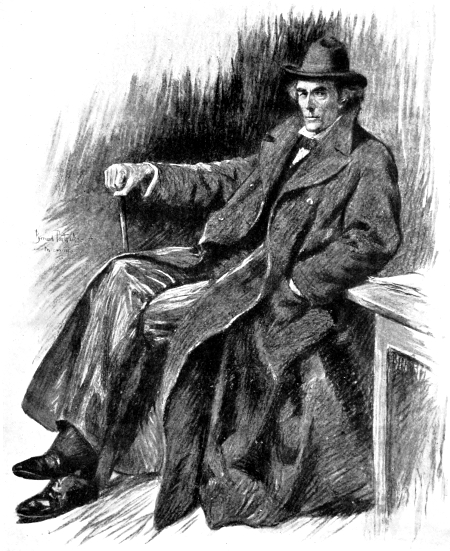
By Bernard Partridge
IRVING AT REHEARSAL.
[Pg 71]
I had been invited to join a luncheon party after rehearsal, so I arrived at the theatre in my best new “bib and tucker” feeling very pleased with myself, and hoping to goodness that the rehearsal would go quickly and smoothly.
Before long I noticed that Irving kept looking at me, and, as I thought, admiring my “turn-out.”
Presently he beckoned me over to him.
“Very pretty frock—very pretty indeed,” he said. “What is it for?”
“I’m going to join a luncheon party as soon as the rehearsal is over,” I babbled proudly.
“Go at once, my dear; go at once,” was his disconcerting reply. “Don’t let the rehearsal detain you. But—to-morrow—come in your working clothes to-morrow—with your mind full of work.”
It was a sharp little lesson, and I never forgot it.
But there was small time for luncheon parties during my first season at the Lyceum. To begin with, there was the production of “Much Ado about Nothing,” and when that was launched there were constant rehearsals of the repertoire in preparation for the American tour. In addition, Irving strongly advised me to take lessons in fencing, dancing and singing, so my time was fully occupied. Had such things as thés dansants, supper and dance clubs existed in those days, I, for one, should have been far too tired to indulge in them.
As I look back upon the interesting but incessant work which was in those days held to be a vital part in the training for the stage I sometimes permit myself to wonder if the average young actress of to-day really knows what work is.
Everybody was very kind to me at the Lyceum, and[Pg 72] one day at rehearsal that fine old actor, Mr. James Fernandez, gave me a memorable piece of advice.
“If you are asked,” he said, “always say that you can play everything and anything; that you can dance, sing, fence, jump—anything.”
It seemed an excellent idea so: “I will!” I assured him solemnly.
At that time the rehearsals of “Much Ado about Nothing” were in full swing, and at night the company was playing “Romeo and Juliet,” in which I had no part.
One morning Irving called for me.
“Ever played Juliet?” he asked.
Now, I had been on the real stage exactly three months, but remembering Mr. Fernandez’s advice: “Oh, yes!” I replied blithely.
“I’m very pleased to hear it,” said Irving. “Miss Terry is not well, and you may have to play it to-morrow night.”
How I blessed Mr. Fernandez for his awful advice!
I went home. I sat up all night reading, learning, spouting, with cold cloths round my aching head, and drinking hot coffee to keep myself awake. All next day I waited, in an agony of suspense, to be called for—and nothing happened!
As the date grew near for the production of “Much Ado,” the dress rehearsals lengthened and lengthened, and many times they lasted until seven or eight in the morning.
Irving seemed made of steel and whipcord: nothing tired him, and his patience was wonderful, but with some of the others nerves became on edge and tempers a little frayed.
[Pg 73]
On one occasion Mr. Terriss saved an explosion, for even Irving had grown impatient at a constantly recurring hitch in one of the processions. The distance between each member of the procession had been spaced out again and again with the most meticulous care, but one of them—I am afraid it was a Miss Millward—never seemed able to keep her proper distance between the person in front and the person behind her when it came to the crucial moment.
Once again Irving stopped the rehearsal, and this time it seemed as if the storm must break. But Terriss braved the tempest.
“It’s all right, guv’nor,” he exclaimed. “Stop a bit, and let me explain it.”
Then, turning to me: “You see, it’s like this,” he explained, and shamelessly parodying Irving’s walk he proceeded to pace out the exact distance. Irving roared—no one could become angry with Terriss—and once more the sun shone.
With Irving Mr. Terriss was a chartered libertine: he could do things with the Lyceum chief that no one else dared attempt. But even he stood in awe of the great man at times, and he often told me that one of his most nervous experiences at the theatre occurred a few months before I joined the company.
He was playing the thankless and overrated part of Laertes in a revival of “Hamlet” in the autumn of 1882, and having a wait of two hours after the third scene of the play, in which Laertes receives the lengthy advice and the blessing of Polonius, he was in the habit of changing and going for a blow on the Embankment to enjoy the air and a cigar.
One night, for some extraordinary reason, after the finish of Scene I he forgot altogether about Scene III[Pg 74] and the garrulous Polonius, and calmly proceeded to dress and leave the theatre. He had just reached the stage door, with the cigar well alight, and was chatting with Barry, when anxious voices were heard, calling louder and louder and coming nearer and nearer.
“Terriss! Terriss!” they cried. “Stage wait! Stage wait!”
For a moment he stood amazed, and then the whole awful truth flashed across his mind.
His first impulse was to dash to his dressing-room, fling on his stage clothes, and rush upon the stage, but a second’s thought was enough to show that it was an impossibility.
Meanwhile: “Terriss? Terriss? Stage wait!” rang the voices.
The next impulse was to drop through the floor to the cellar below, but the floor refused to open; and the next was to rush out into the street—anywhere out of the theatre, and out of the world, if possible. So he fled out into the darkness.
However, the time drew near when he had to return to the theatre to face the reproachful gaze of his chief and whatever punishment awaited him, but Irving only smiled when the reason for the catastrophe was explained to him, and remarked calmly:
“Don’t do it again, my boy; don’t do it again!”
It seemed that Miss Terry and Mr. Howe had proceeded quietly with the scene as if Laertes had been non-existent, and no further inconvenience was caused than that “Hamlet” was “for this occasion only” played without the scene in which the venerable gentleman gives his valuable advice to his son.
When the last dress rehearsal of “Much Ado about Nothing” at last came to an end, Mr. Fernandez[Pg 75] came up to a very dejected and nervous Jessie Millward.
“You are a very charming and promising young actress,” said the dear old gentleman, “and you have a future before you, but you’ve felt frightened to death at rehearsal, and you’ve been called back over and over again. But to-morrow night you can’t be called back. Have every confidence, go ahead, and you’ll make a great success.”
The next night I appeared as Hero and made my success, but so overwrought was I that I remember next to nothing of the performance.
The following morning, according to the Lyceum custom, we were called for a criticism of our respective performances. As I recollected next to nothing of mine I felt it must have been unutterably bad.
As I have already said, Irving knew that I was frightened of him, and on this occasion I think he deliberately kept me in suspense.
One by one the other members of the company were called forward and criticized in the most gentle and kindly manner, and one by one they were dismissed. I alone was left.
“Oh dear!” I cried to myself, as I saw Irving approaching. “Now I am going to catch it! I was so bad that he didn’t like to tell me before the others.” I positively trembled with fright. But all Irving said (I could see he was gently enjoying my obvious fear) was: “Nothing to correct, my dear. Very good; very good indeed.”
And then I knew what it was to be in the seventh heaven of delight.
It did not take me long to realize the tremendous privilege of being associated with the Lyceum of Henry[Pg 76] Irving’s day, and I did my best to take advantage of my opportunities under such a master.
After much sheer hard work I was conscious of gradual improvement in my art, but one was never allowed to become conceited, and one fine day my very small pride received a very great fall.
During my first season with him, Irving gave a big benefit at the Lyceum, and invited me to take part in the programme, suggesting that I should recite Tennyson’s “May Queen,” which Irving had, for reasons of time, slightly condensed for the occasion. I felt very flattered, of course; recited the poem, and, to my delight, was complimented on the success of my first big recitation by Irving himself, who said: “I should like my friend Tennyson to hear you.”
Naturally, I felt highly pleased with myself, and on several occasions afterwards when asked to recite I gave the “May Queen,” feeling that if my delivery of that poem was good enough for Irving it was good enough for anybody.
Some time later, Mr. Terriss and myself, after giving a costume recital at Guildford, were invited to lunch with Tennyson, who had evidently been told by Irving of my success with his poem, for no sooner was lunch over than he asked me to recite it.
Immediately after lunch is not an ideal moment for the recital of a Laureate’s poem to that Laureate himself, but though I was very nervous and uncomfortable I thought I had not done so badly, and when I had finished I felt that I had earned some little compliment, however perfunctory.
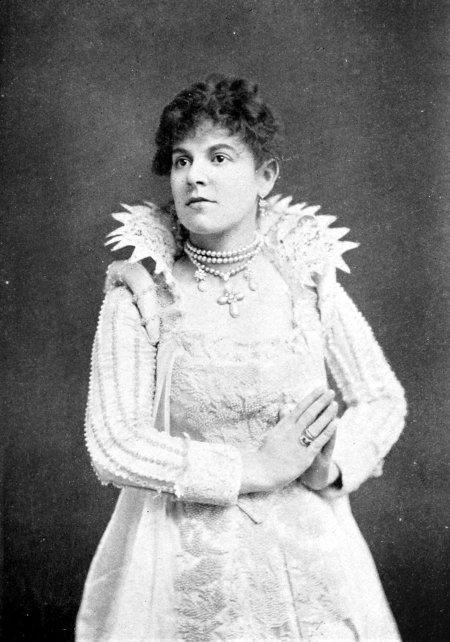
Photo by London Stereoscopic Company
JESSIE MILLWARD AS HERO.
One or two people, it is true, did murmur the inevitable “Thank you, so much,” but I could not help noticing that the “friends of the house” were looking [Pg 77]rather anxiously at the poet, and seemed to be awaiting his verdict before committing themselves.
At last Tennyson spoke, or rather growled:
“Why have you left out some of my lines?”
And not a word more did he say.
Later, when I told Irving of my experience, he smiled.
“Poor dear Tennyson’s sense of humour is not his strong point,” he said, and proceeded to tell me a little experience of his own. A discussion had arisen between Bram Stoker, Joe Hatton and the Laureate over Shelley, and Hatton, turning to Tennyson, observed consolingly: “But you are in the ascendant now, sir.”
“Ah,” observed Tennyson complacently: “Shelley had no humour.”
If I have dwelt at some length on my first appearance at the Lyceum Theatre, a glance at the cast of that wonderful revival of “Much Ado” will furnish my excuse.
I had been but three months on the stage, and yet not only had I the tremendous good fortune to be selected for an important Shakespearean rôle, in which, with equal good fortune, I contrived to make my first big success, but I had the privilege of forming one of a company which contained many names afterwards to become famous.
Apart from Irving and Miss Terry, in the cast of “Much Ado about Nothing” were the present Sir Johnston Forbes Robertson, who played Claudio, and whose part, during his engagement elsewhere, was rehearsed by the present Sir Frank Benson; Mr. Terriss, Mr. Fernandez, Mr. Howe and that fine old Shakespearean actor Mr. Mead, and playing in the Lyceum repertoire were the late Sir George Alexander, the present Sir Martin Harvey—who was then cast to[Pg 78] “walk on”—and his wife, then Nellie de Silva, and Mr. Haviland, while Mr. Jack Robertson, the great concert singer—no relation, by the way, of Sir Johnston Forbes Robertson—was specially engaged to play the small part of Baltazar, and to sing “Sigh no more, Ladies.”
Irving had a genius for surrounding himself with clever people, and neither in casting nor in staging his plays did he stop to consider expense when he had a certain effect in mind.
The chapel scene alone in “Much Ado” was a revelation in stage setting, with its wonderful lighting, and its huge organ specially built on the stage.
And in connection with that chapel scene two “Meadisms” at once rise in my mind.
Mead was a fine actor of the old school, with the appearance of Dante, and a wonderful reverberating voice which at times he failed to modulate, and, as he grew older, his memory played him tricks.
As Hero, I was kneeling at the altar in the wedding scene, and old Mead, as the priest, instead of Shakespeare’s lines started with the words of the Prayer Book Marriage Service.
“Dearly beloved——” boomed that tremendous voice over my bowed head, and I am afraid Hero giggled. Mead caught the sound of my giggle.
“Dearly beloved,” he repeated sternly, in those deep organ tones, and then, in what was meant to be an indignant aside, but in reality was exactly the same intonation—“and—these—damned—amateurs!”
The only time I ever saw Irving laugh on the stage was on another occasion in that same wedding scene, and Mead was the cause.
[Pg 79]
Hero had fainted and was lying on the steps of the altar, with Beatrice on one side of her and Benedick, his back to the audience, on the other. Mead, as the priest, was descending the steps to Hero’s side, when he tripped, took the whole short flight in a sort of pantomime fall, and landed full length beside Hero.
Irving, convulsed with laughter himself, still retained enough presence of mind to gasp: “Don’t laugh, my dear! For God’s sake, don’t laugh!” to the naturally frivolous Hero.
Another magnificent veteran in the cast of this great revival was the late Henry Howe, who had graduated in the Macready school, and was a living link between the new and old tradition.
He was full of stories of that extraordinary man and great tragedian, of whom so many extraordinary stories have been told, and one of the best I remember was of an experience with him in “Macbeth.” Mr. Howe was the Macduff, and it was Macready’s uncomfortable habit as Macbeth to fight so vigorously with Macduff that he was eternally damaging the unfortunate actors who played the part. In fact, at one time it was not easy to find anyone to play it, and it was said that every Macduff who had acted with Macready carried a Macready trade mark in the shape of a cut or a bruise.
After disabling several, he engaged Mr. Howe to support him at Covent Garden, and at rehearsal it was arranged that in order to give Macready breathing space during the great fight, while he was puffing and blowing, the cue for Howe to “come on” was the treading upon a brass nail that shone upon the boards.
But at night, Macready, in the grunting, blustering and cursing in which he indulged to “work himself up,” forgot all about the arrangement, and as Macduff, with[Pg 80] his eyes firmly fixed on the brass nail, waited for his cue the great man became more exasperated than ever.
“Come on, you brute! Why the devil don’t you come on, you beast!” he snarled sotto voce.
“Why the devil don’t you tread on the nail?” retorted Howe indignantly, and then the fight was resumed with immense spirit on both sides.
My first year on the stage was a wonderful experience for a young actress, for after playing Hero until the end of the run, as the Lyceum season finished with a short revival of repertoire in preparation for the American visit, I played in “The Merchant of Venice,” “The Lyons Mail,” “Louis XI,” and “The Bells,” in London, and in a short tour, which included Edinburgh—where Irving opened the Lyceum Theatre, built by Messrs. Howard and Wyndham—Glasgow, and Liverpool, the scene of my little contretemps under the Kendal regime, whence we sailed for the United States on the “City of Rome” in October, 1883.
[Pg 81]
First visit to America.—A family party.—Terriss as an ancient mariner.—Collapse of the ancient mariner.—His seafaring career.—Sir Martin and Lady Harvey.—William Haviland.—Charles Hunt Helmsley.—New York.—“It is I!”—The Jew and the Polish Jew.—A tone-deaf singer.—Irving’s anger.—A Trilby in real life.—Terriss buys the rights of “Trilby.”—Gives them to me.—A Haymarket “scene.”—“The Man’s Shadow.”—The infant prodigy and the Trees.—The juvenile leading lady and Terriss.—A lesson from a critic.—Irving gets his “effect.”—Perverted Shakespeare.—The nigger and the “troupe.”—Norman Forbes.—A burglary.—Chicago.—The Kendals.—Augustin Daly.—Ada Rehan.—Daly’s Theatre.—George Edwardes.—Stephen Fiske.—William Winter.—An accident at Niagara.—A triumphal home-coming.—Terriss as a hypnotist.
IN 1883 an American tour was something in the nature of a great adventure—it was, I know, for one youthful member of the Lyceum Company—and it was a very happy and excited family party that embarked on the “City of Rome.”
And it was a “family party” in something more than the conventional sense, for in the ninety or more members which composed the expedition were fathers, mothers, sisters and brothers, and even a pair of twins, the property of Mr. Houseman, the musical director and his wife.
No sooner had we stepped on board, and before the liner cast off from the stage, than Mr. Terriss assumed command of the expedition. (Irving and Miss Terry had sailed in the “Britannic.”)
[Pg 82]
To begin with, Mr. Terriss had been a real sailor: with the rest of us, our knowledge of the sea had been confined to occasional passages across the Channel, and deep-sea voyaging in a big ship was a high and holy mystery.
So when he whispered in my ear: “Understand, it is a rule of the sea that women and children go first, and you shall be the first; I’ve a pistol in my pocket!” I was impressed.
“Good heavens, are we going to be wrecked?” I blurted.
“One never knows!” he replied darkly.
I thought that, being a sailor, he knew, and that the risks we were taking were rather awful.
Ten minutes or so later, when I saw him climb a mast and reach the dizzy height of the crow’s nest I felt still more convinced that he must know, and my confidence was not in the least shattered when the captain, catching sight of him, sternly ordered him down.
I of course put the captain’s indignation down to professional jealousy.
But when we at last sailed, and on reaching the open sea Mr. Terriss was invisible for two days, and it was whispered that he had been deathly ill, I reluctantly concluded that perhaps after all the captain knew his business best.
Later Mr. Terriss confessed to me the whole extent of his seafaring experiences as a professional seaman.
His mother had had him trained for the merchant service, and when at last he received his cadetship he was so proud of his new uniform that for days he paraded Westbourne Grove in the neighbourhood of his Bayswater home, to his own immense admiration and that of others.
[Pg 83]
At last the day came for him to join his ship.
He bade long and fervent farewells to his family and his friends, and embarked on his new career. The first night at sea was a stormy one, and when at dawn the ship hove to off Plymouth and a bumboat came alongside with an old woman selling vegetables, the new sailor slipped over the side, bribed the proprietress of the bumboat and rowed ashore, arriving the same evening at his mother’s house in Bayswater, to the amazement of his sorrowing family.
And so ended Mr. Terriss’s career as a professional sailor.
However, rough as the passage was, we all recovered in time to assist in the concert in aid of the Seamen’s Orphanage, and at the supper which followed Mr. Terriss again distinguished himself as an experienced traveller by moving an amendment to one of the toasts.
“The President of the United States!” announced the proposer.
“And his wife!” cried Terriss warmly.
Unfortunately the President at that time was a widower.
I have said that the company on that first American tour was a family party, and in that family party were more novices than Jessie Millward. Amongst them were a young couple, Martin Harvey and his sweetheart Nellie de Silva, now Sir Martin and Lady Harvey, who, playing tiny walking-on parts, seemed to spend all the time on our long journeys in reading and studying together. Two more earnest students of their art were never seen, and I wonder if even then they dreamed of what the future held for them.
Playing small parts was that fine actor William Haviland, and other youthful “tourists” were Charles[Pg 84] Hunt Helmsley—who afterwards gave up acting, and was for many years the kind, genial and courteous manager for Sir George Alexander, and is, at the moment I write, with Mr. Arthur Bourchier—and my brother Herbert, freed from his apprenticeship with the White Star Line, who came to chaperon me, and subsequently became assistant stage manager to David Belasco.
We landed at New York in the midst of the Indian summer—another novelty for most of us—and the heat, the bustle, the skyscrapers, the “elevated,” the cable cars, and last, but very far from least, the appalling ordeals at the customs, were all sufficiently bewildering and exciting to the young actress whose furthest journey had hitherto been as far as to Boulogne.
Irving’s first appearance in America was at the Star Theatre, New York, on the evening of Monday, 28th October, 1883, in “The Bells,” and his first words on the American stage were those of Mathias:
“It is I!”
Irving’s Mathias in “The Bells” was a revelation in tragic acting to the American public, and few who saw it remained as unimpressed as the Jew of whom Lal Brough used to tell.
A brother Hebrew was extolling Irving’s magnificent performance, and exhausting superlatives of admiration while his friend remained cold.
“Wonderful! Wonderful! The most wonderful thing in the world!” he kept repeating, until the friend got tired of his enthusiasm.
“Wonderful?” he repeated irritably. “That ain’t wonderful! Could Irving buy steel pens at tenpence a gross an’ sell ’em at a bob a dozen? That’s vat I calls wonderful!”
[Pg 85]
From the reception that first night in New York there were few Jews in the steel pen industry amongst the audience.
“The Bells” was the only piece played on that memorable occasion, and I had no part in it, though on several occasions afterwards during the tour I played the part of Annette. Now, Annette had to sing a little Tyrolean air at the finish of the second act, and though everyone told me that I had a capital singing voice I myself knew only too well that I was absolutely incapable of singing in tune. As a child my inability to sing “Kathleen Mavourneen” in tune had been a family joke, but Irving insisted that it was a mere matter of training and made me take singing lessons from the first violinist, Andrew Levey.
Levey did his best, but after several trials was obliged to admit that I was right. So long as he played the note I was in tune, the moment he stopped I lost the key. He said it was unusual, but at the same time it was a horrid fact, and on his reporting to Irving it was arranged that the snatch of song should be sung “off.”
During the American tour this was done whenever I played Annette, until one day the girl who sang broke down with a bad cold, and as there was no one else available I said that I would sing myself. All afternoon I practised that wretched song with kind old Mrs. Pauncefort, who played Catherine. For hours we rehearsed it together: she sang it to me, I sang it to her, and at last, in an agony of nervousness, I sang it in the performance.
Owing to sheer nervous tension I managed to get through it—all except the last note, which I knew I could not achieve, and which I didn’t attempt—and the moment the curtain fell to a sound of applause, Irving[Pg 86] jumped to his feet and said that the song had never been so well sung before.
He was really angry; it had all been pure affectation on my part, he declared; he would have no more of such silly nonsense, and he wound up by calling a rehearsal of the scene for the next morning.
The next morning came; I sang my poor little best—but I was never asked to sing again!
I had been so terrified that on that occasion only I had been a sort of Trilby, hypnotized into singing in tune.
And the singing of that song “for one night only” had a curious sequel. When Mr. Du Maurier’s novel “Trilby” was published and instantly became famous, Mr. Terriss bought the dramatic rights for Great Britain and gave them to me, as a tone-deaf Trilby in real life.
In his brilliant essay on his brother, Mr. Max Beerbohm tells how he went to see Paul Potter’s version in Philadelphia as an emissary of Sir Herbert to report on it, and how his report was an adverse one. Later, in New York, two nights before he sailed for England, Sir Herbert thought that, as he had an evening to spare, he might as well go and see “Trilby” himself, and, as Max slily observes, “it was on the proceeds of ‘Trilby’ in England that His Majesty’s presently began to arise.”
Many people were then after the dramatic rights of Du Maurier’s book. Mr. Willard had cabled over for them, but Sir Herbert, as soon as he reached England and heard that the rights were mine, came straight on to the theatre, and in my dressing-room begged me to let him have them. He had them, and his magnificent performance of Svengali is now stage history.
Soon after its production at the Haymarket, Mr. Terriss and I went to a matinée of “Trilby”—or rather[Pg 87] I went, and was joined after the curtain had risen by Terriss, who, like most men, was occasionally late. The house was crowded and I was annoyed at his lateness, and was more annoyed at the extreme deliberation with which he proceeded to place his hat under the seat, and, still standing, slowly begin to take off his coat. The play was continuing, and, to make matters worse, there began to be whispers of “There’s Terriss! There’s Terriss!” from enthusiastic admirers who had recognized him.
“You’re very late,” I snapped. “For goodness’ sake sit down!”
The whispers grew, heads were turned in our direction, but, pretending not to hear or care, with maddening slowness he continued to fold his coat, and placed it carefully under his seat; then, after taking a prolonged view of the house, he at last prepared to sit down.
But the “tip-up” seat, to my intense and rather malicious joy, had been slowly “tipping” during that view of the house, and when he at last condescended to sit down he sat gently on the floor.
It is curious that I should have been connected with two of the plays which became famous under the Tree regime at the Haymarket—“Trilby” and “A Man’s Shadow,” the latter of which, under its French title of “Roger la Honte,” Mr. Terriss and I played many times in the States. When “Roger la Honte” was produced in Paris there was a rush of managers over to buy it. Mr. Charles Cartwright and Mr. Terriss were first and bought the English rights, which they sold to Sir Herbert—who was a few hours late—reserving the American rights of the play, which was played in America under Augustin Daly. So popular was it in[Pg 88] the States that a pirate version, “The Spider’s Web,” sprang into existence.
By the way, à propos “The Man’s Shadow,” Sir Herbert Tree was fond of telling a story of a little incident which occurred at one of the early rehearsals of the play.
The small girl who played the part of Suzanne was watching the progress of the rehearsal one morning, and being, like most small children, intensely observant and critical, turned suddenly to her mother and demanded:
“Who is that young lady who seems so familiar with Mr. Tree?”
“Hush, dear,” was the reply. “That is Mrs. Tree.”
“Well,” observed the child, with the air of one who is the repository of all the worldly wisdom of all the ages. “I wonder, if she is so disrespectful to her manager now, how on earth she ever expects to get on in her profession!”
Playing the same part in America on my tour with Mr. Terriss with the play under its original title of “Roger la Honte” was another very self-possessed small child.
She was quite a brilliant little actress—and she knew it. But, a trifle spoilt as she was, she had occasional fits of modesty. For instance, one day when Mr. Terriss chaffingly told her: “You’re the star of this play, my dear,” she replied, almost with diffidence: “Oh, no, Mr. Terriss! You are the star; I’m only the leading lady!”
But to return to that wonderful first American tour of Henry Irving.
The Irving methods, the Irving acting, and the Irving productions were a revelation to the American play-going public of that day. There were, of course, great[Pg 89] actors and actresses in the States, but nothing like the elaborate finish of the ensemble had ever been seen.
But if the critics were enthusiastic they were exacting, and I had one little lesson from a very great critic which I hope did me good.
I was, of course, very young, and I suppose rather frivolous, which may be some excuse for a bad habit I had of giggling on the stage at anything that amused me when I thought no one was looking. I realized it was a bad habit and tried to check it, but one or two other members of the company were wicked enough to encourage me in it. I used to beg of them: “Please don’t make me laugh!” but without much success, as I’m afraid the appeal was too often only a half-hearted one.
But one evening I was fairly frightened into seriousness.
Miss Payne, who was playing Ursula in “Much Ado about Nothing,” suddenly convulsed me in the middle of the garden scene by holding up her thumbs, on the nails of which she had painted two comic little faces. I all but collapsed, but managed to get through the scene, and at the fall of the curtain flattered myself that no one had noticed my wickedness.
As I was leaving the theatre that night a note was placed in my hands. It was from a very great critic indeed, and it ran:
“Dear Miss Millward,—I have admired all your performances greatly, and think you one of the most charming and promising young actresses I have seen for a long time, but—the next time I see you laugh on the stage I shall stand up in the stalls and denounce you.”
[Pg 90]
Another lesson, of a rather different nature, I received from Irving himself. (That first American tour was full of lessons for me!)
I was playing the part of Lady Anne in “Richard III,” in the place of Miss Terry, and in the wooing scene, when Gloucester places the ring on Lady Anne’s finger, do what I could I always anticipated, and thus entirely spoiled the effect Irving intended. Again and again he explained it, but somehow or other I invariably “missed fire,” but one night he got his effect.
And he got it in the simplest way—by a sudden pinch at the crucial moment! My start of surprise and horror was realism itself, and at the end of the act he sent his valet Walter round to my dressing-room to congratulate me.
“Mr. Irving hopes he didn’t hurt you, miss,” said Walter, “but he says you were splendid, and it was just the effect he wanted.”
Another “Richard III” memory is of a ghastly mistake made by the actor who played the small part of the officer in command of the guard placed over the coffin of the dead king.
When Gloucester intercepts him, his lines according to Shakespeare—who certainly should know best what he intended his characters to speak—are:
“Stand back, my lord, and let the coffin pass.”
But on this occasion, from nervousness or “fluffiness,” the player gave an entirely new reading, and scored a somewhat equivocal success with:
“Stand back, my lord, and let the parson cough.”
Which is almost, if not quite, as bad as the story poor Wilson Barrett used to tell of the Portia who saluted the Antonio with the blithe announcement:
“Joy, joy, Antonio! Your ships are all sunk!”
Which in turn reminds me of a deliberate perversion of the original text of that same play, “The Merchant of Venice,” by Mr. Terriss. Needless to say, it occurred when Irving was not on the stage.
In the eyes of the American public the Lyceum Company could do no wrong, and, partly because they looked upon us as perfection, and partly, perhaps, because of their ignorance of the popular English seaside resorts, they accepted without a murmur an entirely novel reading by Terriss.
Bassanio’s lines in the casket scene, on learning that the ships are lost, are:
Never shall I forget Miss Terry’s expression, as the “revised” version caught her ears:
As I say, it was fortunate for everyone concerned that Irving was not within hearing, but the audience took it all as gospel.
After the big success in New York the tour became a sort of triumphal progress; at every stop crowds were waiting on the station to see the Lyceum Company, and Irving and Miss Terry were constantly obliged to appear on the platforms to receive the welcome of “prominent citizens.”
And it was not only the “prominent citizens” who were anxious to see the visitors.
On one long journey I had a “section” to myself—which meant that when the upper berth was closed I had quite a comfortable little compartment—and I was dawdling over my morning toilet after an all-night run[Pg 92] when the train stopped for a moment at some wayside station. There was nothing unusual in that, but what was unusual was that my window was suddenly opened, and a round-eyed, white-toothed nigger’s head appeared, and a nigger’s voice demanded:
“Say, are yew the troupe?”
It was also a trifle disconcerting—until one got used to it—to find crowds of reporters trooping through the “sections” at all hours on their way to Irving’s car, and the first time it occurred at night poor Miss Payne, who had retired to rest and did not realize that the invaders were representatives of the all-powerful press, put out a tousled head from between her curtains and remarked icily that, whatever might be the custom in America, she didn’t think it moral for men to go tramping through ladies’ bedrooms at all hours of the night.
But most of the members of the company speedily adapted themselves to American customs, even if we did not all go to the length of Mr. Norman Forbes, who, on our arrival at Chicago, asked a group of pressmen, in what he fondly imagined to be an American accent:
“Say, you guys, is this Shycawgo?”
The effort was well meant, and it was unkind of a newspaper gentleman to report in print that “there is a member of the Irving Company who not only cannot talk English, but cannot pronounce the name of our city.”
The hot trains and the long journeys of that first tour were very trying to the novices—on the subsequent tours the journeys were differently arranged—but we contrived to enjoy ourselves, for the novelty of our experiences never seemed to pall. And whatever comforts, not to say luxuries, could be provided were there for us, for Irving always “did things” in a princely way,[Pg 93] for others as well as for himself. He was generosity incarnate, even to those who presumed on his generosity, as I am afraid I did on one of those long journeys.
My “section” was next to the kitchen, and one night—we had been travelling from midnight the night before—I happened to open the door between and saw a nice little dinner being prepared, and on the table a dish of quails. I returned and reported what I had seen to another frivolous member of the company, who promptly made me a bet that I would not bring something nice out of that kitchen. My gambling instinct properly roused—to say nothing of my appetite—I darted back to the empty kitchen, popped one of the plump little quails on a plate and was in the act of leaving with the spoil when I heard a well-known voice say kindly:
“Take two, my dear—take two.”
I dropped the quail as if it had been red-hot and bolted, feeling like a naughty schoolgirl. In a few minutes, as I was in the midst of telling the horrible story to my accomplice, a porter arrived bearing two quails on a dish, “with Mr. Irving’s compliments to the burglar.”
But Irving never interfered with the innocent amusement of the members of his company—if burglary can be called innocent! And he declined to interfere when two male members, after a serious quarrel, came to blows in the green-room during a matinée, saying that it was a domestic affair which did not concern him.
But that same evening he so contrived matters that the two antagonists had to appear on the stage together arm-in-arm as bosom friends, and the sheer ridiculousness of the situation put an end to any lingering ill-feeling. That little episode and our first visit to Chicago[Pg 94] are my only two unpleasant memories of the tour, and it was not Chicago’s fault that I was not happy there.
It is true that the city was very dingy and drab, badly lighted, and built on charred wood, not having wholly recovered from the terrible effects of the great fire, but my most vivid memory of it is connected with a bad attack of malaria. As I went on the stage as the girl Julie in Louis XI I heard Miss Terry, who was not playing, say: “The girl looks very ill.”
“Don’t tell her so,” said Irving. “She will have a rest the next few days, but she must get through to-night.”
It was an understood thing at the Lyceum that business was always first, and I struggled through our first night at Chicago somehow or other. The next morning Irving sent his doctor round to me.
Considering the difference in climate, the terribly long and trying journeys, the very hot theatres and hotels, it was wonderful that there was little or no illness in the company. In fact, we were monotonously healthy, and throve on the hard work and the tremendous enthusiasm with which we were everywhere received.
Financially, of course, the tour created a record, and the next English tourists to come anywhere within sight of it were the Kendals, on their first visit under Daniel Frohman in 1889, but Irving’s figures were considerably the larger. Curiously enough, as Irving’s first words to the American public had been “It is I!” Mrs. Kendal’s were: “Well, here I am, good people!”
On my later visits to the States I used to hear much of the impression the matron of the drama had made on the somewhat frivolous Americans, and a favourite story that used to be told of her was in connection with a brooch which, it was said, had been presented[Pg 95] to her by Royalty as a souvenir of a command performance.
It was a very modest little piece of jewellery, with a monogram and a crest, and at a big luncheon party a very beautiful little American actress commented on it.
“Yes,” said Mrs. Kendal—or so the story ran—“That was given to me by a great lady for being the most virtuous and most domesticated woman on the British stage.”
“Do tell!” cried the beautiful little American lady, fingering a huge rope of pearls. “An’ these pearls were given to me for being the most beautiful and the—er—the most popular woman on the American stage.”
That, at any rate, is how the story was told, but I don’t vouch for it. Si non e vero, etc.
It was during that Irving tour that Mr. Terriss first saw the wonderful Augustin Daly Company, and arranged to bring them over to London to open at Toole’s Theatre in 1884 with a repertoire of farces. So successful was the visit that the company later returned to London to the Gaiety with Ada Rehan and John Drew in “The Taming of the Shrew”; still later, Daly’s Theatre was built, and opened with the same play.
It was a hobby with Terriss to buy plays and to dabble in theatrical speculation, and he was generally successful, for he was a very sound business judge of the value of a play, and, unlike more than one well-known actor, never made the mistake of regarding any and every play as a possible background to his own personality and methods.
Augustin Daly was a curious individual: possessing undoubted theatrical capacity, he was also an expert in the gentle art of making enemies, and was too much oppressed with a sense of the importance of being[Pg 96] Augustin Daly to become really popular. In his theatres members of his companies were warned against approaching him without due ceremony and due notice, although he did not always observe the same etiquette in approaching others, and on one memorable occasion was ordered out of Drury Lane by Augustus Harris, who certainly had good reason for his action. But, whatever his faults, he had the wit to realize the genius of that truly great actress Ada Rehan, and he deserves to be remembered if only for her successes under his management, though I often wonder what the modern Shakespearean purists would say to Daly’s system of “cutting” Shakespeare to suit his own ideas. With few exceptions, the critics of his day endured the Daly version of Shakespeare without protest, and one of those exceptions was Mr. William Archer, who suggested that “Daly” should be spelt “Dele.” The manager’s methods were too often a curious mixture of false modesty and sheer pruriency, and will a modern generation believe that in his version of “The Midsummer Night’s Dream” at Daly’s the most magnificent lines in the whole play were docked from Oberon’s speech:
While Daly was a chartered libertine where Shakespeare was concerned, it is strange to think that Irving, whose reverence for the poet approached idolatry, was always fiercely attacked by his English critics for the slightest rearrangements of the plays, rearrangements which were often essential for reasons of time alone.
The story of Daly’s Theatre is not uninteresting.
[Pg 97]
After bringing Ada Rehan to London Daly discovered that he wanted a permanent theatre there, in which he could run a regular season when his New York Theatre was closed.
On hearing this, George Edwardes said to him: “I’ll build you a theatre, and let you have a long lease of it at five thousand pounds a year.”
In those happy pre-war days the theatre only cost some forty thousand pounds to build, but Daly could not make it pay, and then Edwardes came forward and offered to find the entertainment on percentage terms. The result was very profitable for Daly, and afterwards for his executors, the percentage which they drew being far in excess of the rent they had to pay. After litigation the arrangement came to an end, and the theatre passed entirely into George Edwardes’ possession. At one time it was said that he had settled the theatre on his son D’Arcy, who was a captain in the 1st Dragoons, and shortly before his death he told a friend of mine that there were two things in the world that had given him supreme satisfaction.
“The first,” he said, “is that my boy D’Arcy has never caused me a moment’s anxiety, and the second is that I have never had to put my hand in my pocket for one single penny for the Ballykisteen stud farm. On the other hand, Ogbourne has cost me a lot of money, but I’ve always had full value out of my racing.”
Curiously enough, the American critics were much more laudatory of Irving at this time than certain of his countrymen, and in particular my father’s old friend Stephen Fiske, who was then writing for “The Spirit of the Times,” and William Winter wrote wonderful and understanding appreciations of the great actor’s aims and art. William Winter, a man of strong likes[Pg 98] and dislikes, and by no means easy to please, became not only a friend but a whole-hearted devotee of Irving and the Lyceum methods, and expressed his appreciation both in prose criticism and in graceful verse.
These men were quick to see and appreciate Henry Irving’s whole-souled and semi-fanatical devotion to his art at a time when it was still the fashion among certain of his fellow-countrymen to sneer at and belittle him as “the fashionable tragedian.”
New York, Philadelphia, Boston, Baltimore, Brooklyn, Chicago, St. Louis, Cincinnati, Columbus, Indianapolis, Detroit, Toronto, Washington—city vied with city in the warmth of its welcome, and perhaps it was as well that the incessant hard work and the desire to deserve these welcomes gave us no time to acquire that uncomfortable complaint born of too much leisure—swollen head.
Only one holiday did we take, “a day off” to visit Niagara Falls—-a holiday which was nearly marked by a tragedy, for as Mrs. Pauncefort, Miss Payne, Mr. Terriss and myself were walking under the Falls, Terriss slipped, fell, and nearly lost his life. He only just managed to save himself, and was by far the least concerned of the party; in fact, his only comment was: “Bill’s luck! Bill’s luck!” and a shrug of the shoulders.
The closing night of the tour in New York was a memorable one, both for hard work and late hours, for we were to sail early next morning, and the programme consisted of acts from four plays, “The Merchant of Venice,” “Louis XI,” “Charles I,” and “Much Ado about Nothing.” What with the ensuing speeches, the supper parties, the farewells, it was a miracle that Bram Stoker was able to shepherd his little army on board in time for sailing, and long after the ladies of the[Pg 99] company were asleep in their state-rooms, male members of the “troupe,” as the darky had called it, kept turning up from farewell functions at clubs and hotels.
However, at last “The City of Chester” sailed with all on board, no doubt to the immense relief of the faithful Bram Stoker, who was in charge of the voyagers, Irving and Miss Terry sailing later in the “Aurania.”
It was a happy and triumphant home-coming, and the voyage was appropriately happy and ueneventful, save for an experiment in hypnotics by Mr. Terriss.
Hypnotism was at that time a fashionable craze, and one day in the smoke-room Terriss declared that he possessed great and mysterious hypnotic powers, the extent of which even he himself did not understand, which was probably true.
Several of us were in the secret, including Bram Stoker, and a little scene was arranged.
One morning when I was sitting on deck Terriss kept passing to and fro in front of me, glaring fiercely each time he passed, and naturally soon attracted the attention of a good many passengers. Poor old Mrs. Pauncefort, who was sitting beside me knitting, became quite alarmed, thinking perhaps he had temporarily gone off his head, and every time he approached with a ferocious stare she would whisper timidly: “Oh, here he comes again! Don’t look at him, my dear! Don’t look at him!”
Presently I fell forward as arranged, and people rushed to my assistance, but it was not until Terriss had made some mysterious passes over my face that I was supposed to come out of the trance.
The “believers” amongst the audience were tremendously impressed, and to his secret horror Mr. Terriss[Pg 100] was approached by a deputation who formally invited him to give a lecture on hypnotism in the salon.
This was rather more than he had bargained for, but it was too late for him to back out, and with the assistance of Bram Stoker a lecture was hurriedly concocted, and delivered with immense success, the “demonstrations” being particularly impressive. Needless to say, the “subjects” were carefully chosen and had also been carefully rehearsed, thus carrying out to the last the “Lyceum thoroughness” which had so impressed America.
[Pg 101]
Return to England.—Offer from Frohman.—A novice’s “cheek.”—Irving’s kindly wisdom.—David Belasco.—An indigestion-proof genius.—Robert Mantell and the wasted years.—C. P. Flockton.—“The Fire Bug.”—New Orleans and a rich uncle.—“Hazel Kirke.”—My brother’s “hit.”—Pettitt and the play-pirates.—His sense of humour.—A cable from Terriss.—The Adelphi.—Robert Pateman.—“The Harbour Lights.”—Miss Mary Rorke and a dream.—Robert Courtneidge’s “speech.”—Sir Morell Mackenzie and a rival practitioner.—Abingdon’s “love-letter.”—King Edward VII.—The Prince and Terriss’s shirt.—A successful filly.—An actor’s faux pas.—The musical comedy Peeress and the Prince.—Lord Londesborough.—Mr. Justice Hawkins.—Terriss as licensee.—Mr. Bernard Shaw reads “The Devil’s Disciple.”—An awful moment.—Another awful moment.—A parting shot.—Vindication of Mr. Shaw.—“Peter Pan.”
ON the return of the Lyceum Company to England, “Twelfth Night,” with Irving, Miss Terry, Miss Rose Leclerq and Terriss in the cast, was put into rehearsal, and as there was no part for me in the new production I jumped at a proposal from Daniel Frohman to return to America and play the part of Pauline in “Called Back,” the play in which Tree, as Macari, was then drawing all London to the Prince of Wales Theatre.
What ambitious young actress could refuse an offer to “star” in a proved success!
Although there was no part for me in “Twelfth Night” I was still engaged to Irving, so with the blissful impudence of youth I sailed down to the Lyceum one evening—during the performance!—and trembling with[Pg 102] excitement asked him if he could manage to do without me for a little while.
He reminded me that, although I was not actually playing at that moment, I was still a member of his company, and then sat silent for a time, looking at me.
“Yes,” he said at last, quietly, thoughtfully, “you can go; perhaps it will be better for you to go—for a while. But I want you always to look upon the Lyceum as your home—a home you can always return to.”
He knew and understood, far better and far more than I myself at that time.
So on the following Saturday I sailed back to America with Mr. Frohman’s partner, Dr. Mallory, a clergyman, and his wife.
Once again I had the inconceivable good fortune from the point of view of the ambitious beginner to find myself in a company of fine artists whose example and whose precepts were invaluable. The stage manager was David Belasco, even then a brilliant young man, who looked exactly like a clergyman and was understood rather to encourage the resemblance. Shy, eccentric, highly strung, and intensely temperamental, full of idiosyncrasies—he was, for example, never known to appear in evening dress—Belasco was even then one of the greatest of stage managers, and it was said of him that he could train anyone to become great.
After a hard evening’s work he would make a huge supper of cream tarts and chocolates, and that he escaped indigestion is alone proof that he was above the ordinary run of mortals.
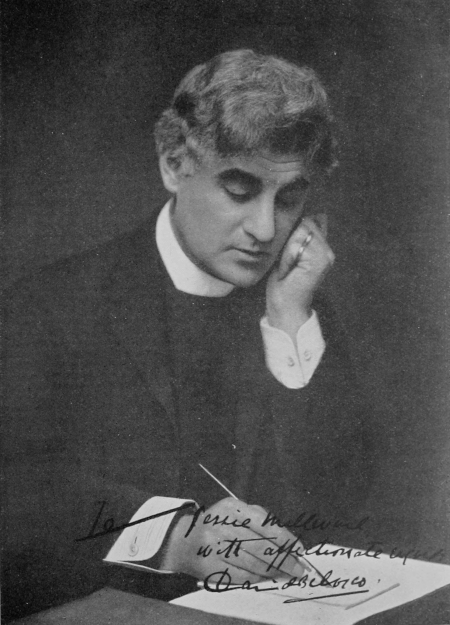
DAVID BELASCO.
Later, amongst his first London productions was “The Heart of Maryland,” in which Mrs. Leslie Carter appeared at the Adelphi in 1897, and which Mr. Terriss [Pg 103]had refused to produce, because, as the heroine, it would have been my uncomfortable “business” to swing from one side of the stage to the other on a huge bell.
In the American cast of “Called Back” was that fine actor Robert Mantell. An Irishman by birth, he had played in America for many years, and endured a long and hard struggle before achieving fame and making his big hit as Loris Ipanoff to the Fedora of Fanny Davenport. On his success Frohman had immediately secured him at a large salary for “Called Back,” but, strange to say, his very success had made him bitter.
“Here I am,” he told me once, “earning five hundred dollars a week, while for years I struggled hard at fifty, every bit as good an actor and doing just as good work as I am doing now!”
And even my youthful assurance that it was better to be recognized late than never failed to lessen his grievance against fortune.
Another member of the cast was C. P. Flockton—“Flocky,” as everyone called him—a dear old English gentleman who bore the most extraordinary likeness to Irving. Indeed he always vowed that he had been compelled to leave England because Irving was so like him. A most lovable and quaint personality, Flockton died suddenly in the train on his way to California, at a great age, and my brother Herbert and Charles Stevenson—the husband of Kate Claxton, of “Two Orphans” fame—had the body cremated and the ashes brought to Fortune Bridge, Prince Edward’s Island, where “Flocky” had a tiny cottage on a lonely promontory. Over the gentle old man’s ashes a sundial was erected, and the natives always vowed that the dead actor’s ghost “walked”. If it did, I’m sure it would never have harmed anybody.
[Pg 104]
Poor Kate Claxton, by the way, had the reputation of being a “fire bug,” for it was a curious fact that theatre fires seemed to follow her wherever she went—and theatre fires in America were usually on a terrible scale, so the reputation was an unenviable one.
Other members of the Frohman Company were W. Ferguson—whom I saw quite recently on the films—and Beatrice Cameron (Mrs. Richard Mansfield).
We opened at the Fifth Avenue Theatre and had a big success, but in spite of success I grew terribly homesick, and implored Mr. Frohman to let me return to England. (I seem to have been always asking famous managers to release me in those days!) His answer was to cable to my brother Herbert to come out and bear me company, so I continued to play in “Called Back” to the end of the season, and then toured the big cities, even to New Orleans, a city which I had always longed to visit for the sake of an uncle whom I loved and whose romantic history as treasured in the family had always appealed to me.
At twenty he had eloped with a bride of sixteen, my father’s sister. Somehow or other they had reached America with twenty-five shillings between them, and eventually settled in New Orleans, where he built the fortifications and endured the Civil War. He lost his fortune in the Civil War, regained it and died a very wealthy man. So it is small wonder that New Orleans had always been invested with a halo of romance for me, for mysterious, wealthy uncles are treasured possessions in every well-regulated family.
After the tour I returned to New York to play in “Sealed Instructions” at the Madison Square Theatre, following the run of “Hazel Kirke,” a play by Steele[Pg 105] Mackaye, which was supposed to have had the longest run America had known.
I have several reasons to remember “Hazel Kirke.”
Some years afterwards it was produced at a matinée in London for the benefit of Mr. and Mrs. Whiffen. I played the part of Hazel, Mr. Fernandez played the father—and a wonderfully fine performance he gave—and my brother Frank was entrusted with a speech of one line. But Frank was determined to make that speech “stand out,” and, as he told me afterwards, he had endeavoured to “put a little character in it.”
So he made his entrance in the big scene, crying excitedly, in an unknown accent: “Hazel’s droonin’! Hazel’s droonin’!”
“Hazel’s what?” gasped Fernandez in astonishment, utterly forgetting his cue. “My God, what is the matter with the boy?”
Frank had waited patiently all afternoon to make his “hit,” and he made it by what he called “adding a little character and local colour.”
“Hazel Kirke” did not enjoy a long run in London, for the simple reason that Henry Pettitt claimed it as his piece “The Green Lanes of Old England”—which indeed it was, boldly transplanted to America and re-christened.
It needed all Pettitt’s sense of humour to see the “joke.”
And Pettitt had a sense of humour. No one who heard it—this is horribly inconsequent, I know, but Pettitt’s name evokes such a host of memories—can ever forget his description of his adventures with a music-hall “improvisatore,” as the gentlemen in those days called themselves whose “speciality” was to[Pg 106] improvise a few doggerel lines on any subject suggested by the audience.
“H. P.” and two or three friends found themselves in a music-hall one evening with one of these “turns” on the programme, and determined to test his poetic powers. The poet advanced to the footlights:
“Ladies and gentlemen,” he announced, “I will now with your kind permission introduce my celebrated improvisatore song, in which I not only undertake to spell any word you like to give me, but I will make a song and verse upon it.” And then he sang:
Whereupon he stopped singing, advanced to the footlights, and asked: “Any lady or gen’man give me a word?”
“Parallelogram!” called “H. P.”
“Thank you, sir,” said the poet. “Parliament,” and forthwith began:
“P-a-r——”
“No!” shouted Pettitt, “not ‘parliament’; any fool can spell that! ‘Parallelogram’ I asked for, and if you can’t spell that, try ‘parallelepipedon.’”
“‘Parliament’ was given me by the lady over there, sir, and my rule is ‘ladies first,’” and he burst into song before he could be stopped:
As soon as the applause ceased the poet asked for another word, and, undefeated, Pettitt shouted: “Protoplasm!”
[Pg 107]
But the singer would not have it, and started off on “marriage,” when his persecutor stopped him by loudly denouncing him as a fraud.
“You say you can spell and sing about any word. I challenge you here and now to spell and sing a verse on ‘protoplasm’!”
“I refuse!”
“Why do you refuse?”
“Because, sir, it is not a fit subject to spell and sing about before ladies!”
“Then if you won’t—or can’t—spell and sing ‘protoplasm,’” went on Pettitt relentlessly, “I will give you one more chance, and if you don’t take it I declare you to be an impostor. The word I give you is ‘apotheosis.’”
“And I decline it, sir!” retorted the victim with pardonable warmth. “So long as I, a respectable singer, sing in a respectable hall, before a highly respectable audience, I will not, under any blackguardly threat, make up verses on scriptural subjects!”
Whereupon the highly respectable applause was tremendous.
But this is a long way from “Hazel Kirke.”
On my return to New York I was handed a cable from Mr. Terriss asking me to return at once to London to be “leading lady” at the Adelphi. While I was in America with Frohman, Terriss had been playing the lead with Miss Mary Anderson, so for a time we had both left the Lyceum Company. At first Miss Anderson had not been altogether successful; but she pluckily struggled on, and in the end became deservedly popular with London audiences, and never again suffered such an ordeal as the “voice from the gallery” which, on her first appearance in “The Hunchback,” countered[Pg 108] her line, “I do not feel happy,” with “No, miss, an’ you don’t look it!”
My reply was: “Sailing in a week,” and once again I got a celebrated manager to “release” me.
On my arrival in England I found that the production of “The Harbour Lights” was to be postponed for a few weeks, and I made my first appearance at the Adelphi in the part of Fanny Power in a short revival of “Arrah Na Pogue,” which was replaced a few weeks later by “The Colleen Bawn,” in which I played Ann Chute, and in which I played for the first time with Mr. Terriss at the famous old theatre.
In the course of these two revivals I also became for the first time associated with Miss Mary Brough, J. D. Beveridge, Charles Glenney, J. L. Shine, and Robert Pateman.
Ever a fine actor, Mr. Pateman had in those days acquired quite a reputation in medical circles for the extraordinary realism with which he indulged in fits on the stage. By some curious chance he had played more than one character addicted to these unpleasantnesses, and when I met him quite recently at the Hammersmith Theatre, enjoying Mr. Bransby William’s wonderful performance in his Dickens’ play, he reminded me of an amusing incident in connection with one of these pathological studies.
Mrs. Pateman had a new maid, and, wishing to give her a little treat—even in those days it was just as well to keep on the right side of one’s servants—she gave her a ticket to see her master act.
To her mistress’s intense surprise, the new maid arrived home shortly before nine in a terrible state of excitement.
“What on earth is the matter?” asked the mistress.
[Pg 109]
“Oh, mum, I hardly like to tell you, but you must be brave! The poor dear master’s had a fit, before all those people, and I’ve run home to have a hot bath ready for him and some warm blankets!”
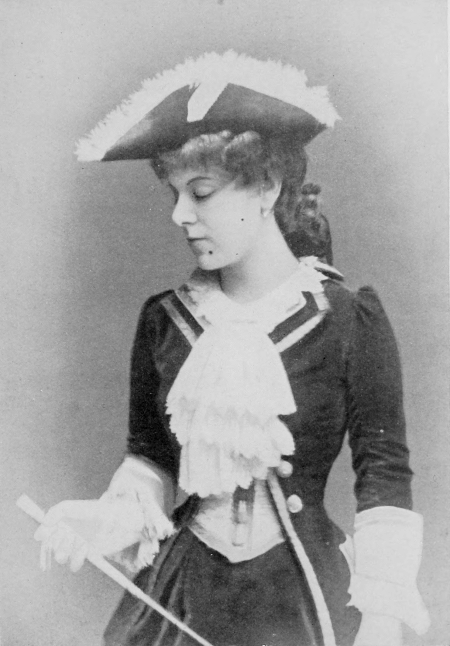
JESSIE MILLWARD AS ANN CHUTE
IN “THE COLLEEN BAWN.”
It took quite a long time to persuade her that the “fit” was only part of her evening’s amusement, but how many modern domestics would allow their master’s indisposition, real or imaginary, to interfere with their “evening out,” I wonder?
“The Harbour Lights,” by Messrs. Sims and Pettitt, was produced on December 23, 1886, and was the first of the long series of Adelphi successes with which Mr. Terriss and I were associated, running at the one theatre without interruption for five hundred and thirteen nights.
During the whole of that run Mr. Terriss and I were never out of the cast together. On several occasions he was out of the bill for long week-ends, from Friday until Monday, and one of my holidays was a sea voyage to New York and back, for by this time I had grown fond of the sea.
Acting with us in a play which made its mark in the history of what came to be called “Adelphi drama,” were Miss Mary Rorke, Miss Clara Jecks, Mrs. Leigh, Miss Jenny Rogers, E. W. Garden, J. D. Beveridge, and W. L. Abingdon, all of whom became dear to the regular patrons of the old Adelphi.
And “The Harbour Lights” also made its mark in the history of Miss Mary Rorke.
There was a long wait in the second act, and one evening as we were sitting together I said to her suddenly:
“Mary, I dreamt that you were married!”
I had only just remembered my dream, but to my astonishment she seemed to take it quite seriously.
“Did you?” she asked quietly. “When?”
[Pg 110]
“Last Tuesday.”
“I was.”
On the Tuesday she had married Frank St. Aubyn, and they had meant to keep it a secret for the time.
Another member of the cast who has since filled an important position in the world of the theatre was Mr. Robert Courtneidge.
Mr. Courtneidge was then a very young man, the “boy” of the company, and as fate would have it he was cast to play the part of an ancient villager, and I remember how we used to roar over his line:
“Ah’m the oldest inhabitant in th’ village, and ah ’aven’t a tooth to me yead!”
Another youthful member of the company who played a tiny part was Morell Mackenzie, the son of the great surgeon, Sir Morell Mackenzie.
Sir Morell was a true friend to the theatrical profession, and many an actor and actress of those days had cause to be grateful to him for his kindness and his skill.
He often visited the theatre, and one evening, noticing from his seat that I appeared to be suffering from a sore throat, he came round to my dressing-room and insisted on examining it. It was pretty bad, and giving me something to relieve it for that evening, he told me to call to see him the next morning, when he again examined it, and treated it, telling me that it would be necessary for me to call on him each day for some little time.
One morning he seemed to take longer than usual in his examination.
“Miss Millward,” he said suddenly. “You have been to some other doctor.”
“Good gracious, no!” I replied.
[Pg 111]
“Well, someone has been tampering with your throat.”
I then told him that each evening after the performance, as my throat had felt very tired and sore, Mr. Terriss, before leaving the theatre, had come to my room and painted it with a little brush.
“H’m,” said Sir Morell. “Give my compliments to Mr. Terriss, and tell him that I say he is a very good actor but a very bad doctor, and that in future we will stick to our own professions.”
In those palmy days of the old Adelphi there was not quite the same luxury “behind the scenes” that the modern young actor seems to expect, and even leading actors did not always have dressing-rooms to themselves.
For instance, Abingdon and two other principals shared one large room which was reached by a short staircase from the back of the stage, and it was their custom to take their letters from the hands of the stage door-keeper as they entered the theatre each evening, carry them up to the room, and read them as they dressed.
One evening a letter addressed to Abingdon was handed by accident to Terriss, who opened it without reading the address, and was very annoyed when he realized the mistake. He went in search of the proper owner, who had not, however, arrived at the theatre.
“That idiot at the stage door is always mixing up our letters,” he said. “He ought to be more careful. This is one of Abingdon’s that he has given me, and I’ve opened it. Luckily it’s nothing very important, only a bill from his bootmaker, but I’ll have to explain and apologize, and Abingdon is a funny-tempered chap.”
[Pg 112]
“Seal it up and say nothing about it,” suggested an occupant of Abingdon’s dressing-room. “It isn’t as if it were anything important. Give it to me, and I’ll send it down to the stage door-keeper.”
The envelope was not torn, so was easily fastened up again, and was handed back to the stage door-keeper with orders to be more careful in future.
Soon after Abingdon entered Terriss’s dressing-room with the identical letter in his hand. He opened it a trifle ostentatiously, read it through with a tolerant smile, then tore it carefully, if a trifle melodramatically, into small pieces.
“Silly little fool!” he muttered.
“What’s the matter, old fellow?” asked Terriss.
“Nothing—nothing. Only another silly little fool of a married woman wants me to take her out to supper.”
And he never understood why his hearer roared with laughter.
Poor Abingdon died by his own hand in 1918 in America, where he had been for the last twelve years of his life. He was fifty-eight years of age, and made his first appearance in the West End in 1887 in “Shadows of a Great City” at the Princess’s; and after playing in several pieces there, including “The Mystery of a Hansom Cab,” “The Still Alarm,” and “Hands Across the Sea,” he migrated to the Adelphi, where his successes as the villain were numerous. It used to be said of “Billy” Abingdon that he could provoke hisses from a virtuous pit and gallery more easily than any other “villain” on the stage. Originally he came from Northampton, where his father, a tailor named Pilgrim, had a shop in Abingdon Street—hence the stage name “Abingdon.”
Although certain of the “highbrows” of the period[Pg 113] affected to despise the Adelphi drama—the gloom of Ibsen was then the fashionable cult—the Adelphi had many famous and regular patrons in the ranks of society, and the late King Edward, then Prince of Wales, was a fairly frequent visitor. One evening during the run of “Harbour Lights” I had the honour of being presented to him, and he was kind enough to recall the success of Hero.
There was always a little extra excitement and nervousness behind the curtain when it became known that “the Prince”—there was only one “Prince” in those days—was in front, and this may possibly explain an appalling slip made one evening by Mr. Terriss as he spoke the concluding lines of the play.
The lines as they left the author’s hands were:
“And straight before me, like two rays of hope, I see the harbour lights.”
As they left the actor’s lips that evening the lines ran:
“And straight before me, like two bars of soap, I see the harbour lights.”
It was in the later Adelphi days, when the Prince visited the theatre on the eve of Persimmon’s Ascot Gold Cup, that Mr. Terriss in his usual hearty way wished the Royal owner luck, and added: “We’ve all got our shirts on Persimmon, sir.” The Prince laughed and thanked him for his good wishes, and later, when the horse had won, in response to a telegram of loyal congratulations came a wire from Marlborough House:
“The Prince of Wales thanks Mr. Terriss for his congratulations, and is glad that Mr. Terriss has retained his shirt.”
If he indeed ventured his shirt it was contrary to his usual principle, for his invariable answer to the[Pg 114] question: “Do you fancy anything for to-day?” was: “Yes, a little filly I’ve often backed and never lost a penny over, Common Sense, ridden by little Tommy Let-it-alone.”
The Prince was nowhere more popular than in theatrical circles, as guest and as host, but while no one entered more thoroughly into the spirit of the occasion than he did, or was more solicitous that others should enjoy themselves in his presence, he knew when and how to assert his dignity, and a well-known actor had good reason to regret his egregious taste in inflicting a risky story on a dinner party at Marlborough House given by the Prince to certain well-known managers and members of the theatrical profession.
And at one time an amusing story went the rounds of a little faux pas on the part of a certain lady of the lighter stage who had married into the peerage, and, possibly on the strength of her new rank, had been invited to meet the Prince. Her husband, probably knowing her free-and-easy manners only too well, cautioned her most carefully as to her behaviour in the Royal presence—for she was to sit at the Prince’s table—and was relieved to see that, so far as he could judge, his wife was behaving admirably. Above all, he had cautioned her: “Whatever you do, don’t rise from the table until the Prince rises,” and knowing her impatience at a long sitting he saw with relief the Prince rise first.
As soon as he reached his wife’s side he congratulated her on her behaviour.
“Oh, that was all right,” replied the lady. “I remembered what you told me and sat tight until he rose. But when he did, I couldn’t help saying, ‘My God, sir, I thought you were going to sit there all night!’”
[Pg 115]
Another great patron of the Adelphi was Lord Londesborough, a tall, distinguished-looking man who had lost one eye, and who used often to come behind, wearing a long and shabby sealskin coat. And yet another Adelphi habitué who always interested me greatly was Mr. Justice Hawkins, later Lord Brampton, who, with his wife, was a frequent visitor.
It was in the palmy days of the Adelphi that Mr. Terriss—who was the most abstemious man in the world, and whose passion for bread-and-milk during the third act of a blood-curdling part would astonish many a dance club frequenting young actor of to-day—to the astonishment of everybody bought a licensed house, “The Market House,” in Covent Garden. When this became known his theatrical friends made a point of calling, and, pretending to find fault with something, would insist on seeing the proprietor. When Terriss found that it was no longer possible to keep the secret he used occasionally to look in after the theatre and humour his “pals,” who insisted upon being served by the proprietor himself, whom they would invite to drink with them, taking no refusal. For these occasions there was a special bottle of gin reserved for the proprietor, but the gin was undiluted water.
Soon after he had bought the place there was a good deal of chaff over the regulation which provided that the licensee’s name should be in a prominent position over the door.
“Think what a fine advertisement it will be for your acting, old chap,” said one humorist, and when at last Terriss announced that the name was up his friends trooped down in a body to inspect it.
The name was up, but to their disappointment it was not that of William Terriss, but of William Charles[Pg 116] James Lewin—his real name—which conveyed little or nothing to the ordinary man in the street.
It was also whispered that he was associated with the host of “The Mitre” in Chancery Lane—a Devonshire man named Drew, nicknamed “The Abbot”—in many of his enterprises. In any case, Mr. Terriss made a good deal of money during the public-house boom in the ’nineties, and retained for some time his interest in “The Market House,” in the days when that hostelry kept open practically all night, and did a roaring trade in early breakfasts for late revellers.
Although he never admitted that he had an interest in “The Mitre” he frequently lunched there, and fameless dramatists would frequent the little parlour in the hopes of getting a word with him. Perhaps it was his taste which decorated the walls of the tavern with a collection of pictures far above the average to be seen in a city chop-house, amongst which were studies by Stacey Marks, some drawings of graceful girls by Kate Greenaway’s father, and some paintings by Beverley.
A sound business man, a very fair judge of pictures, a lover of the open air, and a devotee of the simple life—“Your public pay you for the best that is in you,” he once told me when I came down to the theatre tired after a reception in the afternoon, “and how can you give them value for money if you spend the time you ought to have been resting in a vitiated atmosphere?”—Terriss was also a very good judge of plays, and, what is equally important from the pecuniary point of view, a very good judge of the public taste in plays.
From his experiences with “Trilby” and “The Man’s Shadow” which I have already related, the reader will see that in these two instances his judgment was not[Pg 117] far at fault, but I am afraid it was very much at fault with regard to “The Devil’s Disciple,” by Mr. Bernard Shaw.
For one thing he loathed having plays read to him—“I would not have a MS. read to me if there were millions in it,” he once wrote to a friend; “send it on and I will run through it”—and when Mr. Shaw wrote to ask if he might read a play to Mr. Terriss and myself I feared the worst. I persuaded Mr. Terriss to consent, but my fears were justified. From the very first things went badly.
Mr. Shaw arrived about three o’clock and I was much struck by his appearance: to my unsophisticated eyes he looked more like a farmer than a famous playwright.
He sat down and in a business-like way began to read, and in a little while, to my horror, I saw that Mr. Terriss, who was sitting in a big chair beside the fire, was beginning to nod. Taking advantage of a pause while the dramatist was turning over a leaf, I suggested to Terriss that we should change places, saying that I felt rather cold. We changed places, and the reading went on.
But in ten minutes or so Terriss was indubitably asleep.
Mr. Shaw read on, and when he reached the end of the second act he stopped for a moment. The sudden silence woke Terriss.
“No, Shaw, no,” he said, shaking his head. “I’m afraid it won’t do. I don’t like the end. It isn’t suited to Miss Millward and myself.”
“Mr. Terriss,” said Mr. Shaw, “I have not finished the play, and I am not going to finish it.”
Feeling that if ever there was an uncomfortable moment this was one, I rang for tea.
[Pg 118]
“Have a whisky and soda?” suggested Terriss.
“Thank you, I never drink anything but water,” replied Mr. Shaw. Worse and worse!
Luckily it was now nearly four o clock, and when I was acting I always dined at four, so I asked the two men to stay to dinner. They both gloomily accepted.
We sat down to table. The maid handed some dish to Mr. Shaw.
“No, thank you,” he said. “I never eat meat.”
This seemed absolutely the last straw, and I don’t think I completely recovered until he rose to go.
Before leaving he turned and fired a parting shot.
“I didn’t have you in my mind for the part, Mr. Terriss,” he said coldly. “I wanted Miss Millward, and I hope that some day she will play in one of my pieces.”
Mr. Shaw was right in his estimate of his work, and Mr. Terriss was wrong, for the play was “The Devil’s Disciple,” in which Sir Johnston Forbes Robertson played so superbly in England, and Mr. Richard Mansfield in America.
We cannot always foretell the future, which, on the whole perhaps, is better for our happiness and peace of mind.
But play-reading is an ordeal, both to the reader and the read-to, and at times the ordeal is more severe than usual. It is, I suppose, largely a matter of temperament.
There is a very well-known and very temperamental actress who completely upset a brilliant young playwright on his attempt to read her a play in her Kensington drawing-room.
Unfortunately her pet dog was in the room, and her anxiety about the little beast overshadowed her interest in the play. Every half-minute or so she interrupted the[Pg 119] reading by tender little cries of adoration—to the dog; ardent enquiries after the health and comfort—of the dog; admiring ejaculations about the cleverness—of the dog.
At the end of the first act the brilliant young author folded his manuscript, and, declaring that art could not compete with nature, stalked out into the sunshine in a state of furious indignation. He entered Kensington Gardens, boiling with rage and jealousy, and in the gardens met a very famous dramatist indeed. The great writer, seeing his perturbed condition, made sympathetic enquiries, and together they paced the gardens, the older man in silence, the younger man pouring out his flow of indignation—against the dog.
On they wandered, along the bank of the Serpentine, and at last, by the statue of Peter Pan, the young man ceased the tale of his woes, possibly from want of breath.
“My dear boy,” then said the creator of Peter Pan, laying a sympathetic hand on his young friend’s arm. “I once read a play to that damned dog.”
And I “tell the tale as ’twas told to me.”
[Pg 120]
The Adelphi.—An advertisement record.—A quaint publicity “stunt.”—The Adelphi audiences.—The “unknown admirer.”—Mysterious tips.—The people who know everyone and everything.—Jessamine Cottage.—My gardener, Haddon.—Charles Frohman, William Gillette and Terriss as rose lovers.—Haddon’s trip to town.—Seymour Hicks and a rest cure.—A surprise visit.—The rest cure starts.—A bicycle accident.—Champagne or death.—End of the rest cure.—George Edwardes’ comment.—Terriss’s fearlessness.—Rescue of a small boy.—A runaway.—Miss Olga Nethersole.—An enthusiastic social pioneer.—A trip to the Canaries.—The shot seagull.—The Ancient Mariner.—The tragic fulfilment.—European fame.—Santa Catalina and the invalids.—America with Terriss.—Salvini.—Fair play for the gladiator.—An impresario’s tact.—A tired Othello.—Sir Herbert Tree.—“Paul Kauvar.”—Sir Augustus Harris.
THE first turning-point in my career had been my appearance with Irving at the Lyceum; the second turning-point was my appearance with Terriss at the Adelphi.
With the enormous success of “Harbour Lights” the Adelphi drama, as it was called, came into its own, and from 1885 to 1887 I was identified with it and with Mr. Terriss in a series of successes which included “The Bells of Haslemere,” “The Union Jack,” “The Silver Falls,” and “The Shaughraun.”
But it was “The Harbour Lights” that set the vogue, and I may perhaps be forgiven if I have a tender spot in my heart for that fine old drama.
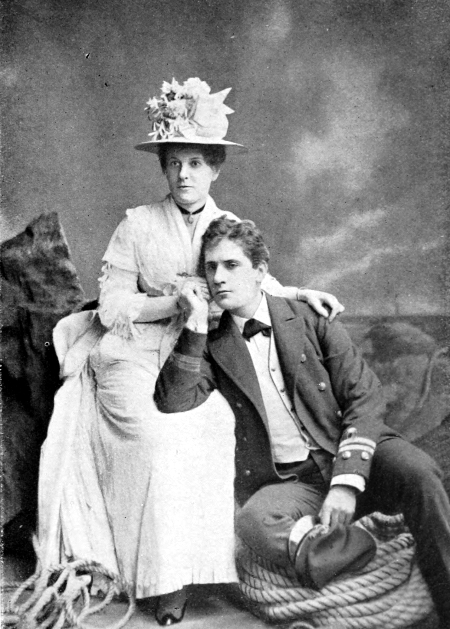
JESSIE MILLWARD AND WILLIAM TERRISS
IN “THE HARBOUR LIGHTS.”
From a sordid business point of view the success of course was immense, and the theatrical world of the [Pg 121]day rang with stories of the huge sums involved. For example, in the matter of advertising “The Harbour Lights” created a record in those days, and it may be of interest to the enterprising modern theatrical manager, such as Mr. Cochran, that the huge pictorial poster, which caused no small sensation, measured twenty feet by fourteen—which represented fifty-six double crown sheets—and was printed in twenty-eight parts and in five colours. One hundred and forty stones were used, one for each colour, twenty-eight times. Each stone cost £5 and weighed seven hundredweight. This huge poster cost something like £600 a thousand, and threepence a sheet was the charge for posting the bill, so that each time it was displayed it cost fourteen shillings, and if fifty copies were posted—which is about the average number used in the large provincial town—the outlay was £35. This was the cost of one bill, only intended to last a week or two, so my readers can conceive the amount of capital required even in those days to take a well-billed play on tour.
But theatrical advertisement is a world of its own, of which, I fear, I know but very little, but before I forget let me chronicle one ostentatious proclamation I saw in a Western American town during a tour with Mr. Terriss. It did not say much for certain of the rival combinations that this particular show drew an enormous amount of publicity by its announcement:
“We pay our salaries regularly every week; by so doing we avoid law expenses, are not compelled to change our folk, and always carry our watches in our pockets!”
But in those early Adelphi days life was too full of interest—work, success, fame and joy—for the Jessie Millward of that time to bother her head about such[Pg 122] squalid details as “double-crown posters” and publicity “stunts.”
The Adelphi soon collected an audience of its own—an audience subtly distinct from that in any other West End theatre. Just as the Lyceum had its special and unmistakable atmosphere, just as the jeunesse dorée gave its peculiar cachet to the old Gaiety, so did the Adelphi gather its audience from every section and every class, and blend them into a perfectly recognizable and distinct entity.
And the player must be of a different nature to mine who would not revel in their whole-souled devotion and their generosity. One was inspired to give the best that was in one; not to do so seemed a lack of loyalty, an ingratitude.
Night after night one had almost to fight one’s way to and from the stage door through the waiting crowds; night after night the same rapturous welcome greeted one—it must have been a poor and niggardly heart which did not warm at such whole-souled recognition and encouragement.
And then there were the quaint and sometimes touching little missives from the strangers one had pleased.
It was at the Adelphi, for example, that I first experienced the “unknown admirer.”
Regularly on the eve of a big race—I was blissfully ignorant of the high mysteries of racing, and at that time had never even seen a racehorse—as I entered the theatre the stage door-keeper would hand me a mysterious and rather grubby scrap of paper, twisted into the form of a cocked hat. Opening it, in an illiterate hand I would find the name of a horse—and only the name of a horse; no message, no protestations of eternal love, no word of praise for my art or myself—merely[Pg 123] the name of a horse engaged in the “big race,” and the signature was always:
And what makes the story still more extraordinary is that the horses generally won.
One evening there was a change in tone. Instead of a tip for the “big race” the letter contained a tip for the Stock Exchange.
Now if there was one subject in the wide world of which my ignorance was more abysmal than racing it was the Stock Exchange, and knowing that Mr. Terriss was an excellent but very cautious judge of stocks and shares I consulted him about it. He made enquiries from some Stock Exchange friends, and the report was that the “tip” was an advisable one, “though how your friend has got to know of it is a mystery. Only the people on the inside know anything about it.”
Thoroughly mystified, I asked the stage door-keeper what the writer of these curious love-letters was like.
“He’s a very shabby, and a very little, elderly man, miss,” he replied. “And he always says ‘There’s no answer’!”
“The next time he comes,” I said, “ask his name, and tell him that I should like to thank him for his kindness.”
A day or two afterwards I received another of the familiar “cocked hats”—it was a horse this time, I think—and, on asking the stage door-keeper if he had delivered my message:
“Yes, miss,” he replied, “but he wouldn’t leave his name. All he said was, ‘She wouldn’t know me, and she wouldn’t want to.’”
Of course there were Adelphi habitués of quite a different type!
[Pg 124]
There were, for instance, the people who knew all about one, from one’s age to one’s favourite breakfast food, and who were only too glad to impart their knowledge to the occupants of the seats around them. But this is a type peculiar to no theatre.
On a visit to “The Harbour Lights” my dear mother was the recipient of some wholly novel information about me.
For some time she had been annoyed by the criticisms of two ladies seated in the stalls immediately behind her, who, from their loud-voiced remarks, seemed to be on intimate terms with the actors and actresses on the stage.
Then I made my first entrance.
“Ah,” said one of the ladies complacently, “there’s Jessie Millward. It is wonderful how young she keeps, is it not?”
“It is dear,” replied the other loudly. “To look at her no one would believe that she was the mother of five children.”
This was too much for my poor mother.
Flouncing round in her seat, she interrupted the speakers.
“Madam,” she said, in vast indignation, “I beg your pardon! Miss Millward is my daughter, and is unmarried!”
Which reminds me that some time later I was sitting in the stalls of the Lyceum watching the “Lyons Mail,” in which Mr. Terriss appeared as the dandy, Courriol. He looked splendidly youthful in the Incroyable costume, which suited his slim figure to perfection, and I was somewhat astonished to hear the woman on my left observe:
“How wonderfully well Terriss looks, considering his age. I know for a fact he is well over sixty.”
I could not resist turning to her and blurting:
[Pg 125]
“And I know for a fact that he is still in his thirties!”
But it is impossible to impress everyone, and there were actually some people in the world who did not take sufficient interest in the theatre to invent stories about the ages of the artists. Such a person was my gardener, Haddon, who lived mainly for his roses at my little country place, “Jessamine Cottage.”
And Haddon’s roses certainly were wonderful. I think the only time I ever saw him unbend about them was one glorious summer afternoon when Charles Frohman, William Gillette and Terriss, who were spending the day with me, insisted on sending for him to compliment him on his success. They were all rose lovers, and they and Haddon talked together as experts.
One day Haddon casually mentioned—as a matter of the utmost unimportance—that although living for years within a few miles of the West End and theatre-land he had never visited London.
The revelation appalled me, and, thinking to give him a treat, I insisted that he should leave his roses and my pony and trap, which occupied the next place in his affections, and spend a whole day in London sightseeing.
He consented—without enthusiasm—and I grew quite excited as I mapped out a day’s round of sights, writing out carefully for him a list of the things he was on no account to miss, with elaborate directions how to get from one place to another; the whole expedition was to conclude with a visit to the theatre, for which I got him a seat.
On the eventful morning, my faithful maid and friend Lottie—Lottie deserves a place all to herself in these pages, and later she shall have it—told me that Haddon had left to catch the eight o’clock train and was “going to make a day of it.” All morning I pictured Haddon let loose on the wonders of London; Haddon gazing[Pg 126] awe-struck at the Crown Jewels in the Tower; Haddon wandering reverently through the dim Abbey; Haddon glancing approval at the Life Guards in their scarlet and gold; Haddon perhaps even having the luck to raise his hat to Royalty itself; Haddon at the Zoo; Haddon in Rotten Row; Haddon in an A.B.C.—in fact Haddon obsessed me, and I began to feel the responsibility of plunging this peaceful rose lover in the whirl of the great city.
After lunch, with cushions and a book I was seeking a shady corner of the garden when a familiar “click-click-click” reached my ears.
I looked and saw the returned traveller amongst his beloved roses.
“Back so soon, Haddon?” I gasped.
“Yes, miss,” he replied calmly. “I don’t take to that London; it’s too noisy.”
But even Jessamine Cottage was not always peaceful.
Mr. Terriss had the most wonderful health; the possessor of a fine constitution, he took the greatest care of it, and always prided himself on his physical fitness, but the long strain of work without a real break began to tell on him, and the doctors told him that if he wanted to avoid a break-down a short rest was essential. After much persuasion he consented, and it was arranged that he should go to the Isle of Wight, George Edwardes giving Seymour Hicks, who afterwards married Ella, permission to leave the Gaiety to go with him. I went to Waterloo Station to see them off, and, to the astonishment of all of us, on the platform was Terriss’s brother, dear old Bob Lewin, who announced his intention of going to the Isle of Wight as well, in order to help to look after the invalid. Dear Bob was one of those steady-going, regular, old bachelor souls who never[Pg 127] deviate one hair’s-breadth from the daily routine. It had been a great sacrifice for him to tear himself away from his usual round, but he considered it to be his duty to look after his brother and he had made the sacrifice. It was his duty; he had performed it—but still, it was a sacrifice.
And he greatly resented the presence of the volatile Seymour, whom he no doubt looked upon as hardly an ideal companion for an invalid embarking on a rest cure. So there was a heated argument on the platform between the three of them—the invalid and his two “nurses”—which lasted until the bell rang, when they all clambered into the carriage, still arguing at the tops of their voices, and as the train steamed out the last I heard was the voice of Seymour proclaiming loudly that he, at any rate, was going away for peace and quiet!
With a sigh of relief I drove off to the Adelphi for the Saturday matinée, and throughout the matinée and the evening performances looked forward to a quiet week-end at Jessamine Cottage with my brother. He and I caught the midnight train from Paddington, and were met at Windsor by the faithful Haddon with the pony and trap, and soon drove the four miles to Winkfield.
On opening the cottage door, which led directly into my sitting-room, I was horrified to see three dirty pairs of men’s boots in front of the fireplace.
My brother and I looked at one another in silence.
There was a slight movement upstairs.
“Burglars!” I whispered.
Firmly clutching his stick, my brother made for the staircase, and I followed him.
At the sound of our steps, three bedroom doors burst open simultaneously, and three figures appeared on the landing, all speaking at once, and all arguing at the tops of their voices—Bob, Terriss and Seymour.
[Pg 128]
My sympathies were with poor Seymour.
“Seymour,” I said firmly, “come down and tell me all about it. As for you, Willie and Bob, I will hear your account to-morrow. Go to bed!”
And then Seymour came downstairs and told me all about the start of the rest cure.
The train left with the travellers arguing hotly; they argued for miles, and when they reached Portsmouth the compartment contained three travellers who were not on speaking terms. On the Portsmouth platform Terriss had an idea.
“I won’t go to the Isle of Wight,” he said firmly. “Beastly hole, the Isle of Wight; not a soul to speak to. Why not give Jessie a surprise and all go back to Jessamine Cottage?”
“Anything for a quiet life,” said Seymour, with a savage glance at poor Bob Lewin. So catching a train to Woking, the trio then hired a dilapidated station landau, which broke down from sheer old age half-way to Ascot, and there was a delay for repairs. Having left Waterloo at ten in the morning, they finally reached Jessamine Cottage, via Portsmouth, at ten o’clock at night, and by the time poor Seymour had finished the recital of his adventures it was four o’clock in the morning. I told him to go to bed, and, worn out, he slept till one o’clock in the afternoon.
After lunch, as it seemed time to start the rest cure, I suggested that Mr. Terriss should lie down, that Seymour should run over to Staines, where Ella was staying, and that my brother and Bob should go for a bicycle ride, my brother on my bicycle and Bob on Terriss’s. The last two said it seemed a good idea; that they were not used to bicycling, but that it might be amusing.
So, having disposed of the surplus population of the[Pg 129] cottage, I curled myself up in a garden chair on the lawn, feeling that I had had a very strenuous time. I had dozed for about half an hour I suppose when the gate clicked, and, opening my eyes, I saw Bob and Percy entering the garden festooned with broken bicycles, which they were carrying on their shoulders. It seemed that shortly after starting Bob had made for a ditch, and out of pure sympathy my brother on a lady’s bicycle had followed him. The ditch and the collision in the ditch explained the broken bicycles.
But the end of the rest cure was not yet.
Barely had we started our evening meal when again the inexorable “click” of the gate was heard, and looking up: “Good Lord!” groaned Bob Lewin dejectedly, “here’s Seymour!”
Into the room in his best jeune premier manner, full of life and buoyancy, burst Seymour.
“Hullo, everybody!” he cried breezily. “How well you’re all looking! Splendid! Capital! Nothing like a rest cure! Jessie, I had such a ripping night’s rest that I want you to put me up again to-night!”
So for the second night my brother slept on the sofa, and I could not blame him when he left by an appallingly early train on the Monday morning, saying he had an important breakfast appointment in the city.
But the peaceful week-end in the country was not over.
As I had been eaten out of hearth and home, I explained that anybody who wanted lunch would have to go to Windsor for it, so we drove over through the forest.
When the Castle came in sight, Bob meaningly suggested that he and Terriss should go quietly over it. Seymour and I at once understood that we were not wanted, so wandered on to the hotel to order lunch. The meal ordered, we sat in the lounge waiting for the[Pg 130] return of the sightseers, and Seymour was unusually silent. Suddenly he burst out:
“Jessie,” he exclaimed solemnly, “if I don’t have some champagne I think I shall die!”
“Then for goodness’ sake have it!” I begged him.
“But I’ve come out without any money.”
“Never mind; I’ll pay for it. You deserve it.”
The champagne arrived, and hardly had it been uncorked before:
“Here they are!” I exclaimed, and Seymour promptly hid the bottle beneath the table, knowing that Bob Lewin strongly disapproved of such wild extravagance.
To my surprise, Willie seemed quite his old self again; all traces of fag and nerviness were gone, and he threw himself into a chair announcing that he felt simply splendid, and would like nothing in the world better than a glass of champagne.
Seymour and I looked at one another.
“Seymour,” I said, “lift up the champagne!”
Which was the end of the only nervous break-down I ever knew Mr. Terriss to have, for that night, to the surprise of everybody and to the disgust of his understudy, he appeared at the Adelphi, and, to the astonishment of George Edwardes, Seymour appeared at the Gaiety.
And I heard afterwards that when George Edwardes was told the story, he observed: “I knew that there would be something original about a rest cure personally conducted by Seymour!”
It seemed absurd to connect Mr. Terriss with “nerves” and the necessity for a rest cure, for he was blessed with a superb constitution, of which he took the utmost possible care. A lover of the “open” and the “simple life,” he was always in the pink of condition, and late hours and lavish meals made not the slightest appeal to him.
[Pg 131]
It was his perpetual state of being “in training” that made possible many of the incidents which at times startled his friends, but of which he himself seemed to think little or nothing. In her book Miss Terry has told of his jumping into the river to save life, and, on his arrival dripping wet at the theatre, replying merely “Looks like it” to someone’s query as to whether it was raining, and I myself was on two occasions the witness of feats for which most men would, quite pardonably, have assumed a fair amount of credit.
Once, during a tour of costume recitals which we made together, I was walking with him on the pier at Eastbourne when we heard cries, and looking over we saw that a small boy who had been climbing on the supports under the pier had somehow managed to get wedged between the planks and had been reached by the rising tide. Instantly Terriss threw off his hat and coat and gave one leap from the pier into the water. I honestly confess that I dared not look until I heard his voice crying: “It’s all right. I’ve got him.”
And then I saw that he had extricated the boy and was swimming towards the shore. Picking up his hat and coat, I flew along the pier, arriving just in time to see them land, and the rescuer give the rescued a good shake, a short sharp lecture, and send him flying home to change his wet clothes.
Where he himself was concerned, Terriss was, physically, absolutely fearless.
On another occasion I was walking with him by the side of the Row in Hyde Park. It was two o’clock; there were very few people about; and suddenly a horse, ridden by a lady, came galloping furiously down the Row. The brute had got the bit in its teeth and the rider had lost all control, and her groom was pounding[Pg 132] along behind in the vain hope of catching it. As soon as he caught sight of it Terriss darted into the path of the runaway, made a wild snatch at the bridle as the beast passed him, caught it, and was dragged for some distance before he managed to pull the animal up, and the groom came to his assistance. For some time after that little episode he was obliged to carry his arm in a sling, and gave evasive answers to enquirers at the theatre who wanted to know what had happened to it.
It was during the series of plays which followed “The Harbour Lights” at the Adelphi that I first acted with Miss Olga Nethersole, who made a sensational success in the part of Lola in the Sims and Pettitt play, “The Silver Falls.”
Lola was a fascinating adventuress, and much curiosity had arisen in the theatre as to the dresses she was to wear. They did not appear at the dress rehearsals—they were not quite ready, we heard—and it was not until Miss Nethersole went on the stage on the first night that the mystery was solved. They were superb, and so was her performance. During the play Mr. Terriss came to me in some excitement, saying that his dresser, whom he had sent into the gallery between the acts to report on the effect the play was producing on the “gods,” had told him that there was a “claque,” but, whether this was so or not, Miss Nethersole once more exemplified the truth of the perverted proverb: “A good performance needs no claque.”
Many years afterwards, after my marriage to Mr. Glendinning, I met Miss Nethersole again in America. She had taken up social work very keenly, and was interested in all sorts of domestic problems. After talking together for some time, she seized my hand.
“You are married?” she asked.
[Pg 133]
I nodded.
“Then promise me one thing,” she begged earnestly.
“What is that?”
“That you will have a large family!”
But then most social pioneers are tremendous enthusiasts!
Those days at the old Adelphi were days of strenuous work, and the few holidays I was able to take were events to be marked with white stones. One such holiday was a somewhat eventful trip to the Canary Islands with my sister. My passion for the sea was responsible for our journey, but when we sailed from Liverpool in a blinding snowstorm, and were battened down and confined to our state-room throughout the crossing of the Bay of Biscay, my seafaring enthusiasm began to wane.
One terrible day in the Bay I shall always remember in connection with a weird and grim incident.
In the morning the ship’s doctor, a young Irishman, whose first voyage it was, shot a seagull, and an old shellback of a sailor, possibly to frighten him, assumed the rôle of the ancient mariner, and told him that it was the worst of bad luck, and that the gulls were the souls of drowned sailors.
All that day the storm grew worse, and in the afternoon, as the young doctor was visiting us in our deck state-room—and I am afraid his services were needed—a huge sea burst open the door and flooded the room. At that moment there was a wild cry for the doctor.
Two sailors had been badly hurt by the sea, and, promising to return, the young Irishman rushed off to attend to them. Barely had he reached the deck when another huge sea buried the vessel, and when she rose, the water pouring from her decks, the doctor was missing, and another “swept overboard” tragedy was[Pg 134] added to the long list of tragedies of the terrible Bay. More than once did I discuss the awful happening with the old sailor who had prophesied bad luck, and nothing on earth could convince him that the accident was not the direct consequence of the shooting of the gull.
Three days later we arrived in brilliant sunshine at the lovely islands, to find that grave fears had been entertained about our safety and that our people had been frantically cabling to the British Consul, who came off to satisfy himself that we were alive and took us ashore to breakfast at Madeira.
Then Portuguese guides, looking like toreadors in their black knee breeches, red sashes and white shirts, placed us in conveyances which resembled four-post bedsteads drawn by four oxen, and conducted us to the highest point in the island, from which the view was superb, and I remember that in the harbour at our feet, glistening like a jewel, lay Lord Brassey’s beautiful yacht, “Sunbeam.” The descent was made in a weird kind of basket sleigh on rollers, a most undignified form of conveyance, for the pace and “bumpiness” was terrific, and when the man next to me cried: “Hang on to me!” I cast dignity to the winds, and gasping “I will!” hung on like a combination of the leech, grim death, the income-tax collector, and all the other unpleasant things that are supposed to hang hardest.
Our next port was Teneriffe, and there I tasted for the first time what I might humbly call European fame, for in the lounge of the hotel was an illustrated paper, and on the front page was a large picture of—Jessie Millward.
From Teneriffe we sailed away to Santa Catalina, and I freely admit that Santa Catalina, lovely and semi-tropical as it was, gave me the horrors. We spent three weeks there, and when one morning I heard that there[Pg 135] was a cargo ship in the bay willing to take passengers, although we were to be the only women on board we rushed down to book our passages.
Lovely Santa Catalina was full of invalids—poor souls in the last stages of consumption—and the frequency with which one was told, if one enquired after a missing face: “Oh, he died yesterday evening and is to be buried this afternoon,” made it hideously depressing for rudely healthy folk like my sister and myself.
And so back to the Adelphi.
My first long stay at the Adelphi came to an end in 1889, when Mr. Terriss and I sailed for America, and for some months we toured the United States under the management of Augustin Daly and J. Miner, who owned Miner’s Theatre, New York, playing in “Roger la Honte,” the play which Terriss had bought in Paris in the way I have described. It was in America that I first saw that truly great actor Salvini. There has surely never been an Othello like his, but when I saw him the effect of the play as a whole was spoiled, to my poor mind, by this big, magnificent creature, with the tremendous voice, playing in volcanic Italian, while the rest of the company gave Shakespeare’s lines in a very quiet English-American.
Perhaps it was to prevent audiences who did not understand Italian from becoming weary of listening to a foreign tongue that an English-speaking company was engaged to support Salvini in America, but the effect was certainly quaint.
There were innumerable stories told of his experiences in the States.
A play in his repertoire that was a great favourite with the Americans was “The Gladiator,” and when this play was put on in any large town with a handy Zoo[Pg 136] some real lions were hired to place in the cages in the Coliseum scene, which was the big “set” of the play, but on “one-night stands” small boys, with cardboard lion-heads and yellow skins over their shoulders, were employed to sway gently about in mysterious gloom behind the bars.
One night out West this scene offended a cowboy’s sense of fair play, so, shouting that he wasn’t going to sit there in comfort and watch one man set upon by half a dozen lions, he climbed over the footlights, a “gun” in each hand, to help the gladiator.
Whereupon the “lions” promptly stood up on their hind legs, threw away their heads, and with frantic squeaks bolted for the wings.
Another Salvini story that used to be told, as an object lesson to impresarios confronted with the difficult task of dealing with rival stars, was of the great tragedian’s appearance in the same cast with Adelaide Ristori and Ernesto Rossi. Rossi and Salvini were of equal celebrity, and in composing the announcements the impresario was confronted with a terrible difficulty.
Which name was to have the precedence?
Ristori, being a lady, naturally came first, but what of the two tragedians, stars of equal magnitude?
After a long and anxious consultation with a resourceful printer, the tactful impresario solved the difficulty thus:
[Pg 137]
But perhaps the most striking Othello in the gallery of my memory—for a different reason—is that of a once-distinguished American actor whom I met at Denver, Colorado, on one of my visits with my husband, John Glendinning.
I had seen him, and admired him tremendously, for he was a handsome, courteous gentleman, and a great actor, but he had one sad failing, which was known only too well to his audiences, who towards the end of his career used to watch and wait for the effect—not inspiration.
One eventful night Othello made his entrance in the bedchamber scene, but his mind was not on smothering the unhappy Desdemona. Seeing the bed ready prepared, he hiccoughed an exclamation of delight, made straight for it, laid himself down, and with a grunt of relief settled himself comfortably for a sleep. Meanwhile, the startled Desdemona, with a little shriek of dismay, had hurriedly climbed out on the other side of the bed, and slipped from the stage.
Which, as someone said, was not exactly a Shakespearean climax, if realistically domestic.
And here let me tell an “Othello” experience of my very own.
The only time I ever acted with the late Sir Herbert Tree was in a performance of the “handkerchief” scene at a benefit performance at the old Gaiety, in which Tree played Iago, Terris Othello, and I was the Desdemona.
My maid had gone up to the gallery to watch the scene, and found herself next to two old habitués of the Gaiety, who were utterly at sea as to the play, and wondered vaguely who were the presumptuous newcomers poaching on the sacred ground of Nellie Farren and Fred Leslie.
[Pg 138]
My white dress and pearl embroidery bothered them a little, and they were entirely unable to place Iago, but when Terriss entered as Othello the old man gave a sigh of relief and turned to the old woman.
“It’s all right, Mary,” he said. “It won’t be long now. The black man and the fairy queen are going to finish with a song and dance.”
As I have said, this was the only occasion on which I acted with Sir Herbert Tree, but it was impossible to meet him and to act with him even once without being impressed by that extraordinarily vivid personality which made Tree an outstanding figure in other worlds than that of the theatre.
Irving and Tree, utterly dissimilar in so many ways, had in common an amazing vitality, a relentless energy, which went far to make their achievements possible.
And, of course, about Tree a whole mythology of stories has arisen, and many of them are true. And, unlike so many stories of celebrities, many of them are amusing. I remember a luncheon party at the Waldorf in New York at which Mr. Oscar Asche kept the table in roars over a recital of Treeisms.
The luncheon party included Lord Rosslyn, who under the nom de theatre of James Erskine was playing with me in “There’s Many a Slip” at the Garrick Theatre, New York, and was at that time dividing his attentions between the stage and some infallible system of breaking the bank at Monte Carlo. Later, financed, I believe, by Sir Hiram Maxim, he did endeavour to break the bank, with the usual result. One explanation I heard of the failure of the infallible system was, to say the least of it, ingenious.
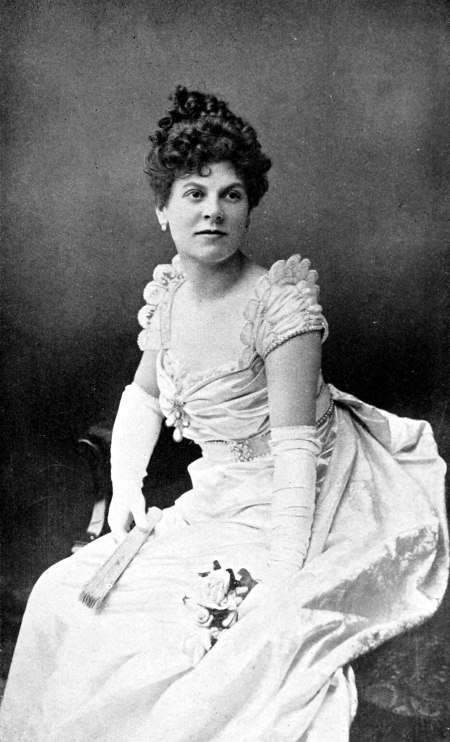
Photo. by Elliott & Fry
JESSIE MILLWARD AS PAULINE
IN “THE LADY OF LYONS.”
“You see,” said the man who was explaining it all, “on the very last day there were two dashed great [Pg 139]bluebottles in the rooms, and they kept jumping on the wheel and off again, apparently under the impression that it was a flies’ merry-go-round, with nothing to pay, and that upset everybody’s balance.”
Mr. Asche told a delightful little story of a rehearsal of “Julius Cæsar,” which dragged along from 11 a.m. on Friday until 3 a.m. on Saturday. Knowing well what might happen if the supers were allowed to leave the theatre, the considerate actor-manager ordered in hundreds of sandwiches and a large barrel of Bass’s beer, which was broached for the benefit of his humbler brethren. The humbler brethren thoroughly enjoyed the rest, and consequently, when the rehearsal was resumed, it was a distinctly beer-logged band of Romans who shambled on to the stage with flaming flambeaux, and indignant cries of: “O mos’ nobl’ Cæsar! O trait’rs! Vill’ns! O bloody day!” in the scene before the forum.
Tree gazed at them hopelessly, but like a true philosopher made the best of it.
“Splendid! Fine! A magnificent bit of realism!” he exclaimed. “Your simulation of the intoxicating effects of Casca’s foul blow on the citizens of Rome is Zolaesque—but please return your torches, all of you, to the property master before you set fire to my beautiful scenery!”
Two of the best of Mr. Asche’s stories were of a rehearsal of Stephen Phillips’ “Ulysses.”
A “vision” in the Hades scene was of Prometheus chained to his rock, with the vulture pecking at his vitals through all eternity. (The vulture was, of course, stuffed.) The actor who played the deep-thinking part of Prometheus was a conscientious youth with a slightly Hebraic accent.
[Pg 140]
“Mister Dree! Mister Dree!” he called. “Am I to dake any nodice of the bird?”
“Yes, my lad,” said Tree blandly; “hiss back.”
Another gentleman who “thought” the same part found it a trifle strenuous at rehearsal.
To a group of admiring friends, Tree was pointing out the beauty and ingenuity of the lighting and the triumph of the mechanism of the bird. Again and again the mechanical effect was repeated and admired, and all the while Prometheus lay supine and neglected on his rock.
At last he could stand it no longer. Professional jealousy overcame him, and, raising his head: “I say, guv’nor, suppose the —— bird and me changes parts,” suggested Prometheus.
Another rehearsal story was of “Drake.” Queen Elizabeth was to be entertained, and the table was spread with a cloth which, to put it mildly, was not fresh from the laundry.
“Her Majesty is served,” said the actor, at the proper cue.
“D——d badly,” said Sir Herbert, surveying the dirty table-cloth.
Yet another story of Sir Herbert was of an occasion on which he wished to engage a young and comparatively untried actress, who was, however, the daughter of famous parents.
“I want your beautiful daughter to play in my beautiful theatre,” he announced, and the parents were delighted. Then the sordid question of terms arose.
“Forty pounds a week!” cried Tree, when he heard the parents’ suggestion. “Good God! I could get Little Tich for that!”
[Pg 141]
At times Tree dared even to repress the Press.
On one of his American tours a reporter strolled into his dressing-room, and, without troubling to remove his hat, licked his pencil and prepared for copy. Tree fixed the offending hat with a cold blue eye. Then, picking up his own top-hat from his dressing-table, Marcus Antonius “covered” himself.
“Let us talk as equals,” said the voice of Tree, though the robes were those of Anthony.
Another Tree story—the mine is inexhaustible, and before they are forgotten some intimate friend of the dead actor should collect a volume of Treeisms and sift the real from the apocryphal.
At a supper in the Dome, conversation turned on a well-known writer and his physical resemblances to great ones of the past.
“Yes,” said Tree, in his deliberate, dreamy manner—no one in reality was more acute—“the upper part of his head is like Our Lord; the lower part distinctly resembles Shakespeare—and the rest of him is just himself.”
Another point of resemblance between Tree and Irving was their loyalty and tenderness to friends, and one who saw it told me that never would he forget Tree’s explosion of anger over a slight to poor Coleridge Taylor, who composed the music for more than one production at His Majesty’s.
The play, I fancy, was “Herod,” and Coleridge Taylor, who was of a dark complexion, was refused admittance by some under-strapper at the stage door, who told him that it was no use waiting; all the “coloured gentlemen’s” parts had been filled. Taylor, a sensitive soul, went away hurt, and when at last, after he had repeatedly asked for the composer, Tree was told what had happened, he exploded right royally.
[Pg 142]
A Tree story he used to tell against himself was not one of the least amusing.
On a provincial tour, on arrival at his hotel he gave the cabman half a crown. The man looked at the coin and then at Tree.
“I recognise you, Sir ’Erbert,” he said ingratiatingly. “The last time Sir ’Enry Irving was ’ere I drove ’im, too, and he gave me five shillings.”
Pause, during which Tree dreamily commenced to ascend the hotel steps.
“An’ you’re a deal better actor than ’e was!”—Tree still ascending steps, and cabby’s voice rising to a hopeless roar—“in your own bloomin’ estimation!”
But, after all, perhaps the best Tree story is that told by Mr. Arthur Bourchier. There had been some slight difference of opinion between the two actors, speedily composed, and one evening, while the little estrangement persisted, a terrific explosion shook the windows in the Haymarket.
“What was that explosion?” asked Tree of his dresser, when he left the stage.
“A gas meter in Charing Cross Road, I believe, sir.”
“Oh,” said Tree, “I thought it was the bursting of Bourchier’s head.”
And as Mr. Bourchier himself tells the story I am sure that there is no harm in my repeating it.
But to return to America and “Roger la Honte.”
During the tour of “Roger la Honte” Mr. Terriss and I were entertained at dinner by Judge Gildersleeve, who took us on to the Grand Opera House, then owned by George Gould, the husband of that beautiful and accomplished member of the Daly Company, Edith Kingdom, and there we saw one of the most successful plays in the States, “Paul Kauvar,” of which our host owned the rights.
[Pg 143]
Mr. Terriss was so impressed with the piece that he at once secured the English rights, and on our arrival in London arranged with Sir Augustus Harris to produce “Paul Kauvar” at Drury Lane. The play was produced on May 12, 1890, and with its production commenced my association with the National Theatre.
[Pg 144]
Drury Lane.—I nearly break my neck.—Stage-struck flappers.—Arthur Collins.—Charles Warner.—“Drink.”—Ultra-realistic snow.—Harris’s cure for nerves.—“Diamond Deane.”—Tom Thorne.—An awful line.—“Formosa.”—Mrs. Langtry.—The responsibilities of jewellery.—An unrehearsed scene.—Julius Knight.—The rise of Augustus Harris.—How he secured Drury Lane.—Charles Harris and his gift of language.—The Baddeley Cake function.—Jimmy Davis’s inspiration.—The Marlborough House “set” invited.—A triumphant evening.—Civic dignitaries on the stage.—A title, a cake and a glass of punch.—A first-night muddle.—Sir George Alexander.
I SIGNALIZED my first appearance on the stage of Drury Lane by nearly breaking my neck. Diane de Beaumont was a fine and most exciting part, and throughout the rehearsals Augustus Harris had taken every pains with me to bring out my best, but on the first night I needed no spur.
At the end of the third act I had a big scene with Henry Neville, who played the part of my father, and after an intensely dramatic speech I had to rush off the stage, mounting a rostrum, from which I was to descend by some steps placed behind the scenes. Utterly carried away, I rushed to the rostrum, mounted it, and—instead of quietly descending the steps, which were hidden from the audience—I jumped straight into the arms of Augustus Harris, who was luckily standing in the wings and had the presence of mind to catch me.
I do not know which of us received the bigger shock.
[Pg 145]
But so thoroughly wound up was I that at the time it affected me little, and when the curtain fell on the scene I remembered nothing until I found myself in my dressing-room sobbing hysterically in the arms of my sister Lil. I knew much of the success of the play depended on the close of that scene, and I felt desperate.
“Not a sound; not a single call!” I gasped; “I’ve damned the play!”
“Yes,” she said, sternly, “you have damned the play! You’ve just taken seven calls!”
It was fortunate for me, and for everybody else, that I had little to do in the last act, for my strength was spent, and I struggled through the rest of my part in a dream. It is nevertheless a curious fact that seven times at the close of the big scene had I appeared before the curtain, and when I reached my dressing-room a few moments afterwards my mind was an absolute blank. The shock of the fall into Gus Harris’s arms was the probable explanation!
Within a week or two after the production Mr. Terriss was compelled to leave the cast to join Irving at the Lyceum, and his departure was, of course, a great loss to the piece. He had, however, been anxious for me to have a big chance for my first appearance at the Lane, and “Paul Kauvar” gave me that chance, for in spite of Mr. Terriss’s departure the play had a successful run and did well in the provinces. And it was in consequence of my success in the piece that in 1890 I commenced a three years’ engagement at Drury Lane under Augustus Harris, the autumn drama being “A Million of Money.”
During my engagement at the Lane my two sisters, Lilian and Florence, who were in their “flapperhood,”[Pg 146] became stage-struck, and, coming to me, announced their intention of going on the stage. If one of the Millward family could make a success, why not others?
It seemed eminently reasonable, so I set them each a recitation to learn, and told them that when they felt that they were word and action perfect I would listen to them and give a sisterly opinion.
My sister Florence bore my decision that she had not the faintest spark of histrionic ability with admirable philosophy, and wisely determined to cultivate her very considerable literary talent, which she did, and before long became confidential secretary to that distinguished litterateur Mr. W. L. Courtney.
My sister Lilian had, I thought, distinct dramatic talent, and I told her if she felt that she wished to go on the stage to set about procuring an engagement.
“Why not try Augustus Harris?” I suggested.
Without saying any more to me, she and her girl chum, “Crede” Byron, the daughter of H. J. Byron, sallied down to Drury Lane one afternoon in search of Harris.
How the two girls of seventeen managed to pass the stage door-keeper unchallenged was a mystery, but pass him they did, and after wandering down various passages they at last found themselves on the stage itself, where Harris, seated in his armchair, was conducting a big rehearsal.
Calmly ignoring the excited whispers to “Get off!” the two “flappers” marched down the centre of the stage to Harris, who sat speechless with amazement.
“Who are you?” he gasped, and stopped the rehearsal.
“I’m Jessie Millward’s sister,” said Lil, “and this is my friend ‘Crede’ Byron.”
[Pg 147]
“Oh,” said Harris, choking, “and what do you want?”
“We want to go on the stage.”
“Engaged! Go on with the crowd!”
And within a month my sister found herself understudying Miss Compton—I had passed on to her Mr. Fernandez’s advice to me: “Say you can do everything”—and being called upon to play one night she played the part admirably, rode a horse, never having ridden before, and calmly fainted in her dressing-room, overcome with success and excitement.
It was during my engagement at the Lane that I first met Mr. Arthur Collins, who was then acting as assistant stage manager and scenic artist, and formed a friendship which I am proud to say still exists.
Even in those days the Lane owed much to Mr. Collins, for brilliant as Harris was, in flashes, he had not, in my humble opinion, either the sustained brilliance or the business methods of his successor.
My earliest recollection of Arthur Collins is in connection with the very trying part of Gervaise, which I played to the Coupeau of that great emotional actor, Charles Warner, in “Drink,” the English version of Zola’s “L’Assommoir.”
What a wonderful performance was Charles Warner’s Coupeau in “Drink”!
The simulated delirium tremens was horrifying; never had a stage drunkard been more realistically played, and medical men asserted that all the ghastly symptoms were reproduced with absolute faithfulness.
I shudder even now as I remember the vacant, staring eyes, the lolling, protruding tongue, the hideous clutching at the imaginary snakes, and the ghastly caressing of the last bottle of brandy before the horrible death.
[Pg 148]
Poor Warner, a wonderful emotional actor on the stage, in private life was a kindly, emotional man, and his death by his own hand came to few as a greater shock than it did to me, for barely a week previously he had visited me at my hotel in New York, and I had found him, to all appearances, as well and as cheerful as ever.
My troubles in “Drink” began in the first act, in which her rival in the play nightly picked up a tub of soapy water and deluged poor Gervaise.
Although my dress was supposed to be waterproof I got a ducking each night, and it did not comfort me in the least to be told that my French predecessor in the past had died of pneumonia. And it was no slight effort to play up to the terrific emotionalism of Warner; so, what with one thing and another, I was generally in a state of physical exhaustion when the last act came and Gervaise was found dying in the snow.
One night Arthur Collins told me with quiet pride that he had discovered something absolutely new in the way of stage snow, and that the storm that night would be the last word in realism.
The snow began to fall: it certainly looked wonderful, and for realism was miles and miles ahead of the old torn scraps of paper. It clung to one’s clothes like real snow, but unfortunately it did not melt. And as the snow began to fall I began to choke, and I choked all through that terrible storm. Perhaps I ought not to give the secret away, but I fancy the snow, for that night only, was composed of shavings from old white kid gloves. It was realistic no doubt, but I know that I for one was glad to see the old scraps of paper back again for the next performance.
Some years afterwards the inventor of the snowstorm[Pg 149] called on me in New York. He had met and fallen in love with a beautiful Californian girl and had asked her to marry him. It was all very sudden, and as he had to sail in a few days, and naturally wished to carry his bride home with him, he was anxious to be married at once, so he called on me for a “character” to hand to his prospective father-in-law and mother-in-law.
But Arthur Collins has never stood in need of a “character” from anyone, and the happy couple sailed away at the end of the week.
Mr. Arthur Collins, besides understanding the art of the theatre, is something more than a mere amateur in other arts. A painter of no small ability himself, he is a fine judge of pictures, and, with reason, prides himself on his collection. When, some years ago, he took a delightful place in Surrey, he entrusted the hanging of the canvases to a very local expert, who combined picture-framing with carpentry of a more modest kind.
“Well,” said Mr. Collins one day, dropping down suddenly from town, and surprising the expert at his labours, “what do you make of them?”
“Splendid, sir, splendid!” replied the expert. “I can truthfully say, sir, that I’ve never handled such a lovely lot of frames in my life.”
Perhaps even in art criticism the wisest cobbler always sticks to his well-known last.
Under the reign of Augustus Harris things were done in princely if somewhat recklessly profuse style at the Lane, and it was under his directorship that the cutting of the Baddeley Cake blossomed into a function—a function at which the hospitality of the Drury Lane knight was much abused.
Baddeley, the actor, who died in 1794, among other curious bequests, left £100 Three per cent. Consolidated[Pg 150] Bank Annuities to purchase “a Twelfth Cake with wine and punch, which the ladies and gentlemen of Drury Lane are requested to partake of every Twelfth Night in the Great Green Room.”
Even in the dear, dead ante bellum days beyond recall three pounds did not go very far in wine and punch, and the sum was generally handed over to the proprietor of the old Albion Tavern opposite the stage door, with the request that he would do the best he could, and make the three sovereigns go as far as possible.
When Harris first became manager of the National Theatre, the cutting of the Baddeley Cake and the distribution of the liquid refreshment was a very modest affair. Some twenty or thirty people at the outside—mostly actors, members of the company and journalists—were present, the cake was cut in solemn silence, a few carpenters and stage hands stood round on the look-out for stray drinks, and after a brief ceremony conducted by Mr. Terriss, who was then the secretary of the Drury Lane fund, and old Mr. Fernandez, an adjournment was made to the green room, where there was a supper of cold salmon, cold chicken and champagne.
But within a year or two of Augustus Harris assuming control, the Baddeley night blossomed into a great function, on almost the lines of one of the famous Lyceum receptions, and this is how it happened.
A wonderful ballroom scene had been painted for the pantomime, and one New Year’s Eve Harris stood on the stage watching it being set, bursting with pride at its splendour.
“I wish I had thought of it before!” he exclaimed to Jimmy Davis, later the Owen Hall of “Geisha” fame, who was at that time his guide, philosopher and friend.
“Thought of what?” asked Davis.
[Pg 151]
“This is the very scene for a grand Baddeley affair—a big dance and a supper on the stage, with half the celebrities in London present.”
“Well, why not?”
“Too late,” sighed Harris regretfully. “No time to get the invitations out.”
“Too late be hanged!” cried Davis. “I’ll get all the celebrities in London here. Whom do you want?”
“Well, first of all, send an invitation to every name that appears “Under the Clock” in the “Telegraph”; then send to the dramatic critics, the editors and any other pressmen you can think of, then——”
“But my dear Gus,” interrupted Davis. “What on earth is the good of asking a lot of mummers and Fleet Streeters who’d go anywhere for a free meal, and can’t do you a particle of good?”
“Well, whom would you ask?”
“The Prince of Wales, for a start, and the Marlborough House set; any duke who is in town; all the judges; as many members of the Jockey Club as you can get hold of—in fact, get the Blue Book and go right through it.”
The magnitude of the idea appealed to Harris, and Jimmy Davis had orders to go ahead, so, as a preliminary, he went in search of a friend at the Marlborough Club to ascertain if the Prince would be in town and without an engagement for January the sixth. Finding the engagement uncertain, an invitation was sent off that night through a quarter which would at any rate ensure that it received attention. Horace Lennard was asked to act as an informal secretary, and drew up a card of invitation which was handed over to a printer at nine o’clock the next morning, and by the next evening somewhere about two thousand invitations had been[Pg 152] sent off by an improvised staff of clerks. Acceptances began to pour in, and a number of well-known people were approached with a view to their being stewards. In addition, with his usual generosity, Harris asked all his stage hands and “extra” people to bring their wives and families, and arranged that they, with the supers and ballet, were to be congregated in the stalls and would each receive a slice of the real Baddeley Cake and a glass of punch.
Then on the morning of Twelfth Day it dawned on someone that at the very least six or seven hundred people were likely to turn up, and all that had been arranged for in the way of refreshment was the big cake annually sent over from the Albion!
At that time Whiteley was re-decorating the foyer of the theatre, and Whiteley’s was a name to conjure with. So off in a hansom to Westbourne Grove tore the harassed secretary, and found the big firm quite ready to provide a supper for six hundred at midnight. The cake problem was solved at Buszards, and a liqueur firm in Holborn undertook to provide the ingredients for the punch.
A Drury Lane fishmonger lent a monster tub, which was placed in the little room where treasury was paid in those days, and with a supply of borage, ice, castor sugar and the indispensable liquids, a crowd of volunteers set to work to brew the historic punch.
Whiteley’s did the work well.
At the fall of the curtain the orchestra played for less than half an hour, and in that time the ballroom scene was set, and the tables laid. On the stroke of midnight Mr. Fernandez cut the Albion cake and made his speech, and Harris responded from the dress circle. The cheering from the stalls, where the punch had been[Pg 153] supplied in cans, was tremendous, and everyone agreed that there had never been such a Baddeley affair.
After two hours of supper, Kate Vaughan led off the first quadrille with a young peer who afterwards became a famous parliamentarian, and Mrs. Bernard Beere was one of the belles of the evening. At six in the morning coffee was served. The Prince of Wales was not present, but Marlborough House was represented, and the night was a brilliant success and a wonderful advertisement.
The next year the function was developed still further.
The workmen and their wives no longer filled the stalls, but a mob of civic dignitaries flitted across the scene. The pantomime was “Dick Whittington.” So it was only appropriate that the Lord Mayor and Sheriffs should be the guests of the evening. It was on this occasion that Augustus Harris first hobnobbed with Gog and Magog, the magnates of the Mansion House and the grandees of the Guildhall, and even then his soul yearned for civic honours. He enrolled himself as a Loriner, and determined to become a freeman of the city. These ambitions led to his election as Sheriff, and it was while acting as Sheriff that he became “Sir Augustus.”
So, in a sense, a title sprang from a cake and a glass of punch.
Harris had not the methodical mind and powers of administration possessed by Mr. Arthur Collins, and sometimes by leaving things, in the hope that they would be “all right on the night,” he used to get himself into hopeless muddles. Nobody who saw it will ever forget the first night of his pantomime “Sinbad the Sailor.”
Several of the scenes had actually never been set, and some of the mechanical effects had never been tried.[Pg 154] So, after the big bird which was to carry off Sinbad refused to work, and the great whale lay flabbily immovable on the stage, Harris had to come forward in his dress suit and famous Inverness overcoat to ask the indulgence of the audience.
“Ladies and gentlemen,” he pleaded, for the gallery was getting restive, “this is the heaviest pantomime I’ve ever produced——”
“By——it is, Gus!” shouted an impatient “god.”
And then Charles Lauri, who played the part of a poodle, frisked about in the canvas waves to draw attention from the carpenters who were dissecting the great whale, and as soon as there was room a front cloth was dropped, so that the comedians, Arthur Roberts, Jimmy Fawn, Harry Nicholls and Herbert Campbell, could “gag” while the leviathan was being removed piecemeal behind.
Incidents such as these would have been impossible under the Collins regime.
Somewhere about this time Gus Moore became a sort of “literary adviser” to Augustus Harris, his chief duty, I believe, consisting in the editing and revising of the conventional newspaper advertisements. But one Boxing Day the Lane advertisement in the first column of the middle page of the “Daily Telegraph” began:
“Drury Lane Theatre Royal. The Two Gus’s—Gus Harris and Gus Moore.”
And it was always said that a breakfastless Druriolanus made the journey from Portland Place to Catherine Street, W.C., in the record time of three and a half minutes!
Harris was wildly generous and kindness itself, but his methods were, to say the least of it, impetuous.
It was some little time before I began to feel that I could settle at Drury Lane: the theatre seemed so huge[Pg 155] and strange. The noise and hurly-burly, after the almost cathedral-like silence behind the scenes at the Lyceum, for long dazed and bewildered me, and one fine day, in a moment of nerves, I made up my mind that I simply could not go on in the strange atmosphere, and the climax was reached when I was told by Fred Latham that when the season finished in a few weeks I was expected to go on tour.
Much against the advice of Mr. Terriss I sought out Harris in his office.
“What is the matter?” he asked, looking up from his desk.
“I’ve come to resign. I don’t want to go on tour,” I blurted.
“I accept no resignations,” said Harris, rising. “You’re engaged to me for three years, and for three years you stay here. But you needn’t go on tour unless you like. However, there’s one thing you must do.”
“And what is that?” I asked despairingly.
“You must come out to lunch at once.”
And so Harris, Latham, Terriss and I went out to lunch at the old Albion, and on reflection I became glad that my resignation had not been accepted.
During my first year at the Lane I was twice “lent” by Harris to play parts in other theatres, once to play Mercedes in “Monte Cristo” with the American actor Henry Lee, at the old Avenue Theatre, now the Playhouse, and again to create the part of Diamond Deane in the play of that name by an American author, Henry van Dam.
“Diamond Deane” was produced at the Vaudeville Theatre, and from the first I felt that the piece was a failure. It was the only real failure I have ever been connected with, and the sensation was not pleasant.[Pg 156] The atmosphere got colder and colder: a wall of ice seemed to be erected between stage and audience, and one grew to dread in advance lines and situations of which one had never been too confident. But we struggled through to the last act without a contretemps, and then poor Tom Thorne, who played the part of a clergyman, had an interminable speech in which he tried to reform Diamond Deane, the girl thief.
The house got restless: it seemed as though the speech would never end, but Thorne stuck to it bravely. At last:
“Stop! You’ve said enough!” gasped the penitent girl thief.
“She’s right, Tom!” bawled a “god.”
And that was the end of “Diamond Deane.”
I returned to Drury Lane to play in a revival of “Formosa,” by Dion Boucicault. Mrs. Langtry had been engaged to play the part of Formosa, and I was to play the juvenile, but during the rehearsals Harris gave the leading part to me. Formosa was a lady with a hectic past, and when the play was first produced created a mild sensation, though nowadays I rather fear that she would be looked upon as a very milk-and-watery “sinner.” The girl who succeeded me in my part of the juvenile subsequently became Mrs. J. M. Barrie.
I remember “Formosa” chiefly for a horrible little scare the possession of some borrowed jewellery gave me on the first night.
As I have said, Formosa was a lady with a hectic past, and as, apparently, every lady possessor of a hectic past is also the possessor of trophies in the shape of elaborate jewellery, some valuable pieces had been borrowed from a Bond Street firm to add realism to the part. When I reached my dressing-room after the big[Pg 157] confrontation scene, I discovered to my horror that I had left the jewels on the stage wrapped up in my handkerchief. My maid tore down and found them, and with a sigh of relief I put them in a cupboard in my dressing-room. When at last the curtain fell on all the excitement of a first night, my maid and I drove off home, which I had no sooner reached than I suddenly “remembered I had forgotten” those wretched jewels for the second time, and that the cupboard had no lock. We rushed back to the theatre, to find it closed, and at eight o’clock the next morning my faithful maid went down, found the stones and returned them to the jewellers in Bond Street with my blessing.
I thought then that if an adventuress in real life went through one-tenth of the anxiety and stress over her ill-gotten gains that I had undergone the game could hardly be worth the candle.
An unrehearsed scene at the Lyceum was an event of sufficient rarity to be spoken of with bated breath, and to be talked of for months afterwards as an “event” in Lyceum history—never was there a greater contrast than that between the meticulous rehearsing of the Irving method and the happy-go-lucky system of Harris—but at the Lane of those days there were many, and in “The Prodigal Daughter” I was myself responsible for an unexpected effect which fortunately was entirely successful.
Once more I was associated with my brother’s old schoolmaster, Henry Pettitt, who was part author of the play, and he afterwards told me that from the first he had been unhappy about the effect in the second act.
The prodigal daughter had eloped to Paris with her young man, and Harris had provided an elaborate scene representing the courtyard of the Grand Hotel. No expense had been spared—and the Drury Lane[Pg 158] knight was extremely lavish—the fountains, the coloured lights, the “atmosphere” left nothing to be desired, but, in theatre language, at rehearsal after rehearsal the big scene in which the girl learnt that her lover did not intend to marry her went for nothing. And in a sense I felt responsible, for the part of the young man was most excellently played by Julius Knight, whom I had been instrumental in engaging.
When the play was being cast, Harris had consulted me as to whom he should procure for the part, and I had suggested Harry Irving. But Harry Irving was engaged, and when my sister introduced me to a young actor, then entirely unknown in London, named Julius Knight, I thought him ideal for the part. So he rehearsed on approval, and was promptly engaged. But, do what we would, there was something in that courtyard scene which never seemed to quite “get there.” Again and again did Mr. Knight and I rehearse it, but Pettitt still wore a worried look and was unable to suggest anything, so all we could do was to hope for the best.
On the first night of the play, so wound up was I with nervous tension and over-anxiety that when I, as the girl, learnt that my lover did not propose to marry me, I was completely carried away and struck Mr. Knight a violent blow on the chest.
Never shall I forget the poor man’s astonished face as he staggered back, nor my own horror when I realized what I had done, but there was no time to gasp an apology. Before we could recover ourselves the curtain was down to roars of applause, and we found ourselves taking “call” after “call” in a scene of wild excitement, with Harris dancing about triumphantly in the wings.
No sooner had I reached my dressing-room than[Pg 159] Pettitt rushed in, and, instead of reprimanding me, literally threw his arms round me.
“Why in heaven’s name didn’t you do that at rehearsal?” he demanded wildly.
“Because I never thought of it,” I stammered, “and I don’t know what on earth made me do it to-night!”
“Child,” he cried, “it makes the act, and I never thought of it! The anxiety, the sleepless nights I’ve had over that wretched ‘curtain,’ and I never thought of it!”
And again he hugged me in his delight.
After his success in “The Prodigal Daughter” Mr. Knight went to Australia, where he became a great favourite and won a well-deserved reputation as a very fine actor.
But for one horrible second I am sure he must have thought that I had suddenly gone mad.
Augustus Harris was an extraordinary personality, and when he died, still a young man, he had attained a unique position in the worlds of theatre and opera.
He inherited from his father his instinct as a stage manager (but, I fancy, very little else), and his first engagement was on tour with Barry Sullivan at a pound a week. When on tour he got to hear that the stage manager of Mapleson’s Opera Company—which was playing at another theatre in the same town—had suddenly left, promptly applied for the post, and was told to show his ability by setting the scenes for “Rigoletto,” which was to be played that night. He set the scenes and obtained the post.
Coming to London, he played with Sir Charles Wyndham in “Pink Dominoes”—a farce which was at the time looked upon as the last word in riskiness, but which would now, I fear, be regarded as very tame indeed—and then joined Edgar Bruce at the Royalty, where he became stage manager and part author of[Pg 160] “Venus,” a burlesque put on as an after-piece to George R. Sims’ “Crutch and Toothpick.”
A good story used to be told of his persistence in securing his engagement at the Royalty.
Calling on Bruce one day: “Do you want a stage manager?” asked Harris.
“No,” replied Bruce. “I’m my own stage manager.”
“Do you want an acting manager?”
“No; I’m my own acting manager.”
“Do you want a treasurer?”
“No; I’m my own treasurer.”
“Do you want an actor?”
“No, I don’t. For heaven’s sake, Gus, go away! Can’t you see I’m so busy that I don’t know where to turn?”
“Then you want help; I’ll stay and help you. What can I do?”
“There are a lot of show-girls waiting on the stage for me. I’ve got to pick a chorus for ‘Venus.’”
“Right you are, I know all the best show-girls. I’ll go and pick your chorus for you.”
Which he did, and, once inside the theatre, was soon part author and stage manager, and at the end of the Royalty season was a bloated capitalist to the extent of one hundred pounds.
Then came the news that Chatterton had failed and that Drury Lane was to let.
With sublime audacity Harris sent in his application for the lease, and then looked round for that useful person, a partner with capital. He secured a promise, but when the critical moment of paying one thousand pounds deposit arrived not a penny was forthcoming.
One day was left in which to find the money.
Harris’s mother, who ran a theatrical costumier’s[Pg 161] business in Wellington Street under the name of “Madame Auguste,” gave her name to a bill of five hundred pounds on condition that she supplied the dresses, and Dodsworth, the refreshment contractor, put up two hundred pounds in cash, and there matters threatened to end, until his sister, Nellie Harris, who was to be his wardrobe mistress, introduced him to Frank Neck, a wealthy timber merchant with a leaning for theatrical speculation, who put up the money in the nick of time.
(Nellie Harris afterwards married Horace Sedger, who died not very long ago.)
When the partnership with Neck came to an end the financier received ten thousand pounds, so the speculation was not a bad one.
Although I personally never came across him, Augustus Harris’s brother, Charles Harris, had always the reputation of being the better producer of the two. Someone once described Gus as the idealist and Charles as the realist, and if half the stories that used to be told were true, “Charlie” Harris was a realist in more ways than one.
It was said of him that he always got his way by strong will, strong persistence, and, above all, strong language.
But even he was nonplussed once, when rehearsing a procession of “vegetables” for the pantomime. Eight children dressed as carrots were supposed to march behind eight children dressed as turnips, and, at a signal, to wheel in procession behind eight vegetable marrows.
Again and again one diminutive carrot went wrong and Charles Harris exploded.
“You blithering little idiot!” he bawled. “That’s what you are, a blithering little idiot! For the last[Pg 162] time, will you or will you not keep with the carrots? Try again!”
But the same thing happened again, and the unhappy infant was in a worse muddle than ever.
“Come here!” shouted Harris angrily, and the poor little carrot stepped nervously up to him. “Why the this-that-and-the-other are you with the wholly unmentionable turnips? You’re a carrot, aren’t you?”
“N-no, sir,” blubbered the child.
“Then what in heaven’s name are you?”
“A b-b-blithering little idiot, sir!”
Only I am afraid that the adjective was not “blithering.”
Charles Harris had his own methods of putting “life” into a performance, and a good example of those methods was shown in the production by Sir Augustus of an opera in which there was a scene of intense excitement during a supposed eruption of Vesuvius.
The longer the rehearsal proceeded the greater became the indifference with which the “crowd” of operatic supers regarded the phenomenon, and anyone but Charles Harris would have given up the task of inspiring the mob with life in despair.
On the night of the production, to the immense surprise of Gus, the panic-stricken mob was all that could be desired; it was essentially lively; its members darted about in wonderfully simulated dismay, uttering frenzied shrieks, displaying every possible form of anxiety, not to say discomfort.
And then it was observed that a monk, with a cowl over his face, was moving about among the Neapolitans, and wherever he moved the ladies in his immediate vicinity all suddenly showed signs of the greatest animation.
[Pg 163]
The monk was Charles Harris, the stage manager, and a smart pinch on the softest portion of any female frame that happened to be near him was his method of imparting liveliness to the proceedings, and a proper sense of the importance of such a phenomenon as the eruption of Vesuvius.
But at times “Charlie” Harris was capable of the suaviter in modo of a brand peculiarly his own.
In the old Drury Lane Theatre the pillars were a nuisance from the point of view of the unfortunate member of the audience who found himself seated immediately behind one of them, and on one occasion a gentleman (who had a lady with him) objected to his seats, as an ornamental column practically obscured the view of the stage. Charles Harris appeared, took the tickets from the objector, sent to the box office for a guinea and returned the money.
“I hope you don’t consider me unreasonable,” temporized the patron, surprised at his easy victory. “But really, those pillars, you know—er—er—are——”
“Yes,” chimed in the lady, “they really are, you know——”
“Quite right, madam, quite right,” agreed Charles Harris warmly. “They’re a perfect —— nuisance, as you say. But you see, poor old Gus has to have ’em to prop up the —— house.”
Whereupon the couple left swiftly, never even stopping to say a word until they reached the bottom of Catherine Street.
A rough diamond was Charles Harris, but a great stage manager.
“The Prodigal Daughter” was a great success, and when it was decided to send it to America I was anxious to play my original part at the Broadway Theatre, New[Pg 164] York, but this time Irving, long-suffering as he was, at last put his foot down, and told me that he wanted me.
The three years I spent at Drury Lane were happy years, and were a valuable experience, with only one regret. Almost immediately after I had signed my contract with Harris, George Alexander came to me, and asked me to join him at the St. James’ Theatre, which he had just opened after his big success in “Doctor Bill,” but it was too late, and I lost the chance of an artistic association with a great actor and a great gentleman.
[Pg 165]
Back to the Lyceum.—The servant question.—-My maid Lottie.—A plea for life.—Child’s play.—“I know my place.”—An attempt at consolation.—A cab accident and “dignity.”—“The Lyons Mail.”—A wretched part.—Ellen Terry’s question.—Irving’s kindness.—Beerbohm Tree and a benefit performance.—My father’s death.—An impersonation of Ada Rehan.—A recital tour with Terriss.—Value for money.—A trip to Monte Carlo.—Learning the game.—Mr. Alphonse de Rothschild.—The benevolent croupier.—A new experience.—Terriss on the telephone.—“Becket.”—A letter from Sir Squire Bancroft.—Rehearsals for the American tour.—Journey to San Francisco.—Terriss takes charge.—Irving’s anxiety.—The effect of surroundings.—A triumphal progress.—Seymour Hicks and Ellaline Terriss.—The stern parent.—Margaret in “Faust.”—The happiest day of my life.
THE year 1892 was yet another turning-point in my life, for in 1892 Irving insisted on my return to the Lyceum—and in 1892 I solved the servant question for over twenty years.
I do not for one moment pose as being singular in my likes and dislikes, but I admit to being profoundly affected by the people with whom I am brought in daily contact; there are such things as natural antipathies—utterly unreasonable, no doubt, and often perfectly incomprehensible—and, fortunately, there are also people in the world, in every station of life, whose natures are essentially sympathetic.
And in such a profession as mine the constant presence of a sympathetic and soothing personality is a boon incalculable. Such a personality was my faithful friend[Pg 166] and maid, Lottie, who first came to me during my season at the Lyceum and remained with me for over twenty years—until, in fact, she was compelled to choose between a husband and me. Rightly, the husband won, and Lottie deserved her happiness, while the husband was a lucky man.
My first sight of Lottie was when I was told that “a person has called about the place,” and, entering the drawing-room of my flat, I found a thin little black-haired woman, ghastly pale, leaning against a chair, breathing heavily and with difficulty.
“I’ve come about the place,” she panted.
“But you look as if you were going to faint!” I cried in alarm.
“Oh no, I’m not. It’s them stairs, and I’m just out of hospital.” By this time the poor thing had recovered her breath, and was looking me over with calmly reflective eyes. Then she looked round her.
“Yes,” she said, “I think the place will suit me. You’ll want my references.”
And she gave me them—to a house in Park Lane, kept by an ex-butler and his wife, where she had for long waited on Mrs. Jerome, the mother of the late Lady Randolph Churchill.
So Lottie came to me, and for over twenty years from the time of her coming she devoted her life to me, and in the shadow through which I was soon to pass I had no firmer stay and comfort than that dark-haired, resolute little woman.
I am afraid her first experience of her new mistress was rather trying, but Lottie rose to any and every occasion, and she accepted the little shock which greeted her on her very first day in her new place with the[Pg 167] calm philosophy which rarely, if ever, deserted her in all the years to come.
At this time I had a flat in Shaftesbury Avenue, on the top floor, with a turret looking over the Trocadero, and during my engagement at the Lyceum Mr. Terriss was in the habit of calling to rehearse with me the new parts in which I was to appear.
On the morning of Lottie’s arrival we were rehearsing the scene from “Richelieu” in which Julie de Mortemar pleads with the Cardinal for the life of De Mauprat.
As Julie, in a modern walking dress, I was kneeling at the feet of Richelieu—Irving’s part being represented by Mr. Terriss in tweeds—and was sobbing the lines: “Spare this man’s life! What is one man’s life to you? To me, ’tis earth, ’tis heaven! ’Tis everything!—Oh spare his life!” when the door opened.
“Luncheon is served, miss,” announced the new maid, looking at us curiously.
“Funny sort of place I’ve tumbled into,” she said to herself, and made for the kitchen.
“You’ve been here longer than me, and I think you ought to be told,” she announced to the cook, “there’s a strange man in the drawing-room with Miss Millward, and she’s on her knees to him asking him to save some man’s life, and, by the look of him, I don’t think he’s going to do it. And she’s saying one man’s life’s nothing to him!”
After serving lunch she returned to the kitchen slightly reassured.
“I think he’ll do it,” she confided to the cook, “they’re chatting quite friendly now.”
Lottie’s knowledge of the world of the theatre at that time was precisely nil, and it took me quite a long time after Terriss had left to explain to her exactly why I[Pg 168] was on my knees to a stranger in my drawing-room at that hour in the morning, making such startling appeals to the stranger’s better feelings.
It was a great surprise to Lottie to find that her new mistress was an actress. Like my gardener Haddon, she was calmly indifferent to the world of the theatre; she grew to tolerate it, but in her heart of hearts she never entirely approved of it.
And her attitude towards the different parts I played was entirely her own.
Shortly after I had made a big success in America in that brilliant comedy, “Lord and Lady Algy,” a visitor to my dressing-room, after saying pretty things to me, turned to Lottie.
“You must be very proud of your lady,” she observed.
Lottie looked up from folding some dresses.
“What for, ma’am?” she asked coldly.
“For her great success in this piece.”
“This piece, indeed!” sniffed Lottie, with memories of strenuous Adelphi and Drury Lane parts crowding her mind, parts which were so physically exhausting that it was her nightly task to towel, massage and sponge a panting, perspiring, and exhausted mistress with eau de cologne; “this piece, indeed! Child’s play, ma’am; mere child’s play!”
During all the years she was with me, Lottie’s chief cares were for my health, that I should be nicely dressed, and, above all, that I should be “dignified,” as she put it, and Lottie’s ideas on the subject of “dignity” were rigid in the extreme.
Shopping one hot afternoon in New York, after an interminable wait in some “store”: “For goodness’ sake, Lottie, sit down,” I begged her.
[Pg 169]
“Thank you, Miss Jessie,” she replied coldly, “I know my place.”
And never shall I forget when, at one rehearsal, after everything possible seemed to have gone wrong, and I had displeased myself in every possible way, on my return to my dressing-room I flung myself in a chair and uttered a very small and not really very naughty word.
“Damn!” I exclaimed, with all my heart and soul.
“Miss Jessie,” said Lottie, icily, “if you say that word again I shall have to get a piece of soap and wash your mouth out!”
But if Lottie could be harsh as the sternest nurse to the naughtiest child if occasion required, she could also be very soothing, in her own way.
On another evening, thoroughly dissatisfied with my dress and “make-up”:
“Oh, Lottie,” I cried in despair, “I wish I were really beautiful!”
“Never mind, Miss Jessie,” she replied, soothingly, glancing at the array of “make-up” implements on the dressing-table. “You do try your best. You use everything, and no one can do more!”
At times, I fear, I was a big responsibility to Lottie, and her anxiety over my “dignity” was touching.
While I was playing in New York we had a nasty cab accident on the way to the theatre, in which, although both of us escaped without a scratch, the poor coachman was badly hurt. It had been entirely the fault of a tram driver, and when the coachman was at last released from hospital I offered to appear as a witness for him in his action against the tram company.
The company was a powerful “trust,” and was represented by a very clever lawyer, who attempted to[Pg 170] laugh the case out of court. As I listened to his brutally humorous cross-examination of the injured man, my indignation rose slowly to boiling point.
“Wait until I get into the witness box!” I hissed to Lottie. “I’ll let that beast of a man know exactly what I think of him!”
On went the brutal cross-examination; and more and more nervous did the poor injured man in the box get, more and more did my blood boil, and more and more anxious did Lottie become.
At last my name was called.
I sprang to my feet, but Lottie grabbed my dress.
“Miss Jessie!” she whispered, as I struggled to tear myself loose. “Miss Jessie! I want to speak to you!”
“What is it?”
“For goodness’ sake, Miss Jessie, let them think you’re a lady, even if you’re not!”
But whatever they thought, the poor man got his well deserved damages.
One of the very few parts I have played which I thoroughly detested was that of Jeanette—the wife of Dubosc, in “The Lyons Mail”—and I was by no means happy when Irving told me that he wished me to play it instead of my former part of the young girl Julie, Miss Terry having also a cordial dislike for Jeanette.
I struggled through somehow or other, loathing my own performance and feeling very unhappy about it, and I did not feel any happier when next day Miss Terry asked me at rehearsal: “And how do you like that wretched part?”
“Not at all,” I told her promptly. “I feel horribly uncomfortable in it.”
“So I rather gathered,” she laughed, “for Henry and[Pg 171] I were talking about your performance and he seemed tremendously amused with it. He made me roar!”
I am sure Ellen Terry did not mean to be unkind, but to me it seemed the very last straw, and I must have shown my perturbation, for no sooner had she left me than Irving, who had been standing up the stage and had evidently noticed our conversation, came to me.
“What was Miss Terry saying to you?” he asked, curiously.
“She—she told me that you had roared at my performance of Jeanette!” I stammered, on the verge of tears.
His eyes twinkled.
“My dear,” he said, tapping my arm reassuringly, “you pleased me—and that is enough.”
No more loyal creature ever breathed than Henry Irving.
Dominating, apparently cynical, as his personality may have seemed, there was an ineffably tender side to his nature, a certain shy sensitiveness which he only rarely revealed. During the whole of the matinée one Saturday afernoon I thought Irving was particularly tender and kind to me; time and again he came to me as I stood waiting in the wings, looking at me half-curiously, half-sadly, but only murmuring commonplaces. When I reached my flat after the performance my sister was waiting for me.
“Father is dead!” I cried. “Did he die at eleven last night?”
She nodded.
At that hour I had been talking of my father with my maid Lottie. I had seen him the day before, when he had seemed as usual, but there was ever the fear of another and a fatal stroke, and that night I had felt[Pg 172] quite suddenly that I ought to cable my brothers in New York.
I was not in the evening bill, and on his arrival at the theatre Terriss went to Irving.
“Charlie Millward is dead,” he said.
“I knew it this morning,” replied Irving, “and I admired Jessie Millward for her fortitude more than I can say. I tried hard several times to tell her how much I sympathised with her, but somehow I could not screw myself up to do it.”
“She didn’t know,” Terriss told him; “we all tried to keep it from her until after the matinée.”
For the following Tuesday a big benefit had been arranged by Beerbohm Tree and Terriss at the Haymarket for St. Mary’s Hospital, and Terriss and I were announced to appear in a scene from “The Taming of the Shrew.”
In the morning Tree came to Terriss.
“I suppose Miss Millward won’t appear?” he said. “Yes, she says she will appear,” replied Terriss, “but only on condition that no one speaks to her.”
Was it some curious comprehension of my nature that had restrained Irving that afternoon?
So I played Katharine, and some of the critics said that, intentionally or not, I had given a splendid impersonation of Ada Rehan in the part. The impersonation was deliberate. I had never, and have never since, seen a more superb performance of Katharine than that of Ada Rehan; to me it has always been the “last word”; there has been nothing more to say or do; with her the character of Shakespeare’s shrew seemed painted for all time, and I even adopted the red velvet dress she wore. I could never conceive of another reading or a more masterly performance than Ada Rehan’s.
[Pg 173]
And it was the matron of the drama who once said to me complacently: “My dear, actresses only come to the theatre to pick my brains,” ever since which I have pleaded guilty to picking up anything, anywhere, from anybody, which seemed artistically worthy of admiration and study.
So when on a costume recital tour which Mr. Terriss and I took about this time he offered to teach me Adelaide Neilson’s rendering of Juliet—to whom he had played Romeo—I was properly grateful, for surely hers was the most nearly perfect Juliet in living memory.
That costume recital tour was great fun.
I remember we played the balcony scene from “Romeo and Juliet,” the cottage scene from “The Lady of Lyons,” a scene from “The Hunchback,” the quarrel scene from “The Taming of the Shrew,” and, in addition, Mr. Terriss recited “Fra Giacomo,” and I, standing before a cloth representing a country cottage, and wearing the traditional white muslin and blue sash, gave the “boiled-down” version of “The May Queen.” Shades of Tennyson!
And as if that were not enough, there were recitations of “The Faithful Soul,” and “The Charge of the Light Brigade,” to say nothing of some clever performances at the piano, à la George Grossmith senior, by Mr. Pritchard, which gave us time to change.
Our audiences certainly received value for money, and the tour was very profitable. We gave one performance in a different town each night, and as our manager, Charles Abud, arranged for very short journeys, the strain was not really so great.
But at one town—Buxton, I think—we made a fatal mistake.
The house was sold out, and the manager asked us to[Pg 174] stay on and play a matinée the next afternoon. It was a foolish move, as there was no time to advertise the performance, but Terriss consented.
While Terriss was “making up” an old friend came round and asked if he might see the show.
“I don’t want a seat, old man,” he said. “I know you were crowded out last night. Let me stand anywhere, and then come and have a little dinner with me.”
“My dear old man,” said Terriss, “you can have as many seats as ever you like. In fact, you can have the whole house.”
And he could have had the whole house, for, owing to shortness of notice and lack of advertisement, the crowded audience of the night before had dwindled to a few curious passers-by, who, noticing the hall was open, had dropped in just to see what was going on.
So there is something in the power of advertisement.
Those costume recitals must have been profitable, for soon after the close of the tour, with my old school friend Kate Morton I paid my first visit to Monte Carlo.
I knew absolutely nothing about gambling, and everybody had warned me not on any account to go near the tables, but it seemed absurd to stay at Monte Carlo and not visit the Casino, so within three hours of our arrival I was in the rooms, and in much less time I had, in some wholly mysterious manner which I was absolutely unable to understand, lost over thirty-five pounds.
The discovery gave me rather a shock. People all round me had money pushed at them by the croupiers, but none seemed to come my way, and I thought it high time to investigate the cause.
“I must learn this game before I play again,” I told[Pg 175] Kate, and on the way back to the hotel I bought a roulette wheel.
So for several mornings I set myself to “learn the game” in a stuffy hotel room—the whole idea of the holiday had been that it was to be spent in the fresh air—and still I lost!
Then I determined to play for half an hour a day before lunch only, and if I still lost, to leave Monte Carlo for ever and go to Nice.
As I entered the Casino the morning of my stern decision, I rubbed against Mr. Alphonse de Rothschild. It seemed a good omen, and I managed to get a seat next to him, thinking he would be simply bound to bring me luck. But his game was entirely beyond my poor comprehension. Not having a mathematical brain, I was quite unable to follow it, so I was thrown back on the little system I had invented all by myself on the roulette wheel in my hotel bedroom, and the system, as far as I remember it, consisted in having half a louis on seventeen, half a louis on the column, and half on six dernier. To my gratified surprise, the first coup came off, and so delighted was I that I passed half a louis to the benevolent-looking croupier who had shovelled me my winnings. I was rather astonished when he returned it in small change, but: “Never mind,” I said to myself, “you deserve it. Whatever you are, you are not grasping, and you shall have a nice tip when I leave off.”
My little system worked out admirably. Time after time the benevolent croupier shovelled me my winnings, and time after time he returned the half-louis I attempted to give him for his trouble.
At last an idea struck me—a horrible idea—which made me tingle all over.
[Pg 176]
“Half a louis is not enough!” I told myself. “The regulation tip is a louis; that’s why he won’t take it!”
Heavens, how mean I felt!
To think, after all his kindness, that I had been deliberately trying to under-tip him!
So I played my final coup, gathered in my winnings—yes, I won again!—and, rising hurriedly, bolted from the rooms leaving a whole louis on the table for the benevolent croupier.
When I got back to the hotel I told the shameful story of my meanness to a person of experience.
“Good heavens!” he exclaimed, in mock horror. “Of course you know that you’ll never be allowed in the rooms again!”
“If they are as strict as all that, they ought to put up a notice about the proper amount to tip!” I retorted. “How on earth was I to know that a louis was the correct fee?”
And then he went on to explain gently that I had committed an unheard-of offence, the penalty for which was expulsion, both for the benevolent croupier and myself, the offence being bribery and the receiving of a bribe!
Somehow or other, so accustomed had I grown on my first visit to Monte Carlo to tipping the most respectable-looking people in the shape of maîtres d’hotel, concierges and officials of every description, that it had never occurred to me that a benevolent Casino croupier could possibly be beyond the pale of tips.
I wonder what he did with that poor little louis when everybody had gone, and it was lying there unaccounted for. And it must have lain there, for I am sure Mr. Alphonse de Rothschild wouldn’t have picked it up.
[Pg 177]
That holiday contained two new experiences for me: I paid my first visit to the gaming table, and spoke for the first time on the telephone.
And I don’t know which experience was the more exciting. When I reached my hotel in Paris on the return journey I was told that I was “wanted on the telephone.” I am afraid that such a message nowadays would entirely fail to excite, but as I had never in my life used a telephone I quivered with nervousness. A polite clerk told me exactly how to use the terrible instrument, and assured me that there was not the slightest danger of electrocution, so I gingerly lifted the receiver to my ears, and felt the thrill of an inventor when I heard the voice of Mr. Terriss, who was actually speaking from the Green Room Club in far-off London.
His voice sounded faint and tired, and I told him so, with a laugh.
“You can laugh,” he replied with a sigh. “You’re in Paris, and can enjoy yourself. I’m off to another rehearsal.”
“Becket” was on the eve of production, and of all the Lyceum rehearsals those for “Becket” were, I was told, the most exhausting, for Irving, in his anxiety to do the dead Laureate justice, spared neither himself nor others.
I had expected to be in the cast, for Irving had insisted on my return to the Lyceum, but for long he refused to tell me of his plans for Tennyson’s play, and at last the mystery was solved when he informed me that Miss Ward was to play opposite to Miss Terry, and that I was to understudy Miss Ward and to play the part on the American tour. And, as a tiny matter of stage history, I also played the part at the Lyceum[Pg 178] during Miss Ward’s absence from the cast owing to the death of her mother.
The opening night of “Becket” was an event, even in the story of the Lyceum, and I returned to my flat with my mind full of the wonderful performance of Irving—in my opinion, his Becket and his Hamlet were his two greatest parts, and were unsurpassable—and of the vision of Terriss, who had never played more nobly, and who looked superb in the gorgeous dresses of the king. His voice was still ringing in my ears and his regal figure was still in my mind’s eye when I returned to my flat next morning after a walk, for he had arranged to call for me to take me out to lunch.
There was no one in the drawing-room.
“Has Mr. Terriss called?” I asked.
“Yes,” replied Lottie; “he’s on the roof cleaning out the drains.”
And at that moment the door opened, and, instead of the stately embodiment of Henry of England, a tousled and rather disreputable figure in old tweeds entered.
“Lottie told me your gutters were choked,” said the figure, “so I’ve been up on the roof cleaning them out. Can I have a wash before we go to lunch?”
Many a romance would have been spoilt by the sharp contrast between the figure of the night’s illusion and the morning’s reality! One hardly pictures a young, golden-voiced Apollo cleaning out gutters.
There was no false romance, no false sentiment about Terriss. The key-note to his character was plain, matter-of-fact determination, and determination and hard work were his prevailing characteristics to the end.
In a letter he wrote me while this budget of memories was being put together, Sir Squire Bancroft reminded me of his first interview with Terriss. On returning[Pg 179] from a walk to their house in Circus Road, their maid told Mr. and Mrs. Bancroft that a young gentleman, who had called before, had pushed past her and installed himself in the drawing-room to await their return. On being interviewed, he calmly announced that he was resolved not to leave the house until he had an engagement, and so amused and amazed was Sir Squire with his courage and cool but quite polite perseverance, that when he left the house he was engaged to play a small part in a revival of Tom Robertson’s “Society.”
By the way it was, curiously enough, in connection with this very play of “Society” that Lady Bancroft first met Robertson, who had previously met her husband at my father’s house.
“I first met Robertson at a supper party given by your father and mother,” wrote Sir Squire, in the letter I am quoting, “but he was introduced to my wife by H. J. Byron, when he and Mrs. Byron lived in Doughty Street, with a view to reading ‘Society.’”
In spite of the success of “Becket,” rehearsals continued at the Lyceum throughout its run, in preparation for the fourth American tour, and, as I have said, there was nothing perfunctory about Lyceum rehearsals. At that time, whatever the play might be at night, the American repertoire was rehearsed by day, and the gospel of work was constantly preached to me both by Irving and by Terriss—two widely different personalities, who agreed, however, in this one particular.
One had little time for amusement and social engagements, and I was reminded of Terriss’s appearance in my flat in his “working clothes” when one afternoon, after a long and tiring rehearsal, I met Irving in Leicester Square.
[Pg 180]
He stopped me, and chatted for a few moments, and I thought I saw a merry twinkle in his eye.
As I have said, I always stood a little in awe of Irving off the stage, so I felt quite embarrassed when as he bade me good-bye he observed: “You are looking very charming, my dear.”
“I don’t feel it, Mr. Irving,” I replied, nervously. “I feel tired out.”
“Very charming,” he repeated, with the twinkle more pronounced than ever. “Look at yourself in the first glass you come to.”
So, at the first glass I came to, I sought to discover the charm which had appealed to Irving’s sense of humour, and I discovered it—in the shape of three long dirty streaks down the whole of one side of my face.
The London season came to an end, and in the autumn of 1893 the Lyceum Company sailed from Southampton on what was for Irving his fourth, and for me my second, American tour. In many ways, from the sordid point of view of comfort, this tour possessed many advantages over the first one. Even Irving, whom nothing seemed to tire, who seemed to require no sleep and who thrived on work, had, on our first visit, begun to complain of the eternal journeying—the jumping from Brooklyn to Chicago, from Chicago to Boston, which had been rendered necessary by the relinquishment of the one-night places originally planned. Each succeeding tour had brought about an improvement in the travelling arrangements, and by the time the fourth tour was arranged the plan of campaign had almost reached perfection. It was, as an expert touring manager observed, the most complete and easiest tour that had ever been mapped out.
In the first place it began at San Francisco.
[Pg 181]
Irving, Miss Terry and the Lovedays went off in advance for a short holiday in Canada, and the company sailed from Southampton on the 19th August, nominally under the parental care of Bram Stoker, but in reality Mr. Terriss very soon took charge of the expedition.
The first excitement of the tour occurred in New York. A certain member of the company, unused to the autocratic methods of the policemen of a democratic country, dared to argue with a New York “cop”; from argument he was rash enough to proceed to strong words, and the policeman, quite unused to free speech from a mere member of the public, promptly arrested him. So the start was delayed while Terriss and Stoker extricated the victim from the toils of democratic tyranny, and pacified the offended autocrats with abject apologies on behalf of the offender, and promises to behave respectfully in future.
The delay worried poor Stoker, but there was worse in store for him. Five days on end cooped up in even a comfortable American train was a disagreeable novelty to most of us, and soon became insupportable to Terriss, whose love of exercise and fresh air almost amounted to a mania. And he had the company with him, when against Stoker’s formal wishes—yet, I am sure, in accordance with Stoker’s secret desires—he took to having the special stopped at little wayside stations, at which the “fresh-air fiends” used to get out and go for brisk walks, while the train officials chewed gum and swapped drinks and stories with the natives.
At one such little wayside station a quaint little incident took place. No sooner had the train stopped, with its usual howl and shriek of whistles and brakes, than two miners appeared on the scene, and seeking out Terriss, told him that they had been waiting for the[Pg 182] train, as, being English, they wanted to welcome fellow countrymen to their village.
“And, Mr. Terriss,” said one of them, “perhaps you don’t know that this place is as good as named after you.”
Which indeed it was, being Terrasse.
The speaker’s apparent familiarity with his face and name amused Terriss, who asked if they had ever met in the old country.
“I can’t say that we ever exactly met,” said the man, with a smile, “but do you remember once playing in “Hamlet” with Mr. Irving in Edinburgh, when a lime-lightman fell from the flies on to the stage?”
“Yes,” replied Terriss.
“Well, I was that man, so, in a sense, we’ve appeared on the stage together!”
The various stops for exercise and conversation with the inhabitants took up time, and when we at last arrived at Cheyenne, a station at the foot of the Rockies, Bram Stoker became almost hysterical when he informed Terriss that we were no less than twelve hours behind time—with the Rocky Mountains still to climb.
There was only one thing to be done, and Terriss did it.
“Fearing that we should be late for our evening performance,” he wrote to a friend, describing our adventures, “I thought our only chance was to try an application of the almighty dollar. I did this to the driver in the shape of a ten-dollar bill, asking at the same time to be allowed to ride on the engine. The result was that we ascended and descended the Rockies at a far greater speed than had ever before been attained, and when it became known that the increased oscillation, as we sped through the rugged defiles, across the slender[Pg 183] bridges that spanned the yawning ravines and through the snowsheds, was due to the erratic driving of a Thespian, prayers were offered up for the safe arrival of the troupe at San Francisco.”
So far as I remember, the climb was not so bad, even if the constant “puff-puff-puff” of the labouring engine got on one’s nerves; it was after we had paused for a moment to take in water at a spot where a noticeboard proclaimed “This is the Summit of the Rockies” that the long descent—and the fun—really began. At times the train seemed to leap like a thing possessed, and no one seemed surprised when one dear old member of the company was found lying prone on his “tummy,” with his eyes tightly shut, loudly praying for “those in peril on deep waters,” so much had the oscillation upset him.
But in spite of all we were many hours late, and the only time I ever saw Irving really excited was when he met us on our arrival late on the Sunday evening. And his excitement was easy to understand for we were to open in a few hours’ time to a house which had long been sold out at the highest prices ever known in the City of the Golden Gate, even Patti’s colossal figures being eclipsed.
The first part in which I appeared in San Francisco was that of Queen Eleanor in “Becket,” and, to my horror, as the play proceeded I found that I simply could not act.
It was not that I was acting badly; I was not acting at all, and after one of my scenes I was not surprised when Irving came to me and reprimanded me for slackness. But it was not slackness; try as I would, I seemed to become worse; it was not merely bad acting, it was not acting at all. Pace, “attack,”[Pg 184] intonation—everything was wrong, horribly wrong, and I felt desperate. So after the big “mob scene” I sought Irving out in my turn.
“I don’t know what is the matter with me,” I blurted desperately. “I’m not acting at all.”
“No,” he replied sardonically, and no one could blame him, for it was the first performance of the dead Laureate’s play in San Francisco, and it was Irving’s pride that Tennyson’s fame should be honoured in America.
There was an awkward pause, while I wondered vainly if I could possibly be ill without knowing it, and Irving stood waiting politely, if ironically, for some sort of explanation.
At last: “I wonder if it is my dressing-room that is depressing me,” I exclaimed.
Irving looked up.
“What is it like?” he asked quickly.
“Like a cell,” I told him; “four bare stone walls, with no window, and a bare stone floor.”
“Show it to me,” he said at once.
I took him down, and he stood in the doorway in his Archbishop’s robes, darting quick glances round the miserable den.
“Of course—of course,” he nodded. “How can you get the atmosphere of a queen coming from a hole like this?”
When I came down to the theatre next day I found the bare walls covered with tapestries, and the gloomy cell transformed with lights and flowers.
And it was as Queen Eleanor in the Laureate’s play that I had the honour of speaking the first words on the stage of the new Abbey’s Theatre, now called The Knickerbocker, in New York, and never shall I forget the roar of assent which greeted the question:
[Pg 185]
“Dost love this Becket?”
How the American public loved him!
Once again an Irving tour had been a triumphal progress; statesmen, artists, lawyers, great commercial magnates, members of every class and every rank in life had vied in paying tribute to the great actor and his art. The farewells were almost hysterical in their fervour, and my most abiding memories of the concluding scenes of that visit are of vast, waiting, cheering crowds, which turned what was a theatrical tour into a royal progress.
It was at Chicago that I saw Mr. Terriss in a new rôle, that of the “heavy father.” It did not suit him in the least, and he soon abandoned it.
Just before the performance of “The Merchant of Venice” I was handed a cable from Dr. Lewin which contained the news of Ellaline’s marriage to Seymour Hicks, and asked me to break the news to her father. Thoroughly imbued with the Lyceum tradition, I was terribly afraid lest someone should break the news to him before the performance was over, but no one did, and when the curtain fell I handed him the cable.
It was at first rather a shock to him, as Ella had been left in charge of the house in Bedford Park, and, on bidding her father good-bye, she had flung her arms round him vowing that she would never, never marry anyone—a very rash vow for a beautiful girl such as Ella.
But for quite ten minutes Mr. Terriss was the stern parent of tradition.
“Outrageous—unkind—disrespectful to me—inconsiderate!” he stormed. “I’ll never speak to her again! Never!”
“Don’t be absurd!” I cried.
[Pg 186]
For a moment I was really frightened, but some weeks later, when our train at last steamed slowly into Euston, Terriss, catching a glimpse of Ella waiting on the arrival platform, was out of the carriage before the train stopped, and father and daughter rushed into one another’s arms.
And that was the “last act” of the “stern parent.”
During one of the last performances in America, Irving called me aside and told me that he wished me to play Margaret in the revival of “Faust” with which he was to reopen the Lyceum.
“Miss Terry will play for the first week,” he said, “but she needs a rest, and when she goes I want you to play the part.”
As a matter of fact, as she tells in her reminiscences, Miss Terry was already tiring of the part of the young girl, but as for me, I could hardly believe my ears when I heard the news. I thought at first that it must be a joke, that it could not be possibly true; but it was true, and the day that I played Margaret to the Mephistopheles of Henry Irving and the Faust of Terriss was positively the happiest day of my life on the stage.
Yet on that day I realized for the first and only time in my life what it is to have stage fright, to say nothing of giving Irving a severe shock.
Although my name had been advertised for some time, when I made my first appearance I felt acutely conscious of a murmur of disappointment that I was not Ellen Terry, and for the moment it completely upset me. Therefore, when Faust made his request:
“Pretty lady, will you walk with me?”
I replied in the words of Margaret:
[Pg 187]
“Sir, I am not pretty, nor yet a lady; I have no need of any escort home,” and walked straight off the stage without finishing the scene, with Irving watching me and wondering what on earth I was likely to do next. However, I soon recovered, and the jewel scene passed off without a hitch.
Having given Irving one shock, he was to give me another.
As Margaret knelt praying in the Cathedral scene, a bony finger gave her two or three severe prods, and a well-known voice muttered, sotto voce:
“Louder!—louder! More agony!—more agony!”
And at each prod Margaret’s voice soared in the desired agony.
I played Margaret on that never-to-be-forgotten day at the matinée and at the evening performance, and when the curtain fell at night Irving turned to me smiling:
“Like to play it all over again?” he asked
“I should!” I cried.
“I really believe you would,” he chuckled.
I have often been asked what has been my favourite character, and my answer has always been Margaret in “Faust,” at the Lyceum, but the Mephistopheles was Henry Irving, and the Faust was William Terriss.
[Pg 188]
The Adelphi again.—Authors and others.—Haddon Chambers.—George Edwardes.—Seymour Hicks.—A villainous heroine.—The latest fashion.—The “actressocracy.”—Edwardes at rehearsal.—Getting his way.—Marie Tempest and trousers.—Medical advice.—George Edwardes’ philosophy.—Jimmy Davis.—Pottinger Stephens appoints a dramatic critic.—John Corlett and “The Bat.”—The responsibilities of an editor.—An ideal butler.—Cecil Raleigh.—A sporting education.—Blistering criticisms.—George R. Sims.—The kindly Dagonet.—Brandon Thomas and “Charley’s Aunt.”—Comyns Carr.—The Gattis.—A veteran Garibaldian.—A military melodrama that never matured.—Colonel Newnham Davis and Willie Goldberg.—Terriss’s borrowed plumes.—“Black-eyed Susan.”—William Gillette and the Duchess.—“Secret Service.”
IN the year 1894 I returned to the Adelphi, to act with Mr. Terriss in a series of plays beginning with “The Fatal Card” and ending with the suspension of the run of “Secret Service” on the murder of my comrade.
The playgoer of to-day, I fancy, hardly realises the abilities of the playwrights who by no means considered it beneath their dignity to write what had become known as “Adelphi drama,” and in the list of plays produced from 1894 to 1897 I find as authors or part authors such names as David Belasco, Brandon Thomas, Clement Scott, George Edwardes and Seymour Hicks, Haddon Chambers, Comyns Carr and William Gillette, and the owners of those names were men of no mean ability, who, one and all, have made their mark in theatrical history.
Of all the authors I have met Haddon Chambers, who will perhaps be best remembered by his “Captain[Pg 189] Swift” and that brilliant comedy “The Tyranny of Tears,” was the least conventional, the most Bohemian, in the best meaning of that much abused word. One of the kindest and most considerate men who ever lived, time and place had absolutely no meaning for Haddon; he was entirely above such limitations—which occasionally made him rather incomprehensible to Philistines and strangers.
The last time I spoke to him was in New York, and the meeting was typical of his methods. I had not the faintest idea that he was in America until one afternoon Charles Frohman, who was one of his greatest friends, happened to remark that Haddon had just left him.
That night when I arrived at my hotel from the theatre I found a card with a pencilled note containing an address, and signed “H. C.” The hall porter told me that “the gentleman” had called at half-past ten, and as he told me he seemed mildly surprised at “the gentleman’s” visiting hours. I explained that my visitor was a famous English author, and that all geniuses were erratic, and he condescended to accept the explanation in the spirit in which it was offered.
The next morning I rang up Haddon.
“Why on earth did you call on me at half-past ten at night?” I asked him. “You knew I would be at the theatre.”
“I really don’t know,” he replied. “It must have been a sudden impulse. I felt I’d like to see where you lived.”
To “The Fatal Card” succeeded “The Girl I Left Behind Me”—someone suggested that its title should have been “The Girl I Took Around with Me”—by David Belasco and Franklin Fyles.
A line which invariably brought rounds of enthusiastic applause was that of the old General: “Forty years in[Pg 190] the army have taught me that a loyal lover is bound to be a good soldier.”
That was the moral of the play, and how the Adelphi “gods” cheered it!
The famous remark of Sir Joseph Porter in “H.M.S. Pinafore”—“It is a standing rule at the Admiralty that love levels all ranks”—never got one-half the reception.
During the run of “The Girl I Left Behind Me” came the news of Henry Irving’s knighthood, and, wild with joy and enthusiasm, I dashed off to the nearest telegraph office and wired him congratulations on his baronetcy!
Back came the reply—so like him: “Thousand thanks for kind congratulations—but only a nightly knight.”
It was during Lord Rosebery’s brief premiership that Henry Irving received his knighthood, and Lord Rosebery was a frequent visitor at the Lyceum.
During the run of “Much Ado about Nothing” I remember that one evening there was to be a big supper party after the play, in the Beefsteak Room, and one had heard that amongst the guests was to be the future Premier. So with, I am afraid, deplorable levity, no sooner had I changed into my “going home” clothes after the play than I ran down the passage to the stage door, singing loudly, for the benefit of a girl friend, whose dressing-room I had to pass:
“I’m going to supper with Lord Rose-beree! Lord Rose-beree! Lord Rose-beree!”
As I turned a corner, I almost bumped into a slim, young-looking gentleman, who glanced at me with some amusement, but I ran on, chanting my song.
[Pg 191]
The next day my friend met me as I arrived at the theatre.
“Do you know whom you nearly knocked down last night?” she asked. I shook my head.
“Lord Rosebery,” she replied, primly, “and everyone in the theatre is absolutely horrified!”
But I don’t think that the future Prime Minister was really very upset, for Irving told me drily, with an amused smile, that Lord Rosebery, in commenting on the play, had observed that he had never realized that Hero possessed such high spirits.
Perhaps the most successful of the plays produced during this period at the Adelphi was “One of the Best,” by George Edwardes and Seymour Hicks. For one thing, it had a topical interest, and though the “wrongly accused hero” is as old as the hills, the excitement and feeling produced in this country by the proceedings in the Dreyfus case gave an added point to the big scene in which the innocent young officer was publicly degraded for betraying his country’s secrets. Never had Mr. Terriss acted better, but as for me, I had a perfectly villainous part as the heroine.
Heroine as she was, she did the most contemptible, not to say criminal, things. She betrayed her father and her country to her villain lover, perjured herself through thick and thin, allowed an innocent man to be publicly degraded, and then turned round and betrayed her lover because he would not marry her. One critic wrote that the latest Adelphi heroine ought to be handed over to Professor Lombroso to adorn his gallery of female criminals, and perhaps the most flattering criticism I ever received was from the pen of Mr. Archer, who, in those days, was supposed to devote[Pg 192] himself entirely to the gloom of Ibsen and to despise the more popular forms of drama.
“A character of more unredeemed turpitude has never been presented to the execrations of a British gallery,” he wrote. “Yet such is Miss Millward’s empire over the affections of the Adelphi ‘gods’ that they positively applaud her! This Esther Coventry is the pivot of the whole action, and in designing her the authors have simplified their task with a happy audacity on which I beg to congratulate them.”
From all of which you will gather that the part was not exactly a sympathetic one, and over it I had very nearly quarrelled with Seymour Hicks at rehearsal.
Those were the days of the hideous and exaggerated “leg-of-mutton” sleeves, and to be in the fashion one wore gigantic starched protrusions which elevated one’s shoulders to one’s ears. The effect was appalling, but we thought it very “chic” in those days, and everyone who wished to be in the movement vied with her friends in the height and “ballooniness” of her sleeves.
But my costumier had given me the quiet hint that the vogue of the monstrosities was drawing to a close, and when I anticipated the swing of the pendulum of fashion and appeared at dress rehearsal with tightly fitting sleeves and “natural” shoulders Seymour nearly fainted.
After the first act he came rushing round to my dressing-room.
“I call it a beastly shame, Jessie!” he stormed. “I know you’ve never liked the part, and now you’re trying to damn the play! The audience will yell their heads off when they see you in that absurd dress!”
“My dear Seymour,” I said coldly, “you may be a very clever author and a very brilliant young man,[Pg 193] but you know nothing whatever about the coming fashions. Ask my costumier, if you like; he’s in the theatre.”
Still Seymour refused to be comforted, and he was not even pacified when George Edwardes, who had been appealed to as brother author, merely replied: “Let her wear what she likes. I’m sure she’s right.”
So the “absurd” dress won the day, and in a few weeks was the height of fashion. And George Edwardes had smoothed over another situation successfully.
If ever there was a man used to smoothing over situations, it was George Edwardes, and truth to tell, with so many situations to smooth over, it is no wonder that he became an expert. But the task was not always an easy one, and in the days when the Gaiety began to become a marriage market for the youthful scions of noble houses, and what someone called the “actressocracy” became a feature of the peerage, poor Edwardes was compelled in self-defence to insert a clause in his contracts that no lady who joined his company should marry for at least two years. The beautiful “show-girls” and “small part ladies” signed the clause with alacrity, but I fear the effect, from George Edwardes’ point of view, was exactly nil.
Which was perhaps as well from the point of view of the race, for has not Sir Arthur Pinero made one of his characters observe: “The musical comedy girls will be the salvation of the aristocracy in the country. Just think of them—keen-witted young women, full of the joy of life, with strong frames, beautiful hair, and healthy pink gums and big white teeth!” According to which, of course, marriage with a Gaiety girl meant a eugenic triumph and no small service to the State, no matter what shipwreck it caused to the plans of the Gaiety chief.
[Pg 194]
Personally, in my small experience of him, I always found George Edwardes amiability itself at rehearsals, but if a tenth of what one heard was true he had his own little methods of getting his way.
For example, a certain singer rather fancied himself in a certain song which had little or nothing to do with the piece in which it was interpolated. Hints had proved useless, and appeals worse than useless, so at last, in despair, the stage manager brought Edwardes down to rehearsal.
The singer threw himself into the song, and felt that he must have surpassed himself, to say nothing of having scored off his enemy, the stage manager, when at the conclusion the great man observed:
“Capital, dear boy, capital! Now, just sing it again, will you?”
Immensely flattered at being encored by Edwardes himself at rehearsal, the singer sang it again, with, if possible, more artistic endeavour than before.
“Splendid, dear boy, splendid!” came the verdict. “And now, if you don’t mind, just speak it.”
Slightly wondering, the singer spoke the lines.
“Now, speak it just once more.”
He spoke it just once more.
“And now—cut the damn thing out!”
And it was cut out.
But even if he got his own way with his productions it was not always to his advantage, for is it not a matter of stage history that a dispute over the length of the trousers she was to wear in the title rôle of “San Toy” drove Miss Marie Tempest from the realms of musical comedy to those of pure comedy?
The lady wanted the trousers short, and Edwardes insisted that they should be long. So the lady left the[Pg 195] cast and the lighter stage at one and the same time, and developed into the brilliant comedienne we all know.
A kind-hearted soul, George Edwardes was prodigal of advice and sympathy to fellow sufferers when the rheumatic affection which afterwards afflicted him so severely first began to pain him, and a typical story used to be told of him in this respect.
He was motoring near Winkfield when he overtook an old countryman hobbling along, almost doubled up with “the rheumatics.”
Kind-hearted Edwardes stopped his car, and after making enquiries into his fellow sufferer’s bad case, was full of good advice.
“Now take my tip, old man,” he pleaded. “Whatever you do don’t go chucking away your money on visits to Kissingen and Aix and those other rotten places. They’re all frauds, and it’s throwing good coin away. What you want to do is to get your specialist to order you that violet ray treatment—that and a course of Malvern waters will make a new man of you! Take my advice, old chap, and give it a trial.”
And off dashed the car with a beaming George, leaving a bewildered and slightly dazed agricultural labourer clutching a golden coin in one horny hand—those were pre-war days—and scratching his head with the other.
But at times George Edwardes had very vague ideas about financial assistance. A certain playwright had read over a scenario to him, and Edwardes had been much impressed by its novelty and possibilities—so much so that there and then he had commissioned the author to go straight away to his favourite seaside resort and finish the play with all possible speed. Whereupon[Pg 196] the author promptly asked for something on account.
“Something on account?” echoed Edwardes. “Very well. Go to my secretary and tell him you are to have fifty.”
“Fifty isn’t enough,” protested the author. “I can’t possibly go away on fifty. You see, it means shutting up the flat in town, and what with my wife, the three children, my wife’s maid, the nurse—what about two hundred on account?”
“Very well, very well,” growled Edwardes. Then, turning to his faithful friend and adviser: “Arthur,” he said, “see that in future all my librettists are bachelors!”
A philosopher in his way, George Edwardes classed all men as “positives” or “negatives,” and one of his theories of life was that two positives or two negatives were bound to disagree, whereas a negative and a positive worked well together. He, of course, counted himself a positive.
And what a personality amongst authors was Edwardes’ friend and favourite playwright, Jimmy Davis, or “Owen Hall” as he punningly named himself, for the simple reason that he was for long in a chronic financial state of owing all.
Jimmy Davis’s ideas of finance were all his own. He once went to a famous financier of his acquaintance with a view to obtaining expert advice on a position which was at the moment (as at so many other moments in his early career) apparently hopeless.
Said the financier: “Meet your creditors, Jimmy.”
“My dear good man,” replied Jimmy, sadly, “my sole object in life is to avoid them.”
Dramatic critic, editor, solicitor, librettist, and, above all, optimist, Jimmy Davis was a man of many parts,[Pg 197] and was for long a prominent figure in Bohemian and theatrical London.
He succeeded Bill Yardley and Pottinger Stephens as dramatic critic of the old “Pink ’Un,” and as Jimmy’s puckish humour was all his own, and as, above all, he delighted in “pitching into play-actors,” as he put it, his proprietor and editor, old John Corlett, returned from one of his annual holidays abroad to find that, owing to the vagaries of his critic, he was not on speaking terms with many of his old theatrical friends, including the Bancrofts and Beerbohm Tree.
And Jimmy Davis had become dramatic critic to the “Sporting Times” in quite an original way. “Pot” Stephens, as he was called, the properly accredited critic, had dabbled in play-writing, and a comic opera, “Billee Taylor,” in which he had collaborated with the much married Teddy Solomons, proving a big success, was sold to America. Stephens wanted to go over to New York for the production and borrowed fifty pounds from his editor for the passage, without, however, telling him what the money was wanted for. From Queenstown he posted a letter informing John Corlett that he was on his way to New York, and that he had appointed Jimmy Davis dramatic critic in his absence. In the same letter he also arranged for repayment of the fifty on somewhat original lines.
“You have always paid me a fiver a week,” he wrote; “I have arranged for you to pay Davis three pounds, and to credit me with the other two pounds, so that at the end of six months you will have paid yourself back your fifty pounds.”
But when Stephens returned he found Cecil Raleigh installed as dramatic critic, under the pseudonym of[Pg 198] “Sir Walter,” and Davis running a paper of his own called “The Bat.”
“I don’t want to quarrel with all my friends,” John Corlett had told Davis; “why not run a hell of your own if you want to criticize everybody?” And the upshot of it was that “The Bat” was founded, Corlett contributing a loan of six hundred pounds to the financing of the new paper.
At the end of some months, the proprietor of the “Pink ’Un” received a bound volume of “The Bat,” on the flyleaf of which was inscribed:
Another financier was found, Alfred Gibbons of “The Lady’s Pictorial,” but “The Bat” ended in a welter of libel actions, and a suit for criminal libel brought by the Earl of Durham finished its career and drove its editor to France for a prolonged holiday.
The “making-up” of “The Bat” was a quaint proceeding. On the sideboard of the little dining-room which served as an editorial room stood a large spirit-stand, many bottles of soda-water and glasses. At the dining-room table sat the brilliant Shirley Brooks and that wilful genius Willie Goldberg—the “Shifter”—each with a glass at his elbow, writing for dear life, and from a tiny room, no bigger than a cupboard, leading out of the main “office,” Jimmy Davis used to appear at intervals, a cigarette half in his mouth, half hanging to a corner of his lower lip.
Jimmy Davis’s ideas of the responsibilities of an editor were erratic, to say the least of it, and he frightened the life out of one well-known journalist and playwright by publishing some perfectly harmless verses by that[Pg 199] journalist and playwright in a way that made the writer’s hair stand on end.
Happening to lunch with Davis one day, the journalist mentioned that the previous evening he had seen Mrs. Langtry in a new play.
A sudden idea clutched Davis.
“I wish you’d write me some verses in praise of her,” he said. “Write me something graceful, and don’t be afraid to praise her—lay it on with a trowel, if you like.”
The verses were accordingly written and posted, and to the horror of the author he saw them in “The Bat,” with the following little note as preface:
“Prince Henry of Battenberg is a bit of a poet. After his visit to the Prince’s Theatre on Tuesday evening he sent the following verses to Mrs. Langtry. I wonder how Princess Beatrice likes them.”
And the only explanation the editor gave the outraged poet was that he believed in attracting attention!
But as the successful playwright “Owen Hall,” Jimmy Davis entered upon a new incarnation; and his journalistic eccentricities were forgotten in the successes of “The Gaiety Girl,” “The Geisha,” “The Greek Slave,” and “Florodora”; his little suppers in Mayfair became famous, and his butler, Downs—known to the initiated as “Upsand”—was a Curzon Street institution.
And Downs was, in his way, as much of a personality as his erratic master.
Much more than a mere butler, he was an expert in placing small “starting price” commissions, and Davis often declared: “I verily believe that he could get you a small cheque changed in the middle of the Sahara!”
Jimmy Davis’s supper parties at the house in Curzon Street were famous, and were usually interesting[Pg 200] because they were a salad of all that was piquant in London life. No guest knew whether he or she was likely to sit next to the operatic star of the moment or to Bessie Bellwood; and the heir to a dukedom and a music-hall comedian, if prepared to make themselves agreeable and amusing, were equally welcome guests. And in the early hours of the morning Tosti would improvise wonderful melodies in the drawing-room upstairs, and if there was a new song going into musical comedy or opera it would be first heard in Curzon Street, with the composer himself at the piano.
It used to be said that the only man who slept at a Curzon Street supper was Augustus Harris, who, unwilling to miss the fun, but dead tired, had come on from a long rehearsal. Sheer physical fatigue overcame him, and, putting his arms on the table, his head sank on to them and he slept peacefully for the rest of the evening.
It was at a Curzon Street supper in the early spring that a well-known gourmet made an unsuccessful assault on some choice plovers’ eggs. His weakness was well known, and some china salt and pepper castors, shaped and coloured like plovers’ eggs, had been put in a moss nest and placed within his reach. Everyone pretended to ignore him and them, but the manœuvres of the victim to bring the nest up to his plate and his furtive attempts to crack an egg were eagerly watched by the whole table.
The butler’s casual conversation with his master would have made excellent dialogue for comedy—or farce—for Downs never hesitated to express his private and personal opinions. Of one frequent guest whose girth was enormous he complained that he impeded the waiting, as it was impossible to get past him at the table.
[Pg 201]
“Nonsense,” said Davis. “He doesn’t take up all that amount of room.”
“Oh, doesn’t he?” replied the servant ironically. “Why I could lay supper for ten on his back!”
Another Curzon Street habitué was a very serious gentleman, who did not write plays, or articles for newspapers, who did not race, and did not seem to be a wit.
“I can’t make out why he comes here so often,” confided Downs to his master. “He seems much too respectable for our set.”
Just before Davis launched one of his journalistic ventures on the world he invited Arthur Binstead, known to thousands of readers under his nom de plume of “The Pitcher,” to contribute to the new paper, adding that he had a sum of almost three hundred pounds behind him.
“Three hundred pounds,” repeated Pitcher. “My dear James, your very first printing bill will exhaust that!”
With a look of ineffable pity for his friend’s commercial ineptitude, Jimmy replied:
“How absolutely infantile are your notions of journalistic finance, Arthur! To begin with, I NEVER pay printers; then again——”
And the possible contributor hurriedly congratulated the future editor on his methods, and pleaded press of work as an excuse for not contributing!
Of the thousands of neat things Jimmy used to say, a description of Monte Carlo as the place “where all the vices are virtues, and all the virtues are vices” was one of the neatest.
One evening at a bachelors’ dinner party, the name of a well-known character in Bohemia cropped up in conversation,[Pg 202] and one who had seen him lately revealed the fact that he was in a state of practical destitution, and suggested a subscription.
“He’s far too ill to do anything,” pleaded the good Samaritan, “and his clothes are almost in rags. Though he has a greatcoat of sorts it’s awful to see him with nowhere to go, dragging from street to street and bar to bar. Now, a little bit of gold all round and we could give him somewhere to sit down—that’s what he wants, somewhere to sit down.”
And although the popularity of the victim of misfortune had waned of late—for various excellent reasons—hands instantly went into pockets, when Jimmy Davis observed:
“Seeing that he can sit on a chair in one of the parks all day for a penny, he ought to be able to keep a seat now till a little after next year’s St. Leger!”
But all the same, Davis’s sovereign was forthcoming.
As one who knew him well wrote of him on his death:
“The opening lines of ‘The Bat’ were: ‘We live in a damned wicked world, and the fewer we praise the better,’ taken from ‘The School for Scandal.’ It was the misfortune of Davis to be the possessor of a Gladstonian mind. Anything that he wanted to believe he could always argue himself into. The fatal point in his character was his casuistry. His sarcasms were biting, and for choice he would inflict them on his best friends, who, however, knowing him well, only laughed, as he intended them to do. What people chose to say about him concerned him not at all, and he made the mistake of thinking it was the same with others. Many who say spiteful things of others are the first to shout when anything of the kind is said of themselves, but it was not so with him. He could always take a story[Pg 203] against himself. On one occasion when George Edwardes was rehearsing one of his plays he struck out line after line of risky dialogue. Presently he struck out another, on which Jimmy remarked: ‘There goes the last line of Owen Hall’s work.’ At one time he had parliamentary aspirations, and contested Dundalk against the late Lord Russell of Killowen and Peter Callan. ‘I think my billstickers voted for me, but I am not sure of all of them! No one else did!’ was the cynical view he took of the election.... He was a man who stood by himself and we never knew another who was exactly like him. In these days of dullness his loss is one that will be felt, and the stage, at any rate, will be the poorer for it.”
Few men knew Jimmy Davis better than John Corlett, the writer of those lines.
I first met Cecil Raleigh at Drury Lane.
It used to be said of him that he was the first playwright to put the racing world on the stage without making absurd technical mistakes and every racing character a villain. As Raleigh had been brought up in a racing stable, and had, indeed, been first intended for a jockey, his sporting dramas, such as “The Whip” and “Sporting Life,” had the great merit of being technically correct, for their author knew what he was writing about. His father, Dr. Fothergill Rowlands, known to the racing world as “Fog,” or “Fogo,” after being one of the best gentlemen riders of his day, had started a training stable at Pitt Place, Epsom, and from his childhood Cecil Raleigh was intimate with all the mysteries of racing.
Some of his friends always wondered why Cecil Raleigh did not write a play and bring Pitt Place into it for the sake of the characters alone. There was one[Pg 204] Irish gentleman who was a constant visitor who would have made the fortune of any racing comedy if properly “translated.” One of his favourite axioms was that there were only twenty thousand pounds invested in racing in the whole of Ireland, and the money was continually being passed from hand to hand.
“But how do they get on for ready cash to keep things going?” he was asked.
“Oh, sure, an’ it’s the bit they manage to snatch as the money’s being passed that keeps things going,” was the reply.
Pitt Place, besides being a meeting place for such racing celebrities as Lord Marcus Beresford, Sir John Astley, Mr. Richard Thorold, the Duke of Hamilton, Captain Sadleir, and other prominent followers of the turf, was also a rendezvous for many theatrical folk, and from the latter young Raleigh first acquired his taste for the stage. Beginning as an actor, he became an acting manager, dabbled in journalism, and finally settled into play-writing, and it is as a writer of plays that he won fame. Cecil Raleigh was one of the most brilliant conversationalists I have ever known, and, cleverly as he wrote, it used to be said of him: “If Raleigh only wrote as he talks, what a wonderful writer he would be!”
It was his boast—and he made it with some justice—that he understood the huge stage of Drury Lane better than anyone else, and that an author needed a special education to understand how to use his characters upon it.
The very last time I met and talked with him I found him enthusiastic about the films, and predicting airily that as the films developed so would the theatre die.
[Pg 205]
I remember that I made a horrified protest but—I wonder.
As a dramatic critic Cecil Raleigh had a way of saying exactly what he thought; a form of dramatic criticism which might excite no small sensation nowadays. For instance, what would the modern young actress say if on picking up her morning paper she were to read:
“It would be a mistaken kindness to let Miss —— labour under the delusion that she is at present fitted in the least possible degree for the stage. She is not a pretty woman, she is tall and spare, her accent is not agreeable, and her actions are awkward. Her carriage and figure are admirably adapted to the requirements of the mantle department at Swan and Edgar’s or Jay’s, and while such a career of modest usefulness is open to her it is regrettable that she should waste her time and that of other persons by embarking in uncongenial dramatic enterprises.”
Yet that is what Cecil Raleigh actually wrote of a certain lady in a certain play!
And how, I wonder, would the modern matinée idol endure friendly advice which took this form:
“He should guard, however, against a bad trick he has recently acquired of letting a sort of hissing sound accompany his speech. Reserve force is all very well, but we don’t want saliva, and on Thursday much that he said took the form of: ‘The man who laysh hish handsh on a woman, shave in the way of kinenesh, ish not worthy of the namesh of English shailor!’”
The caustic Raleigh wrote this of a brilliant actor of the day, and of a lady in the same play the daring critic was bold enough to declare:
“That she should have elected to appear in such a[Pg 206] part as Pauline is regrettable from yet another point of view. Illusion, after all, is always fondly cherished, and I venture to think that those who have gazed with admiration on the buxom proportions of the lady cannot have experienced anything other than dismay when, released from corsets, the rather tubby natural outline of her figure was abundantly revealed by the clinging draperies of her directoire costume.”
And this was considered legitimate dramatic criticism!
Autres temps, autres critiques.
Another author who did not consider popular drama beneath his dignity was Henry Hamilton.
Hamilton’s wit was at times inclined to be caustic, and Sir Charles Wyndham, who, unlike so many smaller folk, was never loth to tell a tale against himself, was fond of giving a typical instance of it.
Sir Charles sat one day in the Garrick Club, in Garrick’s chair beneath Garrick’s portrait, and to him came Henry Hamilton who looked first at the portrait and then at Wyndham.
“Charles,” said Hamilton, “you’re growing more like Garrick every day.”
“Do you think so?” returned Wyndham. “I’m very glad.”
“It’s true,” said Hamilton. “And less like him every night,” he added thoughtfully.
But Sir Charles Wyndham could afford to smile and tell a story against himself, for he was the source of many stories for others. A lawyer friend once told me that the witness whom counsel dreads of all others is the average actor or actress, who almost invariably proves hopeless in the witness box. In fact, he assured me, the only exception to this rule he had ever come across was Sir Charles, whom he once examined as an expert[Pg 207] in a case concerning the terms of a theatrical contract. Sir Charles had expressed his opinion that any actor entrusted with the creation of a part was engaged for the run of the play.
“Then, in effect,” suggested opposing counsel, “if he proves inefficient the only way to get rid of him from the cast is to shoot him?”
“I didn’t say that,” replied Sir Charles drily. “If you are the manager you can, as an alternative, shoot yourself for including him in the cast.”
An author and critic of a widely different nature was the kindly, ever-youthful “Dagonet.” Bitterness—to say nothing of acidity—and Mr. George R. Sims were as poles apart, and only the other day I heard a writer say: “I’ve read ‘Mustard and Cress’ ever since I can remember; I think I’ve read pretty nearly all that Sims has written, and, with the possible exceptions of Charles Peace and Deeming, I don’t think I’ve ever read an unkind word by him on any man, woman or child. He even had a good word for ‘Jack the Ripper.’”
Which strikes me as rather a splendid criticism on a long and arduous public career. Invincible good humour and kindliness are all too rare in this post-war world.
And here is a recent personal reminiscence, typical of the man.
Before I started this chapter I wrote to George R. Sims, telling him of my intention to perpetrate a book, and concluding: “Somewhere or other you must have a photograph of yourself and Pettitt as you were at the time of ‘The Harbour Lights’; I want you to find it and let me have it as an illustration. If not, I shall have to fall back on the ‘Tatcho’ picture.” I did not know it, but actually at that moment he had taken to his bed, and no one knew better than he that[Pg 208] never would he rise from it, except to sit, day and night, propped in his chair in vain hope of relief, but week by week his cheery article appeared in “The Referee,” and no one could have guessed from his gay and kindly reply to me that he and death were at grips.
“Don’t carry out your threat about the ‘Tatcho’ picture,” he wrote. “I don’t know whether I have a photograph of myself and Pettitt, but the archives are being searched, and you shall hear the result. I have a very tender place in my heart for those brave old Adelphi days, and often look back upon them with a sigh of pleasure and regret. You can count upon one deeply interested reader.”
Some weeks afterwards—little did I know or even guess his sufferings—another little note arrived:
“I enclose the drawing of Henry Pettitt and myself. Best wishes.”
And then followed the familiar, characteristic signature, with the brave little flourish as firmly optimistic as ever.
This was at the close of June; yet a few weeks, and the pen that had cheered and delighted so many hundreds of thousands was to write no more.
At rehearsals, I remember, “Dagonet” was content to leave much of the actual conduct of the work to Pettitt, but he was always present, and, if all that one heard was true, the collaborators had more than one stormy little scene in private before all details were settled to their mutual satisfaction.
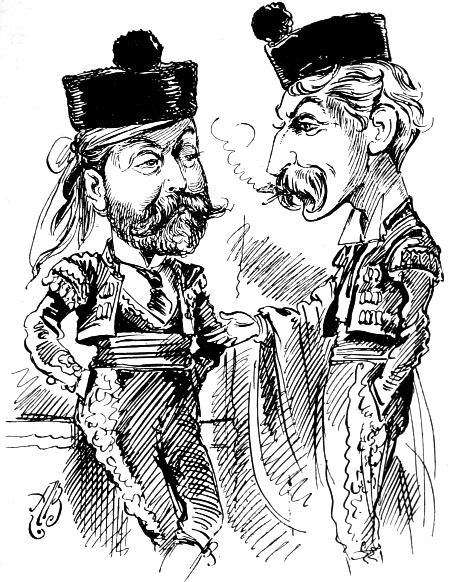
MESSRS. G. R. SIMS AND H. PETTITT.
“UP TO DATA.”
“Is one of the conditions of collaboration with George R. Sims a willingness to black George R. Sims’ boots?” Pettitt was reported to have asked bitterly after one little argument. But whatever happened behind the [Pg 209]collaborators’ scenes in private, Sims interfered very little with the actual rehearsals, although, as he once told me, he had determined to have a hand in every production of his ever since poor Charles Warner ruined the success of “The Last Chance” at the Adelphi, when as the starving hero, he exclaimed, despairingly: “Our last farthing gone! Starvation stares us in the face!” and raised a hand to heaven—a hand on which glittered a superb diamond ring.
“Why don’t ye pawn yer ring, Charlie?” bawled a critical “god,” and it was then that Sims made his resolve.
The nervous, highly-strung and irritable Pettitt—who died, worn out, in his early forties—cannot have been easy to work with in collaboration, and perhaps of all his collaborators Arthur Shirley got on the best with “Dagonet.” When writing “The Two Little Vagabonds” they were said to have worked in all sorts of odd places, and the play was concocted in railway carriages, outside a Parisian café, in the inevitable Adelaide Gallery, at Sims’ Regent’s Park house, “Opposite-the-Ducks,” in the small hours, and lying on the grass in the country.
Quite naturally, Sims was a tremendous believer in the school of drama with which his name had been associated at the Adelphi and the Lane, and it is curious that his very last business transaction, which took place a day or two before his death, was in connection with the film rights of the old Adelphi “Harbour Lights,” to be played for the “pictures” under the direction of Tom Terriss, the clever son of the original “David Kingsley.”
As journalist, dramatist, social reformer, good friend, and smiling, kindly philosopher, George R. Sims will live long in the memory of those whose privilege it was to be associated with him in his work or in his play.
[Pg 210]
Of Brandon Thomas, part author with Clement Scott of the English version of “The Swordsman’s Daughter,” I have already spoken.
He was one of those rare souls whom early hardships and subsequent success fail to embitter, and to the end was the same courtly, sweet-hearted gentleman. And Brandon Thomas’s early struggles were severe. He started as an entertainer at the piano, singing his own songs in his own very distinctive manner, and one of those songs:
became quite famous in the hands of that brilliant “coon” comedian, Eugene Stratton, to whom Thomas sold the rights.
It was, of course, “Charley’s Aunt” that at last brought Brandon Thomas fame and fortune, and I have been told that when the evergreen farce was first produced on tour, the author and Penley had been so frightened by a friend, who declared that a man playing a woman’s part would never be accepted by any audience, that the author played one of the characters himself in order to save a salary in case of a dire failure.
Many years afterwards, as the story-books say, a man went into a bank at a popular French seaside resort to cash a cheque.
“How long will it take you to get this cheque changed?” he asked the clerk.
“Four days is the usual time,” said the clerk, “but M’sieu can have the money now if he likes.”
The man with the cheque expressed his surprise and thanks.
[Pg 211]
“M’sieu will understand that we do not as a rule cash cheques on sight,” observed the clerk, “but it so happens that I have a discretion, and I know the name on this. How is ‘Charley’s Aunt’? And”—he dropped into English—“is the dear lady ‘still running’?”
Comyns Carr, part author with Haddon Chambers of “Boys Together” and “In the Days of the Duke,” was yet another brilliant man who did not disdain to write popular drama.
Art critic, editor, playwright, poet, theatrical manager, and bosom friend of Irving and Tree, “Joe” Carr, as everyone called him, occupied a unique position in literary and artistic London, and was one of the most popular figures in club and theatre life. The only time I ever saw him look sad was at a luncheon given to celebrate the turning of the New Gallery in Regent Street into a restaurant—it is now a cinema. Even an excellent lunch failed to remove his gloom, and at last the cause of it was explained. He pointed to a row of hooks which still remained in the newly decorated walls near to the ceiling, and embarked upon a flood of memories of the great pictures, the Watts, the Burne-Joneses, the Rossettis and the Millais that those very hooks had supported in the days when the New Gallery was a centre of the London art world, and “Joe” Carr its prophet, priest and king.
Of the Gattis, Agostino and Stefano—“Angostura” and “Stephanotis” as some wag re-christened them—there is little new to be said at this time of day, and their innumerable ventures in the restaurant and theatre worlds still keep their names fresh.
In the palmy days of the Adelphi drama the Adelaide Gallery had a strong theatrical clientele, and amongst[Pg 212] the authors regularly to be seen there were Henry Pettitt, George R. Sims, Robert Buchanan, Dion Boucicault, Brandon Thomas and many others. Salvini always took his meals at Gatti’s when he was in London, and on one occasion when I was lunching there I remember that a fine white-haired old gentleman in a slouch hat and a very shabby cloak was pointed out to me as a regular customer. He was, it was said, very poor, and one dish was his invariable meal, but he was an old Garibaldian, and because he had fought under Garibaldi the waiters at Gatti’s treated him with more reverence, and pocketed his tip of a few coppers with more gratitude, than they would have shown a millionaire and his gold.
In those days, Agostino and Stefano Gatti—who of course were of Swiss, not Italian, descent—used to lunch and dine together at a table near the entrance to the kitchen, and after their meal would adjourn to a big desk when they took the counters from the waiters, as had been their custom from the earliest days of the restaurant.
And at the Gatti’s luncheon and dinner table many affairs other than merely restaurant matters were discussed.
The late Colonel Newnham-Davis was fond of telling a good story of how a fine military melodrama never was produced at the Adelphi.
Early one morning he received a telegram from his confrère on the staff of the “Sporting Times,” the brilliant but erratic “Willie” Goldberg, known to most of the English-speaking world of that day as “The Shifter,” making an appointment for lunch at Gatti’s. When the pair met at the door, The Shifter informed his colleague that the Gattis wanted a military melodrama for the Adelphi; that he, The Shifter, had just thought of[Pg 213] a splendid title; that he and the “Dwarf of Blood”—as the Colonel was called—should write it together, and, finally, that the Gattis had asked them to lunch to talk it over. The pair then hurried into the restaurant. They lunched with the Gattis, and when, after lunch, the brothers very gently said they were ready to hear anything about the play the co-authors cared to tell them, The Shifter disclosed the title, which pleased them vastly, and then leant back in his chair as if the matter were settled.
The cautious Gattis asked for some slight outline of the play, but The Shifter, taking a lofty attitude, put it to them that an advance on authors’ fees was obviously the next step in the business. This, the Gattis said, was not the way in which they were accustomed to transact their theatrical ventures, whereupon The Shifter brought the discussion to an abrupt close by saying farewell.
Out in the street again his collaborator suggested that, after all, it might be as well to work out a scenario to submit to the Gattis, but The Shifter was in high dudgeon.
Wrinkling his long nose in haughty scorn: “These foreigners don’t understand our English ways of doing business!” he snorted.
And what was the end of the great military melodrama, which—who knows?—might have rivalled “One of the Best.”
Another story of the Gattis’ theatrical ventures is of their purchase of the Vaudeville Theatre. Amongst the brothers’ many enterprises had been the installation of an electric light distributing plant in a building just behind the Vaudeville Theatre, where Tom Thorne was then running a far from successful season.
[Pg 214]
The actor complained that his ill success was largely owing to the noise the engines made behind the stage, whereupon the Gattis promptly bought the theatre—or as much of it as was freehold.
There were always interesting people to be seen at the Adelaide Gallery, and I well remember seeing the great Lord Salisbury, who was supposed to have a passion for a solitary chop and chipped potatoes, taking his lunch at a corner table in solitary state.
When the old order passed away, John (ex-Mayor of Westminster) and Rocco Gatti succeeded the father and uncle, and still took their meals at the same round table where their predecessors had sat, though they no longer took the counters from the waiters.
Amongst connoisseurs the Adelaide Gallery was for long famous for some wonderful old cognac which had been bought by its astute proprietors at the time of the Franco-German War, when stocks of old brandy were sold at very low prices. It was marked on the wine list so as to show a very small profit on its purchase price—and no more—and the Franco-German War was in a sense responsible for attracting a great number of fastidious clients to Gatti’s.
During the run of “Black-Eyed Susan” Agostino Gatti died, and for the first and only time his friends saw Terriss off the stage in the conventional frock-coat and top-hat.
The theatre had closed and he had announced his intention of attending the funeral, to discover at the last moment that he had no clothes other than his invariable grey tweeds. There was nothing for it but to call his friends to the rescue, and they responded nobly. Seymour Hicks sent an exquisitely glossy top-hat; Arthur Cohen, who had the reputation of being[Pg 215] one of the best-dressed men in London, supplied a beautifully cut frock-coat in the height of the fashion in those days, and someone else contributed a gold-headed ebony cane. But still the mourner was short of one or two indispensable articles. A very shabby old pair of evening-dress trousers was hurriedly pressed, and all that was then wanting was the waistcoat.
Now in the last scene of “Black-Eyed Susan” William puts his black silk scarf round his Susan’s neck. The black silk scarf was sent for, carefully pinned over the tweed waistcoat, and the borrowed frock-coat was tightly buttoned, and the costume was complete.
After the funeral I met the mourner at Paddington with a suit-case containing the old grey suit—a party of us were going down to stay with George Edwardes at Winkfield Lodge—and mounted guard outside the carriage while he hurriedly resumed his own clothes. In a very few minutes he handed me through the window a parcel containing the borrowed plumes, and asked me to give them to the stationmaster with the message that they would be called for next day.
It had, I think, been Terriss’s idea that Douglas Jerrold’s famous old play should be played exactly as it was written, and in the traditional manner, and the success verified his judgment.
And great fun it was; Terriss sang a song, danced a hornpipe, and “avasted” and “belayed” in the fine old fashion; as Susan, I wept and made love and was “faithful and true,” and the rest of the company entered thoroughly into the spirit of the thing, to our own enormous enjoyment and to that of the audience.
“In the Days of the Duke,” a beautifully produced play by Haddon Chambers and Comyns Carr, which followed “Black-Eyed Susan,” had not altogether the[Pg 216] success it deserved, and in its turn was replaced by William Gillette’s play “Secret Service,” which had previously been played in London by an American company.
A brilliant and interesting personality, both as actor and author, was William Gillette, who will perhaps be best remembered by present London playgoers for his wonderful impersonation of Sherlock Holmes.
“I should have had that play,” sighed Beerbohm Tree, when his faithful friend Henry Dana entered his dressing-room to “report progress” on the success of Gillette’s production, which was taking place that evening, but it is hard to imagine a more ideal representative of Conan Doyle’s super-detective than the fine American actor.
Hating fuss and social functions, somewhat to his discontent Gillette found himself a social lion, and his polite attempts to avoid being lionized caused his friends much amusement. Daniel Frohman used to chuckle as he told of one such attempt which failed hopelessly.
A certain duchess had invited him to spend the Sunday at her country place some little distance from town, and Gillette had pleaded as an excuse that the only Sunday train was a very early one and that his doctor had insisted on a Sunday morning’s rest.
“But there is an express later in the day,” urged the duchess.
“I know,” said the wily Gillette, “but that’s the north express and doesn’t stop at your station.”
“Oh, I’ll have it stopped for you!” said the undefeatable duchess.
And she did, and the actor lost his day of rest.
[Pg 217]
“Secret Service,” with its English company, was a big success, and a great critic wrote of the Adelphi audience:
“They had once more got their Terriss, and he loved an honest girl, and he was shot in the hand by a rival, and, like Jim Bludso, he did his duty, and ‘went for it there and then,’ and that was enough for the pit.”
It was during the run of “Secret Service,” on the sixteenth day of December, 1897, that my dear friend and comrade met his death at the hands of a man he had befriended.
[Pg 218]
A Prophecy of Evil
IN the year 1897 the so-called science of palmistry, or chirology as it was then called, was passing through one of its periodical vogues, and was the fashionable craze of the moment.
Everyone was having his or her hand “read,” and “professors of palmistry” of every description, good and bad, began to abound.
Shortly before Christmas, Edward Ledger, the editor of the “Era,” asked several leading members of the theatrical profession to “sit” for their hands, in order that the results might be published in the “Era Almanack,” and, after undergoing the operation myself, I promised to do all in my power to get Mr. Terriss to visit the palmist.
It was not at all an easy task to persuade him. When I broached the subject he roared with laughter, and flatly refused to waste his time. But I had promised to do my best, and at last he grudgingly consented and paid his visit.
On his return he was as sceptical as ever as to the value of palmistry.
“I’ve got quite a nice character, Jessie,” he laughed; “so nice, in fact, that it seems a pity that I’m booked for sudden death. I’m very clever. I’ve got a kind heart, and I’m coming to a violent end. Pleasant, cheery person, your palmist!”
[Pg 219]
For myself, I express neither belief nor disbelief in the so-called science; as a matter of curiosity I reprint below, by permission of the editor of the “Era,” the readings of our hands which appeared in the “Era Almanack” of 1898, a few days after the murder of my friend.
In the same number appeared a reading of the hand of Sir Herbert Tree.
In Sir Herbert Tree’s case the concluding lines ran:
“He is quite safe on the sea, Luna uncrossed and unstarred, he has no danger from fire—no star on Jupiter, but he should be careful as to falls and blows, a star on Head line has faded nearly out, but he has once been in danger of something falling on him from a height.”
Sir Herbert’s death was caused by a fall, but in his case it was many years before the prophecy was fulfilled.
As I have said, I neither believe nor disbelieve in palmistry, and I do not even understand the jargon of the science, but merely reprint these forecasts, warnings—call them what you will—as matters of curiosity, the authenticity of which is at least unimpeachable.
“Hands of Mr. William Terriss.
“These hands possess a strong and distinct personality in keeping with the character of the well-known actor who owns them. They are large, hard and flat, with long fingers of the spatulate type, full of the love of movement, of activity and energy. The hand is more flexible than is usual with this type, though that is not to any great extent; the spaces are wide between all the fingers, the thumb space particularly so in the right. The subject is very unconventional and independent,[Pg 220] both in action and in ideas, but he is not adaptable or amenable either to people or circumstances. There is much generosity shown in his own time and his own manner, and that a rather eccentric one. He would be very difficult to convince, but being so would act freely and without stint, and would hate to be thanked for it. The thumb shows an immensely strong will, and great perseverance, very stern temper, and considerable impatience. The love of rule and governance is strongly marked in the aggressive first finger, and if it were not for the very excellent Heart line the hands would be somewhat tyrannical. The size of the hands and the spatulate Saturnian give much foresight and prudence, the dominant and spatulate Apollo his artistic capabilities, and the love of action and movement in art, which would turn his inclinations towards stirring melodrama rather than subtleties of character-acting; a spatulate Apollo is always extremely forcible, there is no hesitation or half measures with this type of hand. The Mercurian finger is very fine; it is spatulate also, like the Apollo, but long and straight; it shows excellent business management, and, with the deep Head line, practical common sense and capacity, and a considerable want of tact and diplomacy.
“When we come to the Mounts, we find that flat development that does a great deal of hard work in the world. The temperament is Mars and Mercury, with a little Apollo, a powerful combination. There is not much Jupiter, but little love of society, or appreciation of good things or luxury; what there is of this Mount turns to pride, but the joining of Head and Life line with the flat Mount shows the subject not to be so very self-confident, not so much so as a Mars and Mercury temperament generally is, at least not with regard to his[Pg 221] art, and he is more susceptible to criticism than would appear on the surface. A certain amount of vanity will come with the development of Apollo, but it is by no means excessive. The Mount of Mercury shows he is cheerful, especially when there is much hard work to do, and an appreciation of humour, which does not amount to wit, the Head being too straight, and Luna too little developed, and as a rule this temperament is too desperately in earnest to dawdle over the light fascinations of dainty wit or brilliant conversation.
“Mars, the dominant Mount, makes the palm very high and flat. It shows great courage, endurance and aggressiveness; an immense determination to have his own way, and much disregard of other people’s. The subject should be careful to show justice and to cultivate patience, otherwise the good Heart line will hardly prevent him from being occasionally hard upon other and different temperaments from his own.
“There is but little development of the lower Mounts, and one of the best points of the hand is its fine outline towards the wrist. The outline from the base of Mercury to the wrist is beautifully curved, and is nearly equally so on the side of the thumb. The Luna being raised towards the Head will give him imagination in the carrying out of his art, and make him original and convincing, but the want of Venus in combination with it will scarcely make him imaginative in other matters.
“The Heart line is very deep and long in both hands; the subject is very kind-hearted, a good friend, and extremely constant when once attached, very difficult to please, and a little jealous in his affections. He will attach himself very strongly to a very few people, and will stick to them all his life.
[Pg 222]
“The Head line shows a very clever intellect, great concentration of thought and power of mind all turned in one direction, a certain difficulty in seeing two sides to a question; much straightforwardness and practical sense. The memory seems rather fluctuating—good at recollecting some things, and not at all at others.
“The Life line is good; all the lines being clear and strongly marked give a very good constitution, and being much more deeply marked in the right than the left, show the strength has been maintained, and health better than the hereditary disposition promised. There is no illness foreshadowed at the end of the line, it ends very abruptly in the right. There have been two illnesses, one in the growing up, which was not strong at first, and one since, and at the present time the throat, as shown by the feathering of the line under Jupiter, is not at all strong, and great care should be taken of it.
“The Fate line, on the whole, shows a very adventurous career, but has been very steady on its rise after it once got away from the obstructions of surrounding circumstances at about twenty-five. At just under thirty the line in the left doubles, bringing in new influences for good over the life and much success in the career. In the right, the Apollo line goes to Mercury, and breaking on the way at the Head shows that others attempted to cheat him or loss of money through others, which did not have much appreciable effect on the career. At thirty-five or thirty-six there is a change, and again just about forty, all tending steadily to larger influence and more monetary success. The line going to Mercury instead of Apollo shows that the subject had it in him to have attained a greater artistic triumph had the line been directed to Apollo instead, but the Mercurian line makes for worldly[Pg 223] success, and of that there is plenty. The subject has two especial friends marked on the Heart line, one a deep friendship of at least twenty years, and the other, more fluctuating from circumstances, comes and goes at intervals.
“The lines of ambition on Jupiter are strongly marked on both hands, one of the two in the left being discontinued in the right, and the other greatly strengthened; the latter is a sign of much success.
“There is no fear of fire or water, great preservations standing in the way of danger, but much of falls and blows. On the whole, these are the hands of a strong character, great originality, and are the records of a very successful career.”
(Since these lines were written, the dastardly and deplorable crime has been committed which has deprived the theatrical world of one of its most popular leaders, and the subject of the present study. The interview at which the drawings of Mr. Terriss’s hands were made took place about a week before his death. One of the chief things Mr. Terriss inquired about was his death, and I told him it would be quite sudden and possibly violent, a declaration he repeated before others in the profession that same evening, and I especially cautioned him against an accident, but I thought it was something that might fall upon him from a height, and told him of it. But I honestly confess I could not have told from his hands that his death was so near and so terrible. We have had, thank God, but little experience in such cases. The hands of General Boulanger were the only ones I had ever seen of one who was immediately afterwards shot, and those of Dr. Kerwain, who was murdered, but this was after the event. I do not, however, think that, had it been possible to have warned Mr.[Pg 224] Terriss, that warning would have been of any service, as nothing could have prevented him from the cruel and cowardly attack of his wretched murderer.—The Palmist.)
“The Hands of Miss Jessie Millward.
“The hands of Miss Millward are pointed, soft-skinned and flexible, yet strong in their grasp and firm in the touch. They belong to that temperament of Venus and Apollo that rules the souls of their fellow creatures, that governs by persuasion, and controls by influence; those that never seem to seek their own way yet always get it, and that without any very apparent effort of will on their part.
“The spaces between the fingers show extreme unconventionality, and the thumb great generosity and a cultivated extravagance. It is a firm, constant thumb, decided in will, reasonable in judgment; the first finger gives the love of rule and good sense of justice, in fact the dominance of Jupiter in the finger will make the subject hate injustice and greatly rebel if subjected to it. The Apollo finger, which is pointed in the left, has developed a conic tip in the right from the cultivation of her art, and the extremely long and straight Mercurian finger gives that great tact and the management of difficult people for which this character should be remarkable. Language is much developed in the long first phalanx of Mercury, as colour is in the first of Apollo.
“The Mounts on these hands are strongly developed, the temperament is emotional and passionate, capable of great self-sacrifice, and equally so of resentment, and even, under provocation, of inclemency. Jupiter will[Pg 225] give her love of society and social gifts, Mercury a certain brightness of disposition and love of wit and humour; Venus, strongly developed, the love of pleasing, the desire to be liked, and some little vanity, and Apollo in combination with this will give her a great dislike of seeing anyone suffer, and the desire to console and assist all who are in trouble.
“The hand is rather flat, the moral courage is excellent and is intensified by the widely divided line of Head and Life, which gives much audacity and somewhat too quick action. This may be guarded against by the good sense of the thumb and the fine depth and length of the Head line, making the judgment, if hasty, as a rule sufficiently reliable, and also by the exercise of the gift of intuition, or spontaneous decision caused by the senses, which is peculiar to this temperament and often exercised as safeguard.
“The Mount of Venus will also give much love of music, though the shape of the hands deny much execution; the voice should be sweet and clear, rather low-pitched.
“The Head line in the right is much improved. The subject has studied much and carefully, her memory and her quickness of apprehension have greatly improved and are now far beyond the average. There is good practical common sense in many ways shown by this line, and it is quite capable of keeping secrets, and of much thoughtful diplomacy, not in business, but in personal management.
“The Heart line is very affectionate; the turn up towards Jupiter makes it capable of jealousy in a very few cases, not altogether unselfish, but a steady, constant friend, helpful and amiable.
[Pg 226]
“When we look at the Life line, we see the subject has passed through a time of illness and great physical strain, brought on a great deal by trouble and grief; the breaks on the line in the left and the crosses barred on the right show a period of great delicacy, now happily a thing of the past. The hands are altogether much covered with small lines, showing a very nervous temperament, and great care should even now be taken against overwork and too great mental excitement; the heart is still a little delicate, and the circulation not very good. But as all the worst trouble in the life is early, so the worst of the health is also, and between thirty-two and forty-six the lines are all on the improve. At the latter age the subject will have to be careful, but although the line forks in the right hand, it continues afterwards as well as before and continues to a good age.
“The Fate line is altogether a Saturnian one. The subject is much under the rule of circumstances, and these circumstances have not been favourable. There have always been difficult people to contend against and obstacles to be overcome, and the temperament of our subject, although fortunate in friendship, is seldom so in love. Circumstances constrain these temperaments, and the choice is seldom the best. The line of Apollo, which is much broken in the left, showing the difficulties and trials of early life, is very good and strong in the right, but rises somewhat late; the success was not secured without a great struggle, and is due to the subject’s own courage and exertions.
“There is a great preservation from physical danger on the lower Mars, and a shock to the feelings of great intensity in the other hand, otherwise the subject seems free from accident either from fire or water.
[Pg 227]
“These hands show a most kind-hearted, emotional, artistic temperament, grounded on sterling sense and practical benevolence, and the owner should be deservedly popular and dramatically successful in her own special line of art.”
Whether there be any explanation or none, in the light of what happened the passages I have italicized have a curious and tragic interest for me.
[Pg 228]
William Terriss
IN the course of the years that have passed, Time, the merciful, has softened the pain, and at last I feel myself able to set down as simply as possible an account of the terrible crime which deprived me of my friend and comrade, and the stage of a personality which was endeared to thousands.
I feel impelled to write this sad chapter for at least three reasons. No account of my life could pretend to truth which ignored the tragedy which has coloured it; but this reason is a small one, it is eclipsed by the others. I not only wish to pay a tribute to the memory of the dead, but to record the infinite kindness and love I received from those who, though bowed by their own sorrow, yet found time to think of and console me, and to lay a tiny laurel on the grave of that great-hearted, kindly gentleman, Henry Irving.
In this sad chapter I confine myself to facts; I do not attempt to explain the incidents which I am about to relate preceding the murder; I merely record them. I did not, and do not understand them, but they exercised such a powerful influence on me at the time that I cannot ignore them.
One night, three months before my comrade’s death, I woke in a panic, calling for my maid. My dream had[Pg 229] been a horrible one. I had heard a cry: “Sis! Sis!” in a well-known voice, and, bursting open a door, I had rushed into a room with bare boards in time to catch the falling form of Mr. Terriss.
So upset was I that in the early morning I telegraphed to Mr. Terriss, who was living at Bedford Park, to come to me at my flat in Hanover Square. I told him the reason for my telegram, expecting to be laughed at, but he saw my distress. Later in the afternoon his brother, Bob Lewin, called; the three of us dined together, and over dinner I told Bob of my dream.
Six weeks later I dreamt that identical dream again, and once again, on the Sunday before the crime, I dreamt it.
Can it be that it was a case of “coming events casting their shadows before them?” And if so, to what purpose, for in what way could the warning have been turned to use?
But so depressed and haunted by a fear of some vague impending ill had I become, that on the Wednesday I went to Mr. Terriss’s dressing-room before the evening performance.
“What is the matter?” he asked, as he saw me.
“I have a horrible feeling that something awful is going to happen,” I told him. “I can’t explain it. But I’ve nothing of yours for remembrance, nothing personal. I feel I must have something.”
He saw that I was thoroughly over-wrought, and, smiling, he laid his watch and chain on the dressing-table.
“Take that,” he said. “Your picture is inside the lid.”
The next evening, December 16, 1897, at exactly the same hour—7-40—Seymour Hicks came to my room.
[Pg 230]
“Here are father Will’s watch and chain, Jessie,” he said.
Long afterwards I gave them to Tom Terriss, who still wears his father’s watch and chain.
On the day of the murder, Thursday, December 16, 1897, Mr. Terriss and his old friend Mr. Harry Greaves dined with me at my flat in Princes Street, Hanover Square, at the usual hour of four o’clock, having spent the early part of the afternoon at the Green Room Club, playing poker with Fred Terry. When seven o’clock came I rose:
“I must get down to the theatre,” I said. “I hate being rushed,” and left them finishing their game of chess.
I drove up in my hansom to the pass door in Maiden Lane, which opened near my dressing-room. At the pass door I saw standing the man Prince, whom I recognized as a former super. Only a night or two previously I had heard a man speaking in a loud voice in Mr. Terriss’s dressing-room, and as I came out of my room I met him in the passage with Prince.
I had asked him: “What is the matter?”
“This man is becoming a nuisance,” he had told me, and I had guessed that it was a case of begging.
Just as I reached the pass door Prince came towards me, and I half thought of giving him some money so that he should not delay Mr. Terriss when he arrived, but as he came towards me there was something in the man’s face that frightened me, and instead of waiting to open the pass door I rushed to the stage door, and on entering my dressing-room I told my maid, Lottie, of my encounter with Prince.
In the midst of my dressing I heard Mr. Terriss put his key in the pass door, and then there was a strange silence.
[Pg 231]
“Something has happened!” I cried suddenly to Lottie, and she rushed down the stairs, I following her.
Mr. Terriss was leaning against the wall, near the door.
“Here are my keys, Lottie,” he said, quite calmly. “Catch that man!”
I had just reached him when he swayed.
“Sis,” he said faintly, “Sis, I am stabbed.”
I put my arms round him to support him, when we both fell to the ground on the bare boards at the foot of the staircase leading to our dressing-rooms.
“Mr. Terriss has met with an accident!” I remember calling wildly. “Send for a doctor!”
We seemed surrounded with people, doctors came running from Charing Cross Hospital, the world was full of whispers—and I felt that all was hopeless.
He was lying on my right arm, and I held his hand in my left hand.
We were now alone.
He opened his eyes, and faintly squeezed my hand.
“Sis! Sis!” he whispered.
And that was all.
******
Someone led me to my room.
I remember every moment of that time. Soon George Edwardes, Seymour Hicks, and other friends had come to me, and in their own great sorrow were trying to comfort me.
“Cry, my dear, cry,” begged dear old Mrs. Pateman, but there were no tears.
Meanwhile the murderer had rushed into Maiden Lane, flourishing a long knife, my faithful Lottie clinging to him until the police seized him.
When he was told Mr. Terriss was dead: “Yes,” he said; “and I meant to kill Miss Millward, too.”
[Pg 232]
Mr. Terriss had never been threatened or I should have known of it. It was the act of a madman.
The murderer was a short, thin, dark man, with a pronounced squint, whom, when he was employed as a super, I had often seen posing about the stage, and whom Mr. Terriss had assisted with money when he lost his position. I was told afterwards that for a week before his crime he had been strutting about the Strand boasting that in a few days his name would be on everybody’s lips.
At about half-past nine Lottie and I left the theatre. I would not drive, so we walked together back to Hanover Square, and as we passed up Regent Street the newsboys ran by crying: “Murder of William Terriss! Murder of William Terriss!”
“Don’t listen, Miss Jessie,” pleaded Lottie; “don’t listen.”
“I must, I know,” I said.
There were no tears.
I reached the flat, and sat up all night, thinking, thinking. Everything seemed so quiet; I wanted to be alone.
In the morning my mother, my brother and my sisters came to me.
“No one is thinking of me now,” I half sobbed, and, taking my hand, my mother led me into the dining-room. The room was one mass of flowers with cards. It was strange I could not bear the sight of the flowers. In the afternoon Tom Terriss came and took me to see his father in the mortuary at St. Martin’s Church, and I laid a bunch of lilies of the valley in his folden hands. They were the flowers he always gave me. Somehow or other the wonderful and majestic peace in my dear comrade’s face soothed me. Never shall I forget the[Pg 233] kind friends who tried so hard to comfort me. The first telegram I opened was from Mr. Terriss’s daughter Ella; she was ill at Eastbourne, and Seymour had gone to break the news to her, yet in spite of her own great sorrow her first thought was of me. But how good and kind were all the Terriss family. His sisters, Mrs. Tomlin and Mrs. Stevenson, and his brothers, Colonel Lewin and Dr. Lewin, did all they could to comfort me in the midst of their own dreadful trouble, and Mrs. Tomlin took me to see my friend for the last time.
As I gazed my last on my comrade, my friend, I thought of the last lines he spoke on the stage in “Secret Service” the night before his death:
“... Until we meet again.”
And then came into my mind those glorious lines:
“Death is the beginning of eternity.”
One afternoon my sister came to me.
“Sir Henry Irving is here to see you,” she said. “Please don’t refuse; he has a message for you.”
“I will see him,” I replied, and he came into my room.
“My dear,” he said, “I have just come from Bedford Park. I was asked to convey to the Terriss family a message of condolence from the Queen, and I felt that I must come to you to tell you how we all sympathize with you.” Then he went on to tell me that the Prince of Wales had sent his equerry with a message of sympathy to me.
“Is there anything I can do for you?” he asked gently.
“Yes,” I answered; “I should like you to be with me at the funeral.”
“Of course, my dear,” he replied.
Every night after his performance of “Peter the Great” he came to sit an hour with me, talking of the[Pg 234] theatre, of art, and work, and endeavouring, as I afterwards realized, to keep alive in me some interest in my profession and my life-work.
All the Monday night my brother Frank and Seymour Hicks sat by my bedside, and next morning, punctually at half-past ten, Sir Henry Irving called, bearing in his hands a large bunch of violets. He, Seymour and I drove to Brompton together, and never can I forget the sea of faces as we entered the cemetery.
The crowd was enormous, almost terrifying; one paper estimated it at ten thousand. I quote from an old, faded, yellow cutting I have kept:
“Miss Millward, clothed in deepest black and leaning on the arm of Sir Henry Irving, was the most conspicuous figure at the funeral of William Terriss at Brompton Cemetery to-day. She was one of the dead actor’s oldest and closest friends, and her parting kiss was the last thing he felt before he lost consciousness. She has neither slept nor cried, and has hardly eaten or spoken.... Her friends are afraid she may lose her reason. Amongst the immense number of floral tributes hers was the most regarded. It was a cushion of white chrysanthemums bearing in purple violets the words, ‘To My Dear Comrade,’ and in the corner was a spray of lilies of the valley. It is believed that the death of Mr. Terriss will mark the retirement of Miss Millward from the stage. In any event, she will not appear again for a long time.
“Sir Henry looked pale and careworn in the raw December air. He was dressed in the deepest black, and looked slightly bent as he supported Miss Millward.
“Brompton Cemetery is essentially the theatrical one. Here Sothern was buried, with Sir Augustus Harris, Henry Pettitt, the beautiful Adelaide Neilson, and many[Pg 235] other distinguished lights of the English stage. It is as much the custom for the London actors to be buried in Brompton Cemetery as for the New York actors to be buried from the Little Church Around the Corner. But never has Brompton Cemetery witnessed a more representative stage gathering than to-day. Every London theatre was represented, and there were floral mementoes from all the leading companies travelling in the provinces. The most prominent London critics were present, with many members of the nobility, and a great number of persons prominent in the theatrical profession. Among the mourners who followed the coffin were Tom Terriss and William Terriss, junior, the sons of the dead actor; Dr. Lewin, his brother; Colonel Lewin, Clement Scott, George R. Sims, Sims Reeves, Gilbert Tate, Arthur Roberts, George Alexander, and twenty-four members of the Green Room Club. The grave is near the east wall of the cemetery, and close to the grave of Henry Pettitt, the playwright, whose success, like that of Terriss, was closely identified with the Adelphi.
“Sir Henry Irving drove away with Miss Millward. Irving, it is said, has been greatly affected by the tragic death of Terriss, who supported him during his first tour in America and was one of his best friends. To-day he looked older and more careworn than ever before. Many persons said that he had aged ten years since Terriss’s assassination.
“Among those present, or who sent wreaths, crosses or cut flowers, were Lady Clarke, Lord and Lady Londesborough, the Dowager Lady Freake, Leopold Rothschild, Alfred Rothschild, Mr. McCalmont, Charles Wyndham, Mr. Pinero, Mr. and Mrs. Kendal, J. Comyns Carr, Charles Hawtrey, Mr. and Mrs. George Grossmith,[Pg 236] Harry Nichols, Lily Hanbury, Mrs. Langtry, Mr. and Mrs. Cyril Maude, Lady Meux, B. L. Farjeon, Lady Harris, Antoinette Sterling, E. S. Willard, Forbes Robertson, John Hare, Sir Edward Lawson, George Edwardes, Lady Jeune, Sir Henry Hawkins, Marie Tempest, Beerbohm Tree, Max Beerbohm, Haddon Chambers, Miss Fortescue, Weedon Grossmith. A floral tribute was received from Charles Frohman, inscribed: ‘In affectionate remembrance from one of the audience.’ Augustin Daly also sent flowers.”
When I saw the coffin borne to the graveside, “I will go home now,” I said to Sir Henry; “my brother and my maid will take me back.”
“My dear,” he replied, with the grave and gentle courtesy which was a part of his nature, “I had the honour of bringing you here, I will have the honour of escorting you home.”
That same night he paid his usual visit.
“You must go abroad, child,” he said. “You must go away for a long holiday, in fresh scenes, and then you must return to the stage, and work.”
“I can never do that,” I cried. “I can never return to the stage.”
“You must,” he said, simply; “it is your work, and in work lies relief.”
He was right. And in work Henry Irving had ever found his own relief.
“I sincerely hope the entire change of scene and the vivifying air of the Riviera may give you some rest and peace after the fearful strain you have had to go through,” wrote Colonel Lewin, when he heard that I had at last decided to go away; “for amid all my sorrow and sense of ever-abiding loss, I thought always it was you in truth who were most to be pitied—it was[Pg 237] your life that would be most affected. Most sincerely I grieve with you and for you; and if at any time I can do anything to befriend or assist you I beg you will count on me to do whatever lies in my power for the sake of him whom I loved and who certainly loved you more than anyone else on this earth. When that is said, then all is said.—Tom Lewin.”
No one has had kinder, more loyal friends than I have had, and the kindness and loyalty have endured throughout the years. Long, long after the terrible blow, on its anniversary there came a little note I have always treasured:
“My dearest Jessie,—My thoughts will be with you on Christmas Day, and I shall say a prayer for you at Brompton to-morrow. I wish it were in my power to make you happier, but I fear it is not. However, you may always feel I love you.—Ella.”
In the course of a few weeks, the murderer’s trial took place, and one of the witnesses was my maid, Lottie. She gave her evidence with her usual calm, but on her return to the flat the poor thing collapsed, and was very ill. Poor girl, all through that hideous time she had been so brave and so self-sacrificing.
Prince was, of course, found insane, and sent to Broadmoor Asylum for life. Some time later I heard that he had been appointed to the position of gardener, and from Broadmoor he frequently wrote to actors at the Adelphi begging their influence to get him released and to secure him a part in the Adelphi play.
At Broadmoor, for all I know, he still remains. Only recently did I hear of him, through the visit of an ex-Cabinet Minister to the asylum. In the visitor’s[Pg 238] honour a performance was given by the asylum band, the members of which were prisoners found insane. The conductor mounted to his desk, turned to the ex-Minister and gave him a majestic bow, then, tapping on his desk in manner of the professional chef d’orchestre, proceeded to conduct the performance.
That conductor was Prince, the murderer of my friend.
Shortly after his death there was a noble memorial to my friend which was strangely appropriate, and which is unique in the history of memorials to members of his profession.
A little time before his murder there had been a terrible lifeboat disaster off the Nayland Rock at Margate, and Terriss, who from a boy had spent his holidays at Margate and knew every boatman by his Christian name, suggested a subscription in the “Daily Telegraph” for a memorial to the brave men who had lost their lives. The proprietor of the paper, who afterwards became Lord Burnham, one of his greatest friends, supported the scheme warmly, and a figure now stands on the Margate beach of a lifeboatman looking out to sea, in lasting remembrance of the dead.
With a tragic appropriateness, a little later another “Daily Telegraph” Fund was opened for a William Terriss Memorial Lifeboat House at Eastbourne, and subscriptions poured in for this memorial to the murdered friend of the dead heroes. The foundation stone was laid by the Duchess of Devonshire, and in his address Sir Charles Wyndham paid a splendid tribute to the memory of his fellow actor.
“Life, vigour, courage and devotion characterized Terriss the actor, as well as Terriss the man. Within the building of which this stone is the foundation, life,[Pg 239] vigour, courage and devotion will be typified by the staunch little craft which soon here will be housed—a craft which can never be used without calling forth those noble qualities which can never be seen or even named without perpetuating their memory and that of him in whom they were all so happily conjoined; for the fame of William Terriss is not the mere creature of public fancy, distorted by the glamour of the footlights, nor was it built up only on his artistic presentments. His own personality must be taken into account. What he was before the public he was to his friends in private. Every heroic deed of his upon the stage was just such as we could imagine him performing off the boards—nay, as on more than one occasion he did perform. It is impossible to conceive a grander parallel between the artist and the man. He lived a life as worthy and died a death as tragic as any man he had represented on the stage. But we must not dwell too long on mournful memories. When the soldier escorts his dead comrade to the grave he plays the funeral march, but when he turns his face back to life’s work and battle he plays the most inspiriting music at his command. So it is our part with head erect to face the storm and stress of life, emulating the merits, not vainly lamenting the loss, of our departed friends. We must remember with satisfaction that the boat which this house will cover will, whenever she goes forth on her noble mission, immortalize the name and vitalize the spirit of William Terriss far more effectively than a mere appeal to the passer-by set in stately phrases and sculptured in monumental marble. On her prow should be inscribed those watchwords of his career: Life, Vigour, Courage and Devotion.”
[Pg 240]
And a beautiful tribute was that paid by “Punch,” “Punch” in his serious mood, reflecting public opinion as at times only “Punch” can:
[Pg 241]
I go abroad.—Milan.—The peace of Venice.—Music once more.—Irving’s message.—A conspiracy of friends.—Charles Frohman.—A “short engagement.”—A great personality.—Business man and artist.—“Snap.”—Frohman and Hammerstein.—The London Opera House.—“Bursting up Covent Garden.”—A tragic mistake.—Sail for America.—The Empire Stock Company.—“The Conquerors.”—Gus Frohman.—A friend of Mrs. Eddy’s.—“Phroso.”—Fears and a precious moment.—The matinée girl.—A social or an artistic success?—“Lady Algy.”—A racing tip.—The outsider wins.—Dan Frohman.—Richard Mansfield.—An underdone compliment.
NUMBED, dazed, at the persuasion of Henry Irving and my friends I left England to seek relief in travel on the Continent.
Life seemed wholly changed for me; the pleasant things which had meant so much—the music, the flowers of the world—had become bitter, and my art and work on which Irving had never ceased to lay such stress seemed things remote. Above all, music hurt me.
I realised then what Swinburne meant when he sang:
At Milan, I remember, I shunned the opera with a feeling amounting to a fear which was almost hysterical, and it was not until we reached Venice that a sense of the outer world and the beautiful things in life began to return to me. Perhaps it was Venice herself that soothed me.
[Pg 242]
For some childish reason I had always pictured her as ablaze with sunshine, a perpetual carnival of blinding colour and garish music, and had grown almost to fear her in advance; so, when we arrived on a grey day of cool, soothing rain, and I stood at my hotel window watching the black-hooded gondolas stealing over the waters of the canal, I began at last to feel at peace. I think it was the soothing mystery and peace of Venice that brought my sense of life back to me, and it was at Venice that I amazed my patient friends by suddenly expressing a wish to go to the opera. And even the visit to the opera did nothing to destroy the soothing atmosphere of mystery in which from the first Venice had enfolded me.
The silent arrival of the gondolas, with their cloaked and hooded occupants, the blaze of lights inside the theatre, the rows upon rows of boxes with their beautiful bejewelled occupants, the glorious music, and then again, the silent departure over the dark quiet waterways thrilled and enthralled me.
My senses were alive again, the dreadful numbness had departed, and though the black curtain which had fallen over the past seemed terribly near it no longer overshadowed the future.
By the time we moved to Florence I was sufficiently alive to be overwhelmed by the old masters, and sufficiently iconoclastic to feel, with Mark Twain, that I never wanted to see another old master as long as I lived. Then Rome, where the wonderful scene in St. Peter’s on Easter Sunday seemed to unseal every spring of emotion once more, and I returned to England resigned to life.
The day after my arrival Henry Irving called.
“I have a letter which concerns you,” he said,[Pg 243] producing it. “It is from my friend Charles Frohman. He is coming to England and has asked me to try to persuade you to return with him to the States to be his leading lady.”
I shook my head.
“I can never act again,” I told him sadly.
He folded the letter and put it back in his pocket.
“I understand—I understand,” and he nodded kindly. “But, my dear, it is your work—your work,” he repeated, “and, while we live, we must work.” And then, after chatting on other things—tactful, crafty, worldly-wise, human Henry Irving—he left me, and I thought no more of Charles Frohman and his plans, but went off to stay with a dear friend, Mrs. Wilson, at “Watermeetings,” her beautiful place at Elvanfoot, Lanarkshire. Mrs. Wilson was a great friend of Henry Irving, William Terriss, and Wilson Barrett—a memorial window to the memory of the last has been placed by her in Elvanfoot Church—and I think that she was in the conspiracy, for during my stay I received a letter from Charles Frohman, formally asking me to go to America as leading lady of his famous Empire Stock Company, and, the same day, a telegram from Irving renewing his advice.
“At any rate,” urged Mrs. Wilson, “go back to town and see Frohman; there’s no harm in seeing the man. He can’t eat you. And no one can pack you off to America against your will.” Happy is the woman with kind friends as kindly conspirators!
So I returned to town, announcing my return both to Irving and Frohman in letters which also contained a reiteration of my decision never to return to the stage. When I reached my flat a telegram from Frohman was waiting me.
[Pg 244]
“Anyway, come and talk to me,” it ran.
“It’s quite useless,” I told my sister, but she also was in the conspiracy.
“He can’t carry you off to America against your will,” she said; “and after his kindness, and Irving’s kindness and trouble, you can’t be rude to the man. The very least you can do is to call and thank him.”
So I called.
After thanking him for his letters and telegram: “Mr. Frohman,” I said nervously, “do please understand one thing. After all that has happened, I can never return to the stage.”
“So?” he said gravely. “That is a great pity.”
And then after a little silence he began talking of other things, and by degrees he led the talk to the theatre. Soon we were discussing plays and players, and he was telling me all about the beautiful Empire Theatre, New York, of the Empire Stock Company, and of the wonderful success brilliant Miss Maude Adams had just made in Barrie’s “Little Minister.”
“You would have had a difficult task in following her,” he said. “That’s what I meant you to do, but——” and he sighed. “It’s a pity, a great pity.”
And after the sigh he went on talking of all that he meant to do, of the plays he meant to produce, of his theatre ideals, of his ambitions, with the engaging and overwhelming simplicity of a boy.
Clever, kind Charles Frohman!
The end of it all was, of course—as the conspirators had arranged—that when I left him I had accepted a short engagement.
“It must be a short one,” I told him. “I must see how I feel, and if I can bear the stage again.”
[Pg 245]
“Of course,” he replied; “just as you like. Just as you like.”
And then I rose to go.
“Mr. Frohman,” I said suddenly, “when I entered this room I hadn’t the faintest intention of accepting your offer—the absolute contrary, in fact.”
“Miss Millward,” he replied, “when you entered this room I hadn’t the faintest intention of your not accepting my offer—the absolute contrary, in fact.”
On reaching home I told my sister of the result of the interview, and we were still discussing it when the maid brought in a large envelope, saying that the messenger was to wait for an answer.
I opened it. It was from Charles Frohman, and contained a contract for five years. So that was his idea of a short engagement!
“It’s too long,” I exclaimed; “it’s much too long. Supposing that I find I can’t——”
My sister rushed at me, a pen in her hand.
“Sign it! Sign it!” she cried.
And reluctantly, scarce comprehending, I signed it, and I think that my guardian angel must have been very near to me that day.
A rare and lovable personality was Charles Frohman. Like many another American business man—for, idealist as he was in so many ways, Charles Frohman was also a business man—he had hanging in his office a “notice to visitors,” but his notice to visitors was typical of him. It had nothing about it of the “We’re busy; are you?” “Get it over quick and get out!” “If you’ve time to fool around, we haven’t!” type beloved by so many would-be hustlers. It was like himself, unique, and it ran:
[Pg 246]
“Blessed is the man diligent in business. He shall stand before kings. He shall not stand before mean men.”
Smiling, humorous, kindly, gentle, lovable, like his brother, Daniel Frohman, he was also a business man, and many and many a player and playwright has had good reason to thank Providence that the Frohmans were business men—for in the case of both Charles and Daniel it meant higher salaries, higher royalties, fair dealing, and business methods of unimpeachable integrity.
I have no patience with the theatrical “high-brows” who smile loftily at this type of business, and, with a condescending sneer, label it “commercialism.” Nothing I have ever seen in the theatrical world has ever disproved to me Irving’s great axiom: “The theatre must succeed as a business, or it will fail as an art.”
It is surely possible to combine the business instinct and business capacity with the soul of an artist and a poet, and often do I think of the crippled Charles Frohman, standing quietly on the deck of the sinking “Lusitania,” his arms locked in the arms of his friends, and of his last proud, gentle words:
“Why fear death? Death is only a beautiful adventure.”
At that moment the soul of the man spoke.
“A shy, nervous, lovable man,” said Sir Herbert Tree, discussing him with a friend, when the terrible news of the “Lusitania” tragedy reached London. “He had a yearning towards art. He was witty, with that dry form of humour that takes your breath away by its unexpectedness. I remember once, when he was buying some French plays—he established a sort of corner for them in America—and I was discussing with [Pg 247]him American taste, he kept me amused with his description of some rather primitive effects which delighted the audiences he knew so well.”
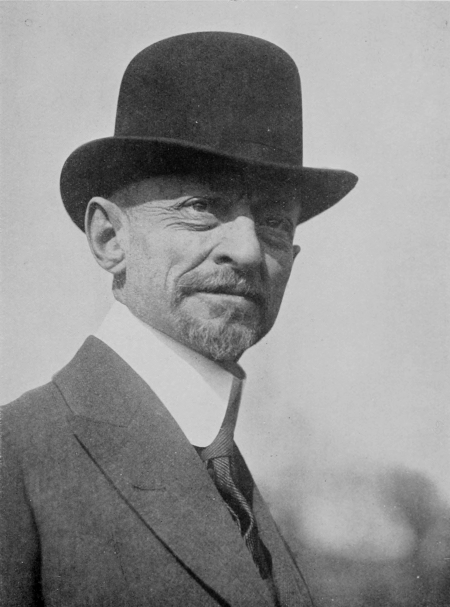
DANIEL FROHMAN.
“‘Ah!’ I said, ‘America may stand for that sort of thing. It is a new country.’
“‘Was,’ came the laconic reply.”
Charles Frohman’s big word was “snap.” If a play had no snap in it there was no Charles Frohman behind it, and a good story used to be told of the experience of a worried author who read on and on, Frohman interjecting at intervals:
“No snap! No snap!”
The worried author lost his temper.
“What the dickens is snap?” he demanded.
“I’ll give you an example,” said Frohman, without a second’s hesitation. “Suppose you start with a scene in a flat. Husband and wife. Husband embraces wife, goes on journey. Lights down. Enter lover. Embrace. Enter husband. Husband missed train. Short brisk talk, no long speeches. Husband shoots both. Husband turns up light, and adjusts spectacles. ‘My God! I’m in the wrong flat!’ Curtain. Snap!”
A fine judge of plays, and one who understood his public, Charles Frohman knew exactly what he wanted, and wasted no time in coming to a decision.
On one of his last visits to London, he went with a friend to see a new play of which much was expected, but little, I fear, realized. After five minutes’ careful attention, Frohman settled himself comfortably in his stall.
“This is fine!” he said, “and I’m going to enjoy myself this evening!”
“But it’s rotten bad, isn’t it?” asked the astonished friend.
[Pg 248]
“That’s why. I know I haven’t got to worry about buying it.”
And Charles Frohman’s popularity in London and his host of English friends formed an answer to the stupid question that at one time was so often asked in London theatrical circles: “Will an American ever understand an Englishman?”
In his capacity for friendship and his cheerfulness under temporary setbacks he was poles apart from Oscar Hammerstein, for example, who, after the failure of the London Opera House, told the New York reporters that he had left London “because of the impossibility of conforming myself to the particular habits and sentiments of the English.” And Hammerstein certainly made few attempts to conform.
Unlike Charles Frohman, he never understood London or the Londoner. He came to London with the declared intention of “bursting up” Covent Garden, and, with no knowledge of English society, regarded its traditions with contempt. That was his first and greatest mistake; the mistake which spelt failure.
By bitter experience he discovered that money was not omnipotent. He opened the magnificent London Opera House on Friday, November 13, 1911, in order, he declared, to prove that he was not superstitious, and from the first it was a lamentable failure. He resented the cold neglect of the public, puffed more cigar smoke, and when he was worried more than usual the poor man, too proud to admit defeat even to himself, would shut himself up alone in his office and play the piano for hours on end.
Then at last, one Sunday afternoon, Oscar Hammerstein stood in Kingsway. The road was deserted, and he had just left his Opera House. He crossed and stood[Pg 249] on the opposite pavement to take a farewell look at the monument he had erected to opera in London.
A disappointed, down-hearted, beaten man, he seemed to have shrunk in stature; his black frock-coat seemed too large for him, and his broad-brimmed high silk hat, instead of being cocked in its usual jaunty manner, was pulled down over his forehead. Gone was the defiant, self-satisfied Hammerstein who had strutted about the vestibule of his magnificent theatre on its opening night, hat on head and puffing his cigar. He still had his cigar in his mouth—in fact he was seldom seen without one. But even his cigar drooped. What was in his thoughts, one wonders, as he stood looking at the beautiful building in which his money and his hopes were buried?
Turning on his heel, with bowed head and lifeless step he walked back to his hotel. He never entered his London Opera House again.
There are still too many Americans—and Englishmen—like poor Hammerstein, who make no attempt to understand or appreciate another country’s little ways and prejudices, and too few like Charles Frohman.
So it was that under Frohman I once more sailed for America, and, preparatory to making my appearance in New York, I played for a few weeks on tour with the famous Empire Stock Company, opening in “The Conquerors” at Power’s Theatre, Chicago, in September, 1898. That first performance was an ordeal, and many a time in the course of it did I bitterly regret having yielded to Frohman’s persuasiveness.
I had been off the stage for a year, and the “behind the scenes” of the theatre, half-forgotten, awoke bitter memories which were only half slumbering. Then, for the first time in my life, I was alone amongst strangers;[Pg 250] they were the kindest of strangers, but still they were strangers, and, in addition I was dreadfully nervous, and had little or no confidence in my own powers. However, at the fall of the curtain the acting manager, Gus Frohman—a brother of Charles—tapped at my dressing-room door and asked to see me.
“I’m sending this telegram about you to Charles,” he observed, showing me a piece of paper.
“What have you said?” I demanded, anxiously, and he showed me the telegram: “Jessie Millward a big success.”
Like every Frohman I have met, Gus Frohman was kindness and consideration itself. During this short tour we were rehearsing Anthony Hope’s “Phroso,” with which we were to open in New York, every day, and playing “The Conquerors” eight times a week, so it was small wonder that, having been so long out of harness, I began to feel the strain. Early one morning there came a knock at the door of my room in the Boston hotel, and in response to my call of “Come in!” a quietly dressed, middle-aged lady entered.
Seating herself beside me she told me that Gus Frohman had sent her to call on me, and that she was a great friend of Mrs. Eddy. I am ashamed to say that in those days I had not the faintest idea as to who Mrs. Eddy was, but in a beautifully soft and sympathetic voice the visitor kept assuring me that she could heal me.
At last: “What is the matter with me?” I ventured to ask.
“Overwork and nerves, my dear,” she replied, “but you’ll soon be very much better.”
“I hope so,” I replied meekly, with the ordeal of my New York début in view.
[Pg 251]
Whether it was due to the gentle little lady’s sympathetic presence or not I am unable to say, but I was able to work from morning till night preparatory to my first appearance at the Empire Theatre without feeling any very ill effects; but perhaps those arduous days at the Lyceum had inured me to hard work, in spite of my long absence from the stage.
On the evening of December 26, 1898, I made my début at the Empire Theatre, New York, in “Phroso,” a dramatization of Sir Anthony Hope’s novel by the author and that gentle gentleman H. V. Esmond.
The Frohman thoughtfulness and consideration met me everywhere; my dressing-room was a beautiful room on the right of the stage, upholstered in gold brocade, and at one end of it was a tall, full-length mirror, with footlights. There were flowers everywhere, and the air was full of kindness. But in spite of all I felt utterly wretched, and as I dressed the tears came to my eyes as I thought how I, a stranger amongst strangers, should miss that kindly, full-throated, warm-hearted old Adelphi roar as I once more set foot upon the scene of my life’s work. Once again, in the atmosphere of the theatre, old associations came flocking around me, and in blank misery I made my way to the stage for my first entrance.
In the first act of “Phroso” I appeared disguised as a boy in Greek costume, and had to walk past a window to make my entrance at the door in the centre of the stage. As I passed the window I seemed to hear a far-off, confused shouting, but when I stood in the doorway I found myself—the lonely, heart-sick stranger—greeted by one of the biggest, warmest and kindest-hearted welcomes I have ever received.
That is another of the precious moments in my life[Pg 252] that I can never forget. Those are the moments that make the player’s life worth living; my heart went out to that generous audience, and as a poor return I gave them of my utmost and my best.
It was during the run of “Phroso” that I first met the American “matinée girl,” and a very charming and very powerful young woman she is.
After the play had been running a few days Mr. Frohman sent for me.
“You’ve made good with the girls,” he said delightedly.
I did not quite understand, but from his manner I felt that it was something to be proud of.
“Is that very important?” I asked.
“I should think so!” he cried, “they rule the matinées.”
And then he went on to explain that the actor or actress who made good with the “matinée girl” would find that at every matinée the house would be packed with girls. The “matinée girls” had their favourites, and vied with one another in the number of times they could see those favourites, most of them keeping little diaries with records of their visits. So you will see how important a young lady, from the point of view of the box-office—to say nothing of the player—was the “matinée girl.”
As I was leaving him: “Tell me one thing more, Mr. Frohman,” I begged. “Everybody is so kind, and every day I receive shoals of invitations from crowds of people who seem to want to do nothing but make me enjoy myself. I can’t possibly accept a quarter of them, and even if I accepted the quarter I should have little time for serious work. Which do you want me to be—an artistic or a social success?”
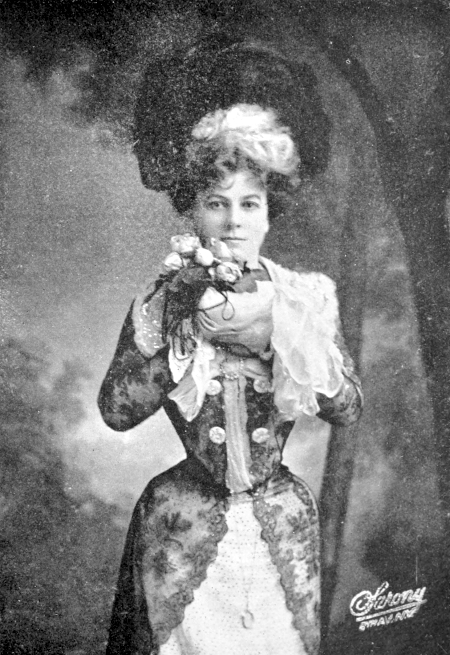
JESSIE MILLWARD AS LADY ALGY
IN “LORD AND LADY ALGY.”
[Pg 253]
“Whichever you like.”
“Then,” I said, “I will try to be an artistic success.”
“That’s what I thought,” was his reply, “and, between ourselves, that’s what I want.”
When at last “Phroso” came to an end, to my astonishment I found myself cast for the part of Lady Algy in Mr. Carton’s brilliant comedy “Lord and Lady Algy,” the play with which Miss Compton and Sir Charles Hawtrey drew all London to the Avenue Theatre. I had little or no confidence in myself, for while I endeavoured to make Lady Algy the smart, good-natured, amusing woman of the world, I had never appeared in such a part before, so at the end of the last dress rehearsal I went to Mr. Frohman.
“I feel I’m going to be a failure,” I told him, sadly, for after all his goodness and consideration I was every bit as anxious for him as for myself. “I don’t think you ought to have cast me for the part.”
“I’ll take the responsibility,” he said, cheerily; “I’m used to it.”
And it is a happy memory that the play, with that fine actor William Faversham as Lord Algy, was a tremendous success for everyone concerned, and in America from that time on my nickname has been Lady Algy.
In one particular instance my identification with the part was profitable. At a race meeting with a party of friends at Sheepshead Bay I was surprised at the persistent way in which the “boys” from the different bookmakers kept coming to me to implore me to “have a bet.” I was just as horribly ignorant of American racing as I was of English, and at last I asked one “boy” point blank why he kept pestering me.
“Well,” said the “boy”—he was really a very big[Pg 254] man—“guess it’s this way. Lady Algy in your play wins a fifty-to-one chance on Flickamaroo. Now if you bet with me, there’ll be heaps of people here who’ll follow you on the chance.”
“All right,” I replied. “I’ll have a bet. What have you got at fifty to one?”
I’m afraid that for the moment his respect for my racing knowledge fell to zero, but perhaps he was not accustomed to young women asking for fifty-to-one chances as they would ask for yards of muslin.
“Well,” he said, “there is a so-called horse running called Harlem Lane. You can have fifty to one about him, but it seems a shame.”
So five dollars “each way” went on Harlem Lane, after which important transaction I and my friends retired to tea. When we returned a blinding snowstorm was sweeping across the course, and nothing of any race could be seen. Presently I heard a voice behind me:
“Guess your fifty-to-one chance won all right,” it said, sadly, and turning, I saw the bookmaker’s “boy” who had tempted me.
“You don’t mean to say Harlem Lane’s won?” I cried in tremendous excitement.
“It sure has,” was the reply, “and”—viciously—“nothing but a condemned old cart-horse like him could ha’ ploughed through this blizzard!”
Poor man, I forgave him his bitterness when I heard that any number of people had followed Lady Algy’s lead, and that night at the theatre I found waiting for me innumerable boxes of flowers with notes thanking me for “the tip.”
After “Lord and Lady Algy” came “His Excellency the Governor,” which Charles Frohman was under[Pg 255] contract to produce, and he asked me if I would play in it, if only for three weeks.
I agreed. “But it’s perfectly ridiculous, Mr. Frohman,” I told him; “I can’t possibly play Stella as she ought to be played.” (Shades of Adelphi heroines!)
I remember we were rehearsed by Dan Frohman, as Charles was finishing his season before his annual visit to England, and one morning before the dress rehearsal I called on the latter.
“Do come to the rehearsal,” I begged him. “I’m making a complete fool of myself, and everybody is laughing, but oh! I am enjoying myself!”
“Go away,” he smiled, “you’ll be late for rehearsal. Dan says you’re fine.”
He was present the first night—he sailed for Europe next day—and when the curtain fell he came to my room and congratulated me.
“And, Jessie Millward,” he concluded with sudden solemnity, “there’s one thing I’m going to tell you. If you ever come to me and say you can play a part, I shan’t believe you.”
It was during the run of “His Excellency the Governor” that I again met that great actor and curious personality, Richard Mansfield, who had deserted England for America. I had first met him on the Lyceum stage during one of his superb performances of Jekyll and Hyde, and I was now invited to a reception at his home on Riverside Drive. Breaking my usual rule I went, and found a gathering of the most celebrated and interesting people in New York.
Mr. Mansfield was particularly kind and attentive to me, and, as he insisted on escorting me personally to my carriage, I felt that, much as I stood in awe of his[Pg 256] curious and impressive personality, I really ought to show my appreciation of his attention and say “something nice.”
“Mr. Mansfield,” I ventured at last, very nervously, “I hear everywhere that, now you have made your home here, you are regarded as the representative actor of America.”
And then as I heard my own voice stammering out the compliment my subconscious self scolded me for its fulsomeness. But:
“Of the world, madam; of the world,” Mr. Mansfield corrected me politely, but very, very firmly.
At the close of the run of “His Excellency the Governor,” I sailed for England for a short holiday at home, bearing with me very happy recollections of my first season with Charles Frohman and the Empire Stock Company.
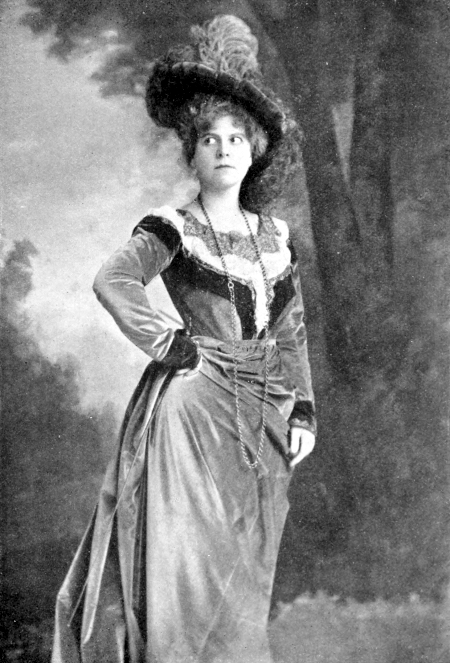
JESSIE MILLWARD AS LADY DOURA
IN “MY LADY’S LORD.”
[Pg 257]
The New York season.—“My Lady’s Lord.”—“Mrs. Dane’s Defence.”—My protest.—Charles Frohman gets his way.—When I come to my own.—Clement Scott.—Cheerful and comforting!—My favourite hobby.—Henry Arthur Jones.—“Diplomacy.”—“Marie Bancroft’s part is the best.”—Madame Sarah Bernhardt.—Why she never learnt English.—She makes herself understood.—The divine Sarah and the reporter.—A clairvoyant’s prophecy.—Its fulfilment.—Leo Dietrichstein.—True French blood.—A full-fledged star.—Impudence.—A new departure.—American “vaudeville.”—Sir Charles Hawtrey.—Sir Herbert Tree breaks the English ice.—Call-boy etiquette.—“A Queen’s Messenger.”—Acrobats as admirers.—Miss Marie Lloyd.—A “movie” defiance of convention.—“The School for Husbands.”—Home.—Death of Sir Henry Irving.
AFTER a short holiday at home I returned to New York in the autumn, and with the Empire Stock Company opened at Power’s Theatre, Chicago, with “Lord and Lady Algy,” touring the big cities and drawing nearer and nearer to New York as the time approached for the commencement of the usual New York season, which lasted from December to May.
The first play of the season was “My Lady’s Lord,” by Harry Esmond, who crossed the Atlantic to supervise the production. In “My Lady’s Lord” I created the part of Lady Doura, but the play did not achieve the success it deserved, and was followed by “Mrs. Dane’s Defence,” by Henry Arthur Jones.
Better accustomed as I was by this time to Charles Frohman’s methods I was rather surprised to find myself cast for the part of Lady Eastney, and suggested mildly[Pg 258] that the anguished Mrs. Dane was more after the parts in which I was known at home.
“See here,” he said, “Miss Mary Moore is Charles Wyndham’s leading lady, and she played Lady Eastney. The part was good enough for her.”
“It’s not a question of the part being good enough,” I protested, “it is whether I am suited to it.”
“And besides,” he went on, cutting me short, “we want you in comedy over here.”
Of course I yielded. Charles Frohman usually got his way, but I could not resist one little comment.
“I wonder,” I said, “what my real line of business is. On the other side of the Atlantic I am called an emotional actress, and I’m told there that the public insist on seeing me in emotional parts. Here I am a comedienne, and you tell me that the American public insist on seeing me in comedy. Where do I come to my own?”
“Possibly in the middle of the Atlantic!” he laughed.
While I had begun to have immense confidence in Frohman’s judgment I still had occasional qualms as to my fitness for my new rôle, and I was not reassured in the least when shortly before Mr. Jones’s play was put into rehearsal I met Clement Scott, who was on a visit to New York.
“Well, Jessie,” was his greeting, “Jones has written a great play, and I’m glad that you are to have your chance as Mrs. Dane.”
“But I’m to play Lady Eastney,” I told him.
He stared at me in very unflattering surprise.
“Well,” he said, “I wouldn’t pay sixpence to see you in comedy!”
Cheerful and comforting, was it not?
But Frohman was a better judge of the American[Pg 259] public and of my little abilities than Scott, and the Lady Eastney of the American production pleased the big American public and had heaps and heaps of nice things said about her, for which she was intensely grateful. It is always pleasant to have nice things said about one, and I have sometimes thought that if I were suddenly asked my favourite hobby, I might, in an unguarded moment, reply quite truthfully: “Listening-in to compliments.” But they must be real compliments, not make-believe ones. It was through acting in “Mrs. Dane’s Defence” that I first met its brilliant author, Mr. Henry Arthur Jones, and for that reason alone I look back on my appearance as Lady Eastney with pride and affection.
In my humble opinion, “Mrs. Dane’s Defence” is a very great play indeed, and its production forms one of the landmarks of the modern stage. At the time it provoked much discussion, and more than once it was asked whether the author was using the Sir Daniel Cartwright or the Lady Eastney to express his own opinions.
In a hitherto unpublished letter, written in 1901, which is before me as I write, and which I have his permission to quote, Mr. Jones says:
“In reply to your question as to whether I am speaking through Lady Eastney’s lips or through Sir Daniel Cartwright’s lips in the last act of ‘Mrs. Dane’s Defence,’ my answer is that my own opinions have nothing to do with the matter. I have merely given, I hope, fair expression and fair play to the two opposite sides of the question, the man’s and the woman’s. It is obvious that these two points of view must always be more or less opposed to each other. It is, of course, also obvious, as you say, that[Pg 260] ‘Convention must win almost invariably in the end’; but this is only because all the great laws that govern human conduct are necessarily highly conventional. The sixth, seventh, and eighth commandments are highly conventional rules of conduct; to go against them does not so much imply unconventional behaviour as unsound morality. With regard to the ending of the play, I wished that the final impression should be one of calm and hope, and not of despair. I think it is bad art to leave the audience disturbed and distressed at the final fall of the curtain.—With sincere regards, faithfully yours, Henry Arthur Jones.”
The New York season was to conclude with an all-star production of “Diplomacy,” and with a twinkle in his eye Charles Frohman asked me which part I would play—Dora, created in London by Mrs. Kendal, or the Countess Zicka, created by Lady Bancroft.
“Marie Bancroft’s part is the best,” he said.
I read the play, and for once I agreed with him and immediately chose the part of Zicka, although I knew that I was undertaking no light task, for in America that splendid actress Rose Coghlan had for years been identified with the part, and any fresh interpreter would naturally lay herself open to severe criticism and comparison.
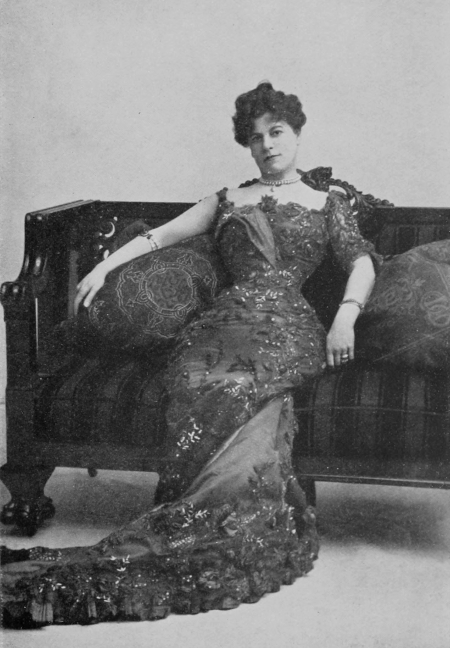
JESSIE MILLWARD AS LADY EASTNEY
IN “MRS. DANE’S DEFENCE.”
A week before my appearance I was at a reception given by Miss Marbury and Miss Elsie de Wolff at their charming house in Irving Place, and there I met Madame Sarah Bernhardt. Ever since—many years before—I had seen her as Camille, I had worshipped the great French artist, for her performance as Camille first opened my eyes to the wonderful possibility of sinking [Pg 261]oneself into a character and entirely losing one’s own identity. Camille had lived before me, and Bernhardt had lived and suffered as Camille. Later, three times in one week I went to see her as La Tosca during one of our vacations at the Adelphi, and I would return home exhausted myself after that wonderful torture scene. She was, of course a frequent visitor at the Lyceum, and often and often would I gaze furtively at her box from the stage and marvel at her.
Therefore I was nervously flattered and excited when I found that she remembered me and asked to meet me. We chatted for a time through an interpreter, and she reminded me of many of the parts I had played at the Lyceum. Then she said that she had heard that I was to play in “Diplomacy,” and asked what part I had selected. I told her that I had chosen the part of Zicka.
“Wise girl,” she said, nodding her head; “that is the part.”
And then I summoned up courage and asked her why she, who could do nearly everything, and had such multitudes of admirers in England and America, had never learnt English.
She laughed.
“Madame has never had the time,” explained the interpreter.
Wonderful Sarah Bernhardt!
When a critic on a New York paper hinted delicately that her frizzy hair was false and that her teeth were too good to be her own, she called on him, and letting down her hair before him:
“Pull eet!” she exclaimed. “Is eet real or not?”
And then, taking his finger, she bit it.
“Are zey false?” she demanded.
[Pg 262]
At all events the great Sarah knew enough English to make herself understood. But another descriptive reporter, I fancy, drew on his imagination when he wrote that with some difficulty he had penetrated the great tragedienne’s hotel sitting-room to make enquiries as to her future arrangements, and had asked, among other things, whether she intended visiting all the States.
“Boston, Chicago, Philadelphia, St. Louis, Baltimore, Minneapolis, sure—but nix on the punk towns,” was the reply that the divine Sarah was reported to have given.
The American reporter is a splendid fellow, but his bump of veneration is—to put it mildly—not overdeveloped, as a little cutting from a criticism of a vaudeville performance which I have preserved will show:
“At the —— Theatre this week are Hiram Van —— and his chorus bevy of Beef Trust Beauties. Hiram’s own figure don’t leave much room for scenery while he is on the stage.”
Nor was the divine Sarah by any means the only theatrical victim of the amusing, resourceful American reporter about this time, for not very long after the Bernhardt incident Mrs. Langtry, then Lady de Bathe, paid a visit of inspection to her ranches at Los Angeles, and became the subject of a “scoop.”
Very quietly did a famous journalistic “hustler,” whose smiling boast it was that he could travel anywhere on his gold teeth, follow her on her travels, and at last he overtook her at a level crossing. Cheerfully pulling off his hat he was about to introduce himself and ask for a “story” when the Jersey Lily touched his arm and said: “For goodness’ sake, stand further back! There’s a train coming!”
It was enough.
[Pg 263]
And a few hours later all New York was staring at the flaming bills:
LADY DE BATHE
SAVES
PRESSMAN’S LIFE!!!
“Diplomacy” was a great success, and Miss Margaret Anglin’s performance of Dora, which followed immediately on her triumph as Mrs. Dane, proclaimed her one of America’s greatest actresses.
At the end of the New York season I once again returned to England, and, with Arthur Collins, secured the English rights of Marion Crawford’s play, “In the Palace of the King,” and Clyde Fitch’s “The Climbers,” both of which had been big successes in the States. During this holiday I made up my mind to remain in England, but it was not to be, and my next visit to America was attended by some curious circumstances. One afternoon two girl friends who were lunching with me announced that they were on their way to visit a clairvoyant.
“Do come with us,” one of them pleaded, “it’s awfully exciting, and she tells you the most extraordinary things.”
“Rubbish,” I said, “you neither believe anything of the kind!”
However, they persuaded me to accompany them to a house in North Kensington, where I sat in a sort of waiting-room while my friends had their interviews. Each came back looking slightly bewildered, declaring that it was very astonishing, and then I was persuaded to take my turn.
I entered the mystic chamber and soon found myself seated opposite a little, dark woman, who sat huddled over a crystal, into which she peered. At last:
[Pg 264]
“I see a star over your head,” she said, in a curiously monotonous tone, “and you have crossed the water, and are in a city with very high buildings. I see a little, round, fat man at a table. He is smoking a huge cigar, and he suffers much from pains in his head. He is surrounded with manuscripts, and he wants you to help him, and if you do not he will not use them. You will get a telegram from him, possibly at midday, and when you see him he will first apologize for not writing, but he writes so badly.”
After this, and some more which didn’t particularly impress me, and which I do not remember, I rejoined my two friends, who seemed to expect that I ought to be extremely enthusiastic.
“It’s utter rubbish,” I told them. “From what I could make out she said I am going back to New York, and I haven’t the faintest intention of doing so.”
That, I remember, happened on a Friday, and I had dismissed the matter from my mind when on the following Tuesday at midday I received a telegram from Charles Frohman asking me if I could possibly see him at two o’clock that afternoon at the Carlton.
I called, and when I was shown into his room, in spite of myself I started.
Sure enough, here was the little, round, fat man, smoking the huge cigar, and continually mopping his head—poor man, he suffered agonies at times—and, strangely enough, his first words were an apology for his abrupt telegram.
I sat opposite him.
“One moment, Mr. Frohman,” I said, as he was about to speak. “You want me to come back to the States, and you have a play, and if I don’t play in it you won’t take it!”
[Pg 265]
He looked up in astonishment.
“Who told you that?” he demanded.
“Never mind,” I replied. “Then it is true?”
“Certainly it’s true, but I haven’t mentioned it to a soul. I’ve got an option on the new play which is to be produced at the Haymarket Theatre, an adaptation of “The Ladies’ Battle,” called “There’s Many a Slip,” and if you don’t take the part Miss Ada Rehan wants the play and I shall let her have it.”
“Very well, Mr. Frohman,” I said, “I’ll play it.”
“Good,” said he, and I could see that he was very much surprised at my quick acquiescence, especially as I knew nothing of the part. And then we talked about the play.
I rose to go, and as I was leaving I turned to him:
“I suppose you will laugh at me, but I got all this information from a clairvoyant.”
“I’m not laughing,” he said. “I’m the winner.”
It seemed a pity that the clairvoyant did not see a little more, for the play was not a big success. I was on the Atlantic when it was produced at the Haymarket with Miss Winifred Emery in the part I played in America, and apart from its psychic associations its chief claim to my remembrance is that in it I was first associated with that brilliant author and actor Leo Dietrichstein, whose “Great Lover” is a recent success.
If not exactly a clairvoyant, Leo Dietrichstein prided himself on his powers of intuition.
I was lunching with him and his wife one day when he observed, à propos nothing:
“Miss Millward, I feel sure you are of French origin.”
“Why?” I asked.
[Pg 266]
“You have so many little actions and ways which remind me of a French actress.”
Of course I felt very flattered.
“Well,” I admitted, “I am of French origin.”
“What did I tell you?” he cried triumphantly, turning to his wife, and then, to me: “Again and again I’ve told my wife that I was certain you had French blood in your veins. I felt it, and I knew I could not be mistaken. I never am when I feel like that.”
“You weren’t,” I assured him solemnly, “my mother was a Miss French—of Cheltenham.”
Which merely goes to prove that some intuitions, while perfectly correct, are occasionally ambiguous.
At the end of “There’s Many a Slip” I was “lent” by Charles Frohman to Henry Miller, the distinguished father of Gilbert Miller, a fine actor and a brilliant manager. Henry Miller was an Englishman, and later, in 1909, appeared at the Adelphi in his famous American success “The Great Divide.” I was “lent” to create the part of Helen in Richard Harding Davis’s play, “The Passing of Helen,” and I thoroughly enjoyed my association with Mr. Miller. I had previously been warned that, though a delightful and clever man, he had a notably violent temper, but all I can say is that I never saw it, though on one or two occasions he would have been perfectly justified in showing it.
Returning to New York I appeared as a full-fledged “star,” which meant seeing in huge electric letters over the theatre the name: “Jessie Millward”—at first a somewhat embarrassing but a very pleasant experience. Once again I created in America a part created in England by Miss Compton, Mrs. Tracey Auberton in Claud Carton’s “A Clean Slate,” and then, greatly daring, I played Beatrice in “Much Ado about [Pg 267]Nothing” during a special engagement with the Century Players.
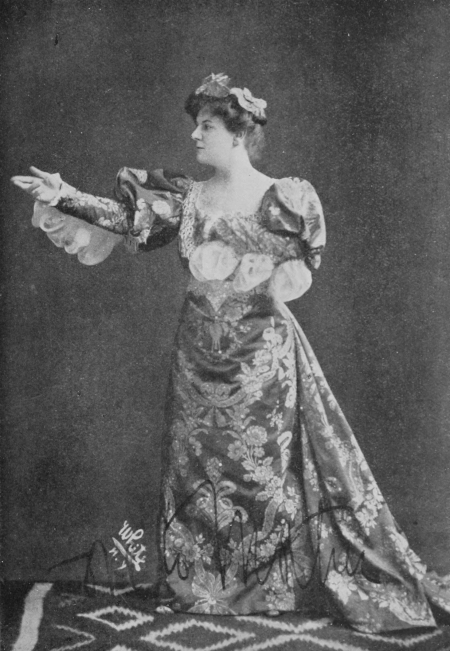
JESSIE MILLWARD AS BEATRICE
William Winter, Irving’s old friend, wrote a very flattering criticism of my performance, adding that while, of course, Ellen Terry was the ideal Beatrice, my reading of the part came near to hers.
And so it ought to have done, for not only had I played Hero to her Beatrice for some hundreds of times, but I had also understudied her, and, with my usual habit of picking all brains worth picking (in remembrance of that conversation with the matron of the drama), I considered that I had given almost an imitation of the divine Ellen. It was very impudent, of course, and I should never have dared to have done it at home, any more than I should have dared to play Beatrice, but just as I have always considered Ada Rehan’s Katharine the only possible and perfect one, so do I regard Ellen Terry’s Beatrice. To those who remember it in its perfection there can be no other.
About this time, to my surprise, I was continually receiving offers from managers to appear on the music-halls, or, as the Americans put it, “in vaudeville,” in any one-act play I chose, the stipulation being that the play was only to last twenty minutes. Offer after offer I declined, for in those not very far-off days the line between the so-called legitimate and illegitimate stage was still very sharply drawn, and I am afraid that we who called ourselves legitimate artists were apt to look down upon the music-hall as the abode of performing animals and red-nosed singers.
One afternoon in New York the telephone bell in my hotel sitting-room rang, and after listening to the message I replied “No!” very curtly, and then, turning to my guest, a well-known American lawyer:
[Pg 268]
“These music-hall people are eternally pestering me,” I said. “Some people called Keith and Procter have just rung up and asked me if I would appear at their Fifth Avenue Theatre. It’s too absurd to consider for a single moment.”
“What sort of terms did they offer you?” he asked curiously.
“The terms are as absurd as the idea,” I replied, and told him the sum, the size of which appalled him.
“Good heavens!” he cried, “I’d do anything for that—short of murder! Why on earth don’t you accept it?”
And then he went on to explain the changing outlook in America on vaudeville, the desire of the big vaudeville managers for a change in the class of performance, and wound up by telling me of the beauty and comfort of Keith and Procter’s theatre.
So impressed was I that I rang up Keith and Procter, told them that I had changed my mind and that I would accept their offer. A little later my ’phone rang again, and I found that the speaker was none other than the present Sir Charles Hawtrey, who was over in New York on a visit.
“I hear that you are going to appear in vaudeville,” he said.
“Yes,” I replied, and told him of my offer.
“Well,” he answered, “I’ve also just had an offer.”
“Then you play the first week, and I’ll play the second,” I suggested, and so it was arranged.
As I have said, in those days it was an innovation for a legitimate actor or actress to play on the music-hall stage, and I believe that Sir Charles Hawtrey and I were almost the first to do so in America. It was not for some years afterwards that in London the cachet[Pg 269] was finally given to the halls, and the tradition broken once and for all, by the appearance of Sir Herbert Tree at the Palace Theatre in 1912 in Kipling’s “Man Who Was,” although by 1912 nearly every prominent American actor or actress had appeared in vaudeville at one time or another.
And in English theatrical circles Sir Herbert’s invasion of the “halls” created quite a mild sensation, and many were the stories told.
On the evening of his first performance the folk behind the scenes were, it was said, very perturbed as to the exact mode of address to adopt towards the great actor, and grew more and more nervous as the time for his turn approached, and stories of Sir Herbert’s vague notions of time recurred to them. In vaudeville, with its constant succession of turns, “time is of the essence of the contract,” and as the minutes drew slowly on, and there were no signs of the “star,” the world behind the stage became very nervous and highly-strung. At last a resourceful call-boy saved the situation.
Dashing round to the “star’s” dressing-room he banged loudly on the door.
“’Urry up, ’Erbert!” he bawled. “Woodward’s seals is nearly through!”
For my first appearance I chose a one-act play, “A Queen’s Messenger,” by Hartley Manners, the clever author of “Peg o’ My Heart,” played in England by Miss Granville and Mr. Aubrey Smith, and terribly nervous and anxious I was when the curtain rose on my first turn. Fortunately all went well, and I thoroughly enjoyed myself, seeing very little, if any difference between the music-hall audience and the audience to which I had so long been accustomed. One[Pg 270] thing that particularly struck me was the clever arrangement of the vaudeville programmes; not only did the different items never clash, but each turn was introduced in a suitable atmosphere. For example, to get the atmosphere of “The Queen’s Messenger” the little play was always preceded by a serious and very fine singer.
During this engagement I appeared twice daily—at three-forty in the afternoon and at nine-forty in the evening—and before and after my performance I was always wildly interested in the other items in the programme, and used to send my maid Lottie down to find out and to report to me what was going on on the stage.
One afternoon she came back to the dressing-room with pursed lips and a frown of disapproval.
“What turn is on?” I asked her.
“Some—some acrobats, Miss Jessie,” she sniffed.
“I love acrobats,” I cried excitedly, “I’ll run down and watch them from the wings.”
She made to stop me.
“I don’t think you’d like these acrobats, Miss Jessie. They’re not at all—nice.”
“How many are there?”
“Oh, a lot.”
“What are they, men or women?”
“All sorts,” she replied, primly.
“What ages?”
“All ages.”
By this time my curiosity was fairly aroused.
“Well, I’ll go and see for myself,” I answered, and pushing past her went to the wings, to find that the “acrobats” were a troupe of monkeys dressed as Chinese laundrymen. For a little time I stood at the[Pg 271] side of the stage much amused, and then I noticed that something seemed to have gone wrong with the laundry business. I could hear an invisible trainer expostulating with his “artists,” and then I noticed that all the “artists” were gazing in my direction, and the “star,” a huge, sinister-looking ape in Chinese costume, was slowly making his way across the stage towards me.
“Please go away, Miss Millward,” begged the voice of the stage manager in my ear. “The monkeys have seen you, and you’ve fascinated them so that they won’t go through their performance!”
I was wearing a glittering gown and head-dress, and the glitter had attracted my fellow performers—but not everyone can boast of having fascinated a troupe of monkeys!
Vaudeville is very strenuous work indeed; your effect must be made at once, and the whole time you are on the stage the pressure must be kept up to the topmost notch, but the experience, if rather exhausting, was most valuable and interesting.
Still, in my first experience of the work in America, I felt very much inclined to agree with a charming and bright little lady who one day stopped me in a New York street.
“I’m Marie Lloyd,” she said. “I’m the head-liner this week at Brooklyn; I see you are next.”
“Yes,” I said; “this is my maid, Lottie; she’s English, too.”
“Oh how do you do, my dear?” cried Miss Lloyd, and to Lottie’s astonishment shook her warmly by the hand.
“And how do you like America, Miss Lloyd?” I asked her.
[Pg 272]
“Oh, it’s all right,” she replied, “but everybody is in such a bally rush!”
Miss Marie Lloyd was right.
It is indeed curious nowadays when one reflects that a very few years ago indeed it was considered beneath the dignity of the legitimate artist to appear on the films, just as it had been previously considered beneath his or her dignity to appear on the halls, and in England it was again Sir Herbert Tree who defied convention and established a precedent when for a huge fee he performed his version of “Henry VIII” before the camera. Again, innumerable were the criticisms, and one gentleman, who had attained some little notoriety over a “press stunt” in which a police-court case over an alleged matinée hat nuisance had figured, was very caustic in his remarks about “lowering the dignity of the drama.”
When he was told of the criticism Sir Herbert smiled.
“All I know is that I’ve enjoyed the experience immensely,” he chuckled. “The money is in my bank, and I think that the gentleman in question is talking through his matinée hat.”
At the time of my vaudeville experiences a costume comedy, “The School for Husbands,” by an Englishman, Stanlaws Stange, had made a great success at Palmer’s Theatre, Broadway, and I liked the play so much that I counted myself very fortunate in being able to secure the English rights, especially when Mr. Stange told me that I was the one English actress he wanted for the part of his heroine. I had begun to feel a longing for home, and a desire to appear before an English audience in rôles totally unlike those in which they had been accustomed to see me—“and,”[Pg 273] I said to myself, “if Charles Frohman and the American public like me in comedy, I don’t see why my own folk should not.”
So I arranged to take the beautiful Scala Theatre for a season from an old friend, Dr. Distin Maddick, whom I had first met during my three years at Drury Lane, where he was the kindly theatre doctor.
I sailed for home in the late autumn of 1905, full of high hopes, but my home-coming was soon saddened for me by the death of one to whose memory I can never sufficiently discharge my debt of love and gratitude—Henry Irving.
How often had I heard Henry Irving repeat those lines in “Becket,” and those were the last words the great actor and great man spoke upon the stage—the words with which he took farewell of the art he had ennobled.
The swift, merciful and painless ending to a long, brave struggle against ill health and the caprice of fortune is now a matter of theatrical history.
More and more had he begun to feel the physical fatigue of his work—he, the indefatigable, tireless Irving. “The Bells” had been withdrawn from his repertoire, as involving too much strain; his faithful friends did all that he permitted them to do to lighten his labours, but the indomitable spirit still wore out the fragile body, and on his return from his last performance of “Becket” at the Theatre Royal, Bradford, he collapsed in the hall of the hotel, and died in the chair into which he had sunk exhausted.
That chair is now a treasured possession of Seymour Hicks.
[Pg 274]
“My dear Jessie”—he wrote me—“It is quite true I have possession of the chair Sir Henry Irving died in. It was presented to me by the Midland Railway directors, and it stood in the outer hall of the Midland Railway Hotel at Bradford. Sir Henry Irving drove up to the door in a four-wheeled cab, and as he was assisted out of it, having been taken desperately ill at the theatre at the end of the performance of ‘Becket,’ he collapsed, and was assisted into this chair, in which he breathed his last. When it was found that he was dead, he was carried up a short flight of stairs and laid upon the sofa in the lounge, after which he was placed on the floor. The chair was marked in pencil by the hall porter, there being twelve others like it at the hotel, and was initialled by the directors at my request. It is now in my possession.—Very kindest remembrances, yours ever, Seymour Hicks.”
His body was brought to his London flat, and then taken to the home of his kind old friend Baroness Burdett-Coutts, and now, as I write these lines, the last treasures of that famous house have been dispersed; house agents’ boards proclaim that all is changed, and dust dims the windows in Piccadilly through which the historic white china cockatoo used to glare fixedly at the Green Park.
On the afternoon of Thursday, the 19th of October, I met the faithful Bram Stoker, and the no less devoted Norman Forbes, who told me that the coffin was to leave the Baroness’s house for the Abbey that night about eight o’clock, and with them I took my stand in the silent crowd some little time before the appointed hour.
[Pg 275]
Suddenly the traffic stopped, all heads were bared, and passing slowly through the gloom of a London October evening came the hearse, with four huge crimson wreaths, followed by one carriage containing Harry and Laurence Irving, and the devoted valet Walter. It was poignantly impressive, that sad little procession moving slowly along Piccadilly in semi-darkness, through the waiting, silent crowd to the Abbey. And on the morrow they laid his ashes in that “Poets’ Corner” where the statue of Shakespeare looks down on the tombs of Henry Irving, David Garrick and his wife, Samuel Johnson, Charles Dickens, and those others of the great-minded dead who did so much with their lives to ennoble their art and language.
[Pg 276]
“The School for Husbands.”—Disadvantages of loyalty.—Some curious theatrical history.—Mr. Henry Arthur Jones.—“The Hypocrites.”—An actress’s qualifications.—America again.—Miss Doris Keane.—The three great essentials.—A fascinating experience.—A regret and Sir Arthur Pinero.—Anxious moments.—I consult King Solomon.—His Majesty speaks his mind.—I make a prophecy to Mr. Jones.—Success.—My prophecy confirmed.—Entering into the part.—Marriage.—A brother’s compliments.—A compliment in verse.—John Glendinning.—Buying a play.—A pleasant town.—Vaudeville.—“Mr. Fitzsimmons, the eminent boxer.”—A pugilistic play.—Professional jealousy.—Women at boxing matches.—A poison mystery.—The fatal draught.—“Cleopatra’s” ambition.—Home.—“The Rosary.”—Shattering an illusion.—War.
THERE is no kinder, more loyal public than the British public, but its very loyalty sometimes makes it intensely conservative, and “The School for Husbands” had not quite the success one had hoped for it; partly, I think, because the audience could not understand why the Jessie Millward they had known and been so good to at the Adelphi should be playing in comedy.
I was told that night after night the attendants at Dr. Distin Maddick’s beautiful theatre would hear the same disappointed comment:
“Oh, yes, it’s very nice, of course—but it’s a comedy!” and the critics, though equally kind, echoed the complaint.
“Miss Millward proves herself to be a brilliant comedienne,” wrote one of them generously, “but—”[Pg 277] and the “but” seemed always the same—“when are we to see her again as the familiar and adorable persecuted heroine?”
This loyalty to the past in its very kindness was disturbing, for players are, after all, only human, and the loyal audiences and kindly critics overlooked the sad associations and painful recollections evoked by the old familiar parts. I had long determined that never could I go back to them, and Charles Frohman had backed me in my decision.
And in spite of its occasional drawbacks, the conservatism of the great British public had its inestimable advantages—once that public has taken you to its heart it never forgets you. Tradition plays a part, and a kindly part, in the life of the theatre-going public of Britain, and the younger generation of playgoers are by no means contemptuous of it, even if they are at times quite pardonably inclined to mix their traditions.
For instance, it was during my season at the Scala that in the lounge of the hotel in which I was staying I chanced to overhear an interesting little piece of theatrical history.
The historian was a young gentleman, one of those inconsequential talkers who are fond of discoursing loudly in public places for the benefit of everyone within earshot. The conversation had evidently been upon theatrical topics, and presently someone asked him his opinions of the Scala.
“Oh, structurally and decoratively it is a beautiful house,” said he, “and I’m glad to see that the management is reverting to the style of comedy with which the place won immortality—I mean such plays as ‘Money,’ ‘Caste,’ ‘The School for Scandal’ and all[Pg 278] the rest that Marie—er—Marie Lloyd first made her name in.”
Shades of the Bancrofts and the old Prince of Wales Theatre!
But I had no reason to regret my season at the Scala, for it led indirectly to a renewal of my association with Mr. Henry Arthur Jones.
Mr. Jones came several times to see my excursion into comedy, and one afternoon came round to my dressing-room and asked me if I would call and see him at his house in Portland Place in order to discuss a play. Naturally I felt delighted, and the next morning at eleven o’clock punctually I was on his doorstep. His first words gave me a mild surprise.
“Miss Millward,” he said, “would you object to play the part of a mother—a well-preserved woman of, say, forty-five?”
“Object! Good gracious, no,” I replied.
“Good. So many actresses do object, I find.” And then he went on to tell me that Charles Frohman was very anxious for me to return to the States. I frankly admit that I was disappointed. After my long absence, I had hoped to be able to settle down once more in my own home. However, Mr. Jones read his play to me, and I was both delighted and fascinated.
“What have you called it?” I asked.
“‘The Hypocrites.’”
“A splendid title. But, Mr. Jones”—for a sudden fear had struck me—“I’ve never played a part of this type before; how can I play the part of the mother as you have created it? I’ve never been one.”
“An actress has imagination,” he replied. “Surely it isn’t necessary for a lady to commit a murder in order to play Lady Macbeth!”
[Pg 279]
So I joyfully accepted the part, and a few days later the company met and the author read the play, and it was in Mr. Jones’s drawing-room at Portland Place that I first met my future husband, John Glendinning, who was cast for the part of the only character who was not a hypocrite.
The English company which sailed for America included John Glendinning, J. H. Barnes, Arthur Lewis, Leslie Faber, myself and Mr. Jones’s daughter, and the only two Americans in the cast were Richard Bennett and Miss Doris Keane, who has since achieved fame and delighted so many thousands of playgoers on both sides of the Atlantic in “Romance.” Long afterwards, when London was flocking to see the clever lady in her famous part, I met Mr. Jones near the theatre in which she was playing.
“When you saw her in that little part in “The Hypocrites” did you think she would rise to this?” he asked.
“Yes, I did,” I replied truthfully, for even in those days and in a tiny part Doris Keane had impressed me by her intelligence, industry and charm—those three essentials to success in the world of the theatre.
We were to open in “The Hypocrites” at the Hudson Theatre in New York, and immediately on our arrival we started rehearsing under the direction of the author.
I have, I think, been more fortunate than most in my professional career. I have rehearsed under the personal direction of the most distinguished folk in their line, under great actors and actresses such as Henry Irving, Genevieve Ward, and Mrs. Kendal; under great producers such as the Frohmans, Belasco and Augustus Harris, and also under authors as distinguished as Henry Arthur Jones, Haddon Chambers[Pg 280] and Comyns Carr, amongst many others, and it has been a lasting regret with me that I was unable to accept Sir Arthur Pinero’s offer to me to create the part in “The Profligate” played by Miss Kate Rorke, but I was engaged at the Adelphi, and the Gattis quite rightly refused to release me. Nor when he asked me to play Paula Tanqueray in Australia could I obtain a release from my engagements, and I fear that my chances of learning a Pinero part under Pinero are gone for ever.
“Why don’t you come back? We want you,” he told me gallantly when I met him at the private view of the reconstructed Drury Lane.
“I’m too old,” I replied. It is always best to face the truth, however horrid!
The rehearsals of “The Hypocrites” were a wonderful and valuable experience. And those rehearsals were no joke—not that rehearsals should ever be a joke—but the heat in New York that August was well nigh tropical, and, accustomed as I had been to the tireless energy of Irving and the exhausting Lyceum routine, even I began to feel something of a physical and nervous wreck as the time for production of the play drew near.
As so often happens after the long and anxious rehearsal of a play to which one is burning to do every justice, there came a sort of reaction on the very day before the production. We were all very depressed, very languid from the heat, and very nervous, and the author’s kindness and tolerance were highly tried.
As I walked back in silence to my hotel with my maid Lottie, I felt desperately gloomy. Once more the horrible doubt began to assail me that perhaps I was mis-cast; that I could not possibly do the author justice; that, from beginning to end, my interpretation[Pg 281] was utterly wrong, that—but every creative artist knows the doubts that come flocking in on the mind in certain moods. What did the morrow hold? And just then my eye was caught by a sign over a doorway:
ARE YOU WORRIED ABOUT TO-MORROW?
THEN CONSULT KING SOLOMON.
“Lottie,” I announced, “I’m going to consult King Solomon.”
“Rubbish, Miss Jessie!” said Lottie severely, “You’ve gone mad!”
But I had rung the bell, and in an instant the door opened and a faded-looking woman was asking me what I wanted.
“To consult King Solomon,” I replied.
“Miss Jessie—” began Lottie, in whispered remonstration.
“Have you an appointment?”
“No; I’ve only just seen the gentleman’s sign.”
“King Solomon only sees clients by appointment.”
“That’s a blessing, anyway,” blurted Lottie, “and now, Miss Jessie, perhaps you’ll come along.”
But at that moment a door in the background opened, and a tall figure in a red velvet robe, and wearing a sort of tinsel crown on his woolly locks, appeared. King Solomon was a full-blooded negro, as black as your boot and fully six feet tall.
“King Solomon will see the lady,” he announced in a high, reedy voice—a weird voice to proceed from such a bulk—and the woman stood aside for us to enter.
His Majesty waved me into his holy of holies, a dark little den opening out of a dark passage.
“Don’t go away, Lottie,” I whispered hurriedly and[Pg 282] a trifle nervously as I passed in, for I had not bargained for a tête-à-tête with a coloured monarch.
“Me go away!” sniffed the indomitable Lottie. “King Solomon or no King Solomon, I stand here on this mat till you come out.”
Seating himself opposite to me, the King looked earnestly into my hand, and then began to gaze into a bowl which apparently contained ink. For some time he mumbled unintelligibly, and then he began to speak.
“It seem to me,” he piped, in that curious head voice, “that you are surrounded by bad people—scandal-mongers and hypocrites. It seem to me you in big building, in crowds of people, all shouting and making great noise. It seem to me great success somehow. It seem to me you long time in place. It seem——”
There were several other “it seems” of various intelligibility and importance, and then “it seemed” to His Majesty that his fee was one dollar and the séance was concluded.
Next morning I met Mr. Jones at the theatre.
“We’re going to have a huge success to-night,” I told him.
“I hope so, I’m sure,” was his answer, “but one can never tell.”
“I can tell.”
And the play was a huge success, the audience rising to its feet and cheering wildly as the author bowed his acknowledgments from his box at the end of the third act.
“I told you it was going to be a success,” I reminded him afterwards. “I had private information about it beforehand.”
“From whom?”
“King Solomon!”
[Pg 283]
So great was the success of “The Hypocrites” that Mr. Jones’s play became the topic of literary and artistic New York, and the papers were filled with correspondence on its “lesson,” or what the writers of the letters thought to be its “lesson,” and various literary societies held debates on the questions raised by the play.
At one such debate, at the Astor Hotel, I was asked to take the chair, but not feeling equal to speaking in private I resigned the honour in favour of Mr. Murray Carson. The subject for discussion was: “Is a mother ever right in sacrificing her son’s future?” and the discussion soon became very animated, even heated. And so excited did I become that I remember leaping to my feet and crying wildly:
“No! I’d do anything and everything on earth to protect my sons!”
“For all the world,” as someone afterwards told me, “as if you had a family of at least a dozen!”
Which merely went to prove the truth of Mr. Jones’s remark to me after his first reading of the play, that a lady need not commit a murder in order to enter into the feelings of Lady Macbeth. An actress must have imagination.
“The Hypocrites” settled down into a great success, and after a long run at the Hudson Theatre in New York went on the usual tour of the big cities.
It was while we were in New York, however, that during the Christmas Day matinée Mr. Glendinning came to me as I stood in the wings and said: “Jessie Millward, will you marry me?”
“Go away! How dare you? You must be mad!” was my rather unconventional reception of the proposal.
“I shall ask you every day until you say ‘yes,’” was all he said, and he carried out his word. His first[Pg 284] rejection was on Christmas Day, and on January 24, 1907, we were quietly married, with my faithful Lottie as witness, in a beautiful church on Broadway, on a glorious, sunny winter morning.
On leaving the church we drove straight to a telegraph office and I cabled my brother Percy: “Tell mother I was married to-day.”
Back came my brother’s answer: “Tell him he is the luckiest man in the world, but we should like to know his name.”
It is nice that a brother should have such a high opinion of his sister.
And very soon afterwards came another compliment, this time in verse, from an old friend who had known me all my life, which I have always treasured, and hope to be forgiven for reprinting it. But if poets will write kind and flattering verses they must abide by the consequences.
JESSIE MILLWARD
Alfred S. Johnstone.
Hillside, Rednal,
Worcestershire, July 3, 1907.
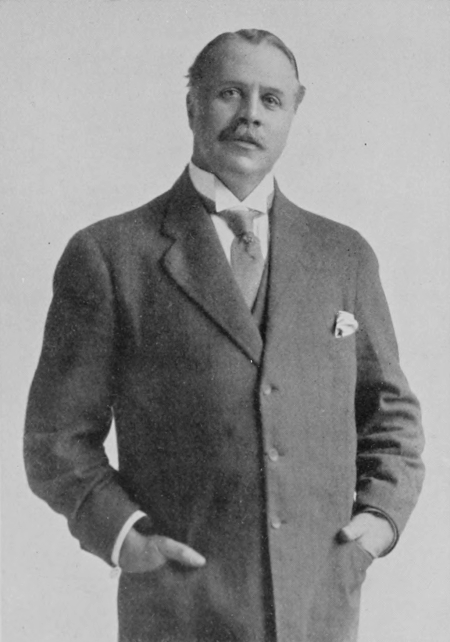
JOHN GLENDINNING.
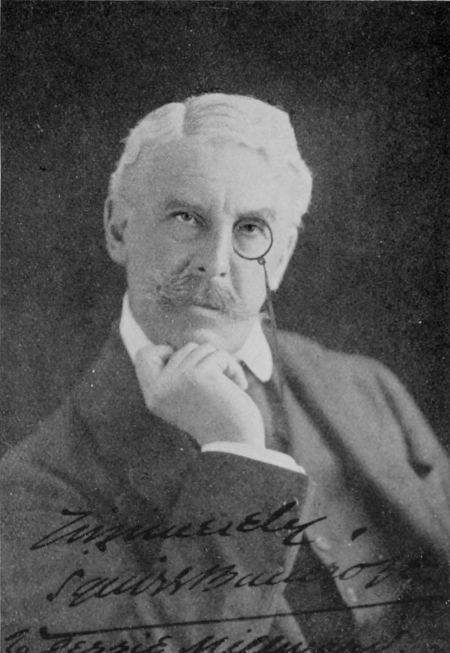
SIR SQUIRE BANCROFT.
[Pg 285]
As an actor my husband had represented the leading character in nearly every leading play, ancient and modern, and in determining the range of his versatility one had not to bother to strain one’s calculations beyond two points—“Macbeth” and “The Girl in the Taxi.”
In the ’eighties Mr. Glendinning was known all over the United Kingdom as “the Terriss of the road.” While Terriss, handsomely defiant, was steadily winning the evergreen stage case of virtue versus vice, and vice versa, at the Adelphi every night and at Saturday matinées, John Glendinning was doing likewise in the provinces.
Romantically and physically robust enough for the hero of “The Harbour Lights,” it naturally fell to the lot of Mr. Glendinning to be chosen to follow Wilson Barrett in “The Silver King” and Charles Warner in “In the Ranks.” From melodrama he passed to comedy-drama—to “A White Lie” at the Court, under the management of Mrs. Kendal, and it was this engagement that led to his future work being confined almost entirely to the American stage. In 1889 he went with the Kendals to New York, playing Octave in “The Ironmaster,” Victor in “Impulse,” and Captain Tempest in “A White Lie.”
Later he played lead with Cara Morris in “The New Magdalen,” “Renee,” “Camille,” and “Claire,” and from that time onwards was engaged in playing to American audiences an extensive variety of parts, including Shylock and the Laird in “Trilby,” Othello and Mark Embury in “Mice and Men,” Iago and Sir John Plugent in “The Hypocrites,” Mercutio and Charles Summers in “Irene Wycherley,” Macbeth and Frederick Smith in “The Girl in the Taxi.” His last appearance was in “The Rosary,” in which he played[Pg 286] the part of a Catholic priest, Father Brian Kelly, a lovable and sympathetic character which has won thousands of hearts in America and in the British Isles.
At the conclusion of the tour of “The Hypocrites” my husband and I returned to England, and spent the summer at our bungalow at Lancing Beach. During our holidays I heard great things of a one-act play, which was being acted in London by Arnold Bell and his wife, called “As a Man Sows.” I went up to town, saw the play, liked it, and invited Mr. Bell down to the bungalow for the week-end, in order to discuss terms. He came, and I bought the rights for vaudeville in America, as I felt the playlet was just the very thing for my husband and myself to act together.
When the deal was completed, Mr. Bell wired to his wife: “Miss Millward has bought ‘As a Man Sows’ for America.” On his return to town Mrs. Bell expressed her surprise at my decision to go in for pig-keeping.
“What on earth do you mean?” asked her husband, and she showed him his wire as she had received it: “Miss Millward has bought many sows for America.”
Even in those dear, dead ante bellum days beyond recall the postal system was not absolutely perfect.
Late in the autumn we returned to America, and after a season in “Lady Frederick,” in which I played the part of Lady Merestow, my husband and I had a delightful tour along the Pacific coast with “As a Man Sows”—which we re-named “Reaping the Whirlwind”—visiting Los Angeles, Colorado, San Francisco and the other principal cities of that beautiful coast, now and then breaking our journey and resting a week or two in some place that particularly appealed to us. It was a wonderful experience, and was more in the[Pg 287] nature of a prolonged holiday among glorious surroundings than of a workaday theatrical tour.
In spite of the increased popularity of vaudeville, in one or two of the cities we visited we found people who expressed a little surprise at seeing me on the music-hall stage, and in San Francisco an interviewer asked me point-blank why I was playing in vaudeville.
“Read that sign,” I told him, and pointed to a printed notice which was fixed to the dressing-room door. It ran:
“Salaries are paid every Saturday night.”
“And my salary is a very pleasant one,” I added. It seemed to me a very sound reason, and also convinced the interviewer.
One met all sorts of interesting folk on this tour.
Walking one day with my husband, a tall, heavily built man who was passing raised his hat, and, rather to my surprise, my husband called to him and introduced him.
“This is Mr. Fitzsimmons, the eminent boxer, Jessie,” he explained, and Mr. Fitzsimmons thrust forth a huge hand.
“Glad to know you, Miss Millward,” said the ex-fighting man; “always glad to meet a brother professional.”
“A brother professional?” I stammered.
“Well, p’r’aps I should say sister professional. Me and my wife’s taken to the stage, and are starring in a sketch.”
In those days, instead of taking to the films, famous pugilists adopted the music-halls when the ring had ceased to lure them, and Fitzsimmons was at that time touring in a sketch in which he played the hero, shod a[Pg 288] horse—his original profession had been that of a blacksmith—and boxed three rounds with the villain.
If all one heard was true, it was necessary to renew the villain occasionally.
So great was the attraction of the halls for “professors of the fistic art”—I believe that is the correct phrase—that even old John L. Sullivan was starring in a playlet called “Honest Hearts and Horny Hands”—or something like that.
But there would seem to be a certain amount of professional jealousy even amongst theatrical pugilists, for when Mr. Glendinning questioned Fitzsimmons as to Sullivan’s success:—
“Bless you, Mr. Glendinning,” he replied, “old John L. will never make a real actor like you and me. He’s not got the artist’s nature. Half a dozen stage directors have given up even trying to break him of the habit—just as he’s pulling on the gloves to do in the girl’s betrayer—of coming down to the footlights and confidentially winking at the audience.”
“Did you notice the diamonds in his teeth?” asked my husband when he left us. I had noticed them, and came to the conclusion that, instead of decorating his wife or his sweetheart with diamonds, the successful pugilist preferred to use them for tooth-stoppings. Which is all a matter of taste.
Mr. Glendinning always maintained that the success of Fitzsimmons over Corbett settled once and for all the much debated question as to whether women should attend championship fights.
“Only think, Jessie,” he would say; “here were the two fighters, dazed, semi-exhausted, after a long and punishing bout. Corbett was still a possible winner, and had not Mrs. Fitzsimmons been at the ringside a[Pg 289] different tale might have been told; but with the unerring tact of the true woman she seized the psychological moment, and, rising in her seat, she cried shrilly to her devoted husband: ‘Never mind his nut, Bob! Paste the tinker in the slats!’ Whereupon her obedient spouse immediately delivered the all-conquering ‘solar plexus jolt’ and Pompadour Jim bent to the storm.”
Such, at least, was Mr. Glendinning’s solution of the problem. It was Greek to me.
“Reaping the Whirlwind” was a grim little tragedy in which a woman, for entirely excellent reasons, poisoned a worthless man, and from the first the poison gave us trouble.
As the playlet was under no circumstances to last longer than twenty minutes, the exact kind of poison to be used became important. If any sort of realism was to be attempted a lingering death from strychnine, for example, was out of the question, and after my husband and I had debated the question at some length I rang up an old medical friend, Dr. McPherson, and implored his advice.
“I’m in a dreadful fix,” I told him over the ’phone, “and I want you to help me.”
“Of course,” came his voice. “What is it?”
“Tell me the quickest kind of poison there is.”
“Depends on what you want to poison. Is it a dog?”
“No, it’s my husband.”
I heard an indescribable exclamation at the other end of the wire, and then came the doctor’s voice:
“Look here,” he said, “I’m coming round to see you at once. Don’t you go out till I come; I’ll be round in a few minutes. And suppose you lie down. I’ll be round immediately.”
And he rang off.
[Pg 290]
When in an incredibly short time he arrived at the hotel he seemed quite surprised to find my husband and myself still earnestly discussing the quickest possible death by poison.
After the particular brand of poison had been settled on—with the doctor’s advice—there was still another difficulty to arise. On our first appearance at Hammerstein’s—an appearance which Oscar Hammerstein had told me was in the nature of an experiment, as he did not yet know his audience would care for serious drama—to my horror I noticed as I was about to hand the fatal glass to my victim that there was a large fly in it. Knowing Mr. Glendinning, I knew too well that play or no play, Hammerstein or no Hammerstein, nothing on earth would persuade him to drink from that glass if once he saw the fly. Hiding it with my hand until the last moment I gave him the fatal draught, and to my intense relief he swallowed it, fly and all.
Then I began to feel uneasy. The fly might be a poisonous one; I might in reality have poisoned my husband; all sorts of terrible complications might ensue, so when I got back to my dressing-room I implored Lottie to get a glass of brandy and take it round to my husband’s room.
“When we met later: “What on earth made you send Lottie round to me with some brandy?” he asked.
“I—I thought you looked pale,” I stammered feebly, but I hadn’t the courage to give the real reason for some considerable time.
Another little contretemps over that death scene occurred at Denver. Like many other people, I felt the effect of the rarefied air, and several times during the performance I felt myself on the verge of collapse. But I pulled myself together, administered[Pg 291] the fatal dose, the victim died, and the curtain came down to loud applause. Barely was it down before I gasped: “Jack, I’m fainting! Catch me!”
My husband leapt from the floor and caught me, and at that very moment the curtain, rising for a “call,” disclosed the murderess clasped in her victim’s arms.
A break-down, resulting in a long and serious illness in New York, brought our tour to an end, and after lying in hospital for weeks I determined that if I was going to die I would die in England, so from the hospital I drove to the steamer, and settled down once more in London.
Shortly before my illness I had seen a performance of “The Rosary,” a play by Edward Rose—who was for many years associated with Charles Frohman at the Empire Theatre, New York—which had attained an immense popularity in America, and when I sailed for home I had arranged with my husband that we should buy the English rights. Owing to his professional engagements he was unable to sail with me, and was obliged to remain in the States for a few weeks, and so keen was I on the play that for a week after landing I cabled him every day: “Have you bought ‘Rosary’?”
Poor man!
But at last came the impatiently expected cable: “Have bought ‘Rosary’ and am sailing Wednesday.”
News of the American success of “The Rosary” had already reached England, and when my husband landed it was to find that many plays, in the titles of which the word Rosary occurred, were being played all over the country, so the first and most obvious thing to be done was to get our “Rosary” played somewhere, somehow, and at once, in order to protect the title: “The Rosary.”
[Pg 292]
A company was hurriedly engaged and the play was put into rehearsal, and, a suitable London theatre then being out of the question, my husband set to work to improvise a tour.
“Get it done, no matter where,” I had begged him, and one day he came to me with an amused smile.
“For heaven’s sake, don’t look at my letters in the morning,” he said, “if you do, I dare say you’ll have a fit.”
“What on earth is the matter?” I asked him anxiously.
“Nothing is the matter. I’m only going to produce ‘The Rosary’ next week.”
“Where?”
“You remember what you said: ‘No matter where’?”
I nodded.
“Well, the only theatre we can get at once is the Elephant and Castle. So that is where we start.”
The Elephant and Castle Theatre was not quite in the West End of London, certainly, but the great thing was to get the play produced as quickly as possible. So at that theatre the tour started.
I had not wished to play the heroine; however young one may feel in heart a certain physical youth is desirable in stage heroines—in my humble opinion, at least, though I sometimes have had reason to wonder if I am in a minority—but in Liverpool and one or two of the bigger towns Mr. W. W. Kelly and others lured me to play, and in Woolwich I had a little adventure which almost persuaded me into the belief that I had been absurdly bashful about my age.
After a matinée at Woolwich a girl sent her card up, asking if she might see me for just one moment, and, remembering vaguely what Charles Frohman had[Pg 293] instilled into me of the vast importance of that powerful young lady the “matinée girl,” I was on the point of saying that I would receive her when my maid anticipated me.
“Do see her, Miss Jessie,” she pleaded, “she seems so nice and so anxious.”
So a charming girl of about eighteen was shown into my dressing-room, and after shily thanking me for receiving her:
“I did want to see you so much, Miss Millward,” she stammered nervously; “I’ve admired your performance more than I can say, and my mother always admired your mother so much. Your mother was her favourite actress when she was young, and she always talks about her performance in ‘The Harbour Lights.’”
“In ‘The Harbour Lights’?”
“Yes, that was the first play she saw your mother in, and she fell in love with her on the spot.”
“My dear,” I said feebly, all my best grammar failing me under the shock, “that was me!”
“You!” she cried, staring at me round-eyed—I was still in my stage costume—“it couldn’t be! My mother’s quite an old lady.”
It is terrible to shatter the illusions of youth, but it had to be done, even at the risk of shattering one or two of my own few remaining illusions about age.
It was during this tour that occurred that great tragedy which eclipsed all minor tragedies.
The war broke out.
[Pg 294]
The 4th of August, 1914.—Unforgettable pictures.—The rule, and the exception.—A personal grievance.—The American point of view.—Lionel Mackinder.—Dyeing to die.—“Carrying on.”—The theatrical profession in war time.—Unconquerable humour.—Death of my husband.—The unchangeable suburb.—An old Adelphi friend.—Alma Murray.—Mr. Robert Pateman.—A new Hamlet?—History repeats itself.—The theatre of to-day.—The young actor and actress.—A player’s first duty.—Irving and Terriss.—A contrast in tours.—A new field.—The film.—A great art in its infancy.—Tom Terriss.
WAR! It scarcely seemed credible. That fourth day of August, 1914, which was to be the last day in the life of the world of the old familiar ways, and was to see the birth of a new, strange and portentous era, was, on the surface, absurdly, tragically like other days. The majority of people seemed numbed, dazed, and unable to grasp the full meaning of the looming tragedy, and went dully about their ordinary tasks. In the streets, in the shops, in the business centres of the great cities, the same throngs moved in much the same fashion, but, whether it was in my imagination alone or not, it seemed to me that in those terrible days each was gazing almost furtively into his neighbour’s eyes, and wondering, always wondering. There was a drawing together, a feeling of a common brotherhood in the face of a common, unknown danger, which abolished the distinction of classes and status in the twinkling of an eye. In an instant the nation seemed to have become one vast family. And wherever one moved, whenever[Pg 295] one listened, there were the voices of the newsboys crying: “War! War! War against Germany!”
In the memories of all of us who passed through those days are unforgettable pictures. It was all so new, so strange, and the impressions were all so vivid. Vaguely one realized that all the pleasant old ways had passed for ever; that an abyss had suddenly opened at one’s feet, into the depths of which the sight could not penetrate.
The unknown yawned suddenly in front of one, and one could only wonder, wonder. Certain sounds of those days are indelibly recorded in my memory. The hoarse cries of the newsboys, for example; the night-long clanking of the troop trains, never ceasing, never pausing; the singing of the recruits as they marched into the unknown; the indescribable, anxious note in the murmuring voices of the crowds in public places. And certain sights are unforgettable. The waiting throngs of quiet, determined youths—now, as we realize only too sadly and well, the flower and chivalry of the nation—at the hastily improvised recruiting stations; wherever one went, one found those silent, grimly patient throngs of boys with stern, set, unboyish faces.
In nearly every home in the land the same great scene was being enacted as was enacted in mine. The bell rang, the door burst open, and a nephew of eighteen, a lad who seemed but yesterday a schoolboy with leanings towards sweets and pocket-money, rushed into my room.
“I’ve enlisted!” he cried, with the air of one who has a great load lifted from his mind.
“But what will your father say when he hears of it?” I asked weakly. Only yesterday, it seemed, he was a child in knickerbockers.
[Pg 296]
“What would he say if I hadn’t?” he demanded proudly.
But there were others, and the others were the exceptions that made the rule more glorious.
On the day after war was declared I was driving down Whitehall with my husband and a young English actor of thirty-three years of age, who, having made a success in America, was now on a visit to England, and seemed to take it as a personal grievance that the nation had spoilt his holiday by declaring war on the Hun.
My husband drew his attention to the patient, waiting thousands who filled the Horse Guards Parade.
“Of course you’re going to enlist?” he observed gruffly.
“Well, I don’t know; I’m thinking it over,” was the peevish answer. “It’s an infernal shame—the whole beastly thing. After a lot of hard work I came over here to have a good time, and I’m not getting it.”
And that is an actual record of a conversation I can never forget.
Within a few days the gentleman who was not getting a “good time” had sailed for New York, and soon after was once more playing his favourite rôle of hero at the safe distance of three thousand miles of Atlantic.
As I have said, the exceptions to the rule were so few and so glaring that they stood out with extreme prominence, and the theatrical club in America may be forgiven the notice which they posted in their smoke-room: “To Englishmen! Your King and Country Need You! We don’t!”—the more especially as America had not at that time even faintly begun to realize the gigantic magnitude of the issue.
I think that every member of my profession has a right to be proud of its record in the war. Very, very[Pg 297] soon the boards were deserted by all the young and able-bodied, and many who were neither young nor able-bodied prevaricated and lied their way into the firing line. Poor Lionel Mackinder, for example, who, in spite of his youthful appearance was years above the military age, in the very early days found a hero’s grave, and there were many like him. And I remember one actor, who is happily still alive and who shall be nameless, whom I met sometime in 1916 in Oxford Street looking the picture of gloom. He had done nobly in those terrible fields of Flanders, and I had heard that he had been wounded and sent home, so my delight at seeing him was only damped by his general air of sadness.
“What is the matter?” I asked him, when we had chatted for a moment. He removed his uniform cap.
“Look at my hair,” he said.
“What is the matter with it,” I asked, somewhat mystified, “there seems plenty of it.”
“Plenty of it,” he retorted peevishly. “Of course there’s plenty of it, but it’s grey, grey! I didn’t expect a medical board for another month, so I haven’t been dyeing it lately, and now they’ve suddenly sprung a ‘board’ on me for this very afternoon—and—and the beastly dye takes at least twenty-four hours to work. The last time they saw me I was a bold brunette, and even then they hinted that I was a bit old for the part!”
And when he shook hands and I wished him God-speed: “It’s a curious world, isn’t it, when one has to dye to die?” he asked whimsically.
For the women, the over-aged, and the unfit of the profession the noblest task seemed to be to “carry on” as best one could, and to brighten and cheer the all too short hours of leave from the shell-torn fields, and to[Pg 298] lighten, so far as it was in the power of human beings to lighten, the lives of the maimed and broken.
Yes, I am proud of my profession’s work in the dark days of Armageddon. For, believe me, there were few of us who had not our own anxieties, for whom the dreadful casualty lists had no terrors, but if anything were needed to hearten us it was supplied by the bravery of the men we tried to amuse and help to forget.
Never, for instance, shall I forget two maimed lads at a performance of “The Rosary” for the wounded at Brighton. They were chums, I heard; they had “joined” together, had fought side by side, had been wounded together; each had lost an arm, one the right and the other the left. And side by side they sat at the performance, and when they wanted to applaud—as they did very often—one maimed boy laughingly struck his right palm against his chum’s left.
Yet again. Into the big hall at St. Dunstan’s trooped in single file a long line of sightless men, each with his hand lightly resting on the shoulder of the man in front of him. Suddenly one of them lost touch, and for a second the rear half of the procession halted. Then from the end of the line came a mock-impatient question:
“What’s the matter, Alf? Dropped your opera glasses?”
And the sightless men roared with laughter as at some Gargantuan joke, while the sighted folk laughed also—but there was a sob in their laughter.
And it was in a London hospital that a plucky little actress of my acquaintance who had become a volunteer nurse, received one of the shocks of her life. She was a tender-hearted soul, full of sympathy, but she at first failed to realize that even a badly wounded Tommy[Pg 299] had a strong desire to keep up appearances, therefore she had a severe shock when an irrepressible patient, with both legs hideously fractured, and whose splints, being longer than the poor legs, stuck out beyond the foot of the bed, called her anxiously to his help.
“What is it?” she asked kindly.
“Nothing in particular, sister,” he replied bashfully; “on’y please cover up these splints. The visitors ’ll think I’m a bloomin’ wheelbarrow.”
She instantly covered them up, and thereafter, seeing that she was at heart a sympathetic soul and appreciated a man’s little vanities, he admitted her to his confidence. Whenever I met her she had some new story of her “wheelbarrow man,” as she used to call him to his face, to his own vast amusement and to the mystification of the doctors and visitors, and one of them I remember as typical of the unconquerable humour of the poor maimed men who saved us.
There was a confirmed hospital visitor who meant dreadfully well. She was a lady of very high rank indeed, with a very loud voice and a very kind heart, but she would make the fatal mistake of “talking war.” Now, not every badly wounded man, back once more in clean sheets and civilization, cared to talk war, but war was her topic and she worked it to death.
“And how many Germans did you kill on the ridge that day?” she asked fatuously.
He opened his eyes wearily, and took her in at a glance.
“I dunno exactly, mum,” he whispered. “I was wounded before I’d finished counting ’em—but they’ve stuffed my mattress with the whiskers.”
With such a spirit among the wounded and the men on leave the task of the theatres in “carrying on”[Pg 300] in war time became a duty. What did the darkened towns, the lighting and travelling difficulties, the thousand petty discomforts matter, when the men who were really suffering, really enduring, and whose life amid the mud and lice of the trenches was a hell on earth, could, in their brief respite from torment, gain a little happiness, a little forgetfulness?
So the men on leave, the anxious ones at home, and the maimed and wounded all found hours of forgetfulness and of laughter in the theatre. Some Spartan folk there were who blamed the profession for the lightness, frivolity and inconsequence of the war-time productions, but Tragedy was stalking through the land, and the greatest problem play in history was being played on the stage of the world. Surely a few hours’ inconsequent laughter at inconsequent nothings could not be grudged to the actors in that play?
While acting on tour at Cheltenham my husband was taken ill on the stage. I was telegraphed for, and, travelling in a crowded troop train, I reached the town I had not visited since I was eight years of age, although it loomed large in our family history. At Cheltenham my great-grandfather, my grandfather, and my mother were born, and at Cheltenham my husband died.
And then—so does history repeat itself—I returned to London to take a flat in West Kensington three houses away from the house in which I had lived with my parents in those old Adelphi days, when, at the urgent request of my poor mother, I used to stop the hansom from the theatre at the corner of the street, and walk the few yards to the door at night, as “the neighbours would not think it respectable for a hansom to drive up so late at night.” Not to say that in those days it was[Pg 301] considered distinctly “fast” for a young woman to be seen in a hansom at all!
But in many ways West Kensington has changed but little, and of all London districts I know seems the least affected by the march of those twin decorators and renovators, time and progress. The same people live there; they look older, that is all.
Shortly after taking up my abode I entered West Kensington Station, and the stationmaster came up to me.
“You won’t remember me, Miss Millward,” he observed, “but many’s the time I’ve watched you from the Adelphi gallery in the old days—many’s the time I’ve opened your carriage door for you when I was a porter at this station and when you were off to the theatre.”
So little does West Kensington change that James Hurford has been at that same station for thirty-eight years.
And the butcher is the same—he looks older, like the rest of us, but he is the same, and he remembers; the newsagent is the same, the doctor is the same—no one seems to leave West Kensington, or if they do, it is only to return.
And it is a colony of familiar faces.
I turn a corner and I meet Alma Murray—Alma Murray, whose performance in “The Cenci” drew letters of praise from Robert Browning; a musician who knew Sims Reeves greets me on my doorstep; a friend of Irving’s bows to me as I take my ticket, with the stationmaster at my side who was porter thirty-odd years ago. And when I visit a near-by theatre whom do I find myself next to but Mr. Robert Pateman, whom I have not seen since the death of Mr. Terriss.
[Pg 302]
We found that we had both been attracted to the theatre that afternoon by the desire to see Mr. Bransby Williams in “David Copperfield.”
“He is a great actor,” I observed to Mr. Pateman as the curtain fell.
“He is,” replied the stately old gentleman. “And I will tell you a secret. He will be a wonderful Hamlet, and he has confided to me that he means to play it.”
Secrets are so difficult to keep, are they not?
And then we talked of his dear wife, who was my friend at the Adelphi—the Adelphi once again as I write devoted to melodrama, so does history repeat itself—and of many, many memories, happy and sad, including even the domestic servant problem.
“You were luckier in your maid than my wife was in hers,” he smiled, and a long-forgotten memory once more came to mind. I had been boasting to Mrs. Pateman of the treasure I had found in Lottie.
“Ah,” she sighed, “how I wish I had your luck, my dear. My last experience has been too awful. She was from the country, and, as she said she had never been to a play, I told her one evening that while we were out she could go to the theatre at Hammersmith, which was quite close, as our house was in Castlenau, Barnes, but to be sure to be back before we arrived home from the West End. Of course, when we arrived there were no signs of her, and when midnight struck, and then one, I grew seriously alarmed, and had visions of a country girl lost in London. I knew the play, ‘Uncle Tom’s Cabin,’ was over long before the Adelphi play, and couldn’t imagine what had kept the girl. At last I heard a noise in the garden in front, and rushing through the hall I opened the front door—and there she stood.
[Pg 303]
“‘What on earth does this mean?’” I asked, angrily. For a moment she did not answer, and then I became aware of a horrible scent—gin, my dear.
“‘Oh, mum!’ she gulped, ‘Little Eva’s dead—an’ it so upset me that I felt quite faint!’ And then she burst into floods of maudlin tears.”
Again I look around as I write, and see history repeating itself.
As I have said, the Adelphi is once again given over to drama of the kind which acquired the name of “Adelphi drama”; the play which set the seal on the reputation of Mrs. Patrick Campbell (who followed me at the Adelphi), “The Second Mrs. Tanqueray,” has added fresh laurels to brilliant Miss Gladys Cooper; Pinero plays are once more the vogue, and, what possesses a peculiar interest for me, Tom Terriss, the son of the original David Kingsley is engaged on a production of “The Harbour Lights” for the films, in which appears the niece of the original Dora. Soon—who knows? he may be already waiting in the wings—the great tragedian may stride upon the scene and another Irving may fill the stage.
All the others are there—the brilliant comedians, the clever comediennes, and I think I see a great tragic actress. And he will come once more, the Garrick, the Kean, the Macready, the Irving of his day.
It seems the mode, in certain circles, to take a gloomy view of the present of the theatre, and an even gloomier view of the future. But I was ever an optimist, and as I survey the present condition of the art I love I see little reason for pessimism.
Artistically, the war phase was a bad one, and has left its mark. Sneer as you may at the actor-managers[Pg 304] and the commercial managers of pre-war days, folk such as the Bancrofts, Irving, Tree, Wyndham, Alexander and the Frohmans loved and knew their theatre, made it their life study, and within their limitations—and who has not limitations?—gave of their best ungrudgingly and devotedly.
The same can scarcely be said of the host of business folk, who, during the curious war period, looked upon the theatre as an outlet for their superfluous capital, and regarded theatrical speculation in the light of an agreeable flutter. Perhaps the phase was unavoidable—in a world upheaval the arts go first to the wall—but it was a phase that did harm, and the effects are not even yet wholly eliminated.
But as I look around I refuse to be pessimistic. I see many clever young people, men and women, who, given fair opportunity and provided they take to the art seriously and reverently, need fear no comparison with the great names of the immediate past.
But I entreat them to take their work seriously. I am old-fashioned enough to believe that it is the player’s duty to give his or her public the best that is in his or her power, and when I look back at the severe and constant work which was thought necessary in my day, entirely apart from the actual performances at the theatre, I permit myself to wonder whether the ambitious young actor or actress who sandwiches a performance between a late lunch, or a dance tea, and a supper dance until the small hours, is physically in a fit condition to give that best to the public who pays.
Each of us, I am aware, must in such matters be a law to him or herself.
[Pg 305]
Nothing delighted Irving more, for example, than to sit up to all hours of the dawn over a cigar with a few of his intimate friends, discussing his art and aims, but Irving was essentially a lonely man, yet a lover of the company of the carefully chosen few. And Irving, as I have said, was made of steel and whipcord. Mr. Terriss, on the other hand, a fervent believer in the open air and the simple life, had his bowl of bread-and-milk—I can see the modern fashionable young jeune premier smile!—between the acts at nine o’clock every evening of his life, and observed the early-to-bed rule as closely as it is possible for a member of our profession to do so.
Healthy relaxation is essential alike for mind and body, and in no profession is it more essential than in the actor’s, for the actor of necessity lives on his nervous temperament with one great object, to fit him to give of his very best to the public by and in whom he has his being.
And the ambitious young man and woman of to-day is far better off in a way than I and my contemporaries were; a vast, new and barely explored field has been opened to them in the cinema.
For long, I confess, I was inclined to treat the film as an amusing toy, valuable, possibly, for educational purposes, and for recording events pictorially for the benefit of posterity, but I begin to realize that I was wrong. It is true that in its earlier phases the film play seemed to me to savour too much of the “penny blood” and the “penny novelette” of my childhood’s days; but the days are already passing when lunatics leaping from precipices, mad cowboys lassoing express trains, and “a crime to every foot of film” seem to be the[Pg 306] producer’s ideal. I may be unduly optimistic, but in the film world I fancy I see the uneducated, illiterate, commercial element retiring gradually into the background, and a new generation of artists and of dreamers who mean to make their dreams come true.
And in this connection I cannot do better than quote from a long letter I received from one of the younger generation of enthusiasts in answer to some criticisms of mine.
Tom Terriss writes:
“In the seven years that I have put in in the making of motion pictures I have played and watched the game from every angle. I cannot exclaim ‘Eureka!’ (which is Greek for ‘I know it all’), but this I can say—the trouble with the cinema is formula. There are set formulas for writing titles, for stories, formulas for entries and exits, formulas for beginnings and endings.
There are not enough bold, creative spirits who will continually smash all rules and formulas. In the rapid development of the mechanical side of picture-making in America the artistic side is being lost sight of. There are beautiful ‘effects,’ but few ideas. Story-writers, directors, title-writers and actors are tied hand and foot by the purely mechanical and business brains that will eventually make the American-made picture the most perfect mechanically in the world, but the least creative, the least intellectual and the most tiresome.
The crying need of this great art is big independent writers and epic directors who can work untrammelled. This real wonder of the modern world is to-day almost wholly controlled by men not to the cinema born. It[Pg 307] is as though Mr. Edison were to call in a barber to run his plants or the ‘Daily Mail’ were to pick a cigar salesman for managing editor.
During my seven years in studios I have watched the manufacture of pictures from the day the story was bought until its production on Broadway. I have seen the story passed on to the scenario (or continuity) writer, who put it into 480 scenes, describing in his script the minutest action of every character, planting the fades and the close-ups with a complete set of titles. I have seen the script changed by the supervising director, passed on to the director, who shot it, scene by scene, from the manuscript; the building of each ‘set’ by the carpenters from the blue prints from the art department, the continual re-editing and cutting of the film after twenty runs in the raw in the projection room, the re-titling, the making of insets (letters, documents, photographs, etc.), the making of title cards in the laboratory, and the final run in the theatre of the studio for the ‘critics’ from the main office—who just as often pronounce the whole thing ‘rot’ as they signify with an enigmatic shake of the head ‘It’ll pass!’
There is only one question after these months of labour—not is the picture ‘good’ or ‘bad,’ ‘true’ or ‘false’—but ‘will it get over?’ And the question is perfectly legitimate, for the cinema is neither educational nor philanthropic. It is as purely a commercial enterprise as selling soap.
There are rare and beautiful instances when artistic effect and commercial values marry. ‘Sentimental Tommy,’ ‘The Four Horsemen of the Apocalypse,’ ‘Experience,’ ‘Peter Ibbetson’ are instances.
[Pg 308]
Before I went into the cinema I had heard a great deal about the ‘fascination,’ the ‘magic’ of the game, and the way it ‘gets you.’ ‘How to get into the cinema’ is the slogan of millions. No one was ever told how to get out of the cinema—for no one wants to get out having once got in. I have never met a person who voluntarily left the cinema for another business.
But when I first entered the studio the fascination and the magic were nowhere apparent. I couldn’t find cinema land, the modern democratic fourth dimension. On the great stages, where sometimes ten scenes were being shot at once, there seemed to be a series of dumb shows going on, interrupted by the hammers of carpenters, the blare of jazz bands, the gong of the director, or his megaphone.
A girl leaped from a castle window into a net held by stage-hands. Tom Meighan was being knocked down in a bar-room; Wallace Reid, in a military uniform, was bowing and scraping to a double-decked duenna; Constance Binney was cooking ham and eggs in a garret; Elsie Ferguson leaned out of a balcony while her stage lover sat on a fire hydrant off scene, chewing a cheese sandwich. Bewildering, but sometimes dismal.
But with the passing days the curious unreality of this world begins to creep into your blood, bone and tissue. These unsubstantial and fading scenes begin to attack and dilate your imagination. Living with a picture from its inception to its last shot built up in me a ‘fiction sense.’ To battle in conferences over people who never lived and dramatic and comic situations that have no reality; to create word pictures (titles) so that they shall fit exactly into the place where[Pg 309] they must go; to live day and night with the doings of mythical beings, to make them do this and that at your will, to see a story growing day by day into flesh and blood before you—that is the fascination, that is the magic, comparable only to the sculptor’s passion when he turns a block of stone into a Galatea.
And once this creational furore seizes you it can never leave you. You may quit, you may chuck the cinema if you will, but the voice of the director rings in your ear still.
You may have noted that men in the various departments of the cinema never talk about anything else. I soon caught the fire. It is because everything that happens becomes a picture. Every face you meet is judged by camera standards. The whole planet becomes a motion-picture studio. All events are poses. I found stories in stones, and shots in everything.
A great many actors and actresses in the cinema portray characters whose fictional names they do not know, and quite often they have not even read the story of the play they are helping to film.
Motion-pictures, the eighth art, are not yet twenty years old, and yet they are always being sneered at because they are not on a ‘higher level.’
What art in the history of the world has progressed so fast?
Painting is one of the oldest of the arts—but not one picture in ten thousand is worth looking at.
Literature is one of the oldest of the arts—but not one book in ten thousand is real literature.
Music is one of the oldest of the arts—but the immortal composers do not number twenty.
Dancing is one of the oldest of the arts—but to-day the world ‘shimmies’ and ‘jazzes.’
[Pg 310]
Architecture is one of the oldest of the arts—but the masterpieces of architecture are few.
Sculpture is one of the oldest of the arts—but how many Rodins, Michelangelos, and Praxiteles are there?
Play-writing is one of the oldest of the arts—but there is not one play in fifty that is worth seeing and not one in ten thousand that lives.
Most books, plays, music and painting are only fit for the ashpan—after incalculable years of work on them.
What the seven arts have achieved only at long intervals in thousands of years, the Jeremiahs demand that an art barely twenty years old shall achieve every day!
No part in the history of humanity can compare for one moment with the achievements of the motion-picture art in twenty years.
No art that is so essentially and necessarily democratic as the motion-picture art has done more for the imagination, the intelligence, the education and the entertainment of mankind.
The seven arts existed hundreds and thousands of years before they gave birth to an Æschylus, a Moliere, a Shakespeare, a Rembrandt, a Beethoven, a Mordkin, a Rodin, a Cervantes, an Acropolis.
And there are those who demand of the eighth art—which is an outgrowth and a blending of all the arts—these miracles in twenty years!
In twenty-five years, with millions behind me and a free foot, I might conceivably put the American-made motion-picture on a level with the highest products in the other arts.
But after seven years I am still an amateur. And the greatest men in the business are still no more than that!”
[Pg 311]
If that is the spirit that animates the young men of to-day I have no fear of the future.
“Look not mournfully into the past: it comes not back again. Wisely improve the present: it is yours. Go forth to meet the shadowy future without fear, and with a manly heart.”
The End.[Pg 313]
[Pg 315]
I acted as an amateur with the Carlton Amateur Dramatic Club, and made my first appearance on the professional stage at the Folly Theatre (subsequently Toole’s), in July, 1881, as Constance in “The Love Chase”; next went on tour with the St. James’s Company, and at Manchester, 7th September, 1881, appeared as Mrs. Mildmay in “Still Waters Run Deep”; subsequently played at the same theatre Mabel Meryon in “Coralie.” At the St. James’s, 27th October, 1881, I played the part of Mary Preston in “The Cape Mail,” this being my first original part; at the same theatre, 29th December, 1881, I played the part of Florence in “Cousin Dick”; and on 17th May, 1882, appeared as Mary Sullivan in “A Quiet Rubber”; in June, 1882, went on tour with Miss Genevieve Ward, playing Alice Verney in “Forget Me Not.” On the strength of my success in the past I was engaged by the late Sir Henry Irving at the Lyceum, and on 11th October, 1882, I appeared there as Hero in “Much Ado about Nothing”; at the Lyceum also played the following parts: Julie Lesurques in “The Lyons Mail,” Annette in “The Bells,” Jessica in “The Merchant of Venice,” Lady Dolly Touchwood in “The Belle’s Stratagem,” and Marie in “Louis XI.” I then accompanied the Lyceum Company to America, where, in addition to the foregoing, I also played Lady Anne in “King Richard III.” On the conclusion of my engagement with Sir Henry[Pg 316] Irving I appeared at Stetson’s Fifth Avenue Theatre, New York, 1st September, 1885, as Pauline in “Called Back,” subsequently touring in the same part. At Madison Square Theatre, 12th April, 1885, I appeared as Katherine Ray in “Sealed Instructions,” and subsequently appeared as Ada in the same play. I then returned to London, and appeared at the Adelphi on 17th September, 1885, succeeding Cissy Grahame as Fanny Power in “Arrah Na Pogue.” On 24th October I played Anne Chute in “The Colleen Bawn”; 23rd December, 1885, I appeared as Dora Vane in “The Harbour Lights” at the Adelphi, which was the first of the series of popular melodramas at that house in which I appeared with the late William Terriss. At the Vaudeville Theatre, 30th June, 1886, I played Hazel Kirke in the play of that name; at the Adelphi I played in “The Bells of Haslemere,” “The Union Jack,” “The Silver Falls,” and “The Shaughraun”; in 1889, accompanied Terriss to America on a joint starring tour, appearing at Niblo’s Garden, 8th October, 1889, as Julie de Noirville in “Roger la Honte” (“A Man’s Shadow”), and 6th November, 1889, as Pauline in “The Lady of Lyons.” I also played in “Ingomar,” “Frou-Frou,” “Othello,” and “The Marble Heart.” I reappeared in England at the Grand Theatre, Islington, 5th April, 1890, as Dora in “The Harbour Lights”; at Drury Lane, 12th May, 1890, I played Diane de Beaumont in “Paul Kauvar”; 6th September, 1890, Mary Maythorne in “A Million of Money”; at the Avenue, 7th February, 1891, I played Mercédès in “Monte Cristo,” and at the Vaudeville, 18th March, 1891, appeared as Miss Young in “Diamond Deane.” Returning to Drury Lane, in April I played Susan Merton in “It’s Never too Late to Mend”; in May I[Pg 317] appeared as Jenny Boker in “Formosa,” and in June as Gervaise in “Drink.” In September I was again at Drury Lane, playing Marie Delaunay in “A Sailor’s Knot”; and in May, 1892, I returned to the Lyceum to play Julie de Mortemar in “Richelieu.” I next toured with William Terriss in costume recitals of “Romeo and Juliet,” “The Lady of Lyons,” “The Hunchback,” and “The Taming of the Shrew.” At Drury Lane, September, 1892, I played the part of Rose Woodmere in “The Prodigal Daughter,” and at the Lyceum, 22nd April, 1893, appeared as Jeannette in “The Lyons Mail.” At the Grand, Islington, 5th June, 1893, I played Alma Dunbar in “For England”; returned to the Lyceum in June and played Queen Eleanor in “Becket,” and in September accompanied Sir Henry Irving and company to the United States. On my return I appeared at the Lyceum, 5th May, 1894, as Margaret in “Faust”; in September, 1892, I returned with William Terriss to the Adelphi, and continued to play there until his tragic death. I appeared there in the following plays: “The Fatal Card,” “The Girl I Left Behind Me,” “The Swordsman’s Daughter,” “One of the Best,” “Boys Together,” “Black-Eyed Susan,” “Secret Service,” and “In the Days of the Duke.” In 1898 I went to America, and appeared at the Empire under Charles Frohman; on 26th December, 1898, I appeared as Euphrosine in “Phroso,” and subsequently appeared as Lady Algernon Chetland in “Lord and Lady Algy,” Stella de Gex in “His Excellency the Governor,” Lady Doura in “My Lady’s Lord,” Eleanor Ainslie in “A Man and His Wife,” Lady Eastney in “Mrs. Dane’s Defence,” and the Comptesse Zicka in “Diplomacy.” At the Garrick, New York, 15th September, 1902, I[Pg 318] played the Comptesse d’Autreval in “There’s Many a Slip,” and at the Savoy, 30th March, 1903, appeared as Helen in “The Taming of Helen.” At Madison Square, 3rd November, 1903, I played Mrs. Tracey Auberton in “A Clean Slate”; at the Princess, 14th March, 1904, Beatrice in “Much Ado about Nothing”; and at Proctor’s, 23rd May, 1904, in “A Queen’s Messenger.” I reappeared in London, after nearly nine years’ absence, at the Scala Theatre (which I leased for a time) on 10th March, 1906, as Lady Manners in “A School for Husbands.” After a short tour with the same play I again returned to America, and at the Hudson Theatre, 30th August, 1906, I played the part of Mrs. Wilmore in “The Hypocrites.” During 1907 I toured in the same play; at the Hudson Theatre, November, 1908, played Lady Mereston in “Lady Frederick”; at the Court Theatre, Chicago, January, 1910, played Clara Stewart in “The Girl in the Taxi,” appearing in the same part at the Astor Theatre, New York, October, 1910. During 1911 I played in various music-halls in “As a Man Sows,” and during 1912 in “Reaping the Whirlwind”; reappeared in London at the Chelsea Palace, 10th February, 1913, when I played Kate Kerrigan in “In the Grey of the Dawn”; subsequently touring in a playlet, “The Laird and the Lady.”
Taylor Garnett Evans & Co.,
Printers,
Manchester.
Transcriber’s Notes:
New original cover art included with this eBook is granted to the public domain.
Variations in spelling and hyphenation are retained.
Perceived typographical errors have been changed.