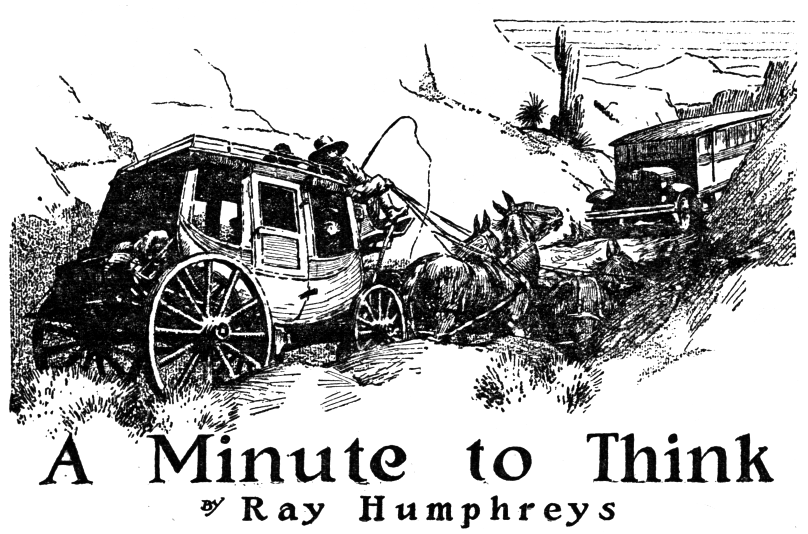
It was a bright, beautiful morning in Gunsight, but as far as Old “Pappy” Stewart, senior driver for the Q-B Stage Lines, was concerned the sun was not shining, the birds were not singing, and the alpine flowers were not blooming. Old Pappy, his hands thrust deep into his trouser pockets, stood morosely in the center of a little group of stage employees in the doorway of the big Q-B barn.
“High jinks to-day, Pappy!” said “Rabbit” Tarvin.
“Yuh kin do it, Grandpop!” exclaimed “Pud” Johnson.
“Got yuhr goggles, Pappy?” asked Joe McMeel.
The remarks were all lost on Pappy, who paid no heed to them if he heard them at all. It was very doubtful if he did hear them. His old, faded blue eyes were fixed coldly on a brand new, shiny red and yellow automobile bus that stood in all its glory in the stage yard. The motor was purring, catlike, and Pappy never had liked cats! There might have been tears in Pappy’s eyes, but there surely was a pair of heavy driving gauntlets under his left arm, and the whip he had carried for years was gone.
“Pappy, to think yuh’d come to this!” wailed Rabbit Tarvin.
“After all these years!” supplied Pud Johnson.
“An’ yuh bein’ half mule, anyway!” added Joe McMeel, grinning.
Still Old Pappy Stewart made no reply. He was half mule at that, if love for the six sleek black mules he had driven for years meant anything. The officials of the Q-B Stage Lines had lately realized that Pappy was almost all mule when it came to stubbornness, for when they had decided to replace the two regular six-mule stages from Gunsight to Central City with heavy motor busses, Old Pappy had balked quickly and thoroughly.
“What about my mules—Nigger an’ Blackie an’ Night an’ Darky an’ Tar Baby an’ Satan?” he had demanded.
“Yuh ought to be highly complimented that we think enough of an ol’ mule skinner like yuh to make yuh a bus driver!” remarked Bill Boyne, general manager of the stage lines.
“What about my mules—Nigger an’ Blackie an’——”
“They’ll be taken care of,” said Boyne.
“Pension?” asked Pappy, sourly.
“No, not exactly,” said Boyne, “we’re going to put them on that auxiliary route, Nevadaville to Chicago Gulch!”
“I’ll go with ’em!” said Pappy grimly.
“No, yuh won’t,” said Boyne, and then proceeded to point out that “Whiskers” Hayes had the Nevadaville—Chicago Gulch route by right of long service, just as Pappy had the seniority on the important Gunsight to Central City line. But it took Boyne a long time to argue reason into the obstinate Pappy, and it was only after the general manager had promised to see that Whiskers treated the six black mules with extravagant kindness that Pappy agreed to “think over” the proposition of becoming pilot of one of the new twenty-passenger busses.
“It’s a promotion, Pappy!” explained Boyne, for the hundredth time. Boyne liked Pappy and had great faith in the old man’s ability and stability. Pappy was never sick. Pappy was never “oiled up” on mountain dew, or any other sort of liquid hilarity. Pappy was never late. Pappy had never lost a pouch of mail, a mule, a passenger, or a minute of schedule—and further, and most important of all, Pappy had the whole-souled love of every man, woman, child, and dog in Gunsight and Central City, and along the many miles of mountain roads that separated the two Colorado towns.
“I guess Pappy will take the job,” said Boyne, finally, to his young assistant, Jim Duffy. Duffy shook his head. He was new on the Q-B lines. He had an idea that to be efficient he must hate all the old men in the company’s employ. So he hated Pappy cordially, but on no other grounds except his age.
“I wish he’d refuse,” said the assistant general manager. “He may have a good record, as yuh say, with six lazy ol’ mules, but he may get in a hole with a powerful motor bus an’——”
Boyne had smiled indulgently at Duffy.
“I’ll do all th’ worryin’ about that, Duffy,” said Boyne, “but ef yuh value that aristocratic nose o’ yuhrs in its present unspoiled beauty, don’t ever say in his hearing that Pappy drove six lazy mules. He wouldn’t like it worth a red cent. And besides, it isn’t true. Pappy had the friskiest hitch on the route—six black devils that we would find hard to handle!”
“Oh—well!” Duffy let the subject lapse.
So Pappy began to take lessons in bus driving from an instructor sent to Gunsight by the motor company that had sold the motors to the Q-B lines. The county commissioners, at the beckoning of progress, had thoughtfully put a crew of ten men and two four-horse scrapers to work on the road, straightening out some of the kinks, widening some of the narrows, and shaving off some of the many bumps. And Old Pappy, taking his first lessons in motor driving, assisted by uprooting a few saplings on the sharp turns, tearing out banks that should have been torn out anyway, and generally revising the route with his heavy auto bus.
Then came the day when Pappy said good-by to his mules. He actually kissed Nigger and Blackie on their satin noses. They were his leaders. He said they were the smartest mules in Colorado. The Q-B barn boss, an old army stable sergeant, swore they were the meanest mules in Colorado, Wyoming, New Mexico or Utah! Pappy put his arms around the necks of Night and Darky, his swing team, and whispered a lingering adios in their waving ears. Pappy had actually cried in his farewell to Satan and Tar Baby, his wheelers. The stable boss declared that Satan and Tar Baby had cried with the old man, but the stable boss didn’t cry. He was very happy. A motor bus wasn’t equipped with iron-shod heels that shot out of dark stalls and caught one unawares in the seat of the pants.
“Waal, Pappy, climb in an’ blow yuhr horn!” suggested Rabbit Tarvin, maliciously, the morning of Pappy’s first regular run with the new bus. “I’m dyin’ to see ef yuh’re goin’ to feed that thing a lump o’ sugar before yuh start!”
“I’ll feed yuh a lump o’ trouble,” roared Pappy, awakening from his daydream. “Waal, I’m a-goin’—yuh birds kin laugh all yuh want to an’ I’m givin’ yuh permission, knowin’ as I do that yuh’ll laugh anyhow after I am off! I got only one passenger down this mawnin’, anyhow, they tells me, an’ I should worry how I bounce him. He’ll have plenty o’ room to bounce all he wants ter!”
“He must be a nut, that passenger!” suggested Rabbit.
“Or aimin’ on suicide,” put in Pud Johnson.
“Or an airy-plane stunt man goin’ in fer something actually dangerous,” said Joe McMeel. Then Joe stared in astonishment.
“Ready, Pappy?” asked assistant manager Jim Duffy, emerging from the barn office. “If yuh are, let’s go!”
“Yuh!” faltered Pappy in awe. “Yuh my passenger?”
“Yes,” said Duffy, and there was something very unpleasant in the way Duffy said it. Tarvin and Johnson and McMeel, the barn helpers, put their tongues in their cheeks, winked at each other, and faded into the recesses of the stable. Pappy climbed into the bus. Duffy followed. The heavy door banged. The horn gave a contemptuous snort, above the grinding of the meshing gears. The big red and yellow bus glided out of the Q-B yard, on to the Gunsight—Central City pike. Tarvin looked at Johnson and Johnson looked at McMeel.
“Waal——” began McMeel, but he left the rest unsaid.
Two weeks of very efficient tutoring by the motor company man had left its mark on Pappy Stewart. He swung the sharp corners in Gunsight as smartly as any bus driver could. He stopped smoothly in front of the Gunsight post office while Tom Egan, the postmaster, slung in a gaunt mail sack. Tom shook hands effusively with Pappy, wishing him success and happiness in his new role of “skinner” to a “travelin’ house an’ barn,” as Tom put it. Tom waved airily at the one passenger, assistant manager Jim Duffy. That wave might have meant almost anything, but to Duffy, seated stiffly in the middle of the bus, it meant simply, “Waal, yuh may go through with a whole skin!”
The bus dipped out of Gunsight. The road crew, working near town, hastily gave the big rumbler plenty of room. The men and teams went into the ditch with alarming disregard for life and limb. This was not lost on assistant manager Jim Duffy. He scowled at the bent back of the old driver.
“Strange, those men would act like that,” said Duffy.
“Oh—they know me,” remarked Pappy complacently. Pappy thought he heard a groan from Duffy, but he wasn’t sure.
“Yuh all right back thar?” asked Pappy, professionally.
“So far,” admitted Duffy, grimly, “but see that yuh take it mighty easy! I wasn’t keen on coming, but Boyne got a crazy idea and sent me. Remember, Pappy, no speeding; this road is dangerous enough, and yuh have valuable—er—United States mail aboard.”
“Yes, sir,” said Pappy, absently.
Pappy’s thoughts were far, far away just then. His eyes followed the flashing ribbon of road over the top of his burnished silver radiator, but his eyes were blurred. He hadn’t slept well the night before, thinking of poor Nigger and Blackie and the rest. He had tossed and worried—not because he feared the motor bus, but because he was lonesome for the six black mules. He had figured out, right down to the dot, how many times he had driven that six-mule hitch down this very road. Something over two thousand times in the six years he had piloted them. Before that he had driven a hitch of grays for several years, and before that he had piloted a mixed team of grays and browns.
“Pore ol’ Nigger,” he said, unhappily, “wonder ef Whiskers Graham will remember my orders to always feed him a lump o’ sugar.”
“What?” asked Duffy.
“An’ Blackie,” went on Pappy, sadly, “thar was a mule fer yuh—never would shy, not even from a rattler; that’s the kind o’ a lead mule yuh gotta have on a road like this.”
“Say,” muttered Duffy, uncomfortably.
“An’ Night an’ Darky,” exclaimed Pappy, swinging a curve and grazing a giant pine stump by a margin of inches, “the best gol-danged swing team in Colorado—fast on their feet, nimble, plenty o’ bone, puffect faith in the leaders, which is lots——”
“Keep yuhr mind on the road!” interrupted Duffy, angrily.
“Yes, sir,” said Pappy, squinting ahead and veering abruptly to avoid a chuck hole. “Now yuh take Tar Baby an’ Satan—them mules were hu-mins, by gosh! I remember the night a trace broke on Floyd Hill as we was comin’ up with a heavy load o’ church folks from a picnic—lawsy me, that had me talkin’ to myself fer a second!—but ol’ Satan, he jus’ leaned back in the collar, knowin’ too much strain would snap another trace, an’ so I got down.”
“Hey!” roared Duffy, ducking mechanically.
“What?” asked Pappy, over his shoulder. “What’s wrong?”
“Nothing—now!” gasped Duffy, “I thought we was goin’ to slide into that ten-ton rock back thar—that’s all. Take it easy, old man, will yuh? I say, take it easy—we’re on a pretty steep grade, I’d say—pretty steep an’ dangerous.”
Pappy said nothing. He knew well enough that he was on a steep grade. He had come down this very grade five or six thousand times at least, and he had come up, whole, every time he had gone down. Now, however, he rested a precautionary foot on the brake pedal. A cottontail sallied out into the road and Pappy dodged it with a swaying bus. Pappy thought again of old Nigger and Blackie and Night and the others; and, watching his passenger through the little rear vision mirror, Pappy waited until Duffy was busy out a side window, measuring the distance between the bus and the brink of the canyon. Then Pappy poked a finger at each eye and brushed away the tears.
“I mustn’t do my grievin’ out loud fer that cuss to hear me an’ report me fer it,” decided Pappy to himself, “but I kain’t help feelin’ purty doggone blue on this trip—my fust reg’lar trip without the mules. Nigger was such a pet. How he would beg fer sugar! Ef ol’ Whiskers Graham doesn’t give it to him, why Nigger will like as not kick Whiskers inter the middle o’ next January, fust chance he gits! Pore ol’ Nigger—a good mule!”
The big bus went down the hill toward Shaffer’s Crossing at a merry clip. Shaffer’s Crossing was at the bottom of a ravine, where the Gunsight—Central City road dipped down and crossed the Nevadaville—Chicago Gulch road. The latter road was rutty and twisting. It existed merely for the sake of the two dozen mines up Chicago Gulch which drew their supplies from Nevadaville on the west slope of the Continental divide. It was on this road that Pappy’s six mules were now working. Pappy scanned the narrow crossing and eased on the brake.
“Don’t slow up now!” ordered assistant manager Duffy from his rear seat. “Yuh never can make that hill on the other side if yuh do! Give her the gas, step on her, let her go! Yuh been speedin’ all along an’ now when yuh oughter speed yuh’re burnin’ out brake linings—let her go!”
“The crossin’,” said Pappy gently.
“Ah, to heck with the crossin’!” roared Duffy. “I kin see that it’s clear from whar I set an’ yuh’re fifteen feet ahead o’ me. The crossin’s clear—anyway, it ain’t a railroad crossin’ an’ that mine road ain’t got no motors on it—give her the throttle, open her up, spin yuhr wheels! I don’t want to git half way up that hill yonder an’ stall an’ start backin’ down an’ slide off the cliff mebbe. I say, let her go—step on the gas, Santa Claus, I tell yuh!”
“Yes, sir,” said Pappy meekly. Duffy was assistant manager, and orders were orders. Anyway, the crossing seemed to be quite clear—what Pappy could see of it. Pappy remembered the time, however, when two ore wagons had met there, killing eleven of the twelve mules involved and one of the hapless drivers. But that was before Duffy’s time.
“Speed her up!” snapped Duffy.
Pappy stepped on the gas, mainly to humor Duffy. The big bus was traveling fast enough on a sharp down grade, anyway. The crossing was now half a city block away; scenery was whizzing past on all sides at an alarming rate. Duffy, however, had his eyes fixed on the opposite hill. It was deceiving, that hill. It looked almost straight up and down. Duffy doubted the ability of the heavy bus to make it, although he remembered that Boyne had told him the bus could make it on high easily. So Duffy watched the hill. Pappy, shifting his chewing tobacco from cheek to cheek, watched the crossing and sped on.
“Whoo-oo-ee-ee!” sounded the bus horn.
The crossing was now two hundred and fifty feet away. The bus was fairly hurtling through the air at Duffy’s commands—“give it to her—let her out—that hill is steep over thar!” Old Pappy ceased to shift his tobacco. The crossing was now a scant hundred and fifty feet away. A leaping shadow was the first intimation of the impending disaster. Pappy’s faded eyes lit up with a hideous light. His hands froze on the steering wheel. A cry died unuttered in his throat. The next second the heads of two sleek black mules flashed into sight, going down grade into Chicago Gulch. A half second, and the heads of the second team of the hitch came into view. The leaders were Nigger and Blackie, the second team was Night and Darky, then came the wheelers, Satan and Tar Baby, and the wagon——
“Yuh got a minute to think!” shrieked Jim Duffy, scrambling to his feet as he saw the coming crash, “a half minute——”
“Ugh!” grunted Pappy, going down hard on the brake pedal; but the bus was traveling too fast for any sudden stop. The six sleek mules and the big freight wagon, with a horrified old Whiskers Graham perched on its seat, seemed to leap at the radiator of the speeding bus.
“Go through ’em—go through ’em!” screamed Duffy, flinging himself on the floor of the swaying bus.
“My mules—Nigger an’ Blackie an’ Night——” began Old Pappy, but he didn’t finish. He threw all his strength into his left arm. The big bus veered, tottered drunkenly; then lurched straight off the road, skimmed the tops of some bearberry bushes that lined the highway, and plunged, nose down, into a tangled thicket of young aspens. There was a tremendous crash, the splintering of glass, the odor of burning rubber, and one scream—from Duffy. Old Pappy, bent over the twisted steering wheel, had mumbled again “Nigger,” and that was all.
Meanwhile old Whiskers Graham had sat spellbound on the high perch of his freighter, unaware that his six black mules had stopped. Graham had expected to be hurtled into eternity so fast that he would beat his feverish prayers to heaven. When he saw the flashing red and yellow bus swerve and go into the ditch, he decided that the driver, whoever he was, had lost control just in time to save him and the outfit of mules he had inherited from Pappy. Slowly climbing down off his big wagon, which set squarely in the middle of the crossroads, Whiskers slid down into the aspen thicket—or what was left of it after the bus had crashed.
“Whew,” he wheezed, dazed. “This is awful!”
Going around the bus, which lay on its side, Graham found a window from which all glass had vanished. He went in that way. He recognized Duffy, dragged him out, and laid him on a grassy plot along the little creek. Duffy was breathing. He had fainted. Then Graham went back and dragged out the driver. He whistled when he recognized the battered face of Pappy Stewart, senior driver on the big route. Pappy wasn’t breathing so well. He was cut and bruised and bleeding. Graham laid him alongside of Duffy and went back to his wagon for a pail. Eventually, with plenty of icy creek water, he brought Duffy back to consciousness, and then revived Old Pappy. Duffy swore horribly as he came to; Pappy merely smiled mirthlessly and was silent.
“Gents,” said Whiskers Graham, a bit unsteadily, “you’ve had a blamed narrow squeak, I’d say, ef anyone should ask me. I thought yuh were both kilt instantly—that big car went off the road like a comet, I tell ye, I couldn’t move.”
Duffy was rubbing his head with both hands, but at that he suddenly thought of something very important.
“Yuh ol’ fool,” he cried at Whiskers, angrily, “what’s the idear o’ runnin’ a mule team across a crossin’ like that? It would have served yuh right ef yuh’d been killed.”
“I wasn’t runnin’ no mules,” whimpered Graham, unhappily; “they was runnin’ me. I ain’t used to that hitch—they’re——”
Duffy swung on Pappy.
“Those were yuhr ol’ mules!” he stormed. “Coddled, pampered, suffocated with all kindness an’ no discipline all their lives, thanks to yuh. An’ yuh, yuh ol’ idjut, why didn’t yuh run right through that wagon outfit, as I told yuh? What’s one ol’ mule driver or a few mules compared to an eight-thousand-dollar bus?”
Pappy groaned.
“Mister Duffy,” he said, “as yuh say, those were my ol’ mules—Nigger an’ Blackie an’ Night an’ Darky an’ Tar—say, Graham, ef yuh think this is funny talkin’ about killin’ my mules.”
Old Whiskers Graham was doubled up with laughter.
“What’s one ol’ mule driver or a few mules compared to an eight-thousand-dollar bus, eh?” roared Whiskers Graham, pointing a shaky finger at assistant manager Jim Duffy. “Waal, I’ll tell yuh, Mr. Duffy, I jus’ wish yuh had tried to run through my outfit—yuh’d dang soon would o’ found out how much we amounted to! I got sixteen boxes o’ grade A dynamite in that ol’ wagon, Mr. Duffy—more’n enough to blow your eight-thousand-dollar bus an’ half a dozen assistant general managers higher than any wild goose ever flew before. It’s a good thing Pappy remembered this was Tuesday an’ dynamite haulin’ day fer the mines, or yuh’d be pickin’ out yuhr harp—or pitchfork—right now.”
Duffy’s face went even grayer than it had been.
“Dynamite, yuh say?” he gasped, and then he turned to Old Pappy, who had never thought of dynamite until he heard Graham mention it. “Waal, sir, that does change matters! I hand it to yuh, Pappy, yuh had one minute to think—an’ yuh thought right! It was an unavoidable accident, I’m here to say! We kin fix up the bus somehow, I guess, but ef we had hit——”
“Excuse me just a minute,” mumbled Old Pappy, scrambling to his feet. “I got some friends I wanta talk to up in the road—Nigger an’ Blackie an’ Night an’ Darky an’ Tar Baby an’ Satan!”
And even then assistant manager Duffy didn’t guess that it was love, and not dynamite, that had swung Pappy into the ditch.