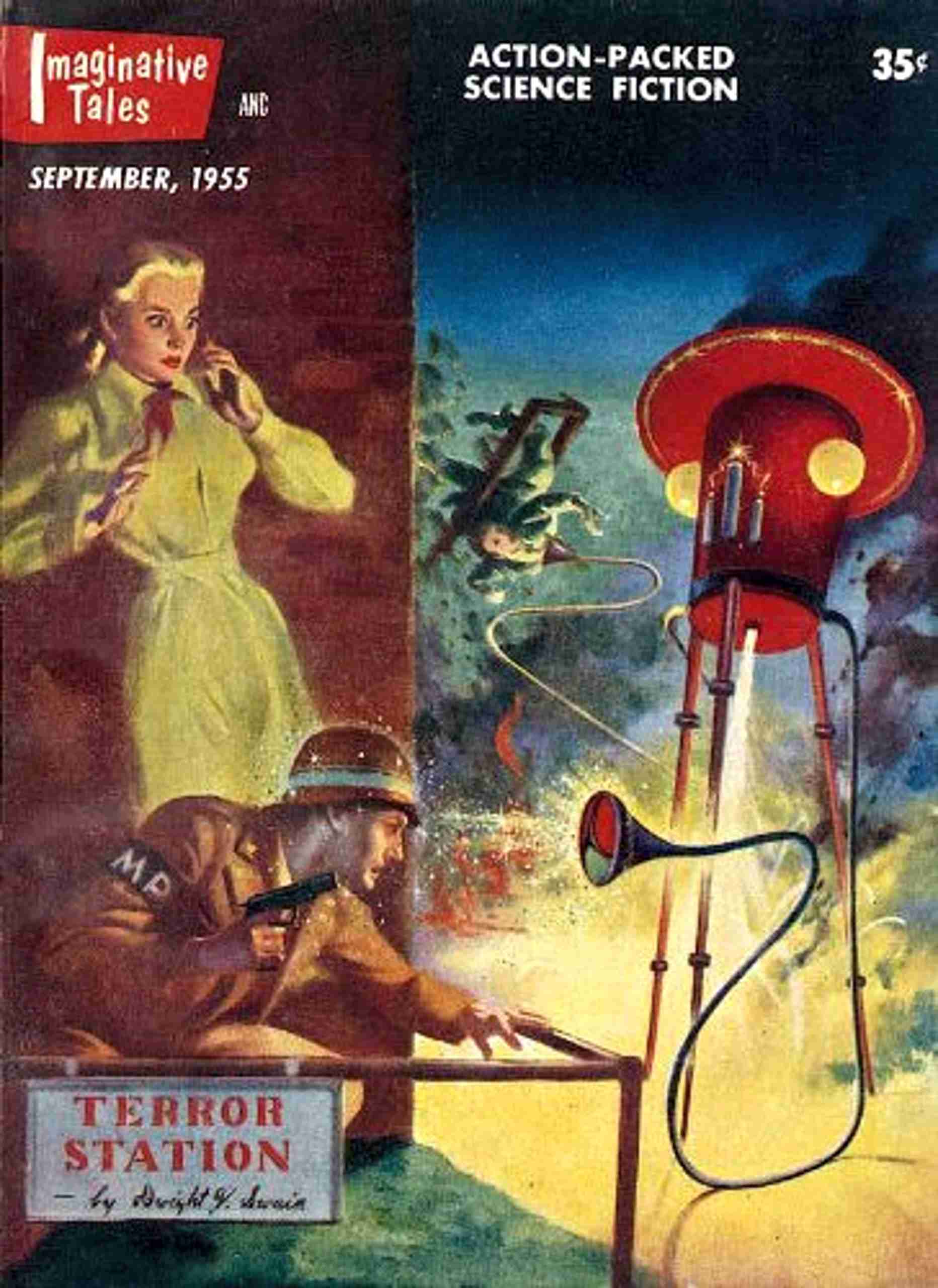
Transcribed from Imaginative Tales, September 1955 (Vol. 2, No. 1).
Transcribed from Imaginative Tales, September 1955 (Vol. 2, No. 1).
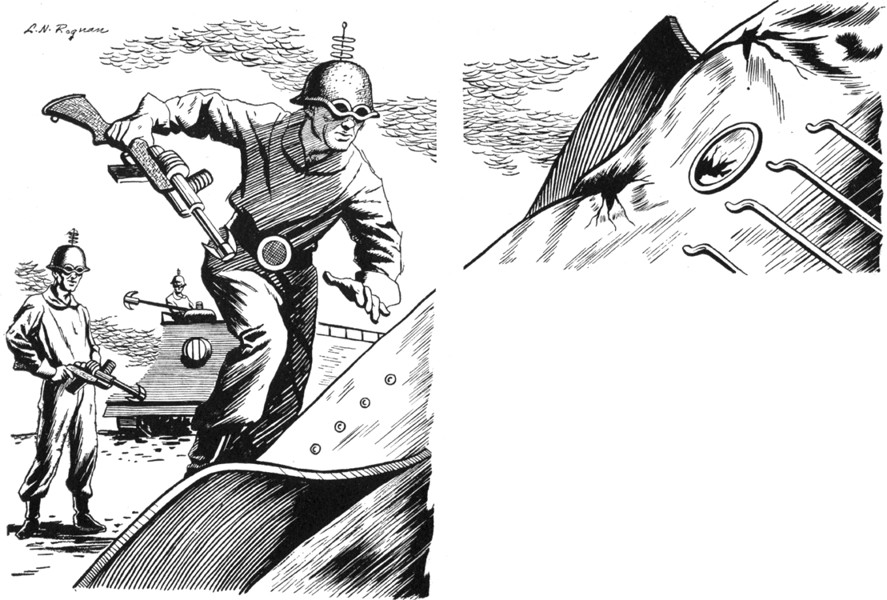
It was a dangerous planet—swallowing up men with no apparent menace to fight against. It was up to Allison and his computer to discover—
by Jerry Sohl
For an hour they had been circling the spot at 25,000 feet while technicians weighed and measured the planet and electronic fingers probed where no eye could see.
And for an hour Harley Allison had sat in the computer room accepting the information and recording it on magnetic tapes and readying them for insertion into the machine, knowing already what the answer would be and resenting what the commander was trying to do.
It was quiet in the ship except for the occasional twitter of a speaker that recited bits of information which Allison dutifully recorded. It was a relief from the past few days of alarm bells and alerts and flashing lights and the drone of the commander’s voice over the intercom, even as that had been a relief from the lethargy and mindlessness that comes with covering enormous stellar distances, for it was wonderful to see faces awaken to interest in things when the star drive went off and to become aware of a changing direction and the lessening velocity. Then had eyes turned from books and letters and other faces to the growing pinpoints of the Hyades on the scanners.
Then had Allison punched the key that had released the ship from computer control and gave it to manual, and in the ensuing lull the men of the Nesbitt were read the official orders by Commander William Warrick. Then they sat down to controls unmanned for so long to seek out the star among the hundreds in the system, then its fourth planet and, a few hours ago, the small space ship that lay on its side on the desert surface of the planet.
There was laughter and the scrape of feet in the hall and Allison looked up to see Wendell Hallom enter the computer room, followed by several others.
“Well, looks like the rumors were right,” Hallom said, eyes squinting up at the live screen above the control panel. The slowly rotating picture showed the half-buried space ship and the four pillars of the force field about it tilted at ridiculous angles. “I suppose you knew all about this, Allison.”
“I didn’t know any more than you, except we were headed for the Hyades,” Allison said. “I just work here, too, you know.”
“I wish I was home,” Tony Lazzari said, rolling his eyes. “I don’t like the looks of that yellow sand. I don’t know why I ever joined this man’s army.”
“It was either join or go to jail,” Gordon Bacon said.
“I ought to punch you right in the nose.” Lazzari moved toward Bacon who thumbed his nose at him. “In fact, I got a good mind to turn it inside out.”
Allison put a big hand on his shoulder, pulled him back. “Not in here you don’t. I got enough troubles. That’s all I’d need.”
“Yeah,” Hallom said. “Relax, kid. Save your strength. You’re going to need it. See that pretty ship up there with nobody on it?”
“You and the commander,” Bacon said. “Why’s he got it in for you, Allison?”
“I wouldn’t know,” Allison said smiling thinly. “I’ve got a wonderful personality, don’t you think?”
Hallom grunted. “Allison’s in the Computer Corps, ain’t he? The commander thinks that’s just like being a passenger along for the ride. And he don’t like it.”
“That’s what happens when you get an old line skipper and try to help him out with a guy with a gadget,” Bacon observed.
“It wouldn’t be so bad,” Homer Petry said at the door, “if it had been tried before.”
“Mr. Allison,” a speaker blared.
“All right, you guys,” Allison said. “Clear out.” He depressed a toggle. “Yes, Lieutenant?”
“You have everything now, Allison. Might as well run it through.”
“The commander can’t think of anything else?”
There was a cough. “The commander’s standing right here. Shall I ask him?”
“I’ll run this right through, Lieutenant.”
Commander William Warrick was a fine figure of a man: tall, militant, greying, hatchet-nosed. He was a man who hewed so close to the line that he let little humanity get between, a man who would be perpetually young, for even at fifty there was an absence of paunch, though his eyes held a look of a man who had many things to remember.
He stood for a while at one end of the control room without saying anything, his never-absent map pointer in his right hand, the end of it slapping the open palm of his left hand. His cold eyes surveyed the men who stood crowded shoulder-to-shoulder facing him.
“Men,” he said, and his deep voice was resonant in the room, “take a good look at the screen up there.” And the eyes of nearly fifty men shifted to the giant screen beside and above him. “That’s the Esther.” The ship was on gyro, circling the spot, and the screen showed a rotation ship on the sand.
“We’ll be going down soon and we’ll get a better look. But I want you to look at her now because you might be looking at the Nesbitt if you’re not careful.”
The commander turned to look at the ship himself before going on. “The Esther is a smaller ship. It had a complement of only eight men. Remember the tense there. Had. They disappeared just as the men in the two ships before them did, each carrying eight men—the Mordite and the Halcyon. All three ships were sent to look for Traveen Abbott and Lew Gesell, two explorers for the Federation who had to their credit successful landings on more than ninety worlds. They were cautious, experienced and wise. Yet this planet swallowed them up, as it did the men of the three ships that followed.”
Commander Warrick paused and looked at them severely. “We’re fifty men and I think we have a better chance than an eight-man crew, not just because there are more of us but because we have the advantage of knowing we’re against something really deadly. In case you haven’t deduced our mission, it is simply to find out what it is and destroy it.”
The insignia on the commander’s collar and sleeve glittered in the light from the ever-changing screen as the ship circled the site of the Esther.
“This is a war ship. We are armed with the latest weapons. And—” his eyes caught Allison’s “—we even have a man from the Computer Corps with us, if that can be counted as an advantage.”
Allison who stood at the rear of the room behind the assembled soldier-technicians, reddened. “The tapes got us here, Commander.”
“We could have made it without them,” the commander said without ire. “But we’re here with or without tape. But just because we are we’re not rushing down there. We know the atmosphere is breathable, the gravity is close to Earth’s and there are no unusually dangerous bacteria. All this came from the Esther prior to the ... incident, whatever it was. But we checked again just to make sure. The gravity is nine-tenths that of Earth’s, there is a day of twenty-four and a half hours, temperature and humidity tropical at this parallel, the atmosphere slightly less rich in oxygen, though not harmfully so—God only knows how a desert planet like this can have any oxygen at all with so little vegetation and no evident animal life. There is no dangerous radiation from the surface or from the sun. Mr. Allison has run the assembled data through his machine—would you care to tell the men what the machine had to say, Allison?”
Allison cleared his throat and wondered what the commander was driving at. “The planet could sustain life, if that’s what you mean, Commander.”
“But what did the machine say about the inhabitants, Mr. Allison?”
“There wasn’t enough data for an assumption.”
“Thank you. You men can get some idea of how the Computer Corps helps out in situations like this.”
“That’s hardly fair, Commander,” Allison protested. “With more data—”
“We’ll try to furnish you with armsful of data.” The commander smiled broadly. “Perhaps we might let you collect a little data yourself.”
There was laughter at this. “So much for the Computer Corps. We could go down now, but we’re circling for eighteen more hours for observation. Then we’re going down. Slowly.”
The ship came out of the deep blue sky in the early morning and the commander was a man of his word. The Nesbitt moved down slowly, beginning at sun-up and ending in the sand within a few hundred feet of the Esther in an hour.
“You’d think,” Lazzari said as the men filed back into the control room for another briefing, “that the commander has an idea he can talk this thing to death.”
“I’d rather be talked to death by the commander than by you,” Hallom said. “He has a pleasanter voice.”
“I just don’t like it, all that sand down there and nothing else.”
“We passed over a few green places,” Allison corrected. “A few rocky places, too. It’s not all sand.”
“But why do we have to go down in the middle of it?” Lazzari insisted.
“That’s where the other ships went down. Whatever it is attacked them on the sand.”
“If it was up to me, I’d say: Let the thing be, whatever it is. Live and let live. That’s my motto.”
“You’re just lazy,” said Petry, the thin-faced oldster from Chicago. “If we was pickin’ apples you’d be askin’ why. If you had your way you’d spend the rest of your life in a bunk.”
“Lazy, hell!” Lazzari snorted. “I just don’t think we should go poking our nose in where somebody’s going to bite it off.”
“That’s not all they’ll bite off, Buster,” said Gar Caldwell, a radar and sonics man from Tennessee.
Wang Lee, force field expert, raised his thin oriental eyebrows and said, “It is obvious we know more than our commander. We know, for example, it bites. It follows then that it has teeth. We ought to report that to the commander.”
The commander strode into the room, map pointer under his arm, bearing erect, shoulders back, head high. Someone called attention and every man stiffened but Allison, who leaned against the door. Commander Warrick surveyed them coldly for a moment before putting them at ease.
“We’re dividing into five teams,” he said. “Four in the field and the command team here. The rosters will be read shortly and duplicate equipment issued. The lieutenants know the plans and they’ll explain them to you. Each unit will have a g-car, force field screen, television and radio for constant communication with the command team. There will be a blaster for each man, nuclear bombardment equipment for the weapons man, and so on.”
He put his hands on his hips and eyed them all severely. “It’s going to be no picnic. It’s hot as hell out there. A hundred degrees in the daytime and no shade. It’s eighty at night and the humidity’s high. But I want you to find out what it is before it finds out what you are. I don’t want any missing men. The Federation’s lost three small ships and twenty-four men already. And Mr. Allison—”
Allison jerked from the wall at the unexpected calling of his name. “Yes, Commander?”
“You understand this is an emergency situation?”
“Well, yes, Commander.”
The commander smiled slyly and Allison could read something other than humor behind his eyes.
“Then you must be aware that, under Federation regulations governing ships in space, the commander exercises unusual privileges regarding his crew and civilians who may be aboard.”
“I haven’t read the regulation, Commander, but I’ll take your word for it that it exists.”
“Thank you, Mr. Allison.” The lip curled ever so slightly. “I’d be glad to read it to you in my quarters immediately after this meeting, except there isn’t time. For your information in an emergency situation, though you are merely attached to a ship in an advisory capacity, you come under the jurisdiction of the ship’s commander. Since we’re short of men, I’m afraid I’ll have to make use of you.”
Allison balled two big, brown hands and put them behind his back. They had told him at Computer Corps school he might meet men like Commander Warrick—men who did not yet trust the maze of computer equipment that only a few months ago had been made mandatory on all ships of the Nesbitt class. It was natural that men who had fought through campaigns with the old logistics and slide-rule tactics were not going to feel immediately at home with computers and the men that went with them. It wasn’t easy trusting the courses of their ships or questions of attack and defense to magnetized tape.
“I understand, Commander,” Allison said. “I’ll be glad to help out in whatever way you think best.”
“Good of you, I’m sure.” The Commander turned to one of the lieutenants near him. “Lieutenant Cheevers, break out a blaster for Mr. Allison. He may need it.”
When the great port was opened, the roasting air that rushed in blasted the faces of the men loading the treadwagons. Allison, the unaccustomed weight of the blaster making him conscious of it, went with several of them down the ramp to look out at the yellow sand.
Viewing it from the surface was different from looking at it through a scanner from above. He squinted his eyes as he followed the expanse to the horizon and found there were tiny carpets of vegetation here and there, a few larger grass islands, a wooded area on a rise far away on the right, mountains in the distance on the left. And above it all was a deep blue sky with a blazing white sun. The air had a burned smell.
A tall lieutenant—Cork Rogers who would lead the first contingent—moved down the ramp into the broiling sun and gingerly stepped into the sand. He sank into it up to his ankles. He came back up, shaking his head. “Even the sand’s hot.”
Allison went down, the sun feeling like a hot iron on his back, bent over and picked up a handful of sand. It was yellower than Earth sand and he was surprised to find it had very little weight. It was more like sawdust, yet it was granular. He looked at several tiny grains closely, saw that they were hollow. They were easily crushed.
“Why was I born?” Lazzari asked no one in particular, his arms loaded with electrical equipment for the wagon. “And since I was, how come I ever got in this lousy outfit?”
“Better save your breath,” Allison said, coming up the ramp and wiping his hands on his trousers.
“Yeah, I know. I’m going to need it.” He stuck his nose up and sniffed. “They call that air!”
In a few minutes, the first treadwagon loaded with its equipment and men purred down the ramp on its tracks and into the sand. It waited there, its eye tube already revolving slowly high on its mast above the weapons bridge. The soldier on the bridge was at ready, his tinted visor pulled down. He was actually in the small g-car which could be catapulted at an instant’s notice.
Not much later there were four treadwagons in the sand and the commander came down the ramp, a faint breeze tugging at his sleeves and collar.
He took the salute of each of the officers in turn—Lieutenant Cork Rogers of Unit North, Lieutenant Vicky Noromak of Unit East, Lieutenant Glen Foster of Unit West and Lieutenant Carl Quartz of Unit South. They raised the green and gold of the Federation flag as he and the command team stood at attention behind him.
Then the commander’s hand whipped down and immediately the purrs of the wagons became almost deafening as they veered from one another and started off through the sand, moving gracefully over the rises, churning powder wakes and leaving dusty clouds.
It was quiet and cool in the control room. Commander Warrick watched the four television panels as they showed the terrain in panorama from out-positions a mile in each direction from the ship. On all of them there were these same things: the endless, drifting yellow sand with its frequent carpets of grass, the space ship a mile away, the distant mountain, the green area to the right.
Bacon sat at the controls for the panels, Petry at his side. Once every fifteen seconds a radio message was received from one of the treadwagon units: “Unit West reporting nothing at 12:18:15.” The reports droned out over the speaker system with monotonous regularity. Petry checked off the quarter minutes and the units reporting.
Because he had nothing better to do, Allison had been sitting in the control room for four hours and all he had seen were the television panels and all he had heard were the reports—except when Lieutenant Cheevers and three other men returned from an inspection of the Esther.
“Pile not taken, eh?” The commander pursed his lips and ran a forefinger along his jaw. “Anything above median level would have taken the pile. I can’t see it being ignored.”
The lieutenant shook his head. “The Esther was relatively new. That would have made her pile pretty valuable.”
“I can’t figure out why the eight men on the Esther couldn’t handle the situation. They had the Mordite and the Halcyon as object lessons. They must have been taken by surprise. No sign of a struggle, eh, Cheevers?”
“None, sir. We went over everything from stem to stern. Force field was still working, though it had fallen out of line. We turned it off.”
“No blood stains? No hair? No bones?”
“No, sir.”
“That’s odd, don’t you think? Where could they have gone?” The commander sighed. “I expect we’ll know soon enough. As it is, unless something is done, the Esther will sink farther into this sand until she’s sunk out of sight with the other two ships.” He frowned. “Lieutenant, how would you like to assume command of the Esther on our return? It must still be in working order if the pile is there. I’ll give you a crew.”
“We’re not through here yet, sir.” Cheevers grinned. “But I’d like it.”
“Look good on your service records, eh, Corvin?” The commander then saw Allison sitting at the rear of the room watching the panels. “What do you make of all this, Allison?”
“I hardly know what to think, Commander.”
“Why don’t you run a tape on it?”
“I wish I could, but with what little we know so far it wouldn’t do any good.”
“Come, now, Allison, surely a good man like you—you’re a computer man, remember?—surely you could do something. I’ve heard of the wonders of those little machines. I’ll bet you could run that through the machine and it will tell us exactly what we want to know.”
“There’s not enough data. I’d just get an ID—Insufficient Data—response as I did before.”
“It’s too bad, Allison, that the computer people haven’t considered that angle of it—that someone has to get the data to feed the machine, that the Federation must still rely on guts and horse sense and the average soldier-technician. I’ll begin thinking computers are a good thing when they can go out and get their own data.”
That had been two hours ago. Two hours for Allison to cool off in. Two hours to convince himself it had been best not to answer the commander. And now they all sat, stony-faced and quiet, watching the never-ending sweep of the eye-tubes that never showed anything different except the changing shadows as the planet’s only sun moved across the sky. Yellow sand and carpets of green, the ship, the mountain, the wooded area....
It was the same on the next four-hour watch. The eye-tubes turned and the watchers in the ship watched and saw nothing new, and radio reports droned on every fifteen seconds until the men in the room were scarcely conscious of them.
And the sun went down.
Two moons, smaller than Earth’s single moon, rode high in the sky, but they didn’t help as much, infrared beams from the treadwagons rendered the panel pictures as plain as day. And there was nothing new.
The commander ordered the units moved a mile farther away the second day. When the action was completed, the waiting started all over again.
It would not be fair to say nothing was new. There was one thing—tension. Nerves that had been held ready for action began demanding it. And with the ache of taut nerves came impatience and an overexercising of the imagination. The quiet, heat, humidity and monotony of nothing the second day and night erupted in a blast from Unit East early on the morning of the third day. The nuclear weapons man in the g-car had fired at something he saw moving out on the sand.
At the site Technician Gar Caldwell reported by radio while Lieutenant Noromak and another man went through the temporarily damped force field to investigate. There was nothing at the target but some badly burned and fused sand.
Things went back to normal again.
Time dragged through the third day and night, and the hot breezes and high humidity and the waiting grated already raw nerves.
On the morning of the fourth day Homer Petry, who had been checking off the radio reports as they came in, suddenly announced: “No radio report from Unit West at 8:14:45!”
Instantly all eyes went to the Unit West panel.
The screen showed a revolving panorama of shimmering yellow sand and blue sky.
Lieutenant Cheevers opened the switch. “Unit West! Calling Unit West!”
No answer.
“What the hell’s the matter with you, Unit West!”
The commander yelled, “Never mind, Lieutenant! Get two men and shoot over there. I’ll alert the other units.”
Lieutenant Cheevers picked up Allison, who happened to be in the control room at the time, and Hallom, and in a matter of moments the port dropped open and with the lieutenant at the controls and the two men digging their feet in the side stirrups and their hands clasping the rings for this purpose on either side, the small g-car soared out into the sweltering air and screamed toward Unit West.
The terrain rushed by below them as the car picked up still more speed and Allison, not daring to move his head too far from the protective streamlining lest it get caught in the hot airstream, saw the grass-dotted, sun-baked sand blur by.
Then the speed slackened and, raising his head, he saw the treadwagon and the four force-field pillars they were approaching.
But he saw no men.
The lieutenant put the car in a tight turn and landed it near the wagon. The three grabbed their weapons, jumped from the car and ran with difficulty through the sand to the site.
The force field blocked them.
“What the hell!” Cheevers kicked at the inflexible, impenetrable shield and swore some more.
The treadwagon was there in the middle of the square formed by the force field posts, and there was no one in it. The eye-tube was still rotating slowly and noiselessly, weapons on the bridge beneath still pointed menacingly at the empty desert, the g-car was still in its place, and the Federation flag fluttered in the slight breeze.
But there was nothing living inside the square. The sand was oddly smooth in many places where there should have been footprints and Allison wondered if the slight breeze had already started its work of moving the sand to obliterate them. There were no bodies, no blood, no signs of a struggle.
Since they couldn’t get through the barrier, they went back to the g-car and went over it, landing inside the invisible enclosure, still alert for any emergency.
But nothing attacked because there was nothing there. Only the sand, the empty treadwagons, the weapons, the stores.
“Poor Quartz,” Cheevers said.
“What, sir?” Hallom asked.
“Lieutenant Quartz. I knew him better than any of the others.” He picked up a handful of sand and threw it angrily at the wagon’s treads.
Allison saw it hit, watched it fall, then noticed the tread prints were obliterated inside the big square. But as he looked out across the waste to the ship he noticed the tread prints there were quite clear.
He shivered in the hot sun.
The lieutenant reported by the wagon’s radio, and after they had collected and packed all the gear, Allison and Hallom drove the treadwagons back to the ship.
“I tell you it’s impossible!” The commander’s eyes were red-rimmed and bloodshot and he ran sweating hands through wisps of uncombed grey hair. “There must have been something!”
“But there wasn’t, sir,” Cheevers said with anguish. “And nothing was overlooked, believe me.”
“But how can that be?” The commander raised his arms angrily, let them fall. “And how will it look in the record? Ten men gone. Just like that.” He snapped his fingers. “The Federation won’t like it—especially since it is exactly what happened to the others. If only there had been a fight! If there were a chance for reprisal! But this—” he waved an arm to include the whole planet. “It’s maddening!”
It was night before the commander could contain himself enough to talk rationally about what had happened and to think creatively of possible action.
“I’m not blaming you, Lieutenant Cheevers, or anybody,” he said slouched in his desk chair and idly eying the three remaining television screens that revealed an endless, turning desert scene. “I have only myself to blame for what happened.” He grunted. “I only wish I knew what happened.” He turned to Cheevers, Allison and Hallom, who sat on the other side of the desk. “I’ve done nothing but think about this thing all day. I don’t know what to tell those fellows out there, how they can protect themselves from this. I’ve examined the facts from every angle, but I always end up where I started.” He stared at Cheevers. “Let’s hear your idea again, Cheevers.”
“It’s like I say, sir. The attack could have come from the air.”
“Carried away like eagles, eh? You’ve still got that idea?”
“The sand was smooth, Commander. That would support the idea of wings of birds setting the air in motion so the sand would cover up the footprints.”
The commander bit his lower lip, drummed on the desk with his fingers and stared hard at Cheevers. “It is possible. Barely possible. But it still doesn’t explain why we see no birds, why we saw no birds on the other viewers during the incident, why the other teams saw no birds in flight. We’ve asked, remember? Nobody has seen a living thing. Where then are we going to get enough birds to carry off ten men? And how does this happen with no bloodshed? Surely one of our men could have got off one shot, could have wounded one bird.”
“The birds could have been invisible, sir,” Hallom said hesitantly.
“Invisible birds!” The commander glared. Then he shrugged. “Hell I suppose anything is possible.”
“That’s what Allison’s machine says.”
“I ran the stuff through the computer,” Allison said.
“I forgot there was such a thing.... So that’s what came out, eh?”
“Not exactly, Commander.” Allison withdrew a roll of facsimile tape. “I sent through what we had. There are quite a few possibilities.” He unrolled a little of it. “The men could still exist at the site, though rendered invisible.”
“Nuts!” the commander said. “How the hell—!”
“The data,” Allison went on calmly, “was pretty weird itself and the machine lists only the possibilities, taking into consideration everything no matter how absurd. Other possibilities are that we are victims of hypnosis and that we are to see only what they—whoever they are—want us to see; that the men were surprised and spirited away by something invisible, which would mean none of the other units would have seen or reported it; or that the men themselves would not have seen the—let’s say ‘invisible birds’; that the men sank into the sand somehow by some change in the composition of the ground itself, or were taken there by something, that there was a change in time or space—”
“That’s enough,” the commander snapped. He rose, eyes blazing. “I can see we’re going to get nothing worthwhile from the Computer Corps. ‘Change in Time’ hell! I want a straight answer, not a bunch of fancies or something straight from a fairy tale. The only thing you’ve said so far I’d put any stock in is the idea of the birds. And the lieutenant had that idea first. But as far as their being invisible is concerned, I hardly think that’s likely.”
“But if it had been just birds,” Allison said, putting away the roll of tape, “there would have been resistance and blood would have been spilled somewhere.”
Commander Warrick snorted. “If there’d been a fight we’d have seen some evidence of it. It was too quick for a fight, that’s all. And I’m warning the other units of birds and of attack without warning.”
As a result, the three remaining units altered the mechanism of their eye-tubes to include a sweep of the sky after each 360 degree pan of the horizon.
The fourth night passed and the blazing sun burst forth the morning of the fifth day with the situation unchanged except that anxiety and tension were more in evidence among the men than ever before. The commander ordered sedatives for all men coming off watches so they could sleep.
The fifth night passed without incident.
It was nearly noon on the sixth day when Wang Lee, who was with Lieutenant Glenn Foster’s Unit West, reported that one of the men had gone out of his head.
The commander said he’d send over a couple men to get him in a g-car.
But before Petry and Hollam left, Lee was on the radio again. “It’s Prince, the man I told you about,” he said. “Maybe you can see him in the screen. He’s got his blaster out and insists we turn off the force field.”
The television screen showed the sky in a long sweep past the sun down to the sand and around, sweeping past the figure of a man, obviously Prince, as it panned the horizon.
“Lieutenant Foster’s got a blaster on him,” Lee went on.
“Damn it!” Sweat popped out on the commander’s forehead as he looked at the screen. “Not enough trouble without that.” He turned to Cheevers. “Tell Foster to blast him before he endangers the whole outfit.”
But the words were not swift enough. The screen went black and the speaker emitted a harsh click.
It was late afternoon when the treadwagon from unit West purred to a stop beside the wagon from Unit South and Petry and Bacon stepped out of it.
“There she is,” Cheevers told the commander at his side on the ramp. “Prince blasted her but didn’t put her out of commission. Only the radio—you can see the mast has been snapped off. No telling how many men he got in that blast before....”
“And now they’re all gone. Twenty men.” The commander stared dumbly at the wagon and his shoulders slouched a little now. He looked from the wagon to the horizon and followed it along toward the sun, shading his squinting red eyes. “What is it out there, Cheevers? What are we up against?”
“I wish I knew, sir.”
They walked down the ramp to the sand and waded through it out to the treadwagon. They examined it from all sides.
“Not a goddam bloodstain anywhere,” the commander said, wiping his neck with his handkerchief. “If Prince really blasted the men there ought to be stains and hair and remains and stench and—well, something.”
“Did Rogers or Noromak report anything while I was gone?”
“Nothing. Not a damned thing.... Scene look the same as before?”
“Just like before. Smooth sand inside the force field and no traces, though we did find Prince’s blaster. At least I think it’s his. Found it half-buried in the sand where he was supposed to be standing. We can check his serial number on it.”
“Twenty men!” the commander breathed. He stared at the smooth sweep of sand again. “Twenty men swallowed up by nothing again.” He looked up at the cloudless sky. “No birds, no life, no nothing. Yet something big enough to....” He shook his fist at the nothingness. “Why don’t you show yourself, whoever you are—whatever you are! Why do you sneak and steal men!”
“Easy, Commander,” Cheevers said, alarmed at the commander’s red face, wide eyes and rising voice.
The commander relaxed, turned to the lieutenant with a wry face. “You’ll have a command some day, Corvin. Then you’ll know how it is.”
“I think I know, sir,” he said quietly.
“You only think you know. Come on, let’s go in and get a drink. I need one. I’ve got to send in another report.”
If it had been up to Allison, he would have called in the two remaining units—Unit East, Lieutenant Noromak’s outfit, and Unit North, Lieutenant Rogers’ group—because in the face of what had twice proved so undetectable and unpredictable, there was no sense in throwing good men after those who had already gone. He could not bear to think of how the men felt who manned the remaining outposts. Sitting ducks.
But it was not up to him. He could only run the computer and advise. And even his advice need not be heeded by the commanding officer whose will and determination to discover the planet’s threat had become something more to pity than admire because he was willing to sacrifice the remaining two units rather than withdraw and consider some other method of attack.
Allison saw a man who no longer looked like a soldier, a man in soiled uniform, unshaven, an irritable man who had spurned eating and sleeping and had come to taking his nourishment from the bottle, a man who now barked his orders in a raucous voice, a man who could stand no sudden noises and, above all, could not tolerate any questions of his decisions. And so he became a lonely man because no one wanted to be near him, and he was left alone to stare with fascination at the two remaining TV panels and listen to the half-minute reports ... and take a drink once in a while.
Allison was no different from the others. He did not want to face the commander. But he did not want to join the muttering soldiers in crew quarters either. So he kept to the computer room and, for something to do, spliced the tapes he had made from flight technician’s information for their homeward flight. It took him more than three hours and when he was finished he put the reels in the flight compartment and, for what he thought surely must have been the hundredth time, took out the tapes he had already made on conditions and factors involved in the current emergency. He rearranged them and fed them into the machine again, then tapped out on the keys a request for a single factor that might emerge and prove helpful.
He watched the last of the tape whip into the machine, heard the gentle hum, the click of relays and watched the current indicators in the three different stages of the machine, knew that inside memory circuits were giving information, exchanging data, that other devices were examining results, probing for other related information, extracting useful bits, adding this to the stream, to be rejected or passed, depending upon whether it fitted the conditions.
At last the delivery section was energized, the soft ding of the response bell and the lighted green bar preceded a moment when the answer facsimile tape whirred out and even as he looked at it he knew, by its length, that it was as evasive and generalized as the information he had asked it to examine.
He had left the door to the computer room open and through it suddenly came the sound of hoarse voices. He jumped to his feet and ran out and down the hall to the control room.
The two television panels showed nothing new, but there was an excited radio voice that he recognized as Lieutenant Rogers’.
“He’s violent, Commander; and there’s nothing we can do,” the lieutenant was saying. “He keeps running and trying to break through the force field—oh, my God!”
“What is it?” the commander cried, getting to his feet.
“He’s got his blaster out and he’s saying something.”
The commander rushed to the microphone and tore it from Cheevers’s hands. “Don’t force him to shoot and don’t you shoot, Lieutenant. Remember what happened to Unit West.”
“But he’s coming up to the wagon now.”
“Don’t lose your head, Rogers! Try to knock him out—but don’t use your blaster!”
“He’s entering the wagon now, Commander.”
There was a moment’s silence.
“He’s getting into the g-car, Commander! We can’t let him do that!”
“Knock him out!”
“I think we’ve got him—they’re tangling—several men—he’s knocked one away—he’s got the damned thing going!”
There was a sound of clinking metal, a rasp and scrape and the obvious roar of the little g-car.
“He got away in it! Maybe you can pick it up on the screen....”
The TV screen moved slowly across the sky and swept by a g-car that loomed large on it.
“Let him go,” the commander said. “We’ll send you another. Anybody get hurt?”
“Yes, sir. One of the men got a bad cut. They’re still working on him on the sand. Got knocked off the wagon and fell into the sand. I saw his head was pretty bloody a moment ago before the men gathered around him and ... my God! No! No!”
“What!”
“They’re coming out of the ground—”
“What?”
There were audible hisses and clanks and screams and ... and suddenly it was quiet.
“Lieutenant! Lieutenant Rogers!” The commander’s face was white. “Answer me, Lieutenant, do you hear? Answer me! You—you can’t do this to me!”
But the radio was quiet.
But above, the television screen showed a panorama of endless desert illuminated by infra red and as it swept by one spot Allison caught sight of the horrified face of Tony Lazzari as the g-car soared by.
Allison pushed the shovel deep into the sand, lifted as much of it as he could get in it, deposited it on the conveyor. There were ten of them digging in the soft yellow sand in the early morning sun, sweat rolling off their backs and chins—not because the sand was heavy or that the work was hard but because the day was already unbearably hot—digging a hole that couldn’t be dug. The sand kept slipping into the very place they were digging. They had only made a shallow depression two or three feet deep at the most and more than twenty feet wide.
They had found nothing.
Commander Warrick, who stood in the g-car atop Unit North’s treadwagon, with Lieutenant Noromak and Lieutenant Cheevers at his side, had first ordered Unit East to return to the ship, which Allison considered the smartest thing he had done in the past five days.
Then a group of ten, mostly men who had not been in the field, were dispatched in Unit South’s old wagon, with the officers in the g-car accompanying them, to Unit North.
There was no sign of a struggle, just the smooth sand around the wagon, the force field still intact and functioning.
Then the ten men had started digging....
“All right,” the commander called from the wagon. “Everybody out. We’ll blast.”
They got out of the hole and on the other side of the wagon while the commander ordered Cheevers to aim at the depression.
The shot was deafening, but when the clouds of sand had settled, the depression was still there with a coating of fused sand covering it.
Later, when the group returned to the ship, three g-car parties were sent out to look for Lazzari. They found him unconscious in the sun in his g-car in the sand. They brought him back to the ship where he was revived.
“What did you see?” the commander asked when Lazzari regained consciousness.
Lazzari just stared.
Allison had seen men like this before. “Commander,” he said, “this man’s in a catatonic state. He’d better be watched because he can have periods of violence.”
The commander glared. “You go punch your goddamn computer, Mr. Allison. I’ll handle Lazzari.”
And as the commander questioned the man, Lazzari suddenly started to cry, then jerked and, wild-eyed, leaped for the commander.
They put Lazzari in a small room.
Allison could have told the commander that was a mistake, too, but he didn’t dare.
And, as the commander was planning his next moves against the planet’s peril, Lazzari dashed his head against a bulkhead, fractured his skull, and died.
The funeral for Lazzari the commander said, was to be a military one—as military as was possible on a planet revolving around a remote star in the far Hyades. Since rites were not possible for the twenty-nine others of the Nesbitt who had vanished, the commander said Lazzari’s would make up for the rest.
Then for the first time in a week men had something else to think about besides the nature of things on the planet of the yellow sand that had done away with two explorers, the crews of three ships and twenty-nine Federation soldier-technicians who had come to do battle.
New uniforms were issued, each man showered and shaved, Lieutenant Cheevers read up on the burial service, Gordon Bacon practiced Taps on his bugle, Homer Petry gathered some desert flowers in a g-car, and Wendell Hallom washed and prepared Lazzari for the final rites which were to be held within a few hundred feet of the ship.
Though Allison complied with the directives, he felt uneasy about a funeral on the sand. He spent the hour before the afternoon services in the computer room, running tapes through the machine again, seeking the factor responsible for what had occurred.
He reasoned that persons on the sand were safe as long as the onslaught of the things out of the ground was not triggered by some action of men in the parties.
He did not know what the Unit South provocation had been—the radio signals had just stopped. He did know the assault on Unit West occurred after Prince’s blast at the men on the treadwagon (though the blast in the sand at Unit North had brought nothing to the surface—if one were to believe Lieutenant Roger’s final words about things coming out of the ground). And the attack at Unit North was fomented by Lazzari’s taking off in the g-car and throwing those battling him to the sand.
Allison went so far as to cut new tapes for each incident, adding every possible detail he could think of. Then he inserted these into the machine and tapped out a question of the advisability of men further exposing themselves by holding a burial service for Lazzari in the sand.
In a few moments the response whirred out.
He caught his breath because the message was so short. Printed on the facsimile tape were these words:
Not advised.
Heartened by the brevity of the message and the absence of all the ifs, ands and buts of previous responses, he tapped out another question: Was there danger to life?
Agonizing minutes. Then:
Yes.
Whose life?
All.
Do you know the factor responsible for the deaths?
Yes.
He cursed himself for not realizing the machine knew the factor and wished he had asked for it instead. With his heart tripping like a jackhammer, Allison tapped out: What is the triggering factor?
When the answer came he found it ridiculously simple and wondered why no one had thought of it before. He stood staring at the tape for a long time knowing there could now be no funeral for Tony Lazzari.
He left the computer room, found the commander talking to Lieutenant Cheevers in the control room. Commander Warrick seemed something of his old self, attired in a natty tropical, clean shaven and with a military bearing and a freshness about him that had been missing for days.
“Commander,” Allison said. “I don’t mean to interrupt, but—we can’t have the funeral.”
The commander turned to him with a look full of suspicion. Then he said, “Allison, this is the one and only trip you will ever make with me. When we get back it will be either you or me who gets off this ship for the last time. If you want to run a ship you have to go to another school besides the one for Computer Corps men.”
“I’ve known how you feel, Commander,” Allison said, “and—”
“The General Staff ought to know that you can’t mix army and civilian. I shall make it a point to register my feelings on the matter when we return.”
“You can tell them what you wish, Commander, but it so happens that I’ve found out the factor responsible for all the attacks.”
“And it so happens,” the commander said icily, “that the lieutenant and I are reviewing the burial rites. A strict military burial has certain formalities which cannot be overlooked, though I don’t expect you to understand that. There is too little time to go into any of your fancy theories now.”
“This is no theory, Commander. It’s a certainty.”
“Did your computer have anything to do with it?”
“It had everything to do with it. I’d been feeding the tapes for days—”
“While we’re on the subject, Allison, we’re not using computer tapes for our home journey. We’re going the whole way manually. I’m awaiting orders now to move off this God-forsaken world, in case you want to know. I’m recommending it as out-of-bounds for all ships of the Federation. And I’m also recommending that computer units be removed from the Nesbitt and from all other ships.”
“You’ll never leave this planet if you have the funeral,” Allison said heatedly. “It will be death for all of us.”
“Is that so?” The commander smiled thinly. “Courtesy of your computer, no doubt. Or is it that you’re afraid to go out on the sand again?”
“I’m not afraid of the sand, Commander. I’ll go out any time. But it’s the others I’m thinking of. I won’t go out to see Lazzari buried because of the blood on his head and neither should anyone else. You see, the missing factor—the thing that caused all the attacks—is blood.”
“Blood?” The commander laughed, looked at Cheevers, who was not laughing, then back at Allison. “Sure you feel all right?”
“The blood on Lazzari, Commander. It will trigger another attack.”
“What about the blood that’s in us, Allison? That should have prevented us from stepping out to the sand without being attacked in the first place. Your reasoning—or rather your computer’s reasoning—is ridiculous.”
“It’s fresh blood. Blood spilled on the sand.”
“It seems to me you’ve got blood on the brain. Lazzari was a friend of yours, wasn’t he, Allison?”
“That has nothing to do with it.”
The commander looked at him hard and long, then turned to the lieutenant. “Cheevers, Allison doesn’t feel very well. I think he’d better be locked up in the computer room until after the funeral.”
Allison was stunned. “Commander—!”
“Will you please take him away at once, Lieutenant? I’ve heard all I want from him.”
Sick at heart, Allison watched the commander walk out of the control room.
“You coming along, Allison?” Cheevers asked.
Allison looked at the lieutenant. “Do you know what will happen if you go out there?” But there was no sympathy or understanding in the eyes of the officer. He turned and walked down the hall to the computer room and went in.
“It doesn’t make any difference what I think,” Cheevers said, his hand on the knob of the door, his face not unkind. “You’re not in the service. I am. I have to do what the commander says. Some day I may have a command of my own. Then I’ll have a right to my own opinion.”
“You’ll never have a command of your own ... after today.”
“Think so?” It seemed to Allison that the lieutenant sighed a little.
“Goodbye, Allison.” It was an odd way to put it. Allison saw the door close and click shut. Then he heard the lieutenant walk away. It was quiet.
Anguish in every fiber, Allison clicked on the small screen above the computer, turned a knurled knob until he saw the area of the intended burial. He hated to look at what he was going to see. The eye of the wide, shallow grave stared at him from the viewplate.
In a few minutes he saw Bacon carrying a Federation flag move slowly into view, followed by six men with blasters at raise, then Hallom and his bugle, Lieutenant Cheevers and his book, the stretcher bearing Lazzari with three pallbearers on either side, and the rest of the men in double ranks, the officers leading them.
Go ahead Commander. Have your military field day because it’s one thing you know how to do well. It’s men like you who need a computer....
The procession approached the depression, Bacon moving to one side, the firing party at the far side of the shallow, Lieutenant Cheevers at the near end, making room for the pallbearers who moved into the depression and deposited their load there. The others moved to either side of the slope in single file.
Make it slick, Commander. By the numbers, straight and strong, because it’s the last thing you’ll ever do....
The men suddenly stiffened to attention, uncovering and holding their dress hats over their left breasts.
Bacon removed the Federation flag from its staff, draped it neatly over Lazzari. Cheevers then moved to the front and conducted the services, which lasted for several minutes.
This is the end, Commander....
Allison could see Commander Warrick facing the firing party, saw the blast volleys. But he was more interested in Lazzari. Two soldiers were shoveling the loose sand over him. Hallom raised his bugle to his lips.
Then they came.
Large, heavy, white porpoiselike creatures they were, swimming up out of the sand as if it were water, and snatching men in their powerful jaws, rending and tearing—clothes and all—as they rose in a fury of attacks that whipped up sand to nearly hide the scene. There were twenty or more and then more than a hundred rising and sinking and snapping and slashing, sun glistening on their shiny sides, flippers working furiously to stay atop the sand.
This, then, was the sea and these were the fish in it, fish normally disinterested in ordinary sweating men and machines and treadwagons, but hungry for men’s blood or anything smeared with it—so hungry that a drop of it on the sand must have been a signal conducted to the depths to attract them all.
And when the men were gone there were still fish-like creatures burrowing into the sand, moving through it swiftly half in and out like sharks, seeking every last vestige of—blood.
Then as suddenly as they had come, the things were gone.
Then there was nothing but smooth sand where before it had been covered by twenty men with bowed heads ... except one spot which maximum magnification showed to be a bugle half-buried in the sand.
Allison did not know how long he sat there looking at the screen, but it must have been been an hour because when he finally moved he could only do so with effort.
He alone had survived out of fifty men and he—the computer man. He was struck with the wonder of it.
He rose to leave the room. He needed a drink.
Only then did he remember that Cheevers had locked him in.
He tried the door.
It opened!
Cheevers had believed him, then. Somehow, this made the whole thing more tragic ... there might have been others who would have believed, too, if the commander had not stood in the way.... The first thing Allison did was close the great port. Then he hunted until he found the bottle he was looking for. He took it to the computer room with him, opened the flight compartment, withdrew the tapes, set them in their proper slots and started them on their way.
Only when he heard the ship tremble alive did he take a drink.... A long drink.
There would have to be other bottles after this one. There had to be. It was going to be a long, lonely ride home.
And there was much to forget.
THE END
This etext was produced from Imaginative Tales, September 1955 (Vol. 2, No. 1). Extensive research did not uncover any evidence that the U.S. copyright on this publication was renewed.
Obvious errors have been silently corrected in this version, but minor inconsistencies have been retained as printed.