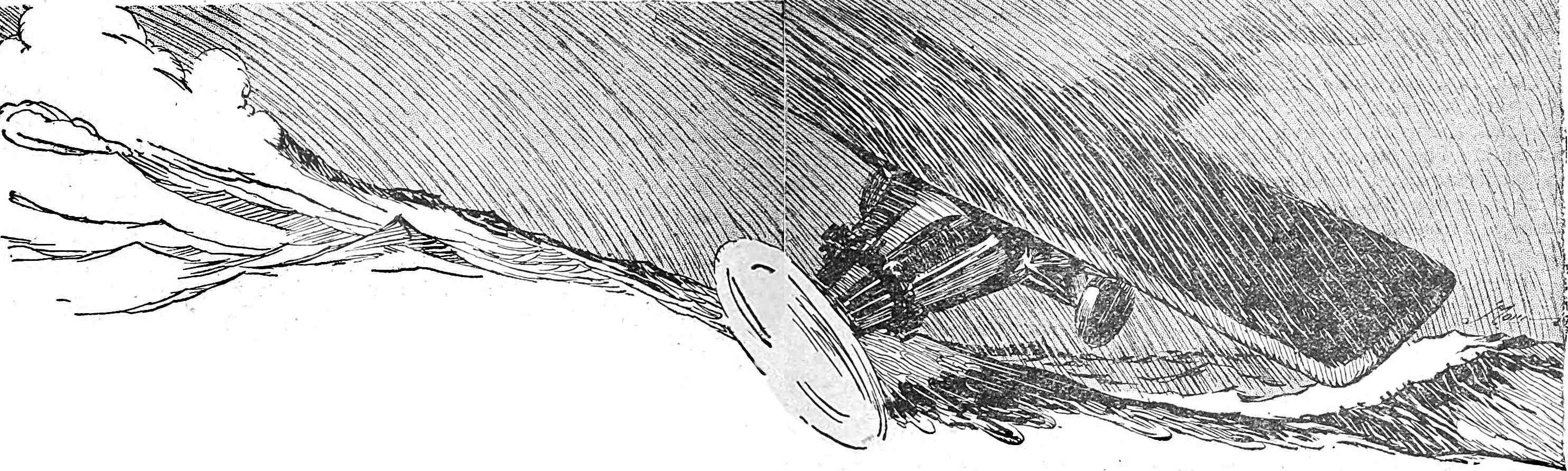
Ray Folsom strode across the flying field to where the Silver Bird stood, her powerful motor idling with a regularity of exhaust that was music in the ears of her pilot. He gazed up at her great spread of shining surface with something akin to affection; his eyes strayed to her massive struts and stays, to her capacious cockpit and the housings of her huge petrol tanks.
He glanced eastward toward where the Atlantic lapped the southern shore of Long Island and cast a shrewd eye aloft, frowning a little at the leaden quality of the clouds that hung low over the earth.
A reporter separated himself from the group which stood, conversing, a short distance away. Sauntering to where Folsom stood, the man asked: “Do you really think there’s a chance of hopping off in the morning?”
“I’ve given up making prophecies,” Ray smiled. “But the weather reports certainly indicate favorable conditions for the next seventy-two hours. And if Mrs. Benham decides to chance it, I’m willing. She’ll be along any minute now. I think that’s her car turning in at the gate.”
Ray watched the newspapermen as they bolted for the smart motor from which Mrs. Jarvis Benham was at that moment alighting. A peculiar feeling—one that had assailed him at intervals for days—swept over him.
A sense of unreality, almost a conviction that this was not Ray Folsom, who was about to attempt a nonstop flight from New York to Warsaw, Poland, hoping thereby to hang up two new records—that of nonstop distance and also compassing the undying fame of Mrs. Benham as the first woman to fly the Atlantic Ocean.
Long before Lindbergh had accomplished his astounding journey, Ray had cherished dreams of a transatlantic flight and had suffered bitter disappointment as he saw the glory of such an achievement dimmed as the trick was repeated on three subsequent occasions. He felt that his skill matched that of the others and cursed the fate that kept his hands tied for lack of the money or the backing which the attempt demanded.
Then had appeared Mrs. Benham—a sort of fairy godmother—to make his dreams come true. She had acquainted herself with Folsom’s record in the war and as mail pilot afterward and, undaunted by the scroll of disaster which the ventures of other feminine aspirants had compiled, had determined to have a try at what they had missed.
Ray Folsom, quite alone in the world and without ties of blood, had seized the opportunity with eagerness. It stood for action, adventure at its best.
And he thanked his stars that Mrs. Jarvis Benham had tired of being looked at and discussed, merely as the rich widow of a shrewd banker. Her bid for fame was his chance.
During the period of preparation, Ray and his backer had got on in perfect harmony, principally because the lady placed the utmost confidence in her chosen pilot and while certain vital decisions were technically up to her, she never made them without first ascertaining Ray’s views in the premises.
Had the latter met Marjorie Benham, casually and in a purely social atmosphere, he doubtless would have liked her vastly—as a woman. She was not a great deal older than he. He was twenty-eight and she may have been thirty-three or thirty-four. She was lively and attractive.
But, as matters were, she did not register with Ray as a woman or a friend, even. She stood only for the answer to hope, for the long-sought means to the end he desired. She was the vehicle in which he would travel to salient accomplishment—or, perchance, destruction.
He watched her now as she crossed the field toward him. She moved with light, springy step; in her smart leather driving coat, with hat to match, booted and gloved meticulously, she was a pleasant picture. About her swarmed reporters and cameramen, but these she courteously motioned back as she drew close to where her pilot stood.
“What ho?” was her cheery greeting.
“I don’t like to be too hopeful,” he told her, “but in spite of this dullness, the indications are more than favorable. The wind is veering to the west. If this holds, the weather will be clear by midnight. The reports do not show any particular disturbances and it looks to me as if we shall not do better by waiting. It is, of course, for you to decide.”
“There’s nothing to decide if you feel that way. We’ll go! When do we hop off?”
“Just about dawn, I should say. The moment there is natural light enough for the take-off. You’d better give out the glad tidings to the boys over there; they’re anxious.”
“No. You tell them. Or, better yet, come with me.” She led the way to where the little knot of scribes waited.
“It’s settled, boys,” Mrs. Benham announced. “We’re going!”
There was a great chorus of “When?”
“Mr. Folsom says at dawn,” she replied.
Ray nodded in confirmation. And for ten minutes faced a crossfire of questions and a battery of cameras as the gentlemen of the press scrambled for last-minute stuff. Then Ray moved off to give his final orders regarding tests and fueling.
The thousands who had flocked to the Long Island field when the news of the Silver Bird’s proposed start got abroad stood, breathless, as the giant machine thundered down the runway, lifted ponderously, sagged, wabbled in apparent hesitation, then, as if with sudden determination and with motor surlily complaining, drew slowly but steadily aloft.
She had made it, despite a load that had caused head-shakings among numbers of so-called experts. And now she was a small dot against the red of a clear winter sunrise. Warsaw, in distant Poland, was her next port of call!
For Ray, the few minutes just prior to the take-off had been a terrific strain. He was satisfied that the Silver Bird would lift her burden, but he knew there was almost no margin. A score of disastrous possibilities existed—a puff of wind at the wrong second, too healthy a pull at the joy-stick, oh, anything might happen.
Thus, when he felt her finally pull herself steadily up, up, up, he wanted to shout with pleasure. He turned a grinning face to his companion and she smiled back reassuringly. They were off!
The buoyancy thus bred endured for perhaps a half hour. And, as can be understood, was followed by something very like depression. For, before them stretched hours upon end, monotonous and empty.
Aside from the unremitting vigilance, the constant watch over a dozen instruments, now and then a slight movement of the hand or foot, there was nothing to be done. If that throbbing motor kept on working properly as it was now, they would touch earth in Warsaw; if not, well—
Underneath, Long Island slipped away; gave place to flat, gray water. The next land they would sight, barring a glimpse of Cape Cod, would be Newfoundland. Then the grim expanse of ocean—the ocean that had claimed so many of their predecessors.
Ray thought that Mrs. Benham must be getting more of a thrill out of the undertaking than he was. The first woman—
Ray expected to handle the controls virtually all the way and had braced himself against the long, sleepless hours. There was plenty of black coffee in the thermos bottle at his hand and the very excitement of the trip would do its part.
During the period of preparation he had taught Mrs. Benham the rudiments of flying and she could take over the controls for brief spaces when he should feel the need of relief. She it was who looked after the radio and several times during the morning hours she had been in communication with land stations as well as two incoming liners. The call of the plane was SBDK.
In the waning afternoon they sighted Harbor Grace, Newfoundland, and Mrs. Benham picked up a greeting from the wireless station there. She replied:
Thanks for good wishes. All well and ship behaving perfectly. SBDK.
Out over the sea roared the Silver Bird, out into the unknown that had swallowed without trace flyers quite as intrepid and skillful as the two whose faces were now set to the east.
Ray planned to make straight for the Irish coast, a matter of seventeen or eighteen hundred miles. They would, if nothing went awry, attain the British Isles on the morning of the next day. That would give them daylight to win halfway across the European continent before night should again overtake them.
The coming of darkness found them well out and doing better than ninety miles an hour under clear, star-shot skies. As the load of fuel lightened, they would make even faster time.
Comfortable thought, that. Ray exulted. They would make it! The weather dope had been right.
Marjorie Benham, listening in constantly, scribbled on a paper and shoved it over to him:
The Majestic is calling. They picked up our last message. I’ll shoot them an all’s well if you will give me our position.
Ray did so and the message was sent. And the march of the weary hours went on.
A fresh sense of unreality enveloped Ray Folsom. Here they were, over a winter sea, under a winter sky—cleaving the velvet of the night at one hundred miles an hour.
They were warm, thanks to the efficient exhaust heater; they were otherwise comfortable albeit a little cramped. There were food and drink at hand. It was easy—so absurdly easy!
He thought of the woeful prophecies with which the papers had teemed for a fortnight; grinned over the stupidity of it all. Why, there was nothing to it except a fairly good motor performance!
And if they were successful, there would be no end of hullabaloo over what did not amount—so far as actual labor was concerned—to the grinding of a set of valves!
It was remarkable, Ray thought. A job so utterly easy that it was hard to remain awake, yet hero stuff awaited at the journey’s end. For that he was glad on Marjorie Benham’s account. She was a game sport.
He flooded the cabin with light and turned to look at her. She smiled sleepily and he motioned her to take a nap. But she shook her head and her lips formed: “I can’t.”
Ray switched off the light and peered once more through the windows of his little domain. Peaceful, so amazingly peaceful. The motor, almost, was singing a lullaby.
So absorbed was Ray in his thoughts and the mechanical inspection of gauges and dials that he did not notice when they plunged into the fog. It was, rather, the change in the tone of the motor as the moist air affected the mixture that caused him to peer anxiously out of the window in an effort to pierce the murk, then to pull open one of the side frames.
He closed this hastily against the rush of dampness and lighted up to look at his companion again.
She nodded in understanding, wrote on a slip:
It won’t delay us, will it?
His answer was a negative, coupled with a slight shrug.
In truth, he was not concerned; he had been astonished that they had not encountered fog earlier—off the Banks at this time of year. If ice did not form in appreciable quantities, the fog would not bother them. And all exposed surfaces had been treated with a special preparation calculated to obviate such a disaster.
He opened a side port again and ran his hand along the outside of the cockpit. No ice yet, at any rate. That was good. The hours crawled on.
Dawn came, gray and clammy. The ship still plowed through heavy, impenetrable mist that walled them in, enveloped them in its steely vapor. As if they were plunging on through nothing into nowhere, it seemed to Ray.
It was annoying, too. They ought to be no great distance from the Irish coast, he felt. Glancing back, he saw that Mrs. Benham had fallen asleep in spite of herself.
Ray grinned. She wasn’t missing a lot. Perhaps they would be in the clear when she should wake. His eyes drifted to the oil gauge and he gave a violent start.
For a moment he studied the indicator. M-m! That was funny. Not so funny, either. For the pointer stood fast at the mark at which he had noticed it an hour back! The oil was not feeding!
Hastily, Ray began an inspection of the connections. If it were some simple difficulty, he might be able to remedy it.
He woke Mrs. Benham, motioned her to take over the controls while he applied himself to the job of locating the trouble. He already could feel the increasing heat of the engine. He must work fast.
Marjorie Benham watched him and the instrument board alternately. She gathered the nature of the trouble almost at once, realized the gravity of it. Therefore it is not strange that her eyes were anxious.
Not that she was particularly fearful of her own safety; the failure of the effort was what preyed upon her mind in those few tense moments.
Ray cursed under his breath as he sought for indications of a bruise on the slender feed pipe, scanned valves and connections, tapped here and there in the hope of jarring loose the obstruction, whatever it might be. Now, the motor was alarmingly hot and a smell as of burning rubber assailed his nostrils—the melting of insulation!
He must take such measures for safety as were at hand. So, for a bit he abandoned his feverish search and took the ship.
“Send out a call,” his lips framed. And S O S sputtered forth into the fog, followed by the Silver Bird’s identifying SBDK and the position.
To Ray’s intense satisfaction there was an almost instant response. His companion listened intently, then leaned over and shouted in his ear: “There is help close by! Must we land?”
Before he could reply, the engine started to knock in a spasmodic fashion that, to Ray’s trained ear, spelled but one thing. Her connecting rods were going—burning out! That was the finish, then; they were done!
He swung about, caught Marjorie Benham’s eyes, motioned to the little compressed air cylinder which was attached to the pneumatic jacket she wore. Then he turned the valve on his own and cut out the worse than useless motor.
No reason for adding fire to their other perils. As the noise ceased and Ray set his lips grimly for the horrible, nerve-racking glide toward the water he could not see, there was borne to him the sound of a vessel’s fog horn: “Whamp! Wha-a-amp!”
The sound appeared to come from directly underneath. Ray was thankful for that. Their chances for rescue were excellent, if they could get clear after striking the water, and he believed the Silver Bird would float plenty long enough for that. He must be careful—careful!
Down, down they slid, on an easy glide, while Ray’s eyes strained for a glimpse of the water. His companion, he noted, was holding herself in readiness to slip out of the cabin. Down—down—
The sea rushed at him suddenly—rushed up in an oily heave! The tip of one wing caught in the crest of a wave, caught and tangled in that astonishing snarl which so frequently accompanies the landing of aircraft in water.
The ship swung violently about; her nose dived into the waves and she seemed about to turn a somersault. Instead, she hesitated at the highest point of the procedure, leaped heavenward briefly and crashed wickedly into the trough!
There was a splintering of wood, the “ping” of parting wires. Ray felt his head in terrific impact with something or other! Then, astonishingly, he was clear of the wreck and in the water!
There was a great confusion—the deafening booming of the fog siren! A cry from Mrs. Benham! Ray caught a swift glimpse of her, in the ocean like himself.
But his head was swimming and a great giddiness swept over him, even as he struggled to shout. The water set upon him, ominous, thundering masses of it—beating at him, bearing him down! He gasped and choked, then suddenly felt light and happy. Why—
What was this, this new comfort? He was relaxed, warm, enveloped in softness. Incredible!
For a moment Ray dared not open his eyes. He wanted to do so. He wanted to understand why he felt as if he was coming back from a far distance. He was very tired and, of a sudden, he realized that his head was aching horribly.
With an effort, he lifted reluctant lids, stared about him.
White paint, gleaming white paint. Orderly rows of rivets. A silvered steam pipe. The stateroom of a vessel, that was clear.
For a moment Ray gazed quietly at the iron ceiling, as yet too languid to wonder how he came to be there. Then he was spurred to action by the recollection of the last vision he recalled—Marjorie Benham, struggling in an icy sea!
He tried to draw himself up, was beaten back by an exquisite stab of pain through his head. But his ears caught a sound and a face suddenly bent over his—a curious, tightly drawn face, yellow and dry looking. A thin voice said: “You wake, Missa Folsom?”
“Mrs. Benham?” Ray managed weakly.
The eyes looking into his appeared puzzled. “You wait. I go see,” returned the other, who by now Ray had set down as a Japanese.
There was a patter of slippered feet, a wait that seemed interminable to Ray. He kept his eyes closed; his head bothered less that way. It was not until he heard the murmur of voices that he ventured to look about again.
When he did, he saw that the Jap had returned and that he was accompanied by a tall, bronzed individual with brilliant blue eyes and a tiny, waxed mustache. The face, Ray thought, was vaguely familiar.
The blue eyes were grave now as their owner said, softly: “So Mrs. Benham was with you. We had hoped that the plans had been changed at the last minute.”
Ray choked on the words: “Didn’t—didn’t—you—”
The other shook his head.
“We searched everywhere—for two hours. Not a sign. It seemed strange. But, of course, the fog and the terrible sea—”
He stopped, as if unable to go on.
Ray said: “My God! My God!” He was too giddy and weak to think clearly.
The other had drawn a stool up beside the bed.
“How do you feel?” he asked. “You got a nasty one on the head.”
“I’m all right,” Ray told him in a whisper. “But—but—Mrs. Benham—” His throat grew too tight for further words.
The other said: “I know. I know. We did all we could.” He spoke to the Jap, who stood close behind him. “Koli, bring some whisky.”
A husky draft of the liquor sent new life coursing through the veins of the man in the bed.
“Tell me,” he addressed the other, “what ship is this—and you, sir?”
“This is the yacht Raven,” replied the man. “I am Miles Starbuck.”
“Oh, yes,” Ray murmured.
He knew now why the man had seemed familiar. For more than a month, the Raven and her owner, Miles Starbuck, had been freely mentioned and photographed in the press. Starbuck, heralded before he arrived in America as a fabulously wealthy diamond manipulator—owner of mines in South Africa—had entertained and had been entertained luxuriously in a dozen Eastern cities. His hosts had been some of the most prominent American society folk.
The Raven had sailed some days before the Silver Bird started on her ill-fated flight, bound, it had been stated, for the north of England or Scotland—wherever it was that Miles Starbuck’s estate, acquired from the heirs of the late Lord Derricote, was located.
Now, Starbuck, observing that the whisky had improved the patient’s condition, resumed: “You’ll be all right shortly. That wound just escaped being fatal. (I’m a bit of a doctor.) But there is not much concussion and a day or two will see you as right as rain. For the present you’d best lie quietly in bed. I’ll have Koli bring you something to eat, a cup of broth, perhaps.”
“But, tell me,” Ray insisted, “where are we? How close did we come to hitting Ireland?”
“We’re about two hundred miles off Queenstown—or Cobh, as they call it now. We can put you ashore there, if you like.”
“Have you reported picking us—picking me up?”
“No. Unfortunately, just after we advised you that we were standing by, our wireless went bad and so far, Sparks hasn’t been able to make repairs. That’s why we took to the fog horn.”
“I see,” Ray murmured. “When shall we make Cobh?”
“Some time tonight—probably before midnight. Depends on the tide and it won’t be worth while trying to go ashore before morning.”
Koli appeared at that moment with a cup of steaming broth. Starbuck rose.
“I’ll toddle off now. Drop in on you a bit later. Take it easy, it’ll pay you better.” He went softly out.
Ray sipped his broth thoughtfully. He was inexpressibly sad over the fate of his companion, but realized that brooding over the disaster would be worse than useless.
He was naturally thankful for having been himself spared and gave some thought to his procedure when he should land at Cobh.
The broth did wonders for him and the ache in his head subsided amazingly. So that, an hour later, Ray said to the hovering Koli: “I think I’d like to get up. Are my clothes in shape to wear?”
The Jap shook his head. “Clo’ no dry, Missa Folsom. But I see.”
He disappeared, only to return promptly with Starbuck. The latter expressed surprise that Ray thought of rising.
“It’s risky,” he said. “But that, of course, is up to you. I have plenty of togs and we are about of a size, I imagine. So I’ll have some things sent in directly.”
Thirty minutes afterward, attired in a gray tweed suit that fitted him astonishingly well, Ray followed Koli to the lounge where his host awaited him, flanked by a taboret containing a most satisfactory array of decanters and soda bottles.
Here they were joined presently by a number of people to whom Ray was presented and whose names he recalled as having seen mentioned in newspaper accounts of the American sojourn of Starbuck and his guests. These included a Count Johann Markowski, who, Ray understood, was a Polish nobleman. There was a Mrs. Mollie Trine and a Miss Fay Dollis—both English.
Starbuck’s skipper, Captain Trumper, also dropped in for a moment to pay his respects to the rescued airman. A somewhat gay company, just what one would expect to find aboard the yacht of a wealthy bachelor.
Ray studied them in turn. He did not much like the count who seemed to him sort of decayed—a slight little man with thin hair and too sharp an eye. Clever, no doubt, but not the sort Ray would select for a companion.
Mrs. Trine was a talkative individual who evidently kept well abreast of current events, including slang and scandal. She laughed often and drank rather more than she ought to.
Miss Dollis, on the other hand, was more to Ray’s liking. She lurked, it appeared, behind a natural reserve, and spoke seldom. But what she did say was very much to the point.
She had, Ray thought, a very keen sense of humor; he felt sure that quiet, inward chuckles were much in her line. He could see, too, that she was regarding him with considerable interest.
Trumper, the skipper, registered as a hard, lean person, utterly without illusions and extremely competent. The steward, Starbuck addressed as Sayles, and a couple of cabin attendants, Grundy and Mapes, appeared briefly in the picture. Koli was everywhere, at all times.
On the whole, Ray was a bit disappointed, aside from the tragedy of Marjorie Benham’s loss, at the tame manner in which his great adventure was ending. A brief ducking, then luxury aboard a private yacht. A mild voyage home on a liner and that would terminate the business.
There would be a two-day flurry in the papers, largely on account of the death of Mrs. Benham. He himself had accomplished nothing of interest to anybody.
Bah! But if he could have looked ahead only a few hours his opinion would have been smartly revised. Tame—nothing!
Starbuck had bade his erstwhile guest make himself at home and Ray had wandered about the deck, gazing idly at the grim waters from which he had so lately escaped.
Koli, apparently full of awe and admiration, was never very far away, and constantly proffered his services, rushing forward with a match whenever Ray indicated that he was about to smoke, and inquiring solicitously if Missa Folsom would like a drink.
During the lunch period, Ray, being without appetite, elected to recline in the lounge where he presently found himself dozing off. He finally took to wandering restlessly here and there, and at last found himself in a sort of combination library and study where rows of books peered from behind glass doors and a desk in one corner was strewn with a confused mass of papers.
Ray glanced at a few of the book titles, saw nothing that interested him, and was about to pass out when his attention was drawn to a paper lying atop the litter on the desk. A plan of some sort, it seemed, and the young man paused to examine it.
The plan, he saw, had been torn from the magazine known as Gorgeous Homes, and showed signs of having been folded in order that it might be placed in a pocket or wallet. All of which, in itself, signified nothing.
It was when Ray came to read the caption underneath that his attention was gripped. And he gave vent to a puzzled exclamation as he read:
First and Second Floor Arrangement in the Magnificent Town House of Wilbur Gaylord, Noted Banker of Philadelphia.
That caption recalled a plenty. For, during the days preceding the flight of the Silver Bird, the front pages of the newspapers had been splitting it between the projected ocean flight and the sensational disappearance of Eve Gaylord, twenty-year-old daughter of the famous banker! And the police of America were turning things upside down in their mad scramble for the glory which would attend the recovery of the girl.
At the time, Ray had paid scant attention to the story; he had too much on his mind. But this sheet of paper brought it sharply back.
What on earth, he wondered, had caused Miles Starbuck, or one of his guests, to rip from between the covers of Gorgeous Homes a plan of the layout at the Gaylord establishment?
Ray puzzled over the matter for several minutes. It was strange, he thought. On the other hand, people were constantly clipping things from periodicals for many reasons. Nevertheless, the coincidence was enough to give anybody a momentary start.
Ray laid the cutting down and thoughtfully made his way into the lounge, where he was joined in a few minutes by Miles Starbuck.
“Sure you won’t have some lunch sent here?” the latter inquired.
Ray shook his head. “No. I’m not a bit hungry.”
He was persuaded, however, to join Starbuck in a glass of port, and over this they tarried. Starbuck chatted on, most entertainingly, and Ray was content to listen, wondering at intervals about that floor plan.
Starbuck suddenly glanced sharply about, then pushed a button. Koli responded, and Ray thought Starbuck unnecessarily curt when he said—almost snapped: “Where have you been?”
“I,” returned Koli, a little nervously, Ray thought, “I make to press Missa Folsom clo’.”
“Oh,” said Starbuck. “I see. And how much longer will you be at it?”
“Mebbe half hour; mebbe hour, Missa Starbuck.”
“Very well. Come back here when you are done.”
Koli indicated that he would, and returned to his work. Ray and Starbuck talked soberly of Marjorie Benham.
It had been impossible to recover the plane, Starbuck explained. The thing was battered to pieces from its contact with the sea, and probably the heavier parts had sunk at once. Ray agreed that this was likely.
Starbuck, it struck Ray all at once, was developing a nervousness that seemed not to fit in with his make-up. He fidgeted about, lighted cigarettes only to discard them, and glanced at his watch oftener than it would seem necessary for a man with nothing to do for many hours to come.
He answered somewhat shortly when Ray inquired how the repairs on the radio were progressing.
“Can’t fix it,” he declared. “Have to get some material ashore. Probably put in at Liverpool.”
“If it would suit you any better,” Ray offered, “I don’t mind waiting until you reach Liverpool. It does not make much difference, that I can see.”
“No, no. We’ll set you ashore at Cobh,” Starbuck said. “And, if you will excuse me, I’ll go below for a bit. Some matters to look after. You will be quite comfortable here, I dare say.”
It seemed to Ray that Starbuck stressed the word “here,” but he nodded. The other observed: “Koli will be back shortly; he will get you anything you require.”
“Don’t worry about me,” Ray said. And Starbuck vanished.
Koli did not appear, however, and Ray found himself growing drowsy again. An hour’s sleep would refresh him, he decided, and forthwith set out to find his stateroom. He knew its location, he thought.
One deck below, along the corridor that led from the foot of the companionway, the second door on the right—or was it the left? Oh, well. He would find it. And a sleep would go mighty well.
The door he sought, he decided, was on the right—the third one down. Yes, that was it. There he paused, hand reaching for the knob.
But before he could touch it, the door was opened from within, and the form of Miles Starbuck appeared in the aperture.
Evidently he had stopped to speak to some one, because he was turned so that his face was away from Ray as the man let himself out. And, looking over Starbuck’s shoulder, Folsom saw that which almost stunned him!
Sitting in a wicker chair, head thrown back, gray eyes scornful and contemptuous, was a young woman. Ray recognized her instantly from the scores of photographs he had seen, especially during the week just past. The girl was—there could be no question—Eve Gaylord!
And while Ray’s brain hummed with his discovery, while he still gasped in astonishment, Starbuck turned and faced him!
In that instant, Ray saw that Starbuck understood what had happened. The man knew that Ray had seen the girl, and that he knew her identity.
Into the blue eyes of the yachtsman a sudden swift flame leaped. And Ray made no effort to avert the issue that had so dramatically arisen.
Starbuck closed the door, turned a key and said: “Well?”
Ray faced the other.
“Well?” he replied.
Starbuck abruptly headed for the lounge, motioned Ray to follow. The latter did so, mechanically, too utterly dumfounded for words or coherent thought. The knowledge that Eve Gaylord, reported to have been kidnaped or spirited away from her Philadelphia home, was on board the Raven, was in itself overwhelming!
How she came to be there and whether she had come willingly were other matters. But the look Ray had caught in Starbuck’s eyes and the sudden alertness that had flashed into the girl’s face in the fleeting instant that Ray had looked upon her—these indicated, without question, that something was amiss.
Starbuck’s “Well” had been the involuntary exclamation of a man caught in a jam. But in the few seconds occupied by their progress to the lounge, Ray had no time to sort out the impressions that were crying for recognition.
He felt dumb and stupid. Therefore, he did the sensible thing, followed Starbuck and, when they had seated themselves, waited for his host to speak.
Starbuck was frowning. “Why did you follow me down there?” he asked sharply.
“I didn’t follow you,” Ray told him. “I was looking for my room when you came out.”
“Well, what do you think about it?” the other demanded.
“I don’t know what to think,” Ray admitted, adding: “What do you expect me to think?”
Starbuck sparred yet a moment longer. “You know who the lady is, I suppose.”
“Sure. Eve Gaylord,” Ray answered shortly.
“Just so. And, before you left New York, the papers, no doubt—well, just what was being said?”
“I was too busy with my own affairs to follow the thing closely,” was the reply. “But I gathered that the girl had disappeared, and that she was believed to have been kidnaped. There were reports that a big ransom had been demanded from Wilbur Gaylord.”
Starbuck smiled faintly. “I fancy he could pay a pretty stiff price for anything he wanted badly enough,” he observed.
“There is no doubt about that, but—Holy Moses, you haven’t kidnaped the girl, Mr. Starbuck!”
Starbuck laughed shortly, a disagreeable little chuckle, it was, and turned abruptly to the taboret. He mixed a stiff drink, motioned Ray to help himself, then said, half to himself: “It is too bad that you couldn’t have remained here where you belonged.”
The sudden recollection of that floor plan forced its way into the tide of Folsom’s racing thoughts and the young man paused in the act of pouring a drink to look keenly at his host. Starbuck noted this.
“Now what?” he queried.
Ray set down his glass.
“Hell!” he exclaimed. “Why go on like this? If you think any sort of explanation is coming to me, Mr. Starbuck, I should be pleased to hear it. Otherwise—well, the subject is not pleasant.”
Starbuck pondered this for a moment.
“We’ll drop the matter for the present,” he announced. “Tonight at Cobh, we shall have the British papers and the American prints at Liverpool next day. We’ll just drop it for now. Only—only, I fear I cannot put you ashore at Cobh, nor yet at Liverpool. You have suddenly become a problem, Mr. Folsom.”
“But—but—why, I must get ashore! I have to report on my trip—to report the—the—disappearance of Mrs. Benham!”
“Sorry,” Starbuck told him. “But it can’t be done, you see. I hate to inconvenience you, but there you are. It can’t be done. Damned shame you came along when you did; otherwise I would have had you snugly ashore this evening or first thing in the morning.”
“You’re crazy,” Ray blurted out. “Why, you can’t keep me here. You can’t keep the news of our mishap bottled up like this, you know!”
“Can’t I, though? I fancy I can if I choose. It’s really remarkable what I can do along those lines—what I have done. But we were about to drop the subject until after seeing those papers. It will be tremendously interesting to read the sundry versions of the affair.
“Meanwhile, I will admit that I’m puzzled. There is a lot of thinking to be done. I hope we make Cobh in time to send a boat ashore tonight.” Whereupon the astonishing Starbuck wheeled and walked out of the lounge.
Ray stared after him. He could put but one construction upon what the man had said. That and his refusal to put his guests ashore could signify only—but, why, the thing was impossible!
This yacht, these guests, the estate in the north, Starbuck himself. Was not the man wealthy and of good repute? There had been enough in the papers about him. That he could be a desperate criminal seemed preposterous!
And these people about him—where did they fit in? Rats! It probably was something in the nature of an astounding hoax. Ah, well. He would make the best of the business and see what the newspapers had to say.
While Ray did not again see Starbuck until the Raven had dropped anchor in the harbor of Cobh, he was aware of the presence in his vicinity of Koli. The little Jap was unobtrusive, but Ray was certain that the man had been given instructions to watch over the luckless visitor, and he was equally sure that any false move on his part would be productive of instant counter measures on the part of Koli.
The latter need not have been apprehensive. Ray had no notion of plunging over the side into the icy waters of the bay; his recent experience had supplied enough of that to last him for a long time.
And there was no chance to get ashore any other way. A small tender was lowered overside. Into this the steward, Sayles, descended, followed by the man called Grundy.
Starbuck appeared at the rail with low-toned instructions for Sayles and the boat put off.
Something like an hour and a half later the launch returned. On gaining the deck Sayles thrust into Starbuck’s hands a great bundle of papers, said a few words and went below. Starbuck approached Ray, remarking affably: “You might want to see the news, Mr. Folsom.” And Ray went along with him to the lounge where Count Markowski was talking with Mrs. Trine.
The two eagerly accepted the papers which Starbuck handed them, watched narrowly, Ray thought, as he and his host passed on into the library where Ray had discovered the floor plan of the Gaylord home.
Starbuck closed the door after he had flooded the room with light and threw the bundle of papers on the table.
“Help yourself,” he told Ray; he himself shook out a copy of the Freeman’s Journal. Ray dug out a Daily Mail and an Evening News.
Instantly the principal headline caught his eye:
There followed the meager news dispatches, reporting the signals exchanged at Harbor Grace, the speaking of the plane by the Majestic. It was pointed out that, unless disaster had overtaken the adventurers, they should have appeared over the British Isles early in the present day.
Ray smiled grimly and turned to the other columns.
There it was, the most important story in the sheet, outside the flying yarn, which really wasn’t a story at all.
The dispatch from New York ran:
Local, State and Federal police confess themselves completely baffled in the nation-wide search for the missing daughter of Wilbur Gaylord, international banker of Philadelphia.
Without giving any specific reason, the authorities state that it is practically certain that Eve Gaylord is the victim of kidnapers. The operations, it is understood, are being supervised by an official high in the United States Secret Service, and this individual is in constant touch with Wilbur Gaylord.
The latter refused to confirm a rumor to the effect that a huge ransom had been demanded for the return of Miss Gaylord, but Mr. Gaylord’s manner, during the interview, indicated that something had occurred which has not been made public. Doubtless the furor which the girl’s disappearance has caused has rendered the kidnapers extremely cautious.
Mr. Gaylord utterly scouts the theory that there is a love affair at the bottom of the matter, or that Miss Gaylord, for any reason, is remaining away from home voluntarily.
Ray read every word with tense absorption and looked up to find Starbuck quietly watching him. The two men stared at each other for fully a minute before Starbuck broke the silence.
“You see why I couldn’t put you ashore,” he said, with rising inflection.
“What I would like to know,” Ray told him, “is, just who are you, Mr. Starbuck?”
“I refer you,” said the other, “to the great American press. Every last newspaper in your grand and glorious country has, if it is alive, a fat file on the activities of Miles Starbuck. Isn’t that enough for you?”
Ray lighted a cigarette.
“I’m damned if it is, after what I’ve seen,” he said bluntly.
“It will have to be, for the present,” was the reply.
“Well, what do you intend to do with me?”
“To tell the truth, I can feel my hair turning gray, trying to work that out,” Starbuck told him. “You are more of a problem than ever. I never should have taken you out of the water. But I thought I could slip you ashore here without any fuss. Believe me, if I had known what was coming off, you would be out there in the ocean yet.”
“You’re a pleasant person, I must say,” Ray told him. “But you have to do something, you know. You can’t keep me here on this boat indefinitely.”
“Why couldn’t I?” demanded Starbuck crisply. “In a day or two it will be an accepted fact that you have been lost at sea. Nobody will bother about you any more. Why couldn’t I keep you here?”
“Perhaps you could,” admitted Ray. “But I don’t think you mean to.”
“You’re right there,” Starbuck said. “I am really debating whether to put you back where I found you or take you north with me. I am going home to my island, and while you would be quite safe and snug there—as much so as on this boat—I hate to be bothered. You couldn’t escape—it’s twelve miles to the nearest land—but you might think you could, and annoy me by trying to do so.”
“I see your viewpoint. You have your hands full with Miss Gaylord, what?”
“Quite. But I hope she will not be with us too long. Of the two, I regard you as the more dangerous. Still, I have nothing against you, and I dislike employing summary measures if I can avoid it. My guests, or perhaps associates, on board, feel the same as I do about it. On the whole, I think we shall have to take you north with us and chance it.”
“Suppose I gave my word to say nothing, if you let me go ashore,” Ray said, tentatively.
“You probably would keep it,” Starbuck returned. “But I could not afford the risk, slight though it might be. No.”
“Very well, then. I may as well be philosophical about it, I suppose. Can you tell me any more about this island of yours? I remember there was something about it in the papers, but I did not pay much attention.”
“What the papers said was that I owned a magnificent island estate in the Irish Sea, off the coast of the Isle of Skye. That is partly true. Only I do not own it; I lease it—and the yacht too—from the estate of Lord Derricote. Would you believe it, I have sunk in this venture of mine some eighteen thousand pounds—ninety thousand American dollars?”
“On which you expect a handsome return, I dare say.”
“Quite handsome. It should be, with the attendant risk. But that will be all, now. You’re an engaging cuss, Folsom. In a minute I shall be offering to sell you a piece of my show. We are going to pull out for Liverpool at once. Koli will see that you find your room, this time. Night.”
“Good night,” Ray said absently.
As the Raven got under way once more, her wireless was sputtering furiously. Probably, Ray thought, the materials required for repairs had been obtained ashore. Certainly the sparks were flying merrily as the yacht slipped away toward the Bristol Channel.
Ray lingered, loath to turn in. He would not sleep, he knew—not while his brain was awhirl with the astounding events of the past twenty-four hours.
It did not seem possible that, some thirty-six hours before, he and Marjorie Benham had exchanged greetings with Harbor Grace. It was more like a week, a month, even.
And now—well, he stood face to face with the strangest predicament that ever fell to the lot of man. He only wondered why Starbuck did not make an end of him at once. It would be so simple.
If his body turned up afterward, no question of murder would be raised. And, of a sudden, he knew why he did not go to bed. He was too nervous; he must keep awake and on his guard.
Once clear of the vessel, it would be different. But the temptation to rid himself of his undesirable guest might prove too great for Starbuck.
Of course the fact that Eve Gaylord had seen him might have a bearing on the case. It might complicate matters for Starbuck later on if he should be apprehended. Ray wondered what the man’s scheme was, anyhow. How he hoped to collect a ransom.
But, more than all, he marveled at the gullibility of the astute American newspapers. How they had fallen for Starbuck and his yacht! Ray acknowledged to himself that he had been quite as easy as the rest.
He had never heard of Miles Starbuck until the press burst into song, as it were. Photographs of the Raven, of Mr. Starbuck, “South African Millionaire.” Stories of the round-the-world cruise just ending. Lavish hospitality to reporters aboard the yacht—followed by columns of good stuff.
Bah! All one had to do was get a boat, hire a castle and spend a lot of money and, if he had a reasonably clever press agent, he could build up an astonishing reputation overnight, almost.
This, apparently, was what Starbuck had done—deliberately, that he might carry out his plan for kidnaping Eve Gaylord.
A sweet bunch of crooks, that was all. But, for the undoing of Ray Folsom, that was quite enough.
He thought vaguely of escape, had wild ideas of watching for another craft passing fairly close and hurling himself overboard. But the vision of Eve Gaylord’s alert face, as he had seen it for a split second, through the door, somehow filled him with the desire to see the thing through, to risk everything on the off chance of being able to compass her freedom.
He told himself that it was silly, but—well, one adventure had merged into another. Why not ride with the wind?
Just outside the Mersey Bar, Starbuck came to Ray with a startling radio message. It had been sent by the American tanker Sunspot to the Associated Press, New York:
Mrs. Jarvis Benham rescued at sea off Irish coast after plane Silver Bird, in which she and Ray Folsom were attempting flight to Warsaw, was wrecked in heavy sea. Motor trouble caused descent. Folsom probably lost, as no trace of him found after exhaustive research. Mrs. Benham suffering from exposure, but not in serious condition.
“Thank God!” breathed Ray when he had scanned the message. “I don’t care much what happens now.”
Starbuck smiled faintly. “I thought you would be pleased,” he said, and went off to pass the news around.
Certainly a great load was lifted from Ray’s mind. He felt capable of facing anything now.
But he had an overwhelming curiosity to see Eve Gaylord again, to talk with her. He wondered if he would have that opportunity when Starbuck’s island should be reached.
How was the girl reacting to the situation? he wondered. Was she depressed or angry or calmly resigned?
Ray—basing his assumption on that one glimpse of her face—guessed that she would not be too docile. Miss Dollis, he gathered, spent most of her time with the girl.
Ray could not see why more freedom was not accorded the victim. She could not escape, and it seemed cruel to hold the girl in her cabin constantly. The reason, however, he learned later.
The Raven anchored well out in the river, and Starbuck prepared to go ashore. With him went Count Markowski and Mrs. Trine.
Ray idled on the deck, half tempted to leap overboard and swim for it. He might possibly be able to raise an alarm before the Raven could get away.
But the distance was more than a mile to the nearest landing stage, and should he fail to make it, Eve Gaylord would be worse off than ever. As it was, he might find himself in a position to help her.
As if in answer to the thought, the quiet voice of Koli said, almost in Ray’s ear, “No jump, Missa Folsom. Missa Starbuck, he say no let Missa Folsom go swimmin’. Water too cold, much.”
In the hand of the Jap, Ray discerned the blued snout of an automatic and did not waste time figuring how far he would get, even if the risk seemed worth taking. So he grinned at the Jap.
“Yes, much too cold,” he agreed.
Presently Starbuck returned in the launch. Count Markowski and the Trine woman did not accompany him, and shortly afterward the Raven turned her nose to the north.
Five days after the Raven steamed out of Liverpool, Count Johann Markowski stepped jauntily down the gangplank of the Aquitania as she lay in her berth in the North River. The count had been thoroughly interviewed by the ship news reporters on the way up from quarantine and had expressed himself as delighted that he might see America so soon again after his very pleasant visit as a guest on the yacht of Mr. Miles Starbuck. The count would be stopping at the Waldorf and hoped to see many of the friends who had shown him such courtesy during his recent sojourn.
He was pleased to state that the Raven had encountered fair weather on her voyage across the Atlantic. Mr. Starbuck, he said, planned to spend the ensuing months at his estate in the Isle of Skye, where the count expected to join him later.
Having delivered himself of this applesauce, the count taxied to the Waldorf, secured a suite and proceeded to make a number of telephone calls. He finally hung up with an expression of perfect satisfaction, bathed leisurely and changed into fresh clothing.
About mid afternoon, he set out on foot, jauntily swinging a stick and presently could be seen elbowing his way through the teeming foyer of one of the newer and more flashy hotels. He appeared to know his ground, and made for the almost deserted grill where two men, who evidently had been waiting, rose from a corner table with somewhat effusive greetings on their lips.
“Don’t be so joyful,” admonished the count. “There is some heavy work ahead.”
“That’s what I’ve been telling Rolphs,” one of the men whom the count presently addressed as Dimes observed.
“I must emphasize the fact, however,” went on Markowski, “that everything is in the best of order. That is, with the exception of one little irritating item.”
“And what might that be?” asked Dimes.
The count opened his mouth to speak, hesitated. He had been about to render an account of the rescue of Ray Folsom, but thought better of it and shifted to: “On the whole, I would best say no more about that. It has no direct bearing on our work here and really concerns only the chief. Let it go.”
“Oh, all right,” grumbled Rolphs. “If that’s the way you feel about it and it doesn’t affect us at all, I should worry.”
“Yes. Let it go. Now, getting down to business, have you been over the ground carefully?”
“You bet we have,” Dimes said. “And we’ve picked a swell location. Between Bridgeport and New Haven there is a bit of ground that will answer splendidly. There are good roads running north, east and west from the place, and, believe me, they will have to look alive to nail us. Also, I have a hunch that they will expect the stunt to be pulled off a lot further from New York, up around Willimantic or Stafford Springs, where the country is thinly settled. We’ll fool ’em, pulling it off so close to home. And by using short lengths of stovepipe, we won’t attract any attention. See?”
“H’m. That stove pipe idea is a good one,” Markowski said. “I’ll ride out with you tomorrow. Meantime, have you got a map with the route traced out?”
Dimes produced one and the three bent their heads over the table. From time to time, the count grunted with satisfaction. Finally he pushed the paper over to Dimes.
“Put it away,” he said, “and now attend—both of you.”
The men bent forward, obediently, and for ten minutes Markowski spoke rapidly and with many gestures. When he had concluded, he leaned back and looked triumphantly at the others.
Dimes and Rolphs sat, obviously impressed. The former managed: “Gawd! He thinks of every last damn thing, don’t he? That is a pip, no mistake. We’ll have to stir about all right.”
“That’s it, stir about,” agreed the count. “It is very pretty, is it not?”
“I’m here to announce that it’s pretty!” rumbled Dimes.
Rolphs nodded vigorously, to indicate his entire approval.
“Things will be happening today. I wired my arrival,” the count said. “We have plenty of time, but arrangements must be airtight. I will meet you here at ten in the morning. I go now for some sleep before dinner. Tonight, I have a most pleasing engagement. Au revoir, my friends.”
In order to appreciate the above cryptic conversation, the reader should be permitted to sit in at a conference taking place in a suite almost directly under that of Count Markowski at the Waldorf. The rooms in question had been temporarily transformed into a headquarters from which Wilbur Gaylord was directing the search for his daughter and her abductors.
With him at the moment was his chief aid, John Keller, deputy chief of the United States Secret Service. And no more astute man hunter than Mr. Keller ever tapped a wanted criminal’s shoulder.
Gaylord was walking up and down the room, chewing fiercely at an unlighted cigar and scowling at a sheaf of papers that lay on the table in front of the detective.
“Of all the dog-goned nerve!” Gaylord was grumbling. “Of all the damned insolence! The others were bad enough, but this one takes the bun!”
The papers which Keller fingered and frowned at were messages sent from an unknown point and received at the private radio station atop the Gaylord Building in Philadelphia. Moreover, they had been sent in the intricate private code known only to Gaylord and one or two trusted employees.
Which was accounted for by the fact that, on the night of Eve Gaylord’s abduction, the personal code book of Wilbur Gaylord had been taken from his desk at his home.
The first message was picked up on the day following Eve’s disappearance, the second four days later, and the last had been received that afternoon. In other words, directly following the arrival of Count Markowski in America. Gaylord leaned over Keller’s shoulder now and scanned them in the order of their arrival. Decoded, they were as follows:
No. 1—Your daughter is safe. She will not be harmed unless you make it absolutely necessary. Detailed instructions will be sent later. Call in the police if you like. It does not matter.
X.
No. 2—Do not alarm yourself. You will be advised further in good time as to terms. Be prepared to part with one million dollars. Your daughter is well.
X.
No. 3, the message just received, the one over which Wilbur Gaylord was so exercised, contained the details promised:
Note carefully the following instructions. On the night of January 18 you will see to it that a plane leaves Mitchel Field, Long Island, at precisely eleven o’clock. If the night is not clear, the start will be made on the first clear night thereafter. The plane will carry, in addition to the usual navigating lights, a single spotlight which will be pointing straight up and will serve to identify the machine from others which may be aloft at that hour.
The plane will carry two parcels, carefully wrapped and padded and each containing five hundred thousand dollars in gold currency. These will be attached to parachutes of the proper size, and to the underside of the parcels will be affixed small electric torches, that their progress through the air may be noted.
Thus equipped, the pilot will fly over the course herewith given, namely, Rye, Port Chester, Stamford, Bridgeport, Milford, New Haven, Saybrook, New London, Willimantic, Putnam, Stafford Springs to Boston. He will keep a sharp lookout, and when he shall perceive on the ground an equilateral triangle, having at its respective corners a red, a white and a blue light, he shall at once release the parachutes to which are attached the parcels containing the money. He will then keep on his way. An attempt to land would be unhealthy, to say the least. If this is not clear, send a random message in your private code and it will be picked up, whereupon such further information as is required will be cheerfully given.
X.
“That,” quoth Keller, frowning at the sheet, “is certainly a knock-out! It’s the coolest thing I ever came across. Hello, there’s the phone ringing.”
Gaylord took up the receiver. “Yes. Yes. This is Mr. Gaylord. You have another code message. Read it off, please. Spell it out. Here, Keller, take this down.”
There followed a jumble of words quite unintelligible to an outsider, but when Keller had written them down and Gaylord had called them back for verification, the two men bent again over the code book which Gaylord produced from his pocket.
When the message had been translated the men looked at each other, and Gaylord said: “I’d give ten times a million to have that bird here in this room for just five minutes!”
The text of the radiogram was:
Neglected to state that failure to comply with our terms on the date set will increase the amount to be paid at the rate of fifty thousand dollars a day. So, really any delay will be all in our favor.
X.
Gaylord flung the paper aside and resumed his pacing of the room.
Keller watched him thoughtfully, and finally said: “One thing is certain, we are not dealing with pikers. It’s a syndicate, and apparently has a perfect organization. There are plenty of groups that operate like this—come out of retirement once in a blue moon with a neat scheme, pull it off and live easy for a long time. And that stuff is the hardest of all to balk.
“They are not ordinary, small-time criminals; you don’t find their records in the courts, except, perhaps, in the cases of a few underlings, and that seldom. Often a stunt like this will be pulled off just after the release from prison of some very smooth criminal. But I have been digging into that and can’t find that any very slick rogue has been turned loose in the last six months. It beats hell! What is your idea about this, Mr. Gaylord? You say you won’t pay.”
“I would drop something for them to pick up,” Gaylord snapped. “I would drop a couple of packages of dynamite—if it wasn’t for Eve. See here, Keller, I’m going to give these folks action—plenty of it. I don’t believe they would hurt Eve, and I know if she had anything to say about it she would say fight. If we can round up some of them, the others will be ready enough to drop her. But, of course, I would not want to take the slightest chance of harm coming to her. I have a plan.”
“Good, Mr. Gaylord. What’s the dope?”
“Well, I am going to get every detective and police officer in three States on the job. I’ll see the Governors of Connecticut and Massachusetts and get their coöperation. It will take an army of men, but we will pack that route with so many cops that after our friends pick up the dummy bundles we throw down to them they’ll think the circus has come to town.
“I’ll have hundreds, thousands of men, if necessary, under secret orders to report at certain points without knowing what they are there for until it is too late for a leak. Then they will fairly choke every damned road by which the crooks could make a getaway. How does the idea strike you, Keller?”
“It can be done,” Keller answered, “if it is handled right. As you say, there must be no chance of a leak. But it will cost a pile of money. However, that will not bother you. You had best let me arrange the details of having these officers report. I will see that they don’t know what it’s all about until the time comes.”
“Then,” said Gaylord, “then, we will have it out of them. They will carry on as if they had got the money or we will tear the hide off them. They will take us to their headquarters or I miss my guess! See the idea?”
“Sure. Force them to communicate with whoever is in charge of Miss Gaylord—and all that. Sure. It’s a big order, but we can handle it. Fortunately, we have the time.”
“We will get busy first thing in the morning, then.”
At the very moment when Wilbur Gaylord was plotting the ruin of the American end of the Starbuck syndicate, Ray Folsom and Eve sat talking in a comfortable sitting room of the imposing Lord Derricote castle off the Isle of Skye.
Once the Raven had set her bows toward the island and Starbuck had realized that Ray knew all, so to speak, he had raised all embargoes and permitted Ray to talk with Eve at will. In fact, Starbuck, with a great show of mock courtesy, had introduced the pair.
“We all may as well be comfortable,” he remarked. “You’ll both like Derricote Castle. We are more than hospitable there.”
“Can’t bear to see us go, eh?” Ray flung in.
“On the contrary, I shall be no end relieved when you are gone,” laughed Starbuck.
In spite of himself, Ray could not but admire the cool recklessness of the man. He went so far as to venture: “Seems to me you are storing up a whole lot of trouble for yourself, Mr. Starbuck.”
To which the other retorted: “You just ought to see me sidestep. My footwork is faultless, as you will observe one day.”
Eve, Ray found, was the most self-confident, cocksure female he had ever come across. She was openly contemptuous of Starbuck.
“You are riding for an awful bump,” she frankly told that individual. “No matter what you do, my father will have your scalp. Beside him, you are something less than zero. I have seen better men than you try to outwit him. That’s why I do not care much what you do with me. I just feel sorry for what’s going to happen to you.”
Which caused Starbuck to grin and say: “You may be right. Who knows?”
But one could see that the man felt he was perfectly safe.
Of course, while the powerful radio plant on the Raven had been more than active, neither Ray nor Eve could know what was being sent through the air to the Gaylord station across the sea. They hooked this activity up with the plans of Starbuck to obtain a ransom, of course. But as to the terms, they were quite in the dark.
Derricote Castle would have been a charming spot, under other conditions, Ray thought. But it was the winter season when, in that part of the world, a grayish yellow fog obscures land and sea most of the time. Ray had heard about Scottish winters, but never had experienced one before.
Still, the uncertainty of the game in which he and Eve were pawns made up for a lot, and on the whole life at Derricote Castle was lazy and comfortable. The island, as has been said, was twelve miles off Skye, and the Raven rode snugly in a small cove which gave the island something the shape of a crescent moon.
Captain Trumper remained on board the yacht, as did Sayles. The men, Grundy and Mapes, slipped into the rôle of house servants under the direction of Koli, who seemed to be everywhere at once.
The wireless operator, whose name Ray had not heard, of course remained at his post. Miss Dollis acted as a sort of companion-keeper to Eve.
The two prisoners were free to prowl about the island except when fishing or other boats came in close. Then they were gently but firmly detained indoors. Nothing rough, but still effective, as on the occasion when Ray harbored the thought of swimming ashore at Liverpool.
Such scant information as they were able to glean was coaxed out of Miss Dollis by Eve. The confidence occurred after the lady had partaken too liberally of champagne. Anyhow, Eve succeeded in drawing the other out with astonishing results.
Starbuck, Miss Dollis declared, was the master criminal of the world. Always he worked on a grand scale and never had spent a night in jail. He was practically unknown to the police. She laughingly told how he once had sold a southern island to a group of wise New York and London investors.
He had chartered a ship and escorted his prospective victims in person. First he had posed as a rich globe-trotter for the benefit of the Imperial Fruit Company officials, and obtained a letter from the president to the superintendent residing on the island, which itself was owned by the fruit company.
The letter bespoke every courtesy for its bearer, and the glib Starbuck managed to convey the impression that he was the owner of the profitable acres which he exhibited to his guests.
Having first convinced the agent that he was about to perpetrate a harmless hoax on his friends by pretending to sell them the island, and having thus made an ally of the man, he had gone blithely about with maps and figures, and so well lined them up that, five days after the ship returned to her home port, Starbuck had given bogus deeds to a million dollars’ worth of fruit acreage and had in his pockets something like one-third of that sum to go on with.
Miss Dollis, who admitted that living by her wits appealed to her, owned to having worked twice before with Starbuck.
Eve retailed this to Ray, and both of them laughed over it.
“But,” declared Eve, “my father is the rock Mr. Smarty Starbuck is going to crack up on. You’ll see.”
Her confidence was infectious; nevertheless, Ray was constantly casting about for a plan that might hold promise of escape for him and the girl.
They were not under constant surveillance, although a sort of watch tower had been rigged over the stable, and one of the three men was to be found there most of every day. There were a few spots on the island, however, that were not visible to the sentinel.
At least, Ray had noted some such places. He wondered how he could turn this feature to account, but never imagined that his chance would come as it did or turn out as it did.
It was the sight of a sea plane, probably from the naval base at Greenock, that set him thinking. On two different occasions he had noticed the craft, flying at a moderate altitude off the island.
And having looked the ground over carefully, the young man proceeded to appropriate a certain flash light that normally reposed on a little shelf at the head of the flight of steps leading to the wine cellar.
Any aviator would be familiar with Morse, Ray knew. He would watch his opportunity, and if the plane ever got close enough, there was a slight depression some two hundred yards to the west of the house, where he could conceal himself and flash a signal to the pilot—a message that would bring help quickly.
He confided his hopes to Eve, and the girl went dizzy with excitement over the prospect of managing their own release. She implored him to be careful, however, to leave the torch in its accustomed place until he should again glimpse the plane. It was two days afterward that the chance came.
Along about three o’clock in the afternoon, when the short northern day was merging into dusk, Ray caught the drone of a motor. Hastily obtaining the torch, he slipped away to the spot he had in mind and concealed himself in the hollow where he had figured he would be unobserved. Then waited with beating heart for the plane to approach close enough for communication.
Luck favored him. The sea plane passed to the north some two miles off the shore, then swung about and laid her course almost directly over the island. When she had reached the point where the visibility was, in Ray’s judgment, best, he let go with his flash.
Swiftly he spelled the words:
Send help quickly.
This message he repeated the second time, and was gratified to see the machine turn and circle a little lower, perhaps, he thought, to better read the flashes.
And then, just at the instant of his triumph, when the hope of actual rescue surged high within him, there came a startling interruption.
He had reached the last two letters of the last word when the sharp crack of a rifle sounded and the torch in his hand flew into a hundred pieces, while the shock of the impact jarred his arm so severely that at first he thought that member had been struck.
Through the gathering dusk a diminutive figure came running; Koli’s voice, warped into a snarl, cut in with “What Missa Folsom up to? Come out here or I shall kill you!”
Ray turned to face the Jap’s automatic, and knew that he had been so careless as to expose his flash to the view of the Jap at his post in the watch tower.
Now, urged by the enraged Koli, Ray marched meekly enough to the house. There he found Starbuck well up in the air.
The latter snapped: “You’re a bigger fool than I thought you, Folsom. You can’t get away with that stuff.”
“Perhaps not,” Ray told him, confident that his message had been absorbed, “but I had a good try, at any rate.”
For the first time that evening, both the prisoners were under close guard. Starbuck kept going outside to listen, and near ten o’clock he returned from one of these expeditions fairly flaming with anger.
To Grundy and Mapes he said:
“Bundle these two into the wine vault, then come back here.”
Whereupon Ray and Eve were forced to the cellar and locked in among the tiers of musty bottles.
Above stairs, Starbuck watched anxiously as flares were dropped off his landing place and three sea planes came to rest close to the shore. He was ready and waiting when their crews, well armed and alert, waded ashore in the shallow water and dragged their planes to points of safety.
A young officer led his companions quickly to where Starbuck stood, Koli at his elbow.
“What’s the trouble here?” demanded the officer.
“No trouble,” answered Starbuck. “That is, nothing real. Fact is, one of my chaps got blotto this afternoon and fancied he was back in no man’s land or somewhere; began sending out distress signals. Still thinks it was funny, I dare say, if he isn’t asleep. I’m sorry, boys. It’s a pity you should be bothered like this, but if you’ll join me in something to drink and a bite of supper I shall appreciate it. What?”
Disgruntled though they were, the hoodwinked flyers could not see how they stood to lose by this arrangement, and accompanied Starbuck to the house, where they proceeded to get tight enough to carry out some intricate flying on their way back to their base at Greenock. And when they were well away Starbuck ordered Ray and Eve released.
“You see,” he remarked, when the crestfallen pair faced him, “it’s one thing to shoot off a gun, and another thing to hit something. I hope to Heaven I’m through with you both and well away from here in a few days. You make me nervous.”
“Damned shame,” Ray muttered as the key was turned on him that night. “Those chaps were there, all right. But, by George, Starbuck is no slouch. Eve’s father will have to go some. And now I’ll have to begin all over again.”
As the date set in the mysterious communications from X. drew near, the preparations on the part of Wilbur Gaylord and his able assistant proceeded briskly and to the entire satisfaction of the banker. Money was spent like water.
Hundreds of officers, ordered to report for unknown and hazardous duty on the evening of January 18, bound to secrecy by the promise of substantial reward, were mobilized and, under the manipulation of John Keller, were so disposed that their presence would not excite comment until it was too late to matter. Each held specific instructions to be at a certain point at a certain hour, when he would be advised as to his subsequent duties.
Keller grunted with satisfaction when he was assured of enough men to cover every mile of highway between Boston and New York.
Bundles containing folded newspapers and attached to small parachutes were in readiness, electric lights already in place. The machine chosen, a swift Taggart monoplane, was to be piloted by one Hart Creighton, an expert mail pilot.
The stage was beautifully set for the reception of Mr. Starbuck’s lieutenants.
Meantime, Count Markowski busied himself with a multitude of details, which included disposal of motor cars which were to be changed twice as a precautionary measure. Also, there was the matter of engaging passage for Europe when a certain trunk, already purchased, should be ready to convey Wilbur Gaylord’s million dollars to a European port.
Count Markowski, it must be owned, was highly nervous, which is not to be wondered at. But it was not the mere responsibility of carrying out his part of the program that beset him; he was waiting for an important message which would be received on the morning of January 18. He could not really be definite about anything until then.
And, sure enough, on the morning of the 18th the expected wire, nicely disguised, to be sure, arrived. The count then knew where he was at, and took steps accordingly.
Dimes and Rolphs chuckled when the count told them of the final arrangements. And if Wilbur Gaylord could have been present at that conference, he would have been less surprised and upset over certain events which occurred that same evening.
At any rate, after their talk, Markowski, Dimes, and Rolphs separated to meet again under circumstances they little dreamed of.
Most of that fatal day Wilbur Gaylord spent in fuming. He was like a condemned person who, having said his last good-byes, chafes over the delay in springing the trap. Keller was at his elbow when he could spare the time from numerous telephone calls.
He was confident that his plans would succeed, and that is why he, too, was thrown completely off his balance when at eight o’clock that night Starbuck, from his distant vantage-point, threw a veritable bombshell.
It was simple indeed, in itself a tribute to the master criminal’s shrewdness.
A code message which was promptly relayed to Gaylord and which contained the following curt and disconcerting orders:
GAYLORD, PHILADELPHIA:Kindly change this evening’s route. After leaving Mitchel Field, your pilot will proceed to New York City, Yonkers, Tarrytown, Poughkeepsie, Albany, Schenectady, Syracuse, Rochester and Buffalo. Other conditions remain as before.
X.
Gaylord stared at the paper.
“Keller,” Gaylord bellowed, “what do you think of that?”
“Barring the hard luck it means for us, I’d say it was damned smart of the gent, whoever he may be. Now we are in the soup. It’s impossible to change our plans now, and your money will be thrown away.”
“To hell with my money! This swine thinks he has us beaten. I’ll show him, by Christmas!”
He paced the room like a wild man for a few moments. Then, without consulting Keller, he called the Secretary of War in Washington; after that, the Secretary of the Navy. His conversations, in both cases, were brief and to the point, and they ended satisfactorily, it seemed.
Keller listened in amazement.
“Gawd!” he breathed. “Do you think you can manage it, sir? Will they understand the importance of the time element?”
“They will have their orders. We shall have to rely upon them. I think they will come through. All we can do now is wait.”
He bit savagely into another cigar, faced Keller defiantly as if challenging him to something or other.
All through the day of January 18, although he could not know the true significance of the date, Ray Folsom was restless. It was as if a germ of excitement had wafted across the sea, as if trouble in New York were breeding trouble in the Isle of Skye. Eve, too, appeared to feel a subtle something.
After all, there was something more tangible that entered into the business. Starbuck himself had been feverishly active, and late in the afternoon Miss Dollis had surprised the prisoners by going out to the Raven, where she remained.
There were other indications that something was about to happen. Grundy and Mapes seemed more cheerful; Koli acted as if a strain had been lifted.
All of which caused Ray to wonder and to fidget. The wireless operator came ashore at the time of Miss Dollis’s departure, and with him Starbuck held a long conference.
As night drew in, the latter manifested no signs of retiring as usual. He drank far more than his wonted quantity at dinner. Koli and the two men, Ray thought, had been indulging overmuch. It showed less on the Jap, but his eyes were brighter and his movements more spasmodic.
Ray said to Eve: “Something is up. I feel it.”
And she replied: “So do I.”
And both of them were wide awake as possible when, about midnight, the wireless took up its sputtering song. That was the message which Wilbur Gaylord was to receive at eight o’clock, and which caused him to rush into fresh activity as recorded above.
Starbuck, who had been glancing at his watch, now slumped into a chair and stared moodily into the fire. Miss Gaylord yawned, said “Good night” shortly, and slipped away to her room. But Ray knew, somehow, that she was not sleepy.
He felt action in the air. He knew that he meant to do something, but did not know just what. Koli padded along and locked Eve’s door, a proceeding which had been omitted heretofore owing probably to the fact that Miss Dollis had shared a small suite with the girl up to that time.
Grundy and Mapes slunk away to their quarters in the servants’ wing of the castle, and Koli looked suggestively at Ray.
The latter, in turn, stared at Starbuck, who seemed half asleep with a whisky and soda clutched in his right hand. Ray got the impression of a player who has just won a hard game but who is weary to the point of listlessness as a result.
He rose and sauntered off toward his bedroom, and close on his heels came Koli.
At his bedroom door Ray paused, fumbled with the knob. The plan in his mind was not half formed; in fact, he had no detailed plan. Nevertheless he entertained a cocksure feeling that whatever he might do would be all right.
Whereupon he suddenly whirled about, seized the astonished Koli by the throat and shut off the Jap’s wind so swiftly and so completely that he had no opportunity of defending himself and the hand that instinctively moved toward his gun pocket never reached it.
Instead, Ray had the weapon out in a twinkling, and with it dealt the luckless Koli a smart crack on the skull. The little man slumped without a sound.
Hastily dragging him into his room, Ray bound him crudely but effectively with a bed sheet and, elated with his start, stole back toward the drawing-room where Starbuck lingered.
Slipping into the room with the swiftness of a cat, Ray jammed the gun into the drowsing Starbuck’s ribs, with a rasping:
“Stick ’em up, damn you, quick!”
Starbuck’s eyes flew to Ray’s determined face, and his hands shot heavenward.
Ray deftly frisked him. He wanted to laugh; the thing had been so easy.
With Starbuck’s gun in his coat pocket, he backed that reluctant individual along the corridor until Eve’s chamber was reached. Turning the key, Ray tapped gently.
As if expecting some such summons, Eve appeared instantly, fully dressed. The shock of amazement at what she beheld passed swiftly, and at Ray’s direction the girl bound their host’s hands securely behind his back and mounted guard over him while Ray made his way to the servants’ wing.
Grundy and Mapes, well fuddled with the stout they had consumed, proved easy victims, and ten minutes later, herded by the menacing guns in the hands of Ray and Eve, they dragged their master and Koli into the wine cellar, where they were securely locked while Ray, flushed with victory, sought new fields to conquer.
At first he considered tackling the yacht, forcing Trumper to take them to Glasgow. But sounder reason prevailed.
There was the wireless man and the Dollis woman and the skipper himself, to say nothing of the two huskies who, although thoroughly cowed at the moment, loomed as potential enemies, given half a chance. No. Instead, he determined to reach the Isle of Skye, and from there summon aid.
The power tender was on the yacht, but there was a dory at the dock, and into this the two prisoners forced their late guards.
“Make it snappy,” Ray ordered. “I want to get well away before daylight.”
Thus, for close to three hours, he and Eve sat astern, gleefully watching the disgruntled pair at the oars struggling with the sea. But in the light of early morning they made port, turned their victims over to an astounded constable, and prepared a sizzling cable which would stir two hemispheres.
There was at Mitchel Field on that night of January 18 a tensity that had never been known in American aviation circles before. The commandant, closeted with Wilbur Gaylord and John Keller, pointed out certain locations on the map and hurried to answer the telephone; in turn, he made many calls. Most of these consisted of “What is your report? . . . . Good . . . . Three? At not less than ten thousand . . . . Right. You understand what is expected of you . . . . O. K.”
“It’s going to hang up a record,” the officer told Gaylord. “I did not think it could be done on such short notice, if at all. Certainly our lads are game to the core.”
“I’ll say they are,” rumbled Keller. “Ah, here is Creighton.”
The tall, lanky flyer strode into the office.
“Twenty minutes to go,” he remarked. “Will everything be set, sir?”
“All set—forty-one, so far,” the commandant told him.
“Whew!” exclaimed the pilot. “Forty-one!”
When, with his strangely burdened and strangely lighted plane, Creighton took off at exactly three minutes before eleven o’clock, and nosed his machine to cover the new route laid down by the arbitrary Mr. Starbuck, he was far from being the lone eagle he was supposed to be.
He flew at five thousand feet, but as his machine swung over Manhattan, from south, east and west other planes took up their positions, timing their arrival over New York to a nicety, so that when Creighton headed up the Hudson he was escorted, although at an altitude twice that of himself, by forty-one other machines, mobilized by an official order from Washington and carefully instructed as to their duties.
The eyes of every pilot were fixed intently on the ground, but from below the navigating lights of only one machine, that of Creighton, showed. Besides the pilot, each of the other machines carried a passenger, a volunteer who was keen for the game.
Above Tarrytown, to be exact, on the golf links of a famous oil magnate, three lengths of stovepipe stood upright in the turf. They were about forty feet apart and formed a triangle. Each of these improvised screens housed a light—one red, one white, one blue. Only from above could these be discerned.
Huddled by a powerful motor car, drawn a bit off the highway, were the three men, Markowski, Dimes and Rolphs. Eagerly they searched the skies to the south. At last the count breathed: “Ah!”
Dimes said: “There she comes, by cripes!”
The third man said nothing, only watched intently the white light pointing upward.
“She must be a walloper, by the noise she makes,” Dimes whispered agitatedly.
“She would be,” the count replied. “So! So! Here she is. Now!”
From the lighted plane what looked like a tiny point of light dropped, then another—the two parachutes with torches attached. Down they floated, true and gently.
A perfect arrangement, so easy to follow and locate when they should strike the ground. The three men immediately hastened off toward the points where the descending lights would land.
They had just reached the first of the two, were about to pounce upon it, when an astonishing thing happened. The sky above seemed to burst into sudden flame.
A terrific roaring filled the air as the rays of more than forty powerful searchlights turned the world white and left the three men staring and shaken at the phenomenon they were witnessing.
But that was not all.
Drifting down through this brilliance came a perfect shower of parachutes, from each of which dangled a form—the form of a fighting man eager to ply his trade. And as the trio stood, terrified, from all about sounded the thud, thud of landing airmen.
In a trice, parachutes were cut away, and the bewildered, trapped minions of Miles Starbuck could do nothing more than jabber and plead for mercy as the horde swept upon them.
Above, the planes circled, and drenched the land with light. Below, the delighted flyers danced about their quarry. It was done—the most sensational air stunt in history.
And when the report of it all reached the office at Mitchel Field, Wilbur Gaylord was himself ready to do a war dance. For his trembling hand held a cable just received from the far-off Isle of Skye.