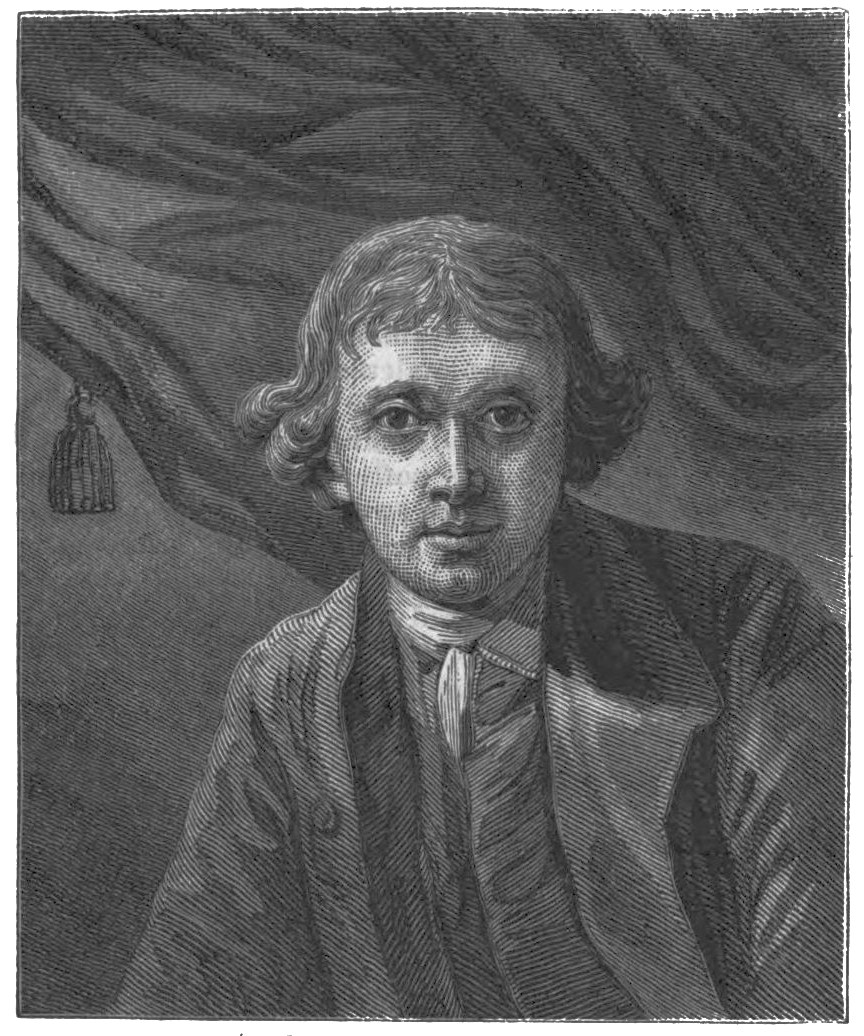
JOHN ANDRÉ.—[FROM PORTRAIT BY JOSHUA REYNOLDS.]
Contents
of
Volume Second.
Footnotes.
WITH
EXTRACTS FROM HER LITERARY CORRESPONDENCE.
EDITED BY
WALTER SCOTT, Esq.
IN THREE VOLUMES.
VOL. II.
EDINBURGH:
Printed by James Ballantyne and Co.
FOR JOHN BALLANTYNE AND CO. EDINBURGH;
AND LONGMAN, HURST, REES, AND ORME, PATERNOSTER-ROW,
LONDON.
1810.
| PAGE | |
| Verses written in Dr Darwin’s Botanic Garden, | 1 |
| Elegy on the Death of Mr Joseph Sykes, | 5 |
| Charity, | 10 |
| Monody on the Death of David Garrick, Esq., | 15 |
| Ode on the Pythagorean System, | 18 |
| Invocation of the Comic Muse, | 22 |
| Amusements of Winter, | 25 |
| Bermuda, | 29 |
| Elegy on Captain Cook, | 33 |
| Verses to a Young Gentleman, | 47 |
| Ode to the Sun, | 49 |
| Verses to Captain Eliott, | 53 |
| Verses to Mrs C——, | 55 |
| On the future Existence of Brutes, | 58 |
| To Miss Seward, | 66 |
| Monody on Major Andre, | 68 |
| Letters addressed to the Author by Major Andre, | 89 |
| Ode to Poetic Fancy, | 105 |
| Epistle to Cornelia, | 110 |
| Epistle to Mr Romney, | 124 |
| Written in the blank page of the Sorrows of Werter, | 130 |
| Written in the Title-page of a Volume of Mr Jephson’s Tragedies, | 133 |
| Written in a diminutive Edition of Gray’s Poems, | 134 |
| Verses written in the blank leaves of Mr Hayley’s Poems, | 135 |
| Written in the blank leaf of a small Pocket Edition of Thomson’s Seasons, | 137 |
| With a Lock of the Author’s Hair to a Gentleman who requested it, | 138 |
| On seeing Mr Hayley’s Works invidiously criticised, | 139 |
| Verses to the celebrated Painter, Mr Wright of Derby, | 140 |
| Epistle to William Hayley, Esq., | 143 |
| To the Memory of Lady Miller, | 150 |
| Epistle to the Rev. Dr William Bagshot Stevens, of Repton, Derbyshire, | 165 |
| To William Hayley, Esq., | 172 |
| Address to the Sun, | 174 |
| Address to Woman, | 176 |
| Verses to the Rev. William Mason, | 179 |
| Epitaph on Hannah Robinson of Lichfield, | 181 |
| — on Lady Miller, | 183 |
| Epitaph on Eliza Jones, | 184 |
| —— on Miss Anne Lawley, | 185 |
| —— on David Garrick, Esq., | 186 |
| —— on Mrs Bennet, | 187 |
| —— on Eliza Whateley, | 189 |
| —— on Elizabeth, wife of J. B. Simpson, Esq., | 190 |
| —— on Elizabeth, wife of the Rev. Michael Baxter, | 191 |
| —— on the Hon. Henrietta Bagot, | 192 |
| —— on Miss Wingfield of Shrewsbury, | 193 |
| Inscribed on the Monument of the Rev. William Bagshot Stevens, | 194 |
| For a Marble Tablet in Lichfield Cathedral, | 195 |
| On General Simcoe, | 197 |
| Epistle to F. C. R. Mundy, Esq., | 199 |
| The Red-breast and Sparrow: A fable, | 207 |
| Mount Etna, | 209 |
| Epistle to Colonel St George, | 215 |
| Ode on Time, | 218 |
| Louisa, a Poetical Novel, in Four Epistles, | 219 |
| I.—Louisa to Emma, | 222 |
| II.—Eugenio to Emma, | 240 |
| III.—Louisa to Emma, | 265 |
| IV.—Louisa to Emma, | 275 |
| Song of Roxana: A Persian Poem, | 295 |
| The Song of Zillia, | 297 |
| Eastern Ode, | 300 |
| Daphne’s coyness accounted for, | 305 |
| Verses to Mr Hayley, | 307 |
| Written in Autumn, 1784, | 310 |
| Colebrook Dale, | 314 |
| Independent Industry True Virtue, | 320 |
| To the Rev. John Granville, | 330 |
| Epistle to Nath. Lister, Esq. of Lichfield, | 333 |
| Epistle to George Romney, Esq., | 345 |
| Idyllium from the Italian, | 348 |
| To Mrs Smith, on her singing in public, | 350 |
| Alpine Scenery, | 352 |
| Ode on Gen. Elliot’s return from Gibraltar, | 374 |
Lady Miller, patroness of that poetic institution, at her villa, near Bath, always appointed the subject of the verses written for the festival. A description of its ceremonies will be found prefixed to the Author’s Monody on Lady Miller.
Clapton, Oct. 3, 1769.
From their agreeable excursion to Shrewsbury, my dearest friends are by this time returned to their thrice beloved Lichfield.—Once again have they beheld those fortunate spires, the constant witnesses of all their pains and pleasures. I can well conceive the emotions of joy which their first appearance, from the neighbouring hills, excites after absence; they seem to welcome you home, and invite you to reiterate those hours of happiness, of which they are a species of monument. I shall have an eternal love and reverence for them. Never shall I forget the joy that danced in Honora’s eyes, when she first shewed them to me from Needwood Forest on our return with you from Buxton to Lichfield. I remember she called them the ladies of the valley—their lightness and elegance deserve the title. Oh! how I loved them from that instant! My enthusiasm concerning them is carried farther even than yours and{90} Honora’s, for every object that has a pyramidal form, recalls them to my recollection, with a sensation, that brings the tear of pleasure into my eyes.
How happy must you have been at Shrewsbury! only that you tell me, alas! that dear Honora was not so well as you wished during your stay there.—I always hope the best. My impatient spirit rejects every obtruding idea, which I have not fortitude to support—Dr Darwin’s skill, and your tender care will remove that sad pain in her side, which makes writing troublesome and injurious to her; which robs her poor Cher Jean[53] of those precious pages, with which, he flatters himself, she would otherwise have indulged him.
So your happiness at Shrewsbury scorned to be indebted to public amusements—five virgins—united in the soft bonds of friendship!—How I should have liked to have made the sixth!—But you surprise me by such an absolute exclusion of the beaux—I certainly thought that when five wise virgins were watching at midnight, it must have been in expectation of the bridegroom’s coming. We are at this instant five virgins, writing round the same table—My three sisters, Mr Ewer, and myself. I beg no reflections injurious to the honour of poor Cher Jean. My mo{91}ther is gone to pay a visit, and has left us in possession of the old coach; but as for nags, we can boast of only two long-tails, and my sisters say they are sorry cattle, being no other than my friend Ewer and myself, who, to say truth, have enormous pig-tails. My dear Boissier is come to town; he has brought a little of the soldier with him, but he is the same honest, warm, intelligent friend I always found him. He sacrifices the town diversions, since I will not partake of them. We are jealous of your correspondents, who are so numerous—Yet, write to the Andres often, my dear Julia, for who are they that will value your letters quite so much as we value them?—The least scrap of a letter will be received with the greatest joy—write therefore, though it were only to give us the comfort of having a piece of paper which has recently passed through your hands;—Honora will put in a little postscript, were it only to tell me that she is my very sincere friend, who will neither give me love nor comfort—very short indeed, Honora, was thy last postscript!—But I am too presumptuous;—I will not scratch out, but I unsay—From the little there was I received more joy than I deserve. This Cher Jean is an impertinent fellow, but he will grow discreet in time—You must consider him as a poor novice of eighteen, who, for all the sins he may commit, is sufficiently punished in the single evil of being 120 miles from Lichfield. My mother and sisters will go to Putney in a few days to stay some time—we none of us like Clapton—I need not care,{92} for I am all day long in town; but it is avoiding Scylla to fall into Charybdis.—You paint to me the pleasant vale of Stow in the richest autumnal colouring:—In return I must tell you that my zephyrs, are wafted through cracks in the wainscot; for murmuring streams I have dirty kennels; for bleating flocks, grunting pigs; and squalling cats for birds that incessantly warble—I have said something of this sort in my letter to Miss Spearman, and am twinged with the idea of these epistles being confronted, and that I shall recal to your memory the fat knight’s love letters to Mrs Ford and Mrs Page.
Julia, perhaps thou fanciest I am merry—Alas!—But I do not wish to make you as doleful as myself; and besides, when I would express the tender feelings of my soul, I have no language which does them any justice; if I had, I should regret that you could not have it fresher, and that whatever one communicates by letter must go such a round-about way, before it reaches one’s correspondent; from the writer’s heart, through his head, arm, hand, pen, ink, paper, over many a weary hill and dale, to the eye, head, and heart of the reader. I have often regretted our not possessing a sort of faculty which should enable our sensations, remarks, &c. to arise from their source in a sort of exhalation, and fall upon our paper in words and phrases properly adapted to express them, without passing through an imagination whose operations so often fail to second those of the heart. Then what a metamorphose should we see in{93} people’s stile! How eloquent those who are truly attached! how stupid they who falsely profess affection! Perhaps the former had never been able to express half their regard; while the latter, by their flowers of rhetoric, had made us believe a thousand times more than they ever felt—but this is whimsical moralizing.
My sister’s penserosos were dispersed on their arrival in town, by the joy of seeing Louisa and their dear little brother Billy again, our kind and excellent uncle Giradat, and uncle Lewis Andre. I was glad to see them, but they complained, not without reason, of the gloom upon my countenance—Billy wept for joy that we were returned, while poor Cher Jean was ready to weep for sorrow. Louisa is grown still handsomer since we left her. Our sisters Mary and Anne, knowing your partiality to beauty, are afraid that when they shall introduce her to you, she will put their noses out of joint. Billy is not old enough for me to be afraid of in the rival-way, else I should keep him aloof, for his heart is formed of those affectionate materials, so dear to the ingenuous taste of Julia and her Honora.
I sympathize in your resentment against the canonical dons, who stumpify the heads of those good green people, beneath whose friendly shade[54] so many{94} of your happiest hours have glided away—but they defy them; let them stumpify as much as they please, time will repair the mischief—their verdant arms will again extend, and invite you to their shelter.
The evenings grow long—I hope your conversation round the fire will sometimes fall on the Andres; it will be a great comfort that they are remembered. We chink our glasses to your healths at every meal. Here’s to our Lichfieldian friends, says Nanny;—Oh—h, says Mary;—with all my soul, say I;—Allons, cries my mother;—and the draught seems nectar. The libation made, we begin our uncloying theme, and so beguile the gloomy evening.
Mr and Mrs Seward will accept my most affectionate respects—My male friend at Lichfield will join in your conversation on the Andres. Among the numerous good qualities he is possessed of, he certainly has gratitude, and then he cannot forget those who so sincerely love and esteem him.—I, in particular, shall always recall with pleasure the happy hours I have passed in his company—My friendship for him, and for your family, has diffused itself, like the precious ointment from Aaron’s beard, on every thing which surrounds you, therefore I beg you would give my amities to the whole town.—Persuade Honora to forgive the length and ardour of the inclosed, and believe me truly your affectionate and faithful friend,
J. Andre.
London, Oct. 19, 1769.
From the midst of books, papers, bills, and other implements of gain, let me lift up my drowsy head a while to converse with dear Julia.—And first, as I know she has a fervent wish to see me a quill-driver, I must tell her, that I begin, as people are wont to do, to look upon my future profession with great partiality. I no longer see it in so disadvantageous a light. Instead of figuring a merchant as a middle-aged man, with a bob wig, a rough beard, in snuff coloured cloaths, grasping a guinea in his red hand; I conceive a comely young man, with a tolerable pig-tail, wielding a pen with all the noble fierceness of the duke of Marlborough brandishing a truncheon upon a sign-post, surrounded with types and emblems, and canopied with cornucopiæs that disembogue their stores upon his head; Mercuries reclined upon bales of goods; Genii playing with pens, ink, and paper; while in perspective, his gorgeous vessels “launched on the bosom of the silver Thames,” are wafting to distant lands the produce of this commercial nation.{96} Thus all the mercantile glories croud on my fancy, emblazoned in the most refulgent colouring of an ardent imagination—Borne on her soaring pinions I wing my flight to the time when Heaven shall have crowned my labours with success and opulence. I see sumptuous palaces rising to receive me—I see orphans, and widows, and painters, and fidlers, and poets, and builders, protected and encouraged; and when the fabric is pretty nearly finished by my shattered pericranium, I cast my eyes around, and find John Andre, by a small coal fire, in a gloomy compting-house in Warnford court, nothing so little as what he has been making himself, and in all probability never to be much more than he is at present. But oh! my dear Honora!—it is for thy sake only I wish for wealth.—You say she was somewhat better at the time you wrote last. I must flatter myself that she will soon be without any remains of this threatening disease.
It is seven o’clock—You and Honora, with two or three more select friends, are probably encircling your dressing-room fire-place.—What would I not give to enlarge that circle! The idea of a clean hearth, and a snug circle round it, formed by a few sincere friends, transports me. You seem combined together against the inclemency of the weather, the hurry, bustle, ceremony, censoriousness, and envy of the world. The purity, the warmth, the kindly influence of fire, to all for whom it is kindled, is a good emblem of the friendship of such amiable minds{97} as Julia’s and her Honora’s—Since I cannot be there in reality, pray imagine me with you; admit me to your conversationes;—Think how I wish for the blessing of enjoying them!—and be persuaded that I take part in all your pleasures, in the dear hope, that ere it be very long, your blazing hearth will burn again for me. Pray keep me a place;—let the poker, tongs, or shovel represent me;—But you have Dutch-tiles, which are infinitely better;—So let Moses, or Aaron, or Balaam’s ass be my representative.
But time calls me to Clapton.—I quit you abruptly till to-morrow: when, if I do not tear the nonsense I have been writing, I may perhaps increase its quantity. Signora Cynthia is in clouded majesty.—Silvered with her beams I am about to jog to Clapton upon my own stumps;—Musing as I homeward plod my way—Ah! need I name the subject of my contemplations!
Thursday.
I had a sweet walk home last night, and found the Claptonians, with their fair guest, a Miss Mourgue, very well—My sisters send their amities, and will write in a few days.
This morning I returned to town—It has been the finest day imaginable—A solemn mildness was diffused throughout the blue horizon;—Its light was clear and distinct rather than dazzling; the serene beams of the autumnal sun!—Gilded hills, variegated{98} woods, glittering spires, ruminating herds, bounding flocks, all combined to enchant the eyes, expand the heart, and “chace all sorrow but despair.”—In the midst of such a scene, no lesser grief can prevent our sympathy with nature—A calmness, a benevolent disposition seizes us with sweet insinuating power—The very brute creation seem sensible of these beauties;—There is a species of mild chearfulness in the face of a lamb, which I have but indifferently expressed in a corner of my paper, and a demure contented look in an ox, which, in the fear of expressing still worse, I leave unattempted.
Business calls me away—I must dispatch my letter,—Yet what does it contain?—No matter—You like any thing better than news.—Indeed you never told me so, but I have an intuitive knowledge upon the subject, from the sympathy which I have constantly perceived in the taste of Julia and Cher Jean.—What is it to you or me,
—But if I was to hearken to the versifying grumbling I feel within me, I should fill my paper, and not have room left to intreat that you would plead my cause to Honora more eloquently than the enclosed letter has the power of doing.—Apropos of{99} verses, you desire me to recollect my random description of the engaging appearance of the charming Mrs——. Here it is at your service—
This little French cousin of ours, Delarise, was my sister Mary’s play-fellow at Paris. His sprightliness engages my sisters extremely. Doubtless they talk much of him to you in their letters.
How sorry I am to bid you adieu! Oh let me not be forgot by the friends most dear to you at Lichfield!—Lichfield! Ah! of what magic letters is that little word composed!—How graceful it looks when it is written!—Let nobody talk to me of its original meaning “The field of blood!”[55] Oh! no such thing!—It is the field of joy! “The beautiful city, that lifts her fair head in the valley, and says, I am, and{100} there is none beside me!”—Who says she is vain?—Julia will not say so—nor yet Honora—and least of all their devoted
John Andre.
Clapton, Nov. 1, 1769.
My ears still ring with the sounds of Oh Jack! Oh Jack! How do the dear Lichfieldians?—What do they say?—What are they about?—What did you do while you were with them?—Have patience, said I, good people!—and began my story, which they devoured with as much joyful avidity as Adam did Gabriel’s tidings of heaven—My mother and sisters are all very well, and delighted with their little Frenchman, who is a very agreeable lad.
Surely you applaud the fortitude with which I left you!—Did I not come off with flying colours?—It was a great effort, for, alas! this recreant heart did not second the smiling courage of the countenance; nor is it yet as it ought to be, from the hopes it may{101} reasonably entertain of seeing you all again ere the winter’s dreary hours are past.—Julia, my dear Julia, gild them with tidings of our beloved Honora!—Oh that you may be enabled to tell me that she regains her health, and her charming vivacity!—Your sympathizing heart partakes all the joys and pains of your friends.—Never can I forget its kind offices, which were of such moment to my peace!—Mine is formed for friendship, and I am blest in being able to place so well the purest passion of an ingenuous mind!—How am I honoured in Mr and Mrs Seward’s attachment to me!—Charming were the anticipations which beguiled the long tracts of hill, and dale, and plain, that divide London from Lichfield!—With what delight my eager eyes drank their first view of the dear spires!—What rapture did I not feel on entering your gates!—in flying up the hall steps!—in rushing into the dining-room!—in meeting the gladdened eyes of dear Julia and her enchanting friend!—That instant convinced me of the truth of Rousseau’s observation, “that there are moments worth ages.”—Shall not those moments return? Ah Julia! the cold hand of absence is heavy upon the heart of your poor Cher Jean—He is forced to hammer into it perpetually every consoling argument that the magic wand of Hope can conjure up; viz. that every moment of industrious absence advances his journey, you know whither.—I may sometimes make excursions to Lichfield, and bask in the light of my Honora’s eyes!—Sustain me, Hope!—nothing on my part shall be{102} wanting which may induce thee to fulfil thy blossoming promises.
The happy social circle, Julia, Honora, Miss S—n, Miss B—n, her brother, Mr S—e, Mr R—n, &c. are now, perhaps, enlivening your dressing-room, the dear blue region, as Honora calls it, with the sensible observation, the tasteful criticism, or the elegant song;—dreading the iron-tongue of the nine o’clock bell, which disperses the beings, whom friendship and kindred virtues had drawn together.—My imagination attaches itself to all, even the inanimate objects which surround Honora and her Julia;—that have beheld their graces and virtues expand and ripen;—my dear Honora’s, from their infant bud.
The sleepy Claptonian train are gone to bed, somewhat wearied with their excursion to Enfield, whither they have this day carried their favourite little Frenchman;—so great a favourite, the parting was quite tragical. I walked hither from town, as usual, to-night—no hour of the twenty-four is so precious to me as that devoted to this solitary walk.—Oh, my friend! I am far from possessing the patient frame of mind which I so continually invoke!—Why is Lichfield an hundred and twenty miles from me?—There is no moderation in the distance! Fifty or sixty miles had been a great deal too much, but then, there would have been less opposition from authority to my frequent visits—I conjure you, supply the want of these blessings by frequent letters—I must not, will not ask them of Honora, since the{103} use of the pen is forbid to her declining health;—I will content myself, as usual, with a postscript from her in your epistles.—My sisters are charmed with the packet which arrived yesterday, and which they will answer soon.
As yet I have said nothing of our journey. We met an entertaining Irish gentleman at Dunchurch, and, being fellow-sufferers in cold and hunger, joined interests, ordered four horses, and stuffed three in a chaise. It is not to you I need apologize, for talking in raptures of an higler whom we met on the road. His cart had passed us, and was at a considerable distance, when, looking back, he perceived that our chaise had stopped, and that the driver seemed mending something. He ran up to him, and with a face full of honest anxiety, pity, good-nature, and every sweet affection under Heaven, asked him if we wanted any thing; that he had plenty of nails, ropes, &c. in his cart.—That wretch of a postillion made no other reply than, “We want nothing, master.” From the same impulse the good Irishman, Mr Till, and myself thrust our heads instantly out of the chaise, and tried to recompense to the honest creature this surly reply, by every kind and grateful acknowledgment, and by forcing upon him a little pecuniary tribute. My benevolence will be the warmer while I live, for the treasured remembrance of this higler’s countenance.
I know you interest yourself in my destiny—I have now compleatly subdued my aversion to the profes-{104}p psion of a merchant, and hope in time to acquire an inclination for it—Yet, God forbid I should ever love what I am to make the object of my attention!—that vile trash, which I care not for, but only as it may be the future means of procuring the blessing of my soul—Thus all my mercantile calculations go to the tune of dear Honora.—When an impertinent consciousness whispers in my ear, that I am not of the right stuff for a merchant, I draw my Honora’s picture from my bosom, and the sight of that dear talisman so inspirits my industry, that no toil appears oppressive.
The poetic task you set me is a sad method—my head and heart are too full of other matters to be engrossed by a draggle-tailed wench of the Heliconian puddle. I am going to try my interest in Parliament—How you stare!—it is to procure a frank.—Be so good to give the enclosed to Honora;—it will speak to her—and do you say every thing that is kind for me to every other distinguished friend of the dressing-room circle—encourage them in their obliging desire of scribbling in your letters, but do not let them take Honora’s corner of the sheet.
Adieu!—May you all possess that chearfulness denied to your Cher Jean. I fear it hurts my mother to see my musing moods;—but I can neither help nor overcome them.—The near hopes of another excursion to Lichfield, could alone disperse every gloomy vapour of my imagination.—Again, and yet again, Adieu!
J. Andre.
The ensuing epistolary poems contain a description rather of passions than of incidents. They resulted from an idea of its being possible to unite the impassioned fondness of Pope’s Eloisa, with the chaster tenderness of Prior’s Emma; avoiding the voluptuousness of the first, and the too conceding softness of the second. It is hoped the reader will distinguish between the apprehended possibility of exhibiting in verse a more faultless female character than the Eloisa of Pope, or the Emma of Prior, and the rash and vain design of equalling, much less of surpassing, the transcendent poetic excellence of either of those compositions.
The Louisa of the following pages has all that enthusiasm which springs from an heart warmly affectionate, joined to a glowing and picturesque imagination. Her sensibilities, heightened, and refined in the bosom of retirement, know no bounds, ex-{220}p pcept those which the dignity of conscious worth, and a strong sense of religion, prescribe. It is feared the modern young ladies will have little sympathy with her, since she is unfashionably enthusiastic, and unfashionably tender.
An ingenious friend, after reading the first epistle, remarked, that Louisa might have described with more interesting particularity her lover’s declaration of his passion, and the manner in which she received that declaration: but the author thought the present method of conveying that circumstance to the mind of the reader more poetic. Pope’s Eloisa is minute in her description of the awful scenery, formed by the rocks, the streams, and mountains of Paraclete, but by no means minute concerning the amorous eclaircissement between herself and Abelard. Louisa discriminates her lover’s early attentions to her, though she leaves the manner of his declaring their source very much to the imagination. Her application of the beautiful scenic objects, by which she was at that interval surrounded, to her own, and to her lover’s situation; and the passing suddenly to their present altered appearance, contrasts the charms, and bloom of the first, with the chill dreariness of the second. There it was that the author had in view that striking letter in the 3d vol. of the Nouvelle Héloïse, which describes St. Prieux accompanying Mrs Wolmar to the rocks of Meillerie, then covered with the richness of summer luxuriance; and painting to her the situation of that very scene,{221} when he had visited it alone, amidst the horrors of winter, and found those horrors congenial to the temper of his soul.
This poem has little chance to be popular. A feeling heart, and a fondness for verse must unite to render it interesting. A feeling heart without a glowing imagination will be tired of the landscape-painting, somewhat luxuriantly interspersed. An imagination that glows, while the heart is frozen, has a propensity to fancy every thing prosaic which is not imagery, and will probably yawn over the reasoning of these lovers, and sicken over their tenderness.
If, however, this little work has the honour to interest and please the few, in whom the kind and sweet affections are blended with poetic taste, the end for which it is published will be obtained.
Except some slight alterations, which have been made since the two first editions, the hundred and fifty-six lines, with which the poem opens, were written when the author was only nineteen. They had been mislaid during a long interval. It is sixteen months since they were accidentally recovered. Some few friends, to whom the fragment was shewn, thought it worth being extended into a regular work. The first and third of these epistles are designed to be descriptive, and sentimental; the second, and last, dramatic.
OCTOBER 21, 1779.
Note.—Upon reading this third epistle to a friend, he observed, that perhaps a comparison of Louisa’s own situation with the harder fate of her lover, and her tender pity for the inevitable miseries of such a union, might have been acceptable in the place of the episode of Clairmont, and the description of the bower; but it should be considered, that Louisa wrote under the immediate impression of her extacy to find Eugenio guiltless; that her mind was not sobered enough for reflection. To have investigated the unhappy lot of her lover, must have been a melancholy employment. Eased of an oppressive weight of misery, her exhilarated spirits admit not, so early, any painful ideas. She does not discriminate, she felicitates her destiny. Her sympathy in the fate of her friends grows more lively—she recollects the situation of Clairmont—Joy is naturally loquacious, and she is gratified in relating his story to her Emma. She awakens with new vivacity to the impressions of pleasure, which her mind was accustomed to receive from scenic objects. The propensity to dwell on them prevailed even in the hours of her unhappiness. It is an habit which compares and assimilates the smiling, or the gloomy views of nature, to the internal feelings, and is common to people of a lively imagination. In the exultation of her heart to find her lover yet estimable, Louisa speeds to the bower, so impressed with his image. Its beauties strike her more forcibly than ever, and in this frame of mind she naturally feels delight in painting them.
Written Sept. 1786, after a fortnight’s residence at Calwick, the seat of the Granville family, in Staffordshire. It stands on the verge of a large, clear, and beautiful lake, with islands. A branch of the river Dove passes through it, and a rich valley forms the scenery on the opposite coast, through which the main river winds. It is bounded by near hills, and beyond them are seen some of the larger Peak mountains. A wood rises behind the house.
END OF THE SECOND VOLUME.
Edinburgh:
Printed by James Ballantyne & Co.
[1] These verses were sent to the Gentleman’s Magazine by Dr Darwin, a short time after they had been presented to him by their author, and sent without her knowledge, and with an alteration in the concluding lines; which alteration invokes the nymph of Botany to grace the scene. They are here inscribed as they were originally printed. Fourteen years after, in the spring 1792, the first part of that splendid poem, The Botanic Garden, appeared, which had been some years oddly preceded by the second part of the work. In that first part its author has placed the above verses as the exordium of his poem, with some slight verbal alterations, and with a few brilliant lines of his own interwoven. There is no hint in the notes, or even by a quotation mark, that this poetic landscape was the work of another pen. The circumstance would have been immaterial, if the lines had not appeared in print with the name of their author; but that circumstance rendered that claim necessary. Other periodical publications of that day copied them from the Gentleman’s Magazine.
[2] l. 10. In a gloomy recess of this dell, there is a rock that drops about once in every minute, alike in dry and wet seasons.
[3] l. 17. Dr Darwin is here considered as the GENIUS of the place, since he first cultivated and adorned the tangled and swampy plain.
[4] l. 10. The Author claimed these verses in Dr Darwin’s lifetime. Two years before he died, they appeared in her name, in Shaw’s History of Staffordshire.
[5] l. 1. The institution of Bath-Easton was a charitable one.
[6] l. 8. Lear.
[7] l. 9. Macbeth.
[8] l. 13. Hamlet.
[9] l. 16. Richard the Third.
[10] l. 9. Samian Sage.—Pythagoras.
[11] l. 16. Alluding to a celebrated picture of Mrs Kauffman’s, The Nymphs disarming Cupid.
[12] l. 1. Massy Pillars.—These are very tall rocks around Bermuda.
[13] l. 2. Ceaseless rave.—See Shakspeare’s Tempest, where Ariel alludes to the high surf around this island.
[14] l. 3. Punctual breeze.—The sea breezes at Bermuda come on about noon, and last till day-dawn.
[15] l. 13. No twilight.—In those latitudes the sun shines out instantaneously on the break of dawn.
[16] l. 11. Peterels soar.—The Peterel is a bird found in the frozen seas; its neck and tail are white, and its wings of a bright blue.
[17] l. 18. The floating fragments.—“In the course of the last 24 hours, we passed through several fields of broken ice; they were in general narrow, but of considerable extent. In one part the pieces of ice were so close, that the ship had much difficulty to thread them.”
[18] l. 3. Furling the iron sails.—“Our sails and rigging were so frozen, that they seemed plates of iron.”
[19] l. 6. And the vast ruin.—The breaking of one of these immense mountains of ice, and the prodigious noise it made, is particularly described in Cook’s second voyage to the South Pole.
[20] l. 14. Till Nature, &c.—“After running four leagues this course, with the ice on our starboard side, we found ourselves quite embayed, the ice extending from north-north-east, round by the west and south, to east, in one compact body; the weather was tolerably clear, yet we could see no end to it.”
[21] l. 5. The olive branch.—“To carry a green branch in the hand on landing, is a pacific signal, universally understood by all the islanders in the South Seas.”
[22] l. 16. And name exchang’d.—The exchange of names is a pledge of amity among these islanders, and was frequently proposed by them to Captain Cook and his people; so also is the joining noses.
[23] l. 17. His living store.—Captain Cook left various kinds of animals upon this coast, together with garden-seeds, &c. The Zealanders had hitherto subsisted upon fish, and such coarse vegetables as their climate produced; and this want of better provision, it is supposed, induced them to the horrid practice of eating human flesh.
[24] l. 2. Walls of coral.—The coral rocks are described as rising perpendicularly from the greatest depths of the ocean, insomuch that the sounding-line could not reach their bottom; and yet they were but just covered with water. These rocks are now found to be fabricated by sea-insects.
[25] l. 4. And sleepless Patience.—“We had now passed several months with a man constantly in the chains heaving the lead.”
[26] l. 3. A rock-built temple.—“On one part of this isle there was a solitary rock, rising on the coast with arched cavities, like a majestic temple.”
[27] l. 11. First gentle Flora.—Flora is the Goddess of modern Botany, and Fauna of modern Zoology: hence the pupils of Linnæus call their books Flora Anglica—Fauna Danica, &c. “The Flora of one of these islands contained 30 new plants.”
[28] l. 13. Vegetable silk.—In New Zealand is a flag of which the natives make their nets and cordage. The fibres of this vegetable are longer and stronger than our hemp and flax; and some, manufactured in London, is as white and glossy as fine silk. This valuable vegetable will probably grow in our climate.
[29] l. 2. A playful Kangroo.—The Kangroo is an animal peculiar to those climates. It is perpetually jumping along on its hind legs, its fore legs being too short to be used in the manner of other quadrupeds.
[30] l. 3. Beauteous Pois.—“The Poi-bird, common in those countries, has feathers of a fine mazarine blue, except those of the neck, which are of a beautiful silver grey; and two or three short white ones, which are in the pinion-joint of the wing. Under its throat hang two little tufts of curled white feathers, called its poies, which, being the Otaheitean word for ear-rings, occasioned our giving that name to the bird; which is not more remarkable for the beauty of its plumage, than for the exquisite melody of its note.”
[31] l. 5. A Giant-bat.—The bats which captain Cook saw in some of these countries were of incredible dimensions, measuring three feet and a half in breadth, when their wings were extended.
[32] l. 2. Rolls the white surf.—“As we passed this island, many of its trees had an unusual appearance, and the richness of the vegetation much invited our naturalists to land, but their earnest wishes were in vain, from the dangerous reefs and the violence of the surfs.”
[33] l. 17. Chasten’d love.—Captain Cook observes, in his second voyage, that the women of Otaheite were grown more modest, and that the barbarous practice of destroying their children was lessened.
[34] l. 22. Morai.—The Morai is a kind of funeral altar, which the people of Otaheite raise to the memory of their deceased friends. They bring to it a daily tribute of fruits, flowers, and the plumage of birds. The chief mourner wanders around it in a state of apparent distraction, shrieking furiously, and striking at intervals a shark’s tooth into her head. All people fly her, as she aims at wounding not only herself, but others.
[35] l. 9. Frore.—Milton, in his Paradise Lost, uses that fine old word, synonimous to the common word frozen.
Also Spencer, “O! my heart’s blood is well nigh frore, I feel.”
[36] l. 19. Highly-favoured year.—This Ode was written at the end of that remarkable fine year, 1779, during which there was scarce any winter; but at that period England was involved in the ruinous miseries of the American war.
[37] l. 22. See the Dying Indian in Dodsley’s poems:
[38] l. 5. Ate.—Goddess of Vengeance.
[39] l. 16. Alluding to captain Donellan’s murder of sir Theodosius Boughton by laurel-water—an event, which at that time agitated the public mind considerably.
[40] l. 8. Victor-garland.—Alluding to the conquest by Lord Cornwallis.
[41] l. 11. Bloody Scroll.—The Court-martial decree, signed at Tappan, for Major Andre’s execution.
[42] l. 2. Julia.—The name by which Mr Andre addressed the author in his correspondence with her.
[43] l. 16. All his gifts.—Mr Andre had conspicuous talents for poetry, music, and painting. The newspapers mentioned a satiric poem of his upon the Americans, which was supposed to have stimulated their barbarity towards him. Of his wit and vivacity, the letters subjoined to this poem afford ample proof. They were addressed to the author by Mr Andre when he was a Youth of eighteen.
[44] l. 8. Early grave.—Miss Honora S——, to whom Mr Andre’s attachment was of such singular constancy, died in a consumption, a few months before he suffered death at Tappan. She had married another gentleman, four years after her connection with Mr Andre had, by parental authority, been dissolved. To that marriage her father gave a reluctant consent. So groundless was the idea of the Reviewers, who, when this poem was first published, imagined, from some expressions, whose sense they had mistaken, that she was urged into wedlock against her inclination.
[45] l. 9. Julia’s arm.—Mr Andre drew two miniature pictures of Miss Honora S——, on his first acquaintance with her at Buxton, in the year 1769, one for himself, the other for the author of this poem.
[46] l. 1. Hovering Rumour.—The tidings of Honora’s marriage: Upon that event Mr Andre quitted his profession as a merchant, and joined our army in America.
[47] l. 4. Last dear record.—“I have a mother, and three sisters, to whom the value of my commission would be an object, as the loss of Grenada has much affected their income. It is needless to be more explicit on this subject, I know your Excellency’s goodness.” See major Andre’s last letter to General Clinton, published in the Gazette.
[48] l. 3. Shade of my love.—The miniature of Honora. A letter from Major Andre to one of his friends, written at that period, contained the following sentence. “I have been taken prisoner by the Americans, and stript of every thing except the picture of Honora, which I concealed in my mouth. Preserving that, I yet think myself fortunate.”
[49] l. 14. Intrepid Portia.—
[50] l. 4. Sacred life.—The concurrent testimony even of the British officers, during the years which have elapsed since this poem was first published, acquits general Washington of that imputed cruelty, which had so forcibly impressed the grieved heart of the author, concerning the sacrifice of major Andre’s life. They acknowledge that there was but one way to have saved the gallant sufferer, viz. by general Arnold having been given up in exchange, who had fled to the English army. It was believed by the American officers, that general Arnold had so taken his measures, that if the projected interview with Andre had been discovered, while they were together, it might have been in his power to have sacrificed Andre to his own safety. This report was urged to the prisoner by an American officer, commissioned from general Washington, who wished his preservation, to induce him to write to general Clinton, requesting him to propose the exchange—but major Andre would not listen a moment to the suggestion. However, though it is urged, that general Washington could not, with safety to himself, and justice to his country, set aside the decision of the court-martial, surely it was in his power to have rendered the manner in which major Andre was to suffer, less wounding to the sensibility of an intrepid spirit.
[51] l. 16. Tappan.—The place where major Andre was put to death.
[52] l. 9. Funeral-scarf.—Our whole army in America went into mourning for major Andre, a distinguished tribute to his merit.
[53] l. 17.Cher Jean.—A name of kindness which Mr Andre was often called by his mothers and sisters, and generally adopted by the persons mentioned in these letters.
[54] l. 26. The trees in the cathedral walk in Lichfield.
[55] l. 16. Field of blood.—Here is a small mistake—Lichfield is not the field of blood, but “the field of dead bodies,” alluding to a battle fought between the Romans and the British Christians in the Dioclesian persecution, when the latter were massacred.—Three slain kings, with their burying-place, now Barrowcop-hill, and the cathedral in miniature, form the city arms. Lich is still a word in use. The church-yard gates, through which funerals pass, are often called Lich-gates, vulgarly light-gates.
[56] l. 12. This Ode was written on the publication of Mr Hayley’s Triumphs of Temper.
[57] l. 17. Elfin Sprite.—Sophrosyne, the Goddess of Mr Hayley’s supernatural machinery in that poem.
[58] l. 13. Museus.—The name Mason allots to Pope in his beautiful Monody on that Poet.
[59] l. 19. First plate in the Rake’s Progress.
[60] l. 21. See the second plate—the Brothel.
[61] l. 13. See the third plate—the Arrestment.
[62] l. 3. See the fourth plate—the Marriage.
[63] l. 18. See the fifth plate—the Gaming Table.
[64] l. 6. See the last plate—Bedlam.
[65] l. 1. Thy science.—The first of Mr Hayley’s admirable Poems on the Sciences, is addressed to his friend Romney, and characterizes the great painters, ancient and modern, comparing them with the poets.
[66] It is said, the characters of Werter, Charlotte, and Albert, the disastrous passion of the former, and the terrible event it produced, were real, together with nearly all the sentiments in Werter’s letters; heightened, no doubt, in the powers of eloquence, bypassing through the pen of the celebrated German novelist. There has been much ridiculous cant about the fancied immorality of these interesting volumes. The long miseries and tragic death of Werter, breathe an awful warning against imitating his error, and evince the fatal power of indulging an hopeless passion, even for a most amiable object, to blast the destiny, and to render fruitless all the virtues of a naturally generous and good young man. Absurd censurers are angry that he is not made despicable, because he was criminally indiscreet. They are incensed that his woes excite compassion. With equal justice, Othello might be deemed an immoral play, because we cannot with-hold our esteem and pity from the man, who, giving way to suspicious appearances, murders his innocent wife. Werter, by giving way to his affection for an engaged woman, though without the least design to seduce her, renders his own existence insupportable. There is no temptation to copy the conduct of either character; therefore neither the play, nor the novel, can justly be taxed with having an immoral tendency. The light of moral warning breaks out stronger, from beneath the shades in such characters, than from the unmingled brightness of those, who are represented faultless, or at least exempt from any very marked error.
[67] l. 8. Sensitive plant.
[68] l. 11. Mr Hayley celebrated Mr Wright’s talent in his first great Work, Epistles on Painting.
[69] l. 9. Mr Wright’s Moonlight Views of Matlock.
[70] l. 13. His Vesuvius.
[71] l. 18. His Virgil’s tomb.
[72] l. 1. His Julia, banished to a desert island by her grandfather, Augustus, for her amours with Ovid.
[73] This poem, as far as the 64th line, was written in the chaise, returning from Coleshill to Lichfield, the author having accompanied Mr Hayley so far on his road to London in December 1781.
[74] l. 11. Perhaps the generality of people have not sufficiently attended to the operation of their minds, respecting the personal idea they retain of the long absent, or the dead, so as clearly to comprehend the eight ensuing lines.
No picture, be it ever so well painted, can vie with the memory in that exactness, with which she presents, early in absence, the image of that form and face, whose lineaments are dear to us. Therefore, actual pictures of beloved friends would not be so eagerly coveted, but that we render this darling, internal image indistinct, by recalling it too frequently; as that strength of line, which gives sharpness and spirit to a copper-plate, becomes injured after a certain number of impressions have been taken off. By repeated use, the plate, if not retouched, will produce only a dim and shadowy mass, in which the features and countenance cannot be very distinctly discerned.
So it is with the memory, after continual recurrence, and pressure of the affections upon the image she presents, which, for a considerable period, she had presented with that perfect precision, to which no powers of the pencil can attain;—but, in time, the image becomes indistinct, not from any decay in the powers of memory; not from the affections growing cold, but merely from intense and incessant recurrence. Yes, it is beneath the constant glow of ardent imagination, that the impression, given by memory, has faded. Then it is that a good, nay even an indifferent picture, or a paper-profile of a dear lost friend, strengthens our recollection, in the same manner that retouching a copper-plate restores its power of giving animated impressions.
The author wishes that all who peruse these remarks, and have dispositions sufficiently affectionate to contemplate fervently, and often, in their own minds the image of one, fondly beloved, whom they have, for a length of years, or for ever lost, would recollect if, after a time, they were able to recall that image with equal precision, as they could remember the features, and air, of other deceased, or absent persons, with whom they had been well acquainted, but of whom, being less interesting to their affections, they had only casually thought. The superior distinctness with which the less beloved image comes back to the mind, upon its summons, proves the philosophic truth of these remarks, and is the cause why we so fondly desire the penciled remembrance of those we love, to refresh that ideal image which intense and perpetual contemplation had rendered evanescent. Locke says—“The pictures drawn in our minds of our absent friends, are laid in fading colours, which, if not sometimes refreshed, will vanish and disappear.” It might have been expected that a philosopher so accurate and discriminating, would have pursued the observation, and reminded us, that there are two causes, exactly opposite to each other, which produce this vanishing; viz. the mind not having dwelt upon the originals of those its pictures often enough to make their image strong and vivid after long absence;—and, its too frequently casting upon such inshrined resemblances, the dazzling light of fervent meditation. It is not meant that fervent meditation will produce forgetfulness of the general idea of the persons of those we fondly regret, but that it will, in time, make us unable to recall them with that precision we desire, without the help of the pencil.
[75] l. 1. Romney.—The celebrated painter.
[76] l. 9. Bards and Chiefs.—Alluding to the tradition of a battle fought in the time of the Romans, and to the remains of the warriors’ tombs on the scene of action, Berocop Hill, near the city.
[77] l. 1. Lichfield stood a siege by Cromwell’s army, in the civil war of that period.
[78] l. 3. That fam’d Pair.—Johnson and Garrick were both educated at Lichfield, under the author’s maternal grandfather, the Rev. John Hunter, Prebendary of the Cathedral, and Master of the Free-School.
[79] l. 9. Evening’s solemn hours.—It was Mr Hayley’s custom, during his fortnight’s residence at Lichfield, to walk in the side aisles of the Cathedral during choir-service at evening prayers, which are always performed by candle-light in winter. The arches of those aisles were then open at top into the choir. When the church was altered, in the year 1788, the arches were closed up, which prevents all the fine effect of dubious light and shadow, described in the ensuing lines. On week days the choir is but imperfectly illuminated.
[80] l. 10. Pledg’d hours.—Unforeseen business obliged Mr Hayley to abridge his purposed visit to Mr Seward and his daughter.
[81] l. 18. Moss-grown tower.—Stow church stands in the little rural valley, overlooked by the east front of the Bishop’s palace, the residence of Mr Seward and his family.
[82] l. 18. Level line of peace.—Milton, in the close of his sonnet to Mr Laurence, insinuates that there is danger in too frequently indulging the luxury of intellectual society, thus—
[83] The late lady Millar, of Bath-Easton, near Bath, held an assembly at that elegant villa, once a fortnight during the Bath season. She rendered this meeting a poetical institution, giving out subjects at each assembly for poems to be read at the ensuing one.
The verses were deposited in an antique Etruscan vase, and were drawn out by gentlemen appointed to read them aloud, and to judge of their rival merits. These gentlemen, ignorant of the authors, selected three poems from the collection which they thought most worthy of the three myrtle wreaths, decreed as the rewards and honours of the day. The names of the persons who had obtained the prizes were then announced by lady Millar. Once a year the most ingenious of these productions were published. Four volumes have already appeared, and the profits been applied to the benefit of a charity at Bath; so that lady Millar’s institution was not only calculated to awaken and cultivate ingenuity, but to serve the purposes of benevolence and charity. It had continued about six years, and ceased with the death of its amiable patroness.—That event happened in July, 1781.
[84] l. 16. An elegy to the memory of lady Millar, set to music for three voices, by Dr Harrington, of Bath.
[85] l. 2. Fiercer blaze.—The Reviewers.
[86] l. 11. Sprightly Winford.—See Miss Winford’s elegant poem, the Hobby Horse, printed in the fourth volume of Poetical Amusements at Bath Easton.
[87] l. 13. Nymph of Dronfield.—See Miss Rogers’s Invocation to the Comic Muse, fourth volume of Poetical Amusements.
[88] l. 5. Time-honour’d Graves—Rev. Mr Graves, of Claverton, author of the Spiritual Quixote, &c.
[89] l. 14. Vulture of the mind.—Alluding to the Chorus Ex Prometheo, presented to the vase by the Hon. Charles Fielding, then of Harrow School. See fourth volume of Poetical Amusements.
[90] l. 15. Stamford’s flow’ry vale.—Rev. Mr Butt, rector of Stamford, in Worcestershire. His verses on the Pythagorean System had the wreath. See fourth volume of Poetical Amusements.
[91] l. 6. Bigot rage.—Mr Jerningham, though a Roman catholic, has ably combated monastic enthusiasm, in his ingenious poem, the Nun.
[92] l. 9. Frail love.—See Mr Jerningham’s Funeral of Aribert.
[93] l. 11. There tender Whalley.—Rev Mr Whalley, of Langford Court, near Bristol, author of that interesting love poem, Edwy and Edilda.
[94] l. 5. Bard of Æschylus.—The learned and Rev. Mr Potter, translator of Æschylus.
[95] l. 8. Charity’s kind warmth.—Lady Millar’s poetic institution was also a charitable one.
[96] l. 5. Elegy on captain Cook.—Monody on major Andre.
[97] l. 7. Monody on lady Miller.
[98] l. 6. Alluding to the Retirement, published by Mr Stevens, in 1782, the first of a small, but beautiful collection of poems, printed for Ab. Portal of the Strand; Faulder, of New Bond-street; and Kearsley, No. 46, Fleet-street. This work went through two editions, though it met the utmost injustice that dullness and spleen could produce, in one of the leading Reviewers. No compositions, especially those of so young a man, are without imperfections. The few defects of Retirement were assiduously pointed out, and exaggerated, and many unexceptionable lines and expressions clumsily ridiculed; while the numerous passages of striking and unborrowed beauty, were passed over in silence; but the Gentleman’s Magazine did more justice to those excellencies, which must impress and delight every reader, who possesses any portion of poetic taste.
[99] l. 16. Talents wither’d—Referring to Mr Stevens’ beautiful descriptions in his poem, Retirement, of the hard fate of those great poets, Spencer, Milton, Otway, Collins, and Chatterton, each of whom struggled with the evils of neglect and poverty; and all, except Milton, became their victims. I am tempted to instance here the passages which relate to Collins and Chatterton, to prove that in praising the genius of Mr Stevens, I have not been influenced by partiality.
Collins——quoted from Retirement.
Chatterton——quoted from Retirement.
Charles the First——quoted from Retirement.
Elizabeth——from the same Poem.
See in Hume’s History, the death of that Queen.
[100] l. 2. Western world.—This poem was written in retrospection of that fatal American war, which dismembered the British Empire.
[101] l. 13. Romney.—The celebrated Mr Romney was then on a visit to Eartham.
[102] l. 15. Heron.—Miss Heron, of Portsmouth.
[103] l. 16. Eliza.—Mrs Hayley.
[104] l. 1. The almost incessant stormy weather of July and August, in the summer 1782, will not be forgotten.
[105] l. 7. Thou offend—Indeed! what never? The Italian poet flatters a little, it must be granted—his translator owns it—nor will the lordly sex assert that female woes are always imaginary.
[106] These verses were published in one of the Gentlemen’s Magazines, in 1783.
[107] This epitaph on Mr Garrick was requested and written in the year 1792, for his monument in Lichfield Cathedral, but not used, the sculptor not having left a space large enough for its insertion.
[108] This lady had a personal friendship with Richardson, the well-known author of Clarissa Harlowe, &c. which, beginning in her youth, continued till his death. Her destiny was uncommon as her merit. Deserted by her husband before she was sixteen, she knew not, through the remainder of her days, whether she was a wife, or widow. She had to struggle with the mortifications of dependence, and a narrow fortune, considering her birth and education. When, in declining life, the latter was augmented from fifty to eighty pounds per ann. she spared twenty annually to the distressed daughter of a deceased gentleman, who during his life had been a generous and protecting friend to herself.
[109] l. 4. Once fair form.—This epithet alludes to proportion rather than colour.
[110] l. 12. Chang’d a Bard—The author hopes she shall not be understood too seriously through this sportive poem. She has every honour for the profession of a public magistrate, and only means to say, that it does not require, she presumes, that brilliance of imagination, necessary to form a poet, accomplished as Mr Mundy. It is hoped she may be excused for trying to exalt her honoured masters, the Bards.
[111] l. 3. Rousseau supported himself, during several years, by copying music for the professors of that science, at the time when he refused royal gratuities.
[112] l. 5. O! tell it not—“Tell it not in Gath, publish it not in the streets of Askelon, lest the sons of the Philistines rejoice, lest the daughters of the uncircumcised triumph.” The reader will perceive the propriety of the personages introduced in this parody. The muses are desired not to mention Mr Mundy’s preference of law to poetry, on the banks of the Hebrus, because it was there that the poet, Orpheus, was destroyed by Bacchanalian women, whose descendants would be likely to triumph in such a preference, from their hereditary aversion to the lyre; not in Lydia, because Midas, king of that country, decreed the palm to Pan, in his contest with Apollo.—His daughters, therefore, would probably exult in poetic apostacy.—It is thus
[113] l. 2. The Bard immortalized—Mr Mundy printed 500 copies, for presents to his friends, of one of the most admirable local poems in our language, bearing the name and describing, in the most appropriate traits, the scenery of Needwood Forest. The composition is enriched with moral sentiments, pathetic episodes, and fanciful machinery.
[114] l. 3. Glowing wreath—The poem, Needwood Forest, which its author cannot be prevailed upon to publish generally.
[115] l. 2. Triple zone—Mr Brydone tells us, that the three distinct seasons, Summer, Spring, and Winter, in inverted order, form the torrid, the temperate, and the frigid zone, round the ascending heights of Mount Etna.
[116] l. 18. Acis—Mr Brydone mentions the peculiar coldness of this river, hence often called in Sicily, il fiume Freddo; also, that it rises out of the earth at once, a large stream. It is the river celebrated by the poets, into which the nymph Galatea transformed the shepherd Acis, her lover, after he had been killed by the giant, Polypheme. Mr Brydone ingeniously observes, that the extreme velocity of the current, seems, from our recollection of the fable, to be inspired by terror.
[117] l. 8. Bason thrown—This is Mr Brydone’s own simile, and beyond any other which could have been chosen, brings to the mind’s eye these peculiar effects of vision. Poets and orators often find themselves obliged to accommodate great things to our perception, by comparing them to small ones. These comparisons are often happy, and sometimes sublime.
Milton compares the fallen angels in Pandemonium to bees, and Homer, Menelaus, guarding the dead body of Patroclus, to a fly. Instances of this sort in the noblest writers are innumerable.
[118] l. 10. Vegetates on blood?—Colonel St. George had nobly distinguished himself in the late disastrous war with America.
He now lives with a considerable part of his head shot away, and though feeble, emaciated, and in almost constant pain, his imagination and his virtues have lost nothing of their vigour. His wit, and genius for allegoric and humourous invention in the art of the pencil, are first-rate. He is singularly happy in the grotesque humour of some of his designs, in the sublimity of others, and in the originality of all. He is also a pleasing poet, though not a poetic author—but upon these talents he sets so little value as to seem disgusted when their excellence is praised.
To the above note, coeval with the composition of the poem, its author grieves to add—that Colonel St. George was assassinated, in the year 1798, in his house in Ireland, by the rebels—and thus finally perished for his attachment to the government of this country.
[119] l. 1. On Matilda leaning—Eugenio’s sister.
[120] This, and the ensuing and very superior poem, the Song of Zillia, are from the under-written prose translations, of strains, sung by dancing nymphs in Persia, at the Grand Vizier’s feast, at which a gentleman was present, who made these prose translations.
SONG OF ROXANA,
A NAME SIGNIFYING SPLENDOUR.
I.
“When, O my beloved Lord, will thou return? My heart’s idol, my soul’s treasure! when wilt thou return to bless the eyes of thy Roxana?—In vain do I look for thee—my eye-lids ache in watching for thy approach.
II.
“The sofa for my beloved is dressed with garlands of jessamine. I have strewed it with the beauties of my garden, and perfumed it with the oil of roses.
III.
“My chamber is scented with the rich essence of the Latura. Hasten then, my beloved!—every thing is prepared for thy reception. Gladden the heart of thine handmaid by thy presence, thou first of her joys, chief happiness of her soul!”
THE SONG OF ZILLIA.
“O! thou lamp of my life, my first, my only love, in vain do I now call upon thee. Thou art afar off, and hearest not the voice of thy Zillia,—once the most favoured of thy Seraglio.
“Shawls of Cassimir, and robes of Irva, were presents from my Lord—such gay attire has no charms for Zillia—They cannot make her happier.
“Thy palaces, thy baths, and thy gardens, afford me no pleasure—Take them back—they no longer delight me.
“The mango and pomegranate tempt me in vain—for the fragrance of flowers, and odours of spices, or the songs of minstrels, I have no relish.
“But return, O my Lord, to thine handmaid!—come back to her arms!—restore to her thy heart, and every pleasure will be renewed—she will be the happiest of women.
[122] “Thou hearest the song of the nightingale, that the vernal season approaches. Spring has spread a bower of joy in every grove, and the almond sheds her silver blossoms. Be cheerful, be full of mirth, for the spring passeth away, it will not last.
“The groves and hills are covered with all sort of flowers. A pavilion of roses, the seat of Pleasure, is raised in the garden. Who knows which of us shall be alive when the season ends? Be cheerful, be full of mirth, for the spring passeth away, it will not last.
“The edge of the bower is filled with the light of Ahmed. Amongst the plants, the fortunate tulips represent their companion. Come, O people of Mahomed, this is the season of merriment! Be cheerful, &c.
“Again the dew glitters on the leaves of the lily, like the water of a bright scymitar. The dew drops fall through the air on gardens of roses—Listen to me—listen to me, if thou desirest to be delighted! Be cheerful, &c.
“The roses and lilies are like the cheeks of beautiful maids, in whose ears pearls hang, like drops of dew. Deceive not thyself with thinking that these charms will have a long duration. Be cheerful, &c.
“Tulips, roses, and anemonies appear in the garden. The showers and sun-beams, like sharp lancets, tinge the banks with the colour of blood. Spend the day agreeably with thy friend!
“The time is past when the plants were sick, and the rose-pbud hung its drooping head on its bosom. The season is come, in which the rocks and mountains are covered with tulips. Be cheerful, &c.
“Each morning the clouds shed gems over the rose-garden. The breath of the gales is full of Tartarian musk—Be not neglectful of thy duty, through too great love of the world!
“The sweetness of the bowers have made the air so fragrant, that the dew is changed into rose-water. The sky spreads a pavilion of bright clouds over the garden. Be cheerful, &c.
“Whoever thou art, know, that the black gusts of the Autumn had seized the garden—but the king of the world appears, dispensing pleasure to all. In his reign the happy cup-bearer desired, and obtains the flowing wine. Be cheerful, &c.
“By these strains I hope to celebrate this delightful valley. May they be a memorial to its inhabitants, and remind them of this assembly, and of those fair maids. Be cheerful, be full of mirth, for the spring passeth away, it will not last.”
[123] l. 3. Like spears—This simile, in the original, of the sun-beams darting through the rains, and tinging the wet banks with the colour of blood, to sharp lancets; and the preceding one, of dew upon lilies, to the watry lustre of polished steel, are each peculiarly in the spirit of the oriental poets, whose comparisons are bold and sublime, but rather broad and general, than answering at all points; yet not the less beautiful for such want of precision. Surprise, to find these two characteristic similes omitted in Sir W. Jones’ versification of this ode, induced the author of these poems to give the above translation.
[124] Fontenelle observes that Daphne fled from Apollo lest he should give her physic—The author formed her bagatelle upon that hint.
[125] Mr Hayley had heard that Mr Boothby (since, Sir Brooke Boothby) was in possession of such morceaus, and applied to him on the subject. The above lines were written extempore after supper, by Sir Brooke, and the author of this Miscellany, about the year 1784.
[126] l. 11. Immers’d in low latin—Sir Brooke Boothby, then Mr Boothby, had been recently engaged in translating Linnæus, whose herbal titles are often promiscuously taken from the generally harsh names of the Continental professors.
[127] l. 17. Hedwigia, &c.—Plants called after Dutch and German botanists.
[128] l. 1. His cares—Alluding to his benevolent efforts in the senate, for the better regulation of the Poor’s laws.
[129] l. 11. High on its brow—The accidental fall of part of a rock, in one of the Colton glens, anticipated Mr Gilbert’s design of dividing the straight channel of a stream, which fell down the declivity, by throwing into it stony fragments.
[130] l. 7. Umber’d flames—“Each battle sees the other’s umber’d face.”—Shakespear.
[131] l. 19. Fam’d Triumvirate—Messrs. Bolton, Watt, and Kier.
[132] l. 21. Rapt Sage—Doctor Priestley, then residing at Birmingham, and the event wholly unforeseen, which drove him thence in the year 1791, with so much loss of property, and induced him to quit his native country. It is to be regretted that he drew upon himself the hatred of the hierarchy, and the fury of the populace, by quitting his philosophic studies for the thorny paths of schismatic controversy, and republican politics.
[133] l. 15. Dusky sister—Wolverhampton has the greatest part of her iron from Ketley, a dreary and barren wold in her vicinity.
[134] l. 18. Arid moor—The East-moor, near Sheffield, which is dreary, though the rest of the country surrounding that town, is very fine.
[135] l. 7. Fair-hair’d Naiades—In Milton’s Comus we find the plural of Naiad made three syllables, thus
And the old pastoral poet, Browne, so pluralizes the word Nereid, thus
[136] William Newton’s father was a carpenter in the Peak of Derbyshire, with a large family. He was too ignorant to give his son any literary advantages, and too indigent to procure them for him. A dame-school, where a little writing was taught, formed the boundary of our minstrel’s education. He worked at his father’s trade, and early became so ingenious, skilful, and industrious, as to be employed by a few families of consequence in the neighbourhood. On those occasions, it has been said, he used to examine books, accidentally left in the apartments where he worked. They awakened into sensibility and expansion the internal fires of his spirit. Every species of fine writing engaged his attention, but poetry enchanted him. From that period all the earning of his mechanic industry, which he could prudently spare, were expended in purchasing books.
Mr Cunninghame, an ingenious and lettered clergyman in the Peak, accidentally discovered this flower of the desert. A reserved disposition, modest and unobtrusive, had over his talents cast a veil, which few had capacity to pierce. Newton was employed, not only to execute, but to construct machines for the Derbyshire cotton-mills, and he had been previously retained as one of the master-workmen in the Duke of Devonshire’s splendid buildings at Buxton. Early in life he married a woman of his own rank, and is known to be a kind husband, a tender father, and, in all respects, a worthy man.
When the author was with her father at his living in the Peak, in the summer 1783, Mr Cunninghame told her, that Newton had a considerable number of well-chosen books, religious, philosophic, historic, and poetic. It was then that Mr C——, first introduced him to her, as the minstrel of her native mountains. Mr Newton is not ill looking, but has nothing in his appearance beyond the decent and the clean, till conversation on ingenious subjects lights up his countenance. When the first embarrassments were past, which arose from a modest consciousness that he had not the manners of polished life, he conversed, though in the accent of his country, on various themes, with perspicuity and taste, and in perfectly good language; upon the books he had read, the striking scenery of the few countries he had seen, and the nature of his own destiny, perceptions, and acquirements. The ease and elegance of his epistolary style are most extraordinary, his birth and uneducated youth considered.—The following are extracts from a letter of thanks, which the author received from him on being presented with the compositions she had sent into the world.
“All that your pensive, your lonely friend can return for this unmerited kindness, are the warm effusions of a grateful heart. My walk along the vale of life, has not been through a wilderness of sweets. Your having scattered in my path flowers of so agreeable an odour, culled from the bowers of the muses, will lighten, in many an irksome hour, the weight of manual labour. Since I received this testimony of your regard, hope and joy have aided the hands of the mechanic. Sublime and beautiful objects, which I used to view with melancholy languor, have now acquired the most animating charms in my sight. As a warm sun-beam dispels the heavy dews, and raises the head of the drooping field-flower, so has your kind attention dispersed the clouds, which were cast about me by adverse fortune. I have lately added to my little collection of poetry, the works of that sublime bard, and learned and ingenious critic, Mr Hayley; and I now live in the midst of charming Monsaldale, whose graces you have so faithfully described in the poem, which you have been so good to address to me. Last week Mr Cunninghame found me in this lovely valley, surrounded by wheels, springs, and other mechanical implements. To his imagination they appeared as the effect of magic, and he called me Prospero.”
To have found, in the compositions of a laborious villager, some bright sparks of native genius, amid the dross of prosaic vulgarity, had been pleasing, though perhaps not wonderful; but the elegance and harmony of Newton’s writings, both in prose and verse, are miraculous, when it is remembered that till Mr Cunninghame distinguished him, he had associated only with the unlettered vulgar.
Monsaldale is the loveliest of the Derbyshire vallies. If its features are less sublime than those of Dovedale, they are more soft and smiling, and not less picturesque. Strange that Monsaldale should seldom be included in the chart traced out for the curious, who mean to explore the wonders, and the beauties of Derbyshire!
The following stanzas are extracted from a poem, written by Newton, and addressed to the author of this miscellany. They were composed during the dangerous walk, which his business obliged him to take through the severe winter 1785, between the little town of Tideswell, where his family resided, and Monsaldale, where he was employed in the cotton-mills. He took this walk every morning, before the day broke, and every evening after it had closed, over the bleak and mountainous tracts of Tideswell Moor, always covered with snow when the winters are rigid.
[137] l. 6. Long-known—Near the author’s native village, Eyam, in Derbyshire.
[138] l. 4. Ash-trees gay—The red and varied leaf of the mountain-ash justifies the epithet gay.
[139] l. 9. Charming Harriet—Mrs Granville.
[140] l. 15. Dewes—Court Dewes, Esq. of Wellsburn, in Warwickshire, since deceased.
[141] That gentleman is since deceased. Meantime his second son has given to the public prints repeated proofs of very fine poetic talents.
[142] l. 10. Nameless thing—Every month teems with strictures on poetry, that display the kindred talents and kindred temper of many of our modern reviewers to those critics, who, in the days of Dryden and Pope, denied them genius, learning, every thing which distinguishes the poet from the mere versifier.
[143] l. 7. Learn’d and lucky pair—Dr. Green, and Dr. Newton, afterwards Bishops of Lincoln and Lichfield. They passed many of their youthful years in Lichfield, of which Bishop Newton was a native, and in which Bishop Green was usher to the maternal grandfather of the author of these poems, the Rev. John Hunter; whose school was of high reputation, and from whom David Garrick, and Samuel Johnson, received their classic education. At that period Dr. Green, and Dr. Newton, were rivals in their attachment to the late Mrs Seward, the author’s mother, and then Miss Hunter, whose beauty was the theme of their muse.
[144] l. 4. Ingenuous Vyse—The late Rev. Arch-deacon Vyse, Canon of Lichfield. Epigrams, and gay ballads, of exquisite spirit, flowed extempore from his lips, but he declined publishing them.
[145] l. 10. On thy lyre—Mr Shaw, the Historian of Staffordshire, inserted, with the author’s consent, this poem in his work, p. 348. Beneath the lines on Dr Davies, he gives a note of reference to p. 290 of his history—but his information there, on the subject of that gentleman’s poetic works, is not accurate. Thus—“He was the author of Verses on Camden’s Picture, and of those to Bishop Cornwallis, in Dosdley’s Miscellany. He was about to publish his poems, but was dissuaded from it.” In the fifth volume of Dodsley’s miscellany, will be found, by Dr. Sneyd Davies, Canon of Lichfield, “Vacuna.” “On John Whalley Arranging Pamphlets.” A classic and exquisite little Poem, entitled, “Epithalamium on the Marriage of Mr Dodd and Miss St. Lege.” “Verses on Two Friends, Mr Dodd and Mr Horace Walpole born the same day.” Nothing can be happier than the thoughts in that panygeric, justly characterising two very eminent, and very opposite, yet united spirits. So far from being dissuaded from publishing his poetry, he did publish it, in a now rare, as valuable collection of poems, given to the public about the year 1744, by his friend the before-mentioned Mr Whalley, Fellow of King’s College, Cambridge, and who was himself, as that volume evinces, an ingenious poet. It was dedicated to Horace Walpole. Its pages from 175 to 264, glow with the emanations of Dr Davies’ genius. The verses on seeing Archbishop Williams’ Monument
[146] l. 1. Source of my life—Rev. Thomas Seward, Canon of Lichfield. In conjunction with Mr Simpson, he published in 1751, an approved Edition of Beaumont and Fletcher’s Plays, with critical notes of much ingenuity. The excellent preface was intirely his. His Female Right to Literature, published in the 2d volume of the first edition of Dodsley’s Miscellany, has been much and justly celebrated. That same volume, p. 302, contains Mr Seward’s Verses on Shakespear’s monument at Stratford-upon-Avon. They do not yield, either in spirit, or beauty, to any panygeric on that great poet, which has been given by our noblest Bards. In the subsequent editions of that Miscellany, there is an idiot alteration in that poem, made by some man, who thought a completer rhyme a good atonement for grossly injuring the sense—
The editor chose to print Swan Swain, at the expense of all consistency in the metaphor. in Caernarvonshire, are tender, solemn, impressive, and interesting. So is the poem to C. P. It contains the following lines, which speak for themselves.
The late Lord Chatham.
[147] l. 20. Intellectual rays—Mr Seward’s life was preserved by the skill and attention of Dr. Jones, of Lichfield, more than three years after the composition of the above poem. Mr Seward resided in the Bishop’s palace at Lichfield, the last 32 years of his life, as did his predecessor, Mr Walmsley, the learned, and liberal patron of David Garrick, and Samuel Johnson.
[148] l. 10. Virtuous Day—Thomas Day, Esq. since deceased, Author of the Dying Negro, which has, by misinformation, been given in one of the public prints of the year 1800, to his friend, Mr Bicknel, also deceased. It is a noble composition, and the first poem that called the attention of this nation to the miseries inflicted on that abused race. Mr Day’s Sandford and Merton is a very popular work on education. The philosophic Mr Keir, published a Life of that Gentleman, ingeniously written, but with too indiscriminate eulogy. Mr Day’s mind was rather great than amiable; his virtues were of a stern complexion. He resided in Lichfield during the years 1771 and 1772, and was living when the above poem was written.
[149] l. 14. Elliot’s happy strain—F. P. Elliot, Esq. then of Shenston-Moss, near Lichfield.
[150] l. 19. Boothby claims—Brooke Boothby, Esq. since Sir Brooke Boothby, and then of Lichfield.
[151] l. 8. Darwin won—Dr Darwin, Author of the Botanic Garden, Zoonomia, &c. He was an inhabitant of Lichfield, from the year 1757 to 1781.
[152] l. 17. Yet Grove—William Grove, Esq. then living, but since, alas! deceased. The richness of his poetic vein may be observed in his Sonnet to the Author of these Volumes. It is amongst the complimentary poems addressed to her, and prefixed to her miscellany.
[153] l. 21. Two wond’rous Youths—Mr Henry Cary, and Mr Thomas Lister, who each, at the age of fifteen, published verses of much beauty and classic elegance.
[154] l. 1. Savoy mountains—This poem is intended as a poetical mirror to the striking pictures of Alpine scenery, which Mr Whalley’s letters from the Continent presented to the author.
[155] l. 5. Lov’d Chatilion’s home—Baron de Chatilion, a young Savoyard nobleman, whom Mr Whalley met at Dijon, and on whose account he and Mrs Whalley passed the winter at Chambéry, the capitol of Savoy, situated amidst some of the highest Alps. It is the winter residence of the Chatilion family.
[156] l. 18. Sable grain—The black grain, which, sowed in patches amidst the corn-fields of Savoy, produces a landscape singularly shaded, and new to an English eye.
[157] l. 15. Montmelion shines—The fortress on the rock, Montmelion, was the last that yielded to Lewis the Fourteenth, when he conquered Savoy. This rock stands single in the centre of the vale, wholly unconnected with the surrounding Alps.
[158] l. 6. Silver lake—So it was then with that country—alas, the change!
[159] l. 1. Kingly sway—The author has since been convinced by the fatal Revolution in France, that a limited monarchy, with its subordinate ranks, is the best form of government for a great nation like that country, or Britain.
[160] l. 2. Bourgian Lake—A beautiful lake in the province of Bourgia. The ancient castle of the Chatilion family stands upon it, but in too ruinous a state to be their general habitation. Mr Whalley, on his tour through that province with the Baron, passed a very tempestuous night in that shattered castle.
[161] l. 14. Sister’s tomb—Mr Whalley lost his beloved sister, the lovely and excellent Mrs Sage, two years before he left England.
[162] l. 14. Lone Valclusa—The celebrated valley near Avignon. The laurels which Petrarch had so lavishly planted there, in allusion to the name of his mistress, are no longer to be found. Olives are now the only trees in the stony, rocky, and barren precincts near the Fountain.
[163] l. 19. Proud Sommane—The Chateau de Sommane. It stands on the right-hand side of the valley, and was once the habitation of Laura. It still belongs to her direct descendants, and was lately inhabited by the learned and ingenious Abbé de Sade, who, some years since, published the voluminous history of Petrarch and Laura, the Abbé’s ancestress. From this work Mrs Dobson formed her valuable abridgement.
[164] l. 1. Matron excellence—The Baroness de Chatilion.
[165] l. 20. Fatal price—The young women of France and Savoy are educated in monasteries, nor, in general, mix at all with the world till they are removed from their gloomy and wearisome exclusion, to be married to the husband appointed for them.
[166] l. 10. Twice-bless’d angel—Shakespeare beautifully says of Mercy:
[167] l. 9. Royal William’s sword—Duke of Cumberland.