Transcriber's note: Unusual and inconsistent spelling is as printed.
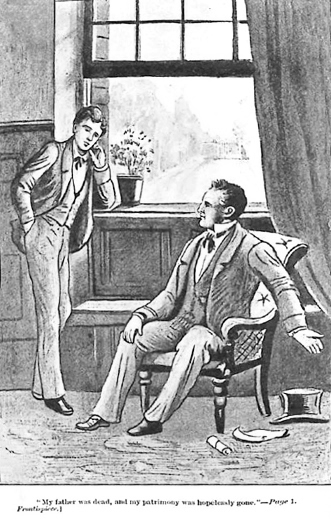
"My father was dead, and
my patrimony was hopelessly gone."
Frontispiece.]
BY
RUTH LAMB
AUTHOR OF "ONE LITTLE VEIN OF DROSS," "AN ANGEL GUEST,"
"ONLY A GIRL WIFE," "COMFORTABLE MRS. CROOK,"
ETC. ETC.

LONDON:
JAMES NISBET & CO., 21 BERNERS STREET.
MDCCCXCI.
CONTENTS.

CHAP.
III. MISS NELLY BURFORD GIVES HER OPINION
VI. MISS FLINT'S COMPANY MANNERS
XII. A SKELETON IN THE CUPBOARD
XIII. MISS FLINT AIRS HER VIEWS
XIX. A "SORT OF RELATION" AT LINT HALL
XXI. MRS. BURFORD'S SELF-COMMUNINGS
XXIII. WATCHINGS AND PERPLEXITIES
XXV. FORTUNE SMILES—AN ADVENTURE WITH BURGLARS
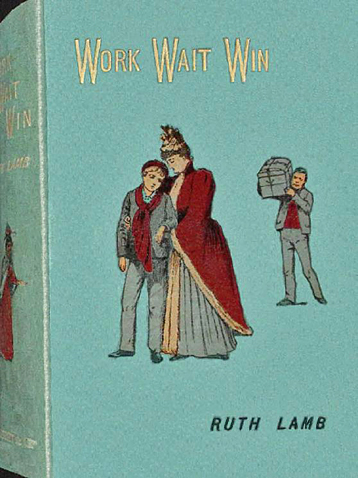
WORK, WAIT, WIN.

BAD NEWS.
I MUST begin my story by telling how I came down in the world. The descent was effected for me whilst I was a boy at school, and before I had anything to do with the shaping of my own fortunes or misfortunes.
I was supposed to have excellent prospects, and to have been born with the proverbial silver spoon in my mouth, for I was the son of a wealthy country gentleman, and heir-presumptive to many broad acres that had never been encumbered as yet.
I was just sixteen and at Rugby when the shock came. My father was dead, and my patrimony was hopelessly gone; probably the knowledge that he was a ruined man, and that my prospects were wrecked, had killed him.
Six years before, my father had been bitten with a craze for speculation, and had invested largely in mines which were to have been El Dorados, but which swallowed up our family acres instead. The land was not entailed, but had passed from father to son for two centuries or more. Now it belonged to Mr. Randal Burford, the family lawyer.
It is only just to say of him that he had done his utmost to prevent my father from risking the property, and, as its purchaser, had paid full value for it.
I only realised my position by degrees. Everything was gone or going, and had there been more, it would have followed. Just one day before the news came, there was no lighter-hearted lad in the old school than I, or one to whom a bright future seemed more assured. Now all was dark before me.
Mr. Burford was kind in letting me know the worst at once. Ill news, forwarded by driblets, gives a succession of shocks, each of which comes as a fresh trial.
I left school without delay, of course. Mr. Burford would have had me go to his house, but I clung to Lint Hall, the only home I had known, until after my father's funeral, then left it with a heavy heart.
I asked Mr. Burford how my father had been induced to enter on these disastrous speculations.
"It was for want of something to do," he said. "A perilous position for any one to be placed in, and sure to end badly. So long as your good mother lived, all went well. There was perfect confidence between your parents, and her practical turn of mind and common-sense put the extinguisher on many an intended rash speculation. It was only after Mrs. Simpson's death that your father became so reckless, and flung his money right and left. He meant and hoped to make you a very rich man. No doubt, he threw out hints of the kind to you."
He had done so; and, foolish fellow that I was, I had carried myself more loftily in consequence, and given the idea that in me, my schoolfellows beheld a future millionaire.
I gave a movement of assent. I could not trust myself to speak, and I wished to play the man before Mr. Burford, though I was but a few months over sixteen, and felt at the moment as if my heart must break. But for those false hopes, the fall would not have been so great. As it was, I came down not only from my real position of a little while ago, but from the imaginary height to which my father's hints of vast future wealth had raised me.
"What can I do?" I asked. "No more school for me, no home to call my own, no human being to whom I have a right to turn for help if inclined to ask it."
"There is Miss Dorothy. You are her only relative on the side of the Simpsons, and she has money enough. But I am bound to tell you that your father borrowed a trifling sum from her, and that she is probably the most indignant of his creditors, because her debt is unsecured. It is only fifty pounds. Mr. Simpson wanted to borrow five hundred, I am sure believing that he should soon repay it."
"If I had any money of my own, I would pay cousin Dorothy, for she will talk and talk about that debt until every one will believe my father robbed her of thousands," I said.
"You have a trifle to come to you—five hundred pounds—from what was your mother's. It seemed almost too ridiculous to settle that at the time of her marriage, because everything looked so bright, and poverty and loss seemed all but impossible. It is well invested at five per cent., but you can only receive the interest till you are of age. It must be your nest-egg, Master John; and listen to me. You must set yourself to work in some way, and climb the ladder of success. When you are far enough up, and your pocket well lined, come to me and make an offer for Lint Hall back again. Nothing would please me better than to see the old place in your hands, Jack. I hope I shall live to put my feet under your mahogany there, my boy, as I used to do in your father's days. Cheer up, Jack! Remember two things. You have a friend in the old lawyer, and you are certain of bare bread without asking anybody's help," said Mr. Burford, with his hand on my shoulder and a fatherly look on his kindly face.
The words and the touch brought comfort. At first, I had counted on many friends, but in the face of lost position and certain poverty, they had seemed to vanish all at once. On which of them, when it came to the push, could I count for a night's shelter or a day's food? It was much to possess one true friend, and to be just removed from beggary.
My eyes became moist as I listened and felt the friendly pressure of his hand, and I no longer cared to hide my emotion from him.
"You are to come to us after the funeral, and stay till you have had a chance to turn round," said the lawyer.
But at that time he had not consulted Mrs. Burford.
Two days later he told me, in a hesitating way, and as if he were ashamed to meet my eye, that he was more sorry than he could express, but that, unknown to him, Mrs. Burford had invited two other visitors, each of whom would require a room, and there were only so many spare apartments in his house.
"But I have provided for you all the same, my dear Jack. My head clerk, a worthy fellow, but a bachelor, has nice rooms over the chemist's. I have engaged another sleeping apartment for you, and you and he can chum together for a little while. It will be far better than being alone, and Gordon is an excellent young fellow, and of a highly respectable family. I shall be your host, Jack, all the same."
I knew what Mr. Burford meant. He would meet all expenses, but it would not be all the same.
I was only a lad, yet a few days had made me years older in many respects, and I could read all that had passed under the lawyer's roof, as plainly as if it had been printed in a book and placed before my eyes.
Mrs. Burford, who had always been so eager to welcome me under her roof when I was accounted heir to Lint Hall, had no spare room for the impoverished lad who must find some mode of bread-winning and be only too thankful for the chance to work.
I looked back on former holiday-times, and thought of all the coaxing bestowed on the Jack Simpson of better days, to induce him to give up boyish society, and spend his leisure with Mrs. Burford's two girls and their child brother. I had thought her very kind to a motherless lad, and felt it pleasant to be counted as a member of the family; for Rose and Nelly Burford were, one my own age, and the other a year younger. They were bonny bright girls, and we had grown up as friends.
"They are all children together," Mrs. Burford had said, with a benevolent smile, only the last holidays, and in reply to a friend's remark as to the propriety of such close companionship between a tall lad and two girls who were speeding towards womanhood.
Nelly Burford had always been my favourite. At six years old, I promised that she should be my wife as soon as ever I grew big enough, and Mrs. Burford reminded me of this in a joking way from time to time as the years went on; so persistently, indeed, that I began to get a little tired of it, and other people looked in a meaning way at each other, as if what was all very well for six was not quite in such good taste with a boy of sixteen.
Mrs. Burford would not trouble me with such allusions again. She was now anxious to keep Rose and Nelly out of sight and reach of such an undesirable companion as myself. Alas! I understood who had obliged poor Mr. Burford to recall the invitation given straight from his own warm heart, and without previous consultation with the lady who ruled his household and himself. She could not see the possibility of worth and poverty being covered by the same hat, and when I once understood why she had so changed in her manner towards me, I could not have crossed her threshold or tasted bread at her table for the world.
Neither could I bear to accept Mr. Burford's second invitation, though I knew he would have been only too glad to surround me with comforts at his own cost, or do anything to make up for his inability to receive me in his own house. So I told him, very gratefully, that I could not intrude on Mr. Gordon.
"Gordon is quite willing, indeed delighted at the thought of your joining him," said Mr. Burford.
I, however, repeated my thanks, and persisted in my refusal, though I was sorry to pain my one true friend. He did not press for reasons; I think he guessed them.
He only asked me, "What shall you do? Where will you go, Jack, if you persist in refusing me this pleasure?"
"Anything. Harvest work, if I can find nothing else. Hands will be wanted in the fields, but I shall go a few miles away before I ask for something to do."
I spoke in a reckless way, for my heart was full of bitterness, and I said to myself, "There is one advantage in poverty even: I shall be free to choose my own mode of working. No one will contend for the privilege of being my guardian. With Lint Hall at my back, tutors and governors would have been necessary. As it is, the living waif may drift whither he will, and none will hinder him from sinking or help him to rise."
"My dear Jack, you will not need to ask for work in the harvest-fields. In three days, you will own a capital of twelve pounds ten shillings—half-a-year's interest on your five hundred. You need not look at me as if I were telling you an untruth, or inventing a payment in order to help you over your first difficulties. This is July twenty-third. On the twenty-sixth your half-year's interest will be due. Your father allowed the interest to accumulate for some time, intending to add it to the principal, but when he became embarrassed, he spent it. He had a right to do so whilst you were under age, as he supplied all your wants."
"Twelve pounds ten!—My very own!" It sounded quite a fortune under present circumstances.
And as Mr. Burford quietly laid before me an account-book, in which previous interest payments had been duly entered and signed for by my father, I saw that the money would be honestly mine, and I might reckon on a like sum each half-year.
The first thoughts of pleasure in connection with this money were not selfish ones. I had some school debts, amounting in all to not more than ten shillings, but the memory of them cost me several sleepless hours, after I first realised my altered position. They had seemed justifiable debts, and only such as all schoolboys are in the habit of contracting, though I had rarely incurred any. Had my usual allowance come when due, instead of the news of my father's death, they would have been honourably paid. In three more days I should send the money, and Jack Simpson's name would be freed from the reproach of having contracted debts which he could not pay.
Then there was cousin Dorothy's fifty pounds, about which Mr. Burford said she was so angry that she declined to attend my father's funeral. No hope of paying that, though if I could have drawn so much of my five hundred pounds, I should certainly have done it, and diminished my future income to that extent, in order to stop my relative's tongue. She was only my second cousin. I was glad to remember that; and her name was not Simpson, but the more appropriate one of Flint, her mother having been my grandfather's sister. That she had heaps of money—more than she could count—was the popular belief, and that she never parted with a penny if she could help it, was also deemed a matter of certainty.
A happy thought struck me. I might pay Miss Flint the interest on the loan; it would only be two pounds five a year, for she had lent her money at four and a half per cent. It was a peculiarity of cousin Dorothy's that, close-fisted as she might be, she never exacted high interest, not considering it safe to do so.
She used to say, "People who promise six or seven per cent. would just as soon say ten, for they never mean to pay either it or the principal. I like borrowers who haggle over the rate and stand out for a quarter per cent. as if their lives depended on it; those are the payers. High interest and great risks go hand-in-hand."
No doubt Miss Flint was right, but my poor father's trifling loan, being likely to prove a loss, was an especially aggravating exception, since it showed that it was possible for low interest and great risk to go hand-in-hand also, and cousin Dorothy hated to be less than infallible.
When I told Mr. Burford that I should pay Miss Flint's interest, I was met by a prompt remonstrance.
"My dear lad, it would be utter folly for you to do it. She is as rich as—I mean she is extremely well off, and will never miss the principal, whilst every penny is of consequence to you. You might just as well hold yourself responsible to some of the swindlers who drew your poor father into those wretched speculations to his ruin. They lost nothing, for an excellent reason—they had nothing to lose."
"And I do not care for them because they drained my poor father of his last shilling. But cousin Dorothy is different; he really had her money, and I shall pay the interest, if I live on bread and water to do it, until I am of age. Then she shall have her fifty pounds back out of my five hundred."
Mr. Burford saw that I was in earnest, and yielded, partly because he could not help himself—partly, I believe, because he imagined that my self-denial might impress Miss Flint favourably on my behalf. I made no such calculation, but I did resolve that, however little I might have to spend, I would not get into debt. And that, however uncongenial any work might be that offered itself, I would undertake it, if within my power to perform, and do it with my might.
I told Mr. Burford so, and he promised to find me a post if possible.
"But in the meanwhile?" he said, and waited for an answer, which he thought I should be puzzled to give him. He believed I should be driven to join Gordon in the rooms over the chemist's after all.
FROM HALL TO COTTAGE.
FOUR years at a great public school had taught me to think and plan for myself in many of the lesser matters of daily life, and encouraged in me a spirit of independence. I had been sent there almost immediately after my mother's death, my father having decided that Jack would be miserable at Lint Hall all by himself—that is, with no one but him.
"I shall have no heart to entertain company, even were it fitting for gaiety to shoulder out sorrow; and if the lad had young companions here, the sound of their voices would make me miserable. If there had been more children, they might have cheered each other, and roused me in time; as it is, I shall be better alone, and Jack far happier at school," was my father's decision.
It was the best for me, no doubt; and though I did not forget my mother, there was nothing around me, as there would have been at home, to keep the knowledge of my loss constantly before me. When the holidays came, I was more frequently with the Burfords than at Lint Hall, and my father had become so absorbed in the speculations which led to his ruin, that he did not miss or want me. I was too young to be made a confidant of, and, except for occasional hints of greater wealth in prospect, I was told nothing.
All these things combined to foster a self-reliant spirit, and before Mr. Burford asked what I should do in the meanwhile, I was prepared with an answer which surprised him not a little. It was a written calculation, and though not put down in a very methodical way, was eminently satisfactory to myself:—
"Available capital to last twenty-six weeks, £12, 10s. Owing at Rugby, 10s. Half-year's interest, cousin Dorothy, £1, 2s. 6d. Deduct these, and I have £10, 17s. 6d. left to call my own."
This sum I allotted as follows:—Lodgings, £3, 5s.; food and all other expenses, £7, 12s. 6d.
As Mr. Burford ran his eye over the paper, I said—
"I shall be able to live, even if I get nothing to do, but I hope to earn something beside. I am resolved not to be idle, but will try to go on improving myself, or at least keep up what I have learned."
"My dear lad, what decent lodgings could you get for half-a-crown a week?" asked the lawyer.
"A clean little bedroom all to myself at Jabez Harwood's. Old Jabez made my first kite, and taught me how to fly it. I have gone in and out of his little place ever since I can remember. His wife Betsy told me, when I was at home last holidays, that she wanted another lodger to pay half-a-crown a week for her parlour. She had one for a year, a youth rather older than myself, who was booking-clerk at the station. She was glad he was going to a better post, because he was steady and a good son who did with less himself that he might help his widowed mother, but she was very sorry to lose him and the regular weekly half-crown, which was of great use to her. Jabez is only a labourer, and has never been equal to full work since his accident."
"I remember; the old man was driving Farmer Whitehead's trap home for him, and the horse bolted. He was thrown out and badly shaken and bruised. But Betsy could get working-men lodgers who would pay her half-a-crown a week. Her cottage is no fit place for you, Jack."
"Betsy says that, seeing she would have to do for whoever lives under her roof, she would prefer being servant to a gentleman, because she finds such-like the easiest to please. She will be very good to me, I am sure, and the terms and place are in accordance with my means. I shall be able to pay my way and live. Betsy told me how she used to contrive for her former lodger. He had vegetables from the cottage garden, and she marketed for him, and washed and mended his clothes. She kept account of all she spent; and a very funny way she had of doing it, but it was easy to understand. And I found that, beside the half-crown for lodgings, the clerk's other expenses averaged five-and-threepence per week. I shall have rather over sevenpence left for pocket-money."
Mr. Burford gave a groan as he listened, and was far more moved at the prospect before me than I was—outwardly at any rate. I purposely spoke in a business-like, matter-of-fact way, the better to conceal the heart-sinking of which I was profoundly conscious, in spite of my brave front.
"It will never do, Jack. I could not bear to think of your father's son reduced to such shifts and living under a thatched roof."
"The roof is sound and weather-proof," I replied. "Besides, I shall be on the ground-floor. The old folks sleep in the large chamber that runs over the house-place and the parlour. Jabez is a first-rate thatcher, and takes care to have a dry shelter."
"You will need clothes and more pocket-money. You must not be so proud, my boy, but let me be your banker until you have begun to climb the ladder of prosperity," said Mr. Burford.
"I have plenty of clothes to serve me for years," I answered, quite determined to make them do.
"You will grow out of them, Jack."
"Not for some time, Mr. Burford."
I gave a gulp before I could add, "If I do, there are some of my father's. You told me you had arranged for me to have them. And there are my mother's watch and a few ornaments that are really mine, you know, though I never mean to part with them if I can help it."
"What will you let me do for you, Jack?"
"If you could speak for me to some one who wants a—" Here I hesitated. What could I say? What was I fit for? The thought crossed my mind that there were scores of lads, brought up in cottage homes, whose qualifications for immediate employment were far superior to mine. My writing, for instance, though legible enough, was far from good, and had always an untidy look with it. I am by no means sure that I did not consider it almost vulgar to write a good hand.
It was all very well for clerks, and tradesmen, but not for the heir of Lint Hall.
"A what? Tell me, Jack. There is nothing I will not do for you, if I can," replied Mr. Burford.
"I mean, that I want work of some kind. Oh, Mr. Burford! Am I fit for any place, do you think?"
"I would offer to take you into my office, but there are reasons why I am just now unable to do this."
"Mrs. Burford again," thought I. "The office is too near the house; and this time the lady has been consulted before the husband ventured to do what was in his heart."
"Thank you all the same," I said, "but I would rather be somewhere else if possible. I wonder if I could get such a place on the railway as the Harwoods' lodger had. It does not seem to want a very clever person to give out tickets."
"If you would take a post of the kind, I think I could get one for you; perhaps the very same which that youth filled. His successor has not turned out well, and is about to leave. It is singular that I heard this to-day. I will use my interest for you, Jack, and have little doubt of success."
Mr. Burford's face brightened, and my heart felt all the lighter as I retired to prepare for my change of residence.
That night saw me installed as Jabez Harwood's lodger and the occupant of the little parlour which was to serve as sitting-room and bedroom, though I was to take my meals in the house-place. This was a good-sized, cheerful apartment, opening into the garden, and kept in a state of spotless cleanliness by the neat hands of Betsy.
Clothes-washing and dish-washing were done in winter-time beneath a lean-to shed at the end of the cottage, in summer, on a wide wooden bench by the hedge-side, as being cooler and more airy than the tiny shed.
There was an outer door to the parlour, but it was always fastened and nearly hidden by the end of the bed which was placed against it. The rude staircase was between the two apartments, but all corners entered by the house-place, and passed through it to the parlour or the room above, as the case might be.
My room had a good-sized window looking into the garden, and a smaller, containing only four panes, at the end, overlooking a pretty lane. One pane swung on hinges and would open, so good ventilation was secured by its means.
The cottage was one of the oldest on the Lint Hall estate, and a favourite plan of mine had been to persuade my father to pull it down and build Jabez a new house on the site of it. I had ventured to name the subject, and been told to wait a while, but in such a kindly way that I felt sure the new dwelling would be built some time, when those dreams of increased wealth became realities.
I told Jabez this, and was a little pained to find that he did not share my enthusiasm, but said, "The old place will serve my time, Master John. I've lived here so many years that I seem to know every straw in the thatch and every twig in the hedge. I hardly think I should sit down comfortable in any chimney-corner but this, even if it were a better one."
In my secret heart I then resolved that whenever I became master of Lint Hall, I should let the old man have the cottage rent free; just as though it were likely that the old man would be living after my father, a man barely forty, and with every prospect of long life, was gone.
And now here was I a lodger in this poor cottage, my father newly laid in the family vault, and Lint Hall the property of Lawyer Burford, on whose interest I was depending for a situation as ticket-clerk at a country railway station.
I did wonder a little that there was such a scanty following at my father's funeral. Surely his old neighbours might have shown him this last mark of respect, despite his fallen fortunes! And they might have extended kind hands and said a word of sympathy to a lonely lad who had lost father, mother, and all.
Mr. Burford enlightened me as to the cause of their absence.
"Some of them have lost money through your father; not by lending, but he was so enthusiastic, so certain of gaining largely by his ventures, that they listened to his hopeful words and followed his example, though only in a small way. They cannot forgive him for having been mistaken and misled, though his ruin proves how entirely he was himself deceived."
"But I never did anything, and they used to be so kind to me," said I.
Mr. Burford did not answer. He only shrugged his shoulders and looked meaningly.
I think I understood for myself, when I remembered that the children must, to a great extent, reap what their fathers have sown. Besides, had not Mrs. Burford been worse than any one else because she had professed so much affection for me? I was the same Jack Simpson, but I was no longer heir to the Lint Hall estates. Truly, not only are the sins, but the misfortunes, of the fathers visited upon the children. I could not meet one of those whom I had been used to look upon as a friend without having this truth brought painfully home.
Mr. Burford proved the single exception amongst the elders. He could not do all to serve me that his kind heart prompted, for his wife held him back on the one hand, and I refused his offers on the other. He did, however, obtain for me the post of booking-clerk, with a salary of eight shillings a week to begin at. My joy on hearing of this appointment was in proportion to my previous anxiety about employment.
It had been such a long drop from Lint Hall to Jabez Harwood's cottage, that anything in the shape of an upward step, cheered me beyond description.
The duties that I was expected to perform, though considered worth only a small salary, were not exactly light. The working-hours were long, and began at ten minutes before six in the morning, the sliding-panel in the booking-office being finally closed at half-past eight at night. To be there in time, I must rise at five, summer and winter. And though there were intervals for meals, and I had exercise enough during the day, I had to be within reach, as it were, more than fourteen hours out of the twenty-four.
"You must mind what you are about when you are taking money," said the station-master. "It seems a small matter to give out tickets, receive payment, and hand the change, but you need to have your wits about you, and to reckon quickly as well as correctly. If you take bad money, you have to make it good out of your wages. If you give too much change, your pocket must supply the deficiency. Your cash must balance to a fraction, remember; so give your whole mind to what you are about, or you will pay forfeit for carelessness. I have gone through all this myself; ay, and gone short of a dinner when I was a lad, because the price of it must be put into the till to make up a deficiency that I could not explain to myself, much less to any one else."
I thanked Mr. Edelston, the station-master, and felt the value of his advice. I was a fairly ready reckoner, but at first I had to find out the amount of each fare, as well as to calculate what change would be needed. With a moderate allowance of time this would have been easy enough. But when people were rushing in, several at once, as was the case on market-days, dreading the being too late, too impatient to wait until the previous comer was served, and stretching across to shout various requests all at the same time, it was bewildering enough to confuse more experienced heads than mine.
"Take time to be correct, and resolutely serve one at once," said Mr. Edelston. "If some are left, it will be their own fault, not yours, for they will pour in at the last moment."
This was true enough, but, boy as I was, I knew how hard many of the labouring people had to work, how precious were the minutes to them, and how difficult it was to set home in order and arrange all for the family, before the house-mother could leave them with a mind at rest. I could not look at the hot, red faces, on which stood great beads of perspiration, which the bearers of heavy bundles or baskets had not time to wipe away, without feeling unwilling to cause needless trouble by any act of mine.
"I am only a booking-clerk, but I will be the smartest on the line," I resolved; and I succeeded. I studied names of places, fares, distances, timetables—everything, in short, that would enable me to give a prompt answer to every probable question. The travelling public reaped the first benefit of my painstaking, but in the long-run, my own work was lightened and time saved by it.
I also overheard remarks which proved that my endeavour to do my duties in the best possible way, was appreciated by the poorer travellers. Nearly all of these who lived within a few miles of Lint Hall knew me, and many amongst them looked the sympathy they did not venture to put into words. It gratified my family pride, too, when I heard a speech like this, addressed by one cottager's wife to another who was perplexed about something—
"Ax young Mr. Simpson. He'll tell you in a minute. He has it all at his tongue-end, and it's a civil, kindly tongue, too. No fear of him 'saucing' you for axing a question that young men are put there to answer and won't trouble to do it in a general way; or if they do, are just fit to snap one's head off. No, no. He's a well-bred 'un, is young Mr. Simpson, and the gentleman shows his true sort wherever you put him. We might all be ladies, the way he speaks to us."
Such words, and others of a like kind, though not meant for my ear, lingered very pleasantly in my memory, and cheered me on from day to day. It was much to feel that my efforts were not in vain, and that to the poor folk, at any rate, Jack Simpson was as truly a gentleman as when they deemed him heir to Lint Hall and its broad acres.
I had more substantial marks of goodwill from the old tenants, both farmers and cottagers. Sometimes they came in the shape of a little basket of fruit, half-a-dozen fresh eggs, half-a-pound of butter between two cool cabbage-leaves, or garden produce, often far more than I could consume unassisted, and always the best of its kind.
I have had a couple of big rosy apples pushed in at the booking-office window, as the giver put in her hand to take the ticket. Then, towards Christmas-time, when pig-killing was going on, I had to ask my kind friends to stay their hands, for mince-pies, sausages, and other seasonable dainties came from all quarters, and far beyond my power to dispose of, even when assisted by Jabez and his good wife. Moreover, I was always "young Mr. Simpson," whilst the station-master was "Edelston" to his neighbours, he having been one of themselves, and not the son of a gentleman.
MISS NELLY BURFORD GIVES HER OPINION,
AND MISS FLINT ENDORSES IT.
I MUST go back a little and relate an incident which occurred at the beginning of my independent career as a railway clerk at Oakhill Station, and whilst Miss Dorothy Flint was the guest of Mrs. Burford.
I had duly paid the six months' interest owing to my relative; that is, I had left the amount in Mr. Burford's hands for Miss Flint, and had subsequently received a formal acknowledgment thereof, signed by herself. But she had not stepped out of her way to see or speak to the orphan-lad who was her own near relation, and I resolved to make no attempt to attract her notice. I heard of her, however, from Nelly Burford.
My little wife of old resembled her father more than her mother in disposition. When Mrs. Burford's fiat went forth that I was no more to be received as a guest under her roof, the girl raised her voice in angry protest.
"Jack has done nothing wrong. Dear old Jack, who has been like a brother to Rose and me, always! It would be a shame to turn our backs on him, and only because he is poor. It is a great deal harder for him, too, as he always expected to be rich, and for us to make it worse still by being unkind! It would be a horribly mean thing to do. Everybody would talk about it, for they know how you, mamma, were never right without Jack, and seemed jealous if he went anywhere else. But you cannot mean it. Say you were only joking—do, mamma, dear," added the girl at the close of her vehement appeal, which Mrs. Burford vainly tried to check.
"I am quite in earnest, Ellen," she replied severely. "You are not qualified to judge in such matters. I must and will keep my children from objectionable society."
"But you always praised Jack, and said he was so truthful and upright and gentlemanly, and that he would be so rich," persisted the girl.
Mrs. Burford's face was aflame at these last words, for Miss Flint was present, and there was a wicked look of enjoyment on her countenance as she calmly took in all that passed.
"Well, there is no question of John Simpson's being rich now," she said. "His reckless gambling father has taken care of that. I have always spoken against gambling, and I consider reckless speculation to be gambling in one of its worst forms. 'Like father, like son,' is a proverb of which every day proves the wisdom. What can be expected from a lad who has had such an example?"
"Why, poor Jack knew nothing of his father's affairs; papa says so. One day he believed that he was heir of Lint Hall, and a great deal of money besides; the next he knew that he could not even go back to school, because his father was dead, and there was nothing left for him."
"We know all that, Ellen. Do be quiet. It cannot be very agreeable to Miss Flint to hear you speak of these things," said Mrs. Burford.
"But I dare say she will like to hear what papa says about Jack. He is your cousin, you know, Miss Flint, though he is so poor. My father says he never saw any one meet a great reverse so bravely, and that many a grown-up man might learn a lesson from his example. He is willing to work in any way, and he is honest, self-denying, and true. Father says he hopes Jack will live to buy Lint Hall back again."
"He buy Lint Hall back! A likely story!" And Mrs. Burford gave a mocking laugh. "I think if John Simpson had possessed one grain of proper pride, instead of staying in a neighbourhood where his father's doings and his own changed position were matters of common talk, he would have hid himself anywhere, or gone to America or Australia. His presence can only be a source of annoyance to you, dear Miss Flint. It must be a trial to you to think that your cousin is giving out tickets at Oakhill Station."
Mrs. Burford had gone a little too far. Miss Flint's spirit of contradiction was roused by these remarks, and she answered in a severe tone—
"Mr. Simpson may have lost his money, but I am not aware that there was anything disgraceful in that. If he had been a speculative rogue, it is probable he would have been a buyer of estates in place of losing his own. It is a great pity that Lint Hall should have gone out of the family, and that my cousin's son should be a railway clerk. But, at any rate, his father risked what belonged to himself, not other people's money, and the lad may turn out all the better man for knowing the value of what he gets by the work it has cost him. As to proper pride, there is no such thing; pride is detestable always, and if my young cousin Jack had any, he has done a wise thing in pocketing or burying it. Do not suppose that I shall faint if I see my relative on the inner side of the aperture through which my ticket is handed. Not I. Dorothy Flint has not lived to be sixty without having got over nonsense of that kind."
Mrs. Burford could not afford to quarrel with Miss Flint. She was an important client, a ready payer, for she was satisfied with her lawyer; and who knew but what some of her wealth might flow into the pockets of his children? She could leave it to whom she chose, and why not to the youthful Burfords?
"Still, my dear Miss Flint, it can hardly be a pleasant thing for you to see John Simpson in such a position. Poor relations are not desirable things, as I know by experience, for we have quite a number on my husband's mother's side, and they are always wanting help in some way or other;" and Mrs. Burford sighed audibly.
"Ah! They often want a good deal more than they can get, no doubt," responded Miss Flint calmly. "I will tell you a little story for your comfort, my dear. A friend of mine was, like yourself, plagued with applications for help from a crowd of poor relations. He groaned and grumbled every time his letter-bag was opened, and said hard things about his impecunious kindred, whom, however, he did not help. He had been holding forth at greater length and with more than usual bitterness one morning, in the presence of a jovial guest who was similarly placed to himself.
"'I have a remedy for such troubles,' said the latter.
"'What is it?' asked the grumbler eagerly.
"'I just say to myself, there are tops and bottoms in every family, and it is better to be at the top than the bottom.'
"Now, this," continued Miss Flint, "is what I say to myself, and I tell the tale for your benefit, seeing it will be more consoling to you than to me. I have but one poor relation, and that is Jack Simpson, and he certainly does not seem inclined to trouble me or anybody else, so long as he has head and hands to work for himself. Instead of coming to me for money, he paid me one pound two and six a short time since, when he had no occasion to do so, reckless youngster that he is! He will know better in time."
"Ah! No doubt he had a motive in paying you that money," rejoined Mrs. Burford.
"I am sure of it," said Miss Flint, with emphasis. "There is great comfort, however, in knowing that I can see through Jack Simpson's designs, and that I can at any time get rid of my only poor relation."
"How?" asked Mrs. Burford. "Do, dear Miss Flint, give me your recipe."
"By giving him as much of my property as would make it impossible to call him poor," was the prompt reply. And having made it, Miss Flint marched off triumphantly to her own room to write letters.
It was Nelly Burford who told me all this, when we met quite accidentally one day. She added, "Mamma was vexed at Miss Flint, but she durst not say anything. She never knows whether your cousin is in jest or earnest, and she is terrified of offending her. I know she went on so about you, Jack, because she thought it would please Miss Flint, and then she fancied she had gone too far, and was quite uncomfortable for ever so long after. I was naughty enough to be glad, though it was my own mamma who got the worst of it, as she always does with that clever old lady. It cannot be so very wicked, though, Jack, because my father is very fond of you, and never loses a chance of saying kind things about you. He would like you to come the same as you used to do. It is all mamma's fault that you are driven away."
I knew that already, but I did not tell Nelly how much I had felt her mother's conduct. I only said, "It is better so. If I were coming in and out in the old way, I might indulge in useless regrets. The dead past must bury its dead, and Jack Simpson, the clerk, must forget that he ever had any prospects, and try to carve out a future for himself. Tell me one thing; are you going to live at Lint Hall?"
"No, and I am glad of it," said Nelly. "Mamma wants to go there, but papa is firm as a rock about that. He says our house is large enough and good enough for a country lawyer.
"And when mamma said, 'Why did you buy the place, then? Not to look at, I suppose,' he said, 'To let, until Jack Simpson can buy it back again.'
"I think he enjoyed the joke, though mamma got quite angry. And now, Jack, I want you to take something from me. My grandfather always gives me a five-pound note on my birthday. I was fifteen last week, and I did think you would have sent me a card."
I interrupted the dear girl to say, "You were not forgotten, Nelly. On your birthday morning I awoke very early, and my first words were, 'I wish Nelly Burford many happy returns of this day. May God bless her, and give her everything to make this new year of life a very happy one.'"
"I am glad of that, Jack dear. Thank you. Now, see, I have changed the note, and I have carried the five sovereigns about with me ever since, on purpose for you. I thought I should never meet you, but here you are at last, and you must take the money and pop it into your pocket quick."
I was touched to the very heart as Nelly tried to put the gold into my hand, her bright young face all aglow with pleasure that she had it to offer, and without a shade of regret in thinking of the pretty things it would have bought for her own use.
"Really, Nelly, you are too kind and generous," I said. "Such true, warm hearts as yours make poverty delightful, for they show that riches and friendship do not always take flight in company. I cannot thank you as I ought."
"I do not want any thanks, Jack. You will please me best by pocketing the money, and letting me run away as quickly as I can, for fear of getting scolded. I have already been out too long, for I dawdled on the road in the hope of seeing you."
"But, Nelly dear, I cannot take your money; though the offer of it and this talk with you has made me feel richer than I should be if my pockets were overflowing with gold."
"Oh Jack!" interrupted Nelly. "I did not think it of you. If it were mamma or Miss Flint who offered it, I would not blame you for being too proud to take it. But we have been playfellows ever since we can remember, and since this trouble came I have said to myself, 'Whatever other people may do, I will never change to Jack. I will be a sister to him, and every sixpence I can save, he shall have.' And now you say you cannot take the five pounds. Perhaps you think some one will know I have given it you, but they will not. Grandfather Burford bargains that, after we are fourteen, we shall do just what we like with his birthday presents. He has plenty of money, too, so of course mamma does not contradict him."
"It is not because I am proud, Nelly, but because I am not so poor as you think, that I decline to rob you, dear. Listen."
Then I went into a calculation of ways and means, and proved that I was quite able to pay my way, and expected to save something out of my income.
"Old Betsy contrives wonderfully for me," I said, "and in a few months I mean to astonish Miss Flint by paying five pounds towards the fifty on which I am giving her interest. When the principal is paid, I must begin to save towards buying back Lint Hall," I added, with a cheery laugh.
There was an equal mixture of earnest and jest in this reply of mine. I meant to pay Miss Dorothy in full, and I also intended to save every penny I could, but as to buying Lint Hall back, I never dreamed of that coming to pass.
"I am sorry you will not have this money," said Nelly. "It will do me no good; money never does. It just burns my pocket, and I have seldom anything to show for it, or can tell where it has gone. If you had only taken this, I should have felt so happy, and gone on taking care of the pence in future. You would have helped me to be careful, and made saving a pleasure."
"Save part of your money in case I should want to borrow; and be sure you will be the only friend I will ask if I want a loan. Have you kept that sixpence with a hole in it, and the motto in tiny letters on Her Majesty's cheek?"
Nelly immediately fished it up from the bottom of her pocket, and with it a collection of small articles, very like those which schoolboys delight to collect, and handed it to me.
"I am going to keep it, if you will give it to me," I said; "so never complain that I will not take any money from you."
The girl's face brightened as I attached it to my watch-chain, which, as well as the watch, had been my mother's. Then I said, "Good-bye, Nelly. I cannot tell you how happy this talk has made me; and it will have to last for a long time, but I shall never forget it or you. I should like you to tell Mr. Burford that we have had it. He will say whether you must also name it to your mother."
She promised, and sped away like a young fawn, whilst I went homeward with a slower step and a lighter heart than I had known since I heard of my father's death.
I was quite determined not to meet this dear girl-friend again, so long as Mrs. Burford maintained the same attitude towards me, but there was no need for me to pain her kind heart by saying so. I knew she would keep her word, and tell her father of our meeting, so I felt satisfied on her account. She had been less than just to herself in speaking of her spendthrift habits; probably she kept no account of the way in which most of her money went. I fully believe that. But there were poor folk that could have answered for her, and who prayed for a blessing on that young head. Nelly Burford was both tenderhearted and generous, and could never close her ears to a tale of want, or her pocket, if she had anything left to give.
The sixpence she had so cheerfully handed over had a history, and bore an inscription beside the impress given to it at the Mint. Some former owner had taken pains to engrave the words, "Work, Wait, Win," on the smooth cheek of the Queen's likeness. The letters were small, but beautifully clear and legible to any one with fairly good sight. Who had shaped them we knew not, for Nelly picked up the coin on a field-path, when she, Rose, and I were out walking together, a couple of years before. We did not find an owner for it, but judged that it had dropped from a worn link in the chain to which it had been attached. Apart from the inscription, there was nothing remarkable about the coin.
We young people used to call it the "three W's" sixpence, because the tiny capital letters stood out conspicuously, but it was only since the date of my own altered fortunes that I had begun to think about the motto.
"'Work, Wait, Win,'" I repeated to myself. "Those are just the words for me, and I will ask my Heavenly Father to give me strength and will to work, patience to persevere and to wait until, in His good time, He sees fit to reward my efforts."
LINT HALL HAS A TENANT.
AS I walked homewards after my talk with Nelly Burford, I half wished that she had not repeated the conversation between her mother and Miss Flint. It never does any good to tell ill-natured remarks to the subject of them, but it vastly increases that individual's discomfort if in the future, he is brought in contact with those who have uttered them.
I could not help thinking of Mrs. Burford's wish that I had betaken myself to America or Australia—anywhere, in fact, to be out of sight and reach.
"Would she have furnished the means for such a voyage?" I asked myself.
It did not seem to strike her that I might have no choice in the matter, no means to convey me to a far-off land.
The staying on close to Lint Hall, and under such different circumstances, had been one of my greatest trials at first. My earnest desire was then to turn my back upon all that I had known, and to forget, if possible, both place and people.
It was not in my own strength that I battled with my pride, and eventually overcame it and settled resolutely to my work.
Until I was twelve years old, I had been blessed with a praying mother, who, above all else, desired for me that I should be a disciple of the Master she loved and served. From my earliest childhood she had striven to impress on my mind the most precious of truths—God's great love for sinners, manifested in giving His dear Son to show them how to live, and then to pay their debt by dying on Calvary's Cross, to save them from eternal death.
She taught me to think of my own needs, and to bring them to God in prayer. She told me sweet stories of her own young days, and opened her heart to me as few mothers do to their children.
She was especially particular to tell me about her faults and failures, the good resolutions she had made and broken, the self-dependence which had shown her how weak she was, and sent her to God in penitence and prayer for pardon.
She told me that she had often been unthankful, and murmured when she ought to have been praising God for His goodness. She related little stories of her own young life, with its joys and sorrows, and showed me how these last had affected her when they happened, seeming hard at first, and tokens of God's displeasure. Then afterwards, by the clearer light of God's Holy Spirit in her heart, she had been led to see that these trials had been marks of love, not of anger, and she learned to trust Him more and grieve over her own want of faith.
As a child, I thought my mother better than any one in the world, and yet she was so unlike most parents. These generally told their children how good they had been when they were young, and held themselves up as patterns of perfection. My mother spoke of her faults, and of God's great goodness in showing her how sinful she was, and her need of the Saviour He had provided for her.
She bade me listen whilst she told how Jesus spoke and acted, how meek and loving He was, how obedient to His Father's will, and said the more I strove to be like Him, and prayed for the Holy Spirit's help to follow Christ's example, the happier I should be.
On the last day of her life she said, "Jack, my one darling child, I want you to know that, even in this time of trial, I rest on God's love in Christ Jesus. Only He knows how hard it is for me to leave your dear father and you, but He will show me yet that all He does is well done. Trust in Him. We shall meet again."
How often my dear mother's words and teachings came to my mind at this time, would not be easy to tell. It was especially when I went to my own little room, and lay wakeful on my bed, that I almost felt as if she were present with me.
The feeling was a natural one, because from the time that I had a room to myself, adjoining hers, she never missed a night, when at home, in coming to sit by me and talk with me. Lying in the darkness, I holding her dear hand between my little palms, what talks we had, what confidences!
I was not only her boy, I was her small friend, whom she trusted with everything suited to my comprehension and likely to teach or interest me. Up to the time of her death, she used to say, "My Jack never betrayed a trust, never broke a promise, never told his mother an untruth; and I believe he has no secrets from me."
Secrets! No. It was my happiness that my mother was always ready to listen, that nothing concerning her boy was too trivial for her attention. I gloried in being her little confidant; I bared my inmost thoughts for her to read; I loved her with a depth of affection which made me dread the thought of giving her pain. And I shall ever say, that if all mothers were like mine, sons would find it difficult indeed to be deceitful or disobedient.
Thinking of my mother, I was naturally led to think, also, how it was that she differed from others, and to cherish and act upon her advice.
The account of her experience was of great value to me, because she had told me about her troubles at different periods of her life; also how, in later days, she had seen that they were blessings, though disguised, and that God's goodness was often shown in denying rather than in granting the prayers of His children.
In my solitude, after my father's funeral, I had prayed, with passionate pleading, and without one thought of submission to God's will or faith in His wisdom and goodness that I might find work at a distance from my old home, that my lot might be cast where my story was quite unknown, so that none might look on me, either with pity or contempt, as the penniless lad who had been but the other day spoken of as heir to a fine estate.
The answer to my cry was this railway clerkship, close to my old home, and amongst those to whom my life's story was fully known. Yet before six months had passed, I was acknowledging, with a thankful heart, that God knew best, and had in very kindness given me the opposite of that for which I craved.
The work was such as I could do well, and, thanks to my painstaking study at the outset, I already had it at my finger-ends. At the twelvemonths' end I should have a rise of five pounds, or "perhaps," said Mr. Edelston, "a removal to a more important station."
He thought this latter prospect would be delightful, but he was mistaken. There was nothing I now dreaded so much as being removed from Oakhill. I had met with such unexpected kindnesses; I knew that I had faithful friends in Mr. Burford and Nelly, though I avoided the latter and never sought the lawyer's presence unnecessarily. And I felt very happy beneath Jabez Harwood's roof.
Old Betsy's economy was truly wonderful, and her devoted kindness knew no bounds. She had been cook in a good family as a girl, and I can well imagine that she was an artiste in her line, for my humble meals were served in such an appetising way, that I never found myself hankering after daintier dishes.
When the 26th of January came round, I looked into my accounts with great satisfaction. I made a practice of putting down every penny I spent, and found, with no small amount of boyish triumph, that I had not touched my salary. I had lived on the sum set aside for the purpose out of my interest, and had never been in better health in my life. I was, moreover, in a position to pay Miss Dorothy's six months' interest, and if she would accept it, ten pounds as an instalment towards the principal sum of fifty.
It gave me special pleasure to think that I should make this payment out of my actual earnings, and that I could prudently part with the money, because I had just received the half-year's interest on my own little capital, and I had saved my wages week by week.
I was very boyish about my money, and very foolish too, for I kept it in the cottage, and took a great delight in seeing it grow. Not an avaricious pleasure, because I looked forward to paying it away, and for no return, except the happiness of knowing that in time Miss Flint would be unable to say that she had lost fifty pounds through lending it to her cousin.
It relieved me to find that she was willing to take this first instalment, though Mr. Burford growled over the writing of a receipt for it, and censured her for taking and me for paying it.
"She has no claim whatever upon you, Jack," he said. "If she were a poor woman, I could understand her willingness to pocket this ten pounds. Under present circumstances, it is simply monstrous for you to offer, or for her to receive it."
Words which sounded very much like "Old cat!" issued from the professional lips of Mr. Burford, who had quite a vicious look on his usually sedate countenance as he handed me the receipt.
"It is so much waste-paper, Jack," he remarked; "and, for a sensible lad, I am bound to tell you that you are an arrant simpleton in this matter, and I have no doubt Miss Flint thinks so too. If you have an idea of advancing your interest with her by denying yourself common necessaries to pay what you do not owe, you will find yourself mistaken. She is too good a woman of business to think the better of you for it."
I felt my face flush at these words, and was very nearly answering sharply. But I conquered my rising temper, and said quietly, "The receipt is not waste-paper to me, though in regard to law it may be. As to Miss Flint, whether she ever bestows a thought on me or no, I care not. I shall never throw myself in her way or ask anything at her hand. I am sorry that you, Mr. Burford, should misunderstand my motives in paying Miss Flint."
"Do not look so hurt, Jack. I was only teasing you a little. I could not imagine you capable of doing right from a selfish motive. All the same, I grudge the money, call you a simpleton, and am angry at Miss Flint. Let us turn to something else. You have not asked after Rose and Nelly. Have you forgotten your old playfellows?"
"No, indeed, Mr. Burford, though I suppose I ought to try, as I am sure their mother would like them to forget me. I hope they are well."
"Quite well. Nelly told me about seeing you and wanting to give you her five pounds; also, that you will no more be beholden to the daughter than to the father."
"I am glad she told you. Dear, kind Nelly; she promised me she would. I am very grateful both to her and you, and if I needed help, I would ask it from no one else. But you see for yourself that my means are enough for my wants, and bread earned by one's own labour tastes sweeter than the loaf given by charity, however kind the hand that offers it. You were my true friend when you obtained me the post I hold and became my security to the company."
"Pooh! That was nothing. I ran no risk in guaranteeing Jack Simpson. You have to go? Well, what message shall I take to Rose and Nelly?"
"None, thank you, Mr. Burford."
"None! Then, if I give you an invitation to pay us a visit, you will not accept it?"
"I will when I am ready to buy back Lint Hall."
"You are incorrigibly proud, Jack," said Mr. Burford. "I cannot blame you, though. I never relished the cold-shoulder business, and that it should have been offered to you has been a source of pain to myself. I have something to tell you about your old home. It is let, furnished."
I knew from Nelly that Mr. Burford had resisted all his wife's entreaties to remove thither, and that the house, furnished as in my father's time, had remained in the hands of caretakers, put in by the lawyer to whom its contents belonged; also, I was naturally curious to know who was going to occupy it, and in answer to my inquiry, was told "Miss Flint."
"Yes, Jack, your venerable cousin has taken the Hall, as it stands, for three years certain, as I judged you would not be prepared to repurchase before the end of that time. Miss Flint wanted to buy the estate out and out, but I told her I had promised to keep it for you, and would never sell it to any one else until a reasonable time had elapsed, so she took the house instead. Just a word more, my boy. Tell me if there is any article of furniture you would like to have, and I will send it to you. Do not answer now. Think it over, and write to-morrow. Be off. No thanks;" and with a hearty shake of the hand, I was dismissed.
There was one article I longed to possess, but as I looked around my little parlour and the larger house-place at the cottage, I decided that it would take too much room; otherwise, I should have asked for it. It was my mother's piano, but being a grand, it was out of the question. I sighed as I said to myself, "If it had only been a cottage, we could have found a place for it, and on glass supports, it would have taken no harm on the red-tiled floor."
My mother was a true musician, and I shared her gifts in this respect. Until my father's death, my taste for music had been indulged to the utmost, and by dint of careful teaching and painstaking on my own side, I had become a fairly good player both on the piano and organ. The greatest privation entailed on me by my poverty, was the inability either to continue my lessons or to keep up my practice, and Mr. Burford's kind offer gave me an additional pang, because, while longing to accept it, I was obliged to refuse.
I did not, however, tell him what I should have liked to ask for when I thanked him for his kindness, or I might have better understood what followed.
A PLEASANT SURPRISE.
I HAD nothing to do with the goods department at Oakhill Station. The traffic was considerable, and the bookkeeper there was a man of thirty, named Rushton.
About a week after my interview with Mr. Burford, Rushton entered the office and said to me, "I have sent your goods to the cottage."
"Goods!" I exclaimed. "I am expecting none. You must have made a mistake."
"Then you will have a pleasant surprise if you are looking for nothing. There is a heavy case, at the contents of which I could guess if I liked, waiting for you at Jabez Harwood's. You will doubtless find it outside the door. Go and look for yourself."
It was just dinner-time, and I hurried home, to find that Rushton had told me the truth. Before me was a huge case, the shape of which suggested that it contained a piano. My address was plainly written on a large card, on which were also the printed words,—
"From Messrs. John Broadwood and Sons—carriage paid."
The address was plain enough. The case could be meant for no one but me, so I was fain to seek the aid of the nearest carpenter, who set about unpacking it under the admiring eyes of a group of children.
It was a piano, or rather a pianette, the smallest instrument obtainable, and one of the best of its kind, evidently purchased with a full knowledge of the scanty space at my disposal. No letter, no message, apparently. Who could have sent it?
Stay. On opening it, I discovered a slip of paper lying on the keys, and read the words,—
"To John Simpson: from a friend. With hearty good wishes.".
That was all. No use trying to find out the sender by the handwriting, for the message was in printing characters.
There was a receipted invoice, but that was made out to Mr. John Simpson, so the instrument had been bought in my name. There were the glass supports too, all ready, so that I could only, with wondering thankfulness, help to place the piano in the best position, run my fingers once lovingly over the keys, and prepare to resume my duties at the office.
I subsequently saw Mr. Burford, whose genuine surprise proved the truth of his assurance that he knew absolutely nothing of the matter.
I wrote to the makers, who sent me the original order for the instrument. It was written in the same style as the message I found on the keys, and merely instructed them to forward a pianette of the best quality to my address, and to place the slip of paper and receipted account where I found them. Bank-notes in payment accompanied the order. They could tell me no more, and I could discover nothing, so I came to the conclusion that some old friend of my mother's had thus shown kindness to me for her sake, and I wished he could know how much happiness he had given.
The delight in this precious acquisition was not confined to myself. Words cannot describe with what pride and exultation old Jabez Harwood and Betsy regarded the instrument. That their cottage-roof should shelter a piano, was a something too good to be true. That in their living-room it should be made to give forth sweet sounds, was so entirely out of the ordinary way, and so suggestive of gentility, that the old couple felt as if they had been lifted into a higher social position by the very fact of its presence.
When I played my more brilliant pieces, Jabez and Betsy would express their surprise that mortal fingers could travel so fast and know all the time where they were going to land. This was the only way in which they were affected by music which required a fair amount of execution. It was when I played simple, old-fashioned tunes on week-nights, or well-known sacred ones on Sunday evenings, that the old folk declared they had a real treat.
Jabez was very proud of the fact that he "had used to sing in the choir" when he was a lad. "Not," said he, "that we had an organ, or even a 'harmonial,' in those days, Mr. John. But it was quite as hard singing along with two fiddles, a clarinet, and a bassoon that disagreed among themselves as ours did—leastways those that played them, and had ought to have kept in tune with one another in more ways than one."
I quite agreed with Jabez, and it was a true pleasure to me to revive such memories, and induce the old man to lift up a quavering voice to a hymn-tune rarely heard now-a-days, but precious in his ears, and never to be forgotten by a former choir-boy. I might prefer the music of the present, but I would not say so to Jabez, who gloried in tunes with many flourishes and repeats, and considered the modern style a sad falling off in every way.
"Not that I can sing 'em now, Mr. John," he would say as he shook his grey head after a vain attempt to get up high enough or go down low enough to meet the requirements of the tune; "but there was a time when my voice rang through the old church, and above everything else, though James Grayson, that played the bassoon, used to try and bray me down, because his lad had a poor, weak, penny whistle of a voice, that could hardly be heard a yard off. Many's the sixpence your grandfather has given me for singing up so well and keeping the other lads going."
The old man's face would light up at the memory of past musical achievements, and Betsy's would reflect its sunshine as she listened.
"I can remember as well as if it were yesterday," she would say by way of confirmation. "There's not much between Jabez and me in age—only a year or so—and I mind hearing him where I sat, and thinking he was worth all the rest of the lot put together."
Then perhaps old Jabez would give a knowing look, and remark—
"You see how it was, Mr. John; she had her eye on me even when I was only a youngster. But, dear heart! it was likely she would look my way, for we lived side by side from the time we were born, and were playmates—all the brothers and sisters of both families—from the days we could toddle."
I liked to hear this well-matched couple talk of their early days, and I wished from my heart, that all husbands and wives were as tender and true towards each other, as this humble pair were.
If it sometimes cost me a little self-denial to play the tunes which Jabez loved, and to hear his vocal efforts, I was more than repaid by feeling that I could in this way give a little pleasure to those who grudged no trouble to promote my comfort.
Old Jabez's voice might be cracked and tremulous, and Betsy's resemble the least tuneful notes of which bagpipes are capable, but I was sure that their hymns of praise went up from thankful hearts.
"What matters it how your voices may sound in my ears?" I asked myself. "You are singing and making melody in your hearts to the Lord, and your notes will join with those of angels, and cause no discord."
I even went so far as to teach old Jabez to play the "Old Hundredth" on the piano. He only used one finger, which looked about as flexible as a stumpy carrot, and his time was "ad libitum." But he got through it somehow, and at the close looked up from the piano with as much pride as if he had played a fugue of Bach's or a sonata of Beethoven's.
Betsy was quite lost in admiration the first time he went through his tune without a mistake, and remarked—
"If you'd ha' learned young, you'd ha' made a grand player, Jabez."
My old landlord only performed in private, but I could name a country village in which, some twenty years ago, a schoolroom was used for service, because there was no regular place of worship within reach of a large portion of its population.
The people subscribed for and bought a harmonium, and then found they had no one on whose attendance they could depend, to play it for them. So for a time a lad, with a correct musical ear acted as stop-gap, and led the singing by playing the hymn-tunes on the harmonium with one finger only.
My piano did not suffer from being in a cottage house-place. Betsy was most careful to preserve its polished case from speck or spot. She turned a wonderful piece of patchwork, a triumph of her girlish days, into a cover for it, and whenever sweeping or dusting had to be done, it was put on to keep the piano from the chance of a scratch.
One evening we were talking about voices and singers, when Betsy remarked, "What a sweet voice George had, and stronger than yours!"
She spoke to Jabez, but I asked, "Who was George?"
She seemed strangely confused at the question.
And turning to Jabez, I noticed that his face had lost its ruddy colour, as he replied in a low, unsteady voice—"He was our only son, Mr. John."
I was greatly surprised, for I had always thought there had been no children born to Jabez and Betsy.
"I never knew you had a son. Is he—"
I began the sentence, but Jabez interrupted me by saying—
"We—we lost him a many years ago, when he was only twenty, and before you were born. It was a great trouble—the worst we ever had; and although it happened so long ago, it upsets me to talk about him."
"We don't talk," said Betsy; "only I forgot myself at the minute, for I seemed to hear his voice that was like what his father's was when he was young, only stronger."
Then Betsy turned away, and I saw her dash the gathering tears from her eyes; whilst Jabez sat still where he was, but silent, and there was no more music or talk about it that night. The unfortunate allusion to their lost son had brought sad memories, and I too felt that the brightness had left the fireside for that night at any rate.
I went early to my room, and I heard Jabez go upstairs directly afterwards.
Then came a light tap at my door, and on opening it, I saw Betsy.
"Excuse me, Mr. John," she whispered, "but I want to ask a favour. Please do not let on to anybody, either in the house or out of it, that you know about our lad. I forgot myself to-night, for we never mention his name even to one another. Jabez cannot bear to hear it, for it seems as if a word is enough to bring back all the old trouble again. People are very kind; they know how my poor old man feels about this, and they say nothing. You could see for yourself that the loss of the lad is one of those things that can never be got over. I was so vexed with myself for naming him to-night that I could almost have bitten the end of my tongue when I had done it."
I readily promised that I would not mention the lost son, "either in the house or out of it," as Betsy requested.
And she left me with a look of infinite relief on her face and a cordial "Good-night, and may God ever bless and keep you, Mr. John!"
I could not quite shut out the memory of what had passed as easily as Betsy closed the door behind her, and the thought would come into my mind again and again—"How strange it is that even this little cottage has its closet with the proverbial hidden skeleton, and that I never dreamed of its presence until to-night!"
I could not rid myself of the feeling that there was some mystery connected with the lost son, or else his death must have occurred under peculiarly painful circumstances. Only such a supposition could account for the ashy paleness which spread itself over the face of Jabez, at the mere mention of his name, and Betsy's regret for having caused him pain, and fear lest I should again allude to what had passed.
I began to calculate dates and ages. Jabez was sixty-six, his wife a year younger, so they must have lost their son when they were both under forty years of age; and George, were he living, would now be seven or eight and thirty, at least. But no doubt, in the minds of his parents, he would be endowed with lasting youth, for he died in all the freshness and glory of budding manhood, at twenty years of age. And he was all they had. Still, in such cases, time generally exercises a healing influence, and as the years pass, the parents wipe away their tears, and love to dwell upon all the qualities which made their lost ones so dear to their hearts. It was strange that Jabez and Betsy could not bear to speak of their boy to each other, and that in all my life, I could not remember that I had ever before heard his existence mentioned.
There was certainly no stone in Oakhill churchyard which bore George Harwood's name, and I well knew the spot where lay his kindred on both sides the house. I also knew every monument in our country "God's acre," and could have repeated all the quaint rhymes which told more in favour of the virtues of those who lay beneath, than of the poetical taste of the survivors who composed or selected the inscriptions.
"Perhaps," thought I, "the young man was drowned, and his body never recovered, or he was the victim of some fearful accident, or—"
But before I had come to the end of my guesses, sleep, happily, cut them short, or I fear I should have been ill-fitted to begin my work in the morning.
MISS FLINT'S COMPANY MANNERS.
THOUGH Miss Dorothy Flint became the nominal tenant of Lint Hall, and paid a good rent for it, she rarely made it her home. Being a lady of an extremely independent turn of mind, and with large means at her own absolute disposal, she was not the person to trouble herself as to what people might say about her acts or movements.
"You hardly ever spend a week at a time in your new house," Mrs. Burford said to her, when she called upon Miss Flint during one of these brief visits to Lint Hall. "People wonder that you troubled yourself with the care of a place which seems to afford you so little pleasure. If you spent half the year in it, now."
"It would give me more trouble and less pleasure," promptly interposed Miss Flint. "I took the place because—well—because your husband would not sell it to me. He will be glad enough to ask me to buy it some day, and I am waiting for that day to come. I shall get it cheaper in the end. As to trouble, it gives me none. Cartwright and his family are capital caretakers, and do all for me that I require, when I pay a business visit to this neighbourhood. You, being an old friend, will excuse the pinafores," continued Miss Flint, indicating by a wave of her hand certain articles of furniture from which the holland covers had not been removed. "I shall receive no one else."
Mrs. Burford assured Miss Flint that she esteemed this absence of ceremony as a mark of personal kindness to herself, and a proof that she was regarded as a friend.
"Only, my dear," she added, "I am sure you would be more comfortable with me during these brief visits. You must feel dreadfully lonely here."
"Not a bit of it," replied Miss Flint. "It is quite delightful. I feel like a feminine Robinson Crusoe, as I wander through this big place, 'monarch of all I survey,' and with nobody to say do this, that, or the other. It is my desert island, my inner world, into which the outer one, always excepting yourself, my dear, does not poke its nose for fear of its being snapped off;" and Miss Flint laughed heartily at her own joke.
"Whilst I am here, however," she said when she had done laughing, "I get to know everything that has happened since my last visit. I have Jane Cartwright in; or if she is alone and busy ironing, I go to the kitchen and sit with my feet on the fender, to hear the last three or six months' gossip. We both enjoy it. I hardly know which of us gets most gratification out of our talk, but I almost think I do," added Miss Flint, in a reflective way. "Jane Cartwright knows that I shall expect to hear about everything and everybody, and she keeps a sort of diary for my benefit. I am vastly amused at the queer collection of facts she stores up in this manner; plenty of rubbish, my dear, of course, but there are many tit-bits,—oh yes, there are tit-bits."
Miss Flint's look at her visitor was indescribably knowing. She laughed and nodded her head, somewhat to the derangement of the drapery which at the moment was doing duty in place of a cap, and consisted of a large bandana kerchief.
Mrs. Burford looked very uncomfortable, and wondered whether any bird could have carried to Jane Cartwright, and Jane have repeated to Miss Flint, some uncomplimentary expressions of her own with regard to the present misuse of Lint Hall.
I have already said that Mrs. Burford's ambition was to occupy my former home, and that Miss Flint's taking it on lease had, she believed, been the cause of her disappointment. The Burfords' house would have been easy to let. Lint Hall was not everybody's money, and might have stood empty for years, or until its present owner was driven to occupy it, as the less of two evils, if only Miss Flint had not gone out of her way to take a place for which she had no use.
"If she would only live in it and receive her friends there, it would be a different matter," said Mrs. Burford. "She has such ample means for keeping up a place of the kind, and might make it quite a delightful social centre if she chose. But Dorothy Flint never did choose to act like an ordinary human being, and I firmly believe she took Lint Hall to prevent our going to it, and to spite me, for I had told her my mind about it. She is just a dog-in-the-manger—or perhaps cat would fit her better. There is that old Cartwright keeping up the gardens and vineries, and selling the produce—flowers, too—for his own benefit. It is a perfect aggravation to see the things and know, that not so much as a basket of grapes or a bunch of flowers ever comes our way. She pays Jane Cartwright a trifle for keeping the house in order, and the husband pays Miss Flint a mere acknowledgment for the gardens, and makes all he can out of them. It is a shame!"
The memory of such remarks, made not once or twice, but often, when Mrs. Burford's indignation outran her discretion, made her feel anything but comfortable as she sat opposite to Miss Flint in the morning-room at Lint Hall. She went first hot, then cold, as she wondered whether they had reached the ears of the shrewd spinster, whose keen glance made her feel so horribly self-conscious.
"You seem to like the Cartwrights," said Mrs. Burford, hardly knowing what else to say at the moment.
"Almost better than they like me," was the prompt reply. "They can scarcely forgive me for being here. Cartwright had been gardener to my late cousin for several years, and was brought up on the estate; so, naturally, I am the interloper;" and again the speaker laughed heartily.
"It is very good of you, then, to put a living into the man's hands as you do, and get nothing back for it. Plenty of men would be glad to pay a substantial rent for these gardens."
"Believe me, my dear, in the arrangement made with Cartwright, I have studied my own interest—I always do. The gardens were terribly worn down, for my cousin had spent no money on them for some time before his death; for the excellent reason that he had none to spend. If I had let the gardens in a regular way, the tenant would have been coming with all sorts of grievances—houses giving way, pipes not acting, woodwork bare of paint, and expense or trouble without end would have followed. As it is, Cartwright knows he has nothing to expect.
"'Make the best of the place, if you choose to stay in it, but expect nothing from me. If it is down, you may get it up again. If painting be needed, outside work is the landlord's business; the rest must be yours.'
"That was what I told Cartwright, and he is getting the place up. His sons work out in the day and help him in the evenings, or when they have no better job. Jane takes in washing, but does it at the lodge, where the two sons and a daughter sleep when I am from home, the other son and parents sleeping here at all times. When I am here, the daughter is mostly here also, to help her mother. They do fairly well, for it is their interest to make the best of things. I come and find the grounds in perfect order and beauty, without paying a penny in wages. If I hired my gardeners and left them to dispose of the produce, I should be cheated on all hands, and have to spend I am afraid to say how much, for a far worse state of things. You see, my dear, you made a mistake in thinking that Cartwright was getting the better of me."
"It would require a clever person to do that," replied Mrs. Burford.
"Now, do you mean that as a compliment, or are you inclined to be satirical?" inquired Miss Flint, with a look of candour that was most irritating. "I shall not be offended in any case. I declare here is Nelly!" she exclaimed; for my girl-friend had been ordered to call for her mother in half-an-hour, and Miss Flint at this moment saw her approaching the Hall door.
Rugged and sarcastic as Miss Flint might be to most, she was always kind to Nelly, and Mrs. Burford, noticing this, was careful to throw the girl in her way whenever an opportunity offered. Rose was her favourite daughter, but Miss Flint's likings were not to be controlled, and Mrs. Burford rejoiced that one of her children found favour in that lady's eyes.
She gave Nelly many instructions about pleasing Miss Flint, and bade her be cautious never to hold, or at any rate express, an opposite opinion when talking with her.
"You are sadly too outspoken, Nelly," she said, "but do control your tongue, for your own sake. Remember she has no end of money, which is growing year by year, for she spends little and gives nothing. What a blessing it is such people cannot carry their money away with them when they die! They must leave it to somebody, and Miss Flint has no relations, so why not you?"
"She has Jack," put in Nelly promptly.
"Do you mean that young Simpson?"
"Of course I do, mother dear. No one else was ever 'Jack' to me. He is Miss Flint's nearest relation."
"As if third cousins were worth counting. And, Nelly, you must on no account name him in her presence, or you will lose her favour once and for all. For the future, you must be good enough to cease the 'Jack' when you speak of young Simpson."
I am afraid Nelly was in a rebellious frame of mind, for she even said that she hoped Miss Flint would never do such a wicked thing as to pass over young Mr. Simpson for her or anybody else. Also, that if she did leave money to her, she would give every penny of it to him, and she was certain her father would help her to do it. Besides, Jack was second, not third cousin.
When Miss Flint saw the girl from the window, she did not wait for her to ring at the Hall door. The window opened to the ground and on to a terrace, so she unfastened it and called—
"Come this way, Nelly, or you may wait outside for some time; Jane Cartwright is slow in her movements, and her daughter is at the lodge to-day."
Nelly obeyed, and shook hands with Miss Flint, disregarding a telegraphic movement from her mother which suggested a more affectionate greeting.
"That is right, Nelly," said Miss Flint, who had noticed the signal with much amusement. "Give your kisses as your heart prompts you to bestow them, though Dorothy Flint may be left out in the cold. How are you, child? You look like a perfect bunch of roses."
"Very well indeed, thank you," replied Nelly. "I hope you have not been suffering from pain in your face."
"You were going to say toothache, were you not? You very properly corrected the expression. Thanks for the inquiry; I have no pain in my face. This handkerchief, which you have mistaken for a defence against cold, is only doing duty as a head-dress for want of a better. I put it on out of respect to your mother, in place of exhibiting my unadorned grey hair, and because, however old friends we may be, I like to observe the proprieties. The kerchief lay close to my hand on the table, whilst my cap was, and is, hanging on the mirror in my bedroom."
"I was going to say toothache," responded Nelly, resolutely ignoring all remarks subsequent to Miss Flint's first question, "but I remember that you told me you hoped never to suffer from that again, seeing you had no natural teeth left."
"True, my dear. I admired the nice distinction you made. I hate shams, and though I have not a tooth left out of those nature at first provided, I deceive nobody. I did not shut myself up and see no one for a month after I had lost the last of them and was waiting for the substitutes. When a lady called upon me and said her little girl was not very good-tempered because she was getting her eye-teeth, I said I could sympathise with the child, for I was getting mine and felt ill-tempered also. And now, child, you may fetch my cap if you like, and I will wear it in honour of your call. It is not well to set an example of untidiness to the rising generation."
"Nelly is going with me on a shopping expedition," said Mrs. Burford. "I told her to call for me, so pray do not change on her account."
"No, she is going to stay with me whilst you go shopping. You know that, out of the kindness of your heart, and in compassion to my loneliness, you planned to leave her. Get the cap, Nelly. You shall stay. Take off your things whilst you are upstairs, to save another journey, and spend five minutes about it, so that your mother and I may take an affectionate farewell of each other without being overseen by your matter-of-fact eyes."
The girl did as she was told, and disappeared. Mrs. Burford turned very red, but she laughed, and agreed to leave Nelly with Miss Flint, as indeed she intended from the first to do, if possible.
But she was annoyed that Miss Flint had read her through and through, and that she was being made game of by the keen-sighted spinster. She thought it better to make a favour of allowing the girl to stay, and added, "Indeed I have a great deal of shopping to do, and little time to do it in. Nelly is going away to school in Germany for a couple of years, and many preparations have to be made."
"Whew!" Miss Flint gave a sound from her pursed-up lips that was an extremely near approach to a whistle, and would have been called one had a boy made it. "Is not this a sudden plan?" she asked. "Mr. Burford said nothing about it when I was talking with him only yesterday."
"I do not suppose he would bring in his family affairs when he was engaged with your business, my dear Miss Flint. Besides, the mere sending of a child to school is such an every-day matter in these travelling times, that I dare say my husband did not think of it."
"An every-day matter! Why, you have never sent one away before."
"Certainly not. But somebody or other is always sending a child to the Continent for educational advantages which do not lie within reach of home. In that sense, it is an every-day occurrence."
"If I were a mother, which, taking all things into account, I am glad I am not, the thought of parting with my girl would seem no every-day matter. It would haunt me night and day. And if I know anything of Randal Burford, it is haunting him. I understand now why the man was so silent and absent in his manner yesterday. Tell me, now, does he want the child to go? Is it your idea or his?"
"My husband has only to be convinced that a thing is for his daughter's good and he will consent, though it may cost him some self-denial. It was I who first thought of sending Nelly to Germany, for finishing lessons in languages and music. The local teachers do not satisfy one."
"I thought so; and you are going to lose two years out of Nelly's life. If I were her mother, I could not do that," said Miss Flint, in a musing fashion.
"I do not understand you. How can I lose two years of the girl's life? She will come to England for the summer holidays, but not in winter, on account of the distance," replied Mrs. Burford.
"It is only an old maid's fancy," said Miss Flint, "but what else have I to do but indulge queer fancies? I should have thought that this particular one would have struck you rather than me, because of your personal interest in the matter. My notion is, that before boys and girls are fully grown up, each year of their lives stands by itself, different from all the past years and all that are to come. There is a constant change going on, a development, so rapid in comparison with the alterations that follow the grown-up stage, when there is no very striking difference to be perceived between one year and another. Part with your child, as a child; do not see the boy or girl for a year or two, and the young creature that comes back to you is different in so many ways from the one that left you. You have for ever lost a phase of that life, and you can never see it again."
"My dear Miss Flint, I should never have dreamed of your thinking so deeply on such a subject. Doubtless you are right, but if all children were to be kept by their parents' sides until they were grown up, I am afraid it would not be to their advantage, to say nothing of its being in most cases impossible."
"No doubt there are two sides to the question. There is just the possibility that in some cases, a girl might be in wiser and better hands than those of her mother, and that in others, the latter cannot choose. I only said what I should feel if I were a mother and could choose. But sometimes, again, mothers distrust their own ability to bring up their children."
"I never entertained such an idea," said Mrs. Burford quickly.
Miss Flint responded with equal promptness, "I am sure you did not." But if ever a face added, "More's the pity that you do not doubt your own wisdom," the expression of hers completed the sentence in this manner.
"How is the child going, and with whom?" asked Miss Flint, after a rather uncomfortable pause.
"We think that a friend of ours will be going in a fortnight, and that Nelly will be able to travel with her and her husband."
"A fortnight! Have you spoken to these people?"
"Not yet, but—"
"Then let them go their ways without Nelly. I am going to Germany in a fortnight, and I will take her myself," said Miss Flint resolutely.
"But you may not be going in the same direction, or Mr. Burford and I would be only too glad. Indeed, my dear Miss Flint, it would remove a load of anxiety from our minds to know that Nelly was under the care of such an experienced traveller, but we should not like to cause you inconvenience."
"I am going in the same direction. Consider the weight off your mind, and depart with a light heart to make your purchases. Nelly wants a female griffin to guard her on the road; I want a companion on my journey to Germany. We shall both benefit by my plan, and you will be happy."
"I thought your friend Miss Watkin and you were going together, as usual. Did you not say so?" inquired Mrs. Burford.
"We are to meet a month hence, but she is in Germany now. Do not call her my friend, please. We go about in company because it suits our convenience, and we quarrel like two cats. We can both bear to rough it now and then. We are equally indifferent about dress, preferring comfort and suitability to mere looks. We both hate to have a maid to look after and pay, so long as we are able to look after ourselves; and, like John Gilpin, being of 'a frugal mind,' we do not care to be at the cost of a third person's travelling expenses, when we know that she would be more trouble than she would be worth. It will be delightful to chaperon Nelly, to play at mother for a few days, to have a companion at somebody else's expense, too!"
Miss Flint laughed with such heartiness and evident enjoyment that Mrs. Burford was infected by her mirth and laughed also. But she was, all the same, feeling in her mind that she should like to give Miss Flint a good shaking for her irritating words, which she could not answer and dared not resent.
All at once Miss Flint ceased laughing, and exclaimed—
"We have kept that child out of the room too long, though perhaps she is listening outside the door. She was only to be five minutes, and we have kept her away a full quarter of an hour."
Nelly was not, however, listening. She needed to be called downstairs.
So Miss Flint, having informed Mrs. Burford that she need not take the trouble to send any one for her daughter, as Jane Cartwright would escort her home, hustled her guest off the premises as rapidly as possible.
FASTING AND FEASTING.
MRS. BURFORD felt very angry indeed as she left Lint Hall and its present mistress.
"The dreadful old screw," she said to herself, "not to offer me even a cup of tea, when she knew that I should be so tired before I reached home. Nothing is so wearying as shopping, especially for a girl who does not appear to care a straw about her outfit. However, her going is a settled thing, and her escort too, for Dorothy Flint can be trusted to take care of Nelly. And there will be no chance of young Simpson's exchanging a farewell word with her when those keen eyes are watching, even if they should go from our own station."
Mrs. Burford knew so much about Miss Flint's views on the subject of afternoon tea that she could hardly have expected an offer of refreshment in that shape, though it might have come in some other way, and, indeed, ought to have done.
"I despise the everlasting tea-fuddling that goes on now-a-days," Miss Flint was accustomed to remark. "People are for ever poking their teapots under one's nose, as if it were impossible to have too much of a good thing. Tea is good in its way, and at proper times, but now every chit of a girl must have her afternoon tea, even when it will come in as her regular meal an hour later. She takes what she does not want, because, forsooth! it is fashionable. I decline to lend myself to such fashions, which only benefit persons who need a refreshing cup of tea between luncheon and eight o'clock dinner. If callers expect afternoon tea here, they will be disappointed."
Mrs. Burford was, however, very angry at Miss Flint's scant hospitality.
"She has spent weeks with us, and been treated to the best of everything, yet would not give me a cup of tea. It is like her meanness, for she knows we dine late and need the cup of tea."
By this time Mrs. Burford had reached a confectioner's, where she obtained refreshment, but whilst taking it, thought still of Miss Flint's discourtesy, and said to herself—
"I wonder I bear with her so patiently as I do."
Mrs. Burford felt quite virtuous as she made this mental remark, never considering that her motives for bearing with Miss Flint's peculiarities, would ill bear looking into.
The door had closed behind her mother before Nelly made her appearance, carrying Miss Flint's cap.
"You have brought down twice as many hairpins as I ever use at once," said that lady.
"I know that," replied Nelly. "But you had better put more pins in it, then your cap will not be so often twisted to one side."
"What do you mean, you saucy child?" asked Miss Flint, with a severe look at the girl, who returned a fearless one as she replied—
"Just what I said. When you were at our house, I was always longing to straighten your cap and give you a general tidying-up, as I do the mother sometimes—when she is in a very good humour, you know, and will submit to such interference."
"Why did you not tell me mine was all wrong? And how dare you meddle with my head-gear now any more than of old?" inquired the spinster.
"I was afraid of offending you then. Besides, I had not heard you remark, as you did to my mother a while ago, that it is not good to set an example of untidiness to the rising generation."
There was a twinkle in Nelly's eyes as she spoke that would have horrified Mrs. Burford, and there was an answering twinkle in Miss Flint's as she resigned herself to being tidied by the deft hands of the girl.
"There now," said Nelly as she adjusted a crumpled bow of ribbon, "see how nice you look;" and she gave Miss Flint's head a gentle turn in the direction of the mirror.
"Almost nice enough to—"
Miss Flint paused, and Nelly added—
"Quite nice enough to kiss always;" and, flinging her arms round the spinster's neck, she gave her a thorough girlish hug and a little shower of kisses.
"Not given to order, thank God!" murmured Miss Flint, in too low a tone for Nelly to hear. She could not see her face either, for Miss Flint went suddenly out of the room, bidding the girl stay where she was. She was back almost directly, carrying a light basket, in which, nestling in vine-leaves, lay glorious bunches of black Hamburgs and white Muscats and peaches that filled the room with perfume.
"Now we will enjoy ourselves," she said.
And truly they did, using the glorious green leaves, instead of dessert-plates, to hold fruit and sugar, and peeling the peaches in turns with a small silver knife which Miss Flint produced from a capacious wallet beneath her gown-skirt, and which she called a pocket.
"Not like those pockets which dressmakers have planned to accommodate thieves, Nelly," remarked the spinster complacently. "I keep to a more sensible fashion, and follow my grandmother's example. She never had her pocket picked, and I shall not, though where she travelled a mile, I have journeyed a thousand. You and I are going to Germany together in a fortnight, Nelly. I am to chaperone you. What do you think of that, child!"
"If I must go, I would rather travel with you than with any one else. But I am very sorry to go at all. It is just to get me right away from Oakhill, and I am sure my father does not wish it, but he gives in for the sake of peace. Mother is sure to get her own way. I know how it will be. I am to come home during the summer holidays, and then it will not be to my real home, but to some seaside place, where they will all be spent, and then I shall be sent back." And these words were followed by a sound very like a sob from Nelly.
"Nelly, child, give your undivided attention to one thing. I thought we were going to enjoy ourselves, and yet you are neglecting your peach, spoiling the flavour of mine, and whimpering into the bargain. I am ashamed of you."
"Forgive me, Miss Flint," said Nelly, wiping her eyes; "I ought not to trouble you with these things."
"Certainly not. You should take the good that is before you, and be thankful, instead of going in fancy, all the way to Germany for something to worry over. I did not keep you here to pull a long face, but to eat peaches and praise the flavour of Lint Hall grapes, which are a credit to old Cartwright. If you neglect your opportunities, I shall wish I had bestowed them on your mother."
Nelly accordingly steadied the lips which were beginning to quiver, and having come to the mental conclusion that she must not expect too much sympathy from Miss Flint, devoted herself to the business in hand in a manner to satisfy her hostess.
Miss Flint detained Nelly as late as she dared, and alternately made her laugh by her amusing criticisms of persons and things, or angry by levelling caustic remarks at friends of her own. Before it was quite dark, Jane Cartwright was summoned, and Nelly sent home under her convoy, and with the rush-basket replenished with grapes and peaches.
There were two ways by which the girl could reach home from Lint Hall, and one of them led past my humble lodgings at Jabez Harwood's. There was not much difference in length between the two, but, if anything, the latter was the longer.
Nelly did not consult Jane, but resolutely took the road past the cottage. When near it, she heard the sound of my piano, and lingered to listen, unchecked by her companion. Indeed Jane was only too willing to follow Nelly's example, and when the girl looked up, she noticed that the woman had a handkerchief to her eyes.
"It's hard for the young master as should have been," whispered Jane, who had nursed me as a baby, and had stood by my mother's deathbed—"hard to think of him being here, and her up at Lint Hall. It just breaks my heart when I see Miss Flint sitting over the fire in my old mistress's room, and caring nothing about the place, except just for a few nights' lodging now and then. And to think how things might be, if she could bear to use some of the money that does no good to any living soul. Seeing that the young master is the only relative she has, why couldn't she have adopted him, and made Lint Hall a home for both of them? But she never will. She cannot spare him a good word. I never can think what makes her so bitter against Mr. John, except it is her contrariness, and because everybody else likes him."
"Not quite everybody, Jane," said Nelly, with a sigh. "My father does, but my mother has never liked Jack since he became so poor. He is as dear and good—no, he is better than ever; for he bears poverty bravely, and shows himself a true gentleman, in spite of all the changes he has had to face. My grandfather Burford likes Jack. He said, even when my mother was present, that he truly respected the lad. He might be only a poor clerk at a railway station, but he deserved all honour for the brave way in which he had faced his position, stayed amongst those who had looked on him as heir to Lint Hall, and performed his duties in the humble place he now filled, as remembering a higher Master than his earthly employers. This is what he said about Jack, too—
"'It is just beautiful to see how that young man shows his fine breeding, by his courtesy and kindness to the poorest travellers on the line, and his sense of duty to those who pay him wages, by giving them of his very best in return. Talk of Jack's misfortune in having come down in the world! It will make him a better man than he would otherwise have been. The lad will rise, whoever lives to see it; and in the meanwhile, he can look the world in the face, as one who deserves well of it.'"
Jane Cartwright and Nelly were standing in the shadow of the house, and the woman's tears fell as she listened to the words which the girl delighted to repeat.
"Ah, Miss!" she replied. "It does me good to know that your grandpa stands up for the young master. You and he used to be such friends, Miss, but I suppose he is not asked to your house now."
Jane was affectionate and faithful to her old employer's family, but not judicious, or she would not have alluded to the change wrought in Mrs. Burford's conduct to myself, with Nelly as a listener.
"No, my mother will not invite Jack, and I never see him except we pass each other in the street, which is very seldom. I should like to leave this fruit for him. See, Jane, the windowsill is broad; I can lay some leaves on it, put the grapes and peaches on them, and the other leaves over them. You could go on a little way, and I would give a gentle tap at the window, and then run after you. We should be out of sight before anybody could get round to this window."
"Bless you, my dear Miss Nelly, there is no call for you to leave this fruit for Mr. John; you may trust us to look after him. He will never be without a share of Lint Hall fruit, according to the seasons, so long as Cartwright has the gardens," replied Jane.
This was true; for, thanks to our old gardener's memory of past kindnesses received from my parents, I enjoyed many a basket of choice fruit grown under the shadow of my old home. I had a store of grapes and peaches at that moment, but Cartwright's gifts were kept as a secret by all at the cottage, lest Miss Flint should hear of them and be angry, though the gardener had a perfect right to dispose of all these things as he chose.
With some difficulty Nelly was induced to carry her fruit home, and abandon her intention of leaving it on the windowsill. Jane Cartwright and she walked quickly away to make up for lost time, and on the road, Nelly told her escort that she was going to Germany in a fortnight, and under Miss Flint's charge, with as many other particulars as she could relate before she said good-night to her at the gate of her father's grounds.
I was a little surprised to see Jane Cartwright and her husband at the cottage when I returned home on the following evening. She had brought me some apples from a tree that was always called mine in the old days, but she also brought the news already related. And though she mostly addressed Betsy, I felt sure that she meant these particulars more for my ears than hers.
"And Miss Flint is off again, it seems," said Jabez. "At her time of life you would think she would be glad to rest in peace in a home of her own, rather than to be trapezing off to foreign lands. But there's no accounting for tastes. Old maids are always reckoned whimmy, and she has no one to say her nay, when she makes her mind up. I reckon you would as soon see her back as her face."
"I can't complain of her myself," said Cartwright. "She has put a living into my hands on very easy terms, and I have been allowed to stay in the old spot, when I expected nothing but to be sent to the right-about after she took Lint Hall."
It is needless to say that, after hearing Jane Cartwright's news, I kept eager watch for Miss Flint and Nelly Burford amongst intending travellers. I wanted a glimpse of my girl-friend's face before she should leave England for two long years. Not that I had any hope of being able to say a farewell word, or that I would have intruded upon her in opposition to Mrs. Burford's commands, so long as she was a mere girl under her mother's care.
On the contrary, I had kept out of Nelly's way, though both her father and grandfather rather went out of theirs to manifest their unchanged goodwill towards me. Perhaps pride had something to do with this. I was only a lad, and with no one to advise me as my mother did in the old happy days. I might have gone much farther astray but for the memory of her words, her love, her prayers for me, offered when I was so young that I could hardly understand all they meant or my own need of them.
I felt sure that, whenever Miss Flint and Nelly Burford set out on their long journey, Mrs. Burford would accompany them to the station, and keep watch over the girl until the train had fairly started. I was mistaken, and this was owing to Miss Flint.
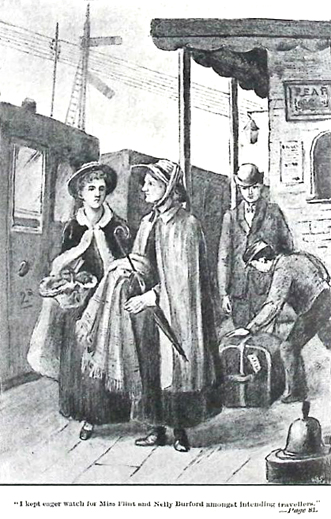
I kept eager watch for Miss Flint and Nelly Burford
amongst intending travellers.
"I hate platform scenes," she told Mrs. Burford. "Good-byes and hand-shakings and wavings of moist pocket-handkerchiefs, are abominations to me. So Nelly and you must please do the weeping and wailing in private. I shall call here for her and any lighter articles of luggage that she wishes to have under her eye, but I beg you will have as few parcels as possible. Heavy boxes your man will take to the station, and wait with them till we come."
So this was how it happened that I saw Miss Flint and Nelly alight from a carriage, unaccompanied, just a fortnight after Jane Cartwright told me of the intended journey.
Oakhill Station is a junction, so trains stay longer at it than at many of its size. A part of one train has always to be detached and shunted, whilst the remainder goes on its way. Then the shunted portion comes back to the platform, has other carriages attached, and branches off in a different direction. It was by the later portion that Miss Flint and Nelly would travel. The elder lady's idea of punctuality was to be at least a quarter of an hour too early, and she fretted and fumed close by the entrance for fully five minutes, until Mr. Burford's man appeared with the heavy luggage. He pointed to the clock, and respectfully assured Miss Flint that there was "lots of time," and he would see the things labelled and into the van, as Mr. Burford had ordered him to do.
It happened that Mr. Edelston, the station-master, had been ailing and absent for some days. He was back that morning, but stayed in the booking-office whilst I did duty on the platform; so I saw Miss Flint come bustling towards the train, accompanied by Nelly, whom she promptly deposited in a second-class through-carriage for London.
I heard her say, "It is money thrown away going second, but I had to give in; for your mother, who has never known the want of cash, wanted you to travel first class. Such extravagance!"
Miss Flint turned away to get the tickets, carrying her rugs, umbrella, &c., in her hand. All at once she seemed to realise that she was taking needless trouble, for she thrust them into mine, and exclaimed, "There, you railway man, put these things into the carriage where that young lady is, and tell her to take care of them."
I lost no time in obeying Miss Flint. There was only my girl-friend in the carriage, and before I could deposit the articles on the seat, two hands were extended to me, and Nelly said,—
"Oh Jack! I am glad just to say good-bye to you. I am off to Germany, and I may not see you for years. But I shall not forget you. We shall always be friends, whether we meet or no."
"Always, dear Nelly. I am very thankful that I have so true a friend as you. I know you will not forget the old happy days any more than I shall. May God bless you, Nelly!"
We had grasped hands, and I could see how pale the girl was, and that she could not utter another word.
I had no chance, for at that instant Miss Flint's harsh voice said, "If you will be good enough to stand on one side, I will take my place. I have no wish to be left behind."
I jumped quickly down, and Miss Flint took her seat, not refusing the help of my hand, for the step was a high one.
"Thank you," said she, without at first looking round. "You need not wait. It is contrary to the company's regulations to give gratuities to porters; and quite right too."
Then turning round, she started, and exclaimed, "It is you, John Simpson, is it? What do you mean by this?"
"It is I, Miss Flint," I answered. "I meant to be of any service in my power, and I still mean it, if there is anything more I can do for you."
"Nothing, but to take yourself off," was the blunt response.
"Then, madam, I wish you and Miss Burford a safe journey;" and lifting my hat respectfully, I left the window.
"The impudence of that young man!" said Miss Flint.
"I thought you told him to bring the things," retorted Nelly, "and that he was very kind and attentive."
"Perhaps he was, after all. He showed his breeding, too, by the way he lifted his hat. He got nothing by it, though," added Miss Flint as she closed her purse with a vicious snap over a threepenny-bit, received in change at the booking-office a minute or two before.
It was a fortunate remark, for it and the action set Nelly laughing, and the tears which ran down her cheeks seemed to be the effect of mirth, not of regret.
I also laughed at Miss Flint's mode of addressing me, and at her extraordinary appearance. Years before, I had heard Mrs. Burford say, "If people did not know Dorothy Flint, they would declare she was mad, or had chosen her garments out of a rag-shop as a matter of economy. It is enough to draw all eyes upon one to be seen speaking to her, when she is off for one of her Continental rambles. She is an awful woman, and the greatest female guy I ever saw. Rose would run anywhere rather than be seen in the street with her."
I could well imagine that Mrs. Burford would excuse herself from going to the railway station to see the travellers off. I thought she would be the one to plead that her maternal feelings would prove too much for her, and that she wished to spare Nelly and herself. I did not then know that Miss Flint had taken matters into her own hands. I had, however, an instinctive feeling that the stern spinster would be good to Nelly, for I had always thought that, if she had a warm corner in her heart, my girl-friend had secured possession of it. Who could help loving what was so sweet and winsome?
RETROSPECTIONS.
WHEN the train had carried away Nelly, I felt sad enough, and began to wonder what would be the result of her two years' absence. Should I ever see her stretch eager hands towards me whilst her dear, true face was lighted with gladness, as she had done to-day? Or—dreadful thought!—would she return a finished young lady, only desirous of shining in fashionable society, and turn a sort of "Who are you?" look on her old friend Jack?
I had little time for such speculations. My work awaited me, but I went back to my desk with a slower step than usual, though the train which sped away with Nelly was far out of sight.
I seldom made a mistake in giving change or ticket, but on that morning, I handed a sovereign too much to a burly farmer who had tendered a five-pound note. Fortunately for me, he found out the mistake and returned the sovereign.
"I had no gold but what you gave me, Mr. John," he said as he balanced the coin on his broad finger and poked it through the booking-office window.
"I am glad you gave me too much, instead of somebody with a pocket so full of yellow-boys that he could not tell if he got one more than he had a right to, or to somebody else that would have chuckled at getting hold of an extra pound that he had never worked for."
"I have cause to be glad," I said, "and I am very much obliged to you for bringing the sovereign back. Such coins are not over-plentiful with me, and I was very careless to make such a blunder."
"As easy to do it with a sovereign as a shilling. I don't think you make many mistakes, Mr. John, for I have noticed how careful you are. But you are not very well, maybe; you look a bit down this morning. You must take care of yourself, as well as of the tickets and the cash."
I thanked the good farmer, and told him I was well, though I had felt a little out of spirits about something. Then, resolutely banishing regret and gloomy foreboding, I bent my mind to my duties and made no more mistakes that day.
My piano, however, discoursed no sweet music that night. It had lost its power to charm me into forgetfulness, for the first time since it came into my possession.
I sat for a while silently thinking over all that had passed, and especially dwelling on the many happy hours I had spent in Nelly Burford's society when I was the favoured guest under her father's roof, the friend whose presence was not only approved of, but courted by her mother.
To-day had added one more to these sweet memories, though Mrs. Burford knew it not. Her face and that of her favourite Rose did not come into this last picture. There were only Nelly's and that of cousin Dorothy; after all, I preferred Miss Flint's to Mrs. Burford's.
Now and then Jabez and Betsy looked inquiringly in my direction, as if wondering at my silence, and whether they could give me service or sympathy. But their kindness was always of the unobtrusive sort, and they were very considerate in little things. They possessed the natural politeness which prevented them from troubling me with inquiries or forcing me to talk, when I wished to be left to myself.
It is one thing to be thoughtfully cared for, another to be obtrusively fussed after, even by one's best friends. I could appreciate the difference; so could Jabez and Betsy.
After a while, I told the old couple that I was tired, and went to my own room, where I at length forgot my anxieties in sleep.
I have mentioned the friendly relations which subsisted between the Harwoods and the Cartwrights, in spite of the fact that Jabez only worked as a labourer in the Hall garden during my father's life, and Cartwright had the oversight of the place. Betsy used to help Jane in her laundry-work, and Jabez would smoke his pipe in company with her husband, as the women stood together at the ironing-table.
Now Cartwright needed no outside help, his sons being more than equal to the work, so Jabez found as much employment as he was able for, on a farm not far from the cottage.
When Miss Flint was at the Hall, the Harwoods avoided the place as if it were haunted, but as soon as her back was turned, the old friendly and frequent intercourse was resumed. Indeed, the Cartwrights came oftener than ever to the cottage, and spoke with much frankness of the sayings and doings of my kinswoman. They had a very high opinion of her cuteness, and Cartwright said Miss Flint could see through people as well as anybody.
"But she is fair, Miss Flint is, though she may be hard. If she makes a bargain she sticks to it, though she will haggle for half-an-hour over a halfpenny. I think it is partly for want of something else to do."
"She might find something better," said Betsy, "seeing that whilst she haggles, she wastes the time of other people as well as her own. Time may be money to them, though it is worthless to her."
"True," said Jane, "but Miss Flint makes one laugh, she is so queer. How she does love to tease Mrs. Burford! I've caught myself smiling many a time over the way she served her when she last called at the Hall. To hear those two 'my dear' one another, you would think they were the best of friends, and all the while one knows that Mrs. Burford is just wild with vexation at the way Miss Flint goes on. The last time Mrs. Burford came it was the end of August, and such a hot day, but she let her come and go, without so much as a grape to refresh her. No sooner was she gone, than the best fruit in the place was put in piles before Miss Nelly, and there the two of them were laughing over it like a couple of children. If Miss Flint loves anybody, it is that young girl, and I really believe it is because she says and does things that no one else dare. She is a very straight talker, is Miss Nelly."
"I suppose the fruit would be Cartwright's," said I. "It is easy to be liberal with what belongs to other people."
"Not so, Mr. John; Cartwright has all the fruit, but Miss Flint pays him good money for all she wants, and she is his best customer. We often wonder where all the grapes and fine stone-fruit go to, for she could not eat it if she sat up o' nights to get through it," said Jane.
"I suppose what you brought me did not come from Miss Flint," said I, feeling that if such were the case, Lint Hall grapes would be sour to me for the future, as I could take none from that hand.
"Bless you, no, Mr. John! You have only had a taste now and then from Cartwright himself, for the sake of old days. But I can tell you there would have been a lot left on your windowsill by somebody else, if I had not prevented her."
Then Jane told me how Nelly had wanted to empty her basket for me, and had only been dissuaded by the information that I was as well supplied as herself.
A tell-tale flush spread over my boyish face as I heard this story, and I blessed my old playmate for her generous thought, and felt thankful that, so far, her leal heart remained unchanged in spite of all that had befallen me.
"You would see Miss Flint when they started for foreign parts, Mr. John. Wasn't she a picture? She says anything is good enough to travel in so long as it is whole, clean, and strong, so as to stand wear and tear. She has the prettiest hands and feet, small and well shaped, but she wears stout boots with clamped soles, and gloves as thick as gentlemen use when driving; she showed some to Miss Nelly.
"'See,' she said, 'my gloves slip on easily; they are not like yours. No pulling, tugging, stretching, and struggling with them till I am purple in the face, and then toiling to fasten a long row of buttons. My gloves keep my hands warm, whilst the young simpletons like you, Nelly, pinch their fingers blue, stop the circulation, and give themselves chilblains by wearing tight ones.'
"'I often go without gloves,' said Nelly, in defence.
"'More to blame, you. I am very particular about the look of my hands when uncovered. They are my special vanity. The Flints have always had beautiful hands, and been proud of them. My old grand-aunt used to show me hers when she was fully eighty, and say,—
"'"Dorothy, only finely bred people can show such hands and feet as we Flints can."
"'I was only a child at the time, but I took care of mine ever after. It is as well to show one's fine breeding in some way, if one does not do it by honeyed words and fashionable raiment. As to my boots, Miss Nelly, you may laugh at them, but they are made to fit my feet. I never know when I put on new ones, and other people are welcome to my share of corns.'
"Miss Nelly was helping Miss Flint to pack at the time. She was the only one our lady would allow to touch a thing, and she had been comparing the gloves and boots with the pretty hands and feet they were to cover. She was never put out with Miss Flint's speeches, and she only laughed back and said,—
"'I wish I were like you, and always had sense enough to prefer comfort to looks; perhaps I shall improve with you for an example.'
"Miss Flint's answer was a tap on the head with the sole of a new boot as she said, 'For shame, Nelly, to make game of an old woman like me!'
"Miss Nelly was kneeling in front of the box, and what did she do but jump up and kiss Miss Flint.
"'There's a kiss for a blow,' she said, 'and I hope you feel ashamed of your wicked, false accusations. Who ever meant to make game of you? Not I, and you know it. I may be saucy sometimes, as you call me, but I never did make fun of anybody that is old in my life. Besides, I don't call you "old." If you only didn't—'
"Miss Nelly stopped, as if even she were afraid to finish.
"'Didn't what, Miss?' asked the mistress.
"'Make yourself look old by dressing so queerly; people will make game if they see any one got up like a—'
"'Guy?' put in Miss Flint, with a grim look on her face.
"'Well, yes,' says Miss Nelly; 'only guys are not ladies, you see. They are always stuffed into a man's old clothes, not a woman's; but I cannot just think of another word.'
"'Your mother spoke of my looking as if I had come out of Noah's ark. She did not say it to me, but there are always good-natured people who try to make capital for themselves out of their neighbours' spiteful remarks. One of these told me what Mrs. Burford said.'
"'And it was a horrid, mean thing to do,' said Nelly, her cheeks all red with anger. 'My mother is your old friend, you know, and would like you to dress nicely for your own sake.'
"Miss Flint's face looked very queer as the young lady said this; but I am sure, whatever she might think of the mother, she liked the daughter to stand up for her. And it came all the better from Miss Nelly, because Mrs. Burford always made so much more of her sister than of herself.
"Miss Flint did not speak for the moment, and the young lady went on again—
"'I do not believe anybody would recommend themselves to you by tattling and repeating things. Lots of people get separated and there's no end of mischief made by such hateful, sneaking ways. You just say a word, perhaps, when you are vexed, and you never meant to be unkind, and it would be forgotten if some miserable tale-bearer did not pick it up, add twenty more to it, and whisper the whole in the very ears it ought never to have reached. Now, let me tell you something, Miss Flint. I don't care a scrap how you dress for my own sake. If you had your gown inside out and your bonnet back to front, I would rather be with you than with half my mother's fine-feathered friends put together. Only I do like you well enough to wish you to look what you easily might do—very distinguished and bonny.'"
"I should have thought there was no need to make Miss Flint more distinguished-looking, in one sense," I said. "She was always sure to be noticed, even in a crowd."
"True enough," replied Jane Cartwright. "But Miss Nelly meant something different from that."
"Certainly she did. Well, how did Miss Flint take these bold words?"
"Why," continued Jane, "she said,—
"'You are a saucy chit, Nelly. It is high time you were at school and learning to treat your elders with proper reverence. Go on with the packing, child. Some day you shall choose me a new gown and bonnet, and I will see if I can recognise Dorothy Flint in them. But mind, I shall not promise to wear them twice. If the feathers do not suit the old bird, the young one shall pay the penalty by having them "cut down" for her.'
"'What lovely things I will choose!' cried Miss Nelly, clapping her hands with delight. 'They shall be right for me, second hand; only you will like them so much that you will never be able to part with them as long as they will hang together.'
"Miss Flint said no more, but she turned her back on the young lady, and stood for ever so long as if she were gazing out of the window. But I do not believe she saw anything. She might make-believe to scold and call Miss Nelly a chit, and wonder what girls were coming to now-a-days. But the truth was, she did not care to let anybody see how she had been stirred by the clasp of the young arms round her neck, the touch of the rosy lips on her cheek, and the honest words that had reached her ears.
"I saw signs of tears when at last the mistress turned round, though they had been carefully wiped away. And she sniffed and made a fuss as if she were beginning with a cold, and said to Nelly that she was glad they would soon be off, for this climate did not suit her."
Jane Cartwright's description of this little scene was so true to life that I was sure of its absolute correctness. I knew instinctively, that she had taken the greatest pains to remember all that passed between Miss Flint and Nelly, because she knew the details would interest me, and I felt more gratitude than I durst express in words.
After all, I had great cause to rejoice that Nelly travelled under cousin Dorothy's convoy. But for this, I should have heard nothing about her movements. As it was, Miss Flint employed Nelly to write on her behalf to Jane Cartwright, not merely to give certain instructions about the care of Lint Hall, but to tell her of the journey and safe arrival.
Nelly must have liked her task, for she wrote at great length, gave many amusing particulars of their movements, and especially about some delightful days spent in what Miss Flint called "gadding up and down together" before her own actual school-life began. The cheery letter proved that cousin Dorothy had been very kind, and that Nelly was also well satisfied with her new life and surroundings.
Jane Cartwright gave me the letter to read, after having told most of the news it contained in the presence of Jabez and Betsy.
"There are no secrets, Mr. John, so you can read it if you like. There's just a bit over the leaf at the very last, where Miss Nelly mentions you."
Jane turned to her old friends and spoke of home matters as she handed me the letter.
Need I say the "bit over the leaf" was the first to which I gave my attention, though it was the last paragraph of the letter. It was as follows:—
"I am sorry Miss Flint seems so set against poor Jack. One thing that
made me glad at the thought of travelling with her was the hope that I
might put in a word for him, seeing how badly he has been used by those
who pretended to be his father's friends. She might make everything
right for him, but she will not hear a word about him. Just the one
person I may not name is Jack Simpson. She quite flew up when I tried,
and said 'she' could see through that young man. He had tried to curry
favour by paying some money that his father borrowed of her; but she
was or would be fifty pounds the better, and he just where he was
before.
"She quite chuckled over this, and I felt so wild with anger that, if
I could, I would have run away from Miss Flint that minute; but I had
no chance. However, I don't care now; I know what Jack is, and he will
always be the same to me as when we played together and were friends
before his trouble came. Some day I hope Miss Flint will be ashamed of
herself."
Little cared I about Miss Flint's opinion, so long as I had the testimony of my own conscience as to my motive in paying her the fifty pounds. Little cared I whether she was willing to listen, so long as I knew that Nelly would have spoken bravely on my behalf, and that her feelings towards me were unchanged.
There was another sentence in the letter that made me glad—
"Give my love and messages of remembrance to all dear friends at
Oakhill."
And I felt I had a share in it, and rejoiced accordingly.
My piano was not silent after that evening, neither did I seek the solitude of my bedroom to muse over old times. Instead of that, I looked forward with hope, and worked with my might to deserve promotion.
"Wait, I must. Work, I will. Win, I shall in the long-run," said I to myself as I turned over the little coin attached to my watch-chain, and read once again the words so clearly cut upon it, and which I had adopted as my motto.
At that moment, I am not sure that I should have been glad had everything been made as smooth for me as my girl-friend would have made my future if she could.
There is a purer pleasure, a truer satisfaction, in putting forth one's powers and using the talents that have been given us in order to conquer difficulties, than in merely opening the hand to have it filled with the fruits of another man's labour. I doubt if I should have enjoyed the possession of Lint Hall and its broad acres more than I did my present life of hard work. It was not the loss of house and lands that troubled me so much now; it was the memory of my father's end, the empty place in the old home, the thought that it was the nominal residence of one who did not care to occupy it, and who mentioned his name, and mine too, with dislike and contempt.
"Well," thought I, "it shall not be my fault if cousin Dorothy continues to speak ill of us Simpsons; she has no cause to do it, and she shall have none in the future. I can forgive her for hating me, so long as she is so kind to Nelly Burford; and if ever I have the chance, I will try to do her a good turn, instead of rendering evil for evil."
BRIGHTENING PROSPECTS.
THE Cartwrights often urged me to go to Lint Hall during Miss Flint's absence.
"All the old things are in it, and just where they used to be. Your cousin has made no alterations, and does not seem to care enough about the place to make any. I keep the furniture as it was, for I know the spot for every chair, just as it stood in your father's time. You have not much chance on week-days, but you could come on Sundays, now and again. Wouldn't you like to play on your mamma's piano?" asked Jane.
"I should think it must be terribly out of tune," I replied. "I should have little pleasure in using it."
"You are mistaken, Mr. John. It is in first-rate order. Miss Flint had it seen to when she was last at the Hall. Not tuned only, but there was a man down here from the maker's place in London, and he spent three whole days on it, and said he left it almost as good as new. I had the strictest orders to keep the drawing-room aired and have regular fires, so that the piano might not suffer."
This information astonished me, and I asked if Miss Flint ever used the instrument herself.
"Not she. But it is singular that, being so very particular, she is no dog-in-the-manger about that piano. She actually left the key with me, and said,—
"'If any old friend of yours comes here and would like to give you a tune to cheer you up, Jane, you are welcome to let them. It will do the piano more harm to be always shut up than to be used. Only mind—I don't want your sons or Mary, pattering their clumsy fingers over the keys, or any village children. It must be some one who knows how to play that would be welcome to use it.'
"She might have been sure our boys would never take such a liberty," added Jane, "but you can play, Mr. John."
A strange thought flashed across my mind. Could it be possible that cousin Dorothy thought of my going to Lint Hall, that she was less hard than she seemed, and wished her orphan kinsman to have an unlooked-for pleasure.
"You see, Mr. John, you could play on the piano without getting me into any trouble," persisted Jane. "I wish you would come."
"Did Miss Flint say that she wished me to come to the Hall?"
"No, Mr. John. She never named you either to me or Cartwright, good, bad, or indifferent."
"Then I cannot cross the threshold of Lint Hall. I can never go there by stealth, or by the invitation of any person but its present mistress. If Miss Flint had wished me to go, she would have said so; though why she spent so much on the piano is a mystery to me."
"She was fond of your mother, Mr. John. You can remember that much, though the master and she got across sadly. Dear, dear! When the mistress died, she grieved as if she had been her own sister; and she got the most beautiful mourning, the best crape that money could buy, and never wore it after the first week."
"How was that?" I asked, though I recollected almost immediately that Mrs. Burford had told me the reason.
"Your cousin," she said, "was going abroad with Miss Watkin, and she decided that all the expensive crape would be ruined by packing and exposure to the weather. She said to me,—
"'It would be a perfect sin, my dear, to spoil what has cost so much; and I never would have bought it but out of affection for the poor woman who is gone. She had as much sense in her little finger, as her husband carries in his whole body. What will become of him, I don't know, except that he will go to the bad in some way. I hate the putting on of black. It is often a sign of anything but sorrow. I can mourn quite as honestly without crape as with it, and as I am going where nobody will know that I have lost a friend, I will leave mine behind.'
"And she did said Mrs. Burford. By the time she came back to England, the period for wearing it was over, and all the things which had cost so much, would be stowed away to mildew and get old-fashioned, and be useless to Miss Flint and every one else. I do say that, for a miserly woman, Dorothy Flint does the queerest things, and is often penny wise and pound foolish."
Mrs. Burford did not know everything, and no amount of searching would have discovered those mourning garments still in Miss Flint's wardrobe. I knew long afterwards that they had been given away to one who needed but could not buy such articles.
I persevered in my determination, and did not visit Lint Hall during her absence; but Jabez and Betsy went, and the Cartwrights came to the cottage. I learned that cousin Dorothy was spending her Christmas in Germany, and though I was not told this, I had a strong suspicion that she and Nelly Burford were not far apart during that festive season. She visited the Hall in the spring for a short time, and spent a few weeks there in summer also, but that was when the Burford family were away from home.
As Nelly had predicted, she was not allowed to come home for her long holidays, but passed them at a seaside place far-away from Oakhill. I must not hope to see her again until the two years should come to an end. I could only wait patiently, and trust that the sweet, frank nature of the girl would remain unchanged, and I cheered myself by recalling her own written words.
All things considered, I was well treated by my employers, who had advanced my salary from time to time, until, after three years' service, I had forty-five pounds per annum. This, added to the interest of my five hundred, made me feel quite rich.
I had persevered in living economically, and had paid Miss Flint's principal and interest to the last farthing. This done, I began to save money, though I could not, nor did I wish to limit my expenses to the very small amount at first allotted to them. Still, I always felt glad that the resolution to pay that fifty pounds got me into the way of doing without many little things which I should once have considered necessary.
I had enjoyed wonderfully good health, to which my simple, regular habits and occupation no doubt contributed. I now persisted in paying the Harwoods four shillings a week, contrary to their wishes, but I was sure they needed and merited the additional sum.
I had been above a year at Oakhill Station when Nelly Burford went to Germany, and the time fixed for her return had nearly arrived. I was looking forward to it with mingled hope and fear, for Nelly would now be quite a grown-up young lady of eighteen and a half. There was, as I have already said, just a year between us, but the girl would be really older in many ways, than the youth whose age was so little in advance of her own.
I had heard less about Nelly for some time past, Miss Flint and her friend, Miss Watkin, having been for several months almost as far from the girl as she was from Oakhill.
I heard of the elder ladies from Jane Cartwright, who was ever expressing her surprise that people of Miss Flint's time of life could take pleasure in going from place to place, like tramps, and looking very little better than such, when they had good homes to shelter them.
"And the stuff they do talk," said Jane. "Miss Flint might have been at the Tower of Babel and got hold of the different languages, she knows such a lot. If you believe me, Mr. John, the last time our lady was at Lint Hall, there was an organ-grinder with a monkey in front of the dining-room window.
"'Be off,' says I; 'you'll get nothing here; for we don't encourage vagabonds about the place.'
"Actually, out stepped Miss Flint, all for contradiction, and gave the man a shilling, and talked to him in a foreign tongue, and the soft fellow cried like a baby, and seized hold of her hand and kissed it! Would you believe it, now?"
"I should hardly have expected it of Miss Flint," I said, "but I can quite understand the poor fellow's gladness at hearing his own language in a foreign land. You would be the same yourself."
"You don't call England a foreign land, I hope," replied Jane. "It was the man that was foreign."
And I had some difficulty in making her realise that I was right, in saying that England was a strange country to the poor wanderer.
"Ah, well! There are folks that could stay at home and will not, and there are some that would come and are not to be allowed. There is Miss Nelly Burford. She would like to come home, I've no doubt, but she is to be kept away another year."
I started, and felt my face go hot as I heard this news. It gave me a great shock, for I had been so longing to look once more on the dear face of my girl-friend, and counting the days that must pass before she would be again settled in my neighbourhood.
I glanced at Jane Cartwright to see if she were noticing my heightened colour, but she appeared to be intently watching the gambols of Betsy Harwood's pet cat and her kitten.
Betsy asked the question I was longing to put.
"Are you sure about Miss Nelly stopping another year away?"
"Certain. You know I have had all the fine laundry-work from Mrs. Burford's for a good while past. There being no family at the Hall, I have time to do it, and I can have Mary at home, too, to help. The girl could get a good place, but we have enough work for both, with the washing and the Hall to look after, and she is my only daughter, so I am glad to keep her with me.
"Well, I was in Mrs. Burford's kitchen, waiting, and the cook said to me, 'I thought you would have had another young lady's fine things to do, and I told you so last week, but I am wrong. Our Miss Ellen is not to come home yet.'
"'How is that?' I asked.
"'Between ourselves,' said cook, 'the master wants her, but the mistress doesn't, and Miss Burford doesn't. Miss Nelly is the flower, and Miss Rose has got a wrong name, except for the thorns, and she has plenty of them. She is as proud and stuck-up as you like. She'd almost run over a poor body before she'd speak to her, as if she was made of better stuff. As to us servants, she gives us ten times the work Miss Nelly did. Not a finger will she lift for herself, if she can get anybody else to do it. She thinks it is not becoming to a lady to make herself useful. Now, Miss Nelly was always trying how she could save trouble instead of giving it. She had a pleasant smile for every one, and if she could give nothing else, she gave a kind word. Everybody loves her and wants her back; and I believe it is just because of that she is to be kept away—and her full eighteen years old.
"'Miss Rose thinks she is such a beauty, and that her sister is nothing to look at; and yet she is as jealous of her as can be, because everybody likes her. The mistress can see no wrong in her eldest daughter, so Miss Rose gets her way with her mother, and Mrs. Burford will have hers with her husband, poor gentleman! He gives in for peace and quietness. Now you know all about it.'
"I say it is a shame," added Jane Cartwright, "but we all know what Mrs. Burford is."
I did only too well, and I realised that even in the matter of his own child's presence or absence, the father's will would go for nothing.
I had concluded for some little while past, that I must not hope for any further advance of salary whilst I remained at Oakhill Station. If my position were to be bettered, it must be by removal, and for this I was not anxious, for it would have meant leaving behind me every friend I had in the world. None of these were rich or great people, but they had been true to me in my time of trouble, and treated me with such hearty kindness as I could never forget. Yet I was wholly cut off from those who used to be frequent guests at my father's table, some of them seeming even to forget that the railway clerk had ever been in a higher position.
I saw Mr. Burford less frequently now that I had paid cousin Dorothy, though I still went to his office twice a year for the interest of my own capital. He always asked kindly enough about my concerns, and was glad to hear of my prosperity. But he said nothing about his own family, and did not ask me why I never inquired after its younger members. Even the old joke, which used to be never omitted, about my buying back Lint Hall, seemed to have faded from his memory.
As I left his office on July 26th, I thought to myself, "Mr. Burford is like all the rest of those who called my father friend. In a little while, I shall be just the clerk at the station, to whom, in the way of business, he pays a certain amount of interest. He never thinks of me now as once—Jack Simpson of Lint Hall."
I did my true friend injustice. He did not forget, but he was a good deal harassed at the time by domestic and professional matters. It was not long after these bitter thoughts crossed my mind, that I was thoroughly ashamed of having ever doubted Mr. Burford's goodwill towards me.
I have said that Mr. Edelston, the station-master at Oakhill, was a very kindly man, who had treated me with great consideration, done his utmost to make me acquainted with all that could be of use to me in my situation, and never lost an opportunity of saying a good word for me to those in authority.
Just after my last call at Mr. Burford's office, Mr. Edelston received a notice that in a month he would be removed to a much better post.
The news was very welcome. He was married, and his increasing family made his income appear very small in proportion to his needs. I rejoiced with him when he came to me, letter in hand, to tell me of his good fortune. My only regret was at the thought of losing him, and I told him so.
"And I am only sorry to think that a stranger may be placed over you," he said. "If only the company would let you slip into my shoes and bring a youth under you, I should be content. You are quite equal to the work, and you are so careful and correct."
"But I am so young," said I. "Thanks to you, the duties are mere A B C work to me, but I am not of age, you know."
"Companies never lose a chance of saving if it can be done safely. You would not begin with my salary, but if they started you, say at sixty pounds a year, and gave a lad such as you were at first, the same that you began with, both amounts would be less than I get now. And the station-master has house, fire, and lights in addition."
"None of which I want," said I. "I would rather be at the cottage."
"True, but somebody else would like these along with his present place. Pritchard wants to get married, but there is no house to be had."
Pritchard was over the goods department. And it struck me at once that he was more likely to be Mr. Edelston's successor than myself, and I said so.
"He would not take my post. He is better off where he is. Only he would be glad of the station house, and an arrangement might be made to suit everybody, if only the directors could be induced to see things properly."
"That is, as we do," I replied, with a laugh. "But matters seldom arrange themselves so delightfully."
"Mr. Burford has plenty of influence, and his father is a director, though he does not now attend many meetings. Still, his word would go a long way."
"I shall not ask either of the gentlemen to speak for me," I said. "They did it once, but I could not bear to trouble them again on my account."
Mr. Edelston did not press me further, but quietly did for me far more than I would or could have done for myself. He saw both the lawyer and his father, and laid the whole case before them. He showed that not only would such an arrangement benefit me, but it would satisfy Pritchard, be a saving to the company, and give me a prospect of a further increase of salary without removing me from Oakhill.
"Mr. John Simpson is a high-principled young man, with a good business head on his shoulders," pleaded the station-master. "He is well up in the work, and has it at his finger-ends. When I was laid up for weeks, not a thing went wrong, not a halfpenny was he incorrect in his daily balances. No stranger could do better—few so well as he. He would most likely want some one to be security for a larger amount than at present, but surely some old friend of his father's would—"
Mr. Randal Burford did not wait for the station-master to finish his sentence.
"There would be no difficulty about that, even if Jack had nothing of his own. I shall be only too glad to be his surety, and to a far greater amount than will be required. If my father were here, he would say the same, and his best efforts may be relied on. I hope young Simpson will get the place."
Mr. Edelston was well satisfied with the result of the interview, and still more so when matters were arranged exactly in accordance with his wishes on my behalf. The plan commended itself to the directors from every point of view, but they were just a little more generous than I expected, for they increased my salary to sixty-five pounds a year, with a promise of another advance at the six months' end should I continue to give satisfaction.
AN EAVESDROPPER.
I SOON found out to whom I owed my preferment, and felt deeply grateful to my good friend the station-master.
I sent a letter of thanks to Mr. Burford, senior, who lived too far from Oakhill to allow of my calling upon him at once.
When I went to Mr. Randal Burford's office, he grasped my hand with all his old heartiness, and his kind face promptly reflected the gladness that was in mine.
But he soon stopped my thanks with the words, "Say no more, Jack. If you only knew how delighted I was at having a chance to serve you, you would understand that the balance of satisfaction is on my side. You have won golden opinions already. Go on as you have begun, and may God bless and prosper you! It is in accordance with His own teaching that the servant who uses one talent well shall be entrusted with more. I hope you will be found as faithful in a position of greater responsibility, as you have already been in lesser matters."
Then my good friend spoke of his family with more freedom than he had done for a long time past, and alluded to the probable extension of Nelly's stay in Germany.
"The child is very happy there, and I do not think she is a bit the worse in any way for her new experiences, whilst in many respects she is greatly improved. But I want her back very badly. Home is not the same without Nelly. I have to submit, however, for mothers seem to claim the right to decide what shall be done with daughters. Rather hard on a father where there are no boys, and his one privilege is to pay the bills for the girls. I think the youngsters should be equally divided when they are all of one sort; or if there is an odd number, give the mother the advantage so far, for peace and quietness' sake."
Mr. Burford spoke in a jesting manner, but I was sure that he regretted Nelly's absence from his heart, and that neither his wife nor his elder daughter could fill her place, even if they strove to do so, which I much doubted.
"I suppose you will have Nelly back for the summer holidays?" I said. "You must miss her sadly."
"I am sorry to say I shall not have her at home for a year to come. Mrs. Burford and Rose will start for the Continent to-morrow. They are to meet Nelly at Cologne, and for six weeks to come they will be vagabonds on the face of the earth. Rose has never yet left her native country, so the three will travel about together till it is time for Nelly to resume her studies. In the meanwhile our house is to undergo a renovating process, at much cost to me of coin and comfort."
"Shall you stay at home all the time?" I asked.
"Not quite. I must see Nelly, and hope to get a fortnight or perhaps three weeks' change, for I want it rather badly. When here, I shall stay with my father, for my own house would be too uncomfortable with workmen busy from cellar to garret."
"Will Miss Flint travel with Mrs. Burford and the young ladies?" said I.
Mr. Burford went off in a fit of hearty laughter, which for some moments prevented any reply but a shake of the head.
"Excuse me, Jack," said he at length, "your question brought to my mind so many domestic scenes in which Miss Flint was a prominent figure that I could not help laughing. Nelly is very fond of your cousin, who has been very good to her, but I do not think Mrs. Burford and Rose would choose her as a travelling companion. They have too much regard for externals to tolerate Miss Flint's 'get-up' when on a journey."
I smiled at this, then asked Mr. Burford if he thought Miss Flint was really as hard as she tried to make people think.
"I have a notion that she puts on a good deal of the harshness of speech and manner to hide a tenderness of which she is ashamed," I added.
"I like to hear that from you, Jack, for certainly, she has lavished no superfluous kindness on you. I have known her do some very generous things, but they seemed to me rather the results of caprice than of any higher principle," replied Mr. Burford.
"Do you think she sent me my piano?" inquired I.
"Certainly not; and I know absolutely nothing of the matter. Thus I reply to a question visible in your looks, but which you hesitate to put into words."
"I cannot imagine who sent it, then. I only know that I owe the kind giver more than words can express. After all, I might have guessed it could not be cousin Dorothy, because I believe she wished me to make use of my mother's instrument at the Hall."
And I told Mr. Burford what Jane Cartwright had said about the care taken of the piano.
"That seems likely enough, but the fact that Miss Flint acted in this manner, renders it less probable that she had anything to do with the bestowal of a new one."
I could not but agree to this.
Then, as it was time for me to return to my duties, I again thanked Mr. Burford, and left him.
I had never taken a holiday of any length since my father's death. As I should have less chance of doing so after Mr. Edelston's departure, he advised me to obtain leave of absence at once, and to get a few days at the seaside before my more serious work should begin. I was quite inclined to act upon his suggestion, until I heard from Mr. Burford that Nelly was not coming to England till the end of another twelve months.
I had meant to see her, if possible—to see without being seen. Jane Cartwright would have told me where the family were staying, and I should have found some modest shelter in their neighbourhood, and watched and waited for a sight of the dear face that was ever before me, so far as memory was concerned. That face had always told the story of a pure, kind, true heart, and of a faithful friendship that had stood the fiery test of poverty and changed prospects. It told of a nature unconscious of vanity, meanness, and littleness in every shape.
But memory had now to go back two years for a glimpse of the sweet picture, and though Mr. Burford had cheered me greatly by saying that Nelly was none the worse for her recent experiences, I had an intense longing to judge for myself. I never meant to intrude upon her.
I told myself that I would never try to meet my girl-friend again unless I could do so on fairly equal terms, with the full consent of her father, and standing in something like my former social position. I could not again be heir to Lint Hall and its acres, but though I had lost these, I had kept my good name and character.
These were days in which men might fight their way upwards from the ranks, and be none the less esteemed because they owed nothing to those who were born before them.
I took no summer holiday, however. The desire for one vanished with the hope of seeing Nelly.
Mr. Edelston went to his new post, and I stepped into his shoes, finding as I stood therein abundant occupation, and in the successor to the office of booking-clerk, an hourly trial of patience.
It was, perhaps, well for me that, in addition to doing my own work, I had to instruct and correct the blunders of one of the most stupid lads ever pushed into an utterly unsuitable place by sheer influence. When this youth, Maurice Gibbs by name, was most trying, I strove to bear in mind all Mr. Edelston's kindness to me when I went, a raw lad, to fill the same situation, and imitated his example in dealing with my sub.
Happily, Gibbs was honest and grateful, and in return for my painstaking, gave me the sort of admiring, devoted affection that a faithful dog renders to his master. When he had been extra stupid, he would say,—
"I'm an awful trouble to you, Mr. Simpson. I never was clever at anything, but I do my best, and I do want to get to know, you know."
I could not doubt Gibbs' willingness to perform his duties, and in consideration for this, and his straightforwardness, I warded off the consequences of his blunders, by doing a great deal of his work in addition to my own.
Mr. Pritchard, with his pretty bride, now occupied the station house, and I, as before, went to and from the cottage daily. He was so glad to have the house, through my giving up my right to it, that he lost no chance of showing his goodwill. But for his presence at my station during meal-times, I should have been almost wholly tied to the spot, as I had no confidence in Gibbs, and could not have left him in sole charge even during my dinner-hour. However, we worked most harmoniously together, and I was also made welcome by Mr. and Mrs. Pritchard to their fireside. They were quite a staid couple, having been ten years engaged, and waiting until they could marry prudently. Both were musical, and Mrs. Pritchard's playing and singing were above the average of amateurs, so we had many pleasant evenings, both in their home and at the cottage.
It was during the winter which followed my promotion, that a serious trouble came upon me, and from an unexpected source.
Both Mr. Pritchard and I were in the habit of banking daily, whatever railway money could be spared.
Still, there was always some which had to be left in the booking-office, but it was locked up in the safe with the account-books.
By this time I had saved a considerable sum, and though I had deposited part of it in Mr. Burford's hands, I was foolish enough to keep about ten or fifteen pounds at the cottage. I never put my own money into the office safe. From the very first, I had scrupulously avoided mixing my cash with my employers', though I might well have been excused for putting it in a place of safety, seeing that I had only my writing-desk at the cottage.
The safe was pretty large, and divided into two compartments, one of which was used by Mr. Pritchard for his books and cash, the other by me. We had each a key for the outer door, but not for that which enclosed the compartment used by the other.
One evening in midwinter, the Pritchards were going by the last train to visit friends who lived a few miles away. He proposed returning in the morning; his wife intended to remain two or three days away.
Before starting, he brought his books and cash as usual, and went towards the safe, which was shut and locked.
"How stupid!" he exclaimed. "I have left the large key at home, but I am not uneasy about that, as it is in a place where no one would think of looking for it. Lend me yours, please, Simpson."
"Have you the key of your door?" I asked.
"Yes, here it is," he replied, holding up the much smaller one which unlocked his compartment. "I will put in my things, fasten up my place, and give you back the large key."
No doubt he meant to do so, but as he was pushing in his books the train ran into the station, and I went to the platform, leaving Gibbs at the window giving tickets.
I placed Mrs. Pritchard in a carriage, and pointed her out to her husband, who jumped in beside her, and away went the train.
I returned to the booking-office, where Gibbs was, as usual, puzzling over his ticket-money and hoping he had not given too much change.
I glanced towards the safe, and noticing that the outer door was shut, I said to the lad, "Did Mr. Pritchard give you the key?"
"What key, sir?"
"The safe-key," I replied, and as I spoke, I pulled at the handle and found that the door was locked.
"No, sir, he always puts the key in his pocket. I heard him slam the door and lock it, just as he does other nights when his books are in."
"But it was my key he had. Surely he has not carried it off with him!" I exclaimed in some dismay.
I looked about, but no key was there, and I came to the conclusion that, in haste to catch the train, Pritchard had forgotten that he was using my key, and had slipped it into his pocket, as he usually did his own.
"Whatever shall we do with the books and the money?" asked Gibbs, looking helplessly at me.
"The books must be put in the cupboard there. Fortunately, there is not much money."
There was more than I counted on, for I had left out a bag with a good deal of silver in it to meet the probable demand for change. It was pay-night at some works in the neighbourhood, and men going to their homes by train would, many of them, tender gold.
"There will be fifteen pounds, or more," said Gibbs.
"A good deal more," thought I, but I did not say so, for obvious reasons.
At this moment, I noticed a figure outside the window, and the idea crossed my mind, "Whoever is there will have heard what has passed, for Gibbs has not closed the slide, though the ticket-giving is over for to-night."
I was determined to see who was standing there, and I passed noiselessly out, and noted a man leaning forward, with his head bent towards the open slide, as if he had been listening. He was dressed in a rough suit, and had on a pea-jacket of coarse serge, his get-up being generally suggestive of a seafaring life.
I was always observant, and before I spoke to the man I noticed that from his left hand, which was placed against the wall as a support whilst he leaned forward, the second and third fingers were missing.
"What are you waiting for?" I asked quickly. "There are no more trains to-night."
The man started round, and as he turned the light from a lamp fell upon him and revealed a countenance which, once seen, I should find it impossible to forget. It was a most unpleasant one, though not absolutely bad, and rendered still more remarkable by a cruel scar which extended across the cheek, and included the right side of the nose and lip. Some terrible injury must have produced it, and the portion of the face across which the scar ran was contracted, and the lip drawn up a little, so as to show the teeth below.
The man's large whiskers and beard could do nothing towards hiding the remarkable disfigurement caused by the scar, and at sight of it, I thought to myself, were the owner of that face to commit a crime, escape would be impossible.
In reply to my question the man said, "I wanted to ask you a question, master, if there was any chance of my getting a job on the line? I am out of work and getting hard up."
"I cannot give you work," I replied; "and if I could, there is no place vacant."
"Not portering, or anything of that sort? I'm as strong as a castle."
"No, we have all the porters we require, both here and at the goods station."
The man scarcely waited for me to finish these few words, but turned and left the place with a muttered oath. At the same instant an old resident in the neighbourhood came in by another door to inquire for a parcel "left till called for."
Gibbs handed it to him, and then having finished what we had to do, I made up the cash—above forty pounds, for I had some more in my own possession besides that left with him—into as small a parcel as possible, and placed it in my breast-pocket, buttoned my coat over it, and prepared to go home.
I did not feel easy at having to walk alone with so much cash about me, and should have been glad even of Gibbs' company, but he went in an opposite direction. The night was very dark, and I was full of unwonted fears and fancies, suggested by the memory of that stranger's evil face and abrupt disappearance.
I have seldom felt more glad than I did at hearing the cheery voice of our last caller at the station, who came out of one of the few houses I had to pass on my way home.
"Is that you, Mr. John?" he said. "I have just been leaving the parcel I brought from your place, at my daughter's. There were some toys and things for her children in it. I am only sorry they are all asleep and I cannot see how they will dance with joy over their treasures."
"Would they not keep until your next visit?" I asked.
"They would keep well enough, but I said to their mother, 'Let the darlings have them. Never mind me. No good putting off pleasure where little folks are concerned. Let them have it while they can.' I am glad I called, for now you and I can walk so far together, Mr. John."
"I shall be very glad of your company, Mr. Metcalf," said I, thinking to myself, "Now I am safe. The 'so far' leaves me at home, for my friend's farm lies beyond the cottage."
We went along chatting pleasantly, the farmer delighting to tell me about his children, married and single, all of whom I had known since I could remember anything. He made allusion to the season's dainties, told me I should most likely find a mince-pie or two waiting for me, as there had been a pig-killing at his place, and he was sure his missus was always proud to offer me a taste, &c., &c.
I knew the taste would mean a great basketful, for, as I have said before, the old Lint Hall tenants never failed to evince their goodwill in this fashion to "Mr. John," albeit he was now "Jack, the disinherited."
I thanked the farmer warmly, sent a message of grateful acknowledgment to Mrs. Metcalf. And, greatly relieved at having brought my cash safely home, I parted with him at the garden-gate.
A NIGHTLY VISITOR.
ON my way home, despite my having to listen to Farmer Metcalf, I decided where I would deposit the money belonging to my employers. I was satisfied that no one could see my movements in the house-place, for its windows were protected by old-fashioned wooden shutters on the outside, and shaded within by blinds and checked curtains.
I determined not to tell Jabez and Betsy about the cash, for fear of making them uneasy. I was certain that, if they knew such a sum of money was under their roof, the fact would be enough to banish sleep.
My piano was always locked at night, and inside it, unseen by the old people, I placed my valuable packet after I had played a few tunes for their amusement. My music that night was of a very simple sort, for I could not enjoy it as usual. That listener's scarred face haunted me, though I strove hard to banish it from my mind. I was fully convinced that the owner of it was after no good. Wherever I looked, I seemed to see the scarred cheek, and at the same time to hear the muttered words which accompanied the man's rapid exit from the station.
These feelings became more intense when I found myself alone in my room. It will be remembered that it had two windows, the larger looking into the garden, and protected by shutters like those in the house-place; the second, rather higher up, and consisting of only four panes, being at the side of the house and facing a quiet lane, along which few people passed by daylight, hardly any after dark.
There was only a blind before this smaller window, and I may say, that the shutters attached to the others were rather for warmth than safety. People living in such humble dwellings felt little anxiety on the score of thieves, their possessions not being of a character to attract these gentry.
On that night, however, I felt glad that of the side window only one pane swung on hinges for ventilating purposes, and I examined it carefully to see that the hasp was securely fastened. Once, after I got into bed, I fancied I heard it shaken; but as the sound was not repeated, I thought I had been mistaken, and that it had been caused by the old people moving overhead.
Sleep came at length, and it was all the sounder from having been so long delayed. I was aroused at my regular time in the morning by the tones of my alarum-clock, and I at once became sensible of the unusual coldness of the room.
It was still dark, but not so dark as it had been the night before, when no stars were visible. Now they were shining brightly in the wintry sky, and a keen frost had followed several dull, raw days. I might well feel cold. The north wind was blowing the blind of the side window straight across, and at first, I thought the window itself had been carried bodily away.
A brief inspection showed me that I was mistaken. The whole window would actually swing on hinges, though apparently only a single pane could be opened. A subsequent examination showed that by removing a couple of laths, the hinges were freed at one side, and the window could be drawn outward at the other; this done, the open space was large enough to admit a full-sized man.
Some one had entered—no doubt of that—and my heart sank within me as this became evident. My desk had been carried away bodily. My watch was gone from my bed's head, and attached to the chain was the little coin with my motto on it—Nelly's gift. The desk and watch had been my mother's, and were very precious on that account. My money was in the former, but I could better have borne the loss of any amount in mere coin, than of the other articles.
I had not much time for consideration. I was due at the station within half-an-hour, and I only took a little milk and a piece of bread each morning before going on duty, then returned between trains for my proper breakfast. I could get these without disturbing the Harwoods, and I resolved to say nothing about my loss until I came back.
I had taken the piano-key off the bunch the night before, and slipped it into my waistcoat-pocket. I sought and found it there, and on opening the instrument was thankful to discover my employers' property just as I left it.
It is said: "There is nothing so bad but it might have been worse." My loss was a sufficient trial, and increased at first by the thought that I owed it to my folly, in keeping so much of my savings at the cottage.
I afterwards rejoiced that things had so happened. If my own money had not been there, the thief would have sought elsewhere for that belonging to the railway, and perhaps neither I nor the old folks would have escaped uninjured.
I remembered Gibbs' remark that there would be at least fifteen pounds at the station, and the burglar who found that much in my desk would think he had got the whole available booty, and never dream that the money belonged to a young railway "employé," living under such a humble roof.
I at once associated the strange listener with the robbery. I felt that if he could be laid hold of, there would be no need for further search. His stealthy conduct at the station, the certainty that he must have overheard Gibbs' remark about the cash, and indeed the previous conversation about the safe-key, made it most natural to suppose that the information thus obtained had guided him to the cottage.
Whilst my thoughts were thus occupied, I heard steps on the stairs, and found that Betsy was coming down.
"You are early this morning," I said. "Did you not sleep well through the night?"
"Middling the first part, but I woke up at three o'clock, feeling as if I had been roused by a noise of some sort. I dare say I was only dreaming it, but you know when old folks lose their sleep, they don't easily catch it again. I heard no more, but after lying awake till you were on the move, I thought I might as well get up as toss about there. I can get a nap in the afternoon if I feel to want it."
I now decided to tell Betsy what had happened, and in as few words as possible, I made her acquainted with my own loss and the greater amount which was in the house, which the thief had missed.
When I named the window, and showed how it had been opened, the poor woman's face went ashy pale, and she dropped down on a chair as if she would faint.
"Cheer up, Betsy," I said. "Things might have been much worse. No one is hurt, the railway cash is safe, and I am not penniless, though I would give far more than their value to get back my mother's watch, chain, and desk. I feel certain one man did it."
I then told of the incident at the station, adding, "I shall know the listening fellow anywhere by a great scar on his cheek and the absence of two fingers on his left hand."
Betsy uttered a cry which seemed to express suffering and despair. Then seizing my hand, she gasped out—
"Mr. John, for the sake of your own dear mother that's gone, I ask you to have pity on me."
I was at a loss to understand her meaning, as well I might be, and asked—
"What can I do? Only tell me. I would do anything for you and your husband, Betsy; you know that."
"Just this. If you mention the robbery—and I suppose you must—don't describe that man. It couldn't have been him. He would never come to this house. Promise me, Mr. John."
Tears were streaming down the pale troubled face, usually so cheerful and rosy with health; for Betsy was a comely old body, with the clear complexion of a girl.
I had no time to ask for or listen to any explanation of her emotion, but I gave the required promise, then rushed from the cottage and hurried towards the station as fast as my feet would carry me.
I was at my post to the minute, and found everything in the office as I had left it the night before.
No doubt the eavesdropper was quite satisfied that it contained nothing worth stealing, and turned his attention to the cottage instead.
I said nothing to Gibbs about the robbery until Mr. Pritchard came, which he did before my breakfast-hour. Otherwise, I should have been afraid to leave the office, seeing I could not lock up the cash.
As he entered, he said—
"I fear my carelessness has caused you some inconvenience, for in my hurry I carried off your key. I was very sorry when I found it out, but I could not restore it last night, seeing there was no train back. You would have to carry the cash home with you. Luckily nobody would suspect you of having it, so no harm would follow."
"The railway cash is safe enough," I said, "but I lost some of my own last night, and articles which I value far more than money."
I then told him of the robbery, and my thankfulness that I had taken the precaution of putting the larger amount in a place where no one would be likely to look for it, so that I was the only loser.
Gibbs stood staring open-mouthed as I told my story, then remarked—
"If I were you, I should be sorry that they had found my things and missed the other. It would not hurt the company to lose a few pounds, and they would be a great deal to you—to say nothing of your watch."
"You and Mr. Simpson look at the matter from different sides, Gibbs," said Mr. Pritchard. "I agree with him, though the loss of his valuables is most annoying. Who can have done it? No Oakhill man, that is certain. I wonder if any suspicious characters were seen about yesterday. They have taken on some fresh hands at those Works up above. It would be as well to inquire quietly if any have left again."
"Do you think that man who was listening at the window last night could have been the thief?" said Gibbs eagerly. "You know he went out swearing after you told him you could not give him work."
Mr. Pritchard was on the alert at once, and before I had time to say a word, Gibbs blurted out his account of a listener who must have heard our talk about the key being gone and the money.
"What was he like, Gibbs?" asked Pritchard.
"I did not see his face, only that a big man in dark, rough clothes was standing outside after everybody else had gone, and when the porters were putting all right for the night. They were at the other end of the station, near the points."
"But you said that the man went out swearing."
"That was at Mr. Simpson. I never spoke to him."
"Now that you have had your say, Gibbs, I will finish the story," said I, and I told Pritchard what had passed between the stranger and myself.
"Should you know him again?" asked Pritchard.
"I think I should, though I had only a momentary sight of him."
"It is difficult to describe a person so that others would know him, when you have only seen him once, and for so short a time. Yet you might recognise him, if he were brought face to face with you and you heard his voice."
I assented, and then I described the stranger, much as Gibbs had done, in a very general way. Bearing in mind my promise to Betsy, I made no allusion to the scarred face or the two fingers missing from the left hand.
Before I returned to the cottage, the police had been put in possession of the fact of the robbery. And Mr. Pritchard had convinced himself, by personal inquiry, that no new or old "employé" was missing from the neighbouring works.
When I entered the cottage, a surprise awaited me. On the table was my desk, which had not been very roughly handled. It must have been opened by a skeleton-key, and not battered or torn from the hinges. The money was gone, of course, but the remaining contents, though tumbled and in some cases soiled, were there, and otherwise uninjured. Beside it was my watch, but the chain and appendages were gone, my little coin included.
The chain was a massive one, of the best quality, but of an ordinary pattern. The watch, being old-fashioned, would be of little value to a thief, and would be the most likely article to lead to his detection.
So, to my equal surprise and pleasure, it had been abandoned. Jabez and Betsy found it in the lane with the desk, nearly covered with decaying leaves and earth which had been hastily thrown over it.
The inquiries of our local police proved unsuccessful. No one could be found who had noticed the stranger to whom I had spoken on the previous evening. Most likely he had tramped to Oakhill, bided his time in some out of the way place, perhaps the lane near the cottage, effected an entrance at the early hour when Betsy was roused by a noise, and having secured the plunder, escaped whilst it was yet dark. Everything was in his favour, and he might have cut across country to some other small station and taken train straight to London, without risk of detection.
Mr. Pritchard and others besides him were surprised at my having so much money of my own in the house, and all in gold.
I admitted that I had acted very foolishly, but explained that I had in the first instance, kept some extra money in hand to meet the cost of a seaside holiday. Then I had determined always to have a few pounds within reach in case of any unexpected emergency. I regretted that the sum lost was so large, but, after all, it had saved a larger, though at my cost.
The police did not take much notice of the swinging window by which the burglar had entered, and this was hardly to be wondered at.
In all my life, I had never before heard of a house being broken into in the neighbourhood of Oakhill. There had been petty thefts of poultry, garden produce, and fruit in the season, but a burglary was an altogether out of the way matter.
No doubt any cottage in the place might have been as easily entered, as the one in which I lived. People who have little to lose are mostly careless about locking and barring their doors. If that stranger vagabond had not listened at the office window, his attention would never have been directed to my place, and he would probably have either attempted the station safe, or gone his way and been seen no more hereabouts.
I had quite made up my mind as to the culprit, and I felt how utterly hopeless was the recovery of the rest of the booty. No one could identify the sovereigns, and the chain would have, no doubt, gone into a receiver's melting-pot, and as an article of use exist no longer.
I did feel very glad to have the watch back and uninjured. In my heart, I thanked the thief for this much. My desk would have been difficult to carry off, and worse than worthless—a mere burden, and a dangerous one to possess—so I owed him no thanks for leaving it. I did wish, however, that my motto-sixpence had been spared me, because it was, to use the set phrase, "of no value except to the owner."
Of course, the news of the burglary spread like wildfire, and the cottage was besieged by visitors curious to look at the scene of the event. These went away disappointed at finding that there was nothing unusual to be seen.
There were also many inquirers at the station, and amongst these came Mr. Burford.
He gave me a good-humoured lecture about my boyish folly in keeping money at the cottage of which I was not in immediate need, but I noticed a very peculiar expression on his face, when I explained how the thief got into my room.
"Did not Jabez or Betsy tell you that the whole window would open?" he asked.
"No. I do not suppose they would think it of any consequence. Most likely the window was at first made to open in that way, and the single swinging pane a mere after-thought, sufficient for every requirement. I can fancy Betsy thinking it had a staring appearance, and that it would expose the room too much, especially as it was used for sleeping purposes. You know they have generally had a lodger occupying the parlour, and he would hardly like to have the whole of the square window swung open."
"Very likely," said Mr. Burford. "It is curious, though, that the thief went straight to that weak place, is it not?"
"I thought so myself at first," I replied. "But there are shutters to the other windows, and the door has a strong lock and bolts."
"True. Well, I am sorry for your loss. You will not buy back Lint Hall if you are not more careful of your cash."
And then he went his way.
A SKELETON IN THE CUPBOARD.
I NEVER saw two persons so changed in a short time, as were Betsy and Jabez Harwood by the events of the last few hours. Both looked years older for the excitement they had passed through, and taking this in connection with Betsy's emotion at the mention of the strange man's appearance, I could not help feeling that there was more in it than appeared on the surface, or than they wished to have made public.
I was naturally curious to know more, but I had no time for any quiet talk until after the cottage was locked up for the night, and inquisitive or sympathetic neighbours finally got rid of.
As a rule, visitors to the Harwoods dropped in for a chat at times when I was absent, and during my evening hours only persons called whose presence I could welcome. I fancy there must have been an understanding between the old couple and their neighbours, in order to secure greater home-likeness and quiet for me. If so, it was quite in accordance with the thoughtful kindness I always experienced from them.
On that evening, they seemed rather to dread the hour when they and I would be left alone together, whilst I was no less anxious for its arrival; not merely to gratify the natural curiosity roused by Betsy's terror at my description of the stranger man, but in the hope that, if there was any hidden trouble, I might be of use to them.
As we three sat there by the hearth, neither Betsy nor Jabez seemed able to speak of what had happened. Each cast imploring looks at the other, as if begging to be relieved from some painful duty.
I broke the silence by saying, "It seems very strange that the burglar should have come straight to my room window and unfastened it so easily, by removing the laths from the sides. I have used the place for over three years, and never noticed that the whole window hung on hinges. One might think the man knew beforehand, too."
I looked from face to face, and noticed the expression of pain and fear deepening on both, whilst Betsy clasped her trembling hands tightly together in a vain effort to stay their motion.
"There's the shutters at the other windows, Mr. John," said old Jabez.
"True, but how could any one tell that there were hinges below those laths? It is that which so puzzles me. Has Betsy told you about that man who was listening at the station, and what he was like?"
The old man's face worked and his lips moved, but he could not utter a word. He only bent his head in assent.
I saw that the question had touched some unhealed wound, and I determined, if possible, to know what had inflicted it. I turned to Betsy and said—
"I have kept my promise. No one but you two has any idea that I saw the face of that stranger, and could pick him out from a thousand others. I would not cause you, my good, true friends, any trouble for the world, but I feel there is something under all this which you know and I do not. Also that it is a cause of sorrow and anxiety to you both. Will you not trust me, and let me help you if I can? I am but young—"
"But you've got an old head on your shoulders and a true heart beating inside of you, Mr. John. I'll tell you partly what is grieving Betsy and me. We did know of that window, and we ought to have told you. But, dear heart! who could have thought that a thief would try to get in and rob you?"
"Never mind the money; I shall get over that," said I cheerily. "I could not bear for you to make a trouble of it."
"But we do trouble, and we mean you to get over it," said Jabez. "We have saved a bit against a rainy day, and we shall pay you that fifteen pound out of it."
"You pay!" I exclaimed in utter amazement. "I will not take a farthing! I never heard anything so kind and generous, and at the same time so ridiculous, as your proposal. Even if I had any claim upon you, I would not take it. But I have none, and I should be wicked, indeed worse than the burglar, if I could rob you of your savings."
"You have a claim in this way, Mr. John. We knew about that window, and we never told you. If we had, you would have wanted it made safe, and might not have lost your money."
"I should never have dreamed of danger; and I am sure the thief would not have come here at all but for Gibbs and me talking with the office window open, and giving him the clue he wanted. I suppose my window was made to open entirely at first, and altered afterwards."
"It was not, Mr. John. There was only the pane that would open to begin with. The change was made after, and unknown to us, by—by—"
Jabez looked helplessly at Betsy, who continued the sentence in a quavering voice, very unlike her usual one—
"By a man that lived here at the time. He slept in the parlour, like you do, but he wasn't of your sort. He was wild in his ways, and often up to no good. He was very clever, though; could turn his hand to almost anything—joinering among the rest—and he contrived that window so that he might get out and in at nights unknown to us, and when we thought he was fast asleep in his bed. He was a great trial to us."
Betsy's voice now failed her, and the tears streamed down her cheeks.
"Did you send him away when you found him out?" I asked. "Surely you were not bound to keep such a man, and be made miserable by him!"
"He had to leave at last, through other people," said Jabez. "He got himself into sad trouble, and he—was—took away from Oakhill."
The old man gasped out these last words in such manifest distress that I could not bear to ask any more questions.
"I think I understand now," I replied. "You had got to care for your lodger, through his being under your roof. You would try to do him good and lead him into better ways, and you could not bear to drive him from your house, because you were afraid he would go from bad to worse. Am I not right?"
"You are, mostly, Mr. John. We were fond of him—very—and we did what we could to save him. But it was all no use—no use."
"No use," echoed Betsy, and a great sob followed.
"I suppose he did something that got him into prison at last?"
"Poor lad! He did, and for a many years."
"Is the time out now?" I inquired.
"It was for life," whispered Jabez. "We know nothing about him—nothing," he repeated earnestly. "I suppose he might have sent a letter now and then, according to rules, but he never did. We couldn't have told whether he was living or dead, till—"
Betsy gave an exclamation of alarm, and this sealed Jabez's lips once more.
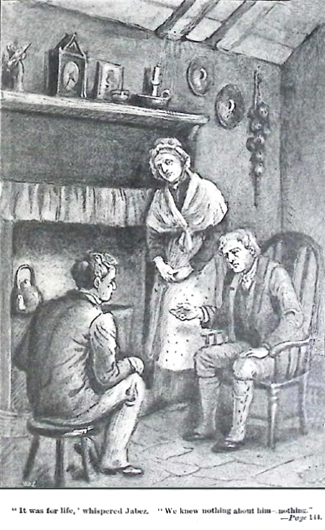
"It was for life," whispered Jabez. "We knew nothing
about him—nothing."
"You may trust me, dear friends; indeed you may," I said. "I will finish the story for you. From my description of the scarred face that I saw at the station, and the missing fingers on its owner's hand, you now know that your old lodger has been set at liberty, on ticket of leave, most likely. You feel sure, as I do, that he took advantage of his old knowledge of the window, and robbed me by means of it. You are grieved, not only on that account, but because the action proves that punishment and the lapse of years have not greatly improved your old lodger."
"That's the worst of it all," said Betsy.
"Well, you cannot take blame to yourselves for my loss, because you believed that the only person who knew the secret of the window, was safe under lock and key. Now, you must cheer up. If I had not been so foolish as to keep so much money here, I could not have had it stolen. If I had not had this money, search would have been made for the railway cash, and though I do not believe the man would have found it, worse than robbery might have happened to me, or to you. You have trusted me with an old secret and an old sorrow. I can understand how terrible it would be for you to think your roof had harboured such a character. I do not think he will come to Oakhill again; and I promise you that what we three know, shall never be made known by me to any one else."
"May God bless you, Mr. John!" said husband and wife in answer.
That was all. But I knew that my promise had lifted a load from their minds, and I was glad I had made it. From that time I carefully avoided any allusion to this painful subject, but I noticed ever after that the old folks were nervous and easily startled by the slightest sound. A rattling of the casement, a footstep after dark, would make them uneasy. And they were most careful in seeing to the fastenings, though I used laughingly to assure them that, in my apartment, no robber would again find what would repay a visit.
The side window no more swung on hinges. Only the one pane could be opened, and inside were strong iron bars that could not be removed without noise and a great deal of trouble.
The thief made good his escape. I had to grin and abide by my loss. A steel chain replaced that which had been my mother's, and at the end of it hung no little coin as of old. But "Work, Wait, Win" was still my motto, and there was no fear of its fading from my memory.
Often afterwards, when I thought of this sensational episode, which broke the humdrum character of my daily life, I wondered at the silence of others with regard to the story of the Harwoods' former lodger. All the circumstances must have been known to the older inhabitants of the place, and yet, neither the Cartwrights nor any other of the neighbours, had ever named the ne'er-do-weel in my presence.
I had sat many a time and heard Betsy, Jabez, and their friends talk over little incidents that happened many years before, and they would laugh or sigh together over occurrences that seemed hardly worth remembering at all, but the interest in which remained unabated after the lapse of many a winter.
It was strange that the dissolute doings of the former lodger, which must have extended over a considerable period and which ended so miserably, were never alluded to. It could not be because these things were forgotten; I was sure of that.
People round about Oakhill led very monotonous lives. One day was very like another to simple folk who tilled the ground and troubled themselves little about the outside world, or any changes save those of the weather. But they had good memories, and never forgot any circumstance which made a break in the monotony.
I at length concluded that the silence in this case arose from sympathy with my old friends.
They were lonely. They had lost their only son; and, no doubt, the stranger who lived under their roof for a time, had filled a void in the lives of the bereaved parents.
Did I not know what kindly hearts beat under the fustian waistcoat of Jabez, and the homely print gown of Betsy?
When the lodger got into trouble by his wicked ways, these dear folk would have another shock to endure, their tender hearts would receive another wound.
Doubtless there would be no lack of sympathy at the time. Afterwards, and partly on account of the disgrace attendant on their lodger's departure, those who cared most for the Harwoods would feel that time and silence would prove better healers than words, however well meant.
In the end, I had little cause to regret the loss of my money. The whole story came to the ears of the directors, probably through Mr. Burford, senior, who would hear it from his son.
I got even more credit than I deserved for the manner in which I had saved my employers' property at the risk of my own, and many kind things were said of me.
I had evidently more than one friend at court. Reference was made to the steady, conscientious manner in which I had done my duties from the first.
"Say what you like," said one member of the board, who had often sat at my father's table, "gentle blood will tell. Young Simpson comes of a family that had borne a good name for centuries. It must be dreadfully hard for him to look at Lint Hall and think that he ought to have been master there, instead of giving out tickets at a country station."
"It's a pity," put in another. "He is a fine, brave lad, and I honour him for the way he has carried himself through it all. His poor father was as kind a hearted man as ever lived; only rogues made a tool of and robbed him."
"Ay; and they deceived wiser heads than his," said a third, with a significant look at the last speaker. "However, it is not for us to judge the father who is gone, but to help, if we can, the son who is living. He has got a capital head for business, whichever side it came from, father or mother's."
"Maybe he has the father's share as well as his own."
"He has the fine manners of the Simpsons, and he does not think them too good for his present place. I have seen him treat an old market-woman, who went shoving into the station with a couple of baskets on her arms, as politely as if she were a duchess."
"Suppose we come to business," interposed the first speaker. "Young Simpson is doing the station-master's work, and everybody agrees that it was never done more efficiently. He has lately acted in a manner which proves that he places our interests before his own. He has waived his right to occupy the house at the station, with other privileges attached to the post, and made things pleasant for Pritchard; and yet he receives far less salary than we gave to his predecessor, Edelston. This hardly seems right."
"Certainly not," was the remark which followed from all sides.
"It is to our interest to make it worth the while of a trustworthy, able young man to stay with us."
Again the rest assented, and old Mr. Burford remarked—
"I happen to know a gentleman who has been greatly struck with young Simpson's ability, and who would gladly offer him a much better salary to go into his office—not here, but in London."
"Then I propose that we retain his services if we can," said my special advocate, if I may so name one where all were proving their desire to serve me. "I propose that young Simpson's salary be at once advanced to the same amount paid to Edelston, due allowance being made for the house and perquisites pertaining thereto. Pritchard accepted these last as part of an increase of salary which had been promised him, so that we shall not be really giving more in wages than before."
I could scarcely believe my eyes when I received written news of my good fortune. My salary had gone up at a bound, from sixty-five to a hundred and twenty pounds a year. The tidings almost bewildered me, and I remained for some moments under the impression that I must be dreaming, and that I should awake to a far less pleasant reality.
When I did become convinced that there was no mistake as to the contents of the letter and that my position would be so greatly improved, I began to wonder whom I had to thank for such good fortune.
It was not likely that I could keep such news to myself, and as Mr. Pritchard was the friend nearest at hand, I told it to him, and showed my letter.
"I am delighted," he exclaimed, and the pleasure visible on his face was as eloquent as words.
"I have had quite a guilty feeling ever since you were robbed, on account of my carelessness in carrying off the safe-key. Now I shall plume myself on having, though by accident, given you a push upward on the ladder of promotion. The climbing of that is generally a slow process. Yours might have been winged, you have risen so fast. However, you have done your best to deserve it; and it is wonderful what a turn things have taken for you."
Wonderful indeed! When I looked back and thought how dreadfully lonely I had felt after my father's death, how often I had mused, bitterly enough, on the desertion of all those who had called themselves his friends, I could not be sufficiently thankful now. Neither could I altogether clear myself from blame as I looked into my own heart.
Surely I must have been very hasty in my judgments, for had not some of those friends been the authors of this great improvement in my present prospects? I heard the particulars afterwards from Mr. Burford, and knew that such had been the case.
He congratulated me warmly, and said—
"You have done well, Jack, very well, and put your heart into your work. But, after all, my boy, you would never have got such a big lift all at once, if you had not been your father's son. I think it right to tell you this, for it would not do for you to run away with the notion that you are a sort of phœnix amongst railway 'employés.'"
"Indeed, Mr. Burford, I do not think that," I replied. "No one could have been more surprised at the news of my advance than I was, for I knew I had done nothing special to merit it."
"That is right. Keep in that spirit, and you will keep the friends who, partly for your father's sake, and, it is fair to say, because they like and respect you, have given you such a considerable advance. You will need to carry yourself modestly on account of your colleagues as well."
I was very grateful to Mr. Burford for this advice, and resolved to act upon it.
Without my asking any questions, he told me how Nelly was; that she would come home for good in July, with various particulars of the Swiss holiday he and his family had enjoyed in the autumn.
He said he should be like a schoolboy, counting weeks until the time came for his daughter's return. I knew that I should count days and hours until I should see the face of my old playfellow, but I did not tell him so.
MISS FLINT AIRS HER VIEWS
ON MODERN FURNITURE AND EDUCATION.
SOON afterwards, I heard from Jane Cartwright that Miss Flint's wandering feet were stayed for a while, but not at Lint Hall. She was the guest of Mrs. Burford, who had declared she could not be satisfied until her dear old friend paid her a visit and passed her opinion on the improvements made in her home.
It will be remembered that Mr. Burford told me of the projected changes, and groaned over the probable cost, "in cash and comfort," which would result therefrom. If his wife expected compliments on her good taste from Cousin Dorothy, she was grievously disappointed.
"Don't ask my opinion," she said, when taken into the newly arranged drawing-room. "If I give it, I shall only offend your—what's the word?—æsthetic development. Only I implore you to let me have an old-fashioned chair to sit upon. I will not trust myself to the new-fangled things, with a length of embroidered stuff doing duty for seat, cushion, and back. Two acquaintances of mine came to grief through being over-persuaded to occupy such. Their tenure was short, and serve them right. One chair broke down bodily, its jerry-made frame being unequal to the sitter's weight; the other, a folding one, doubled up unexpectedly, because my friend, being unused to the arrangement, did not know how to balance herself, but perched on the edge of the thing, instead of nearly lying at full length in it."
"My dear Miss Flint, you may trust yourself to my chairs without fear. They are not what you call the jerry-made sort, but thoroughly strong, even when slight-looking, and are from a first class upholsterer. If you knew the price! But I should be afraid to tell you that," said Mrs. Burford.
"Oh, I have no doubt they cost money enough. I cannot speak from experience, of course, but I have always understood that it is the husband's privilege to pay for new furniture. 'That' does not come out of the housekeeping purse, does it?"
Mrs. Burford laughed, as people laugh when they want to hide their vexation by appearing to be amused.
"You dear, droll creature! You are as satirical as ever," said Mrs. Burford. "But I am not going to be angry with you, or put out of love with my pretty room, though you do not admire it. Every one else thinks it so much improved, and all the alterations in perfect taste."
"They tell you so, but what they think is another matter. I do not see how you can speak with certainty of their thoughts," persisted Miss Flint.
"Why should I distrust them? Or, if I ought to do, I should perhaps judge you in the same way, and believe that, whilst you profess to think slightingly of my taste in furnishing, you really admire the results of it."
"Think as you like, my dear. I distrust people who give their neighbours credit for perfection in anything; though, by the way, I believe nobody ever paid me such a compliment. Certainly not with regard to taste in dress or furniture."
Miss Flint was so amused at her own remark that she laughed heartily, and it was sufficiently suggestive to make Mrs. Burford join in the laugh, as she thought of her guest's eccentric costumes and her domestic surroundings.
"You may laugh, and welcome, especially when you do it heartily, though I may be the subject of your mirth," said Miss Flint, looking triumphant and good-humoured. She liked her caustic remarks to be appreciated, and would always join in the amusement they created, if even she did not begin the laugh.
"Seriously, though," she added, "I am not in love with modern decorative art, which, in many cases, means the turning out of everything that is solid and substantial, and cramming rooms with all kinds of trash that is of no possible use, and which one stumbles over at every step, unless it is fixed high up, and then it tumbles on one's head instead. I was in a room the other day, and there were some big, softly-cushioned chairs in it, wide enough to accommodate a giantess. The seats were about ten inches from the floor. A stout caller had sunk into one, and being rheumatic, could not rise by herself. She was hauled out by the united efforts of her hostess and the parlour-maid, and a nice picture that was. A long-legged cavalry officer occupied another, and alternately sat with his knees at his chin and his feet sprawling half across the room. There were no chairs in that room fit for sensible people to occupy, and no two alike."
"But mine are both safe and comfortable, my dear," said Mrs. Burford.
"Then point out one that you can warrant a 'patent safety,' and let me sit down; for you seem to have forgotten that I have been standing all this time," said Miss Flint.
"I beg your pardon. I thought you were looking round at all my pretty things as you were moving about the room. Do try this chair; you will find it delightfully comfortable."
The article in question being of wicker-work, Miss Flint was induced to deposit her person within its embracing arms. It was luxuriously upholstered, and it would have been hard for any one else to find fault with it, but she was equal to the occasion.
"I hope you find that chair comfortable?" said Mrs. Burford complacently, and as if defying a negative reply.
"It is big enough and strong enough, but wickedly luxurious. Who could do anything useful when buried in down and satin? I could not even knit in it. No wonder girls are so disgracefully idle, when they are tempted to laziness at every turn by such chairs as this. When I was a girl, young people had to be content with something less. There were but a couple of so-called easy-chairs in a room, and they were not too comfortable; but such as they were, they were left for our elders and betters. We should as soon have thought of flying as of occupying one of them."
Rose Burford had just entered the room when Miss Flint began this tirade against idleness and luxury, and had deposited her elegant person on a similar chair to the one occupied by the speaker. Rose never troubled herself to conciliate Cousin Dorothy, and sometimes made very plain remarks about those "who toadied such old horrors because of their money." Though she had always been first favourite, Mrs. Burford stood in some awe of her elder daughter, who was of a very independent character, and whose trenchant speeches would often bring an angry flush to her mother's face, though they were not apparently aimed at her.
Rose waited quietly until Miss Flint finished, for the speaker was looking straight in her face, as though her remarks, while professing to be general ones, were meant for the girl opposite.
"I am very glad I was not young when you were," said Rose coolly. "The present state of things must be infinitely preferable to what existed then."
"No doubt they appear so to lazy, self-indulgent people," retorted Miss Flint.
"I do not think girls are lazier than they used to be. When you went to school, you would not have half so many lessons to learn as I had. As to poor Magnus, I wonder he is alive with the amount of cramming he has to do for exams."
"It may well be called 'cramming,' taken higgledy-piggledy, as learning is swallowed in these days. But do not be alarmed, Rose. Your brother will not kill himself with work, any more than you have done," was the reply.
"Indeed I hope not. An only brother is precious to grown-up girls, and I trust I shall find him useful soon. He is very tall for his age."
"Then your idea of a brother's usefulness is—"
"That he may escort his sisters to parties, concerts, and so on," returned Rose, without any sign of shrinking before Miss Flint's steady gaze.
"Let me congratulate you on the unselfish view you take of a brother's vocation, my dear," replied Cousin Dorothy.
"Thank you, Miss Flint. I meant what I said; and I am sure you, who are candour itself, ought to like me for following your example and speaking out."
"My dear Rose, you are forgetting yourself. Remember, the difference between Miss Flint's age and yours entitles her to say and do many things that would ill become a girl like you."
"I am not likely to forget the difference you name, mother," said Rose, "considering that Miss Flint's presence cannot fail to remind me of it."
Rose first looked at Miss Flint, then gave a careless glance at her own handsome reflection in an opposite mirror, and smiled.
The gesture was sufficiently suggestive, and Mrs. Burford was annoyed, as well she might be; for Miss Flint was her guest, and the girl's manner was almost impertinent.
"You are rude, Rose. If you cannot refrain from such remarks, you had better leave the room."
"Let her alone, my dear," interposed Miss Flint. "It would be a pity to interfere with such a picture of comfort as Rose presents. Dorothy Flint can hold her own with a chit of twenty, without asking the help of the maternal arm and tongue to defend her. Besides, while I do not care for gimcracks, and cannot go into raptures over a three-halfpenny palm-leaf fan with a lily painted on it, I do like to see a pretty girl's face opposite me; and Rose is pretty and young, and I am sixty-three—going sixty-four, as the children say. My days of youth and beauty are things of the far-away past. But it is not always kind in those who still possess a wealth of the things which are only ours once in a lifetime, to call attention to the fact that, in their opposite neighbour's case it may be, they are gone for ever."
There was an unusually pathetic ring in Miss Flint's voice as the last words dropped slowly from her lips. And then she turned and gazed at the glowing fire, as if it were showing her visions of that past to which she had just alluded.
Mrs. Burford was thinking to herself, "If ever a contradictious creature lived on this earth, it is Dorothy Flint. If I had not rebuked Rose, she would have twitted me with allowing her to treat a guest with rudeness in my presence. I speak, as in duty bound, and she as good as tells me to hold my tongue, for she is quite able to defend herself."
What Mrs. Burford said was, "You were quite as pretty a girl as any I know to-day when we were at school together. I remember how I used to like to stroke your lovely hair—you wore it in masses of soft curls. They were fashionable then; and I always envied you, for mine never would curl. I was a little girl, you a big one. I did so admire you."
"Did you, my dear? I am so glad you remember that I had a pretty face and beautiful hair. Now, Rose, you have the testimony of your own mother as to my youthful charms. Do not get too conceited, child. You may be a beauty of the present generation, but, remember, there were as fair faces in the last, that are wrinkled now; hair that hung in dark, glossy curls, is grey and not too plentiful now. Such changes come to us all in our turns. Look at me, child, and take warning."
Miss Flint's face had on it a softer expression than common as she turned it towards Rose. Who knows what memories were stirring her as the past came before her? Who knows but that the elderly spinster—eccentric in her habits, grotesque in dress, caustic of speech, and reputed to be hard as her name—could hear again tender words that had made her cheek flush and her heart beat faster in those far-away days?
Mrs. Burford might be able to describe the fair outside, but she could never have been Dorothy Flint's confidante in her beautiful girlhood—the difference in their ages forbade that; and so now she could not recall to her mind the scenes or hear the words that her guest could see and hear, though these, like her beauty and youth, were things of the past, and had no present reality.
If Miss Flint were dreaming of the past, she was soon brought back to her present surroundings, and in an unexpected manner. Something in her words and looks had touched Rose Burford's heart.
She left her seat, crossed towards Miss Flint's chair, and dropped gracefully down on the rug beside it. Then, taking the spinster's hand, she said, "I beg your pardon for having been rude and impertinent just now."
"Do you mean it, child?" asked Cousin Dorothy, with a look of profound astonishment.
"Yes, I do. My conscience reproached me, and made me feel ashamed of myself. It often does speak without being heeded, I am afraid, but just now I could not help listening."
Rose glanced across at her mother as if to intimate that her action was by no means a consequence of the maternal rebuke, but that she had begged Miss Flint's pardon purely of her own sweet will.
Indeed, Mrs. Burford knew this already.
When a parent is injudicious enough to elevate one child at the expense of the others, she generally finds that the favourite, who has received more than her share of indulgence and affection, repays her with less both of love and obedience. Often the child becomes the parent's tyrant, and after every concession, exacts still more.
Mrs. Burford was, however, glad of Rose's conciliatory conduct, from whatever motive it had sprung, and she smiled approvingly back at her daughter.
"I forgive you, child," said Miss Flint, retaining Rose's hand in one of hers, whilst with the other she patted her cheek. "I am rather glad you were ruder than usual, and thought it right to beg pardon, because, for once, you seem more like your father's daughter than your mother's."
Miss Flint said the last few words in a whisper, audible only to Rose; then turning to Mrs. Burford, "I was paying the child a pretty compliment, my dear, and I determined to spare her blushes by letting no one else hear it."
After Cousin Dorothy's recent complimentary remarks on the girl's looks, Mrs. Burford concluded that the whisper conveyed some further tribute of a similar kind, and did not trouble herself to ask any questions. It was satisfactory to her that her guest seemed quite drawn towards Rose, and she hoped that in time her favourite might stand equal to, if not higher, than the absent Nelly in Miss Flint's regard.
"If you were Nelly, now, I should most likely stroke your pretty hair, as your mother stroked my curls in ancient days. But your style of hairdressing is too elaborate, and has cost too much time, in order to produce such marvellous effects, for me to venture on disturbing them," said Miss Flint.
"I am very glad you did not," replied Rose frankly. "You are quite right in supposing that my hair takes a fearful time, and when it is done, I am terrified at having it upset. Nelly has such a crop of natural crisp curls, that nothing can alter her appearance."
"Or her nature, I hope. I am very fond of your sister, Rose; and—" with an air of much candour—"I like you better than I did an hour or two ago. I was going to have a wordy war with you. I meant to say that now-a-days you learned a little of everything, and nothing well; that education was carefully planned for the absorption by girls of every species of knowledge but the kind that would be useful to them in home life; that, above all, good manners and decent respect to their elders and betters were purposely ignored, and that girls were generally rude, conceited, and selfish."
"You have said it, Miss Flint," remarked Rose.
"No, child; or, at least, not in the same way. I have only told you what my opinions were a few minutes ago, with the view of adding that, even in this short space of time, they have undergone some modification."
"And what do you think of us girls now, Miss Flint?"
"I think that all these mistakes may be made without quite spoiling a girl, and that sometimes the heart, yielding to conscience, may triumph over an injudicious—education."
Miss Flint made a very decided pause before she spoke that last word. She uttered it looking straight at Mrs. Burford. And if ever gesture and facial expression said one thing whilst the tongue said another, Miss Flint meant "mother" when she closed her sentence with the word "education."
"I think I must get up now," said Rose, springing lightly to her feet and extricating the hand which Miss Flint still held. "I am not improving my dress by kneeling upon it."
"That is right, child; take care of all your pretty things. Of your face, by being kind and good-tempered. Nothing spoils beauty sooner than harsh ways and ill temper. Besides, the opposites make people beautiful when the charms which are only skin-deep have departed. You have fine examples in your mother and myself. Take care of your health too, because money will not buy it back again; and of your hair, and your finery, because they have cost time, pains, and your father knows how much in coin of the realm. There now, I have repaid your charming conduct with much good advice, and I hope you are grateful."
Rose laughed, and made a pretty curtsey, not a mocking one, with the addition of, "Thank you, Miss Flint."
"Now let me alone, both of you. I am going to have a nap. I am ashamed of myself for wanting such a thing, but the blame must rest on you and this disgracefully luxurious chair, which has a corrupting influence on my habits, yet detains me in spite of myself."
Miss Flint closed her eyelids with a species of snap, much as she habitually closed her lips when she had said something particularly cutting.
"You shall have the room to yourself for a while," said Mrs. Burford. "Come, Rose;" and, followed by her daughter, she left Miss Flint to enjoy her nap, though under protest, in that disgracefully easy chair.
"I could have taken a nap too, if you had let me alone, mamma," said Rose. "I was just as well inclined for one as Miss Flint herself; for you know I was up late last night."
"You might have disturbed her, Rose, and that would have been a pity. Sleep makes people amiable."
"Then why did you hinder me from it? Miss Flint would not have disturbed me, unless she snored very loudly, and I scarcely think she would do that in the day-time," returned the girl in anything but an amiable tone.
But she followed her mother to the morning-room, and deposited herself on a seat equally comfortable with the one she had left.
DANGEROUS GROUND.
WHATEVER might be Rose's state of mind and temper, Mrs. Burford was in a very good humour with the girl, and began to praise her "judicious" conduct towards Miss Flint.
"If you will only go on as you have begun, I dare say you will become as great a favourite with her as Nelly is. I have always felt that you, darling, might benefit yourself greatly by conciliating Dorothy Flint."
Rose flamed up in a moment.
"If you think, mamma, that I asked Miss Flint's pardon to curry future favour with her, you are mistaken. I did nothing of the kind. I did it because I felt that I had been rude and unladylike towards a guest. It was mean to boast of being young and—well, pretty, over one who had been both in her time, though she is now a cantankerous old maid. Very likely I shall be worse if I live as long. If I had gone to Miss Flint from any other motive than the one which induced me to go, she would have seen through me in a moment, and would have been more likely to bid me 'get away for a little hypocrite' than to keep me by her side for a moment," said Rose. "You, mamma, have known Miss Flint, in a sense, nearly all your life, but I do not believe you understand her as well as I do now. I should scorn to flatter Miss Flint, even if I thought I could deceive her by it. I may not be as smooth-spoken as Nelly is, but I mean what I say, and the old lady cannot help believing me."
"I am not going to quarrel with you about motives, Rose. You have acted rightly and straightforwardly, and produced a good impression on my old friend. If I am anxious for you to please her, it can only be for your future benefit."
"In what way, mamma? We are not paupers, that we need act hypocritically and pretend a lot of affection which we do not feel for Miss Flint. Our position and my father's means are good, and grandpapa Burford is rich, too. We are his only grandchildren. Really, I cannot understand why we should crouch and defer to Miss Flint on account of her money; though I believe I shall get to like her for her own sake. She is so delightfully different from everybody else."
Mrs. Burford was too wise in her generation to reply to her daughter's last remark, but she took up the money question.
"Your father and grandfather may be very well off, my dear, but remember, they still occupy their own shoes, and I trust they will be long spared to do so. The dear old man is charming, and so liberal, as I know. But why should not Dorothy Flint put my children before those of other people? Who ought to be nearer than a life-long friend?"
"A relation, I should think," said Rose perversely.
"That young man at the station is her nearest, I believe, though he is only a second cousin, and she will never leave him a penny."
"I wouldn't be too sure of that. Jack Simpson is a gentleman, and very much respected. Grandfather thinks him perfection, and he is so handsome."
Rose had never cared much for me, even in our childish days, and had always been inclined to domineer over me, as girls do over boys of the same age as themselves. But she was in an aggravating mood, and used my name to tease her mother. The mention of it was like a lighted match to gunpowder, and Mrs. Burford railed against me to her heart's content, without provoking a word of reply from Rose.
When she stopped breathless, the girl quietly said, "I am not going to defend Jack Simpson. I do not care enough about him to pose as his champion. I will leave that to Nelly when she comes back."
"If Ellen dares—" began Mrs. Burford, but again her daughter interrupted—
"You can tell Nelly what you will do when the time comes. Let us talk about Miss Flint. She is a more interesting subject than Jack Simpson."
"I was going to say that, while you may have very nice fortunes at some future time, you would be none the worse with my friend's property in addition."
"People often are the worse for having riches. I am not sure that I could stand much more temptation in that way," said Rose.
"I wonder whether Dorothy Flint has made a will. I am sure your father knows all about her affairs, and I have asked him to tell me just this one thing, but he will not satisfy me. Of course, professional reticence is all very well, and your father would be blamable indeed to trust outsiders with a client's affairs. But a wife is different, especially when the client is that wife's oldest friend."
"I do not see that my father ought to make any exception," said Rose. "A trust is a trust, and should be held sacred. Besides," she added, after a brief pause, "men have paid dearly for letting their wives know too much. Samson, for instance."
"Rose, you are really too provoking," said Mrs. Burford sharply. "As if there were anything in what I said just now to suggest a comparison between that wicked Philistine woman and myself."
Rose gave no direct reply to this remark, but said, "There is certainly no external resemblance between poor papa and Samson in the matter of hair. I heartily wish there were more." Mr. Burford was getting bald. "But you know one does not speak of these things in the concrete, but in the abstract. I got that nice, learned phrase from my father himself. All I want to convey is, that if a client trusts a lawyer with private matters, the fact of there being not merely a professional but a friendly connection between them, ought to make the trust, if anything, more sacred and inviolable. I am quite sure it would be wrong in any of us to try and find out from my father how Miss Flint means to leave her money."
"I ought to be very much obliged to you for making your father's duty and mine so plain to us. Things are coming to a pretty pass when a girl like you sets herself up to be a judge of her parent's actions. We old people educate our children, and they get so wise in their own conceits that they treat us as mere nobodies. I know well enough that you have had greater advantages than I had, but I do not see that these should give you the right to lecture and look down on your mother. If I feel anxious about the disposal of Miss Flint's property, is it on my own account or my children's? She is a few years older than I am, but she is far stronger, and likely enough to outlive me."
Mrs. Burford put her handkerchief to her eyes in very real distress or annoyance, or both.
"You have misunderstood me, mamma," said Rose. "I have no wish to lecture or give myself airs. Neither did I think of paining you, for you are always very good to me. But it was, to my mind, a question of right or wrong, a principle that must be applied all round, in my father's case, and that of every upright professional man. I am very proud of my father. People run down lawyers sometimes, but if I hear them, I carry my head just a little bit higher and say to myself, 'I know one against whose goodness no one can say a word with truth.' He is always trying to act the peacemaker, to put the knowledge his profession gives him to a good use, without ever betraying a trust or thinking what course will pay him best; and I say that he must be true and staunch all round, and neither to you nor anybody living, tell a client's secret."
"As if I wanted your father to do wrong!"
Mrs. Burford was fairly sobbing, but even this fact did not stir Rose from the position she had assumed.
"I am certain you never thought of wrong in the matter, mamma. Please do not be hurt at my words. I am afraid I express myself in a very blunt way, but, remember, the first lesson my father and you taught us all was to tell the truth, and sometimes perhaps I speak it too harshly."
Did Mrs. Burford's conscience reproach her as Rose said this? She knew that, whilst in words she had always urged her children to speak the truth and had condemned deceit, she had been guilty of many an evasion in their presence, when self-interest was concerned. About their father's teaching, there could be no two opinions, and his own upright life was its best practical illustration.
At any rate, she chose to accept Rose's words as an apology, and said, as she wiped away real tears—
"I know you did not mean to pain me, darling, but I am very sensitive where the affection and respect of my children are concerned. You know, too, that I would rather have you too brusque in saying what is true, than be guilty of deceit in the least thing."
Here the discussion ended, but a circumstance occurred which gave Mrs. Burford an early opportunity of airing her views on the subject of will-making.
Dinner was over, and Mr. Burford, with his slippered feet resting on a fender-stool, was looking forward to a quiet evening after a busy day. He was not to have it. A ring came at the hall door, which was followed by a second, before time had elapsed to allow of its being answered.
"Who can be coming at this time?" said Mrs. Burford.
"An impatient caller, whoever it is," said Rose.
"Do clients follow you home?" asked Miss Flint. "If so, I should think this is a call for you. Were you a doctor, I should feel sure of it."
"Sometimes they do. It is generally the sick who send for me out of business hours as well as for the doctor," replied Mr. Burford.
He had scarcely finished speaking when a servant entered to say that he was wanted, and the lawyer, without returning to the room again, left the house in company with the messenger.
"Most likely some one is dying and wants a will made all in a hurry," said Mrs. Burford. "This often happens, and what might have been prepared with due thought and care, has to be hurried through or cannot be done at all. I think it is quite wicked of people to put off such an important matter as the making of a will; do not you?"
"That depends upon circumstances," said Miss Flint, to whom the question was addressed.
"What circumstances could excuse carelessness in such a matter?"
"Indifference as to who may possess your property after you have done with it," replied Miss Flint calmly. "I can quite imagine persons who have no near family ties—men without wives or children, women alone in the world, like myself, for instance—who care very little who may squabble over their belongings. You must love a person in order to wish that he may have them, or you must dislike a person, such as your next-of-kin, in order to bestir yourself and make a will to prevent his getting them. If you have no particular likes or dislikes, you may be pardoned if you allow the survivors to fight it out amongst themselves."
"My dear, how can you talk in such a way?" said Mrs. Burford.
"My dear, how can you, a lawyer's wife, forget how much the legal profession owes to the people who make no wills, or such as are liable to be disputed? Why, the solicitors and all the tribe of people learned in the law and, deriving their incomes therefrom, would lose some of their most exciting and profitable practice if everybody with property, made a sound will at the right time."
"I am glad to think that no such selfish considerations were in my mind when I talked about will-making. I thought of the cases which have come under my notice, where dissension, misery, and family troubles might have been averted by prudence and foresight in this respect. I feel so strongly about it, that if I had but a shilling to leave, I would make a will."
Mrs. Burford spoke with energy, and drew herself up with an air of determination as she finished.
"My dear friend," said Miss Flint, "if you had but a shilling, how would you pay a lawyer for making your will? He would want a good many shillings for his trouble."
Rose had been sitting with a book in her hand, but she was really listening to her mother and Miss Flint. The last question was too much for her gravity, and she broke into a hearty laugh, in which Miss Flint joined.
Mrs. Burford looked displeased for a moment, but afterwards appeared to think she had better not stand on her dignity, and began to explain.
"You seem determined to take my words literally," she said. "Of course, the shilling meant just a little property, and if I had ever so little, I should take care that it went to some one I liked."
"A shilling to me means exactly twelve pence, or two sixpences," said Rose.
"The same to me until now. Henceforth, I shall know that it may represent property worth bequeathing. If my views on these subjects were as decided as yours, my dear," said Miss Flint, addressing her hostess, "I should know exactly what to do with my little property."
"Little!" exclaimed Mrs. Burford. "My little and yours have very different meanings." At the same time she thought, "I have, at any rate, found out that Dorothy has not yet made a will."
"Little or much, I have been a perfect human weathercock as to the disposal of it. I have made ever so many wills, or at least your husband has made them for me, and no two have been alike. At this moment, I cannot be sure what the last is about, or whether there is a last: Do you know?"
Miss Flint turned sharply round and faced her hostess.
"I do not," was Mrs. Burford's instant reply, and the inquirer felt that it was true.
"I am surprised at your asking such a question. You know my husband would never betray the confidence of a client, and that, if you thought him capable of doing it, you would never give him the chance," she continued.
Mrs. Burford drew herself up with a look of conscious virtue.
And Miss Flint gave a satisfied nod as she remarked—
"And you, my dear, would not tempt him to tell you his professional secrets for the world. You are quite in the right, and I am well satisfied with my legal adviser, as I have good reason to be."
Whatever Rose thought, or whether she mentally compared her mother's previous remarks with those addressed to Miss Flint, cannot be told. She bent over her book and said nothing.
When Mr. Burford returned, he looked very grave and thoughtful.
"Was it to make a will that you were called out so suddenly?" asked his wife.
"Yes, but I was too late. It is very unfortunate for the family," was the reply.
He gave no further information, but Mrs. Burford looked at Miss Flint as if she would say, "You have now had a practical proof of the wisdom of my advice."
What Miss Flint said was—
"How glad I am that no neglect of mine can affect the well-being of sons and daughters! Single life may have its drawbacks, but it has its privileges too. And it escapes so many responsibilities. Think what it must be never to feel bound to ask leave of any human being as to what I shall spend, whither I shall go, or when. Think what it must be to know that if I choose to leave my money to buy parasols for the dwellers in Central Africa, or to found a 'home for starving dogs' in Constantinople, no one will have a right to find fault. What do you think of such a state of independence, Rose? Would you not like it?"
"I am afraid not," replied Rose.
"And why, may I ask? You have always seemed to me to have a very independent nature, and to hold very decided views of your own on many subjects."
"If you mean that I have always liked to have my own way, and that I have got it whenever I could, you are right. But I doubt if I should care always to have it without an effort, and with nobody to object to my views and plans. As to my goings and comings, I should not care a pin for going anywhere unless some one were sorry to part with me, or to return if there were no one waiting with outstretched arms to give me a welcome back. Independence may be very nice to a certain extent, but loneliness and isolation are too dreadful. I would not have the one at the cost of the other two," replied Rose.
"The fact is, Rose, that, you are a perfect illustration of the old proverb, that a woman cannot live without contradiction. You only value what you have had to fight for, and you like to be fussed after. Now, good people, I will go to my own room. Good-night, Mr. Burford. You are very weary. I leave you to the best society of all, that of your wife. Good-night, Rose; and, though last, not least, good-night my dear—" this to Mrs. Burford. "If I do not dream of wills and will-making, it will not be your fault. I am going to take myself to task before I sleep, and, it may be, decide on the terms of one more last will and testament, to be drawn up by your good husband with all convenient speed."
Miss Flint withdrew, but whatever might have been the subject of her private cogitations, she did not trouble Mr. Burford with any instructions of the kind alluded to, when the morrow came.
A RIDDLE SOLVED.
"MR. JOHN, we want to have a little bit of quiet talk with you—Jabez and me. There is a something that we have been turning over together, and we feel it is only right we should mention it to you."
It was Betsy Harwood who spoke, and she said this very soon after I received such an important addition to my salary.
From the time of my going to live with the Harwoods, I had been accustomed to speak to them quite unreservedly about my private concerns. They were so trustworthy and staunch, so deeply interested in my well-being, that I could not have had more sympathetic confidants. They might talk of their own concerns or gossip about those of the neighbourhood, but of my affairs or doings, never.
When I first told them of my improved position, they were radiant with delight, and proud beyond expression that I should be so trusted and recompensed whilst still so young.
They believed that I was now on the high-road to fortune, to the recovery of Lint Hall, to everything that was most desirable, and they rejoiced accordingly.
Soon afterwards, I noticed that my old friends were unusually silent and seemed to be in trouble, and I wondered if their low spirits could be connected with their former lodger.
When Betsy opened her mind, I was greatly relieved to find that she and Jabez were only worrying themselves about me and my worldly position.
"You have been very good to Jabez and me, Mr. John," said she. "As you've prospered, we've prospered. When you first came, you gave us the same money a week as that other young railway gentleman did, and we were quite content. Then you went up to four shillings, and lately nothing would serve but we must have six, and you paying extra for washing. You have helped us in more ways beside. Mr. John, you are giving too much for what you get, seeing the place we live in. Why, if you had the whole cottage to yourself, it wouldn't be worth it, and it goes against our consciences to take it."
"Why, Betsy, I could never be half so comfortable anywhere else as I am here. If I went to lodge in a larger house, I should have to pay much more than I can induce you to take. Who would ever care for me as you have done?" I asked.
"I won't give in to anybody in the way of wanting to make you comfortable, Mr. John," said Betsy. "It's not that."
"What is it, then?"
"Well, people have been talking as if a gentleman like you ought to lodge somewhere more suitable to your—your forefathers," said Jabez, after a struggle for a word. "I was going to say family, but there is none to speak of left," he continued. "Remarks have been made that a nice sitting-room, with a bow-window facing the road, would be nearer the thing than our parlour with a latticed one, and no better look-out than our bit of garden. It seems to me that a many people are beginning to take a deal of interest in you, Mr. John."
"Then I can truly say 'Thank you for nothing' to all those who are beginning to concern themselves about my surroundings. What would have become of me when I was left fatherless and homeless, if you had not taken me in? You were the best of friends to me when I was very poor and could afford to pay so little. How could I enjoy my prosperity if I were not allowed, in some degree, to share it with you? I would gladly do more if you would let me."
The look of proud satisfaction on Betsy's face as she turned towards Jabez was pleasant to see.
"Just hear how Mr. John do talk," she said, "making out as if we had not all along been paid for our work. We have only done what was our bounden duty to do. But there are plenty saying that a poor place like ours is not becoming to young Mr. Simpson, as was brought up so different, and that for your own sake, you ought to move to different 'partments at once."
"I have no doubt those who now take so much interest in my concerns, are the very ones who turned their heads in the opposite direction when I was first left to shift for myself. I will have none of them. I am thankful that poverty has taught me the difference between true and fair-weather friends, and that I am not likely to mistake the one for the other. If you two tell me that you wish to be rid of me, I will go, but I will take a notice to quit only from my landlady herself," and I looked at Betsy.
"We can never want you to leave for our sakes, Mr. John," said Betsy. "Your being here means good and brightness and comfort to us in every way. But, however hard it would be to part with you, we could do that if it would be better for you to leave us."
The kindly creature's voice trembled, but she bravely added, "I mean what I say, Mr. John."
"So do I, Betsy, and therefore we will consider the matter settled until you give me notice to go."
It was not quite settled, though, for one whose friendship I could not doubt, was a little dissatisfied about my lodgings. This was Mr. Burford.
"The cottage was all very well whilst you were a boy and strict economy a matter of necessity, unless you would have deigned to accept help from an outsider," he said. "But you are certain to be invited out more now you are grown up, and you can hardly receive friends in the house-place at old Harwood's."
"My duties at the station will furnish me a sufficient excuse for declining invitations if I should receive any," I replied. "Thus far, the cottage house-place has sufficed to accommodate the friends who have sought me at home."
"That may be, Jack, but recent events have proved that you are not destitute of friends. If I am not mistaken, some of those who were so ready to speak a good word for you at the board meeting a little while ago, will try to show you more direct personal kindness before long."
"I hope I am not ungrateful," said I, "but I would rather be allowed to show my sense of these gentlemen's goodwill towards me, by the way in which I fulfil my duties than in any other. I have been let alone so long, that I ask for nothing but to go on in the old way. As to leaving the Harwoods, I simply cannot; and were I ungrateful and foolish enough to do so, I should be the sufferer, and deserve to be."
"There is a good deal of truth in what you say, my boy, and I know how you are cared for at present; still, a change might be effected without parting you and the Harwoods," said Mr. Burford. "The cottage is part of the Lint Hall property, which you are to buy back, you know, and it is one of the poorest dwellings on the estate. There is a really nice little house at liberty just now, with a bit of garden front and back, quite as much ground as Jabez has at present. If the old people could be persuaded to move into it, for your sake, both they and you would be infinitely more comfortable. The rent will be very low, only a couple of pounds more than that of the cottage."
"You mean the one where old Mrs. Henderson lived—'Rose Cottage,' she called it," I replied.
"Yes, and well she might, for it is a very bower of roses. The front is covered with them, and though the dwelling is so small, it is quite pretty. There are a good sitting-room, a front and a back kitchen, and three bedrooms, with many little conveniences which the Harwood cottage lacks."
"It would be a very suitable place to remove to, if Betsy and Jabez were not so wedded to the old spot, but it would cost them a great wrench to leave it now."
"It would be the best possible thing for them both, considering what miserable associations are connected with that cottage. Removal would help to deaden the memory of their past sorrows. And if they were once out of it, the old dwelling should be levelled with the ground as rapidly as it could be done," said Mr. Burford.
I was quite in the dark as to his meaning, and I think my face showed this, for he continued—
"I suppose you do not remember the circumstances? But how could you? They happened either before or just after you were born. Did the old people never speak of their son to you?"
I had most carefully kept my word to Betsy, and never alluded to that one conversation which had stirred her and Jabez so painfully. Now Mr. Burford named the lost son, I could only answer that he had been incidentally mentioned on a single occasion, but never afterwards.
"They said they had lost him, and I could see that, though so many years had passed, the wound was as fresh as ever," I replied.
"Did they tell you he was dead?" asked Mr. Burford, with a curious expression on his face.
"No; I suppose I took that for granted. Is he not?"
"I may as well tell you the story, Jack, for I see you are in the dark as to the real state of affairs. The Harwoods had only this one lad, a sharp, clever fellow, of whom they made an idol almost. From the time he could speak and walk, they let him have too much of his own way, and the more they yielded, the more he exacted in after-days. Unfortunately, his cleverness was misapplied from the first, and he became the ringleader in every piece of mischief perpetrated by the lads of the neighbourhood. George—that was his name—delighted in being talked about; and though at first he was, I believe, more actuated by a spirit of reckless fun than by anything worse, he unfortunately made acquaintance with another youth who was vicious as well as daring. This lad's name was Michael Perry, or 'Black Mike,' as he was generally called on account of his dark hair and swarthy skin. Most people thought he came of gipsy parentage, but nothing was known of him except that he was a waif from the roadside, the child of a poor woman who had sunk down there, worn-out with wandering and pinched with cold, and who was carried to the workhouse to die. She was never able to give any account of herself, so Mike was left to be brought up by the parish, and in time apprenticed to the blacksmith, whose forge is about two hundred yards from the station. You know it, Jack."
I assented, and Mr. Burford continued.
"Mike was sharp enough, and became very clever at his craft, as well as in other ways. He turned scraps of metal to account in a fashion little suspected by those who praised his deftness at his work. The master, who admired the neatly turned horseshoes which his apprentice had asked leave to make after working-hours, little dreamed that, besides these, Mike was amusing himself by making skeleton-keys of many sizes, and other implements to be unlawfully used whenever an opportunity should offer.
"For a long time, however, Mike was rather a favourite than otherwise. He had plenty of fun, and during his workhouse sojourn, he had come across many queer characters and picked up strange stories of adventure, which he retailed for the amusement of young and old. He never lacked listeners, for in a country town, the forge is a favourite lounging-place, and there were always idlers ready to be entertained.
"Probably the men could detect and would laugh in their sleeves at Mike's embellishments; for, of course, the more willing people were to listen, the more the lad drew on his imagination to make his stories exciting and attractive.
"With the boys it was different, and over these Black Mike's tales exercised a most unfortunate influence, turning as they did upon daring robberies and the hair-breadth escapes of those who had committed them.
"Careful mothers began to watch their lads during the dinner-hour, and forbade their hurrying over the meal so that they might go and listen to Mike. There was one, however, over whom Mike had obtained a great influence, and this was George Harwood. His parents saw, but too late, that the blacksmith's apprentice was doing their boy a world of harm by filling his head with unwholesome notions. It was too late to undo the mischief, and equally so to enforce obedience when they would fain have stopped the acquaintance, for their son heard their commands, and simply went his own way as before, never dreaming of obeying them.
"You are young, Jack, but you have seen enough to know how easy is the downward course. The boyish pranks, so innocent at first, became mischievous and hurtful to others. The daring lad became the hardened youth; the spoiled child grew into the son who defied his parents and would none of their reproofs. Mischief degenerated still further and became criminal. It had seemed fun to startle people out of their beds by some practical joke, and a trifle to ease the laden trees of a portion of their fruit, when the owner was sleeping peacefully and with no thought of nightly marauders in his orchard.
"Soon these exploits were not exciting enough, and the lads went on from bad to worse.
"I should tell you that, whilst George Harwood was not so much wicked, to begin with, as led away by a daring temperament and fondness for fun, Mike Perry was as selfish and cunning as he was clever.
"So he often managed to throw the blame upon George which should have rested upon himself; and, to the intense grief of his honest parents, people began to shun the lad and warn their own children against associating with him.
"Still, George, a stalwart youth, tall for his age, and industrious by fits and starts, always found employment when he was willing to take it. He had seasons of remorse, too, when he grieved over his ill-doing, made promises of amendment, and gladdened his parents' hearts by remaining quietly at home and earning his own bread by very real work.
"It was during one of these steady intervals that he met with a terrible accident. He was going from farm to farm with a steam thrashing-machine when it happened, and he had nearly lost his life.
"I cannot describe how the mischief was done, but George was caught by the machine in some way, and when he was extricated, he was fearfully hurt. It was a wonder he lived through it; and when one thinks of all that followed, we are apt to say it would have been better had he died then. But who can tell? At any rate, he did recover, though after many months of confinement to his bed and much suffering.
"You will imagine, Jack, how Betsy would nurse him, thinking nothing of self, hardly conscious of weariness when endured for the sake of her lad."
I could well picture the dear woman's devotion, and I said so to Mr. Burford.
"Ay, Jack; and she, poor soul! ready to hope for the best, and giving full faith to his expression of regret and promises of amendment, thought that her son was given back to her—that there would be a fresh start, a putting off of the old habits, and a putting on of new and better ones. But she was doomed to disappointment, all the more bitter because she had become so hopeful.
"If only Michael Perry had been out of the way, I think the Harwoods would not have lost their son, but whilst he was so very ill, and the chances of his recovery seemed so small, it was hard to refuse any request that George made. He wished to see Mike, and the parents, thinking that his coming would matter little under the circumstances, yielded to him as usual.
"I dare say they were also touched by Mike's own conduct, for he seemed so distressed at the terrible condition of his late companion, so full of gratitude that the accident had not resulted from any of their pranks together, that the parents were led to regard his doings as leniently as they did those of their son. He deceived them, as he had done others, and not merely by regretful allusions to his past follies, but by expressing good resolutions for the future.
"He looked quite solemnly at his friend, and said to Betsy, 'If ever anybody could get a lesson, the sight of poor George might give him one. To see him, that was the strongest amongst us, lying there as helpless as a baby, struck down all in a moment, makes one think of what has to come to us all. I've got a warnin', I can tell you,' and so on.
"But I must cut my story short. George did recover, and went back to his old ways, and worse. The end of these was, that he and Mike were associated in a crime of a very serious character—burglary with violence—which had nearly cost the life of a gentleman whose house they broke into. It was certainly shortened by the shock, and they both got twenty years' penal servitude.
"George Harwood always declared that he had nothing to do with the attack on the gentleman, and I believed him, and did my best for him at the trial, for his parents' sakes, and because I was able to discern a vast difference between his character and that of his associate. Things, however, looked equally black against both, and the punishment was the same in each case."
"The term must be out by now," I said. "Is George Harwood living?"
"He and Mike were liberated on ticket of leave some years ago, but what became of them, I cannot tell. George Harwood would certainly be recognised if he were seen hereabouts, but, for the old folks' sake, I trust that, if living, he will never disturb them by his presence. I know he has not written for a long time past."
"How would he be so easily recognised?" I asked.
"By a frightful scar crossing the cheek and drawing up the lip on one side, so as to expose the teeth. Nothing could hide or obliterate this mark, which was a result of the accident I told you of," replied Mr. Burford, and his words revealed far more than he had any idea of.
OLD TREES UPROOTED.
IT will be easy to imagine what thoughts occupied my mind when Mr. Burford uttered the sentence which closed my last chapter. Now I understood all that had so puzzled me in connection with Jabez and Betsy. I no longer wondered at the extraordinary emotion they had shown at the bare mention of their lost son's name, still less at the greater trouble caused by the recent robbery at the cottage.
How deeply I felt for them! I almost wished that I had never described to Betsy the scarred face of the stranger whom I caught lurking at the booking-office window.
The fiction of the lodger had now become a terrible fact, and I knew that he was identical with the son who had brought such sorrow into his parents' hearts, such shame on the good name inherited from them. Poor Betsy! Poor Jabez! Who could give them any solid comfort?
Yet, while these thoughts were flashing through my mind, I had sufficient self-command to keep me from betraying my new knowledge to Mr. Burford.
It was a fortunate circumstance that our conversation, which took place in his private office, was interrupted by the entrance of his clerk, who handed him a written message.
"I shall have to send you away, Jack," he said. "There is some one waiting who is waxing impatient, and I must give him a turn. Do not apologise for staying so long. I am very glad to have had this talk, which has been really a business one as well as confidential. Good-bye. You will talk over the subject of removing with the old couple, and I trust they will decide in favour of it."
I said I hoped so too, though I hardly dare count on it; then I hastened back to my duties. Mr. Burford had pounced upon me as I was returning to the station after dinner, and insisted on my going into his office for a few minutes' talk. I had a little time to spare, and as it was one of our quietest days, there was the less occasion to hurry; besides which, Gibbs had become better able to do his share of the work and more trustworthy than of old. My assistant must have thought me very silent and preoccupied during the remainder of that day, for my thoughts were dwelling so much on what I had heard that I could find room for little else.
First and foremost came a feeling of the deepest sympathy with Jabez and Betsy when I realised what they must have already gone through, and the state of constant apprehension in which they must be living from day to day. I could not for a moment doubt the identity of their son with the thief who had stolen my property, and I was sure that the idea of my suffering at his hands, would greatly increase the weight which rested upon them. Neither could I rid myself of a feeling of fear on their account. Who could tell from what quarter the next blow would come, or what tidings might reach them of his evil-doing?
Like many others, both young and old, I thought that, if I had only been able to overrule events, these kindly people should never have known this continued sorrow and shame.
How much better would it have been if George had died in infancy, had never recovered from the effects of his accident, or that he had been kept under prison restraint for life, rather than let loose to resume a career of crime and keep his parents in constant terror! We are always wanting our way rather than God's way—wanting to show ourselves wiser than the All-wise. We learn to measure our own littleness and folly when, step by step, His mode of working is made plain to us as time passes on.
As soon as I could, I spoke to the Harwoods about removing to Rose Cottage. I described its conveniences, which would be just enough to meet what my friends considered I ought now to require; of the trifling difference in rent, which I would gladly meet; and of its pretty appearance.
"You know all about the outside as well as I do," I said. "The garden has been nicely kept, too, and would be a delight to Jabez, for it gets so much sun."
"It looks fit for gentlefolks to live in," said Jabez, "not for such-like as us, Betsy."
"And if only you and me were to be thought of, this place, that has served us so long, would last till the finish. But it is gentlefolks that have to be thought of—Mr. John, who is a real gentleman, look at him which way you like, and his friends that want him to be housed accordin'," replied Betsy, with unusual loftiness of manner assumed on my behalf. "I told him he ought to leave us, for I felt this was no place for him to live in now."
"And I said then what I repeat now, that I shall not leave you and your husband. If we can go to Rose Cottage together, well and good; if not, we stay together. You must decide nothing in a hurry. We have three days to make up our minds, for Mr. Burford will hold over the cottage for us so long, even if he should have an offer for it in the meanwhile. It is not likely to be long unlet. We will not say another word about the matter now. Besides, I promised to play some of your old favourite tunes to-night, and the music is ready."
I turned to my piano, and played and sang some of the ditties which always delighted Jabez and Betsy.
My voice had developed into a powerful baritone, and though I had received no instruction in singing, I was not likely to offend the ears of my audience, who were not disposed to be critical. So I sang "Near Woodstock Town," "Barbara Allan," and others of a similar kind.
Then after supper we had hymns set to old-fashioned tunes, and the voices of the old people were joined with mine in the singing.
As I look back, I always feel thankful that I was kept from being carried away by my unexpectedly prosperous position, and I think my humble surroundings helped towards this, seeing they were only fitted for persons of the simplest tastes and habits. I could find happiness in giving pleasure to those who knew no greater joy than in contributing to my comfort, and I was quite in earnest when I told Mr. Burford that I should rejoice to be still allowed to live after the same quiet fashion in the future as I had done in the past.
The Harwoods said nothing until Monday came, when I must give an answer about the cottage.
Then Jabez said—
"We've thought things over, Betsy and me, and we've made up our minds to flit with you, Mr. John."
"Yes," said Betsy, "you've only to say the time and we'll be ready for moving. We have come to think it will be a good thing for us to have a change as well as you; and if so be that in time you should think of getting married, we can just flit back here, and that would be a change again."
Betsy tried to look jocose, but I could guess from the quavering voice that it would cost her no light effort to leave the home of all her married life, though there might be sorrowful memories attached to it. I knew, too, that she and her husband had come to their decision purely for my sake, and but that I was convinced they would also benefit by it, I would not have accepted the sacrifice.
I professed to take Betsy's allusion as an excellent joke, but said—
"If you think Rose Cottage will suffice for me when I am married, you make a great mistake. I shall want a much larger house to bring a wife to, and a much larger income to maintain a home with. No, when you and I go to Rose Cottage, it will be for you to find in it a life-long resting-place. If I am spared to work on, and have no one else but yourselves, I shall always feel that I have at least two dear friends to work for, when they are no longer able to do anything towards earning a livelihood."
"We had rather expected to end our days in a deal bigger house than Rose Cottage, Mr. John," said Jabez, "seeing we have nobody to look to, and the bit we have saved up couldn't last long if we had to live on it. But, dear heart, you haven't altered a bit. When you were a little boy, you used to talk about pulling this cottage down and building a better for us. Now, to think we shall actually go to another house together. It seems past believing, to say nothing of your promising to look to us when we are real old."
"As if we would let you keep us, Mr. John," said Betsy. "Nay, nay. If the time comes when we can do nothing and we have nothing, let the parish as we have paid rates to all these years give us a shelter in their big house. We should be entitled to that much."
"Whisht, lass!" cried Jabez. "You are too proud. I'd sooner, any day, be beholden to Mr. John than to the parish. He means what he says, and them words of his will come into my mind many a time as the days go over our old heads. I shall say to myself, 'If I am taken away, and my old woman is left, she will always have a friend whilst Mr. John lives and has health.'"
"It wasn't that I felt proud," replied Betsy, "leastways not too proud to be beholden to Mr. John. Only I could not bear to think of robbing him, when he has lost so much already. I am proud that he cares so much about us, and I shall be happier for remembering his kind words this day."
"Mr. Burford will be very glad when I tell him what we have all decided upon," said I. "The next thing will be to see about a little furniture for the sitting-room."
"You must let us do that. You would not let us give you back the money you lost through—"
"Not remembering to have that window properly fastened up," interposed Jabez, with a warning glance at Betsy. "The fifteen pounds will make the sitting-room quite nice, and it is our own business to furnish it for our lodger, Mr. John. You have the piano towards it. Dear, how we shall miss your playing and singing!"
"You shall miss nothing. As to the furniture, I must choose my own, and show you what a pretty place I will make of that sitting-room, and at no great cost either."
Of course I had my way, and I was very busy for some weeks afterwards, not only in planning my own surroundings, but in making some little additions to the old people's furniture, which did not look sufficient when distributed over more space. They were continually deprecating any expenditure on their behalf, and falling into ecstasies of admiration over the results of it when I had carried my point.
Betsy looked more than dubious when, after she had scrubbed the floors to the most perfect whiteness of which they were capable, I prepared to stain them round in imitation of oak before covering the centre with a square of carpet.
I need not describe my sanctum, but I have ever since felt very proud of my first essay in furnishing. If, of late, I had divided my time almost wholly between the station and the cottage, I had not forgotten the different surroundings to which I had once been accustomed. I had also kept my eyes open, and noted for purchase the many cheap but artistic trifles that add so much to the cosiness and charm of a home, and I felt, as I looked at my new possessions, that I should not be ashamed for any one to see my surroundings when everything was in its place.
As I have opened my mind very freely whilst telling my story, I need not hesitate to say that the wish uppermost in my mind was that my old playfellow, the little wife of my childish days, might see my new home. It was hardly likely she would have the opportunity, but still it would be very pleasant to me if Nelly could glance round and I could read in her sweet face that she approved of all I had done.
It was very absurd, no doubt, and especially when one considered that she had been so long absent, and that we had never exchanged a word with each other, or even a written line; also, that by her mother's will, we should not meet again.
In all this time Mrs. Burford had not altered towards me. We had met often. If this happened in the street, both she and Rose appeared unconscious of my presence, and I was much too proud to appear aware of theirs.
If they saw me at the station and, as occasionally happened, they had to ask a question about times or changes, they addressed me as though I were only known to them in my business capacity, and I replied in the same manner.
Mrs. Burford and Rose had, however, long lost the power to pain me by ignoring old acquaintance, but if Nelly were to follow their example, it would be otherwise. She would soon be home, and then would come the testing time.
I tried hard not to meet trouble half-way, and reminded myself of the wonderful manner in which my prospects had brightened, and of Mr. Burford's unfailing friendship through these later years.
But the joy of joys for me would be to see Nelly's sweet face, with the old look on it, and to be sure that she was still my friend, though we might seldom meet to exchange friendly greetings in the future. I thought I could be contented just to know that she was happy, though our life-paths might be widely separated.
Mr. Burford had looked into Rose Cottage and expressed his warm approval of our arrangements. My sitting-room was finished, and such furniture as could best be spared was already placed in the new home, but we were to sleep for the last time in the old one, half-denuded as it was.
I was in high spirits at the coming change, but Betsy and Jabez evidently deeply felt leaving the scene of so many joys and sorrows. They answered me at random when I spoke, and more than once I noticed that Betsy turned to wipe away the tears she did not wish me to see.
I thought she had something to tell me, but it was Jabez who spoke after an interval of silence.
"Mr. John, this old place is to come down, every stick and stone of it, as soon as it can be cleared off after we are gone. I didn't reckon on that; neither did Betsy."
"No," said she. "I counted on seeing other people in it, maybe young folks with a few bits of things like we had to begin with, and not able to pay much rent; and I thought I should give them 'good-day' as I passed, and maybe in time get to know them, if they were strangers at first, and be asked to go and sit a bit in what was my own house so long. But it will be a last good-bye when we turn out to-morrow."
Betsy's sobs prevented her from saying more.
But I answered cheerfully, and tried to make light of the matter.
"You forget that I always planned to build a new cottage instead of this when I reckoned on owning the property. Depend on it, you will be glad afterwards that the cottage has been taken down. And, for myself, I shall be saved from the fear that you will run away and leave me. If this old home had been allowed to stay, you might have been hankering after it, and then what would have become of me?"
"It will be better—a deal better—to pull it down," said Jabez earnestly. "Mr. Burford talked it over with us this very afternoon, and made that plain to me. I don't mean to fret after it, and Betsy will not have time to worrit with her fine new place to look after."
I hardly know what Betsy said—something about hoping all would be for the best, but she was so evidently distressed that I would not even intrude upon her with words of sympathy.
If Betsy had known that Mr. Burford had withdrawn the veil which hid the secret of her great sorrow, I think she would have felt it a comfort to talk about it to me. For the sake of her husband, and to avoid touching the unhealed wound or agitating him by repeating the dread which perpetually haunted her, she kept silence. Yet silence must have increased the trial to one so warm-hearted, so full of the milk of human kindness, as Betsy. I should have been very glad if I could have acted as a sort of safety-valve to relieve her overburdened heart, by listening to and sympathising with her. However, she was too unselfish and thoughtful to let my first home-coming to Rose Cottage be other than bright.
When, on the following evening, I returned from the station, my duties done for the day, both Betsy and Jabez met me with smiling faces, and were the first to speak in praise of our improved surroundings and conveniences as equally a boon to themselves and to me.
WELCOME VISITORS.
IT was early summer when we removed, and soon afterwards, when our dwelling was looking its prettiest, I had a great surprise.
I was coming home to tea, and as I opened the little garden-gate, I saw Betsy standing in the porch, her face radiant with pleasure and ill-concealed importance.
"There's a visitor waiting for you in your room, Mr. John," she said.
The event was so unusual at that time of day that I felt half afraid, and asked—
"Who is it?"
"Mr. Burford," she replied, but I could hardly understand the peculiar look, which seemed to express more than her words.
I advanced to the door of my room, and there stood my friend, portly and pleasant to look upon, with hand outstretched to meet mine.
"Upon my word, Jack," said he, "you have done wonders. You have made Rose Cottage fit for a lady's bower. It does you great credit. We shall hear of your entertaining gentler guests one of these days. Tell me, now, have you had no feminine help in arranging this room?"
"Mrs. Pritchard, who lives at the station, and who has very good taste, kindly gave me a few hints, but so far has not seen the full result of her help, as she is from home. I hope she and her husband will visit me together before long."
"Then you have had no lady within your walls as yet? That is a pity, Jack. We must mend that;" and Mr. Burford laughed.
He was all the while filling the doorway of my room with his broad person. And I was on the point of saying, "Will you not go in and sit down?" when he stepped aside and revealed—Nelly!
Yes, there stood my old playmate, taller and more womanly-looking, but fairer and sweeter than ever. There was just the same frank, natural manner, just the same bright expression on the dear face; and as she saw me start back in dumb amazement at finding such an unexpected visitor, the same musical laugh came rippling on my ear that I had been accustomed to in the old days.
"Have you not a word of welcome for me, Jack?" she asked as she held out her hand, her face all aglow with pleasure.
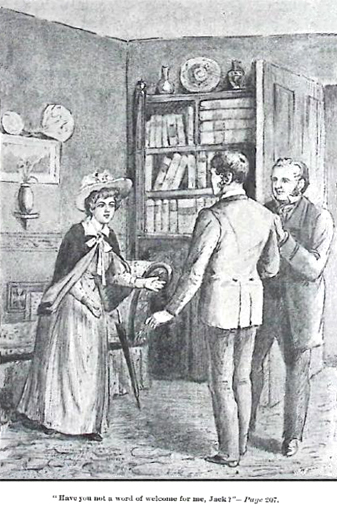
"Have you not a word of welcome for me, Jack?"
"No words can tell how welcome you are, or how glad I am to see you, Nelly," I said as I clasped the little hand in mine, and felt very reluctant to let it go again, for her touch sent a thrill of happiness through my whole being.
Nelly was true; Nelly was unchanged, save that the slender, growing girl had become more graceful. All the angularity belonging to the age at which she left home had disappeared, and everything about her that had been winsome and charming then, had become yet more so during these three years of absence.
To hear her say "Jack" from the first moment, to see her thorough naturalness of manner, revealed the precious truth that adversity, time, change, absence, had failed to deprive me of the friend I valued most of all.
I had drawn a seat forward for Mr. Burford, and Nelly had dropped into a cosy chair of wicker, covered with dainty cretonne, when I ventured to suggest a cup of afternoon tea.
"That will be delightful, Jack, and just what I am longing for. I am hot and thirsty, for my father and I have had a long walk together. I only came home last night, a few days earlier than was at first intended, because by anticipating my journey a little, I could travel with an old friend."
"You did not come to Oakhill Station, Nelly, or I must have seen you," I said.
"No, Jack; we came to Waverton, and drove the four miles thence to Oakhill. I came upon my father unawares, found my mother and Rose from home, and likely to be for another week, so we are taking care of each other. Are we not, dear?"
She held out her hand as she asked the question, and Mr. Burford took it. As they exchanged glances, both began to smile, then came a merry laugh which told a tale. Indeed, the father and daughter were very much like a couple of children who had escaped from their guardians and were bent on having a good time together, even if they paid for it afterwards.
"I am being tyrannised over, you mean, Nelly," remarked Mr. Burford, still holding her hand in his and stroking it softly from time to time.
"This child came to the office, bade me throw work to the winds or wherever I chose, and dragged me out for a long walk with her. Who knows how many clients I may miss by running away at such a time?"
"You were not very busy, you know you were not; only you want me to feel very much obliged to you for being so obedient. I mean to have you nearly all to myself until my mother and Rose come; for even Magnus, poor boy! is away, grinding for an exam. It is something—indeed it is a great deal to see you, Jack," added Nelly. "I feel a little girl again when I hear your voice, though you are sadly grown up now, like myself."
"Yes, Nelly; I am quite a young man of business—station-master now, and hoping to rise still higher."
"'Work, wait, win,'" quoted the girl. "After all, your patience has not been as sorely tried as that of many, but you have worked well, I know, for my father has told me, and to some extent you have already won."
As she spoke, she glanced towards my watch-chain, and noted the short steel one without the appendages she used to see attached to that which had been my mother's.
"It is gone, Nelly," I said, answering the mute inquiry—"gone, to my great regret, for I possessed nothing that I valued more than the little motto-coin."
Then, in a low voice—for Betsy was coming in and out with the tea-things—I told her the story of my loss. "But the motto abides, though the little coin that bore it is gone. It will never leave me, any more than I shall forget the giver."
Nelly gave me a bright look and a little nod of assent, as if agreeing to my words. Then she said, "I suppose you wonder how we happened to call here. My father had not told me a word about your removal, and when we came near this place, I began to ask him who lived in it now, for Rose Cottage was always an object of intense admiration to me as a child. I do not think you ever came here in the old days, Jack, but I did. I have spent many an hour in this very room with Mrs. Henderson, who was a darling old woman with a young heart, and loved to have children about her. I was so sorry when I heard of her death; and as we were going homewards to-day, I said to my father I should like to see the cottage, though the dear tenant was gone, and that I hoped the place was kept in order and the roses pruned and trained.
"He said, 'Yes, the cottage is let again, and is in very good order. I know the tenants, and am sure they will let you have a look at it if you wish.'
"When we reached the door, I saw Betsy Harwood, and guessed the rest. Then we thought it would be great fun to surprise you, Jack, as we found you were expected home soon, and I was glad at the thought of seeing you."
"Think what I am, if you can, Nelly," I replied.
But somehow my words did not come so readily as hers, though my heart was full to the overflowing with joy. She was so natural and girlish in spite of her womany stature and elegant appearance. I began to ask myself whether I should not have been glad to see her more shy towards me, whom she had left a boy and found a man, with a man's work resting on his broad shoulders. It might have been pleasant to note just a shade of self-consciousness in her look, a little drooping of the shapely head, a casting down of the beautiful eyes when hers met mine, but there were none of these things. Her glance was as frank and open as ever; her manner just what a brother would have delighted in, just what I had thought would suffice for all happiness; yet, now I had it, there crept into my mind a shade of dissatisfaction; and why? Nelly was too straightforwardly and unreservedly kind. That was all.
I did, however, see one bright flush covering her face during this visit. It came when, tea being quite ready—and a very prettily arranged meal it was—Mr. Burford said—
"Nelly, you must preside over Jack's board, and make-believe that you are mistress, as you used to do when you had make-believe teas, as children, in the summer-house."
She rose at once and went to the table, but she turned away to take off her gloves and lay aside her outdoor garment. She lingered a little over this, but not long enough for the glow to have faded from her face when she took her seat. She said something about the heat, but I was glad to think that it was not wholly to blame for the lovely colour that must have come so suddenly.
As Nelly looked at the table, on which were brown and white bread and butter, biscuits, jam, crisp cress, and a hot teacake, she turned to me and said—
"Pray, Jack, do you call this a cup of afternoon tea? What a luxurious individual you have become! Here is a perfect feast, and I am so hungry with my walk, I shall do justice to your spread."
"You must remember tea is a meal to me, not a make-believe, to be followed by dinner two hours later. Betsy arranges all for me, and she has only given us a little extra supply. If you are really hungry, and if you were not going to dine afterwards, Nelly, I think we might improve upon it still further."
Nelly was beginning with "Impossible!" and declaring that tea present was much to be preferred to dinner in prospect, when the appetite was ready; but Betsy proved that she had heard my last remark, and acted upon it. She entered at the moment with a little dish of pink ham, in delicate slices, and garnished with parsley.
Nelly laughed like a very child as she saw her, and exclaimed, "Oh Betsy, this is so nice! The sight of your table has carried me back years and years, and made me feel really at home again. Is not this exactly like one of our old teas, Jack, when we had all been specially good, and were allowed a treat? You remember, of course?"
I did remember, and as I glanced back it seemed as though several years were blotted out, and Nelly and I were children again, as happy as ever.
We had the brightest little meal imaginable. No one enjoyed it more than Mr. Burford did, and I am afraid, judging from the way in which Betsy's dainties were appreciated, that the more elaborate home meal would receive scant justice. Never had tea tasted so delicious as that which Nelly poured out and handed to me; never had Lint Hall, in its brightest days, seemed so bright as did my little room for one short hour; never until then had I responded unwillingly to the call of duty, which told me that I must return to Oakhill Station without delay.
Mr. Burford relieved me from a little embarrassment, for he knew what were my hours, and judged how sorry I should be to shorten such a meeting.
"Nelly, my dear," he said, "Jack has work to do of a different kind from that you compelled me to leave. You said mine might wait, and I have allowed it to do so; Jack's cannot, and his absence might involve serious consequences. He will have to go; and so must we, my dear."
"I will be ready directly," she replied, as she rose from the table. "I have not seen half your treasures, Jack, but I hope I may have another chance."
"Indeed, I hope so too, Nelly." And then I dropped my voice a little as I added, "Do you know that your visit this afternoon, has fulfilled the strongest desire of my heart in connection with my new home? I said to myself, 'If only Nelly could just come in and sit once at my table, and then go away able to picture her old playmate amid his every-day surroundings, I should be so contented.' Yet I never dared to hope that my desire would be fulfilled."
"But it has been, and very soon, fulfilling my great wish at the same time; for I did want to see you, Jack. I have thought about you in the old cottage, and grieved over your troubles; indeed, I have magnified them out of very sympathy; and all the while you have been making a steady progress in the right direction. I am so glad and thankful. What you have already done fills me with hope on your account, and I am sure you will attain a good place in the world. Once my single hope was, that Miss Flint would see things in a right light, and devote some of her wealth to giving you back the lands of your fathers. But I do not feel like that now. You will be a happier and a better man for owing prosperity to your own efforts, and you will be able to hold your head the higher—I do not mean proudly, Jack—for having waited and worked patiently before you won it. I must not keep you longer."
"I only wish I could stay, Nelly."
"I know that. Well, we have this last hour to look back on, and we shall no more forget it than we have forgotten our early days during years of absence. Friends once, friends always, Jack."
"Always, Nelly. When we shall meet again, we cannot tell; but having met so unexpectedly, all things seem possible."
A hand-clasp from father and daughter, a hasty good-bye, and I was hurrying back to my work with a sense of such happiness as I had not known before since my father's death.
I laughed to myself from time to time, as I thought of Mr. Burford's face and the reckless, boyish fashion in which he had dared to enjoy himself, and to bring Nelly under the roof that I called "home." What would Mrs. Burford say if she heard of this escapade? Surely no bird of the air would carry the matter; for if so, I feared both Nelly and her father would have an uncomfortable sequel to it. She could not touch me, but I should be grieved if these two kind friends experienced any unpleasantness on my account.
I had not asked Nelly who her travelling companion was, and I wondered if it could be Miss Flint who had been absent for some time past. I hardly thought she would return by Waverton, and drive thence to Lint Hall; but who could account for any fresh whim of Cousin Dorothy's?
I should doubtless soon hear from the Cartwrights whether my relative had come home or not; for, as of old, they were often dropping in to see Jabez and Betsy. Cartwright had been saying that he should like cuttings from some of the roses at our new cottage, as many of them were exceptionally fine, their cultivation having been made quite a hobby of by Mrs. Henderson. He wanted to see them in full bloom, in order to mark the ones he wished to introduce to the Lint Hall gardens.
I had taken care that Nelly did not go without a sample, for whilst we were at tea, I had asked Betsy to cut some of the best flowers. To these I hastily added others from those which clustered round the porch, and gave them to the girl as she was leaving.
"Thank you, Jack," she said, burying her face amongst the scented blossoms. "How lovely they are! We have none so fine at home."
I had felt glad to think that she had something to carry away as a remembrance of her visit, and I knew that, as roses, the neighbourhood could furnish nothing better than those I had to offer.
As I went about my duties during that evening, I did not think of roses, however, but of a fairer picture still. It was delightful to go over the sayings and doings of that happy hour in my little sitting-room, which would henceforth be associated with the precious memory of a reunion longed for, but hardly hoped for. I had become suddenly rich with a new kind of wealth, better than even the worldly riches that had taken to themselves wings.
I was rich in friends—I, who had thought myself all but alone—rich in hope for the future; and I said in my own mind,—
"I will not believe in the impossible. Rather will I cherish the conviction that nothing is unattainable to those who work and wait—work in the right way, and as in God's sight; work with a right motive, and thinking of others' benefit as well as one's own; waiting the while God's time with patience, yet without fear or despondency."
But real duties had to be attended to as well as day-dreams. I was on the platform as the last train ran into the station, and as soon as it came to a stand and the carriage-doors were opened, from one of them Rose Burford stepped lightly down. Then she held out her hand to assist another passenger, and this, I saw, was her mother. Farewell to any hope of seeing Nelly during the next few days. Farewell to the hoped-for "tête-à-tête" between father and daughter.
Mr. Burford would subside into his ordinary routine, and neither he nor Nelly would dare to allude to Rose Cottage or Jack Simpson, in her august presence.
I felt unfeignedly sorry, for I knew how strong was the bond between the father and daughter, and how much Nelly brightened Mr. Burford's life when at home, yet without neglecting her duty to her mother.
FOREBODINGS AND HOPES.
THE Harwoods' old cottage was still standing empty as we left it. Mr. Burford had not quite made up his mind as to the kind and size of the dwelling which was to occupy the site of it, but in the meanwhile, he would not let the place again.
I was rather sorry that the cottage was not promptly demolished, for I found out that the old people got into a way of haunting the scene of so many memories, and I was sure this would do them no good. They were very proud of Rose Cottage, which was a very palace in comparison, but they clung to the less attractive spot, in spite of being really satisfied with the change they had made, for my sake in the first instance.
Jabez would sometimes go out after working-hours with his gardening tools, and on several occasions I caught him digging and delving in the old ground.
I ventured to remonstrate with him for spending the strength of which he had none to spare, on a place in which he had no beneficial interest.
He looked up wistfully, and replied—
"I can't help it, Mr. John. I have kept this garden in order for so many years, and never could abear to see a weed in it, that it goes to my heart to let it be neglected now."
"But when the men begin to pull the cottage down, and afterwards, whilst the building is going on, your work will be undone. There will be all the worthless materials from the old place, and the bricks and mortar, timber and slates, for the new, upon the very beds that are costing you so much labour. Even at the best you will reap no benefit. Others will do that, wherever the garden is unoccupied by the things I have named."
"Well, Mr. John, I can't help that. As to doing a bit for other people to benefit, I shall never grieve over that. We didn't come into this world to think only of ourselves. If so be that little hands pull the ripe berries from the trees I planted, the children, bless 'em! are welcome; and if older folk have a bit of green stuff ready to their hands through my doing an hour's work now and then in the old spot, I shall be no poorer for it."
"You show a truly neighbourly spirit, Jabez," I replied, admiring the unselfishness of character which he displayed even to the unknown neighbour who might call the garden "mine" at a future day, "but you are getting into years. I am sure your daily work and the care of our garden at Rose Cottage are quite enough for your strength."
"Maybe you are right. I'm not as young as I was, by a long way; but, Master John, though you are young, you know what a labour of love means. Well, this is my labour of love. I cannot help doing it, and Mr. Burford does not mind my pottering about here when I have the time. You may be sure I did not take the liberty with-asking leave first."
I was greatly touched by the old man's words and the sight of his earnest face. I could well enter into the feelings which prompted his work, and yet, for his own sake, I did wish that the demolition of the cottage had rendered it impossible. I was half glad, half sorry, when Mr. Burford gave Jabez a small weekly sum for keeping the little place in order, "for the next people," as he expressed it.
Jabez was unwilling to receive anything, and seemed really distressed at the idea of payment, but Mr. Burford insisted.
"I am not going to have you toiling there, and spending your strength on what will do you no good," said he.
"It will do me good, sir, indeed," protested Jabez. "If you believe me, the working in the old garden freshens me up instead of tiring me."
"Work and welcome, if you take my weekly half-crown."
"I can't, sir. It's a labour of love."
"Then I shall put a stout padlock on the garden-gate, and a board to warn off trespassers on pain of being prosecuted. You can take your choice, Jabez," said Mr. Burford.
"If I must take the money, I must," responded Jabez ruefully, but his face brightened later on. "I'm not bound to spend the money on myself, or you either, Betsy. There are more ways than one of getting rid of money, and the work may be a labour of love yet."
It proved doubly such, for the cash was handed to Betsy week by week, and she expended it for the benefit of a needy neighbour and her children. Still, I would rather have given Jabez the money, if it had been a question of payment, to keep quite away from the old cottage and garden.
I could hardly understand why I felt so strongly, but I was always haunted with a notion that some trouble would yet be connected with the place, and that the sorrows of its late tenants were not ended. I never could pass the deserted dwelling without casting curious glances into every corner that was visible. I used to look at my old room window, half expecting that the scarred face of George Harwood would meet my gaze from within.
I knew these were idle fancies, and strove to banish them, but from the time that Mr. Burford revealed the mystery which Jabez and Betsy had so carefully concealed in respect to their son's career, no day had passed without its crossing my mind. That the good-for-nothing would reappear sooner or later I never doubted. That his coming would be the herald of renewed sorrow to the parents, I was equally convinced, and in time my forebodings were fully justified.
At Oakhill Station we generally heard any news that might be stirring. In country towns people take a vast interest in each other's affairs, and whilst they are generally more sympathetic than dwellers in busier centres, they are also more curious and more eager both to hear and spread every bit of gossip.
If Mrs. Burford's arrival had been unexpected on the evening after I entertained her husband and daughter, I was pretty sure that I should soon know the reason of her sudden home-coming. Nelly's words had led me to believe that she would be absent for another week, and when we were together, neither she nor Mr. Burford looked for the immediate return of the mother and Rose. I knew afterwards that, at the very time we were spending that bright hour in my little room, a telegram was awaiting Mr. Burford with news of the serious illness of his only son.
I have said little so far about Magnus Burford. He was the youngest of the family, two boys having been born between Nelly and him, but both had died in early infancy. Magnus was a quiet, studious lad, and of a gentle, retiring disposition. When the girls and I were ready for any amount of fun in our playfellow days, he would steal away into any quiet corner and pore over a book. Our laughter seemed to pass unheeded, our sports were no temptation to him; and when obliged to leave his favourite volume, he would be like one awakened from a dream which was happier than the realities around him.
Mr. Burford used to say that Magnus was a mistake, and ought to have been a girl; that either Rose or Nelly would have made a better boy, albeit there was nothing unfeminine in the ways of either. They were just a pair of bonny girls, with the bright spirits that accompany healthy minds in healthy bodies.
Though Rose partook of her mother's prejudices, and was too fond of estimating people rather for what they possessed than for what they were in themselves, she was both admired and liked by her friends and associates. She was always worldly wise in her choice of these, and before entering on anything like familiar social intercourse with those she met, she was careful to ascertain that they possessed the requisite qualifications of property and position.
Let them have such and sufficiently refined manners, and Rose would be content, and make herself as charming and attractive as could be desired.
Nelly, on the contrary, troubled herself very little as to whether a friend's balance at the bank were large or small, or, indeed, whether he had coin enough to be worth banking. Her whole conduct towards myself, proved that she was not to be influenced by adverse fortunes to forsake a friend.
When I heard of Magnus's illness, I felt very sorry for his parents and sisters, to whom it would be a great trial. Mrs. Burford's anxiety for her children's welfare could not be doubted. She was not very tender or demonstrative, but I am sure she tried to promote their well-being to the best of her power and knowledge. Even in banishing Nelly from Oakhill for so long a time, I knew that she was actuated by a wish to benefit the girl, and thought the separating her from all her childish associations was the best way of doing this.
When Mrs. Burford received the news of Magnus's illness, she telegraphed to her husband and started for home, as it would be equally convenient to take Oakhill on her way, and to proceed thence to her boy's bedside, only fifteen miles farther.
Nelly's home-coming was naturally greatly saddened by her brother's condition. Mr. Burford was too anxious about his boy to remain behind, so he and his wife drove the rest of the distance, after an hour's interval from the time of her arrival at home. There was no train available, and even had it not been too late to go from Oakhill by rail, they must have driven five miles of the distance, as the school was so far from a station.
Rose and Nelly were left alone together, and probably this increased their pleasure in meeting, in spite of the anxiety in which they were involved.
When I heard the sorrowful news, I should have liked to inquire after the invalid, but my going to the house was out of the question. So until Mr. Burford's return, I had to content myself with indirect information.
On the following day, the Cartwrights came—Jane first, to enjoy a cup of tea and a gossip with Betsy, her husband a little later, to see and mark the roses for future operations. They brought the news that Mr. Burford had come back, but that his wife had remained with Magnus at the school.
The boy was in no immediate danger, but had broken down from over-study, and would need a long rest before he could resume his work.
"Always the way," said Jane; "when schoolmaster gets hold of a young gentleman that will learn, he isn't content with him doing as much as he ought to do, but wants to cram his head with everything at once. No wonder he can't carry it. I often feel sorry for the boys and girls now, with their lessons in school and out o' school, and no time to be children or have a good game, as is natural to them while they're of an age for it. And if it's so with poor folk's youngsters, what must it be with great people's children?"
"I ain't larned, though I can read and write and reckon up my money and how I spend it," said Jabez by way of comment.
"That last has never given your head very hard work," said Betsy promptly.
"Except in getting ends to meet, and lap over a bit now and then," replied Jabez. "I was going to say that I got on very well without so much schooling; and I was glad I happened to be a boy before people got hold of so many new-fangled notions about it. I had a rare good time for a working-lad," and Jabez laughed at the memory of his boyish days, with their scant allowance of schooling and large one of comparative freedom.
Cartwright's views were more advanced.
"After all, there's a deal to be said for new-fangled things, though you would never have missed or wanted most of 'em, Jabez," said Cartwright. "Look at the telegraph bringing word about Master Burford's illness, and taking a message back to say that his father and mother would be there the same night! He might have been dead under the old ways of doing things, before they could have heard that aught was amiss with him."
"There's another side to look at," persisted Jabez, who was inclined to dispute whatever might be said in favour of modern inventions. "If there hadn't been a tallygraft, Mr. and Mrs. Burford might have stayed at home in peace, instead of driving off post-haste last night, and not getting to their journey's end till after twelve o'clock. Master Magnus had fainted over his books, and no wonder, seeing the weather is so warm and the holidays just at hand. He came to again, by all accounts, but before there was time to see what was amiss with the boy, schoolmaster must send that message. If he hadn't tallygrafted, Mr. and Mrs. Burford wouldn't have been frightened out of their wits almost, and the young ladies left by themselves with a weight of trouble on their backs, wondering what word would come next. I say, 'Bad news always travels too fast, and good news always comes at right time, without tallygrafting.'"
Jabez looked round triumphantly, and as no one thought fit to contradict him, felt that he had quite the best of the argument this time.
"To think that Mr. Burford was in here only yesterday afternoon, taking a cup of tea with our Mr. John, and looking better and younger than I've seen him for years," said Betsy proudly.
"Did he tell you Miss Nelly was back home?" asked Jane.
"No need to tell, and for why? Miss Nelly came with her father. She's prettier than ever, and she's not a bit proud or stuck-up because she's been so long in foreign parts and can speak in foreign tongues."
"Well, you do astonish me!" exclaimed Jane after a brief pause, for this piece of news had for the moment deprived her of the power to reply. "'When the cat's away—'"
Jane did not complete the old proverb, but nodded significantly at Betsy.
"Ay," said the latter, "you are about right, Jane. Mr. Burford is a kind gentleman, and has stood up well for Mr. John, but he would never have dared to come here and bring Miss Nelly if his lady had been at home or expected there so soon."
"I'm inclined to think that they were out for a walk, and they just dropped in here quite pro-misc'us, and did not think of coming here when they started," remarked Jabez.
"I make no doubt Miss Nelly knew, whatever Mr. Burford did," said Betsy, with a knowing look, and as if surprised at her partner's obtuseness.
She was mistaken. Our meeting was a glad surprise alike to Nelly and myself, though, in the kindness of his heart, Mr. Burford must have planned it.
Betsy's pride on my behalf, however, induced her to put another construction on the affair, and she took the first opportunity of imparting it to the Cartwrights.
Had I been present during the conversation, I should have promptly contradicted such an assumption, but I came in later.
I had carefully abstained from naming my visitors even to the Pritchards, who were most in my confidence, as I was not anxious for Mrs. Burford to hear that Nelly and I had met again on the old friendly terms. My mind was sufficiently exercised as to the possibility of future interviews, and I asked myself how I should act if my girl-friend and I were to meet when she was with her mother.
After the manifestation of friendliness on Mr. Burford's part, I neither could nor would avoid Nelly. Surely the father had an equal right with the mother. And though I would not have acted clandestinely for the world, neither should I have any qualms of conscience about meeting Nelly in future, when circumstances might permit me that happiness.
As to times and seasons, these mattered little in comparison. Nelly was within reach, and whenever we might meet, I could be sure that the pleasure would not be one-sided.
A "SORT OF RELATION" AT LINT HALL.
I SAW the Cartwrights at Rose Cottage that evening, and heard further particulars about Magnus Burford's illness, and of plans for promoting his restoration to health.
"The mistress will bring the young gentleman home first," said Jane, "but as soon as he is strong enough the whole family will go to the seaside, as usual, for a few weeks. Miss Ellen is looking bonnier than ever. Our old lady brought her back from Germany."
I assented to Jane's remark about Nelly's good looks, and said—
"I knew she travelled with some friend, but not that it was my cousin."
"There were two friends," said Jane—"our lady and a young gentleman that she picked up somewhere in foreign parts. Miss Flint makes out that he is a sort of relation of hers, but he is neither a Simpson nor a Flint. She would be hard set to show what kin he is, but, any way, it can only be by marriage; there is no relationship worth naming. However, the mistress can make him stand instead of those that are her own flesh and blood, if she chooses; and she is likely enough to do it, for I have heard her say, plain out, 'I will never leave a shilling to John Simpson.'"
"More shame for her!" said Betsy wrathfully.
"Not at all," I remarked. "Miss Flint's property is her own, and she has a right to do as she likes with it. I have not the slightest claim upon it, for my father's branch of the family had their full share of what belonged to those who were born before them. Our part has been scattered to the winds; Miss Flint is in the enjoyment of hers, and I trust she will long be so. Let her property pass into what other hands it may, I shall feel no disappointment, for my cousin has never made any secret of her sentiments towards me."
"She has not, Mr. John. She says what she means, and I have no doubt she will stick to it; though there's many a one has kept hoping that she would put you back at Lint Hall, when she saw how you had worked your way and made yourself respected by all sorts of people," said Jane.
"Is Miss Flint at the Hall now?" I asked.
"She is coming to-morrow, and bringing the young gentleman to stay with her for a week or two. It is a good thing we are used to her ways, and keep the place aired and in order, or we could not be ready when she gives such little notice. But this time there is more preparing than usual. It looks as if she were going to have company, for all the covers are to be off the furniture, the ornaments set out, and a lot of plate to be sent from the bank where it is kept. It has never seen daylight before, since Miss Flint came to the Hall. She must think a great deal of her visitor, or she would never make so many preparations for him. When she is here by herself, any old odd fork and spoon will serve her."
This news of Jane's set me wondering, not that I was surprised to hear of any whim of Cousin Dorothy's, but I began to speculate as to her object in bringing this newly discovered connection to Lint Hall. She must have already introduced him to Nelly, for they had travelled in company for some days. She always journeyed leisurely and comfortably, and declined to rush over the ground in the shortest possible time.
I could fancy her stopping by the way at any specially interesting places, and proving the most delightful of guides to Nelly and this new male favourite.
With all her peculiarities, Cousin Dorothy was exceptionally well informed, and much travel and unlimited leisure had enabled her to make continual additions to her store of knowledge.
I indulged in many speculations that night, for in the course of conversation I learned from the Cartwrights that Miss Flint had not met this Mr. Herbert Kenningham, for the first time during her recent tour. He had been much with the Burfords a year before, when they joined Nelly on the Continent, instead of allowing her to spend the summer holidays at Oakhill. It was Mrs. Burford who had ferreted out the connection, which did not amount to relationship, between Mr. Kenningham and Cousin Dorothy, and had effected the introduction, for which I owed that lady another grudge.
Not because my relative would probably endow him with a portion of her worldly goods. I had never expected that, either while she lived or afterwards, any part would come to me. She might leave him every penny, and her doing so would not cost me a sigh of regret. But Cousin Dorothy usually went dead against any plan of Mrs. Burford's, and an individual favoured by the latter, was almost certain to be anything but a favourite with the former.
I had hitherto believed that they were in accord only on one point—dislike of myself. Now they were agreed in their liking for this stranger, picked up only themselves knew where or how.
I was very angry at both, for I at once jumped to the conclusion that Miss Flint had purposely brought my own one girl-friend and Mr. Kenningham together a second time, and that she had invited him to Lint Hall to give him a better opportunity of cultivating Nelly's acquaintance.
"Have you seen the young gentleman?" I asked Jane Cartwright when her husband had gone into the garden.
"No, Mr. John, but I have seen his 'p'oto,' and if he is like it, he must be most uncommon handsome. Miss Flint had it with her the last time she was at the Hall, and she showed it to me and asked me what I thought of it. I said what I have told you about his looks, and Miss Flint nodded and seemed pleased."
"'He is a fine fellow, Jane,' she said. 'You would not meet two such as he in a long day's walk. I am glad I can claim a sort of relationship with him, and I wish it were nearer.'
"Then she went on as if she were thinking out loud, and I heard her muttering for a good while after. So far as I could make out, she said,—
"'Yes, if I had got married, I might have had such a son as he is, instead of being a lonely old woman, with nobody to care about me except for what they can get.'
"I ventured to say that, after all, marrying was a great lottery. You might get a husband that was steady and worth cooking and washing for when he is well, and waiting on when he is sick; or you might chance upon quite another sort, and wish you had been like Miss Flint, your own mistress, with nobody to say you nay. There was a deal to be said on both sides. You see, Mr. John, I wanted to cheer her up a bit, if she really was feeling down-hearted because she had out-stood her market."
"What do you mean by that, Jane?" I asked.
"Why, surely, Mr. John, you have heard the saying many a time! It happens now and then that a farmer's wife finds herself with all her wares unsold and the buyers gone, because she has stood out for the highest price, and nobody has been willing to give it. Then she has been forced to take her butter and eggs to a shop, and content herself with less than she has refused often enough during the day, or else she must carry home full baskets and an empty purse. So they say of a girl who has turned up her nose at one suitor after another, in the expectation that somebody grander and better would come, until she has grown old whilst she waited, that she has 'out-stood her market.' I cannot say for certain, but I have heard that Miss Flint had plenty of offers in her young days, and it is likely enough, for she was both pretty and rich."
"Yet she out-stood her market," I said, with a smile.
"Or, maybe, Mr. Right was not amongst them. There was a story, but I have forgotten the ins and outs of it, that there was one she cared about, only he was poor and proud, and afraid that he might be looked on as being only after Miss Flint's money. Any way, she is Miss Flint to-day, so we know the end of the story. It was not getting married and being happy ever after," replied Jane.
At this moment, Cartwright and Jabez returned from the garden, and Jane at once rose from her seat.
"We must be going," she said. "I have ever so many little things to see to, for the Hall is not ready for the mistress yet."
"I thought we were pretty straight before we came out," replied Cartwright, as he cast a longing look in the direction of his favourite chair. "Do you want my help?"
"No. All the heavy work is done; it is only the little things that are left to finish—the tittivating part, as we call it. You can stay and have a pipe and a chat with Jabez. You will be home by bedtime, I dare say."
Cartwright nodded and dropped into his chair, and for a long time he and Jabez talked on gardening subjects to their hearts' content.
I did not stay with them, but went to my own room, where I must acknowledge I thought of Miss Flint's new departure with considerable bitterness. I felt convinced that she and Mrs. Burford were conspiring to rob me of Nelly's friendship, by creating for her a new and lasting interest.
I could imagine, the pleasure with which Cousin Dorothy would parade this new favourite of hers, and, if only to indulge her ill-will towards myself, boast of the sham relationship in the ears of Oakhill people. She would have a grim satisfaction in noting the effect of his personal endowments on the feminine portion of her country neighbours, amongst whom young bachelors with cultured minds, polished manners, and good looks were not too plentiful.
This Mr. Kenningham might not possess that other qualification, a full purse, which prudent parents would desire as an accompaniment to the rest, but here again Miss Flint could step in triumphantly and make good the deficiency.
She was just the one to do it, and, I felt, would stand at nothing in order to carry to a successful issue any scheme on which she had set her mind.
Miss Flint was fond of Nelly, and probably thought that by introducing her to Herbert Kenningham she would be doing her a real service; always provided that this first acquaintance ripened into a closer tie and proved the means of parting her finally from me.
I have made this confession as to the state of my feelings that evening, in order to show how capable of self-torment I was, and how foolish it is in any person to build up a wall of trouble in front of him, when its only foundation is an imaginary one. I might have spared myself many anxious hours if, instead of doing this, I had let my mind rest on all the unmerited and unlooked-for good that had come to me already. Even if I had remembered the whole of Jane Cartwright's talk, I might have bethought myself that, according to her account, the whole Burford family would be going away from Oakhill on account of Magnus. But self-tormentors are always sure to bear in mind every circumstance likely to increase their trouble, and to leave unnoticed such as would tend to lessen or remove it.
When thinking over what I had heard about Mr. Kenningham's good looks, I might have found some consolation by a glance at my own reflection in the mirror. Though not quite twenty-one, I was fully six feet high, well built, and manly-looking. My simple habits and regular life had doubtless helped to lay a foundation of health, and I had not been a day absent from my duties on account of illness since I first went to Oakhill Station. As to my looks, I would rather not attempt a description of these, but it will be remembered that even my fair foe, Rose Burford, had declared to her mother that I was handsome, though I only knew this years afterwards. But what did these things signify? Of what value would looks, health, a good name, and an unblemished character be in the eyes of Mrs. Burford and Miss Flint, so long as the possessor was called John Simpson and was poor?
I had felt quite rich a little while ago—rich in having a quiet home, a few faithful friends, a sufficient income earned by honest work, and a trifle laid by to fall back upon in addition to my five hundred pounds, the interest of which now went to increase my capital; rich but yesterday in sweetest realities and most precious memories. I had held Nelly's hand in mine; she had occupied my cosiest chair and played the hostess in my little room. We had laughed and talked like a couple of children as we recalled the days when we were such, and Mr. Burford had laughed with us, and seemed as young as ourselves and no less happy.
My little room but yesterday had been all aglow with golden sunshine when Nelly sat there, and every article in it had seemed brighter and more tasteful, because she had touched and admired each in turn. Later on, I had sat in the gloaming, recalling every kind word of hers and the bright looks from those sweet, true eyes, and as I thought of them all, it mattered not that the sun had gone down and the stars were twinkling faintly in the summer sky. Memory still showed me Nelly. I should always be able to picture her again as she had looked during that one delightful hour. I could close my eyes, and memory would flood the room with golden sunlight, the chair would have its tenant at my will, and loneliness would be for the future a matter of choice. And this was yesterday.
Now I sat in gloom, conjuring up dark shadows which, though only shadows, proved powerful enough to chase away the substantial good which I could call my own, and the memories and hopes that had cast a rosy hue over my past and pictured for me yet better things to come.
On the following day I heard of two arrivals. Magnus Burford was brought home, and Miss Flint reached Lint Hall with Mr. Kenningham. Though they did not come to Oakhill Station, the luggage did, and certainly the quantity which bore Mr. Kenningham's name suggested that a long visit was intended.
"He is going to take up his abode at Cousin Dorothy's," I thought, as package after package was handed out of the van. I did not consider that Mr. Kenningham was returning from the Continent, and probably had more than his mere personal luggage along with him.
Betsy told me of Magnus Burford's home-coming.
"He looks real bad, poor boy!" she said, with a sigh of regret. "I saw the carriage driven up very gently, as I was passing the house this afternoon. He was nearly lifted out, and his limbs seemed to tremble under him as he walked to the door leaning on his mother's arm. Better have had him strong with a bit less book-learning than worn-out with too much."
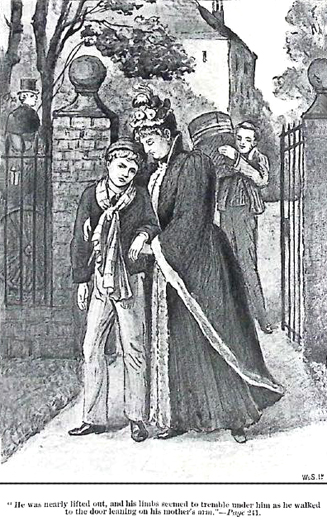
He was nearly lifted out, and his limbs seemed
to tremble under him as he walked
to the door leaning on his mother's arm.
I told Betsy that his parents had never wished Magnus to be overworked, and that it was the boy's own love of study that had made him do too much.
"He will soon be all right. Rest and change will work wonders," I said.
"Never, Mr. John!" replied Betsy solemnly. "I can read something in that boy's face—a look that tells me his illness will have only one ending. As to his going away, he will not leave his home yet awhile. It is well Mrs. Burford has got him safe there."
In one respect Betsy's prophecy proved correct. There was no question of a journey to the seaside. The two best doctors in the neighbourhood agreed that until Magnus gained strength, no further change would prove beneficial or could be attempted without risk.
I was truly sorry to hear this. I knew how great a trial the dear lad's illness would be, not only to Mrs. Burford, but to his father and sisters; and I fervently trusted they would be spared the still greater sorrow hinted at by Betsy's foreboding words. I thought even more about Magnus's condition than I did of its probable results, though now Rose and Nelly would perforce remain at home, and no doubt Miss Flint would insist on having them with her as often as Mrs. Burford could be induced to spare them.
MISS FLINT'S ROMANCE.
IN after-days I knew that Cousin Dorothy's regard for Herbert Kenningham was neither owing to Mrs. Burford's introduction, nor to the very distant relationship which really could be traced between Miss Flint and her guest.
The truth was, that my cousin's fair girlhood had not been without its romantic episode, though no one looking at the elderly spinster of to-day, with her eccentricities of dress, speech, and manner, would have suspected this.
The visitor in whose honour the plate had been brought from the bank, and the Hall turned its best side out, could not have connected any memory of Miss Flint's young days with her evident partiality for himself. Had he known all, he might have done so.
As Cousin Dorothy looked in the face of her young guest, she saw the living semblance of another Herbert Kenningham, his uncle and her distant cousin. Looking at the young man of to-day, her thoughts went back over long years, and she pictured herself as a girl of nineteen, an only child, a rich heiress, followed, flattered, sought by many, who all pleaded in vain.
Apart from the crowd stood one—that far-away cousin—just five years older than herself, a model of brave young manhood, with a nature equally strong and tender. Cousin Dorothy could call to mind how his elders trusted him, how little children haunted his steps and tried to coax him into companionship, and how dogs would follow him uninvited, happy in being near him. She remembered his patience with the pertinacious youngsters, his courtesy to the old and unattractive, his kindness to animals, for the veriest mongrel was sure of a pat and a kind word.
Cousin Dorothy was just the one to appreciate all that was good and noble in this only individual who kept aloof from her. But she could not understand why he ever lingered near, yet never asked for what her heart told her was indeed his already. She did not dream that poverty sealed his lips, and that, whilst she joyfully thought, "I have enough for both," his feeling was, "Were I to ask Dorothy to become my wife, she might judge that I was only one amongst the fortune-hunters who are always besieging her, and speak of me as she has done of others."
So the words which might have changed the future of two lives were never spoken, and the paths of Dorothy Flint and Herbert Kenningham crossed no more.
Neither married, but he died in a foreign land at six-and-thirty, and just when fortune was favouring him after twelve years of hard work. From his sick-bed, he wrote to Cousin Dorothy, and told her that, through all this time, she had held the chief place in his thoughts and had been the one love of his life.
He told her of his struggles, made easy through long years by the hope of seeing her again, and of telling the tale which so often trembled on his lips during his days of poverty. He sent her a ring, only a plain gold one, with the motto "True till death" inside it, and asked her to wear it for his sake.
Cousin Dorothy placed the ring on her wedding-finger, and from that moment never removed it. She would have gone to the bedside of the sender had this been possible, but the news of his death followed so immediately after his letter announcing his serious illness, that there was no chance of this.
From that time began those eccentricities of speech, dress, and manner which had grown with her years and made her the Dorothy Flint whom I have endeavoured to picture as I knew her.
People imagined that she loved money, and hoarded it for its own sake, but they were mistaken. Cousin Dorothy regarded her wealth as the thing which had stood between her and Herbert Kenningham, and proved a misfortune instead of a blessing.
"Why should I care to spend on myself what has robbed me of him?" she asked herself in the time of her great sorrow. "My wealth sealed his lips and hindered him from telling, in time, the story of his true, pure love. What could rich clothing or rich jewels do to make amends for the loss of a faithful heart? They are less than nothing to me now, and I will have none of them. But I have one source of joy and comfort. Though we were parted by a mere shadow, I know that through all those years the noblest nature I ever met with, placed me first in its esteem, the kindliest heart beat true to me!"
In this thought Cousin Dorothy found her best consolation. All that the world values or wealth can buy would never have given comfort to a nature like hers. Had I known these particulars when the namesake of Cousin Dorothy's dead love first came to Lint Hall, the knowledge would have spared me some of the jealous feeling which his presence engendered in my mind, though I should still have made myself fairly miserable on account of his being thrown so much into Nelly Burford's society. Miss Flint's openly expressed hostility to myself, made me put the worst construction on her motives in bringing him to the Hall.
I cannot tell how Betsy Harwood obtained her information, except on the principle which I have named as peculiar to country towns in general, namely, that everybody knows everything about everybody else. Betsy it was who told me that there had been "a fine to-do about Miss Nelly coming to Rose Cottage."
"The master might have no right to take his daughter out with him or to call on a friend, by the way Mrs. Burford lectured him," said Betsy.
"But how did Mrs. Burford know that they had been here?" I asked. "She only came home that evening, and went away directly with her husband to fetch Magnus."
"It was the roses that told. You know we have some here different from any in the town, and finer, too. You remember, Master John, how you gathered the very best for Miss Nelly. Well, she carried them home and took the greatest care of them, but she was wearing some the day her brother came. He is such a boy for flowers, and directly he saw the roses, he called out, 'Nelly, those are from Rose Cottage. Mrs. Henderson used to give me such when I called upon her with my mother. Let me smell them; there are none so sweet.'
"Miss Nelly had the roses fastened near her throat, and she bent over Magnus for him to smell them. He laid his hand on them as if to pull them away, but she said, 'I have more, dear, fresher than these, and only half open. I will fetch them for you.'
"The boy loosed his hold of the roses, and Miss Nelly ran to fetch the others. He had these in his hand when Mrs. Burford came in, and he called to her, 'See what Nelly has brought to me! They are from my favourite bush at Rose Cottage.'
"Though the lad is so ill, and he had only just got into the house, as one may say, Mrs. Burford's face went as red as fire, and she turned to Miss Nelly.
"'How did you get flowers from Rose Cottage, Ellen?' she asked, in that stern voice of hers, enough to frighten one.
"Miss Ellen went white and red, but she looked up in her honest way, and said—
"'I called there with my father the day you came back, before you fetched Magnus from school. I had no chance of telling you before.'
"'You called at Rose Cottage! Your father took you! And pray what business had you there? I suppose you planned this disgraceful visit purposely when I was away.'
"Mrs. Burford was angry, though I don't see myself there was any disgrace about calling here, if even you had been out of the way, Mr. John. I take it there's no disgrace in being plain working folks and living in a little house, so as you pay your way and do what's right to the best of your power.
"Miss Ellen answered that there was no planning about it; that she was out walking with her father, and he called at Rose Cottage to speak to me, and afterwards they stopped and had tea with you, Mr. John. She said she did not know we all lived here till then, but she was very glad we had left the old house, which was not good enough for her friend and playfellow Jack, but now everything about him was fit for a gentleman born, like you are, Mr. John, though it might not be grand or have cost such a lot of money as their furniture had done.
"I can't tell you all that was said, only that there was a great disturbance, and Mrs. Burford raked up all the ill-natured things that she used to be so fond of saying soon after your father died, and had them over again. She told Miss Nelly that she had low tastes that nothing would cure, and she should go away again till she learned to know better; that if ever she disgraced herself by again speaking to young Simpson, she should pay for it in a way she little counted on.
"The more angry Mrs. Burford got, the calmer Miss Nelly was. She answered her quite firm and steady, and said—
"'Mother, I am sorry that I cannot agree with you, but I should be grieved indeed if I could feel anything but regard and esteem for my dear friend Jack. It seems so strange that you, who once could not say enough in his favour, should speak so harshly and cruelly about him, and for no fault. My father and grandfather say that Jack is a good, brave fellow, whom everybody honours, not for what he has, but for what he is. Nobody speaks ill of Jack but you, mother, and surely every one else cannot be wrong. His life is open for all to see, and he has proved by it that he can be as thorough a gentleman whilst earning his bread at Oakhill Station, as he could ever have been at Lint Hall. Father is as proud of Jack as ever.'
"'Gentleman or not, I insist upon it that you never speak to John Simpson again,' says Mrs. Burford. For, poor body! I believe she was just at her wits' end to find something ill-natured to fling at Miss Nelly about you; only she couldn't, and for a good reason.
"'Do you hear, Miss?' she went on. 'I expect you will give me your word never willingly to see that wretched young man for the future.'
"'I hear, mother,' said Miss Nelly, 'but I can give no such promise, for I should not keep it. I hope I shall see Jack, and much oftener than I have done of late years. But I will promise this, that when father and grandfather Burford forbid my speaking to him, and agree with your opinion of him, I will give up my old friend.'"
"Poor Nelly! I am sorry for the unpleasantness between her and Mrs. Burford. It would be very hard for her to oppose her mother, but Mr. Burford has always favoured our continuing friends, and he brought Nelly here quite unexpectedly to me," said I to Betsy.
"And very glad the young lady was to come, Mr. John; and nobody could say wrong there was, except just her cross-grained mamma. Not that Mrs. Burford will get her own way about sending Miss Nelly away again. I know better than that," and Betsy nodded sagaciously. "I have not quite done with my story about the roses," she added, "for after Miss Nelly as good as said she should always keep friends with you, Mrs. Burford just scolded right and left, as one may say. Then she snatched the roses from her daughter's dress and crushed them in her hand, thereby getting more than she bargained for, seeing they were fastened with a big pin, that buried itself deep in the palm and gave her something else to talk about for a while after. She had more than that, too, for the poor boy was so overdone by the noise and the scolding that he went off in a dead faint, and it took some time to bring him to his senses again. I dare say Mrs. Burford would be sorry enough when she saw her poor boy so upset through her going on. But being sorry cannot always mend mischief. Master Magnus had to be taken to bed, and seems likely to stop there, by all accounts."
I was very much grieved to hear this about the sick boy, and I could not help echoing Betsy's subsequent wish that ill-tempered people might be forced to carry on their own shoulders the whole weight of trouble caused by their hard words.
"Yes, Master John," said she, "that would teach them to think before they speak. But the mischief is, they trouble other people too. I've often said that 'hard words break no bones,' and mostly these old sayings have a deal of good sense in them. I am beginning to think that they sometimes do worse than break bones."
"Ay, Betsy, they wound tender hearts; they break friendships; they lay up sorrowful memories. Sometimes the wounds are never healed; friends meet no more as such, and the bitter words will not leave the memory through the long years that follow," I replied.
"And those that have made all the mischief blame everybody but themselves. I dare say, if one could know the truth, Mrs. Burford blames you for Master Magnus being worse."
"Blames me!" I cried, amazed that Betsy could imagine that possible. "How could she blame me, when I have neither seen nor spoken to Magnus for years?"
"When people want somebody else to take the blame of their faults, they can always find a way. Didn't you give those roses to Miss Nelly?"
"Of course I did?"
"And wasn't it the sight of them that made Mrs. Burford find out that the young lady had been here with her father?"
"Certainly, but they came of their own accord."
"That's true enough, but the coming made Mrs. Burford angry, and depend on it, she says it was all through you stopping at Oakhill, when she thought by rights you should have gone away where nobody knew you. If you had gone to Australia or America, you would not have been here; and if you had not been here, nobody could have come having tea with you and carrying home roses to vex Mrs. Burford. You can see, Mr. John; it is all as plain as A B C. It was through your roses that the lady got in a temper and made her son ill."
There was a humorous twinkle in Betsy's eyes as she made out the case against me on Mrs. Burford's behalf.
"You are right," I replied. "If any one is determined to make out a case against another, a way will be found, though it may be a crooked one."
Mrs. Burford subsequently attacked her husband on the subject of that visit to Rose Cottage, but found herself hopelessly worsted. Mr. Burford showed sufficient firmness, and frankly told his wife that he should use his own judgment with regard to the places to which he might take his children.
"As to Nelly going abroad again," he said, "she will do nothing of the kind. She is going to stay at home to be a comfort to me, and, I trust, to you also. I have been deprived of my dear girl's sunny presence far too long already, and I mean to enjoy as much of it as possible in future. Where Nelly goes, I go. I am most thankful that she has returned home unspoiled, and that she has remained faithful alike to home affections and outside friendships. I was delighted to know this in regard to Jack Simpson, her old playfellow. It quite brought back old happy times to be Jack's guest in his little nest. I thought of his poor father, at whose table you and I sat many a time in bygone years, and how glad he would have been to see his lad what he is in spite of changed fortunes. I tell you, I have not had such a pleasant hour for years as that which Nelly and I spent at Rose Cottage. The memory of it, and of those young bright faces, is like a poem, and I hope to repeat it before long."
There were occasions when even Mrs. Burford had to own herself vanquished, not in so many words, but to herself. Her husband, good, easygoing, and indulgent as a rule, could be firm enough at times, and when he was in such a mood, there was nothing for her but tacit submission.
Naturally I did not know of this conversation when it took place, but I heard the particulars from Mr. Burford himself, when I saw him about another matter which troubled me not a little shortly afterwards.
MRS. BURFORD'S SELF-COMMUNINGS.
"THERE is something below the surface. He will not tell me because it is a professional matter, but I am convinced that he knows of circumstances which make it desirable to be friendly with John Simpson. I wish I knew, but it would be useless, to ask, and especially at present."
Thus cogitated Mrs. Burford after listening to those decisive words from the lips of her husband. She had convinced herself that there was something below the surface which she would not be allowed to penetrate, and she felt that silence and patience would be advisable under the circumstances.
Mrs. Burford was quite unable to understand her husband's larger, kindlier nature. If he showed special goodwill to any person, she measured him by herself, and judged that he expected some benefit, professional or otherwise, to be the result of showing it.
"If I could but know it, I have little doubt that Dorothy Flint has made her will at last," thought she. "My husband will say nothing, of course, but he will act on the knowledge. If she has left anything substantial to that young Simpson, there would be no harm in being decently civil to him. Dorothy has always declared she would never leave him a penny, but if she changed her mind, she is just the woman to find twenty excuses for carrying out a new whim. I have been daily expecting her to say that she meant to adopt young Kenningham. However, my husband knows what he is about, and he is, I believe, Dorothy's only confidant."
Mrs. Burford smiled at her own thoughts, and persuaded herself, that by carefully noting her husband's conduct, she should be able to form some notion of Miss Flint's intentions. That lady's voice interrupted her cogitations, and she turned quickly to receive and welcome her visitor.
"I am so sorry the girls are both out," she said, after the first greetings were over. "Are you quite alone?"
Mrs. Burford looked beyond Miss Flint, as if expecting to find that she had a companion.
"I came alone, if that is what you wish to ask, but I am no longer so, for you are with me. I want no one else. Not likely, when I come to visit the child-friend of my youthful days," responded Miss Flint.
"It is always sweet to recall those old days," said Mrs. Burford. "You know, dear, I always enjoy a talk with you alone."
"I shall not trouble you to go back so far as the old days, my dear. I think the present more interesting. I am gathering bright faces round me in 'my' old days, and I find that more agreeable than trying to see myself as I was more than forty years ago, and then going to my glass to note the difference between the picture which memory paints, and the one reflected by the mirror."
"We seldom have much satisfaction in anything it shows us when we are growing old. I feel this;" and Mrs. Burford sighed as she answered.
"I do not," said Miss Flint. "I never expected to look young and handsome when more than half-a-century had passed over my head; and if you did, I am sorry for you. Stay; I think I will leave out the word handsome. Good looks are as compatible with old age as with youth. It is when the old try to look young, and trick themselves out in unbecoming finery which apes youth, that age becomes alike hideous and contemptible."
Miss Flint spoke with no little dignity as well as feeling. "I am growing old," she added after a brief pause, "and I am afraid I shall not make the most amiable of old women, seeing that tempers rarely improve as infirmities grow upon us. But I do trust I shall have sense enough to dress and act in accordance with my years, and never be ashamed of people knowing them."
"You can never be accused of dressing too youthfully," said Mrs. Burford. "You have gone into the other extreme. And if you would fall in just a little with the fashion of the day, you would look years and years younger, without the aping of youth you spoke of just now."
"That is just like Nelly. She and I agree on most subjects, but the child harries me now and again in the matter of dress, in this one respect agreeing with yourself. I have promised Nelly that one day she shall choose me a gown and accompaniments. She has long wished me to fix the date, and now I have gone so far as to name the occasion on which I will be attired in accordance with her views."
"Do tell me what that is to be," said Mrs. Burford in a tone of entreaty.
"On Nelly's own wedding-day. As to the date, or any other particular in connection therewith, I am as ignorant as the child herself. But she will tell me in good time, I am sure, and in the meanwhile, I wait patiently for my new gown."
"I hope to see you in it long before that event takes place," said Mrs. Burford, with a look almost of displeasure. "Ellen is too young to talk about getting married—a girl just home from school. And I do hope, dear, that you will not sanction any foolish jesting on such a subject now she is so often with you at Lint Hall."
Mrs. Burford spoke warmly, and in a tone she seldom adopted towards Miss Flint.
But the latter showed no resentment, and replied—
"You may trust me. Surely you do not think me capable of making the most sacred of all human ties a subject for idle jests? It was a shadow, not a reality, that we laughed about. Nelly was pressing me to fulfil an old promise made before she went to Germany. It was, that she should choose me a gown and other articles without any restriction as to cost or material. Again and again she has urged me to say when, and at last I told her it should be for her wedding-day, let it come whenever it might.
"'That will not be for years and years,' she said, 'if ever; and I shall be only too glad to stay at home after so long a banishment. If it were not for poor Magnus, I should rejoice that we cannot go, as usual, to the seaside. You must let me choose the gown, though, seeing how long I have waited for the chance. It will be your dinner-party gown; for, of course, now you are settling down at Lint Hall, you will invite people and go in and out amongst your neighbours.'
"This was what Nelly said, and you may be thankful that, all things considered, the girl wants to stay at home."
"Are you really going to settle down, as Nelly says?" asked Mrs. Burford, who had become in a moment more eager to hear about Cousin Dorothy's intentions than her daughter's.
"For a while, certainly; probably till spring, if I can manage to rest for seven or eight months in a place after being such a rolling stone for thirty years. Only I shall want you to spare me the girls a great deal, or I shall run away without saying good-bye to anybody."
"You have young Kenningham with you at present."
"Yes. If he were like most young men, I should be sorry I had persuaded him to be the guest of a solitary old woman, but he is not, and I find the entertaining of this youth a pleasant experience. I indulge in all sorts of fancies. I make-believe that he is my nephew and he has adopted me as his maiden aunt. He is a fine, honest, single-hearted lad, and he has very real enjoyment in the quiet life he is leading with me at the Hall. The worst of it is, he cannot stay very long. But we are going to be quite gay for us, and have tennis at home, boating on the mere, country drives and excursions, in addition to other hospitalities. My new carriages will be here to-morrow."
Miss Flint enjoyed the astonishment shown on Mrs. Burford's face. She had purposely said nothing about the coming vehicles or her plans for entertaining her neighbours, and Mrs. Burford thought that one or two solemn dinner-parties would be the only attempts at festivity. Then the fine plate would be deposited in the cases and returned to the bank, and the Hall resume its usual condition.
"I do not know whether I am more surprised or pleased," she said. "I have always wished you would settle down somewhere near us and give up your—"
"Vagabond habits," said Miss Flint, taking advantage of a momentary pause.
"I did not use or intend to use such words."
"I am sure of it, my dear, but they are the right ones. I was going to say I am a born vagabond, but that would hardly be correct. I became one through force of circumstances and a thirst for knowledge, which I did not care to satisfy by study. It is so much nicer to see for one's self than through the eyes of other people, and travellers' tales are not always to be trusted," said Miss Flint promptly.
"When you spoke of drives just now, I began to wonder where you would find a decent carriage for hire in the town, and I was about to offer you ours."
"That was very good of you. Now I can offer you the choice of two, or I will do when I get them and circumstances are favourable."
"That means," thought Mrs. Burford, "when you cannot by any possibility use them yourself." Her words, however, expressed thanks for so kind an offer, of which she was little likely to be able to avail herself.
"I cannot bear to leave my boy for long. I shall hear of your hospitalities, but shall not share them." Mrs. Burford's eyes filled and her voice trembled as she alluded to Magnus, whose condition was a sore trial to the mother.
"You must not leave him, of course. He can bear to drive with you, and, if I may, I want to see Magnus. I have something for him in the hall."
Miss Flint bustled out of the room and brought in a dainty basket, in which some of the Lint Hall grapes made a perfect picture resting on their own beautiful leaves. Then she followed Mrs. Burford to the boy's room.
"He cannot bear much excitement. You will be tender with him," whispered the mother, who would not have invited her visitor to Magnus's bedside unless almost compelled to do it.
"You need not fear," was the answer.
And truly any looker-on who knew her, would have wondered where the every-day Miss Flint was gone to, had she been seen in that sick-room.
Magnus was unfeignedly glad to see her, and when she bent over him, he clasped his thin arms round her neck and kissed her heartily. The quiet lad could understand Cousin Dorothy better than Mrs. Burford could.
The woman whose experience dated from childhood, as yet knew only one side of the old maid's character. All her children realised that beneath the rugged surface something better was concealed.
Mrs. Burford had never felt so kindly towards Cousin Dorothy in her life as she did after seeing her with Magnus. She coaxed him to take some of the grapes; she talked cheerily to him—told him stories of wonders she had seen in her travels, to which he listened with eager interest. She took him, as it were, out of himself for a whole happy hour, and finished with an account of the new carriage, in which she declared he should take the first drive, with the doctor's leave, as it was specially built for the comfort of invalids and old women. She left him looking and feeling better than she found him, and Mrs. Burford knew it, and thanked her with all her heart.
"You would not believe how much Magnus enjoyed Miss Flint's company this morning," she said to her husband. "I asked him afterwards if he were tired, and he told me,—
"'No, indeed. I was weary before of lying so still and doing nothing. She is an old darling. I want her as often as ever she can come.'
"Dorothy Flint is the strangest mixture of qualities I ever knew. She is so terribly bitter, almost revengeful, where she takes a dislike to a person; and her likes and dislikes are equally unreasoning, so far as outsiders can judge."
"Her partiality for young Kenningham and her antipathy to my friend Jack Simpson, for instance," said Mr. Burford slily.
"Why do you persist in dragging John Simpson's name in? You know so well my feelings towards him."
"Because I could think of no more apt illustration of your remark about Miss Flint's likes and dislikes. You cannot understand either; and, dear wife, let me ask you to look into your own heart and see whether you have any reasonable ground for some of your own. It has given me pain, more than I can express, to notice your hardness towards our old friend's son, and for no cause, except that, without any wrong-doing on his part, he found himself in poverty, when he had until then every cause to count on riches and—"
"You need not tell me what John Simpson expected; surely all these things are as familiar to me as to yourself. It was no fault of mine that he lost his money."
"But was it not your fault that the lad's sore heart was wounded yet more deeply? Was not the change in your conduct towards him as unreasoning as Miss Flint's hostility?"
"No. I had a very good reason for the course I took. Was it likely that I could permit the intimacy between him and our own children to continue on the old footing? They were passing beyond childhood, and pray would it have been a fitting thing for the ticket-boy at the station to parade up and down with my daughters at will? If there were any romantic nonsense in the young man's head, I think it was really kinder on my part to nip it in the bud. Half-measures would have been ridiculous, and would have failed. I wanted to touch John Simpson's pride, as the best means of separating him from our girls, and I did it. Events have proved that I acted rightly, though I am sometimes afraid that your indiscretion—or shall I call it tenderheartedness?—will yet spoil everything. Whatever happens, my conscience will not reproach me for having neglected to watch over the interests of my children."
"We take different views of things, and I am sorry it should be so. I cannot see that it is right to try and advance the worldly interests of your own children by being hard, cold, and unfeeling towards an orphan-lad in his hour of need, and by ignoring old friendships. At this moment, dear wife, I grieve for you. It hurts me to see you cherish a causeless animosity, and as I grieve, I fear that your heart will be wounded in its tenderest affections before you realise what is in it, what bitterness needs to be expelled therefrom. As to Jack, I have no concern for his future. He has surmounted many difficulties, and though he may still fill a comparatively humble position, mark my words, he is on the high-road to—"
Mr. Burford checked himself and paused.
"The high-road to what?" asked Mrs. Burford eagerly. "Has Dorothy changed her mind and made a new will in his favour?"
"On second thoughts, I will not finish my sentence. To hear of good to Jack would give you no pleasure."
Mr. Burford left the room without further comment, and, much to his wife's chagrin, the secret that had been trembling on his lips remained unspoken.
For some time afterwards she was in a state of combined annoyance, curiosity, and fear—angry that Mr. Burford should have hinted at some secret without imparting it, and curious to penetrate it by other means. Her feeling of fear was on her own boy's account. What had her husband meant when he said, that her heart would be wounded in its tenderest affections before she realised what was in it?
Could it be that he thought the condition of her darling boy was a punishment upon her for having been so hard on John Simpson?
Mrs. Burford's heart sank within her at the thought. The arrow had been shot at random, but it had reached a mark often aimed at in previous conversations, but always missed until now. Mrs. Burford had been so accustomed to defend her conduct and to assure herself that she had acted rightly, that it was a new thing for even a momentary doubt to find a place in her mind. She had now, however, begun to look back at the real motives which actuated her, and this review was far from satisfactory, though she would not have owned as much to any human being.
A COTTAGE MYSTERY.
DURING the weeks which followed Miss Flint's return, I saw little either of herself or her visitor, but I heard of the gaieties in my old home.
Sometimes one of the new carriages would whirl past me, and its owner would be accompanied by both or one of the Burford girls. Herbert Kenningham usually occupied another place. He stayed on until September, and his presence filled me with unrest.
There was gossip enough at Oakhill, and everybody said there would be a wedding by-and-by, yet no person seemed able to decide which of the Miss Burfords would be a principal actor in it.
I never doubted that Nelly must be the attraction. Despite Rose's charms, I never imagined that she would inspire a second thought where Nelly came.
Sometimes I noticed the more luxurious of Miss Flint's carriages proceeding gently country-wards, and then I had no occasion to raise my head in order to ascertain who occupied it, for I was sure that Cousin Dorothy, Mrs. Burford, and Magnus were going for a drive together.
Needless to say, I received no gracious greeting from any of them. Nor did I seek it.
Once, and only once, did I meet Rose and Nelly Burford face to face when in company with young Kenningham. He was walking between the girls, but it seemed to me that he had no eyes save for Nelly. I thought her face had never looked so fair, for it was full of animation, and she was speaking with evident earnestness, whilst Mr. Kenningham listened as if completely absorbed by the subject, whatever it might be.
Rose was the first to see me, and, somewhat to my annoyance, she gave a little shrug of the shoulders and glanced, first at me, then with an amused look in the direction of the other two, as if bidding me note the good understanding between them.
For a long time before, Rose had not even deigned to notice me, and though now there seemed more of mockery than friendliness in a little movement of the head which accompanied her look, I lifted my hat in return without appearing to notice her manner.
This movement on my part attracted Nelly's notice. In a moment, she left the others and advanced towards me with outstretched hand and a beaming face.
"How are you, Jack? I am so glad to see you," she said, and her looks proved this.
"And I to see you, Nelly," I replied as I clasped the kind hand in mine.
"I have only a moment now, but I hope we shall meet again before long. We are so near and yet so far," she added ruefully.
I echoed the wish with all my heart, and had just time to ask after Magnus and hear that he was improving in health, but very slowly, when Mrs. Burford came out of a shop and towards us.
Nelly looked neither ashamed nor afraid of being seen in friendly converse with me, but again extended her hand as she said, "Good-bye, Jack."
I could hardly believe that my eyes told the truth when I saw Mrs. Burford give me a slight bow of recognition, to which I could only respond, in spite of all that had passed.
She was Nelly's mother, and Nelly was looking on approvingly. I could have forgiven anything for her sweet sake and rather than bring a look of pain to her face.
This interview again stirred contending feelings.
I could only be glad at the thought of the dear girl's kindness, but Mrs. Burford's slight civility filled me with anxiety. What could it mean? Was it possible that she no longer objected to my seeing Nelly and exchanging friendly greetings with her; and if so, what had brought about such a change?
I could find but one reply to my own questions. It must be because she was satisfied that Nelly's dearest affections had been won by another, and therefore she need no longer grudge me a shake of my darling's hand and a few kindly words.
"My darling!" Yes, Nelly had been nearest and dearest to me from the time I could remember anything. All the circumstances of my life and hers—even the means used to induce forgetfulness—had only made childish memories more precious and intensified my feelings of affection. I had no kindred to love me or to love. I had so many quiet hours to devote to memories of the past and day-dreams of future happiness to be mine, when I had climbed to a higher place in the social ladder.
"Come what may, I pray that she may be happy!" I said from my very heart; and I tried to drive away every selfish feeling and think only of her.
I had felt that her unembarrassed manner was simply suggestive of sisterly regard. I was angry with myself for expecting more, yet disappointed at the same time.
I have told how Jabez and Betsy Harwood were accustomed to haunt their old home after we removed to Rose Cottage, and of the manner in which Mr. Burford sanctioned the old man's efforts to keep its surroundings in order. Jabez's reasoning on the subject touched me deeply, without convincing me that it was good for him to be so often in a place with which many painful associations were connected.
Betsy and he might argue that they had spent most of their lives there, and loved every bit that formed the old roof-tree. I sympathised, but at the same time wished that the cottage had been pulled down and every trace of it removed.
Yet the place had its fascination for me also, and I often caught myself going a little out of my way in order to pass it. I did this on the night after my meeting with Nelly Burford. I was just in the mood for dwelling upon the time when we were first parted and I found humble, faithful friends in the old couple, whilst those who might have been kind stood aloof.
The latter part of the day had been gloomy, and darkness had come on early. A drizzling rain was falling, but in spite of this, I determined to take a brisk walk after leaving the office, and on my homeward way I came up the lane at the side of the old cottage. I stood for an instant facing the window of what was my room when I lodged there, and naturally my thoughts went back to the night of the robbery.
As I stood, the rain began to fall in a perfect downpour, and I remained under the shelter of a large horse-chestnut, which protected me from a drenching whilst it lasted.
All at once, I was amazed to notice a little flash of light in that room, and I was almost certain that it showed me a man's figure within. The light had probably been caused by the striking of a match, and quickly vanished.
I crossed the road, taking care first to creep along below the trees to some little distance, and cautiously approached the cottage. After waiting for a few moments, I became convinced that there were at least two persons in the old building. One of these, a female, came out, and the door was closed behind her and locked by some one within.
There were two ways leading from the old place to Rose Cottage. I took the longer, but walked rapidly. I felt that I should have my suspicions verified when I reached home and found Jabez alone.
I had been in the house three or four minutes, and had lingered beside the old man, taking off my wet boots and coat, when Betsy entered.
I had never before noticed Jabez show an anxiety to get rid of me, but he told me more than once, that I should find a bit of fire in my room, on account of the night being damp and chilly for early September.
"Damp enough," I answered, "but not cold. I felt it rather close than otherwise, but it was very thoughtful of Betsy to light a fire. I hope she is not out on such a night."
Jabez's face went pale, and his voice quavered as he answered—
"Betsy is out. She's gone to see a person that wanted her, that isn't altogether well. I wish she were safe back," and the old man sighed wearily.
"I do not wonder at anybody who is ill or in trouble wanting to see Betsy's kind face beside them," I replied. "But it is getting almost time for Betsy to consider herself as well as other people. This is no night for her to be out. Can I fetch her from any place?"
Jabez looked terrified at the suggestion, and began—
"There isn't the least occasion to trouble. She will come as soon as she can."
Before the sentence was ended Betsy entered, and I again saw on her face the same expression that came there when I described the listener at the railway station, after the robbery took place.
"You are both wet and weary, Betsy," said I. "You are so kind to others that you forget self altogether."
"I am getting old, Mr. John, and no mistake about it. I have been thinking I could do as much and as well as I used to do twenty years since, and I am finding out that I am all those years older."
She was making an effort to untie the strings of her bonnet as she spoke, but her hands shook so much that she dropped them on her lap, and added—
"I must rest a little before I do anything."
Jabez seemed completely scared at Betsy's condition, and murmured something about her having caught cold.
I noticed that she shivered from time to time, though I did not think this was the effect of cold, for the night was murky and the air close and warm.
"Let me help you," I said, and I succeeded in removing her bonnet and shawl.
She could scarcely put on her cap, her hands still trembled so much; and Jabez was no less agitated.
"You must have some of your own brew to-night, Betsy, and get quickly to bed. Where can I find some?" I asked.
My old landlady was famous for elderberry wine of her own making. It was highly spiced, and regarded as a sovereign remedy for a cold, if promptly administered. Many a time had she given it to me when I came in cold and weary; and I determined to attribute her symptoms to exposure to the rain, and insisted that hot elder wine was the right thing for her to take.
Jabez eagerly adopted the suggestion, and seemed quite relieved that nothing else was said about his wife's unusual condition.
Betsy took some of the hot wine, and by degrees the colour came back to her cheeks, and she gave me a wan smile along with her thanks and regret for having caused so much trouble.
Feeling that my absence would be a relief, I left the old couple together and went to my own room, after advising Betsy to go to bed as soon as possible.
As may be imagined, I was extremely concerned at what I had witnessed. I could only come to the conclusion that the some one hiding in the old cottage was the worthless son of the Harwoods; and that his being in the neighbourhood boded good to no one, least of all to his unhappy parents. That they were suffering acutely I could not doubt, and not merely on account of the past, but of what might be the outcome of his return to Oakhill.
I felt sure that Betsy had gone to the old cottage under cover of the darkness, to carry necessaries to her son. What a wretched errand it would be for her! She, who was so upright and true in word and deed, would be miserable at the need for concealment, and fancy that every footstep meant danger, every movement of her own was calculated to arouse suspicion.
No one would have suspected Betsy. Her going to the empty cottage to open and close windows and sweep it occasionally was thought nothing of Jabez's love for digging and tidying in the garden had become so much a matter of course that it was not noticed.
It was only the consciousness of carrying a miserable secret that made them cowards, ever in dread of discovery, poor souls! I grieved for them, but hesitated as to the course I should take.
After much thought, I resolved not to give them the slightest hint of what I had seen, but to keep on the alert, and find it out, if possible, whether their worthless son was indeed hiding in the cottage, and with what object.
There was only one person to whom I could speak on the subject, and that was Mr. Burford. Unfortunately, he had been called from home on very important business, and would not return for three or four days. I ascertained this by inquiry, on the morning after my discovery that the cottage had a hidden tenant.
I felt the weight of this secret almost more than I could bear, but for the sake of the old couple, I resolved to watch and wait, and to entrust it only to Mr. Burford, who was their kind friend as well as mine.
I was never much at home during the day, but I easily noted that there was more cooking done, without a corresponding consumption at Rose Cottage; that the daylight visits to the old place became less frequent, but either Betsy or Jabez was sure to slip out in the gloaming, basket in hand, professedly on some trivial errand never heretofore left till night.
I had not been used to play the spy or the eavesdropper, but I did keep a close watch on their movements, without seeming to do it, and I succeeded in appearing unconscious that anything unusual was going on.
Naturally, Jane Cartwright's visits had been few and far between since Miss Flint took up her abode at Lint Hall, but she called the evening before Mr. Burford was expected home. She was brimful of gossip, and had very little time in which to tell it.
"You're not looking so well as I should like, Betsy," she said. "The weather has been telling on you—first hot, then cold. How changeable it has been! I should have been in before but for being so busy. Our old lady has renewed her youth, I think; and, really, she can be wonderfully pleasant when she has a mind. It has been a deal livelier for everybody since she took a new turn, though I am nearly worn-out with work."
"You have servants enough, I expect," said Betsy.
"Of a sort, but they nearly drive me out of my senses with their ways now-a-days. They get up hours later than we used to do when you and I were in service, and when they are up, they take twice the time to do half the work. As to saving out of their wages, they never think of such a thing. Every penny is spent beforehand, and more than they have to come in, on their unbecoming finery."
Jane spent a good deal of breath in denouncing the ways of young domestics—the finery, frizzled hair, improvidence, and sluttishness of the whole tribe. Then she concentrated her wrath on one specimen, a new girl whom Miss Flint had engaged, it seemed to Jane, out of sheer contrariness and in opposition to her advice.
"Not that she is bad at her work, for she is sharper than most. But the airs she gives herself and her giddiness make me certain she'll come to no good. The worst of it is, she has got some stranger man running after her. If it were one of the Oakhill lads, I would soon settle him, but I cannot make this man out, or find where he is living."
I was present during this conversation, and at this point I noted that meaning, frightened glances were exchanged between Jabez and Betsy, but neither spoke. I believed they could not speak, so I interposed.
"You should get Miss Flint to settle the young man," I said. "I think she would frighten him off the premises."
"The worst of it is, Mr. John, that she only makes fun of me when I mention it, and asks if I never stole out at night to see my young man, or if I think there ought to have been an end put to marrying after I got a husband for myself. It is pure contradiction of the mistress. If she had been the one to find out the girl's goings-on, there would have been no peace in the place till she was bundled off, and without an hour's warning. But because it was me, she stays, and is encouraged into the bargain."
"Is he a young man that is after the girl?" asked Jabez.
"I've never been able to get a look at his face, but I should say he isn't by his figure. He has more the build of a man of forty than five-and-twenty, which would be a natural age for Sarah's young man. But he takes care to keep out of sight, and only comes hanging round after dark, when nobody could see enough of him to know him again. I only got a notion of his build through coming upon the two of them unawares. My gentleman was off like a shot, and Sarah, who did not know that I was close by, gave a scream and ran off into the house before I could say a word. I gave her a good talking-to afterwards, and specially about being so foolish as to take up with a stranger. But I might as well have held my tongue, for she first asked me how I knew he was a stranger and not an Oakhill man, and then told me plainly that Miss Flint was her mistress, and not me, and when she wanted my advice she would ask for it."
I felt almost afraid to look at Jabez and Betsy whilst Jane Cartwright was telling her story.
Betsy made no answer, but her husband managed to say that these young things were so wilful there was no guiding them, more's the pity.
I was sure that the same thought was passing through their minds that crossed my own, and it sorely increased my perplexity.
I was not in the habit of asking questions about Cousin Dorothy and her guest, but, to turn the conversation, I did inquire if Mr. Kenningham were still at the Hall.
"He is, Mr. John, but he is to leave to-morrow. I hear he is to come back for Christmas, and then we shall see what will happen."
Jane looked most knowing, and was evidently so interested in something to come, that she made no further allusion to Sarah's iniquities.
She left the house immediately afterwards, saying that she had outstayed her time, and should be wanted at the Hall.
And I went for a short stroll in order to give Jabez and Betsy time to recover from the shock which I was sure Jane's gossip would have given them. In my own mind, I associated Sarah's lover and the man in hiding at the old cottage, and I could not doubt that he was George Harwood.
WATCHINGS AND PERPLEXITIES.
WHEN I left the house, I had no intention of going to the old cottage, but I was drawn towards it by a species of fascination. The night was moonless, dark, and cloudy. I wanted to find out more about the man who was in hiding, and I was convinced that, knowing every bush as I did, I should be able to watch the place without being discovered.
There were no visible signs of life or habitation about the dwelling, and I thought it not unlikely that the man might be keeping tryst with Sarah at the Hall, during Jane Cartwright's absence. Perhaps I should see him, or, I might better say, discern him, if he returned soon; for, though I had become accustomed to the darkness, anything like distinct sight was out of the question.
An old thorn-tree, beneath whose bent trunk and boughs, nearly touching the ground, I had often sat, now afforded me a capital hiding-place, and there I waited for whatever might happen.
This tree was in the part of the garden next the lane, and after standing some little time, I heard stealthy footsteps on the other side of the hedge, which ceased as the pedestrian came abreast of the window by which the burglar had entered my old room and succeeded in carrying off my money.
To my intense astonishment, the new-comer swung back the window-frame quite noiselessly, climbed into the room, and closed it after him. It had evidently been made to open again to its full size, and was doubtless intended to afford the means of escape to the present occupant if discovered.
It was well-known that, after the robbery, the window had been securely fastened into its framework, so that only the single pane would open, as was supposed to be the case before the burglary revealed the secret.
No doubt this man, who was in hiding, had made the alteration, and probably in the night-time.
My adventure was not quite over. I was on the point of leaving my place of concealment, when a slight click of the garden-gate warned me that some one was approaching. It was poor Betsy. She gave a light tap at the window which fronted the garden. In a moment, the lattice was opened and a hand extended for something, I could not tell what.
There was not a sound in the lane or on the road; passers-by there were none, for the few people who lived in that neighbourhood were working-folk, who went to rest early, and there was no other cottage within a hundred yards or thereabouts. This fact probably emboldened the man to speak roughly to my poor old landlady, and to raise his voice sufficiently for me to catch part of what he said.
From what I did hear, I concluded that he was demanding a considerable sum of money from the weeping woman, and threatening her with certain consequences if it were not forthcoming.
I could hear Betsy say, "It would take every penny we have saved, and more—all that we have scraped to keep us from the workhouse, when we cannot do a hand-stroke for ourselves."
"No fear of the workhouse for you. Your fine friends will take care of that. Why, you are living like gentlefolks in your old days, and this place, that had served you when you were young, isn't good enough. Not but what it has come in handy for me."
"I wish it had been pulled down, stick and stone," said Betsy; "then you could not have been here."
"Then don't you see I should have come to Rose Cottage; for I had an eye to business at Oakhill, though I don't suppose your gentleman lodger would have wanted another call. Hows'-ever, it's not too late, and when I make up my mind, I'm not easy to turn."
The poor old woman moaned in her distress, and for a few moments I heard no sound except her half-smothered sobs.
"You couldn't—you couldn't be so wicked as to try to rob him again? Besides, he takes care not to keep money by him now. I would rather my last penny went than he should suffer again."
"Then you've only got to buy him off with your spare cash, and keep your only son's neck out of danger at the same time. A nice affectionate mother you are, to care more for your money than for him. You will have to choose between the two, for I am getting desperate. How long do you think I shall stay here, cooped up all the day through, and only stealing out, like a bat or an owl, when it is dark? I had enough of that life whilst I was serving my time in one of Her Majesty's retreats, I can tell you. Do you think it is very nice to have my victuals anyhow, and mostly cold? I was just famished to-night, and dursn't buy a morsel, for fear anybody should remember my face after all these years. If it hadn't been for that girl at the Hall, I should have broken into somebody's pantry and helped myself, but she brought me some nicer bits than you do. It was like a picnic, eating them under the trees;" and the speaker gave a low laugh.
"Why do you entice that silly girl to come and meet you? If she brings you food, she brings what is not hers to give, and may get into trouble through it. You have always had plenty to eat, and good food too, though you may have waited for it sometimes. Leave the girl alone, I say. You have done harm enough in your life. Have you no shame?—Do you never feel sorry?"
"Not I. Who feels sorry for me? Nobody cares enough for me to do that, and nobody need be ashamed on my account. As to the girl—it's the one bit of amusement I have to go meeting her and hearing the news. The old maid at the Hall will be none the poorer for the few bites I have had at her expense."
The wretch muttered something else which I did not hear. It seemed, however, to amuse him immensely, for he gave a chuckling laugh, whilst Betsy appeared to be excited to greater terror and distress by his words.
"I will not listen to such talk!" she said. "If I were not sure that you cannot mean what you say, I would warn—"
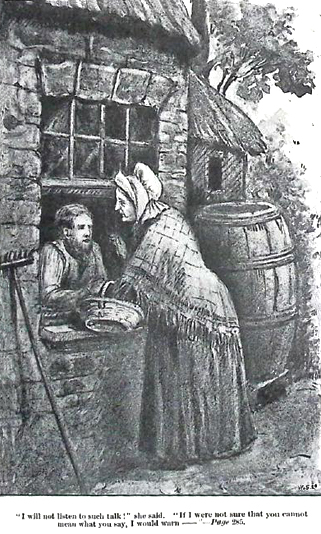
"I will not listen to such talk!" she said.
"If I were not sure that you cannot mean
what you say, I would warn—"
It was well that Betsy stood outside the window and that the man was within, for he aimed a blow at the old woman, which, happily, did not reach her. She waited for no more, but turned and rushed out of the garden as fast as her trembling feet would carry her.
The man muttered something, but he made no attempt to follow. Then he shut the window and fastened it inside, replacing the loosened bars. I waited until I thought it would be safe to leave my hiding-place, and then stole softly away. I reached home after Betsy, and found Jabez standing in the doorway at the back of Rose Cottage.
"It's a very dull night, Mr. John," he said. "I was just looking out for you. You'll excuse Betsy; she's got a bit of a headache, and is gone straight to bed, without waiting till you came in."
"Say good-night to her for me, and tell her I hope she will be better in the morning," I replied, and passed on to my own room.
"Poor soul!" I thought. "She has heart-ache which a night's rest would not cure if she could have it. But I fear there is little hope of quiet sleep either for Betsy or Jabez to-night."
I knew that the old man had waited at the door for my coming in order that I might not see his own face, and that he might make an excuse for his wife's unusual absence.
I too lay down with little expectation of rest. My mind was too full of what I had witnessed, and of fear as to what would be the outcome of that wretched man's presence at Oakhill.
No doubt he had come with the intention of extorting money from his parents, and would not rest satisfied until he had robbed them of the savings of their lives. It was plain that the punishment inflicted for that former offence had wrought no improvement; it must have had rather a hardening effect, for, according to Mr. Burford, George Harwood had been considered, as a youth, rather weak than wicked—one who could not resist the temptations of evil companions, but most unlikely to be ringleader in any deed of darkness, and, in spite of all, retaining a strong affection for his parents.
Mr. Burford's picture bore no resemblance to the hardened ruffian who kept these poor old folk in constant terror and felt no compunction for the past, or hesitation about causing them further suffering. Knowing them as I did, I felt that the very fact of their son's presence would make them miserable. They would shrink with horror from the revelation of such a character as his had developed into, and yet their hearts would yearn after the one only creature who had a right to call them by the sacred names of father and mother.
"Oh that Mr. Burford were home!" thought I. "If I could but speak to him, this dreadful weight of responsibility would be lifted from my shoulders. I have no other friend to whom I can go."
The thought had scarcely crossed my mind when it was followed by a remorseful one. Had I not the Best of Friends, ever present, ever willing to hear and answer, ay, and to make my way plain before me?
I said to myself, "He knows;" and then I told Him all, and humbly asked that my good old friends might be relieved from their present trouble, and I guided as to the best mode of helping them.
I felt happier after this, and I was further comforted by the thought that Mr. Burford would be home on the morrow and I could take counsel with him.
When the morrow came, I was doomed to further disappointment. I knew that Mr. Burford was not expected until the evening, and the day passed sufficiently slowly in the meanwhile. I had some hope of seeing him on his arrival at the station, for I knew whence he was coming, and I was on the platform as each train came in; but I vainly looked for the well-known face.
He would not go to the office after his return—of that I felt assured, but I thought his principal clerk would go to the house to see him there. Acting on this belief, I wrote a few lines to Mr. Burford, and addressed it to the office. It was marked "Private and Urgent," and would only be opened by the lawyer himself. In it I stated that I wished to see him on a matter of great importance, and begged him to grant me an immediate interview in case I failed to see him at the station.
Mr. Burford knew me too well to suppose that I should write in such terms unless there was a needs-be for so doing, and I confidently expected to see him before I slept. However, as no message came and I could ill endure the suspense, I called at the house of Mr. Gordon, Mr. Burford's chief clerk, to inquire if he had come home.
"I am sorry to say he has not," was the reply; "and it is most unfortunate in all ways. He is wanted by two important clients, whose business is of a nature to require Mr. Burford's personal supervision; and there are several other clients, for whom I could act equally well, who insist on waiting for his return. Can I do anything for you?" asked he. "If it be a legal matter, I have no doubt I could be of some use."
Mr. Gordon was a qualified lawyer, and stood high in the esteem of his employer, but Oakhill folk, as a rule, were stubbornly attached to Mr. Burford, and persisted in going to what they called the fountain-head.
"If it had been a legal matter, I should have consulted you at once," I said, "but it is one which involves the private affairs of others, and of which I am at liberty to speak only to Mr. Burford. I wish I were not bound to silence, as it would be a great relief to open my mind to some one else and take counsel from a wiser head than my own."
"Mr. Burford will be in great trouble just now. He had to go away at a most inconvenient time, and now that his presence here is doubly necessary, he has been prevented from returning at the appointed date by his father's illness," said Mr. Gordon.
"Is the dear old man seriously ill?" I asked. "I hope not. I know he is from home, for I helped him into the railway carriage a week ago, and he was then looking wonderfully well. We had quite a pleasant talk, for he kept me standing by the carriage-door as long as possible. He was going to visit his only sister and her husband; both, he said, younger than himself, but less hale for their years."
"He was wonderfully well, and might have been so still but for an accident—a fall, I think, but I do not know particulars. I have only heard that the injury is not a serious one, but the shock to the system is likely to prove so."
It was of no use asking when Mr. Burford would be home, for Mr. Gordon could add little to what he had already told me, and he kindly promised to let me have further news as soon as possible.
I could see that his day's work was by no means done, for his table was covered with papers. By way of apology for not asking me to stay, he pointed to them, and said—
"I shall scarcely finish what must be done on this side midnight. I have brought my work home, because if I remained at the office, I should be constantly interrupted."
I had gone to Mr. Gordon's hoping to leave part of my weight of anxiety behind me; I came away with an additional load, and little prospect of ridding myself of any. I could not count on seeing Mr. Burford at any particular time. I was distressed when I thought of the heavy cloud hanging over Jabez and Betsy, and at its manifest effect on the health and spirits of both. I was in hourly dread that they would be terrified into giving up their little savings in order to buy their son's departure, or that they would be heartbroken by hearing that he had committed some new outrage.
The result of such evil-doing on themselves would be the same whether he was detected or not, as they would guess the author, and suffer accordingly.
I was keeping my knowledge to myself for their sakes, and all the while I was harassed with doubts as to whether secrecy was advisable even on their account.
On the one hand, they were living in a state of perpetual terror; on the other, the shame which would follow the exposure of their secret would, I feared, overwhelm them altogether. For my hand to inflict such a blow would be too terrible; and yet it was surely wrong to screen such a man as George Harwood.
In addition to perplexity on these accounts, I had heard of old Mr. Burford's accident and consequent illness. He had been my kind, unvarying friend; and though we rarely met, he never lost an opportunity of speaking a good word for me and a kind one to me.
He had kept my hand in his up to the last moment that morning at the station, and had whispered—
"I have been thanking God on your behalf, Jack. I was very fond of your poor father and mother, and it makes me glad to know that the son of my old friends is keeping on the right path. Go on and prosper, my boy. Never be ashamed of honest work. The man is to be alike envied and honoured who finds more sweetness in the bread he has earned, than in the dainties offered at the tables of the rich who never knew a like luxury. The clothes that have been paid for by the fruits of daily toil wear well, Jack, and well become the wearer, too. What was that motto you used to talk about—the one on the sixpence?"
"'Work, wait, win,'" I replied.
"Ay, I remember now. You lost the coin and kept the motto. Do not forget the words; I always liked the ring of them myself, Jack. Keep on working, and whilst working and waiting, look to Him who has led you so far, and rest in Him. As to the last word, you may not win great wealth or a high position, but God is sure to give you what is best, and enough of it to satisfy you that those who trust Him can never work or patiently wait in vain. Good-bye, my boy, and may God bless and keep you."
The kindly face and the sound of those farewell words were very present with me as I returned to Rose Cottage, tired and disheartened, after my interview with Mr. Gordon.
The old couple were at home when I entered, and neither Jabez nor Betsy left the house again. I thought they looked a little more cheerful, and I wondered whether they had succeeded in making some bargain with George and were rid of his haunting presence. Not that I hoped the departure would be final, if he had been induced to go; I felt sure that he would come again when he had spent the money extorted from them, but I resolved that they should not be harassed repeatedly, for, come what might, I would interfere for their protection.
"You have deserted an old friend lately, Mr. John," said Betsy, pointing to the piano as she cleared away the supper-tray. "Now the nights are getting long again, maybe we shall have more music."
"You shall have some to-night, if you like," I said, delighted that I could do anything to give them pleasure.
I would not tell them of old Mr. Burford's illness, for I wished to keep away whatever might darken the little brightness I had noticed in both.
So I played their favourite tunes, and though Jabez did not join in with his quavering voice, his lips repeated the words of hymns that suited them, and I had no doubt he was back, in imagination, in the village choir with Betsy as a listener.
"It has been like old times to-night, Mr. John," she said. "You don't know how nice it has been. It has done us good;" and she looked and smiled at Jabez and me in turns, with a happier expression on her face than I had seen there for some time past.
MORS JANUA VITÆ
ON the following morning, as I was glancing at the newspaper, I noticed a paragraph, headed "Death of Mr. Harcourt Whinney, the millionaire stockbroker."
The sight of this name brought to my mind an almost forgotten incident. Amongst my father's papers, I had found a copy of a letter addressed to this Mr. Whinney. It was a somewhat singular composition—an appeal, indeed, to this man whose death had just taken place. In it my father wrote respecting a large sum of money which he had been induced to lend on security of shares nominally of great value, but really almost worthless. Mr. Harcourt Whinney was a sharebroker who had obtained the money for a railway contractor on the verge of bankruptcy, and when this man failed, my father was left with script apparently representing ten times the amount of his loan, but not marketable at any price.
He must have been almost desperate when he wrote in these terms to Mr. Whinney:
"You well knew the circumstances of the man for whom you borrowed my money, and were also well aware that had I known his position, or the true nature of the so-called securities placed in my hands, I should not have advanced a farthing. I was grossly, cruelly deceived, and—must I add this?—intentionally, for you could not be ignorant of what you were doing, though I was. You ruined me and made my son a beggar, only to stave off the exposure from another client, which you knew could only be delayed, not averted. I can compel no restitution. If I were to speak of your conduct, I should gain only a contemptuous pity, and be told that a simple countryman like myself should not have dabbled in things of this kind, and of which he knew nothing. You, I hear, have become rich, but though it would cost you little to restore that of which I have been robbed, you treat my letters with contempt and silence. It was not so when I first made your acquaintance. I have no expectation of present redress at your hands, but I hope and pray that when your days are drawing to a close, and you can no longer hold the wealth you have accumulated, you will be moved to make restitution wherever you have acted as you have done to me."
Mr. Burford had explained the meaning of this letter to me when we read it over together. He knew all about the loan. It was what deprived me of my patrimony. I asked if he thought Mr. Whinney had really done wrong in the matter, and he replied, "I have no doubt he pocketed an immense percentage on the amount, probably one half, for obtaining the other."
"But if he really knew how worthless the scrip was, the whole affair was a conspiracy to defraud," I said.
"As you and I would look at it, Jack, it was. But I have no doubt Mr. Whinney would merely regard it as a good stroke of business. Your father was not the only one who suffered at the same time, and even to a greater extent."
"Did no one try to get their money back?" I asked.
"How could they? The actual borrower became bankrupt, and died soon after. Mr. Whinney was only an agent; and, depend on it, no one knew what remuneration he received, though many might guess, as I have done."
"My poor father wrote this letter to try and move him; but, of course, he would make no restitution."
"He has not done so far, Jack; and, unless it should come as a proof of a deathbed repentance, I am afraid you will never be the richer for this effort."
"I should be foolish indeed to spend a thought on the man," I replied, "but I shall keep this copy of the letter. It is in my father's handwriting, and it was just an outcome of his own upright nature."
As I read the newspaper paragraph which enlarged on the splendid business talents of Mr. Harcourt Whinney, my thoughts naturally reverted to my father's dealings with him. The one had lost all, according to the world's verdict. The other had died a millionaire; and yet I would rather have cast in my lot with the poor than the rich man.
My quiet life helped to make me thoughtful and observant, and very often I took stock, so to speak, of the surroundings and circumstances of the rich whom I knew. I invariably came to one conclusion, which was, that if I must take all that accompanied the wealth in any single case—age, health, position, family, and responsibility—I would refuse the money, if it were offered me.
These cogitations did not make me less contented with my lot, humble though it might be; and indeed I had great cause not only for contentment, but thankfulness.
I heard the same evening that, so far as guests were concerned, Miss Flint was once more alone. The Burford girls had been staying with her for some days before Herbert Kenningham left, and Nelly was to have remained, but her grandfather's illness prevented this.
Jane Cartwright told us, she having taken early advantage of the lull at the Hall to visit the cottage.
"I was bound to come as soon as I could, Betsy," said Jane, "for you were looking so poorly the last time I called that I could not get you out of my head. I am glad you are so much better."
"Yes, I am better, thank you; but, well or ill, you always come at the right time, Jane."
"I shall get in oftener now, unless our lady takes a fresh fancy," replied Jane. "I doubt she'll feel lonesome, losing all her visitors at once, but I'm thinking she must be going to have more, for the covers are to be kept off the furniture, and she keeps on using the best plate. I sometimes wish we hadn't so much silver about, for it's a great charge. You know Miss Flint bought all the plate that belonged to your father, Mr. John, so as it might not go out of the family."
I assented, and then asked Jane if she had heard anything about old Mr. Burford.
"He is not expected to get better, and I am sorry to hear it, for such-like men are scarce. Mrs. Burford and Miss Nelly are gone to him, and Miss Rose is staying with her brother, for he could not be left by himself. The boy is really mending, they say. Our old miss will have him to fuss after whilst his mother is away, and a good thing too. She is kind enough where she takes, and she has taken to him for certain; indeed, she seems fond of all Mrs. Burford's young people now."
"Have you managed to drive away Sarah's young man?" I inquired.
"I had no hand in driving him, Mr. John. I could never get near enough for that, but I think he must be gone, seeing that Sarah stops in of a night now. He was no young man. Any way, she is not fretting after him, though she has sulked with me for two days because of what I said. She is trimming up her Sunday bonnet, and will be showing off in it by daylight, instead of going out at dark to meet that vagabond under the trees."
This news was welcome to me, and I was sure it was equally so to Jabez and Betsy. Perhaps, after all, I might not have occasion to speak to Mr. Burford about George Harwood's visit until I could mention it as a matter that had made me uneasy, but was now a thing of the past.
I left Jane Cartwright with the Harwoods, and went to the piano, where my happier mood found vent in lively music. According to custom, the doors of my room and the kitchen were left ajar, so that the old people and their visitor could hear it.
The next day, I passed the old cottage on my way home to tea, and found Jabez in the garden.
I went to him, but he showed no uneasiness at my presence, except when I said, "I should like to go into my old home, Jabez. I believe I have not crossed the threshold since the last night we slept here. Have you the key?"
"No, Mr. John. I am only the gardener. Betsy keeps the key, and goes in and out now and then. There's nothing to see inside."
"It was only a fancy. I will come with Betsy some day," I answered carelessly, and turned away, but did not at once leave the garden.
I was not surprised that the key was in Betsy's possession, for there would probably be traces of recent occupancy in the nondescript apartment formerly used as a bedroom by her and Jabez; or some tell-tale articles of bedding might still be there.
As I strolled round the garden, I looked keenly into every corner for something that might help me to understand the new aspect of affairs. At length I caught sight of a strip of note-paper, partly hidden in the hedge, and held fast by its thorns. It was only half a page, which had been unequally torn across, but I quickly detached and pocketed it for future examination. I then resumed my stroll, in the hope of finding the remainder of the sheet, for some words on that which I had secured were sufficiently suggestive.
I sought in vain, however, for the other part of the sheet of paper from which mine had been torn. And when I reached home, I tried to decipher the writing on the soiled piece taken from the hedge. This was not very easy, as one side had been washed by the rain, and only a few words were legible on the other. Of these I could make no sense, as the writing and spelling were equally bad, but the signature left no doubt as to the authorship.
"Yure affecshanut Sarah" pointed to the girl at the Hall, whose doings had excited Jane Cartwright's wrath. There were allusions to a "cross old cat," probably Jane, since Miss Flint had chosen to take an opposite view of Sarah's doings, and a promise to be "ready in good time" and go "tords the stashun."
These words caused me no uneasiness. They had probably been written to the stranger man at a time when Jane's vigilance rendered meetings under the trees near the Hall less easy, and very likely to be interrupted. For the foolish girl's sake, I hoped this unwise correspondence had been closed, and that Sarah might see George Harwood's ill-favoured face no more.
Since I witnessed that cruel attempt to strike at poor old Betsy from the open window, I had felt more indignant than ever against the wretch, and would have given much to ensure his perpetual absence from the neighbourhood.
For nearly a week all went on as usual. I saw Mr. Burford at the station, when he paid a hurried visit to the office to transact important business.
I heard from him of the hopeless condition of his father and of the steady improvement in that of Magnus.
"We believe now that our dear boy will be spared, though I suppose he can hardly be counted 'out of the wood' yet. He may not go to see his grandfather, as the double excitement of the journey and the meeting might do him harm. It is rather hard for his mother, who wants to be in two places at once. Rose will return with me, but only for a night, after which it is not unlikely that she and Magnus will go to Miss Flint for a while. He is quite at home with her, and she has been very good to him."
I knew this, and had always felt glad to think that Cousin Dorothy's hardness was but partial, and that, if she showed a stern front to me, she could display a kindly one to those she liked.
"How is Nelly?" I asked. "I suppose she is with her grandfather still?"
"Yes; and she must remain. My father cannot spare Nelly. He says he has lost far too much out of her girl-life by her long absence at school. They are great friends, and it is really beautiful to see how the dear old face brightens as she approaches his bedside. His room is a little heaven, Jack. If you young folk want to know the value of religion, you should stand by the deathbed of a man like my father. There is no test like this."
I could well believe it, and I said so. Then I sent messages to Nelly and her grandfather, which Mr. Burford promised to deliver.
"My father is always pleased to have good news of you, my boy. I suppose everything is going on satisfactorily at your place. We must try to get you a further rise in due time, but it is too soon yet."
"I do not expect any further advance for some time," I replied. "There was a matter about which I wanted badly to see you a few days ago, but—"
"I would never defer anything of real consequence to you, Jack, but if this can be put off, I should prefer its waiting," said Mr. Burford.
"It can now, I am glad to say; indeed, I hope it is done with altogether."
"That is well. By the way, did you see that Mr. Harcourt Whinney is dead? I fear you will not come into a fortune by way of restitution."
"As I never hoped for anything, I shall not be disappointed, Mr. Burford. I have often wondered that my father should have been sanguine enough to write, in the hope of moving Mr. Whinney to do anything either for himself or me."
"Most people would agree with you, but it is wonderful how such an appeal will sometimes work on the superstitious nature of a man when conscience fails utterly. I have known very curious results in the course of my practice as a maker of wills."
At this moment a gentleman, for whom Mr. Burford had been waiting on the platform, joined him, and they went away together. This was on Friday.
On Monday I heard that my kind old friend was dead, and would be interred at Oakhill on the Thursday following.
It was from Mr. Burford himself I received the news, and, to my great surprise, an invitation to attend the funeral.
"It was my father's wish that you should come and represent your father, who was his friend and mine. He talked about you, Jack, not very long before the end came, and in referring to those he loved, and asking for them all good, he did not forget you. He said, too, that I must always be your friend—a needless injunction, perhaps, but one that you will not think lightly of."
I was not likely to do that. When I heard of it, I felt as a son of one of the old patriarchs must have done when his father's hands were laid on his head and his dying lips blessed him.
I attended the funeral, and was paired with Mr. Gordon. Then, without exchanging any after-word with a member of the Burford family, I went back to my duties; though I found subsequently that I had been expected to return to the house with the rest. Mr. Gordon said as much, but I thought he must be mistaken.
"I know Mr. Burford's goodwill towards me, but I should never presume upon that to intrude upon the rest of the family at such a time," I replied.
I did not hint that I was sure my presence would be most unwelcome to Mrs. Burford, but I felt it none the less, and resolved to keep out of her sight.
There were many friends and a few relatives from a distance who had attended the funeral, and these returned by train later in the day.
Mr. Burford came to the station with two of the latter, and after they left, spared a minute or two for me.
"I should have been glad to see you at the house, Jack," he said. "Had you come, you would have received a little piece of good news the sooner. My poor father has left you a small legacy—a thousand pounds."
"How very kind of him!" I exclaimed. "But I hardly feel as if it would be right to take it, when there are so many of his own family."
"You can do nothing else, my dear boy; and you may be sure no member of the family will wish to deprive you of it. My father was very rich, and though he gave largely, his quiet mode of life favoured accumulation. He has left thirty thousand pounds to each of my children, to be theirs absolutely as they come of age, and more at my death. So, you see, your odd thousand is a mere drop in the bucket, about which you need have no conscientious qualms. My father knew about your nest-egg of five hundred, and that you were prudently saving a little in addition, so he wished this sum to be added to your capital, in the hope that you might see an opening to use the whole advantageously some day."
What I said may be easily imagined, and perhaps some who read this will realise that I went home that night feeling both richer and poorer—richer by a thousand pounds, poorer for Nelly's wealth, which would separate us and leave us farther apart than ever. In a year's time, she would be absolute mistress of a large sum, with the prospect of much more. I was creeping up the ladder of fortune far more rapidly than I could have expected, but Nelly had been lifted to the topmost rung at one bound, and I could never hope to stand beside her on equal terms. If an attachment existed between her and Herbert Kenningham, whose means were not large, and who hoped to make his way as a professional man, this legacy would smooth all obstacles; and I doubted not that Miss Flint would do her best to facilitate their union.
As I look back, I can see what an ungrateful fellow I was to indulge in such thoughts, and that I deserved to suffer for being so ingenious in self-torment, both at this and at other times.
I did, however, tell Jabez and Betsy of my legacy, and their comments brought me to a better state of mind.
"Eh, Mr. John! I am glad and thankful for you. A thousand pounds! What a fortune that is, when you come to think about it!" exclaimed Betsy. "Why, you would be so full when you heard about it, you wouldn't know how to speak to Mr. Burford. You would be just thanking God with all your heart."
I hope I had not been unthankful, and yet poor Betsy had rather pictured what ought to have been than what was filling my heart, for the other wretched thoughts that I have told about occupied too great a share of my mind.
"Yes, Mr. John," said Jabez, "you are getting rich fast, and I begin to hope that I may be spared to see you at Lint Hall again. This money will take you a step nearer."
I smiled and said, "I have learned to be very happy at Rose Cottage. For me to think of Lint Hall again, would be like a child stretching out its hands for the moon. My father had at one time several thousands a year."
"Mr. John," said Betsy after a pause, "would you mind doing a sum for me?"
"What is it? I will do it if I can."
"Just reckon up how many weeks it would take Jabez to earn a thousand pounds at fifteen shillings a week."
I did so, and told her it would be 1333 weeks and a day or two over.
"Eh, but that is a many! I can't quite get hold of the time when the figures are so big. Could you put them into years, Mr. John?"
"Twenty-five years and about thirty-three weeks towards another," I replied.
"Hear that, Jabez! It would take you more than five-and-twenty years, with never a day off, to earn the thousand pounds that are coming to Mr. John all at once. We've got something to thank God for, haven't we?"
Dear unselfish soul, which overleaped every thought of discontent in connection with a life of ceaseless toil, and all envy of my better fortune, and thanked God on my behalf, as if the legacy had come straight to her and her old partner, instead of to me.
I was glad that Betsy had set me that sum to do. It did more than satisfy her thirst for information; it set me thinking much of the good providence of God, and how it had been manifested on my behalf, and made me alike more humble and grateful.
Could Betsy have guessed what was in my mind? It may be. Unselfish souls are far-sighted. She may have wished to draw my attention to two sides of the subject uppermost in my thoughts. Any way, I had cause to thank her for that question in arithmetic.
FORTUNE SMILES—AN ADVENTURE WITH BURGLARS.
IF misfortunes seldom come singly, it is equally true that Fortune's gifts often arrive in pairs, or close on the heels of each other.
On the day after old Mr. Burford's funeral, a most astounding piece of news reached me—news which I hardly dared to believe, it seemed so utterly incredible. The loss of means and the clouding over of my early prospects did not unhinge me more than this did, in spite of the fact that good news is said never to harm the recipient.
I longed to tell mine, but to whom must I speak, seeing that I wished to confine the intelligence to a single friend, and to pledge that one to absolute secrecy? Betsy and Jabez had enough to think of already; and, besides, it would have been so hard for them to carry such a weighty burden, and be compelled to bear it alone.
There was only Mr. Burford; and yet how could I trouble him on the day after his father's funeral, and when he must be overweighted with business that had accumulated during his absence? However, I remembered his words spoken that day at the station: "I would never defer any business that was of real consequence to you, Jack."
He would know how unwilling I should be to trouble him at such a time, so I sent a line to the office, and begged him to see me for a few minutes, adding that the matter was indeed urgent, or I would not ask him. I had a prompt reply, bidding me come to him at a time when I should have an hour free.
"What is it, my boy?" he asked, after a shake of the hand.
For answer I placed in his hand a letter I had that morning received from a firm of solicitors in London.
Mr. Burford read the contents with no less surprise than I had done, then said, "My dear Jack, how wonderful this is! I could not have believed it; though, as I told you, such things have been brought about by a superstitious fear, when conscience had long lost its power. I congratulate you with all my heart." And again, he grasped my hand with a friend's warmth, whilst his face expressed the genuineness of his pleasure.
"Do you think it is true?" I asked.
"True! Of course it is. I have had dealings with this firm often enough. This is the signature of 'Deedes & Willes.' I had correspondence with them on your father's behalf, in that very affair with Harcourt Whinney which lost him so many thousands. That letter has preyed on the man's mind, and driven him to make restitution, almost at the last, for your bequest is contained in a codicil executed only a few days before he died. I ran over a newspaper notice of his will, in which it said the personalty was valued at £1,600,000. What fortunes men do leave now-a-days! It seems a trifle to be a millionaire. You perhaps read the paragraph in which we were told who was to have the bulk of the property, and that there were many legacies. Hoping against hope, I searched for your name without success, and put down the paper disgusted. There is no mistake about this," said Mr. Burford, laying his hand on the letter. "Shall I act for you, and write to Messrs. Deedes & Willes?"
"If you please, Mr. Burford. That is what I wanted to ask. And just another favour. Do not mention this affair to any human being."
"Not to one at my house, or to Miss Flint, that she may be ready with her felicitations?"
"Not to Miss Flint. Not even to Nelly; and you know I would rather tell her, the faithful friend of storm and sunshine, than any other. You will keep my secret?"
"I will, Jack. I will hug it closely and rejoice over it."
I was sure the promise would be kept. Then I asked one more question, on a subject which had not puzzled me as a boy, but which perplexed me now.
"I cannot understand how my father could have so large a sum to spare at a time when he had been borrowing money to meet the calls on his own speculative ventures."
"He had borrowed from me, but at a very moderate interest. That twenty-five thousand had been settled on your mother, in case she should be the longer liver of the two. It was well invested when her death took place, and your father did not wish to disturb it, especially as I could accommodate him with the sums he wanted. Later on the principal was repaid, and, beguiled by Mr. Harcourt Whinney, he lent it, as you know, with the idea of improving his income. The result of all your father's money transactions may be summed up in one word—ruin."
It seemed very strange to think that, after a lapse of years, I should be made comparatively rich by the man who had helped to bring the ruin about, for under Mr. Harcourt Whinney's will I was a legatee to the extent of £30,000, a sum identical with that left to Mr. Burford's children by their grandfather. No wonder I found it hard to realise my good fortune! Its truth was, however, soon confirmed by further correspondence between the lawyers.
Mr. Burford had said, "It will seem strange for you to act the station-master at Oakhill, with the knowledge of coming wealth uppermost in your mind."
It was strange, but I resolved to keep duty uppermost, and to be as faithful as ever in the discharge of it until I should resign my trust. I should keep my secret, and wait until—well, I could not yet fix a date for revealing it, and I rejoiced that my name had not appeared in print as one of Mr. Whinney's legatees.
I met Nelly Burford walking alone early in the following week, and had the hardest work possible to keep from telling my secret after all. And no wonder. Nothing made any change in Nelly's manner towards myself, and I thought she looked lovelier than ever in her deep mourning and in spite of her paleness.
"You have been grieving, Nelly," I said. "I have been so sorry for you, and for all. You will feel the loss of your grandfather very deeply, I know."
"Yes, Jack. No one would believe what a sad blank the death of an old man has caused amongst us. When I looked at his empty chair, I quite broke down. Not that I grieve for him, only for the loss of him."
I understood her meaning. I felt the same myself. Then she continued—
"You never guessed who sent you the little piano, did you, Jack?"
"No. I have puzzled my brains many a time, but always in vain."
"I may tell you now. It was Grandfather Burford. He wanted to give you pleasure, Jack, but not to be thanked for his gift. He was very fond of you. And, Jack, just hear me out. He has left me a great deal of money, not to be mine for over a year, but mine when I am of age. I think, if I could have had the whole sum placed in my hands, I should have liked to run and offer it to you, just like old times."
"When you came with your five pounds—your grandfather's gift, too—to say, 'Take it Jack.' Nelly, what can I say to you except that you are the dearest and most faithful of friends, and that I am more proud, glad, thankful, than words can tell for all your goodness?"
"Yes, Jack, always your friend, though one who is ever wanting to do something to prove it, yet never able to serve you. I hope I may be one day. If you need anything I can do or give, you will come to me first, will you not?"
With hope once more springing in my heart, and the thought of my secret, I promised.
"Trust me, Nelly; I will come to you first of all."
She gave me back the same bright smile and little, quick movement of the head that was characteristic of her childish days, and seemed abundantly content. I asked after Magnus, and then inquired if the family would be going away before the winter.
"Not all of us. My mother will go to Devonshire with Magnus for about a fortnight. They will stay with dear friends, and have all the quiet, restful surroundings that are best for my brother. Rose and I will be mostly at Lint Hall with your cousin. Oh Jack! If you could only have your old home again! I should dearly love to buy it back for you!"
"I shall feel as if you had made me a present of it, Nelly, because you would do it if you could. But I shall never own it again. Without the broad acres that once went with it, the house would be of little use."
I had forgotten for the moment that Mr. Burford owned them, but I was reminded of this by seeing the flush which rose to the girl's very forehead.
"I feel so sorry my father owns the land," she said.
"And I am very glad, for it is in worthy hands, those of my best friend—next to yourself."
"Mother is not nearly so set against you as she was. Magnus's illness and dear grandfather's death have had a softening effect on her, and she has several times named you with something of the old goodwill. I should not be afraid if she were to come in sight just now, Jack." And Nelly lifted her head as if ready to face the whole world and still keep her place by my side.
To think I should have to shorten such a meeting in order to return to Oakhill Station! Yet I had to say that I was due there and must leave her.
"Thank you for telling me who gave the piano," I said. "I have always valued it greatly, and it has been such a source of pleasure, such a companion to me! I can never value it enough now I know whence it came."
Afterwards, I found out that old Mr. Burford sent the piano at Nelly's instigation; though it did not strike me at the time that I owed his kind act to her kind thought.
The week which followed this meeting was a very busy one. I saw Mrs. Burford and Magnus set out for the south, and I knew that the girls were backwards and forwards between Lint Hall and their own home, one sleeping under each roof in turn.
I had become comparatively easy in my mind on Jabez and Betsy's account, for the latter paid no stealthy visits to the old cottage, and both were fairly cheerful and looking well again, all things considered.
Jane Cartwright found more time to visit her cronies, and had much to say as to the way in which her old lady was wrapped up in Rose and Nelly.
"I had used not to care for Miss Rose," she said, "but Miss Flint has done her good by her plain talk. She thinks less of herself and more of other folks now, and before her grandfather died, she kept us alive at the Hall. It is Miss Ellen's turn to stay the night. Whatever the mistress would do without these young people I don't know."
I heard little of Jane's gossip, for I had to return to the station after the usual time. A large annual fair was being held at our county town, and during the week, there were daily excursion trains from Oakhill. Some of these did not return until a late hour, and the passenger traffic was thrown a good deal out of order by them. The last of these was timed to reach our station at midnight, but I hardly hoped that it would be punctual. Of course, my duties would not be over until the last train had passed through the station, so I begged the old people to go to bed, as I could let myself in without disturbing them.
As it happened, most of the Oakhill people returned by an earlier train, and only six came by the last, which arrived half-an-hour late. I found afterwards that Cartwright and one of his sons ought to have been in it, but, by some mischance, had missed it.
Five of the passengers were known to me, and nearly all said "Good-night" in passing out. The sixth emerged with difficulty from a crowded carriage, and wore his hat much slouched over his face, and a muffler, which helped still further to conceal it, not wholly, however, for by the light of a lamp I thought I saw a portion of the scar so conspicuous under ordinary circumstances on the face of George Harwood. The man noticed that I was observing him, and thrusting his ticket into the collector's hands, he hurried out of sight as quickly as possible.
I wished to follow, and I lost no time in doing it, but I had to see that all was right before I left the spot, and this was not done in a moment. When free, I hastened onward, not to my present home, but towards the old cottage, feeling convinced that this man would turn his steps in that direction. My mind was terribly disturbed and full of forebodings as I went up the lane, treading softly and listening for the lightest sound. But I heard none, and after spending some time watching and waiting, I decided to go home.
At one part of my way, the road skirted an outlying corner of the Lint Hall gardens, and as I approached it, I heard a feeble cry for help.
Distance made it faint, but it was distinctly a cry of distress, and the voice was that of a woman. I even fancied that it was Nelly's, and at once all my old fears in connection with George Harwood and his object in hanging about the neighbourhood, returned with redoubled force.
There was no gate near, but I scrambled over the fence, and as I knew every inch of the ground, I took the nearest road to the house. I heard one or two more cries, but they were extremely faint.
I hastened on at a break-neck pace, and with a great dread in my heart that I should be too late, or, single-handed, be unable to render help if it were needed. At this moment, I ran almost into the arms of a man who was hurrying towards the Hall from an opposite direction.
"There's something wrong up there," said he. "I guessed there might be, and that made me turn towards the Hall. Did you hear screams?"
"Yes; they brought me here."
"Then if help is wanted, I'm your man. I know you, sir, and what you have been to my poor old father and mother. I've taken the wrong road many a time, but I'm on the right track now."
Sure enough, the speaker was the man with the scarred face—George Harwood. The words were jerked out as he hastened on beside me.
I had little breath for words. I only managed to say—
"I hope you mean this. I stand alone."
"Beggin' your pardon, sir, you don't, and that you'll see. Trust me, sir, for the sake o' the old folks. I don't mean to finish an ill life by breaking their hearts, though I've done enough in that line."
This man's words were the strangest possible contradiction to his recent conduct, and I found it hard to reconcile the two. However, I had no choice but to trust him, and on we went.
Being younger and lighter, I could get over the ground more quickly, and I hastened forward, until, on approaching the shrubbery near the house, I thought I saw something white emerging from the trees. Surely it was a female figure in a white garment, and I called softly—
"Who is there?"
It was Nelly, and she knew my voice, and ran towards me.
"Jack, there are thieves in the house—two, I think. Cartwright and his son should have been back from the fair, but have not come. Jane went down to the lodge to her daughter, who is ill. The men did not see me, for they were too busy securing Miss Flint, and there are only the maids in the house beside."
"Where were you going, Nelly?"
"To the lodge, to rouse the men there, but I thought some one might be outside and see me in my white dressing-gown; so I was creeping amongst the bushes. Jack, you must not go into the Hall alone; and yet—poor Miss Flint! I am frightened for her."
I have often thought of Nelly as she looked in her white wrapper, with her pale face, her little bare feet just thrust into slippers—so fearful for others, so forgetful of self.
"I have a helper, Nelly," I said, for George Harwood came up out of breath at the moment.
"That's right," he gasped out. "You're trusting me. I'll not fail you."
We kept Nelly from going to the lodge, for I knew that no harm should reach her that I could ward off at the risk of my life, and I knew not what accomplice might be watching outside the house. We stole softly in at the side-door, left open by Nelly. All was dark, but she and I knew our ground, and George Harwood followed, as we crept cautiously towards the strong-room, in which stood some large safes specially constructed to hold the plate. There was no window, except a small skylight in the roof, and the men had already forced the door, and were busy at one of the safes, which, so far, resisted their attempts to open it.
The same thought evidently crossed all our minds at the instant, for we extended our hands with a view of shutting the outer door on the men, whose backs were towards us and it. The noise made by their tools, though not great, had sufficed to keep them from hearing our approach, which was as stealthy as possible.
We failed in our attempt. The door stuck a little, and made a grating sound at the instant the thieves paused in their work. They closed their lantern and made a dash for the door, so suddenly that I was driven aside; and though both George Harwood and I tried to stop them, they eluded our grasp, and got clear away, across the hall and out of doors.
We followed as fast as we could, but when I was about to pass out of the house, I bethought myself that, if Harwood were minded, he could draw back as I left it, and I might find myself and Nelly on different sides of the door, so I paused on the threshold.
"Right, sir," said he. "There can be no more harm done if we bar them out. If we followed, we might not come off scot-free, and there's more to be done—we must find the women folk."
I would have sought Miss Flint first, even if Nelly had not led the way to her room. Poor Cousin Dorothy! She was in evil case—tied firmly hand and foot, and gagged so that she could not utter a sound.
As quickly and carefully as possible, I removed the gag from her mouth, and cut or loosed the bands which tied her. Her pretty hands were swollen, and the nails livid with the tightness of the cords; and Nelly fairly cried as she held them in her own, tenderly stroking them and condoling with her friend.
Miss Flint had been said to look an "object" in her travelling attire. She certainly looked a woeful one at this moment, and her conduct was worthy of her reputation for eccentricity. No sooner was she set free than she burst into a fit of hearty laughter. Nelly and I were frightened, thinking that she was either hysterical or crazy.
There was, however, such a genuine ring in the laugh that we took heart, and felt inclined to join in her mirth.
"What are you staring at, John Simpson?" asked Cousin Dorothy. "Do you think I have taken leave of my senses? Not I. Those laugh who win, and whilst I have been fastened here like a trussed fowl, I have had a joke to comfort me. Those foolish would-be thieves were working away like the fellow we see in the advertisement of somebody's safes. I could hear them as I sat. And all the while everything of importance was in reach of my hand, if I could have stretched it. Other people may collect their valuables and put them into a safe if they like—then thieves know where to look for them, not so Dorothy Flint."
Again she laughed heartily, and this time the rest of us joined her without fear or compunction.
A MYSTERY CLEARED UP—COUSINS AT LAST.
COUSIN DOROTHY was nothing if not eccentric, and she had been true to her character in planning to keep her plate in safety. No one except Jane Cartwright and herself knew that it was deposited nightly, not in the strong-room, but in a large cupboard occupying a recess in her bedroom. There was no keyhole visible, as it was concealed by a carved moulding running round the door, a small piece of which was movable.
We left Nelly with Miss Flint and went in search of the servants. Three were asleep, having remained unconscious of what was going on, but these were locked into their rooms. The fourth was Sarah, the girl whom I had believed to be encouraging George Harwood's visits during the time he lay in hiding at the old cottage. I felt utterly bewildered when I saw George himself approach Sarah and release her from bonds as painful as those which had confined Miss Flint. There was no sign of recognition between the two, and as soon as the girl's tongue was set free, she began to denounce another individual, weeping bitterly the while, and complaining of having been deceived by a wretch that she had been "ever so good to."
She was ready enough to speak against the man who, after she had admitted him and his comrade, had treated her with scant ceremony. It seemed that, as Miss Flint had taken Sarah's part when Jane Cartwright found fault with her, the girl had stipulated that the mistress should not be hurt in any way. In her indignation at seeing her seized and bound, she uttered a succession of screams, which were speedily silenced by a course of treatment of a similar character.
What followed may be imagined. The police were communicated with, the two young Cartwrights brought from the lodge to the Hall, and a cottager's wife and son left there to bear Jane and her ailing daughter company. As to Sarah, the traitress who expected to accompany the thieves and their booty, and to become the wife of the one who had made a tool of her, Cousin Dorothy merely said, "Go to your bed, simpleton, but first thank God you have not seen murder committed, as well as robbery attempted, this night."
"Oh ma'am, forgive me!" cried the girl. "I never wanted them to hurt anybody, and least of all you."
"I know that well enough. You only thought it was very nice to stand chattering under the trees, like the magpie you are, with a stranger of whom you knew nothing, and that it was right to feed your vagabond, not with crumbs, but tit-bits from your mistress's larder. You thought it made you a great person to tell of our visitors and our plate, and how many men were in the house, with a great many other particulars. Oh! You did. You need not deny it. And you thought you should get a husband through it."
"He asked me, or I shouldn't have told," sobbed the girl. "And he said he only wanted to bring a gentleman in at night to see a picture that's in the library, and was worth a mint of money. He said it couldn't be seen proper only by candlelight, and there would be no harm done. He wouldn't ask me, but you had said it should never be set eyes on by mortal man, and it would be money in his pocket, because the gentleman was safe to pay well. He declared if you waked up and caught them, you shouldn't be hurt, for they would run away straight and trouble nobody."
"That will do; you can go back to bed," said Cousin Dorothy, with the utmost calmness.
"We will lock her into her room, if you like," said I.
"No, thank you; she has had enough of her admirer's delicate attentions, and will not run after him," replied Miss Flint. "Go, Sarah;" and the girl withdrew.
Turning to Nelly, Miss Flint said, "Nelly, child, I shall have to own John Simpson as a kinsman after all. Not merely on account of this night's work, but because I have kept an eye on him all along, and decided that he is worthy to be called 'Cousin Jack.' I doubt whether he will appreciate the compliment, or call me Cousin Dorothy."
"I always called you so," I said, "when I could; but of late it has not been possible."
"Do you know, Cousin Jack, that I have said I will never leave you a penny, and that I shall keep my word?"
"Cousin Dorothy, I have heard as much, and I am glad you have confirmed the report, for now no one can misunderstand my motives in wishing to have you for a friend as well as a kinswoman."
She held out her hand, and I clasped it gently, for the delicate wrist bore the mark of the cruel cord. Then she looked in my face, and positively there were tears trembling in her eyes.
"Cousin Jack, you are very like your mother, and I loved her," said Cousin Dorothy, in a voice very unlike her ordinary one.
Her disengaged arm went round my neck, and she kissed me as a mother might kiss her boy.
I could not tell how this act touched me. She had loved my mother, I always knew that; and as I returned her kiss, I felt happier than I had ever done since the death of my father. Of neglect I had experienced enough, of open enmity none, except, as I believed, from Cousin Dorothy; and now she was to be numbered amongst my friends.
As to Nelly, she was in an ecstasy of happiness, and bestowed a little shower of caresses upon Miss Flint. Then she declared there had never been anything so fortunate as this attempted robbery, and she should be grateful to the burglars, only she could not forgive them for their treatment of Miss Flint. She said little to me, but her looks were eloquent enough.
This conversation did not take place until Cousin Dorothy and Nelly had spent some time in their rooms. The injured wrists had been bathed, and needed additions made to their scanty garments.
Meanwhile, George Harwood was partaking of a hearty supper in the kitchen. Afterwards, Miss Flint spoke to him, and thanked him, with much dignity, for his timely help.
"I hope I shall be able to repay your services with something better than a present-gift of money. You may trust me. I knew you, George Harwood, the moment I saw you."
George murmured something about "not gen'lly needing to be introdoosed twice," and pointed with his maimed hand to his scarred cheek as a proof of his words.
"It would never do for me to be after any tricks hereabouts," he added, "for I should be found out directly."
"Have you any idea who were the men that got into the house?" asked Cousin Dorothy, looking at George.
The man moved about uneasily, but did not answer.
"You have done one good act, do not be ashamed of it, George. Try to do more and better. I knew you as a lad, and I never believed you thoroughly bad at the worst of times, for you were the son of a praying father and mother. You have had a hand in wrong-doing more than once, but you committed one great robbery single-handed, and it was the worst of all."
"Never, ma'am, never," replied George. "I have done wrong enough, and been one amongst others, but I can say truly I neither planned a robbery nor carried one out by myself."
"What do you say to having robbed your father and mother of a son's affection, help, and presence through all these long years? Have you not done this, and robbed them of peace and hope and rest, and the pride they once had in their only child? Have you not made them ashamed and afraid to name your name, or let it be known that their son was worse than dead?"
"Oh ma'am, don't, don't!" said George. "I'll go away now and never show my face at Oakhill again, though I was coming to see the old folks and find out if there was a chance of staying with them, and trying to make up for what is past. I'm hungering for a look at father and mother, though you mightn't think it. I've never seen them since I was tried and sent away for what I did not do, though I deserved what I got for other things."
"If you wish to stay in this place, you shall. But mind, you may have to bear a good deal for their sakes. People will not believe in you. You must be ready to bear suspicion and cold looks and doubts of your honesty. But if you are in earnest, I will stand by you and find you work. My cousin here will assist for your parents' sake."
"Gladly," I answered.
I could say no more, for I was in a state of utter bewilderment. Had I not seen George Harwood at the station, on the very night the old cottage was entered by the window and my property taken? Had not I, and his parents too, concluded that George was the culprit? And had I not, for the sake of Jabez and Betsy, kept silence on the subject from all but Mr. Burford?
Then, again, I had been certain that Sarah's lover and the man in hiding at the old cottage were identical, and George Harwood was the individual. I had been intensely indignant at his conduct to Betsy—his mother, as I believed—and here was George declaring that he had never seen her face through all these years. I began to doubt him, to feel that it would be dangerous to leave him unwatched, and to question if he were not in league with the thieves, in spite of appearances. Either he was telling wilful falsehoods, or I had been under a mistake from the first.
After a brief cogitation, I decided to ask George to go with me to Rose Cottage. I meant to steal quietly in, and, instead of going to bed, to remain with him in my sitting-room through the night.
George owned to Miss Flint that he had his suspicions about one of her visitors, but he would tell me all he knew and guessed on the road to Rose Cottage.
"We shall see you to-morrow, Cousin Jack. No, by the way, it is to-morrow already—I mean morning; and real to-morrow will be Sunday, when you can come to dinner after service. I shall have no company."
Perhaps Nelly noted a disappointed look on my face, for she said, "I shall be here, Jack."
"You are not 'company,' child. You are a mere nobody. Good-night, Jack;" and she whispered, "Give the old cousin a corner of your heart, though she has helped to show the metal you are made of. You are your mother's son."
I kissed her for answer. I held my darling's little hand in mine for a moment, and then went away along the dark road with George Harwood. I would not hear his tale on the way, for fear of our voices attracting attention, but advised him to wait a while.
There was a light in Rose Cottage as we approached, and I bade George stay outside till I knew the reason of it. I found Betsy up and looking pale and frightened. This she explained by saying that she had awakened and could not help coming down to see if I were in. Finding I was not, she was too uneasy to sleep, so stayed in the kitchen. Jabez was asleep, she said.
Then I began my story, and told of the stranger who had rendered such timely aid, and of Miss Flint's gratitude to him and conduct towards myself.
How glad she was on my account! How sympathetic! Yet there was some hidden trouble, which her joy on my behalf could not hide.
"I want to tell you more about the strange man," I said. "He is one who, as a lad, was led astray by an evil companion, and went on from folly to crime. He was caught, tried, imprisoned for a long term of years. He was the only son of parents very like you and Jabez, and in spite of all his wrong-doing, he could not forget them, their teaching, above all their love, of which he knew himself to be unworthy. Now he has forsaken his evil ways, he wants to work honestly for his bread; he longs above all things to see his parents and be forgiven. But he is afraid to go home. If you were the mother, Betsy, what would you do?"
"Oh, Mr. John, I would hold out both arms to welcome him;" and the tears which streamed down her cheeks told what the dear woman felt as she spoke.
I opened the cottage door. I signalled to the man who was waiting there. I took his hand in mine and drew him inside. I saw Betsy's arms extended, and as she clasped them round him, I heard her say, "George, my own lad!" as he cried, "Mother, mother!"
That was all, for I went quietly into my own room and closed the door behind me. It was no scene for a third person to share in. I leave others to picture it, as I do. Also, the after meeting with old Jabez.
When the old folks asked me to join them, George cleared up the mystery which had so puzzled me of late. I give his story in as few words as possible:—
"You know that Black Mike and I were sentenced together? We had agreed to continue our partnership after our time was up, but my mind changed whilst I was in prison. I resolved to come home to you and bear anything, so as not to leave you any more.
"Mike was angry, and managed to meet me again near Oakhill Station. He did his best to persuade me to join him, saying I should find that everybody would despise me and refuse me work, and he knew better than to be seen hanging about the old place. I thought this likely enough, but I tried for work. You'll remember, sir, I asked you for it, near the office door. I believe you thought I was listening for no good end, but I was only wanting to know if you would soon be out, that I might speak to you. Mike was listening too, but he was off too quick for you to see him.
"You spoke pretty sharp in answer to me, and I felt sure you would know me again. I lost heart, and turned away with an expression I was a bit sorry for after. I started off, late as it was, turning my back upon Oakhill, and from that time to this I have gone from place to place working at anything I could do, and have lived honestly any way, though I have not had much more than bare bread. Lately I began hankering after the old place, and I thought if father or mother should die without saying, 'I forgive you, George,' the sooner my life came to an end the better. Here I am, and I am glad I made up my mind and stuck to it."
I had always blamed this man for the cottage robbery, but I now became convinced that he did not even know of it. I therefore told him the particulars, and he at once exclaimed, "That was Mike's doing, I'll be bound. He knew how the window opened, for it was his own contriving, and while outside the office, he heard as much as I did of the talk about the gentleman having taken the safe-key away by mistake."
"Oh George! I blamed you for that. I am sorry I could have had such a thought," said Betsy.
"So am I, mother. Bad as I have been, I would not have touched a thing in the old home for the world. Never mind; it is no worse than I deserved."
"But, George—you've been in more trouble since, haven't you?"
"Who said it? Has Mike been here with his lies?"
I understood all when I heard this question. It was Mike who had come to poor Betsy and Jabez, and by pretending that he possessed some power over George, compelled them to connive at his hiding-place, minister to his wants, and bribe him to depart.
It was Mike who had made sham love to Sarah, and planned to rob Lint Hall. I strongly suspected that the wretch had come to Betsy after his escape from the Hall, and terrified her in some way. My conjectures proved wholly correct.
The last trick was the most daring of all. Mike did not know of George Harwood's arrival at Oakhill, and could not have seen him as he dashed past us both, at the door of the strong-room. He had therefore made his way to Rose Cottage, roused Betsy by throwing stones at her window, and terrified her by declaring that her son and he had been surprised in the act of breaking into Lint Hall. He knew not what had become of George, but he should take up his abode in the old cottage, and look to Betsy to supply his wants until the hunt for him was over.
I let the three know both what I had suspected and seen whilst the wretched man was hiding there before, and how I had believed that it was George himself whom the parents were helping to conceal. When I spoke of Mike's attempt to strike poor Betsy, George's anger knew no bounds. He ground his teeth and muttered threats of vengeance.
"We shall catch him now in spite of the charm he carries, though he always says luck will never fail him unless he loses it."
"What is the charm?" I asked.
"A sixpence with three words on it, cut very neatly and plain to read. I dare say he stole it."
"And the words were 'Work, Wait, Win.'" said I.
"Right you are, sir. How did you know them?"
"I have reason to do. That sixpence was hanging to my watch-chain, and stolen with it from the old cottage. It was given to me by the young lady you saw at the Hall last night, when we were much younger—boy and girl friends."
"How things do come round, to be sure! That beats all," remarked George. "Well, sir, I hope you may get it back. The young lady is Lawyer Burford's daughter, I believe. He did his best for me, and he did more than speak for me when I was tried. He would not believe I was guilty, and he was right."
I am sure that Jabez, Betsy, and I felt self-condemned when we thought how ready we had been to attribute crimes to George which he had never committed—how slow to give him credit for any improvement or wish to lead a better life. No doubt they were even more glad than I to think that it was not too late to encourage his good resolutions and help him to redeem his character.
It was decided amongst us that it would be well for Betsy to visit the old cottage and carry food to its inmate the same as before; also, that she should make apparently anxious inquiries as to her son's whereabouts. This would throw him off his guard, and we felt that it would be quite in accordance with his daring character to remain contentedly where he was, until an opportunity offered for him to leave the cottage.
MY TREASURE RECOVERED—
COUSIN DOROTHY'S CONSISTENCY.
DESPITE a tiring day and a sleepless night, I was hardly conscious of weariness when I went to the office. I was too much excited to think about myself.
By the earliest train came Cartwright and his son. They had been tricked into leaving the platform the night before, probably by a confederate of Black Mike's, and were greatly concerned at what had happened.
Betsy carried out our directions, and found Mike making himself perfectly comfortable in his old quarters, though intensely disgusted at the failure of the previous night, which he attributed to "the screeching of that girl," and avowed his intention of "paying her out yet."
I took advantage of the first opportunity to call on Cousin Dorothy, though it was not easy to get to the house on account of the many excited inquirers who stopped me on the way. Mr. Burford and Rose were there, the former delighted at my presence under that roof, the latter ready with an extended hand and a mock reverence, as she inquired after the hero of the night.
Nelly, dear Nelly, came towards me with her hands closed, but stretched in my direction.
"Which will you have, Jack?" she demanded, in the old childish fashion, and waited for me to choose.
"This," said I, taking the left.
She opened it, and on the palm lay my old sixpence, with the words, "Work, Wait, Win." as plain as ever on its surface.
"Where did you find it, Nelly?" I said, delighted to receive my treasure a second time from her hand.
"Inside the strong-room, close to the door of the safe at which the men were working when 'we' surprised them." She emphasised the "we," as if proud to have been one of the three; and, indeed, she had shown marvellous courage and presence of mind through a trying time.
I told her so, and she blushed charmingly at my praises. Then I said, "This furnishes a most important link, and leaves no doubt what ever that one of the men who attempted to rob the safes last night, is identical with the thief who carried off this along with my gold chain and money."
Mr. Burford had to be informed of all that had come to my knowledge respecting Black Mike's doings and present whereabouts. I had little time to spend at the Hall. Indeed, I had found it very difficult to leave the station in order to go there, but I told all I knew, and left Mr. Burford to make what arrangements he thought best for preventing the escape of Black Mike from the cottage.
I only ventured to suggest that the place should not be approached in open daylight, as I felt assured the man would deem his present retreat beyond suspicion, and, relying on Betsy's silence, remain there quietly until the first excitement was over. He would argue that Oakhill was the last place in which he would be sought for.
I was on the platform that afternoon, and the 4.15 train was just moving out, when a man rushed forward and made a leap towards a carriage. He clutched the door-handle, but missed the step and slipped down in a sitting posture, with his lower limbs between the train and the platform.
He clung in desperation to the carriage, and was dragged along for some distance before the train could be brought to a standstill. By keeping hold, he saved himself from instant death, for had he loosed it, he would have been drawn bodily underneath it and crushed horribly. As it was, the suffering must have been terrible, for his lower limbs were much injured, and those who saw him, felt convinced that he would never be able to walk again.
"I knew my luck was gone when I lost the charm," he muttered, and then I felt sure that the speaker was indeed Black Mike.
Contrary to my suggestion and Mr. Burford's advice, the police had approached the cottage by daylight and attempted to capture him. They saw him dash through the side window and make for the station. When they reached it, they found that the hospital was the only place to which the helpless prisoner could be conveyed, and thither he was carried.
Mike was never tried for this last offence by an earthly judge. He died two days after the accident—died as he had lived, without expressing any regret except for his ill success at Lint Hall, and the being "caught for nothing." He attached great importance to the loss of that innocent little coin of mine, and had, it seems, regarded it with superstitious reverence, deeming that the possession of it meant luck, the loss ruin.
Mike's confederate was never captured.
Sarah forgot her indignation on account of the rough treatment to which she had been subjected by Mike, and shed many tears when she heard of his terrible end. She even retrimmed with black that best bonnet in which she had probably intended to figure as a bride, and wore the same as mourning on two consecutive Sundays.
Mike had made the girl believe that he intended to make her his wife, and the scrap of paper found by me proved to be part of a letter to him, in which she accepted his proposal, and promised to meet him at an appointed time on the road "tords the stashun."
Sarah's grief proved short-lived. Black did not suit her complexion, so she soon replaced the gayer bonnet-trimming, and was heard to own that hers had been a lucky escape, seeing it would have been a let-down for a decent girl to marry a man that had been in prison, and was going the way to get in again.
Under good influences and through Miss Flint's forbearance, Sarah is fast becoming a wiser and better girl, and is still in Cousin Dorothy's service.
I am anticipating, however, and must go back a little. Shall I ever forget the Sunday which followed the attempted robbery? I went to church as usual, and at the door I met Miss Flint.
"Come with me, Cousin Jack," she said; "come and sit where you sat as a lad."
She placed her hand on my arm, and thus we walked up the aisle together, thereby creating a sensation hitherto unknown amongst the worshippers in Oakhill Church.
I held the door open for her, and when she had taken what was once my mother's place, I took that which had been my own, close beside her.
I am afraid my lips did not follow the service very closely that day, but my heart was full of thankfulness, and He who reads all hearts knew what was in mine.
Nelly and Rose sat with their father, but after service, I walked to Lint Hall with the two girls, their father and Miss Flint following, for we were to make one little party at dinner.
"Jack, you and I have been creating a false impression this morning," said my kinswoman. "To-morrow, if not sooner, everybody in the place will be saying that I have adopted you, and that you are coming to live at Lint Hall. Mind you contradict it, for it is not true."
"I will," was my answer, and I had to keep the promise often in the days that followed.
As we all sat together that evening, my cousin told us her own love-story. I need not repeat it.
"You know now what attracted me to Herbert Kenningham," she added. "At first, I cared for the lad because he brought before me the living image of one that was gone. He deserves to be loved for his own sake, and you and he will be friends, Cousin Jack, when you meet." The prophecy proved a true one.
Then turning to Rose and Nelly, she said, "Children, you, like myself, will be enriched whilst you are young, through neither work nor effort of your own. Do not let wealth deprive you of a better gift, as mine did. Some girls have admirers who look past them to their money-bags. Mine saw in these a wall which parted him from me."
"'I' shall not let money come between Herbert and me," said Rose, looking up at Miss Flint with a bright smile.
The latter nodded approval, and patted the girl's blushing cheek.
At that instant I thought of the needless torment I had suffered through my jealous doubts and fears, and of my folly in imagining that no one could look at Nelly with other eyes than I did, or past her at Rose.
Nelly told me that her sister and young Kenningham were engaged, with the full consent of her parents; that they had intended to wait until Herbert's position was more assured, but now their marriage would take place soon after Rose came of age.
It was hard to keep the secret of my own good fortune from Nelly, but I succeeded. And when I asked her to be my wife, she was still in ignorance of it. I hardly needed to tell her the story of my almost life-long love for her. Nelly was nobler, larger-souled than I, and had not only been true to me, but she had never doubted my truth for a moment.
"I always knew you loved me first and best, dear Jack," she said; "and if you had never told me, I should have guessed why, and waited on till I was a grey old woman, or until death, if it had come first."
I drew my darling to my heart, and her head rested on my shoulder for a little while, for we were too happy to utter a word, though I am sure we were just brimming over with glad thankfulness.
"Jack, you will have to take my money now or leave me." And she looked up with a little, triumphant smile.
"True, my darling. And the money is such a trifle in comparison that the thought causes me no trouble, especially as I am equally rich;" and I told her my secret then.
I am not sure that she was glad of it in one sense, but, as she subsequently remarked—
"I was willing to be your wife, dear Jack, when I thought you were poor; and you to take me when you knew I should have quite a lot of money. There was no room for false pride on either side. How can there be, when love and faith are in the ascendant?"
I did not ask for my Nelly until even Mrs. Burford had given her consent. Whether she was moved by my deference to her maternal rights, or influenced by her husband, children, and Cousin Dorothy in combination, I cannot tell. All I know is, that there was no dissentient voice, and that we are very, very happy, though our marriage will not take place for a year or two. Most likely the interval will be spent in study and travel, to fit me for a different sphere of work from that I have hitherto filled. I trust the possession of ample means will not make me self-indulgent. If I did not hope to live usefully in the future, I should wish myself in my old post at Oakhill Station.
Whether in England or elsewhere, Nelly and I will not be long parted, for in travelling Miss Flint will be one of the party, and will act as deputy-mother to my darling.
My coming of age was actually celebrated at Lint Hall, and on that occasion Cousin Dorothy wore a dress selected by Nelly, according to promise, and looked, what she is, a very dignified and charming old lady. Moreover, from that date she laid aside her eccentricities of dress and manner once and for all, reserving, I am glad to say, all her amusing characteristics.
I had a disappointment, but it did not last long. Nelly was most anxious to buy back the Hall and a portion of the old estates, but on naming the subject to Mr. Burford, he told me they were already sold to Cousin Dorothy.
It is an open secret that my whimsical kinswoman has chosen this mode of keeping her vow never to leave me a penny. She has made a will disposing of such personal property as she still retains, how, and in whose favour, I know not. But as the real estate is not even mentioned, it will come to me in due course as next-of-kin. Long may it be before I own it.
Mr. Burford pulled down the old cottage after Black Mike's death, and removed every trace of it. I am building a new one on the old site, exactly in accordance with the ideas of comfort and convenience expressed by Jabez and Betsy, and there George will find a home with his parents. So far he has gone on steadily and industriously, and for the sake of the old folk and the service rendered on the night of the burglary at the Hall, Oakhill people seem inclined to forget all that was so much to be regretted in his past life.
I use the old armorial bearings of my family now, but I carefully preserve Nelly's sixpence. And if I had to choose a motto, it should still be—
"Work, Wait, Win."
THE END.
—————————————————————
PRINTED BY BALLANTYNE, HANSON AND CO.
EDINBURGH AND LONDON.
By the same Author.

ONE LITTLE VEIN OF DROSS.
With Illustrations. Crown 8vo, gilt edges, 3s. 6d.
——————————————————————
"It will be found interesting to the last chapter, whilst a thoroughly
healthy and moral tone pervades the whole."—Church Review.
"This is one of the prettiest gift-books of the season. It is brightly
written and tastefully got up."—British Weekly.
"The tone of the book is thoroughly healthy, and it may be cordially
recommended."—Academy.
————————————————————
LONDON:
JAMES NISBET & CO., 21 BERNERS STREET, W.