[i]
A HISTORY OF
THE AMERICAN PEOPLE
BY
WOODROW WILSON, Ph.D., Litt.D., LL.D.
IN FIVE VOLUMES
Vol. III.
The Founding of the Government
[ii]
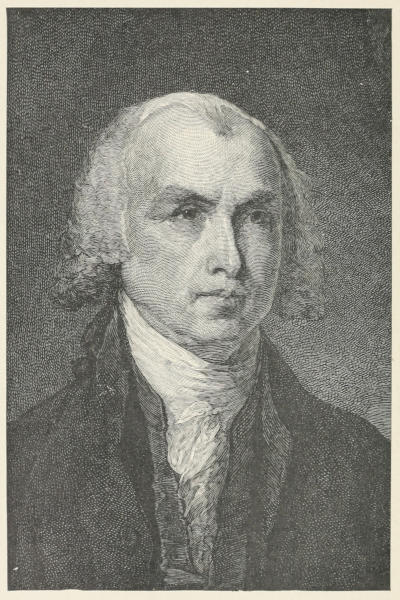
JAMES MADISON
[iii]
A HISTORY OF
THE AMERICAN PEOPLE
BY
WOODROW WILSON, Ph.D., Litt.D., LL.D.
PRESIDENT OF PRINCETON UNIVERSITY
ILLUSTRATED WITH PORTRAITS, MAPS,
PLANS, FACSIMILES, RARE PRINTS,
CONTEMPORARY VIEWS, ETC.
IN FIVE VOLUMES
Vol. III.

NEW YORK AND LONDON
HARPER & BROTHERS PUBLISHERS
MCMVII
[iv]
Copyright, 1901, 1902, by Woodrow Wilson.
Copyright, 1901, 1902, by Harper & Brothers.
All rights reserved.
[v]
CONTENTS
[vi]
[vii]
NOTES ON ILLUSTRATIONS
| PAGE | |
| James Madison | Frontispiece |
| Sir Henry Clinton.—Reproduced from an old steel engraving after a painting by Smart | 3 |
| Rodney Triumphant. From Gillray’s caricature upon the occasion of Sir George Rodney’s victory over Admiral de Grasse in the West Indies.—Reproduced from the print in the New York Public Library (Lenox Building). This signal victory of Rodney over de Grasse was considered the most important battle of the century, and as a reward for his services Rodney was raised to the peerage. The print shows Rodney trampling on the French flag while receiving de Grasse’s sword. In the background are sailors bringing ashore the treasure-chests, while above Rodney is seen the Viscount’s coronet, which never reached his head | 5 |
| Yale College and Chapel, 1786.—Reproduced from an old print in the library at Yale University, New Haven, Conn. | 7 |
| Henry Seymour Conway.—Reproduced from a print in the European Magazine, 1782 | 9 |
| North side of Wall Street, New York, 1785.—Redrawn from an old print | 10 |
| Lord Shelburne.—Reproduced from an old steel engraving | 11 |
| South Carolina currency.—From the original in the New York Public Library (Lenox Building) | 13 |
| General Carleton’s return of refugees.—From The Memorial History of New York City | 14[viii] |
| Sir Guy Carleton.—Redrawn from an engraving in the Political Magazine, 1782 | 15 |
| Title-page of Burke’s “Considerations.”—Reproduced from the original in the library of Harvard University, Cambridge, Mass. | 17 |
| Count de Vergennes.—Reproduced from an engraving by Vangelisti, after the painting by Callet, in the New York Public Library (Lenox Building) | 19 |
| John Jay.—From a painting by Gilbert Stuart | 21 |
| Richard Henry Lee.—From the painting by C. W. Peale, in Independence Hall, Philadelphia, Pa. | 23 |
| Tory refugees on their way to Canada.—From a painting by Howard Pyle | 25 |
| Mount Vernon, the home of George Washington.—From a recent photograph | 27 |
| A political discussion.—From a painting by Howard Pyle | 29 |
| General George Washington’s coach and four.—Redrawn from an old print | 30 |
| Robert Morris.—From the painting by Gilbert Stuart | 31 |
| Alexander Hamilton.—From the portrait by Weimar, in the Governor’s Room, New York City Hall | Facing p. 32 |
| Facsimile of Continental budget, 1786.—From the MS. Reports of the Board of Treasury, in the Emmet Collection, New York Public Library (Lenox Building) | 33 |
| Map of North America.—Showing the boundaries according to the proposals of the Court of France | 35 |
| Along the water front, New York, about 1780.—From a painting by Howard Pyle | 39 |
| The burial of Braddock.—From a painting by Howard Pyle | 41 |
| Fraunce’s Tavern in 1783.—From Wilson’s Washington | 43 |
| Address of returned citizens, New York, 1783.—From The Memorial History of the City of New York | 44, 45[ix] |
| Map of the United States, 1783 | 47 |
| Unfinished portraits of the signers of the Treaty of Paris, 1783.—By Benjamin West | 50 |
| Facsimiles of signatures to the treaty of peace.—From a photograph of the original in the State Department at Washington | 52 |
| Royal proclamation of cessation of hostilities.—From the original in the Emmet Collection, New York Public Library (Lenox Building) | 55 |
| Shays’s mob in possession of the court house.—From a painting by Howard Pyle | 57 |
| Marquis de Lafayette. From an engraving by Jones | 59 |
| Thomas Sumter.—From an engraving after the painting by C. W. Peale | 63 |
| Count de Grasse.—From an etching in the Emmet Collection, New York Public Library (Lenox Building) | 65 |
| Specimen of Virginia currency.—From a photograph | 67 |
| John Blair.—From an etching in the Emmet Collection, New York Public Library (Lenox Building) | 69 |
| Gouverneur Morris.—From an etching in the Emmet Collection, New York Public Library (Lenox Building) | 70 |
| Rufus King.—From a painting by Gilbert Stuart | 73 |
| Edmund Randolph.—From a painting in the Capitol at Richmond | 75 |
| Governor Bowdoin’s proclamation.—From the original in the Massachusetts Historical Society | 77 |
| Silhouette of James Bowdoin.—From Winsor’s Narrative and Critical History of America | 79 |
| James Bowdoin.—From the original painting by John Singleton Copley, in the library at Bowdoin College, Maine | 81 |
| Oliver Ellsworth.—From an engraving after a painting by J. Herring | 84[x] |
| Henry Laurens.—From an old English engraving | 86 |
| William Patterson.—From an etching in the Emmet Collection, New York Public Library (Lenox Building) | 88 |
| Thomas Paine.—Redrawn from an old print | 90 |
| Title-page of “Common Sense.”—From the original in the library of Harvard University | 92 |
| George Washington, from the bust by Eckstein.—From Wilson’s Washington | 95 |
| John Marshall.—From an engraving after a painting by Henry Inman | Facing p. 96 |
| Thomson, the clerk of Congress, announcing to Washington, at Mount Vernon, his election to the presidency.—From a painting by Howard Pyle | 97 |
| Inauguration of Washington in New York.—From a painting by Howard Pyle | 99 |
| The first presidential mansion, at Pearl and Cherry Streets.—Redrawn from an old print | 101 |
| Henry Knox.—From a painting by C. W. Peale | 103 |
| Celebration in New York on the night of Washington’s inauguration.—From a painting by Howard Pyle | 105 |
| Government House at the battery, New York, 1790.—From Wilson’s Washington | 107 |
| Congress Hall, 1790-1800.—Redrawn from an old print | 109 |
| United States frigate, 1812.—Redrawn from an old print | 111 |
| View of Broad Street and City Hall, New York, 1780.—Redrawn from an old print | 113 |
| First Ohio Capitol, 1801.—Redrawn from an old print | 118 |
| State Capital of Kentucky, 1796.—Redrawn from an old print | 121 |
| Model of a Conestoga wagon.—Redrawn from a print | 123 |
| Transportation advertisement.—Copied from an old poster | 125[xi] |
| A mail carrier in the eighteenth century.—Redrawn from an old print | 127 |
| First mill in Ohio, 1789.—Redrawn from an old print | 129 |
| Land office of the Ohio Company, Marietta.—Redrawn from an old print | 130 |
| Edmond Charles Genet.—From Harper’s Monthly Magazine | 131 |
| Interview between General Washington and “Citizen” Genet.—From a painting by Howard Pyle | 133 |
| A banquet to Genet.—From a painting by Howard Pyle | 135 |
| First public school in New York.—Redrawn from an old print | 139 |
| French fort at St. Louis.—Redrawn from an old print | 141 |
| Washington’s writing table.—From a photograph | 142 |
| Albert Gallatin.—Redrawn from an old print | 144 |
| Impressment of seamen.—From a painting by Howard Pyle | 147 |
| Prince Talleyrand.—From an old French lithograph | 149 |
| Elias Boudinot.—Redrawn from an old print | 151 |
| Announcement of the death of Washington.—This announcement of the death of Washington was printed originally as the leading editorial in the New York Gazette and General Advertiser | 155 |
| Advertisement of funeral of liberty.—From Sparks’s The Men Who Made the Nation | 157 |
| Thomas Jefferson.—From a painting by Gilbert Stuart, in the Art Gallery of Bowdoin College, Maine | Facing p. 160 |
| Charles C. Pinckney.—Reproduced from an etching in the Emmet Collection, New York Public Library (Lenox Building) | 162 |
| Eli Whitney.—Redrawn from an old engraving | 165 |
| Old court house, New Orleans.—Redrawn from a woodcut in Harper’s Monthly Magazine | 167[xii] |
| View across the North River, 1796.—Redrawn from an old print | 169 |
| Title-page of a campaign document, 1800.—One of several pamphlets issued violently opposing the election of Thomas Jefferson to the Presidency of the United States. A copy of this pamphlet is in the New York Public Library (Lenox Building) | 171 |
| Whitney’s cotton gin.—From a drawing from the original model | 173 |
| Title-page of Jefferson’s inaugural address | 175 |
| William Pinkney.—Redrawn from an old engraving | 177 |
| The Hamilton-Burr duel.—From a painting by F. Luis Mora | 179 |
| Robert R. Livingston.—Redrawn from an old engraving | 181 |
| Hamilton’s residence. The Grange.—Redrawn from an old print | 184 |
| Early view of Washington City.—From Higginson’s History of the United States | 186 |
| Old State House, Hartford.—Redrawn from an old print | 187 |
| Arch Street, Philadelphia, in 1800.—Redrawn from an old print | 189 |
| New York about 1800. From the north.—Redrawn from an old print | 191 |
| Bryant’s satire.—From Sparks’s The Men Who Made the Nation | 193 |
| Notice concerning the relief of sailors.—From Sparks’s The Men Who Made the Nation | 195 |
| John Quincy Adams.—Reproduced from an old engraving | 198 |
| Aaron Burr.—From a painting by John Vanderlyn, in the library of the New York Historical Society | 201 |
| Western cooking utensils.—Redrawn from an old print | 202 |
| Pittsburg, 1810.—Redrawn from an old print | 203 |
| Monticello. Thomas Jefferson’s residence.—From a sketch by Benson J. Lossing in 1850 | 205[xiii] |
| Cincinnati in 1810.—Redrawn from a print in Howe’s History of Ohio | 207 |
| Tremont Street, Boston, 1800. Looking north.—Redrawn from an old print | 208 |
| Cincinnati, from Newport, in 1812.—From Lossing’s Field-Book of the War of 1812 | 209 |
| Henry Clay.—From a painting by an unknown artist, in the Long Island Historical Society | 211 |
| William Harris Crawford.—Redrawn from an old print | 213 |
| John Randolph.—From a painting by J. W. Jarvis in 1811 | 215 |
| Detroit in 1815.—Redrawn from an old print | 216 |
| The Port of Buffalo, 1815.—Redrawn from an old print | 217 |
| Jackson’s headquarters, New Orleans.—Redrawn from an old print | 219 |
| Oliver Hazard Perry.—Redrawn from an old print | 221 |
| Battle of Lake Erie.—From a painting by Carlton T. Chapman | 222 |
| Thomas Macdonough.—From a painting by Gilbert Stuart, in the library of the Century Club, New York | 224 |
| House of American commissioners at Ghent.—Redrawn from an old print | 225 |
| In the American trenches. Battle of New Orleans.—From a painting by F. Luis Mora | 226 |
| Facsimile of signatures to the treaty at Ghent.—From The Memorial History of New York City | 228 |
| Josiah Quincy.—From a portrait by Gilbert Stuart, in the Museum of Fine Arts, Boston, Mass. | 233 |
| De Witt Clinton.—From a painting by Jonathan Trumbull, in the Chamber of Commerce, New York | 235 |
| Daniel D. Tompkins.—From an engraving after a painting by J. W. Jarvis | 239[xiv] |
| James Wilson.—From a painting by Wharton after a miniature by James Peale, in Independence Hall, Philadelphia, Pa. | Facing p. 240 |
| Cumberland Gap, near Wheeling, Virginia.—From a photograph | 241 |
| Canal boats crossing the mountains.—From a photograph | 244 |
| Prince Metternich.—From a French engraving | 247 |
| Chicago in 1821.—Redrawn from an old print | 251 |
| Jersey City in 1820.—Redrawn from an old print | 253 |
| Cumberland road, near Wheeling, Virginia.—Drawn from a photograph | 257 |
| The capitol at Washington, 1804.—Redrawn from an old print | 259 |
| Bust of George Canning.—From Green’s History of the English People | 262 |
| Richard Rush.—From an engraving after a portrait painted in London while minister to the British Court | 264 |
| Rear view of the capitol at Washington, 1820.—Redrawn from an old print | 266 |
| Ground plan of the capitol, 1825.—From Winsor’s Narrative and Critical History of America | 267 |
| John C. Calhoun.—Redrawn from an old engraving | 269 |
| North end of City Hall Park, New York, 1825.—Redrawn from an old print | 271 |
| Thomas H. Benton.—From a portrait in the library of Princeton University | 273 |
| The Adams mansion, Quincy, Mass.—Redrawn from an old print | 275 |
| Locks on the Erie Canal.—From Harper’s Monthly Magazine | 277 |
| Autograph of invited guests, Erie Canal celebration.—From The Memorial History of the City of New York | 279[xv] |
| John Quincy Adams.—From a painting by G. P. A. Healy, in the Corcoran Gallery, Washington | Facing p. 280 |
| St. Paul’s Church and Broadway, 1831.—From an old lithograph | 281 |
| Campaign poster of 1828 | 282 |
| Title-page of Calhoun’s “Exposition.”—A copy of this political pamphlet is in the New York Public Library (Lenox Building) | 284 |
| Title-page of Jackson’s “Proclamation.”—A copy of an American issue of this pamphlet is in the New York Public Library (Lenox Building) | 286 |
| Andrew Jackson’s forest residence.—From a sketch by Benson J. Lossing | 288 |
| The Hermitage. Residence of General Jackson.—From a sketch by Benson J. Lossing | 290 |
| LIST OF MAPS | |
| The United States in 1783.—Showing claims of the States | Facing p. 48 |
| Map of Votes in Middle and Southern States on Federal Constitution, 1787-89.—With contour lines by Professor O. G. Libby, of the University of Wisconsin | Facing p. 78 |
| Map of Votes in New England States on Federal Constitution, 1787-88.—With contour lines by Professor O. G. Libby, of the University of Wisconsin | Facing p. 80 |
| The United States, March 4, 1801 | Facing p. 144 |
| The United States, March 4, 1825 | Facing p. 288 |
The Appendix in this volume is taken by permission from Mr. Howard W. Preston’s Documents Illustrative of American History.
[1]
A HISTORY
OF THE AMERICAN PEOPLE
CHAPTER I
BETWEEN WAR AND PEACE
The surrender of the Earl of Cornwallis at Yorktown closed the career in America of the only British general who had shown commanding gifts in the field. It closed also the revolution itself. The southern campaign had been undertaken at the wish and upon the plan of Cornwallis. He knew how pronounced division of opinion was in the South, and how certain a hold could be got there upon the sympathy of scores of men who could be of the utmost service to an army in the field. He knew how important it was to close the southern ports, and particularly the Chesapeake, in order to shut out the supplies that came steadily in from over sea. He believed that an effectual blow struck from the south at Virginia, after the reduction of the far southern ports, would secure for the British an almost commanding position on the continent. Had Clinton helped him promptly, instead of grudging him aid; had he been enabled to move rapidly and in force as he had planned, he might have accomplished [2]his purpose effectually, even brilliantly. Even as it was, there had been something very striking about the manner in which he had fought his way from the far southern coasts to Yorktown: the boldness with which he had dared to risk all his connections to deliver a blow; the success with which he had beat off the Americans whenever he was himself personally in command; the comparative freedom with which he had moved in Virginia, despite the gathering strength of the forces under Lafayette. It was the express orders of Clinton, his superior, that had caged him at Yorktown; and it was but seven thousand men he yielded to his fourteen thousand besiegers and de Grasse’s fleet in the Bay. It was characteristic of Sir Henry Clinton that he did not start from New York to bring the long-needed aid until the very day of his comrade’s surrender. The usual thing had happened. An incompetent commander-in-chief had dallied and blundered with Washington at hand to take advantage of every blunder like a master. Sir Henry had gone to succor Cornwallis as he had gone to meet Burgoyne, when the campaign was over.
[3]
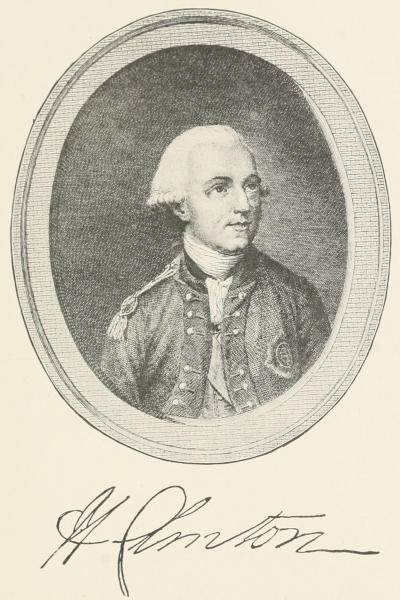
SIR HENRY CLINTON
[4]
Lord North knew what the news meant when it came. He received it “as he would have taken a ball in his breast, opening his arms and exclaiming wildly, ‘O God! it is all over!’” But when that first moment of poignant chagrin was past, no doubt a very distinct sense of relief ensued, to offset the bitterness of the humiliating blow. It was imperative for England that the American war should end. She was beset. France and Spain had taken advantage of the revolt of the colonies once more to attack her,—not because they loved America or sympathized with the ideals of liberty for which she fought, but because they wished to make good against England the threatened disaster. United, they were as strong as she upon the seas. Louis XVI. had diligently courted peace with his neighbors on the continent, and had spent the money of France for ships and efficient sailors. Early in 1779 a French squadron had seized the English possessions in Senegal and on the Gambia. That same year a combined French and Spanish fleet swept through the Channel, no English force daring to oppose it. His work in the Chesapeake finished, de Grasse had returned again, upon the surrender of Cornwallis, to his attack upon the British West Indies, and before another spring came he had reduced every English island of the Caribbean Sea except Jamaica, Barbadoes, and Antigua. An English fleet out of New York had attacked him at the capes of the Chesapeake, trying to break the trap into which Cornwallis had fallen, but had been beaten off. In May, 1781, a Spanish force had taken Pensacola and driven the English from Florida; and in February, 1782, a Spanish fleet captured Minorca, and a closer siege than ever was drawn about Gibraltar.
Finding herself at war with half the world, England had claimed the right to search neutral vessels on the high seas for goods belonging to her enemies, and to confiscate them when found; had claimed also the right to seize vessels trading with such of her enemies’ ports as she had declared blockaded, whether she had actually blockaded them or not; and so had set the rest of the world against her. The northern states of Europe, headed by Russia, drew together in a league of “Armed Neutrality,” determined to assert in force the doctrine that “free ships make free goods,”—a doctrine till then unasserted,—and to make effectual denial of the right to establish “paper blockades,” created by proclamation and not by naval force; and the actual resistance of Dutch ships to her attempts to subject them to search forced England, in December, 1780, to make formal declaration of war against the Dutch Republic. Wars with the native princes of India had been heaped upon her other burdens since 1778, and France had sent a formidable armament thither, as she had sent an armament to America, at the moment of most critical danger, demanding that England relinquish everything except Bengal. It was no time to reconquer America.
[5]
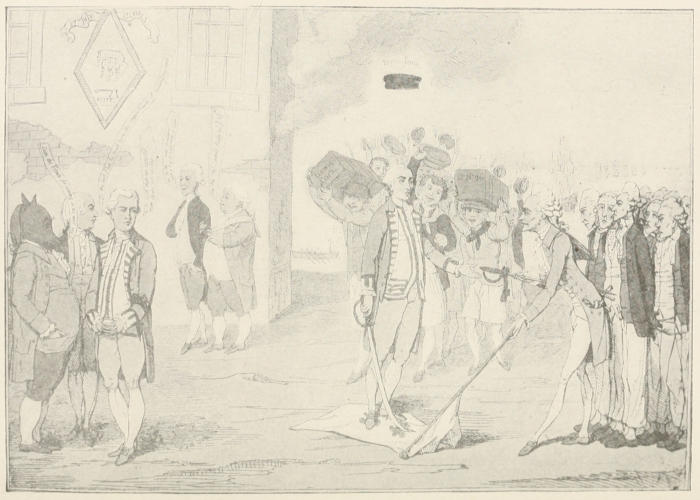
RODNEY TRIUMPHANT, FROM GILLRAY’S CARICATURE UPON THE OCCASION OF SIR GEORGE RODNEY’S VICTORY OVER ADMIRAL DE GRASSE IN THE WEST INDIES
[6]
Opinion as well as fortune had set against the further prosecution of the war against the colonies. At first opinion had seemed to sustain it. The nation, so far as any man could tell, believed it necessary and desirable that the colonies should be brought to obedience. But with the progress of the war opinion had veered. Uneasiness and disquiet had ensued, not merely because every campaign had ended in failure, but also because of the very fact of the war,—a war against Englishmen, and upon questions which abode at home as well as in America. It was noteworthy that the country seemed to grow more and more dissatisfied with Parliament and with the subtile power of the King to rule in every turn of affairs. There began to be, for the first time in England, an articulate “public opinion,” which was not the opinion of the Commons but an opinion uttered in mass meetings such as Mr. Wilkes’s friends had found out how to assemble and make use of. A great agitation arose for a reduction of the crown’s patronage and influence in Parliament, and for the regulation of official [7]emoluments, in order that corruption might be prevented. In April, 1780, Mr. John Dunning, the Whig member for Calne, and from the first an avowed opponent of the war against the colonies, had actually carried through the House of Commons itself, in the teeth of the ministers, a resolution that “the influence of the crown had increased, was increasing, and ought to be diminished.” Sudden mobs and tumults disturbed London with the swaying of opinion at every change of policy.
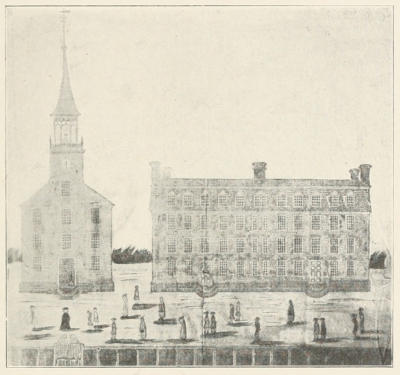
YALE COLLEGE AND CHAPEL, 1786
There were some men who saw what underlay the doubts and agitations and dismays of the time,—who saw that the success of the English armies in America would mean such a danger to English liberty itself as they did not care to face,—the supremacy of the crown and of an unreformed Parliament. The Duke of Richmond [8]had not hesitated to declare at the very outset of the war his hope that it would end in just such a crushing defeat as this which had now come at Yorktown. Young Pitt, great Chatham’s son, had denounced the war while yet Cornwallis seemed to move victorious in the South as “accursed, wicked, barbarous.” Charles Fox clapped his hands at news of Washington’s final victory. Lord North had himself long ago lost heart in the business. He had wished to resign ever since the news of Burgoyne’s surrender; had kept his office against his will and better judgment because the King so urgently commanded him to keep it; and was heartily glad to get his release when at last the House itself yielded to opinion out-of-doors and voted that the war should stop.
A soldier led the dissatisfied Commons in their tardy revolt,—the gentle Conway, who from the first had stood with Burke and the Rockingham Whigs as a champion of the cause of the Englishmen over sea. On the 27th of February, 1782, he triumphantly carried against the ministers the significant resolution, “That it is the opinion of this House that a further prosecution of offensive war against America would, under present circumstances, be the means of weakening the efforts of this country against her European enemies, and tend to increase the mutual enmity so fatal to the interests both of Great Britain and America,” and on the 4th of March capped it with the still more trenchant resolution, “That the House will consider as enemies of his Majesty those who should advise or attempt a further prosecution of offensive war on the continent of North America.” By the end of the month North was out, and Rockingham had once more taken office.
[9]
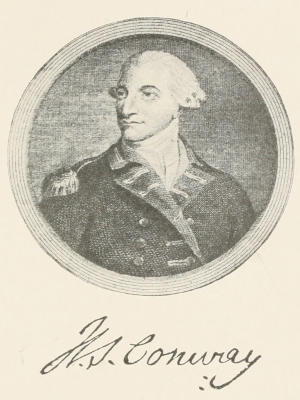
HENRY SEYMOUR CONWAY
With this radical change in the spirit and motive of affairs at home came brighter news from abroad. In India the native princes had once more been brought to submission, and France had gained no advantage. Rodney had beaten de Grasse in the West Indies (April 12, 1782), in eleven hours of desperate fighting which had rendered the western seas no longer tenable for France had broken her naval power, and had made England safe of her mastery again on those contested coasts. Before the close of the year the combined forces of France and Spain had been obliged to abandon the siege of Gibraltar, which Spain had begun at the very outset of hostilities. It was, of course, no part of the personal triumph of the new ministers that the year in which they supplanted North was also the year in which the tide of victory turned, the year of England’s triumph over her European enemies. It was their task to make wise use of victory, and to reform the government which the King had corrupted and North had misused. In that their success was singularly immediate and extensive. By a rapid succession of measures they disqualified [10]revenue officers from voting at elections and government contractors from sitting in the House of Commons, and cut in half the patronage of the crown. They were convinced, with Mr. Dunning, that the power of the crown had too much increased and ought to be diminished, in England no less than in America. It showed an extraordinary alteration in the temper of the Commons that they were able to diminish it so much.
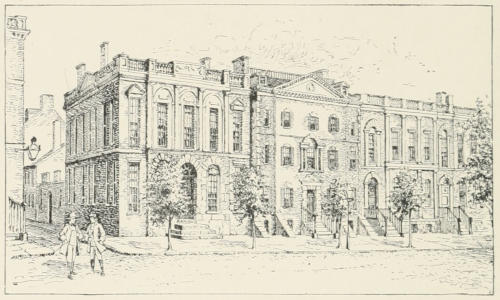
NORTH SIDE OF WALL STREET, NEW YORK, 1785
The lesson learned in America told upon the policy of the ministers in more ways than one. It led them to concede, among other things, an independent parliament to Ireland. There had been no soldiers to spare for the defence of Ireland when war threatened every coast and province of the empire; the Irish Protestants had mustered eighty thousand volunteers for their own defence; they could not now be refused the independent parliamentary action they had coveted.
[11]
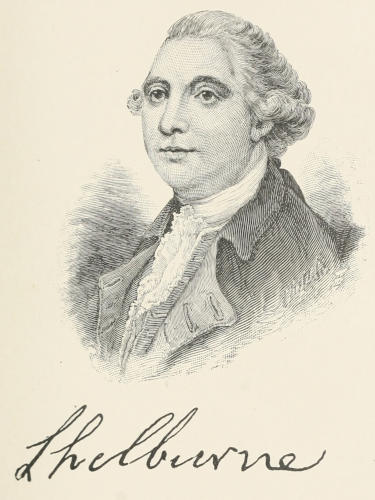
LORD SHELBURNE
But the chief fruit of the change of ministers was peace. Lord Rockingham lived but three months to preside over the counsels of peace and reformation he had so long wished to bring about. On the 2d of July, 1782, Lord Shelburne became the head of the government, and some of the Rockingham Whigs refused to serve under his leadership. But the reconstitution of the ministry did not affect either its spirit or its policy. It had planned peace and was able to bring it about. France and Spain had but completed their bankruptcy by the war; England’s credit was [12]secure. She could afford to continue the war; they could not. It was a mere matter of terms: England could almost dictate what they should be.
Peace must have seemed to Washington and Greene and Knox in the field, to the executive committees of the Congress at Philadelphia, to Franklin at Paris and John Adams at The Hague, like a beneficent providence rather than a thing earned by decisive victory. It was midsummer, 1782, before they could thoroughly credit those who told them of its certain approach. That supreme stroke at Yorktown having been delivered, everything fell slack; it seemed impossible to add anything, by way of making victory secure. There were still, it might be, some forty thousand British troops in America, reckoning all the posts from Canada round about, west and east, to the Gulf and the islands of the Indies. There were seventeen thousand in New York, and nearly seven thousand facing General Greene in the South. Having finished at Yorktown, Washington sent two thousand men to reinforce General Greene in South Carolina, and himself went promptly back to his post at Newburgh on the Hudson, to watch Clinton at New York, leaving Rochambeau and four thousand French troops at Williamsburg in Virginia, to guard the approaches of the Chesapeake. He was deeply anxious. He knew that the country had reached a point of utter exhaustion, lethargy, and disorganization. Not a recruit could he get. The troops were unpaid, unfed, only half clothed. He deemed the situation one of grave peril, and despaired presently of so much as keeping up appearances, knowing very well that the British were as well aware of his weakness as he was, and of the apathy and confusion [13]of weak counsels that had fallen on the states. Clinton sent word to the ministers that if they would but send him ten thousand more men he would be responsible for the reduction of the country. Rodney presently cleared the coast of the French, and there was nothing to prevent fresh troops and supplies being sent as fast as the ministers wished to send them,—nothing but the ministers’ desire for peace, which Washington found it hard to credit.
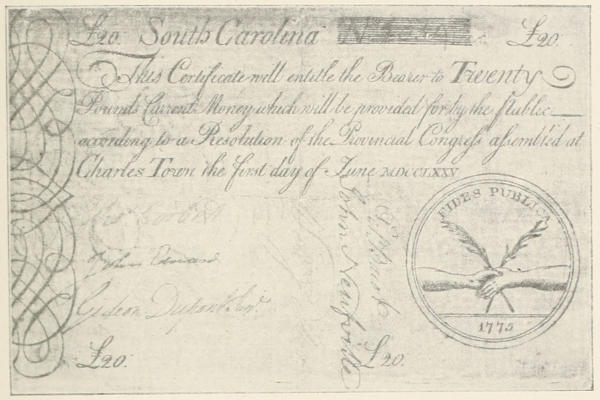
SOUTH CAROLINA CURRENCY
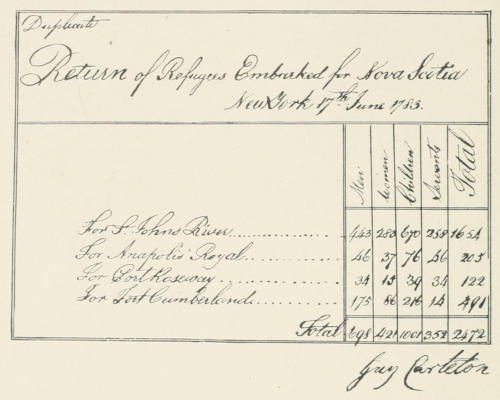
GENERAL CARLETON’S RETURN OF REFUGEES
But the new year confirmed the good news. The leaders of government in England had no doubt come to perceive very clearly how essentially impossible it was to conquer America, now that the alienation of feeling between the two countries was complete and final, and all thought of submission or accommodation out of the question. Their generals had seldom been beaten in battle, as it was. Burgoyne had won action [14]after action in the northern forests only to find himself helpless at last. Howe had had his way easily enough at New York and on his expedition against Philadelphia. Cornwallis had moved freely, almost victoriously, into the trap at Yorktown. The unpalatable fact was, that British troops could control only so much of the country as they actually occupied, and that it was out of the question to occupy all of it. With Washington always at hand, always ready to strike, and always able to make the stroke tell, it was not safe even to attempt the maintenance of extended lines. At any rate, England had grown weary of the unnatural business; the House of Commons had declared against the war; the new ministers were resolved to end it, [15]even at the cost of granting America her independence; and it had become only a matter of terms.
SIR GUY CARLETON
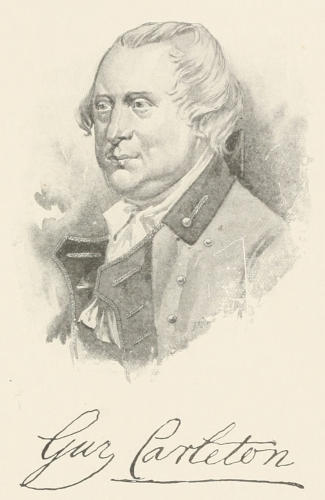
In May, 1782, General Clinton was superseded at New York by General Sir Guy Carleton, who was instructed to assure the American commander-in-chief of the government’s determination to seek terms of peace, and who was of the noble spirit to like his errand. On the 11th of July the British garrison at Savannah was withdrawn and sent to New York. In August, Washington received from Carleton definitive assurances that the independence of the United States was to be conceded as a preliminary of peace, and in September the French who had remained in Virginia joined the Americans on the Hudson. In October they embarked at Boston for France. By the close of November (November 30, 1782) a provisional treaty of peace had been agreed upon; and on the 14th of December Charleston was also evacuated, and the South left free of British troops. Carleton, [16]when he felt that peace was indeed assured, began to disband the loyalist regiments enlisted in the British service and to despatch many of his regulars to the West Indies, to Nova Scotia, and to England. No one doubted any longer that the end of the bitter business had come at last; every one waited impatiently for the treaties which were to constitute its formal conclusion.
The actual formulation of peace, however, proved a matter of no small difficulty. America and France were bound together by the close and honorable ties of alliance; and France was in her turn allied with Spain, who now felt her interests to be by no means coincident with the interests of America. The Congress at Philadelphia explicitly commanded its commissioners “to be guided by the wishes of the French court.” Dr. Franklin, Mr. John Adams, and Mr. John Jay, who bore its commission, were men of honor, and entertained, besides, a lively sense of the very deep obligations of the United States to France, for the money and the armed assistance in the field and upon the seas without which, apparently, their victory would have been impossible. It proved impracticable, nevertheless, to act with France; for she conducted herself, not as the ingenuous friend of the United States, but only as the enemy of England, and as first and always a subtile strategist for her own interest and advantage. The American commissioners would not be tricked and made use of, and came to terms separately, secretly, and for themselves with the English, their instructions notwithstanding. They did not make peace without their ally, but they would not accept terms of her arrangement.
[17]
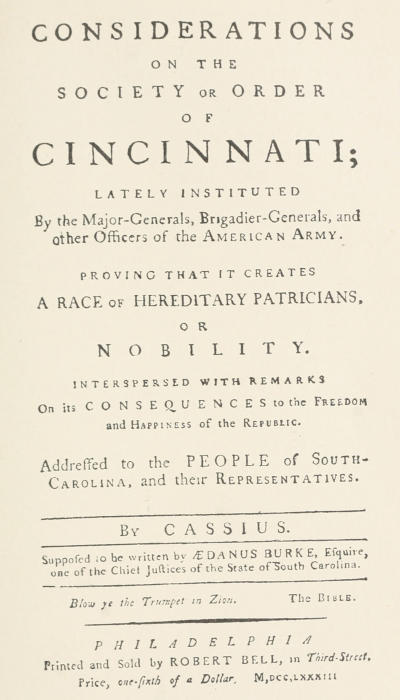
TITLE-PAGE OF BURKE’S “CONSIDERATIONS”
[18]
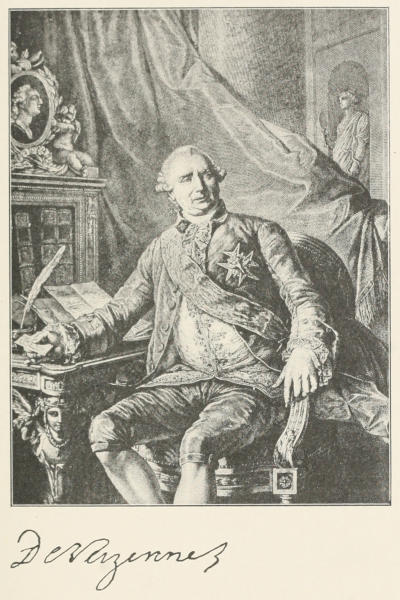
The Count de Vergennes, her astute minister, had meant to devise a balance of power in America which might be made to redound to the advantage of France in Europe: had meant to support England in the exclusion of the Americans from the Newfoundland fisheries, and in her claim that the northern boundary of the United States should be the river Ohio, instead of the great lakes; to suggest the creation of a neutral zone of territory between the western settlements of the American States and the Mississippi, set apart for the Indians under the joint protection of the United States and Spain; and to stand with Spain for the utmost possible northward extension of the boundaries of Florida, which Spain had taken possession of. The American commissioners ignored him and got their own terms: The independence of the United States, a northern boundary at the great lakes, a western boundary at the Mississippi, and the use of the Canadian fisheries. Between the signing of the provisional and the signing of the definitive treaty the ministry of Lord Shelburne gave place to a coalition ministry under the Duke of Portland which brought North once more into office; but the course of the negotiations was not materially changed. The American commissioners got substantially all they had contended for (September 3, 1783).
The States had at last, moreover, a common government which could accept independence. On the 1st of March, 1781, Maryland had given her tardy assent to the Articles of Confederation, on the understanding that the States which had claims to territory in the west should as soon as possible relinquish them in favor of the newly formed government. On the 14th of January, 1784, the Congress of the Confederation, not yet two years old, ratified the treaty of peace.
[19]
COUNT DE VERGENNES
A burst of heady indignation followed the publication of the terms of the treaty. It was well enough that the United States should have their independence, of course, and their proper boundaries, and that the immemorial right of their people to fish in the Canadian waters should be retained; but there were other articles [20]in the treaty which gave almost universal dissatisfaction. The Confederation bound itself to urge upon the States unconditional amnesty for the loyalists and a complete restoration of their estates and civil rights, and to prevent so far as possible any legal obstacles being put in the way of the collection of the debts due British merchants at the outbreak of the war. Dr. Franklin had very candidly explained to the British commissioners that the Congress of the Confederation had no power to enforce these articles: that it could only advise the States, and that they would be free to follow or to disregard its advice as they pleased; and they did disregard it entirely and even scornfully, being bent upon vouchsafing to the loyalists neither property nor rights of any kind, and upon virtually wiping out all debts owed to Englishmen.
The Confederation, in fact, furnished the country with no real government at all. The Articles explicitly reserved to each State “its sovereignty, freedom, and independence.” The general Congress had, it is true, powers which made it seem like a veritable government with respect to all dealings with foreign states, in the making of war and the conclusion of peace, in the maintenance of land and naval forces for national defence, and in the raising of loans on the faith and credit of the United States. It was authorized, too, to act as absolute arbiter of disputes between the States, to establish and regulate post offices, to determine the alloy and the value of all coin struck either by its own authority or by the authority of the States, to fix the standard of weights and measures, and to regulate all dealings with the Indian tribes. But it had absolutely no power to lay taxes of any kind. It was to get its [21]means of support by requisition on the States,—by requests which it had no right to transmute into commands. The Confederation had no Executive but only its talkative Congress, in which the States big and little had an equal voice: which could decide no important matter without the concurrence of at least nine out of the thirteen little commonwealths which had but just now formed the jealous partnership. Its Congress was but a board of advice; and its advice could be ignored with impunity.
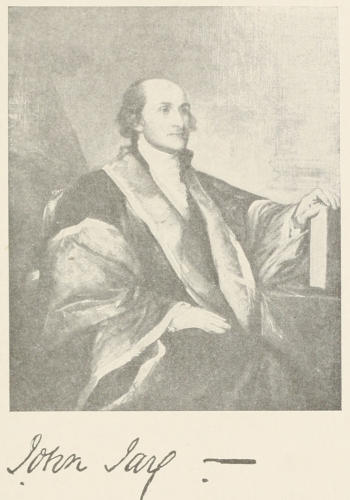
JOHN JAY
[22]
The common affairs of the country had therefore to be conducted as the revolution itself had in fact been conducted,—not by the authority or the resolutions of the Congress, but by the extraordinary activity, enterprise, and influence of a few of the leading men in the States who had union and harmonious common effort at heart. The revolution may almost be said to have been carried forward by private correspondence,—by the impulse of conviction, the urgency of argument, the clear interpretation of signs of the times, the ceaseless persuasion, planning, instigating of the letters of men like Washington, Knox, Greene, Schuyler, Hamilton, Henry, Franklin, Livingston, Madison, Jefferson, Hancock, Morris, Jay, Gadsden, the Lees, the Adamses,—a handful of men in each State who kept every one within reach of their letters or their voices reminded, in season and out of season, of the happenings, the dangers, the hopes, the difficulties, the duties of the time, stimulating those in authority, checking those in opposition, arousing those who were indifferent. This, rather than the work of formal committees of correspondence, had kept action awake and made it vital.
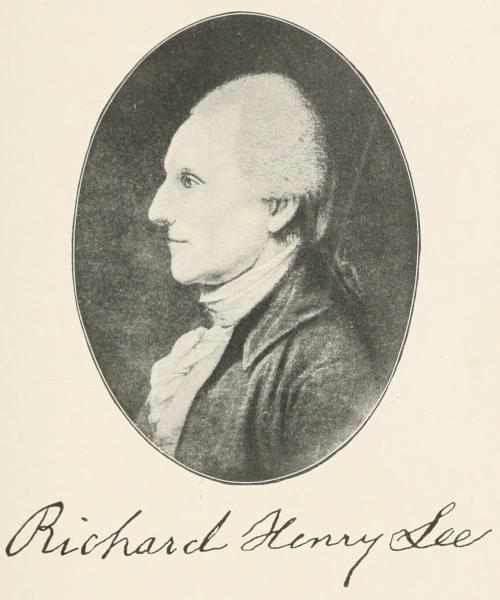
RICHARD HENRY LEE
The Congress had talked ineffectually enough, and done nothing, at many a critical moment; had given way to the influence of petty provincial factions and listened to unworthy intrigues, while men not in its membership were carrying affairs forward without it. John Adams himself had too readily joined the silly talk of that disconcerted body when it grew impatient of Washington’s “Fabian policy” in the face of overwhelming odds. “My toast,” he had cried, “is a short and a violent war!” Samuel Adams, too, had seemed [23]once and again, in that demoralizing atmosphere of debate without action, to show only his petty gifts of management without a touch of broad or generous temper. Even Richard Henry Lee, of Virginia, had criticised the sorely tried commander-in-chief’s “delays” at the very time when Washington’s letters were being hurried through the country along more lines of power than the Congress had ever had use of, persuading men and States to do what the Congress vainly suggested. The impotency, the occasional sheer imbecility, of the only common [24]council the country yet had had been offset and made up for by the singular assiduity and faithfulness in personal effort of the real leaders of opinion in the States. The States had been remiss enough, as it was, in supplying their quotas of men and money and stores; they would have been still more remiss had not their leading spirits cried shame upon them and excited them in some measure to a performance of their duty.
When peace came it proved more difficult than ever to induce the States to act, or even seriously to take counsel, in the common interest. They had made the Confederation, but they were not interested in it. They were engaged in setting their own affairs in order after the long disquieting years of revolution and war which had brought such sad havoc upon their old-time ordinances and ways of life. Passion had run hot while the war lasted. It was not easy to put a term at once upon the license or upon the distempers which such a time had produced so rankly. Not a little poise, not a little of the sentiment of law, not a little of the solidity of tradition and the steadiness of established ways of thought and action, not a little of the conservative strength of the young communities had gone out of the country with the loyalists,—not a little of the training, the pride of reputation, the compulsion of class spirit, the loyalty and honor of a class accustomed to rule and to furnish rulers. There was an added unsteadiness in affairs because in so many places new men, and radical, were at the front in all public business.
[25]
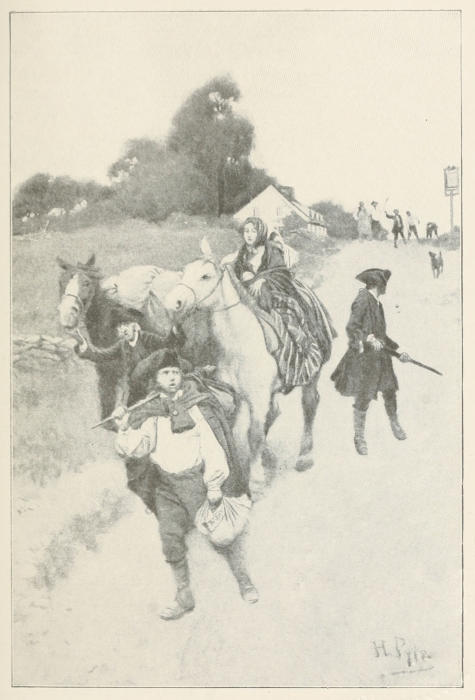
TORY REFUGEES ON THEIR WAY TO CANADA
[26]
Those who had adhered to the old order had made their way out of the revolted States in almost incredible numbers, as the issue of the war approached and became certain. Throughout the latter part of 1782 and all of 1783 they had poured out of the country in a veritable flight, knowing themselves proscribed and ruined, and not daring to wait for the actual evacuation of the English. Out of the southern country they made their way in ever-increasing numbers into Spanish Florida, or took ship to Bermuda or the British West Indies. Those who were within reach of Canada set out northward through the forests to seek a refuge there, following the rough, uncleared trails and the watercourses, with pack horse and boat, as in the old days of the first settlement of the continent out of Europe, abandoning home and property to escape contumely and the unspeakable hardship of being outlawed and hated in the communities of their own birth and breeding. Thousands upon thousands crowded to New York to seek the shelter of the British arms. It was the 25th of November, 1783, before Sir Guy Carleton could effect the final evacuation of the city, so great and so troublesome was the pitiful company of refugees for which he felt himself obliged in mere compassion to provide protection and transportation. More than twenty-nine thousand refugees (including three thousand negroes) left the State of New York alone, for Canada, during that confused and anxious year 1783.
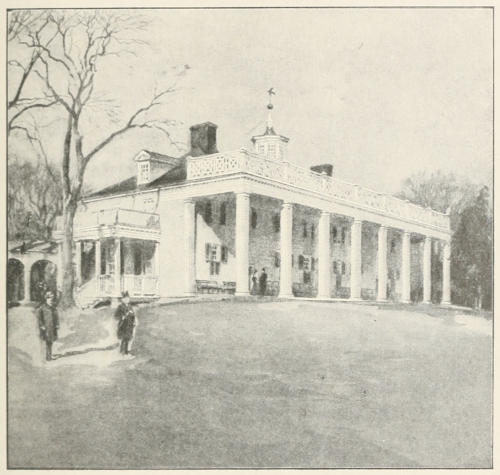
MOUNT VERNON
Most of these had taken no active part in the struggle which had rendered them homeless. Almost without exception they had been, in opinion, as thoroughly opposed as their neighbors to the policy of the King and Parliament towards the colonies. But they had not been willing to go the ugly length of rebellion and of outright separation from England. When it came to the final breach, some of them had become not merely passive but active opponents of revolution and independence. [27]The more partisan had taken up arms for the King. First and last, during the five years of the fighting, there had been no fewer than twenty-five thousand loyalists enlisted in the British service. At one time (1779) they had actually outnumbered the whole of the continental muster under the personal command of Washington. Most of those, however, who would not join the patriot party had been quiet non-combatants, and had been opponents of the revolution only in opinion. When the war was over the men who spoke the mind of the majority and who accordingly controlled [28]policy in the new States refused to make any distinction between those who had taken up arms and those who had not. In their eyes they were all alike “Tories” and traitors; and many an excess of persecution and spoliation, many a wanton insult, many an act of mere vengeance darkened the years which immediately followed the war;—increasing the bands of exiles and adding in an incalculable measure to the bitterness which was throughout generations to mark the feeling of Canadians for their southern neighbors.
It was but human nature that it should be so. No one could wonder that civil war had brought these too familiar things in its train. The bitterest words of the great Washington himself were uttered against the Tories. Even with his splendid moderation and poise of mind, he could not find it in his heart to forgive the men who had seemed to fill every country-side his army entered with intrigue and threat of treason to the cause he had given his life to. The best Virginians had chosen as he had chosen: he could not imagine how good men or true patriots anywhere could choose otherwise. It was part of the almost universal demoralization produced by the war that every sentiment should now exhibit its excess, every reaction prove dangerously violent. There was everywhere a sort of moral exhaustion; a relaxation of the very principles of just and temperate government which the war had been fought to vindicate; a loss of tone, an access of perilous agitation.
[29]
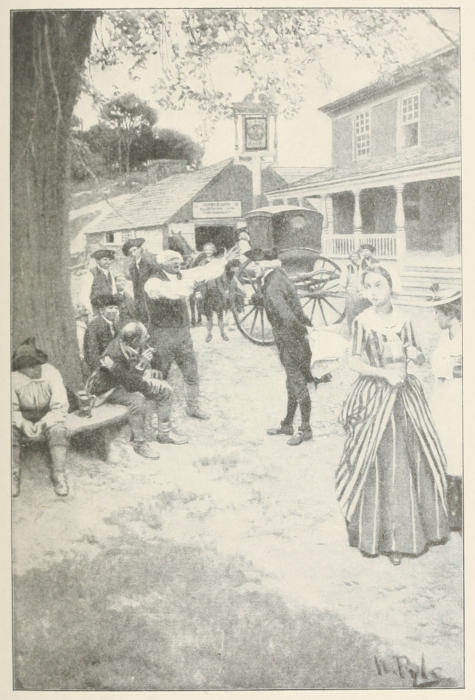
A POLITICAL DISCUSSION
[30]
The war had brought many things in its train calculated to work distress and to throw both morals and business into confusion. For one thing, it had saddled the country with an almost incalculable burden of debt. The individual States, the general Congress, towns, private persons even, had strained their credit to the utmost to meet the engagements and defray the expenses of a season during which business was oftentimes quite suspended and the ordinary sources of income absolutely dried up. The States and the Congress alike had resorted to the demoralizing expedient of issuing paper money which they could not redeem. Its bulk had, of course, increased from year to year, and its value had as rapidly declined. The continental money in particular had fallen so in value that the commodity must have been valueless indeed which fell under the reproach of being “not worth a continental.”
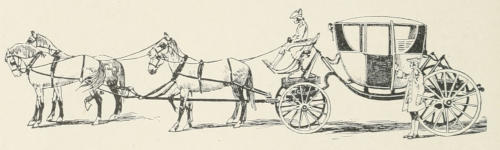
GENERAL GEORGE WASHINGTON’S COACH AND FOUR
It was the good fortune of the Confederation to have Robert Morris, one of the most distinguished, honorable, and successful merchants of Philadelphia, in charge of its treasury during the critical years of the final reckonings of the war (May, 1781, to April, 1785),—a man who had large means to pledge and who would pledge them to the last farthing to raise a sum of money upon an exigency, as Washington had done for the pay of his troops before Trenton. Mr. Morris had himself supplied almost everything that was needed for the victorious campaign which culminated at Yorktown, borrowing twenty thousand dollars in gold of Count [31]de Rochambeau, upon his personal credit, to do it. But even Morris, trained merchant and financier that he was, could not make something out of nothing. The States would not tax their people for the support of the Confederation. It took eighteen months to collect one-fifth of the taxes assigned them in 1783. They [32]neglected, sometimes even bluntly refused, to pay so much as their allotted shares of the interest on the national debt. The Confederation could not, of course, borrow under such circumstances. It was threatened with a mere unhonored lapse of all its powers and even of its very existence, for want alike of respect and support. The war had cost the Confederation more than ninety-two million dollars, reckoned in specie. France alone had spent sixty millions for America in loans and the support of armies. The States had added an expenditure of quite twenty-one millions more out of their own treasuries or their own credit. No wonder the men in responsible charge of public affairs in America rejected with a touch of bitter passion the demand of the treaty of peace, that they should, in addition to all this, restore to the loyalists the property they had lost, and pay to British merchants debts which antedated the war.
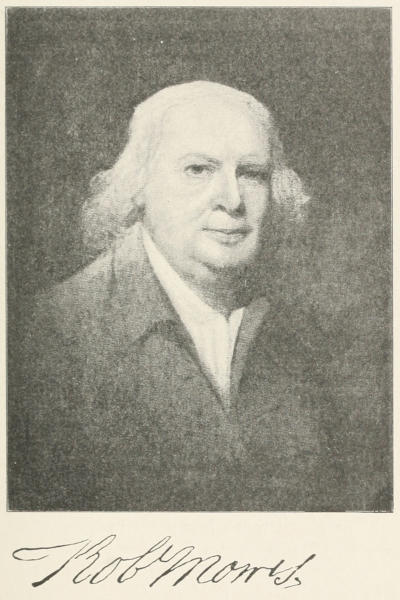
ROBERT MORRIS
Trade, apparently, could not recover from the blow it had received by reason of the long continuance of hostilities. It was likely to be worse, indeed, now that the war was over, than it had been while the war lasted. While the war lasted ship owners could at least use their craft as privateers, to bring in cargoes not consigned to them. Seamen had found infinitely more adventure and not much less profit in their profession during those lawless years than formerly. But when peace came the ports of the British West Indies, once open to them, became foreign ports and were closed against them. Productive industry had too long stood still and there was little or nothing to sell in exchange for the English goods every one needed and all bought who could. A war of tariffs succeeded the war of arms,—a war in which each State acted for itself. The Congress of the Confederation could not regulate trade,—that was not one of its powers. It could arrange no national policy. It could neither retaliate upon foreign governments nor make bargains of reciprocity with them. Each State studied its own interest and knew not how to advance even that successfully. American commerce had everywhere the worst of it.
[33]
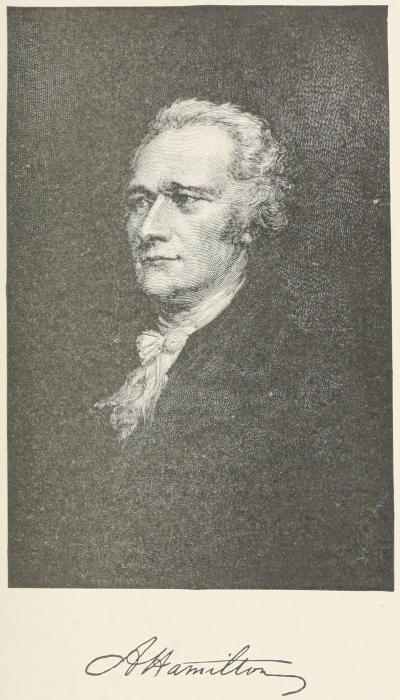
ALEXANDER HAMILTON
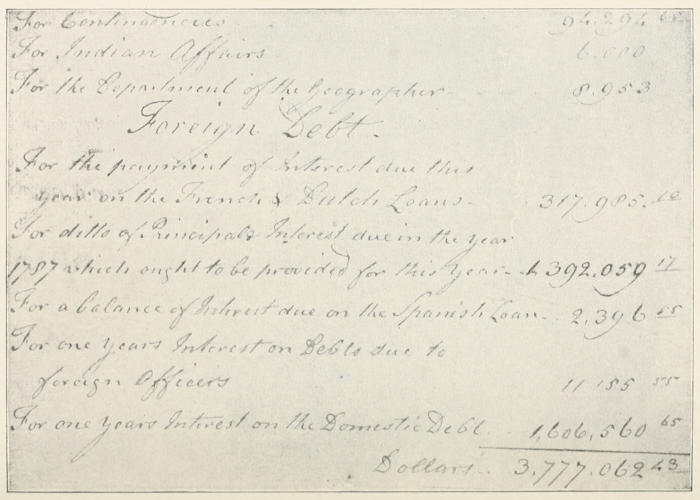
FACSIMILE OF CONTINENTAL BUDGET, 1786
[34]
It had been one of the unhappy omens of the time that the Confederation had had to reckon the disbandment of its own army one of the most serious difficulties attending the establishment of peace, and had had reason to feel relieved when it had at last got rid of it. During those last tedious months which intervened between the surrender at Yorktown and the formal conclusion of peace the idle soldiers had felt, more keenly even than in days of movement and war, the constant privations to which they were subjected. There had been times when some of them had been obliged to keep all day within their tents because absolutely without clothes to wear in which they could decently walk abroad. Their pay was almost never forthcoming; and they thought from time to time that they had good reason to suspect that the Congress meant to disband them and send them home without it. Their very idleness fostered an ill humor among them, for there was nothing but their very bitter grievances to think about. The neglect they suffered naturally seemed to them an intolerable indignity; and they broke here and there into actual mutiny, their officers hardly restraining them.
[35]
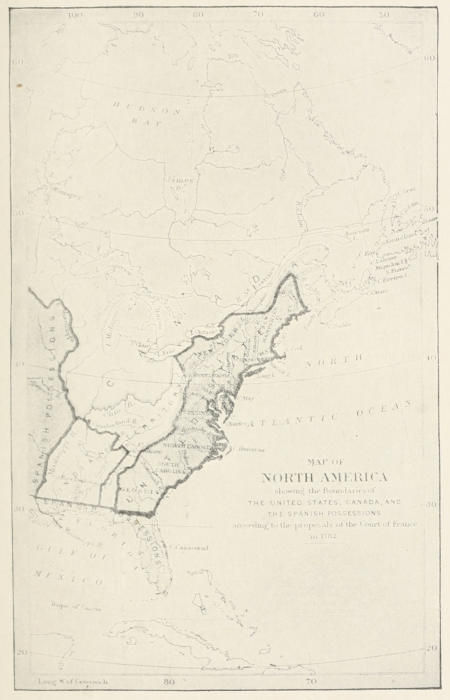
MAP OF NORTH AMERICA IN 1782
[36]
Their officers, indeed, went, some of them, a little beyond mutiny, to the borders of treason, at any rate in their wish and purpose. In the spring of 1782 a letter from one of the most respected and trusted of his officers had intimated to Washington the willingness of the army to make him king, master of the country, dictator,—anything he would,—in order that the futile government of a group of petty republics might give place at least to order and efficiency. Washington’s reply had run hot in every sentence with scornful indignation that any one should dare to deem him capable of proving himself a traitor and an adventurer; but it had been reported from his camp ere the year ended that he was steadily losing his hold upon the affection of the army by the harshness with which he acted against everything that looked like a breach either of law or of discipline in bringing the army’s claims to the attention of the Congress or of the States. In the spring of 1783 there was a movement among his officers to force their claims upon the Congress which it required every gift of wise control and patient persuasion he was master of to hold back from lawlessness and open disloyalty. It was with no small sense of relief, therefore, that the country witnessed at last the peaceful disbandment of the troops (November 5, 1783). The Congress had, happily, in the end been able to satisfy them, at any rate in part, in the matter of their pay; and had not waited even for the evacuation of New York by the British (November 25, 1783) to get them safely dispersed to their homes.
Here our general authorities are the sixth volume of Bancroft and his History of the Constitution; the third volume of Hildreth; the first volume of George Tucker’s History of the United States; the fourth volume of Bryant and Gay’s Popular History of the United States; John Fiske’s Critical Period of American History; George Ticknor Curtis’s History of the Origin, Formation, and [37]Adoption of the Constitution, and The Constitution of the United States and its History, in the seventh volume of Winsor’s Narrative and Critical History of America; Justin Winsor’s The Confederation, 1781-1789, in the same volume of Winsor; the fourth volume of W. E. H. Lecky’s History of England in the Eighteenth Century; the first volume of John Bach McMaster’s History of the People of the United States; James Kent’s Commentaries on American Law; and Joseph Story’s Commentaries on the Constitution of the United States.
The sources for the period are to be found, as before, in the published Works, letters, and correspondence of the leading characters of the time on both sides the water, especially in such intimate views of affairs as are to be found in Thomas Jefferson’s Notes on Virginia and in Madison’s Notes in the Madison Papers; the Journals of Congress and the Secret Journals of Congress; Jonathan Elliot’s Debates on the Federal Constitution, including the Madison Papers; Noah Webster’s Sketches of American Policy; Pelatiah Webster’s Dissertation on the Political Union; and Brissot de Warville’s Examen Critique (1784) and New Travels in the United States, performed in 1788.
[38]
CHAPTER II
FOUNDING A FEDERAL GOVERNMENT
The army disbanded and peace made, the chief business of the Confederation seemed concluded. The Articles which had given it a formal constitution had done little more than impart form and explicit sanction to the familiar functions which the Congress had for seven years exercised without them, and the exigency and occasion for the exercise of those functions seemed now gone by. Now that the war was over, the Confederation seemed to lack its old-time reason for being, and yet to have found no new reason, no new service to justify its existence and give it authority. It was still too much like an occasional body; still without powers suitable for seasons of peace and the ordinary courses of government: without administrative authority, without governmental efficacy,—a mere board of advice about things which had ceased to be interesting. All real vigor, all quick interest and vital ambition, all initiative and effective purpose centred in the several States. They alone had individuality and political power. The treaty of peace gave “the United States” vast territories which spread at large upon the map like a great empire; but it was an empire without organization, left to be ruled and peopled, as the States themselves had been, by the concert and initiative of pioneers and of single individuals who knew how to organize and how to lead. The enterprise of settlement did not lag. The masterful advance over the mountains and out upon the great slopes and into the fertile valleys which stretched, green and forested, to the far Mississippi had begun before the revolution itself, and sprang forward in trebled volume when war was done. It gave the young republic the early growing pains by which it got its first self-consciousness and its introduction to international difficulties. But it did not give it the organization, the centred authority, the coherent force necessary to its poise and conduct as a nation.
[39]
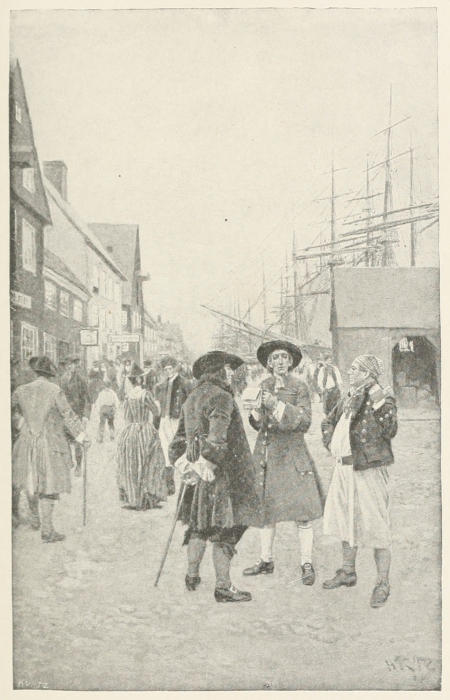
ALONG THE WATER FRONT, NEW YORK, ABOUT 1780
[40]
Migration into the West had been given its first impulse by the treaty of 1763, which closed the war with France and gave to the English all that the French had claimed east of the Mississippi. The war for independence had checked it for a little, but only for a little. It thronged forward again the moment the anxious strain of the fighting was off. Northwestward along the valleys of the Mohawk and the Delaware into the land of the Iroquois which Sullivan had harried,—where Sir William Johnson had reigned in days gone by over red men and white; straight towards the heart of the West along the upper courses of the Potomac, through the difficult country through which Braddock had gone his blundering way, to Fort Pitt and the lands by the Ohio; through the long forests to the fair Kentucky; down the valleys opened by the spreading tributaries of the Tennessee, and through the forests beyond to the Cumberland, whither the men who had ridden the passes to King’s Mountain had shown the way; around the southern end of the great Appalachians to the plains by the Gulf,—wherever the mountains opened or a way could be made, ever-increasing bands of emigrants essayed the long journey every open season, seeking new homes at the heart of the lands where once the French had had their posts and garrisons,—until there began to be communities beyond the mountains big enough to count in affairs: communities in whose behalf peace and government must be provided, and a way of intercourse and sympathy between East and West to which the great mountain ranges should be no effectual barrier. The war itself had not stopped this eager journeying into the West. The savage tribes upon those borders, north and south, found themselves checked and beaten, not by any sudden onset of armed men, but by this crowding in of the indomitable white man, this thickening of his stubborn, ineradicable settlements upon the western streams, the coveted hunting grounds.
[41]
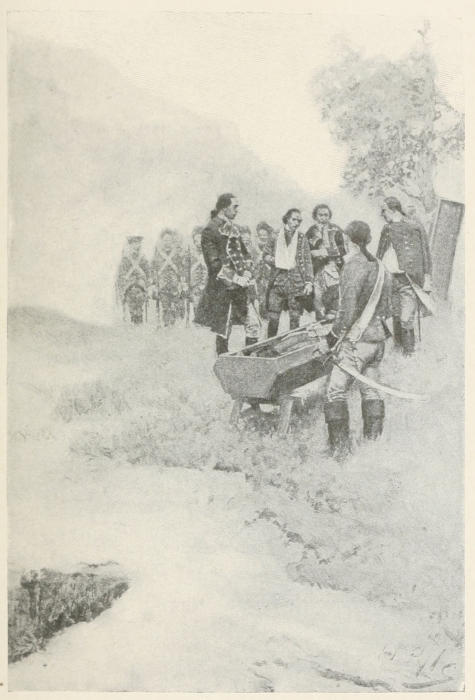
THE BURIAL OF BRADDOCK
[42]
Washington had seen the gates of that new world when, as a mere boy, he had acted as surveyor of Lord Fairfax’s estates within the valley of the Shenandoah; when, as a youth, he carried Dinwiddie’s warning to the French at fort Le Bœuf, ere they made themselves masters at the forks of the Ohio; and again when he went with unhappy Braddock against Duquesne. He saw more vividly than most men what this new movement of population meant, and must bring to pass in the future. When he had written his farewell to the army from his headquarters at Rocky Hill (November 2, 1783), had embraced his officers and comrades in arms in a last, affectionate leave taking at Fraunce’s Tavern in New York (December 4th), and had delivered up his commission to the Congress sitting at Annapolis (December 23d), he turned for a little respite to his [43]home at Mount Vernon, to which these long years through his thoughts had reverted with an ever-increasing longing; but the very next year saw him over the mountains again, observing what lands were to be had there, and studying once more the best means of communication between East and West. The primary object of his visit was to procure good lands for himself and for old comrades who had made him their agent and adviser in that matter, but his statesman’s eye apprised him of the full meaning of the new migration now afoot along all the western border.
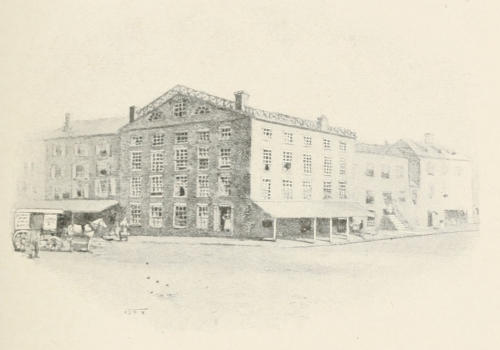
FRAUNCE’S TAVERN IN 1783
[44]
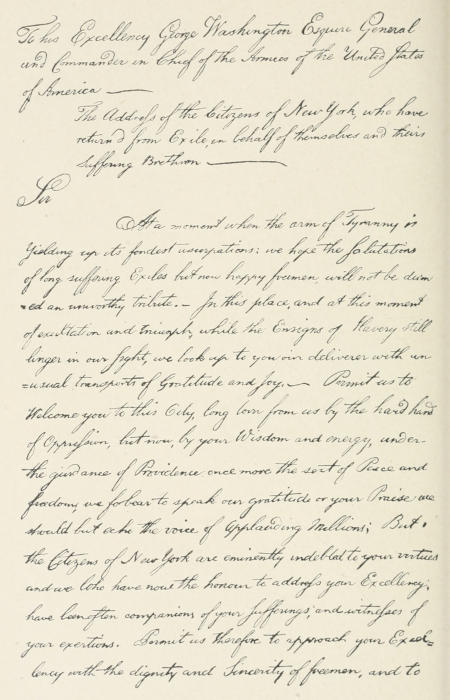
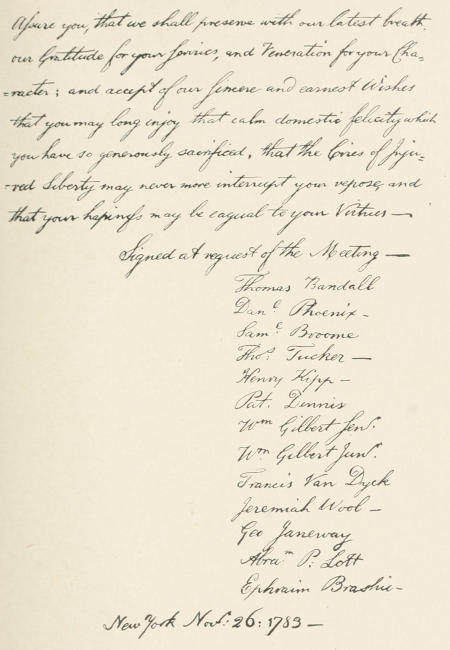
ADDRESS OF RETURNED CITIZENS, NEW YORK, 1783
[45]
[46]
For one thing, he saw how serious a situation it might prove should this body of settlers, sure to grow greater and more masterful from year to year, continue for very long to look back upon almost impenetrable mountains piled between them and the eastern ports and highways. Their natural outlet, when once the mountains were well behind them, would be the Mississippi, their natural highways the streams which ran to the Gulf. It was possible they might see their chief advantage in a connection with the Spaniards at New Orleans rather than with the wellnigh inaccessible eastern settlements on the Atlantic seaboard,—or even with the English again by the highway of the lakes and the St. Lawrence. “The western settlers,” he declared, “stand as it were upon a pivot. The touch of a feather would turn them any way.” He returned home to push again with renewed vigor the project which for now twenty years he had had at heart, and which had in these new days of independence, as it seemed to him, become a sheer political necessity,—the opening of the upper reaches of the Potomac to navigation, in order that the East might there at any rate be linked with the West, by joining the waters of the Potomac with the streams which ran down into the Ohio. This had been part of the plans of the old Ohio Company of which the Washington and the Fairfaxes had been members. The revolution had interrupted its plans; there was now added reason for renewing them.
[47]
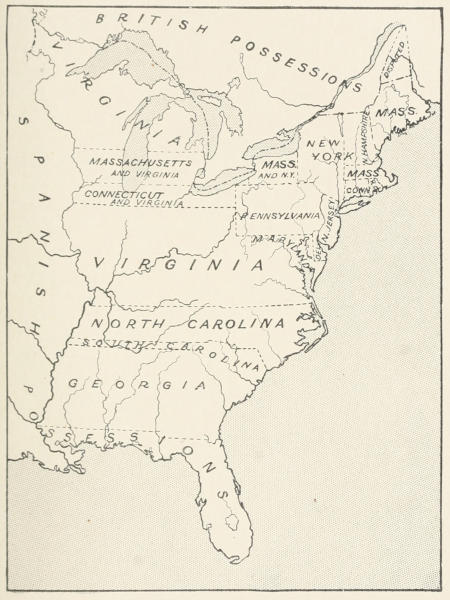
MAP OF THE UNITED STATES, 1783
[48]
In the old days the lands about the Ohio had been deemed part of Virginia’s domain. Almost every State upon the seaboard had had at the first a grant from the crown which read as if it had been meant to set no boundaries at the west at all except the boundaries of the continent itself; and Virginia’s grant was the oldest of them all. Virginia claimed practically all the western country which lay north of her own southern line extended, under the terms of her charter of 1609, which defined her territory as running from her boundaries at the sea-coast “up into the land throughout from sea to sea, west and northwest.” But the other colonies as they were formed had also received charters which had a straight westward outlook, practically without bound or limit this side of the Pacific; and each laid confident claim to its own long western strip of the continent. It was in part to quiet these conflicting claims, in part to give herself, who had no grant at all at the west, some parity with her partners in the Confederation, that Maryland had insisted, as a condition precedent to her acceptance of the articles, that all the western territory be ceded to the Confederation itself, as a joint and common property to be held for the use and benefit of all. New York, accordingly, had ceded her claims in 1781; and Virginia so much of hers as lay north of the Ohio, in 1783. The other States were virtually pledged to follow their example. The West was already practically common property. Whatever should be done to bind it to the East would bring so much nearer the promised dawn of a national life.
It was a noteworthy thing, too, how every one seemed to take it for granted that the Congress of the Confederation had the right to accept these gifts and act as a veritable sovereign in the government of a national domain, notwithstanding the Articles vouchsafed it no grant of power in the matter, and in everything else its authority, though explicitly granted, had fallen into contempt. Whatever the States might do in the administration of their own affairs and the government of their own people, a national domain meant a national government. Its very existence put another face upon affairs. It could not be redivided. The States had put it, a practically impassable barrier, between them and separation. Maryland had builded better than she knew.
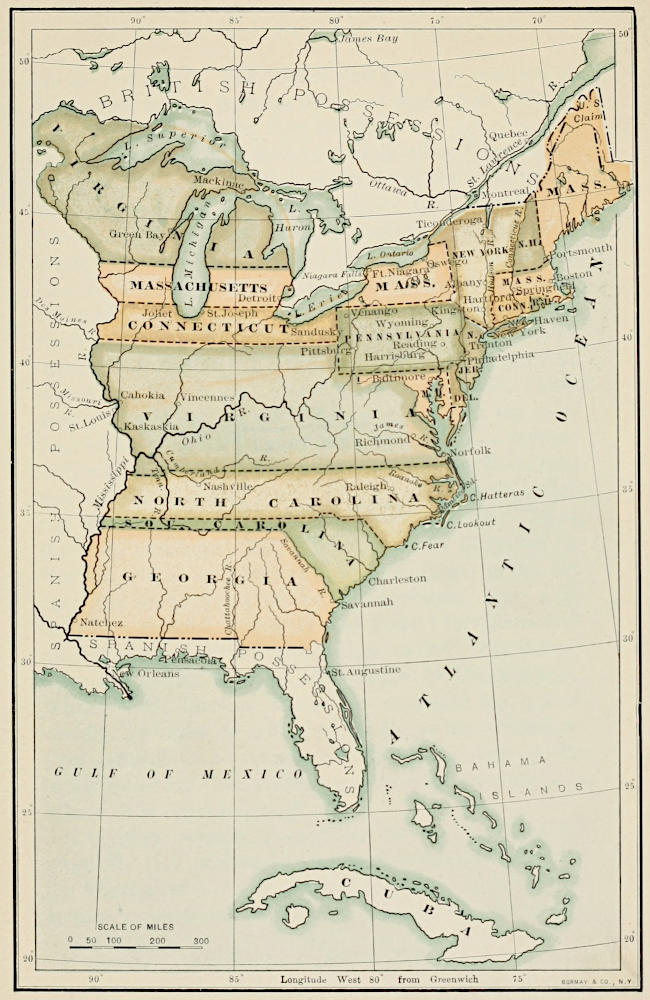
THE UNITED STATES, 1783. SHOWING CLAIMS OF THE STATES.
[49]
Already the western settlers were showing themselves, by not a little heady wilfulness, to be of the same stock that had made the original colonies first strong and then independent. In its April session, 1784, the legislature of North Carolina had followed the example of New York and Virginia by ceding to the general government her lands beyond the mountains. It committed the blunder, however, of making the grant contingent upon its acceptance by Congress, which might have been taken for granted, and of making no specific provision in the mean time for the government of the very flourishing and very mettlesome little group of pioneer settlements which John Sevier and James Robertson had helped to plant upon the upland streams which ran beyond the mountains into the Tennessee. These promptly concluded that, if they were not governed by North Carolina and had not yet been taken under the care and government of the Confederation, they were their own masters, and proceeded to erect for themselves an independent State, which they called “Franklin,” after the genial wit and philosopher at Philadelphia. When North Carolina thereupon rescinded her act of cession, in order to win them back to her dominion, they refused to be reannexed. It was a sign of the times, a taste of that western quality which the nation’s affairs were often to smack of.
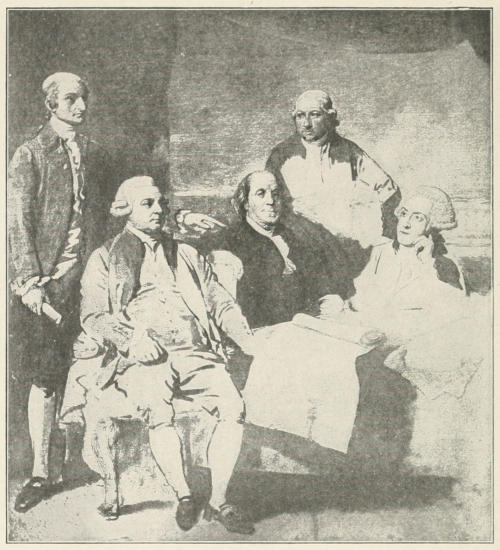
UNFINISHED PORTRAITS OF THE SIGNERS OF THE TREATY OF PARIS, 1783
The whole country caught the flavor of that quality when Mr. Jay proposed to relinquish the navigation of the Mississippi for a generation to Spain, in return for certain commercial advantages greatly desired at the [50]Atlantic seaports. Spain had already shown an ugly temper with regard to the use of the river, whose outlet she controlled. She had seized merchandise passing down towards its mouth. She had instigated Indian raids against the new-made settlements on the Cumberland, which crowded too near its course. Mr. Jay had been one of the commissioners through whom the United States had got their western boundary at the Mississippi and their grant of the right to use the great [51]stream, at the making of the treaties of peace; and he knew how difficult a thing it had been to force Spain backward to that boundary. But he had not seen that rising tide of emigration now pouring into the West; had not imagined the empire making there, the homes already established, the toil and success already achieved. He thought that there would probably be no occasion to use the Mississippi for twenty-five or thirty years yet to come. He proposed, therefore, in 1785, when Congress had made him its Secretary of Foreign Affairs and had bidden him negotiate a treaty of commerce with Don Diego Gardoqui, the newly arrived representative of Spain, to surrender the navigation of the lower Mississippi, which he thought was not needed, for a term of twenty-five years in exchange for commercial advantages which would redound to the profit of the merchants of the shipping colonies, together with certain concessions with regard to land claims in the West which were likely to please the people of the South. The instant cry of hot protest that came out of the West apprised eastern politicians of the new world a-making there, the new frontiers of the nation. The proposed treaty was not adopted.
It was hard for men in the East to realize how fast settlers were multiplying and their settlements growing to the stature of States beyond the mountains, where only the other day there had been nothing but unbroken wilderness,—faster a great deal than the original colonies themselves had grown. So early as 1784 the settlers in the Kentucky country deemed themselves numerous and independent enough to be detached from Virginia and set up as one of the States of the Confederation. When rumors reached them of what Mr. Jay proposed some of the bolder spirits among them negotiated in their own behoof a private treaty of commerce with the Spanish at New Orleans. When Virginia interposed delays and difficulties in the way of their plan to become a State, they listened very indulgently to certain lawless men who proposed that they make some stroke for entire independence. There was talk of the British at the North helping them to seize Spain’s possessions beyond the river by force of arms and drive Spain from the continent. No man knew what might happen there, should counsels of revolution prevail.
[52]
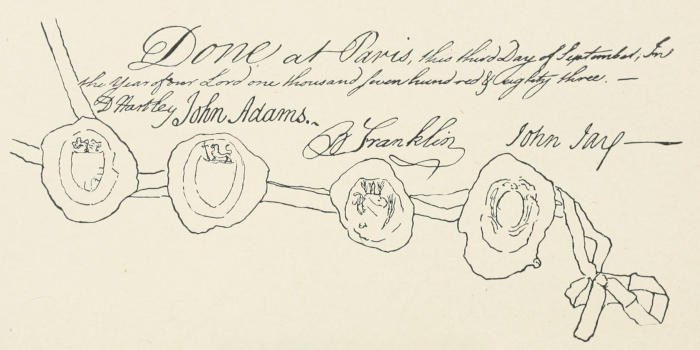
FACSIMILES OF SIGNATURES TO TREATY OF PEACE
[53]
No disquieting rumor or untoward prospect of new wars for independence in the West at all restrained the steady flood of emigration the while. In March, 1786, a new Ohio Company was formed in Boston for the active furtherance of the settlement of the western country. Soldiers of the revolution officered it and in large part made up its membership. The money script of the Confederation was bought up and used for the purchase of land in the new public domain. Subscriptions and systematic corporate action began to make the settlement of the Ohio country an enterprise of forethought and associated effort, like the settlement of the first colonies themselves.
The whole country was witness, the while, to the need for a real government, instead of a mere advisory Congress, to bind the inchoate nation together in a more than makeshift union. Every disorder, every difficulty but made this need the more pressing and the more painfully evident; and difficulties and disorders multiplied fast enough,—in the East as well as in the West. No hope of national achievement, no ideal of independence or of power could be fulfilled while the very organization [54]of the nation stood thus formless and dissolved. “There is scarcely anything that can wound the pride or degrade the character of an independent nation,” cried Mr. Hamilton, “which we do not experience.” Efforts were made to secure for the Congress the right to lay and collect taxes, in order that at least its existence and such powers as it already had should not be at every turn dependent upon the attitude and action of the several States; but the States were not willing to increase its authority so much. In 1786 they were asked to intrust to the Congress at least the collection and use of a revenue laid upon imports; and so plain had both the necessity and the propriety of such an addition to its efficiency by that time become that all of the States except New York consented. But it required the unanimous consent of the States to amend the Articles of Confederation, and New York’s refusal set even this aside. New York had no mind to relinquish the duties which she collected for herself at her great port,—not only upon foreign commerce but also upon goods brought out of the other States, her neighbors: on farm produce and garden-truck from New Jersey and firewood from Connecticut,—making her spreading harbor a veritable toll-gate.
[55]
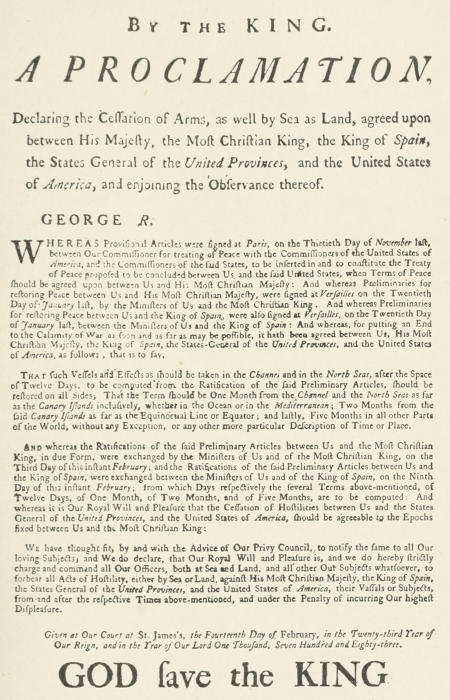
ROYAL PROCLAMATION OF CESSATION OF HOSTILITIES
[56]
There was in all this one of the most serious signs of the times. The States indulged to the top of their bent a petty hostility towards each other. New York was by no means the only State that laid duties on merchandise brought in from the farms and shops of her neighbors. There was everywhere the same jealous spirit, the same striving for every paltry advantage, the same alert and aggressive selfishness; and the more the States deemed their interests antagonistic the more like a mere rope of sand did the Confederation become. “We are either a united people, or we are not,” exclaimed Washington. “If the former, let us in all matters of general concern act as a nation which has a national character to support; if we are not, let us no longer act a farce by pretending to it.” England, apparently, expected the weak structure presently to fall to pieces. She would not withdraw her troops from the western posts because the debts of British merchants were not paid and the property rights of the exiled Tories were not restored. Neither would she send a diplomatic representative to America, seeming to regard the Confederation as of no international importance. France and Spain and Holland, seeing the Confederation utterly unable to repay the moneys they had loaned it, scarcely able to pay so much as the interest on its debts, alternated between anger and contempt in their treatment of it; and confidently expected to see it very soon in ruinous collapse and final disintegration. France and Spain were somewhat hopefully wondering, it was evident, what the spoils and plunder of the wreck would be, and to whom it would fall to do the plundering.
[57]
SHAYS’S MOB IN POSSESSION OF THE COURT HOUSE
[58]
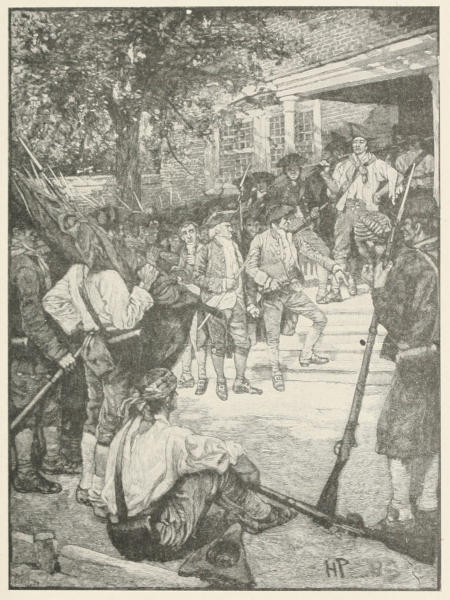
Each year seemed to emphasize by new disorders the increasing need for the wholesome restraints and discipline of a common government. In the autumn of 1786 actual armed rebellion capped Massachusetts’ struggles against slack trade, heavy taxes, burdensome debts, and discontented farmers,—a debtors’ rebellion. Captain Daniel Shays, a veteran of the fight at Bunker Hill, a captain of the revolutionary army, was its foremost figure. Mobs in the inland counties, of the State and in the towns by the Connecticut closed the courts, to prevent the collection of debts. Local conventions, called to discuss the grievous circumstances and distresses of the time, broke up in riot. By the time winter had come Captain Shays had not scrupled to put himself at the head of a riotous muster which had the proportions of a veritable army. James Bowdoin was governor of Massachusetts, a man of probity who knew his duty and did not disrelish the performance of it. There was no mistaking the issue. “My boys,” one of the leaders of the insurrection had cried, “you are going to fight for liberty. If you wish to know what liberty is, I will tell you. It is for every man to do what he pleases, to make other folks do as you please to have them, and to keep folks from serving the devil.” It was flat anarchy. The treasury of the State was empty, but a hastily equipped force of militia under General Lincoln, paid for by a temporary loan raised by a few patriotic citizens, dispersed the rebels and restored the authority of the government. It was an ominous thing, nevertheless, to see how the people of the State sympathized with the rebels. They would not have Bowdoin for governor again, deeming him too harsh. Rhode Island passed resolutions of sympathy for the rebels and Vermont offered them refuge. Leaders of the rebel force were captured and convicted, but no one dreamed of venturing to execute upon them the penalty denounced by the law against what they had done. The rebellion had plainly been a symptom, not an isolated or singular thing. It had been extraordinary only in its violence.
[59]
LAFAYETTE
[60]
Disorders like these were for the mass of men, who did not see the significance of signs less gross and tangible, the best possible evidence of the sore straits the country was in to maintain even so much as its local governments and its respect for law. But it was not violence of this sort so much as the subtle, all-pervasive air of uneasiness, of rivalry, and even hostility between the States, of commercial enmity and a universal unneighborly spirit of reprisal which moved the thoughtful and masterful spirits of the country most deeply, and led them to bestir themselves while yet there was time to forestall disaster. It made them fear the worst, too, for the honor and very life of the country to see how debt demoralized the States: how they yielded upon every side to the temptation to repudiate their obligations by some new evasion, and encouraged individuals to practise a like dishonesty by passing stay laws against the collection of private debts and making legal tender of paper money issued without limit, whose value dropped with every week it was in use. Business as well as government seemed about to go to pieces, bankruptcy to go hand in hand with virtual anarchy.
It was Washington’s scheme of making the West accessible through the valley of the Potomac which, after all, as it turned out, opened the way for statesmanlike measures of union. There was but one method by which to save the Confederation now, as there had been but one method by which to concert and carry forward the revolution. It had to be done, if done at all, by bringing the leading minds of the country to some sort of agreement: by correspondence, by individual effort; by personal appeals to individuals and to legislatures on the part of men who could gain a hearing because they had approved themselves by service. An infinite deal of letter writing: letters handed about from hand to hand which were like state papers for thoroughness, for sobriety of argument, for cogency and quiet power; personal [61]interviews; persuasion that soaked slowly through from group to group in the simple society of the scattered towns and hamlets and plantations,—such was the machinery of reform, whether in opinion or in affairs; and Washington, with his quick conscience and steady competency in every matter that called for action, was the natural centre alike of counsel and of performance.
By the spring of 1785 the Potomac Company, pushed forward in its business by men like Washington, had developed plans serious and definite enough to engage the attention of the legislatures of Maryland and Virginia. The Potomac ran with Maryland on the one bank and Virginia on the other: it was necessary that the two States should agree upon plans for its use and navigation. They united, therefore, in appointing commissioners to meet at Alexandria in March, 1785, to consult upon this matter not only, but also upon the general commercial relations of the two commonwealths which this matter touched and which there was no general government to regulate. Washington invited the commissioners to adjourn to Mount Vernon, near by, as his guests; and there, though not of their number, he was freely admitted to their counsels. They did not report to their legislatures all the hopes and questions to which their thoughts had broadened as they talked, but they set forth matters significant enough for the present. The Potomac, they pointed out, could not be connected with the western waters without affecting Pennsylvania, as well as Maryland and Virginia; they recommended, therefore, that she also be called into conference before that business was carried further. The rest of their task, which concerned common commercial regulations, uniform duties on imports, and joint rules touching the [62]currency, they completed. The Maryland legislature, when it received their report, happily read it in as liberal a spirit as any statesman could have wished for. If Pennsylvania was to be drawn into conference about the Potomac, why should not Delaware also be consulted, with a view to carrying a straight watercourse, by canal, from Chesapeake Bay to the Delaware River? And if Pennsylvania and Delaware might be asked to confer about these specific things, what was to prevent a general conference of the States, in which all the uncomfortable questions of their intercourse with one another might be frankly discussed? Governor Bowdoin, of Massachusetts, had that very year urged his legislature to invite the States to such a general convention, in the interests of amicable trade, and it might be that it would meet with universal approbation.
Virginia was willing. There were men in her legislature to whom such suggestions seemed full of hope and good counsel. Under their influence, therefore, the Burgesses (January, 1786) asked all the States of the Confederation to send delegates to a convention to be held at Annapolis on the first Monday of September, to consider the questions of trade and common intercourse which were disturbing the whole country. The response was disappointing. Connecticut, South Carolina, and Georgia ignored the call altogether. Even Maryland fell suddenly indifferent and failed to act, though the plan was her own. New Hampshire, Massachusetts, Rhode Island, and North Carolina appointed delegates, but when the conference had assembled it was found that they had not taken the trouble to attend. Only Virginia, Pennsylvania, Delaware, New Jersey, and New York were represented; and their delegates [63]did not feel that, alone, they could do anything. They could only urge another and fuller conference.
THOMAS SUMTER
New Jersey had taken a very lively interest in these new plans of consultation and co-operation. She felt very keenly the serious commercial and political disadvantage at which she was placed by a geographical position which made the much more powerful States of [64]New York and Pennsylvania her jealous rivals at either outlet to the sea, and along every mile of her border to the westward. She had, accordingly, given her delegates a broader commission than the others bore. She had bidden them “consider how far a uniform system in their commercial regulations and other important matters might be necessary to the common interest and permanent harmony of the several States”; and Mr. Hamilton, one of the delegates sent from New York, being a statesman and no partisan, induced the conference to make a like suggestion in asking for another and fuller convention of the States. Alexander Hamilton had been born, and bred as a lad, in the West Indies. He had established himself while yet a very young man in New York; but he had taken no color from the place; had kept a mind detached from merely local interests and provincial prejudices; had served under Washington in the field, as his aide and confidant; and had learned to see as clearly as any of his elders in affairs the needs and dangers of the country. He lacked still several months of being thirty; but he had been quickened to a singular maturity in that time of stress. He proposed an address to the States in which they should be asked to come together at Philadelphia, on the second Monday of the following May, not merely for the consideration of questions of trade, but also for the purpose of devising “such further provisions as should appear to them necessary to render the constitution of the federal government adequate to the exigencies of the Union,” and of reporting to the Congress “such an act as would effectually provide for the same”; and the conference, being in earnest, adopted the paper as he had drawn it.
[65]
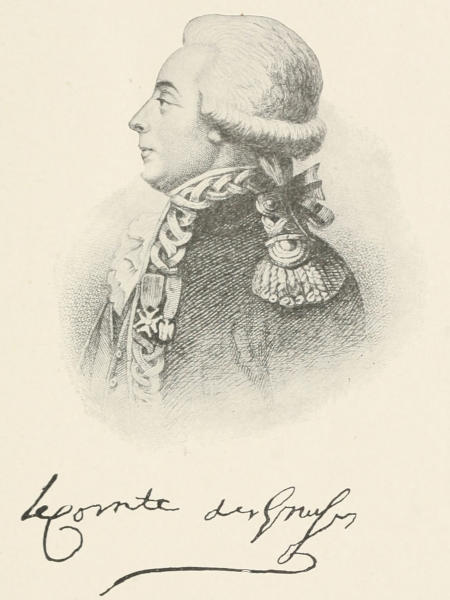
COUNT DE GRASSE
Again the States would have been indifferent and conference of no avail, had not the winter which followed been darkened and made very ominous indeed by Shays’s rebellion. Every one of the little commonwealths felt the threat of unmanageable disorder and the upsetting of government itself which that spoke. “You talk, my good sir,” wrote Washington to Harry Lee, in Congress, “of employing influence to appease the present tumults in Massachusetts. I know not [66]where that influence is to be found, or, if attainable, that it would be a proper remedy for the disorders. Influence is no government. Let us have one by which our lives, liberties, and properties will be secured, or let us know the worst.” There was the same feeling everywhere. Government was too slack, order too uncertain. The authority of law could nowhere be stronger than each individual State was prepared to make it. There was no common power, no effectual combination, no aggregate force to render it beyond peradventure firm and lasting. The object-lesson had come in good season. The Congress of the Confederation had heretofore been opposed to a general conference; it now sanctioned and advised it. The States were at last effectually shaken from their indifference, and appointed delegates to attend at Philadelphia in May, to take part in the new Continental Congress.
It proved a notable assembly,—more notable than the Congress of 1774; for its business was not protest but the reconstruction of a government, and it proved equal to the task. A certain very noticeable anxiety attended the opening of its sessions. The delegates came very slowly and tardily in. A full week had gone by after the day set for convening before so many as seven States were represented. The delegates from New Hampshire were two months late in arriving. It was evident at first that the members were nervous and set about their work of conference and debate with a touch of reluctance and apprehension. They knew that their business was critically important. It might be that the breaking up of their Union, or its consolidation, the setting in or the happy and final preclusion of civil war, would follow upon the completion of their [67]labors. Affairs, and opinion, too, hung at a perilous poise, and might easily be turned this way or that by their success or failure.
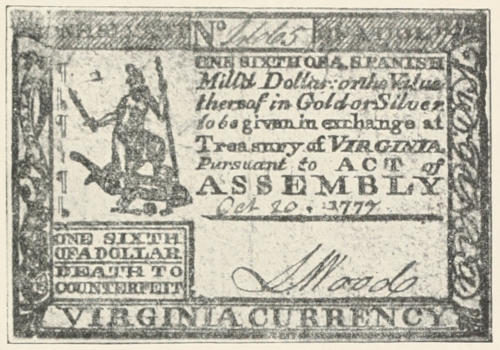
SPECIMEN OF VIRGINIA CURRENCY
They gathered confidence, however, as they got hold of their task and gained knowledge of one another. There were fifty-five delegates in attendance at last: every State except Rhode Island had sent commissioners. Many of the more famous figures of the revolutionary time were missing. Samuel Adams had declared himself opposed to “a general revision of the Confederation.” John Adams was in England. Jefferson was in France. Patrick Henry declined to attend. The men who had organized the Continental Congress and the Congress of the Confederation had in large part given place to others. Younger men had come forward, and were speaking with authority: men like James Madison, of Virginia, who was but just turned of thirty-six, and Alexander Hamilton, of New York, [68]who was only thirty. But older men were there also, and it was reassuring to find how carefully the States had picked their representatives. Robert Morris was there, the experienced financier of the revolution; Roger Sherman was there, whose practical good sense had steadied the early counsels of the Continental Congress; and John Rutledge, whom South Carolina had made a sort of dictator in her affairs while the revolution held; and Benjamin Franklin, in his eighty-second year. Virginia had sent seasoned jurists past middle life, like John Blair, who had been president of her council, and George Wythe, who had drafted her protest against the Stamp Act; and had added George Mason, her best type of conservative country gentleman, and General Washington, as of course, as well as handsome Edmund Randolph and studious Mr. Madison, still in their thirties.
Every day’s debates gave strength and confidence to the counsels of the conference. There were many sharp differences of opinion among its members; but they held together, and a sound practical sagacity prevailed. Leadership among them fell to Madison, whose quiet suggestions always smacked of moderation and of a real knowledge of the subject in hand; to James Wilson, of Pennsylvania, whose shrewd Scots sense and thorough knowledge of law,—the law of nations and of governmental structure as well as the law every lawyer could talk of,—enabled him to clarify and strengthen every topic he touched; to Roger Sherman, of Connecticut, rugged, practical, hard-headed; to Dr. Franklin, who could utter the mellow wisdom of age, and utter it in sentences men could remember; to Gouverneur Morris or Rufus King, who knew how [69]to cast propositions for a vote,—to the men who could think steadily and see things whole, or who could strike out practicable lines of definite action.
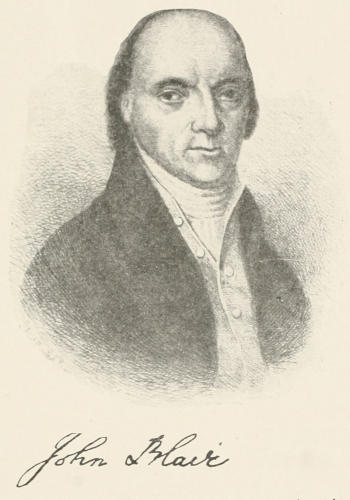
JOHN BLAIR
The convention wisely sat with closed doors. It sat all the summer through, and until September was more than half gone; let no one know what it debated or had its doubts and its sharp differences of opinion about; merely published its work when finished, and went home to press it for acceptance. It gave it great dignity that Washington had presided over its counsels and was heart and soul for the adoption of the measures [70]it proposed. His name and quiet force had steadied the convention on many an anxious day when disagreement threatened hopeless breach. His fame and influence infinitely strengthened also the measures proposed, now that they were completed. He supported them because they were thorough-going and courageous and cut to the root of the difficulties under which the country was laboring. Issue had been joined now, as he had wished to see it joined, between government or no government, and the country was to know at last where it stood in the most essential matters of its life.
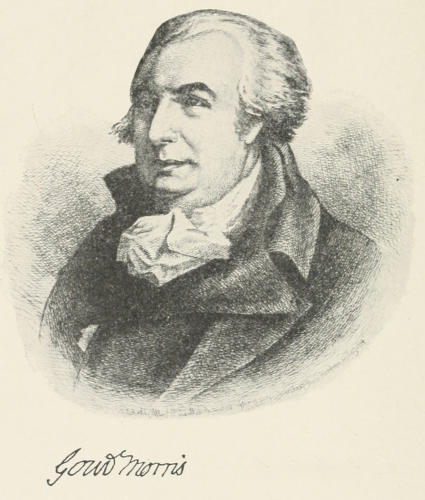
GOUVERNEUR MORRIS
The convention had drafted nothing less than a [71]new constitution,—no mere amendment or series of amendments to the Articles of Confederation; a radically new scheme of government and of union, which must stand or fall upon its own merits. It was recalled, many years afterwards, how General Washington had stood in the midst of a little group of delegates, during the anxious first days at Philadelphia, while they waited for commissioners enough to justify them in effecting an organization, and had cried, “Let us raise a standard to which the wise and honest can repair. The event is in the hand of God.” It was in that spirit that the convention had acted. They had not taken measures to please, but measures to save the country. The constitution which they proposed showed by its very simplicity and directness the statesmanlike vigor, definiteness, and consistency of purpose with which it had been conceived and drafted. It conferred upon the federal government powers which would make it at once strong and independent: the power to tax, the exclusive power to coin money, the power to maintain an army and a navy,—the powers, within its sphere, of a supreme and sovereign government. Its laws were to be, not advisory, but imperative, and were to operate, not upon the States, but directly upon individuals, like the laws of any sovereign. It was provided with the executive the Confederation had lacked: a president in whose authority should be concentrated the whole administrative force of its government. It was to have its own courts, and in those courts, not in the courts of the States, were its powers to be finally determined, whenever challenged. The very equality of the States, that cardinal principle,—that cardinal defect,—of the Confederation, was in large part to be done away with. [72]The legislature of the new government, which was to be no confederation, but a veritable State built upon a federal principle, was to consist of two houses. In one, the Senate, the States were to be equally represented; but in the other and larger house, the House of Representatives, the people were to be represented directly, by number,—one representative for every thirty thousand,—counting them within their States, indeed, but not as if they constituted separate commonwealths. The new government was to regulate commerce, both with foreign nations and among the States. The States were to be forbidden to enter into any treaty, alliance, or confederation; to emit bills of credit; to pass any law impairing the obligation of contracts; and to lay any imposts or duties on imports or exports, unless permitted to do so by the Congress of the United States. All foreign affairs, all questions between State and State, all common interests were to be controlled by the federal government; and it was to act directly, of its own will and initiative, through its own officers and its own tribunals.
[73]
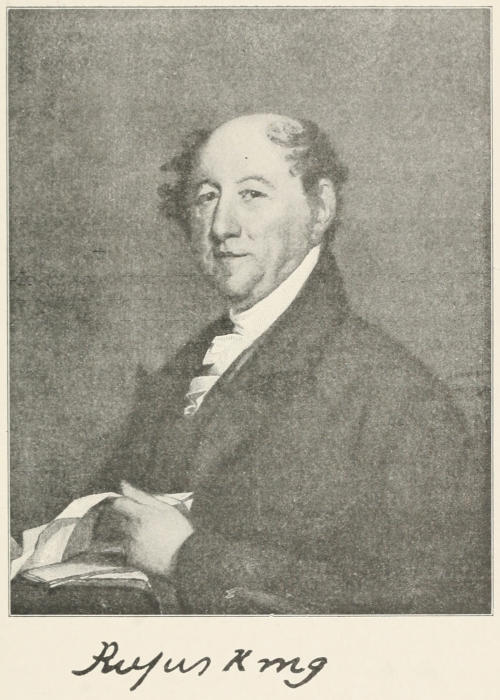
RUFUS KING
[74]
In brief, every salient feature of the existing Confederation was in this new instrument of government condemned and rejected:—the absolute equality of the States, the dependence of the general government upon them for the execution of the laws and for its very support, its lack of an executive and of executive powers, its futile function of mere advice. Even so, the changes proposed did not satisfy Mr. Hamilton. He had been a member of the convention, had signed the document now sent forth, and meant to devote himself very heartily indeed to advocating its adoption; but he had taken very little part in its formulation, because, as he had frankly told his fellow members, he himself desired something very different, which he knew he could not get. He had very little faith, he said, in federal government, or even in republican government, which it seemed to him impracticable to establish over so extensive a country as the United States. He could wish, he said, that the state governments, as independent political bodies, might be extinguished, or at any rate entirely subordinated; that the general government might be given “complete sovereignty”; that the new executive of the nation might hold for life, and at least one house of the national legislature for a like term, “or at least during good behavior.” His breeding was not of the colonies, his thinking marked him of the culture that belonged on the other side of the sea. He hated anarchy, and saw the country drifting into it. He believed that nothing short of a centralized government could be certainly relied upon to check and kill it. He was for efficiency rather than for sentiment. But he was above all a statesman, and contented himself, and that right heartily, with the minimum of what he desired,—with the government the convention had devised. He knew, as every one did who had been admitted to the counsels of the convention, by how sharp a struggle, by how delicate and difficult a series of compromises, the constitution as it stood had been obtained amidst the conflict of interests and of views disclosed in debate. The smaller States had assented to it only because the Senate was to preserve for them the old-time equality of the States in legislation. The slave-holding States of the South had assented only when it was agreed that three out of every five of their slaves were to be counted in reckoning population as a basis of representation [75]in the lower house. A compromise had ended every serious divergence of opinion. The wonder was, not that so little, but that so much concentration and invigoration of authority had been agreed upon where counsel and interest differed by the width of the poles.
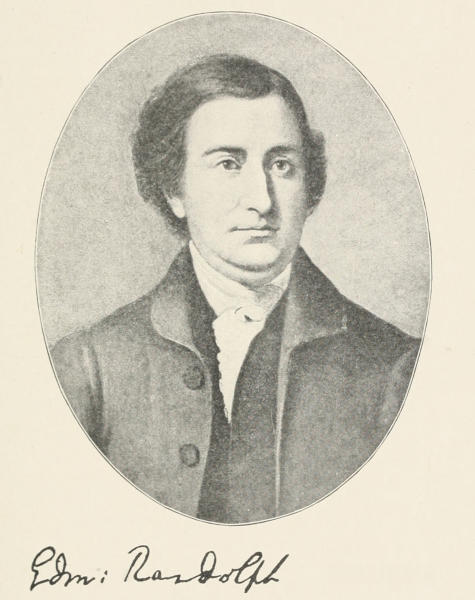
EDMUND RANDOLPH
So far as the country at large was concerned, the new constitution was startling and radical enough as it stood. Patrick Henry, of Virginia, had refused to attend [76]the convention because he had foreseen and feared just such revolutionary proposals. George Mason and Edmund Randolph, of Virginia, and Robert Yates and John Lansing, Hamilton’s colleagues from New York, had refused to sign the constitution which it proposed. The new document was most revolutionary in the method which it proposed for its adoption by the States. There was but one way by which the Articles of Confederation, the existing federal law for which this was to be a substitute, could legally be amended: by the unanimous assent of the States. The convention proposed, nevertheless, that the new constitution should go into effect if adopted by nine out of the thirteen; and the Congress, seeing change probably impossible otherwise, sanctioned the proposal.
Fortunately, there was nothing novel in the details of the government proposed. Every practical provision in it, almost without exception, had been borrowed from the experience of the colonies themselves, or from English experience equally familiar:—the single governor, the two legislative houses, the supreme court, the partial equality of the States, the representation of the people, popular elections, brief terms of office, definite, chartered powers. Even the electoral college which was to choose the President, had its prototype in the electoral body through which Maryland chose the members of the upper house of her legislature. The convention had showed its conservative temper in every provision it touched; and not much of what it had done had to be elaborately explained. Many of the States were ready to accept the constitution at once. Delaware ratified it on the 7th of December, but a little more than three months after the adjournment of the convention; Pennsylvania followed her example on the 12th, and New Jersey on the 18th. By the 1st of June, 1788, eight States had given their assent,—Massachusetts among them, though she had hesitated,—but New York and Virginia still held off. Massachusetts had waited until Mr. John Hancock and Mr. Samuel Adams declared themselves willing to accept the constitution and had suffered their choice to shift the balance of opinion. New York held off, as she had held off from granting additional powers to the Congress of the Confederation, because she did not wish to yield her commercial independence; and Virginia because men whom she loved, like Mr. Henry, and men whom she had been accustomed to trust in counsel, like Mr. Mason, feared to see so powerful a central government set up.
[77]
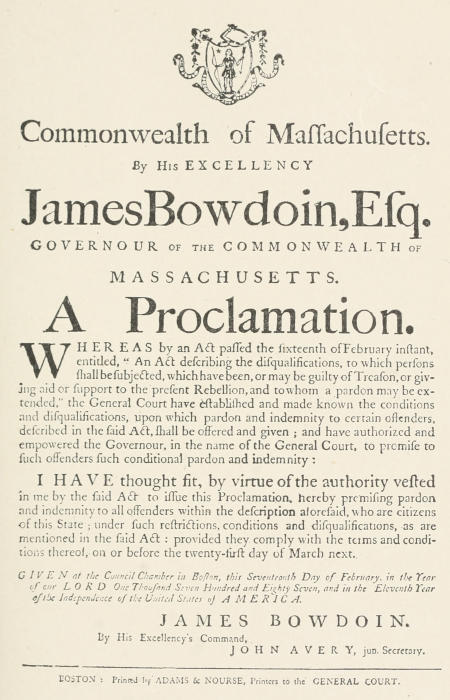
GOVERNOR BOWDOIN’S PROCLAMATION
[78]
New York yielded at last (July 26th), by a majority of only two votes out of fifty-seven, because Mr. Hamilton and the men who stood with him pressed every advantage of argument, influence, and persuasion,—and because news came that New Hampshire had accepted the constitution, the ninth State (June 21st), and that therefore the new government was quite certain to be tried without her. In Virginia the arguments of Madison and Randolph and Marshall and the personal influence of Washington prevailed at last (June 25th), notwithstanding the opposition of Lee and Henry and Mason. It was said in her convention that there were no safeguards in the new constitution sufficient to withhold the powerful government about to be set up from encroaching alike upon individual rights and upon the undoubted powers of the several States; and the opposition would have prevailed had not the ratification been coupled with resolutions which urged amendments which should constitute a sort of bill of rights,—amendments which the new government afterwards accepted.
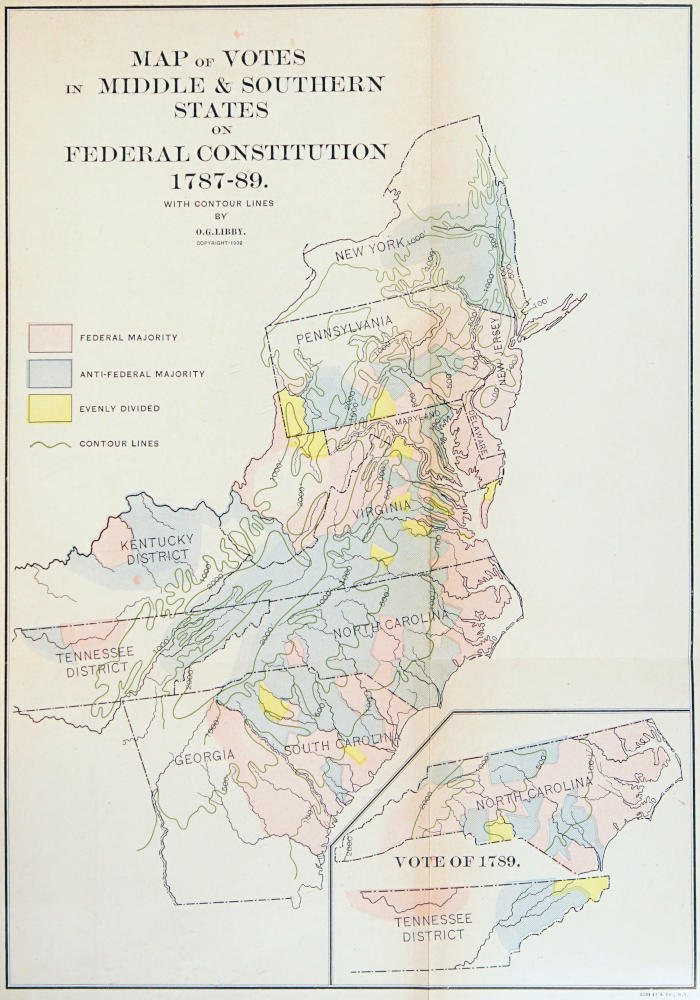
MAP OF VOTES IN MIDDLE & SOUTHERN STATES ON FEDERAL CONSTITUTION 1787-89.
WITH CONTOUR LINES BY O. G. LIBBY. COPYRIGHT 1902.
BORMAY & CO., N. Y.
[79]
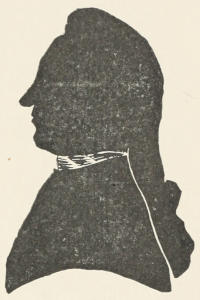
SILHOUETTE OF JAMES BOWDOIN
“The opinion of General Washington was of such weight,” said Count Moustier, the French minister to the United States, “that it alone contributed more than any other measure to cause the present constitution to be adopted.” No doubt the country did feel, throughout, the compulsion of loyal sentiment that went with his name. No doubt it felt, too, the mastery of the men who stood with him to lead, and yielded, in part, to their tact, their quick concert, their energy, their infectious enthusiasm, their ardor of unhesitating conviction. But it was interest and the pressure of affairs which told most decisively in the vote. Each State had uttered its choice with regard to the adoption of the constitution through a convention chosen for the purpose; and it was noteworthy how the delegates stood divided. Those from the larger towns and the districts where hamlets and homes lay thickest, where commerce moved upon the rivers and to the sea; those from the farming regions which lay by tide-water or near the long rivers which crossed the boundaries of States and floated produce to markets within another jurisdiction; [80]those who came from exposed frontiers where there was nothing to hope for from independence and much to hope for from a protecting common government:—all who felt the wide movements of trade or the need for free markets or the too sharp pinch of rivalry between State and State or the imminent threat of division and disorder, to the unsettling of property and the upsetting of their lives, voted for the constitution. It was opposed by the men who lived remote from the centres of population and the stronger currents of trade, whose lives had no wide connections and sufficed them; by men who were more likely to be debtors than to be creditors and wished their States left at liberty to legalize a depreciated currency; by men whose homes were upon the western rivers which ran towards Spanish territory, not towards the ports of the East, and who doubted their real connection of interest with the seaboard; by the great land-owners of New York, whose estates shut free farmers out, who had been masters of the State hitherto and wished to keep intact her right to collect duties at her great port, her power to put her neighbors at a disadvantage; by conservative men who feared to see one group of States take advantage of their majority to obtain commercial ascendency over another group. “Tories” voted for the constitution because they hoped to be safer under it; many extreme “Whigs” voted against it because they thought that they would be a little freer without it. Those who admired a centred and efficient government like that of England and regretted separation, were its advocates; those who ardently preferred their own little commonwealths and looked upon them as their best field of prosperity or of personal ambition were its opponents. Men voted for it because they hated anarchy and confusion of authority and wished to see a nation created in America, as Mr. Hamilton did; and against it because they thought that where anarchy was impossible liberty was insecure. No doubt, could there have been a counting of heads the country through, a majority would have been found opposed to the constitution; but the men who were its active and efficient advocates lived at the centres of population, had the best concert of action, filled the mails and the public prints with their writings, were very formidable in debate and full of tactical resources in the conventions, could win waverers, and prevailed. North Carolina and Rhode Island alone rejected the constitution, waiting without to see what would come of the new union.
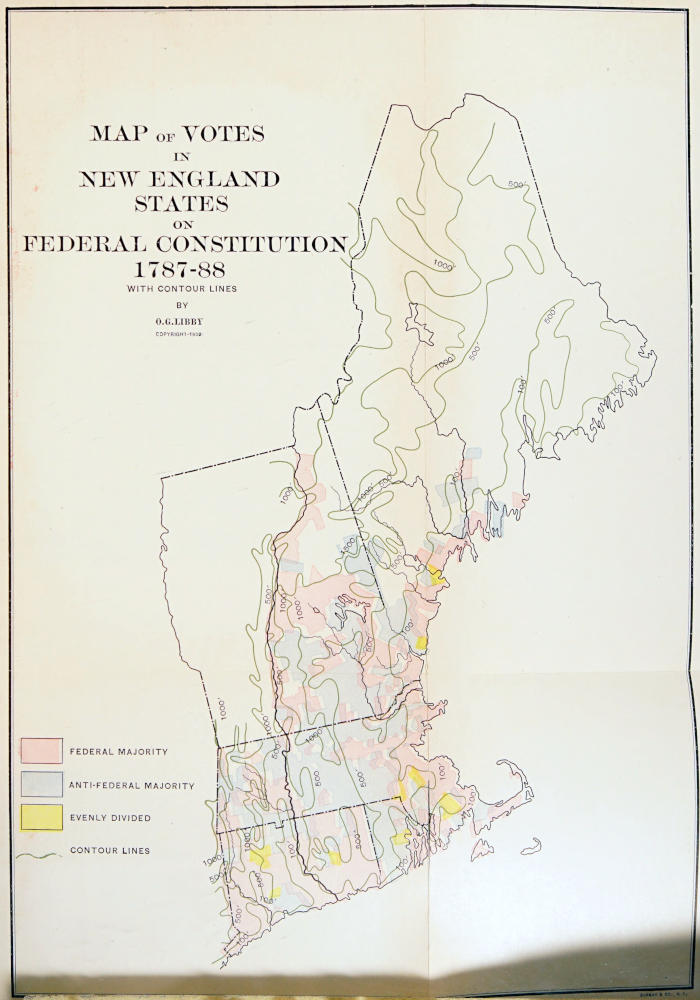
MAP OF VOTES IN NEW ENGLAND STATES ON FEDERAL CONSTITUTION 1787-88 WITH CONTOUR LINES BY O. G. LIBBY. COPYRIGHT 1902.
BORMAY & CO., N. Y.
[81]
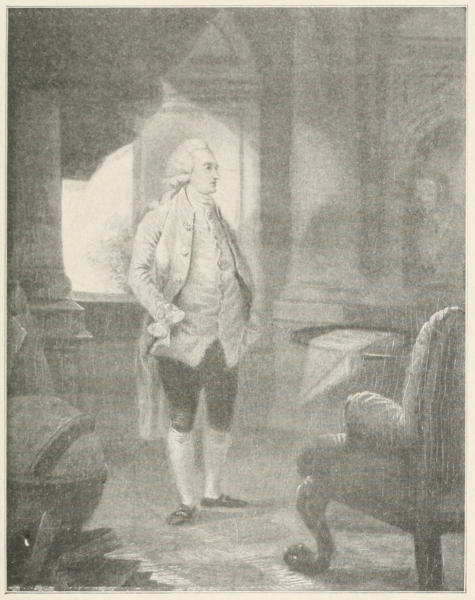
JAMES BOWDOIN
[82]
It had been a notable thing to see how wide the discussion had swung which attended the drafting and adoption of the new form of government, through how broad a range of topics it had run, and with how statesmanlike a tone and thorough-going a method alike of advocacy and of opposition. It had produced pamphlets which, for sobriety and thoroughness, might some of them have served as manuals of free government, and for form and vigor as models of lucidity and force in the use of English prose. At the very outset of the Revolution, at the first touch of national feeling, America had found her voice and produced of a sudden her school of statesmen and of writers. The strong emotions of the time had seemed to spring easily into words,—into words that told instantly upon men’s spirits on both sides of the sea, and made themselves at once vehicles of power. Now a new strain, a new impulse, the strain and impulse of those who build and [83]make good what they have achieved, was upon the leaders of the young States, and they spoke their chastened thought like masters.
Very few men in America had used the pen for achievement or the satisfaction of the force that was in them until this supreme day of struggle came when a new nation was born and the very abstract principles of liberty entered into their imaginations and possessed their minds, like things that lived and had of themselves power to prevail. Men had not often turned to the making of books during the long days of settlement, when the colonies were a-making and every man’s fire went into his work in the forests or upon the sea or in the conduct of affairs. Here and there some man of thoughtful spirit, bred to his books in old England, would turn again, for solace and relief of heart in that wilderness, to his studies, as gentle George Sandys did, Sir Edwin’s brother, who had quickened the heavy nights at Jamestown with coining noble English verses out of the Metamorphoses of Ovid. Once and again some gentle woman, like Anne Bradstreet, of quick wit and thoughts that moved uneasy amidst her narrow, pent-up life, would seek outlet of spirit in bits of prose, that spoke her deeper moods, or verses into which she sought to put her image of the world. Men did not always merely preach, or speak only in town meeting, or put pen to paper only in letters of business. William Bradford, the peasant scholar who ruled Plymouth, wrote the moving narrative of his people’s pilgrimage and establishment in the New World with the dignity of the true historian, minded to hand a great story on to men of other days. Mr. John Winthrop kept daily chronicle of what went forward in the little commonwealth in [84]which he ruled a generation through like one who works upon the records of a great State and people. But there was in none of this the full breath of letters.
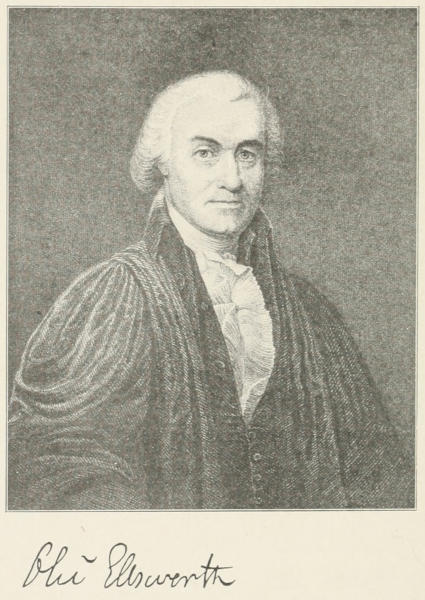
OLIVER ELLSWORTH
Men wrote, for the most part, only to set some business forward, of church or state. It was thus that Captain Smith had written his True Relation of the first planting of Virginia, his Description of New England, and his General History of Virginia, Summer Isles, and [85]New England, and that the many books, great and small, about the planting of the colonies had come into existence. Partisans of each enterprise set its merits forth; opponents foredoomed it to failure; those who had tried America and found it a bitter place to live in spoke out in ridicule, condemnation, slander against it. It was in a like tone, as of men who carry an enterprise forward in their words, that the governing divines of the New England commonwealths had uttered their treatises upon the workings of Providence and the disciplinary purposes of the established polity among them. Mr. Hooker’s discourses rang always of man’s salvation or of the affairs of state which must rule his conduct. Mr. Cotton’s spoke always a purpose to govern men by the terms of his Puritan creed. Roger Williams wrote always of some matter that touched his mission as the founder of a free commonwealth or an evangelist among the Indians. Cotton Mather had set down, in his rugged Tudor prose, the judgments of God among men, as they had been revealed to him in the lives of those who had lived about him or in the affairs of the New England churches. Even their verses were but another engine of doctrine and reproof, when they made verse their vehicle of utterance, as did Michael Wigglesworth, the “little shadow of a man,” more soul than body, who through half a century was pastor at Maldon.
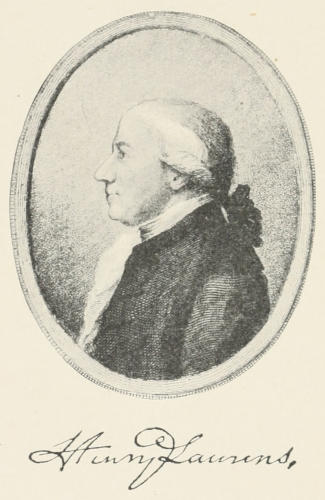
HENRY LAURENS
Not until that first century of initial strife and experiment had closed and a new age had come, with broader outlooks and airs of common enterprise, did any touch of genius lift letters to the levels of abiding power. In Jonathan Edwards the doctrine and philosophy of the Puritan churches found a voice which knew the full gamut of noble and effective speech. [86]Every thought that he touched lived. His mind wrought always with a gift of creation. What he wrote was no longer the mere matter of the preacher; it was always living matter of thought as well, which searched meanings to their bottom, and was put forth to be reckoned with by every man who pondered aught of the weightier matters of his life. But it was spoken at the end of an age. The cool eighteenth century had come in. Men were beginning to ask, not for counsels of righteousness, but for common-sense maxims of conduct, for a philosophy of this world, not of the next; and were turning away from the religion, as they were turning away from the politics, of the age gone by. They stopped once and again to record what that age had done. Each little commonwealth could presently point to some quiet gentleman, like Mr. Hugh Jones and Mr. Robert Beverley in Virginia, and Mr. Thomas Prince in Massachusetts, who had made note of its history while yet the memory of it was fresh, its [87]documents safe at hand. But the passion of the older time was no longer upon them. The spirit of another day turned men’s faces to the future, rather than to the past. New affairs were afoot, new thoughts astir, and men who thought, thought upon the enterprises and the principles of their own day.
Mr. Benjamin Franklin was their typical man of letters. That he was a man of letters seemed only an accident of his career as a man of affairs. His plain, straightforward, manly prose seemed with him an instrument of business. For all it had about it the flavor of his singular individuality and had an unmistakable touch of the nice art of speech upon it, it used everywhere the accents of the shop, the street, the lecture room, or the council chamber, and had seldom about it the free disengagement of letters. The homely saws and wise maxims of Poor Richard’s Almanack had the true flavor of his career, and were as close to practical experience as he himself kept all his life through. His passion for physical science oftentimes took him, it is true, away from the workaday world into the realms of speculation; but science was for him, after all, but the experimental side of practical achievement in the arts and conveniences of life. He was a savant of the people.
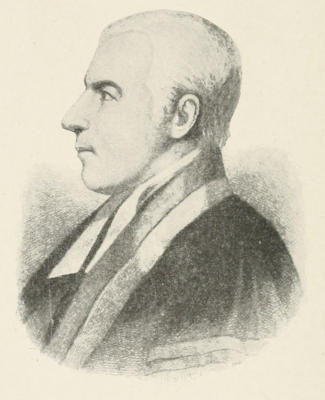
WILLIAM PATTERSON
In the literature of the Revolution forces were released which transformed letters into an instrument of creation and brought nothing less than a nation into self-consciousness. It had had its beginnings in the protest against the Stamp Act, grave state papers, the addresses of colonial assemblies and of the Congress at New York, the arguments of jurists, and the letters of observant men of affairs. Here was the structure of an empire to be debated. The very scope and capital significance [88]of such a debate called to the best minds of the colonies like a challenge. Pamphlets began to come from the press which showed quiet men unexpectedly turned statesmen and masters of style to state the case for the liberties of the colonies. Mr. Daniel Dulany’s Considerations on the Propriety of Imposing Taxes on the British Colonies for the Purpose of Raising Revenue by Act of Parliament supplied the great Pitt with the chief grounds of his argument against taxing America. A Maryland lawyer had turned from leading the bar of a province to set up the true theory of the constitution of an empire, with the dignity, the moderation, [89]the power, the incommunicable grace of a great thinker and genuine man of letters. Mr. Richard Bland, of Virginia, antiquary and mere jurist though he seemed to be, published an Enquiry into the Rights of the British Colonies, which put in blunt and bitter sentences what Mr. Dulany had said with restrained and sober eloquence,—that, and more besides. Mr. Bland did not hesitate to speak of Virginia as a “distinct and independent state,” bound, indeed, in allegiance to England’s king, but not bound to her Parliament; a dominion “settled by Englishmen at their own expense, under particular stipulations with the crown,” and entitled to deal with the crown alone. Mr. Townsend’s Acts of 1767 called forth a series of Letters from a Farmer in Pennsylvania to the Inhabitants of the British Colonies, into which John Dickinson had put the very heart of good sense and justice, to support the theory of liberty to which all America adhered, with an urbanity, a simple grace, a fine, natural power of statement which gave him instant place, on both sides of the sea, among famous Americans.
It seemed quite in the order of nature that James Otis and John Adams in Boston should enter the lists to make themselves champions of the people’s side in such an argument; and they wrote as they spoke, with a point and efficacy sure to win attention. It was much more significant that a like passion of speech should take hold of men hitherto withdrawn from popular leadership, for whom, it seemed, principles were the ultimate realities, not the mere play of affairs. And as the debate broadened, so did the volume of American letters grow. Her writers were serving their apprenticeship in the statement of the ideals by which [90]she was to live. From the first Continental Congress came forth an earnest address to the King, sober memorials to the people of Great Britain and to the people of British America, and a solemn declaration of rights which were as firm, as moderate, as cogent in reasoning, as sagacious in method as if they had been the [91]state papers of an ancient parliament. Men everywhere marvelled at their power of convincing statement, their telling force of quiet eloquence, as coming from a people without any writers, except Dr. Franklin, that anybody had heard of. There was here a breeding in letters which no man could well comprehend who had not breathed the keen airs of political inquiry moving upon the coasts of America.
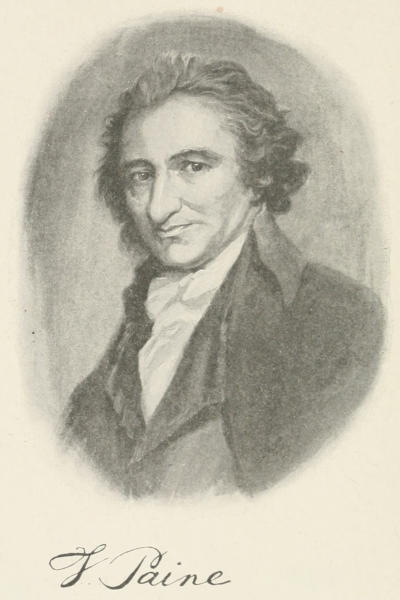
THOMAS PAINE
Presently there was the air of revolution, too. Pamphlets which argued with slow and sober power gave place to pamphlets which rang with passionate appeals; which thrust constitutional argument upon one side and spoke flatly for independence. One such took precedence of all others, whether for boldness or for power, the extraordinary pamphlet which Thomas Paine, but the other day come out of England as if upon mere adventure, gave to the world as Common Sense. It came from the press in Philadelphia early in January, 1776, the year the Congress uttered its Declaration of Independence, and no writing ever more instantly swung men to its humor. It was hard to resist its quick, incisive sentences, which cut so unhesitatingly to the heart of every matter they touched; which spoke, not the arguments of the lawyer or the calculations of the statesman, but the absolute spirit of revolt, and were as direct and vivid in their appeal as any sentences of Mr. Swift himself could have been. They were cast, every one, not according to the canons of taste, but according to the canons of force, and declared, every one, without qualification, for independence.
[92]
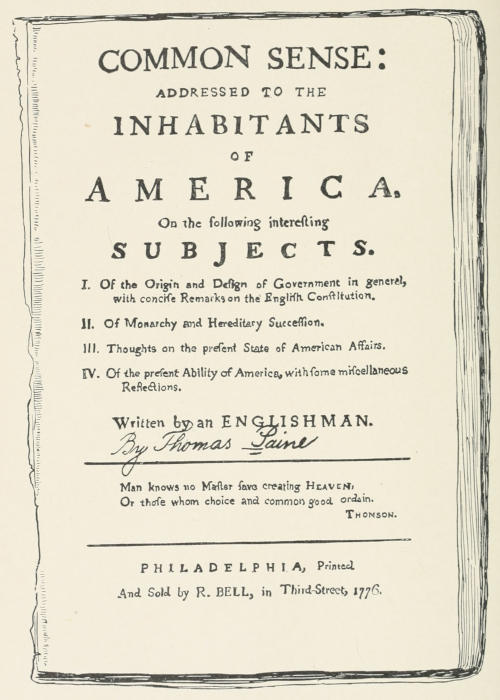
TITLE PAGE OF “COMMON SENSE”
[93]
Upon that, issue was joined. Men like Mr. Dickinson and Mr. Dulany drew back, and pleaded for the peaceful ways of constitutional agitation. Men like Joseph Galloway threw their sturdy power upon the same scale. Samuel Seabury, “The Westchester Farmer,” had already written letters against the extreme courses of the Congresses of 1774 and 1775 which were as difficult to answer as those of Mr. Dickinson himself, and men drew from them very effective weapons of controversy as affairs thickened towards revolution. Men mustered now upon that side who were very formidable, whether for influence or for skill and persuasiveness as advocates,—among the rest the redoubtable Jonathan Boucher, the robust preacher who was General Washington’s friend: who had met Washington in mid-stream of the Potomac as he fared to the Congress at Philadelphia and had warned him very solemnly to beware what he did to make cause against the King’s government in England. Issue joined, passion was the more quickened. There was vehement give and take. The sting of satire and invective was added to the bitterness of conflicting views upon this vital matter which must involve all men’s fortunes, and many used in ugly temper the worst weapons of abuse. Friends parted company in hopeless alienation. Men fought for their mere good name who resisted the rising spirit of the revolution. It was no light matter to come under the lash of verse-makers like Philip Freneau, whose satire burned like the flames about a stake. It was almost as hard to face John Trumbull’s stinging jests, touched sometimes with mirth but never with pity. These men were masters of their weapons, and wielded them with a certain grim pleasure. Perhaps Philip Freneau might, in some other age, have struck into the fine, sweet tones of genuine poetry; strains [94]came now and again from his pen which marked him a poet with the real gift of song. But
and he spent his force upon bitter satire, whose voice the men of his day welcomed and applauded. The passion of such a time could yield nothing more gentle. Men’s ears were not waiting for music. They spoke to give their speech efficacy as an instrument of action. The very private letters of the time read like minor pamphlets, ran always upon some theme of public concert in affairs, upon principles and measures, and were grave bits of counsel. Heads of colleges, like redoubtable John Witherspoon, of Princeton, kept the field in this fight for principles of government; Timothy Dwight, whom Yale afterwards preferred to her presidency, wrote its songs of war.
And so a generation was schooled for the making of a nation and the framing of constitutions: a generation bred to the debate of polities and the acute discrimination of principles of government; bred also to the severest and most analytical forms of discussion, and to the statement of political reasoning in words which told upon the mind like a demonstration. It was such a generation that debated the setting up and constitution of the Confederation, its weakness, the significance of Shays’s rebellion and of the disorders, some obvious, many obscure, which followed the war, the necessity for a new and better form of union, and the character of the government it ought to be provided with.
[95]
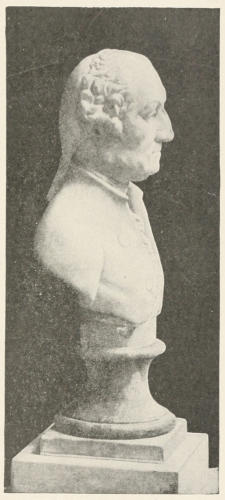
GEORGE WASHINGTON, FROM THE BUST BY ECKSTEIN
The chief part in the critical discussion of the constitution proposed by the convention of 1787 fell, of course, to the leaders of the several state conventions which met to consider its adoption or rejection. But there came also a flood of pamphlets from the press, and the newspapers of the seaport towns teemed with letters from men whose every line showed how schooled they had grown in the art of assessing questions of government. Public opinion had first to be dealt with before the state conventions should come together. There were opponents of the new scheme of union as ready to speak out as its advocates, and they spoke with a certain advantage of argument on their side. They could very easily make it seem, both to themselves and to those whom they addressed, that they [96]were but continuing their advocacy of the principles of the Revolution in opposing the creation of a central government likely to command them as they had but just now refused to be commanded by the immemorial government of the King over sea, a government made sacred by old allegiance. But the victory was again with those who concerted action. The most notable papers of the whole controversy were the eighty-five Federalist letters addressed, in quick, unbroken series, to “The People of the State of New York” from the columns of The Independent Journal, The New York Packet, and The Daily Advertiser during the weeks which intervened between the promulgation of the text of the constitution and the assembling of New York’s convention.
Each letter bore the signature Publius, but the series was in fact written by three several authors. Those which analyzed the general powers of the proposed government, those which sought to make clear its historical and theoretical foundations, and many of those which expounded its details, were the work of Mr. Madison. Mr. Hamilton examined, in his thorough-going, unanswerable way, the defects of the existing Confederation, such of the details of the constitutional convention’s plan for the reconstitution of the government as Mr. Madison had not the time to develop, and those general conceptions of government which he handled so like a master. Mr. Jay discussed the fitness of the new government for dealing with the foreign relations of the States. What distinguished these papers from all the rest with which printers and politicians were so busy was their breadth of view, their fine temper, their range of topic, their texture woven both of fact and principle, their candid and yet conclusive comment upon every matter that could be drawn into controversy. They read like what they were, the utterances of statesmen,—of statesmen drawn for the nonce out upon the general field of the theory and practice of government. It was easy to see in reading them how Mr. Madison had served and guided the convention at Philadelphia, and how Mr. Hamilton might have served it, had he liked its work while in progress as heartily as he now accepted and advocated it. These papers were henceforth to be the chief manual of all students and historians of the constitution. And their style, with its unfailing lucidity, its cogency without artificial emphasis, its unmistakable distinction and elevation of tone, matched their matter. This was the masterpiece of letters in the sober kind bred by revolution.
[97]
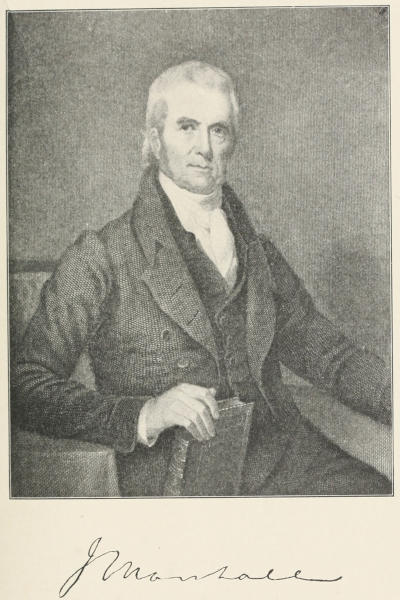
JOHN MARSHALL
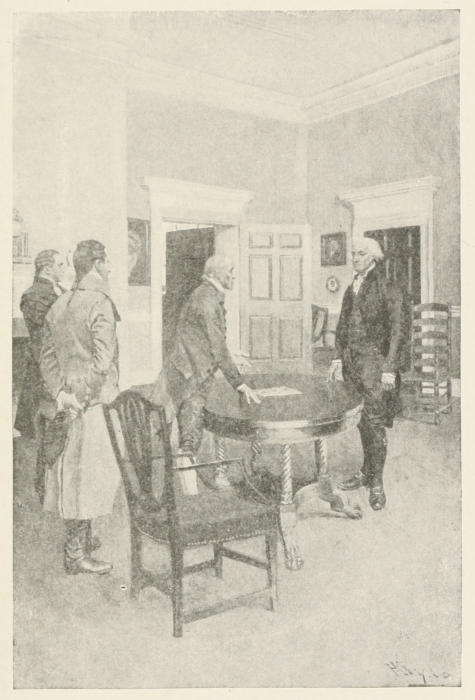
THOMSON, THE CLERK OF CONGRESS, ANNOUNCING TO WASHINGTON, AT MOUNT VERNON, HIS ELECTION TO THE PRESIDENCY
[98]
No man could say whether argument or interest had won the fight for the constitution; but it was at least certain that nothing had been done hastily or in a corner to change the forms of union. These close encounters of debate had at least made the country fully conscious of what it did. The new constitution had been candidly put through its public ordeal. All knew what it was, and for what purposes it was to be set up. Opinion had made it, not force or intrigue; and it was to be tried as a thing the whole country had shown itself willing to see put to the test.
[99]
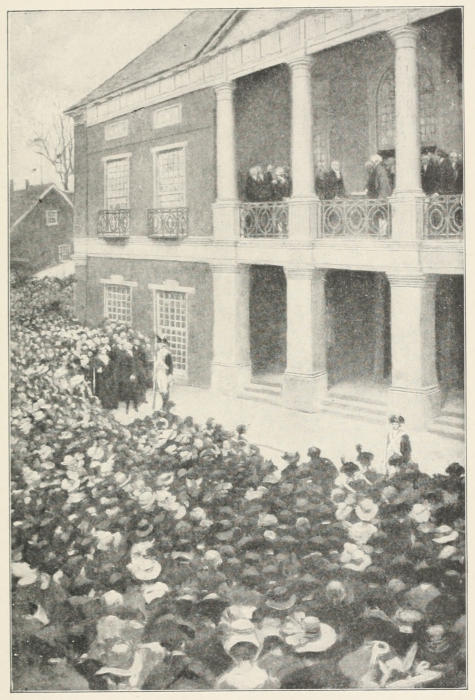
INAUGURATION OF WASHINGTON IN NEW YORK
[100]
Fortunately, there was one “Federalist” leader whom all the country trusted, and against whom even the bitterest opponents of the new constitution hesitated to speak in malice or detraction. The choice of men everywhere turned spontaneously to Washington as the one man who ought to be first President of the United States. The constitution provided that electors should be chosen in the several States, and that by them a President and Vice President should be selected. Their votes were to be sent to the Congress, to be opened and counted in a joint session of the two houses. The 4th of March, 1789, had been set as the day for the convening of the new Congress and the inauguration of the government; and New York was the place appointed. But the members were laggard and tardy, as they had been at Philadelphia when the constitution was to be framed. It was the 6th of April before they found a quorum and counted the electoral votes. On the 7th they sent Charles Thomson, who had been clerk of every Congress since 1774, to Mount Vernon to inform General Washington that he had been unanimously chosen President. By the 27th Washington was in New York, ready for his duty. He had come with unaffected reluctance. He called himself a mere soldier, and an old man besides; doubted his civil capacity; and coveted peace and retirement. But he had known it his duty to come; and on the 30th he was inaugurated President of the United States.
The first thing to be done was to give the new government dignity, vigor, and pre-eminence, lest it should inherit the taint of contempt which had fallen on the Confederation. It was the office and authority of the President, rather than the increase in the powers of Congress, that constituted the chief difference between the new government and the old. It was to be a government which could not only make laws, but execute them also; and Washington knew that no small part of its efficacy and prestige must depend upon him, [101]its Executive. “I walk,” he said, “upon untrodden ground. There is scarcely an action the motive of which may not be subjected to a double interpretation. There is scarcely any part of my conduct which cannot hereafter be drawn into precedent.” He must, he saw, mix prudence with firmness, conciliation with command, a reasonable accommodation with the strict execution of the law; and yet not abate the new authority. The new constitution had yet to prove itself acceptable; the new government had yet to win respect. No sentiment attached to it. It must be begun amidst curiosity rather than reverence; in a cool air almost of indifference; without many warm partisans of the rank and file; as an experiment, lacking yet for some time the dignity of an institution.
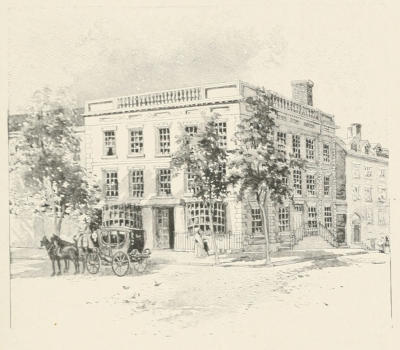
THE FIRST PRESIDENTIAL MANSION, AT PEARL AND CHERRY STREETS, NEW YORK
[102]
In such circumstances questions of etiquette assumed the importance of questions of statecraft. The President insisted, first of all, upon personal precedence. He would receive but not make calls, would give invitations but not accept them; the representatives of foreign governments must deal with him, not directly, but through the Department of State, the country’s new foreign office; the governors of States, when he travelled, must call first on him, not he first on them. He made a point of visiting different parts of the country when he could, in order that the people might everywhere have visible proof of the existence and of the dignity of the President, the head of the nation. He practised no foolish seclusion. It was inbred in his principles that he should serve the people in true republican spirit, without affectation or pretension. He walked the streets like other men; rode forth for his exercise on horseback, as was his Virginian habit; was but little more punctilious in dress and manner than he would have been at home. But the natural majesty of his person, his habitual gravity, his breeding in a formal society, the impression he made upon every one of a man of high passion self-controlled, inevitably gave him distinction, and magnified his office in the imagination of all who saw or dealt with him.
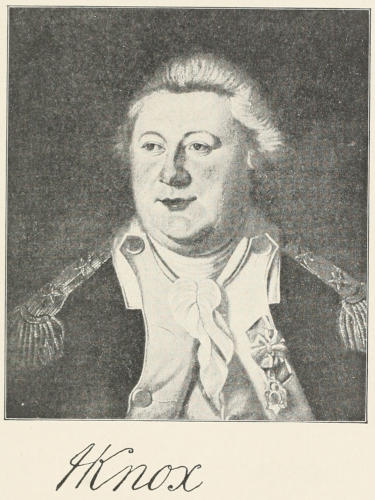
HENRY KNOX
It was easier for him to play his own part of quiet authority and matter-of-course precedence than to fill the new offices of federal administration with men who could lend a like flavor to the conduct of affairs. Ambitious men looked askance upon the new government; preferred the service of their States, if they wished political office at all; had to be persuaded to take federal office, and were asked to say nothing of the offer and [103]refusal if they declined it. Fortunately, there were not many offices to be filled; and for these efficient men were found. The Congress created but three administrative departments at the outset: the Department of State, the Department of the Treasury, and the Department of War; though it provided also for the appointment of an Attorney General. Washington chose Thomas Jefferson to be Secretary of State, Alexander Hamilton to be Secretary of the Treasury, General [104]Henry Knox to be Secretary of War, and Edmund Randolph to be Attorney General. Mr. John Jay he made Chief Justice of the Supreme Court of the United States. His strong desire was to join parties in a common support of the general government,—join them at the outset, when their formation was but foreshadowed, not yet hardened to a definite purpose. Alexander Hamilton the whole country knew to be one of the chief advocates of the new and stronger government; General Knox, too, was an avowed “Federalist,” as well as a close personal friend of General Washington’s; but Mr. Jefferson, who had been in France when the constitution was framed and adopted, came rather lukewarmly to its support, and Mr. Randolph, though he had stood for its adoption, with Mr. Madison, in the Virginian convention, had favored it rather as a sensible politician than as an earnest friend. Mr. Jay was known to be a Federalist.
When parties formed it would be in Congress; and the elements there were not difficult to reckon. There were but eighty-one members, all told: in the Senate twenty-two, in the House fifty-nine, until Rhode Island and North Carolina should come into the Union. It gave weight to the administration that John Adams had been chosen Vice President, and stood with all his sturdy frankness for Federalism, and represented, besides, distinguished national service, both at home and abroad. He had been the first minister of the new republic at the court of St. James, and had made himself and his country respected there, alike for statesmanship and for integrity. He had been at Paris and at The Hague, always alert, always serviceable, always efficient, if never quite genial or attractive, and brought with him to his new duties in New York the excellent traditions of his State in politics and morals.
[105]
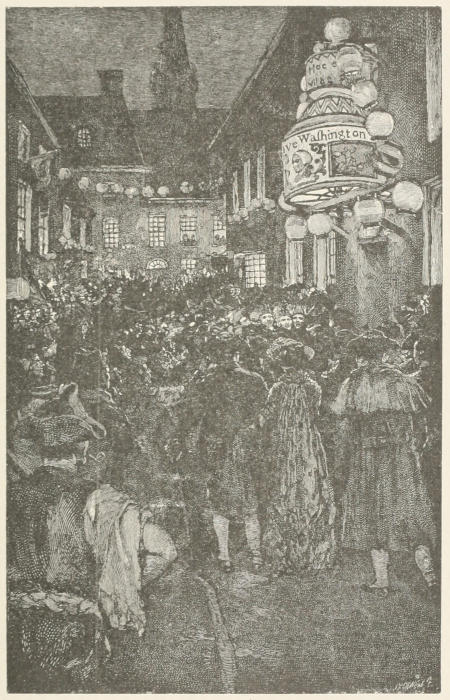
CELEBRATION IN NEW YORK ON THE NIGHT OF WASHINGTON’S INAUGURATION
[106]
There were marked differences of opinion in the houses from the first: some were inclined to a very liberal construction of their new powers under the constitution; others cried a warning against it, and pressed very earnestly for methods which should above all be conservative, and hold all things to a moderate course. It was easy to see how parties could form,—were forming; but as yet they revealed themselves only vaguely, and legislation moved unembarrassed.
The task of the new Congress was nothing less than the organization of the government. By an act of the 24th of September, 1789, it definitively set up the Supreme Court for which the constitution had provided; giving it a membership of six justices, of whom one should be Chief Justice. Its statutes erected the Departments of State, War, and the Treasury; created the office and functions of Attorney General; put the military establishment upon a modest peace footing; and confirmed the regulations which the Congress of the Confederation had made with regard to the government of the Northwest Territory ceded by the States to the general government.
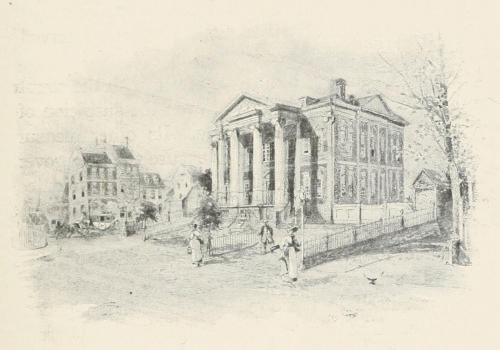
GOVERNMENT HOUSE AT THE BATTERY, NEW YORK, 1790
Its measures of policy affected the whole action of the government in the matters most likely to give it strength and credit; and even the operation of the constitution itself. Virginia was not the only State which had given its assent to the constitution upon the virtual condition that so soon as the government went into operation amendments should be adopted which should explicitly safeguard the more essential rights of individuals and of States. North Carolina, South Carolina, New York, [107]Massachusetts, and New Hampshire had also urged amendments; and those who had been the chief advocates of the constitution in their several conventions had virtually promised that amendment should be undertaken at the earliest practicable moment. The Congress, therefore, promptly proposed twelve amendments; and of these twelve the States accepted ten. Eight of them ran in the phrases of Magna Charta, the Petition of Right, the Declaration of Independence, and the Virginia Bill of Rights; the principles they embodied had come out of the long processes of English constitutional history, out of the precedents of English courts and the practice of English justice; out of charters and constitutions and ancient parliamentary protests. They made secure against federal encroachment the rights of individuals in respect of religion, freedom of speech, military service and the [108]use and maintenance of armies, search warrants, trial in accordance with fixed law and by the judgment of juries, criminal accusations, the inflicting of punishments, and the exaction of bail. The ninth provided that “the enumeration in the constitution of certain rights should not be construed to deny or disparage others retained by the people.” The tenth declared that “powers not delegated to the United States by the constitution, nor prohibited by it to the States, were reserved to the States respectively or to the people.”
So much Congress did to keep faith with the country and to clear the constitution of even the suspicion of a character unfavorable to liberty. Its other measures were intended, not to justify or excuse the new government, but to give it efficiency. It was by common consent the chief business of the session to set the finances of the country effectually to rights and to regulate commerce: to give the new Union unquestionable standing in the markets and the banks of the world. Congress put itself in these matters under the guidance of Hamilton. The advice given by the young Secretary was characteristic alike of his capacity and of the purposes which he entertained with regard to the government. And he declared his views with characteristic candor and directness. “To justify and preserve the confidence of the most enlightened friends of good government; to promote the increasing respectability of the American name; to answer the calls of justice; to restore landed property to its due value; to furnish new resources both to agriculture and commerce; to cement more closely the union of the States; to add to their security against foreign attacks; to establish public order on the basis of an upright and liberal policy; [109]these,” he said, “are the great and invaluable ends to be secured by a proper and adequate provision at the present period for the support of the public credit.” In a series of carefully considered reports in which he showed himself, as always, a consummate master of constructive argument and of that sort of exposition which itself convinces,—reports on the public credit, on the excise, on the establishment of a national bank, on manufactures,—he proposed that a tariff act be passed which should incidentally protect and encourage domestic manufactures; that the foreign debt of the Confederation should be assumed and paid in full; that the domestic debt of the Confederation, also, though it had long ago fallen below par and had largely [110]passed into the hands of speculators at an enormous discount, should nevertheless be paid at its face value; that even the debts which the several States had incurred during the Revolution should be assumed and paid by the federal treasury; and that a national bank should be established to serve as the fiscal agent of the government. Each of these proposals in turn Congress acted upon and adopted,—not, of course, at once and without debate: only after severe and even bitter contests, indeed, which ran through two annual sessions, and by majorities which grew narrower and narrower with each vote until they dwindled and were lost altogether, to be regained again only by an adroit parliamentary bargain;—but adopted, nevertheless, and made the deliberate policy of the government.
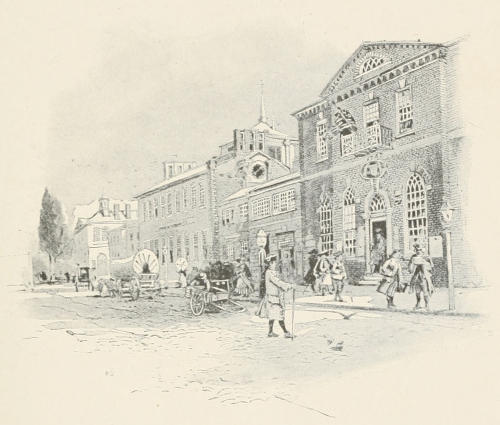
CONGRESS HALL, 1790-1800
Here was more than conservative men could digest. Even Madison, who in most things led the houses, as he had led the constitutional convention, hesitated and drew back. Jefferson protested, with rising heat, in the cabinet and out of it. Parties began to gather definite creed and purpose, and divided upon lines which grew more and more fixed and clear. It was undoubtedly Hamilton’s purpose to draw men of wealth and property to the support of the government by means of his financial measures: to give them definite reasons for wishing it to succeed, and for determining to stand by it until it did succeed, building for the government a great backing of interest; and that of itself condemned what he did in the eyes of some. It seemed to make what he proposed legislation for a class: for a class which did not always prefer the interests of communities to its own. More than that, some of the measures which Congress had adopted, notably [111]that which established a national bank, involved a doctrine of powers implied, as well as of powers explicitly granted, by the constitution. The new government had looked formidable enough with the powers explicitly granted; who should say where the elaboration of its powers would end if still others were to be drawn forth by implication? The constitution nowhere explicitly gave Congress the right to create a corporation, like the new Bank of the United States. Hamilton argued that that right was included under the clause which gave it power to make all laws which should be “necessary and proper for carrying into execution” the powers specifically granted; because he held that the Bank was a necessary financial agent in the handling of the federal funds. But whither would the country be led if men of Hamilton’s school in politics were permitted to interpret the word “necessary”?
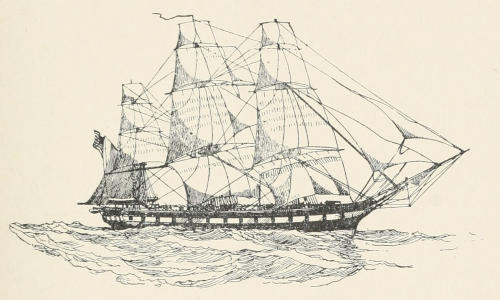
UNITED STATES FRIGATE, 1812
[112]
Those who had opposed the constitution because under it the authority of a common government could command the financial policy of the States, and those who had opposed it because it subordinated the States in every chief matter of politics and made of them fractions instead of integers in the political life of the country, had, of course, been ready from the first to stand against Mr. Hamilton and his policy of concentration. When his whole plan was disclosed many Federalists also drew back, with Mr. Madison, fearing whither they should be led by the doctrine of implied powers which the young Secretary thus so boldly pressed at the very outset. Many a sign of sharp reaction gave the Federalist leaders plain warning of what they might expect, should they persist.
Mr. Jefferson became the real leader of the new party of opposition, even before he left the cabinet: at first covertly, at last openly; giving it the name Democratic Republican, which savored of the Rights of Man and took men’s thoughts over sea to the sharp struggle for liberty then ablaze in France; giving it also organization and the spirit of party, like the master of men he was,—philosopher and politician in equal compound. But Washington accepted the leadership of Hamilton, as Congress did, and for a time nothing could withstand the purposes of those who meant to make the new government strong, national, and permanent. When two years had gone by (1791) a new House was chosen, and in part a new Senate; but the Federalists still kept their ascendency in most of the constituencies, and the first policy of the government was not stayed.
[113]
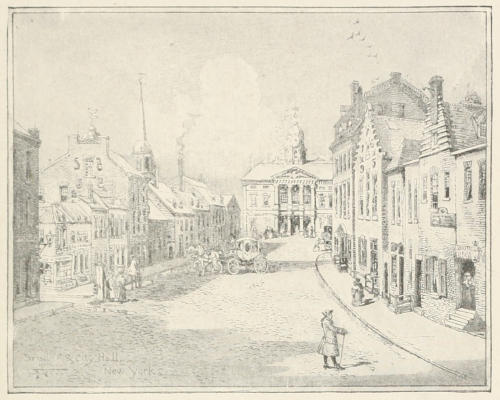
VIEW OF BROAD STREET AND CITY HALL, NEW YORK, 1780
Meanwhile North Carolina (November 21, 1789) and Rhode Island (May 29, 1790) had come into the Union, and the original roster of the States was complete again. Two more States were presently added: Vermont,—“the New Hampshire Grants,” territory which New York and New Hampshire both had claimed,—in March, 1791, and Kentucky, Virginia’s lusty and restive offspring, in June, 1792. Whatever doubts of policy or contests of party marked those opening days with threat of divided counsels, the Union was at least established,—was already expected to last. Kentucky’s incorporation within it showed that the hopeful West was turning to it. Public questions touched its measures, but had already ceased to touch its life. A veritable government had at last been set [114]up to hold the country together. It had been “a novelty in the history of society,” as de Tocqueville said, “to see a great people turn a calm and scrutinizing eye upon itself, when apprised that the wheels of government had stopped; to see it carefully examine the extent of the evil, and patiently wait until a remedy was discovered, which it voluntarily adopted, without having wrung a tear or a drop of blood from mankind.” But this the people of America had done, under the men who had called upon them to amend the Articles of Confederation and provide themselves with a real government: under the men who, with Washington, had set that government up and given it immediate credit and standing in the world.
The general authorities for this period are the sixth volume of Bancroft’s History and his History of the Constitution; the third volume of Hildreth; the second volume of Timothy Pitkin’s Political and Civil History of the United States; the first volume of George Tucker’s History of the United States; John Fiske’s vivid Critical Period of American History; George Ticknor Curtis’s Constitutional History of the United States, History of the Origin, Formation, and Adoption of the Constitution, and The Constitution of the United States and its History, in the seventh volume of Winsor’s Narrative and Critical History of America; John B. McMaster’s History of the People of the United States; Francis N. Thorpe’s Constitutional History of the American People and Constitutional History of the United States; Richard Frothingham’s Rise of the Republic of the United States; Judson S. Landon’s Constitutional History and Government of the United States; C. Ellis Stevens’s Sources of the Constitution of the United States; George Gibbs’s Memoirs of the Administrations of Washington and Adams; Edward Stanwood’s History of the Presidency; J. P. Gordy’s History of Political Parties in the United States; and Joseph Story’s Commentaries on the Constitution of the United States. Hermann von Holst’s Constitutional and Political History of the United States and James Schouler’s History of the United States of America under the Constitution here begin to serve us as guides and mentors.
[115]
The sources are to be found in the published writings and correspondence of the leading men of the time; the Annals of Congress; Jonathan Elliot’s Debates on the Federal Constitution; The Federalist; Thomas H. Benton’s Abridgment of the Debates of Congress; the federal Statutes at Large; The American State Papers; Niles’s Weekly Register; H. D. Gilpin’s Papers of James Madison; Paul L. Ford’s Pamphlets on the Constitution of the United States and Essays on the Constitution; Thomas Jefferson’s Anas; and William Maclay’s Journal, covering his service in the first Senate of the United States.
[116]
CHAPTER III
A NATION IN THE MAKING
General Washington’s first administration gave tone, direction, and presumption of permanence to the new government. His second term steadied it amidst its first serious difficulties, and gave the country a wholesome taste of its vigor. The vote of the electors was unanimous in 1792, as it had been in 1789, in choosing him President, and the seventy-seven votes which they cast for Mr. John Adams made him Vice President a second time by a safe majority. The congressional elections which accompanied the choice of the electors showed, it is true, an unmistakable reaction of opinion against the strong and systematic measures by which the Federalists had put Mr. Hamilton’s programme into execution. The majority in the new House of Representatives consisted of men inclined to follow Mr. Jefferson in the formation of a distinct party of protest, if not of opposition; though the more slowly changing Senate showed still a preponderance of Federalists. But General Washington still seemed to all the safest leader in affairs, the only possible guide and mentor in those first days when all things were yet to be brought to a stable order and a wise way of government.
It was a notable thing how a minority prevailed in all active policy and managed to keep affairs in its own [117]hands,—the same minority whose sagacity and vigor and concert in action had secured the formulation and adoption of the constitution. The war for independence had been a democratic upheaval, and its processes had seriously discredited all government which was not directly of the people. It had made local committees of correspondence the real organs of opinion. Town meetings and the people’s representatives in the provincial assemblies had originated policy, while it lasted, with an almost sovereign freedom of choice and had kept their sovereignty when the war closed. Almost everywhere, except in Virginia, a majority of the leading families and of the professional classes of the colonies had thrown their influence against the separation and independence which the popular leaders demanded; against the trial of an out-and-out people’s government without king or parliament or ruling class to moderate and offset the sway of democracy; and when the end of the struggle came those whom the country had been accustomed to see lead in its commonwealths abandoned it in extraordinary numbers forever, preferring Canada and the Indies and the old country over sea, where government still kept the form and dignity and aristocratic flavor to which they were attached. Men enough of the classes hitherto honored and privileged remained to hand on the old traditions of initiative and service and authority which wealth and training and social influence had formerly secured; but the end of their predominance was plainly at hand. Aristocratic privilege and the natural precedence of birth and breeding were sadly discredited. The mass of common men had put their own leaders forward, had acted for themselves in town meetings and in voluntary organizations of their [118]own, with regard to matters of the greatest scope and consequence. Power had plainly been levelled; equality had become the cardinal principle of politics, local autonomy and direct elections the standards and models of political organization. The central government which the constitutional convention of 1787 had devised and to which Washington and Hamilton had given power and authority had plainly been set up as if by reaction, to offset the heady autonomy and turbulent democracy of the people’s commonwealths. Many of the cherished ideals of a democratic revolution seemed lost and given up by its successful establishment; and the Federalists, with their frank preference for the old vigor of authority, their undissembled contempt for pure democracy, were [119]not likely very long to maintain themselves in the people’s favor. Mr. Jefferson found men eager to put a check upon them and restrict the new government to a more modest scale of power. The minority were only temporarily in the saddle. They were permitted to rule only because of their vigor and efficiency, and the need to employ them in order to give definite shape to the government which they had originated.
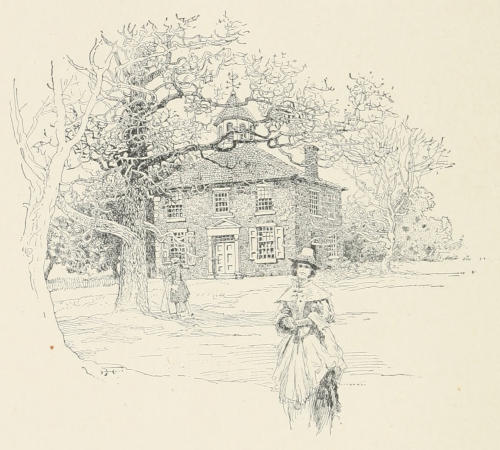
FIRST OHIO CAPITOL, 1801
It was a rural nation which had drawn together into this novel union,—a nation without aristocratic example now that its connection with England was cut off; with nothing but its own simple needs, naïve preferences, and manifest convenience to consider, now that it was no longer part of an extended and various empire. It had been obliged, because convinced by the unanswerable arguments of tumult and of ugly reprisals of State upon State, to set up at its centre a real government again, to take the place of the government over sea from which it had broken away: a government with an authority of its own which was likely to be even more efficacious in holding them together in a co-operative union than the authority of the King and Parliament. But, though opinion had reluctantly consented to that, it by no means followed that it would consent to see the new government given a scope and vigor such as Mr. Hamilton, with his notoriously high notions of prerogative, wished to confer upon it. The people could not, it is true, of a sudden shake off their life-long habit of following those who had always seemed their natural leaders. Their society was old; their commonwealths were compact of law that was rooted deep in the past; their thoughts were stuff of old tradition. Noble gentlemen who were of [120]the gifts and breeding which had so long made the chief families among them seem a sort of privileged and authoritative class, to be looked to as of course for guidance, had endeared themselves to them anew by their cordial espousal of the popular cause and by their indispensable capacity in its successful promotion; had still an unmistakable prestige in affairs. But their governments had long been in fact democratic, and were now democratic in form also, and the privilege of leading could not much longer be monopolized amongst them.
And that notwithstanding the prescriptions of their law. Under the laws of the colonies only a minority of the adult male residents in each community had been allowed to vote,—those who held some not inconsiderable amount of property; and still fewer had been allowed to hold office,—the ownership of a still larger amount of property being prescribed as a qualification for candidates for political office. Most of the one-time colonies had transformed themselves into States upon their assumption of independence by an entire reformulation of their fundamental law; and some had modified it still further before the new central government over which General Washington was to preside had been set up; but the basis of their suffrage they had in most cases left substantially unaltered. It was still necessary that every voter should be a freeholder, or the possessor of an estate of (say) fifty pounds value, or at the least a tax-payer. Rhode Island and Connecticut had kept their colonial charters as their State constitutions and left their law substantially unchanged. There were probably not more than one hundred and twenty thousand men who had the right [121]to vote out of all the four million inhabitants enumerated in the first census (1790). In 1792 Kentucky was made a State of the Union, and her constitution, with its frontier liberality, said nothing about any qualification for the suffrage except the qualifications of age and residence; but Tennessee, which came into the Union as a State four years later, though no less a frontier community than Kentucky, required by her constitution that voters should be owners of freeholds. There were also in almost every State property qualifications for membership in the lower House of the State legislature; and ownership of a very considerable amount of property was so universal a prerequisite for election to the Senates of the States that they were looked upon as bodies which of intention represented the propertied classes. Both by law and by ancient custom wealth and social consideration carried with them also political privilege.
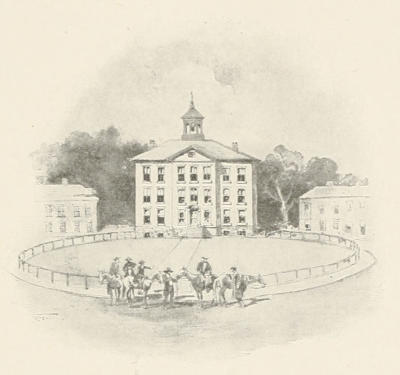
STATE CAPITOL OF KENTUCKY, 1796
[122]
But law and custom already felt in these matters the pressure of opinion. The party that was gathering about Mr. Jefferson purposed, among other things, the levelling of political privilege. The spirit of the rural nation was against social distinctions. The essential simplicity of its life made pretension ridiculous; the free movement of enterprise throughout its borders made the individual man, with or without property, if only he possessed energy and initiative, the real and only constant unit of power; and the new nation was not long in showing that it wished its government conducted with the economy, simplicity, and plainness of the individual man. There had been a significant flurry of excited comment when the first Congress under the constitution debated whether in official papers it should speak of the President of the United States as “His Highness” or “His Excellency,” or confer upon him some other title of even greater semblance of rank and dignity. “Does the dignity of the nation then consist,” Mr. Tucker, of South Carolina, had cried, “in the exaltation of one man and the humiliation of all the rest?” It raised a very storm of angry and even abusive comment when the houses voted their first salaries Bill, which gave to the President twenty-five thousand dollars a year, to the Vice President five thousand, to Senators and Representatives six dollars a day during the sessions of Congress, and to the Speaker of the House twelve dollars. It was known that General Washington would decline to draw his salary, and that while he remained President the salary voted to the chief magistrate would be merely nominal; but the bill fixed the salary for subsequent incumbents of the office, and it was very generally condemned for its wilful extravagance.
[123]
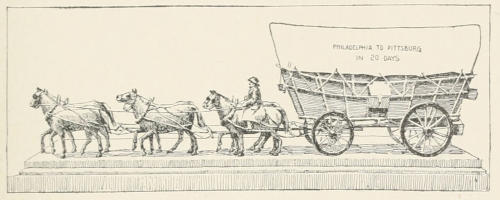
MODEL OF A CONESTOGA WAGON
The Congress felt the air of opinion out-of-doors very sensitively, and the President and his advisers sometimes found now the one house and again the other in a singular mood of uneasiness or suspicion. The Federalists who gathered about General Washington were watched very narrowly to see that they formed no “court” about the President and accumulated no private stock of privilege in their managing coteries. Their more democratic opponents made merry over their affectations of social preference and their manners copied from an aristocracy over sea; and their mirth had in it oftentimes a touch of sardonic bitterness. The prejudices of such critics were based upon their own radically simple lives. Their fears of plots and usurpations, of aristocratic pretension and the insidious bringing in of notions of government which would be more suitable for a monarchy than for a democratic republic sprang wholly from what they knew and had had taste of from a very different world across the sea. A spectre of tyranny stalked always somewhere in their forecasts of the future and in all their uneasy criticisms of the present. Their governors found it necessary not only to be [124]but also to seem servants, not of one class or of any special interest, but of the whole people.
No society could have been more radically and essentially democratic. Agriculture, the northern fisheries, and the commerce of their ports,—their crops, their timber, their fish salted for the world, their ships showing their sails upon every coast,—summed up the chief interests of the little country commonwealths, more forest than field, more wilderness than plotted ground. Not a little of their clothing their people made for themselves out of their own flax and hemp, besides felt for hats, their own shoes, and many a pair of breeches of leather or buckskin. But English law had forbidden the export of such goods while they were colonists, which was but yesterday; and had made anything beyond the necessary spinning of the household a thing useless and unprofitable. Ships were built in every colony, but they carried only breadstuffs or lumber or shingles or tobacco or indigo in bulk. Not until the year of the constitutional convention (1787) had any considerable quantity of cotton even been gathered for export. It had for long seemed little more than an ornamental plant, a curiosity of the garden.
And even at the ports tradesmen and shippers and money-lenders and mechanics gathered in no great numbers. There were but six cities of noticeable size in all the country. The South, which held half the population, had but two, Baltimore and Charleston; and the population of these, added to the population of Philadelphia and New York and Boston and Salem, the other four, made up a total of only one hundred and thirty-one thousand all told. Virginia, with one-fifth of the total population of the country, had as yet no city [125]at all. There were only five daily papers in the country, and these could not be sent in the mails because of their bulk and the heavy rates of postage. There were but seventy-five post offices the country through, and few of these saw the weary post-rider more than twice a week.
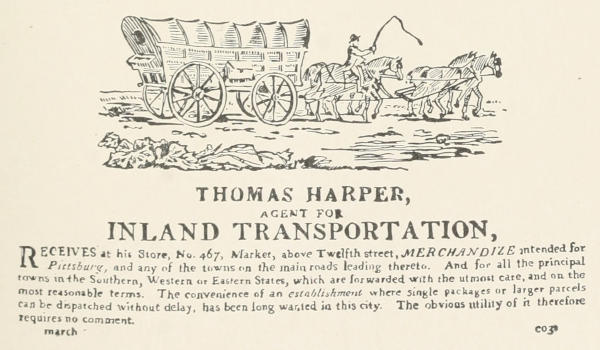
TRANSPORTATION ADVERTISEMENT
It was notable, nevertheless, how the population of the country taken as a whole had grown, despite the wars and the doubts and hazards of fortune which had marked the troubled time. When the war for independence began the people of the colonies had probably not numbered more than two millions seven hundred and forty-three thousand, counting black and white, slave and free. When the first census under the constitution was taken, in 1790, there were found to be very close upon four millions, an increase of quite twelve hundred thousand within the brief space of those fourteen troubled years. But the new men who came into the reckoning did not swell the population of the towns at [126]the ports. They for the more part took up land and became freeholders in that free society, and added their force to the power of the new democracy, making a nation which must be governed upon principles of equal privilege or not governed at all.
The political weather held very fair until General Washington had a second time been made President. A little jealousy; an occasional discourtesy on the part of state officials who did not wish to yield in any point of dignity or precedence to the officers of the new government; a burst of hostile criticism now and again because the new Congress seemed to go too fast in its assumptions of authority or in its expenditures; annoying difficulties in getting men of right principle and first-rate capacity to serve as subordinate officials of the federal government; petty embarrassments without number beset the novel government of the Union, because it was new and as yet had its place and its methods to establish. But Washington’s wise way of being firm; his striking bearing in every matter which touched authority or precedence, half gracious, half austere, wholly commanding; his sensible moderation in counsel and straightforward vigor in action made such things of little consequence. The way in which the majorities necessary to carry Mr. Hamilton’s measures for the financial support of the government had dwindled from vote to vote in the Congress was the only sign that had looked ominous.
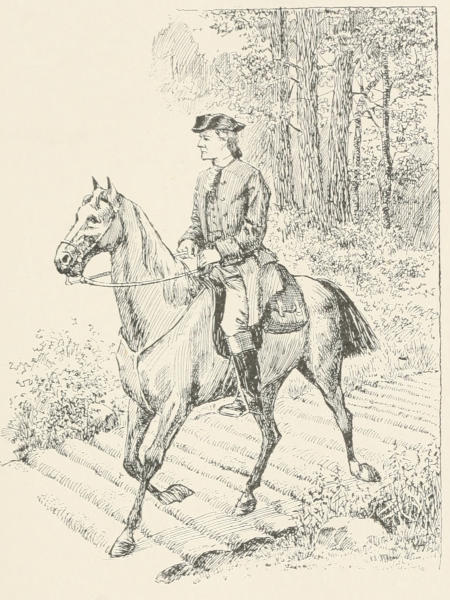
A MAIL CARRIER IN THE EIGHTEENTH CENTURY
A serious crisis had in fact been reached when it came to a vote on the proposition that the federal government should assume the war debts of the States. The southern members resolutely opposed the measure. Some States owed much more than others of the sum total [127]which it was proposed all should pay. Some had already paid a portion of what they owed, and would lose outright what they had paid should the debts be assumed by Congress. The southern members did not wish either to admit the inability of their States to pay their debts or to make the federal government a general providence for the whole country in matters financial, and a patron and friend, besides, of the money-lenders; and their opposition defeated the measure by the narrow majority of two votes. The northern members were [128]as resolutely determined that the measure should pass; and the heat of the debates and the bitterness of those who had lost in the vote gave to affairs for a moment almost a tone of revolution. Mr. Hamilton cleared the storm by a sudden stroke of astute management. The southern men were anxious that the federal district which the constitution had directed should be secured as a site for the Union’s capital should be laid out on the shores of the Potomac, within their easy reach and at a safe distance alike from the importunate merchants and money-lenders of the eastern ports and from the too philanthropic Quakers of the middle States, with their troublesome and impracticable agitations for the abolition of slavery. Mr. Hamilton arranged that the two measures should be associated, the assumption of the debts and the selection of a federal district. Two Virginian members consented to vote for assumption if the northern members would vote for a capital on the Potomac; and both bills were passed.
Since 1785 New York had been the seat of the federal government; and there the new government of the Union had first been set up. It was now decided (1790) that the government should be transferred to Philadelphia, the seat of the first Congresses of the Revolution and of the formal Confederation, until a capital of its own should be ready on the Potomac.
In Philadelphia, where the Confederation had been set up and the first councils of the Revolution held, the new government also saw its first years of stress and trial. Its sharp and trying test came the year Washington was for a second time made President (1793); and came from over sea,—a test alike of its [129]motives and of its strength. That year the French revolution came to its keen pitch and passionate crisis.
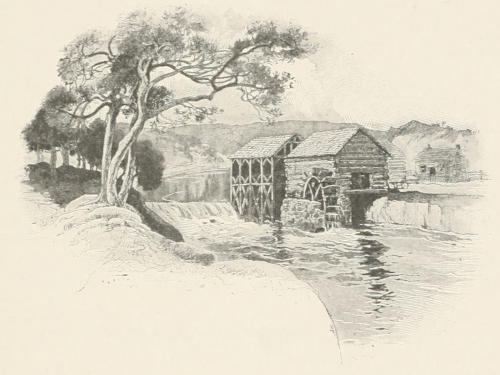
FIRST MILL IN OHIO, 1789
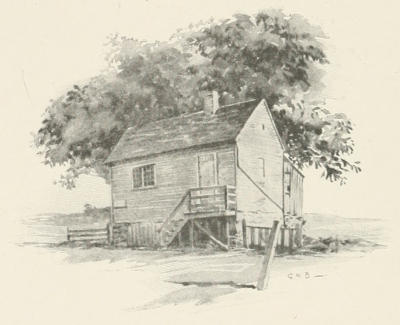
LAND OFFICE OF THE OHIO COMPANY, MARIETTA
It was the year of the Terror, and of wars which swept Europe like winds of destiny. But the Terror came at midsummer. Early in the year men in America knew only that France had gone the full length of revolution; that the monarchy had been abolished, the king sent to his death, a republic set up, and a new experiment like their own, an experiment in human liberty, begun, with all Europe to fight in order to make it good. No one in Europe doubted that America would cast in her lot with France in this day of her hope and sally for freedom, if only to requite the inestimable service France had done her in her own time of aspiration and struggle. No one in America doubted it, either, who merely gave rein to sympathy and thought nothing of the consequences. But Washington saw what the consequences [130]would be; and his was the responsibility. His cabinet was unanimous in its agreement with him that the young republic, as yet without assured power or established friendships in the world, its own government still in its first stages of experiment, must stand neutral in European wars. Even Mr. Jefferson, though chief of the party whose passionate sympathy with the French revolutionists now stirred the quiet country from end to end, though himself touched at every point of thought by the speculations which were the principles of the revolution over sea, voted with his colleagues that the United States must stand aloof. France was at war with Prussia and Austria; with the spring news came that the circle of the spreading conflict had reached England and Spain; through England the flame might touch America. On the 22d of April, accordingly, the President issued a definitive proclamation of neutrality, drawn and signed by Jefferson himself, as Secretary [131]of State. English troops still held the posts on the northwestern frontiers; Spain commanded the lower courses of the Mississippi. To go to war with England and Spain would be to renew all the peril of the struggle for independence. No prudent man among those who now supported Washington in his delicate task of giving the new government form and strength and character doubted either the wisdom or the opportuneness of the proclamation of neutrality.
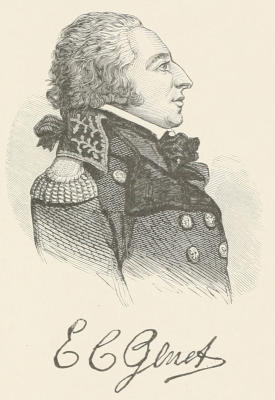
EDMOND CHARLES GENET
But the very day the newspapers of Philadelphia printed the significant and imperative proclamation “Citizen” Genet reached the city, the accredited minister of the French Republic to the United States. He had landed from a French frigate at Charleston on the 9th of April, had commissioned privateers and enlisted men there to prey upon English commerce before even presenting himself for recognition at Philadelphia, and had travelled from stage to stage of his pleasant journey northward to meet nothing but enthusiastic welcome everywhere. He had confidently expected to command America as his ally against the world. The governor of South Carolina had approved [132]of his extraordinary acts at Charleston. Genet had commanded that English prizes should be brought into the nearest ports of the United States, and that French consuls should condemn them in prize court; and yet he had heard nothing but applause until he reached the presence of Washington. Jefferson loved France and welcomed Genet as a friend. The United States had linked themselves with France in close treaty of alliance in the old day of their own struggle for freedom, and Mr. Jefferson was willing to believe that the promises of assistance then given applied now to the new France and her new wars against Europe almost as M. Genet himself extravagantly interpreted them. The President found himself obliged to hold his own Secretary very sternly to his duty as the minister of a neutral state. England’s complaints were heeded; captured English prizes brought to the ports of the United States were released; the exequatur of the French consul at Boston, who had done as Genet bade him, was revoked; Americans who had enlisted on the privateers fitted out at Charleston were put on trial; and Genet’s recall was requested. His reception at the hands of the people had gone to his weak head. He thought, because he was feasted and fêted in Philadelphia itself, the seat of the federal government, that he could appeal to the country against its own government, and insolently threatened to do so, to learn too late that Washington was master. As soon as possible he was superseded.
[133]
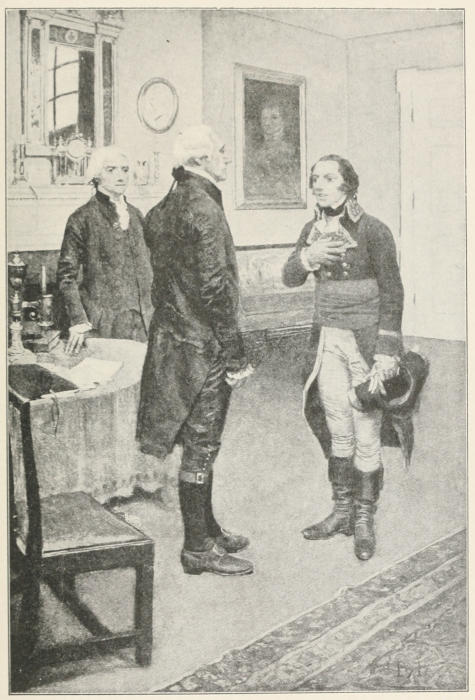
INTERVIEW BETWEEN GENERAL WASHINGTON AND “CITIZEN” GENET
[134]
The demonstrations with which he had been received were none the less genuine. A wave of deep feeling was sweeping over the country. The “civic” feasts and republican banquets, the elaborate celebrations of liberty and the Rights of Man, with which almost every town and hamlet excited itself, would have been impossible had not a sober and unaffected enthusiasm underlain all their extravagant charlatanry and affectation. Some enthusiasts cooled towards France when her King went to the guillotine as a sacrifice; more drew away when news of the bloody Terror came; but the tide of feeling did not permanently subside. Something of a deep, unfathomable faith remained. The firmness of the government and the discredit of Genet did not prevent the formation everywhere of democratic societies which established themselves upon the model of the Jacobin Club in Paris. Their sympathy with France was but a sign and incident of the thorough-going and undoubting democratic creed of the people themselves. They were the nuclei of the party which meant as soon as possible to take possession of the government and mould it to its principles,—the party which Mr. Jefferson withdrew from the cabinet to lead when the year was out (December 31, 1793). He knew how to estimate the real volume of opinion now running against the policy of the administration; he shared the principles and predilections of the men who represented it upon its more sober and thoughtful side; and he had realized now for a long time that in the cabinet his views could not prevail. He withdrew to form the gathering party for its ultimate triumph when Washington should be off the stage.
[135]
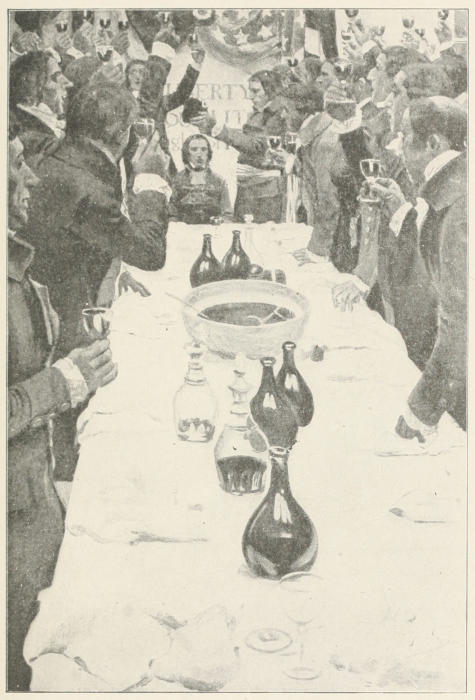
A BANQUET TO GENET
[136]
Washington felt very keenly the sharp power of the hot criticism to which his course towards France had subjected him. It was a heady current to stem. Unmeasured abuse beat upon him. He seemed for a little the leader of a party, and of a minority party at that, instead of the leader of the nation. He was made to seem for a time nothing but a Federalist, the head of a party which meant to make the federal government the people’s master and then use its mastery to serve England, whom they hated, and to humiliate France, whom they loved. And while the storm beat most fiercely he was obliged to seem to confirm hostile opinion with regard to the attitude of his party towards England.
Trouble with England had not been avoided by neutrality. She kept her garrisons in the northwestern posts because the debts due to British subjects before the war for independence had not been paid; and the presence of the unfriendly garrisons there seemed to keep the Indians of the border constantly inflamed for war. She seized and impressed American seamen on the high seas, under the pretence of mistaking them for her own runaway men. She seized American ships bound for French ports with corn, and condemned them in her admiralty courts as if they were lawful prizes; and she cut away the right of the States to trade with West Indian ports, whether her own or those of France, by every vexatious restriction and arbitrary interference. She would maintain no resident minister at the seat of the federal government, as if expecting America to break her neutrality and openly espouse the cause of France. And yet the President held Congress back from every measure of retaliation or hostility; commissioned Mr. Jay, the Chief Justice, to visit England and seek a satisfactory treaty of accommodation; and kept affairs at a balance until he should return.
And then, while the country waited, the President found himself obliged to use the power of the federal government to carry out by force an unpopular law. In 1791 Congress had passed, along with the rest of [137]Mr. Hamilton’s measures for strengthening the government, an internal revenue bill which laid taxes on distilled spirits. The people of the far counties of Pennsylvania, beyond the Alleghanies, where the roads were bad and the markets far away, could make no profit on their corn unless they converted it into whiskey; were mulcted of part of that profit by the law; and felt the thing an intolerable burden. They therefore first ignored and then resisted it. Washington watched what they did until it reached the pitch of organized rebellion; then (1794) summoned the militia of the States and moved against the rebels in force, himself accompanying the troops till he learned that there would be no final resistance; and the first concerted effort to discredit the authority of the government he had been trusted to administer was crushed. “The servile copyist of Mr. Pitt thought he must have his alarms, his insurrections and plots against the constitution,” sneered Jefferson, against Hamilton, the author of the law. “It aroused the favorite purposes of strengthening the government and increasing the public debt; and therefore an insurrection was announced and proclaimed and armed against and marched against, and could never be found.” “The powers of the Executive of this country are more definite and better understood, perhaps, than those of any other country,” Washington had declared, “and my aim has been, and will continue to be, neither to stretch nor to relax from them in any instance whatever.” But the judgment of the Democrats was the judgment of Jefferson. This stroke against the people of the western counties was, in their view, an illustration of Mr. Hamilton’s all too subtile way of strengthening the federal government.
[138]
Meanwhile the country waited for Mr. Jay. He had sailed from New York on his mission on the 12th of May, 1794; on the 28th of May, 1795, he returned, bringing a treaty. On the 24th of June, 1795, it was confirmed by the Senate in secret executive session; and in July its contents were made known to the country. The storm of dissent that greeted it shook the country like the bitter excitements of the ominous Stamp Act time. It was a storm, not so much of criticism, as of blind and passionate anger.
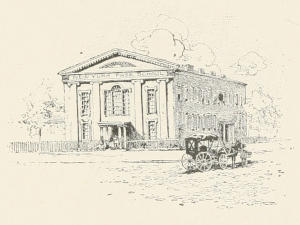
FIRST PUBLIC SCHOOL IN NEW YORK
The treaty was, in fact, a statesmanlike piece of work. Mr. Jay had the sobriety, the steadiness and largeness of view, and the high spirit of a statesman. He had gone to England feeling that the affair he was to engage in was not to be “a trial of diplomatic fencing, but a solemn question of peace or war between two countries, in whose veins flowed the blood of a common ancestry, and on whose continued good understanding might perhaps depend the future freedom and happiness of the human race.” Lord Grenville, with whom he had to deal, had met him in a like spirit of accommodation, and both believed when their work was done that no just exception could be taken to the terms of the treaty “except on the part of those who believed the interests of Great Britain and the United States to be in contradiction with each other, or who wished to make them so.” It was not only a treaty of accommodation, it was also a treaty of commerce,—the first it had proved practicable to get from England since the war of alienation and independence which had broken the old ties forever. It provided that the British garrisons should be withdrawn from the northwestern posts by the 12th of June, 1796; that a commission, to [139]sit in Philadelphia, should determine and provide for the payment of debts due British subjects at the outbreak of the war for independence, and that a similar commission, to sit in London, should adjudicate and adjust the matter of the compensation of American merchants and ship owners for illegal captures or condemnations made during the war between France and Great Britain; and that all pending boundary disputes should go for settlement to a board of joint commissioners. It defined contraband of war, regulated privateering, and declared, to the betterment and elevation of invariable international practice hitherto, that war between the two countries should never be made a pretext for the confiscation of debts or the invalidation of contracts between individuals. The door of trade between the two countries it opened wide. Trade between America and the British East Indies also it made free. Only the clause governing trade with the British West Indies was unsatisfactory. It provided that no American vessel of more than seventy tons burden should be admitted to that trade, and that no sugar, molasses, coffee, cocoa, or cotton should ever be exported thence in American bottoms to European ports. That clause the Senate rejected. It was October, 1795, before better [140]terms could be obtained and the treaty finally completed.
Mr. Jay had not been able to induce Lord Grenville to forego the impressment of seamen, or to pay for the hundreds of slaves taken away with the British armies at the close of the war. Neither had he been able to change in the least the arbitrary policy of the English ministers with regard to neutral trade with France. He had reminded himself at every step that his object was peace, had felt sure that he was gaining enough to secure that, and had satisfied himself that to press for more would be to fail. The country was angry because he had not failed. It wanted war with England, fiercely resented accommodation, and deemed it poltroonery and false patriotism for any one to wish it. To accept peace, above all to seek peace, was to truckle to England and betray France and America alike. Fishermen and ship owners, the vulgar and the well informed alike, at Boston, had been in a very frenzy for war, feeling to the quick their unjust losses at the hands of the British. “You cannot imagine,” wrote John Adams, “what horror some persons are in, lest peace should continue.” And when they knew that peace was assured by the treaty there were no bounds to their chagrin and passionate resentment, or to the violent expression of their passion. “Damn John Jay! Damn every one that won’t damn John Jay! Damn every one that won’t put lights in his windows and sit up all night damning John Jay!!!” was the vulgar explosion of wrath to be read upon a gentleman’s fence in a public street of the staid old town; and every town, particularly every seaport town, rang with the same license of vituperation. The temper [141]of the whole country seemed of a piece with the temper of New England.
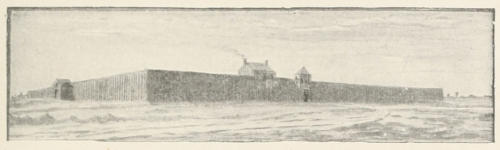
FRENCH FORT AT ST. LOUIS
It was, in mere sober fact, a bitter thing for high-spirited men to endure that Mr. Jay had been obliged to forego so much that was just and content himself with so little of what lay at the very heart of the matter. The treaty undoubtedly left England still free to impress American seamen; to close the ports of France, if she could, against ships laden with provisions, though they were neutral craft and carried no article of war; to shut America forcibly off from trade with the French West Indies, which France herself had declared free while the war should last; and to confiscate all French goods found on American vessels. “The treaty from one end to the other,” exclaimed Mr. Madison, “must be regarded as a demonstration that the party to which the envoy belongs is a British party, systematically aiming at an exclusive connection with the British government, and ready to sacrifice to that object as well the dearest interests of our commerce as the most sacred dictates of national honor”; and many another sober man, whose sentiment was not for France or the Rights of Man, but for the new government and the hard-bought independence of America, echoed the painful conviction. It was no light thing to play so [142]humble a part. Washington himself hesitated and earnestly sought counsel in the matter. The alternative was war or the acceptance of the treaty. The treaty, for all England yielded so little by it, gained something for peace and amity and trade. In case of war the enemies of the young government, both at home and abroad, would have their day of opportunity. There was no money, no army, no navy. The purses of Europe would now be shut against the young republic. Her trade was with England, and that would be ruined. There seemed no wise choice but that which would certainly bring peace; and Washington chose steadily and firmly, as if there had been no clamor.
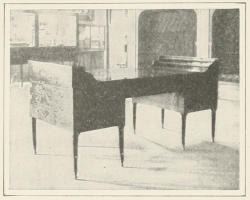
WASHINGTON’S WRITING TABLE
Slowly the storm blew off. The commission set up under the treaty in London awarded American ship-owners and merchants more than ten million dollars in damages for their losses; trade quickened at every port because of the renewed privileges of commerce with England. The country had obviously gained more than it had conceded, and tardily saw the debt it owed to Mr. Jay and to the administration, whose firmness and prudence had made his mission possible. But in the mean time things had been said which could not be forgotten. Washington had been assailed with [143]unbridled license, as an enemy and a traitor to the country; had even been charged with embezzling public moneys during the Revolution; was madly threatened with impeachment, and even with assassination; and had cried amidst the bitterness of it all that “he would rather be in his grave than in the presidency.”
The country knew its real mind about him once again when the end of his term came and it was about to lose him. He refused to stand for another election. His farewell address, with its unmistakable tone of majesty and its solemn force of affection and admonition, seemed an epitome of the man’s character and achievements, and every man’s heart smote him to think that Washington was actually gone from the nation’s counsels.
The country, moreover, had swung once again to the Federalists before Washington withdrew,—the one man whose personal force and command upon the country had given the party its field and opportunity. Federalist majorities were returned to both houses of Congress in the autumn of 1796, notwithstanding the French frenzy and the treaty; and Mr. Adams was chosen President. There was no longer any unanimous choice. Mr. Adams received seventy-one of the electoral votes; Mr. Jefferson received sixty-eight and became Vice President. It was a narrow margin of preference.
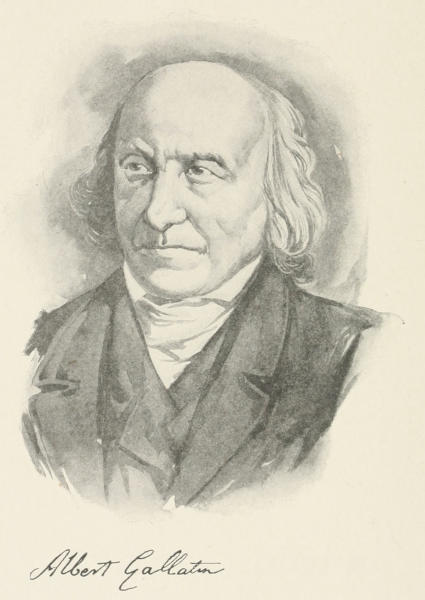
ALBERT GALLATIN
When Washington gave place to his successor a certain distinction seemed to pass from the office of President, which only he, whom all the world knew, could give it. Mr. Adams had a national standing second to no man’s save Washington himself; but he had not stood, as Washington had, in the gaze of the [144]whole world, the maker of a nation; and when he became President affairs seemed to settle to a more workaday level, where parties could fight upon a parity, unembarrassed by the President’s personal prestige. Mr. Adams had shown a dignity, a capacity, and a devotion in the public service which had marked him both at home and abroad as a statesman of the highest principle and the most excellent gifts; but he was still the John Adams of the Revolution, stung by jealousies which he tried in vain to conquer, too sensitive, too hasty, too acid in judgment, erratic, intolerant, irascible, sometimes irresolute,—a man to trust in the long run and to stand loyal to with steady purpose, but not a man to love or to deem above parties.
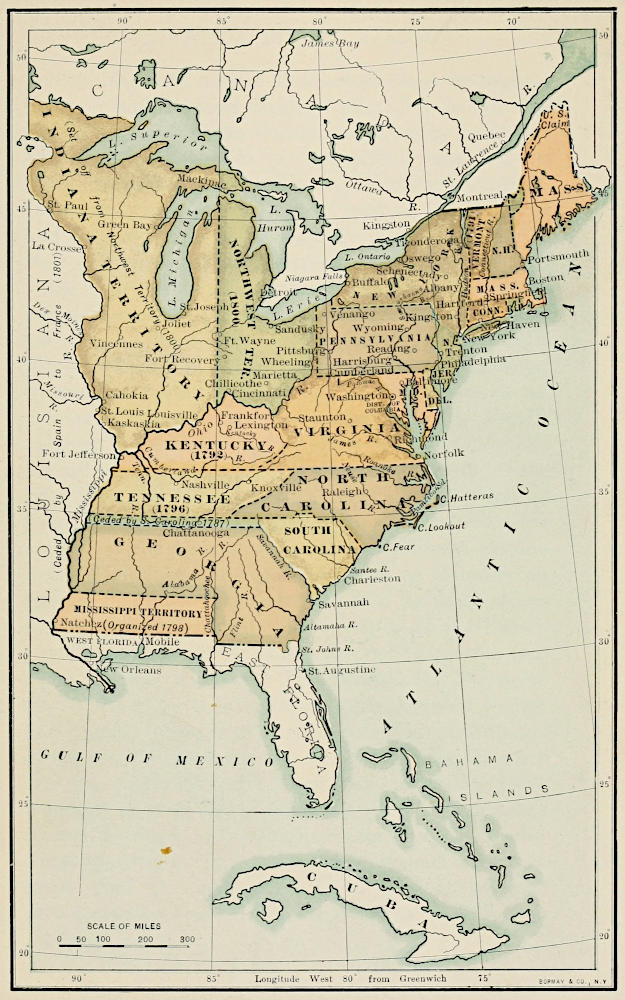
THE UNITED STATES, MARCH 4TH, 1801.
[145]
His four years of office saw the questions which had darkened and perplexed Washington’s second term mature and bear their unpalatable fruit. War with England had been avoided, but not war with France. France had hoped for and expected the success of the Jeffersonian Democrats in the elections; the French minister to the United States had even so far forgotten himself as to make a plea in the public prints for the principles and the party of Jefferson, the friend of France, and had uttered thinly veiled threats that the success of the Federalists in the presidential election would lead France to regard America as virtually an English dependency, to be treated as if as much an enemy as England herself. The cockade of the French republic became for the nonce the emblem of the partisans of Mr. Jefferson. The struggle for the presidency looked for a little like a game between French and English for political advantage. With such things in the air the success of the Federalists was the more assured. The country’s irritation over Mr. Jay’s treaty, it is true, had not cooled, and the Federalists seemed too much in the English interest to please men whose patriotism was quick to be jealous and take alarm; but the impudence of M. Adet, the French minister, and the unblushing aggressions of the French [146]and their partisans were for the moment worse yet, and the Federalists kept their posts of authority.
When once the result of the election was known France put away all pretence of friendship. Already she had declared herself released from the treaties of commerce and alliance by which she had bound herself to the United States in 1778,—released by the mere fact that Mr. Jay had negotiated and the United States had accepted a treaty with England. Ever since 1793 she had been seizing American ships and cargoes on the high seas as she pleased, as freely and with as little regard for right as England herself. Her depredations upon the commerce of the country had been less serious than those of England only because her cruisers were less numerous than the English and did not move as freely upon the seas. Now she quickened her aggressive action, like a power at war. She even extended her seizures, searches, and confiscations to the very waters of the United States themselves. General Washington, during the closing months of his term as President, had recalled Mr. Monroe, then the minister of the United States at Paris, deeming him too much infatuated with French principles, too sentimental a friend of the government to which he was accredited, to act with proper vigor. The Directory of the heady republic refused to receive any other minister in his place until its grievances against the United States had been redressed. Its grievances were summed up in America’s friendship for England, and Mr. Jay’s treaty as an earnest of that friendship. Mr. Adams hurried three ambassadors over sea to secure accommodation and avoid war: Mr. John Marshall, Mr. Elbridge Gerry, and Mr. Charles Cotesworth Pinckney (June, 1797). M. Talleyrand, the foreign minister of the Directory, would not treat with them in person. His agents (MM. “X,” “Y,” and “Z,” the ambassadors designated them in their despatches) prescribed terms alike dishonorable and humiliating; even demanded money, “a great deal of money,” “for the pockets of the Directory,” as the price of accommodation; and war became inevitable. “I will never send another minister to France,” declared Mr. Adams, in a message to Congress, “without assurances that he will be received, respected, and honored as the representative of a great, free, powerful, and independent nation.”
[147]
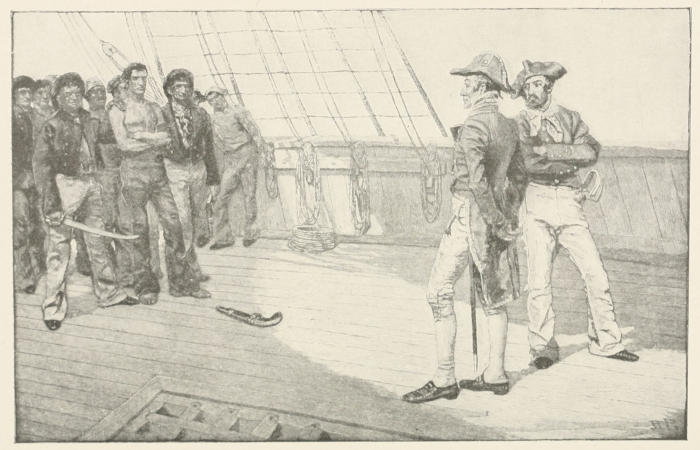
IMPRESSMENT OF SEAMEN
[148]
The war was brief and of no significant consequence in itself. No formal declaration of hostilities was made. There was only a season of sharp retaliation. A separate navy Department was created (April 30, 1798); existing treaties with France were declared abrogated (April 7, 1798); American vessels of war were expressly authorized to attack French cruisers (July 9, 1798); and active reprisals were begun. The little navy of the country, but just now reinforced by a few new frigates of first-rate strength, acted upon the permission to fight with spirit and success. American cruisers and privateers alike set about preying upon French commerce with the activity of genuine satisfaction. Measures were taken to raise an army, and General Washington was asked to take command of it. The publication of the extraordinary proposals of MM. X, Y, and Z to the American commissioners had effectually silenced every partisan of France, and war with the country’s one-time friend and ally had become for the moment almost popular. But fortunately the exposure of the intrigue attempted by the agents of M. Talleyrand [149]had made a most unfavorable impression in France itself; Talleyrand saw that he must undo what he had done; and intimations were given early in 1799 that France would receive a minister from the United States and discuss honorable terms of accommodation. By the time commissioners of the United States were ready to discuss terms at Paris (March 30, 1800) the Directory was no longer in charge of the affairs of France. The Consulate had been set up, and Napoleon Bonaparte was First Consul, a master of men at least, with whom [150]it was possible to make definite agreements, as if with a real government.
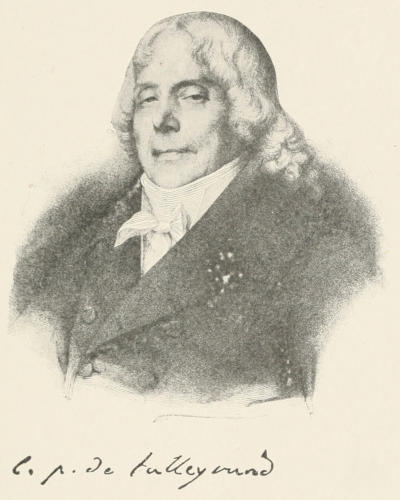
PRINCE TALLEYRAND
The terms of agreement, however, were by no means easy to decide upon. The American commissioners were instructed to secure indemnification for the losses France had wrongfully inflicted on American commerce; they were also instructed to secure the formal abrogation of the treaty of 1778, which had accorded to French privateers privileges in American ports which it was no longer wise or convenient to accord them, and which had pledged the United States to such a defence of the French possessions in the West Indies as they no longer felt justified in undertaking. But they could not get both indemnification and a release from the treaties. They were obliged to forego compensation for the French spoliations in order to get peace and relieve themselves of the burdensome obligations of the treaty of 1778, which, there having been no formal declaration of war, they could not insist upon having escaped from. A twelve-year convention, restoring amicable relations between the two countries, securing neutral ships against search and seizure, embodying a sensible and enlightened code of definitions with regard to the rights of belligerents and neutrals, and adjusting minor questions of dispute, was all that they could get. By February, 1801, such terms as could be had were agreed upon. It was Mr. Jay’s experience repeated.
But the war had ruined the great party whose leaders had framed the constitution and set the government afoot. At first it had seemed its legitimate triumph, and something like the hearty support of the country had been extorted. The Federalist majority in the House of Representatives, doubtful of its power at the [151]outset of Mr. Adams’s administration, had by the elections of the autumn of 1798 been made strong and confident. The country evidently had not been displeased to see “France and all the world” convinced, as the President had declared he meant to convince them, that [152]the people of the United States were not “a degraded people, humiliated under a colonial spirit of fear and sense of inferiority”; and opinion seemed about to regain tone and self-possession.
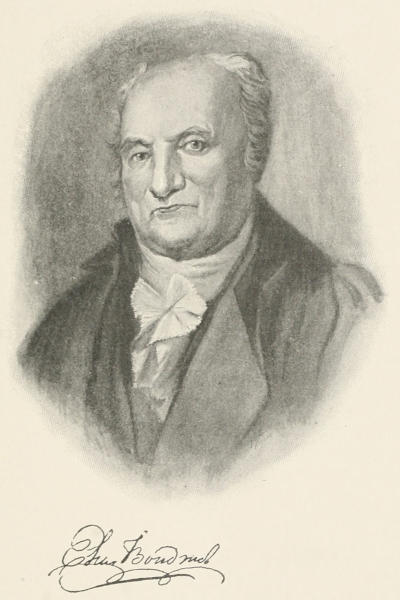
ELIAS BOUDINOT
But moderate counsels forsook the ruling party in the midst of its apparent triumph. Throughout four whole years the country had been kept under the excitement and anxiety of the trouble with France, not knowing whether it was at war or at peace,—from the recall of Mr. Monroe in December, 1796, until the conclusion of the convention with France in September, 1800. Throughout all that time a storm of bitter defamatory criticism had beat upon the Federalists, which unsettled their temper and broke their self-restraint at the very height and crisis of their success. They had been intrusted with the conduct of the government again and again by the free suffrages of the country, and yet they were assailed with every slander and defamed from half the presses of the towns by the republican partisans of France, who were also suffered and encouraged to be spokesmen against them in every domestic policy. It intensified their resentment and seemed to them a most sinister sign of peril to the country and its government that a great many of the men who were their bitterest enemies, and who used the public prints most scandalously and unscrupulously against them, were foreigners,—Frenchmen and Englishmen who were not even citizens, but mere adventurers, the irresponsible agents of a reckless and almost revolutionary agitation, which might jeopard the very existence of the young government, but ten years established, over which they had been bidden to preside. They therefore, during June and July, 1798, pressed through Congress [153]four drastic statutes, aimed against aliens and against all, whether aliens or citizens, who should foster any kind of sedition. A Naturalization Act (June 18, 1798) increased the period of residence for those who would become citizens from five to fourteen years. An Alien Act (June 25th) and a Sedition Act (July 14th) authorized the arrest and deportation of turbulent and dangerous aliens at the discretion of the President, even in time of peace, and the arrest, trial, and punishment of any one who should either unlawfully combine with others to oppose any measure of government or “write, print, utter, or publish” anything with intent to defame the President or the houses of Congress, or to weaken their authority and bring them into contempt. An act directed against alien enemies (July 6th) authorized the President in time of war to restrain, secure, or remove from the country, as he pleased, all subjects of a hostile power.
Washington himself approved of these extraordinary laws, so passionately did he love order, hate faction, and fear for the safety of the new Union. Patrick Henry commended them, stout and consistent advocate though he was of the pure principles of thorough democracy. But the whole country presently knew how fatally the Federalists had blundered in passing them. The Alien law deprived foreigners of every privilege “without accusation, without jury, without public trial, without confrontation of the witnesses against them, without having witnesses in their favor, without defence, without counsel,” upon the mere suspicion of the President. The Sedition Act cut perilously near the root of freedom of speech and of the press. There was no telling where such exercises of power [154]would stop. Their only limitations and safeguards lay in the temper and good sense of the President and the Attorney General. Protests came from every part of the country, and grew ominously in volume from month to month,—and petitions for repeal couched in every form and bearing thousands of signatures. It would have been well had the opposition stopped at petitions; but it did not. The legislatures of Kentucky and Virginia went further, much further. Each, in a series of resolutions, drawn in solemn form and sent through their governors to the legislatures of all the other States, as in the days of Parliament’s aggression, called the attention of the entire country to definitions of constitutional right as between the people and the federal government which were in the last degree radical and significant, and which seemed to carry with them an air as it were of revolution.
The Kentucky Resolutions (November 8, 1798) defined the constitution of the Union as a compact, whereby the States, the contracting parties, had set up a federal government of definitely specified and strictly limited powers, reserving to themselves or to the people every power not plainly granted; and declared that every State, as a party to the compact, had the right to judge for itself whether the fixed limits of the constitution were observed or transcended by the federal authorities: that it had the right to declare every unwarranted exercise of power void and unconstitutional, and to call upon the other States, its partners in the Union, to join with it in measures of redress. The Alien and Sedition laws they unhesitatingly and emphatically pronounced unconstitutional and of no legal effect. The Virginia Resolutions (December 21, [155]1798), briefer and milder in tone, were yet equally express in their doctrine that “in case of the deliberate, palpable, and dangerous exercise” by the federal government of powers not granted “by the plain sense and intention” of the constitution, “the States who are parties thereto have the right, and are in duty bound, to interpose for arresting the progress of the evil, and for maintaining within their respective limits the authorities, rights, and liberties pertaining to them.” [156]Mr. Jefferson had drawn the original draft upon which the Kentucky Resolutions were based; Mr. Madison had drafted the Virginia Resolutions,—Mr. Madison, joint author of the Federalist papers, friend and coadjutor of Hamilton and Washington in the formation of the government of the Union,—a man whose reaction against Federalist policy and whose slow alienation from Washington and Hamilton might well mark for every thinking man the measure of the Federalist mistake with regard to the temper and inclinations of the people they were governing. Mr. Jefferson’s original draft, used by Mr. Breckinridge in framing the Kentucky Resolutions, had gone the length of proposing that each State should “take measures of its own for providing that neither these acts nor any others of the general government, not plainly and intentionally authorized by the constitution, should be exercised within their respective territories”; and in November, 1799, the legislature of Kentucky acted upon the suggestion and added to its former Resolutions the even more startling declaration “that a nullification” by the States “of all unauthorized acts done under color” of the constitution was “the rightful remedy.”
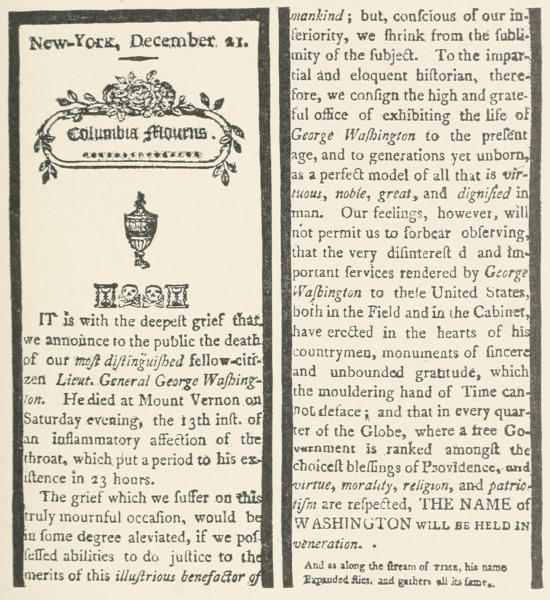
ANNOUNCEMENT OF THE DEATH OF WASHINGTON
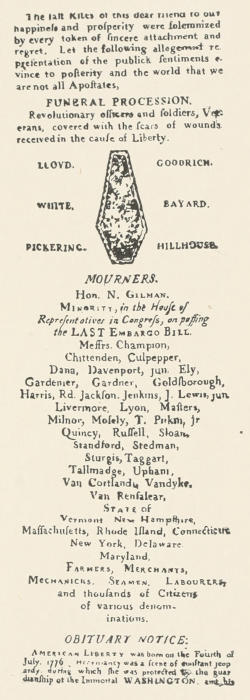
ADVERTISEMENT OF FUNERAL OF LIBERTY
The “nullification” of federal action by a single State went much beyond the meaning Mr. Madison and Mr. Jefferson had intended the Resolutions to speak. They meant only that, in case of an exercise of federal powers by Congress which was obviously, palpably excessive, the methods supplied by the constitution itself must be used to check it. “The ultimate arbiter,” as Mr. Jefferson said, as he looked back to these things in his old age and reassessed his principles of action, “the ultimate arbiter is the people of the Union, assembled [157]by their deputies in convention, at the call of Congress, or of two-thirds of the States. Let them decide.... It has been the peculiar wisdom and felicity of our constitution to have provided this peaceable appeal, where that of other nations is at once to force.” Congress must not itself be suffered to determine its own powers unchecked. The Resolutions said nothing explicitly of constitutional method; but they implied much, and rang out very significantly upon the tense air of the time. Though no other legislature was willing to echo them, men noted their outspoken doctrine of federal limitations and State rights. The opposition recognized in them a formidable weapon of defence; and no one doubted that it was more than a passing sign of the times that such things should be said. [158]There underlay all this something deeper than the mere antagonisms of party.
Clearly the Federalists had gone too far. The indictment of their enemies seemed proved,—they were the party of power, of autocratic power, and not the party of popular privilege. While the bad impression was at its height, moreover, a serious rift was disclosed in the counsels of the party itself. Mr. Adams broke with Mr. Hamilton. He had continued General Washington’s cabinet in office upon his own accession to the Presidency: and had thus put himself in the hands of men who looked to Mr. Hamilton, rather than to himself, for guidance, though Mr. Hamilton was himself no longer a member of the cabinet. The President frequently found it necessary to act without their knowledge or assent, in order to act with independence and without embarrassing interference from outside quarters. He had sent the embassy which concluded peace with France without their knowledge or approbation, greatly to their chagrin and to the deep annoyance of Hamilton, whom they deemed their party leader. Neither Hamilton nor they had wished peace with France. At last Mr. Adams found the friction intolerable. He dismissed his ministers, and substituted others whose unquestioning allegiance to himself he could command, branding the men he dismissed as “a British faction”; and so made the breach with Hamilton complete.
There was here something more than a mere breach between men. It was a breach which cut to the very foundations of the party itself. Hitherto Mr. Hamilton had been the real master of Federalist policy; but he had ruled the party through a minority in its ranks, not by persuasion or any tact of popular force, but by [159]sheer mastery over men, a power in counsel, a gift of constructive statesmanship unmatched among his contemporaries. Mr. Adams disliked most other strong-willed men, and Mr. Hamilton had made himself almost his open enemy; but something deeper than mere personal antagonism separated them. It was spoken out in Mr. Adams’s angry charge that Hamilton and those who adhered to him as their personal chief were nothing better than “a British faction.” That was the charge of the opposition. That was the feeling of the county. It was unjust; it was false; but it was not without foundation. It was but a crude, undiscriminating way of interpreting the plain fact, which Mr. Hamilton made hardly a pretence of concealing, that the men who had hitherto led the Federalist party feared democracy, distrusted it with an ineradicable distrust, believed a strong government necessary, which should be intrusted to men of the older traditions of power and of statesmanship received from over sea, deemed the English government, if stripped of its abuses, the safest model of free institutions, and thought England the only European power worth keeping close friendship with in international dealings. They had not accepted the ideals of America set up at the Revolution; had refused to acquiesce in it as a definitive triumph of democracy. They were seeking to perpetuate the ideals of an older world, a more ancient conception of government. It was their lack of sympathy that the country felt. It was their unwillingness, their inability to act wholly for America in every matter of policy, without regard to their preferences for this alliance or that, that made Adams fling them off as a British faction.
And Adams spoke the real preferences of the rank [160]and file of the Federalist party itself,—the very party which, until that day of breach, Mr. Hamilton had led with an almost undisputed supremacy. It had doubted and been vaguely uneasy even while it obeyed. Hamilton once out of command and its opinions freed from his masterful domination, its ideals in affairs showed no radical difference from those of the opponents whom Jefferson was drilling against it. Federalist voters were not infatuated with the French, as the men of the Democratic clubs had been; they did not dread, as Mr. Jefferson did, the conversion of the government of the United States under their leaders into a centralized tyranny by the mere process of using the powers of Congress and the President with vigor and courage and a touch of constructive statesmanship; they relished the predominance of men who had the temper to rule; but for the rest they were not of Mr. Hamilton’s making. They thought first of America in their hopes for the future and their plans for the present, dreaded democracy as little as they dreaded the tyranny of constitutional presidents, were heartily for such measures as should give the country independence and a free hand for its affairs, thought more of their own interests than of handsome or seemly alliances abroad, accepted democracy without squeamishness, and were robust believers in the happy destiny of their institutions. Mr. Adams was much nearer their spirit and temper than Mr. Hamilton and the group of masterful men whom he led; and his breach with Mr. Hamilton cut to the roots of the party itself. By the time another presidential election approached (1800) personal rivalries and antagonisms had robbed the party of coherence and leadership; it had lost its sense of unity; many who had voted with it felt their sympathies transferred to the other side; and the elections brought it humiliating defeat. Mr. Adams was personally popular enough, commended by his sturdy character, his manifest good faith and independence, his frankness and courage; but the section of his own party with which he had avowed himself out of sympathy was not loyal to him. Hamilton publicly argued that he was unfit for the office he held, egotistical, jealous, indiscreet, and of unsound views in matters of administration; Mr. Jefferson had at last imparted compactness and self-reliant vigor to the Democratic Republican ranks which he led; and Mr. Adams failed of re-election.
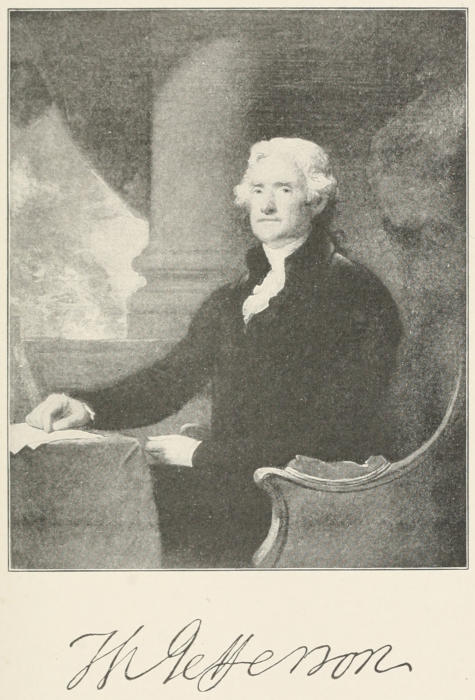
THOMAS JEFFERSON
[161]
No one was chosen President by the electors. As the electoral clause of the constitution then stood, each elector was directed to cast his vote for two persons, without designating which was his preference for President, which for Vice President; and when the votes were opened they were found to stand: seventy-three for Mr. Jefferson, seventy-three for Mr. Aaron Burr, Mr. Jefferson’s accomplished lieutenant in New York; sixty-five for Mr. Adams; sixty-four for Mr. Pinckney. It was necessary in such a case that the House of Representatives should itself select a President, from the two leading candidates; and the Federalists still, though for the last time, controlled the House. For a little while they were tempted to put Mr. Burr into the Presidency, rather than endure Mr. Jefferson; but that intrigue failed. Mr. Hamilton was too manly a politician to give it countenance for a moment. He denounced it roundly and induced the members of the majority to let Mr. Jefferson take the Presidency, to which he was [162]clearly entitled by the well-understood preferences of the electors. But they yielded sullenly. They let Mr. Jefferson come in, not with their votes, but without them, by refraining from voting at all in sufficient numbers to leave his friends in a majority, and lost credit for good temper as well as for good faith.
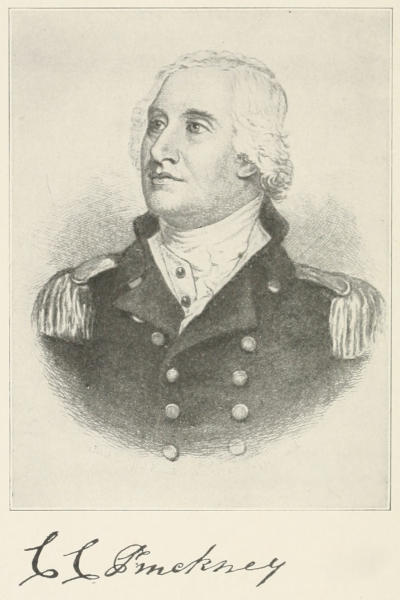
CHARLES C. PINCKNEY
[163]
Their last acts of power confirmed the impression of their critics that they neither trusted the people nor believed any but themselves capable of conducting the government or ruling the country. For more than three months after the presidential election they remained in control of Congress. They used their majority, when the result of the election became certainly known, to make themselves secure, as they hoped, of the possession of at any rate the judicial branch of the government. On the 13th of February, 1801, less than three weeks before the day upon which Mr. Jefferson was to become President, they put through Congress, by a strictly party vote, a Judiciary Act which very considerably enlarged the number of federal courts and judges and added some fifty thousand dollars to the annual judicial budget, notwithstanding the fact that the legal business of the country justified no such expansion of the federal judicial machinery; and Mr. Adams hastened to fill the new judgeships, as well as every other vacant place, great or small, with staunch Federalists. On the 31st of January he had appointed Mr. John Marshall, of Virginia, Chief Justice of the Supreme Court of the United States, an approved lawyer, but a tried Federalist, and but just turned of forty-five. The government of the country passed into Mr. Jefferson’s hands as stoutly fortified against change or misuse as a solidly Federalist personnel in the courts could make it.
The whole face of affairs, the very aspect of the government itself, seemed to change when Mr. Jefferson became President. For one thing, the seat of government was transferred from Philadelphia, the busy city and mart of trade, with its seventy thousand inhabitants, [164]to the rural spaces of the new federal District of Columbia. The removal had been effected in the summer of 1800, during the closing months of Mr. Adams’s administration, and had suitably marked the exeunt of the Federalists, the party whose rule had been planned to draw about the federal government the support of the merchants, the bankers, the property owners, the chief men of means and influence in society and affairs, the men of the centres of trade, whose interests were larger than those of any single State or neighborhood. An extensive city, to be called “Washington,” had been plotted in the fields and woodlands which lay upon the northeastern bank of the Potomac, on the portion of land which Maryland had ceded for a federal district. The building of an official residence for the President had been begun in 1792, and the corner-stone of a capital building had been laid by General Washington in September, 1793. Some quarters for the executive departments had been erected; a few houses had been built here and there at long intervals upon the projected streets of the new city; and speculators had bought land there in expectation of high prices to come. But only one wing of the Capitol was completed when the government was at last actually transferred. The Congress had to be temporarily housed. The President’s residence was the only dwelling of any pretensions ready for occupancy. The streets of the quiet place ran through bits of forest, like avenues in a wild and wooded park, or were lost in open fields, where there was neither fence nor dwelling. There were not houses enough in all the spreading plot of projected avenues and squares to furnish members lodging during the sessions of the Congress. Some had to make their [165]way as best they could over several miles of soft and miry road to find quarters. The stately proportions of the White House and of the rising Capitol looked strangely enough in such a place. Life there was a sad exchange for the comforts and the social stir and brightness of Philadelphia; and government could not seem there the handsome thing of etiquette and [166]dignity and formal show of authority that the Federalists had made it appear in a city.
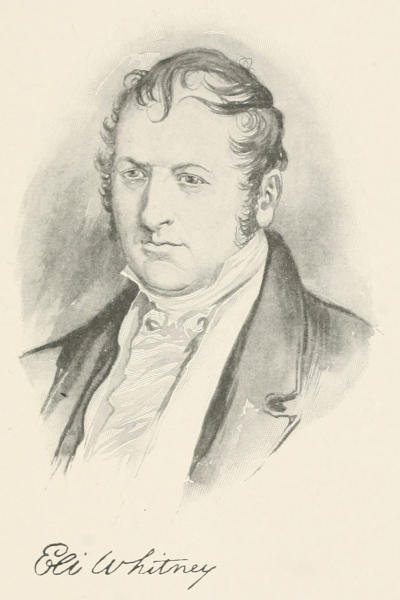
ELI WHITNEY
It was the more suitable place on that account for the coming in of Mr. Jefferson, and the change of scene and atmosphere which was to come with him. Here was a place for real democracy to be brought in, without show or circumstance. Mr. Adams set out upon his long ride homeward early on the morning of the 4th of March, having no stomach to wait and see Mr. Jefferson take the Presidency. The new President, accompanied by a few friends, and escorted by a company of Virginian artillery, as guard of honor, walked quietly from his boarding house to the Capitol; there took the oath of office and read his address to the people; and a new régime was inaugurated. John Marshall, the new Chief Justice, twelve years his junior, administered the oath; and the two men, as they stood thus face to face, Virginians both, bred to the same principles of life and courtesy, but opposite in every principle of politics, must have seemed to give each his silent challenge to the future in the act.
A noteworthy and momentous thing stood revealed in the simple ceremony. The democratic forces which had set the Revolution ablaze, and which had operated through seven years of war and reconstruction to work a radical change in the temper and practice of the whole country in public affairs, now once again reasserted themselves and took possession of the seats of government. They had been temporarily discredited during the troubled years when the Confederation was the makeshift government of the country,—discredited by the jealousies, the riotous disorders, the gross turbulence and distempers of the time. The new Union had [167]been formed and the new constitution framed to check and govern them. The Federalists’ twelve years’ labor of organization had been undertaken and carried forward while the reaction lasted: to make strong the forces of conservatism, school the people in order and self-restraint, and make solid once more the foundations of authority. Democrats had spent their lungs, the while, in the cries of the French Revolution and in passionate outbursts against England and against all who parleyed with her. They had seen no vision of national duty, no workable creed until the Alien and Sedition laws were passed, and the Sedition law enforced against editor and pamphleteer. Then they had had sight at last of the constitutional principles and the domestic policy for which they must fight. Mr. Jefferson and Mr. Madison had cleared their thought with the strong [168]sentences of the Kentucky and Virginia Resolutions,—no programme, but a warning cry which no man failed to hear or to understand; and the election of 1800 disclosed, behind Mr. Jefferson, no longer a body of agitators merely, but a national party, ready to play the sober rôle of administering a government.
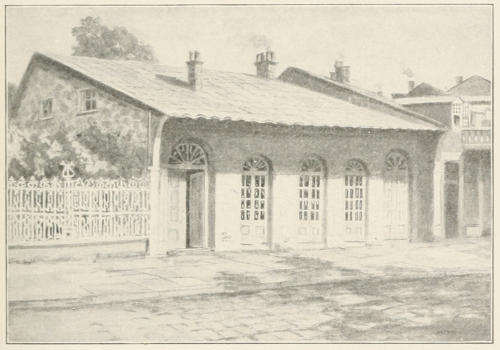
OLD COURT HOUSE, NEW ORLEANS
Nothing could exceed the fine tact and gentleness with which Mr. Jefferson gave tone of order and patriotic purpose in his inaugural address to the new way of government his followers expected of him. “We are all Republicans, we are all Federalists,” he exclaimed; “we are not antagonists, but live by an absolute acquiescence in the decisions of the majority, the vital principle of republics.” “To preserve the peace of our fellow citizens, promote their prosperity and happiness, reunite opinion, cultivate a spirit of candor, moderation, charity, and forbearance towards one another,” are “objects calling for the efforts and sacrifices of every good man and patriot.” “Let us unite with one mind,” he urged, in tones so quiet, so sweet and sincere of accent as to calm every mind they touched; “let us restore to social intercourse that harmony and affection without which liberty and even life itself are but dreary things. And let us reflect that, having banished from our land that religious intolerance under which mankind so long bled and suffered, we have yet gained little if we countenance a political intolerance as despotic, as wicked, and capable of as bitter and bloody persecutions.”
And what he did soon gave excellent proof of his sincerity. Mr. Jefferson was an interesting mixture of democrat, philosopher, and patrician. In taste and occupation and habit he touched and was familiar [169]with the life of the cultured and moneyed classes, the aristocracy of the young nation, which constituted the Federalist strength. In creed and principle he was the comrade and work-fellow of the people. By gift of insight and genius for organization he was a leader of parties and of concerted action in affairs. An infinite sensibility taught him moderation, lent him tact, pointed out to him the practicable courses of persuasion and the certain prospects of popular support. His personal charm, his high breeding without arrogance or pretence, gave him hold upon every one with whom he came in contact. No other man could have so moderated, or so completed, a revolution in the spirit and conduct of the government.
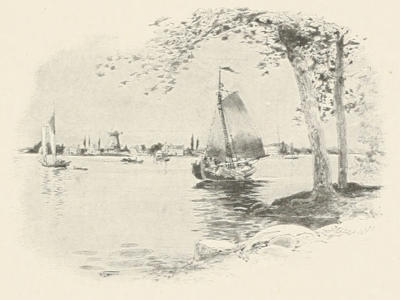
VIEW ACROSS THE NORTH RIVER, 1796
For a revolution it was, profound and lasting. Undoubtedly the chief merchants, the chief men of means and of responsible trust, the chief men of parts and learning and social influence in the country were Federalists. They looked upon Mr. Jefferson as “an atheist in religion and a fanatic in politics”; and they [170]dreaded the direct thrusts of democracy at the careful system they had reared, as likely to be little less than the throwing down of the very props of society itself. Mr. Hamilton, more than any other man in their ranks, spoke their purposes and fears. It had been his wish and effort at every turn of policy in which he had any part to make the federal government virtually master of the affairs of the nation, fortified with an overwhelming strength against every force, whether of the States or of individuals, that might antagonize it. He believed, as his enemies supposed, in the maintenance of a strong army, even in time of peace. He wished to see the States absolutely subordinated to the general government. He thought the opinions of the masses an unimportant and negligible thing in the choice of policy. “No man,” he said, “has sacrificed or done more for the present constitution than myself; and, contrary to all my anticipations of its fate, I am still laboring to prop the frail and worthless fabric.” Assuredly he had labored for it. He had played no small part in establishing it also. But he had wished to have it serve as a buttress against democracy, a safeguard against the fickle play of opinion and the caprice of men unschooled in affairs.
[171]
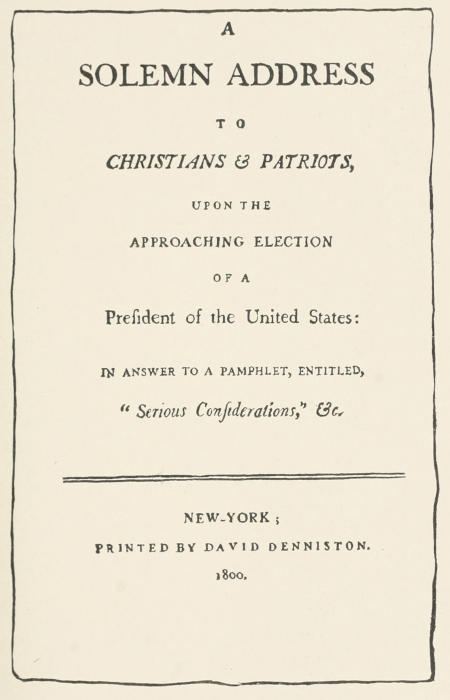
TITLE-PAGE OF A CAMPAIGN DOCUMENT, 1800
[172]
Mr. Jefferson’s was an opposite school of thought. “I am persuaded,” he said, “that the good sense of the people will always be found the best army. They may be led astray for the moment, but will soon correct themselves.” His belief was wholly sincere, aristocrat though he was in life and breeding and in instinctive aptitude for power; and it was wholesome for the country that the forces he so moderately and graciously represented should thus early gain their inevitable ascendency. It was impossible that the ruling classes of the older days should continue to govern the young nation now springing into life. Mere growth and change of life had broken every bond of habit and restraint of form. The nation of 1800 was not even the nation of 1790. Its population had grown in that decade from 3,929,214 to 5,308,483, and had spread itself northward and westward and northwestward, to Lake Ontario and round about to the St. Lawrence and Lake Champlain; to Lake Erie and into the Ohio country; and into Kentucky and Tennessee, until great communities mustered there more than three hundred thousand strong. Vermont and Kentucky and Tennessee had been added as States to the Union, and had brought the spirit of the frontier with them into its counsels. It was not the cities that grew, though they had their growth with the rest, so much as the spreading country-sides. The great spaces of virgin land at the west were filling in, and there stirred everywhere the air of enterprise and change.
No group of men could restrain, or measure, or even guide the quick, expanding life of that young people, before whom all ways of conduct and endeavor were open to be tried and made test of, in whose hands all things were making and to be made. Their industry kept pace with their numbers. The Parliament in England forbade any one to take out of England any industrial machinery whatever, or even the plans of machinery invented or perfected there; but it was impossible to keep as a secret and monopoly what master mechanics who chose to go to America could take away in their heads and in their trained and skilful fingers; and slowly the carefully guarded secrets of manufacture [173]passed over sea. By 1790 Samuel Slater had set up a cotton-spinning factory, with complete machinery after the English models, at Pawtucket, in Rhode Island. In 1793 Eli Whitney, a Connecticut school master living in Georgia, invented a practicable gin for clearing cotton of its tenacious seed, and the South had no sooner realized what this new instrument meant than it suddenly sprang into competition with India and Egypt in supplying the world with cotton. In 1791 less than two hundred thousand pounds of cotton had been shipped out of the country; in 1800 nearly twenty million pounds went over sea. Everything that America produced found market, despite all obstacles. The trouble with England while Washington was President, the trouble with France while Mr. Adams ruled, had checked and jeoparded trade; but trade had strengthened and increased with an irrepressible growth, nevertheless. Nearly twice as much flour and wheat left the ports in 1800 as had been sent out in 1791. American ships were to be found in every sea, and carried cargoes of every sort.
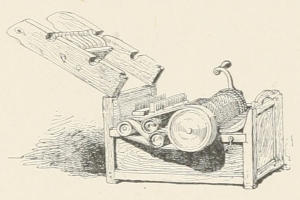
WHITNEY’S COTTON GIN
No class or region or single school of politicians or thinkers could keep the mastery or determine the course of such a people, growing after such a fashion, on such a continent. Democracy, free force, an equal footing for all men in opinion, effort, and attainment were the very conditions of its being: there could be no leading-strings. Mr. Jefferson spoke the spirit of the day, its [174]only acceptable principle in affairs. The government had passed into the hands of the people’s party.
Its programme, as Mr. Jefferson spoke it, accorded with its origin: The restriction of federal powers within strait constitutional limits, an unembarrassed field for the powers of local self-government within the several States, the payment of the public debt, the reduction of the armed forces of the country, and consequently of the taxes, to the lowest practicable point, and as nearly as might be free trade at the ports: a government simple, inexpensive, unmeddlesome. Some of the latest and most partisan acts of the Federalists the new Congress, with its working majority of Republicans, proceeded to undo. The Judiciary Act, by which the Federalists had called new federal courts into existence to fill them with judges of their own party principles, was repealed, and the new courts were abolished almost before they had been organized. The other officials whom Mr. Adams had put into office during the closing days of his term were dismissed, and Republicans were put in their places. A few Federalist office-holders who had been offensively loud, partisan, and industrious in working against Mr. Jefferson’s election, and who had used their official power to influence the vote at the polls, were also removed and replaced by men of the President’s party. Sixteen federal officials were dismissed without cause assigned, in order, no doubt, to put the public service more in accord with the views of the new head of the government. All who were imprisoned under the odious Sedition law were at once pardoned and released. The law itself had expired by limitation; and Mr. Adams had not used the authority conferred upon him by the law against aliens. The Federalist Naturalization law of June, 1798, which required a residence of fourteen years as a condition precedent to the acquisition of citizenship by a foreigner, was repealed, and the old period of five years restored.
[175]
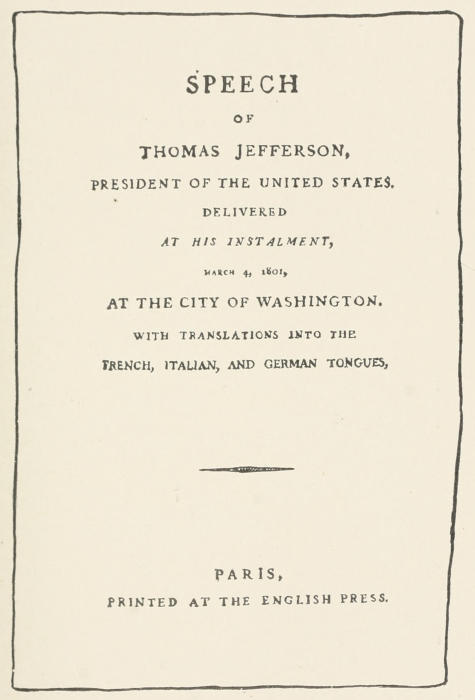
TITLE-PAGE OF JEFFERSON’S INAUGURAL ADDRESS
[176]
But there the reaction stopped. The new Congress reduced the federal taxes, and the customs duties at the ports; cut down the army and navy establishments; retrenched expenses and lessened burdens, as had been promised and expected; but the despondent forebodings of those Federalists who had looked to see a fatal retrogression in the character of the government were not fulfilled. The people’s men were not, after all, “Jacobins and miscreants,” and Mr. Cabot was apparently not yet justified in considering “democracy to be the government of the worst.” Mr. Jefferson called Mr. Madison to the Secretaryship of State, a man whom all the country knew to be a patriot and a statesman. He made Albert Gallatin, of Pennsylvania, Secretary of the Treasury, and financiers soon learned to trust the clear-headed Swiss for judgment and capacity almost as much as they had trusted Mr. Hamilton himself. There was, at any rate, no revolution in the business methods of the government.
Mr. Jefferson was too wise a politician to alienate the very men whose suffrages had brought him into office. He knew that many thoughtful men who had before always voted with the Federalists had in the last election voted for the Democratic Republican electors,—not because ready to see the government experimented with, but because they hated the taxes with which the Federalist Congresses loaded them, disliked the new tone and temper of the Federalist leaders, and believed [177]that, for all they were so radical in their talk, the leaders of the opposition would simplify the government without weakening it or doing it damage. He knew that he was on trial to prove his conservatism as well as to prove his capacity for reform. He meant to prove himself no enemy of an efficient federal government, but only an enemy of extremes.
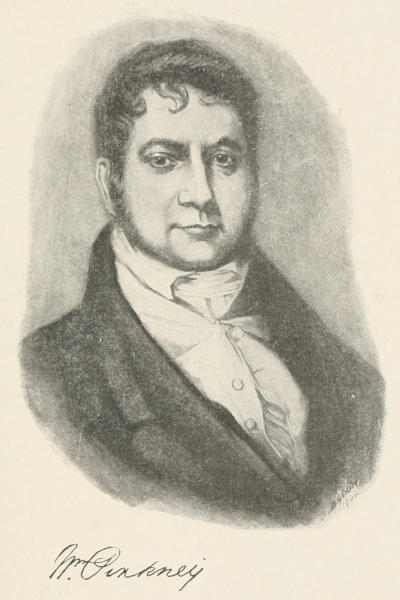
WILLIAM PINKNEY
[178]
It turned out that he had judged the temper of the country and the posture of affairs to a nicety, and had brought in a new régime which was to give its opponents abundant time to assess its qualities. Mr. Jefferson remained eight years in office; and handed on the presidency to men of his own school of political principle who kept it for sixteen years more. He was elected for a second term (November, 1804) by an overwhelming majority. Mr. Charles Cotesworth Pinckney and Mr. Rufus King, the candidates of the Federalists, received only the votes of Connecticut and Delaware, added to two of the eleven votes of Maryland. The country had turned with a sort of mild enthusiasm to the new party, which seemed with every year to grow more national and more typical of the natural disposition and principles of America. The more ardent Federalists grew very black and bitter under the sharp discipline of such a change, and talked intemperately and with a touch of reckless disloyalty of breaking up the Union rather than submit to the new régime. Hamilton, more wise and more patriotic, rebuked them passionately. “You are going to Boston,” he wrote to Colonel Trumbull. “You will see the principal men there. Tell them from me, as my request, for God’s sake, to cease these conversations and threatenings about a separation of the Union.” But Mr. Hamilton’s influence was presently withdrawn. Mr. Burr, the Vice President, stung by Hamilton’s attacks in a bitter political quarrel, in which words ran hot and unguarded on both sides, challenged him to a duel, which ended in a fatal tragedy (July, 1804). Mr. Hamilton was killed, and the one commanding figure among the Federalists was removed. They lost influence with every election, and the hands of the Republicans were free, in the presidency and in Congress.
[179]
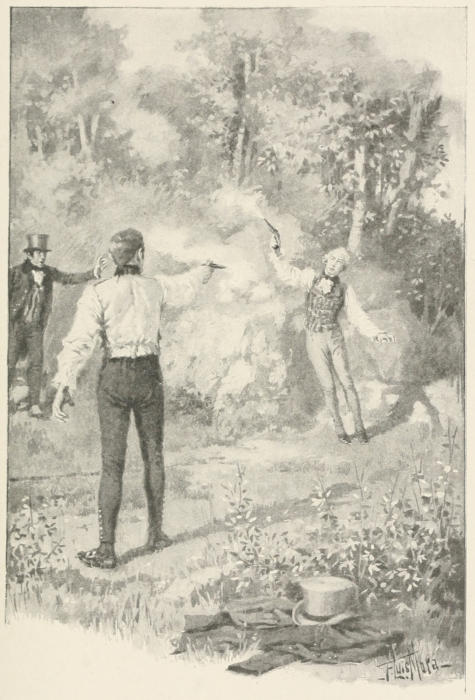
THE HAMILTON-BURR DUEL
[180]
The new unanimity in affairs sprang, not out of the repeals, retrenchments, and reforms of the party newly come to power, so much as out of its popular action in national affairs. For all their professions of an opposite set of principles in government, its leaders acted as its more conservative supporters had expected,—very much as Washington or Adams or Hamilton would have acted, when there was occasion to vindicate either the authority or the interests of the Union. Mr. Jefferson was hardly installed in office before news reached America that Spain had re-ceded the great province of Louisiana to France. It was one thing to have all the western bank of the Mississippi, its outlet at the Gulf, and all the continent between the Mississippi and the Pacific controlled by Spain, who had lost her power in the world; but it was quite another to let it pass into the hands of France, and Bonaparte her leader. “The cession of Louisiana and the Floridas by Spain to France,” wrote Mr. Jefferson, the lover of peace and friend of France, to Mr. Livingston, the American minister at Paris, “completely reverses all the political relations of the United States, and will form a new epoch in our political course. There is on the globe one single spot the possessor of which is our natural and habitual enemy. It is New Orleans, through which the produce of three eighths of our territory must pass to market. France, placing herself in that door, assumes to us the attitude of defiance. Spain might have retained it quietly for years.... The day that France takes possession of New Orleans ... seals the union of two nations, who, in conjunction, [181]can maintain exclusive possession of the ocean. From that moment we must marry ourselves to the British fleet and nation.” An intense excitement spread through all the western country, which grew to a still quicker fever when it was learned that the [182]Spanish governor at New Orleans had practically closed the port against the western trade, by way of preparation for the transfer to France.
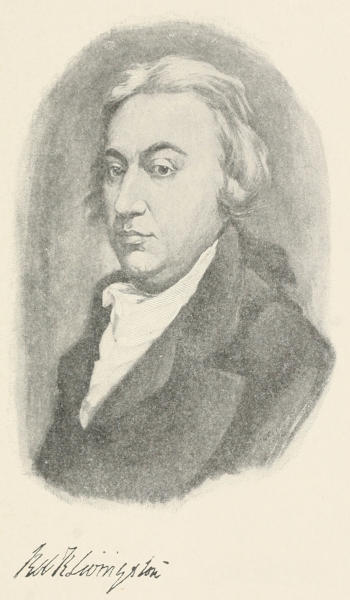
ROBERT R. LIVINGSTON
Mr. Monroe was sent to join Mr. Livingston at the French court. He was authorized to purchase Florida and a strip of the coast which should include New Orleans. He found Bonaparte willing to sell the whole of Louisiana or nothing. The American commissioners, therefore, exceeded their authority and agreed to buy the whole of the vast territory for fifteen million dollars. Bonaparte congratulated himself that he had replenished his purse for a war with England and had turned over to the United States lands and resources which should make them able themselves some day to humble England, even on the high seas and in trade.
Mr. Jefferson admitted that he could find nowhere in the constitution authority to buy foreign territory, and professed himself very anxious about the awkward situation that had arisen. He believed that such a purchase would be beyond the precedent even of Mr. Hamilton’s “implied powers,” and wished a constitutional amendment passed to make good what his representatives had done and he could not decline to accept. “I had rather ask an enlargement of power from the nation, when it is found necessary,” he said, “than to assume it by a construction which would make our powers boundless. Our peculiar security is in the possession of a written constitution. Let us not make it a blank paper by construction.” But in the same breath with which he urged his scruple he declared his readiness to abandon it. “If our friends think differently,” he said, “certainly I shall acquiesce with satisfaction, confiding that the good sense of our [183]country will correct the evil of construction when it shall produce ill effects”; and the houses agreed to the treaty and voted the money for the purchase without so much as proposing an amendment (1803). The President acquiesced with startling facility in the apparent “necessity of shutting up the constitution” in such exigent cases of imperative policy. No one but the more extreme and partisan Federalists would patiently hear of any scruples in the matter. Nowhere except in New England was there sharp and acrid dissent.
Mr. Jefferson had given the country its first taste of his real quality in action. He was a Democrat, a people’s man, upon conviction, genuinely and with a certain touch of passion; but he was no lawyer. He stickled for a strict construction of the constitution only when he thought that a strict construction would safeguard the rights of common men and keep the old Federalist theories of government at arm’s-length: not because he disliked to see the country have power as a nation, but because he dreaded to see it put in bondage to an autocratic government. He wanted as little governing from the federal capital as might be; but as much progress as might be, too, and as much access of power and of opportunity to the people as a body of free men, unshackled by any too meddling government. It was his weakness to think it safe for the friends of the people to make “a blank paper” of the constitution, but the very gate of revolution for those who were not Democrats. If only Democrats led, “the good sense of the country would correct the evil of construction when it should produce ill effects”!
In the older and more stubborn Federalists it naturally [184]bred a sort of madness to see Mr. Jefferson turn loose constructionist to do the very things which they most dreaded in their political calculations. In New England it seemed to many who were high in the Federalist counsels a thing not to be borne that a great field of expansion should be opened at the very doors of the South and West, to the undoing of the East, which had no free space in which to grow, and must lose her weight in affairs when the West came to its power. It was this that made them talk of disunion and of an independent Confederation to be set up at the North, despite the protests of Mr. Hamilton, who believed the purchase to be constitutional and knew it to be wise.
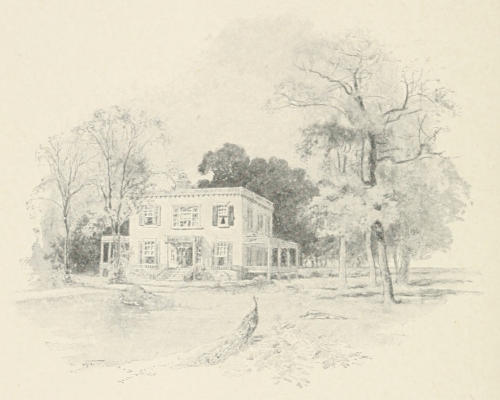
HAMILTON’S RESIDENCE. THE GRANGE
[185]
But they were in a hopeless minority. Even Mr. Jefferson’s attacks upon the judiciary, that last stronghold into which they had been driven, failed to bring on the storm they wished for. The process of impeachment was actively set afoot, that same year 1803, to effect the removal of such federal judges as made themselves most obnoxious to attack. The Democratic leaders of the House announced it as their theory of impeachment under the constitution that it was not a criminal prosecution but only a process of removal. Its ground, they said, need not be any crime or legal misdemeanor. Such acts sufficed to support it as made the judge called in question an instrument of opposition to the course of the government. A decision declaring an act of Congress unconstitutional would support it. It must be considered a means of keeping the courts in reasonable harmony with the will, of the nation. Here was enough and to spare to feed the fears and the rising anger of the Federalist leaders.
But Congress itself declined the theory. Judge Pickering was removed from office because of gross irregularities of conduct; but Judge Chase was acquitted, despite his violent partisanship outspoken from the bench. The Senate would not oust merely for opinions held, and the courts were safe. The Federalist leaders found, moreover, that their own partisans, upon whom they had thought that they could reckon, gave them no countenance. It was impossible to arouse or alarm them. Mr. Jefferson had proved no monster, after all, but an amiable and attractive gentleman, graceful in conciliation, and apparently honest in his desire to serve the whole country, spite of what was said against him.
[186]
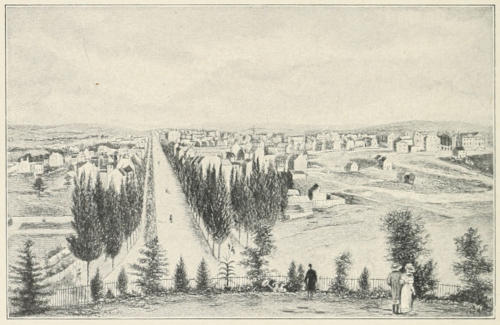
EARLY VIEW OF WASHINGTON CITY
He had surrounded himself, besides, with capable men, whose ability and integrity the whole country recognized. His Secretary of the Treasury was able, so sound did his management of the finances prove, to arrange for the payment of the fifteen millions due for the purchase of Louisiana without asking Congress to lay an additional tax. “I greatly fear that a separation would be no remedy,” wrote George Cabot to those who would have led in the Northern secession. The source of our evils “is in the political theories of our country and ourselves. We are democratic altogether,” and can expect nothing salutary “while we retain maxims and principles which all experience and reason pronounce to be absurd.” “It is impossible to alarm, much less to convince, a large portion of the Federalist party here of their danger,” explained Mr. Higginson to the radicals in Congress. “A small [187]part only of those called Federal are sound in their opinions and willing to look into their real situation. Many even of our own party have as much yet to unlearn as to learn. They have yet much of the democratic taint about them.” Even extremists saw that they would have no following in revolutionary courses, and would have to wait for some grosser provocation, “which should,” as Mr. Cabot said, “be very generally felt and distinctly understood as chargeable to the conduct of our Southern masters, such, for example, as a war with Great Britain manifestly provoked by our rulers.” Almost the whole country outside their narrow coterie rejoiced in the acquisition of the lands beyond the Mississippi. To the southerner and the westerner it seemed a mere consummation of destiny, inevitable and not to be debated. The President turned, with such ease of conscience as he could command, to other things.
OLD STATE HOUSE, HARTFORD
“Other things,” it turned out, were to involve still more Federalist-like policy as affairs shifted: were to involve, in the end, a new set of troubles with England and France which were as serious as those which had made such mischief in Mr. Adams’s time, and which as inevitably led straight towards war and taxes and federal activity in foreign affairs, the pet [188]aversions of the President and of every man who held the strict Jeffersonian creed in politics. Had Europe been at peace, America might have had her day of adolescence unchecked and clear of embarrassment. But France had set all Europe afire, and America, it turned out, was to be drawn into the storm,—was not to be suffered to be the only neutral, lest her advantage should be Europe’s ruin.
All the world being at war, hers was the only flag under which cargoes could make their way into European ports. It was the recognized law of nations that every ship that carried the flag of a belligerent was subject to be taken and made prize of by an enemy’s cruisers. England’s merchantmen could go abroad upon the seas with impunity enough, because England’s navy dominated the ocean waterways; but half of the ports of the continent were closed against them. French and Dutch ships did not venture out of port. Spain gave up her attempt to bring Mexican dollars and the ingots of the Peruvian mines out of the south under convoy in her own bottoms. That and all the rest of the carrying trade of the world fell to American skippers, who were free, as neutrals, to go where they pleased. They fetched cargoes of every kind from every quarter of the globe; put in with them at American ports, in order that they might there be reshipped; and took them thence to their destinations as neutral goods in neutral bottoms. The products of both Indies poured in at the ports of Holland, Spain, and France, without let or hindrance, if only Yankee skippers brought them; and made their way by river and canal to the markets of every kingdom and principality whose resources Bonaparte was using to subdue the world. [189]Those who fought him seemed defeated by neutral trade, by means of what seemed to them, at that tremendous crisis, merely war disguised,—a veritable fraud of neutral flags by which the laws of war were annulled. Bonaparte could never be beaten unless this uninterrupted stream running into his coffers were somehow cut off.
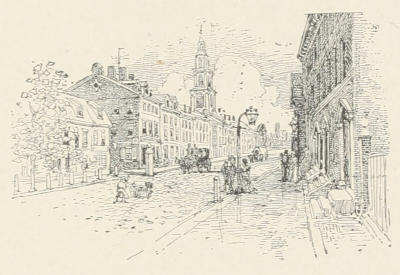
ARCH STREET PHILADELPHIA, IN 1800
England’s only mastery was on the sea. If she could not cut off the conquering Corsican’s resources there she could not hope to check him at all. For a little while she observed nominal peace with him (1802-1805), but that was soon broken. Nelson had utterly destroyed the French fleet at the Nile (August 1, 1798); and now broke the naval power of Spain and of France alike on the great day of Trafalgar (October 21, 1805). But on land, apparently, the Corsican could not be beaten. England determined that at least his coasts should be shut up and the trade of his allied and subject states destroyed; and, since she could not make an actual blockade of all Europe, she resolved to make a paper blockade, and enforce it as she might by captures at sea. By a series of Orders in Council (May, 1806–April, 1809) she virtually declared every port of Europe and the Indies closed against neutral trade. Napoleon answered with a series of decrees (November, 1806–August, 1810) which closed every [190]English port also, so far as such cruisers as France had left could close them, or seizures in French ports make the orders good. Fine, condemnation, even capture and confiscation were to be the penalties imposed on all who should be caught ignoring the mandates of either imperious leader in that desperate combat of nations.
America was not the special target of these extraordinary measures. They were simply unprecedented acts of war in a struggle which had at last transcended every rule and standard. But America’s trade was likely to be cut away at the roots as effectually as if all Europe had declared war against her. Moreover, she was helpless. Mr. Jefferson had brought a party to power which had dismantled the navy which the Federalists had begun. The few ships that remained were tied up at the docks out of repair, out of commission, or lacking crews and equipment. English cruisers overhauled American merchantmen when and where they pleased, looked into their manifests and bills of lading, forbade them their voyage if they chose, and took their seamen off to serve in their own crews.
It was indisputable English law that a British subject’s allegiance was indefeasible and could not be renounced. Many a man upon American ships was in fact a deserter from the British navy, where the pay was poor enough and the discipline brutal enough to make any man wish for respite and escape. English captains were simply reclaiming runaway Englishmen, their government said. They were fighting single-handed against Napoleon with all Europe at his back; they could not suffer their navy to be drained of its men at such a time as that, when liberty the world [191]over, it might be, was staked upon their success. Thousands of her sailors were in fact deserting; it was notorious where they went; and they must be found. Many of the men who were impressed could show American naturalization papers; but no naturalization papers could avail for their exemption from impressment if allegiance were indefeasible. The bitter and intolerable thing was, that British officers made no pretence of investigation; took what men they chose, American or English, not declining negroes even; and insulted the flag of the United States by every method they employed. Insult reached its climax when the English cruiser Leopard followed the American frigate Chesapeake out of Hampton Roads, fired upon her, and took four men from her as deserters,—the Chesapeake having but a single gun ready for use (1807).
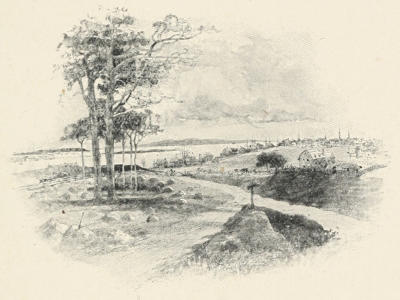
NEW YORK ABOUT 1800. FROM THE NORTH
Mr. Jefferson saw the face of war in all this, but would not propose any means of redress. The only remedy [192]he would suggest was a fleet of gunboats for the defence of the ports, less costly than fortifications, less dangerous also, his creed said, to principles of self-government and the maintenance of a modest central power, than a formidable navy. If American seamen were not safe against attack at sea, it was best that they should stay in port, where the country could make good their defence. He found it impossible, indeed, to do away with sea-going ships of war altogether. At the very outset of his administration he had been obliged to send a squadron against the pirates of Tripoli, who openly made war on the commerce of the United States. The six frigates then kept in commission proved unsuitable for the service, and he was forced to consent to the construction of a few vessels more suitable, which promptly brought Tripoli to terms. But he did not allow even the Tripolitan war (1802-1805) to bring a real navy into existence.
He tried negotiation with England, through Mr. Monroe and Mr. William Pinkney, for many weary months, and through many changes of ministry over sea, but could get nothing better than Jay’s treaty (then about to expire by limitation), and would accept nothing less than a renunciation of the right of search and of impressment, which England would not relinquish. When the Leopard fired on the Chesapeake he ordered all British men-of-war out of American waters and forbade them her ports; but there was no remedy in that. At last, driven to retaliation but unalterably opposed to war, he recommended an embargo, which should at least make English merchants smart by cutting off their lucrative trade with the United States.
[193]
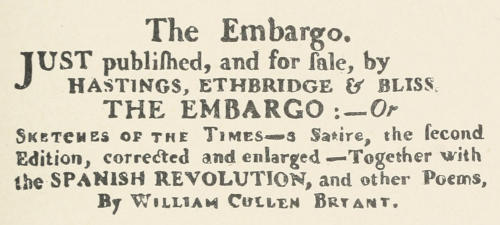
BRYANT’S SATIRE
On the 22d of December, 1807, an Embargo bill became law which absolutely prohibited all foreign commerce, whether in foreign or in American bottoms. A year before Congress had authorized the President to forbid the importation of certain classes of English goods on and after a certain date. But the date had been deferred until the eve of more radical measures. The Embargo Act closed the ports against all nations, and even against the exit of American ships. Even coasting vessels were required to give bond to land their cargoes within the United States. Such an experiment in retaliation, cried Josiah Quincy, of Massachusetts, in the House, had “never before entered into the human imagination. There is nothing like it in the narrations of history or in the tales of fiction.”
“My principle,” said the President, “is that the conveniences of our citizens shall yield reasonably, and their taste greatly, to the importance of giving the present experiment so fair a trial that on future occasions our legislators may know with certainty how far they may count on it as an engine for national [194]purposes,”—as a substitute for war in bringing foreign nations to terms of reason; and he had his way to the utmost. His personal influence prevailed in everything. Members of Congress knew very well how sorely the bill would pinch, but they never dreamed of disobeying. “All our surplus produce will rot on our hands,” cried a member of the House. “God knows what all this means! I cannot understand it. I see effects, but I can trace them to no cause.... Darkness and mystery overshadow this House and the whole nation. We know nothing; we are permitted to know nothing. We sit here as mere automata; we legislate without knowing; nay, sir, without wishing to know why or wherefore.” The embargo was to be tried because Mr. Jefferson believed in its efficacy.
The closing year of his presidency was darkened and distressed by its effects. The States themselves suffered from the act more than the nations whose trade they struck at. America’s own trade was ruined. Ships rotted at the wharves,—the ships which had but yesterday carried the commerce of the world. The quays were deserted. Nothing would sell any more at its old price. The southern planters suffered even more keenly than the New England merchants. Their tobacco and rice and cotton could not be sold, and yet their farm hands, who were slaves, could not be discharged and had to be maintained. The wheat and live stock of the Middle States lost half their market. It was mere bankruptcy for the whole country. No vigilance or compulsion could really enforce the act, it is true. Smuggling took the place of legitimate trade, where it could. Even within the year, too, manufactures began to show a little more as if they would [195]grow, to supply what importation could no longer supply. But there was small palliation for the keen distress of the time in smuggling or the feeble beginnings of manufacture; and before irreparable mischief had been done the fatuous system broke down.
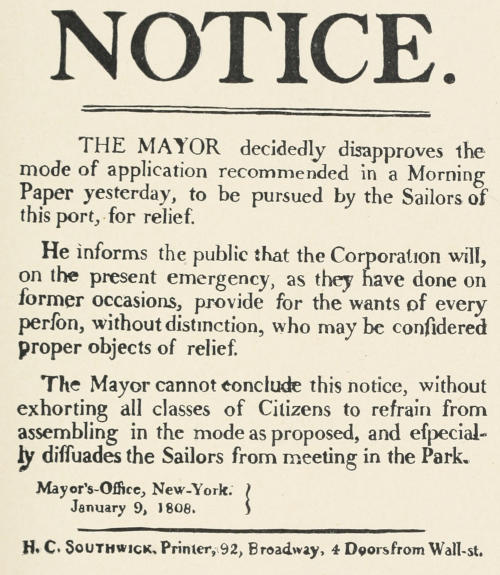
NOTICE CONCERNING THE RELIEF OF SAILORS
It bred distress not merely, but actual disaffection [196]as well. The distress was universal; disaffection showed itself only in New England, where the Federalists still kept their organization and their power. The sea was New England’s farm, as Mr. Pickering said. To be shut out from using it for trade and adventure was as sharp a blow at her habit and her livelihood as that which had been dealt by Mr. Townshend’s Acts, which had played their part, as everybody knew, in bringing on a revolution. Exasperation could not easily be kept within bounds; and no one seemed wise enough to restrain it. New Englanders deemed the embargo a more open and more partisan attack upon their interests than the purchase of Louisiana had been, and thought it significant enough that it came from Mr. Jefferson, the Virginian, leader of the South and West. As a matter of fact, the Act cut nearer the roots of life in Virginia than in Massachusetts. The merchants of New England lost the profits of trade, indeed; but British cruisers would very likely have confiscated those in any case. Their capital at least was safe; and New England, like Pennsylvania, found means to reimburse herself in the home markets suddenly opened for her simple manufactures which Virginia and the South had no opportunity to employ. It showed a singular constancy and steadfastness in principle and in party loyalty on the part of Virginia and her neighbor States at the south that they should thus face ruin to support Mr. Jefferson.
The Federalist coterie in Massachusetts and Connecticut were at such a pitch of exasperation, allowed themselves such license of bitter and disloyal speech, seemed so stubbornly bent upon opposition to the utmost, that even men very little given to panic fear began [197]seriously to apprehend the worst. Indeed, the worst was presently to be seen at hand. It was a long coast to keep ships from, that which stretched all the way from the rivers of Maine round about Spanish Florida to the rivers and inlets of the Gulf, and before the President and his advisers had done with the hateful Act they were driven, in order to make it effective, to measures as arbitrary and as inquisitorial as the Alien and Sedition laws and Mr. Townshend’s Acts to enforce the Parliament’s laws of trade. In January, 1809, in accordance with the recommendations of a report from Mr. Gallatin, Congress passed an Enforcing Act which authorized the President, through the collectors of customs, to seize any goods of American growth or manufacture that might be found in any kind of boat or in any vehicle going towards the sea, and to hold them until heavy bonds were given that they would not be taken out of the United States. At that the temper of New England broke down, as the temper of Kentucky and Virginia had broken down under the Alien and Sedition laws. A committee of the Massachusetts senate recommended a law to protect the people of the State against “unreasonable, arbitrary, and unconstitutional searches.” When Mr. Dearborn, the Secretary of War, requested Governor Trumbull, of Connecticut, to select officers of the militia of that State to assist the collectors in enforcing the Act, he flatly refused, and plainly declared his determination to defy the authority of the federal government. “Conceiving, as I do, and believing it to be the opinion of the great mass of citizens in this State,” he said, “that the late law of Congress for a more vigorous enforcement of the embargo is unconstitutional [198]in many of its provisions, ... my mind has been led to a decided and serious determination to refuse compliance with your request, and to have no agency in the appointments which the President has been pleased to refer to me.”
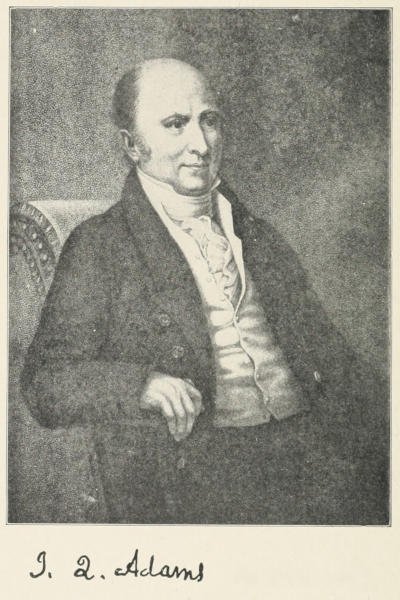
JOHN QUINCY ADAMS
Already, the year before, Mr. John Quincy Adams had informed Mr. Jefferson that there was a plan afoot in New England to nullify the embargo and defeat the [199]laws, and that secession, it might be, and union, or at least alliance, with England would follow. Here was a notable sign of the times! John Adams’s son, bred in the strictest school of federalism, and himself senator from Massachusetts, had of a sudden left his party, had voted for the embargo, and now, cool and distant though he was with all men, came forward to warn and counsel Thomas Jefferson and shield the country from the consequences of Federalist folly. Mr. Jefferson knew at once how singular and significant a thing had happened; knew that Mr. Adams had acted from a love of duty, not from love of him; felt a touch of panic himself; and acted as the crisis seemed to demand.
Amidst such an accumulation of embarrassments, at home and abroad, it was no doubt better to yield a good deal to the spirit of discontent, before actual strife came on, than to provoke it to excesses. The end of Mr. Jefferson’s term was at hand, his successor chosen, his party’s supremacy secure, and concession could be made without material sacrifice. On the 1st of March, 1809, accordingly, a Non-Intercourse Act, which prohibited trade with the ports of England and with all countries under the control of France, but set it free again to move as it pleased so far as the rest of the world was concerned, was substituted for the absolute embargo. The signing of the new measure was almost the last official act of Mr. Jefferson’s administration. On the 4th of March, with no slight sense of relief, he handed over to Mr. Madison the responsibilities of his great office,—a burden which increased, as he had found, from year to year.
Mr. Madison had been chosen without difficulty to [200]the Presidency (1808). The supremacy of his party was almost unquestioned; he was Mr. Jefferson’s choice for the succession; the nomination was an affair arranged by the party leaders in Congress and formally ratified in a caucus of the Republican members of the two houses,—not without rivalries and a show of contest, indeed, but without difficulty; and the electors readily confirmed the choice. Massachusetts, Rhode Island, and New Hampshire returned in the election to their Federalist allegiance; three Federalist votes in North Carolina were added to the two which Maryland again stood ready to give: and Mr. Pinckney and Mr. King, who were again the nominees of the Federalists, received forty-seven electoral votes, instead of the beggarly fourteen they had received four years before. But Mr. Madison received one hundred and twenty-two. Mr. George Clinton, of New York, who had been chosen Vice President with Mr. Jefferson, after Mr. Burr’s retirement, became Vice President for a second term with Mr. Madison. The reaction against the embargo had not touched the country at large.
[201]
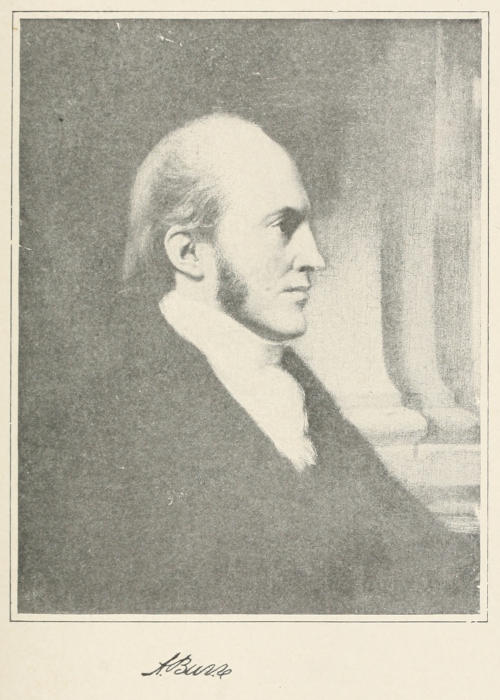
AARON BURR
[202]
The country, indeed, had turned with a singular heartiness and unanimity from the Federalists to Mr. Jefferson and the party he had made, as if he had spoken the natural humor and inevitable principles of a new country wishing a new life of its own. The Federalists seemed of a sudden statesmen no longer, but a mere faction which wished accommodation with England upon any terms, for the sake of trade and the maintenance of a tradition. They seemed out of humor with the making of a free democratic nation, full of wholesome but irregular force; and handed even their one-time principles over to the Republicans: opposed them when they magnified the federal power by the purchase of Louisiana, and echoed the protests of the Virginia and Kentucky Resolutions when they enforced the embargo. It was evidently the tone and method of the new party rather than its rigidity in principle or consistency in action that had taken the fancy of the country. It used power as freely, and stretched the constitution with as little compunction in the using, as the Federalists before it. Though for a little while after its first elevation to the place of government it had railed in good set terms against the constitution itself, because it prevented the removal of obnoxious judges by mere address of the two houses; had wished impeachment to be regarded as a political, not as a judicial process; and had tried to use it to subordinate the courts to the political control of the President, it had soon forgotten that madness, and had used a very different tone in most things. It had voted money to build a great national road through the Cumberland Gap into the West, as readily as Federalists would have voted it, and with almost as little doubt or scruple as to constitutional powers. What had seemed a bit of treason against the government in the West had been snuffed out as promptly and unhesitatingly as the whiskey rebellion in western Pennsylvania had been snuffed out by Washington and Hamilton in their more questionable day of authority, when, Jeffersonians had said, a party acted and not the nation.
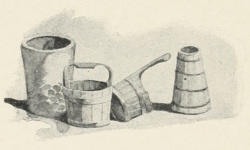
WESTERN COOKING UTENSILS
[203]
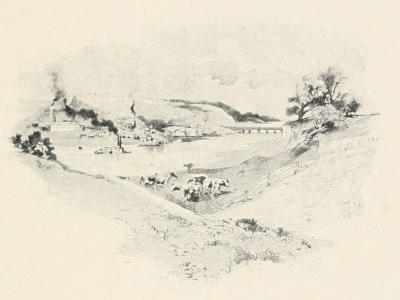
PITTSBURG, 1810
The treason, if treason it was, had been Mr. Burr’s, now a discredited, it might be also a desperate, man. His duel with Hamilton, which seemed like nothing less than a political murder, had rendered him of a sudden almost a political and social outcast; the last months of his vice presidency he had passed in bitter isolation from old friends and associates; and he had left office (March 4, 1805) stricken in every legitimate ambition. I am “under ostracism,” he said. “In New York I am to be disfranchised, and in New Jersey to be hanged. Having substantial objections to both, I shall not, for the present, hazard either, but shall seek another country.” The forced pleasantry covered no man could tell what purpose. His “other country”, was the West. Leaving Washington in May, 1805, he swept in a swift journey through all the forested country which lay upon the eastern banks of the Mississippi from Kentucky to far New Orleans and back again, as if upon an errand. The next year he repeated [204]the journey; and boats, provisions, munitions of war began to be gathered here and there on the Ohio and the Cumberland. It was said he meant to attack Mexico; that he meant to set up an independent empire in the West; that some great treason, or at the least some lawless scheme of freebooting, was afoot. Nothing could be proved. Mr. Burr was indicted and tried for treason (May-September, 1807), but there was not evidence enough to convict him. He left the country and wandered in restless loneliness through foreign lands, a ruined and hopeless man.
He had at least furnished proof, men felt sure, that the loyalty of the West to the East could no longer be doubted or seriously tampered with: for, whatever it had been that he was plotting, he had got, it was certain, very little aid or counsel there, spite of appearances. The reign of the new party in national affairs had, at any rate, knitted East and West together; the makeweight of Louisiana had been added to the national scale; and Mr. Madison had the bulk of the country back of him.
Mr. Madison loved peace, as Mr. Jefferson did, and was willing to secure it by any slow process of law or negotiation that promised to keep war at arm’s length. But he presently found himself caught in the tangled network of policy which, as Secretary of State, he had woven for Mr. Jefferson. Mr. Jefferson’s foreign dealings had turned, not merely upon Napoleon’s decrees and the English Orders in Council against neutral trade, but also upon his desire to add the purchase of West Florida to the purchase of Louisiana, and so make good the dominion of the Union to the east as well as to the west of the Mississippi. First, when he [205]thought England would aid him in that matter, he had played for a close friendship with her. When England failed him and it seemed as if Napoleon would compel Spain to make the cession if America would but turn away from England to him, friendly dealings with England had been given up and everything had been pulled about to please the master of France. Napoleon’s diplomacy ran deeper than that of England. He stuck at nothing to gain his ends; was determined that America should serve him, not the English, in the mighty struggle he had entered upon to bring the world to his feet; promised everything to win America away from England, and then, having gained what he wished, repudiated his promises and did nothing. Mr. Jefferson had become deeply entangled, beyond hope of extrication; had become the professed friend of France, and had not gained Florida. Mr. Madison was left to face two unfriendly powers, to the more false and dangerous of whom it was his cue, it seemed, to play the complacent servant.
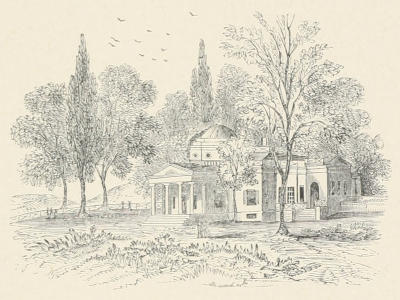
MONTICELLO. THOMAS JEFFERSON’S RESIDENCE
[206]
For a brief space affairs seemed to clear very hopefully, as if the old tangle were about to be unravelled and dealings with England brought to a right posture again. Mr. Erskine, the British minister at Washington, young, sanguine, and inexperienced, agreed to a withdrawal of the Orders in Council, and Mr. Madison gladly suspended the operation of the Non-Intercourse Act in respect of Great Britain, as the terms of the Act permitted. But it turned out that the young minister had acted without authority. He was recalled, the Act was again put into force against England (August 9, 1809), and affairs looked uglier than ever.
Then Napoleon practised anew upon the credulity of the Administration. On May 1, 1810, Congress formally repealed the Non-Intercourse Act, which would have expired by limitation at the close of the session without repeal, and authorized the President, in case either Great Britain or France should “cease to violate the neutral commerce of the United States,” to revive and enforce non-intercourse with the other, should she fail to do the same. Napoleon promised that his decrees against American shipping should be revoked on the 1st of the following November, provided England would before that date withdraw her Orders in Council. England replied that she would rescind the Orders when informed that the Emperor had revoked his decrees. The Emperor sent word to Mr. Madison that his decrees were in fact revoked, and should cease to have effect after the 1st of November, if in the mean time the United States should “cause their rights to be respected by England.”
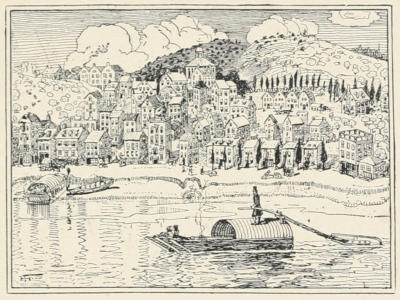
CINCINNATI IN 1810. FROM HOWE’S HISTORY OF OHIO
There was no doubt what that meant: non-intercourse with England as the price and condition of release [207]from the intolerable restraints of France. And intolerable they were. Nearly every port of the continent, whether on the Atlantic, the Mediterranean, or the Baltic, was under the Corsican’s control; and everywhere American ships were seized and confiscated on the pretext that they were carriers for England, whom he meant to beat at any cost. Napoleon’s decrees, like the English Orders in Council, had been nothing less than acts of war against the United States from the first, though not primarily aimed at her, and would at any time have justified a declaration of hostilities. But Mr. Madison did not want war. The United States were not strong enough,—particularly now that the party in power had disbanded its army, dismantled its navy, and reduced its revenues to a minimum. The President’s principles clearly forbade war, besides. He wished to fight only with the weapons of nominal peace: embargoes and retaliatory restrictions. If Napoleon would yield his decrees, so much the greater [208]pressure could be brought to bear upon England to yield her Orders in Council, and the vexatious game might at last be won. The Emperor was no doubt bringing the end of it within sight.
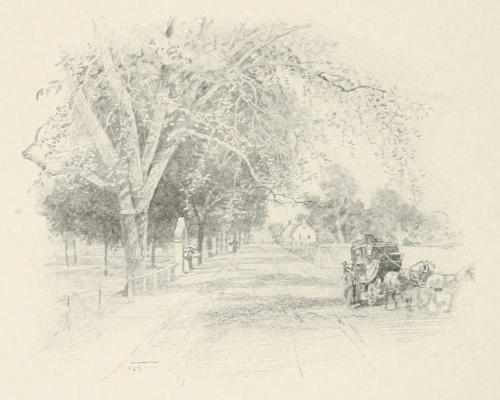
TREMONT STREET, BOSTON, 1800. LOOKING NORTH
Again too precipitate and too confiding, therefore, the President acted as if the game were already won and the matter already settled, so far as France was concerned. The 1st of November having come and England’s Orders not yet being withdrawn, on the 2d he made proclamation that intercourse with Great Britain and her dependencies would again be suspended on and after the 2d day of February (1811) following, until England should yield. Only after he had fully committed both himself and the country did he learn how deeply and shamefully he had been deceived. The seizure of American ships in continental ports did not [209]stop. Other decrees, other restrictions, old and new, sufficed for their condemnation as well as the decrees said to have been revoked. The revoked decrees themselves were still acted upon if occasion demanded. American skippers were but lured by a false security into virtually hostile ports. Their ships and cargoes were seized and confiscated without compunction or subterfuge, at a loss of quite ten million dollars in a single season. Ill feeling between England and the United States was seriously deepened, as the astute and unscrupulous master of France had meant that it should be; and every negotiation for an amicable settlement grew the more confused and doubtful. Every sinister influence seemed to draw Mr. Madison towards what he most dreaded and contemned,—towards a war of arms, brought on by a programme of peace.
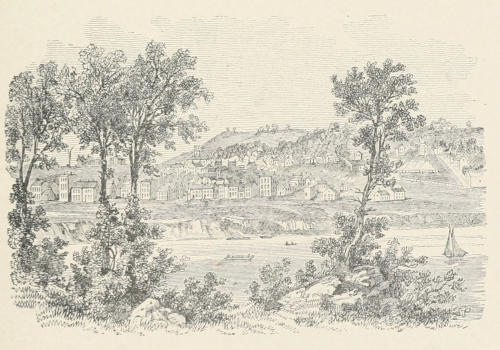
CINCINNATI, FROM NEWPORT, IN 1812
Negotiations dragged very slowly then, with the [210]coming and going of tardy ships, which had oftentimes to steal like fugitives in or out of port. But all through the long year 1811, though hopes and plans and anxious fears came and went with doubtful ebb and flow, and no one knew what either England or France would do, it grew more and more evident that the government of the United States must do something, if only to keep itself in countenance. It had pledged itself to believe that France had in good faith yielded to its demands. England made no pretence of having yielded or of intending to yield. Evidence multiplied that France was playing a double and lying part. Mr. Madison’s mortification was complete and very bitter; but no one deemed it possible that the United States should fight both France and England at once. Men’s minds were slowly made up to stomach France’s deceptions and fight England. At least it was so with the President, who saw no way of retreat not too humiliating to be borne; and it was so with Congress, which had passed under the control of new leaders.
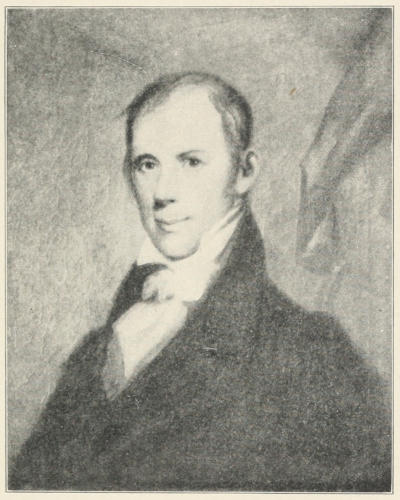
HENRY CLAY
An air of radical action began to stir the moment Congress assembled (November 4, 1811). It was the first session of the Twelfth Congress. In the House seventy members, out of a total of one hundred and forty-one, were new men, and for the most part young men: their leaders young men like themselves. Most conspicuous among them was Henry Clay, a man not yet turned thirty-five, whose tall and striking figure, easy way of comradeship among men, free and ringing eloquence in speech, and ready mastery in the battle of debate gave him an engaging pre-eminence, which no man without an equal charm and power could dispute with him. There was something in the whole make-up [211]of the man,—his free pose, his candid way of utterance, his dash and telling vigor,—which bespoke him the Kentuckian, the man of the new and confident West, where the frontier of settlement was near at hand and where the forces of irresistible growth and initiative were abroad. And yet there was an art, a winning persuasiveness, a reverence for old ideals, a flavor of old principles in all that he did and said which seemed a reminiscence of his birth in Virginia, where tradition [212]was from of old and kept its votaries. Scarcely less striking was John C. Calhoun, the new member from South Carolina, a young man not yet thirty, who showed in every piece of business he handled a maturity like that of the young statesmen of the constitutional convention. There was the air of the scholar and student about him. His luminous sentences, uttered in debate, shone upon every matter they touched with singular steadiness and with a light at once vivid and diffused, disclosing the distant view no less than the thing at hand. A strain of passion and of quiet energy showed in him which caught the imagination and touched the purpose of those about him. It was inevitable that these men should lead,—these and the other men of the new age who stood with them and were of like principle and purpose: in the House, Langdon Cheves and William Lowndes, of South Carolina; Richard M. Johnson, of Kentucky; Peter Buel Porter, of New York; and in the Senate, William H. Crawford, of Georgia.
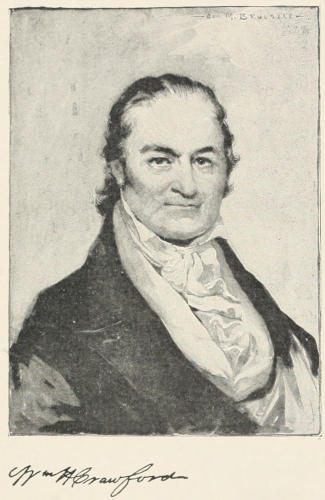
WILLIAM HARRIS CRAWFORD
Mr. Clay was chosen Speaker and organizer of the House, and it proceeded to the business which led to war. These men had made up their minds that the country should fight. The President could not but take their purpose, having no alternative to suggest. The tangle of French diplomacy could not be straightened out, the stubbornness of England could not be budged: the country, as if by hereditary choice, chose to fight England and let France go her way for the present. The grounds of the war were singularly uncertain. France was doing much more to injure neutral trade than England was. That very spring (1812) a French fleet put to sea confessedly commissioned to burn American [213]merchantmen wherever found. Mr. Madison urged against England the old grievance of impressment, and no one could doubt its weight or gravity. Nearly every twelvemonth between 1804 and the embargo close upon a thousand men a year had been seized out of American ships. American tonnage increased seventy thousand tons a year so long as American skippers were permitted to enjoy the profits of neutral trade; four thousand two hundred additional men were needed yearly to put crews into the new craft, [214]and it was estimated that twenty-five hundred of the new men were in fact British subjects, no small proportion of them unquestionably deserters from his Majesty’s navy. Every American sailor went about with a certificate of citizenship which described his “eyes and nose and mouth and chin, the color of his hair and complexion, and the marks and scars about his person,—like the advertisement of a runaway slave,”—and yet was not safe. Actual outrages often accompanied the ceaseless impressments, and only the embargo, which kept ships in port, had thrown the matter for a little into the background. But it had been thrown into the background. Mr. Jefferson had let it go almost without protest since his commissioners had failed to induce England to abandon it. It was now clearly an afterthought as a ground for war. There was no excitement in the country; only a vague irritation and fretfulness. But the drift had set in, and the majority went with it, dragging the country. In April, 1812, an embargo was enacted, preparatory to war; and on the 18th of June war was declared. The very day before (June 17th) the English Parliament had repealed the Orders in Council. The change of mind and of policy long looked for in England had come at last, and the cause of the war was taken away on the very eve of its outbreak.
[215]
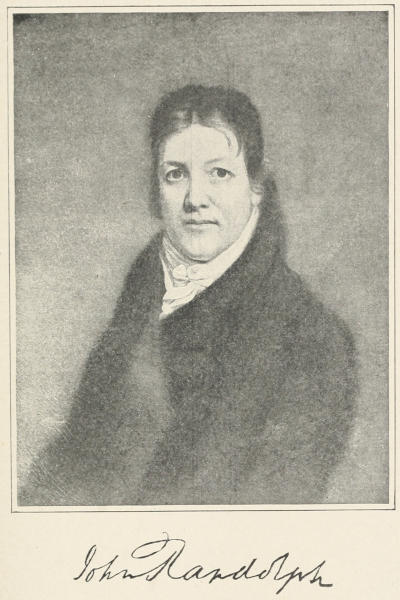
JOHN RANDOLPH
[216]
It was a foolhardy and reckless risk the Congress was taking. The country had been “embargoed and non-intercoursed almost into a consumption,” as Mr. Randolph said, very passionately. It was certainly no time for battle. The party in power had relied on embargoes and non-intercourse and had disbanded the army. The revenues of the government were scarcely more than sufficient for its meagre peace establishment. The very Congress which voted the war refused to provide for the taxes which Mr. Gallatin told them would be necessary to carry it on. The preceding Congress had refused to recharter the Bank of the United States, the government’s only effective financial agency, and the currency was already falling, as a consequence, into hopeless confusion, running through a quick depreciation.
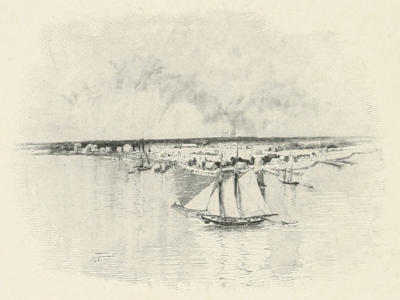
DETROIT IN 1815
What was worse, the risk of the war was not a whit more obvious than its deep impolicy. Napoleon was the enemy of the civilized world, had been America’s own enemy in disguise, and had thrown off the disguise. England was fighting him almost alone, all Europe thrown into his scale and hers almost kicking the beam; and now America had joined the forces of Napoleon, in fact if not in intention, as he had subtilely planned. It was natural that the raw and rural [217]nation should thus have seen its own interests in isolation and indulged its own passion of resentment with selfishness. England’s policy had cut America to the quick and had become intolerable, and it did not lessen America’s exasperation that that policy had been a measure of war against the Corsican, not against her. It was a tragical but natural accident that the war should be against England, not against France.
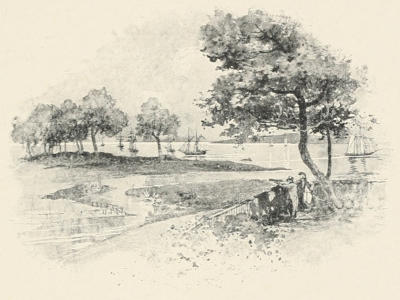
THE PORT OF BUFFALO, 1815
It was thus that the New England Federalists saw the war; but they deemed the accident inexcusable and pressed their opposition almost to the verge of treason. The trade of the shipping ports had of course suffered immensely at the hands of both England and Napoleon. But the profits of the neutral carrier were enormous, nevertheless, in that troubled time. Such ships as escaped seizure and made good their voyage recouped their owners for many lost. Ship building went forward very prosperously in America despite every order and decree of the belligerents; and so long [218]as there was no embargo to restrain and make them outlaws at home merchants almost cheerfully took the risks of the sea. The embargo which immediately preceded the war was intended, of course, to call the shipping in for its own protection; but merchants hurried every available vessel to sea as soon as they heard it was to be passed, in order to be beforehand with it and take the risks Congress sought to protect them against. Once again, when the embargo came, the opposition of New England became factious and desperate. It spread to New York, which passed from the control of a Republican to the control of a Federalist majority. It threatened hopelessly to embarrass the government, if not to jeopard its very existence.
The course of the war did little to improve matters. The government had neither the means nor the organization to conduct it. The President was authorized to increase the regular army from six to twenty-five thousand men, to call for fifty thousand volunteers, and to employ one hundred thousand men from the militia of the States. But volunteers were not to be had for the asking; and officers were even harder to find than men. The governors of Massachusetts, Connecticut, and New Hampshire, though they would not forbid recruiting, refused to permit the use of their organized militia outside the limits of their States, thinking themselves legally justified by the terms of the constitution, which authorized Congress to provide for calling forth the militia only “to execute the laws of the Union, suppress insurrections, and repel invasions,” and said nothing of a war like this. The President, accordingly, withdrew all federal garrisons from New England. The only general officers available were [219]either veterans of the Revolution, too old to be serviceable, or mere politicians who claimed preferment as a political favor. The income of the government never while the war lasted rose above ten millions a year; but its expenses for the war turned out to be from thirty to forty millions per annum. Loans had constantly to be resorted to; most of the money of the country was in New England or at the great ports, where the war was hopelessly unpopular; men were inclined to refuse to aid a government which had already more than once ruined trade and prostrated business,—if only to show their temper in affairs; and the credit of the government sank lower and lower. Congress was obliged to resort at last to the very excise taxes which all Republicans had so hotly condemned the Federalists for imposing; to lay direct taxes on such articles of personal use as household furniture and watches; and finally, when the war was over but not the difficulties of finance, to re-establish the Bank of the United States (April, 1816). A few light duties on imports could not support the government when every principal harbor of the country was blockaded.
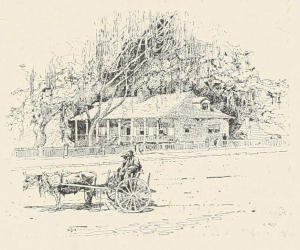
JACKSON’S HEADQUARTERS, NEW ORLEANS
For almost three weary years the war dragged on. It was a war upon the borders: the long northern frontier, [220]the defenceless coast, the easy points of approach on the Gulf. As in the Revolution so now, the heart of the country went untouched. Along the short lines of the Detroit, the St. Clair, and the Niagara; on the waters and shores of the great lakes; and up and down the line of Champlain, where Burgoyne had moved in the wilderness, were the chief scenes of the uncertain fighting. On the coasts English fleets swarmed thicker and thicker until almost every important port was effectually closed. Finding no opposing force to attack, their crews made frequent descents upon defenceless settlements, which they burned and plundered. In August, 1814, a strong British force landed in Chesapeake Bay, close to the capital; marched upon Washington, which the government, knowing the place to be of no strategic importance whatever, had not thought of providing with defences; took it without difficulty, the officers of the government barely escaping capture; burned the public buildings; and turned to an attack on Baltimore which was gallantly repulsed.
The year 1814 had set England free to prosecute the war with vigor. Napoleon was beaten. The very month Congress declared war against England he had attacked Russia for a final triumph. Five hundred and fifty thousand men he took against her, the combined armies of subjugated Europe. But disaster dogged him at every step. Three hundred thousand lives he threw away; more than a hundred thousand men he left in the hands of the enemy. He came back with barely one hundred thousand (December, 1812), to face a rising of the nations. Germany, Spain, Sweden, every people in Europe roused itself to crush him. His armies dwindled and were beaten, by Wellington [221]in Spain, by Blücher beyond the Rhine. By the end of March, 1814, the allies leagued against him were in Paris; in April he was an exile in Elbe.
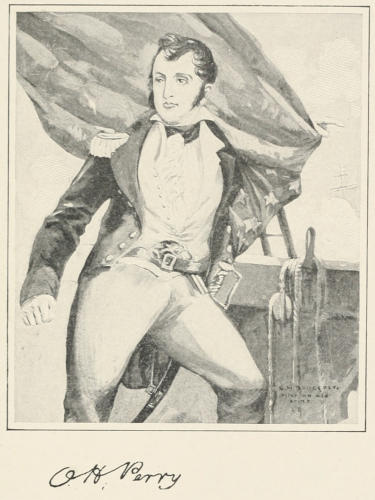
OLIVER HAZARD PERRY
But America by that time had drilled troops and experienced officers, trained by the hard processes of the war itself. What proved of as much consequence, her little navy startled the world by its extraordinary exploits. There were but seven frigates, great and small, besides a corvette or two and a few small brigs; but her seamen were professionals, not amateurs like her soldiers. Whenever they could elude a British fleet watching at the harbors where they lay, and come to a reckoning with their foes, vessel with vessel on the sea, they almost without exception won, and won promptly, by expert seamanship and good gunnery; and British captains were ordered to sail, not singly but in company, to be safe against them. Little navies were created, too, on the lakes, where they were built while the war lasted. Commodore Perry in a single gallant action (September 10, 1813) won entire control of Lake Erie, and set a body of troops across the lake whose decisive victory on the Thames ended the war in the northwest. In the summer of 1814 Commodore Macdonough met the English on Lake Champlain (September 11th) and won a victory which once for all ended plans of invasion there.
[222]
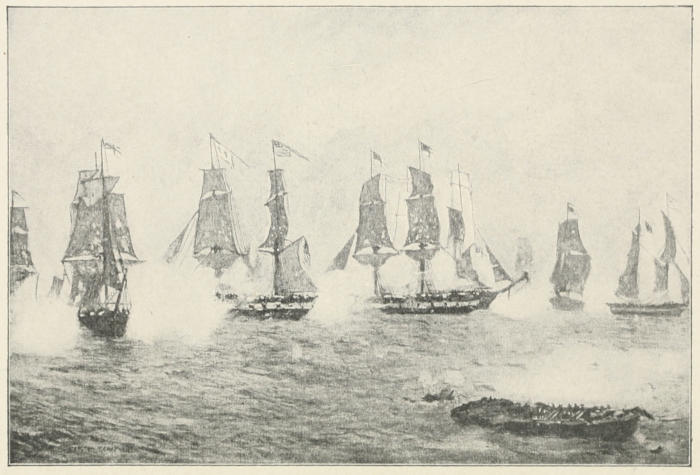
BATTLE OF LAKE ERIE
[223]
As the war progressed discipline came to the raw armies of the Union and they began to be handled by men who understood their duty and performed it in soldierly fashion. The war had begun with a series of defeats in the north at once ridiculous and disgraceful; but the whole face of affairs changed when the Americans drove the British troops from their batteries at Lundy’s Lane (July 25, 1814) and kept their victory half the black night through against assault after assault; and the fortunes of the field swung measurably even after that from action to action.
The war closed in the South. There the British sent Pakenham with twelve thousand men, veterans for the most part from the fields of Spain, to take New Orleans, which they meant to hold for such terms as might suit them when the war was done. There, on the 8th of January, 1815, General Andrew Jackson received him, at the trenches the Americans had drawn across a narrow strip of land below the city, and beat him off with half the force: sent him back in utter rout, with twenty-five hundred men less than he had brought. Jackson himself lost but eight killed and thirteen wounded.
[224]
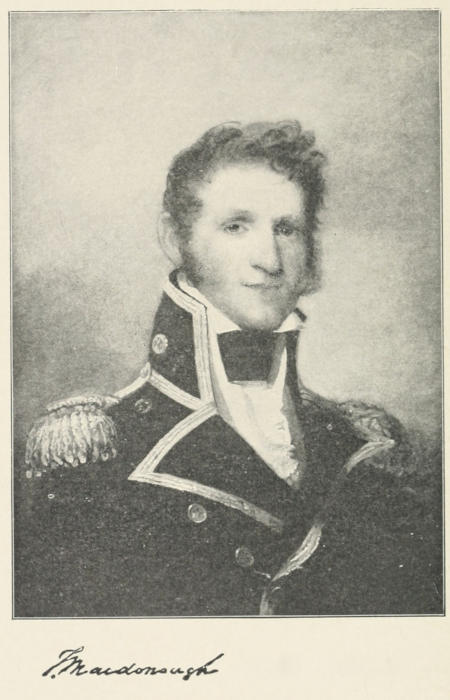
THOMAS MACDONOUGH
[225]
Two weeks before that notable affair at New Orleans (December 24, 1814) a treaty of peace had been signed at Ghent, of which the country knew nothing. England had several months earlier made known her willingness to treat. The war was costing her ten millions sterling a year; and she made no real headway in it. Mr. Madison hurried commissioners over sea at the word, and by December terms had been agreed upon. It was a mere treaty of peace and of boundaries. The Orders in Council were long ago repealed; impressment was not mentioned,—was, indeed, itself a matter settled well enough by the defeat of Napoleon and by the new respect America had gained on the seas. The war itself was no doubt sufficient guarantee that another for a like purpose would never be necessary.
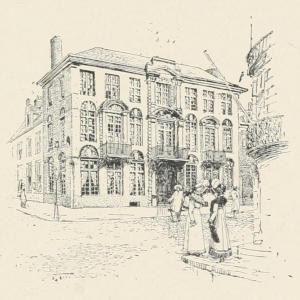
HOUSE OF AMERICAN COMMISSIONERS AT GHENT
[226]
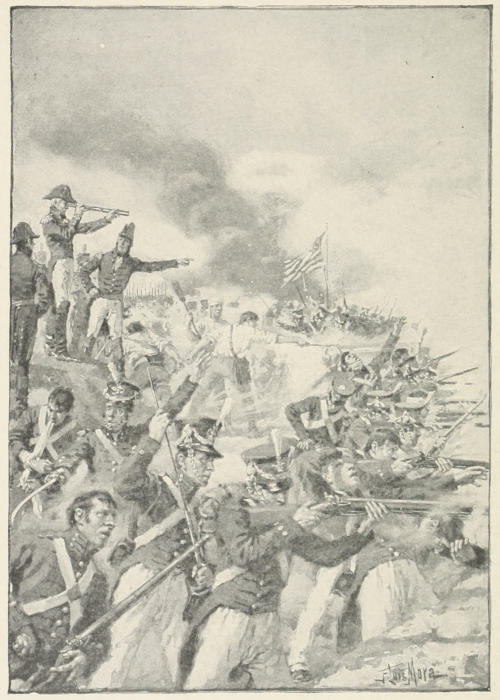
IN THE AMERICAN TRENCHES. BATTLE OF NEW ORLEANS
[227]
Peace came none too soon to check the sinister influences of politics at home. New England had contributed men and money to the war as the law required and her means permitted. Because she was wealthy and populous, she had, indeed, contributed more than the South and West, whose representatives in Congress had brought the war on despite her passionate protests. But the temper of her leading men grew more and more impatient and insubordinate as the war advanced. In December, 1814, at the call of the legislature of Massachusetts, a convention of delegates from Massachusetts, Connecticut, and Rhode Island met at Hartford whose secret sessions made the whole country uneasy. There was nothing actually revolutionary in what it did, so far as the country could learn; it had met for consultation, no doubt, not for action. But it spoke the very language of the Kentucky and Virginia Resolutions in the papers which it put forth; it was known to represent men who had more than once been openly and aggressively a pro-British faction, men who Hamilton and John Quincy Adams had feared might go the treasonable length of disunion; it insisted upon amendments to the federal constitution which should protect minorities of States from majorities. When the war closed a committee of its members was in Washington to demand of the government that the federal taxes should be divided and the New England States permitted to retain those which their own people paid in order that they might apply them as they pleased to their local defences. The treaty of peace sent them home belated and derided. The Hartford convention was the end of the Federalist party. But it had none the less been a very sinister sign of the times.
[228]
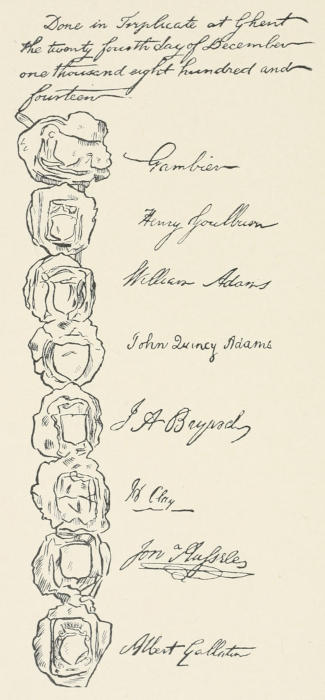
FACSIMILE OF SIGNATURES TO THE TREATY AT GHENT
[229]
If the war had done nothing else, however, it had at last made the country quick with the spirit of nationality, and factions were discredited. The war of the Revolution had needed a war for independence to supplement it, as Mr. Franklin had long ago said. Until now, notwithstanding the separation, English statesmen had deemed the United States still in no small degree dependent upon England for their place and privilege in the world, and America had virtually in her thought accepted a position of dependence. The Federalists had been ashamed of no concession or submission to England, when once their greater leaders had fallen silent. This clumsy, foolhardy, haphazard war had at any rate broken that temper. The country had regained its self-respect. The government of the Union, moreover, was once more organized for rational action. The party which controlled it had once for all given up the theories which made it conscientiously weak and inefficient upon principle. It was ready now upon occasion to raise armies, impose direct taxes, avail itself of the services of banks, and serve the country by means which should hold the nation united and self-centred against the world.
Authorities: For general guidance through this period we have the fourth, fifth, and sixth volumes of Hildreth, the first three volumes of George Tucker’s History of the United States, the second and third volumes of John Bach McMaster’s History of the People of the United States, the first and second volumes of James Schouler’s History of the United States of America under the Constitution, the first volume of Dr. Hermann E. von Holst’s Constitutional and Political History of the United States, and the fourth volume of Bryant and Gay’s Popular History of the United States. With the accession of Mr. Jefferson to the presidency, Mr. Henry Adams’s admirable History of the United States during the administrations of Jefferson and Madison becomes indispensable. The late Mr. Alexander Johnston contributed to J. J. Lalor’s [230]Cyclopaedia of Political Science, Political Economy, and United States History articles on the chief topics and events of this period, such as the purchase of Louisiana, the embargo, and the war, which exhibit at their best the painstaking and the judicial temper of the trained historian. For the rest, our general authorities are John C. Hamilton’s History of the Republic of the United States of America as Traced in the Writings of Alexander Hamilton and His Contemporaries, a voluminous work in seven volumes; Edward Stanwood’s History of the Presidency; George Gibbs’s Memoirs of the Administrations of Washington and Adams; William H. Trescot’s Diplomatic History of the Administrations of Washington and Adams; the first volume of J. P. Gordy’s History of Political Parties in the United States; Charles Francis Adams’s Life of John Adams; George Tucker’s Life of Thomas Jefferson; John T. Morse’s Life of Alexander Hamilton; Henry Adams’s Life of Albert Gallatin; William C. Rives’s History of the Life and Times of James Madison; Josiah Quincy’s Memoir of the Life of John Quincy Adams; Edmund Quincy’s Life of Josiah Quincy; Henry Cabot Lodge’s Life and Letters of George Cabot; C. W. Upham’s Life of Timothy Pickering; Moncure D. Conway’s Omitted Chapters of History, disclosed in the Life and Papers of Edmund Randolph; Matthew L. Davis’s Memoirs of Aaron Burr; H. M. Brackenridge’s History of the Late War; William Jones’s Military Occurrences and Naval Occurrences; Charles J. Ingersoll’s Historical Sketch of the Second War between the United States of America and Great Britain, 1812-1815; Benson J. Lossing’s Pictorial Field Book of the War of 1812; and Theodore Roosevelt’s Naval War of 1812.
The very notable set of brief biographies known as The American Statesmen Series constitute, when put together, an excellent history of the country from the points of view of its several public men of chief importance. The volumes for this period are those on Washington, John Adams, Hamilton, Jefferson, Madison, Jay, Gallatin, Gouverneur Morris, John Marshall, John Randolph, Clay, John Quincy Adams, and John C. Calhoun. Having been prepared by different authors, these volumes are necessarily unequal in authority and merit, but the series as a whole is of remarkable excellence.
The documents and contemporary materials are to be found in the Annals of Congress; Thomas H. Benton’s Abridgement of the Debates of Congress; the American State Papers; the Works, Papers, and Correspondence of the leading public men of the time; John Marshall’s Life of George Washington; John Quincy Adams’s [231]Memoirs; the Diary and Letters of Gouverneur Morris; Timothy Dwight’s Travels in New England and New York (1796-1813); Rochefoucault-Liancourt’s Voyage dans les États-Unis (1795-1797); J. Weld’s Travels through the States (1795-1797); Thomas Ashe’s Travels in America (1806); John Melish’s Travels in the United States (1806-1811); John Davis’s Travels of Five Years and a Half (1798-1802); S. G. Goodrich’s Recollections of a Lifetime; William Sullivan’s Familiar Letters on Public Characters; Memoirs and Letters of Dolly Madison, Wife of James Madison; John Randolph’s Letters to a Young Relative; William Cobbett’s Porcupine’s Works; Henry A. Wise’s Seven Decades of the Union; Timothy Dwight’s Character of Thomas Jefferson as exhibited in His Writings; Henry Adams’s Documents Relating to New England Federalism; James Monroe’s View of the Conduct of the Executive in the Foreign Affairs of the United States; J. Stephen’s War in Disguise, or the Frauds of the Neutral Flags; Coggeshall’s History of the American Privateers; Dwight’s History of the Hartford Convention; S. Leech’s Thirty Years from Home (upon a vessel of the United States); and, after 1811, Niles’s Weekly Register.
[232]
CHAPTER IV
CRITICAL CHANGES
A critical presidential election had marked the very outset of the war. Mr. Madison had, no doubt, been Mr. Jefferson’s lieutenant and chosen successor, and had meant to walk in his footsteps, preserving peace at the price of embargoes and domestic agitation, and keeping the federal government in the background, even though it should cost it its strength and prestige. But there had been men of his own party from the first who earnestly objected to the succession, wishing a leader of a different temperament and fibre. “We ask for energy,” they said, “and we are told of his moderation; we ask for talent, and the reply is, his unassuming merit.” The very war itself had come because Mr. Madison and his cabinet, like Mr. Jefferson and those who counselled him, had nothing to suggest, whatever wrong was wrought upon them,—except to withdraw from the seas, close the ports, build gunboats to defend the harbors, and wait until the inevitable should be at hand. While they waited every condition of national politics shifted and was altered, and watchful men who wished for action had grown deeply uneasy.
[233]
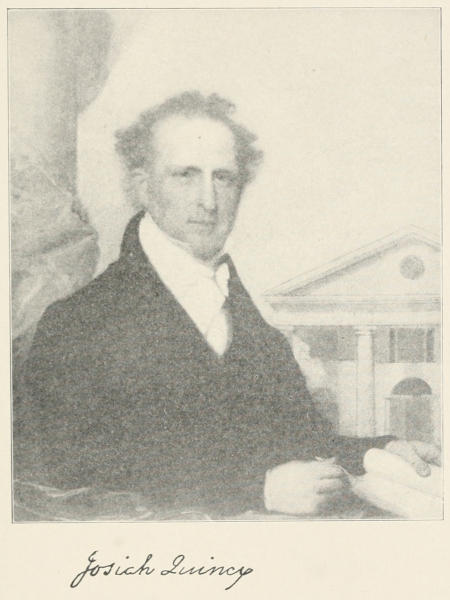
JOSIAH QUINCY
Sixteen years of Jeffersonian supremacy had culminated in a war which was against all Jeffersonian principles, and there had come about, while no one planned, an unlooked for disorder of parties, a bewildering reversal of parts in every matter of policy. In June, 1813, Mr. Josiah Quincy, no Jeffersonian, but a Federalist, professing to be of the school of Washington and Hamilton, had moved, in the legislature of Massachusetts, that “in a war like the present, waged without justifiable cause and prosecuted in a manner which indicates [234]that conquest and ambition are its real motives, it is not becoming a moral and religious people to express any approbation of military or naval exploits which are not immediately connected with the defence of our sea-coasts and soil,”—words which rang true to the earlier tones of Jeffersonian profession. The young leaders of the new Republican Congress, on the other hand, Jeffersonian Republicans though they professed to be, had pressed the war forward in the spirit, if not with the method, which had been Washington’s and Hamilton’s. Mr. Madison was not their real party head. Only eighty-three of the one hundred and thirty-three Republican senators and representatives attended the congressional caucus which gave him his nomination for a second term (May, 1812); and he won the election only by the vote of Pennsylvania. Mr. De Witt Clinton, of New York, Republican though he was, had put himself forward as an independent candidate, had carried New York with him into opposition, had received the support of the Federalists, desperate for success, and had been voted for by the electors of every northern State except Pennsylvania and Vermont. Mr. Madison had received the solid support of the South and the votes of Vermont and Pennsylvania. Pennsylvania’s twenty-five electoral votes had decided the election (128-89). Parties were breaking up, and Mr. Madison’s personality was not strong enough to hold his own party together. It had been a hazardous test of party allegiance with which to begin a war.
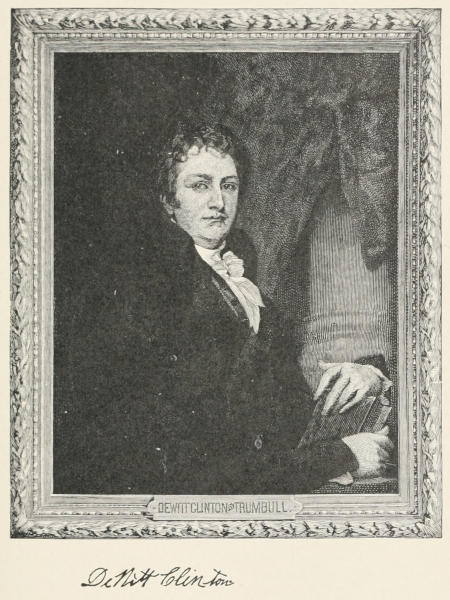
DE WITT CLINTON
And then, when the war was over and Mr. Madison’s eventful second term at an end, there had been another choice of President which seemed to go by rule of thumb rather than by the real preference of those who guided [235]affairs. Mr. Monroe received the succession,—not because of his personal force or because of any gift of leadership discoverable in him, but because, by long public service and by intimate association with the leaders of his party, he had made his way into the inner [236]group of politicians long since gathered about Mr. Jefferson. Virginia, one of the most populous and influential States of the Union, was the Republican party’s centre of gravity. Her public men, with twenty-five electoral votes behind them, dominated Republican party counsels; and Mr. Monroe was their choice for fourth Virginian President. His nomination was carried in caucus, it is true, only by the narrow margin of eleven votes over Mr. Crawford, of Georgia; but, that initial victory won, the presidency followed as of course. Mr. Madison had shown himself a statesman rather in the framing of institutions and the formulation of law than in the government of events. Mr. Monroe, without his studious comprehension of principles, stood for at least a like experience in affairs. The country, it seemed, was not yet ready for younger men, and there was no party set against him that could defeat him. The Federalists knew themselves discredited. What with their factious support of Mr. Clinton, who had never avowed any principle which they could pretend was their own, and the ugly threat of the Hartford convention,—their loss of principle in following the men they did follow and the openly avowed disunionist principles of the one-time leaders whom they did not follow,—the country at large had turned from them in contempt and deep distaste. Their electoral vote fell off to thirty-four again: the votes of Massachusetts, Connecticut, and Delaware.
No doubt it was a fortunate choice which preferred Mr. Monroe at such a time. A man of aggressive force and enterprising initiative would too much have disturbed the quiet, spontaneous processes by which, in those years of peace and yet of quick transition, parties [237]were finding themselves and making ready for a new age. That the new President was no master of men had become evident enough while he was a member of Mr. Madison’s cabinet. He had accepted the Secretaryship of State in April, 1811, with the avowed intention of extricating the country from the entanglements into which Mr. Jefferson and Mr. Madison had suffered it to be drawn; but the dark tide of perplexed diplomacy which swirled about the Napoleonic wars, and which had overwhelmed Mr. Madison, had caught him also in its fatal drift, and he had become Mr. Madison’s comrade merely, not his guide. He lacked originative strength, but not sound character; he fell short of the equipment of a statesman, but not of the equipment of an upright and serviceable public officer. He was able, his colleagues found, “to keep important matters steadily under his attention until he had mastered them and could form his judgment accurately concerning them”; and looked into his duties with “a mind of capital integrity and ingenuous honesty.” Without the social gift to preside with grace, he brought dignity and good temper to his task, and the safe traditions of an elder school in politics.
While he steadily held the government to its accepted and established mode of action and of growth, many things disclosed themselves in the life of the country, and politics moved forward to a new order. Hitherto the country had known the leadership only of New England and the South, regions peopled straight out of the Old World: the one ruled by a professional aristocracy of ministers and lawyers, the other by a social and proprietary aristocracy of land owners; both governed, alike in thought and action, by old traditions [238]and both smacking, whatever their professions of democratic principle upon occasion, of an old-world taste for privilege and for the authority of a trained, experienced, disciplined minority. But since the new century opened and Mr. Adams gave place to Mr. Jefferson new States had come crowding faster and faster into the Union, and came crowding still: Ohio (1802), Louisiana (1812), Indiana (1816), Mississippi (1817), Illinois (1818), Alabama (1819); most of them springing up in the far valley of the Mississippi, where new communities bred a new air and the sap of a new nation was rising. Transplantation thither seemed to create a new race,—not the mere offspring of New England or the South, not mixed or compounded of the two in such ways as to reproduce the East, not moulded from the Old World, not homogeneous even, but full of racy elements united in a new and free combination, more like New York and Pennsylvania than like Virginia or Massachusetts, and yet different also from these, with a flavor and spirit distinctively its own.
The country was at last in a position to feel at their full these forces from within, and to respond to them quickly and naturally. By the mastery of Wellington and Blücher at Waterloo (June 18, 1815) Europe had found peace again. For the first time since the Revolution in France, since the setting up of the federal government in America, the seas were cleared of hostile armaments. Questions of impressment and of the rights of neutral carriers at sea fell quietly out of sight amidst a general peace. Every strain was eased, and the young state in the West, which the great storm of war over sea, spreading blackly from continent to ocean till it seemed to fill the world, had at last touched and tested, could [239]turn to its own affairs with a novel sense of freedom from outside influences or interruption.
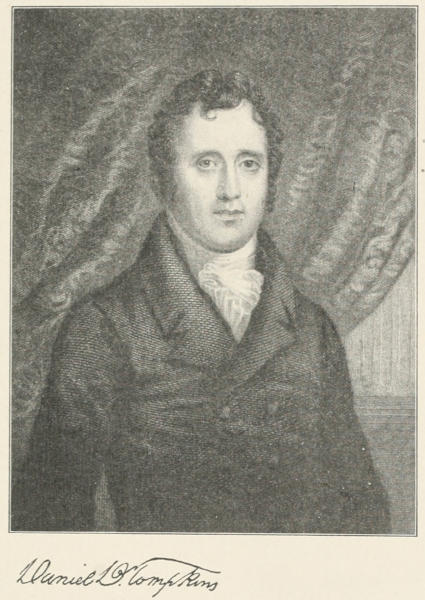
DANIEL D. TOMPKINS
She found her affairs and her life singularly altered. Peace changed the very face of trade. American skippers no longer had the lucrative advantage of commanding the only vessels free to pass from port to port amidst a world at war. There was, indeed, still plenty of carrying to be done at sea. Crops fell short in Europe [240]after the scourge of war, and America filled all the ships she could get with grain for the markets over sea. English merchants poured their goods once again into the American ports, so long shut against them by embargoes and war. But seamen of every nation could compete for the trade, and the Yankee skipper had no longer any advantage except such as his wit and sea-bred fitness gave him.
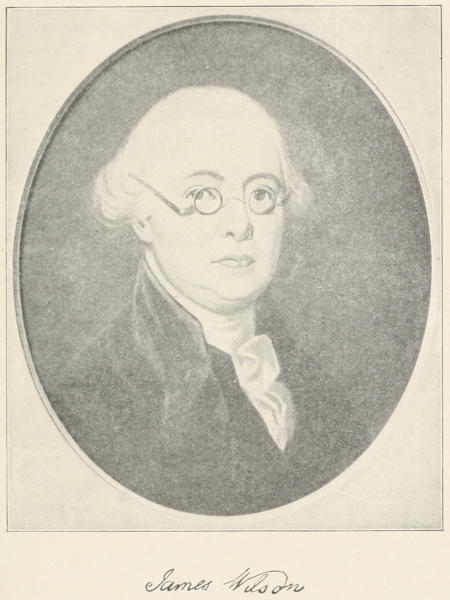
JAMES WILSON
The very freedom with which trade moved, besides, altered the attitude of the country towards it. Manufactures had sprung up while the ports were closed. The very ship owners of the trading ports had in many instances sold their craft and put their capital into the manufacture of such things as were most immediately needed for the home market. By the year 1815 close upon fifty million dollars had been invested in the manufacture of textile fabrics alone. In 1808, when feeling ran so hot in the East over the embargo, there were but eight thousand spindles employed in the manufacture of cotton, and only some fifteen hundred bales of cotton per year were needed to supply them; but in 1815 there were five hundred thousand, and ninety thousand bales of cotton were used within the year to keep them busy. In 1814 Mr. Francis Lowell, of Boston, had set up at Waltham the first factory ever established in which every process in the manufacture of cotton, from the cleansing and carding of the raw material to the weaving of the cloth, was carried through under a single roof, each step intelligently and economically coördinated and fitted to the next. The secret of the power loom successfully put into operation in England in 1806 had been very jealously and carefully guarded by its inventors, but Mr. Lowell, with the [241]assistance of shrewd mechanics, worked its principle out to a successful application for himself, and the American factory system was once for all established. The new movement did not stop with the establishment of cotton factories. The manufacture of wool and flax and hemp and even silk was added. The machinery which could not be bought in England was made in America. Iron manufactures, long ago set up but tentative and feeble hitherto, increased from hundreds of thousands to millions in value under the stimulation of foreign trade cut off. Hides and skins were extensively prepared; liquors were distilled and fermented from the abounding grain and fruits of the country-sides; glass, earthenware, furniture, almost everything that was in general use in the country, [242]was sooner or later added to the growing list. Industries long ago begun upon a small scale took heart to grow, and those which Americans had hitherto not dreamed of attempting were hardily embarked upon. Distinct manufacturing regions began sensibly to develop in the middle States and in the East, with interests and characteristics which statesmen could not afford to overlook.
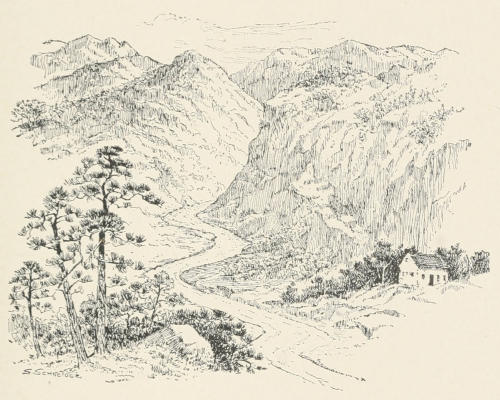
CUMBERLAND GAP, NEAR WHEELING, VIRGINIA
It was manifestly a menace to every young industry that a flood of English imports should continue to pour into the country at the open ports. The remedy was a protective tariff, such as Mr. Hamilton had wished to see at the first; and the young Republican leaders of Congress did not hesitate to advocate and establish it (April, 22, 1816). Mr. Madison himself favored and even urged it, as he had favored and urged also the re-establishment of the national bank. Western members of Congress supported it because they wanted and could get duties on flax and hemp. Every State in the Union except Delaware and North Carolina was represented by at least one member in the vote which established it. Men of the most diverse views and interests united in wishing to give the country not only political but also economic independence. Mr. Clay urged that it ought to be put into a position to develop every resource that could serve it or make it powerful in time of war. The duties imposed were not high: twenty-five per cent. upon cotton and woollen goods, and upon other manufactured goods in proportion. But the duties on cottons and woollens were made very formidable, as it turned out, by a provision that in no case should they amount to less than six and a quarter cents a yard. At the very outset that represented [243]a tax of more than twenty-five per cent. on the coarse goods which the southern planters bought for the use of their slaves; and as the processes of manufacture cheapened this fixed minimum represented, of course, a larger and larger fraction of the price. It was pretty sure in the end to become an effectual barrier against all foreign competition.
The men who planned these things saw also the danger of mere development, the risk in growth itself, unless the country, with its long coast and scattered settlements, spreading more and more upon the unlimited spaces of the great continent, were in some way bound together by easy means of intercourse and union. It had been found next to impossible to handle armies in the northern forests during the war, or in the long wilderness which lay upon the lower Mississippi between the Atlantic settlements and the Gulf: difficult to handle them anywhere at the heart of the country, even amidst the oldest settlements,—for lack of roads or any open way of transport except where rivers or the lakes themselves lay like highways. The troops had been time and again likely to starve, not because there was not food enough to be had upon the order of the government, but because it could not be got to them. The commissary had infinitely more difficult duties than the general in command. Great highways were needed, alike for war time and for times of peace, and a system of canals cut from watercourse to watercourse. Mr. Gallatin had outlined what ought to be done so long ago as April, 1808, in a forcible report to Congress, planning a whole scheme of intercommunication with all his wide-eyed, statesmanlike sagacity in such matters; but Mr. Jefferson, though he felt nothing [244]less than enthusiasm for the Secretary’s plan, had demanded first a constitutional amendment to make it legal. Mr. Gallatin’s broad purpose of “internal improvements” upon a national scale and at the nation’s expense slumbered, therefore, until the Congress came which the young Republicans led who made war on England. Then (December, 1816) Mr. Calhoun, of South Carolina, proposed that the million and a half dollars which the new national bank had paid the government for its privileges should be set aside as a fund “for constructing roads and canals and improving the navigation of watercourses.” But, though the bill passed, Mr. Madison vetoed it, entertaining Mr. Jefferson’s scruples in the matter; and for a little while longer the plan was put aside. The federal government did nothing but slowly push forward through the Cumberland [245]Gap into the West a single great road which was meant to be the nation’s highway to the lands on the Ohio, its common estate in the far western valleys. This road the government had begun in 1806, and from year to year small appropriations had been made for its extension as opportunity or money permitted. But for anything more than this the time was not yet quite ripe.
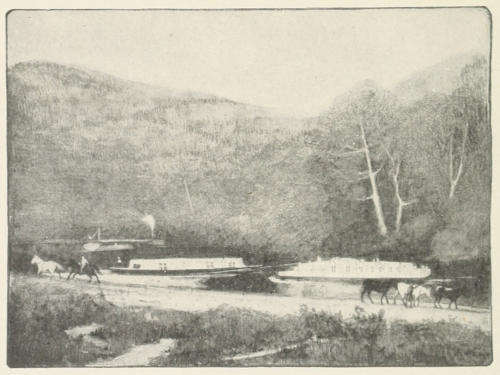
CANAL BOATS CROSSING THE MOUNTAINS
The new national principles of the Republican leaders found fuller scope and a wider application in affairs when Mr. Monroe became President,—not so much because of any change from the old order of thinking in Mr. Monroe himself, as because events overruled party creeds and made their own terms with abstract principles. Subtly, insensibly, by an alchemy whose processes no man knew or guided, the transformations of growth were becoming also transformations of character in the young body politic of the Union. Young men, and men not hitherto looked to for leadership, were pushing themselves to the front. Mr. Madison had already called Mr. Crawford, of Georgia, one of the new group of congressional leaders, into his cabinet, and Mr. Monroe retained him as Secretary of the Treasury. He called Mr. Calhoun, of South Carolina, to the Secretaryship of War. The State Department, hitherto the chief post of each administration, he put into the hands of Mr. John Quincy Adams, whose defection from the Federalist ranks in 1808 had shown in him the temper and the audacity of the man who dares interpret the signs of the times and is not subject to the discipline of parties retrogressive or gone astray.
Letters written by Mr. Jefferson and Mr. Madison [246]from their quiet places of retirement could not hold the country back from radical change. Every year the mere scale of affairs, if nothing more, was enlarged and altered,—by the tidelike movement of population into the western country, the setting up of new States, the quick transfigurements of economic conditions, the incalculable shiftings and variations of a society always making and to be made. It was found when the census of 1820 came to be taken that the total population of the country had increased from 7,215,791 to 9,638,191 within the decade. Twenty thousand immigrants had come in at the ports the year Mr. Monroe became President (1817). It was not merely a growth along the old lines and at the old seats of population. The restless, unceasing, adventurous movement of the nation made a deeper impression upon its politics than did its mere growth. The boatman’s song on the long western rivers, the crack of the teamster’s whip in the mountain passes, the stroke of the woodman’s axe ringing out in the stillness of the forest, the sharp report of the rifle of huntsman, pioneer, and scout on the fast advancing frontier, filled the air as if with the very voices of change, and were answered by events quick with the fulfilment of their prophecy.
Five States were admitted to the Union within the first four years of Mr. Monroe’s administration, as many as had been admitted within the five-and-twenty years preceding, as many as were to be admitted within the five-and-twenty years to follow. And the list of new States was not complete before an issue had been raised whose significance was only too plainly of the future: not a thing to be settled at a stroke, but a thing to be slowly tried out by the long processes of the nation’s life. It startled him, Mr. Jefferson said, “like a fire-bell in the night.” It arose out of the application of the Territory of Missouri to be admitted to the Union (March 6, 1818). Missouri had been settled out of the South; slave owners had followed the hardy first settlers thither; and now they asked leave to come into the Union as a State with the institution of slavery secured to them in their constitution. Here was a question which aroused passion and challenged principle upon the instant,—an issue between the North, which had rejected slavery, and the South, whose industries and whose very social order were founded upon it.
[247]
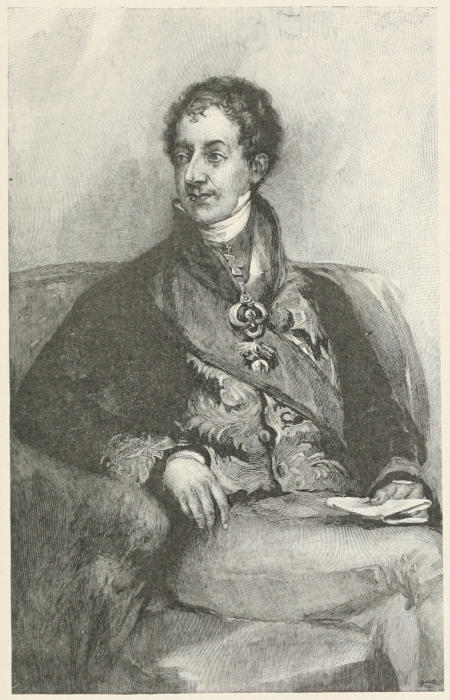
PRINCE METTERNICH
[248]
Southern statesmen had dominated the counsels of the ruling party of the nation these sixteen years and more. Men out of the South were also making and governing the West. The broad stretches of the great State of New York, themselves but half peopled and full of fair regions inviting to settlement, lay between New England and the far-away valleys where new States were to be built; the unoccupied forests of Maine were near at hand and easy of access at the north; many a tract within the borders of New England’s own little commonwealths still awaited occupation and development. By special effort an “Ohio Company,” organized in Massachusetts by veterans of the Revolution, had sent bands of settlers out of New England to lands which it had purchased and reserved upon the northern bank of the great river the French had coveted, and little hamlets of their making had sprung up there and flourished. Its settlers, crowding slowly in, had played a notable part in making the young State of Ohio ready for admission into the Union (1802). But [249]it was not men out of New England, or even out of Pennsylvania and New York, which lay so close at hand, who were as yet playing the chief part in the West. Kentucky and Tennessee, themselves but the other day built into States by hunters, woodsmen, pioneers, adventurers, while the Revolution was being fought out and the Union brought into existence, furnished the men who were fittest for the first enterprises of conquest and settlement beyond the Ohio and the Mississippi: the conquest of nature and of the doughty tribes of red men who were still knights challengers there in the daunting wilderness.
The Ohio poured its open flood along all the northern front of Kentucky from northeast to southwest; the Mississippi itself was at her doors at the west, and swept slowly down, below her, along all the western front of Tennessee. Kentuckians had constituted the chief part of the rough-and-ready muster which beat the English and Tecumseh’s braves, their allies, at the Thames by Lake St. Clair, to make safe the northwestern border in the war of 1812. Tennesseeans, under a Tennesseean commander, had lain in the trenches at New Orleans in the mist of a January morning in 1815, and saved the South on a famous field. Men upon those frontiers had the initiative, the training, and the zest for every sort of daring and endurance, and a sense of comradeship which made the whole long border seem to them their common home and field of endeavor. It was they who crowded first across the great streams at their front into Indiana, of which they had been prompt to make a State in 1816; into Illinois, presently to be admitted (December, 1818); and into Missouri, which they now insistently asked leave to bring in. Indiana [250]and Illinois lay above the Ohio, and were parts of that great Northwest Territory which Virginia and her sister States had consented to part with as a preparation for the setting up of the Confederation. It had become, as they intended, a national domain, for whose organization and development the Congress of the Confederation had made well-considered plans in the famous Ordinance of 1787. That Ordinance was still the law of the land. It forbade slavery forever. The pioneers who had pressed across the Ohio from the south, to make the new commonwealths now established there, had been promptly followed by men out of the older settlements behind them, out of Virginia and North Carolina, and out of the long-settled neighborhoods of Kentucky and Tennessee themselves. These men had again and again petitioned Congress for permission to own and employ slaves in their new homes; but Congress had refused to relax the law. In Missouri there was no such bar. Slave owners could take up lands there and put their slaves upon them. It was a region carved out of the vast Louisiana purchase beyond the Mississippi. Its lands stretched wide upon the open prairies of a new region for which Congress had made no law. Institutions might shape themselves there at will; and did shape themselves, accordingly, to the masterful will of the aggressive men who had gone over to possess the land.
It was, indeed, a masterful race, which the men of the East were slow to understand or sympathize with,—a race bred to warfare and a lawless mastery. It had made short work of overcoming nature in the wilderness, and as short of driving the Indians with slaughter and savage force from their hunting grounds and bits of [251]tillage. It had meant to cross the river and make itself free of the great province of Louisiana whether Mr. Jefferson had bought the inviting region or not. Not content with such trade as they could get upon the rivers at the east, its pioneers sent caravans of white-hooded wagons across the long plains into the far southwest, from their new seats in the Missouri country to the Spanish settlements which lay upon the Rio Grande del Norte. Their talk was already of a time when they should thrust the Spaniard out there also, and have all the continent from ocean to ocean, north and south, as one unbroken national domain.
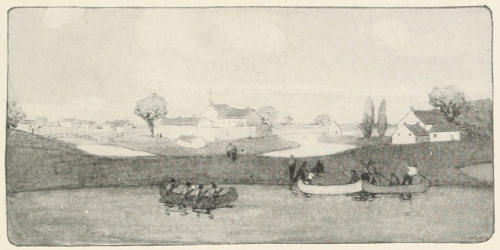
CHICAGO IN 1821
Such men were not likely to take a refusal when they asked to be admitted to the Union, whatever their proffered state constitution contained of institutions distasteful to politicians in the East. But their request threw Congress and the country itself into a very fever of debate. Here was indeed a critical choice to be made concerning the extension of slavery. Slavery had found no suitable place in the economy of the northern [252]States, where free labor had from the first predominated, and was now abolished: though it had been permitted in every one of them no longer ago than the year of the Declaration of Independence, and had been abolished in some but the other day. In the South, on the other hand, it had long been habitual and of the fixed and accepted order of society, the very foundation of an aristocratic system and way of life; and was now about to get a new hold and enjoy a new reason for being. In the days of the Revolution there had seemed a considerable body of sentiment against slavery even in the South. Many a generous protest had been uttered there against it, especially in Virginia, by men who were no closet philosophers, but the trusted representatives and leaders of their State; who declared that it discouraged arts and manufactures, degraded labor, and had a most pernicious effect on manners. But such sentiments had given way before the fact of its inveterate rootage and before the increasing value and serviceableness of slave labor in the cotton fields, as the crop rose from, hundreds to hundreds of thousands of bales, and the spindles both of Old and New England waited on the bursting of the boles. The cotton gin which Mr. Whitney had invented enabled even an unskilful slave to cleanse a thousand pounds of cotton of its tenacious seed in a single day. Without it he had been able to cleanse but five or six pounds. The negro could endure the heat of the southern day in the open field as the white man could not. His labor had become the very sinews of the South.
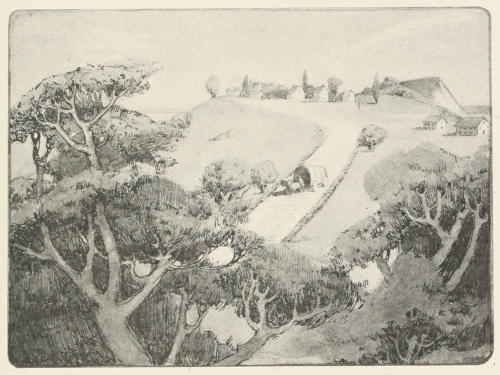
JERSEY CITY IN 1820
Southern men had seen already what the system must cost them. Its mere existence meant that the North must outstrip them in population and in wealth. [253]White immigrants, free laborers, would not come into the South; and manufactures could not be built up where the only laborer was the awkward, careless, inapt slave. If the South could not keep her place in the race for men and wealth, she must lose also her place in the race for power. Slowly and surely, as representation was reapportioned from decade to decade, to correspond with the changes disclosed by the decennial census, her representation in the lower house of Congress must grow smaller and smaller, that of the northern States larger and larger, until she should be overwhelmed in matters of legislation by a governing majority which could neglect her peculiar interests at pleasure. Southern men did not doubt that such a majority would be used against the South. Their leaders felt sensibly enough [254]the subtle antagonisms which radically different social standards, radically different economic conditions, radically different interests and ways of thought made more and more intense from year to year. Here was already, they began to see, a nation of two disparate halves, whose interests, if indeed irreconcilable, as they seemed, must be kept at a nice balance over against each other,—a balance hazardous to maintain, fatal to give up.
This was the unpleasant light that shone upon the question of Missouri’s admission to the Union with a slave constitution. What division was to be made of the Louisiana territory as between the southern system and the northern? East of the Mississippi all was plotted out and settled that concerned this vexatious matter. The line of the Ohio, it had been agreed, should mark the cleavage between free States and slave. Mississippi and Alabama had offset Illinois and Indiana in the list of States created this side the Louisiana purchase. If the Senate was not to pass, like the House, entirely into the hands of a northern majority, there must be some similar division of the Louisiana country also, which stretched beyond the river, wide as the original domain of the Union. The case of Missouri must turn upon fundamental questions of interest, development, and political power.
For two years it hung doubtful, held in debate both within and without the houses of Congress; and it was settled at last only by compromise. It was agreed that Missouri should be admitted upon her own terms, with slavery sanctioned in her fundamental law, but that from all the rest of the Louisiana purchase tying north of latitude 36° 30′,—a line drawn beyond Missouri as [255]if straight into the west from the mouth of the Ohio,—slavery should be forever excluded, as it was from the Northwest Territory; and Missouri was with that understanding authorized (March 3, 1820) to organize a state government with slavery in its constitution. At the same time a bill was passed admitting Maine, in far New England, into the Union, as a counterpoise to the new slave State in the West. For a time the troublesome question was quieted; but many a sinister token of agitation and change had been brought to light in the long processes of debate. A sense of divided interests, sectional antagonisms, bitter personal feeling on the one side and on the other, a consciousness that fundamental contrasts and diversities of principle underlay the apparent agreement, wrought very seriously upon the minds of thoughtful men and could not soon or easily be thrown off.
Meanwhile other events pushed steadily forward the process of expansion and growth which was inevitably to hasten the solution of that and every other question of interest or of power. In 1810 Mr. Madison had taken possession of West Florida, the strip of coast which lay upon the Gulf between the Mississippi and the river Perdido, with its key at Mobile: upon the pretext that it was in fact part of the original territory of Louisiana, and had become the property of the United States by the cession of 1803. For seven years after that cession it had remained in the hands of the Spaniards, who considered it an integral part of Florida, in no way affected by Napoleon’s sale of Louisiana to the United States. But settlers had crowded in from the States. Their self-assertion and independence of action there and their manifest determination to be [256]quit as soon as possible of Spanish rule had thrown affairs into confusion; and Mr. Madison made their interests his excuse for interfering. It was April, 1813, before the Spanish garrison at Mobile suffered itself to be crowded out and relinquished its post; but Congress had not waited for it to go. It had already apportioned the territory (1812), in part to the new State of Louisiana, that year created and admitted to the Union, in part to the Territory of Mississippi. Spain was in no position to resist. Napoleon’s armies had overrun her (1810); she had become the battlefield upon which Wellington pitted himself against the marshals of France (1811-1812); her South American colonies had revolted against her and she was powerless to recover them; she could do nothing while Napoleon swept Europe with his power.
The government of the United States pushed its claims upon that frontier, accordingly, at every opportunity, and found opportunities enough in the disorders of the ill-governed province. Early in 1811 Congress had not scrupled to authorize the President to take “temporary possession” of East as well as of West Florida, by a couple of resolutions which were not made public until 1818; and only the President’s good principle in the matter had prevented additional acts of aggression and virtual conquest. Finally war with the restless, marauding Seminoles who were still upon the border (1818) brought the inevitable outcome. Andrew Jackson was in command at Mobile. When once in the field against the red men he would not stop because they crossed the frontier into Spanish Florida, but followed them over the border as he would have followed them anywhither, with a vigor that never hesitated or relented. [257]Suspecting the Spaniards at St. Marks and Pensacola of giving shelter and encouragement to the Indians, he incontinently seized both places until he should have reported his business finished and learned what his government wished to have done with them. Deeming Alexander Arbuthnot, a Scots trader whom he found there in the Indian country, and Robert Ambrister, an English ex-lieutenant of marines who could not give a satisfactory account of himself, to all intents and purposes “outlaws and pirates,” paid emissaries of the English government to keep trouble brewing for the United States among the Indians of Florida, he hanged the one and shot the other out of hand, British subjects though they were and within the territory of Spain. He had understood his real errand to be the virtual conquest of East Florida, time out of mind the refuge of [258]smugglers, runaway slaves, and broken and hostile tribes of Indians, and in time of war a constant menace to all the southern border because of the weakness or the unfriendly alliances of Spain.
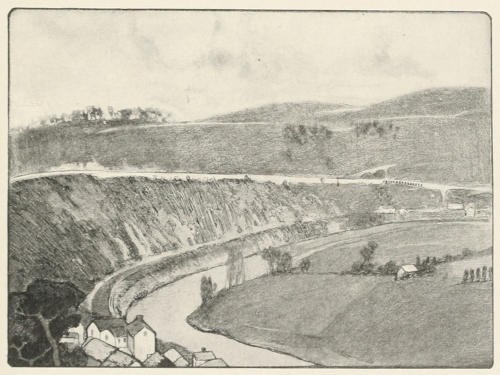
CUMBERLAND ROAD, NEAR WHEELING, VIRGINIA
Mr. Monroe and his cabinet were greatly shocked to learn what he had done in his headstrong masterfulness, and promptly restored Pensacola and St. Marks to the Spanish authorities; they saw nothing for it, however, so long as affairs stood as they did upon the border, but to defend their general’s course for the rest, upon the ground that he had only pursued his Indian foes to their habitual refuge amidst the forests of the peninsula, and performed in Spain’s stead the indispensable duties of police in districts infinitely disturbed and an undoubted menace to every neighbor. The Spanish government, on its part, saw clearly enough how defenceless and how useless Florida was, thus cornered and detached by the spreading power of the United States throughout the continent. On February 22, 1819, therefore, the Spanish minister in Washington, acting under new instructions from his government, signed a treaty by which Florida was ceded entire to the United States, in consideration of the payment by the United States of five million dollars in satisfaction of all claims, and the relinquishment by the United States of all right to the Texas country, where their title to possession was much better than it had ever been in any part of Florida. The Senate confirmed the treaty at once; the Spanish government tardily returned its ratification within a couple of years (February, 1821); and the questionable business was at an end.
Both Mr. Madison and Mr. Monroe addressed themselves very diligently, the war of 1812 being over and [259]all the world having come into a breathing time of peace, to clearing all foreign complications away. In 1815 Mr. Monroe, being then himself Secretary of State, had arranged with Great Britain a tolerably satisfactory commercial convention, which opened at any rate a part of the trade of the British West Indies to American ships. The same year the Dey of Algiers, who had taken advantage of the war to prey upon the commerce of the United States, was obliged upon Commodore Decatur’s quarterdeck to sign a treaty of peace and amity which he was not likely soon to break, having read his lesson at the port-holes of a formidable fleet in his harbor. In 1818 Mr. John Quincy Adams, acting under Mr. Monroe, negotiated fresh treaties with England under which the United States gained permanent rights in the Canadian fisheries, Great Britain gave up her claims to the navigation of the Mississippi, and the northern boundary line of the United States was determined from the Lake of the Woods to the Oregon country.
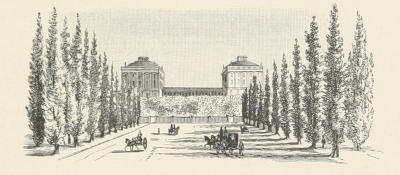
THE CAPITOL AT WASHINGTON, 1804
Fair skies at home and abroad cheered the country ere the time for choosing presidential electors came round again, in the autumn of 1820, foreign difficulties [260]having cleared away and the ill-omened Missouri question being apparently settled; and Mr. Monroe’s re-election was agreed upon as of course. When the electors met in their several States to vote only a single one of their number, an elector of New Hampshire, indulged himself in an individual choice, voting, not for Mr. Monroe, but for Mr. John Quincy Adams. Every other vote was cast for Mr. Monroe. Even eight Federalist electors, chosen, along with seven Republicans, in Massachusetts, joined in the all but unanimous choice; and the election passed as if it were hardly more than an incident, a formality, at mid-term of the President’s eight years of office.
There was no longer any Federalist party to be reckoned with in the field of national politics. Though Federalist views persisted, the name was a name discredited. The manufacturers of New England had been won over to the Republican party by the tariff of 1816; and had not cooled towards it because the Senate rejected the still higher duties which Mr. Monroe had recommended and the House had adopted. The rich merchants at the eastern ports did not like the tariff, but did like the President and the treaties of commerce and of peace he had secured. He had declared himself opposed to “internal improvements” at the national expense, upon which, progressive men thought, the movements and the expansion of commerce must in no small degree depend; and in 1822, when Congress put him to the test, he vetoed even an appropriation for the Cumberland road; but he presently modified his views on that point, and, for the rest, held so steady and reasonable and open a course, and was upon occasion so spirited in defending the nation’s interests, that criticism [261]gathered no head against him. Politicians schemed for personal advantage behind the scenes, not forgetting the next presidential election. Now one group and again another essayed to gain control of affairs. To those who read very curiously the signs of the times new parties seemed to be perceptibly enough outlined just beneath the surface of events. But on the surface there was a great calm, and to the country at large it seemed an acceptable time of concord, an “era of good feeling.” The strain of politics was eased.
With the return of peace all questions had become domestic questions, and there seemed now, for the nonce, to be no serious differences of opinion concerning them. Mr. Monroe took an early opportunity to domesticate, as it were, the very foreign policy of the government, by confining its issues to the Americas. European statesmen were putting their houses in order after the convulsions of the Napoleonic wars: setting up thrones which had been overturned, rehabilitating states which had been torn asunder, reassigning territory, establishing once more the balance of power and the rights of shaken dynasties. Finding their careful work likely to be marred and rendered of no avail by the passion for liberty which had spread like an unquenchable fire out of France and touched the subjects of almost every sovereign of Europe, they drew their states together under the leadership of Austria and her consummate Metternich to crush every rising, silence every demand for liberal reform, and make good the jeoparded absolutism of their kings throughout the length and breadth of Europe. Their reactionary purposes having been accomplished with some touch of thoroughness on the continent itself, Spain prayed them to assist her to win the revolted colonies of South America back to her crown, and they seemed about to accede to her prayer.
[262]
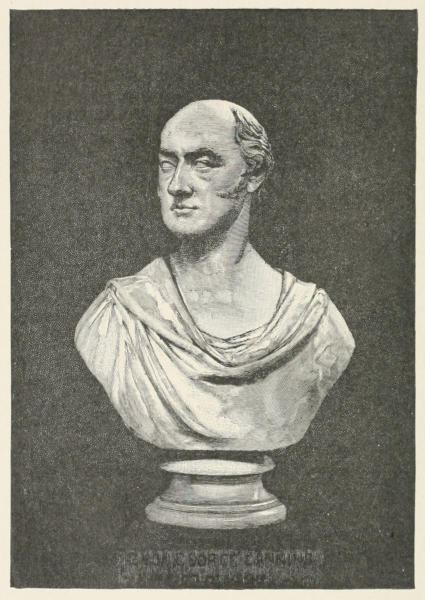
BUST OF GEORGE CANNING
[263]
Mr. Canning, England’s watchful minister, saw at once the peril there would be in that to England’s trade in the south. He knew, too, how hearty a sympathy the people of the United States entertained for the newly liberated peoples and the newly established republics of the southern continent of America, and how profitable a trade American as well as English merchants were finding in the ports which only revolution could have opened to them. He proposed, therefore, to Mr. Rush, the American minister in London, that the United States should join with England in protesting against the attempt of any outside power to restore Spain’s authority in America. Mr. Adams, the Secretary of State, did not relish the suggestion, though he approved the object. He thought such a course too likely to make the United States merely “a cock-boat in the wake of the British man-of-war,” and so draw them again and at a disadvantage into European politics; and Mr. Monroe accepted his view in the matter. A different but no less effective step was taken. In 1822 the President had recognized the independence of the South American republics. In his annual message of December, 1823, he told Congress and the world what attitude he meant to take towards any attempt on the part of the European powers “to extend their system to any portion of this hemisphere.” He should deem such an act, he declared, dangerous to the peace and safety of the United States. “With the existing colonies or dependencies of any European power,” he said, “we have not interfered and shall not interfere. But with [264]the governments who have declared their independence, and maintained it, and whose independence we have, on great consideration and on just principles, acknowledged, we could not view any interposition for the purpose of oppressing them, or controlling in any other manner their destiny, by any European power, in any [265]other light than as the manifestation of an unfriendly disposition toward the United States.” No one could mistake the meaning of the words, and Spain’s plans in the south were given up. This Mr. Adams and Mr. Monroe meant to be American, not European, policy.
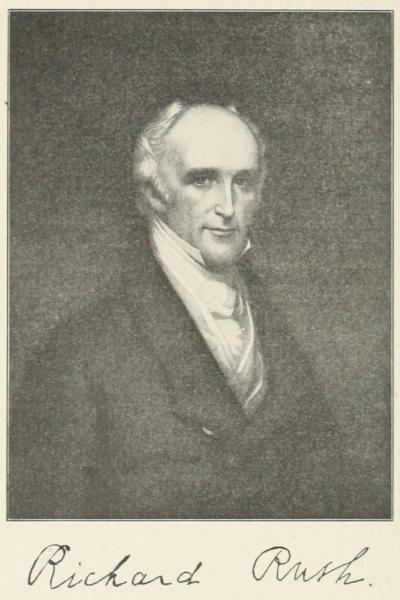
RICHARD RUSH
What had made the matter seem the more exigent and important was the unpleasant fact that Russia was gaining a foothold in North America itself. Russian fur traders were pushing and extending their trade not only in Alaska, which the Russian government claimed by right of discovery (1741), but also along the coasts to the southward, nearer and nearer to Oregon, which England and the United States, suspending their rival claims for the present, had agreed (1818) to occupy in common. The Czar claimed all the coast waters of the region as his own, and forbade seamen of any other nation (1821) to approach within one hundred miles of the American coast north of the fifty-first parallel. Mr. Adams had feared that, should the European coalition of which the Czar was so influential a member interfere in the affairs of Spain at the south, Russia might take the Spanish province of California as compensation for her trouble, and shut the doors of the Pacific once for all against the expanding Union. Mr. Monroe, therefore, spoke very plainly upon that point also in his message. “The American continents,” he said, “by the free and independent condition which they have assumed and maintain, are henceforth not to be considered as subjects for future colonization by any European power.” These decisive words proved sufficient. Whatever may have been Russia’s plans, she did not care to force them now; and in the closing months of Mr. Monroe’s administration (April, 1824) [266]she agreed to a treaty in which it was stipulated that the fisheries and the navigation of the Pacific were to be open to both parties, and that the line 54° 40′, north latitude, should divide their future settlements. The next year she made a similar agreement with Great Britain.
In 1824 Congress passed and the President approved a bill increasing duties on metals and on wool and hemp, in order that the protective system might be a little strengthened; and a bill providing for extensive surveys for a national system of canals, in order that an adequate improvement of the means of trade and intercourse might accompany the quickening of industry.
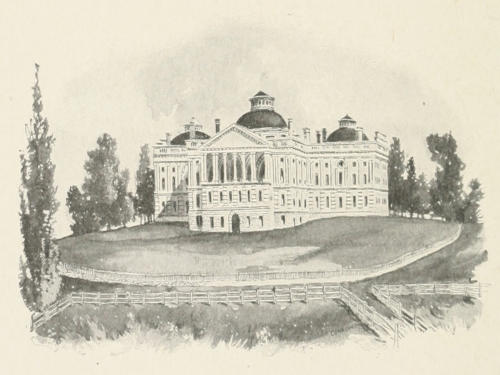
REAR VIEW OF THE CAPITOL AT WASHINGTON, 1820
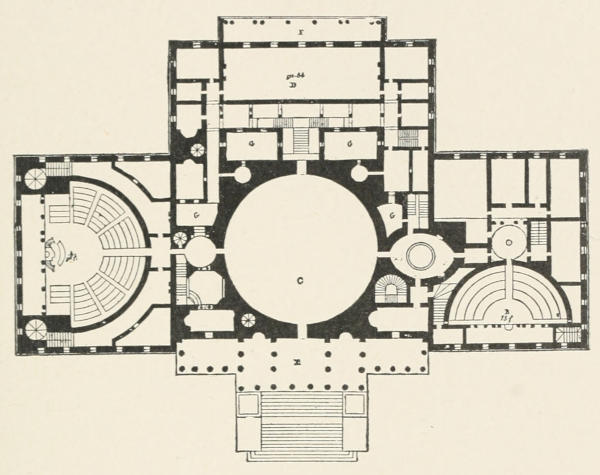
GROUND PLAN OF THE CAPITOL, 1825
A. House of Representatives, 96 feet radius; B. Senate Chamber, 75 feet radius; C. Central Rotunda, 96 feet in diameter; D. Library, 96 × 34 feet; E. Eastern Portico; F. Western Portico; G. Open Areas. The eastern front is 350 feet long.
And then, amidst a general scramble for the presidency, the country found how deceptive had been the political calm of the last few years. Personal rivalries disclosed, almost of a sudden, a new cleavage of parties. It was natural that Mr. Adams, as Secretary of State, should expect the succession to the presidency. Mr. [267]Madison had been Secretary of State under Mr. Jefferson, Mr. Monroe under Mr. Madison: the Secretaryship of State had come to be looked upon as the post to which the natural successor of the President should be called, and twenty-four years had given that understanding the dignity of precedent. Mr. Crawford, the Secretary of the Treasury, however, was determined that he should not again be passed by in the choice, and took pains to make himself, so far as might be, the official nominee of his party through the accustomed congressional caucus. Only a handful of his personal followers, indeed, and of the better disciplined adherents to old practice attended [268]the caucus when it met: the country had already grown impatient of that method of naming candidates, and Mr. Adams was understood, despite the caucus, to be the real candidate of the older elements of the party,—if party there was where all acted as if with common principles. The legislatures of Kentucky, Louisiana, Missouri, Illinois, and Ohio, the field being open, took leave to nominate Mr. Clay, the popular Speaker and acknowledged leader of the House, through whose eloquent tongue the new West rejoiced to hear itself given utterance. The legislature of Tennessee and several conventions in various parts of the country nominated Andrew Jackson, the headstrong, redoubtable Tennesseean soldier, now, though almost unnoticed there, a member of the Senate.
The nomination of General Jackson could very well be ignored, it seemed at first, as a mere rally of his personal friends here and there, so much of an outsider did he seem in every circle of politicians. “He is respected as a gallant soldier,” said the chief political newspaper of New York, “but he stands, in the minds of the people of this State, at an immeasurable distance from the executive chair.” The vote of the electors, however, put a very different color on the matter. It stood, for General Jackson, ninety-nine; for Mr. Adams, eighty-four; for Mr. Crawford, forty-one; for Mr. Clay, thirty-seven. Over the vice presidency there had been little contest: Mr. Calhoun was chosen, as had been expected, by a handsome majority. No one having received a majority of the votes for President, the election went, as the constitution provided, to the House, whose choice was limited to the three candidates who stood highest in the electors’ list. Voting by States, as [269]was prescribed, the House chose Mr. Adams, to whom Mr. Clay’s friends gave their support.
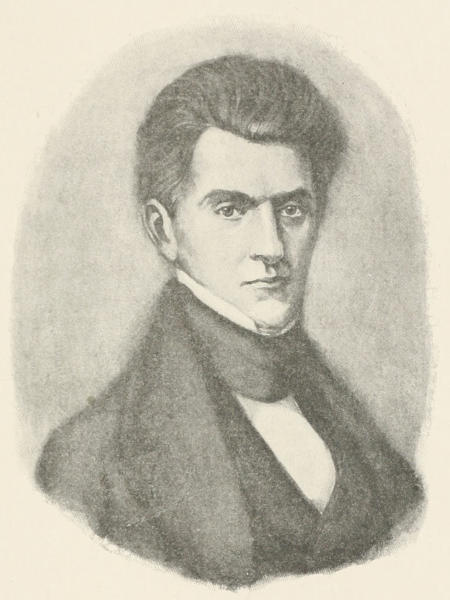
JOHN C. CALHOUN
There was in this sharp and doubtful struggle for the presidency, with its closing appeal to the managing politicians of the House, just shock enough, just thrill and zest enough of direct challenge and open contest, to bring the hidden lines of party to the surface. The four years of Mr. Adams’s administration completed [270]their disclosure, and changed the whole face of politics. The new President was undeniably the choice of a minority of the nation. He seemed to the impatient men of the new generation to be holding the government arbitrarily back from the touch of renewal and of democratization which they were eagerly waiting to give it. Mr. Adams seemed to them to represent the traditions of the old order which had passed, and to be a mere obstacle to the acknowledgment of the new order which had come. His very stiffness and precision of manner, as of the old school; his cool, unsympathetic aloofness from the men about him, repelling intimacy or any warm confidence; the dash of acid in his careful rectitude; his whole attitude, as of a man who administered his great office as a purely personal trust, for which he alone was responsible, and kept all others at arm’s length, enhanced the impression of his separateness, his single survival out of an age gone by. John Adams, his father, and Thomas Jefferson, whom he had first opposed and then followed, died the next year after he came to the presidency, passing away together on the fiftieth anniversary of the Declaration of Independence (July 4, 1826), the last great figures of the nation’s first generation of statesmen. The President seemed to have their principles without their warmth, to stand older than his years amidst a scene transformed.
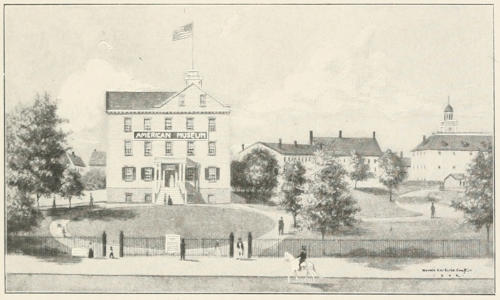
NORTH END OF CITY HALL PARK, NEW YORK, 1825
Social changes had come upon the nation thick and fast with the passing away of that first age, in which the government had been set up and had received its life and structure, and radical political changes had inevitably followed in their train. In the gathering host of new States at the west there could be nothing [271]but levels of privilege: no special class, trained and preferred for government, as in New England and the South, but universal manhood suffrage; and the example of the West had reacted powerfully upon the East. There, too, social change was touching affairs with the touch of transformation. Airs blew everywhere out of the West. Because its lands were open and not too far away, and every man could betake himself thither if he chose and be his own master, those who stayed at home in the East, whether common or gentle, had the flavor of independence, the choice of individual initiative in their lives, and counted, not in the mass merely, but as efficient units in every reckoning, social or political. New industries raised new classes, to rank with the merchants and the lawyers of the older order. The quick, incessant initiative of individuals broke the lines between class and class so often athwart that they became at last confused and lost. The suffrage was inevitably [272]widened in the East, as in the West; and with the number of voters the number of those who played a managing and organizing and originative part in politics also increased. Every right, as far as might be every function of politics, was thrown open to every man. Nine out of the fifteen States which took part in the second election of General Washington chose their electors through their legislatures; only six gave the people any direct part in the choice. In the election just decided by the vote of the House, on the contrary, the electors had been chosen by the direct vote of the people in eighteen out of the twenty-four States of the Union. Before another presidential election came around every State except Delaware and South Carolina had adopted the same popular system.
It was the pulse of these changes that now beat in affairs. A new democracy stood eager for its triumph,—now a second time, as first in 1800. It was tired of the “Virginian dynasty” that had ruled it, as if by prescriptive privilege, since the century opened, and was infinitely impatient of Mr. Adams as its heir and successor. Mr. Clay had seemed for a little while the preferred spokesman of the new generation, a veritable voice of the West and of democracy upon a new field, uttering its hearty ardor for a policy at once continental and of the people. The new State of Missouri had added Mr. Thomas H. Benton to the roll of Senators, to put his mass also into the western scale, a new leader among Democrats. But Mr. Clay lacked the unhesitating boldness and audacity loved on the frontier; had the address of the careful politician; brought his free and telling eloquence to the service of old ideals, merely quickened by new affairs; was not wholly of the West. Mr. Benton was heavy with a touch of pedantry, and had the self-assertion of the egotist, not of the leader. The new impulse of the time craved a hero rather than a statesman. No one knew or asked General Jackson’s opinions. His friends put him forward, not as a thinker or even as an organizer of parties, but simply as a man, whom the nation could trust: a man with rugged strength enough to break the old order in politics, now grown artificial, and inaugurate a new, under which the people, whose child and type he was, should come to their own.
[273]
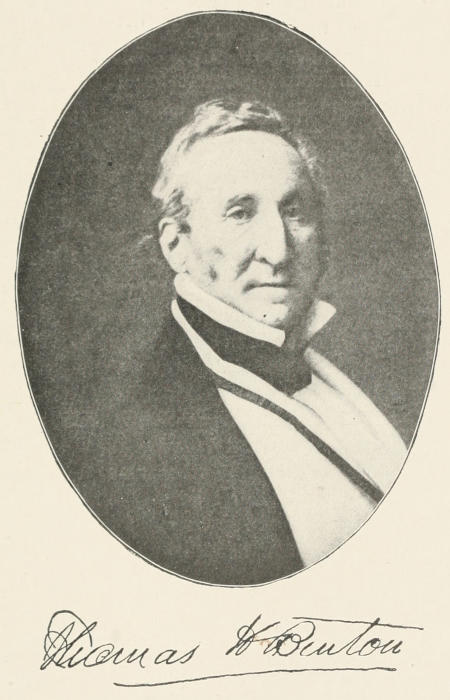
THOMAS H. BENTON
[274]
That was the significance of the ninety-nine electoral votes cast for General Jackson in 1825. It was a bitter thing to bear, his supporters found, to see Mr. Adams preferred before him, and Mr. Clay’s support given, out of the West itself, to the candidate of an eastern minority,—so bitter that they protested in their anger against the constitution itself, which made the thing possible: against any law, though it were the fundamental law of the land, which could thus restrain and defeat “the will of the people.” Their bitterness turned to malice when Mr. Adams asked Mr. Clay to become Secretary of State under the new administration and Mr. Clay consented. There was here, they said, palpable evidence of a bargain, an office given for an office received, a self-seeking combination to keep the people’s candidate out,—“a coalition,” exclaimed John Randolph, with bitter jest, “unheard of until now, of the Puritan and the blackleg.” The charge was shown to be absolutely groundless. There had been no previous understanding whatever between Mr. Adams and Mr. Clay. But they were facing men who in the vehemence of their passion believed what they chose, and [275]whose leader was as implacable and as obstinate in error as he was honest and direct in action.
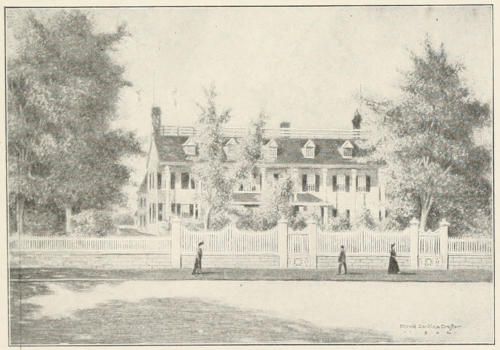
THE ADAMS MANSION, QUINCY, MASS.
General Jackson had been bred by the rough processes of the frontier; had been his own schoolmaster and tutor; had made himself a lawyer by putting his untaught sagacity and sense of right to the test in the actual conduct of suits in court, as he had made himself a soldier by taking the field in command of frontier volunteers as unschooled as himself in discipline and tactics. There was a certain natural grace and sweetness in the man when he was at ease, and an impressive dignity always. “General Jackson’s manners are more presidential than those of any of the candidates,” wrote a leading member of the House who was his opponent. “He is grave, mild, and reserved. My wife is for him decidedly.” But his nature was compact of passion. His prejudices, once fixed, were ineradicable. [276]He believed with all the terrible force that was in him, when once engaged in any public matter, that those who were with him were his friends and the country’s, those who were against him enemies of the country as well as of himself. Knowing his own convictions to be honest and formed without selfishness, he took their wisdom and their reasonableness for granted, and believed every one who held opinions opposed to them to be moved by some sort of public or private malice. He had declined at first to let his name be used in connection with the presidency, deeming himself old at fifty-four (1821), feeling ill from the effects of the hardships he had undergone in Florida, and believing himself unfit for the office. But, candidacy once undertaken, his passion played along every line of emotion and conviction opened by the novel business, as if he were again in the field with troops, and his friends were themselves at a loss how to govern him.
It had needed such a striking personality as this to bring parties to a head. They took form rapidly enough when he came upon the field. The coalition between Mr. Adams and Mr. Clay had been not only incorrupt, but an arrangement to be looked for in the nature of things. Mr. Clay stood in all his thought for the same principles of liberal construction in applying the constitution and for the same purposes of legislative action in furthering national interests that Mr. Adams frankly avowed and earnestly advocated: protective tariffs, internal improvements; the deliberate building up and binding together of the nation. General Jackson’s friends, on the contrary, were found for the most part among the men who had reacted against this new programme, in which every principle and purpose of the [277]old Federalists seemed revived, and who were harking back to the principles upon which the Republican party of Mr. Jefferson had been founded: a scrupulous limitation of the powers of the federal government, a studious regard for the separate powers of the several States, a democratic diffusion of power throughout the body politic. Mr. Crawford had latterly been of these principles; but Mr. Crawford was now broken in health, and his followers had turned to General Jackson. Whether General Jackson definitely or consciously [278]held their views or not they did not stop to ask. What was of moment to them was, that he stood in the eyes of the whole nation an unmistakable type of the unsophisticated man of the people. His instincts, they felt sure, could be trusted to make and keep him a partisan of popular privilege and local self-government. And so parties formed: National Republicans, as they began to call themselves, turned to Mr. Clay and Mr. Adams for leadership, while all “Democrats” of the older type turned to those who pressed the candidacy of General Jackson.
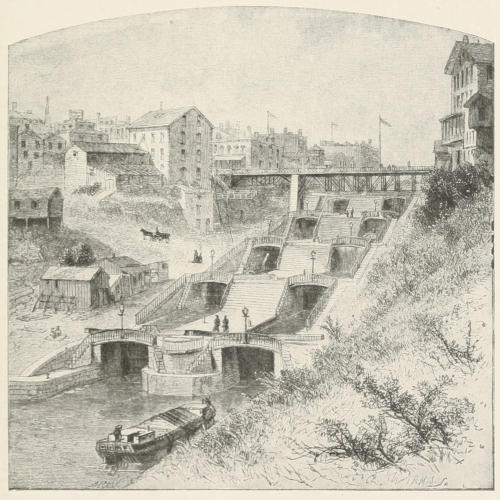
LOCKS ON THE ERIE CANAL
Though the men who thus drew apart into the one group or the other did not at once recognize their new comradeships in affairs as the permanent comradeships of principle or feel at first the bonds of party in their new association, it soon became evident enough that the election of 1825 had marked a parting of the ways, at which, consciously or unconsciously, public men had made their individual choices upon principles which must henceforth permanently separate them; had arrayed themselves in opposite camps upon a set field of party contest. They awaited only Mr. Adams’s going out to put the fight afoot.
The four years Mr. Adams was President yielded, accordingly, scarcely a single important measure either of legislation or of policy. They proved to be a season between times, in which the new parties got their first drill and organization, and merely manœuvred for advantage in the final struggle, the decisive victory and defeat, to come. Hitherto the President had been always the real leader of the government. His messages had in no small degree constituted the programmes of party action, in Congress hardly less than [279]in executive policy. Now, of a sudden, they counted almost for nothing. Mr. Adams was treated as if he were the leader of a faction. Congress seldom vouchsafed so much as a respectful consideration to his suggestions. Fresh congressional elections filled the House with his opponents. Now and again a measure passed which the Administration was known to favor; but only, it seemed, because the discipline of parties was not yet recast, and some men were guided, when they chose to be, by old ties or individual preferences.
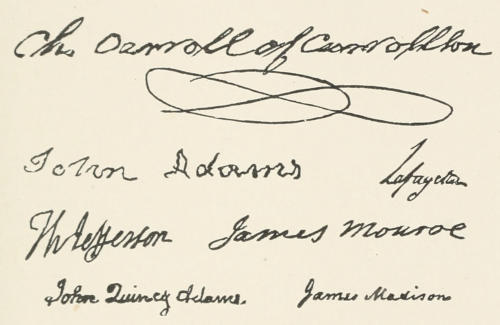
AUTOGRAPHS OF INVITED GUESTS, ERIE CANAL CELEBRATION
Mr. Adams performed his duties with the diligence, the intelligence, the high-minded regard for principle that had always characterized him. No man of his generation was better acquainted than he with the field of foreign policy, still here and there perplexed and ominous; and he applied himself like a statesman to the settlement of every question that was likely to affect [280]either the trade or the peace of the country. His successful treaties of commerce nearly equalled in number those of all the preceding Administrations put together. But in the chief matter of all he failed, and his opponents noted that alone. In 1815 Mr. Monroe, then Secretary of State, had succeeded in obtaining from England the right of trade with the British West Indies, in which, the ports once open, American merchants and skippers easily gained a virtual monopoly; but in 1825, when that agreement lapsed, England changed her policy, opened the West Indian ports to all the world on terms which put the United States at a disadvantage, and, because the United States did not, within a year set, accept the new arrangement, flatly refused so much as to open the matter again for negotiation (1826). Congress, not Mr. Adams, had been at fault; but the country, indifferent to him at best, made no inquiry into details: remembered only that he had failed to secure the invaluable West Indian trade.
The party contests of those barren years of divided counsel turned chiefly upon the tariff and upon the question of internal improvements. Mr. Adams was an avowed advocate of internal improvements upon a national scale, conceived and carried forward in accordance with a comprehensive system thought out beforehand, and completed from session to session as the resources of the Treasury permitted,—such a scheme as Mr. Gallatin had long ago conceived and advocated and Mr. Jefferson had postponed till the constitution could be amended. But the new “Democrats” made that impossible. Money in very liberal sums was voted from time to time for specific works of general or local utility, but the idea of a system of national improvements undertaken by the federal government had to be given up.
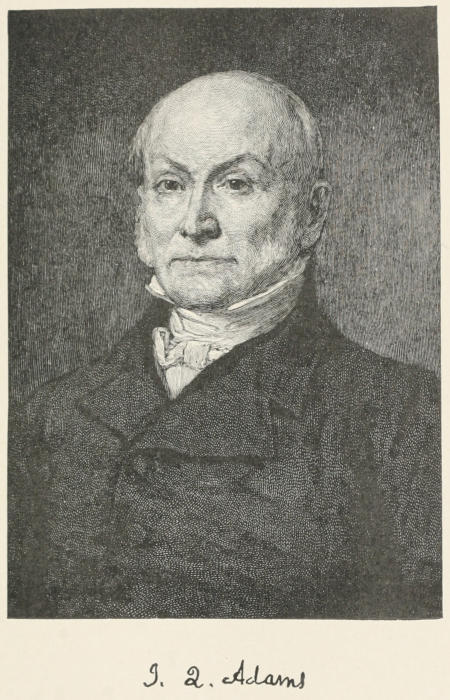
JOHN QUINCY ADAMS
[281]
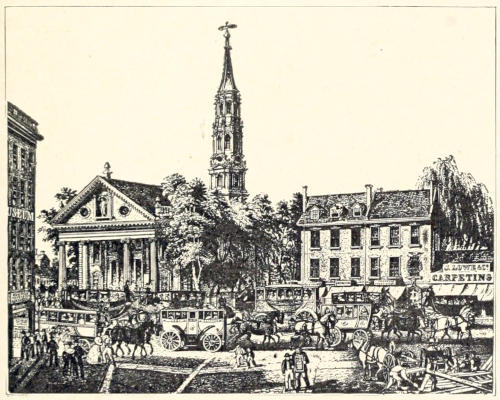
ST. PAUL’S CHURCH AND BROADWAY, 1831
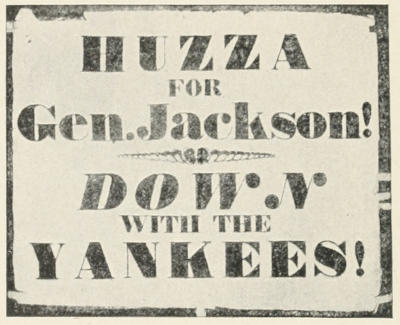
CAMPAIGN POSTER OF 1828
The tariff was another matter. The systematic protection of domestic industries, once undertaken, could not be kept squared with its object or maintained in good repair without frequent alterations and adjustments. The very system itself, moreover, was an incitement to every industry in the country, new or old, to clamor lustily, in season and out of season, for its share in the gainful arrangement. There was no one to govern the competition. First, interest vied with interest in an open field; then, rather than destroy each other, interests combined in an ill-assorted muster, whose demands the committees of Congress could neither reconcile nor withstand. The result was the tariff [282]of 1828. In July, 1827, a convention of protectionists had been held at Harrisburg, upon the initiative and invitation of the Pennsylvania Society for the Promotion of Manufactures and the Mechanic Arts. It had been called in the interest of the wool growers and manufacturers, but the politic general invitation by which it had been made up had bidden every other industry that chose send its delegates also. Many came who recked nothing of wool; and every industry represented put its own demands into the petition which the convention addressed to Congress. Congress, responding to the petition, put into its bills a like incongruous miscellany of provisions,—protection for all who asked it. The opponents of the tariff tried the too subtile game of discrediting the threatened legislation by thickening at every point its confusion of contradictory items; heightening in every possible way its absurdities and inconsistencies. They especially counted on forcing the New England manufacturers [283]to vote against it by filling it with provisions which increased the cost of their raw materials. But the game was too subtile and failed. The New England members hardily voted for the measure as it stood,—“the Tariff of Abominations.” It passed both houses, Mr. Adams signed it, and it became law.
For the southern men that was a day of awakening. Only a trifle here and there could come to them in this reckless distribution of favors. They were obliged in any case to content themselves with the agricultural system to which slave labor shut them in. Their prosperity depended, therefore, most of all, upon the free movement of trade: particularly upon a free and normal market for their cotton. Tariff measures which strangled trade at their ports put them at a distressing disadvantage. They got no more for their cotton than before: got less and less, indeed, as the crop increased; and yet they paid more for almost everything they bought. And what did they not buy? Each successive increase of duties seemed a heavier blow than the last to them, and even Mr. Calhoun put himself forward to stop the mischief. Many a southerner, many a South Carolinian, in Congress and out, had cried sharp warning ere he heeded. He yielded at last rather to the compulsion of opinion in his own State than to his individual observation and conviction in the matter, so thoroughly national were his instincts, so clear and imperative hitherto had been his bent towards a statesmanship which should take the whole country into its view. But his mind once engaged, and his passion for the interests of the people he served, and he seemed of a sudden the leader, almost the originator, of sectional opposition.
[284]
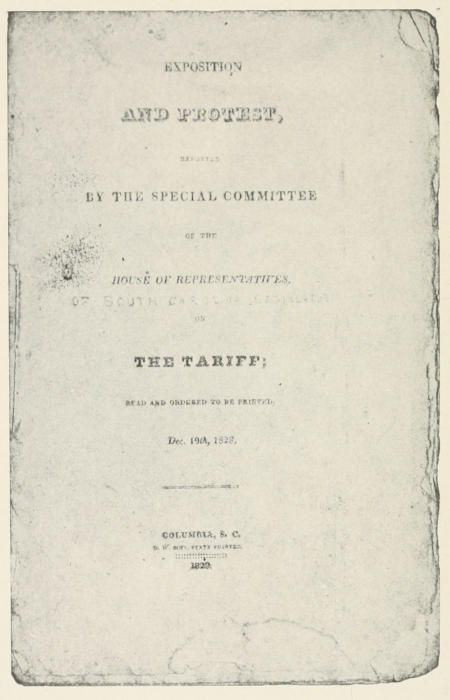
TITLE-PAGE OF CALHOUN’S “EXPOSITION”
[285]
Assuredly, though a section, the South was making contributions to the wealth and commerce of the country which entitled her spokesmen to a hearing. The total value of the exports from the United States in 1829 was $55,700,193, and to this total the southern States contributed no less than $34,072,655, in cotton, tobacco, and rice,—very nearly three-fifths of the whole. The total value of agricultural exports for the entire Union was $44,000,000. Of that total three-fourths came from the South. The value of manufactured articles exported footed up but $6,000,000, all told. The value of the cotton alone that went out at the ports was $26,575,311. And South Carolina was entitled to speak for her sister States. Her exports in 1829 were valued at $8,175,586. Only Louisiana in the South and New York and Massachusetts in the North showed a larger total.
It was the scope and precision of his mind that gave Mr. Calhoun his instant pre-eminence. He based his opposition directly upon the constitution itself, as his friends in South Carolina had done; but the argument in his hands seemed new because he made it so striking; seemed radical because he made it cut with so keen an edge of logic. It was, in fact, the old argument of the Virginia and Kentucky Resolutions, made but a little more definite, pushed but another step towards practical application. The southern States, Mr. Calhoun pointed out, were set apart from the rest of the Union, and, so far as any man could see, permanently set apart, by reason of their “soil, climate, habits, and peculiar labor,” to be “staple States,” without diversification of industry. In matters of commercial policy their interests could never be wholly coincident with those of [286]the rest of the country, and if Congress suffered their interests, which did not change, to be sacrificed to the interests of the rest of the country, which shifted and were new with each generation, their case would be intolerable, and the understandings of the federal arrangement [287]clearly set at naught. Was it not, in truth, the right of States put thus at a fatal disadvantage in respect of their very means of subsistence to have recourse once again to the ultimate authority underlying the whole structure of the government? Must they not in such a peril take their defence into their own hands, and declare the statutes under which they suffered null and without effect within their borders until a convention of the States should once more have considered the fundamental law and its meanings? Should three-fourths of the States, upon the recommendation of such a convention, declare the power complained of to be constitutional, protest must end, or revolution begin: but no other power could righteously force States protesting thus of their fundamental rights to be still and submit.
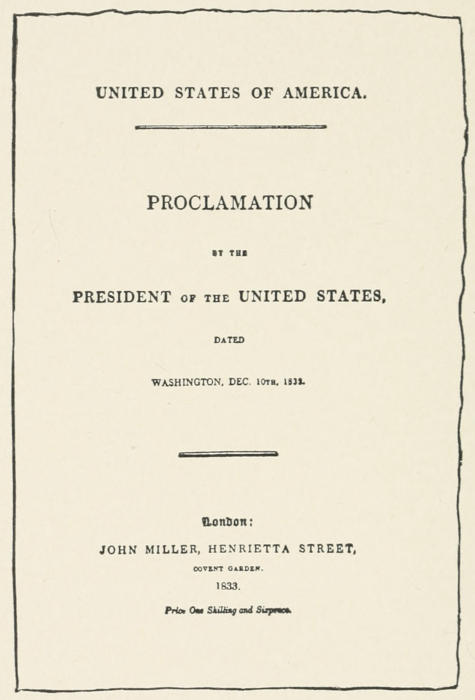
TITLE PAGE OF JACKSON’S “PROCLAMATION”
Feeling had at length come to such a pitch in South Carolina that her leaders were constrained to speak very boldly in this matter; and this was Mr. Calhoun’s exposition of her rights, undertaken at their urgent request. He had not acted upon his own initiative. His own thought was still of the nation as a whole and of local interests reconciled, not set against each other in rivalry and antagonism. He had yielded to the views of his friends at home, where passion was astir. Men whom he trusted came to him to be their spokesman in a matter which seemed to them to touch the very life of the State,—to be their spokesman, not in passion, but in the grave argument of rights. Unquestionably the most fundamental material interests of the State seemed to be at stake; unquestionably his own settled view of the nature of the federal arrangement and the reserved rights of the States furnished a [288]formidable weapon against the tariff of abominations. He turned from his dreams of national development to vindicate the interests of his neighbors and constituents, and, turning, put his strength into the new task as heartily as he had put it into the old. The manifesto, the “South Carolina Exposition,” which he put forth rang as clear as any call to party battle could have rung; and his friends had the spokesman they had coveted.
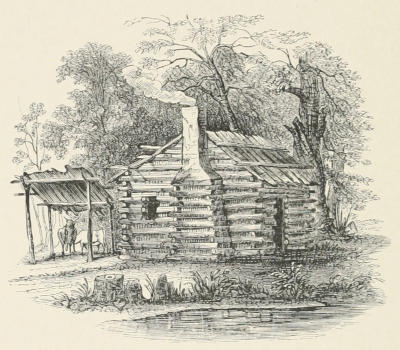
ANDREW JACKSON’S FOREST RESIDENCE
It was a document written with the full passion of his mind. Lover of the Union though he was, he conceived this to be its just and pristine model: a body of States sovereign in all that they had not deliberately relinquished for the sake of union; protected in the sovereignty which they retained, against the federal government no less than against one another, by inherent, [289]inalienable rights never surrendered, never impaired. These rights, inherent and unrelinquished, he conceived to be as much a part of the constitution as the powers transferred to the federal government. It was to these he would have recourse in time of crisis, not to the crude right of revolution. He would save the Union by an appeal to its ultimate principle: the deliberate concert of sovereign States. In this case of the tariff he hoped that a mere assertion of the constitutional right to a radical remedy would suffice. He had set himself, he believed, to keep the Union pure, not to destroy it. The government was about to change hands. It was evident to all observant men, in the summer of 1828, while he wrote, that General Jackson was to be the next President, and that the government was to pass out of the hands of the party that stood for high tariffs and an aggressive use of federal power into the hands of the new Democrats, who professed doctrines of strict construction and purposes of moderate action in the use of constitutional authority. South Carolina could afford to wait for the change. In December the legislature of the State adopted Mr. Calhoun’s exposition as its own declaration of rights and put it forth as South Carolina’s official creed and earnest of policy; but it, too, waited for General Jackson and a propitious change of temper in Congress, and took no step towards action.
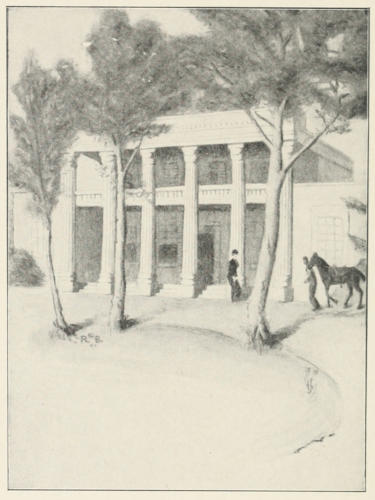
THE HERMITAGE. RESIDENCE OF GENERAL JACKSON
Already presidential electors had been chosen (November, 1828), and it was known that General Jackson commanded a large majority of their votes. In due course their votes were formally cast, and were found to be, when counted (February, 1829), one hundred and seventy-eight for General Jackson, eighty-three [290]for Mr. Adams. Mr. Calhoun, who had transferred his allegiance from Mr. Adams to General Jackson, was re-elected Vice President. In every State except South Carolina and Delaware the electors had been chosen by popular vote: 647,276 of the people’s votes had been cast for General Jackson, 508,064 for Mr. Adams. For four years the astute and active men who had constituted themselves General Jackson’s managers had been preparing this triumph. Even men whom Mr. Adams kept in high office had openly assisted them, Mr. Adams, so punctiliously did he judge of his duty in the matter, leaving them unmolested so long as they performed their official tasks with faithfulness and propriety. Their plans had covered the whole Union. Ever since October, 1825, before Mr. Adams had met his first Congress as President, legislatures and assemblies of every sort had been nominating General Jackson for the presidency, one after the other, in a succession that did not flag. Now they were satisfied. They had had their revenge for the defeat of 1824, and had put their idolized man of the people in.
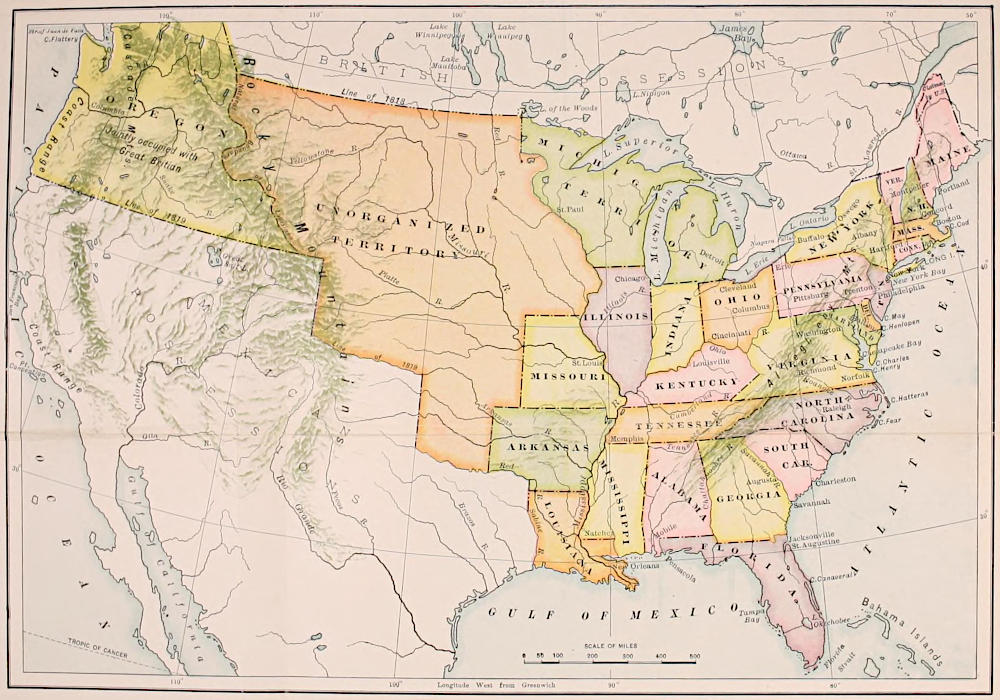
THE UNITED STATES, MARCH 4TH 1825.
BORMAY & CO., N. Y.
[291]
Authorities: For the period covered by this chapter our general authorities are the last volume (IX.) of Mr. Henry Adams’s History of the United States, the sixth volume of Hildreth, the fourth volume of Bryant and Gay, the fourth and fifth volumes of McMaster’s History of the People of the United States, the first volume of Hermann von Holst’s Constitutional and Political History of the United States, the second and third volumes of James Schouler’s History of the United States under the Constitution, and the third volume of George Tucker’s History of the United States. For accounts of the period more personal, more particular, or more limited in view we have Thomas H. Benton’s Thirty Years’ View, vol. I., Martin Van Buren’s Inquiry into the Origin and Growth of Political Parties in the United States, both of which are also contemporary sources of information, Judson S. Landon’s Constitutional History and Government of the United States, The Constitutional History of the United States as Seen in the Development of American Law, a series of lectures by Thomas M. Cooley, Henry Hitchcock, and others, Edward Stanwood’s History of the Presidency, Alden Bradford’s History of the Federal Government, R. McK. Ormsby’s History of the Whig Party, A. W. Young’s The American Statesman, James Parton’s Life of Andrew Jackson, George Ticknor Curtis’s Life of Daniel Webster, Daniel C. Gilman’s James Monroe (in the American Statesmen Series), Carl Schurz’s Henry Clay (in the same series), J. T. Morse, Jr.’s John Quincy Adams (in the same series), Henry Cabot Lodge’s Daniel Webster (in the [292]same series), William G. Sumner’s Andrew Jackson (in the same series), the second volume of Calvin Colton’s Life, Correspondence, and Speeches of Henry Clay, Henry Adams’s John Randolph (in the American Statesmen Series), Theodore Roosevelt’s Thomas H. Benton (in the same series), George Ticknor Curtis’s Life of James Buchanan, Edward M. Shepard’s Martin Van Buren (in the American Statesmen Series), Andrew C. McLaughlin’s Lewis Cass (in the same series), N. M. Butler’s Influence of the War of 1812 (in the fifth volume of the Johns Hopkins University Studies in Historical and Political Science), H. V. Poor’s Sketch of the Rise and Progress of Internal Improvements, Albert S. Bolles’s Financial History of the United States, F. W. Taussig’s Tariff History of the United States, and William G. Sumner’s History of American Currency.
The sources are to be found for the most part in The Annals of Congress, Thomas H. Benton’s Abridgment of the Debates of Congress, The American State Papers, the Messages and Papers of the Presidents, Hezekiah Niles’s Weekly Register, Williams’s Statesman’s Manual, the collected Works or Writings of Clay, Calhoun, Webster, Gallatin (edited by Henry Adams), Madison, Jay, Marshall, and Jefferson, W. W. Story’s Life and Letters of Joseph Story, G. J. McRee’s Life and Correspondence of James Iredell, G. M. Dallas’s Life of A. J. Dallas, the Memoirs of John Quincy Adams, Josiah Quincy’s Life of John Quincy Adams and Figures of the Past, Nathan Sargent’s Public Men and Events, Richard Rush’s Narrative of a Residence at the Court of London, John Taylor’s controversial Construction Construed and the Constitution Vindicated and Inquiry into the Principles and Policy of the Government of the United States, William Cobbett’s A Year’s Residence in the United States (1817-1818), Basil Hall’s Travels in North America (1827-1828), Amos Kendall’s Autobiography, Henry A. Wise’s Seven Decades of the Union, Clark and Hall’s Legislative and Documentary History of the Bank of the United States, C. F. Dunbar’s Laws Relating to Finance, F. W. Taussig’s State Papers and Speeches on the Tariff, and James B. Thayer’s Cases in Constitutional Law.
[293]
APPENDIX
TREATY OF PEACE—1783.
DEFINITIVE TREATY OF PEACE BETWEEN THE UNITED STATES OF AMERICA AND HIS BRITANNIC MAJESTY. CONCLUDED SEPTEMBER 3, 1783.
In the name of the Most Holy and Undivided Trinity.
It having pleased the Divine Providence to dispose the heart of the most serene and most potent Prince George the Third, by the Grace of God King of Great Britain, France and Ireland, Defender of the Faith, Duke of Brunswick and Luneburg, Arch-Treasurer and Prince Elector of the Holy Roman Empire, &ca., and of the United States of America, to forget all past misunderstandings and differences that have unhappily interrupted the good correspondence and friendship which they mutually wish to restore; and to establish such a beneficial and satisfactory intercourse between the two countries, upon the ground of reciprocal advantages and mutual convenience, as may promote and secure to both perpetual peace and harmony: And having for this desirable end already laid the foundation of peace and reconciliation, by the provisional articles, signed at Paris on the 30th of Nov’r, 1782, by the commissioners empowered on each part, which articles were agreed to be inserted in and to constitute the treaty of peace proposed to be concluded between the Crown of Great Britain and [294]the said United States, but which treaty was not to be concluded until terms of peace should be agreed upon between Great Britain and France, and His Britannic Majesty should be ready to conclude such treaty accordingly; and the treaty between Great Britain and France having since been concluded, His Britannic Majesty and the United States of America, in order to carry into full effect the provisional articles above mentioned, according to the tenor thereof, have constituted and appointed, that is to say, His Britannic Majesty on his part, David Hartley, esqr., member of the Parliament of Great Britain; and the said United States on their part, John Adams, esqr., late a commissioner of the United States of America at the Court of Versailles, late Delegate in Congress from the State of Massachusetts, and chief justice of the said State, and Minister Plenipotentiary of the said United States to their High Mightinesses the States General of the United Netherlands; Benjamin Franklin, esq’re, late Delegate in Congress, from the State of Pennsylvania, president of the convention of the said State, and Minister Plenipotentiary from the United States of America at the Court of Versailles; John Jay, esq’re, late president of Congress, and chief justice of the State of New York, and Minister Plenipotentiary from the said United States at the Court of Madrid, to be the Plenipotentiaries for the concluding and signing the present definitive treaty; who, after having reciprocally communicated their respective full powers, have agreed upon and confirmed the following articles:
ARTICLE I.
His Britannic Majesty acknowledges the said United States, viz. New Hampshire, Massachusetts Bay, Rhode Island, and Providence Plantations, Connecticut, New York, New Jersey, Pennsylvania, Delaware, Maryland, [295]Virginia, North Carolina, South Carolina, and Georgia, to be free, sovereign and independent States; that he treats with them as such, and for himself, his heirs and successors, relinquishes all claims to the Government, proprietary and territorial rights of the same, and every part thereof.
ARTICLE II.
And that all disputes which might arise in future, on the subject of the boundaries of the United States may be prevented, it is hereby agreed and declared, that the following are, and shall be their boundaries, viz: From the northwest angle of Nova Scotia, viz. that angle which is formed by a line drawn due north from the source of Saint Croix River to the Highlands; along the said Highlands which divide those rivers that empty themselves into the river St. Lawrence, from those which fall into the Atlantic Ocean, to the northwesternmost head of Connecticut River; thence down along the middle of that river, to the forty-fifth degree of north latitude; from thence, by a line due west on the said latitude, until it strikes the river Iroquois or Cataraquy; thence along the middle of said river into Lake Ontario, through the middle of said lake until it strikes the communication by water between that lake and Lake Erie; thence along the middle of said communication into Lake Erie, through the middle of said lake until it arrives at the water communication between that lake and Lake Huron; thence along the middle of said water communication into the Lake Huron; thence through the middle of said lake to the water communication between that lake and Lake Superior; thence through Lake Superior northward of the Isles Royal and Philipeaux, to the Long Lake; thence through the middle of said Long Lake, and the water communication between it and the Lake of the Woods, to the said Lake of the Woods; thence [296]through the said lake to the most northwestern point thereof, and from thence on a due west course to the river Mississippi; thence by a line to be drawn along the middle of the said river Mississippi until it shall intersect the northernmost part of the thirty-first degree of north latitude. South, by a line to be drawn due east from the determination of the line last mentioned, in the latitude of thirty-one degrees north of the Equator, to the middle of the river Apalachicola or Catahouche; thence along the middle thereof to its junction with the Flint River; thence strait to the head of St. Mary’s River; and thence down along the middle of St. Mary’s River to the Atlantic Ocean. East, by a line to be drawn along the middle of the river St. Croix, from its mouth in the Bay of Fundy to its source, and from its source directly north to the aforesaid Highlands, which divide the rivers that fall into the Atlantic Ocean from those which fall into the river St. Lawrence; comprehending all islands within twenty leagues of any part of the shores of the United States, and lying between lines to be drawn due east from the points where the aforesaid boundaries between Nova Scotia on the one part, and East Florida on the other, shall respectively touch the Bay of Fundy and the Atlantic Ocean; excepting such islands as now are, or heretofore have been, within the limits of the said province of Nova Scotia.
ARTICLE III.
It is agreed that the people of the United States shall continue to enjoy unmolested the right to take fish of every kind on the Grand Bank, and on all the other banks of Newfoundland; also in the Gulph of Saint Lawrence, and at all other places in the sea where the inhabitants of both countries used at any time heretofore to fish. And also that the inhabitants of the United States shall have liberty [297]to take fish of every kind on such part of the coast of Newfoundland as British fishermen shall use (but not to dry or cure the same on that island) and also on the coasts, bays, and creeks of all other of His Britannic Majesty’s dominions in America; and that the American fishermen shall have liberty to dry and cure fish in any of the unsettled bays, harbours, and creeks of Nova Scotia, Magdalen Islands, and Labrador, so long as the same shall remain unsettled; but so soon as the same or either of them shall be settled, it shall not be lawful for the said fishermen to dry or cure fish at such settlement, without a previous agreement for that purpose with the inhabitants, proprietors, or possessors of the ground.
ARTICLE IV.
It is agreed that creditors on either side shall meet with no lawful impediment to the recovery of the full value in sterling money, of all bona fide debts heretofore contracted.
ARTICLE V.
It is agreed that the Congress shall earnestly recommend it to the legislatures of the respective States, to provide for the restitution of all estates, rights, and properties which have been confiscated, belonging to real British subjects, and also of the estates, rights, and properties of persons resident in districts in the possession of His Majesty’s arms, and who have not borne arms against the said United States. And that persons of any other description shall have free liberty to go to any part or parts of any of the thirteen United States, and therein to remain twelve months, unmolested in their endeavors to obtain the restitution of such of their estates, rights, and properties as may have been confiscated; and that Congress shall also earnestly [298]recommend to the several States a reconsideration and revision of all acts or laws regarding the premises, so as to render the said laws or acts perfectly consistent, not only with justice and equity but with that spirit of conciliation which, on the return of the blessings of peace, should universally prevail. And that Congress shall also earnestly recommend to the several States, that the estates, rights, and properties of such last mentioned persons, shall be restored to them, they refunding to any persons who may be now in possession, the bona fide price (where any has been given) which such persons may have paid on purchasing any of the said lands, rights, or properties, since the confiscation. And it is agreed, that all persons who have any interest in confiscated lands, either by debts, marriage settlements, or otherwise, shall meet with no lawful impediment in the prosecution of their just rights.
ARTICLE VI.
That there shall be no future confiscations made, nor any prosecutions commenc’d, against any person or persons for, or by reason of the part which he or they may have taken in the present war; and that no person shall, on that account, suffer any future loss or damage, either in his person, liberty or property; and that those who may be in confinement on such charges, at the time of the ratification of the treaty in America, shall be immediately set at liberty, and the prosecutions so commenced be discontinued.
ARTICLE VII.
There shall be a firm and perpetual peace between His Britannic Majesty and the said States, and between the subjects of the one and the citizens of the other, wherefore all hostilities, both by sea and land, shall from henceforth [299]cease: All prisoners on both sides shall be set at liberty, and His Britannic Majesty shall, with all convenient speed, and without causing any destruction, or carrying away any negroes or other property of the American inhabitants, withdraw all his armies, garrisons, and fleets from the said United States, and from every port, place, and harbour within the same; leaving in all fortifications the American artillery that may be therein: And shall also order and cause all archives, records, deeds, and papers, belonging to any of the said States, or their citizens, which in the course of the war, may have fallen into the hands of his officers, to be forthwith restored and deliver’d to the proper States and persons to whom they belong.
ARTICLE VIII.
The navigation of the river Mississippi, from its source to the ocean, shall forever remain free and open to the subjects of Great Britain, and the citizens of the United States.
ARTICLE IX.
In case it should so happen that any place or territory belonging to Great Britain or to the United States, should have been conquer’d by the arms of either from the other, before the arrival of the said provisional articles in America, it is agreed, that the same shall be restored without difficulty, and without requiring any compensation.
ARTICLE X.
The solemn ratifications of the present treaty, expedited in good and due form, shall be exchanged between the contracting parties, in the space of six months, or sooner if possible, to be computed from the day of the signature [300]of the present treaty. In witness whereof, we the undersigned, their Ministers Plenipotentiary, have in their name and in virtue of our full powers, signed with our hands the present definitive treaty, and caused the seals of our arms to be affixed thereto.
Done at Paris, this third day of September, in the year of our Lord one thousand seven hundred and eighty-three.
[301]
GOVERNMENT OF THE NORTHWEST TERRITORY
1787.
An Ordinance for the government of the territory of the United States northwest of the river Ohio.
Section 1. Be it ordained by the United States in Congress assembled, That the said Territory, for the purpose of temporary government, be one district, subject, however, to be divided into two districts, as future circumstances may, in the opinion of Congress, make it expedient.
Sec. 2. Be it ordained by the authority aforesaid, That the estates both of resident and non-resident proprietors in the said territory, dying intestate, shall descend to, and be distributed among, their children and the descendants of a deceased child in equal parts, the descendants of a deceased child or grandchild to take the share of their deceased parent in equal parts among them; and where there shall be no children or descendants, then in equal parts to the next of kin, in equal degree; and among collaterals, the children of a deceased brother or sister of the intestate shall have, in equal parts among them, their deceased parent’s share; and there shall, in no case, be a distinction between kindred of the whole and half blood; saving in all cases to the widow of the intestate, her third part of the real estate for life, and one-third part of the personal estate; and this law relative to descents and dower, shall remain in full force until altered by the legislature of the district. And until the governor and judges shall adopt [302]laws as hereinafter mentioned, estates in the said territory may be devised or bequeathed by wills in writing, signed and sealed by him or her in whom the estate may be, (being of full age,) and attested by three witnesses; and real estates may be conveyed by lease and release, or bargain and sale, signed, sealed, and delivered by the person, being of full age, in whom the estate may be, and attested by two witnesses, provided such wills be duly proved, and such conveyances be acknowledged, or the execution thereof duly proved, and be recorded within one year after proper magistrates, courts, and registers, shall be appointed for that purpose; and personal property may be transferred by delivery, saving, however, to the French and Canadian inhabitants, and other settlers of the Kaskaskies, Saint Vincents, and the neighboring villages, who have heretofore professed themselves citizens of Virginia, their laws and customs now in force among them, relative to the descent and conveyance of property.
Sec. 3. Be it ordained by the authority aforesaid, That there shall be appointed, from time to time, by Congress, a governor, whose commission shall continue in force for the term of three years, unless sooner revoked by Congress; he shall reside in the district, and have a freehold estate therein, in one thousand acres of land, while in the exercise of his office.
Sec. 4. There shall be appointed from time to time, by Congress, a secretary, whose commission shall continue in force for four years, unless sooner revoked; he shall reside in the district, and have a freehold estate therein, in five hundred acres of land, while in the exercise of his office. It shall be his duty to keep and preserve the acts and laws passed by the legislature, and the public records of the district, and the proceedings of the governor in his executive department, and transmit authentic copies of such acts and proceedings every six months to the Secretary of Congress. [303]There shall also be appointed a court, to consist of three judges, any two of whom to form a court, who shall have a common-law jurisdiction and reside in the district, and have each therein a freehold estate, in five hundred acres of land, while in the exercise of their offices; and their commissions shall continue in force during good behavior.
Sec. 5. The governor and judges, or a majority of them, shall adopt and publish in the district such laws of the original States, criminal and civil, as may be necessary, and best suited to the circumstances of the district, and report them to Congress from time to time, which laws shall be in force in the district until the organization of the general assembly therein, unless disapproved of by Congress; but afterwards the legislature shall have authority to alter them as they shall think fit.
Sec. 6. The governor, for the time being, shall be commander-in-chief of the militia, appoint and commission all officers in the same below the rank of general officers; all general officers shall be appointed and commissioned by Congress.
Sec. 7. Previous to the organization of the general assembly the governor shall appoint such magistrates, and other civil officers, in each county or township, as he shall find necessary for the preservation of the peace and good order in the same. After the general assembly shall be organized the powers and duties of magistrates and other civil officers shall be regulated and defined by the said assembly; but all magistrates and other civil officers, not herein otherwise directed, shall, during the continuance of this temporary government, be appointed by the governor.
Sec. 8. For the prevention of crimes, and injuries, the laws to be adopted or made shall have force in all parts of the district, and for the execution of process, criminal and civil, the governor shall make proper divisions thereof; and he shall proceed, from time to time, as circumstances [304]may require, to lay out the parts of the district in which the Indian titles shall have been extinguished, into counties and townships, subject, however, to such alterations as may thereafter be made by the legislature.
Sec. 9. So soon as there shall be five thousand free male inhabitants, of full age, in the district, upon giving proof thereof to the governor, they shall receive authority, with time and place, to elect representatives from their counties or townships, to represent them in the general assembly: Provided, That for every five hundred free male inhabitants there shall be one representative, and so on, progressively, with the number of free male inhabitants, shall the right of representation increase, until the number of representatives shall amount to twenty-five; after which the number and proportion of representatives shall be regulated by the legislature; Provided, That no person be eligible or qualified to act as a representative, unless he shall have been a citizen of one of the United States three years, and be a resident in the district, or unless he shall have resided in the district three years: and, in either case, shall likewise hold in his own right, in fee-simple, two hundred acres of land within the same: Provided also, That a freehold in fifty acres of land in the district, having been a citizen of one of the States, and being resident in the district, or the like freehold and two years’ residence in the district, shall be necessary to qualify a man as an elector of a representative.
Sec. 10. The representatives thus elected shall serve for the term of two years; and in case of the death of a representative, or removal from office, the governor shall issue a writ to the county or township, for which he was a member, to elect another in his stead, to serve for the residue of the term.
Sec. 11. The general assembly, or legislature, shall consist of the governor, legislative council, and a house [305]of representatives. The legislative council shall consist of five members, to continue in office five years, unless sooner removed by Congress; any three of whom to be a quorum; and the members of the council shall be nominated and appointed in the following manner, to wit: As soon as representatives shall be elected the governor shall appoint a time and place for them to meet together, and when met they shall nominate ten persons, resident in the district, and each possessed of a freehold in five hundred acres of land, and return their names to Congress, five of whom Congress shall appoint and commission to serve as aforesaid; and whenever a vacancy shall happen in the council, by death or removal from office, the house of representatives shall nominate two persons, qualified as aforesaid, for each vacancy, and return their names to Congress, one of whom Congress shall appoint and commission for the residue of the term; and every five years, four months at least before the expiration of the time of service of the members of the council, the said house shall nominate ten persons, qualified as aforesaid, and return their names to Congress, five of whom Congress shall appoint and commission to serve as members of the council five years, unless sooner removed. And the governor, legislative council, and house of representatives shall have authority to make laws in all cases for the good government of the district, not repugnant to the principles and articles in this ordinance established and declared. And all bills, having passed by a majority in the house, and by a majority in the council, shall be referred to the governor for his assent; but no bill, or legislative act whatever, shall be of any force without his assent. The governor shall have power to convene, prorogue, and dissolve the general assembly when, in his opinion, it shall be expedient.
Sec. 12. The governor, judges, legislative council, secretary, and such other officers as Congress shall appoint [306]in the district, shall take an oath or affirmation of fidelity, and of office; the governor before the President of Congress, and all other officers before the governor. As soon as a legislature shall be formed in the district, the council and house assembled, in one room, shall have authority, by joint ballot, to elect a delegate to Congress, who shall have a seat in Congress, with a right of debating, but not of voting, during this temporary government.
Sec. 13. And for extending the fundamental principles of civil and religious liberty, which form the basis whereon these republics, their laws and constitutions, are erected; to fix and establish those principles as the basis of all laws, constitutions, and governments, which forever hereafter shall be formed in the said territory; to provide, also, for the establishment of States, and permanent government therein, and for their admission to a share in the Federal councils on an equal footing with the original States, at as early periods as may be consistent with the general interest:
Sec. 14. It is hereby ordained and declared, by the authority aforesaid, that the following articles shall be considered as articles of compact, between the original States and the people and States in the said territory, and forever remain unalterable, unless by common consent, to wit:
ARTICLE I.
No person, demeaning himself in a peaceable and orderly manner, shall ever be molested on account of his mode of worship, or religious sentiments, in the said territory.
ARTICLE II.
The inhabitants of the said territory shall always be entitled to the benefits of the writs of habeas corpus, and [307]of the trial by jury; of a proportionate representation of the people in the legislature, and of judicial proceedings according to the course of the common law. All persons shall be bailable, unless for capital offences, where the proof shall be evident, or the presumption great. All fines shall be moderate; and no cruel or unusual punishments shall be inflicted. No man shall be deprived of his liberty or property, but by the judgment of his peers, or the law of the land, and should the public exigencies make it necessary, for the common preservation, to take any person’s property, or to demand his particular services, full compensation shall be made for the same. And, in the just preservation of rights and property, it is understood and declared, that no law ought ever to be made or have force in the said territory, that shall, in any manner whatever, interfere with or affect private contracts, or engagements, bona fide, and without fraud previously formed.
ARTICLE III.
Religion, morality, and knowledge being necessary to good government and the happiness of mankind, schools and the means of education shall forever be encouraged. The utmost good faith shall always be observed towards the Indians; their lands and property shall never be taken from them without their consent; and in their property, rights, and liberty they never shall be invaded or disturbed, unless in just and lawful wars authorized by Congress; but laws founded in justice and humanity shall, from time to time, be made, for preventing wrongs being done to them, and for preserving peace and friendship with them.
ARTICLE IV.
The said territory, and the States which may be formed therein, shall forever remain a part of this confederacy [308]of the United States of America, subject to the articles of Confederation, and to such alterations therein as shall be constitutionally made; and to all the acts and ordinances of the United States in Congress assembled, conformable thereto. The inhabitants and settlers in the said territory shall be subject to pay a part of the Federal debts, contracted, or to be contracted, and a proportional part of the expenses of government to be apportioned on them by Congress, according to the same common rule and measure by which apportionments thereof shall be made on the other States; and the taxes for paying their proportion shall be laid and levied by the authority and direction of the legislatures of the district, or districts, or new States, as in the original States, within the time agreed upon by the United States in Congress assembled. The legislatures of those districts, or new States, shall never interfere with the primary disposal of the soil by the United States in Congress assembled, nor with any regulations Congress may find necessary for securing the title in such soil to the bona-fide purchasers. No tax shall be imposed on lands the property of the United States; and in no case shall non-resident proprietors be taxed higher than residents. The navigable waters leading into the Mississippi and Saint Lawrence, and the carrying places between the same, shall be common highways, and forever free, as well to the inhabitants of the said territory as to the citizens of the United States, and those of any other States that may be admitted into the confederacy, without any tax, impost, or duty therefor.
ARTICLE V.
There shall be formed in the said territory not less than three nor more than five States; and the boundaries of the States, as soon as Virginia shall alter her act of cession and consent to the same, shall become fixed and established [309]as follows, to wit: The western State, in the said territory, shall be bounded by the Mississippi, the Ohio, and the Wabash Rivers; a direct line drawn from the Wabash and Post Vincents, due north, to the territorial line between the United States and Canada; and by the said territorial line to the Lake of the Woods and Mississippi. The middle State shall be bounded by the said direct line, the Wabash from Post Vincents to the Ohio, by the Ohio, by a direct line drawn due north from the mouth of the Great Miami to the said territorial line, and by the said territorial line. The eastern State shall be bounded by the last-mentioned direct line, the Ohio, Pennsylvania, and the said territorial line: Provided, however, And it is further understood and declared, that the boundaries of these three States shall be subject so far to be altered, that, if Congress shall hereafter find it expedient, they shall have authority to form one or two States in that part of the said territory which lies north of an east and west line drawn through the southerly bend or extreme of Lake Michigan. And whenever any of the said States shall have sixty thousand free inhabitants therein, such State shall be admitted by its delegates, into the Congress of the United States, on an equal footing with the original States, in all respects whatever; and shall be at liberty to form a permanent constitution and State government: Provided, The constitution and government, so to be formed, shall be republican, and in conformity to the principles contained in these articles, and, so far as it can be consistent with the general interest of the confederacy, such admission shall be allowed at an earlier period, and when there may be a less number of free inhabitants in the State than sixty thousand.
ARTICLE VI.
There shall be neither slavery nor involuntary servitude in the said territory, otherwise than in the punishment [310]of crimes, whereof the party shall have been duly convicted: Provided always, That any person escaping into the same, from whom labor or service is lawfully claimed in any one of the original States, such fugitive may be lawfully reclaimed, and conveyed to the person claiming his or her labor or service as aforesaid.
Be it ordained by the authority aforesaid, That the resolutions of the 23d of April, 1784, relative to the subject of this ordinance, be, and the same are hereby, repealed, and declared null and void.
Done by the United States, in Congress assembled, the 13th day of July, in the year of our Lord 1787, and of their sovereignty and independence the twelfth.
[311]
CONSTITUTION OF THE UNITED STATES—1787.
We the People of the United States, in Order to form a more perfect Union, establish Justice, insure domestic Tranquillity, provide for the common defence, promote the general Welfare, and secure the Blessings of Liberty to ourselves and our Posterity, do ordain and establish this Constitution for the United States of America.
ARTICLE I.
Section 1. All legislative Powers herein granted shall be vested in a Congress of the United States, which shall consist of a Senate and House of Representatives.
Section 2. The House of Representatives shall be composed of Members chosen every second Year by the People of the several States, and the Electors in each State shall have the Qualifications requisite for Electors of the most numerous Branch of the State Legislature.
No Person shall be a Representative who shall not have attained to the Age of twenty-five Years, and been seven Years a Citizen of the United States, and who shall not, when elected, be an Inhabitant of that State in which he shall be chosen.
Representatives and direct Taxes shall be apportioned among the several States which may be included within this Union, according to their respective Numbers, which shall be determined by adding to the whole Number of [312]Free persons, including those bound to Service for a Term of Years, and excluding Indians not taxed, three fifths of all other Persons. The actual Enumeration shall be made within three Years after the first Meeting of the Congress of the United States, and within every subsequent Term of ten Years, in such Manner as they shall by Law direct. The Number of Representatives shall not exceed one for every thirty Thousand, but each State shall have at Least one Representative; and until such enumeration shall be made, the State of New Hampshire shall be entitled to chuse three, Massachusetts eight, Rhode Island and Providence Plantations one, Connecticut five, New York six, New Jersey four, Pennsylvania eight, Delaware one, Maryland six, Virginia ten, North Carolina five, South Carolina five, and Georgia three.
When vacancies happen in the Representation from any State, the Executive Authority thereof shall issue Writs of Election to fill such Vacancies.
The House of Representatives shall chuse their Speaker and other Officers; and shall have the sole Power of Impeachment.
Section 3. The Senate of the United States shall be composed of two Senators from each State, chosen by the Legislature thereof, for six Years; and each Senator shall have one Vote.
Immediately after they shall be assembled in Consequence of the first Election, they shall be divided as equally as may be into three Classes. The seats of the Senators of the first Class shall be vacated at the Expiration of the second Year, of the second Class at the Expiration of the fourth Year, and of the third Class at the Expiration of the sixth Year, so that one-third may be chosen every second Year; and if Vacancies happen by Resignation, or otherwise, during the Recess of the Legislature of any State, the Executive thereof may make temporary Appointments [313]until the next Meeting of the Legislature, which shall then fill such Vacancies.
No Person shall be a Senator who shall not have attained to the Age of thirty Years, and been nine Years a Citizen of the United States, and who shall not, when elected, be an Inhabitant of that State for which he shall be chosen.
The Vice President of the United States shall be President of the Senate, but shall have no Vote, unless they be equally divided.
The Senate shall chuse their other Officers, and also a President pro tempore, in the Absence of the Vice President, or when he shall exercise the Office of President of the United States.
The Senate shall have the sole Power to try all Impeachments. When sitting for that Purpose, they shall be on Oath or Affirmation. When the President of the United States is tried, the Chief Justice shall preside: and no Person shall be convicted without the Concurrence of two thirds of the Members present.
Judgment in Cases of Impeachment shall not extend further than to removal from Office, and disqualification to hold and enjoy any Office of honor, Trust or Profit under the United States: but the Party convicted shall nevertheless be liable and subject to Indictment, Trial, Judgment and Punishment, according to Law.
Section 4. The Times, Places and manner of holding Elections for Senators and Representatives, shall be prescribed in each State by the Legislature thereof; but the Congress may at any time by Law make or alter such Regulations, except as to the Places of chusing Senators.
The Congress shall assemble at least once in every Year, and such Meeting shall be on the first Monday in December, unless they shall by Law appoint a different Day.
Section 5. Each House shall be the Judge of the Elections, Returns and Qualifications of its own Members, and a [314]Majority of each shall constitute a Quorum to do Business; but a smaller Number may adjourn from day to day, and may be authorized to compel the Attendance of absent Members, in such Manner, and under such Penalties as each House may provide.
Each House may determine the Rules of its Proceedings, punish its Members for disorderly Behaviour, and, with the Concurrence of two thirds, expel a Member.
Each House shall keep a Journal of its Proceedings, and from time to time publish the same, excepting such Parts as may in their Judgment require Secrecy; and the Yeas and Nays of the Members of either House on any question shall, at the Desire of one fifth of those present, be entered on the Journal.
Neither House, during the Session of Congress, shall, without the Consent of the other, adjourn for more than three days, nor to any other Place than that in which the two Houses shall be sitting.
Section 6. The Senators and Representatives shall receive a Compensation for their services, to be ascertained by Law, and paid out of the Treasury of the United States. They shall in all Cases, except Treason, Felony and Breach of the Peace, be privileged from Arrest during their Attendance at the Session of their respective Houses, and in going to and returning from the same; and for any Speech or Debate in either House, they shall not be questioned in any other Place.
No Senator or Representative shall, during the Time for which he was elected, be appointed to any civil Office under the Authority of the United States, which shall have been created, or the Emoluments whereof shall have been encreased during such time; and no Person holding any Office under the United States, shall be a Member of either House during his Continuance in Office.
Section 7. All bills for raising Revenue shall originate [315]in the House of Representatives; but the Senate may propose or concur with Amendments as on other Bills.
Every Bill which shall have passed the House of Representatives and the Senate, shall, before it become a Law, be presented to the President of the United States; if he approve he shall sign it, but if not he shall return it, with his Objections to that House in which it shall have originated, who shall enter the Objections at large on their Journal, and proceed to reconsider it. If after such Reconsideration two thirds of that House shall agree to pass the Bill, it shall be sent, together with the Objections, to the other House, by which it shall likewise be reconsidered, and if approved by two thirds of that House, it shall become a Law. But in all such Cases the Votes of both Houses shall be determined by yeas and Nays, and the Names of the Persons voting for and against the Bill shall be entered on the Journal of each House respectively. If any Bill shall not be returned by the President within ten Days (Sundays excepted) after it shall have been presented to him, the Same shall be a Law, in like Manner as if he had signed it, unless the Congress by their Adjournment prevent its Return, in which Case it shall not be a Law.
Every Order, Resolution, or Vote to which the Concurrence of the Senate and House of Representatives may be necessary (except on a question of Adjournment) shall be presented to the President of the United States; and before the Same shall take Effect, shall be approved by him, or being disapproved by him, shall be repassed by two thirds of the Senate and House of Representatives, according to the Rules and Limitations prescribed in the Case of a Bill.
Section 8. The Congress shall have Power to lay and collect Taxes, Duties, Imposts and Excises, to pay the Debts and provide for the common Defence and general Welfare of the United States; but all Duties, Imposts and Excises shall be uniform throughout the United States.
[316]
To borrow Money on the credit of the United States;
To regulate Commerce with foreign Nations, and among the several States, and with the Indian Tribes;
To establish an uniform Rule of Naturalization, and uniform Laws on the subject of Bankruptcies throughout the United States;
To coin Money, regulate the Value thereof, and of foreign Coin, and fix the Standard of Weights and Measures;
To provide for the Punishment of counterfeiting the Securities and current Coin of the United States;
To establish Post Offices and post Roads:
To promote the Progress of Science and useful Arts, by securing for limited Times to Authors and Inventors the exclusive Right to their respective Writings and Discoveries;
To constitute Tribunals inferior to the supreme Court;
To define and punish Piracies and Felonies committed on the high Seas, and Offences against the Law of Nations;
To declare War, grant Letters of Marque and Reprisal, and make Rules concerning Captures on Land and Water;
To raise and support Armies, but no Appropriation of Money to that Use shall be for a longer Term than two Years;
To provide and maintain a Navy;
To make Rules for the Government and Regulation of the land and naval Forces;
To provide for calling forth the Militia to execute the Laws of the Union, suppress Insurrections and repel Invasions;
To provide for organizing, arming, and disciplining the Militia, and for governing such Part of them as may be employed in the Service of the United States, reserving to the States respectively, the Appointment of the Officers, and the Authority of training the Militia according to the discipline prescribed by Congress;
[317]
To exercise exclusive Legislation in all Cases whatsoever, over such District (not exceeding ten Miles square) as may, by Cession of particular States, and the Acceptance of Congress, become the Seat of the Government of the United States, and to exercise like Authority over all Places purchased by the Consent of the Legislature of the State in which the Same shall be, for the Erection of Forts, Magazines, Arsenals, dock-Yards, and other needful Buildings;—And
To make all Laws which shall be necessary and proper for carrying into Execution the foregoing Powers, and all other Powers vested by this Constitution in the Government of the United States, or in any Department or Officer thereof.
Section 9. The Migration or Importation of such Persons as any of the States now existing shall think proper to admit, shall not be prohibited by the Congress prior to the Year one thousand eight hundred and eight, but a Tax or duty may be imposed on such Importation, not exceeding ten dollars for each Person.
The Privilege of the Writ of Habeas Corpus shall not be suspended, unless when in Cases of Rebellion or Invasion the public Safety may require it.
No Bill of Attainder or ex post facto Law shall be passed.
No Capitation, or other direct, tax shall be laid, unless in Proportion to the Census or Enumeration herein before directed to be taken.
No Tax or Duty shall be laid on Articles exported from any State.
No Preference shall be given by any Regulation of Commerce or Revenue to the Ports of one State over those of another: nor shall Vessels bound to, or from, one State, be obliged to enter, clear, or pay Duties in another.
No Money shall be drawn from the Treasury, but in Consequence of Appropriations made by Law; and a regular [318]Statement and Account of the Receipts and Expenditures of all public Money shall be published from time to time.
No Title of Nobility shall be granted by the United States: And no Person holding any Office of Profit or Trust under them, shall, without the Consent of the Congress, accept of any present, Emolument, Office, or Title, of any kind whatever, from any King, Prince, or foreign State.
Section 10. No State shall enter into any Treaty, Alliance, or Confederation; grant Letters of Marque and Reprisal; coin Money; emit Bills of Credit; make any Thing but gold and silver Coin a Tender in Payment of Debts; pass any Bill of Attainder, ex post facto Law, or Law impairing the Obligation of Contracts, or grant any Title of Nobility.
No State shall, without the Consent of the Congress, lay any Imposts or Duties on Imports or Exports, except what may be absolutely necessary for executing it’s inspection Laws: and the net Produce of all Duties and Imposts, laid by any State on Imports or Exports, shall be for the Use of the Treasury of the United States; and all such Laws shall be subject to the Revision and Controul of the Congress.
No State shall, without the Consent of Congress, lay any Duty of Tonnage, keep Troops, or Ships of War in time of Peace, enter into any Agreement or Compact with another State, or with a foreign Power, or engage in War, unless actually invaded, or in such imminent Danger as will not admit of delay.
ARTICLE II.
Section 1. The executive Power shall be vested in a President of the United States of America. He shall hold his Office during the Term of four Years, and, together with the Vice President, chosen for the same Term, be elected, as follows.
[319]
Each State shall appoint, in such Manner as the Legislature thereof may direct, a Number of Electors, equal to the whole Number of Senators and Representatives to which the State may be entitled in the Congress: but no Senator or Representative, or Person holding an Office of Trust or Profit under the United States, shall be appointed an Elector.
The electors shall meet in their respective States, and vote by ballot for two persons, of whom one at least shall not be an inhabitant of the same State with themselves. And they shall make a list of all the persons voted for, and of the number of votes for each; which list they shall sign and certify, and transmit sealed to the seat of the Government of the United States, directed to the President of the Senate. The President of the Senate shall, in the presence of the Senate and House of Representatives, open all the certificates, and the votes shall then be counted. The person having the greatest number of votes shall be the President, if such number be a majority of the whole number of electors appointed; and if there be more than one who have such majority, and have an equal number of votes, then the House of Representatives shall immediately chuse by ballot one of them for President; and if no person have a majority, then from the five highest on the list the said House shall in like manner chuse the President. But in chusing the President, the votes shall be taken by States, the representation from each State having one vote; a quorum for this purpose shall consist of a member or members from two-thirds of the States, and a majority of all the States shall be necessary to a choice. In every case, after the choice of the President, the person having the greatest number of votes of the electors shall be the Vice President. But if there should remain two or more who have equal votes, the Senate shall chuse from them by ballot the Vice-President.
[320]
The Congress may determine the Time of chusing the Electors, and the Day on which they shall give their Votes; which Day shall be the same throughout the United States.
No person except a natural born Citizen, or a Citizen of the United States, at the time of the Adoption of this Constitution, shall be eligible to the Office of President; neither shall any Person be eligible to that office who shall not have attained to the Age of thirty-five Years, and been fourteen Years a Resident within the United States.
In Case of the Removal of the President from Office, or of his Death, Resignation or Inability to discharge the Powers and Duties of the said Office, the Same shall devolve on the Vice President, and the Congress may by Law provide for the Case of Removal, Death, Resignation or Inability, both of the President and Vice President, declaring what Officer shall then act as President, and such Officer shall act accordingly, until the Disability be removed, or a President shall be elected.
The President shall, at stated Times, receive for his Services, a Compensation, which shall neither be encreased nor diminished during the Period for which he shall have been elected, and he shall not receive within that Period any other Emolument from the United States, or any of them.
Before he enter on the Execution of his Office, he shall take the following Oath or Affirmation:—“I do solemnly swear (or affirm) that I will faithfully execute the Office of President of the United States, and will to the best of my Ability, preserve, protect and defend the Constitution of the United States.”
Section 2. The President shall be Commander in Chief of the Army and Navy of the United States, and of the Militia of the several States, when called into the actual Service of the United States; he may require the Opinion, in writing, of the principal Officer in each of the [321]executive Departments, upon any Subject relating to the Duties of their respective Offices, and he shall have Power to grant Reprieves and Pardons for Offences against the United States, except in Cases of Impeachment.
He shall have Power, by and with the Advice and Consent of the Senate, to make Treaties, provided two thirds of the Senators present concur; and he shall nominate, and by and with the Advice and Consent of the Senate, shall appoint Ambassadors, other public Ministers and Consuls, Judges of the supreme Court, and all other Officers of the United States, whose Appointments are not herein otherwise provided for, and which shall be established by Law: but the Congress may by Law vest the Appointment of such inferior Officers, as they think proper, in the President alone, in the Courts of Law, or in the Heads of Departments.
The President shall have Power to fill up all Vacancies that may happen during the recess of the Senate, by granting Commissions which shall expire at the End of their next Session.
Section 3. He shall from time to time give to the Congress Information of the state of the Union, and recommend to their Consideration such Measures as he shall judge necessary and expedient; he may, on extraordinary Occasions, convene both Houses, or either of them, and, in Case of Disagreement between them, with Respect to the Time of Adjournment, he may adjourn them to such Time as he shall think proper; he shall receive Ambassadors and other public Ministers; he shall take Care that the Laws be faithfully executed, and shall Commission all the Officers of the United States.
Section 4. The President, Vice President and all civil Officers of the United States, shall be removed from Office on Impeachment for, and Conviction of, Treason, Bribery, or other high Crimes and Misdemeanors.
[322]
ARTICLE III.
Section 1. The judicial Power of the United States, shall be vested in one supreme Court, and in such inferior Courts as the Congress may from time to time ordain and establish. The Judges, both of the supreme and inferior Courts, shall hold their Offices during good Behaviour, and shall, at stated Times, receive for their Services, a Compensation, which shall not be diminished during their Continuance in Office.
Section 2. The judicial Power shall extend to all Cases, in Law and Equity, arising under this Constitution, the Laws of the United States, and Treaties made, or which shall be made, under their Authority;—to all Cases affecting Ambassadors, other public ministers and Consuls;—to all Cases of admiralty and maritime Jurisdiction;—to Controversies to which the United States shall be a Party;—to Controversies between two or more States;—between a State and Citizens of another State;—between Citizens of different States,—between Citizens of the same State claiming Lands under Grants of different States, and between a State, or the Citizens thereof, and foreign States, Citizens or Subjects.
In all Cases affecting Ambassadors, other public Ministers and Consuls, and those in which a State shall be Party, the supreme Court shall have original Jurisdiction. In all the other Cases before mentioned, the supreme Court shall have appellate Jurisdiction, both as to Law and Fact, with such Exceptions, and under such Regulations as the Congress shall make.
The Trial of all Crimes, except in Cases of Impeachment, shall be by Jury; and such Trial shall be held in the State where the said Crimes shall have been committed; but when not committed within any State, the Trial shall be at such Place or Places as the Congress may by Law have directed.
[323]
Section 3. Treason against the United States, shall consist only in levying War against them, or in adhering to their Enemies, giving them Aid and Comfort. No Person shall be convicted of Treason unless on the Testimony of two Witnesses to the same overt Act, or on Confession in open Court.
The Congress shall have Power to declare the Punishment of Treason, but no Attainder of Treason shall work Corruption of Blood, or Forfeiture except during the Life of the Person attainted.
ARTICLE IV.
Section 1. Full Faith and Credit shall be given in each State to the public Acts, Records, and judicial Proceedings of every other State. And the Congress may by general Laws prescribe the Manner in which such Acts, Records and Proceedings shall be proved, and the Effect thereof.
Section 2. The Citizens of each State shall be entitled to all Privileges and immunities of Citizens in the several States.
A person charged in any State with Treason, Felony, or other Crime, who shall flee from Justice, and be found in another State, shall on Demand of the executive Authority of the State from which he fled, be delivered up to be removed to the State having Jurisdiction of the Crime.
No Person held to Service or Labour in one State, under the Laws thereof, escaping into another, shall, in Consequence of any Law or Regulation therein, be discharged from such Service or Labour, but shall be delivered up on Claim of the Party to whom such Service or Labour may be due.
Section 3. New States may be admitted by the Congress into this Union; but no new State shall be formed or erected within the Jurisdiction of any other State; nor [324]any State be formed by the Junction of two or more States, or Parts of States, without the Consent of the Legislatures of the States concerned as well as of the Congress.
The Congress shall have Power to dispose of and make all needful Rules and Regulations respecting the Territory or other Property belonging to the United States; and nothing in this Constitution shall be so construed as to Prejudice any Claims of the United States, or of any particular State.
Section 4. The United States shall guarantee to every State in this Union a Republican Form of Government, and shall protect each of them against Invasion; and on Application of the Legislature, or of the Executive (when the Legislature cannot be convened) against domestic Violence.
ARTICLE V.
The Congress, whenever two thirds of both Houses shall deem it necessary, shall propose Amendments to this Constitution, or, on the Application of the Legislatures of two thirds of the several States, shall call a Convention for proposing Amendments, which, in either Case, shall be valid to all Intents and Purposes, as Part of this Constitution, when ratified by the Legislatures of three fourths of the several States, or by Conventions in three fourths thereof, as the one or the other Mode of Ratification may be proposed by the Congress; Provided that no Amendment which may be made prior to the Year One thousand eight hundred and eight shall in any Manner affect the first and fourth Clauses in the Ninth Section of the first Article; and that no State, without its Consent, shall be deprived of its equal Suffrage in the Senate.
ARTICLE VI.
All Debts contracted and Engagements entered into, before the Adoption of this Constitution, shall be as valid [325]against the United States under this Constitution, as under the Confederation.
This Constitution, and the Laws of the United States which shall be made in Pursuance thereof; and all Treaties made, or which shall be made, under the Authority of the United States, shall be the supreme Law of the Land; and the Judges in every State shall be bound thereby, any Thing in the Constitution or Laws of any State to the Contrary notwithstanding.
The Senators and Representatives before mentioned, and the Members of the several State Legislatures, and all executive and judicial Officers, both of the United States and of the several States, shall be bound by Oath or Affirmation, to support this Constitution; but no religious Test shall ever be required as a Qualification to any Office or public Trust under the United States.
ARTICLE VII.
The ratification of the Conventions of nine States, shall be sufficient for the Establishment of this Constitution between the States so ratifying the Same.
Done in Convention by the Unanimous Consent of the States present the Seventeenth Day of September in the Year of our Lord one thousand seven hundred and Eighty seven, and of the Independance of the United States of America the Twelfth. IN WITNESS whereof We have hereunto subscribed our Names,
New Hampshire.
Massachusetts.
[326]
Connecticut.
New York.
New Jersey.
Pennsylvania.
Delaware.
Maryland.
Virginia.
North Carolina.
South Carolina.
Georgia.
[327]
ARTICLES IN ADDITION TO, AND AMENDMENT OF, THE CONSTITUTION OF THE UNITED STATES OF AMERICA, PROPOSED BY CONGRESS, AND RATIFIED BY THE LEGISLATURES OF THE SEVERAL STATES PURSUANT TO THE FIFTH ARTICLE OF THE ORIGINAL CONSTITUTION.
[ARTICLE I.][1]
Congress shall make no law respecting an establishment of religion, or prohibiting the free exercise thereof; or abridging the freedom of speech, or of the press; or the right of the people peaceably to assemble, and to petition the Government for a redress of grievances.
[ARTICLE II.]
A well regulated Militia, being necessary to the security of a free State, the right of the people to keep and bear Arms, shall not be infringed.
[ARTICLE III.]
No Soldier shall, in time of peace, be quartered in any house, without the consent of the Owner, nor in time of war, but in a manner to be prescribed by law.
[ARTICLE IV.]
The right of the people to be secure in their persons, houses, papers, and effects, against unreasonable searches and seizures, shall not be violated, and no Warrants shall issue, but upon probable cause, supported by Oath or affirmation, and particularly describing the place to be searched, and the persons or things to be seized.
[328]
[ARTICLE V.]
No person shall be held to answer for a capital, or otherwise infamous crime, unless on a presentment or indictment of a Grand Jury, except in cases arising in the land or naval forces, or in the Militia, when in actual service in time of War or public danger; nor shall any person be subject for the same offence to be twice put in jeopardy of life or limb; nor shall be compelled in any Criminal Case to be a witness against himself, nor be deprived of life, liberty, or property, without due process of law; nor shall private property be taken for public use, without just compensation.
[ARTICLE VI.]
In all criminal prosecutions, the accused shall enjoy the right to a speedy and public trial, by an impartial jury of the State and district wherein the crime shall have been committed, which district shall have been previously ascertained by law, and to be informed of the nature and cause of the accusation; to be confronted with the witnesses against him; to have compulsory process for obtaining witnesses in his favor, and to have the Assistance of Counsel for his defence.
[ARTICLE VII.]
In suits at common law, where the value in controversy shall exceed twenty dollars, the right of trial by jury shall be preserved, and no fact tried by a jury shall be otherwise re-examined in any Court of the United States, than according to the rules of the common law.
[ARTICLE VIII.]
Excessive bail shall not be required, nor excessive fines imposed, nor cruel and unusual punishments inflicted.
[329]
[ARTICLE IX.]
The enumeration in the Constitution, of certain rights, shall not be construed to deny or disparage others retained by the people.
[ARTICLE X.]
The powers not delegated to the United States by the Constitution, nor prohibited by it to the States, are reserved to the States respectively, or to the people.
[ARTICLE XI.][2]
The Judicial power of the United States shall not be construed to extend to any suit in law or equity, commenced or prosecuted against one of the United States by Citizens of another State, or by Citizens or Subjects of any Foreign State.
[ARTICLE XII.][3]
The Electors shall meet in their respective States, and vote by ballot for President and Vice-President, one of whom, at least, shall not be an inhabitant of the same State with themselves; they shall name in their ballots the person voted for as President, and in distinct ballots the person voted for as Vice-President, and they shall make distinct [330]lists of all persons voted for as President, and of all persons voted for as Vice-President, and of the number of votes for each, which lists they shall sign and certify, and transmit sealed to the seat of the Government of the United States, directed to the President of the Senate;—The President of the Senate shall, in the presence of the Senate and House of Representatives, open all the certificates and the votes shall then be counted;—The person having the greatest number of votes for President, shall be the President, if such number be a majority of the whole number of Electors appointed; and if no person have such majority, then from the persons having the highest numbers not exceeding three on the list of those voted for as President, the House of Representatives shall choose immediately, by ballot, the President. But in choosing the President, the votes shall be taken by states, the representation from each state having one vote; a quorum for this purpose shall consist of a member or members from two thirds of the states, and a majority of all the states shall be necessary to a choice. And if the House of Representatives shall not choose a President whenever the right of choice shall devolve upon them, before the fourth day of March next following, then the Vice-President shall act as President, as in the case of the death or other constitutional disability of the President. The person having the greatest number of votes as Vice-president, shall be the Vice-President, if such number be a majority of the whole number of Electors appointed, and if no person have a majority, then from the two highest numbers on the list, the Senate shall choose the Vice-President; a quorum for the purpose shall consist of two-thirds of the whole number of Senators, and a majority of the whole number shall be necessary to a choice. But no person constitutionally ineligible to the office of President shall be eligible to that of Vice-President of the United States.
[331]
[ARTICLE XIII.][4]
Section 1. Neither slavery nor involuntary servitude, except as a punishment for crime whereof the party shall have been duly convicted, shall exist within the United States, or any place subject to their jurisdiction.
Section 2. Congress shall have power to enforce this article by appropriate legislation.
[ARTICLE XIV.][5]
Section 1. All persons born or naturalized in the United States, and subject to the jurisdiction thereof, are citizens of the United States and of the State wherein they reside. No State shall make or enforce any law which shall [332]abridge the privileges or immunities of citizens of the United States; nor shall any State deprive any person of life, liberty, or property, without due process of law; nor deny to any person within its jurisdiction the equal protection of the laws.
Section 2. Representatives shall be apportioned among the several States according to their respective numbers, counting the whole number of persons in each State, excluding Indians not taxed. But when the right to vote at any election for the choice of electors for President and Vice President of the United States, Representatives in Congress, the Executive and Judicial officers of a State, or the members of the Legislature thereof, is denied to any of the male inhabitants of such State, being twenty-one years of age, and citizens of the United States, or in any way abridged, except for participation in rebellion, or other crime, the basis of representation therein shall be reduced in the proportion which the number of such male citizens shall bear to the whole number of male citizens twenty-one years of age in such State.
Section 3. No person shall be a Senator or Representative in Congress, or elector of President and Vice-President, or hold any office, civil, or military, under the United States, or under any State, who, having previously taken an oath, as a member of Congress, or as an officer of the United States, or as a member of any State Legislature, or as an executive or judicial officer of any State, to support the Constitution of the United States, shall have engaged in insurrection or rebellion against the same, or given aid or comfort to the enemies thereof. But Congress may by a vote of two-thirds of each House, remove such disability.
Section 4. The validity of the public debt of the United States, authorized by law, including debts incurred for payment of pensions and bounties for services in suppressing [333]insurrection or rebellion, shall not be questioned. But neither the United States nor any State shall assume or pay any debt or obligation incurred in aid of insurrection or rebellion against the United States, or any claim for the loss or emancipation of any slave; but all such debts, obligations and claims shall be held illegal and void.
Section 5. The Congress shall have power to enforce, by appropriate legislation, the provisions of this article.
[ARTICLE XV.][6]
Section 1. The right of citizens of the United States to vote shall not be denied or abridged by the United States or by any State on account of race, color, or previous condition of servitude.
Section 2. The Congress shall have power to enforce this article by appropriate legislation.
FOOTNOTES
[1] The first ten amendments to the Constitution of the United States were proposed to the legislatures of the several States by the First Congress, on the 25th September, 1789.
[2] The eleventh amendment to the Constitution of the United States was proposed to the legislatures of the several States by the Third Congress, on the 5th of September, 1794; and was declared in a message from the President to Congress, dated the 8th of January, 1798, to have been ratified by the legislatures of three-fourths of the States. [Poore.]
[3] The twelfth amendment to the Constitution of the United States was proposed to the legislatures of the several States by the Eighth Congress, on the 12th of December, 1803, in lieu of the third paragraph of the first section of the third article; and was declared in a proclamation of the Secretary of State, dated the 25th of September, 1804, to have been ratified by the legislatures of three-fourths of the States. [Poore.]
[4] The thirteenth amendment to the Constitution of the United States was proposed to the legislatures of the several States by the Thirty-eighth Congress, on the first of February, 1865; and was declared, in a proclamation of the Secretary of State, dated the 18th of December, 1865, to have been ratified by the legislatures of twenty-seven of the thirty-six States viz.: Illinois, Rhode Island, Michigan, Maryland, New York, West Virginia, Maine, Kansas, Massachusetts, Pennsylvania, Virginia, Ohio, Missouri, Nevada, Indiana, Louisiana, Minnesota, Wisconsin, Vermont, Tennessee, Arkansas, Connecticut, New Hampshire, South Carolina, Alabama, North Carolina, and Georgia. [Poore.]
[5] The fourteenth amendment to the Constitution of the United States was proposed to the legislatures of the several States by the Thirty-ninth Congress, on the 16th of June, 1866. On the 21st of July, 1868, Congress adopted and transmitted to the Department of State a concurrent resolution, declaring that “the legislatures of the States of Connecticut, Tennessee, New Jersey, Oregon, Vermont, New York, Ohio, Illinois, West Virginia, Kansas, Maine, Nevada, Missouri, Indiana, Minnesota, New Hampshire, Massachusetts, Nebraska, Iowa, Arkansas, Florida, North Carolina, Alabama, South Carolina, and Louisiana, being three-fourths and more of the several States of the Union, have ratified the fourteenth article of amendment to the Constitution of the United States, duly proposed by two-thirds of each House of the Thirty-ninth Congress: Therefore, Resolved, That said fourteenth article is hereby declared to be a part of the Constitution of the United States, and it shall be duly promulgated as such by the Secretary of State.” [Poore.]
[6] The fifteenth amendment to the Constitution of the United States was proposed to the legislatures of the several States by the Fortieth Congress, on the 27th of February, 1869, and was declared, in a proclamation of the Secretary of State, dated March 30, 1870, to have been ratified by the legislatures of twenty-nine of the thirty-seven States. [Poore.]
[334]
KENTUCKY RESOLUTIONS OF 1798.
I. Resolved, that the several states composing the United States of America, are not united on the principle of unlimited submission to their General Government; but that by compact under the style and title of a Constitution for the United States and of amendments thereto, they constituted a General Government for special purposes, delegated to that Government certain definite powers, reserving each state to itself, the residuary mass of right to their own self-Government; and that whensoever the General Government assumes undelegated powers, its acts are unauthoritative, void, and of no force: That to this compact each state acceded as a state, and is an integral party, its co-states forming as to itself, the other party: That the Government created by this compact was not made the exclusive or final judge of the extent of the powers delegated to itself; since that would have made its discretion, and not the constitution, the measure of its powers; but that as in all other cases of compact among parties having no common Judge, each party has an equal right to judge for itself, as well of infractions as of the mode and measure of redress.
II. Resolved, that the Constitution of the United States having delegated to Congress a power to punish treason, counterfeiting the securities and current coin of the United States, piracies and felonies committed on the High Seas, and offences against the laws of nations, and no other crimes whatever, and it being true as a general principle, [335]and one of the amendments to the Constitution having also declared, “that the powers not delegated to the United States by the Constitution, nor prohibited by it to the states, are reserved to the states respectively, or to the people,” therefore also the same act of Congress passed on the 14th day of July, 1798, and entitled “An act in addition to the act entitled an act for the punishment of certain crimes against the United States;” as also the act passed by them on the 27th day of June, 1798, entitled “An act to punish frauds committed on the Bank of the United States” (and all other their acts which assume to create, define, or punish crimes other than those enumerated in the constitution) are altogether void and of no force, and that the power to create, define, and punish such other crimes is reserved, and of right appertains solely and exclusively to the respective states, each within its own Territory.
III. Resolved, that it is true as a general principle, and is also expressly declared by one of the amendments to the Constitution that “the powers not delegated to the United States by the Constitution, nor prohibited by it to the states, are reserved to the states respectively or to the people;” and that no power over the freedom of religion, freedom of speech, or freedom of the press being delegated to the United States by the Constitution, nor prohibited by it to the states, all lawful powers respecting the same did of right remain, and were reserved to the states, or to the people: That thus was manifested their determination to retain to themselves the right of judging how far the licentiousness of speech and of the press may be abridged without lessening their useful freedom, and how far those abuses which cannot be separated from their use, should be tolerated rather than the use be destroyed; and thus also they guarded against all abridgement by the United States of the freedom of religious opinions and exercises, and retained to themselves the right of protecting the same [336]as this state, by a Law passed on the general demand of its Citizens, had already protected them from all human restraint or interference: And that in addition to this general principle and express declaration, another and more special provision has been made by one of the amendments to the Constitution which expressly declares, that “Congress shall make no laws respecting an Establishment of religion, or prohibiting the free exercise thereof, or abridging the freedom of speech, or of the press,” thereby guarding in the same sentence, and under the same words, the freedom of religion, of speech, and of the press, insomuch, that whatever violates either, throws down the sanctuary which covers the others, and that libels, falsehoods, defamation, equally with heresy and false religion, are withheld from the cognizance of federal tribunals. That therefore the act of the Congress of the United States passed on the 14th day of July, 1798, entitled “An act in addition to the act for the punishment of certain crimes against the United States,” which does abridge the freedom of the press, is not law, but is altogether void and of no effect.
IV. Resolved, that alien friends are under the jurisdiction and protection of the laws of the state wherein they are; that no power over them has been delegated to the United States, nor prohibited to the individual states distinct from their power over citizens; and it being true as a general principle, and one of the amendments to the Constitution having also declared, that “the powers not delegated to the United States by the Constitution, nor prohibited to the states are reserved to the states respectively or to the people,” the act of the Congress of the United States passed on the 22d day of June, 1798, entitled “An act concerning aliens,” which assumes power over alien friends not delegated by the Constitution, is not law, but is altogether void and of no force.
[337]
V. Resolved, that in addition to the general principle as well as the express declaration, that powers not delegated are reserved, another and more special provision inserted in the Constitution from abundant caution has declared, “that the migration or importation of such persons as any of the states now existing shall think proper to admit, shall not be prohibited by the Congress prior to the year 1808.” That this Commonwealth does admit the migration of alien friends described as the subject of the said act concerning aliens; that a provision against prohibiting their migration, is a provision against all acts equivalent thereto, or it would be nugatory; that to remove them when migrated is equivalent to a prohibition of their migration, and is, therefore contrary to the said provision of the Constitution, and void.
VI. Resolved, that the imprisonment of a person under the protection of the Laws of this Commonwealth on his failure to obey the simple order of the President to depart out of the United States, as is undertaken by the said act entitled “An act concerning Aliens,” is contrary to the Constitution, one amendment to which has provided, that “no person shall be deprived of liberty without due process of law,” and that another having provided “that in all criminal prosecutions, the accused shall enjoy the right to a public trial by an impartial jury, to be informed of the nature and cause of the accusation, to be confronted with the witnesses against him, to have compulsory process for obtaining witnesses in his favor, and to have the assistance of counsel for his defence,” the same act undertaking to authorize the President to remove a person out of the United States who is under the protection of the Law, on his own suspicion, without accusation, without jury, without public trial, without confrontation of the witnesses against him, without having witnesses in his favour, without defence, without counsel, is contrary to these provisions [338]also of the Constitution, is therefore not law but utterly void and of no force.
That transferring the power of judging any person who is under the protection of the laws, from the Courts to the President of the United States, as is undertaken by the same act concerning Aliens, is against the article of the Constitution which provides, that “the judicial power of the United States shall be vested in the Courts, the Judges of which shall hold their offices during good behaviour,” and that the said act is void for that reason also: and it is further to be noted, that this transfer of Judiciary power is to that magistrate of the General Government who already possesses all the Executive, and a qualified negative in all the Legislative powers.
VII. Resolved, that the construction applied by the General Government (as is evidenced by sundry of their proceedings) to those parts of the Constitution of the United States which delegate to Congress a power to lay and collect taxes, duties, imposts, and excises; to pay the debts, and provide for the common defence, and general welfare of the United States, and to make all laws which shall be necessary and proper for carrying into execution the powers vested by the Constitution in the Government of the United States, or any department thereof, goes to the destruction of all the limits prescribed to their power by the Constitution—That words meant by that instrument to be subsidiary only to the execution of the limited powers, ought not to be so construed as themselves to give unlimited powers, nor a part so to be taken, as to destroy the whole residue of the instrument: That the proceedings of the General Government under colour of these articles, will be a fit and necessary subject for revisal and correction at a time of greater tranquillity, while those specified in the preceding resolutions call for immediate redress.
VIII. Resolved, that the preceding Resolutions be transmitted [339]to the Senators and Representatives in Congress from this Commonwealth, who are hereby enjoined to present the same to their respective Houses, and to use their best endeavours to procure at the next session of Congress, a repeal of the aforesaid unconstitutional and obnoxious acts.
IX. Resolved lastly, that the Governor of this Commonwealth be, and is hereby authorized and requested to communicate the preceding Resolutions to the Legislatures of the several States, to assure them that this Commonwealth considers Union for specified National purposes, and particularly for those specified in their late Federal Compact, to be friendly to the peace, happiness, and prosperity of all the states: that faithful to that compact according to the plain intent and meaning in which it was understood and acceded to by the several parties, it is sincerely anxious for its preservation: that it does also believe, that to take from the states all the powers of self government, and transfer them to a general and consolidated Government, without regard to the special delegations and reservations solemnly agreed to in that compact, is not for the peace, happiness, or prosperity of these states: And that therefore, this Commonwealth is determined, as it doubts not its Co-states are, to submit to undelegated & consequently unlimited powers in no man or body of men on earth: that if the acts before specified should stand, these conclusions would flow from them; that the General Government may place any act they think proper on the list of crimes & punish it themselves, whether enumerated or not enumerated by the Constitution as cognizable by them: that they may transfer its cognizance to the President or any other person, who may himself be the accuser, counsel, judge, and jury, whose suspicions may be the evidence, his order the sentence, his officer the executioner, and his breast the sole record of the transaction: that a very numerous [340]and valuable description of the inhabitants of these states, being by this precedent reduced as outlaws, to the absolute dominion of one man and the barrier of the Constitution thus swept away from us all, no rampart now remains against the passions and the powers of a majority of Congress, to protect from a like exportation or other grievous punishment the minority of the same body, the Legislature, Judges, Governors, & Counsellors of the states, nor their other peaceable inhabitants who may venture to reclaim the constitutional rights & liberties of the state & people, or who for other causes, good or bad, may be obnoxious to the views or marked by the suspicions of the President, or be thought dangerous to his or their elections or other interests public or personal: that the friendless alien has indeed been selected as the safest subject of a first experiment; but the citizen will soon follow, or rather has already followed; for already has a Sedition Act marked him as its prey: that these and successive acts of the same character, unless arrested on the threshold, may tend to drive these states into revolution and blood, and will furnish new calumnies against Republican Governments, and new pretexts for those who wish it to be believed, that man cannot be governed but by a rod of iron: that it would be a dangerous delusion were a confidence in the men of our choice to silence our fears for the safety of our rights: that confidence is everywhere the parent of despotism: free government is founded in jealousy and not in confidence; it is jealousy and not confidence which prescribes limited Constitutions to bind down those whom we are obliged to trust with power: that our Constitution has accordingly fixed the limits to which and no further our confidence may go; and let the honest advocate of confidence read the Alien and Sedition Acts, and say if the Constitution has not been wise in fixing limits to the Government it created, and whether we should be wise in destroying those limits? [341]Let him say what the Government is if it be not a tyranny, which the men of our choice have conferred on the President, and the President of our choice has assented to and accepted over the friendly strangers, to whom the mild spirit of our country and its laws had pledged hospitality and protection: that the men of our choice have more respected the bare suspicions of the President than the solid rights of innocence, the claims of justification, the sacred force of truth, and the forms & substance of law and justice. In questions of power then let no more be heard of confidence in man, but bind him down from mischief by the chains of the Constitution. That this Commonwealth does therefore call on its co-States for an expression of their sentiments on the acts concerning Aliens, and for the punishment of certain crimes herein before specified, plainly declaring whether these acts are or are not authorized by the Federal Compact? And it doubts not that their sense will be so announced as to prove their attachment unaltered to limited Government, whether general or particular, and that the rights and liberties of their Co-states will be exposed to no dangers by remaining embarked on a common bottom with their own: That they will concur with this Commonwealth in considering the said acts as so palpably against the Constitution as to amount to an undisguised declaration, that the Compact is not meant to be the measure of the powers of the General Government, but that it will proceed in the exercise over these states of all powers whatsoever: That they will view this as seizing the rights of the states and consolidating them in the hands of the general government with a power assumed to bind the states (not merely in cases made federal) but in all cases whatsoever, by laws made, not with their consent, but by others against their consent: That this would be to surrender the form of Government we have chosen, and live under one deriving its powers from its own will, and not [342]from our authority; and that the Co-states, recurring to their natural right in cases not made federal, will concur in declaring these acts void and of no force, and will each unite with this Commonwealth in requesting their repeal at the next session of Congress.
Passed the House of Representatives, Nov. 10th, 1798.
In Senate, November 13th, 1798, unanimously concurred in,
Approved November 16th, 1798.
By the Governor,
[343]
VIRGINIA RESOLUTIONS OF 1798.
Virginia to wit,
In the House of Delegates,
Friday, December 21st, 1798.
Resolved, that the General Assembly of Virginia doth unequivocally express a firm resolution to maintain and defend the constitution of the United States, and the constitution of this state, against every aggression, either foreign or domestic, and that they will support the government of the United States in all measures, warranted by the former.
That this Assembly most solemnly declares a warm attachment to the union of the states, to maintain which, it pledges its powers; and that for this end, it is their duty, to watch over and oppose every infraction of those principles, which constitute the only basis of that union, because a faithful observance of them, can alone secure its existence, and the public happiness.
That this Assembly doth explicitly and peremptorily declare, that it views the powers of the Federal Government, as resulting from the compact, to which the states are parties; as limited by the plain sense and intention of the instrument constituting that compact; as no farther valid than they are authorized by the grants enumerated in that compact, and that in case of a deliberate, palpable and dangerous exercise of other powers not granted by the said compact, the states who are parties thereto have the right, and are in duty bound, to interpose for arresting the progress of the evil, and for maintaining, within their respective limits, the authorities, rights, and liberties appertaining to them.
[344]
That the General Assembly doth also express its deep regret, that a spirit has, in sundry instances, been manifested by the Federal Government, to enlarge its powers by forced constructions of the constitutional charter which defines them; and that indications have appeared of a design to expound certain general phrases (which having been copied from the very limited grant of powers in the former articles of confederation were the less liable to be misconstrued) so as to destroy the meaning and effect of the particular enumeration, which necessarily explains and limits the general phrases; and so as to consolidate the states by degrees into one sovereignty, the obvious tendency and inevitable consequence of which would be, to transform the present republican system of the United States, into an absolute, or at best a mixed monarchy.
That the General Assembly doth particularly protest against the palpable and alarming infractions of the constitution, in the two late cases of the “Alien and Sedition acts,” passed at the last session of Congress; the first of which exercises a power nowhere delegated to the Federal Government; and which by uniting legislative and judicial powers, to those of executive, subverts the general principles of free government, as well as the particular organization and positive provisions of the federal constitution: and the other of which acts, exercises in like manner a power not delegated by the constitution, but on the contrary expressly and positively forbidden by one of the amendments thereto; a power which more than any other ought to produce universal alarm, because it is levelled against that right of freely examining public characters and measures, and of free communication among the people thereon, which has ever been justly deemed, the only effectual guardian of every other right.
That this state having, by its convention which ratified the federal constitution, expressly declared, “that among other essential rights, the liberty of conscience and the [345]press cannot be cancelled, abridged, restrained or modified by any authority of the United States,” and from its extreme anxiety to guard these rights from every possible attack of sophistry and ambition, having with other states recommended an amendment for that purpose, which amendment was in due time annexed to the constitution, it would mark a reproachful inconsistency and criminal degeneracy, if an indifference were now shewn to the most palpable violation of one of the rights thus declared and secured, and to the establishment of a precedent which may be fatal to the other.
That the good people of this Commonwealth having ever felt and continuing to feel the most sincere affection for their brethren of the other states, the truest anxiety for establishing and perpetuating the union of all, and the most scrupulous fidelity to that constitution which is the pledge of mutual friendship, and the instrument of mutual happiness: the General Assembly doth solemnly appeal to the like dispositions of the other states, in confidence that they will concur with this commonwealth in declaring, as it does hereby declare, that the acts aforesaid are unconstitutional, and that the necessary and proper measures will be taken by each for cooperating with this state, in maintaining unimpaired the authorities, rights, and liberties, reserved to the states respectively, or to the people.
That the Governor be desired to transmit a copy of the foregoing resolutions to the executive authority of each of the other states, with a request, that the same may be communicated to the legislature thereof.
And that a copy be furnished to each of the Senators and Representatives representing this state in the Congress of the United States.
1798, December the 24th. Agreed to by the Senate.
[346]
THE KENTUCKY RESOLUTIONS OF 1799.
House of Representatives,
Thursday, Nov. 14, 1799.
The house, according to the standing order of the day, resolved itself into a committee, of the whole house, on the state of the commonwealth, (Mr. Desha in the chair,) and, after some time spent therein, the speaker resumed the chair, and Mr. Desha reported that the committee had taken under consideration sundry resolutions passed by several state legislatures, on the subject of the Alien and Sedition Laws, and had come to a resolution thereupon, which he delivered in at the clerk’s table, where it was read and unanimously agreed to by the House as follows:
The representatives of the good people of this commonwealth, in General Assembly convened, having maturely considered the answers of sundry states in the Union to their resolutions, passed the last session, respecting certain unconstitutional laws of Congress, commonly called the Alien and Sedition Laws, would be faithless indeed to themselves, and to those they represent, were they silently to acquiesce in the principles and doctrines attempted to be maintained in all those answers, that of Virginia only accepted. To again enter the field of argument, and attempt more fully or forcibly to expose the unconstitutionality of those obnoxious laws, would, it is apprehended, be as unnecessary as unavailing. We cannot, however, but lament that, in the discussion of those interesting subjects by sundry of the legislatures of our sister states, unfounded suggestions and uncandid insinuations, derogatory to the true character and principles of this commonwealth, have [347]been substituted in place of fair reasoning and sound argument. Our opinions of these alarming measures of the general government, together with our reasons for those opinions, were detailed with decency and with temper, and submitted to the discussion and judgment of our fellow-citizens throughout the Union. Whether the like decency and temper have been observed in the answers of most of those States who have denied or attempted to obviate the great truths contained in those resolutions, we have now only to submit to a candid world. Faithful to the true principles of the federal Union, unconscious of any designs to disturb the harmony of that Union and anxious only to escape the fangs of despotism, the good people of this commonwealth are regardless of censure or calumniation. Lest, however, the silence of this commonwealth should be construed into an acquiescence in the doctrines and principles advanced, and attempted to be maintained by the said answers or, at least those of our fellow-citizens, throughout the Union, who so widely differ from us on those important subjects, should be deluded by the expectation that we shall be deterred from what we conceive our duty, or shrink from the principles contained in those resolutions,—therefore,
Resolved, That this Commonwealth considers the Federal Union upon the terms and for the purposes specified in the late compact, conducive to the liberty and happiness of the several States: That it does now unequivocally declare its attachment to the Union, and to that compact, agreeably to its obvious and real intention, and will be among the last to seek its dissolution: That, if those who administer the general government be permitted to transgress the limits fixed by that compact, by a total disregard to the special delegations of power therein contained, an annihilation of the State governments, and the creation, upon their ruins of a general consolidated government, will be the inevitable consequence: That the principle [348]and construction, contended for by sundry of the state legislatures, that the general government is the exclusive judge of the extent of the powers delegated to it, stop not short of despotism—since the discretion of those who administer the government, and not the Constitution, would be the measure of their powers: That the several States who formed that instrument, being sovereign and independent, have the unquestionable right to judge of the infraction; and, That a nullification, by those sovereignties of all unauthorized acts done under color of that instrument, is the rightful remedy: That this Commonwealth does, under the most deliberate reconsideration, declare, that the said Alien and Sedition Laws are, in their opinion, palpable violations of the said Constitution; and, however cheerfully it may be disposed to surrender its opinion to a majority of its sister States, in matters of ordinary or doubtful policy, yet, in momentous regulations like the present, which so vitally wound the best rights of the citizen, it would consider a silent acquiescence as highly criminal: That, although this Commonwealth, as a party to the Federal compact, will bow to the laws of the Union, yet it does, at the same time, declare, that it will not now, or ever hereafter, cease to oppose, in a constitutional manner, every attempt, at what quarter so ever offered, to violate that compact: And finally, in order that no pretext or arguments may be drawn from a supposed acquiescence, on the part of this Commonwealth, in the constitutionality of those laws, and be thereby used as precedents for similar future violations of the federal compact, this Commonwealth does now enter against them its solemn Protest.
Extract, etc.
In Senate, Nov. 22, 1799.—Read and concurred in.
END OF VOL. III.