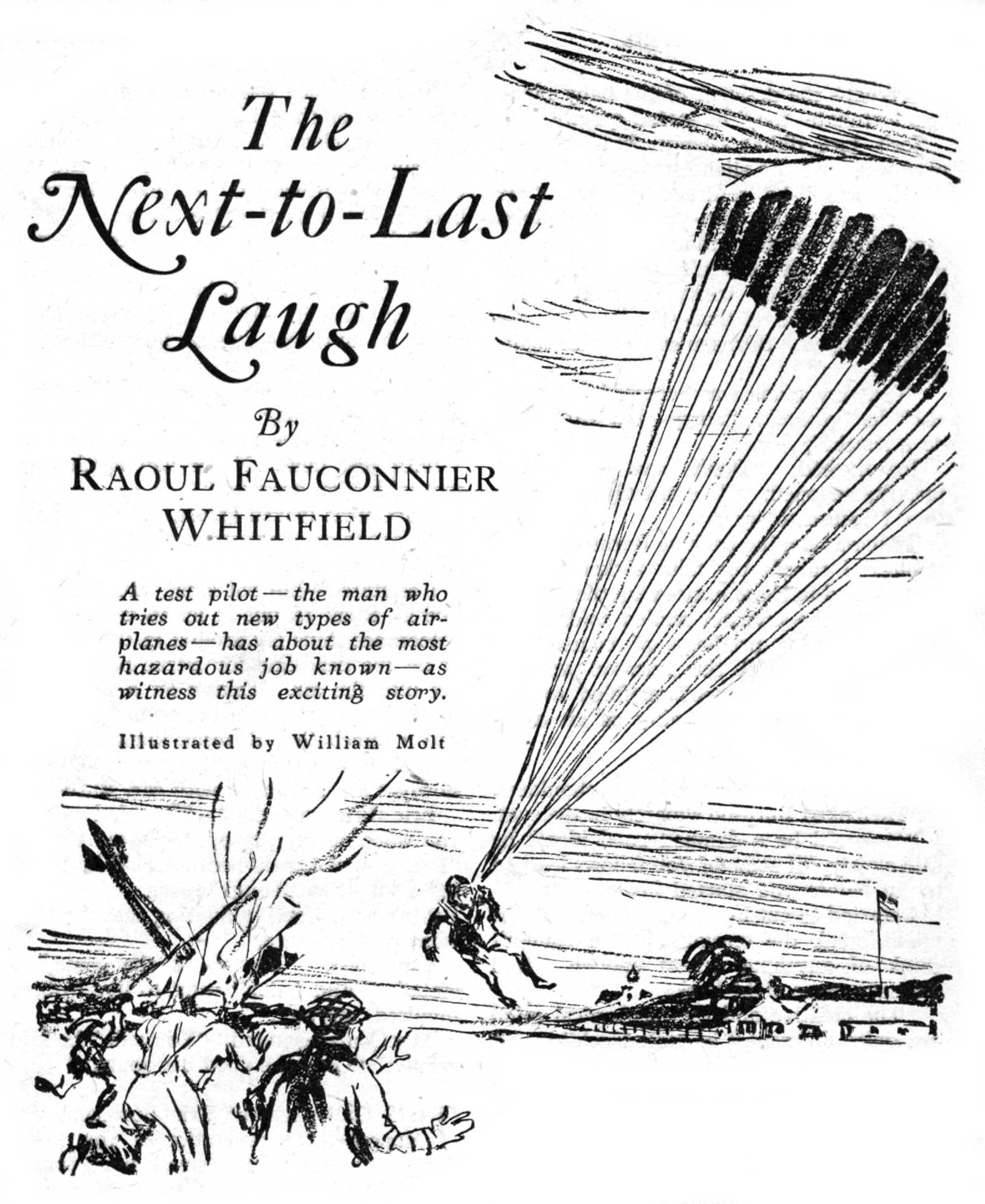
Funny things happen at Rook Field, and that fact isn’t so surprising. All sorts of nuts try to put something together that will do something in the air that has never been done before—and if the boys think that the something has a third of a chance it’s given a try-out. MacComas has a pretty level head, and it isn’t every inventor who can get his pet theory into a hangar at Rook. But enough of them do to make things interesting.
Now Eric Burnson had a duraluminum-surfaced baby plane that was supposed to be a world-beater. After listening to what Burnson said it should do I got the idea that it hardly needed a pilot. I didn’t say a thing. It was Joe Curtis who spoke up.
“We had one something like this baby, a year ago,” he stated grimly. “But I was lucky—I happened to be flying the big ones.”
Burnson was short and rather stocky. He had thin features, a high forehead, and very peculiar eyes—he seemed to be seeing right through things. They were gray, and the pupils appeared to be slightly dilated. He burned right through Joe’s blue eyes, nodding his head slightly.
“Perhaps the designer of the baby plane was fortunate, too,” he stated quietly.
Joe’s face didn’t change, but his eyes narrowed just the slightest degree.
“He was,” he returned grimly. “He didn’t go up in his ship—and Lew Bellows came down fourteen thousand in a loose-winged spin. We haven’t had a tricky ship here, not one as tricky, anyway—until MacComas told us that—”
Joe stopped. Burnson smiled with tight-set lips.
“That my plane was accepted for tests, eh?” he finished. “Sorry—but can’t you do a sneak?”
Joe flushed. “Don’t have to go that far,” he snapped. “I’ve already told Mac that I refuse to fly it.”
That was coming back at Burnson pretty strong. I caught the faint flicker of rage that flashed in those gray eyes; then it was gone, and the inventor smiled coldly.
“That’s your privilege, of course,” he stated. “I’ve had the Burnson up two thousand. But I’m not qualified to test my own ship as thoroughly as an experienced pilot.”
Joe Curtis shrugged his shoulders. He looked Burnson squarely in the eyes.
“It would be a damned good idea,” he said slowly, “if some of you fellows learned to fly before you started inventing!”
I started to cut in, to say something that might break the tension. But I couldn’t think of anything decent enough. And Burnson came right back.
“The creative and the mechanical mind are quite different,” he stated coldly. “A chauffeur seldom helps to improve the automobile industry.”
And that got Joe. He’s pretty much of a fighter, anyway. I thought for a split second that he was going to swing on Burnson. But he didn’t. He just laughed.
It was one of those throaty, nasty laughs, packed with contempt, and I saw Burnson stiffen. Then there was a little silence, broken by the scraping of Joe’s chair as he shoved it back.
“I’m not laughing at you, Burnson,” he stated, his voice coldly amused. “I’m laughing at that crate of yours. And it isn’t the last laugh, either. The public will give you that. I’m giving you the next-to-last laugh!”
Then he got to his feet, swung around and strode from the Field-office room in which the four of us had been gathered.
Burnson’s face was white, and the hand that rested on the table which held his blueprints was clenched tightly. MacComas, the superintendent of the testing end at Rook, was frowning. A door slammed back of the departing Joe Curtis.
“He’s off his feed,” I suggested, after a little silence.
The Super shook his head.
“That isn’t it, Al,” he told me. “How about it, Burnson—has he any real scrap with you?”
Burnson shook his head. “It happens that I’m not crazy about him,” he stated directly, “but I’ve never clashed with him—until just now. Never had much contact with him, actually.”
MacComas looked at me.
“Want to do the work on the baby Burnson, Al?” he asked.
I hesitated—but not long. It’s the practice at Rook to put it up to a test-pilot. Sometimes ships lie around in the hangars or on the dead-line for weeks before they get into the air. Taking off a trick ship for the first time is a big gamble. But I had a hunch that Burnson knew his stuff.
“I’ll feel her out—this week,” I said slowly, “if it’s all right with Mr. Burnson.”
Eric Burnson nodded. “I’m glad to have you work on my plane,” he stated simply. “I suggested Curtis because he’d been doing a lot of small-ship testing. Naturally, I think he’s wrong in figuring that the Gull won’t pass measure.”
I grinned. “It’s all in the game,” I stated. “And I don’t want to live to be a hundred, anyway.”
MacComas grunted. “You will,” he said grimly. “Only the good die young!”
This Gull plane of Eric Burnson’s was supposed to revolutionize the flying game. It was a very small single-seater, and it had been designed to adopt most of the principles of natural bird-flight. It was supposed to be able to get off a pocket-handkerchief field, and to land on building roofs. A graceful little thing it was—and it looked fast.
When it hit dirt the wings ceased to support the ship—and were planned to act as air brakes, stopping all forward motion. The elevators could be spread fan-tailed in flight. It was tricky—there was no doubt about that. And the trickier they are, the more dangerous they are; but if the ship was up to snuff it would move everything along fast—in the air.
But I decided that I’d be sure and inspect my ’chute-pack before I took the Gull off. And I also decided that I’d get altitude without rocking the boat any more than I had to rock it. If I could get five thousand or better it wouldn’t be so bad. I could take a chance on getting clear, at that altitude.
I was thinking things over when I climbed the stairs of Ma Gray’s house, four miles from the Field—we haven’t any quarters at Rook—and headed for my room. The door was partly opened, and when I got inside I found Joe Curtis sitting on the bed, a scowl on his face.
“A great guy, you are!” I stated. “You sure ran out of that job sweet and pretty!”
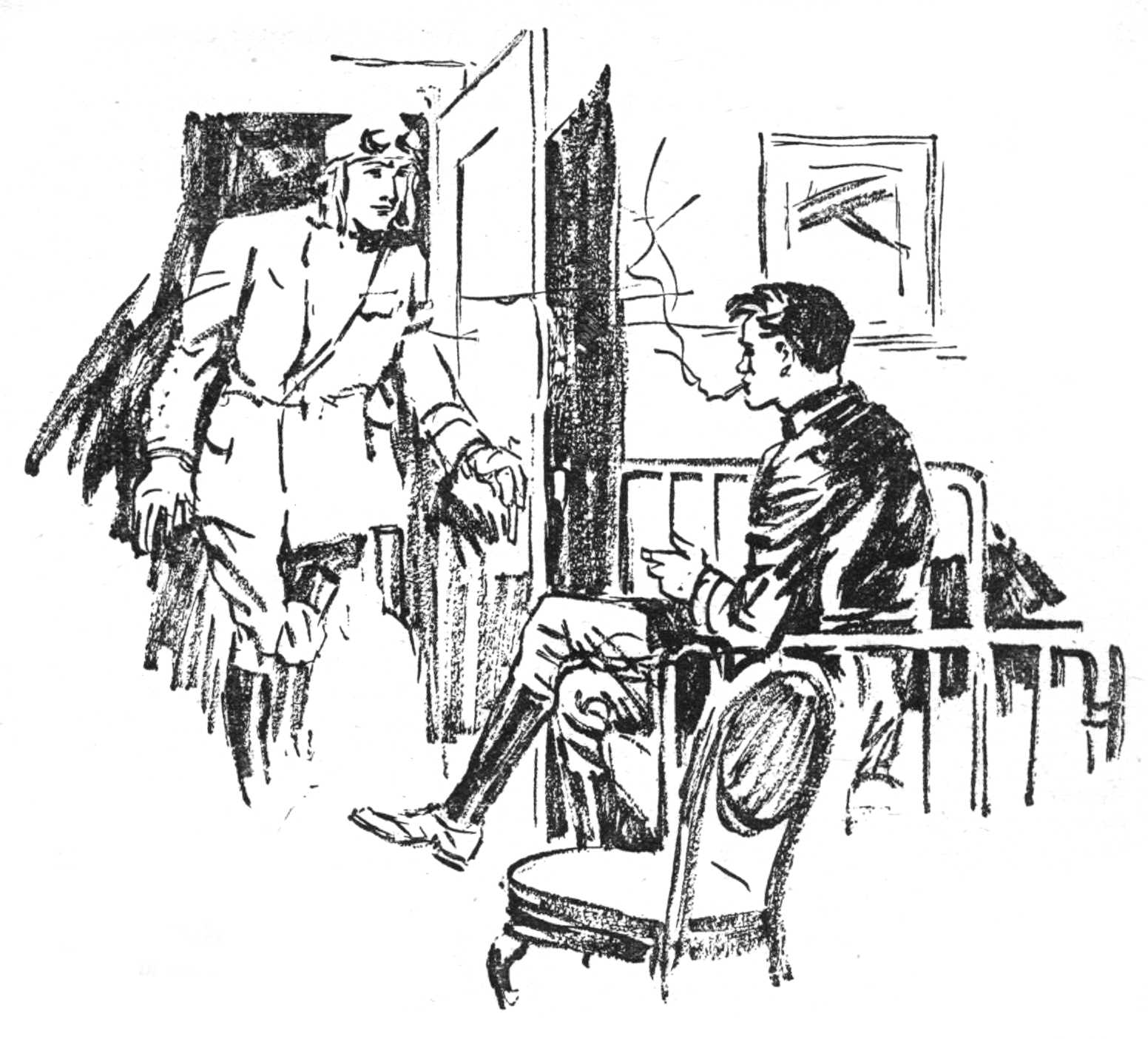
Joe swore softly. “And they grabbed you for the dirty work, I suppose!” he muttered. “She’ll fall apart in the air, Al.”
I grinned. “I’m being paid good coin for testing ships,” I stated slowly. “MacComas accepted this one. Somebody’s got to do the trick!”
“Well—” Joe lighted a pill—“that somebody doesn’t have to be me. And it won’t be you!”
I stiffened. Joe and I had been pretty thick for a couple of years, but we hadn’t reached a point where we told each other what we could and what we couldn’t do.
“No?” I questioned. “How come, Joe?”
He just smiled. “When do you figure on getting her off the ground?” he asked slowly.
“I haven’t started to figure yet, Joe,” I returned.
He chuckled. “The only reason I asked, Al,” he came back, “was because that’s a mighty intelligent ship—according to Burnson. And I’ve got some good cigars over at my room. Didn’t want to leave a window open and have it fly in after the smokes.”
But Joe wasn’t fooling me any by using the funny stuff. So I gave it to him straight.
“Don’t mix in on this deal, Joe!” I warned. “Mac passed the assignment to me—and I’m testing that Burnson plane. You’ve had your laugh. Now give Burnson a chance to have his.”
Joe Curtis flicked the ashes from his pill. His eyes were little slits.
“It might not be a laugh,” he stated. “Not for you, anyway.”
I swore softly. “You’re getting old and sentimental, Joe,” I told him. “You do your stuff—and I’ll do mine. Just because you turned Burnson down and I didn’t—”
“You did,” Joe interrupted grimly; “only you’re not wise to that fact yet!”
As I mentioned before—a lot of funny things happen at Rook Field. And some happen that aren’t so funny. The morning after I had the little chat with Joe Curtis, MacComas called me to the Field in a hurry. I drove out, and caught him at his desk.
“Listen to this one, Al,” the test-boss ordered, picking up a piece of white paper from his desk. “Just came through the mail, postmarked from the city. Typewritten and unsigned. All set?”
I nodded. Mac read in a low voice:
“Take our warning and don’t test Burnson’s Gull. It’s curtains for the pilot who rides her in the sky. She’ll never get altitude for a jump. MacComas, don’t be a killer!”
Mac paused, tossed the note over to me. I read it carefully. Then I tossed it down on the desk again.
“Well?” I asked. “What about it?”
“Who sent it?” Mac asked me.
I shook my head. I thought of Joe Curtis. But Joe hadn’t had time to get to the city, which was about fifty miles distant—not to get there and have the letter come back in the first morning mail.
“You win!” I stated. “Some crank, I suppose. Or maybe some ship designer who thinks Burnson might have the goods.”
MacComas grunted. “I don’t like the last line,” he stated slowly. “I’ve never sent a man up in a ship that he didn’t think was right. This Gull is the biggest freak we’ve had here in a long time. But somehow, I figure that Burnson—”
He stopped, and I finished it for him.
“Has the goods?” I asked.
Mac shook his head. “Not exactly that,” he stated. “But he has enough to rate him a test. We haven’t gone forward very far—in the air. Al, how do you feel about the Gull?”
I grinned. “I want to skyride her,” I came back steadily. “I’m curious.”
Mac nodded. “Well, I wanted you to see this note,” he said. “She’s ready for the air, isn’t she?”
“She is,” I replied. “I’m going to have a talk with Burnson this morning—and I’ll bounce her around the Field a bit after lunch. May not get her up until tomorrow, though.”
The test-boss nodded. “Take your time, Al,” he stated. “And if you get feeling funny about it—just tell me.”
I shook my head. “It’ll be all right,” I stated. “We may have a world-beater. I’ll chase along and meet Burnson. Forget about the note, Mac.”
He smiled, and I headed for the hangar at the south end of the Field, in which we were keeping the Gull. There were quite a few things I wanted to talk over with the piercing-eyed Burnson.
He was to show up at nine. But at ten there was no sign of the inventor. At eleven I called the small hotel in which he had been putting up, a few miles from the Field. They hadn’t seen him since the previous noon. He wasn’t at the Field, and I knew the man well enough to be sure he’d be on the job—with tests for his pet plane close at hand! He’d been working two years on the Gull, and had been dreaming about it for ten.
I got Mac, and we drove over to the hotel. After considerable talk they let us into his room. The bed hadn’t been slept on. Everything was in perfect order. Burnson’s bags and extra clothing—both were in the closet.
“Let’s get back to the Field,” Mac suggested. “If we don’t locate him within a few hours, there’s only one thing to do.”
We didn’t locate Eric Burnson, and Mac called the police and told the story—at about three bells. And while he was doing it, I suddenly woke up to the fact that I hadn’t seen Joe Curtis around the Field. That was unusual. Joe loved his ships—he was always about. Not once in the last four months had I failed to see him, unless I knew where he was. I thought of his final words, the night before: “You did! Only you’re not wise to that fact yet!” Meaning that I’d really turned Burnson down, as he had, only I didn’t know it. And the “yet” was significant.
I shook my head slowly. “Joe wouldn’t mess up a Government deal like this,” I muttered to myself. “He isn’t that dumb.”
But I thought of the note. It had been written by some person who knew planes, and knew Rook. Burnson had disappeared—and Joe Curtis was not around the Field.
When Mac had finished giving the police the little information he possessed, I told him about Joe. It’s all right to tell Mac these things—he understands. He shook his head.
“Looks bad,” he stated. “Joe’s gone and lost his head—that’s all. He’s been working too hard, and I didn’t notice it. He’s sore at Burnson, anyway. Never has liked him because he’s been so sure of that Gull plane. And he thinks a lot of you, Al. He’s done something—”
Mac broke off abruptly, staring beyond me, toward the door of the Field-office. I faced around—and into the room walked Joe Curtis. He was smiling. But he didn’t say a thing. He half-turned toward the door—Eric Burnson was following him in!
Burnson’s face was white. His eyes held an expression I couldn’t quite fathom.
“Where in hell have you been?” Mac muttered, being the first to recover. “We’ve got the police looking—”
“I’m all right,” Burnson interrupted in a low, steady tone. “There was an”—he hesitated, and his eyes flickered to those of Joe Curtis, and then went back to Mac’s again—“an accident!”
“An accident?” I stared at the inventor. “What kind?”
“It happened to a friend of mine,” Burnson stated, and managed a faint smile. But it wasn’t a go. All three of us knew he was lying. His eyes showed it.
Mac shrugged his shoulders. He turned toward the telephone.
“I’ll tell the police you’re here,” he stated. “Thought we’d better play safe. There’s been some publicity about the Gull, and I figured some crank might have had it in for you.”
Then Joe Curtis laughed. And I saw rage flash in Burnson’s deep-set eyes. He was controlling himself with an effort, that was certain.
Mac made his report to the police. Joe grinned as he heard the test-boss state that there had been an “accident.” Nothing serious, Mac explained. Everything was all right now. He hung up, and then faced us.
“Well,” he stated, addressing the inventor, “you gave us a scare! But I suppose the affair is your own business. Al was waiting for you to— We want to get your ship in the air within a few days.”
“I’ve changed my mind about the Gull,” Burnson said, slowly and rather unsteadily. “Something has come up—and I’ve changed my mind.”
That was all. There was absolute silence in the office. Mac was staring at Burnson, but my own eyes went from the inventor’s to those of Joe Curtis. And Joe just sat there with a grin on his lean, browned face. Mac spoke first.
“Changed your mind?” he muttered. “What about?”
Burnson spoke more rapidly this time. Color was returning to his face, his thin features.
“I’ll fly the ship on the first hop-off,” he said quickly. “And then, if she seems to handle well enough—I’d like to have—” He hesitated, his eyes meeting mine momentarily—“to have Curtis carry on the remaining test work.”
I stiffened. Joe pulled out a pack of cigarettes from his pocket.
“It’s all right with me,” he stated cheerfully. “Glad to try it, Mr. Burnson.”
Mac frowned. I just looked at Joe through narrowed eyes. He lighted a pill.
“If she’s right—suppose you take her up just before dusk, when the air’s quiet,” Joe suggested to Burnson. “Then I’ll do some work tomorrow—if she’s still right.”
Burnson’s eyes gleamed. But he just nodded his head. Mac looked at me.
“Al had the assignment,” he commenced doubtfully, “and it seems to me that—”
“Show them the letter you got, Mac,” I interrupted, and the test-boss handed it to Joe. Burnson moved to his side—they read it together. I watched Joe closely.
“Bunk!” he muttered. “I don’t think the Gull’s that bad. It sounds like a joke to me.”
Burnson was muttering something to himself. I smiled grimly at Joe.
“You ought to know!” I told Joe, and walked out of the room. When I got outside, with the door slammed back of me, I heard Curtis laugh again. And I was very sure, then, that he did know.
But I couldn’t figure the game out. Joe Curtis had come in with Burnson. And Joe was relieving me—and getting the test-job on the Gull. After he’d turned it down in the first place, he was taking it now. Why? And why, also, was Burnson letting him have it? Certainly the two men hated each other. They couldn’t mask their feelings enough to hide that.
The more I thought of it—the more hot I got. It wasn’t that I was crazy about testing the Gull. But I didn’t like to see Joe step in and grab the job; not after what he’d said. And Burnson was letting him get away with it. And so would Mac. If the inventor wanted Joe—he’d get Joe. That was almost a creed of the Field. But did Burnson want Joe?
“Not on your life!” I muttered, and pulled up short.
I’d been walking blindly along the dead-line, and I’d reached the hangar in which the Gull was kept. And that gave me the big idea. I didn’t like those laughs of Joe’s. They went mostly for Burnson, but they included me, too.
“All right!” I muttered, “we’ll see who gives this baby the first test!”
And I headed for Burnson’s duraluminum-surfaced, fan-tailed Gull.
I had her on the dead-line, and was feeling out the controls, when I jerked my helmeted head and saw Joe emerge from the Field-office. The crew was back out of the way, and the engine of the little girl had revved up all right. We were set for the take-off. I’d have to pass up the ground-hopping, but that didn’t mean so much, anyway. I had a pet ’chute-pack strapped to me, and was sitting on it comfortably.
Joe turned his head my way—and I waved a hand. He let out a yell that I didn’t hear because of the throttled-down exhaust rumble, and leaped off the steps that led to the Field-office door. I saw MacComas bouncing out—and then Burnson. And I gave her the gun.
“The next-to-last laugh for Joe,” I muttered; “the last laugh for me!”
She rolled. Out from the dead-line into the wind. She didn’t need much ground on which to take-off. I got her tail up, sitting tensely in the cockpit and saying a few of my favorite test-prayers. She skidded a bit, and I used the rudder to straighten her out. But she wasn’t handling right. And for once the prayers didn’t take.
We hit a ground-gust. Her nose dropped. I jerked the joy-stick back. The nose came up—but her tail dropped. She didn’t zoom—she did skid. Her under-carriage struck; something crackled. I thought for a split second that we were going to crack up right then.
But we didn’t. We got off—and this time we stayed off. The baby Gull climbed—climbed up into the sky minus most of her under-carriage!
I sat tight, and held the ship in a mild climb. Testing was out of the question now. In a ship of the Gull’s size, loss of even a portion of the under-gear meant ragged flight. And the Gull was in the air now for the first time.
At three thousand I tried a mild bank—and she almost got away from me and slipped into a spin. But I managed to get her back on even keel again. Staring down and back, I got a glimpse of ground-crew men holding up the wreckage. As if I wasn’t fully aware of the fact that I’d battered part of it loose!
At five thousand I got around in a bank, but the Gull’s air work was sloppy, and she had a left wing-droop. The only thing that was functioning right was her engine.
“Looks like a hop-over!” I muttered. “Can’t land this baby—not in this shape!”
The Gull was supposed to land slow, and on a small field. But not without under-carriage! I could risk a stall landing, but even then I’d crack up pretty badly. I couldn’t see what was left below, but it was a sure thing that not much of the two wheels and the tail-skid remained. A ’chute-jump seemed the only way out.
I got two thousand feet more altitude. It wasn’t the first time I’d been over the side, but the conditions weren’t the best for a getaway. I’d have to handle the Gull as long as I could, and the cockpit was so tiny I’d have to wriggle out of it. But it had to be done.
About a half-mile to the north of the Field, figuring on the wind drifting me back toward Rook, I climbed the Gull at about a thirty-degree angle. Slipping the safety-belt, I squirmed out of the cockpit, holding the stick as long as I could. When I released it, I had one foot on a wing surface, and as the nose dropped down I got the other one over. My left hand gripped a strut; the right one fumbled for the rip-cord ring, and found it.
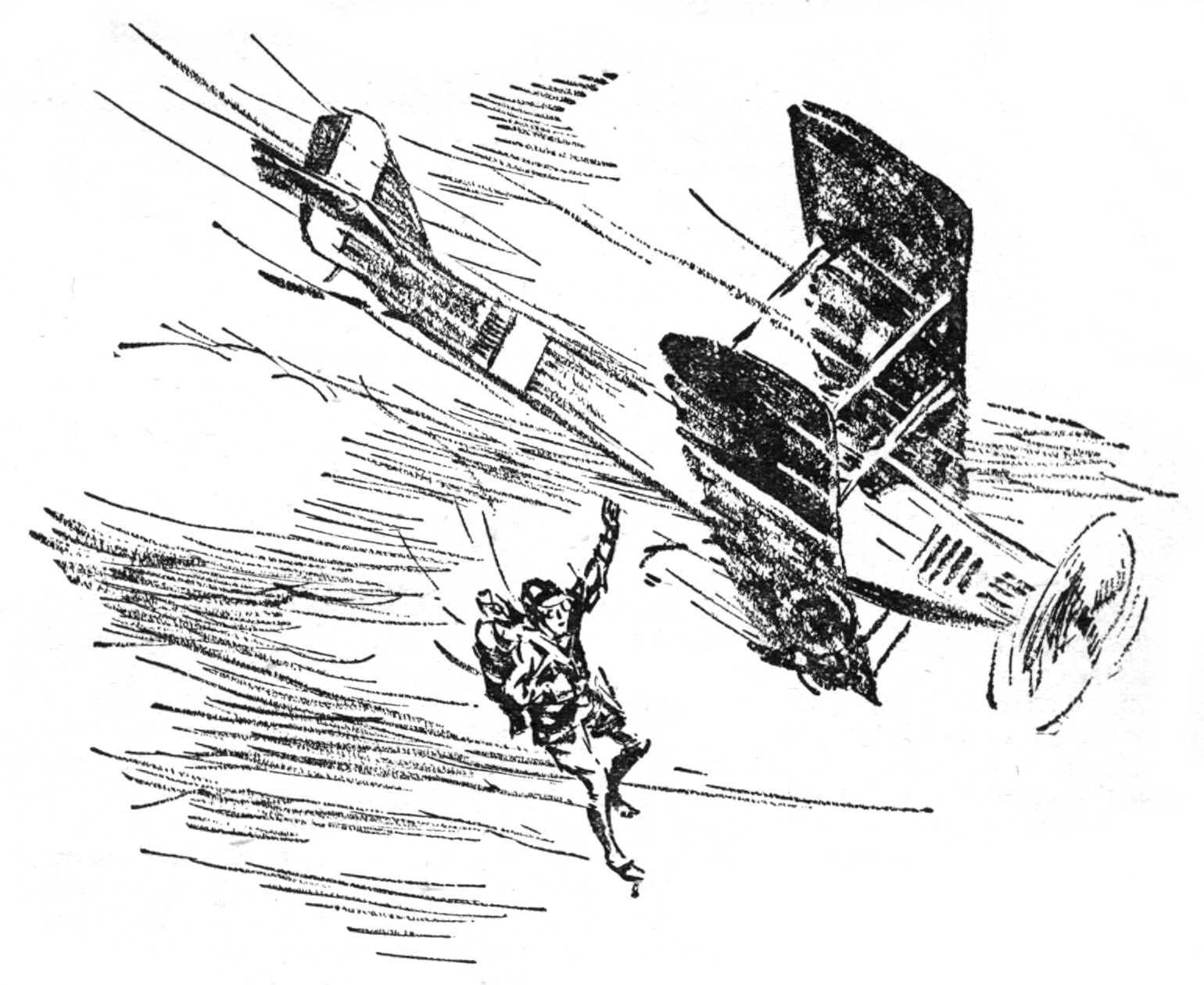
Then I let go. It seemed as if I missed the tail assembly by inches. I somersaulted down, counted seven—jerked the rip-cord ring. The lead parachute got out—and then the bigger spread crackled in the air. There was a terrific jerking—the harness tightened about my body. And I was drifting now—drifting beneath the ’chute toward Rook Field.
Figures were running toward me as I neared the north end of the Field. There was a loud boom—the finish of the Gull. I wondered how Burnson would take it. And then I flexed my legs, made ready for the seventeen-foot-a-second contact with the earth.
I landed hard, and was out of the ’chute before it could drag me. Feeling pretty shaky, I sat down and dug a pill out of my khaki shirt pocket. And while I was lighting up, Joe Curtis reached me.
He stood looking down at me, breathless and scowling. I managed a grin.
“You damned idiot!” he muttered finally. “After all I did—”
Then he shut up. But that was enough for me. I was mighty curious.
“Spill it, Joe!” I stated. “What did you do?”
“I flew in and sent that note to Mac!” he stated grimly. “And then I cornered Burnson over in town—and made him take a drive with me, and give me a promise or two. He didn’t want to do it—but he came through, finally.”
I nodded. “Figured you did it, Joe,” I stated. “But why? You were going to fly that ship.”
“Like hell I was!” he came back. “Not until Burnson took off first. And I’m not so sure that he would have taken off. She was rotten underneath, Al—and I knew it. Burnson practically admitted it—this morning, after I stuck a gun under his face and got him out of town. He wasn’t sure, of course. But he had to sacrifice something—to get what he wanted. And he eased up on the under-gear. Why, you didn’t give it a hard rap, but it ripped right off! He nearly went crazy when he saw what had happened. Then he keeled over, fainted.”
Joe shook his head slowly. “And after all I did—trying to keep you from breaking your neck—”
I chuckled. The other fellows were coming up now. “Guess he’ll be more careful on the next one, Joe,” I said. “If you hadn’t been so high-hat—”
“You’d only have laughed at me!” Joe cut in. “Just because I turned it down, you were sure I was sore because you grabbed it. And besides, it was only a hunch. Inspection didn’t show any great weakness.”
I grinned. “I was after the last laugh, Joe,” I muttered. And then I got to my feet. “But I guess you get the candy—with the next-to-last laugh!”
Joe just grunted. “With a head like yours,” he stated sarcastically, “you wouldn’t have needed a ’chute-pack.”
I let it go at that.