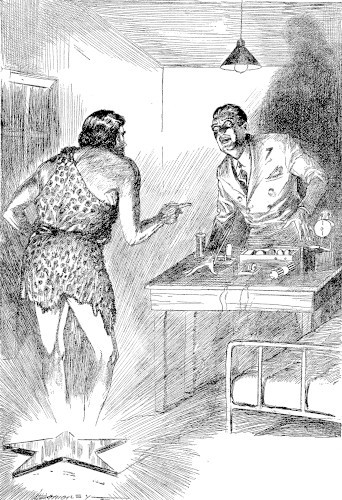
The Jimmy Miles, who had vanished through the crystal one minute before, had been clad in conventional civilized clothing, if a bit shabby. Now a half-naked savage stood on the glistening surface of the crystal.
By Jack Williamson
Author of "The Lady of Light,"
"The Stone from the Green Star," etc.
Illustrated by MOREY
This story, by one who is justly called a favorite
author, describes life in the stone age, when man was
in the most primitive state of advance. It tells of
the discovery of fire and of the combats of the
herculean ancestors of our present race.
[Transcriber's Note: This etext was produced from
Amazing Stories March 1933.
Extensive research did not uncover any evidence that
the U.S. copyright on this publication was renewed.]
On a hot afternoon in June, 1930, I was standing in front of a newsstand in El Paso, Texas, examining the latest copy of a magazine of science fiction.
"Like 'em?" a pleasant voice inquired at my elbow.
"Yes," I said. "Merritt and Wells and——"
I caught myself, looked up swiftly to see who had accosted me. A young man stood beside me. Tall and well built he was, in shirt sleeves. His black trousers and cheap shoes had seen better days. But his eyes were blue and brilliant with strange enthusiasm.
He stood still, smiling a little, while I measured him.
"Beg your pardon," he said. "I read 'em myself. It struck me we were kindred spirits."
"Glad you spoke. I haven't anything to do. And I like to talk science fiction. If you like, we can go somewhere to lunch."
There was something about his face that suggested my words; and a quick gleam in his brilliant eyes replied to them. But he flushed a little, spoke quickly,
"No. Thanks. I've just eaten."
"I was going. We can talk as we eat——"
He weakened visibly, collapsed.
"All right. I'll come. A fifteen cent feed at that Coney Island joint—anyhow——"
We found a promising place, dark and cool, with electric fans whining overhead. My new acquaintance did his best to conceal impatience, while we waited for two full orders. I discovered that he thought Wells and Verne a bit old-fashioned and dry, that he had vastly enjoyed Merritt's story, "The Moon Pool."
When the soup and roast beef came, with coffee and pie and what-not along with it all, conversation lagged. He ate with the gusto of one who has been for some time practising economy in his diet. At last he pushed back his cleaned plate, rose, flushing a little again.
"You know, this is darned good of you, Mr.——"
"Stewart. John Stewart. And it's quite all right. Glad I met you."
"My name's Jimmy Miles," he said as we strolled back out into the baking street. "Sort of roving electrical engineer. No college. But I've worked in power houses—nineteen of 'em, to be exact.
"And if you're interested, I've got something to show you—pay you for——"
"Don't worry about the dinner!" I said, "I write a little, and am interested in characters."
"Business proposition, eh?" He laughed. "Well, this might give you a plot. Strange enough!"
"Of course I want to hear it. What is it?"
"Well, to begin at the first, I came here a couple of months ago. Failed to land any job down at the light-plant. Should have been drifting on—I had enough to carry me on till I found something. But one day I got to looking in a pawnshop window——" He paused.
"Yes, they fascinate me," he went on. "Every bright, useless article under the sun. Diamonds and watches and jewelry. Pistols and knives. Kodaks and phonographs. Probably a thrilling story for every one of them!
"I found a strange thing in that window. Sort of a crystal. Looked like red glass, or ruby. Star-shaped. A big thing, heavy, nearly three feet across. I'd never seen anything like it—from what I know of chemistry, there isn't any known substance that crystallizes in five-pointed stars.
"I went in to examine it. The proprietor said that a Mexican had brought it in two or three weeks before. Seems he'd smuggled it across the river from Juarez, said it came from the ruins of an old fallen building in the desert, way down in Chihuahua."
"I know the sort of thing," I said. "Big mounds of dirt, crumbled mud walls with broken pottery and stone axes and what-not mixed in. I've just been down on the Casas Grandes River—uncle has a ranch down there. Saw lots of the mounds—the Mexicans call 'em moctezumas. They have been digging them up, treasure-hunting—some of them have pieces of matte in them, copper alloyed with silver and gold, just as if it had come out of a prehistoric furnace. Nobody knows when those fellows lived there. To judge from the ruins, the whole valley must have been farmed."
"Well anyhow, this peon had brought the crystal across the river, claiming he had dug it up in an old ruin. Seemed to think it was a diamond, fabulously huge. The pawnbroker knew it wasn't any diamond, of course. But he let the fellow have something for it.
"The thing aroused my curiosity immensely. The pawnbroker wanted two hundred dollars for it. That was more than I had in the world. After three days, I drove him down to a hundred and seventeen. That left me with sixty-one dollars. I've lived six weeks on that, and spent twenty of it for apparatus to test the crystal with.
"Dingy little room I have, hot as a furnace. It looks out on a ventilator shaft. Three dollars a week. Living on dry bread, and raisins and a slab of cheese, in my room. When I want to celebrate, a little cheap fruit, or a glass of milk and a slab of pie at that Coney Island joint." He grinned.
"But what about the crystal? What is it?"
"I don't know what it is. But I do know that it's worth every cent I paid for it. I've been starving along, struggling with it, hoping to learn the secret of it, before I had to turn it over to some museum or college professor for a song. And I've done it!
"That crystal is the greatest thing since Columbus!"
"How?" I pressed him.
"You read those stories about worlds in the Fourth Dimension, worlds in the atom, worlds in the infra-red spectrum, worlds——"
"Read 'em and laugh, mostly. I can admit people on other planets, but as for the Fourth Dimension stuff——"
"I used to be that way. But Stewart, you know that crystal is a connecting link with another world! I've never gone through, myself. But I tied my watch on a string, and let it through."
He laughed, ruefully. "And something happened to it. I'd been planning to pawn it. It came back all right; but it wasn't worth pawning any more. Crystal broken, figures faded off the face, case worn and works corroded and ruined. Looked like it had been lying out in the weather a century or so."
I looked keenly at the man, to see if he were paying for a good dinner with a good lie. A smile of enthusiasm was on his thin face, his blue eyes were very bright. He seemed quite grave and serious, and for the life of me I could not doubt his sincerity.
"Come around to my room, if you like, and I'll show it to you."
"I'm coming!"
What he said had appealed indeed to my love of the marvelous and the fantastic.
We had been strolling down the sultry street. Now he quickened our pace, led the way toward the river, where there were many mysterious doors, where there were little fruit stands and dirty street peddlers, where there were signs in Spanish and Chinese, and an alien note to the voice of the crowd.
"Not the best neighborhood in town," Jimmy Miles observed. "But one cannot be a chooser on three dollars a week."
He slipped between a swarthy Mexican and a strapping colored woman, and led me into a dingy lobby, a dark and stale-smelling lobby, where a crippled man and a white-haired patriarch were playing a languishing game with dirty cards, and a thin dyspeptic fellow was wearily rattling a newspaper.
He led me quickly across the room, up a narrow steep stairs, and down a long dark hall, that was hot and unpleasant with a faint, sickly odor. He stopped before a blank door, and turned a key in the lock. I followed him.
A mere cell it was, with a narrow bed, a tall scarred bureau with cracked mirror, a broken rocking chair, and a tottering stand. The one little window opened on a hot, black roof, with a blank wall eight feet away. The room was stifling in the sultry midsummer afternoon.
"See!"
Jimmy Miles pointed to the strangest piece of apparatus that I had ever seen. It stood in the corner of the little room, back of the door, filling most of the available floor space.
Set on a low bench, apparently made mostly of packing boxes, was a wonderful, blazing gem. A five-pointed star, nearly three feet across, perfectly formed of scintillant crystal, scarlet, ruby-red, sparkling. It was like a five-pointed star sawed out of an inch-thick sheet of flawless blood-ruby.
Beside the crystal, on the bench, was a little stack of dry cells, a Ford coil, and a small brass switch, connected with wires that ran under the bench. I saw a radio "B" battery, an electron tube and rheostat, and some more wiring that I did not understand.
"There she is," he said.
"Quite interesting. I hardly see what it's all about."
"Well, I found out something interesting about the crystal. It isn't a natural formation. It's artificial——"
"Artificial!"
"Made by man—or at least by some intelligent being—without a doubt! There are two little platinum studs on the lower side of it, that I have the coil connected to. And it's got metal parts inside it. The crystal stuff may just be cast over it to protect it."
"But those Indians, whose ruins are the moctezumas, didn't know anything about the use of metals, even if they did smelt them a little."
"No use to argue that. They may have found the thing in the ruins of an older civilization. It's hard as diamond; it must be nearly indestructible. Just another puzzling relic of a lost civilization, like the Great Pyramid. More than likely the people that made it went inside it—went through it to that other world. You say you write stories. There's drama for you. A doomed continent sinks into the sea and the scientists toil to make the star to let them into another world.
"And of course there is the interesting possibility that it was made by a race of that other world, who wanted a window into our space."
"How does it work?" I demanded.
He looked around the bare, little room, evidently in search of something, then fumbled in one of the bureau drawers, where there was half a loaf of bread and some grocer's sacks. He produced an empty sardine tin, which he laid on the scarlet, star-shaped crystal.
"I send the discharge of the coil through it," he said. "It glows, phosphoresces like the diamond does under cathode rays. But the emanation from it has a queer effect."
He closed the little switch. The Ford coil buzzed angrily, and purple sparks played about its points. And a soft crimson fire shone from the crystal, it seemed to melt into a rosy fog. Pale weird lights of green and purple and blue played about the edges of the red flame.
Bathed in soft, red fire, the tin can sank through the crystal. Gleaming crimson mist flowed over it—the crystal seemed to have become a mere nebulous scarlet haze. The tin vanished as if it had been dropped into a basin of blood. And quickly though the man still held down the key, the coruscating mist faded, and the star was real again, sharply distinct.
"It isn't on the other side of the crystal," Jimmy said. "Not on the bottom, I mean. It has somehow gone through it to another world. It may come back when I break the circuit; that somehow reverses the process. My watch came back—rather the worse for the experience."
He raised his finger from the key. And the shimmering red mist rose about the scarlet star again, until the crystal itself seemed to dissolve in a fog of dancing red molecules. And the sardine tin popped up through the ruby fog.
But it was a sadly altered can, battered and rusty as though it had been lying out of doors for months.
"Gone to the bad, like the watch," he said.
"Mostly, things come back when I break the circuit. That somehow seems to reverse the process. There is an analogy in electricity. When you have a secondary coil wound about a primary, a current is induced, for a moment, when you send a current through the primary coil. When the primary current reaches its full value, the secondary drops to zero. But when you break the primary circuit, the induced current again flows through the secondary circuit, this time in the opposite direction. This phenomenon must be of the same order."
"But where is it that the can went?"
"Frankly, I don't know, not positively. But I think it went through the space that mathematicians call the Fourth Dimension, until it entered another plane alongside our world, parallel to it. Let us say that this crystal is just a sort of boundary, or meeting place, between that other world, and this, in the Fourth Dimension.
"When we send the current through the coil, a sort of magnetic effect carries the body through the opening, as it were, into this other space; and when the circuit is broken the magnetic effect is reversed, drawing the body back."
"I've read stories of the Fourth Dimension."
"So have I—written mostly by men who considered it a sort of weird fairyland, without any conception of the scientific factors involved. But the Fourth Dimensional hypothesis seems to fit all the elements here better than anything else I can think of."
The man turned toward me suddenly, with fierce determination glowing in his blue eyes. "I'm going through tonight," he said. "I wish you would operate the switch for me."
"Going into that! Without knowing!"
"That's the way to find out. The watch and the can came back. I ought to manage it."
"Well, I can stand by, of course. But I'd wait——"
"I need a condenser, and another coil and more batteries, to increase the power to man-size capacity. If—I wonder if—if you could let me have a few dollars——"
"Of course. Whatever you need."
"The crystal and apparatus will be security."
"That's all right. You don't realize that you're giving me a real adventure."
I handed the man a twenty-dollar bill, which he blushingly accepted.
"If you need more——"
"This is ample. And you might come back—say, at eight o'clock. This hole will be cooler then. I'll try to have everything ready."
I followed him down the dark hall, and out into the street. I went to a show, and then tried to read in my room at the hotel. But my mind kept running back to the marvelous crystal that seemed to carry objects to another world—and to the amazing young man who was eager to undertake a voyage of discovery more marvelous than that of Columbus.
Ordinarily, I should have suspected chicanery, and a plot to separate me from some money. But I had not the slightest doubt of Jimmy Miles' sincerity.
My imagination, following his suggestion, persisted in building up rather a fantastic story out of it. I pictured a mighty civilization grown up on the earth, and suddenly faced with a cataclysmic doom—a submergence of continents, or an age of ice, or collision with a comet—the struggle to build the crystal, the escape, through it to a new world in the Fourth Dimension—and the crystal, by some freak of fate, the sole memento of that vanished race upon the earth—though what an empire they might have in the new world!
Impatiently I awaited the appointed hour; and when it came I hurried down to the shabby little hotel, so wrought up that I hardly noticed the bright windows and the gay, half-alien throngs that ordinarily I studied so intently. I found my way up to Jimmy's room, and knocked on the door.
When he let me in I saw that he had new apparatus attached to the crystal, to bring a more powerful and more accurately regulated current through it. I found that he had not eaten, so I insisted that we go down and get supper before the trial. He came rather reluctantly, but ate heartily enough.
By nine o'clock we were back in the little room. Jimmy gave me detailed instructions for operating the rheostat and switches—I was to hold the key down for exactly one minute. He handed me a long legal envelope. I opened it, and found this document:
To Whom it May Concern:
This is to certify that I, James R. Miles, do this night of June 3, 1930, enter upon a most perilous adventure, in full knowledge of the peril to my own life and person thereby incurred. Mr. Stewart, or no other person, is to be held responsible in the event of my injury or complete disappearance.
(Signed) James R. Miles
Below was the signature and seal of a notary public who had acknowledged the document.
"In case something happens," he said, "you might find that useful. Not likely to be any inquiries, though. I haven't a relation in the world."
With these words, he stepped lightly upon the flat, polished surface of the scarlet crystal star, and stood waiting, slender, erect, eager, his blue eyes burning intensely.
"Shoot!" he said.
Suddenly I felt a lump in my throat. For no very good reason, I felt tears springing into my eyes. I tried to say something, but at the moment I could not speak. I realized there would be no dissuading the young man from his adventure.
With an eye on the second-hand of my watch, I pressed the little button that completed the circuit. The coils buzzed, wasp-like. A soft red mist rose about the crystal—it seemed oddly as if the gleaming thing vanished, ceased to exist in our space at all, leaving a sort of door that was screened with the dancing rosy mist.
And Jimmy Miles fell through the scarlet star.
Quickly, as if some strong magnetic attraction were drawing him, he dropped into the three-foot blur of crimson fog. He waved his hand briefly, as I pressed the button. And he opened his lips, to breathe a sound that might have been "Good-by" if he had stayed to finish it.
It was over in a split second. The red mists had faded, and the gleaming star had recovered its appearance of brilliantly polished ruby.
I sat on the broken chair, in the stuffy little room. My watch was on my knee, and I held the key down with a finger. The coil was buzzing merrily, with purple fire flashing from its contact points. My eye traveled restlessly between the crawling second-hand of the watch and the rude apparatus that had sent a man on an amazing voyage of exploration. I moved a little, sat straighter, in my tense nervous strain. In my pocket I heard the rattle of the document which was to absolve me from prosecution for murder, if Jimmy did not come back.
It was all beginning to seem very wild and fantastic, when the end of the minute came. And I felt an icy chill of fear. What if that vaguely guessed-at reversed magnetic power of the crystal failed to function? What if it failed to draw Jimmy Miles back into our world?
I was near crying out with the strain when the end of the minute came. I raised the key. The hum of the coil ceased abruptly. And the glistening surface of the scarlet star seemed to melt into a dancing mist of ruby particles.
And an amazing apparition plunged up through that bloody fog.
The Jimmy Miles, who had vanished through the crystal one minute before, had been clad in conventional civilized clothing, if a bit shabby. Now a half-naked savage stood on the glistening surface of the crystal. He had a good deal of beard, and unkempt hair fell to his naked bronzed shoulders. There was a livid scar across his great bare breast. His only garment was a tawny skin, dressed with the hair on, crudely fastened about his middle. In one mighty hand he grasped a coil of rawhide rope.
The Jimmy Miles, who had vanished through the crystal one minute before, had been clad in conventional civilized clothing, if a bit shabby. Now a half-naked savage stood on the glistening surface of the crystal.
And this amazing stranger raised a bronzed arm, cried out in astonishment evidently as great as my own. Then he grinned at me in astounded recognition, and I realized that he was indeed Jimmy Miles, but changed immensely. Instead of a slight boy, or little more, he was now a powerful man, tremendously muscled—and extremely unkempt.
It seemed as if he had aged years in a single minute of our time.
"Still here, Stewart?"
He spoke hesitantly, in a voice rusty, it seemed, from disuse.
"Yes. Yes, of course. But what has happened to you?"
"Of course? And still in this same little room? And you don't look—why you look as I might have left you yesterday!"
"Yesterday? I held the key down just one minute——"
"One minute! Man you're foolish! It's years! I've been roaming a strange world for years. A moment ago I was stalking a wild horse with Harr Garr, without a thought in the world of the old life. And to be snatched up like this!
"You don't believe it? Look at this hair, this beard! Look at these!" He touched the great scar on his chest, a livid white spot on his forehead. Evidently wounds, long-healed. "Does a man collect such things in a minute? You're crazy!"
"No. No. But a strange world, you say?"
"Yes. I can tell you about it. Plenty of time. But this! Still 1930? I had figured it ought to be '35, at least. How in the Sam Hill——"
"I have it!" I interjected. "The watch and the tin can! They showed the effects of months of time. Time passes faster in that other world!"
The giant bowed his shaggy head, considered.
"Yes, it could be. Relativity and so on. And it must really be in the Fourth Dimension. The crystal is just a door between two worlds. The magnetic attraction draws one way when the current is turned on, and jerks the object back with the reversed field when the circuit is broken."
"Logical enough, as such things go."
"I'd given up all hope of coming back. I was making the best of things there. The Lord knows I had thrills enough!"
"Tell me!" I demanded.
"Give me time!" The naked, bronzed giant stepped down from the little crystal, flexing mighty limbs.
"You need some clothing."
"Presently. Before I go out, of course. But I'm pretty well used to going as I am." He looked down at the spotted, tawny hide about him. "Skin of a leopard I killed myself," he commented.
"Shoot! Spill it!" I demanded.
He stepped over to the bed, a splendid bronzed giant, and deliberately seated himself upon a none-too-clean sheet, fixing his brilliant eyes upon me.
"To begin with," he said, "it seems to me that it is about five years since I saw you last. I was not able to measure time very exactly, however, for on the planet where I found myself, seasonal changes were not perceptible. And the sky was uniformly cloudy, so that only occasionally was I able to see sun or stars. I did get enough glimpse of the sky there, however, to assure myself that, by day and by night, it looks somewhat as the sky of earth, though the sun seems rather larger and bluer, and the constellations of the stars are strange.
"That world, too, seems much younger than the earth—say, about like what the earth probably was when man first appeared upon it. There was no winter while I was there, no frost, and the climate was uniformly warm and wet. It is a world of luxuriant jungle.
"But I suppose I should begin with the sensations of the change. When I stood upon the crystal, and you depressed the switch, I felt as if I were floating on immense waves of power. Then the room grew black, about me, and vanished. I reeled, had a dizzy feeling of falling. That is all.
"Then I was standing in that new world.
"Literally new, I suppose. I found myself in a rank, luxuriant jungle. Above me towered a larger tree than I have ever seen on earth. It must have been nearly a thousand feet high; sometimes its top was actually hidden in the low gray clouds. For it was always cloudy in that world, and warm rain drizzled almost endlessly down upon the rank, fern-like undergrowth that rose in the gray light.
"I was standing there, in a primeval jungle, rather amazed, and a little terrified. I was expecting to be brought back to this world in a minute, of course. I even tried to count the seconds, after I got over the first amazement and began to be worried. I had expected to find the crystal still visible in that other world.
"I counted to many times sixty—and nothing happened. I felt a chill of horror. I knew that I was not going back.
"For a few hours I could do nothing but wander about beneath that mighty tree, staring up at the unbroken ceiling of cloud, lost in wonder. There was no doubt that I had found another world, but what I was to do with it seemed a highly uncertain matter.
"Presently it began to rain harder, so copiously that even the foliage of the giant tree was scant protection. While it was raining, night fell. A sudden pall, that blotted out all the gray light of the sky. I wandered about in the darkness, now very keenly sensible of the fact that I was utterly cut off from the world I had left, with no apparent means of getting back.
"Suddenly, I heard the beat of great wings in the darkness. And something screamed with a hoarse, raucous voice that wrecked my nerves. I felt something swoosh past me in the air, heard the click of snapping jaws.
"I know now that it was a most foolish thing to do. But I turned and ran off through that black jungle, through utter darkness and rain and mud, blundering into trees, caught and tripped by vines, splashing into pools and streams. Two or three times something started up near me, only increasing my terror.
"Then I was suddenly embraced in great muscular arms. I think I screamed with fear. I struggled my best to get away. But a baby might as well have struggled in a giant's grasp. Hairy arms enfolded me. And presently seeing that my struggles availed me nothing, and that my unseen captor offered me no immediate harm, I relaxed my frenzied efforts.
"I was carried up into a tree. Using a free arm to feel of my captor, I was soon satisfied that he was something on the order of an ape or a hairy man; and his low gutturals had something of the human voice in them.
"That was the beginning of my acquaintance with Harr Garr, the savage man of this new world. The meeting was to prove a most fortunate one for me. He was the rudest of savages, ignorant of metal, even of fire, and armed only with such sticks and rocks as he might pick up. Yet he was better prepared for existence in that world than I was. We seldom think of how poorly the civilized man is equipped to care for himself unaided. Our work in this world depends so much upon machines—upon machines that we must have other machines to build. And we are all so highly specialized—no man knows how to do all the tasks required for his daily comfort.
"I should probably have starved to death, if it had not been for Harr Garr—or more likely, should have been eaten before I had time to starve. The fellow kept me in the tree until morning—he seemed oddly disposed to share my company, and laid mighty hands on me, whenever I attempted to move.
"For some reason, he seemed rather kindly disposed toward me—it turned out that he was separated from his tribe, and his gregarious instinct made even my companionship desirable. He seemed much interested in sniffing me and feeling of me at first. Presently he released me, but showed an inclination to lay hold of me again when I moved. And in the darkness and on our unfamiliar perch, I did not dare to make any violent attempt to leave him.
"It was not long before daylight came—the day on that other world is only about six hours long."
"The earth had a shorter day during the early ages, before the tidal drag from the moon slowed it down," I commented.
"When the light came, he descended to the ground, a vague hairy shape in the half-light. He waited below, and when I missed my footing on a branch, and thrashed about in the foliage, holding by my hands, he laughed at my misadventure in a wholly human, if rather inconsiderate manner.
"He seemed inclined to be vaguely friendly, and I realized that his good will might be worth a great deal, since I had not the slightest idea of how I was to get back to El Paso. He began looking for his breakfast at once, and I knew no better way of satisfying my own hunger than by imitating his methods.
"The berries and fruits that he ate I could stomach well enough. But when he took to over-turning stones and eating the little grubs and hard-shelled things he found under them, it was too much for me, though he gave a guttural grunt that I interpreted as an invitation to join him. While he was thus engaged, I contrived to stalk a clumsy, bird-like thing, and to kill it with a luckily directed stone. I tore the skin off it, and divided my gory prize with Harr Garr, thereby, I think, proving my friendship. I was not yet extremely hungry, but I thought that since I should probably be reduced to such fare in the end, I might as well begin at once and conserve my strength.
"When our meal was over, my companion wiped his great bloody hands on hairy thighs, and made off through the jungle, grunting as if to ask me to come on, if I wished. I thought I could do no better than to go with him. A strange creature he was, loping along before me, a gray, hairy shape, hunched and shambling, with great arms hanging almost to the ground and shaggy head thrust forward. But he was much more human than animal.
"We wandered together for two months or so. I made a great effort to learn his language. He was amiable about it, and willing enough to help, though he tired very easily. His language seemed to consist only of a few hundred grunts and clicks, sufficient to express only the most simple and concrete ideas, and them most crudely.
"As I have said, the name of my odd companion was Harr Garr. Though he did his best with the jabbering grunts, he could give me but the vaguest idea of his past history. It seemed that he had always lived among 'The-People-of-the-Mountain' and that the 'Old-Man-of-the-Winged-Stone' had driven him out, not to return until he brought a 'she'.
"That 'she' seemed to be the object of Harr Garr's present rather aimless quest. I had been with him two or three months before we got on the trail of another rambling tribe, and then it was another month before the paleolithic[1] love affair came to a climax.
"The method of courtship seemed to be to steal along in the wake of the other tribe, avoiding the males, who would be only too eager to kill and eat us. But, as I was a little surprised to note, the lucky lady was not to be seized by force. For, in that event, as Harr Garr dramatically expressed it, she would be likely to smash his head with a rock while he was asleep, and run off.
"He did his best to persuade me to accompany him on these surreptitious, amatory expeditions, evidently under the impression that I was in need of a female of my own. But while he was absent on these trips, I usually spent the time up a tree, grasping a sharp rock—a sort of triangular 'fist-hatchet' which was the best weapon I had come across.
"In the first few days I had been filled with great ideas of rubbing sticks to make fire, and then smelting metal, and doing other marvelous stunts. But pretty soon I found that Harr Garr was just about my equal in civilization, until I got a little more practical knowledge of this young planet. Everything I knew how to do depended upon tools to work with.
"I remember very well the day when Harr Garr's courtship came to a climax. He brought the grinning bride to my hiding place. She was a much better specimen of humanity than I had anticipated. Her body was erect, almost hairless, and certainly lithe and graceful. She was clothed to the knees in a wealth of curly brown hair. Her face was not unlovely, and the eyes were clear and bright, glowing with a love for the gigantic Harr Garr.
"I was a little amused at the intensity of their affection, and sometimes almost brought to tears by the pathos of it. They were bound up in each other, usually oblivious to my presence. They would sit together for long periods, holding hands, gazing into each other's eyes. And when we hunted food, each shared the choicest morsels that he found.
"During the first few days, however, there was little time for love-making. It seemed that the male relations of Tol-ga, as the girl was called, were immovably opposed to the match. We traveled night and day, frequently crossing streams and doubling on our track. Once a solitary hairy man caught up with us. Harr Garr joined furious combat with the hulking, shaggy beast, first with hurled stones, then with tooth and claw. What the issue of the fight would have been, I do not know, for Tol-ga, at considerable risk to herself, ran in and smashed the other creature's head with a rock; her mate rose victorious.
"We hurried on, and presently threw off the pursuit. Then life was easier; and Harr Garr and Tol-ga had time for love-making. The weather was always warm; there was plenty of fruit and a good many little animals that might be killed with stones. We lived well enough.
"There were a few adventures with wild animals. It seemed that the deeper morasses were inhabited by a huge, winged reptillian monster, something like the old pterodactyl; and there were huge tiger-like beasts that roamed the forest at night. But Tol-ga and Harr Garr knew their habits, and were able to keep us from harm—though we had escapes that seemed perilously narrow to me.
"At last we arrived at the settlement of Harr Garr's tribe, 'The-People-of-the-Mountain.' A narrow trail led up the face of a cliff to a broad shelf of rock, five hundred feet above the jungle in the canyon. A huge dead tree—it was something like a pine—grew upon this shelf, which was of some acres extent, and there was a scattering of other vegetation.
"Behind the tree was a narrow cave-mouth, opening out into a vast cavern in the mountain. We had been met by a sentry on the path, and a horde of naked cave-people came pouring out of the gloomy opening as we came upon the broad ledge. All were naked and somewhat hairy, of about the same type as Harr Garr.
"There were seven or eight young men, all somewhat older than my companion, and perhaps three times that many women—mostly scrawny, horrible hags, though one or two were nearly as good-looking as Tol-ga. There were so many naked, squalling babies that I made no attempt to count them. The autocrat of the tribe seemed to be a huge, gorilla-like creature, rather old and hideously scarred. Younger men, females, and dirty children seemed equally in awe of him, and he appeared to enjoy cuffing all that happened within his reach. He was called Kog, or sometimes 'The-Old-Man-of-the-Winged-Stone.'
"The savage creatures seemed amazed at my comparatively white, hairless skin. They crowded around, feeling of me. They were not exactly fragrant, and at my objection, Harr Garr sprang to my aid and herded them off. They seemed willing enough to admit me to the tribe on equal terms, though Kog made it plain that he would like nothing better than to knock me about, as he did the others, if I gave him any excuse.
"I saw nothing more desirable than to make my home with them—for all I know they were the most highly civilized race in that world. I hoped presently to get my scanty scientific knowledge reduced to a state practical enough to bring these people some of the gifts of civilization, fire and metal at least.
"But fire was brought to the tribe before my clumsy experiments were successful.
"I had been with the tribe two months, I suppose, had learned the names of most of the adults, was a lodger in the cavern on equal terms with any except old Kog, and had been on a few hunting trips with Harr Garr.
"There was a dense thicket below the cliff, with the trail leading up from it to the shelf. This thicket, I early discovered, was inhabited by a savage creature, comparable to the saber-toothed tiger, that was the terror of prehistoric man on earth. The savages seemed to worship him almost as a god, offering him a part of every kill, in the belief that his spirit hunted with them. The offerings were left on a great stone before the cave, at night. Fortunately the entrance was too narrow to admit the monster. His presence perhaps really had some practical benefit, in keeping away other and less dangerous enemies.
"Soon I learned of the human sacrifice to the tiger. One of the hunters had been bitten by a poisonous snake. Shrieking, contorted with pain, his body already turning black and swelling, he was carried to the cave. But instead of taking him inside, the men at the order of Kog, lifted one side of the great boulder on which the offerings to the tiger were left, and set it down on the feet of the howling, bloated cave-man.
"The swift darkness fell; we heard the padded footfalls of the great beast outside. Then a fresh out-burst of screaming, that was mercifully clipped off....
"Tol-ga seemed rather more attractive than any other woman of the tribe—most of them were aged hags. I suppose she came from a tribe a little more highly advanced. Almost from the first I had noticed Kog, the brutish, hulking chief, casting greedy eyes upon her as she sat in the cave with Harr Garr, slender and graceful and clad in flowing brown hair, laughing at her lover with her eyes.
"I think Tol-ga and Harr Garr realized the danger, too. They talked to me of leaving and establishing a new tribe. But they knew of no other cave like this one, and the great beasts of the jungle were too frequent to permit a tribe or family to exist without some such impregnable shelter.
"One day, Kog ventured to assault Tol-ga, when Harr Garr was outside. Her screams brought her mate into the cavern on the run. As he came scrambling through the narrow entrance, Kog flung aside the girl, reached for his sharp-edged hurling stone.
"Harr Garr did not hesitate an instant, though he had no weapon, and knew that Kog was much more powerful, and cunning with the experience of a thousand bloody battles.
"He charged across the cave.
"Kog hurled his stone. It missed, was splintered on the rocks. Harr Garr struck him, bore him to the cavern floor.
"They rolled about furiously, biting, gouging, kicking, and clawing, each seeking to get his hands on the other's neck, so as to sink fangs in his throat.
"Tol-ga sprang to the aid of her lover as she had done once before. But the old hags that belonged to Kog seemed to have enough affection for their brutish master to pull the girl off, in spite of her furious struggles. In fact, it was all I could do to keep one of them from braining Harr Garr on her own account.
"Harr Garr fought furiously, but the other creature was far heavier, and experienced in combat. Once my friend got a hold upon him that made him howl with agony. But he broke away, and in a moment was on top, driving Harr Garr's head against the cavern floor.
"With a shriek, Tol-ga, struggling like a Fury, broke loose from the withered creature that was holding her, and flung herself upon Kog. I succeeded in tripping up the female that had been attempting to smash Harr Garr's head, and ran to aid the girl.
"Between us, we managed to pull the monster off her mate. The young cave-man was stunned, unconscious. But his marvelously thick skull had saved his life—for the time being.
"Kog insisted that, as was the rule with the wounded, aged, or disabled, the boy should be given to 'The-Watcher-Who-Cries-in-the-Night.' In spite of Tol-ga's frantic screams, and my own vain objections, Harr Garr was carried out in front of the cavern. The great rock was tilted up by four straining men, and the injured man's feet crushed beneath it, so that the vast strength of the tiger alone would suffice to draw them forth.
"The quick night fell.
"Harr Garr was still apparently unconscious. Tol-ga stayed with him, crying out in agony, and holding his bleeding head in her arms. The terror of the coming night drove the cave-men into the cavern. Even then she would not have left her mate, I think, but Kog seized her and dragged her inside, holding her struggling form in huge hairy arms, while he breathed amatory mouthings into her face.
"Outside, in the darkness, a thunderstorm was sweeping down the canyon. Through the narrow horizontal slit of the cavern door, I saw the blue glare of lightning flickering against sheets of falling rain. Thunder crashed and rolled in booming echoes in the canyon, while the men in the cave crouched in cowering terror.
"And out in the stormy night, two or three times, I heard the blood-chilling scream of the tiger, first far below, then so near that I knew he must be on the broad ledge before the cave.
"By the brief flashes of lightning that illuminated the gloomy cavern, I saw that Tol-ga had relaxed in the foul embrace of Kog, silent and inert, as if resigned to fate. But suddenly I heard the sound of a sharp scuffle, and the fall of a heavy body.
"When the next dazzling flash of lightning came, I saw that Tol-ga had somehow tripped Kog, who now lay sprawled on the floor. She had escaped his grasp, was running, already was half way across the cave. In the momentary illumination she seemed motionless, like a statue of a splendid figure in action.
"By the time the next flash came, she was leaving the narrow mouth of the cave. Kog had recovered his feet. But coward that he was, he could not have been tempted out into the stormy night, where the tiger waited, for a whole harem of jungle beauties.
"There was another screaming roar as Tol-ga ran out, as if the tiger were surprised and angry. Quickly I scrambled past the huddled, terrified cave-men, to a point where I could watch from the narrow mouth of the cavern, though I lacked courage actually to leave it.
"As I reached my point of vantage, a flickering series of purple flashes lit the scene before me. Harr Garr still lay with feet beneath the rock. He was conscious now, half sitting up, and staring in a paralysis of horror at the huge, tawny beast that crouched a dozen yards away, giving vent to a frightful scream.
"As I looked, Tol-ga, a slender, trim, wild thing, mantled in rippling hair, ran across before me, stood between her lover and the tiger. Another flash came, and showed her poised there, noble and erect, while the tiger seemed in the very act of springing.
"Then there was a crashing detonation. The air was thick with purple sparks—I felt a powerful shock even as I stood in the cave's mouth. A blinding glare of light showed fragments of wood raining down before the cave. Lightning had struck the old pine before the entrance—splintered it.
"For the moment, the tiger was driven away by the explosive crash. Tol-ga flung herself upon her mate, tried vainly to drag him from under the stone. Her efforts resulted only in a cry of agony from him. She collapsed on his breast, weeping.
"In a few minutes I heard the tiger screaming again, approaching. There seemed to be something querulous, hesitant, in his tones. In a moment I saw the reason. The lightning had fired the dry, resinous trunk of the old pine. Flickering red flames were dancing merrily up the splintered bole.
"I heard Harr Garr madly entreating Tol-ga to run back to the cavern to save herself. She did not stir. Then for a long time they were still—the girl there on the ground, holding up the bleeding head and shoulders of the mighty man whose feet were crushed beneath the stone. I suppose they were listening for the footfalls of the beast.
"At last Tol-ga looked up and saw the tiger. The fire was fifty yards away from them, the tiger was slinking uneasily up and down, from time to time raising a low, impatient growl. The lurid, uncertain light of the burning tree shone in his eyes.
"With her quick mind, Tol-ga must have understood at once that the fire was what kept him away. With a low, soft word to Harr Garr she rose, and stood staring at the flames. I would give a good deal to know just what she thought. It is possible, of course, that she had seen fire before; but that is not likely, for the cave-men seemed to know nothing of it.
"She stood looking at it thoughtfully, for perhaps an hour. If it was something new to her, she must have been reasoning pretty clearly, for what happened afterwards showed that she understood it pretty well, showed that she knew it was supported by dry wood, and that the wood was consumed in the process.
"At first the roaring blaze had swept up in a lurid volcano, lighting the whole shelf before the cavern. Slowly it died down. And as it died down the restless tiger came nearer and nearer, and began to repeat his dreadful screams—he was evidently getting into a bad humor. Above the crackle of the dying flames, I could hear his light, quick footfalls; his impatient course was traced by the red coals that seemed to gleam in his eyes.
"When the flickering, smoky blaze had fallen so that the tiger seemed about to come up past it, the girl ran to the fire and seized a blazing branch. She dragged it up close by the man under the rock.
"The first one went out, through too rough handling. She burned her hand painfully on the next, and cried out; but she was too plucky to give up. Soon she had a little heap of blazing sticks in front of Harr Garr. Then she made the great discovery that the phenomenon could be transmitted to a new piece of dry wood.
"At once she set about gathering up the scattered fragments of pine scattered about the shelf. By this time the tiger seemed extremely impatient about his delayed dinner—even the storm had frayed his nerves, before this weird business of fire. He persisted in coming nearer, leaping restlessly about the fire, champing his teeth and squalling.
"Twice, the girl very narrowly escaped him, while she was gathering wood. Then she hit on the idea of carrying a blazing brand with her. Soon the sticks near the cavern-mouth were exhausted, and she had to go farther a-field. While she was gone, the tiger crept upon Harr Garr, determined to get at him in spite of the flames.
"Courageously, the girl ran at the huge, tawny beast, flourishing her flaming pine-knot. The tiger snarled savagely, refused to retreat. The girl came on, drove the blazing stick into his face. He sprang back with a howl of pain.
"And Tol-ga went after him.
"She passed out of my sight. She was driving the tiger toward the narrow end of the shelf, toward the sheer precipice behind it. I heard savage growls, squalls of pain. And then the crashing rattle of stones, as a heavy body plunged down the mountain side.
"She had driven the tiger over the cliff.
"In a moment she was back to Harr Garr. She took his body up in her arms again. But she did not forget the fire, but presently rose to gather sticks for it again.
"And then she came into the cave with a flaming pine-knot in either hand. The cave-men cowered back from her, shivering and mouthing in terror. With dauntless courage, she flourished her torches and shot jabbering clicks and grunts at the men, until she got three or four of the younger savages to hurl themselves upon Kog.
"The young bucks fought with a good heart—they hated the old bully cordially enough—and she helped with her firebrands. In a few minutes he was driven out of the cavern, broken and terrified.
"Then Tol-ga, with the authority the blazing pine-knots gave her, superintended the efforts of a half-dozen cave-men who lifted the boulder from Harr Garr's feet. No bones had been broken; and with the amazing vitality of his race, he seemed as well as ever in a day or two.
"Kog had been driven from the cavern, but he was back in a short time, with his females gathered around him, at his old bullying habits once more. He seemed to have learned a lesson, at first, and left Tol-ga and Harr Garr severely alone. But his brutish mind soon forgot.
"Tol-ga and Harr Garr kept the fire burning before the cave. The tribe soon realized the value of it as protection from wild animals, and for warmth on stormy nights. The art of cooking—or at least of broiling meat—was soon discovered. And an attempt to cook something in a woven basket water-proofed with a lining of clay resulted in a rude pottery vessel—the beginning of the ceramic art. When Tol-ga mastered fire on that night before the cave, she made the first step of her race on the long road to civilization.
"As keepers and masters of the fire, the young couple soon enjoyed a prominence quite unprecedented for those of their age. Kog grew insanely jealous of Harr Garr. A few months later he made a desperate and treacherous assault upon Tol-ga, armed with a jagged stone.
"Harr Garr had just started on a hunting trip.
"With her mental quickness, the girl escaped old Kog, provoked him to throw his stone, and dodged it. She got past him to the fire, and with a blazing stick kept him at bay until her calls had brought Harr Garr back on the run—Kog had not had self-control to wait until the young hunter was beyond hearing distance.
"There, on the wide ledge before the cavern, the two of them fought the final battle for mastery of the tribe. Kog, having flung his stone, was armed only with fang and claw. Harr Garr carried a wooden spear, the end shaped and sharply pointed. As they closed, he caught Kog in the abdomen with that crude weapon. Though the old bully carried the young hunter to the ground, he died of the wound before his superior strength could be turned to account.
"Thus Harr Garr and Tol-ga became rulers of 'The-People-of-the-Mountain,' and brought them the blessings of fire—in very much the same way that fire must have come to our world. When I last saw Tol-ga she was nursing a pink little infant.
"It must have been three or four years, as time goes in that other world, that I lived in the great cave. Twice, in those long years, I was wounded, once in an encounter with a pterodactyl, another time in a battle with a tiger. On both occasions Harr Garr saved me at the risk of his own life. I came to feel a real friendship for him, savage that he is.
"It is only a few minutes ago that Harr Garr and I were hunting in the forest, stalking a shaggy little prehistoric horse that we were trying to capture. I was standing there in a little glade in the lush green jungle, silent and tense with the excitement of the hunt. Then a dizzy sensation of reeling, falling. And the next moment I was standing on the red crystal, looking at you. Do you wonder that I was amazed?"
And the bronzed giant straightened in his seat on the bed, fingering the tawny striped tiger skin about his waist. Blue eyes gleamed restlessly above an unkept beard as he said,
"And you know, Stewart, I'm going back to that world in the star!"
[1] An early period in human origin, characterized by weapons made of stone. It is assigned to the second place of the stone ages or is sometimes used to include four divisions or the whole of them.