Transcribed from Future Science Fiction #35, February 1958.
Transcribed from Future Science Fiction #35, February 1958.
by Margaret St. Clair
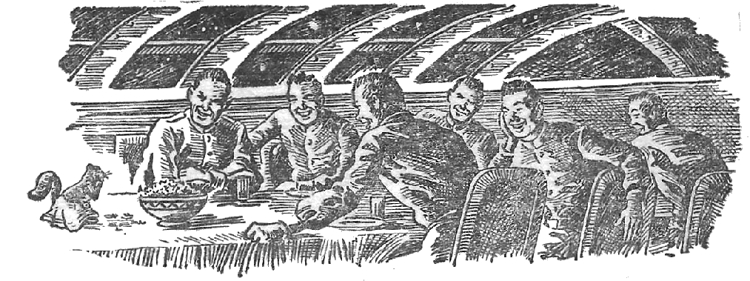
(illustration by MURPHY)
There was hope for humanity only if men had learned one lesson—that some things must not be done, even to win. Had they learned?
They slept with their feet in each other’s faces, and breathed the same air over and over again. Except for Neil’s laboratory, which was well-lighted (Thomas Neil, the son of old sex-linked-virus Neil), they lived in a perpetual twilight. They never had quite enough to eat, and the water they drank came from the distillation of their own catabolic wastes. For these and other bitterer causes, they were acutely irritable. A dozen quarrels flared up a day. They had been living like this for nearly three years now, and they would have to go on living like this for at least a year more, until the time when they got back to Earth. When. If.
It was Jacobsen who kept them sane. He was a natural clown and mimic, a big, good-natured, imperturbable man who could play a zither like a professional musician. Jacobsen had a gift for drawing the quarrels of the others on himself and dissipating them harmlessly, in the way that a lightning rod grounds the big bad voltage from the sky with no damage to anybody. They couldn’t have got along without him. He was also a brilliant and profound mechanic—an aptitude for whose display the almost-powerless landing they were going to have to make on earth would give ample opportunity.
If it was Jacobsen who kept them sane, it was Neil the ship was run for. His laboratory was the one well-lighted, well-aired, roomy place. This wasn’t because they liked him. They only saw him for thirty minutes a day, at meals, but he would easily have won in a contest for the most hated man on the ship; and on top of that they regarded him with a sort of loathing, because of whose son he was. But they hoped he might be able to undo some of the damage his father had done. They hoped he might be able to get them out of the predicament they, and everybody else, were in. They knew he was a first-class cytologist. They hoped.
“What’s Neil trying to do, anyway?” Adams asked one day, when he and Venner had been playing Go in the dimness for as long as they could stand. He had asked the question a number of times before, during the years they had been in space; and he would undoubtedly ask it several times more before they got home. Three years with the same shipmates makes conversation repetitive.
“Well, I’m no biologist,” Venner answered. He pushed the Go-board aside and crossed his fingers over his lean diaphragm. “But as I understand it, he’s trying to make a sort of artificial ovum, an artificial human egg.” It was the answer he always made when Adams asked about Neil’s work.
“An artificial egg? How could he possibly do that? How can he turn a sperm into a human egg?”
“That’s the million-dollar question,” Venner replied heavily. His stomach rumbled. “But here’s the way it was explained to me: A spermatozoon has all the chromosomes an ovum has; in a sense, it’s an ovum stripped down, an ovum without any albumen and with the minimum of cytoplasm possible. A mature sex-cell—a gamete —has been through a—a reduction division, and so has only half the number of chromosomes found in the ordinary body cells. That ordinary number is what they call the diploid number. A mature spermatozoon, or a mature ovum, has the haploid number.
“After fertilization occurs, the zygote has the full number of chromosomes characteristic of the animal’s body cells. It’s diploid again. All clear so far?”
“More or less.”
“Well, now, suppose you could get two sperms to, unh, sort of anastomose. Suppose you could supply this new cell—remember, it now has the diploid number of chromosomes—with albumen, and the same sort of cytoplasm an ovum has. What you’d have would be essentially a zygote, a fertilized egg.”
“Unh. Why not work with spermatozoa before the reduction division takes place? Then you’d have your diploid number of chromosomes without worrying about getting two sperms to snuggle up to each other and become one.”
“You could, but it won’t work. The cells aren’t ripe enough; they just die. I guess the point is that with anything as complicated as a human being, you have to get the extra set of chromosomes from outside the same cell. It has to be a little bit like fertilization.”
“If you can call another spermatozoon ‘outside’. Or—why don’t they try surrounding a mature sperm cell with cytoplasm and so on, and then let it be fertilized by another sperm? Wouldn’t that work?”
“Neil—he spent all of ten minutes talking to me on this subject once—Neil said that a mature unastomosed sperm seems almost to fight off any attempt to surround it with cytoplasm. The way he put it was, it insists on remembering that it’s a sperm.”
“I wish his old man had remembered it.”
Venner laughed dutifully. “It helps to get the two sperms to anastomose if the cell wall is a little bit flaccid,” he said. “That’s why Neil has been doing so much work on sperms from men who have cancer of the testes. They produce cells that are abnormal in a promising way.”
“Is that so!” For the first time in the routine conversation, Adams sounded sharply interested. “Why didn’t you tell me? I never heard that before. Why am I always the last one to know things on this ship? Anything interesting, you don’t tell me.”
“I only heard it a couple of days ago, from Clancy. I thought you’d heard, too. For Lord’s sake, don’t get so worked up.”
“You’re lying,” Adams said flatly. “Creep around behind my back and then try to lie out of it, will you? You....”
Venner pushed the Go-board aside and confronted him. Both men were breathing heavily. From the upper bunk where he was sitting—Clancy slept under him—Jacobsen twanged a burst of notes on his zither.
The tension in the cabin dropped abruptly. After a moment, both men laughed.
Venner sat down again. Adams stooped and began picking up Go-pieces from the floor. “Can it be done?” he asked when he had them all back on the board.
“Making an artificial egg? That time he talked to me, Neil said it was about trying to lift yourself up by your bootstraps while you have a hundred-pound weight tied on each foot. But I think he’s hopeful; human sperms seem quite tolerant of albumen derived from Ganymedean insect eggs.”
“Things work out funny, don’t they,” commented Adams. “Who’d ever have thought, when they sent out the robot rockets to the further planets before ... it happened, that soil cores from Ganymede would turn out to be useful. But there it is.”
“Yeah.... Old sex-linked-virus Neil’s son. But I suppose he knows what he’s doing. By sending him along, they saved a couple of years in working on the problem. The insects whose eggs he’s been using aren’t at all those that were in the soil core the robot rocket brought back. The ones, I mean, that first attracted the biologists’ attention to Ganymede. Those were a sort of scale insect, parasitic on Ganymedean lichens. What Neil’s using now is something more like a sow bug. If he hadn’t been along, we wouldn’t have known what insects to collect.”
Jacobsen was playing again on his zither. He was touching the strings in a way that gave the instrument almost the resonance of a guitar. It was a song he had played once or twice for them before, sad and romantic, called A Border Incident.
The music had turned their thoughts in a less scientific direction. Half-guiltily—he knew it was a forbidden topic—Venner said, “You know, I was married.”
“You were lucky,” answered Adams, who had been too young to have a wife.
“Yeah.... We weren’t awfully close to each other. Oh, she used to ask me what I’d done that day when I got home from work, and I’d tell her. Stuff like that. But it wasn’t what you’d call a romantic marriage.”
“It was a marriage. You were lucky,” Adams repeated.
“Unhhunh.... We had a couple of kids, a boy and one of the others, but they were more her kids than they were mine. What I mean is, I never thought of myself as much of a hand for the women. If she’d died in ... in the ordinary way, I probably wouldn’t have remarried. But now—it’s like all the meaning had gone out of life. I don’t know what I’m living for.”
“Everybody says the same thing,” Adams answered. “Even the ones you wouldn’t think would miss women much. It’s like daylight, I guess. You don’t think it matters very much; you can always turn on the electric lights. But if sunlight stops falling on the Earth, it means the end of most terrestrial life.”
Jacobsen was singing to his own accompaniment, the words to the song he had been playing before. “Spanish is the loving tongue,” he sang softly, in his warm, pleasant baritone voice. The beautiful, dark, loving girl and the soft words she had taught him. And then the refrain, “Mi amor, mi corazon.”
“Stop it, Jacobsen,” Venner said after they had listened for a little while. “You’ll have us crying into our tea in a minute, thinking.” There was no unkindness in his voice.
Jacobsen played another verse before he put the zither aside. “Sometimes it’s a good thing to think,” he said.
It was two days or so after this that Neil, coming in to lunch with the crew, attracted their attention by his air of supressed excitement. His normal game-cock aggressiveness seemed to have doubled. His small black moustache bristled, his teeth and eyeballs had a gleam like glass. None of them wanted to ask him questions. But by the time the dessert course—one small sweet biscuit per man—was served, they were all watching him.
Neil pushed his chair back and got to his feet. “Captain Ambarzumian,” he said formally. “I suggest you break out the stores of medicinal liquor. We have something to celebrate.”
Captain Ambarzumian’s normally ruddy color had paled. “Please explain yourself, Dr. Neil,” he said with equal formality.
“I cannot be quite certain,” Neil replied. He paused for dramatic effect. “But I believe—it is my sincere belief —that the future of the race is safe.”
There was a moment of dead silence. Somebody coughed. “The difficulties still to be overcome are enormous,” Neil continued. “Getting something as complicated as a human embryo to go through the later stages of its development in vitro is almost impossible. Almost. We will have to work very hard. The first human beings we produce from our artificial egg cells will almost certainly be monsters. But I believe that within fifty years—perhaps even within twenty-five—young human beings like ourselves will again walk the surface of our earth.”
Another silence. It was as if they couldn’t assimilate what he had told them. Then Jacobsen struck a wild burst of notes on his zither; his face had lit up like a sign-board. “Mine eyes have seen the glory of the coming of the Lord!” he sang with the full strength of his rich baritone voice.
The leaping exultation of the old words, if not their bellicosity, expressed what they all felt. By the time Jacobsen came to the full-throated chorus, they were all singing.
They sang with their heads thrown back, “The truth is marching on!” The song came to an end with another burst of notes from Jacobsen’s zither. “First time I ever heard that song really sung,” he observed to nobody in particular. “Sung right, I mean.”
The cabin began to fill with the babble of excited talk. Neil put up his hand as if to stop it. “There’s just one thing,” he said. “It doesn’t bother me, but some people might consider it a drawback. You’d better know about it now.” He seemed to have forgotten his suggestion that the captain break out the liquor to celebrate.
“You mean—you said they’d be monsters at first. Will they always be deformed in some way?” Clancy asked. Very softly, Jacobsen played the first few notes of a song that had been popular when the ship had left earth. Its title was A Cross-Eyed Girl Would Be a Pretty Girl.
“No, nothing like that. We’ll be able to get them straight and well-formed. But I haven’t been able—and there are strong theoretical reasons for thinking nobody will ever be able—to produce an artificial human zygote that doesn’t contain the X-chromosome.”
“We’re not cytologists, Dr. Neil,” said Captain Ambarzumian. “Please explain yourself.”
“Very well.” Neil sat down in his place at table again. He seemed to be enjoying himself.
“Only spermatozoa contain the X-chromosome,” he said. “Ova do not. If it were possible to get a human ovum before the meiotic division occurred, and induce it to go through its embryonic development to maturity without fertilization, it would give rise to a female.
“Spermatozoa are of two kinds, those which contain the X-chromosome and those which do not. They are produced in the testes in approximately equal quantities. That is why human males and females are born—used to be born—in approximately equal numbers.
“As I said, I have been unable to produce an artificial human zygote that does not contain the X-chromosome. Apparently there is such an antipathy between the cell walls of two sperms, neither of which contains the X-chromosomes, that it is impossible to get them to pair their chromosomes properly. Only X and non-X will pair. Nor does it appear feasible to eliminate the X-chromosome from the zygote after it has come into existence. Any such attempt makes the artificial human fertilized egg break down completely.
“It looks as if our zygotes were all going to have to contain the X-chromosome.” They looked at each other blankly. Neil’s words seemed to mean something; they weren’t sure what it was. They weren’t sure they wanted to know.
“Can’t you put it in nontechnical terms, Neil?” asked Captain Ambarzumian. “What does that mean?”
“We’ll be able to produce human beings. But they’ll all have to be produced from zygotes that contain the X-chromosome. So they’ll all be males.”
What they talked about was whether Neil might be lying. “But why would he lie?” somebody—it might be Venner—would say. “He’s a scientist. He wouldn’t tell lies in a thing where he’d be caught out.”
“Did you see the expression on his face when he was telling us the bad news?” somebody—it was usually Adams—would answer. “He enjoyed it; he likes the idea of a world without women. He could perfectly well be lying. Look whose son he is.”
It was during one of these discussions that Adams asked, “What happened to old man Neil, anyhow? I know he’s dead, but I never heard the real details. Some people say one thing and some another. I was only twelve when the plague killed ... everybody.”
“He was torn to pieces by a mob about two months after the last woman in North America died,” Venner answered. “I mean, literally torn to pieces. The authorities didn’t even try to stop the mob; I saw a telecast of his death.”
“That must have been good watching,” said Adams.
“Well....”
“He was the worst man who ever lived,” Adams said. He turned in his bunk. They all spent a good deal of time in their bunks now; it was as if they didn’t have enough energy to sit up. “To kill off all the enemy’s women to win a war isn’t war: it’s murder.”
“Of course his idea wasn’t to kill all of them,” Venner answered. “He was trying—what was that expression they used?—trying to negotiate from a position of maximum strength. If the enemy didn’t want all their women killed, they’d have to surrender. Then they’d be given the vaccine.
“They did surrender; but by that time, the virus had mutated in the enemy women’s tissues. It was a lot faster and more deadly than it had been; it swept over the whole world. The vaccine wasn’t any use against it in its new form, and that was that.”
“He was the worst man who ever lived,” Adams repeated.
“He was a bad man, certainly,” answered Venner, “but he wasn’t much worse than a lot of others. That bomb they used to have—they kept on testing it, even though they knew there was a good chance their tests were damaging human germ plasm permanently. They came within an inch of using the bomb in battle. In fact, one of the arguments in favor of bacteriological warfare was that it was more humane.”
“Humane,” said Clancy.
“That’s what they said. No, in the end we’re none of us much different from Neil. We’re all of us responsible.”
Adams raised himself on one elbow and looked at Venner. “How am I responsible?” he asked. “I was twelve years old at the time of the plague. Twelve years! How am I responsible?”
“We’re all of us too aggressive,” Venner replied. “Have we still learned to take a blow and not strike back, even if striking back means ruining ourselves as well as the enemy? Put it another way. Have we yet learned there are some things you mustn’t do even to win?”
Adams made a disgusted noise. “I wish you’d shut up. Be saintly, if you want to. When somebody hurts me, I want to hurt him back. You make me sick.”
“I know. That’s just it.”
As the discussions continued, their apathy increased. Finally Ambarzumian called Jacobsen in for a conference.
“Can’t you do something to cheer them up, Jacobsen?” he demanded. “Play some on your zither. Morale was never this bad before. If they get much more depressed, they’ll be making suicide tries.”
“I don’t feel like cheering anybody up, Sir,” Jacobsen said shortly. Since Neil had made his announcement, his big frame seemed to have shrunk in on itself. He looked considerably older and smaller than he had two weeks ago.
“None of us feels very well,” Captain Ambarzumian answered, “but we’ve got to have our full crew to get home at all. When it comes to our landing, even Neil will have his duties. If we’re short-handed, landing will be very ... difficult.”
There was a silence. Then Jacobsen said, without disrespect, “Who cares?”
Ambarzumian was too wise to rebuke him. “We’ve got to keep hoping,” he answered. “Neil’s a good man, of course. Brilliant. The Council wouldn’t have sent him with us otherwise. But he’s not the only cytologist. There’s Rausch ... Trenton ... Yee Ching ... Scheel. Neil could be wrong; he’s got to be wrong. The important thing is getting home with the Ganymedean cell material; then the others can work with it. Teamwork might accomplish a lot.—Look whose son he is.”
Jacobsen chewed his lower lip. “Well....”
“You can have anything you want,” Ambarzumian told him. “Except the emergency landing stores. Perhaps you could rig up some sort of a toy to divert them. A puzzle machine, for example. Anything like that.”
Jacobsen nodded. He left the Captain’s cabin and went back to the forecastle, where he sat for half a morning, thinking. Then he went to the storeroom and rummaged about. He came out with an assortment of metal parts, the last three big flashlight batteries, and a number of relays and electron tubes. He worked for a long time over them. What he came up with, finally, was the Squee.
He introduced his creation to his shipmates at the end of the short, morose meal they called dinner. He began by emptying a handful of metal nuts into a small dish. When he saw the crew was watching him, though apathetically, he reached under his chair and produced the Squee.
The little robot was about fifteen inches high, housed in a reasonably accurate squirrel-shaped case. (Jacobsen had had to do a lot of hammering to get the curves right.) It had two beady eyes that were actually ball-bearings touched with black paint, and a nicely-curled, bushy tail that Jacobsen had gone to a lot of pains to make from some spun-glass insulation. Around its waist there was a full, very abbreviated red skirt that had been the hem of a bandana handkerchief. Considering the difficulties Jacobsen had labored under, it was a thoroughly engaging robot squirrel.
It stood for a moment balanced on its hind paws beside Jacobsen’s plate. Then it said—a fair proficiency in ventriloquism was among Jacobsen’s talents—“Hello, boys,” in a high, squeaky, indubitably feminine voice. There was a silence. The success of Jacobsen’s project—other things, too—hung in the balance. At last Clancy said, “Hello yourself. What’s your name?”
“Squee,” the robot answered. “And I like nuts. I like nuts. I think I’ll go get me a nut.”
Jacobsen touched something on the creature’s underbelly. It stood for a moment, swaying. Then it bounded lightly over the table to the dish of metal nuts. It picked one up. It turned it between its forepaws. It raced gracefully back across the table to the large box Jacobsen had put by his elbow. It went inside the box and left the nut.
The performance was repeated twice more. Then the Squee halted beside Jacobsen. “I just love nuts,” it said in its high voice.
“Will she come for a nut if I hold it out for her?” Clancy asked eagerly.
“Sure, if your nut is nearer than the ones in the dish.”
Clancy picked up a nut and pushed the dish to the extreme end of the table. Everyone was smiling. “Here, Squee,” he said coaxingly. “Come and get it. Nice nut. Nice nut for Squee.”
The robot squirrel seemed to hesitate. She turned her head from side to side. Then she raced toward Clancy, seemed to snatch the nut from his fingers, and bounded back to her box. “Thank you, Clancy,” she said in a somewhat muffled voice when she was inside.
Clancy laughed. “Some squirrel,” he said warmly.
“Thank you, Clancy,” came the answer from within the box.
That night their after-dinner discussions turned on something considerably different from the usual weak arguments about Neil’s trustworthiness. What they wanted to know was whether the robot was properly known as the Squee, or simply Squee. Jacobsen, appealed to, refused to commit himself. The discussions grew warm, even heated; but it was plain the participants were enjoying themselves.
Gradually, it became the customary thing for the after-dinner interval to be devoted to the antics of the Squee. With Jacobsen’s deft fingers helping, she “learned” to jump to the shoulder of the man who called her (provided he had a metal plate on his shoulder), to roll over, to sit up and beg for nuts. The men themselves suggested extra tricks for her to “learn.” Morale was improving amazingly.
For the first two weeks or so, Neil seemed unconscious of the Squee’s existence. He still messed with the crew, but even a man as thick-skinned and arrogant as he was must have been aware of the hostility with which they regarded him, and have found it slightly distasteful. At any rate, he always left the table as soon as he had finished chewing his food. One evening, however, he remained in his place and witnessed the Squee’s whole performance. When it was over, he said, “Nice little robot, Jacobsen.”
Jacobsen did not answer. Neil continued, in his drawling, rather high-pitched voice, “You know, people’s minds are amazing. Here’s this robot. It’s nothing but a robot, entirely sexless; but because Jacobsen has dressed it up in a red handkerchief, and given a rather hippy character to its locomotion, you’re all convinced that it’s a she. But if I were to take off its red skirt, and make a couple of changes in the mechanism....” He picked up the Squee and began sliding the red skirt down over the robot’s metal flanks.
Jacobsen snatched it away from him. “You let my Squee alone,” he said angrily.
“All right, all right,” Neil answered, permitting Jacobsen to take the Squee from him. “I was only trying to demonstrate a point.”
“Demonstrate it on your....” Jacobsen answered. He was so angry his voice was shaking. “If you want something to play with, go play with your damned chromosomes. Keep your hands off my Squee.”
“I won’t touch it again, I assure you,” Neil said in his mocking voice. He pushed his chair back from the table. “As I said before, people’s minds are amazing.” He went out.
Jacobsen continued to “teach” his robot new tricks. The best of them, it was generally agreed, was that she “learned” to rattle a tambourine (made of metal washers loosely riveted to the bottom of a metal biscuit tin) in time to her own singing.
Since all of Jacobsen’s sizeable vocal repertory was at her disposal, she ended by “knowing” a considerable number of songs. Her rendering of Blow the Man Down was particularly spirited. She did so many tricks that her red bandana skirt frayed at the edges and had to be replaced with a new one made of blue fabric.
The crew had not even begun to tire of her antics when Jacobsen had another idea. He made a few adjustments in her mechanism; the tempo of her performances slowed down noticeably.
“What’s the matter with her?” Clancy demanded when, for the second evening running, the Squee had hardly seemed to notice the nut he held out of her. “She sick or something?”
“I don’t think so,” Jacobsen responded. There was a slight smile at the corners of his mouth. “But why don’t you ask her yourself how she feels?”
“What’s the matter, Squee?” Clancy asked. “Aren’t you feeling well?”
“Oh, I’m all right,” the robot answered. “But—unh....”
The blue skirt switched. The Squee lowered her head and pawed lightly at the table, in a perfect pantomime of coy, embarrassed happiness. “But I may be having a little secret to tell you—I’m not sure—one of these days.” She scampered off to her box.
“What’s the secret, Jacobsen?” Adams asked eagerly later that evening, when the remains of the meal had been cleared away.
“I don’t know,” Jacobsen answered. He was beaming. “She hasn’t told me yet. I guess she’ll tell us when she’s good and ready.” He picked up his zither and began to play Careless Love on it. “Well, that’s how it is,” he sang. He skipped on to the fourth verse. “Now my apron strings won’t pin, you pass my door and won’t come in. Love, Oh careless Love.”
“Yeah, I guess she’ll tell us when she’s ready,” said Adams. His face wore a delighted smile. “We all know how women are.”
The news—that there was to be news—must have got to Neil somehow. Three nights later, when the dessert was being served, he said abruptly to Captain Ambarzumian, “Captain, can’t you let me have a little more power for my laboratory? It’s important.”
The captain frowned. The request should have been made to him in private, instead of in the presence of the crew. “I’m sorry, Dr. Neil,” he said stiffly. “There simply isn’t more power available. We’re already on minimum rations for the most essential things.”
“I only need a few watts. It’s for my centrifuge. You see, there’s a possibility—perhaps more than a possibility—that I may be able to centrifuge out the X-chromosomes from my artificial ova. Without too much damage to the cell wall, I mean. In that case, the artificial ova would no longer give rise to males. Females could be produced.”
“That’s—interesting news. But I’m afraid I simply haven’t even a few watts.”
“I think you have,” Neil answered. “What about that thing?” He pointed to the Squee’s hutch, which was sitting on the table beside Jacobsen’s elbow. “There must be more than a few watts in the batteries for it.”
Captain Ambarzumian sat silent. The crew watched him almost without breathing. They all knew what he was thinking. Neil’s request might be—very probably was—prompted by malice. He disliked Jacobsen, he hated the Squee. His tight face wore a spiteful little smile. But he might, after all, be on the track of something important.
The chance was too great for Ambarzumian to take. “All right,” the captain said at last. “I’m very sorry, Jacobsen. But you’ll have to give him the batteries.”
In silence Jacobsen fetched a screw driver. He disconnected the big batteries. He put them on the table, still without a word.
Neil picked them up. “Thanks,” he said to nobody in particular. Carrying the batteries, he left the cabin. There was triumphant malice in every line of his rigid little back.
That night, Venner had a nightmare. He dreamed that he was standing out of doors, under a lowering sky, while the wind moaned. The sound of the wind grew louder. It began to rain, big icy drops that came out of the sky with an audible plop.
For all the drops were so cold, they were burningly hot when they touched him. He tried to rub them away, but they clung and scalded in. The noise of the wind was rising. And still the rain fell, in big hot drops. Venner awoke with a start. He rubbed his hands over his face, and found that it was wet and sticky. He could still hear the wind moaning. More frightened than he had been in his dream, he leaped from his bunk and turned on the cabin light.
It was Adams whose breathing had seemed like the wind howling. “What’s the matter?” Venner demanded. “Are you sick?”
“...Hurt,” Adams said with difficulty. “Get Ambarzumian.” At a run, Venner routed the captain from his cubicle. Then, urged by an impulse he couldn’t have defined, he ran to Neil’s laboratory.
There was blood and broken glassware everywhere. Tables had been overset; the laboratory looked as if everything in it had been stirred with a big stick; there wasn’t a flask or test tube unbroken; there was blood high up on the white walls. Neil lay on the floor in bloodsoaked pyjamas. He had been beaten about the head until almost the only recognizable feature of his face was his moustache. In his right hand he was holding one of the long-bladed laboratory knives.
Venner turned and ran back to the forecastle. Ambarzumian was bending over Adams. The emergency lights had been turned on.
“What happened?” Ambarzumian demanded. “How did you get hurt like this?”
“Neil,” the young man answered. “I had to get the batteries back from him.”
“Batteries, Why?”
“For the Squee,” Adams replied. The breath was rattling in his throat, but he smiled at them. “She had to have them; right now, she’s got to have plenty of power.”
“Power? What for?” Ambarzumian questioned. He knew, better than the others, what their position now was; he looked sick and old.
“Because....” Adams, bleeding to death, sounded surprised. “Didn’t you hear what Jacobsen told us? We’ve got to be extra careful with her now. Because she’s going to have a pup.”
Oddly enough, the two deaths improved the morale of the crew. Neil had been deeply and bitterly hated; the loss of the Ganymedean cell material seemed to be more than compensated for by the fact of his death. Adams had been popular enough, but his being dead meant a little more comfort in the way of food, air, and living space for the others. The difficulties of a short-handed landing on earth were still so distant in space and time that it was difficult for the crewmen to appreciate them. Since there was no other way to dispose of the bodies, they were fed into the ship’s atomic reducers, and added, ultimately, a few extra BTU to the auxiliary fuel supply.
As the distance between the ship and earth lessened, Ambarzumian called Jacobsen in for a series of conferences. He wanted to see what could be done toward modifying the landing gear to make a safe landing a little more possible.
“That’s the best I can do, sir,” Jacobsen said at last.
“Yes. You’ve tried hard. It’s ... not too bad.”
Jacobsen touched the zither strings lightly. “What do you think our chances of a safe landing are, sir?” he ventured.
“Oh—about fifty-fifty. Maybe a little better than that. Depends a good deal on what sort of upper stratospheric winds we meet.” Ambarzumian leaned back in his chair and sighed.
“If we do get down to surface safe, it’s going to be hard on the people at home when they learn that we failed. This ship was just about the last hope, and we aren’t bringing anything back.”
“It’s not quite that bad,” Ambarzumian answered. He had grown noticeably more gray-haired in the last month. “We’ve got most of Neil’s notes; they’ll be valuable. We know that he did succeed in making an artificial human zygote. The next ship to leave earth for Ganymede will start off from a higher level than we did.”
“The next ship.... Sir, do you think that what Venner said was true? Did we fail because we haven’t learned to control our own aggressiveness?”
“It certainly looks that way. Adams loved the Squee. When he felt Neil was endangering her, he struck back at him, even though, by his striking back, he destroyed everything the expedition had accomplished. What you said Venner said about men, generally speaking, is certainly one way of looking at it.”
“Yes, but.... Suppose we get home safe. Suppose the other cytologists are smarter than Neil was. Suppose the race goes on living. Will we always be that way? Will we never be able to get rid of?”
“How should I know, Jacobsen? I’m only a human being.”
There was a long silence. At last Jacobsen began to play the zither lightly. “Didn’t my Lord deliver Daniel? Deliver Daniel?” he sang softly but indomitably. “Didn’t my Lord deliver Daniel? And why not every man?”
This etext was produced from Future Science Fiction #35, February 1958. Extensive research did not uncover any evidence that the U.S. copyright on this publication was renewed.
Obvious errors have been silently corrected in this version.
Some song lyric lines have been italicized to match the other song lyrics quoted.
Word change made:
felt to left
He left the Captain’s cabin and went back to the forecastle,