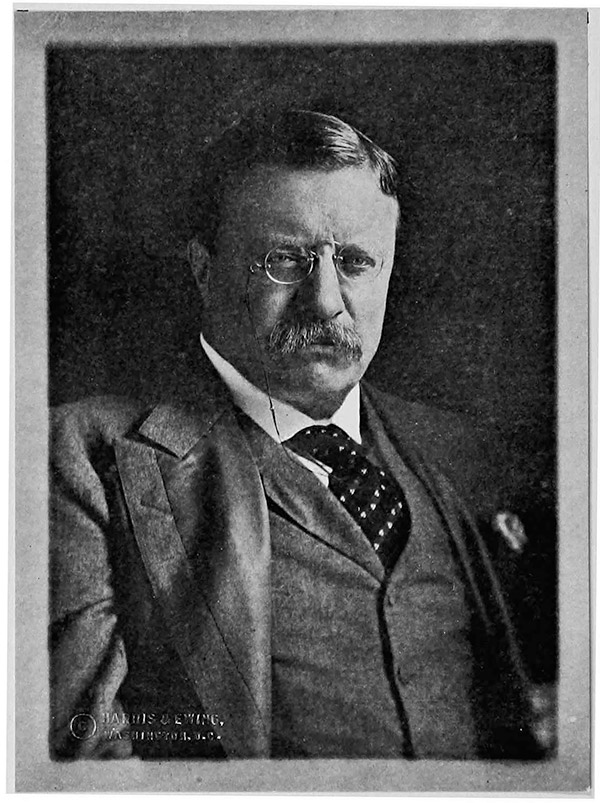

Earl Lectures of Pacific Theological Seminary
delivered at Berkeley, California,
in 1911.
BY
THEODORE ROOSEVELT

SAN FRANCISCO
WHITAKER & RAY-WIGGIN CO.
1912
COPYRIGHT
BY
Theodore Roosevelt
1911
The addresses printed in this volume were delivered under the auspices of Pacific Theological Seminary by the Hon. Theodore Roosevelt, as Earl Lecturer, in the Spring of 1911. The Seminary is fortunate in possessing a Lectureship founded by Mr. Edwin T. Earl in 1901, whose purpose, as stated in the articles of foundation, is “to aid in securing at the University of California the presentation of Christian truth by bringing to Berkeley year by year eminent Christian scholars and thinkers to speak upon themes calculated to illustrate and disseminate Christian thought and minister to Christian life.” The uncommon public interest which this series of lectures aroused, and the attendance of many thousands who daily crowded the Greek Theatre to hear them, emphasized to the Lectureship Committee the desirability of yielding to a wide-spread demand for their publication. Since Mr. Roosevelt did not have a manuscript, arrangements were made for an accurate stenographic report, which was afterwards submitted to him for revision. So much should be said in explanation of the forensic form of these lectures. Their fine ethical purpose justifies the hope that they may continue to stimulate good citizenship in wider circles than those which came within reach of the speaker’s voice.
William Frederic Badè.
September, 1911.
Pacific Theological Seminary,
Berkeley, California.
[Pg 1]
When I was first asked to deliver this course of lectures I refused just because what I wanted to preach was action. I did not feel sure that I could preach action in five lectures. I finally accepted, because it seemed to me so admirable a thing for the Seminary to have started this kind of a lecture course and so admirable a thing for the founder of the course to have provided for it that I did not feel quite at liberty to refuse.
All our extraordinary material development, our wonderful industrial growth will go for nothing unless with that growth goes hand in hand the moral, the spiritual growth that will enable us to use aright the other as an instrument. I hesitated some time as to exactly what title to give to the lectures I was to deliver because I wanted to [Pg 2]use the two titles of Applied Ethics and Realizable Ideals. I chose these titles because they seemed to me to put into words the only spirit which I think counts for anything in preaching, whether by a professional or by an amateur; the spirit which regards preaching as worthless unless transmuted into action. If we treat the study of ethics as a mere intellectual diversion then we probably do ourselves little harm and certainly do ourselves no good. If we consciously or carelessly preach ideals which cannot be realized and which we do not intend to have realized, then so far from accomplishing a worthy purpose we actually tend to weaken the morality we ostensibly preach. Now, anything I have to say to you during these lectures will derive its whole value from the spirit in me as I say it and the [Pg 3]spirit in you as you listen to it. If I preach to you anything which I do not strive, with whatever haltings and shortcomings, myself to realize then I am unworthy for you to listen to; and if, on the other hand, you come to listen to me from mere curiosity, or to get a little temporary enjoyment, then you would better have stayed at home.
I chose as the opening lecture this address on realizable ideals, because the longer I have lived the more strongly I have felt the harm done by the practice among so many men of keeping their consciences in separate compartments; sometimes a Sunday conscience and a weekday conscience; sometimes a conscience as to what they say or what they like other people to say, and another conscience as to what they do and like other people to do; sometimes a conscience [Pg 4]for their private affairs and a totally different conscience for their business relations. Or again, there may be one compartment in which the man keeps his conscience not only for his domestic affairs but for his business affairs and a totally different compartment in which he keeps his conscience when he deals with public men and public measures.
It has always irritated me when, in whatever capacity, I have attended Sunday School celebrations, to listen to some of the speeches made, and especially when I knew some of the men making them. I have always felt most strongly that it was mischievous and wrong for a man to get up before a number of boys and girls and preach to them to “take no thought of things of the body,” not “to regard their own interests [Pg 5]in any way,” to think of “nothing whatever but others,” when they knew that he did not follow any such course of action himself, and when they knew that they themselves could not act and were not expected to act, literally on his words. That kind of a speech does harm, because harm is always done by preaching an ideal which the preacher and the hearer know cannot be followed, which they know it is not intended to have followed; for then the hearer confounds all ideals with the false ideal to which he is listening; and because he finds that he is not expected to live up to the doctrine to which he has listened he concludes that it is needless to live up to any doctrine at all.
Now I do not mean for a moment that the ideal preached should be a low one; I do not mean for a moment that it is [Pg 6]ever possible entirely to realize even for the very best man or woman the loftiest ideal; but I do mean that the ideal should not be preached except with sincerity, and that it should be preached in such a fashion as to make it possible measurably to approach it.
Take the Sunday School address of the type to which I object and of which I have just spoken: If you tell a number of boys who are about to become men and go out to earn their own living—if you tell them to despise the things of the body, to care nothing for material success, you are telling them what you would not want your own boys actually to do; you are telling them what they cannot do unless they are willing to become public charges, and what it is not desirable that they should try to do. To tell them such things in the name of [Pg 7]morality is to invite them to despise morality. What is necessary is to tell them that their first duty is to earn their own livelihood, to support themselves and those dependent upon them; but that when that first duty has been performed there yet remains a very large additional duty, in the way of service to their neighbor, of service to the rest of mankind.
Again, I have heard men, whose lives have been passed chiefly in amassing money, preach to boys that money was of no real consequence, that they ought to disregard it, that it was really entirely unimportant. Well, those men did not in practice believe what they preached. Curiously enough some of them had for so many years schooled themselves to utter that kind of a sentence when they got on a platform, and [Pg 8]to act in such diametrically opposite fashion when they were in their business offices, that they had ceased to become conscious of any incongruity; when they got up to speak they naturally fell into the very vice that represented the negation of the other vice into which they equally naturally fell as soon as they sat down before their counting-desk. Now, it is a false statement, and therefore it is a disservice to the cause of morality, to tell any man that money does not count. If he has not got it he will find that it does count tremendously. If he is worth his salt and is desirous of caring for mother and sisters, wife and children, he will not only find that it counts but he will realize that he has acted with infamy and with baseness if he has not appreciated the fact that it does count. And of course, when I [Pg 9]speak of money I mean what money stands for. It counts tremendously. No man has any right to the respect of his fellows if through any fault of his own he has failed to keep those dependent upon him in reasonable comfort. It is his duty not to despise money. It is his duty to regard money, up to the point where his wife and children and any other people dependent upon him have food, clothing, shelter, decent surroundings, the chance for the children to get a decent education, the chance for the children to train themselves to do their life work aright, a chance for wife and children to get reasonable relaxation. Now practically, as regards his or her own family, I doubt if there is anyone here who would deny that proposition. It is so obvious that it seems needless to put it before you; and yet [Pg 10]how often do we listen to a man on a platform like this, saying, because it is the conventional thing to say, “pay no heed to money.” Now, of course, when such a preacher says “pay no heed to money” his hearers at once accept what he is about to say further as insincere; and, whether they pay heed to money or not, they pay no further heed to what he says about it.
It is not a realizable ideal, to “pay no heed to money.” You must pay heed up to the point I have indicated. But it is a realizable ideal, after you have once reached that point, to understand that money is merely a means to an end, and that if you make it the end instead of a means you do little good to yourself and are a curse to everybody else. It is a realizable ideal, to make people understand that while it is their first [Pg 11]duty to pull their own weight in the world, yet that after they have achieved a certain amount of prosperity both their capacity for usefulness toward others and their capacity for enjoyment depends infinitely more on other things than upon possessing additional money.
Now, the very fact that I grant in the fullest degree the need of having enough money, which means the need of sufficient material achievement to enable you and those dependent upon you to lead your lives healthily and under decent conditions—the very fact that I grant this as the essential first need to meet, entitles me to have you accept what I say at its face value when I add that this represents only the beginning, and that after you have reached this point your worth as a unit in the commonwealth, your worth to others and [Pg 12]your worth to yourself, depends infinitely less upon having additional money than it depends upon your possessing certain other things, things of the soul and the spirit.
I could not overstate the grinding misery, the heart-breaking misery, I have seen come to a family where the man is unable quite to do what he ought to for those dependent upon him. But after the man and the woman have reached the point where they have a home in which the elemental needs are met and where in addition they have accumulated a comparatively small amount of money necessary to meet the primal needs of the spirit and of the intellect—after this point is reached it is my deliberate judgment that money, instead of being the prime factor, is one of the minor factors, both in usefulness [Pg 13]and in happiness. Always keep in mind my first proviso—I am not going to repeat it to you—as to the necessity of having enough money. But go beyond that; for beyond that, the difference between the multi-millionaire and the man of very moderate fortune is in the vast majority of cases really a difference of appearance and not of reality as regards both usefulness and happiness. The chief harm that the multi-millionaire does in my mind comes not in his joining with others to make a trust—although when he does that I will try to regulate him—and it is not in the fact that in him as in other men there is, as Abraham Lincoln put it, “a deal of human nature,” so that he is sometimes very good and sometimes not good at all; it is that he is apt to give to the rest of us a thoroughly false ideal. The [Pg 14]worst ill that can befall us is to have our own souls corrupted, and it is a debasing thing for a nation to choose as its heroes the men of mere wealth.
I remember a number of years ago seeing a pleasant and very happy little community very nearly ruined—and as regards many of the families completely ruined—because an entirely amiable multi-millionaire moved into the neighborhood. I really think that his amiability and his perfectly sincere desire to be pleasant with everyone was one of the causes of the mischief. I know, for instance, a very nice woman there, with a charming little house, who, having been asked to dinner at the very gorgeous mansion of this worthy soul of many millions, naturally wished to entertain him and his wife in return. But, alas, she was perfectly wretched when it [Pg 15]actually came to entertaining them in her house; she was not willing to have the hired girl wait on the table; she had to have a butler, and then she had to live up to the butler. And the funny thing was instead of giving the multi-millionaire a perfectly pleasant time in her own fashion, which she could have done, she merely gave him a dreary tenth-rate imitation of his own feasts. Instead of putting herself in a totally different class, so that there could be no competition between them at all, she insisted on competing in a class where she was certain to get the worst of it. After two or three years of the millionaire’s residence in the neighborhood there were not a few families who had suffered either some permanent damage or grave temporary discomfort, not from any fault of the millionaire, [Pg 16]but because they themselves had been foolish. Now, I don’t want to preach against the millionaire; but I do want to preach against us if we let him make us spoil ourselves—that’s all.
I wish us to understand better than we now do what are the real things and what are the artificial things of life. I wish us to get a better perspective. Take even the average educational institution; if a very wealthy man visits it altogether too many of the boys look at him with eager interest, as a man that has had just the career that they intend to emulate; and altogether too many of the girls think that they would like to marry into his class! Now, in that case, I don’t blame him at all; I think it merely adds to our sin, to our iniquity, if we blame him instead of ourselves for the feelings, not that he has about us, but [Pg 17]that we have about him. But I do blame ourselves; I blame us if we do not have a proper sense of perspective, if we fail to pay honor to the people who are entitled to it. I do not wonder that a great many men make of money-getting their one ideal when so many of their fellow countrymen treat success in making money as the chief kind of success.
When America’s history is written, when the history of the last century in America is written a hundred years hence, the name of no multi-millionaire, who is nothing but a multi-millionaire, will appear in that history, unless it appears in some foot-note to illustrate some queer vagary or extravagance. The men who will loom large in our history are the men of real achievement of the kind that counts. You can go over them—statesmen, soldiers, wise [Pg 18]philanthropists—I wish to underscore the word “wise,” for the philanthropist who is really worth calling such is the man who tries to make such use of his philanthropy as to provide against the need of philanthropy in the future, just as the real worker in charity is the worker who does his best to bring about conditions in which charity shall not be necessary. The statesman, the writer, the man of science, of letters, of art, these are the men who will leave their mark on history.
When you look back and think of the Civil War, what lives of those who then lived would you, if you had a chance, like yourselves to have lived? Not the lives of the sordid souls who stayed at home and made money out of the Civil War; not even the lives of those men who were not sordid, who acted honorably [Pg 19]in their private business at home, but who did not have the opportunity and privilege of going to the front. The lives that you respect, the lives that you wish your fathers or forefathers to have led, are those of the men who in the time of the Nation’s trial each endeavored to render all the service that could possibly be rendered to the nation. Those are the men of the past to whose memory we look up, of whose fame we as Americans are jealous, whose good deeds we would like to emulate. Now, that is our attitude toward the past; I ask that we make it also our attitude in the present.
I wish it distinctly to be understood that I have not the smallest prejudice against multi-millionaires. I like them. But I always feel this way when I meet one of them: You have made millions—good; [Pg 20]that shows you must have something in you, I wish you would show it.
I do regard it as a realizable ideal for our people as a whole to demand, not of the millionaire—not at all—but of their own children and of themselves, that they shall get the millionaire in his proper perspective, and when they once do that ninety-five per cent of what is undesirable in the power of the millionaire will disappear. I shall speak of the other five per cent in a minute or two; but I am speaking now of much the larger part of what makes him undesirable; and much of that larger part is not in him at all, it is in us; it is in the emotions we permit the sight of him to produce in us.
Now, a word to my fellow reformers. If they permit themselves to adopt an attitude of hate and envy toward the [Pg 21]millionaire they are just about as badly off as if they adopt an attitude of mean subservience to him. It is just as much a confession of inferiority to feel mean hatred and defiance of a man as it is to feel a mean desire to please him overmuch. In each case it means that the man having the emotion is not confident in himself, that he lacks self-confidence, self-reliance, that he does not stand on his own feet; and, therefore, in each case it is an admission that the man is not as good as the man whom he hates and envies, or before whom he truckles.
So that I shall preach as an ideal neither to truckle to nor to hate the man of mere wealth, because if you do either you admit your inferiority in reference to him; and if you admit that you are inferior as compared to him you are no good American, you have no place in [Pg 22]this Republic. So that from our standpoint toward the millionaire ninety-five per cent of the damage he can do us is subjective and not objective; that is to say, it rests with us and not with him.
There remains the five per cent of harm that he can do us for which we are not responsible. Up to this point I have been preaching to us about him. Now I want to say a word or two to him, to the man of great wealth. The mere acquisition of wealth in and by itself, beyond a certain point, speaks very little indeed for the man compared with success in most other lines of endeavor. I want you to weigh the words that I have used—the mere acquisition of wealth in itself. I know that there are many men who have made great fortunes where the making of the great fortune has been an incident to the doing of a great [Pg 23]task, where the man has really been at least as much interested in the task as in the fortune. It is a great epic feat to drive a railroad across a continent; it is a great epic feat to build up a business worth building. For the man who performs that feat I have a genuine regard. For the man who makes a great fortune as an incident to rendering a great service I have nothing but admiration—although unfortunately the men who are entitled to our regard, and a little more—to our admiration—for the feats that they have thus done, have too often forfeited all right to that regard and admiration and more than forfeited it by the course that they have afterwards, or coincidently, pursued in regard to money making or in other matters. Furthermore the wealthy men who make money which does not represent service are [Pg 24]public enemies; we are bound to make war against every form of special privilege.
We have now definitely accepted as axiomatic the fact that in this country we have to control the use of enormous aggregations of wealth in business. But no great industrial chief should be content to do only so much as is necessary to keep within the law. He may be “law honest,” and yet be a sinister enemy of the commonwealth.
One great realizable ideal for our people is to discourage mere law honesty. It is necessary to have good laws and to have them well enforced. But the best laws and the most rigid enforcement will not by themselves produce a really healthy type of morals in the community. In addition to the law and its enforcement we must have the public [Pg 25]opinion which frowns on the man who violates the spirit of the law even although he keeps just within the letter. I cannot tell you any one way in which that feeling can be made to carry weight. I think it must find expression in a dozen different ways. Later in one of these lectures I shall discuss the organs of public opinion and public expression—the press and the magazines. When they more measurably reach the ideal they ought to, we shall be able to grapple more effectually with the man of wealth who fails in his duty than we do at present. But without waiting for that day, we should strive to create in the community the sense of proportion which will make us respect the decent man who does well, and condemn the man who does not act decently and who does wrong.
[Pg 26]
The other day a sentence was uttered in the Senate by a certain Senator which I thought was fraught—quite unconsciously fraught—with a lesson for all of us. The Senator in question had been engaged in an impassioned speech on behalf of Mr. Lorimer, and in speaking of some of the unsavory creatures who had testified in the case he said in answer to a question, “Yes, they were fools as well as knaves,” and that in his experience all knaves were fools.
That is not so. This Senator was giving expression to a very unhealthy attitude of the public mind, the tendency to treat as a knave only the foolish knave, and to pardon the wise knave who managed to succeed in his villainy. We shall never come near realizing the very realizable ideal of honesty in business and public life until we make it evident [Pg 27]that the scoundrel whom we hate most is not the scoundrel who fails but the scoundrel who succeeds. The scoundrel who fails is condemned by everyone and is laughed at by his fellow-knaves. It is the scoundrel who wins out that is the menace to this Republic, the menace to this great commonwealth of ours. Let us so shape our laws as to make it difficult for the scoundrel to succeed, and to give us at least a reasonable chance of punishing him after he succeeds. In addition to this, let us also, each of us individually and all of us collectively, strive to create the kind of public opinion which will make the success of such a scoundrel hardly worth having. The dullest man, the man with the thickest skin, does not enjoy very much a success which brings on him the scorn of his fellows. The old Greek [Pg 28]proverb was that “contempt would pierce the shell of a tortoise,” and whatever our people really scorn, really despise, really condemn, is something that the knaves among us rarely care to have. When we can create the public opinion which will mean that the average honest man turns away from the successful knave one of the prime incentives for being a successful knave will have vanished.
To that end, friends, I again wish to say that we must hold up an ideal that can be realized. If we use language which would go to show that we regard success and failure in the business world as of indifference, then we shall merely convince every man in that world that we are speaking insincerely. You do not regard success and failure with indifference. You do not regard the man [Pg 29]who fails and the man who succeeds as standing on the same plane; and as long as you do not so regard it, tell the truth about it. No man ever permanently helped a reform by lying on behalf of the reform. Tell the truth about it; and then you can expect to be believed when you tell further truths; the truth that business success, though an admirable thing, up to a certain point an absolutely necessary thing, is beyond that point not as admirable as some other things; and the truth that business success obtained, not by serving your fellows but by swindling your fellows, is an infamy and is to be so regarded by all honest men.
Realizable ideals; we must have them in private and in public life both. I have already told you of one type of sermon to which I strongly object. There is [Pg 30]another type to which I object almost as strongly, and that is the sermon which in its condemnation of innocent pleasure tends to make men confound vice and pleasure. I heartily abhor the man who practices vice because he regards it as the only kind of enjoyment. I do not abhor quite as much, but I at least as much despise, the clergyman who makes ready the path for such a man by condemning indiscriminately innocent enjoyment and vice. It is not only harmless, but it is eminently desirable, that young people should have a good time.
What we wish for ourselves, and have a right to wish for ourselves I want to see us preach towards others. If you persuade the average boy that it is wicked to have a good time, it may have either one of two results: if he is a very [Pg 31]sensitive boy it may prevent him from ever having a good time, in which case I will guarantee that he makes all those intimately associated with him have a very bad time; or else, you may persuade him that inasmuch as he thoroughly intends to have a good time, and as a good time is wicked—why, in for a lamb, in for a sheep, and he will be wicked to some purpose. I ask here again that not only every clergyman but every teacher of morals—and that ought to include every father who is worth being called father—endeavor to help the boy in getting a good time; and then hold him to a rigid accountability if he turns that good time into a bad time.
This illustrates just what I mean by a realizable ideal. Don’t preach the impossible. Don’t preach what makes [Pg 32]your hearers think you are insincere. But have ideals and insist on their realization. If this nation has not the right kind of ideal in every walk of life, if we have not in our souls the capacity for idealism, the power to strive after ideals, then we are gone. No nation ever amounted to anything if it did not have within its soul the power of fealty to a lofty ideal. For that very reason it is our duty to avoid preaching false ideals, and with almost equal scrupulousness to avoid preaching, as desirable, ideals which cannot be measurably attained.
I am to deliver four more lectures, and I wish in these lectures to speak of applied ethics, of realizable ideals; in the first place in the family, because that is the foundation of everything; in the next place in public life—which means in the collective life of all of us, in the [Pg 33]life lived on behalf of all of us; and finally as regards the expression of public opinion, as regards the instruments that should do most to shape public opinion—the press, the magazines. In each of those four lectures I shall endeavor to show you why I believe we should change certain of the ideals we now have, and why I believe we should in every way, and, above all, by the force of public opinion, insist that the realizable ideal be actually realized in practice.
[Pg 34]
If this were the first of these lectures I would feel like apologizing for having brought you here under false pretenses; but you came here with your eyes open now and I haven’t any sympathy for you!
I spoke yesterday of applied ethics, of realizable ideals. Before I begin my regular theme of today I want to say a word as to my utterances yesterday. I intend to try to avoid the position in which a former fellow-townsman of mine, a Mr. Richard Grant White, who was a great Shakespearean scholar got himself. It was once announced that he was to deliver twelve lectures on Shakespeare; in his first lecture he outlined what he intended to say in the other eleven; and then he spent the other eleven in answering the attacks on the first. [Pg 35]I intend to try to avoid getting into a similar predicament, but I must make one explanation.
Two or three remarks that were made to me after the close of the lecture yesterday suggested to me that I ought perhaps to have laid emphasis on a point which seemed to me so obvious that I did not emphasize it. Two or three gentlemen spoke to me in a way that indicated that they thought that in advocating realizable ideals I had somehow seemed to advocate low ideals. I do not believe that to most of you I conveyed any such impression, but if I did I of course wish to correct it. I should be ashamed of myself unless I believed in high ideals. I do not think that an ideal is really a high ideal unless it is one that is at least partially realizable. My preaching is not against high ideals but [Pg 36]against wrong ideals. I remember in a little story by Miss Mary E. Wilkins when she makes one of her characters say anent the leading village worthy who claimed to be much better than anyone else, “I think there are some people who aren’t so far ahead of us as they are to one side of us; sometimes it is latitude and sometimes it is longitude that separates reformers.” I would be sorry indeed to have any word of mine understood as implying any willingness to lower our ideals. All I want is to have the people that preach them sure that they are really high ideals. No ideal can be right for this world if it is not fitted to be used in this world. It cannot be right to preach to men and women a standard of conduct up to which you do not expect them to live. My plea is only that those who preach [Pg 37]shall strive to preach a doctrine up to which it is possible to live, and that those who listen shall not listen merely to gratify their esthetic sensibilities, but shall listen with the serious purpose of applying and of acting upon the principles laid down to them. Perhaps in what I had to say yesterday I ought to have guarded myself against the possibility of anyone’s misconstruing my language. I hope I have so guarded myself in what I have said today.
The first place where I desire to see any man or woman realize his or her ideals is in connection with those most intimately thrown with him or her. The very first place in which it is necessary that ideals should be realized is in the man’s own home. It is so elementary that it seems hardly necessary to say that everything else in our civilization [Pg 38]rests upon the home; that all public achievement rests upon private character; that the state cannot go on onward and upward, that the nation cannot make progress, unless the average individual is of the right type, unless the average American is a pretty decent fellow and unless his wife is a still better fellow. It will not be possible otherwise for the nation permanently to rise.
The first essential toward the achievement of good citizenship is, of course, the building up the kind of character which will make the man a good husband, a good father, a good son; which will make the woman a good daughter when she is young, a good wife and mother as she grows older. Absolutely nothing is gained by filling a man with vague aspirations for the betterment of his kind if you have not filled him first [Pg 39]of all with the desire to do decently by those members of mankind with whom he passes most of his life.
We all of us know the type of man, frequently found at cross-road groceries, who in his abundant leisure is able to explain precisely how humanity should be benefited and the nation run, meanwhile he himself exists at all only because his wife takes in washing. We also know the man who in public life is filled with the loftiest aspirations; but whose family unite in breathing a sigh of relief whenever he is absent from the house.
Of course there is now and then a man who in some given crisis plays the hero although on other occasions he plays the brute—there are such cases; but it is a mighty unsafe thing to proceed upon the assumption that because a man is [Pg 40]ordinarily a brute he will therefore be a hero in a crisis. Disregarding the exceptions, and speaking normally, no man can be of any service to the state, no man can amount to anything from the standpoint of usefulness to the community at large, unless first and foremost he is a decent man in the close relations of life. No community can afford to think for one moment that great public service, that great material achievement, that ability shown in no matter how many different directions, will atone for the lack of a sound family life.
Multiplication of divorces means that there is something rotten in the community, that there is some principle of evil at work which must be counteracted and overcome or widespread disaster will follow. In the same way, if the man preaches and practices a different code [Pg 41]of morality for himself than that which he demands that his wife shall practice, then no profession on his part of devotion to civic ideals will in the least avail to alter the fact that he is fundamentally a bad citizen. I do not believe in weakness; I believe in a man’s being a man; and for that very reason I abhor the creature who uses the expression that “a man must be a man” in order to excuse his being a vile and vicious man.
I recollect saying to a young friend who was about to enter college, “My friend, I know that you feel that you ought to be a good man; now, be willing to fight for your principles whenever it is necessary; if you’re willing enough to fight nobody will complain about your being too virtuous.”
If you accept only the weak man who cannot hold his own as the type of virtuous [Pg 42]man, you will inevitably create an atmosphere among ordinary, vigorous young men in which they will translate their contempt of weakness into contempt of virtue. My plea is that the virtuous man, the decent man, shall be a strong man, able to hold his own in any way, just because I wish him to be an agent in eradicating the misconception that being decent somehow means being weak; I want this to apply to every form of decency, public as well as private.
The worst development that we could see in civic life in this country would be a division of citizens into two camps, one camp containing nice, well-behaved, well-meaning little men, with receding chins and small feet, men who mean well and who if they are insulted feel shocked and want to go home; and the other [Pg 43]camp containing robust and efficient creatures who do not mean well at all. I wish to see our side—the side of decency—include men who have not the slightest fear of the people on the other side. I wish to see the decent man in any relation of life, including politics, when hustled by the man who is not decent, able so to hold his own that the other gentleman shall feel no desire to hustle him again. My plea is for the virtue that shall be strong and that shall also have a good time. You recollect that Wesley said he wasn’t going to leave all the good times to the Devil. In the same way we must not leave strength and efficiency to the Devil’s agents. The decent man must realize that it is his duty to be strong just as much as to be decent. There are a good many types of men for whom I do not [Pg 44]care; and among those types I would put in prominent place the timid good man—the good man who means well but is afraid. I wish to see it inculcated from the pulpit by every ethical teacher, and in the home, that just to be decent is not enough; that in addition to being a decent man it is the duty of the man to be a strong man. And also this; to let the fact that he is a decent man dawn on his neighbors by itself, and without his announcing it or emphasizing it.
With both men and women the prime necessity to remember is that the simple duties are the most important. I believe that they also mark the way by which, and by which alone, it is possible to realize the truest and highest happiness. I have known a good many miserable people in my life, and infinitely the most miserable among them have been [Pg 45]those who have deliberately and with set purpose devoted their lives to the pursuit of what they call pleasure. A young girl, a young man, can be happy for a few years and to a certain degree, in following a life from which every vestige of serious effort and of attempt to fulfill duty has been removed; but they can thus be happy only at the cost of laying up for themselves an infinite store of misery in the future. In this audience there are many who fought in the great Civil War. The memories that those men prize are not the memories of the days of ease, of the days when life was pleasant for them; the memories that they prize, and that they wish to hand down as heritages of honor to their children, are the memories of the days of toil and effort, of the days of the march and the battle, the weary [Pg 46]months in camp, the time when in the full flush of their vigorous young manhood they gladly risked everything—life itself—for the great prize of death in battle for the right.
It is not given to every generation—fortunately it is given to only an occasional generation—to spend itself for so great a goal; but we can all render, not as distinguished, but as essential, a service in ordinary life, if only we will face the ordinary humdrum every-day duties in the spirit in which the soldiers of the Civil War faced their great and exceptional task. But this we can only do if we put duty before pleasure, and make of it our highest happiness.
As I said to you yesterday, I do not intend to preach anything that I do not think can be practiced. I call your attention to the fact that I have not said [Pg 47]that you shall put duty in the place of pleasure; I have merely asked you to put it before pleasure. Pleasure has its place. I wish you to have a good time, I wish you to enjoy yourselves. But I wish you to remember that merely having a good time will turn to bitter dust in your mouth, to Dead Sea fruit in your mouth, if you devote your whole attention only to the pursuit of pleasure, and especially to the pursuit of vapid pleasure. Pleasure interspersed as an occasional needed relief in doing your life work as duty demands that you do it—such pleasure is worth having. But pleasure pursued as a serious business represents about as melancholy an occupation as any that I know of anywhere. Of course, if you have the pure Bridge Club type of mind I can’t expect to appeal to you. If unlimited Bridge, [Pg 48]continued through that section of eternity that you enjoy on this earth, represents your ideal, then nothing that I can say will in any way shake or alter it—which will be, not my fault, but yours. If, however, you have in you the desire for higher things, then I believe that it is possible to make you realize that in the long run your greatest enjoyment will come from the performance of duty. It is very important that we should consider our rights; but it is all-important that we should consider our duties.
A little while ago I was handed a letter from the Equal Suffrage Association asking me to speak on behalf of Woman Suffrage. I have always told my friends that it seemed to me that no man was worth his salt who did not think very deeply of woman’s rights; and that no [Pg 49]woman was worth her salt who did not think more of her duties than of her rights. Now, personally I am rather tepidly in favor of woman’s suffrage. When the opportunity came I have always supported it. But I have studied the condition of women in those states where they have the suffrage and in the adjacent states where they do not have it; and, after such study I have never been able to take as great interest in the question as in many other questions because it has always seemed to me so infinitely less important than so many other questions affecting women. I do not think that the harm that its opponents fear will come from it, but I do not think that more than a fraction of the good that its advocates anticipate will come from it. In consequence, while I favor it yet, as I said, I favor it tepidly, [Pg 50]because I am infinitely more interested in other things. I do not believe that the question of woman’s voting is a thousandth or a millionth part as important as the question of keeping, and where necessary reviving, among the women of this country, the realization that their great work must be done in the home, that the ideal woman of the future, just like the ideal woman of the past, must be the good wife, the good mother, the mother who is able to bear, and to rear, a number of healthy children. Now, I notice that a good many men applauded that statement. I wish to say to those men in their turn that there is no human being with whom I have less sympathy than the man who is always loudly in favor of woman doing her duty while he falls short in the performance of his own. He in his turn is [Pg 51]not fit to exercise the suffrage if he is not a good man in his own home. If he does not make it the first duty of his life to be an efficient home-maker, a good and loving husband, a wise and loving father, he is a mighty poor citizen. And let him be exceedingly careful that he occupies the proper relation towards his family, and does his duty to the state; before he tries to talk to the woman about keeping her proper position. Let him do his duty first before troubling himself as to how she does hers.
I wish to speak especially about the relation of the home and the child. There is a natural—and I cannot help thinking a regrettable—tendency to treat with a certain levity what ought to be the great fundamental truth underlying every system of morals taught in this country. I do not wish to see this [Pg 52]country a country of selfish prosperity, where those who enjoy the material prosperity think only of the selfish gratification of their own desires, and are content to import from abroad not only their art, not only their literature, but even their babies. Look at the census returns published in 1910, and you will see that this country is beginning to travel the path that France has long been traveling. Two-thirds of our increase now comes from the immigrants and not from the babies born here, not from young Americans who are to perpetuate the blood and traditions of the old stock. It surely ought to be so obvious as to be unnecessary to point out that all thought of the next generation, all thought of its vocational, artistic or ethical training is wasted thought if there is not to be a next generation to [Pg 53]train. The first duty of any nation that is worth considering at all is to perpetuate its own life, its own blood. That duty will not be performed unless we have not merely a high but a sober ideal of duty and devotion in family life, unless our men and women realize what true happiness is, realize and act on the belief that no other form of pleasure, no other form of enjoyment, in any way takes the place of that highest of all pleasures which comes only in the home, which comes from the love of the one man and the one woman for each other, and for their children. Nothing else takes the place or can take the place of family life, and family life cannot be really happy unless it is based on duty, based on recognition of the great underlying laws of religion and morality, of the great underlying laws of civilization, [Pg 54]the laws which if broken mean the dissolution of civilization. Unless the average man and woman are married and have healthy children then my coming before this audience is a waste of time and it is a waste of time for you in your turn to come here and listen to me. If you do not believe in your own stock enough to wish to see the stock kept up then you are not good Americans, you are not patriots; and if you do not believe in this, then I for one shall not mourn your extinction, and in such event I shall welcome the advent of a new race that will take your place, because you will have shown that you are not fit to cumber the ground.
This is the most essential and the least pleasant truth that I have to tell you. I can’t expect you to applaud it. But I [Pg 55]want you to think over it; and I don’t care a rap what you think of me for telling it to you, if only you will think seriously of the truth itself. In the long run no man or woman can really be happy unless he or she is doing service. Happiness springing exclusively from some other cause crumbles in your hands, amounts to nothing; and in no other way can service as good be rendered as by the right type of mother and father—and I have put them in their order of precedence, the mother first, the father next.
Speaking here in a great educational institution I wish to extend my profound sympathy to the teachers and instructors who are continually brought into contact with what I may call the cuckoo style of parent—the parent who believes that when he can once turn his [Pg 56]child into school he shifts all responsibility from his own shoulders for the child’s education, the parent who believes that he can buy for a certain sum—which he usually denounces as excessive—a deputy parent to do his work for him. There is no profession in this country quite as important as the profession of teacher, ranging from the College President right down to the lowest paid teacher in any one of our smallest country public schools. There is no other profession so important. But not the best teacher can wholly supply the want of what ought to be done in the home by the father and the mother. And you men here, I wish you to remember that I put the father in with the mother. I know perfectly well that he cannot fulfill quite as useful a function in the home; but he has his place! He has no right [Pg 57]to try to shift the burden wholly upon the woman’s shoulders and then wonder why the children are not better brought up. We continually speak—and it is perfectly proper that we should—of the enormous importance of the woman’s work in the home. It is more important than the man’s. She does play a greater part. But the man is not to be excused if he fails to recognize that his work in the home, in helping bring up, as well as provide for, the children, is also one of his primary functions.
Just because she is more important in the home than the father I wish to speak especially to the women on one point in connection with bringing up children. One of the things that makes one sad in certain families is to see the harm done by the loving parent who is foolish. I trust that I need not say that I abhor [Pg 58]and condemn the father and the mother who do not give ample and manifest love to the children. It is a dreadful thing to have a child brought up in a loveless home; it is a dreadful thing to have the children who are brought into the world deprived of the love and the devotion which is their due. But great though the harm is that is done by the hard, narrow, unsympathetic parent, it is hardly greater than the harm done by the well-meaning parent—and I regret to say more often by the woman than the man—the well-meaning parent who permits tenderness of heart to extend until it becomes softness of head. Too often, among hard-working friends of mine I have known a woman say, “I’ve had to work hard all my life and my daughter shall be brought up as a lady”; meaning—poor soul—that the daughter [Pg 59]shall be brought up to be utterly worthless to herself and to everyone else. I have often seen a good woman—at least a woman who was good in purpose—allow her children to become utterly selfish, and really elaborately trained for avoiding the performance of duty, under the mistaken impression that she was being kind and loving to them. The worst wrong that can be committed by you mothers and fathers to your children is to train them in such fashion that they have no recognition of duty to themselves or to others. Your children had better have been taken away from you and adopted somewhere else than brought up by you if you are guilty of the culpable weakness of gratifying your own feeling of weak, ease-loving affection by failing to make them behave from the beginning as they ought to behave.
[Pg 60]
I am speaking of what I have seen in humble households. I have seen it in aggravated degree in bigger households; but, just as I told you yesterday, I am not concerned very much with the multi-millionaire excepting as we are foolish enough to allow ourselves to be hurt by anything that is wrong in his example. I meet just as large a proportion of good people among multi-millionaires as among others; but anything merely affecting them is a small question. I am not dealing with them. If they all went wrong, and the rest of the American people went right, the nation would still be all right.
The man in whom I am primarily interested, the woman in whom I am most interested, is the average man and the average woman, the American whom we see about us running the trolley-cars, [Pg 61]running the steam-cars, running every small business, taking care of the small houses, doing all the ordinary things around about us. It is for and to them that I am speaking.
If the mother teaches the girl that when she comes home she is to sit in the front parlor at ease and let the mother work in the kitchen and run up and down stairs until at the end of the day she is utterly worn out, she not only wrongs herself—that I am not concerned about, for she is too foolish to have me care very much about her—but, what I am concerned about, she inflicts a dreadful wrong on the daughter and upon all with whom the daughter is afterwards to be brought into contact. If the girl trained in such a way is a fundamentally good girl she will finally unlearn the lesson she was taught at [Pg 62]home; but it will cost her years of effort to unlearn the lesson; and if she is of weak character she will have been permanently spoiled.
And in just the same way with the father—and here I am going to say a word especially to the father who is pretty well off in this world’s goods. If the father brings up the boy in such fashion that he cannot do anything except spend money in vacuous fashion he has not helped the boy, he has hurt him. It would have been better for the boy that the father had never earned money at all than to have earned money if his training is to be in such fashion. Of course, you fathers, it is a great error to think that it is necessary to show needless harshness to your sons. I have no patience with that type of twisted Puritanism which forbids the father to show [Pg 63]love and affection and consideration for his son. You do not make the boy hardier or better by making him miserable; you do not tend to make him a good citizen by giving him a feeling of sore dislike for his parent. Make him your companion, make him your friend; do all you can for him; and then make him understand that in his turn he must do all he can for you and for the rest of the family. Make it a reciprocal bond between you. But never whether from carelessness or folly let him grow up thinking that it is proper for him to lead a useless or idle life or one of mere pleasure. We have room in this country for a busy leisure class but we have no room for an idle class, I don’t care at which end of the social scale, whether of a hobo or a multi-millionaire.
And one more word to the mother. I [Pg 64]have spoken of the mother’s training of the daughter. Perhaps it is even worse if the mother permits the son to grow up selfish and without regard for the feeling of others. I remember a good many years ago reading a little story that impressed me much. It described a tired, rather wornout mother getting into a railroad train with her boy. The mother sat by the window in the seat; the minute the little boy discovered that he was not by the window he began “mother, I want to sit by the window”; she replied “mother is tired”; then he, “mother, I want to sit by the window”; she answered “now, Johnnie, you wouldn’t ask to sit by the window when poor mother is so tired”; he, pouting and sullen “I want to sit by the window”; she, patiently “Johnnie, I want to look out of the window, I am very [Pg 65]tired, I want to rest”; he, louder and more angry, “I want to sit by the window”; whereupon at last the mother let him sit by the window! The author of the story went on to say that sometime in the future a sad little wife would wonder “why men were so inconsiderate”; and that the blame would rest really as much with Johnnie’s unwise mother as with himself. Of course, what the Johnnie of that type needs is a firm parental hand. Let him have discipline in as ample a measure as love.
I remember a most excellent backwoods mother whom I once knew who, having disciplined a boy who sadly needed it, was addressed by a rather sentimental lady of my acquaintance as follows: “Oh, my dear Mrs. So and So, I am sure it hurt you worse than it did him”! To which my backwoods friend [Pg 66]responded, “indeed it did not, he had been very bad; and I thoroughly enjoyed it”!
So my plea today is for that form of applied ethics which lies at the base of every kind of good citizenship. We cannot have good citizenship in the present unless the average man and the average woman do their duty in their homes; we cannot have good citizenship in the future unless in the average home the average boy and girl are so brought up that in the future they will be American men and women of the right type, able and anxious to meet all the exacting demands that American citizenship now makes, and that it will make in ever increasing degree upon our people as the generations pass.
[Pg 67]
I have come here to-day, in the course of a series of lectures upon applied ethics, upon realizable ideals, to speak of the book to which our people owe infinitely the greater part of their store of ethics, infinitely the greater part of their knowledge of how to apply that store to the needs of our every-day life.
There have been many collections of the sacred books, the sacred writings of the Old and New Testaments—many collections of note. Upon an occasion such as this we who think most of all of the King James version of the Bible should be the first to acknowledge our obligation to many of the other versions, especially to the earliest of the great versions, the Vulgate of St. Jerome, a very great version, a version that played an [Pg 68]incalculable part in the development of Western Europe, because it put the Bible into the common language of Western Europe, the language known to every man who pretended to any degree of learning—Latin—and therefore gave the Bible to the peoples of the West at a time when the old classic civilization of Greece and Rome had first crumbled to rottenness and had then been overwhelmed by the barbarian sea. In the wreck of the old world, Christianity was all that the survivors had to cling to; and the Latin version of the Bible put it at their disposal.
Other versions of the Bible followed from time to time, and gradually men began to put them into the vernaculars of the different countries. Wyclif’s Bible is one version to which we must feel under deep obligation. But the [Pg 69]great debt of the English-speaking peoples everywhere is to the translation of the Bible that we all know—I trust I can say, all here know—in our own homes, the Bible as it was put forth in English three centuries ago. No other book of any kind ever written in English—perhaps no other book ever written in any other tongue—has ever so affected the whole life of a people as this authorized version of the Scriptures has affected the life of the English-speaking peoples.
I enter a most earnest plea that in our hurried and rather bustling life of to-day we do not lose the hold that our forefathers had on the Bible. I wish to see Bible study as much a matter of course in the secular college as in the seminary. No educated man can afford to be ignorant of the Bible; and no uneducated [Pg 70]man can afford to be ignorant of the Bible. Occasional critics, taking sections of the Old Testament, are able to point out that the teachings therein are not in accordance with our own convictions and views of morality, and they ignore the prime truth that these deeds recorded in the Old Testament are not in accordance with our theories of morality because of the very fact that these theories are based upon the New Testament, because the New Testament represents not only in one sense the fulfillment of the Old but in another sense the substitution of the New Testament for the Old in certain vital points of ethics. If critics of this kind would study the morality inculcated by the Old Testament among the chosen people, and compare it, not with the morality of to-day, not with the morality created by [Pg 71]the New Testament, but with the morality of the surrounding nations of antiquity, who had no Bible, they would appreciate the enormous advances that the Old Testament even in its most primitive form worked for the Jewish people. The Old Testament did not carry Israel as far as the New Testament has carried us; but it advanced Israel far beyond the point any neighboring nation had then reached.
In studying the writings of the average critic who has assailed the Bible the most salient point is usually his peculiar shallowness in failing to understand, not merely the lofty ethical teachings of the Bible as we now know it, but the elemental fact that even the most primitive ethical system taught in the primitive portions of the Bible, the earliest of the sacred writings, marks a giant stride [Pg 72]in moral advance when compared with the contemporary ethical conceptions of the other peoples of the day.
Moreover, I appeal for a study of the Bible on many different accounts, even aside from its ethical and moral teachings, even aside from the fact that all serious people, all men who think deeply, even among non-Christians, have come to agree that the life of Christ, as set forth in the four Gospels, represents an infinitely higher and purer morality than is preached in any other book of the world. Aside from this, I ask that the Bible be studied for the sake of the breadth it must give to every man who studies it. I cannot understand the mental attitude of those who would put the Bible to one side as not being a book of interest to grown men. What could interest men who find the Bible dull? The [Pg 73]Sunday newspaper? Think of the difference there must be in the mental make-up of the man whose chief reading includes the one, as compared with the man whose chief reading is represented by the other—the vulgarity, the shallowness, the inability to keep the mind fixed on any serious subject, which is implied in the mind of any man who cannot read the Bible and yet can take pleasure in reading only literature of the type of the colored supplement of the Sunday paper. Now, I am not speaking against the colored supplement of any paper in its place; but as a substitute for serious reading of the great Book, it represents a type of mind which it is gross flattery merely to call shallow.
I do not ask you to accept the word of those who preach the Bible as an inspired book; I make my appeal not [Pg 74]only to professing Christians; I make it to every man who seeks after a high and useful life, to every man who seeks the inspiration of religion, or who endeavors to make his life conform to a high ethical standard; to every man who, be he Jew or Gentile, whatever his form of religious belief, whatever creed he may profess, faces life with the real desire not only to get out of it what is best, but to do his part in everything that tells for the ennobling and uplifting of humanity.
I am making a plea, not only for the training of the mind, but for the moral and spiritual training of the home and the church, the moral and spiritual training that has always been found in, and has ever accompanied, the study of the book which in almost every civilized tongue, and in many an uncivilized, can [Pg 75]be described as “the Book” with the certainty of having the description understood by all listeners. A year and a quarter ago I was passing on foot through the native kingdom of Uganda, in Central Africa. Uganda is the most highly developed of the pure Negro states in Africa. It is the state which has given the richest return for missionary labor. It now contains some half-million of Christians, the direction of the government being in the hands of those Christians. I was interested to find that in their victorious fight against, in the first place, heathendom, and, in the next place, Moslemism, the native Christians belonging to the several different sects, both Catholics and Protestants, had taken as their symbol “the Book,” sinking all minor differences among themselves, and coming together on the [Pg 76]common ground of their common belief in “the Book” that was the most precious gift the white man had brought to them.
It is of that book, and as testimony to its incalculable influence for good from the educational and moral standpoint, that the great scientist Huxley wrote in the following words:
“Consider the great historical fact that for three centuries this book has been woven into the life of all that is noblest and best in English history; that it has become the national epic of Britain; that it is written in the noblest and purest English and abounds in exquisite beauties of mere literary form; and, finally, that it forbids the veriest hind, who never left his village, to be ignorant of the existence of other countries and other civilizations of a great [Pg 77]past stretching back to the furthest limits of the oldest nations in the world. By the study of what other book could children be so much humanized and made to feel that each figure in that vast historical procession fills, like themselves, but a momentary space in the interval between the Eternities?”
I ask your attention to this when I plead for the training of children in the Bible. I am quoting, not a professed Christian, but a scientific man whose scientific judgment is thus expressed as to the value of Biblical training for the young.
And again listen to what Huxley says as to the bearing of the Bible upon those who study the ills of our time with the hope of eventually remedying them:
“The Bible has been the Magna Charta of the poor and of the oppressed. [Pg 78]Down to modern times no State has had a constitution in which the interests of the people are so largely taken into account, in which the duties so much more than the privileges of rulers are insisted upon, as that drawn up for Israel in Deuteronomy and in Leviticus; nowhere is the fundamental truth that the welfare of the State in the long run depends upon the righteousness of the citizen so strongly laid down.... The Bible is the most democratic book in the world.”
This is the judgment of Huxley, one of the greatest scientific thinkers of the last century. I ask you to train children in the Bible. Never commit the awful error of training the child by making him learn verses of the Bible as a punishment. I remember once calling upon a very good woman and finding one of her small sons, with a face of black injury, [Pg 79]studying the Bible, and this very good woman said to me with pride, “Johnny has been bad, and he is learning a chapter of Isaiah by heart.” I could not refrain from saying, “My dear madam, how can you do such a dreadful thing as to make the unfortunate Johnny associate for the rest of his life the noble and beautiful poetry and prophecy of Isaiah with an excessively disagreeable task? You are committing a greater wrong against him than any he has himself committed.” Punish the children in any other way that is necessary; but do not make them look upon the Bible with suspicion and dislike as an instrument of torture, so that they feel that it is a pain to have to read it, instead of, as it ought to be, a privilege and pleasure to read it.
In reading the Bible and the beautiful Bible stories that have delighted childhood [Pg 80]for so many generations, my own preference is to read them from the Bible and not as explained even in otherwise perfectly nice little books. Read these majestic and simple stories with whatever explanation is necessary to make the child understand the words; and then the story he will understand without difficulty.
Of course we must not forget to give whatever explanation is necessary to enable the child to understand the words. I think every father and mother comes to realize how queerly the little brains will accept new words at times. I remember an incident of the kind in connection with a clergyman to whose church I went when a very small boy. It was a big Presbyterian church in Madison Square, New York; any New Yorker of my age who happens to be [Pg 81]present here will probably recollect the church. We had a clergyman one of the finest men that I had ever met, one of the very, very rare men to whom it would be no misuse of words to describe as saintly. He was very fond of one of his little grandsons. This little grandson showed an entire willingness to come to church and to Sunday-school when there were plenty of people present; but it was discovered that he was most reluctant to go anywhere near the church when there were not people there. As often happens with a child (every mother knows how difficult it often is to find out just what the little mind is thinking), his parents could not find out for some time what was the matter with the little boy or what he was afraid of in the church. Finally, Dr. Adams, the clergyman, started down [Pg 82]to the church and asked his little grandson to come with him. After a little hesitation the small boy said yes, if his grandfather were coming, he would go. They got inside the church and walked down the aisle, their footsteps echoing in the empty church. The little fellow trotted alongside his grandfather, looking with half-frightened eagerness on every side. Soon he said, “Grandfather, where is the Zeal?” The grandfather, much puzzled, responded, “Where is what?” “Where is the Zeal?” repeated the little boy. The grandfather said, “I don’t know what you mean; what are you talking of?” “Why, grandfather, don’t you know? ‘The zeal of thine house hath eaten me up’!” Now that little fellow had been rendered profoundly uncomfortable and very suspicious of the church because he had [Pg 83]read this statement, had accepted it in literal fashion, and concluded there was some kind of fearful beast dwelling in the church, as to which it behooved him to be on his guard.
It would be a great misfortune for our people if they ever lost the Bible as one of their habitual standards and guides in morality. In addressing this body, which must contain representatives of many different creeds, I ask you men and women to treat the Bible in the only way in which it can be treated if benefit is to be obtained from it, and that is, as a guide to conduct. I make no pretense to speak to you on dogmatic theology—there are probably scores of different views of dogma here represented. There are scores of different ways leading toward the same goal; but there is one test which we have a right to apply to the [Pg 84]professors of all the creeds—the test of conduct. More and more, people who possess either religious belief or aspiration after religious belief are growing to demand conduct as the ultimate test of the worth of the belief. I hope that after what I have said no man can suspect me of failure rightly to estimate the enormous influence that study of the Bible should have on our lives; but I would rather not see a man study it at all than have him read it as a fetish on Sunday and disregard its teachings on all other days of the week; because, evil though we think the conduct of the man who disregards its teachings on week days, it is still worse if that conduct is tainted with the mean vice of hypocrisy. The measure of our respect for and belief in the man and the woman who do try to shape their lives by the highest [Pg 85]ethical standards inculcated in the Scriptures must in large part be also the measure of our contempt for those who ostentatiously read the Bible and then disregard its teachings in their dealings with their fellow-men.
I do not like the thief, big or little; I do not like him in business and I do not like him in politics; but I dislike him most when, to shield himself from the effects of his wrong-doing, he claims that, after all, he is a “religious man.” He is not a religious man, save in the sense that the Pharisee was a religious man in the time of the Saviour. The man who advances the fact that he goes to church and reads the Bible, as an offset to the fact that he has acted like a scoundrel in his public or private relations, only writes his own condemnation in larger letters than before. And so [Pg 86]a man or a woman who reads and quotes the Bible as a warrant and an excuse for hardheartedness and uncharitableness and lack of mercy to friend or neighbor is reading and quoting the Bible to his or her own damage, perhaps to his or her own destruction. Let the man who goes to church, who reads the Bible, feel that it is peculiarly incumbent upon him so to lead his life in the face of the world that no discredit shall be brought upon the creed he professes, that no discredit shall attach to the book in accordance with which he asserts that he leads his own life. Sometimes I have seen—all of you have seen—the appeal made to stand by a man who has done evil, on the ground that he is a pillar of the church. Such a man is a rotten pillar of any church. And the professors of any creed, the men belonging to any church, [Pg 87]should be more jealous than any outsider in holding such a man to account, in demanding that his practice shall square with the high professions of belief. Such a man sins not only against the moral law, sins not only against the community as a whole, but sins, above all, against his own church, against all who profess religion, against all who belong to churches, because he by his life gives point to the sneer of the cynic who disbelieves in all application of Christian ethics to life, and who tries to make the ordinary man distrust church people as hypocrites. Whenever any church member is guilty of business dishonesty or political dishonesty or offenses against the moral law in any way, those who are members of churches should feel a far greater regret and disappointment than those who are not members. They cannot [Pg 88]afford for one moment to let it be supposed that they exact from the attenders at church any less strict observance of the moral law than if they did not attend church. They cannot afford to let the outside world even for a moment think that they accept church-going and Bible-readers as substitutes for, instead of incitements toward, leading a higher and better and more useful life. We must strive each of us so to conduct our own lives as to be, to a certain extent at least, our brother’s keeper. We must show that we actually do take into our own souls the teachings that we read; that we apply to ourselves the Gospel teaching that a corrupt tree cannot bring forth good fruit, and that the sound tree must prove its soundness by the fruit it brings forth; that we apply to ourselves the teachings of the [Pg 89]epistle wherein we are warned to be doers of the word and not hearers only.
I have asked you to read the Bible for the beautiful English and for the history it teaches, as well as for the grasp it gives you upon the proper purpose of mankind. Of course if you read it only for aesthetic purposes, if you read it without thought of following its ethical teachings, then you are apt to do but little good to your fellow-men; for if you regard the reading of it as an intellectual diversion only, and, above all, if you regard this reading simply as an outward token of Sunday respectability, small will be the good that you yourself get from it. Our success in striving to help our fellow-men, and therefore to help ourselves, depends largely upon our success as we strive, with whatever shortcomings, with whatever failures, to [Pg 90]lead our lives in accordance with the great ethical principles laid down in the life of Christ, and in the New Testament writings which seek to expound and apply his teachings.
[Pg 91]
I am overcome more and more with your good nature in coming here. I learn a great deal more from you than you can possibly learn from me.
Today I come to speak on the text “The Public Servant and the Eighth Commandment” and like some other preachers I do not intend to keep purely to that text. I chose the two titles I speak upon today and tomorrow because I wish to lay especial stress upon the prime virtue of the public servant and therefore the prime crime of the unworthy public servant; and also upon the prime virtue and the corresponding prime crime of the man who writes about the public servant, the man of the newspaper press and magazines. With the latter I shall deal tomorrow. Today [Pg 92]I wish to speak of the public servant. Because the first essential in a public man is honesty, I have chosen as my title the public servant and the eighth commandment; but I wish to speak of much more than the eighth commandment in connection with the public servant, and I wish to speak of the attitude of the public as well as of the attitude of its servant.
There used to be in the army an old proverb that there were no bad regiments, but plenty of bad colonels. So in private life I have grown to believe that if you always find bad servants in a household you want to look out for the mistress. I wonder if you grasp just what I mean by that? If you always find bad public servants, look out for the public! We here—you my hearers and I—live in a government where we are [Pg 93]the people and in consequence where we are not to be excused if the government goes wrong. There are many countries where the government can be very wrong indeed and where nevertheless it can be said that the people are fundamentally right, for they don’t choose their public servants, they don’t choose their government. On the contrary we do choose our government, not temporarily but permanently, and in the long run our public servants must necessarily be what we choose to have them. They represent us; they must represent our self-restraint and sense of decency and common sense, or else, our folly, our wickedness, or at least our supine indifference in letting others do the work of government for us. Not only should we have the right type of public servants, but we should remember that the wrong [Pg 94]type discredits not only the man himself but each of us whose servant he is. Sometimes I hear our countrymen inveigh against politicians; I hear our countrymen abroad saying, “Oh, you mustn’t judge us by our politicians.” I always want to interrupt and answer, “you must judge us by our politicians.” We pretend to be the masters—we, the people—and if we permit ourselves to be ill served, to be served by corrupt and incompetent and inefficient men, then on our own heads must the blame rest.
The other day I spoke to you of the prime need of having each man act the good citizen first in his own home, and I added that unless he did, he could not be a good citizen. But that is not enough. In addition the man must do his part, not merely in the election of candidates, but in creating the kind of [Pg 95]atmosphere which will make the public man unwilling to do wrong, and especially unwilling to permit wrong in its grosser forms.
I began my education early, immediately after leaving college; for about that time I first began to spend a good deal of my time west of the Mississippi, and I also went into the New York legislature, a by no means wholly arcadian body. It is a little difficult to persuade me that politically we are growing worse. I do not think so. I think that politically we have grown a little better during the thirty years that I have watched politics close at hand. We have slipped back, now and then, we have had trouble of every kind—local disturbances—yet on the whole I believe we have grown better and not worse; but there is still ample room for improvement!
[Pg 96]
One of the first things that struck me in the legislature was the amount of downright corruption that I saw and the utter cynicism with which many of the men who practiced the corruption spoke of it. The next thing that struck me, as I grew better acquainted with political conditions, was the difficulty in arousing the public to an attitude of hostility towards that corruption. This was largely because the public declined to be awakened unless they thought the corruption was directly exercised at their own expense; in other words, it availed little to go into a district and say “look at that man’s votes on such and such questions, they show that he isn’t a straight man,” unless the people of the district believed that their own interest was involved in one of the questions upon which the man had voted wrong. [Pg 97]For instance, there were in the legislature at that time many country members who were scrupulous to do right, or at least to appear to do right, on the smallest questions affecting their own districts, but who would go very far wrong indeed when the question was one involving some interest in New York City; for they trusted to the fact that their people did not care how they voted on New York City matters as long as they kept straight on matters immediately affecting the constituents themselves. Naturally men who held such a standard were certain when they got into higher offices to be false to their trust. You cannot have unilateral honesty. The minute that a man is dishonest along certain lines, even though he pretends to be honest along other lines, you can be sure that it is only a pretense, it [Pg 98]is only expediency; and you cannot trust to the mere sense of expediency to hold a man straight under heavy pressure. I very early made up my mind that it was a detriment to the public to have in public life any man whose attitude was merely that he would be as honest as the law made it necessary for him to be. The kind of honesty which essentially consists merely in too great acuteness to get into jail is a mighty poor type of honesty upon which to rely; because, up near the border line between what can and what can not be punished by law, there come many occasions when the man can defile the public service, can defy the public conscience, can in spirit be false to his oath, and yet technically keep his skirts clear. When I say that the prime need is that the public servant shall obey the eighth commandment I [Pg 99]do not mean merely that he shall keep himself in such shape that a clever lawyer can get him off if he is charged with theft. I mean that he shall be honest intensively and extensively. I mean that he shall act with the same fine sense of honor toward the public and on behalf of the public that we expect to be shown by those neighbors with whom we are willing to trust not only our money, but our good names. If you intend to trust a neighbor, the kind of neighbor whom you certainly will not choose is the man of whom it can only be said that you are quite sure you won’t be able to get him in jail. The kind of mental acuteness that is shown merely by a thorough study of the best methods of escaping successful criminal procedure is not the kind of mental acuteness that you value in your friend, in the man [Pg 100]with whom you have business relations; and it should be the last type of mental ability, the last type of moral attitude, which you tolerate in a public man.
Perhaps the most dangerous of all public servants, however, is the public servant who gets into office by persuading a section of the public that he will do something that is just a little bit crooked in their interest. I do not care in the least what section of the public is thus persuaded. I do not care whether it is the great corporation man who wishes to see a given individual made judge, or executive officer, or legislator, “because he is our man and he will look out for the rights of property,” or whether, on the other hand, it is the wage-worker, the laboring man, who supports some candidate because that candidate announces that he is “the [Pg 101]friend of labor,” although the man to whom the appeal is made ought to understand also that the candidate is the foe of decency. Capitalist and wage-worker alike will do well to remember that their interests face to face with the public man are primarily as those affecting all good American citizens, and that whatever the temporary advantage may be, they irretrievably harm themselves and the children who are to come after them if they permit themselves to be drawn into any other attitude.
The capitalist who because he thinks it is the interest of his class to have in high office a corrupt man who will serve his class interest is laying up for himself and for his children a day of terrible retribution; for if that type of capitalist has his way long enough he will persuade the whole community that the interest [Pg 102]of the community is bound up in overthrowing every man in public office who serves property, even though he serves it honestly. The corrupt capitalist may help himself for the moment, and he may be defended by others of his own class on grounds of expediency; but in the end he works fearful damage to his fellows. If a business man cannot run a given business except by bribing or by submitting to blackmail let him get out of it and into some other business. If he cannot run his business save on condition of doing things which can only be done in the darkness, then let him enter into some totally different field of activity. The test is easy. Let him ask whether he is afraid anything will be found out or not. If he is not, he is all right; if he is, he is all wrong. So much for the capitalist.
[Pg 103]
Let the wage-worker in his turn remember that the candidate for public office who appeals for his support upon the ground that he will condone lawless violence, that he will look the other way when violence is perpetrated, that he will recognize the rules of a labor organization of any kind as standing above the Constitution and the laws of his country, let the laboring man remember that if he supports such a candidate he in his turn is doing his best to bring about a condition of things where democracy would come to an end, where self-rule would come to an end. Let the capitalist remember that he had better be most shocked at the deeds of his own class, and not at the misdeeds of the men of another class. And let the laboring man remember in his turn that the foe against whom he should most carefully [Pg 104]guard is the corrupt labor man, the labor candidate who preaches violence, envy, class hatred. That is the kind of man who most jeopards the welfare of the wageworker, just as the successful corruptionist, the capitalist who has reached a high position in the financial world by the practice of acts that will not bear the light of day, is really the worst foe of the very property classes that are sometimes so misguided as to rally to his defense when he is attacked.
I shall tell you one story: In the old days I used to have a cow ranch in the short grass country. At that time there were no fences within a thousand miles of it. If a calf was passed by on the roundup so that next year when it was a yearling and was not following any cow it was unbranded, it was called a maverick. It was range custom or range [Pg 105]law that if a maverick were found on any range the man finding it would put on the brand of that range. One day I had hired a new cow-puncher, and when he and I were riding we struck a maverick. It was on a neighbor’s range, the Thistle Range. The puncher roped and threw the maverick; we built a little fire of sage-brush, and took out the cinch iron and heated it to run on the brand. When he started to run on the brand I said to him “the Thistle brand”; he answered, “that’s all right, boss, I know my business.” In a minute I said “hold on, you’re putting on my brand”; to which he answered “Yes, I always put on the boss’s brand.” I said “Oh, well, you go back to the house and get your time.” He rose, saying “What’s that for, I was putting on your brand”; and I closed the conversation with the remark “Yes, [Pg 106]my friend, and if you will steal for me you will steal from me.” That applies in lots of occupations besides those of the cow punchers. Nowhere does it apply more clearly than in public life.
One of the pains of our development as a people has been the tendency to deify what is called “smartness,” meaning by smartness adroitness and skill unaccompanied by any scruple in connection with the observance of a moral law. We have all of us heard—I have heard it in the West as well as in the East—some man alluded to as an awful scoundrel, and another person replying “Oh yes, perhaps he ain’t quite straight, but I tell you, that fellow is smart!” You must yourselves have heard at times this kind of statement made about some scoundrel whom you could not understand decent men supporting; and the [Pg 107]statement is acted upon by many little men, and by many big men, both in business life and in political life. Well, we shall never reach the proper standard in public service or in private conduct until we have a public opinion so aroused, so resolute, so intelligent, that it shall be understood that we are more bitter against the scoundrel that succeeds than against the scoundrel that fails.
The other day I noticed a brief statement made by a certain Senator, which, as far as I have seen, has not been commented on at all, but which struck me as highly significant. The Senator in question had been defending Mr. Lorimer, and in alluding to some of the men who had testified that they had been bribed to vote for the Illinois Senator, he quite casually remarked that in his [Pg 108]experience a knave was always a fool. His idea was that no very high grade intelligence was ever found in a knave. The Senator was entirely wrong. The knave that fails is usually a fool, but the knave that succeeds may be a very intelligent man, and his intelligence when unaccompanied by any trace of moral instinct, merely makes him infinitely the most dangerous man that this community can bring forth; and the Senator in the remark he made came dangerously near assuming the very dangerous position that a knave who is sufficiently able is therefore relieved from the odium of knavery.
We ought to admire intelligence and ability; but only when the intelligence and ability are controlled and guided by the will to do right. Intelligence and ability divorced from the moral instinct [Pg 109]merely make the man an infinitely dangerous wild beast whom it is our business to hunt out of the political life, and, so far as we can, out of the business life, of the community.
It has been finely said that the supreme task of humanity is to subordinate the whole fabric of civilization to the service of the soul. This does not mean that we are to neglect the things of the body. It means that we are to treat the welfare of the body as necessary, as a good in itself; but still more as a good because upon that welfare we can build the higher welfare of the soul. There is a soul in the community, a soul in the nation, just exactly as there is a soul in the individual; and exactly as the individual hopelessly mars himself if he lets his conscience be dulled by the constant repetition of unworthy acts, so the [Pg 110]nation will hopelessly blunt the popular conscience if it permits its public men continually to do acts which the nation in its heart of hearts knows are acts that cast discredit upon our whole public life.
It is an old and a trite saying that our actions have more effect upon our principles than our principles upon our actions. I remember some time ago out on the range listening to a fine old fellow speaking to his nephew who was a fine young man, but nervous in his strange surroundings, and entirely unaccustomed to horses. The young fellow had asked his uncle how he could grow fearless in handling horses, because, he said, he was sure that if he only could get so that he would not be afraid of them he could handle them all right. The old uncle responded, “Now, I’ll tell you, you go ahead and handle them as if you were [Pg 111]not afraid of them and gradually you will stop being afraid of them.” In other words, the boy could not afford to wait until he stopped being afraid of the horse before he rode it. He had to ride until he stopped being afraid of it. He had to get the habit of not being afraid of it, and when once he had acquired the habit of riding as if he were not afraid, all cause for worry disappeared and gradually all fear itself disappeared. It is just the same way in public life. If you habitually suffer your public representatives to be dishonest you will gradually lose all power of insisting upon honesty. If you let them continually do little acts that are not quite straight you will gradually induce in their minds the mental attitude which will make it hopeless to get from them anything that is not crooked. If in this state, in California, [Pg 112]or in New York, you for a generation permit big corporations to purchase favors to which they are not entitled you will breed up a race of public men and business men who accept that condition of things as normal. And then, my friends, when you finally wake up I wish you would remember that great though their blame may be your blame is even greater for having permitted such a condition of things to arise.
When the awakening comes, you will undoubtedly have to change the machinery of the law in order to meet the conditions that have become so bad, but do not forget that no nation was ever yet saved by governmental machinery alone. You must have the right kind of law; but the best law that the wit of man can devise will amount to nothing [Pg 113]if you have not the right kind of spirit in the man behind the law. And again, friends, when you finally revolt, as revolt you will and must against being ruled by corporations, and when you assume the power over them, then is the time to remember that it is your duty to be honest to them just as much as to exact honesty from them; and that if you are guilty of the folly and iniquity of doing wrong at their expense, you have not made a step in advance, even though you have stopped them from doing wrong at your expense. You must demand honesty or you are not men; and you must do honesty or you are not decent men.
Sometimes I have been asked as to why I draw the distinction in need of governmental action between the big business corporation and the smaller [Pg 114]corporation. I think it is perfectly clear. Each one of us deals in his domestic relations with a number of different men, the grocer, the dry goods merchant, the carpenter, the butcher, the baker, and a number of others. Now, we do not need any governmental help in dealing with those men, because they are about our size. If the grocer doesn’t give you the proper kind of goods you will change the grocer, and if you don’t pay the grocer he will change you. But if the grocer becomes—I use the technical terminology—a captain of industry and accumulates a great fortune and joins with other men of the same type in a great business—a great railroad, a great oil or coal company, I don’t care what it is—then they create a mighty artificial entity called a corporation, and no one of us individually can deal satisfactorily [Pg 115]with that corporation because we are dealing with an entity that is not our size. You can change the grocer if he serves you ill; but if you live along the line of the only railway in the country and wish to ship goods you must ship them on the railway’s terms or not ship them at all. That is the only alternative. If you are dealing with a big corporation that controls all the products of an industry or if you are working for that corporation, you must accept what it gives or accept nothing. The situation is reversed from what it was previously. Therefore it becomes necessary to replace our individual strength by the strength of all of us collectively, so that we may have to represent us an artificial entity as big as the corporation. If the corporation works only inside a state, why then this entity [Pg 116]must be the state government; if it works in a number of different states, then we invoke the only man big enough to deal with it—Uncle Sam.
And now how shall Uncle Sam deal with it? Well, fundamentally just exactly as we deal with the grocer and the grocer with us. If we do not pay the grocer enough to give him a profit he will either have to abandon serving us or he will have to get out of business. He cannot run his business unless we pay him enough for him to make money. It is just the same with a big corporation. If we insist upon making stipulations on behalf of the Government, on behalf of the people, such that the corporation cannot carry them out and give any money to those who have built it up, why either that corporation will quit business or at least no other corporation [Pg 117]will go into business. On the other hand, if each householder here always pays all his bills without looking into them it does not show that he has a nice disposition, it shows that he is a fool. In the same way I want Uncle Sam to do scrupulous justice to the corporation, but I want him to say in return, now I want you to behave yourself, I have no doubt that you would like to behave yourself; but whether you would or would not, I will see that you do behave yourself.
In the century which is now well open we shall have to use the legislative power of the state to make conditions better and more even as between man and man. Our aim must be to control the big corporation so that while it earns an ample reward upon its investment it gives to the public in return an [Pg 118]ample service for the reward it receives. More and more we must shape conditions so that each man shall have a fair chance in life; that so far as we can bring it about—I do not mean to say that we can bring it about absolutely but insofar as we can approximately bring it about—each man shall start in life on a measurable equality of opportunity with other men, unhelped by privilege himself, unhindered by privilege in others. Now understand me: I do not mean for a moment that we should try to bring about the impossible and undesirable condition, of giving to all men equality of reward. As long as human nature is what it is there will be inequality of service, and where there is inequality of service there ought to be inequality of reward. That is justice. Equal reward for unequal service is injustice. [Pg 119]All I am trying to help bring about is such a condition of affairs that there shall be measurable approximation to a higher reward than at present for the right kind of service, and a less reward than at present for some forms of activity that do not represent real service at all. There must be an opportunity for each man to show the stuff that is in him. But in the last analysis he must help himself. Every one of us stumbles at times. There is not a man here who does not at times stumble; and when that is the case shame on his brother who will not stretch out a helping hand to him. Help him up; but when he has been helped up then it is his duty and business to walk for himself. Help him up; but if he lies down, you cannot carry him. You will not do any good to him and you will interfere [Pg 120]with your own usefulness to yourself and to others.
Our whole governmental policy should be shaped to secure a more even justice as between man and man, and better conditions such as will permit each man to do the best there is in him. In other words, our governmental ideal is to secure as far as possible the even distribution of justice—using the word justice in its largest and finest sense. You cannot secure justice if you haven’t just and upright public servants. You cannot secure great reforms if the fountain head from which the reforms are to come is corrupt. Our democracy in this our country now approximates the hundred million limit of population; our great democracy has great and complex needs; we need to have wise men, far-sighted men in public office, so that they [Pg 121]may study those needs, and, so far as may be, meet them. But no wisdom in a public servant will avail if the public servant is not honest; and he will not be honest unless the public both demands and practices honesty.
I plead for honesty in the public servant, and I plead for it strongly. We need ability and intelligence to help us solve the problems with which as a nation we are face to face. We cannot solve them without ability, without intelligence. But what we need most of all is honesty, honesty in our people and honesty in our representatives. And woe to us as a nation if we do not have the honesty, the uprightness, the desire to treat each man with wise and generous and considerate justice.
Last year I was in the Old World, and wherever I went I encountered two [Pg 122]phases of feeling that seemed contradictory. In the first place, wherever I went I found the man who felt that he had been unjustly treated in life looking eagerly toward this country as a country where the ideal of justice between man and man had been at least partially realized. And everywhere I went I found also, oh, my friends, a very different feeling, a feeling of doubt and mistrust among our friends and admirers because of what they had heard of our lack of integrity and honesty in public and in business affairs. I wish that our people could realize that every time word is sent abroad of political or business corruption or mob violence in this country, it saddens the heart of all believers in popular government, everywhere; and it is a subject for sneering mirth to every reactionary, to every man who disbelieves that the people can [Pg 123]control themselves and do justice both to themselves and to others. I do not suppose that if we come short in our duty, if we are uninfluenced by the appeal made to us for our own sakes and for the sake of our children, we can be moved by an appeal made for other people. Yet I believe that every man who has the inestimable privilege of living here in our free land should feel in his soul, deep in the marrow of his being, that not only are we bound to act justly and honorably and honestly as a nation for our own sakes, not only are we bound so to act for the sake of the children who are to come after us, but that we are also bound thus to act because all over the world the peoples are looking eagerly at this great experiment in popular government; and shame to us, woe to us, if our conduct dims the golden hope of the nations of mankind.
[Pg 124]
Today in making my last speech to you I wish to thank you from my heart for the way in which you have listened to me.
It had not occurred to me that people would come in numbers sufficient to fill every corner of this theatre. You have made me both very grateful and a little embarrassed. You have made me feel more than a little humble; because each time I saw the audience I was afraid that they would go away feeling that they had not received just what they had a right to expect; because, friends, after all, the message I have to give to you is so very simple, and its worth depends so purely upon the spirit in which I give it and you take it.
[Pg 125]
What I have to say amounts to absolutely nothing if it does not represent at least an honest effort on my part to live up to what I preach, and if it does not represent a purpose on your part to act on whatever of my words you think it worth while to applaud. Of course, what I have to say is simple because the great facts of life are simple; and I am speaking to you, my fellow citizens, my fellow Americans, whom I trust and in whom I believe, about the elemental needs that are common to all of us, and vital to all of us.
A cultivated and intellectual paper once complained that my speeches lacked subtlety. So they do! I think that the command or entreaty to clean living and decent politics should no more be subtle than a command in battle should be subtle. You veterans, over [Pg 126]there, what you wanted to have your officer say, when in a tight place was “Come on, boys”; and it was no use his saying it unless he went himself. The most admirable address that could possibly be delivered by an officer on the field would be hopelessly marred if immediately afterwards the officer went to the rear; and no heartiness of enthusiasm on the part of the soldiers who listened to the address would atone if they then failed to go forward.
The purpose of the command or the entreaty or the adjuration of the officer was to make his men go forward. The exact language that Sheridan used when he came back from Winchester and met his men going the wrong way matters little from the classical standpoint; the point was that after hearing it the men began to go the right way; and they [Pg 127]would not have gone the right way if he had not been going the right way himself. In war, and in peace also, words are of use only as they are translated into deeds.
All I have to say to you here is very simple; and yet it is all important. Any good that will come from it to you will come only if you really do think of what I have said, and then, if it agrees with your judgment, if you try to act a little closer to the right standard than hithertofore you have been doing. And right here I want to say that you in your turn have put me under a bond of obligation; for after having spoken to you as I have spoken for these five days I realize that I must myself try to make my conduct square absolutely with my words and I realize also that I have more to learn than to teach.
[Pg 128]
As I say, I would like you to test what I have to say by your own experiences. The first day I spoke of applied ethics, of realizable ideals. I spoke in favor of having a lofty ideal which could be lived up to. Let me apply what I have to say by instances taken from the Civil War, from the experience of the men in blue and the men in gray—for they are all brothers now. It was of no use for a man to enter the army if he was not actuated by a lofty ideal; unless he had the right kind of ideal of personal conduct, unless he was ashamed to flinch, ashamed to disgrace himself in battle or on the march, then he was of no use in the army. It was necessary that he should have the right kind of ideal. But it was even more necessary that he should apply that ideal in practice. I do not care how lofty his theory of conduct [Pg 129]was, that theory was useless if when he heard the bullets he was unable to control his tendency to run away. The soldier needed a lofty ideal, and he needed to apply that ideal. It had to be an ideal that he could measurably realize on the field of battle. It must be just so with us in civil life. We must have a lofty ideal of conduct; and we must strive to realize that ideal in practice. That was my first day’s lecture.
The tone of my second lecture was that the man must do well in his own home before he can do well outside; that the man must be a decent husband and father, decent in the performance of his duty toward those with whom he is most intimately brought into contact, before he can hope to amount to anything in the world at large.
On the third day I spoke of what has [Pg 130]been for many centuries the great guide to righteousness and clean living.
Yesterday I spoke of the public man, of his cardinal virtue, honesty, and of the relations of the public to the public man. Let me again there take an example from the army. I spoke of the right feeling to have toward the successful man and of the right feeling for the individuals in the community to bear towards one another. They are just such feelings as the soldiers of the Civil War bore to their chiefs and to one another. No soldier worth his salt grudged the preference, the honor, the reward that came to great Generals such as Grant and Sheridan and Sherman, such as Lee and Johnson and Stonewall Jackson. They not only did not grudge any reward that came to a man because he earned it, but they scorned the creature [Pg 131]who did grudge such reward. It was not only a matter of justice, it was to their own interest to see the fighting General, the General who could carry on a campaign and fight a battle successfully put high up. It was to the interest of the army and the country that that man should be rewarded. What the soldiers grudged was a reward coming to a man who had not earned it, a reward coming to a General, not because he was a first class General in the field, but because he had pulled wires in Washington, because he was so and so’s friend and had such and such influences behind him, so that he was shoved up over the head of a better man. That type of promotion they grudged because that type of promotion was not earned by service.
It is just so with us in private life and [Pg 132]in public life. It is a scandal and a shame to grudge the reward that comes to the big man who earns a fortune by rendering service to his fellows, service of such a kind that for every dollar he gets he has done at least a dollar’s worth of good to someone else. It is to the interest of all of us to encourage that man. It is eminently to our interest, however, to discourage the man whose fortune represents not serving the public but swindling the public. And again it is to our interest to discourage the fortune that represents service, but service overpaid ten or one hundred times. So much for the men at the top. Now for the men in the ranks. What the soldier—whether he wore the uniform of the Northerner or the Southerner, whether he served in the Federal or in the Confederate armies—what the soldier [Pg 133]was concerned with knowing about his bunky, about the man who stood by him, who marched by him was not whether he was a banker or a bricklayer—he had no concern as to whether the comrade had much money or little, as to how he earned his livelihood, or how he worshipped his Creator—but only whether that man when an emergency came would “stay put.” When the fight came he did not wish to have to look over his shoulder to see if his comrade was still there; he wished to be certain on that point, and to be able to devote his undivided attention to the enemy. In camp and on the march he wished to be sure that the man who was his comrade would not shirk part of the job. If this man acted up to the requirements of a good comrade, if he was a man to be trusted in battle and on the [Pg 134]march, if he was a man who could be counted upon to do his part and a little more than his part in whatever emergency arose, then the soldier worth his salt, stood by his comrade and recognized in him a man entitled to be trusted in battle and on the march. If the comrade was a man who could be counted upon to do his part, and a little more than his part, in whatever emergency arose, then the other stood by him and recognized in him a man entitled to every demand that comradeship could exact.
It should be just so in civil life. Shame to our people if they ever come to pay loyalty to cast or class ahead of loyalty to good citizenship. I have no patience with the man, whether a multi-millionaire or a wage-worker, whether the member of a big corporation or the [Pg 135]member of a labor union, who does not recognize the fact that as an American citizen his first loyalty is due to the nation, and to his fellow citizens no matter what position they occupy as long as those fellow citizens are decent men. His first loyalty must be to the nation and to decency in citizenship. He cannot be a good citizen if he puts loyalty to any other organization above loyalty to the nation, if he puts loyalty to any class above loyalty to good citizenship as such.
Having spoken yesterday of the public men and the eighth commandment today I speak about the disseminator of information to the public and the ninth commandment.
The public man occupies a very important position, a very responsible position. He deserves cordial praise if he [Pg 136]does well, and the heartiest condemnation if he does badly. But after all, in a country like ours, where public opinion rules, he does not occupy quite so important a position as the shaper of public opinion, that is, as the man who by speech or writing—especially in the magazines and newspapers—seeks to tell his countrymen what the facts are about public and private questions, about public and private men.
The cardinal sin of the public man is theft. The cardinal sin of the public writer is mendacity. I abhor a thief, and I abhor a liar as much as I abhor a thief. I abhor the assassin who tries to kill a man; I abhor almost equally the assassin of that man’s character. The infamy of the creature who tries to assassinate an upright and honest public servant doing his duty is no greater than [Pg 137]the infamy of the creature who tries to assassinate an honest man’s character, and who irretrievably damages the public by destroying their faith in the man who should have their confidence, and mind you, when I speak of the wrong done by this type of slanderous perverter of truth, I wish to dwell upon the fact that I am not concerned primarily with the wrong done to the man whom he slanders. That is bad enough; but my chief concern is the wrong he does to the public whom he teaches to think crookedly.
The newspaper man or writer in a magazine who sustains the crook shares the crook’s guilt. The newspaper which upholds the briber, the corrupter of legislators, the man who buys a seat in a legislative body, or buys an executive position—the newspaper man who upholds [Pg 138]the crooked judge, the crooked legislator or executive officer, who upholds the public servant who betrays his duty, that newspaper writer or magazine writer is himself as guilty morally as the man whom he defends. No more praise-worthy, no more indispensible service can be rendered than that of the man who truthfully and fearlessly exposes corruption in the high places of political and business life. But remember also that the converse is true. Evil though dishonesty is, it is hardly worse than false accusation of dishonesty against the honest man. I am speaking only from the standpoint of the honest man who is falsely accused. The honest man of strength and courage is probably fairly well able to take care of himself. If the honest man is fit for public life he will have a fairly thick skin and will [Pg 139]view with a certain grim contempt the accusations of the men who, we know, have either been bought to accuse him or are earning their livelihood in the lowest and meanest of all ways, by the practice of mendacity for hire—and incidentally, the offense is just as great if they lie to gratify the spirit of sensationalism as if they lie because they are bought.
Muckrakers who rake up much that ought to be raked up deserve well of the community and the magazines and newspapers who publish their writings do a public service. But they must write the truth and the service they do must be real. The type of magazine which I condemn is what may be called the Ananias muckraker type. No paper bought and owned by the special interests can be viler, or can play a more contemptible [Pg 140]part in American politics, than the Ananias muckraker type of magazine, the type of magazine where the proprietor, editor and writer seek to earn their livelihood by telling what they know to be scandalous falsehoods about honest men. No boodling Alderman, no convicted private or public thief serving his term in stripes in the penitentiary is a baser and more degraded being than the writers of whom I speak. And they render this ill service, this worst of bad services to the public; they confuse the mind of the public as between honest and dishonest men. Every time that an honest man is falsely accused of dishonesty you give heart to every rogue. There is nothing that a dishonest man revels in more than a false accusation against his honest compeers; for if you attack enough honest men with sufficient [Pg 141]violence you finally utterly confuse the public mind, you make the average decent citizen wholly unable to tell the true attack from the false, the honest public servant from the dishonest public servant; and in the end you get him to believe that the white men are not white and that the black men are not black, but that they are all gray, and that it does not make much difference which of them you support.
Such a feeling is absolutely fatal to the achievement of good citizenship. If you once get the public so thoroughly confused and disheartened and skeptical that on the one hand it does not believe that any man is good, and on the other hand tends to excuse every bad man on the ground “Oh, well, I guess he’s no worse than the rest, they are all pretty bad;” if you once get the public in such [Pg 142]a frame of mind you have done more than can be done in any other way towards ruining our citizenship, towards ruining popular and governmental honesty and efficiency.
I hope and believe that, as the people at large more and more take into their own hands the shaping of legislation, and try to shape legislation directly, they will recognize the fact that the man who poisons their minds is as thoroughly reprehensible a scoundrel—and when I say scoundrel I am speaking with scientific precision and with moderation—as the man who poisons their bodies.
President Wheeler alluded to the fact that I had been able to get through the Pure Food Law. It was one of the achievements during my administration of which I felt we all had a right to be [Pg 143]proud. We got it through in the teeth of the opposition of the multitude of men who were making fortunes by the sale of adulterated foods, and who owed much of their wealth to the fact that in the absence of law they could sell their goods by a label which did not correspond to the contents of the package. We had to face the opposition not only of the men in that business themselves but of the newspapers and the magazines which did the advertising for that kind of business; and the opposition was so powerful that it was six years before I was able to secure the passage of a law which gave us a reasonable chance to see that if food was bought for a baby the food was not poisoned.
Now I hope in the end to see legislation which will punish the circulation of untruth, and above all of slanderous untruth, [Pg 144]in a newspaper or magazine meant to be read by the public; which will punish such action as severely as we punish the introduction into commerce of adulterated food falsely described and meant to be eaten by the public.
At present men sufficiently wealthy to pay for slander and libel and the other men wishing to earn a base livelihood by pandering to the taste of those who like to read slander and libel can undoubtedly do an enormous quantity of damage to the upright public servant. But keep in mind that I am not concerned with him; I am speaking from the standpoint of the public. The enormous damage, the incredible damage, is done to the public, by completely misinforming them as to the character of the decent public servant, and also misinforming them as to the character of that man in public life [Pg 145]who is an unworthy public servant. I will give you an example out of my own personal experience during the last three years to show the kind of conduct with which we have to reckon on the part of some of the newspapers.
One of the papers of notoriety in New York is the “New York Herald;” it is published by Mr. James Gordon Bennett. Whatever distinction it has is implied in its being the founder, the beginner, of the school of purely sensational yellow journalism in New York. Mr. James Gordon Bennett was born in America. He possesses one redeeming characteristic, he lives abroad; he lives in Paris. While I was President and while I had as District Attorney in New York a man named Harry Stimson—one of the best public servants in the country—all kinds of cases of very great [Pg 146]importance came up for action in his district. I put Harry Stimson in as District Attorney because I knew we would have to take action against a number of very powerful corporations and individuals, who would have at their command the very best legal talent that money could get. I wanted to be sure that when the trial day came Uncle Sam’s man would be just as good as the men against him.
We did various things. You may recollect that about eight years ago they used to say that you couldn’t put a rich man in the penitentiary. Well, we put several rich men in the penitentiary. Harry Stimson put the wealthy man, Morse, in the penitentiary. He brought to a successful conclusion the proceedings against the Sugar Trust, partly for rebates and partly for swindling the [Pg 147]United States Government by debauching Custom House employees; he recovered, and had paid into the United States Treasury, between two and three millions of dollars in fines from the Sugar Trust for its misconduct. (It is perhaps unnecessary to add that when Stimson ran for Governor last year the Sugar Trust and every kindred business organization in Wall Street stated that he was “unsafe for the business interests”). He conducted several of such suits. Among other matters his attention was brought to the fact that the “New York Herald” was carrying a “personal” column of the vilest description. He sued in person James Gordon Bennett, the editor and proprietor of the “Herald” for violation of the law against circulating obscene literature through the mails. Mr. Bennett was living in [Pg 148]Paris. As soon as it became evident that we intended to fight the suit to a conclusion it also became evident that we would obtain the verdict. Every effort was made to avoid having Bennett brought in person to New York City to plead. Every species of pressure and influence was brought to bear on Stimson, and ultimately on me, to get Stimson to permit the plea to be entered in Bennett’s absence and not make him cross the water. I speak of what I know at first hand, when I say that every effort was made to obtain this favor; it was represented that if we would agree to do this the “Herald” would be most friendly with us, that the “Herald” was very influential, that we ought not to anger it, that to do so would be a very bad thing politically, etc., etc. And Stimson answered that when he came to enforce the [Pg 149]criminal law he knew no distinction between criminals, and that, just as the poorest and most friendless wrongdoer would have to appear in person to answer to a criminal charge, so the editor of the greatest and most wealthy newspaper would have to appear in just the same fashion. And Mr. Bennett came back from France, crossed the ocean to the land of his nativity, stayed long enough to appear in court and plead guilty, and then went back to France. He paid over $30,000 in fines for what he had done; and never again has that type of personal column appeared in the “Herald.”
The significant thing in connection with the case was the action of the other New York papers. They kept the public in ignorance of what we were doing with the “New York Herald.” No attention [Pg 150]was paid to the suit or to the judgment, beyond the two or three lines, put in some obscure part of the paper, and usually with the names suppressed. The average decent citizen was kept in ignorance of what had occurred and is to this day in ignorance why the “Herald” has ever since followed with envenomed hostility, not only the then administration, but especially Stimson.
Conduct such as I have described on the part of the “New York Herald” is conduct just as base as the conduct of the worst public servant in any municipality, in any state or in the nation can possibly be. Conduct such as that represents the effort to poison the sources of information, to poison the minds of our people, to put them in such shape that they cannot form a correct opinion upon the men who represent them in [Pg 151]public life. No greater crime can be committed against the body politic; and particularly in this case, where the action that we took against the “Herald” was not an action for political wrong doing; it was an action against the “Herald,” against Mr. Bennett, for that species of crime that eats into our vitals, that eats into the home life, that eats like an acid into the moral fibre of our people. Yet the press and the magazines, with but one or two exceptions, paid no attention whatever to what had been done, made no attempt to discriminate against the “Herald” for the conduct of which it had been guilty; and by their silence left the public in ignorance so that it might readily fall a victim to the studied and envenomed misrepresentations and falsehoods of the “Herald” about the men who had thus brought it to justice.
[Pg 152]
You may remember that a high officer of the Sugar Trust once testified before a committee in Congress that the Trust subscribed heavily to campaign committees, and that it subscribed to the Republican Party in a Republican state and to the Democratic Party in a Democratic state. The Sugar Trust was non-partisan in its attitude. In your turn, I ask you people here, whatever your politics may be, to be non-partisan when the question of honesty is involved. A certain type of big corrupt corporation cares nothing whatever for political parties when its interests are at stake; and labor unions of the same type act in the same fashion. And I ask the people, in their turn, to pay no heed to parties when the great fundamental issues of honesty and decency, as against dishonesty and indecency are involved; [Pg 153]only let them act in the reverse way from the action of the corporations and unions in question. When it comes to the question of a crook I will respect party feeling to just this extent: if there are two crooks, one of my party and one of another party, I will cinch the crook of my party first because I feel a shade more responsible for him.
To you men here, to all good citizens, I make the appeal to stand for honesty in public life, and to stand for the creation of an opinion which shall demand truth and decency in the press and the magazines. Do what you can, by private effort, but especially by organized effort and by pressure upon those who are your representatives, to bring about the day when the man who wilfully misleads the public, and wilfully lies to the public, on any question of interest to the [Pg 154]public, shall be amenable—if possible to the law, if not, at least to the force of public opinion—exactly as if he were a malefactor of any other kind.
And now, my friends, in closing these five lectures I wish again to thank you from my heart for having come here and listened to me as you have listened. I appreciate it more than I can say. My plea can be summed up in these words: I ask you men and women to act in all the relations of life, in private life and in public life, in business, in politics, in every other relation, as you hope to see your sons and daughters act if you have brought them up rightly and if you prize their good name and good standing among decent men and women.
Good-bye and good luck.
TRANSCRIBER’S NOTES
Inconsistencies in hyphenation have been left unchanged.
Obvious typographical errors silently corrected.