
Transcriber's note: Unusual and inconsistent spelling is as printed.
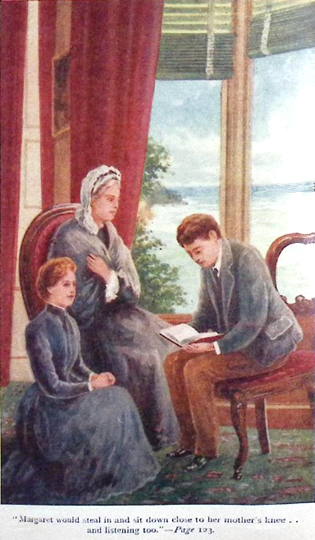
Margaret would steal in and sit down close
to her mother's knee . . . and listening too.
[Sequel to "Alick's Hero"]
OR,
ON THE CLIFF.
BY
CATHARINE SHAW
AUTHOR OF "ALICK'S HERO," "SOMETHING FOR SUNDAY,"
AND EDITOR OF "SUNDAY SUNSHINE."
NEW EDITION
JOHN F. SHAW & CO., LTD.
Publishers
3, Pilgrim Street, London, E.C.

CONTENTS.

SALOME
A SHADOW
ON THE SURFACE
IN THE CAVE
ON THE ROCKS
CLAUDE
SALOME'S SLATE
MARIAN'S SUNSHINE
ON THE HILLSIDE
MARGARET'S LEGACY
AT THE TOWERS
A PURSE
MARIAN'S CLASS
RECONCILED
LIONEL'S DESIRE
A FAREWELL
IN LONDON
SALOME'S TEA-PARTY
LILIAN'S PEACEMAKER
"THE RECOMPENCE OF THE REWARD"


ALICK'S CAVE.

"Blessed are the poor in spirit:
for theirs is the kingdom of heaven."
SALOME.
"SALOME!"
"I'm listenin', child, my lovey."
"Salome, has mother told you about Lionel and Marian?"
"Nofing as I know on, dearie."
"Then she hasn't been up here since Aunt Ella came over?"
"Why no, Master Charlie, dear. Why should she come up?"
"Then I shall tell you the news," burst forth Charlie, colouring with excitement. "Marian and Lionel have got to come and stay over here for ever so long, because—because—"
Salome turned her head round, and looked in the glowing face, and put out her dark hand.
"It's not a secret, lovey dear, is it?" she asked gently. "The dear missis wouldn't mind you tellin' me, would she?"
"Why no, nursey dear," laughed Charlie. "She said, 'Run off and tell Salome, if the news has not got to the nursery yet, Charlie; she will be very sorry though.'"
"That's all right then," answered Salome, settling herself to her work and preparing to listen. "I'm one as like news very much, lovey, if 'tis all right for me to hear it."
"Well," pursued Charlie, "you know Marian and Lionel have been staying here since Saturday because it was Alick's birthday, and he wanted to have them particularly?"
"Why of course I do, Master Charlie. Haven't they been running in and out of this nursery, a kissin' of the little ones half the time?"
Charlie laughed.
"Teasing them too," he added. "But any way, Salome, when I was sitting with mother just now (you know the others are all gone for a walk), who should come over the grass and round the garden way but Aunt Ella. She had thrown a cloak over her head, and her face was all white and scared. She beckoned mother to the window, and said she would not come in. Mother went to her, and begged her to enter, but she waved her hand, and looked more miserable than I have ever seen her. And then she said, bursting into tears—
"'Claude has scarlet fever; the doctor has just been, and says so.'"
"Then mother caught up a shawl that was lying there, and went out on to the verandah, and they stood talking for ever so long. At last she came in, saying, as she closed the door upon Aunt Ella, 'It's so hard not to kiss you, but I suppose I must not.'
"Aunt Ella shook her head vigorously, and said, 'Then you will detain them when they come? It is "very" good of you, Greta dear.'
"And then she hurried away, and mother sat down by the fire, as if she were quite tired out."
Charlie paused. Salome's handsome, dark face was turned towards him intently, and for once her work had fallen from her busy hands.
"Poor dear, poor dear!" she murmured. "What good thing de dear Lord know all 'bout it. Poor dear, poor dear!"
"Then," pursued Charlie, "I came over to mother, and asked her why she was sad, and she began to cry too, like Aunt Ella.
"'Is scarlet fever very bad, mother?' I said.
"'Very, very bad, dear.'
"'Is Claude very ill?'
"'They do not know yet. But it is so sad for them to be shut away from everybody.'
"'Will they be?'
"Mother nodded. And then, wiping her eyes, and kissing me, she said more cheerfully:
"'You will be pleased with one piece of news, Charlie. I have asked Marian and Lionel to stay with us for a long visit. You will like that.'
"'I wish it were Claude though,' I said; 'for he is nearer my age.'
"And then I was sorry; for mother looked disappointed. Salome, I wish I weren't so selfish."
"Well, lovey, tell de dear Lord so. That's de best way as I knows of to get things right."
Charlie pondered. His Indian nurse's advice was always good. Ever since he could remember, she had been the same. Love shone out of her beautiful dark eyes; loving words came from her mouth. Charlie put his hand into hers confidingly.
"Does de dear missis want me, lovey?" she asked suddenly.
"No; she's gone out in the garden to find father. Do you think it will be nice, having them to stay, Salome?"
"If de Lord has sent dem, child, you may 'pend on it as He 'll make it all right."
"Yes," said Charlie soberly; "only, you see, they are different from us, and—"
"Don't you be upset, lovey; you jest know what I say is de trufe. De ways of de Lord is de very best ways. Don't you worry yourself 'bout 'em."
Just at this moment Ruth and Sydney, who had been listening open-mouthed to the conversation, began to grow tired of the little sermon with which their dear nurse often ended a talk, and proceeded to the other side of the room, to go on with their interrupted play. Charlie sprang up, and went after them, while Salome took her work again, and went on with it industriously.
There were three houses on the top of the downs at Leesworth, which stood, as a little colony, all to themselves, quite apart from the village under the cliff.
One had been there for generations, and was called The Towers. In it lived Courtenay Malden and his young wife, both now away in India. Belonging to this was a large garden, two or three fields, coachhouse, and stables, with coachman's and gardener's cottages attached. It stood on the summit of the hill, and the ground sloped away from it on either side, a steep lane leading from it to the beach beneath, some eight minutes' pleasant walk between red cliffs and overhanging trees.
Then there was The Cottage, as it was called, adjoining Courtenay's garden, and belonging to him, which had been done up a year or two ago, and turned into a gentleman's house. Though the rooms were extremely small, the rent suited Mr. Chantry's small income, and his wife thought that the long, low nursery, built out over extensive kitchens and laundry, amply made up to her for the confined space of the other chambers. Sometimes she confessed to herself that a peep of the sea would have been very refreshing to her, but when she looked out at the sweet country lane in front, she was so grateful for the peaceful home which was provided her that she felt she ought not to wish for anything else.
In the old-fashioned garden belonging to this cottage, Mr. Chantry, who was very delicate, employed himself whenever the weather allowed. He had been ordered to spend as much time as possible in the open air, and now, from such time in the morning as his health permitted him to rise, he was to be seen busily working. Sometimes Mrs. Chantry would take her sewing out, and sit by his side; and he would look up at her from his weeding, and say:
"Greta, this is the happiest piece of our life, after all."
They had four children—Alick, aged seventeen; Charlie, eleven; Ruth, six; and Sydney, three years old. They had lost two little ones during their long residence in India. Salome and a little maid completed the family.
The third house was Sunnyside, built by Courtenay for his invalid father's use, in the field adjoining his own garden, but a little lower down the hill, nearer the edge of the cliff. In this lived Mr. and Mrs. Malden, Lionel, Marian, Claude, Muriel, and Leslie, varying in ages from sixteen to eight years old.
As Salome sat at her work on the day on which the story opens, the occupants of the nursery heard voices approaching, and Charlie exclaimed:
"There they are!"
"Who?" asked Ruth.
"Alick and the others."
"I hope they will not come up here bothering."
"Hush, dearie," said Salome, turning round.
"They 'do' bother," added Sydney, in his little, distinct voice; "and I don't like botherin'."
"Of course you don't," laughed Charlie, "but the best thing you can do is to put up with it as well as you can, Sydney. They don't mean to tease you."
Sydney looked unconvinced, and before long the three young people about whom they had been talking were heard running up the stairs, and came quickly into the room.
The first to enter was a girl of about fifteen, tall and robust, with a fresh, sweet face, which looked as if care sat but lightly on it. This was Marian Malden.
Behind her came her brother Lionel, and following him Alick Chantry, a head taller than his cousin, with slight, graceful figure, and earnest face.
"Oh, Salome, have you heard?" asked Marian, coming over and kneeling down by the nurse's side. "Is it not dreadful? What will poor mother do?"
Salome's peaceful eyes turned towards the young, fresh face, but she did not at once reply.
"I call it a horrid nuisance!" exclaimed Lionel. "It's just how things happen. Here were we going to have jolly Easter holidays, and now everything's upset."
"But we shall have some nice times here," put in Alick. "We often do; and when once we know that Claude is going on well—"
"Oh, of course he will! That's not it a bit," said Lionel. "But here are we, shut off from all our games and books, and even clothes, and obliged to be mewed up in this little cottage, with nothing on earth to do."
Marian looked distressed. Her hand, which was resting on the nurse's knee, fidgeted nervously with the strings of the pinafore which Salome was mending, and her face turned red and uncomfortable.
"It is dreadfully unfortunate," Lionel went on, "that we were out for this walk, instead of having gone home first. Then mother would have had no excuse for exiling us; as it is, as we have not been home for three days, it would be daft, I suppose, to go. But, all the same, it is a great bore."
"But—" said Marian, anxious to stop her brother.
"I suppose we shall have to make the best of it," pursued Lionel loftily; "and so we'll say no more about it. But things always seem to happen 'contrairy.' If I particularly want to do anything, sure enough something prevents."
Salome smiled silently over her work, and Marian's eyes, which were fixed on her face, looked enquiringly.
Alick had turned on his heel after a glance at his cousin, and had walked out of the room, with an annoyed shrug of his shoulders.
"What did you so particularly want to do?" asked Charlie, breaking a rather awkward pause.
"I wanted to enjoy my Easter holidays. I had planned to have a lot of boating, and father had promised to get me a bicycle."
"You will be able to have the boating all the same," said Charlie.
"Yes, but not half such fun as if there were our own house to run in and out of. One thing I know, when Claude gets out of this horrid fever—"
Salome raised her face, and put out her hand gently.
"Dear young master," she said gravely, "I don't think as de dear Lord would like you to say 'dat. We've got to submit to Him. Them as will be led, He leads as tender as tender, but them as want to be drove—"
"Do you mean that I want driving?" asked Lionel, turning red.
"Don't you think as you're anxious to go this way and that way, as pleases you best, Master Lionel?"
"I certainly do," he answered, trying to laugh off his displeasure. "Don't you think that the pleasantest?"
Marian listened intently for the answer. She so often thought her own way was best, and found out afterwards that she was wrong.
"I have learnt not," answered Salome humbly. "It can't be learnt all at once, but if we're 'willing,' de dear Lord takes us in hand, and then it's all right wid us."
Lionel picked up his cap, and walked over to disturb the little ones at their play.
Marian got up, and bent her head to kiss the smooth, dark cheek.
"Oh, Salome," she said, "what a way on the road you've got!"
"Me, dearie?"
"Yes; it looks very, very far off to be able to be sure the Lord's way is best. I wish I could jump right over to it."
"Well, dearie, we can't 'jump' to nothin'. It's just a step at a time—followin' on. If you take what He sends to-day, you'll find as you'll be a step nearer home to-morrow."
Marian's face gave a little flash through one or two tears, and she went to seek her aunt with a very tender hope of doing to-day what came next.
"Aunt Greta," she said, when she found her aunt, sitting somewhat dejectedly by the fire in the dining-room, "do you want a new daughter for a little while?"
Mrs. Chantry looked up, brightening in spite of herself at the bright tone.
"Because I mean to try to be one, if you will have me. I cannot think what dear mother will do without me, but since she has decided it so, I mean to make the best of it. It would be poor gratitude to you for your kindness in having us, to keep on lamenting that we are not at home."
"Dear child, you know how glad I am to be able—"
"Yes, auntie. So now that's all settled, what are you going to set your new daughter to do?"
Marian's homely face was quite brilliant for a moment.
Mrs. Chantry looked round the room with a sigh; it was disordered enough to make any one sigh.
Marian hastened to pull the tablecloth straight, and began to pack Sydney's bricks into their box.
"Aunt Greta," she said, as she passed the back of her aunt's chair, bending down, and speaking shyly, "will you not go up and see Salome?"
"Why, darling?"
"She would give you some medicine."
"Medicine?" echoed Mrs. Chantry, wondering.
"Don't you know the sort of medicine she always carries about with her?"
Mrs. Chantry smiled and roused herself.
"We all might," she said, as she went to the door.
And then Marian was left alone to her untidy room.
Meanwhile, Alick, disgusted with his cousin's selfishness, had gone to his own chamber, and shut himself in.
Like Charlie, he felt this illness at Sunnyside a great blow to him. Setting aside the risk and sorrow to all there, the actual thwarting of his plans, and having to make room for Lionel in their narrow abode, meant a great deal of annoyance to orderly Alick. As to Marian, he did not at the moment give her a thought.
He looked round on his dear little domain.
It had been all very well for Lionel to share it for two days, which had been specially set apart as a special holiday, but how to put up with his cousin for two months (had not Salome said something about two months?) he could not conceive, and paced up and down his room in sore vexation.
Alick's life flowed on in an even, uneventful way just now, and the boy confessed to himself, or hardly knew that he confessed it, that it was rather tame and dull.
More than two years ago his beloved step-cousin, Courtenay Malden, had been married, and had brought his young wife to the large house which overshadowed Alick's little home. And since that time, his whole interest had been centred in the doings and sayings at "The Towers," as it had been called for longer than any one could remember.
After a year of cloudless happiness to the young pair, as well as the little circle to which they belonged, and on whom they lavished all the love of which they were so full, a little cloud had fallen upon them all.
A tiny baby came to grace the happy home, but soon it was found that she had not the health of ordinary babies. And when her parents were suddenly called to take a journey to India, on the death of Margaret's father, the little frail girl was taken with them. She had hardly been kept alive where she could have every care at home. And when she became exposed to the changes incident to a journey, she quietly sank. They were but a week from port when her little body was laid beneath the waves of the Indian Ocean.
News of this had but lately reached the homes at Leesworth, and even the prospect of Courtenay's speedy return could hardly cheer Alick from the sorrow he felt on the behalf of those whom he loved so well.
His mother, tender as was her love for her boy, sometimes felt with a pang that his deepest interest and affection were centred outside his home.
"It will all come right," his father would say consolingly; "it is not as if Alick loved any one unworthy of him."
Mrs. Chantry tried to be satisfied, but confessed to herself a sense of relief when Margaret and Courtenay had really started for India.
Now they were on their homeward journey, bringing with them Margaret's widowed mother, whose health of body and mind had been shattered by the blow of her husband's death, and leaving behind them in that sea the tiny form on which for nearly a year all hearts had been set.
In all his life Alick had never spent such a sorrowful, unhappy three months. The empty house at the end of their garden was but typical of the emptiness of his life without Courtenay.
It was true he went often to read to Courtenay's invalid father at Sunnyside, and found some satisfaction in fulfilling one of his step-cousin's last requests; it was true that he walked frequently down into the fishing village beneath the cliff to call upon Courtenay's old men and women, but all seemed flat and dull. And he wondered at himself for being out of sorts, and was angry at himself, but could not guess why it was; nor did it occur to him to speak to any one of it.
His mother looked on and prayed. She knew not what else to do.
Salome looked on and prayed. She knew it was the best to do.
So Alick stood this bright day in March, and looked round on his invaded room.
"I teazed mother, I do believe, to have Lionel here, when she was hardly up to it, and this is what I've got for it," he said to himself. "Here he is, to be my constant companion night and day for two months. Well, I deserve it."
He sat down by his window, and pushed open the little old-fashioned lattice. The sunshine came streaming in with the wind fresh from the North Sea. He leaned his head on his hand, deep in thought.
"I wonder why all this has happened?" he asked himself. Then, pausing even in his thoughts, he waited for a moment.
"It cannot have happened by chance; why, of course it cannot. Courtenay's going away, their poor little baby, this illness of Claude's, my unutterable loneliness—"
He turned from the window, and opened his little well-worn Bible.
He might have found out the reason there. He probably would, but at this moment a step was heard outside, and Lionel entered abruptly.
"Aren't you coming down? I say, Alick, it's all very kind of Aunt Greta to have us, but where on earth are we to fix ourselves? You have only those two little bits of sitting-rooms downstairs, and these poky bedrooms up here. Wherever shall we be all day?"
"There's the large nursery."
"Yes, but who would like to settle down with the babies?"
"We often sit there. The little ones play by one window, and we have the other."
"Salome is always near that one."
"Well?"
"We can't talk, or anything."
Alick frowned. Unhappy, unrefreshed, because he had not drunk fresh supplies at the Fountain of Life, he had no strength or spirit to withstand to-day's annoyances.
"Don't you think so?" went on Lionel.
"I think we had better put up with it, and not be disagreeable."
Lionel whistled.
"I thought you'd have given a fellow a little better welcome than this, Alick."
Alick got up and turned away.
Oh, for Courtenay to set him right, to talk it all out to; to be able to explain his worries, and have the kind, generous sympathy in return!
The boy could have wept in his loneliness and despair. He had "forgotten his resting-place." If he could only have found out how poor he was, he might have asked to be enriched with the great riches. For "blessed are the poor in spirit: for theirs is the kingdom of heaven."



"Blessed are the poor in spirit:
for theirs is the kingdom of heaven."
A SHADOW.
"HERE'S Mr. Alick's tutor called, ma'am," said Mrs. Chantry's little maid that afternoon, throwing open the door of the dining-room where her mistress was sitting with Marian.
Mrs. Chantry turned round hastily.
"Good morning, Mr. Fortescue."
"I am so sorry to hear this bad news," began the tutor.
"Yes, it is very bad news."
"Lionel came round to tell me about it just now. I had not heard it, on account of its being Alick's birthday and a holiday. What do you think had better be done with regard to their studies?"
"I have been thinking about it. It has occurred to me that, as we are so short of room in our cottage, perhaps they might use Mr. Courtenay's library. I am sure he would be glad for us to do so."
"Just so," answered Mr. Fortescue; "I had thought the same thing. Lionel walked up with me— Oh, here he is!"
Mrs. Chantry explained to her nephew what they had been proposing, and had hardly finished when Lionel burst out:
"Then, if we go to The Towers at all, why should we not take up our abode there altogether? Marian and I could do finely together."
Mrs. Chantry shook her head; but Lionel continued:
"You see, Mr. Fortescue, there is not room for us here; and though it is very good of aunt to have us, if we could clear out, it would be a charity to everybody, I'm sure."
"I should not wish to 'take French leave' like that," interposed Marian.
"Nor I," answered Mrs. Chantry, "unless under great necessity. We can make room for you here, and therefore I do not feel justified in proposing it."
"I shall then. I shall go over at once, and ask mother," said Lionel.
Mrs. Chantry stopped him.
"Not with my permission, Lionel," she said decidedly. "I told your mother that there must be no communication backwards and forwards between you young people. What may be necessary to say, must be said between us elders. You are not to go into your own garden even."
Lionel stared. His gentle aunt was speaking as he had never heard her speak before.
"Am I to be treated like a baby?" he asked haughtily.
"You are to keep to the few rules that are made," answered his aunt gravely.
"Certainly," said Mr. Fortescue, "you must see, Lionel, the necessity of that."
"I see the necessity, but not the obligation," said Lionel. "Do your rules allow of my writing to my mother?"
Mrs. Chantry thought for an instant.
"There can be no objection to that," she answered. "My sister can answer through me."
"Not to get an answer myself?" fumed Lionel, freshly affronted.
"No!" answered his aunt.
He took himself off without further words, feeling even then that he had gone beyond all the limits of respect due to his hostess, to say nothing of that hostess being his dearly-loved aunt.
"It is a sore trial," said Mrs. Chantry, turning to Mr. Fortescue.
"Lionel should be better able to bear it," answered the tutor severely.
"Aunt Greta, I am so sorry," said Marian, looking up with burning cheeks. "I cannot think how Lionel—"
"Do not distress yourself, my dear," answered her aunt kindly; "Lionel will be sorry by-and-by."
"Shall we begin studies to-morrow, then?" asked Mr. Fortescue.
"I believe Alick said that was the arrangement."
"That is all right then. I only came over to ask that, and to condole with you on the misfortune."
He took leave, and Marian and her aunt were left alone.
"Salome would not call it 'a misfortune,' would she?" said Marian quietly.
Mrs. Chantry smiled.
"It is not a word I like," she answered. "I would rather feel it was 'permitted,' Marian."
"Aunt Greta—" Marian hesitated. "Do you think mother will wish us to take up our abode at The Towers?"
"We shall see what she says; that is, if Lionel asks her."
"I would a great deal rather be here, auntie."
"I like to have you, dear."
Just at this moment, Mr. Chantry came in—a tall, pale man, whose health had been greatly impaired by a long residence in India.
"Well, my dear, is tea coming? Let us gather all our new family together, and settle in as we are to be."
"Before it gets dark, I was going to see if I could get any news from Sunnyside. I should like to know how Claude is to-night."
"I will go, my dear; you look worn out."
Mrs. Chantry made no objection. She felt indeed that she had passed through a great deal since that morning-hour when her sister had come to her over the grass.
"Tea will be ready then," she said, ringing the bell.
"I will make the tea, auntie," exclaimed Marian, springing up, "I always do it at home."
By the time it was ready, Alick and Lionel came in, and Mr. Chantry returned from Sunnyside.
His wife looked up in his face, fearing to ask, but he spoke at once.
"There is no change to be expected at present, my dear; and your sister says you must not be anxious. Claude has slept nearly all day, and the doctor has not yet been again."
"How did you find out?" she asked.
"I tapped at the window where Uncle Malden sits, and he answered through the glass."
Lionel stood listening, and as they took their seats at the small table he said to Alick, in a low tone:
"What a plague that Claude is! I hope he'll make haste and get well."
"I hope so indeed," answered Alick gravely.
After tea Alick, Lionel, and Marian set themselves down to study at a side-table, Lionel covertly complaining how small and inconvenient it was, while Marian besought him in a low tone to behave properly, and Alick whistled to himself an impatient tune.
Mrs. Chantry sat by the fire working, and teaching Charlie his lessons. And her husband paced up and down the narrow space left to him, in the restlessness of confirmed ill-health, which often came on with increased discomfort in the evening.
After the lessons were put away, the young people got out a game in which all joined, Mr. Chantry sitting down, and looking relieved to have something to turn off his thoughts from himself.
When Alick and Lionel went up to their room and the door was shut, there was silence for some little time. Alick got out his Bible, finding the place, and putting a chair by the wide window-sill sat down.
"Look here, Alick," began Lionel, "are you and I to have a kind of feud while I am here?"
"Not that I know of; that is, if you'll make the best of things."
"That's nice for you to say, but if you were turned out of house and home, and stuck into a little place like this, when there's a great empty house with nobody in it—"
"Where?" asked Alick.
"Courtenay's."
"Oh! Well, anyway, mother has not thought of that; and it makes everything horrid to have you so complaining."
"I thought of it, but Aunt Greta would not even let me ask mother about it."
"Then I suppose she had her reasons. Anyway, Lionel, do let me read; for I'm tired enough of all this, and we have a tough day with Mr. Fortescue before us."
Alick turned towards his Bible, and Lionel was forced to be silent, though he rustled about his things in a disturbing kind of way.
As Alick read, he began to think over the frame of mind he had been in all day. He blamed his cousin for it; for if Lionel had not been so disagreeable, all would have been right, he argued to himself.
As his eyes ran over the familiar words, his thoughts chased each other backwards and forwards, first accusing himself of impatience and unkindness, then excusing himself with the plea of justifiable indignation at unprovoked rudeness.
Without taking in the sense of any of the sacred words, he closed the book, and knelt down to pray.
Used to be alone, with the exception of sleeping little Charlie, since the time when he and Courtenay had sometimes shared the same room in the old days, he could not forget the presence of his cousin, and he could think of nothing to say. Still he justified himself, and still the warning voice of conscience whispered that, however tempted he had been, yet he had failed of his high standard.
At last, ashamed to rise from his knees without one prayer from his heart, in despair of any other, he repeated slowly,—
"'Our Father, which art in heaven,'" and went on mechanically till he
came to the words, "'As we forgive our debtors.'"
Then he paused, and raised his head for a moment. His eyes rested on his cousin's dark form, standing between him and the light, and he almost hated him for being there—for making all his life dark and miserable. Then came as a flash—
"'Neither will your Father . . . forgive your trespasses.'"
"I can't be sorry; he is in fault, and not I," he said bitterly to himself, and buried his head in his hands again.
He knelt on. Lionel quickly got through his undressing and short prayers, and jumped into bed, and still Alick felt he could not be sorry.
At last, just as he was almost giving up the struggle, those words came over him—
"I dwell in the high and holy place, with him also who is of a humble
and contrite spirit, to revive the spirit of the humble."
With one beseeching inward cry for help, he rose and went over to the bed.
"Lionel," he said, in a smothered voice, "I'm sorry I've been cross to you, and have not welcomed you more kindly; will you forgive me?"
"Eh?" asked sleepy Lionel.
Alick said it again more clearly, though it was very hard to do it twice.
"Oh, all right!" answered Lionel. "Aren't you coming to bed? It's ever so late."



"Blessed are the poor in spirit:
for theirs is the kingdom of heaven."
ON THE SURFACE.
THE next morning Alick rose with the sense of a clearer atmosphere around him.
He and Lionel did not exchange many words while dressing, but he saw that his cousin was still as cross as ever. This he felt hard; for had he not made a great effort last night? And ought not Lionel to have been ready to meet him half-way?
With a mental shake of himself, he threw off his thoughts, and went down to breakfast looking brighter than he had done for weeks. But he was conscious that all was not yet quite right with him, and that he was very ill-prepared for a battle, should any conflict come upon him.
His mother stood by the fire just lifting off the kettle, and as she glanced in his face, she saw something which made her heart rise in thankfulness.
He came up and kissed her, and she put her hand on his shoulder with a sweet look.
"Better to-day, my boy?" she asked lovingly.
"Rather," he answered, half smiling. "Why, mother, you see without being told."
"My eyes like sunshine," she answered quaintly; "so I am glad when it comes."
"Have you heard from Sunnyside yet, mother?"
"Not yet. Alick, cut the bread, will you? We shall be late, I fear."
"'I' am going to do that," said Marian, entering at the moment.
"You are not going to take 'my' duties, Miss Cousin," laughed Alick. "I'm quite willing that you should help mother mend the socks!"
"Oh, your lordship will condescend to allow me to use a thimble then!" she answered, watching him take the knife and begin upon the loaf.
"Yes, thimbles and looking pretty are the best use of girls."
"Then I can only have half a use," said Marian soberly. "But I consider, Alick, that you have very low ideas indeed."
"How?"
"I consider thimbles only a part of a girl's life."
"Of course. Her first finger is not her whole self."
"Her 'second' finger."
"Well, her second finger, if you like. But it is one of the chief ends of a woman to work well."
"You are speaking on the top of things?" asked Marian, looking up enquiringly.
Alick laughed a little. "I'm not going very far underneath, for certain. Like this bread, we are cutting off the outside; but crust is good."
"Well then," said Marian, who was all this time quietly setting the room in order, in a very different way from that which the little maid had considered perfect when she left it that morning, "I disagree with you entirely, Alick, about even the crust of girls."
"As how, Miss Cousin?"
"Partly about looking pretty. Of course, that must depend on how you are made."
"And on how you make yourselves."
"I don't see that."
"I do. Mother says—"
"Oh, 'I' say, do I?" laughed Mrs. Chantry. "Please, Alick, give out your own opinions in this serious conversation."
"Mother says," pursued Alick with a twinkle in his eye, "that if a girl has neat hair—"
Mrs. Chantry's glance rested for a moment on Marian's beautiful soft light braids, and she smiled.
"That is possible, at any rate," said the girl.
"And a gentle, cheerful, good face—"
"That is a thing to be earnestly desired, but, Alick, you are going below the 'crust' now—"
"And a truthful spirit that shines out of the eyes—" pursued he, not heeding.
"But all this does not make prettiness, and that is what you started with, Alick. You had better get back to the thimble; you know better what you are about there."
"Do I?" asked he, amused.
"You are quite right, Alick," interposed Mrs. Chantry; "I agree with you entirely. In my estimation, a girl who has a kind, cheerful face, neat hair, tidy, suitable dress, and a clean frill, is refreshing to look at. And whatever her face may happen to be, her friends do not think of that, but of the love that shines out through those familiar features. I have seen the homeliest face of an old woman made perfectly beautiful by the Christlike spirit that irradiated it."
"But then you get beneath the surface again," said simple Marian.
"And so we must," said Mrs. Chantry, "however our talk may begin. We cannot live 'on the top of things,' as Marian called it; at least, earnest people cannot. Alick, that pile of bread will last all day. Set the chairs, my dear, and ring the breakfast-bell."
At that sound, the rest came trooping in. Mrs. Chantry gave a tray, already prepared, into Alick's hand to take to his father, who seldom left his room so early, and then the business of breakfast began.
"I wish we could have heard," observed Mrs. Chantry, looking out of the window abstractedly.
"He'll be all right, Aunt Greta," said Lionel. "I never knew Claude turn up on the wrong side of anything; I cannot think why you are anxious. I only wish he'd have had sense not to catch it at such an inconvenient time."
Charlie looked up at Lionel with astonishment. "I do not see that it was his fault, and it makes me feel horrid to hear you."
His big cousin merely glanced at him, and disdained to answer.
But Mrs. Chantry, who had hardly been attending to what had gone before, now turned round, and said gravely:
"Lionel, my dear, I would prefer that you should keep all such observations and repinings to yourself. Your little brother's life is very precious to a great many of us, and I am sure you will be glad, however this illness may end, that you had taken my advice and been silent where we all must stand in awe, and learn how helpless we are when we are under the chastening hand of God."
Lionel had flushed and then paled under his aunt's rebuke. Never till yesterday had she rebuked him. What was this she said about "however the illness ended"? How should it end? Claude was always strong. Scarlet fever was not anything so very dreadful, was it? Plenty of people got well from that. Why did his heart sink like this?
He was very silent, and but little more was said all through the meal; for Alick had his own thoughts, Marian divided hers between annoyance with her brother and sober consideration of what they had been talking about before breakfast, and Charlie was rather dismayed at the silence of the others.
The moment breakfast was over, Mrs. Chantry gathered the household together for their morning reading. It had been a sore trial to her when her husband's continued ill-health had forced her to take up this duty by herself. But meeting it bravely, in strength which she sought and received from above, she went forward in her quiet way. And now daily, what had once been a trial, became a great blessing, and there were many among that little household who valued the few moments in which they stepped aside from the whirl of life, and took a peep into the unseen and eternal.
This day as they knelt together Alick heard his mother say,—
"May we feel ourselves to be poor in spirit, that Thou mayest be
able to enrich us; and may we so mourn before Thee on account of our
sinfulness, that Thou mayest be able to give us Thy blessed comfort."
Alick heard, and bent his head lower, acquiescing in the prayer from his heart, feeling that it was in some way connected with his thoughts last night, but yet conscious that a proud wilfulness lurked within him, and made him still feel injured by circumstances, which had somehow combined to rob him of peace. He was not yet poor in spirit.
Still he joined in praying his mother's prayer, and rose from his knees wondering how the answer would come. That an answer would come to every true prayer, sent up from a humble heart straight to the great Giver, he did not for a moment doubt.
Just as they were all separating, Marian, Lionel, and Alick, for their hats, ready to start for lessons at The Towers, the postman came up the path through the little front garden.
Alick was the first to see him, and sprang to the door. There was but one letter, and that was for him. Yes, truly an Indian letter, in Courtenay's bold, fair writing.
"Come along!" exclaimed Lionel impatiently. "You are never going to open that now, are you, Alick? We are already behind time, and you know how it upsets Fortescue."
"I never intended to open it," answered Alick, annoyed.
"Marian," called Lionel, "do hurry yourself. What a time you girls do take!"
"I am coming in a moment," answered his sister from above; "go on without me."
She was standing by Salome at the nursery-door. "I did so want to know about Claude before I went into school," she said in a low tone, looking wistfully into the dark, sympathetic face.
"He's in de 'Lord's' hands, dear missey."
"Yes, but I shall be thinking about him all lesson-time."
"Dear missey, you just 'member this. If de dear Lord wants you to know, He 'll send you word; if He wants you to wait, can't you do as He wants?"
"I'll try," she answered humbly, running down to join Alick, who stood on the path waiting for her, Lionel having gone on.
"Have you had a letter?" she asked, as they quickly walked down the garden behind the house, to the little stile which had been made in the hedge which separated the cottage from the house.
"Yes, from Courtenay, but I have not read it, and do not intend to, till I can do so in peace."
He spoke hardly, and Marian's eyes came back from his face disappointed.
"It is so difficult to learn to wait, is it not?" she said.
"Oh, that is not much waiting!" answered Alick lightly. "I know they are on their way home from the telegram; it will only probably be things personal to myself."
"Those are such nice letters."
"Yes; I don't care for descriptions of scenery."
Marian laughed.
"But you love scenery as much as any one, Alick."
"So I do, but not when you want to hear about those you love. One assurance that they are thinking about you, is worth a hundred lines of how beautiful the mountains looked this morning."
They had reached the steps of Courtenay's house—those wide, pleasant steps on which his grandmother used to stand in her white cap and black satin dress, the picture of a lovely old lady.
Alick saw it all now, as if it were yesterday; and he remembered in the same moment all that had come and gone when Courtenay had been his hero, and had stood out bravely for the right within these very walls.
The thought calmed him; and as he passed through the wide hall, he could greet Mr. Fortescue with his usual pleasant smile.
"No news yet from Sunnyside?" had been the tutor's first question. "So Lionel tells me."
And on the negative answer, the three settled down without another word to the business of the day.
Marian, by her steady perseverance, had kept up with her brother. But Alick, a year older still, had got far ahead, and now studied by himself, Mr. Fortescue finding no pressing needful, and only having to direct his thirst for knowledge.
They plodded on silently for an hour or two, and then a note was brought in to the tutor, which he immediately opened.
"From your mother," he said to Alick, as he took in the sense of the few lines. "She says she has seen Mrs. Malden in the garden, and Claude has passed a restless night, but there is no particularly bad symptom."
Marian gave a deep sigh, while Lionel exclaimed, with a sound of relief in his tone:
"That's all right then; I thought my aunt made it out too bad—"
Then, meeting Alick's eyes, he checked himself suddenly, and turned to his writing again.
Mr. Fortescue was a very quiet man, and made no remark on the letter, so again they went on with their tasks.
At one o'clock they put up, and prepared to go home.
Mr. Fortescue took leave, and the rest gathered near the window, looking over the broad green garden to the raised walk at the end under the elms, between which could be seen peeps of the sea, and the pretty roof and chimneys of Sunnyside.
"I was born to be a gentleman," said Lionel, with a sounding sort of sigh.
"I 'was' born one; not 'to be' one," said Alick, speaking in spite of himself; but his cousin's pompousness was too aggravating.
"Why?" asked Marian. "I do not see what made you give us the benefit of that sage remark, Lionel."
"Because I find this handsome house suits me a great deal better than Alick's house."
"My 'father's' house, you mean," answered Alick.
"Suiting you well depends on the end to be attained," said Marian.
"What end?"
"Just having what is best for us."
"That's what I say. I find this decidedly best for me. I have felt in a better temper ever since I entered it."
"That shows it is 'not' good for you," said Marian.
"You girls have no reasoning powers," said Lionel. "It's just the other way."
Marian only smiled.
"We must not keep auntie waiting for dinner. What a lovely day it is, Alick; just like Spring, isn't it?"
"Yes; shall we go for a walk on the shore this afternoon, when we have done our lessons?"
"'I' can't. I must stay and see if Aunt Greta wants me. Besides, I shall have to practise."
"I'll come!" volunteered Lionel. "It will be a change from that poky—"
Marian looked up anxiously.
"From being poked up so, I mean," stammered Lionel.
"I don't think I shall go," said Alick, hesitating.
"Why you proposed to a minute ago!" said Lionel.
Marian perfectly understood, and they walked in silence through the garden, Lionel again hurrying on before.
"We have only an hour," observed Alick, "to get back again. Mr. Fortescue is coming at two instead of half-past to-day."
"I wonder why that is?"
"He is going into Norwich. I fancy he has volunteered to get some things for your mother, Marian."
"I cannot help wishing I were at home helping her, Alick."
"I am sure you must. But it is so nice that you do not fuss about it, Marian."
"Fussing does no good."
"But that does not hinder people from doing it."
"No; I want to feel quite sure I am doing right in being here, and then I should be satisfied."
Alick paused an instant, looking into her gentle, fresh face consideringly.
"You feel it's right to do as your mother wishes, Marian?"
"Of course I do; but then suppose she wants me at this moment?"
The blue eyes filled slowly, and Alick's turned away.
"She did wish you to stay here, dear," he said very kindly; "she came over on purpose to ask it. I'm sure mother said so. It would have been an added care to have had you to think of."
"But there are the children and my father; she cannot be with them both."
"The little ones have Martha, have they not?"
"Yes—"
"And Aunt Ella goes in and out with Claude, and waits on Uncle Malden too. Because, don't you remember, she told mother it could not be helped, and there was not much risk to uncle?"
Marian nodded. Her tears were falling down, one after the other, as fast as they could.
"She could send for you if she needed you very much," suggested Alick again.
But this made Marian cry more than ever.
They had come to the cottage door, and poor Marian brushed away her tears and ran up to her room.
Alick stood at the bottom of the stairs looking after her, feeling he had been but a poor comforter.
She came down in a moment; and as he took hold of the dining-room door to open it for her, he whispered, "Marian, we must ask God about it. He will make it right for you, if you ought to go; there's nothing too hard for Him."
"Thank you," she murmured, nearly overcome again.
They were all seated at the early dinner—Mr. Chantry, and even the little ones. It was quite a tight fit to sit to the table, but Lionel had had enough of making disagreeables, and held his tongue.
"Did I hear you say you had a letter from Courtenay, Alick?" asked his mother.
"Yes, mother; one came this morning."
"What does he say? How is poor little Margaret? And is Mrs. Bruce any better?"
"I have not even had time to open it yet."
Mrs. Chantry looked a little surprised, but made no remark. When Alick's voice took that tone, she knew all was not quite well with him.
"It was too precious for our eyes to even rest on," said Lionel.
"I never thought of your wanting to hear the contents, mother, or I would have tried to make time to read it. Of course you would like to know about them; I forgot that."
"Not till you are ready to tell me, dear; I am in no hurry."
"Mother is never in a hurry," said Charlie.
The moment dinner was swallowed, the three were off again to their tutor.
And not a word was exchanged between them, except with reference to lessons, till the clock struck four.
Then Mr. Fortescue hurried off for his train, and Marian returned to see what she could do for her aunt.
Alick put on his hat and walked to the stile with her. Then, after he had helped her over, he turned back, saying with a smile:
"Now for my letter and a ramble on the shore, Marian. Tell mother, if I am not home to tea, she will know where I am; I won't be very late. Ask her, like a dear mother, to keep my tea under the cosy till I come."
Marian nodded, and he ran off down the road.
He was rejoicing inwardly at having escaped without Lionel, when, at a turn in the steep lane, he found him resting against a post waiting for him.
"I thought you had gone home," he said somewhat ungraciously.
"Why, you promised to come down with me to the beach. What a changeable fellow you are!"
"I never promised at all. However, we can go together, and when I come to my cave, you must continue your walk without me; for I want to have a little quiet."
"With your beloved letter?"
"With my beloved letter."
"Courtenay's only your cousin, and he's my brother; and yet I don't make a quarter the fuss over him you do."
"Perhaps not."
"Why do you?"
"Simply because he and I have been thrown together by circumstances, and suit each other."
"I should hope you did, but for my own part, I'd ten times sooner Courtenay had never been my brother; he was always getting in the way."
"Lionel!"
"I don't mean anything dreadful. Simply that if he were just a friend living in The Towers, instead of a brother, it would be nicer."
Alick was silent, too angry to be ready to bear with his cousin and explain the matter to him, which would have done the younger boy good.
"I suppose we shall squabble along like this for the rest of the two months," remarked Lionel comfortably, when their feet first crunched the shingle of the beach.
Alick roused himself. "Courtenay will be home in a fortnight—I hope we shall not indeed, Lionel; I cannot think what has come to us."
"It's you who are so disagreeable; I never saw you so obstinate before. Mother used always to hold you up as a perfect paragon."
"I'm not a paragon now," said Alick with an inward groan, "whatever I may have been then."
But he acknowledged to himself as he said the words that he had in those days considered himself somewhat of a paragon; one of those who knew his duty and did it.
"Is the tide going out or coming in?" asked Lionel. "You always know the tides."
"I forget," answered Alick, with a weary sound in his voice; "any way, it's a good way out, and we must be back in two hours or thereabouts. It will be dark soon after six."
He was walking rapidly towards his favourite cave.
"You'll let me come too?" asked Lionel. "I won't speak a word while you read your letter. Seriously, Alick, I won't quarrel, or anything; I will sit still and go to sleep, if you like. It is so dreary all alone, especially now Claude is ill. Do let me come."
"Oh, no," said Alick hastily; "I told you I wanted to be quiet. Good-bye; we shall meet at tea."


"Blessed are they that mourn:
for they shall be comforted."
IN THE CAVE.
LEAVING Leesworth on the left, and making their way under the overhanging cliffs, the boys reached the Point, about a mile to the right, which shut in the small bay in which the little fishing village nestled.
Some time before high-tide, the water reached the Point, and in consequence of this, the second bay on the other side of it, was but little frequented, and was a favourite resort of the Chantrys and Maidens, who liked to escape from the visitors who came to stay at Leesworth in the season.
Of course, a few visitors wandered along the shore, and were as pleased as they with the quiet little haven beyond the Point, where the clean, fresh sand was so firm to walk on, and the fallen rocks so interesting to climb over, washed as they were daily by the sea.
Among these rocks and openings in the cliff Alick and Courtenay long ago had chosen one particular cave, which they called their own. It was very secluded, and not easy to find by the unobservant, and for this cause was much prized by the boys.
Lionel was only allowed to enter it on invitation, and they expected him to be satisfied with his own cave, which was situated about half a mile further on, and immediately in front of a ledge of rocks which stretched far out into the sea, and were full of such marine treasures as young collectors love.
This cave of Lionel's was close to the sands, and was washed out at every high-tide by the waves. Indeed, every part of this piece of the beach was covered at high-water, though there were some broken pieces of cliff which, by a little climbing, would form a place of safety, should the unwary be overtaken by the tide. In this case, however, they would be imprisoned for some hours, as there was no way to reach the upper cliffs, and those thus caught must remain patiently watching for the subsidence of the waters.
Alick and the rest had once had this misfortune, and had considered themselves quite romantic when at length, hungry and weary, they had waded round the Point, unwilling to wait for the extra half-hour which would have left them dry ground to walk upon.
So this March afternoon, Alick turned away from Lionel, and climbed up the face of a pointed rock in certain footholds known to himself, and quickly reached his cave, which looked down upon the beach and bit of sea in front of him, just also taking in the very end of the reef jutting out far into the sea.
Sometimes he was sorry that he could see anything but sea and sky, though ever from to-day he was thankful that that bit of rock and beach had come into his horizon.
He sat down. His cousin's retreating footsteps were the only sound besides the gentle noise of the waves, to-day less distinct than usual, as it was very calm for the time of year.
"He's going to his cave, or to the rocks, I expect; and we can join company on his way back," he thought.
Alick's heart had smitten him a little at his cousin's forlorn tone, and he made up his mind he would call to him when he should see him pass the strip of sand which the mouth of his cave commanded.
He drew out his precious letter. It ran thus:
"DEAR OLD BOY,—We shall, I hope, soon be starting for home; and as
the letters take as long to come as we shall, you will probably have
a telegram to say we have started even before you receive this. But I
daresay you will want more information than a telegram can give.
"Margaret has written to mother and father, so that my letter to you
need not enter on plans and journeys and packings-up. I can write to
you yourself, and tell you a little about me myself. For, Alick, since
you and I parted, I have passed through a baptism of suffering, and I
am afraid I shall not come back to you the same follow who went away.
Perhaps I have been growing gradually unlike the same, ever since I
have had my precious Margaret to take care of. But anyway, love and
happiness do not alter one as sorrow and bereavement do.
"I have had to fight my battle alone, as all the great spiritual
battles of our life have to be fought. Not that Margaret has not been
everything any one could possibly be. She has been more to me and
better to me than I could have believed possible; but even then, in
spite of all that (for which I thank God inexpressibly), I have had to
walk through the valley of the shadow of death 'alone.' Alone, did I
say? That is just what I want to tell you. It was in that valley, when
my little treasured child was lifted from my clasp, and buried beneath
the waves, that I learned more fully than I had ever done before,
'"Blessed" are they that mourn: for they shall be comforted.'
"I said there was no comfort for me; I fainted, and did not believe
to see the goodness of the Lord in the land of the living. I felt cut off;
I laid myself down (so to say) in the depths, never to rise again.
"Then, after a long time, as it seemed to me, I cried unto the Lord
out of the depths, and He heard my cry. He put His hand under me, He
brought me up; He put His strength into me, where I had none; He walked
through the valley with me; He brought me out into His sunshine again.
And He not only did this for me, but He so filled me with the assurance
of His love and faithfulness that I could rejoice in His having done
the very best in taking my darling safe home, from every pain and care,
into His everlasting keeping.
"There, Alick; and if you have followed me through all this, you
will perceive that your Courtenay who went away can never come back.
Instead will come back one who has tasted that the Lord is beyond all
things better than our best thoughts, and who is humbled at his own
sinfulness, while he is lifted up by His great love.
"Alick, I would rather you should be aware of this. And how do I know
but that you, dear boy, may also have had some spiritual conflict while
I have been gone?
"I long to see you again; so does Margaret. Oh, Alick, you will like
to see Margaret with her poor suffering mother! Her tenderness, her
brightness, and forgetfulness of herself. No one would guess from
Margaret's sweet, cheerful face that within four months she had lost
her only child. But we know,—do we not?—that loving heart, which ever
was ready to put away its own care in ministering to others.
"This is the last letter I shall send you. Between now and our sailing
there will be nothing but boxes and packages.
"Alick, how shall I feel when I pass over the spot where our darling
lies?
"But she is not there; Margaret will not have me for a moment say she
is 'there.' 'She is safe with Jesus above,' she says to me whenever I
look sadly at the great ocean; and then I smile at her, and say she is
right. What can be better than to be safe with Jesus, Alick?
"Your ever affectionate step-cousin,
"COURTENAY MALDEN."
Alick sat for a long time after he had finished the letter, gazing out upon the sea. His mind was in India, and he was living in his loved step-cousin's life. He was so absorbed in thought that he lost all sense of there being a place in the world called Leesworth, till a little moving black figure among the distant rocks out at sea brought him back, and with a start, he remembered there was such a person as Lionel Malden.
With that came an inward sense of repulsion, which suited ill with the peaceful thoughts which had been occupying him. How angry he had been with him for joining company, how unreasonably angry and annoyed; and then he looked over the feelings of the last few months, ever since Courtenay had gone away, since the time when Lionel had been more thrown into his company.
"I have almost hated him," groaned Alick half-aloud. "Though I asked him for this wretched birthday of mine, it was more to get my own way than because I wanted 'him;' and besides, Marian would not have been asked if he had not come, and Marian and I are always such friends.
"Yes, I have at times almost hated him; partly because he makes me feel bad. He stirs up all the bad in me and brings it out. Oh, dear! And this ought not to be so, must not be so.
"What was it my mother prayed this morning? 'That we might so mourn on account of our sin, that God might be able to give us His great comfort'?
"I haven't mourned; I am as proud, as angry, as indignant with him as ever. And yet—yet—God can't dwell with the proud heart, and I want Him to dwell with me; I must have Him dwell with me. That is why I have been so utterly wretched, because I have not got the humble heart in which He can condescend to dwell. I see it all now, and no wonder I have been cross and miserable and hateful!"
Alick buried his face in his arms. His sin swept over him like the waves of the sea; he saw himself and his un-Christlike behaviour in their true light; and as each fresh wave of remembrance washed up over his soul, his head sank lower and lower, and his spirit sank in deep mire, where there was no standing.
Then Courtenay's words, uttered with such a different sense, mourning in such a different way, stole over him: "Out of the depths I cried unto the Lord, and He heard me."
Alick took courage; he would cry unto the Lord too. Who was like the Lord, who was ready to pardon, and plenteous in mercy to all that call upon Him?
The conflict and despair were over; his foot was set upon a rock once more.
He raised his head, peace shining in his eyes, though a great humbleness filled his heart.
"'We love Him because He first loved us,'" he said with a deep sigh as he rose.
And then he found his sleeve wet with the tears he had shed. He was not ashamed of them, but then came another thought. Lionel! He must seek Lionel, and ask his forgiveness for all his hard thoughts and cross words. Forgiven himself, he must forgive.
He went outside on the ledge of rock and looked towards the reef. His cousin was not to be seen, but probably he had turned homewards, as it was already getting dusk.
"Perhaps I missed seeing him pass," thought Alick; "I might well have done so as I was sitting. I will try and overtake him before he gets into the house; he cannot have long passed."
He clambered down the rocks and hastened home. The tide had come up very much, but he could still pass the end of the Point. Before he turned it, he looked once more at the rocks, at least at so much of them as were yet uncovered, but they rose up still and distinct against the darkening sky. And then, only anxious to overtake his cousin, he sped homewards, his heart full of deep repentance.
That he had been so loved as to be brought back from such ingratitude, made him more humble than he had ever been in his life before.
The prayer had been answered. He had found the words true: "Blessed are they that mourn: for they shall be comforted."



"Blessed are they that mourn:
for they shall be comforted."
ON THE ROCKS.
"WHERE'S Lionel?" was Alick's first question as he entered the dining-room, and found he was not seated at tea with the rest.
"Is he not with you?" asked his mother, looking up. "We have seen nothing of him."
"He was on the rocks, but I supposed he had gone home."
"He will be in presently," said Mr. Chantry. "Sit down, Alick; we have almost finished tea."
Alick obeyed, but just as he was raising his cup to his lips, a thought struck him, a thought which, but for his unkindness and repentance, he would have dismissed as nonsense.
"Mother, I'll go and look after him, if you don't mind," he said, rising.
"My boy, he has taken care of himself hundreds of times; he will be in directly, I hope."
"But the tide is coming in fast, and he will not want to be round there all night; I doubt if he can pass the Point now."
"Do just as you like," said Mr. Chantry; "but he may have gone the other way."
"No, he was on the rocks, I know, for I saw him, and he had not time to get home before I came out on the beach. What I'm afraid of is, that he may have gone to sleep in his cave. He said something about going to sleep."
"Well, be off then," said Mr. Chantry, "for it is getting very dusk."
Alick was gone like the wind. How bitterly he felt now the careless words he had uttered when he had parted from his cousin, how grieved that he had disregarded his evident loneliness.
The mile along the sands had never seemed so long before. When he reached the Point, the waves were gurgling and washing gently between the stones at its base. In less than an hour it would be impassable.
He plashed through the water ruthlessly, regardless of boots or clothes.
Then his eye scanned the darkening line of white sand as it stretched before him, but no moving figure broke its expanse. He pressed on, half-angry with himself for being anxious, and yet conscious of that ever-deepening water at the Point, which made his own situation disagreeable enough, if not actually dangerous.
As he neared Lionel's cave, he called his name, hoping to save time. But while he waited for an answer, he felt he was losing more than if he had hurried on.
None came. The sea broke and fell, and ran back and came forward again; but no other sound struck the ear.
Alick intended, when he reached the cave, to run in and beg Lionel's forgiveness the first thing, but what was his dismay to find it desolate and empty. The sand, even in that dim light he could perceive, was untrodden—had not been touched that day, at any rate.
He went outside again, a chill fear creeping over him. He ran down to the sand near the beginning of the rocks, and there were Lionel's fresh footprints, in single row, leading direct on to the middle of the reef. But he could not see any returning marks.
"Lionel," he called, following them a little way, and looking round in every direction, "Lionel, are you there?"
Was it his fancy that made a voice seem to come back with the waves, a sort of cry of pain?
Nonsense; he had fancied heaps of times that the sea sent back such a sound. It was only that his nerves were out of order. Still, he would call once more.
"Lionel, are you there? Are you in any difficulty?"
Surely it was not only the sea that answered this time!
Alick and Courtenay had a particular call, which they had sometimes been annoyed with Lionel for using. It carried sound a long way, and was so peculiar, that no sea-music could be mistaken for it.
As Alick advanced cautiously on to the broad flat rocks which stretched in the middle of the reef, he bethought him of this call, and now he shouted it as loud as he could. Then he listened intently. He need not have done so.
Somewhere from the sea, as it seemed to him—around, beneath him, from "somewhere"—came the answer back, twice repeated, then instantly followed by, "Help, Alick! Help!"
"Where are you?" he called, standing as if turned to stone.
He had nearly reached the limit of the reef, and the water was dashing up in white spray against the broken rocks almost at his feet. Lionel could be nowhere on the reef, and yet—
"Here!" again came back to him with the rushing of the waves.
"Say where, Lionel," Alick called in despair. "I cannot see you, or even guess where you are."
"Here, to your left!" called the voice, almost beneath him.
And then he groped his way over the slippery rocks in the direction indicated, entreating, as he made his way over and round them, "Keep on calling, Lionel; the waves make such a roar! Am I coming near you yet? Are you hurt?"
Lionel called again and again, adding with terrible distinctness, "Make haste, Alick; for I'm drowning!"
At last, Alick reached the edge of the reef, and looking down in the direction of the voice, which seemed close beneath him, he could make out in the darkness Lionel's face and shoulders emerging from the waves; while one arm was raised high, holding a dripping white handkerchief.
Alick, as he stooped down hastily to try to see more clearly, breathed one earnest prayer for help half-aloud.
"Oh, help me!" he implored. "I don't deserve it, but don't let him perish for my fault."
"Is anyone else there?" asked Lionel. "Quick, Alick, the waves have taken me off my feet twice."
"One 'mighty to save,'" answered Alick solemnly. "We must look to Him; for I don't see what to do. Can't you swim round?" he asked suddenly.
"I'm hurt, or I should have done that long ago."
"I could pull you up by your hands. Raise them up, Lionel, and let your body float out."
"I can't; this hand is useless. Be quick, Alick!"
The entreaties for haste wrung Alick's heart.
"Be patient, dear boy," he said tenderly. "We shall have time, I believe, if we hit on the right way. If I pull you by one hand, can you clamber up with your feet?"
"My foot's crushed, that's just it."
"Foot and hand?" Alick groaned. "What are you standing on? For I suppose you 'are' standing."
"A large rock. Oh, Alick, here's a big wave!"
He stretched up his hand, and Alick grasped it. Only just in time; for the wave lifted him off his feet, and would have carried him away but for that grip of his cousin's.
"There is no time to be lost, I see," said Alick, and he began climbing over the edge of the reef.
"It's no use," said Lionel, "you'll never do anything, we shall both drown. Keep up there, Alick, and stay with me till the last. Give my love to mother. I wish I'd been better—"
But Alick was already clinging with both hands to the rock, and letting himself down cautiously into the sea close to his cousin's side.
"Guide me to the rock you're on, Lionel, if you can, and do not fear. Remember we've got a mighty Helper."
Lionel was so nearly off his feet with the height of the water that he had but little power to help his cousin. The stone on which he stood was however large, and by a little guiding with his one hand, Alick safely reached it.
"Now, dear boy, make up your mind to a hard fight for it, and plenty of pain, but you'll be saved yet if you can be brave. Lionel—I must say it—forgive me, if we never have time to say any more. Do you?"
"Yes, Alick," answered the boy, holding fast to Alick's taller shoulder, and feeling half-saved already.
"Now, Lionel, I'm going to lift you up and push you on to the reef, and you must not shrink if it hurts you. That can't be helped. Just let yourself go. Now for it."
He bent down till his face touched the water and grasped his cousin round the legs, and then with all his might hoisted him up and up, till he fell forwards on to the reef, his poor maimed hand under him.
"You're safe there for a few minutes till I can get up?" asked Alick from the darkness.
"Yes," said a faint voice. "My hand—"
"That will be better soon."
"No," said Lionel, exerting all his strength; "here's my good hand sticking out for you to take hold of—here—"
Alick caught it, and after a good many slips and plunges on the slimy rocks, he found foothold, and at last reached his cousin's side.
"Now, Lionel," he said, "we are not all right yet. Can you walk at all?"
"No, but if you can help me, I can hop. I was doing that when I had the second fall down there. Alick, I'm in such awful pain."
"Where?"
"My hand and my foot, but my hand the worst."
"We have not a moment to lose. Let me help you up; these rocks will be covered soon. Don't you remember how the end near the shore gets under water first?"
"I know."
"Can you walk so?"
"I'll try. Alick, you get me up on to the landslip, and there I'll lie till you can get help."
"It would be easier to get you to the Point. I doubt if I can haul you up the cliff."
"Is the water up at the Point?"
"It was, but only just there. I think we may get round."
They were hobbling along, but at every jump Lionel groaned with pain. And when they were safely off the reef, Alick pulled up.
"Thank God!" he said. "Now I think we may feel you will be saved."
Lionel leant against him in silence, taking long breaths, hardly able to repress his moans.
"Alick, I shall never reach the Point like this. Every shake of mine, every jump, wrings both my hand and foot. It's impossible. How long do you think it will be before the tide reaches the cliff up here?"
"Why?"
"Because you might get a boat."
"It runs in very quickly after it has reached the Point. I could not be back under an hour. No, Lionel, I must get you up on my back."
"I can't. Oh, Alick, can't you think of some other way?"
"No," answered Alick decidedly. "If we waste another moment, we may be lost. Let me get you up. See, here is a rock. Now, Lionel, however much it hurts you, bear it as inevitable. It would be worse to be drowned."
Lionel did as directed; he threw as much of his weight as he could round his cousin's shoulders, clinging on with his unhurt arm.
Alick bent bravely beneath the weight, and without any further delay beyond one or two halts for rest, actually reached the Point. There he set his cousin down. How he did that half mile he never could explain, but he only knew that at the end, he uttered his second "Thank God!" which was quite as heartfelt as the first had been.
"I'm going round first, Lionel; because if I can't, you can't; that's certain."
It was now quite dark, and Alick pushed into the water with a feeling of uncertainty. He kept close under the cliff, and found it not so deep as he had feared. When he went down between two rocks, it was up to his middle, but the average depth was not much above his knees.
He knew the place so well that he felt somewhat reassured, and when he saw they could get through turned back to his cousin.
"All right," he called. "Now, Lionel, can you help yourself a bit, or shall I carry you?"
"I had better try to walk," he answered, "but I doubt if we shall get over."
"Fear nothing. We cannot come to much harm if I have to carry you again. Come along."
This was the worst bit they had had. Lionel did his best, but his one foot got between rocks and in holes, and he plunged about sadly distressed, feeling as if he must give up all for lost.
But Alick had no idea of giving up, and by dint of encouragement, entreaties, and commands, he at last turned the corner of the Point, and could see the lights at Leesworth shining over the water.
"Look, dear boy," he said cheerfully, "we shall soon be quite safe, and then I hope your pain will be better."
Lionel clung to him.
"I'm going to faint or die or something," he said. "Alick, I'm—"
He happened to be on a rock just behind Alick at the moment. Alick seized the opportunity and grasped his hands—hurt or not—round his own neck, and with two or three desperate struggles and stumbles felt his feet greeted by the firm sand beneath, and then he found himself walking out of the water under the deep black shade of the overhanging cliffs.
He pushed on. That his cousin was either fainting or dying he believed, but hesitation now was disaster. He never paused till the change in the character of what he was treading made him aware that he had reached high-water mark. Still on he pushed, and was not satisfied till he laid his burden down close under the cliff, where even in winter storms he had never seen the waves come.
He placed the unconscious form as comfortably as he could, and bent down to feel his heart. Yes, it was beating. Overjoyed at this, Alick stayed one moment more.
"Lionel," he said softly, "can you hear me, dear boy?"
No answer.
"I am going to get help, Lionel; I shall not be long gone."
No answer.
Alick ran down to the edge of the sea, and filled his hands with water; for hat, he had none.
It was but little that reached the fainting boy; but that little dropping on his face revived him.
"Where am I?" he asked feebly.
"Safe, perfectly safe. I am going for something to carry you on."
"Don't leave me, Alick."
"I must. Dear Lionel, I shall not be long; you will not be afraid. You will be home all the sooner."
"Very well. Alick, would you give me one kiss?"
"Willingly, gladly."
He stooped down and kissed him, and Lionel pressed Alick's hand to his lips.
"Lionel, we'll never be anything but friends after this?"
"Yes," answered Lionel faintly. "Alick, you've done more for me than save my 'body!'"
But their suspense was over. As Alick turned to go away, lights were seen coming rapidly towards them, and several men, with Tom, the Towers' coachman, at their head, came up in another minute, having been sent in search of them.
Alick explained briefly what had happened, and two of the men ran back to the fishermen's cottages for a shutter.
"Take me to Salome," murmured Lionel. "She knows best what to do for me—as I can't go to mother."


"Blessed are they that mourn:
for they shall be comforted."
CLAUDE.
WHEN the doctor had pronounced Claude's illness to be scarlet fever, Mrs. Malden had gone to her husband for a brief consultation.
After the first dismayed explanations, she had said:
"I cannot leave you, my dear; that is one point settled, and I do not see how I can leave him."
"Then you must necessarily have us both in one room," answered her husband with one of his sweet, reassuring smiles.
She answered the smile with a very loving one, but shook her head.
"I shall have him left where he is."
"In the morning-room?"
"Yes. I put him on the sofa there because he was so feverish and miserable, to be out of the way of the other children, and to be with me. I am glad I did."
Mr. Malden thought for a few minutes. "It is the best plan," he said at last.
"And I shall go over to the cottage and ask Greta to keep Lionel and Marian."
"What shall you do without Marian?"
"I shall have to do," answered Mrs. Malden decidedly; "that is, dearest, if God spares me my strength and health."
She looked fondly in his face. To her, her health was most precious; for what would her invalid husband do without her, especially since Courtenay's marriage?
"We are all in God's hands," she said with a long-drawn sigh. "I ought not to be anxious."
"Was that sigh one of resting all the load on Him?" asked Mr. Malden, taking her hand, and looking up in her face.
"I think it was," she answered.
Mr. Malden had learned many a lesson during those eight years since his accident, and so had she.
"I must go," she said softly, bending to kiss his forehead. Then stopping suddenly, she added, "You do not think there is any undue risk to you?"
"None at all, my dear; I believe I have had it."
"I did when a child," she answered. "You know I could get a nurse, but there are so many difficulties, and I could not bear not to nurse him myself if I am able. The little ones will be quite safe with Martha. That girl is worth her weight in gold."
"We have many mercies, though we have some trials, my dear. Do not let us forget them in this blow."
She assented warmly, and then hurried through the window out into the garden, anxious to secure that her elder children should not return to the house before she had spoken to her sister.
Mr. Malden looked after her with a tender smile.
"Who would have thought she could ever have turned from that beautiful, fashionable girl into this lovely wife and mother, more beautiful than ever in my eyes?" he murmured to himself.
Mrs. Malden soon returned with her sister's answer, and then went to make up a bed for her boy.
Sunnyside had been built by Courtenay with every arrangement for his father's comfort, and thus it happened that the chief sitting-room had been appropriated to his use, its French windows opening on to a verandah, commanding one of the most beautiful views at Leesworth. Adjoining this, with a door made wide enough for his wheeled chair to pass through, was Mr. Malden's bedroom. And on the other side, a little morning-room had been planned where his wife could retire for the writing of letters, or to do necessary business, while she could still be within call of her husband, and watch over him with that vigilant care which had been her characteristic, ever since she had waked up to the knowledge that he would never be strong again.
And so she settled in to her new duties, and went backwards and forwards to Claude during the two first days.
There was no particular anxiety. His attack seemed of a mild nature. And after she had once accepted the fact of infectious illness being in the house, and of the necessary separation from her other children, she went about her nursing with a calm spirit, feeling not unhappy in the quiet and peace in which she found herself.
On the Tuesday evening, as she sat in the twilight with Claude, just as her eldest son (had she known it) was in such peril on the reef, he stretched out his little hot hand to her, looking up from a short doze.
"What did Dr. Smith say this morning, mother?"
"That you were doing as well as we could expect, dear."
"How soon does he think I shall be better?"
"He did not say; but I hope a few days may make a great difference."
"I wish my pillow were cool."
"Let me turn it, my darling."
"But it gets hot again."
He moved restlessly.
"It is very tiring for you, dear, but it helps us to be patient to remember that the Lord Jesus is with you, and is sorry for your pain."
The child's eyes quivered with a tear, and his lip trembled.
"I should like to get better soon," he said, laying his face down on his mother's hand.
"So should I like you to, dearie; but I am glad Jesus knows about it."
"Yes," said Claude assentingly.
He soon slept again, and then Mrs. Malden disengaged her hand gently, and went to her husband, closing the door behind her, as she always did, so as to keep the air as separate as she could.
She sat down by Mr. Malden's side very silently, and gazed out on the sea abstractedly.
"How is he now, my dear?"
"I thought he seemed a little low," she answered, hesitating.
"We have to expect ups and downs, my dear; we must not allow ourselves to go up and down with them."
"No—"
"Our feet must stand upon a Rock. What was it you read me in that old version the other day? How Christ says to His disciples, 'What dread ye?' Christ holds it all quite safely in His hand; it is only we who are uncertain."
She leaned her head against his chair for a long time without speaking.
"I think he loves Jesus," she said at last; "I have thought so for some time."
"I believe he does, my dear. I do not think you need to be anxious on that score."
"I should like to be sure," she answered with a sound of tears in her voice.
"We can ask Him to let us know, and to make it all right for us. It says, 'Cast thy burden upon the Lord.'"
She knelt down by his side, his hand clasping hers. Many a prayer had gone up from those two, and many an answer of peace had come back. They had learned "to make their requests known," and the peace of God which passeth understanding came in answer, and "kept their hearts."
"I must go now," whispered Mrs. Malden when he had ceased praying. "Would you like lights?"
"No; I will sit so for a little longer. There will be no stars to-night."
She left him, entering the sick-room again softly. Claude still slept, but was tossing restlessly. She seated herself by him, and smoothed his forehead with her cool fingers.
"That is nice," he said, opening his eyes. "I do have such nasty dreams."
"I am so sorry, darling."
He nestled against her hand, but said no more, and again seemed to sleep. So the hours passed, and the night drew on. Mr. Malden went to bed, but she told him she intended to sit up all night.
"You will be worn out," said her husband.
"I had a fairly good night on the sofa there last night, but he is worse this evening. I shall get some sleep in the arm-chair I daresay."
Just as she was preparing the last things for the night, seeing that she had milk and all things ready for her invalid, a note was handed in by the maid who waited on her.
It was from her sister, Mrs. Chantry. Seeing that it contained news of some importance, she took it in to read with her husband, the few words her eye had caught alarming her very much. It ran:
"Do not be frightened, dearest Ella, for all is now going on well.
I only tell you to-night, because we mutually promised to have no
reservations whatever. Your dear Lionel has had a fall on the reef this
evening, and has hurt his foot badly. He had some trouble to extricate
his leg from between two rocks, and then, alarmed at the rising tide,
he attempted to get home on his one foot. He thinks he hurried too
much; at any rate, he slipped again, this time falling on to a lower
ridge nearer the water, straining his hand very seriously, I fear.
He thinks he fainted, but, at any rate the first thing he remembers
was the sea washing over him. He managed to get up and stand; but
there was no means in his wounded condition of climbing up the steep
rock behind him, or of swimming to shore. He says he did his utmost,
but every movement of his hand made him so faint that he feared he
would fall down into the sea; he therefore stood still, and waved his
handkerchief, hoping to attract the notice of some of the fishermen.
None saw his signal of distress, however, not even Alick, who was
anxious about him, and had gone out to look for him.
"By the merciful providence of God, however, Alick went right on to
the reef after him, and was able to rescue him just before the water had
risen so high as to have carried him away. It is too long to tell you
all about how he saved him, and got him home; it is sufficient now to
say that when he was brought in, he asked to be put into Salome's care,
and we have placed him in the nursery, and I hope in a few days he will
be quite himself again.
"Salome and I are both clever with wounds and bruises, and already he
looks relieved by our cold applications. I am writing by his side, and
he sends his love, and says he is 'so comfortable now.'
"I ought perhaps to say that he did not tell us this long story word
for word, but that I have gathered it from Alick's account, to which
Lionel has added a few sentences. But I do not encourage him to talk,
as I think quietness is essential to recovery. I will let you know how
he is in the morning. I do not think you have need to be in the least
anxious, but be as 'thankful' as you like, Ella.
"Your loving sister,
"GRETA CHANTRY."
Mrs. Malden read every word, and then sat as if stunned. Her husband touched her hand.
"Let us thank God for his preservation; he has been in great danger, Ella, or she would not have written such a letter."
"We promised each other—"
"But for a fall or a sprain, she would not have filled two sheets. Our boy has been close to the gates of death."
"And I never knew—"
"How few things we know, love? We walk along day after day, and danger and death may come close alongside of us, and we be as unconscious as a newborn babe of it; and yet our Father knows. He only allows what He sees best for our eternal interests, and holds back all that would injure us—I mean in the true sense. It may be the valley of the shadow of death to us, but 'He' is with us, He will comfort us through all."
"Yes, yes, I know it. I am glad to know it."
She was forced to hasten back to her child. But though she wrapped herself up in a warm cloak, and prepared herself to rest, sleep forsook her eyes. She lived over and over again the scenes pictured in her sister's letter, and thought she could see every stone in the way over which her poor, wounded boy had had to pass. How she longed to hear all the particulars.
Soon after the clock struck one, she was rising softly to make up the fire, when Claude raised his head with a woebegone look in his face.
"Oh," he exclaimed, shrinking away from something in horror. "Oh, don't let it come! Oh, I'm so frightened!"
His voice sank to a whisper of intense fear, and his face was so utterly wretched that Mrs. Malden threw herself on her knees by his side, and clasped her arms round him protectingly, hiding the wide-open eyes in her neck.
"Mother is here," she said tenderly; "do not be afraid, darling. Nothing can really hurt you. It is only a bad dream."
He continued to clasp her convulsively, whispering in terror, "I'm so frightened, mother; don't let it come."
"Remember Jesus is here," she entreated, her heart broken by her inability to soothe him; "He will take care of you."
"Ask Him," murmured Claude, shuddering.
His mother whispered their request.
And then with a long-drawn breath, the boy's arms relaxed, and he sank back on to his pillow.
"It's so nice to have you, mother," he said gratefully.
"And so nice to have Jesus to go to," she added, looking in his weary little face for a response.
"Yes," he answered softly. "He made it go away."
"If it comes again, you must try to remember His mighty power, Claude, and His mighty love."
He did not answer, but closed his eyes as if satisfied.
And then his mother rose from her knees and sat down by him again, pondering on what he had said, and thanking God that so far her prayer had been answered.
Towards morning, he slept more quietly, and Mrs. Malden had some sleep.
Thus, a few days passed away; sometimes better, sometimes worse, till on Sunday evening, the doctor coming in unexpectedly, Mrs. Malden looked up surprised.
"I thought I would have a look at him again to-night," he explained, and though his tone was cheerful, the mother's heart sank.
He came over and felt his pulse, and looked at his tongue.
"You do not think him quite so well?" said Mrs. Malden in a low voice.
"Not quite, his pulse is not so good as it was this morning, and much quicker than last night."
"I hoped we had turned the corner."
"These things are very treacherous. Now, my little man, that's all I want of you to-night. You have been a very patient boy."
Claude did not respond in words, but he gave a very sweet smile.
"Keep him up all you can. Feed him every few minutes. I'll come in again the first thing in the morning."
Then turning at the door, he beckoned Mrs. Malden outside.
"I do not like the look of him to-night. Keep his spirits up. Do not let him know you are anxious. Feed him well; nearly everything depends on that."
Mrs. Malden went back. She bent and kissed her boy's face tenderly.
"Claude, darling, you must eat all you can. Dr. Smith wants you to get stronger."
"I do not so much care about that now," he answered, his heavy eyes glancing in her face, she fancied, to see the effect of his words.
"Do you not, dear? Why?"
"I've been talking to Jesus."
He said it very tenderly and softly, and she held her breath to hear.
"You love Him then, darling? He is your own Saviour?"
"Yes, mother."
"And what did you talk to Him about?"
"I asked Him to do as He likes."
"That is the best, darling," she said, quietly swallowing down the tears which would force themselves into her eyes. She managed to keep them out of her voice she thought.
"I'm quite willing, only I'm so tired. Do you think people get tired in heaven?"
"I am sure they do not."
He seemed to think for awhile and then he fell asleep, and she could do nothing but wait.
When she felt she must rouse him for food, his increased inability to take it alarmed her greatly. He besought her more with his eyes than with his voice not to press him. But remembering Dr. Smith's commands, she entreated him to be patient and take what she thought necessary.
He yielded, but by-and-by, though seemingly unable to speak, with his little weak fingers he pushed the spoon away, holding her hand down with a beseeching touch that wrung her heart.
"I 'can't,'" he whispered when she made another effort; "my throat—"
Then she sat still and knew all hope was over.
He slept quietly hour after hour, and she moistened his lips from time to time, but she could not get him to take even a half-spoonful.
About an hour before dawn, he suddenly opened his eyes and raised himself in bed, looking eagerly upwards, while a smile hovered round his lips.
"Mother, look! White babies."
She gazed where he gazed, but the spirit world, though it was visible to him, was hidden from her.
"Oh, Claude!" she said, laying her cheek against his. "I wish I could see Jesus as soon as you will."
He put his weak arms round her neck, and said in a little tone that seemed only a murmur, "It's so nice—Jesus."
She loosened his clasp, thinking he would be tired, and he seemed satisfied to hold her hand. And so they sat for another half-hour, when he gave one gentle sigh and so passed home.
Mrs. Malden's first thought was that he saw his Saviour's face now. She kissed him and laid him down tenderly, crossing his hands on his breast, and then she went through to her husband's room.
He was sleeping quietly, and though she spoke a few low words, he did not hear. She turned away and came back again into the chamber of death.
Yes, no longer Claude's room—no longer her own loved little boy lying in the bed—but something which made her shrink and tremble, and feel herself unutterably alone.
She sat down for a moment to think, and then there swept over her one of those fierce assaults of the Evil One which left her no power to extricate herself from his clutches.
Doubt after doubt sent cruel blows against her soul, and for awhile she felt as if everything on which she had trusted in heaven and earth were swept away from her.
But One mighty to save was with her, though she knew it not. The Holy Comforter drew near and spoke to her,—
"Blessed are they that mourn: for they shall be comforted."
"Them that sleep in Jesus will God bring with Him."
She looked up; a light was shining in the midst of the darkness. In her overwhelming desolation, she hardly had strength even to cry for help, but watchful, everlasting love had sent it just in her hour of sorest need.
"God will bring him with Jesus," she murmured; "my darling 'is' asleep in Him."

"Blessed are they that mourn:
for they shall be comforted."
SALOME'S SLATE.
"HOW'S that, dearie?"
"Very nice, very comfortable, thank you, Salome."
We must return to the evening of Lionel's accident. He had but a short while ago been carried into the nursery at the cottage, where in the ordinary way the little ones slept, as there were but few bedrooms at the disposal of the somewhat large family. The children were just putting away their toys for bed when the cavalcade arrived, and had been hurried to the dining-room, where they had since been kept amused by Alick and Marian, while Mrs. Chantry and Salome attended to the poor boy, whose discomfort and suffering were very great in his soaking condition.
He was at last got to bed, and Mrs. Chantry had sat down by him to write her note to her sister. Now she had gone to see after the little ones, and Salome and he were left alone.
"Very comfortable, thank you, Salome," he had answered gratefully, to her inquiry as to the position of his pillows.
"You'll be better by-and-by, dearie; that is, if de dear Lord sees best."
Lionel did not dissent by word or sign, but closed his eyes.
"Is de pain very bad, dearie?"
"Not so bad as it was before you put on this stuff. What time can it be, Salome?"
"I should say it's nigh on ten o'clock by now."
"I thought it must be the middle of the night."
"I hope you'll be asleep, dearie, long 'fore that. Master Lionel, you mustn't mind me callin' you by my pet names, 'cause when I'm waitin' on my child'en, I always call 'em so."
"And I'm one of your children now," answered Lionel, smiling.
"Jest that, dearie. Now you mus' do jest what I say, and we'll get on first-rate."
"I mean to," he answered, looking up in her face.
"That all settled den, dearie. Now you go 'sleep."
Lionel obeyed, at least in so far as closing his eyes again, but the pain in his hand was too severe to allow of sleep.
Salome went quietly about, arranging all things for the comfort of her children, who were turned out of their room by Lionel's presence.
And he watched her handsome form going here and there, sorting out clothes, putting up toys, carrying out night-clothes, till in spite of pain and everything, his eyelids got heavy, and before he thought it possible, he was fast asleep.
Then Salome, quiet as she had been, grew quieter. She took off her shoes and pinned her skirts close round her, and stepped about noiselessly.
Mrs. Chantry was in the next room arranging for beds for her little ones. Charlie was put with Alick, and the others stowed in corners where they would be perfectly happy.
Salome crept out to help her mistress.
"He's sleepin' like a baby, dear missis; he could not be doin' better. There's nothing like sleep for healin'. Now, child'en, you must not make 'noise for all de world. Master Lionel get better if he have dis sleep out. He perhaps not wake till half de night over."
The children were quite ready to fall in with their dear Salome's wishes. They were, however, tired and sleepy—being up for two hours longer than usual, great as the excitement had been, had left them very weary, and they gladly viewed the little impromptu beds prepared for their use.
"That is awfully comfortable," said Ruth, as she laid her little curly head on the white pillow. "I like being turned out; I wish we were every day!"
"Do you?" asked their mother, smiling.
Marian was busy undressing Sydney, "the baby," as he was sometimes called.
"Aunt Greta," she said, as she raised her head from kissing the fat shoulders, "how is it that children in their petticoats are so exquisite?"
"To baby-lovers!"
"Well, I suppose so; but I perfectly love to undress Sydney."
Mrs. Chantry smiled at her enthusiasm.
"Now he is ready for bed, Aunt Greta, is he not like the pictures of 'little Samuel'?"
Salome smiled brightly.
"I' seen them too," she said. "I'd like him to hear de dear Lord speak 'any rate."
"I hope he will," said Marian, kissing him.
"Well, if you have had enough for to-night, Marian, shall we put him into bed?" said Mrs. Chantry, smiling.
"I love Marian," said Sydney; "she's a kind gell."
They all laughed.
"Well, Marian is going to stay with you for ever so long, and you'll have plenty of her," she said coaxingly. "Will you always love me, Sydney?"
Sydney nodded, and then, his bed being ready, he was laid in it, and his mother knelt down by him and whispered his evening prayer.
"I do love Jesus," he said comfortably, stroking his mother's face softly; "and I love everybody too."
So they darkened the room and went down to supper.
"Alick, my boy, you look tired," said his mother.
"I feel tired, mother."
"I hope carrying him was not too much for you—has not hurt you."
"Oh, no. I shall be all right in the morning. Mother, I feel so thankful I hardly know what to do."
Soon the excited household were in bed; and the sleep, so much needed by all, came a gift from an overruling Father's love, and refreshed and strengthened them.
The next morning, Salome reported Lionel to have passed quite as good a night as she had expected, but that he was suffering, and must be kept very quiet.
"You do not think there is anything serious?" asked Mrs. Chantry anxiously.
"Oh dear, no, misses, my dear. But, after all he went through, we can't 'spect him to be well. He feel as if he's bruised all over."
Mrs. Chantry went in to see him.
"I am sorry you are in so much pain, my dear," she said kindly.
But she remembered all his annoyance and restlessness since he became her guest, and she felt it hard to make her tone such as she would like it to be to her own child were he hurt.
"Thank you, auntie," he replied, turning away his eyes. He wanted to say something, but he could not get it out.
"Have you all you want, my dear? Is Salome nursing you as you would like?"
She would not have asked her own child that. But Lionel should have no reason to complain of her care of him.
"Oh, yes, thank you—everything," he answered heartily. "I am only sorry to give you all so much trouble."
It was said so humbly, so unlike proud Lionel, that his aunt was touched.
"Never mind that, dear, so long as you get better. But I must not let you talk."
"Aunt Greta!"—he paused, taking her hand with his unhurt one, though he felt hers slightly unwilling. "Aunt Greta, I am so sorry I was so cross and unbearable since I came. It seems funny now I am helpless to ask you to forgive me, but I do. I could not be happy till I had told you."
Mrs. Chantry's eyes filled with tears.
"My dear boy, you are freely forgiven; do not think of the matter again."
She kissed him warmly, and left the room with a happier heart than she had had ever since he came into the house on the Saturday before.
When Salome came back to him, Lionel was very silent, and she gave him his breakfast without much remark, though her observant eyes had seen a great deal more than he guessed.
"Salome," he said presently, when she was getting the things ready to dress his wounds, "have you heard anything from Sunnyside this morning?"
For an instant Salome hesitated, then she said, quietly and firmly:
"Don't you think, dearie, as you'd better not be asking 'bout them all day, till your pain gets little better?"
"If you knew—" he answered brokenly.
"What should I know?" she asked kindly.
Lionel was silent. It seemed as if he could not tell her.
"I do want to hear," he said at last, "but if you say I am not to ask, I shall submit."
"You are very good, dearie. I'm only wantin' you to get well, and if you go frettin', you won't get strong."
Lionel did not press the matter, but silently prepared to have his hand dressed.
"It seems worse than ever," he said, as he tried to lift it towards her and failed.
"That's to be 'spected," she said. "My! How it is swollen. My 'pinion is, dearie, that this is different from a sprain. I b'lieve it's out of joint; that's what it is."
"Is that worse than a sprain?" asked Lionel, wincing as she began to bathe it.
"Not if you get a bone-setter, dearie. We'll see 'bout that. You got nofing to do, dear, jest yet, but be patient, and let me see to you. Salome don't hurt you more than you 'spected, does she?"
"You are 'very' good to me," he answered; "much better than I deserved."
"If I am, I'm only follerin' in de dear Lord's ways, dearie. He's better than ever we deserve in all things."
"I know that," he said softly.
As the day passed on, though Lionel did not ask again for news of his brother, Salome noticed an anxious, melancholy look settling down upon his face. She went out and consulted Mrs. Chantry as to what she would wish.
"You told me to say nofing, misses, my dear; but I'm thinkin' as it will be quickest in the end to keep no secrets."
Mrs. Chantry thought for a minute, then she said:
"You can do just as you think best at the moment, Salome. I may well trust it to you. I know what would make 'me' better if I were ill—that would be to have nothing kept from me."
Salome went back to her charge.
He looked earnestly in her face, but made no remark.
"The dear misses says as you may ask what you like, Master Lionel, about your little brother."
"Oh, 'thank' you, Salome; how kind of Aunt Greta."
"But you won't go vexing yerself all the time, will you now, dearie? 'Cause de dear misses only 'low me to tell you, 'cause I know you will be better for not keepin' anythin' in."
"I'm sure I shall, Salome. It is very kind of you."
He was silent for a little while, then he said hesitatingly, "Have you heard to-day?"
"We did this morning. He was not quite so comfortable then, dearie."
"Do you think there is any danger, Salome?"
"I never heard that, dear. I'm so sure that de dear Lord holds it all in His hand that I don't ask if dere's danger, but I say to myself, 'De Lord knows,' and that make me quite peaceful."
Lionel pondered. In his helpless condition, he had time to listen to the heavenly music which would have been too low to hear in the turmoil of life.
"Salome, why do you suppose I have had this accident?"
"I don't pretend know all de Lord's ways, dearie."
"I know, Salome."
"Do you?"
"I was so headstrong that He could do nothing with me, so He had to knock me down before He could teach me."
Salome smiled at the boy's way of putting it, and she answered, "It's a good thing to have found that out anyway, dearie."
"I've found out a great deal more than that," he replied.
But he did not explain, and Salome came over to him, and smoothed his bedclothes, telling him to go to sleep now, and not talk any more.
"Salome, you must be like my mother, and give me a good-night kiss. Will you? Then I shall know you have forgiven me."
"I have not got 'nofing to forgive dearie. I always ask de dear Lord to wash de slate clean every night."
"The slate?" questioned Lionel.
"Where it's all put down on. If dere's any stain on my heart, either from my sin or from other people, I say to de dear Lord,—
"'I don't want to tink of it no more, dear Lord, wash it all 'way.
Wash mine 'way from thy holy sight, and wash deres 'way from my unkind
sight, and den we'll start quite clean 'gain, and I'll be happy.'"
"Oh, Salome, how nice!"
"Don't you see, dearie, He can't dwell where 't isn't all fresh and clean? So I'd better ask Him to wash it, and make it ready for Himself; 'cause I 'spect Him to dwell with me."
"Haven't 'we' anything to do then?" asked the boy, looking up earnestly.
"We've got to ask Him to do it, dearie, and believe He'll keep His promise to hear us."
Lionel turned his face to the wall, and Salome went about her work.
After this, one day was like another all the week till Sunday. Lionel's foot got gradually better, but his hand remained helpless and painful, so that Salome earnestly advised him to stay in bed for the sake of both foot and hand.
Marian came to read to him, Alick played chess with him, and he was so happy in the cheerful room and Salome's company that he took her advice to stay where he was. Privately, he dreaded to return to ordinary life, even had his hand permitted it, while his little brother's life hung in the balance. That it did hang in the balance he began to understand.
Salome did not express it in so many words, but he could see from the soberness of the faces that greeted him after the general early bulletin, that the news did not get any better.
He noticed on the Monday morning that Marian did not come up to bring him a flower to grace his breakfast, but that Salome busied herself in unusual silence, and there was a sort of feeling of something wrong in the air. He tried to shake it off as a bad dream.
"I shall get up to-day, if you'll let me, Salome," he said, as he pushed away his tray. "My foot is ever so much better, and though my hand is so bad still, I have lain here long enough; don't you think so?"
"So you have, dearie, but I had better bathe your hand 'fore you do. See, I've got all your clothes as dry as bones for you, and 'dere 'dey are all ready on a chair when you like to dress. We did cut your sleeve, but if we had not, you'd not have been able to get your arm into your coat, I'm afraid."
Lionel shook his head. His hand was bathed and bound up again, and then Salome said gently:
"I wouldn't get up for half an hour if I was you, dearie. Lie still a bit."
"Have you any particular reason why I should?"
"Only I have a message from your mother for you, and I thought we talk about that first."
"A message," echoed Lionel, surprised.
"Your dear little brother was much worse after they sent in last night—"
"Is that mother's message?" he asked, his heart sinking down to an unknown depth.
"No, dearie; she sent jest these words to you, to you particularly, dear Master Lionel. Can you bear me to say dem to you now, dearie?"
"Yes," answered Lionel slowly. He knew the purport of the message without any more words.
"She said, 'Tell him to be comforted, for Claude has gone to be with Jesus.'"
The boy's eyes were fixed on Salome's face with unutterable yearning. And then as her tender voice and touch helped him to take in the reality of the news, he turned away, and hid his face under the bedclothes.
"Oh, if I could only have seen him once more," he moaned, "just for one single minute!"
Salome understood such words as she heard, but she knew it was useless to offer consolation yet. She went to her place at the window and took up her work, her heart sending up many a prayer that the mourning one might be comforted.
At last she heard herself called, and she hastened to his side.
"Oh, Salome," said the boy, flinging his one arm round her neck, and burying his face against her, "I've got no mother to go to, and I am so dreadfully miserable! May I tell you about it?"
"I'd be very glad, dearie. But you must 'member there's One as is better 'ner any mother; He'll comfort you better 'ner I can."
"I was so angry with him for being ill—," whispered Lionel.
"I know, dearie, and de dear Lord knows."
"And I said he would be sure to get well."
"And so he has, dearie; he's well up dere."
"But—and I said 'he always came up the right side,' and here—he is dead—and I—I have been saved. Oh, Salome, I'd give my life for his at this very minute."
"Yes, dearie, I know as you would; but you're thinkin' of all your sins, and not of the de Lord's mercy. Hasn't He washed your slate clean?"
"But that doesn't make it any better that I was so cruel and thoughtless to say such things."
"It makes it better now. He says,—
"'I am He dat blotteth out thy transgressions, and will not 'member
thy sins.'"
"But even that will not bring Claude back."
And then at the sound of his brother's name, he wept bitter tears.
"But, dearie," said Salome with the greatest tenderness, "you jest listen what I say to you. Don't you think as de dear Lord has got a lot of good things for the darlin' boy as will be far, far better than livin' down here? And don't you think as He's cared for him far better than anyone here could do, if you had your wish to give your life for his to-day?"
Lionel listened, still his head was buried on that motherly bosom.
"Oh, Salome," he said, "how dreadful it is to mourn!"
"My dear Lord says how 'blessed' it is to mourn, and He can't be wrong, dearie."
"How 'can' it be blessed to mourn?"
"Jest this very fing, dearie. He says it is blessed to mourn in order that you may be 'comforted;' He means to give more dan He takes away."
"But how, Salome?" he asked. "How can He comfort me?"
"That's the very fing, dearie. 'He' is our comfort, He Himself. If He draws near to you, and comes and takes you into His arms, and wraps you up in dem, you'll say wid great joy, 'It was 'deed blessed to mourn, 'cause "He" has comforted me.'"
"And will that be better than having Claude back?" asked Lionel.
"He'll make it better dan dat even, dearie; He'll say to you, 'I know what's best for you.'"
"And then—Oh, Salome, how will He make me not mourn for those horrid things I said?"
"He won't make you not mourn for dem, dearie, but He'll comfort you 'bout dem. He'll say to you (I mean when you safe in His arms, and leanin' on His bosom), He 'll say to you, 'I've blotted out your transgressions, and now all things work together for your "good."' Dat's de way de dear Lord speaks to me anyway, dearie. It 'pears to me as if 'comforted' jest means having Jesus Himself."
Lionel kissed her dark cheek, and laid himself down on his bed. He turned over on his side, away from the light, and did not speak again for hours. There was no more talk of getting up.
She brought him food from time to time, but beyond a grateful "thank you," he said not a word.
Salome knew all was well with him, and when Marian met her on the stairs, and asked anxiously after her brother, she answered:
"De dear Lord's got him in hand, and you need have no 'xiety 'bout him, child."
"It's worse for him than for any of us," said Marian, wiping away her tears.
"Perhaps not, lovey. When de Lord ploughs down deep, de gentle rain goes in deep too. I never saw de Lord's work more plain. Dere's joy amongst de angels of God dis week I'm thinkin'."
"Then I don't so much mind, Salome. Would he like me to come and see him?"
"I'd leave him 'lone wid de Lord, lovey, till he ask for someone else."
She went back to her charge, and Marian sought for her aunt to cheer her with Salome's report.
In the evening the sunset happened to be very lovely, and Salome pulled up the blind, without however speaking about it. The glory streamed along the floor, and rested on Lionel's bed. He turned round when he felt the warmth on his face, and appreciated her action in a moment; he knew it was done to cheer him.
"Salome," he said, "is Alick at home, do you think?"
"Yes, dearie; he is walkin' in the garden with Miss Marian, and de dear misses. There he is, turnin' de corner now."
"I wanted him to write a letter for me to mother. Dear Salome, ask Aunt Greta if she minds my sending one. I can't write well with my left hand myself."
"I'll go at once, dearie. Your dear mother like to get 'letter from you."
Alick came directly, and willingly undertook to be his cousin's amanuensis.
Salome said she had "something to do for her child'en," and left the two boys together.
Lionel greeted Alick with a smile, and then said:
"You don't mind, Alick?"
"Not a bit. I am delighted to do anything for you."
"I'd rather you should see what I say than anyone else. Even Salome could not understand this as well as you."
Alick was silent, his hand holding the pen ready to begin.
"I shan't write much, Alick; but I think I ought not to hold it back when she's in such trouble."
Alick hoped he understood, but he let his cousin proceed in his own way.
"So will you begin now, Alick?"
"DEAREST MOTHER,—Alick is writing for me because I can't use my hand
yet.
"I cannot attempt to explain to you in writing all I have felt this day
in the loss of dear Claude, but I just want to tell you one thing which
I know will make you rejoice even in your sorrow.
"While one of your little lambs has been taken, into the fold in
heaven, another big lamb has been sought by the Great Shepherd and
brought into His fold on earth. Mother, on that rock, with the water
ready to swallow me up, I learned what it was to be a sinner. I
thought before that I was a very good fellow on the whole, and could
not imagine why you were anxious for me to have a Saviour. Then I
understood it in its awful meaning, and unless Alick had come, it
would have been all over with me for this world and the next. At least
I suppose it would, but perhaps God would have thought of some other
way of saving me. At any rate, while I was despairing on account of my
sins, which were ten times more dreadful to me than drowning, Alick
whispered these words, 'Mighty to save.'
"'Mighty to save!' I repeated to myself. 'Then He's mighty to save me.'
All at once, while Alick was climbing down, risking his life to rescue
me, I saw Jesus on the cross giving His life, shedding His blood, for
me. Mighty to save! And then I remembered that text on our nursery wall
at home, 'Look unto me, and be ye saved.'
"Before Alick had got down to me, the deed was done. I had looked, and
I was saved.
"Mother dear, will this do you good? Such a week as I have passed no
words can say.
"Because I have been very far off, I must come very near. Because He
has given His life's-blood for me, I must henceforth give my life to
Him. There must be no half-and-half with me.
"Salome has been so good to me.
"Now, darling mother, you can't write to me I know, but you can send
me a message.
"I'll tell you what I've found God this week, 'The God of "all"
comfort,' and He will be that to you and my dear father too.
"Your loving son,
"LIONEL MALDEN."
Lionel had taken the pen and had scratched his own name with his left hand at the bottom of the page.
"Thank you, Alick," he said.
"Thank you for letting me know," answered Alick earnestly.
"I don't mind your telling Marian about it, Alick. I can't talk of it yet to anyone. I have got so much to learn."
"You've learnt the greatest thing at any rate," said Alick.
"It's only the 'beginning,' I'm thinking, Alick. One step up a very tall ladder."
"Whose top reacheth unto heaven," said Alick, smiling.
"Yes," answered Lionel.



"Blessed are the meek:
for they shall inherit the earth."
MARIAN'S SUNSHINE.
"AUNT GRETA," said Marian, putting her head in at the dining-room door.
"She isn't here," said Charlie, looking up from the floor, where he was building bricks with Sydney; "I think she went into the drawing-room."
The drawing-room was across the narrow passage, and looked out as the dining-room did on the little front garden, and thence to the lane. But Courtenay in his alterations had thrown out a bay window at the side, commanding a view, first of the pretty lawn belonging to the cottage, and then of sloping fields down to the bottom of the valley.
Marian found her aunt sitting at this window with the rays of the western sun falling on her rippling brown hair—a beautiful picture she thought in her quiet little heart.
"Aunt Greta, shall you not be cold in here?" she asked.
"I don't know, dear; the sun makes it warm."
The tone was dejected. Marian recognised it in a moment.
"There is a fire in the other room."
"The children's bricks make such a noise; I thought I should be quieter here."
"So you will be, but I must get you something."
She ran off, and in a moment brought a Shetland shawl, warm and light, which her aunt generally used in the garden.
"Thank you, dear," said Mrs. Chantry; "I could not find it."
"Lie down on the sofa, and I will tuck you up, auntie."
"Oh, no, dear!" answered Mrs. Chantry, rousing herself. "I must go and see after the little ones, only my head felt all in a whirl."
"I shall go in there directly. There is no need for you to move for ever so long. I am afraid the children being turned out for Lionel has come very hard on you, Aunt Greta."
"My head is not so very strong," answered Mrs. Chantry apologetically. "You see, Marian, Salome generally takes every care away from me with regard to them."
"Yes," said Marian. "Salome says, 'I got no head like de dear missus; I just as strong as can be.'"
Mrs. Chantry smiled, but soon looked sorrowful again.
"Now, auntie," said Marian, "you do as I say. Lay yourself on this sofa, and I will come back in five minutes. And if you are not asleep, which you ought to be, I'll 'report progress,' and tell you how your three bairns are getting on."
Mrs. Chantry's eyes filled with tears. Marian did not appear to see them, but covered her aunt up, and with a kiss left her.
She hurried to the kitchen, which was out at the back under the nursery, and gave a direction to the little maid, and then hastened to the children in the dining-room.
"I've got nothing to do, Marian," said Ruth, coming to her, and rubbing up against her like a little kitten. "I will see what we can find, Ruthie."
"It's so dark with these blinds down. Does it do dear Claude any good to have the blinds down?"
"No, dearie, not the least; it's because of other people we pull them down."
"I don't see that it does other people any good either," said Ruth.
"Lest they should think we forget," said Marian gently. "But look here, Ruthie, I can put this blind so that you can see nicely. There, how does that do?"
"Very much better," answered Ruth. "Now I want something to do."
"I can see beautiful now," said Sydney. "Marian, I'm glad you've come to stay."
"So am I," said Ruth; "we've got no big sister."
She was searching in her aunt's basket for a pair of scissors.
"Now, Ruthie, sit up to the table, and cut this letter-paper into strips. Look here, about half an inch wide, and curl them so with this paper-knife, or with one edge of the scissors. I'll teach you to make a cushion."
"A cushion!" echoed Charlie, getting up from his knees.
"Yes; and you, too, if you could find some more paper."
"There is some here. Mother put these sheets by for Ruth to make spills of."
"I'm tired of making spills," said Ruth, fearing she should be set to that task again. "I'd rather make a cushion."
"Of course you would," said Marian, smiling, "because we always like to do something fresh."
"I'm going to build a 'very' high castle," said Sydney, "as high as this table."
"Very well, do, dear," answered Marian. "Charlie, have an eye on him while I do something for Aunt Greta, will you? And see that he comes to no harm."
Charlie nodded. "Isn't mother well, Marian?"
"She is tired—and sad, I think," added Marian with a little break in her voice; for she had lost her own favourite brother that day, and her own heart was very sad too.
"Yes," answered Charlie, quite comprehending; "and besides it's very tiring having these children down all day long. It's different to have me, because I employ myself if she's busy, but Ruth keeps on all the time, 'Mother, mother, dear."
"I don't," said Ruth, looking aggrieved.
"Well," interposed Marian, "you must all be as thoughtful as you can. Ruth will be pleased to show auntie a box full of paper curls, shall you not, Ruthie?"
Ruth was in the act of curling a particularly hard one, and was too busy to answer. So with another glance to Charlie to be careful of his little brother, Marian left them, and ran back to the kitchen.
"Is it ready, Molly?"
"Yes, miss," answered the little maid, delighted with her own promptness. "Don't you think I've been quick, miss?"
"Indeed you have, and you've cut that bread and butter very nicely too, Molly. Thank you."
She went off with the tray, leaving Molly smiling. Her aunt was not asleep, but lay quietly looking at the sunset. She turned round on Marian's entrance.
"Here's a cup of tea for someone," said Marian, "for someone who did not eat half a dozen mouthfuls when the others had theirs."
"My dear, you are very thoughtful, but—"
"Now, Aunt Greta, just try this cup. Is not that refreshing?"
"Very refreshing."
"And is not this glorious sunset refreshing?"
Mrs. Chantry did not answer to that; she looked at it for a moment, and then her eyes turned to her cup.
"It makes me think of my little ones whom I lost in India," she said at last.
"I should like it to remind me of seeing them again," answered Marian softly.
"And then I think of your dear mother, Marian, and know she is passing through what I did then, and that makes me sorrowful."
Marian had much ado to go on quietly, but she resolutely gulped down her tears and whispered, for she could not force her voice to its usual tone: "But she is comforted; she did say so this morning when she saw Uncle Chantry. Aunt Greta, dear, do try to let in the sunshine into your heart."
Mrs. Chantry was silent, and then after a while, she said tenderly, turning round to kiss the soft, round cheek which was bending so near her:
"Marian, darling, tell me, what has made you so peaceful to-day?"
"Just this, auntie: that He knows best. I'm so satisfied that He is doing right for us all that I feel lifted above all the difficulties and turmoil, and am resting in His presence."
Marian said it very humbly. If it had not been that she saw her aunt in such great need of comfort, she would never have said so much.
"It is the 'meek' who shall inherit the earth," said Mrs. Chantry musingly. "When we are willing, He can work. It is the unwilling who hinder."
"Do you not remember," pursued Marian, "how we felt everything was wrong when dear Claude got ill, and we had to come and fill up your house, auntie?"
"Well, dear."
"And then came Lionel's accident, and then it seemed worse than ever, and yet all the time God was working round for the very best for us. He was teaching us lessons we could never have learned in prosperity."
"What lessons have you learned, darling?"
"I had to learn to give up my own will about being at home to help mother," said Marian, her voice quivering as she thought of all it had cost her.
"And you did?"
"Yes, auntie; He helped me. And then when I thought it was all wrong about Lionel, He's turned it all round till it's the very best that could be."
"How do you mean, darling?" Mrs. Chantry raised her eyes to the glowing face.
"Salome says that there's joy in the presence of the angels of God over him, and we know what that means, auntie. Isn't that enough to lift us above the clouds?"
"Indeed, it is darling. I have been very wrong to be so desponding."
"You are tired and overdone, auntie. Now will you let me put those two little ones to bed, and you lie still for an hour? By that time, you will feel better I hope, and uncle will be in from the garden."
She kissed her aunt once more, and left her alone.
Mrs. Chantry put down her cup and wept excessively for a few minutes. She wanted to be willing to be led, but she felt as if she could not make herself willing. Then those words stole over her with their healing balm—
"'Come unto "Me" . . . I will give you rest . . . learn of "Me:" for
I am meek and lowly in heart, and ye shall find rest unto your souls.'"
"Yes, it is the meek," she murmured, "those who learn of Him, who shall inherit all things. It is the meek who shall be satisfied with His goodness; it is the meek who leave all in His hands, who receive in return 'exceeding abundantly above all that they can ask or think.'"
Before the hour was over, she felt she had been strengthened with a new strength. And when she heard the little footsteps cease to patter overhead, she rose up and went into the other room. Charlie was lighting the lamp and setting the room in order.
"Mother, Marian is putting the little ones to bed. Salome says Lionel will soon be well enough to sleep in Alick's room, and then the children can go back to the nursery; she's been in saying so to Marian."
"I am very glad of that; I shall go up now to wish them good-night."
"Are you more rested, mother?" he asked wistfully.
"God has rested me," she answered softly.
She went first to the children, and after she had heard all about the paper cushion, and how kind Marian was, and had said their evening prayer with them, she went to the nursery and tapped at the door.
"Come in," said Alick. "Oh, mother, is it you? I was just going down."
"I shall follow you in a minute." Then, advancing into the room, she went over to Lionel's side.
"My dear boy, I have not been to see you to-day because I did not want to make you increasingly sad with my sadness, but I feel better now. There is such a thing, Lionel, as finding a hand come down from the skies, which lifts a burden under which you are fainting right off your shoulders. It is so with many sorts of burdens; and as you walk along the path towards the heavenly home, you will find it so over and over again. When we will let Him help us, He can; but while we think it too hard for Him, He has to let us find out that it is only too hard for us."
She kissed him warmly. "It has done me worlds of good to think He has been seeking you, dear."
"It's more than seeking, auntie," he said gently.
And she understood and gave a bright smile in return.
"Now, missis, my dear, Master Lionel has had quite enough talkin' for one night. To-morrow, if de dear Lord is willin', he's going to get up, and the child'en is coming back 'gain in here. I shall be mighty glad 'see my child'en."
"I'm a dreadful bother," said Lionel.
"You not talk like that, dearie," she answered. "You've been nothin' but pleasure to me; but, all 'same for that, I'll be mighty glad to have my child'en back."


"Blessed are the meek:
for they shall inherit the earth."
ON THE HILLSIDE.
IT was breakfast-time on the morning after Claude went "home."
Mr. and Mrs. Malden were sitting together in the library, with the sea gleaming and flashing in the sun, which shone directly in at the front windows.
The blinds were partly lowered, but more to keep the dazzling rays off, than because of the conventional custom. Mrs. Malden had instantly decided that her loved invalid must not be kept for days in darkness for any such reason.
They sat almost in silence hand in hand. To have no child with them, no child to care for and nurse even, came down on Mrs. Malden's loving heart with a great blank of loneliness—a sense of an empty lap, which somehow made her feel forlorn. She did not cry, for no tears had come since the little spirit had fled, but she went about her usual morning duties to her husband, with a quiet sort of patience which surprised herself.
"Not here—with Jesus," she kept on repeating softly, when the thought of that closed room came over her.
So the husband and wife sat hand in hand, eating but little, but feeling refreshed by the quiet meal.
"How peaceful it is," said Mr. Malden, glancing out on the sparkling sea.
"Yes, very."
"Have you telegraphed to Norwich?"
"Yes, that is all done. Uncle Chantry has been very kind to come over so early to help us."
"Very kind."
"Everyone has been so good to us."
"Yet you seem, my love, as if you were still perplexed."
"So I am," she answered, turning towards him. "I cannot see my way to arrange about the children, and all that must be done when the funeral is over."
"There is no hurry for that, love."
"No, no, but one cannot help thinking."
"'The meek will He guide in judgment,'" he said softly.
"I am sure of that, but I am so afraid of making up plans of my own, and dwelling on them, till I think them the very best that can be done."
"Yes; energetic people are apt to do that. But I often think Moses was energetic enough, and yet God said of him that he was the most teachable man on earth."
"Teachable?"
"Ready to do as he was told, not one who put up the shoulder when a direction was given. And so, being teachable, the Lord could come and speak face to face with him."
Mrs. Malden pondered, resting her chin on her hand, looking out over the sea.
"We must ask to be guided," she said at length. "It all seems very complicated to me. There are the children to be got out of the house while it is fumigated; you and I must go somewhere too."
"One step at a time," he answered, stroking her hand tenderly. "We have not that to do to-day, nor for many days. As all that becomes necessary, we shall be shown how to do it. People often make mistakes by stepping before the time."
"I know it," she answered. "I will wait."
Just as they had finished breakfast, the maid knocked at the door.
When Mrs. Malden opened it, on a dish before her lay a beautiful little wreath of ivy, with one single white hyacinth lying across the middle.
"With Mrs. Chantry's love, ma'am," said the servant.
And Mrs. Malden took it from her hand and brought it to her husband's side.
By the hyacinth was a card, on which was written,—
"It is well with the child."
One glance at the words was enough; the bereaved mother burst into tears and buried her face in her hands. The child that since she was "comforted" last night she had thought of as being with Jesus, triumphant over death and pain, was by these simple words brought back, as it were, to her arms, and now lay in them as the tiny babe, as the tender little child, as the bright boy, as the dying little son.
"It is well with the child! Oh, yes, it is well," she acknowledged, "but—but I have not got him here."
She wept very much for a few minutes, and then again patience and trust reasserted themselves. She began once more to think of the victory gained, the strife over, the goal reached. "It is well with the child."
She dried her eyes, and laid her cheek against her husband's without speaking.
"You will be better now, Ella, my love," he whispered tenderly. "Take this in and lay it at his feet. It was very loving of Greta to think of it."
Thus, the days passed away, till on the Thursday, Claude's small coffin was carried away to its resting-place under the trees by the old church.
There the sea breezes swept over the new turf, and made solemn music between the branches of the spreading fir-trees which hung overhead.
Mrs. Malden had sent in to the cottage an earnest request that no one would come to the house, or follow her darling's funeral carriage.
Mrs. Chantry had answered that she at any rate should be in the churchyard, but would not, for the sake of her children, come near the grave. She would turn homewards, she said, when the service was over.
So when Mrs. Malden stood alone on the breezy hill, by the newly-turned mould, she saw advancing from the other side of the churchyard her sister Greta and Alick. She saw them without looking; for her eyes were resting on the flower-covered casket which had already been lowered, thinking of the precious body within, which was to wait there till the resurrection.
When she raised her eyes again, some one tall had come round and taken his place by her side, and with a start, she looked up at her step-son, Courtenay Malden.
He only whispered:
"Let me, mother. Margaret sent me."
And she felt inexpressibly relieved to think they had got him home again.
The blessed service—blessed when read over those who sleep in Jesus—was over.
Mrs. Chantry and Alick, as agreed, turned homewards, with only one wave of the hand as adieu, and then Courtenay and Mrs. Malden waited in silence till all was completed.
After that, they slowly walked along the path and left the place, which ever after to her seemed as a part of her self.
"Courtenay dear, ought you?" she said gently, as they turned into the lane.
"There could be but little risk in the open air, mother."
"Perhaps not, but I would not have you run any for the world."
"It has been a comfort to me, mother."
"Dear boy," she answered in her old phrase, "we both understand now, as neither of us could six months ago."
"Yes, Margaret wished me particularly to come. She would have been here herself, but that I laid my commands upon her. She is not very strong."
"When did you come home, Courtenay? I had no idea—"
"This morning, an hour ago. I drove straight here."
"How did you hear? My dear boy, my heart is lighter since I saw you."
"Dear mother, I am so thankful I was in time. I had written to Alick to prepare him for our arrival; because a telegram at Gibraltar had informed us about dear little Claude, and I told him what hotel we would call at on our way through. Aunt Greta wrote to us there, to bring us home quickly. We arrived in London last night, and came on by the first train this morning."
"God is very good to me. Oh, Courtenay, I wish you could come in and see your father, but that is impossible!"
"We shall soon arrange that. Mother, as we have so little time to talk, would it distress you to-day to discuss plans?"
"Not in the least, my dear boy."
"I would not, only that we cannot so well meet now, and here we are together."
"It will not cause me a pang. Why should it? I am thanking my heavenly Father at every step that He has brought you back to us."
"Well then, mother, Margaret and I have thought about it all, and we want you all to come at once to The Towers, while Sunnyside is made right."
"But the risk—oh, no, dear Courtenay."
"There is not much to risk now, mother. There are no children—" He stopped, a spasm passing over his face. Then he went on, more softly:
"The little ones, Alick tells me, have never been near the infection, have been out in the air with Martha from morning till night, have never even entered the passages, but have gone up and down by the back staircase."
"Yes, that is all true."
"Then they can come without an instant's thought?"
"But your father and I are different."
"Yes, but not to be left out, mother."
He looked in her face, smiling one of his old smiles. "I do not see how," she said, her eyes filling at that look.
"But we do. We propose that you should put on fresh clothes, or whatever disinfecting is considered necessary nowadays, and go into the children's part of your house for a few days. Then you can migrate over to The Towers for a long visit, while I have Sunnyside done up from top to bottom."
"Oh, Courtenay!"
"We have thought it all over."
"Indeed you have. But, dear boy, supposing either of the children gets it, in spite of all our precautions?"
"Then that's in God's hands. We are only doing our obvious duty, we can trust Him for the rest."
Mrs. Malden walked on, thinking it all over. That her heart was filled with grateful love, she knew, but felt that she must not let her feelings blind her judgment.
"Come, mother," he said at last, "have not you and my dear father asked to be guided about all this?"
"Indeed we have."
"And have you not asked that some way might be found in this difficulty?"
"How did you know?" she asked, surprised.
"Do you not always?"
"Yes, you know we do."
"Then you have not omitted it this time, I expect."
"Courtenay, I was able to leave it with Him. Your father reminded me that it was the meek He would guide in judgment, and the meek He would teach His way. And so I asked Him to make me meek and teachable, so that He might act for me."
"Oh, mother," he answered, "when you tell me that, it makes me more happy than ever in our plan! Do try to be, too."
"Your father and I must think it over, dear boy, but it seems everything that could be wished. Dear Courtenay, you must let me thank you, even if—"
"You can thank me best by coming, mother."
"I will be at the stile at six o'clock this evening if I can. Will you come there to speak to me, dear?"
They had by this time reached the gate at Sunnyside. Courtenay opened it for her to pass through, saying, "I will be there, mother; and tell my dear father that I know how to make him comfortable, do I not? He must not be afraid to come."
"It would not be that—"
"Mother dear, just ask to be guided about this, as you did about the other, and then, if it is His plan, you will see your way to accept it."
She raised her eyes to his face. "I will, Courtenay," she answered.
And then turned homewards to her husband, remembering suddenly, with thankfulness, what a joy to him it would be on this sorrowful day to hear that his beloved son, Courtenay, had returned to them.
"Why was I anxious?" she asked herself. "He has made the meek to inherit the earth to-day.
"'All things are yours, and ye are Christ's, and Christ is God's.'"


"Blessed are they that hunger and thirst after
righteousness: for they shall be filled."
MARGARET'S LEGACY.
ALICK and Mrs. Chantry drove home in Courtenay's carriage, which had waited for them while the service was read. And after Alick had accompanied his mother to the cottage door, he went in to The Towers to enquire if Margaret wanted any help in her unpacking.
He found her, however, sitting quietly in the dining-room doing nothing, her work-basket by her side, but her hands folded in her lap.
One glance at her face showed him that she had been crying.
He came in and sat down near her. "It was very nice," he said gently, "so peaceful and still!"
"Did mother seem pleased to see Courtenay?" she asked without raising her eyes, hoping Alick would not notice the traces of tears.
"Very pleased indeed. I never saw such a change in anyone's face in a moment."
"Ah! He is good—" said Margaret, but she could not finish her sentence.
"Alick," she exclaimed at last, "it is of no use pretending. You must forgive me for being foolish, but I've been upset by something—"
"Dear Margaret, what?"
"I ought not to have been, but I was alone, and he was not here to be hurt by it. But when I opened my work-basket that I left at home, you know, this was the first thing I found."
She drew out the unfinished body of a delicate little white dress which she had been making for her tiny daughter before she started on their hurried journey to India.
"Dear Margaret," he said sympathizingly, "I wish I knew what to say to you."
"You cannot say anything, Alick. I know it all. Only to-day, coming back to the empty house where every corner was associated with her little presence, I have realized more keenly than ever before that—that I am childless."
Alick was silent; he was turning over the little dress almost reverently.
"They have whiter robes than these there," he murmured softly.
"Yes," answered Margaret.
She took it in her hand, folding it up, and placing it in her work-table drawer.
"I know it well, but to-day the sorrow has come fresh, and the joy has faded for a little while."
Then, closing the drawer, and turning round suddenly, she said with a hesitation in her tone very unlike herself, "Alick, how do you think he is looking?"
"Courtenay?" But Alick knew she meant no one else. "I hope he will be better now he is at home."
He had not answered her in words, but she saw well enough what he thought.
"It has been a very sad time for him," she said.
"And for you too," said Alick.
"Yes, but I have had so much to make up. He has been so very good to me, and then his generous welcome to my dear mother has made me so happy and grateful."
"Was he so kind over that?"
"Ah! If you could have seen. But no one but myself will ever know all about that; for, Alick, it is not a light care to take up, and some men would have grudged it even if they had thought it their duty to do it."
"And he did not grudge it?"
"Grudge it? But you know him better than that, Alick. What he does, he does freely always. He said my cares were his, and that I was never to imagine he had taken back his words, whatever anxiety and trouble we might be allowed in connection with it."
"That is just like Courtenay," said Alick.
"Is it not? And then he said what I shall never forget.—
"'If she had only been left to us as your mother, Margaret, it would have been our duty to care for her while life lasts, but our God has added to that a great privilege. He has sent us one of His redeemed ones, weak, and needing constant tending, who is hungering and thirsting after righteousness; and He gives into our hands His blessed command to carry out "that she may be filled." I count it a great honour, Margaret.'
"Alick, ought not all that to make me happy?"
At this moment, Mrs. Bruce's slow step was heard in the passage. Alick hastened to open the door for her, and she bowed her head in acknowledgment, but did not appear to recognize him. He took her hand, and led her to the arm-chair by the fire.
"Dear mother," said Margaret rising, "this is Alick Chantry."
"I do not remember, my dear, but I am pleased to make his acquaintance."
Alick felt startled, but Margaret took it quite calmly.
"He used to be very kind to me years ago, and I love him very much," she said quietly.
"Then I shall love him too," answered Mrs. Bruce. "Your friends are always my friends, Margaret."
"Yes, mother," she answered. "Alick, mother is very fond of being read to, and you have such a nice voice. I daresay you will come in and see her sometimes."
"I shall be very glad to do so," answered Alick, feeling rather confused; for Mrs. Bruce looked so exactly like her old self in her handsome clothes and well-to-do air, that he could hardly divest himself of his old feelings, which had been somewhat of a distrustful kind, though he was hardly aware of the fact.
She went on again simply, in a strangely altered voice from the prompt, rather imperious tones he recalled so well, "But you must not be surprised if I forget what you read to me, Mr.—What did you say his name was, my dear?"
"Alick," answered Margaret tenderly.
"I thought you said another name. But you must not mind my forgetting what you read to me—Alick—for I do not remember anything now very well. I fancy I used to be proud to know a great many things, but now I am glad to know only one thing. I do not forget 'Jesus,' and He remembers 'me.'"
Alick took her hand in his, with the first feeling of love towards her he had ever had; in it his awe passed away, and he felt a great tenderness supplant it.
"I should like to read to you about Jesus very much," he said, "if you will let me."
She looked earnestly in his face as if some floating memory haunted her, but she did not say anything more.
"Alick," said Margaret, "is not that Courtenay coming in at the gate?"
"Yes," answered Alick, springing up; "and, Margaret, it must be our dinner-time at home."
"Stay here and have it with us to-day?" she asked; he thought wistfully.
"Margaret, I would; only that—"
"Ought you not, dear?"
"I must not forsake mother. Oh, Margaret, I have had to learn while you were away that I was too bound up in Courtenay!"
"Alick!"
He nodded.
"Who is bound up in Courtenay?" asked another voice.
Margaret smiled, and Alick looked up with more feeling in his eyes than he knew.
"Courtenay," he said, "you must help me to be watchful about it. From the day you went away, till the day of Lionel's accident, I was never in a decent humour. I should be ashamed to remember it, only that it is forgiven."
"We'll try to be more careful, dear boy," he answered earnestly.
And then he went over to his wife's side and put his arm round her shoulders, looking down in her upturned face.
"What have you been doing while I have been away, love?" he asked, seeing something unusual in her eyes.
"I have been talking to Alick part of the time. He has been so kind to me."
But she said nothing about the little frock, and Alick guessed she never would, not for years perhaps, till the poignancy of her husband's grief should have passed away.
When Alick got home, his mother was standing in the garden, holding seeds for Mr. Chantry, who was sowing busily.
"Let me do that, mother," he said, noticing that she looked tired.
"It is just dinner-time. These are the last," she said, giving them into Mr. Chantry's hand, and then she turned indoors.
"I thought perhaps Courtenay would have wanted you, Alick," she said, as he hung his hat up in the passage.
"Margaret did ask me, mother, but I am not going to run away from you so much."
Mrs. Chantry was touched at his tone. "My boy, I only want your good."
"I know that, mother, but I have seen lately that I was too much over there—did not enough make my pleasure at home."
"I saw it too, dear, but I did not know how to remedy it."
"I daresay you took the best way?" he asked archly.
She smiled. "Yes, Alick, but do not think, dear, that I do not wish you to be with them as often as ever you like. I have no such thought."
"I quite understand, mother. I shall try to be more watchful over myself."
A few mornings after this, Salome called Mrs. Chantry up to see Lionel's hand dressed.
It had not improved as quickly as his foot. The swelling had gone down, but it remained stiff and useless.
"And 't was not likely it should get better," Salome observed, as she and Mrs. Chantry stood looking at it.
"But why, Salome?" asked her mistress.
"'Cause it's my 'pinion as it's out of joint, misses, my dear. I've seen 'em like this in India. There was a bone doctor there, and he set 'em right in five minutes."
"I wish we had called in Dr. Smith, Salome."
Salome shook her head.
"You and me was best for him, misses, my dear. If this had been a sprain, he'd have been well almost by now. But as it isn't, we'd better take him to a bone-setter."
Mrs. Chantry quite agreed. But she said she should like to have Mrs. Malden's consent before they took any further steps.
Lionel had some time ago taken up his quarters in Alick's room. But on account of his still tender foot, he kept upstairs, living by day in the nursery, and limping about through the few little rooms, which he called taking change of air.
"To think," he said to Alick, "that I could ever have called this a poky hole! Why, it's been a palace of blessing to me. And this nursery, which I so despised—"
Alick smiled.
"We all love it, but places so depend on association."
"I think it's the most beautiful room I ever was in. But then, you see, Alick, it's been the gate of heaven to me, and that makes everything bright."
"Do you mind the children playing about?"
"Not a bit; I rather like it. Alick, I say, do you think Aunt Greta will let you go to Norwich with me about my wrist? Did you ever see such deformity?"
"You must have fallen smash upon it."
"I did; I know that much. It's the greatest wonder I did not roll off that rock into deep water. I should have gone like a stone to the bottom."
"Things are very wonderful."
"Alick, I wish you could help me downstairs into the garden presently. It's such a lovely spring day and I believe I have seen mother walking about in The Towers garden. Do you think it possible? It looked just like her."
"I daresay it was; for she and Uncle Malden were to move in there this morning; I heard so at breakfast."
"What a change it will be for them. Won't she be glad to see Muriel and Leslie again? And then there's Margaret and Mrs. Bruce."
"You will like to see Margaret, Lionel; she is so sweet."
"Is Mrs. Bruce very changed? But I have only seen her once, at Courtenay's marriage. I do not know her well."
"You would not think she was the same person, except in look."
"Well, Alick, now do see if I can hobble downstairs. Will not my dear mother be pleased to see me come walking along the path?"
"She will indeed."
"Did I ever tell you the message she sent to me, Alick?"
"No."
"She gave it to Salome one day in the garden.
"'Tell my boy,' she said, 'that his letter gave me greater happiness
than I have known for years; and that I am sure of one thing, that
if he wants to get "near," as he says; and hungers and thirsts after
righteousness, he will know the blessedness of being "filled."'"


"Blessed are they that hunger and thirst after
righteousness: for they shall be filled."
AT THE TOWERS.
"WELL, Lionel," said Charlie, looking up from his lessons one afternoon, "has he done it?"
"I should just think so," answered Lionel, walking into the room, looking very bright.
"Really put it in joint?"
"Done everything, but didn't he give me a pulling about!"
"Yes," said Alick, following him in. "I should think he did. Where's mother?"
"She did not expect you so soon," said Charlie, "and she has gone in to see Aunt Ella."
"Has she?" said Alick. "I am very glad of that."
"Then she will ask mother if I may come to see them too," said Lionel.
"Dr. Smith thinks it is quite safe now," answered Alick; "and if Aunt Ella approves, we are all to be allowed to run in and out as we used."
"We must not go too often at first," said Charlie, "or Margaret will think we are going to overrun her house like a horde of savages."
"I do not see that we need be 'savages,'" said Marian, looking up from behind the window curtain, where she was working industriously.
"I did not know you were there," exclaimed Alick, coming to her side. "Why did you not speak?"
"I thought there were plenty to talk," said Marian.
"But is not this jolly about Lionel's hand?"
"Oh, it is indeed! Alick, Aunt Greta will be so sorry to have been away when you arrived. We did not think you could possibly catch this early train, so we have ordered tea an hour later than usual."
"And we are particularly hungry," said Alick, making a face. "Father did not wait for anything when he found we could get back; and not to have something to eat for another hour and a half—I say, Lionel, what do you think of that?"
"Awful!" said Lionel, smiling.
"Can your masculine minds contemplate that there might be a possibility of shortening that period?" asked Marian, folding up her work as she spoke.
"I was afraid 'you wasn't missus' enough for that," laughed Alick, "but girls do think of things better than boys."
Marian ran off to the back regions, and the boys sauntered out into the garden, with a fairly correct idea that tea would come somehow sooner than an hour and a half.
"Molly," said Marian, "they have come back from Norwich already, and want their tea at once. How soon can you get it ready?"
"Me, miss? Well, I shan't be five minutes, and that water—I was going to do something with it, but that can wait till afterwards. It's just boiling, miss."
"All right then," said Marian; "and now while you set the cups, I will run over to Aunt Greta."
She slipped out the back way, and by a little watching of her opportunity reached The Towers' garden without the boys seeing her. She soon managed to attract her aunt's attention, and she came out of the house immediately to speak to her.
"Am I wanted, dear? There is nothing the matter, I hope."
"Oh no, auntie! Only they have come home—"
"Yes; your uncle has just stepped in to tell me; I was coming back this moment. What a pity about our tea, Marian!"
"Should you mind having it a little sooner if we can manage it?" asked Marian demurely.
"Certainly not, but I gave Molly something to do, and I expect she has used all the boiling water."
"At any rate, come in soon, auntie; for the boys are hungry. Is mother pleased about Lionel's hand?"
"Pleased! But you can guess, Marian."
"I shall not wait to hear any news now, auntie, because famished boys can't be put off. Don't you be long; and Uncle Chantry, perhaps he is hungry too."
"You are a saucy girl," said her aunt, smiling at her.
And Marian went back and congratulated herself that she got in unobserved.
She spread the white cloth; she ran backwards and forwards for bread and butter, and water-cresses, and shrimps, setting the table with the utmost taste at her command, and running out into the garden to gather one or two bits of April green which had peeped out in spite of the cold winds.
Molly, who had privately confided to Salome that she liked doing things for Miss Marian, flew about in her best style, and in less than twenty minutes from the time the boys had gone out, the tea-bell clanged forth, and Marian stood smiling in the doorway with a mischievous—
"So, after all, you're late for tea, young gentlemen."
"Are we indeed?" asked Alick.
But they bolted upstairs to prepare for the meal in a great hurry, and came down just as Mr. and Mrs. Chantry came in from The Towers at the sound of the bell.
"Well, mother," said Alick, when they had fairly begun tea, asking the question which was burning on Lionel's lips, "are we to be made free of The Towers now?"
"To-morrow," answered Mrs. Chantry, "but—"
"Oh, yes! We know we are not to come down upon them like an avalanche," said Lionel. "Auntie, we must go in, in succession one by one, at intervals of a quarter of an hour."
"That would not be at all nice," said literal Marian.
"No," said Alick with a twinkle in his eye. "I propose that I go to-morrow; then Lionel can go the next day—"
"Oh!" gasped Lionel. And then stopped himself just before he caught sight of Alick's face.
Nobody else was taken in. Charlie knew from his brother's tone that he did not mean it; besides, who had ever found Alick selfish?
"Auntie," said Marian, "we all want to see them dreadfully, but we none of us wish to push the others aside. How shall we manage it?"
"I propose—" said Alick eagerly.
"Well?" asked Mr. Chantry quietly.
But Alick had stopped. "I do not know why I should be the one to propose at all," he said; "let Lionel arrange it."
But Lionel was equally unwilling.
And at last Alick was persuaded to give out his plan, on condition that it was not necessarily accepted.
"I thought," said he, "that as it is Lionel's and Marian's mother and father who are there, they ought to have the first chance."
"You are quite right," said Mr. Chantry. "I did not interfere, because I hoped you would come to this wise settlement."
"But Alick so wants to see them all," said Lionel, "and I am willing to wait."
Charlie had become somewhat accustomed to his cousin's changed frame of mind, but he could not forbear an earnest look in his face to see if he meant what he said.
"Let it be settled then," said Mr. Chantry. "My dear, this is a very nice tea you have got ready for us. We shall do justice to it. Our hurried lunch was not too substantial."
"I told you to get the boys some coffee in Norwich, but I do believe you forgot it."
"I certainly did. Anyway, there was not time, and we could not have lost our train for the sake of it, could we?"
"I am afraid you must not thank 'me' for having this all ready," said Mrs. Chantry, glancing at Marian.
Marian laughed and blushed.
"I took upon me the office of 'missus,' as Alick calls it, while auntie was out."
"Did she scold you when she came home?" asked Alick.
Marian shook her head.
"Marian, you fulfil my idea of what a girl should be," said Alick, at which everybody laughed, till Marian was so confused that she would have given anything to run out of the room.
So the next morning, as soon it was considered not too early for Mr. Malden, his two children put on their hats, and set out across the garden.
"Hasn't old Fortescue had a holiday?" said Lionel. "I should think it would do him good. I wonder he did not go home, Marian."
"I fancy he is not friendly with his father; it seems strange, doesn't it?"
"Or he might have gone to London to his friends."
"I suppose he liked staying here best. Besides, 'friends' are different to relations; you can always be sure of a welcome at home, but with other people, it is not the same."
"Of course it isn't. I often wonder how old he is, Marian, and whether he was ever young?"
"He is not very old now, I should think, not more than twenty-eight or so. At least, that is what mother said. But he has had a great many sorrows, and that ages people more than anything. He said he would tell me all about it some day, if he could."
"Who would think, Marian, that it is only a month since you and I went grumbling into The Towers for lessons! What a month?"
"I did not grumble," said Marian, smiling a little.
"No, but I did. What a day that was! And now we are going in there, and I dread to see them all together without poor little Claude."
"Rich little Claude, you mean. I never am going to call him 'poor,' like people do, Lionel. I shall say 'dear Claude,' but not poor Claude, when he's the richest of us all."
"I see that," answered Lionel. "But, Marian, I've been thinking a great deal, you know, while my hand was bad, and when the pain kept me awake at night. And it seemed to come to me that we are not always to be thinking of dying, and going to heaven to enjoy ourselves, but we are to be busying ourselves about doing God's will 'here,' while He wishes us to stay."
Marian looked earnestly at him, her face full of joyful contentment at his words.
"Oh, Lionel, I am so glad you feel that."
"It is not so much feeling it, as proceeding to do it, that I want."
"Of course, but how shall we find out?"
"That's what I don't yet quite see. But do you remember what Salome once said about it?"
"No."
"She said it was just following on, step by step, doing each hour what seems to be the next thing."
"Oh, I remember! I remember perfectly."
"Yes, not that I noticed it at the time. But when I was thinking it over, it came to me."
They had reached the steps of The Towers; Courtenay was just coming down them.
"Here you are," he said, smiling. "You will find our dear father in his old quarters in the library; he looks as if he had never been away."
They ran in, and after a tap at the door, Lionel found himself at last by his father's side, and Marian was clasped in her mother's arms.
"I never guessed I loved you so 'very' much," she whispered.
And Lionel, bending to kiss his father's cheek, said huskily:
"I hope to be different in every way, dear father, from what I was before. Thank you for all your patience with me."
Presently Muriel and Leslie stole in to see their big brother and sister. And after that, they began to feel more at home, though all felt the gap terribly.
"May I go and see Margaret?" asked Lionel, when they had talked for a little while.
"You will find her in the dining-room; she generally sits with her mother there," said Mrs. Malden, "since we have occupied the library."
Lionel went off, and found his sister-in-law as his mother had said, reading to Mrs. Bruce.
The dining-room looked out over the drive, and had not the lovely sunny view of the sea which both drawing-room and library commanded. The room was rather cheerless, and it struck Lionel that Margaret looked "triste" in her black dress, and that her voice had lost its old bright tone.
She presented Lionel to her mother, and then said they were just going for a drive, but she had a few little domestic matters to attend to, and would return presently.
"Will you stay with my dear mother?" she asked. "Perhaps you could finish what I was reading, Lionel? I know you will be kind enough."
Lionel felt rather shy, but a sudden remembrance of "the next thing," which he and Marian had been talking about, gave him courage, and he felt a new pleasure stealing over him at already having received something to do from his Lord.
Margaret was gone; he felt somewhat at a loss what to say. Mrs. Bruce looked so handsome, so independent. But he recalled Margaret's gentle tone, as one would speak to a child, and he said pleasantly:
"Do you like this book? Shall I go on where Margaret left off?"
"If you like, my dear, but I am not at all good at remembering."
"Oh, that does not matter a bit!" said Lionel bluntly and heartily. "If you can put up with me, I shall be so glad. We'll learn it together."
Mrs. Bruce looked at him intently, but handed him the book Margaret had laid down, saying rather sadly, "I am afraid I do not know where she left off."
Lionel was hardly prepared for such an entire loss of memory, but he felt so happy in thinking he was doing something for the Master that he looked up in his companion's face quite brightly.
"Never mind! I'll go on here, and then if you don't think it's right, you can tell me."
She listened politely, but he saw her mind was intent on her own thoughts.
He would have been discouraged, only that something seemed to whisper to him, "Have not I sent thee?" He could not imagine where the words came from, but they kept on echoing through his heart like a heavenly bugle.
At last Mrs. Bruce put out her delicate white hand.
"My dear," she said, "I cannot remember your name yet, but you said something just now which made me happy, and I cannot think of it again."
"Did I?" he asked, wondering, still hearing the echo. "'Have not I sent thee?'"
"Yes; I wish you would say it again."
"I do not know what it was, but I will try to recall it."
She was silent, waiting for him to do so.
"I do not think I said anything at all," he began, sorry enough not to be able to satisfy her.
"Oh, yes you did! The others are very kind, very kind indeed, but they know so much, they are so far above where I stand; I am such a poor old woman now, and they try to teach me. They are very kind, very kind indeed, but you said something different to that—something that made me happy."
"I know now!" exclaimed Lionel. "Was it that I said you and I would learn together?"
"Yes!" answered Mrs. Bruce earnestly. "That was it. The others know I am thirsting to learn, and they try to teach me—they are 'very' kind, my dear, but they don't understand—you will suit me much better, because you want to learn too, do you not? Did you not say 'learn'?"
"Indeed I do; I want to learn of Jesus more than anything else in the world. I've been so far off, I want to come very near."
Mrs. Bruce took his hands in hers, "My dear, did anyone send you to me?"
A bright smile crossed the boy's face, but he hardly liked to answer.
"Do not be afraid to tell me," she begged.
"I have been hoping it was the Lord Jesus who sent me," he answered very low.
"I thought it was," she said, with a sigh of content like a weary little child. "I do not forget 'Him,' though I cannot remember anything else."
Lionel drew from his pocket a tiny testament, which Marian had given him long ago in their childish days. He found the place about the woman who was thirsty, and who could have her thirst quenched if she drank of that living water, and his listener sat with folded hands taking it all in. When he had finished, he looked up to see if he should go on, and at the same moment Margaret entered.
She saw her mother's rapt face, she saw Lionel's happy one, and she wondered, and was exceeding glad.
"Can he go for a drive with us?" asked Mrs. Bruce, touching Lionel's hand softly. "I do not know his name, but I like him."
"Willingly, mother dear. Lionel, will you? There is plenty of room."
Collins, the maid, had followed her mistress, and now asked Mrs. Bruce if she would like to put on her bonnet. Mrs. Bruce immediately rose from her seat, pausing at the door however to say to Lionel:
"You will come with me?"
"I should like to very much," he answered.
"I fear you will find a drive rather uninteresting," said Margaret in a low tone, "but it would be so kind, as my dear mother has asked you, Lionel."
"Do not fear that I shall be dull; I am delighted that she wishes it."
"Really, Lionel?"
"Yes, Margaret."


"Blessed are they that hunger and thirst after
righteousness: for they shall be filled."
A PURSE.
SO day after day, for many months, Lionel found time to go into The Towers, and "learn" with Mrs. Bruce. His lessons with his tutor took up a great part of each day, but whenever he could, he made the opportunity. When he appeared, Mrs. Bruce would rise up and follow him to her sitting-room upstairs, where she would seat herself in the large bay window, and prepare to listen—the same bay window where years ago Margaret, Alick, and Courtenay used to sit and sing hymns to his dying grandmother.
Very often Margaret would steal in and sit down close to her mother's knee, leaning her head against her and listening too.
Lionel saw many tears fall from those closed eyes, but he fancied, as the days went on, that a brighter look was coming back.
"It is so restful," Margaret would say sometimes, "and I am so sure God has sent you, Lionel, that if you do not mind my coming too, it does me the most good of anything."
So the summer passed away. Sunnyside was done up at Courtenay's expense, and the family moved back there in July. Still Lionel came backwards and forwards to his "grandmamma," as he called her; and those looking on were astonished to see how much the two learned together.
In Mrs. Bruce the difference was apparent by her talking less about what she could not remember, and instead bringing out from time to time little bits of what she "could" remember.
One day, she was sitting with Margaret and Lionel in their favourite window, while Alick and Courtenay were writing at the table. Somehow that room was the brightest in the house, and everybody seemed to gather in it.
"Margaret, my dear," she said, bending down to smooth the cheek that lay against her, "have I not some money?"
"Plenty, dear mother."
"Where is it?"
"Locked away safely."
"What do I do with it?"
"Nothing much, just now. Do you want to do anything?"
Mrs. Bruce was silent for a little while. At last she said:
"He was reading this morning about that poor widow putting in all she had."
"He" meant Lionel; she never could think of his name.
"Yes, dear mother. And you thought—"
"I thought I had never put a farthing in."
"You forget what you used to do, darling mother. I have often seen you put ever so much in the collection-plate."
She spoke soothingly; for her mother looked troubled.
But Mrs. Bruce shook her head.
Margaret never persisted. If her mother did not recall a thing, she let it drop.
But Mrs. Bruce was not satisfied.
"No; I have never put a farthing in."
Lionel looked up suddenly; he thought he understood.
"Not as a poor widow," she went on simply. "Not as one that 'loved' Him."
Lionel's head went down again; he had been right in his surmise. As rich, she had, perhaps, cast in much; but as poor, she had cast in nothing.
"Margaret, I should like to give some, now that I love Him."
"Indeed you shall, darling."
"I loved my money very much at one time," she said reflectively.
"But it is different now," suggested Margaret.
"Very different. I love Him now."
She was very silent for a long time after this, and Lionel was obliged to go to his lessons. He did not disturb her to say good-bye, but simply kissed her cheek, and went off.
When he was gone, Mrs. Bruce roused herself.
"Does 'he' want anything?" she asked, her eyes looking on the closed door where Lionel had disappeared.
"I do not think he does," said Margaret, rather wondering. "Alick, do you know of anything Lionel wants?"
Alick coloured. "Do you mean a little thing, such as a knife or bag, or something of that sort?"
Margaret appealed to her mother.
"Do you mean a little present, dear mother?"
"I mean, what does he want most in all the world?"
Margaret shook her head, but Mrs. Bruce was in earnest.
"I do not intend it to take away from what I said before—for my Lord Jesus. But what does that dear boy want most in the world?"
"We must ask him," said Margaret.
Alick sat with burning cheeks. "Oh, Margaret," he exclaimed, "I don't think I ought to keep it in, but he would never tell you, and yet I do know what he wants most in the world! Ought I to say?"
"I do not think it could be wrong," said Courtenay, looking at Mrs. Bruce's expectant face.
Alick came over to her side, and spoke slowly and gently.
"Lionel wants some day to be trained as a medical missionary."
"A medical missionary?" asked Mrs. Bruce, looking rather bewildered.
"One who goes out to foreign lands to teach people about Jesus, having been trained as a doctor to cure their diseases too."
"But money could not buy that, could it?" said Mrs. Bruce.
"Yes, mother," said Margaret; "money could. It is a lovely thought of yours. You shall help him to have his heart's desire, and go out to tell people of the love of Jesus."
Mrs. Bruce looked very pleased.
"He ought not to be told," said Courtenay. "Mother, it would perhaps spoil him to be told yet. Could you put the money in the bank for a little while, and keep it for him?"
"Yes, I could do that," answered Mrs. Bruce, "if you think I may not give it to him now."
"I am sure that will be best," answered Margaret, rising, and taking out her keys. "Look here, mother dear, I have some of your money waiting for you in my wardrobe. Shall we go and get it, and put it in a purse I have to spare, and mark it with his name? Then when it gets full, we must take it to the bank. You and I can do that together."
Mrs. Bruce was perfectly satisfied. She went off with her daughter, and Alick and Courtenay were left together.
"Will she keep to it?" asked Alick, looking up from his writing.
"Oh dear, yes! She never changes. Alick, it is a splendid idea. Her money was quite a weight on our minds."
"Was it?"
"It is so much to lie idle, and yet we did not feel at liberty to spend it for her. It will all be Margaret's at her death, but meanwhile, there is a large income accumulating."
So the summer wore away, and Lionel went on his quiet way, and did not guess anything of that purse upstairs marked with his name. He did not tire of "learning" with the stricken invalid. But day after day, wet or fine, busy or at leisure, they heard his step along the passage, and his cheerful "Where's grandmamma?" Till at last, no one ever thought of calling Mrs. Bruce anything else.
If Alick offered occasionally to be his proxy, he never would accept.
"Alick," he said once, "if I do not at the moment want to go, I remember those words, 'Have not I sent thee?' and I go as His messenger. When I get there, I am sure to come back richer than I went."
"I daresay you do. I am inclined to envy you."
"Why? You, Alick, whom everybody loves?"
"Because you are learning so fast, and have been allowed to help her so much."
"But you have 'helped' others, as you call it. Does not Courtenay say you were the means long ago—"
"Yes," answered Alick, "but I seem to have come to a standstill. I don't help anybody now."
"Alick, you've helped 'me' a great deal at any rate. But lately I've learned one thing—it is what mother said to me in her message, but I daresay you don't remember—that if I hungered and thirsted after righteousness, I should be filled. I 'have' hungered, and I 'have' thirsted, and He 'is' filling me."
"Then I must hunger and thirst too," said Alick; "for I too want to be 'blessed.'"



"Blessed are the merciful:
for they shall obtain mercy."
MARIAN'S CLASS.
"I DO like consistency," said Alick.
"Don't most people?" asked Lionel.
"They 'dislike' inconsistency at any rate," said Marian.
It was a bright Sunday in the middle of the winter, and such of the members of the three houses as were strong enough to face the cold were wending their way to church. Mrs. Chantry and Mrs. Malden were behind, walking together as they always did on Sundays—two loving sisters enjoying a brief spell of heart-communion.
Their two husbands were at home—Mr. Chantry unable to venture out in the winter on any but the mildest days; Mr. Malden confined to his chair, a peaceful, even, joyful prisoner, who spent his morning happily by himself, with one of his children in turn as his attendant. To-day it was Leslie who was at home with him—a proud child, feeling his responsibility great of being left in charge. The rest of the children had joined company, as they always did, and were walking together near the elder ones chatting pleasantly.
Courtenay rented a very small stable close to the church, and had a little pony chaise which he had purchased on purpose to drive Margaret and Mrs. Bruce to church. Thomas, the coachman, walked up early, and met him at the door; and after housing the little "Sunday carriage," as it was called, he came in to join in the service with his master. On Monday the little pony had his day of rest, and was never used.
On this bright day Alick and his cousins were some way in front of their two mothers, and Marian had just agreed that people do like consistency.
"But why do you say so particularly?" asked Lionel.
"I was only thinking," he answered. "One hears people say so often, 'Well, I would not have done it!' When very likely, they themselves will fall into the same thing a little while after."
"It says so often, 'Judge not, that ye be not judged,'" said Lionel thoughtfully.
"That is one good of seeing our own sinfulness," said Marian; "it makes one much more sorry for other people."
"Is that the reason you are always so charitable?" asked Alick in a low tone. "I have often noticed that you are slow to blame other people."
"I suppose so," she answered. "When I see how much I have been forgiven, I should be ashamed not to forgive."
"Let's have the benefit of that," said Lionel, looking round, "or is it private?"
"It is not private," answered Marian, "but it will not bear repeating."
Curiously enough, when the sermon came, it was on the words,—
"I forgave thee all that debt."
The three listened, their conversation having already helped them towards a beginning of the subject.
And when they turned homewards afterwards, their thoughts were very full of it, but there was no opportunity for further talk. Alick and Lionel joined their mothers, and Marian was soon claimed by Ruth and Sydney.
"Marian," said the little boy, "did I sit still?"
"Very still, dear."
"Were you looking at me?"
"Sometimes."
"I put my hands so, and peep through my fingers, Marian."
"Oh, Sydney, 'I' don't!" said Ruth reprovingly. "You should never look about in church. If you can't do anything better, you should count how many people there are, or something like that."
Marian kept her countenance and said gently:
"You see, dears, what we have to think about is God. Not so much how we sit, or whether we put our hands this way or that, but whether our hearts are in earnest in wishing to please our heavenly Father."
"My heart is," said Sydney gravely. "I always do think about God."
"I don't expect you do," observed Ruth; "for lots of times I've seen you fidgeting with your gloves and folding your pocket handkerchief."
"But then I'm such a little boy," said Sydney.
"Of course," answered Ruth briefly. "Only you shouldn't say you are so good, when I don't believe you are better than anyone else."
"Hush, dear," said Marian, "that was just what our sermon was about. Did you not hear it, Ruthie?"
"I heard every word," answered Ruth; "but I do not understand Mr. Arthur, Marian. I wish he'd be as plain as you."
"I must try to explain it to you then," said Marian.
"At our class meeting this afternoon?"
Marian nodded. Her thoughts were looking down a long avenue, whose end was hidden in the blue distance.
"What can you see?" asked Sydney, squeezing her hand to get attention.
"Something which I will tell you after dinner."
For on Sunday afternoons Marian gathered a number of children together in the dining-room at Sunnyside and gave them a Bible-lesson. Her little cousins came over, and several children from Courtenay's cottages near at hand, whose mothers gladly dressed them in their best and brought them smiling to the door, as the stable clock pointed to five minutes to three.
Marian was rather silent at dinner, and when rallied by Lionel as to the cause, she confessed that she was thinking over her lesson.
"I thought you always got that ready by Friday at any rate."
"I do generally; but our talk and the sermon afterwards, and then finding that Ruth could not understand it, have made me alter my plan."
"I shall come in and listen," said Lionel.
"Indeed you must not," she answered. "I will not even admit dear old Salome, though she begged very hard."
"She goes to the stables to read to old Thomas's wife," said Lionel.
"I know she does. She says she goes to learn, not to teach. I suspect, however, that it is a little of both."
"Yes," answered Lionel. "I used to go and read to her sometimes, because Courtenay so particularly asked me to, and I thought it was very kind of me to do so. But since my accident, I have come quite to a different conclusion."
"Isn't it so kind of you now?" asked Muriel.
"No, it's just the other way," said Lionel. "It's kind of her to let me go. She gives me a drink of the water of life every time!"
"Oh!" said Muriel, wondering.
"I know what you mean," said Mrs. Malden. "I have often felt humbled when I have been there."
"Humbled and lifted up too," said Lionel.
After dinner, Marian got her room ready for the children. She opened the windows for a few minutes, she built up a nice fire, she placed her seats in readiness. Then when they came trooping in, she only had to place them, and take her seat and begin:
"Generally, children, I give you a regular Bible-lesson. To-day I shall only read one verse and tell you a story upon it for a change, because I want you all to understand it. And so, if you will repeat this one verse after me, I will begin—
"'Blessed are the merciful: for they shall obtain mercy.'"
******
"Such a short journey, and such a rich reward."
"But the journey seems long to us, mother!"
"Only two little days."
The mother stood at the house door, bidding good-bye to two well-grown boys, who appeared to me (for I was dreaming, I think) to be just starting on a journey. They had bags slung over their shoulders, which doubtless held provisions; for the mother was arranging them, and giving them charges concerning them at the very last moment.
"Remember," she said, "you will sow them, whether you will or not; so, my boys, look well to what you do."
This I did not understand, though the boys evidently did, but I determined to watch them very carefully, and find out what this was which they had to sow.
As I looked down the quiet valley, where the early sun was only just beginning to peep through the gaps in the eastern hills, I saw other boys and girls emerging from different cottages, and setting forth apparently on a journey too. All seemed to have the same knapsack or bag to carry, but there was a notable difference in the dresses of these children. Some were clothed in white garments, some in black; and though they had added to their dress ornaments of various kinds, yet I could see beneath these, the two different colours plainly enough.
What astonished me most of all was, that when the road through the valley divided into two paths, the children parted company too; and some went one way, and some another.
"We shall meet at the end, Ulric," said one bright-looking girl, nodding towards a companion who chose the right-hand path, though he looked regretfully after her as she turned down the other.
"Perhaps," he answered sadly. "I wish—"
But she laughed gaily. And as she ran off, and her light-coloured cloak flew back in the wind, I saw that her dress was of the sombre hue which all her companions who turned that way seemed to wear. Then I looked closer at those who went to the right, and I found that their garments were invariably white; and though in some cases soiled and torn, were even then pleasanter to look upon than the others.
I felt compelled to follow the fortunes of the travellers who kept the road to the right, along the middle of the valley—the more so as I was much interested in the young man, who ever and anon turned to gaze so anxiously after the others who had left them. These were however soon lost to our view. Their way led them up a rocky path between two high hills, with a stream of water rippling by the side of it, and very soon they were hidden over the top of the pass, and we saw them no more.
Then the young man turned away, and walked along with his head bent, as if all the energy and hope were gone out of his life. He led the way, the rest following slowly. As they walked, I noticed that every now and then a seed would fall to the ground from the bags on their shoulders. And on looking closer, I perceived that there was an aperture in the bags on purpose, through which a seed could pass at intervals.
Presently the two boys whom I had seen at first sat down on a stone to rest, and as they sat, one of them pulled his bag round over his shoulder and poured some of the contents into his hand. Then I perceived that these bags were not for provisions at all, but were filled with pure white seeds, the bag bearing an inscription embroidered on it in golden letters—
"'Be ye therefore merciful as your father also is merciful.'"
Then I heard one of the boys say, "They look all alike, Fritz. I do not see how some should come up and bear good fruit, and the others come up and bear thorns and prickles."
"That depends on how we sow them," said Fritz.
"It's a great bother; I've a good mind to sow mine all at once," remarked Athred discontentedly.
"We may not do that. No, we must be patient and watchful. At every action of ours, a seed will fall into the ground, but the journey will soon be over. We have only to sow to-day, and then our day's work will be done, and we shall be allowed to return home."
"And to-morrow we shall reap what we have sown to-day?" asked Athred.
"Yes, those were the conditions of our journey."
Athred kicked his foot discontentedly.
"I almost wish I had gone with the others," he said; "they will not trouble themselves one bit about sowing their seeds, but are going to make their journey into a pleasure picnic."
Fritz shook his head.
"When the few sowing journeys are over, it is only those who have accepted the White Robe who will be welcomed at the Golden Gate. 'They' would not any of them take the White Robe."
"Oh, that is a long way off!"
"Not so long as you think. A few more days, and then—"
Athred sat silent. He had accepted that White Robe at early dawn, but as yet his heart was more full of pleasing himself than of doing the will of the King, who had given it to him. He wanted to be accepted at last at the Golden Gate, but he wanted also to get as much enjoyment out of the journeys as he could.
This Robe, pure and white, had been bought with a great price—the price of Blood—and to those who remembered this, it was a precious robe; and the One who had paid that great price was a dearly-loved One. But Athred was selfish and thought but little of it, though he prized it enough to accept it.
So he sat turning over his seeds.
"Why must we sow them?" he asked at last.
"That I do not know, unless it is that we must do the will of the King."
Athred began to put his seeds back into the bag, and rose up to proceed on his way.
Fritz sat still for a moment looking thoughtfully along the peaceful valley. The sun had risen above the tops of the hills now, and streamed down on the still dewy meadows. The fresh green of the hedges and trees, waving gently in the breeze and showing new lights and shades as the bright clouds passed across the sun, made him happy, and he thought with joy of the journey he had undertaken, and of the entrance by-and-by into a country where there would be never-fading spring.
His reverie was roughly broken in upon by Athred's voice.
"Come along, Fritz, what a time you are!"
"I shall catch you up in a moment," answered Fritz.
"I wanted to make haste," pursued Athred, "but you are never one of the ready ones. That is what they say of you at school—always slow."
As he spoke, I observed a seed from his bag fall to the ground and sink in. Was it my imagination, or really the truth, that in its brief transit to the earth the white seed had turned black? I would look closer next time, I thought.
Fritz was stung by his brother's thoughtless words, but did not reply.
He rose from his seat and hastened to follow the others, saying, however, softly to himself, "He does not think how earnestly I strive against my slowness, but then how should he? How can he know?"
Then I saw a seed, dazzling white, slip quietly from the bag on his shoulders and fall down into the earth.
He seemed quite unconscious of it, and pursued his journey with what speed he could, for he found the others were somewhat ahead of him. Just as he was hurrying along, a slight sound attracted his attention; it seemed like a cry of someone in pain. He stopped abruptly and listened. Yes, there it was again, in the bushes near his path.
One moment's thought flashed across him of how far he was already behind the rest. But he remembered his charge—the golden writing on his bag—and he turned aside to see who it was needed help.
Then another white seed fell into the ground.
He looked about, and at length a little voice said, "I'm here, please, and I've caught my dress with these thorns, and my arm, and I can't get away."
It was a little child whose steps, straying in her play, had taken her out of the path.
He hastened to her side, and began gently to disengage the bramble which had caught her, with tender, comforting words assuring her that her pain would soon be better.
When at last she was free, she flung her little arms about his neck and kissed him with a grateful sob, saying, "It did hurt so, and the more I tried to get away, the deeper it went in!"
"I saw it did, poor little girl. Now shall we run on and catch the others?"
He took her little hand, and as they set off, again a white seed fell from the bag.
It was some time before they even caught sight of the others. And soon Fritz found that his companion's weary little feet dragged heavily along the path.
He lifted her up in his arms, and as she rested her golden head on his shoulder, she said softly, "What makes you so kind?"
"The thought of my Father and King," he answered, "but I am a long way off from being as merciful as He is."
"Are you?" asked the child with wondering eyes. "You seem to me as if you were getting very near it at any rate."
He smiled brightly; this was better praise than being thought quick at school.
All this while, as his burden grew heavier and heavier, and the boy still pressed on, the white seeds fell at intervals one after another and sank down unseen into the ground.
It was no wonder it seemed long before they overtook the other travellers; for meanwhile, they had found an easier means of pursuing their journey than that of walking.
They had come up with an empty waggon, whose driver lay asleep while his horse jogged along the road.
"Let's get in here," said Athred; "the old fellow will be none the wiser, and the horse none the worse. He has to pull the cart all the same, and it makes no difference to him whether it is full or empty."
This reasoning sounded very plausible, and the children laughed and climbed in, sitting on the sides where the trusses of hay usually rested.
All but the young man who was in front of them, and whose spotless clothes shone out a long way ahead. Anxious as he was to get on, when he turned round and saw what his companions had done, he waited silently by the road till the waggon came up.
"Going to get in?" laughed one. "We will make room for you if you like."
"Oh, no! I was not stopping for that. I say, fellows, do you know that horse is 'lame?'"
"Is it?" said one of them carelessly, and as he spoke a black seed fell down behind him and sank into the ground close to the wheel.
"Yes; you have no business to be making him pull you along."
"He'd have to pull the cart," said Athred, "and he may as well drag us with it."
The young man stopped the horse and began to take off his collar, the carter comfortably sleeping all the while.
"I thought so!" he exclaimed indignantly. "Could none of you notice that the poor beast was limping along? Look at this place!"
One or two of them leant over the sides to see, but the rest sat still.
"It is all humbug," said Athred, "thousands of horses do their work like that." And then a black seed went tumbling down.
"I daresay they do," answered Ulric, turning pale with emotion; "it makes me sick to think of all the cruelty that goes on all over the world."
He proceeded to tear his handkerchief in half, and went to the side of the road, where he dipped it in the stream, and returning laid it folded on the sore place. And as he stooped, a dazzling seed fell down unobserved.
"And yet you mean to be a doctor," said Athred scornfully.
"Well?"
"And won't you kill the poor animals, and torture them and cut them up, and think nothing of it, while you are learning?"
"There is no need to do that," answered Ulric; "I can learn to be a good doctor without being cruel. I have my instructions here."
As he turned away, he touched the Golden Letters on his bag, and read them with reverent, obedient eyes:
"'Be ye therefore merciful, as your Father also is merciful.'"
The children, influenced by Ulric's example, determined to leave the waggon, and proceed on foot. They put a small coin in the waggoner's hand, and began to climb a long hill which lay directly in front of them.
Thus, they went on sowing their seeds as they went, some black, some white. Many of them were so anxious to please their King, and so watchful of their actions, that I never saw a black seed fall the whole day. Others were less careful, and many an unkind speech passed their lips, many a harsh judgment crossed their heart, many a thoughtless unkindness marred their life. And at each of these, a black seed fell to the earth.
One or two forgot all about their instructions, all about their White Robes, and all about keeping in the straight path. They wandered here and there, doing what pleased them best, without regard to the feelings of others or the command of their King. They forgot that they would have to retrace their path to-morrow.
At last, the sun began to go down. The shadows of the hills grew deeper and deeper, and the golden light made the peaks stand out like dark spectres against the sky.
"Our day's work is over," said Ulric, "here is the resting-place for to-night."
They had come to a small village, where tables were spread in the twilight for all weary travellers. Before Ulric sat down, he looked long and intently around, but no other travellers came in sight from any other road, and at last he had to go to the chamber prepared for him, with the certainty that none were to be expected that night. He laid his empty bag by his side, its golden letters still shining in the darkness, and thus, he fell asleep.
Athred and Fritz too, and the little golden-haired girl, took their suppers, and went to their chambers. And so rest fell on the little company till the morrow.
When the sun first peeped out into the valley, an attendant, who had waited on them the night before, roused the sleepers by a silver bell. Ample refreshment for their journey was again provided, of which each one could take what he liked. And when the meal was finished, the attendant presented each traveller with a small silver thread.
"This," said he, "will guide you home by the same way you came, and you will find it lead you in the very steps you took yesterday. Whatever you have sown, that will you reap."
He looked gravely and lovingly upon them, and set them forth on their way.
They had no power now to tread where they would. They found themselves compelled to follow the silver thread. Where they had sown a black seed, there I perceived a bramble or nettle had sprung up, and the boys and girls were forced by their silver thread to walk through it, or scramble over it. On the other hand, where I could remember a white seed had fallen, the happy sowers of it found the path straight and easy. Now and again a carriage would be waiting for them at the spot, and would take them a mile or two of the weary road, or they would be invited to a table where delicate fruit and flowers were spread for their entertainment.
When Fritz came to the long dusty road, over which he had with such pains carried the little child, he found that for both of them had sprung up a shady avenue of trees, under which they walked hand in hand for a long way.
Thus, I followed the fortunes of these boys and girls. Those who had sown white seeds got on much better in their journey and left the others far behind. For the children who had sown black seeds were often hindered by having to disentangle their silver threads from some briar which had sprung up, or they had to wait to find an antidote for the sting of some nettle on which they had stepped. Even when walking on what seemed an easy straight path, I could perceive an unseen thorn often pierce their feet, which caused them an anguish of pain.
At such times, the children would sit down by the side of the road and mournfully try to extract the cause of their suffering, and when they found this to be impossible, they would bethink themselves of some balm for their wound. I could watch them searching about here and there till they found what they wanted, and then I saw them apply the same Blood-red leaves which, when once laid on the place, seemed to give instant relief. Then the healed ones would arise and go on their way once more, thanking the King in their hearts for providing the wonderful Remedy so near at hand for every need.
Thus, while some of the travellers reached home in good time and received a rich reward at the Golden Gate, the others, weary and spent with battling with the fruits of their own doings, came in late, and were glad enough to be given the refreshment which, in spite of their failures, was waiting for them.
As I noticed all this, I could not forbear asking one question of someone standing near me:
"Then the first get a reward; the rest, are they to be punished for their unfaithfulness?"
He shook his head. "It is not a question of punishment," he said, "but of reward for faithful service. The White Robe which they have received covers all the failure. Those who have that on need fear no punishment at the end of the journey, but if they are not faithful in sowing whatever is given them to sow (and there are many things), it will cause them much grief during their journey, and at the end, they will not receive so much reward."
Then I awoke from my dream.
******
Marian paused in her story.
"Do you understand what I mean now, children? Can you realize a little bit better, that what we sow to-day bears fruit to-morrow?"
"It don't always come up in one day, teacher," remarked a little round-faced rustic.
Marian smiled. "It begins to 'grow,' Jemmy, as soon as it is sown, and comes up quicker than you think. But I was speaking of deeds, not of real seeds, you know."
Jemmy laughed a little, for his sister had nudged him for being so bold as to venture on a remark. But Marian liked her class to speak a little now and then, and not to be afraid of her.
"Now, children, I am going to ask you to learn correctly for me by next Sunday two texts, and if any of you think that is very difficult, I shall be quite satisfied if you will copy them out for me on a piece of paper. I would rather you could say them of course, but if you find them difficult just write them out.
"These are the texts—
"'Be not weary in well-doing: for in due season ye shall reap, if ye
faint not.'
"'Blessed are the merciful: for they shall obtain mercy.'"



"Blessed are the pure in heart:
for they shall see God."
RECONCILED.
A YEAR after this, Mrs. Malden and Marian sat one morning in the middle of the winter busily doing accounts. It was Saturday, and on this morning Mrs. Malden instructed her in the mysteries of housekeeping, linen sorting, and accounts, arguing that it was never too soon to begin, and that everything learned was a store put by for future use.
They had not more than opened their books when the maid announced Mr. Fortescue.
"I am an early visitor," he said, as both looked up somewhat surprisedly, "but the greatness of my happiness must be my excuse."
He paused as if unable to go on, and Mrs. Maiden rose and begged him to be seated, and to tell her what had happened.
"I wanted so much to speak to you." Then turning to Marian, who had made a movement to leave the room, "Pray don't go, Miss Marian. I should so like you to stay, if you don't mind."
Marian looked very astonished, but sat still, toying with her pen nervously.
"I want to tell you a little about myself, dear Mrs. Malden. I cannot explain why to-day, but I have reasons which make me wish that you should understand my position. You knew, I believe, when I came here first, that my history had been a sad one, but at that time, I had not the heart to explain further. Now happiness has opened my lips, may I tell you? Do you and Miss Marian feel enough interest in me to listen to a long story?"
"Indeed we do," answered Mrs. Malden kindly, wondering what could have turned the sober tutor into the bright young man before her.
"Mrs. Malden, I have had a letter to-day which—which—makes all my life different to me. This morning I was poor in every sense; since the post came in, I am richer than I dreamed it possible I could ever be. May I tell you about it?"
"I shall be so pleased to hear; so glad that you have such glad news to communicate," said Mrs. Malden.
Mr. Fortescue had stationed himself at the back of Marian's chair; he seemed as if he could not be satisfied to sit down, as though his excitement were too great.
"I must explain that some years ago my father and I had a very serious disagreement. He had set his heart on my marrying a young lady—an heiress—who lived near us in Scotland. And, like many young men, out of sheer obstinacy I thought I would prefer to choose for myself. My father persisted in his wish, and I persisted in my refusal. He added threats which only angered me more deeply, and at last, he turned me out of doors. I know I was extremely undutiful to him in language, and we parted in hot anger on both sides. He told me that henceforth I was no son of his, and I left home with but fifty pounds in my pocket—which had been given me by my sister—and with no means of earning my bread.
"I had been brought up in expectation of receiving from my father enough to live on, and had studied from the love of it rather than with any idea of making my living, so when I found that I was homeless and penniless, I was very nearly in despair.
"It was during those terrible months in which I wandered about in search of employment, that I received the gracious call from my heavenly Master, and this was how it happened:
"One evening, tired out by my long round in the city, having had nothing but rebuffs from early morning, I came upon a crowd pressing into a large building. Somebody thrust a ticket into my hand, and hardly thinking what I did, or where I was going, I let the crowd push me with it right on till at last I found myself in a large hall, where some lovely singing was going on.
"'A concert,' I said to myself in an unconcerned sort of a way; for I was weary and hungry, and hardly cared whether it was that or anything else. My money was almost gone, my clothes were getting threadbare, my courage, which had been so great, was ebbing away under the difficulties in my path. And I sank down on a chair, caring little indeed what was going on around me so that they would let me sit for half an hour, and pull myself together once more.
"I had told my father that I would work or starve, and he had bidden me in fierce anger do which I liked. The work would not come; the starvation was coming fast enough.
"Mrs. Malden, you look as if you were asking, Had I no friends? The few I had—for I had always been somewhat shy and shut up in myself—were also friends of my father's, and I had declared to him that I would never receive a halfpenny from them, if he kept his threat of disinheriting me.
"So I sat on, and the concert went on, and I took no heed of what they sang, or how they sang it. I think in my weariness, I must have fallen asleep; for presently, on opening my eyes, I found the singing had stopped, and a man was addressing what I now found to be a vast assembly.
"'Don't you "want" to see God?' asked the man solemnly. 'For if you do,
I can tell you, you must get a pure heart. Did not you hear the words
that I read out to you just now, "Blessed are the pure in heart: for
they shall see God"? Yes; if you haven't got a pure heart, you must
"get" one, or you'll never see Him!'
"And then, in tones whose tenderness rings in my ears to this day, he added:
"'And you want to see God? You do not want to go away into punishment
for ever? You want to have a pure heart, only you don't know how to
get it, nor how to keep it? But I'll tell you the way. Such a sweet
way, such a blessed way. Hear Him say it to "you," and to "you," and
to you (pointing down far back to where I sat). Hear Him say it now so
tenderly, "Come unto 'Me,'" all ye that labour and are heavy laden, and
I will give you rest."
"'Oh, that's the way to get the pure heart! Oh, that's the way to get
blessed! Come to Him just as you are. Do not try to get ready first;
for you will never do it. Just as you are, come to Him. He will make
you ready; He will give you the pure heart; for He will wash you clean
in His own blood, and give you a new heart altogether.
"'You've got nothing, I daresay you feel; and you are in want of
everything. Then you will find everything in Jesus! And He only wants
you, the sinner, to come. What an exchange! The King of glory and
"you!" You, who are wretched and forlorn and sinful—"you!"'
"Oh, Mrs. Malden, I cannot do justice to that man's persuasions, though I remember it all as if it were yesterday. But if you are not tired, I must tell you the end of it. Proud as I was, I took his advice. His words had touched home to my miserable heart. Surely I wanted something that I had not got. This man said it was a Saviour. Yes, I came to the conclusion that I wanted a Saviour from sin, more than I even wanted bread and clothes and happiness. These could only be for this little life; but this Saviour, was not He for the life beyond, where I should have to see God? There was no doubt I needed a Saviour; for how dare I think of seeing God without that pure heart which He would give me? And this man kept on all the time reiterating as if he would fain see me blessed,—
"'Jesus wants you! Jesus died for you! Will you not come to Him
to-day?'
"He wants 'me,' I thought, and I want Him. Can there be anything to wait for?
"It was done by one look at Him; one moment's belief that He suffered instead of me.
"Mrs. Malden, I turned from that place and went out with the throng, a new man. My coat was as shabby, my purse was as empty, but I was rich. I had received Christ as my Saviour. I should be able to see God without fear.
"Just as I left the building, a gentleman touched me on the shoulder.
"'Can I help you in any way?' he asked.
"I was inclined for one moment to resent his interference in my affairs. But a look in his eyes, and a new feeling in my heart, stopped me, and he went on:
"'These are times when the thought of the overwhelming love of God, breaks down the wall of conventionality by which we are too often surrounded. I sat by you in that meeting, and should hardly like to part company without knowing if you are in any trouble.'
"The delicate sympathy with which he spoke opened my heart, and I said briefly that I was only in search of employment.
"He drew me into a side street and questioned me a little as to what I could do, listening to my short story with bent head.
"'I see,' he said. 'Will you do me the kindness to come home with me, and I will think over what can be done?'
"And that was how I came to be a tutor.
"He troubled himself to make enquiries as to the truth of my story, though he smilingly told me it was for other people's satisfaction and not for his own, and it ended in his obtaining a situation for me in the school from which, after three years' stay, I came here.
"His kindness and generosity I shall never forget; and it has been at his house for all these years that I have spent my holidays. Mr. Hallett has been the truest friend.
"I should, however, have said that, immediately upon my new-found happiness and peace, I wrote to my father, explaining it to him as I have to you, and begging his forgiveness for the hot words I had spoken when we parted.
"I had but little hope that he would receive me into favour, but I could not bear to be unforgiven.
"All the answer I received, however, was one line in his clear decided handwriting,—
"'I consider you as no longer entitled to write to me. The letter can
go back to the place from whence it came.'
"That was six years ago. Each Christmas I have written to my father, but each letter has been opened and returned. The only satisfaction I had was that they were opened.
"And so the years went on. I knew from our family lawyer that my father had altered his will, but to what extent he would not say. It was not till this morning that I had the slightest hope that my circumstances would ever be different. The postman put in my hand this letter, and I have brought it to you, Mrs. Malden, because—because you are all my dearest friends in the world."
His hand trembled as he held out the letter, and Mrs. Malden took it and read:
"MY SON,—I have seen things in a different light lately—a light from
above. I am not a man of many words, but I understand now what you
meant six years ago, when you said those canting words, as I thought
then, 'I'm saved.' Yes, I understand. Can you forgive your old father
his hastiness and come back? But I am sure you can, if you know what it
is to be forgiven yourself?
"Though I am in a desperate hurry to see you, yet I do not want you to
come till Monday."
Mrs. Malden's tears were in her eyes.
"Will you read it too, Miss Marian?" he asked, bending and placing the note in her hand. "I want you to understand it too, because you have been so kind, and I have to go away."
Marian looked up wistfully.
"For always?" she asked.
"I trust not, I believe not. Mrs. Malden, will you spare me for a week to see my father? I will come back to fulfil my engagement with you; I shall have much to tell you then, I hope. To think that we are reconciled, and that he too has learned what I value above all else! I feel to-day as if I were walking on air."
"I am sure you must. I may tell Mr. Malden all you have told me?"
"Oh, yes! Oh, certainly! I intended to include him in my confidence. Shall I go in and speak to him myself?"
Mrs. Malden peeped into her husband's library. "He is quite alone," she said, opening the door, herself returning to the dining-room.
Marian was sitting with her head resting on her hand in deep thought. She looked up when her mother entered.
"Mother, I wish we had known all this before, don't you?"
"I think I do, Marian. Poor man, he must have gone through a great deal."
"Yes; and it seems so sad that we never knew. Perhaps we were thoughtless. I am afraid with our light spirits we often forget others."
"I do not think you need regret, my dear. 'You' are not often thoughtless at any rate."
"Oh, I am, mother! But do you think he will tell Lionel and Alick? How strange of him to want me to hear. Why do you think it was, mother?"
"I do not know, my dear. Marian, clear up these papers. I shall not do the accounts just now. I am afraid this will make a difference in our plans. It is not likely he will want to be a tutor any longer."
"Will he not? What will Alick and Lionel do? Of course for me it does not matter so much, as I only take German with him, and I really am old enough to leave off learning now."
Mrs. Malden looked at her archly, and Marian laughed and blushed.
"You know what I mean, mother, though you pretend not to. Of course I shall learn as long I live, but I shall not go into lessons as long as I live, I hope."
Mrs. Malden kissed her. "Run along and take these bits of silk across to Salome for her patchwork. Tell her I shall be able to find some more in a few days, I think."
"These will last a long time," said Marian, gathering them together.
"Yes."
Marian put on her hat and jacket, and sped across the frosty garden to Salome's nursery. If any one word might have been written up over that door, it would have been "Peace." But all who entered there felt it, though it was not written up.



"Blessed are the pure in heart:
for they shall see God."
LIONEL'S DESIRE.
SALOME was alone except for little Sydney, who lay on her lap asleep.
Marian's tap had been light, and as usual she entered without waiting for an answer, as was the mutual custom in the three houses on the cliff. Before she had taken a step into the room, however, she paused abruptly. It was so very unusual to find Salome sitting doing nothing, nursing one of them, that she saw in a moment something was amiss.
Her look asked the question, and Salome answered in an even quiet tone which did not disturb the sleeping child:
"Yes, dearie, he's been poorly all night. I think it's the bronchitis that the lamb had last winter."
"I had come to have a chat, but I'll go," said Marian, trying to speak just as Salome did.
"It'll not wake him, dear missey; he's that tired out."
"When did it begin?"
"In the middle of the night, about twelve."
"Is he very bad?"
"I don't know 'bout that, dearie, but he's better than he was. I hope de dear Lord will soon bring him round."
Somehow those few words quieted Marian's alarm. If the dear Lord knew, and had the charge of it, that was everything.
"Salome," she said presently, bringing her eyes back from a long gaze into the fire, "what do you think it means to be pure in heart?"
"As how, dearie?"
"When it says, you know, 'Blessed are the pure in heart: for they shall see God.' What does that mean?"
Salome thought for a few moments, then she said slowly, as if to herself, "'Thou art of purer eyes than to behold evil.'"
"Yes," said Marian eagerly; "but how can one know if one has a pure heart?"
"I was lookin' at that tumbler, dearie, there in the sun. I think de pure heart might be somethin' like that. See, there is not a spot nor a mark upon it, and the sun shines right through it and into it, and for all that, 'dere's not a speck on it, because it's been washed clean, and nothin' dirty has come near it since."
Marian's eyes followed Salome's, but she did not interrupt her by answering.
"And so with the heart, dearie. It ought first to be washed (you know how as well as me—in de Lord's precious blood), and then it ought never to get 'near' to nothin' dirty. It ought to love to have de light of de blessed Spirit going through and through it; it ought never willin'ly to think of anythin' wrong; it ought to fly away from thinkin' of wrong as it would from de fire. And then, if so be in this sorrowful worl' de pure heart gets soiled, it ought to go to de fountain dat very minute and get washed 'gain. I don't know no way of keepin' pure, but gettin' washed very often."
Salome's dark eyes glistened, as she spoke, with what looked very like tears.
"Dear Salome," said Marian, affectionately stroking her dark hand.
"And I'll tell you somethin', dear missey—in p'portion as de heart is pure, it will be always wantin' to get washed. My 'sperience is that 'tis de clean people as likes to be washin', and not de dirty people. And if that's true on this earth, it's true in better things."
"I should like to be pure in heart," said Marian thoughtfully. "But, dear Salome, somehow I do not feel as if it were 'only' washing it wanted."
"Why no, missey, you're quite right 'dere, only old Salome doesn't speak so plain as she should. Doesn't it say in de Book, 'Thy word is very pure'? It is keepin' close to what de Word says that makes us know whether we are keepin' pure or not."
Sydney stirred uneasily, and Salome reached out for his medicine, and then asked Marian if she would mind telling his mother that he was awake.
Marian kissed the flushed little face, and softly left the room, meeting her Aunt Greta outside.
"My dear, they are enquiring for you; they did not know where you were. Alick and Lionel are going for a walk, and want you to go."
"I do not mind," answered Marian, "if mother does not want me."
"She sent word by Lionel that you could go."
"That is all right then," said Marian, putting on her hat and running down stairs.
"Courtenay is coming too," said Alick, who was waiting in the narrow hall; "he will join us in a minute. He had to go round by the stables."
"Let's ask Fortescue," said Lionel; "there he is coming out from Sunnyside. Whatever has taken him there so early, Marian?"
Marian coloured and hesitated, which was so unlike her usual straightforward manner that Alick said:
"If there is anything, we ought not to ask, do not trouble about it, Marian."
"I—he—I think he will tell you himself," stammered Marian. "He has had a letter—"
"From that old father of his?" asked Lionel.
Marian had only just time to say "Yes," before Mr. Fortescue came up.
The boys quickly asked him to join their walk. And Marian, finding they would be such a company of gentlemen, said she thought they would be better without her. This nobody would allow. And as she always did walk with them, she thought it was making a fuss to persist, and turned down the path with Alick.
"Is it a secret about Fortescue?" he asked.
"Oh, I do not think so, but I believe he will tell you himself. He told mother so this morning."
"It looks like good news, at any rate by his manner."
"Yes," said Marian soberly.
Courtenay came out from his gate as they went into the lane, and then they set off at a good pace; he and Mr. Fortescue keeping for the whole walk somewhat behind the others, apparently in deep conversation.
That evening, after dinner, when Margaret's drawing-room looked its very cosiest; when the curtains were drawn, and the log of wood blazed brightly; when Mrs. Bruce sat in her handsome dress on one side of the fire, and Margaret with her sweet, pale face near her, Courtenay pulled forward a large stool and seated himself between his wife and her mother, laying a hand on each.
"Mother," he said softly, "is that purse of yours very full?"
Mrs. Bruce smiled brightly. It was a pleasant topic.
"Not very full," she answered, "because Margaret and I took it into Norwich a little while ago. But it will get full in time again."
"Do you still mean Lionel to have what you have been saving for him?"
She looked surprised, and then said, almost reproachfully:
"Why, of course I do, Courtenay. I haven't forgotten that, though I do so many things."
Margaret got up and kissed her tenderly.
"No, indeed," she said, "mother thinks of it every day. Why do you ask, Courtenay?"
"I only wanted to be sure. Then, dear mother, there is an opportunity for you to do what you have been planning. The time has come for Lionel to go away from home. My father sent for me this afternoon to consult me about it."
"Did you tell him about what I have saved for him?" asked Mrs. Bruce eagerly.
"No, mother, I left it till I had been able to talk to you. But I did say this—as I felt sure you would wish it—that we had thought of a plan, about which I would tell him this evening when I had your permission."
"You need not have waited for that, my dear. You knew me well enough for that, did you not?"
She looked troubled, and sat for some time rather mournful, which Margaret quickly perceived, and tried to turn her thoughts to other things.
But her mother could not leave the subject till she had talked the matter out.
"Not but that when you knew me in the old days I was different to this, Courtenay. I do not wonder that you distrusted me."
"Dear mother," he protested, "indeed it was not that. But how could I let you use your money for my brother without feeling it very much? You have always been most generous. Pray do not be troubled."
She gave him her hand; and her brow cleared while Margaret kissed her again, and told her she was the dearest—dearest mother in the world.
"Ah," she said regretfully, "I let my opportunity go when I had it, now—"
"'Now,'" answered Margaret soothingly, "you have learned your Lord's will, and do it. That is everything, dear mother. He has pardoned all the past, and He gives you grace for the present. What can you want more than that?"
Margaret's tender face looked up in the troubled one reassuringly, and her eyes were bright with hope.
Mrs. Bruce returned her caress, and rose from her chair with a decision in her step of a purpose formed.
"I am going in to see Mr. Malden," she said. "It is late, but he will not mind."
"But, mother," said Courtenay, smiling, "you have never heard all about it. I must tell you. I did not even tell Margaret before dinner, so that you might hear it together. There's a piece of self-denial on my part, because I tell Margaret everything!"
Mrs. Bruce had seated herself again, and prepared to listen attentively. Her listening attitude often affected her daughter as much as anything she did. It was so patient, so different from the old energetic impetuosity which she had left far behind.
"Well, mother; well, Margaret, there are to be great changes at Sunnyside, and at the cottage for that matter. Fortescue has had a letter from his father seeking a reconciliation, and it now comes out that his father is a wealthy man in Scotland, and can amply keep his only son and daughter, so that Fortescue will have no reason to work any longer unless he likes."
"I see," said Margaret; "and so the time has come for our boys to go into the great world?"
"Just so," answered Courtenay, sighing a little.
"He is 'able to keep,'" said Margaret, reading his thought. "None of us could have steered our course, even so near the harbour as we have already got, but for His keeping. Courtenay, we are all very apt to think we do it ourselves; but the more I understand of myself, the more glad I am that I am in 'His' hand, and not in my own, and 'no one shall pluck me' thence."
"Yes," answered Courtenay, thinking of a bygone day when Satan did his best to pluck him away. "Yes, dear, that is very true. We must trust more."
"And is my dear boy to go away from me?" asked Mrs. Bruce rather sorrowfully.
"I am afraid he must, dear mother," answered Courtenay.
"Could he not learn here? What is it he has to learn now?"
"More things than I can tell you," answered Courtenay. "But do you not remember, mother, you were going to give him the thing he wanted most?"
"So I was, but I did not think it would take him away from me. Who will read to me now?"
"I shall, darling mother," said Margaret.
"Yes, my dear, I know that. You do everything—everything; but he—he 'learns.' We learn together."
"And I want to learn," whispered Margaret in a broken voice. "I know so little yet. I might read to you all day, and yet have plenty to learn at the end."
"Not all day," answered Mrs. Bruce simply. "I should get tired; but never mind, I have thought of something."
Margaret looked enquiringly at her. "May I know?" she asked wistfully; for the tone was strange, and the eyes were far away.
"Not yet," she answered, with a peaceful look. "Not yet, Margaret. Have you anything more to tell me?"
Margaret sat down again, but she was very quiet; while Courtenay wondered at the sudden serenity that settled on the sometimes troubled face of their mother.
At last Margaret roused herself. "Courtenay, what will Alick do?"
"That is not decided. His father talks of his going to London with Lionel and taking some situation. I have told him if any premium is needed, you and I will see to it. I was sure you would wish that."
"Yes, indeed," answered Margaret, brightening.
"Then let us all go to Sunnyside now and 'have it out,' as the boys say. Uncle Chantry will not be there of course, because of this frosty air; but we can go over to the cottage afterwards. I hope, love, it will not be too cold for you?"
"Oh, no! I will wrap up warm. Mother, what shall Collins get for you?"
When they reached the hall at Sunnyside, Lionel was just rushing across it after Marian. They both paused, astonished at seeing Mrs. Bruce and Margaret out on so cold an evening.
"Have the stars fallen!" laughed Lionel. "I say, grandma, what shall I do if you catch your death o' cold?"
He came up to her affectionately, with the half rough, but wholly tender, chivalry which everyone delighted to see in him towards the old lady, and took her shawl from her shoulders.
"Not both of them, my dear," she said.
"Oh, are there two? I see; here is this white jim-crack one that you look so sweet in. Now, grandma, don't you wear that because you look so nice in it?"
She answered his saucy smile by a quiet one. Then, in a tone in which a little mischief lurked, she added, "I wear it because my shoulders are cold."
She put her arm round Lionel and drew him towards his father's library, saying, "My dear boy, I want to have a little talk with you. Will you come in?"
Lionel, used to humour her, nodded his head and led her in, Courtenay and Margaret following.
"Father," said Margaret, advancing, "my mother was so anxious to tell you of a little plan of hers that she could not wait till Monday, so we have come over. Do you mind?"
"Mind, my dear?" asked Mr. Malden. "Come and sit down; you are always welcome."
Mrs. Bruce advanced to his invalid chair and seated herself near him. She looked very pale, and Margaret secretly trembled lest this sudden excitement should be too much for her.
"You—Courtenay says you are going to send him away," she began abruptly.
"Me?" asked Lionel, "Away. Where?"
"Stay, dear mother," interposed Courtenay very gently. "Let us ask my father whether he would rather hear your proposal in private first? I am sure Lionel will not mind."
Mr. Malden, who had been looking at her earnestly, spoke at once:
"I have so much confidence in Lionel that I think we may discuss his future 'with' him. I feel sure he will not be too set on one plan or another, but will be guided by my wishes."
"I will try to, father," answered Lionel, colouring under the glance of so many eyes.
"No plan can be decided on in a hurry," pursued Mr. Malden, "and Lionel has not yet even heard that we talk of a change. He only knows that Mr. Fortescue probably leaves us very soon. Dear Mrs. Bruce, we will gladly listen to what you have thought."
She had not been attending much to this conversation, but had been stroking Lionel's hair over and over, and looking in his face with a gaze that made Margaret's heart ache. Somehow it made her feel as if she were once more looking on her own little Janet for the last time.
When, however, Mrs. Bruce heard herself addressed, she seemed to bring back her thoughts.
"My dear boy," she said, "will you tell grandma what you would 'like' to do if you had your free choice?"
Mrs. Malden looked up quickly, and then down again. "Poor Lionel, there was not much choice for him," she thought.
"I—do you mean in earnest?" answered the boy, looking from one to another.
"Yes, in earnest," answered Mrs. Bruce, hurrying on to her secret; "because I have been saving up for you for ever so long, and there is ever so much in the bank. Margaret will tell you so too, because she has helped me do it. I know I'm right in this, though I do forget some things."
"Be anything I like?" asked Lionel slowly, turning pale with emotion, and looking first at his father, and then all round, to see if he were dreaming.
"Yes, what you like," answered Mrs. Bruce, still stroking his head with her delicate fingers.
"Courtenay—" began he appealingly.
But Mrs. Bruce was the one to bring out the long hidden secret. She turned to Mr. Malden, and put her hand on his:
"I am an old woman, and I have plenty to spare; and once I had a little boy who only stayed with me for a few hours—I think I had—I can remember 'that'—"
Margaret looked up suddenly.
"And he might have grown up like this boy. I always feel as if he were my own, and I want to do something for him, to provide for him, as I should have done for my own little boy if he had not gone away. This dear boy wants to be a missionary. What was it, Courtenay? A—"
"A medical missionary," answered Courtenay.
"And I want to give him the money to do it. It is all put away in the bank, and I have altered my will—Margaret knows about it, and agrees to it—and so—"
All the time she was gazing in his face. "So you must go away from me—and I—"
She broke down. She put her arms round the boy's neck, and clung there.
And he burst out sobbing, and rushed from the room.
And so it was settled for Lionel to have his heart's desire.


"Blessed are the pure in heart:
for they shall see God."
A FAREWELL.
WHEN they left Sunnyside, it was past nine o'clock. But Courtenay knew that it must be an anxious evening for the inmates of the cottage, so they turned their steps in that direction. When however they came to the gates of The Towers, Mrs. Bruce said that she would go home, while they went further.
"Let me come too, dear mother," said Margaret affectionately. "Courtenay can carry our message quite well alone."
But Mrs. Bruce would not hear of this, only allowing them to take her to the door, where Collins, having been watching for their return, stood ready to wait upon her.
The young husband and wife turned back into the cold starlight with a pleasant sense of being together, and walked arm in arm to the cottage.
When they got in, Mr. and Mrs. Chantry were seated in earnest talk with Alick, who sat with both elbows on the table, his head resting on his two clasped hands. He looked up in Courtenay's eyes—such bright, cheerful, hopeful eyes to-night—and he felt a load lifted from his heart.
"We thought we should find you so," said Courtenay, "and as I wanted to ratify what I hinted this morning, Margaret and I have come in."
He sat down close to Alick.
"What is proposed?" he asked him. "What is the difficulty?"
"I have seen it coming for a long time," answered Alick, "and now the difficulty can be put off no longer. What am I to be?"
"You see, Courtenay," said Mr. Chantry, "my means are very limited, and Alick has always known he would have to make his own way."
Courtenay felt with a pang that Lionel had got everything, while Alick—his Alick—had got nothing. But he put the jealous thought away as quickly as he could, and answered:
"That is very true; but if I may go by my own experience, I would not now be without those two years in London when everything seemed so hard; Alick knows. I do not pretend that they were nice at the time (at least, not always), but I am thankful for them now."
Alick had turned his face, and was looking into Courtenay's. He remembered those words which they had both tried to learn—"Thy will be done." He knew he would have to learn that now afresh.
"I thought we must try to get him a situation," said Mr. Chantry. "How can we set about it, Courtenay?"
"That was what I came over about. I have friends in London, as you know, and I thought Alick and I, and Lionel, could go up and see what we could find. Fortescue too has promised an introduction to that old gentleman, Mr. Hallett, who is such a friend of his."
"Indeed, that is truly kind. He is in the city I think."
"Yes; in some large way, I fancy. And then, if any premium or help is needed for a year or two to advance Alick's prospects, Margaret and I shall feel it the greatest pleasure to be allowed to provide the means."
"I'm sure—" began Alick, but Courtenay stopped him.
"Alick, you need never feel it any obligation. Margaret and I both owe you so much in the old days that nothing we can do would ever pay it. But this is not a question of paying, but of love."
Alick could say no more, but Courtenay and Margaret understood.
And then after some further discussion of the details of the plan, they went home.
"Mrs. Bruce has retired to her room, ma'am," said Collins, meeting them. "She begged that you would go in and wish her good-night. She said she was tired."
Margaret ran lightly upstairs, and Courtenay went into his pleasant drawing-room.
When she came down again, she came over to where he stood on the hearthrug and leaned her head on his shoulder in silence.
"'It is more blessed to give than to receive,'" he said, smiling down at her.
But she answered a very sober "Yes."
"I hope, dearest, you have not got chilled?"
"Oh, no, no Courtenay, I am afraid mother will feel this shock."
"I hope not, love. We must not be anxious; it is so nice to know He has it all in His hands, isn't it?"
His words were very tender and they comforted Margaret, and so this eventful day closed.
"Thy saints are in thy hand," thought Courtenay, as he heard the clock strike twelve on the still night air. "Oh, how glad I am of that!"
And so, while Mr. Fortescue went home to his father, Courtenay and the boys, as they were generally called, took their journey to London.
"A week's holiday will do us all good," he had said.
And then he had looked at Margaret and doubted if he had decided rightly.
But she assured him she approved, and so they went.
"This is not good-bye, dear grandma," said Lionel, as she stood in the hall when he was going.
"No, my dear," she answered placidly, "I know that."
The week passed quickly away. Mr. Fortescue's friend was most kind, and proved a great help. Through his recommendation, a situation was found for Alick in a wholesale warehouse, and Courtenay was able to make all arrangements before he left town.
Then came the question of lodgings. Lionel would have to be near the London University where he was to study, and it was desirable that Alick should live with him. Both said they would prefer to be in lodgings together instead of joining a family circle, and to this their fathers had agreed.
"They want to study hard, and not to be playing music and making themselves agreeable," said Mr. Chantry; "and I believe the temptations are as great in one place as in another, unless you meet with an exceptionally nice family."
So lodgings had to be looked for, and in this Mr. Hallett was again their adviser. He knew of a widow who had seen better days, and who had remained in the house where she had once lived in comfort during her husband's lifetime, but was obliged now to let it out in apartments.
To Courtenay's great satisfaction, she only had one other set of lodgers, an aged gentleman and lady, with their servant, who occupied the best portion of the house. Alick and Lionel would have two bedrooms on the second floor, with a pleasant sitting-room adjoining, overlooking the garden of the square in which the house was situated.
"We shall be jolly here," said Alick, stretching himself in the worn arm-chair. "Only I wish mother would come up and put some clean dimity on these old chairs and sofa."
"Cretonne," put in Courtenay, who was looking out of the window.
"Anything you like, so that it is clean," answered Alick, making a face.
Lionel laughed. "I am afraid it will cost Alick more to live in London than it will me."
"Why?" asked Alick, a little hurt.
"Oh, I did not mean 'money!'" said Lionel. "I never thought of money. I mean, what will not affect me in the least will be a real trial to you. I never noticed that these things were black till you said so."
"Did you not? Courtenay, you did?" asked Alick, half ashamed of being so particular.
"Oh, I noticed it, of course! But then I thought things do get smoky in the heart of London, and if you had them ever so bright to-day, next week they would be as bad as ever."
"Next 'week!'" exclaimed Alick, with a rueful face. "And I have to live here all my life!"
"They will get dirty very soon I should have said," answered Courtenay. "But, Mr. Squeamish, we will see what can be done. Some of this is real dirt, and not only smoke."
Alick looked relieved.
"But," continued Courtenay seriously, "if I were you, I would make the best of things. Besides, Alick, this London life which you so dread may not be for always. We never know. If you go on patiently for a few years, and are faithful over your 'few things,' you may find that even here 'many things' will be committed to you."
Alick thought how that had been true in Courtenay's own case. But he only answered, "All right, Mr. Wise, you are quite correct, and I'll mend my ways."
The landlady undertook, at Courtenay's desire, to get the cretonne and re-cover the furniture.
"I am sure your dear 'grandma' would wish you to have what is seemly," he said to Lionel, "and she will be delighted to hear we have done it when we go home."
And so she was. Every detail of their trip was told her over and over again. She was never tired of hearing, nor they of telling. She would have refurnished all their rooms on the spot if Courtenay had not earnestly besought her if she loved the boys to do nothing of the sort.
"If they are comfortable there, mother, in three months you shall give them a carpet," he promised.
With this Mrs. Bruce had to be satisfied. But she talked to Margaret in private of all she should do for them, if Courtenay would let her.
Margaret asked her tenderly if she were not as anxious for the boys' good as Courtenay, and after some troubled thought, she exclaimed, "Oh, yes, my dear, of course you know best! It is so difficult to me to think others know best, but I am sure you do."
After this, she never alluded to her plans for them. But if she found herself slipping into it, she would stop abruptly.
"Margaret says I want them to be 'good' boys, not only happy and comfortable, and she knows best," she would say to herself.
At the end of the week too came Mr. Fortescue.
"I say," exclaimed Charlie, bursting in on the Monday with unusual excitement, "what do you think? I thought I would go up and see if old Fortescue came by the train from the north, and there he was, looking such a swell. I should think he had a new suit from top to toe. That's his father, I suppose; and he was quite pleased to see me, and asked after everyone in particular, and was as jolly as a sandboy."
"Where is he?" asked Mrs. Chantry.
"He's gone into Sunnyside. I suppose he considers Uncle Malden his—his master."
"Nonsense, 'master,'" said Alick. "Charlie, look out what you're saying."
"I don't know what word it is," said Charlie, "but you understand what I mean, anyway."
But before many moments had passed, Mr. Fortescue's step was heard outside, and he came in.
"I have nothing but good news," he exclaimed, clasping Alick's hand warmly, when he had in propriety greeted Mrs. Chantry first, "and I am sure you will all rejoice with me. The only bad news is that my father wants me at home at once—I mean bad because it involves my leaving here very soon—but now he has once got me back, he can hardly bear me out of his sight."
"And is it all right?" asked Alick.
"Everything. It is explained now why he did not want me on Saturday. He was busy with the lawyer making a new will."
"Oh!" said Charlie, in such a tone that everybody laughed.
"And I am to be reinstated in my old place; only everything is better than it ever was before."
"And if I may ask," said Mrs. Chantry, "how long do you think of remaining here this time? You have understood, I know, from my brother-in-law and from us, that you are freely released from our engagement."
"You have been most kind. I have had no time to speak to Mr. Malden on that subject yet, but have only been in to report my arrival. But I am quite ready to do anything that is convenient to you."
"Alick has written to you about their going to London?"
"Yes, indeed; the letter reached me as I was starting home."
"Home?" said Alick, smiling.
"It feels like home to me," he answered, "but by-and-by my father's house will be home again. I am however forgetting that Mr. Malden charged me with a message to you, Mrs. Chantry. Would it be convenient to you and Mr. Chantry to meet at Sunnyside this evening, that we may come to some arrangement that will suit us all?"
To this Mrs. Chantry willingly agreed, and then Alick went off with Mr. Fortescue to call on Courtenay at The Towers.
The end of it all was that Mr. Fortescue decided to stay for a few weeks, not as a tutor, but as a friend.
"I should like to see the last of my boys," he said, "and I have other reasons which Mr. Courtenay knows of, which decide me to remain a little longer."
So the days flew by in preparations. Mrs. Bruce took Alick and Lionel to Norwich, after having obtained permission of her son-in-law to do so, and bought various things which she said they could not do without.
Margaret smiled happily, and let her have her way, and Courtenay only said:
"Mother, you will end in spoiling those boys in spite of me!"
Mrs. Chantry went about with a very pale face, and Alick knew well that her heart was nearly breaking. She worked silently at his things, saying but little to him or anyone.
"Mother," he said one evening, when he caught her alone for an instant, "your face makes me wish that I were not going. Shall I give it all up and stay? What am I to do?"
Mrs. Chantry looked at him for one moment as if questioning if it might be possible. Then she answered, as she put her arms round his neck, "No, Alick, my darling; it is right, only—only it is so hard."
"Mother," he began, but he felt choked.
"Alick, I believe it is want of faith on my part," she said at last. "I feel like I did that time when I had to leave you in England alone. Then it was your youth I could not bear to trust to strangers; now—"
"Well?" he asked, kissing her face tenderly with a grave protection, which she felt even in her misery.
"Now it is your manhood I fear for. The world is full of temptation. Oh, Alick! It says, 'Blessed are the pure in heart.' That is all I want, that you shall please our God in all things, and one day see Him face to face."
"And do you doubt that He, who so carefully guarded me when I was little, and kept me safe, and found Courtenay for me, and led me all along till now, will forsake me at this great crisis of my life? Is it likely, mother? He loves with an 'everlasting' love. Does He not say, 'They may forget, yet will not I.'"
The well-known beloved words broke her down. Still clasped in her son's arms she wept out her sorrow, till after a long time she heard his gentle voice asking:
"Are you not tired of standing, sweet mother? Look, there is a little crescent moon peeping in at us. Let us pluck up our courage, and remember that we have a faithful God. He will not suffer me to be tempted above what I am able to bear. Do trust Him now about me as you did long ago, and you will find He is ever true and faithful."
Mrs. Chantry was inexpressibly comforted by this talk, and she saw him go away the next day with even a smile.
"Trusting?" he whispered, as he kissed her.
"Yes, Alick. And you?"
He nodded, and then the next thing she knew was that he was gone.
Meanwhile, Lionel had run in early to wish the inmates of The Towers farewell.
"I shall see you at the station," Courtenay said; "and 'grandma' is upstairs. She is not very well to-day."
Lionel went up. His bright future was before him, and it was natural he should look forward to it with happy expectation. But he did not forget that what was almost unalloyed joy to him would leave a great blank behind.
"Dear grandma," he said, coming and kneeling down at her side, "have you any last charges to give me?"
She did not at once answer; she put her two hands on his shoulders, and looked into his face yearningly.
He returned her gaze as steadily, with frank, fearless eyes.
"I'll work all I can so as to please you, and realize your hopes for me," he said.
But she still did not reply.
"My dear boy," she said at last, "my dear boy, you have been such a comfort to me. Next to my dear Margaret, my greatest comfort."
"So have you to me, grandma; I could not have got on at all without you."
She bent and kissed his forehead.
"And my last charge to you is this; I want you to remember what I wish I had remembered when I was young, that the only thing worth living for in this world is to prepare to see God."
"I'm sure it is, dear grandma. I shall not forget."
"No, you will not forget," she answered slowly, "and I will not forget. 'The pure in heart.' What was our text for to-day, my dear?"
"'They shall see His face, and His name shall be in their foreheads.'"
"Yes," said Mrs. Bruce, "that is the one. They shall see 'His' face. That is what I have been looking for and thinking of for a long time; only I asked Him to let me help you first, my dear, dear child."
Lionel rose. "Dear grandma," he said cheerfully, "I shall write to you very often, and you will write to me, and I shall think of all you have said—always."
She kissed him once more, answering by nothing but a tender smile, and then he heard Courtenay's voice calling loudly that they would be late, and with one more "Good-bye, dear grandma," he was gone.
The carriage was at the door, and Margaret stood on the step, wrapped up in a shawl, to see them off. When the last wave of their hats had come, and nothing remained but the empty gateway with the leafless hedges shaking in the winter wind, Margaret turned indoors, and went to seek her dear mother, who she feared would be feeling the parting very deeply.
She entered, and came forward to where Mrs. Bruce sat in her usual place in the bay window. She was sitting now with one hand pressed tightly under her heart, while her eyes were closed as if in sleep.
"Darling mother," said Margaret gently, "are you in pain?"
She bent over her, and took her hand in hers, and then with a startled cry she turned round seeking Courtenay, or any help which might be near.
"Collins," she breathed to the maid who had followed her upstairs, "what is it?"
But she had no need to ask. She knew before Collins had time to answer that her beloved mother, no longer afflicted, and suffering, and forgetful, had gone in to see the King's face, and would come out no more for ever.


"Blessed are the pure in heart:
for they shall see God."
IN LONDON.
"AND so 'that's' what you are going to take for your motto in town?" asked Mr. Hallett, standing before the boys' fire in Gordon Square, late one afternoon soon after their arrival, and reading out slowly,—
"'Blessed are the pure in heart: for they shall see God.'"
His tone was one of satisfaction as he turned round from contemplating the framed text, and looked in the two faces.
"Yes," answered Lionel, "it was impressed on me by a talk I had with poor dear grandma (Mrs. Bruce, you know) just before I came away, the last talk we had. And, curiously enough, Alick's mother said the same thing to him. So we've done it, and put it up."
"You will never be sorry for it," said Mr. Hallett gravely. "I called in, young gentlemen, to ask you to spend next Sunday with me. I daresay you will feel it rather a forlorn day, the first in London alone, so do come. We spend the day very quietly, but we are a happy party for all that, and you will be welcome."
They thanked him warmly, and then he took leave, and they were left to their tea.
They sat down almost in silence; indeed Lionel had hardly spoken since they came in.
At last, he seemed to force himself to speak. His voice was constrained as he said:
"Funny he should notice that at once, Alick."
"I don't know that," answered Alick; "anyone might. I wonder if we ought to have put two in our bedrooms instead?"
"No!" exclaimed Lionel quickly. "For I can tell you, Alick, I shall need to remember it."
Alick looked startled, then he said sorrowfully:
"Lionel, already?"
"Already!" echoed Lionel bitterly. "How shall I be pure in heart for His service if this goes on? One would think there was not one among them who can think a pure thought, or say a pure word."
He pushed his untasted tea from him and got up, turning his back to Alick, and pacing up and down the end of the room.
"'But the foundation of "God" standeth sure,'" said Alick earnestly, "'having this seal, The Lord knoweth them that are His. And, Let every one that nameth the name of Christ depart from iniquity.' 'He' is steadfast, though you feel all things else shake."
Lionel came to the back of his chair.
"I see you understand, Alick," he said in a low voice. "I did not know people could say and think such wicked things. But He knows I do not want to copy them! I am so glad you reminded me of that text, 'The Lord knoweth them that are His,' it has set my foot upon a Rock once more."
And it was not till they were just going to bed that night that Lionel referred to the subject again.
"Alick, how can I help hearing? My soul revolts, but how can I stop it?"
"I do not know exactly," answered Alick, "but I think only by feeling in your inmost heart that you are the Lord's. 'The Lord knoweth them that are His.' Then if you are His, He has you in charge, and all you have to do when the blast of temptation comes is to repeat joyfully to yourself, 'I am His.' It seems to me—at least Courtenay used to say so—that after a little time of intense suffering, if you bear on bravely, holding up the standard, and setting your face as a flint against evil, they will let you alone, and they will be as anxious to avoid your condemnation as they are now to obtain your concurrence."
Lionel thought over Alick's words for a long time.
"Did Courtenay have such things to bear?"
"Yes, in his office. He has told me about it since."
"But medical students are worse than most," said poor Lionel.
"I don't know," answered Alick; "some have one sort of temptation and some another. Now in our place it appears to me that it will be covert disregard of God, and a desire to undermine faith in Him."
Lionel shuddered. He was too sore with his own wounds to bear to hear of those of others.
"I wish Courtenay were here," he said, "or even my poor dear grandma."
"I wish they could be, but we must not forget that we are not alone. We have help ever at hand."
"Yes," answered Lionel. "Alick, you're very kind and patient, but I am afraid you are too good ever to have had such things said to you. You have always been better than I in every way."
Alick did not answer. A burning flush came over his face, and he turned away and began to light their candles.
"Shall we not read our chapter?" said Lionel.
"Oh, yes!"
They had agreed to read a chapter together every night, and to kneel down together, but did not bind themselves to pray audibly unless either of them felt inclined.
"It must not get into a task," Alick had said.
To-night they read as usual, and then knelt in silence. Alick was busy with his own thoughts, and though he knelt on as long as Lionel did, he could not pray. A great battle raged within him. Lionel had said he had been always good, and he had allowed the assertion to pass when he knew it was not true. Now he felt he ought to tell this to Lionel, but he also felt it was utterly impossible. Lionel, who honoured him so much, must be told that he had let him believe what was not true, and had not had courage to speak up at once and say it had not always been so.
At last, Lionel rose from his knees, and Alick rose too. They wished good-night and went to their own rooms.
Alick locked his door and sat down to think. Had he not been talking about being pure in heart, and here he was unwilling to acknowledge himself in the wrong?
But such a wrong—such a little impalpable wrong. To make a fuss over nothing, when thousands every day said things which were actually untrue and thought no more about it.
He wished he need think no more about it. He wished—oh, how earnestly!—that he had spoken up at once, but now he could not—no, he could not—bring up the subject again, and tell Lionel what a coward he had been. Lionel always looked up to him. Lionel would despise him ever after. No, it was "impossible."
Pride said it was impossible, but another voice whispered to him, with words which thrilled him with pain,—
"The pure in heart shall see God."
"If I regard iniquity in my heart, the Lord will not hear me."
"Hear me!" Alick looked up with one moment's hope. "I have not asked Him to hear me. What is impossible to me may be possible to Him."
Then a prayer from his inmost heart formed on his lips, and he whispered:
"Lord, I cannot make myself do it, and the doing of it seems as far
out of reach as the clouds above me, but I do ask to be made willing
to do it; I do want to see God; I do want to be pure in heart; I would
not have a stain there for the world, only I can't do this. If thou
wouldest have me do it, make me willing."
That was his prayer. Then he buried his face in his arms and waited. He did not pray now, he only waited. Had he not had answers before? Was anything too hard for God to do?
The streets grew quieter and quieter, and the roar and hum of the great city seemed to recede and grow far off. Still he sat on, expecting the answer.
Presently, from thinking how utterly impossible it was, he found himself wondering that it should have been so difficult. All at once the answer had come; he was willing.
He unlocked his door and tapped at Lionel's. His cousin was equally wakeful, and when he entered, he found him seated before his window in the dark, with only such light as a high winter moon cast into the room.
"Lionel," he said in a low voice, "I thought till to-night that I was a great deal braver than I am. I have come in to tell you something. When you said that about being too good always for anyone to tempt 'me' to evil, I let it pass as if it were true; as if in my experience it had been true. It was not true."
Lionel turned round in the darkness and caught the sight of Alick's pale face behind him.
"Lionel, at first I felt I could not confess this to you; so unwilling was I that I felt, come what might, I could not bring my lips to say it; but God has been very good to me. He has helped me to understand that I could not have a cloud between my soul and Him if I wished to see Him; and then He has made easy what was as high as a mountain to me. Lionel, I never before knew how gracious my Lord could be, nor how powerful."
"Dear Alick," exclaimed Lionel, deeply touched, "thank you so much for telling me."
"No, do not thank me; I could not have done it but for Him. Lionel, it was at school, when we lived at the Grange, one of the bad set got hold of me, and for a little while I was very miserable. And then one day, Aunt Ella was talking, and she described how, if we felt ever so defiled, there was the more need that we should go to the fountain that cleanseth from 'all' sin. That 'all' settled me. It was not sins of action so much as thoughts, but 'all' meant thoughts and everything; and so I asked to be washed; and like Naaman (don't you know?), my heart came again like the heart of a little child, and I was clean.'"
Lionel clasped his hand as it rested on the back of his chair.
"Alick, you have helped me and comforted me very much. I shall never forget your kindness—never. I will ask Him to take away all my defilements, and to make me in deed and in truth pure in heart."
They said no more, but ever after that had a mutual love and forbearance which had never been present in the old days. And from that evening, they established a regular practice of praying for each other that simple, comprehensive prayer—
"'Lead us not into temptation, but deliver us from the evil one.'"



"Blessed are the peacemakers:
for they shall be called the children of God."
SALOME'S TEA-PARTY.
"HUSH, dear!" said Salome. "You must try to be more quiet to-day."
"I can't be quiet," said Sydney in a discontented little voice; "I've been quiet a 'great' while."
"So you have," began Salome, but Ruth struck in:
"I don't call it at all long, Sydney; it only began this morning."
Poor little Sydney, not yet recovered from his bronchitis, and wrapped up in a shawl, looked ready to cry at this contradiction.
"It is long," persisted Sydney, "'cause I'm a little boy."
"I say it 'isn't,'" said Ruth, who was as tired of the long quiet day as her little brother.
Salome looked from one to the other, and then she said softly, "Come here, dearies, and I'll tell you somethin'. You like stories, though old Salome don't tell them nothing like Miss Marian."
"What is not like Marian?" asked a voice at the door, and a sweet rosy face peeped in.
"Oh, missey, you de very one I was wishin' for! Dese dear little ones is mighty tired of de long day, and de dear missis wished dem to be quiet cause of de funeral, and so dey fell to squablin', and I was wishin' you were here to tell dem one of your stories."
"I guessed as much," said Marian, "and so I came over, and who do you think I've brought with me?"
Sydney turned his little face round. He had been pretending not to listen to the conversation, but a little curiosity came to the aid of his dignity, and he said, "Who, then?"
"I only came up first to ask Salome if you were well enough. Is he Salome?"
"He's well enough if dey don't go rompin' nor leavin' de doors open, missey. But 'tisn't likely, as dey'll be noisy on such a day as this; and as to de door, I'll mind that."
Marian ran down, and returned in a minute with Leslie and Muriel, who came in with very sober faces. They had just seen the carriages start for the cemetery which bore Mrs. Bruce from The Towers to her earthly resting-place. It had brought back very vividly the remembrance of the time when Claude had been carried away from them, and they felt as if it were that day come back again.
Marian gathered them all near the window, and put them in comfortable places, reserving her lap for frail little Sydney, who soon forgot his grievance, and nestled happily in her arms.
"So you've thought a good way to pass a long day was to get tired of each other, eh, Ruthie?"
The words were not satirical but gentle, accompanied by an arch look into the little faces.
"Well—" began Ruth.
But Marian stopped her by asking, "Is that little chair 'quite' cosy, Ruthie, because I'm going to begin?"
Ruth said "Yes."
And as Marian was just on the very point of speaking, they all settled themselves as quickly as they could, and she began.
******
"Get along into the corner, and bide there; that's what you'd better do," said a strong-looking man, laying down a bag of heavy tools, and throwing himself into a chair by the fire.
The child addressed shrank into the place allotted to him, where already three or four small children were congregated; while the father turned to his wife, and said roughly, "Ain't the tea ready?"
"In a minute," she answered, putting down the whining baby, and stirring up the little fire so that the kettle might boil quickly.
The baby went on whining, and there was a stir in the crowded corner, and a little thin pinched form came slowly to the child, and a small hand was put out and drew it nearer, till it was safely in two arms, whose tenderness was quickly perceived, and the crying stopped.
"Janey, I'm so tired and hungry; can't yer get us a bit of bread?"
"Hush, Jacky! Mother 'll be ready presently. Look here, feel in my pocket, and see what you can find there!"
Jacky answered somewhat disdainfully, "There ain't nothing there, 'I' know, but stones and shells, and I'm sick of 'them.'"
"Then ye don't know nothing about it," said Janey in a whisper; "you jest feel."
Jacky condescended to put out his hand, and Janey moved so as not to disturb the baby, and yet to let him get at her pocket.
In the shallow depths of it, he found something round. And on drawing it out, to his delight, it was a ball, or something so like a ball that he was nearly uttering a cry of delight. But Janey's hand was quickly placed before his mouth only just in time for him to escape notice.
"Let me see," said Dick, snatching at it. "Where did you get it, Janey?"
"I made it," answered his sister, "for all of you. But look 'ere, don't grab, there's a good boy, but let's 'ave a game here in the corner. You send it across to me, and I'll send it over to you, Jacky, and then Jack send it to Pollie, and round agin, till supper's ready."
The children were tired of nothing to do, and the little peacemaker's advice was generally good, so the home-made ball went round and round, while Janey rocked the baby to and fro till it ceased fretting, and then she left the ball to the others, and softly crept round the little kitchen till she came to a wooden box in the corner, which served for a cradle, into which she placed the now sleeping child.
Then you might have seen her put her hand on a chair near, and straighten herself up as well as she could, but it was not much after all, for her poor little back was terribly crooked, and now ached almost insupportably with the weight of the baby.
But no cross, irritable word passed her lips. She went back slowly to the little ones, and then their worn mother's welcome call came, and the children started to their feet.
"Mind you don't get to no play," she observed, opening the staircase door for them to go through, when she had given each of them a slice of bread.
Then the little deformed sister hobbled after them in the hope that she might get them to bed without further trouble.
When she came down again, the father had finished his supper, and the mother was clearing up for the night.
"He ain't in again," he was saying angrily; "what's he up to now?"
"I don't know, I'm sure," said the tired mother. "He ain't often as late as this."
"Often!" growled the man. "I say, Janey, what's that good-for-nothing brother of yours about?"
Janey had come to the fire. Her face was very pale, and her hands blue with cold.
"Why, father," she said, "you know what a hard master Jim has, and he can't always be sure of his time. He must stay if he's wanted, ye know."
Janey spoke gently, but the father only answered:
"That's always what young folks say. I don't believe anything about it, but if he wanted to be home, he could."
Janey was silent for a moment; it was difficult to know whether to speak or to be quiet. At last she said:
"You know, father, when you sent me out t'other night to 'The Bells,' when you was suspecting of Jim's being up to mischief, just the same as you are to-night? Well, I met him coming out of his master's all right enough, and three or four more of 'em too. They said 'Good-night' as pleasant as anything, and he set off tearing home as fast as he could. He never see'd me, he was in such a hurry."
"Well, well, girl, let him alone now, and get to bed. I don't want to be too hard on him, only I'll not have him taking to bad ways."
He had looked in the little thin face, and her words and her pleading eyes had softened even his heart for a moment.
"May I have some supper, mother?" asked Janey, as she heard the cupboard door slam, which was a sign that all had been put away.
"There, yes, child; why didn't ye ask before?"
Janey did not answer, and her mother cut her a slice of bread, adding a piece of cheese, which was a great treat.
Janey put it down on a side shelf, and began to draw the fire together.
"What's that for?" roughly asked the father.
"He'll come in cold," faltered Janey, "and ain't you going to leave any supper for him, mother?"
"Yer father says I ain't to," she replied, and went slowly upstairs, followed by her husband, and Janey was left alone.
How nice that cheese smelt! How hungry she was! But though she went and looked at it longingly, she left it untouched. After a little time, her brother's quick step came running along the pavement, and he came in.
"Hulloa, Janey, you up? I say, don't he keep me awful late; it's a shame. I say, Janey, where's my supper? Ain't mother got it for me?"
Then, before she could answer, his clear brow darkened, and he said:
"I see what it is. Father thinks as it's my fault, and he won't allow me none. But it's cruel hard to work as I do, and then to go to bed without no vittles."
"Here's this, Jim," said Janey. "I've saved it for you from supper."
The hungry boy asked no questions, but seized upon it, saying, when it was nearly gone, "I could 'a eaten three times as much, and not 'a hurt myself, that I could."
Janey sighed.
Her brother looked up. "Well, it ain't your fault, and I'm much obliged to you for seeing to me. Look here, Janey, I forgot I'd got a' apple in my pocket for you; a chap as I knows gave me two, and I saved this one for you."
"Oh, Jim!" she said gratefully, tears coming into her eyes.
"You look mighty pale," he said, as he stuffed in the last mouthful. "Janey, what did ye have for supper?"
"This," she said, smiling, holding up the apple, which she had already begun on.
"And this bread and cheese—was—yours? Oh, Janey!"
"That don't matter a bit," she answered; "and now you've brought me this nice apple, I don't feel at all hungry."
Jim looked ruefully at her, and at his empty plate. Then a sudden idea seized him; he got up and went determinately to the cupboard.
"Oh, 'don't!'" said Janey, coming and putting her little thin hand on his arm. "Jim, I wouldn't have you do that for anything you could give me."
She pulled him away with gentle force, and he sat down again sullenly in his chair. "Janey, I can't stand this much longer."
"Oh, yes!" she answered beseechingly. "You can. I know it's terrible hard, but, Jim, father 'ull be better by-and-by. I know he will, 'cause I'm always praying about it, and if you'll 'ave patience a little longer—"
She hung round his neck and kissed him, telling him in broken words how the Saviour she loved would help him, even in this, if he would ask Him.
And at last, Jim said huskily that "he'd try."
And then they blew out the lamp, and went upstairs in the dark. Jim crept into the little cupboard on the stairs he called his room, and the little peacemaker went in among her little sisters, and wearily took off her clothes.
"'They shall be called the children of God,' my text said this morning," she whispered softly to herself as she lay wakeful, because of the pain in her back. "I wonder who it is who's to be called the children of God? I wish I could be, but I think I am, because, though I'm so very unworthy, if Jesus is my Saviour, I 'am' a child of God."
With this thought, so resting, so large, so full, came other thoughts of the wonder and delight which would one day be her portion, instead of the pain and weariness and strife of her present life. Her tired eyes closed, her back ceased to ache so badly, and with a sweet smile on her pale lips, and a prayer that her father might soon be kind to Jim, she slept.
"'Blessed' are the peacemakers: for they shall be called the children
of God.'"
******
Marian stopped, and the eager little listeners said, "Isn't there any more?"
"No more," said Marian, shaking her head.
"And did the father get kind?" asked Ruth.
"Yes," said Marian; "for I've found that when we trust things to God, He sees to it."
"I have found that also," said another voice behind her, and Marian turned round in dismay to find that Mr. Fortescue had been a listener too.
"It was not fair," she said, feeling mortified.
"I did not think you would mind, Miss Marian," he answered. "I came in as Salome went out just now, and you were all too busy to see me. I sat down without any pretence of quietness. Pray, forgive me."
"I thought it was Salome who came in again," said Marian; "I should have been dreadfully shy if I had known."
She tried to laugh off her annoyance, and began to put on her hat to go home.
"There is tea coming," said Sydney. "I did not know it was tea-time."
"That's because Marian has kept us so happy," said Ruth. "Marian, do stay and have a cup of tea with us."
"Yes, do, missey," said Salome; "I've brought up lots of dese cups on purpose for you. Mr. Fors'cue will have one of Salome's cups of tea like de others?"
"Certainly I will," he answered, well pleased. "I've never had tea with you up here before. This is delightful."
He took Sydney on his knee, and then told them how nicely everything had been arranged for Mrs. Bruce's funeral, and said what a comfort it was it had been fine.
"And did poor Margaret keep up well?" asked Marian.
"She was very, very pale, and Mr. Courtenay seems very anxious about her. I fear she will feel her mother's death more than anyone will know."
"You see she has had so many losses."
"Yes, and her constant attendance on her mother, which has been so beautiful to witness, will make the blank doubly great."
Salome had been busy with her cups, but now, as she handed them to her visitors, she said:
"De best thing you can do for de dear young misses is to pray dat de Lord may comfort her. I've seen in my time so many things that do dear Lord help in—numbers of things. You go on askin', and you see if de answer don't come."
"I am sure of it, Salome," said Mr. Fortescue, "if it is in accordance with His will. We must wait for that. Look what an answer I have had about my dear father, and now I am praying for my only sister. She cannot understand it at all, and thinks both my father and I must be mad."
"Does she?" asked Marian. "I thought she was so very very kind to you."
"Kind? Yes, but displeased and disappointed that I have come back an altered man. But she is a dear sister for all that, and I want you to know her, Miss Marian."
"Did not Margaret propose to ask her to The Towers?" said Marian.
"Yes, but Mrs. Bruce's death has postponed it. I want her to know you, so much."
"Do you?" asked Marian. "I am afraid I should not do her any good."
"Why?"
"Because I am only fit to talk to children, and do home duties. I'm not grand one bit, or able to make myself agreeable."
He laughed pleasantly.
"At any rate you satisfy your friends," he said. "Salome, what a delicious cup of tea this is! I never tasted anything so good."
"Perhaps it's de colour of de cups makes a difference," answered Salome, with a shadow of a twinkle in her eyes.
"I don't see how it can be," began Leslie.
But Mr. Fortescue only smiled, and said he would notice that another time; and when he set up housekeeping, would be sure to get the same colour as Salome's.
And so the tea-party ended. It had already got dark, and Marian once more sought for her hat, and prepared to go.
"Come, Muriel and Leslie," she said. But they were quicker than she, and were down the stairs before she could turn round.
"I am coming with you," said Mr. Fortescue, "so do not trouble about them."
"I do not mind going alone," laughed Marian; "there are no wild beasts in our garden, and if there were, Leslie and Muriel would not be much protection."
"Still, you do not mind my coming?"
"Not at all, only I did not wish to bring you out of your way."
She peeped into the dining-room to bid her aunt good-bye, and then went out into the garden.
Mr. Fortescue was silent till they reached the gate, then he said rather anxiously:
"I fear you have not forgiven me for coming in, Miss Marian? I would not have vexed you for the world."
"Oh, no," answered Marian, feeling very hot and uncomfortable, "I shall not think of it again! I ought to beg your pardon for speaking so hastily. I ought not to have been so vexed; I do not know why I was."
"When I heard your voice, I thought at first you were reading aloud (for I could not see your face), and then when it began to dawn upon me that you were not reading, I so longed to stay that—"
"That you put your honesty to sleep?" asked Marian, trying to laugh.
"Something like it. And it is that I want you to forgive, will you?"
"Oh, yes!" answered Marian. "Please say no more about it."
"I have had such a happy fortnight, Marian, since I came back; so different from the long, weary, weary months when I could only know for a certainty, as I thought, that no bright future would ever be in store for me."
But Marian answered, "Ever? I thought—"
"Oh, yes! I was only referring to earthly happiness. You cannot think how nice it has been to get to know you better, and to be with you without that weight crushing me."
"What weight?" asked Marian, her heart standing still; for why did Mr. Fortescue keep on linking her name with all he said.
But this time he did not answer, and Marian grew a little frightened. They had come almost to the door at Sunnyside, and the light of the hall lamp fell on his face. He looked down at her with sudden inexpressible tenderness.
"Marian," he answered, "I know I am many years older than you; I know you have never given the matter a thought. And yet—yet ever since I first began to teach you, ever since I first saw your peacemaking way with the little ones—long before I had a hope that I should be able to marry,—I had made up my mind that you and you only of all the world would be the wife I should have, if I ever had one at all."
"I?" echoed Marian, too surprised to say another word.
"Yes, you, Marian. Now I have told you; and what do you say about it? But I do not want you to say one word till you have thought it over; only tell me that you do not think it utterly impossible."
Marian was very pale; she looked up in his face, and then on the ground.
"I will wait," he said gently. "You have been taken by surprise. I have been worse than one of those wild animals my little dove was not afraid of."
His tender tone reassured her, and she was just going to speak when Leslie rushed to the glass door and threw it open.
"Oh, there you are!" he exclaimed. "What a time you have been!"
"Yes, I have," answered Marian, gaining her voice at last. Then, turning to Mr. Fortescue, she added in a low tone, "I feel so surprised that I do not know what to say, but I should not like you to be unhappy."
"And I shall be if you do not say 'Yes.'"
"Shall you?" asked Marian, looking up.
"Very unhappy; so you will think kindly of it, I am sure."
And Marian nodded, and went indoors. She ran up to her mother's room, and throwing her arms round her neck, burst into tears.


"Blessed are the peacemakers:
for they shall be called the children of God."
LILIAN'S PEACEMAKER.
"AND this is Marian?" said a ringing voice, belonging to a face and figure the most beautiful Marian had ever seen.
"Yes," she answered, turning rosy red.
"And I have come all the way from Scotland to see you, and now have you no welcome for me, little one?"
She put her arm round the shy shoulders, and looked down into the blushing face. Then thinking she had been almost unkind, she stooped and kissed her, saying:
"Your little note was so nice that I could not but come. But why did you let Evan go away till he had seen me?"
"He said he had business which must be done."
"Eh? Oh, well, in the old days Evan never had any business." A shade crossed her bright face. "But I must get used to him as he is."
She was taking off her hat and smoothing her luxuriant hair in Margaret's spare room, whither Marian had been sent to make her acquaintance and attend upon her.
Marian looked on in silence. Her heart was very full. Only this morning she had parted from Mr. Fortescue, and his last words were sounding in her ears—
"Marian, when I come back next week, you will say what will make me happy?"
And she had said nothing, had been frightened and vexed that she had had no courage to answer. She began to understand that it would make her happy too to give the reply he wanted, and she had let him go and had never said so.
Now here was his sister—this Lilian who had given him, long ago, that fifty pounds which had kept him from starving. Yes, Marian did not forget that. But how should she get on with this bright, fashionable girl, who looked at everything from such a different standpoint from hers?
Meanwhile, Lilian Fortescue was making up her mind about the little lady sitting so quietly there with folded hands, of whom her brother was so proud and fond, and she felt puzzled; for who could know Marian from seeing her for five minutes?
"I am ready now," she said, and then they went downstairs together.
"Marian is going to stay with us for a little while," said Margaret; "for though she only lives next door, we should never see her, she is such a busy little person. It is quite a treat to catch sight of her."
"Oh, Margaret," expostulated Marian, "I come in and out as if this were my home almost!"
Margaret laughed, and added, "But you do not stay, Marian. However, I do not quarrel with any girl for keeping at home."
Margaret, in her fresh grief at her mother's death, felt it a great relief to have her young sister-in-law to help in the entertainment of the Scotch young lady. But she did not guess that besides this, Marian's peaceful society would be a rest to her own weary spirit.
"This is bad weather to pay us a visit," she said, exerting herself to talk, "but I hope, in spite of the cold, you may enjoy yourselves. Do you ride much?"
Lilian brightened up.
"I love it dearly," she said.
"We have several horses, and my husband is very fond of riding, so perhaps that will be a resource. Then, you know, you will have to get acquainted with the inmates of all the Cliff houses: if only our boys were here. But our relationships are very puzzling."
"Yes," said Marian. "If Miss Fortescue can say them off at the end of a fortnight, she will be clever."
"Shall I?" asked Lilian, looking up, surprised that the demure girl could say anything bright.
Margaret saw the look, and smiled to herself.
"She looks down on our treasure," she thought, and was very glad that at the moment, Courtenay came in, and dinner was announced.
No; the Cliff was not the same without the two boys, and every day made it more apparent.
At first Mrs. Bruce's sudden death had taken up everyone's thoughts. But after a week or two, the blank became more and more great, and Courtenay found himself asking for Alick, or expecting to hear his step continually.
As to Margaret, the loss of the three whom perhaps of all on the Cliff, next to her husband, she had loved the best, was so great that she drooped exceedingly, and Courtenay hailed the advent of their two young visitors as something to occupy her and change her thoughts.
So a few days passed away. The girls found an unexpected and charming occupation in using their water-colours. Marian had happened to say one day that she wished she could paint, and Lilian had eagerly volunteered to teach her.
"We shall get quite sisterly over this," she said, looking up into Marian's absorbed face.
Marian started and blushed.
"It is very nice," she answered; "more nice than anything I ever did before."
"Better than stocking-mending?" asked Lilian, a little disdainfully.
But Marian looked up gravely.
"I do not believe you would grudge mending stockings for those you loved, Lilian?"
"Perhaps not," answered Lilian lightly; "but you take everything so seriously. That is like Evan. Why do all the good people make themselves so obnoxious?"
But even as she said it, she knew it was untrue.
"Some day, when you are in a serious humour, I'll explain it to you," said Marian.
"Am I not serious now then?"
Marian shook her head. She and Lilian had by this time become very intimate, but there was an invisible barrier between them, over which they did not step.
"Tell me what you do at home?" said Marian.
"I? Oh, I ride about with my father, and keep house, and entertain company, and dress myself and make the most of my looks, and talk nonsense, and practise for two hours a day, and—"
"What a list!" said Marian, busily going on with her painting. "But to me, Lilian, all that does not 'sound' very peaceful. It may be, but it does not sound so."
"'Peaceful'? Marian, I do not know such a word in my vocabulary. Now I see the secret of you. Is not that the motto you have put up in your room at Sunnyside?"
"Not exactly a motto. My text I suppose you mean?"
"Well, your text. Say it, Marian, and explain it to me; I really will be serious."
"To-night," said Marian, "you know, we were going to have a moonlight stroll on Margaret's terrace, and I will tell you then, if you do not mind. I can't talk while I am painting, not on those things."
Lilian was a little curious, but more careless about the whole matter. She liked Marian, but it was in spite of her religion, not in consequence of it.
As to Marian, she had passed many anxious hours of thought about this gay young girl who had been thrown in her way.
"Margaret," she said that afternoon, when their guest was out riding, and they found themselves alone, "I cannot make any impression on her. I tremble to think how important it is that she should think of these things, and yet I have not courage to begin the subject in good earnest. What can I do?"
Margaret smoothed the soft cheek with her hand in silence for a few moments, then she said:
"Do you know, Marian, that reminds me of how I used to feel with my dear mother years ago, when she cared for nothing of the sort? Oh, you cannot think how difficult it is for anyone to speak to a mother!"
"I can," answered Marian. "I think near relations must be the most difficult."
"It was some time before I could venture, and I used to break the ice by reading a chapter to them every day (but I have told you that), and mother and father used to listen. Then gradually their hearts began to open, and after a while, God helped me to speak plainly to dear mother. She was very angry, but for all that, the seed took root. And almost the first words she spoke to me when I reached India were, 'Margaret used to tell me about Jesus.' Was not that reward for any effort?"
Marian listened with beating heart; could she ever be so brave?
When she went to her room, she knelt down by her bedside, and asked to have courage to begin the subject, and be strengthened to say the right words.
That evening she thought Lilian was particularly flighty. She talked and sang, and looked so beautiful, that Marian sat and gazed at her, and felt it would be impossible to say a word to such a lovely, fascinating creature.
By-and-by, she turned round suddenly.
"Little sister," she said, in a smiling whisper, "you are very silent. Where is that walk you promised me? Or have you forgotten it?"
"Forgotten" it? When every thought since early morning, when they had sat painting together, had been centred on this interview.
Lilian ran to the window, and peeped out.
"Lovely!" she said. "How I wish Evan were here. Come out, Marian, and blow away your cobwebs."
Marian only knew of one way of blowing away cobwebs, and that was casting all her care upon Him who careth, and these words reminded her of it. While she went for her shawl, she had time to raise her heart for one moment in an earnest entreaty that this care might be removed, and then she and Lilian met in the hall, and went out.
"Yes, the moon is very lovely," Lilian exclaimed. "Do you not wish you could paint it? But how few do justice to moonlight? Look how dark the shadows are on the water, except the place where the rays strike. There, Marian, do you not see?"
"I see," answered Marian thoughtfully.
"It seems to me something like my life," pursued Lilian, half in spite of herself, "just light where I walk, and dark everywhere else. Such a pleasant pathway for me, but outside of it, so many dark bits which might be very gloomy."
"Oh, Lilian, you give me the shivers!" said Marian.
"Do I? I did not mean to do that. Let us go in then."
"But," said Marian, making the plunge, "you were going to have a talk; and your words reminded me of just what we were going to talk about. Now it seems to me that instead of that silver pathway being an emblem of your life, it is just the other way. Your life is like the restless waves in the dark, and it is only the love of Jesus that makes the pathway bright."
"Nonsense, child," said Lilian, half-angry, "mine was a much prettier thought."
"But, Lilian, we were going to be serious, and, after all, these similes are not to be depended on. Do you 'really' want to know about my text? Because, if you do, I want to tell you so much; for—"
"Well, little sister?"
"Don't say that, dear," said Marian, distressed. "But oh, Lilian, I am so unhappy that you trifle with things that I believe are the most important in the world."
"I am not trifling now. You can say what you like, and I will listen; for though I seem so giddy, Marian, I'll confess to you, what I have never confessed to anyone before, my heart aches terribly sometimes."
Marian's arm stole round her waist, and her head, with its soft, shining hair, laid itself on Lilian's taller shoulder.
"I did not guess that," she whispered; "then my text may speak a message to you."
"How can it?"
"'Blessed are the peacemakers: for they shall be called the children of God.'"
"Well?"
"'He' is the Peacemaker; 'He' is the child of God Who has pleased His Father in all things, and has made peace for a lost world."
"'He?'" questioned Lilian.
"Jesus Christ our Saviour. I put up that text, Lilian, for two reasons. The first was by far the most important in my thoughts. It reminded me that 'He' is our peace. The Lord hath laid on Him the iniquity of us all. He is the best of Peacemakers, and His Father acknowledges His perfect work by saying out of heaven, so that it should come down to us even to-day, 'This is my beloved Son, in whom I am well pleased.'"
"Why was He well pleased?" asked Lilian softly.
"Because He was making peace for this sorrowful world—'my' peace, 'your' peace, Lilian."
"Not mine," answered the girl slowly. "I have never wished for it, nor sought it. Now—"
"Now you do?" asked Marian, pressing her closer. "Oh, do say you do!"
"I cannot say that to please you. I wish it with a kind of weary wish that I had something solid to rest on, but to-morrow I may be as light-hearted as ever; and I fear that so it will ever be."
Marian was silent. What could she say more?
"And supposing that to-morrow should never come?"
Lilian shrugged her shoulders.
"Can't you trust Him as your Peacemaker?" Marian asked wistfully.
"To make peace for what?"
"Because of our sins; that's what He makes peace for. We never could meet God if He did not make peace. Why, Lilian, have you never thought of that for one moment? If a rebel wants his conqueror to show him mercy, do you not suppose he had better find some way of appeasing the conqueror's just wrath?"
"I suppose so."
"And is it not wonderful that God has found out a plan by which we sinners can come near Him without fear?"
Lilian was listening intently.
"And so He sent His Son, that 'whosoever believeth in Him should not perish, but have everlasting life.'"
The moon still shone on the rippling sea, and the light clouds passed over it, and then it came out as bright as before, and still the girls stood silently watching it.
"I begin to see at last," said Lilian, turning caressingly towards her companion; "and seeing even dimly makes me understand many things which Evan tried to teach me. Marian, if what you say is true, I need a Peacemaker as much as anyone."
"Then you will not wait, but find one to-night, will you not, Lilian? I cannot bear putting off."
Lilian kissed her tenderly, and only answered—but it was in a reassuring tone—"I have found that out already."
And with this, Marian was forced to be satisfied.
But when she was in bed, lying awake looking at the moon, and praying for the girl who all at once had become so dear, a light tap at her door was followed by a white figure crossing her room.
"I shall not frighten you, little sister?"
"Oh, no! Do you want anything?"
"Only to tell you that 'I' do not like putting off any better than you; so I have come to the Peacemaker, and asked Him to make peace for me."
"And He has?"
"Yes; did you expect Him to cast me out when I came?"



"Blessed are they that are persecuted
for righteousness' sake: for theirs is the kingdom of heaven."
THE RECOMPENCE OF THE REWARD.
"HERE is a telegram, Courtenay," said Marian one day, soon after the foregoing conversation, entering Margaret's sitting-room about eleven o'clock.
Margaret looked up. What ill news could come now?—was her first thought. And then her second was, that He who loved her ruled.
Courtenay took it calmly. A telegram comes so often nowadays, that if Margaret's nerves had not been weak, she would not have feared the contents of this one.
"From Fortescue," said Courtenay, reading out:
"Will you ask Alick and Lionel's parents if they may come to Leesworth
for Easter at my expense?"
This was Thursday. To-morrow would be Good Friday. It fell this year as early as it possibly could fall.
"Then I suppose Fortescue is coming with them. Margaret, love, you will have a large party."
"But 'I' can go home," said Marian.
"Indeed, you shall not! Why, Marian, you are my greatest help and comfort," answered Margaret earnestly, "Do not go and forsake me."
"Forsake you?" said Marian, kissing her affectionately. "But I have been here nearly a fortnight already, and you will be getting tired of me."
"That is likely," answered Margaret, "but it shall be as you wish, dearest. Only, if I am asked, I shall say, 'Stay.'"
"How nice it would be for them to come home," said Marian; "the Cliff is not the same without them."
Just at this moment, Lilian entered and caught the last words.
"Without your boys? Is there some project for them to come? I should like to see them before I go."
"You are not going yet, Miss Lilian?" answered Courtenay. "Not if you are happy to remain with us a little longer."
Lilian put her arm round Marian. "I have so much to thank you all for," she said gently, "and especially this brave little woman."
Marian looked up with a smile, and then said to Courtenay, "Shall I run over and ask father about Lionel?"
"But I do not understand it all," said Courtenay. "I thought Fortescue was in Scotland."
"I suppose he is passing through London, on his way back."
"Perhaps so. Poor boys! If I had thought they wished to come home, I would have provided the means. But I thought they were too busy—"
"Yes," said Marian, "father did talk about it, Courtenay. But he said, 'Much as he wanted to see them, it would be better not to unsettle them, as they had not mentioned it.'"
"Oh, well, here it is put into their heads, and so now what is to be done? Is the telegraph messenger waiting, Marian?"
"I believe so."
"Then let us go over together, and ask the momentous question at each house. Marian, I declare my heart feels lighter. I do long to see them again. Two months! Have they been gone two months?"
In less than half an hour a telegram was on its way back, giving permission from Mr. Malden and Mr. Chantry. And in a very short time after that, came another from Mr. Fortescue, announcing that they would all arrive at seven o'clock.
"Now, Courtenay," said Margaret, "how are we going to dispose of them? Are they to come here or to be at their homes?"
"I thought of that. But do you know, Margaret, I am afraid it would be very selfish to ask them here? The two other houses need cheering quite as much as we do. And my father and mother would prefer for Marian to come home now, they say."
Margaret looked disappointed. "You do not know how good she has been to me, Courtenay. When you and Lilian have been out, she has kept me company, and I am sure it is not because she does not like riding as much as anyone, but it is her unselfishness. She has chatted away as pleasantly, or read to me as cheerfully, as if—"
Margaret's words quite failed her.
"You are not a very unpleasant person to do things for," smiled her husband.
"Ah, but I am not as interesting as if I were well," said Margaret, sighing.
So before night, Marian's few belongings had been carried home, and Lilian had poutingly told her she should never forgive her.
"Why I am coming back this evening," said Marian. "When Lionel has told father all his news, we are both coming in here."
Lilian was not half satisfied, but Marian had assured her it was what she herself liked best. And so she saw her go, and turned back into The Towers, feeling as if a bit of sunshine had been shut out.
And then Courtenay's carriage had gone to meet them. And in due time, the wheels were heard returning, and Alick and Lionel got out before it turned in at The Towers' gates, while Mr. Fortescue drove up to the steps in solitary state.
His sister and Courtenay were in the hall to meet him. And when he entered the drawing-room, one glance showed him that Marian was not there. This was a shock to him, as he knew from Lilian's letters that she had been staying at The Towers. And he glanced in their faces to see if he might guess whether there was bad news in store for him. But they all looked very happy, and much the same as when he left them, so he took courage again.
Meanwhile, at Sunnyside, Lionel was seated close to his father's side, holding his mother's hand in his, and talking as fast as his tongue would go.
"How you have grown!" said his mother for the sixth time at least. "And how much older you look! Why, Lionel, you cannot be called a boy any longer!"
"Of course not, mother. We were past that before we left home, only you would call us so. In London we stand on our merits as gentlemen."
Marian laughed. "Lionel, your old stilts are out in the shed. Have you grown too tall for them?"
"Why?" asked Lionel.
"Because I thought you had brought a new pair down with you."
"Oh, that's it, Miss Marian! So you have grown saucy. But seriously, mother, this is a jolly dodge of Fortescue's. I call it very kind of him."
"Very," said Mr. Malden; "I could not have had a greater pleasure given me. I was quite wearying for a sight of you, Lionel; and as to mother—"
Mr. Malden's eyes turned to the beautiful, patient face, but hers were riveted on her son's.
"What had London done for him?" she thought.
"But we shall have to go back on Monday night. I cannot miss any of my lectures, and as to Alick, I can tell you, he has to work like a slave."
"No; has he?" asked Marian.
"And if he were one minute late, the whole lot of fellows would make it a case against him. They hate him, that's the truth."
"Hate him?" asked Mrs. Malden, too astonished to say another word.
"Perfectly hate him. I'll tell you about it, for Alick never will. Oh, here's tea, hurrah! But I'll tell you at tea."
He proceeded to wheel his father's chair into the dining-room. But as they crossed the hall, the glass door opened, and Mr. Fortescue came in.
He waited a moment till the chair had gone through the dining-room door, and was put into its place, and then he came forward.
"I could not sit down to dinner till I had seen you," he said, addressing himself generally, but taking Marian's hand. "But I hear you are coming in presently."
"Yes," answered Marian, "though I do not think mother is coming. I wish you would, mother."
Mrs. Malden shook her head happily. "I would rather stay with dear father, but if Margaret were well enough to come over here—"
"I fear she is not," said Mr. Fortescue. "She did propose it, but Mr. Courtenay would not hear of it. He said the risk was too great, as she is not strong."
"No, he is quite right; Marian and Lionel shall come for a little while presently."
"I will come and fetch them after dinner." With that, he went off, looking as if he would rather stay there.
When they had seated themselves, and had fairly begun their meal, Lionel said:
"Now, Leslie and Muriel, you must hold your tongues about what I'm going to tell father, because Alick will not have it talked about, and I did not know you youngsters were coming down to tea."
"We always do now, and we shall not repeat anything," said Muriel.
"All right then. And as to that, I should like you to hear it if you don't go and make a fuss and talk about it.
"Well, father, you must know that Alick got very quiet after a week or two at his warehouse; and for the matter of that, so did I. We both had found out things that were not 'couleur de rose,' and it upset us a good deal. But we had come to a tacit understanding that we could not go over every little worry to each other, so we said nothing, and bore it. I'll confess to you that that was the darkest bit of our London life as yet.
"After awhile, Alick looked so pale and downcast that I thought the time had come to speak out, and I asked him if things were not going on satisfactorily at his place.
"'Pretty well,' he said wearily.
"'I wish you'd tell me,' said I, feeling downright anxious about him, and having visions of Aunt Greta, and Salome, and everybody, coming up to receive his last messages."
"Lionel!" said his mother.
"I did indeed, mother. Trust the first two months in London for taking the pluck out of you. But it's better now.
"'There is nothing to tell,' said Alick; 'nothing but what everybody new has to bear. They want to mould me into one of themselves, and I'd rather die first.'
"'Hurrah,' said I, clapping him on the back, 'then I don't mind. Now, Alick, out with it; for I began to fear from your way that they had made you into one of themselves. Go ahead.'
"Alick seemed very pleased with my warmth, and presently said (as near as I can remember):
"'There is very little to "go ahead" about as you call it, Lionel. I suppose in many warehouses the young men are taught and expected to deceive. The manager of our department is responsible for making it pay, and we are quietly made to understand that no nonsense is allowed. By that they mean that conscientious scruples are not to be thought of. We are instructed (or hardly instructed, but expected) to pass off goods which are not of the quality asked for; we have to ignore any questions customers may ask, or to tell downright lies to get out of them; we have to assure people that this cloth will wear longer than that one, in order to pass off an unsaleable piece to an inexperienced buyer. Should we any of us be caught doing anything else than this—and there are countless variations in the untruths that are expected of us—the manager comes down upon us and expends his most sarcastic wrath upon us. He intimates sneeringly that he supposes we have well-to-do friends, as we take so little care to keep our situations; at least that was what he said to me this afternoon.'
"'Do you suppose he means it, Alick?' said I.
"'Oh, dear, yes! Not that he will give me notice on any occasion such as this, but he will take an early opportunity of doing me a bad turn. There is a fellow there who has seen him do it; he warned me to be careful.'
"'That means, that he also wanted you to put your conscience in your pocket?'
"'No; for he seems not to do so himself. He is a very quiet, useful man, who seldom speaks, but keeps on his way in spite of them. That is why I liked him.'
"'I'm glad you have one friend,' said I.
"'He cannot be called a friend exactly,' said Alick thoughtfully, 'but I do believe he is a help to me, now I come to think of it.'
"'But, Alick,' said I, 'if you are doing "right," why do you mind?'
"'It is easy to say that, but almost impossible to explain it,' he answered, getting despondent again. 'The right is not always apparent. I wonder sometimes if I am making myself unpleasant for nothing—whether I may, after all, be "straining out a gnat and swallowing a camel."'
"'"Are" you swallowing a camel?' I asked.
"'No—not that I know of—no, Lionel. But I find myself slipping into a hope that Mr. Axleford will not come round; and even into wishing to meet his views as far as I can without stepping over the line.'
"'That is the hardest of all, I am sure,' said I.
"Alick looked up. 'Yes it is, Lionel, yet what can I do?'
"'You will not think me irreverent if I say that it might be a help if you could remember the Lord Jesus is standing by. All things would grow clear in that light.'
"'So they would,' said Alick with a sigh of relief. 'I'll think of that next time.'
"'And then,' said I, 'perhaps it would help you too, Alick, to remember that you are not to be sad under this affliction, but to know that you are "blessed," because you are being "persecuted for righteousness' sake."'
"Then the clouds seemed to roll from Alick's face, and he took out his books to study with quite a different look from what he had borne lately.
"When we wished good-night, he told me I had been a great comfort to him.
"'Then let us tell each other of our difficulties, Alick; for I am sure it would be better,' I said.
"So we promised, and since then such a strange thing has happened. There was a difficulty about the accounts, and some money was missing; and what do you think the owner of the concern did? Though Alick has only been there two months, he had him up with the other man, whom he likes you know, and the charge of the books and things was given to them, and they were taken into Mr. Winter's confidence in every way. I assure you, father, Alick looked as if he had got a fortune when he came home that night."
"Of course he did," said Marian.
"Now don't you love Alick more than ever?" asked Lionel. "Because 'I' do. He has been persecuted for righteousness' sake; and he will be again before he has done."
"And was the money found out about?" asked Leslie.
"Oh dear, yes! Two of the most uppish of the lot, who had been ringleaders in despising Alick. They got the sack though."
"And that manager?"
"Oh, he has Mr. Winter's confidence apparently."
"How came they to choose Alick?"
"Oh, I think Mr. Axleford thought that, though he was too conscientious for 'him,' he might be just right for accounts. And I expect he was only too glad to get him out of his department."
Then, tea being over, Lionel proposed that they should go to The Towers.
"Do not be in a hurry," answered his mother; "Mr. Fortescue is coming to fetch you."
"He is not coming to fetch 'me,'" he said, laughing. "So if you don't want me any longer, I'll be off to find Alick."
Hardly waiting for permission, he was gone.
And Marian sat down with her work in her hand to wait.
Was it a very long half-hour or a very short half-hour before she heard his step coming across the hall? She could never decide which it had been.
Mr. Fortescue sat down by Mr. Malden, and talked to him quietly for a few minutes, and then he asked Marian if she were ready.
"I will get my shawl," she answered, rising and leaving the room.
When she came downstairs again, Evan stood in the hall waiting to open the door.
"Moonlight again," he said as they went out; "and I have so longed to see this moon with you."
"Have you?"
"Do you not think it likely, Marian? I wanted to write to you, and intended to do so, but afterwards, I thought I had better not. It has seemed such a long fortnight to me. Did you think I should write to you?"
"I did not know," faltered Marian; "you had not said anything about it."
"I thought when I was gone that perhaps I had pressed you too much—had put my wishes too forward. So I decided I would leave you quite free of me for a little while. My dear, I would not have you say 'Yes' for my sake for the world. Marian, I am afraid I have been selfish."
"You need not fear that," she said gently.
There was a long pause, and they had almost reached The Towers' door.
Marian's tongue seemed tied, and Evan thought he had said all he could. Had it not been for a certain tone in her last words, he had intended to wait indefinitely. Now he felt something more must be said.
"Shall we walk up and down the terrace?" he asked. "The moon is so sweet there."
Marian turned her steps in that direction. She would have given anything to be able to speak.
"I shall go home to-morrow I think, dear, and come back again another time. Would it not be best, Marian?"
She did not answer, because she could not.
"Eh, dear Marian? I have only worried you for nothing. I had better go."
"But I do not want you to go," she said at last, "not if you want to stay."
"Marian, you do not doubt that?"
"Then please be happy. I wanted to tell you before you went, but then I could not. I wanted to tell you—"
He bent lower, but he could not hear.
"That you do care for me really, dearest?"
"Yes, that was what I wished to tell you; and that making you happy makes me happy."
Evan took her hands in his, and looked down on her face for a moment.
"Thank God," he said reverently. "Oh, Marian, how good He has been to me!"
And when they went in five minutes afterwards, those in the secret guessed in a moment that all was right. Evan was as joyful as on that day when he had heard from his father. And Marian, though as quiet as a little mouse, looked perfectly content, and sat holding Margaret's hand, as if that were the only thing she could do.
Lilian came behind her and leaned over her chair.
"I may call you 'little sister' now?" she whispered mischievously.
And Marian answered shyly, "Yes, but it was very wrong of you before, Lilian."
"Alick," said Lionel that night as they walked over to their respective homes, "did you ever guess that there was anything up between those two?"
"Not till lately."
"I always thought that he was not likely to marry."
"Yes, so did I. But one day, when Marian and you were chasing each other about the garden, he was standing at the window watching you with such a sad look on his face, and he said to me,—
"'Alick, we sing that hymn sometimes, "Thy will be done," without thinking quite what it involves. I sometimes find it hard to wait for that will.'"
"And what did you answer?" asked Lionel.
"I said I thought feeling it hard to wait meant a want of confidence in our Father's 'love,' a fear that if we were not in a hurry, we should never get what we wanted. He looked up earnestly, and put his hand on my shoulder.
"'Thank you, Alick,' he answered. Then turning again to watch you both, he added with a smile—such a smile, Lionel, as I never saw on his face before—'God loves her better than I.'
"I think he had forgotten my presence, and I slipped out, and did not remind him of it. I should never have told you, only that it has all ended so happily, and he would not mind it now."
The moonlight had all passed away from the front windows, though the sea in sight of them still glittered like a sheet of silver.
Marian, finding that Evan wished to speak to her father and mother, had escaped to her room. She knelt down by her window, and leaned her arms on the sill. Was it possible that she could be the same girl who knelt there last night? she thought. How was it that she was at once so intensely happy and yet almost sorrowful?
At last, she heard her mother's soft step behind her. Two arms were put about her shoulders, and a voice said, "So you have decided, my child?"
"Yes, mother."
"And it has made you happy, dearest?"
"Only how can I leave you and dear father? Somehow I never thought of that properly before," she whispered.
Mrs. Malden could have sighed, but she only said cheerfully, "I trust it will be for your happiness, my darling. But, Marian—I should blame myself if I did not ask you once for all—you are 'sure' that you are not accepting him because you would be so sorry for him to be disappointed?"
Marian hung her head, and Mrs. Malden grew alarmed.
"Because, dearest, if that were so, you could not do him a greater wrong than to accept him now to save him sadness, and afterwards find out your mistake."
"Is he afraid of that?" she asked sorrowfully.
"No, no, but tell me, dearest. Do trust your mother with all your heart."
"I could not bear for him to think so," she answered softly, "because it would not be true. Mother, I did not understand myself at first, and it was all so strange and surprising that I was foolish. But when he spoke this evening of going away, I thought my heart would break. And now, if it were not for leaving you, I should be so happy that I should be afraid."
Her mother clasped her closely, but did not speak. She asked no more questions after that; she knew Marian too well to doubt her.
By-and-by Marian raised her head, and said simply:
"He told me that though his father was very anxious for his marriage, and though he could hardly bear to think of leaving me any more (I did not know he had thought about it for so long, mother), yet that he would not take me away from you till I am twenty. That will be two years, you know. He says it will be enough for him to be sure—" She paused, and her mother listened for the rest, but it did not come.
"To be sure of what, dearest?" she asked at last.
"That I love him," she whispered. "When I told him that I thought it was God had given us to each other, he seemed so happy, mother."
******
And so Easter passed away, and the boys went back to London, and set-to once more at the stern duties of life.
One evening Lionel, going to fetch a match out of Alick's room, saw something fresh there, which made him call out:
"Hullo, Alick! When did you do this?"
It was a beautiful text, framed in oak, hanging over his mantelpiece.
Alick laughed. "I wondered how long you would be before you discovered that."
"Who did it?"
"'My boy,'" said Alick, smiling, in remembrance of a name he had given Courtenay years ago.
"Ah, I see. Well, Alick, it's a beauty. I suppose you told him about all this that you've had to go through?"
"Yes, I wanted his advice."
"And what was it?"
"Just what 'you' said, dear old Lionel." Alick pointed to the text, and repeated with emphasis:
"'"Blessed" are they that are persecuted for righteousness' sake: for
theirs is the kingdom of heaven.'
"Lionel, the sowing-time may be tedious, but what a harvest of blessing is promised to all those who learn to do His will."

FINIS.