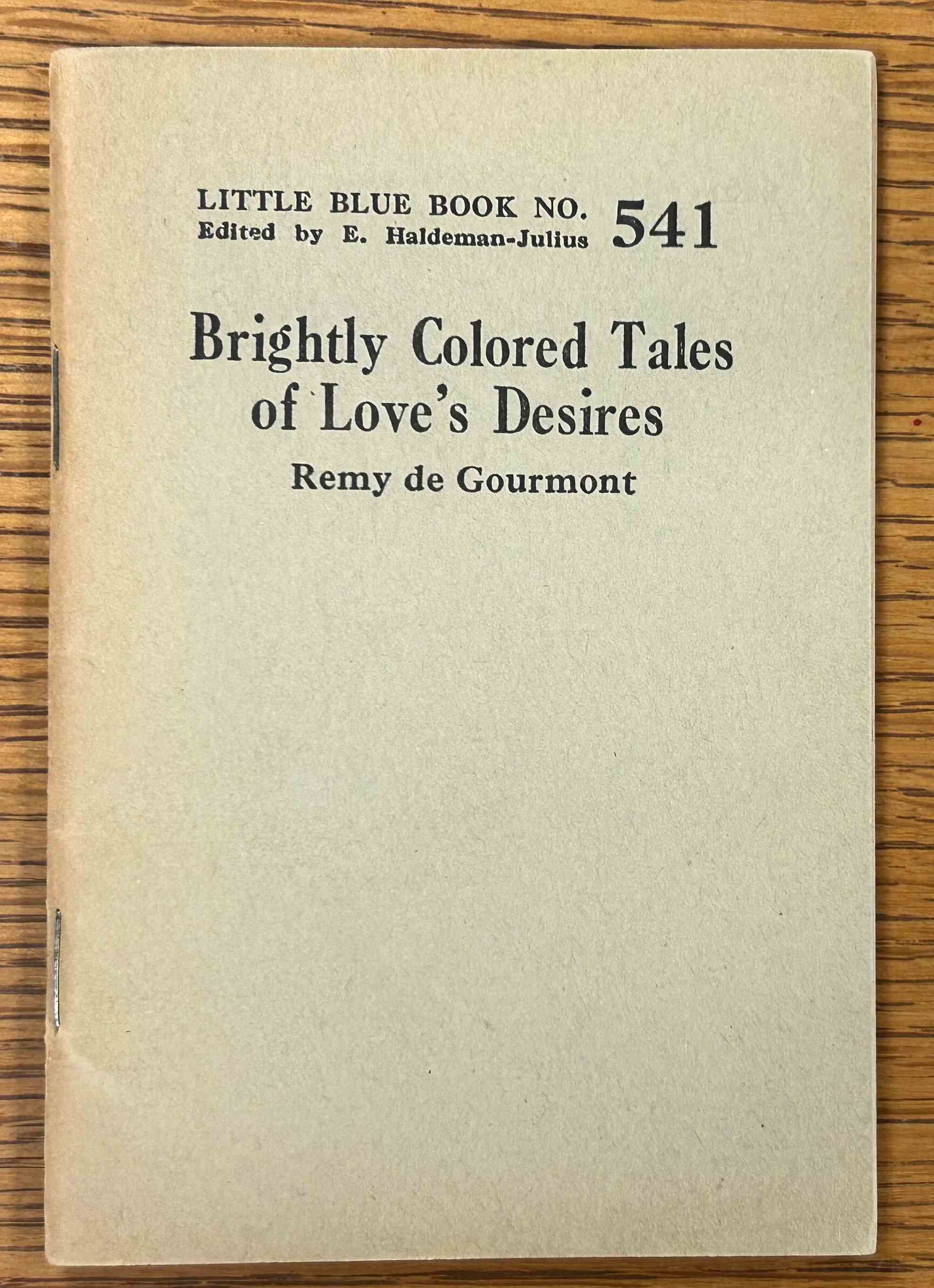
LITTLE BLUE BOOK NO. 541
Edited by E. Haldeman-Julius
Remy de Gourmont
Translated from the French by Isaac Goldberg
HALDEMAN-JULIUS COMPANY GIRARD, KANSAS
Copyright, 1924.
Haldeman-Julius Company.
PRINTED IN THE UNITED STATES OF AMERICA
After eight days of silence, having scornfully resisted all attempts to torture the secret out of her, all stratagems of the interrogatory, Catherine, accused of having poisoned her mistress, Lady W., spoke and said:
“Very well, yes, I’m the one, yet I am not to blame. I lived alone with her and she had such a bad nature that nobody, after six months, stayed with her more than two hours at a time, and then only in the morning. I alone may be accused; I’ve thought it over and understood that. At first I imagined I would save myself by saying nothing, by remaining before you and before all the judges mute and as if dead; but then I saw that my silence would condemn me. It is only this morning, upon awakening, that things became clear to me; up to that time I seemed to be living in a dense darkness, and I imagined that perhaps I should be left there, that I should be forgotten. When{6} you summoned me, I heard your words without understanding them, but I smiled, I believe, because I was glad to hear the sounds of a voice. This past night, no doubt, everything was clarified in my mind, without my being aware of it. I’ll tell you the story, then, exactly as it is. I am not guilty.”
There was nothing common about Catherine except the equivocal position whence she had risen. Her situation was mid-way between that of lady companions and that of a servant. She had been a tutor. Her origin was modest, but worthy. She was tall, pale beneath brown hair with reddish glints, and her eyes were green. When she raised her head in an attitude of defiance the judge regarded these green eyes with a certain fear.
“Green eyes,” he said to himself. “Cat’s eyes, the eyes of a monster!”
She drooped her eyelids, awaiting a reply; then she raised them with a questioning air.
“Green eyes, but a beautiful green, tender and deep,” mused the judge. “The eyes of a passionate woman.... Of a surety there’s a man in this case.... She wishes to save her lover. That she is in love, her eyes proclaim; that she is beloved is witnessed by her beauty. What a wretched travesty is justice, and what does the{7} disappearance of that old woman matter if it has filled with happiness these distant eyes! How beautiful they must be when they are mad with desire.... Ah! But it’s I who am going mad....”
He frowned and said, simply:
“I am listening to you.”
But Catherine was very well aware of the effect produced by her female attitude and she became more the female than ever.
“It’s two years since I came to Mme. W’s as a lady companion, but at once I saw that I’d be expected, at least most of the time, to fill a humbler position. The maids rarely remained more than a week; a quarrel, suspicions, the mistress’s constant ill humor, discouraged these girls. As I received my share of this testy treatment, I intended at first to leave the place likewise, when I noticed that she was a trifle afraid of me and that, after all, with a little tact I could manage her. So I remained. Toward the end I had a poor neighbor come to do the more menial tasks for me and I ran the house alone, without the help of any domestic. Thus I managed to get some peace, finally even smiling at the peevish words she spoke to me. She’d never address me except in violent, insolent tones, but I never answered, so that took{8} care of itself. I would have endured such a life, in hope of better things, for I went out frequently....”
“To see your lover?”
“Yes, sir, I went to see my lover every day, and I will resume seeing him every day as soon as you permit me to....”
The green eyes had become so tender as she spoke and so ardent that the judge did not dare to brave their brilliancy. He lowered his head and said:
“Go on, please.”
He was playing with a pencil, scribbling aimless designs upon a large sheet of white paper.
“I had reached,” resumed Catherine tranquilly, “up to the chapter of suspicions. Our food was sent in, but it was I, naturally, who saw to its preparation; it passed through my hands and I was responsible for it. As we did not have the same tastes, she allowed me to choose my own. This is the cause of my unhappiness—and hers,” she added cruelly.
“How is that?”
“Eh! Because she took it into her head that, that....”
“That what happened would happen,” said the judge.
“Yes, sir, that what happened would inevit{9}ably happen,—what she herself was preparing, not with her own hands, but with her own words. All at once she would shove back her plate and cry: ‘Catherine, are you trying to poison me?’ I would answer, calmly: ‘I’ve never thought of such a thing, Madame, and you know it.’ Then she’d say: ‘Prove it by eating this.’ And I’d resign myself to sipping a bit of the rejected plate. Thus satisfied, Mme. W. would resume her meal, murmuring, ‘Well, I guess today isn’t yet the day.’ These words, so often repeated, worked upon me like a command. I heard them at night, in my dreams and at times even not sleeping. I should have fled. Alas! I remained. Toward this same time I suffered the severest worriment. My lover fell ill and had to be taken away from Paris. I went mad, if obsession is madness, and one morning I began to repeat, like a litany: ‘This is the day! This is the day!’”
The judge pulled out his watch and arose abruptly.
“Later, we’ll resume later.... Calm yourself.... Say no more.”
Two hours later, alone with Catherine in her cell, the judge was saying to her:
“My child, there are no proofs against you{10} other than your possible confession. So I’ll question you no further. Later on you will tell me everything.”
“Later on?” asked Catherine. “Are you sure you will see me again?”
“I wish very much to see you again. Shall I not have been kind to you? My child, I don’t say this to give me any right to you; but if I do not save you from death, I save you surely from a prison sentence, and certainly from deep disgrace. Shall you not feel grateful to me for that?”
“My life,” said Catherine, “was worth so little! And now? Prison frightened me, and freedom frightens me no less.”
She hid her face in her hands and wept.
“Your lover awaits you,” said the judge, in a voice that quivered a little.
“Would I be crying,” asked Catherine, “if a lover were awaiting me?”
“I can love you, then! Would you have me love you?”
“Can I forbid it?”
“Thanks, but you,—will you love me?”
“I? I?... I should have loved you, perhaps, if, through jealousy, you had had me convicted so as to separate me from a lover....”
“But I knew that you no longer had a lover. Court judges know a great many things.”
“He is dead, and his death taught me that he had been deceiving me.... Leave me, leave me to myself....”
“I will come to see you, and you’ll tell me the end of the story.... But here,” he continued in a low voice, “not a word more. Tomorrow you’ll receive the address of the house where you’ll be expected.”
The judge possessed the smile of those eyes that had encompassed him, and the white pure body of Catherine with its red flowers and its russet shadows. She proved to be an agreeable mistress, but so dreamy at times that she seemed to have become the very statue of dreams. Awakened, she would take the hand that had touched her shoulder and would kiss it.
The end of the story never came up between them. The judge knew it; he knew that the poison had been poured; he knew that the crime had been commanded by the word that need not be uttered.
One day he asked for something to drink.
“Never,” said Catherine. “You’ll never drink here, you’ll never eat here. Never.”
“You don’t love me?” asked the judge.
“Perhaps I don’t love you enough to believe in your love.”
“What do you want, then, my child?”
“To forget.... Will you have a drink now?” He made no reply.
“Do you see?” said Catherine.
The topic of conversation was colors, and the young women were telling their preferences, which were not at all exquisite. One was fond of pink, the other, of blue; another extolled pale green and the fourth preferred red.
“And you, Alain?” asked she of the Blue.
“Oh, I!” replied Alain. “I am, through my status as man, consecrated to blacks, greys and cachous. I do not, like you, dream of brilliant plumage. Still, if I were permitted to harbor such a desire, I should choose to dream in zinzolin.”
They all burst into laughter, to hide their ignorance.
“Isn’t that a pretty word?” continued Alain.
There was no reply. Then the young man resumed:
“I don’t want to deceive you. The word’s a pretty one, but the color is frightful. Imagine a reddish violet; think of those violet velvets all frayed and showing a woof of dubious red.”
“You’re poking fun at us, and that isn’t nice.
“I’m not poking fun. I like that word, because it’s pretty. Perhaps because it rhymes{14} with my name, perhaps above all because it rhymes with yours, my zinzoline[A] Aline?”
[A] Tr. note: The feminine form of zinzolin, as Aline is the feminine form of Alain.
And passionately he kissed his sister, who protested:
“No, I’m not zinzoline, I don’t want to be zinzoline!”
“But if I am fond of the word,” Alain went on, “I don’t at all care for the color that it represents, and if my Aline became truly zinzoline I’d love her less.”
“Wretch!” said Aline.
“For a few moments,” said Alain.
She whom they called Mlle. Blue was an orphan. The daughter of the closest lady friend that Alain and Aline’s mother had possessed, she had come into the house as a tiny girl and had there grown up, yet there was a feeling that she did not quite form part of the household. Her character separated her from her adoptive family. She was moody, they were light-hearted; she seemed to fear life, while they plunged into it joyously, young and old as in a warm sea; neither the one nor the others had much will-power. Paule, on the contrary (that was her real name) seemed forever in a state of moral tension, and if she ever{15} happened to laugh like everybody else, she would stop brusquely the moment she became aware of herself. A philosopher might have found in this child the passion for suffering that priests have so greatly exploited in women, in whom it is not rare, and which men always like in women, since their pride is flattered by it or else, more simply, because they find this perfectly natural. Such creatures are very difficult to domesticate, for they are exceedingly defiant and exceedingly timid as well. Often one thinks them wicked when they are really afraid. Those most advanced in the art of causing self-suffering try to displease, as others try to please, but they have always a secret motive, and when one has detected this, one becomes their master.
Paule was neither homely nor pretty. If the features of her somewhat dumpy face were lighted by a smile, she became agreeable; her eyes might have spoken if she had not imposed silence upon them; she was small but not thin, rather lithe, and her hair, which was very abundant, was of chestnut hue,—that neutral shade which is perhaps the most seductive because it is the most mysterious, because it forecasts nothing.
With the two young girls there were two{16} young women, and it was these, naturally, that Alain courted. He was not at all sure which appealed to him the most, nor for that matter the one or the other appealed to him at all. They were both pronounced brunettes and they fairly frightened him, but as they responded to his advances, he teased them, as one provokes singular animals to see what will happen. And what happened was that, in the midst of this play they would exchange oblique glances and each of the women, in turn, would go into ecstasies when she had received a particular token of favor. Alain would kiss one of them upon the fingertips, and her corsage, where the fingers would fly for refuge, would swell like a great wave. He would approach the other, like a traitor, and brush the down of her nape with his lips: the neck and the whole woman would shudder a long time.
Motionless, with a vague glance and a scornful mien, Paule seemed to see nothing yet saw all. She seemed to feel nothing, yet suffered.
“I’m nothing, I am. He didn’t look at me once! I’m homely, it’s true, and so ill dressed in this blue that doesn’t at all become me! But it suits me to be thus. Oh! I wish I could displease him even more!”
Alain, at this moment, happened to notice her.
“Just the same, she’s the prettiest of them all.”
He threw toward her head a rose that he had just filched from one of the young women.
“Thanks, Zinzolin,” said Paule. “You don’t often make me a gift, so I’ll keep this one.”
She placed the rose in her corsage and resumed her disdainful air.
“He tried to humiliate me,” she said to herself. “How shall I make myself really disagreeable to him? Remain or leave?”
She looked at the two young women:
“Remain.”
She smelled the rose:
“Leave.”
“I’m going in,” said Aline at that juncture. “Are you coming, Paule?”
Once more she looked at the two young women, which Alain, facing them, half concealed from her.
“No, I’ll stay.”
Alain turned his head toward her. His features outlined a smile.
“Yes, I’ll go too. Wait for me.”
She had mused:
“He looked at me with an ironical air. He thinks I want to spy upon him. What a notion! I certainly scoff at him!”
Aline entered the salon. Paule went up to her room. She poured some water into a little vase of blue crystal and, before placing the rose into it, she inhaled its fragrance, gazed at it for a long time and suddenly, with a brusque movement, brought it to her lips.
“Why, I’m mad! I’m ashamed of myself! What do I care for this flower? How stupid! No, no, no.”
And she crushed the rose with passionate violence, threw it broken upon the carpet, stamped upon its petals, a prey to a childish fit of anger. Coming back to herself, she carefully swept toward the fireplace the ruins of her rejected joy, but in this humble attitude she was seized by a sudden reversion of feeling and with the little hearth broom in her tightened fingers, her other hand leaning against the marble, at once a ridiculous and a tragic figure, she gave herself up to tears.
Once again Paule had the strength to fight off her emotion. She arose, bathed her eyes, forced herself to read three pages of the Trésor des humbles and went down, calm and cold. Everybody had come in. She served tea, with Aline, as usual.
Alain, during all this, had continued his adolescent games. Alain, who was eighteen, was{19} awkward and insolent, but in all innocence, for he believed himself very skilful, having already conquered two chamber-maids and a little flower-girl of the neighboring village: he had beheld them, in turn, languishing with pleasure and chagrin and he had spoken to them, each time, the words required by the situation. So that he did not consider himself insolent, but, on the contrary, well-bred and even affable.
He was fairly tall and slender, beardless and with hair close cropped; his head revealed but two superposed tones—pink and copper, with two large blue flowers in the pink. He was singular and attractive; women desired him as they desire a rare, striking jewel, but, as he thought too much about himself, he was not aware of their desires. The friends of his mother or his sister seemed to him, moreover, impregnable citadels. These two, however, had betrayed weaknesses and he was beginning to consider them vulnerable.
Left alone with the two young women, he addressed to them awkwardly the greatest impertinences in the world.
“I love you both, yes, both of you.”
“We have no need of being loved,” replied the younger spiritedly. “We have our husbands.”
“And those things love, do they—these husbands?”
“Why certainly,” she retorted.
“If your husbands loved you, they wouldn’t be a-hunting. They would have done as I did. They would have had a lame foot so that they might remain with you.”
And he showed his slipper.
The younger woman would not be beaten. She said:
“There is a time for everything.”
But to herself she said:
“Good Lord! He missed the hunt for me! He loves me.”
“Does he love me, then?” thought the elder. “He loves me!”
As if he had divined these secret thoughts, Alain grew bolder.
“Only lovers know how to love.”
“Can that be true?” mused the elder. “If I only tried it.”
“He’s right,” thought the younger, who had had experience. “He could make excellent love to me, he could!”
They had lowered their eyes, that they might dream the better.
“Mesdames,” said Alain, “I place my heart at your feet.”
This time they laughed:
“What a devil!”
“What a little demon!”
“Oh! If I might only whisper into your ears—to both of you at a time!”
“The scoundrel!”
“The scoundrel!”
“Very well, then, one after the other. Let’s draw lots.”
They laughed more heartily.
“I’ll speak one word to each and I’ll ask a question. You’ll have to answer me.”
“No, I don’t care to hear anything.”
“And still less to answer.”
“But I won’t say the same word to both, nor will I ask the same question.”
“And you’ll say only things that it’s proper to hear?”
“You’ll ask only questions that admit of reply?”
“Naturally.”
“Come, then, and cast your lots, naughty boy.”
“I don’t want to be first.”
“It’s your turn, dear Madame. Deign to approach. Fine. ‘I love you. And you?—Monster!’ Now your turn: I adore you. Do you love me?—Hush!’ I’ve kept my word, and so{22} have you. Now let’s have our tea with the satisfaction of having fulfilled a duty.”
The women walked along in a revery. Alain followed them, asking himself:
“With which shall I begin, and how shall I go about it?”
* * *
Scarcely had the day dawned when Paule was up. She had slept but little. Before even making her toilette she left her room and made her way to a spacious chamber nearby which was called the linen room, and contained, besides the household linen, all manner of castoff material from hats and gowns, abandoned ribbons,—the remnants of several generations of women. There were pigeon-throat silks in the style of Empress Eugénie, there were amaranth velvets and nacarat satins:
“Ah! Here’s what I want!”
It was a card of ribbons whose sorry hue seemed to answer exactly to the definition of zinzolin,—a reddish violet.
“How ugly!”
Upon her blue corsage, her white neck, her chestnut tresses, she arranged the bows of zinzolin silk.
“I look like a savage,” she said, as she surveyed herself in the mirror. “He’ll laugh at{23} me. Perhaps he’ll be angry? If I don’t manage this time to displease him utterly, how am I ever to do it?”
She went down into the garden. A blackbird was arduously whistling the five notes of its monotonous call; the sun cast long shadows; the dew lay soft upon the leaves and the trees; she saw a bindweed open for all the world like a tender eye; she ate an apple as cold as ice: Paule no longer thought of anything, but the joy of being an early-rising roe-deer.
What was that she glimpsed, all at once, at the turn of the syringas? Alain, seated upon a bench, staring at her in surprise.
The sight of this friendly enemy rekindled her rancor:
“Eh? You couldn’t have been thinking of me?”
“No, my dear Paule, I was thinking of myself.”
“Do you get up early?”
“Oh! Not every day.”
“Today, then?”
Paule, in the full sunlight, was ablaze with zinzolin gleams.
“Where did you find that?”
“Find what?”
“Those frightful ribbons.”
“Frightful? Do you think so?”
“Could it be to please me, by chance?”
“Why not?”
“If it was your purpose to displease me, you have succeeded. But, tell me,—I thought you indifferent to everything. I thought nothing could touch your heart. And here you’ve arisen at five in the morning....”
“And you?”
“I? Because I’m in love....”
“Not I.”
“ ... and because you’ve bedizened yourself like a gipsy and are strolling through the garden to shake your thoughts.... Sit down besides me, Paule, do.... It’s certainly zinzolin.... What a notion! But you haven’t been so blundering as you thought and I am less stupid than you believe....”
“Then?” she queried, with ill-feigned coldness.
“Then I am like you,—I don’t know what to say. I’d like to banter, but the words won’t come.... Paule, Paule, do you know why we both arose with the dawn? Tell me, do you know?... Give me your hand, Paule.”
She let him take her hand, she let Alain’s arm encircle her waist, she allowed him to clasp her to his bosom. The trees, the flowers, the sky and the earth all blended and turned{25} away. She shut her eyes and her head drooped.
“Tell me, do you know?” continued Alain. “Well, we were seeking each other, and we found.”
She became the tender mistress of Alain, during all the vacations and for a long time after, every time he returned to the house.
Alain said one day:
“We ought to get married, but how can we? Can a man marry at eighteen? Let’s wait.”
“Let’s not speak of that,” answered Paule. “I belong to you; you’ll do as you please with me.”
Thus did she reconcile her felicity and her love of suffering. She was very happy for several years.
He was a child. He was no longer dressed as a little boy, but neither was he dressed as a man. His figure was lithe, his hair curly; one could fairly see him grow; he played billiards during the season and chaffed the girls all the year round.
But he didn’t chaff Christiane, however, because Christiane was ten years older than he, and because she seemed a lady, like her mother—a younger lady and not yet married. On the contrary, he loved her, because she was kind, affectionate and good-humored. Life is a thing that must laugh, think little boys, and when one isn’t laughing, one isn’t living.
All of Christiane’s friends were married, having settled down here and there. She would visit them, hoping, here or there, to find a husband in her turn, but she scarcely had a dot and that made matters difficult. She would often come to the little boy’s mother, because their houses were nearby and also because the father of the little boy, who collected prints, frequently received visits from wealthy enthusiasts, to whom he liked to exhibit his{27} collection. Who knows? It was her own explanation. She repeated it at every opportunity, with confidence in the future. Christiane was twenty-five.
In the summer, Christiane’s friends would foregather at a little seashore in Brittany and the one who had found the most spacious cottage would invite Christiane, whose parents, old and weak, preferred not to stir from their home. This made of the coterie the gayest gathering of childhood and youth. There, the little boy became more than ever amphibious. He no longer knew which of his instincts to obey. To rear fortresses of pebbles against the rising tide was really tempting; to remain reading near the young women who sat sewing and beside Christiane who was embroidering, was also mightily tempting. Then he would divide himself in two, and when he thought that he had played the serious young man long enough, he would run off to the little fellows and gleefully wade in the foam-washed sand.
Thus the time had been passing by for several days when the print collector received a mysterious letter: “Monsieur, your departure, of which I learned when I came to your house this past Thursday, interfered with a project that I had for some time been dreaming about.{28} A certain impatience does not permit me to wait till you return. Would I be indiscreet to take the liberty of disturbing you for a few moments at the shore, to which you have gone for the precise purpose of fleeing such indiscreet persons as I?” ... The signature, “Durand, of the Institute,” recalled to the print lover a visitor whom he had received two or three times and who, at his last visit, seemed distrait. He recalled, too, that on the first day Christiane had been with this gentleman, and that he had greeted her with great deference, that he had spoken with her, tenderly, and that for her he had even stopped examining the portfolio of rare examples.
Christiane had conquered a husband. One doubted this no longer when M. Durand was seen to install himself in the Beach hotel, and, declaring that he would finish his vacation season there, mingle gravely in the frivolous pursuits of the young women. The little boy had detested him from the first day. He thought:
“That fellow is no print lover, he’s a lover of Christiane.”
This thought, which often recurred to him, he even permitted to escape aloud, before his mother, who gave him a proper scolding, at the same time repressing her intense desire to{29} laugh. Soon M. Durand was known only as the lover of Christiane, and this name was to cling to him for the rest of his life.
This was the sole allusion to a marriage that was decided in silence. Toward the end of the month, when everybody, spontaneously, began to speak of preparations to return, M. Durand drew the print collector aside and said to him:
“I’m leaving. I’m firmly decided. I certainly am ‘Christiane’s lover.’”
“Ah! You have heard?...
“Yes, and joyfully. That proves that I have been understood.”
“But she?”
“I don’t care.”
The print collector took it upon himself to place Christiane’s hand into that of M. Durand. Christiane opened her eyes in astonishment. M. Durand blushingly kissed the obedient little hand and Christiane understood that this man loved her and desired her happiness. This thought rendered her already happy.
Christiane freed herself of the felicitations, the kisses of her friends. She went up to her room, and, seated at the window, contemplated the sea, which, naively, she found similar to the infinitude of her existence.
She had been dreaming thus a moment, when{30} a noise caused her to turn her head. She listened. It sounded like sobbing. She arose and looked. On his knees near the bed, and half concealed by the drawn curtain, the little boy was crying, his head buried in the covers.
Christiane approached and, taking the boy by the shoulders, raised him and drew him toward her:
“What’s the matter, my little fellow?”
“Christiane! Christiane!”
“What is it?”
“Oh! Christiane!”
“Come now. Sit down right beside me tell me what is the trouble.” She had sunk down upon the bed, quite touched by this immense sorrow. She began again, when the little boy had drawn near to her with his head leaning against her shoulder.
“Did they give you a scolding?”
“No.”
“Does something hurt you?”
“Yes.”
“Where?”
“I don’t know.”
“Come now,” she said, a little rudely. “Be reasonable. Speak.”
“Oh! Christiane, it’s you who scold me. You whom I love so much!”
Then Christiane understood, and the child began to frighten her. But his words had softened her, too, and, in order to make up for her rudeness she clasped him to her bosom.
“Christiane, is he going to take you away, then?”
“Why, not at all. I shall remain with all of you, with you.”
“That’s not true!”
“But it is, I assure you. I’ll come to see you, just as usual, and I’ll always love you, my dear little fellow.”
“And I,—I love you so!”
A pair, of innocent and curious hands clutched at Christiane and pressed her flesh. She looked, perturbed, into the languishing eyes that sought her own. She looked at the young mouth, and the young mouth rose toward hers and seized it. They remained a long time in this position, then in a sudden ecstasy they rolled over upon the bed. The little boy opened his eyes and his instinct threw him upon Christiane. He opened her corsage, caressed her soft flesh, thrust his hand in under her shoulders. Christiane started up, arranged her clothes, then, all of a sudden, finding herself unhooked:
“Yes, my little one, kiss my heart. Here! Give me my first kiss of love!”
And the little boy, with both hands pressing Christiane’s swelling breast, placed his happy lips upon the pale rose that budded there, ready to open.
She uttered a cry, as if bitten, arose, arranged her toilette, and said:
“Now I am content. My tender little friend, I will love you always. Preserve the taste of my heart. Who knows?”
SIDOINE
CLOTILDE
MARCELLE
Clotilde—A lover? No. I am too fond of my freedom. A lover? Suspicions, jealousy, torment. A lover? No, I want to be able to go and come in life, according to my own wishes. A lover? “What were you doing yesterday, my dear, at the corner of the rue de la Paix?” “I was waiting.” “What?” “Waiting for a carriage.” “Ah!” And he doesn’t believe you. His whole person says: “It’s very strange.” A lover! No. I’ve enough as it is with a husband. My husband is a debonair guardian who fears only scandal. Knowing that I am well-bred, he watches over me only from afar, and then the infatuation characteristic of husbands prevents him, even if he should surprise me in a suspicious conversation, from believing his eyes. But a lover?
Sidoine—Your husband is right. To suspect his wife is to insult her, and a gallant man is above insulting his wife.
Clotilde—If his wife is honest, that’s quite as it should be. If she is not, his suspicions become legitimate, even before the beginning of the proof.
Sidoine—Suspicions are never legitimate.
Clotilde—Don’t talk nonsense. Suspicions are always legitimate. But one has them or hasn’t; it depends upon temperament. I don’t know whether my husband has ever suspected me; he has never shown it. You know as well as I, nevertheless,—no, not quite so well, but anyway you know—that I had a lover, since you were not only his friend but our confidant. Confess, then, that all your pretty phrases are nothing but pretty phrases.
Sidoine—Not at all. When one loves, when one believes oneself loved, suspicions are infamous. I’ll say more—they’re stupid. Life is an act of confidence. To deceive is to degrade oneself. Well, can one ever suppose that the beloved is a degraded creature?
Clotilde—For my part, I know that lovers are suspicious, and nothing unnerves me more. Your friend tortured me for three years. I’ve{35} had enough. The trouble he gave me did not make up for the pleasures that he lavished so prodigally upon me. Another woman, perhaps, would have been happy with him. I wasn’t. One experiment suffices. I don’t say that I’ll never yield to a whim. Oh! Lord, no! Caprices! I seek them, and I’d bless heaven, I’d dedicate a novena to Notre-Dame des Victories, if that plant should sprout in my head. Alas! It’s years since I’ve felt anything; my flesh doesn’t rise to anything or anybody. I’m desolate. As to my heart, let’s not mention it. I’ve brought it to reason.
Sidoine—You’re a delightful little egotist. That isn’t why I love you, but I love you just the same.
Clotilde—You’ve told me so often enough. Love me. Who’s stopping you?
Sidoine—But it takes two to love.
Clotilde—Much credit you deserve, then! Why, I loved your friend for six months before he so much as deigned to cast an eye upon me.
Sidoine—My merit, if there is any, is far greater, for it’s a year, day for day, that I’ve been paying court to you.
Clotilde—Your merit would be double, indeed, if you really loved me.
Sidoine—What? You don’t even credit my sincerity?
Clotilde—One believes only in the sincerity of those whom one loves, and I don’t love you.
Sidoine—There’s a fine fix for me!
Clotilde—What’s the matter? You’ve turned pale?
Sidoine—That thrust was rather direct. Farewell.
Clotilde—Sidoine, don’t leave with such an evil impression.
Sidoine—Ah! Your eyes are no longer cruel, thanks! I may remain a little while, then?
Clotilde—Yes, but not seated.
Sidoine—I’ll remain standing then.
Clotilde—Not standing. On your knees.
Sidoine—Yes, I ask your pardon for loving you too much.
Clotilde—Very well, I pardon you, and here’s my hand to kiss, even. That makes it complete, doesn’t it?
Sidoine—It’s so nice kneeling before you.
Clotilde—How silly is a man in love. It’s really touching.
Sidoine—She’s actually weeping. Ah! You love me, Clotilde!
Clotilde—Yes.
Marcelle—This is going to be highly amusing. At what time, exactly?
Clotilde—Ten o’clock.
Marcelle—We have still ten minutes. Is everything ready?
Clotilde—Yes. Do you know that you look charming in those clothes? If this were truly serious, you’d make me lose my head.
Marcelle—My dear, I wanted to say the same thing to you. Ever since I dressed up in men’s garb I find in you a certain charm that makes my heart go pit-a-pat.
Clotilde—So much the better. You’ll play the part well.
Marcelle—Marvelously.
Clotilde—No, no, be careful! Wait till the bell rings.
Marcelle—I’m impatient.
Clotilde—Ah, there! You’re becoming dangerous.
Marcelle—Alas! So little!
Clotilde—Come, be careful, I tell you. Ah! Didn’t you hear?
Marcelle—Yes, and there’s a second ring.
Clotilde—I’ve given orders. He’ll enter at the third. I’m afraid, now, I’m afraid.
Marcelle—I’m hugely amused, I am.
Clotilde—Marcelle! Why she....
Marcelle—I love you! I love you!
Clotilde—Dearest! Ah!—Ah!—Ah!—Marcel, my Marcel! Ah! Ah! Ah! Ah!...
Marcelle—I love you, I ... love ... ah-ah-ah-ah!
Sidoine—Can it be possible?
Clotilde—Marcelle, take care to hide your face especially! Ah! Sidoine! What happiness! I didn’t hear you come in. I was dozing, I was dreaming, perhaps. I sometimes dream out loud when I fall asleep after dinner.
Sidoine— ...
Clotilde—No, here. The divan is too much upset.
Sidoine— ...
Clotilde—What ails you?
Sidoine— ...
Clotilde—What are you looking for?
Sidoine— ...
Clotilde—You? Sidoine, I beg you!
Sidoine— ...
Clotilde—Suspicions, then!
Sidoine— ...
Clotilde—Like the others!
Sidoine— ...
Clotilde—Then you believe?
Sidoine— ...
Clotilde—What does this prove?
Sidoine— ...
Clotilde—Ah! You no longer love me!
Sidoine— ...
Clotilde—Very well, I know what I’ll do.
Sidoine— ...
Clotilde—No, you still love me. Speak. You don’t believe that? Sidoine?
Sidoine— ...
Clotilde—Say something, at least, won’t you? Do you detest me?
Sidoine— ...
Clotilde—You despise me?
Sidoine— ...
Clotilde—Suspicions are infamous.
Sidoine— ...
Clotilde—Allow me to introduce to you my accomplice.
Sidoine—What! Marcelle!
Marcelle—The tragedy is over. It was deeply touching.
Clotilde—You were right, Sidoine, one must never....
Sidoine—Ah! How you’ve made me suffer. How wicked you are!
Clotilde—I wanted to put you to the test.
Sidoine—This time again, it was a bit too direct.
Clotilde—Those are the best thrusts.
Marcelle—Good-bye. I leave you my conquest, but I regret it.
Sidoine—How pretty she is, dressed like that!
Clotilde—You came in the nick of time.
Sidoine—Very well, now let her play the woman. That shall be my revenge.
Marcelle—No, no! Clotilde, stop him!
Clotilde—Sidoine! Sidoine!
Sidoine—I love you! I love you!
Clotilde—How horrible! It gives me the shudders! I’m dying! Marcelle, I entreat you!
Marcelle—I love you, I love you! I ... lov ... Ah!—a—a—h!
Sidoine—A-a-a-a-h!
Sidoine—I took sweet revenge.
Clotilde—Wicked creature! Wicked!
Sidoine—Yes, I went a bit too far, perhaps! But you set me such a good example.
Clotilde—You were more cruel than I.
Sidoine—Not at all. Reality is what we feel to be real.
Clotilde—An innocent sham.
Sidoine—I, too.
Clotilde—Is that true? Tell me. Is it true?
Sidoine—A sham.
Clotilde—Is that true, wicked man? She was crying, too....
Sidoine—Very well, then, cry in your turn.
Clotilde—Ah! You love me, you love me, you do.
Pauline spent a very agreeable half-hour at the confessional. As she picked off the heavy fruits of sin, the unburdened tree straightened its branches and resumed its vernal attitude.
“It feels a little like Amélie washing my head,” she mused. “As the fresh waves inundate me, I feel that I’m becoming lighter, relieved of a heavy veil, of the crepe of care.”
As she mused thus she felt ashamed, for she should have belonged entirely to contrition and have participated, by thrills of repentance, in the indulgent words of the priest.
“But that’s all right,” she went on, in her thoughts. “And then, this sensation of wellbeing that floods me—isn’t it the proof itself of the effect of the sacrament upon the sinner?”
She had recounted sweetly, without bragging, but without reticence, the story of her life for the past two years.
“I have sinned against chastity.”
“Yes. All by yourself?”
“No.”
“With your husband?”
“Oh! No.”
“Very well. Continue.”
“I have sinned in thought, in word and in deed.”
“A regular lover? An only one? Several?”
“An only one.”
“Very well. You desire ardently to see your accomplice, to kiss him, to surrender yourself to him?”
“Yes.”
“Often?”
“Always.”
“Very well. When you were together, did you exchange any dishonest talk?”
“Oh! No.”
“Dishonest talk,—that is, tender words?”
“Yes.”
“Very well. Then, caresses. Normal?”
“ ...”
“Did he kiss you all over?”
“Yes.”
“For a long time.”
“Yes.”
“And you?”
“I, too.”
“And it was thus that you would reach voluptuousness?”
“Sometimes.”
“I see. That’s quite serious. Was it of your own free will or by constraint?”
“Oh!”
“Of your own free will, then?”
“Yes.”
“This is horrible. You deserve the fires of hell.”
“Holy father, I repent, ever so much.”
“Very well. Continue. No other habitual attempts to avoid procreation?”
“ ...”
“You satisfied your passion without thinking of anything else, like beasts, according to the words of the apostle Saint Paul?”
“ ...”
“You mingled your flesh at a venture, with no other purpose than bestial pleasure?”
“Oh!”
“With never a reflection upon your own conduct, nary a regret, a thought of the teachings of Holy Church?”
“Alas!”
“Without shame?”
“I feel shame now.”
“Very well. Continue. Did you undress, naked? Completely naked?”
“Yes.”
“Without blushing?”
“Alas!”
“You were like a demon.”
“Oh!”
“It’s only demons who don’t blush at their nakedness.”
“I blush at it now.”
“Did you yield to the sway of a too ardent temperament?”
“ ...”
“To passion, then?”
“Yes, I loved.”
“You should have had recourse to sacraments, to pious devotions.”
“I am doing so now.”
“How did he enamor you?”
“I no longer know. By glances, by smiles, by words....”
“Did you struggle?”
“I loved him.”
“Is it over?”
“Yes.”
“You’ll never see him again?”
“Never.”
“Very well. Continue.”
And they had reviewed the other sins—gluttony, indolence, lying,—and Pauline recalled the delicate lunches after the furious repasts of{46} love,—siestas in the arms of her friend, complicated tales that she invented to throw her husband’s curiosity off the scent. That dream! For it was now no more than a dream! That dream! She wept.
“Since your repentance is genuine, I am going to grant you absolution, which it would have been preferable to defer, perhaps, but tears wipe away many things. From the bottom of your heart ask pardon of God, whom you have offended so gravely.”
Her emotion had redoubled, while the Latin words fell one by one upon her blond tresses, through a delightful mauve hat matched to her dress, which was of the same hue, but paler.
The ceremony over, she greeted, with no embarrassment whatsoever, the priest, whom she knew. They spoke for a moment about the last charity sale, the results of which had proved marvelous, and the poor man could not help considering—without envy, of course, but with a certain astonished complaisance—this elegant young woman, good-looking and ingenious, who doubtless knew better than the most crafty casuist all the secrets of licentiousness.
“Woman! Woman! This one has two little children as pretty as angels, whom she herself takes to mass and to catechism. Her husband{47} preaches holy war and her lover has left her for Mme. de Ruel, who loudly proclaims, ‘I, I am a fanatic of the Lord!’ Woman! Woman!”
Pauline, stepping back into her carriage, thought of the delightful orchids that a hand which she imagined she could easily guess had sent to her that very morning.
“Here I am, pure, spotless. What joy! There’s one of them with its little rose tail twisted like a corkscrew, and it’s a dear! It’s he, assuredly, it’s he. Already six o’clock! I hope I don’t miss him! Good Lord! How beautiful is religion! I’m so happy!”
Beatrice, being a princess, believed herself obliged to be very severe toward her adorers. A princess—isn’t that a rare fruit, the plucking of which is well worth some torments? She imposed tests upon them. The one, an inveterate smoker, must, during an excursion into the country, refrain from smoking an entire day. Another, who was fond of dancing, must abstain from the most attractive balls for the season. Three leading dandies, one after the other, were forbidden to patronize a certain master of fashions. The tailor conceived a hatred for the princess. Lionel, on the contrary, accepted everything, even ridicule. When he had been deeply humiliated, he would be permitted a few somewhat lingering kisses of her hand; he was favored with discreet smiles; his flowers would occasionally be accepted; he would be chosen as companion for a tour of the Salons or to go and hear one of M. Jules Lemaître’s lectures. Finally, he was granted a tête-à-tête in the little lilac salon, which was the well-known anti-chamber of the definite joys. For a long time thus, seated, standing, on{49} his knees, Lionel declaimed gallant, witty or pathetic speeches upon his passion. One day, after a tender impulse of abandonment, Beatrice suddenly resumed her dignified air:
“Let us be reasonable, my friend. I ought not to fall, and you ought not lead me into temptation. The flesh, even that of princesses,” and she dwelt an instant upon that word, “is weak. But a woman like me knows how to suffer. Born for virtue, I remain faithful to it. Alas! I shall never belong to you. Be my friend, Lionel, be the partner of my renunciation and the confidant of my griefs.”
Lionel had his plans. He knew that at this sentence of the play one must be shocked, plunge into despair and knock his head lightly against the panels of the little old oak library; they were very solid. Then, in order to avoid a greater misfortune, the princess would weepingly yield. She would go herself to bolt the door, as in the gallant prints of yore and, like a grisette, let herself very adroitly be undressed.
Lionel had his plans. He pretended to enter into the arrangements of the astonished princess:
“We’ll weep together. I love you too much to{50} dare to oppose a will that is so dear to me. Let us be friends, alas!”
Beatrice loved Lionel. At the moment in which he spoke thus she desired him with all the secret desires of her soul and of her flesh. As he took his leave, gloomily, she was on the point of clasping very tightly and drawing to her heart the hand that touched hers, but a modesty that she had never known frustrated her desire. She let Lionel depart without finding anything else to say than:
“So soon!”
The door closed, she felt herself enveloped in a mantle of chagrin. It was heavy, it was thick, it hid all objects from her sight,—all life itself. Finally her suffering yielded somewhat to this idea:
“He will come back tomorrow.”
Lionel did not come back on the next day, nor two days later, nor three. On the fourth came a word, from London:
“Dear friend, an unexpected matter.... I hope tomorrow, at the regular hour, to present to you the respectful compliments of your friend Lionel.”
At the regular hour, a blue note: “Suffering....”
Beatrice’s reply:
“I knew very well, my dear friend, that only something unexpected could take you away from me. But why should I have been deprived of news about you so long—three or four centuries? At last I have that news, however, and it’s bad! Tell me that I need not be uneasy? Beatrice.”
Lionel, as he read this, said:
“She is conquered. It’ll be tomorrow.”
During this week Beatrice’s imagination had skipped about a thousand different ways, from branch to branch, like a squirrel. She had passed through deception, hope, fear, boredom, despair, joy, disquietude, and this is the point she had reached when Lionel was shown in.
At sight of him she darted forward, then checked herself, blushing. Lionel opened his arms; she fell into them, closing her eyes, happy, no longer thinking of anything. There were long, mute kisses, tender caresses, then it was Lionel himself who bolted the door. Thus, at the same time that he affirmed his love, he affirmed his authority.
Lionel loved Beatrice, but he held a certain smiling rancor against the princess. Even as he satisfied his love, at the same time he perfected his revenge. After the great liberty, there were the little ones, which are indecent, and the singular ones, which are excessive. He{52} dared all and exacted all. Every day he added a stanza to the voluptuous poem. Beatrice, however, with the air of one who lets herself be vanquished by love, grew more and more exalted as the beads of the chaplet ran through her fingers, and one day when Lionel, at the end of his imagination, had enjoyed simply a mutual and simple happiness, Beatrice, at ease, laughing, invented a mad embrace.
Then he sank to his knees and kissed her feet, not as a lover but as a worshipper, and he mused:
“O Beatrice, thrice woman,—Beatrice of beauty, Beatrice of love, Beatrice of voluptuousness,—with these soft words I entreat your pardon for my stupidity. I tried to humiliate you, follow your example; I thought I would treat you somewhat as an odalisk and it is I, instead, who have done your will; it is I who am the slave.”
When the captain entered the little room where she worked with her mother, Berthe was dumbfounded. She could arise only by restraining her heart. Falling at once back in to her chair, she lowered her head. She seemed to be folding her work, but she was trembling with happiness.
The mother expanded in graciousness and in useless, common words:
“You weren’t expected so soon. We should have desired to dress and receive you in the parlor. We should have placed, since it’s the style in Paris, some flowers in the vases upon the mantelpiece. And above all we should have asked M. Bernard to be here, for nothing so intimidates poor women as a brilliant officer.”
She was very much afraid. The orderly, who had come that afternoon as courier to visit the room, and unpack a military valise, had not given the old domestic a very clear notion of what the captain was like.
“He’s a rough chap, I tell you,” he had said. “Twice my size and with an appetite like the devil.”
“Lord Jesus, can it be possible! We’ll cook him a fine dinner and make a fine bed for this excellent gentleman.”
“He’s not a fine gentleman. He’s a tough bird. He’ll be here at six o’clock. Well, greetings to the company. So long.”
“You’re surely going to have something to drink just the same, mister Soldier.”
“Just the same.”
And as he drank, the soldier had outlined his notion of the captain: a handsome brute.
As these details were repeated the whole house had trembled, but not Berthe. M. Bernard had gone to invite to dinner the tax-collector, a knowing fellow, so that he might not be alone, face to face with such a redoubtable personage.
“We’ll get him drunk,” he had decided. “That will be the best way to get out of it.”
Mme. Bernard, on her side, said to herself:
“I’ll stuff him with sweets. Dainties—that’s all it takes to win over a man.”
Berthe, too, had thought on the matter. She had mused:
“At last, a man! I shall behold, finally, a man. Ah! How long ago!... Perhaps he’ll harm me? Perhaps! Perhaps!”
And she had tried to devote herself entirely to her embroidery, as on every other day, so as not to appear excited:
“Are we going to look like folks who never receive a visitor?”
And as she drew the needle she repeated to herself:
“Can my hour have come, at last,—the definitive hour?”
There was talk of great maneuvers, of the country, of its coolness, of the grass, of the trees. The officer sketched his rustic landscapes, lauded the charm of the tiny stream beneath the willows, and deplored the fact that he had been compelled to trample upon a corner of green meadow all aglow with buttercups.
Berthe, astonished, gazed at him, surprised at such tenderness, when he accentuated his admiration by slapping his knee and bursting into:
“Upon my word! A pretty little patch of earth! There was a big girl who kept pounding her clothes and from time to time would get up to lay out a piece upon a willow pollard. By Jove! If I had been alone!”
Berthe, once more happy, thought to herself:
“If he had been alone with her, something terrible would have happened, that’s evident. Oh! If I could only be alone with him?”
As the officer praised the garden, which he had glimpsed as he came in, Berthe addressed him for the first time:
“It’s very simple, but would you like to see it?”
“A good idea,” said the mother, “and you’ll cut some flowers. I’ll join you in a moment.”
“I’ll cut the ones you tell me to. I don’t want you to hurt your fingers in my presence.”
“No, no. Do you think me so clumsy?”
She pretended to struggle with him, letting him capture the instrument. He opened her fingers gently.
“A good sign,” he said. “To have touched so pretty a hand makes one feel like touching the heart.”
She made no reply, thinking:
“It’ll all come to nothing but empty compliments!”
Then she became aggressive. As the captain held out a rose with a hand streaked by scratches:
“Blood? Don’t let any get on to my flowers, at least.”
“But blood’s a beautiful thing.”
“No, it’s dirty.”
“I never believed that anybody could talk like that to an officer who had had his head half{57} split by the blow of a sword.”
She looked at him.
“He really looks terribly angry. If he dared, he would strike me. What shall I say to him to excite him more?”
She could find nothing, and there was a long silence.
“Another one,” she said to herself, “who is master of his emotions. I was deceived. He won’t attack me. Ah! How weary I am!”
“In short,” said the captain to himself, “she has insulted me. She’s only a woman. Very well. But she insulted me just the same. I must get reparation.”
The captain looked around him. They were in an out-of-the-way nook, enclosed by clumps of bushes.
“The basket’s full, I believe,” he said. “Here’s the pruning-shears.”
And, as she held out her fingers, somewhat uneasy, despite her resolution, at the change of attitude in the man whom she was observing, she felt two hands seize upon her shoulders and, at the same time, a mouth crush against her own.
His gesture of vengeance completed—an ironical vengeance—the captain released her shoulders and was drawing back when he felt that{58} his rude kiss was being returned with passion. From her shoulder one of his hands descended upon the heaving breast; the other hand supported her yielding waist. An eminently classical pose, the sequel of which, not far from a bed of verdure, is the difficulty of lifting up a skirt caught under the recumbent body. It is often necessary for the tender victim, who has not lost her sense of folds, to come delicately to the aid of the brute.
“Yes, yes....” murmured Berthe.
But, from the direction of the house a voice was calling:
“Berthe, Berthe.”
As she arose, she said:
“We have the night. I will come. Meanwhile, silence, coldness, or conventional gallantry.”
The officer, to the great astonishment of his hosts, ate and drank very moderately. He smoked only two cigarettes, but accepted a great deal of coffee. His attention, that entire evening, was concentrated upon trying to hit upon the topics of conversation that could release the eloquence of his partners. He was lucky enough to discover them. While they spoke, he reflected:
“Virgin? A lover? Lovers? Innocence? Perversity? Curiosity? Stupidity? In any event, i{59}t’s serious. In the first place, my conscience? Then, marriage? I’d better bolt the door.”
The next instant the male began to dream of the beautiful girl who was offering herself:
“Why have any scruples? What? Not pluck the flower along the road?”
Finally:
“If I don’t take it, I’ll feel remorseful for the next two years, perhaps for the rest of my life.”
He looked at her without affectation, while she poured him out a glass of tea, and he dared to say:
“Oh! Not so much, it’s very strong. You’re going to keep me from sleeping.”
As her only reply she raised her head, looked at him and lowered her lashes.
He felt his head whirl around. Of a surety this was not his first affair, but he had never before enjoyed one of such quality. This youthful country bourgeoise certainly excited him to the highest pitch. What was this sphinx with the red hair? He scented the odor of her nudity in advance, and trembled. He saw her all white, like those marble statues which formerly he had desired rather than admired.
“You’ll sleep in the orange room,” said Mme. Bernard, who was beginning to grow sleepy.{60} “One of my daughter’s whims. She wanted it all in that color. But you’ve seen it already. I hope that you’ll sleep in it well.”
This last word pierced the officer atrociously. This maternal intervention cast him back into his indecision.
Berthe perhaps divined this evil impression, for she added:
“Orange is my color. It seems to me that I’m less ugly amidst this flame, into which I am melted. Nobody ever sleeps in that room, but I often retire to it. It’s my domain.”
“And what does she do there, I ask you?” resumed Mme. Bernard. “She reads, she dreams, for we’re a bit dreamy. What would you have? Young girls! I was just the same at her age. But my favorite color was blue.”
“Orange is a pretty color, too.”
“Say that it’s the prettiest of all,” said Berthe.
“It’s the prettiest of all,” said the officer.
Now he awaited her. After having undressed, he half-dressed, and smoked a cigarette, sketching arabesques upon the margins of a newspaper. He no longer thought of anything. Only, at every sound, even that of a wakened fly, his heart would stop beating.
Every six seconds he would look at the door.{61} He arose and went over to it, to put his ear at the chink.
At this moment a panel of drapery, near the hearth, seemed to detach itself.
“Am I seeing things?”
He approached the mystery and reached there just in time to receive Berthe in his arms.
“My room is there,” she explained, after having received and returned the kiss of greeting. “Simply a double cupboard whose inside partition I’ve managed to make moveable. How many times, for three years, have I come to see if you were there! Nobody, always nobody! But at last here you are. Will you love me, at least?”
Seeing that these words astonished her lover, she resumed:
“He who comes is he whom one has been awaiting. You have come and I belong to you.”
Walking ever so softly, speaking ever so softly, they reached the edge of the bed and sat down. As he pressed her to him, the captain felt, under the flimsy robe, the young girl’s bodily beauty. He was deeply moved, but he had the courage to say:
“No, you are a silly child and I will not abuse you. If you wish to love me, we have the rest{62} of our lives. You said, imprudently and innocently, ‘We have the night.’ And I tell you: ‘We have life’.”
She dropped her head upon the officer’s chest, pressing very tightly the arm that she had slipped around his neck. Then she arose, her head red, her golden eyes gleaming ardently, wildly, found his lips, which she bit, and threw herself upon her back, drawing him upon her.
“Should we,” she said later, cuddling into her lover’s lap, “should we ever have found again a chance like this?”
Two months later the orange room became the wedding chamber.
They were very happy and spoke very often of their adventure, but Berthe, I believe, never confessed to her husband that he was the third captain for whom she had pierced the walls.