
Transcriber's notes: Unusual and inconsistent spelling is as printed.
New original cover art included with this eBook is granted to the public domain.
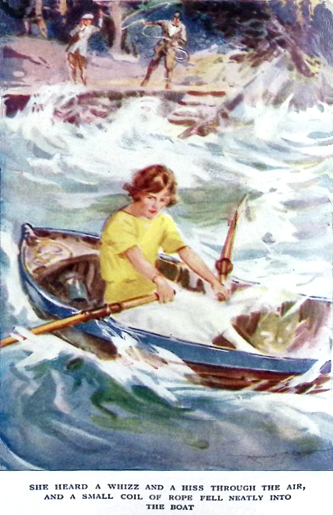
SHE HEARD A WHIZZ AND A HISS THROUGH
THE AIR, AND A SMALL COIL OF ROPE FELL
NEATLY INTO THE BOAT
BY
AMY LE FEUVRE
AUTHOR OF "TOMINA IN RETREAT," "THE MENDER,"
"DUDLEY NAPIER'S DAUGHTERS," ETC., ETC.
"The joy of the Lord is your strength"
LONDON
THE RELIGIOUS TRACT SOCIETY
4 BOUVERIE STREET, E.C.4
Made in Great Britain
                        OTHER BOOKS BY

                         AMY LE FEUVRE
                         —————————————

                     A BIT OF ROUGH ROAD
                     BRIDGET'S QUARTER-DECK
                     THE CHISEL
                     A DAUGHTER OF THE SEA
                     THE DISCOVERY OF DAMARIS
                     HEATHER'S MISTRESS
                     HER HUSBAND'S PROPERTY
                     JOYCE AND THE RAMBLER
                     THE MENDER
                     ODD MADE EVEN
                     OLIVE TRACEY
                     TOMINA IN RETREAT
                     THE MAKING OF A WOMAN
                     THE CHATEAU BY THE LAKE
                     DWELL DEEP
                     ON THE EDGE OF A MOOR
                     THE CARVED CUPBOARD

OF ALL BOOKSHOPS
TO
MY SISTER CHARLOTTE
CONTENTS
BOOK I
CHAPTER
BOOK II
A HAPPY WOMAN
BOOK I
HER BROTHER'S NEWS
THE fire blazed away cheerfully in the grate, throwing flickers of light across the dusky room.
Sara sat in an easy-chair with her feet on the fender. There was a quiet serenity and grace about her attitude; her needlework was upon a small table by her side. Just now she was idle; her slender capable hands were clasped in her lap, but her large heavily fringed grey eyes were perplexed with busy anxious thought.
Her surroundings, if not luxurious, were essentially cosy and homelike. The carpet was a thick Turkey, the leather chairs and large Chesterfield couch drawn up on the other side of the fire looked made for comfort. There were two handsome bookcases, a piano, and a large writing-table between two long narrow windows. But the sporting prints on the walls, the pipe-racks over the chimney-piece, and the scent of tobacco in the room were evidences that this was more of a man's room than a woman's. And yet there were feminine touches in the gracefully grouped flowers in glass bowls, and in the indescribable woman's impress on it all.
Sara herself was an attractive figure—not strictly beautiful, but she had a bright lovable face, which changed perpetually from grave to gay; a face that one learnt to watch with increasing interest, for it mirrored a happy and beautiful soul. She had a way of twinkling her eyes, and pulling down the corners of her mouth when she was amused, and Sara had the gift of humour in no small degree. Now she was very serious, and a wistful look had crept into her soft eyes.
Outside there was a distant rumble and roar of motors and 'buses. The street itself was a quiet one, taxis occasionally dashed past the house, but there was a continual tramp on the pavement. In a few minutes, she raised her head.
A taxi had stopped at the door; she heard the click of a latchkey inserted in the lock, for her door was open; then she heard voices and steps coming along the hall. For an instant she rose from her chair, and stood irresolute, then with a quick-caught breath, she reseated herself. And the next moment a young man and a very pretty girl stood before her.
"Here we are, Sara! Give us your blessing!"
Sara was on her feet again, she held out both hands to the girl; then stooping, for she was fully a head the taller of the two, she kissed her warmly.
"We shall be sisters now, Milly. I am so very glad."
"And so am I," said Milly, prettily. "I have always admired you so much; and Arnold and I have been saying that you must always live with us. I couldn't be happy if I felt that I was turning you out of your home."
Sara winced, then she laughed.
"We need not talk about that," she said, "but I thank you for your thought of me."
Then Arnold drew the most comfortable chair towards the fire and seated Milly in it.
"We'll have tea down here, eh?" he asked. "Just as we do when we want to be cosy."
"I'm afraid Lacy has laid it in the drawing-room with unusual pomp and splendour. You'll hurt her feelings dreadfully if you make her alter her arrangements."
Milly laughed.
"You're always in such bondage to Lacy; now, in our house, our servants do what we want; we don't do what they want!"
Sara looked at the girl reflectively.
"Yes," she said after a pause, "that's the orthodox way, of course, but fifteen years of faithful service makes one's heart tender."
"Oh, well," laughed Arnold, "let us come along up, then. It is in honour of you, Milly, so we won't grieve the poor old soul!"
They went upstairs into a pretty drawing-room. A sweet-faced elderly woman was putting the finishing touches to a round table wheeled up to the fire.
"Here, Lacy, is the future Mrs. Arnold Darlington. Don't you think I'm a lucky man?"
Lacy looked up and almost made an old-fashioned curtsey.
"I wish you both well, sir," she said sedately, but she did not look overwhelmingly glad as she spoke.
"I'm sure Lacy doesn't approve of me," said Milly, when the old servant had left the room. "She never did, not from the first day I came to see Sara here."
Arnold laughed happily. Lacy's opinion was of small importance to him at this present moment.
Sara took her place at the tea-table, and talk flowed on in an easy fashion. Milly was slightly excited by her new position, and full of plans for the future.
"We're going to be married next month," she announced. "We've talked it all over and settled the day, and my dress, and everything. We've known each other for two years, and there's nothing to wait for."
"Nothing in the world," responded Arnold fervently; "and we're going to make a flying visit to Paris, and then will settle in here straight away."
"You take my breath away with such rapidity," said Sara. "And what do the parents say, Milly?"
"Arnold is coming to dinner to-night, and then the whole thing will be settled," said Milly, her eyes roving round the room as she spoke. "Sara dear, don't you think the curtains rather shabby here? I love blue in a room. Pale blue Roman satin would be lovely. What do you say, Arnold?"
"Anything you like," was the answer of the reckless lover. "I suppose the house ought to be done up a bit. You'll see to that, eh, Sara?"
"Oh," said Milly, eagerly, "you must let me have my say in it. I love getting new furniture and having fresh paint and papers in a house."
"Yes, it will be your right," said Sara, looking across at the girl with a friendly smile; "and I can't promise to supervise things, for I shall be away."
"Away?" gasped Arnold. "Why, Sara, you've never left me. Where can you go?"
"Ah!" said Sara, with a laugh and mysterious nod. "That's 'my' secret!"
Her brother looked at her wonderingly, but Milly claimed his attention. She did not seem surprised by Sara's statement, and the young couple did not stay long after tea.
Milly invited Sara to dinner that evening, but she declined the invitation.
"It will be better for Arnold to meet your parents alone," she said, and she saw the relief in Milly's face as she spoke.
When they had left the house, Sara walked downstairs again to the smoking-room, and sat down at the writing-table to answer a letter which had come by the morning post, and which had been in her thoughts all the day. She sealed it and stamped it, then stood up, and clasping her hands behind her neck, looked at herself in the low mirror over the fireplace.
"You're strong and comfortable looking," she murmured, giving her reflection a little nod of approval, "not very young or flighty. And you've learnt, or you ought to have learnt, to have an unlimited amount of patience and forbearance to draw from when required. And you must buck up and do what thousands of other women are doing, for you have most assuredly burnt your boats behind you now."
Then she added, with a sudden inspiration—
"I'll run over and see Miss Grafton. I won't sit brooding and mooding, and fermenting the feeling of injury and neglect!"
To say was to do with her. She swiftly went upstairs to her bedroom, and wrapping a fur cloak around her, sped down the stairs out into the cold foggy street.
Across the square, she knocked at a house in a terrace.
The door was opened, and a minute later she was shaking hands with a bright-faced little old lady upon an invalid couch.
"My dear Sara! You whirl in like a fresh breeze. Isn't my room very warm? My dragon will have the windows shut to-night! And the fire is big enough to roast an ox. Now, what is your news?"
"What I have expected for a long time. Arnold and Milly are engaged."
"What fools young men can be!"
"Now, don't be nasty. She really is devoted to him, and he to her. They have a lot to learn, but they will learn it like every one else."
"And when is the wedding coming off?"
"Almost immediately. In a month's time. There is no reason why they should wait. Arnold has a handsome income, and she, you know, has plenty of money."
"I hope we are not going to lose you."
"In about three weeks," said Sara, slowly, "I shall be in the wilds of Westmorland, living with a lonely widow in the capacity of a companion and help."
"My dear girl!"
Little Miss Grafton looked genuinely shocked and disturbed.
She cast her memory back to the day when the rising young barrister had come to the opposite house to live with his sister. She had known their old home in Berkshire; their father had been a small country squire there. And Sara had hunted with him four days a week during the winter, and had house-parties of young friends all the summer. She had paid occasional visits to town after she had been presented at Court, and had always had plenty of admirers amongst her friends. But since her father's death, and the break-up of the old home, Sara had withdrawn herself from much social gaiety.
Mr. Darlington's affairs were found to be in a shocking state after his death. The estate had to be sold to pay off the accumulated mass of debts, and Sara came to live with her brother with only an income of fifty pounds a year which had come to her through her mother. She and her brother had been all in all to each other till the usual thing happened. Millicent Conway had come into their lives; and Arnold had quickly lost his heart to her.
"But, my dear girl," said Miss Grafton, slowly, "is it necessary to cut yourself aloof from your brother? Does he wish it?"
"I am afraid I do." Sara's head was raised in the air, and a heightened colour was in her cheeks. "It never does for sisters-in-law to live together, and Milly and I have hardly a thought in common."
"But 'anybody'—a shop girl—could become a companion help. It is really a waste of material for you to sink to that. With your culture and education you could do so much better. How did you hear of this?"
"I saw the advertisement in the paper. It attracted me. I don't know why. I have spent my days in taking care of a helpless man. I shall miss my vocation if I do not take care of somebody. And I wanted something at once. And though I answered other advertisements, this was the only one that had a satisfactory result. She required one reference, and my clergyman's proved quite sufficient. The advertisement ran like this—I know it by heart—
"'Wanted at once by lonely widow; a gentlewoman as companion, also
to help in light household duties. Must be patient, capable, and
resourceful.'
"I like the word 'resourceful,' don't you? There's an adventurous sound in it! Well, I answered it, and this is the reply."
She took a letter out of her pocket—
"'Mrs. Laird has received Miss Darlington's application, and begs to
say that she requires a young woman of good birth to wait upon her,
as she is a great invalid. Her duties would be light, but though Mrs.
Laird keeps two indoor servants, she expects her companion to bring
her comfort and cheerful society. She does not wish a young or flighty
girl, and she wants some one who is good-tempered and forbearing. If
Miss Darlington is not happy in the country, she had better not come.'"
Miss Grafton gave a little laugh.
"It does not sound an attractive post."
"It does to me. I love making people happy and comfortable. And I want hard things to tackle. I have been leading a very luxurious lazy life."
"My dear Sara, you are always busy. You have a district and a Sunday school class."
"Yes."
For an instant Sara's bright face shadowed.
"I shall feel leaving them. But I am panting for a fuller life, Miss Grafton. And my opportunity has come."
"Shut up with a cranky invalid in desolate country," exclaimed Miss Grafton. "You had much better come and live with me."
Sara looked at her friend with tenderness in her eyes.
"What would your dragon say?" she asked lightly. "No, Miss Grafton, you are too happy and resourceful in yourself to need me. You have taught me to be happy, I want to pass the teaching on. I don't know why my heart goes out to the lonely and sad ones of the earth, but it does."
"And what remuneration do you get for this post? That is, if you think fit to tell me."
"Forty pounds a year. A nice little addition to my income. I would have gone if she had offered me twenty."
There was silence. Then Miss Grafton said—
"And what are Lacy's views?"
"I have not told her yet."
"Surely you have made all these arrangements very prematurely?"
"I knew what was coming. I wanted to have my plans ready, because I cannot stand any discussion and argument about a course which I am determined to take."
Miss Grafton gave a funny little shake of her head.
"A stout heart, and a strong will, are more the characteristics of a man than a woman."
Then sudden tears came to Sara's eyes. She knelt down by Miss Grafton's couch, and kissed her.
"Oh, you don't know what a wave of homesickness and desolation has come over me to-day. I'm so alone, so unwanted, a superfluous woman on the face of the earth. If I can't comfort and help this lonely widow, I don't know what to do next!"
Miss Grafton looked at her with moisture in her eyes. Then she said softly—
"'The works that I do, shall ye do also.' And those works cannot soon be finished."
Sara got up.
"I must go. And I know this is the time for your evening meal. Shall I ever be such a little saint as you?"
She left the room as a tall hard-featured maid entered, the maid who had lived with Miss Grafton all her life, and who would have laid down her life for her.
When she got home, she went up to the smoking-room again. She had letters to write, and accounts to make up, but she was not left long in peace. Lacy came in to make up the fire, and lingered purposely.
"May I speak to you, ma'am, please?"
Sara wheeled round her chair.
"Why, Lacy, what a lugubrious face! What is the matter?"
"I'm only looking ahead, ma'am, and thinking of the time when a new mistress will be head of this house. And if you will be going to make your home elsewhere, I hope you'll take me with you. I've been with you since you were ten years old, and I can't take to new ways and faces at my time of life."
"But, my dear Lacy, you know you dote upon Mr. Arnold, and he will be the head of the house, not his wife. You must stay with him, you really must. You look after his comforts like no one else, and I am going to stay in a house where it would be impossible to have you."
"But couldn't I be your maid, ma'am? You are going away. I guessed you would. Ladies always take their maids with them on visits."
Sara began to laugh at the idea of a "companion help" arriving with her maid. And then she sobered down, and talked soothingly and persuasively to Lacy, getting her to promise to think of making no change for the present.
When Lacy eventually left her, it was dinnertime. She dined alone, and her thoughts were sad. She did not wait up for her brother's return, which she usually did, but went early to bed. And so ended an eventful day and epoch in Sara's life.
AN UNCOMFORTABLE HOUSE
IT was pitch dark. The air was cold and frosty. Sara wrapped her fur coat tightly round her as she stepped out on a tiny platform of a very deserted-looking railway station. One porter with an oil lamp swinging in his hand went to the van to get her luggage. She had missed a connecting train on her journey North, and instead of arriving at her destination at six o'clock, had arrived three hours later. Very weary she was, and yet cold and nipping as the air was, she welcomed it gladly after the long hours of waiting in stuffy waiting-rooms with coke fires, and being cooped up in carriages with fellow passengers who insisted upon having the windows shut.
"Is anybody or anything waiting for me?" she asked the porter.
"Ay, there'll be a 'mon' outside," was the laconic reply.
She groped her way through the tiny booking-office to the road beyond. Through the darkness a high dog-cart with a restive horse could be dimly seen.
The driver raised his cap to her. In a few moments, she was perched up by his side, and the porter hoisted up her luggage behind. Then they set off at a smart canter along a hard frosty road.
"Do you want another wrap?" the driver asked her.
His voice was low and gruff, and Sara hardly caught the words.
"I am quite warm, thank you. I hope I have not kept you waiting. I missed my train at the junction. The London train was very late."
"So I heard."
The man's independence of manner made Sara resolve on silence. Up and down hills, passing dark shadowy firs, then out on a lonely bit of moor, and then they began to climb a steep, wild hillside. The darkness began to lift; clouds rolled away, and a silvery moon appeared.
Sara looked about her. The cold clear air exhilarated her. She saw that they were climbing up round the side of a mountain, a deep ravine fell away from them on one side; below was the gleam of a shining winding river. Then suddenly they took a sharp turn, and Sara made an exclamation of delight. Such a scene of surpassing beauty was before her that she knew she would remember it for the rest of her life.
The moon was shining across a lake. The bare brown branches of larches and firs that bordered its banks were frosted, and looked like delicate lacework against a silver sky; the hills on the farther side stood like sentinels guarding a treasure. Wild and weird it was in the moonlight, almost foreign with the wonderful woodland growth around it. Then a flock of wild ducks flew across with their shrill cry, and owls hooted as if in response to their appeal.
Sara in her excitement touched the driver's arm.
"Stop, just stop for a moment! I have never seen anything like this!"
The driver pulled up without a word. In perfect silence Sara gazed upon the scene below her. She felt as if she had been transported to another world. The taciturn driver beside her, the steaming horse, the flickering lights on either side of them from their lamps, and the calm serene moon making a silver road across the rippling waters of the lake. Was it only a few hours back that she had left foggy, bustling London? It seemed impossible. She drew a long breath of enjoyment.
"Oh," she cried impulsively, "I wish we could stay here for ever! It is enchanting! Exquisite!"
Then the driver spoke in tense, short tones.
"The finest scenery in the world would never content a soul."
"It would content mine!" said Sara.
He whipped up the horse; a thick-wooded road soon hid the lake from their view.
And Sara began to ponder upon his tone and words.
"A superior man," she mused, "possibly a friendly farmer. I will try and find out who he is."
Presently she asked—
"How much farther is it? Where does Mrs. Laird live?"
"We shall have to get round to the other side of the lake, about five miles yet."
"And are—are you in her employ?"
How she could have asked the question Sara afterwards wondered.
He answered shortly—"I am her son."
"I beg your pardon. It was very kind of you to come to meet me."
He made no reply, and Sara relapsed into surprised silence. She asked no more questions.
Somehow she had imagined the "lonely widow" to be absolutely without kith or kin. A son had not entered into her calculations. Soon they began to go downhill, the road seemed interminable. Sara's back began to ache, and she was conscious how very tired she was.
When at last they stopped at a gate, she gave a long sigh of relief. Her driver gave a peculiar whistle, and in a minute or two an old man holding a lantern appeared. He opened the gate and walked by the horse's head up a short drive. It was impossible to see any house. No lights flickered in the windows. Sara stumbled down with cramped stiff limbs; she was ushered into a gloomy entrance-hall. One dim and smoky oil lamp hung from the middle of it.
A door was pushed open, and Sara found herself in an untidy, comfortless-looking room. The fire was dying out; the remains of a meal were on the table. A brown collie rose from the hearthrug, and stuffed his nose into his master's hand, then he inspected Sara, and after sniffing all round her, returned to his former position.
Mr. Laird made an exclamation under his breath, then he strode across the passage. And Sara heard him say in a peremptory fashion—
"Where is Mrs. Thwaites? Is there no supper? Do you know the fire is out? Come and light it at once."
Then an untidy sleepy-looking girl appeared at the door with an armful of kindlings. Mr. Laird followed her and said—
"Will you excuse me, Miss Darlington? I must go up to my mother. She will not settle to sleep until she has seen me."
Then he disappeared. Sara threw off her fur cloak, and with it her weary languor.
"We are very late," she said to the girl. "I suppose you had given up expecting us. What is your name?"
"Izzie. Yes, miss, I dropped right off to sleep. I was up soon after four this morning. And Mrs. Thwaites went off to bed. She had the toothache cruel."
"Now I'll light up that fire. Can you bring us any supper? Is there a kettle boiling?"
Down on her knees went Sara, and with some coaxing, and the bellows to assist, she soon had a cheerful blaze. Izzie left the room, and returned with a cold ham, a currant loaf, and a hot steak pie, the latter very much burnt.
Sara saw her clapping the things down on the table, not attempting to clear the plates and dishes that were already there.
"'Twas Mr. Pitt, he came in, and brought two other gen'man to see the cows what are goin' to be sold," said Izzie in a grumbling tone. "And I meant to have washed up, but I sot down and went bang off, and never woke till master called!"
"Well, look here," said Sara with some spirit; "you go straight off to bed. I'll see to everything. Run along. It's much too late for you to be up."
Izzie looked surprised and delighted.
"Won't master scold?"
"No. I will be responsible. Run along."
The girl went.
"And now the help begins her work!" murmured Sara to herself.
She was roused to energetic action. The untidy room had definitely called to her. Within an incredibly short time, she had swept and tidied up the hearth, cleared away all the dirty dishes, and laid the table according to her notions of fitness. She put loose books into the bookcases, hung upon the pegs in the hall two coats and a fishing-basket. Then she went into the kitchen, and foraged about till she found some coffee. The kettles were boiling; she boiled some milk, made some coffee, and was in the act of putting it upon the table, when Mr. Laird came back.
He looked surprised at the altered aspect of the room, and for a moment he and Sara confronted each other. Both found food for thought in their respective looks. Sara, in her well-cut tailor brown serge gown, her soft dark hair coiled loosely over her head, and her bright smiling face, seemed to have brought already with her a sense of comfort and cheeriness that had been lacking in this house for many a long day.
Mr. Laird was an enigma to her. He was a thin wiry man, not very young, and yet, now his thick overcoat was off, looked alert and singularly upright. His close-cropped head of hair was already streaked with grey at the temples. He was dressed in rough, well-cut tweeds, and his hands—Sara found herself glancing at them were well kept, and those of a gentleman. If she had seen him in London like this, she would have taken him for a thorough man about town, he had no signs of a country rustic in his look or bearing. But when she caught his gaze, she started, for the look of weary sadness in his eyes she had never witnessed in a man's face before.
The house appeared to be a second-rate farmhouse. The man was a well-born, fastidious gentleman.
"I am sorry you should have had such a poor welcome," he said, "but this is how we live. Mrs. Thwaites and Izzie run the house, and they are both incompetent but good-tempered and faithful."
"I have sent the poor girl to bed, and Mrs. Thwaites has toothache. You see, I have begun to interfere already. Do you like coffee? There is some here."
They drew their chairs up to the table, and for a few moments there was silence between them. Sara was really hungry, and the hot coffee warmed and comforted her. She felt now ready for anything, though it was just eleven o'clock, and she had been travelling since eight o'clock in the morning.
"Will Mrs. Laird want to see me to-night?"
"Oh no. She has settled off to sleep now. Your room is next to hers, but she will not disturb you. I am sorry—I ought to have shown you your room."
"It does not matter," said Sara, smiling; "I have found my way to the kitchen, and refreshed myself with some hot water there. Now may I ask if your mother is ill?"
"She has had great sorrow in her life," said Mr. Laird slowly; "it has preyed upon her mind, and she needs rousing, but she will not be managed—I warn you of that."
"Is she always upstairs, or does she come about the house?"
"She was downstairs last year, but caught a bad chill the beginning of this winter, and has been afraid to venture out of her room since."
Sara looked sober. She wondered if she were going to spend all her time shut up in a close and airless bedroom.
Mr. Laird caught her look, and said—
"I think I had better tell you that six young women have come and gone during this winter."
Sara gave a little nod.
"You want to put me on my mettle," she said, "but I am not superior to the average woman. If I can help or comfort your mother in the least degree, I will stay. If I cannot, I shall give way to another, who may be more successful."
No more was said. But after their meal was over, Sara insisted upon clearing the table. At first Mr. Laird offered to help, but she saw he was unaccustomed to do it, and she said—
"This is woman's work."
"We have two servants," he said; "leave it to them."
"Is this the only sitting-room?" Sara asked.
"There is another one, but it is rarely used. I eat and drink and smoke here—and read when I can."
"Do smoke now. I am accustomed to sit in my brother's smoking-den."
"If you don't object, I will."
He took out his pipe, and sat in the big leather armchair by the fire. His eyes watched her quick deft movements.
"I always think a room is so uncomfortable with the food left about," she said; "and I am sure Izzie will be thankful to have it done for her."
She took out the plates and dishes into the kitchen. Then with a few touches, she gave the room a tidy, comfortable look.
"Now I will say good night. Don't trouble to come upstairs. I shall find my way."
But he insisted upon showing her the way to her room. It faced the staircase, and was fairly large and comfortable, though the cold was intense. She noticed a door which evidently led into Mrs. Laird's room, but it was closed. Just for a moment she felt a wave of homesickness come over her. She would have given worlds then to find herself in her own luxurious room, with a blazing fire, and Lacy waiting upon her.
"When to-morrow comes, I shall feel more comfortable," she assured herself.
And kneeling down by her bedside, she held communion with the Master she loved and served.
Sleep came to her quickly, and she did not wake till Izzie appeared the next morning with a large can of hot water and a cup of tea.
"Me and Mrs. Thwaites were having ours, and I thought I'd bring you one, because you cleared away the supper last night for me," Izzie said gratefully.
"That's very kind of you," said Sara.
She drank her tea, then slipped on her warm dressing-gown and looked out of her window. It was grey and cold, the house evidently stood on an easy slope. At the bottom of a small lawn was a belt of firs, beyond them a steep descent of wood and undergrowth, and then the lake stretched away calm and still. The hills in the distance were shrouded with the morning mist.
Then her eyes travelled inwards round her room. Her small bed faced the window, which was broad and low and had a deep window-seat. On one side was her dressing-table, on the other a writing-table, against which was drawn up a cushioned wicker chair. There was a curious old-fashioned bureau in one corner of the room, the upper half of which held some books behind glass doors.
Sara inspected these and found them chiefly to consist of theological and religious works, and a few volumes of Scott's poems. Two of Dickens's stories were the only books of fiction there. Thick crimson serge curtains hung from the window, and a crimson drugget was under foot. The furniture was of good old-fashioned mahogany, the pictures on the walls were of the early Victorian type.
"If I had a fire," she thought, "I should be thoroughly comfortable! But if it remains as cold as this, I shall not stay longer in my bedroom than I can help."
She dressed herself quickly, longing to get out of doors and explore.
Though she had been a Londoner for some years, she had a passionate love for the country. The sense of quiet free space outside, the absence of any noise except the twittering of birds, and soughing of the wind in the trees, filled her soul with delight. It took her memory back to mornings like this when she had ridden with her father after the hounds, when the fresh keen morning air came to her like nectar, and sent the blood rushing through her veins, till she felt ready to do and dare anything. She came to breakfast with bright eyes.
Mr. Laird hardly looked at her, he seemed absorbed in thought. And they had a very silent meal together.
Sara was feasting her soul upon the view through the low casement windows. The sun was struggling through dense masses of grey woolly clouds, and touching the distant hills with streaks of light and shadow. Then blue sky appeared and reflected itself in the lake below.
"Oh," thought Sara with joy, "what will it be like when summer is here?"
Mr. Laird, moving from the table, was almost startled by her vivid brightness.
"You have not seen my mother yet?"
"No, I am waiting till she sends for me.
"She likes her breakfast taken to her after we have finished ours. She will tell you the order of things. I shall be out all day to-day and shall not be home till six or seven."
Sara thought that his comings and goings would be a matter of indifference to her. She felt that he considered her an inferior sort of being to himself, and she rather resented it.
Taking his hint, she went out to the kitchens and asked for Mrs. Laird's breakfast tray. Mrs. Thwaites, a fat untidy-looking woman, looked up.
"You're the new young lady," she said with a little wheezy sigh. "They come in streams and generally leave before their month. And I'm fair sick of telling where everything be! The tray's over there, and the bread and butter on that table. She'll like a bit of toast made. You can do that off the dining-room fire, and I'll poach an egg and throw in a bit of bacon. She takes tea, and you get the cups and saucers from the chiny pantry on the left of you."
About ten minutes later Sara climbed the stairs, tray in hand. She knocked at the bedroom door next hers, and then opened it. She was agreeably surprised by the size of the room. Two big windows faced her. There was a fire in the grate. A big four-post bed stood on one side. There was a round table with a green cloth in the middle of the room on which was piled a number of books and papers. And in an easy-chair by the fire in a warm wrapper sat Mrs. Laird. Her hair was white, her complexion sallow, and her eyes dark and restless. Yet she was a handsome woman still, and bore the impress of a gentlewoman. Sara met her sharp keen gaze with great serenity.
"Good morning, Mrs. Laird. I hope I am not late with your breakfast, but the first morning, things are strange to me."
She had with her quick eyes seen a small round table by the bedside upon which she placed the tray, then lifted it in front of the invalid.
"You look strong enough," said Mrs. Laird. "That is one of their excuses, their health suffers from the climate. I am weary of seeing fresh faces. The young ones make love to my son; the old ones complain that the loneliness of this place gets upon their nerves. What will be your excuse, I wonder."
"To get away?" queried Sara, with a little laugh. "Oh, I shall go if I can't do you any good—if I can't make you happy!"
"Happy!"
There was unutterable scorn in the tone.
"Do you think I have engaged you to make me happy? Nobody in the wide world could do that. Happiness and I are as far apart as the North is from the South. What could my son have written to make you imagine such a thing?"
"I did not know the letter I received was from Mr. Laird, I thought it was from yourself," said Sara with surprise. She reminded herself of the "comfort and cheerful society" she was expected to bring, but wisely said no more.
Mrs. Laird looked at her breakfast with an invalid's querulousness.
"I don't feel inclined for anything, but you can leave me now. There is a bunch of keys over there. Go down to the kitchen and give out from the store cupboard the stores that will be needed for the day. I never leave the stores unlocked. It will be in your charge, and you must replenish the things as needed.
"Consult with Mrs. Thwaites about meals. I want you to undertake the housekeeping; she is a very fair cook, but has no head, and prefers to carry out orders given to her. I will ring when I want you. And you will have to look after Izzie, she is lazy and careless and not very clean, but she is Mrs. Thwaites's niece, and an orphan, so we keep her on."
Sara departed, glad to have some details of what she was required to do. And she found a good deal to employ both head and hands that morning. She went up later to help Mrs. Laird dress, and then she read the newspaper to her, but she could not persuade her to leave her room.
In the afternoon, Mrs. Laird had a nap, and for an hour Sara was off duty. She escaped from the house, and made acquaintance with the garden and small farmyard attached to it. Old Samuel, the one outdoor servant kept, was groom and gardener and general farm help. He gave her one bit of information, and that was that Mr. Laird was agent for a very big property that lay on the other side of the lake belonging to a Sir Malcolm Ferris.
Mr. Laird came home about half-past six that day. He took off his outdoor boots, and then, tired as he was, slipped softly up to his mother's room.
A strange sound and sight awaited him. The room was in firelight; his mother sat back in the shadow of a screen placed between her and the fire. Seated on a low chair in the firelight was Sara, a guitar was slung round her neck. The scarlet ribbon made a bright spot of colour. She wore a very simple black velvet gown, but the lace collar and sleeves were of old Mecklin lace, and she was singing in a sweet contralto some simple little pathetic songs. There was a rich lilt in Sara's voice that appealed to all who heard her sing. She had the gift of bringing to her audience both tears and laughter.
She was finishing a song now, and her tone was softly gay.
"So boy and girl sat side by side
Their differences forgotten,
For life is short, and time is sweet
When first love is begotten."
She laid down her guitar as she finished her little song.
"We are having some music," she said brightly.
"So I hear," said Mr. Laird, with great gravity, and Sara slipped out of the room.
A ROW UPON THE LAKE
WHEN mother and son were alone, Mrs. Laird said fretfully—
"She's a very new broom! But they all begin so well."
Her son shook his head. There was an amused gleam in his eye.
"No, mother; three have informed me the first morning at breakfast that it was not what they expected. She has not done that yet. What a pretty voice she has!"
"So she seems to think herself. She insisted upon my listening to her. But so far I must say she knows how to bring the sense of comfort and order with her. Do you notice how tidy my room is? She wants me to go into her room to-morrow, whilst she and Izzie have a clean out. She is full of energy and reform, but it won't last."
"She has brought you a pretty nosegay of red berries and leaves."
"Yes, but they give me no pleasure."
A heavy sigh followed.
Mother and son had half an hour's chat together. Then a tempting little supper-tray appeared. Sara brought it. And when a quarter of an hour later, she came to the dining-room, she found Mr. Laird ready for his evening meal.
He had lost his touch of reserve. Both of them chatted together in an easy unembarrassed manner. Then when Izzie came in and removed the cloth, Mr. Laird took out his pipe. And when she had left the room, he said—
"I wish you could try to get my mother downstairs, Miss Darlington. There is no reason why she should not venture. The change of atmosphere would do her good."
"She speaks as if it were impossible. She seems to imagine she might be worried with visitors. Have you any?"
"You can imagine not many!"
"Is there any real reason why Mrs. Laird should not meet people?"
He took his pipe out of his mouth, and looked at her. Was this audacity, or the result of a keen observation, he wondered. He had never had such a question put to him before.
Sara quietly waited for his reply.
"Why do you ask such a question?" he asked.
"Because I want to help your mother. I see she has something on her mind; is it a delusion? I was singing a little song of a tiny girl's talk with her mother about her dead father, and she stopped me with agony of tone and gesture—
"'Never mention a girl child to me!' she cried. 'For one moment I thought I was free from the haunting thought of her!'
"'I am sorry,' I said.
"'Sorry!' she cried. 'You sang that song on purpose! You are cruel! Do you think my punishment is not already greater than I can bear?'
"Then she saw my astonishment, and said no more."
"My mother has grown morbid," Mr. Laird said slowly. "She has had a great sorrow. I have told you so. You must bear patiently with her, and try to get her from thinking too much."
"Ah!" said Sara. "That is a hard task. But I will do my best. And now I think it is time I went up to her. I shall stay with her till she is in bed; so I shall not come down again. Good night."
Mr. Laird sprang up, held open the door for her, and when she had gone, tumbled back into his seat again.
"She is angry, because I won't tell her," he muttered. "Well, there is plenty of time. I've never told any of her predecessors. But she is different to any of them. Can't think why she takes such a post. It's like old times—to see a woman of that sort opposite one at table."
Upstairs Sara was finding Mrs. Laird difficult to please. She was very irritable, and nothing that Sara did was right.
"I'm tired of trying to train young women to my ways. It's only Graham's whim that I should have some one about me. Now, don't hurry me. I suppose you are like the rest of them, wanting to get down and make yourself pleasant to him."
For one moment an angry spark shot from Sara's eyes, then she said with extreme quietness—
"I wished Mr. Laird good night before I came up. You must not say such things to me, Mrs. Laird, not until I deserve them. I have been too much accustomed to men to take any special notice of your son. If we are to live happily together, you must believe that I am single woman by choice, and am far too content to be such to ever wish to try to alter my state."
"One of these rampant suffragettes, I suppose!"
"No," said Sara, laughing; "I emphatically am not one of them. And now will you let me brush your hair?"
She talked away quite pleasantly. Her gentle deft ways soothed the old lady. When she was comfortably in bed enjoying what her son called her "nightcap," Sara said—
"Would you like me to read you the evening Psalms before I leave you?"
"Why should you? I burnt my Bible and Prayer-book long ago, and all the pious books which I possessed. I am not a hypocrite, and if there is a God, He has treated me so inhumanly that I never wish to see His Face."
Sara was shocked, but she did not expostulate.
"I have my Prayer-book in the next room; please let me read to you."
She opened the door into her room, and came back with the book in her hand.
Mrs. Laird said no more. In a soft, reverent voice Sara read the evening Psalms. She made no comment on them, and Mrs. Laird did not speak again.
Then Sara went to her room, and occupied her time by writing a letter to her brother.
"MY DEAREST ARNOLD,
"Here I am as far from town seemingly as Kamschatka is! But oh, the
beauty of the scene from my window! I have just had a peep out. Do you
know we're in the heart of the lake country, a lake is down below me
framed with blue hills, and the moon is on it now, and the hoar frost
makes the woods like fairyland! My dear boy, don't give me a pitying
thought. All my desires and hopes and energies and machinations are
centred in an old lady, who is in the next room to me. I am going to be
her physician, nurse, and friend, all rolled into one.
"You know how I adore old people, so rest assured I am having a good
time. I am given 'carte blanche' to manage her household, and I have
two very good-natured and inefficient servants to deal with. We live
in a solid square granite house, but it has its redeeming points,
mullioned windows, oak beams across the lower rooms, and is a genuine
fourteenth-century manor house.
"Mrs. Laird's son, who lives with her, is agent to a big landowner
near us. They are gentle-people, and I am at present quite content with
my enterprise. Good-bye, old boy. I know you live in the clouds, but
Millie will be with you, and I hope that Lacy makes you comfortable.
"Ever your own sister,
"SARA."
She sat for a moment after writing this letter with her cheek in her hand. Her eyes grew very soft and tender.
"A soured embittered sorrowful woman," she said to herself, "and more behind than I am allowed to know. How I hope I may bring her comfort!"
Comfort of body Sara certainly did bring her employer from the moment she entered the house. In a few days, her room was a picture of dainty freshness.
The whole house was the better for Sara's presence. She did not scold Izzie for her untidiness and want of thoroughness in her cleaning. She simply tidied and cleaned herself, until from very shame Izzie learnt to do better.
Every evening when dusk fell, Sara played and sang to Mrs. Laird. But she always laid aside her guitar when Graham Laird entered the room.
She did not know that he often crept up quietly and sat on the top stair of the old staircase outside, listening for some time before he opened the door.
Except at meal times, they did not meet much; and Mrs. Laird was quite content that it should be so. Sara read to her and talked to her, and Sara was a very good talker. She had travelled, and had met a good many interesting people. She produced some easy fancy-work which she persuaded Mrs. Laird to work at. She herself began to make chintz covers for the shabby couch and chairs in the bedroom.
Shopping by post was a new experience to Mrs. Laird; she began to take interest in the patterns and parcels, and was almost bright whilst opening and discussing them. But Sara soon found her black moods of gloom more frequent, as she became accustomed to her. There were days when she would not utter one word, and when she could with the greatest difficulty be persuaded upon to take her meals.
"Why should I eat?" she exclaimed suddenly one day. "Why should I try to prolong my miserable life? Am I of any use to any one in the whole wide world? Would not Graham shut up the house with glee and go back to his former world feeling like an escaped prisoner if I were only out of the way? Prisoner! It is I who ought to be a prisoner. I should have felt better had they made me suffer as I deserved!"
Sara found the best way was to ignore such speeches as these, but they made her think.
One afternoon she found her way down to the lake. It was a still bright day in February. To her surprise, she came upon a boat lightly tied to a post outside a boathouse. She had often rowed on the Thames with her brother, and seeing the calm stillness of the water, a longing seized her to go out in it.
The boat was swaying up and down, the gentle lap of the water against its sides seemed to invite to her to venture. In another moment, she had lightly jumped in, unmoored it, and taking the oars, began to row out with long easy strokes.
She was absolutely happy, and gave herself up to the enjoyment of her surroundings. Exercise kept her warm, and the hills with their wonderful lights and shadows reaching down to the water's edge fascinated her. Time slipped away, and then suddenly she was aware of a hoarse shout in the distance.
She pulled round and saw two men calling to her from the shore. For a moment she felt guilty, and imagined that she had no right to be in the boat. Then she looked up and saw a thick roll of black cloud coming towards her from over the hills. At the same moment, a sudden wind bore down upon the lake, and in a few minutes more the waves were tossing her up and down in sudden fury.
She set her teeth, and turned back in the direction of the shore. She had heard of these sudden squalls that swept across inland lakes, and knew she would need all her wits and strength to return in safety.
Happily the wind was driving her in the direction she wished to go, but occasionally it would veer round, and to her excited imagination seemed like some demon determined to upset her. The boat tossed up and down as if it were on an angry sea. Waves began to wash over the boat and into it, and at last one broke over her.
Drenched to the skin, she shipped her oars, then felt under the seat, and to her relief found a big can, with which she instantly began to bale out the water. When she could, she took up her oars again. Twice she thought she was going to be upset. Still, she laboured at her rowing. The shore seemed to recede instead of becoming nearer. Her hands were blistered, her breath came in great gasps. Gradually her strength began to fail her. But Sara's will was strong, and she would not give in to being beaten.
She saw the men watching her anxiously; one had a rope ready to fling, and that gave her fresh courage. As she slowly approached them, she heard a whizz and a hiss through the air, and a small coil of rope fell neatly into the boat. She saw that one man had got hold of the other end. Without any hesitation she made her end of it fast to the painter. A sense of security came to her, but she did not slacken in her rowing, and though the waves were now dashing into the boat, she did not stop to bale out the water.
And at last, she came to shore driving her boat with a dash against the rough stone pier. The next moment she was being helped out of it by Graham Laird, and she sank exhausted to the ground. Another man was by Graham's side, and it was he who spoke first—
"Now, don't have hysterics! Don't spoil your courage! I couldn't have fought through better myself, and Graham and I are accustomed to squalls!"
Sara looked up a little indignantly—
"I am only breathless. You must have mercy!"
Graham said nothing, he was occupied in fastening the boat to its moorings. When his task was done, Sara was able to get upon her feet.
He looked at her.
"The quicker you get home the better, for you are drenched. It's a mercy we caught sight of you before you had gone too far out! If you had asked me, I would have warned you against trusting the weather to-day. I had better introduce my friend, Colonel Fleming, to you."
Sara looked at Colonel Fleming with a little laugh.
He was a square, sturdily built man, with fair hair and blonde moustache, his face was tanned with an outdoor life, and when Sara laughed, his eyes twinkled.
"Have you been accustomed to hysterical women?" she asked. "I am not one of them. I'm afraid I took out the boat on the impulse of the moment. I did not know or care who owned it. These wilds make one do and dare anything!"
She turned and made her way up the little lane which led to the house. The men accompanied her, but as they reached the hall door, Graham turned into the yard to see to something.
"I am coming in for some tea," said Colonel Fleming; "I hope you are going to give it to us. Graham Laird and I are very old chums. I moved up here to be near him. I'm farming my own land—about three miles off, that's all. You haven't been here long?"
"No," said Sara with reserve, feeling that Colonel Fleming was oddly communicative. "You will excuse me, I must change my wet things."
"Of course, of course. Hope you won't take cold. I'm quite at home. Don't mind me."
Sara vanished upstairs. She was feeling shivery and shaken by her experience. But when she had got into dry clothes, she felt better, and went into Mrs. Laird's room before going down to tea. She told her of her misadventures, for she always tried to give the invalid all details of her walks abroad.
When Mrs. Laird heard that Colonel Fleming was downstairs, she said—
"That man is too ridiculous in his adoration for Graham. He worries him to death by always hanging round."
"I thought they were friends."
"So they are, or were, but you can have too much of a good thing."
"Hasn't he a wife?"
"He had, but he had to divorce her. I am thankful we have no wives in the neighborhood. I never have a visitor; and if one did come, I should not see them. Go downstairs and give those men their tea, and then come up to me again."
So Sara went down in her russet-brown serge gown. Her pink colour and bright eyes made her look unusually fresh and girlish.
"You are evidently none the worse for your wetting," said Colonel Fleming. "Do you know that several rash boatmen have been drowned in a squall like the one we had this afternoon?"
"I will profit by my experience," said Sara, sedately, "and not venture boating again until the weather is settled."
"Tell me when you want to use the boat," said Graham; "and then I shall be able to tell you whether it is safe to venture. Storms sweep down very suddenly from our hills."
"Yes, I was ignorant and foolhardy," acknowledged Sara, "but how delicious it was down there before the storm came on! You seem framed in a little world all to yourself, I loved it!"
"How strange is the variety of human nature!" said Colonel Fleming. "I should be bored to death unless I were fishing. To row aimlessly about in a boat would be dull work to me. No object in it!"
"You are a sportsman, I suppose?"
"I suppose I am, though I pride myself on being a working man now, don't I, Graham?"
They talked away; Graham Laird showing himself in quite a different light as he and his friend discussed things together. He was brighter and keener than Sara had ever seen him before. Then a message came to him from his mother through Izzie saying that she wanted to see him at once. He left his tea unfinished, as he promptly obeyed the summons.
Colonel Fleming gave his head a comical little shake as he looked across at Sara.
"A man of one idea, he is. It's just his mother. Awfully good son, isn't he?"
"Yes," assented Sara.
"So glad you're a cheerful soul. He wants cheering in this hole! Personally I believe in cheerfulness—it's essential to body and soul. I'm a bit of a philosopher in my way. I've knocked about in different parts of the world, and gone under the hammer as I call it, and I've learnt this much, that one is bound to be hammered sooner or later—beaten gold, you know! And bad though the time may be, it passes. It is bound to pass. The trick is to extract as much enjoyment as you can. Get the honey out of the dead carcase, like that chap in the Bible—Samson, wasn't his name? That's what I tell Graham.
"He's been under the hammer, Miss Darlington, for fifteen years, some of the best years of his life, and his mother, poor soul, is likely to give him a good many more years of it still. But he's got to clench his teeth and be cheerful. I keep him at it! We did some game shooting when we were out in India together. Did you know he was in the woods and forests there? A good appointment, but he chucked it and came home directly his mother was in trouble. And having been boss over a pretty big district, things go hard with him now when he has to knuckle under to one of these petty chiefs as I call them. Not that Malcolm Ferris is a bad chap, but he has rather a swelled head, and imagines his agent a bailiff."
He paused for breath. Sara looked thoughtful. Then he went on—
"So cheer up the old lady, Miss Darlington, and you will cheer him up. It's his dark time, but it will pass—as I say—it will pass."
"Yes," said Sara, with shining eyes, "and if we remember Who wields the hammer as you call it, we ought to do more than simply endure it!"
"Quite so—my old mother—bless her soul—taught me these things when I was a boy, soaked me in them—and they've all come back. I've lived to see them come true. Get him to church, Miss Darlington. It's only three miles off, quite a nice walk. And the parson's a friend of mine, lives his religion out—you know what I mean?"
They heard Graham's approaching step. Colonel Fleming nodded at her.
"Thought you were a good woman. Do your job thoroughly, and you'll have the thanks of two people for it!"
Sara wondered what he meant. Her heart warmed to this short sturdy little man. She felt glad she knew him. Though he was plain in features, there was something extremely attractive in his happy eyes and cheerful voice.
And when she went up to Mrs. Laird's room, she carried with her an extra amount of cheeriness. She was stimulated afresh to bring happiness to this lonely woman. But she very naturally wished to know what was the nature of her trouble, and how it had taken such complete and masterful possession of her spirit.
SPRINGTIME
THE first Sunday had been so wet that there was no question of church.
The next week Sara asked at breakfast how far the church was.
"I should like to go, if I may. It doesn't seem Sunday to me without church."
"To tell you the truth, I never like the horse out on Sunday. I give him one day's rest a week, poor brute! I work him pretty hard the remaining six."
"But I'm a good walker, and should enjoy it."
"You would lose your way, unless you went round by the road, and that would be a good five miles. It's barely three across the hills."
"I suppose you wouldn't be able to come too, to show me the way?"
In another woman this might have been coquetry. But Sara was so frank and straightforward in everything she said and did that Graham knew she simply meant what she said.
"I might possibly," he said, "but I generally sit with my mother on Sunday morning."
"Then never mind. Give me a few directions, and I will find my way. But I should like to go."
An hour later Sara, wrapped in her thick tweed coat and skirt and furs, was ready to start. Graham joined her in the hall. She saw he had changed into a navy blue suit.
He gave a short little laugh as he met her eyes.
"I haven't done this for many a year, but my mother has spared me, and I'll sit with her this afternoon instead. Now then, we shall have to step out."
They skirted the grounds, then turned their back to the lake, and before very long were treading a rough sheep-track over the hills. The air was fresh and bracing, and the sun was shining.
Sara's firm easy tread showed that she was, as she said, a good walker.
"I have been walking-tours with my brother. I love it."
"How did you know we had a church near us?"
"Colonel Fleming mentioned it."
"I guessed as much."
There was amusement in his tone.
"Fleming is a queer fellow. He's the last man in the world whom I should have counted on making a good farmer, but he's quite enamoured with his farm, and isn't doing badly."
"I should think he has a happy nature," said Sara, slowly.
"He's been through trouble. His wife ran off with another man. It was very dreadful, and the affair has left its mark on him. He's a born optimist, that's what he is! And he likes to take a hand in everything going. You'll see him reading the lessons in this small church—he's a good Churchman."
"I love to see people take their troubles courageously," said Sara. "It sends the same thrill through me that gallant fighting does against a superior foe."
"I'm afraid you have not much sympathy for my poor mother, then. She is one of the crushed ones on the earth. Life is very hard on some."
"Oh, I was not thinking of your mother, indeed I was not! Of course I do not know her trouble, but she is physically weak in body, and that always tells against one."
"Do you think you will be able to stay with her?"
"I will stay as long as she wants me," said Sara, quietly.
"I don't feel like giving my mother away to any one who is here to-day and gone to-morrow, but she seems to have taken an extraordinary liking to you."
He smiled a little, and added—
"She told me to come with you this morning.
"'I want her to settle down with us,' she said, 'and she won't do it unless she finds a church. I know her sort!'
"So I'm to show you the way to-day, and then you can have every Sunday morning for church-going!"
"That's very kind of her," said Sara, with twinkling eyes. She wondered if Mrs. Laird's secret was to be disclosed, but Graham seemed purposely to wander from the point.
Then Sara said very gravely—
"Your mother is right, Mr. Laird, I could not be happy here if I never went to church. It helps the spiritual part of one's life so much."
"I have no spiritual part in my composition," said Graham, lightly; "so it doesn't trouble me. I believe in God as our Creator, but then I take it that He shows Himself in all His works, and doesn't require to be imprisoned in a small building to reveal Himself to His creatures."
"Yes, I know some people believe they can worship by themselves anywhere, but I can't. The Bible teaches one differently."
"Do you see that small village tucked away down there?" said Graham, pointing in front of them to a valley in the indentation of two hills. "That is Torry Fell, where our church is, and also the nearest shops. Now look over that line of hills, do you see the smoke rising from furnaces? That is our nearest town. Have you ever lived so far-away, before, from all human beings?"
"No. I do not think I have, but it is a very pleasant change from London. I am country bred and born, so no wonder my heart goes back to it."
She added after a little silence—
"I think I shall often come up on these hills. I love the short springy turf, and the boulders of rock with their crannies full of moss and fern and stonecrop. I suppose the heather comes out in the summer?"
"There is not much on this hill, but even here it is dangerous, so don't be too venturesome. Mists come on suddenly, and so do storms. The lake must have taught you that. It's easy to miss one's way, and there's a sharp side to most of these hills, where rocks and precipices abound."
"I suppose shepherds live on them. What is that odd-looking little hut tucked under that overhanging rock?"
"We won't go past it. Old Reuben Cleave lives there with his daughter. He's a herb doctor—the country folk have great faith in him, and some of them come tramping out here from the town. He's a queer old man—seen better days, I fancy. Some say he went through a medical course at one time."
"How desolate for his daughter!"
"She's close on fifty, and lame. They're happy enough. I lend her books occasionally, but they have a great dislike to strangers, especially ladies. People do get queer when they live much alone. I'm inclined to myself. Fleming considers he helps to keep me sane."
"But you have work," said Sara, feeling touched by this little bit of confidence; "nobody need be dull or lonely when they have work to do."
"That's true."
He caught his breath.
"That's where my mother is at a disadvantage."
"Oh," said Sara, briskly, "she and I are going to be very busy. We have just started making rugs. We shall surprise you by our industry soon."
"I congratulate you. When the warmer weather comes, you must get her out. I'm a great believer in fresh air."
"She seems to have a terrible shrinking from it," said Sara.
"Yes, every winter she gets worse. But I hope you'll overcome her dislike."
They tramped along. Then they wound their steps down to Torry Fell, and arrived at the church just as the bell had stopped tolling.
It was a small grey stone building, and had a very fair congregation of working people in it.
One sweet-faced woman sat with two children on each side of her, and Sara rightly conjectured her to be the vicar's wife. The service was simple and hearty. Colonel Fleming read the lessons and the vicar preached a sermon on the text, "Seek ye first the Kingdom of God."
He was an earnest and eloquent preacher. The "first thing" in life was his theme, and when the service was over and Colonel Fleming joined them in the churchyard, Graham said—
"I like your parson. He's a man. A pity there are not a few more like him."
"There are plenty of them," said the cheerful little Colonel, "only they're scattered broadcast over the world, and the heathen get some of the best. Well, Miss Darlington, haven't you enjoyed the walk? I wish my house was on your way, I'd ask you in to have some refreshment, but I'm a mile and a half away in the other direction."
"I came to show Miss Darlington the way," said Graham.
"Hope you'll show her it another Sunday," said Colonel Fleming.
Graham made a slight movement of dissent.
And after a little further talk, he and Sara returned home over the hills. They had a very silent walk back. Sara was quite happy in following her own thoughts.
She started, when Graham said at length—
"You look very happy. I'm afraid I'm rather unsociable, I have grown so."
"Why should we talk if we have nothing to say?" said Sara, laughing. "Yes, I am happy; the sun and air are delicious. We have been brought a little nearer our unseen Kingdom this morning, and I haven't a care in the world! I am glad when I am away from your mother to be able to bottle up the outside sunshine and take some of it back with me to her room."
Then seeing a shadow fall over his face at the mention of his mother, she added—
"And I am looking forward to the spring so! I feel sure I shall be able to get her out. And then she will be brighter, I know."
"It's to be hoped she will."
When they reached home, they found Mrs. Laird plunged into one of her moods of gloom. Not even the company of her son that afternoon removed it. Sara pitied him when she went upstairs to relieve him, for he looked careworn and sad, but he was always very silent when his mother was extra difficult to deal with, and Sara wisely left him alone.
The next day Mrs. Laird was a little brighter.
Sara generally had an hour's walk in the afternoon. When she came back, Izzie met her in the hall in floods of tears, and when asked what was the matter said the "Missis" had been so angry with her that she had terrified her.
"She rang her bell, and I went up and put more coals on the fire, and I some'ow stumbled, and caught hold of the manty shelf, and a little chiny cup and saucer fell off, and broke into smithereens! She got up out of her chair and sweared at me, and raised her stick to strike at me. I never seed nobody in such a fury before! She said 'twas the only things she vallied in the 'ouse. And I telled her I were sorry, but 'twas no good. And then she began to shake and tremble, and then she give me notice to leave, and I've just comed downstairs!"
Sara tried to cheer the girl by telling her she would intercede for her. And then she went upstairs and found Mrs. Laird leaning back in her chair, looking very white and exhausted.
She looked up at Sara when she came in, and her eyes were full of a haunting horror.
"I've broken out again!" she said, with a pitiful little cry. "After fifteen years and an eternity of remorse, I find my temper is not yet under my control. It's just a chance you didn't come in and find Izzie stretched dead at my feet. I nearly struck her, but I remembered—oh, I remembered!"
Sara hardly knew what to say or do. She just knelt down and kissed the worn and haggard face.
"Never mind!" she said soothingly. "Izzie is unhurt, and we all lose our tempers sometimes. What was it she broke?"
"It was the last thing Dorrie gave me—her last birthday present. And it is destroyed. I suppose even the comfort of that is to be denied to me! Oh, I wish I could die, and end it all."
"I wish you would tell me your trouble," said Sara, softly, "and then we could talk about it together, and see if some comfort could not be had."
Mrs. Laird shook her head. Her brief fit of passion had left her quite exhausted.
Sara left her, and soon returned with a tray on which a dainty little tea had been laid. Mrs. Laird needed some coaxing before she took anything, but she was persuaded to eat at last, and felt much better after it.
Then Sara had to go downstairs and comfort Izzie. Mrs. Thwaites was the only unruffled one. Nothing ever upset her equanimity.
"If Izzie did get sharp speaking, 'twill do her good. She's never had a stick broken across her back, like my feyther did to all of us when we were children."
When Graham came home, Sara said nothing to him about the small tempest that had arisen, but she fancied his mother must have done so, as he was peculiarly silent and absorbed during the evening meal.
Two or three evenings afterwards, Sara was reading the evening Psalms as usual, when for the first time, Mrs. Laird made a comment upon them.
"I wonder you're so fond of those Psalms. They're simply Eastern songs of hate or love."
"Oh no, no," said Sara, eagerly and earnestly. "They may have been sung in the Temple worship, but they were the heartfelt experience of one of the Saints. He poured out his soul in them. I think the one golden thread that runs through them is the unswerving trust and confidence in God. David had a terribly sad and difficult life, and he made many mistakes, but his faith never failed, and God was in all his thoughts."
"David never sinned beyond forgiveness."
"None of us can do that, but he did sin grievously. Look how he killed a man because he coveted his wife!"
"He never killed him with his own hands," said Mrs. Laird, quickly and feverishly. "He had no blood-stain upon 'his' hands."
"I think the way he did it was as bad as it could be, for he acted like a coward, but he repented and was forgiven."
Mrs. Laird shook her head rather sadly.
"Sin brings its own punishment," she said. "It is more than a life for a life; that would be easy to bear."
Sara puzzled over these remarks. But for the time she remained unenlightened.
The short days now began to lengthen; the bare brown branches of the trees swelled with bud. In the garden, a few straggling daffodils peeped out through the long grass. Sara asked if she might take the garden in hand.
Colonel Fleming came in one afternoon, and found her struggling with an overgrown flower-bed, now a mass of thistles and weeds.
"That is man's work," he said, shaking hands with her.
Sara laughed, and took off her straw hat, fanning her heated face with it.
"It isn't Samuel's work. I have as good a muscle in my right arm as he has any day! He told me so yesterday—
"'The horse and the trap and the 'arness and the cattle, not to speak of the yards and sheds, and the vegetables to be tilled, is mor'en I shall manage; flowers is ladies' fancies. If so be as they wants to grow 'em, why, let 'em do it, says I!'
"So I'm doing it, you see!"
"I could send you round a boy who lives at my gate," said the Colonel. "His mother is looking out for a job for him. Say the word and I will do it."
"But I can't do that. I am neither the master nor mistress here."
"You can do anything you like in this house, I'm pretty sure!"
Sara shook her head, and Graham joining them at this moment was appealed to by his friend.
"Of course if you can send round a lad, I shall be delighted for Miss Darlington to set him to work. The fact is, I haven't cared for the garden, and I've let it go. Boy labour is scarce about here."
"Come over and see him yourself, Miss Darlington," said Colonel Fleming. "I'll give you tea."
"Thank you, but I must be here at tea-time. Mrs. Laird expects me to be. But I could walk over very early in the afternoon if necessary."
"It isn't necessary at all," Graham said, shortly. "Send him along, Jack, we'll try him."
So Ted Cranley appeared the next day, and worked steadily in the flower garden under Sara's superintendence, until order and beauty reigned instead of chaos. Sara sent for flower seeds, she talked to Mrs. Laird about the flower garden she meant to have.
"And then you will be able to come down and help me enjoy the flowers," she said to her.
"No, I cannot leave my room."
"You don't know what you'll be able to do when the warmer weather comes. I want to row you out in a boat upon the lake. Don't look so startled! It's exquisite down there. You have no idea of all the beautiful places round about you."
"I came to this wild spot because I needed a refuge," said Mrs. Laird very solemnly. "I wished to bury myself from everybody and everything."
"But you choose a most exquisite refuge," persisted Sara; "and you can be as much alone out of doors as you can indoors. You wait and see."
She worked away cheerfully in her garden.
Graham found her in it when he came home, and she was generally singing softly to herself. He stood and watched her one day.
She was pruning a rosebush, and she sang as she worked—
"All day I wear a flowery crown,
Flowers, only flowers:
At night by flowers I lay me down,
Oh, the sunny hours!
Breath of angels, hues of heaven,
Surely to the flowers are given,
Bring more flowers."
"I do believe you are happy here!" he said.
She turned, pruning scissors in hand, for she did not know he was near.
"Of course I am," she said. "Why should I not be? And the feeling of spring in the air makes all our pulses beat quicker, and our hearts throb with hope."
"I believe it does," he returned; and there was a light in his eye and a spring in his tread as he went on into the house.
A DAY OUT
"DOES a companion ever have a 'day out'?"
This astonishing question was put to Graham the next morning by Sara herself.
His startled look made her laugh.
"I was wondering," she went on. "Izzie had her day out last week. It made me want to go too."
"Are you in such bondage, then?" Graham asked. "You know you have only to express a wish to have it granted."
"That's nicely put. But I never want to get away from my position. And if I am not entitled to a day, I won't ask for it. Did any of my predecessors have a day out?"
Graham's eyes twinkled.
"I must think," he said; "the one who stayed longest did. She insisted upon coming my rounds with me one day in the dog-cart. We had lunch with Jack Fleming. Would you like to do the same?"
"No, thank you," said Sara, laughing. "When I go, you won't set eyes on me from breakfast to nightfall, I want to have my fill of the hills one day, and to feel that I have leisure to enjoy them, instead of hurrying back."
"What did you do in London when you could never gratify such longing?"
"I used sometimes to run away from my brother," Sara confessed. "I have picknicked by myself in Richmond Park, and in Kew Gardens, and had a delicious time."
"You must choose a day when the mists are not about. I have told you that our hills hold dangers."
"I shall be very cautious, I promise you. My only doubt is whether your mother can spare me."
"I will ask her to do so. I am sure she will."
So it came to pass that one lovely spring morning, Sara set out with a book, a stout stick in her hand, and a packet of sandwiches in her pocket. A feeling of exhilaration was in her soul. There was a crisp freshness in the air, and a warmth in the sun, which sent her on her way rejoicing.
When she got out on the hills with the soft springy turf underfoot, and saw the gorse in full bloom, and watched the upward flight of many larks carolling their way towards heaven, she forgot all the anxious thoughts about her poor depressed invalid, and lifted her face in joy at being alive. One companion she had with her, and that was Graham's collie, "Snooks." Snooks had attached himself with great pertinacity to Sara. He laid in wait for her when she came out of the house, and would trot round the garden after her watching all her performances with the greatest interest. Now he, like herself, was ecstatic with the sense of freedom. He bounded here and there, pursued imaginary rabbits, and barked at the larks.
Sara let him roam unhindered by whistle or calls; she tramped steadily upward, and at length turned to look about her. The beauty of the scene below made her determine to have a rest, so that she would have time to enjoy it. She lay down on the soft turf and gazed dreamily before her. In the distance was the lake, looking a brilliant blue this morning, with deep purple shadows on the farther side where the young larches lined the banks in their fresh shimmering dress of green. As she looked, a tiny boat with a white sail shot out from the shore, and took its way across the calm still water, leaving a streak of silver light behind it. From this height she could see behind the trees the towers of Sir Malcolm Ferris's house, and green valleys running up from the side of the lake through a break in the hills. She caught sight of the high white road through the pines which she had driven along that first night of her arrival. And then her thoughts centred on Mrs. Laird.
"She could be so happy," she mused; "she has an affectionate son, and a comfortable home, and she has no pains and aches to speak of. Whatever she has done, and I expect it is extreme morbidness that makes her think she has done anything, she could have the peace of forgiveness resting upon her soul, for I am sure her repentance and remorse has been lasting enough. How I wish she would confide in me! If I only knew more, I could help her more. I should love to have her up here with me now. What a world of good it would do her!"
Sara turned over on her side, the smell of the hot gorse with its peculiar fragrance came to her, bees buzzed busily round. In the distance, she heard the sheep bleating to each other. Then her thoughts began to get hazy. In the warmth of the sun, she slept.
She awoke with a start. Somebody was prodding her with the end of an umbrella. She rubbed her eyes, then sat up. An elderly lady in blue goggles and a big brown straw hat tied down with a veil was standing by her. The stranger was in short tweed skirt, and had a tin box slung over her shoulder. She was now leaning on a stout green umbrella, and she gave a little grunt when Sara rose to her feet.
"What are you thinking of to go to sleep upon the grass at this time of year? Are you trying to court rheumatism and ague, and sciatica, and all the rest of it?"
"No," said Sara, smiling. "I own I have been unwise, but I was so comfortable."
"I thought you'd had a fit at least, seeing you in that ridiculous position on the ground."
Sara looked round for Snooks. He was nowhere to be seen.
"Have you seen a brown collie?" she asked.
"Of course I have. He was trying to court disaster too, chasing birds amongst the rocks. I tried to call him off, but he refused to come. He may get a tumble if he doesn't take care."
"I must go and find him."
"Do you know our hills? You look a stranger. I think I had better come with you. I am out botanizing."
"Thank you," said Sara, meekly. "I am a stranger. I am staying with Mrs. Laird."
The old lady took off her goggles and gazed at Sara with a pair of bright brown eyes.
"A relative, I presume?"
"No, a companion," said Sara with a smile; "and I am having a day out. Isn't it delicious up here?"
"I'm Kate Ferris. I come occasionally to stay with my nephew, he is down here now, and always invites me to the Towers in the spring. I sit and read and write and knit all the winter in my rooms in town. When the first breath of spring comes, I'm in the country to greet it. I've been hunting for a certain little plant which grows and blossoms on these hills this month. I know Mr. Laird, and he knows me, but he is always very rude to me—won't allow me to call upon his mother. I suppose she's a poor hypochondriac."
She was striding up the hill as she spoke, and Sara wondered at her strength and activity. She tried to explain that Mrs. Laird received no visitors.
"A great pity!" was the sharp reply. "People are not meant to shut themselves away from their fellow creatures, least of all women, who are a mass of fads and eccentricities and nerves, when they let themselves run to seed. We are like plants, which grow in clusters, and in their natural state like plenty of company."
Sara turned this over in her mind.
"There are single specimens," she said diffidently.
"Men cultured," snapped the old lady; "and if you let these precious single specimens alone to the state of nature in which God placed them—what happens?"
Sara did not answer, for she heard a yelp of pain proceeding from some rocks a short distance from them, and she ran forward in haste, for she knew that Snooks was in difficulties.
She was startled to find herself on a sharp spur of the hill which fell precipitately down hundreds of feet. About fifteen feet down, Snooks was struggling frantically to extricate himself from a narrow crevice, into which he had either tumbled or crept.
Miss Ferris had been quick to follow Sara.
"What are you going to do?" she asked. "It's perilous footing where he is."
Sara did not reply. In an instant, she was scrambling down to where the collie was. She found that one of his hind legs was seriously crushed. Miss Ferris watched from above anxiously. Very deftly and calmly, with soothing words and touch, did Sara release the poor dog. She was able to lift up a heavy piece of rock which had fallen on him, and so had imprisoned him. But having released him, she stood looking up in doubt.
Miss Ferris seemed unable to suggest anything.
"Can't he climb himself? You can never lift him?"
Sara slipped out of her thick tweed coat. She wrapped it round the dog's body, then took off her long thick scarf, and in five minutes had him slung across her back, and was climbing up to safety.
Miss Ferris heaved a long sigh when she was able to grip Sara by the hand, and see her bring her burden up to the green turf above.
"Splendidly done, young woman! And what an intelligent tractable dog! No trouble at all! If he had struggled and borne you down, you and he might have fallen back, and been dashed to pieces below! I'm quite breathless with the excitement of the moment."
"Poor Snooks!" said Sara, laying the collie tenderly down and examining his hurt. "I'm afraid his leg is broken, or very badly sprained. He won't let me touch it. I wonder what I had better do? Carry him home, I suppose."
"He will be too heavy. No, there's a doctor not far from here—a quack—a herb doctor, but he's very good with animals. My brother had a sheep up here doctored by him once, and it was quite a success! Keep the dog in your jacket and we'll carry him between us. I know the way. It's not so very far down."
"I know it too. We'll try."
With the help of a strap from Miss Ferris's tin box, they managed to carry the collie carefully between them, but it seemed a long and a rough way before they reached the little hut.
"This is another case of unhealthy isolation," said Miss Ferris, as she tapped peremptorily on the stout wooden door with her walking-stick.
There was no answer for some time, though they heard somebody moving about inside.
Then Miss Ferris said—
"Mr. Cleave, here is a wounded dog! We want your help. Don't keep us waiting."
Then the door was opened sharply; and an old grey-bearded man appeared. He was dressed in brown corduroy, had leather gaiters, and wore a shabby green felt hat. Sara thought him singularly handsome, with his dark piercing eyes and white hair; his features were clear cut and refined. And when he spoke, though his voice was gruff, his accent showed that he had had education.
"Bring him in, madam. A gun-shot wound?"
"No, we think he has broken his leg," said Sara, gently. "He belongs to Mr. Laird, and I know he values him."
"It is Snooks. I know him."
And Snooks raised his head at once and feebly wagged his tail.
Whilst the old man was examining his hurt, Sara looked around her.
It was a low-roofed room, a picture of a tidy farmhouse kitchen. There were rows of dried bunches of herbs hung from a beam across the ceiling, an old oak chest, a bright shining kitchen range, and an oak dresser which held on its shelves rows, and rows of bottles and glass jars, the latter full of preserved seeds and fruits. There was a shelf of books in a deep recess, and some quaint foreign curiosities in a glass cupboard. The floor was stone, and the window was shrouded with thick net curtains. Everything was beautifully clean, and there was a shelf of shining copper pans beneath the dresser. The walls were covered with quaint old wood-cuts. One particularly claimed her attention. It was of an old monk or hermit standing outside his cell in a wood. His hands were raised as if in benediction, and underneath was written:
"'The profit of the earth is for all: the king himself is served by the
field.'"
Whilst she was puzzling over this, Miss Ferris was chatting away in a very friendly fashion to the herb doctor. It seemed that she and he were great friends, and botany was the link between them. She had in fact more than once brought him rare herbs which she had discovered, and which he was desirous to obtain.
"The bone is not broken, but a ligament. I will dress it and bandage it. He has bruised himself. I will take care of him for a night. He wants rest. Mr. Laird can drive over for him to-morrow."
He spoke curtly. Sara looked troubled.
"I don't know what Mr. Laird will say. I ought to have looked after him better. I feel responsible for his accident."
She knelt down by Snooks, who was lying on a rug in front of the fire, and stroked his head gently. Snooks looked up at her with affection, but he made no attempt to move.
"You couldn't have helped it," said Miss Ferris, briskly. "Dogs will hunt, and if you had been close to him, he would have done it just the same. We'll leave him to the good doctor here, he couldn't be in better hands."
Then she and the old man began discussing the merits of the little plant for which she had been searching.
Sara walked out of the hut, and stood gazing before her deep in thought. Ought she to return home and report the dog's accident? She did not want to spoil her day out, but she felt that it would be right to inform Mr. Laird as soon as possible of what had happened.
As she was standing there, suddenly a woman came round the corner with a big brown pitcher of water in her hand. Sara knew in an instant who she was, from the way she shrank back, and from her limp.
Impulsively Sara stepped aside.
"I hope you don't mind, but we have brought a wounded dog to your father, and he is going to look after him for us."
The woman looked furtively at Sara from under a big print bonnet. She had her father's eyes, but her face was white and delicate; she rested her pitcher on the ground and listened to the voices within.
"Who is there?" she asked in a deep, quiet voice.
"Miss Ferris," said Sara; "she met me out of doors. I am staying with Mrs. Laird. I am her companion, and I came out for a day on the hills, and have allowed Snooks to meet with an accident."
The woman stood irresolute; she was unwilling to meet Miss Ferris, unwilling to talk to Sara; and yet her eyes could not keep away from Sara's face. Everybody who looked once at Sara always wanted to look again. There was so much sympathy and feeling in her expression. To the lame woman's eyes, Sara looked at her as if she had in that moment seen something that she admired and liked in her.
As a matter-of-fact there was a wistful sadness in the woman's face that drew out Sara's compassion and liking. Ever since she had been quite a child, she had always insisted that she liked sad people better than gay.
So now she touched the woman's arm softly—
"I'm a stranger in these parts," she said, "but I love nature, and I am sure you do. Will you be my friend? I haven't spoken to any woman outside the house till to-day, when I met Miss Ferris. May I come and see you?"
"I never see visitors."
"I don't want you to think of me as a visitor. If I come up here and sit under that old rock over there, will you join me sometimes? I won't intrude upon your privacy."
The woman turned away with a little nod. She took her pitcher of water indoors, and a moment after Miss Ferris came out.
"That sulky Agnes and I don't get on," she said, "but the father is a very good sort. I believe it is she who makes him live out in this wild. Have you heard her story? Of course it has to do with blighted love, what woman's story has not! Come along out of their hearing and I will tell you.
"She wasn't lame when she was young, and she was going to marry the young blacksmith of her village. But her mother died suddenly, and she could not make up her mind to leave her father. He used to go off for tramps by himself and be away three and four days at a time, hunting about for his plants and herbs.
"There was another girl in the story, of course, and she was wildly in love with the blacksmith. One day the two girls met on these hills. Agnes was waiting for her lover. The other one taunted her with her laggard lover. They fell to abuse, and finally Agnes was struck by her rival, and in falling she tumbled over some rocks and broke her thigh.
"She was laid up for a long time, and left permanently lame. She only recovered to find that the other girl had improved her opportunities, had made the smith see that a delicate crippled wife would be no helpmate to him, and had married him herself. Agnes never got over it. She was laughed at by some giddy girls for her limping gait one day, and she then persuaded her father to come out of the village and live up on these hills. Her trouble soured her, and she has a great dislike to her own sex. Rather pitiful, isn't it?"
"Oh, I'm sorry for her!" exclaimed Sara.
"Yes, so was I. But she's had years to get sweetened up here, with no neighbours to irritate her; and I don't approve of her sulking still. After all, don't we most of us have to go through the mills of God? We don't get our own way, as a rule. I never did. But is that any reason why we should shut ourselves away from humanity, and narrow down our circle to our own precious selves? I've no patience with it! Where are you going now?"
"Home, I'm afraid," said Sara, a little ruefully. "I must let Mr. Laird know about his dog."
"Oh, you needn't trouble! He's coming over to see my brother after lunch about some business matter, and I'll tell him then. Take your fill of air and sunshine whilst you can, and then go home and try to shake old Mrs. Laird out of her morbid melancholy, and get her into the open, where the wind will blow on her, and the sun shine upon her! Oh, these petulant rebels! They're just like roses creeping away into a sheltered corner to escape the pruning and training which they need. What happens to them? They degenerate into briars. Agnes Cleave is one briar, your Mrs. Laird is another. Good-bye. Glad to have met you."
She strode away with an abrupt little nod, and Sara was left alone.
She wandered up the hill again, but felt ill at ease. The accident to poor Snooks had spoiled her day. It seemed heartless to go on enjoying herself whilst he lay in the herb doctor's hut, suffering acutely. Then she sat down and ate her sandwiches. She was just resolving to return to the house, when she saw in the distance a rider coming up in her direction.
As he came nearer, she recognized Graham Laird, and she hastily went forward to meet him.
"Oh," she said, "I was longing to make my confession to you. I am so glad to have the opportunity. My day out is spoiled. Poor Snooks has hurt himself badly."
"I have just met Miss Ferris," he said, "and she has told me the story. But you couldn't have left him in better hands. I'll just look in at the hut. I caught sight of you perched on the sky line, and came on to relieve your mind."
"I think you must be a wizard," said Sara, laughing; "I was feeling quite miserable."
"What are you going to do with yourself now? Perhaps I oughtn't to ask!"
"Oh yes. I feel quite cheered up, and am ready for anything. I want to get away to that pine ridge. I love walking amongst pines."
She pointed to a distant line of firs on the slope of the hill above her.
He looked at her and then at the ridge.
"By the time you reach that, you will be wanting your tea."
"I dare say I shall," said Sara, laughing, "but I shall do without it."
"I was going to suggest that you should get it at a small farm close by. I know Mrs. Gates would be delighted to give it to you. She loves visitors."
"Perhaps I shall not get so far, but I will try. I am so sorry about Snooks."
They parted.
For a moment he watched her, as she walked off with her happy easy stride, then he turned his horse's head, and rode off to the herb doctor's.
THE SECRET TROUBLE
SARA was fond of walking, and she reached the pine ridge in very good time. But when she saw a small grey house tucked away in the corner, she followed Graham's advice, and went in for some tea. Mrs. Gates, a plump, motherly looking woman, gave her a warm welcome.
"I've heard tell of you, miss. You're with the poor lady at Felstone Corner—Mrs. Laird. We're very fond of Mr. Laird—my husband and I—he's so thorough and just in all his dealings, and there's nothing too small for him to look into! Sir Malcolm has never had an agent like him before! And when he comes over here on business, he's so good to my little girls—they just dote on him. But there! We all see what a burden his mother's illness be to him. I went up to the house when first they come here just to help them in, and she fair depressed me, she were so overcome with wretchedness."
"It is ill health," said Sara.
Then not wishing to discuss her employer, she asked Mrs. Gates if she did not feel lonely.
"Not when I'm busy, and I'm generally that. But just now I have a lady lodger. She have come up here for the health of her little girl. They live out in the pine wood most of the day, and when my little girls come back from school, they and Miss True have rare games together."
She gave Sara tea in a spotless little kitchen. The home-made loaf of bread, the currant cake, the honey and golden butter set before her were all appetizing, and she drank her tea with great relish. After a little more chat, she went out into the pine wood, rather dreading lest she should come across the lodgers.
"It seems to me," she said, smiling at the thought, "that my day out by myself away from every living creature has been anything but solitary, for I have done nothing but come across people the whole time."
She stepped softly upon the pine drift, looking about her with the greatest appreciation. It took her back to a pine wood in her childhood's home; the scent of the pines, the stillness and majesty of their slender trunks, with the far-away sound of the wind swaying their dark heads, so high above her!
And then she suddenly longed to do as she and her brother had always done—to make a fire of the cones and pine-needles! She took a little silver matchbox from her pocket, and gathering some sticks together, she soon had a blaze. Then she sat down by it, and taking her book from her pocket, she began to read. Her back was resting against a tree. She was so deep in her book that she did not see a little figure stealing up in her direction. Suddenly she was startled.
"Please, are you a gipsy?"
She looked up. Standing in front of her was a tiny, short-frocked girl with a crop of short curls and a white face, with large dark eyes and pointed chin.
Sara's heart always had a warm place in it for children.
"Let us pretend I am," she said. "Come and sit down by my fire, and tell me your name."
"Yes, that will be lovely! My name is True—at least that's what Mummy calls me, my proper name is Gertrude. Mummy is close by, but I leaves her when I wants to do adventuring."
"I expect you are lodging with Mrs. Gates."
"Now I b'lieve you're a fairy, for I didn't tell you that."
"Would you rather I was a fairy than a gipsy? I can be anything you like."
"Oh, you 'are' glorious!"
The small creature clasped her hands in ecstasy.
"Then will you be the wicked witch making spells over a fire, and I'll be the princess—?"
"True, what are you doing?"
The child started, for her mother had come upon the scene. She was very young, and looked a mere girl in her simple black dress and wide shady hat. She had a sweet face, very gentle and appealing in its expression, and her voice was very low in tone.
"She is not disturbing me," said Sara with a pleasant smile. "We were just beginning to play together."
"It is time to go to tea," said the mother, taking her small child by the hands. Then she looked at Sara with friendly eyes.
"We were so accustomed to monopolize the wood, that my little girl was quite curious when she saw the smoke from your fire. We do not see many people here."
"No," said Sara. "I have come over from Felstone Corner. I am staying with Mrs. Laird."
"Are you really? How extraordinary! I haven't been here long, but I am a distant cousin of Mrs. Laird's. I used often to stay with her before—before her trouble. I went over to Felstone Corner once since they have been there, but Mrs. Laird would not see me, and Graham drove me back to the station the same day. That was when my husband was alive. We were staying in Lancaster for a few weeks."
"Does Mr. Laird know you are here?" asked Sara.
"I wrote to him a couple of days ago. Our doctor recommended me this high air for True. She is very delicate."
Sara wondered to herself that she had not been told of these visitors, and then took herself to task for expecting to be taken into Graham's confidence about everything.
"How is Mrs. Laird?" was the next question put to her.
"I am hoping she will be better when the warm weather comes."
"Then you—you nurse her?"
"I am her companion," said Sara, quickly.
She saw that the young widow was scrutinizing her closely. Was it fancy that made Sara think she noticed a certain hardening of lips and smile?
"I suppose you have not been long with her? No one stays very long, I hear. It's a terrible life for Graham."
Sara made no reply.
Then the young widow passed on, saying with a little bow and smile—
"I dare say we will meet before long. You can tell them you have seen me. I wish we were not so far-away, but we are nearer the town than they are. Felstone Corner seems the other end of nowhere!"
True kissed her hand.
"Come another day, when it isn't tea-time," she called out in her shrill little voice. "Then we'll have time to play all sorts of games!"
Sara was left alone to her fire and to solitude. She could read no longer. Her thoughts again centred in Mrs. Laird.
"I am making no way with her at all; oh, I wish, I wish I could bring her comfort!"
She was interested in the widow and her child. And when she at length turned homewards, she wondered again why Graham Laird had not mentioned them, when he advised her to have tea at the farm in which they were lodging.
She did not arrive home till dusk had set in. She found Graham sitting with his mother. Contrary to his custom, he did not leave the room when she came into it.
"Come and tell the mother of your adventures," he said with a little smile. "She wants to hear about poor Snooks."
"How is he?"
"Doing very well. He'll be about again in a few days. Reuben is first-rate with animals!"
Then Sara sat down, and gave Mrs. Laird a very full account of her day.
When she came to her meeting with the widow and child, Mrs. Laird said irritably—
"A cousin of mine? I have no cousins living—"
"It is Eva, mother. She married, you know, soon after we came here. Her name is Jeffery now. Her husband died last year. I heard from her the other day, and have not had time to answer her—"
"She is not to come into the house," said Mrs. Laird, excitedly. "I will not see her. I wonder she dares come near us! What is her object?"
"She told me her little girl was delicate, and wants country air," said Sara.
"I can't think why you need have spoken to her," said Mrs. Laird. "I don't wish you to have anything to do with her."
"It was quite an accident. In fact I was only thinking as I came home, how differently my day has been spent from what I intended. I went out to the hills to have a lovely time of solitude. I have instead been making acquaintance with six strange people."
"And you couldn't even get away from me," said Graham with a little laugh.
Then he got up to go. Mrs. Laird was strangely restless and upset.
When she was alone with Sara, she said—
"Give me your promise you won't speak to that woman again. She has done untold harm to me in the past."
"I will try and not meet her, but I never give promises that I am doubtful about keeping. She might insist upon speaking to me. She looks such a sweet gentle girl."
"She's a snake—a snake in the grass," said Mrs. Laird, angrily.
"Well, don't let us think about her."
"But I must. I shan't sleep to-night. She'll be getting hold of you and telling you a lot of falsehoods. A cousin of mine indeed! She's the stepdaughter of a cousin of mine, and when her mother went abroad, she came to stay with me. She was only a schoolgirl then, about seventeen, but she wrought mischief between the ones I loved best, and myself. She was the cause of it all! I could curse her!"
Mrs. Laird broke down and sobbed miserably. Sara knelt by her side.
"Dear Mrs. Laird, do tell me all about it. I can't bear seeing you so miserable. I wish I could comfort you!"
Mrs. Laird raised her head, and a fierce light came into her eyes.
"I will tell you. And you can leave me to-morrow, for you won't want to stay with me when you hear. But if I don't tell you, she will! She has followed us here on purpose to rake up the old story. I know her too well! Lock the door. Come here and listen."
She took hold of Sara's hands with her hot trembling ones.
Sara caught her breath. At last she was going to be told the secret.
"Did you think Graham my only son? I had another, my firstborn, Edmund. He was in a Government office in London. We lived out of town, half an hour's run by train. Graham was abroad. Edmund lived with me, but the day came when he married. She was a nice little thing—his wife. I had my own rooms in the house, and did not interfere with them. Of course we had differences occasionally. I'll confess it. I have a quick passionate temper, and there were times when she exasperated me by her helpless babyish ways. But we were good friends. We only lived together a year. She died when her baby was born. Edmund was inconsolable, he got his chief to send him out abroad on some foreign mission, and he left his child with me—"
Mrs. Laird paused, for her voice broke.
Seeing her agitation, Sara said—
"Don't tell me any more now, if you would rather not."
"I shall not stop now I have once begun," Mrs. Laird said sharply. Then she looked up at Sara with weary pitiful eyes—
"I loved that child, loved her as I had loved her father. Do you believe me when I say it? I 'adored' her!"
"I am sure you did," said Sara gently, seeing a fierce light leap into the old lady's eyes again.
"Dorothy, her name was. We called her Dorrie. She slept in a dressing-room next mine. I taught her myself to read and write. She was always with me. She was high-spirited, and I suppose I indulged her too much. Her governesses used to say she was a handful! Then came the time when Eva Routledge came to stay with us. I had her for her mother's sake. She was a favourite cousin of mine. Eva was a girl whose rôle in life was to be popular. She craved and sought for the affection of all she came across, but she would not share this affection with others. Dorrie looked up to her as a child of eleven does look up to a girl of seventeen, and Eva got such an influence over her that she would do anything for her.
"Then Edmund came home on leave, and Eva being a born flirt began to amuse herself with him. She always did, as you say, look quiet and gentle—but she was very deep. I knew how she acted behind my back—and I exposed her falseness one day before Edmund. She never forgave me for it, and systematically tried to turn Dorrie against me. It was her revenge. I did not realize then how bitterly she felt towards me. But when Dorrie flouted me to my face, refused to stay with me, and spent all her time with Eva, I began to see it must be stopped, and I told Eva her visit must come to an end.
"I really believe now that she was trying to make Edmund marry her. He was very near it, and thought me very harsh in the way I talked about her. I remember the night before he left us—he was going to spend a fortnight in the country with some friends.
"'Mother,' he said, 'I think you're very hard on young people. Dorrie seems frightened of you. Do you find her a trouble? Would she be better at a boarding-school?'
"I knew who had been poisoning his mind against me.
"'When Dorrie and I are alone,' I said, 'we are perfectly happy. Eva is having a bad influence over her, and I am very glad she is leaving us.'
"He said no more. He left us the next day, and Eva was to go the day after."
Mrs. Laird stopped. She hid her face in her hands. Sara waited. She felt the sooner the story was told, the better it would be.
In a few moments, Mrs. Laird looked up, and went on in a cold metallic tone of voice.
"I was feeling miserable that day. I hadn't slept, and everything seemed to get upon my nerves. Eva was packing, and Dorrie spent most of the day in her room. In the afternoon, I was going to take Dorrie out to tea somewhere. When the time came, the child sent a message saying she wasn't coming, she was going to stay with Eva till her cab came. Of course I ought to have given in. I see now that I ought. If we could ever foresee the result of some of our actions, how differently we should behave! I was very angry, and sent for Dorrie to come to me. I can see her now springing up the stairs, a little slim figure, with her auburn curls flying, and her dark eyes flashing rather angrily.
"I came out on the broad landing, and she stood balancing herself on one leg—it was a trick she had—at the head of the stairs.
"'I won't come, Granny!' she said passionately. 'Poor Eva is crying. You've been very unkind to her!'
"'So you like Eva better than your old Granny!' I said, feeling my temper rise.
"'A thousand times better!' cried Dorrie.
"My passion overcame me. I can't remember what I said. But my words were enough to make the child shrink back suddenly, as I sprang towards her. My instinct was to take her by the arm and bring her into my room and keep her there till Eva had gone. Even now—I can't say for certain—I go over and over the scene till my brain gets dizzy—but I do believe that I never laid my hand on her. In any case, the child was frightened, lost her balance and fell headlong down that steep long staircase, striking her head with awful force on the stone pavement below.
"Eva saw her fall, and told every one that she saw me strike her down. I could not contradict her. The horror of it all numbed me. I dashed downstairs and carried her upstairs to my bedroom. A doctor was sent for, but she never recovered consciousness. She died in my arms two hours afterwards—I—and no one else had killed her!"
"You poor—poor soul!" said Sara. And then in a passion of pity and compassion, she put her arms round the trembling speaker, and kissed her.
Mrs. Laird gently pushed her away.
"Ah—h—h!" she said, with a drawn-out shudder. "I am in God's sight a murderer. It was my temper which killed my darling! That sting nobody can take out of my heart. Let me finish, there is not much more to tell. Edmund was telegraphed for. He came, but got the version of the story from Eva first. You can imagine how he felt towards me. My remorse, my grief was nothing to him. He shut himself up away from me till after the funeral, then he bade me good-bye, and went abroad again. What do you think his last words were to me? They are burnt into my soul:
"'May God forgive you, mother, I cannot. We are best apart, for you have taken my all from me!'
"He went, and to add to my punishment, he was attacked by fever a year later, and died out in India. He passed out of this life without a word of forgiveness for his mother."
"And then your other son came home and comforted you," said Sara, consolingly.
"Do I look comforted? No. It's a wonder to me now why I was not tried for murder. Our doctor hushed it up."
"It was an accident," said Sara, firmly. "You could not have been thought guilty of murder. You say yourself that you did not think you touched her."
"I delude myself with that fancy. I know I did not strike her downstairs, as that vile girl insinuated. But the fact remains the same. She met her death through me. A young happy life destroyed at its outset by a jealous passionate woman! This is my burden. This is why I will not face my fellow creatures. They say I am morbid, but God has forsaken me. How I wrestled all that night in my agony beseeching Him to save her life, and not lay the loss of it to my charge! He would not listen to me. He took her. And I have never prayed to Him since."
"But God knows your heart. He knows your sorrow and remorse, and forgives. I remember a verse in the Bible that brought me great comfort once, when I had done wrong:
"'Thou drewest near in the day that I called upon Thee. Thou saidst,
Fear not.'
"That's how we're received. Do call upon Him. He will comfort and relieve you, because He knows, as no one else knows, how you feel about it."
Mrs. Laird did not speak, her face was turned away.
"So now," she said coldly, "you know that you are living with a woman who has been guilty of murder."
"No," said Sara, emphatically, "that is not true. You may have sinned by anger, but I don't believe for a moment that your hand touched the child. Shall we have our evening reading now?"
"No, I cannot bear it. I am too upset."
Sara took her trembling hand in hers caressingly. She said no more, she felt she could not, but she just sat silently by her side, praying for her.
Then Mrs. Laird suddenly raised her head, and spoke in an indifferent tone.
"You might play and sing to me. I like your music. We will not talk any more."
Sara never in her life had felt more disinclined to sing than she did just now.
But she went into her room and got her guitar. And then a sudden impulse came to her. She sat down in the firelight and sang in her sweet thrilling voice—
"'Souls of men! why will ye scatter
Like a crowd of frighten'd sheep?
Foolish hearts! why will ye wander
From a love so true and deep?'"
When she came to the verse—
"'There is no place where earth's sorrows
Are more felt than up in Heaven;
There is no place where earth's failings
Have such kindly judgment given—'"
Mrs. Laird heaved a deep sigh, and her lips quivered. Sara went on—
"'For the love of God is broader
Than the measures of man's mind;
And the Heart of the Eternal
Is most wonderfully kind.
"'Pining souls! come nearer Jesus,
And oh! come not doubting thus,
But with faith that trusts more bravely
His huge tenderness for us.'"
Then Mrs. Laird bowed her head in her hands, and tears came.
Sara finished the hymn, then slipped quietly out of the room, and left the stricken woman alone.
THE INVALID IMPROVES
THE next morning at breakfast, Graham said—"How is my mother this morning?"
"She did not sleep very well, but she seems comfortable now. I shan't let her get up very early."
"I'm afraid your meeting with Mrs. Jeffery rather agitated her?"
Sara looked up at him gravely and frankly.
"Mr. Laird, your mother told me all last night."
"I am glad she did," he said, after a little pause; "I would rather you had heard it from her lips than from anybody else's. I suppose you guessed she had something on her mind?"
"It ought not to be there," said Sara. "She has distorted and magnified what happened so much that she refuses to put it away from her."
"She cannot well do that. Our memories are hard masters."
"But our failures and mistakes can be blotted out. It is wrong to bind them upon our shoulders and bear the burden of them."
"What were you singing to her last night?"
"A hymn—"
Graham smiled, and Sara coloured a little.
"Don't scorn hymns," she said. "This was a very special one."
"I do not doubt it. But my mother's hurt is too deep to be touched by hymns. If Mrs. Jeffery does happen to call here, you must not let her see my mother. I am sorry she is in the neighbourhood. Of course I was abroad at the time of my mother's trouble. Eva was a young and foolish girl, but I don't think she was so much to blame as my mother imagines. It is a very sad story. I have heard both sides. But I would give a good deal to any one who brought the least bit of comfort to my mother. She is much too morbid, of course, about her part in it. It was an accident, pure and simple. And if any soul has punished themselves a thousand times over for a fit of temper, I am sure my poor mother has."
"Yes," said Sara, "that is quite true. She will be comforted by and by, Mr. Laird; I know she will."
"I shall have to answer Mrs. Jeffery's note," said Graham, musingly. "I am ashamed of having put it into my pocket and forgotten it. I think I must ride over and see her, and then I'll have a look at Snooks. Reuben would like to keep him another day, he said."
Sara's day passed very quietly. It seemed like a calm after a storm.
When Mrs. Laird was dressed, she sat in her chair engrossed in a book which she was reading. She made no allusion to what had passed the evening before, but when dusk came on, she sent for Sara.
"Sing to me," she said.
Sara sang some of her favourite songs, both grave and gay, then, just as she was laying aside her guitar, Mrs. Laird said—
"And now sing me that hymn again. And sing it slowly—make it last!"
Sara willingly did so.
Mrs. Laird listened with face screened from view by her book, which she held between herself and the singer.
The sweet vibration of Sara's voice accentuated the sweetness of the words.
Mrs. Laird thanked her quietly when she had finished, and Sara wisely made no comment upon it.
After that, every evening she sang the same hymn, until one night about ten days afterwards Mrs. Laird said abruptly—
"You need not sing it any more. I know it now by heart. As I lie in bed, I hear your voice still singing it."
Sara bent down and kissed her.
"I'm so glad you like it," she said. "I have always loved it. You're going to have the two last lines made good to you."
Mrs. Laird looked up inquiringly.
"We'll change one word," said Sara, smiling.
"And our lives will be all sunshine
In the sweetness of our Lord."
Mrs. Laird caught hold of her hand with a quick-drawn breath.
"Oh," she said, "if it could be! It's the first ray of hope I've had through all these wretched years."
She was very silent after that. Sara felt her way very carefully. She knew that words from her were unnecessary, for she believed that Mrs. Laird was drawing near to the One Who loved her. So she said little and prayed much.
Snooks returned home, and soon regained the use of his leg.
Sara did not forget the lonely woman who had helped to dress his wounds. She went up one day, and sat outside the hut according to her promise. She sat there for half an hour without hearing or seeing any sign of her.
Then as she was about to move away, the door slowly opened, and Agnes came out. She had a jug in her hand as if she were going to the spring, and she gave a start when she saw Sara, but it was too self-consciously done to be natural. Sara had a pretty good idea that she had been seen from the window.
"I thought you might like to hear how your patient was going on," said Sara, brightly. "I nearly brought him up with me to-day, only I was afraid that you had made him so comfortable here that he would want to return to you."
"He was a very good patient," Agnes said gravely. "A good deal more patient than I was when I got my hurt. He and I have reason to remember these hills."
Then she looked sharply at Sara.
"You've heard my story from somebody?"
"Well, yes, I have," said Sara, gently. "I do feel so sorry for you."
Agnes shot up her head in the air with a little snort.
"Oh, you've no cause to be sorry for me. That happened years ago. I've learnt to bear in silence, but I hate pity."
Sara made no reply. She just smiled upon her companion in a friendly fashion, and Agnes's face softened at once.
"Father and I fit in very well together, for we're both silent. He is always busy, and so am I."
"Do you get any time for reading?"
"No. Father's books don't interest me. They're all on herbs and medicines. But I crochet and knit. I've crocheted a good many shawls and now I'm doing a quilt. Does Mrs. Laird work? She'd find it would soothe her like nothing else if she did."
"Yes; we work together. I quite agree with you. Work always soothes me."
Agnes looked at Sara's bright sympathetic face.
"I shouldn't think you were ever ruffled or disturbed," she said.
"Sometimes I feel inside like a seething whirlpool," said Sara; "especially when wrong is being done, and nobody seems able to right it. But as far as my own affairs go, I have had a happy life."
"You look like it. Anybody could see you've never known trouble."
"Oh, I don't know about that," said Sara, gravely. "Trouble comes to us all. I have twice been rooted up out of a very happy comfortable home, but I know it must be the very best thing for me, so it doesn't worry me."
"Why should it be the very best thing for you?" asked Agnes in surprise.
"I don't know why. I suppose I shall see the reason for it some day."
A little silence fell upon them.
Then Agnes said gloomily—
"There's no more light and hope for me some future day than there is now."
"Oh, isn't there? Don't you look forward to another better life when this is done? You don't expect to come to an end when you die?"
"I hate death. I don't trouble about it."
"I have learnt that it is a golden gate," said Sara. "I remember hearing a little story long ago. May I tell it to you?
"It was of three travellers on board ship journeying towards land. One
was a stowaway; he knew he was going to be landed and left to shift for
himself. He looked forward with doubt and uneasiness to the end of his
journey, for he did not know what would become of him. The other was a
criminal who had been detected and discovered since he was on board. He
knew what the end of his journey would mean for him. Trial, punishment,
and most likely death. The third was going home to his father's
house. He had been sent abroad on a mission of some difficulty, and
had suffered a good many hardships in trying to carry it out. But his
mission was done. He had been recalled, and now there was a gladness
in his eye, an eager anticipation in his heart of the welcome he would
receive, of the home that was his. He knew that the end of his journey
would be better than all that had gone before."
Sara paused. Her eyes were far-away and there was a rapt smile about her lips.
Agnes looked at her. Her daily contact with her father, who was an educated man, had refined her and made her more thoughtful than most women in her position would have been.
"I feel like the stowaway," she said. "I don't know what the end of my journey will be."
"But you can know. I would never rest if I were you till I did know. The Bible will tell you."
Then Sara got up to go.
"Come and see me soon again," said Agnes. "You are different from other people."
Sara promised she would; and Agnes stood watching her light quick steps retreating into the distance. She went back to the hut.
"If the Bible could give me her gladness and sureness, it would be worth reading," she said. "I'll have a try."
It was an eventful day when, wrapped up warmly, Sara took Mrs. Laird round the garden. She leant heavily upon the girl's arm, and at first would hardly notice the flowers that under Sara's care were blossoming freely. But as the days grew brighter and warmer, the air and sunshine worked their way with her, and she began to evince more interest in things about her.
And one sunny morning Sara got Graham to help, and between them they got the old lady down to the lake, and took her out in a boat.
It was a very successful effort. Mrs. Laird came back to the house with a light in her eyes which Sara had never seen before.
Graham was intensely pleased, but also cautious.
"Don't go too fast, Miss Darlington," he said. "Don't overtax her strength. I don't know if it is a good sign or not, but my mother is altering very much. She is softer and gentler in her ways; the shadow seems lifting from her. I sometimes wonder whether it is a sign that her hold on life is lessening, that her strength is going. What do you think?"
"No," said Sara, slowly, "I think it is something better than that. I think she is being comforted."
"She has told me more than once what a comfort you are to her."
"Oh, Mr. Laird, I am not doing it. Do you think I personally could bring her out of the shadows?"
He looked at her in a puzzled sort of way, but said no more.
There were still days when Mrs. Laird relapsed into brooding melancholy, but these came very seldom now, and if she had been depressed during the day, she would ask Sara to sing her the hymn that she had learnt to love.
One evening she had retired early to bed, and Sara ran down into the garden to water her flowers. She found Colonel Fleming and Graham pacing the paths together, as they smoked their pipes.
Colonel Fleming gave her a very hearty greeting. "Haven't seen you for ages! I hear of you from different quarters. Miss Ferris complains she has asked you over to dine and you won't go. I hoped to meet you there last week. Why won't you accept her invitations?"
"Because I am otherwise employed," said Sara, with a little laugh. "But I liked Miss Ferris very much."
"So does every one. Now look here. I'm going to give a party—what do you ladies call it?—An 'At Home,' isn't it? I shall be at home to my friends next Thursday. I expect Sir Malcolm and Miss Ferris, I expect Mrs. Jeffery and her little girl, and I expect you, Miss Darlington. Laird will drive you over: of course he'll come. I shall have the parson and his wife, and the doctor and a few local fry. What's bothering my head is the question of entertainment. My strawberries will be ripe, but you wouldn't like to be told to pick them, would you? There will be croquet for a few—but what on earth will the rest do?"
"Talk," said Graham. "My experience of those sorts of gaieties is that you stand about a damp lawn, and keep your tongues busy; you refresh yourself with tea, and you go at it again till you've exhausted every subject under the sun. And then you're glad enough to see the traps coming round."
"Poor dumb dog," said Colonel Fleming. "Does he never talk to you, Miss Darlington?"
"Not much," said Sara, laughing.
"No," said Graham; "Miss Darlington and I think more than we speak. If we have anything particular to say, we say it, otherwise we hold our tongues."
"Well, am I to expect you?"
"I will see what Mrs. Laird says," said Sara, quietly. "If she cannot spare me, I shall not come. But I thank you for the invitation."
"You must bring her, Graham. Don't dare to show your face without her!"
He departed.
Sara continued watering her flowers.
"Here!" said Graham, suddenly, after watching her in an absent-minded way. "You must let me fill those cans for you. Why do you give yourself such a lot of trouble? Let the flowers take their chance and wait for the rain."
"If you had sown these, and watched their growth from seedlings, you couldn't see them flag and wither and die for want of a little effort on your part."
Graham did not answer. He filled her cans from the garden tap and carried them backwards and forwards for her. Then, when she expressed herself satisfied, he said—
"Now we have earned a rest, come and sit down over here where we can look down upon the lake."
She followed him to a favourite nook of hers in the garden. The trees and shrubs had been cut away, and from a rustic seat the lake in its beautiful setting of wooded slopes lay before them. She clasped her hands idly in her lap, and a smile of keen enjoyment came to her lips as she gazed over the still blue water.
"I don't think I have ever seen you idle before," said Graham, breaking a silence of some minutes. "You always have that everlasting knitting in your hands or some other dull kind of work."
Sara laughed.
"How like a man! Women's work is often dull, but it is very useful nevertheless!"
"How was it you refused Miss Ferris's invitation? Did my mother know about it?"
"No. I did not think it necessary to tell her."
"But that was hardly fair. There was no reason why you should not have gone."
"I had several very good reasons," said Sara, serenely. "The chief one perhaps was that your mother requires me more towards the end of the day than any other part of it."
"But I could have taken your place."
"Not altogether. You see what a good opinion I have of my services! I did not come here to enjoy social gaiety."
"Gaiety! If you only knew what a dull soul is Ferris! His dinners are heavier to the spirit than to the digestion, and that is saying a good deal!"
"Then I haven't missed much," said Sara, laughing.
He looked at her without speaking for a moment, then he said—
"You must come to Fleming's to-morrow. We need not stay long. I can't think how he can consider it worth his while to turn his house topsy-turvy for such an ineffectual bit of social intercourse. It's like playing at a game!"
"Playing games is healthy sometimes. Colonel Fleming strikes me as a very sociable man. He likes his fellow creatures, doesn't he?"
A shadow came into Graham's eyes.
"He used to be one of the most popular officers in the service. I can't think even now why he stays here. Of course at one time I think I told you—he had his trouble, but time heals wounds of that sort."
"He is very fond of you."
"It's rather astonishing, isn't it?"
As Sara looked up, she encountered quite a humorous sparkle in Graham's dark eyes, and she cried impulsively—
"Oh, I'm so glad you've a sense of humour. Why don't you show it more? It helps through difficult bits of life as nothing else does."
And then she rose from her seat.
"I must go in. Your mother will be expecting me."
She had turned from him before Graham had recovered from his astonishment.
"A sense of humour!" he muttered. "When one is cramped and deadened, and crushed into a flattened bit of putty, it's hard to have any sense at all. But she is revolutionizing us! And what a light she is in our dark dreary house!"
A MAN'S DETERMINATION
SARA went to Colonel Fleming's "At Home." Mrs. Laird said she would like her to do so.
It was a very warm afternoon when she started in the high dog-cart with Graham. She wore a lavender muslin gown, and a shady straw hat. He glanced at her, as she stood on the steps waiting for the trap to come round. There was something peculiarly dainty and fresh in her appearance in spite of the extreme simplicity of her dress. She caught his gaze and laughed.
"I hope I am dressed suitably for the occasion."
"You will want a dust-coat or cloak," said Graham, gravely.
She held up one with a smile, and he took it out of her hands and helped her into it.
Then as they drove off, he said—
"This is rather different weather to when you last drove with me."
"Yes," said Sara; "I shall not soon forget my arrival in these parts. What a strange, eerie, and interesting time it was to me! Do you remember the mistake I made about you? I took you for an exceedingly taciturn groom!"
"I had driven so many ladies backwards and forwards," said Graham apologetically, "that I felt very depressed that night."
"You did not think me suitable," said Sara, amusement in her tone.
"No, I did not, and I do not now."
"Oh, I am sorry. I hoped I was giving satisfaction."
"It is a false position for you to be in. And candidly, I wonder that you stay."
"But I am very happy, so why should I not? And I am truly fond of your mother."
"You are very good and patient with her."
Sara did not speak for a moment, then she said—
"Don't you think it one of the good things in this life to be able to mitigate even in the least degree the sorrows and discomforts of others? I do. And when your mother's eyes brighten, and a smile hovers about her lips, I feel as happy as a sandboy! I want to get her out more. Do you think we could persuade her to drive with you across the hills? Couldn't you take her to see the old herb doctor?"
He shook his head.
"She won't see people just yet. I wish she would. Have you been much with old people, Miss Darlington?"
"No, I don't think I have. But I do love them. A little old Miss Grafton is one of my greatest friends in town. I love their placid detachment of things and people, and yet their keen interest in all the little details of life which escape the younger people who are more self-engrossed."
They turned then to talk of the country round them. Sara found that Graham was interested in all nature studies. He told her some of his experiences in the hills in India, and gave her an account of his game-hunting there. She felt quite sorry when the drive came to an end.
Colonel Fleming came out to meet them with a beaming face.
"Good creatures to be so punctual! I'm actually getting nervous. Miss Darlington, come and look at my tea-tables. I hope my housekeeper has provided enough. How do people know how much will be required? It's a mystery to me."
Tea had been laid under a group of old elms on the lawn. Sara looked at the bountiful spread, and assured him that he had enough cakes and sandwiches for a hundred.
"You think so? I'm so glad. I made Mrs. Larkins double everything half an hour ago. You see, I've never gone in for this style of thing before. And I want to do it well."
The guests began to arrive, and soon there was a very fair sprinkling of people scattered about upon the lawn. Colonel Fleming had made a very pretty garden for himself, and the old farmhouse looked most picturesque in its setting. Miss Ferris and her brother, Sir Malcolm, were there, and Sara was introduced to the squire of the district for the first time. He was a short, stout man with very little powers of conversation, and Sara found him distinctly heavy.
Mrs. Jeffery and her little girl were some of the latest arrivals. The child soon discovered Sara, and followed her about like a shadow.
Her mother paced a shady shrubbery path for a long time with Graham. Sara came across them once talking earnestly. The young widow's face was very sweet and appealing, she seemed to be pleading for something which Graham, with set frowning face, was denying her. Sara was walking with Miss Ferris when she met them. Mrs. Jeffery gave her a stiff little smile of recognition; Graham never lifted his eyes from the ground.
"My dear," said Miss Ferris, bluntly, "we have interrupted unadvisedly."
"Oh, they're cousins," said Sara, indifferently.
A little later, Colonel Fleming insisted upon taking her over his house. Little True accompanied them. Sara admired the plain dark-panelled hall, with its oak table and settle by the fire. It was essentially a man's room. The dining-room led out of it, and was furnished in the same severe style. Above the fireplace was the portrait of a charming girl in riding dress.
"My mother, God bless her!" said Colonel Fleming. "And painted by a first-rate artist too. I don't mind telling you, Miss Darlington, but her eyes looking down upon me when I sit over my wine prevents my making a—a beast of myself. Do you understand? A man dining alone, with nobody to keep him company, soon makes a god of his cellar. And she and I understand each other, and I know when I must draw in. Now then, come into the drawing-room. It has been aired and trimmed up, but I never use the room myself. I sit mostly in the hall."
The drawing-room was appalling in its stiff decorum: chairs against the wall, shrouded to hide light, windows close shut, curtains and the crimson damask suite from which holland covers had been removed made Sara feel hot to look at them.
"I suppose this room appeals to ladies most," Colonel Fleming said, with a wistful note in his voice, "but a man doesn't need a state room like this, so I never use it."
"I don't think I should use it either," said Sara, thoughtfully; adding, with a little laugh: "I mean if I were staying as a visitor in your house."
"Oh, I would," exclaimed True, dancing up and down as she clung hold of Sara's hand. "I would have canaries in all the windows, and dogs and cats about the floor, and then when it got dark, I would light up all the candles, and get somebody to play the piano, and I would dance to the music. It would be lovely!"
"I can see you and the cats and dogs all dancing together," said Sara, with a merry laugh.
The child did not laugh. But she looked up into Colonel Fleming's face gravely.
"Why don't you get a lady to come and live in this room? If I was bigger, I might come. But there are lots of ladies who would like a nice room like this."
"Ah!" said Colonel Fleming, laughing. "But then they might interfere with my rooms, and that would never do. Now we'll come back to the garden and lock this room up. It is too hot and fusty to use to-day."
"Like Bluebeard's cupboard it is," cried True.
And then she ran off in search of her mother, whilst Sara was taken over the rest of the house.
As they rejoined the company on the lawn, the Colonel said—
"So glad to get Graham out amongst us to-day. He has been slowly fossilizing, but you're waking him up at last."
"Oh, I have very little to say or do with him," said Sara, indifferently.
She glanced at Graham, as he stood by Mrs. Jeffery's side. She was eating an ice which he had brought her, and he was smiling at True's earnest talk.
The child was leaning against her mother.
Then Sara was introduced to a local doctor's wife, and afterwards the vicar of the parish came up and claimed her attention.
She did not see Graham to speak to till the guests were departing. They were the last to leave, for Colonel Fleming had begged them to help him till the end.
When the dog-cart came round, the Colonel helped Sara into it and said—
"I am hoping my party has been a success, but I'll own up to being confoundedly glad it's over!"
"You have given pleasure to all of us," said Sara.
"Get Mr. Laird to follow my example," said Colonel Fleming as they drove off. "It's your turn to show hospitality next!"
Graham gave a short laugh.
"The skies will fall before we go in for entertaining," he said to Sara.
"Oh, I don't know," she replied. "Your mother may wake up one day, and want to do it."
"She is certainly taking more interest in life. Now I want you to get her to do something. Mrs. Jeffery is most anxious to let bygones be bygones. She wants to come over to lunch one day, and see my mother. In fact, I should like her and the child to come to us for a few days before they leave this neighbourhood. I want my mother to be willing to receive her."
"You take my breath away," said Sara. "It was only the other day you told me if Mrs. Jeffery were to call, that your mother was not to see her. And now I have heard the story, I think it would be the height of folly for them to meet at present."
She felt Graham instantly stiffen, as he sat beside her.
"I am the best judge of that."
"No, excuse me, you are not. No man understands a woman. Your mother is not strong enough either mentally or physically to be put under such an intense strain. Think how it will reopen all the anguish and remorse! Why, it is cruelty to think of it! I am fond of dear little True, but to have a child in the house, in your mother's state, would be madness, especially as she is the child of Mrs. Jeffery."
Sara spoke hotly. She felt up in arms against such a proposition.
But Graham resented her impulsive speech.
"Miss Darlington," he said in very determined tones, "you may be sure I have my mother's welfare at heart as much as you. But she is softening, and I am convinced that were she once to see my cousin, and hear her speak of the past, she would see it with different eyes. Mrs. Jeffery's life has been a very unhappy one, and my mother's attitude towards her has intensified that unhappiness. My mother used to adore children, and True, I firmly believe, would bring balm and peace to her heart and be a veritable little peacemaker. We do not want to encourage my mother in this morbid animosity towards one who has really been an innocent victim of her dislike. I have promised to have my cousin and her child the end of next week. And I never break a promise."
"Oh!" cried Sara. "You are going to undo all my work, and plunge your mother into the depths again. I must protest! I will! Your cousin ought to have known better than to make you give her such a promise. You are vexed with me. You think I have no right to object. But I do. I shouldn't be human if I did not. And if you still persist in bringing her to the house, I warn you that I shall circumvent you if I can!"
Graham compressed his lips but said no more, and the rest of their drive was taken in constrained silence: Sara in seething rebellion against his decision, Graham in real annoyance at her attitude.
When Sara alighted from the trap, she stood with flushed cheeks and a proud poise of the head.
"We are angry with each other now," she said, "but do not let your mother see that we are. And do not, I implore you, touch upon this plan before her to-night. Let her have some sleep. She needs so much, and she will have none after she knows."
"You are exaggerating," said Graham, coldly, "but I have no intention of saying anything to my mother about the matter to-night."
Sara heaved a sigh of relief and went upstairs.
Graham shut himself into the dining-room. As he paced up and down, with a furrow of anxiety and impatience across his brow, he caught the sounds of Sara's bright cheerful voice in the room above. Once he heard his mother's feeble laugh. He knew that a minute account of the garden party was being given, and a certain regret crept into his heart that he was not there to join in the talk. Then, he gave himself a mental shake.
"A very masterful young woman! She may manage my mother, but she will not manage me."
He contrasted her with the sweet plaintive young widow who, with a hand laid lightly on his arm, had said—
"Graham, if I could regain your mother's love and friendship, I should be a happy woman. It is like a heavy burden weighing my spirit to the ground. Let me only see her, and I know, I know I could make my peace with her."
Sara only came downstairs in time for the evening meal, and she talked as usual upon various subjects. The one topic that was in both their minds was not touched upon again.
Graham sat with his mother afterwards, and her improved brightness and animation only made him more determined than ever to keep his promise to Mrs. Jeffery.
"It could not harm her, and Eva is sweetness and gentleness itself. She will have the tact necessary when seeing her."
When the next morning came, Sara spoke to him at breakfast.
"Will you let me plead for a redecision on your part upon having your cousin here?"
"No," he said; "I have weighed the matter well, and you are unduly alarmed. I am convinced it may be the very best course to take with my mother now. The final touch that will bring her peace and comfort of mind. She is much better in health now—more reasonable in every way."
Sara was mute.
He looked across at her, and his tone softened a little.
"I will do this if you like. I will invite Mrs. Jeffery over for the day, and leave it to my mother to decide as to whether she should come for a few days as our guest."
"Well," said Sara, drawing a deep breath, "I have lain awake all night trying to see a gleam of light in your suggestion, and my instinct and, may I say, my common sense is dead against it. But I will not fight you. I am here to help your mother, and I will do my best to see her through it. When are you going to speak to her about the visit?"
He hesitated.
"I think you might do that."
"I am afraid I must refuse."
He looked at her with a cold smile.
"I expected a refusal, but I gave you your opportunity. I had better speak to her at once before I go out."
Sara made no reply.
He left the room and went upstairs.
Sara stepped out into the garden. She found herself gripping the back of a garden seat, and wondered at her own agitation.
"If only he had waited a little longer, till she was out in this beautiful air and sunshine! Oh, I hope he will be gentle and patient with her!"
She waited in suspense, then she heard the trap coming round, and as she turned towards the house, Graham came out and stood upon the doorstep.
"It is all right," he said quietly, meeting her anxious gaze. "Mrs. Jeffery comes to lunch on Friday next."
She said nothing, but with swift step passed him, and made her way at once to Mrs. Laird's room.
The old lady was sitting in her easy-chair by the window. Her breakfast tray was on the table by her side.
Her hands were grasping the arms of her chair, but they were trembling, and her sad, haunting eyes met Sara's with infinite pathos.
"Come to me. I want you badly."
Sara knelt down by her side, and spoke with her usual brightness.
"Isn't it a lovely morning? Shall we have the bath-chair round in an hour's time, and enjoy the air?"
"Oh, my dear, my dear, don't you know? Hasn't Graham told you? That woman is coming here—under our roof—to eat our bread—to force herself upon me after all these years. How can I bear it? Will you help me? You are my only help, my son is against his own mother!"
She leant back in her cushions with a little moaning sigh.
"Dear Mrs. Laird! I have been told about it, but you need not fret. She is not worth it. Can you not show her that the past is past, and is not to be reopened? As you are never down to lunch, you need not see her for more than a moment or two. She seems—if I may say so—to crave for your forgiveness and affection. And I will be with you when you see her if you would like me to be. I will not leave you alone."
"Yes—yes, you must be with me. I distrust her, I cannot help myself. And Graham seems distressed to think I can't forgive. He is so honourable himself, so big-hearted, that he cannot understand a woman's feelings. Oh, Sara, my dear, I was beginning to have such peace, such comfort, and now the darkness is coming back."
"No, no, don't think such a thing for a moment. Ask yourself: Who has given you this peace? Where does it come from?"
Mrs. Laird put her trembling hand on Sara's soft brown head. A little smile came to her lips.
"You told me it says that no man can take it away from me, but Graham has been perilously near doing it this morning."
"He cannot touch your soul. You have given that right away into God's keeping."
"So I thought I had, and the past with it. But the past is to be reopened. She will confront me with the consequence of my evil temper. Is it blotted out?" Then she added under her breath—
"'There is plentiful redemption,
In the Blood that has been shed.'"
Sara smiled, but the quick tears of pity and sympathy were dimming her eyes.
"Do you know," she said brightly, "I think you are bravely going to crush the last of your shadows underfoot. You have always had a secret dread of meeting Mrs. Jeffery again one day. Now, when you will have seen her, this dread will leave you. A week hence, you will look back and smile at your fears. And if you could make up your mind to forgive her and tell her why you can do it now, it may do her all the good in the world!"
"But she has a child!"
Sudden terror leapt into her eyes.
"I told Graham she should not torture me by bringing her child here! He did not press the point. That would be too much for me to bear! You'll prevent that, Sara! Oh, my head! My head!"
She sank back exhausted.
Sara soothed her. But that was a trying morning, and Mrs. Laird was too upset to go out in her wheel chair.
Graham came home to lunch.
Sara met him with no reproaches. She simply said—
"Would it be possible for Mrs. Jeffery to come to lunch to-morrow? I think it would be better for your mother if she did."
"Perhaps she would be able to do so. You mean the sooner she comes the better?"
"Yes, the waiting and suspense is very wearing for your mother."
"I thought she was very calm and reasonable about it when I talked to her."
"You must not let True come. I have promised that she shall not."
He looked at her. And the faintest smile came to his lips.
"I did not know you could speak so disagreeably," he said.
"I feel disagreeable," said Sara, meeting his gaze with calmness. "I am really anxious. And I wonder why men's instincts are so faulty. But we won't discuss the subject."
"No, we will not," Graham said. "Are you going out this afternoon?"
"I don't think I will leave your mother to-day."
"Then I will ride over myself to the farm. I thought that perhaps you could have taken a message."
Sara mentally congratulated herself upon escaping such an errand.
She spent the afternoon with Mrs. Laird, but persuaded her to come down and sit in the garden. The old lady was still much perturbed. Sara read aloud to her, hoping to distract her thoughts from the unhappy past.
But Mrs. Laird did not 'listen, and at last put her hand on the book.
"Stop reading, and talk to me. I suppose Graham has gone over to see Eva?"
"I think he is going to ask her to come to-morrow."
"Is it not an extraordinary thing that a woman of her type should make every one believe in her? And, Sara, the conviction has come to me this afternoon, that she will follow her former tactics, and turn my only son against me."
"Oh no, no. You must not think such a thing. Your son is devoted to you. Think of all his loving care—"
"And sacrifice! I know now that he has sacrificed himself for me all these years. I used not to care, but I do care now. I was struggling with my selfishness and resolving to fight with my fears, and come out amongst people again for his sake, but now, oh, I can't think! You have seen her, you say she is a sweet attractive woman. I know how weak, how blinded men are! Do you think my cup of sorrow is not yet full? Shall I be forced to welcome her as a daughter-in-law?"
"I think you are very wrong in entertaining such a thought. Now, shall I sing to you? Shall I fetch my guitar?"
Mrs. Laird sighed heavily.
"I don't think that even your music could cheer me to-day."
But Sara made the attempt, and her sweet little songs brought some relief to Mrs. Laird's brain.
The weary day was over at last. Sara laid her head upon her pillow with a prayer that strength and grace would be given for the morrow.
A DIFFICULT MEETING
THE next morning Sara was too busy to spend much time in thinking. Visitors had not been to any meal in the house for years, and Mrs. Thwaites and Izzie seemed quite unequal to the occasion. Sara was in the garden gathering flowers, then dusting and arranging the two sitting-rooms, and finally out in the kitchen helping Mrs. Thwaites, who was a very indifferent cook, to prepare an appetizing little luncheon.
Mrs. Laird was very quiet and resigned. She refused to come down to lunch, but said she would see Mrs. Jeffery afterwards. The piteous, nervous look in her eyes haunted Sara. She felt that she would like to have taken Graham by his two broad shoulders and given him a thorough good shaking.
Mrs. Jeffery arrived at half-past twelve, and walked about the garden with Graham till lunch was ready. She greeted Sara pleasantly, but a little indifferently. And when they sat down to lunch, confined her remarks to Graham.
At last, Mrs. Laird's name was mentioned.
"I hope it will not distress her to see me," Mrs. Jeffery said in her sweet plaintive voice. "If she only knew what a longing I have had to see her again! And she is really much better in health now, is she not? I dare say time has healed things."
Then Sara spoke. It was quite unpremeditated, and afterwards she wondered that she had done so.
"Mrs. Laird is better, or she would not be able to see you to-day," she said. "But time has not effaced the past. And of course, your presence here reopens much. She is agitated and perturbed in consequence. But I believe you could do much to ease her mind. I hope you will be able to do it. She is certain to refer to the past. If she does, will you assure her of the fact that she never laid her hand upon her little grandchild when her accident happened. She did not touch her, as you know."
Graham looked up quickly.
There was a quiet challenge in Sara's eyes as she faced Mrs. Jeffery that brought the colour to the young widow's cheeks.
"No, of course she did not touch her," she said hastily. "I was in the hall below, and saw the child fall."
"Just assure Mrs. Laird of that," said Sara, quietly. "Though she knows the fact herself, in her ill health she has sometimes imagined otherwise; and it is good for her to be reassured on that point."
"But—" began Graham.
Sara flashed such an imperious frowning glance upon him that he stopped short.
"Perhaps my mother would rather not talk of the past at all," he said a little lamely.
But neither Mrs. Jeffery nor Sara responded to this.
Half an hour afterwards, Sara was sitting by Mrs. Laird's side, when Mrs. Jeffery was brought in by Graham.
It was a tense moment for all, and perhaps Mrs. Jeffery was the one who saved the situation.
"Dear Cousin Rachael, thank you for seeing me. Please don't get up. I have so often wanted to ask your forgiveness for my unwise behaviour in the past."
She had both Mrs. Laird's hands in hers as she spoke, and in a pretty foreign fashion bent her lips to them and kissed them.
Mrs. Laird made an effort to speak, but could not.
Graham hurriedly began to make conversation.
"Eva has been living at a farm on the Fells, mother. Her little girl is delicate, but she is now going to Brighton with her mother. Do you remember our first visit to Brighton—when we were boys? We had had the whooping cough." He stopped.
The allusion to his brother brought a shadow across his mother's face. She sank back in her chair. Then she said—
"Will you wait downstairs, Graham? There are too many of us in the room. I feel I cannot breathe. No, Sara, do not leave me. You are the only one I want. Now, Eva, what is it you want to say to me?"
Sara was surprised at the quiet composure of her tone.
Mrs. Jeffery looked a little disconcerted.
"I don't know that I want to say more than I have already said. I want you to be friends with me again."
She glanced nervously at Graham as he was leaving the room. She had not imagined that he would desert her at this juncture.
"I think," said Sara, slowly, "that you were going to tell Mrs. Laird that you saw that she did not touch the child when she fell. That she never laid her hand upon her."
Mrs. Laird lent forward in her chair. Her dark sad eyes were fixed intently upon the young widow. "I should like to hear the truth," she said.
"Of course, Cousin Rachael, you did not touch her. Why should you imagine that you did?"
Mrs. Jeffery spoke feverishly. She had spoken hastily downstairs without a thought of the consequences of her admission. Now she began to remember more of the past, and wondered if Mrs. Laird did. She was not left in doubt.
"I imagined I might have done so though my heart told me I did not, when you told my son that you saw me strike her down. But let the past be past, Eva. May you find, as I have done, the source of peace for misdeeds of words and acts. You cannot undo what you have done, but you can be sorry for it. And I am not going to judge you. If you have a child, train her to guard her lips against hypocrisy and untruths."
Sara had turned away whilst Mrs. Laird was speaking. She felt uncomfortable at being forced to be present at this interview, and stood looking out of the window upon the blue lake and encircling hills in the distance.
She heard a little sob come from Mrs. Jeffery.
"Oh, you are still hard upon me! You never liked me, and I have always craved for your affection. I am alone in the world now. They say there is nothing like kinship. I hoped we might draw nearer together."
"You have your child to live for. I am alone in the world too, but I have a son, and I am content."
"I hope you are not angry at my coming to-day?"
"No, I am not angry. Let us bury the past. The world is large enough for you and me to live our own lives in it without jarring one another. Now, as this is my rest time I must say good-bye to you."
Then Sara turned.
Without a word Mrs. Jeffery took the hand Mrs. Laird offered her, and left the room.
When the door had closed upon her, Mrs. Laird lay back in her chair with a weary sigh.
Sara arranged her cushions with loving care.
"Now I am going to leave you for an hour. Get some sleep if you can. And we won't think or talk about this visit any more to-day."
Mrs. Laird smiled at her.
"You are one of the most tactful people I have ever met. I can't talk. My heart is so lacerated and hurt. I will try to rest, but sleep is impossible."
Then Sara left her and went to her room where she tried to write some letters. But she was painfully conscious of the young widow pacing up and down the garden paths with Graham, and talking in low earnest tones as she did so.
At last, the dog-cart came round, and Graham drove her away in it.
Sara purposely did not go down. She knew that Mrs. Jeffery had bitterly resented her being present at the interview with Mrs. Laird, and had she known that the old lady would show such force and composure, she would not have stayed.
At tea-time she went back to Mrs. Laird, but talked brightly to her on different topics, and then brought out her guitar and began to sing.
Graham slipped into the room before she finished.
And then Sara left mother and son together. She did not see Graham alone till late in the evening. And then as she came into the sitting-room, she saw him at his writing-desk, turning over packets of old letters and carefully reading them through.
He looked up at her.
"Well," he said, "I can hardly say my cousin's visit has been a success, but at least my mother seems none the worse for it in spite of all your gloomy prognostications!"
"No," said Sara, quietly. "The relief at finding her instincts true, after all, has done her good. As I know all the sad story, can I speak?"
"Of course."
Graham turned in his chair as Sara took a seat by the open window.
"Do you realize the tremendous importance to your mother of your cousin's assertion that she never laid a hand upon the child?"
"Yes," said Graham, slowly; "and I am trying to find my brother's letter to me at the time. He misunderstood the facts."
"He got the facts from your cousin."
"You speak as bitterly as my mother. I hardly think that is the case. Or in his grief he must have distorted them. Ah, this is his letter which he wrote to me at the time."
For a moment there was silence, whilst Graham unfolded the foreign-looking letter in his hand. His brows were knitted in perplexity as he read. He folded it up with a sigh.
"He says in it that my mother struck the child, that Eva saw her do it. It is very sad, perplexing, but does it do any good now to rake up all the past? It was an accident."
"Yes, let us leave it at that. But your mother knows now that it was not her actual hand that killed the child, and I am glad for her sake that that point has been cleared. Is Mrs. Jeffery leaving the neighbourhood this week?"
"I do not know exactly. I think she is."
"You will not bring her over here again?"
Graham made an impatient movement in his chair.
"Upon my word, Miss Darlington, you do try to manage us all!"
Sara rose. "I beg your pardon," she said, and left the room.
They did not meet again that evening. She felt vexed with him, and he was angry with her.
But the next morning they met at breakfast as if nothing had occurred to annoy them. Only just as Graham was leaving the table, he spoke to her—
"Forgive my hasty words last night, Miss Darlington. I know you have my mother's interests at heart, and nobody else is of any consequence at all!"
He smiled as he finished his sentence, and Sara looked up at him with her frank pleasant laugh.
"You are right," she said; "I think of no one but your mother. I want her to get perfectly happy and well, and would sweep away all the hindrances to it with a ruthless hand."
"Shall we take her out upon the lake this afternoon? I shall have a couple of hours' leisure; and it is a lovely day."
"It will be delightful if I can manage it."
So peace was made between them, and Mrs. Jeffery was not mentioned again.
What Mrs. Laird had said to her son Sara never knew. She was singularly calm now that the dreaded visit was over.
When Sara came to tell her of the proposed boating expedition, she laid her hand on her arm and said—
"I will come if Graham wishes it. Sara, cannot you and I make him happy here?"
Sara knew what was her underlying thought. She answered lightly—
"I think he is happy, Mrs. Laird. We all are, are we not?"
"I never thought I could be," said Mrs. Laird in a low tone, "but the relief that came to me yesterday has almost made me so. I am not going to look back at the past. I prayed this morning that as my sins had been forgiven me, so I might forgive hers. One sinner has no right to condemn another sinner. And I am not going to fear the future. I am even anticipating a delightful old age, if what I wish comes to pass."
Sara did not ask what that wish was.
That afternoon, Mrs. Laird was very carefully wheeled down in her chair to the lake, Graham settled her comfortably in the boat, Sara steered, and he rowed.
It was an exquisite afternoon. The hills were purple with heather and ling, the lake reflected the deep blue sky, and a soft breeze fanned their faces as they slowly glided along.
"You're enjoying it, mother?" Graham asked, looking at her with fond affection.
"I only wish we three could be always together like this," said Mrs. Laird with fervour.
Graham smiled.
Sara glanced at him.
With his sleeves rolled up to his elbows, in his white boating flannels, and his straw hat shading his face, he looked this afternoon ten years younger than he was. There was a briskness and energy about him, and a brightness in his eyes, that was quite unusual.
Sara herself irradiated sunshine round her. Her grey eyes were shining with deep content. And she lapsed into a happy reverie from which she was roused by Mrs. Laird asking her to sing to them.
"You promised me to bring your guitar."
"So I have," said Sara, "but I cannot steer and play at the same time."
"Oh, I'll manage the boat," said Graham.
"What shall I sing?" asked Sara. "It must be something bright!"
Then she broke into a little song which Mrs. Laird loved.
"Over the water lives my dear love
And I call him when I want him,
Over the water he hies to me
And oftentimes I flaunt him.
"Over the water he thinks of me
He loves me, oh, so dearly!
His heart is too deep for me to reach,
I'm tired of trying—nearly!
"Over the water I love him much,
But when he comes to woo me,
I laugh and make light of all he says
For the fear of love goes through me.
"Over the water my love falls ill,
I die with anxiety—nearly.
Over the water I haste to him,
I love him, oh so dearly!"
Sara's voice always pourtrayed the words she sang. There was a tremulous intensity in her last notes that made Graham suddenly raise his eyes and look at her.
And she was startled to see a fire and passion in his face that she had never conceived could be existent beneath his grave cold exterior. For a moment, it almost took her breath away, she gazed away over the lake, feeling her pulses throb in an inexplicable fashion.
Then Mrs. Laird urged her to sing again, and this time she took care that it should be no love song.
When she put her guitar down, they were silent for a time, then Graham began to tell a country legend about a certain headland overlooking the lake.
"Sir Malcolm's house was once a monastery, and long ago the abbot there used to go up to that headland and pray. One moonlight night, he was startled by a strange hand being placed on his shoulder, but turn as he would, he could not see the stranger behind him. All he heard was, 'Pray to the one who holds you.' And he knew it was the Devil who spoke. Then ensued a fearful struggle, for the abbot said he owned only the Master to Whom he prayed. The Devil tried to hurl him into the lake, and at last, as the abbot felt his strength departing, he sank to his knees crying: 'Into Thy Hands, Lord, I commend my spirit.'
"With a wild cry the Devil fled, the abbot was saved and lived many years after, but the imprint of his knees, they say, are still to be seen on the rock over there."
"That's rather nice," Sara said, then she added, almost under her breath—
"'And Satan trembles when he sees
The weakest saint upon his knees.'"
Mrs. Laird looked at her with a smile.
"It's true," she said quietly. "Prayer is power."
"I wish I could believe that," said Graham, looking at his mother thoughtfully.
"Sara will make you believe it," said Mrs. Laird, quickly. "She made me—and I've proved it true. Only prayer, my dear Graham, enabled me to meet and talk with Eva yesterday. Only prayer makes me able to forgive her for her false statements so long ago."
"We won't think of the past," Sara said gaily. "Look at the sun on the hills! What exquisite colouring!"
She saw the shadow coming over Mrs. Laird's face again. If she forgave, she could not forget, and Sara wanted her mind to have a rest.
They glided on until they nearly reached the opposite side, and then they found it was time to return.
Mrs. Laird was much the better for her outing. And when she retired to rest for the night, she called Sara to her.
"I keep thinking of the legend Graham told us of. How true it is to life! I feel I have been in the Devil's grip for all these years, but you have taught me to pray, and his power over me has gone. I am so thankful and happy, my dear. And am even glad that I saw Eva yesterday. She rolled such a weight off me when she told me that I never touched my darling. If only Edmund had not believed her when she told him the contrary! But I won't think of it. I am going to try to make up to my son for all the gloom and crossness and unsociability of these past years. You will help me, will you not, and don't lose patience if I sometimes lapse into gloom? God will help me to conquer. I have been a selfish woman all my life, but I want to serve the One Who has forgiven me and given me peace."
Sara kissed her warmly, but could hardly trust herself to speak. Mrs. Laird was almost like a little child in her simple pathos. She seemed now to have come out into the clear shining after rain, and Sara could hardly believe sometimes that she was the same woman as the one who had greeted her a few months before with such irritable impatience and scorn.
GRAHAM'S DEPARTURE
"DO you think you could take care of my mother whilst I go to town for a few days?"
"Most certainly," replied Sara, promptly. "We are always happy together."
Graham had never before left home for even a night. His request almost amused Sara; and he was quick to catch the sparkle in her eyes.
"I suppose you think I don't do much in the way of looking after my mother? But before you came, she refused to go to bed unless she was assured that I was close to her."
"I quite believe it. Now she can spare you easily; and I hope you will take more than a few days if you can. It will do you a lot of good. Don't you think we all need change from our surroundings sometimes?"
"I am content. One learns to adapt one's self to one's circumstances."
Mrs. Laird offered no objections to her son's proposed visit to town.
And he left early one morning, saying he would be back in three days' time.
Later that same day Sara went out for a ramble over the hills. The bracken was already tinged with gold, the heather dying, and the young gorse beginning to bloom. She took Snooks with her, and paid a visit to the herb doctor's daughter.
She found the latter busy taking some honey from her beehives, and Sara watched the operation with the greatest interest. Then they sat down on a rough bench outside the little hut, and began to talk. Agnes had by this time lost all her shyness and reserve; and she and Sara were the best of friends.
As Sara looked over the exquisite range of hills and valleys with the golden sunshine stealing across them, and the shadows of the clouds above following in its track, she drew a long breath of delight.
"Oh, I wish I lived up here, Agnes; I don't think I should ever get tired of looking out over these lovely hills. One feels such rest and peace in one's soul in lovely scenery like this."
"I think different people feel different," said Agnes; "I never took much notice when I was miserable. How is Mrs. Laird?"
"Very much brighter and happier in every way."
"I always look upon her and myself as a bit alike in our experience," said Agnes, slowly. "'Tis strange that you should be friends with both of us, but I s'pose you go through life hunting out the gloomy."
"Indeed, I don't," said Sara, smiling. "It was quite by accident we came across each other."
Agnes nodded.
"Yes, I was much put about when I saw you first. But I can't thank you enough for putting me on to my Bible. I read it in the evenings, and lately I've been reading a bit here and there to father. It's good to think of another life to come, when this is such a poor failure."
"I won't allow that, Agnes. We have our rough bits of road and cloudy days, but you have a good many years before you yet—at least I hope you have—and there's no reason why you should not live those years in sunshine."
"Oh, miss! How can I?"
Sara looked at her affectionately.
"Open your heart to the real Sun, Agnes. The Bible tells you of Him. If He comes inside you, your life can become a glory!"
Agnes drew a long breath.
"Tell me how you feel," she said. "You look as if sunshine be bursting out of you all over."
Sara could not help laughing, and her laugh was so infectious that Agnes joined her.
"I'm not one for an example," she said, "but I must say I can't help feeling happy. This summer weather is delicious, and my invalid is getting cheerier every day, and there's so much to do that wants doing, and our unseen Friend, Agnes, is so tender and loving, such a Guide and Protector!"
"I wish I knew Him as you do."
Then Sara sat and talked to her of that Friend, and Agnes's heart quickened and glowed as she listened.
When Sara at last left her, promising to come again soon, it was already late in the afternoon. She was hastening downhill when a loud whistle behind her made her turn round. It was Colonel Fleming.
He overtook her.
"Quite breathless with the chase!" he exclaimed. "How you do fly along! May I come back with you for a cup of tea?"
"Yes, do. I believe Mrs. Laird will see you. We are going to have it in the garden."
"And so the stay-at-home has gone to have his fling! Saw him and Mrs. Jeffery this morning at the station. They went off together."
Sara did not show her surprise.
"He will only be away for a few days. It will be very good for him to have the change."
"Won't it just! I say, Miss Darlington, do you think you could persuade him to come up to Scotland with me in a month's time? I'm going to shoot with an old pal of ours. I go every year; and last year we did our utmost to get Graham up there. But his mother is so much better now, he might be persuaded. Is it rough on you if he goes? Would you be lonely?"
"I don't really know the meaning of that word," said Sara, smiling at his sudden concern for her. "I have been the one woman in the house ever since I left school, first with my father, then with my brother; and you know the ways of men!—Always out, and liking their womenkind always in!"
"Yes—yes—I believe we do. I hate now coming into an empty house with nobody to greet me—well—you'll try and do what you can to make Graham go with me. Wish you'd seen him some years ago—he has fossilized here—no spring or energy in him, and he used to be a first-class shot too; Ferris won't preserve—and there's not much shooting about here. My own is very poor. Lyle—the chap who's asked me to his shooting-box—has got splendid covers and sport. He and Graham did some game-hunting together in India and I joined them for a time. It would be like old times to have Graham with us again."
"We will try to make him go," said Sara.
Colonel Fleming talked hard till they reached the house.
They found Mrs. Laird pacing up and down the garden paths enjoying Sara's bright flower border. Just for an instant, from long habit, she began to retire to the house, when she saw that Sara was not alone, but the Colonel stepped blithely forward—
"May I have a cup of tea, Mrs. Laird? So glad to hear you're better. If I'm going to drive you indoors, I'll go—I forced myself upon Miss Darlington. Graham and I often have tea and a smoke at this time together."
"I shall be very glad if you will stay," said Mrs. Laird, seating herself in an easy-chair under an acacia tree; "my son is away."
"Yes, so I heard—glad he was able to have a change. Ferris is a beggar for keeping his agents hard at it. You don't know him, do you, Mrs. Laird? No loss, I can tell you. He and I had words the other day over boundary marks. And I said to him,—
"'Look here, sir, you've your own property, and so have I. It don't matter whether we possess one acre or a million, but the rights of owners have to be respected, and I jolly well respect mine, I can tell you!'
"The little bounder began to jaw, but I jawed too, and when once my tongue is loose, I can tell you nobody can get an innings!"
Colonel Fleming was now leaning back in a garden chair perfectly at ease, and Sara saw to her delight that Mrs. Laird was quietly interested in his talk. She poured out tea and took a part in the conversation.
And when the Colonel eventually departed, Mrs. Laird said thoughtfully—
"I can understand Graham's affection for that man. He is his only friend in these parts, but he's such cheery company."
"I have never seen him anything but cheerful," said Sara. "He gets pleasure out of everything."
"Like yourself. It was a fortunate day when you came to me, Sara. You have made life very different to me, and to Graham too. He sees the difference in the house. I wonder what business has taken him to town?"
Sara was wondering that too. She did not tell Mrs. Laird that Mrs. Jeffery had gone up to town with him. She hardly knew herself if it was prearranged or mere coincidence. She hoped the latter, and then resolutely turned her mind from dwelling upon the subject.
"It has nothing to do with me. They are cousins, and he has a right to help her if she needs a man's help."
But a letter from Graham to his mother, bearing the Brighton postmark, made her very thoughtful. It arrived two days later, and Sara took it to Mrs. Laird upon her breakfast tray. Mrs. Laird smiled as she took it into her hand.
"You wouldn't believe how few letters I have received from Graham. For fourteen years he has never been away from me."
Then she put on her spectacles and began to read it. Her smile soon faded. She looked up at Sara, with fear in her eyes.
"Eva has got hold of him. He is with her at Brighton—says she has got into some legal worry over a furnished house she has taken there, and has gone down to straighten matters out. Oh, my dear, I fear, I fear she means to marry him!"
"Oh no, why should she?" said Sara, trying to speak carelessly. "She has the whole world to choose from. I think myself, if she marries again, it will be to somebody who can give her more than your son can. Forgive my plain speaking."
"Yes—yes, I know, and Eva always thought a good deal of wealth and position. He says he may be away a little longer than he intended."
"It will do him good," Sara said. "We shall get on very well by ourselves."
But both she and Mrs. Laird missed Graham a good deal. The absence of a man in the house made itself felt, and the evenings, which were already drawing in, seemed very long.
A fortnight elapsed before he returned, and then one day he wired, and arrived a few hours after his wire.
Sara had planned a surprise for him. The little drawing-room was in use; a small bright fire burned in the grate; and Mrs. Laird was down, and sitting in the easy-chair, her work-table at her side. The room was bright with flowers.
Graham could at first hardly believe his eyes. His mother stood up and greeted him.
"Yes, I am in possession here. Has not Sara made the room pretty? And I have been dining downstairs for some days now. I have become tired of my bedroom."
"It's like old times, mother."
He said little, but his face glowed. He had returned much brighter in spirits, and had a good deal to tell them of several old friends he had come across in town.
"And Eva?" asked Mrs. Laird, quietly. "How is she?"
"Not very well. She has been having a lot of worries. I settled the matter of the house, but she is looking for a good boarding-school for her child, and it seems to involve a good bit of fatigue and anxiety."
"True is rather small for a boarding-school," said Sara.
"I don't know. I think I advised it. Hotel and boarding-house life isn't good for a small child. And Eva doesn't care for housekeeping. This furnished house gave her such a lot of trouble that she declares she will never try another."
The subject was dropped. When dinner was over, they all returned to the drawing-room. Graham could not get over the strangeness of having his mother downstairs again. But before many days had passed, it seemed perfectly natural. Mrs. Laird still breakfasted in her room, but appeared to lunch, and was downstairs for the rest of the day.
And when Colonel Fleming came over, he joined the family circle as a matter of course. Mrs. Laird was always quiet, but took part in conversation now, and was increasingly interested in matters concerning the outside world, from which she had retired for so many years.
And then Colonel Fleming broached the subject of the Scotch shooting visit. A letter came from Sir Douglas Lyle urging Graham to accompany him, and after much persuasion from every one, Graham at last gave way, and said he would go.
The night before he went, he talked to Sara about it.
"Of course it is you who have brought this about," he said, looking at her with a gleam of amusement in his eyes. "You are longing to boss the whole show here, and get rid of me. I am convinced that my mother would never have agreed to it had you not worked upon her feelings in private. Have you any wicked plans or devices up your sleeve?"
Sara stood against the fire in the drawing-room as he spoke. One of her slender feet was on the fender. She was dressed in a plain powder-blue velveteen gown, a little open at the neck. Very graceful and queenly she looked, and when she raised her eyes to his they looked rather wistful than gay, though she spoke as lightly as he.
"If I had, I would not produce them for your benefit. You must thank the Colonel and your mutual friend Sir Douglas Lyle for the invitation, not me! I have nothing to do with it. But we are all agreed that a change of air and scene will be good for you."
"Indeed? Am I such a surly brute that you look forward to my absence with pleasure?"
"No," said Sara, calmly, "you are not surly now. You were when I first came. But no man or woman thrives when they are left too long in the same rut. And this is a very small corner for a man to live his life in, year in and year out. You must remember circumstances are changing. You have steeled and trained yourself to a life of restraint and repression until you were almost becoming mechanical in your ways. Now we all want to shake you out of that life. The cause and reason of it is being removed."
"What a very poor creature I am in your sight." There was bitterness in his tone.
"Oh, Mr. Laird, what have I said to make you think that? If you only knew—why, you are simply a marvel to me! Don't let us misunderstand each other to-night. But, believe me, your mother herself wants you to go. It will bring balm to her spirit when she realizes that she is no longer a tie to you here. And I think you will bring her the greatest pleasure when you return with all your news. She will be so freshened up to hear it, so interested in all that you can tell her."
"I suppose it is egotism on my part, but I should like to feel that I shall be missed."
"Oh, we can assure you of that," said Sara, with one of her soft laughs. "But you will not see us with long faces till you are out of the house. Would it comfort you to know that we shall feel deadly flat and depressed when you are really gone?"
Then Graham smiled in his turn.
"I hope you will take care of yourselves," he said; "and remember if anything occurs to make you need a man, send for Fleming or wire for me."
Sara nodded, and said no more.
Mrs. Laird had a few last words with her son, and there were tears in her eyes as she wished him good-bye. But when he had driven away, she put her hand on Sara's arm.
"I never thought that I could live in this house without him. But you are such a tower of strength to me! And I realize now that he ought to see more of his old friends. I have asked him to call upon a cousin of ours who lives near the Border. She is the only relative of mine now living. Rather an eccentric woman she used to be, but perhaps you would not call her so. I remember I thought her very good and very narrow, but full of good works. She simply lives for the welfare of her tenants. There is coal on her property, and she treats the colliers in the most marvellous way. She told me she felt responsible for every soul amongst them. Can you imagine the sort of woman she is?"
"A very delightful sort, I should think," said Sara.
She and Mrs. Laird had a quiet but happy time together. It was a fine autumn and they spent much of their time out of doors. Sara was very busy tidying up the garden. She raked and swept the paths, and with the help of Samuel made big bonfires of weeds and hedge prunings. Mrs. Laird looked on with great interest, and suggested that they should look over a bulb catalogue together, and send for a nice supply to plant at once.
One day Sara was surprised by a letter from Colonel Fleming. He wrote, he said, to ask her if she would mind asking the herb doctor to go and see one of his dogs.
"My housekeeper," he wrote, "has told me Trust is ailing and won't eat
her food. When you are rambling over the hills, I know you will not
mind asking him to go over and have a look at her. We're having good
sport here. Graham doesn't know himself amongst so many of his old
pals. And who do you think arrived yesterday? Mrs. Jeffery! There is
quite a big house-party. Mrs. J—, I heard, asked herself. She knows
Lady Lyle, but they are not very intimate. Why is Mrs. J— making such a
dead set at Graham? She's not half good enough for him. And I shall do
my best to frustrate her efforts. This might be a cackle from some old
maid, might it not? Well—so long! My kind regards to Mrs. Laird. You
should both be up here. I'll bring Graham back heart whole if I can. I
don't cotton to Mrs. J—. Never did!
"Yours,
"JACK FLEMING."
Sara did not read this letter to Mrs. Laird, but it depressed her. She felt annoyed with Colonel Fleming for gossiping, and yet she knew he must have had good grounds for writing so. She went off to the herb doctor that same afternoon, but there was a weight on her spirits which would not lift.
"Why should it matter to me?" she asked herself impatiently. "If a man likes a woman well enough to propose to her, nobody can stop him. Graham won't be her 'victim.' He will do it of set deliberate purpose. It is Mrs. Laird who will be the chief sufferer! Oh, what fools some men are! How entirely they judge by the surface! What can he have in common with Eva Jeffery? And how can a woman of her butterfly tastes expect a grave-thinking man like Graham Laird to content her for life? It will be disaster—I know it will!"
Not even the fresh mountain air could exhilarate her. She went and returned in the same low spirits, and it was well for her that she could not brood over her bit of news when in Mrs. Laird's company. She forced herself to be cheerful then, and, as is often the way, she succeeded in bringing back a certain amount of brightness into her own soul, as she was making the effort to brighten another.
A YOUNG VISITOR
COLONEL FLEMING was the first one to return, and he came round to see Mrs. Laird at once.
"Graham has gone to Dalby," he informed her. "Some relative of yours there, eh? He'll be following me in a few days' time. His change has done him a lot of good, Mrs. Laird. He was in first-rate form, and his shooting took the cake!"
"We are expecting him in three days' time," said Mrs. Laird. "I hope you all enjoyed yourselves."
"Oh, it was great sport. Quite a big house-party. I told you Mrs. Jeffery turned up."
"Not Eva?" said Mrs. Laird in astonishment.
Colonel Fleming gave a little chuckle.
"Clever young woman she is," he said.
Sara suddenly frowned at him; and her frowns were so unusual that he gave an embarrassed cough.
"Er—well—she's a pretty young woman, Mrs. Laird, eh? And a great favourite with some of the fellows there. She's not there now, you know. Left when we did. We travelled part of the way together."
"How is your farm getting on?" Sara asked.
Colonel Fleming immediately plunged into a list of delinquencies on the part of his men in his absence, and Sara kept him busy on that topic till he went.
She accompanied him to the hall door, and said then—
"I do wish you would not mention Mrs. Jeffery in conversation with Mrs. Laird. Don't you know that she does not like her?"
"Awfully sorry! But 'pon my word she is a minx! Do you know she's made Graham her child's sole guardian and trustee? And such a lot of confidential business she transacts with him! I got hold of her one day and tried to warn her that he never would be a marrying man.
"'Such stuff to make him a trustee for your child!' I said to her. 'Why don't you marry again and let your husband do it? Lots of chaps waiting for you to encourage them a bit!'
"And then she looks at me with her big reproachful eyes. 'Graham is the only relation I have in the world!' she says. 'If I can't turn to him, whom can I turn to?'
"'Well,' I said, 'of course he'll be a single unattached man to the end of his life—told me so the other day—so he'll have more time to give to the business perhaps.'
"She gave a little ghost of a smile and walked away. She always walked away from me, but I put Charlie Carter on her track—told him she had a fat little income, and was feeling her lonely state. He admired her, likes womanly women you know, and he haunted her steps, has got her address at Brighton, and means to turn up there soon. My dear Miss Darlington, I'd rather see Graham married to your Izzie than to that young lady! There's something slimy about her! Can't help myself! I never could cotton to her when she was here, but I dare say that's because she didn't like me. She has a way of pleasantly ignoring anybody that won't be of any use to her!"
"Well," said Sara, laughing, "Mr. Laird is able to look after himself, I think, and if he is fond of her, you must stand back and let him have his desire."
"I never will!" said Colonel Fleming, stamping upon the ground energetically. "I've looked after him too long. Miss Darlington, Graham is a chap who lives for other people, not himself. And those sort want to be protected. If he thought a woman wanted him, he would give himself away to her out of sheer cussedness of generosity! It wouldn't matter about his life at all, only about hers. And I'm not going to see him make a mess of his affairs as—as I've done."
His tone softened. Sara spoke very quietly.
"My dear Colonel, Mr. Laird would not be at all likely to desert his mother or bring a wife into her house whom she would not welcome. You say yourself that he told you he had no intention of being ever anything but a bachelor. Does not that content you?"
"Yes, yes, of course I'm a fool, an old fool. Good-bye, take care of yourself. You look a little fagged. Had any hill rambles lately?"
"Not many. I shall when Mr. Laird is home again."
She went indoors, thinking how good it was to have such a staunch true friend as Colonel Fleming, and wondering uneasily if there was any foundation for his fears. She found it difficult to soothe Mrs. Laird when she joined her again.
"I am convinced Eva means mischief. She wants to take my son from me, and she will make him miserable—his life will be a hell on earth with her! It wasn't a coincidence her being included in that house-party. She managed it all. I know her!"
This and more Mrs. Laird poured into Sara's ears, and she listened and expostulated, but could give little real comfort.
Mrs. Laird grew feverishly anxious for her son's return, and yet when he did come, she had actually so worried herself into a sick headache that she was obliged to go to bed before he arrived.
But in a quarter of an hour Graham had restored her peace of mind to her. The very look of him, the calm grave tone of his voice, and the affectionate inquiries after her health, all brought reassurance to her. She felt that he had at present no desire to wreck her peace and spoil their home together.
"I'm a regular stay-at-home," he said to her, with a little smile coming to his lips. "Do you know I have been counting the days to get back to you! Now, I'm not going to talk much to-night. To-morrow I have a lot to tell you about Cousin Anna. My mind is full of her at present."
Mrs. Laird turned over on her pillows with a rested heart, and went sound asleep directly he had left her.
Sara and Graham dined together downstairs. Their conversation was mostly on local topics, but towards the end of the meal, he looked round the room meditatively.
"We are old and shabby," he said, "but how is it you give such an atmosphere of bright comfort in the room in which you are? I have felt nothing like this the whole time I have been away, and yet our quarters at Lyle's shooting-box were most luxurious!"
Sara laughed.
"That is good to hear," she said; "I must tell your mother that. I wish you had not come home to find her laid up. She and I have had very good times together, and last Sunday she went to church with me!"
Graham looked astonished. Then he said quietly—
"You are a wonderful woman."
When dinner was over, Sara went upstairs to Mrs. Laird. She soon came down to the drawing-room, and found Graham reading his newspaper there before the fire.
"Now," she said, "we have another surprise for you! Mrs. Laird has gone to sleep, and I do not want to wake her, but she asked me to show you the surprise. Will you come this way?"
She stepped out into the passage and opened the door of what had been a lumber-room. It was behind the kitchen and looked out into the garden. Graham could hardly believe his eyes. All the boxes and rubbish had disappeared. A dark crimson carpet was on the floor, and the same coloured curtains to the big square window. There was a square table with a new desk and inkstand, two big leather armchairs. A bureau with a glass bookcase on top, and a roomy cupboard in a recess. Some old prints lined the walls which were covered with a grey paper. A small bright fire flickered in the grate.
It looked as it was meant to look, a man's room waiting for him to occupy it.
"Your mother thought of everything. She was horrified that you had written, and read, and smoked, and ate in the same room—the dining-room."
"It did not seem worth while to move from it," said Graham. "I really shan't know myself. What a revolutionary person you are, Miss Darlington!"
"But it isn't me! It is your mother."
"Yes—yes—but you have carried out her wishes, and aided and abetted her all through. I am in luck! Dear little mother!"
He looked round him as pleased as any boy, and then Sara slipped away. And Graham sank into one of the big chairs, pulled it close to the fire, and lighting up his pipe gave himself up to some very pleasant reflections.
The next day he went off early to interview Sir Malcolm, but got home in time for lunch, and found Mrs. Laird downstairs and quite herself again.
At lunch, he began to talk of his visit to Dalby.
"Cousin Anna was overjoyed to see me," he said. "I found her a pitiful little creature, overtaxing her brains and strength by multiplicity of good deeds, and being defrauded right and left by a most obnoxious rogue of a secretary. She had just begun to find him out, and was terrified of convicting him of dishonesty. I went to her in the nick of time, for I spent a good day and night studying his books, and then gave him the sack on the spot. She is one of the frailest little creatures I have seen, does a man's work, and does not seem to have a single capable person about her. The only person I saw who seems to have any gumption is a sad overworked girl, a kind of companion to her, I fancy. She, Cousin Anna told me, is her right hand in most of her charitable objects, and it was she who opened her eyes to the delinquencies of the secretary."
"And what about her colliery?" asked Mrs. Laird. "Is she still working that? Is that in a satisfactory condition?"
"I should doubt it, for she is always changing her agents. She says she must have a Christian man at the head of it. And her so-called Christian men prove failures from a business point of view."
"Poor Anna, she always was queer from a girl!" said Mrs. Laird. "Have you been able to find her another secretary?"
"Not yet. I want to overhaul her accounts a bit first. I have brought a batch of books away with me, and promised her I will go back for a day or two, till she gets straight again."
"You are not going away again?"
"Not for long, mother. I couldn't leave my work here. I may run up for a week-end."
"I don't really see why you should worry over Anna's business affairs. Can't she engage a lawyer to work for her?"
Graham smiled.
"She says she doesn't trust lawyers, and she's a woman who likes to keep the reins in her own hand. The consequence is that only inferior and incapable people will work with her. But she has given me 'carte blanche' to do what I like, provided I pull her out of her difficulties."
"How can you be in two places at once?" said Mrs. Laird. "Sir Malcolm takes up all your time here."
"Oh, I can do a good deal in a week-end. I should have the whole of Sunday up there, and could get through a good bit of work in it."
A sudden silence fell on them. Then Graham began to tell them about his Scotch visit, and he was more animated than Sara had ever yet seen him.
Later in the day, he happened to come through the garden as Sara was trimming some dead flowers and tying up her chrysanthemums. He stopped and began to assist her. His help was very welcome, and Sara said as she thanked him—
"Your rôle in life seems to be to help us women."
"It's the least I can do. I feel so sorry for my poor little cousin. She is too guileless, and is taken in right and left. If she would only not try to mix up religion with business she would get on much better."
"I don't agree."
"No, I know you don't. But the fact is there. These Christian secretaries and agents are all rogues and hypocrites. They are fleecing her."
"Then that proves they are not genuine Christians. There is always the counterfeit article, is there not?"
He did not reply for a moment, then he said, abruptly—
"I saw disapproval stamped upon your face when I mentioned working for her on Sunday. Now, doesn't your Bible say somewhere that you can rescue an animal on a Sunday? Is it more wicked to rescue a human being, especially a little saint? If I don't do something for her, she'll drift into a regular quagmire of debt."
"I don't think she will let you work for her on Sunday," said Sara. "You are a Christian, aren't you? We are all bound to respect the day of rest."
"I am bound to nothing. I never go to church, as you know."
"I am hoping you will go with your mother next Sunday."
"Why?"
"It will please her, and will do you good."
"I wish I could see things as you do. But religion has never influenced me as a practical thing. And I am essentially practical and matter-of-fact."
"True religion is absolutely practical. May I quote St. James? What can be more practical than his definition of it.
"'Pure religion and undefiled before God and the Father is this, To
visit the fatherless and widows in their affliction, and to keep
himself unspotted from the world.'"
"The latter condition is very vague."
Sara shook her head.
"We won't argue. But has not your mother's altered state of mind proved that religion is very real and practical?"
"But I don't put down my mother's improved health to her religious views. It is your vivid personality that has impressed and changed her.
"Nothing of the sort," said Sara, emphatically. "I could live with her for fifty years and never be able to bring her peace of mind. She has given herself into the keeping of our Master. He brought her into touch with Himself, and she lives every day of her life now wholly dependent on Him for strength and guidance."
"You may fancy that, but it is your—shall I call it mesmeric influence that plays upon her heart. If you went away, what would happen? Why, ten chances to one, my mother would lapse into her old depression of spirit."
"Not now," said Sara, firmly.
"Now, Miss Darlington, do you really believe that the Creator of the Universe would take the trouble to pick out my mother as His special charge?"
"Certainly I do. What are we told?
"'Thus saith the high and lofty One that inhabiteth eternity, whose
name is Holy: I dwell in the high and holy place, with him also that is
of a contrite and humble spirit, to revive the spirit of the humble,
and to revive the heart of the contrite ones.'"
"You must know your Bible by heart," said Graham, with a little smile. "I still maintain that you, rather than our Creator, influence my mother."
"I should almost like to go away from her to prove how wrong you are."
"Oh, please don't do that! What a discussion we are having. I am only too thankful for my mother's improved health and spirits—whatever may be the cause!"
The subject dropped.
But the following Sunday, Graham did accompany his mother to church, and Mrs. Laird was very happy in consequence. He drove her there and back, but Sara preferred to walk across the hills by herself.
As Graham and his mother were returning, Mrs. Laird said—
"I have missed a great deal of happiness all these years; what a blessing Sara has been to us all!"
"Would you miss her if she left you?"
"Very much indeed. She is not thinking of doing so, is she?"
"Not that I know of, but I suppose she will be wanting a change some time. Would you be very miserable without her?"
"My dear boy," and Mrs. Laird put her hand gently on his arm, "I don't think I shall ever be miserable again. I have new life in my soul. It's just as we were hearing this morning, 'The Lord guides us continually and satisfies our souls in drought.' I have Him with me. And though I have lived most of my life without Him, He has forgiven the past, and now fills me with joy."
"Very wonderful," murmured Graham, and he said no more.
It was not long before he paid another visit to his old cousin. He was only three or four days away, but he did not spend Sunday there, and then he made an astonishing proposal to his mother the day before he returned.
"May I bring back Cousin Anna's young helper, a Miss Godwin? She has had an attack of influenza, and is run down and badly needs a change. Our beautiful hills will soon set her up again, and Cousin Anna is quite willing to spare her."
"A strange girl!" exclaimed Mrs. Laird to Sara. "How can we do it? We never have visitors. There is no spare room. And how can we entertain her when she comes? I have seen so few people that I am shy of meeting strangers. If it were Anna herself, it would be different."
"I think you might manage it," said Sara, persuasively. "There is an empty room at the top of the house which I could move into, and give her mine. You wouldn't have to entertain her. I expect it is rest she needs. She would be quite happy, I am sure, if she were allowed to amuse herself."
"I shouldn't like you to turn out of your room at all, for you are close to me, and I should miss you."
"Very well, if you give me leave, I am sure I could make that top room cosy for her."
Mrs. Laird made no further objections, and Sara took Izzie to help her, and worked very hard all that day and the next. But the result fully paid her for her trouble. The little room looked quite fresh and dainty, and Izzie was wildly excited at the prospect of a strange young lady coming to stay with them.
The travellers arrived by an early afternoon train, so that they reached the house by five o'clock, and there was an abundant tea waiting for them in the drawing-room. Mrs. Laird was quite composed when she greeted the stranger; Sara looked at her with real interest. She was a tall slim girl, with auburn hair, beautiful hazel eyes, and a small white face and pointed chin. Her complexion was delicate and transparent. When she got a little flush upon her cheeks from the fire where she stood to warm herself, Sara thought her very pretty. But her face in repose lacked animation, and she was very shy.
Yet once, when Sara laughed, she looked up at her quickly with a flash of light in her eyes, then in a moment lapsed into her quiet pensive mood again.
"Miss Godwin was not in love with our lake, Miss Darlington," said Graham. "She did not make me pull up, and go into ecstasies over it as you did."
"Perhaps Miss Godwin has seen views like it before. You must remember I came straight from London; and the contrast was very marked."
The girl looked up quickly.
"I have never seen anything like it before, but it was eerie and lonely and desolate; it made me want to cry."
"You must see it in the sunshine," said Sara, cheerily, "with the blue sky reflected in it and the birds singing above it. You would want to sing too!"
The girl did not answer. She leant back in her chair looking tired and fragile. And Sara noted with an ache at her heart how very thin she was. She took her up to her room and did not worry her with talk.
Graham was talking to his mother about her when Sara returned to the drawing-room.
"She is being worked to death, a willing slave, but Cousin Anna does not realize the strain it is for a young girl to go on year in and year out without any change or holiday. They are devoted to each other, and once the doctor told her that Miss Godwin must go away, she was quite anxious and willing that she should do so."
"We will soon make her stronger."
Graham looked at Sara with a grave softness in his eyes.
"I told Cousin Anna that you would be better than a gallon of doctor's tonics."
"Thank you," said Sara, laughing. "I can't promise that, but change of air and scene are better than a tonic any day."
Miss Godwin retired early to bed that evening, and Sara visited her the last thing with a tumbler of egg and milk beaten up together, which she insisted that she should take before she went to sleep.
"I am going to take you in hand," she said, with one of her irresistible smiles; "you are nothing but a bag of bones at present!"
The girl flashed a grateful look at her. Then she impulsively put her hand on Sara's arm.
"I feel I am in a dream. Will you be my friend and let me talk to you? And will you call me by my Christian name, which is Ina?"
"A dear little name," said Sara, and she stooped and kissed her. "You poor child," she added, "of course, I shall be delighted to be your friend. Now good night. Sleep well, and then you will be able to talk to me to-morrow."
She left her and went downstairs, wondering why this girl had been brought into the quiet life at Felstone Corner.
When Sara re-entered the drawing-room, she found Graham still there talking to his mother. He looked up at her inquiringly.
"Well, what do you think of her? My mother fancies she may prove an additional burden to you."
"I have no burdens in this house," said Sara, happily; "my heart is full of pity for her, and I'm longing to see her lose her careworn lines and wrinkles."
"I have been asking who she is," said Mrs. Laird.
"And I have been telling my mother that she was the daughter of a former rector of the parish in which our cousin lives. She was the only child, and lost both her parents when she was seventeen. Cousin Anna befriended her, and she has been living with her for the last seven or eight years. A cold, joyless life, I should say, but you religious people would say it ought not to be, for she has been entirely devoted to good works."
"Good works is a very vague term," said Sara. "In any case, all workers need relaxation and rest sometimes."
"I don't believe she has ever had it. Cousin Anna is wiry, and doesn't like to be absent from her work. She told me she occasionally goes to the sea, which is twenty miles or so from them, for a week-end. But when she goes there, she takes all her accounts and reports and keeps this child well at it for quite half of every day."
"How will she manage without her?"
"Quite well. A friend of hers has gone to stay with her. I really believe if this girl had friends to whom she could have gone, she would have been sent away before. But that was the difficulty which I tried to solve."
"Well," said Mrs. Laird, "she seems very gentle and quiet, and Sara will know how to amuse her. Now I am going to bed. Good night."
They separated. Sara's thoughts as she laid her head on her pillow that night were full of Ina Godwin. She wondered at herself for taking such an interest in her, for as a rule young girls did not appeal to her as much as old people.
"TOO GOOD TO LAST"
"AND now can we talk?"
"As much as ever you like."
Sara was taking the young guest for her first walk across the hills.
Ina was not as a rule a good walker, but the keen bracing air invigorated her, and though Sara had to adapt her pace to hers, she was enjoying her fresh experience of striding through the dead heather and bracken. It was a still October morning. Curlews swooped and circled round overhead, there was a fresh moist smell of earth, occasionally they disturbed the sheep who were cropping the short turf, and Snooks who was with them darted in and out of the furze bushes in the vain hopes of putting up a rabbit to chase.
Ina lifted her head, and drew in long breaths of the sweet pure air.
"Oh, how I hate chimneys and smoke!" she said suddenly. "How good it is not to see a sign of either up here!"
"Tell me about your life," said Sara; and Ina began at once.
"I love Aunt Anna—she lets me call her 'Aunt,' though I'm no real niece—but I have got weary of all her work. Is that wicked of me? I can't tell you how unselfish she is, but I wonder if ever God will be able to make her rest in heaven. She will never rest here. And she has had trouble upon trouble. I often wonder why people are allowed to deceive her so! I have reasoned it out to myself sometimes, and I feel as if every professing Christian must be a hypocrite!
"And then I realize that in Aunt Anna's single-heartedness, she lays traps for impostors. If she engages a servant, she must have a Christian one, she says, and as she gives good wages, they pretend to be what they are not, for the sake of the place. She is always getting hold of reclaimed drunkards and putting them into places of trust and responsibility, and then they break out, and there is disaster at once.
"And then Mr. Wylde, her late secretary, he is an arch hypocrite, and has been behaving in a perfectly shameless way, actually enticing members of her young men's club to come to his house and play cards and drink. I can't tell you what we have gone through. She hasn't had one honest strong man amongst all her dependents. And then Mr. Laird came. Isn't he wonderful? So quiet and capable and strong, with such keen quick sight of right judgment. In one day he discovered what Mr. Wylde was like, and he was sent away in twenty-four hours!"
Ina paused for breath. Her eyes were glowing. She was quite enthusiastic.
Sara listened and sympathized; the girl talked on and told of the busy life she had had since she had left school.
"Have you had no young companions of your own age?"
"I have never been young," said Ina, with a little wistful smile, "not since I left school. Aunt Anna has some nieces, but they are smart up-to-date girls who despise her, because she is old-fashioned and good, and they look upon me as a poor dependent. You see I am always so busy that I haven't a chance to know young people. I have friends amongst the colliers, and I see servant girls and shop girls who come down to our Home of Rest, but I can't exactly make friends of them. I don't think I care about people much. I never meet anybody who takes any interest in me. But there is no reason why they should."
"Isn't there?" said Sara with a smile as she put her hand on her shoulder. "Why, I was interested in you from the first moment I saw you!"
A swift bright colour came into Ina's cheeks.
"Oh," she said, "you are so kind. I can't tell you what I feel like. You are all such fascinating people to be with! Mrs. Laird with her sad eyes and sweet smile, and clinging affection for Mr. Laird and for yourself, and he—well, I've told you what I think of him, he's like a chivalrous knight, thinks no trouble too much for a weak defenceless woman. And you're a princess—I love to watch you moving about. I watch for your smile and that lovely little laugh of yours: you're the happiest person I've ever seen! Do you believe in people distributing their auras around them? You make everybody in the room with you comfortable and glad. Mr. Laird inspires one with safety and confidence; you with joy and hope. And when I'm in the room with both of you, I feel as if I were in heaven!"
"My dear Ina, what a romantic little person you are!" Sara was much touched.
This quiet girl had keen observation as well as imagination. She had not yet lost her youthful enthusiasms, though she was strangely worn and old in other ways.
And then suddenly, as they breasted the summit of the hill on which they were, they came across Colonel Fleming riding on his stout old cob. He dismounted at once and came forward in his usual impulsive genial way.
"Upon my word, I'm in luck! Was thinking of you, Miss Darlington, and wondering whether Graham were back!"
Sara introduced him to Ina.
He shook hands with her.
"Don't know who you are from Adam, but you look a good sort. A friend of Graham's, eh? He seems to have a good many friends when he gets away. Oh! Do you come from Dalby? Where he has been putting his finger into a very muddled pie, eh? And what do you think of our neighbourhood?"
"I think it is all perfectly lovely!"
"That's right. Then you'll be happy here. But you look like a wraith! And I suppose Miss Darlington has trotted you up here to whip some colour into your cheeks. I'm coming over this afternoon—want to look up Graham on business! Do you know what I call Miss Darlington behind her back? Balm. Just Balm. You'll soon find out what a good name it is for her."
If Ina was astonished at Colonel Fleming's rapid flow of talk, she did not show it. But she smiled up at him, the first real smile of appreciation and pleasure since her arrival.
And then Sara and Colonel Fleming had a little talk together about local matters, and presently Ina was addressed again.
"Do you like horses? Ever ridden?" Ina was quietly stroking the nose of the Colonel's old cob.
"Yes, I used to ride when I was a little girl. We had an old pony."
Sadness came into her eyes at the recollection of her childhood.
Colonel Fleming looked at her, then at Sara.
"Look here, will you come out riding with me? I have a quiet old rocking-horse, who will carry you anywhere. If you've come down here to get strong, there's nothing like riding over our hills, now is there, Miss Darlington?"
"I think it would be delightful for her. Wouldn't you like to ride, Ina?"
Ina's face flushed and paled by turns.
"I think I would," she said.
"That's good. Now we'll settle it right off. To-morrow afternoon sharp at half-past two, I shall be at Felstone Corner with a mount for you."
"But," gasped Ina, "I have no habit—nothing to ride in. And Mrs. Laird might not like me to do it."
"Habits be bothered! I've seen women on horseback in shorter skirts than you're wearing at present, and nobody will see you on these hills. Make yourself a guy, nobody will care. And as for Mrs. Laird, she'll let you do any mortal thing you have a mind to, dance on your head if you care to try!"
Ina laughed, and Sara joined her.
And then the girl promised to be ready; and the Colonel mounted his horse and rode away.
"I think I'm in a fairy tale," said Ina with sparkling eyes. "I seem to be in another life altogether."
She was a different girl when she returned to the house, bright and animated and interested in everything about her.
In the afternoon, Sara made her rest.
They had a pleasant evening together in the drawing-room. Sara brought out her guitar and sang to them, and Ina played on the piano. She was a good musician though she acknowledged that she had never time to practise.
And then Graham began to talk to her about his cousin's work. In the course of conversation, Ina mentioned their new vicar, who had lately married and settled in a house close to them.
"Surely," said Sara, "you see something of him and his wife, don't you?"
"Not much," said Ina. "Aunt Anna doesn't care for his wife. She isn't a bit like a clergyman's wife. Won't do anything in the parish, and dresses very smartly and plays golf and bridge. She says she's not going to be her husband's curate. They don't seem very suited to each other, they don't care for the same things."
"And that means tragedy," said Sara, with deep feeling in her tone.
Graham looked at her.
"Why?" he asked. "A woman's tastes are different to a man's as a general rule. But they get on together none the worse for that."
"Ah, but," said Ina, hesitatingly, "Mrs. Arran despises good people and parish work, and she laughs at it all, and wants her husband to be a military chaplain in India, because then she says they would have no parish."
"I wonder why she married him," Sara said thoughtfully. "Marriage is so irrevocable, two people pulling different ways tied together for life! Oh, it's dreadful to think of! And it's so often done. One with his hopes in heaven, the other with her hopes on the earth. How can they live happily together?"
Graham stirred in his chair.
"I don't agree," he said, and his tone was rather abrupt and impatient. "If one of them has an ounce of real religion worth having, he'll impart it to the other."
"I've never known that happen," said Sara, sadly, "and I've known several ill-matched couples. It's generally just the other way. I don't know why. But the power of evil seems greater than the good. I know such a nice girl who married an atheist. She thought she would influence him, and he assured her that she would, but she did not, and instead, lost her own faith. She's a miserable woman now."
"Then do you mean to say that no man ought to marry a woman unless he and she think exactly alike from a religious point of view?"
Graham's keen eyes were bent on Sara as he spoke. His tone was very impressive.
"How can two walk together, unless they are agreed?" quoted Sara, softly.
"You good people are very pharisaical!"
And taking his pipe out of his pocket, Graham got up and left the room. They heard him go into his smoking-room, and bang the door rather violently.
And Sara knew that she had vexed him.
She did not see him again that night.
And at breakfast the next morning, he was noticeably stiff in manner towards her. But no one could resist Sara's sweet gaiety for long, and he was no exception to the rule.
The next day Ina went off for her ride with Colonel Fleming. She was a little nervous at the thought of it, but Sara encouraged and cheered her. She lent her a loose covert coat of hers, and some leggings, and watched her ride off with mixed feelings of envy and delight. She could not forget the days when she rode out, and Colonel Fleming had never offered her a mount, much as she would have liked it.
Ina came back from her ride in glowing spirits.
"I do like Colonel Fleming. What fun he is! He is just like a schoolboy. He wants me to go again to-morrow. May I?"
She appealed to Mrs. Laird, who at once agreed that she could.
"My dear Sara," she said when the girl had left the room; "it is a great relief to me to see how easily she is amused and entertained, and she is very willing and helpful. She tidied out a drawer for me beautifully this morning. She asked me to give her something to do."
And before many days had passed, Ina had made herself quite at home. She adored Sara, and loved nothing better than to work with her in the garden, or sit sewing with her indoors. She was always ready to wait upon Mrs. Laird, and showed her many little polite attentions. Graham had the effect of awing her; she was rather silent when he was in the room, but she confided in Sara that she thought he was like one of the strong silent heroes in story books, who worked miracles of strength and valour, when appearing to be absolutely immovable and passive.
One day Colonel Fleming did not come for the ride, but sent a message that he would like to see Graham. And in the evening, after Ina had gone to bed, Graham told them the reason of his summons.
"Poor Fleming has just heard of his wife's death. It has rather upset him."
"But he has been divorced from her for years, has he not?" asked Sara.
"Yes, her death has reopened all the past. He can't regret her, and yet actually asked me if he ought not to get a black tie."
"Poor man!" said Mrs. Laird, pityingly. "He can't forget that he was once happy with her. Shall I write him a note of sympathy?"
"For goodness' sake, no, mother! He will want no allusions to it. Perhaps I ought not to have spoken. You must pretend you do not know."
For a few days Colonel Fleming remained in seclusion, then he appeared again, and happened to meet Sara in the garden.
She saw a change upon his cheerful-looking face. There was a softness and serenity in his eyes that had not been there before. He gripped her hand silently.
"I have been down in the valley," he said to her, "but I am up and out of it now, ready to have a smack and a thrust at Apollyon again, when he comes my way! How's Miss Godwin? What a good horsewoman she is! And what a life she is leading with that little tyrannical saint of hers! Can't you get her out of it? She wants a rescuer. Don't your ears burn sometimes? You should hear the histories we tell each other of what you do and say!"
"I'm sorry you can't find a more interesting topic of conversation," Sara said, looking at him with her bright smile. "She's a dear little thing, isn't she? So grateful to every one for giving her pleasure. I shall be quite sorry when she goes back, but her visit cannot be prolonged much longer. She is impatient to be back—says she is wanted."
"Rubbish! Keep her till she gets a little more flesh upon her bones. She hasn't had a chance as yet."
Ina happening to come up at this moment, he turned to her.
"Talk of an angel! Well, did you hear what we were saying? That until you were more respectably clothed with plump fat we shouldn't let you stir from Felstone Corner! Have you been wondering at my absence? Joey is eating his head off in the stable. I've been busy, and distracted and rather down in the dumps, but I'm as cheery as a cricket now, and am coming round to-morrow sharp at two, for the days are getting short. Will you be ready?"
"Oh yes," was the joyful response. "Thank you so much. I have missed my rides, but I wonder you can find time to take me out at all, with all your farm to see to. And do you know that I feel I could ride over these lovely hills quite alone now? So if you would trust me with Joey one day, then you need not be dragged away from your work!"
"Couldn't trust you!" said the Colonel, emphatically. "Why, Joey might take it into his head to take you near the cliffs: and landslips are too frequent there for safety. Nobody drags, me, I assure you! I come off as blithe as a bird!"
The rides continued, and then one afternoon when Ina was out, a telegram came for Graham.
"Miss Harrison very ill—wants you."
Happily he was in when it arrived. He made all arrangements for leaving that night.
Mrs. Laird was very distressed about it.
"Poor Cousin Anna! I am sorry for her, but you cannot be continually at her beck and call. She is always having attacks like this. That child has told me so."
"This is from her doctor," said Graham, gravely, and he went on preparing for his journey.
When Ina came home from her ride, she was told. In an instant, she decided that she must go too.
"I must! I must! I'm always with her when she is ill. I know how to nurse her. She will miss me. Oh, how I wish I had not left her! I shall never forgive myself if anything happens to her."
"Graham is going to-night!" said Mrs. Laird, gently. "By the night train. Men can travel so much easier than women. It would be too great a rush for you!"
"A rush! I could pack up in a quarter of an hour. If Aunt Anna is ill, I would cross the ocean to get to her if necessary. Oh, Mr. Laird, you won't refuse to take me?"
"Of course I will not," was the quiet reply. "Pack up your boxes and have a good meal before you start. I must ride over and see Sir Malcolm. But I don't think there will be anything to detain me."
Mrs. Laird, seeing the girl's distress, made no further objections. Sara helped her to pack, and Ina flung her arms round her neck in parting.
"Oh, you've been so good to me! I've never been so happy in my life. I knew it was too good to last."
"But you're glad to be going to Miss Harrison?"
"Oh yes, yes. I feel selfish in enjoying myself here whilst she has been struggling to keep well. She always goes on till she drops. Her doctor says she never husbands her strength. Oh, Miss Darlington, will you pray hard that she may get better? My heart will break if she is taken from me! I am always so afraid of it! And oh! I do thank you for all your kindness and goodness to me. I have never been so happy in my life before."
She drove away by the side of Graham, looking back at the ugly little farmhouse with smiles and tears.
And Sara went indoors wondering what life held for the quiet unselfish girl who had left them as suddenly as she had come.
Mrs. Laird called to her. She was sitting knitting by the fire in the drawing-room.
Sara went across to her; and Mrs. Laird laid her hand caressingly upon her arm.
"You and I are left together, Sara. We shall be very happy, shall we not? I am learning to give my son up to other women who need him. I have kept him to myself for so long that I dare not try to do it any longer."
Sara kissed her affectionately.
"He will be a great comfort to his cousin," she said. "Let us hope she will get better, and then he will soon return to you."
Mrs. Laird shook her head doubtfully.
"I have a presentiment that she is not going to live, but if anybody is ready to leave this world, I should think she must be. Her whole life has been given to good works, and to real self-denial."
Mrs. Laird proved right in her surmise. Two days afterwards, she received a wire saying that her cousin had quietly and peacefully passed away.
COUSIN ANNA'S HEIR
GRAHAM LAIRD was away a fortnight. He had been left sole trustee to many of Miss Harrison's charities, and he and her lawyer had a great deal of business to transact together. Mrs. Laird insisted that Ina should return with him, and make her house her home for the present, until she settled what she was going to do.
And so one wild stormy evening in December they returned together.
Ina was very quiet and sad that first evening, but seized hold of Sara when bedtime came.
"Do come and see me the last thing, will you?" she entreated; and Sara promptly promised that she would.
Graham and his mother were talking very earnestly together when Sara left them. She knew there would be much to discuss, and felt that they would like to be alone.
Ina welcomed her rapturously.
"I can't tell you what it is to be back, I have so much to tell you. Dear Aunt Anna has left me £500 a year. Just think of it! I can't believe it. Why, I have never had a penny to call my own! But I truthfully would rather have aunt back than enjoy her money; and, Miss Darlington, I don't know what to do, nor where to go! She does not seem to have expected me to stay on up there, and continue all my work, for she has left all her philanthropic schemes to different people. Her People's Clubs to the vicar, and her Rest Homes to her doctor, and I believe Mr. Laird has been left nearly all the rest."
"Tell me about her," said Sara, gently; "did she know you?"
"Yes."
A flood of colour rose into the girl's cheeks.
"She was quite conscious, you know, and yet she spoke so strangely. I hardly like to tell you. Mr. Laird was in the room, she sent for him and for me together, and then she turned to him:
"'I leave her in your charge,' she said.
"And Mr. Laird nodded. Then she looked at me, and then her eyes went back to him again.
"'I should like to think that you would both carry on some of my work together,' she said, 'but Ina cannot live here alone.'"
"We were both absolutely silent, and she gave a little sigh."
"'Ah, well, I leave it to God,' she said. 'He will arrange for His own work and raise up those whom He needs for it.'
"I did not see her again. She kissed me, and she whispered,—
"'I hope you will marry, Ina. I would not when I might, and a lonely woman is sadly crippled in many ways. My work here has needed a man's hand, and it has not had it.'"
"Now, don't you think it was strange of her to talk so?"
Sara did not reply.
Then Ina said impulsively—
"It was almost as if she wanted Mr. Laird to marry me. I could laugh at the idea. She little knew how he worships the ground you tread upon!"
"Hush!"
Sara's tone was quick and peremptory.
"Don't hush me!"
The girl was sitting up in bed, she took Sara's hand and lifted it to her lips and kissed it.
"There!" she said mischievously. "That's what he would give the world to do, and a good deal more. Why, Miss Darlington, if you're out of the room, he's always watching for you till you come again. Mrs. Laird knows it as well as I do, and—and she's glad."
"I did not come up to you to hear nonsense."
Sara's head was lifted high. Ina was at once penitent.
"Forgive me; my tongue has run away with me. And I'm really aching in my heart for dear Aunt Anna. Death seems to have swept my last belonging away from me. I suppose, now I have money, I must learn to be independent and live alone. But the money is a trust, is it not? How and where shall I use it?"
"That you will be shown. Good night, dear. You are too tired to stay awake talking. We shall have plenty of time for that to-morrow."
Sara left her, but she did not go downstairs at once. She stood on the staircase looking out of a narrow window overlooking the hills. The moon was just rising, the sky clear and full of stars. Sara's face was wrapt and dreamy, she opened the casement window and let the keen frosty night air fan her hot cheeks. Then after a time, her lips moved.
"It never could be!"
A heavy sigh followed; she shut the window quietly and descended the stairs to the drawing-room.
Mrs. Laird—not Graham—looked up expectantly—
"Sara, come here. We must tell you. It may mean a great change in our lives. My son has been left the whole of my cousin's colliery."
Sara was surprised. She turned to Graham.
"May I congratulate you?" she said.
"It's just as well to be tentative about it," he said looking at her. "I don't know if it is a subject for congratulation. Though she has left it to me unconditionally, I know that it has been more of a burden than a blessing to my cousin. Wealth it may mean, but care and responsibility, and a life no longer one's own!"
"You have never had that," said his mother, thoughtfully.
Her son looked at her quickly, then he gave her one of his rare smiles.
"My life with the one who loves me best in the world has been good to live," he said.
Sara's eyes filled with quick unaccountable tears, as she thought of the past dreary isolated years—the best of a man's life spent in and about a sick-room. Then she said, with a little effort—
"Does it mean that you will have to live on your property?"
"I am afraid so."
"And I have told him I am willing to go with him anywhere," said Mrs. Laird.
"I don't know why she has left it to me," Graham went on, "but she tried to explain to me before she died. She would not leave it to her nieces because she said they would spend the income on themselves and on gaiety, and neglect her dear people. She would not leave it to Ina, because she felt she was not strong enough for the burden of it. She seemed to be looking back upon her own weakness; she said she had been inefficient, and it needed a man's hand to keep things as they should be.
"I tried to tell her that her principles were not mine. And then she gave me—a text, I believe. Isn't it one, Miss Darlington? Something like this,—
"'What does the Lord require of thee, but to do justly, and to love
mercy, and to walk humbly with thy God'?
"And she said she had loved mercy, but not justice, and she had come to see that men put that first in the same way that God did. I think that was about the last thing she said to me—almost!"
His face softened as he spoke. A certain memory had touched him, but that memory was sacred to himself and the one who had gone. Sara sat absolutely silent. And then Mrs. Laird rose, and taking Sara's arm said she was going to bed.
Far into the night Sara lay thinking. This quiet peaceful life was coming to an end. What did the future hold in store for each one of them? She thought a good deal of Mrs. Laird, and wondered how she would bear the transplanting to a large manufacturing centre, to the bustle and noise of a town life, after so many years of silence and isolation. And then she thought of Graham. Would he be able to hold the property given to him in the way that the late owner of it would approve? Did he mean to spend most of his income—like his cousin—in benefiting the colliers on his estate? Would he be able to carry on the religious work connected with it?
Lastly she thought of herself. If Ina went back with them to Dalby, surely she would naturally be his right hand in helping him with the work on the estate, the work in which she had been engaged for so many years? Surely it was natural that Miss Harrison should have built upon the possibility of Graham and Ina coming together and taking a joint part and interest in the property. In this case, would she be wanted? Would not Mrs. Laird gradually learn to lean upon Ina? They were fond of each other now. If she were away, they would draw still closer together.
"My work is perhaps done. I should be more a hindrance than a help to Miss Harrison's hopes if I accompanied them to Dalby."
This was her unspoken thought, and then she turned over on her pillow with a prayer for guidance. She knew that prayer would be answered. But she did not know that the answer was already on the way to her.
The next day Colonel Fleming came in with Graham to lunch. He had been told the news, and his cheerful serenity had been somewhat disturbed. When Sara went out into the garden to cover up her violet frame, he followed her.
"I say, I want a talk with you. Can't we get away somewhere together where we shan't be disturbed?"
Sara laughed.
"You sound very mysterious! Come down the lane with me. I want a little exercise."
They went down the little winding lane towards the lake.
"I am struck all of a heap!" said the Colonel. "Do you think this will answer? I can't fancy Graham owner of a colliery! I suppose he will play his part there all right; but what about all these philanthropic and religious bits of work connected with it? I asked him plump if he was going to work it as it had been worked, and he said he hadn't the faith of his cousin and wouldn't pretend he had, but as it was a point of honour that nothing would drop, he hoped that you and Ina would run the part that he couldn't. What astounds me is Mrs. Laird's placid assent to being rooted out of her seclusion and planted down close to a smoky manufacturing town. How will she do it? And then, where do I come in? Am I to be left here alone? I'm not in love with this bit of the country, you know, and my farm is a plaything. It doesn't really pay its way. I'm too easy-going."
"You'll have to move up there too," said Sara.
"Upon my word I think I shall! I'm not fond of being alone. And Miss Ina and I can still have some rides. What a game little creature she is! And now I hear she's had a fat legacy left her! She deserves it, I'm sure, but we mustn't let her work herself to skin and bone again. What do you think about it all? I thought you were wonderfully silent at lunch. Do you like the idea of the move?"
"I have not been asked to go yet," said Sara, slowly. "And I with you have been pondering over all that this change will entail. I suppose it is necessary to be shaken out of our ruts occasionally. But this has been a very pleasant and comfortable rut to me, and I shall grieve to part with my beloved lake, and these invigorating hills."
"Yes, yes, it won't be a change for the better. I hate factory smoke—always did—and collieries are depressing. I'm wondering how Graham will stand it. Old Ferris is in an awful stew over his going! I met him, after he had been told this morning. He says he's never had such an agent before, and never will again. But it won't hurt him to miss Graham. He has been awfully rough on him at times. What do you mean by being asked to go with them. You don't think that Mrs. Laird could do without you, do you?"
"Yes," said Sara, quietly. "Ina is quite capable of taking my place."
"No, indeed," and the Colonel got quite excited. "She isn't strong enough mentally or physically to cope with Mrs. Laird in her moods. And she'll be plunging into all her old work again on the top of it. She wants a home of her own, that little thing does, and some one to take care of her."
Sara was amused at his concern, but dared not remark upon it. And then after a little more talk they returned to the house.
Before the Colonel left, he announced his intention of accompanying the household to Dalby.
"At least," he added, "if I don't actually come with you, I shall follow on—can't stay here by myself. I'll look out some diggings up there a few miles out from the town. Thank goodness there's an open moor within reach, I know!"
Graham looked at him affectionately, but he said nothing. He knew that he and Colonel Fleming were like a David and Jonathan for sticking to each other; he accompanied him to the gate and there showed him a little bit of his heart.
"You've been in dreary seclusion, old chap, all these years to make life bearable to me. Now it's my turn, when you come up North, to make it cheery and pleasant for you. And I warn you, I shall need an awful lot of your time and brain to help me manage my bit of property in the best way possible!"
It was about two hours later that Sara received a telegram. It was from her brother.
"Can you come to me? In great trouble. Letter following.
"ARNOLD."
Sara spent a miserable evening and a sleepless night. She could not think what had happened. She did not often hear from her brother, and she feared that something must have gone wrong with his wife, who was expecting her first baby in two months' time. It seemed extraordinary to her at this juncture that she should receive a summons to town.
Mrs. Laird was as perturbed as she was.
But Ina, seeing Sara's real distress, came forward bravely—
"I promise to look after Mrs. Laird and take care of her till you come back to us," she said; and Sara's face brightened.
In the morning the letter came, and Sara received it in her bedroom. She sat for a time as if stunned by its contents.
Her brother's wife had died in giving birth to a little boy who arrived two months before his time. The father was distracted; he turned at once to the sister who had lived with him and done everything for him for so many years, and he implored her to come to him and take charge of his motherless child.
It seemed to Sara that God's guiding hand was in it all. She was not to go to Dalby. She had had a strange presentiment that she should not go, and now that presentiment proved true. Her heart ached for her brother, but she had not known how strong were the ties that bound her to her present life, until she was forced to leave it.
She knelt down and said from her heart,—
"Thy will be done."
And then she rose from her knees, if not comforted, at least strengthened to take the path that stretched out in front of her.
She broke her news very gently to Mrs. Laird, who burst into tears and clung hold of her pathetically.
"Am I to lose you altogether? Don't tell me so! But I must not stand in your way. Of course an infant, especially a boy with all his possibilities, is more important than an old woman fast nearing the end of her journey. But oh, my dear Sara, you have been like a daughter to me! And I feel that I cannot face a fresh life amongst strangers without you by my side. What a dreadful blow it is! How shall we manage the move without you? You see how selfish I am."
"I can't bear to go," acknowledged Sara, "but does it not seem as if things have been arranged so as to keep you from missing me too much? Ina is such a dear helpful girl and so fond of you. And she is very, very capable, your son has told us that. She will do everything for you. Dear Mrs. Laird, you will not be alone; you are leaning hard upon the One Who will never leave or forsake you. You don't know how you will be helped and guided through all that lies in front of you. And then you have your son who is always such a tower of strength. Why, in the face of all these, I am quite a superfluity."
Sara gave one of her happy laughs as she finished speaking, and Mrs. Laird's careworn face lightened a little.
Ina took the news with courage, but there was blank dismay in her eyes. And when Graham heard of it, he was almost angry in his remonstrances.
"Your brother can get somebody else to go to him. Why should he summon you to him when we are all needing you at this time? Are you always to be at his beck and call? He turned you out of your home, now he wants you back again. But you are not bound to go!"
"Oh, Mr. Laird, you must remember he is my only brother. Think of the helpless baby."
"What does a widower do who has no sister?"
He walked away from her as he spoke; he could not trust himself to speak.
Sara found it would not be an easy matter to leave this new home of hers and all who had learnt to value her. She wrote to her brother saying she would come in a short time. She knew as long as the monthly nurse stayed in the house there would be no immediate hurry. And then she set to work to make all her necessary arrangements for the comfort of Mrs. Laird when she should be gone.
After the first outcry, every one was very quiet. Mrs. Laird seemed to be buoyed up by some secret hope. Ina was anxiously learning to take Sara's place, and do all her little tasks of labour and love for the old lady's welfare. And Graham was absorbed in winding up his estate accounts, and in initiating a fresh agent into Sir Malcolm's affairs.
A fortnight passed, and then Sara came to her last day. In the afternoon she went over the hills to say good-bye to Agnes Cleave.
The poor woman had tears in her eyes when she parted with her.
"You've brought me new life, miss, since you befriended me. Now I go to church, and have no shrinking from any of those I used to know. And I'd like you to know what a treasure my Bible is to me! And even father listens and enjoys a chapter out of it the last thing every night. You were quite right. You said the Bible would show me what the end of my journey could be. And I'm looking forward in glad hope to it now."
"I'm so glad," said Sara. "And now you will try and instil that same hope into your father's heart. Or rather ask that God Himself will do it."
Agnes nodded.
"It's an awful blow—your going away! Won't you ever be in these parts again?"
"Perhaps we may," said Sara; "who can tell? Will you write to me sometimes, Agnes, and let me write to you?"
"I'm no scholar, but I'll be proud to do my best. May God bless you, miss, for the sunshine you have brought to my soul!"
A SUMMONS TO TOWN
SARA sped down the hill again, with an ache in her heart for all that she was leaving. And then a longing came over her to pay a last visit to the lake. She made her way down to it, and gazed dreamily and rather sadly across its waters. It was a cold grey afternoon, but she always loved to see its unruffled surface in the stillness of winter-time. The black branches of birch and elm stood out against the cold silver sky like delicate lacework; the rich tints of amber and ruddy brown of the rushes and dead bracken, the brilliant green moss of its banks, and the soft purple blue of the firs and pines in the background all made a delightful picture of colour to her eyes. Suddenly she was conscious of some other person near her, and turning quickly round, she saw Graham coming towards her.
"I have followed you here," he said; "all day I have been trying to speak to you, but you have eluded me. Am I disturbing you now?"
"No," said Sara, quickly, "I am only saying good-bye to my dear lake. I don't know why I love it so. I think it's because of its still aloofness, its unchangeable beauty, and its attitude of patient waiting."
He did not speak for a moment, then he said—
"That was the first spark of warmth that crept into my heart, when you looked at it as if you loved it. Do you remember our first drive together?"
He did not wait for an answer.
"I expect you will think me a laggard for putting off till to-day what I have been burning to say to you for months and months. I have grown so used to sternly repressing my feelings that it is difficult to make the plunge. You know what a fresh sphere awaits us in the north. I can go to it gladly and joyfully, and take up all the burdens and difficulties that I know await me, if you can give me the hope of your coming to me later.
"And if you don't feel for me as I feel for you, Sara—I hardly can hope that you do, for there is little in me to attract a woman of your sort—will you bear this in mind, that there is work to be done there which I cannot do, but which you can? I cannot think of anything more sublime than for you and me to work together, you doing the spiritual part, teaching and helping and befriending the poor and ignorant, and I the sterner harder business part of the whole concern.
"I can't pretend to be what I am not. I am not a religious man. Nor do I think I ever shall be, but I honour and reverence those who are, and no woman to my mind fulfils her part in life unless she is. I shall fail in carrying out my cousin's wishes if I tackle her work single-handed, but I shall not fail with you by my side. Will you give me yourself? Will you let me have the right to stand by you and keep you and guard you through life as the most precious treasure a man can have given him?"
It was a strange declaration of love. Perhaps if Graham had put his passion and love foremost, and his work last, Sara would have been sorely tempted to yield. As it was, she turned to him very sorrowfully.
"Oh, Mr. Laird, what can I say? I do thank you for the honour you have done me. But I fear it cannot be."
"Why not?"
He moved closer to her, and his words snapped like steel.
"I could not live the life you describe to me, I working in a perfectly different sphere to you, and both of us without any unity or sympathy with each other in the vital questions of life."
"We have been living in the same house with each other for a full year," he said; "and speaking for myself, I have never been so happy before in my life. Why should we not continue to do the same?"
"But would it be the same?"
"No," he said, with a break in his voice; "of course it would not. But believe me, I could and would make you happy. You would have perfect liberty to do what you chose or thought best. Oh, Sara—I may call you so, may I not? Don't answer me in a hurry. If you doubt my sympathy, I swear here that you would have it in full. And think of my mother's joy and happiness! It would give her a new lease of life. May I tell you it has been her crowning desire to have you as her daughter? It will break her heart, I believe, if you refuse."
There was silence, then Sara said softly—
"Your greatest inducements are work and a mother-in-law; a woman wants more than that. But it is as well that you should put it so, for I feel it is easier to refuse."
"You shall not refuse me on that account!" Passion and fire shot from his eyes. "I have kept my own feelings in the background because until I had your leave, I was not going to unlock my heart. You know without my telling you that you are enshrined there. A man who comes to my age without falling in love with a woman is bitten very deeply when his time comes. I told my mother long ago you were the one woman in the world to me. But what had I to offer you! Now I can at least offer you a comfortable home and a life free from money anxieties. And I want you, Sara, I want you! I would move heaven and earth to win your love! Is it quite impossible? Is your heart absolutely indifferent to me? Do you know that to have you in the same room with me is heaven? Life itself is darkness without you. Are you going to make religion the paltry reason for refusing me? Your principles are utterly at fault, if because I can't feign to believe in all that a woman finds so easy, you must separate yourself from me. Don't you realize what your influence has been in our house? If you take it away from me—I will be personal—shall I be nearer your God and heaven?"
"What do you believe?" Sara asked desperately. She was walking slowly along the lake and he paced by her side.
"I believe in the Creator of the Universe, but I cannot associate Him with my daily life. I can't believe He manages and guides me in all I do. I live an upright life—at least I have a try at it—and as far as the other world goes, nobody knows anything about it. Let theologians surmise and disagree as they always do, it has nothing to do with me. You are not going to tell me that this matter of religion is the obstacle to our union?"
"I am afraid it is," said Sara, slowly. "If I married a man—and I could not do that unless I loved him with all my soul—life in this world only would not content me. I should want to be with him always, and if he did not attempt to desire to know God in this world, he most certainly would not care to live in His Presence in the next. And I should never be able to talk with him of the things I loved best. I should always have to keep back the thoughts of my heart, and we would drift further and further apart. You have planned out two separate lives for each of us, lived in the same house, but as far apart as the north and south poles. I would be in one life, you in another. You would be bored to death by hearing any details of mine, I should feel that I had my province, and must keep in it; and you would keep in yours. No, Mr. Laird, I have the greatest respect and confidence in you—but we cannot join our lives together. I grieve to refuse, for you are offering me much, but I dare not do otherwise. It would mean misery and disaster to both of us."
"Then I say, as I said the other day, you good people are Pharisees of the deepest dye."
Tears came to Sara's eyes.
"It sounds so, but if you only saw into my heart, you would think differently. What can I say? Marriage is bound to be a failure if the two bound together have not the same aims and objects in life, if they do not revolve round the same centre."
"Oh, leave all these theories alone, let your heart speak, not your head. Love is the foundation for a happy marriage. Do you love me? Look me in the face, and tell me the truth."
He had got in front of her, and seizing hold of both of her hands drew her with a gentle force towards himself.
Sara stood perfectly still with downcast eyes, but he felt her hands tremble in his.
"Look me in the face," he said; but Sara would not.
Then she gave a weary little sigh.
"Love is very strong," she said, "but if it is only love for this life, it is not worth much. What good would love do if you and I were drowning? Supposing I got safely to a rock, and you were still struggling in the water, if you refused the rock, would our love be worth much?"
He dropped her hands.
"You are as cold and hard as ice!" he said bitterly. "I will say no more."
In silence they retraced their steps to the house. Then just as he opened the gate for her, Sara put her hand on his arm. It was dusk, but he saw that tears were in her eyes.
"Forgive me for having hurt you," she said; "you can have the assurance that I am if anything more unhappy than you are at present. I would give a good deal to be able to give you the answer you would like."
"You are wrapped up in unassailable self-righteousness," was the quick reply, "too celestial to mate with men on the earth!"
He had hurt her now, and he knew it, but he was in a seething state of wild rebellion and bitter disappointment. He went straight off to his study and stayed there, and Sara shut herself into her room and had a very miserable hour.
"I have allowed myself to love him," she moaned; "and now I am dealing him a real blow. How I long to go straight down to the study and into his arms! If only he had the one thing! He is so unselfish, so honourable, so chivalrous and kind to women in need! I could trust him so utterly and entirely! And yet I know it would spoil his life and mine if we married each other. He would shunt all the religious work off on me and never give it a thought. If he has to tackle it alone, isn't it possible that it may lead him to think more seriously! Oh, I hope it may, for I feel as if I have now destroyed something in his soul, and I must, I do, seem a self-righteous prig! How difficult it is! If he only knew that I am deliberately shutting the gate of golden romance and love in front of me. I have only now a lonely old age to look forward to, and I love him. I can't do anything but love him with all my heart and with all my soul."
Tears would have been a relief to her, but she fought them bravely, this was no time for tears. Mrs. Laird was expecting her even now in the drawing-room to pour out afternoon tea. She must go down, and wear a bright face as usual.
She was rather relieved when she did go to find that Ina was out. Mrs. Laird and she were quite alone. Graham sent in word that he was busy and did not want any tea. Sara was glad of the message. Not so his mother. Instinctively she knew something was wrong. She looked across at Sara in perplexity.
"Did you not come in together, Sara? Is he upset at your going away? Has anything passed between you?"
"A good deal," said Sara, gently; "and we are both unhappy in consequence. Your son has made me an offer of marriage, dear Mrs. Laird, and I have refused him."
Mrs. Laird uttered a little piteous cry.
"Oh, Sara, it has been the hope of my heart lately. Don't say that you mean it! I longed for him to speak to you before. He has loved you ever since the first day that you entered the house; he told me so. But he has been diffident of himself, and with his rare unselfishness was afraid of your refusal, and then feared for my sake that his proposal would drive you away from us. He has been so happy lately. He hoped the congenial work waiting for you might induce you to look upon him more favourably. He has such humble ideas of his own power to attract, and he is so proud and reticent that a refusal from you will be very bitter to him. Don't you love him, dear? I have seen a look in your eyes sometimes when he is speaking that makes me think you must."
Sara knelt down by Mrs. Laird's chair, and tried to speak calmly.
"Oh, dear Mrs. Laird, I know how I am disappointing you, but much as I like and admire your son as a friend, I could not make him my husband. We should not be suited to each other. We should not make each other happy."
"Why not? He worships the ground you tread on, he has never given me a day's anxiety in his life; a good son makes a good husband. Is he not good enough for you?"
Tears rose in Sara's eyes, and could not be repressed.
"I fear you will not understand," she whispered; "I could not marry any one who did not put God first in his life. I am not a woman who can marry easily. I am no mere girl, and I have my ideals. No happiness comes to those who are not absolutely one in the matter of eternal things."
Mrs. Laird was speechless. But she stooped and kissed Sara.
"That will come," she said with conviction; "a mother's prayers will be answered. Is that your only reason for refusing him?"
Sara nodded. She could not speak.
"Never mind, my dear. I have learnt to wait, and I can wait still. You will pray for him with me."
Ina came in at this moment, and their talk was interrupted.
Sara was busy for the rest of the day packing and leaving instructions for Ina and the servants.
The next morning the post was late, and letters were opened at the breakfast table. Graham made an exclamation as he read one of his. His mother's quick eyes had seen that it was from Eva.
"I must go up to town at once," he said. "I was going to drive you to the station, Miss Darlington. I think now that I shall accompany you to town if you will allow me."
Sara murmured that she would be very pleased, though she hardly felt so.
"Is it business?" asked Mrs. Laird. "You have heard from Eva, have you not?"
"Yes, it is her business. She is staying in town and wants to see me. It is rather important."
So very shortly afterwards Graham was driving Sara to the station, and though both were silent, both were thinking of the first drive when they met each other for the first time. It was a cold foggy day. He was very particular about her comfort, and when they were settled in the train, wrapped his own plaid round her knees to keep her warm. Then, when they were really off, he spoke.
"A night's rest has made me ashamed of myself," he said; "I want to apologize for my lack in courtesy yesterday—I promise you I am not going to refer to the matter again. You have a perfect right to act in life as you think best. And I bow to your decision. For my mother's sake there need not be a break in our friendship, need there?"
Sara looked up at him and smiled.
"No," she said; "and I shall go away the happier for feeling that there is no bitterness between us."
Peace was made. Though they did not talk much, all awkwardness disappeared between them, and when they arrived at Euston Station, it was with mutual good will that they parted.
And then Sara found herself in her brother's house again, being welcomed with tears from Lacy, and with real gratitude and affection from Arnold. He took her straight upstairs to the nursery, and himself took his baby son out of his cot and put him in her arms.
"He has suffered, poor mite, from being motherless, and the first days were torment to me, hearing his incessant wail for her. But now he is all right, nurse tells me."
Sara bent down and kissed the tiny puckered face.
"I will do my best to be a mother to him," she said softly.
The baby opened his eyes and looked up, then a faint smile came to his lips.
"There!" said the old monthly nurse triumphantly. "He has taken you into his little heart, ma'am."
And Sara felt that from that moment she had taken him into hers.
BOOK II
A MOVE TO THE COUNTRY
"WELL, my dear Sara, and how are you? And the infant? I've come in for a regular good long gossip. I only got back to town last night, and two months' absence is an unheard-of thing for me!"
It was little Miss Grafton who spoke. Sara had been living in her brother's house for six months, and it was now June. She was sitting in the upstairs drawing-room by the open window. The balcony outside was gay with flowers. Inside, the room was fragrant with pots of lilies of the valley and mignonette. Sara herself always gave her friends the idea of fresh fragrance. She was in a pale blue linen gown, and she was sewing some dainty white for the chubby baby, who was sprawling on a soft rug at her feet.
"I am always delighted to see you, as you know," she said. "Come and have my chair. It is very comfortable."
"So is this one, thank you. I don't want to disturb the pretty picture before me. Bless me! How the boy has grown!"
The baby, seeing a stranger, began to whimper. Sara put down her work, and took him upon her lap. With coaxing words and smiles she comforted him. And pillowing his head on her arm, he put his thumb in his mouth, and placidly regarded the old lady in front of him.
"Isn't he a darling? Nurse had to go out and I am minding him. Well! We are going along very smoothly. I don't see much of Arnold. He is out a good deal, and is working very hard at present. He is not the same man since his wife's death, Miss Grafton. He seems restless and preoccupied. Yesterday evening he told me he had a chance of going abroad, and he thought he would take it."
"And does he want you to go with him?"
"Oh, dear no! I suppose I shall stay on here."
"Not through the very hot weather, will you?"
"It would be nice to take baby to the sea," said Sara, reflectively. "I must talk to Arnold about it."
"And how are your friends in the North? Do you hear from them still?"
"Mrs. Laird is a very regular correspondent. I heard from her this month. They have quite settled down in their new home. They went straight into the old cousin's house. I think I told you about her, did I not? I heard one pleasant bit of news. Ina, the nice girl who is with Mrs. Laird and who took my place, is just engaged to be married."
"Oh, ho! To that immaculate son, I suppose. What is his name? Gerald, isn't it?"
"Graham. No, not to him, but to his great friend, a Colonel Fleming. I am so very glad! He is such a cheery delightful little man, and so good!"
"And they are going to be married soon? She'll be leaving the old lady. What a pity she did not marry the other man, and then they could have still remained the same happy family! Do you know, at one time I was almost afraid you would have engaged yourself to him. I am sure he must have adored you."
Sara looked down at the baby in her arms. His eyes were heavy with sleep. She altered his position a little, and then was able to meet her old friend's bright eyes with equanimity.
"He and I would not have suited each other, Miss Grafton."
"Ah, Sara, my dear, you must marry! The way you hold that child makes me know you were meant for a mother. Don't be too fastidious. Don't drift into a single life as I did, because I was always waiting for an impossible bird in the bush."
Sara laughed her low happy laugh, but there was a wistful look in her eyes, which did not escape Miss Grafton.
"What a pity they have left that lovely country place by the lake and mountains!" continued the old lady. "For you and baby could have paid them a visit. I am sure they would have loved to have you. But as it is, a colliery town is not the most attractive place in summer."
"No, I don't think that place would be at all feasible," replied Sara.
A little silence fell upon them, broken by the entrance of Lacy ushering in a visitor.
And the visitor was Colonel Fleming.
"I took the chance of finding you at home. This is good."
He came forward in his usual hearty, impetuous fashion, and Sara welcomed him gladly.
She introduced him to Miss Grafton.
"I've never looked her up before," he said to the old lady in a confidential manner, "but I was up on particular business, and I wanted her advice. I always admire her taste, and it's a serious matter. Oh, don't go! I'm an old fogy and ought not to be bashful! It's the important question of an engagement ring. I've got a lot of them, in my pocket somewhere—hope I haven't lost them!"
He was pulling things furiously out of his pockets, talking hard as he did so.
"Funny to see you handling a baby! But, whether it's a baby, or sick bird, or a pot of bulbs, you always do seem made for it! Ever see such a young person for establishing herself as a protector and caretaker for every human being she comes across?"
He had turned to Miss Grafton now, who, much against her inclination, was rising to go.
"I'm sure you two will like a good talk together. No, I won't stay. I only live opposite, and can run in any time. Good-bye, my dear Sara. And I hope you will be able to give the needed help and advice."
She was out of the room as briskly as if she had never been an invalid. In the summer, Miss Grafton always revived in a most marvellous fashion.
Colonel Fleming found his packet, but there was another interruption in the entrance of the nurse who took her charge away, and Sara was now able to give her whole attention to the excited little Colonel.
"I must give you my warm congratulations," she said. "I have only just heard the news. I don't know which of you is most to be congratulated."
"That's very nice of you, but I'm a lucky man. She's so different to the usual modern girls, now isn't she? Such a thorough home-loving little soul, as unselfish as they're made! And such cheery company for an old duffer like myself. Do you think I'm too old for her? She says she doesn't like young men. And I'll give her a happy time, God helping me, such as she has never had before!"
"It's delightful," said Sara. "I hoped you two would come together. She is a darling, and is so true and constant to those she loves."
"She's tons too good for me," said Colonel Fleming.
And then he produced his case of rings, fingering them doubtfully.
"I came off at once. I was determined to get her a nice one, and then I thought of you—if old Lambert hadn't known me all his life, he might have thought I was going to rob him! I caught up this case—told him I would be back in an hour's time—hailed a taxi in passing, and here I am! Now, what do you think I ought to give her? Pearls are more her sort, aren't they? I always think diamonds are vulgarized by the kind who wear them. But I like this old emerald and diamonds. What do you think? Will you choose for her?"
Sara bent her mind to the task. They finally selected a beautiful pearl ring with a diamond in the centre. That business over, he settled down to talk.
"We have missed you, 'pon my word we have. And Ina is quaking now as to what her duty is. She feels you left Mrs. Laird to her as a trust, and she at first—would you believe it?—wouldn't listen to me, said Mrs. Laird had been so good and kind to her that she couldn't leave her. She got quite distressed, so I let the matter drop, and then got hold of Graham on the sly, and he told his mother, and she of course made it all right. I can't get over the change in Mrs. Laird, I really can't! She isn't the same woman. Why, she's visiting some of the old people round her and taking the greatest interest in all her neighbours!"
"I'm so glad! And how is Mr. Laird getting on in his new sphere?"
The Colonel hesitated.
"He's not himself at all. Can't make the chap out. Look here, you and I are chums, you know! You won't take offence. I guessed what had happened—and Graham let out to me the trouble—and though I see your point, I'm awfully disappointed—he's such a good fellow—except perhaps the one thing—but, do you know, I think he poses as being more indifferent than he really is about religion. He takes his mother to church now as a regular thing.
"What I can't understand is the hold Mrs. Jeffery has over him. That little woman never leaves him alone for a week at a time. She's always writing to him, or sending for him—and she's moved up to Chester now—within a few hours' reach of him by train, and the amount of business she and he do together would appal you! I always told you that she's after him! And I suppose you don't care. I don't often feel afraid of women, but she does give me the squirms! If Graham is fool enough to marry her, he will rue it. His mother and I are kindred spirits on that point. I can see she is very uneasy."
"Are you staying in town for long?" Sara asked, wishing to change the subject.
"I go to-morrow—am putting up at my club for the night."
"I have not asked yet where you have settled?"
"I've got an awfully snug little place—couldn't cotton to the town, so scoured the suburbs and country round. And one day I found what I wanted, only two miles out, but it lies in the corner of the moor in a sheltered hollow—is called Beckdale Hollow. An artist fellow built it—thatched roof—and a big studio which I have turned into a kind of hall, and the garden is well-stocked and secluded, and the stables' yard. I'm going to keep some live stock—a cow and fowls and piggeries, etcetera, but I'm not going to farm—have had enough of that. I have taken over a colliers' club and am running it—and on Sundays I go in and meet them—not as a parson, but a friend—and then I give them a little Sunday talk, and we have singing. You should hear those chaps sing! And I do a lot of odd jobs for Graham—quite good for me to keep me from getting rusty."
"And soon," said Sara, smiling, "you will have a dear little wife to take care of, and will no longer be lonely in your home. Oh, I am very, very glad for you both!"
"I knew you would be."
His voice softened—
"If you only knew the loneliness of the past years! I can hardly believe in my good fortune! I shall have her love always in my future now! My cup runs over, doesn't it?"
"You deserve it."
He shook his head.
"Well—I must get back with these rings, or I shall have the police on my track. Any messages? I've got the picture of you photographed on my brain—here in this pretty room, in your blue gown, and the sleeping baby in your arms—a good thing for you to have the interest of him, eh? You're looking a trifle thin! Miss the keen air on those hills, eh? London soon takes an outer rim off one!"
"Give them my dear love," said Sara, the light coming to her eyes; "and—and Colonel Fleming—I speak plainly like yourself—don't forget Mr. Laird in your new happiness. He is a lonely man too remember, and a more difficult nature to understand than—than yours. Don't let him feel you're not interested in him. Don't drive him into Mrs. Jeffery's arms!"
Colonel Fleming shot a keen glance at her.
"I believe he's there already!" he blurted out. "But bless your kind little soul! Graham and I are old pals. I'll stick to him as I always have. Wife or no wife. Good-bye—awfully nice seeing you again. May I look you up when I'm next in town? And I say—remember you're booked for the wedding. Coming off in September, I believe. Don't you fail us!"
He was out of the room before he had finished speaking.
He had brought Sara a whiff of the old life; and the ache at her heart made itself felt. How she longed to go back with him! But she resolutely set herself to think of other things. Vain regrets would not be profitable, she assured herself. She had acted as she felt right; she must not torture herself now by questioning her decision. She could only pray and hope that Graham would not rush recklessly into taking a step that he would afterwards regret.
And then, as she sat dreaming by the open window, her brother came in, and claimed her attention.
"Sara, Talbot Gray is going out to the Rockies for a year. He wants me to go with him."
"And are you going?" Sara asked, looking up with a smile. "You told me last night you might have the chance of going abroad. I suppose this is it?"
"Yes. Will you mind? I can't settle to my work. I think a year's break will do me good. Will you look after my boy?"
"Assuredly I will. I think you are wise, Arnold. You will come back fresh and ready for your work again. But now we must talk business. What about this house? Could we not let it? I have got a little tired of town life. Baby and I will be better and happier in the country."
"Really? Surely you would have more friends in town?"
"I think not, and running this house is an expense, and rather an unnecessary one. Let me find a small cottage in the country, and take nurse and another good servant. May I?"
"If you would prefer it, of course. Sara, why don't you marry?"
He spoke abruptly, and Sara looked up at him with astonishment in her eyes.
"Why should you ask me such a question?"
"Because you're too good to be wasted," said her brother promptly. "You're one of the women in the world who have the art of making men really comfortable. My poor little wife never had it. Things were always going wrong and worrying her to death. Nothing ever seems to go wrong when you're in a house, or else you have the art of hiding it away from us men!"
Sara laughed merrily—
"You poor men! You do value a life of comfort, don't you? It won't hurt you to miss your home comforts, Arnold, for a while! But, joking apart, I thank you for the compliment paid me. And I assure you that I am perfectly happy in my single state, and wish nothing better than to go on making people comfortable. Now then, let us talk about the money part of this plan of yours. How much will your trip cost? How much can you afford to leave me?"
Brother and sister were soon deep in calculation. Sara never made a fuss about any impending changes. She immediately adapted herself to her new circumstances. But when she went to bed that night, she did have a few lonely reflections.
"I shall miss him dreadfully. To be shut up with a baby and two servants, and have no sensible intellect with which I can exchange a few sentiments will be a trial. But, after all, I have the darling boy to train, and I am not a person without resources. Yes, I think I will venture upon the country. It will suit us better, especially in the hot weather coming!"
Her brother rapidly made his arrangements to leave.
At the last moment in parting, he looked at his sister with affectionate scrutinizing eyes.
"You have been an angel to leave your own life, and come back to me. And I'm making you a shabby return by going off away from you. But I felt that you were wasting yourself on some second-rate uninteresting people, so that made me bold in asking you to leave them."
"They are not second-rate," said Sara, quickly; "I count them as dear friends now."
"Do you want to go back to them?"
"No, I can never do that."
"You see, Sara, the fact is I can't settle down. The house reminds me so of her! I have got to hate every room in it. It has been different since you came, but I feel still that I must get away. And you are very fond of my small Oliver, aren't you?"
"Oliver is a darling!" said Sara, brightly. "He will keep me busy and occupied, till you come back."
So her brother went.
And Sara and her old friend Miss Grafton were much together whilst she was arranging to let the house, and trying to find a suitable home for herself and the baby.
At last, she settled upon a certain farmhouse in Devon, a farmhouse which possessed four good airy rooms for letting. She went down herself to inspect them, and fell in love with the place.
The house stood on a slope of a hill facing south, and was in a lonely bit of wooded country. There was an apple orchard in front, and the four rooms composed a complete wing of the house, two downstairs, one of which was the kitchen, the other a very comfortable sitting-room, and two large rooms above. The farmer's wife said she could let a smaller room as well, if desired, and Sara took this. The baby's nurse was a staid elderly woman, and the other maid she meant to take with her was Lacy, who had implored not to be left behind.
"I am quite a good hand at cooking, and I would gladly be a one-handed general if only you'll keep me with you. I've endured a lot since you went away, ma'am. But I've always said to myself, 'Miss Sara will come back one day, and then she'll want to see me here.' And you've come now, and you'll let me stay with you for the rest of your days I'm hoping!"
"Oh, Lacy, you dear old thing!" said Sara, smiling through sudden tears. "Of course you shall come, and you and I will study cooking together. I have told nurse she must be willing to take her meals in the kitchen with you. She and baby will have a big room upstairs to themselves, and you must be content with a small room if you come."
"I'm content with anything," said Lacy, in a satisfied tone.
And Sara was delighted at the thought of having her, for she knew what a treasure she would prove.
It was the middle of July when they journeyed down to Devon, and Sara never forgot that first summer evening when they arrived at the farm. An old-fashioned roomy jingle met them at the station, driven by a very self-possessed small boy, who informed Sara he was Master Shiplake, and had left school for good the week before.
"So I'm helpin' feyther to the farm, an' the hay is out, an' one thing an' another will kep me busy till winter, an' then I means to have a try at a writin' clerk's place in Lunnon. I thought as ye were strange to Rattlecombe, I'd best meet ye instead of old Sam."
He talked most of the way; the old white pony stepped very leisurely up the hill. Sara with nurse and baby were inside the jingle. Lacy preferred to walk. A station luggage-cart brought up the rear.
They passed along a road arched over with leafy elms; they saw some red cows sauntering on in front going home to be milked. And then they turned in at a white gate, and the old yellow cob-walled farmhouse with its thatched roof lay before them. It was a quite drowsy time of day, an old sheep dog lay outside the porch door fast asleep. A row of beehives was along the garden path next the old cob garden wall, a border of bright hollyhocks, sunflowers, and Madonna lilies were behind them.
There were striped holland blinds outside the windows, and a little breeze was flapping them to and fro. In the orchard beyond the garden were some turkeys, and fowls strutting up and down; the humming of the bees hovering over the hollyhocks, the clucking of the hens and turkeys were the only sounds to disturb the stillness that reigned. Then the sheep dog suddenly raised his head and barked, and in an instant there was life and bustle around them.
Mrs. Shiplake, a good-looking, matronly woman, came to the door. Then she called a ruddy-checked servant, and the farmer himself came down to the gate to welcome them.
When Sara got into her sitting-room, she found an appetizing tea already prepared, and there was a delicious smell of hot baked bread in the house. She turned to Lacy with shining eyes.
"Oh, Lacy, isn't this better than London? Look at this nosegay of flowers on the table. Did you ever smell anything sweeter than these old-fashioned cabbage roses?"
And Lacy smiled, as well pleased as her mistress.
"I've just slipped into the kitchen, ma'am, and had a squint at the stove. Quite a nice little oven, and plenty of crockery and cupboards. I think we shall settle in beautiful!"
And later on, when Sara wandered out by herself in the dusky orchard and heard the owls begin to hoot, and the frogs croak in the stream beyond, she lifted up her face to the starlit heavens, and thanked God for having brought her to such a peaceful home.
UNWELCOME NEWS
THE first day at the farm was one of keen enjoyment to Sara. She was very busy adjusting and arranging things, so as to make every one comfortable in the simple life to which they had come. Mrs. Shiplake was a keen brisk worker, and had enough to do in her part of the farm to keep her busy there all the day. Lacy settled down into her kitchen with great content. Nurse was the only one who had to be kept in a good temper, for she was a Londoner, and missed her town comforts.
Little Oliver was out all day long in his pram or rolling on his crawling rug. He was a fair bonny boy, sweet-tempered and full of spirits. Sara grew fonder of him day by day; and he now welcomed her with a smile and crow of recognition, holding out his dimpled arms to be taken up whenever he saw her.
One day of peace Sara had. And then upon the second morning after their arrival, she got a letter from Mrs. Laird.
"MY DEAREST SARA,
"The blow has fallen, and my fears have been justified. Graham came
to me this morning, and told me that he had married Eva quietly in a
church in Chester, where she has been staying for the last two months.
I asked him why he had concealed his engagement. Eva, of course, had
begged him to do so, fearing that I might be upset. I won't write the
bitterness that is in my heart. You will feel for me, but I am going to
pray hard for the grace that I shall need when I have to receive her
as my daughter-in-law. Oh, Sara! I won't reproach you, but it is the
losing you that has made him reckless. And Eva has tightened her hold
of him, and has never let him go, till she has gained her object. And
my son is not happy. There is a harassed look on his face.
"One thing I am determined upon, and that is to find myself a little
house, where I can live alone. I have told him to-day, and he is vexed
with me, but I mean to be quite firm. He does not like this house and
Eva wants to live in the best part of the town, so perhaps till Ina
marries, she and I will stay on where we are."
There was a break in the letter here. Then an addition came—
"She has come over this afternoon. Very sweet and gentle, but that she
always is. She does not look at all well; she is very thin, and looks
ten years older than when I saw her before. I was as kind as I could
be, and I am thankful to say she did not stay long. Her little girl is
still at a boarding-school. She begged me to forgive the secrecy of
their engagement and wedding. 'I wanted to be married very quietly,'
she said; 'I have been worried and depressed lately, but I mean to
take a new lease of life now. Graham and I have planned out lots of
delightful things together.' 'Your husband is a very busy man,' I said;
'this new estate and all the business connected with it entails a lot
of arduous work.' And then she laughed.
"'I shall make him play!' she said. And I could not help smiling,
though I was nearer tears. Graham is not a man who knows how to take
life lightly, and recreation is always difficult to him. Well, my dear
Sara, this is my news. My heart seems stunned with it, but I have
courage now to face troubles which I could never have faced before.
"Write and tell me all you are doing. I am very angry with your brother
for going off and leaving you all alone. How I wish I could see you
with your little nephew in your arms! Will you not be photographed and
send me a print? I should love to have one of you.
"Yours always lovingly,
"RACHAEL LAIRD."
Sara sat reading this letter at her breakfast. It was placed for her on a round table by the window, where she could look out upon the rich meadowland below her, and feel the sweet scented air fan her cheeks as it came through the open window. She had been rejoicing in this sunny summer's morning a moment or two before. Now as she gazed out with shadowed eyes, there seemed no golden buttercup meadows, no sun sending flickers of colour across the valley down below, no scent of roses and pinks in the borders outside her window. It was a grey hard world she was seeing before her, a dusty monotonous never-ending climb uphill.
Her hand clenched upon the letter, and her lips took a straight firm line. She had had to go through troublous times before in her life, but never yet had any trouble touched her heart as this one was doing now. Her unspoken thought was—
"Why am I punished for acting rightly? Why have I brought punishment and misery upon those I care for, and love? If I had been less single-hearted, less high-principled, if I had followed my heart's desire, and taken the sunny easy path, this would not have happened!"
Then the hard bitterness passed away from her eyes, and they grew misty with tears.
"It does not matter about me, but dear Mrs. Laird! I hoped she was going to enjoy a little sunshine in her old age. It is enough to shake her faith! Oh, how could he! How could he! He has a home and a mother who loves him. He has lived for years in a grey clouded atmosphere, and now that the clouds have gone, he might have been content. I cannot understand it. Surely he is too self-contained, too sane to act on a hot angry impulse. I cannot believe it is I who drove him to it! Poor dear Mrs. Laird! How can I comfort her?"
"If you please, ma'am, can you have baby?"
Sara turned. Nurse stood in the doorway with the laughing crowing child in her arms.
Sara caught hold of him. The touch of his soft baby fingers in her hair, the warmth and sweetness of his little body in her arms, brought a strange comfort to her aching heart.
"Oh, my little Oliver," she murmured, "will you grow up and bring trouble upon those you love, I wonder? Is it in you to bring sadness and tears to one who is weak and helpless and old? But we'll come out into the sunshine, baby, and put dull care away!"
No one seeing Sara a few minutes later as she played with her little nephew upon the sunny grass and pelted him with fallen rose petals, whilst he kicked and laughed with glee, could have imagined that she had just received a death knell to her secret hopes. For in her heart of hearts, Sara had not doubted that sooner or later she and Graham would come together. She had prayed for him earnestly, she felt that like the young ruler in the Gospels he was "not far from the Kingdom of God," but that, like him, he was not willing or ready to cast in his life and lot with his Saviour, and meekly follow Him day by day.
Now she knew that Eva's influence would not bring him nearer the life she coveted for him. And her own life looked bleak and grey before her.
When her hour with her little nephew was over, she went back to the sitting-room, and replied to Mrs. Laird as follows:—
"MY DEAREST MRS. LAIRD,
"Your news perplexes and astonishes me, but do not let it fill you
with dismay. In life, to use a common platitude, what can't be cured,
must be endured. I love to think that you will not fail your son, and
already your courage has risen to the occasion. His welfare is your
first thought, I know. Do not blame me for this step which he has
taken. Mrs. Jeffery has had a strange hold upon him for a long time. I
think it is her weakness and helplessness that appeal to him. He has
always been ready to lend his strength to the weak, has he not? And I
cannot help feeling that his absolutely unselfish life will mould and
influence her character. She may regret the past. In any case, it is
buried and done with, is it not? Remember, if I had linked my life to
his as you wished, he would not have broken with Eva. Complications
might have ensued, and I might have become a jealous miserable wife.
God, I am sure, has it all in His Hands to work out as He sees fit. My
heart may sometimes misgive me for my decision, my conscience never
does. Now, please let this chapter in my life be buried with the
others. I cannot and will not speak of it again.
"At present, I am sure you are happy with dear Ina, and when she
marries, do you think you could come and pay me a little visit? I think
I shall be still here if all goes well. It is not like your hill and
lake country, it is like living in one of those pretty pictures we see
depicting rural life. The church is just as picturesque as it should
be, I see its tower peeping through the elm trees which surround it,
and which of course contain a rookery. The rectory is close to it, a
cob-walled house with thatched roof very like our farm. There is a
mill, and a river, and buttercup meadows, and much pasture land about
us. In the distance from my window, I get a glimpse of a stately white
house amongst trees, the Hall, Mr. Shiplake tells me. The Squire is
very typical of his race, I should think. He hunts in the winter, and
is very keen on farming. Mrs. Shiplake tells me he is the cleverest
farmer in the county. He is a widower with a grown-up daughter. His son
is in the Navy. I don't expect I shall see anything of them.
"I have discovered that there is an old friend of my father's living
near this. An Admiral Burke and his wife. They have a pretty place
about three miles away. But I am quite content to enjoy the country in
solitude. I have books and work, and my darling little Oliver for the
comfort and joy of my heart. You inspire me to be photographed. There
is a country town four miles away. We will borrow the jingle and drive
over one day and see what a country photographer can produce!
"Oh, dear Mrs. Laird, I am chattering away, but I feel for you, how I
feel for you! And yet I know God has you in His keeping, and He Himself
will guide and cheer you every step of the way.
"Your loving
"SARA."
After sending this cheerful letter, Sara abandoned herself to her feelings, and she had a very miserable day in consequence.
The next day was Sunday, and in the quiet peaceful little church she received the peace of mind and consolation which she so much needed.
The Rector was a middle-aged man with a careworn face, but when he preached, his shining eyes and intensely earnest voice made his congregation realize that his religion was a living vital force within him. Sara was too wrapped up in her own thoughts to notice any of the congregation. She came home with the Rector's text ringing through her head.
"'One thing I do, forgetting those things which are behind, and
reaching forth unto those things which are before.'"
And for the rest of that day a quiet happy light glowed in her grey eyes, as she thought over some of the things which were "before her."
On Monday afternoon Sara was with the baby in the orchard, when Mrs. Shiplake came hurriedly out to her.
"The Rector's wife has called, please ma'am. I showed her into your sitting-room. 'Tisn't often her comes our way. Her 's not one who favours us workin' folk with her visits. But her went so far as to step inside my kitchen and say how clean it looked! I was fair inclined to tell how drab an' dusty I thought her hall when I was left standin' there when I were after arrangin' for my niece's baby's christening! I—"
Sara stopped the breathless flow of talk.
"Will you call nurse, please, Mrs. Shiplake? She is ironing, I believe. She had better come out here. It is a shame to take baby in."
And then with a little sigh, Sara went into the house. She was pale to-day, with dark circles round her eyes, but in her cool linen dress and with her free easy step, and high lift of her head, Sara could not but look a very graceful and attractive woman.
Young Mrs. Peel put out her hand in a very friendly fashion. She looked a mere girl in her short white skirt, showing a good deal of slim ankle. She wore a white panama hat, and soft white silk shirt with pale blue tie. She was a handsome girl, dark-haired and eyed, with warm colour in her cheeks.
"How do you do, Miss Darlington? I know all about you, but never meant to call upon you till I saw you yesterday in church, and then I suddenly wanted to come."
"I don't think I saw you," said Sara, smiling upon her in her usual caressing fashion; "and if I had, I should never have guessed you were the Rector's wife."
"No, I'm generally taken for his daughter, but there's only ten years between us in age. 'An old maid and a baby,' I said to my husband in disgust when I heard you were coming. Last summer Mrs. Shiplake had two artists lodging there, and they were great fun! But you're not an old maid, and you're not a rustic, and in church yesterday, I determined to get my next hat trimmed like yours!"
She laughed, and in sheer sympathy, Sara laughed too.
"That's right. I don't shock you? Of course you'll know without saying that it was before the service began I was thinking such vain thoughts! But I'd better tell you at once that I'm not a model rector's wife. And I told him when I married him that I would not be his curate. If I keep his house, and give him good food, and see that his clothes are mended, and cheer him up when he is downhearted, is not that enough? I don't know why I am running on like this. Now do tell me why you came down to this quiet spot."
"For the same reason that other lodgers have come," said Sara, gaily, "from love of the country, and pure air; and the longing to get out of smoky foggy London."
Mrs. Peel settled herself comfortably into the one easy-chair, and crossed her legs in careless fashion.
"Yes, that was what I felt once. I was born and brought up in a London vicarage; and I used to think the country must be a dream of delight. There were five of us girls. We lived in a high-terraced house, and a backyard by way of a garden. My husband was my father's curate. He worked himself to death nearly, and then when he was told he must get away from town if he wished to live, he was presented with this living, and he asked me to come with him. I saw a photo of the house and garden, and that decided me."
She paused, and looked swiftly across at Sara.
"I don't know why I am talking of my own affairs like this. You won't be interested."
"But indeed I am. I was interested in you the first moment I saw you. It is sweet of you to be so friendly. Please tell me more."
Sara looked as interested as she felt.
The young wife rattled on—
"Well, I came; we had a delicious honeymoon, and then we took possession, and for the first six months it seemed one long battle against dilapidation, bad drains, dry rot, and unwholesome water! Last, but not least, a batch of bills that would have frightened a Croesus. Country servants, oil lamps, rats and mice, a mouldy fusty church which always reeked of damp, and suspicious unfriendly villagers soon cured me of romance. I've lived here for five years, and I hate and detest it!"
She looked frankly rebellious, and yet her youth and beauty and fresh audacity had a rare charm to Sara.
"My dear child," she said, "in another five years, you may learn to love it."
"Never, never! Why was I ever induced to marry a parson? He is too good for me, Miss Darlington, miles too good! He thought he would make me as good as himself, but he couldn't. The continual stream of services worry me; I am a perpetual thorn in his flesh. He is getting like them all, a mere mechanical church machine, going round and round on a treadmill of penance and duty, an austere mystic, and I who am still flesh and blood tied to him by unbreakable bonds, oh, what am I saying? I love him still, of course I do. But I hate visiting the poor, I'm not fit to teach in Sunday school, and there are times when I hate the sound of the clanging church bell.
"The only relief to me is to get up to the Hall. May and I are great friends, but even she thinks I ought to be quite content with my life. As if I could be! We see no one, we go nowhere. In summer we have a few clerical garden parties, and if we are invited to the places round, the county look upon us as quite a different class to themselves.
"'Who is she?' 'Oh, a parson's wife.'
"Interest dies away at once. And of course amongst my kind—other parsons' wives, you know—I'm everything that is shocking. Dear me! I can't conceive what you must think of me talking to you like this! But I don't seem able to help myself!"
She stopped speaking, and looked at Sara with a mixture of defiance and wistfulness in her eyes.
"I am so glad to hear it all, glad to think you will let me into a corner of your life. Now I wish I could help you! But you have youth and health, and love for your husband. Couldn't you try to find the only thing that would make your life a joy to you instead of a burden?"
"What do you mean? What could make stagnation different? Oh, don't let us talk any more about myself! Tell me a little of your history. Do you know that this morning a poisonous little reptile of a creature, a village dressmaker who goes out to work at various parsons' houses, suggested to me that there might be a mystery about you? Such a handsome young lady, and single, and an infant baby! Can't you hear her? I jumped down her throat, and was glad to be able to say that Admiral Burke was a great friend of yours. Has he called yet? He told us that you and your brother were a devoted pair before your brother married. What a sad thing for him to lose his wife and only have this infant in her stead! I wish—"
She stopped and thought better of uttering her wish.
"What are you going to do with yourself here?"
"Read a great deal," said Sara, smiling at her visitor. "Write some letters, and fill up my other time with sewing, and playing with baby. What do you do with yourself? Have you any hobbies?"
"Yes, one. I paint—but not landscapes—figures and miniatures. I believe I could have been an artist, if I had not married. Then I should have been some good. Here I am a failure."
"You musn't say that to me," said Sara, briskly; "failures are such miserably depressing things. Why, you have hope and buoyancy in your face! I should think the villagers love a visit from you, don't they?"
"I hardly ever go near them. I told you, I hate visiting the poor. We haven't an idea in common. I did try to paint one of their children once, and what do you think the mother said after a few sittings? That she wasn't going to have her child tired out, just to bring more money to the rich. She said if she wasn't to be paid for it well, she shouldn't let her come. So I sent the child home at once. I suppose she thought I was going to paint a picture and sell it. I wonder if you would let me sketch you one day? You, and the wonderful baby! I saw you with him in the orchard as I came up the garden. You made quite a picture!"
Sara promised to give her a sitting, and she promptly arranged that she would come over the next day and make a start. Then she got up to go.
Sara asked her to stay to tea, but she said she had promised her husband to be back to tea with him.
"You must come to us. Come to tea with us to-morrow, after I have started my sketch. You see how unconventional I am; I ought to wait till you return my call. But I'm lonely and dull, and the very minute I saw your face, I wanted to know you. And now I'm going, and I've talked, as usual, of nobody but myself, and I know nothing of your interests, your life! You must talk to-morrow and I will listen. Good-bye."
Sara walked down to the garden gate with her visitor, rather breathless at the sudden onslaught which had been made upon her time and interest.
But she had noted the lonely wistful spirit behind the heedless self-centred talk, and her heart warmed to the young wife. She was glad that she had called.
When Mrs. Shiplake came in with the tea, she said—
"Well-a-day, ma'am, you've had Mrs. Peel a long time. Her don't dress or talk or act like our Rector's wife should, do her? Her be but a giddy thoughtless child, an' they say, her leadeth her husband a terrible life!"
"I thought she was a very bright pleasant little person," said Sara. "She is very young certainly, but that is a fault that will mend itself."
She would not discuss Mrs. Peel further with Mrs. Shiplake.
That good woman retired discomfited, but relieved her feelings by taking Lacy into her confidence. And when that worthy heard a list of young Mrs. Peel's indiscretions, she quietly said—
"Then the more she comes here the better, for Miss Darlington will do her good."
And Mrs. Shiplake had not a word to say.
MAKING FRIENDS
SARA was not left without visitors. Besides Mrs. Peel, Admiral Burke and his wife came over in an old-fashioned pony-chaise to call upon her, followed by Miss Agnew from the Hall. Sara was delighted to see the old people. They were an ideal couple, as devoted now to each other as they had been when lovers, and were determined to show her hospitality.
"You must come and spend a long day with us, my dear," said the old lady; "we have pretty gardens, and I should like to show you an oil painting presented to us on our marriage by your father. He painted it himself. We have also a photograph of you and your brother as tiny children."
Sara promised she would come, and they had hardly taken their departure before Miss Agnew was announced.
Sara looked at the tall slim handsome girl with much interest. She was dressed in a plain brown holland coat and skirt, and coarse straw hat. Her face was alive with interest and expectation. She was not so impulsive, or so confidential as Mrs. Peel had been, and Sara saw at once that she was of a more thoughtful nature. She told Sara a great deal about the village and places of local interest, and spoke as if she loved it all.
"I have grown up here and never want to leave it. My father and I go to town once every year, so as to widen our outlook and prevent us from running in a groove, but I am always glad to get back here again. Don't you think it is a lovely bit of country?"
"Indeed I do. It strikes me as such luxuriant rich pasture land! Everything looks so flourishing and prosperous."
"Oh, we have our bad times, I assure you, but father farms most of his land himself. He puts a lot of money into it, and I think he gets its worth. I'm so glad you appreciate our part. Have you met Nellie Peel? She's enough to turn a pail of milk sour sometimes."
"Aren't you two great friends?"
The girl laughed.
"In a way I suppose we are. But I hate her grumbling. Why on earth did she marry a parson if she didn't like his life? She's always trying to get out of her sphere into another. She's a parson's daughter, so she ought to be content to be a parson's wife. She's always trying to run down her own sort. She has a very good time, I consider. Her husband is a saint; she has no children, nothing to tie her to the house. And our village is a very pleasant one, and the people happy and well-to-do. She ought to like visiting them and having meetings and clubs and that sort of thing. As it is, I take the clothing and coal club off her shoulders. Nellie is always trying to occupy herself with things that have nothing to do with the parish."
"I think you are hard upon her," said Sara, pleasantly. "Young people are very intolerant sometimes of others' likes and dislikes. She is of no different flesh and blood to yourself—"
May Agnew drew her head up proudly at this and Sara saw she did not like it, but she went on firmly—
"Parochial work does not come easily to every one. She tells me she paints. An artistic nature must find its vent in some way. She may not have been born with that gift of sympathy and interest in her fellow creatures which you perhaps possess, and what comes easy to you as the Squire's daughter and, may I say, as Lady Bountiful of the parish, comes hardly with her. I am a newcomer, and I don't know either of you yet, but my first impressions are pleasant of you both. I feel sorry for Mrs. Peel, she is so young, with such great expectations from life; and those who expect much meet with many disappointments."
"You think she is a square peg in a round hole? By her own showing she is. When first she came here, I felt sorry for her, and had her continually up at the Hall. She comes now, and whenever we have company, I send for her. But she expects to spend her whole time with us. And then when I happen not to ask her if anything is going on, she gets huffy and sulky. Oh, what am I saying? You have bewitched me! What must you think of me! Sitting up and slanging our Rector's wife in this fashion!"
"I will never abuse your confidence," said Sara, quietly. "It is good of you to have talked so openly with me. Don't be too impatient; life slowly impresses its lessons on each one. And Mrs. Peel will learn her lessons like the rest of us."
May Agnew smiled.
"You think me a prig, I expect. It is so easy to see the motes in our neighbours' eyes, is it not? Are you fond of reading? Father has rather a good library, and he would be flattered if you came up and made use of it!"
"How very kind of you! I shall be delighted. A library is always so attractive! I have so much idle time on my hands now, that reading will be possible to me, and I do love it."
When she had gone, Sara mused upon these two girls' lives, running side by side, and yet with such different outlooks. And though in her heart she knew that May Agnew was more high-principled and right-minded than Nellie Peel, her sympathies were most with the latter.
Nellie came to make the promised sketch. And they had an interesting talk about art and its different schools and fashions. Sara went to the Rectory to tea and found Mr. Peel a charming man to talk to. He was very devoted to his young wife, but the latter chose to be in one of her flippant moods that day; and more than once Sara saw the Rector wince at things she said.
She came away rather sad at heart. The home was picturesque in its setting, there was no lack of comfort in it, yet the atmosphere seemed charged with friction.
The contrast when she went to lunch with Admiral and Mrs. Burke was very marked. The old couple were delighted to see her, they talked of the past with many fragrant memories. And Sara told them when she came away that she had never spent such a happy day anywhere for years, as she had now with them.
"My dear," said Mrs. Burke, kissing her, "it is good of a young thing like you to be interested in the old."
"I don't feel at all young," said Sara. "I always feel I have much more in common with those who are getting through their journey than with those who have just begun it."
"There are two young people close to you who will be glad of your advice and help," said Mrs. Burke, gently. "We know them both; and wonder often how things will go with them. May is a dear girl. She is her father's right hand—such a useful life she leads—but it makes her a little hard on the less energetic ones. And she can never forget that she is the Squire's daughter. I think I may tell you in confidence that she was engaged to a nephew of ours for six months. He is in the Horse Artillery, and always spent his leave with us. It was broken off because she wanted to manage him, and he would not have it. She has managed everybody since she was twelve years old, when her mother died. She insisted then, though she had a governess, upon dining with her father every night; and she would take her seat at the foot of the long dining-room table opposite him like any old woman."
"Both Mrs. Peel and Miss Agnew are inclined to be very friendly," said Sara. "I don't think there is any danger of my feeling dull."
And there was not. Time slipped rapidly by, the baby Oliver growing bigger and bonnier every day, and Sara, with her usual aptitude for making friends and winning confidences, was continually in request by either the Squire's daughter or the Rector's wife.
Nellie Peel made a water-colour sketch of her. It was cleverly done, and she caught the sunshine in Sara's face and eyes, as she sat against a background of apple-trees, with her small nephew in her arms.
It was a bright and vivid portrait.
"The only pity," said Nellie, "is that you aren't the baby's mother. For nobody would believe that you were not. You have such a motherly face! I shall call this sketch, 'Sunshine.' Now, would you like to have it? I should love to give it to you."
"My dear, I could not take it."
"Why not? I love painting for painting's sake."
"If you are really going to make me a present of it, I should like to send it to an old lady, a very great friend of mine. But I hope I am not taking advantage of your generosity."
"I never give away anything unless I want to," said Nellie, carelessly. Then she looked down upon the sketch on her knee.
"You're a very happy person, aren't you? I wish I could feel as happy as you do, but I suppose you have always had your own way, and have done what you liked."
"Oh, Nellie dear, that doesn't make a person happy."
"Yes, it does. It makes me happy, but something or somebody is always crossing my will, and then I'm angry."
"I don't think any of us can sail through life without any buffetings or storms," said Sara.
For a moment a shadow dimmed her eyes. There was not a day or an hour that Graham Laird did not figure in her thoughts. She knew he belonged to another woman now. She tried to think of him in a detached impersonal way, but she had an intense longing to know if he was happy, and this longing brought an ache into her heart which stayed there.
"People say we can't cultivate happiness," Sara went on thoughtfully; "for the more we think about it, the less we feel it. Happiness is a very elusive thing, isn't it? But certain habits bring it to us."
"What habits? I like to hear you talk. Go on. I am just putting the finishing touches to my sketch."
"I think the habit of recognizing the good things which we possess is one. If we take an inventory of our possessions sometimes, we shall find it is a pretty long one. And the habit of taking an interest in other people and things outside ourselves is a great help. I was feeling rather sad the other morning before I came down to breakfast. But I had two distinct bits of cheer, and thinking of them warmed my heart up."
"Do tell me what they are."
"Don't laugh at my first bit of cheer. It was a mother thrush out of my window. She was taking a walk with three of her young ones. Our tabby cat saw her, and came stalking through the long grass. The mother saw the creature and gave her cry of alarm, and two of her nestlings fluttered up to the high laurel bush where their nest had been. The third little bird was either weak on his legs or else he had entangled himself in the grass. He fluttered his wings but could not rise. Then the mother flew over the tabby's head and tried to distract her attention, and after several struggles the little thrush rose successfully, and joined the others in their refuge. The mother flew after him, Tabby crept away disappointed, and the little family of thrushes rejoiced in their safety; I couldn't help rejoicing too."
"How ridiculous you are! What was the other event?"
"I knew you would laugh at me! I came down to breakfast, and Mrs. Shiplake came in with a beaming face—
"'Oh, ma'am, I've had a piece of luck this morning. I were worritin' over a new gown for the Flower Show up tu the Hall. I'm that shabby, I felt like staying at home, an' if I haven't heard from my sister what married last spring, and she sends me one poun' forward for eggs an' cream an' chicken she have ordered for a gran' entertainment tu her part. Her husband be land steward to Sir Philip Baker! An' las' market-day I saw a nice grey skirt and coat marked up at Taylor's for nineteen shillings and elevenpence. An' it were my fit jus' as if it were made for me, but times have been bad, and I didn't have the money. Now 'tis ready and I'll go straight off to Taylor's this very afternoon and send off some chickens and eggs at the same time!'
"You should have seen her face. It was like a round shining sun! I began my breakfast in quite good spirits."
"You are an extraordinary person!"
Nellie had laid her sketch down, and was regarding Sara with puzzled eyes.
"Those kind of things would never touch me at all. Do you remember saying to me the first day I called upon you that I ought to find the one thing that would make my life a joy instead of a burden? I have often thought of it since. What did you mean?"
"Something very real, and deep and lasting," said Sara, quietly.
"You don't mean anything religious, do you? That sounds like it."
"Do you dislike everything connected with religion?"
"Yes, I don't want it in my life. I want to enjoy myself."
Then Sara said very softly—
"'Thou hast put gladness in my heart, more than in the time that their corn and wine increased.'"
"I never thought you would preach me a sermon!"
Nellie got up quickly. She put her sketch into Sara's hands.
"Don't thank me any more. If you're a good person, you're rather a nice sort, but I don't want any goody talk. I get plenty of that from my husband."
She was off and away before Sara could say another word.
A few days afterwards, Sara heard from Mrs. Laird, in acknowledgment of the sketch which she had sent.
"MY DEAR, DEAR SARA,
"I cried when I opened the parcel. It is you to the life! Just the
light in your eyes that I always loved to watch. And what a dainty,
delicate bit of work it is! The colouring is so sweet. Your soft blue
dress which matches the sky in the background, and the golden-haired,
happy child. Oh, Sara, Sara, why didn't you marry my son? Excuse my
outburst. But you are wasted where you are. Well, your portrait will
bring sunshine into my room. I shall place it where I can always see it.
"Graham came in for a moment to-day. He quite started when he saw it.
I put it on the mantelpiece for the time being. He is worn and weary.
This colliery is giving him a great deal of anxiety and trouble, and
Eva is, as I thought, no help to him. She has developed great delicacy
since their marriage, is quite the nervous invalid. She told Ina that
she had a weak heart, but I think it must be fancy. She has never
looked strong, but she has always rushed about from place to place, and
has had far more energy and strength than most. They have settled into
their new house.
"Eva has insisted upon having a motor, and is very luxurious. I have
been to see her once or twice. She never comes here. Her little girl
has gone to stay with a little schoolfellow for the summer holidays.
Graham says that Eva does not feel strong enough to have her at home.
"I am looking forward to seeing you in September. You will not
disappoint us, will you? I don't think I must pay you a visit this
summer. When Ina goes, I shall have one or two of her classes to look
after, and I do not give up this house till Christmas. I am happy
when I am busy, so I keep myself always occupied; but my thoughts are
perpetually with you, and with my poor boy. Why did he marry her? I
keep asking myself. For, Sara, he does not love her, he is sorry for
her with his usual wonderful compassion for everybody who is weak and
helpless. And she apparently, even at this early stage of their wedded
life, has lost her love for him. She is entirely self-centred, and
thinks that by day and night he ought to be her willing devoted slave.
She looks ill, but will not speak of her health to me. She has become a
peevish discontented woman. I will not write about her any more. And I
am ready to go to her at any time, should she want me.
"As I look at your happy smiling face, I feel a warmth in my heart.
We have much in common to make us happy, Sara. I hope this is not a
wail, for I am happy—happier than I have ever been for years. And heart
happiness gets deeper than mere surface enjoyment. Good-bye. May God
bless you!
"Your loving old friend,
"RACHAEL LAIRD."
Sara read this letter over and over again. She hungered for news of her friends, and longed to know every detail of their daily life.
As September drew near, she wondered if it would be wise to go up there amongst them all again. And then the matter was taken out of her hands. Little Oliver was taken ill. It was not very serious, but enough to make and keep her anxious. It began with an internal chill, and then fever. He soon pulled round, but had lost weight, and was a shadow of his former self.
When the time for the wedding drew near, he still wanted the greatest care and attention, and Sara felt that she could not leave him. She wrote very regretfully, for she knew that both Mrs. Laird and Ina would be disappointed, and she herself, now that she was prevented from going, began to think of all that she would miss.
But the baby occupied all her time, for which she was thankful. She heard all about the wedding from Mrs. Laird. Eva was not well enough to be present, but Graham gave away the bride. And Colonel Fleming was like a boy in his excitement and delight.
Ina wrote to her during her honeymoon.
"I can hardly believe that I am on earth at all," she finished up with;
"Jack spoils me utterly and entirely. Mrs. Laird used to say I was much
older than he in my talk and behaviour: I feel like a child again now.
He is so gay and cheerful and so full of fun, and then suddenly he gets
quite grave and opens a sacred corner of his heart to me, and I know
then what a really good husband I have got. I have made a resolve that
I will always be his comfort and help, for he never thinks of himself
at all, only of doing good and helping others."
Sara smiled and sighed.
"An ideal couple," she murmured, "but then they revolve round the same Centre. There is no gulf between their respective goals."
GRAHAM AND HIS WIFE
IT was a wet wild night the beginning of October.
Graham, hurrying along the pavements of the town, began to look forward to the firelight and warmth and comfort of his home. He came to it at last, a handsome stone house in a quiet street, a small drive and shrubbery stood between it and the passers-by. He mounted the broad stone steps with some weariness. Mentally and physically he was tired.
There was a threatened strike at the colliery; all day he had been interviewing people. First the masters of several collieries round, then the miners' representatives, then his agent with several others. It had been an exhausting day: Graham would never let himself or any one else rest till he had mastered every technicality, every point of law connected with the dispute, and he now had it at his finger ends.
But it had not been a cheering process, and the future loomed black and frowning before him. He knew himself to be inexperienced; he felt in honour bound to stand by and with those in the same position as himself. And yet his keen sense of justice more than once made him put his finger on a weak spot in some of the masters' arguments. He felt fettered and bound in the course that was laid down for him to take. He longed to break with them all, and act on his own responsibility, and yet he knew at the present juncture of affairs, he dared not do it.
He let himself into his house with his latchkey. A maid came forward to meet him in the hall.
"If you please, sir, the mistress would like to see you at once."
"Is anything the matter?" he asked quickly, slipping out of his overcoat as he spoke.
"The mistress has fainted, sir; she's had two faints, but she is better now."
Graham caught his breath, then ran lightly up the stairs, and entered his wife's room. He did not find her in bed, she was sitting up in a cushioned chair by the fire. Her fair hair was hanging in two plaits below her waist. She looked very small, very young as she sat there gazing into the fire, but upon his approach, she turned her face towards him, and it was wan and pinched and grey.
"Oh, Graham, I thought you would never come! You are hours late! I've had another of my attacks, and I was all alone! You might think of me a little more! I believe you forget all about me when you go off to that horrid office every day."
"My dear, I am sorry, but I could not help myself. I have been delayed. I suppose you have dined. It is close on nine o'clock."
"I have been ill, I tell you; don't you care at all?"
Eva's tone was more than petulant, it was really angry.
"Indeed, I do care very much. Do you feel better now?"
His tone was gentleness itself.
She turned her face away from him, sullenly.
"I didn't marry you to be left alone in this house day after day with only servants to speak to."
He did not answer. Then he said—
"Was the pain very bad, dear? Don't you think you would be better in bed?"
"I don't mean to go to bed. I hate it. I know I shall die in it one night. And you won't care. You'll be thankful to get rid of me."
Tears crowded into her eyes, she began to sob hysterically.
Graham went to a small table near, and poured out a dose from a medicine bottle.
"You haven't taken this, I see. Why did you not?"
"Because you always give it to me after dinner, and you weren't here," she snapped.
She took it from him and drank it, then leant her head back amongst her cushions, and looked up at her husband with frightened despairing eyes. He stood leaning against the mantelpiece and regarding her with a good deal of tenderness and pity.
"Oh, Graham, I'm afraid of going to sleep! Have pity on me! Be kind to me! I'm afraid of my own thoughts. Come close to me and hold my hands. I feel safe with you. What shall I do? Every day that passes brings it nearer. Comfort me! Is there no comfort for me? How can I go through it?"
He knelt down by her side, and drew her head to rest against his shoulder.
"My dear child, don't be frightened. You have been accustomed to these faints. You are not worse to-day than you have been, and to-morrow you will be quite yourself again. You have been alone, and so you've got down in the dumps."
"But I oughtn't to be alone!" Eva roused herself and pushed him away. "It is cruel of you to leave me so! You promised me you would be with me always, and help me to bear the pain!"
"You are tired to-night," he said patiently; "and I own I am very late in coming home, but I could not help it. There is trouble at the colliery."
"I hate the colliery and everything belonging to it. It takes up your time more and more. I might as well have never married you—"
Graham was silent for a few minutes. He was becoming accustomed to his wife's continual reproaches, but he never lost his patience. Long experience with his invalid mother had taught him self-control. His heart ached for his wife. He knew he could do so little to relieve her fears and sufferings.
"I wish you would let my mother come and see you, or Ina. Ina would be so pleased to know you, and be your friend if you would let her."
"She is young," said Eva, peevishly; "and we don't care for each other. Why should we pretend that we do? And you know your mother dislikes me. She always has, and always will. The doctor said I ought to get out as much as possible, but you have never time to take me: our motor lies idle, we hardly ever use it."
"Well," said Graham, cheerfully, "we will go out to-morrow afternoon. I will come home to luncheon if it is fine. We will have a spin together, before it gets dark."
At this moment, the parlourmaid knocked at the door, and wanted to know if Graham had dined.
"No, indeed I have not," he said; "and I had no time for lunch, so I am pretty hungry."
He went off to his dressing-room, and soon returned to his wife.
"Now I'm going downstairs for a short time. Won't you go to bed? I'll send your maid to you. What is her name? I never can remember. Halkin, is it?"
"Yes. Please don't be long. I feel so nervous to-night. And I hardly touched my dinner."
"Then you must have a snack of something now. I will send you up something, and you must promise me to eat it."
He went downstairs to the empty dining-room and consumed his dinner in haste. Then he went into his study. His blazing fire and easy-chair looked inviting. He longed to sit down and smoke a pipe and have a quiet time to think out various problems that were simmering in his brain, but he resolutely turned away from the fire. He took up the evening newspaper and went upstairs to spend the rest of the evening with his wife.
This was a sample of many evenings in Graham's life. As he looked back upon his hasty engagement, and marriage, he wondered now if he had done well for Eva. She had been in delicate health for some time, and then some friend in town persuaded her to go to a heart specialist. This was a man who believed in telling his patients the truth about themselves, and he told Eva that her heart was diseased, and that he feared she had not two years of life left to her. It was a tremendous shock. She sent for Graham, and then in her extremity she poured out her soul before him, telling him that she had loved him for years, and imploring him to help and comfort her.
"I am absolutely alone," she said. "I have two years of suffering in front of me, and then death. Nobody wants me. Nobody cares for me. I shall get some chloroform and end my life now! How can I live on day after day, dragging myself nearer and nearer the grave, without a soul to speak to? Oh, Graham, pity me! What can I do?"
And then, tortured by her deep distress, and by her avowal of love for him, he felt that he could offer her a home with him, for those two short years. His heart had always been open to women in their need and weakness, and he knew that he could in a measure soften the dark days coming upon her. But Eva bound him to secrecy about the state of her health, not even his mother was to be told. He had faithfully kept the promise he made to her.
As it often happens, when Eva had got the desire of her heart, it seemed to turn to ashes. Graham was of too quiet and grave a nature to cheer her in her times of depression. He was attention itself, but his attentions were given with great gravity. He showed her sympathy, and tenderness, and patience, every day of her life. But Eva longed to be cheered by a gay laugh and a bright word; and this she felt she would never get from Graham. She did not realize the strain of his business life, and the ceaseless thought and toil it gave him.
And Graham's heart had received a blow from which it could not recover. He, like Eva, was tempted to ask himself sometimes what incentive he had to live. It was a blank grey world to him without Sara. He had had so little sunshine in his life that her presence in the house had been an ideal experience for him. Now she was gone; and he had no hope of ever seeing or speaking to her again. It was no wonder he found it difficult to be cheerful.
Eva herself had altered greatly. Her sweet pensive smiles and little graceful speeches were things of the past. She was up against a black horror which never left her night or day, and she rebelled frantically against her fate. Now she felt that marriage had not brought her the ease and comfort she expected; she had really thought that Graham would act exactly as a trained nurse would, and she resented everything that took him away from her.
They went for a motor ride the next afternoon. Eva was soothed and refreshed by it at first, but upon their return, they encountered a crowd of colliers who had just come up from the pits, and were congregated around one man who was addressing them in fiery language. The motor had to slow down, for there was hardly room to pass, and Graham was instantly recognized.
Some lads began to hoot and hiss. And one hot-tempered little man sprang to the side of the car and shook his first in Eva's face, shouting—
"Ye willna ride us doon, you pampered lass of his'n. A fine lot he cares for them which work to stow money into his pocket. He'd better'n be in the office preparin' for the day when the pits shut down. They're surely comin'!"
The chauffeur quietly glided through the crowd, and Graham said nothing, though silence was much against the grain. He knew that agitation might be fatal to his wife, and, as it was, she was in a panic of fright.
"They're savages!" she panted, when they had passed. "Graham, why do you put up with such insolence? I shall never dare to come out again. Oh, do take me abroad! Leave this filthy, smoky town, and let us go to the Riviera before the winter sets in. I feel I should have a fresh lease of life there."
This idea seized hold of her; she never gave him any peace day or night till he had half promised to take her. And then before their arrangements could be completed, she had another very bad heart attack, and her doctor refused to let her move.
"She would never get there alive," he said. "She is wearing herself out by her fright and agitation about herself. It is a pity she has not a more placid disposition; she would give herself a better chance then."
But this nobody could give the sick woman; and Graham looking ahead could see no ray of light on the path she would have to travel.
One evening, after a specially trying day, when she had at last gone to bed, and sunk into an exhausted sleep, Colonel Fleming came to see his friend. Graham saw him in the smoking-room, and gripped his hand with real pleasure.
"We are becoming strangers!" Graham said. "I haven't set eyes on you for ages. It's being married men, I suppose."
"So it is! But you're much more married than I am. Ina, bless her little soul! is as happy as a sandboy alone. She's sent me to look you up to-night. I've been down town. It's my club night, you know. Lucky thing your strike didn't come off. But it was touch and go, wasn't it? I heard that it was you who saved the situation. You got the masters to give way a bit, didn't you? Well, how's your wife? She's in a poor way, I hear. I met your doctor just now. He was seeing a chap who got hurt in the pits, and I was there inquiring for him. We walked a bit of the way here together. He told me it was serious, and that she couldn't go abroad. I was glad to hear it. Sick people are best at home, don't you think so?"
Graham did not answer. He pulled aside the window curtain and looked out. Then he turned and faced his friend.
"Jack, I feel I must have a whiff of pure wholesome air. Will you let me walk home with you? I must have a turn on the moor. Will you take anything first?"
"Not a sip. Come on, we'll start at once. Ripping it will be. The stars are out, and there's a touch of frost in the air, but there's no wind. A pity you don't live up our way!"
They went out of the house together, and talked on various subjects till they reached the open moor. Graham drew in a breath of the keen pungent air with relief and pleasure.
"I never shall get accustomed to this town life. I have a hankering for our hills at Felstone Corner."
Then he said abruptly—
"Look here, Jack, I know at bottom you're a religious chap. What can be said to smooth my poor wife's path in front of her? Her days are numbered and she knows it. And she's fighting with her fate, and is terrified at the prospect of death. She won't see the vicar; she has an idea it is only dying people who send for parsons, and she won't allow to herself that she's anything like bad enough for a pastoral visit just at present. What can you tell her?"
The Colonel stopped short in growing excitement—
"Why, man alive, the best of all news—that death is only a dark door into light! One step will take her through. I should like to have a talk with her. You must know that our Lord died to take away the sting of death! Does she read her Bible?"
"No. I don't think so. But I was thinking of reading to her a verse or two in the evenings. Women always get comfort from it, don't they? Honestly I don't know what part to read to her."
"Read the Gospel of St. John," said Colonel Fleming, quickly. "That will give you and your wife all you want."
They walked on in silence. Then Colonel Fleming took Graham's arm.
"I say, old fellow, you've a rare chance of helping a soul through the valley. What do you—what don't you believe?"
"Oh, I don't know." Graham's tone was weary. "I have never formulated my belief in my own mind. The shadow of death in our home makes things different. I believe in God. I went to church last Sunday, and I tested myself with the Creed. I think I do believe all the statements in it."
"Capital! I always knew you were sounder than you made out! The forgiveness of sins brings us to the resurrection of the body and the life everlasting, doesn't it?"
"That's how it winds up."
"Well, get your wife to pray. A few words will be enough. Our Master is quick to hear and quick to save. He'll blot out her sins, and take her hand through the River if she asks Him. Nothing could be easier. Don't trouble her head with doctrines. Get her to speak to the One Who can help her. He's the only One Who can."
"It sounds simple. I'll have a try. I should like her to get some comfort and peace of mind. She won't see my mother."
They were silent again. Presently Colonel Fleming stopped and said—
"Look up, old chap! Did you ever see such magnificent heavens stretched out before us? Doesn't it give you an idea of infinity and glory and power?"
Graham looked up and heaved a sigh.
"Yes, yes," he said. "It's bringing conviction to me that all things are easy to our Creator. But I'm—I'm a poor hand with women, Jack, and that's a fact!"
It was an hour later that he returned home, but hope and fresh courage were with him. And before he went to bed that night, he took hold of a Bible and read the whole of the Gospel of St. John through to himself.
He shut up the Book with a lightened heart.
"I believe I have got hold of the cure," he said to himself.
And he went to sleep for the first time since his marriage with peace and hope creeping into his heart.
The next evening, he suggested reading to his wife, and she, after a little hesitation, consented to listen. Every night after that, he read about fifteen to twenty verses of the Gospel of St. John.
Eva never made any remarks. But once she looked at her husband curiously.
"You read it as if your life depended on it," she said, with a little funny laugh.
He looked up at her with earnest eyes. "Your life does depend upon it," he said. "I mean the life that matters, the life of your soul."
She was dumb; the arrow had sped home and pierced the crust of selfish indifference and distaste to unseen things.
She said nothing, but he felt she listened in a different spirit afterwards.
And then one night she woke him up with a frightened cry—
"Oh, Graham, I want to get right with God. But I've never properly served Him. What can I do? I can't sleep. Do comfort me."
He was ready for her need—and repeated word for word what Colonel Fleming had said to him.
"You've only to ask to have your sins forgiven, Eva. Christ died to do it, we've read about it. He'll come and take your soul into His keeping. Ask Him now."
"Oh, let us ask Him together. I've been a worldly, wicked woman, and I have never thought of these things before."
So in the dead of night, whilst all the rest of the house lay sleeping, husband and wife haltingly prayed their way into the Kingdom.
Graham had been learning slowly from the Master Himself. And when the dawn broke, it found them both with the peace that no man can give, in their hearts and souls, the peace that passes understanding.
TROUBLE AT THE HALL
MAY AGNEW stood in the farmhouse porch listening. It was a rainy day, but equipped in her macintosh coat and hat, she defied the elements. She had come over to see Sara, and was spellbound by hearing her sing.
A simple little song, but accompanied by the guitar, the haunting melody of it surprised and delighted May. She waited till it ended, then she stepped inside.
And a minute later, Sara was greeting her warmly.
"You never told me you sang, nor that you had a guitar."
"I am not always in a singing mood," said Sara. "I forgot all about my guitar till the rain and winds of these last few days drove me indoors, and baby likes music, so now I play and sing to him."
"It is impertinence to pronounce an opinion upon your voice, but it is one of the most delicious that I have ever heard."
"Thank you," said Sara, laughing, "but I am no musician. I only sing to amuse myself and others. How are you? I have not seen you lately."
"I have been busy, and now father is beginning his shoots, they keep me occupied. I've come over to ask you up to dinner to-morrow night. Will you excuse a short invitation? And will you be an angel and bring up your guitar and sing to us? Father is so fond of music."
"Thank you for asking me. Yes, I will certainly sing to you if you would like me to do so. Is it a big party?"
"No, only the men in the house, and one of my aunts is staying with us. I shall ask Nellie and the Rector up. Then we shall be four ladies to six men, but I can't help that."
Baby Oliver, who had been sitting on the floor listening to the music, now demanded attention. Sara rang the bell and gave him to his nurse.
"I know you like children," she said, "but I don't want him to bore my visitors when they come."
"You don't let him do that as a rule. I love him. I'm so glad you're staying on here. You won't be going back to town just yet?"
"No," said Sara, clasping her hands tightly round her knees and gazing dreamily into the fire. "I have been thinking over it, but the fogs are very bad there, they say, and nurse seems to have settled down here. I'm inclined to stay on. You say it is never very cold here."
"Splendid! It's never cold in our village; we're sheltered from the north-east winds. You look so cosy here that I should love to stay and have a good talk, but I'm busy and I must move on. I shall look forward to seeing you to-morrow."
She was gone as quickly as she had come, but Sara did not stir from her seat. Her guitar and the little songs she had been singing had taken her thoughts back to Felstone Corner where she had sung so often to Mrs. Laird. She had not heard from her friend lately; and in her quiet life at the farm, she learnt to look for letters as a real treat.
She had settled down very comfortably in this small Devonshire village. She knew most of the villagers by this time. And though May had been quite right in saying there was no want or poverty amongst her father's tenants, yet Sara had found a good many sad hearts amongst them. If it was a model village, the inmates of the pretty cottages were much the same as other country people. They had their quarrels, their family troubles, their share of sickness.
Sara found an old blind man who loved to be read aloud to, and an old bedridden woman who welcomed every visitor with keen delight. These she visited regularly every week. The Rector had asked her to do so. She never found time heavy on her hands, and she was happy, in spite of the heartache of Graham's marriage, and all that she felt it entailed.
The next evening she went up to the Hall. It was not the first time that she had dined there, and she and the Squire were very good friends. Sometimes he would come to the farm to have a chat with her, and to bring her one of his favourite books. For though a farmer and a sportsman, Mr. Agnew was also a lover of books, and he spent an hour every day in his library amongst them.
Sara loved to watch May moving about amongst her guests. She was a perfect hostess, and on this night was in the brightest spirits. Sara wondered if the presence of a favourite cousin, a handsome young soldier, was accountable for this. He paid her great attention, but so did two other men, one a barrister, who to Sara's surprise knew her brother, and the other a young neighbouring squire. Nellie Peel looked very pretty in her soft white satin gown. May was in black and gold. A gold braid was threaded through her dark hair, and a crimson rose at her breast. Sara herself wore russet-brown velvet. Rare lace was in neck and sleeves, and a single row of pearls was the only ornament she wore.
Miss Agnew, a tall stout woman with plain features, but with a great deal of presence and personality about her, said to Sara as they gathered round the drawing-room fire after dinner was over—
"I never felt so plain in my life. You three young people quite put me in the shade. My niece has lost her heart to you, Miss Darlington. I knew you must be something special, for she is very critical as a rule."
"She has been very kind to me a stranger," said Sara, "and I am very fond of her."
"She ought to marry," her aunt continued, "but I don't know what my brother would do without her. And he is getting old. I see a great difference in him this time. I haven't been here for a year. I live in Bath, and am not fond of moving about. He does too much, I tell him; and his daughter takes after him that way. A pity that little creature over there doesn't do more in her husband's parish. What a get-up for a parson's wife! And yet she is so pretty that one can forgive her a lot!"
When the gentlemen came in, May begged Sara to sing.
"And sing that sweet little song you were singing to yourself and the baby the other afternoon in the twilight."
"It is very simple," said Sara; "all my songs are. They suit the guitar, which cannot accomplish much."
She sat where she was, and as she played and sang, she riveted the attention of all. Her graceful ease, and the happy, shining light in her big grey eyes, made the Squire turn to his sister—
"If I were twenty years younger, Maria, I should have lost my heart to her."
And Sara sang—
"Oh, how can you sing, and why do you sing,
Little Robin with voice so gay?
The snow and the frost have whitened the ground,
Your food has been taken away!
"I sing because I am sure of my food,
There is always some one to see
That robins have food when the ground is hard.
I'm certain it's coming to me!
"Oh, how can you sing, and why do you sing,
Gentle thrush with the speckled throat?
The bushes are bare, and the rain beats down;
You have not a sorrowful note!
"I sing because of the sweet coming spring,
I heed not this dismal wet day.
It will not last, for the sun will shine forth,
The clouds will be driven away!
"Oh, how can you sing, and why do you sing,
Fair maid in the gloomy black gown?
Alone in the world in a garret small,
And outside—a dull dreary town!
"I sing because I have joy in my heart,
And my eyes are so far away,
On the hills of gold where my treasures are,
And where I am going one day!
"Oh, Robin, and Thrush, and Maiden so fair,
With your joy and your faith so sure,
We'll all learn to sing in the darkest time,
We'll sing, and we'll learn to endure!"
Sara's voice struck a chord in every heart. The Squire brushed his hand across his eyes.
"Those simple songs for me," he said. "Can you give us some more?"
Sara complied with his wish. It was her voice perhaps more than the words that always reached the hearts of those who listened. If her song was gay, her hearers became so; if it was full of pathos, tears rose to their eyes; if it touched on some of the deep things in life, a sweet and softened expression came over the faces of her audience.
That was a very pleasant evening at the Hall; and Sara always looked back to it afterwards as one of her bright times.
When she left, the Rector and his wife said they would walk home with her. They were all accustomed to returning from their parties on foot. Nellie was longer than Sara in equipping herself for her walk home, and for a moment Sara stood on the broad stone terrace outside the front door enjoying the beauty of the night.
The Squire came up to her there, and startled her by putting his hand on her shoulder.
"Thank you, my dear, for the pleasure you have given us to-night. Your songs have brought back to me many sweet memories. I'm glad to think you're a friend of my girl's. You'll help her. She's a good girl, but a wee bit too sure of herself. As we get older, we realize how many mistakes we have made."
He gave a little sigh, and Sara hardly knew what to say.
"I'm very fond of May," she said, "and think myself fortunate in being made so welcome by all of you."
And then the Rector came up, and they said good-bye to their host and came away.
"I wish I could sing like you," Nellie said, taking her arm affectionately.
"I wish I could paint like you," said Sara, laughing. "We must be content with our own gifts, must we not?"
"We can all sing in our hearts," said the Rector, and he murmured to himself. "We'll sing, and we'll learn to endure."
His wife caught the words.
"I suppose you have to endure me," she said, half-laughing, half-vexed. "And I consider I have to endure much more from you than you do from me. Because I let you go your own way, and never interfere with you, but you won't let me go mine. Fancy, Miss Darlington, they're making a new golf course at Manstead, and he doesn't want me to become a member! Now what possible harm can golf do me?"
"We won't discuss that subject now," said the Rector, uneasily.
"No," said Sara, quietly; "a third person ought never to be brought into a discussion between two. It isn't fair, especially if she wants to remain a friend of those two!"
Nellie laughed.
"But you see I want you to take my part. John thinks it right to deprive me of so many pleasures. I should like to ride out with the hounds. May has offered to mount me, and I can ride a little, but it is tabooed. They are going out to-morrow. Would you like to come to the meet with me? I am going on foot. They meet at Spelding's Cross. It will be a nice walk—just two miles from here."
"No, I am afraid I can't go to-morrow," said Sara. "Nurse is having a day out, so I have the baby."
"Oh, that blessed baby! Well, I won't say anything against him, for I know you adore him, and he is a darling. I do allow that."
Then the Rector began to talk of the Squire's library, and as he and Sara were both book lovers, they waxed enthusiastic over it, whilst Nellie laughed at them both.
As they parted with Sara at the gate, the Rector said—
"I hope you will bring your guitar over to us one day. I haven't enjoyed an evening so much as I have to-night for a long while."
And as they went along the lane, Nellie called out—
"You were the success of the evening, Miss Darlington. Good night."
Sara smiled.
"Ah!" she said to herself. "How little they know what a poor creature I am at heart! But I will be glad. I have plenty to make me so. Life is full, and I have found very pleasant friends in this quiet little spot."
The next afternoon, she was in her sitting-room trying to soothe her little nephew who was teething and rather fractious in consequence, when her door burst open, and Mrs. Shiplake appeared panting with excitement.
"Oh, ma'am, what do you think! My Frankie has just run in with the news. Our poor dear Squire has broken his neck out hunting! It's given me such a turn, I be tremblin' to where I stand."
Sara stood up. She could not believe her ears.
"Not dead!" she cried. "Oh, he can't be dead!"
"But 'tis Gospel truth, ma'am—he were carried home an hour ago, and two doctors wired for, and my Frank stayed till he heard the head groom say 'twas all over! What an awful situation for the whole lot of us!"
Sara felt quite dazed. She recalled the Squire's last words to her on the previous night. How little she thought that she would never see him alive again, and then her whole heart went out to May. How would she bear this awful blow? Had she been with him when the accident occurred, she wondered. She felt glad that May had her aunt staying with her, but she knew what a terrible shock it would be to them all.
Later on she heard further particulars from Frank. It was in taking a high fence that the Squire's horse came down, and flung his master against the trunk of a tree. Death was instantaneous, and May riding on in front was absolutely unconscious of what had occurred. Her cousin broke the news to her, and every one said her calmness and composure astonished them all. She walked home by the side of her father's dead body, and when they arrived at the house issued all necessary orders with an unfaltering voice.
Sara knew the reaction would come, but during the next few days, May was still the ruling spirit in the house.
The Rector came over to Sara with a white shaken face. He had been over to the Hall to see the last of his old friend, and had found May very cold and grave, very absorbed in necessary business, and not in any respect broken down with grief at her loss.
"I cannot understand her," he said to Sara; "her aunt is absolutely ill with the shock of it, but May talks as if she is arranging a funeral for some outside stranger. Has she no feelings, do you think?"
"I am sure she has," said Sara, earnestly; "she and her father were devoted to each other. She will feel it more by and by. I expect the shock has for the time stunned her."
"I asked her if I could do anything to help her, but she said her cousin, Captain Talbot, was seeing to everything for her. She seems as if she wants no sympathy from any one. I was allowed to give her no comfort."
"The time for that is not just yet," said Sara, thoughtfully. And she was right.
It was not till after the funeral had taken place, and after all the relatives and friends had left the house, that May began to realize her loss.
Her aunt remained with her, but even she got upon May's nerves. She longed to be quite alone, and at last, frankly told her aunt so.
Miss Agnew was much hurt, but she herself wanted to get home, and was glad to have the excuse of leaving her niece.
"I will come down to you later," she said; "for you are too young to be left long in this big place alone, and it would not be the thing. But for the present, if you want to nurse your grief in solitude, you can do it!"
Sara had written a little note of sympathy to May, and she had a line acknowledging it. But she did not see her till three weeks after the funeral, and then May surprised her one day by walking in whilst she was at tea.
Sara was shocked to see how white and ill she looked. But she held her head high, and spoke much as usual.
"You always look so cosy here! How is the baby? For once I find you without him!"
"He is very well, thank you. He is asleep in the nursery now. I am so glad to see you. I did not come up to you, because I thought you would not care to see visitors."
"I don't count you as a visitor. But I have been frightfully busy, and Mr. Dane, our lawyer, is still in the house. I suppose you know my aunt has left me?"
"I heard she had. Are you sorry?"
May gave a wintry smile.
"No, I'm glad; she worried me. I have never been accustomed to have women fussing over me, and I could not appreciate it. She threatens to come back to me, says it's improper my living alone! Now, isn't that very Early Victorian? What do you think? Tell me frankly. I am expecting my brother back in three months' time. His ship is still at Hong Kong, but till he comes, I shall keep everything going as it always has been. Why on earth should I require a chaperon?"
"It isn't necessary," said Sara, slowly, "but I think it would be pleasanter for you. It would leave you freer to have your friends at the house."
"You don't think I am going to entertain at present, do you? Now, look here. I want to ask you a favour. I've been thinking over things, and I suppose I had better not run the risk of having Aunt Maria coming back just yet. Will you come up and stay with me? I'm perfectly certain we should get on. You would go your way and I should go mine, and you never worry nor fuss."
"My dear! I don't think I can. It is not possible. I should not like to leave my small nephew down here without me."
"But, of course, you can bring him with you. There are the old nurseries. We could make him and his nurse quite comfortable. At all events, you can stay with me till Alan comes back. Do try to do it. I won't press you for an answer to-day. There's no hurry; think it over."
Sara looked at May without speaking for a moment, then she said—
"I'll do it if I can, if it will be any help to you, I'll come. It is very generous and good of you to take us all in. Could I bring Lacy as my maid, do you think?"
"Of course."
May was drinking a cup of tea. She put it down hastily, and got up to go.
"I can't stay. I have business to do with Mr. Dane before dinner. Thanks awfully. You don't know how I shall like it."
She shook hands abruptly with Sara, but when she reached the door, she turned—
"Do you know what father said to me before we went to bed that last evening? I suppose you know how struck he was with your singing. He said of you,—
"'That's a most charming woman, May. I should like to see more of her. One feels the better for having her near one. Couldn't we ask her to stay in the house?'
"And I said I was afraid you wouldn't leave the baby."
She broke off, slipped out of the door, and was gone, leaving her sentence unfinished.
Sara understood. She knew that the mention of her father, and the memory of that last evening of his, had proved too much for her self-control.
It was the remembrance of the Squire's words to herself that had made her accept May's invitation so promptly.
"He would like it, dear old man!" she thought. "He asked me to be her friend and help her; and God helping me, I will."
She knew that there would be difficulties in her way, and she found that it needed a good deal of talk and persuasion to make both nurse and Lacy willing to accompany her. Mrs. Shiplake was aggrieved too, for she had quite looked forward to having her as a permanent lodger all the winter. However, Sara managed to soothe them all, and a week later she went up to the Hall.
Nellie Peel was very excited over the news.
She met Sara out one afternoon, and told her that she had just heard of the plan from her father who had been up to the Hall.
"I do think May might be a little more friendly with me. She hasn't been near us, and we are quite her oldest friends here. She is so self-important now. One would think that she was squiress. It all belongs to her brother, and some people say he is engaged to some girl out abroad. If he leaves the Navy and comes home and marries, May may find herself without a home. I wonder how she will like that!"
"She would bear it as other women have before her," said Sara, quietly. "We will hope, for her sake, that she will not be turned out of her old home just yet."
"I don't wonder that she has sent for you," said Nellie, quickly, not liking the pained look in Sara's eyes. "If I ever get into a hobble about anything, I should do the same—I wonder how you will like it up at the Hall? I always love staying there. It is so luxurious!"
But the luxury and comfort did not appeal to Sara, who had only one overwhelming longing, and that was to comfort this sorrowful lonely girl in the hour of her trouble.
AN EVENING TALK
"YOU don't mind sitting up here in the evening, do you?" May asked this question of Sara after dinner the first evening.
They were in the library. The Squire's chair was drawn up to the fire just as when he was there, but Sara noticed that May never sat in it. In the same way, the chair at the head of the dining-table was always there, but it was never used. May drew a low chair up to the fire by Sara's side. It was the first time they had been alone. At May's suggestion the lamps had not been lighted. Only the wax candles on the big carved writing-table gave light besides the fire, but the flames flickered and danced merrily up the wide chimney, and touched with golden sparkles the books in the bookcases, the pictures on the walls, and the handsome copper and silver ornaments about the long room.
"Father and I always sat here after dinner," said May, gently. "And I like to think that his spirit is here still. You will not laugh at me if I tell you something. Yesterday, all day long, I was hunting for an important paper which Mr. Dane wanted. I knew father had had it in his hand in this room the day before—before his accident. I came up here, and I searched everywhere for it. I turned out the drawers in the writing-table, I ransacked the bureau for it, I searched everywhere. And last night as I was sitting here alone, I felt that father was near me. I said out loud:
"'If only you would tell me where you put it!'
"This morning I came here again and had another hunt, and, do you know, when I opened his writing-table drawer—there was the paper just doubled in half on the very top! Now don't you think he came back and put it there himself?"
Sara, looking at May's pale earnest face, could not answer her for a moment, and May, quick to read faces, exclaimed—
"I see you don't believe it. You will say I hadn't looked properly, that it was a coincidence. Well, you can think what you like. But I know, and am perfectly certain, that there was no coincidence about it."
A little silence fell on them. Then May said, abruptly—
"Where is he, Miss Darlington? He was taken so suddenly. He was alive to his finger tips! What an awfully cruel thing death is! How can he be silent towards me if the best part of him is living still. And what is he doing? And what is he thinking? Oh, I wish I knew! I don't doubt where he is! Father was always so very good, though he never talked much. Do you know, he used to read a chapter out of mother's Bible every night before he went to sleep? And I shall never forget his saying to me in this very room the first night after I came home from school:
"'My dear, your mother was a good woman, and she isn't here to teach you. I want you to be like her. Will you always say your prayers and read your Bible in the quiet of your bedroom every day? I promised your mother I would do it, and I want you to do it too.'
"Of course I promised."
"It is a great comfort to have such memories as that," said Sara with a little smile. "And I should trust your father to God's own keeping, dear May. Don't have an anxious or unhappy thought about him. He was spared a long illness, which is so trying to men."
"Oh yes," May said listlessly. "I do believe he is all right. It is not his fate which depresses me, but my own. I have lost everything with him! He and I enjoyed everything together, now I shall never enjoy anything without him. I have lost my appetite. Can you understand me? Nothing interests me now. I try to do everything as I have always done, and I am struggling to take over a good deal that he did. There is plenty to keep me occupied, but deep down in my heart is the awful blank which will never be filled."
"I think I can understand," said Sara, tenderly. "I have gone through the same experience myself."
"Not exactly the same, have you? And I am not brave enough to face my future. Let me tell you. It is a relief to talk to some one. Shall I bore you?"
"My dear child!"
Sara's little caressing touch on her arm made May exclaim—
"You're the only person who seems to care a bit about me! I don't know if you have heard about my brother Alan. He is in the Navy, and just lately he has become engaged to an old friend of ours, Lilian Rush. Everything is left to him—house, property, and every penny of money. I have nothing but three hundred a year left me by my mother. I suppose father considered that enough, but then he expected that I shall be dependent on Alan for a home. I know he will retire from his profession, and settle down here at once. He will marry, of course. I cannot, and will not, stay here with them, so it means a break-up of all I value and love. Aren't women at a disadvantage? It seems so cruel to be turned out of my home and give my place to a stranger, one not of the same blood, and who can never love the family things as I do? Mr. Peel talked to me the other day of comfort coming to me. I thought how little he knew my circumstances to imagine I could 'ever' be comforted."
She spoke with passion. Clasping her hands round her knees, she looked into the glowing embers of the fire with gloomy sullen eyes.
And then Sara spoke.
"My dear, I don't often talk about myself, but I want you to listen to me now. I suppose you look upon me as a happy woman?"
"The personification of happiness!" said May, looking at the sweet sunny face opposite her. "Everybody says you carry a fund of sunshine about with you. Though I'm so miserable myself, I felt I couldn't stand long-faced tearful people about me. That's why I asked you to come to me. I have been wading through hundreds of letters of consolation, and there hasn't been one with a spark of brightness in it. Resignation they all preach, and at present, I am full of resentment."
"It is some years now since I lost my father," said Sara, slowly and softly. "Strange to say you and I are much alike in our experience. I had a country home like you. I hunted with my father, and after my mother's death did everything with him. Then he died, and not only did I lose him, but my home went as well. We had to sell the estate, and my brother and I went to London and had a hard struggle to live whilst he was an unknown briefless barrister. Then gradually he got on in his profession, and when I fancied we were settling down to a comfortable life together, he met a girl whom he liked, and my second home was broken up. These are just the facts of my life, but I want to tell you something more.
"In the early days, when the crash came, and I had to see all our family belongings sold, when I was leaving my home, and all the people I cared about, I was like you, rebellious and miserable. I could not, and would not, see any light for myself anywhere. And then one day, our Rector preached a sermon. I have never forgotten it.
"'The joy of the Lord is, your strength.'
"He told us first of all how joy in the heart carried people on the crest of the wave in time of storm and stress, how it strengthened and braced all the weakness in them, how absolutely impossible it was for them to sink under the biggest trouble that could come to them in this world if they had joy inside them. He compared it to a life-belt.
"'Joy won't let you drown,' he said, 'but take care that it is not a spurious imitation of the genuine article.'
"And then, having made our mouths water for this wonderful attribute, he told us how we could get it."
May looked interested.
"I never realized you had been through a bad time like mine," she said. "I suppose you got this joy, and have kept it ever since."
"You can have it too, dear."
"Oh, I know! I know! Do you remember your little song? Isn't it an extraordinary thing you sang that on the eve of our trouble? I remember father saying he loved it. How did it go? I remember something about a maid in a black gown who was singing because she had joy in her heart! But nothing can bring me joy, nothing!"
"Oh yes, May, you could obtain as I did."
"How did you get it?"
"I went down on my knees in church, and again when I got home, and besought for my poor desolate empty heart to be flooded with the love and joy that only my Saviour could give me. He came in Himself, and took possession of me. It's the knowledge of His love that brings the joy, May. You can bear anything if you lean hard on Him, and realize that He is with you through it all. If we can't understand the reason why, He stills our questionings by telling us we shall see the way He has led us by and by, and acknowledge that it all has worked out for our good. If you know a person loves you very much, you can't help trusting him."
May was silent. She was naturally reserved, and Sara knew that this was an opportunity that she might not get again. So she went on talking in her soft happy voice, and at last, her words began to impress May with an inexplicable conviction of their truth and reality.
"It may seem a strange thing to be talking about joy to you at this time," concluded Sara, "but our Lord did it to His disciples in the darkest hour of their lives, and when His agony was just coming upon Him. It's one of the Heavenly paradoxes, that when we're full of trouble, we can be full of joy. And it's such exquisite, unseen joy, that only we ourselves know about."
"The knowledge that our Lord was close to me could bring me no joy," said May, slowly, "for I don't love Him."
"But He loves you," Sara said quickly; "that's what brings the joy."
Then they were silent, the firelight flickering upon their faces, upon May's troubled eyes and hard shut mouth, upon Sara's tender, glowing gaze.
When they parted for the night a little latter, May kissed Sara very warmly.
"You're a wonderful person!" she said. "As a rule, I hate jaws from pious people, but with you it seems so simple and natural, a part of yourself, that nothing jars. You have given me something to think about. It's rather queer your life altering after hearing that text. For our Rector quoted it to me when talking about you the other day. He said he always said to himself when he looked at you, 'The joy of the Lord is her strength.'"
"Oh," said Sara with tears in her eyes; "I'm a very poor creature, but the poorest creatures can be made happy, and can tell others how they have been made so."
May said nothing more. She rather avoided another heart-to-heart talk in the evenings afterwards. And Sara was quite content to leave her alone. She never forced her views upon any one. And certainly she and her baby nephew brought brightness into the sad house.
May would often steal away to the nursery. She was very fond of children and Baby Oliver was a friendly little soul. He learnt to know her and look for her, and his chubby arms would be extended at once to be taken up and amused. They saw very little of outside neighbours.
Nellie came up to the Hall occasionally, but as she told Sara when she met her out one day, she was not good at talking to people when they were in trouble.
"I'm jealous of May. She has taken possession of you altogether. I have nobody to go off to, and pour out all my woes and troubles to now. And John and I do get so tired of each other. How long are you going to stay here? Till Captain Agnew comes home?"
"I think so," replied Sara.
And then Nellie had laughed and gone off calling out—
"It will be my turn then to have you."
Sara at this time was rather taken up with the news that Mrs. Laird was giving her in her letters.
Eva's serious illness was a great surprise to her.
Then one day the following letter came:—
"MY DEAREST SARA,
"You will be surprised and pleased to hear that Eva has of her own
accord sent for me to come and see her. I told you, did I not? that
she is in bed now, and too weak to get up. Graham is wonderful. He is
always with her, when he is not at his office, and I do not expect to
see much of him. I went round to Eva this afternoon. She looks very
ill, and has attacks of pain which are distressing to witness. But she
rallies wonderfully from them. She has altered very much. As I looked
at her, and then at my boy, I could not help noticing that there was a
calm peacefulness and serenity about their faces that used not to be
upon them. I suppose they have learnt to fit into each other's ways,
and to love each other. Graham left us together, and Sara, the last bit
of anger and dislike to Eva left me. When she put her hand into mine
and said, 'I want to be quite sure of your forgiveness, Cousin Rachael.
I've had an unhappy past, but God has forgiven me and given me His
peace, and I'm not afraid to go to Him now.' She told me the end might
come in any one of these heart attacks, and she was longing to go. Then
she added: 'I have selfishly made Graham's life very unhappy this last
year, but I am not sorry he married me, and I do not think he will be,
when he remembers what he has done for me.' All her peevishness and
discontent has gone.
"I came away from her, feeling that a miracle had been performed, and
then I suddenly thought of myself and of what I was like a couple of
years ago, and I began to see that what changed my outlook, has changed
hers. Graham walked home with me. He was very silent, but very dear.
He told me that Eva's little girl was coming home from school for the
holidays, that her mother wanted to see her. I have never seen the
child, but I remember you spoke of her as a dear little thing. I have
a strong feeling that Eva may not be with us at Christmas. God only
knows. This is a dull stupid letter. I get a great longing for you,
Sara, sometimes. When shall we see each other again?
"Much love,
"Your loving old friend,
"RACHAEL LAIRD."
Sara was hardly surprised to hear a fortnight later of Eva's death. For a day or two there was a shadow upon her spirit, which impressed itself upon her face. Even May noticed it, but she asked no questions. Sara was peculiarly reticent about her life with the Lairds. She rarely mentioned them; in some way she felt a shrinking from doing so. And yet now in the time of his trouble, Graham was continually in her thoughts. She wondered if his faith in God had increased during the time when he must have gone down for part of the way with his wife into the Valley of the Shadow of Death. And she longed to be able to send him some bit of comfort. She could only pray for him, and that she never failed to do.
About Christmas time, she got a long letter from Mrs. Laird—
"MY DEAREST SARA,
"It seemed to me that poor Eva's funeral was no sooner over than Graham
came to me to ask me my advice about her child.
"'I promised Eva I would be a father to her,' he said, 'and I have
written to her, and she must spend her holidays with me. It will be
dull for a small child alone in that big house.'
"He paused, and, Sara, I knew what he hoped. And I could not bring
myself to say it. I have never had a child in the house since my little
Dorrie died. A child of Eva's, with her mother's nature—well, I will
not write as I felt! The old Adam dies hard, Sara! Then I asked Graham
if he was going to live in that big house by himself. And he sighed and
said he felt he must, until he could let it. 'The child must have a
home, mother,' he said. 'Well,' I said, 'after her holidays, you might
come back to me for a little.' And he smiled. The first smile that has
crossed his lips since Eva died. 'I think I might, mother,' he said.
And my heart kindled at his words.
"Yesterday the child arrived. He met her at the station and brought
her to see me on their way home. As they passed the house, it seemed
natural to him to do it, but I felt irritated at first—until I saw her.
I was sitting in the big drawing-room. Graham had run upstairs first to
ask me if he could bring her up. I hope he did not see my hesitation.
Then he went back, and a moment afterwards, she softly crept in at the
door and stood looking at me shyly and wistfully. Such a tiny slim
little thing in her deep black!—with big blue eyes and very fair hair.
"I held out my hand, and she came sedately across to me. I kissed her,
Sara. She did not say one word. I wondered if my face was grim and
set, and if she was frightened of me. Somehow or other a sense of her
loneliness took possession of me.
"'Have you had a nice journey?' I asked her for want of something
better to say. She looked at me, then clasped her small hands across
her chest.
"'I felt,' she said, 'like Mummy used to—in a lonely world without
nobody to love me. And Mummy had me, and I have nobody.'
"Great tears were in her eyes. I was going to put my arms right round
her and take her to my heart, when suddenly her little face became
perfectly radiant, and she sprang towards the table on which your
picture was—the one you sent me with your little nephew in your arms.
'Why!' she cried. 'It's my dearest Miss Darling! Does she live with
you? Mummy told me she had gone away.'
"'So she has,' I said. But she did not hear me, she was hanging over
the picture in ecstasy. Then she turned to Graham who was following
her in. 'Oh!' she cried. 'My Miss Darling has got a baby! It's the one
thing I mean to have direck'ly I'm growed up. How very kind of God to
send her one.'
"Graham smiled.
"'Come along,' he said, 'we mustn't keep the cab waiting.'
"She turned towards me at once, and put up her face for a good-bye kiss.
"'Please, what may I call you? And may I, if I'm very good, come to see
Miss Darling's picture another day? She was a very special fren' of
mine, and I lost her so very soon.'
"I tell you, Sara, I longed to keep the child for good and all. And I
said in a voice that astonished myself—'You may call me Grannie, dear.'
"'Good night, Grannie dear,' she repeated, softly, and then Graham took
her away.
"And now, Sara, I have been unpacking a box of Dorrie's books and
playthings, for if she and Graham do not come and live with me, I shall
go and live with them.
"I can write no more. Much love,
"Your loving old friend,
"RACHAEL."
"Ah!" murmured Sara to herself as she read and re-read this letter. "I do not feel sorry for Graham if he has little True to share his big empty house with him. She will cheer both him and his mother!"
And she wrote a long letter in reply to Mrs. Laird, in which she begged her to use her influence over the motherless child.
"True responds so quickly if you talk to her. She has had so little
religious teaching that I always wonder that her faith in God is so
sure and strong."
Mrs. Laird acted upon Sara's suggestion. And day by day she and little True drew nearer to each other, until the old lady was never happy away from her.
True said to her stepfather—
"Grannie and I understand alike about some things, you know. I tell her about fairyland, and she tells me about Heaven, and I really think they're the same place, don't you?"
And Graham looked at the child in amused astonishment. She often reduced him to helpless silence.
TOWN LIFE AGAIN
CHRISTMAS passed; a very sad time at the Hall, and Sara was glad when it was over. May sometimes seemed to her to be possessed with the fever of unrest. She never sat still unless at meals; she never opened a book to read, and rarely a newspaper. Sometimes in the evenings she would throw herself down in a fit of exhaustion upon the couch in the library, and ask Sara to read her the news. All day long she was either shut up in the study conning accounts, and doing business with her father's bailiff; or else she was going round her father's farms, trying to keep the reins of each in her hand.
"Alan will never cope with it," she said to Sara one day. "He is too easy-going. I expect he will have an agent. Father never had one. He has kept on John Whiting as his working bailiff, and has always superintended everything himself."
"Yes, but, May dear, you are wearing yourself out. No woman can have the same grip as a man. It is too much for you."
"I mean to keep everything going without any change till Alan comes back. And I am happier working hard. I have not so much time to think."
She and Sara were thoroughly content with each other's company, and they did not see much of any one else, except occasionally Nellie Peel.
One day Nellie wrote a note to Sara, imploring her to come to tea with her.
"I shall be quite alone," she wrote; "and I have something of great importance to tell you. My husband has gone to a clerical meeting and won't be home till quite late. Don't disappoint me. May has so much of you that she can well spare you to me this afternoon."
Sara went, and found Nellie looking very bright and happy, with flushed cheeks, and an important turn of her head.
"Come and sit down in this easy-chair. Now then for my news. I don't believe you would ever guess, and a year ago I should have thought it bad news. Now I don't. I think it is seeing you with your little nephew that has made me alter my mind."
"Ah," said Sara, softly. "If my guess is a right one, I do indeed think it good news. Is it that you are going to be a mother one day?"
"Yes," whispered Nellie, "and I am glad. Of course John is delighted. He has been so nice to me. I thought I must tell you before any one else."
"I am so very glad, Nellie dear. It is just what you want. Some little life to tend and care for and train. You will have no more dull empty days. And it will bring such a lot of fresh thoughts and ideas to you."
"It has done that already," said Nellie, gravely. "I mean to turn over a new leaf, and be a model wife and mother. I do want to be good, Miss Darlington, but I hate being a long-faced Pharisee. You are not that. You enjoy life, don't you? It doesn't matter where you are, or what you are doing, you always look absolutely radiant, and I don't want my child to think his mother a selfish pig!"
Sara laughed heartily. But this was a prelude to a very nice little talk together, and she left the rectory with great content in her heart, for she knew that Nellie's rather shallow sleepy little soul was at last waking up to realities.
The winter passed, and spring came. Slowly and gradually May was creeping back to her normal life. She was not averse to seeing visitors now. Occasionally she returned their calls. She and Sara always enjoyed their evenings together. They would read and talk, and many long earnest discussions they had on matters of science and theology, which always led them to spiritual things.
One day May heard from her brother on his way home, and strangely enough, by the same mail, Sara heard from hers. Arnold's friend had fractured his ankle, and they were returning to England before their year was over.
"It seems as if our circumstances are fitting in like a puzzle!" said Sara, laughing.
"My brother will want me in town very soon; and you will be wanting me no longer."
"Don't say that! I think I shall always want you. But I know what you mean. Oh, Sara, what shall I do, when I am forced to leave this dear old house? I have so much to interest and occupy me here. Imagine me at a loose end in town! I always feel like a fish out of water there. Where shall I live? What shall I do? You made your plans before your brother married, but I can't do that. I know he will want help when he first comes back. He knows nothing of the working of the estate. I should like to take a cottage in the village and stay on as his agent. I wonder if I could?"
"I don't think it would be wise. Your brother would not get to know his tenants so well if you did, and though it is delightful for you to be able to look after everything in his absence, it wouldn't be the same thing if he were here. It would place him in a false position."
"Yes, I expect you are right. I had better make myself scarce, as soon as ever he knows his way about."
"I don't see why you shouldn't live in the neighbourhood still. You need not separate yourself from them altogether, need you?"
"The fact is, I know I should not be able to keep from interfering if things went wrong," said May, laughing. "And Lilian is quite as fond of managing as you say I am. I am afraid we should not get on if we lived close to one another; whereas now we are great friends, and I should always be able to pay them a visit in the summer."
"I wish you would come and pay me a visit," said Sara. "I shall settle down in town. My brother will have to be there, and it would be very nice to have you, before you decided about your future."
"I should love to come to you. May I really? Now, that makes my way clear. I shall come straight off to you directly I leave this."
A heavy sigh followed. May tried valiantly to keep up a brave heart, but as yet she had not always succeeded.
In a very little time her brother arrived.
Sara liked him, and though May had perhaps the stronger character of the two, Alan was a clear-headed straightforward young fellow. He told Sara he was bitterly sorry to leave his profession. He had always had a passion for the sea from a boy, but his father only let him enter the Navy on condition that he would leave it, and take possession of the property when it came to him.
"And I mean to do my best," he said, "but I shall never run the show like my father did. He was a born farmer, and loved his land as I love the sea. I don't know much about farming, but I shall learn, and I mean to have an agent. It wasn't necessary with my father. It will be with me."
Then he spoke of his sister.
"She's a fine woman, isn't she? A born ruler. I'm sorry she means to turn out. The house will hold us both, and Lilian and she are very fond of each other. But I must leave her a free hand. Women can't be coerced these days, eh, Miss Darlington?"
Then came the day for Sara and her little nephew to return to London. She left the Hall with sincere regret, but looked forward to seeing May according to her promise later on.
And when she got back to town, she found her brother awaiting her. He was delighted at the growth of his baby son, who was now a year old, and a most intelligent and amusing little mortal.
Sara, with her usual adaptability, soon settled down in the town house again, and life went on much the same as it had done before.
Then one day she heard from Mrs. Laird, asking her if she could ever spare time to run down to Folkestone and see little True, who had gone back to school, but who had not been well.
"Graham tells me I fuss too much over her," she wrote, "but she's rather a delicate child, and she has had cold upon cold this winter. I don't think the children are looked after carefully enough at her school, and I want Graham to take her away and let me have her. There's a very good day school she could attend here. If you could see her, I should be so glad, for you could tell me what you thought of her."
So one sunny day, Sara went down to True's school, and was allowed to take her out for the whole day.
The child was white and thin, but full of spirit, and delighted to see her "Miss Darling" again.
They went down to the beach, had lunch at a restaurant, and then went for a drive in the afternoon, and True's little tongue was busy the whole time. She spoke quite simply and a little sadly of her mother.
"I never saw her go to Heaven, that's what made me so sorry, she didn't tell me she was so very ill, and I wanted to wish her good-bye. It's so dreadful to lose your Mummy, because you can't get another, and I did love Mummy very much. I used to bother her, she often said so, but I truefully tried not to. She didn't like having to explain things to me—and I always feel I must know things; don't you, Miss Darling? And now I've got two quite new people that I belong to, at least, Dad isn't quite new. I've always knowed him, since we stayed at the farm near the beautiful lake, and he says I can call him Dad."
She paused for breath.
"I'm sure you will get very fond of him," Sara said. "He will be always good and kind."
"Oh, my dear," said True in her old-fashioned way, "him and me are the greatest fren's. We talk to each other about everything, and I tidy out his pockets, and fill his pipe, and pour out his tea for him. He came upstairs and sat with me when I went to bed with the earache, and we said some hymns together. He likes some hymns and I like others. And when I couldn't help crying for the pain, he wrapped me up in a blanket, and set me on his knee by the fire. It was so comforting. He has such nice big shoulders to rest your head against. I'm sure you would think so, Miss Darling, if you did it. We used to talk about you sometimes, and make out what you were doing. I said you were nursing your baby and singing to it; he said you were making dark places light."
"And what about Grannie?" asked Sara.
"Oh, I just adore her!"
True clasped her hands.
"She spoils me, Dad says, but you've no idea what things I do with her. She lets me tidy her boxes and drawers and have bits of ribbon and silk to make dolls' frocks, and she tells me stories, and I play all sorts of games with her. And we sit by the fire when it gets dark and see pictures in the coals, and I tell her stories about them sometimes. I'm very happy in Dalby, Miss Darling, but I do wish you'd come there too."
It was hard to say which of them enjoyed that day the most. Sara was always devoted to children; and she took a peculiar interest in True. When she took her back to her school, she had a long talk with her schoolmistress, who frankly said the child would be better at home than at school.
"Her brain is too quick and active, she works feverishly and excitedly, she is always top of her class, and we have to keep her back. I do not like the headaches she gets. She is too small to have them, and I find they are the result of a high temperature. Of course whenever she has one, she is put to bed and kept quiet. I think the necessary competition in our classes is bad for her."
Sara wrote this to Mrs. Laird. She hoped that True would be taken away; she seemed to her much too small and delicate to be at such a big boarding-school.
Then one day when she was sitting at tea, Graham Laird was announced.
The suddenness of his coming brought a flush to her cheeks, and his quiet determined handshake discomposed her for a moment.
"How nice to see you!" she said. "Do sit down and let me give you some tea. How is Mrs. Laird?"
"Wonderfully well. I had to come to town on business, and I have come to take away the child from school. It was good of you to take her out for the day. A long account was written to me of the joys of that day."
"She is a darling little thing," said Sara, warmly. "Are you going to take her away before the Easter holidays? They are very late this year."
"They are breaking up this week and expect me. My mother and I are living together again, and she says she would like the charge of her."
"Are you still going to live right in the town?" asked Sara.
He looked at her with a little smile.
"You wonder at our taste," he said. "The fact is houses are difficult to get. I am keeping my eyes open, for I'm sure the child would be much better in country air, and my mother would like it too. As I have my car, I could easily live a few miles out."
He took his tea from Sara's hands. He was conscious, as he always was in her presence, of the freshness and fragrance of her atmosphere.
She was dressed in a blue lavender cloth gown, her soft bright hair seemed to be touched with sparkles of sunshine, her grey eyes as she looked at Graham were the same sweet, steadfast ones that he remembered so well. Her room was full of flowers, her surroundings had that peculiarly homelike comfortable look which was characteristic of every room which she occupied.
And Sara, as she looked at the face that had never left her memory, saw a change in it. Graham had streaks of grey in his dark hair; his face was thinner and a little sharper in outline, but there was a serenity and peacefulness in his eyes that never used to be there.
"How are you?" he asked. "My mother will ask a good many questions about you when I return. You must give me all the information that you can. Are you going to stay in town all this summer?"
"I am very well, thank you. We are thinking of going down to our farm in Devonshire—baby and I—when the hot weather sets in."
"Why don't you come up our way? My mother would enjoy seeing you again."
Sara did not answer for a moment. The idea was delightful to her, but hardly feasible.
"I want your mother to come and see me," she said pleasantly. "She and little True might like to pay a visit to Devonshire this summer."
A shadow came into his eyes.
"Perhaps they might," he said quietly.
And Sara was vexed with herself for making the suggestion.
"How is dear Ina?"
"Very well. She and the Colonel are very busy people. She still keeps her fingers in some of my pies and so does he. I don't think any of my cousin's good works have been allowed to drop."
"How nice!"
Then he said abruptly—.
"Do you think the child looking very delicate?"
"Not particularly, but I do think she would be better at home and not at school."
"Yes, and we want to have her with us. She is very good company. She stayed with me for a couple of weeks, before my mother came to me, and she seemed perfectly happy and able to take care of herself."
"I think her mother brought her up to be useful," said Sara; then she added softly—
"I was so sorry to hear of your trouble. Was it not very sudden? Perhaps you would rather I did not speak of it?"
"No, I would like to tell you. She and I both knew that her days were numbered when we married. She was very lonely and afraid, and I think I was able to comfort her—latterly. Her doctor told her he would give her two years, but he told me that was the possibility, not the probability."
He paused. Sara's quick woman's intuition in an instant filled out that short sketch of his married life. She knew his chivalrous nature; she realized that Graham had married Eva out of tender compassion, because he believed that he could help her. She had always known that Eva was fond of him.
But she was speechless.
And after a moment or two, Graham went on—
"I expect you would like to know that her end was a very peaceful and happy one. She died in her sleep. But she was absolutely prepared and ready for death."
"I am so glad."
Sara murmured the words.
"Yes," he said in the same clear grave tone; "and though we were married such a short time, though one can consider it but an interlude, I shall never to the end of my life regret the step we took. For it was then—"
He was interrupted. Arnold Darlington came into the room.
Sara introduced the two men, and they chatted together on various subjects before Graham left.
He told Sara he was staying in town the following day, which was Sunday, and going down to Folkestone on the Monday.
Arnold asked him to lunch, and he accepted the invitation.
When he was gone, Arnold looked at his sister with a whimsical smile.
"So that is Laird with whom you lived in the wilds so long!"
"I lived with his mother," corrected Sara.
"It comes to the same thing. I like him. He's a strong able man."
Sara said nothing. She felt she could not discuss him with her brother.
GRAHAM'S VISIT
GRAHAM came to lunch, had a smoke and chat with Arnold in his study, and then hearing that Sara was going to the Abbey service, asked if he might accompany her. They walked across St. James's Park, which was looking bright with bulbs and spring flowers.
Sara found conversation rather difficult. Graham was peculiarly silent, he seemed to her to be in dreams, but in reality every moment of his time with her was precious to him. If he was in dreams, she formed the centre of those dreams.
They reached the Abbey, and managed to get seats in the Choir. The service was exquisitely rendered, and the anthem that afternoon was, "Thou hast put gladness in my heart, more than in the time that their corn and their wine increased." One boy's voice rang out with such thrilling power and sweetness that tears came to Sara's eyes.
When they came out, Graham said—
"I haven't enjoyed a service like that for many years. It seems to lift one up to the heights."
"Yes," said Sara; "I've had a very happy hour. I always come here in the afternoon. I let nurse go out in the evening and stay with my small nephew then."
"May I, if we have spare time on our hands, come and see you on our way home? True is always talking of you. I shall put up at an hotel to-morrow night and then bring her up to town Tuesday. Will you be in that afternoon?"
"I shall make an engagement of it," said Sara with her happy smile.
Then they talked of some of the philanthropic ventures of Graham's cousin. He seemed to know all the weak points in them, and had already remedied a good deal.
"You are more interested in this part of the work than you were," said Sara, presently.
He looked at her.
"I have had my outlook changed," he said quietly. Then he added—
"I always used to wonder if your happiness was just a habit, if it was cultivated, or whether it was spontaneous, the bubbling up of a spring inside. I know it is the spring overflowing. That anthem explains it, doesn't it? I'd like you to know that the first bit of it has become my experience."
Before Sara could speak, he was holding out his hand. They had come to her brother's house and he was saying good-bye.
"No, thank you, I won't come in, but we'll hope to see each other next Tuesday."
"Mr. Laird, you 'must' let me say how glad I am!"
Sara's shining eyes made Graham's heart throb. He was putting great restraint upon his feelings.
"I knew you would be," he said simply, and then he turned away.
And Sara went indoors with unspeakable joy filling her heart.
She almost counted the moments to Tuesday, and then took herself to task for being so glad.
"Still," she argued to herself, "I am wronging no woman by thinking of him and loving him, even if he has left off loving me. And I shall see him once more, and I shall have the memory of it afterwards."
Tuesday came, and between three and four, Graham came into Sara's drawing-room leading little True by the hand.
The child seemed to make the situation easy at once. She flung her arms round Sara's neck.
"Isn't it lovely what's happening? Me leaving school and always going to live with Dad and Grannie! And we've done some shopping. And I choosed some new gloves for Dad, and we're taking Grannie a beautiful basket to put her knitting in, with cherries hanging over it."
"Shopping is a tremendous undertaking with True," said Graham, his eyes alight with humour: "she thinks that every shopwalker and all the assistants ought to gather round and witness our purchases."
"I made Dad get some new gloves," said True, shaking her curls at him in a motherly fashion. Then she darted to his side, and plunged her hand into one of his coat pockets. Drawing out a stout, well-worn leather pair of gloves, she held them up before Sara to see.
"Now, did you ever see such disgusting, shabby gloves?" she cried. "Grannie and me has to look him all over to see he is tidy when he comes to church with us!"
Sara's laughing eyes met Graham's.
"Yes," he said; "I'm well managed, I can tell you!"
He sat down and took True on his knee. The little girl subsided when her stepfather and Sara began to talk to each other, but at last she said in suppressed excitement—
"Miss Darling, may I see your dear little baby? Dad says he hasn't seen him, but we both know him by his picture. I know you aren't his real mother now. Grannie explained it to me. I thought you know that—"
But Sara had hastily risen, and rung the bell.
"Yes, True darling, you shall see him at once. I will have him brought down. He is getting quite a big boy now."
Little Oliver appeared in his nurse's arm. He struggled to get to Sara, and when in her lap, True advanced to make friends with him. He was quite willing to be friends, and presently he scrambled down to the floor, where he crawled very quickly towards Sara's guitar case.
"Moo, moo, moo!" he called out.
"There, isn't that clever?" cried Sara in delight. "He's beginning to talk already. He loves music, and I play and sing to him when he comes down. Now he quite expects it."
"Don't disappoint him," said Graham. "True and I would like to hear you."
For a moment, Sara hesitated, then she opened her case. The baby sat on the floor looking up expectantly.
And then she broke into one of her pretty gay little songs called "Fairybells."
The tinkles of the bells were so realistic that True laughed and clapped her hands, and the baby joined her, beating his hands on the floor.
Graham looked on. If this visit was enjoyed by Sara, to him it was a dream of delight.
"Ah!" he said. "We must tell Grannie about that song, True."
He asked Sara to sing again, and she did so, and then tea came in.
True hardly wanted to have hers. She was so engrossed in playing with the baby on the floor that she wanted nothing else. And when his nurse came in to take him away, she parted with him with the greatest reluctance.
"I wish you and baby would come and visit us," she said, when at last she was seated up at the table enjoying some jam sandwiches.
"Dad, dear, she'd come if you asked her, I expect."
But Graham shook his head gravely.
"I have asked her already and she has refused me. And I don't like to be refused anything that I set my heart upon, True. Perhaps one day I may ask her again, and then she may say 'Yes.'"
"And when she comes, we'll never let her go again," cried True, gaily.
Sara blushed, and she was conscious that Graham noted her blush.
"Baby's father wants us both," she said in a cheerful tone. "I have my brother to look after, just as you look after Dad, True."
"Have you reely? Is he as untidy as Dad? I'm always tidying his pockets, and his writing-table."
They talked away, and then Graham carried True off with him to his hotel. They were going to start for the North early the next morning.
Good-bye was hard to say, and Sara's voice faltered a little as she sent love and messages to Mrs. Laird and Ina.
Graham held her hand in his as if he could not let it go, but his words were few—
"Good-bye. If ever I am up in town again, may I come and see you?"
"Of course. I am always glad to see old friends."
She could not, and would not, meet his gaze.
When they had gone, she sat wrapt in dreamy meditation. And it was not till her brother came in and claimed her attention that she roused herself.
The next few days found her restless and preoccupied. Then, happily for her, she heard from May, asking her if she could have her for a short visit, and Sara brightened up again, and prepared to welcome her warmly.
May arrived late one afternoon. Arnold did not see her till she came into the drawing-room before dinner. She swept in with her usual proud graceful carriage. She was clad in a thin, black gown, which intensified the whiteness of her neck and arms. Her hair was coiled up on the top of her head. She wore no jewelry of any sort, but she was a girl who could not fail to be noticed anywhere. And her easy grace, and clever, amusing talk, made her always a favourite with men. Sara was not surprised to see her brother fall under her spell.
May had lost the harassed look of gloom that she had after her father's death. She gave Sara an amusing account of her brother's efforts to understand and manage his tenants.
"I came across him one day haranguing a very uppish farmer. They were both red in the face, and were going at it hammer and tongs.
"'I tell you,' Alan was shouting, 'I may not know as much about soil and mangels as you do, but I do know that you've one of the best farms on the property, and are putting by more money than most of us about here. My father knew what a fair rent was, and I'm not going to reduce it by one penny!'
"They stopped when I came up. I asked Alan afterwards if it was nice to show such heat in discussing such matters with a tenant, and he said:
"'Only to hide my ignorance, my dear. I'm not going to let them browbeat me! And as to shouting, we all shout at sea, it's second nature!'
"Oh, he'll get on with them soon. And I feel that you are right, Sara. It is best that I should leave him to weather it out alone."
"Have you made any plans yet?" asked Sara.
"I want to do something in town. Work of some sort."
"What a passion you all have for work nowadays!" said Arnold. "Why have you such abundant energy? Women used not to possess it."
"I suppose we are stronger, physically," said May, thoughtfully. "And our schools train us in a wider way, and give us a broader outlook, and a higher idea of our capabilities. I am not one of those who would leave home to work. But my home has left me. And I can't sit down with folded hands and do nothing. I have led a very active life at home, and I want to be active still."
"So many girls come to London to find work," said Arnold. "I see scores of them going about the city. Typewriting and clerking gives them stooping shoulders and weary-lined faces—old before their time. If I were your brother, Miss Agnew, I would not allow you to do it."
"There speaks a despot," said May, laughing; "how could you prevent me?"
"I have prevented Sara. She had those ideas when we first left home, but I persuaded her that I was going to the bad living alone in town. So she swallowed the bait, and settled down with me as meek as Moses!"
Sara laughed.
"Yes, he is right in what he says, May. But men are very helpless without women to look after them; and I have learnt that filling empty corners and helping those who need help is as much work as anything else."
"Yes," said May, her expressive dark eyes shadowing a little, "but then nobody wants me. I have no empty corner to fill."
Arnold had been standing at the open window as he talked. He now stepped out upon the balcony, and gazed with troubled brooding eyes over the quiet square in front of his house.
"I wonder," he said to himself, "whether I dare to hope that she might fill mine."
May had not been with them a week before her cousin, Captain Talbot, discovered her, and came round to take her out. She was away the best part of one day with him, and came back in very low spirits.
Sara and she were dining alone that evening. Arnold was out.
When they were in the drawing-room together after dinner, May said—
"Aren't men tiresome, Sara? I think I must tell you. My cousin asked me to marry him this afternoon. I have always been very fond of him as a cousin, but nothing more. Now this spoils everything. I hoped to see a good deal of him when I was up here. I have other relations, but they are very gay; I never do care much for incessant amusement, and just now, of course, I should not go anywhere. I had made up my mind that Charlie and I would do several little quiet expeditions together, and now that is all over. I have lost my cousin and my friend."
"Don't you really care for him?" asked Sara, sympathetically. "I only saw him that one evening, but I thought he seemed such a delightful man."
"Not as a husband. I know him too well. I feel very down to-night, Sara. Will you sing to me? It is so desolate to be without a home, isn't it? I feel I can never settle in town. It's far lonelier than the country. I have absolutely no object in life. If only I had, I should be happier."
Sara got up to get her guitar.
Then she sang very sweetly and softly—
"I've been to the familiar places,
The dear old ways;
But there were no familiar faces
That met my gaze.
The green woods were too lonely,
I, there alone,—I only.
"I climbed among the mountain ridges
Beyond the town,
And on its crowded streets and bridges
Looked sadly down.
The mountain was too lonely,
I stood alone,—I only.
"But looking up, not down, Faith traces
A City Fair,
And sees the dear, familiar faces
That gather there;
None stand deserted, lonely,
Yet still my own,—mine only.
"And strange! while gazing on that City
New life is found,—
My heart is filled with yearning pity
For men around.
I must not enter lonely,
Nor bring one,—one only.
"I will go forth, to sinners telling
That Christ has come,—
I will go forth, by love compelling
The wanderers home;
Pointing the lost and lonely
To Christ alone,—Christ only!" *
* S. L. F., Lyra Christiana.
There was dead silence when the last note died away.
May sat in a dusky corner of the drawing-room, and she was shading her eyes with her hand. At last, she broke the silence.
"I can't think where you get your songs from! You have one suitable for every occasion."
Her words were lightly spoken, but there was a little break in her voice. Then in a gentler tone she added—
"I do like that immensely, Sara; you live the last verse out, and I'd like you to know that you haven't pointed in vain as far as I'm concerned. But I can't imagine myself taking up that role; I know so little, I am so ignorant. I only know that beneath all the loneliness and sorrow, I have real deep peace and assurance that I belong to Christ and that He loves me."
"Dear May, the rest will follow. You need not try to teach before you have learnt, but you will soon realize the compelling force of love. I hoped that you were happier. But I waited till you felt you could tell me about it."
"It's intensely comforting," said May, slowly, "but oh, I have such a longing for father. Sara, do you believe that we can hold no communion with the dead upon this earth?"
"Personally I don't believe God wishes us to do so, but may I tell you what has been a tremendous comfort to me? A few years ago I lost a very dear school friend. She and I were friends for many years, in fact we wrote to each other every day. She married and went to India, but we never stopped writing to each other. She helped me in spiritual things more than any one else on earth. She died suddenly in India from fever, and a blank came into my life. I found myself longing to tell her things. And at last, I seemed to realize that it could not be wrong when I was praying, to ask that God Himself, if He saw fit, would give her a message from me, or let her know what I was so anxious she should know. It is so perfectly easy for Him, is it not? And He loves to have us pour out our hearts before Him. It must be the better way, rather than resort to spiritualism as so many do. That, we know from the Bible, is directly opposed to God's will. If, as we believe, our loved ones are in God's keeping, surely we can ask Him to speak to them about anything that we feel they would like to know. I feel that if it is good for them to know it, they will be told, and if not, we must rest content with God's will in the matter."
"That's very interesting," said May, thoughtfully; then she added—
"You always give me food for thought when we talk together. Now let me give you an idea of mine. I should like to go and live in a settlement in the East End for a short time. I should learn a good deal there—be helped myself, and perhaps be able to help others."
"I think it would be splendid for you, but I should like you to get into the right kind of settlement. Some of them are so much more helpful than others. Don't plunge in anywhere, will you? Let us make inquiries together first."
"Yes. I will not be in a hurry. You see, Sara, I am not like you. I don't think I am sympathetic enough to have any personal influence amongst people in my own class. I'm not very fond of girls, you know. I like visiting the poor. I have always done it, and it comes natural to me."
Sara did not tell her friend that she would find the London poor rather different to her father's country tenants. She knew that she must buy her experience, but as they parted that night for bed, Sara put both her hands on her shoulders, and said tenderly—
"Dear May, I shall go to sleep very happy to-night. Doesn't it make life fuller and deeper to you?"
"Very much," said May, gravely. "You know I'm not a demonstrative person, Sara, but I understand as I never understood before how it is you are such a persistently happy person. And I can never thank you enough for having shared your wonderful secret with me."
A DAY OF SUNSHINE
MAY soon found a settlement in which she promptly established herself. She came to see Sara as often as she could. Once when she arrived early in the afternoon, she found Sara out. So she betook herself to the nursery. Little Oliver dearly loved a romp with her, and May always had a bewitching way with children. She was in the midst of a game with him, when the door opened and Arnold appeared. He looked his astonishment.
"I came up here to find Sara. I've had tickets for a private view of pictures in Bond Street, and thought she would like to come with me. The artist is a friend of mine."
"She is out," said May, putting her hands up to her hair which Oliver had loosened in his play. "I was very disappointed to find her gone, so I came up here and Oliver is consoling me."
"Would you like to come instead?"
His tone was eager.
May looked at him and considered.
"How long will it take? I have only two hours off. I must be back at half-past five."
"Come along. We can do it."
And off they went together, and when Sara came home, she was amused, and rather pleased to hear it. It was not the last time that Arnold took May about town. He gradually lapsed into a very happy comradeship with her. And May accepted his attentions, but apparently took them as she had taken her cousin's, and thought nothing of them.
In August, Sara took Oliver again to the farm; and there they stayed for a couple of months.
May was at the Hall for a part of the time; and it was a very enjoyable time to all. Nellie Peel was a great deal with Sara. She was much softer and sweeter in manner, and was full of the little one who was to arrive two months later.
Sara heard very often from Mrs. Laird. She seemed happy and well. True was the delight of her heart. Sara wondered sometimes whether Graham would ever want anything else in his life than he had at present. He as well as his mother was devoted to his little stepdaughter.
Sara returned to town in the autumn, and May went back to her work. The winter passed quietly and happily.
Then one bright afternoon in April, Graham suddenly appeared upon the scene again. Sara was just going out when he was announced.
She welcomed him with her usual happy ease.
"Now I am not going to keep you in this lovely day," he said at once. "Have you an engagement?"
"No, I was simply going out for the good of my health," said Sara.
"Then may I come with you?"
She assented, and after a little discussion, Graham hailed a taxi, and they drove off to Kensington Gardens. Then they got out and walked. The fresh green budding trees and the bright spring flowers were always a keen delight to Sara, but to-day they seemed to be especially exhilarating. She was hearing all the Dalby news.
"I have found a house at last," said Graham. "It has only just become vacant. A Colonel Dewar has been living in it. He commands the district, and his time is up, and his successor, an unmarried man, is going to live in barracks."
"Do tell me what it is like. Is it in the country?"
"Yes, close to the moor, but in a sheltered hollow, about a mile and a half away from Jack Fleming. It is not exactly a pretty-looking house. My mother says it is not. I never know what women do consider attractive, but it has a delightful garden, and is enclosed with old red brick walls, which are for the most part covered with fruit trees."
"That sounds delicious. What does True say to it?"
"She's in the seventh heaven of delight. She has planned out all the rooms. Of course she has chosen one for you. She thinks the size of the house no disadvantage, because she says the more rooms we have, the more of our friends we can have to stay with us. The list of True's friends grows alarmingly! And they are a cosmopolitan crew, from dustmen and crossing sweepers to shopmen and policemen, and there isn't a soul with whom we come in contact that True doesn't know. She has their family histories at her finger ends!"
"Dear little True! Now describe the house."
"I have brought you a snapshot. It is a square red brick house covered with creepers in the summer. I saw it for the first time in the autumn, and the sun blinds were down over the windows, and I took a snapshot of it then."
"Shall we sit down here? It is so warm."
They took a seat in a very secluded part of the gardens. Only happy children's voices could be heard in the distance, and a far-away rumble of traffic that might be the distant roar of the ocean waves. As they sat there, the trees hid all houses, all disfiguring chimney pots, and the birds were singing ecstatically in the branches.
"We might be miles out of London," said Sara. "What a boon these gardens are! Now may I see your snapshot? Oh, what a sweet old family house! I should have lost my heart to it. It looks so truly comfortable and cheerful."
Then Graham wasted no more time.
"I have my house, Sara, but unless you become its mistress, it will be an empty house to me. I am venturing to speak to you again. Will you give me a kind answer this time?"
Sara did not look up. She understood now why the gardens had seemed so full of sunshine to-day. And she knew that this moment was going to be the most exquisite one of her life.
She just put her hand over his, and said—
"I feel I would do anything to make you happy."
He held her hand tightly, and Sara could feel the throbbing of his pulses.
"Then you are going to give yourself to me for good and all? Look up. Let me see your dear eyes."
And as Sara raised her head, she saw that Graham's stern face was illumined with radiance.
"I can hardly believe my good fortune," he said. "You know my heart has always been yours from the first day I saw you. I told Eva that. I would not let her marry me under false pretences. At that time, I felt you would never relent, that our paths would be apart all our lives. But later, when in God's infinite goodness, He brought me to the knowledge of Himself, I began to wonder whether in time I would speak to you again. And your God is my God now, Sara. There will be nothing between our spirits, and we shall have all eternity together."
And then Sara's soft grey eyes suddenly filled with tears.
"Oh, Graham, I had a hard time after I had sent you away. I can hardly believe the long waiting time is over. It seems too good to be true. I have had to stand aside, outside your life—when my heart and soul was in it."
Much more they said, and then slowly they retraced their steps home.
Sara found that her brother had just come in, so she made Graham accompany her to his smoking-room and they gave him their news together. He was not surprised.
"I knew I shouldn't keep her long when you arrived upon the scene last spring. I only wonder you've taken so long to speak."
But Sara knew that it was in honour of Eva's memory that Graham had waited more than a year to come and claim her.
He surprised her by his impatience now.
"Why should we not get a special licence and be quietly married in town within the next few days? There is nothing to wait for. We know each other through and through. We have lived in the same house together for over a year!"
"I cannot do that," said Sara. "What is to become of my small nephew? You do not realize that I shall be leaving my brother in a very awkward position. Some women might not feel they could leave him. But I place you and your wants before him. And I think that he will not be left alone for very long. But there are many arrangements that I must make!"
"Then will you do this? I have business that will keep me in town till the end of the week. Will you come back with me to Dalby for a short visit? Just to see the house, and give me an idea how you would like it decorated and furnished. It is to be your home. You have a right to advise and help me in making it beautiful for you. It will be such joy to my mother to have you with her again as a visitor."
"I think I might do that," said Sara, slowly, but light sprang into her eyes as she spoke. She knew what a joy such a visit would be to her. Then she added—
"That is, if I can leave Arnold happy and comfortable without me. I have the baby to think of, you know, but his nurse is a very responsible steady person, and would manage perfectly without me for a week or two."
Arnold was quite willing to spare his sister.
And so it came to pass that three days afterwards, Sara was journeying up North with Graham. She wondered sometimes if she were dreaming. Her happiness almost felt unreal in its intensity. Graham had not written telling his mother that she was returning. It was Mrs. Laird's birthday the following day, and he and Sara had planned her visit as a surprise.
He and Sara had a compartment to themselves. And they had so much to say to one another that Sara was quite sorry when the journey was over.
When they reached Dalby, Graham was told that his car was waiting for him. They went outside the station, and there found True sitting up in state on the front seat of the car.
"Grannie said I might come and meet you, Dad. It seems years since you went away."
Then she caught sight of Sara, and screamed with delight.
"She's going to be a birthday surprise to Grannie," said Graham.
"Oh, how loverly! Oh, Miss Darling, let me hug you. What a birthday Grannie will have! Have you brought your baby?"
"No, he is staying at home helping to amuse his daddy," said Sara. "Why, True, you are getting quite fat and rosy!"
"Ah, you wait and see me when we live in the country!" said the child dimpling with smiles. "All the wishes of my life are coming true. It's almost as good as fairyland to me, that house is! There's an orchard where a swing can be put, and there's a loft and woodshed and henhouses, and a pond for ducks. And now you've come, couldn't we all go and see the house to-morrow for a birthday treat for Grannie?"
"I really think we might," said Graham. "We'll all take a holiday, True."
The child clapped her hands. Then she looked thoughtful.
"Where are you going to hide Miss Darling till to-morrow morning? If she's a birthday present, she mustn't be given to Grannie till then."
"Do you think I ought to be made a parcel of?" asked Sara, laughing. "Wrapped in brown paper and laid on the breakfast table?"
True did not laugh.
"There's only one person who could lift you in his arms and carry you, if you were a parcel, and that is Daddy," she said gravely.
And then Graham and Sara laughed out together.
"No," said Graham, presently; "you and I will go and tell Grannie that her birthday present is waiting outside the door. That it has come overnight to be sure to be in time."
"Yes, and Grannie will go outside and find her."
True was quite excited in thinking about it.
"My birthday present will be nothing," she said, "'nothing' after this. I've got Grannie some coloured pockethandkerchers, Miss Darling. Three lovely ones with pictures on them, there's a boat on a sea on one, and a man grinding a organ on another, and a boy and a windmill on the other, and I really don't know which I like the best of them!"
"I'm sure Grannie will like them all," said Sara, comfortingly.
They reached the house. Sara looked at it with interest. Mrs. Laird had never moved from her cousin's house, and Graham had come back to her there. There was no garden in front. It faced the street, but it was at the quiet end of the High Street, and most of the traffic was lower down. The drawing-room was upstairs.
True with delighted face crept upstairs on tiptoe. Graham and Sara followed.
Then Sara stayed outside in the long narrow passage, whilst the others went into the room.
They left the door ajar, and she heard Mrs. Laird's pleased welcome. She also heard—
"And did you see my dear Sara in town?"
Then True's eager little voice—
"And Daddy's brought you such a big birthday present, Grannie, that we couldn't carry it in, and it's waiting for you outside the door."
"Oh, Graham, you have not been wasting your money on me?"
True burst into giggles of delight. She danced up and down.
"Go and fetch it in, Grannie! Fetch it in quick, quick!"
The door opened, and Mrs. Laird appeared with a puzzled smiling face.
Then she and Sara were in each other's arms.
"Oh, my dear! My dear! How I have prayed and longed for you!"
She drew her in, and when True's excitement had subsided a little, she was sent upstairs to tidy herself for tea.
Then Graham drew near, and took Sara's hand in his.
"She has only come for a very short visit now, mother, but she is going to be your daughter, and coming to us for good and all very soon."
And then Mrs. Laird was quite overcome, and began to wipe away the tears of joy that were springing to her eyes.
"I have felt lately that joy was coming to us," she said. "It has not been only the lovely spring weather. I had a strange feeling that good was on the way to us!"
She sat down in her easy-chair, and held Sara by the hand as if she could not let her go.
"Oh, Sara, I have sometimes felt that life has been an effort without you. How good God is to give you back to us!"
"Dear Mrs. Laird," whispered Sara, "my heart has been with you all the time."
When tea came in, they talked in soberer fashion. Graham sketched out plans for the next day. A picnic lunch was to be taken in the car, and eaten in the house that was to become their home. Then they could have leisure to look over it in every detail, and he would ask his builder and decorator to come out in the afternoon and discuss all necessary repairs and alterations.
Mrs. Laird was as pleased as True with the prospect. Later on, she carried off Sara to her bedroom, and there they sat and talked till nearly dinnertime.
"You are going to make my boy happy at last. If any one deserves you, I consider he does. And oh, Sara dear, he has so softened since poor Eva's death. I wonder if he has told you, as he did me, how it was her pitiful appeals to him that made him marry her? At first, he was very reticent about it, until one day when we were talking about you, I said I feared you would consider that Eva had taken your place in his affections. Then he said, with a hurt look in his eyes—
"'Oh, mother, if you had seen her stabbed to the heart by a surgeon's blunt truthfulness, if you had heard her sobs, and realized her weakness and loneliness and dread of life, lived on without a soul to cheer or speak to her, you wouldn't have wondered at my consent. She was unnerved or she would not have let me see her heart. I knew it would be but a very short time. I couldn't resist her appeals for help and comfort. And though I felt afterwards that I might have made a mistake, the time came when I saw that I had not.'
"He really was led to see things differently, Sara, through reading the Bible to his wife. You forgive him for that tragic marriage?"
"Forgive him, dear Mrs. Laird? There is no forgiveness needed. It has only shown me his chivalrous tenderness to a dying woman. He had no thought for himself, only for her. I don't believe another man in the world would have acted so!"
That was a very happy evening.
Sara was taken all over the house, and shown the wing which was devoted to clubrooms and classrooms for the colliers and their wives and children.
She asked Graham what he thought of doing with the old house.
"You will keep on the clubs and classes, will you not?"
"Most emphatically. My idea is to keep the wing of this house exactly as it stands, and put a caretaker into it. I can let off the private part of the house very easily. You see we have a car, and whenever you or my mother want to come into town, you can do so."
Then Mrs. Laird said very quietly—
"Of course we have not discussed everything yet. I am wondering if you two had not better start your married life alone. A mother and mother-in-law is not always a success in the house. And I have been living alone until lately. I can do so again."
Sara shot a quick look at Graham, who just smiled at her.
"Dear Mrs. Laird," she said, slipping her hand into Mrs. Laird's arm, "I will not marry Graham unless you live with us; and if you ask him, he will say the same. We want the rest of your life to be a blaze of sunshine. We do not want you to have the slightest shadow across your path. It will be one of my joys to see you happy. We all love each other so much, that our lives would be spoiled away from each other."
"And True and I have chosen a lovely sunny room for Grannie's sitting-room," said Graham; "so that when she wants quiet and rest, she can have it."
Then Mrs. Laird said, smiling through the tears that came so easily this evening—
"Don't you think that there will be rest and comfort wherever Sara is? She has made our happiness in the past, and she wouldn't be Sara if she does not make it still."
Graham turned to Sara with a smile.
"There!" he said. "Those are our sentiments. I can't add more, except that it will be my part to take care of you, and to try to do it as well as you take care of others!"
THEIR FUTURE HOME
MRS. LAIRD'S birthday welcomed her with bright sunshine and a cloudless blue sky. True was in her bedroom long before breakfast time, presenting her wonderful handkerchiefs, and chattering gaily about the delights in front of them.
"Run away, chatterbox," said Mrs. Laird at length, "or Grannie will be late for breakfast."
"I'll go this very minute."
But her hand on the door handle, she paused.
"Isn't it a very comfortable feeling, Grannie, that Miss Darling is in our house? I thought about it direckly I woke."
"And that was Grannie's first thought too," said Mrs. Laird.
The car came round very soon after breakfast. The luncheon basket was packed in, plenty of rugs taken in case it might be chilly, and then Mrs. Laird, Sara, and True were tucked up comfortably on the broad seat together. Graham drove himself. They sped away through the busy streets, past the collieries with their high shafts and smoky surroundings, along a straight dusty road where the coal dust seemed to begrime all the fresh green foliage of bush and tree.
Then they climbed slowly a long, steep hill, and then had a wonderful glimpse of the moor stretching away in flat marshes and gentle undulations of heather-covered slopes. The air was fresh and pungent; they passed a fir wood, then some coverts, and at last turned into a real country lane which led them slowly down to some tall iron gates flanked by a high brick wall. Through the gates they sped up a short avenue of beeches, and then swept round before the old red brick house.
Very sunny and homey it looked that morning. The lawn in front wanted mowing, the flower-beds were untidy and overgrown, the drive beginning to show weeds in great patches over it. But the house stood serene and sweet. A white jasmine was just coming out and overhung the porch. Japonica was framing the lower windows, and an ancient magnolia mounted nearly to the roof on one side of the house.
Graham had the keys, and unlocked the door himself as there was no caretaker.
The hall was broad and roomy, the oak staircase went up from it at the back. There was a high dado of oak panelling round the hall. Out of it on one side spread a long drawing-room with five windows. Behind it a comfortable smoking-room overlooking a side Dutch garden with tiled paths. On the other side of the hall was the dining-room, a similar size to the drawing-room, with the same five windows, and behind that a very pleasant morning-room which opened on one side into a conservatory, and looked out at the back upon a rose garden.
Sara was delighted with this room.
"I know some people do not care to be in a room next to a conservatory, but I love it. I remember we had a room at my old home like this, and I remember as a child how I loved the scent of the heliotrope and lemon verbena that grew in it."
Then they went out and looked over the kitchen premises which were rather extensive, but all in good repair. True was anxious to explore the garden, but Graham said that Sara must see the rest of the house first. The rooms on the next floor were all sunny and spacious. True pointed out to Sara the one she had chosen for her.
"You can see the dear little church and village between the hills out of the window, and the moor is over there too. Don't you like it, Miss Darling?"
"I like every room that I see," said Sara, enthusiastically.
And then they went to the room which had a western outlook, and which Graham thought would suit his mother for a sitting-room. She said at once how much she would like it. The top floor contained the nurseries, and at the back some servants' rooms. True was delighted with the nurseries, for they had been papered with a paper illustrating the Nursery Rhymes, and in one corner cupboard she had found a headless doll in an old wastepaper basket.
Mrs. Laird looked about her with a soft, tremulous smile. She was wondering if a few years hence, pattering feet and baby voices would be heard up here from her sitting-room below. And Sara walked through the rooms, her hand on Graham's arm, and her grey eyes misty with dreamy hope.
When the house was thoroughly explored, they went downstairs and brought cushions and rugs in from the car and spread them in the sunny drawing-room. Then the luncheon basket was unpacked, and they all did justice to their meal. Afterwards, Mrs. Laird said she would like to sit and rest there. Graham had found an old garden chair in the conservatory, and he brought it in and tucked her up so comfortably in it, that she had quite a long nap. Whilst she was resting, True was scampering round the old garden, and Sara and Graham paced the paths together.
"Do you like our future home?" he asked her gently. "Knowing how fond you were of the country and of a garden, I could not bear to think of bringing you into a town house, and when I at last found this, it seemed to fit you."
"It is quite palatial," said Sara, laughing, "but I do like it very much. I always think houses have their atmosphere, and I am sure this must have had a happy one."
"In any case you would soon make it a happy one," said Graham. "Shall I ever forget your first few weeks at Felstone Corner? What a miserable atmosphere you came into! An ugly house, comfortless rooms, rough ignorant servants, my poor mother in the depths of woe, and a rough surly silent man."
"No," said Sara, quickly, "a weary sad, patient man, content to think nothing of his own prospects and happiness, wholly absorbed in ministering to the wants of his invalid mother. Before I had been a week with you, I admired you from the bottom of my heart!"
Graham shook his head, then went on—
"What changes you wrought! How quietly you went to work, how slowly but surely you brought sunshine into every dark corner of that house! I don't know which time I loved best, the summer evenings when I came home to find you in your cool white gown amongst your beloved flowers tending and watering them with a look of love upon your face, or the winter nights when I used to steal upstairs and see you sitting by my mother's side in the firelight, with your guitar upon your knee, singing those bewitchingly sweet little songs of yours. I was so afraid that you would stop when you saw me that sometimes I used to slip out of my boots at the bottom of the stairs and creep up noiselessly and sit on the top stair outside my mother's room listening to all of it. How did you manage to content yourself in those first miserable days?"
"I was always hoping for better times," said Sara; "and I loved the lake and the hills and the country. And when once your mother began to get better, how happy I was!"
"Would you like to go back there again?" asked Graham.
Sara shook her head.
"I don't think I should care to live there. It was a desolate bit of country, wasn't it? Very beautiful, but no friends are there now. Do you regret leaving it? Tell me truly, Graham. Does this town life suit you?"
"I am getting to enjoy the work. I understand the men much better, and I think they are getting to understand me. And I see now the principles which were the mainspring of my cousin's good works. I told you once, Sara, that I would leave all the religious part of the work to you. I don't want to do that now."
Sara looked up at him with sweet earnestness.
"What a difference that will make to me! Don't you see, Graham, that having the same aim and object in life, you and I will be drawn much nearer together than if you went your way and I mine?"
"I see that you were right, as you always are, when you sent me away from you."
Then they wandered round the garden. The long sloping lawn in front of the house, with its group of old cedars at the farthest end, the herbaceous borders under the old brick walls, the rose garden, and the small Dutch garden, and the winding walk through a shrubbery of rhododendrons and azaleas, all were visited in turn. Sara felt as if she were in a dream. Once Graham referred to her brother.
"I pity him, when you have to leave him. What will he do?"
Sara smiled.
"He will console himself. He is very fond of May Agnew. I told you about her, and his only fear is that she does not care for him, but the other day I discovered that she did. And I quite understand men marrying again. They become accustomed to women and cannot get on without them."
Then she stopped.
"Don't think I am meaning anything personal."
"I told you," said Graham, quietly, "that I considered my marriage an interlude. You ought to have been my first and only wife, Sara. You know that."
Sara did not reply. She gazed over the old garden dreamily.
Graham, seeing her sweet wrapt face, asked her to give him her thoughts.
"I was resolving to make up to you, if I could, for all your lonely barren years!"
Graham caught her in his arms and kissed her.
"One day with you now has more than compensated me for all those bygone years," he said.
And then they were interrupted by True, who wanted to show Sara a squirrel up a tree. They did not get any more time alone, for the builder arrived and business was done with him for the rest of the afternoon. They all returned home in the car in time for tea, having had a very enjoyable day.
In the evening, Mrs. Laird asked Sara to sing to them. She willingly did so, and many of Mrs. Laird's old favourites were asked for. Then just before Mrs. Laird went to bed she asked for the hymn that had first touched and quickened her soul. Sara sang it sweetly and softly as she always did, but with passionate warmth in some parts of it, and Graham listened entranced. It had new meaning to him now.
"'Souls of men, why will ye scatter
Like a crowd of frightened sheep?
Foolish hearts, why will ye wander
From a love so true and deep?'"
When Sara had finished it, he said—
"We shan't be able to let you go, Sara. I can't think how mother and I have existed without you all this time."
"When will you come back?" asked Mrs. Laird.
"I am going to give her a month to get herself ready: no longer," said Graham with determination.
Sara looked up at him with a shake of the head.
"Give me till June," she said, "the month of June! What do you say to being married on Midsummer Day? Your builder said he could complete the repairs and decorations by the beginning of June!"
"It's too far off."
"Time will soon remedy that."
They finally settled upon Sara's date.
Mrs. Laird retired to bed, and Sara and Graham were alone.
A little bright fire was in the grate, as the evening was chilly. She sat in a chair, in unconscious grace, her eyes dreamily and happily gazing into the red-hot coals. Graham stood warming his back, his dark eyes fixed upon her.
Then he spoke slowly—
"Sara darling, we must get away alone together. I love my mother and I love the child, but I want you, and you only. I am selfish. I have always had to see you and talk to you before others, now I want to have you all to myself. I will not bring you to our home directly after marriage. Where shall we go?"
Sara looked up at him and smiled, but her heart beat quickly.
"I want a honeymoon," he said.
"Then," said Sara, "let us go back to Felstone, and see the lake once more. I love it so. And I could see that poor old herb doctor again and Agnes his daughter."
"I would want you to see no one but me," said Graham. "I have never been really with you—never told you half that is in my heart. We will go back there if you wish. I don't care where it is, as long as we are together. Do you think I shall make you happy, Sara? Or rather shall I add to your happiness?"
His tone was somewhat wistful.
Sara rose from her seat. Then she turned towards him—
"You have worked for the happiness of every woman you have come across," she said with her soft laugh; "do you think that I shall be your first failure? Oh, Graham, life has had its clouds as well as sunshine, for both of us, but now that we belong to each other, I feel that I can weather an eternity of storms if you are by my side."
And then Graham held her in his strong arms, and was content.
THE END
—————————————————————————————
PRINTED IN GREAT BRITAIN BY
WILLIAM CLOWES AND SONS, LIMITED, LONDON AND BECCLES.