January 1896.
Contents
5 CENTS
THE SHORTSTORY PUBLISHING CO., 144 HIGH ST. BOSTON, MASS.
4. Copyright 1895 by The Shortstory Publishing Co.

Mason & Hamlin Co.
The Mason and Hamlin Pianos are the only pianos manufactured containing the patented Screw Stringer, by virtue of which they do not require one quarter as much tuning as any other piano made: thus reducing expense of keeping and inconvenience to a minimum.
Full particulars and catalogues mailed free on application.
MASON & HAMLIN CO
BOSTON. NEW YORK. CHICAGO.
High Grade Salad for High Grade People
Book about real Olive Oil—Nature’s best refined—appreciated by folks of educated taste—free if you mail us your calling card—we don’t want postal card folks—A. G. Belden & Co., 145 Maiden Lane, New York, Importers.
Free Magic Lantern Book
All about lanterns, stereopticons and views, for Public Exhibitions—Schools—Home amusement and for everybody How to make money—265 page illustrated catalogue free.—Send to McALLISTER, 49 NASSAU STREET, NEW YORK.
Stock Buyers and Bankers
Take care of money—subject to check—give interest on deposits.
Buy and sell for cash or margin ONLY the securities listed on New York Stock Exchange
Investors of money
Givers of stock information, by mail or wire.
A member of our firm always on floor of Stock Exchange.
Wayland Trask & Co.,
18 Wall St., New York.
[1]
The Black Cat
A Monthly Magazine of Original Short Stories.
| No. 4. | JANUARY, 1896. | 5 cents a copy, 50 cents a year. |
Entered at the Post-Office at Boston, Mass., as second-class matter.
IMPORTANT.—The entire contents of this
magazine are covered by copyright and publishers
everywhere are
cautioned against reproducing any of the stories, either wholly or in
part.
Copyright, 1895, by the Shortstory Publishing Company. All rights reserved.
BY CHARLES EDWARD BARNS.
Three men stood in the doorway of the Bohemian Club, that meeting-place of men of the world from all over the world. It was the hour of noon, when the human tide in this busy quarter of San Francisco is at its height. Just as the party was about to separate, their way was temporarily blocked by a squad of policemen, who escorted a score or more of Chinamen handcuffed in pairs.
“What’s up?” asked one of the club-men.
“Opium smuggling,” replied the police captain.
“Speaking of opium,” said another of the trio, turning to his companions, “reminds me of an experience that befell a traveler in the Holy Land, an experience in which opium saved a man’s life.”
“Tell us about it.”
“It’s too long a story for the sidewalk, but if you will step upstairs and join me in a dish of frijoles, with etceteras, I’ll tell you all about it.”
“It happened in the ancient city of Jerusalem,” said the speaker, after they were seated in the Bohemian’s dining-room, whose walls bore picturesque record of many a “High and Low [2]Jinks” in the club’s history. “Not many people know that the famous walled hamlet stands on a shell of rock; in other words, that there is a series of wonderful caverns extending for some miles in an intricate chain underneath the city, and that a little hole near the Golden Gate of the Holy Land, barely large enough to admit a man, is the only entrance and exit. These caverns, unlike the caves of Kentucky, were made by man. The stones which came from them were used in the building of Solomon’s Temple, just one thousand years before Christ. The old king employed eighty thousand men to cut out these stones, forty thousand working by day and as many by night, so you see that there must have been plenty of elbow room, and you can judge of the vastness of the present caverns. You remember the passage in 1 Kings,—that in the building of the temple ‘there was neither hammer, nor axe, nor any tool of iron heard.’
“One lovely spring morning, this man I’m telling about, who had a passion for out-of-the-way adventures, started for these caverns with a trusty dragoman guide, his mind bent on exploring the subterranean chambers further than had any one before him. In fact, he had a secret idea that he might discover a passage leading to the cavern under the pool of Siloam on the other side of the city; but this plan he kept to himself until he had reached the caverns, and spent an hour or more studying the marks left by the tools of Solomon’s workmen. When he finally revealed his scheme, the dragoman combated with the greatest vehemence an undertaking that, he said, might cost them their lives.
“Not at all affected by this dismal prophecy, which, in fact, added a certain relish to the adventure, the explorer took accurate bearings, and pressed on to what appeared to be the lowest spot in the whole series of caverns. Here, to his amazement, his guide sat down and absolutely refused to go farther. It was useless for his master to attempt to urge him on by the assurance that they could not be far from the south wall, where he hoped to find a connecting passage to the pool of Siloam. The old chap sat immovable, declaring that to go farther, provided as they were with but two torches and little food, meant certain death. He even appealed to Allah to restore his master to reason.
[3]
“But, guide or no guide, the explorer was determined to hang on to his project as a dog does to a bone. A few yards away rose a huge ledge that promised a better view of the caverns’ unexplored depths. Directing the dragoman to remain where he was seated and to answer whenever he heard his master’s call, he picked up his staff and started toward the ledge, promising that if he could find no outlet without going beyond calling distance he would give up his search. Once on his way to the ledge the man stopped, and, looking back to make sure that the dragoman understood his instruction, saw the old fellow sitting just as he had left him, the staff of his torch supported by his breast, so that the light shone full upon him, while his hands, which were thus left free, were rolling a cigarette, breaking an opium pill and sprinkling it into the tobacco, as was his custom. With a loud cry, which the guide returned in a deep guttural that resounded in a decidedly ghostly fashion in the grim caverns, the man passed on, lighted now only by the flame of his own torch. No sooner had he reached the high ledge than, seeing another still higher, farther on, he started for that, calling each moment, and as often hearing the sound of encouragement ever further and further away. Suddenly the answer, ‘Aiya!’ rose to a shrill scream, like that of a wounded animal. Instinctively he turned back, and called again. There was no answer. Another and yet another cry echoed vainly down the grim caverns. Seized with dread of some awful catastrophe, he rushed back the way he had come. When finally he reached his starting point he found, to his amazement, that the dragoman’s lamp was out; but by the light of his own he could see the man still sitting there in the hollow where he had left him, upright and motionless. Again he spoke, and again. The man made no reply. Then, thrusting his torch forward, he caught his first glimpse of the guide’s face, and stood rigid with terror. The bronze countenance was of a deathly pallor; the mouth was drawn as in agony, and the eyes were wide open,—so wide that the whites glowed through the darkness like phosphorescent globes. At the first touch the man fell heavily backward. As his master bent, attempting to raise the body, he saw, to his amazement, the torch, which he had laid aside, flicker and die. Then he understood. They were in a lake of deadly [4]gas, which, being heavier than the air, had settled to the bottom of the cave. He groped for his torch, found it, and lighted it again, testing the lake of deadly carbon. Soon he found that if he lowered the light below his hips, when standing erect, it would go out. Thus he was half submerged in a lake of death, where he was safe only as long as he stood upright. Malook had seated himself, hence was literally drowned. Drawing a deep breath and holding it, he stooped and placed his hand on the guide’s heart. The action made him doubly sure of the deadly nature of the gas. The heart was still, and his own almost ceased beating in the brief moment spent in the suffocating carbon. But, even in the presence of death and danger, the instinct of self-preservation did not fail him. In a moment he had possessed himself of the dead man’s torch, his knapsack and luncheon, and his staff, and then, sacrilege though it seemed, he rifled his pockets. Here he found only tobacco and a box containing about a hundred little pellets of opium. These last he was about to put back, but, missing the pocket, he thrust the box into his own, and hurried to a higher and safer place. Once there, he set himself to puzzling out his next course of action. To make his way back to the entrance of the cave after these miles of wandering would be impossible. He had trusted his guide too implicitly for that. His only hope was to reach the pool of Siloam, which he was still doggedly convinced was not far away, although of a passage through there was no record. With this idea he started out once more, wandering aimlessly first this way and then that, finally bringing up, faint and exhausted, by the side of a body of still water. Grateful for this discovery, he scooped a little into his hands, bathed his hot head, and, as he was hungry, took a few mouthfuls of food. Finally, in the face of danger, just as has been told of famous generals in the thick of battle, he sat down and rolled a cigarette. The food and the tobacco, topped by a strong pull at his brandy flask, renewed his courage, and he set himself once more to reviewing the situation. From his extreme fatigue, he felt convinced that he had wandered miles. His legs ached as they never had before, and this, too, although he was accustomed to the severest mountain climbing. Looking at his watch, he was surprised to find that it was night in the world beyond and above him. Satisfied that [5]even if he came near the passage to the pool the darkness would deceive him, he resolved to rest where he was until daybreak. An inventory of his supplies convinced him that he might fight off starvation for three days, but that at the extreme limit. Possessed by these frightful thoughts, he lay back, and, overcome by fatigue, soon fell into a slumber troubled by the most horrible dreams. In the midst of one of these nightmares he awoke with a scream, which resounded appallingly. The sense of desolation was almost unbearable. Indeed, if his torch had not been lighted, he would certainly have lost his reason. He knew that madness often preceded death under such circumstances, and in his desperation resolved that at the first signs of a failing mind he would put an end to his existence with his revolver. The case was desperate. Oil and food were low; above him stretched a crust of rock from forty to one hundred feet thick, through which no sound or ray of light from the outer world could penetrate. As a test of his courage, he put out his torch, but found that he could not endure the torture for long, though he resolved to inure himself to the strain of the intense darkness and silence, at any cost. Oil was now as precious as blood drops.
“When at last his watch told him that the night had worn away, he took another morsel of food and a sip of brandy, rose, and started out again, keeping close to the pool. As he walked, he heard a slight sound, like that made by a leaping fish. Here, at last, was a chance to test his theory. If that fish had eyes, then this cavern lake connected with the pool of Siloam. If not—At the end of a full hour spent in searching for the fish he finally caught the squirming thing in his hands, and brought it to the light. It was eyeless! In his rage the man flung the ugly thing back into the water. A moment later, however, the thought of the poverty of his supplies sent him groping on hands and knees for the object of his wrath, which he killed and cleaned, storing it away in his bag. He even bagged a huge bat that, frightened by his torch, flew so near that he brought it down with his staff, saving it as carefully as if it had been a chicken. For all that he knew, its few drops of blood might be the means of preserving his life.
“For three days and nights he wandered away from that pool, [6]each time, however, bringing up there again, as though propelled by fate. Fortunately it was impossible for him to find his way back to the guide’s body; that visible presence of death would undoubtedly have extinguished the last spark of his own life. As it was, with each hour he felt his flesh fail and his strength wane, until finally it was only by a supreme effort that he could drag himself along. By this time he had become so accustomed to the darkness that he lighted his torch only under compulsion, determined to save his oil for some possible emergency. It was while he was groping his way, unlighted, through the darkness, that a rat ran across his path, so near that he struck at and killed it. Upon feeling of it he found that it seemed sleek and prosperous, while its cheeks were pouched out with what proved on examination to be kernels of grain. This discovery, however, only aggravated his despondency, for it convinced him that even the vermin knew the secret of the passageway which he alone had no way of finding out. Then, driven to one of the extremities to which desperate men are reduced, he wrote a message to the world, spent half a day in catching another rat, tied the message to it, and set it free, laughing meanwhile at his own folly.
“And now began the epoch in his underground existence when not only his bodily strength but his mind itself rapidly failed him. Each hour his excursions in search of the mythical passage became shorter and shorter, and the idea of any land beyond this gloomy pit faded further and further into the region of dreams. Finally he gave up any active struggle, and lay for hours in a half-tranced condition, roused only occasionally by the sharper pangs of hunger. In this state he lost all trace of day and night, although he still had with him the less important record of the hours. Even in this semi-stupor, however, he noticed that there was a strange stir of the water every now and then for a certain period in the twenty-four hours, and that for the same length of time there was absolute quiet. In one of his waking intervals it suddenly occurred to him, though why he could not explain, that this phenomenon was in some way connected with day and night. The idea that these strange periodical tremblings on the surface of the lake might furnish the clue to that long-sought outlet to the world above roused him to one last effort. Dragging himself [7]towards the further end, whence the ripplings started, he was rewarded by a glimpse of what seemed to be a slender thread extending from the ceiling directly down into the lake, and which proved upon examination to be nothing else than an iron tube some four inches in diameter. That touch of cold metal thrilled him like an electric battery. This pipe then—this slender thread—this well-tube—was the only connecting link between himself and the habitations of man. But how could he make use of this knowledge? The solution of this problem suggested itself only when, after almost an hour spent in crouching close to the tube, with his ear against it, he distinctly heard the force-pump working above him, and saw the water stir as he had seen it so often. That sound went to his heart like the battle-cry to the soldier’s. For some reason he felt sure that the pipe would be his salvation. Throwing off his shoes and stockings, he clambered into the icy water, and with his feet he traced the pipe down until he found the end and actually felt the water gushing up. Then he made his way back to his resting-place, where he sank, exhausted with joy.
“It was not until the next day, or, at least, until after the next long period of quiet, that he could command himself sufficiently to write the following note by the light of the last few remaining drops of oil:—
“‘I am in the cavern underneath the city. This is the fourth or fifth day of my entombment. My guide, Iesa Malook, is dead. As only he knew the way out, I am lost. For God’s sake, come to the rescue! Take this to the consul general. He will understand all. Lose no time. All my food and oil are gone. I cannot live much longer.’
“This urgent message he signed, wrapped in a shred of handkerchief, tied to a cork of his now empty flask, and in total darkness he dragged himself back to the well-tube. Then he leaped into the lake with the precious message, and, following the course of the pipe, held the packet under the end, and felt it leave his hand and soar up through the tube to the land of sunshine and freedom. Though nearly killed by the shock of the icy water, he crept back to his resting-place, triumphant. He somehow felt that with the first pumping of water his message must fall out, [8]attract the attention of his unknown rescuers, and that in a few hours more he should be rescued. But he had sadly miscalculated. For three days more he lived on the little opium pellets that he had taken from the body of Malook. By this time his food was quite exhausted, and the effect of the strange drug was to plunge him in the most frightful and fantastic waking dreams. Once he dreamed that he was being garroted for the murder of Malook; and the vision was so vivid that he felt convinced that such an end actually awaited him if he returned to the world above, and prayed for immediate death. Before long he was obliged to double the dose, in order to lessen the gnawing of hunger, and the saving grace was soon reduced to a day’s supply. These pills were his last comfort. With them gone, he resolved upon suicide. Upon drawing his revolver, however, he found that, straining with all his might, he lacked the strength needed to lift the hammer. Nothing was left, then, except to swallow the three remaining pills, which he did, with the hope that they might bring the end. This done, he lay back motionless, and, listening to the rhythm of his heart-beat, which sounded farther and farther away, he sank into a slumber which he prayed and believed would be his last.
“When he awoke he was lying on the grassy slopes of the valley of the Kedron, not far from the tomb of Absalom. It was twilight, and in the setting sun the Mount of Olives shone like a pyramid of fire. Looking about him, he saw that Malook’s body was lying at his side. Around him stood a strange group, all conversing in strange tongues,—Jews with yellow and black gowns, Russian pilgrims, Bedouins in flowing scarlet, and English tourists in cork helmets. Suddenly some one bent over him. It was the consul. A great joy lighted up his kind face, as he exclaimed, ‘Good God!—he has opened his eyes—he breathes!—he lives! It is a miracle—nothing short of a miracle!’
“Yes,” concluded the speaker, as he deliberately swallowed two pellets drawn from a small, thimble-shaped box that he had leisurely taken from his vest pocket while speaking, “opium saved that man from starvation, but it made him an opium fiend for life.”
[9]
BY FREDERICK BRADFORD.

Evening service at the Blackhawk Presbyterian Church was just finished. As the unpainted door swung open before the little body of home-bound worshipers, a broad-shouldered, blue-eyed young man, who for the last half hour had been patrolling the plank walk outside, strode up to the doorway. Standing there with his back against the sash, his eyes gleaming good-humoredly under the stares and winks of certain unregenerate members of the congregation, Jim Hewson recalled a little grimly that the door of a church was the last place where he would have whiled away his Sunday half hours a year ago. But, then, a year ago he had not known Alice Huyler. Now it seemed to him that he had never known any one else.
Alice was the organist, and would be the last to come out. Meantime, Jim, listening dreamily to the notes of the voluntary, found his mind drifting idly back over the past two years of his life. He remembered how he had come to Blackhawk as the agent for the B. & S. Stage Company, without a string or tie of any kind to bind him to place or person. He was not a bad boy then, he thought, though he had lived in some pretty hard sections, and maybe was a bit too familiar with their customs. It seemed to him that he had started wrong, somehow,—had not met the right sort of people at first. The overland stage boys were all right,—good, big-hearted fellows,—but hardly the friends for a young man who might some day aspire to mingle with the best society of Blackhawk—for they had a best society there, even if it was only a mining camp. Their Four Hundred was composed chiefly of member’s of the Presbyterian church, and actually numbered about twoscore.
It did not take long for “pretty Jim,” as the boys affectionately [10]called him, to distinguish himself as a gentleman able to put away his share of forty rod “mountain dew” and lead reckless expeditions in search of a good time. Before he had been there two weeks he broke up a dance at old Prouty’s hall by deliberately shooting out the candles and decorating the ceiling with bullet holes, “just to stampede the outfit,” he said. If this was his only object it was a dismal failure so far as the “ladies” were concerned; they simply refused to be stampeded, but sat down in the middle of the floor and screamed; the “gents,” however, made it a great success by climbing over each other’s heads in frantic endeavor to be among the first to get out of the narrow door. This brilliant stroke of genius gave Jim such prestige among the boys that they unanimously elected him foreman of the “Mulligan Guards Hose Company No. 1,” an organization that served as a social club for the young men of the camp. Their “business meetings” always ended in a free-for-all-high-old-time, and when they went out for a practise run at their usual hour,—10 P.M.,—the knowing citizens, by common consent, went home to bed.
It was after one of these little runs somebody suggested that the Presbyterians were having a “mush and milk debauch or strawberry hurrah,”—he didn’t know which—over on Main Street, and he thought the boys might be able “to enliven the proceedings a little” by “lending their distinguished presence.” This suggestion was unfortunate, in view of the fact that Henrich Schwer, the People’s Candidate for mayor and the Poor Man’s Friend, had sent over to the hose house a keg of beer and demijohn of whiskey as a “slight testimonial of his esteem,” but the idea was promptly acted upon, and the boys all marched over to the church to the tune of “The Mulligan Guards,” a ditty much in vogue in those days. What they did there Jim could not now remember distinctly; he had a dim recollection of helping to buy out a doll-baby bazaar presided over by several pretty but embarrassed young ladies, and of somebody in his crowd having a “difficulty” with Deacon Huyler, during which the others formed a ring and sold pools on the fight. Anyway, he was very much ashamed of the whole business, and testified to this the next night by asking Stancliff, the Sunday-school superintendent,—a [11]good young man whom he had often, and, he was now convinced, unjustly, characterized as a weak sister,—to take him around for the second night of the bazaar. Stancliff was glad to do so, and Jim, in the main, enjoyed his somewhat novel associations. The good sisters of the church, ever ready to snatch a brand from the burning, took him up and introduced him to all the pretty girls, incidentally relieving him of half a month’s salary for votes in all sorts of impossible things. No, they did not introduce him to quite all the pretty girls; there was one, a tall, slight girl in a dark dress, with pale golden hair, brushed primly from her forehead, escaping down her back in a single plait, child fashion, to whom, for some occult reason, he was not presented. Moreover, though he took pains to keep as much as possible in the neighborhood of this particular young lady, she seemed to be perfectly oblivious to his six feet two and bright blue eyes. Piqued by her obvious indifference, he finally asked Stancliff for an introduction, and was gratified to see that worthy gentleman engaged a few moments later in earnest conversation with this fair-haired member of the Blackhawk Four Hundred. But when Stancliff finally came back he appeared to have forgotten Jim’s request altogether, and seemed embarrassed and annoyed about something. Jim divined what that something was, and felt the blood rush to his neck in anger. He had been snubbed, deliberately snubbed, and there was only one thing to do, in the ethics of Blackhawk, and that was to “get square.”
There was a dangerous glitter in his eyes as he silently watched Stancliff, who was trying to make a feeble joke about nothing in particular.
“See here, Stan,” he finally said, “there’s no use of your getting red in the face and clawin’ away from it. I know what’s the matter with you; yer frien’ don’t want no introduction to me, won’t have it nohow; that’s right, aint it?”
“Well, you know, last night—she was here—and the boys—of course you had no hand in it, but you see girls—church girls—are particular, and—
“Oh, yes, I know about that; it’s all right fer as you’re concerned, Stan; you are a bully little feller—treated me white down to the ground, and I aint got nothin’ agin you. You have [12]an onpleasant duty to perform, an’ it comes hard, but I’ll help you out. We were—well—drowsy last night—drowsier’n duchesses—the whole billin’ of us, and some—mind I don’t say who—some of us made fools of ourselves and licked her dad, an’ she holds it agin me; thinks she’s too good to ’sociate with fellers what has got a little hell in ther’ necks. But, Stan, don’t you let it escape yer two-by-four mem’ry; she will know me better before the night’s over, and its a stack of blues to whites I take her home when this Sunday-school gymnasium lets out, see?”
To the last statement Mr. Stancliff could not subscribe. He admired Jim, as most young men who are admittedly good admire those admittedly bad, and envied him his supreme self-confidence, but, to tell the truth, he expected to be Alice Huyler’s escort that night himself.
Not long after, supper was announced in an adjoining room, and the young people passed out in couples. This was Jim’s opportunity; he purchased two tickets, and, without hesitation, he stepped up to Alice Huyler before Stancliff’s astonished eyes, and said: “Miss Huyler, I know you, and you think you know me well enough not to want to know me any better; that’s so, aint it? Well, you’re making a dead mistake. Now, I’ve two tickets for supper, an’ I don’t want to sit alongside of an empty chair. Will you break bread with a publican and sinner to-night?”
She did not answer at once, but looked about vaguely, as if seeking some avenue of escape. “That’s right; think it over,” Jim went on. “I disremember the circumstances an’ I don’t know whether he belonged to your church or not, but there was a man down in Galilee a few thousand years ago that went around hunting up the kind of fellers what was here last night. I give you my word, Miss Huyler, that if you go in to supper with me it will not stand as an introduction to-morrow unless you wish. I came here because I wanted to do the right thing, and I want you to help me;” then, after a pause, he added significantly, “The hose house is still open.”
Before Alice had time to shape an excuse, Jim had her hand safely on his arm and was in the supper room. What he said to the girl there Stancliff never knew, but that he talked to some [13]purpose was evident from the fact that he walked home with her that night.
This was the beginning of their acquaintance, but, as Jim acknowledged to himself, “he hadn’t no walk over.” Alice Huyler was a girl of Puritan ideals of life, an earnest, consistent church member, with very distinct, if somewhat bigoted, views of right and wrong. Jim did not come up to her standard; she did not approve of him at all, but felt it her Christian duty to do what she could to save his soul, and, with a mental reservation against committing herself in any way, passively permitted his attentions, as their acquaintance progressed. She could not help admiring the big, handsome fellow with his strong, masterful ways; but this weakness she justified to herself by reason of the real good that was in him. Once she let her heart go out to him unreservedly upon learning that he had soundly thrashed two cowboys for insulting a poor little German woman who lived down on the school lands and earned a precarious livelihood by taking in washing; but she repented, and vainly tried to tear the new-born love from her heart when she heard that he, with a dozen other “Guards,” had been arrested and fined for disturbing a prohibition “mass meeting” to the extent of forcing the candidate to announce from a burning dry-goods box that he was the Lone Star candidate for “reform and free whisky.” But Jim squared himself by promptly and vigorously denying the charge; he even went so far as to have his friend, the editor of The Daily Tomahawk, print a full account of the affair, in which it was credited to some Southsiders who had pleaded guilty and paid fines under the names of U. S. Grant, Henry Ward Beecher, Dr. Mary Walker, and others.
But, however much Alice cared for Jim, she gave him no sign. To her Puritan notions she joined a certain wisdom in the world’s ways, and, like most Western maidens, was not to be lightly won; so, though Jim had been her devoted slave for a year—first from pique and a desire to get “square,” and later from a real fondness for the girl,—he had made uncertain progress with his suit. Finally, moved partly by a young man’s desire for worldly advancement, but chiefly by a dogged resolution to break the bond that he could not untie, he had accepted a clerkship with a [14]rich merchant, who monopolized the business for miles around a little border town in Western Arizona. To-night he waited to see Alice for the last time before he went—perhaps for the last time in his life.
She came out of church presently, and smiled up into his face as she laid her hand lightly upon his arm with an air of proprietorship. They walked along in silence, hardly noticing the path which led them through a kind of lovers’ byway over Tenderfoot Hill. At the summit they sat down and looked over the camp, peaceful in the moonlight that veiled its shortcomings.
“It seems good to be here, doesn’t it? just you and me,” Jim said, drawing a long breath of contentment. “I feel away above the boys up here with you.”
“I wish you could get above some of their ways, wherever you are; but that’s too much to hope for, I suppose,” the girl replied, not too graciously; for Jim’s manner that evening was portentous, and she was not sure enough of her own feelings to want to hear what he might have to say. But Jim, who had hitherto shown fight when his associates were aspersed, now only replied wearily:—
“I know you are not fond of the gang I travel with, but their ways are mine for the time being, an’ I’ve no call to be above them; you’re hard on us, just the same.” Then, after a pause, he added bitterly: “It seems to me you are always just a little flintier after a sermon. I don’t seem to belong to the kind of crowd you people want to save; it’s only the good ones you’re after, I guess.”
“Don’t think that,” she cried earnestly; “you wrong the church and you are unjust to me. For my part, I would do anything in the world to make any one better or bring a soul nearer to God. O Jim, there is so much that is good and noble in you, why won’t you give yourself a chance? If I could only make you understand that you are the one I want to save.” Unconsciously, she took his hand and clung to it in the fervor of her appeal. That much Jim understood, and he promptly imprisoned her hand in both of his, saying, “I don’t know about your saving me—I guess you had better let that job out; but you can make me better, little one; you can make me better with a word, and bring [15]me so near heaven that my head will bump the stars. It’s taking a mean advantage of you to tell you now; and, honestly, I didn’t mean to do it, but I love you, Alice, I love you. I was going away to-morrow without saying a word, ’cause I knowed I was a dead loser, anyway, and I aint the kind to squeal; but just now it seemed to me that sometime when you kinder got to thinking of the past you would miss something, and then you’d be glad to know that Jim loves you, and that he’s keeping you in his heart. You don’t care for it now—that’s all right; but know it—know it good—it’s not hard to say; I love you—yes, I love you better than—I do the gang,” he ended lamely; but quickly, fired by the purpose of a great sacrifice for that love, he added, in a tone that carried conviction, “and I’ll shake ’em to-morrow if you say the word.”
For a moment Alice was stunned by the suddenness of her return to earth; but she saw nothing incongruous in her appeal and his reply; she could only think that he loved her and that he was going away. For a few moments she sat without speaking, her face gleaming softly in the moonlight, her slim fingers lying passive in the strong hand that touched hers so reverently. Then she answered simply: “Now that you have said it, Jim, I am not sorry, though I would have prevented it if I could. I can’t help being glad to know that you love me—the knowledge is sweet to me; it would be to any woman, I think; but, O Jim, I don’t know all of my own heart; I can only say that you are very, very dear to me.”
“No, no,” she cried, as he sought to draw her to him, “not that, Jim, not now; I want to be honest with you—with myself. You are dear to me, Jim, it’s true, but I have no confidence in you—I can’t trust you; I am sorry, but I can’t. That sounds hard, I know, and it’s a poor return to make for the love you offer; but what can I say? If you could prove to me that you care more for me than anything else it would come all right, I know, and I’d wait for you, Jim, I’d wait years. I can’t say more than that.”
“Alice,” the man said slowly, “I don’t want you to say more than that. I know what waiting means, an’ its only a grain of hope; but that’s tons and tons more than I deserve. I told you [16]that I was going away to-morrow, and I am; but don’t feel that you drove me out of the camp; whatever happens, you ain’t got nothing to answer for. The fact is, it’s getting too teetotally civilized up here for me, anyway; this thing of building in railroads and developing the country afterwards is ruining this section for a young man. I’ve got a lay-out down in Arizona, and I am going to play it. You think I can’t keep straight? Well, I think I can, if it will pay dividends; and if you say, ‘Jim, come back to me in two years, good and pious like,’ I’ll do it, Alice; I’ll do it if it breaks me.”
“Perhaps I oughtn’t to say it,” the girl answered gently; “but it’s our only chance. In two years, if you want to come back and say again what you have said to-night, I’ll listen.”
When Jim went home that night he astonished Ed Saulsbury, his room-mate, by making him a present of his silver whisky flask and writing out his resignation as foreman of Hose Company No. 1.
Jim’s resignation was received by the boys with sincere regret, and a committee was appointed, which prevailed upon him to defer his departure a day, in order that they might send him away with proper honors. The next morning the following invitation, printed upon glazed cardboard in gold lettering, was issued:—
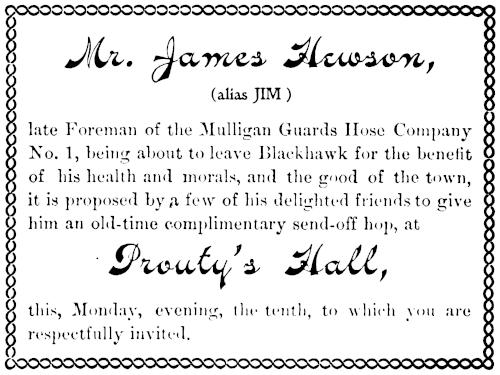
Mr. James Hewson,
(alias JIM)
late Foreman of the Mulligan Guards Hose Company No. 1, being about to leave Blackhawk for the benefit of his health and morals, and the good of the town, it is proposed by a few of his delighted friends to give him an old-time complimentary send-off hop, at
Prouty’s Hall,
this, Monday, evening, the tenth, to which you are respectfully invited.
[17]
The dance was a great success, despite the fact that Jack Gillis got more on board than was good for him, and insisted upon setting fire to the hall, just to give Jim a chance to make a last run with the Hose Company.
In the barren little Arizona town of San Biciente a man struggled, and toiled, and dreamed away the two dreary years of his probation. True, many of the asperities of the rough life were smoothed away by the daily increasing favor shown by Don Jose Macias, the rich merchant with whom he lived and worked, and by the assiduous caretaking of Don Jose’s pretty black-eyed daughter, Josfita. Moreover, the better class natives, attracted by his aptitude in acquiring the Spanish tongue and by the boyish bonhomie that had made Jim the joy and pride of the “Blackhawk Mulligan Guards Hose Company,” showed themselves more than ready to initiate him into certain Mexican methods of killing any time not occupied by his business. But, though chuses, monte, cock-fights, and bayles were seductive sports to a young man of Jim’s temperament, his promise to Alice was far more potent. Occasionally, to be sure, he so far fell from grace as to try his luck at the cards or to sun himself a little too long in Josfita’s admiring glances. Jim did not attain his full growth as a man at one bound. But the memory of that face as he had seen it, shining with tenderness for him, and of that voice, bidding him prove himself worthy of her trust, was never long absent from his mind. Alice had said that she would wait for him. That assurance was the pillar of cloud by day and fire by night that guided this wanderer through the desert of distasteful toil and sordid living to the promised land of life with the woman he worshiped. And so the years dragged by.
That promised land seemed very real and near to Jim one spring morning, two years after his arrival, when he boarded the stage that was to carry him toward Blackhawk. Indeed, it was only an hour before that Jim, sitting in the little room behind the shop with his patron, had rejected an estate of earthly acres for this immaterial Canaan.
“You go back to your own country, that’s all right,” the little man had said unctuously, pressing upon his former clerk a glass [18]of the rare wine reserved ordinarily for weddings and fête days. “You find it much changed. Poco tempo you come back. I like your work. You be my partner. You lack Josfita? All right. She have two hundred thousand dollars. You marry her, my bien good amigo.”
But if Jim’s eyes had glistened and Jim’s breath had come short upon his realization of the Don’s generosity, that was simply through joy that he had seen what stood to him for all the kingdoms of the earth unrolled before him, and had renounced them for the woman who waited for him in the North.
Before he went he had assured the Don both of his undying gratitude and of his sorrow that he could not accept his offer, in a manner so delicate that that worthy Mexican realized the full import of the young man’s words only after Jim, seated in the rickety stage-coach, had put at least five miles between himself and San Biciente.
Thirty-six hours later, when the evening train thundered into the big, new brownstone railroad station at Blackhawk, the passengers watched a little curiously the big man in the garb of a cow-puncher, who alighted from the car and stood for a moment on the platform with the set stare and stiff movements of one in a trance. In those two years of banishment, hundreds of miles from railroads and newspapers, Jim’s life had been untouched by the farthest wave of the widening sea of change. At the end of two years San Biciente and the country about it were exactly as he had first found them. On the day that he boarded the stage-coach at San Biciente he himself was the same Jim, a little bigger and stronger, perhaps, and, but for the picturesque long hair, more handsome. His blue eyes shone complacently beneath his wide sombrero, and his broad shoulders, under the rolling shirt collar and bright neck-handkerchief, swung with a certain air of harmless satisfaction. In fact, it was not until he had found himself seated in the railroad car that whirled him over the last stage of his journey, and caught the curious glances bent upon him by the conventionally garbed wearers of patent leather shoes and stiff derby hats, that it occurred to Jim that he was not of the world about him. Then, as the train bore him farther and farther, through rows of newly erected houses, and past enormous factories, [19]which seemed to have sprung like magic among the familiar hills and valleys, the sparkle faded from his eyes, and his big shoulders drooped forward. Even the gold band on his sombrero, that had cost him a good twenty-five dollars at San Biciente, seemed to have lost its glitter.
As he hurried up Blackhawk’s main thoroughfare, lined now with imposing shops and warehouses, he felt that in some inexplicable way everything had grown away from and above him. Upon the very spot where the old engine house had stood a brownstone club house projected its imposing front upon the street. A brick hotel, glittering with electric lights, reared its five stories in the place of the yellow-painted corner store, whose upstairs dance hall had been the scene of the “stampede.”
And the church,—the little unpainted church where he had met Alice, and at whose door he had waited for her on that memorable evening two years ago? Even on the threshold of this long-expected meeting Jim felt drawn by an irresistible impulse towards the spot around which clustered so many sacred memories. But as he drew near to the familiar meeting of ways where the old church had stood the man stopped short and drew his hand across his eyes as if to brush away a mist. The little church was gone, wiped out of existence like a picture from a slate! Nothing but a marble tablet, placed over the arched doorway of a pretentious granite edifice, assured him that this was still the site of the First Presbyterian Church of Blackhawk. At the sight of that last transformation Jim’s heart sank. In all that delirium of progress could Alice alone have remained unchanged? The doubt descended like a black cloud, blotting out all his happy visions of an hour ago. As he stood irresolute, looking up and down the street, the deep notes of an organ floated out through the open door of the church. To Jim, standing outside in the darkness, the solemn music seemed to promise the strengthening of his purpose and the solution of all his doubts and anxieties. Yielding once more to that undefined but irresistible impulse that had brought him hither, he stole through the doorway and into the church. Service had already begun when Jim, entering on tiptoe, seated himself in a pew near the door, reverently removing his sombrero, which he placed on the [20]floor next the aisle. Around him there were flowers, and bright lights, and all the modern church’s appeals to the unregenerate, but Jim noted with a sinking heart that among this fashionably garbed congregation there was not a single familiar face or figure. Again that sickening doubt descended on the man, bowing his head with a weight like that of a physical burden, and for the time blotting out church, and lights, and flowers. Even when the service was finished and the congregation was dispersing to the sound of the organ’s voluntary Jim waited, his head bowed, his eyes fixed like those of a man in a trance—waited until the sound of a man’s voice, that seemed to speak to him across the gulf of two years, sounded in his ears. It was Stancliff, the Sunday-school superintendent of other days, coming down the aisle, talking eagerly to a young woman, whose face, looking up into his own, was hidden, but who, by token of her dress and bearing, belonged to that invading throng whom Jim had already come to hate. As they passed the pew where Jim still sat, the folds of the woman’s dress brushed against his sombrero, and for a moment she looked around. In that moment Jim saw her face. It was the face of Alice Huyler, but so changed under its modish capote, set jauntily on the waving yellow hair, so ripened in its expression and molding, above all, so radiant with emotions and interests that Jim had never touched that it seemed more alien than that of any stranger in the congregation. As he sat there waiting for the couple to pass by him and out of the church, Jim did not attempt to define the relations between Stancliff and Alice. He did not ask to know whether Stancliff was husband, lover, or friend to this woman,—the woman that he had loved and who had promised to wait for him. What he did know was that the years had opened between himself and Alice a yawning chasm, a chasm that no memories nor promises, however sacred, could ever bridge.
Rapt in such thoughts, he sat, half dazed, until the congregation had dispersed and the sexton appeared to put out the lights. Then, rousing, he fumbled for his sombrero, which had been swept under a neighboring pew, recovered it, and, rising, passed slowly, with bowed head, out into the night.
[21]
BY HERMAN BROWNSON.
His real name was Tim O’Hagan, but in Miggles’ Alley he was familiarly known as Shingles. This was because, while a bootblack by profession, he spent a large share of his life on the roof of a five-story tenement house, tending his baby brother. On this particular occasion, however, he rose above his callings of bootblack and nursemaid, and became a hero.
The region about Miggles’ Alley is not precisely a hotbed of heroism. Indeed, there is probably not a corner of America in which the poverty-stricken and depraved of all nations meet in such strength as here, where the social sewers from the four corners of the earth seem to empty themselves. But Shingles, looking down upon the streets from the high plane of the tenement housetop, saw more of the color, and whirl, and bigness of the streets than of their mud and meanness. He saw the circus parade as it swept gleaming by. He saw the crowd pouring through the neighboring streets,—a black river of humanity.
Best of all, he looked almost daily on the wonderful maneuvers of the fire company, whose engine house, opposite one entrance of the tenement house, was Shingles’ favorite resort. On those rare occasions when he was free to ply his trade, Shingles earned several dimes and nickels, and incidentally many golden opinions, from the good-natured fire laddies, who recognized a kindred spirit in this mite of ten. And when chained by duty to his post on the roof, Shingles could, if he liked, exchange occasional salutes with the objects of his worship as they lounged in the street below. As for those moments when the alarm gong rang, and his friends at the engine house jumped into their places on the hose carriage or the hook-and-ladder trucks, and were whirled off to scenes of adventure, those were periods of combined pride and [22]pain to Shingles. The pride was for his comrades; the pain that he, by reason of his ten years and absorbing occupation, was cut off from any share in these deeds of daring. Only in make-believe could he climb ladders and rescue people from burning buildings; and, while it was easy to play circus parade with the baby and pussy cat in a soap-box on rollers for the band chariot, the heroism of the fire laddie called for a greater exercise of talent.
On this June morning Shingles’ mother, who was to-day engaged in scrubbing at one of the big insurance buildings on Broadway, left the youngster with his charge on the roof, screaming back strict injunctions to the boy to keep the baby amused. To this task Shingles addressed himself with an ardor born of the beautiful day and the necessity for some occupation for the long hours that stretched between now and supper-time. What could he do to amuse the baby and incidentally himself? Why, “play fire,” of course. His engine house experience, joined to his observations from the roof, had given him a familiarity with the fire laddies’ modes of operation that resulted in the most stirring realism. The baby seemed pleased, and listened with open-mouthed wonder, while big brother imitated the clatter and clangor of the engine gong or the hoarse shouts of the firemen, and gazed with special delight at Tim’s astonishing climb up an imaginary ladder as foreman of the Rescue Corps. Indeed, he was so much amused by this new game that he did not wince while Shingles tied one end of the clothes-line around the tiny figure, puffing and blowing laboriously for imaginary smoke the while. Baby even thought it great fun, until brother bore him over to the edge of the roof and began to let him down, down,—a tiny morsel of humanity dangling five stories above the pavements of Miggles’ Alley. Then fun changed to fright, and baby set up a lusty howl. It was this scream that aroused Shingles from his realistic play to the grim earnestness of the situation. There was no ladder waiting below; there were no brave comrades,—only himself, a mite of ten, clutching in his small hand the very end of the rope from which dangled the helpless figure of his tiny brother. Real fear gripped at the little fellow’s heart. Slowly, painfully, he began to pull in that endless length of line. Inch by inch he brought [23]that tiny, swaying figure nearer to the housetop. Then suddenly a knot in the rope caught in the iron railing. Cold perspiration rolled down the little fellow’s cheeks. Already his strength was failing him. To slacken a single foot meant to loosen his hold altogether. He tried to call for help, but the shrill little voice attracted no more attention than had the baby’s feebler wail. In the neighborhood of Wiggles’ Alley children lift up their voices in lamentation so often that nothing short of an alarm of fire or murder excites special notice. Suddenly, in this moment of agonizing terror, the boy was seized by an inspiration. On his left rose a large chimney. Around this the little fellow drew the taut rope, making it fast to the clothes-hook in the masonry. Then he rushed to the edge of the roof, and shouted, “Fire, fire, in Miggles’ Alley!”
At this sound the firemen lounging in the street below leaped to their feet. Looking up, they recognized the figure on the roof’s edge as that of their little comrade, and, convinced that this was no false alarm, rushed into the engine house. A moment later the street below resounded with the rumble of trucks, the whang of gongs, and the rush of the surging crowd. In this focal point of cosmopolitan New York, where a quarter of a million people are located within a stone’s throw of a common center, the elements of a stirring scene are always at hand. At the sound of the alarm, Chinamen crept from their basement bunks in Mott Street,—reeking with opium, and dazed by the noise; long-haired Hebrews tumbled into the alley from their sweat shops; swarthy Italians came pell-mell from their hovels; and the Arab lost his fez, which, in the surging crowds, was trampled under foot. By the time that the engines and hook-and-ladder company reached the alley they found it jammed with a mass of excited humanity, whose eyes were focused upon a tiny white bundle that swayed in mid-air, seventy feet above the pavement. At once the firemen realized that they had been duped; but the necessity for effort did not escape them. Up shot the great ladders, one above another, and then an agile rescuer began the swift ascent. The crowd cheered in a babel of tongues; but as the climber reached the last few rounds, and began creeping out over the slender threads towards the precious prize, a hush fell upon the multitude. [24]Now he was almost there—now he stood directly under the dangling mite—now he put forth his hand with extremest caution. The crowd stood on tiptoe. Not a soul breathed. Then, just as the strong hand touched the hem of the little frock, the child began struggling once more, this time so violently that, in the very moment of apparent safety, it slipped from the noose and fell.
In that moment even the hardened faces of the multitude below, accustomed to sights of all degrees of danger and wickedness, blanched with terror; eyes bleared by drink or opium were shudderingly averted from the awful scene that seemed inevitable. Meantime the tiny bundle of humanity, in its wild plunge downward, struck a rope stretched across the alley, hanging full of wet clothes. The strand broke with the strain, and the child was lost in the flying mass of white. A few stray rags fluttered down—but the baby—? It had disappeared like a wraith. Strong arms outstretched to make a desperate effort to catch the flying waif fell helpless at many a side. The vast crowd stood speechless, dumfounded.
An instant later a deaf old Irish woman in the second story tenement looked up from her work and gave a shrill cry of surprise as she saw crawling through the window that led from the fire-escape where she had just laid her feather-bed to air, an almost naked child with scarlet bars around its little body. “By all the saints together!” she cried, dropping on her knees, “if thot kid didn’t rain down from heaven oi’ll niver say another pather noster as long as I live!”
And it took the combined eloquence of Shingles and his distracted mother to convince the old lady of the child’s earthly origin.
[25]
BY JAMES BUCKHAM.
When it was announced that Frederick Henderson had given twenty-five thousand dollars towards founding a library in Woodville, his fellow townsmen were not merely surprised, but amazed. Every one knew that Henderson was in receipt of only a fairly comfortable salary, that he had no private fortune, and that he had received no recent bequest. They knew, also, that he, with his wife and children, occupied a rented house, kept no servants, and, in short, lived after the usual fashion of small clerks’ families. Where, then, could he have obtained twenty-five thousand dollars, and why did he give it for a library instead of using it to feather his own nest? For five days town gossip buzzed about this mystery like bees in a clover patch, until finally, on the sixth, one man, bolder than the rest, went to Henderson and asked pointblank the meaning of his strange munificence.
To him the founder of the Woodville Library told the following story:—
“There were five of us who went, early last June, for a camping trip in the Flat-top Mountains, away up in the northwest corner of Colorado. We were all young fellows—the oldest still considerably on the frisky side of forty—and it is hardly necessary to say that the object of our expedition was a good time. Incidentally, of course, we expected to acquire a surplus fund of health and enough game to make our friends glad to welcome us home again. Furthermore, I hoped to bring back as much of the scenery of Northern Colorado as could be sandwiched between some two hundred photographic plates.
“Our outfit for camping was complete. We had a canvas-covered mountain wagon, drawn by two horses, and filled with nearly a ton of provisions and baggage. In addition, every man [26]was mounted and equipped in true cowboy fashion,—furnished with everything en regle, from rifle and revolver to ‘slickers’ and lariat.
“For two weeks we journeyed leisurely up through that wonderful mountain country northwest of Denver. In the clear, dry, bracing air the very breath of life was an infinite joy. Our eyes feasted continually upon some of the most marvelous scenery and atmospheric effects in that wonderland of the West. Our route lay over Berthold Pass into Middle Park and Twenty-mile Park, great successive terraces of rolling woodland and prairie, shut in by higher and ever higher ranges of the Rockies. By gradual stages we reached Steamboat Springs, six thousand feet above the level of the sea; then Trapper’s Lake, four thousand feet higher, its clear, cool waters rippling at the base of volcanic cliffs, seamed and stained by centuries of conflict with frost and storm. Ever higher and higher we climbed, through grand and gloomy cañons, shaded by forests which had never echoed with the woodsman’s axe,—on and up, till at last we reached the second step of the mighty mountain stairway. And here we camped, on a fair meadow, at the foot of the last and highest range of the Flat-tops. On all sides save one our little meadow was surrounded by an almost impenetrable timber-fall. On the left the land lay open, and sloped steeply up to the crowning range of cliffs.
“On that last and loftiest plateau the first chapter of a strange story began.
“We had been in camp a week or more, and had shot a couple of deer and caught several goodly messes of trout, when one day the impulse seized me to take my camera, climb to the top of the last and highest range of Flat-top Mountains, and capture some bird’s-eye views of the surrounding country. I started early one morning, carrying with me only my camera, three double plate-holders, and some lunch.
“The ascent proved longer and harder than I had anticipated. I was obliged to make my way up to the level of the last plateau through a deep and tangled ravine, down which brawled a mountain stream. There was no sign of path. The high and thickly wooded sides of the ravine made a perpetual twilight, and as I toiled upward the way grew steeper and narrower, till at last there [27]was scarcely room for the roaring brook. I was obliged to enter its bed and wade, sometimes knee-deep in the icy water, climbing now and then over some slippery rock that blocked the way, at infinite pains lest I should drop my camera or my precious plates.
“Finally, however, I reached the top of the slope and came out into a grove of scattered pines, through which I could see a clearing that lay just beyond. I was about to leave the fringe of trees and step into the open ground, when a rifle-shot not far away startled me. It was followed, in a minute or two, by another shot from a slightly different direction. The next moment a wounded deer bounded into the little mountain meadow, sprang with convulsive leaps across it, and fell dead on the opposite edge.
“Scarcely had the deer fallen, when a hunter, rifle in hand, came running through the clearing to the spot. Just as he drew his knife to bleed the animal a second hunter appeared. He also was running, but stopped as he saw the other man bending over the deer, and approached him more leisurely. All this took place in a very brief space of time, while I stood watching, just within the edge of pines.
“I saw the first hunter, who had finished bleeding the deer, rise and confront the other man as he approached. Then I heard excited and heated talk between them. As they stood wrangling over the little gray mound on the edge of the forest, the sudden inspiration seized me to take a picture of the vivid scene. Up to this moment I had been a perfectly passive observer. I had not even removed the tripod of the camera from my shoulder. So great had been my surprise at seeing the deer bound across the clearing and fall dead, and then the two strange hunters rushing in to claim it, that for a few minutes I totally lost the consciousness of self. My whole being was absorbed in wonder and curiosity. But when the quarreling hunters began to wrangle the spell was broken, and I said to myself, ‘There is a forest picture worth taking!’
“Screened by the overhanging trees, and with no further thought than to add to my collection a unique bit of backwoods life, I hastily swung the tripod from my shoulder, affixed the [28]camera, focused, inserted a plate-holder, made the exposure, and secured a view of the two hunters as they stood wrangling over the fallen deer.
“Suddenly, as if moved by ungovernable anger, the men locked arms and began to struggle fiercely. My first impulse was to rush out and separate the angry contestants. My second impulse—when I realized that I was unarmed and alone—was to slink away into the shadow of the woods and let the men settle their own difficulty. My third impulse (a compromise between the two, but cowardly still,) was to take advantage of the absorbing passion of the contestants and possess myself of another and still more striking photograph,—a phase of real life seldom presented to the manipulator of lenses. This, accordingly, I did.
“What followed almost froze the blood in my veins. I saw the smaller but more active of the two men, by a sudden and swift backward motion of the right hand, draw a flashing knife from his belt. The next instant it was buried in the breast of his antagonist. The stricken man tottered, took a step backward, and fell, apparently tripping over the horns of the deer. The long arms, thrown backward, remained outspread in the grass; the body, after a few convulsive movements, lay still. I could see the shaft of the murderer’s knife sticking out of the breast of the dead man’s coat.
“I can hardly explain the impulse which led me, at this point, to slip another plate-holder into my camera, and with trembling hand remove the cap! The former pictures had been taken chiefly from curiosity, though that feeling was combined, in the second instance, with a certain restless mental recoil from the inertia of cowardice. But the third photograph was due to an entirely unaccountable impulse. I do not know what inspired me to take it. I hardly understand how I was able to break the spell of horror which had seized me as I saw the murderous blow of the knife and the fall of the dying man. I seemed to perform the act under a kind of hypnotic influence. I obeyed dreamily, as under the spell of another’s will.
“The moment of exposure for the third plate was strangely opportune. The slayer bent over quickly and withdrew the knife from the heart of his victim. In the very instant consumed by [29]the act my camera did its work. This was proved by the subsequent development of the plates.
“As quickly as possible I reversed the plate-holder and exposed another plate. The murderer had gathered his rifle under his arm, and, half averted in the attitude of flight, stood looking back at his victim. The pause was but momentary, yet long enough for swift-registering light to record. Then the guilty man turned and ran rapidly away through the woods.
“I calmly took the second plate-holder from the camera and replaced it in the box. Then I did what some men of more physical bravery than I possess would, perhaps, have shrunk from doing. I walked out into the presence of Death—alone in that great listening, mysterious wilderness—knelt down, and placed my finger upon the pulse of the murdered man. I knew, before I did it, that he was dead. His flesh was still warm, but the last fluttering spark of life had departed.
“Back to my camera, and down the steep ravine, with its brawling brook, I went; though every step I took seemed like a step in a dream.
“It was early afternoon when I reached camp. The boys were stretched out smoking, after their noonday meal. As I gazed into their unsuspecting, friendly faces an impenetrable wall seemed to rise between me and the full confession which I had intended to make. How could I tell them what a coward I had been? Would they not turn from me? Would they not despise me? I strove hard to overcome this reduplicated weakness—this cowardice upon cowardice—but could not. I simply told the boys that I had found a dead hunter, with a knife thrust through his heart, on the plateau above. Even then they would scarcely believe me, till I had minutely described the dead man.
“‘Why, it’s that big Chicago tenderfoot, Stetson!’ exclaimed George Lincoln. ‘I saw him down at the settlement the other day. He is the fellow, you know, who came out here for his health and liked it so well that he bought up a claim and started in to ranching. He tallies with your description of the murdered man to a T.’
“‘He must have friends in the settlement,’ I replied. ‘We must report the case at once.’
[30]
“Two hours later George Lincoln and I rode into the little village, six miles below our mountain meadow. We dismounted at the store, which was the only public gathering-place in the settlement, and soon had a motley crowd about us listening to our story,—Americans, Mexicans, Germans, and half-breeds. There was no constable, no coroner, no public officer of any kind in the village. But a searching party was organized, to report at our camp next morning, at daybreak, when I was to guide them to the spot where the murdered man lay.
“Sunrise of the next morning found us entering the gloomy pass where the brook came foaming down from the heights above. We had to ascend the narrow ravine on foot, as horses would have been useless in such a place. When we reached the clearing beyond the pines I led my party directly to the spot where man and deer lay stretched side by side in the strange companionship of death. The dark, stern faces circled round, and for some minutes no word was spoken. Then the storekeeper, a huge, sandy-whiskered Yankee, exclaimed:—
“‘By God, boys, it makes my blood boil! Stetson never drawed his knife—see it there in his belt? The damned coward that was raslin’ with him stabbed him unawares. Some sneakin’ Mexican, I’ll bet my head!’
“One or two dark faces in the group grew darker as the impetuous Yankee spoke. There were Mexicans in the searching party.
“‘I’ll take my oath it was Marcelino!’ continued the big storekeeper loudly. ‘You all know he had a grudge against Stetson. He came into my store to get some ca’tridges for his Winchester yestiddy mornin’. Said he was goin’ out huntin’ on the Flat-tops. Him and Stetson was up here together, and it stands to reason he done it. The’ ain’t one of ye das say he didn’t!’
“No one dared contradict the big storekeeper, and no one cared to, for, in spite of the lack of positive proof, we all felt that he was right.
“A litter was hastily put together, and we carried the dead man down to the settlement. That afternoon a swift rider started for the nearest telegraph station, to wire Stetson’s brother [31]in Chicago. The latter had been to see Stetson twice since he had settled down on his mountain ranch, and was well known in the village.
“Meanwhile suspicion had fastened more and more strongly upon the Mexican, Pedro Marcelino. As the storekeeper said, he had gone hunting on the very morning of the murder, and in the same direction as Stetson. Since then he had not returned.
“On the morning of the fourth day after the tragedy the murdered man’s brother arrived, bringing with him a detective from Denver. After attending to the obsequies of his murdered brother, and leaving instructions with the detective to spare no expense in tracing the murderer, Cyrus Stetson returned to Chicago.
“About a week later our party broke up camp and returned home. The tragedy had cast such a gloom over us that we no longer had any zest for sport. I was especially glad to get away from the spot with my oppressive secret. The longer it was concealed, the less I felt like disclosing it, and yet the more painful and remorseful it became.
“As soon as I reached Woodville I immersed myself in business cares, and for a time succeeded in drowning the reproachful voice within. But one morning, about two months after my return to the city, I picked up a paper and was confronted by the following paragraph:—
“‘WAS HE THE MURDERER?
“‘Hahn’s Peak, Colo., Sept. 28.—The Mexican, Pedro Marcelino, who was arrested in the southern part of the State two weeks since and brought here for trial, on the charge of having murdered Albert Stetson while the two men were out hunting, last June, seems likely to escape conviction, as the case now in progress before the County Court fails to develop evidence sufficient to convict the suspected man. All who are acquainted with the facts of the case believe that Marcelino was the murderer, but, as only circumstantial evidence can be adduced to prove his guilt, it is more than likely that he will escape the noose. Every attempt is being made by Cyrus Stetson, the brother of the murdered man, to obtain evidence which will lead [32]to the absolute conviction of the guilty party. The case, which is the most important on the docket, will probably be given to the jury before the close of this week.’
“By the time I had finished reading this item I was actually trembling from head to foot. But I made a resolve. I would develop those negatives, and if they proved to be as graphic and exact as I had every reason to expect I would overcome my cowardly self-shielding reticence, tell my story as an eye-witness of the murder—for to me it seemed murder, and not manslaughter—and submit my photographs as evidence.
“I went immediately to my ‘dark-room,’ developed the negatives, and examined them closely. They were surprising even to myself, not only in their clearness and distinctness of detail, but in the marvelous nicety with which they had caught and fixed the very moments of the tragedy which would be most convincing as evidence.
“The day, fortunately, was bright, and I secured two or three good prints from each negative in the shortest possible time, packed a small strap-bag, and, without saying a word to anybody, took the train for Glenwood Springs, the nearest point by rail to Hahn’s Peak. Here I procured a good horse, and by riding all night reached the county-seat early the next morning. I turned in at the little hotel for a few hours’ sleep, and, bidding the landlord call me without fail at half past eight o’clock, threw myself on a bed without removing my clothes, and was asleep inside of five minutes.
“The harsh little bell in the court-house tower was proclaiming the hour for the morning session when I rose from my hastily eaten breakfast and passed into the village street. Already little groups of men, coming from all directions, were centering at the court-house. I gathered, from scraps of conversation which I overheard, that it was the last day of the murder trial. The last available testimony had been taken. To-day the arguments were to be made, and the case given to the jury, who, it was feared, could not possibly return a verdict of ‘guilty’ upon the scanty evidence so far produced.
“I entered the court room a few minutes before nine o’clock. A group of lawyers stood talking within the bar. I asked to [33]have the State’s attorney pointed out to me. He was a small man, with a plump waistcoat and a boyish, closely shaven face. I stepped up to the bar and beckoned him. A few moments’ conversation served to acquaint him with the purpose of my trip and the nature of my evidence. The round, cheery face of the State’s attorney fairly shone as I finished my story. Then the sheriff’s thunderous rap called the court to order, and the State’s attorney had only time to say, ‘Hold yourself in readiness to be called to the witness stand,’ when the preliminary exercises began.
“The clerk’s monotonous monologue was succeeded by a rustling, sibilant pause; and then began the deep, slow voice of the judge: ‘Evidence having been completed in the case of State versus—’
“‘May it please your honor!’ exclaimed the State’s attorney, starting briskly to his feet. ‘Having come into possession of new and important evidence in the case now before the court, the counsel for the State requests permission to submit the same before the case is closed.’
“The judge turned his keen gray eyes curiously and inquiringly upon the State’s attorney. Every head in the room was bent forward in an attitude of keenest attention.
“‘We have been so fortunate,’ continued the State’s attorney, ‘as to discover, at the last moment, an eye-witness of the murder of Albert Stetson. The evidence which this witness has to offer is absolutely convincing in character. May it please your honor to call to the witness stand Mr. John Henderson, of Woodville, Colorado?’
“There was a moment’s absolutely breathless pause. Then the deep tones of the judge’s voice broke the silence:—
“‘Mr. Henderson may take the stand.’
“The prisoner at the bar eyed me keenly as I came forward. I recognized his face the instant my eyes fell upon it. It was the same which had looked back, half fearfully, half exultantly, at the dead man stretched in the grass of the clearing. A moment’s uneasiness in the deep-set eyes gave place to a stolid stare of defiance, as I took my place on the witness-stand. What proof could the new accuser bring, beyond his own unsupported statement?
[34]
“There was a kind of fierce, yet calm, exultation in my heart as I told my straightforward story,—exultation not due alone to the thought of bringing guilt to justice, but, also, and, perhaps, even more to the thought of my own triumph over myself, in that most manly atonement which a coward can make for his cowardice,—the confession of his own weakness.
“I could not resist noting the effect of my story on the prisoner as I proceeded. When I first mentioned the fact that I carried my camera with me up the mountain I detected a slight start and aversion of face on the part of the Mexican. When I described the bounding of the wounded deer into the clearing, its fall on the opposite edge, and the appearance of the two hunters hastening to the spot the prisoner seemed to tremble slightly. But when I confessed the natural timidity which led me to take a photograph of the struggling hunters, instead of rushing out to separate them, a deathly pallor overspread the man’s face, and he clutched at the railing before him for support. Then, as I kept relentlessly on, describing the knife-thrust, the fall of the murdered man, the withdrawing of the weapon from his bosom, and the snap-shot photograph of the murderer while engaged in that very act, then the backward look of mingled triumph and terror, perpetuated by the relentless camera, and, finally, the hurried flight through the woods, the man’s chin sank upon his bosom, and his whole frame shook with abject fear.
“The most intense excitement now reigned in the little court room. Attention was divided between myself and the prisoner, until I drew forth the photographs and held them out to the State’s attorney to be submitted to the jury. At this stage of the proceedings, impelled, it would seem, by a strange, ungovernable fascination, the prisoner, though almost palsied with fear, stretched out his hand and snatched one of the photographs as they were being passed to the jury. It happened to be the one which represented the murderer drawing the knife from his victim’s bosom, while the light fell full and strong upon the pale, upturned face of the murdered man. As his eyes fell upon this awful portrayal of a scene which he supposed was pictured alone in his own haunting and accusing memory, the superstitious Mexican shrieked with terror and fell heavily upon the floor. I [35]shall never forget the horrible intensity of fear and despair in that cry, nor the picture of the round-faced State’s attorney standing over the prostrate form, with accusing finger pointed downward, and cheery countenance for once tragically solemn as he bent his triumphant eyes upon the jury.
“Of course the jury pronounced a verdict of guilty without leaving their seats, and the Mexican, abject, cowering, and self-convicted, was hurried away to jail, hemmed in by a howling mob. The brother of the murdered Albert Stetson came to me as soon as he could force his way through the crowd, intent upon obtaining a sight of the strange, pictured testimony, seized my hand, and fairly overwhelmed me with grateful acknowledgments.”
At this point Henderson stopped short, as though his story were finished.
“But what in the name of common sense has all this to do with your endowment of the Woodville Library?” asked the mystified listener.
“Oh, yes; on the day after my return to Woodville I received a letter from Cyrus Stetson, notifying me that he would call the next morning to pay the reward of twenty-five thousand dollars offered by him for the apprehension of his brother’s murderer. Now, I had known nothing of any such reward. My testimony in the case had been given simply with the idea of convicting the murderer and at the same time partially atoning for my own cowardice. But it isn’t every day that twenty-five thousand dollars is thrown into the hands of a man in my circumstances; and I may as well confess that the thought of all that the money could do for my family and myself was a strong temptation. On the other hand, to accept it was to accept a reward for my own cowardice and so to forfeit my last shred of self-respect. Between these two courses I could see no middle way. Well, you can imagine how fierce the battle was between conscience and self-interest when I tell you that I never breathed a word of all this to a soul, even to my wife, but lay awake all night, my mind oscillating like a pendulum between two decisions. In the end, however, conscience conquered. I determined to refuse the reward, with the request that Mr. Stetson keep it for the family of the [36]murdered man. But when Stetson arrived the next morning he simply wouldn’t hear of a refusal, declared that the dead man had left no family, pooh-poohed all my objections, and, in short, so far overcame my scruples in the heat of the conversation that when he left his check for twenty-five thousand dollars was in my pocket.
“No sooner was he gone, however, and my excitement was cooled than all my doubts of the night before returned threefold. For the five days that I was the secret possessor of that twenty-five thousand dollars I was the most unhappy man on the face of the earth. And it was only when I had converted the entire sum into an endowment for the Woodville Library that I finally felt at peace with myself and the world.”
[37]
BY KATHERINE MORROW.

The moonlight fell through the climbing roses over the wide piazza of a country house where some people were sitting. It was midsummer in the foot-hills of the California Sierras, and the insects, the dogs, and the water in the ditch had their voices in the air with the people.
The talk, uninfluenced by the beauty of the night, had been mostly of murders and scenes of blood. Then a girl shook it off quickly.
“Alice and I sleep outside now. Also Ned, the restless, takes to a hammock. It’s glorious.”
There had been too many tales of an abnormal nature for the equilibrium of the timid ones. A voice came from the corner:—
“It isn’t safe.”
Ned Carter laughed with his sisters.
“I’ve a little revolver—a beauty,” he said, “and nothing could come within half a mile! Besides, there are the dogs.”
“Yes,” the three admitted in chorus, “we’re too much on the alert for impressions. We’re too anxious to waken for anything to escape.”
“Oh,” said a girl from the steps, “I’ve heard this sort of thing before. I’ll venture you snore profoundly all night.”
“I advise you not to test us in disguise,” they retorted. Ned added with vigor: “I’d bet my twelve-mule threshing machine that neither man, woman, child, nor animal could pass our front gate at any hour of the night unchallenged.” He laughed: “Ah, the gleam on my pistol in the moonlight!”
At eleven that night two who had been guests of Ned and his sisters sat together, scheming.
“We’ll do it,” they said as they separated.
The next afternoon two girls in a cart drove a fat mare over [38]hot stretches of brown meadows and along dusty roads that lay over the hills. They darted into stray coverts, and drove among the stones of dry creek-beds. As they rattled home in the twilight a collection of bleached cattle bones lay at their feet.
Under the awnings of a little gray cottage a woman waited.
“You’re late,” she said as they came up. “But here’s Joe.”
“Bring up the riding-horses to-night, Joe, and put on men’s saddles,” called his young mistress as she went in the house.
“And now, mother, may we have tea? We want to be ready by midnight.”
As the clock struck twelve Mrs. Head laughed her apprehension and her sense of the effect of light opera. The girls were in men’s canvas suits and summer sombreros. Bulky bundles were tied to their saddle strings and they supported others on their shoulders.
“But we’ve really no sign of defense,” they suddenly exclaimed, looking at each other.
In a moment Mrs. Head had produced two huge leather pistol cases. When they were strapped on, no belligerent cow-boy or primitive desperado could have hit a more happy effect of emphasizing independence.
The girls strode out to their horses and, tightening the girths, took their mounts quickly.
“We’ll stay out on the haystack when we come back, remember; so please go to sleep and forget us.”
The moon was full in the heavens and the unwooded part of their hilly road lay bright before them. The horses felt their bits resentfully,—kept to a walk along the crest of the hill and down the rocky, pine-dotted slope of the flat. Everything but the soft brilliance of the night seemed to fall away. The soul of summer hovered.
“Let’s give the horses their heads the first two miles. We’ll creep the last half—near the house.”
The beasts went forward at a bound. A level road shut in by the hills lay before them. There was a strange specter sense of being at one with power as the horses raced neck and neck through the silence. The caressing radiance was an intoxicant.
Finally they reached the stony hill which lay between them and [39]the main road. The heated horses took it slowly, climbing through the shadow and rousing the uncanny wail of a wandering coyote and the hoot of a curious owl.
They reined up as they swung into the stage road, and gave the horses a mouthful of water from a tiny spring.
If there was anybody to meet, this would be the place.
The horses’ ears were in constant motion, though there seemed nothing but the easy pace of their own hoofs to give attention to. Suddenly, from an obscure bridle-path, three horsemen came into the road, and toward them. There was no time to arrange concerted action. The beating of their hearts made suffocation an experience, until one was visited by an inspiration.
“Answer anything in Mexican,” she gasped; “that will pass us.”
It suddenly dawned upon their consciousness that under the shadow of this very oak, on this awkward turn of the winding grade, the mail stage had been held up and robbed, just a month before. There had been shooting, and a wounded driver and passenger dripping blood over the wheels into the dust.
But the men had reined up before them.
The instant of silence compassed eons of apprehension before one of the men spoke.
“How far to Mokelumne Hill, partners?”
Promptly it came, though burdened with an unnatural guttural inflection:—
“Quien sabe!”
Daring to risk no more, the girls pulled out and, passing the horsemen, rode quietly down the road.
The men watched them disappear, ignoring an impulse to follow, before they continued on their journey.
“A couple of suspicious-looking greasers up to no good,” said one, as they trotted ahead through the night.
The outbuildings of the Carter ranch appeared ahead. The girls grasped each other’s hands.
“The pistol cases,” they whispered. “They saved our lives!”
At a little weather-beaten cabin used as a smithy the girls dismounted. It was as if they pledged themselves in epic measure, standing there, silent, in the spirit of the adventure.
[40]
Tying their horses, they loaded themselves with the bundles, and walked cautiously, slowly, towards the gulch they must cross before they reached the road lying in front of the house. They crept through its thick, uncertain shadows with the animal stealth of the forest, and found themselves up in the high light of the roadway. Forty yards lay between them and the gate which shut in people, and dogs, and a little revolver that was pretty in the moonlight.
Their watch showed one o’clock.
Step by step they accomplished with almost suspended breath. Of a sudden a dried fig leaf under foot filled the air with a sharp crackling. Transfixed with a horror that raised their hair, one balanced on the ends of her toes, the other crouched low on her knees.
But the moments returned no echoes of an alarm.
Nearer they moved and almost imperceptibly nearer. The breath from their lungs seemed a thousand voices. At last they stood together at the gate, looking up at the white house spreading its piazza over three who were in slumber.
With motion so fraught with care it seemed motionless, they managed to arrange a series of things on its fence pickets. Then they salaamed low in a burlesque of social mockery, and waved their hands in a pantomimic farewell.
Little by little, they moved up the road again, through the gulch, and on to their horses. Not a note from the throats of the dogs followed them.
Mounting, they walked the half mile to the spring before they even dared express their elation.
“It’s too good to go to sleep on,” said one.
“Let’s ride on it,” said the other.
They chose the black depths of the twisting stage road, and, leaving the moon-bathed open, took four miles of wooded riding. The farm dogs below in the valley barked greeting, but no one else seemed abroad in the land. The spirit of the night was wholly theirs.
At three o’clock they were home. They stabled the horses and walked back to a lonely haystack. Ginger beer, crackers, and blankets had been stowed there, so they made festive toasts to [41]their success before they settled to sleep with the dews of the morning.
The sun was hurrying on toward the breakfast hour when a girl at the Carter farm wakened her companions.
“Horrors!” she cried aloud.
All three sat up in their hammocks. Visions of Ku Klux, White Caps, and midnight assassins ran riot in their minds. A certain terror stiffened their very joints.
Facing them from the inside of the gate hung a long white placard, printed in letters of flaming red:—
“We are Iron-Jawed Hyenas of the West and our food is Gore.”
Two red hand-marks decorated each end. Underneath hung a calf’s skull and cross-bones, livid with fiery symbols. Along the fence were rows of bones bearing the same ghastly stamp, and on another post hung another placard:—
“Thirty years have we been on your track and at last we have found you!”
In a moment a contagion of laughter reached even the kitchen. The truth had dawned! As they swayed in the clutches of a mild hysteria, a mounted messenger appeared with a note addressed to Mr. Edward Carter.
The young man read it aloud to his sisters:—
“Mr. Carter will please deliver to the bearer his twelve-mule threshing machine.
“Merciless Ben, the Hairlifter
“Tomahawk Tom, of Toyone.”
[42]
BY HERO DESPARD.

In the early fall of 1880 I was in Dahbol, India, having run down from Bombay, upon a sister who had set up a little bungalow there.
Dahbol is charmingly situated between the sea and the wooded heights of the Western Ghauts, and as nothing pressed me at the time, I remained there, spending my time rambling about the place and sometimes running into a chance adventure. Thus it happened that the following strange experience befell me.
One evening, in the cool of the late twilight, I was strolling about through the sea-end of the town, and, stopping before a small temple which was a little removed from the houses around, stood studying out the lines of the usual grotesque figures cut upon its face. Dense shadows cast by the rising moon threw the entrance into such obscurity that nothing could be seen within. In fact, I thought the place deserted for the time, and was about to obey an impulse to step up into the shadows banked in the doorway, when, suddenly, a human figure hurled itself upon me from out the darkness with such force that I staggered back and almost lost my footing. I had instinctively thrown out my arms and clasped the figure for support, and now, as I recovered my balance and looked down, it was into the face of the fairest woman I have ever seen in any land.
The marvelousness of her beauty served to steady my faculties where ordinarily I should have felt bewildered, and, still holding her close, for she trembled as if she would fall from my arms, I said in such Hindustani as I was capable of:
“Something has frightened you. You are fleeing from danger?”
“Sir,” she answered, in a voice soft and rich, though broken by low gasps, “I must hasten;” and she pulled against my arms for release.
[43]
From my knowledge of the country, I felt sure no woman like the one who stood before me could safely venture into the streets at this hour, and, having an Anglo-Saxon’s feelings for all womankind, I acted on a quickly formed resolve.
“I do not know what sends you out into the night, nor what pursuit you fear, but I am ready to take you where you wish to go,” I said.
“I must go far from this place,—and alone,” she answered, speaking agitatedly.
“We will go,” I said reassuringly. “I will take you to your own people.”
Upon this her slender body trembled anew, and replying, “I have no people. I cannot stay here,” she turned from me and began to walk quickly away.
I as quickly followed, walking behind her through street after street, she choosing the deserted by-ways, until we came out through some suburban orchards, and finally reached the edge of a stretch of thick forest which belts the eastern side of the town. Here she stopped suddenly, and, turning to me, said entreatingly:
“Leave me! You cannot help.”
I looked at the town behind, at the forest in front, and felt it a moral impossibility to obey.
“I think I can,” I ventured, “if you will confide in me. I have a sister here in whose care I can place you, and if anything is threatening you I can hide you with her. She is an English doctor, and is devoting her life to work among your countrywomen.”
It would be impossible to describe the changes of expression which flashed over her face at this. Relief, questioning, consent, and doubt arose from the depths of her dark eyes and looked out at me. For some time she stood thus, inwardly debating, and at last answered:
“Yes, if I may come out alone once in seven days.”
“You shall have perfect liberty, of course,” I eagerly assured her.
This promise seemed so completely to allay any lurking feeling of fear or doubt that at once she laid her hand upon mine, saying, “I will go with you.”
[44]
Now, I had no hesitation whatever in taking this girl to my sister, who, as I had said, lived in India for the purpose of dealing with the conditions of life surrounding the Oriental women. Indeed, no sooner had she seen Aidu and heard her story than she insisted upon taking this beautiful waif into our household as one of ourselves; and as time passed and the lovableness of her nature was fully revealed to us, we found that we had rescued one of the rarest of pearls from the depths of the human sea around us.
She was pathetically gentle, and when the first constraint of the situation wore off showed herself possessed of a brilliant though unformed mind.
My sister built many hopes upon Aidu—for that was the name of our waif—as a future coadjutor in her chosen work; though I may as well confess at once that I had other intentions about her.
After only a few weeks spent in her society, I found myself deeply in love, and but for one singular, inexplicable circumstance would have begged her then and there to become my wife.
The mystery was this:
While she looked the perfection of sweet and elastic health and possessed an unusually pure vitality, no one ever saw Aidu partake of food. At first we thought that perhaps she shrank from burdening us, and believed that in some way she secretly procured cheap food outside. To all questions on the subject she returned a jesting reply, or else remained pleadingly silent. Once only, during each week, was she seen to leave the house, when she went upon those twilight walks for which she had stipulated. And the mystery of her sustenance, puzzling at first, grew darker and denser every day, the more so as Aidu steadily became more radiant in health and tinted like a ripe pomegranate from a fountain of rich vitality. Indeed, she seemed the incarnation of some flawless vital force consciously masking itself in human form.
But there came a day when I could restrain my love no longer.
My jealousy of those walks, during which she went I knew not where nor whom to see, became at last unbearable, and I determined to push my misgivings to a conclusion by questioning her outright.
Late in the afternoon of one of these seventh days of the week, on which she never failed of her twilight walk, I sought her [45]where she sat in the shade of a trellised veranda, and, seating myself beside her, took her hands in my own.
“Aidu, you must know how I love you!” I said impetuously.
I could wipe out the fact of my own soul sooner than I could forget the measureless depth and meaning of the look she gave me, straight from her lifted eyes! Oh, cold and reasonable Westerner! Never, even through eternity, will you know the infinity of meaning hidden in the lotus-heart of love, never having looked into the eyes of Aidu raised in a pure and perfect confession!
“I love you!” she murmured. Echo of my own words only, but enough.
“You will not go out alone again, now, Aidu?” I questioned pleadingly.
“I would try to do what you ask, even that which I cannot,” she said wistfully.
Having gained so much, I was in a measure satisfied; but I determined, in virtue of my now undoubted right, to follow her should she again go on her secret errand. This I hoped she would not do; but later I saw her steal out from the house and walk away, not briskly, as was usual, but with a certain languor, as if pulling against her will. It was an easy matter to follow her at a little distance, for she went straight forward, as to a well-known goal, never once looking back. On she went, past the houses of the town, out into a stretch of the suburban orchards, until we stood again upon the edge of the same tangled forest where we had stopped on the evening I first found her. Surely, it could not be that Aidu would venture within those dense shadows!
Yes, even here she did not hesitate, but forced her way through the gloomy thicket, deftly stepping over obstructions and pushing away the drooping vines as if the path were a clear and familiar one. And all the while I followed, possessed by an intensity of curiosity and feeling which must have given me the eyes of a night animal, for I never for a moment lost sight of her; but, while she walked easily and swiftly, I rushed on, panting through excitement, until when, at last, she halted and leaned back against a tree in an attitude of expectation, I stopped, trembling and weak from agitation.
[46]
And now that happened which is burnt into my memory forever.
As she stood there, motionless, her slight figure in its snowy garments dully outlined against the dark tree trunk, I noted that Aidu’s eyes were fixed upon a certain spot in the ground before her, whither mine followed. At first I saw only a faint glow in the grass at her feet, like the light of two phosphorescent insects side by side, but as this rapidly grew and widened, the shape of a dark head was outlined within the rays. Brighter and brighter the light grew until—yes, a cobra’s hooded head appeared! and from the glowing eyes streamed the rapidly increasing light in a coruscating flood.
Horror-stricken, I looked at Aidu! She was gazing down into those burning, venomous eyes, whose radiance was momentarily intensified until her rapt face and figure, the coiled length of the serpent, and even the grass and trees around were illuminated as by the shining of two small suns.
Under this compelling gaze Aidu’s languor melted. Her form dilated and changed in my sight as if the very crucible of vital life were there, purging away the particles of mortality and building her form anew out of imperishable materials. Her glowing beauty was indescribable; it was a revelation.
And now the monster slowly raised himself, stretching up out of his coils, until his scintillating, fiery orbs were on a level with the smiling, dewy eyes of the woman whom I loved. She leaned gently forward and softly stroked the mottled neck. A tremor shook my whole body. In that moment I was overwhelmed by the horrible certainty that here I beheld the rites of the ancient mystic serpent worship still practised in certain parts of India; and that Aidu, my Aidu, served as the unwilling instrument of the priests of the temple, from whose fearful power she had vainly attempted to escape on the night of our first meeting.
Crazed by a fury of conflicting emotions, I seized a stone that lay near and hurled it upon the erect serpent. It struck his neck just below the level of Aidu’s matchless chin, and as the ugly head dropped suddenly down upon the coils of his body, slowly settling to the ground, the wonderful light faded, and a heart-rending shriek from Aidu rang through the woods. I sprang to her side, and lifted her in my arms!
[47]
“Aidu! my love!” I cried, “speak to me.”
But the exquisite form hung relaxed in my embrace, and the white lids slowly shut down over the eyes of my love.
The fearful spell had been broken, but at what cost! By arresting too suddenly that strange, magnetic current, I had checked the fountain from which her life was fed.
Aidu was dead!

[48]
BY C. MARIE MOTT.

I saw him pass every day; not that I watched for him, but it’s against human nature that a woman should sit at a window all day and never look out. Besides, it was winter and I was watching the passers-by creep over my slippery sidewalk, with all a property-holder’s anxious solicitude for their safety.
I was turning away when he appeared and sped over the ice without the slightest fear. How we women love courage! And he was not only fearless, but handsome and well built, with just such broad shoulders and such an assured carriage as a frail little spinster with her own way to make in the world most admires.
I’m sure a dressmaker ought to appreciate a fine figure, if any one can. To-day, sitting there watching the familiar figure disappear in the distance, I felt my heart flutter like a girl’s. Well, well, the sensation was strange and new; it was late, too late, perhaps, in coming,—and yet it was not all unpleasant.
As I took up my work I sighed. Forty years I had spent beneath this roof, never repining at my lot, dull and cheerless though it was, content to pass all my life rendering others charming, that they might the more readily gain the love it was my fate always to have missed. I had never hoped to possess happiness. Why should I? I am no imbecile. No one pauses in a garden, undecided whether to pluck the glowing half-open rosebud or the homely mignonette.
Hitherto I had been happy enough in my cozy home, content to have my life history written in the words: “Stitch, stitch, stitch.” But to-day all my woman’s nature rose in passionate protest against my loveless, unloving life. I shuddered as I thought of the long, lonely future.
[49]
“With him,” I thought, “life would be worth the living.” True, he was considerably younger than I, but what matter years when the heart is fresh?
But how could I win him?
I am not what is called a strong-minded woman. I have no longing to approach the polls. But I do think there ought to be an amendment to the constitution, giving women the right—not to vote, but to propose. There are so many fine men declining into forlorn, crabbed old bachelorhood simply because they do not know enough to ask some sweet women to make them comfortable in homes of their own. Now, a woman knows by instinct when her ideal presents himself, and wouldn’t waste half a lifetime in coming to the point. My ideal was late in coming, but now that he had come I would let no foolish timidity on my part blight the happiness that might be ours. By a few discreet questions I discovered that he lived with my next-door neighbor, Mrs. Emory; and I felt quite conscience-smitten when I remembered that I had not called on her since she moved here, a fortnight ago. That very night I ran in, and was glad that she insisted on my staying to tea. All the time that we talked I watched him furtively. He was the only one of the boarders whom she treated like a member of the family. He sat on a lounge before the fire, and I saw that he was even handsomer than I had thought. His large eyes were full of tender melancholy. His hair was dark and silky, and, though he had no moustache, his whiskers gave character to a face that otherwise might have seemed almost effeminate in its beauty. Even his silence prepossessed me in his favor. I myself am fonder of talking than of listening. So my love grew. Before leaving, I pressed Mrs. Emory to call soon and bring Tom with her. She saw my deep interest, and, as I said good-by in the doorway, told me his full history. After his family had been killed in that dreadful river accident he had made his home with her. He was perfectly independent, but I did not care for that. Riches have no weight with me, or any woman truly in love.
Next day, as he passed my window, he smiled such a pleased recognition that I sang over my work all the afternoon. That very afternoon Mrs. Brown told me they would drop in to tea. I made great preparations. A younger woman would have spent [50]all the time before her mirror. I did not. I thought I knew the effect of good cookery on the affections of the other sex. Well, I don’t think there was a cozier room or a better table than mine in the United States. We had a delightful time, the first of a pleasant series. Soon Tom got into the habit of coming alone. Never shall I forget the night when he first kissed me good-by or the hours when he would sit with his head on my shoulder in the soft firelight. Don’t be shocked; he knew nothing about society’s cold formalities. At length he became mine. I use the expression advisedly, because he seemed so helpless and confiding, and I vowed to love, protect, and cherish him. The obeying I meant should be furnished by the other partner. I did make him happy. How I love to linger over that brief period when we were all the world to each other. Alas! But I must go on, even though my heart bleeds afresh at each remembrance.
There was a snake in my Eden. Why is it that every member of the other sex is born with a propensity for staying out nights? No one can appreciate more truly than I the good qualities of the so-called stronger sex. But when my Tom took to keeping late hours I confess that I became embittered and made angry speeches that now I would give the world to recall. If only he had “talked back” at me we might have made up, and I would have retracted my bitter, angry words. But he only sat gazing at me with those melancholy poetic eyes, his very silence adding fuel to the flames of my indignation.
It was during this period of estrangement that one night he stayed out so late that I went to my room without waiting for his return. I don’t know how long I slept, when suddenly I was awakened from troubled dreams by a most appalling noise. It seemed as if all the toot-horns ever manufactured had joined partnership with countless steam whistles for the production of this—well, there are times when the privilege of profanity would be beyond the price of rubies.
I listened. All was silent. Pshaw! it was a nightmare. No, a long low moaning tone, then a gradual swell, and it burst on the night air:—
“As all the fiends from heaven that fell Had pealed the banner cry of hell.”
[51]
I threw up the window. Ah, how mistaken I had been. Dear Tom, with a few companions, was giving me a pleasant surprise. Two of them were in the middle of a duet. At least, one began the theme, and then another took it up, after which all joined in a grand chorus which sounded just like a Wagner opera.
I never did care for midnight serenades, and I fear my voice was none too pleasant when I begged them to desist. At any rate, they all went off in high dudgeon and Tom with them. A woman’s patience isn’t always elastic, and I banged down the window, got into bed, and pulled the blanket over my ears.
When I found he was still absent the next morning my resentment changed to alarm. I was just doing up my hair when Mrs. Emory rushed in. A glance at her face was enough, and I fainted. When I revived she told me the horrible truth. The lifeless body of my beloved Tom had been found in her garden early that morning. There was a bullet hole in his forehead, and his dark silky hair was stained with blood. He had been ruthlessly slain,—cut off in his prime by the hand of a midnight assassin.
When I grew calm I tried to assuage my grief by attending to the last sad obsequies. To-day a little mound under a locust tree on the edge of my garden marks the spot where the former companion of my joys and sorrows lies at rest. And every evening, as I stand beside his grave or sit watching the sunset light tinge the white tombstone on which “Tom” is carved in large letters, I vow anew that I will never keep a second pet. No other cat shall enter the temple sacred to his memory.
[52]
Houghton, Mifflin & Co.’s
HOLIDAY BOOKS.
Works of John Burroughs.—A beautiful edition of Mr. Burroughs’ writings, in nine volumes. Printed on cream-tinted laid paper, and bound in a simple, elegant style. With several portraits of Mr. Burroughs, and engraved title-pages. Limited to 1000 sets. Price, $13.50 net per set.
Standish of Standish.—By Jane G. Austin. With twenty exquisite full-page illustrations by F. T. Merrill. Carefully printed and bound. Two volumes. 12mo, $5.00. The most popular of Mrs. Austin’s historical novels of the Old Plymouth Colony, admirably illustrated.
Mrs. Jameson’s Works on Art.—In five volumes, crown 8vo, finely printed from new plates. With nearly one hundred illustrations to each volume, and portrait of Mrs. Jameson, and biographical sketch by Miss Estelle M. Hurll, the editor. Price, $3.00 each; $15.00 the set.
A Victorian Anthology.—Representative Poems by the authors discussed in “Victorian Poets.” Selected and edited by E. C. Stedman. With brief biographies of the authors, a fine portrait of Queen Victoria, and a vignette of the Poets’ Corner in Westminster Abbey. Large crown 8vo, $2.50; full gilt, $3.00; half calf, $4.50; full levant, $6.00.
Robert Browning’s Complete Poetic and Dramatic Works.—Cambridge Edition, like the Cambridge Editions of Longfellow and Whittier. With biographical sketch and notes, a new portrait, and vignette of “Asolo.” A wonderful piece of book-making that compresses all of Browning into a single volume, printed from clear type, on firm, opaque paper, and bound strongly yet flexibly. Crown 8vo, $3.00; half calf, $5.00; tree calf, or full levant, $7.00.
Complete Poetical Works of Oliver Wendell Holmes.—Cambridge Edition. Printed from large type, with a portrait and vignette of the “Gambrel-roofed House,” biographical sketch, and notes. Crown 8vo, $2.00.
The Last Poems of James Russell Lowell.—An artistic volume, with new portrait, rubricated title and initials. Exquisitely bound in polished buckram. 12mo, $1.25.
Later Lyrics.—Selected from the four latest volumes of poetry by Thomas Bailey Aldrich. A gem of a book, like Mr. Aldrich’s XXXVI. Lyrics and XII. Sonnets, and Friar Jerome’s Beautiful Book. 18mo, vellum or cloth, $1.00.
Mr. Rabbit at Home.—A sequel to “Little Mr. Thimblefinger and His Queer Country.” By Joel Chandler Harris, author of the “Uncle Remus” Books. With twenty-five illustrations by Oliver Herford. Square 8vo, $2.00.
Sold by Booksellers. Sent, postpaid, by
HOUGHTON, MIFFLIN & CO., BOSTON.
[53]
If you really believed
There was a preparation which would give you abundant, beautiful hair, you would not delay its use one minute.
Yet thousands, doubtful as you, have found that Ayer’s Hair Vigor makes hair grow; gives it strength, length, and luster.
But they tried it.
Copyright, 1895, by J. C. Ayer Co.
[54]

Florence
Silk
Underwear
For Men and Women.
NONOTUCK SILK CO.,
BOSTON OFFICE AND SALESROOM:
18 SUMMER ST., BOSTON, MASS.
Send for Price-List.
Hunt’s Remedy
is no experiment. For more than
40 Years
the foremost physicians have prescribed it, and prescribe it to-day, because it cures diseases of the Kidneys, Liver, Urinary organs, and because it
Saves Lives.
We have many thousand testimonials on file.
Correspondence with our consulting physicians (free of charge) solicited.
Hunt’s Remedy Co., Providence, R. I.
The Imperial Hair Regenerator
NO MATTER HOW GRAY YOUR HAIR IS—OR BLEACHED—OR FADED—MAKES IT BEAUTIFUL, NATURAL, HEALTHY LOOKING.—IT
RESTORES Gray Hair to its Original Color.
REGENERATES Bleached Hair.
Gives it new life and vigor, and makes it any color desired. By the use of the REGENERATOR once in every few months, the hair is always glossy, beautiful, and natural.
It is guaranteed by court tests absolutely harmless—and genuine. There are many substitutes. Refuse to take them.
IMPERIAL CHEMICAL MFG. CO.
292 Fifth Ave., New York
Between 30th and 31st Streets. Take Elevator.
[55]
POPE MFG. CO.
Columbia BICYCLES
THAT PLATE MEANS Columbia
YOU SEE THEM EVERYWHERE
[56]
Londonderry Lithia
PINTS AND QUARTS
“The one thing the real connoisseur in water does when he buys lithia water is to make sure that it is labeled ‘Londonderry Lithia,’ and put up by the Londonderry Lithia Spring Water Company of Nashua, N. H. Then he is sure, not only of making no mistake, but of having the best and purest quality ever put upon the market.”—“The Beacon,” Boston.
Copyright, 1895, by Londonderry Lithia Spring Water Co., Nashua, N. H.
[57]

Winter Fashion Notes.
All skirts, silks as well, must have a stiff interlining that reaches to the waist at the back and sides, and as far as to the knee in front. For this purpose nothing equals Hair Cloth Crinoline, since, after it is properly shrunk, it is not affected by dampness. If not shrunk, be sure that the dressmaker does this properly, since without doing so the use of different materials in dresses which are likely to be affected by snow and dampness would sometimes show from two materials put together shrinking differently.
From inherent elasticity, hair springs into its original outlines as soon as pressure is removed, and its permanency as against the fibre imitations, which after wetting will often roll up and be useless, is very marked:—
Think a moment!
No matter how many ways human hair is combed, whether twisted, curled, braided, crimped or frizzled, wet or oiled, it will resume its natural position. The same is true of Hair Cloth Crinoline having a weft of pure hair. Hair Cloth cannot cut through if the edges be properly turned and bound. Hair is elastic, while fibre and cotton will snap with a small strain. To make certain of the genuine hair cloth take out a few strands of the weft, pull them, and if found to be elastic it is hair cloth, otherwise imitation.
The matter of weight is also an important factor in any weather, for the usual quantity of Hair Cloth Crinoline for a dress will only weigh about 12 ounces, and some varieties considerably less than that.
The different varieties named below should be carried by all dealers, both in gray and black.
Unequaled for Skirts, Puffed Sleeves, Revers, or for any purpose requiring a stiff interlining. Beware of Worthless Substitutes and Imitations. “The Best Is the Cheapest.”
For Heavy Skirts ask for 10/4*, 14/4*, 10/5*, 98/3, 206/4.
Light Skirts and Sleeves. 84/3, 146/3, 170/3, 200/4, 206/4.
* Herring-bone weave—all others French Imperial weave.
Although we do not sell at retail, if you cannot get all the styles wanted of your dealer, write us (The American Hair Cloth Co., Pawtucket, R. I.), and we will see that you are supplied. Samples showing all these advertised styles will be mailed to any address on receipt of 8 cents.
Charles E. Pervear, Agent.
[58]

To Story Tellers:—
The publishers of the The Black Cat desire only the most fascinating stories that can be told,—stories that both in plot and handling are outside of the beaten path of fiction,—stories so full of incident and movement and so cleverly handled as to interest every one,—stories tersely told, which never, either in whole or part, have appeared in print before, and which are free from padding, foreign phrases, and attempted fine writing. No dialect stories, poetry, or translations will be considered.
To receive attention, all manuscripts must bear the writer’s full name and address, together with the number of words, which may range from fifteen hundred to five thousand, but must in no case exceed the latter number; they must be very legibly written, sent unrolled, and accompanied by addressed and stamped envelopes for their return. Manuscripts will be received and returned only at the writer’s risk. All stories will be judged purely on their own merits, and the writer’s name or reputation will carry no weight whatever. Payment for accepted manuscripts will be made—not according to length, but according to the editor’s opinion of their worth. Manuscripts will be paid for on the day of acceptance.
THE SHORTSTORY PUBLISHING CO.,
144 High St., Boston, Mass.
Copyright, 1895, by The Shortstory Publishing Co.
[59]

The
Modern
Hercules
is
raised on
Ridge’s
Food.
RIDGE’S FOOD has been the Standard Infant and Invalid Food for the past 30 years. A small sample can for test will be sent free to any mother or physician who will mention this publication with the request. Address Woolrich & Co., Palmer, Mass.
Copyright, 1895, by Woolrich & Co.
[60]

4 to 1.
After careful analyses and thorough tests in their private and hospital practise, the foremost physicians of New England have found that the only pure, reliable, and harmless stimulant is
Heather Blossom Pure Old Malt Whiskey.
Taken with water—four parts of water to one of whiskey—it makes new blood and new nerve force. It stimulates, but does not inebriate. It invigorates, but does not irritate. It differs from all other whiskeys as day differs from night. Its ingredients are different. Its process of manufacture is different. Its taste is different. Its effects are different. It is absolutely free from fusel oil and other poisons. The best physicians recommend Heather Blossom Pure Old Malt to invalids and people with weak stomachs, because it is retained when all other stimulants are rejected. It is decidedly
The Doctors’ Whiskey.
Our pamphlet, “Whiskey Wisdom,” contains “Facts about the Drink that Kills and the Drink that Cures,” which every man and woman ought to know. A copy free by mail to all who write for it.
If your dealer won’t supply you with HEATHER BLOSSOM PURE OLD MALT let us know and we’ll see that you get it.
B. H. R. Distilling Co.,
NO. 451 SOUTH MAIN STREET,
PROVIDENCE, R. I.
[61]

Vim Tires Don’t Slip
Perfect Confidence on all roads, in all weather and under all conditions can be placed in the bicycle that is encircled with Vim Tires.
Of course they are FAST and that is why the crack riders all have the
Vim
—Enough said
It’s the pebble tread
Boston Woven Hose & Rubber Co.
The Black Cat
for
February, 1896,
WILL CONTAIN
Six Prize Stories
Stories of Adventure, Stories of Mystery, Stories of Love, Stories of Peace and War, Stories of Land and Sea, All original, all fascinating, and all complete.
The Black Cat is sold by newsdealers at five cents a copy. If yours hasn’t it and won’t get it for you, get another newsdealer. But if you haven’t a newsdealer, send us fifty cents, and you will receive The Black Cat, postage paid one year. The Shortstory Publishing Co., Boston, Mass.
Copyright 1895, by The Shortstory Publishing Co.
[62]

Do You Eat?
Of course—but does your food give you strength—and then
An Appetite?
Pabst Malt Extract
The “Best” Tonic
will make your food yield to the tired body all its nourishment and appetite will wait on good digestion.
“Oh, there’s substance to it—it’s life-giving, vivifying—it gives vim and bounce, it braces—this beneficent Extract of Malt and Hops—
The “Best” Tonic
SUPREME AWARD
WORLD’S FAIR
PABST
MILWAUKEE
THE HISTORY OF BREWING BEGINS WITH EGYPT
MILWAUKEE BEER IS FAMOUS
PABST HAS MADE IT SO.
[63]
Copyright, 1895,
by Russia Cement Co.
It will not mend broken hearts, But—
For every other breakage about the house LE PAGE’S GLUE is a sure remedy without any heating or bother.
LE PAGE’S is a liquid glue, always ready to apply with a brush; that is one great advantage; another is that LE PAGE’S is a sure sticker and a slow dryer, giving you time to match edges carefully.
The UNITED STATES uses LE PAGE’S GLUE in the Government Arsenals, the National Museum, and the Patent Office—you ought to.
Ten-cent bottles for household use.
Cans with patent cover for Mechanics.
[64]

Chapped Skin
“—Is a winter plague easily avoided by use of Packer’s Tar Soap.”—Medical Standard, Chicago.
Packer’s Tar Soap
“—is an excellent remedy for chapped skin.”—Lancet-Clinic, Cincinnati.
“—It is remarkably pure, and contains the balsamic virtues of the pine in a high degree. For Skin Diseases it will be found just the article wanted.”—Medical and Surgical Reporter, Philadelphia.
“Packer’s Tar Soap is an excellent antiseptic.”—Medical Chronicle, Baltimore.
“—And it stands at the head of all others for Bathing Infants and Invalids.”—New England Medical Monthly.
THE
VITAL PART
OF A
Lamp
is the Draft-Holes in the Burner;
generally they are too small—get filled up, and endanger life. Did you ever see any so large—four times the size of any other—as are in
The “New” Rochester
burner—a photographed section of No. 2 (exact size) shown herewith? No clogging there—no climbing of flame—no soiling of table covers—no broken chimney springs.
NO “OUTS” ABOUT IT!
This Burner is sold only with our Lamps.
Other information which every lamp user ought to know is given in our Catalogue, which is free to all.
Bridgeport Brass Co.,
Bridgeport, Conn.
19 Murray St., New York.

It cures from head to foot.
Puritana
Nature’s Cure
OFFICIAL.
Seal of New Hampshire.
The cures effected in this State by Dr. Dixi Crosby’s prize formula Puritana are so astonishing and the results with which we personally have used this remarkable medical discovery are so entirely satisfactory that we deem it our duty to accord it our public indorsement and private recommendation.
Puritana has cured case after case that had been given up as hopeless.
It has cured case after case from head to foot, whether the suffering was due to disordered Blood, Liver, Stomach, Kidneys, Lungs, Brain, Nerves, or Skin. A trial proves its worth.
If you are a sufferer get of your druggist this great disease-conquering discovery (the price is $1, for the complete treatment, consisting or one bottle of Puritana Compound, one bottle of Puritana Pills, and one bottle of Puritana Tablets), or write to the undersigned and you will bless the day when you heard of Puritana. The Puritana Compound Co., Concord, N. H.

USED EVERY WEEK DAY
SAPOLIO
Brings Rest on Sunday.
Armstrong & Co. Boston, Mass.